EP2279185B1 - Catalyzed carbonylation in the synthesis of angiotensin ii antagonists - Google Patents
Catalyzed carbonylation in the synthesis of angiotensin ii antagonists Download PDFInfo
- Publication number
- EP2279185B1 EP2279185B1 EP09721867.1A EP09721867A EP2279185B1 EP 2279185 B1 EP2279185 B1 EP 2279185B1 EP 09721867 A EP09721867 A EP 09721867A EP 2279185 B1 EP2279185 B1 EP 2279185B1
- Authority
- EP
- European Patent Office
- Prior art keywords
- biphenyl
- process according
- halo
- propyl
- dimethyl
- Prior art date
- Legal status (The legal status is an assumption and is not a legal conclusion. Google has not performed a legal analysis and makes no representation as to the accuracy of the status listed.)
- Not-in-force
Links
- 230000015572 biosynthetic process Effects 0.000 title claims description 12
- 238000003786 synthesis reaction Methods 0.000 title claims description 11
- 230000006315 carbonylation Effects 0.000 title description 4
- 238000005810 carbonylation reaction Methods 0.000 title description 4
- 229940123413 Angiotensin II antagonist Drugs 0.000 title description 3
- 239000002333 angiotensin II receptor antagonist Substances 0.000 title description 3
- RMMXLENWKUUMAY-UHFFFAOYSA-N telmisartan Chemical compound CCCC1=NC2=C(C)C=C(C=3N(C4=CC=CC=C4N=3)C)C=C2N1CC(C=C1)=CC=C1C1=CC=CC=C1C(O)=O RMMXLENWKUUMAY-UHFFFAOYSA-N 0.000 claims description 53
- 238000000034 method Methods 0.000 claims description 35
- 230000008569 process Effects 0.000 claims description 29
- 239000005537 C09CA07 - Telmisartan Substances 0.000 claims description 26
- 229960005187 telmisartan Drugs 0.000 claims description 26
- WFDIJRYMOXRFFG-UHFFFAOYSA-N Acetic anhydride Chemical compound CC(=O)OC(C)=O WFDIJRYMOXRFFG-UHFFFAOYSA-N 0.000 claims description 18
- XLYOFNOQVPJJNP-UHFFFAOYSA-N water Substances O XLYOFNOQVPJJNP-UHFFFAOYSA-N 0.000 claims description 18
- UGFAIRIUMAVXCW-UHFFFAOYSA-N Carbon monoxide Chemical compound [O+]#[C-] UGFAIRIUMAVXCW-UHFFFAOYSA-N 0.000 claims description 16
- 229910002091 carbon monoxide Inorganic materials 0.000 claims description 16
- 238000006243 chemical reaction Methods 0.000 claims description 16
- 239000002904 solvent Substances 0.000 claims description 15
- 150000003839 salts Chemical class 0.000 claims description 14
- KDLHZDBZIXYQEI-UHFFFAOYSA-N Palladium Chemical compound [Pd] KDLHZDBZIXYQEI-UHFFFAOYSA-N 0.000 claims description 13
- BDAGIHXWWSANSR-UHFFFAOYSA-N methanoic acid Natural products OC=O BDAGIHXWWSANSR-UHFFFAOYSA-N 0.000 claims description 13
- 239000002552 dosage form Substances 0.000 claims description 12
- 239000008186 active pharmaceutical agent Substances 0.000 claims description 10
- 239000004305 biphenyl Substances 0.000 claims description 10
- 150000002148 esters Chemical class 0.000 claims description 10
- 239000008194 pharmaceutical composition Substances 0.000 claims description 10
- 150000001875 compounds Chemical class 0.000 claims description 9
- 239000003054 catalyst Substances 0.000 claims description 7
- 229910052751 metal Inorganic materials 0.000 claims description 7
- 239000002184 metal Substances 0.000 claims description 7
- XEEYBQQBJWHFJM-UHFFFAOYSA-N Iron Chemical compound [Fe] XEEYBQQBJWHFJM-UHFFFAOYSA-N 0.000 claims description 6
- PXHVJJICTQNCMI-UHFFFAOYSA-N Nickel Chemical compound [Ni] PXHVJJICTQNCMI-UHFFFAOYSA-N 0.000 claims description 6
- XYFCBTPGUUZFHI-UHFFFAOYSA-N Phosphine Chemical compound P XYFCBTPGUUZFHI-UHFFFAOYSA-N 0.000 claims description 6
- JYZIHLWOWKMNNX-UHFFFAOYSA-N benzimidazole Chemical compound C1=C[CH]C2=NC=NC2=C1 JYZIHLWOWKMNNX-UHFFFAOYSA-N 0.000 claims description 6
- 239000000376 reactant Substances 0.000 claims description 6
- OSWFIVFLDKOXQC-UHFFFAOYSA-N 4-(3-methoxyphenyl)aniline Chemical compound COC1=CC=CC(C=2C=CC(N)=CC=2)=C1 OSWFIVFLDKOXQC-UHFFFAOYSA-N 0.000 claims description 5
- 235000019253 formic acid Nutrition 0.000 claims description 5
- XKPJKVVZOOEMPK-UHFFFAOYSA-M lithium;formate Chemical compound [Li+].[O-]C=O XKPJKVVZOOEMPK-UHFFFAOYSA-M 0.000 claims description 5
- 229910052763 palladium Inorganic materials 0.000 claims description 5
- 239000000546 pharmaceutical excipient Substances 0.000 claims description 5
- 229910052723 transition metal Inorganic materials 0.000 claims description 5
- 150000003624 transition metals Chemical group 0.000 claims description 5
- 239000003814 drug Substances 0.000 claims description 4
- 229940124531 pharmaceutical excipient Drugs 0.000 claims description 4
- VQBLIICKCAOSNS-UHFFFAOYSA-N 1-(chloromethyl)-4-(2-iodophenyl)benzene Chemical group C1=CC(CCl)=CC=C1C1=CC=CC=C1I VQBLIICKCAOSNS-UHFFFAOYSA-N 0.000 claims description 3
- QUVJSOPZDYJQHV-UHFFFAOYSA-N 1-bromo-2-[4-(bromomethyl)phenyl]benzene Chemical group C1=CC(CBr)=CC=C1C1=CC=CC=C1Br QUVJSOPZDYJQHV-UHFFFAOYSA-N 0.000 claims description 3
- YTFFKRAAPAKVPV-UHFFFAOYSA-N 1-bromo-2-[4-(chloromethyl)phenyl]benzene Chemical group C1=CC(CCl)=CC=C1C1=CC=CC=C1Br YTFFKRAAPAKVPV-UHFFFAOYSA-N 0.000 claims description 3
- JRVKTGXISDCAPZ-UHFFFAOYSA-N 1-bromo-2-[4-(iodomethyl)phenyl]benzene Chemical group BrC1=CC=CC=C1C1=CC=C(CI)C=C1 JRVKTGXISDCAPZ-UHFFFAOYSA-N 0.000 claims description 3
- PBJZBKSGUSTERM-UHFFFAOYSA-N 1-chloro-2-[4-(chloromethyl)phenyl]benzene Chemical group C1=CC(CCl)=CC=C1C1=CC=CC=C1Cl PBJZBKSGUSTERM-UHFFFAOYSA-N 0.000 claims description 3
- IKJRCEMDUNXTLG-UHFFFAOYSA-N 1-chloro-2-[4-(iodomethyl)phenyl]benzene Chemical group ClC1=CC=CC=C1C1=CC=C(CI)C=C1 IKJRCEMDUNXTLG-UHFFFAOYSA-N 0.000 claims description 3
- DJUXXRBWFJHVCI-UHFFFAOYSA-N 1-iodo-2-[4-(iodomethyl)phenyl]benzene Chemical group C1=CC(CI)=CC=C1C1=CC=CC=C1I DJUXXRBWFJHVCI-UHFFFAOYSA-N 0.000 claims description 3
- 125000002915 carbonyl group Chemical group [*:2]C([*:1])=O 0.000 claims description 3
- 239000010941 cobalt Substances 0.000 claims description 3
- 229910017052 cobalt Inorganic materials 0.000 claims description 3
- GUTLYIVDDKVIGB-UHFFFAOYSA-N cobalt atom Chemical compound [Co] GUTLYIVDDKVIGB-UHFFFAOYSA-N 0.000 claims description 3
- 238000011065 in-situ storage Methods 0.000 claims description 3
- 229910052742 iron Inorganic materials 0.000 claims description 3
- 239000003446 ligand Substances 0.000 claims description 3
- 238000002156 mixing Methods 0.000 claims description 3
- 229910052759 nickel Inorganic materials 0.000 claims description 3
- 229910000073 phosphorus hydride Inorganic materials 0.000 claims description 3
- 239000010948 rhodium Substances 0.000 claims description 3
- 229910052703 rhodium Inorganic materials 0.000 claims description 3
- MHOVAHRLVXNVSD-UHFFFAOYSA-N rhodium atom Chemical compound [Rh] MHOVAHRLVXNVSD-UHFFFAOYSA-N 0.000 claims description 3
- 239000011877 solvent mixture Substances 0.000 claims description 3
- 238000004519 manufacturing process Methods 0.000 claims description 2
- WYURNTSHIVDZCO-UHFFFAOYSA-N Tetrahydrofuran Chemical compound C1CCOC1 WYURNTSHIVDZCO-UHFFFAOYSA-N 0.000 description 19
- XEKOWRVHYACXOJ-UHFFFAOYSA-N Ethyl acetate Chemical compound CCOC(C)=O XEKOWRVHYACXOJ-UHFFFAOYSA-N 0.000 description 16
- YMWUJEATGCHHMB-UHFFFAOYSA-N Dichloromethane Chemical compound ClCCl YMWUJEATGCHHMB-UHFFFAOYSA-N 0.000 description 15
- 239000000203 mixture Substances 0.000 description 15
- 239000012071 phase Substances 0.000 description 14
- 239000000243 solution Substances 0.000 description 14
- ZMXDDKWLCZADIW-UHFFFAOYSA-N N,N-Dimethylformamide Chemical compound CN(C)C=O ZMXDDKWLCZADIW-UHFFFAOYSA-N 0.000 description 13
- HEMHJVSKTPXQMS-UHFFFAOYSA-M Sodium hydroxide Chemical compound [OH-].[Na+] HEMHJVSKTPXQMS-UHFFFAOYSA-M 0.000 description 12
- HEDRZPFGACZZDS-MICDWDOJSA-N Trichloro(2H)methane Chemical compound [2H]C(Cl)(Cl)Cl HEDRZPFGACZZDS-MICDWDOJSA-N 0.000 description 12
- VLKZOEOYAKHREP-UHFFFAOYSA-N n-Hexane Chemical compound CCCCCC VLKZOEOYAKHREP-UHFFFAOYSA-N 0.000 description 12
- YLQBMQCUIZJEEH-UHFFFAOYSA-N tetrahydrofuran Natural products C=1C=COC=1 YLQBMQCUIZJEEH-UHFFFAOYSA-N 0.000 description 9
- ZUOUZKKEUPVFJK-UHFFFAOYSA-N diphenyl Chemical group C1=CC=CC=C1C1=CC=CC=C1 ZUOUZKKEUPVFJK-UHFFFAOYSA-N 0.000 description 7
- 235000019439 ethyl acetate Nutrition 0.000 description 7
- 229910052736 halogen Inorganic materials 0.000 description 7
- 150000002367 halogens Chemical class 0.000 description 7
- 229910052740 iodine Inorganic materials 0.000 description 7
- ZCYVEMRRCGMTRW-UHFFFAOYSA-N 7553-56-2 Chemical compound [I] ZCYVEMRRCGMTRW-UHFFFAOYSA-N 0.000 description 6
- CSCPPACGZOOCGX-UHFFFAOYSA-N Acetone Chemical compound CC(C)=O CSCPPACGZOOCGX-UHFFFAOYSA-N 0.000 description 6
- 239000000543 intermediate Substances 0.000 description 6
- 239000011630 iodine Substances 0.000 description 6
- 239000011777 magnesium Substances 0.000 description 6
- YYQFDDSZXSCMGT-UHFFFAOYSA-N 1-[[4-(2-iodophenyl)phenyl]methyl]-4-methyl-6-(1-methylbenzimidazol-2-yl)-2-propylbenzimidazole Chemical group CCCC1=NC2=C(C)C=C(C=3N(C4=CC=CC=C4N=3)C)C=C2N1CC(C=C1)=CC=C1C1=CC=CC=C1I YYQFDDSZXSCMGT-UHFFFAOYSA-N 0.000 description 5
- BZLVMXJERCGZMT-UHFFFAOYSA-N Methyl tert-butyl ether Chemical compound COC(C)(C)C BZLVMXJERCGZMT-UHFFFAOYSA-N 0.000 description 5
- 238000005469 granulation Methods 0.000 description 5
- 230000003179 granulation Effects 0.000 description 5
- 238000005160 1H NMR spectroscopy Methods 0.000 description 4
- FAPWRFPIFSIZLT-UHFFFAOYSA-M Sodium chloride Chemical compound [Na+].[Cl-] FAPWRFPIFSIZLT-UHFFFAOYSA-M 0.000 description 4
- 239000000400 angiotensin II type 1 receptor blocker Substances 0.000 description 4
- 239000000010 aprotic solvent Substances 0.000 description 4
- USIUVYZYUHIAEV-UHFFFAOYSA-N diphenyl ether Chemical compound C=1C=CC=CC=1OC1=CC=CC=C1 USIUVYZYUHIAEV-UHFFFAOYSA-N 0.000 description 4
- 229910052749 magnesium Inorganic materials 0.000 description 4
- 239000000047 product Substances 0.000 description 4
- 238000010791 quenching Methods 0.000 description 4
- 239000011541 reaction mixture Substances 0.000 description 4
- 239000007858 starting material Substances 0.000 description 4
- HXJUTPCZVOIRIF-UHFFFAOYSA-N sulfolane Chemical compound O=S1(=O)CCCC1 HXJUTPCZVOIRIF-UHFFFAOYSA-N 0.000 description 4
- 239000000725 suspension Substances 0.000 description 4
- CXICQWKTXYVQMA-UHFFFAOYSA-N 1-(bromomethyl)-4-(2-iodophenyl)benzene Chemical group C1=CC(CBr)=CC=C1C1=CC=CC=C1I CXICQWKTXYVQMA-UHFFFAOYSA-N 0.000 description 3
- QBELEDRHMPMKHP-UHFFFAOYSA-N 1-bromo-2-chlorobenzene Chemical compound ClC1=CC=CC=C1Br QBELEDRHMPMKHP-UHFFFAOYSA-N 0.000 description 3
- ZBTMRBYMKUEVEU-UHFFFAOYSA-N 1-bromo-4-methylbenzene Chemical compound CC1=CC=C(Br)C=C1 ZBTMRBYMKUEVEU-UHFFFAOYSA-N 0.000 description 3
- QAJMEIMSXHIHPE-UHFFFAOYSA-N 1-iodo-2-(4-methylphenyl)benzene Chemical group C1=CC(C)=CC=C1C1=CC=CC=C1I QAJMEIMSXHIHPE-UHFFFAOYSA-N 0.000 description 3
- -1 5-tetrazolyl Chemical group 0.000 description 3
- QTBSBXVTEAMEQO-UHFFFAOYSA-N Acetic acid Chemical compound CC(O)=O QTBSBXVTEAMEQO-UHFFFAOYSA-N 0.000 description 3
- RTZKZFJDLAIYFH-UHFFFAOYSA-N Diethyl ether Chemical compound CCOCC RTZKZFJDLAIYFH-UHFFFAOYSA-N 0.000 description 3
- PEDCQBHIVMGVHV-UHFFFAOYSA-N Glycerine Chemical compound OCC(O)CO PEDCQBHIVMGVHV-UHFFFAOYSA-N 0.000 description 3
- FYYHWMGAXLPEAU-UHFFFAOYSA-N Magnesium Chemical compound [Mg] FYYHWMGAXLPEAU-UHFFFAOYSA-N 0.000 description 3
- JGFZNNIVVJXRND-UHFFFAOYSA-N N,N-Diisopropylethylamine (DIPEA) Chemical compound CCN(C(C)C)C(C)C JGFZNNIVVJXRND-UHFFFAOYSA-N 0.000 description 3
- IMNFDUFMRHMDMM-UHFFFAOYSA-N N-Heptane Chemical compound CCCCCCC IMNFDUFMRHMDMM-UHFFFAOYSA-N 0.000 description 3
- KWYUFKZDYYNOTN-UHFFFAOYSA-M Potassium hydroxide Chemical compound [OH-].[K+] KWYUFKZDYYNOTN-UHFFFAOYSA-M 0.000 description 3
- VYPSYNLAJGMNEJ-UHFFFAOYSA-N Silicium dioxide Chemical group O=[Si]=O VYPSYNLAJGMNEJ-UHFFFAOYSA-N 0.000 description 3
- YXFVVABEGXRONW-UHFFFAOYSA-N Toluene Chemical compound CC1=CC=CC=C1 YXFVVABEGXRONW-UHFFFAOYSA-N 0.000 description 3
- 239000007864 aqueous solution Substances 0.000 description 3
- 239000002585 base Substances 0.000 description 3
- 235000010290 biphenyl Nutrition 0.000 description 3
- GDTBXPJZTBHREO-UHFFFAOYSA-N bromine Substances BrBr GDTBXPJZTBHREO-UHFFFAOYSA-N 0.000 description 3
- 125000003178 carboxy group Chemical group [H]OC(*)=O 0.000 description 3
- KRKNYBCHXYNGOX-UHFFFAOYSA-N citric acid Chemical compound OC(=O)CC(O)(C(O)=O)CC(O)=O KRKNYBCHXYNGOX-UHFFFAOYSA-N 0.000 description 3
- 230000008878 coupling Effects 0.000 description 3
- 238000010168 coupling process Methods 0.000 description 3
- 238000005859 coupling reaction Methods 0.000 description 3
- 150000004820 halides Chemical class 0.000 description 3
- 239000007788 liquid Substances 0.000 description 3
- 239000000843 powder Substances 0.000 description 3
- DURPTKYDGMDSBL-UHFFFAOYSA-N 1-butoxybutane Chemical compound CCCCOCCCC DURPTKYDGMDSBL-UHFFFAOYSA-N 0.000 description 2
- 238000001644 13C nuclear magnetic resonance spectroscopy Methods 0.000 description 2
- JWUJQDFVADABEY-UHFFFAOYSA-N 2-methyltetrahydrofuran Chemical compound CC1CCCO1 JWUJQDFVADABEY-UHFFFAOYSA-N 0.000 description 2
- ILXRSCZVHSZGCS-UHFFFAOYSA-N 4-methyl-6-(1-methylbenzimidazol-2-yl)-2-propyl-1h-benzimidazole Chemical compound C1=CC=C2N(C)C(C3=CC(C)=C4N=C(NC4=C3)CCC)=NC2=C1 ILXRSCZVHSZGCS-UHFFFAOYSA-N 0.000 description 2
- CPELXLSAUQHCOX-UHFFFAOYSA-M Bromide Chemical compound [Br-] CPELXLSAUQHCOX-UHFFFAOYSA-M 0.000 description 2
- ZAFNJMIOTHYJRJ-UHFFFAOYSA-N Diisopropyl ether Chemical compound CC(C)OC(C)C ZAFNJMIOTHYJRJ-UHFFFAOYSA-N 0.000 description 2
- IAZDPXIOMUYVGZ-UHFFFAOYSA-N Dimethylsulphoxide Chemical compound CS(C)=O IAZDPXIOMUYVGZ-UHFFFAOYSA-N 0.000 description 2
- 230000005526 G1 to G0 transition Effects 0.000 description 2
- 101000764644 Homo sapiens Trimethyllysine dioxygenase, mitochondrial Proteins 0.000 description 2
- 206010020772 Hypertension Diseases 0.000 description 2
- WHXSMMKQMYFTQS-UHFFFAOYSA-N Lithium Chemical compound [Li] WHXSMMKQMYFTQS-UHFFFAOYSA-N 0.000 description 2
- WMFOQBRAJBCJND-UHFFFAOYSA-M Lithium hydroxide Chemical compound [Li+].[OH-] WMFOQBRAJBCJND-UHFFFAOYSA-M 0.000 description 2
- KWYHDKDOAIKMQN-UHFFFAOYSA-N N,N,N',N'-tetramethylethylenediamine Chemical compound CN(C)CCN(C)C KWYHDKDOAIKMQN-UHFFFAOYSA-N 0.000 description 2
- SECXISVLQFMRJM-UHFFFAOYSA-N N-Methylpyrrolidone Chemical compound CN1CCCC1=O SECXISVLQFMRJM-UHFFFAOYSA-N 0.000 description 2
- OFBQJSOFQDEBGM-UHFFFAOYSA-N Pentane Chemical compound CCCCC OFBQJSOFQDEBGM-UHFFFAOYSA-N 0.000 description 2
- CDBYLPFSWZWCQE-UHFFFAOYSA-L Sodium Carbonate Chemical compound [Na+].[Na+].[O-]C([O-])=O CDBYLPFSWZWCQE-UHFFFAOYSA-L 0.000 description 2
- UIIMBOGNXHQVGW-UHFFFAOYSA-M Sodium bicarbonate Chemical compound [Na+].OC([O-])=O UIIMBOGNXHQVGW-UHFFFAOYSA-M 0.000 description 2
- DWAQJAXMDSEUJJ-UHFFFAOYSA-M Sodium bisulfite Chemical compound [Na+].OS([O-])=O DWAQJAXMDSEUJJ-UHFFFAOYSA-M 0.000 description 2
- GWEVSGVZZGPLCZ-UHFFFAOYSA-N Titan oxide Chemical compound O=[Ti]=O GWEVSGVZZGPLCZ-UHFFFAOYSA-N 0.000 description 2
- 102100026223 Trimethyllysine dioxygenase, mitochondrial Human genes 0.000 description 2
- 150000001408 amides Chemical class 0.000 description 2
- 150000001412 amines Chemical class 0.000 description 2
- 150000005347 biaryls Chemical class 0.000 description 2
- 229910052794 bromium Inorganic materials 0.000 description 2
- 239000002775 capsule Substances 0.000 description 2
- 239000001913 cellulose Substances 0.000 description 2
- 229920002678 cellulose Polymers 0.000 description 2
- 229910052801 chlorine Inorganic materials 0.000 description 2
- 239000000460 chlorine Substances 0.000 description 2
- 238000004587 chromatography analysis Methods 0.000 description 2
- 239000013078 crystal Substances 0.000 description 2
- 238000005516 engineering process Methods 0.000 description 2
- 238000009472 formulation Methods 0.000 description 2
- 239000008187 granular material Substances 0.000 description 2
- 125000005843 halogen group Chemical group 0.000 description 2
- 229910052744 lithium Inorganic materials 0.000 description 2
- KWGKDLIKAYFUFQ-UHFFFAOYSA-M lithium chloride Chemical compound [Li+].[Cl-] KWGKDLIKAYFUFQ-UHFFFAOYSA-M 0.000 description 2
- 238000003819 low-pressure liquid chromatography Methods 0.000 description 2
- UAEPNZWRGJTJPN-UHFFFAOYSA-N methylcyclohexane Chemical compound CC1CCCCC1 UAEPNZWRGJTJPN-UHFFFAOYSA-N 0.000 description 2
- 239000012074 organic phase Substances 0.000 description 2
- YJVFFLUZDVXJQI-UHFFFAOYSA-L palladium(ii) acetate Chemical compound [Pd+2].CC([O-])=O.CC([O-])=O YJVFFLUZDVXJQI-UHFFFAOYSA-L 0.000 description 2
- BWHMMNNQKKPAPP-UHFFFAOYSA-L potassium carbonate Chemical compound [K+].[K+].[O-]C([O-])=O BWHMMNNQKKPAPP-UHFFFAOYSA-L 0.000 description 2
- 230000000171 quenching effect Effects 0.000 description 2
- 229920006395 saturated elastomer Polymers 0.000 description 2
- 239000011780 sodium chloride Substances 0.000 description 2
- AKHNMLFCWUSKQB-UHFFFAOYSA-L sodium thiosulfate Chemical compound [Na+].[Na+].[O-]S([O-])(=O)=S AKHNMLFCWUSKQB-UHFFFAOYSA-L 0.000 description 2
- 239000003826 tablet Substances 0.000 description 2
- KZPYGQFFRCFCPP-UHFFFAOYSA-N 1,1'-bis(diphenylphosphino)ferrocene Chemical compound [Fe+2].C1=CC=C[C-]1P(C=1C=CC=CC=1)C1=CC=CC=C1.C1=CC=C[C-]1P(C=1C=CC=CC=1)C1=CC=CC=C1 KZPYGQFFRCFCPP-UHFFFAOYSA-N 0.000 description 1
- QFMZQPDHXULLKC-UHFFFAOYSA-N 1,2-bis(diphenylphosphino)ethane Chemical compound C=1C=CC=CC=1P(C=1C=CC=CC=1)CCP(C=1C=CC=CC=1)C1=CC=CC=C1 QFMZQPDHXULLKC-UHFFFAOYSA-N 0.000 description 1
- WQONPSCCEXUXTQ-UHFFFAOYSA-N 1,2-dibromobenzene Chemical compound BrC1=CC=CC=C1Br WQONPSCCEXUXTQ-UHFFFAOYSA-N 0.000 description 1
- BBOLNFYSRZVALD-UHFFFAOYSA-N 1,2-diiodobenzene Chemical compound IC1=CC=CC=C1I BBOLNFYSRZVALD-UHFFFAOYSA-N 0.000 description 1
- LVEYOSJUKRVCCF-UHFFFAOYSA-N 1,3-Bis(diphenylphosphino)propane Substances C=1C=CC=CC=1P(C=1C=CC=CC=1)CCCP(C=1C=CC=CC=1)C1=CC=CC=C1 LVEYOSJUKRVCCF-UHFFFAOYSA-N 0.000 description 1
- RYHBNJHYFVUHQT-UHFFFAOYSA-N 1,4-Dioxane Chemical compound C1COCCO1 RYHBNJHYFVUHQT-UHFFFAOYSA-N 0.000 description 1
- OIRHKGBNGGSCGS-UHFFFAOYSA-N 1-bromo-2-iodobenzene Chemical compound BrC1=CC=CC=C1I OIRHKGBNGGSCGS-UHFFFAOYSA-N 0.000 description 1
- MPEOPBCQHNWNFB-UHFFFAOYSA-N 1-chloro-2-iodobenzene Chemical compound ClC1=CC=CC=C1I MPEOPBCQHNWNFB-UHFFFAOYSA-N 0.000 description 1
- UDHAWRUAECEBHC-UHFFFAOYSA-N 1-iodo-4-methylbenzene Chemical compound CC1=CC=C(I)C=C1 UDHAWRUAECEBHC-UHFFFAOYSA-N 0.000 description 1
- OZAIFHULBGXAKX-UHFFFAOYSA-N 2-(2-cyanopropan-2-yldiazenyl)-2-methylpropanenitrile Chemical compound N#CC(C)(C)N=NC(C)(C)C#N OZAIFHULBGXAKX-UHFFFAOYSA-N 0.000 description 1
- NPDACUSDTOMAMK-UHFFFAOYSA-N 4-Chlorotoluene Chemical compound CC1=CC=C(Cl)C=C1 NPDACUSDTOMAMK-UHFFFAOYSA-N 0.000 description 1
- BCJVBDBJSMFBRW-UHFFFAOYSA-N 4-diphenylphosphanylbutyl(diphenyl)phosphane Chemical compound C=1C=CC=CC=1P(C=1C=CC=CC=1)CCCCP(C=1C=CC=CC=1)C1=CC=CC=C1 BCJVBDBJSMFBRW-UHFFFAOYSA-N 0.000 description 1
- OZAIFHULBGXAKX-VAWYXSNFSA-N AIBN Substances N#CC(C)(C)\N=N\C(C)(C)C#N OZAIFHULBGXAKX-VAWYXSNFSA-N 0.000 description 1
- ZOXJGFHDIHLPTG-UHFFFAOYSA-N Boron Chemical compound [B] ZOXJGFHDIHLPTG-UHFFFAOYSA-N 0.000 description 1
- WKBOTKDWSSQWDR-UHFFFAOYSA-N Bromine atom Chemical compound [Br] WKBOTKDWSSQWDR-UHFFFAOYSA-N 0.000 description 1
- VEXZGXHMUGYJMC-UHFFFAOYSA-M Chloride anion Chemical compound [Cl-] VEXZGXHMUGYJMC-UHFFFAOYSA-M 0.000 description 1
- KZBUYRJDOAKODT-UHFFFAOYSA-N Chlorine Chemical compound ClCl KZBUYRJDOAKODT-UHFFFAOYSA-N 0.000 description 1
- ZAMOUSCENKQFHK-UHFFFAOYSA-N Chlorine atom Chemical compound [Cl] ZAMOUSCENKQFHK-UHFFFAOYSA-N 0.000 description 1
- JZUFKLXOESDKRF-UHFFFAOYSA-N Chlorothiazide Chemical compound C1=C(Cl)C(S(=O)(=O)N)=CC2=C1NCNS2(=O)=O JZUFKLXOESDKRF-UHFFFAOYSA-N 0.000 description 1
- XDTMQSROBMDMFD-UHFFFAOYSA-N Cyclohexane Chemical compound C1CCCCC1 XDTMQSROBMDMFD-UHFFFAOYSA-N 0.000 description 1
- FBPFZTCFMRRESA-KVTDHHQDSA-N D-Mannitol Chemical compound OC[C@@H](O)[C@@H](O)[C@H](O)[C@H](O)CO FBPFZTCFMRRESA-KVTDHHQDSA-N 0.000 description 1
- LFQSCWFLJHTTHZ-UHFFFAOYSA-N Ethanol Chemical compound CCO LFQSCWFLJHTTHZ-UHFFFAOYSA-N 0.000 description 1
- 239000007818 Grignard reagent Substances 0.000 description 1
- VEXZGXHMUGYJMC-UHFFFAOYSA-N Hydrochloric acid Chemical compound Cl VEXZGXHMUGYJMC-UHFFFAOYSA-N 0.000 description 1
- DGAQECJNVWCQMB-PUAWFVPOSA-M Ilexoside XXIX Chemical compound C[C@@H]1CC[C@@]2(CC[C@@]3(C(=CC[C@H]4[C@]3(CC[C@@H]5[C@@]4(CC[C@@H](C5(C)C)OS(=O)(=O)[O-])C)C)[C@@H]2[C@]1(C)O)C)C(=O)O[C@H]6[C@@H]([C@H]([C@@H]([C@H](O6)CO)O)O)O.[Na+] DGAQECJNVWCQMB-PUAWFVPOSA-M 0.000 description 1
- 239000005909 Kieselgur Substances 0.000 description 1
- 229930195725 Mannitol Natural products 0.000 description 1
- FXHOOIRPVKKKFG-UHFFFAOYSA-N N,N-Dimethylacetamide Chemical compound CN(C)C(C)=O FXHOOIRPVKKKFG-UHFFFAOYSA-N 0.000 description 1
- PCLIMKBDDGJMGD-UHFFFAOYSA-N N-bromosuccinimide Chemical compound BrN1C(=O)CCC1=O PCLIMKBDDGJMGD-UHFFFAOYSA-N 0.000 description 1
- MBBZMMPHUWSWHV-BDVNFPICSA-N N-methylglucamine Chemical compound CNC[C@H](O)[C@@H](O)[C@H](O)[C@H](O)CO MBBZMMPHUWSWHV-BDVNFPICSA-N 0.000 description 1
- ZLMJMSJWJFRBEC-UHFFFAOYSA-N Potassium Chemical compound [K] ZLMJMSJWJFRBEC-UHFFFAOYSA-N 0.000 description 1
- DBMJMQXJHONAFJ-UHFFFAOYSA-M Sodium laurylsulphate Chemical compound [Na+].CCCCCCCCCCCCOS([O-])(=O)=O DBMJMQXJHONAFJ-UHFFFAOYSA-M 0.000 description 1
- 239000004141 Sodium laurylsulphate Substances 0.000 description 1
- 229920002472 Starch Polymers 0.000 description 1
- 238000006887 Ullmann reaction Methods 0.000 description 1
- HCHKCACWOHOZIP-UHFFFAOYSA-N Zinc Chemical compound [Zn] HCHKCACWOHOZIP-UHFFFAOYSA-N 0.000 description 1
- IIXMGHYKIZTSAC-UHFFFAOYSA-M [Br-].C1=CC(C)=CC=C1C1=CC=CC=C1[Mg+] Chemical compound [Br-].C1=CC(C)=CC=C1C1=CC=CC=C1[Mg+] IIXMGHYKIZTSAC-UHFFFAOYSA-M 0.000 description 1
- ZRJNGFJIBZKXTP-UHFFFAOYSA-M [Br-].CC1=CC=C([Mg+])C=C1 Chemical compound [Br-].CC1=CC=C([Mg+])C=C1 ZRJNGFJIBZKXTP-UHFFFAOYSA-M 0.000 description 1
- 150000001338 aliphatic hydrocarbons Chemical class 0.000 description 1
- 229910052783 alkali metal Chemical class 0.000 description 1
- 150000001340 alkali metals Chemical class 0.000 description 1
- 150000004703 alkoxides Chemical class 0.000 description 1
- 230000029936 alkylation Effects 0.000 description 1
- 238000005804 alkylation reaction Methods 0.000 description 1
- HTIQEAQVCYTUBX-UHFFFAOYSA-N amlodipine Chemical compound CCOC(=O)C1=C(COCCN)NC(C)=C(C(=O)OC)C1C1=CC=CC=C1Cl HTIQEAQVCYTUBX-UHFFFAOYSA-N 0.000 description 1
- 229960000528 amlodipine Drugs 0.000 description 1
- 239000008346 aqueous phase Substances 0.000 description 1
- 150000001491 aromatic compounds Chemical class 0.000 description 1
- 150000004945 aromatic hydrocarbons Chemical class 0.000 description 1
- 239000011230 binding agent Substances 0.000 description 1
- 230000004071 biological effect Effects 0.000 description 1
- HTJWUNNIRKDDIV-UHFFFAOYSA-N bis(1-adamantyl)-butylphosphane Chemical compound C1C(C2)CC(C3)CC2CC13P(CCCC)C1(C2)CC(C3)CC2CC3C1 HTJWUNNIRKDDIV-UHFFFAOYSA-N 0.000 description 1
- 229910052796 boron Inorganic materials 0.000 description 1
- 230000031709 bromination Effects 0.000 description 1
- 238000005893 bromination reaction Methods 0.000 description 1
- 125000001246 bromo group Chemical group Br* 0.000 description 1
- 239000003795 chemical substances by application Substances 0.000 description 1
- 125000001309 chloro group Chemical group Cl* 0.000 description 1
- 239000003086 colorant Substances 0.000 description 1
- 230000002860 competitive effect Effects 0.000 description 1
- 238000001816 cooling Methods 0.000 description 1
- WMKGGPCROCCUDY-PHEQNACWSA-N dibenzylideneacetone Chemical compound C=1C=CC=CC=1\C=C\C(=O)\C=C\C1=CC=CC=C1 WMKGGPCROCCUDY-PHEQNACWSA-N 0.000 description 1
- 229960004132 diethyl ether Drugs 0.000 description 1
- IJKVHSBPTUYDLN-UHFFFAOYSA-N dihydroxy(oxo)silane Chemical group O[Si](O)=O IJKVHSBPTUYDLN-UHFFFAOYSA-N 0.000 description 1
- 238000004090 dissolution Methods 0.000 description 1
- 239000003937 drug carrier Substances 0.000 description 1
- 238000007908 dry granulation Methods 0.000 description 1
- 238000010410 dusting Methods 0.000 description 1
- 230000000694 effects Effects 0.000 description 1
- 150000002170 ethers Chemical class 0.000 description 1
- 229940052303 ethers for general anesthesia Drugs 0.000 description 1
- 230000002349 favourable effect Effects 0.000 description 1
- 239000000945 filler Substances 0.000 description 1
- 239000000706 filtrate Substances 0.000 description 1
- 239000000796 flavoring agent Substances 0.000 description 1
- 235000019634 flavors Nutrition 0.000 description 1
- 150000004795 grignard reagents Chemical class 0.000 description 1
- 125000001475 halogen functional group Chemical group 0.000 description 1
- 150000004678 hydrides Chemical class 0.000 description 1
- 229930195733 hydrocarbon Natural products 0.000 description 1
- 150000002430 hydrocarbons Chemical class 0.000 description 1
- 229960002003 hydrochlorothiazide Drugs 0.000 description 1
- XMBWDFGMSWQBCA-UHFFFAOYSA-N hydrogen iodide Chemical compound I XMBWDFGMSWQBCA-UHFFFAOYSA-N 0.000 description 1
- 150000004679 hydroxides Chemical class 0.000 description 1
- 230000006872 improvement Effects 0.000 description 1
- 125000002346 iodo group Chemical group I* 0.000 description 1
- 239000000594 mannitol Substances 0.000 description 1
- 235000010355 mannitol Nutrition 0.000 description 1
- 229960003194 meglumine Drugs 0.000 description 1
- GYNNXHKOJHMOHS-UHFFFAOYSA-N methyl-cycloheptane Natural products CC1CCCCCC1 GYNNXHKOJHMOHS-UHFFFAOYSA-N 0.000 description 1
- 238000005580 one pot reaction Methods 0.000 description 1
- 238000004806 packaging method and process Methods 0.000 description 1
- LXNAVEXFUKBNMK-UHFFFAOYSA-N palladium(II) acetate Substances [Pd].CC(O)=O.CC(O)=O LXNAVEXFUKBNMK-UHFFFAOYSA-N 0.000 description 1
- 239000002245 particle Substances 0.000 description 1
- 239000008188 pellet Substances 0.000 description 1
- 150000003003 phosphines Chemical class 0.000 description 1
- 229920000036 polyvinylpyrrolidone Polymers 0.000 description 1
- 229910052700 potassium Inorganic materials 0.000 description 1
- 239000011591 potassium Substances 0.000 description 1
- 239000011736 potassium bicarbonate Substances 0.000 description 1
- 229910000028 potassium bicarbonate Inorganic materials 0.000 description 1
- 229910000027 potassium carbonate Inorganic materials 0.000 description 1
- TYJJADVDDVDEDZ-UHFFFAOYSA-M potassium hydrogencarbonate Chemical compound [K+].OC([O-])=O TYJJADVDDVDEDZ-UHFFFAOYSA-M 0.000 description 1
- LPNYRYFBWFDTMA-UHFFFAOYSA-N potassium tert-butoxide Chemical compound [K+].CC(C)(C)[O-] LPNYRYFBWFDTMA-UHFFFAOYSA-N 0.000 description 1
- 239000010970 precious metal Substances 0.000 description 1
- 239000002244 precipitate Substances 0.000 description 1
- 238000002360 preparation method Methods 0.000 description 1
- HDACQVRGBOVJII-JBDAPHQKSA-N ramipril Chemical compound C([C@@H](C(=O)OCC)N[C@@H](C)C(=O)N1[C@@H](C[C@@H]2CCC[C@@H]21)C(O)=O)CC1=CC=CC=C1 HDACQVRGBOVJII-JBDAPHQKSA-N 0.000 description 1
- 229960003401 ramipril Drugs 0.000 description 1
- 238000010992 reflux Methods 0.000 description 1
- 239000000741 silica gel Substances 0.000 description 1
- 229910002027 silica gel Inorganic materials 0.000 description 1
- 229960001866 silicon dioxide Drugs 0.000 description 1
- 239000011734 sodium Substances 0.000 description 1
- 229910052708 sodium Inorganic materials 0.000 description 1
- 229910000030 sodium bicarbonate Inorganic materials 0.000 description 1
- 229910000029 sodium carbonate Inorganic materials 0.000 description 1
- 235000019333 sodium laurylsulphate Nutrition 0.000 description 1
- 239000007909 solid dosage form Substances 0.000 description 1
- 238000005507 spraying Methods 0.000 description 1
- 239000008107 starch Substances 0.000 description 1
- 235000019698 starch Nutrition 0.000 description 1
- 239000004094 surface-active agent Substances 0.000 description 1
- 230000002195 synergetic effect Effects 0.000 description 1
- 150000003606 tin compounds Chemical class 0.000 description 1
- 239000004408 titanium dioxide Substances 0.000 description 1
- 239000003981 vehicle Substances 0.000 description 1
- 238000005550 wet granulation Methods 0.000 description 1
- 238000010626 work up procedure Methods 0.000 description 1
- 229910052725 zinc Inorganic materials 0.000 description 1
- 239000011701 zinc Substances 0.000 description 1
Classifications
-
- C—CHEMISTRY; METALLURGY
- C07—ORGANIC CHEMISTRY
- C07C—ACYCLIC OR CARBOCYCLIC COMPOUNDS
- C07C17/00—Preparation of halogenated hydrocarbons
- C07C17/26—Preparation of halogenated hydrocarbons by reactions involving an increase in the number of carbon atoms in the skeleton
- C07C17/263—Preparation of halogenated hydrocarbons by reactions involving an increase in the number of carbon atoms in the skeleton by condensation reactions
-
- A—HUMAN NECESSITIES
- A61—MEDICAL OR VETERINARY SCIENCE; HYGIENE
- A61P—SPECIFIC THERAPEUTIC ACTIVITY OF CHEMICAL COMPOUNDS OR MEDICINAL PREPARATIONS
- A61P9/00—Drugs for disorders of the cardiovascular system
- A61P9/12—Antihypertensives
-
- C—CHEMISTRY; METALLURGY
- C07—ORGANIC CHEMISTRY
- C07C—ACYCLIC OR CARBOCYCLIC COMPOUNDS
- C07C17/00—Preparation of halogenated hydrocarbons
- C07C17/093—Preparation of halogenated hydrocarbons by replacement by halogens
- C07C17/10—Preparation of halogenated hydrocarbons by replacement by halogens of hydrogen atoms
- C07C17/14—Preparation of halogenated hydrocarbons by replacement by halogens of hydrogen atoms in the side-chain of aromatic compounds
-
- C—CHEMISTRY; METALLURGY
- C07—ORGANIC CHEMISTRY
- C07C—ACYCLIC OR CARBOCYCLIC COMPOUNDS
- C07C17/00—Preparation of halogenated hydrocarbons
- C07C17/26—Preparation of halogenated hydrocarbons by reactions involving an increase in the number of carbon atoms in the skeleton
- C07C17/263—Preparation of halogenated hydrocarbons by reactions involving an increase in the number of carbon atoms in the skeleton by condensation reactions
- C07C17/2632—Preparation of halogenated hydrocarbons by reactions involving an increase in the number of carbon atoms in the skeleton by condensation reactions involving an organo-magnesium compound, e.g. Grignard synthesis
-
- C—CHEMISTRY; METALLURGY
- C07—ORGANIC CHEMISTRY
- C07D—HETEROCYCLIC COMPOUNDS
- C07D235/00—Heterocyclic compounds containing 1,3-diazole or hydrogenated 1,3-diazole rings, condensed with other rings
- C07D235/02—Heterocyclic compounds containing 1,3-diazole or hydrogenated 1,3-diazole rings, condensed with other rings condensed with carbocyclic rings or ring systems
- C07D235/04—Benzimidazoles; Hydrogenated benzimidazoles
- C07D235/20—Two benzimidazolyl-2 radicals linked together directly or via a hydrocarbon or substituted hydrocarbon radical
-
- Y—GENERAL TAGGING OF NEW TECHNOLOGICAL DEVELOPMENTS; GENERAL TAGGING OF CROSS-SECTIONAL TECHNOLOGIES SPANNING OVER SEVERAL SECTIONS OF THE IPC; TECHNICAL SUBJECTS COVERED BY FORMER USPC CROSS-REFERENCE ART COLLECTIONS [XRACs] AND DIGESTS
- Y10—TECHNICAL SUBJECTS COVERED BY FORMER USPC
- Y10T—TECHNICAL SUBJECTS COVERED BY FORMER US CLASSIFICATION
- Y10T436/00—Chemistry: analytical and immunological testing
- Y10T436/14—Heterocyclic carbon compound [i.e., O, S, N, Se, Te, as only ring hetero atom]
- Y10T436/145555—Hetero-N
- Y10T436/147777—Plural nitrogen in the same ring [e.g., barbituates, creatinine, etc.]
Definitions
- the present invention relates in general to the field of organic chemistry and in particular to the synthesis of halogenated biaryl starting material via Grignard chemistry and the use thereof.
- the invention further relates to catalyzed carbonylation of the 3'-(2'-halo-biphenyl-4-ylmethyl)-1,7'-dimethyl-2'-propyl-1H,3'H-[2,5']bibenzoimidazolyl, in particular to use of the said process in preparation of telmisartan or salt or ester thereof.
- Angiotensin II antagonists are efficient active compounds with biological activity which has proved useful for the treatment of hypertension.
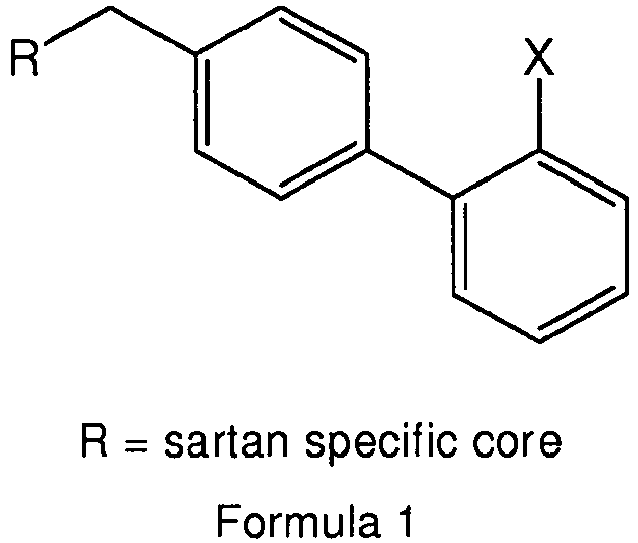
- Most of commercially available sartans contain biphenyl moiety substituted with 5-tetrazolyl or carboxy group on the position 2' (Formula 1, X is COOH or 5-tetrazolyl).
- Telmisartan or salt or ester thereof known from EP 502314 and which can be prepared in accordance with this invention is used as a pharmaceutical compound alone or in combination with pharmaceutically acceptable carrier for treatment of hypertension in human or animal and functions as angiotensin II antagonists.
- the object of the present invention is to provide industrially applicable, economical and acceptable process for obtaining telmisartan from cheap starting aromatic compounds.
- telmisartan or salt or ester thereof comprises introducing C-1 synthon on the position 2' of 3'-(2'-halo-biphenyl-4-ylmethyl)-1,7'-dimethyl-2'-propyl-1H,3'H-[2,5']bibenzoimidazolyl as specified in claim 1.
- Preferred embodiment of the invention is the reaction of catalyzed carbonylation of the 3'-(2'-halo-biphenyl-4-ylmethyl)-1,7'-dimethyl-2'-propyl-1H,3'H-[2,5']bibenzoimidazolyl (TLMH) using either gaseous carbon monoxide in a solvent mixture containing water; or formic acid salts optionally together with acetic acid in anhydrous solvent.
- TLMH 3'-(2'-halo-biphenyl-4-ylmethyl)-1,7'-dimethyl-2'-propyl-1H,3'H-[2,5']bibenzoimidazolyl
- a first aspect of the invention is a process for preparing telmisartan or salt or ester thereof, characterized in that TLMH is treated by carbon monoxide, wherein carbon monoxide can be in a gas state or formed in situ from formic acid or its salts.
- Compounds in the process react in the presence of a catalyst.
- Catalyst can be selected from transition metal or complex thereof, such as the metal selected from the group consisting of metal palladium, rhodium, nickel, cobalt or iron, or from complex of the said, such as for example the complex with a carbonyl or a phosphine ligand.
- the aforementioned process is exercised with the reaction set at the temperature of between 20°C to 180°C.
- Halo in the 2' position of the biphenyl part is selected from iodo, bromo or chloro.
- the invention is related to the process for obtaining telmisartan as specified, characterized in that TMLH is reacted with carbon monoxide in a mixture of aprotic solvent and water. Reactants can be left to react for 5 to 30 hours, particularly for 10 to 20, more particularly for 12 to 18 hours.
- the invention is related to the process for obtaining telmisartan as specified, characterized in that TMLH is carbonylated using lithium formate and optionally acetic anhydride or acetic anhydride, preferably acetic anhydride.
- the reactants react in anhydrous solvent. Preferably reactants react for 0.5 to 24 hours, particularly for 2 to 10, more particularly for 4 hours.
- the temperature at which the reactants react is of between 20°C to 180°C, particularly at 40°C to 120 °C, more particularly at 80 °C.
- Another aspect of the invention is use of the process according to any one of the above aspects for preparing telmisartan or salt or ester thereof.
- Another aspect of the invention is a process for obtaining a pharmaceutical composition and/or dosage form comprising preparing telmisartan according to the any process disclosed in the above aspects of the invention, and mixing it, optionally in combination with another active pharmaceutical ingredient, with pharmaceutical excipient.
- Additional aspect of the present invention is use of the process according to previous aspect for preparing a medicament.
- Possible embodiment of the invention is also use of a compound selected from 4'-bromomethyl-2-bromo-biphenyl, 4'-iodomethyl-2-iodo-biphenyl, 4'-iodomethyl-2-bromo-biphenyl, 4'-iodomethyl-2-chloro-biphenyl, 4'-chloromethyl-2-iodo-biphenyl, 4'-chloromethyl-2-bromobiphenyl, or 4'-chloromethyl-2-chloro-biphenyl, wherein said 4'-halomethyl-2-halo-biphenyl is reacted with 2-(1-propyl)-4-methyl-6-(1'-methylbenzimidazole-2-il)benzimidazole, for the synthesis of telmisartan or salt or ester thereof as specified above.
- Scheme 1 represents in first two steps the synthesis of 4'-halomethyl-2-halo-biphenyl.
- a process for obtaining 2'-halo-4-methylbiphenyl in which 1 to less than 2 eq. of 4-halotoluene is dissolved in an aprotic solvent, which may be selected from tetrahydrofuran, methyltetrahydrofuran, diethylether, diisopropylether, methyl tertiary butyl ether, dibutyl ether or diphenyl ether and the solution is maintained at about 15 °C to 80 °C, preferably at room temperature.
- 4-halotoluene can be selected from p-bromotoluene, p-chlorotoluene or p-iodotoluene.
- metal there is contemplated any embodiment capable of forming organometal intermediates such as, e. g. magnesium, lithium or zinc.
- 1,2-dihalobenzene dissolved in the said solvent dropwise at 15 °C to 80 °C, preferably at 50 to 60 °C during 1 min to 5 hours, such as during 2 hours and stirred at same temperature for 1 to 48 hours.
- Dihalobenzene can be selected from 1-bromo-2-chlorobenzene, 1-chloro-2-iodobenzene, 1-bromo-2-iodobenzene, 1,2-dibromobenzene, or 1,2-diiodobenzene.
- 4'-methyl-biphenyl-2-ylmetal halide in the said solvent 1 to 5 eq of elemental halogen is added at 15 °C to 80 °C, preferably at room temperature.
- 4'-methyl-biphenyl-2-ylmetal halide can be any appropriate organometal compound such as, e. g.
- halide may be iodide, bromide or chloride, preferably bromide.
- Elemental halogen is selected from iodine (I 2 ) or bromine (Br 2 ) or chlorine (Cl 2 ). The mixture is stirred for minimum 5 minutes. The remaining halogen is reduced with aqueous solution of NaHSO 3 or Na 2 S 2 O 3 .
- apolar solvent which may be selected from esters, ethers, chlorinated solvents and hydrocarbons preferably from aliphatic hydrocarbons such as n-hexane, n-pentane, n-heptane, cyclohexane, methylcyclohexane are added.
- the phases are separated and the organic phase is evaporated.
- the product is for example purified with LPLC chromatography.
- Mobile phase is n-hexane
- stationary phase is silica gel 60.
- the fractions are followed by TLC method and collected. The main fractions are evaporated to give 2-halo-4'methyl-biphenyl in yield off at least 60 %.
- 1.1 eq of 4-bromotoluene is dissolved in 5 to 7 times bigger volume of tetrahydrofuran and the solution is maintained at room temperature. 2.5 eq of Mg is added and stirred for at least 30 minutes. To thus prepared mixture one adds 1 eq of 1-bromo-2-chlorobenzene diluted by the same volume of tetrahydrofurane dropwise at 55 °C during 2 hours and stirred at same temperature for 1 to 3 hours. To the solution of thus obtained 4'-methyl-biphenyl-2-ylmagnesium bromide in tetrahydrofuran 1 eq of iodine (I 2 ) is added and the reaction is worked up as described above.
- I 2 iodine
- 2-halo-4'methyl-biphenyl is halogenated in dichloromethane yielding 4'-halomethyl-2-halo-biphenyl.
- Specific compounds thus prepared are 4'-bromomethyl-2-bromo-biphenyl, 4'-iodomethyl-2-iodo-biphenyl, 4'-iodomethyl-2-bromobiphenyl, 4'-iodomethyl-2-chloro-biphenyl, 4'-chloromethyl-2-iodo-biphenyl, 4'-chloromethyl-2-bromo-biphenyl, 4'-chloromethyl-2-chloro-biphenyl.
- Said 4'-halomethyl-2-halo-biphenyl can be reacted with 2-(1-propyl)-4-methyl-6-(1'-methylbenzimidazole-2-il)benzimidazole (PMB), to afford TLMH.
- the reaction mixture is stirred at the same temperature for additional 0 - 5 hours.
- 40 mL of demineralised water and 35 mL of ethyl acetate are added.
- the phases are separated.
- the EtOAc phase is washed several times with saturated water solution of NaCl.
- the solvent is evaporated and 4 mL mixture of EtOAc and acetone is added.
- the suspension is stirred for 15 minutes to 5 hours.
- the precipitate is filtered off and dried to give TLMH.
- telmisartan is prepared from the intermediate 3'-(2'-halo-biphenyl-4-ylmethyl)-1,7'-dimethyl-2'-propl-1H,3'H-[2,5']bibenzoimidazolyl (TLMH) by introducing C-1 synthon on the position 2' as specified above. It can be introduced in one step.
- telmisartan can be obtained by carbonylation of halo derivative TLMH preferably iodo derivative 3'-(2'-iodo-biphenyl-4-ylmethyl)-1,7'-dimethyl-2'-propyl-1 H,3'H-[2,5']bibenzoimidazolyl by reacting with carbon monoxide in the presence of a catalyst, such as transition metals.
- a catalyst such as transition metals.
- carbon monoxide is used as gas at pressure of 1 to 50 bar, particularly of 1 to 10 bar.
- carbon monoxide is generated in situ by using formic acid and its salts.
- Transition metals are preferably selected from nickel, cobalt or iron.
- the reaction can be performed in a solvent mixture containing water.
- the medium of the reaction is a mixture of aprotic solvent and water (wet solvent).
- Aprotic solvent can be selected from the group comprising tetrahydrofuran, methyltetrahydrofuran, dimethylformamide, toluene, dioxane, diisopropylether, methyl tertiary butyl ether, dibutyl ether, and diphenyl ether.
- phosphine ligands When using carbon monoxide as gas, phosphine ligands are used which can be selected from trialkyl phosphines (R 3 P), alkylarylphosphines (R 2 PAr or RPAr 2 ), triarylphosphines (Ar 3 P) or bis-phosphines (dppe, dppb, dppp, dppf).
- the reaction temperature is set at between 50°C to 180 °C, preferably at 80 °C to 150 °C, particularly at 100 °C.
- the medium of the reaction is preferably selected from the group comprising aromatic hydrocarbons and amides.
- Formic acid salts are salts of formic acid and alkali metal, which is for example lithium, sodium or potassium.
- the use of lithium formate optionally together in a mixture with acetic anhydride, palladium catalyst with optional addition of base selected from amines in an amide solvent such as N,N-dimethylformamide is most preferred.
- the reaction temperature when using formic acid salts is set at the temperature of between 20 °C to 180 °C, preferably at 40 °C to 120 °C, particularly at 80 °C.
- telmisartan or salt or ester thereof can be used for preparing pharmaceutical composition and/or dosage form.
- the aforementioned process of preparing telmisartan can comprise subsequent steps of mixing said telmisartan, optionally together with another active pharmaceutical ingredient, with pharmaceutical excipient.
- suitable pharmaceutical excipients are for example binders (e.g. polyvinylpyrrolidon), disintegrators (e.g. starch, cellulose derivatives), surfactants (e.g. sodium laurylsulphate), pH balancing agents (e.g. citric acid, sodium hydroxide, meglumine), fillers (e.g. mannitol, cellulose derivatives), vehicles (e.g.
- telmisartan water, glycerol, alcohol), flavors, colorants (e.g. titanium dioxide).
- telmisartan water, glycerol, alcohol, flavors, colorants (e.g. titanium dioxide).
- another active pharmaceutical ingredient can be hydrochlorothiazide, amlodipine or ramipril.
- the technology used for preparing pharmaceutical formulations and/or dosage forms can be any one known to the person skilled in the pharmaceutical technology.
- Telmisartan, excipients and optionally another active pharmaceutical ingredient can be simply mixed as powders or dissolved in a suitable solvent.
- Granulation techniques can be applied to improve the handling properties of said formulation. Dry granulation with compacting or briquetting can be undertaken to prime the granulation mass for tabletting. Similarly, wet granulation with adding or spraying granulation liquid onto particles, powders or already dry granules of compounds can be used to aid formulation of the compounds in the dosage form.
- Granulation techniques can be used to improve flowability, compressibility, especially when the mass is intended to be used for tabletting. Granulation can also reduce dusting and can determine the dissolution properties. Such properties are desired not only with tablets but also in capsules.
- dosage forms can be in a form of tablets, capsules, pellets, granules, powders, solutions, or the like, wherein solid dosage forms can further be coated or layered.
- Apparatus such as mixer, tabletting machine, extrudor, granulator can be used in preparing the pharmaceutical composition and/or dosage form.
- the pharmaceutical composition and/or dosage form can be used for preparing a medicament, meaning that said process of preparing pharmaceutical composition and/or dosage form is expanded to embrace necessary steps for preparing a medicament. Said steps can include determination of the right amount of active pharmaceutical ingredient in the pharmaceutical composition and/or dosage form, packaging, or combining the pharmaceutical composition and/or dosage form with a product leaflet.
- the prepared solution of 2-magnesium bromide-4'-methyl-biphenyl is cooled to room temperature, and 20 mL of tetrahydrofuran with further 12.3 g (48,7 mmol) of iodine (I 2 ) are added. The mixture is agitated for minimum 5 minutes. The remaining iodine in neutralised with aqueous solution of NaHSO 3 . 70 mL of demineralised water and 50 mL of n-hexane are added. The phases are separated and the upper (n-hexane) phase is evaporated. The 15.6 g of yellowish liquid is obtained.
- Example 4 Synthesis of telmisartan from 3'-(2'-iodo-biphenyl-4-ylmethyl)-1,7'-dimethyl-2'-propyl-1 H,3'H-[2,5']bibenzoimidazolyl by Pd catalyzed hydroxycarbonylation using gaseous carbon monoxide
- Reactor was flushed three times with carbon monoxide (CO), pressure was adjusted to 5 bar and reactor was heated for 16 h at 100°C. After cooled down to room temperature, the reaction was filtrate on Celite ⁇ (diatomaceous earth) and concentrated. Mixture of oily consistency was diluted using NaOH 1 N solution and methyl t-butyl ether (MTBE). Phases were separated and organic phase was extracted once again with NaOH 1 N solution. Combined aqueous phases were washed twice with MTBE. The pH of the water phase was acidified until pH 3 using 1 N HCl and precipitated telmisartan was filtered off. The cake was washed with water.
- CO carbon monoxide
- Example 5 Synthesis of telmisartan from 3'-(2'-iodo-biphenyl-4-ylmethyl)-1,7'-dimethyl-2'-propyl-1H,3'H-[2,5']bibenzoimidazolyl by Pd catalyzed hydroxycarbonylation using lithium formate
Landscapes
- Chemical & Material Sciences (AREA)
- Organic Chemistry (AREA)
- Chemical Kinetics & Catalysis (AREA)
- Health & Medical Sciences (AREA)
- Life Sciences & Earth Sciences (AREA)
- Cardiology (AREA)
- Heart & Thoracic Surgery (AREA)
- General Chemical & Material Sciences (AREA)
- Medicinal Chemistry (AREA)
- Nuclear Medicine, Radiotherapy & Molecular Imaging (AREA)
- Animal Behavior & Ethology (AREA)
- Bioinformatics & Cheminformatics (AREA)
- Pharmacology & Pharmacy (AREA)
- Engineering & Computer Science (AREA)
- General Health & Medical Sciences (AREA)
- Public Health (AREA)
- Veterinary Medicine (AREA)
- Organic Low-Molecular-Weight Compounds And Preparation Thereof (AREA)
- Low-Molecular Organic Synthesis Reactions Using Catalysts (AREA)
- Plural Heterocyclic Compounds (AREA)
- Pharmaceuticals Containing Other Organic And Inorganic Compounds (AREA)
- Indole Compounds (AREA)
- Catalysts (AREA)
Description
- The present invention relates in general to the field of organic chemistry and in particular to the synthesis of halogenated biaryl starting material via Grignard chemistry and the use thereof. The invention further relates to catalyzed carbonylation of the 3'-(2'-halo-biphenyl-4-ylmethyl)-1,7'-dimethyl-2'-propyl-1H,3'H-[2,5']bibenzoimidazolyl, in particular to use of the said process in preparation of telmisartan or salt or ester thereof.
- Angiotensin II antagonists ("sartans") are efficient active compounds with biological activity which has proved useful for the treatment of hypertension. Most of commercially available sartans contain biphenyl moiety substituted with 5-tetrazolyl or carboxy group on the position 2' (Formula 1, X is COOH or 5-tetrazolyl).
- Telmisartan or salt or ester thereof (TLM, Formula 2) known from
EP 502314 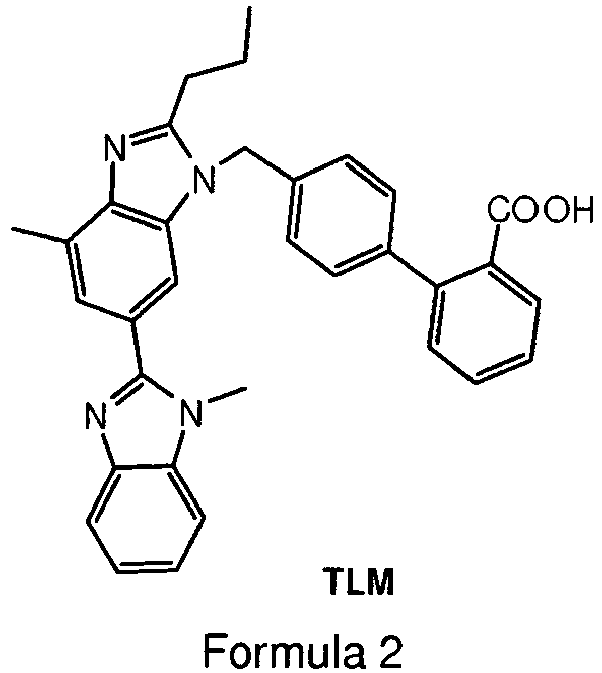
- 2'-halo-4-methylbiphenyls (Formula 3, X = Cl, Br, I) are potential starting materials for the synthesis of biphenyl type sartans but they have not found an application in industry due to inefficient or expensive synthesis. Known procedures use Suzuki and Heck couplings which need for industry unfriendly boron and tin compounds, Ullmann reaction (Chem. Rev. 2002, 102, 1359-1469) give low yields and coupling of Grignard intermediates require significant amounts of starting materials (Org. Lett. 2000, 2, 3675-3677). The later reaction was exercised using 1,2-dihalobenzene, 4-halotoluene in the presence of magnesium and iodine for quenching the Grignard intermediate wherein 1,2-dihalobenzene, 4-halotoluene and iodine were used in the ratio of 1:2:3, which is not economically favorable for industrial application.

- There is a need for efficient synthesis of biphenyl class of sartans especially for carboxy group containing derivatives such as telmisartan.
- The object of the present invention is to provide industrially applicable, economical and acceptable process for obtaining telmisartan from cheap starting aromatic compounds.
- The object is solved by the process according to claim 1. Preferred embodiments are set forth in subclaims. Further provided are a process according to claim 11 and a use according to claim 12.
- Disclosed is the efficient synthesis of halogenated biaryl starting material via Grignard chemistry. The preparing of telmisartan or salt or ester thereof comprises introducing C-1 synthon on the position 2' of 3'-(2'-halo-biphenyl-4-ylmethyl)-1,7'-dimethyl-2'-propyl-1H,3'H-[2,5']bibenzoimidazolyl as specified in claim 1. Preferred embodiment of the invention is the reaction of catalyzed carbonylation of the 3'-(2'-halo-biphenyl-4-ylmethyl)-1,7'-dimethyl-2'-propyl-1H,3'H-[2,5']bibenzoimidazolyl (TLMH) using either gaseous carbon monoxide in a solvent mixture containing water; or formic acid salts optionally together with acetic acid in anhydrous solvent.
- In a first aspect of the invention is a process for preparing telmisartan or salt or ester thereof, characterized in that TLMH is treated by carbon monoxide, wherein carbon monoxide can be in a gas state or formed in situ from formic acid or its salts. Compounds in the process react in the presence of a catalyst. Catalyst can be selected from transition metal or complex thereof, such as the metal selected from the group consisting of metal palladium, rhodium, nickel, cobalt or iron, or from complex of the said, such as for example the complex with a carbonyl or a phosphine ligand. The aforementioned process is exercised with the reaction set at the temperature of between 20°C to 180°C. Halo in the 2' position of the biphenyl part is selected from iodo, bromo or chloro.
- Particularly the invention is related to the process for obtaining telmisartan as specified, characterized in that TMLH is reacted with carbon monoxide in a mixture of aprotic solvent and water. Reactants can be left to react for 5 to 30 hours, particularly for 10 to 20, more particularly for 12 to 18 hours.
- Similarly the invention is related to the process for obtaining telmisartan as specified, characterized in that TMLH is carbonylated using lithium formate and optionally acetic anhydride or acetic anhydride, preferably acetic anhydride. The reactants react in anhydrous solvent. Preferably reactants react for 0.5 to 24 hours, particularly for 2 to 10, more particularly for 4 hours. The temperature at which the reactants react is of between 20°C to 180°C, particularly at 40°C to 120 °C, more particularly at 80 °C.
- Another aspect of the invention is use of the process according to any one of the above aspects for preparing telmisartan or salt or ester thereof.
- Another aspect of the invention is a process for obtaining a pharmaceutical composition and/or dosage form comprising preparing telmisartan according to the any process disclosed in the above aspects of the invention, and mixing it, optionally in combination with another active pharmaceutical ingredient, with pharmaceutical excipient.
- Additional aspect of the present invention is use of the process according to previous aspect for preparing a medicament.
- Possible embodiment of the invention is also use of a compound selected from 4'-bromomethyl-2-bromo-biphenyl, 4'-iodomethyl-2-iodo-biphenyl, 4'-iodomethyl-2-bromo-biphenyl, 4'-iodomethyl-2-chloro-biphenyl, 4'-chloromethyl-2-iodo-biphenyl, 4'-chloromethyl-2-bromobiphenyl, or 4'-chloromethyl-2-chloro-biphenyl, wherein said 4'-halomethyl-2-halo-biphenyl is reacted with 2-(1-propyl)-4-methyl-6-(1'-methylbenzimidazole-2-il)benzimidazole, for the synthesis of telmisartan or salt or ester thereof as specified above.
- Surprisingly it has been found that 2'-halo-4-methylbiphenyls can be obtained in a simple one-pot two-step technical process, in yields that are industrially applicable and competitive in which a 4-halotoluene is reacted with a 1,2-dihalobenzene in the presence of elemental metal, wherein less than 1 molar excess of 4-halotoluene in regard to 1,2-dihalobenzene is used, that for each mol of 1,2-dihalobenzene, from 1.0 to 1.9 mol, particularly 1.0 to 1.2 mol 4-halotoluene is used, particularly from 1.05 to 1.15 mol, and arisen organometal intermediates are quenched by elemental halogen. Proportionally for each 1 mol of 1,2-dihalobenzene used in the reaction less than 3 mol, particularly less than 2.9 mol; preferably from 1 to 2 mol, more preferably 1 mol of elemental halogen is used to quench the organometal intermediate.
- Scheme 1 represents in first two steps the synthesis of 4'-halomethyl-2-halo-biphenyl.
- Disclosed is a process for obtaining 2'-halo-4-methylbiphenyl in which 1 to less than 2 eq. of 4-halotoluene is dissolved in an aprotic solvent, which may be selected from tetrahydrofuran, methyltetrahydrofuran, diethylether, diisopropylether, methyl tertiary butyl ether, dibutyl ether or diphenyl ether and the solution is maintained at about 15 °C to 80 °C, preferably at room temperature. 4-halotoluene can be selected from p-bromotoluene, p-chlorotoluene or p-iodotoluene. 2 to 5 eq of metal is added and stirred for about 5 to 180 minutes. By the term metal there is contemplated any embodiment capable of forming organometal intermediates such as, e. g. magnesium, lithium or zinc. To thus prepared mixture one adds 1 eq. of 1,2-dihalobenzene dissolved in the said solvent dropwise at 15 °C to 80 °C, preferably at 50 to 60 °C during 1 min to 5 hours, such as during 2 hours and stirred at same temperature for 1 to 48 hours. Dihalobenzene can be selected from 1-bromo-2-chlorobenzene, 1-chloro-2-iodobenzene, 1-bromo-2-iodobenzene, 1,2-dibromobenzene, or 1,2-diiodobenzene. To the solution of thus obtained 4'-methyl-biphenyl-2-ylmetal halide in the said solvent 1 to 5 eq of elemental halogen is added at 15 °C to 80 °C, preferably at room temperature. 4'-methyl-biphenyl-2-ylmetal halide can be any appropriate organometal compound such as, e. g. 4'-methyl-biphenyl-2-ylmagnesium halide, wherein halide may be iodide, bromide or chloride, preferably bromide. Elemental halogen is selected from iodine (I2) or bromine (Br2) or chlorine (Cl2). The mixture is stirred for minimum 5 minutes. The remaining halogen is reduced with aqueous solution of NaHSO3 or Na2S2O3. After work-up with water and an apolar solvent which may be selected from esters, ethers, chlorinated solvents and hydrocarbons preferably from aliphatic hydrocarbons such as n-hexane, n-pentane, n-heptane, cyclohexane, methylcyclohexane are added. The phases are separated and the organic phase is evaporated. The product is for example purified with LPLC chromatography. Mobile phase is n-hexane, stationary phase is silica gel 60. The fractions are followed by TLC method and collected. The main fractions are evaporated to give 2-halo-4'methyl-biphenyl in yield off at least 60 %.
- In a more specific but preferred example 1.1 eq of 4-bromotoluene is dissolved in 5 to 7 times bigger volume of tetrahydrofuran and the solution is maintained at room temperature. 2.5 eq of Mg is added and stirred for at least 30 minutes. To thus prepared mixture one adds 1 eq of 1-bromo-2-chlorobenzene diluted by the same volume of tetrahydrofurane dropwise at 55 °C during 2 hours and stirred at same temperature for 1 to 3 hours. To the solution of thus obtained 4'-methyl-biphenyl-2-ylmagnesium bromide in tetrahydrofuran 1 eq of iodine (I2) is added and the reaction is worked up as described above.
- The employment of excess of only 0.1 eq of 4-halotoluene dramatically improves the yield, which exceeds in this specific example 60 %. Furthermore, only 1 eq of halogen was sufficient to quench the reaction, which lasts 3 hours at most. The procedure is a great improvement of known literature procedures (Org. Lett. 2000, 2, 3675-3677) which takes 14 hours to react and uses over two times excess of 4-halotoluene and three times excess of halogen to achieve comparable yields.
- In additional reactions obtained 2-halo-4'methyl-biphenyl is halogenated in dichloromethane yielding 4'-halomethyl-2-halo-biphenyl. Specific compounds thus prepared are 4'-bromomethyl-2-bromo-biphenyl, 4'-iodomethyl-2-iodo-biphenyl, 4'-iodomethyl-2-bromobiphenyl, 4'-iodomethyl-2-chloro-biphenyl, 4'-chloromethyl-2-iodo-biphenyl, 4'-chloromethyl-2-bromo-biphenyl, 4'-chloromethyl-2-chloro-biphenyl. Said 4'-halomethyl-2-halo-biphenyl can be reacted with 2-(1-propyl)-4-methyl-6-(1'-methylbenzimidazole-2-il)benzimidazole (PMB), to afford TLMH.
- As presented in the second part of the Scheme 1 2-halo'-bromomethyl-biphenyl and 2-(1-propyl)-4-methyl-6-(1'-methylbenzimidazole-2-il)benzimidazole (PMB) are coupled, which is performed but not limited as follows: 10 - 25 mL of sulfolane (tetramethylene sulfone) or N,N-dimethylacetamide or N-methyl-2-pyrrolidone or dimethyl sulfoxide is charged to the flask. 0.85 g of 2-(1-propyl)-4-methyl-6-(1'-methylbenzimidazole-2-yl)benzimidazole and 0.38 g of strong base such as KtBuO or appropriate amount of NaOH, KOH, LiOH, Na2CO3, K2CO3, NaHCO3, KHCO3 are added. The mixture is brought to the temperature of about 25 °C - 45 °C to dissolve all the components. The solution is then brought to the temperature of about 5 °C to 25 °C and from 1 to 1.2 equivalents of 2-halo-4'-bromomethyl-biphenyl in 5 to 20 mL of solvent is added during 0.5 - 5 hours. The reaction mixture is stirred at the same temperature for additional 0 - 5 hours. 40 mL of demineralised water and 35 mL of ethyl acetate are added. The phases are separated. The EtOAc phase is washed several times with saturated water solution of NaCl. The solvent is evaporated and 4 mL mixture of EtOAc and acetone is added. The suspension is stirred for 15 minutes to 5 hours. The precipitate is filtered off and dried to give TLMH.

- In accordance with the invention telmisartan is prepared from the intermediate 3'-(2'-halo-biphenyl-4-ylmethyl)-1,7'-dimethyl-2'-propl-1H,3'H-[2,5']bibenzoimidazolyl (TLMH) by introducing C-1 synthon on the position 2' as specified above. It can be introduced in one step.
- As presented in Scheme 2 telmisartan can be obtained by carbonylation of halo derivative TLMH preferably iodo derivative 3'-(2'-iodo-biphenyl-4-ylmethyl)-1,7'-dimethyl-2'-propyl-1 H,3'H-[2,5']bibenzoimidazolyl by reacting with carbon monoxide in the presence of a catalyst, such as transition metals. In one aspect carbon monoxide is used as gas at pressure of 1 to 50 bar, particularly of 1 to 10 bar. In an alternative aspect carbon monoxide is generated in situ by using formic acid and its salts. Transition metals are preferably selected from nickel, cobalt or iron. Preferably they are used in the form of metal carbonyls in the presence of bases selected from hydroxides, hydrides, alkoxides and amines. In addition, the transition metals can be selected from precious metals such as rhodium and palladium, more preferably palladium and preferably in the form of palladium(II) acetate. When using carbon monoxide as gas, the reaction can be performed in a solvent mixture containing water. Preferably the medium of the reaction is a mixture of aprotic solvent and water (wet solvent). Aprotic solvent can be selected from the group comprising tetrahydrofuran, methyltetrahydrofuran, dimethylformamide, toluene, dioxane, diisopropylether, methyl tertiary butyl ether, dibutyl ether, and diphenyl ether. When using carbon monoxide as gas, phosphine ligands are used which can be selected from trialkyl phosphines (R3P), alkylarylphosphines (R2PAr or RPAr2), triarylphosphines (Ar3P) or bis-phosphines (dppe, dppb, dppp, dppf).The reaction temperature is set at between 50°C to 180 °C, preferably at 80 °C to 150 °C, particularly at 100 °C. In case of using formic acid or its salts, the medium of the reaction is preferably selected from the group comprising aromatic hydrocarbons and amides. Formic acid salts are salts of formic acid and alkali metal, which is for example lithium, sodium or potassium. In particular, the use of lithium formate optionally together in a mixture with acetic anhydride, palladium catalyst with optional addition of base selected from amines in an amide solvent such as N,N-dimethylformamide is most preferred. The reaction temperature when using formic acid salts is set at the temperature of between 20 °C to 180 °C, preferably at 40 °C to 120 °C, particularly at 80 °C.

- Thus obtained telmisartan or salt or ester thereof can be used for preparing pharmaceutical composition and/or dosage form. The aforementioned process of preparing telmisartan can comprise subsequent steps of mixing said telmisartan, optionally together with another active pharmaceutical ingredient, with pharmaceutical excipient. Suitable pharmaceutical excipients are for example binders (e.g. polyvinylpyrrolidon), disintegrators (e.g. starch, cellulose derivatives), surfactants (e.g. sodium laurylsulphate), pH balancing agents (e.g. citric acid, sodium hydroxide, meglumine), fillers (e.g. mannitol, cellulose derivatives), vehicles (e.g. water, glycerol, alcohol), flavors, colorants (e.g. titanium dioxide). The reason for introducing additional active pharmaceutical ingredient into pharmaceutical composition and/or dosage form together with telmisartan is to achieve synergistic effect of both active pharmaceutical ingredients, or having a goal of addressing two indications simultaneously, or to reduce side effects of the first active pharmaceutical ingredient with the simultaneous or consecutive application of the second active pharmaceutical ingredient, or the like. For example, another active pharmaceutical ingredient can be hydrochlorothiazide, amlodipine or ramipril. The technology used for preparing pharmaceutical formulations and/or dosage forms can be any one known to the person skilled in the pharmaceutical technology. Telmisartan, excipients and optionally another active pharmaceutical ingredient can be simply mixed as powders or dissolved in a suitable solvent. Granulation techniques can be applied to improve the handling properties of said formulation. Dry granulation with compacting or briquetting can be undertaken to prime the granulation mass for tabletting. Similarly, wet granulation with adding or spraying granulation liquid onto particles, powders or already dry granules of compounds can be used to aid formulation of the compounds in the dosage form. Granulation techniques can be used to improve flowability, compressibility, especially when the mass is intended to be used for tabletting. Granulation can also reduce dusting and can determine the dissolution properties. Such properties are desired not only with tablets but also in capsules. It is known, that dosage forms can be in a form of tablets, capsules, pellets, granules, powders, solutions, or the like, wherein solid dosage forms can further be coated or layered. Apparatus such as mixer, tabletting machine, extrudor, granulator can be used in preparing the pharmaceutical composition and/or dosage form. The pharmaceutical composition and/or dosage form can be used for preparing a medicament, meaning that said process of preparing pharmaceutical composition and/or dosage form is expanded to embrace necessary steps for preparing a medicament. Said steps can include determination of the right amount of active pharmaceutical ingredient in the pharmaceutical composition and/or dosage form, packaging, or combining the pharmaceutical composition and/or dosage form with a product leaflet.
- The following examples are merely illustrative of the present invention and they should not be considered as limiting the scope of the invention in any way.
-

- 60 mL of tetrahydrofuran is charged to the flask. 9 g (52.6 mmol) of p-bromotoluene is added and the solution is maintained at 20°C. 3.0 g (125 mmol) of Mg is added and stirred for minimal 30 minutes.
- 9.3 g (48.7 mmol) of 1-bromo-2-chlorobenzene in 5 mL of THF is added into the prepared reaction mixture of p-toluyl magnesium bromide and remaining magnesium at 55 °C in 2 hours and stirred at 55 °C for 2 hours.
- The prepared solution of 2-magnesium bromide-4'-methyl-biphenyl is cooled to room temperature, and 20 mL of tetrahydrofuran with further 12.3 g (48,7 mmol) of iodine (I2) are added. The mixture is agitated for minimum 5 minutes. The remaining iodine in neutralised with aqueous solution of NaHSO3. 70 mL of demineralised water and 50 mL of n-hexane are added. The phases are separated and the upper (n-hexane) phase is evaporated. The 15.6 g of yellowish liquid is obtained.
- The product is purified with LPLC chromatography. Mobile phase is n-hexane, stationary phase is silicagel 60. The fractions are collected. The main fractions are evaporated. 8.6 g (60 %) of 2-iodo-4'methyl-biphenyl (colourless liquid) is obtained.
1H NMR (300 MHz, CDCl3) δ: 2.56 (s, 3H), 7.13 (dt, J = 7.5 Hz, J = 2.0 Hz, 1 H), 7.39 (s, 4H), 7.44 (dd, J = 7.6 Hz, J = 1.9 Hz, 1 H), 7.47 - 7.52 (m, 1 H), 8.09 (dd, J = 7.9 Hz, J = 1.0 Hz, 1 H). 13C NMR (75 MHz, CDCl3) δ: 146.4, 141.2, 139.3, 137.1, 130.0, 129.0, 128.5, 128.5, 128.0, 98.8, 21.2. -

- 20 mL of dichloromethane (DCM) is charged to the flask. 0.73 g of N-bromosuccinimide (NBS), 0.08 g of 2,2'-azoisobutyronitrile (AIBN), 18 µL of Br2 and 0.9 g of 2-iodo-4'-methyl-biphenyl are added. The reaction is carried out under reflux temperature for minimum 2 hours and the flask is lighted all the time. The reaction is quenched with aqueous solution of Na2S2O3. The phases are separated and the lower DCM phase is washed with demineralised water one more time. The DCM phase is evaporated and 4 mL of n-hexane is charged and stirred at room temperature for 30 minutes. The suspension is then cooled to 0 °C and filtered. The cake is washed with 2 mL of solvent. 0.6 g of white crystals of 4'-bromomethyl-2-iodo-biphenyl is obtained.
1H NMR (300 MHz, CDCl3) δ: 4.58 (s, 2H), 7.06 (dt, J = 7.6 Hz, J = 1.8 Hz, 1 H), 7.31 (dd, J = 7.7 Hz, J = 1.8 Hz, 1H), 7.35 (d, J = 8.2 Hz, 2H), 7.40 (dt, J = 7.4 Hz, J = 1.2 Hz, 1 H), 7.48 (d, J = 8.2 Hz, 2H), 7.98 (dd, J = 7.9 Hz, J = 1.1 Hz, 1 H). 13C NMR (75 MHz, CDCl3) δ: 145.8, 144.1, 139.5, 137.0, 130.0, 129.6, 128.9, 128.6, 128.1, 98.3, 33.2. -

- 15 mL of sulfolane (tetramethylene sulfone) is charged to the flask. 0.85 g of PMB (2-(1-propyl)-4-methyl-6-(1'-methylbenzimidazole-2-il)benzimidazole) and 0.38 g of potassium tert-butoxide are added. The mixture is heated above 30 °C to dissolve all the components. The solution is than cooled down to 15 °C and 1.07 g of 4'-bromomethyl-2-iodo-biphenyl in 5 mL of solvent is added slowly during 45 minutes. The reaction mixture is stirred at the same temperature for additional 2 hours. 40 mL of demineralised water and 35 mL of EtOAc (ethyl acetate) are added. The phases are separated. The upper EtOAc phase is washed several times with saturated water solution of NaCl. The solvent is evaporated and 4 mL mixture of EtOAc and acetone is added. The suspension is stirred for 30 minutes at room temperature. The suspension is filtered and 0.94 g of white crystals of 3'-(2'-iodo-biphenyl-4-ylmethyl)-1,7'-dimethyl-2'-propyl-1H,3'H-[2,5']bibenzimidazolyl are obtained.
1H NMR (300 MHz, CDCl3) δ: 1.06 (t, J = 7.4 Hz, 3H), 1.84 - 1.92 (m, 2H), 2.95 (t, J = 7.8 Hz, 2H), 3.81 (s, 3H), 5.46 (s, 2H), 7.03 (ddd, J = 7.9 Hz, J = 7.4 Hz, J = 1.8 Hz, 1 H), 7.13 (d, J = 8.0 Hz, 2H), 7.23 - 7.54 (m, 9H), 7.77 - 7.83 (m, 1 H), 7.94 (dd, J = 7.9 Hz, J = 1.1 Hz, 1 H). -

- 3'-(2'-iodo-biphenyl-4-ylmethyl)-1,7'-dimethyl-2'-propyl-1H,3'H-[2,5']bibenzoimidazolyl (1 g, 1,68 mmol) was dissolved in 10:1 mixture of tetrahydrofuran (THF) and water (17 mL) and was charged in pressure reactor. Tetramethylethylenediamine (TMEDA; 0,32 mL, 1,25 eq), Pd(OAc)2 (4 mg, 0,01 eq) and cataCXium A® (n-butyldiadamantylphosphine, 18 mg, 0,03 eq) were added. Reactor was flushed three times with carbon monoxide (CO), pressure was adjusted to 5 bar and reactor was heated for 16 h at 100°C. After cooled down to room temperature, the reaction was filtrate on Celite© (diatomaceous earth) and concentrated. Mixture of oily consistency was diluted using NaOH 1 N solution and methyl t-butyl ether (MTBE). Phases were separated and organic phase was extracted once again with NaOH 1 N solution. Combined aqueous phases were washed twice with MTBE. The pH of the water phase was acidified until pH 3 using 1 N HCl and precipitated telmisartan was filtered off. The cake was washed with water. Crude telmisartan (2-[4-[[4-methyl-6-(1-methylbenzoimidazol-2-yl)-2-propyl-benzoimidazol-1-yl]methyl]phenyl]benzoic acid) was obtained.
-
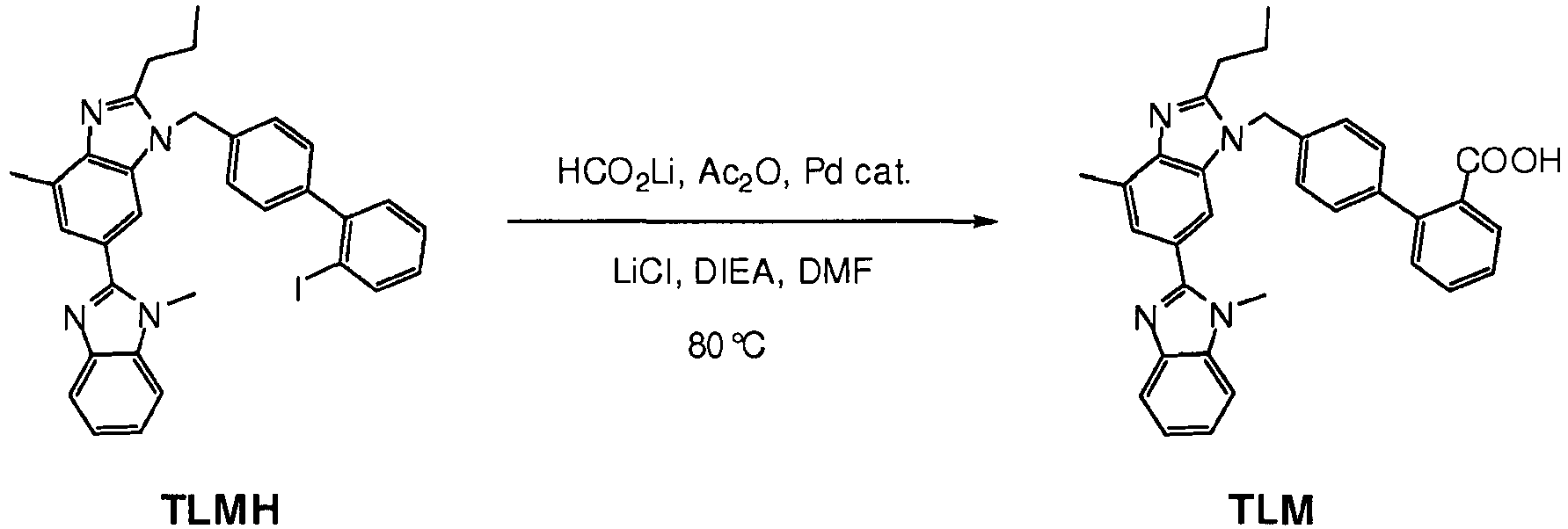
- A solution of lithium formate (262 mg, 3 eq), diisopropylethylamine (DIEA; 0,58 mL, 2 eq), acetic anhydride (0,32 mL, 2 eq) in anhydrous dimethylformamide (DMF; 2 mL) was stirred at room temperature for 1 hour. Then, 3'-(2'-iodo-biphenyl-4-ylmethyl)-1,7'-dimethyl-2'-propyl-1H,3'H-[2,5'] bibenzoimidazolyl (1 g, 1,68 mmol), Pd2(dba)3 (38 mg, 0.025 eq, dba is dibenzylideneacetone), LiCl (211 mg, 3 eq) in anhydrous DMF (4 mL) were added. The reaction mixture was stirred at 80 °C for 3 h, filtered and after cooling poured into 1.2 mL of water, stirred for 15 minutes, product filtered, washed with water and dried in vacuo to yield telmisartan.
1H-NMR (CDCl3): δ 1,19 (t, 3H, J = 7,3 Hz), 2,04 (m, 2H, J = 7,6 Hz), 2,76 (s, 3H), 3.27 (t, 2H, J = 7,5 Hz), 3,79 (s, 3H), 5,48 (s, 2H), 7,10-8,41 (m, 14H).
(M+H)+ = 515.
Claims (14)
- A process for preparing telmisartan or salt or ester thereof characterized in that 3'-(2'-halo-biphenyl-4-ylmethyl)-1,7'-dimethyl-2'-propyl-1H,3'H-[2,5']bibenzoimidazolyl is treated by carbon monoxide in the presence of a catalyst.
- The process according to the Claim 1, characterized in that carbon monoxide is in a gas state or formed in situ from formic acid or its salts.
- The process according to any one of claims 1 or 2, where the catalyst is a transition metal or complex thereof.
- The process according to any one of claims 1 to 3, wherein the catalyst is selected from the group consisting of metal palladium, rhodium, nickel, cobalt, and iron, or the complex thereof with a carbonyl or a phosphine ligand.
- The process according to any one of claims 1 to 4, where the reaction is set at the temperature of between 20°C to 180°C, preferably between 50°C to 180°C, particularly at 80°C to 150°C, more particularly at 100°C.
- The process according to any one of claims 1 to 5, wherein the 3'-(2'-halo-biphenyl-4-ylmethyl)-1,7'-dimethyl-2'-propyl-1H,3'H-[2,5']bibenzoimidazolyl is reacted with gaseous carbon monoxide in a solvent mixture containing water.
- The process according to any one of claims 1 to 6, wherein the 3'-(2'-halo-biphenyl-4-ylmethyl)-1,7'-dimethyl-2'-propyl-1H,3'H-[2,5']bibenzoimidazolyl and carbon monoxide are left to react for 5 to 30 hours, particularly for 10 to 20, more particularly for 12 to 18 hours.
- The process according to any one of claims 1 to 4, wherein 3'-(2'-halo-biphenyl-4-ylmethyl)-1,7'-dimethyl-2'-propyl-1H,3'H-[2,5']bibenzoimidazolyl is carbonylated using lithium formate and optionally acetic anhydride.
- The process according to claim 8, wherein reactants react in anhydrous solvent.
- The process according to any one of claims 8 or 9, wherein reactants react for 0.5 to 24 hours.
- A process for obtaining a pharmaceutical composition and/or dosage form comprising preparing telmisartan according to any one of claims 1 to 10, and mixing it, optionally in combination with another active pharmaceutical ingredient, with pharmaceutical excipient.
- Use of the process according to any one of claims 1 to 10 for preparing telmisartan or salt or ester thereof.
- Use of the process according to claim 11 for preparing a medicament.
- The process according to any one of claims 1 to 10, wherein compound selected from 4'-bromomethyl-2-bromo-biphenyl, 4'-iodomethyl-2-iodo-biphenyl, 4'-iodomethyl-2-bromo-biphenyl, 4'-iodomethyl-2-chloro-biphenyl, 4'-chloromethyl-2-iodo-biphenyl, 4'-chloromethyl-2-bromo-biphenyl, or 4'-chloromethyl-2-chloro-biphenyl is used for the synthesis of 3'-(2'-halo-biphenyl-4-ylmethyl)-1,7'-dimethyl-2'-propyl-1H,3'H-[2,5']bibenzoimidazolyl, wherein said 4'-halomethyl-2-halo-biphenyl is reacted with 2-(1-propyl)-4-methyl-6-(1'-methylbenzimidazole-2-il)benzimidazole.
Priority Applications (1)
| Application Number | Priority Date | Filing Date | Title |
|---|---|---|---|
| EP09721867.1A EP2279185B1 (en) | 2008-03-20 | 2009-03-19 | Catalyzed carbonylation in the synthesis of angiotensin ii antagonists |
Applications Claiming Priority (4)
| Application Number | Priority Date | Filing Date | Title |
|---|---|---|---|
| EP08153085A EP2103609A1 (en) | 2008-03-20 | 2008-03-20 | Catalyzed carbonylation in the synthesis of angiotensin ii antagonists |
| EP08153084A EP2103588A1 (en) | 2008-03-20 | 2008-03-20 | 2'-Halobiphenyl-4-yl intermediates in the synthesis of angiotensin II antagonists |
| EP09721867.1A EP2279185B1 (en) | 2008-03-20 | 2009-03-19 | Catalyzed carbonylation in the synthesis of angiotensin ii antagonists |
| PCT/EP2009/053269 WO2009115585A1 (en) | 2008-03-20 | 2009-03-19 | Catalyzed carbonylation in the synthesis of angiotensin ii antagonists |
Publications (2)
| Publication Number | Publication Date |
|---|---|
| EP2279185A1 EP2279185A1 (en) | 2011-02-02 |
| EP2279185B1 true EP2279185B1 (en) | 2014-01-15 |
Family
ID=40647168
Family Applications (2)
| Application Number | Title | Priority Date | Filing Date |
|---|---|---|---|
| EP09721867.1A Not-in-force EP2279185B1 (en) | 2008-03-20 | 2009-03-19 | Catalyzed carbonylation in the synthesis of angiotensin ii antagonists |
| EP09723165.8A Not-in-force EP2279159B1 (en) | 2008-03-20 | 2009-03-19 | 2'-halobiphenyl-4-yl intermediates in the synthesis of angiotensin ii antagonists |
Family Applications After (1)
| Application Number | Title | Priority Date | Filing Date |
|---|---|---|---|
| EP09723165.8A Not-in-force EP2279159B1 (en) | 2008-03-20 | 2009-03-19 | 2'-halobiphenyl-4-yl intermediates in the synthesis of angiotensin ii antagonists |
Country Status (10)
| Country | Link |
|---|---|
| US (2) | US8445693B2 (en) |
| EP (2) | EP2279185B1 (en) |
| JP (2) | JP5764055B2 (en) |
| CN (2) | CN102036937B (en) |
| CA (2) | CA2719068C (en) |
| ES (1) | ES2450370T3 (en) |
| PL (1) | PL2279159T3 (en) |
| PT (1) | PT2279159E (en) |
| SI (1) | SI2279159T1 (en) |
| WO (2) | WO2009115585A1 (en) |
Families Citing this family (6)
| Publication number | Priority date | Publication date | Assignee | Title |
|---|---|---|---|---|
| PL2279159T3 (en) * | 2008-03-20 | 2014-05-30 | Lek Pharmaceuticals | 2'-halobiphenyl-4-yl intermediates in the synthesis of angiotensin ii antagonists |
| JP5711888B2 (en) * | 2010-01-26 | 2015-05-07 | 株式会社Dnpファインケミカル宇都宮 | Method for producing telmisartan alkyl ester |
| WO2012055941A1 (en) | 2010-10-27 | 2012-05-03 | Krka,Tovarna Zdravil, D. D., Novo Mesto | Multilayer pharmaceutical composition comprising telmisartan and amlodipine |
| CN103333204B (en) * | 2013-07-12 | 2016-01-20 | 河南省科学院化学研究所有限公司 | One class 9, the synthetic method of 9 '-spirobifluorene derivative |
| EP3196183B1 (en) * | 2014-09-19 | 2019-05-01 | Toray Fine Chemicals Co., Ltd. | Method for producing 2'-trifluoromethyl group-substituted aromatic ketone |
| CN114436833B (en) * | 2021-12-27 | 2024-12-24 | 南京红太阳医药研究院有限公司 | A method for preparing telmisartan key intermediate 4'-bromomethylbiphenyl-2-carboxylate |
Family Cites Families (12)
| Publication number | Priority date | Publication date | Assignee | Title |
|---|---|---|---|---|
| GB8520662D0 (en) * | 1985-08-17 | 1985-09-25 | Wellcome Found | Tricyclic aromatic compounds |
| SI9210098B (en) * | 1991-02-06 | 2000-06-30 | Dr. Karl Thomae | Benzimidazoles, drugs with this compounds, and process for their preparation |
| SK2895A3 (en) * | 1992-07-10 | 1995-07-11 | Boots Co Plc | Substituted 3-cyclobutene-1,2-diones, method of their preparation and pharmaceutical agents which containing thereof |
| JP3261474B2 (en) * | 1992-09-22 | 2002-03-04 | 株式会社ジェムコ | Method for producing 2-chloro-4,5-difluorobenzoic acid |
| US5606107A (en) * | 1995-06-07 | 1997-02-25 | Monsanto Company | Formic acid and formaldehyde destruction in waste streams |
| JP4001665B2 (en) * | 1997-09-24 | 2007-10-31 | 株式会社ヤクルト本社 | Fermentation product culture management method |
| JP4573409B2 (en) * | 2000-08-10 | 2010-11-04 | Agcセイミケミカル株式会社 | Optically active compound, liquid crystal composition containing the same, and liquid crystal element |
| DE10314702A1 (en) * | 2003-03-31 | 2004-10-21 | Boehringer Ingelheim Pharma Gmbh & Co. Kg | Process for the preparation of telmisartan |
| KR20080112424A (en) * | 2004-10-15 | 2008-12-24 | 테바 파마슈티컬 인더스트리즈 리미티드 | How to prepare telmisartan |
| WO2006103068A1 (en) * | 2005-04-01 | 2006-10-05 | Lek Pharmaceuticals D.D. | A synthesis of 4-bromomethyl-2'-formylbiphenyl and 4-bromomethyl-2'- hydroxymethylbiphenyl and its use in preparation of angiotensin ii antagonists |
| ITMI20050801A1 (en) * | 2005-05-03 | 2006-11-04 | Dipharma Spa | PROCEDURE FOR THE PREPARATION OF TELMISARTAN |
| PL2279159T3 (en) * | 2008-03-20 | 2014-05-30 | Lek Pharmaceuticals | 2'-halobiphenyl-4-yl intermediates in the synthesis of angiotensin ii antagonists |
-
2009
- 2009-03-19 PL PL09723165T patent/PL2279159T3/en unknown
- 2009-03-19 CN CN200980118039.0A patent/CN102036937B/en not_active Expired - Fee Related
- 2009-03-19 US US12/933,585 patent/US8445693B2/en not_active Expired - Fee Related
- 2009-03-19 CN CN200980115813.2A patent/CN102015690B/en not_active Expired - Fee Related
- 2009-03-19 WO PCT/EP2009/053269 patent/WO2009115585A1/en not_active Ceased
- 2009-03-19 SI SI200930866T patent/SI2279159T1/en unknown
- 2009-03-19 PT PT97231658T patent/PT2279159E/en unknown
- 2009-03-19 JP JP2011500228A patent/JP5764055B2/en not_active Expired - Fee Related
- 2009-03-19 EP EP09721867.1A patent/EP2279185B1/en not_active Not-in-force
- 2009-03-19 JP JP2011500229A patent/JP5462857B2/en not_active Expired - Fee Related
- 2009-03-19 EP EP09723165.8A patent/EP2279159B1/en not_active Not-in-force
- 2009-03-19 WO PCT/EP2009/053267 patent/WO2009115584A2/en not_active Ceased
- 2009-03-19 CA CA2719068A patent/CA2719068C/en not_active Expired - Fee Related
- 2009-03-19 CA CA2718891A patent/CA2718891C/en not_active Expired - Fee Related
- 2009-03-19 ES ES09723165.8T patent/ES2450370T3/en active Active
- 2009-03-19 US US12/933,617 patent/US8410285B2/en not_active Expired - Fee Related
Non-Patent Citations (4)
| Title |
|---|
| ALEXANDER LEDERER: "Carbanionisch vermittelte "Methylen"-Insertion mit N,N-Dimethylformamid als C1-Synthon", 2001, UNIVERSTÄT HEIDELBERG * |
| E. J. COREY: "Retrosynthetic Thinking - Essentials and Examples", CHEMICAL SOCIETY REVIEWS, vol. 17, 1988, pages 111 - 133 * |
| Excerpt from SciFinder, 2013 * |
| STUART WARREN: "Designing Organic Synthesis", 2000, JOHN WILEY & SONS, Chichester, ISBN: 0471996122 * |
Also Published As
| Publication number | Publication date |
|---|---|
| CN102036937A (en) | 2011-04-27 |
| CA2718891C (en) | 2016-10-18 |
| JP5764055B2 (en) | 2015-08-12 |
| CN102036937B (en) | 2014-06-04 |
| EP2279159B1 (en) | 2013-12-04 |
| EP2279159A2 (en) | 2011-02-02 |
| CN102015690B (en) | 2014-04-30 |
| CN102015690A (en) | 2011-04-13 |
| WO2009115585A1 (en) | 2009-09-24 |
| US20110098329A1 (en) | 2011-04-28 |
| US8445693B2 (en) | 2013-05-21 |
| EP2279185A1 (en) | 2011-02-02 |
| WO2009115584A2 (en) | 2009-09-24 |
| JP2011515373A (en) | 2011-05-19 |
| CA2719068C (en) | 2016-10-11 |
| WO2009115584A3 (en) | 2009-11-12 |
| US20110105539A1 (en) | 2011-05-05 |
| CA2718891A1 (en) | 2009-09-24 |
| CA2719068A1 (en) | 2009-09-24 |
| JP2011515374A (en) | 2011-05-19 |
| JP5462857B2 (en) | 2014-04-02 |
| PL2279159T3 (en) | 2014-05-30 |
| SI2279159T1 (en) | 2014-04-30 |
| US8410285B2 (en) | 2013-04-02 |
| ES2450370T3 (en) | 2014-03-24 |
| PT2279159E (en) | 2014-03-10 |
Similar Documents
| Publication | Publication Date | Title |
|---|---|---|
| EP1277726B1 (en) | Process for the preparation of 2-halobenzoic acids | |
| CA2719068C (en) | Catalyzed carbonylation in the synthesis of angiotensin ii antagonists | |
| US8030527B2 (en) | Process for preparing substituted biphenyls | |
| WO2012174685A1 (en) | Preparation method of 2-substituted-2h-1,2,3-triazole derivative | |
| CN102295577A (en) | Synthetic method of sartanbipheny and derivatives thereof | |
| CN1970555A (en) | Process for the preparation of angiotensin ii antagonistic compounds | |
| EP4624453A1 (en) | Method for preparing cyclosulfonone, and intermediates | |
| JP2003286244A (en) | Method for producing N-phenylbis (trifluoromethanesulfonimide) | |
| EP2103609A1 (en) | Catalyzed carbonylation in the synthesis of angiotensin ii antagonists | |
| NO20025652L (en) | Process for the preparation of trifluoroethoxy-substituted benzoic acids | |
| JP2021127332A (en) | Method for Producing 5-Bromo-2-alkylbenzoic Acid | |
| EP2210869A1 (en) | New method for the preparation of 6-[3-(1-adamantyl)-4-methoxyphenyl]-2-naphthoic acid | |
| KR101113791B1 (en) | Novel potassium azidoaryltrifluoroborate derivatives and method for producing the same | |
| CN101223149A (en) | Process for preparing valsartan | |
| EP2123648A1 (en) | A process for the preparation of Telmisartan. | |
| JP2003528846A (en) | Process for preparing N-butyryl-4-amino-3-methyl-benzoic acid methyl ester and novel compound N- (4-bromo-2-methylphenyl) -butanamide | |
| Roy et al. | Microemulsion technique for the novel synthesis of deferasirox using metal mediated coupling | |
| ITMI990749A1 (en) | METHOD FOR THE SYNTHESIS OF DERIVATIVES OF 2-4-METHYLPHENYL BENZOIC ACID | |
| CN111057052A (en) | Method for preparing minodronic acid intermediate 2- (imidazo [1,2- α ] pyridine-3-yl) acetic ester compound | |
| CN117466695A (en) | Cobalt-catalyzed alkyne synthesis method | |
| JPH05201981A (en) | Production of 2-amino-3-nitro-5-halogenopyridine compound | |
| SE453094B (en) | USE OF A MAGNESIUM HALOGENIDE COMPLEX OF ALFA-BROMOPROPIONIC ACID AS INTERMEDIATE FOR THE PREPARATION OF 2-ARYLPROPIONIC ACIDS | |
| JP2006328005A (en) | Method for producing dihalogenated biaryl derivative | |
| EP2103588A1 (en) | 2'-Halobiphenyl-4-yl intermediates in the synthesis of angiotensin II antagonists |
Legal Events
| Date | Code | Title | Description |
|---|---|---|---|
| PUAI | Public reference made under article 153(3) epc to a published international application that has entered the european phase |
Free format text: ORIGINAL CODE: 0009012 |
|
| 17P | Request for examination filed |
Effective date: 20101020 |
|
| AK | Designated contracting states |
Kind code of ref document: A1 Designated state(s): AT BE BG CH CY CZ DE DK EE ES FI FR GB GR HR HU IE IS IT LI LT LU LV MC MK MT NL NO PL PT RO SE SI SK TR |
|
| AX | Request for extension of the european patent |
Extension state: AL BA RS |
|
| DAX | Request for extension of the european patent (deleted) | ||
| 17Q | First examination report despatched |
Effective date: 20111027 |
|
| GRAP | Despatch of communication of intention to grant a patent |
Free format text: ORIGINAL CODE: EPIDOSNIGR1 |
|
| INTG | Intention to grant announced |
Effective date: 20131015 |
|
| GRAS | Grant fee paid |
Free format text: ORIGINAL CODE: EPIDOSNIGR3 |
|
| GRAA | (expected) grant |
Free format text: ORIGINAL CODE: 0009210 |
|
| AK | Designated contracting states |
Kind code of ref document: B1 Designated state(s): AT BE BG CH CY CZ DE DK EE ES FI FR GB GR HR HU IE IS IT LI LT LU LV MC MK MT NL NO PL PT RO SE SI SK TR |
|
| REG | Reference to a national code |
Ref country code: GB Ref legal event code: FG4D Ref country code: CH Ref legal event code: EP |
|
| REG | Reference to a national code |
Ref country code: AT Ref legal event code: REF Ref document number: 649782 Country of ref document: AT Kind code of ref document: T Effective date: 20140215 |
|
| REG | Reference to a national code |
Ref country code: IE Ref legal event code: FG4D |
|
| REG | Reference to a national code |
Ref country code: DE Ref legal event code: R096 Ref document number: 602009021443 Country of ref document: DE Effective date: 20140227 |
|
| REG | Reference to a national code |
Ref country code: NL Ref legal event code: VDEP Effective date: 20140115 |
|
| REG | Reference to a national code |
Ref country code: AT Ref legal event code: MK05 Ref document number: 649782 Country of ref document: AT Kind code of ref document: T Effective date: 20140115 |
|
| REG | Reference to a national code |
Ref country code: LT Ref legal event code: MG4D |
|
| PG25 | Lapsed in a contracting state [announced via postgrant information from national office to epo] |
Ref country code: LT Free format text: LAPSE BECAUSE OF FAILURE TO SUBMIT A TRANSLATION OF THE DESCRIPTION OR TO PAY THE FEE WITHIN THE PRESCRIBED TIME-LIMIT Effective date: 20140115 Ref country code: NO Free format text: LAPSE BECAUSE OF FAILURE TO SUBMIT A TRANSLATION OF THE DESCRIPTION OR TO PAY THE FEE WITHIN THE PRESCRIBED TIME-LIMIT Effective date: 20140415 Ref country code: IS Free format text: LAPSE BECAUSE OF FAILURE TO SUBMIT A TRANSLATION OF THE DESCRIPTION OR TO PAY THE FEE WITHIN THE PRESCRIBED TIME-LIMIT Effective date: 20140515 |
|
| PG25 | Lapsed in a contracting state [announced via postgrant information from national office to epo] |
Ref country code: FI Free format text: LAPSE BECAUSE OF FAILURE TO SUBMIT A TRANSLATION OF THE DESCRIPTION OR TO PAY THE FEE WITHIN THE PRESCRIBED TIME-LIMIT Effective date: 20140115 Ref country code: AT Free format text: LAPSE BECAUSE OF FAILURE TO SUBMIT A TRANSLATION OF THE DESCRIPTION OR TO PAY THE FEE WITHIN THE PRESCRIBED TIME-LIMIT Effective date: 20140115 Ref country code: CY Free format text: LAPSE BECAUSE OF FAILURE TO SUBMIT A TRANSLATION OF THE DESCRIPTION OR TO PAY THE FEE WITHIN THE PRESCRIBED TIME-LIMIT Effective date: 20140115 Ref country code: PT Free format text: LAPSE BECAUSE OF FAILURE TO SUBMIT A TRANSLATION OF THE DESCRIPTION OR TO PAY THE FEE WITHIN THE PRESCRIBED TIME-LIMIT Effective date: 20140515 Ref country code: ES Free format text: LAPSE BECAUSE OF FAILURE TO SUBMIT A TRANSLATION OF THE DESCRIPTION OR TO PAY THE FEE WITHIN THE PRESCRIBED TIME-LIMIT Effective date: 20140115 Ref country code: SE Free format text: LAPSE BECAUSE OF FAILURE TO SUBMIT A TRANSLATION OF THE DESCRIPTION OR TO PAY THE FEE WITHIN THE PRESCRIBED TIME-LIMIT Effective date: 20140115 Ref country code: NL Free format text: LAPSE BECAUSE OF FAILURE TO SUBMIT A TRANSLATION OF THE DESCRIPTION OR TO PAY THE FEE WITHIN THE PRESCRIBED TIME-LIMIT Effective date: 20140115 |
|
| PG25 | Lapsed in a contracting state [announced via postgrant information from national office to epo] |
Ref country code: HR Free format text: LAPSE BECAUSE OF FAILURE TO SUBMIT A TRANSLATION OF THE DESCRIPTION OR TO PAY THE FEE WITHIN THE PRESCRIBED TIME-LIMIT Effective date: 20140115 Ref country code: BE Free format text: LAPSE BECAUSE OF FAILURE TO SUBMIT A TRANSLATION OF THE DESCRIPTION OR TO PAY THE FEE WITHIN THE PRESCRIBED TIME-LIMIT Effective date: 20140115 Ref country code: LV Free format text: LAPSE BECAUSE OF FAILURE TO SUBMIT A TRANSLATION OF THE DESCRIPTION OR TO PAY THE FEE WITHIN THE PRESCRIBED TIME-LIMIT Effective date: 20140115 |
|
| REG | Reference to a national code |
Ref country code: DE Ref legal event code: R097 Ref document number: 602009021443 Country of ref document: DE |
|
| PG25 | Lapsed in a contracting state [announced via postgrant information from national office to epo] |
Ref country code: LU Free format text: LAPSE BECAUSE OF FAILURE TO SUBMIT A TRANSLATION OF THE DESCRIPTION OR TO PAY THE FEE WITHIN THE PRESCRIBED TIME-LIMIT Effective date: 20140319 Ref country code: DK Free format text: LAPSE BECAUSE OF FAILURE TO SUBMIT A TRANSLATION OF THE DESCRIPTION OR TO PAY THE FEE WITHIN THE PRESCRIBED TIME-LIMIT Effective date: 20140115 Ref country code: EE Free format text: LAPSE BECAUSE OF FAILURE TO SUBMIT A TRANSLATION OF THE DESCRIPTION OR TO PAY THE FEE WITHIN THE PRESCRIBED TIME-LIMIT Effective date: 20140115 Ref country code: CZ Free format text: LAPSE BECAUSE OF FAILURE TO SUBMIT A TRANSLATION OF THE DESCRIPTION OR TO PAY THE FEE WITHIN THE PRESCRIBED TIME-LIMIT Effective date: 20140115 Ref country code: RO Free format text: LAPSE BECAUSE OF FAILURE TO SUBMIT A TRANSLATION OF THE DESCRIPTION OR TO PAY THE FEE WITHIN THE PRESCRIBED TIME-LIMIT Effective date: 20140115 |
|
| REG | Reference to a national code |
Ref country code: CH Ref legal event code: PL |
|
| PLBE | No opposition filed within time limit |
Free format text: ORIGINAL CODE: 0009261 |
|
| STAA | Information on the status of an ep patent application or granted ep patent |
Free format text: STATUS: NO OPPOSITION FILED WITHIN TIME LIMIT |
|
| PG25 | Lapsed in a contracting state [announced via postgrant information from national office to epo] |
Ref country code: SK Free format text: LAPSE BECAUSE OF FAILURE TO SUBMIT A TRANSLATION OF THE DESCRIPTION OR TO PAY THE FEE WITHIN THE PRESCRIBED TIME-LIMIT Effective date: 20140115 Ref country code: PL Free format text: LAPSE BECAUSE OF FAILURE TO SUBMIT A TRANSLATION OF THE DESCRIPTION OR TO PAY THE FEE WITHIN THE PRESCRIBED TIME-LIMIT Effective date: 20140115 |
|
| 26N | No opposition filed |
Effective date: 20141016 |
|
| REG | Reference to a national code |
Ref country code: IE Ref legal event code: MM4A |
|
| PG25 | Lapsed in a contracting state [announced via postgrant information from national office to epo] |
Ref country code: IE Free format text: LAPSE BECAUSE OF NON-PAYMENT OF DUE FEES Effective date: 20140319 Ref country code: LI Free format text: LAPSE BECAUSE OF NON-PAYMENT OF DUE FEES Effective date: 20140331 Ref country code: CH Free format text: LAPSE BECAUSE OF NON-PAYMENT OF DUE FEES Effective date: 20140331 |
|
| REG | Reference to a national code |
Ref country code: DE Ref legal event code: R097 Ref document number: 602009021443 Country of ref document: DE Effective date: 20141016 |
|
| PG25 | Lapsed in a contracting state [announced via postgrant information from national office to epo] |
Ref country code: SI Free format text: LAPSE BECAUSE OF FAILURE TO SUBMIT A TRANSLATION OF THE DESCRIPTION OR TO PAY THE FEE WITHIN THE PRESCRIBED TIME-LIMIT Effective date: 20140115 |
|
| REG | Reference to a national code |
Ref country code: FR Ref legal event code: PLFP Year of fee payment: 8 |
|
| PG25 | Lapsed in a contracting state [announced via postgrant information from national office to epo] |
Ref country code: MT Free format text: LAPSE BECAUSE OF FAILURE TO SUBMIT A TRANSLATION OF THE DESCRIPTION OR TO PAY THE FEE WITHIN THE PRESCRIBED TIME-LIMIT Effective date: 20140115 |
|
| PGFP | Annual fee paid to national office [announced via postgrant information from national office to epo] |
Ref country code: DE Payment date: 20160315 Year of fee payment: 8 |
|
| PG25 | Lapsed in a contracting state [announced via postgrant information from national office to epo] |
Ref country code: MC Free format text: LAPSE BECAUSE OF FAILURE TO SUBMIT A TRANSLATION OF THE DESCRIPTION OR TO PAY THE FEE WITHIN THE PRESCRIBED TIME-LIMIT Effective date: 20140115 |
|
| PGFP | Annual fee paid to national office [announced via postgrant information from national office to epo] |
Ref country code: GB Payment date: 20160316 Year of fee payment: 8 Ref country code: FR Payment date: 20160208 Year of fee payment: 8 |
|
| PG25 | Lapsed in a contracting state [announced via postgrant information from national office to epo] |
Ref country code: IT Free format text: LAPSE BECAUSE OF FAILURE TO SUBMIT A TRANSLATION OF THE DESCRIPTION OR TO PAY THE FEE WITHIN THE PRESCRIBED TIME-LIMIT Effective date: 20140115 Ref country code: BG Free format text: LAPSE BECAUSE OF FAILURE TO SUBMIT A TRANSLATION OF THE DESCRIPTION OR TO PAY THE FEE WITHIN THE PRESCRIBED TIME-LIMIT Effective date: 20140115 Ref country code: GR Free format text: LAPSE BECAUSE OF FAILURE TO SUBMIT A TRANSLATION OF THE DESCRIPTION OR TO PAY THE FEE WITHIN THE PRESCRIBED TIME-LIMIT Effective date: 20140416 |
|
| PG25 | Lapsed in a contracting state [announced via postgrant information from national office to epo] |
Ref country code: TR Free format text: LAPSE BECAUSE OF FAILURE TO SUBMIT A TRANSLATION OF THE DESCRIPTION OR TO PAY THE FEE WITHIN THE PRESCRIBED TIME-LIMIT Effective date: 20140115 Ref country code: HU Free format text: LAPSE BECAUSE OF FAILURE TO SUBMIT A TRANSLATION OF THE DESCRIPTION OR TO PAY THE FEE WITHIN THE PRESCRIBED TIME-LIMIT; INVALID AB INITIO Effective date: 20090319 |
|
| REG | Reference to a national code |
Ref country code: DE Ref legal event code: R119 Ref document number: 602009021443 Country of ref document: DE |
|
| GBPC | Gb: european patent ceased through non-payment of renewal fee |
Effective date: 20170319 |
|
| REG | Reference to a national code |
Ref country code: FR Ref legal event code: ST Effective date: 20171130 |
|
| PG25 | Lapsed in a contracting state [announced via postgrant information from national office to epo] |
Ref country code: FR Free format text: LAPSE BECAUSE OF NON-PAYMENT OF DUE FEES Effective date: 20170331 Ref country code: DE Free format text: LAPSE BECAUSE OF NON-PAYMENT OF DUE FEES Effective date: 20171003 |
|
| PG25 | Lapsed in a contracting state [announced via postgrant information from national office to epo] |
Ref country code: GB Free format text: LAPSE BECAUSE OF NON-PAYMENT OF DUE FEES Effective date: 20170319 |
|
| PG25 | Lapsed in a contracting state [announced via postgrant information from national office to epo] |
Ref country code: MK Free format text: LAPSE BECAUSE OF FAILURE TO SUBMIT A TRANSLATION OF THE DESCRIPTION OR TO PAY THE FEE WITHIN THE PRESCRIBED TIME-LIMIT Effective date: 20140115 |