EP2277597A1 - Reduktiver Farbabzug - Google Patents
Reduktiver Farbabzug Download PDFInfo
- Publication number
- EP2277597A1 EP2277597A1 EP10177126A EP10177126A EP2277597A1 EP 2277597 A1 EP2277597 A1 EP 2277597A1 EP 10177126 A EP10177126 A EP 10177126A EP 10177126 A EP10177126 A EP 10177126A EP 2277597 A1 EP2277597 A1 EP 2277597A1
- Authority
- EP
- European Patent Office
- Prior art keywords
- group
- alkyl
- formula
- alkyl group
- eine
- Prior art date
- Legal status (The legal status is an assumption and is not a legal conclusion. Google has not performed a legal analysis and makes no representation as to the accuracy of the status listed.)
- Granted
Links
- 0 *C(*)(C1=CC=CCC1)S(*)=O Chemical compound *C(*)(C1=CC=CCC1)S(*)=O 0.000 description 3
- DBYIOGDIROLKJO-UHFFFAOYSA-N C#[O]C(CCC([NH+]([O-])O)O)=O Chemical compound C#[O]C(CCC([NH+]([O-])O)O)=O DBYIOGDIROLKJO-UHFFFAOYSA-N 0.000 description 1
- HMZXMUAGUXPVDR-UHFFFAOYSA-N CC(CCCC(OC)=O)([NH+]([O-])OC)[O](C)=C Chemical compound CC(CCCC(OC)=O)([NH+]([O-])OC)[O](C)=C HMZXMUAGUXPVDR-UHFFFAOYSA-N 0.000 description 1
- QQKPFCUWZIXCTL-ONEGZZNKSA-N CCOC(/C=C/C([NH+]([O-])O)O)=O Chemical compound CCOC(/C=C/C([NH+]([O-])O)O)=O QQKPFCUWZIXCTL-ONEGZZNKSA-N 0.000 description 1
- KGSJCTVAAVVHNZ-UHFFFAOYSA-N COC(CCC([NH+]([O-])O)O)=O Chemical compound COC(CCC([NH+]([O-])O)O)=O KGSJCTVAAVVHNZ-UHFFFAOYSA-N 0.000 description 1
- LVAGFKGTBGABFR-UHFFFAOYSA-N N#Cc1ccc(C(O)S(O)=O)cc1 Chemical compound N#Cc1ccc(C(O)S(O)=O)cc1 LVAGFKGTBGABFR-UHFFFAOYSA-N 0.000 description 1
- VNAVWYKPNMTOMX-UHFFFAOYSA-N NC(c(ccc(C(O)=O)c1)c1O)S(O)=O Chemical compound NC(c(ccc(C(O)=O)c1)c1O)S(O)=O VNAVWYKPNMTOMX-UHFFFAOYSA-N 0.000 description 1
- BYWFTIQHCUTRMV-UHFFFAOYSA-N OC(c(ccc(C(O)=O)c1)c1O)S(O)=O Chemical compound OC(c(ccc(C(O)=O)c1)c1O)S(O)=O BYWFTIQHCUTRMV-UHFFFAOYSA-N 0.000 description 1
- KHJFRAAJUKXJGQ-UHFFFAOYSA-N OC(c1ccnc2ccccc12)S(O)=O Chemical compound OC(c1ccnc2ccccc12)S(O)=O KHJFRAAJUKXJGQ-UHFFFAOYSA-N 0.000 description 1
Classifications
-
- A—HUMAN NECESSITIES
- A61—MEDICAL OR VETERINARY SCIENCE; HYGIENE
- A61Q—SPECIFIC USE OF COSMETICS OR SIMILAR TOILETRY PREPARATIONS
- A61Q5/00—Preparations for care of the hair
- A61Q5/08—Preparations for bleaching the hair
-
- A—HUMAN NECESSITIES
- A61—MEDICAL OR VETERINARY SCIENCE; HYGIENE
- A61K—PREPARATIONS FOR MEDICAL, DENTAL OR TOILETRY PURPOSES
- A61K8/00—Cosmetics or similar toiletry preparations
- A61K8/18—Cosmetics or similar toiletry preparations characterised by the composition
- A61K8/30—Cosmetics or similar toiletry preparations characterised by the composition containing organic compounds
- A61K8/40—Cosmetics or similar toiletry preparations characterised by the composition containing organic compounds containing nitrogen
- A61K8/41—Amines
- A61K8/416—Quaternary ammonium compounds
-
- A—HUMAN NECESSITIES
- A61—MEDICAL OR VETERINARY SCIENCE; HYGIENE
- A61K—PREPARATIONS FOR MEDICAL, DENTAL OR TOILETRY PURPOSES
- A61K8/00—Cosmetics or similar toiletry preparations
- A61K8/18—Cosmetics or similar toiletry preparations characterised by the composition
- A61K8/30—Cosmetics or similar toiletry preparations characterised by the composition containing organic compounds
- A61K8/46—Cosmetics or similar toiletry preparations characterised by the composition containing organic compounds containing sulfur
-
- A—HUMAN NECESSITIES
- A61—MEDICAL OR VETERINARY SCIENCE; HYGIENE
- A61K—PREPARATIONS FOR MEDICAL, DENTAL OR TOILETRY PURPOSES
- A61K8/00—Cosmetics or similar toiletry preparations
- A61K8/18—Cosmetics or similar toiletry preparations characterised by the composition
- A61K8/30—Cosmetics or similar toiletry preparations characterised by the composition containing organic compounds
- A61K8/49—Cosmetics or similar toiletry preparations characterised by the composition containing organic compounds containing heterocyclic compounds
-
- A—HUMAN NECESSITIES
- A61—MEDICAL OR VETERINARY SCIENCE; HYGIENE
- A61K—PREPARATIONS FOR MEDICAL, DENTAL OR TOILETRY PURPOSES
- A61K8/00—Cosmetics or similar toiletry preparations
- A61K8/18—Cosmetics or similar toiletry preparations characterised by the composition
- A61K8/30—Cosmetics or similar toiletry preparations characterised by the composition containing organic compounds
- A61K8/49—Cosmetics or similar toiletry preparations characterised by the composition containing organic compounds containing heterocyclic compounds
- A61K8/4906—Cosmetics or similar toiletry preparations characterised by the composition containing organic compounds containing heterocyclic compounds with one nitrogen as the only hetero atom
- A61K8/4913—Cosmetics or similar toiletry preparations characterised by the composition containing organic compounds containing heterocyclic compounds with one nitrogen as the only hetero atom having five membered rings, e.g. pyrrolidone carboxylic acid
-
- A—HUMAN NECESSITIES
- A61—MEDICAL OR VETERINARY SCIENCE; HYGIENE
- A61K—PREPARATIONS FOR MEDICAL, DENTAL OR TOILETRY PURPOSES
- A61K8/00—Cosmetics or similar toiletry preparations
- A61K8/18—Cosmetics or similar toiletry preparations characterised by the composition
- A61K8/30—Cosmetics or similar toiletry preparations characterised by the composition containing organic compounds
- A61K8/49—Cosmetics or similar toiletry preparations characterised by the composition containing organic compounds containing heterocyclic compounds
- A61K8/4906—Cosmetics or similar toiletry preparations characterised by the composition containing organic compounds containing heterocyclic compounds with one nitrogen as the only hetero atom
- A61K8/4926—Cosmetics or similar toiletry preparations characterised by the composition containing organic compounds containing heterocyclic compounds with one nitrogen as the only hetero atom having six membered rings
-
- A—HUMAN NECESSITIES
- A61—MEDICAL OR VETERINARY SCIENCE; HYGIENE
- A61K—PREPARATIONS FOR MEDICAL, DENTAL OR TOILETRY PURPOSES
- A61K8/00—Cosmetics or similar toiletry preparations
- A61K8/18—Cosmetics or similar toiletry preparations characterised by the composition
- A61K8/30—Cosmetics or similar toiletry preparations characterised by the composition containing organic compounds
- A61K8/49—Cosmetics or similar toiletry preparations characterised by the composition containing organic compounds containing heterocyclic compounds
- A61K8/4906—Cosmetics or similar toiletry preparations characterised by the composition containing organic compounds containing heterocyclic compounds with one nitrogen as the only hetero atom
- A61K8/4933—Cosmetics or similar toiletry preparations characterised by the composition containing organic compounds containing heterocyclic compounds with one nitrogen as the only hetero atom having sulfur as an exocyclic substituent, e.g. pyridinethione
-
- A—HUMAN NECESSITIES
- A61—MEDICAL OR VETERINARY SCIENCE; HYGIENE
- A61K—PREPARATIONS FOR MEDICAL, DENTAL OR TOILETRY PURPOSES
- A61K8/00—Cosmetics or similar toiletry preparations
- A61K8/18—Cosmetics or similar toiletry preparations characterised by the composition
- A61K8/30—Cosmetics or similar toiletry preparations characterised by the composition containing organic compounds
- A61K8/49—Cosmetics or similar toiletry preparations characterised by the composition containing organic compounds containing heterocyclic compounds
- A61K8/494—Cosmetics or similar toiletry preparations characterised by the composition containing organic compounds containing heterocyclic compounds with more than one nitrogen as the only hetero atom
- A61K8/4946—Imidazoles or their condensed derivatives, e.g. benzimidazoles
-
- A—HUMAN NECESSITIES
- A61—MEDICAL OR VETERINARY SCIENCE; HYGIENE
- A61K—PREPARATIONS FOR MEDICAL, DENTAL OR TOILETRY PURPOSES
- A61K8/00—Cosmetics or similar toiletry preparations
- A61K8/18—Cosmetics or similar toiletry preparations characterised by the composition
- A61K8/30—Cosmetics or similar toiletry preparations characterised by the composition containing organic compounds
- A61K8/49—Cosmetics or similar toiletry preparations characterised by the composition containing organic compounds containing heterocyclic compounds
- A61K8/4973—Cosmetics or similar toiletry preparations characterised by the composition containing organic compounds containing heterocyclic compounds with oxygen as the only hetero atom
-
- A—HUMAN NECESSITIES
- A61—MEDICAL OR VETERINARY SCIENCE; HYGIENE
- A61K—PREPARATIONS FOR MEDICAL, DENTAL OR TOILETRY PURPOSES
- A61K8/00—Cosmetics or similar toiletry preparations
- A61K8/18—Cosmetics or similar toiletry preparations characterised by the composition
- A61K8/30—Cosmetics or similar toiletry preparations characterised by the composition containing organic compounds
- A61K8/49—Cosmetics or similar toiletry preparations characterised by the composition containing organic compounds containing heterocyclic compounds
- A61K8/4986—Cosmetics or similar toiletry preparations characterised by the composition containing organic compounds containing heterocyclic compounds with sulfur as the only hetero atom
-
- D—TEXTILES; PAPER
- D06—TREATMENT OF TEXTILES OR THE LIKE; LAUNDERING; FLEXIBLE MATERIALS NOT OTHERWISE PROVIDED FOR
- D06P—DYEING OR PRINTING TEXTILES; DYEING LEATHER, FURS OR SOLID MACROMOLECULAR SUBSTANCES IN ANY FORM
- D06P1/00—General processes of dyeing or printing textiles, or general processes of dyeing leather, furs, or solid macromolecular substances in any form, classified according to the dyes, pigments, or auxiliary substances employed
- D06P1/44—General processes of dyeing or printing textiles, or general processes of dyeing leather, furs, or solid macromolecular substances in any form, classified according to the dyes, pigments, or auxiliary substances employed using insoluble pigments or auxiliary substances, e.g. binders
- D06P1/62—General processes of dyeing or printing textiles, or general processes of dyeing leather, furs, or solid macromolecular substances in any form, classified according to the dyes, pigments, or auxiliary substances employed using insoluble pigments or auxiliary substances, e.g. binders using compositions containing low-molecular-weight organic compounds with sulfate, sulfonate, sulfenic or sulfinic groups
- D06P1/621—Compounds without nitrogen
-
- D—TEXTILES; PAPER
- D06—TREATMENT OF TEXTILES OR THE LIKE; LAUNDERING; FLEXIBLE MATERIALS NOT OTHERWISE PROVIDED FOR
- D06P—DYEING OR PRINTING TEXTILES; DYEING LEATHER, FURS OR SOLID MACROMOLECULAR SUBSTANCES IN ANY FORM
- D06P5/00—Other features in dyeing or printing textiles, or dyeing leather, furs, or solid macromolecular substances in any form
- D06P5/13—Fugitive dyeing or stripping dyes
- D06P5/134—Fugitive dyeing or stripping dyes with reductants
-
- D—TEXTILES; PAPER
- D21—PAPER-MAKING; PRODUCTION OF CELLULOSE
- D21H—PULP COMPOSITIONS; PREPARATION THEREOF NOT COVERED BY SUBCLASSES D21C OR D21D; IMPREGNATING OR COATING OF PAPER; TREATMENT OF FINISHED PAPER NOT COVERED BY CLASS B31 OR SUBCLASS D21G; PAPER NOT OTHERWISE PROVIDED FOR
- D21H21/00—Non-fibrous material added to the pulp, characterised by its function, form or properties; Paper-impregnating or coating material, characterised by its function, form or properties
- D21H21/14—Non-fibrous material added to the pulp, characterised by its function, form or properties; Paper-impregnating or coating material, characterised by its function, form or properties characterised by function or properties in or on the paper
- D21H21/32—Bleaching agents
Definitions
- the invention relates to compositions for reductive color printing, which in addition to organic sulfinic acid derivatives at least one compound having at least one quaternary nitrogen atom.
- These color proofing agents are suitable for the decolorization of colored substrates such as paper, textiles and, in particular, keratin-containing fibers, for example human hair.
- a process for decolorization of colored substrates, as well as the use of said color proofing agent is the subject of the invention.
- the dye is transferred to the substrate by adsorption to the surface, by diffusion, by formation on and / or in the substrate, or by chemical bonding.
- either direct dyes or oxidation dyes are generally suitable.
- Oxidative dyes are formed by oxidative coupling of one or more developer components with each other or with one or more coupler components. Coupler and developer components are also referred to as oxidation dye precursors. The oxidative coupling preferably takes place during the dyeing process so that the dye precursors can diffuse into the substrate and the dye forms in the substrate. The size of the resulting dye molecule makes it difficult to wash out of the substrate.
- developer components are usually primary aromatic amines with another, located in the para or ortho position free or substituted hydroxy or amino group, diaminopyridine derivatives, heterocyclic hydrazones, 4-aminopyrazolone derivatives and 2,4,5,6-tetraaminopyrimidine and its derivatives used.
- m-phenylenediamine derivatives naphthols, resorcinol and resorcinol derivatives, pyrazolones, m-aminophenols and substituted pyridine derivatives are generally used.
- Suitable coupler substances are in particular ⁇ -naphthol, 1,5-, 2,7- and 1,7-dihydroxynaphthalene, 5-amino-2-methylphenol, m-aminophenol, resorcinol, resorcinol monomethyl ether, m-phenylenediamine, 2,4-diaminophenoxyethanol , 2-amino-4- (2-hydroxyethylamino) -anisole (Lehmann's Blue), 1-phenyl-3-methyl-pyrazol-5-one, 2,4-dichloro-3-aminophenol, 1,3-bis ( 2,4-diaminophenoxy) propane, 2-chlororesorcinol, 4-chlororesorcinol, 2-chloro-6-methyl-3-aminophenol, 2-methylresorcinol, 5-methylresorcinol, 3-amino-6-methoxy-2-methylaminopyridine and 3,5-diamino-2, 6-dimethoxy.
- Direct-acting dyes are generally understood to be dyes which are already preformed before the beginning of dyeing and are applied to the substrate.
- Important representatives of this class of dyes are, for example, triphenylmethane dyes, azo dyes, anthraquinone dyes or nitrobenzene dyes, which may each carry cationic or anionic groups.
- oxidative or reductive discoloration of dyed materials finds particular application in the decolorization of textiles or hair. Oxidative discoloration usually leads to good results.
- the structure of the substrate can be chemically altered by the strong oxidizing action of the decolorizing oxidizing agent. This is accompanied by an undesirable physical change of the substrate. For example, textiles or hair can become brittle or even break, especially if they are discolored several times. The visual impression, the feel as well as the durability of the substrate are negatively influenced.
- reductive decolorizing agents scarcely discolour the natural hair color but have a reductive effect only on the dyes applied by dyeing. There is thus hardly any whitening of the hair.
- the reductive decolorants require an improvement in decolorization performance.
- one uses reductive sulfur compounds for decolorization As is known, dithionites or derivatives of 1-hydroxymethylsulfinic acid or of 1-aminomethylsulfinic acid are suitable as reducing agents.
- 1-hydroxyalkylsulfinic acids or 1-aminoalkylsulfinic acids which carry a carboxy group, a sulfonic acid group, an acyl group, an aminocarbonyl group or an alkoxycarbonyl group are suitable for decolorizing colored substrates.
- Said derivatives have a comparable or better decolorizing power as 1-hydroxymethylsulfinic acid ( vide supra ).
- the WO-A1-02 / 30369 the discovery is described that with the sulfinic acid derivatives of the WO-A1-99 / 18067 also discolour keratin-containing fibers, such as hair.
- Further sulfinic acid derivatives which are suitable for decolorizing keratin-containing fibers can be found in the documents WO-A1-03 / 026597 and WO-A1-03 / 41668 ,
- the object of the present invention is to provide reductive decolorizing agents which decolorize the substrate permanently without darkening.
- the substrate structure should be spared.
- the reducing agents used in the decolorizing agents for a cosmetic use should be physiologically acceptable and toxicologically harmless.
- the object is achieved by means which comprise a combination of at least one of the organic sulfinic acid derivatives according to the invention with at least one compound containing at least one quaternary nitrogen atom.
- the discoloration of colored substrates, such as paper, textiles or keratin fibers, in particular human hair, succeeds very well without darkening to a high degree after the decolorization process, as is caused by the use of the sulfinic acid derivatives alone.
- the compositions according to the invention are particularly suitable for the fiber-sparing decolorization of keratin-containing fibers.
- keratin fibers are, for example, wool, furs, feathers and especially human hair to understand.
- the compounds of the formula (I) can be present in the form of the free acid or salt thereof as the inner salt, especially if, in addition to the sulfinate group of the formula (I), a cationic substituent (see definition R 2 and R 7 ) is contained in the molecule.
- the radicals M, M ', M "and / or M III represent a hydrogen atom
- the fragments MO of the formula (I), M'O- of the formula (III) and M II O- or M III O- in accordance with R 1 or R 2 from formula (II) form a hydroxy group in this case
- the sulfinic acid of the formula (I) is present as a salt, at least one of the radicals M, M ' , M "or M III for one equivalent of a mono- or polyvalent cation.
- the monovalent or polyvalent cation M z + with a charge number z of one or higher is only used for reasons of electroneutrality to compensate for the single negative charge of salt formation present sulfinate fragment of formula (I) or mutatis mutandis from formula (III), or the carboxylate fragments of the radicals of R 1 or R 2 of the formula (II).
- the equivalent of the corresponding cation to be used is 1 / z.
- all cations which do not undergo a redox reaction with the remaining sulfinate fragment of the formula (I) are suitable as corresponding mono- or polyvalent cations.
- these are metal cations of the physiologically acceptable metals from groups Ia, Ib, IIa, IIb, IIIb, VIa or VIII of the Periodic Table of the Elements, ammonium ions, as well as cationic organic compounds with quaternized nitrogen atom.
- the latter are formed for example by protonation of primary, secondary or tertiary organic amines with an acid, such as with compounds of formula (I) in their acidic form, or by permanent quaternization of said organic amines.
- Examples of these cationic organic ammonium compounds are 2-ammonioethanol and 2-trimethylammonioethanol.
- M, M ', M "and M III are preferably each independently a hydrogen atom, an ammonium ion, an alkali metal ion, half an equivalent of an alkaline earth metal ion or half an equivalent of a zinc ion, more preferably a hydrogen atom, an ammonium ion, a sodium ion Potassium ion, 1 ⁇ 2 calcium ion, 1 ⁇ 2 magnesium ion or 1 ⁇ 2 zinc ion.
- the equivalent of the optionally present mono- or polyvalent anions according to formula (I) is described analogously to the definition of the cation equivalents to maintain the electroneutrality by formulating a stoichiometric coefficient of less than 1 before the name of the anion.
- Said anions are hereinafter defined as having at - symbolized. They are preferably selected from halide, 1 ⁇ 2 sulfate, hydrogen sulfate, 1 ⁇ 2 carbonate, bicarbonate, 1/3 phosphate, 1 ⁇ 2 hydrogen phosphate, dihydrogen phosphate or p-toluenesulfonate.
- the anion is particularly preferably chloride, bromide, p-toluenesulfonate or hydrogen sulfate.
- such a sulfinic acid derivatives of the formula (I) are furthermore preferred in which the radicals Y of the formula (II) or formula and Y 'of formula (III) (III) independently represent a hydroxy group or a group -NH 2.
- radical R of the formula (I) is a radical of the abovementioned formula (II)
- the preferred sulfinic acid derivative of the formula (Ia) according to the invention results from the formula (I) as a preferred first embodiment, wherein M, Y, R 1 and R 1 have the meaning defined under the formulas (I) and (II).
- M, Y, R 1 and R 1 have the meaning defined under the formulas (I) and (II).
- the aforementioned preferred definitions of the radicals M, Y and R 1 also apply here, applied alone or together to formula (Ia), as being preferred.
- the radical R 2 according to formula (II) or formula (Ia) is an aliphatic or aromatic heterocycle which may optionally be substituted. If the abovementioned selected aliphatic or aromatic heterocycles of this embodiment are substituted, these are preferably with at least one radical of (C 1 to C 6 ) -alkyl, (C 2 to C 6 ) -alkenyl, (C 1 to C 6 ) -Hydroxyalkyl, aryl- (C 1 to C 6 ) -alkyl, hydroxy, (C 1 to C 6 ) -alkoxy, amino, di (C 1 to C 6 ) alkylamino, nitro, halogen, carbamoyl, sulfonamido, cyano or carboxamido , substituted.
- the radical R 2 it is again preferable to select the aliphatic or aromatic heterocycles of the radical R 2 from thienyl, furyl, pyrrolyl, imidazolyl, thiazolyl, oxazolyl, pyrazolyl, pyridyl, pyrimidinyl, pyrazyl, pyridazyl, benzimidazolyl, benzothiazolyl, benzoxazolyl, indolyl, Quinolinyl, quinoxalinyl or quinazolinyl, which may optionally be substituted, preferably with the abovementioned substituents, particularly preferably with at least one radical of (C 1 to C 6 ) -alkyl, (C 1 to C 6 ) -hydroxyalkyl, hydroxy, amino, (C 1 to C 6 ) alkoxy, carboxy, halogen, nitro or sulfonic acid.
- the group NR IV from residue Z 1 forms an azandiyl group -NR IV - in the ring of the heterocycle.
- Z 1 is an oxygen atom
- Z 2 is a group CH and Y is a hydroxy group
- R 5 and R 6 are not simultaneously a hydrogen atom
- the benzanellation from the radicals R 5 and R 6 of the formula (Ia-1) to (Ia-4), when substituted, is preferably at least one radical of (C 1 to C 6 ) alkyl, (C 2 to C 6 ) alkenyl, (C 1 to C 6 ) -hydroxyalkyl, aryl- (C 1 to C 6 ) -alkyl, hydroxy, (C 1 to C 6 ) -alkoxy, amino, di (C 1 to C 6 ) alkylamino, nitro, halogen, carbamoyl, sulfonamido, cyano or carboxamido substituted.
- R 5 and R 6 according to formulas (Ia-1) to (Ia-4) particularly preferably represent a hydrogen atom, a hydroxy group, a (C 1 to C 6 ) -alkyl group, a (C 1 to C 6 ) -alkoxy group, a (C 1 to C 6 ) hydroxyalkyl group, halogen atom or nitro group.
- the CH 2 group forms the ring of the heterocycle a Methandiylfragment -CH 2 -, which is also one of the radicals may be substituted 17 or R 18 R course.
- radical R 2 of the formula (II) is a radical of the abovementioned formula (IV)
- the formula (I) results in the sulfinic acid derivative of the formula (Ia-7) according to the invention, wherein M, Y, R 1 , R 7 , R 8 and R 9 have the meanings given under formula (I).
- R 7 is a carboxy group, a sulfonic acid group or a group -N + R I R II R III , with R I , R II and R III are independently is a (C 1 to C 6 ) alkyl group, a (C 2 to C 6 ) alkenyl group, an aryl (C 1 to C 6 ) alkyl group or a (C 1 to C 6 ) hydroxyalkyl group, and the radicals R 8 and R 9 represent a hydrogen atom.
- n in formula (Ia-8) is a number 0, 1 or 2.
- radical R of the formula (I) is a radical of the abovementioned formula (III)
- the sulfinic acid derivative of the formula (Ib) according to the invention results from the formula (I) as preferred second embodiment of the invention, wherein M, M ', Y, Y', X, R 1 and R 14 have the meaning defined under the formulas (I) and (III).
- the aforementioned preferred definitions of the radicals M, M ', Y, Y', X, R 1 and R 14 also apply here, applied alone or together to formula (Ib), as being preferred.
- the radical X is preferably an organic radical having two free valencies.
- Suitable radicals according to the invention are in principle all organodiyl radicals, such as, for example, aliphatic or alicyclic, aromatic or heteroaromatic diyl radicals.
- the said organic radical having two free valencies X according to formula (III) or formula (Ib) is preferably selected from the group consisting of optionally substituted radicals of arendiyl, heteroarylenediyl, alkanediyl, alkenediyl, cycloalkanediyl, cycloalkendiyl and di (( C 1 to C 6 ) alkylene) -substituted carbocyclic or heterocyclic groups which are aliphatic or aromatic.
- radicals of this embodiment are substituted, these are preferably having at least one radical of (C 1 to C 6 ) -alkyl, (C 2 to C 6 ) -alkenyl, (C 1 to C 6 ) -hydroxyalkyl, Aryl (C 1 to C 6 ) alkyl, hydroxy, (C 1 to C 6 ) alkoxy, amino, di (C 1 to C 6 ) alkylamino, nitro, halogen, carbamoyl, sulfonamido, cyano or carboxamido substituted.
- the organic radical having two free valencies X is selected from the formulas (VII) and (VIII), the radicals are 2-chloro-cyclopentane-1,3-diyl, 2-bromo-cyclopentane-1,3-diyl, 2 Chloro-cyclohexane-1,3-diyl and 2-bromo-cyclohexane-1,3-diyl preferred representatives.
- (C 1 to C 6 ) -alkyl radicals are linear, branched or cyclic (C 1 to C 6 ) -alkyl groups, preference being given to linear or branched (C 1 to C 6 ) -alkyl groups.
- the groups methyl, ethyl, propyl, isopropyl, n-butyl, sec-butyl, tert-butyl, n-pentyl and n-hexyl are suitable.
- Examples of correspondingly suitable cyclic alkyl groups are cyclopentyl and cyclohexyl.
- Examples of preferred (C 2 to C 6 ) alkenyl radicals are vinyl, allyl and butenyl.
- Preferred (C 1 to C 6 ) -alkoxy radicals according to the invention are, for example, a methoxy or an ethoxy group.
- the methoxycarbonyl, ethoxycarbonyl, n-propoxycarbonyl, isopropoxycarbonyl, n-butoxycarbonyl, sec-butoxycarbonyl and tert-butoxycarbonyl groups are examples of (C 1 to C 6 ) alkoxycarbonyl groups; the methoxycarbonyl and ethoxycarbonyl groups are particularly preferred.
- the 2-methoxycarbonylethyl, 2-ethoxycarbonylethyl, 2-propoxycarbonylethyl, 2-isopropoxycarbonylethyl, 2-butoxycarbonylethyl, 2-sec-butoxycarbonylethyl, 2-tert-butoxycarbonylethyl, 3-methoxycarbonylpropyl, 3-ethoxycarbonylpropyl, 3-propoxycarbonylpropyl, 3-isopropoxycarbonylpropyl, 3-butoxycarbonylpropyl, 3-sec-butoxycarbonylpropyl and 3-tert-butoxycarbonylpropyl group are examples of (C 1 to C 6 ) alkoxycarbonyl (C 1 to C 6 ) alkyl groups.
- Examples of cyano (C 1 to C 6 ) alkyl groups according to the invention are cyanomethyl, 2-cyanoethyl, 3-cyanopropyl, 4-cyanobutyl and 5-cyanopentyl.
- a (C 1 to C 6 ) monohydroxyalkyl group there may be mentioned hydroxymethyl, 2-hydroxyethyl, 2-hydroxypropyl, 3-hydroxypropyl, 4-hydroxybutyl, 5-hydroxypentyl and 6 -Hydroxyhexyl group.
- a 2-hydroxyethyl group is particularly preferred.
- Examples of a (C 2 to C 6 ) polyhydroxyalkyl group are the 2,3-dihydroxypropyl group, 3,4-dihydroxybutyl group and the 2,4-dihydroxybutyl group.
- the methoxyethyl, ethoxyethyl, methoxypropyl, methoxybutyl, ethoxybutyl and the methoxyhexyl group are examples of the present invention alkyl groups (C 1 to C 6) alkoxy (C 6 to C).
- a preferred hydroxy (C 1 to C 6 ) alkoxy group is the 2-hydroxyethoxy group.
- Preferred aryl groups are phenyl, naphthyl and biphenyl.
- Preferred heteroaryl groups are thienyl, furyl, pyrrolyl, imidazolyl, thiazolyl, oxazolyl, pyrazolyl, pyridyl, pyrimidinyl, pyrazyl, pyridazyl, benzimidazolyl, benzothiazolyl, benzoxazolyl, indolyl, quinolinyl, quinoxalinyl and quinazolinyl.
- the trifluoromethyl and pentafluoroethyl groups are preferred perfluoro (C 1 to C 6 ) alkyl groups.
- halogen atoms are F, Cl, Br or 1 atoms, with Cl and Br atoms being very particularly preferred.
- Preferred aryl (C 1 to C 6 ) alkyl groups are benzyl and 2-phenylethyl.
- the 2-trimethylammoniumethyl is an example of an N, N, N-tri [(C 1 to C 6 ) -alkyl] ammonium (C 1 to C 6 ) alkyl group.
- a preferred (C 1 to C 6 ) carboxyalkyl group is the 3-carboxypropyl group.
- the other terms used are derived according to the invention from the definitions given here.
- Very particularly preferred representatives of the sulfinic acid derivatives of the formula (I) are the sulfinic acids according to the list below or salts thereof with one equivalent of at least one mono- or polyvalent cation:
- the sulfinic acids of the formula (I) used according to the invention are prepared, for example, from the reaction of dithionite with corresponding aldehydes or ketones analogously to the preparation procedure according to WO-A1-99 / 18067 ,
- the agent according to the invention preferably contains at least one sulfinic acid derivative of the formula (I) in an amount of from 0.01 to 20% by weight, particularly preferably from 1 to 20% by weight, based in each case on the weight of the ready-to-use agent.
- Compounds possessing at least one quaternary nitrogen atom are, for the purposes of the invention, all chemical compounds which carry at least one quaternary, cationic nitrogen atom. These are also referred to as quaternary ammonium compounds.
- the quaternary nitrogen atom is elaboratebindig. Thus quaternary ammonium radicals and quaternary iminium radicals are included.
- the groups which bind to the quaternary nitrogen are all different from hydrogen and form at least three bonds to carbon atoms of organic radicals.
- Said compounds possessing at least one quaternary nitrogen atom are different from the sulfinic acids of the formula (I).
- compositions of the invention preferably contain at least one compound having at least one quaternary nitrogen atom selected from the group consisting of compounds having a quaternary nitrogen atom, compounds having two quaternary nitrogens, compounds having three quaternary nitrogens, organic N-oxides and polymers derived from a monomer containing at least one quaternary nitrogen atom.
- the quaternary nitrogen compounds be net cationically charged. The said compounds are consequently not present in the last-mentioned embodiment as an uncharged zwitterion or even anionically.
- the compounds possessing at least one quaternary nitrogen atom are preferably present in the composition according to the invention in an amount of from 0.01% by weight to 20% by weight, particularly preferably from 0.1% by weight to 5% by weight, in each case based on the weight of the ready-to-use agent.
- R 4 is preferably a methyl, an ethyl, a benzyl or a 2-hydroxyethyl group according to formula (Q1).
- Examples of a (C 1 - to C 4 ) -alkyl group are methyl, ethyl, propyl, isopropyl, n-butyl, sec-butyl and tert-butyl.
- Examples of a (C 8 - to C 30 ) -alkyl group are n-octyl, n-decyl, n-dodecyl, n-tetradecyl, n-hexadecyl, stearyl, behenyl, isostearyl and eicosyl.
- Examples of a (C 1 to C 30 ) alkyl group are the aforementioned examples of the respective alkyl groups and n-pentyl, an isopentyl, n-hexyl and an n-heptyl group.
- Examples of a (C 2 to C 4 ) alkenyl group are vinyl, allyl and butenyl.
- Examples of a (C 2 to C 4 ) hydroxyalkyl group are a 2-hydroxyethyl, a 2-hydroxypropyl, a 3-hydroxypropyl and a 4-hydroxybutyl group.
- Examples of a (C 2 - to C 4 ) -alkylene group are ethylene, propane-1,2-diyl, propane-1,3-diyl, and butane-1,4-diyl.
- Examples of a (C 2 to C 4 ) -hydroxyalkylene group is 2-hydroxyethylene, 1-hydroxy-propane-1,2-diyl, 1-hydroxy-propane-1,3-diyl and 2-hydroxy-propane-1, 3-diyl.
- Examples of a (C 1 to C 4 ) alkylene group are methylene, ethylene, propane-1,2-diyl, propane-1,3-diyl, and butane-1,4-diyl.
- Examples of (C 2 to C 30 ) acyl groups are octanoyl, decanoyl, dodecanoyl, tetradecanoyl, hexadecanoyl, octadecanoyl and eicosanoyl.
- Examples of linear or branched (C 8 -C 30 ) -alkenyl groups are 9-octadecen-1-yl, 9,12-octadecadien-1-yl, 9,12,15-octadecatrien-1-yl and 13-docosen-1 yl.
- Hydroxy (C 8 -C 30 ) -alkyl groups are, for example, 2-hydroxydecyl, 2-hydroxydodecyl, 2-hydroxytetradecyl, 2-hydroxyhexadecyl and 2-hydroxyoctadecyl.
- Suitable physiologically acceptable organic or inorganic counterions X - according to formula (Q1) are, for example, halide ions, sulfate ions, phosphate ions, methosulfate ions and organic ions such as lactate, citrate, tartrate and acetate ions.
- Preferred are methosulfate and halide ions, especially bromide and chloride.
- Preferred representatives of the radical -A 1 -A 2 -A 3 -R 5 are according to the invention the groups in which the groups A 3 and R 5 are defined according to formula (Q1).
- Examples of ⁇ - [(C 8 to C 30 ) alkanoyloxy] (C 2 to C 4 ) alkyl groups are the preferred 2 - [(C 8 to C 30 ) acyloxy] ethyl groups, in particular 2- ( Dodecanoyloxy) ethyl, 2- (tetradecanoyloxy) ethyl, 2- (hexadecanoyloxy) ethyl and 2- (octadecanoyloxy) ethyl.
- the radical R 10 is preferably an alkyl group having 10 to 22 carbon atoms, particularly preferably having 10 to 18 carbon atoms.
- the quaternary ammonium compounds present in the compositions according to the invention as compounds of the formula (Q1-c) are preferably halides, in particular chlorides and bromides.
- radicals of the formula (Q1) are examples of the respective radicals or groups of the formulas (Q1-a), (Q1-b) and (Q1-c).
- quaternary ammonium compounds from the group of polymers derived from at least one monomer having a quaternary ammonium group cationic and / or amphoteric polymers are preferably used.
- Cationic or amphoteric polymers are to be understood as meaning polymers which have a group in the main and / or side chain which is "permanently” cationic.
- "permanently cationic” refers to those polymers which have a cationic group, irrespective of the pH of the agent. These are usually polymers containing a quaternary nitrogen atom, for example in the form of an ammonium group.
- Preferred cationic groups are quaternary ammonium groups.
- those polymers in which the quaternary ammonium group is bonded via a (C 1 to C 4 ) hydrocarbon group to a polymer main chain composed of acrylic acid, methacrylic acid or derivatives thereof have proven to be particularly suitable.
- Suitable physiologically tolerated counterions X - include, for example, halide ions, sulfate ions, phosphate ions, methosulfate ions and organic ions such as lactate, citrate, tartrate and acetate ions. Preference is given to halide ions, in particular chloride.
- a particularly suitable homopolymer (Q2) is the, if desired crosslinked, poly (methacryloyloxyethyltrimethylammonium chloride) with the INCI name Polyquaternium-37.
- Such products are available, for example under the names Rheocare ® CTH (Cosmetic Rheologies) and Synthalen® ® CR (Ethnichem) in trade.
- the crosslinking can be carried out with the aid of poly olefinically unsaturated compounds, for example divinylbenzene, tetraallyloxyethane, methylenebisacrylamide, diallyl ether, polyallylpolyglyceryl ethers, or allyl ethers of sugars or sugar derivatives such as erythritol, pentaerythritol, arabitol, mannitol, sorbitol, sucrose or glucose.
- Methylenebisacrylamide is a preferred crosslinking agent.
- the homopolymer is preferably used in the form of a nonaqueous polymer dispersion which should not have a polymer content of less than 30% by weight.
- Such polymer dispersions are (under the names Salcare ® SC 95 about 50% polymer content, additional components: mineral oil (INCI name: Mineral Oil) and tridecyl-polyoxypropylene-polyoxyethylene-ether (INCI name: PPG-1 trideceth-6) ) and Salcare ® SC 96 (about 50% polymer content, additional components: mixture of diesters of propylene glycol with a mixture of caprylic and capric acid (INCI name: propylene glycol Dicaprylate / Dicaprate) and tridecyl-polyoxypropylene-polyoxyethylene-ether (INCI Designation: PPG-1-trideceth-6)) are commercially available.
- Copolymers with monomer units of the formula (Q2) are contained as nonionic monomer units preferably acrylamide, methacrylamide, acrylic acid C 1-4 alkyl esters and methacrylic acid C 1-4 alkyl esters.
- nonionic monomer units preferably acrylamide, methacrylamide, acrylic acid C 1-4 alkyl esters and methacrylic acid C 1-4 alkyl esters.
- the acrylamide is particularly preferred.
- These copolymers can also be crosslinked, as described above in the case of the homopolymers.
- a copolymer preferred according to the invention is the crosslinked acrylamide-methacryloyloxyethyltrimethylammonium chloride copolymer.
- Such copolymers in which the monomers present in a weight ratio of about 20:80, are commercially available as approximately 50% non-aqueous polymer dispersion 92 under the name Salcare ® SC.
- Preferred polymers of the formula (Q3) which are suitable according to the invention are those in which R is a C 1 - to C 10 -alkyl group, in particular a methyl group.
- C 1 - to C 30 -alkyl groups which can be used according to the invention in compounds of the formula (Q3) are methyl, ethyl, n-propyl, isopropyl, n-butyl, sec-butyl, isobutyl, tert-butyl, n-decyl, n- Dodecyl, stearyl or behenyl.
- Examples of C 2 -C 6 -alkenyl groups which can be used according to the invention in compounds of the formula (Q3) are vinyl, 2-propen-1-yl (allyl) or 3-buten-1-yl.
- Examples of a C 1 to C 4 aralkyl group are the benzyl group and the 2-phenylethyl group.
- Examples of a C 2 to C 6 hydroxyalkyl group are the 2-hydroxyethyl group and the 3-hydroxypropyl group.
- the physiologically acceptable anions X- according to formula (Q3) may not only carry a negative charge but may also have a charge number greater than one.
- the anions X- of the salt form according to formula (Q3) are described for preserving the electroneutrality by formulating a stoichiometric coefficient smaller than 1 before the anion.
- the physiologically tolerated anions are preferably selected from halide, benzenesulfonate, p-toluenesulfonate, C 1 -C 4 -alkanesulfonate, trifluoromethanesulfonate, C 1 -C 4 -alkyl sulfate, Perchlorate, 0.5 sulfate, hydrogen sulfate, 0.5% carbonate, bicarbonate, 1/3 phosphate, 0.5% hydrogen phosphate, dihydrogen phosphate, lactate, citrate, tetrafluoroborate, hexafluorophosphate or tetrachlorozincate.
- X - is a halide, particularly chloride, bromide or iodide, C 1 -C 4 alkyl sulfate, p-toluenesulfonate, tetrafluoroborate, trifluoromethanesulfonate, hexafluorophosphate, 0.5 sulfate, or bisulfate.
- the anions chloride, methyl sulfate or ethyl sulfate are used as X - .
- the polymers of the formula (Q3) which can be used according to the invention have a preferred molecular weight of more than 100,000 g / mol, more preferably of more than 400,000 g / mol.
- a copolymer which, in addition to at least one structural unit according to the above formula (Q3), comprises at least one structural unit of the formula (N1), wherein n is 1, 2 or 3 as the number of methylene units.
- Preferred polymers are sold under the trade names Luviquat ® FC 370, Luviquat ® FC 550, Luviquat ® FC 905 and Luviquat ® HM 552, as well as Luviquat ® Hold (INCI name: Polyquaternium-46), Luviquat ® Supreme (Polyquaternium-68) and / or Luviquat ® Ultra Care to refer respectively by the company BASF.
- Such polymers are sold, for example, by BASF under the trade name Luviquat ® Hold (INCI name: Polyquaternium-46).
- Can be used as cationic polymers are sold under the names Polyquaternium-24 (commercial product z. B. Quatrisoft ® LM 200), known polymers.
- Gaffix ® VC 713 manufactured by ISP:
- the copolymers of vinylpyrrolidone such as the commercial products Copolymer 845 (ISP manufacturer) are Gafquat ® ASCP 1011, Gafquat ® HS 110, Luviquat ® 8155 and Luviquat ® MS 370 available are.
- Suitable starting monomers are, for. Dimethylaminoethylacrylamide, dimethylaminoethylmethacrylamide, dimethylaminopropylacrylamide, dimethylaminopropylmethacrylamide and diethylaminoethylacrylamide when Z of the formula (Z1-a) represents an NH group or dimethylaminoethyl acrylate, dimethylaminoethyl methacrylate and diethylaminoethyl acrylate when Z is an oxygen atom.
- the monomers containing a tertiary amino group are then quaternized in a known manner, methyl chloride, dimethyl sulfate or diethyl sulfate being particularly suitable as alkylating reagents.
- the quaternization reaction can be carried out in aqueous solution or in the solvent.
- such monomers of the formula (Z1-a), the derivatives of acrylamide or methacrylamide represent. Preference is furthermore given to those monomers which contain halide, methoxysulfate or ethoxysulfate ions as counterions. Also preferred are those monomers of the formula (Z1-a) in which R 3 , R 4 and R 5 are methyl groups.
- the acrylamidopropyltrimethylammonium chloride is a most preferred monomer of the formula (Z1-a).
- Suitable monomeric carboxylic acids of the formula (Z1-b) are acrylic acid, methacrylic acid, crotonic acid and 2-methylcrotonic acid. Preference is given to using acrylic or methacrylic acid, in particular acrylic acid.
- the zwitterionic polymers which can be used according to the invention are prepared from monomers of the formulas (Z1-a) and (Z1-b) by polymerization processes known per se.
- polymers of this type have proved particularly effective in which the monomers of the formula (Z1-a) were present in excess over the monomers of the formula (Z1-b). It is therefore preferred according to the invention to use those polymers which consist of monomers of the formula (Z1-a) and the monomers of the formula (Z1-b) in a molar ratio of 60:40 to 95: 5, in particular 75:25 to 95 : 5, persist.
- Preferably usable amine oxides are dimethyl (C 8 to C 22 ) alkylamine oxides.
- cocamidopropylamine oxide, N-cocomorpholine oxide, decyldimethylamine oxide, Dimethylcetylaminoxid, dimethyl cocoamine oxide (Aromox ® MCDW, Fa. Akzo Nobel), Dimethylhydrators-tallowamine oxide, dimethyl laurylamine, Dimethylmyristylaminoxid, (2-hydroxyethyl) cocoamine oxide or Oleaminoxid are preferred in the inventive compositions as a non-ionic N-oxide -Tenside used.
- At least one pyridine-N-oxide or derivatives thereof, a pyrimidine-N-oxide or derivatives thereof, in particular 2,4-diaminopyrimidines-3-oxide (Chimex ) may be contained in the agent according to the invention.
- the agents according to the invention may contain as further component at least one compound of the aldehydes and / or the ketones.
- the keto group (s) may be (endocyclically (and / or) or exocyclically bonded).
- All aldehyde or keto compounds should be selected from physiologically acceptable or non-toxic compounds if the agent according to the invention is to be used as a cosmetic agent.
- the compounds selected from aldehydes or ketones are according to the invention preferably in an amount of 0.1 wt .-% to 20 wt .-%, in particular from 0.5 wt .-% to 10 wt .-%, each based on the Weight of the ready-to-use agent contained in the composition according to the invention.
- the agent according to the invention may be preferred according to the invention to provide the agent according to the invention with the proviso that the compounds used in the agent according to the invention, selected from the aldehydes and / or the ketones, must be different from those aldehydes or ketones, from which those sulfinic acids are derived, which are actually contained in the agent according to the invention.
- the agent according to the invention additionally contains at least one reductone.
- a reductone is understood by those skilled in the art to be reductive endiol compounds which are stabilized by substitution in the ⁇ position and undergo tautomerism.
- the most important reductones which can be used according to the invention are ascorbic acid, isoascorbic acid, 2,3-dihydroxy-2-propen-dial and 2,3-dihydroxy-2-cyclopentenone.
- the reductones are inventively preferably in an amount of 0.1 wt .-% to 20 wt .-%, in particular from 0.5 wt .-% to 10 wt .-%, each based on the weight of the ready-to-use agent, in the contain agents according to the invention.
- Suitable carriers for the agent according to the invention are preferably liquid media in which the sulfinic acid derivative according to the invention is preferably soluble, for example water or organic solvents. It is preferred according to the invention if the carrier is a cosmetic carrier.
- cosmetic carriers are particularly suitable creams, emulsions, gels or surfactant-containing foaming solutions, such as shampoos, foam aerosols or other preparations which are particularly suitable for use on the hair. But it is also conceivable to integrate the ingredients in a powdered or tablet-like formulation, which is dissolved in water before use.
- the cosmetic carriers may in particular be aqueous or aqueous-alcoholic.
- An aqueous cosmetic carrier contains at least 50% by weight of water.
- aqueous-alcoholic cosmetic carriers are to be understood as meaning aqueous solutions containing from 3 to 70% by weight of a C 1 -C 4 -alcohol, in particular ethanol or isopropanol.
- Other alcoholic solvents are, for example, methoxybutanol, benzyl alcohol, 2-phenoxyethanol, ethyldiglycol or 1,2-propylene glycol.
- the inventive composition additionally contains, as solvent, at least one (C 2 to C 6 ) -alkyl monoalcohol and / or a (C 2 to C 6 ) -alkanediol, in particular ethanol, isopropanol and / or 1,2-propylene glycol.
- the agent according to the invention preferably has a pH of from pH 1 to pH 9, in particular from pH 1.5 to pH 6.
- a second object of the invention is the use of the composition according to the first subject of the invention for the decolorization of substrates which are colored with natural and / or synthetic dyes.
- the substrate preferably contains synthetic fibers and / or natural fibers.
- the natural fibers are preferably selected from cellulose-containing fibers, in particular cotton, and keratin-containing fibers, in particular wool or animal or human hair, very particularly preferably from human hair.
- the synthetic fibers will preferably be selected from polyester, polyamide (such as nylon), elastane, viscose or polyacrylic.
- the substrates to be decolorized are preferably dyed with oxidation dyes and / or substantive dyes as representatives of the synthetic dyes.
- the substrates to be decolored were dyed with an oxidative dye which additionally contains at least one coupler component in addition to at least one developer component.
- coupler components are usually m-phenylenediamine derivatives, naphthols, resorcinol and resorcinol derivatives, pyrazolones and m-aminophenol derivatives.
- Suitable coupler substances are in particular 1-naphthol, 1,5-, 2,7- and 1,7-dihydroxynaphthalene, 5-amino-2-methylphenol, m-aminophenol, resorcinol, resorcinol monomethyl ether, m-phenylenediamine, 1-phenyl-3 -methyl-pyrazolone-5, 2,4-dichloro-3-aminophenol, 1,3-bis (2 ', 4'-diaminophenoxy) -propane, 2-chloro-resorcinol, 4-chloro-resorcinol, 2-chloro 6-methyl-3-aminophenol, 2-amino-3-hydroxypyridine, 2-methylresorcinol, 5-methylresorcinol and 2-methyl-4-chloro-5-aminophenol.
- coupler components according to the invention are 1-naphthol, 1,5-, 2,7- and 1,7-dihydroxynaphthalene, 3-aminophenol, 5-amino-2-methylphenol, 2-amino-3-hydroxypyridine, resorcinol, 4-chlororesorcinol , 2-chloro-6-methyl-3-aminophenol, 2-methylresorcinol, 5-methylresorcinol, 2,5-dimethylresorcinol and 2,6-dihydroxy-3,4-dimethylpyridine.
- the substrates to be decolorized with precursors of naturally-analogous dyes may preferably be dyed with the aid of such indoles and indolines, which preferably have at least two hydroxyl or amino groups, preferably as a substituent on the six-membered ring. These groups may carry further substituents, e.g. Example in the form of etherification or esterification of the hydroxy group or alkylation of the amino group.
- Particularly preferred derivatives of indoline are 5,6-dihydroxyindoline, N-methyl-5,6-dihydroxyindoline, N-ethyl-5,6-dihydroxyindoline, N-propyl-5,6-dihydroxyindoline, N-butyl-5,6 dihydroxyindoline, 5,6-dihydroxyindoline-2-carboxylic acid and 6-hydroxyindoline, 6-aminoindoline and 4-aminoindoline.
- N-methyl-5,6-dihydroxyindoline N-ethyl-5,6-dihydroxyindoline, N-propyl-5,6-dihydroxyindoline, N-butyl-5,6-dihydroxyindoline and especially 5, 6-Dihydroxyindolin.
- Particularly preferred derivatives of indole are 5,6-dihydroxyindole, N-methyl-5,6-dihydroxyindole, N-ethyl-5,6-dihydroxyindole, N-propyl-5,6-dihydroxyindole, N-butyl-5,6- dihydroxyindole, 5,6-dihydroxyindole-2-carboxylic acid, 6-hydroxyindole, 6-aminoindole and 4-aminoindole.
- the substrate to be decolorized may also have been dyed with substantive dyes.
- Suitable direct dyes include, in particular, nitrophenylenediamines, nitroaminophenols, azo dyes, anthraquinones or indophenols.
- Preferred substantive dyes are those having the international designations or trade names HC Yellow 2, HC Yellow 4, HC Yellow 5, HC Yellow 6, HC Yellow 12, Acid Yellow 1, Acid Yellow 10, Acid Yellow 23, Acid Yellow 36, HC Orange Disperse Orange 3, Acid Orange 7, HC Red 1, HC Red 3, HC Red 10, HC Red 11, HC Red 13, Acid Red 33, Acid Red 52, HC Red BN, Pigment Red 57: 1, HC Blue 2, HC Blue 12, Disperse Blue 3, Acid Blue 7, Acid Green 50, HC Violet 1, Disperse Violet 1, Disperse Violet 4, Acid Violet 43, Disperse Black 9, Acid Black 1, and Acid Black 52 known compounds as well as 1 , 4-diamino-2-nitrobenzene, 2-amino-4-nitrophenol, 1,4-bis ( ⁇ -hydroxyethyl) amino-2-nitrobenzene, 3-nitro-4- ( ⁇ -hydroxyethyl) -aminophenol, 2 - (2'-hydroxyethyl) amino-4,6-dinitrophenol, 1- (2'-hydroxyethyl) amino
- a third object of the invention is a process for the reductive decolorization of substrates dyed with natural and / or synthetic dyes, in which an agent of the first subject of the invention is applied to the dyed substrate and rinsed off again after a contact time.
- the reaction time is preferably 1 to 60 minutes, preferably 5 to 30 minutes.
- the action of the agent according to the invention can be carried out not only at room temperature, but preferably in a temperature range from 15 to 60 ° C, in particular from 25 to 60 ° C.
- the hair is rinsed out, wherein preferably a surfactant-containing agent, such as a cleaning agent or a shampoo, applies.
- a surfactant-containing agent such as a cleaning agent or a shampoo
- the substrate can be rinsed out several times, or treated several times with the surfactant-containing agent.
- the surface-active agent for rinsing or aftertreatment preferably contains in a carrier at least one surfactant selected from anionic, zwitterionic, ampholytic, nonionic or cationic surfactants, in particular from nonionic surfactants.
- Suitable anionic surfactants in the surface-active compositions according to the invention for rinsing or aftertreatment are all anionic surface-active substances which are suitable for use on the human body. These are characterized by a water-solubilizing, anionic group such as. Example, a carboxylate, sulfate, sulfonate or phosphate group and a lipophilic alkyl group having about 10 to 22 carbon atoms.
- anionic group such as.
- Example a carboxylate, sulfate, sulfonate or phosphate group and a lipophilic alkyl group having about 10 to 22 carbon atoms.
- glycol or Polyglycol ether groups, ester, ether and amide groups and hydroxyl groups may be included.
- Preferred anionic surfactants are alkyl sulfates, alkyl polyglycol ether sulfates and ether carboxylic acids having 10 to 18 carbon atoms in the alkyl group and up to 12 glycol ether groups in the molecule and, in particular, salts of saturated and especially unsaturated C 8 -C 22 carboxylic acids, such as oleic acid, stearic acid, isostearic acid and palmitic acid ,
- Zwitterionic surfactants are those surface-active compounds which carry in the molecule at least one quaternary ammonium group and at least one -COO (-) or -SO 3 (-) group.
- Particularly suitable zwitterionic surfactants are the so-called betaines such as N-alkyl-N, N-dimethylammonium glycinates, for example cocoalkyl dimethylammonium glycinate, N-acylaminopropyl N, N-dimethylammonium glycinates, for example cocoacylaminopropyl-dimethylammonium glycinate, and 2-alkyl 3-carboxymethyl-3-hydroxyethyl-imidazolines each having 8 to 18 C atoms in the alkyl or acyl group and cocoacylaminoethylhydroxyethylcarboxymethylglycinate.
- a preferred zwitterionic surfactant is the fatty acid amide derivative known by the CTFA name Cocamid
- Ampholytic surfactants are understood as meaning those surface-active compounds which, apart from a C 8-18 -alkyl or -acyl group in the molecule, contain at least one free amino group and at least one -COOH or -SO 3 H group and are capable of forming internal salts.
- ampholytic surfactants are N-alkylglycines, N-alkylpropionic acids, N-alkylaminobutyric acids, N-alkyliminodipropionic acids, N-hydroxyethyl-N-alkylamidopropylglycines, N-alkyltaurines, N-alkylsarcosines, 2-alkylaminopropionic acids and alkylaminoacetic acids each having about 8 to 18 C Atoms in the alkyl group.
- Particularly preferred ampholytic surfactants are N-cocoalkylaminopropionate, cocoacylaminoethylaminopropionate and C 12-18 acylsarcosine.
- cationic surfactants which can be used in the surface-active compositions according to the invention for rinsing or after-treatment are, in particular, quaternary ammonium compounds.
- ammonium halides such as alkyltrimethylammonium chlorides, dialkyldimethylammonium chlorides and trialkylmethylammonium chlorides, eg. Cetyl trimethyl ammonium chloride, stearyl trimethyl ammonium chloride, distearyl dimethyl ammonium chloride, lauryl dimethyl ammonium chloride, lauryl dimethyl benzyl ammonium chloride and tricetylmethyl ammonium chloride.
- cationic surfactants which can be used according to the invention are the quaternized protein hydrolysates.
- cationic silicone oils such as the commercially available products Q2-7224 (manufactured by Dow Corning, a stabilized trimethylsilylamodimethicone), Dow Corning 929 emulsion (containing a hydroxylamino-modified silicone, also referred to as amodimethicones), SM -2059 (manufacturer: General Electric), SLM 55067 (manufacturer: Wacker), and Abil ® -Quat 3270 and 3272 (manufacturer: Th Goldschmidt; diquaternary polydimethylsiloxanes, quaternium-80.).
- Alkylamidoamines in particular fatty acid amidoamines, such as the stearylamidopropyldimethylamine obtainable under the name Tego Amid® S 18, are distinguished not only by a good conditioning action but also by their good biodegradability. Also very good biodegradability are quaternary Estertellen, so-called “esterquats”, such as those sold under the trademark Stepantex ® methyl-hydroxyalkyldialkoyloxyalkylammoniummethosulfate.
- the compounds containing alkyl groups used as surfactants may each be uniform substances. However, it is usually preferred to start from the production of these substances from native plant or animal raw materials, so as to obtain substance mixtures with different, depending on the particular raw material alkyl chain lengths.
- the surfactants are preferably used in concentrations of 0.5 to 30 wt .-%, based on the weight of the composition, in the surfactant-containing agent for rinsing or aftertreatment.
- the surfactant-containing rinse or aftertreatment agent has a pH of less than pH 7. This pH is preferably kept constant by the addition of a buffer during the rinsing or aftertreatment step.
- Buffer systems which are preferably suitable according to the invention are the phosphate buffer (PO 4 3- / HPO 4 2- / H 2 PO 4 - / H 3 PO 4 ), acetic acid / acetate buffer, citric acid / citrate buffer, KCl / HCl buffer, monophthalate / HCl Buffer or monophthalate / NaOH buffer.
- oxidant-containing composition After rinsing, it may be advantageous to treat the substrate with an oxidant-containing composition.
- Hydrogen peroxide is preferably used as the oxidizing agent, preferably in concentrations of from 0.5 to 6% by weight.
- the reaction time is preferably 1 to 30 minutes, more preferably 1 to 10 minutes. After expiry of the contact time, the oxidant-containing composition is rinsed out.
- Preferred colored substrates are those defined in the second subject of the invention.
- those dyes were preferably used, as we defined them in the second subject of the invention.
- the decolorizing agents according to the invention according to Table 1 were provided.
- the following raw materials were used: Raw material: content Manufacturer: Aromox ® MCDW Dimethyl (kokosnussölalkyl) amine oxide; 30% by weight of active substance in water (INCI name: Cocamine Oxide) Akzo Nobel HostapurTM ® OS C 15-18 Olefinsulfonate, sodium salt (powder) Clariant Brüggolit ® FF7 contains about 65% of 2-hydroxy-2-sulfoacetic acid sodium salt Brüggemann
- All strands of hair showed improved lightening with each of the B1 to B3 agents after rinsing as compared to a hair strand of Procedure 1 which was rinsed with water only.
- the hair damage is low.
- the strands of hair experienced no darkening even after 2 weeks of storage.
Landscapes
- Life Sciences & Earth Sciences (AREA)
- Health & Medical Sciences (AREA)
- Veterinary Medicine (AREA)
- Animal Behavior & Ethology (AREA)
- General Health & Medical Sciences (AREA)
- Public Health (AREA)
- Birds (AREA)
- Epidemiology (AREA)
- Textile Engineering (AREA)
- Engineering & Computer Science (AREA)
- Cosmetics (AREA)
- Peptides Or Proteins (AREA)
- Organic Low-Molecular-Weight Compounds And Preparation Thereof (AREA)
Abstract
Description
- Die Erfindung betrifft Zusammensetzungen zum reduktiven Farbabzug, welche neben organischen Sulfinsäurederivaten mindestens eine Verbindung mit mindestens einem quartären Stickstoffatom, enthalten. Diese Farbabzugsmittel eignen sich für die Entfärbung gefärbter Substrate wie Papier, Textilien und insbesondere keratinhaltigen Fasern, beispielsweise menschlicher Haare. Gleichfalls ist ein Verfahren zur Entfärbung gefärbter Substrate, sowie die Verwendung besagter Mittel zum Farbabzug Gegenstand der Erfindung.
- Beim Färben wird der Farbstoff auf das Substrat durch Adsorption an die Oberfläche, durch Eindiffundieren, durch Bildung auf und/oder in dem Substrat bzw. durch chemische Bindung übertragen. Für das Färben, beispielsweise von Papier, Textilien oder keratinhaltigen Fasern, kommen im allgemeinen entweder direktziehende Farbstoffe oder Oxidationsfarbstoffe in Frage. Oxidationsfarbstoffe entstehen durch oxidative Kupplung einer oder mehrerer Entwicklerkomponenten untereinander oder mit einer oder mehreren Kupplerkomponenten. Kuppler- und Entwicklerkomponenten werden auch als Oxidationsfarbstoffvorprodukte bezeichnet. Die oxidative Kupplung findet bevorzugt während der Färbevorgangs statt, damit die Farbstoffvorprodukte in das Substrat hinein diffundieren können und der Farbstoff sich in dem Substrat bildet. Durch die Größe des entstandenen Farbstoffmoleküls wird ein Auswaschen aus dem Substrat erschwert.
- Als Entwicklerkomponenten werden üblicherweise primäre aromatische Amine mit einer weiteren, in para- oder ortho-Position befindlichen freien oder substituierten Hydroxy- oder Aminogruppe, Diaminopyridinderivate, heterocyclische Hydrazone, 4-Aminopyrazolonderivate sowie 2,4,5,6-Tetraaminopyrimidin und dessen Derivate eingesetzt. Spezielle Vertreter sind beispielsweise p-Phenylendiamin, p-Toluylendiamin, 2,4,5,6-Tetraaminopyrimidin, p-Aminophenol, N,N-Bis-(2-hydroxyethyl)-p-phenylendiamin, 2-(2,5-Diaminophenyl)-ethanol, 2-(2,5-Diaminophenoxy)-ethanol, 1-Phenyl-3-carboxyamido-4-amino-pyrazol-5-on, 4-Amino-3-methylphenol, 2-Aminomethyl-4-aminophenol, 2-Hydroxymethyl-4-aminophenol, 2-Hydroxy-4,5,6-triaminopyrimidin, 2,4-Dihydroxy-5,6-diaminopyrimidin, 2,5,6-Triamino-4-hydroxypyrimidin und 4,5-Diamino-1-(2-hydroxyethyl)pyrazol.
- Als Kupplerkomponenten werden in der Regel m-Phenylendiaminderivate, Naphthole, Resorcin und Resorcinderivate, Pyrazolone, m-Aminophenole und substituierte Pyridinderivate verwendet. Als Kupplersubstanzen eignen sich insbesondere α-Naphthol, 1,5-, 2,7- und 1,7-Dihydroxynaphthalin, 5-Amino-2-methylphenol, m-Aminophenol, Resorcin, Resorcinmonomethylether, m-Phenylendiamin, 2,4-Diaminophenoxyethanol, 2-Amino-4-(2-hydroxyethylamino)-anisol (Lehmanns Blau), 1-Phenyl-3-methyl-pyrazol-5-on, 2,4-Dichlor-3-aminophenol, 1,3-Bis-(2,4-diaminophenoxy)-propan, 2-Chlorresorcin, 4-Chlorresorcin, 2-Chlor-6-methyl-3-aminophenol, 2-Methylresorcin, 5-Methylresorcin, 3-Amino-6-methoxy-2-methylamino-pyridin und 3,5-Diamino-2,6-dimethoxypyridin.
- Unter direktziehenden Farbstoffen werden im allgemeinen Farbstoffe verstanden, die bereits vor Beginn des Färbens vorgebildet sind und auf das Substrat aufziehen. Wichtige Vertreter dieser Farbstoffklasse sind beispielsweise Triphenylmethanfarbstoffe, Azofarbstoffe, Anthrachinonfarbstoffe oder Nitrobenzolfarbstoffe, welche jeweils kationische oder anionische Gruppen tragen können.
- Ein wichtiges technisches Gebiet stellt neben dem Färben das Abziehen von Farbstoffen dar. Darunter versteht man im Allgemeinen das Entfernen von Färbungen oder Bedruckungen durch Auswaschen, chemische Veränderung oder Zerstörung des Farbstoffes. Die oxidative oder die reduktive Entfärbung gefärbter Materialien findet insbesondere bei der Entfärbung von Textilien oder Haaren Anwendung. Eine oxidative Entfärbung führt meist zu guten Ergebnissen. Jedoch kann durch die starke Oxidationswirkung des zur Entfärbung benutzten Oxidationsmittels die Struktur des Substrats chemisch verändert werden. Dies geht mit einer unerwünschten physikalischen Änderung des Substrats einher. Textilien oder Haare können beispielsweise spröde werden oder insbesondere bei mehrmaliger Entfärbung gar brechen. Der visuelle Eindruck, die Haptik aber auch die Haltbarkeit des Substrats werden dadurch negativ beeinflusst. Weniger Einfluss auf die Substratstruktur, insbesondere auf die Struktur keratinhaltiger Fasern, nehmen reduktive Entfärbemittel. Die reduktiven Entfärbemittel entfärben kaum die Naturhaarfarbe, sondern wirken lediglich auf die durch Färbung aufgetragenen Farbstoffe reduktiv ein. Es tritt somit kaum eine Aufhellung des Haars auf. Allerdings bedürfen die reduktiven Entfärbemittel einer Verbesserung der Entfärbeleistung. Überwiegend nutzt man reduktiv wirkende Schwefelverbindungen zur Entfärbung. Bekanntermaßen eignen sich Dithionite oder Derivate der 1-Hydroxymethylsulfinsäure bzw. der 1-Aminomethylsulfinsäure als Reduktionsmittel.
- Aus der Druckschrift
US-A-3 892 845 sind dem Fachmann reduktive Farbabzugsmittel bekannt, mit deren Hilfe sich gefärbte keratinhaltige Fasern entfärben lassen. Als Reduktionsmittel ist 1-Hydroxymethylsulfinsäure oder ein Salz davon in den Entfärbemitteln enthalten. GemäßDE-OS-1 617 829 EP-A-1 079 018 eignen sich Aminoalkansulfinate der Formel R1 3-2N (CR2R3-SO2-M)z (R2, R3 = Wasserstoff oder (C1 bis C4)-Alkyl) zur teilweisen Entfärbung von mit Küpenfarbstoffen oder Schwefelfarbstoffen gefärbten oder bedruckten Textilien. - Gemäß
WO-A1-99/18067 WO-A1-02/30369 WO-A1-99/18067 WO-A1-03/026597 WO-A1-03/41668 - Substrate, die mit den Sulfinsäurederivaten des Standes der Technik reduktiv entfärbt wurden, erfahren einige Zeit nach dem Farbabzug eine unerwünschte Nachdunkelung.
- Aufgabe der vorliegenden Erfindung ist es, reduktive Entfärbemittel bereitzustellen, die das Substrat dauerhaft ohne Nachdunkelung entfärben. Die Substratstruktur soll dabei geschont werden. Ferner sollten die in den Entfärbemitteln eingesetzten Reduktionsmittel für eine kosmetische Verwendung physiologisch verträglich und toxikologisch unbedenklich sein.
- Überraschenderweise wird die Aufgabe durch Mittel gelöst, die eine Kombination mindestens eines der erfindungsgemäßen organischen Sulfinsäurederivate mit mindestens einer Verbindung enthaltend mindestens ein quartäres Stickstoffatom enthalten. Die Entfärbung gefärbter Substrate, wie beispielsweise Papier, Textilien oder keratinhaltige Fasern, insbesondere menschliches Haar, gelingt sehr gut ohne dass sich nach dem Entfärbevorgang eine Nachdunkelung in dem hohen Maße einstellt, wie sie durch die Verwendung der Sulfinsäurederivate allein hervorgerufen wird. Die erfindungsgemäßen Mittel eignen sich besonders zur faserschonenden Entfärbung keratinhaltiger Fasern.
- Unter keratinhaltigen Fasern sind beispielsweise Wolle, Pelze, Federn und insbesondere menschliche Haare zu verstehen.
- Ein erster Gegenstand der Erfindung sind daher Mittel, enthaltend in einem Träger mindestens ein Sulfinsäurederivat der Formel (I)

- M
- steht für ein Wasserstoffatom oder ein Äquivalent eines ein- oder mehrwertigen Kations,
- R
- für einen Rest gemäß einer der Formeln (II) bis (III) steht,

Y und Y' unabhängig voneinander eine Hydroxygruppe, eine -NH2 Gruppe oder eine Gruppe -NR3R4, wobei R3 und R4 unabhängig voneinander für eine (C1 bis C6)-Alkylgruppe, eine (C2 bis C6)-Alkenylgruppe, eine (C1 bis C6)- Hydroxyalkylgruppe, eine (C2 bis C6)-Polyhydroxyalkylgruppe, eine Arylgruppe oder eine Aryl-(C1 bis C6)-alkylgruppe stehen,
M' unabhängig von M die unter M aufgeführten Merkmale,
X eine direkte Bindung oder einen organischen Rest mit zwei freien Valenzen,
R1 und R14 unabhängig voneinander ein Wasserstoffatom, eine (C1 bis C6)- Alkylgruppe oder eine Carboxyalkylgruppe -(CH2)m-COOMII, in der MII für ein Wasserstoffatom oder für ein Äquivalent eines ein- oder mehrwertigen Kations steht und m die Zahl 0, 1 oder 2 bedeutet,
R2 ein Wasserstoffatom, eine (C1 bis C6)-Alkylgruppe, einen Carboxyalkylrest -(CH2)n-COOMIII mit MIII = Wasserstoffatom oder ein Äquivalent eines ein- oder mehrwertigen Kations und n eine ganze Zahl 0, 1, 2, 3, 4, 5 oder 6, einen (C1 bis C6)-Alkyloxycarbonylrest, eine Sulfonsäuregruppe, eine Carbamoylgruppe, eine N,N-Di[(C1 bis C6)-alkyl]carbamoylgruppe, eine N,N,N-Tri[(C1 bis C6)-alkyl]ammonium-(C1 bis C6)-alkylgruppe eine Carboxy-(C2 bis C6)-alkenylgruppe, eine Cyano-(C1 bis C6)-alkylgruppe oder eine (C1 bis C6)-Alkoxycarbonyl-(C1 bis C6)-alkylgruppe, einen aliphatischen oder aromatischen Heterozyklus, der substituiert sein kann, oder einen Rest gemäß Formel (IV) oder R2 zusammen mit R1 und dem Restmolekül einen aliphatischen 5-, 6-, oder 7-gliedrigen Ring bildet, welcher mindestens ein kationisches, quaterniertes Stickstoffatom als Heteroatom enthält, wobei die kationische Ladung gegebenenfalls durch ein Äquivalent eines ein- oder mehrwertigen Anions kompensiert wird,
R7 eine Carboxygruppe, eine Sulfonsäuregruppe, eine (C1 bis C6)- Alkoxycarbonylgruppe, eine Sulfonamidgruppe, eine Cyanogruppe, eine Nitrogruppe, eine Carboxy-(C1 bis C6)-alkylgruppe, eine Carboxy-(C1 bis C6)-alkoxygruppe oder eine Gruppe -N+RIRIIRIII,
R8 und R9 mit RI, RII und RIII stehen unabhängig voneinander für eine (C1 bis C6)- Alkylgruppe, eine (C2 bis C6)-Alkenylgruppe, eine Aryl(C1 bis C6)- alkylgruppe oder eine (C1 bis C6)-Hydroxyalkylgruppe, unabhängig voneinander ein Wasserstoffatom, eine (C1 bis C6)- Alkylgruppe, eine (C2 bis C6)-Alkenylgruppe, eine (C1 bis C6)- Hydroxyalkylgruppe, eine (C2 bis C6)-Polyhydroxyalkylgruppe, eine (C1 bis C6)-Alkoxygruppe, eine Hydroxygruppe, eine Aminogruppe, eine Carboxygruppe, eine Nitrogruppe, eine Cyanogruppe oder ein Halogenatom, mit der Maßgabe, dass in Formel (II) R1 und R2 nicht gleichzeitig für ein Wasserstoffatom stehen, - Falls die Verbindungen gemäß Formel (I) mindestens ein Chiralitätszentum enthalten, sind selbstverständlich alle Stereoisomere allein sowie deren Mischungen, insbesondere deren Racemate, erfindungsgemäß.
- Die Verbindungen gemäß Formel (I) können neben der Form als freie Säure oder als dessen Salz auch als inneres Salz vorliegen, insbesondere dann, wenn neben der Sulfinat-Gruppe der Formel (I) zusätzlich ein kationischer Substituent (siehe Definition R2 und R7) im Molekül enthalten ist.
- Wenn die Verbindung der Formel (I) als Säure vorliegt, bedeuten die Reste M, M', M" und/oder MIII ein Wasserstoffatom. Die Fragmente MO- der Formel (I), M'O- der Formel (III) und MIIO-bzw. MIIIO- gemäß R1 bzw. R2 aus Formel (II) bilden in diesem Fall eine Hydroxygruppe. Wenn die Sulfinsäure der Formel (I) als Salz vorliegt, steht mindestens einer der Reste M, M', M" oder MIII für ein Äquivalent eines ein- oder mehrwertigen Kations. Das ein oder mehrwertige Kation Mz+ mit einer Ladungszahl z von eins oder höher dient lediglich aus Gründen der Elektroneutralität zur Kompensation der einfach negativen Ladung des bei Salzbildung

- Als entsprechende ein- oder mehrwertige Kationen kommen prinzipiell alle Kationen in Frage, die keine Redox-Reaktion mit dem übrigen Sulfinat-Fragment der Formel (I) eingehen. Insbesondere sind dies Metallkationen der physiologisch verträglichen Metalle aus den Gruppen Ia, Ib, IIa, IIb, IIIb, VIa oder VIII des Periodensystems der Elemente, Ammoniumionen, sowie kationische organische Verbindungen mit quaterniertem Stickstoffatom. Letztere werden beispielsweise durch Protonierung primärer, sekundärer oder tertiärer organischer Amine mit einer Säure, wie z.B. mit Verbindungen der Formel (I) in ihrer sauren Form, oder durch permanente Quaternisierung besagter organischer Amine gebildet. Beispiele dieser kationischen organischen Ammoniumverbindungen sind 2-Ammonioethanol und 2-Trimethylammonioethanol. M, M', M" und MIII stehen bevorzugt unabhängig voneinander für ein Wasserstoffatom, ein Ammoniumion, ein Alkalimetallion, für ein halbes Äquivalent eines Erdalkalimetallions oder ein halbes Äquivalent eines Zinkions, besonders bevorzugt für ein Wasserstoffatom, ein Ammoniumion, ein Natriumion, ein Kaliumion, ½ Kalziumion, ½ Magnesiumion oder ½ Zinkion.
- Das Äquivalent des gegebenenfalls vorhandenen ein- oder mehrwertigen Anions gemäß Formel (I) wird, analog zur Definition der Kationäquivalente, zur Wahrung der Elektroneutralität durch Formulierung eines stöchiometrischen Koeffizienten kleiner 1 vor der Bezeichnung des Anions beschrieben. Die besagten Anionen werden im Weiteren definitionsgemäß mit An- symbolisiert. Sie werden bevorzugt ausgewählt aus Halogenid, ½ Sulfat, Hydrogensulfat, ½ Carbonat, Hydrogencarbonat, 1/3 Phosphat, ½ Hydrogenphosphat, Dihydrogenphosphat oder p-Toluolsulfonat. Besonders bevorzugt steht das Anion für Chlorid, Bromid, p-Toluolsulfonat oder Hydrogensulfat.
- Erfindungsgemäß sind weiterhin solche Sulfinsäurederivate gemäß Formel (I) bevorzugt, in denen die Reste Y der Formel (II) bzw. Formel (III) und Y' der Formel (III) unabhängig voneinander eine Hydroxygruppe oder eine Gruppe -NH2 bedeuten.
- Sulfinsäurederivate, in denen R1 für ein Wasserstoffatom oder eine Methylgruppe steht, sind erfindungsgemäß bevorzugt.
- Steht der Rest R der Formel (I) für einen Rest der oben genannten Formel (II), dann ergibt sich als bevorzugte erste Ausführungsform aus der Formel (I) das erfindungsgemäße Sulfinsäurederivat der Formel (la),

- Es ist erfindungsgemäß, wenn gemäß einer bevorzugten Ausführungsform der Erfindung der Rest R2 gemäß Formel (II) bzw. Formel (la) für einen aliphatischen oder aromatischen Heterozyklus steht, welcher gegebenenfalls substituiert sein kann. Falls die oben genannten ausgewählten aliphatischen oder aromatischen Heterozyklen dieser Ausführungsform substituiert sind, dann sind diese bevorzugt mit mindestens einem Rest aus (C1 bis C6)-Alkyl, (C2 bis C6)-Alkenyl, (C1 bis C6)-Hydroxyalkyl, Aryl-(C1 bis C6)-alkyl, Hydroxy, (C1 bis C6)-Alkoxy, Amino, Di(C1 bis C6)alkylamino, Nitro, Halogen, Carbamoyl, Sulfonamido, Cyano oder Carboxamido, substituiert.
- Im Rahmen dieser Ausführungsform ist es wiederum bevorzugt, die aliphatischen oder aromatischen Heterozyklen des Rests R2 auszuwählen aus Thienyl, Furyl, Pyrrolyl, Imidazolyl, Thiazolyl, Oxazolyl, Pyrazolyl, Pyridyl, Pyrimidinyl, Pyrazyl, Pyridazyl, Benzimidazolyl, Benzothiazolyl, Benzoxazolyl, Indolyl, Chinolinyl, Chinoxalinyl oder Chinazolinyl, welche gegebenenfalls substituiert sein können, bevorzugt mit den oben genannten Substituenten, besonders bevorzugt mit mindestens einem Rest aus (C1 bis C6)-Alkyl, (C1 bis C6)-Hydroxyalkyl, Hydroxy, Amino, (C1 bis C6)-Alkoxy, Carboxy, Halogenatom, Nitrogruppe oder Sulfonsäurerest.
- Dabei sind besonders bevorzugte Sulfinsäurederivate dieser Ausführungsform Verbindungen der nachfolgenden Formeln (Ia-1) bis (la-4)

- M, Y und R1
- die unter Formel (I) definierten Bedeutungen haben,
- Z1
- für ein Sauerstoffatom, ein Schwefelatom oder eine Gruppe N-RIV steht, worin RIV ein Wasserstoffatom, eine (C1 bis C6)-Alkylgruppe, eine (C2 bis C6)- Alkenylgruppe, eine (C1 bis C6)-Hydroxyalkylgruppe oder eine Aryl-(C1 bis C6)- alkylgruppe bedeutet,
- Z2 und Z3
- unabhängig voneinander für eine Gruppe CH oder für ein Stickstoffatom stehen,
- R5 und R6
- unabhängig voneinander stehen für ein Wasserstoffatom, eine (C1 bis C6)- Alkylgruppe, eine (C2 bis C6)-Alkenylgruppe, eine (C1 bis C6)-Hydroxyalkylgruppe, eine Hydroxygruppe, eine (C1 bis C6)-Alkoxygruppe, eine Aminogruppe, eine Di(C1 bis C6)alkylaminogruppe, eine Nitrogruppe, eine Halogenatom, eine Carbamoylgruppe, eine Sulfonamidogruppe, eine Cyanogruppe oder eine Carboxamidogruppe oder gemeinsam eine Benzanellierung bilden, welche wiederum substituiert sein kann.
- Die Gruppe N-RIV aus Rest Z1 bildet im Ring des Heterozyklus eine Azandiylgruppe -NRIV-. Die Gruppe CH der Reste Z2 bzw. Z3 bildet im Ring des Heterozyklus eine Methanylylidengruppe =CH-, die selbstverständlich auch mit einem der Reste R5 bzw. R6 substituiert sein kann.
- Wenn in den Formeln (Ia-1) bzw. (la-2) Z1 für ein Sauerstoffatom, Z2 für eine Gruppe CH und Y für eine Hydroxygruppe steht, so ist es erfindungsgemäß bevorzugt, wenn in den Formeln (Ia-1) bzw. (la-2) R5 und R6 nicht gleichzeitig für ein Wasserstoffatom stehen.
- Die zuvor erwähnten bevorzugten Definitionen der Reste M, Y und R1 gelten auch hier, allein oder gemeinsam, auf Formeln (Ia-1) bis (la-4) angewendet, als bevorzugt.
- Die Benzanellierung aus den Resten R5 und R6 der Formel (Ia-1) bis (la-4) ist, wenn sie substituiert ist, bevorzugt mit mindestens einem Rest aus (C1 bis C6)-Alkyl, (C2 bis C6)-Alkenyl, (C1 bis C6)-Hydroxyalkyl, Aryl-(C1 bis C6)-alkyl, Hydroxy, (C1 bis C6)-Alkoxy, Amino, Di(C1 bis C6)alkylamino, Nitro, Halogen, Carbamoyl, Sulfonamido, Cyano oder Carboxamido substituiert. R5 und R6 gemäß Formeln (Ia-1) bis (la-4) stehen besonders bevorzugt für ein Wasserstoffatom, eine Hydroxygruppe, eine (C1 bis C6)-Alkylgruppe, eine (C1 bis C6)-Alkoxygruppe, eine (C1 bis C6)-Hydroxyalkylgruppe, Halogenatom oder Nitrogruppe.
- Wenn die Reste R1 und R2 gemäß Formel (II) im Rahmen der ersten Ausführungsform gemeinsam mit dem Restmolekül einen aliphatischen 5-, 6-, oder 7-gliederigen Ring bilden, welcher mindestens ein kationisches, quaterniertes Stickstoffatom als Heteroatom enthält wobei die kationische Ladung gegebenenfalls durch die ein Äquivalent eines ein oder mehrwertigen Anions kompensiert wird, sind folgende Verbindungen gemäß Formeln (la-5) und (la-6) bevorzugt,

- Y
- die unter Formel (I) beschriebenen Definitionen bedeutet,
- M
- die unter Formel (I) beschriebenen Definitionen oder eine negative Ladung bedeutet,
- Z8, Z9 und Z10
- einer dieser Reste eine Azoniumdiyl-Gruppe N+RVRVI bedeutet
- R17 und R18
- mit RV und RVI stehen unabhängig voneinander für eine (C1 bis C6)- Alkylgruppe, eine (C2 bis C6)-Alkenylgruppe, eine (C1 bis C6)- Hydroxyalkylgruppe oder eine Aryl-(C1 bis C6)-alkylgruppe, und die übrigen dieser Reste für eine CH2-Gruppe stehen, unabhängig voneinander ein Wasserstoffatom, eine (C1 bis C6)-Alkylgruppe, eine Hydroxygruppe, ein Halogenatom oder eine Carboxygruppe bedeuten,
- mit der Maßgabe, dass ein Äquivalent eines ein- oder mehrwertigen Anions zugegen ist, wenn M keine negative Ladung bedeutet.
- Die CH2-Gruppe bildet im Ring des Heterozyklus ein Methandiylfragment -CH2-, das selbstverständlich auch mit einem der Reste R17 bzw. R18 substituiert sein kann.
- Die zuvor erwähnten bevorzugten Definitionen der Reste M und Y gelten auch hier, allein oder gemeinsam, auf Formeln (la-5) und (la-6) angewendet, als bevorzugt. Die unter der Maßgabe beschriebene Bedingung beschreibt die Ausbildung eines inneren Salzes, das ebenso eine bevorzugte Ausführungsform darstellt.
- Wenn der Rest R2 der Formel (II) für einen Rest der oben genannten Formel (IV) steht, dann ergibt sich aus der Formel (I) das erfindungsgemäße Sulfinsäurederivat gemäß Formel (la-7),

- Es sind solche Verbindungen der Formel (la-7) erfindungsgemäß bevorzugt, bei welchen der Rest R7 eine Carboxygruppe, eine Sulfonsäuregruppe oder eine Gruppe -N+RIRIIRIII, mit RI, RII und RIII stehen unabhängig voneinander für eine (C1 bis C6)-Alkylgruppe, eine (C2 bis C6)-Alkenylgruppe, eine Aryl(C1 bis C6)-alkylgruppe oder eine (C1 bis C6)-Hydroxyalkylgruppe, bedeutet und die Reste R8 und R9 für ein Wasserstoffatom stehen.
- Weiterhin erfindungsgemäß bevorzugt eingesetzte Verbindungen der Formel (I) sind Verbindungen der Formel (la-8)

- Es sind darüber hinaus solche Verbindungen der Formel (la-8) erfindungsgemäß bevorzugt, bei welchen Y eine Hydroxy- oder Aminogruppe bedeutet.
- Bevorzugt steht n in Formel (la-8) für eine Zahl 0, 1 oder 2.
- Steht der Rest R der Formel (I) für einen Rest der oben genannten Formel (III), dann ergibt sich aus der Formel (I) als bevorzugte zweite Ausführungsform der Erfindung das erfindungsgemäße Sulfinsäurederivat der Formel (Ib),

- Der Rest X steht bevorzugt für einen organischen Rest mit zwei freien Valenzen. Als erfindungsgemäße Reste eignen sich prinzipiell alle Organodiyl-Reste, wie z.B. aliphatische oder alizyklische, aromatische oder heteroaromatische Diyl-Reste. Der besagte organische Rest mit zwei freien Valenzen X gemäß Formel (III) bzw. Formel (Ib) wird bevorzugt aus der Gruppe ausgewählt, die gebildet wird aus gegebenenfalls substituierten Resten aus Arendiyl, Heteroarendiyl, Alkandiyl, Alkendiyl, Cycloalkandiyl, Cycloalkendiyl und Di((C1 bis C6)alkylen)-substituierten carbozyklischen oder heterozyklischen Gruppen, die aliphatisch oder aromatisch sind. Falls die oben genannten ausgewählten Reste dieser Ausführungsform substituiert sind, dann sind diese bevorzugt mit mindestens einem Rest aus (C1 bis C6)-Alkyl, (C2 bis C6)-Alkenyl, (C1 bis C6)-Hydroxyalkyl, Aryl-(C1 bis C6)-alkyl, Hydroxy, (C1 bis C6)-Alkoxy, Amino, Di(C1 bis C6)alkylamino, Nitro, Halogen, Carbamoyl, Sulfonamido, Cyano oder Carboxamido substituiert.
- Es ist erfindungsgemäß besonders bevorzugt, wenn der Rest X der Formel (III) bzw. der Formel (Ib) für einen organischen Rest mit zwei freien Valenzen steht, der aus einer (C1 bis C6)-Alkandiylgruppe oder aus Resten der Formeln (VII) bis (XI) ausgewählt wird,


- R15 und R16
- unabhängig voneinander für ein Wasserstoffatom, ein Halogenatom, eine (C1 bis C6)-Alkylgruppe oder eine Carboxygruppe,
- n
- eine ganze Zahl von 0 bis 6,
- Z4
- eine Gruppe CH2, ein Sauerstoffatom, ein Schwefelatom oder eine Gruppe NR', mit R' = Wasserstoffatom, eine (C1 bis C6)-Alkylgruppe, eine (C1 bis C6)- Hydroxyalkylgruppe oder eine (C2 bis C6)-Polyhydroxyalkylgruppe,
- Z5, Z6 und Z7
- unabhängig voneinander eine Gruppe CH oder ein Stickstoffatom.
- Die jeweiligen Gruppen CH bzw. CH2 der Reste Z4, Z5, Z6 oder Z7 können selbstverständlich erfindungsgemäß ebenso mit allen erfindungsgemäß im Rahmen der Definition der betroffenen Formel aus den Formeln (VII) bis (XI) möglichen Substituenten substituiert sein.
- Falls der organische Rest mit zwei freien Valenzen X aus den Formeln (VII) und (VIII) ausgewählt wird, sind die Reste 2-Chlor-cyclopentan-1,3-diyl, 2-Brom-cyclopentan-1,3-diyl, 2-Chlor-cyclohexan-1,3-diyl und 2-Brom-cyclohexan-1,3-diyl bevorzugte Vertreter.
- Im Folgenden sollen Beispiele für die als Substituenten im Rahmen dieser Anmeldung genannten Gruppen bzw. Reste erwähnt werden. Beispiele für (C1 bis C6)-Alkylreste sind lineare, verzweigte oder zyklische (C1 bis C6)-Alkylgruppen, wobei lineare oder verzweigte (C1 bis C6)-Alkylgruppen bevorzugt sind. Insbesondere sind die Gruppen Methyl, Ethyl, Propyl, Isopropyl, n-Butyl, sec-Butyl, tert.-Butyl, n-Pentyl und n-Hexyl geeignet. Beispiele für entsprechend geeignete zyklische Alkylgruppen sind Cyclopentyl und Cyclohexyl.
Beispiele für bevorzugte (C2 bis C6)-Alkenylreste sind Vinyl, Allyl und Butenyl.
Erfindungsgemäß bevorzugte (C1 bis C6)-Alkoxyreste sind beispielsweise eine Methoxy- oder eine Ethoxygruppe.
Die Methoxycarbonyl-, Ethoxycarbonyl-, n-Propoxycarbonyl-, Isopropoxycarbonyl-, n-Butoxycarbonyl-, sec-Butoxycarbonyl- und tert-Butoxycarbonylgruppe sind Beispiele für (C1 bis C6)-Alkoxycarbonylgruppen; die Methoxycarbonyl- und die Ethoxycarbonylgruppe sind dabei besonders bevorzugt.
Die 2-Methoxycarbonylethyl-, 2-Ethoxycarbonylethyl-, 2-Propoxycarbonylethyl-, 2-Isopropoxycarbonylethyl-, 2-Butoxycarbonylethyl-, 2-sec-Butoxycarbonylethyl-, 2-tert-Butoxycarbonylethyl-, 3-Methoxycarbonylpropyl-, 3-Ethoxycarbonylpropyl-, 3-Propoxycarbonylpropyl-, 3-Isopropoxycarbonylpropyl-, 3-Butoxycarbonylpropyl-, 3-sec-Butoxycarbonylpropyl- und 3-tert-Butoxycarbonylpropylgruppe sind Beispiele für (C1 bis C6)-Alkoxycarbonyl-(C1 bis C6)-alkylgruppen.
Beispiele für erfindungsgemäße Cyano-(C1 bis C6)-alkylgruppen sind Cyanomethyl, 2-Cyanoethyl, 3-Cyanopropyl, 4-Cyanobutyl und 5-Cyanopentyl.
Weiterhin können als bevorzugte Beispiele für eine (C1 bis C6)-Monohydroxyalkylgruppe eine Hydroxymethyl-, eine 2-Hydroxyethyl-, eine 2-Hydroxypropyl, eine 3-Hydroxypropyl-, eine 4-Hydroxybutylgruppe, eine 5-Hydroxypentyl- und eine 6-Hydroxyhexylgruppe genannt werden. Eine 2-Hydroxyethylgruppe ist besonders bevorzugt.
Beispiele für eine (C2 bis C6)-Polyhydroxyalkylgruppe sind die 2,3-Dihydroxypropylgruppe, 3,4-Dihydroxybutylgruppe und die 2,4-Dihydroxybutylgruppe.
Die Methoxyethyl-, Ethoxyethyl-, Methoxypropyl-, Methoxybutyl-, Ethoxybutyl- und die Methoxyhexylgruppe sind Beispiele für erfindungsgemäße (C1 bis C6)-Alkoxy-(C, bis C6)-alkylgruppen.
Eine bevorzugte Hydroxy-(C1 bis C6)-alkoxygruppe ist die 2-Hydroxyethoxygruppe. Bevorzugte Arylgruppen sind Phenyl, Naphthyl und Biphenyl.
Bevorzugte Heteroarylgruppen sind Thienyl, Furyl, Pyrrolyl, Imidazolyl, Thiazolyl, Oxazolyl, Pyrazolyl, Pyridyl, Pyrimidinyl, Pyrazyl, Pyridazyl, Benzimidazolyl, Benzothiazolyl, Benzoxazolyl, Indolyl, Chinolinyl, Chinoxalinyl und Chinazolinyl.
Die Trifluomethyl- und die Pentafluorethylgruppe sind bevorzugte Perfluor-(C1 bis C6)-alkylgruppen.
Beispiele für Halogenatome sind F-, Cl-, Br- oder 1-Atome, wobei Cl- und Br-Atome ganz besonders bevorzugt sind.
Bevorzugte Aryl-(C1 bis C6)-alkylgruppen sind Benzyl und 2-Phenylethyl.
Die Trimethylammonium- und Diethylmethylammonium- sind Beispiele für eine Gruppe - N+RIRIIRIII.
Die 2-Trimethylammoniumethyl- ist ein Beispiel für eine N,N,N-Tri[(C1 bis C6)-akyl]ammonium-(C1 bis C6)-alkylgruppe.
Eine bevorzugte (C1 bis C6)-Carboxyalkylgruppe ist die 3-Carboxypropylgruppe.
Die weiteren verwendeten Begriffe leiten sich erfindungsgemäß von den hier gegebenen Definitionen ab. - Ganz besonders bevorzugte Vertreter der Sulfinsäurederivate gemäß Formel (I) sind die Sulfinsäuren gemäß folgender Liste oder deren Salze mit einem Äquivalent mindestens eines ein- oder mehrwertigen Kations:
Name: korrespondierende Struktur: 2-Furyl(amino)methansulfinsäure, 
Amino(thien-2-yl)methansulfinsäure, 
Amino(1H-imidazol-2-yl)methansulfinsäure, 
Amino(1,3-thiazol-2-yl)methansulfinsäure, 
Amino(1,3-oxazol-2-yl)methansulfinsäure, 
Amino(1H-pyrrol-2-yl)methansulfinsäure, 
Amino(hydroxyl-2-yl)methansulfinsäure, 
Amino(hydroxyl-4-yl)methansulfinsäure, 
Amino[3-hydroxy-5-(hydroxymethyl)-2-methylpyridin-4- yl]methansulfinsäure, 
Amino(chinolin-2-yl)methansulfinsäure, 
Amino(chinolin-4-yl)methansulfinsäure, 
1H-Benzimidazol-2-yl(amino)methansulfinsäure, 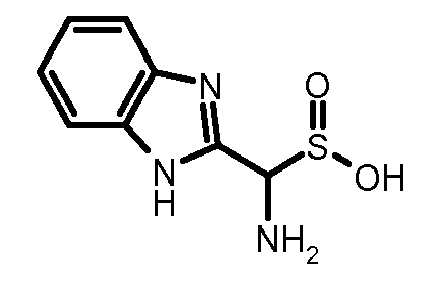
1,3-Benzothiazol-2-yl(amino)methansulfinsäure, 
1,3-Benzoxazol-2-yl(amino)methansulfinsäure, 
Hydroxy(thien-2-yl)methansulfinsäure, 
Hydroxy(thien-3-yl)methansulfinsäure 
(3-Bromthien-2-yl)(hydroxyl)methansulfinsäure, 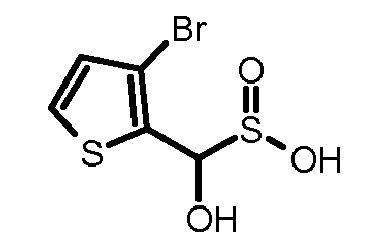
Hydroxy(1H-imidazol-2-yl)methansulfinsäure, 
Hydroxy(1H-imidazol-5-yl)methansulfinsäure, 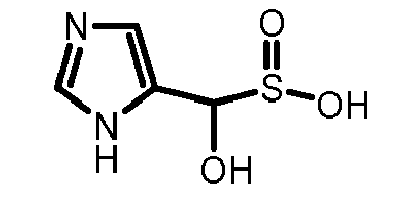
Hydroxy(1-methyl-5-nitro-1H-imidazol-2- yl)methansulfinsäure, 
Hydroxy(1,3-thiazol-2-yl)methansulfinsäure, 
Hydroxy(1,3-oxazol-2-yl)methansulfinsäure, 
Hydroxy(1H-pyrrol-2-yl)methansulfinsäure, 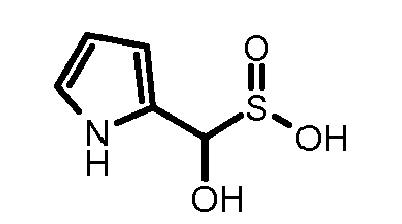
Hydroxy(hydroxyl-2-yl)methansulfinsäure, 
Hydroxy(hydroxyl-4-yl)methansulfinsäure, 
Hydroxy[3-hydroxy-5-(hydroxymethyl)-2-methylpyridin-4-yl]- methansulfinsäure, 
Hydroxy(chinolin-2-yl)methansulfinsäure, 
Hydroxy(chinolin-4-yl)methansulfinsäure, 
1H-Benzimidazol-2-yl(hydroxyl)methansulfinsäure, 
1,3-Benzothiazol-2-yl(hydroxyl)methansulfinsäure, 
1,3-Benzoxazol-2-yl(hydroxy)methansulfinsäure, 
1,2-Dihydroxyethan-1,2-disulfinsäure, 
1,3-Dihydroxypropan-1,3-disulfinsäure, 
Hydroxy{4-[hydroxy(sulfino)methyl]phenyl}methansulfinsäure, 
{2-Chlor-3-[hydroxy(sulfino)methyl]cyclohexyl}- (hydroxy)methansulfinsäure, 
{2-Chlor-3-[hydroxyl(sulfino)methyl]cyclopentyl}- (hydroxyl)methansulfinsäure, 
Hydroxy{5-[hydroxy(sulfino)methyl]thien-2- yl}methansulfinsäure, 
Hydroxy{2-[hydroxy(sulfino)methyl]phenyl}methansulfinsäure, 
Hydroxy{3-[hydroxy(sulfino)methyl]phenyl}methansulfinsäure, 
1,5-Dihydroxypentan-1,5-disulfinsäure, 
4-Hydroxy-4-sulfinobutansäure, 
1-Hydroxy-4-methoxy-4-oxobutan-1-sulfinsäure, 
1-Hydroxy-4-ethoxy-4-oxobutan-1-sulfinsäure, 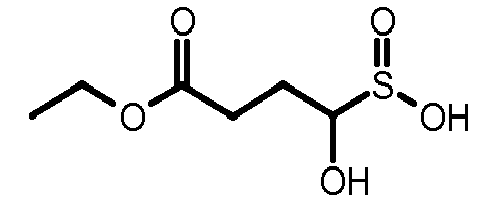
4-Hydroxy-4-sulfinopentansäure, 
2-Hydroxy-5-methoxy-5-oxopentan-2-sulfinsäure, 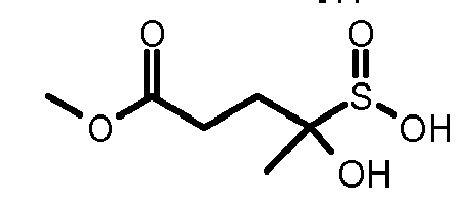
2-Hydroxy-5-ethoxy-5-oxopentan-2-sulfinsäure, 
4-Hydroxy-4-sulfinobut-2-ensäure, 
1-Hydroxy-4-methoxy-4-oxobut-2-en-1-sulfinsäure, 
1-Hydroxy-4-ethoxy-4-oxobut-2-en-1-sulfinsäure, 
4-Hydroxy-4-sulfinopent-2-ensäure, 
2-Hydroxy-5-methoxy-5-oxopent-3-en-2-sulfinsäure, 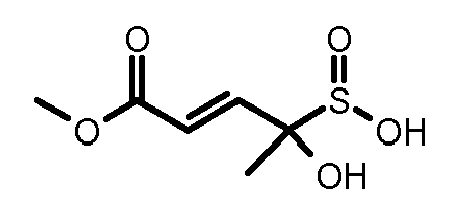
2-Hydroxy-5-ethoxy-5-oxopent-3-en-2-sulfinsäure, 
5-Hydroxy-5-sulfinopentansäure, 
1-Hydroxy-5-methoxy-5-oxopentan-1-sulfinsäure, 
1-Hydroxy-5-ethoxy-5-oxopentan-1-sulfinsäure, 
5-Hydroxy-5-sulfinohexansäure, 
2-Hydroxy-6-methoxy-6-oxohexan-2-sulfinsäure, 
2-Hydroxy-6-ethoxy-6-oxohexan-2-sulfinsäure, 
4-[Hydroxy(sulfino)methyl]benzoesäure, 
4-[Amino(sulfino)methyl]benzoesäure, 
{4-[Hydroxy(sulfino)methyl]phenoxy}-essigsäure, 
{4-[Amino(sulfino)methyl]phenoxy}-essigsäure, 
3-Hydroxy-4-[hydroxy(sulfino)methyl]benzoesäure, 
3-Hydroxy-4-[amino(sulfino)methyl]benzoesäure, 
(4-Cyanophenyl)(hydroxy)-methansulfinsäure, 
[(2-Methoxy-2-oxoethyl)amino](oxo)methansulfinsäure, 
2-Hydroxy-2-sulfino-essigsäure 
2-Amino-2-sulfino-essigsäure 
(4-Cyanophenyl)(amino)-methansulfinsäure, 
(4-Nitrophenyl)(hydroxy)-methansulfinsäure, 
(4-Nitrophenyl)(amino)-methansulfinsäure, 
Salz des 4-Hydroxy-1,1-dimethyl-4-sulfinopiperidiniums mit An- als Äquivalent eines ein- oder mehrwertigen Anions, 
Salz des 1-Allyl-4-hydroxy-1-methyl-4-sulfinopiperidiniums mit An- als Äquivalent eines ein- oder mehrwertigen Anions, 
2-Hydroxy-2-sulfino-propionsäure 
2-Amino-2-sulfino-propionsäure 
2-Hydroxy-2-sulfinato-essigsäureethylester 
2-Amino-2-sulfinato-essigsäureethylester 
4-Hydroxy-1,1-dimethylpiperidinium-4-sulfinat, 
1-Allyl-4-hydroxy-1-methylpiperidinium-4-sulfinat, 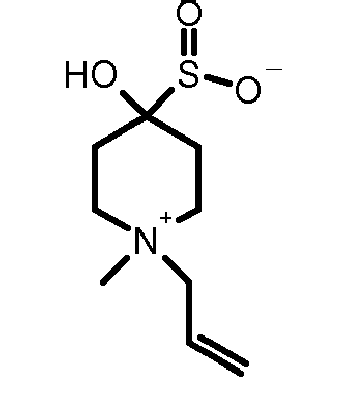
3-Hydroxy-3-sulfinato-propionsäure 
1-Hydroxy-2-(trimethylammonio)ethansulfinat, 
Hydroxy[4-(trimethylammonio)phenyl]methansulfinat, 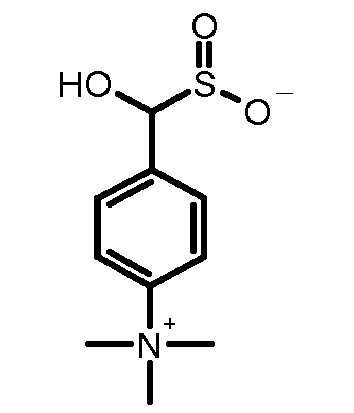
4-[Hydroxy(sulfino)methyl]benzolsulfonsäure und 
2-[Hydroxy(sulfino)methyl]benzolsulfonsäure 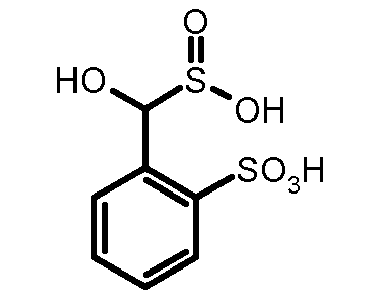
3-Amino-3-sulfinato-propionsäure 
1-Hydroxy-2-methoxy-2-oxoethansulfinsäure 
2-Amino-1-hydroxy-2-oxoethansulfinsäure 
2-(Dimethylamino)-1-hydroxy-2-oxoethansulfinsäure 
Hydroxy(sulfino)methansulfonsäure 
Hydroxy(phenyl)methansulfinsäure 
Hydroxy(4-hydroxyphenyl)methansulfinsäure 
Hydroxy(4-methoxyphenyl)methansulfinsäure 
- Für die bevorzugten ein- oder mehrwertigen Kationen aller Salze der zuvor genannten Verbindungen gilt das zuvor Gesagte.
- Die Herstellung der erfindungsgemäß eingesetzten Sulfinsäuren der Formel (I) erfolgt beispielsweise aus der Umsetzung von Dithionit mit entsprechenden Aldehyden bzw. Ketonen analog zu der Herstellvorschrift gemäß
WO-A1-99/18067 - Bevorzugt enthält das erfindungsgemäße Mittel mindestens ein Sulfinsäurederivat der Formel (I) in einer Menge von 0,01 bis 20 Gew.-%, besonders bevorzugt von 1 bis 20 Gew.-%, jeweils bezogen auf das Gewicht des anwendungsbereiten Mittels.
- Unter Verbindungen, besitzend mindestens ein quartäres Stickstoffatom, verstehen sich im Sinne der Erfindung alle chemischen Verbindungen, die mindestens ein quartäres, kationisches Stickstoffatom tragen. Diese werden auch als quartäre Ammoniumverbindungen bezeichnet. Das quartäre Stickstoffatom ist vierbindig. Somit sind quartäre Ammoniumreste und quartäre Iminiumreste umfasst. Die an das quartäre Stickstoffatom bindenden Gruppen sind allesamt von Wasserstoff verschieden und bilden mindestens drei Bindungen zu Kohlenstoffatomen organischer Reste aus.
- Besagte Verbindungen, besitzend mindestens ein quartäres Stickstoffatom, sind von den Sulfinsäuren der Formel (I) verschieden.
- Die erfindungsgemäßen Mittel enthalten bevorzugt mindestens eine Verbindung, besitzend mindestens ein quartäres Stickstoffatom, ausgewählt aus der Gruppe, die gebildet wird aus Verbindungen mit einem quartären Stickstoffatom, Verbindungen mit zwei quartären Stickstoffatomen, Verbindungen mit drei quartären Stickstoffatomen, organischen N-Oxiden und Polymeren abgeleitet von einem Monomer, enthaltend mindestens ein quartäres Stickstoffatom. Sowohl im Allgemeinen als auch für alle Vertreter der vorangegangenen Liste ist es bevorzugt, wenn die Verbindungen mit quartärem Stickstoffatom netto kationisch geladen sind. Die besagten Verbindungen liegen in letztgenannter Ausführungsform folglich nicht als ungeladenes Zwitterion oder gar anionisch vor.
- Die Verbindungen, besitzend mindestens ein quartäres Stickstoffatom sind in dem erfindungsgemäßen Mittel bevorzugt in einer Menge von 0,01 Gew.-% bis 20 Gew.-%, besonders bevorzugt von 0,1 Gew.-% bis 5 Gew.-%, jeweils bezogen auf das Gewicht des anwendungsbereiten Mittels, enthalten.
- Erfindungsgemäß besonders geeignete Verbindung, besitzend mindestens ein quartäres Stickstoffatom, sind Verbindungen mit der Formel (Q1),

- R1 und R2
- unabhängig voneinander eine lineare oder verzweigte (C1 bis C30)-Alkylgrupppe, eine (C2 bis C30)-Acylgruppe oder eine Gruppe -A1-A2-A3-R5
worin
R5 eine lineare oder verzweigte (C8 bis C30)-Alkylgruppe, eine lineare oder verzweigte (C8 bis C30)-Alkenylgruppe, eine Hydroxy-(C8- bis C30)- alkylgruppe oder eine Oligohydroxy-(C8- bis C30)-alkylgruppe bedeutet,
A1 eine direkte Bindung oder eine Carbonylgruppe bedeutet,
A2 eine direkte Bindung, eine Gruppe NH oder ein Sauerstoffatom bedeutet,
A3 eine (C2 bis C4)-Alkylengruppe oder eine (C2 bis C4)- Hydroxyalkylengruppe bedeutet - R3
- eine lineare oder verzweigte (C8 bis C30)-Alkylgruppe, eine (C8 bis C30)- Hydroxyalkylgruppe, eine (C2 bis C30)-Acylgruppe, eine (C2 bis C4)- Hydroxyalkylgruppe oder eine Aryl-(C1 bis C6)-alkylgruppe,
- R4
- eine (C1 bis C4)-Alkylgruppe oder eine (C2 bis C4)-Hydroxyalkylgruppe,
- X-
- ein physiologisch verträgliches organisches oder anorganisches Anion.
- R4 steht gemäß Formel (Q1) bevorzugt für eine Methyl-, eine Ethyl-, eine Benzyl- oder eine 2-Hydroxyethylgruppe.
Beispiele für eine (C1- bis C4)-Alkylgruppe sind Methyl, Ethyl, Propyl, Isopropyl, n-Butyl, sec-Butyl und tert.-Butyl.
Beispiele für eine (C8- bis C30)-Alkylgruppe sind n-Octyl, n-Decyl, n-Dodecyl, n-Tetradecyl, n-Hexadecyl, Stearyl, Behenyl, Isostearyl und Eicosyl.
Beispiele für eine (C1- bis C30)-Alkylgruppe sind die vorgenannten Beispiele für die jeweiligen Alkylgruppen sowie n-Pentyl, eine Isopentyl, n-Hexyl und eine n-Heptylgruppe.
Beispiele für eine (C2- bis C4)-Alkenylgruppe sind Vinyl, Allyl und Butenyl.
Beispiele für eine (C2- bis C4)-Hydroxyalkylgruppe sind eine 2-Hydroxyethyl-, eine 2-Hydroxypropyl, eine 3-Hydroxypropyl- und eine 4-Hydroxybutylgruppe.
Beispiele für eine (C2- bis C4)-Alkylengruppe ist Ethylen, Propan-1,2-diyl, Propan-1,3-diyl, und Butan-1,4-diyl.
Beispiele für eine (C2-bis C4)-Hydroxyalkylengruppe ist 2-Hydroxyethylen, 1-Hydroxy-propan-1,2-diyl, 1-Hydroxy-propan-1,3-diyl und 2-Hydroxy-propan-1,3-diyl.
Beispiele für eine (C1-bis C4)-Alkylengruppe sind Methylen, Ethylen, Propan-1,2-diyl, Propan-1,3-diyl, und Butan-1,4-diyl.
Beispiele für (C2- bis C30)-Acylgruppen sind Octanoyl, Decanoyl, Dodecanoyl, Tetradecanoyl, Hexadecanoyl, Octadecanoyl und Eicosanoyl.
Beispiele für lineare oder verzweigte (C8-C30)-Alkenylgruppen sind 9-Octadecen-1-yl, 9,12-Octadecadien-1-yl, 9,12,15-Octadecatrien-1-yl und 13-Docosen-1-yl.
Hydroxy-(C8-C30)-alkylgruppen sind beispielsweise 2-Hydroxydecyl, 2-Hydroxydodecyl, 2-Hydroxytetradecyl, 2-Hydroxyhexadecyl und 2-Hydroxyoctadecyl.
Als physiologisch verträgliches organisches oder anorganisches Gegenionen X- gemäß Formel (Q1) kommen beispielsweise Halogenidionen, Sulfationen, Phosphationen, Methosulfationen sowie organische Ionen wie Lactat-, Citrat-, Tartrat- und Acetationen in Betracht. Bevorzugt sind Methosulfat und Halogenidionen, insbesondere Bromid und Chlorid. - Bevorzugte Vertreter des Rests -A1-A2-A3-R5 sind erfindungsgemäß die Gruppen

- Besonders bevorzugte Reste -A1-A2-A3-R5 sind erfindungsgemäß
- - eine ω-[(C8- bis C30)-Alkanoyloxy]-(C2- bis C4)-alkylgruppe (R5 = (C8- bis C30)-Alkyl, A1 = Carbonyl, A2 = Sauerstoffatom, A3 = (C2- bis C4)-Alkylengruppe),
- - eine ω-[(C8- bis C30)-Alkylamido]-(C2- bis C4)-alkylgruppe (R5 = (C8- bis C30)-Alkyl, A1 = Carbonyl, A2 = Gruppe NH, A3 = (C2- bis C4)-Alkylengruppe),
- - eine (C10- bis C34)-Hydroxyalkylgruppe (entweder: R5 = (C8- bis C30)-Alkyl, A1 = direkte Bindung, A2 = direkte Bindung, A3 = (C2- bis C4)-Hydroxyalkylengruppe oder: R5 = (C8- bis C30)-Hydroxyalkyl oder Oligohydroxy-(C8- bis C30)-alkylgruppe, A1 = direkte Bindung, A2 = direkte Bindung, A3 = (C2- bis C4)-Alkylengruppe.
- Beispiele für ω-[(C8- bis C30)-Alkanoyloxy]-(C2- bis C4)-alkylgruppen sind die bevorzugten 2-[(C8-bis C30)-Acyloxy]ethylgruppen, insbesondere 2-(Dodecanoyloxy)ethyl, 2-(Tetradecanoyloxy)ethyl, 2-(Hexadecanoyloxy)ethyl und 2-(Octadecanoyloxy)ethyl.
- Die Verbindungen mit der Formel (Q1) werden bevorzugt ausgewählt aus mindestens einer Verbindung aus der Gruppe, die gebildet wird aus Verbindungen der nachfolgenden Formeln (Q1-a), (Q1-b) und (Q1-c).
Eine der o.g. bevorzugten Gruppen von quartären Ammoniumverbindungen der vorgenannten Formel (Q1) wird definiert aus Verbindungen der Formel (Q1-a)
- R6 und R7 unabhängig voneinander eine (C2 bis C30)-Acylgruppe oder eine lineare oder verzweigte (C1 bis C30)-Alkylgruppe bedeutet,
- R5* eine lineare oder verzweigte (C8 bis C30)-Alkylgruppe oder eine lineare oder verzweigte (C8 bis C30)-Alkenylgruppe bedeutet,
- A1 eine direkte Bindung oder eine Carbonylgruppe bedeutet,
- A2 eine direkte Bindung, eine Gruppe NH oder ein Sauerstoffatom bedeutet,
- A3 eine (C2 bis C4)-Alkylengruppe oder eine (C2 bis C4)-Hydroxyalkylengruppe bedeutet
und - X- ein physiologisch verträgliches organisches oder anorganisches Anion ist,
- Die andere Gruppe der bevorzugten quartären Ammoniumverbindungen wird ausgewählt aus Verbindungen mit der Formel (Q1-b)

- R8 und R9 unabhängig voneinander für eine (C1- bis C4)-Alkylgruppe oder (C2- bis C4)-Hydroxyalkylgruppe stehen,
- R5 eine lineare oder verzweigte (C8- bis C30)-Alkylgruppe, lineare oder verzweigte (C8- bis C30)-Alkenylgruppe, eine Hydroxy-(C8- bis C30)-alkylgruppe oder eine Oligohydroxy-(C8- bis C30)-alkylgruppe bedeutet,
- A1* eine Carbonylgruppe bedeutet
- A2* eine Gruppe NH oder ein Sauerstoffatom bedeutet,
- A3 eine (C2- bis C4)-Alkylengruppe, eine (C2- bis C4)-Hydroxyalkylengruppe bedeutet und
- X- ein physiologisch verträgliches organisches oder anorganisches Anion ist.
- Es sind solche Verbindungen gemäß Formel (Q1-b) erfindungsgemäß bevorzugt, für die mindestens eine der folgenden Bedingungen gilt:
- R8 und R9 stehen bevorzugt unabhängig voneinander für eine Methylgruppe oder eine 2-Hydroxyethylgruppe.
- wenn R8 und R9 gleich sind, stehen sie bevorzugt für eine (C1- bis C4)-Alkylgruppe, besonders bevorzugt für eine Methylgruppe.
- Es ist bevorzugt, daß A3 ausgewählt wird aus Ethylen, Propan-1,3-diyl, Propan-1,2-diyl, 2-Hydroxypropan-1,3-diyl.
- Weitere erfindungsgemäß bevorzugte quaternierte Ammoniumverbindungen der Formel (Q1) werden ausgewählt aus Verbindungen mit der Formel (Q1-c),
(R10)y(Me)(4-y)N+ X- (Q1-c)
wobei - R10 unabhängig voneinander eine (C8- bis C30)-Alkylgruppe,
- y gleich 1 oder 2 ist und
- X- ein physiologisch verträgliches organisches oder anorganisches Anion ist,
- In den Verbindungen der Formel (Q1-c) steht der Rest R10 bevorzugt für eine Alkylgruppe mit 10 bis 22 Kohlenstoffatomen, besonders bevorzugt mit 10 bis 18 Kohlenstoffatomen.
- Die in den erfindungsgemäßen Mitteln als Verbindungen der Formel (Q1-c) enthaltenen quartären Ammoniumverbindungen sind bevorzugt Halogenide, insbesondere Chloride und Bromide.
- Es gelten diejenigen für die Reste gemäß Formel (Q1) genannten Beispiele, als Beispiele für die jeweiligen Reste bzw. Gruppen der Formeln (Q1-a), (Q1-b) und (Q1-c).
- Die Verbindungen der Formel (Q1) werden bevorzugt ausgewählt aus der Gruppe, die gebildet wird aus
- - Salze, insbesondere Halogenide, des Dicetyldimethylammoniums, Distearyldimethylammoniums (z.B. Dioctadecyldimethylammonium Chlorid als Genamin® DSAc der Firma Clariant), Cetyltrimethylammoniums (z.B. Hexadecyltrimethylammonium Chlorid als Dehyquart® A der Firma Cognis), oder des Stearyltrimethylammoniums,
- - quaternierten Estersalzen von Fettsäuren mit Triethanolamin, sogenannte Esterquats, insbesondere den Salzen des N,N-Di(2-(dodecanoyloxy)ethyl)dimethylammoniums, N,N-Di(2-(tetradecanoyloxy)ethyl)dimethylammoniums, N,N-Di(2-(hexadecanoyloxy)ethyl)dimethylammoniums, N,N-Di(2-(hexadecanoyloxy)-propyl)dimethylammoniums, N,N-Di(2-(octadecanoyloxy)ethyl)dimethylammoniums mit einem physiologisch verträglichen, organisch oder anorganischen Anion. Bevorzugte Anionen sind Alkylsulfate, wie z.B. Methylsulfat, und Halogenide, wie Chlorid und Bromid. Solche Produkte werden beispielsweise unter den Warenzeichen Stepantex®, Dehyquart® und Armocare® vertrieben. Die Produkte Armocare® VGH-70, ein N,N-Di(2-Hexadecanoyloxyethyl)dimethylammoniumchlorid, sowie Dehyquart® L80 (INCI-Bezeichnung: Dicocoylethyl Hydroxyethylmonium Methosulfate), Dehyquart® F-75, Dehyquart® C-4046, und Dehyquart® AU-35 sind Beispiele für solche Esterquats. Zur Herstellung können auch Fettsäureschnitte, z.B. aus Talg wie beispielsweise Rindertalg gewonnene Talgfettsäuren, verwendet werden (INCI-Bezeichnungen: Ditallowoylethyl Dimonium Methosulfate, Ditallowoyl PG-dimonium Chloride).
- - Salzen des N,N-Dimethyl-N-(2-hydroxyethyl)-N-(2-hydroxyhexadecyl)-ammoniums. Bevorzugte Halogenide sind Chlorid und Bromid. Diese werden beispielsweise unter der Handelsmarke Dehyquart® E (INCI-Bezeichnung: Aqua (Water), Hydroxycetyl Hydroxyethyl Dimonium Chloride) von der Firma Cognis vertrieben.
- - quaternierte Amidsalze von Fettsäuren mit Diaminen, wie z.B. Salzen des N-(13-Docosen)amidopropyl-N-2-hydroxyethyl-N,N-dimethylammoniums (INCI-Bezeichnung: Hydroxyethyl Erucamidopropyl Dimonium Chloride) oder des N-Docosylamidopropyl-N-2-hydroxyethyl-N,N-dimethylammoniums welches unter dem Handelsnamen Incroquat® Behenyl HE (INCI-Bezeichnung: Hydroxyethyl Behenamidopropyl Dimonium Chloride) von der Firma Croda Inc. vertrieben wird.
- Als quartäre Ammoniumverbindungen aus der Gruppe der Polymere, die sich ableiten von mindestens einem Monomer mit einer quartären Ammoniumgruppe, sind vorzugsweise kationische und/oder amphotere Polymere einsetzbar. Unter kationischen bzw. amphoteren Polymeren sind Polymere zu verstehen, welche in der Haupt- und/oder Seitenkette eine Gruppe aufweisen, die "permanent" kationisch ist. Als "permanent kationisch" werden erfindungsgemäß solche Polymere bezeichnet, die unabhängig vom pH-Wert des Mittels eine kationische Gruppe aufweisen. Dies sind in der Regel Polymere, die ein quartäres Stickstoffatom, beispielsweise in Form einer Ammoniumgruppe, enthalten. Bevorzugte kationische Gruppen sind quartäre Ammoniumgruppen. Insbesondere solche Polymere, bei denen die quartäre Ammoniumgruppe über eine (C1 bis C4)-Kohlenwasserstoffgruppe an eine aus Acrylsäure, Methacrylsäure oder deren Derivaten aufgebaute Polymerhauptkette gebunden sind, haben sich als besonders geeignet erwiesen.
- Homopolymere der allgemeinen Formel (Q2),

- R1 steht für eine Methylgruppe
- R2, R3 und R4 stehen für Methylgruppen
- m hat den Wert 2.
- Als physiologisch verträgliches Gegenionen X- kommen beispielsweise Halogenidionen, Sulfationen, Phosphationen, Methosulfationen sowie organische Ionen wie Lactat-, Citrat-, Tartrat- und Acetationen in Betracht. Bevorzugt sind Halogenidionen, insbesondere Chlorid.
- Ein besonders geeignetes Homopolymer (Q2) ist das, gewünschtenfalls vernetzte, Poly(methacryloyloxyethyltrimethylammoniumchlorid) mit der INCI-Bezeichnung Polyquaternium-37. Solche Produkte sind beispielsweise unter den Bezeichnungen Rheocare® CTH (Cosmetic Rheologies) und Synthalen® CR (Ethnichem) im Handel erhältlich. Die Vernetzung kann gewünschtenfalls mit Hilfe mehrfach olefinisch ungesättigter Verbindungen, beispielsweise Divinylbenzol, Tetraallyloxyethan, Methylenbisacrylamid, Diallylether, Polyallylpolyglycerylether, oder Allylethern von Zuckern oder Zuckerderivaten wie Erythritol, Pentaerythritol, Arabitol, Mannitol, Sorbitol, Sucrose oder Glucose erfolgen. Methylenbisacrylamid ist ein bevorzugtes Vernetzungsagens.
- Das Homopolymer wird bevorzugt in Form einer nichtwäßrigen Polymerdispersion, die einen Polymeranteil nicht unter 30 Gew.-% aufweisen sollte, eingesetzt. Solche Polymerdispersionen sind unter den Bezeichnungen Salcare® SC 95 (ca. 50 % Polymeranteil, weitere Komponenten: Mineralöl (INCI-Bezeichnung: Mineral Oil) und Tridecyl-polyoxypropylen-polyoxyethylen-ether (INCI-Bezeichnung: PPG-1-Trideceth-6)) und Salcare® SC 96 (ca. 50 % Polymeranteil, weitere Komponenten: Mischung von Diestern des Propylenglykols mit einer Mischung aus Capryl- und Caprinsäure (INCI-Bezeichnung: Propylene Glycol Dicaprylate/Dicaprate) und Tridecyl-polyoxypropylen-polyoxyethylen-ether (INCI-Bezeichnung: PPG-1-Trideceth-6)) im Handel erhältlich.
- Copolymere mit Monomereinheiten gemäß Formel (Q2) enthalten als nichtionogene Monomereinheiten bevorzugt Acrylamid, Methacrylamid, Acrylsäure-C1-4-alkylester und Methacrylsäure-C1-4-alkylester. Unter diesen nichtionogenen Monomeren ist das Acrylamid besonders bevorzugt. Auch diese Copolymere können, wie im Falle der Homopolymere oben beschrieben, vernetzt sein. Ein erfindungsgemäß bevorzugtes Copolymer ist das vernetzte Acrylamid-Methacryloyloxyethyltrimethylammoniumchlorid-Copolymer. Solche Copolymere, bei denen die Monomere in einem Gewichtsverhältnis von etwa 20:80 vorliegen, sind im Handel als ca. 50 %ige nichtwäßrige Polymerdispersion unter der Bezeichnung Salcare® SC 92 erhältlich.
- Als erfindungsgemäße quartäre Ammoniumverbindung können die erfindungsgemäßen Mittel mindestens ein Polymerisat enthalten, das mindestens eine Struktureinheit gemäß Formel (Q3) umfasst,

- R eine C1- bis C30-Alkylgruppe, eine C1- bis C4-Aralkylgruppe, eine C2- bis C6-Alkenylgruppe oder eine C2 bis C6-Hydroxyalkylgruppe bedeutet und
- X- für ein physiologisch verträgliches Anion steht.
- Als erfindungsgemäß bevorzugt geeignete Polymerisate der Formel (Q3) dienen solche, in der R für eine C1- bis C10-Alkylgruppe, insbesondere für eine Methylgruppe, steht.
- Beispiele für erfindungsgemäß in Verbindungen der Formel (Q3) verwendbare C1- bis C30-Alkylgruppen sind Methyl, Ethyl, n-Propyl, Isopropyl, n-Butyl, sec-Butyl, Isobutyl, tert-Butyl, n-Decyl, n-Dodecyl, Stearyl oder Behenyl. Beispiele für erfindungsgemäß in Verbindungen der Formel (Q3) verwendbare C2- bis C6-Alkenylgruppen sind Vinyl, 2-Propen-1-yl (Allyl) oder 3-Buten-1-yl. Beispiele für eine C1- bis C4-Aralkylgruppe sind die Benzylgruppe und die 2-Phenylethylgruppe. Beispiele für eine C2 bis C6-Hydroxyalkylgruppe sind die 2-Hydroxyethylgruppe und die 3-Hydroxypropylgruppe.
- Die physiologisch verträglichen Anionen X- gemäß Formel (Q3) dürfen definitionsgemäß nicht nur eine negative Ladung tragen, sondern können auch eine Ladungszahl größer 1 besitzen. In letzterem Falle werden die Anionen X- der Salzform gemäß Formel (Q3) zur Wahrung der Elektroneutralität durch Formulierung eines stöchiometrischen Koeffizienten kleiner 1 vor dem Anion beschrieben. Die physiologisch verträglichen Anionen werden bevorzugt ausgewählt aus Halogenid, Benzolsulfonat, p-Toluolsulfonat, C1-C4-Alkansulfonat, Trifluormethansulfonat, C1-C4-Alkylsulfat, Perchlorat, 0.5 Sulfat, Hydrogensulfat, 0.5 Carbonat, Hydrogencarbonat, 1/3 Phosphat, 0.5 Hydrogenphosphat, Dihydrogenphosphat, Lactat, Citrat, Tetrafluoroborat, Hexafluorophosphat oder Tetrachlorozinkat. Besonders bevorzugt steht X- für ein Halogenid, insbesondere Chlorid, Bromid oder Iodid, C1-C4-Alkylsulfat, p-Toluolsulfonat, Tetrafluoroborat, Trifluormethansulfonat, Hexafluorophosphat, 0.5 Sulfat, oder Hydrogensulfat. Besonders bevorzugt werden die Anionen Chlorid, Methylsulfat oder Ethylsulfat als X- eingesetzt.
- Die erfindungsgemäß verwendbaren Polymere der Formel (Q3) besitzen ein bevorzugtes Molekulargewicht von mehr als 100000 g/mol, besonders bevorzugt von mehr als 400000 g/mol.
- Es ist erfindungsgemäß bevorzugt, ein Copolymerisat zu verwenden, das zusätzlich zu mindestens einer Struktureinheit gemäß obiger Formel (Q3) mindestens eine Struktureinheit der Formel (N1) umfasst,

- Bevorzugte Polymerisate sind unter den Handelsnamen Luviquat® FC 370, Luviquat® FC 550, Luviquat® FC 905 und Luviquat® HM 552, sowie Luviquat® Hold (INCI-Bezeichung: Polyquaternium-46), Luviquat® Supreme (Polyquaternium-68) und/oder Luviquat® Ultracare jeweils von der Firma BASF zu beziehen.
- Weiterhin bevorzugt verwendbar ist ein Copolymer, in welchem neben mindestens einer Struktureinheit der Formel (Q3), mindestens eine Struktureinheit der Formel (N1) mit n = 1 und mindestens eine weitere Struktureinheit der Formel (N1) mit n = 3 enthalten ist.
- Bevorzugt eignet sich ebenfalls ein Terpolymer mit den Struktureinheiten der Formeln,
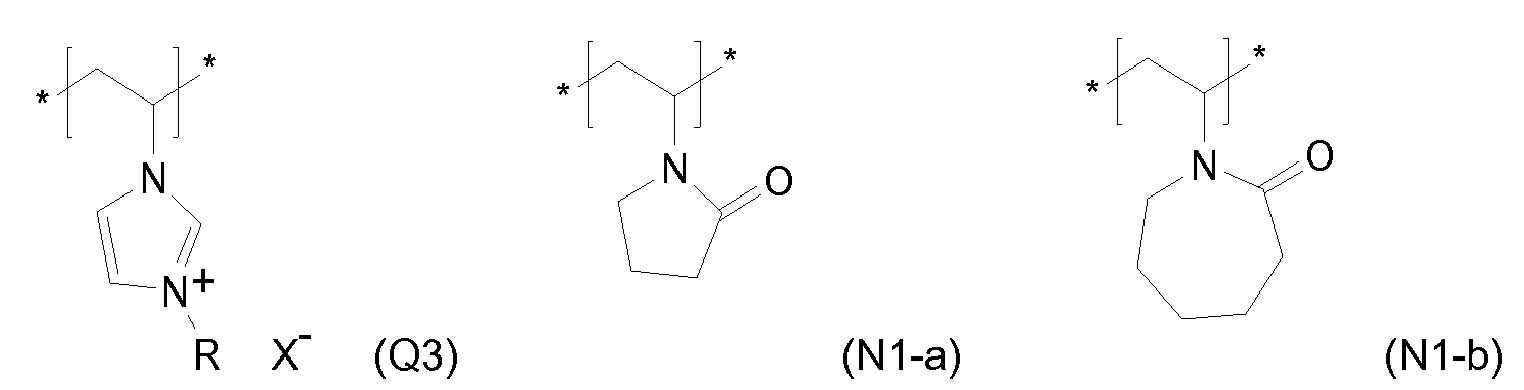
Solche Polymere werden beispielsweise von der Firma BASF unter dem Handelsnamen Luviquat® Hold (INCI-Bezeichnung: Polyquaternium-46) vertrieben. Die Gewichtsverhältnisse (in Gewichtsprozent) der Struktureinheiten der Formel (I) zu den Struktureinheiten der Formel (II) mit n = 1 zu den Struktureinheiten der Formel (II) mit n = 3 beträgt in dem Handelsprodukt 10 zu 40 zu 50 und die Ladungsdichte beträgt 0.5 meq/g. - In allen erfindungsgemäß verwendbaren Polymeren können bei Vorhandensein verschiedener Struktureinheiten diese jeweils statistisch verteilt oder als Block vorliegen.
- Weitere in den erfindungsgemäß Mitteln einsetzbare kationische Polymere sind beispielsweise
- quaternisierte Cellulose-Derivate, wie sie unter den Bezeichnungen Celquat® und Polymer JR® im Handel erhältlich sind. Die Verbindungen Celquat® H 100, Celquat® L 200 und Polymer JR®400 sind bevorzugte quaternierte Cellulose-Derivate,
- kationische Alkylpolyglycoside gemäß der
DE-PS 44 13 686 - kationisierter Honig, beispielsweise das Handelsprodukt Honeyquat® 50,
- kationische Guar-Derivate, wie insbesondere die unter den Handelsnamen Cosmedia®Guar und Jaguar® vertriebenen Produkte,
- polymere Dimethyldiallylammoniumsalze und deren Copolymere mit Estern und Amiden von Acrylsäure und Methacrylsäure. Die unter den Bezeichnungen Merquat®100 (Poly(dimethyldiallylammoniumchlorid)) und Merquat®550 (Dimethyldiallylammoniumchlorid-Acrylamid-Copolymer) im Handel erhältlichen Produkte sind Beispiele für solche kationischen Polymere,
- Copolymere des Vinylpyrrolidons mit quaternierten Derivaten des Dialkylaminoalkylacrylats und -methacrylats, wie beispielsweise mit Diethylsulfat quaternierte Vinylpyrrolidon-Dimethylaminoethylmethacrylat-Copolymere. Solche Verbindungen sind unter den Bezeichnungen Gafquat®734 und Gafquat®755 im Handel erhältlich,
- quaternierter Polyvinylalkohol,
- sowie die unter den Bezeichnungen Polyquaternium 2, Polyquaternium 17, Polyquaternium 18 und Polyquaternium 27 bekannten Polymeren mit quartären Stickstoffatomen in der Polymerhauptkette.
- Gleichfalls als kationische Polymere eingesetzt werden können die unter den Bezeichnungen Polyquaternium-24 (Handelsprodukt z. B. Quatrisoft® LM 200), bekannten Polymere. Ebenfalls erfindungsgemäß verwendbar sind die Copolymere des Vinylpyrrolidons, wie sie als Handelsprodukte Copolymer 845 (Hersteller: ISP), Gaffix® VC 713 (Hersteller: ISP), Gafquat®ASCP 1011, Gafquat®HS 110, Luviquat®8155 und Luviquat® MS 370 erhältlich sind.
- Zusätzlich zu kationischen Polymerisaten oder an ihrer Stelle können die erfindungsgemäßen Mittel auch amphotere Polymere enthalten. Diese weisen zusätzlich mindestens eine negativ geladene Gruppe im Molekül auf und werden auch als zwitterionische Polymere bezeichnet. Im Rahmen der vorliegenden Erfindung bevorzugt einsetzbare zwitterionische Polymerisate (Q4) setzen sich im wesentlichen zusammen aus
- A) Monomeren mit quartären Ammoniumgruppen der allgemeinen Formel (Z1-a),
R1-CH=CR2-CO-Z-(CnH2n)-N(+)R3R4R5 A(-) (Z1-a)
In der R1 und R2 unabhängig voneinander stehen für Wasserstoff oder eine Methylgruppe und R3, R4 und R5 unabhängig voneinander für Alkylgruppen mit 1 bis 4 Kohlenstoff-Atomen, Z eine NH-Gruppe oder ein Sauerstoffatom, n eine ganze Zahl von 2 bis 5 und A(-) das Anion einer organischen oder anorganischen Säure ist
und - B) monomeren Carbonsäuren der allgemeinen Formel (Z1-b),
R6-CH=CR7-COOH (Z1-b)
in denen R6 und R7 unabhängig voneinander Wasserstoff oder
Methylgruppen sind. - Geeignete Ausgangsmonomere sind z. B. Dimethylaminoethylacrylamid, Dimethylaminoethylmethacrylamid, Dimethylaminopropylacrylamid, Dimethylaminopropylmethacrylamid und Diethylaminoethylacrylamid, wenn Z gemäß Formel (Z1-a) eine NH-Gruppe bedeutet oder Dimethylaminoethylacrylat, Dimethylaminoethylmethacrylat und Diethylaminoethylacrylat, wenn Z ein Sauerstoffatom ist.
- Die eine tertiäre Aminogruppe enthaltenden Monomeren werden dann in bekannter Weise quarterniert, wobei als Alkylierungsreagenzien Methylchlorid, Dimethylsulfat oder Diethylsulfat besonders geeignet sind. Die Quaternisierungsreaktion kann in wäßriger Lösung oder im Lösungsmittel erfolgen.
- Vorteilhafterweise werden solche Monomere der Formel (Z1-a) , die Derivate des Acrylamids oder Methacrylamids darstellen. Weiterhin bevorzugt sind solche Monomeren, die als Gegenionen Halogenid-, Methoxysulfat- oder Ethoxysulfat-Ionen enthalten. Ebenfalls bevorzugt sind solche Monomeren der Formel (Z1-a), bei denen R3, R4 und R5 Methylgruppen sind.
- Das Acrylamidopropyl-trimethylammoniumchlorid ist ein ganz besonders bevorzugtes Monomer der Formel (Z1-a).
- Als monomere Carbonsäuren der Formel (Z1-b) eignen sich Acrylsäure, Methacrylsäure, Crotonsäure und 2-Methyl-crotonsäure. Bevorzugt werden Acryl- oder Methacrylsäure, insbesondere Acrylsäure, eingesetzt.
- Die erfindungsgemäß einsetzbaren zwitterionischen Polymerisate werden aus Monomeren der Formeln (Z1-a) und (Z1-b) nach an sich bekannten Polymerisationsverfahren hergestellt.
- Als besonders wirksam haben sich erfindungsgemäß solche Polymerisate erwiesen, bei denen die Monomeren der Formel (Z1-a) gegenüber den Monomeren der Formel (Z1-b) im Überschuß vorlagen. Es ist daher erfindungsgemäß bevorzugt, solche Polymerisate zu verwenden, die aus Monomeren der Formel (Z1-a) und die Monomeren der Formel (Z1-b) in einem Molverhältnis von 60:40 bis 95:5, insbesondere von 75:25 bis 95:5, bestehen.
- Aus der Gruppe der organischen N-Oxide erfindungsgemäß besonders geeignete Verbindung sind Verbindungen mit der Formel (Q5),

- R1 und R2
- unabhängig voneinander eine lineare oder verzweigte (C1 bis C30)-Alkylgrupppe, eine Aryl-(C1 bis C6)-alkylgruppe, eine (C2 bis C30)-Acylgruppe, oder eine Gruppe - A1-A2-A3-R5
worin
R5 eine lineare oder verzweigte (C8 bis C30)-Alkylgruppe oder eine lineare oder verzweigte (C8 bis C30)-Alkenylgruppe bedeutet,
A1 eine direkte Bindung oder eine Carbonylgruppe bedeutet,
A2 eine direkte Bindung, eine Gruppe NH oder ein Sauerstoffatom bedeutet,
A3 eine (C2 bis C4)-Alkylengruppe oder eine (C2 bis C4)- Hydroxyalkylengruppe bedeutet und - R3
- eine lineare oder verzweigte (C8 bis C30)-Alkylgruppe, eine (C8 bis C30)- Hydroxyalkylgruppe, eine (C2 bis C30)-Acylgruppe,
- Bevorzugt einsetzbare Aminoxide sind Dimethyl(C8-bis C22)alkylaminoxide. Insbesondere werden Cocamidopropylaminoxid, N-Cocomorpholinoxid, Decyldimethylaminoxid, Dimethylcetylaminoxid, Dimethylcocoaminoxid (Aromox® MCDW, Fa. Akzo Nobel), Dimethylhydriertes-Talgaminoxid, Dimethyllaurylaminoxid, Dimethylmyristylaminoxid, (2-Hydroxyethyl)cocoaminoxid oder Oleaminoxid bevorzugt in den erfindungsgemäßen Mitteln als nichtionische N-Oxid-Tenside eingesetzt.
- Weiterhin können erfindungsgemäß als quartäre Ammoniumverbindungen aus der Gruppe der organischen N-Oxide mindestens ein Pyridin-N-oxid oder Derivate davon, ein Pyrimidin-N-Oxid oder Derivate davon, wie insbesondere 2,4-Diaminopyrimidine-3-oxid (Fa. Chimex), in dem erfindungsgemäßen Mittel enthalten sein.
- Zusätzlich zu der erfindungsgemäßen Wirkstoffkombination können die erfindungsgemäßen Mittel als weitere Komponente mindestens eine Verbindung aus den Aldehyden und/oder den Ketonen enthalten.
- Der Auswahl der Verbindungen aus den Aldehyden bzw. den Ketonen ist zunächst keine Grenze gesetzt. Als besonders geeignet erweist sich mindestens ein Vertreter aus der Gruppe:
- Oxocarbonsäuren oder deren Salze,
- Oxocarbonsäureester,
- cyclische, lineare oder verzweigte aliphatische Aldehyde,
- cyclische, lineare oder verzweigte aliphatische Ketone,
- mono- bis polyhydroxyfunktionalisierte Aldehyde,
- mono- bis polyhydroxyfunktionalisierte Ketone,
- alicyclische, aromatische oder heterocyclische Aldehyde sowie
- alicyclische, aromatische oder heterocyclische Ketone.
- Generell gilt, dass in den oben genannten Verbindungen der cyclischen, alicyclischen bzw. heterocyclischen Ketone die Ketogruppe(n) endocyclisch (und/oder) oder exocyclisch gebunden sein kann (können).
- Oxocarbonsäuren sind organische Verbindungen, die neben mindestens einer Carboxylgruppe eine Carbonylgruppe tragen und sind somit Aldehyd- bzw. Ketocarbonsäuren. Bevorzugte Oxocarbonsäuren sind α-Oxocarbonsäuren, β-Oxocarbonsäuren, γ-Oxocarbonsäuren sowie ω-Oxocarbonsäuren der Formel (XII) bzw. deren Salze,

- R ein
- Wasserstoffatom, eine (C1 bis C6)-Alkylgruppe, eine (C1 bis C6)-Hydroxyalkylgruppe, eine gegebenenfalls substituierte Arylgruppe, eine gegebenenfalls substituierte Heteroarylgruppe, eine (C2 bis C6)-Alkenylgruppe oder eine Carboxy-(C1 bis C6)- alkylgruppe,
- n
- eine Zahl 0, 1, 2 oder 3.
- Besonders bevorzugt werden die Oxocarbonsäuren ausgewählt aus mindestens einem Vertreter aus der Gruppe Glyoxalsäure, Acetessigsäure, 3-Oxoglutarsäure, 4-Oxovaleriansäure und Brenztraubensäure bzw. den Salzen der vorgenannten Säuren.
Die Oxocarbonsäureester werden bevorzugt ausgewählt aus (C1 bis C6)-Alkylestern der erfindungsgemäß bevorzugten Oxocarbonsäuren.
Unter cyclischen, linearen oder verzweigten aliphatischen Aldehyden sind erfindungsgemäß aliphatische Aldehyde zu verstehen, deren Formylgruppe(n) nicht in Konjugation mit einem aromatischen π-Elektronen-System stehen. Die entsprechenden Aldehyde dürfen aromatische Reste tragen, solange die π-Elektronen der Formylgruppe(n) nicht über ein solches aromatisches System delokalisiert sein können. Bevorzugte cyclische, lineare oder verzweigte aliphatische Aldehyde sind gesättigt oder ungesättigt und werden besonders bevorzugt ausgewählt aus mindestens einem Vertreter aus der Gruppe Formaldehyd, Acetaldehyd, Glyoxal, Propionaldehyd, Butanal, Pentanal, Isopentanal, Hexanal, Cyclohexanal, Heptanal, Octanal, Malondialdehyd, Glutaraldehyd, 2-Methylpentanal, 2-Ethylhexanal, 3,5,5-Trimethylhexanal, 2-Ethylbutyraldehyd, 2-Methylbutyraldehyd, Isobutyraldehyd, 3-Phenylpropanal, 3-(4-Methylphenyl)propanal, 3-(4-Methoxyphenyl)propanal, 3-(2-Methoxyphenyl)propanal, 2-Butenal, Acrolein, 3-Methyl-2-butenal, 3,7-Dimethyl-2,6-octadienal, 2,4-Pentadienal, 3,7-Dimethyl-6-octenal, 2,4-Dimethyl-3-cyclohexencarboxaldehyd und 2,6-Nonadienal.
Unter cyclischen, linearen oder verzweigten aliphatischen Ketonen sind erfindungsgemäß aliphatische Ketone zu verstehen, deren Ketogruppe(n) nicht in Konjugation mit einem aromatischen π-Elektronen-System stehen. Die entsprechenden Ketone dürfen jedoch aromatische Reste tragen, solange die π-Elektronen der Ketogruppe(n) nicht über ein solches aromatisches System delokalisiert sein können. Bevorzugte cyclische, lineare oder verzweigte aliphatische Ketone sind gesättigt oder ungesättigt und ausgewählt aus mindestens einem Vertreter aus der Gruppe Aceton, 2-Butanon, 2-Pentanon, 3-Pentanon, 2-Hexanon, 3-Hexanon, Butan-2,4-dion, Pentan-2,4-dion, Hexan-2,5-dion, Cyclohexanon, Cyclopentanon, 4-Methylpentan-2-on, 5-Methyl-3-hexen-2-on, 2-(3-Oxopropyl)benzoesäuremethylester und 4-(3-Oxopropyl)benzoesäuremethylester.
Bevorzugt verwendbare monohydroxyfunktionalisierte Aldehyde werden ausgewählt aus mindestens einem Vertreter aus der Gruppe 1-Hydroxypropanal, 5-Hydroxypentanal, 3,7-Dimethyl-7-hydroxyoctanal, Hydroxyisohexyl-3-cyclohexen-1-carboxaldehyd und 2,6,6-Trimethyl-1,3-cyclohexadien-1-carboxaldehyd.
Polyhydroxyfunktionalisierte Aldehyde sind erfindungsgemäß bevorzugt die sogenannten Aldosen und werden besonders bevorzugt ausgewählt aus mindestens einem Vertreter aus der Gruppe 2,3-Dihydroxypropionaldehyd, D-Erythrose, D-Threose, D-Ribose, D-Arabinose, D-Lyxose, D-Xylose, D-Allose, D-Altrose, D-Galactose, D-Glucose, D-Idose, D-Mannose, D-Rhamnose und D-Talose, sowie den L-Konfigurationen L-Erythrose, L-Threose, L-Ribose, L-Arabinose, L-Lyxose, L-Xylose, L-Allose, L-Altrose, L-Galactose, L-Glucose, L-Idose, L-Mannose, L-Rhamnose und L-Talose.
Monohydroxyfunktionalisierte Ketone, die sich erfindungsgemäß besonders eignen, werden bevorzugt ausgewählt aus mindestens einem Vertreter aus der Gruppe 1-Hydroxy-2-propanon, 1-Hydroxy-2-butanon, 3-Hydroxy-2-butanon und Benzoin.
Polyhydroxyfunktionalisierte Ketone sind erfindungsgemäß bevorzugt die sogenannten Ketosen und werden besonders bevorzugt ausgewählt aus mindestens einem Vertreter aus der Gruppe 1,3-Dihydroxyaceton, D-Psicose, D-Fructose, D-Sorbose, D-Tagatose, D-Ribulose, D-Xylulose, D-Erythrulose sowie den L-Konfigurationen L-Psicose, L-Fructose, L-Sorbose, L-Tagatose, L-Ribulose, L-Xylulose, L-Erythrulose.
Bevorzugte alicyclische, aromatische oder heterocyclische Ketone werden bevorzugt ausgewählt aus mindestens einem Vertreter aus der Gruppe - Benzylidenketone, insbesondere den Benzylidenketonen aus der Patentanmeldung
DE-A1-19717281 (sieheDE-A1-19717281 : Formel (I) des 1. Anspruchs und die Vertreter gemäß 4. Anspruch), auf die ausdrücklich Bezug genommen wird, - Imidazolin-2,4-dion und dessen Derivaten, insbesondere Allantoin und/oder
5,5-Dimethylhydantoin. - Benzaldehyd und seinen Derivaten,
- Zimtaldehyd und seinen Derivaten sowie
- Naphthaldehyd und seinen Derivaten.
- Alle Aldehyd bzw. Ketoverbindungen sollen aus physiologisch verträglichen bzw. nicht toxischen Verbindungen ausgewählt werden, wenn das erfindungsgemäße Mittel als kosmetisches Mittel Verwendung finden soll.
- Die Verbindungen, ausgewählt aus Aldehyden oder Ketonen, sind erfindungsgemäß bevorzugt in einer Menge von 0,1 Gew.-% bis 20 Gew.-%, insbesondere von 0,5 Gew.-% bis 10 Gew.-%, jeweils bezogen auf das Gewicht des anwendungsbereiten Mittels, in dem erfindungsgemäßen Mittel enthalten.
- Es kann erfindungsgemäß bevorzugt sein, das erfindungsgemäße Mittel mit der Maßgabe bereitzustellen, dass die in dem erfindungsgemäßen Mittel eingesetzten Verbindungen, ausgewählt aus den Aldehyden und/oder den Ketonen, sich von denjenigen Aldehyden bzw. Ketonen unterscheiden müssen, von denen sich diejenigen Sulfinsäuren ableiten, die in dem erfindungsgemäßen Mittel tatsächlich enthalten sind.
- Es ist ebenso erfindungsgemäß bevorzugt, wenn das erfindungsgemäße Mittel zusätzlich mindestens ein Redukton enthält. Unter einem Redukton versteht der Fachmann reduktiv wirkende Endiol-Verbindungen, die durch Substitution in α-Stellung stabilisiert sind und die der Tautomerie unterliegen. Die wichtigsten erfindungsgemäß einsetzbaren Reduktone sind Ascorbinsäure, Isoascorbinsäure, 2,3-Dihydroxy-2-propendial und 2,3-Dihydroxy-2-cyclopentenon.
Die Reduktone sind erfindungsgemäß bevorzugt in einer Menge von 0,1 Gew.-% bis 20 Gew.-%, insbesondere von 0,5 Gew.-% bis 10 Gew.-%, jeweils bezogen auf das Gewicht des anwendungsbereiten Mittels, in dem erfindungsgemäßen Mittel enthalten. - Als Träger für das erfindungsgemäße Mittel eignen sich bevorzugt flüssige Medien, in denen das erfindungsgemäße Sulfinsäurederivat bevorzugt löslich ist, wie beispielsweise Wasser oder organische Lösemittel. Es ist erfindungsgemäß bevorzugt, wenn der Träger ein kosmetischer Träger ist.
Als kosmetische Träger eignen sich besonders Cremes, Emulsionen, Gele oder auch tensidhaltige schäumende Lösungen, wie beispielsweise Shampoos, Schaumaerosole oder andere Zubereitungen, die insbesondere für die Anwendung auf dem Haar geeignet sind. Es ist aber auch denkbar, die Inhaltsstoffe in eine pulverförmige oder auch tablettenförmige Formulierung zu integrieren, welche vor der Anwendung in Wasser gelöst wird. Die kosmetischen Träger können insbesondere wässrig oder wässrig-alkoholisch sein.
Ein wässriger kosmetischer Träger enthält mindestens 50 Gew.-% Wasser.
Unter wässrig-alkoholischen kosmetischen Trägern sind im Sinne der vorliegenden Erfindung wässrige Lösungen enthaltend 3 bis 70 Gew.-% eines C1-C4-Alkohols, insbesondere Ethanol bzw. Isopropanol, zu verstehen. Weitere alkoholische Lösemittel, sind beispielsweise Methoxybutanol, Benzylalkohol, 2-Phenoxyethanol, Ethyldiglykol oder 1,2-Propylenglykol. In einer bevorzugten Ausführungsform enthält das erfindungsgemäße Mittel zusätzlich als Lösemittel mindestens einen (C2 bis C6)-Alkylmonoalkohol und/oder ein (C2 bis C6)-Alkandiol, insbesondere Ethanol, Isopropanol und/oder 1,2-Propylenglykol. - Das erfindungsgemäße Mittel besitzt bevorzugt einen pH-Wert von pH 1 bis pH 9, insbesondere von pH 1,5 bis pH 6.
- Ein zweiter Gegenstand der Erfindung ist die Verwendung des Mittels gemäß erstem Erfindungsgegenstand zur Entfärbung von Substraten, die mit natürlichen und/oder synthetischen Farbstoffen eingefärbt sind.
- Das Substrat enthält bevorzugt synthetische Fasern und/oder natürliche Fasern.
Die natürlichen Fasern werden bevorzugt ausgewählt aus cellulosehaltigen Fasern, insbesondere Baumwolle, und keratinhaltigen Fasern, insbesondere Wolle oder tierischen oder menschlichen Haaren, ganz besonders bevorzugt aus menschlichen Haaren.
Die synthetischen Fasern werden bevorzugt ausgewählt werden aus Polyester, Polyamid (wie beispielsweise Nylon), Elastan, Viskose oder Polyacryl. - Die zu entfärbenden Substrate sind bevorzugt mit Oxidationsfarbstoffen und/oder direktziehenden Farbstoffen, als Vertreter der synthetischen Farbstoffe, gefärbt.
In einer weiteren bevorzugten Ausführungsform wurden die zu entfärbenden Substrate mit einem oxidativen Färbemittel gefärbt, welches neben mindestens einer Entwicklerkomponente zusätzlich mindestens eine Kupplerkomponente enthält.
Als Kupplerkomponenten werden in der Regel m-Phenylendiaminderivate, Naphthole, Resorcin und Resorcinderivate, Pyrazolone und m-Aminophenolderivate verwendet. Als Kupplersubstanzen eignen sich insbesondere 1-Naphthol, 1,5-, 2,7- und 1,7-Dihydroxynaphthalin, 5-Amino-2-methylphenol, m-Aminophenol, Resorcin, Resorcinmonomethylether, m-Phenylendiamin, 1-Phenyl-3-methyl-pyrazolon-5, 2,4-Dichlor-3-aminophenol, 1,3-Bis-(2',4'-diaminophenoxy)-propan, 2-Chlor-resorcin, 4-Chlor-resorcin, 2-Chlor-6-methyl-3-aminophenol, 2-Amino-3-hydroxypyridin, 2-Methylresorcin, 5-Methylresorcin und 2-Methyl-4-chlor-5-aminophenol.
Erfindungsgemäß besonders bevorzugte Kupplerkomponenten sind 1-Naphthol, 1,5-, 2,7- und 1,7-Dihydroxynaphthalin, 3-Aminophenol, 5-Amino-2-methylphenol, 2-Amino-3-hydroxypyridin, Resorcin, 4-Chlorresorcin, 2-Chlor-6-methyl-3-aminophenol, 2-Methylresorcin, 5-Methylresorcin, 2,5-Dimethylresorcin und 2,6-Dihydroxy-3,4-dimethylpyridin. - Zusätzlich können die zu entfärbenden Substrate mit Vorstufen naturanaloger Farbstoffe bevorzugt unter Zuhilfenahme solcher Indole und Indoline gefärbt sein, die bevorzugt mindestens zwei Hydroxy- oder Aminogruppen, bevorzugt als Substituent am Sechsring, aufweisen. Diese Gruppen können weitere Substituenten tragen, z. B. in Form einer Veretherung oder Veresterung der Hydroxygruppe oder eine Alkylierung der Aminogruppe.
Besonders bevorzugte Derivate des Indolins sind das 5,6-Dihydroxyindolin, N-Methyl-5,6-dihydroxyindolin, N-Ethyl-5,6-dihydroxyindolin, N-Propyl-5,6-dihydroxyindolin, N-Butyl-5,6-dihydroxyindolin, 5,6-Dihydroxyindolin-2-carbonsäure sowie das 6-Hydroxyindolin, das 6-Aminoindolin und das 4-Aminoindolin. Besonders hervorzuheben sind innerhalb dieser Gruppe N-Methyl-5,6-dihydroxyindolin, N-Ethyl-5,6-dihydroxyindolin, N-Propyl-5,6-dihydroxyindolin, N-Butyl-5,6-dihydroxyindolin und insbesondere das 5,6-Dihydroxyindolin. Besonders bevorzugte Derivate des Indols sind 5,6-Dihydroxyindol, N-Methyl-5,6-dihydroxyindol, N-Ethyl-5,6-dihydroxyindol, N-Propyl-5,6-dihydroxyindol, N-Butyl-5,6-dihydroxyindol, 5,6-Dihydroxyindol-2-carbonsäure, 6-Hydroxyindol, 6-Aminoindol und 4-Aminoindol. Innerhalb dieser Gruppe hervorzuheben sind N-Methyl-5,6-dihydroxyindol, N-Ethyl-5,6-dihydroxyindol, N-Propyl-5,6-dihydroxyindol, N-Butyl-5,6-dihydroxyindol sowie insbesondere das 5,6-Dihydroxyindol.
Das zu entfärbende Substrat kann ebenso mit direktziehenden Farbstoffen eingefärbt worden sein. Als direktziehende Farbstoffe kommen dabei insbesondere Nitrophenylendiamine, Nitroaminophenole, Azofarbstoffe, Anthrachinone oder Indophenole in Frage. Bevorzugte direktziehende Farbstoffe sind die unter den internationalen Bezeichnungen bzw. Handelsnamen HC Yellow 2, HC Yellow 4, HC Yellow 5, HC Yellow 6, HC Yellow 12, Acid Yellow 1, Acid Yellow 10, Acid Yellow 23, Acid Yellow 36, HC Orange 1, Disperse Orange 3, Acid Orange 7, HC Red 1, HC Red 3, HC Red 10, HC Red 11, HC Red 13, Acid Red 33, Acid Red 52, HC Red BN, Pigment Red 57:1, HC Blue 2, HC Blue 12, Disperse Blue 3, Acid Blue 7, Acid Green 50, HC Violet 1, Disperse Violet 1, Disperse Violet 4, Acid Violet 43, Disperse Black 9, Acid Black 1, und Acid Black 52 bekannten Verbindungen sowie 1,4-Diamino-2-nitrobenzol, 2-Amino-4-nitrophenol, 1,4-Bis-(β-hydroxyethyl)-amino-2-nitrobenzol, 3-Nitro-4-(β-hydroxyethyl)-aminophenol, 2-(2'-Hydroxyethyl)amino-4,6-dinitrophenol, 1-(2'-Hydroxyethyl)amino-4-methyl-2-nitrobenzol, 1-Amino-4-(2'-hydroxyethyl)-amino-5-chlor-2-nitrobenzol, 4-Amino-3-nitrophenol, 1-(2'-Ureidoethyl)amino-4-nitrobenzol, 4-Amino-2-nitrodiphenylamin-2'-carbonsäure, 6-Nitro-1,2,3,4-tetrahydrochinoxalin, 2-Hydroxy-1,4-naphthochinon, Pikraminsäure und deren Salze, 2-Amino-6-chloro-4-nitrophenol, 4-Ethylamino-3-nitrobenzoesäure und 2-Chloro-6-ethylamino-1-hydroxy-4-nitrobenzol. - Ferner können die zu entfärbenden Substrate bevorzugt mit einem kationischen direktziehenden Farbstoff gefärbt sein. Besonders bevorzugt sind dabei
- (a) kationische Triphenylmethanfarbstoffe, wie beispielsweise Basic Blue 7, Basic Blue 26, Basic Violet 2 und Basic Violet 14,
- (b) aromatischen Systeme, die mit einer quaternären Stickstoffgruppe substituiert sind, wie beispielsweise Basic Yellow 57, Basic Red 76, Basic Blue 99, Basic Brown 16 und Basic Brown 17, sowie
- (c) direktziehende Farbstoffe, die einen Heterocyclus enthalten, der mindestens ein quaternäres Stickstoffatom aufweist, wie sie beispielsweise in der
EP-A2-998 908 - Ein dritter Gegenstand der Erfindung ist ein Verfahren zur reduktiven Entfärbung von mit natürlichen und/oder synthetischen Farbstoffen eingefärbten Substraten, in dem ein Mittel des ersten Erfindungsgegenstandes auf das eingefärbte Substrat aufgetragen wird und nach einer Einwirkzeit wieder abgespült wird.
- Die Einwirkzeit beträgt bevorzugt 1 bis 60 Minuten, bevorzugt 5 bis 30 Minuten. Die Einwirkung des erfindungsgemäßen Mittels kann nicht nur bei Raumtemperatur, sondern bevorzugt in einem Temperaturbereich von 15 bis 60 °C, insbesondere von 25 bis 60 °C erfolgen.
- Nach Ablauf der Einwirkzeit werden die Haare ausgespült, wobei bevorzugt ein tensidhaltiges Mittel, wie beispielsweise ein Reinigungsmittel oder ein Shampoo, Anwendung findet. Gegebenenfalls kann das Substrat mehrfach ausgespült, bzw. mehrfach mit dem tensidhaltigen Mittel behandelt werden.
- Das tensidhaltige Mittel zur Spülung bzw. Nachbehandlung enthält bevorzugt in einem Träger mindestens ein Tensid, ausgewählt aus anionischen, zwitterionischen, ampholytischen, nichtionischen oder kationischen Tensiden, insbesondere aus nichtionischen Tensiden.
- Als anionische Tenside eignen sich in den erfindungsgemäßen tensidhaltigen Mitteln zur Spülung bzw. Nachbehandlung alle für die Verwendung am menschlichen Körper geeigneten anionischen oberflächenaktiven Stoffe. Diese sind gekennzeichnet durch eine wasserlöslich machende, anionische Gruppe wie z. B. eine Carboxylat-, Sulfat-, Sulfonat- oder Phosphat-Gruppe und eine lipophile Alkylgruppe mit etwa 10 bis 22 C-Atomen. Zusätzlich können im Molekül Glykol- oder Polyglykolether-Gruppen, Ester-, Ether- und Amidgruppen sowie Hydroxylgruppen enthalten sein.
- Bevorzugte anionische Tenside sind Alkylsulfate, Alkylpolyglykolethersulfate und Ethercarbonsäuren mit 10 bis 18 C-Atomen in der Alkylgruppe und bis zu 12 Glykolethergruppen im Molekül sowie insbesondere Salze von gesättigten und insbesondere ungesättigten C8-C22-Carbonsäuren, wie Ölsäure, Stearinsäure, Isostearinsäure und Palmitinsäure.
- Als zwitterionische Tenside werden solche oberflächenaktiven Verbindungen bezeichnet, die im Molekül mindestens eine quartäre Ammoniumgruppe und mindestens eine -COO(-)- oder -SO3 (-)-Gruppe tragen. Besonders geeignete zwitterionische Tenside sind die sogenannten Betaine wie die N-Alkyl-N,N-dimethylammonium-glycinate, beispielsweise das Kokosalkyl-dimethylammoniumglycinat, N-Acyl-aminopropyl-N,N-dimethylammoniumglycinate, beispielsweise das Kokosacylaminopropyl-dimethylammoniumglycinat, und 2-Alkyl-3-carboxymethyl-3-hydroxyethylimidazoline mit jeweils 8 bis 18 C-Atomen in der Alkyl- oder Acylgruppe sowie das Kokosacylaminoethylhydroxyethylcarboxymethylglycinat. Ein bevorzugtes zwitterionisches Tensid ist das unter der CTFA-Bezeichnung Cocamidopropyl Betaine bekannte Fettsäureamid-Derivat.
- Unter ampholytischen Tensiden werden solche oberflächenaktiven Verbindungen verstanden, die außer einer C8-18-Alkyl- oder -Acylgruppe im Molekül mindestens eine freie Aminogruppe und mindestens eine -COOH- oder -SO3H-Gruppe enthalten und zur Ausbildung innerer Salze befähigt sind. Beispiele für geeignete ampholytische Tenside sind N-Alkylglycine, N-Alkylpropionsäuren, N-Alkylaminobuttersäuren, N-Alkyliminodipropionsäuren, N-Hydroxyethyl-N-alkylamidopropylglycine, N-Alkyltaurine, N-Alkylsarcosine, 2-Alkylaminopropionsäuren und Alkylaminoessigsäuren mit jeweils etwa 8 bis 18 C-Atomen in der Alkylgruppe. Besonders bevorzugte ampholytische Tenside sind das N-Kokosalkylaminopropionat, das Kokosacylaminoethylaminopropionat und das C12-18-Acylsarcosin.
- Beispiele für die in den erfindungsgemäßen tensidhaltigen Mitteln zur Spülung bzw. Nachbehandlung verwendbaren kationischen Tenside sind insbesondere quartäre Ammoniumverbindungen. Bevorzugt sind Ammoniumhalogenide wie Alkyltrimethylammoniumchloride, Dialkyldimethylammoniumchloride und Trialkylmethylammoniumchloride, z. B. Cetyltrimethylammoniumchlorid, Stearyltrimethylammoniumchlorid, Distearyldimethylammoniumchlorid, Lauryldimethylammoniumchlorid, Lauryldimethylbenzylammoniumchlorid und Tricetylmethylammoniumchlorid. Weitere erfindungsgemäß verwendbare kationische Tenside stellen die quaternisierten Proteinhydrolysate dar.
Erfindungsgemäß ebenfalls geeignet sind kationische Silikonöle wie beispielsweise die im Handel erhältlichen Produkte Q2-7224 (Hersteller: Dow Corning; ein stabilisiertes Trimethylsilylamodimethicon), Dow Corning 929 Emulsion (enthaltend ein hydroxyl-amino-modifiziertes Silicon, das auch als Amodimethicone bezeichnet wird), SM-2059 (Hersteller: General Electric), SLM-55067 (Hersteller: Wacker) sowie Abil®-Quat 3270 und 3272 (Hersteller: Th. Goldschmidt; diquaternäre Polydimethylsiloxane, Quaternium-80). Alkylamidoamine, insbesondere Fettsäureamidoamine wie das unter der Bezeichnung Tego Amid®S 18 erhältliche Stearylamidopropyldimethylamin, zeichnen sich neben einer guten konditionierenden Wirkung speziell durch ihre gute biologische Abbaubarkeit aus. Ebenfalls sehr gut biologisch abbaubar sind quaternäre Esterverbindungen, sogenannte "Esterquats", wie die unter dem Warenzeichen Stepantex® vertriebenen Methyl-hydroxyalkyldialkoyloxyalkylammoniummethosulfate. - Bei den als Tenside eingesetzten Verbindungen mit Alkylgruppen kann es sich jeweils um einheitliche Substanzen handeln. Es ist jedoch in der Regel bevorzugt, bei der Herstellung dieser Stoffe von nativen pflanzlichen oder tierischen Rohstoffen auszugehen, so daß man Substanzgemische mit unterschiedlichen, vom jeweiligen Rohstoff abhängigen Alkylkettenlängen erhält.
- Die Tenside werden bevorzugt in Konzentrationen von 0,5 bis 30 Gew.-%, bezogen auf das Gewicht der Zusammensetzung, in dem tensidhaltigen Mittel zur Spülung bzw. Nachbehandlung eingesetzt.
- Zusätzlich besitzt das tensidhaltige Mittel zur Spülung bzw. Nachbehandlung einen pH-Wert von kleiner pH 7. Dieser pH-Wert wird bevorzugt durch den Zusatz eines Puffers während des Spül- bzw. Nachbehandlungsschritts konstant gehalten. Erfindungsgemäß bevorzugt geeignete Puffersysteme sind der Phosphatpuffer (PO4 3- / HPO4 2- / H2PO4 - / H3PO4), Essigsäure/AcetatPuffer, Citronensäure/Citrat-Puffer, KCI / HCI-Puffer, Monophthalat/HCI-Puffer oder Monophthalat/NaOH-Puffer.
- Nach dem Ausspülen kann es vorteilhaft sein, das Substrat mit einer Oxidationsmittelhaltigen Zusammensetzung zu behandeln. Bevorzugt wird Wasserstoffperoxid als Oxidationsmittel, bevorzugt in Konzentrationen von 0,5 bis 6 Gew.-%, eingesetzt. Die Einwirkzeit beträgt bevorzugt 1 bis 30 Minuten, besonders bevorzugt 1 bis 10 Minuten. Nach Ablauf der Einwirkzeit wird die Oxidationsmittelhaltige Zusammensetzug ausgespült.
- Als bevorzugte eingefärbte Substrate eignen sich diejenigen, die im zweiten Erfindungsgegenstand definiert wurden.
- Als bevorzugte natürliche oder synthetische Farbstoffe wurden bevorzugt diejenigen Farbstoffe verwendet, wir sie im zweiten Erfindungsgegenstand definiert wurden.
- Der Erfindungsgegenstand soll exemplarisch anhand der folgenden Ausführungen erläutert werden.
- Es wurden die erfindungsgemäßen Entfärbemittel gemäß Tabelle 1 bereitgestellt. Dabei wurden folgende Rohstoffe verwendet:
Rohstoff: Inhalt Hersteller: Aromox® MCDW Dimethyl(kokosnussölalkyl)aminoxid; 30 Gew.-% Aktivsubstanz in Wasser (INCI-Bezeichnung: Cocamine Oxide) Akzo Nobel Hostapur® OS C15-18-Olefinsulfonat, Natriumsalz (Pulver) Clariant Brüggolit® FF7 enthält ca. 65 % 2-Hydroxy-2-sulfinoessig-säure Natriumsalz Brüggemann - Die Rohstoffe wurden nach und nach in 75 Gew.-% Wasser unter Rühren gemischt. Anschließend wurde der pH-Wert eingestellt und ggf. mit Wasser auf 100 Gew.-% aufgefüllt.
Tabelle 1: Entfärbemittel Rohstoff E1 E2 [Gew.-%] [Gew.-%] Brüggolit® FF7 10,0 10,0 Aromox® MCDW 3,0 - Cetyltrimethylammoniumchlorid - 3,0 H3PO4 ad pH 1,5 ad pH 1,5 Wasser ad 100 ad 100 - Folgende Prozedur wurde für alle Entfärbemittel der Tabelle 1 durchgeführt:
- Eine Haarsträhne (Naturhaar, Fa. Kerling) wurde mit einer handelsüblichen oxidativen Haarfarbe (Igor® Royal (Schwarzkopf), Färbecreme Naturton im Gewichtsverhältnis 1 zu 1 mit dem Entwickler Oxigenta® (6 Gew.-% Wasserstoffperoxid, Fa. Schwarzkopf) über eine Einwirkzeit von 30 Minuten bei Raumtemperatur gefärbt, gespült und für 24 Stunden gelagert. Danach wurde die Strähne in 30 mL eines Entfärbemittels der Tabelle 1 über eine Einwirkzeit von 30 Minuten bei Raumtemperatur getaucht, anschließend mit viel Wasser gespült und an der Luft getrocknet.
- Alle Haarsträhnen zeigten nach der Entfärbeprozedur eine hervorragende Aufhellung und eine geringe Haarschädigung. Die Haarsträhnen erfuhren auch nach 2 Wochen Lagerung keine Nachdunkelung.
- Folgende Prozedur wurde für alle Entfärbemittel der Tabelle 1 durchgeführt:
- Es wurde eine mit der oxidativen Haarfarbe gemäß Versuch 1 gefärbte Haarsträhne (Naturhaar, Fa. Kerling) in 30 mL eines der Entfärbemittel der Tabelle 1 über eine Einwirkzeit von 30 Minuten bei Raumtemperatur getaucht. Abweichend zum Versuch 1 wurde die Strähne jedoch anschließend für 2 Minuten in 50 mL eines der tensidhaltigen Mittel zur Spülung gemäß Tabelle 2 gewaschen, für weniger als 1 Minute unter fließendem Wasser gespült und an der Luft getrocknet.
- Alle Haarsträhnen zeigten mit jedem der Mittel B1 bis B3 nach der Spülung eine verbesserte Aufhellung im Vergleich zu einer Haarsträhne aus Verfahren 1, die lediglich mit Wasser gespült wurde. Die Haarschädigung ist gering. Die Haarsträhnen erfuhren auch nach 2 Wochen Lagerung keine Nachdunkelung.
| Rohstoff | B1 | B2 | B3 |
| [Gew.-%] | [Gew.-%] | [Gew.-%] | |
| KH2PO4 | 5,0 | 5,0 | 5,0 |
| Aromox® MCDW | 10,0 | - | - |
| Cetyltrimethylammoniumchlorid - | - | 10,0 | - |
| Hostapur® OS | - | - | 10,0 |
| H3PO4 | ad pH 2 | ad pH 2 | ad pH 2 |
| Wasser | ad 100 | ad 100 | ad 100 |
Claims (15)
- Mittel zum reduktiven Farbabzug, enthaltend in einem Träger mindestens ein Sulfinsäurederivat der Formel (I)
 M steht für ein Wasserstoffatom oder ein Äquivalent eines ein- oder mehrwertigen Kations,R für einen Rest gemäß einer der Formeln (II) bis (III) steht,
 Y und Y' unabhängig voneinander eine Hydroxygruppe, eine -NH2 Gruppe oder eine Gruppe -NR3R4, wobei R3 und R4 unabhängig voneinander für eine (C1 bis C6)-Alkylgruppe, eine (C2 bis C6)-Alkenylgruppe, eine (C1 bis C6)-Hydroxyalkylgruppe, eine (C2 bis C6)-Polyhydroxyalkylgruppe, eine Arylgruppe oder eine Aryl-(C1 bis C6)-alkylgruppe stehen,M' unabhängig von M die unter M aufgeführten Merkmale,X eine direkte Bindung oder einen organischen Rest mit zwei freien Valenzen,R1 und R14 unabhängig voneinander ein Wasserstoffatom, eine (C1 bis C6)- Alkylgruppe oder eine Carboxyalkylgruppe -(CH2)m-COOMII, in der MII für ein Wasserstoffatom oder für ein Äquivalent eines ein- oder mehrwertigen Kations steht und m die Zahl 0, 1 oder 2 bedeutet,R2 ein Wasserstoffatom, eine (C1 bis C6)-Alkylgruppe, einen Carboxyalkylrest -(CH2)nCOOMIII mit MIII = Wasserstoffatom oder ein Äquivalent eines ein- oder mehrwertigen Kations und n eine ganze Zahl 0, 1, 2, 3, 4, 5 oder 6, einen (C1 bis C6)-Alkyloxycarbonylrest, eine Sulfonsäuregruppe, eine Carbamoylgruppe, eine N,N-Di[(C1 bis C6)-alkyl]carbamoylgruppe, eine N,N,N-Tri[(C1 bis C6)-alkyl]ammonium-(C1 bis C6)-alkylgruppe eine Carboxy-(C2 bis C6)-alkenylgruppe, eine Cyano-(C1 bis C6)-alkylgruppe oder eine (C1 bis C6)-Alkoxycarbonyl-(C1 bis C6)-alkylgruppe, einen aliphatischen oder aromatischen Heterozyklus, der substituiert sein kann, oderR7 einen Rest gemäß Formel (IV) oder R2 zusammen mit R1 und dem Restmolekül einen aliphatischen 5-, 6-, oder 7-gliedrigen Ring bildet, welcher mindestens ein kationisches, quaterniertes Stickstoffatom als Heteroatom enthält, wobei die kationische Ladung gegebenenfalls durch ein Äquivalent eines ein- oder mehrwertigen Anions kompensiert wird, eine Carboxygruppe, eine Sulfonsäuregruppe, eine (C1 bis C6)- Alkoxycarbonylgruppe, eine Sulfonamidgruppe, eine Cyanogruppe, eine Nitrogruppe, eine Carboxy-(C1 bis C6)-alkylgruppe, eine Carboxy- (C1 bis C6)-alkoxygruppe oder eine Gruppe -N+RIRIIRIII, mit RI, RII und RIII stehen unabhängig voneinander für eine (C1 bis C6)- Alkylgruppe, eine (C2 bis C6)-Alkenylgruppe, eine Aryl(C1 bis C6)- alkylgruppe oder eine (C1 bis C6)-Hydroxyalkylgruppe,R8 und R9 unabhängig voneinander ein Wasserstoffatom, eine (C1 bis C6)- Alkylgruppe, eine (C2 bis C6)-Alkenylgruppe, eine (C1 bis C6)- Hydroxyalkylgruppe, eine (C2 bis C6)-Polyhydroxyalkylgruppe, eine (C1 bis C6)-Alkoxygruppe, eine Hydroxygruppe, eine Aminogruppe, eine Carboxygruppe, eine Nitrogruppe, eine Cyanogruppe oder ein Halogenatom,in Kombination mit mindestens einer Verbindung, besitzend mindestens ein quartäres Stickstoffatom.
 - Mittel nach Anspruch 1, dadurch gekennzeichnet, daß in Formel (I) M, M', MII und MIII unabhängig voneinander stehen für ein Wasserstoffatom, ein Ammoniumion, ein Alkalimetallion, für ein halbes Äquivalent eines Erdalkalimetallions oder ein halbes Äquivalent eines Zinkions, insbesondere für ein Wasserstoffatom, ein Ammoniumion, ein Natriumion, ein Kaliumion, ½ Kalziumion, ½ Magnesiumion oder ½ Zinkion.
- Mittel nach einem der Ansprüche 1 oder 2, dadurch gekennzeichnet, daß gemäß Formel (I) die Reste Y der Formel (II) bzw. der Formel (III) und Y' der Formel (III) unabhängig voneinander eine Hydroxygruppe oder eine Gruppe -NH2 bedeuten.
- Mittel nach einem der Ansprüche 1 bis 3, dadurch gekennzeichnet, daß der Rest R für eine Gruppe der Formel (II) steht.
- Mittel nach einem der Ansprüche 1 bis 4, dadurch gekennzeichnet, daß es das Sulfinsäurederivat in einer Menge von 0,01 bis 20 Gew.-%, besonders bevorzugt von 1 bis 20 Gew.-%, jeweils bezogen auf das Gewicht des Mittels, enthält.
- Mittel nach einem der Ansprüche 1 bis 5, dadurch gekennzeichnet, daß die Verbindungen, besitzend mindestens ein quartäres Stickstoffatom, ausgewählt aus der Gruppe, die gebildet wird aus Verbindungen mit einem quartären Stickstoffatom, Verbindungen mit zwei quartären Stickstoffatomen, Verbindungen mit drei quartären Stickstoffatomen, organischen N-Oxiden und Polymeren abgeleitet von einem Monomer, enthaltend mindestens ein quartäres Stickstoffatom.
- Mittel nach einem der Ansprüche 1 bis 6, dadurch gekennzeichnet, daß die Verbindungen, besitzend mindestens ein quartäres Stickstoffatom ausgewählt werden aus Verbindungen mit der Formel (Q1),
 R1 und R2 unabhängig voneinander eine lineare oder verzweigte (C1 bis C30)- Alkylgrupppe, eine (C2 bis C30)-Acylgruppe oder eine Gruppe -A1-A2-A3-R5
worinR5 eine lineare oder verzweigte (C8 bis C30)-Alkylgruppe, eine lineare oder verzweigte (C8 bis C30)-Alkenylgruppe, eine Hydroxy-(C8- bis C30)- alkylgruppe oder eine Oligohydroxy-(C8- bis C30)-alkylgruppe bedeutet,A1 eine direkte Bindung oder eine Carbonylgruppe bedeutet,A2 eine direkte Bindung, eine Gruppe NH oder ein Sauerstoffatom bedeutet,A3 eine (C2 bis C4)-Alkylengruppe oder eine (C2 bis C4)-Hydroxyalkylengruppe bedeutetR3 eine lineare oder verzweigte (C8 bis C30)-Alkylgruppe, eine (C8 bis C30)- Hydroxyalkylgruppe, eine (C2 bis C30)-Acylgruppe, eine (C2 bis C4)- Hydroxyalkylgruppe oder eine Aryl-(C1 bis C6)-alkylgruppe,R4 eine (C1 bis C4)-Alkylgruppe oder eine (C2 bis C4)-Hydroxyalkylgruppe,X- ein physiologisch verträgliches organisches oder anorganisches Anion. - Mittel nach Anspruch 7, dadurch gekennzeichnet, daß die Verbindungen, mit der Formel (Q1) ausgewählt werden aus mindestens einer Verbindung aus der Gruppe, die gebildet wird aus Verbindungen der Formeln (Q1-a), (Q1-b) und (Q1-c),


(R10)y(Me)(4-y)N+ X- (Q1-c)
worin- R5 eine lineare oder verzweigte (C8- bis C30)-Alkylgruppe, lineare oder verzweigte (C8- bis C30)-Alkenylgruppe, eine Hydroxy-(C8- bis C30)-alkylgruppe oder eine Oligohydroxy-(C8-bis C30)-alkylgruppe bedeutet,- R5* eine lineare oder verzweigte (C8 bis C30)-Alkylgruppe oder eine lineare oder verzweigte (C8 bis C30)-Alkenylgruppe bedeutet,- R6 und R7 unabhängig voneinander eine (C2 bis C30)-Acylgruppe oder eine lineare oder verzweigte (C1 bis C30)-Alkylgruppe bedeutet,- R8 und R9 unabhängig voneinander für eine (C1- bis C4)-Alkylgruppe oder (C2- bis C4)-Hydroxyalkylgruppe stehen,- R10 unabhängig voneinander eine (C8- bis C30)-Alkylgruppe bedeutet,- A1 eine direkte Bindung oder eine Carbonylgruppe bedeutet,- A1* eine Carbonylgruppe bedeutet- A2 eine direkte Bindung, eine Gruppe NH oder ein Sauerstoffatom bedeutet,- A2* eine Gruppe NH oder ein Sauerstoffatom bedeutet,- A3 eine (C2- bis C4)-Alkylengruppe, eine (C2- bis C4)-Hydroxyalkylengruppe bedeutet,- y gleich 1 oder 2 ist und- X- ein physiologisch verträgliches organisches oder anorganisches Anion ist,mit der Maßgabe, daß in Formel (Q1-a) A3 eine (C2- bis C4)-Hydroxyalkylengruppe bedeutet, wenn A1 und A2 für eine direkte Bindung stehen. - Mittel nach einem der Ansprüche 1 bis 8, dadurch gekennzeichnet, daß es zusätzlich Verbindungen aus den Aldehyden bzw. den Ketonen enthält, ausgewählt aus mindestens einem Vertreter aus der Gruppe- Oxocarbonsäuren oder deren Salze,- Oxocarbonsäureester,- cyclische, lineare oder verzweigte aliphatische Aldehyde,- cyclische, lineare oder verzweigte aliphatische Ketone,- mono- bis polyhydroxyfunktionalisierte Aldehyde,- mono- bis polyhydroxyfunktionalisierte Ketone,- alicyclische, aromatische oder heterocyclische Ketone sowie- alicyclische, aromatische oder heterocyclische Aldehyde.
- Mittel nach Anspruch 9, dadurch gekennzeichnet, daß die Verbindungen, ausgewählt aus Aldehyden oder Ketonen in einer Menge von 0,1 Gew.-% bis 20 Gew.-%, insbesondere von 0,5 Gew.-% bis 10 Gew.-%, jeweils bezogen auf das Gewicht des anwendungsbereiten Mittels, enthalten sind.
- Mittel nach einem der Ansprüche 1 bis 10, dadurch gekennzeichnet, daß es einen pH-Wert von pH 1 bis pH 9, insbesondere von pH 1,5 bis pH 6, besitzt.
- Mittel nach einem der Ansprüche 1 bis 11, dadurch gekennzeichnet, daß es zusätzlich mindestens ein Redukton enthält.
- Mittel nach einem der Ansprüche 1 bis 12, dadurch gekennzeichnet, daß es zusätzlich als Lösemittel mindestens einen (C2 bis C6)-Alkylmonoalkohol und/oder (C2 bis C6)-Alkandiol enthält, insbesondere Ethanol, Isopropanol und/oder 1,2-Propylenglykol.
- Verwendung eines Mittels gemäß einem der Ansprüche 1 bis 13 zur Entfärbung von Substraten, die mit Oxidationsfarbstoffen und/oder direktziehenden Farbstoffen gefärbt sind.
- Verfahren zur reduktiven Entfärbung von mit natürlichen und/oder synthetischen Farbstoffen eingefärbten Substraten, dadurch gekennzeichnet, daß ein Mittel gemäß einem der Ansprüche 1 bis 13 auf das eingefärbte Substrat aufgetragen wird und nach einer Einwirkzeit wieder abgespült wird.
Applications Claiming Priority (4)
| Application Number | Priority Date | Filing Date | Title |
|---|---|---|---|
| DE102006013260A DE102006013260A1 (de) | 2006-03-21 | 2006-03-21 | Organische Sulfinsäurederivate |
| DE200610022274 DE102006022274A1 (de) | 2006-05-11 | 2006-05-11 | Reduktiver Farbabzug |
| PCT/EP2007/002401 WO2007107313A2 (de) | 2006-03-21 | 2007-03-19 | Reduktiver farbabzug |
| EP07723368A EP2001559A2 (de) | 2006-03-21 | 2007-03-19 | Reduktiver farbabzug |
Related Parent Applications (2)
| Application Number | Title | Priority Date | Filing Date |
|---|---|---|---|
| EP07723368A Division EP2001559A2 (de) | 2006-03-21 | 2007-03-19 | Reduktiver farbabzug |
| EP07723368.2 Division | 2007-03-19 |
Publications (3)
| Publication Number | Publication Date |
|---|---|
| EP2277597A1 true EP2277597A1 (de) | 2011-01-26 |
| EP2277597B1 EP2277597B1 (de) | 2019-01-16 |
| EP2277597B2 EP2277597B2 (de) | 2024-06-26 |
Family
ID=38522785
Family Applications (2)
| Application Number | Title | Priority Date | Filing Date |
|---|---|---|---|
| EP07723368A Withdrawn EP2001559A2 (de) | 2006-03-21 | 2007-03-19 | Reduktiver farbabzug |
| EP10177126.9A Active EP2277597B2 (de) | 2006-03-21 | 2007-03-19 | Reduktiver Farbabzug |
Family Applications Before (1)
| Application Number | Title | Priority Date | Filing Date |
|---|---|---|---|
| EP07723368A Withdrawn EP2001559A2 (de) | 2006-03-21 | 2007-03-19 | Reduktiver farbabzug |
Country Status (2)
| Country | Link |
|---|---|
| EP (2) | EP2001559A2 (de) |
| WO (1) | WO2007107313A2 (de) |
Families Citing this family (1)
| Publication number | Priority date | Publication date | Assignee | Title |
|---|---|---|---|---|
| EP2001559A2 (de) | 2006-03-21 | 2008-12-17 | Henkel AG & Co. KGaA | Reduktiver farbabzug |
Citations (10)
| Publication number | Priority date | Publication date | Assignee | Title |
|---|---|---|---|---|
| DE1617829A1 (de) | 1966-06-03 | 1972-04-13 | Schwarzkopf Gmbh Hans | Mittel zum Blondieren von lebenden Haaren |
| US3892845A (en) | 1972-09-29 | 1975-07-01 | Avon Prod Inc | Hair shade adjuster |
| DE4413686A1 (de) | 1994-04-20 | 1995-10-26 | Henkel Kgaa | Kationische Zuckertenside |
| DE19717281A1 (de) | 1997-04-24 | 1998-10-29 | Henkel Kgaa | Verwendung von Benzoylidenketonen zum Färben von keratinhaltigen Fasern |
| WO1999018067A1 (de) | 1997-10-02 | 1999-04-15 | L. Brüggemann KG | Sulfinsäurederivate und deren herstellung und verwendung |
| EP0998908A2 (de) | 1998-11-04 | 2000-05-10 | L'oreal | Färbende Zusammensetzung enthaltend einen kationschen direkt-und einen Oxidationsfarbstoff auf der Basis von Pyrazolo-(1,5)-Pyramidin und Färbeverfahren |
| EP1079018A1 (de) | 1999-08-24 | 2001-02-28 | Basf Aktiengesellschaft | Verfahren zum Aufhellen von gefärbtem Textilmaterial |
| WO2002030369A1 (fr) | 2000-10-11 | 2002-04-18 | L'oreal | Composition cosmetique contenant des derives d'acide sulfinique |
| FR2829764A1 (fr) * | 2001-09-17 | 2003-03-21 | Oreal | Composition cosmetique contenant des derives d'acide sulfinique |
| WO2003026597A1 (fr) | 2001-09-26 | 2003-04-03 | L'oreal | Composition cosmetique contenant des derives d'acide sulfinique |
Family Cites Families (3)
| Publication number | Priority date | Publication date | Assignee | Title |
|---|---|---|---|---|
| EP0889719B1 (de) | 1996-11-16 | 2003-04-02 | Wella Aktiengesellschaft | Mittel zur färbung und entfärbung von fasern |
| JP4182183B2 (ja) * | 1999-08-24 | 2008-11-19 | ディーエスエム アイピー アセッツ ビー.ブイ. | 痩身用皮膚化粧料 |
| EP2001559A2 (de) | 2006-03-21 | 2008-12-17 | Henkel AG & Co. KGaA | Reduktiver farbabzug |
-
2007
- 2007-03-19 EP EP07723368A patent/EP2001559A2/de not_active Withdrawn
- 2007-03-19 WO PCT/EP2007/002401 patent/WO2007107313A2/de not_active Ceased
- 2007-03-19 EP EP10177126.9A patent/EP2277597B2/de active Active
Patent Citations (11)
| Publication number | Priority date | Publication date | Assignee | Title |
|---|---|---|---|---|
| DE1617829A1 (de) | 1966-06-03 | 1972-04-13 | Schwarzkopf Gmbh Hans | Mittel zum Blondieren von lebenden Haaren |
| US3892845A (en) | 1972-09-29 | 1975-07-01 | Avon Prod Inc | Hair shade adjuster |
| DE4413686A1 (de) | 1994-04-20 | 1995-10-26 | Henkel Kgaa | Kationische Zuckertenside |
| DE19717281A1 (de) | 1997-04-24 | 1998-10-29 | Henkel Kgaa | Verwendung von Benzoylidenketonen zum Färben von keratinhaltigen Fasern |
| WO1999018067A1 (de) | 1997-10-02 | 1999-04-15 | L. Brüggemann KG | Sulfinsäurederivate und deren herstellung und verwendung |
| EP0998908A2 (de) | 1998-11-04 | 2000-05-10 | L'oreal | Färbende Zusammensetzung enthaltend einen kationschen direkt-und einen Oxidationsfarbstoff auf der Basis von Pyrazolo-(1,5)-Pyramidin und Färbeverfahren |
| EP1079018A1 (de) | 1999-08-24 | 2001-02-28 | Basf Aktiengesellschaft | Verfahren zum Aufhellen von gefärbtem Textilmaterial |
| WO2002030369A1 (fr) | 2000-10-11 | 2002-04-18 | L'oreal | Composition cosmetique contenant des derives d'acide sulfinique |
| FR2829764A1 (fr) * | 2001-09-17 | 2003-03-21 | Oreal | Composition cosmetique contenant des derives d'acide sulfinique |
| WO2003041668A1 (fr) | 2001-09-17 | 2003-05-22 | L'oreal | Composition cosmetique contenant des derives d'acide sulfinique |
| WO2003026597A1 (fr) | 2001-09-26 | 2003-04-03 | L'oreal | Composition cosmetique contenant des derives d'acide sulfinique |
Also Published As
| Publication number | Publication date |
|---|---|
| EP2277597B1 (de) | 2019-01-16 |
| WO2007107313A3 (de) | 2008-04-24 |
| WO2007107313A2 (de) | 2007-09-27 |
| EP2001559A2 (de) | 2008-12-17 |
| EP2277597B2 (de) | 2024-06-26 |
Similar Documents
| Publication | Publication Date | Title |
|---|---|---|
| EP2056780B1 (de) | Reduktiver farbabzug | |
| DE19717224A1 (de) | Verwendung von ungesättigten Aldehyden zum Färben von keratinhaltigen Fasern | |
| EP1233744B1 (de) | Mittel zum färben von keratinhaltigen fasern | |
| EP1242038A2 (de) | Mittel zum färben von keratinhaltigen fasern | |
| EP2277599B1 (de) | Reduktiver Farbabzug | |
| EP1244421B1 (de) | Farbstoffkombination auf basis von einem 4,5-diaminopyrazolderivat und einem chlorierten m-aminophenol | |
| EP1200051B1 (de) | Mittel zum färben von keratinhaltigen fasern | |
| EP2283899B1 (de) | Reduktiver farbabzug | |
| EP2277597B1 (de) | Reduktiver Farbabzug | |
| EP0832640B1 (de) | Oxidationsfärbemittel zum Färben von Keratinfasern | |
| DE19757510A1 (de) | Verwendung von Übergangsmetallkomplexen und Färbemittel | |
| EP1139990B1 (de) | Mittel zum färben von keratinhaltigen fasern | |
| EP2277598B1 (de) | Reduktiver Farbabzug | |
| DE102006022274A1 (de) | Reduktiver Farbabzug | |
| EP2001558A2 (de) | Reduktiver farbabzug | |
| EP1747047B1 (de) | Verwendung von speziellen formylierten chinoliniumderivaten in kombination mit 2-amino-6-chlor-4-nitrophenol und mindestens einem weiteren primären oder sekundären, aromatischen amin | |
| EP1758543B1 (de) | Verwendung von speziellen formylierten chinoliniumderivaten in kombination mit aminosubstituierten diarylderivaten und mindestens einem weiteren primären oder sekundären aromatischen amin | |
| WO2000061090A1 (de) | Verfahren zum färben keratinischer fasern und färbemittel | |
| DE102006022228A1 (de) | Reduktiver Farbabzug | |
| DE102006023116A1 (de) | Organische Sulfinsäurederivate | |
| DE102006022215A1 (de) | Reduktiver Farbabzug | |
| WO2001030312A1 (de) | Mittel zum färben von keratinhaltigen fasern | |
| WO2001003661A1 (de) | Mittel zum färben von keratinhaltigen fasern enthaltend mindestens eine aromatische nitrosoverbindung | |
| DE102006022214A1 (de) | Reduktiver Farbabzug | |
| DE102006022225A1 (de) | Reduktiver Farbabzug |
Legal Events
| Date | Code | Title | Description |
|---|---|---|---|
| PUAI | Public reference made under article 153(3) epc to a published international application that has entered the european phase |
Free format text: ORIGINAL CODE: 0009012 |
|
| 17P | Request for examination filed |
Effective date: 20100916 |
|
| AC | Divisional application: reference to earlier application |
Ref document number: 2001559 Country of ref document: EP Kind code of ref document: P |
|
| AK | Designated contracting states |
Kind code of ref document: A1 Designated state(s): AT BE BG CH CY CZ DE DK EE ES FI FR GB GR HU IE IS IT LI LT LU LV MC MT NL PL PT RO SE SI SK TR |
|
| AX | Request for extension of the european patent |
Extension state: AL BA HR MK RS |
|
| 17Q | First examination report despatched |
Effective date: 20110214 |
|
| STAA | Information on the status of an ep patent application or granted ep patent |
Free format text: STATUS: EXAMINATION IS IN PROGRESS |
|
| GRAP | Despatch of communication of intention to grant a patent |
Free format text: ORIGINAL CODE: EPIDOSNIGR1 |
|
| STAA | Information on the status of an ep patent application or granted ep patent |
Free format text: STATUS: GRANT OF PATENT IS INTENDED |
|
| INTG | Intention to grant announced |
Effective date: 20180927 |
|
| GRAS | Grant fee paid |
Free format text: ORIGINAL CODE: EPIDOSNIGR3 |
|
| GRAA | (expected) grant |
Free format text: ORIGINAL CODE: 0009210 |
|
| STAA | Information on the status of an ep patent application or granted ep patent |
Free format text: STATUS: THE PATENT HAS BEEN GRANTED |
|
| AC | Divisional application: reference to earlier application |
Ref document number: 2001559 Country of ref document: EP Kind code of ref document: P |
|
| AK | Designated contracting states |
Kind code of ref document: B1 Designated state(s): AT BE BG CH CY CZ DE DK EE ES FI FR GB GR HU IE IS IT LI LT LU LV MC MT NL PL PT RO SE SI SK TR |
|
| REG | Reference to a national code |
Ref country code: GB Ref legal event code: FG4D Free format text: NOT ENGLISH |
|
| REG | Reference to a national code |
Ref country code: CH Ref legal event code: EP |
|
| REG | Reference to a national code |
Ref country code: IE Ref legal event code: FG4D Free format text: LANGUAGE OF EP DOCUMENT: GERMAN |
|
| REG | Reference to a national code |
Ref country code: DE Ref legal event code: R096 Ref document number: 502007016571 Country of ref document: DE |
|
| REG | Reference to a national code |
Ref country code: AT Ref legal event code: REF Ref document number: 1089243 Country of ref document: AT Kind code of ref document: T Effective date: 20190215 |
|
| REG | Reference to a national code |
Ref country code: NL Ref legal event code: MP Effective date: 20190116 |
|
| REG | Reference to a national code |
Ref country code: LT Ref legal event code: MG4D |
|
| PG25 | Lapsed in a contracting state [announced via postgrant information from national office to epo] |
Ref country code: NL Free format text: LAPSE BECAUSE OF FAILURE TO SUBMIT A TRANSLATION OF THE DESCRIPTION OR TO PAY THE FEE WITHIN THE PRESCRIBED TIME-LIMIT Effective date: 20190116 |
|
| PG25 | Lapsed in a contracting state [announced via postgrant information from national office to epo] |
Ref country code: LT Free format text: LAPSE BECAUSE OF FAILURE TO SUBMIT A TRANSLATION OF THE DESCRIPTION OR TO PAY THE FEE WITHIN THE PRESCRIBED TIME-LIMIT Effective date: 20190116 Ref country code: ES Free format text: LAPSE BECAUSE OF FAILURE TO SUBMIT A TRANSLATION OF THE DESCRIPTION OR TO PAY THE FEE WITHIN THE PRESCRIBED TIME-LIMIT Effective date: 20190116 Ref country code: PL Free format text: LAPSE BECAUSE OF FAILURE TO SUBMIT A TRANSLATION OF THE DESCRIPTION OR TO PAY THE FEE WITHIN THE PRESCRIBED TIME-LIMIT Effective date: 20190116 Ref country code: FI Free format text: LAPSE BECAUSE OF FAILURE TO SUBMIT A TRANSLATION OF THE DESCRIPTION OR TO PAY THE FEE WITHIN THE PRESCRIBED TIME-LIMIT Effective date: 20190116 Ref country code: SE Free format text: LAPSE BECAUSE OF FAILURE TO SUBMIT A TRANSLATION OF THE DESCRIPTION OR TO PAY THE FEE WITHIN THE PRESCRIBED TIME-LIMIT Effective date: 20190116 Ref country code: PT Free format text: LAPSE BECAUSE OF FAILURE TO SUBMIT A TRANSLATION OF THE DESCRIPTION OR TO PAY THE FEE WITHIN THE PRESCRIBED TIME-LIMIT Effective date: 20190516 |
|
| PG25 | Lapsed in a contracting state [announced via postgrant information from national office to epo] |
Ref country code: BG Free format text: LAPSE BECAUSE OF FAILURE TO SUBMIT A TRANSLATION OF THE DESCRIPTION OR TO PAY THE FEE WITHIN THE PRESCRIBED TIME-LIMIT Effective date: 20190416 Ref country code: LV Free format text: LAPSE BECAUSE OF FAILURE TO SUBMIT A TRANSLATION OF THE DESCRIPTION OR TO PAY THE FEE WITHIN THE PRESCRIBED TIME-LIMIT Effective date: 20190116 Ref country code: IS Free format text: LAPSE BECAUSE OF FAILURE TO SUBMIT A TRANSLATION OF THE DESCRIPTION OR TO PAY THE FEE WITHIN THE PRESCRIBED TIME-LIMIT Effective date: 20190516 Ref country code: GR Free format text: LAPSE BECAUSE OF FAILURE TO SUBMIT A TRANSLATION OF THE DESCRIPTION OR TO PAY THE FEE WITHIN THE PRESCRIBED TIME-LIMIT Effective date: 20190417 |
|
| REG | Reference to a national code |
Ref country code: DE Ref legal event code: R026 Ref document number: 502007016571 Country of ref document: DE |
|
| PLBI | Opposition filed |
Free format text: ORIGINAL CODE: 0009260 |
|
| PLAX | Notice of opposition and request to file observation + time limit sent |
Free format text: ORIGINAL CODE: EPIDOSNOBS2 |
|
| PG25 | Lapsed in a contracting state [announced via postgrant information from national office to epo] |
Ref country code: MC Free format text: LAPSE BECAUSE OF FAILURE TO SUBMIT A TRANSLATION OF THE DESCRIPTION OR TO PAY THE FEE WITHIN THE PRESCRIBED TIME-LIMIT Effective date: 20190116 Ref country code: EE Free format text: LAPSE BECAUSE OF FAILURE TO SUBMIT A TRANSLATION OF THE DESCRIPTION OR TO PAY THE FEE WITHIN THE PRESCRIBED TIME-LIMIT Effective date: 20190116 Ref country code: IT Free format text: LAPSE BECAUSE OF FAILURE TO SUBMIT A TRANSLATION OF THE DESCRIPTION OR TO PAY THE FEE WITHIN THE PRESCRIBED TIME-LIMIT Effective date: 20190116 Ref country code: DK Free format text: LAPSE BECAUSE OF FAILURE TO SUBMIT A TRANSLATION OF THE DESCRIPTION OR TO PAY THE FEE WITHIN THE PRESCRIBED TIME-LIMIT Effective date: 20190116 Ref country code: CZ Free format text: LAPSE BECAUSE OF FAILURE TO SUBMIT A TRANSLATION OF THE DESCRIPTION OR TO PAY THE FEE WITHIN THE PRESCRIBED TIME-LIMIT Effective date: 20190116 Ref country code: SK Free format text: LAPSE BECAUSE OF FAILURE TO SUBMIT A TRANSLATION OF THE DESCRIPTION OR TO PAY THE FEE WITHIN THE PRESCRIBED TIME-LIMIT Effective date: 20190116 Ref country code: RO Free format text: LAPSE BECAUSE OF FAILURE TO SUBMIT A TRANSLATION OF THE DESCRIPTION OR TO PAY THE FEE WITHIN THE PRESCRIBED TIME-LIMIT Effective date: 20190116 |
|
| REG | Reference to a national code |
Ref country code: CH Ref legal event code: PL |
|
| 26 | Opposition filed |
Opponent name: L'OREAL Effective date: 20191016 |
|
| PG25 | Lapsed in a contracting state [announced via postgrant information from national office to epo] |
Ref country code: LU Free format text: LAPSE BECAUSE OF NON-PAYMENT OF DUE FEES Effective date: 20190319 |
|
| REG | Reference to a national code |
Ref country code: BE Ref legal event code: MM Effective date: 20190331 |
|
| PG25 | Lapsed in a contracting state [announced via postgrant information from national office to epo] |
Ref country code: LI Free format text: LAPSE BECAUSE OF NON-PAYMENT OF DUE FEES Effective date: 20190331 Ref country code: CH Free format text: LAPSE BECAUSE OF NON-PAYMENT OF DUE FEES Effective date: 20190331 Ref country code: IE Free format text: LAPSE BECAUSE OF NON-PAYMENT OF DUE FEES Effective date: 20190319 |
|
| PG25 | Lapsed in a contracting state [announced via postgrant information from national office to epo] |
Ref country code: BE Free format text: LAPSE BECAUSE OF NON-PAYMENT OF DUE FEES Effective date: 20190331 Ref country code: SI Free format text: LAPSE BECAUSE OF FAILURE TO SUBMIT A TRANSLATION OF THE DESCRIPTION OR TO PAY THE FEE WITHIN THE PRESCRIBED TIME-LIMIT Effective date: 20190116 |
|
| PLBB | Reply of patent proprietor to notice(s) of opposition received |
Free format text: ORIGINAL CODE: EPIDOSNOBS3 |
|
| PG25 | Lapsed in a contracting state [announced via postgrant information from national office to epo] |
Ref country code: TR Free format text: LAPSE BECAUSE OF FAILURE TO SUBMIT A TRANSLATION OF THE DESCRIPTION OR TO PAY THE FEE WITHIN THE PRESCRIBED TIME-LIMIT Effective date: 20190116 |
|
| PG25 | Lapsed in a contracting state [announced via postgrant information from national office to epo] |
Ref country code: MT Free format text: LAPSE BECAUSE OF FAILURE TO SUBMIT A TRANSLATION OF THE DESCRIPTION OR TO PAY THE FEE WITHIN THE PRESCRIBED TIME-LIMIT Effective date: 20190116 |
|
| REG | Reference to a national code |
Ref country code: AT Ref legal event code: MM01 Ref document number: 1089243 Country of ref document: AT Kind code of ref document: T Effective date: 20190319 |
|
| PG25 | Lapsed in a contracting state [announced via postgrant information from national office to epo] |
Ref country code: AT Free format text: LAPSE BECAUSE OF NON-PAYMENT OF DUE FEES Effective date: 20190319 |
|
| PG25 | Lapsed in a contracting state [announced via postgrant information from national office to epo] |
Ref country code: CY Free format text: LAPSE BECAUSE OF FAILURE TO SUBMIT A TRANSLATION OF THE DESCRIPTION OR TO PAY THE FEE WITHIN THE PRESCRIBED TIME-LIMIT Effective date: 20190116 |
|
| APAH | Appeal reference modified |
Free format text: ORIGINAL CODE: EPIDOSCREFNO |
|
| APBM | Appeal reference recorded |
Free format text: ORIGINAL CODE: EPIDOSNREFNO |
|
| APBP | Date of receipt of notice of appeal recorded |
Free format text: ORIGINAL CODE: EPIDOSNNOA2O |
|
| PG25 | Lapsed in a contracting state [announced via postgrant information from national office to epo] |
Ref country code: HU Free format text: LAPSE BECAUSE OF FAILURE TO SUBMIT A TRANSLATION OF THE DESCRIPTION OR TO PAY THE FEE WITHIN THE PRESCRIBED TIME-LIMIT; INVALID AB INITIO Effective date: 20070319 |
|
| APBQ | Date of receipt of statement of grounds of appeal recorded |
Free format text: ORIGINAL CODE: EPIDOSNNOA3O |
|
| PLAB | Opposition data, opponent's data or that of the opponent's representative modified |
Free format text: ORIGINAL CODE: 0009299OPPO |
|
| R26 | Opposition filed (corrected) |
Opponent name: L'OREAL Effective date: 20191016 |
|
| P01 | Opt-out of the competence of the unified patent court (upc) registered |
Effective date: 20230705 |
|
| APBU | Appeal procedure closed |
Free format text: ORIGINAL CODE: EPIDOSNNOA9O |
|
| PUAH | Patent maintained in amended form |
Free format text: ORIGINAL CODE: 0009272 |
|
| STAA | Information on the status of an ep patent application or granted ep patent |
Free format text: STATUS: PATENT MAINTAINED AS AMENDED |
|
| REG | Reference to a national code |
Ref country code: DE Ref legal event code: R084 Ref document number: 502007016571 Country of ref document: DE |
|
| 27A | Patent maintained in amended form |
Effective date: 20240626 |
|
| AK | Designated contracting states |
Kind code of ref document: B2 Designated state(s): AT BE BG CH CY CZ DE DK EE ES FI FR GB GR HU IE IS IT LI LT LU LV MC MT NL PL PT RO SE SI SK TR |
|
| REG | Reference to a national code |
Ref country code: DE Ref legal event code: R102 Ref document number: 502007016571 Country of ref document: DE |
|
| PGFP | Annual fee paid to national office [announced via postgrant information from national office to epo] |
Ref country code: GB Payment date: 20260324 Year of fee payment: 20 |
|
| PGFP | Annual fee paid to national office [announced via postgrant information from national office to epo] |
Ref country code: DE Payment date: 20260319 Year of fee payment: 20 |
|
| PGFP | Annual fee paid to national office [announced via postgrant information from national office to epo] |
Ref country code: FR Payment date: 20260320 Year of fee payment: 20 |