EP2273449A2 - Verfahren und Vorrichtung zur Bildverarbeitung durch Histogrammausgleich - Google Patents
Verfahren und Vorrichtung zur Bildverarbeitung durch Histogrammausgleich Download PDFInfo
- Publication number
- EP2273449A2 EP2273449A2 EP10182515A EP10182515A EP2273449A2 EP 2273449 A2 EP2273449 A2 EP 2273449A2 EP 10182515 A EP10182515 A EP 10182515A EP 10182515 A EP10182515 A EP 10182515A EP 2273449 A2 EP2273449 A2 EP 2273449A2
- Authority
- EP
- European Patent Office
- Prior art keywords
- colour
- image
- histogram equalization
- updated
- processing
- Prior art date
- Legal status (The legal status is an assumption and is not a legal conclusion. Google has not performed a legal analysis and makes no representation as to the accuracy of the status listed.)
- Withdrawn
Links
Images




Classifications
-
- G—PHYSICS
- G06—COMPUTING OR CALCULATING; COUNTING
- G06T—IMAGE DATA PROCESSING OR GENERATION, IN GENERAL
- G06T5/00—Image enhancement or restoration
- G06T5/40—Image enhancement or restoration using histogram techniques
-
- G—PHYSICS
- G06—COMPUTING OR CALCULATING; COUNTING
- G06T—IMAGE DATA PROCESSING OR GENERATION, IN GENERAL
- G06T5/00—Image enhancement or restoration
- G06T5/90—Dynamic range modification of images or parts thereof
- G06T5/92—Dynamic range modification of images or parts thereof based on global image properties
-
- G—PHYSICS
- G06—COMPUTING OR CALCULATING; COUNTING
- G06T—IMAGE DATA PROCESSING OR GENERATION, IN GENERAL
- G06T2207/00—Indexing scheme for image analysis or image enhancement
- G06T2207/10—Image acquisition modality
- G06T2207/10024—Color image
Definitions
- the present invention relates to image processing in general and more specifically to methods and means for the effective detection of physical object representations in colour images with a wide range of applications such as aviation and air transport, land transportation, shipping, submarine work, underwater inspections, medical investigations, marine archaeology, land archaeology, agriculture, surveillance and security, food safety, energy systems and forestry.
- a problem is that when the sea floor is accidentally disturbed, the silt will prevent any more work until it has set. This is both dangerous and leads to efficiency problems. Any underwater construction or inspection is difficult because of visibility problems, depending on the water quality, silt, and amount of particles and other of above visibility disturbances.
- ROV Remotely Operated Vehicles
- Marine archaeology means disturbing the bottom of the sea with great visibility problems. Often the only possibility to retrieve artefacts is through "vacuuming" and filtering, but that destroys a lot of information, for instance the position of the artefact. Thus, there is a need to provide means and methods that overcome or reduce these problems.
- Finding the place for digs is much more efficient if it would be possible to utilize airplane mounted video equipment.
- a problem is that no effective image processing technology capable to find remains through difference in soil colour, for instance pole holes from houses and other constructions, is available today.
- Polluted soil areas differ slightly in colour from the surroundings.
- the colour difference can be so small that it is difficult to detect it with pure visual inspection.
- Crop quality and growth status can be seen in slight colour differences.
- the colour difference can be so small that it is difficult to detect it with pure visual inspection.
- airborne inspections are used in forest maintenance and control, e.g. to investigate/estimate quality, growth, health status, environmental problems, illegal logging, etc.
- a surveillance pan camera mounted immediately under the roof of an airport terminal building.
- the camera may be tilted and is mainly pointed at the tarmac.
- the camera is used for security surveillance as well as general activity surveillance.
- the weather conditions are foggy.
- the detection of unauthorized personnel which may be recognised e.g. by wearing clothes and/or objects having a specific form and/or reflection characteristics, is hindered by the low visibility.
- Another object of the present invention is to provide a user friendly, interactive, image processing means being versatile in use, so as to facilitate the human interpretation of colour images in a wide range of different applications and situations in an economical manner.
- Still a further object of the present invention is to provide apparatuses specifically adapted for the various applications discussed above, which solve/alleviate above problems/drawbacks and/or fulfil above needs in an effective and efficient manner.
- the invention essentially achieves this by providing an image processing method facilitating the human detection of physical object representations in a colour image, and a set of apparatuses and devices working in accordance with the method of the invention.
- the present invention achieves above objects by providing a method for detecting physical object representations in a colour image, I C , formed by at least two distinct colour pixel matrixes, M N , wherein said image, I c , is processed at least by a histogram equalization processing step comprising the following steps:
- said histogram equalization step is normally carried out separately for each and all of said colour pixel matrixes, M N , forming updated versions, M N ', of said colour pixel matrixes, and forming an updated version, I C ', of said image, I C , so that I C ' comprises all of said updated colour pixel matrixes, M N '.
- the method according to the invention comprises a first type of pre-washing step, which is carried out before said histogram equalization step, wherein said first type of pre-washing step, comprises the following steps:
- the method according to the invention comprises a second type of pre-washing step, which is carried out before said histogram equalization step, wherein said second type of pre-washing step comprises the following steps:
- said histogram equalization processing step comprises the following steps
- the method according to the invention comprises the step of capturing said colour image representation, I C , by using sensors having a spectral range at least between about 400 and 800 nm.
- the processing method according to the invention is applied on a sequence of consecutive colour images, on an image by image basis.
- the method according to the invention comprises the following steps:
- the invention provides a computer readable medium with stored computer program code means wherein said stored program code means comprises program code means to make a computer execute at least one procedure realizing the method according to the invention, when said program is loaded in said computer.
- the invention provides an image processing apparatus having processing means with access to a digital representation of a colour image, I C , captured in storage means by capturing means or through data communication means or through video connection means wherein said storage means has stored program code means to make said processing means execute at least one procedure realizing the method according to the invention, when said program code means is loaded in said processing means.
- the image processing apparatus comprises interactive control means interconnected with said processing means wherein said control means allows for an interactive control of said threshold value, K, and thereby the degree of intensity distribution expansion in said histogram equalization step.
- Said display means may be arranged to interact with interactive pointing means.
- the image processing apparatus comprises interactive pre-wash selecting means, and/or selecting means allowing an interactive selection of what specific combination of updated colour pixel matrixes M N ' is used to form said updated image I C '.
- the invention provides a camera which comprises an apparatus according to the third aspect of the invention.
- the invention provides a video camera which comprises an apparatus according to the third aspect of the invention.
- the invention provides a detector device for detecting physical object representations in colour images, said detector comprising means for providing specific lighting conditions and an apparatus according to the third, fourth or fifth aspect of the invention.
- the invention provides a security surveillance and/or monitor system comprising an apparatus according to the third, fourth, fifth or sixth aspect of the invention.
- the invention provides a vehicle comprising an apparatus according to the third, fourth, fifth, sixth or seventh aspect of the invention.
- the invention provides a vehicle according to the eight's aspect of the invention wherein said image processing apparatus comprises display means adapted for projecting said image, I C , on at least one windscreen of the vehicle.
- the invention provides a Remotely Operated Vehicle comprising colour image capturing means communicating with an apparatus according to the third, fourth, fifth, sixth or seventh aspect of the invention.
- the invention provides an apparatus for inspecting the inner parts of the human eye comprising means for capturing a colour image from the inside of the eye wherein said capturing means are connected with an apparatus according to the third, fourth, fifth, sixth or seventh aspect of the invention.
- the invention provides a face mask comprising colour image display means arranged for eye view wherein said display means are connected with an apparatus according to the third, fourth, fifth, sixth or seventh aspect of the invention.
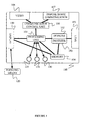
- FIG. 1 is a functional block diagram illustrating a colour image processing apparatus, 100, according to the present invention.
- the apparatus, 100 is basically an adapted digital video camera.
- the lens, 101 e.g. a normal camera lens being transparent at least for wavelengths visible to the human eye.
- the sensors, 102 may be arranged to form digital sensor arrays with sensitivity suitable at least for wavelengths visible to the human eye, i.e. the spectral range of the sensor(s), 102, used to capture an image is adapted to cover at least the wavelengths of human vision, which means normal film or ordinary digital camera sensors (wavelengths roughly between 400 and 800 nm).
- Each element in the sensor array i.e. pixel
- Digitizer, 103 is a conventional A/D-converter transforming an analog representation of a colour image captured by the sensors, 102, into a digital representation of said colour image, Ic.
- the apparatus, 100 has further a storage means, 104, i.e. any suitable RAM memory, a processing means, 105, e.g. a CPU, ASIC-circuit, ALU interconnected with other suitable hardware, as known to a person skilled in the art.
- a communication control unit, 106 which may comprise a converter for converting a colour image into a suitable format, interconnects the processing means, 105, with an analog image/video input/output connection unit, 108, and a digital image/video input/output connection, 107.
- connection 107 may be an ad hoc connection adapted for the communication with an external devices such as a digital camera and/or a network connection, e.g. an Internet connection, realised e.g. as a conventional telephone modem connection or USB-port.
- a display, 109 is connected with storage means 104 and/or processing means 105, allowing the display of a colour image stored in memory 104.
- the display, 109, the processing means, 105, and storage means 104 are arranged to allow an interactive selection of areas in the colour image displayed on display, 109, by the usage of interactive pointing means, 120, e.g. a computer mouse or similar. This is known and will not be described further here.
- control means, 110 are interconnected with interactive control means, 110, and/or , 130, and/or 140, such as selector buttons, knobs or similar, allowing an interactive control of the pre-washing steps, 215, 240, and the interactive control of parameter values for the histogram equalization step, 250, as described in detail below.
- control means, 130 is a knob with 5 distinct positions for selecting what type of pre-wash to apply depending on application, as described below, but other possibilities exist.
- control means 140 is a knob with 7 distinct positions to select what specific combination of updated colour pixel matrixes, Mi's, to use when updating a colour image, depending on application, but other possibilities exist.
- control means, 110 is a knob with N distinct positions for selecting a suitable threshold value K depending on application, as described below.
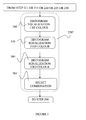
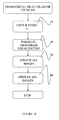
- FIG. 2 shows a flowchart illustrating the method according to the invention. The method is generally carried out by loading a software program, stored in storage means 104, into processing means 105.
- the method according to the invention starts with the capturing step, 210, to obtain a stored version of a colour image representation, Ic, in storage means 104.
- Live images may be captured through lens, 101, further by sensors 102, then converted into a digital format by A/D-converter, 103, and then stored in memory 104, in a known manner, or can be read directly from external devices via connections 107 or 108.
- Analog video images are read in via input connection, 108, decoded and encoded into a suitable digital format, Ic, by processing means, 105, and/or communication control unit 106, and then stored in memory 104, in a known manner.
- Digital video images are read in via input connection, 107, possibly transferred to a more suitable data format, Ic, by processing means, 105, and/or communication control unit 106, and then stored in memory, 104, in a known manner.
- a suitable format means that Ic is made up of a set of separate colour channels or colour pixel matrixes, Mi, normally one matrix for red, one matrix for green and one matrix for blue.
- said set of matrixes comprises at least two distinct colour matrixes.
- the invention is however applicable for all types of colour images, e.g. Cyan-Magenta-Yellow-Black encoded images, since any colour image can be transformed into said suitable data format, Ic, in a known manner.
- step 211 in which the processing means, 105, reads the positions of each and all of the interactive control means, 110, 130, and 140. If the control means 130 is positioned in its first position, (1), then the method proceeds to pre-wash step 215, described in detail below. If the control means 130 is in its second, (2), third, (3), or fourth, (4), position, then the method proceeds to pre-wash step 240, described in detail below. If the control means, 130, is in its fifth, (5), position, then the method proceeds to the histogram equalization step, 250, in which an updated version, M1', for at least one of said colour pixel matrixes, M1, is created. Step 250 is described in more detail below with reference to fig. 3 .
- step 250 the method according to the invention proceeds to step 290, in which an updated version Ic', of the image, Ic, is created, by combining said updated pixel matrix version, M1', with at least one other pixel matrix, Mi, or updated pixel matrix, Mi'.
- step 290 the updated image representation, Ic', is stored in memory 104.
- step 295 the updated image representation, Ic', in memory 104 is displayed on display 109, in a known manner.
- the histogram equalization step is carried out for at least one of the pixel matrixes, however, the best result is normally obtained when all three pixel matrixes are histogram equalized, so that the updated version of said image, Ic', is made up of updated versions of all three colour pixel matrixes, i.e. green, red and blue.
- Ic' updated versions of all three colour pixel matrixes
- the histogram equalisation step 250 is carried out separately, for the different colour pixel matrixes, Mi.
- the histogram equalization step, 250 comprises a first histogram equalisation step, 360, for said first colour pixel matrix, M1, e.g. green, a second histogram equalisation step, 370, for a second colour pixel matrix, M2, e.g. red, and a third histogram equalisation step, 380, for the remaining colour pixel matrix, M3, e.g. blue, in this case.
- the method according to the invention proceeds to step 385 after step 380.
- a selection is made in step 385 what updated pixel matrixes, Mi':s, will be used in said updating step 290.
- the updated image, Ic' will be made up of at least these selected matrixes, Mi:s, after step 290.
- the selection in step 385 is carried out interactively by positioning the selecting means, 140.
- selecting means, 140 if selecting means, 140, is in its first, second or third position, only one updated colour matrix, M1, is selected, i.e. green or red or blue, if selecting means 140 is in its fourth, fifth, or sixth position, then a combination of two updated colour pixel matrixes, Mi':s, are selected, i.e. red and green, red and blue or green and blue, and if selecting means 140 is in its seventh position, then all three updated colour pixel matrixes Mi':s are selected, however, other possibilities obvious for a person skilled in the art exist.
- the histogram equalisation steps, 360, 370, and 380, are completely analogous, and only step 360 will be described in detail here, with reference to figures 4 , 5 , 6 , 7 and 8 .
- the histogram equalisation step is carried out as illustrated in figure 4 .
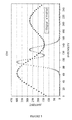
- Figure 5 illustrates the IDH for a colour matrix, Mi, before, as grey circles, and after, as black triangles, the histogram equalisation step 250.
- the colour pixel matrix, Mi comprises intensity values only in the range between the quantization values of about 60 and 160.
- the histogram equalization step, 250 "stretches out” the intensity distribution, e.g. so as to form a result illustrated by the grey bars in figure 5 .
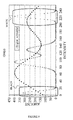
- step 410 from step 401, in which the normalized cumulative sum, NCS, of IDH is calculated, as illustrated in figure 6 .
- the grey circles represent the IDH before histogram equalization and the black triangles illustrate the NCS for said IDH.
- step 420 a suitable threshold value, K, is chosen. This can be accomplished in an interactive way by positioning control means 110.
- the choice of K depends on application and/or environmental conditions, e.g. for a landing ground in fog a suitable value for K can be K 1 , for a deep under water application K 2 , for under water applications in tropical waters, K 3 , and so on.
- K is a stretching factor determining how much the IDH shall be "stretched out", i.e. the degree of intensity distribution expansion. Normally, the IDH is stretched out to its full range, as illustrated in figure 5 but the invention is not restricted hereto.
- K represents a percentage threshold value, as illustrated in figure 7 .
- the method proceeds to step 430, in which the intensity distribution histogram, IDH, is stretched out to form an updated version, IDH', by remapping the original pixel values on to a larger range of intensity values, as illustrated in figure 5 .
- This can be accomplished by first selecting a first range R AB for IDH, e.g. by identifying intensity values in the NCS having values A, and B, corresponding to said percentage threshold value K, and 1-K, as illustrated in figure 7 .
- K is set to 5% and the value of A is about 80 and the value of B is about 140 on the intensity scale.
- All intensity values outside the range R AB i.e. intensity values below A or exceeding B, are thereafter removed from IDH, and the pixel values of IDH are remapped on to a second larger range R AB ', of pixel intensity values.
- R AB ' is normally the whole quantization range, as illustrated in figure 5 , but other possibilities exist.
- the remapping step can be carried out pixel by pixel by forming suitable look-up tables, as known to a person skilled in the art.
- the histogram equalization step, 250 thus gives a more linear cumulative histogram, NCS, as illustrated in figure 8 .
- Histogram equalization is per se an established algorithm described in several image processing texts, e.g. Gonzalez, R.C. and Wintz, P., Digital Image Processing, Addison-Wesley, Reading, MA, 1987 . What is important according to the invention is that the histogram equalization step is carried out separately for each individual colour pixel matrix, M N .
- the commercial software program Photoshop TM has preinstalled functions to perform histogram equalization for individual colour channels, and these functions may be used as parts for carrying out the present invention.
- the three separate histogram equalization steps, 360, 370 and 380 all use the same threshold value K, and the updated version, Ic, of the colour image is made up of all updated matrixes, Mi', but the invention is not restricted hereto.
- the imaging system according to the invention can allow for different choices of K for different sections/parts of an image and cumulative histogram calculation can be based on the local neighbourhood of every pixel in the image.
- K-values are used for different segments in the image, e.g. by using segmentation algorithms overriding the manual control of K.
- this embodiment can be advantageous.
- Another possibility particularly advantageous for real time applications is to apply the method according to the invention in parallel on at least two identical image sequences, i.e. one being a copy of the other, and to display the image sequences next to each other.
- a specific parameter setting i.e. a settled combination of type of pre-wash, matrix combination and K-value, can thus generate a "best" image sequence which currently can be compared with a "scan” image sequence scanning for better alternative settings during parallel display next to each other in real time. If the "scan" image sequence provide a higher perceived image quality, i.e.
- Figure 10 is a flow chart illustrating how this embodiment can be realised.
- step 20 a histogram equalisation step is carried out in parallel for said at least two identical colour images, Ic, Ic2, normally with different parameter settings regarding type of pre-wash and/or stretching factor, K, and/or matrix combination for Ic, with respect of the parameter settings for Ic2.
- the step 20 is nothing but step 250, described with reference to figures 2 , 3 and 4 , applied for Ic and IC2 separately.
- step 30 updated image versions Ic', Ic2' are formed.
- Step 30 is nothing but step 290, described with reference to figure 2 , applied for Ic' and Ic2' separately.
- Ic' and Ic2' are thereafter displayed on display means 109 in step 40.
- step 215 the colour content of artificially introduced artefacts in the image are identified, and removed as illustrated in figure 9 .
- artefacts often occur when analog video signals are captured by digital devices. These images often contain black/white frames and/or texts and/or lettering to indicate position, date, time, status etc.
- the high intensity pixel values, corresponding to "WHITE" values in figure 9 and the low intensity pixel values, corresponding to "BLACK” values in figure 9 , are discarded before the histogram equalization step. This can be accomplished by using known algorithms for image processing.
- Step 240 can be realized by any of steps 220, or 225 and 230, or a combination thereof, not illustrated in figure 2 .
- undesired segments of the image, Ic are identified and removed.
- a text recognition algorithm identifies what segments in the image, Ic, to remove before the histogram equalisation step. All pixel values in said segments will thus be discarded.
- step 225 the image, Ic, is segmented by human interaction, e.g. by moving pointing means, 120, over a display 109, displaying said image.
- an image segmentation algorithm adapted for a specific application identifies what segments/pixels in the image, Ic, to discard, e.g. at deep under sea work close to the bottom using high power lamps, with many blinding particles "floating" in the image, all pixels having an intensity exceeding a threshold value may be discarded.
- Another possibility is to use segmentation algorithms that identify specific "firm" object/s with a known form in the image, such as part/s of an oil rig. Such algorithms are known and will not be described in detail here.
- the method according to the invention seems to give the best result in situations where the spectral dynamic range of the colour image is limited/restricted to a relatively narrow segment of intensity values for each channel/colour.
- the invention is not restricted to only such situations.
- the apparatus according to the present invention can be realised e.g. by a computer readable medium, e.g. hard disc memory, CD-ROM, magnetic tape, flash-memory etc, with stored computer program code means to be stored in said memory, 104, to make said processing means 105 execute at least one procedure realizing the method according to the invention.
- a computer readable medium e.g. hard disc memory, CD-ROM, magnetic tape, flash-memory etc
- stored computer program code means to be stored in said memory, 104, to make said processing means 105 execute at least one procedure realizing the method according to the invention.
- pure hardware logic can be used, such as e.g. ASIC-circuits, as known to a person skilled in the art.
- the invention is realised in form of an adapted camera or video camera, thus providing a handy, relatively small and low weight apparatus being mobile and versatile in use as an economical choice.
- the apparatus according to the invention is realised in form of a detector device which may be adapted in a specific way depending on application, e.g. specific lamps may be arranged in a specific way to provide optimal lighting conditions, e.g. in the case of food safety, meat slices may be illuminated from below and so on.
- the detector may comprise a lens that is aerodynamically integrated with the airplane body at an optimal position, e.g. under the nose.
- the detector display means may be adapted so as to project the image on the wind screen and so on.
- the invention is realised in form of a security surveillance and/or monitor system comprising at least one apparatus according to the invention.
- the invention is realised in form of a Remotely Operated Vehicle comprising colour image capturing means communicating with an apparatus according to the invention, e.g. by means of an electrical or optical cable, radio link etc.
- colour image capturing means communicating with an apparatus according to the invention, e.g. by means of an electrical or optical cable, radio link etc.
- the invention is realised in form of an apparatus for inspecting the inner parts of the human eye comprising means for capturing a colour image from the inside of the eye wherein said capturing means are connected with an apparatus for executing the method according to the invention.
- the apparatus may be adapted in many ways, e.g. for obtaining optimal lighting conditions, e.g. by specific lamps directed towards the eye, or to provide optimal zoom and/or resolution and/or having specific preinstalled parameter settings regarding intensity diagram stretching, e.g. choice of K, combination of updated colour matrixes to form the updated image and type of pre-wash, for the effective and efficient detection of specific malformations and/or illnesses, and/or other arrangements to improve patient conditions, e.g. providing a comfortable and firm support of the head, in order to minimise the risk of erroneous diagnoses and/or the time required for the inspection.
- the invention is realised in form of a face mask comprising colour image display means arranged for eye view wherein said display means are connected with an apparatus for executing the method according to the invention.
- the face mask may be in form of e.g. adapted goggles, providing particularly efficient means for amplified vision e.g. during rescue operations in foggy/smoky environments e.g. during fire fighting or in case of a fire in cockpit and so on.
Landscapes
- Physics & Mathematics (AREA)
- General Physics & Mathematics (AREA)
- Engineering & Computer Science (AREA)
- Theoretical Computer Science (AREA)
- Image Processing (AREA)
- Facsimile Image Signal Circuits (AREA)
- Color Image Communication Systems (AREA)
- Studio Devices (AREA)
- Image Analysis (AREA)
Applications Claiming Priority (2)
| Application Number | Priority Date | Filing Date | Title |
|---|---|---|---|
| US52165004P | 2004-06-11 | 2004-06-11 | |
| EP04021699A EP1605406A3 (de) | 2004-06-11 | 2004-09-13 | Detektion von Objekten in Farbbildern |
Related Parent Applications (2)
| Application Number | Title | Priority Date | Filing Date |
|---|---|---|---|
| EP04021699 Previously-Filed-Application | 2004-09-13 | ||
| EP04021699.6 Division | 2004-09-13 |
Publications (2)
| Publication Number | Publication Date |
|---|---|
| EP2273449A2 true EP2273449A2 (de) | 2011-01-12 |
| EP2273449A3 EP2273449A3 (de) | 2012-07-25 |
Family
ID=40134080
Family Applications (2)
| Application Number | Title | Priority Date | Filing Date |
|---|---|---|---|
| EP10182515A Withdrawn EP2273449A3 (de) | 2004-06-11 | 2004-09-13 | Verfahren und Vorrichtung zur Bildverarbeitung durch Histogrammausgleich |
| EP04021699A Ceased EP1605406A3 (de) | 2004-06-11 | 2004-09-13 | Detektion von Objekten in Farbbildern |
Family Applications After (1)
| Application Number | Title | Priority Date | Filing Date |
|---|---|---|---|
| EP04021699A Ceased EP1605406A3 (de) | 2004-06-11 | 2004-09-13 | Detektion von Objekten in Farbbildern |
Country Status (6)
| Country | Link |
|---|---|
| US (1) | US8023730B2 (de) |
| EP (2) | EP2273449A3 (de) |
| JP (1) | JP4712041B2 (de) |
| CN (1) | CN101040296A (de) |
| CA (1) | CA2569791A1 (de) |
| WO (1) | WO2005122085A2 (de) |
Cited By (2)
| Publication number | Priority date | Publication date | Assignee | Title |
|---|---|---|---|---|
| CN106033616A (zh) * | 2015-03-17 | 2016-10-19 | 联想(北京)有限公司 | 电子设备和图像处理方法 |
| CN104867369B (zh) * | 2015-05-29 | 2017-04-12 | 哈尔滨工程大学 | 无人潜器运动模拟装置及模拟方法 |
Families Citing this family (26)
| Publication number | Priority date | Publication date | Assignee | Title |
|---|---|---|---|---|
| US7738698B2 (en) * | 2006-01-26 | 2010-06-15 | Vestel Elektronik Sanayi Ve Ticaret A.S. | Method and apparatus for adjusting the contrast of an image |
| US20100128058A1 (en) * | 2007-03-27 | 2010-05-27 | Akihiro Kawabata | Image viewing apparatus and method |
| CN101436038B (zh) * | 2008-12-05 | 2011-12-28 | 中国国家博物馆 | 考古发掘现场智能预探测系统 |
| US9269154B2 (en) * | 2009-01-13 | 2016-02-23 | Futurewei Technologies, Inc. | Method and system for image processing to classify an object in an image |
| WO2010114478A1 (en) * | 2009-03-31 | 2010-10-07 | Azimuth Intellectual Products Pte Ltd | Apparatus and methods for analysing goods cartons |
| US8665329B2 (en) * | 2010-06-11 | 2014-03-04 | Gianni Arcaini | Apparatus for automatically ignoring cast self shadows to increase the effectiveness of video analytics based surveillance systems |
| TWI469631B (zh) * | 2010-11-05 | 2015-01-11 | 財團法人資訊工業策進會 | 影像處理裝置及影像處理方法 |
| RU2013149272A (ru) * | 2011-04-06 | 2015-05-20 | Конинклейке Филипс Н.В. | Безопасность в динамическом трехмерном медицинском окружении |
| KR101568971B1 (ko) * | 2011-08-03 | 2015-11-13 | 인디안 인스티튜트 오브 테크놀로지, 카라그푸르 | 화상 및 동영상에서 안개를 제거하는 방법 및 시스템 |
| US9646366B2 (en) * | 2012-11-30 | 2017-05-09 | Change Healthcare Llc | Method and apparatus for enhancing medical images |
| US9866835B2 (en) * | 2013-02-07 | 2018-01-09 | Schlumberger Technology Corporation | Borehole image compression |
| CN104516340B (zh) * | 2014-12-23 | 2017-02-01 | 福建省计量科学研究院 | 一种污染源监测设备的计量服务系统及其方法 |
| JP6361631B2 (ja) | 2015-10-29 | 2018-07-25 | Smk株式会社 | 車載センサ、車両用灯具及び車両 |
| JP2017085414A (ja) | 2015-10-29 | 2017-05-18 | Smk株式会社 | 撮像システム、車両用灯具及び車両 |
| CN105675623B (zh) * | 2016-01-29 | 2018-05-25 | 重庆扬讯软件技术股份有限公司 | 一种基于污水口视频的污水颜色与流量检测的实时分析方法 |
| EP3296960B1 (de) * | 2016-09-15 | 2018-08-22 | Axis AB | Verfahren und anordnung zur pseudofärbung eines digitalen bildes |
| US11295859B2 (en) | 2016-12-14 | 2022-04-05 | Reliant Immune Diagnostics, Inc. | System and method for handing diagnostic test results to telemedicine provider |
| US11164680B2 (en) * | 2016-12-14 | 2021-11-02 | Reliant Immune Diagnostics, Inc. | System and method for initiating telemedicine conference using self-diagnostic test |
| US11915810B2 (en) | 2016-12-14 | 2024-02-27 | Reliant Immune Diagnostics, Inc. | System and method for transmitting prescription to pharmacy using self-diagnostic test and telemedicine |
| KR101907548B1 (ko) * | 2016-12-23 | 2018-10-12 | 한국과학기술연구원 | 휴먼 추종을 위한 이동로봇의 주행 및 탐색방법 |
| US10664702B2 (en) | 2016-12-30 | 2020-05-26 | International Business Machines Corporation | Method and system for crop recognition and boundary delineation |
| US10586105B2 (en) * | 2016-12-30 | 2020-03-10 | International Business Machines Corporation | Method and system for crop type identification using satellite observation and weather data |
| US10445877B2 (en) | 2016-12-30 | 2019-10-15 | International Business Machines Corporation | Method and system for crop recognition and boundary delineation |
| CN106934796B (zh) * | 2017-02-15 | 2018-11-30 | 山东大学 | 隧道掘进机搭载的高速皮带机岩渣视频分析系统及方法 |
| EP3933776B1 (de) * | 2020-06-29 | 2024-12-25 | Axis AB | Verfahren und bildverarbeitungsvorrichtung zur anonymisierung eines digitalen farbbildes |
| CN117392038B (zh) * | 2023-12-05 | 2024-03-08 | 北京智源人工智能研究院 | 医学图像直方图均衡化方法、装置、电子设备和存储介质 |
Family Cites Families (9)
| Publication number | Priority date | Publication date | Assignee | Title |
|---|---|---|---|---|
| JPH01161507A (ja) | 1987-12-18 | 1989-06-26 | Aisin Seiki Co Ltd | 移動体上監視装置 |
| JP2825679B2 (ja) | 1990-04-12 | 1998-11-18 | キヤノン株式会社 | 電子写真感光体及びその製造方法 |
| US6463173B1 (en) | 1995-10-30 | 2002-10-08 | Hewlett-Packard Company | System and method for histogram-based image contrast enhancement |
| JPH09284642A (ja) | 1996-04-19 | 1997-10-31 | Fujitsu General Ltd | テレビカメラ |
| JP3557509B2 (ja) | 1997-03-28 | 2004-08-25 | 沖電気工業株式会社 | 動物の個体識別装置 |
| US6906826B1 (en) * | 1998-11-16 | 2005-06-14 | Seiko Epson Corporation | Medium on which image modifying program is recorded, image modifying apparatus and method |
| JP2001257905A (ja) | 2000-03-14 | 2001-09-21 | Sony Corp | 映像処理方法および映像処理装置 |
| JP2002158893A (ja) | 2000-11-22 | 2002-05-31 | Minolta Co Ltd | 画像補正装置、画像補正方法および記録媒体 |
| JP2003284705A (ja) * | 2002-03-27 | 2003-10-07 | Konica Corp | 医用画像処理装置、画像処理パラメータの設定方法、プログラム、記憶媒体 |
-
2004
- 2004-09-13 EP EP10182515A patent/EP2273449A3/de not_active Withdrawn
- 2004-09-13 EP EP04021699A patent/EP1605406A3/de not_active Ceased
-
2005
- 2005-06-08 CA CA002569791A patent/CA2569791A1/en not_active Abandoned
- 2005-06-08 US US11/629,343 patent/US8023730B2/en active Active
- 2005-06-08 CN CNA2005800272236A patent/CN101040296A/zh active Pending
- 2005-06-08 WO PCT/EP2005/052645 patent/WO2005122085A2/en not_active Ceased
- 2005-06-08 JP JP2007526427A patent/JP4712041B2/ja not_active Expired - Lifetime
Non-Patent Citations (3)
| Title |
|---|
| FISHER B ET AL: "Contrast Stretching - Histogram Equalization", INTERNET CITATION, 1994, XP002291289, Retrieved from the Internet: URL:http://www.cee.hw.ac.uk/hipr/html/stretch.html [retrieved on 2004-08-04] * |
| R. SUKTHANKAR ET AL: "Argus: the digital doorman", IEEE INTELLIGENT SYSTEMS, vol. 16, no. 2, 1 March 2001 (2001-03-01), pages 14-19, XP055020718, ISSN: 1541-1672, DOI: 10.1109/5254.920593 * |
| SHIGUANG SHAN ET AL: "Illumination normalization for robust face recognition against varying lighting conditions", ANALYSIS AND MODELING OF FACES AND GESTURES, 2003. AMFG 2003. IEEE INT ERNATIONAL WORKSHOP ON 17 OCT. 2003, PISCATAWAY, NJ, USA,IEEE, 1 January 2003 (2003-01-01), pages 157-164, XP010664359, DOI: 10.1109/AMFG.2003.1240838 ISBN: 978-0-7695-2010-0 * |
Cited By (3)
| Publication number | Priority date | Publication date | Assignee | Title |
|---|---|---|---|---|
| CN106033616A (zh) * | 2015-03-17 | 2016-10-19 | 联想(北京)有限公司 | 电子设备和图像处理方法 |
| CN106033616B (zh) * | 2015-03-17 | 2020-01-31 | 联想(北京)有限公司 | 电子设备和图像处理方法 |
| CN104867369B (zh) * | 2015-05-29 | 2017-04-12 | 哈尔滨工程大学 | 无人潜器运动模拟装置及模拟方法 |
Also Published As
| Publication number | Publication date |
|---|---|
| EP1605406A2 (de) | 2005-12-14 |
| CA2569791A1 (en) | 2005-12-22 |
| US20080304695A1 (en) | 2008-12-11 |
| EP2273449A3 (de) | 2012-07-25 |
| EP1605406A3 (de) | 2006-09-20 |
| JP4712041B2 (ja) | 2011-06-29 |
| US8023730B2 (en) | 2011-09-20 |
| WO2005122085A3 (en) | 2006-10-12 |
| CN101040296A (zh) | 2007-09-19 |
| WO2005122085A2 (en) | 2005-12-22 |
| JP2008502062A (ja) | 2008-01-24 |
Similar Documents
| Publication | Publication Date | Title |
|---|---|---|
| US8023730B2 (en) | Method that improves human interpretation of color images with limited spectral content | |
| Acharya et al. | Image processing: principles and applications | |
| JP4783795B2 (ja) | 照明および反射境界の区別 | |
| CN102461156B (zh) | 用于双传感器应用的红外相机系统和方法 | |
| Toet et al. | New false color mapping for image fusion | |
| Johnsen et al. | The use of underwater hyperspectral imaging deployed on remotely operated vehicles-methods and applications | |
| US9047515B2 (en) | Method and system for wildfire detection using a visible range camera | |
| KR20220077428A (ko) | 유인 또는 무인 항공기에서 획득된 다분광 영상을 이용한 원격 모자반 탐지방법 및 그 시스템 | |
| Sharma | Probabilistic model-based multisensor image fusion | |
| CN112365467B (zh) | 一种基于单幅图像深度估计的雾天图像能见度估计方法 | |
| Zhang et al. | Sea Ice Image Processing with MATLAB® | |
| CN108563986B (zh) | 基于远距离拍摄图像的震区电线杆姿态判断方法和系统 | |
| Congalton | Remote sensing: an overview | |
| CN117690083A (zh) | 一种基于图像特征的洞库目标伪装效果动态监测方法与系统 | |
| CN115187936B (zh) | 一种海上平台防登临监控系统及方法 | |
| Bello-Pineda et al. | Using aerial video to train the supervised classification of Landsat TM imagery for coral reef habitats mapping | |
| Crapper et al. | Change detection using Landsat photographic imagery | |
| Fechner et al. | Optimal fusion of TV and infrared images using artificial neural networks | |
| US12217439B2 (en) | Real-time marine snow noise removal from underwater video | |
| Setiawan et al. | ANALYSIS OF CLASSIFICATION METHODS FOR MAPPING SHALLOW WATER HABITATS USING SPOT-7 SATELLITE IMAGERY IN NUSA LEMBONGAN ISLAND, BALI | |
| KR102357256B1 (ko) | 카메라의 임의 풍경 영상을 이용한 방향 의존 시정거리 및 2 차원 공간 미세먼지 분포 측정 방법 | |
| CN116152682A (zh) | 超低空无人机视角下的多行人检测与姿态估计方法 | |
| Panić et al. | Drone as a part of maritime search and rescue operations | |
| Wong et al. | A review on the underwater image restoration and enhancement methods | |
| Edmunds | Operational Guidance: Marine Ecology Imaging Surveys |
Legal Events
| Date | Code | Title | Description |
|---|---|---|---|
| PUAI | Public reference made under article 153(3) epc to a published international application that has entered the european phase |
Free format text: ORIGINAL CODE: 0009012 |
|
| AC | Divisional application: reference to earlier application |
Ref document number: 1605406 Country of ref document: EP Kind code of ref document: P |
|
| AK | Designated contracting states |
Kind code of ref document: A2 Designated state(s): AT BE BG CH CY CZ DE DK EE ES FI FR GB GR HU IE IT LI LU MC NL PL PT RO SE SI SK TR |
|
| RIN1 | Information on inventor provided before grant (corrected) |
Inventor name: HOLM, OLLE Inventor name: HOLM, ANDERS |
|
| RIC1 | Information provided on ipc code assigned before grant |
Ipc: G06T 5/40 20060101AFI20120305BHEP |
|
| PUAL | Search report despatched |
Free format text: ORIGINAL CODE: 0009013 |
|
| AK | Designated contracting states |
Kind code of ref document: A3 Designated state(s): AT BE BG CH CY CZ DE DK EE ES FI FR GB GR HU IE IT LI LU MC NL PL PT RO SE SI SK TR |
|
| RIC1 | Information provided on ipc code assigned before grant |
Ipc: G06T 5/40 20060101AFI20120621BHEP |
|
| STAA | Information on the status of an ep patent application or granted ep patent |
Free format text: STATUS: THE APPLICATION IS DEEMED TO BE WITHDRAWN |
|
| 18D | Application deemed to be withdrawn |
Effective date: 20130126 |