EP2271504B1 - Machine readable security elements and products containing them - Google Patents
Machine readable security elements and products containing them Download PDFInfo
- Publication number
- EP2271504B1 EP2271504B1 EP08755124A EP08755124A EP2271504B1 EP 2271504 B1 EP2271504 B1 EP 2271504B1 EP 08755124 A EP08755124 A EP 08755124A EP 08755124 A EP08755124 A EP 08755124A EP 2271504 B1 EP2271504 B1 EP 2271504B1
- Authority
- EP
- European Patent Office
- Prior art keywords
- dopant
- emission
- security element
- pigment
- host lattice
- Prior art date
- Legal status (The legal status is an assumption and is not a legal conclusion. Google has not performed a legal analysis and makes no representation as to the accuracy of the status listed.)
- Revoked
Links
Images

Classifications
-
- B—PERFORMING OPERATIONS; TRANSPORTING
- B42—BOOKBINDING; ALBUMS; FILES; SPECIAL PRINTED MATTER
- B42D—BOOKS; BOOK COVERS; LOOSE LEAVES; PRINTED MATTER CHARACTERISED BY IDENTIFICATION OR SECURITY FEATURES; PRINTED MATTER OF SPECIAL FORMAT OR STYLE NOT OTHERWISE PROVIDED FOR; DEVICES FOR USE THEREWITH AND NOT OTHERWISE PROVIDED FOR; MOVABLE-STRIP WRITING OR READING APPARATUS
- B42D25/00—Information-bearing cards or sheet-like structures characterised by identification or security features; Manufacture thereof
- B42D25/20—Information-bearing cards or sheet-like structures characterised by identification or security features; Manufacture thereof characterised by a particular use or purpose
- B42D25/29—Securities; Bank notes
-
- B—PERFORMING OPERATIONS; TRANSPORTING
- B42—BOOKBINDING; ALBUMS; FILES; SPECIAL PRINTED MATTER
- B42D—BOOKS; BOOK COVERS; LOOSE LEAVES; PRINTED MATTER CHARACTERISED BY IDENTIFICATION OR SECURITY FEATURES; PRINTED MATTER OF SPECIAL FORMAT OR STYLE NOT OTHERWISE PROVIDED FOR; DEVICES FOR USE THEREWITH AND NOT OTHERWISE PROVIDED FOR; MOVABLE-STRIP WRITING OR READING APPARATUS
- B42D25/00—Information-bearing cards or sheet-like structures characterised by identification or security features; Manufacture thereof
- B42D25/30—Identification or security features, e.g. for preventing forgery
- B42D25/36—Identification or security features, e.g. for preventing forgery comprising special materials
- B42D25/378—Special inks
-
- B42D2033/20—
-
- B42D2035/34—
-
- B—PERFORMING OPERATIONS; TRANSPORTING
- B42—BOOKBINDING; ALBUMS; FILES; SPECIAL PRINTED MATTER
- B42D—BOOKS; BOOK COVERS; LOOSE LEAVES; PRINTED MATTER CHARACTERISED BY IDENTIFICATION OR SECURITY FEATURES; PRINTED MATTER OF SPECIAL FORMAT OR STYLE NOT OTHERWISE PROVIDED FOR; DEVICES FOR USE THEREWITH AND NOT OTHERWISE PROVIDED FOR; MOVABLE-STRIP WRITING OR READING APPARATUS
- B42D25/00—Information-bearing cards or sheet-like structures characterised by identification or security features; Manufacture thereof
- B42D25/30—Identification or security features, e.g. for preventing forgery
- B42D25/36—Identification or security features, e.g. for preventing forgery comprising special materials
- B42D25/378—Special inks
- B42D25/382—Special inks absorbing or reflecting infrared light
Definitions
- This invention relates to machine readable security elements and products containing them.
- Products requiring machine readable security elements include, for instance, value documents (e.g. paper and plastic substrate materials such as banknotes, passports, visas, and the like), labels, tickets and identity cards.
- host lattices doped with rare earth ions are generally known within the art. These compounds may absorb radiation at one frequency, and emit radiation at a different frequency, wherein radiation refers to UV, visible, near infrared and infrared radiation. When irradiated with a given wavelength of radiation, these compounds luminesce at a second wavelength and such luminescence may be detected by a detector. Such luminescent compounds are called "luminophores,” which may be ions or compounds.
- Host lattices doped with luminophore compounds have absorption and emission profiles that are generally characteristic of the ion, but modified by the effects of being incorporated into a crystal host lattice. It is possible to measure both absorption and emission with current laboratory equipment.
- the emission may be disguised by using more than one rare earth metal and/or host lattice.
- WO2006/024530 A1 discloses the use of at least two luminescent materials with overlapping spectral emission bands as a luminescent security feature system.
- the luminescent materials have the same host lattice but a different luminophore or alternatively a different host lattice with the same luminophore, wherein the luminophore may be a rare earth metal.
- WO2005/035271 A2 discloses a machine-readable coding system for security documents comprising a first and second luminescent substance both of which are luminescent in a common emission range outside of the visible spectral range.
- the emission spectra of the first and second luminescent substances overlap in at least one partial area of the known emission range in such a manner that the emission spectrum of the first luminescent substance is characteristically supplemented by the emission spectrum of the second luminescent substance, wherein the luminescent substances may be host lattices doped with rare earth metals.
- the emission spectra of luminophores may be disguised by the use of absorbing materials.
- the absorption spectrum of an absorbing material overlaps or covers the emission spectrum or the excitation spectrum of the luminophore and changes it in characteristic fashion. These changes may, for example, take place by "restricting" the spectral range or by "deforming" the excitation and/or emission spectra. In the simplest example, such restriction occurs by separating edge regions of the spectra, while such deformation may occur by designed damping of narrow spectral regions of broad band spectra or by eliminating given spectral lines.
- US4451530 discloses altering a known emission spectra and using the characteristically altered portion for authentication of the security document.
- the security element consists of an inorganic host lattice doped with a luminophore, such as a rare earth and one or more absorbing materials such as dyes which alter the emission spectrum of the luminophore by restricting the spectral range or by deforming the excitation and/or emission spectra.
- US6506476 B1 discloses the use of an inorganic host lattice doped with at least one rare earth metal, including thulium as an authentication feature for a printed value document.
- the authentication feature may be printed onto the printed value document or added into the paper pulp.
- the doped host lattice largely absorbs and is excitable in the visible region of the spectrum and is transparent in at least part of the infrared spectrum. With high efficiency, the host lattice transfers the absorbed energy to the thulium.
- the quantum yield of the luminescent substances lies in the range between 50 and 90%. By absorption, the host lattice suppresses the emission lines of the thulium occurring in the visible and possibly near infrared regions.
- US6344261 B1 discloses a printed valuable document with at least one authentication feature in the form of a luminescent substance based on a host lattice doped with at least one rare earth metal.
- the host lattice largely absorbs in the entire visible region of the spectrum, and contains chromium as an absorptive substance. This very broad band absorption by the host lattice causes the lines from the doped rare earth metal lying in this region to be suppressed.
- an energy transfer takes place from the host lattice to the doped rare earth metal, by means of which the emissions by the luminescent substance are induced. Much more effective stimulation of the rare earth metals takes place, also leading to greater emission intensities.
- US6479133 B1 discloses the use of an inorganic host lattice, doped with two rare earth metals, thulium and holmium, as an authentication feature for a printed valuable document.
- the authentication feature may be embedded in a paper pulp or added to the printing ink.
- the host lattice contains broadband absorptive components and with high efficiency, transfers the absorbed energy to the rare earth doping metal.
- the quantum yield of the luminescent substances lies in the range between 50 and 90%.
- the emission spectrum of the rare earth metal is influenced in a characteristic manner by the absorptive components.
- US4463970 discloses the use of camouflage materials, which may be luminophores, to prevent detecting the pattern of the excitable marking materials indirectly by means of chemical laboratory analysis.
- the excitable marking materials are used to record information in a code.
- the signal used in coding to be concealed may involve the emission spectra of camouflage materials including luminophores.
- the camouflage materials may be wide-band emitting, e.g. organic luminophores.
- the characteristic signal of the excitable marking material may then only be noticed as a small tip added to the emission spectra.
- one or more narrow-band luminophores may be added which emit at wavelengths other than the signal to be measured and therefore the emission spectrum is complex.
- luminescent substances may be used as a security feature for a printed value document.
- One luminescent substance acts as the absorber and the other luminescent substance acts as the emitter. There may be an efficient transfer of energy from the absorber to the emitter.
- WO2006/099642 A1 discloses the use of two inorganic luminescent substances in a security element for a security document.
- the first luminescent substance is excited by incident radiation.
- Energy is transferred between the first and second luminescent substances, whereby the frequency range of the excitation of one of the luminescent substances corresponds to the frequency range of excitation of the other luminescent substance.
- JP2002212552 discloses an infrared luminescent fluorescent substance comprising an inorganic material co-activated with thulium, having an absorption in the infrared range, and holmium, matching a thulium energy level to efficiently transmit an absorbed light energy and having luminescence in the infrared range as optionally active elements.
- EP1241242 A2 discloses an anti-Stokes phosphor that is a luminophore for application in security documents, where the emission waveband has a shorter wavelength than the absorption waveband.
- the anti-Stokes phosphor is a host lattice doped with two rare earth ions.
- One of the dopants for example ytterbium, forms an absorber and the other dopant, for example thulium, forms an emitter.
- the intensity levels between individual groups of emission lines are variable and depend on the absorber and/or the emitter concentration in the phosphor.
- a machine readable security element comprising an admixture of at least two pigments, wherein a first pigment comprises a first inorganic host lattice having a first luminescent dopant ion that emits electromagnetic radiation at a first emission wavelength band, and a second pigment comprises a second inorganic host lattice having at least two dopants wherein a first dopant of the second inorganic host lattice is the same as the first luminescent dopant ion and a second dopant is a rare earth ion (i) capable of being excited through non-radiative energy transfer from the first dopant of the second inorganic host lattice and (ii) emitting electromagnetic radiation at a second emission wavelength band, in which the second emission wavelength band has negligible overlap with the first emission wavelength band and the second dopant largely quenches the emission from the first dopant of the second inorganic host lattice at one or more emission peaks
- an article comprising a substrate carrying a security element according to the first aspect of this invention, wherein the article is an item of value.
- the substrate may be a paper or plastic product comprising paper pulp or polymer material and an admixture of at least two pigments, wherein when the pigments are added to the pulp during papermaking or the polymer during extrusion to form a security element within a paper or plastic product, the admixture is as defined in the first aspect of this invention.
- an ink comprising a vehicle, and an admixture of at least two pigments, wherein when the ink is applied to a substrate to form a security element, the admixture is as defined in the first aspect of this invention.
- a method of detecting the presence of a security element according to the first aspect of this invention in which the element is irradiated with incident radiation at one or more wavelengths including at a first dopant/first pigment absorption wavelength and at a first dopant/second pigment absorption wavelength and emission is detected in the first emission band and in the second emission band by use of detectors.
- a machine readable security element comprising an admixture of at least two pigments, wherein a first pigment comprises a first inorganic host lattice having a first luminescent dopant ion that emits electromagnetic radiation at a first emission wavelength band, and a second pigment comprises a second inorganic host lattice having at least two dopants wherein a first dopant of the second inorganic host lattice is the same as the first luminescent dopant ion and a second dopant is a rare earth ion (i) capable of being excited through non-radiative energy transfer from the first dopant of the second inorganic host lattice and (ii) emitting electromagnetic radiation at a second emission wavelength band, in which the second emission wavelength band has negligible overlap with the first emission wavelength band and the second dopant largely quenches the emission from the first dopant of the second inorganic host lattice at one or more emission peaks.
- a first pigment comprises a first inorgan
- “Largely quenches” means that the emission peak is quenched so that the maximum intensity of the emission peak is reduced substantially, preferably the emission peak is reduced to less than 20% of the maximum intensity of the peak in the first pigment, more preferably less than 10% of the maximum intensity of the peak in the first pigment and most preferably less than 5% of the maximum intensity of the peak in the first pigment so it may not be readily distinguished from the background noise of the spectrum.
- the first dopant absorbs electromagnetic radiation in the UV, visible or infrared spectral region at a first absorption wavelength, and preferably emits electromagnetic radiation in the UV, visible or infrared spectral region in the said first emission wavelength band which is at a higher wavelength than the first dopant absorption wavelength.
- the first luminescent ion may be a transition metal such as chromium, vanadium, manganese, titanium, nickel, iron or cobalt.
- the first luminescent ion is a rare earth ion, more preferably a lanthanide. Examples are given below.
- the first and second emissions may both be in the IR range.
- the host lattice for the pigments may be an aluminate, bromide, chloride, fluoride, gallate, garnet (including all mixed garnets), germanate, molybdate, niobate, oxide, oxyfluoride, oxysulfide, sodium yttrium fluoride, silicate, sulphate, sulphide, titanate, tungstate, and vanadate.
- the host lattice may be any of the known host inorganic lattices for rare earth cations, for instance any of those disclosed in WO2006/024530 A1 .
- the host lattices for the first and second pigments may be the same, or different.
- the first dopant absorption is preferably in the same region of the spectrum, and may be within a few nanometers, for both the first and second pigments in order to enable the same incident radiation source to be used for both pigments.
- the incident radiation which excites the first dopant in the first pigment and the incident radiation which excites the first dopant in the second pigment may be from different sources. This could be required in the case where narrow band excitation sources are employed when the two host lattices are substantially different, causing the absorption band of the first dopant to be sufficiently different in the first and second pigments such that narrow band excitation cannot adequately excite the primary ion in both host lattices.
- the excitation of the first dopant may be done at several wavelengths. For the purpose of generating a more compact, higher intensity excitation source, wavelength combining may be beneficial, e.g. where two light sources are directed to the security element. An example of such a case would be where there are multiple absorption peaks that feed the desired upper state manifold.
- the first and second emission bands are typically different by at least 50 nm.
- the desired result is to have essentially single excitation of both pigments with the resulting spectral outputs of each separate pigment to be largely separable from each other even though they contain at least one emitting dopant in common.
- the emissions may be either narrow or wide band, or combinations of either and it is the wavelengths at the maximum intensity which are preferably at least 50nm apart.
- the emission peak of the first dopant in the second pigment arising from the same transition that produces the emission in the first emission band is largely quenched by the second dopant.
- the most efficient sources of incident radiation are ones where the light is more fully absorbed by the spectral absorption feature.
- Light emission that may be part of the excitation source that does not overlap an absorption feature should be avoided if high efficiency is required.
- a narrow band laser light source may be advantageous in that it may be more efficient and LED's of suitable wavelength may not be available for absorption spectra of some of the suitable pigment combinations, but is also more expensive to operate and maintain.
- a person skilled in the art is to select a suitable source to meet the system requirements. There should be sufficient excitation, and the system function should meet all other performance criteria. These criteria include the lifetime, environmental factors, eye safety and economic considerations.
- the incident light may have a narrow waveband and may be at least 50 nm shorter in wavelength than both the first and second emission bands.
- the incident light may have a very wide waveband such as a light bulb or flash bulb. It is possible to filter the incident light to prevent irradiation of the security element by light of the same wavelength as said first or second emissions, and subsequent detection by the detector.
- the incident source may be a narrower band than conventional light bulbs, but wider than lasers, such as LED's.
- the incident radiation is preferably in the UV, visible and IR regions of the spectrum.
- the host lattices of the first and second pigment in a preferred embodiment are both largely transparent in the visible range, that is, in the preferred embodiment the host lattices are substantially colourless, but this is not a requirement.
- An advantage of the pigments being substantially colourless is that even if large amounts are applied to a substrate e.g. in a printed element, it will not substantially change the colour of the ink compared to the unloaded condition. Should the pigments not be substantially colourless, they may be used in some embodiments at sufficiently low levels to avoid the substrate changing colour, or in other embodiments at levels such that the colour is visible.
- the first and second dopant may be a M 2+ , for example Eu, Co, V and Dy, M 3+ , for example Cr, Ho, Pr and Nd, M 4+ , for example Cr or M 5+ , for example Mn ion, preferably M 3+ , wherein M is a rare earth, preferably a lanthanide or, for example for the first dopant a transition metal and the number + represents the valance state of the ion. Valence states impact the emission properties of the element.
- the host lattice is selected to accommodate the valance state of the element.
- the first dopant in the first and second pigments may also emit electromagnetic radiation at one or more additional emission wavelength bands at a higher wavelength that the first dopant absorption wavelength. One or more such emissions may not be substantially quenched by the second dopant in the second pigment. It may be useful to detect such further emissions from the first dopant in both pigments.
- a further emission wavelength is at a higher wavelength than the first dopant absorption wavelength and first emission wavelength, and in said second pigment, the second dopant, in sufficient concentration, may largely quench the further emission from the said first dopant in the second pigment.
- the quenched emission may correspond to a further emission which does take place from the first dopant in the first pigment.
- Detectors are selected with regard to the wavelength(s) of the emission(s) being detected, using, where necessary, filters to separate said first and second (and further) emissions. Detectors have design parameters based on a variety of requirements and conditions. They may be selected for the particular system requirement by those skilled in the art based on, for instance, spectral sensitivity, noise characteristics, impedance, cost, speed, availability and the like. Detectors include, for instance, photomultipliers, Si, PbS, CdS, PbSe, InAs, InSb, Ge, HgCdTe, GaP, InGaAs detectors, and others.
- a silicon detector may detect photons up to 1100 nm and the silicon-based detector exhibits extremely low noise. This feature is advantageous when the emission level of a phosphor is very low requiring greater electronic amplification. Silicon detectors also have the advantage of being readily available and inexpensive.
- An InGaAs detector may be used to detect higher wavelengths. It has a lower signal to noise ratio, is generally more expensive, and has fewer commercial suppliers. Such a detector is useful in the invention for detecting emissions greater than 900 nm with some detector models exhibiting detection capability out to 2600 nm. The detector models that exhibit sensitivity at the higher wavelengths, however, suffer from far greater noise and a reduced shunt resistance.
- the first and second emission bands may be measured at the same time, and the respective phosphors preferably have similar decay time constants, but this is not a required condition.
- a person skilled in the art will be able to select appropriate amounts of the first and second pigment in a security element having regard to the detector used to detect the first and second emissions.
- silicon detectors exhibit very little NEP (noise equivalent power) so that signal may be amplified to a higher degree than, for example, an InGaAs detector that has considerably higher noise characteristic.
- NEP noise equivalent power
- a person skilled in the art would make a decision on the amount of security feature to be used based on emission wavelength, emission intensity, emission gathering optics (if required), filter parameters, detector type, response, area, environmental conditions and associated electronic amplification needs in order to attain satisfactory signal to noise ratio over all anticipated operational conditions of the security feature and the detection system.
- the relative levels of dopant may be selected by a person skilled in the art according to available information about luminescent efficiency and non-radiative energy transfer efficiency, and/or empirically.
- an article that comprises a substrate on which the security element is carried.
- the article may be value documents (e.g. paper and plastic substrate materials such as banknotes, passports, visas, and the like), labels, tickets and identity cards.
- value documents e.g. paper and plastic substrate materials such as banknotes, passports, visas, and the like
- labels e.g. stickers, stickers, tickets and identity cards.
- the security element may be incorporated into the body of the substrate, preferably where the substrate is paper or plastic or may be applied to a substrate, preferably where the security element is in ink.
- a person skilled in the art will be able to select an appropriate particle size for each application.
- the admixture of pigments may be incorporated during the production of the paper or plastic.
- US4874188 discloses the incorporation of particles such as grains, pellets or fibres into the paper pulp at the time of preparation of the paper. These are of the order of about 10 ⁇ m for the cross-section of the grains or pellets and of the order of a few mm for the length of the fibres or the diameter of the pellets. Particle sizes to be used in this invention vary with application, but may be of the order of 0.1 to 50 ⁇ m.
- the first and second pigments each have a particle size distribution which may be characterized by commercially available laboratory equipment such as a laser diffraction particle size measurement system by Microtrac. Distributions are generally characterized by a value of D50 whereas half of the volume is made up of particles less than the specified diameter. Values for D90, D95 or D99 may also be referenced. There are situations where the D50 and the D90, D95 or D99 values may be very far apart.
- the particle size distributions are selected according to their intended method of application and eventual detection. Requirements are established such that when the particles are used, the performance in terms of luminescence is within specified tolerances. If the particle size is too large, detected emission standard deviations may be undesirably large. If the particle size is too small, the intensity of the emissions from the two pigments could be reduced, making detection more difficult.
- the article may have the security element provided in a layer or on the substrate, preferably as a discontinuous layer, for instance forming a predetermined pattern on the substrate.
- the admixture could be incorporated into fibres which are woven into the substrate to form a pattern or be randomly incorporated. strips of polymer film containing the pigments may be incorporated into an article e.g. sandwiched between outer layers.
- the article may have the security element provided in a discontinuous layer by printing and the layer may comprise other ink components.
- a collection of articles according to the second aspect of the invention in which the security element is identical in each item such as a collection of bank notes of different denomination which all have the same security element. Furthermore, there may be provided a collection of articles in which each security element differs in respect of the predetermined pattern on the substrate such as a different printed pattern for each denomination of banknote.
- an ink comprises a vehicle and an admixture, wherein when the ink has been applied to a substrate to form a security element, the admixture is as defined in the first aspect of this invention.
- the ink may be used in a lithographic, offset, intaglio, flexographic, rotogravure, ink jet, letterpress or silk screen printing process.
- Each process has requirements set by the type of printing process employed. Larger particles may clog certain printing transfer surfaces, but may be acceptable on others.
- Silk screen printing methods may accommodate rather large particles.
- a suitable particle size for each printing method may be selected by a person skilled in the art, as may suitable vehicles and additives, and formulation methods.
- GB2258660 discloses that particles suitable for use in a range of printing techniques have a maximum diameter of no more than 40 ⁇ m, preferably no more than 20 ⁇ m, and most preferably below 10 ⁇ m, e.g. 1 ⁇ m to 5 ⁇ m or even 1 ⁇ m to 2 ⁇ m. Such particle sizes may be used in this invention.
- the ink of the fourth aspect of this invention may be used to print on a substrate, preferably by a lithographic, offset, intaglio, flexographic, rotogravure, ink jet, letterpress and silk screen printing process.
- the element is irradiated with incident radiation at one or more wavelengths including at a first dopant/first pigment absorption wavelength and at a first dopant/second pigment absorption wavelength and emission is detected in the first emission band and in the second emission band by use of detectors.
- different detectors are used to detect the first and second emissions, wherein radiation optionally passes through a filter before reaching each detector, the filter selected so as to allow transmission of one of the first and second emissions and preventing transmission of the other of the first and second emissions.
- the detectors may be of the same type or alternatively of different types.
- the detectors will be chosen by the requirements of the particular job. This will be based on performance, environment, availability and economics. This invention requires that each emission that is to be detected has its own detection system that may include appropriate detectors and filters.
- a further embodiment of the sixth aspect of this invention includes moving a security element by a mechanical conveyor to the detection location. This may occur during the manufacture of an article to ensure that the security element is being produced correctly. This may also occur at a later stage when the security element needs to be validated.
- the conveyor may or may not render the security element stationary at the detection location.
- the conveyor is a component of the machine which comprises the detectors and which allows the machine-readability of the security element to be utilised. Detectors may also be produced for static measurements such as in quality control. The design considerations for each type of detector may vary according to the specified requirements.
- DE10056462 A1 discloses a method for producing a luminescent material. This comprises charging an ion exchanger with rare earth metal cations and thermally treating the charged ion exchanger.
- rare earth cations include a mixture of Yb and Er cations, or Nd and Cr cations or Yb and Y cations or Yb cations.
- the charged ion exchanger is crushed before or after thermal treatment to a pigment size, preferably by grinding.
- the ion exchanger is a silicate, most preferably a zeolite.
- Thermal treatment is carried out at 1100° to 1200°C, preferably 1150°C for 2-5 hours.
- EP1386708 A2 discloses an aerosol method and accompanying apparatus for preparing powdered products involving the use of an ultrasonic aerosol generator, including a plurality of ultrasonic transducers underlying and ultrasonically energizing a reservoir of liquid feed which forms droplets of the aerosol.
- Carrier gas is delivered to different portions of the reservoir by a plurality of gas delivery ports delivering gas from a gas delivery system.
- the aerosol is pyrolyzed to form particles, which are then cooled and collected.
- the powdered products may include inorganic host lattices doped with rare earth metal ions.
- WO2006/078826 A2 discloses a process for forming nanoparticles in a flame spray system, wherein the nanoparticles disclosed include inorganic host lattices doped with rare earth metal ions.
- the process comprises the steps of (a) providing a precursor medium comprising a liquid vehicle and a precursor to a component; and (b) flame spraying the precursor medium under conditions effective to form a population of nanoparticles, wherein the nanoparticles, as formed, comprises less than about 5 % by volume particles having a particle size greater than 1 ⁇ m.
- US6344261 B1 discloses grinding and milling inorganic host lattices doped with rare earth ions to produce particles with an average grain size of less than 1 ⁇ m.
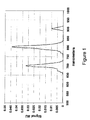
- Figure 1 shows the absorption spectrum of Y 2 O 2 S doped with 1.0% (atomic %) Tm, which is substantially the same as the absorption spectrum of Y 2 O 2 S doped with 1.0% (atomic %) Tm and 2.0% (atomic %) Ho;
- Figure 2 shows the emission spectrum of Y 2 O 2 S doped with 1.0% (atomic %) Tm; and also the emission spectrum of Y 2 O 2 S doped with 1.0% (atomic %) Tm and 2.0% (atomic %) Ho.
- the Figures were generated using a high resolution optical spectrometer.
- the curve of Figure 1 was created by monitoring an emission peak and scanning through the desired excitation range (e.g., 500-1000 nm).
- the excitation results were the contribution to the designated emission peak at the wavelength range indicated by the scan.
- Figure 2 was generated by setting the excitation wavelength and scanning through the designated emission spectral range monitored by a detector.
- the first pigment was Y 2 O 2 S doped with 1.0% (atomic %) Tm. Particles of the first pigment containing the Tm dopant were made using common phosphor production methods.
- the first pigment may be excited using light of e.g. 700nm, 805nm or 910nm corresponding to the absorption peaks shown in Figure 1 . Suitable LED's are available from Roithner-laser.com.
- the emission spectrum is shown in Figure 2 .
- the Tm emission centered at approximately 1800nm was detectable by an extended InGaAs detector with a high resolution spectrometer. This emission may correspond to the said first emission band in the invention.
- the second pigment was Y 2 O 2 S doped with 1.0% (atomic %) Tm and 2.0% (atomic %) Ho. Particles of the second pigment containing both Tm and Ho dopants were made using common phosphor production methods.
- the second pigment was excited using the same light source as in Example 1 a.
- the absorption spectrum is substantially the same as in Figure 1 .
- the Tm emission ( Figure 2 , Trace A) which was present in Example 1a centered at approximately 1800nm was substantially quenched in the second pigment as seen in Figure 2 , Trace B.
- Ho emits over a band with main peaks at 1975nm and 2050nm.
- the Ho emission in this spectral range can be detected using extended InGaAs detectors with a high resolution spectrometer. This emission may correspond to the said second emission band in the invention.
- the first and second pigments were produced separately.
- the first pigment was made as described in Example 1 a and the second pigment was made as described in Example 1 b.
- the two pigments were then mixed together in a 1:1 ratio and stirred to produce a homogeneous admixture. This admixture was used as a machine readable security element.
- the said first and second emission bands would be measured as described in Examples 1 a and 1 b.
- Example 1 c The admixture as described in Example 1 c may be mixed with vehicles to produce a printing ink. When this ink is used to print a substrate, assuming the ink is dry, the ink may be illuminated with the source of light in Example 1 a.
- the detection system described in Examples 1 a and 1 b would identify the first and second emission bands in the invention.
Landscapes
- Business, Economics & Management (AREA)
- Accounting & Taxation (AREA)
- Finance (AREA)
- Credit Cards Or The Like (AREA)
- Luminescent Compositions (AREA)
- Printing Methods (AREA)
- Inspection Of Paper Currency And Valuable Securities (AREA)
- Inks, Pencil-Leads, Or Crayons (AREA)
Applications Claiming Priority (1)
| Application Number | Priority Date | Filing Date | Title |
|---|---|---|---|
| PCT/US2008/062911 WO2009136921A1 (en) | 2008-05-07 | 2008-05-07 | Machine readable security elements and products containing them |
Publications (2)
| Publication Number | Publication Date |
|---|---|
| EP2271504A1 EP2271504A1 (en) | 2011-01-12 |
| EP2271504B1 true EP2271504B1 (en) | 2012-06-27 |
Family
ID=40298634
Family Applications (1)
| Application Number | Title | Priority Date | Filing Date |
|---|---|---|---|
| EP08755124A Revoked EP2271504B1 (en) | 2008-05-07 | 2008-05-07 | Machine readable security elements and products containing them |
Country Status (8)
| Country | Link |
|---|---|
| EP (1) | EP2271504B1 (enExample) |
| JP (1) | JP5416764B2 (enExample) |
| CN (1) | CN102026819B (enExample) |
| BR (1) | BRPI0822680A2 (enExample) |
| ES (1) | ES2389278T3 (enExample) |
| TW (1) | TW200946366A (enExample) |
| WO (1) | WO2009136921A1 (enExample) |
| ZA (1) | ZA201007428B (enExample) |
Cited By (1)
| Publication number | Priority date | Publication date | Assignee | Title |
|---|---|---|---|---|
| US12194772B2 (en) | 2018-09-14 | 2025-01-14 | Giesecke+Devrient Currency Technology Gmbh | Valuable document system |
Families Citing this family (11)
| Publication number | Priority date | Publication date | Assignee | Title |
|---|---|---|---|---|
| DE102009058669A1 (de) | 2009-12-16 | 2011-06-22 | Giesecke & Devrient GmbH, 81677 | Echtheitsmerkmal in Form von lumineszierenden Substanzen |
| US8277612B2 (en) * | 2009-12-17 | 2012-10-02 | Honeywell International Inc. | Controlling the detectability of an article and method for authenticating the article |
| US8328102B2 (en) * | 2009-12-21 | 2012-12-11 | Honeywell International Inc. | Method and authentication apparatus for authenticating value documents |
| DE102010028818A1 (de) | 2010-05-10 | 2011-11-10 | Swiss Authentication Research And Development Ag | Kombination von Lumineszenzstoffen |
| US8742369B2 (en) * | 2010-11-01 | 2014-06-03 | Honeywell International Inc. | Value documents and other articles having taggants that exhibit delayed maximum intensity emissions, and methods and apparatus for their authentication |
| US20130048874A1 (en) | 2011-08-31 | 2013-02-28 | Honeywell International Inc. | Articles with confounded emission characteristics and methods and apparatus for their authentication |
| US8975598B2 (en) * | 2012-01-17 | 2015-03-10 | Honeywell International Inc. | Articles incorporating thermographic phosphors, and methods and apparatus for authenticating such articles |
| CN106147398A (zh) * | 2015-04-15 | 2016-11-23 | 佛山市高明区(中国科学院)新材料专业中心 | 一种防伪陶瓷墨水 |
| KR102141124B1 (ko) | 2018-01-30 | 2020-08-04 | (주)바이오니아 | 이중 가닥 miRNA를 포함하는 이중나선 올리고뉴클레오타이드 구조체 및 이의 용도 |
| GB2580324B (en) * | 2018-12-28 | 2022-09-14 | Guy Stevens Henry | Paint including a taggant |
| EP4059733A1 (en) * | 2021-03-18 | 2022-09-21 | Gerresheimer Glas GmbH | Counterfeit-proof marking of individual primary packaging means using digital printing of ceramic inks with spectral markers |
Family Cites Families (5)
| Publication number | Priority date | Publication date | Assignee | Title |
|---|---|---|---|---|
| DE19804032A1 (de) * | 1998-02-02 | 1999-08-05 | Giesecke & Devrient Gmbh | Wertdokument |
| EP1117060A1 (en) * | 2000-01-10 | 2001-07-18 | Sicpa Holding S.A. | Authentication of a security article |
| JP2002212552A (ja) * | 2001-01-22 | 2002-07-31 | Hitachi Maxell Ltd | 赤外発光蛍光体および印刷物 |
| EP1805727B1 (en) * | 2004-09-02 | 2017-03-29 | Giesecke & Devrient GmbH | Luminescent security feature and method of producing the luminescent security feature |
| WO2006047621A1 (en) * | 2004-10-22 | 2006-05-04 | Parallel Synthesis Technologies, Inc. | Rare earth downconverting phosphor compositions for optically encoding objects and methods and apparatus relating to same |
-
2008
- 2008-05-07 EP EP08755124A patent/EP2271504B1/en not_active Revoked
- 2008-05-07 BR BRPI0822680-6A patent/BRPI0822680A2/pt not_active Application Discontinuation
- 2008-05-07 CN CN2008801290589A patent/CN102026819B/zh not_active Expired - Fee Related
- 2008-05-07 ES ES08755124T patent/ES2389278T3/es active Active
- 2008-05-07 JP JP2011508462A patent/JP5416764B2/ja not_active Expired - Fee Related
- 2008-05-07 WO PCT/US2008/062911 patent/WO2009136921A1/en not_active Ceased
- 2008-05-16 TW TW097118258A patent/TW200946366A/zh unknown
-
2010
- 2010-10-18 ZA ZA2010/07428A patent/ZA201007428B/en unknown
Cited By (1)
| Publication number | Priority date | Publication date | Assignee | Title |
|---|---|---|---|---|
| US12194772B2 (en) | 2018-09-14 | 2025-01-14 | Giesecke+Devrient Currency Technology Gmbh | Valuable document system |
Also Published As
| Publication number | Publication date |
|---|---|
| BRPI0822680A2 (pt) | 2015-06-30 |
| JP2011526548A (ja) | 2011-10-13 |
| TW200946366A (en) | 2009-11-16 |
| ES2389278T3 (es) | 2012-10-24 |
| WO2009136921A1 (en) | 2009-11-12 |
| ZA201007428B (en) | 2012-01-25 |
| EP2271504A1 (en) | 2011-01-12 |
| CN102026819B (zh) | 2013-09-04 |
| JP5416764B2 (ja) | 2014-02-12 |
| CN102026819A (zh) | 2011-04-20 |
Similar Documents
| Publication | Publication Date | Title |
|---|---|---|
| EP2271504B1 (en) | Machine readable security elements and products containing them | |
| JP2011526548A5 (enExample) | ||
| US6383618B1 (en) | Printed document comprising a luminescent authenticity feature | |
| EP0053183B1 (de) | Wertpapier mit echtheitsmerkmalen in form von nur im unsichtbaren bereich des optischen spektrums lumineszierenden substanzen und verfahren zur prüfung derselben | |
| EP3390066B1 (en) | Security element formed from at least two materials present in partially overlapping areas, articles carrying the security element, and authentication methods | |
| US6344261B1 (en) | Printed document having a value and comprising a luminescent authenticity feature based on a host lattice | |
| EP2513248B1 (en) | Controlling the detectability of an article and method for authenticating the article | |
| US6479133B1 (en) | Document having a value | |
| EP2517167B1 (en) | Method and authentication apparatus for authenticating value documents | |
| JPH0212198B2 (enExample) | ||
| US7927511B2 (en) | Coding system for value documents | |
| US10981406B2 (en) | Security feature | |
| WO2011019293A1 (en) | Markers for protection valuable liquid and solid materials | |
| CN1867947B (zh) | 有价文件 | |
| KR101073375B1 (ko) | 기기감지요소를 포함하는 보안인쇄용 평판잉크 | |
| CA2528058A1 (en) | Value document provided with a safety element and method for producing said value document | |
| HK1027067B (en) | Printed document having a value, with luminescent authenticity feature | |
| HK1027067A1 (en) | Printed document having a value, with luminescent authenticity feature | |
| HK1027138B (en) | Document having a value | |
| HK1027322B (en) | Printed document having a value and comprising a luminescent authenticity feature | |
| HK1027322A1 (en) | Printed document having a value and comprising a luminescent authenticity feature |
Legal Events
| Date | Code | Title | Description |
|---|---|---|---|
| PUAI | Public reference made under article 153(3) epc to a published international application that has entered the european phase |
Free format text: ORIGINAL CODE: 0009012 |
|
| 17P | Request for examination filed |
Effective date: 20101013 |
|
| AK | Designated contracting states |
Kind code of ref document: A1 Designated state(s): AT BE BG CH CY CZ DE DK EE ES FI FR GB GR HR HU IE IS IT LI LT LU LV MC MT NL NO PL PT RO SE SI SK TR |
|
| AX | Request for extension of the european patent |
Extension state: AL BA MK RS |
|
| DAX | Request for extension of the european patent (deleted) | ||
| GRAP | Despatch of communication of intention to grant a patent |
Free format text: ORIGINAL CODE: EPIDOSNIGR1 |
|
| RAP1 | Party data changed (applicant data changed or rights of an application transferred) |
Owner name: HONEYWELL INTERNATIONAL INC. |
|
| GRAS | Grant fee paid |
Free format text: ORIGINAL CODE: EPIDOSNIGR3 |
|
| GRAA | (expected) grant |
Free format text: ORIGINAL CODE: 0009210 |
|
| AK | Designated contracting states |
Kind code of ref document: B1 Designated state(s): AT BE BG CH CY CZ DE DK EE ES FI FR GB GR HR HU IE IS IT LI LT LU LV MC MT NL NO PL PT RO SE SI SK TR |
|
| REG | Reference to a national code |
Ref country code: GB Ref legal event code: FG4D |
|
| REG | Reference to a national code |
Ref country code: CH Ref legal event code: EP |
|
| REG | Reference to a national code |
Ref country code: AT Ref legal event code: REF Ref document number: 563947 Country of ref document: AT Kind code of ref document: T Effective date: 20120715 |
|
| REG | Reference to a national code |
Ref country code: IE Ref legal event code: FG4D |
|
| REG | Reference to a national code |
Ref country code: DE Ref legal event code: R096 Ref document number: 602008016796 Country of ref document: DE Effective date: 20120823 |
|
| REG | Reference to a national code |
Ref country code: ES Ref legal event code: FG2A Ref document number: 2389278 Country of ref document: ES Kind code of ref document: T3 Effective date: 20121024 |
|
| PG25 | Lapsed in a contracting state [announced via postgrant information from national office to epo] |
Ref country code: NO Free format text: LAPSE BECAUSE OF FAILURE TO SUBMIT A TRANSLATION OF THE DESCRIPTION OR TO PAY THE FEE WITHIN THE PRESCRIBED TIME-LIMIT Effective date: 20120927 Ref country code: LT Free format text: LAPSE BECAUSE OF FAILURE TO SUBMIT A TRANSLATION OF THE DESCRIPTION OR TO PAY THE FEE WITHIN THE PRESCRIBED TIME-LIMIT Effective date: 20120627 Ref country code: FI Free format text: LAPSE BECAUSE OF FAILURE TO SUBMIT A TRANSLATION OF THE DESCRIPTION OR TO PAY THE FEE WITHIN THE PRESCRIBED TIME-LIMIT Effective date: 20120627 Ref country code: SE Free format text: LAPSE BECAUSE OF FAILURE TO SUBMIT A TRANSLATION OF THE DESCRIPTION OR TO PAY THE FEE WITHIN THE PRESCRIBED TIME-LIMIT Effective date: 20120627 |
|
| REG | Reference to a national code |
Ref country code: NL Ref legal event code: VDEP Effective date: 20120627 |
|
| REG | Reference to a national code |
Ref country code: AT Ref legal event code: MK05 Ref document number: 563947 Country of ref document: AT Kind code of ref document: T Effective date: 20120627 |
|
| REG | Reference to a national code |
Ref country code: LT Ref legal event code: MG4D Effective date: 20120627 |
|
| PG25 | Lapsed in a contracting state [announced via postgrant information from national office to epo] |
Ref country code: LV Free format text: LAPSE BECAUSE OF FAILURE TO SUBMIT A TRANSLATION OF THE DESCRIPTION OR TO PAY THE FEE WITHIN THE PRESCRIBED TIME-LIMIT Effective date: 20120627 Ref country code: HR Free format text: LAPSE BECAUSE OF FAILURE TO SUBMIT A TRANSLATION OF THE DESCRIPTION OR TO PAY THE FEE WITHIN THE PRESCRIBED TIME-LIMIT Effective date: 20120627 Ref country code: GR Free format text: LAPSE BECAUSE OF FAILURE TO SUBMIT A TRANSLATION OF THE DESCRIPTION OR TO PAY THE FEE WITHIN THE PRESCRIBED TIME-LIMIT Effective date: 20120928 Ref country code: SI Free format text: LAPSE BECAUSE OF FAILURE TO SUBMIT A TRANSLATION OF THE DESCRIPTION OR TO PAY THE FEE WITHIN THE PRESCRIBED TIME-LIMIT Effective date: 20120627 |
|
| PG25 | Lapsed in a contracting state [announced via postgrant information from national office to epo] |
Ref country code: CZ Free format text: LAPSE BECAUSE OF FAILURE TO SUBMIT A TRANSLATION OF THE DESCRIPTION OR TO PAY THE FEE WITHIN THE PRESCRIBED TIME-LIMIT Effective date: 20120627 Ref country code: BE Free format text: LAPSE BECAUSE OF FAILURE TO SUBMIT A TRANSLATION OF THE DESCRIPTION OR TO PAY THE FEE WITHIN THE PRESCRIBED TIME-LIMIT Effective date: 20120627 Ref country code: CY Free format text: LAPSE BECAUSE OF FAILURE TO SUBMIT A TRANSLATION OF THE DESCRIPTION OR TO PAY THE FEE WITHIN THE PRESCRIBED TIME-LIMIT Effective date: 20120627 Ref country code: SK Free format text: LAPSE BECAUSE OF FAILURE TO SUBMIT A TRANSLATION OF THE DESCRIPTION OR TO PAY THE FEE WITHIN THE PRESCRIBED TIME-LIMIT Effective date: 20120627 Ref country code: EE Free format text: LAPSE BECAUSE OF FAILURE TO SUBMIT A TRANSLATION OF THE DESCRIPTION OR TO PAY THE FEE WITHIN THE PRESCRIBED TIME-LIMIT Effective date: 20120627 Ref country code: AT Free format text: LAPSE BECAUSE OF FAILURE TO SUBMIT A TRANSLATION OF THE DESCRIPTION OR TO PAY THE FEE WITHIN THE PRESCRIBED TIME-LIMIT Effective date: 20120627 Ref country code: IS Free format text: LAPSE BECAUSE OF FAILURE TO SUBMIT A TRANSLATION OF THE DESCRIPTION OR TO PAY THE FEE WITHIN THE PRESCRIBED TIME-LIMIT Effective date: 20121027 Ref country code: RO Free format text: LAPSE BECAUSE OF FAILURE TO SUBMIT A TRANSLATION OF THE DESCRIPTION OR TO PAY THE FEE WITHIN THE PRESCRIBED TIME-LIMIT Effective date: 20120627 |
|
| PG25 | Lapsed in a contracting state [announced via postgrant information from national office to epo] |
Ref country code: PT Free format text: LAPSE BECAUSE OF FAILURE TO SUBMIT A TRANSLATION OF THE DESCRIPTION OR TO PAY THE FEE WITHIN THE PRESCRIBED TIME-LIMIT Effective date: 20121029 Ref country code: PL Free format text: LAPSE BECAUSE OF FAILURE TO SUBMIT A TRANSLATION OF THE DESCRIPTION OR TO PAY THE FEE WITHIN THE PRESCRIBED TIME-LIMIT Effective date: 20120627 |
|
| PG25 | Lapsed in a contracting state [announced via postgrant information from national office to epo] |
Ref country code: NL Free format text: LAPSE BECAUSE OF FAILURE TO SUBMIT A TRANSLATION OF THE DESCRIPTION OR TO PAY THE FEE WITHIN THE PRESCRIBED TIME-LIMIT Effective date: 20120627 |
|
| PLBI | Opposition filed |
Free format text: ORIGINAL CODE: 0009260 |
|
| PG25 | Lapsed in a contracting state [announced via postgrant information from national office to epo] |
Ref country code: DK Free format text: LAPSE BECAUSE OF FAILURE TO SUBMIT A TRANSLATION OF THE DESCRIPTION OR TO PAY THE FEE WITHIN THE PRESCRIBED TIME-LIMIT Effective date: 20120627 |
|
| PLAX | Notice of opposition and request to file observation + time limit sent |
Free format text: ORIGINAL CODE: EPIDOSNOBS2 |
|
| 26 | Opposition filed |
Opponent name: GIESECKE & DEVRIENT GMBH Effective date: 20130327 |
|
| REG | Reference to a national code |
Ref country code: DE Ref legal event code: R026 Ref document number: 602008016796 Country of ref document: DE Effective date: 20130327 |
|
| PG25 | Lapsed in a contracting state [announced via postgrant information from national office to epo] |
Ref country code: BG Free format text: LAPSE BECAUSE OF FAILURE TO SUBMIT A TRANSLATION OF THE DESCRIPTION OR TO PAY THE FEE WITHIN THE PRESCRIBED TIME-LIMIT Effective date: 20120927 |
|
| PLAF | Information modified related to communication of a notice of opposition and request to file observations + time limit |
Free format text: ORIGINAL CODE: EPIDOSCOBS2 |
|
| PLBB | Reply of patent proprietor to notice(s) of opposition received |
Free format text: ORIGINAL CODE: EPIDOSNOBS3 |
|
| PG25 | Lapsed in a contracting state [announced via postgrant information from national office to epo] |
Ref country code: MC Free format text: LAPSE BECAUSE OF FAILURE TO SUBMIT A TRANSLATION OF THE DESCRIPTION OR TO PAY THE FEE WITHIN THE PRESCRIBED TIME-LIMIT Effective date: 20120627 |
|
| REG | Reference to a national code |
Ref country code: IE Ref legal event code: MM4A |
|
| PG25 | Lapsed in a contracting state [announced via postgrant information from national office to epo] |
Ref country code: IE Free format text: LAPSE BECAUSE OF NON-PAYMENT OF DUE FEES Effective date: 20130507 |
|
| PG25 | Lapsed in a contracting state [announced via postgrant information from national office to epo] |
Ref country code: MT Free format text: LAPSE BECAUSE OF FAILURE TO SUBMIT A TRANSLATION OF THE DESCRIPTION OR TO PAY THE FEE WITHIN THE PRESCRIBED TIME-LIMIT Effective date: 20120627 |
|
| PLCK | Communication despatched that opposition was rejected |
Free format text: ORIGINAL CODE: EPIDOSNREJ1 |
|
| REG | Reference to a national code |
Ref country code: FR Ref legal event code: PLFP Year of fee payment: 8 |
|
| APBM | Appeal reference recorded |
Free format text: ORIGINAL CODE: EPIDOSNREFNO |
|
| APBP | Date of receipt of notice of appeal recorded |
Free format text: ORIGINAL CODE: EPIDOSNNOA2O |
|
| PLAB | Opposition data, opponent's data or that of the opponent's representative modified |
Free format text: ORIGINAL CODE: 0009299OPPO |
|
| APAH | Appeal reference modified |
Free format text: ORIGINAL CODE: EPIDOSCREFNO |
|
| PG25 | Lapsed in a contracting state [announced via postgrant information from national office to epo] |
Ref country code: TR Free format text: LAPSE BECAUSE OF FAILURE TO SUBMIT A TRANSLATION OF THE DESCRIPTION OR TO PAY THE FEE WITHIN THE PRESCRIBED TIME-LIMIT Effective date: 20120627 |
|
| R26 | Opposition filed (corrected) |
Opponent name: GIESECKE & DEVRIENT GMBH Effective date: 20130327 |
|
| APBQ | Date of receipt of statement of grounds of appeal recorded |
Free format text: ORIGINAL CODE: EPIDOSNNOA3O |
|
| PG25 | Lapsed in a contracting state [announced via postgrant information from national office to epo] |
Ref country code: LU Free format text: LAPSE BECAUSE OF NON-PAYMENT OF DUE FEES Effective date: 20130507 Ref country code: HU Free format text: LAPSE BECAUSE OF FAILURE TO SUBMIT A TRANSLATION OF THE DESCRIPTION OR TO PAY THE FEE WITHIN THE PRESCRIBED TIME-LIMIT; INVALID AB INITIO Effective date: 20080507 |
|
| RAP2 | Party data changed (patent owner data changed or rights of a patent transferred) |
Owner name: HONEYWELL INTERNATIONAL INC. |
|
| REG | Reference to a national code |
Ref country code: FR Ref legal event code: PLFP Year of fee payment: 9 |
|
| REG | Reference to a national code |
Ref country code: FR Ref legal event code: PLFP Year of fee payment: 10 |
|
| REG | Reference to a national code |
Ref country code: FR Ref legal event code: PLFP Year of fee payment: 11 |
|
| PGFP | Annual fee paid to national office [announced via postgrant information from national office to epo] |
Ref country code: CH Payment date: 20180525 Year of fee payment: 11 |
|
| REG | Reference to a national code |
Ref country code: DE Ref legal event code: R064 Ref document number: 602008016796 Country of ref document: DE Ref country code: DE Ref legal event code: R103 Ref document number: 602008016796 Country of ref document: DE |
|
| PLAB | Opposition data, opponent's data or that of the opponent's representative modified |
Free format text: ORIGINAL CODE: 0009299OPPO |
|
| APBU | Appeal procedure closed |
Free format text: ORIGINAL CODE: EPIDOSNNOA9O |
|
| PGFP | Annual fee paid to national office [announced via postgrant information from national office to epo] |
Ref country code: DE Payment date: 20180731 Year of fee payment: 11 |
|
| R26 | Opposition filed (corrected) |
Opponent name: GIESECKE+DEVRIENT GMBH Effective date: 20130327 |
|
| RDAF | Communication despatched that patent is revoked |
Free format text: ORIGINAL CODE: EPIDOSNREV1 |
|
| RDAG | Patent revoked |
Free format text: ORIGINAL CODE: 0009271 |
|
| REG | Reference to a national code |
Ref country code: CH Ref legal event code: PL |
|
| 27W | Patent revoked |
Effective date: 20181002 |
|
| GBPR | Gb: patent revoked under art. 102 of the ep convention designating the uk as contracting state |
Effective date: 20181002 |
|
| PGFP | Annual fee paid to national office [announced via postgrant information from national office to epo] |
Ref country code: ES Payment date: 20190625 Year of fee payment: 12 Ref country code: IT Payment date: 20190524 Year of fee payment: 12 |
|
| PGFP | Annual fee paid to national office [announced via postgrant information from national office to epo] |
Ref country code: FR Payment date: 20190528 Year of fee payment: 12 |
|
| PGFP | Annual fee paid to national office [announced via postgrant information from national office to epo] |
Ref country code: GB Payment date: 20190529 Year of fee payment: 12 |