EP2258933A1 - Gas turbine and method for maintaining and inspecting the same - Google Patents
Gas turbine and method for maintaining and inspecting the same Download PDFInfo
- Publication number
- EP2258933A1 EP2258933A1 EP09715196A EP09715196A EP2258933A1 EP 2258933 A1 EP2258933 A1 EP 2258933A1 EP 09715196 A EP09715196 A EP 09715196A EP 09715196 A EP09715196 A EP 09715196A EP 2258933 A1 EP2258933 A1 EP 2258933A1
- Authority
- EP
- European Patent Office
- Prior art keywords
- gas turbine
- air intake
- rotating body
- air
- rotor
- Prior art date
- Legal status (The legal status is an assumption and is not a legal conclusion. Google has not performed a legal analysis and makes no representation as to the accuracy of the status listed.)
- Granted
Links
Images




Classifications
-
- F—MECHANICAL ENGINEERING; LIGHTING; HEATING; WEAPONS; BLASTING
- F01—MACHINES OR ENGINES IN GENERAL; ENGINE PLANTS IN GENERAL; STEAM ENGINES
- F01D—NON-POSITIVE DISPLACEMENT MACHINES OR ENGINES, e.g. STEAM TURBINES
- F01D25/00—Component parts, details, or accessories, not provided for in, or of interest apart from, other groups
- F01D25/28—Supporting or mounting arrangements, e.g. for turbine casing
-
- F—MECHANICAL ENGINEERING; LIGHTING; HEATING; WEAPONS; BLASTING
- F01—MACHINES OR ENGINES IN GENERAL; ENGINE PLANTS IN GENERAL; STEAM ENGINES
- F01D—NON-POSITIVE DISPLACEMENT MACHINES OR ENGINES, e.g. STEAM TURBINES
- F01D15/00—Adaptations of machines or engines for special use; Combinations of engines with devices driven thereby
- F01D15/10—Adaptations for driving, or combinations with, electric generators
-
- F—MECHANICAL ENGINEERING; LIGHTING; HEATING; WEAPONS; BLASTING
- F01—MACHINES OR ENGINES IN GENERAL; ENGINE PLANTS IN GENERAL; STEAM ENGINES
- F01D—NON-POSITIVE DISPLACEMENT MACHINES OR ENGINES, e.g. STEAM TURBINES
- F01D25/00—Component parts, details, or accessories, not provided for in, or of interest apart from, other groups
-
- F—MECHANICAL ENGINEERING; LIGHTING; HEATING; WEAPONS; BLASTING
- F01—MACHINES OR ENGINES IN GENERAL; ENGINE PLANTS IN GENERAL; STEAM ENGINES
- F01D—NON-POSITIVE DISPLACEMENT MACHINES OR ENGINES, e.g. STEAM TURBINES
- F01D25/00—Component parts, details, or accessories, not provided for in, or of interest apart from, other groups
- F01D25/28—Supporting or mounting arrangements, e.g. for turbine casing
- F01D25/285—Temporary support structures, e.g. for testing, assembling, installing, repairing; Assembly methods using such structures
-
- F—MECHANICAL ENGINEERING; LIGHTING; HEATING; WEAPONS; BLASTING
- F02—COMBUSTION ENGINES; HOT-GAS OR COMBUSTION-PRODUCT ENGINE PLANTS
- F02C—GAS-TURBINE PLANTS; AIR INTAKES FOR JET-PROPULSION PLANTS; CONTROLLING FUEL SUPPLY IN AIR-BREATHING JET-PROPULSION PLANTS
- F02C7/00—Features, components parts, details or accessories, not provided for in, or of interest apart form groups F02C1/00 - F02C6/00; Air intakes for jet-propulsion plants
- F02C7/04—Air intakes for gas-turbine plants or jet-propulsion plants
-
- F—MECHANICAL ENGINEERING; LIGHTING; HEATING; WEAPONS; BLASTING
- F05—INDEXING SCHEMES RELATING TO ENGINES OR PUMPS IN VARIOUS SUBCLASSES OF CLASSES F01-F04
- F05D—INDEXING SCHEME FOR ASPECTS RELATING TO NON-POSITIVE-DISPLACEMENT MACHINES OR ENGINES, GAS-TURBINES OR JET-PROPULSION PLANTS
- F05D2230/00—Manufacture
- F05D2230/70—Disassembly methods
-
- F—MECHANICAL ENGINEERING; LIGHTING; HEATING; WEAPONS; BLASTING
- F05—INDEXING SCHEMES RELATING TO ENGINES OR PUMPS IN VARIOUS SUBCLASSES OF CLASSES F01-F04
- F05D—INDEXING SCHEME FOR ASPECTS RELATING TO NON-POSITIVE-DISPLACEMENT MACHINES OR ENGINES, GAS-TURBINES OR JET-PROPULSION PLANTS
- F05D2230/00—Manufacture
- F05D2230/80—Repairing, retrofitting or upgrading methods
Definitions
- the present invention relates to a gas turbine and a method for maintaining and inspecting the same, and more particularly, to a gas turbine whose body is lifted in maintenance and inspection and a method for maintaining and inspecting the same.
- Apparatuses conventionally used to take energy out of combustion gas produced by combustion of fuel include gas turbines.
- gas turbines for example, the turbines are rotated with the energy of combustion gas produced by combustion with compressed air supplied to combustion, thereby causing a rotor to output rotational energy.
- Patent Document 1 discloses a gas turbine with a rotor for high-speed rotation including a thrust bearing collar in an overhang provided outside a bearing span.
- the rotor is so configured that no shaft extends outside of the thrust bearing collar and the shaft of the overhang is made hollow, thereby simplifying the vibration properties of the rotor at a rated speed and facilitating balancing.
- Patent Document 1 Japanese Patent Application Laid-open No. H5-118201
- Patent Document 1 takes vibration properties into consideration, but pays no attention to maintenance and inspection of gas turbines in this regard.
- the present invention has been made in view of the foregoing, and has an object to enable maintenance and inspection of a gas turbine without lifting of an air duct.
- a gas turbine includes: a gas turbine body in which a rotating body is rotated with energy of combustion gas produced by combustion of fuel to take out rotational energy from the rotating body; an air intake member that is attached to the gas turbine body and that guides the air to a compressor section compressing the air; and an air intake chamber that is configured to prevent interference with the rotating body when the rotating body is moved and that is connected to the air intake member and guides the air taken in from atmosphere to the compressor section.
- the rotating body when the rotating body is moved, for example, when the gas turbine undergoes maintenance and inspection, the rotating body does not interfere with the air intake chamber. Therefore, in the gas turbine, when the gas turbine undergoes maintenance and inspection, the air duct does not need to be lifted and moved by a crane, for example.
- the air intake chamber has an opening so formed in the air intake chamber as to cover an entire range where the rotating body passes or exists when the rotating body is moved.
- the rotating body when the rotating body is moved, for example, when the gas turbine undergoes maintenance and inspection, the rotating body does not interfere with the air intake chamber. Therefore, in the gas turbine, when the gas turbine undergoes maintenance and inspection, the air intake chamber does not need to be lifted and moved by a crane, for example.
- the air duct When the air duct is lifted by the crane, the air duct needs to be stored in a building that houses therein the crane.
- the gas turbine requires no lifting of the air duct by the crane in maintenance and inspection. Therefore, the gas turbine eliminates the need for storage of the air duct in the building. Consequently, with the gas turbine, the size of the building that houses therein the gas turbine body is reduced.
- the gas turbine further includes: a generator input shaft that is detachably and directly connected to the rotating body; and a generator that generates electric power based on rotation of the generator input shaft.
- the gas turbine further includes: a generator input shaft that is detachably connected to the rotating body through an intermediate shaft; and a generator that generates electric power based on rotation of the generator input shaft.
- the intermediate shaft is removed. Accordingly, the rotating body is removed from the generator.
- the generator and the rotating body are spaced apart by a certain distance. Therefore, in the gas turbine, the rotating body and the generator are connected to each other through the intermediate shaft, whereby the length of a part of the rotating body connected to the generator can be shortened. Consequently, in the gas turbine, the travel distance of the rotating body in maintenance and inspection can be shortened.
- the intermediate shaft is formed with a hole.
- the intermediate shaft is formed with the hole. Accordingly, the mass of the intermediate shaft is reduced. Therefore, in the gas turbine, vibrations accompanying the transmission of rotation of the rotating body to the generator can be reduced.
- the gas turbine further includes a cover that is detachably provided to the opening to cover the opening formed in the air intake chamber.
- a method for maintaining and inspecting a gas turbine configured to include a gas turbine body in which a rotating body is rotated with energy of combustion gas produced by combustion of fuel to take out rotational energy from the rotating body, an air intake chamber that is configured to prevent interference with the rotating body when the rotating body is moved and that is connected to the air intake member and guides the air taken in from atmosphere to the compressor section, an air intake member that is detachably connected to the air intake chamber and that guides the air to the compressor section compressing the air, an opening so formed in the air intake chamber as to cover an entire range where the rotating body passes or exists when the rotating body is moved, a generator input shaft that is detachably connected to the rotating body and to which rotation of the rotating body is transmitted, a generator that generates electric power based on rotation of the generator input shaft, and a cover that is detachably provided to the opening to cover the opening, the method includes: removing the cover; removing the air intake member from the air intake chamber; removing the generator input shaft from the rotating body
- the method for maintaining and inspecting a gas turbine requires no lifting of the air duct by the crane in maintenance and inspection. Therefore, the method for maintaining and inspecting a gas turbine eliminates the need for storage of the air duct in the building. Consequently, in the method for maintaining and inspecting a gas turbine, the size of the building that houses therein the gas turbine body can be reduced.
- the present invention enables maintenance and inspection of a gas turbine body without lifting of an air duct.
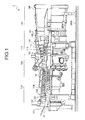
- Fig. 1 is a schematic of a configuration of a gas turbine according to the present embodiment.
- a gas turbine body 100 according to the present embodiment is a core element of a gas turbine 1. As illustrated in Fig. 1 , the gas turbine body 100 is placed on a ground GND.
- the gas turbine body 100 is configured to include, from the upstream side to the downstream side of the flow of a fluid, a compressor section 120, a combustor section 130, a turbine section 110, and an exhaust section 140.
- the compressor section 120 compresses the air and sends the compressed air to the combustor section 130.
- the combustor section 130 supplies fuel to the compressed air.
- the combustor section 130 then burns the fuel.
- the turbine section 110 converts the energy of the combustion gas sent by the combustor section 130 into rotational energy.
- the exhaust section 140 discharges the combustion gas into the atmosphere.
- the compressor section 120 is configured to include an inlet casing 121 as an air inlet member, a compressor section casing 122, a compressor section vane 123, and a compressor section rotor blade 124.
- the inlet casing 121 takes the air from the atmosphere into the compressor section casing 122.
- a plurality of such compressor section vanes 123 and a plurality of such compressor section rotor blades 124 are arranged alternately in the compressor section casing 122.
- the turbine section 110 is configured to include a turbine section casing 111, a turbine section nozzle 112, and a turbine section rotor blade 113. A plurality of such turbine section nozzles 112 and a plurality of such turbine section rotor blades 113 are arranged alternately in the turbine section casing 111.
- the exhaust section 140 has an exhaust diffuser 141 communicating with the turbine section 110. The exhaust diffuser 141 converts the dynamic pressure of exhaust gas that has passed the turbine section 110 into static pressure.
- the gas turbine body 100 has a rotor 10 as a rotating body.
- the rotor 10 is provided to penetrate the central areas of the compressor section 120, the combustor section 130, the turbine section 110, and the exhaust section 140.
- the rotor 10 has one end on the compressor section 120 side rotatably supported by a bearing 151, and the other end on the exhaust section 140 side rotatably supported by a bearing 152.
- a plurality of disks 114 is fixed. To the disks 114, the compressor section rotor blades 124 and the turbine section rotor blades 113 are connected. The end of the rotor 10 on the compressor section 120 side is connected to a generator input shaft 61 in a generator 60 illustrated in Fig. 2 .
- the configuration of the connecting part between the rotor 10 and the generator 60 will be described in detail later.
- the gas turbine body 100 first takes in the air through the inlet casing 121 in the compressor section 120.
- the air thus taken in is compressed by the compressor section vanes 123 and the compressor section rotor blades 124. Consequently, the air becomes high-temperature, high-pressure compressed air.
- the combustor section 130 supplies a given fuel to the compressed air to burn the fuel.
- the turbine section nozzles 112 and the turbine section rotor blades 113 that constitute the turbine section 110 convert the energy of high-temperature, high-pressure combustion gas produced by the combustor section 130 into rotational energy.
- the turbine section rotor blades 113 transmit the rotational energy to the rotor 10, whereby the rotor 10 rotates.
- the gas turbine body 100 drives the generator 60 connected to the rotor 10 and illustrated in Fig. 2 .
- Exhaust gas that has passed the turbine section 110 has its dynamic pressure converted by the exhaust diffuser 141 in the exhaust section 140 into static pressure, and is then released into the atmosphere.
- Fig. 2 is a schematic of a configuration of a connecting part and periphery thereof between the gas turbine body according to the present embodiment and the generator.
- Fig. 3 is a schematic of the entire configuration of the gas turbine according to the present embodiment.
- the gas turbine 1 has a jackshaft 20 as an intermediate shaft as illustrated in Fig. 2 .
- the jackshaft 20 has one end detachably connected to the generator input shaft 61 in the generator 60.
- the jackshaft 20 has the other end detachably connected to the rotor 10.
- the jackshaft 20 directly connects the generator input shaft 61 and the rotor 10. The jackshaft 20 thus transmits rotation of the rotor 10 to the generator 60.
- the jackshaft 20 is formed in a substantially cylindrical shape, for example.
- the jackshaft 20 is formed with a penetrating hole in its axial direction. Accordingly, the mass of the jackshaft 20 is reduced. Note that the smaller the mass of a rotating body is, the more vibrations accompanying its rotation are reduced under the same mass balance. Therefore, with the jackshaft 20, vibrations accompanying the transmission of the rotation of the rotor 10 to the generator 60 are reduced.
- the penetrating hole is not necessarily formed in the axial direction.
- the jackshaft 20 may have a non-penetrating hole, instead of the penetrating hole. In this case as well, the mass of the jackshaft 20 is reduced. Therefore, with the jackshaft 20, vibrations accompanying the transmission of the rotation of the rotor 10 to the generator 60 are reduced.
- An air duct 30 is, for example, connected to the inlet casing 121 in the gas turbine body 100 through an air intake chamber 31.
- the air duct 30 has, as illustrated in Fig. 3 , an air duct air intake section 32.
- the air duct air intake section 32 is open to the atmosphere outside a building 40 that houses therein the gas turbine body 100.
- an air cleaner 36 that removes dust in the air is provided.
- the air intake chamber 31 has one opening connected to the air duct 30 and the other opening connected to the inlet casing 121. Accordingly, the air intake chamber 31 guides the air inside the air duct 30 to the inlet casing 121.
- the air intake chamber 31 has an air intake chamber opening 33.
- the air intake chamber 31 is arranged between the generator 60 and the gas turbine body 100.
- the air intake chamber opening 33 is an opening for making the rotor 10 penetrate the air intake chamber 31.
- the inlet casing 121 has one opening connected to the air intake chamber 31 and the other end connected to the compressor section 120 in the gas turbine body 100.
- the inlet casing 121 is connected detachably from the air intake chamber 31 and the compressor section 120 in the gas turbine body 100. With this configuration, the air taken in through the air duct air intake section 32 is guided to the air intake chamber 31 through the air duct 30. The air guided to the air intake chamber 31 is supplied to the compressor section 120 in the gas turbine body 100 through the inlet casing 121.
- Fig. 4 is a schematic of the air intake chamber according to the present embodiment seen from the gas turbine side.
- the air intake chamber 31 is formed with a notch 34 as an opening.
- the notch 34 is formed on the wall surface that constitutes the air intake chamber 31.
- the notch 34 includes the air intake chamber opening 33, and is formed on the wall surface on the air duct 30 side of the air intake chamber opening 33.
- the notch 34 is rectangular but has its portion on the air intake chamber opening 33 side cut in an arcuate form.
- a cover 35 is provided to closely cover the notch 34.
- the cover 35 thus maintains air-tightness in the air intake chamber 31. If the cover 35 is removed, the notch 34 communicates with the air intake chamber opening 33, thereby forming an opening.
- the rotor 10 in the gas turbine body 100 illustrated in Fig. 2 is, in maintenance and inspection, lifted from the ground GND and moved by a crane 50 illustrated in Fig. 3 .
- the cover 35 is removed, whereby the notch 34 appears.
- the notch 34 is provided to avoid contact between the rotor 10 and the air intake chamber 31 when the rotor 10 is lifted and moved by the crane 50. As a result, during the lifting of the rotor 10, the distance by which the crane is moved in the horizontal direction is small.
- the notch 34 is formed, for example, at one point in the air intake chamber 31, but the present embodiment is not limited thereto.
- the notch 34 may be formed at a plurality of points in the air intake chamber 31.
- an opening is formed sufficiently as long as it is formed in all the portions included in a range where the rotor 10 passes or exists when the rotor 10 is lifted and moved by the crane 50.
- the cover 35 is removed from the air intake chamber 31. Subsequently, in the gas turbine 1, the inlet casing 121 is removed from the air intake chamber 31 and the compressor section 120 in the gas turbine body 100. Then, in the gas turbine 1, the jackshaft 20 is removed from the rotor 10.
- the rotor 10 illustrated in Fig. 2 is lifted in a direction away from the ground GND as an arrow AR11 indicates by the crane 50 illustrated in Fig. 3 .
- the inlet casing 121 and the cover 35 have been already removed from the air intake chamber 31 as mentioned above. Therefore, the rotor 10 does not interfere with the air intake chamber 31.
- the rotor 10 is moved in a direction away from the air intake chamber 31 as an arrow AR12 indicates. In this operation, the rotor 10 is moved to a position where its end on the jackshaft 20 side does not interfere with the air intake chamber 31 when the rotor 10 further moves in the direction away from the ground GND. In other words, the rotor 10 is moved to a position where its end on the jackshaft 20 side does not correspond to the air intake chamber 31 in the vertical direction.
- a distance DIM01 represents a distance from a virtual plane that passes through a part of the air intake chamber 31 closest to the inlet casing 121 side within the range of movement of the rotor 10 in the direction away from the ground GND as the arrow AR11 indicates and that is perpendicular to the ground GND, to the end of the rotor 10 on the generator 60 side.
- the rotor 10 moves in the direction away from the air intake chamber 31 as the arrow A12 indicates by the distance DIM01 or more.
- the rotor 10 and the generator input shaft 61 are connected through the jackshaft 20 that is detachable as described above. Therefore, in the gas turbine 1, the distance DIM01 is shortened if the distance between the gas turbine body 100 and the generator 60 is constant compared with a case where the rotor 10 is connected to the generator input shaft 61 without the jackshaft 20 interposed therebetween.
- the travel distance of the rotor 10 by the crane 50 illustrated in Fig. 3 is shortened.
- work time and operators' workload for maintenance and inspection can be reduced.
- a rail for the crane 50 is made compact.
- the building 40 housing therein the crane 50 and illustrated in Fig. 3 is made compact.
- the distance between the gas turbine body 100 and the generator 60 is preferably set small. In this manner, in the gas turbine 1, the size of the distance DIM01 can be further reduced. Therefore, in the gas turbine 1, the travel distance of the rotor 10 by the crane 50 illustrated in Fig. 3 is shortened more desirably. Consequently, with the gas turbine 1, work time and operators' workload for maintenance and inspection can be further reduced. In the gas turbine 1, because the travel distance of the crane 50 is shortened, the rail for the crane 50 is made further compact. As a result, with the gas turbine 1, the building 40 housing therein the crane 50 and illustrated in Fig. 3 is made compact.
- the rotor 10 When the rotor 10 is moved in the direction away from the air intake chamber 31 as the arrow AR12 indicates, in the gas turbine 1, the rotor 10 is moved in a direction away from the ground GND as an arrow AR13 indicates. In this operation, the rotor 10 is moved in the direction away from the ground GND up to a height that is necessary to undergo maintenance and inspection.
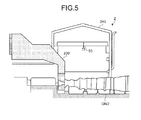
- Fig. 5 is a schematic of the entire configuration of a conventional gas turbine.
- a conventional gas turbine 2 illustrated in Fig. 5 in maintenance and inspection, an air duct 230 is lifted and removed by the crane 50 before a rotor is lifted by the crane 50. For this reason, at least a part of the air duct 230 to be removed needs to be housed in a building 240 where the crane 50 exists.
- the crane 50 To lift the air duct 230, the crane 50 needs to be placed at a higher level from the ground GND than the part of the air duct 230 to be removed. For this reason, the building 240 illustrated in Fig. 5 can be larger in size than the building 40 illustrated in Fig. 3 .
- the air duct 30 and the air intake chamber 31 are not lifted by the crane in maintenance and inspection as described above. Therefore, the crane 50 provided in the building 40 that houses therein the gas turbine body 100 is provided sufficiently to a higher level at least than the gas turbine body 100. Thus, in the gas turbine 1, the height of the building 40 that houses therein the gas turbine body 100 from the ground GND to the ceiling is reduced.
- the air duct 30 is not moved even in maintenance and inspection. Therefore, with the gas turbine 1, the air duct 30 can be provided outside the building 40. Accordingly, with the gas turbine 1, the size of the building 40 that houses therein the gas turbine body 100 is reduced.
- the air duct 30 is not removed, the time required for maintenance and inspection is reduced.
- the workload of operators involved in the work of maintenance and inspection of the gas turbine body 100 can be reduced.
- Fig. 6 is a schematic of an alternative configuration of the connecting part and periphery thereof between the gas turbine body according to the present embodiment and the generator.
- the connecting part between the rotor 10 and the jackshaft 20 may be located, as illustrated in Fig. 6 , in an area opposite to the generator 60 with respect to the virtual plane as a reference that passes through a part of the air intake chamber 31 closest to the inlet casing 121 side within the range of movement of the rotor 10 in a direction away from the ground GND and that is perpendicular to the ground GND.
- the connecting part between the rotor 10 and the jackshaft 20 is provided in a position that does not correspond to the air intake chamber 31 in the vertical direction. In other words, supposing that the distance DIM01 illustrated in Fig. 2 is a positive value, the DIM01 illustrated in Fig. 6 is a negative value.
- the rotor 10 when the gas turbine 1 undergoes maintenance and inspection, the rotor 10 is moved only in a direction away from the ground GND as an arrow AR14 indicates. In this operation, the rotor 10 is moved in the direction away from the ground GND up to a height that is necessary to undergo maintenance and inspection. In this manner, in the gas turbine 1, the rotor 10 is not moved in a direction away from the air intake chamber 31.
- the travel distance of the rotor 10 by the crane 50 illustrated in Fig. 3 is shortened.
- work time and operators' workload for maintenance and inspection can be reduced.
- the rail for the crane 50 is made compact.
- the building 40 housing therein the crane 50 and illustrated in Fig. 3 is made compact.
- a distance DIM02 represents a distance from a virtual plane that passes through a part of the generator 60 closest to the inlet casing 121 side and that is perpendicular to the ground GND, to the rotor 10.
- the distance DIM02 is preferably set small. The smaller the distance DIM02 is, the more vibrations of the rotor 10 are reduced in the gas turbine 1.
- the size of the distance DIM01 and the size of the distance DIM02 are preferably set to such an extent that vibrations of the rotor 10 are allowed. In this manner, in the gas turbine 1, while vibrations of the rotor 10 are reduced, the travel distance of the rotor 10 by the crane 50 illustrated in Fig. 3 is shortened.
- the rotor 10 when the rotor 10 is lifted by the crane illustrated in Fig. 3 , the rotor 10 does not at all interfere with the air intake chamber 31. Therefore, the air intake chamber 31 does not need to be formed with the notch 34. In addition, the air intake chamber 31 does not need to include the cover 35. Accordingly, the configuration of the gas turbine 1 is simplified and the number of its elements is reduced. Furthermore, with the gas turbine 1, cost required for manufacturing the gas turbine 1 is reduced.
- Fig. 7 is a schematic of an alternative configuration of the connecting part and periphery thereof between the gas turbine body according to the present embodiment and the generator.
- the gas turbine 1 for example, as illustrated in Fig. 7 , the rotor 10 and the generator input shaft 61 in the generator 60 may be connected directly without the jackshaft 20 interposed therebetween.
- the jackshaft 20 is formed with a penetrating hole in its axial direction as described above. Therefore, in the gas turbine 1, the mass of the connecting part between the rotor 10 and the generator input shaft 61 is reduced if the rotor 10 and the generator input shaft 61 are connected through the jackshaft 20 compared with a case where the rotor 10 and the generator input shaft 61 are connected directly. In this manner, in gas turbine 1, vibrations of the rotor 10 are reduced.
- the generator input shaft 61 is formed with a hole in its axial direction.
- the mass of the connecting part between the rotor 10 and the generator input shaft 61 is reduced without the jackshaft 20.
- the length of the generator input shaft 61 in its axial direction is preferably set longer.
- the size of the distance DIM01 is reduced.
- the travel distance of the rotor 10 by the crane 50 illustrated in Fig. 3 is shortened. Accordingly, with the gas turbine 1, work time and operators' workload for maintenance and inspection can be reduced. In the gas turbine 1, because the travel distance of the crane 50 is shortened, the rail for the crane 50 can be made compact. As a result, with the gas turbine 1, the building 40 housing therein the crane 50 and illustrated in Fig. 3 is made compact.
- the gas turbine according to the present embodiment is useful for a gas turbine whose body is moved in maintenance and inspection, and in particular, useful for a gas turbine that undergoes maintenance and inspection without lifting of an air duct by a crane.
Landscapes
- Engineering & Computer Science (AREA)
- Mechanical Engineering (AREA)
- General Engineering & Computer Science (AREA)
- Chemical & Material Sciences (AREA)
- Combustion & Propulsion (AREA)
- Connection Of Motors, Electrical Generators, Mechanical Devices, And The Like (AREA)
- Wind Motors (AREA)
Abstract
Description
- The present invention relates to a gas turbine and a method for maintaining and inspecting the same, and more particularly, to a gas turbine whose body is lifted in maintenance and inspection and a method for maintaining and inspecting the same.
- Apparatuses conventionally used to take energy out of combustion gas produced by combustion of fuel include gas turbines. In gas turbines, for example, the turbines are rotated with the energy of combustion gas produced by combustion with compressed air supplied to combustion, thereby causing a rotor to output rotational energy.
- For example,
Patent Document 1 discloses a gas turbine with a rotor for high-speed rotation including a thrust bearing collar in an overhang provided outside a bearing span. The rotor is so configured that no shaft extends outside of the thrust bearing collar and the shaft of the overhang is made hollow, thereby simplifying the vibration properties of the rotor at a rated speed and facilitating balancing. - Patent Document 1: Japanese Patent Application Laid-open No.
H5-118201 - In general, a gas turbine is lifted by a crane in maintenance and inspection of the gas turbine, for example. This operation usually requires lifting of an air duct through which the air is supplied to a gas turbine body by the crane. Therefore, the work of maintenance and inspection of the gas turbine can be complicated. In addition, because the air duct is lifted by the crane, a facility required for maintenance and inspection of the gas turbine can be large in size. The technology disclosed in
Patent Document 1 takes vibration properties into consideration, but pays no attention to maintenance and inspection of gas turbines in this regard. - The present invention has been made in view of the foregoing, and has an object to enable maintenance and inspection of a gas turbine without lifting of an air duct.
- According to an aspect of the present invention, a gas turbine includes: a gas turbine body in which a rotating body is rotated with energy of combustion gas produced by combustion of fuel to take out rotational energy from the rotating body; an air intake member that is attached to the gas turbine body and that guides the air to a compressor section compressing the air; and an air intake chamber that is configured to prevent interference with the rotating body when the rotating body is moved and that is connected to the air intake member and guides the air taken in from atmosphere to the compressor section.
- With this configuration, in the gas turbine according to the present invention, when the rotating body is moved, for example, when the gas turbine undergoes maintenance and inspection, the rotating body does not interfere with the air intake chamber. Therefore, in the gas turbine, when the gas turbine undergoes maintenance and inspection, the air duct does not need to be lifted and moved by a crane, for example.
- Advantageously, in the gas turbine, the air intake chamber has an opening so formed in the air intake chamber as to cover an entire range where the rotating body passes or exists when the rotating body is moved.
- With this configuration, in the gas turbine according to the present invention, when the rotating body is moved, for example, when the gas turbine undergoes maintenance and inspection, the rotating body does not interfere with the air intake chamber. Therefore, in the gas turbine, when the gas turbine undergoes maintenance and inspection, the air intake chamber does not need to be lifted and moved by a crane, for example.
- When the air duct is lifted by the crane, the air duct needs to be stored in a building that houses therein the crane. By contrast, the gas turbine requires no lifting of the air duct by the crane in maintenance and inspection. Therefore, the gas turbine eliminates the need for storage of the air duct in the building. Consequently, with the gas turbine, the size of the building that houses therein the gas turbine body is reduced.
- Advantageously, the gas turbine further includes: a generator input shaft that is detachably and directly connected to the rotating body; and a generator that generates electric power based on rotation of the generator input shaft.
- With this configuration, in the gas turbine according to the present invention, in maintenance and inspection, the generator is removed from the rotating body. Thus, in the gas turbine, the number of elements to be moved in maintenance and inspection can be reduced. Therefore, in the gas turbine, movement of the rotating body in maintenance and inspection is facilitated.
- Advantageously, the gas turbine further includes: a generator input shaft that is detachably connected to the rotating body through an intermediate shaft; and a generator that generates electric power based on rotation of the generator input shaft.
- With this configuration, in the gas turbine according to the present invention, in maintenance and inspection, the intermediate shaft is removed. Accordingly, the rotating body is removed from the generator. The generator and the rotating body are spaced apart by a certain distance. Therefore, in the gas turbine, the rotating body and the generator are connected to each other through the intermediate shaft, whereby the length of a part of the rotating body connected to the generator can be shortened. Consequently, in the gas turbine, the travel distance of the rotating body in maintenance and inspection can be shortened.
- Advantageously, in the gas turbine, the intermediate shaft is formed with a hole.
- In general, the smaller the mass of a member is, the more vibrations accompanying its rotation are reduced under the same mass balance. In the gas turbine according to the present invention, the intermediate shaft is formed with the hole. Accordingly, the mass of the intermediate shaft is reduced. Therefore, in the gas turbine, vibrations accompanying the transmission of rotation of the rotating body to the generator can be reduced.
- Advantageously, the gas turbine further includes a cover that is detachably provided to the opening to cover the opening formed in the air intake chamber.
- With this configuration, in the gas turbine, the flow of the air leaking out of the opening can be reduced.
- According to another aspect of the present invention, a method for maintaining and inspecting a gas turbine configured to include a gas turbine body in which a rotating body is rotated with energy of combustion gas produced by combustion of fuel to take out rotational energy from the rotating body, an air intake chamber that is configured to prevent interference with the rotating body when the rotating body is moved and that is connected to the air intake member and guides the air taken in from atmosphere to the compressor section, an air intake member that is detachably connected to the air intake chamber and that guides the air to the compressor section compressing the air, an opening so formed in the air intake chamber as to cover an entire range where the rotating body passes or exists when the rotating body is moved, a generator input shaft that is detachably connected to the rotating body and to which rotation of the rotating body is transmitted, a generator that generates electric power based on rotation of the generator input shaft, and a cover that is detachably provided to the opening to cover the opening, the method includes: removing the cover; removing the air intake member from the air intake chamber; removing the generator input shaft from the rotating body; and moving the rotating body in a direction away from a ground on which the gas turbine is placed.
- With this configuration, in the method for maintaining and inspecting a gas turbine according to the present invention, when the rotating body is moved, for example, when the gas turbine undergoes maintenance and inspection, the gas turbine body and the opening formed in the air intake chamber do not interfere with each other. Therefore, in the method for maintaining and inspecting a gas turbine, when the gas turbine body undergoes maintenance and inspection, the air duct does not need to be lifted and moved by a crane, for example.
- If the air duct is lifted by the crane, the air duct needs to be stored in a building that houses therein the crane. By contrast, the method for maintaining and inspecting a gas turbine requires no lifting of the air duct by the crane in maintenance and inspection. Therefore, the method for maintaining and inspecting a gas turbine eliminates the need for storage of the air duct in the building. Consequently, in the method for maintaining and inspecting a gas turbine, the size of the building that houses therein the gas turbine body can be reduced.
- The present invention enables maintenance and inspection of a gas turbine body without lifting of an air duct.
-
- [
Fig. 1] Fig. 1 is a schematic of a configuration of a gas turbine according to an embodiment. - [
Fig. 2] Fig. 2 is a schematic of a configuration of a connecting part and periphery thereof between a gas turbine body according to the present embodiment and a generator. - [
Fig. 3] Fig. 3 is a schematic of the entire configuration of the gas turbine according to the present embodiment. - [
Fig. 4] Fig. 4 is a schematic of an air intake chamber according to the present embodiment seen from the gas turbine side. - [
Fig. 5] Fig. 5 is a schematic of the entire configuration of a conventional gas turbine. - [
Fig. 6] Fig. 6 is a schematic of an alternative configuration of the connecting part and periphery thereof between the gas turbine body according to the present embodiment and the generator. - [
Fig. 7] Fig. 7 is a schematic of an alternative configuration of the connecting part and periphery thereof between the gas turbine body according to the present embodiment and the generator. -
- 1, 2
- gas turbine
- 10
- rotor
- 20
- jack shaft
- 30, 230
- air duct
- 31
- air intake chamber
- 32
- air duct air intake section
- 33
- air intake chamber opening
- 34
- notch
- 35
- cover
- 36
- air cleaner
- 40, 240
- building
- 50
- crane
- 60
- generator
- 61
- generator input shaft
- 100
- gas turbine body
- 110
- turbine section
- 111
- turbine section casing
- 112
- turbine section nozzle
- 113
- turbine section rotor blade
- 114
- disk
- 120
- compressor section
- 121
- inlet casing
- 122
- compressor section casing
- 123
- compressor section vane
- 124
- compressor section rotor blade
- 130
- combustor section
- 140
- exhaust section
- 141
- exhaust diffuser
- 151, 152
- bearing
- GND
- ground
- The present invention will now be explained in detail with reference to the drawings. The present invention is not limited to the best modes for carrying out the invention (hereinafter, "embodiments"). Elements described in the embodiments below include elements readily thought of by those skilled in the art, substantially the same elements, and elements that fall within the scope of so-called equivalents.
-
Fig. 1 is a schematic of a configuration of a gas turbine according to the present embodiment. Agas turbine body 100 according to the present embodiment is a core element of agas turbine 1. As illustrated inFig. 1 , thegas turbine body 100 is placed on a ground GND. Thegas turbine body 100 is configured to include, from the upstream side to the downstream side of the flow of a fluid, acompressor section 120, acombustor section 130, aturbine section 110, and anexhaust section 140. - The
compressor section 120 compresses the air and sends the compressed air to thecombustor section 130. Thecombustor section 130 supplies fuel to the compressed air. Thecombustor section 130 then burns the fuel. Theturbine section 110 converts the energy of the combustion gas sent by thecombustor section 130 into rotational energy. Theexhaust section 140 discharges the combustion gas into the atmosphere. - The
compressor section 120 is configured to include aninlet casing 121 as an air inlet member, acompressor section casing 122, a compressor section vane 123, and a compressorsection rotor blade 124. Theinlet casing 121 takes the air from the atmosphere into thecompressor section casing 122. A plurality of such compressor section vanes 123 and a plurality of such compressorsection rotor blades 124 are arranged alternately in thecompressor section casing 122. - The
turbine section 110 is configured to include aturbine section casing 111, aturbine section nozzle 112, and a turbinesection rotor blade 113. A plurality of suchturbine section nozzles 112 and a plurality of such turbinesection rotor blades 113 are arranged alternately in theturbine section casing 111. Theexhaust section 140 has anexhaust diffuser 141 communicating with theturbine section 110. Theexhaust diffuser 141 converts the dynamic pressure of exhaust gas that has passed theturbine section 110 into static pressure. - The
gas turbine body 100 has arotor 10 as a rotating body. Therotor 10 is provided to penetrate the central areas of thecompressor section 120, thecombustor section 130, theturbine section 110, and theexhaust section 140. Therotor 10 has one end on thecompressor section 120 side rotatably supported by abearing 151, and the other end on theexhaust section 140 side rotatably supported by abearing 152. - To the
rotor 10, a plurality ofdisks 114 is fixed. To thedisks 114, the compressorsection rotor blades 124 and the turbinesection rotor blades 113 are connected. The end of therotor 10 on thecompressor section 120 side is connected to agenerator input shaft 61 in agenerator 60 illustrated inFig. 2 . The configuration of the connecting part between therotor 10 and thegenerator 60 will be described in detail later. - The
gas turbine body 100 first takes in the air through theinlet casing 121 in thecompressor section 120. The air thus taken in is compressed by the compressor section vanes 123 and the compressorsection rotor blades 124. Consequently, the air becomes high-temperature, high-pressure compressed air. Subsequently, thecombustor section 130 supplies a given fuel to the compressed air to burn the fuel. - Subsequently, the
turbine section nozzles 112 and the turbinesection rotor blades 113 that constitute theturbine section 110 convert the energy of high-temperature, high-pressure combustion gas produced by thecombustor section 130 into rotational energy. The turbinesection rotor blades 113 transmit the rotational energy to therotor 10, whereby therotor 10 rotates. - With this configuration, the
gas turbine body 100 drives thegenerator 60 connected to therotor 10 and illustrated inFig. 2 . Exhaust gas that has passed theturbine section 110 has its dynamic pressure converted by theexhaust diffuser 141 in theexhaust section 140 into static pressure, and is then released into the atmosphere. -
Fig. 2 is a schematic of a configuration of a connecting part and periphery thereof between the gas turbine body according to the present embodiment and the generator.Fig. 3 is a schematic of the entire configuration of the gas turbine according to the present embodiment. - The
gas turbine 1 has ajackshaft 20 as an intermediate shaft as illustrated inFig. 2 . Thejackshaft 20 has one end detachably connected to thegenerator input shaft 61 in thegenerator 60. Thejackshaft 20 has the other end detachably connected to therotor 10. In other words, thejackshaft 20 directly connects thegenerator input shaft 61 and therotor 10. Thejackshaft 20 thus transmits rotation of therotor 10 to thegenerator 60. - The
jackshaft 20 is formed in a substantially cylindrical shape, for example. In other words, thejackshaft 20 is formed with a penetrating hole in its axial direction. Accordingly, the mass of thejackshaft 20 is reduced. Note that the smaller the mass of a rotating body is, the more vibrations accompanying its rotation are reduced under the same mass balance. Therefore, with thejackshaft 20, vibrations accompanying the transmission of the rotation of therotor 10 to thegenerator 60 are reduced. - The penetrating hole is not necessarily formed in the axial direction. The
jackshaft 20 may have a non-penetrating hole, instead of the penetrating hole. In this case as well, the mass of thejackshaft 20 is reduced. Therefore, with thejackshaft 20, vibrations accompanying the transmission of the rotation of therotor 10 to thegenerator 60 are reduced. - An
air duct 30 is, for example, connected to theinlet casing 121 in thegas turbine body 100 through anair intake chamber 31. Theair duct 30 has, as illustrated inFig. 3 , an air ductair intake section 32. The air ductair intake section 32 is open to the atmosphere outside abuilding 40 that houses therein thegas turbine body 100. To the air ductair intake section 32, anair cleaner 36 that removes dust in the air is provided. - The
air intake chamber 31 has one opening connected to theair duct 30 and the other opening connected to theinlet casing 121. Accordingly, theair intake chamber 31 guides the air inside theair duct 30 to theinlet casing 121. Theair intake chamber 31 has an airintake chamber opening 33. Theair intake chamber 31 is arranged between thegenerator 60 and thegas turbine body 100. The air intake chamber opening 33 is an opening for making therotor 10 penetrate theair intake chamber 31. - The
inlet casing 121 has one opening connected to theair intake chamber 31 and the other end connected to thecompressor section 120 in thegas turbine body 100. Theinlet casing 121 is connected detachably from theair intake chamber 31 and thecompressor section 120 in thegas turbine body 100. With this configuration, the air taken in through the air ductair intake section 32 is guided to theair intake chamber 31 through theair duct 30. The air guided to theair intake chamber 31 is supplied to thecompressor section 120 in thegas turbine body 100 through theinlet casing 121. -
Fig. 4 is a schematic of the air intake chamber according to the present embodiment seen from the gas turbine side. As illustrated inFig. 4 , theair intake chamber 31 is formed with anotch 34 as an opening. Thenotch 34 is formed on the wall surface that constitutes theair intake chamber 31. Thenotch 34 includes the air intake chamber opening 33, and is formed on the wall surface on theair duct 30 side of the airintake chamber opening 33. In the present embodiment, thenotch 34 is rectangular but has its portion on the air intake chamber opening 33 side cut in an arcuate form. - To the
notch 34, acover 35 is provided. Thecover 35 is provided to closely cover thenotch 34. Thecover 35 thus maintains air-tightness in theair intake chamber 31. If thecover 35 is removed, thenotch 34 communicates with the air intake chamber opening 33, thereby forming an opening. - The
rotor 10 in thegas turbine body 100 illustrated inFig. 2 is, in maintenance and inspection, lifted from the ground GND and moved by acrane 50 illustrated inFig. 3 . In maintenance and inspection of thegas turbine body 100, thecover 35 is removed, whereby thenotch 34 appears. Thenotch 34 is provided to avoid contact between therotor 10 and theair intake chamber 31 when therotor 10 is lifted and moved by thecrane 50. As a result, during the lifting of therotor 10, the distance by which the crane is moved in the horizontal direction is small. - The
notch 34 is formed, for example, at one point in theair intake chamber 31, but the present embodiment is not limited thereto. Thenotch 34 may be formed at a plurality of points in theair intake chamber 31. In other words, in thegas turbine 1, an opening is formed sufficiently as long as it is formed in all the portions included in a range where therotor 10 passes or exists when therotor 10 is lifted and moved by thecrane 50. - In the
gas turbine 1, in maintenance and inspection, first thecover 35 is removed from theair intake chamber 31. Subsequently, in thegas turbine 1, theinlet casing 121 is removed from theair intake chamber 31 and thecompressor section 120 in thegas turbine body 100. Then, in thegas turbine 1, thejackshaft 20 is removed from therotor 10. - Subsequently, in the
gas turbine 1, therotor 10 illustrated inFig. 2 is lifted in a direction away from the ground GND as an arrow AR11 indicates by thecrane 50 illustrated inFig. 3 . At this point, theinlet casing 121 and thecover 35 have been already removed from theair intake chamber 31 as mentioned above. Therefore, therotor 10 does not interfere with theair intake chamber 31. - Then, as the
rotor 10 leaves the ground GND, in thegas turbine 1, therotor 10 is moved in a direction away from theair intake chamber 31 as an arrow AR12 indicates. In this operation, therotor 10 is moved to a position where its end on thejackshaft 20 side does not interfere with theair intake chamber 31 when therotor 10 further moves in the direction away from the ground GND.
In other words, therotor 10 is moved to a position where its end on thejackshaft 20 side does not correspond to theair intake chamber 31 in the vertical direction. - A distance DIM01 represents a distance from a virtual plane that passes through a part of the
air intake chamber 31 closest to theinlet casing 121 side within the range of movement of therotor 10 in the direction away from the ground GND as the arrow AR11 indicates and that is perpendicular to the ground GND, to the end of therotor 10 on thegenerator 60 side. - The
rotor 10 moves in the direction away from theair intake chamber 31 as the arrow A12 indicates by the distance DIM01 or more. In other words, the smaller the distance DIM01 is, the more the travel distance of therotor 10 by thecrane 50 illustrated inFig. 3 is shortened in thegas turbine 1. - In the
gas turbine 1, therotor 10 and thegenerator input shaft 61 are connected through thejackshaft 20 that is detachable as described above. Therefore, in thegas turbine 1, the distance DIM01 is shortened if the distance between thegas turbine body 100 and thegenerator 60 is constant compared with a case where therotor 10 is connected to thegenerator input shaft 61 without thejackshaft 20 interposed therebetween. - Consequently, in the
gas turbine 1, the travel distance of therotor 10 by thecrane 50 illustrated inFig. 3 is shortened. As a result, with thegas turbine 1, work time and operators' workload for maintenance and inspection can be reduced. In thegas turbine 1, because the travel distance of thecrane 50 is shortened, a rail for thecrane 50 is made compact. As a result, with thegas turbine 1, thebuilding 40 housing therein thecrane 50 and illustrated inFig. 3 is made compact. - In the
gas turbine 1, the distance between thegas turbine body 100 and thegenerator 60 is preferably set small. In this manner, in thegas turbine 1, the size of the distance DIM01 can be further reduced. Therefore, in thegas turbine 1, the travel distance of therotor 10 by thecrane 50 illustrated inFig. 3 is shortened more desirably. Consequently, with thegas turbine 1, work time and operators' workload for maintenance and inspection can be further reduced. In thegas turbine 1, because the travel distance of thecrane 50 is shortened, the rail for thecrane 50 is made further compact. As a result, with thegas turbine 1, thebuilding 40 housing therein thecrane 50 and illustrated inFig. 3 is made compact. - When the
rotor 10 is moved in the direction away from theair intake chamber 31 as the arrow AR12 indicates, in thegas turbine 1, therotor 10 is moved in a direction away from the ground GND as an arrow AR13 indicates. In this operation, therotor 10 is moved in the direction away from the ground GND up to a height that is necessary to undergo maintenance and inspection. -
Fig. 5 is a schematic of the entire configuration of a conventional gas turbine. In aconventional gas turbine 2 illustrated inFig. 5 , in maintenance and inspection, anair duct 230 is lifted and removed by thecrane 50 before a rotor is lifted by thecrane 50. For this reason, at least a part of theair duct 230 to be removed needs to be housed in abuilding 240 where thecrane 50 exists. - To lift the
air duct 230, thecrane 50 needs to be placed at a higher level from the ground GND than the part of theair duct 230 to be removed. For this reason, thebuilding 240 illustrated inFig. 5 can be larger in size than thebuilding 40 illustrated inFig. 3 . - By contrast, in the
gas turbine 1, theair duct 30 and theair intake chamber 31 are not lifted by the crane in maintenance and inspection as described above. Therefore, thecrane 50 provided in thebuilding 40 that houses therein thegas turbine body 100 is provided sufficiently to a higher level at least than thegas turbine body 100. Thus, in thegas turbine 1, the height of thebuilding 40 that houses therein thegas turbine body 100 from the ground GND to the ceiling is reduced. - In the
gas turbine 1, theair duct 30 is not moved even in maintenance and inspection. Therefore, with thegas turbine 1, theair duct 30 can be provided outside thebuilding 40. Accordingly, with thegas turbine 1, the size of thebuilding 40 that houses therein thegas turbine body 100 is reduced. - In the
gas turbine 1, because theair duct 30 is not removed, the time required for maintenance and inspection is reduced. In addition, with thegas turbine 1, the workload of operators involved in the work of maintenance and inspection of thegas turbine body 100 can be reduced. -
Fig. 6 is a schematic of an alternative configuration of the connecting part and periphery thereof between the gas turbine body according to the present embodiment and the generator. The connecting part between therotor 10 and thejackshaft 20 may be located, as illustrated inFig. 6 , in an area opposite to thegenerator 60 with respect to the virtual plane as a reference that passes through a part of theair intake chamber 31 closest to theinlet casing 121 side within the range of movement of therotor 10 in a direction away from the ground GND and that is perpendicular to the ground GND. Specifically, the connecting part between therotor 10 and thejackshaft 20 is provided in a position that does not correspond to theair intake chamber 31 in the vertical direction. In other words, supposing that the distance DIM01 illustrated inFig. 2 is a positive value, the DIM01 illustrated inFig. 6 is a negative value. - In this case, when the
gas turbine 1 undergoes maintenance and inspection, therotor 10 is moved only in a direction away from the ground GND as an arrow AR14 indicates. In this operation, therotor 10 is moved in the direction away from the ground GND up to a height that is necessary to undergo maintenance and inspection. In this manner, in thegas turbine 1, therotor 10 is not moved in a direction away from theair intake chamber 31. - Consequently, in the
gas turbine 1, the travel distance of therotor 10 by thecrane 50 illustrated inFig. 3 is shortened. As a result, with thegas turbine 1, work time and operators' workload for maintenance and inspection can be reduced. In thegas turbine 1, because the travel distance of thecrane 50 is shortened, the rail for thecrane 50 is made compact. As a result, with thegas turbine 1, thebuilding 40 housing therein thecrane 50 and illustrated inFig. 3 is made compact. - Referring to
Figs. 2 and6 , a distance DIM02 represents a distance from a virtual plane that passes through a part of thegenerator 60 closest to theinlet casing 121 side and that is perpendicular to the ground GND, to therotor 10. In general, in thegas turbine 1, the distance DIM02 is preferably set small. The smaller the distance DIM02 is, the more vibrations of therotor 10 are reduced in thegas turbine 1. - However, if the design or the layout of the
air duct 30 does not allow reduction in the size of the distance DIM01 while the distance DIM02 is kept constant, in thegas turbine 1, the size of the distance DIM01 and the size of the distance DIM02 are preferably set to such an extent that vibrations of therotor 10 are allowed. In this manner, in thegas turbine 1, while vibrations of therotor 10 are reduced, the travel distance of therotor 10 by thecrane 50 illustrated inFig. 3 is shortened. - In this case, when the
rotor 10 is lifted by the crane illustrated inFig. 3 , therotor 10 does not at all interfere with theair intake chamber 31. Therefore, theair intake chamber 31 does not need to be formed with thenotch 34. In addition, theair intake chamber 31 does not need to include thecover 35. Accordingly, the configuration of thegas turbine 1 is simplified and the number of its elements is reduced. Furthermore, with thegas turbine 1, cost required for manufacturing thegas turbine 1 is reduced. -
Fig. 7 is a schematic of an alternative configuration of the connecting part and periphery thereof between the gas turbine body according to the present embodiment and the generator. In thegas turbine 1, for example, as illustrated inFig. 7 , therotor 10 and thegenerator input shaft 61 in thegenerator 60 may be connected directly without thejackshaft 20 interposed therebetween. - Note that the
jackshaft 20 is formed with a penetrating hole in its axial direction as described above. Therefore, in thegas turbine 1, the mass of the connecting part between therotor 10 and thegenerator input shaft 61 is reduced if therotor 10 and thegenerator input shaft 61 are connected through thejackshaft 20 compared with a case where therotor 10 and thegenerator input shaft 61 are connected directly. In this manner, ingas turbine 1, vibrations of therotor 10 are reduced. - In the present embodiment, for example, the
generator input shaft 61 is formed with a hole in its axial direction. Thus, in thegas turbine 1, the mass of the connecting part between therotor 10 and thegenerator input shaft 61 is reduced without thejackshaft 20. - When the distance DIM02 is constant, in the
gas turbine 1, the length of thegenerator input shaft 61 in its axial direction is preferably set longer. Thus, in thegas turbine 1, the size of the distance DIM01 is reduced. - Consequently, in the
gas turbine 1, the travel distance of therotor 10 by thecrane 50 illustrated inFig. 3 is shortened. Accordingly, with thegas turbine 1, work time and operators' workload for maintenance and inspection can be reduced. In thegas turbine 1, because the travel distance of thecrane 50 is shortened, the rail for thecrane 50 can be made compact. As a result, with thegas turbine 1, thebuilding 40 housing therein thecrane 50 and illustrated inFig. 3 is made compact. - As described above, the gas turbine according to the present embodiment is useful for a gas turbine whose body is moved in maintenance and inspection, and in particular, useful for a gas turbine that undergoes maintenance and inspection without lifting of an air duct by a crane.
Claims (7)
- A gas turbine comprising:a gas turbine body in which a rotating body is rotated with energy of combustion gas produced by combustion of fuel to take out rotational energy from the rotating body;an air intake member that is attached to the gas turbine body and that guides the air to a compressor section compressing the air; andan air intake chamber that is configured to prevent interference with the rotating body when the rotating body is moved and that is connected to the air intake member and guides the air taken in from atmosphere to the compressor section.
- The gas turbine according to claim 1, wherein the air intake chamber has an opening so formed in the air intake chamber as to cover an entire range where the rotating body passes or exists when the rotating body is moved.
- The gas turbine according to claim 1 or 2, further comprising:a generator input shaft that is detachably and directly connected to the rotating body; anda generator that generates electric power based on rotation of the generator input shaft.
- The gas turbine according to claim 1 or 2, further comprising:a generator input shaft that is detachably connected to the rotating body through an intermediate shaft; anda generator that generates electric power based on rotation of the generator input shaft.
- The gas turbine according to claim 4, wherein the intermediate shaft is formed with a hole.
- The gas turbine according to claim 2, further comprising a cover that is detachably provided to the opening to cover the opening formed in the air intake chamber.
- A method for maintaining and inspecting a gas turbine configured to include a gas turbine body in which a rotating body is rotated with energy of combustion gas produced by combustion of fuel to take out rotational energy from the rotating body, an air intake chamber that is configured to prevent interference with the rotating body when the rotating body is moved and that is connected to the air intake member and guides the air taken in from atmosphere to the compressor section, an air intake member that is detachably connected to the air intake chamber and that guides the air to the compressor section compressing the air, an opening so formed in the air intake chamber as to cover an entire range where the rotating body passes or exists when the rotating body is moved, a generator input shaft that is detachably connected to the rotating body and to which rotation of the rotating body is transmitted, a generator that generates electric power based on rotation of the generator input shaft, and a cover that is detachably provided to the opening to cover the opening, the method comprising:removing the cover;removing the air intake member from the air intake chamber;removing the generator input shaft from the rotating body; andmoving the rotating body in a direction away from a ground on which the gas turbine is placed.
Applications Claiming Priority (2)
| Application Number | Priority Date | Filing Date | Title |
|---|---|---|---|
| JP2008048248A JP5010499B2 (en) | 2008-02-28 | 2008-02-28 | Gas turbine and gas turbine maintenance inspection method |
| PCT/JP2009/050158 WO2009107410A1 (en) | 2008-02-28 | 2009-01-08 | Gas turbine and method for maintaining and inspecting the same |
Publications (3)
| Publication Number | Publication Date |
|---|---|
| EP2258933A1 true EP2258933A1 (en) | 2010-12-08 |
| EP2258933A4 EP2258933A4 (en) | 2013-04-17 |
| EP2258933B1 EP2258933B1 (en) | 2016-08-17 |
Family
ID=41015816
Family Applications (1)
| Application Number | Title | Priority Date | Filing Date |
|---|---|---|---|
| EP09715196.3A Active EP2258933B1 (en) | 2008-02-28 | 2009-01-08 | Gas turbine and method for maintaining and inspecting the same |
Country Status (6)
| Country | Link |
|---|---|
| US (1) | US8844297B2 (en) |
| EP (1) | EP2258933B1 (en) |
| JP (1) | JP5010499B2 (en) |
| KR (1) | KR101207828B1 (en) |
| CN (1) | CN101960121B (en) |
| WO (1) | WO2009107410A1 (en) |
Families Citing this family (6)
| Publication number | Priority date | Publication date | Assignee | Title |
|---|---|---|---|---|
| KR101513476B1 (en) * | 2013-07-26 | 2015-04-21 | 두산중공업 주식회사 | Combustor assembling apparatus for turbine and assembly method with the same |
| JP6145026B2 (en) * | 2013-10-30 | 2017-06-07 | 三菱日立パワーシステムズ株式会社 | How to check the generator |
| JP5758529B1 (en) | 2014-06-26 | 2015-08-05 | 三菱日立パワーシステムズ株式会社 | Method for installing or removing gas turbine components, apparatus for performing the method, and method for installing the apparatus |
| JP6441611B2 (en) * | 2014-08-25 | 2018-12-19 | 三菱日立パワーシステムズ株式会社 | Gas turbine exhaust member and exhaust chamber maintenance method |
| US10662816B2 (en) | 2016-04-12 | 2020-05-26 | General Electric Company | System and method to move turbomachinery |
| EP3477066B1 (en) * | 2017-10-30 | 2020-03-25 | General Electric Company | Installation apparatus for a load-coupling of a turbine system and method of installing a load-coupling in a turbine system |
Family Cites Families (28)
| Publication number | Priority date | Publication date | Assignee | Title |
|---|---|---|---|---|
| US2550580A (en) * | 1945-01-16 | 1951-04-24 | Power Jets Res & Dev Ltd | Flexible coupling for shafts and the like |
| US2443054A (en) * | 1946-11-07 | 1948-06-08 | Westinghouse Electric Corp | Gas turbine plant |
| US2650753A (en) * | 1947-06-11 | 1953-09-01 | Gen Electric | Turbomachine stator casing |
| CH569861A5 (en) * | 1974-04-09 | 1975-11-28 | Bbc Sulzer Turbomaschinen | |
| SE387408B (en) * | 1974-12-23 | 1976-09-06 | Stal Laval Turbin Ab | PROCEDURE FOR INSTALLATION IN A MACHINE HALL OF A GAS TURBINE UNIT |
| FR2317501A1 (en) * | 1975-07-09 | 1977-02-04 | Snecma | COUPLING DEVICE FOR GAS TURBINE ENGINE |
| IT1123460B (en) | 1978-07-10 | 1986-04-30 | Westinghouse Canada Ltd | METHOD FOR HEATING THE DIRECT VANE IN A GAS TURBINE |
| JPS6062621A (en) | 1983-09-17 | 1985-04-10 | Toshiba Corp | Generating plant by gas turbine |
| JPH0447391Y2 (en) * | 1985-09-25 | 1992-11-09 | ||
| JP2948383B2 (en) | 1991-10-24 | 1999-09-13 | 三菱重工業株式会社 | High-speed rotation rotor |
| JPH0552235U (en) | 1991-12-24 | 1993-07-13 | 石川島播磨重工業株式会社 | Intake chamber of gas turbine power generator |
| NZ241415A (en) * | 1992-01-27 | 1995-04-27 | Air New Zealand Ltd | Gas turbine engine transporting frames |
| FR2707698B1 (en) * | 1993-07-15 | 1995-08-25 | Snecma | Turbomachine provided with an air blowing means on a rotor element. |
| JPH0710440U (en) | 1993-07-22 | 1995-02-14 | ヤンマーディーゼル株式会社 | Generator V-belt drive mechanism |
| US5709529A (en) * | 1995-11-14 | 1998-01-20 | Westinghouse Electric Corporation | Optimization of turbomachinery harmonics |
| DE19600419A1 (en) * | 1996-01-08 | 1997-07-10 | Siemens Ag | Machine set |
| DE19837413A1 (en) | 1997-08-25 | 1999-03-04 | Mitsubishi Heavy Ind Ltd | Gas turbine generator system |
| JP3104129B2 (en) * | 1997-08-25 | 2000-10-30 | 三菱重工業株式会社 | Gas turbine power plant and its maintenance method |
| US6279309B1 (en) * | 1998-09-24 | 2001-08-28 | Ramgen Power Systems, Inc. | Modular multi-part rail mounted engine assembly |
| JP4004680B2 (en) * | 1999-03-31 | 2007-11-07 | 株式会社東芝 | Steam turbine equipment |
| JP3095749B1 (en) * | 1999-10-06 | 2000-10-10 | 三菱重工業株式会社 | Turbine building structure and intake duct |
| JP3806292B2 (en) | 2000-08-01 | 2006-08-09 | 三菱重工業株式会社 | Gas turbine package and gas turbine engine replacement method thereof. |
| JP2002147248A (en) | 2000-11-15 | 2002-05-22 | Yanmar Diesel Engine Co Ltd | Inlet plenum for gas turbine |
| JP4543547B2 (en) | 2000-12-13 | 2010-09-15 | 株式会社Ihi | Connected structure |
| JP2003106110A (en) * | 2001-09-28 | 2003-04-09 | Hitachi Ltd | Power plant |
| US7428818B2 (en) * | 2005-09-13 | 2008-09-30 | Gas Turbine Efficiency Ab | System and method for augmenting power output from a gas turbine engine |
| US8672606B2 (en) * | 2006-06-30 | 2014-03-18 | Solar Turbines Inc. | Gas turbine engine and system for servicing a gas turbine engine |
| US8272222B2 (en) * | 2010-01-04 | 2012-09-25 | General Electric Company | Inlet bleed heat system with ejector/mixer nozzles for noise reduction |
-
2008
- 2008-02-28 JP JP2008048248A patent/JP5010499B2/en active Active
-
2009
- 2009-01-08 EP EP09715196.3A patent/EP2258933B1/en active Active
- 2009-01-08 WO PCT/JP2009/050158 patent/WO2009107410A1/en not_active Ceased
- 2009-01-08 US US12/919,434 patent/US8844297B2/en active Active
- 2009-01-08 KR KR1020107018755A patent/KR101207828B1/en active Active
- 2009-01-08 CN CN200980106938.9A patent/CN101960121B/en active Active
Also Published As
| Publication number | Publication date |
|---|---|
| CN101960121B (en) | 2014-04-30 |
| JP2009203925A (en) | 2009-09-10 |
| US8844297B2 (en) | 2014-09-30 |
| CN101960121A (en) | 2011-01-26 |
| EP2258933B1 (en) | 2016-08-17 |
| WO2009107410A1 (en) | 2009-09-03 |
| KR101207828B1 (en) | 2012-12-04 |
| KR20100113136A (en) | 2010-10-20 |
| US20110006546A1 (en) | 2011-01-13 |
| EP2258933A4 (en) | 2013-04-17 |
| JP5010499B2 (en) | 2012-08-29 |
Similar Documents
| Publication | Publication Date | Title |
|---|---|---|
| EP2258933B1 (en) | Gas turbine and method for maintaining and inspecting the same | |
| CN106401754B (en) | Gas turbine engine frame assembly | |
| US10711797B2 (en) | Inlet pre-swirl gas turbine engine | |
| CN111120101B (en) | gas turbine engine | |
| JP4898491B2 (en) | Power turbine test equipment | |
| EP1939437A3 (en) | Turbine engine with modulated flow fan and method of operation | |
| US20140090386A1 (en) | Geared turbofan with fan and core mounted accessory gearboxes | |
| EP2123863A1 (en) | Pre-diffuser for centrifugal compressor | |
| CN101743391A (en) | Exhaust section structure of gas turbine and gas turbine | |
| CN103184898A (en) | Gas turbine nozzle with a flow groove | |
| US10677159B2 (en) | Gas turbine engine including a dual-speed split compressor | |
| EP2650476A2 (en) | Turbomachine blade tip shroud with parallel casing configuration | |
| CN107448477A (en) | Bearing | |
| CN108005786B (en) | Rotor shaft structure for gas turbine engine and method of assembling the same | |
| JP2017194058A (en) | Gas distribution labyrinth for bearing pads | |
| CN107304713A (en) | Bearing | |
| JPWO2019162989A1 (en) | Supercharger | |
| EP3170972A1 (en) | Modular fan for a gas turbine engine | |
| CN110291283A (en) | Power generation system and method of operation | |
| CN101965443A (en) | Gas turbine and method of opening chamber of gas turbine | |
| US10385865B2 (en) | Airfoil tip geometry to reduce blade wear in gas turbine engines | |
| CN108964305A (en) | Motor and gas turbine including the motor | |
| ATE497088T1 (en) | TURBO MACHINE | |
| CN119604668A (en) | Gas turbine engine with turbine blade carrier cooling flow path | |
| CZ2008656A3 (en) | Method of removing contaminants from turbocharger diffuser and device for making the same |
Legal Events
| Date | Code | Title | Description |
|---|---|---|---|
| PUAI | Public reference made under article 153(3) epc to a published international application that has entered the european phase |
Free format text: ORIGINAL CODE: 0009012 |
|
| 17P | Request for examination filed |
Effective date: 20100806 |
|
| AK | Designated contracting states |
Kind code of ref document: A1 Designated state(s): AT BE BG CH CY CZ DE DK EE ES FI FR GB GR HR HU IE IS IT LI LT LU LV MC MK MT NL NO PL PT RO SE SI SK TR |
|
| AX | Request for extension of the european patent |
Extension state: AL BA RS |
|
| DAX | Request for extension of the european patent (deleted) | ||
| A4 | Supplementary search report drawn up and despatched |
Effective date: 20130315 |
|
| RIC1 | Information provided on ipc code assigned before grant |
Ipc: F02C 7/00 20060101AFI20130311BHEP Ipc: F02C 7/04 20060101ALI20130311BHEP Ipc: F01D 25/00 20060101ALI20130311BHEP Ipc: F02C 6/00 20060101ALI20130311BHEP |
|
| RAP1 | Party data changed (applicant data changed or rights of an application transferred) |
Owner name: MITSUBISHI HITACHI POWER SYSTEMS, LTD. |
|
| RAP1 | Party data changed (applicant data changed or rights of an application transferred) |
Owner name: MITSUBISHI HITACHI POWER SYSTEMS, LTD. |
|
| 17Q | First examination report despatched |
Effective date: 20151109 |
|
| GRAP | Despatch of communication of intention to grant a patent |
Free format text: ORIGINAL CODE: EPIDOSNIGR1 |
|
| INTG | Intention to grant announced |
Effective date: 20160324 |
|
| GRAS | Grant fee paid |
Free format text: ORIGINAL CODE: EPIDOSNIGR3 |
|
| GRAA | (expected) grant |
Free format text: ORIGINAL CODE: 0009210 |
|
| AK | Designated contracting states |
Kind code of ref document: B1 Designated state(s): AT BE BG CH CY CZ DE DK EE ES FI FR GB GR HR HU IE IS IT LI LT LU LV MC MK MT NL NO PL PT RO SE SI SK TR |
|
| REG | Reference to a national code |
Ref country code: GB Ref legal event code: FG4D |
|
| REG | Reference to a national code |
Ref country code: CH Ref legal event code: EP |
|
| REG | Reference to a national code |
Ref country code: IE Ref legal event code: FG4D |
|
| REG | Reference to a national code |
Ref country code: AT Ref legal event code: REF Ref document number: 821346 Country of ref document: AT Kind code of ref document: T Effective date: 20160915 |
|
| REG | Reference to a national code |
Ref country code: DE Ref legal event code: R096 Ref document number: 602009040412 Country of ref document: DE |
|
| REG | Reference to a national code |
Ref country code: NL Ref legal event code: MP Effective date: 20160817 |
|
| REG | Reference to a national code |
Ref country code: LT Ref legal event code: MG4D |
|
| REG | Reference to a national code |
Ref country code: AT Ref legal event code: MK05 Ref document number: 821346 Country of ref document: AT Kind code of ref document: T Effective date: 20160817 |
|
| PG25 | Lapsed in a contracting state [announced via postgrant information from national office to epo] |
Ref country code: NO Free format text: LAPSE BECAUSE OF FAILURE TO SUBMIT A TRANSLATION OF THE DESCRIPTION OR TO PAY THE FEE WITHIN THE PRESCRIBED TIME-LIMIT Effective date: 20161117 Ref country code: NL Free format text: LAPSE BECAUSE OF FAILURE TO SUBMIT A TRANSLATION OF THE DESCRIPTION OR TO PAY THE FEE WITHIN THE PRESCRIBED TIME-LIMIT Effective date: 20160817 Ref country code: IT Free format text: LAPSE BECAUSE OF FAILURE TO SUBMIT A TRANSLATION OF THE DESCRIPTION OR TO PAY THE FEE WITHIN THE PRESCRIBED TIME-LIMIT Effective date: 20160817 Ref country code: FI Free format text: LAPSE BECAUSE OF FAILURE TO SUBMIT A TRANSLATION OF THE DESCRIPTION OR TO PAY THE FEE WITHIN THE PRESCRIBED TIME-LIMIT Effective date: 20160817 Ref country code: HR Free format text: LAPSE BECAUSE OF FAILURE TO SUBMIT A TRANSLATION OF THE DESCRIPTION OR TO PAY THE FEE WITHIN THE PRESCRIBED TIME-LIMIT Effective date: 20160817 Ref country code: LT Free format text: LAPSE BECAUSE OF FAILURE TO SUBMIT A TRANSLATION OF THE DESCRIPTION OR TO PAY THE FEE WITHIN THE PRESCRIBED TIME-LIMIT Effective date: 20160817 |
|
| PG25 | Lapsed in a contracting state [announced via postgrant information from national office to epo] |
Ref country code: AT Free format text: LAPSE BECAUSE OF FAILURE TO SUBMIT A TRANSLATION OF THE DESCRIPTION OR TO PAY THE FEE WITHIN THE PRESCRIBED TIME-LIMIT Effective date: 20160817 Ref country code: PL Free format text: LAPSE BECAUSE OF FAILURE TO SUBMIT A TRANSLATION OF THE DESCRIPTION OR TO PAY THE FEE WITHIN THE PRESCRIBED TIME-LIMIT Effective date: 20160817 Ref country code: LV Free format text: LAPSE BECAUSE OF FAILURE TO SUBMIT A TRANSLATION OF THE DESCRIPTION OR TO PAY THE FEE WITHIN THE PRESCRIBED TIME-LIMIT Effective date: 20160817 Ref country code: GR Free format text: LAPSE BECAUSE OF FAILURE TO SUBMIT A TRANSLATION OF THE DESCRIPTION OR TO PAY THE FEE WITHIN THE PRESCRIBED TIME-LIMIT Effective date: 20161118 Ref country code: PT Free format text: LAPSE BECAUSE OF FAILURE TO SUBMIT A TRANSLATION OF THE DESCRIPTION OR TO PAY THE FEE WITHIN THE PRESCRIBED TIME-LIMIT Effective date: 20161219 Ref country code: ES Free format text: LAPSE BECAUSE OF FAILURE TO SUBMIT A TRANSLATION OF THE DESCRIPTION OR TO PAY THE FEE WITHIN THE PRESCRIBED TIME-LIMIT Effective date: 20160817 Ref country code: SE Free format text: LAPSE BECAUSE OF FAILURE TO SUBMIT A TRANSLATION OF THE DESCRIPTION OR TO PAY THE FEE WITHIN THE PRESCRIBED TIME-LIMIT Effective date: 20160817 |
|
| PG25 | Lapsed in a contracting state [announced via postgrant information from national office to epo] |
Ref country code: RO Free format text: LAPSE BECAUSE OF FAILURE TO SUBMIT A TRANSLATION OF THE DESCRIPTION OR TO PAY THE FEE WITHIN THE PRESCRIBED TIME-LIMIT Effective date: 20160817 Ref country code: EE Free format text: LAPSE BECAUSE OF FAILURE TO SUBMIT A TRANSLATION OF THE DESCRIPTION OR TO PAY THE FEE WITHIN THE PRESCRIBED TIME-LIMIT Effective date: 20160817 |
|
| REG | Reference to a national code |
Ref country code: DE Ref legal event code: R097 Ref document number: 602009040412 Country of ref document: DE |
|
| PG25 | Lapsed in a contracting state [announced via postgrant information from national office to epo] |
Ref country code: CZ Free format text: LAPSE BECAUSE OF FAILURE TO SUBMIT A TRANSLATION OF THE DESCRIPTION OR TO PAY THE FEE WITHIN THE PRESCRIBED TIME-LIMIT Effective date: 20160817 Ref country code: SK Free format text: LAPSE BECAUSE OF FAILURE TO SUBMIT A TRANSLATION OF THE DESCRIPTION OR TO PAY THE FEE WITHIN THE PRESCRIBED TIME-LIMIT Effective date: 20160817 Ref country code: DK Free format text: LAPSE BECAUSE OF FAILURE TO SUBMIT A TRANSLATION OF THE DESCRIPTION OR TO PAY THE FEE WITHIN THE PRESCRIBED TIME-LIMIT Effective date: 20160817 Ref country code: BG Free format text: LAPSE BECAUSE OF FAILURE TO SUBMIT A TRANSLATION OF THE DESCRIPTION OR TO PAY THE FEE WITHIN THE PRESCRIBED TIME-LIMIT Effective date: 20161117 Ref country code: BE Free format text: LAPSE BECAUSE OF FAILURE TO SUBMIT A TRANSLATION OF THE DESCRIPTION OR TO PAY THE FEE WITHIN THE PRESCRIBED TIME-LIMIT Effective date: 20160817 |
|
| PLBE | No opposition filed within time limit |
Free format text: ORIGINAL CODE: 0009261 |
|
| STAA | Information on the status of an ep patent application or granted ep patent |
Free format text: STATUS: NO OPPOSITION FILED WITHIN TIME LIMIT |
|
| 26N | No opposition filed |
Effective date: 20170518 |
|
| PG25 | Lapsed in a contracting state [announced via postgrant information from national office to epo] |
Ref country code: SI Free format text: LAPSE BECAUSE OF FAILURE TO SUBMIT A TRANSLATION OF THE DESCRIPTION OR TO PAY THE FEE WITHIN THE PRESCRIBED TIME-LIMIT Effective date: 20160817 |
|
| REG | Reference to a national code |
Ref country code: CH Ref legal event code: PL |
|
| GBPC | Gb: european patent ceased through non-payment of renewal fee |
Effective date: 20170108 |
|
| PG25 | Lapsed in a contracting state [announced via postgrant information from national office to epo] |
Ref country code: MC Free format text: LAPSE BECAUSE OF FAILURE TO SUBMIT A TRANSLATION OF THE DESCRIPTION OR TO PAY THE FEE WITHIN THE PRESCRIBED TIME-LIMIT Effective date: 20160817 |
|
| REG | Reference to a national code |
Ref country code: FR Ref legal event code: ST Effective date: 20170929 |
|
| PG25 | Lapsed in a contracting state [announced via postgrant information from national office to epo] |
Ref country code: CH Free format text: LAPSE BECAUSE OF NON-PAYMENT OF DUE FEES Effective date: 20170131 Ref country code: LI Free format text: LAPSE BECAUSE OF NON-PAYMENT OF DUE FEES Effective date: 20170131 Ref country code: FR Free format text: LAPSE BECAUSE OF NON-PAYMENT OF DUE FEES Effective date: 20170131 |
|
| REG | Reference to a national code |
Ref country code: IE Ref legal event code: MM4A |
|
| PG25 | Lapsed in a contracting state [announced via postgrant information from national office to epo] |
Ref country code: LU Free format text: LAPSE BECAUSE OF NON-PAYMENT OF DUE FEES Effective date: 20170108 Ref country code: GB Free format text: LAPSE BECAUSE OF NON-PAYMENT OF DUE FEES Effective date: 20170108 |
|
| PG25 | Lapsed in a contracting state [announced via postgrant information from national office to epo] |
Ref country code: IE Free format text: LAPSE BECAUSE OF NON-PAYMENT OF DUE FEES Effective date: 20170108 |
|
| PG25 | Lapsed in a contracting state [announced via postgrant information from national office to epo] |
Ref country code: MT Free format text: LAPSE BECAUSE OF NON-PAYMENT OF DUE FEES Effective date: 20170108 |
|
| PG25 | Lapsed in a contracting state [announced via postgrant information from national office to epo] |
Ref country code: HU Free format text: LAPSE BECAUSE OF FAILURE TO SUBMIT A TRANSLATION OF THE DESCRIPTION OR TO PAY THE FEE WITHIN THE PRESCRIBED TIME-LIMIT; INVALID AB INITIO Effective date: 20090108 |
|
| PG25 | Lapsed in a contracting state [announced via postgrant information from national office to epo] |
Ref country code: CY Free format text: LAPSE BECAUSE OF NON-PAYMENT OF DUE FEES Effective date: 20160817 |
|
| PG25 | Lapsed in a contracting state [announced via postgrant information from national office to epo] |
Ref country code: MK Free format text: LAPSE BECAUSE OF FAILURE TO SUBMIT A TRANSLATION OF THE DESCRIPTION OR TO PAY THE FEE WITHIN THE PRESCRIBED TIME-LIMIT Effective date: 20160817 |
|
| PG25 | Lapsed in a contracting state [announced via postgrant information from national office to epo] |
Ref country code: TR Free format text: LAPSE BECAUSE OF FAILURE TO SUBMIT A TRANSLATION OF THE DESCRIPTION OR TO PAY THE FEE WITHIN THE PRESCRIBED TIME-LIMIT Effective date: 20160817 |
|
| PG25 | Lapsed in a contracting state [announced via postgrant information from national office to epo] |
Ref country code: IS Free format text: LAPSE BECAUSE OF FAILURE TO SUBMIT A TRANSLATION OF THE DESCRIPTION OR TO PAY THE FEE WITHIN THE PRESCRIBED TIME-LIMIT Effective date: 20161217 |
|
| REG | Reference to a national code |
Ref country code: DE Ref legal event code: R082 Ref document number: 602009040412 Country of ref document: DE Representative=s name: HENKEL & PARTNER MBB PATENTANWALTSKANZLEI, REC, DE Ref country code: DE Ref legal event code: R081 Ref document number: 602009040412 Country of ref document: DE Owner name: MITSUBISHI POWER, LTD., JP Free format text: FORMER OWNER: MITSUBISHI HITACHI POWER SYSTEMS, LTD., YOKOHAMA, JP |
|
| PGFP | Annual fee paid to national office [announced via postgrant information from national office to epo] |
Ref country code: DE Payment date: 20251203 Year of fee payment: 18 |