EP2257157B2 - Sustained release insecticide composition - Google Patents
Sustained release insecticide composition Download PDFInfo
- Publication number
- EP2257157B2 EP2257157B2 EP09710492.1A EP09710492A EP2257157B2 EP 2257157 B2 EP2257157 B2 EP 2257157B2 EP 09710492 A EP09710492 A EP 09710492A EP 2257157 B2 EP2257157 B2 EP 2257157B2
- Authority
- EP
- European Patent Office
- Prior art keywords
- insecticide
- dosage unit
- unit according
- spray
- tablet
- Prior art date
- Legal status (The legal status is an assumption and is not a legal conclusion. Google has not performed a legal analysis and makes no representation as to the accuracy of the status listed.)
- Active
Links
Images

Classifications
-
- A—HUMAN NECESSITIES
- A01—AGRICULTURE; FORESTRY; ANIMAL HUSBANDRY; HUNTING; TRAPPING; FISHING
- A01N—PRESERVATION OF BODIES OF HUMANS OR ANIMALS OR PLANTS OR PARTS THEREOF; BIOCIDES, e.g. AS DISINFECTANTS, AS PESTICIDES OR AS HERBICIDES; PEST REPELLANTS OR ATTRACTANTS; PLANT GROWTH REGULATORS
- A01N25/00—Biocides, pest repellants or attractants, or plant growth regulators, characterised by their forms, or by their non-active ingredients or by their methods of application, e.g. seed treatment or sequential application; Substances for reducing the noxious effect of the active ingredients to organisms other than pests
- A01N25/18—Vapour or smoke emitting compositions with delayed or sustained release
-
- A—HUMAN NECESSITIES
- A01—AGRICULTURE; FORESTRY; ANIMAL HUSBANDRY; HUNTING; TRAPPING; FISHING
- A01M—CATCHING, TRAPPING OR SCARING OF ANIMALS; APPARATUS FOR THE DESTRUCTION OF NOXIOUS ANIMALS OR NOXIOUS PLANTS
- A01M1/00—Stationary means for catching or killing insects
- A01M1/20—Poisoning, narcotising, or burning insects
- A01M1/2022—Poisoning or narcotising insects by vaporising an insecticide
- A01M1/2061—Poisoning or narcotising insects by vaporising an insecticide using a heat source
- A01M1/2077—Poisoning or narcotising insects by vaporising an insecticide using a heat source using an electrical resistance as heat source
-
- A—HUMAN NECESSITIES
- A01—AGRICULTURE; FORESTRY; ANIMAL HUSBANDRY; HUNTING; TRAPPING; FISHING
- A01N—PRESERVATION OF BODIES OF HUMANS OR ANIMALS OR PLANTS OR PARTS THEREOF; BIOCIDES, e.g. AS DISINFECTANTS, AS PESTICIDES OR AS HERBICIDES; PEST REPELLANTS OR ATTRACTANTS; PLANT GROWTH REGULATORS
- A01N25/00—Biocides, pest repellants or attractants, or plant growth regulators, characterised by their forms, or by their non-active ingredients or by their methods of application, e.g. seed treatment or sequential application; Substances for reducing the noxious effect of the active ingredients to organisms other than pests
- A01N25/34—Shaped forms, e.g. sheets, not provided for in any other sub-group of this main group
-
- A—HUMAN NECESSITIES
- A01—AGRICULTURE; FORESTRY; ANIMAL HUSBANDRY; HUNTING; TRAPPING; FISHING
- A01N—PRESERVATION OF BODIES OF HUMANS OR ANIMALS OR PLANTS OR PARTS THEREOF; BIOCIDES, e.g. AS DISINFECTANTS, AS PESTICIDES OR AS HERBICIDES; PEST REPELLANTS OR ATTRACTANTS; PLANT GROWTH REGULATORS
- A01N49/00—Biocides, pest repellants or attractants, or plant growth regulators, containing compounds containing the group, wherein m+n>=1, both X together may also mean —Y— or a direct carbon-to-carbon bond, and the carbon atoms marked with an asterisk are not part of any ring system other than that which may be formed by the atoms X, the carbon atoms in square brackets being part of any acyclic or cyclic structure, or the group, wherein A means a carbon atom or Y, n>=0, and not more than one of these carbon atoms being a member of the same ring system, e.g. juvenile insect hormones or mimics thereof
-
- A—HUMAN NECESSITIES
- A01—AGRICULTURE; FORESTRY; ANIMAL HUSBANDRY; HUNTING; TRAPPING; FISHING
- A01N—PRESERVATION OF BODIES OF HUMANS OR ANIMALS OR PLANTS OR PARTS THEREOF; BIOCIDES, e.g. AS DISINFECTANTS, AS PESTICIDES OR AS HERBICIDES; PEST REPELLANTS OR ATTRACTANTS; PLANT GROWTH REGULATORS
- A01N53/00—Biocides, pest repellants or attractants, or plant growth regulators containing cyclopropane carboxylic acids or derivatives thereof
-
- A—HUMAN NECESSITIES
- A01—AGRICULTURE; FORESTRY; ANIMAL HUSBANDRY; HUNTING; TRAPPING; FISHING
- A01N—PRESERVATION OF BODIES OF HUMANS OR ANIMALS OR PLANTS OR PARTS THEREOF; BIOCIDES, e.g. AS DISINFECTANTS, AS PESTICIDES OR AS HERBICIDES; PEST REPELLANTS OR ATTRACTANTS; PLANT GROWTH REGULATORS
- A01N65/00—Biocides, pest repellants or attractants, or plant growth regulators containing material from algae, lichens, bryophyta, multi-cellular fungi or plants, or extracts thereof
- A01N65/08—Magnoliopsida [dicotyledons]
- A01N65/12—Asteraceae or Compositae [Aster or Sunflower family], e.g. daisy, pyrethrum, artichoke, lettuce, sunflower, wormwood or tarragon
-
- Y—GENERAL TAGGING OF NEW TECHNOLOGICAL DEVELOPMENTS; GENERAL TAGGING OF CROSS-SECTIONAL TECHNOLOGIES SPANNING OVER SEVERAL SECTIONS OF THE IPC; TECHNICAL SUBJECTS COVERED BY FORMER USPC CROSS-REFERENCE ART COLLECTIONS [XRACs] AND DIGESTS
- Y02—TECHNOLOGIES OR APPLICATIONS FOR MITIGATION OR ADAPTATION AGAINST CLIMATE CHANGE
- Y02A—TECHNOLOGIES FOR ADAPTATION TO CLIMATE CHANGE
- Y02A50/00—TECHNOLOGIES FOR ADAPTATION TO CLIMATE CHANGE in human health protection, e.g. against extreme weather
- Y02A50/30—Against vector-borne diseases, e.g. mosquito-borne, fly-borne, tick-borne or waterborne diseases whose impact is exacerbated by climate change
Definitions
- the invention pertains to a dosage unit in the form of a compressed tablet for the sustained release of an insecticide, comprising a vaporizable insecticide and an inert solid carrier, the carrier comprising a two-component system comprising a bulking material and a porosity providing material, wherein the bulking material is selected from the group of direct compressing excipients and the porosity providing material is a carbonate or bicarbonate, and wherein the bulking material is selected from the group consisting of spray-dried lactose, spray dried maltose, and mixtures thereof.
- compositions that exert a long duration of action, preferably while providing a period of at least one week, and more preferably several weeks, of constant release of the insecticide.
- the insecticide is released by its natural evaporation. This is the case, e.g., with insecticide-impregnated papers and the like.
- insecticide-releasing compositions are suitable for use in devices that cause the insecticide to evaporate by the application of energy, such as heat.
- the insecticide is typically provided in the form of a reservoir containing it in liquid form.
- the reservoir is attached to a wick, which serves to transport the insecticide to a heating element, from where it is evaporated.
- wicks are, e.g. WO 2004/068945 , JP 02/174628 , EP 253 640 , WO 2004/105486 , and GB 2 194 442 .
- the result is a relatively large and complex device, the plugging of which into an electricity socket can sometimes be very inconvenient, due to the space occupied and the resulting load caused on the extensions of the plug.
- the invention seeks to provide a ready-to-use single dosage unit, particularly a solid dosage unit such as a tablet, from which the insecticide can be directly released and that can thus be inserted into a generally simpler and smaller device.
- GB 1 601 095 relates to an agent for controlling injurious insects which is based on a porous solid mineral, typically sintered material.
- the mineral material servers as a carrier for the insecticide.
- the carrier comprises a binder or a reinforcing fiber.
- the described agent serves to provide a very rapid release of the insecticide and thereby uses extremely high temperatures (200-430 °C). This renders the described agent unsuitable for sustained release, due to possible degradation of the insecticide upon prolongation of these temperatures.
- the present invention rather than providing a short-term boost of the insecticide, seeks to satisfy an entirely different purpose, viz. a long duration of action. Also, it is desired to thereby avoid such high temperatures as mentioned in GB 1 601 095 .
- a particular desire is to provide a composition that has a duration of action of about 1-4 months, preferably 2-3 months. This has the advantage that the consumer can use one single composition during a full season (as in many countries the summer season of 2-3 months is the main season during which insecticide action is desired). This particularly pertains to combating flies, mosquitoes and other bugs in households, offices, schools, etc.
- insecticidal compositions that have a long duration of action, these are generally based on traditional solvent-based formulations. In such a case a liquid, being a solution of an insecticide in an organic solvent, will be evaporated over time.
- the invention relates to more modern insecticidal compositions that are essentially free of organic solvents, particularly free of volatile organic solvents.
- Non-solvent based insecticidal compositions exerting a duration of action of as long as several months hitherto do not exist.
- a problem is that the amount of insecticide needed to provide the desired long duration of action cannot be simply dissolved in anything other than an organic solvent.
- compositions are usually directed to a use of one day, or a few days at most. See, e.g., US 6,706,761 , that discloses compositions of transfluthrin in polymer tablets, used in cycles of 1 or 3 days.
- composition of a vaporizable insecticide that does not require the presence of volatile organic solvent, and yet has a long duration of action of at least a week, preferably at least a month, and more preferably last for a season of 2-3 months or even longer (particularly upon night-time use).
- the invention provides a dosage unit comprising a vaporizable insecticide and an inert solid carrier, the carrier comprising a two-component system comprising a bulking material (diluent, filler) and a porosity providing material (absorbent), wherein the bulking material is selected from the group of direct compressing excipients and the porosity providing material is a carbonate or bicarbonate, and wherein the bulking material is selected from the group consisting of spray-dried lactose, spray dried maltose, and mixtures thereof.
- the carrier comprising a two-component system comprising a bulking material (diluent, filler) and a porosity providing material (absorbent), wherein the bulking material is selected from the group of direct compressing excipients and the porosity providing material is a carbonate or bicarbonate, and wherein the bulking material is selected from the group consisting of spray-dried lactose, spray dried maltose, and mixtures thereof.
- a dosage unit (also referred to as "unit dose”) implies a self-contained product that comprises the insecticide.
- a dosage unit is not a wick, which serves to transport insecticide from an external reservoir.
- the dosage unit of the invention if compared to systems based on a reservoir of insecticide and a wick, replaces the functions of both the reservoir and the wick in one single insecticide delivery device.
- the dosage unit when put to use in devices capable of releasing the insecticide, typically is the sole source of vaporizable insecticide.
- sole source it is meant that an external reservoir of insecticide is absent.
- the invention relates to a delivery device for an insecticide comprising a reservoir for the insecticide, wherein the reservoir consists essentially of a dosage unit comprising a vaporizable insecticide and an inert solid carrier, the carrier comprising a two-component system comprising a bulking material (diluent, filler) and a porosity providing material (absorbent), wherein the bulking material is selected from the group of direct compressing excipients and the porosity providing material is a carbonate or bicarbonate, and wherein the bulking material is selected from the group consisting of spray-dried lactose, spray dried maltose, and mixtures thereof.
- the bulking material is selected from the group of direct compressing excipients and the porosity providing material is a carbonate or bicarbonate
- the bulking material is selected from the group consisting of spray-dried lactose, spray dried maltose, and mixtures thereof.
- the bulking material a direct-compression excipient selected from the group consisting of spray-dried lactose (e.g. Lactopress®) or spray-dried maltose (Advantose®).
- spray-dried lactose e.g. Lactopress®
- spray-dried maltose e.g. Advancedose®
- the porosity providing material is a carbonate or bicarbonate.
- sodium carbonate, sodium bicarbonate or calcium carbonate is used.
- a preferred sodium carbonate is "porous soda” (e.g. Soda Ash IPH ex Solvay, which is a sodium carbonate having a smaller particle size than normal sodium) carbonate, which has a particle size distribution (determined by sieve analysis and based on weight) wherein at most 25% of the particles are smaller than 160 ⁇ m.
- This sodium carbonate has also higher specific surface area than normal sodium carbonate, which has a specific surface area (determined according to the standard BET area measurement) of approximately 0.2 m 2 /g.
- the weight ratio in which the diluent and the absorbent are used can vary from 10:1 to 1:10. Preferably the weight ratio is closer, i.e. 3:1 to 1:3 and more preferably 2:1 to 1:1.
- the two components mentioned will generally comprise more than 50 wt.% of the carrier, and preferably 80-100%.
- the porosity providing material preferably calcium carbonate
- the bulking material preferably spray-dried lactose
- the insecticide can generally be any insecticide that is vaporizable (respectively sublimable if solid at the temperature at which it is held during use).
- One of the preferred classes of insecticides are pyrethroids.
- Pyrethroid insecticides are a group of man-made pesticides similar to the natural pesticide pyrethrum, which is produced by chrysanthemum flowers.
- Several pyrethroids exist of different chemical and physical properties.
- the insecticide is vaporizable, which means that if used at regular ambient temperature it can be dispensed to the surroundings with the aid of energy input such as a heater. These pyrethroids are thus volatile. A few of them are volatile at room temperature and capable of evaporating without additional energy.
- Preferred pyrethroid insecticides are selected from the group consisting of transfluthrin, metofluthrin, d-allethrin, prallethrin, esbiothrin, natural pyrethrum extract and empenthrin.
- Preferred non-pyrethroid volatile insecticides are selected from the group consisting of citronella, citronellol, geraniol and linalool.
- the amount of insecticide with which the composition of the invention is loaded can be varied as desired.
- the insecticide will be present in a weight percentage of from 1 to 50%, preferably 3 to 30%, and more preferably 6 to 20%.
- the various variables in the composition can be adjusted so as to obtain a formulation having the desired effect.
- transfluthrin as the insecticide and a composition having a weight ratio of 1.5-2.5 parts of calcium carbonate and 2.5-3.5 parts of spray-dried lactose some 15 to 20 weight % of insecticide will be accommodated in the composition, leading to a desired duration of action of 2-4 months.
- the ideal percentages may differ, but can be easily set by the person skilled in the art based on experience or, if needed, by straightforwardly testing the duration of action and adjusting the composition as desired.
- the composition may comprise further ingredients such as a lubricant (e.g. magnesium stearate, talc, stearic acid, hydrogenated oil, sodium stearyl fumarate), a colorant, and if desired a fragrance.
- a lubricant e.g. magnesium stearate, talc, stearic acid, hydrogenated oil, sodium stearyl fumarate
- a colorant e.g. magnesium stearate, talc, stearic acid, hydrogenated oil, sodium stearyl fumarate
- a fragrance e.g. magnesium stearate, talc, stearic acid, hydrogenated oil, sodium stearyl fumarate
- the disclosure also relates to the use, in making insecticidal formulations, of excipients that are regularly used in making pharmaceutical formulations, preferably tablet formulations, and more preferably direct compression excipients.
- excipients that are regularly used in making pharmaceutical formulations, preferably tablet formulations, and more preferably direct compression excipients.
- methods and compositions for making tablets and pills have been described in Remington's (18th edition, A.R. Gennaro Ed., Mack Publishing Co. Easton, Pa, 1990), at pages 1633 through 1665 .
- Pharmaceutical diluents or "filler excipients" are agents added to dosage units to increase the granules' and resulting dosage units' bulk, and to improve dry-binding characteristics.
- the preferred diluent for use in this regard is spray dried lactose. Binders may also be present.
- Binders are agents used to impart cohesive properties to the granules and tablets, resulting in more physically stable dosage units, and include hydroxypropylcellulose, amylopectin, starch, povidone (polyvinylpyrrolidone), hydroxypropylmethylcellulose, gelatin, polyethyleneglycols, ethyl cellulose, acacia gum, gelatin, glycerol, and starch based binders.
- the preferred binder for use with the invention is polyvinylpyrrolidone. If present, a binder will typically make up from 0.5 to 5 % by weight.
- a dye is present.
- sustained-release insecticide compositions A problem associated with sustained-release insecticide compositions is to make it visible when the composition is no longer active. The better the sustained release (in terms of active life), the greater this problem is. E.g. daily replacement would be a simple routine for a user. The need for replacement after several weeks, however, would be more easily missed.
- EP 1 709 980 it is proposed in EP 1 709 980 to provide a tablet that is evanescent, i.e. that substantially disappears over an interval of time. Its disappearance serves as the indicator that replacement is needed.
- This has several drawbacks.
- One is that a precise adaptation is required of the period of existence of the tablet carrier, and the active life of the insecticide. This may lead to complications in design and production, and to uncertainties during use.
- the times of disappearance of the tablet carrier and the insecticide may be equal in one environment and not equal (depending on, e.g., relative humidity and environmental temperature) in another. It were not desired if the insecticide disappears before the tablet does (as in that case the indicator does not work).
- the tablet disappears before the insecticide does (as one would be prompted to replace a tablet in a holder still containing insecticide). Further, the tablet disappears by means of sublimation, thus loading the environment of the device not only with insecticide, but also with tablet carrier material. It will be apparent that it is desired, where possible, to reduce the amounts and types of material loading a human indoor environment.
- a dye can be dissolved with the insecticide and lend colour to the insecticide composition. Both the insecticide and the dye will evaporate with the solvent, and a fading (and ultimately disappearing) colour will automatically coincide with the disappearance of the insecticide from the composition. Whilst this is a much more straightforward method of indicating the presence and disappearance of the insecticide, it is simply not suitable for compositions wherein the insecticide is not solvent-based.
- the present invention relates to compositions that do not require solvent for the evaporation of the insecticide.
- the dye is dissolved in the insecticide. Upon full or nearly full evaporation of the insecticide, the dye will go out of solution and loose its colour. This can be seen as a sudden change form coloured to white, but it can also go more gradually, if a small amount of dye remains dissolved in an small remainder of the insecticide. Upon full evaporation of the insecticide, the colour will have gone.
- Suitable dyes include solvent Green 3, Solvent Blue 35, Solvent Yellow 18, Solvent Red 1, Solvent Yellow 33, Solvent Violet 13, Solvent Violet 37, Solvent Blue 26, Solvent Violet 14, Solvent Blue 104, Solvent Violet 3, and mixtures thereof.
- composition of the invention it is generally sufficient if the ingredients are just mixed and tabletted. Tabletting techniques are known to persons skilled in pharmaceutical tabletting or in laundry detergent tabletting. Generally, a tablet press will be used.
- Suitable compaction pressures are generally between about 0.5 and 500 MPa.
- a compressed mixture of a porosity providing material, and particularly an absorbing material such as a carbonate is preferred for the following reason.
- the insecticide is made to occupy all the space it needs, particularly the pores existing in the carbonate (or other porous material) as well as any free volume in between the carbonate and the bulking agent.
- the resulting structure is capable of providing a suitable and prolonged evaporation of the insecticide in a continuous cycle.
- the active ingredient is made to evaporate, thus leaving voids (holes or pores) near or at the outside surface of the dosage unit.
- the insecticide be mixed with the carrier components while in a liquid state.
- manufacture of the composition of the invention will then take place at a temperature above the melting point of the insecticide.
- Some insecticides have melting points above regular ambient temperature (e.g. transfluthrin, at 32°C), i.e. in that case the insecticide composition is prepared at elevated temperature (in the case of transfluthrin at, e.g. 35-40°C).
- the invention also pertains to sustained release insecticidal compositions obtainable by providing a carrier comprising the aforementioned two components and mixing these components with an insecticide that is in a liquid state and, compressing the mixture.
- the preferred order of the mixing is first all solid ingredients except the lubricant.
- the liquid insecticide preferably with a dye dissolved in it
- a spraying system while stirring the mix, to lead to fine liquid particles and homogenous distribution into the powder.
- a solid lubricant can be added, followed by homogenization.
- the resulting compositions are distinguished not only by a desirable porous structure, but moreover by a desirable high load of insecticide contained in said porous structure.
- the composition is in the form of a unit dose that can be placed in a holder of a device from which the insecticide is released, particularly a device comprising a heater.
- the device can be made to allow a refill, to which end it is advantageous if the composition is in the form of a tablet.
- the product can also be in the form of a disposable device, for single use.
- the invention also pertains to a dispenser in which the composition is contained, and which includes a heater.
- the heater will normally operate based on electrical current, which can be provided by one or more batteries, but preferably and more conveniently just can be plugged directly into an AC socket (e.g. 230V).
- the dispenser of the invention is illustrated in the Figure 1 , with reference to the following parts: a plug, i.e. a pin bridge (1), a plug deck (2), a heater (3), a tablet (4), a shroud (5), and a cap (6).
- the heater (3) operates on the basis of current input when the plug (1) is put into an electrical socket.
- the plug deck (2) serves to hold the heater (3).
- the latter is based on a cemented electrical wire resistance.
- a typical heater temperature is of from 50°C to 180°C, preferably of from 85°C to 100°C.
- the heater (3) will heat the tablet (4) so as to allow the insecticide to evaporate through the openings in the shroud (5).
- the shroud aids in storage stability by isolating the tablet from the ambient external conditions (e.g. humidity).
- the dispenser of the invention typically comprises a composition as described hereinbefore, wherein the composition is in the form of a tablet (4) placed adjacent to a heater (3), the device further comprising an electrical current provider, preferably a plug (1) provided with a plug deck (2) that provides an electrical connection to the heater (3), and a cover for the tablet (4), preferably comprising a shroud (5) and a cap (6).
- an electrical current provider preferably a plug (1) provided with a plug deck (2) that provides an electrical connection to the heater (3)
- a cover for the tablet (4) preferably comprising a shroud (5) and a cap (6).
- the depicted device is an illustrative example of a single-use disposable device.
- the tablet (4) can be replaced.
- the tablet will show its end of active life by the incorporation of a dye that will loose its colour once all or nearly all of the insecticide has evaporated.
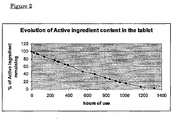
- the graph in Figure 2 shows, on the vertical axis, the percentage of the active ingredient in a tablet such as prepared in the Example. On the horizontal axis the time (in hours) is shown, during which the tablet is subjected to evaporation in a device as in Figure 1 .
- a compact powder tablet is made by mixing the ingredients listed below.
- the CaCO 3 and the spray-dried lactose are dry-mixed first.
- the insecticide (TFT TG which is transfluthrin TG) with the dye dissolved therein is sprayed into the formulation and homogenized.
- the magnesium stearate is added, and the mixture is pressed to a 22mm diameter tablet.
- the tablet thus is composed of a mix of powders and the insecticide, and weighs approximately 3.2g.
- the tablet is fixed on a heater unit where occurs the evaporation of the active ingredients at 90-100°C.
- the colour of the tablet changes during the use of the product, serving as an end of use indicator once the product is finished.
- Ingredient % W/W CaCO 3 25,39 Lactopress spraydried 250 55,59 Magnesium stearate 2 TFT TG 17 Dye 0,02
Landscapes
- Life Sciences & Earth Sciences (AREA)
- Health & Medical Sciences (AREA)
- General Health & Medical Sciences (AREA)
- Pest Control & Pesticides (AREA)
- Engineering & Computer Science (AREA)
- Wood Science & Technology (AREA)
- Environmental Sciences (AREA)
- Zoology (AREA)
- Agronomy & Crop Science (AREA)
- Plant Pathology (AREA)
- Dentistry (AREA)
- Toxicology (AREA)
- Insects & Arthropods (AREA)
- Natural Medicines & Medicinal Plants (AREA)
- Mycology (AREA)
- Botany (AREA)
- Biotechnology (AREA)
- Microbiology (AREA)
- Agricultural Chemicals And Associated Chemicals (AREA)
Description
- The invention pertains to a dosage unit in the form of a compressed tablet for the sustained release of an insecticide, comprising a vaporizable insecticide and an inert solid carrier, the carrier comprising a two-component system comprising a bulking material and a porosity providing material, wherein the bulking material is selected from the group of direct compressing excipients and the porosity providing material is a carbonate or bicarbonate, and wherein the bulking material is selected from the group consisting of spray-dried lactose, spray dried maltose, and mixtures thereof.
- In the sustained release of insecticides it is desired to provide compositions that exert a long duration of action, preferably while providing a period of at least one week, and more preferably several weeks, of constant release of the insecticide. Depending on the composition, the insecticide is released by its natural evaporation. This is the case, e.g., with insecticide-impregnated papers and the like.
- Other insecticide-releasing compositions are suitable for use in devices that cause the insecticide to evaporate by the application of energy, such as heat. In these cases, the insecticide is typically provided in the form of a reservoir containing it in liquid form. The reservoir is attached to a wick, which serves to transport the insecticide to a heating element, from where it is evaporated. Typical references regarding wicks are, e.g.
WO 2004/068945 ,JP 02/174628 EP 253 640 WO 2004/105486 , andGB 2 194 442 - It is an object of the invention to avoid the use of separate reservoirs of insecticide to be transported via a wick. When attached to an apparatus that provides for the release, the result is a relatively large and complex device, the plugging of which into an electricity socket can sometimes be very inconvenient, due to the space occupied and the resulting load caused on the extensions of the plug. Rather, the invention seeks to provide a ready-to-use single dosage unit, particularly a solid dosage unit such as a tablet, from which the insecticide can be directly released and that can thus be inserted into a generally simpler and smaller device.
-
GB 1 601 095 - The present invention, rather than providing a short-term boost of the insecticide, seeks to satisfy an entirely different purpose, viz. a long duration of action. Also, it is desired to thereby avoid such high temperatures as mentioned in
GB 1 601 095 - To the extent that insecticidal compositions exist that have a long duration of action, these are generally based on traditional solvent-based formulations. In such a case a liquid, being a solution of an insecticide in an organic solvent, will be evaporated over time.
- The invention relates to more modern insecticidal compositions that are essentially free of organic solvents, particularly free of volatile organic solvents. Non-solvent based insecticidal compositions exerting a duration of action of as long as several months hitherto do not exist. A problem is that the amount of insecticide needed to provide the desired long duration of action cannot be simply dissolved in anything other than an organic solvent.
- In the field of sustained release preparations of insecticides, various polymeric materials have been proposed. Such compositions are usually directed to a use of one day, or a few days at most. See, e.g.,
US 6,706,761 , that discloses compositions of transfluthrin in polymer tablets, used in cycles of 1 or 3 days. - It is desired to provide a composition of a vaporizable insecticide that does not require the presence of volatile organic solvent, and yet has a long duration of action of at least a week, preferably at least a month, and more preferably last for a season of 2-3 months or even longer (particularly upon night-time use).
- To this end, the invention provides a dosage unit comprising a vaporizable insecticide and an inert solid carrier, the carrier comprising a two-component system comprising a bulking material (diluent, filler) and a porosity providing material (absorbent), wherein the bulking material is selected from the group of direct compressing excipients and the porosity providing material is a carbonate or bicarbonate, and wherein the bulking material is selected from the group consisting of spray-dried lactose, spray dried maltose, and mixtures thereof.
- Without wishing to be bound by theory, the present inventors believe that the creation of a porous structure in a two-component carrier system serves to strike the optimal balance between the containment and the release of the insecticide.
- The term "dosage unit" (also referred to as "unit dose") implies a self-contained product that comprises the insecticide. E.g. a dosage unit is not a wick, which serves to transport insecticide from an external reservoir. In other words, the dosage unit of the invention, if compared to systems based on a reservoir of insecticide and a wick, replaces the functions of both the reservoir and the wick in one single insecticide delivery device. Thus, in essence, the dosage unit, when put to use in devices capable of releasing the insecticide, typically is the sole source of vaporizable insecticide. By "sole source" it is meant that an external reservoir of insecticide is absent. It is not excluded that in one device, a plurality of unit doses of the invention is present at the same time. In other words, the invention relates to a delivery device for an insecticide comprising a reservoir for the insecticide, wherein the reservoir consists essentially of a dosage unit comprising a vaporizable insecticide and an inert solid carrier, the carrier comprising a two-component system comprising a bulking material (diluent, filler) and a porosity providing material (absorbent), wherein the bulking material is selected from the group of direct compressing excipients and the porosity providing material is a carbonate or bicarbonate, and wherein the bulking material is selected from the group consisting of spray-dried lactose, spray dried maltose, and mixtures thereof.
- The bulking material a direct-compression excipient selected from the group consisting of spray-dried lactose (e.g. Lactopress®) or spray-dried maltose (Advantose®).
- The porosity providing material is a carbonate or bicarbonate. Preferably, sodium carbonate, sodium bicarbonate or calcium carbonate is used. A preferred sodium carbonate is "porous soda" (e.g. Soda Ash IPH ex Solvay, which is a sodium carbonate having a smaller particle size than normal sodium) carbonate, which has a particle size distribution (determined by sieve analysis and based on weight) wherein at most 25% of the particles are smaller than 160 µm. This sodium carbonate has also higher specific surface area than normal sodium carbonate, which has a specific surface area (determined according to the standard BET area measurement) of approximately 0.2 m2/g.
- The weight ratio in which the diluent and the absorbent are used, can vary from 10:1 to 1:10. Preferably the weight ratio is closer, i.e. 3:1 to 1:3 and more preferably 2:1 to 1:1. The two components mentioned will generally comprise more than 50 wt.% of the carrier, and preferably 80-100%. In another preferred embodiment, the porosity providing material (preferably calcium carbonate) is present in a weight excess as compared to the bulking material (preferably spray-dried lactose), and preferably of from 3:1 to 10:1.
- The insecticide can generally be any insecticide that is vaporizable (respectively sublimable if solid at the temperature at which it is held during use). One of the preferred classes of insecticides are pyrethroids. Pyrethroid insecticides are a group of man-made pesticides similar to the natural pesticide pyrethrum, which is produced by chrysanthemum flowers. Several pyrethroids exist of different chemical and physical properties. In the present invention the insecticide is vaporizable, which means that if used at regular ambient temperature it can be dispensed to the surroundings with the aid of energy input such as a heater. These pyrethroids are thus volatile. A few of them are volatile at room temperature and capable of evaporating without additional energy. Preferred pyrethroid insecticides are selected from the group consisting of transfluthrin, metofluthrin, d-allethrin, prallethrin, esbiothrin, natural pyrethrum extract and empenthrin. Preferred non-pyrethroid volatile insecticides are selected from the group consisting of citronella, citronellol, geraniol and linalool.
- The amount of insecticide with which the composition of the invention is loaded, can be varied as desired. Generally, the insecticide will be present in a weight percentage of from 1 to 50%, preferably 3 to 30%, and more preferably 6 to 20%. It will be apparent to the person skilled in the art, that the various variables in the composition can be adjusted so as to obtain a formulation having the desired effect. E.g., with transfluthrin as the insecticide and a composition having a weight ratio of 1.5-2.5 parts of calcium carbonate and 2.5-3.5 parts of spray-dried lactose, some 15 to 20 weight % of insecticide will be accommodated in the composition, leading to a desired duration of action of 2-4 months. With other insecticides and other excipients, the ideal percentages may differ, but can be easily set by the person skilled in the art based on experience or, if needed, by straightforwardly testing the duration of action and adjusting the composition as desired.
- The higher the amount of insecticide that is desired, the more porous the appropriate structure will be. As will be apparent to the skilled person, the composition will be more porous if the percentage absorbent is increased. The composition will become stronger (more coherent) with an increased percentage of the diluent.
- In addition to the insecticide and the two carrier components mentioned, the composition may comprise further ingredients such as a lubricant (e.g. magnesium stearate, talc, stearic acid, hydrogenated oil, sodium stearyl fumarate), a colorant, and if desired a fragrance.
- Thus, the disclosure also relates to the use, in making insecticidal formulations, of excipients that are regularly used in making pharmaceutical formulations, preferably tablet formulations, and more preferably direct compression excipients. For example, methods and compositions for making tablets and pills have been described in Remington's (18th edition, A.R. Gennaro Ed., Mack Publishing Co. Easton, Pa, 1990), at pages 1633 through 1665. Pharmaceutical diluents or "filler excipients" are agents added to dosage units to increase the granules' and resulting dosage units' bulk, and to improve dry-binding characteristics. The preferred diluent for use in this regard is spray dried lactose. Binders may also be present. Binders are agents used to impart cohesive properties to the granules and tablets, resulting in more physically stable dosage units, and include hydroxypropylcellulose, amylopectin, starch, povidone (polyvinylpyrrolidone), hydroxypropylmethylcellulose, gelatin, polyethyleneglycols, ethyl cellulose, acacia gum, gelatin, glycerol, and starch based binders. The preferred binder for use with the invention is polyvinylpyrrolidone. If present, a binder will typically make up from 0.5 to 5 % by weight.
- In a preferred embodiment, a dye is present.
- A problem associated with sustained-release insecticide compositions is to make it visible when the composition is no longer active. The better the sustained release (in terms of active life), the greater this problem is. E.g. daily replacement would be a simple routine for a user. The need for replacement after several weeks, however, would be more easily missed.
- To this end, it is proposed in
EP 1 709 980 to provide a tablet that is evanescent, i.e. that substantially disappears over an interval of time. Its disappearance serves as the indicator that replacement is needed. This has several drawbacks. One is that a precise adaptation is required of the period of existence of the tablet carrier, and the active life of the insecticide. This may lead to complications in design and production, and to uncertainties during use. For, the times of disappearance of the tablet carrier and the insecticide may be equal in one environment and not equal (depending on, e.g., relative humidity and environmental temperature) in another. It were not desired if the insecticide disappears before the tablet does (as in that case the indicator does not work). It were also not desired if the tablet disappears before the insecticide does (as one would be prompted to replace a tablet in a holder still containing insecticide). Further, the tablet disappears by means of sublimation, thus loading the environment of the device not only with insecticide, but also with tablet carrier material. It will be apparent that it is desired, where possible, to reduce the amounts and types of material loading a human indoor environment. - In solvent-based systems for the sustained release of insecticide, a dye can be dissolved with the insecticide and lend colour to the insecticide composition. Both the insecticide and the dye will evaporate with the solvent, and a fading (and ultimately disappearing) colour will automatically coincide with the disappearance of the insecticide from the composition. Whilst this is a much more straightforward method of indicating the presence and disappearance of the insecticide, it is simply not suitable for compositions wherein the insecticide is not solvent-based. The present invention relates to compositions that do not require solvent for the evaporation of the insecticide. Essentially, the dye is dissolved in the insecticide. Upon full or nearly full evaporation of the insecticide, the dye will go out of solution and loose its colour. This can be seen as a sudden change form coloured to white, but it can also go more gradually, if a small amount of dye remains dissolved in an small remainder of the insecticide. Upon full evaporation of the insecticide, the colour will have gone.
- Suitable dyes include solvent Green 3, Solvent Blue 35, Solvent Yellow 18, Solvent Red 1, Solvent Yellow 33, Solvent Violet 13, Solvent Violet 37, Solvent Blue 26, Solvent Violet 14, Solvent Blue 104, Solvent Violet 3, and mixtures thereof.
- In the manufacture of the composition of the invention, it is generally sufficient if the ingredients are just mixed and tabletted. Tabletting techniques are known to persons skilled in pharmaceutical tabletting or in laundry detergent tabletting. Generally, a tablet press will be used.
- After mixing it may be convenient, as is customary in the art of tabletting, to conduct a pre-granulation step to achieve the best granulometry of the powder for tabletting. The eventual tablet pressure will generally depend on the selected powder weight and dimensions of the tablet. This is standard operational knowledge in tablet making. Suitable compaction pressures are generally between about 0.5 and 500 MPa.
- Without wishing to be bound by theory, the inventors believe that a compressed mixture of a porosity providing material, and particularly an absorbing material such as a carbonate, is preferred for the following reason. The insecticide is made to occupy all the space it needs, particularly the pores existing in the carbonate (or other porous material) as well as any free volume in between the carbonate and the bulking agent. The resulting structure is capable of providing a suitable and prolonged evaporation of the insecticide in a continuous cycle. Thus, from a region near or at the outside of the dosage unit, the active ingredient is made to evaporate, thus leaving voids (holes or pores) near or at the outside surface of the dosage unit. These voids become refilled with active ingredient resourced from further within the dosage unit, which are then made to evaporate again. This continuous process essentially results from the combination of a porous, absorbent material, with a bulking material that is present in admixture with the porous material. I.e., without the active ingredient occupying space in such a mixture, one would not create proper, continuous communication channels from filled pores to evaporation surface. Thus, in a highly porous structure without the nonporous bulking material, the active ingredient runs a risk of not being well accessible for evaporation. In such a case, undesirable or extreme conditions (such as the high temperatures employed in the aforementioned
GB 1 601 095 - The aforementioned effect is believed to be strengthened by compressing the ingredients, as this leads to an optimal loading with active ingredient and optimal communication channels, and thus prolonged duration of action.
- To obtain a preferred high load of the insecticide, it is preferred that the insecticide be mixed with the carrier components while in a liquid state. Hence, manufacture of the composition of the invention will then take place at a temperature above the melting point of the insecticide. Some insecticides have melting points above regular ambient temperature (e.g. transfluthrin, at 32°C), i.e. in that case the insecticide composition is prepared at elevated temperature (in the case of transfluthrin at, e.g. 35-40°C).
- In view of the foregoing, the invention also pertains to sustained release insecticidal compositions obtainable by providing a carrier comprising the aforementioned two components and mixing these components with an insecticide that is in a liquid state and, compressing the mixture. The preferred order of the mixing is first all solid ingredients except the lubricant. Then the liquid insecticide (preferably with a dye dissolved in it) is added with a spraying system while stirring the mix, to lead to fine liquid particles and homogenous distribution into the powder. Finally a solid lubricant can be added, followed by homogenization. The resulting compositions are distinguished not only by a desirable porous structure, but moreover by a desirable high load of insecticide contained in said porous structure.
- It is preferred for the composition to be in the form of a unit dose that can be placed in a holder of a device from which the insecticide is released, particularly a device comprising a heater. The device can be made to allow a refill, to which end it is advantageous if the composition is in the form of a tablet. The product can also be in the form of a disposable device, for single use.
- The invention also pertains to a dispenser in which the composition is contained, and which includes a heater. The heater will normally operate based on electrical current, which can be provided by one or more batteries, but preferably and more conveniently just can be plugged directly into an AC socket (e.g. 230V).
- The invention is illustrated hereinafter with reference to the Figures and the Example. These are nonlimiting. Within the scope of the invention many variations can be made.
-
Figure 1 is a drawing that shows a dispenser of the invention. -
Figure 2 is a graph that shows a typical evaporation profile of a composition of the invention. - The dispenser of the invention is illustrated in the
Figure 1 , with reference to the following parts: a plug, i.e. a pin bridge (1), a plug deck (2), a heater (3), a tablet (4), a shroud (5), and a cap (6). It will be apparent that the heater (3) operates on the basis of current input when the plug (1) is put into an electrical socket. The plug deck (2) serves to hold the heater (3). The latter is based on a cemented electrical wire resistance. A typical heater temperature is of from 50°C to 180°C, preferably of from 85°C to 100°C. The heater (3) will heat the tablet (4) so as to allow the insecticide to evaporate through the openings in the shroud (5). The shroud aids in storage stability by isolating the tablet from the ambient external conditions (e.g. humidity). - Thus, the dispenser of the invention typically comprises a composition as described hereinbefore, wherein the composition is in the form of a tablet (4) placed adjacent to a heater (3), the device further comprising an electrical current provider, preferably a plug (1) provided with a plug deck (2) that provides an electrical connection to the heater (3), and a cover for the tablet (4), preferably comprising a shroud (5) and a cap (6).
- The depicted device is an illustrative example of a single-use disposable device. Depending on the structure of the device, e.g. if the shroud (4) and the cap (5) are fixed onto the plug deck (2) in such a way as to be releasable and refixable, the tablet (4) can be replaced. In a preferred embodiment, the tablet will show its end of active life by the incorporation of a dye that will loose its colour once all or nearly all of the insecticide has evaporated.
- The graph in
Figure 2 shows, on the vertical axis, the percentage of the active ingredient in a tablet such as prepared in the Example. On the horizontal axis the time (in hours) is shown, during which the tablet is subjected to evaporation in a device as inFigure 1 . - A compact powder tablet is made by mixing the ingredients listed below. The CaCO3 and the spray-dried lactose are dry-mixed first. Then the insecticide (TFT TG which is transfluthrin TG) with the dye dissolved therein is sprayed into the formulation and homogenized. Finally the magnesium stearate is added, and the mixture is pressed to a 22mm diameter tablet. The tablet thus is composed of a mix of powders and the insecticide, and weighs approximately 3.2g. The tablet is fixed on a heater unit where occurs the evaporation of the active ingredients at 90-100°C. The colour of the tablet changes during the use of the product, serving as an end of use indicator once the product is finished.
Ingredient % W/W CaCO3 25,39 Lactopress spraydried 250 55,59 Magnesium stearate 2 TFT TG 17 Dye 0,02
Claims (12)
- A dosage unit in the form of a compressed tablet for the sustained release of an insecticide, comprising a vaporizable insecticide and an inert solid carrier, the carrier comprising a two-component system comprising a bulking material and a porosity providing material, wherein the bulking material is selected from the group of direct compressing excipients and the porosity providing material is a carbonate or bicarbonate, and
wherein the bulking material is selected from the group consisting of spray-dried lactose, spray dried maltose, and mixtures thereof. - A dosage unit according to any one of the preceding claims, wherein the porosity providing material is selected from the group consisting of sodium carbonate, sodium bicarbonate, calcium carbonate, and mixtures thereof.
- A dosage unit according to any one of the preceding claims, wherein the weight ratio of the bulking material to the porosity providing material ranges from 1:10 to 10:1, preferably of from 1:5 to 5:1.
- A dosage unit according to any one of the preceding claims, wherein the insecticide is present in an amount of from 1% to 50%, by weight, preferably of from 6% to 20%, by weight.
- A dosage unit according to claim 1, wherein the carrier comprises 50 to 100%, preferably 80-100%, of the components calcium carbonate as the porosity providing material and spray-dried lactose as the bulking material, and wherein the mutual weight ratio of said components is 1.5-2.5 parts by weight of calcium carbonate and 2.5-3.5 parts by weight of spray-dried lactose.
- A dosage unit according to claim 1, wherein the carrier comprises 50 to 100%, preferably 80-100%, of the components calcium carbonate as the porosity providing material and spray-dried lactose as the bulking material, and wherein the weight ratio of calcium carbonate to spray-dried lactose is of from 3:1 to 10:1.
- A dosage unit according to any one of the preceding claims, wherein the insecticide is selected from the group consisting of transfluthrin, metofluthrin, d-allethrin, prallethrin, esbiothrin, natural pyrethrum extract, empenthrin. citronella, citronellol, geraniol and linalool.
- A dosage unit according to claim 87, wherein the insecticide is of from 6% to 20%, by weight, of transfluthrin.
- A dosage unit according to any one of the preceding claims, further comprising a dye dissolved in the insecticide.
- A delivery device for an insecticide comprising a reservoir for the insecticide, wherein the reservoir consists essentially of a dosage unit according to any one of the preceding claims.
- A method of making a dosage unit according to any one of the claims 1 to 9, wherein the ingredients are mixed, and preferably tabletted, at a temperature above the melting point of the insecticide.
- An insecticide dispenser comprising a dosage unit according to any one of the claims 1-10 as the sole source of insecticide, wherein the composition is in the form of a tablet (4) placed adjacent to a heater (3), the device further comprising an electrical current provider, preferably a plug (1) provided with a plug deck (2) that provides an electrical connection to the heater (3), and a cover for the tablet (4), preferably comprising a shroud (5) and a cap (6).
Priority Applications (1)
| Application Number | Priority Date | Filing Date | Title |
|---|---|---|---|
| EP09710492.1A EP2257157B2 (en) | 2008-02-15 | 2009-02-13 | Sustained release insecticide composition |
Applications Claiming Priority (3)
| Application Number | Priority Date | Filing Date | Title |
|---|---|---|---|
| EP08151499A EP2098119A1 (en) | 2008-02-15 | 2008-02-15 | Sustained release insecticide composition |
| EP09710492.1A EP2257157B2 (en) | 2008-02-15 | 2009-02-13 | Sustained release insecticide composition |
| PCT/NL2009/050066 WO2009102206A1 (en) | 2008-02-15 | 2009-02-13 | Dosage unit for a sustained release insecticide composition |
Publications (3)
| Publication Number | Publication Date |
|---|---|
| EP2257157A1 EP2257157A1 (en) | 2010-12-08 |
| EP2257157B1 EP2257157B1 (en) | 2018-01-03 |
| EP2257157B2 true EP2257157B2 (en) | 2020-06-24 |
Family
ID=39641472
Family Applications (2)
| Application Number | Title | Priority Date | Filing Date |
|---|---|---|---|
| EP08151499A Ceased EP2098119A1 (en) | 2008-02-15 | 2008-02-15 | Sustained release insecticide composition |
| EP09710492.1A Active EP2257157B2 (en) | 2008-02-15 | 2009-02-13 | Sustained release insecticide composition |
Family Applications Before (1)
| Application Number | Title | Priority Date | Filing Date |
|---|---|---|---|
| EP08151499A Ceased EP2098119A1 (en) | 2008-02-15 | 2008-02-15 | Sustained release insecticide composition |
Country Status (3)
| Country | Link |
|---|---|
| EP (2) | EP2098119A1 (en) |
| RU (1) | RU2501219C2 (en) |
| WO (1) | WO2009102206A1 (en) |
Families Citing this family (3)
| Publication number | Priority date | Publication date | Assignee | Title |
|---|---|---|---|---|
| CA3068765C (en) * | 2017-07-06 | 2023-08-08 | Thermacell Repellents, Inc. | Portable thermal insect repellent system |
| CN113575243B (en) * | 2021-07-27 | 2022-10-04 | 中国热带农业科学院南亚热带作物研究所 | A kind of liquid fruit bagging material, its preparation method and application |
| US12543731B2 (en) | 2022-10-13 | 2026-02-10 | Clarke Mosquito Control Products, Inc. | Insecticidal tablet compositions |
Citations (10)
| Publication number | Priority date | Publication date | Assignee | Title |
|---|---|---|---|---|
| JPS5557503A (en) † | 1978-10-21 | 1980-04-28 | Lion Corp | Mosquito-repellent incense |
| GB1601095A (en) † | 1977-01-31 | 1981-10-21 | Sumitomo Chemical Co | Controlling agent for and a method of controlling injurious insects |
| US4744987A (en) † | 1985-03-08 | 1988-05-17 | Fmc Corporation | Coprocessed microcrystalline cellulose and calcium carbonate composition and its preparation |
| US5747067A (en) † | 1996-12-06 | 1998-05-05 | Fmc Corporation | Co-processed products |
| US20010001664A1 (en) † | 1995-01-09 | 2001-05-24 | Sherwood Bob E. | Pharmaceutical excipient having improved compressibility |
| US20020132005A1 (en) † | 2000-01-14 | 2002-09-19 | Joaquina Faour | Combined diffusion / osmotic pumping drug delivery system |
| WO2003011031A1 (en) † | 2001-07-25 | 2003-02-13 | Syngenta Limited | Insecticidal mixture containing gamma-cyhalothrin |
| WO2004103388A2 (en) † | 2003-05-22 | 2004-12-02 | Bioniche Life Sciences Inc. | Insect repellent |
| US20050147673A1 (en) † | 1996-06-10 | 2005-07-07 | J. Rettenmaier & Soehne Gmbh + Co. Kg | Directly compressible sustained release formulation containing microcrystalline cellulose |
| WO2009010226A1 (en) † | 2007-07-18 | 2009-01-22 | Eni S.P.A. | Polyalkenyl succinimides and use thereof as dispersants in lubricating oils |
Family Cites Families (11)
| Publication number | Priority date | Publication date | Assignee | Title |
|---|---|---|---|---|
| US3574636A (en) * | 1967-05-05 | 1971-04-13 | Bay State Milling Co | Product and method of agglomerating flour |
| EG18025A (en) * | 1986-07-18 | 1993-06-30 | Sumitomo Chemical Co | A method for killing insects by heating fumigation |
| AU594495B2 (en) * | 1986-09-02 | 1990-03-08 | Fumakilla Limited | Heat fumigation apparatus |
| JP2604219B2 (en) * | 1988-09-13 | 1997-04-30 | 大日本除虫菊株式会社 | Liquid absorbent core and insecticide method |
| CA2011744A1 (en) * | 1989-03-09 | 1990-09-09 | Mutsuhiko Takeda | Composite insecticice and package thereof |
| US20020136748A1 (en) * | 1997-06-30 | 2002-09-26 | Mike-Dirk Bublitz | Formulations containing an insecticide |
| DE19922406A1 (en) | 1999-05-14 | 2000-11-16 | Bayer Ag | Insecticidal composition contains o-cyano-phenylazo color change dye as indicator for loss of insecticidal activity |
| US7138130B2 (en) * | 2003-01-30 | 2006-11-21 | S.C. Johnson & Son, Inc. | Substrate for volatile delivery systems |
| KR20040101790A (en) * | 2003-05-27 | 2004-12-03 | 국보제약주식회사 | An insecticide composition for industrial hygienl and a wick for used thereal |
| RU34314U1 (en) * | 2003-07-18 | 2003-12-10 | Кузьмин Анатолий Иванович | ELECTRIC HEATER FOR SEPARATION OF VOLATILE COMPONENTS FROM DRUGS |
| EP1709980A1 (en) | 2005-04-05 | 2006-10-11 | Reckitt Benckiser (UK) LIMITED | Emanation device |
-
2008
- 2008-02-15 EP EP08151499A patent/EP2098119A1/en not_active Ceased
-
2009
- 2009-02-13 RU RU2010138159/13A patent/RU2501219C2/en active
- 2009-02-13 WO PCT/NL2009/050066 patent/WO2009102206A1/en not_active Ceased
- 2009-02-13 EP EP09710492.1A patent/EP2257157B2/en active Active
Patent Citations (10)
| Publication number | Priority date | Publication date | Assignee | Title |
|---|---|---|---|---|
| GB1601095A (en) † | 1977-01-31 | 1981-10-21 | Sumitomo Chemical Co | Controlling agent for and a method of controlling injurious insects |
| JPS5557503A (en) † | 1978-10-21 | 1980-04-28 | Lion Corp | Mosquito-repellent incense |
| US4744987A (en) † | 1985-03-08 | 1988-05-17 | Fmc Corporation | Coprocessed microcrystalline cellulose and calcium carbonate composition and its preparation |
| US20010001664A1 (en) † | 1995-01-09 | 2001-05-24 | Sherwood Bob E. | Pharmaceutical excipient having improved compressibility |
| US20050147673A1 (en) † | 1996-06-10 | 2005-07-07 | J. Rettenmaier & Soehne Gmbh + Co. Kg | Directly compressible sustained release formulation containing microcrystalline cellulose |
| US5747067A (en) † | 1996-12-06 | 1998-05-05 | Fmc Corporation | Co-processed products |
| US20020132005A1 (en) † | 2000-01-14 | 2002-09-19 | Joaquina Faour | Combined diffusion / osmotic pumping drug delivery system |
| WO2003011031A1 (en) † | 2001-07-25 | 2003-02-13 | Syngenta Limited | Insecticidal mixture containing gamma-cyhalothrin |
| WO2004103388A2 (en) † | 2003-05-22 | 2004-12-02 | Bioniche Life Sciences Inc. | Insect repellent |
| WO2009010226A1 (en) † | 2007-07-18 | 2009-01-22 | Eni S.P.A. | Polyalkenyl succinimides and use thereof as dispersants in lubricating oils |
Non-Patent Citations (9)
| Title |
|---|
| "Delicia® Elektro-Mückenstecker produktinformation", FRUNOL DELICIA, May 2006 (2006-05-01), pages 1 - 2 † |
| "Essential oil", WIKIPEDIA, 6 June 2014 (2014-06-06) † |
| A copy of document D14a indicating the publication date † |
| Computer translation of JP S55 57503 A † |
| EPO Patent translation of JP 2011 074726 A † |
| Espacenet print of JP S55-57503 A † |
| JPO translation of JP 2009-229906 A † |
| M.C. GOHEL ET AL.: "A review of co-processed directly compressible excipients", J. PHARM. PHARMACEUT. SCI., vol. 8, no. 1, 2005, pages 76 - 93 † |
| PESONEN T. ET AL.: "Evaluation of a novel cellulose powder as a filler-binder for direct compression of tablets", PHARM WEEKBL SCI, vol. 11, no. 1, 24 February 1989 (1989-02-24), pages 13 - 19 † |
Also Published As
| Publication number | Publication date |
|---|---|
| EP2098119A1 (en) | 2009-09-09 |
| WO2009102206A1 (en) | 2009-08-20 |
| EP2257157A1 (en) | 2010-12-08 |
| EP2257157B1 (en) | 2018-01-03 |
| RU2010138159A (en) | 2012-03-20 |
| RU2501219C2 (en) | 2013-12-20 |
Similar Documents
| Publication | Publication Date | Title |
|---|---|---|
| US6551560B1 (en) | Two-stage dispensing mat | |
| AU2008226790B2 (en) | Air treatment dispensers delivering multiple chemicals | |
| US6514532B2 (en) | Soluble form osmotic dose delivery system | |
| CN101243788B (en) | Substrate for volatile delivery systems | |
| JP5341269B2 (en) | Pest control method | |
| US20060231213A1 (en) | Volatilizer | |
| EP2257157B1 (en) | Sustained release insecticide composition | |
| JPWO2021010195A1 (en) | Insecticide efficacy enhancer, pest control method, and aqueous insecticide composition for thermal transpiration | |
| US6447795B2 (en) | Gel formulations containing insecticide | |
| KR100463455B1 (en) | Long-term insecticide mat and heating evaporation method using the same | |
| JP2010090048A (en) | Drug vaporizer | |
| JP4340761B2 (en) | Insect repellent | |
| JP5517884B2 (en) | Pest control equipment | |
| JP4974668B2 (en) | Mouse repellent | |
| CN110087462A (en) | Control of insect product and insect pest control method | |
| ES2364859T3 (en) | PESTICIDE COMPOSITION THAT INCLUDES CARBOXYLATES OF TETRAFLUOROBENCIL CICLOPROPANO. | |
| US20130086836A1 (en) | Method for the sustained release of an insecticidally active compound | |
| JP4589068B2 (en) | Insecticide dissolution promoter and heat transpiration insecticide | |
| CN117136005A (en) | Composition for heating and transpiration and method for exterminating harmful arthropods using the same | |
| JPH09188601A (en) | Paradichlorobenzene preparation containing oily substance and method for producing the same | |
| JPH10194904A (en) | Insecticidal mat for long-term use and method of heat transpiration and insecticidal using the same | |
| JPH04297403A (en) | Herbicidal tablet or capsule for paddy field | |
| JPH0940507A (en) | Incense | |
| HK1262820B (en) | Thermal vaporization/diffusion absorbent wick, production method therefor, and thermal vaporization/diffusion method of using said thermal vaporization/diffusion absorbent wick | |
| HK1262820A1 (en) | Thermal vaporization/diffusion absorbent wick, production method therefor, and thermal vaporization/diffusion method of using said thermal vaporization/diffusion absorbent wick |
Legal Events
| Date | Code | Title | Description |
|---|---|---|---|
| PUAI | Public reference made under article 153(3) epc to a published international application that has entered the european phase |
Free format text: ORIGINAL CODE: 0009012 |
|
| 17P | Request for examination filed |
Effective date: 20100915 |
|
| AK | Designated contracting states |
Kind code of ref document: A1 Designated state(s): AT BE BG CH CY CZ DE DK EE ES FI FR GB GR HR HU IE IS IT LI LT LU LV MC MK MT NL NO PL PT RO SE SI SK TR |
|
| AX | Request for extension of the european patent |
Extension state: AL BA RS |
|
| DAX | Request for extension of the european patent (deleted) | ||
| RAP1 | Party data changed (applicant data changed or rights of an application transferred) |
Owner name: SARA LEE/DE B.V. |
|
| RAP1 | Party data changed (applicant data changed or rights of an application transferred) |
Owner name: S.C. JOHNSON & SON, INC. |
|
| 17Q | First examination report despatched |
Effective date: 20161201 |
|
| GRAP | Despatch of communication of intention to grant a patent |
Free format text: ORIGINAL CODE: EPIDOSNIGR1 |
|
| INTG | Intention to grant announced |
Effective date: 20170821 |
|
| GRAS | Grant fee paid |
Free format text: ORIGINAL CODE: EPIDOSNIGR3 |
|
| GRAA | (expected) grant |
Free format text: ORIGINAL CODE: 0009210 |
|
| AK | Designated contracting states |
Kind code of ref document: B1 Designated state(s): AT BE BG CH CY CZ DE DK EE ES FI FR GB GR HR HU IE IS IT LI LT LU LV MC MK MT NL NO PL PT RO SE SI SK TR |
|
| REG | Reference to a national code |
Ref country code: GB Ref legal event code: FG4D |
|
| REG | Reference to a national code |
Ref country code: CH Ref legal event code: EP Ref country code: AT Ref legal event code: REF Ref document number: 959405 Country of ref document: AT Kind code of ref document: T Effective date: 20180115 |
|
| REG | Reference to a national code |
Ref country code: IE Ref legal event code: FG4D |
|
| REG | Reference to a national code |
Ref country code: DE Ref legal event code: R096 Ref document number: 602009050205 Country of ref document: DE |
|
| REG | Reference to a national code |
Ref country code: FR Ref legal event code: PLFP Year of fee payment: 10 |
|
| REG | Reference to a national code |
Ref country code: NL Ref legal event code: MP Effective date: 20180103 |
|
| REG | Reference to a national code |
Ref country code: LT Ref legal event code: MG4D |
|
| REG | Reference to a national code |
Ref country code: AT Ref legal event code: MK05 Ref document number: 959405 Country of ref document: AT Kind code of ref document: T Effective date: 20180103 |
|
| PG25 | Lapsed in a contracting state [announced via postgrant information from national office to epo] |
Ref country code: NL Free format text: LAPSE BECAUSE OF FAILURE TO SUBMIT A TRANSLATION OF THE DESCRIPTION OR TO PAY THE FEE WITHIN THE PRESCRIBED TIME-LIMIT Effective date: 20180103 |
|
| PG25 | Lapsed in a contracting state [announced via postgrant information from national office to epo] |
Ref country code: FI Free format text: LAPSE BECAUSE OF FAILURE TO SUBMIT A TRANSLATION OF THE DESCRIPTION OR TO PAY THE FEE WITHIN THE PRESCRIBED TIME-LIMIT Effective date: 20180103 Ref country code: HR Free format text: LAPSE BECAUSE OF FAILURE TO SUBMIT A TRANSLATION OF THE DESCRIPTION OR TO PAY THE FEE WITHIN THE PRESCRIBED TIME-LIMIT Effective date: 20180103 Ref country code: NO Free format text: LAPSE BECAUSE OF FAILURE TO SUBMIT A TRANSLATION OF THE DESCRIPTION OR TO PAY THE FEE WITHIN THE PRESCRIBED TIME-LIMIT Effective date: 20180403 Ref country code: ES Free format text: LAPSE BECAUSE OF FAILURE TO SUBMIT A TRANSLATION OF THE DESCRIPTION OR TO PAY THE FEE WITHIN THE PRESCRIBED TIME-LIMIT Effective date: 20180103 Ref country code: CY Free format text: LAPSE BECAUSE OF FAILURE TO SUBMIT A TRANSLATION OF THE DESCRIPTION OR TO PAY THE FEE WITHIN THE PRESCRIBED TIME-LIMIT Effective date: 20180103 Ref country code: LT Free format text: LAPSE BECAUSE OF FAILURE TO SUBMIT A TRANSLATION OF THE DESCRIPTION OR TO PAY THE FEE WITHIN THE PRESCRIBED TIME-LIMIT Effective date: 20180103 |
|
| PG25 | Lapsed in a contracting state [announced via postgrant information from national office to epo] |
Ref country code: GR Free format text: LAPSE BECAUSE OF FAILURE TO SUBMIT A TRANSLATION OF THE DESCRIPTION OR TO PAY THE FEE WITHIN THE PRESCRIBED TIME-LIMIT Effective date: 20180404 Ref country code: PL Free format text: LAPSE BECAUSE OF FAILURE TO SUBMIT A TRANSLATION OF THE DESCRIPTION OR TO PAY THE FEE WITHIN THE PRESCRIBED TIME-LIMIT Effective date: 20180103 Ref country code: BG Free format text: LAPSE BECAUSE OF FAILURE TO SUBMIT A TRANSLATION OF THE DESCRIPTION OR TO PAY THE FEE WITHIN THE PRESCRIBED TIME-LIMIT Effective date: 20180403 Ref country code: LV Free format text: LAPSE BECAUSE OF FAILURE TO SUBMIT A TRANSLATION OF THE DESCRIPTION OR TO PAY THE FEE WITHIN THE PRESCRIBED TIME-LIMIT Effective date: 20180103 Ref country code: SE Free format text: LAPSE BECAUSE OF FAILURE TO SUBMIT A TRANSLATION OF THE DESCRIPTION OR TO PAY THE FEE WITHIN THE PRESCRIBED TIME-LIMIT Effective date: 20180103 Ref country code: IS Free format text: LAPSE BECAUSE OF FAILURE TO SUBMIT A TRANSLATION OF THE DESCRIPTION OR TO PAY THE FEE WITHIN THE PRESCRIBED TIME-LIMIT Effective date: 20180503 Ref country code: AT Free format text: LAPSE BECAUSE OF FAILURE TO SUBMIT A TRANSLATION OF THE DESCRIPTION OR TO PAY THE FEE WITHIN THE PRESCRIBED TIME-LIMIT Effective date: 20180103 |
|
| REG | Reference to a national code |
Ref country code: DE Ref legal event code: R119 Ref document number: 602009050205 Country of ref document: DE |
|
| REG | Reference to a national code |
Ref country code: CH Ref legal event code: PL |
|
| PLBI | Opposition filed |
Free format text: ORIGINAL CODE: 0009260 |
|
| PLAX | Notice of opposition and request to file observation + time limit sent |
Free format text: ORIGINAL CODE: EPIDOSNOBS2 |
|
| PG25 | Lapsed in a contracting state [announced via postgrant information from national office to epo] |
Ref country code: EE Free format text: LAPSE BECAUSE OF FAILURE TO SUBMIT A TRANSLATION OF THE DESCRIPTION OR TO PAY THE FEE WITHIN THE PRESCRIBED TIME-LIMIT Effective date: 20180103 Ref country code: RO Free format text: LAPSE BECAUSE OF FAILURE TO SUBMIT A TRANSLATION OF THE DESCRIPTION OR TO PAY THE FEE WITHIN THE PRESCRIBED TIME-LIMIT Effective date: 20180103 Ref country code: MC Free format text: LAPSE BECAUSE OF FAILURE TO SUBMIT A TRANSLATION OF THE DESCRIPTION OR TO PAY THE FEE WITHIN THE PRESCRIBED TIME-LIMIT Effective date: 20180103 |
|
| 26 | Opposition filed |
Opponent name: AECHTER, BERND Effective date: 20181004 |
|
| REG | Reference to a national code |
Ref country code: IE Ref legal event code: MM4A |
|
| REG | Reference to a national code |
Ref country code: BE Ref legal event code: MM Effective date: 20180228 |
|
| PG25 | Lapsed in a contracting state [announced via postgrant information from national office to epo] |
Ref country code: CZ Free format text: LAPSE BECAUSE OF FAILURE TO SUBMIT A TRANSLATION OF THE DESCRIPTION OR TO PAY THE FEE WITHIN THE PRESCRIBED TIME-LIMIT Effective date: 20180103 Ref country code: SK Free format text: LAPSE BECAUSE OF FAILURE TO SUBMIT A TRANSLATION OF THE DESCRIPTION OR TO PAY THE FEE WITHIN THE PRESCRIBED TIME-LIMIT Effective date: 20180103 Ref country code: LI Free format text: LAPSE BECAUSE OF NON-PAYMENT OF DUE FEES Effective date: 20180228 Ref country code: CH Free format text: LAPSE BECAUSE OF NON-PAYMENT OF DUE FEES Effective date: 20180228 Ref country code: LU Free format text: LAPSE BECAUSE OF NON-PAYMENT OF DUE FEES Effective date: 20180213 Ref country code: DK Free format text: LAPSE BECAUSE OF FAILURE TO SUBMIT A TRANSLATION OF THE DESCRIPTION OR TO PAY THE FEE WITHIN THE PRESCRIBED TIME-LIMIT Effective date: 20180103 |
|
| GBPC | Gb: european patent ceased through non-payment of renewal fee |
Effective date: 20180403 |
|
| PG25 | Lapsed in a contracting state [announced via postgrant information from national office to epo] |
Ref country code: DE Free format text: LAPSE BECAUSE OF NON-PAYMENT OF DUE FEES Effective date: 20180901 Ref country code: IE Free format text: LAPSE BECAUSE OF NON-PAYMENT OF DUE FEES Effective date: 20180213 |
|
| PLBB | Reply of patent proprietor to notice(s) of opposition received |
Free format text: ORIGINAL CODE: EPIDOSNOBS3 |
|
| PG25 | Lapsed in a contracting state [announced via postgrant information from national office to epo] |
Ref country code: SI Free format text: LAPSE BECAUSE OF FAILURE TO SUBMIT A TRANSLATION OF THE DESCRIPTION OR TO PAY THE FEE WITHIN THE PRESCRIBED TIME-LIMIT Effective date: 20180103 Ref country code: GB Free format text: LAPSE BECAUSE OF NON-PAYMENT OF DUE FEES Effective date: 20180403 Ref country code: BE Free format text: LAPSE BECAUSE OF NON-PAYMENT OF DUE FEES Effective date: 20180228 |
|
| APAH | Appeal reference modified |
Free format text: ORIGINAL CODE: EPIDOSCREFNO |
|
| APBM | Appeal reference recorded |
Free format text: ORIGINAL CODE: EPIDOSNREFNO |
|
| APBP | Date of receipt of notice of appeal recorded |
Free format text: ORIGINAL CODE: EPIDOSNNOA2O |
|
| PG25 | Lapsed in a contracting state [announced via postgrant information from national office to epo] |
Ref country code: MT Free format text: LAPSE BECAUSE OF NON-PAYMENT OF DUE FEES Effective date: 20180213 |
|
| APBU | Appeal procedure closed |
Free format text: ORIGINAL CODE: EPIDOSNNOA9O |
|
| PG25 | Lapsed in a contracting state [announced via postgrant information from national office to epo] |
Ref country code: TR Free format text: LAPSE BECAUSE OF FAILURE TO SUBMIT A TRANSLATION OF THE DESCRIPTION OR TO PAY THE FEE WITHIN THE PRESCRIBED TIME-LIMIT Effective date: 20180103 |
|
| PUAH | Patent maintained in amended form |
Free format text: ORIGINAL CODE: 0009272 |
|
| STAA | Information on the status of an ep patent application or granted ep patent |
Free format text: STATUS: PATENT MAINTAINED AS AMENDED |
|
| PG25 | Lapsed in a contracting state [announced via postgrant information from national office to epo] |
Ref country code: PT Free format text: LAPSE BECAUSE OF FAILURE TO SUBMIT A TRANSLATION OF THE DESCRIPTION OR TO PAY THE FEE WITHIN THE PRESCRIBED TIME-LIMIT Effective date: 20180103 Ref country code: HU Free format text: LAPSE BECAUSE OF FAILURE TO SUBMIT A TRANSLATION OF THE DESCRIPTION OR TO PAY THE FEE WITHIN THE PRESCRIBED TIME-LIMIT; INVALID AB INITIO Effective date: 20090213 |
|
| 27A | Patent maintained in amended form |
Effective date: 20200624 |
|
| AK | Designated contracting states |
Kind code of ref document: B2 Designated state(s): AT BE BG CH CY CZ DE DK EE ES FI FR GB GR HR HU IE IS IT LI LT LU LV MC MK MT NL NO PL PT RO SE SI SK TR |
|
| PG25 | Lapsed in a contracting state [announced via postgrant information from national office to epo] |
Ref country code: MK Free format text: LAPSE BECAUSE OF NON-PAYMENT OF DUE FEES Effective date: 20180103 |
|
| P01 | Opt-out of the competence of the unified patent court (upc) registered |
Effective date: 20230528 |
|
| PGFP | Annual fee paid to national office [announced via postgrant information from national office to epo] |
Ref country code: IT Payment date: 20260121 Year of fee payment: 18 |
|
| PGFP | Annual fee paid to national office [announced via postgrant information from national office to epo] |
Ref country code: FR Payment date: 20260121 Year of fee payment: 18 |