EP2251001A1 - Skin whitening agent and external preparation for the skin - Google Patents
Skin whitening agent and external preparation for the skin Download PDFInfo
- Publication number
- EP2251001A1 EP2251001A1 EP09709400A EP09709400A EP2251001A1 EP 2251001 A1 EP2251001 A1 EP 2251001A1 EP 09709400 A EP09709400 A EP 09709400A EP 09709400 A EP09709400 A EP 09709400A EP 2251001 A1 EP2251001 A1 EP 2251001A1
- Authority
- EP
- European Patent Office
- Prior art keywords
- alkyl
- whitening agent
- formula
- compound
- present
- Prior art date
- Legal status (The legal status is an assumption and is not a legal conclusion. Google has not performed a legal analysis and makes no representation as to the accuracy of the status listed.)
- Withdrawn
Links
- 0 C*(C)C(C(*)*1)N=C1N(*)* Chemical compound C*(C)C(C(*)*1)N=C1N(*)* 0.000 description 2
Classifications
-
- A—HUMAN NECESSITIES
- A61—MEDICAL OR VETERINARY SCIENCE; HYGIENE
- A61K—PREPARATIONS FOR MEDICAL, DENTAL OR TOILETRY PURPOSES
- A61K31/00—Medicinal preparations containing organic active ingredients
- A61K31/33—Heterocyclic compounds
- A61K31/395—Heterocyclic compounds having nitrogen as a ring hetero atom, e.g. guanethidine or rifamycins
- A61K31/435—Heterocyclic compounds having nitrogen as a ring hetero atom, e.g. guanethidine or rifamycins having six-membered rings with one nitrogen as the only ring hetero atom
- A61K31/44—Non condensed pyridines; Hydrogenated derivatives thereof
- A61K31/4427—Non condensed pyridines; Hydrogenated derivatives thereof containing further heterocyclic ring systems
- A61K31/4439—Non condensed pyridines; Hydrogenated derivatives thereof containing further heterocyclic ring systems containing a five-membered ring with nitrogen as a ring hetero atom, e.g. omeprazole
-
- A—HUMAN NECESSITIES
- A61—MEDICAL OR VETERINARY SCIENCE; HYGIENE
- A61K—PREPARATIONS FOR MEDICAL, DENTAL OR TOILETRY PURPOSES
- A61K31/00—Medicinal preparations containing organic active ingredients
- A61K31/33—Heterocyclic compounds
- A61K31/395—Heterocyclic compounds having nitrogen as a ring hetero atom, e.g. guanethidine or rifamycins
- A61K31/495—Heterocyclic compounds having nitrogen as a ring hetero atom, e.g. guanethidine or rifamycins having six-membered rings with two or more nitrogen atoms as the only ring heteroatoms, e.g. piperazine or tetrazines
- A61K31/505—Pyrimidines; Hydrogenated pyrimidines, e.g. trimethoprim
- A61K31/506—Pyrimidines; Hydrogenated pyrimidines, e.g. trimethoprim not condensed and containing further heterocyclic rings
-
- A—HUMAN NECESSITIES
- A61—MEDICAL OR VETERINARY SCIENCE; HYGIENE
- A61K—PREPARATIONS FOR MEDICAL, DENTAL OR TOILETRY PURPOSES
- A61K8/00—Cosmetics or similar toiletry preparations
- A61K8/18—Cosmetics or similar toiletry preparations characterised by the composition
- A61K8/30—Cosmetics or similar toiletry preparations characterised by the composition containing organic compounds
- A61K8/49—Cosmetics or similar toiletry preparations characterised by the composition containing organic compounds containing heterocyclic compounds
- A61K8/494—Cosmetics or similar toiletry preparations characterised by the composition containing organic compounds containing heterocyclic compounds with more than one nitrogen as the only hetero atom
- A61K8/4946—Imidazoles or their condensed derivatives, e.g. benzimidazoles
-
- A—HUMAN NECESSITIES
- A61—MEDICAL OR VETERINARY SCIENCE; HYGIENE
- A61P—SPECIFIC THERAPEUTIC ACTIVITY OF CHEMICAL COMPOUNDS OR MEDICINAL PREPARATIONS
- A61P1/00—Drugs for disorders of the alimentary tract or the digestive system
-
- A—HUMAN NECESSITIES
- A61—MEDICAL OR VETERINARY SCIENCE; HYGIENE
- A61P—SPECIFIC THERAPEUTIC ACTIVITY OF CHEMICAL COMPOUNDS OR MEDICINAL PREPARATIONS
- A61P17/00—Drugs for dermatological disorders
-
- A—HUMAN NECESSITIES
- A61—MEDICAL OR VETERINARY SCIENCE; HYGIENE
- A61P—SPECIFIC THERAPEUTIC ACTIVITY OF CHEMICAL COMPOUNDS OR MEDICINAL PREPARATIONS
- A61P17/00—Drugs for dermatological disorders
- A61P17/16—Emollients or protectives, e.g. against radiation
-
- A—HUMAN NECESSITIES
- A61—MEDICAL OR VETERINARY SCIENCE; HYGIENE
- A61P—SPECIFIC THERAPEUTIC ACTIVITY OF CHEMICAL COMPOUNDS OR MEDICINAL PREPARATIONS
- A61P19/00—Drugs for skeletal disorders
- A61P19/02—Drugs for skeletal disorders for joint disorders, e.g. arthritis, arthrosis
-
- A—HUMAN NECESSITIES
- A61—MEDICAL OR VETERINARY SCIENCE; HYGIENE
- A61Q—SPECIFIC USE OF COSMETICS OR SIMILAR TOILETRY PREPARATIONS
- A61Q19/00—Preparations for care of the skin
- A61Q19/02—Preparations for care of the skin for chemically bleaching or whitening the skin
Definitions
- the present invention relates to a whitening agent and a skin external preparation, and particularly, to an active ingredient thereof.
- Pigmentation in the skin such as pigmented spots and freckles are resulted from hyperpigmentation of melanin in the epidermis.
- the hyperpigmentation is caused by acceleration of melanin production in epidermal melanocytes triggered by hormone abnormality or UV stimulation.
- a whitening agent has been mixed into a skin external preparation with an aim to prevent and improve such abnormal melanin pigmentation.
- ingredients that are mixed into a skin external preparation as a whitening agent there are vitamin C derivative, kojic acid, arbutin (4-hydroxyphenyl- ⁇ -D-glucopyranoside), Rucinol (4-n-butylresorcinol), ellagic acid, etc, which are known to have an inhibitory action on melanin production.
- a whitening agent fully satisfactory in terms of the effect, safety, and the like has not yet been obtained, and therefore development of a new whitening agent has been demanded.
- Patent Literature 1 describes a 2-aminothiazole compound having an antibacterial or bactericidal effect.
- Patent Literature 2 describes a thiazole compound having a C17,20-lyase inhibitory effect.
- Patent Literature 3 describes a thiazolinecompound having a pest control effect on a harmful organism.
- these literatures are totally silent on an inhibitory action on the melanin production and a whitening effect.
- An object of the present invention is to provide a compound having an excellent inhibitory action on melanin production and being useful as a whitening agent, and a skin external preparation containing the compound.
- the whitening agent of the present invention comprises, as an active ingredient, a heterocyclic compound represented by the following formula (1) or a pharmacologicallyacceptable salt thereof:
- A is C 1-6 alkyl, C 5-6 cycloalkyl, benzyl, benzylcarbonyl, benzoyl, or a group represented by formula (A1): wherein X 1 is CR 1 or N, wherein R 1 is H, C 1-6 alkyl, C 1-6 alkoxy, or OH; X 2 is CR 2 or N, wherein R 2 is H, C 1-6 alkyl, C 1-6 alkoxy, or OH; R 5 is C 1-6 alkyl, C 1-6 alkoxy, or OH; and p is an integer of 0 to 3, wherein when p is 2 or 3, R 5 may be the same or different;
- the present invention also provides the whitening agent, wherein Y is S.
- the present invention also provides the whitening agent, wherein A is the group (A1).
- the present invention also provides the whitening agent, wherein - - - is a single bond.
- the present invention also provides the whitening agent, whereinis represented by formula (1-1): wherein R 3 , R 4 , R 5 , and Ra are as defined in the formula (1).
- the present invention also provides the whitening agent, whereinR 3 in the formula (1-1) is each independently H or C 1-6 alkyl.
- the present invention also provides the whitening agent, whereinis represented by formula (1-2): wherein R 3 , R 4 , R 5 , and Ra are as defined in the formula (1).
- the present invention also provides the whitening agent, whereinR 3 and R 4 in the formula (1-2) are each independently H or C 1-6 alkyl.
- the present invention also provides the whitening agent, wherein - - - is a double bond.
- the present invention also provides the whitening agent, whereinis represented by formula (1-3): wherein, R 3 , R 4 , R 5 , and Ra are as defined in the formula (1).
- the present invention also provides the whitening agent, whereinis represented by formula (1-4): wherein, R 3 , R 4 , R 5 , and Ra are as defined in the formula (1).
- the present invention also provides the whitening agent, whereinR 3 in the formula (1-3) or (1-4) is C 1-6 alkyl or the group (A1).
- the present invention also provides the whitening agent, whereinR 4 in the formula (1-3) or (1-4) is H or C 1-6 alkyl.
- the present invention also provides the whitening agent, whereinRa is H.
- the present invention also provides the whitening agent, whereinR 5 is C 1-6 alkyl.
- the present invention also provides the whitening agent, where in the active ingredient inhibits melanin production.
- the present invention also provides a skin external preparation or a cosmetic comprising any of the aforementioned heterocyclic compounds or a pharmacologically acceptable salt thereof.
- the whitening agent of the present invention has an excellent inhibitory action on melanin production and also has extremely low cytotoxicity; therefore, it can be suitably mixed into a skin external preparation as a whitening agent.
- the whitening agent of the present invention is represented by the following formula (1):
- A is C 1-6 alkyl, C 5-6 cycloalkyl, benzyl, benzylcarbonyl, benzoyl, or a group represented by the following formula (A1):
- X 1 is CR 1 or N, wherein R 1 is H, C 1-6 alkyl, C 1-6 alkoxy, or OH.
- X 2 is CR 2 or N, wherein R 2 is H, C 1-6 alkyl, C 1-6 alkoxy, or OH.
- an unsaturated 6-membered ring containingX 1 and X 2 is a benzene ring, a pyridine ring, or a pyrimidine ring.
- R 5 is C 1-6 alkyl, C 1-6 alkoxy, or OH, and preferred examples thereof include C 1-6 alkyl.
- p is an integer of 0 to 3. Wen p is 2 or 3, R 5 can be the same or different.
- Ra is H, C 1-6 alkyl, or C 2-6 alkenyl, and preferred examples thereof include H.
- - - - " represents a single bond or a double bond.
- n 2
- n 1.
- two R 3 may be the same or different
- two R 4 may also be the same or different.
- Y is S or O. Accordingly, in the formula (1), an unsaturated 5-membered hetero ring containing Y is thiazole, thiazoline, oxazole, or oxazoline.
- Another example of the preferred compound represented by the formula (1) is a compound wherein A is the group (A1).
- An example of the preferred compound wherein A is a group (A1) is a compound wherein - - - is a single bond.
- Preferred examples of such a compound include a compound represented by the following formula (1-1) or formula (1-2).
- R 3 , R 4 , R 5 , and Ra are as defined in the formula (1).
- a preferred example of the compound represented by the formula (1-1) is a compound whereinR 3 is each independently H or C 1-6 alkyl.
- a preferred example of the compound represented by the formula (1-2) is a compound whereinR 3 and R 4 are each independently H or C 1-6 alkyl.
- a preferred example of the compound wherein A is the group (A1) is a compound wherein - - - is a double bond.
- Preferred examples of such a compound include a compound represented by the following formula (1-3) or formula (1-4).
- R 3 , R 4 , R 5 , and Ra are as defined in the formula (1).
- a preferred example of the compound represented by the formula (1-3) or formula (1-4) is a compound whereinR 3 is C 1-6 alkyl or the group (A1).
- Another preferred example of the compound represented by the formula (1-3) or (1-4) is a compound whereinR 4 is H or C 1-6 alkyl.
- the compound of the formula (1) can be synthesized by a known method or commercially available.
- an appropriate protecting group is preferably used to allow the reaction to proceed efficiently.
- the use of the protecting group can be carried out according to, for example, Protective Groups in Organic Synthesis by Theodora W. Greene and Peter G. M. Wuts.
- a pure isomer or geometric isomer can be obtained by appropriately selecting a raw material and a reaction condition and performing a separation operation.
- a pure isomer of the compound of the formula (1) as well as a mixture thereof are also included.
- a reaction of an iso(thio)cyanate compound (2) with an ethanolamine compound (3) can be carried out, for example, in an appropriate solvent such as chloroform, while heating as needed.
- a ring closure reaction of the (thio)urea compound (4) thus obtained can be carried out, for example, in the presence of an acid catalyst, while heating.
- the above reaction can be carried out according to, for example, a method described in Japanese Unexamined Patent Publication No. S62-228089 .
- a reaction of a (thio)urea compound (5) with a ⁇ -haloketone compound (6) can be carried out in an appropriate solvent such as methanol,at room temperature or while heating, in the presence of a base such as triethylamine as needed.
- This reaction can be carried out according to, for example, a method described in Japanese Unexamined Patent Publication No. 2005-532983 and Japanese Patent No. 3023178 .
- a reaction of 2-aminothiazole compound (or 2-aminooxazol compound) with a compound represented by A-X (X is a halogen) can also be adopted.
- This reaction can typically be carried out in an appropriate solvent in the presence of a base such as triethylamine, while heating as needed.
- the compound of the formula (1) can be converted into an acid-addition salt by an ordinary method as needed.
- acid in the acid-addition salt include an inorganic salt such as hydrochloric acid, hydrobromic acid, sulfuric acid, and phosphoric acid, and an organic acid such as acetic acid, propionic acid, citric acid, lactic acid, oxalic acid, maleic acid, fumaric acid, succinic acid, tartaric acid, and methanesulfonic acid.
- the compound of the formula (1) has an excellent inhibitory action on melanin production while exhibiting extremely low cytotoxicity. Therefore, the present compound is useful as a whitening agent and can be suitably mixed into various skin external preparations, particularly a skin external preparation intended to improve or prevent pigmentedspots, freckles, skin dullness, and the like.
- the compound amount is, in the total amount of the external agent, typically 0.0002% by mass or more, preferably 0.002% by mass or more. When it is too low, the effect cannot be fully exerted.
- the upper limit it is typically 30% by mass or less, preferably 20% by mass or less, and more preferably 5% by mass or less.
- the skin external preparation of the present invention can be produced by an ordinary method.
- other ingredients normally used in a skin external preparation such as a cosmetic product and a pharmaceutical product can be appropriately added to the skin external preparation of the present invention as needed as far as the effect of the present invention is not adversely affected.
- examples of such an ingredient include oil, a humectant, an ultraviolet protective agent, an antioxidant, a metal ion chelating agent, a surfactant, a preservative, a moisturizer, a fragrance, water, an alcohol, a thickener, powder, a colorant, a crude drug, and various kinds of medicinal ingredients.
- whitening agents such as vitamin C, magnesium ascorbyl phosphate, ascorbyl glucoside, arbutin, kojic acid, Rucinol, ellagic acid, tranexamic acid, and linoleic acid can be appropriately added.
- the skin external preparation of the present invention is widely applicable to the fields of cosmetics, drugs, and quasi drugs. No particular limitation is imposed on the form of the skin external preparation as long as it is applicable to the skin. Any form such as a solution, an emulsion, a solid, a semi-solid, a powder, a powder dispersion, a water-oil-separated two-phase liquid, a water-oil-powder-separated three-phase liquid, an ointment, a gel, an aerosol, a mousse, and a stick can be applied.
- the skin external preparation can be provided in any use form including a facial cosmetic such as a lotion, an emulsion, a cream, a pack, an essence, and a gel, and a makeup cosmetic such as a foundation, a makeup base, and a concealer.
- a facial cosmetic such as a lotion, an emulsion, a cream, a pack, an essence, and a gel
- a makeup cosmetic such as a foundation, a makeup base, and a concealer.
- test for melanin production inhibition by the compounds of the formula (1) was conducted.
- the test method is as follows.
- the medium was removed by aspiration. Then 1 ml of EMEM medium containing 10% Alamar Blue solution was added, and a reaction was allowed to proceed at 37°C. After 30 minutes, 100 ⁇ L of the reaction mixture was transferred to a 96 well plate and fluorescence was measured at an excitation wavelength of 544 nm and a measurement wavelength of 590 nm. Using the value thus measured as a relative value of cell count, a ratio of the cell count (% cell count) of the test substance-added group to the test substance-absent group (group in which only the solvent was added) was calculated. The higher the % cell count, the lower the cytotoxicity. It was determined that a compound having the % cell count of 80% or more was non-cytotoxic, and that a compound having the % cell count of less than 80% was cytotoxic.
- the cells after the cell proliferation test were washed with PBS three times, and then lysed by addition of 200 ⁇ L of 1M NaOH to measure an absorbance at 475 nm. Using the value thus measured as a relative value of the melanin amount, a ratio of the melanin amount (%) of the test substance-added group to the test substance-absent group (group in which only the solvent was added) was calculated. The lower the ratio of the melanin amount, the higher the melanin production-inhibitory effect.
- the minimum final concentrationof the test substance at which the ratio of the melanin amount (%) was 80% or less was provided as a minimum concentration for inhibition of melanin production (ppm).
- the inhibitory effect on melanin production was evaluated according to the following criteria.
- N-(1-hydroxy-2-methylpropan-2-yl)-N'-phenylthiourea (80.1 g, 0.36 mol) was dissolved in 2,400 mL of 35% HCl, and the resulting mixture was stirred while heating at 90°C for 1.5 hours. After cooling, the mixture was neutralized with NaOH and extracted with diethyl ether. The extract was washed with saturated brine and then anhydrous sodium sulfate was added. The organic phase was distilled off under reduced pressure and the residue was washed three times with hexane. The crystals thus obtained were dried under reduced pressure at room temperature, and then recrystallized from methanol twice to give 22.4 g of the title compound (yield 18%).
- 1 H-NMR (CDCl 3 ) 1.39(6H, s), 3.08(2H, s), 7.01-7.09(3H, m), 7.26-7.30(2H, m)
- Formulation Examples of the skin external preparation of the present invention are shown.
- one or more compounds of the present invention can be used.
- Any of the skin external preparations shown in Formulation Examples below exerts a whitening effect becauseof the by the addition of the compound of the present invention.
- Formulation Example 1 Cream (Formulation) Stearic acid 5.0% by mass Stearyl alcohol 4.0 Isopropyl myristate 18.0 Glyceryl monostearate 3.0 Propylene glycol 10.0 Compound of the present invention 0.1 Caustic potash 0.2 Sodium bisulfite 0.05 Preservative q.s. Fragrance q.s. Ion-exchanged water balance
- Propylene glycol and caustic potash were dissolved in ion-exchanged water, and the resulting mixture was heated to and maintained at 70°C (aqueous phase). Other components were mixed and melted by heat, and maintained at 70°C (oil phase). The oil phase was gradually added to the aqueous phase, and after the complication of the addition, the resulting mixture was maintained at 70°C for some time to allow a reaction to proceed. Subsequently, the mixture was homogeneously emulsified by a homomixer, and cooled to 30°C while thoroughly stirring.
- Formulation Example 2 Cream (Formulation) Stearic acid 5.0 by mass% Sorbitan monostearate 2.5 Polyoxyethylene (20) sorbitan monostearate 1.5 Arbutin 7.0 Sodium bisulfite 0.03 Propylene glycol 10.0 Compound of the present invention 0.05 Glyceryl trioctanoate 10.0 Squalene 5.0 Octyl p -dimethylaminobenzoate 3.0 Disodium ethylenediaminetetraacetate 0.01 Ethylparaben 0.3 Fragrance q.s. Ion-exchanged water balance
- Propylene glycol and disodium ethylenediaminetetraacetate were dissolved in ion-exchanged water and the resulting mixture was maintained at 70°C (aqueous phase). Other components were mixed and melted by heat, and maintained at 70°C (oil phase). The oil phase was gradually added to the aqueous phase. The mixture was preliminarily emulsified at 70°C, homogeneously emulsified by a homomixer, and then cooled to 30°C while thoroughly stirring.
- Powder soap and borax were added to ion-exchanged water and dissolved with heat, and the resulting mixture was maintained at 70°C (aqueous phase). Other components were mixed and melted by heat, and maintained at 70°C (oil phase). While stirring, the oil phase was gradually added to the aqueous phase to allow a reaction to proceed. Upon completion of the reaction, the mixture was homogeneously emulsified by a homomixer, and then cooled to 30°C while thoroughly stirring.
- Formulation Example 4 Milky lotion (Formulation) Stearic acid 2.5% by mass Cetyl alcohol 1.5 Petrolatum 5.0 Liquid paraffin 10.0 POE (10) monooleate 2.0 Polyethylene glycol 1500 3.0 Triethanolamine 1.0 Carboxyvinyl polymer 0.05 Compound of the present invention 0.01 Sodium bisulfite 0.01 Ethylparaben 0.3 Fragrance q.s. Ion-exchanged water balance
- Carboxyvinyl polymer was dissolved in a small amount of ion-exchanged water (phase A). Polyethylene glycol 1500 and triethanolamine were added to the remaining ion-exchanged water and dissolved with heat, and the resulting mixture was maintained at 70°C (aqueous phase). Other components were mixed and melted by heat, and maintained at 70°C (oil phase). The oil phase was added to the aqueous phase and preliminarily emulsified.After addition of phase A, the resulting mixture was homogeneously emulsified by a homomixer and then cooled to 30°C while thoroughly stirring.
- phase A Polyethylene glycol 1500 and triethanolamine were added to the remaining ion-exchanged water and dissolved with heat, and the resulting mixture was maintained at 70°C (aqueous phase). Other components were mixed and melted by heat, and maintained at 70°C (oil phase). The oil phase was added to the aqueous phase and preliminarily emulsified.After addition of
- Propylene glycol was added to ion-exchanged water, and the resulting mixture was heated and maintained at 70°C (aqueous phase). Other components were mixed and melted by heat, and maintained at 70°C (oil phase). While stirring the oil phase, the aqueous phase was gradually added to the oil phase. The resulting mixture was homogeneously emulsified by a homomixer and then cooled to 30°C while thoroughly stirring.
- Formulation Example 6 Jelly (Formulation) 95% Ethanol 10.0% by mass Dipropylene glycol 15.0 POE (50) oleyl ether 2.0 Carboxyvinyl polymer 1.0 Caustic soda 0.15 L-arginine 0.1 Compound of the present invention 5.0 Sodium 2-hydroxy-4-methoxybenzophenone sulfonate 0.05 Trisodium ethylenediaminetetraacetate dihydrate 0.05 Methylparaben 0.2 Fragrance q.s. Ion-exchanged water balance
- Carboxyvinyl polymer was homogeneously dissolved in ion-exchanged water. Separately, the compound of the present invention and POE (50) oleyl ether were dissolved in 95% ethanol and then added to the aqueous phase. After addition of the remaining components, the resulting mixture was neutralized by caustic soda and L-arginine to increase the viscosity.
- Phase A and Phase C were homogeneously dissolved, and Phase A was added to Phase C to be solubilized. After addition of Phase B, the resulting mixture was packed in a container.
- Formulation Example 8 Pack (Formulation) (Phase A) Dipropylene glycol 5.0% by mass POE (60) hydrogenated castor oil 5.0 (Phase B) Compound of the present invention 0.05 Olive oil 5.0 Tocopherol acetate 0.2 Ethylparaben 0.2 Fragrance 0.2 (Phase C) Sodium bisulfite 0.03 Polyvinyl alcohol (saponification degreeof 90 and polymerization degreeof 2,000) 13.0 Ethanol 7.0 Purified water balance
- Phase A Phase A
- Phase B Phase B
- Phase C Phase C
- Formulation Example 9 Solid foundation (Formulation) Talc 43.1 % by mass Kaolin 15.0 Sericite 10.0 Zinc oxide 7.0 Titanium dioxide 3.8 Yellow iron oxide 2.9 Black iron oxide 0.2 Squalane 8.0 Isostearic acid 4.0 POE sorbitan monooleate 3.0 Isocetyl octanoate 2.0 Compound of the present invention 0.5 Preservative q.s. Fragrance q.s.
- Powdery components from talc to black iron oxide shown above were thoroughly mixed by a blender. To this mixture were added oily components from squalane to isocetyl octanoate shown above, the compound of the present invention, preservative, and fragrance. The resulting mixture was thoroughly kneaded, packed in a container, and then formed.
- the aqueous phase was stirred with heat and then the powder part, which had been fully mixed and pulverized, was added.
- the mixture was treated with a homomixer and then the oil phase, which had been mixed with heat, was added.
- the mixture was treated with a homomixer and then fragrance was added while stirring. The mixture thus obtained was cooled to room temperature.
- Formulation Example 11 Lotion (1) Compound of the present invention 0.05% by mass (2) Aspartic acid 1.0 (3) Tocopherolacetate 0.01 (4) Glycerol 4.0 (5) 1,3-Butylene glycol 4.0 (6) Ethanol 8.0 (7) POE (60) hydrogenated castor oil 0.5 (8) Methylparaben 0.2 (9) Citric acid 0.05 (10) Sodium citrate 0.1 (11) Fragrance 0.05 (12) Purified water balance
- Alcohol phase A was added to Aqueous phase B and solubilized to provide a lotion.
Landscapes
- Health & Medical Sciences (AREA)
- Life Sciences & Earth Sciences (AREA)
- Veterinary Medicine (AREA)
- Public Health (AREA)
- General Health & Medical Sciences (AREA)
- Animal Behavior & Ethology (AREA)
- Pharmacology & Pharmacy (AREA)
- Chemical & Material Sciences (AREA)
- Medicinal Chemistry (AREA)
- Epidemiology (AREA)
- General Chemical & Material Sciences (AREA)
- Engineering & Computer Science (AREA)
- Nuclear Medicine, Radiotherapy & Molecular Imaging (AREA)
- Chemical Kinetics & Catalysis (AREA)
- Dermatology (AREA)
- Bioinformatics & Cheminformatics (AREA)
- Organic Chemistry (AREA)
- Birds (AREA)
- Orthopedic Medicine & Surgery (AREA)
- Physical Education & Sports Medicine (AREA)
- Toxicology (AREA)
- Rheumatology (AREA)
- Immunology (AREA)
- Cosmetics (AREA)
- Pharmaceuticals Containing Other Organic And Inorganic Compounds (AREA)
- Plural Heterocyclic Compounds (AREA)
Abstract

Description
- This application claims the priority of Japanese Patent ApplicationNo.
2008-29106 filed on February 8, 2008 2008-199606 filed on August 1, 2008 - The present invention relates to a whitening agent and a skin external preparation, and particularly, to an active ingredient thereof.
- Pigmentation in the skin such as pigmented spots and freckles are resulted from hyperpigmentation of melanin in the epidermis. The hyperpigmentation is caused by acceleration of melanin production in epidermal melanocytes triggered by hormone abnormality or UV stimulation.
A whitening agent has been mixed into a skin external preparation with an aim to prevent and improve such abnormal melanin pigmentation. At present, as ingredients that are mixed into a skin external preparation as a whitening agent, there are vitamin C derivative, kojic acid, arbutin (4-hydroxyphenyl-β-D-glucopyranoside), Rucinol (4-n-butylresorcinol), ellagic acid, etc, which are known to have an inhibitory action on melanin production.
However, a whitening agent fully satisfactory in terms of the effect, safety, and the like has not yet been obtained, and therefore development of a new whitening agent has been demanded. - On the other hand, Patent Literature 1 describes a 2-aminothiazole compound having an antibacterial or bactericidal effect.
- Also, Patent Literature 2 describes a thiazole compound having a C17,20-lyase inhibitory effect.
Further, Patent Literature 3 describes a thiazolinecompound having a pest control effect on a harmful organism.
However, these literatures are totally silent on an inhibitory action on the melanin production and a whitening effect. -
- Patent Literature 1: Japanese Patent No.
3033178 - Patent Literature 2: Japanese Unexamined Patent Publication No.
2005-532983 - Patent Literature 3: Japanese Unexamined Patent Publication No.
H6-25197 - The present invention has been accomplished in view of the aforementioned problem of the conventional art. An object of the present invention is to provide a compound having an excellent inhibitory action on melanin production and being useful as a whitening agent, and a skin external preparation containing the compound.
- The present inventors conducted thorough research to solve the aforementioned problem. As a result, they have found that a specific thiazoline or oxazoline compound has an excellent inhibitory action on melanin production and also has extremely low cytotoxicity, thereby completing the present invention.
That is, the whitening agent of the present invention comprises, as an active ingredient, a heterocyclic compound represented by the following formula (1) or a pharmacologicallyacceptable salt thereof: -

A is C1-6 alkyl, C5-6 cycloalkyl, benzyl, benzylcarbonyl, benzoyl, or a group represented by formula (A1):
X1 is CR1 or N, wherein R1 is H, C1-6 alkyl, C1-6 alkoxy, or OH;
X2 is CR2 or N, wherein R2 is H, C1-6 alkyl, C1-6 alkoxy, or OH;
R5 is C1-6 alkyl, C1-6 alkoxy, or OH; and
p is an integer of 0 to 3, wherein when p is 2 or 3, R5 may be the same or different; - Ra is H, C1-6alkyl, or C2-6 alkenyl;
"- - -" represents a single bond that leads n = 2 or a double bond that leads n = 1, wherein when n = 2, two R3 may be the same or different, and two R4 may also be the same or different;
Y is S or O; and - R3 and R4 are each independently H, C1-6 alkyl, hydroxy-C1-6 alkyl, C2-7 acyl, or the group (A1), or
one R3 and one R4 may together form a saturated or unsaturated 5- or 6-membered hydrocarbon ring condensed with the hetero ring to which R3 and R4 are bound, or
C(R3)2 or C(R4)2 may each independently be C=CH2;
with the proviso that at least one R3 is a group other than C1-3 alkyl in the case where: the hetero ring containing Y is a thiazoline ring; R4 = Ra = H; X1 = X2 = CH; and p = 0 or R5 = C1-6 alkyl. - The present invention also provides the whitening agent, wherein Y is S.
The present invention also provides the whitening agent, wherein A is the group (A1).
The present invention also provides the whitening agent, wherein - - - is a single bond. - The present invention also provides the whitening agent, whereinis represented by formula (1-1):

- The present invention also provides the whitening agent, whereinR3 in the formula (1-1) is each independently H or C1-6 alkyl.
The present invention also provides the whitening agent, whereinR4 in the formula (1-1) is each independently H or C1-6 alkyl, or C(R4)2 is C=CH2. - The present invention also provides the whitening agent, whereinis represented by formula (1-2):

The present invention also provides the whitening agent, whereinR3 and R4 in the formula (1-2) are each independently H or C1-6 alkyl. - The present invention also provides the whitening agent, wherein - - - is a double bond.
The present invention also provides the whitening agent, whereinis represented by formula (1-3):
- The present invention also provides the whitening agent, whereinis represented by formula (1-4):

The present invention also provides the whitening agent, whereinR3 in the formula (1-3) or (1-4) is C1-6 alkyl or the group (A1). - The present invention also provides the whitening agent, whereinR4 in the formula (1-3) or (1-4) is H or C1-6 alkyl.
The present invention also provides the whitening agent, whereinRa is H.
The present invention also provides the whitening agent, whereinR5 is C1-6 alkyl. - The present invention also provides the whitening agent, where in the active ingredient inhibits melanin production.
The present invention also provides a skin external preparation or a cosmetic comprising any of the aforementioned heterocyclic compounds or a pharmacologically acceptable salt thereof. - The whitening agent of the present invention has an excellent inhibitory action on melanin production and also has extremely low cytotoxicity; therefore, it can be suitably mixed into a skin external preparation as a whitening agent.
- The whitening agent of the present invention is represented by the following formula (1):

-

- In the group (A1), X1 is CR1 or N, wherein R1 is H, C1-6 alkyl, C1-6 alkoxy, or OH. X2 is CR2 or N, wherein R2 is H, C1-6 alkyl, C1-6 alkoxy, or OH.
Accordingly, an unsaturated 6-membered ring containingX1 and X2 is a benzene ring, a pyridine ring, or a pyrimidine ring. - R5 is C1-6 alkyl, C1-6 alkoxy, or OH, and preferred examples thereof include C1-6 alkyl.
p is an integer of 0 to 3. Wen p is 2 or 3, R5 can be the same or different.
Ra is H, C1-6 alkyl, or C2-6 alkenyl, and preferred examples thereof include H. - "- - -" represents a single bond or a double bond. When it is a single bond, n = 2, When it is a double bond, n = 1. When n = 2, two R3 may be the same or different, and two R4 may also be the same or different.
Y is S or O. Accordingly, in the formula (1), an unsaturated 5-membered hetero ring containing Y is thiazole, thiazoline, oxazole, or oxazoline. - R3 and R4 can each independently be H, C1-6 alkyl, hydroxy-C1-6 alkyl, C2-7 acyl, or the aforementioned group (A1). Also, one R3 and one R4 may together form a saturated or unsaturated 5- or 6-membered hydrocarbon ring condensed with the hetero ring to which R3 and R4 are bound. Alternatively, C(R3)2 or C(R4)2 may each independently be C=CH2.
However, in the present invention, at least one R3 is a group other than C1-3 alkyl, in the case where: a hetero ring containing Y is a thiazolinering; R4 = Ra = H; X1 = X2 = CH; and either p = 0 or R5 = C1-6 alkyl. - An example of the preferred compound represented by the formula (1) is a compound wherein Y = S.
Another example of the preferred compound represented by the formula (1) is a compound wherein A is the group (A1). - An example of the preferred compound wherein A is a group (A1) is a compound wherein - - - is a single bond. Preferred examples of such a compound include a compound represented by the following formula (1-1) or formula (1-2).
-

-
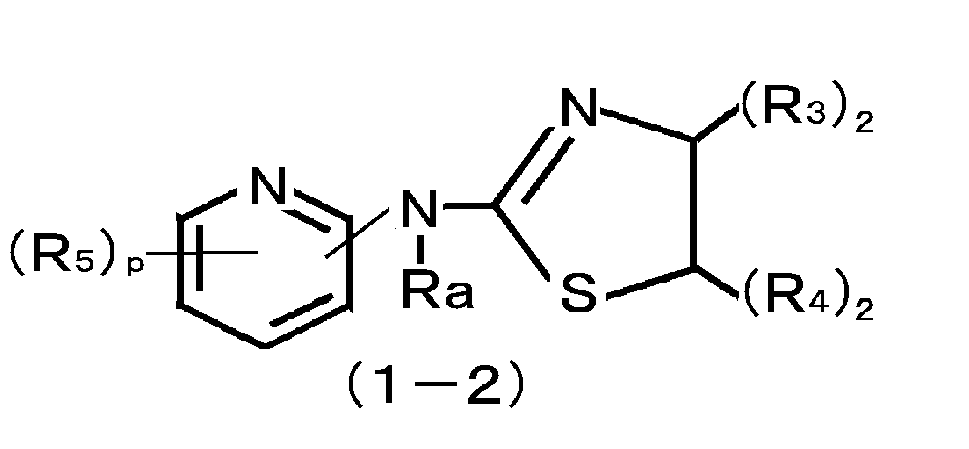
- A preferred example of the compound represented by the formula (1-1) is a compound whereinR3 is each independently H or C1-6 alkyl.
Another preferred example of the compound represented by the formula (1-1) is a compound whereinR4 is each independently H or C1-6 alkyl, or a compound wherein C(R4)2 is C=CH2.
A preferred example of the compound represented by the formula (1-2) is a compound whereinR3 and R4 are each independently H or C1-6 alkyl. - It is to be noted that compounds of the formula (1) wherein- - - is a single bond and Ra = H can be tautomers as shown below. In the present invention, such tautomers are also included in the compound of the formula (1).
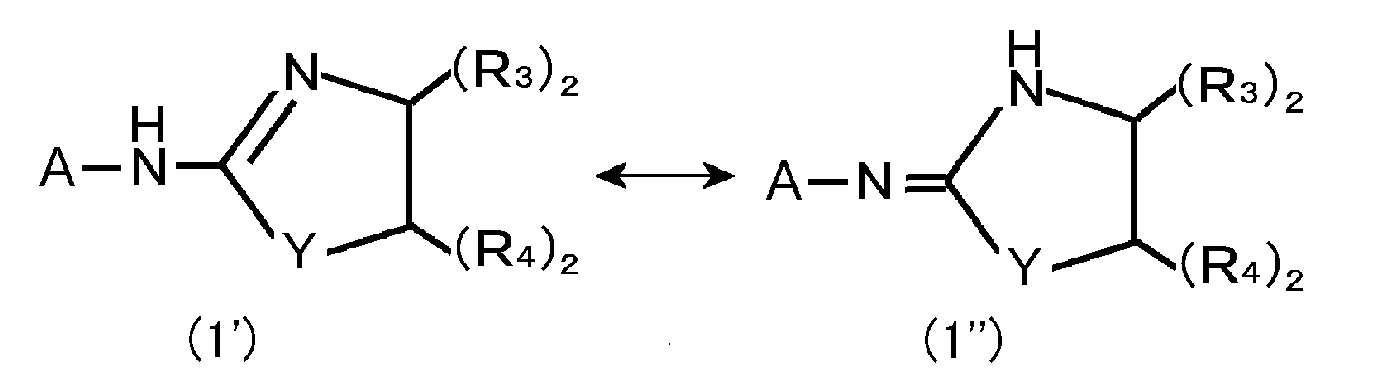
- Also, a preferred example of the compound wherein A is the group (A1) is a compound wherein- - - is a double bond. Preferred examples of such a compound include a compound represented by the following formula (1-3) or formula (1-4).
-

-

- A preferred example of the compound represented by the formula (1-3) or formula (1-4) is a compound whereinR3 is C1-6 alkyl or the group (A1).
Another preferred example of the compound represented by the formula (1-3) or (1-4) is a compound whereinR4 is H or C1-6 alkyl. - The compound of the formula (1) can be synthesized by a known method or commercially available.
In the case of synthesis, when the molecule has a functional group which blocks or might block a reaction, an appropriate protecting group is preferably used to allow the reaction to proceed efficiently. The use of the protecting group can be carried out according to, for example, Protective Groups in Organic Synthesis by Theodora W. Greene and Peter G. M. Wuts. - Further, when an isomer such as a conformational isomer, a geometric isomer, and an optical isomer is present, a pure isomer or geometric isomer can be obtained by appropriately selecting a raw material and a reaction condition and performing a separation operation. In the present invention, a pure isomer of the compound of the formula (1) as well as a mixture thereof are also included.
- A compound wherein - - - is a single bond and Ra = H in the formula (1) can be obtained by, for example, a reaction shown in the following scheme 1.

- In scheme 1, a reaction of an iso(thio)cyanate compound (2) with an ethanolamine compound (3) can be carried out, for example, in an appropriate solvent such as chloroform, while heating as needed. A ring closure reaction of the (thio)urea compound (4) thus obtained can be carried out, for example, in the presence of an acid catalyst, while heating. The above reaction can be carried out according to, for example, a method described in Japanese Unexamined Patent Publication No.
S62-228089
Alternatively, as a method described in Japanese Unexamined Patent Publication No.H6-25197 - A compound wherein - - - is a double bond and Ra = H in the formula (1) can be obtained by, for example, a reaction shown in the following scheme 2.

- In scheme 2, a reaction of a (thio)urea compound (5) with a α-haloketone compound (6) can be carried out in an appropriate solvent such as methanol,at room temperature or while heating, in the presence of a base such as triethylamine as needed. This reaction can be carried out according to, for example, a method described in Japanese Unexamined Patent Publication No.
2005-532983 3023178
Alternatively, as a method described in Japanese Patent No.3023178 - The compound of the formula (1) can be converted into an acid-addition salt by an ordinary method as needed. Examples of acid in the acid-addition salt include an inorganic salt such as hydrochloric acid, hydrobromic acid, sulfuric acid, and phosphoric acid, and an organic acid such as acetic acid, propionic acid, citric acid, lactic acid, oxalic acid, maleic acid, fumaric acid, succinic acid, tartaric acid, and methanesulfonic acid.
- Many of the compounds of the formula (1) are commercially available and can be obtained from various suppliers such as Enamine Ltd. (Ukraine), Pharmeks Ltd. (Russia), Labotest (Germany), Scientific Exchange Inc. (U.S.A), Life Chemicals Inc. (Ukraine), Asinex Ltd. (Russia), Vitas-M Laboratory Ltd. (Russia), ACB Blocks Ltd. (Russia), Bionet (U.S.A), and Princeton Biomolecular Research Inc. (U.S.A).
- The compound of the formula (1) has an excellent inhibitory action on melanin production while exhibiting extremely low cytotoxicity. Therefore, the present compound is useful as a whitening agent and can be suitably mixed into various skin external preparations, particularly a skin external preparation intended to improve or prevent pigmentedspots, freckles, skin dullness, and the like.
When the compound of the formula (1) is mixed into the skin external preparation as the whitening agent, the compound amount is, in the total amount of the external agent, typically 0.0002% by mass or more, preferably 0.002% by mass or more. When it is too low, the effect cannot be fully exerted. Although no limitation is imposed on the upper limit, it is typically 30% by mass or less, preferably 20% by mass or less, and more preferably 5% by mass or less. When the compound is excessively mixed in, not only a remarkable effect reasonably expected from the increased amount may not be obtained but also formulation designing and usability may be affected. - Other than adding the compound of the formula (1), the skin external preparation of the present invention can be produced by an ordinary method.
In addition to the compound of the formula (1), other ingredients normally used in a skin external preparation such as a cosmetic product and a pharmaceutical product can be appropriately added to the skin external preparation of the present invention as needed as far as the effect of the present invention is not adversely affected. Examples of such an ingredient include oil, a humectant, an ultraviolet protective agent, an antioxidant, a metal ion chelating agent, a surfactant, a preservative, a moisturizer, a fragrance, water, an alcohol, a thickener, powder, a colorant, a crude drug, and various kinds of medicinal ingredients.
Further, other whitening agents such as vitamin C, magnesium ascorbyl phosphate, ascorbyl glucoside, arbutin, kojic acid, Rucinol, ellagic acid, tranexamic acid, and linoleic acid can be appropriately added. - The skin external preparation of the present invention is widely applicable to the fields of cosmetics, drugs, and quasi drugs. No particular limitation is imposed on the form of the skin external preparation as long as it is applicable to the skin. Any form such as a solution, an emulsion, a solid, a semi-solid, a powder, a powder dispersion, a water-oil-separated two-phase liquid, a water-oil-powder-separated three-phase liquid, an ointment, a gel, an aerosol, a mousse, and a stick can be applied. Further, the skin external preparation can be provided in any use form including a facial cosmetic such as a lotion, an emulsion, a cream, a pack, an essence, and a gel, and a makeup cosmetic such as a foundation, a makeup base, and a concealer.
Hereinbelow, the present invention will be further described with specific examples. However, the present invention is not limited thereto. - A test for melanin production inhibition by the compounds of the formula (1) was conducted. The test method is as follows.
- Mouse B16 melanoma cells were inoculated in a six well plate at 100,000 cells/well. The next day, test substance solutions (solvent: DMSO) were added.
- Three days after the addition of the test substance solution, the medium was removed by aspiration. Then 1 ml of EMEM medium containing 10% Alamar Blue solution was added, and a reaction was allowed to proceed at 37°C. After 30 minutes, 100 µL of the reaction mixture was transferred to a 96 well plate and fluorescence was measured at an excitation wavelength of 544 nm and a measurement wavelength of 590 nm. Using the value thus measured as a relative value of cell count, a ratio of the cell count (% cell count) of the test substance-added group to the test substance-absent group (group in which only the solvent was added) was calculated. The higher the % cell count, the lower the cytotoxicity. It was determined that a compound having the % cell count of 80% or more was non-cytotoxic, and that a compound having the % cell count of less than 80% was cytotoxic.
- The cells after the cell proliferation test were washed with PBS three times, and then lysed by addition of 200 µL of 1M NaOH to measure an absorbance at 475 nm. Using the value thus measured as a relative value of the melanin amount, a ratio of the melanin amount (%) of the test substance-added group to the test substance-absent group (group in which only the solvent was added) was calculated. The lower the ratio of the melanin amount, the higher the melanin production-inhibitory effect. In the final concentrationsof the test substances at which the compound was determined to be non-cytotoxic, the minimum final concentrationof the test substance at which the ratio of the melanin amount (%) was 80% or less was provided as a minimum concentration for inhibition of melanin production (ppm). The inhibitory effect on melanin production was evaluated according to the following criteria.
- ⊚: the minimum concentration for inhibition of melanin production was 1 ppm or less.
- ○: the minimum concentration for inhibition of melanin production was more than 1 ppm and 10 ppm or less.
- ×: no inhibitory effect on melanin production was exhibited at 10 ppm or less (the ratio of the melanin amount was not 80% or less even at 10 ppm or less).
- The results of melanin production inhibition test using the compounds of the present invention are shown in Table 1.
Any of the compounds shown in Table 1 was acknowledged to have an inhibitory effect on melanin production, and most of them exhibited the effect at such an extremely low concentrationas 1 ppm or less.
It is to be noted that symbols in Tables represent the following groups.
Me: Methyl, Et: Ethyl, tBu: tert-Butyl, Phe: Phenyl, Ac: Acetyl -
Table 1 
No R3 R4 R5a R5b R5c R5d R5e Ra Inhibitory effect on melanin production 1 pyridin-4-yl H Me H H H H H ⊚ 2 pyrrdin-2-yl H Me H H H H H ⊚ 3 pyridin-2-yl H Et H H H H H ⊚ 4 pyridin-2-yl H H H H H H H ⊚ 5 tBu H Me H Me H H H ⊚ 6 Me Ac Me H H H H H ○ 7 4-methoxyphenyl Me Me H H H Me H ⊚ 8 Phe H Me H H H Me H ⊚ 9 3,4- dihydroxyphenyl H Et H H H H H ⊚ 10 2,4- dihydroxyphenyl H Et H H H H H ⊚ 11 -(CH2)4- Me H H H H H ⊚ -
Table 2 
No. R3 R4 A1 Ra Inhibitory effect on melanin production 12 Phe H pyridin-2-yl H ⊚ 13 Phe H 3-methylpyridin-2-yl H ⊚ 14 pyridin-4-yl H pyridin-2-yl H ⊚ 15 pyridin-4-yl H 3-methylpyridin-2-yl H ⊚ 16 pyridin-2-yl H 5-methylpyridin-2-yl H ⊚ 17 pyridin-3-yl H pyridin-2-yl H ⊚ 18 pyridin-4-yl H pyridin-3-yl H ⊚ -
Table 3 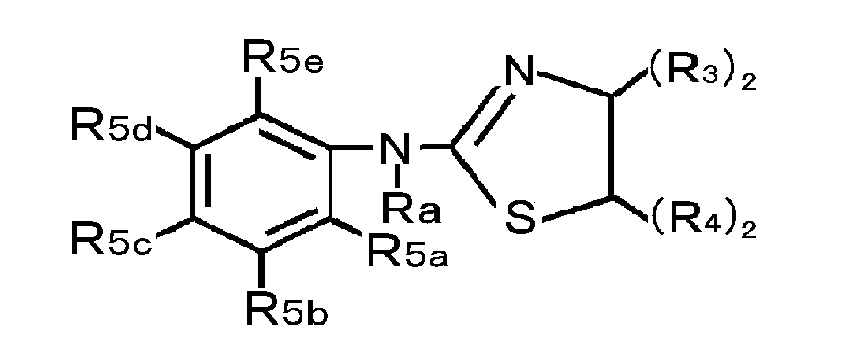
No. R3 R4 R5a R5b R5c R5d R5e Ra Inhibitory effect on melanin production 19 H, Et H, H H H H H H H ⊚ 20 H, H H, H H H H H H H ○ 21 H, H H, Me H H H H H H ⊚ 22 H, H H, H Me H H H H H ⊚ 23 H, H H, H O-Me H H H H H ⊚ 24 Me, Me H, H H H O-Me H H H ○ 25 Me, Me H, H H O-Me H H H H ○ 26 Me, Me H, H O-Me H H H H H ○ 27 H, Me H, H Me H Me H H H ○ 28 H, H Me, Me Me H H H H H ⊚ 29 CH2OH, CH2OH H, H H H H H H H ○ 30 CH2OH, CH2OH H, H Me H Me H Me H ○ 31 
⊚ 32 
⊚ -
Table 4 
No. R3 R4 A Y Ra Inhibitory effect on melanin production 33 Me Phe t-Bu S H ⊚ 34 Me H 4-methylbenzoyl S H ○ 35 -(CH2)4 - benzoyl S H ⊚ 36 
⊚ 37 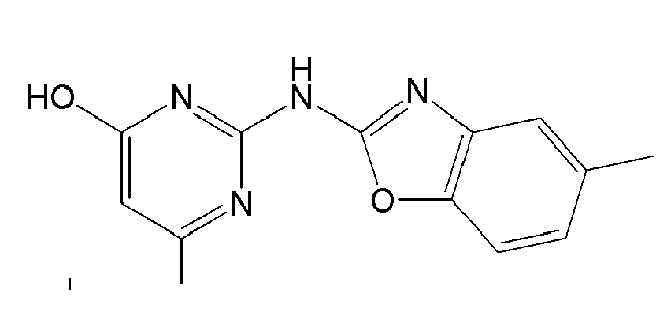
○ -
Table 5 
No. R3 R4 A Ra Inhibitory effect on melanin production 38 H, H Me, Me pyridin-3-yl H ○ 39 H, H Me, Me cyclohexyl H ○ 40 H, H Me, Me benzyl H ○ - Hereinbelow, representative Synthesis Examples of the heterocyclic compounds used for the whitening agent of the present invention will be shown. Various heterocyclic compounds can be obtained by carrying out a reaction according to the below-described Synthesis Examples using a corresponding raw material.
- To p-anisidine (0.60 g, 4.86 mmol) and methanol (4.0 mL) in a 50 mL recovery flask was added methallyl isothiocyanate (0.50 g, 4.42 mmol) dropwise at room temperature, and then the resulting mixture was stirred for 12 hours at room temperature. Upon completion of the reaction, the mixture was extracted with ethyl acetate once. The organic phase thus obtained was washed with saturated brine and then dried over anhydrous magnesium sulfate. The solvent was distilled off under reduced pressure and the residue was recrystallized from a mixed solvent of ethyl acetate and hexane to give 0.79 g of 1-(4-methoxyphenyl)-3-(2-methylallyl)thiourea (yield 76%).
- 1-(4-Methoxyphenyl)-3-(2-methylallyl)thiourea (0.50 g, 2.11 mmol) and 35% hydrochloric acid (5.0 mL) were added in a pressure resistant reaction container, and the resulting mixture was stirred at 140°C for five hours in the sealed container. Upon completion of the reaction, a 3N aqueous solution of sodium hydroxide was added to the reaction mixture to adjust the pH up to 14, and the resulting mixture was extracted with ethyl acetate twice. The organic phase was washed with saturated brine and then dried over anhydrous magnesium sulfate. The solvent was distilled off under reduced pressure, and the residue was purified by silica gel column chromatography (hexane:ethyl acetate = 1:2) to give 0.19 g of 4-(5,5-dimethyl-4,5-dihydrothiazol-2-ylamino)phenol (Compound 41) (yield 40%).
- (Hetero)arylaminothiazolines as shown in Table 6 were each synthesized in the same manner as in Synthesis Example 1-1 except that raw material A was used instead of anisidine.
-
Table 6 No. Structure Raw material A NMR Yield 41 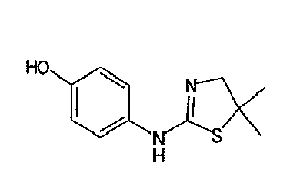
p-anisidine 1H-NMR (DMSO-d6): 1.46(6H, s), 3.51(2H, br-s), 6.61(2H, dd), 7.07(2H, br-s), 8.67(2H, br-s) 40% 42 
m-anisidine 1H-NMR (DMSO-d6): 1.47(6H, s), 3.64(2H, br-s), 6.31(1H, d), 6.83(2H, br-s), 6.97(1H, t), 9.17(2H, br-s) 34% 38 
3-aminopyridine 1H-NMR (DMSO-d6): 1.49(6H, s), 3.53(2H, br-s), 7.23(1H, dd), 7.66(1H, br-s), 8.12(1H, dd), 8.35(1H, br-s), 9.10(1H, br-s) 56% - To 975 mL of methanol were added triethylamine (14.0 g, 137 mmol), o-toluylthiourea (11.54 g, 69.4 mmol), and 2-(bromoacetyl)pyridine hydrobromide (19.5 g, 69.4 mmol), and the resulting mixture was stirred for 15 hours at room temperature. Upon completion of the reaction, 1,950 mL of water was added to the mixture and precipitated crystals were collected by filtration. The solid thus collected was crystallized from a mixed solvent of water and methanol to give the title compound (14.0 g, 76%).
1H-NMR (DMSO-d6) : 2.30(3H, s), 7.01-7.04(1H, m), 7.22-7.30(3H, m), 7.46(1H, s), 7.82-7.91(2H, m), 7.97(1H, d), 8.56(1H, d), 9.32(1H, s) - In 500 g of chloroform was dissolved 2-amino-2-methyl-1-propanol (61.6 g, 0.69 moL). Then, 300 g of chloroform solution containingphenyl isothiocyanate (81.6 g, 0.6 moL) was slowly added dropwise to the mixture over one hour, while stirring. Upon completion of the addition, the resulting mixture was stirred for 12 hours at room temperature. The precipitated crystals were refluxed with heat to be dissolved and then recrystallized. The crystals thus obtained were collected by filtration, washed with 20 mL of diethyl ether three times, and then dried under reduced pressure at room temperature to give 80.1 g of N-(1-hydroxy-2-methylpropan-2-yl)-N'-phenylthiourea (yield 60%).
- N-(1-hydroxy-2-methylpropan-2-yl)-N'-phenylthiourea (80.1 g, 0.36 mol) was dissolved in 2,400 mL of 35% HCl, and the resulting mixture was stirred while heating at 90°C for 1.5 hours. After cooling, the mixture was neutralized with NaOH and extracted with diethyl ether. The extract was washed with saturated brine and then anhydrous sodium sulfate was added. The organic phase was distilled off under reduced pressure and the residue was washed three times with hexane. The crystals thus obtained were dried under reduced pressure at room temperature, and then recrystallized from methanol twice to give 22.4 g of the title compound (yield 18%).
1H-NMR (CDCl3) : 1.39(6H, s), 3.08(2H, s), 7.01-7.09(3H, m), 7.26-7.30(2H, m) - Hereinbelow, Formulation Examples of the skin external preparation of the present invention are shown. In each Formulation Example, one or more compounds of the present invention can be used. Any of the skin external preparations shown in Formulation Examples below exerts a whitening effect becauseof the by the addition of the compound of the present invention.
-
Formulation Example 1 Cream (Formulation) Stearic acid 5.0% by mass Stearyl alcohol 4.0 Isopropyl myristate 18.0 Glyceryl monostearate 3.0 Propylene glycol 10.0 Compound of the present invention 0.1 Caustic potash 0.2 Sodium bisulfite 0.05 Preservative q.s. Fragrance q.s. Ion-exchanged water balance - Propylene glycol and caustic potash were dissolved in ion-exchanged water, and the resulting mixture was heated to and maintained at 70°C (aqueous phase). Other components were mixed and melted by heat, and maintained at 70°C (oil phase). The oil phase was gradually added to the aqueous phase, and after the complication of the addition, the resulting mixture was maintained at 70°C for some time to allow a reaction to proceed. Subsequently, the mixture was homogeneously emulsified by a homomixer, and cooled to 30°C while thoroughly stirring.
-
Formulation Example 2 Cream (Formulation) Stearic acid 5.0 by mass% Sorbitan monostearate 2.5 Polyoxyethylene (20) sorbitan monostearate 1.5 Arbutin 7.0 Sodium bisulfite 0.03 Propylene glycol 10.0 Compound of the present invention 0.05 Glyceryl trioctanoate 10.0 Squalene 5.0 Octyl p-dimethylaminobenzoate 3.0 Disodium ethylenediaminetetraacetate 0.01 Ethylparaben 0.3 Fragrance q.s. Ion-exchanged water balance - Propylene glycol and disodium ethylenediaminetetraacetate were dissolved in ion-exchanged water and the resulting mixture was maintained at 70°C (aqueous phase). Other components were mixed and melted by heat, and maintained at 70°C (oil phase). The oil phase was gradually added to the aqueous phase. The mixture was preliminarily emulsified at 70°C, homogeneously emulsified by a homomixer, and then cooled to 30°C while thoroughly stirring.
-
Formulation Example 3 Cream (Formulation) Solid paraffin 5.0% by mass Beeswax 10.0 Petrolatum 15.0 Liquid paraffin 41.0 Glyceryl monostearate 2.0 POE (20) sorbitan monolaurate 2.0 Soap powder 0.1 Borax 0.2 Compound of the present invention 0.05 Sodium bisulfite 0.03 Ethylparaben 0.3 Fragrance q.s. Ion-exchanged water balance - Powder soap and borax were added to ion-exchanged water and dissolved with heat, and the resulting mixture was maintained at 70°C (aqueous phase). Other components were mixed and melted by heat, and maintained at 70°C (oil phase). While stirring, the oil phase was gradually added to the aqueous phase to allow a reaction to proceed. Upon completion of the reaction, the mixture was homogeneously emulsified by a homomixer, and then cooled to 30°C while thoroughly stirring.
-
Formulation Example 4 Milky lotion (Formulation) Stearic acid 2.5% by mass Cetyl alcohol 1.5 Petrolatum 5.0 Liquid paraffin 10.0 POE (10) monooleate 2.0 Polyethylene glycol 1500 3.0 Triethanolamine 1.0 Carboxyvinyl polymer 0.05 Compound of the present invention 0.01 Sodium bisulfite 0.01 Ethylparaben 0.3 Fragrance q.s. Ion-exchanged water balance - Carboxyvinyl polymer was dissolved in a small amount of ion-exchanged water (phase A). Polyethylene glycol 1500 and triethanolamine were added to the remaining ion-exchanged water and dissolved with heat, and the resulting mixture was maintained at 70°C (aqueous phase). Other components were mixed and melted by heat, and maintained at 70°C (oil phase). The oil phase was added to the aqueous phase and preliminarily emulsified.After addition of phase A, the resulting mixture was homogeneously emulsified by a homomixer and then cooled to 30°C while thoroughly stirring.
-
Formulation Example 5 Milky lotion (Formulation) Microcrystalline wax 1.0% by mass Beeswax 2.0 Lanolin 20.0 Liquid paraffin 10.0 Squalane 5.0 Sorbitan sesquioleate 4.0 POE (20) sorbitan monooleate 1.0 Propylene glycol 7.0 Compound of the present invention 1.0 Sodium bisulfite 0.01 Ethylparaben 0.3 Fragrance q.s. Ion-exchanged water balance - Propylene glycol was added to ion-exchanged water, and the resulting mixture was heated and maintained at 70°C (aqueous phase). Other components were mixed and melted by heat, and maintained at 70°C (oil phase). While stirring the oil phase, the aqueous phase was gradually added to the oil phase. The resulting mixture was homogeneously emulsified by a homomixer and then cooled to 30°C while thoroughly stirring.
-
Formulation Example 6 Jelly (Formulation) 95% Ethanol 10.0% by mass Dipropylene glycol 15.0 POE (50) oleyl ether 2.0 Carboxyvinyl polymer 1.0 Caustic soda 0.15 L-arginine 0.1 Compound of the present invention 5.0 Sodium 2-hydroxy-4-methoxybenzophenone sulfonate 0.05 Trisodium ethylenediaminetetraacetate dihydrate 0.05 Methylparaben 0.2 Fragrance q.s. Ion-exchanged water balance - Carboxyvinyl polymer was homogeneously dissolved in ion-exchanged water. Separately, the compound of the present invention and POE (50) oleyl ether were dissolved in 95% ethanol and then added to the aqueous phase. After addition of the remaining components, the resulting mixture was neutralized by caustic soda and L-arginine to increase the viscosity.
-
Formulation Example 7 Essence (Formulation) (Phase A) Ethyl alcohol (95%) 10.0% by mass POE (20) octyldodecanol 1.0 Pantothenyl ethyl ether 0.1 Compound of the present invention 2.0 Methylparaben 0.15 (Phase B) Potassium hydroxide 0.1 (Phase C) Glycerol 5.0 Dipropylene glycol 10.0 Sodium bisulfite 0.03 Carboxyvinyl polymer 0.2 Purified water balance - Each of Phase A and Phase C was homogeneously dissolved, and Phase A was added to Phase C to be solubilized. After addition of Phase B, the resulting mixture was packed in a container.
-
Formulation Example 8 Pack (Formulation) (Phase A) Dipropylene glycol 5.0% by mass POE (60) hydrogenated castor oil 5.0 (Phase B) Compound of the present invention 0.05 Olive oil 5.0 Tocopherol acetate 0.2 Ethylparaben 0.2 Fragrance 0.2 (Phase C) Sodium bisulfite 0.03 Polyvinyl alcohol (saponification degreeof 90 and polymerization degreeof 2,000) 13.0 Ethanol 7.0 Purified water balance - Each of Phase A, Phase B, and Phase C was homogeneously dissolved, and Phase B was added to Phase A to be solubilized. After addition of Phase C, the resulting mixture was packed in a container.
-
Formulation Example 9 Solid foundation (Formulation) Talc 43.1 % by mass Kaolin 15.0 Sericite 10.0 Zinc oxide 7.0 Titanium dioxide 3.8 Yellow iron oxide 2.9 Black iron oxide 0.2 Squalane 8.0 Isostearic acid 4.0 POE sorbitan monooleate 3.0 Isocetyl octanoate 2.0 Compound of the present invention 0.5 Preservative q.s. Fragrance q.s. - Powdery components from talc to black iron oxide shown above were thoroughly mixed by a blender. To this mixture were added oily components from squalane to isocetyl octanoate shown above, the compound of the present invention, preservative, and fragrance. The resulting mixture was thoroughly kneaded, packed in a container, and then formed.
-
Formulation Example 10 Emulsion foundation (cream-type) (Formulation) (Powder part) Titanium dioxide 10.3% by mass Sericite 5.4 Kaolin 3.0 Yellow iron oxide 0.8 Red iron oxide 0.3 Black iron oxide 0.2 (Oil phase) Decamethylcyclopentasiloxane 11.5 Liquid paraffin 4.5 Polyoxyethylene-modified dimethylpolysiloxane 4.0 Compound of the present invention 0.5 (Aqueous phase) Purified water 50.0 1,3-Butylene glycol 4.5 Sorbitan sesquioleate 3.0 Preservative q.s. Fragrance q.s. - The aqueous phase was stirred with heat and then the powder part, which had been fully mixed and pulverized, was added. The mixture was treated with a homomixer and then the oil phase, which had been mixed with heat, was added. The mixture was treated with a homomixer and then fragrance was added while stirring. The mixture thus obtained was cooled to room temperature.
-
Formulation Example 11 Lotion (1) Compound of the present invention 0.05% by mass (2) Aspartic acid 1.0 (3) Tocopherolacetate 0.01 (4) Glycerol 4.0 (5) 1,3-Butylene glycol 4.0 (6) Ethanol 8.0 (7) POE (60) hydrogenated castor oil 0.5 (8) Methylparaben 0.2 (9) Citric acid 0.05 (10) Sodium citrate 0.1 (11) Fragrance 0.05 (12) Purified water balance - (2), (4), (5), (9), and (10) were dissolved in (12) to provide a purified water solution. Separately, (1), (3), (7), (8), and (11) were dissolved in (6), and the resulting mixture was added to the aforementioned the purified water solution to be solubilized. The mixture thus obtained was filtrated to provide a lotion.
-
Formulation Example 12 Lotion A: Alcohol phase Ethanol 5.0% by mass POE oleyl ether 2.0 2-Ethylhexyl-p-dimethylaminobenzoate 0.18 Compound of the present invention 0.1 Fragrance 0.05 B: Aqueous phase 1,3-Butylene glycol 9.5 2-O-Ethyl ascorbic acid 0.5 Sodium pyrrolidonecarboxylate 0.5 Whey extract 5.0 Nicotinamide 0.3 Glycerol 5.0 Hydroxypropyl-β-cyclodextrin 1.0 Trisodium hydroxyethylethylenediamine triacetate 1.0 Lysine 0.05 Tranexamic acid 1.0 Purified water balance - Alcohol phase A was added to Aqueous phase B and solubilized to provide a lotion.
-
Formulation Example 13 Cream (whitening) Trans-4-(trans-aminomethylcyclohexanecarbonyl) aminomethylcyclohexanecarboxylic acid hydrochloride 1.0% by mass Potassium 4-methoxysalicylate 1.0 3-O-Ethylascorbicacid 1.0 Linoleic acid 0.3 Sodium lipoate 1.0 Compound of the present invention 3.0 Coenzyme Q10(CoQ10) 0.03 Petrolatum 2.0 Dimethylpolysiloxane 2.0 Ethanol 5.0 Behenyl alcohol 0.5 Batyl alcohol 0.2 Glycerol 7.0 1,3-Butylene glycol 5.0 Polyethylene glycol 20000 0.5 Jojoba oil 3.0 Squalane 2.0 Phytosteryl hydroxystearate 0.5 Pentaerythritol tetra(2-ethylhexanoate) 1.0 Polyoxyethylene hydrogenated castor oil 1.0 Potassium hydroxide 0.1 Sodium pyrosulfite 0.01 Sodium hexametaphosphate 0.05 Stearyl glycyrrhetinate 0.1 Pantothenyl ethyl ether 0.1 Arbutin 7.0 Tranexamic acid 2.0 Tocopherol acetate 0.1 Sodium hyaluronate 0.05 p-Hydroxybenzoate ester q.s. Trisodium edetate 0.05 4-t-Butyl-4'-methoxydibenzoylmethane 0.1 Glyceryl diparamethoxycinnamate mono-2-ethylhexanoate 0.1 Yellow iron oxide q.s. Xanthan gum 0.1 Carboxyvinyl polymer 0.2 Purified water balance -
Formulation Example 14 Two-phase cream (sunscreen) Tranexamic acid 2.0% by mass Potassium 4-methoxysalicylate 1.0 Compound of the present invention 0.03 Dimethylpolysiloxane 5.0 Decamethylcyclopentasiloxane 25.0 Trimethylsiloxysilicate 5.0 Polyoxyethylene/methylpolysiloxanecopolymer 2.0 Dipropylene glycol 5.0 Dextrin palmitate-coated fine-particle zinc oxide (60 nm) 15.0 Dipotassium glycyrrhizinate 0.02 Glutathione 1.0 Thiotaurine 0.05 Sophora flavescens extract 1.0 Paraben q.s. Phenoxyethanol q.s. Trisodium edetate q.s. 2-Ethylhexyl p-methoxycinnamate 7.5 Dimethyldistearylammonium hectorite 0.5 Spherical poly(alkyl acrylate) powder 5.0 Butylethylpropanediol 0.5 Purified water balance Fragrance q.s. -
Formulation Example 15 Gel (whitening) Potassium 4-methoxysalicylate 0.1% by mass Rucinol 0.3 Dihydrolipoic acid 1.0 Lamium album var. barbatum 0.1 Dimethylpolysiloxane 5.0 Glycerol 2.0 1,3-Butylene glycol 5.0 Polyethylene glycol 1500 3.0 Polyethylene glycol 20000 3.0 Cetyl octanoate 3.0 Citric acid 0.01 Sodium citrate 0.1 Sodium hexametaphosphate 0.1 Compound of the present invention 1.0 Dipotassium glycyrrhizinate 0.1 Ascorbyl glucoside 2.0 Tocopherol acetate 0.1 Scutellaria baicalensis extract 0.1 Saxifraga stolonifera extract 0.1 Trisodium edetate 0.1 Xanthan gum 0.3 Acrylic acid/alkyl methacrylate copolymer (Pemulen TR-2) 0.05 Agar powder 1.5 Phenoxyethanol q.s. Dibutylhydroxytoluene q.s. Purified water balance -
Formulation Example 16 Pack (moisturizing) Trans-4-aminomethylcyclohexanecarboxylic acid methylamide hydrochloride 10.0% by mass Dihydrolipoamide 1.0 Rosa multiflora fruit extract 0.1 Ethanol 10.0 1,3-Butylene glycol 6.0 Polyethylene glycol 4000 2.0 Olive oil 1.0 Macadamia nut oil 1.0 Phytosteryl hydroxystearate 0.05 Lactic acid 0.05 Sodium lactate 0.1 Disodium L-ascorbyl sulfate 0.1 Compound of the present invention 0.5 Potassium 2-L-Ascorbyl α-tocopheryl phosphate 0.1 Vitamin E acetate 0.1 Fish collagen 0.1 Sodium chondroitin sulfate 0.1 Sodium carboxymethyl cellulose 0.2 Polyvinyl alcohol 12.0 p-Hydroxybenzoate q.s. Purified water balance Fragrance q.s. -
Formulation Example 17 Lotion (moisturizing) Tranexamic acid 1.0% by mass Potassium 4-methoxysalicylate 1.0 Lipoic acid 10.0 Hamamelis 0.1 Silica-coated zinc oxide 0.1 Hypotaurine 0.1 Sophora flavescens extract 0.1 Peach kernelextract 0.1 Beech sprout extract 0.1 Retinol 0.1 Compound of the present invention 0.01 Ethyl alcohol 5.0 Glycerol 1.0 1,3-Butylene glycol 5.0 Polyoxyethylene polyoxypropylene decyltetradecyl ether 0.2 Sodium hexametaphosphate 0.03 Trimethylglycine 1.0 Sodium polyaspartate 0.1 Potassium 2-L-Ascorbyl α-tocopheryl phosphate 0.1 Thiotaurine 0.1 Green tea extract 0.1 Peppermint extract 0.1 Iris root extract 1.0 Trisodium EDTA 0.1 Carboxyvinyl polymer 0.05 Potassium hydroxide 0.02 Phenoxyethanol q.s. Purified water balance Fragrance q.s.
Claims (19)
- A whitening agent comprising, as an active ingredient, a heterocyclic compound represented by formula (1) or a pharmacologicallyacceptable salt thereof:

A is C1-6 alkyl, C5-6 cycloalkyl, benzyl, benzylcarbonyl, benzoyl, or a group represented by formula (A1):
X1 is CR1 or N, wherein R1 is H, C1-6 alkyl, C1-6 alkoxy, or OH;
X2 is CR2 or N, wherein R2 is H, C1-6 alkyl, C1-6 alkoxy, or OH;
R5 is C1-6 alkyl, C1-6 alkoxy, or OH; and
p is an integer of 0 to 3, wherein when p is 2 or 3, R5 may be the same or different;
Ra is H,C1-6alkyl, or C2-6 alkenyl;
"- - -" represents a single bond that leads n = 2 or a double bond that leads n = 1, wherein when n = 2, two R3 may be the same or different, and two R4 may also be the same or different;
Y is S or O; and
R3 and R4 are each independently H, C1-6 alkyl, hydroxy-C1-6 alkyl, C2-7 acyl, or the group (A1), or
one R3 and one R4 may together form a saturated or unsaturated 5- or 6-membered hydrocarbon ring condensed with the hetero ring to which R3 and R4 are bound, or
C(R3)2 or C(R4)2 may each independently be C=CH2;
with the proviso that at least one R3 is a group other than C1-3 alkyl in the case where: the hetero ring containing Y is a thiazoline ring; R4 = Ra = H; X1 = X2 = CH; and p = 0 or R5 = C1-6 alkyl. - The whitening agent of claim 1, wherein Y is S.
- The whitening agent of claim 1 or 2, wherein A is the group (A1).
- The whitening agent of any of claims 1 to 3, wherein - - - is a single bond.
- The whitening agent of claim 4, whereinis represented by formula (1-1):

- The whitening agent of claim 5, whereinR3 is each independently H or C1-6 alkyl.
- The whitening agent of claim 4 or 5, wherein R4 is each independently H or C1-6 alkyl, or C(R4)2 is C=CH2.
- The whitening agent of claim 4, whereinis represented by formula (1-2):

- The whitening agent of claim 8, whereinR3 and R4 are each independently H or C1-6 alkyl.
- The whitening agent of any of claims 1 to 3, wherein - - - is a double bond.
- The whitening agent of claim 10, wherein is represented by formula (1-3):

- The whitening agent of claim 10, wherein is represented by formula (1-4):

- The whitening agent of claim 11 or 12, wherein R3 is C1-6 alkyl or the group (A1).
- The whitening agent of any of claims 11 to 13, whereinR4 is H or C1-6 alkyl.
- The whitening agent of any of claims 1 to 14, whereinRa is H.
- The whitening agent of any of claims 1 to 15, wherein R5 is C1-6 alkyl.
- The whitening agent of any of claims 1 to 16, where in the active ingredient inhibits melanin production.
- A skin external preparation comprising the heterocyclic compound described in any of claims 1 to 17 or a pharmacologicallyacceptable salt thereof.
- A cosmetic comprising the heterocyclic compound described in any of claims 1 to 17 or a pharmacologically acceptable salt thereof.
Applications Claiming Priority (3)
| Application Number | Priority Date | Filing Date | Title |
|---|---|---|---|
| JP2008029106 | 2008-02-08 | ||
| JP2008199606 | 2008-08-01 | ||
| PCT/JP2009/052079 WO2009099195A1 (en) | 2008-02-08 | 2009-02-06 | Skin whitening agent and external preparation for the skin |
Publications (2)
| Publication Number | Publication Date |
|---|---|
| EP2251001A1 true EP2251001A1 (en) | 2010-11-17 |
| EP2251001A4 EP2251001A4 (en) | 2013-01-09 |
Family
ID=40952264
Family Applications (5)
| Application Number | Title | Priority Date | Filing Date |
|---|---|---|---|
| EP09707883.6A Active EP2250999B1 (en) | 2008-02-08 | 2009-02-06 | Skin whitening agent and external preparation for the skin |
| EP09709400A Withdrawn EP2251001A4 (en) | 2008-02-08 | 2009-02-06 | Skin whitening agent and external preparation for the skin |
| EP16162633.8A Active EP3067038B1 (en) | 2008-02-08 | 2009-02-06 | Skin whitening agent |
| EP09707325.8A Active EP2250998B1 (en) | 2008-02-08 | 2009-02-06 | Skin whitening agent and external preparation for the skin |
| EP09709047.6A Not-in-force EP2251000B1 (en) | 2008-02-08 | 2009-02-06 | Skin whitening agent and external preparation for the skin |
Family Applications Before (1)
| Application Number | Title | Priority Date | Filing Date |
|---|---|---|---|
| EP09707883.6A Active EP2250999B1 (en) | 2008-02-08 | 2009-02-06 | Skin whitening agent and external preparation for the skin |
Family Applications After (3)
| Application Number | Title | Priority Date | Filing Date |
|---|---|---|---|
| EP16162633.8A Active EP3067038B1 (en) | 2008-02-08 | 2009-02-06 | Skin whitening agent |
| EP09707325.8A Active EP2250998B1 (en) | 2008-02-08 | 2009-02-06 | Skin whitening agent and external preparation for the skin |
| EP09709047.6A Not-in-force EP2251000B1 (en) | 2008-02-08 | 2009-02-06 | Skin whitening agent and external preparation for the skin |
Country Status (11)
| Country | Link |
|---|---|
| US (6) | US20100316584A1 (en) |
| EP (5) | EP2250999B1 (en) |
| JP (4) | JP4592820B2 (en) |
| KR (4) | KR101039220B1 (en) |
| CN (4) | CN101938988B (en) |
| AU (1) | AU2009211564B2 (en) |
| BR (1) | BRPI0908143B1 (en) |
| ES (4) | ES2582176T3 (en) |
| RU (1) | RU2434634C1 (en) |
| TW (4) | TWI381856B (en) |
| WO (4) | WO2009099192A1 (en) |
Cited By (3)
| Publication number | Priority date | Publication date | Assignee | Title |
|---|---|---|---|---|
| DE102011083259A1 (en) * | 2011-09-23 | 2013-03-28 | Beiersdorf Ag | Alkylamidothiazoles, their cosmetic or dermatological use and cosmetic or dermatological preparations containing such Alkylamidothiazolen |
| DE102011083283A1 (en) * | 2011-09-23 | 2013-03-28 | Beiersdorf Ag | Heteroalkylamidothiazoles, their cosmetic or dermatological use and cosmetic or dermatological preparations containing such Heteroalkylamidothiazolen |
| DE102011083271A1 (en) * | 2011-09-23 | 2013-03-28 | Beiersdorf Ag | Aromatic amidothiazoles, their cosmetic or dermatological use and cosmetic or dermatological preparations containing such aromatic amidothiazoles |
Families Citing this family (63)
| Publication number | Priority date | Publication date | Assignee | Title |
|---|---|---|---|---|
| EP2250999B1 (en) * | 2008-02-08 | 2016-04-13 | Shiseido Company, Ltd. | Skin whitening agent and external preparation for the skin |
| AR077999A1 (en) | 2009-09-02 | 2011-10-05 | Vifor Int Ag | ANTIGONISTS OF PYRIMIDIN AND TRIAZIN-HEPCIDINE |
| DE102010002558A1 (en) | 2009-11-20 | 2011-06-01 | Symrise Ag | Use of physiological cooling agents and agents containing such agents |
| JP5164179B2 (en) * | 2009-12-28 | 2013-03-13 | 株式会社 資生堂 | Liquid cosmetic |
| KR101186021B1 (en) | 2010-01-18 | 2012-09-26 | 가부시키가이샤 시세이도 | Process for preparation of pyrimidinylpyrazole compounds |
| JP5693862B2 (en) * | 2010-02-24 | 2015-04-01 | 株式会社 資生堂 | Whitening sunscreen cosmetics |
| CN102858176A (en) * | 2010-03-10 | 2013-01-02 | 加林制药公司 | Analgesic compounds, compositions, and uses thereof |
| DE102010012594A1 (en) * | 2010-03-23 | 2011-09-29 | Beiersdorf Ag | Cosmetic or dermatological preparations containing one or more thiazole derivatives |
| JP2013523721A (en) * | 2010-03-31 | 2013-06-17 | 株式會社アモーレパシフィック | Melanin pigment formation inhibitor and cosmetic composition containing the same |
| WO2012124436A1 (en) * | 2011-03-17 | 2012-09-20 | 株式会社 資生堂 | Skin cosmetic |
| CN103687585B (en) * | 2011-04-12 | 2015-11-25 | 株式会社资生堂 | Whitening agent and melanin production inhibitor |
| CN104411296A (en) * | 2012-05-16 | 2015-03-11 | 考希德芭以奧帕有限公司 | Cosmetics, pharmaceuticals, and food composition containing pieces or extract from fish eyes |
| DE102013204097A1 (en) * | 2013-03-11 | 2014-10-30 | Beiersdorf Ag | Active ingredient combinations of alkylamidothiazoles and one or more cosmetically or dermatologically acceptable UV filter substances |
| DE102013204070A1 (en) | 2013-03-11 | 2014-09-11 | Beiersdorf Ag | Use of cosmetically or dermatologically acceptable substituted Michael acceptors for the prevention, reduction or prophylaxis of the tyrosinase activity of the human skin and / or its lightening |
| DE102013204081A1 (en) * | 2013-03-11 | 2014-09-11 | Beiersdorf Ag | Active ingredient combinations of alkylamidothiazoles and one or more cosmetically or dermatologically acceptable preservatives |
| DE102013204110A1 (en) | 2013-03-11 | 2014-09-25 | Beiersdorf Ag | Active ingredient combinations of alkylamidothiazoles and one or more cyclodextrins |
| DE102013204088A1 (en) | 2013-03-11 | 2014-09-11 | Beiersdorf Ag | Active ingredient combinations of alkylamidothiazoles and one or more cosmetically or dermatologically relevant fragrances |
| WO2015002926A1 (en) | 2013-07-02 | 2015-01-08 | Bristol-Myers Squibb Company | Tricyclic pyrido-carboxamide derivatives as rock inhibitors |
| JP6434968B2 (en) | 2013-07-02 | 2018-12-05 | ブリストル−マイヤーズ スクイブ カンパニーBristol−Myers Squibb Company | Tricyclic pyrido-carboxamide derivatives as ROCK inhibitors |
| CN103822976B (en) * | 2013-10-15 | 2015-05-27 | 辽宁省食品药品检验所 | Method for measuring 4-potassium methoxysalicylate in cosmetics |
| KR20160092000A (en) | 2013-11-29 | 2016-08-03 | 가부시키가이샤 엠티지 | Water-based skin care agent |
| MY195016A (en) | 2014-08-04 | 2023-01-03 | Nuevolution As | Optionally Fused Heterocyclyl-Substituted Derivatives of Pyrimidine Useful for The Treatment of Inflammatory, Metabolic, Oncologic and Autoimmune Diseases |
| DE102014223570A1 (en) * | 2014-11-19 | 2016-05-19 | Beiersdorf Ag | Preparations containing ascorbic acid, ubidecarenone and phosphate ions for improved skin contouring or against cellulite |
| EP3259256B1 (en) * | 2015-02-17 | 2022-03-09 | Beijing Erai Therapeutics Co., Ltd. | Compounds and methods for inducing browning of white adipose tissue |
| WO2016202935A1 (en) | 2015-06-19 | 2016-12-22 | Bayer Pharma Aktiengesellschaft | Glucose transport inhibitors |
| WO2017210545A1 (en) | 2016-06-02 | 2017-12-07 | Cadent Therapeutics, Inc. | Potassium channel modulators |
| EP3485871B1 (en) * | 2016-07-14 | 2025-12-24 | Resonac Corporation | Non-therapeutic use of an orotic acid derivative for inhibiting melanin production and whitening the skin |
| EP3571193B1 (en) | 2017-01-23 | 2021-12-01 | Cadent Therapeutics, Inc. | Potassium channel modulators |
| JP7731064B2 (en) | 2017-04-19 | 2025-08-29 | 御木本製薬株式会社 | Tranexamic acid-containing preparations |
| EP3675809B1 (en) | 2017-08-31 | 2023-09-27 | Basf Se | Use of physiological cooling ingredients and agents containing such active ingredients |
| CN108929271B (en) * | 2018-06-29 | 2021-08-31 | 中国药科大学 | Tyrosinase inhibitor and preparation method and use thereof |
| MX2021004647A (en) | 2018-10-22 | 2021-08-16 | Novartis Ag | CRYSTALLINE FORMS OF POTASSIUM CHANNELS MODULATORS. |
| CN109758379A (en) * | 2019-03-20 | 2019-05-17 | 广州纳丽生物科技有限公司 | A kind of compound tranexamic acid composition and preparation method and product thereof |
| JP2021100925A (en) * | 2019-10-31 | 2021-07-08 | 共栄化学工業株式会社 | Skin external agent |
| AU2020405446A1 (en) | 2019-12-20 | 2022-05-26 | Nuevolution A/S | Compounds active towards nuclear receptors |
| BR112022012205A2 (en) | 2019-12-20 | 2022-09-13 | Nuevolution As | ACTIVE COMPOUNDS FOR NUCLEAR RECEPTORS |
| JP7713954B2 (en) | 2020-03-31 | 2025-07-28 | ヌエヴォリューション・アクティーゼルスカブ | Compounds active against nuclear receptors |
| JP7824032B2 (en) * | 2020-03-31 | 2026-03-04 | 株式会社コーセーホールディングス | composition |
| CA3174252A1 (en) | 2020-03-31 | 2021-10-07 | Nuevolution A/S | Compounds active towards nuclear receptors |
| CN112675076A (en) * | 2021-01-04 | 2021-04-20 | 上海新高姿化妆品有限公司 | Cosmetic composition for brightening skin color and preparation method and application thereof |
| US20240293300A1 (en) * | 2021-07-21 | 2024-09-05 | Shiseido Company, Ltd. | Skin penetration cosmetic material, and skin penetration cosmetic material production method |
| DE102022209937A1 (en) | 2022-09-21 | 2024-03-21 | Beiersdorf Aktiengesellschaft | Active ingredient combinations of alkylamidothiazoles and one or more biopolymers |
| CN115991698B (en) * | 2022-11-03 | 2024-03-29 | 广东中科药物研究有限公司 | A kind of heterocyclic compound and preparation method and application thereof |
| JP2024089769A (en) * | 2022-12-22 | 2024-07-04 | 株式会社 資生堂 | Cosmetics |
| JPWO2024135395A1 (en) * | 2022-12-22 | 2024-06-27 | ||
| CN120265266A (en) * | 2022-12-26 | 2025-07-04 | 株式会社资生堂 | Cosmetics |
| KR102852940B1 (en) * | 2023-01-20 | 2025-08-29 | 대전대학교 산학협력단 | Skin whitening composition comprising 1,3-dioctyloxybenzene as an actve agent |
| DE102023210917A1 (en) | 2023-11-03 | 2025-05-08 | Beiersdorf Aktiengesellschaft | Active ingredient combinations of alkylamidothiazoles and isobutylquinoline |
| DE102023210912A1 (en) | 2023-11-03 | 2025-05-08 | Beiersdorf Aktiengesellschaft | Active ingredient combinations of alkylamidothiazoles and ethylmaltol |
| DE102023210906A1 (en) | 2023-11-03 | 2025-05-08 | Beiersdorf Aktiengesellschaft | Active ingredient combinations of alkylamidothiazoles and indole |
| DE102023210907A1 (en) | 2023-11-03 | 2025-05-08 | Beiersdorf Aktiengesellschaft | Active ingredient combinations of alkylamidothiazoles and delta-decalactone |
| DE102023210919A1 (en) | 2023-11-03 | 2025-05-08 | Beiersdorf Aktiengesellschaft | Active ingredient combinations of alkylamidothiazoles and gamma-undecalactone |
| DE102023210909A1 (en) | 2023-11-03 | 2025-05-08 | Beiersdorf Aktiengesellschaft | Active ingredient combinations of alkylamidothiazoles and one or more aliphatic branched or unbranched aldehydes |
| DE102023211235A1 (en) | 2023-11-13 | 2025-05-15 | Beiersdorf Aktiengesellschaft | Active ingredient combinations of alkylamidothiazoles and oil components |
| WO2025110033A1 (en) * | 2023-11-24 | 2025-05-30 | 株式会社 資生堂 | Cosmetic |
| WO2025115637A1 (en) * | 2023-11-28 | 2025-06-05 | 株式会社 資生堂 | Cosmetic |
| WO2025134805A1 (en) * | 2023-12-22 | 2025-06-26 | 株式会社資生堂 | Cosmetic |
| CN122249196A (en) * | 2023-12-25 | 2026-06-19 | 株式会社资生堂 | cosmetic |
| DE102024211553A1 (en) | 2024-12-03 | 2026-06-03 | Beiersdorf Aktiengesellschaft | Light-stable cleaning preparation containing alkylamidothiazoles |
| DE102024211552A1 (en) | 2024-12-03 | 2026-06-03 | Beiersdorf Aktiengesellschaft | Cleaning preparation containing polyols and alkylamidothiazoles |
| DE102024211554A1 (en) | 2024-12-03 | 2026-06-03 | Beiersdorf Aktiengesellschaft | Cleaning preparation containing rhamnolipids and alkylamidothiazoles |
| DE102024211858A1 (en) | 2024-12-12 | 2026-06-18 | Beiersdorf Aktiengesellschaft | Cosmetic hydrodispersions containing alkylamidothiazoles |
| DE102024211860A1 (en) | 2024-12-12 | 2026-06-18 | Beiersdorf Aktiengesellschaft | Cosmetic hydrodispersions containing alkylamidothiazoles |
Family Cites Families (40)
| Publication number | Priority date | Publication date | Assignee | Title |
|---|---|---|---|---|
| JPS54117029A (en) | 1978-02-28 | 1979-09-11 | Hokko Chem Ind Co Ltd | Agricultural and horticultural microbicide |
| JPS6059883B2 (en) | 1978-05-08 | 1985-12-27 | 北興化学工業株式会社 | Fungicide for agriculture and horticulture |
| JPS62404A (en) | 1985-06-25 | 1987-01-06 | Takeda Chem Ind Ltd | Agricultural fungicide |
| EP0234104B1 (en) * | 1985-12-03 | 1990-10-24 | Sumitomo Chemical Company, Limited | Novel pyridinylpyrimidine derivatives, method for production thereof and a plant disease protectant containing them as the active ingredient |
| ZA868951B (en) | 1985-12-07 | 1987-08-26 | Shionogi & Company Limited | Organophosphorus compounds having pesticidal activity |
| EP0264883A3 (en) * | 1986-10-21 | 1990-04-04 | Banyu Pharmaceutical Co., Ltd. | Substituted pyridine derivatives |
| EP0278610A3 (en) * | 1987-02-13 | 1990-03-14 | Sumitomo Chemical Company, Limited | Novel pyridinyl-s-triazine derivatives, method for production thereof and a fungicide containing them as the active ingredient |
| US5332627A (en) * | 1990-10-30 | 1994-07-26 | Sony Corporation | Field emission type emitter and a method of manufacturing thereof |
| JP3033178B2 (en) | 1990-10-30 | 2000-04-17 | ソニー株式会社 | Field emission type emitter |
| JP2997071B2 (en) | 1991-01-11 | 2000-01-11 | 和彦 石井 | Hemorrhoid treatment |
| JP2680771B2 (en) | 1992-06-17 | 1997-11-19 | 大建工業株式会社 | Inorganic base plate |
| JP2710088B2 (en) * | 1992-07-03 | 1998-02-10 | 宇部興産株式会社 | Polyfluorinated thiazoline derivatives, their preparation and pesticides |
| JP3154834B2 (en) * | 1992-10-23 | 2001-04-09 | 第一製薬株式会社 | Tyrosinase inhibitor |
| JP3023178B2 (en) | 1994-11-29 | 2000-03-21 | 久光製薬株式会社 | Antimicrobial or bactericide comprising 2-aminothiazole derivative and salts thereof |
| JPH08208620A (en) | 1995-02-03 | 1996-08-13 | Takeda Chem Ind Ltd | Aminopyrazole derivative, its production and use |
| JPH08231520A (en) * | 1995-02-28 | 1996-09-10 | Showa Sangyo Co Ltd | Tyrosinase inhibitor |
| US5883254A (en) * | 1996-11-08 | 1999-03-16 | Hoffmann-La Roche Inc. | Process for making pyrimidine derivatives |
| FR2768618B1 (en) * | 1997-09-23 | 1999-10-22 | Oreal | KERATINIC FIBER OXIDATION DYE COMPOSITION AND DYEING METHOD USING THE SAME |
| FR2769221B1 (en) * | 1997-10-03 | 2000-01-14 | Oreal | OXIDIZING COMPOSITION AND USES FOR DYEING, PERMANENT DEFORMATION OR DECOLORATION OF KERATINIC FIBERS |
| DE10008907A1 (en) * | 2000-02-25 | 2001-08-30 | Haarmann & Reimer Gmbh | Topical cosmetic compositions containing benzocondensed or heterocyclically condensed 2-hydrazino-1,3-heteroazoles |
| EP1147764A3 (en) * | 2000-04-19 | 2002-03-20 | Nof Corporation | Cosmetic composition |
| DE10111050A1 (en) * | 2001-03-06 | 2002-09-12 | Beiersdorf Ag | Use of substances which prevent the NO-synthase of the warm-blooded organism from exerting its effect, for the preparation of cosmetic or dermatological preparations for the treatment and / or prophylaxis of undesired skin pigmentation |
| AU2002340010A1 (en) | 2001-09-26 | 2003-04-07 | Bayer Corporation | Substituted 3-pyridyl indoles and indazoles as c17,20 lyase inhibitors |
| US20040209924A1 (en) * | 2001-09-26 | 2004-10-21 | Barry Hart | Substituted 3-pyridyl imidazoles as c17,20 lyase inhibitors |
| US20040267017A1 (en) * | 2001-09-26 | 2004-12-30 | Bierer Donald E | 3-pyridyl or 4-isoquinolinyl thiazoles as c17, 20 lyase inhibitors |
| US20040236110A1 (en) * | 2001-09-26 | 2004-11-25 | Ladouceur Gaetan H | Substituted 3-pyridyl indoles and indazoles as c17,20 lyase inhibitors |
| US20040198773A1 (en) * | 2001-09-26 | 2004-10-07 | Barry Hart | Substituted 3-pyridyl oxazoles as c17,20 lyase inhibitors |
| EP1437348A1 (en) * | 2003-01-13 | 2004-07-14 | L'oreal | 6-methyl-2,4-diamino-pyrimidine derivatives, process for preparation, compositions containing them and their uses as basic neutralising agents |
| EP1594438B1 (en) * | 2003-02-12 | 2013-07-17 | L'Oréal | Use of an inhibitor of 15-hydroxyprostaglandin dehydrogenase in order to stimulate pigmentation of the skin or hair |
| ATE410161T1 (en) | 2003-05-02 | 2008-10-15 | Elan Pharm Inc | 4-BROMO-5-(2-CHLORO-BENZOYLAMINO)-1H-PYRAZOLE-3- CARBOXYROMIDE DERIVATIVES AND RELATED COMPOUNDS AS BRADYKININ B1 RECEPTOR ANTAGONISTS FOR THE TREATMENT OF INFLAMMATORY DISEASES |
| US20070042997A1 (en) * | 2003-07-16 | 2007-02-22 | Akiko Itai | Medicament for treatment of dermal pigmentation |
| US7223759B2 (en) * | 2003-09-15 | 2007-05-29 | Anadys Pharmaceuticals, Inc. | Antibacterial 3,5-diaminopiperidine-substituted aromatic and heteroaromatic compounds |
| JP2008534472A (en) | 2005-03-22 | 2008-08-28 | ノイロサーチ アクティーゼルスカブ | Pyrazolyl-pyrimidine and its medical use as potassium channel modulators |
| US20090036475A1 (en) * | 2005-03-22 | 2009-02-05 | Neurosearch A/S | Pyrazolyl-Pyrimidines as Potassium Channel Modulating Agents and Their Medical Use |
| FR2885128B1 (en) * | 2005-04-27 | 2007-07-06 | Expanscience Laboratoires Sa | DEPIGMENTING OR LIGHTENING COSMETIC COMPOSITION COMPRISING AT LEAST ONE OXAZOLINE AS AN ACTIVE INGREDIENT DEPIGMENTING OR LIGHTENING |
| EP1893581B1 (en) * | 2005-06-15 | 2010-01-27 | Pfizer Limited | Substituted arylpyrazoles for use against parasitites |
| WO2006133876A1 (en) * | 2005-06-17 | 2006-12-21 | Dsm Ip Assets B.V. | Use of pyrimidine derivatives for cosmetic purposes |
| KR100716891B1 (en) * | 2005-11-01 | 2007-05-09 | (주)아모레퍼시픽 | Pyridine thiazole carboxamide derivative, preparation method thereof and composition for skin whitening containing same |
| US20070243132A1 (en) * | 2005-12-22 | 2007-10-18 | Apollo Life Sciences Limited | Transdermal delivery of pharmaceutical agents |
| EP2250999B1 (en) * | 2008-02-08 | 2016-04-13 | Shiseido Company, Ltd. | Skin whitening agent and external preparation for the skin |
-
2009
- 2009-02-06 EP EP09707883.6A patent/EP2250999B1/en active Active
- 2009-02-06 CN CN200980104456XA patent/CN101938988B/en active Active
- 2009-02-06 EP EP09709400A patent/EP2251001A4/en not_active Withdrawn
- 2009-02-06 WO PCT/JP2009/052076 patent/WO2009099192A1/en not_active Ceased
- 2009-02-06 US US12/866,460 patent/US20100316584A1/en not_active Abandoned
- 2009-02-06 US US12/866,062 patent/US8324234B2/en active Active
- 2009-02-06 JP JP2009552545A patent/JP4592820B2/en active Active
- 2009-02-06 BR BRPI0908143A patent/BRPI0908143B1/en active IP Right Grant
- 2009-02-06 WO PCT/JP2009/052077 patent/WO2009099193A1/en not_active Ceased
- 2009-02-06 KR KR1020107018039A patent/KR101039220B1/en not_active Expired - Fee Related
- 2009-02-06 ES ES09707325.8T patent/ES2582176T3/en active Active
- 2009-02-06 EP EP16162633.8A patent/EP3067038B1/en active Active
- 2009-02-06 KR KR1020107018040A patent/KR101102640B1/en not_active Expired - Fee Related
- 2009-02-06 JP JP2009552546A patent/JP4665052B2/en active Active
- 2009-02-06 AU AU2009211564A patent/AU2009211564B2/en not_active Ceased
- 2009-02-06 CN CN2009801046777A patent/CN101938989B/en active Active
- 2009-02-06 US US12/866,250 patent/US8563552B2/en active Active
- 2009-02-06 CN CN2009801046828A patent/CN101965176B/en active Active
- 2009-02-06 JP JP2009552543A patent/JP4586108B2/en active Active
- 2009-02-06 CN CN2009801046832A patent/CN101965177A/en active Pending
- 2009-02-06 EP EP09707325.8A patent/EP2250998B1/en active Active
- 2009-02-06 EP EP09709047.6A patent/EP2251000B1/en not_active Not-in-force
- 2009-02-06 JP JP2009552544A patent/JP4613248B2/en active Active
- 2009-02-06 ES ES16162633.8T patent/ES2655305T3/en active Active
- 2009-02-06 ES ES09709047.6T patent/ES2582228T3/en active Active
- 2009-02-06 KR KR1020107018035A patent/KR101047242B1/en active Active
- 2009-02-06 RU RU2010134819/04A patent/RU2434634C1/en active
- 2009-02-06 WO PCT/JP2009/052079 patent/WO2009099195A1/en not_active Ceased
- 2009-02-06 WO PCT/JP2009/052078 patent/WO2009099194A1/en not_active Ceased
- 2009-02-06 ES ES09707883.6T patent/ES2582227T3/en active Active
- 2009-02-06 US US12/866,472 patent/US20100324096A1/en not_active Abandoned
- 2009-02-06 KR KR1020107018034A patent/KR101037515B1/en active Active
- 2009-02-09 TW TW098104026A patent/TWI381856B/en not_active IP Right Cessation
- 2009-02-09 TW TW098104025A patent/TW200938226A/en unknown
- 2009-02-09 TW TW098104028A patent/TWI353246B/en active
- 2009-02-09 TW TW098104029A patent/TWI348920B/en not_active IP Right Cessation
-
2012
- 2012-02-07 US US13/367,577 patent/US8211412B2/en active Active
- 2012-10-22 US US13/656,790 patent/US8426435B2/en active Active
Cited By (4)
| Publication number | Priority date | Publication date | Assignee | Title |
|---|---|---|---|---|
| DE102011083259A1 (en) * | 2011-09-23 | 2013-03-28 | Beiersdorf Ag | Alkylamidothiazoles, their cosmetic or dermatological use and cosmetic or dermatological preparations containing such Alkylamidothiazolen |
| DE102011083283A1 (en) * | 2011-09-23 | 2013-03-28 | Beiersdorf Ag | Heteroalkylamidothiazoles, their cosmetic or dermatological use and cosmetic or dermatological preparations containing such Heteroalkylamidothiazolen |
| DE102011083271A1 (en) * | 2011-09-23 | 2013-03-28 | Beiersdorf Ag | Aromatic amidothiazoles, their cosmetic or dermatological use and cosmetic or dermatological preparations containing such aromatic amidothiazoles |
| US9533963B2 (en) | 2011-09-23 | 2017-01-03 | Beiersdorf Ag | Alkylamidothiazoles, cosmetic or dermatological preparations containing said alkylamidothiazoles, and use thereof to combat or prevent undesired pigmentation of the skin |
Also Published As
Similar Documents
| Publication | Publication Date | Title |
|---|---|---|
| US20100324096A1 (en) | Whitening Agent And Skin External Preparation | |
| AU2013242832B2 (en) | Skin whitening agent and external preparation for the skin | |
| HK1150538A (en) | Skin whitening agent and external preparation for the skin | |
| HK1149488B (en) | Skin whitening agent and external preparation for the skin | |
| HK1150757B (en) | Skin whitening agent and external preparation for the skin |
Legal Events
| Date | Code | Title | Description |
|---|---|---|---|
| PUAI | Public reference made under article 153(3) epc to a published international application that has entered the european phase |
Free format text: ORIGINAL CODE: 0009012 |
|
| 17P | Request for examination filed |
Effective date: 20100826 |
|
| AK | Designated contracting states |
Kind code of ref document: A1 Designated state(s): AT BE BG CH CY CZ DE DK EE ES FI FR GB GR HR HU IE IS IT LI LT LU LV MC MK MT NL NO PL PT RO SE SI SK TR |
|
| AX | Request for extension of the european patent |
Extension state: AL BA RS |
|
| DAX | Request for extension of the european patent (deleted) | ||
| A4 | Supplementary search report drawn up and despatched |
Effective date: 20121212 |
|
| RIC1 | Information provided on ipc code assigned before grant |
Ipc: A61P 17/00 20060101ALI20121205BHEP Ipc: A61K 31/506 20060101ALI20121205BHEP Ipc: A61Q 19/02 20060101ALI20121205BHEP Ipc: A61K 8/49 20060101AFI20121205BHEP Ipc: A61K 31/421 20060101ALI20121205BHEP Ipc: A61K 31/426 20060101ALI20121205BHEP Ipc: A61K 31/4439 20060101ALI20121205BHEP |
|
| STAA | Information on the status of an ep patent application or granted ep patent |
Free format text: STATUS: THE APPLICATION IS DEEMED TO BE WITHDRAWN |
|
| 18D | Application deemed to be withdrawn |
Effective date: 20130713 |