EP2246661A2 - Lasergerät mit einer justierbaren Pendeleinrichtung - Google Patents
Lasergerät mit einer justierbaren Pendeleinrichtung Download PDFInfo
- Publication number
- EP2246661A2 EP2246661A2 EP10158909A EP10158909A EP2246661A2 EP 2246661 A2 EP2246661 A2 EP 2246661A2 EP 10158909 A EP10158909 A EP 10158909A EP 10158909 A EP10158909 A EP 10158909A EP 2246661 A2 EP2246661 A2 EP 2246661A2
- Authority
- EP
- European Patent Office
- Prior art keywords
- pendulum
- laser device
- laser
- axis
- sleeve
- Prior art date
- Legal status (The legal status is an assumption and is not a legal conclusion. Google has not performed a legal analysis and makes no representation as to the accuracy of the status listed.)
- Granted
Links
Images


Classifications
-
- G—PHYSICS
- G01—MEASURING; TESTING
- G01C—MEASURING DISTANCES, LEVELS OR BEARINGS; SURVEYING; NAVIGATION; GYROSCOPIC INSTRUMENTS; PHOTOGRAMMETRY OR VIDEOGRAMMETRY
- G01C15/00—Surveying instruments or accessories not provided for in groups G01C1/00 - G01C13/00
- G01C15/002—Active optical surveying means
- G01C15/004—Reference lines, planes or sectors
Definitions
- the present invention relates to a laser device with a pendulum laser device consisting of a pendulum device, wherein the pendulum is formed as a universal joint with a first and second axis, and arranged on the shuttle device jet device, the jet device by means of the shuttle independently of an orientation of the laser device to a vertical direction is self-leveling.
- laser devices In order to perform leveling or marking work in interior and exterior engineering, laser devices are known which generate point and / or line-shaped laser beams. These laser beams are used to transfer reference points and / or reference lines to walls, ceilings or floors. These laser devices distinguish between rotary lasers as well as spot and / or line lasers.
- Rotary lasers generate a linear laser beam by rotation of a laser beam source or beam deflecting optics about an axis of rotation.
- Point and / or line lasers generate laser beams through beam-forming optics, such as cylindrical lenses or prisms.
- Point and / or line lasers are often formed in a limited angular range, the self-leveling, self-leveling. For this purpose, a blasting device is suspended on a pendulum device.
- the jet device aligns itself within the self-leveling range in the gravitational field of the earth independently of an orientation of the laser device in a vertical direction itself, so that the laser beams are aligned exactly in the horizontal or vertical direction.
- the pendulum device described forms the basic function of the aforementioned self-leveling laser devices.
- the center of gravity of the pendulum laser device may be displaced in the horizontal plane.
- the center of gravity of the pendulum laser device In order to ensure the functionality of the laser device in the self-leveling range, the center of gravity of the pendulum laser device must be aligned as accurately as possible. This can be achieved on the one hand by low tolerances in the production and assembly, but this leads to high costs.
- the center of gravity of the pendulum laser device can be moved after assembly. It is known to adjust the center of gravity of Pendellaservorraumen using weight elements. This procedure results in the adjustment of the laser device, a plurality of weight elements must be kept in order to install the appropriate weight element in the laser device can.
- the object of the present invention is to further develop the known laser device in such a way that the adjustment of the center of gravity of the pendulum laser device is simplified.
- first and second axes of the pendulum device are arranged offset to one another in the vertical direction and coupled by means of a coupling element.
- first and second axes are arranged offset in the vertical direction, the two axes form no intersection.
- the arrangement of the first and second axis without intersection offers the advantage that both axes of the universal joint are each adjustable from one side.
- a two-axis universal joint with intersecting axes consists of four axle sections, each of which must be adjusted individually.
- the jet device has a pendulum body, which is displaceably mounted on at least one of the two axes of the pendulum device.
- the displaceably formed axis has a longitudinal axis and a sleeve, which are coupled by means of a bearing unit.
- the sleeve is particularly preferably by means of a positive connection with the pendulum body of the jet device in engagement.
- the longitudinal axis is coupled by means of a locking unit against rotation with the coupling element of the shuttle.
- the sleeve has a fine thread on the end of the displaceably formed axis facing away from the locking unit, the fine thread being particularly preferably arranged on the side of the pendulum laser device facing the jet device.
- the coupling element between the first and second axes of the pendulum device is designed as a U-shaped retaining profile.
- laser device 1 comprises a housing (not shown), arranged in the housing pendulum laser device 2 consisting of a pendulum device 3 and arranged on the shuttle device 3 jet device 4 and an electronic board 5 for controlling the jet device.
- pendulum laser device 2 consisting of a pendulum device 3 and arranged on the shuttle device 3 jet device 4 and an electronic board 5 for controlling the jet device.
- the beam device 4 comprises a first and a second beam source 6, 7, which are formed, for example, as laser diodes with a wavelength of 635 nm. Laser radiation generated in laser diodes is highly divergent and is therefore parallelized with the help of collimating optics.
- a first laser beam emerging from the first beam source 6 strikes a first collimating optics 8 and a second laser beam emerging from the second beam source 7 strikes a second collimating optics 9.
- the collimated, first laser beam impinges on a first beam shaping optics 10 which are in a first optical mount 11 is attached.
- the collimated, second laser beam impinges on a second beamforming optics 12 mounted in a second optics mount 13 .
- the first beam source 6 and the first collimation optics 8 are arranged in a first bore 14 of a pendulum body 15 .
- the second beam source 7 and the second collimation optics 9 are arranged in a second bore 16 of the pendulum body 15.
- the first and second bores 14, 16 penetrate the pendulum body 15 completely.
- the pendulum body 15 consists, for example, of aluminum and the holes 14, 16 can be introduced by milling in an aluminum plate or an aluminum block.
- the first and second beam sources 6, 7 are pressed at one end into the bores 14, 16 of the pendulum body 15.
- the collimating optics 8, 9 are attached.
- the pendulum body 15 is about three dowel pins 17, which in corresponding holes the optic holders 11, 13 engage, frictionally connected with the first and second optics holder 11, 13.
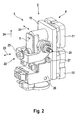
- Fig. 2 shows the structure of the shuttle 3 of the pendulum laser device 2 of the invention Fig. 1 in a three-dimensional view.
- the blasting device 4 is connected via the pendulum device 3, which is referred to as a two-axis universal joint with a first axle unit 20, which is aligned along a transverse direction (arrow 21 ) and is referred to as a transverse axis unit, and with a second axle 22, which is different from the first axle 20
- a longitudinal direction (arrow 23 ) is aligned and is referred to as L Lucassachshim, self-leveling stored in the gravitational field of the earth, ie the pendulum body 15 is aligned via the first and second axes 20, 22 on the perpendicular parallel to a vertical direction 24 .
- the first and second axes 20, 22 are arranged offset in the vertical direction, so that they do not form an intersection.
- the arrangement of the first and second axes 20, 22 without intersection offers the advantage that the two axes 20, 22 of the universal joint are each adjustable from one side.
- a biaxial universal joint with intersecting axes consists of four axle sections, which must be adjusted individually.
- the retaining profile 25 is provided at first and second ends of the U-shape with holes which are in engagement with the transverse axis unit 20.
- the holding profile 25 has a further bore, which is in engagement with the Lticiansachsappel 22.
- the pendulum device 3 in addition to the Querachsaku 20, the Lekssachsiser 22 and the holding profile 25, a weight member 26 which is connected to the pendulum body 17 and in the transverse direction 21 via an adjusting device 27 in the form of a screw slidably formed. By shifting the weight element 26, the center of gravity of the pendulum laser device 2 in the transverse direction 20 is adjustable.
- Fig. 3 shows a section Fig. 1 with the Lticiansachsech 22 in an enlarged view.
- the longitudinal axis unit 22 consists of an axis 30, which is referred to below as a longitudinal axis, a bearing unit 31 and a sleeve 32.
- the sleeve 32 is slidably mounted in the pendulum body 15.
- the pendulum body 15 and the sleeve 32 are connected via a positive connection 33 in the form of a thread in engagement.
- the sleeve 32 has on its outer side via an external thread which engages in a correspondingly formed internal thread in the bore of the pendulum body 15.
- the longitudinal axis 31 is arranged in the interior of the sleeve 32 and coupled via the bearing unit 31 with the sleeve 32. At one end, the longitudinal axis 30 is coupled by means of a locking unit 34 in the form of a nut with the retaining profile 25 against rotation. The longitudinal axis 31 can not be displaced or rotated relative to the retaining profile 25.
- the sleeve 32 has on the locking unit 34 remote from the end of the L Lucassachsech 22 a fine thread 35 , via which the sleeve 32 is adjustable by rotation in the longitudinal direction 23.
- a fine thread 35 via which the sleeve 32 is adjustable by rotation in the longitudinal direction 23.
Landscapes
- Physics & Mathematics (AREA)
- Engineering & Computer Science (AREA)
- General Physics & Mathematics (AREA)
- Radar, Positioning & Navigation (AREA)
- Remote Sensing (AREA)
- Lasers (AREA)
- Conveying And Assembling Of Building Elements In Situ (AREA)
Abstract
Description
- Die vorliegende Erfindung betrifft ein Lasergerät mit einer Pendellaservorrichtung bestehend aus einer Pendeleinrichtung, wobei die Pendeleinrichtung ais Kardangelenk mit einer ersten und zweiten Achse ausgebildet ist, und einer an der Pendeleinrichtung angeordneten Strahleinrichtung, wobei die Strahleinrichtung mittels der Pendeleinrichtung unabhängig von einer Ausrichtung des Lasergerätes an einer vertikalen Richtung selbstnivellierend ausgebildet ist.
- Um Nivellier- oder Markierungsarbeiten im Innen- und Außenbau durchzuführen, sind Lasergeräte bekannt, die punkt- und/oder linienförmige Laserstrahlen erzeugen. Diese Laserstrahlen dienen dazu, Referenzpunkte und/oder Referenzlinien auf Wände, Decken oder Böden zu übertragen. Bei diesen Lasergeräten wird zwischen Rotationslasern sowie Punkt- und/oder Linienlasern unterschieden. Rotationslaser erzeugen einen linienförmigen Laserstrahl durch Rotation einer Laserstrahlquelle oder einer strahlumlenkenden Optik um eine Rotationsachse. Punkt- und/oder Linienlaser erzeugen Laserstrahlen durch strahlformende Optiken, wie Zylinderlinsen oder Prismen. Punkt- und/oder Linienlaser sind häufig in einem begrenzten Winkelbereich, dem Selbstnivellierbereich, selbstnivellierend ausgebildet. Dazu ist eine Strahleinrichtung an einer Pendeleinrichtung aufgehängt. Die Strahleinrichtung richtet sich innerhalb des Selbstnivellierbereiches im Gravitationsfeld der Erde unabhängig von einer Ausrichtung des Lasergerätes an einer vertikalen Richtung selbst aus, so dass die Laserstrahlen exakt in horizontaler oder vertikaler Richtung ausgerichtet sind. Die beschriebene Pendeleinrichtung bildet die Grundfunktion der eingangs genannten selbstnivellierenden Lasergeräte.
- Aufgrund von Fertigungstoleranzen bei der Herstellung und beim Zusammenbau der Pendel- und Strahleinrichtungen kann der Schwerpunkt der Pendellaservorrichtung in der horizontalen Ebene verschoben sein. Um die Funktionalität des Lasergerätes im Selbstnivellierbereich gewährleisten zu können, muss der Schwerpunkt der Pendellaservorrichtung möglichst genau ausgerichtet sein. Dies kann einerseits durch geringe Toleranzen bei der Fertigung und Montage erreicht werden, was allerdings zu hohe Kosten verursacht. Andererseits kann der Schwerpunkt der Pendellaservorrichtung nach dem Zusammenbau verschoben werden. Bekannt ist, den Schwerpunkt von Pendellaservorrichtungen mit Hilfe von Gewichtselementen anzupassen. Dieses Vorgehen führt dazu, dass bei der Justage des Lasergerätes eine Vielzahl an Gewichtselementen vorgehalten werden muss, um das passende Gewichtselement in das Lasergerät einbauen zu können.
- Die Aufgabe der vorliegenden Erfindung besteht demgegenüber darin, das bekannte Lasergerät dahingehend weiterzuentwickeln, dass die Einstellung des Schwerpunktes der Pendellaservorrichtung vereinfacht wird.
- Diese Aufgabe wird bei dem eingangs genannten Lasergerät erfindungsgemäß dadurch gelöst, dass die erste und zweite Achse der Pendeleinrichtung in vertikaler Richtung versetzt zueinander angeordnet und mittels eines Kopplungselementes gekoppelt sind. Dadurch, dass die erste und zweite Achse in vertikalen Richtung versetzt angeordnet sind, bilden die beiden Achsen keinen Schnittpunkt. Die Anordnung der ersten und zweiten Achse ohne Schnittpunkt bietet den Vorteil, dass beide Achsen des Kardangelenkes jeweils von einer Seite justierbar sind. Ein zweiachsiges Kardangelenk mit sich schneidenden Achsen besteht aus vier Achsabschnitten, die jeweils einzeln justiert werden müssen.
- In einer bevorzugten Ausführungsform weist die Strahleinrichtung einen Pendelkörper auf, der auf zumindest einer der beiden Achsen der Pendeleinrichtung verschiebbar gelagert ist. Besonders bevorzugt weist die verschiebbar ausgebildete Achse eine Längsachse und eine Hülse auf, die mittels einer Lagereinheit gekoppelt sind. Die Hülse steht besonders bevorzugt mittels einer formschlüssigen Verbindung mit dem Pendelkörper der Strahleinrichtung in Eingriff.
- In einer bevorzugten Ausführungsform ist die Längsachse mittels einer Feststelleinheit verdrehsicher mit dem Kopplungselement der Pendeleinrichtung gekoppelt. Besonders bevorzugt weist die Hülse an dem der Feststelleinheit abgewandten Ende der verschiebbar ausgebildeten Achse ein Feingewinde auf, wobei das Feingewinde besonders bevorzugt auf der der Strahleinrichtung zugewandten Seite der Pendellaservorrichtung angeordnet ist.
- Besonders bevorzugt ist das Kopplungselement zwischen der ersten und zweiten Achse der Pendeleinrichtung als U-förmiges Halteprofil ausgebildet.
- Weitere Vorteile und vorteilhafte Ausgestaltungen des Gegenstands der Erfindung sind der Beschreibung, der Zeichnung und den Ansprüchen entnehmbar. Ebenso können die vorstehend genannten und die noch weiter aufgeführten Merkmale erfindungsgemäß jeweils einzeln für sich oder zu mehreren in beliebigen Kombinationen Verwendung finden. Die gezeigten und beschriebenen Ausführungsformen sind nicht als abschließende Aufzählung zu verstehen, sondern haben vielmehr beispielhaften Charakter für die Schilderung der Erfindung.
- Es zeigen:
- Fig. 1
- ein erfindungsgemäßes Lasergerät bestehend aus einer Pendellaservorrich- tung mit einer Strahleinrichtung, die an einer Pendeleinrichtung gelagert ist, in einem Längsschnitt;
- Fig. 2
- den Aufbau der Pendeleinrichtung der in
Fig. 1 dargestellten Pendellaservor- richtung mit einer Querachseinheit, einer Längsachseinheit und einem Halte- profil in einer dreidimensionalen Darstellung; und - Fig. 3
- den Aufbau der Längsachseinheit in einer vergrößerten Darstellung in einem Längsschnitt.
- Das in
Fig. 1 in einem Längsschnitt schematisch dargestellte Lasergerät 1 umfasst ein Gehäuse (nicht gezeigt), eine in dem Gehäuse angeordnete Pendellaservorrichtung 2 bestehend aus einer Pendeleinrichtung 3 und einer an der Pendeleinrichtung 3 angeordneten Strahleinrichtung 4 sowie eine Elektronik-Platine 5 zur Steuerung der Strahleinrichtung 3. - Die Strahleinrichtung 4 umfasst eine erste und zweite Strahlquelle 6, 7, die bspw. als Laserdioden mit einer Wellenlänge von 635 nm ausgebildet sind. In Laserdioden erzeugte Laserstrahlung ist stark divergierend und wird daher mit Hilfe von Kollimationsoptiken parallelisiert. Ein aus der ersten Strahlquelle 6 austretender erster Laserstrahl trifft auf eine erste Kollimationsoptik 8 und ein aus der zweiten Strahlquelle 7 austretender zweiter Laserstrahl trifft auf eine zweite Kollimationsoptik 9. Der kollimierte, erste Laserstrahl trifft auf eine erste Strahlformungsoptik 10, die in einer ersten Optikhalterung 11 befestigt ist. Der kollimierte, zweite Laserstrahl trifft auf eine zweite Strahlformungsoptik 12, die in einer zweiten Optikhalterung 13 befestigt ist.
- Die erste Strahlquelle 6 und die erste Kollimationsoptik 8 sind in einer ersten Bohrung 14 eines Pendelkörpers 15 angeordnet. Die zweite Strahlquelle 7 und die zweite Kollimationsoptik 9 sind in einer zweiten Bohrung 16 des Pendelkörpers 15 angeordnet. Die erste und zweite Bohrung 14, 16 durchdringen den Pendelkörper 15 vollständig. Der Pendelkörper 15 besteht bspw. aus Aluminium und die Bohrungen 14, 16 können durch Fräsen in eine Aluminiumplatte oder einen Aluminiumblock eingebracht werden. Die erste und zweite Strahlquelle 6, 7 sind an einem Ende in die Bohrungen 14, 16 des Pendelkörper 15 eingepresst. An einem gegenüber liegenden Ende der Bohrungen 14, 16 sind die Kollimationsoptiken 8, 9 angebracht. Der Pendelkörper 15 ist über jeweils drei Passstifte 17, die in entsprechende Bohrungen der Optikhalterungen 11, 13 eingreifen, mit der ersten und zweiten Optikhalterung 11, 13 reibkraftschlüssig verbunden.
-
Fig. 2 zeigt den Aufbau der Pendeleinrichtung 3 der erfindungsgemäßen Pendellaservorrichtung 2 derFig. 1 in einer dreidimensionalen Ansicht. - Die Strahleinrichtung 4 ist über die Pendeleinrichtung 3, die als zweiachsiges Kardangelenk mit einer ersten Achseinheit 20, die entlang einer Querrichtung (Pfeil 21) ausgerichtet ist und als Querachseinheit bezeichnet wird, und mit einer von der ersten Achse 20 verschiedenen zweiten Achse 22, die entlang einer Längsrichtung (Pfeil 23) ausgerichtet ist und als Längsachseinheit bezeichnet wird, im Schwerefeld der Erde selbstnivellierend gelagert, d.h. der Pendelkörper 15 wird über die erste und zweite Achse 20, 22 am Lot parallel zu einer vertikalen Richtung 24 ausgerichtet. Die erste und zweite Achse 20, 22 sind in vertikaler Richtung versetzt angeordnet, so dass sie keinen Schnittpunkt bilden. Die Anordnung der ersten und zweiten Achse 20, 22 ohne Schnittpunkt bietet den Vorteil, dass die beiden Achsen 20, 22 des Kardangelenkes jeweils von einer Seite justierbar sind. Ein zweiachsiges Kardangelenk mit sich schneidenden Achsen besteht aus vier Achsabschnitten, die einzeln justiert werden müssen.
- Die Kopplung der Querachseinheit 20 und der Längsachseinheit 22 erfolgt über ein Kopplungselement 25 in Form eines U-förmigen Halteprofils. Das Halteprofil 25 ist an einem ersten und zweiten Ende der U-Form mit Bohrungen versehen, die mit der Querachseinheit 20 in Eingriff stehen. In der Mitte der U-Form weist das Halteprofil 25 eine weitere Bohrung auf, die mit der Längsachseinheit 22 in Eingriff steht.
- Die Pendeleinrichtung 3 weist neben der Querachseinheit 20, der Längsachseinheit 22 und dem Halteprofil 25 ein Gewichtselement 26 auf, das mit dem Pendelkörper 17 verbunden und in Querrichtung 21 über eine Verstelleinrichtung 27 in Form einer Schraube verschiebbar ausgebildet ist. Durch eine Verschiebung des Gewichtselementes 26 ist der Schwerpunkt der Pendellaservorrichtung 2 in der Querrichtung 20 einstellbar.
- Die Einstellung und Verschiebung des Schwerpunktes der Pendellaservorrichtung 2 in Längsrichtung 21 erfolgt ohne ein zusätzliches Gewichtselement, wie anhand von
Fig. 3 erläutert wird.Fig. 3 zeigt einen Ausschnitt ausFig. 1 mit der Längsachseinheit 22 in einer vergrößerten Darstellung. - Die Längsachseinheit 22 besteht aus einer Achse 30, die im Folgenden als Längsachse bezeichnet wird, einer Lagereinheit 31 und einer Hülse 32. Der Pendelkörper 15, der sich über die Längsachseinheit 22 in Längsrichtung 23 ausrichtet, verfügt über eine Bohrung, die den Pendelkörper 15 vollständig durchdringt und die Längsachseinheit 22 aufnimmt.
- Die Hülse 32 ist in dem Pendelkörper 15 verschiebbar gelagert. Der Pendelkörper 15 und die Hülse 32 stehen über eine formschlüssige Verbindung 33 in Form eines Gewindes in Eingriff. Die Hülse 32 verfügt an ihrer Außenseite über ein Außengewinde, das in ein entsprechend ausgebildetes Innengewinde in der Bohrung des Pendelkörpers 15 eingreift.
- Die Längsachse 31 ist im Inneren der Hülse 32 angeordnet und über die Lagereinheit 31 mit der Hülse 32 gekoppelt. An einem Ende ist die Längsachse 30 mittels einer Feststelleinheit 34 in Form einer Mutter mit dem Halteprofil 25 verdrehsicher gekoppelt. Die Längsachse 31 kann relativ zum Halteprofil 25 nicht verschoben oder verdreht werden.
- Die Hülse 32 weist an dem der Feststelleinheit 34 abgewandten Ende der Längsachseinheit 22 ein Feingewinde 35 auf, über das die Hülse 32 durch Drehung in Längsrichtung 23 verstellbar ist. Durch die Drehbewegung der Hülse 32 um die Längsrichtung 23 wird der Pendelkörper 15 mit der Strahleinrichtung 4 in Längsrichtung 21 verstellt. Da die Längsachseinheit 22 über das Halteprofil 25 mit der Querachseinheit 20 gekoppelt ist, führt eine Verschiebung des Pendelkörpers 15 in Längsrichtung 23 zu einer Drehung des Pendelkörpers 15 um die Längsrichtung 23.
Claims (8)
- Lasergerät (1) mit einer Pendellaservorrichtung (2) bestehend aus einer Pendeleinrichtung (3), wobei die Pendeleinrichtung (3) als Kardangelenk mit einer ersten und zweiten Achse (20, 22) ausgebildet ist, und einer an der Pendeleinrichtung (3) angeordneten Strahleinrichtung (4), wobei die Strahleinrichtung (4) mittels der Pendeleinrichtung (3) unabhängig von einer Ausrichtung des Lasergerätes (1) an einer vertikalen Richtung (24) selbstnivellierend ausgebildet ist,
dadurch gekennzeichnet, dass
die erste und zweite Achse (20, 22) der Pendeleinrichtung (3) in vertikaler Richtung (24) versetzt zueinander angeordnet und mittels eines Kopplungselementes (25) gekoppelt sind. - Lasergerät nach Anspruch 1, dadurch gekennzeichnet, dass die Strahleinrichtung (4) einen Pendelkörper (15) aufweist, der auf zumindest einer der Achsen (22) der Pendeleinrichtung (3) verschiebbar gelagert ist.
- Lasergerät nach Anspruch 2, dadurch gekennzeichnet, dass die verschiebbar ausgebildete Achse (22) eine Längsachse (30) und eine Hülse (32) aufweist, die mittels einer Lagereinheit (31) gekoppelt sind.
- Lasergerät nach Anspruch 3, dadurch gekennzeichnet, dass die Hülse (32) mittels einer formschlüssigen Verbindung (33) mit dem Pendelkörper (15) der Strahleinrichtung (4) in Eingriff steht.
- Lasergerät nach einem der Ansprüche 3 bis 4, dadurch gekennzeichnet, dass die Längsachse (30) mittels einer Feststelleinheit (34) verdrehsicher mit dem Kopplungselement (25) der Pendeleinrichtung (3) gekoppelt ist.
- Lasergerät nach einem der Ansprüche 3 bis 5, dadurch gekennzeichnet, dass die Hülse (32) an dem der Feststelleinheit (34) abgewandten Ende der verschiebbar ausgebildeten Achse (22) ein Feingewinde (35) aufweist.
- Lasergerät nach Anspruch 5, dadurch gekennzeichnet, dass das Feingewinde (35) auf der der Strahleinrichtung (4) zugewandten Seite der Pendellaservorrichtung (2) angeordnet ist.
- Lasergerät nach einem der vorhergehenden Ansprüche, dadurch gekennzeichnet, dass das Kopplungselement als U-förmiges Halteprofil (25) ausgebildet ist.
Applications Claiming Priority (1)
| Application Number | Priority Date | Filing Date | Title |
|---|---|---|---|
| DE200910002771 DE102009002771A1 (de) | 2009-04-30 | 2009-04-30 | Lasergerät mit einer justierbaren Pendeleinrichtung |
Publications (3)
| Publication Number | Publication Date |
|---|---|
| EP2246661A2 true EP2246661A2 (de) | 2010-11-03 |
| EP2246661A3 EP2246661A3 (de) | 2012-08-01 |
| EP2246661B1 EP2246661B1 (de) | 2015-02-25 |
Family
ID=42272292
Family Applications (1)
| Application Number | Title | Priority Date | Filing Date |
|---|---|---|---|
| EP20100158909 Active EP2246661B1 (de) | 2009-04-30 | 2010-04-01 | Lasergerät mit einer justierbaren Pendeleinrichtung |
Country Status (2)
| Country | Link |
|---|---|
| EP (1) | EP2246661B1 (de) |
| DE (1) | DE102009002771A1 (de) |
Cited By (2)
| Publication number | Priority date | Publication date | Assignee | Title |
|---|---|---|---|---|
| CN106716060A (zh) * | 2014-09-11 | 2017-05-24 | 罗伯特·博世有限公司 | 用于安装摇摆式激光器装置的方法 |
| WO2022193201A1 (zh) * | 2021-03-16 | 2022-09-22 | 深圳市杜比激光有限公司 | 一种快速配重的激光投线仪 |
Family Cites Families (5)
| Publication number | Priority date | Publication date | Assignee | Title |
|---|---|---|---|---|
| JP3532167B2 (ja) * | 2001-06-01 | 2004-05-31 | 株式会社オーディオテクニカ | レーザー墨出し器におけるレーザーライン光照射方法および装置 |
| US7134211B2 (en) * | 2004-03-18 | 2006-11-14 | Black & Decker Inc. | Laser level |
| JP4993554B2 (ja) * | 2005-11-22 | 2012-08-08 | 株式会社オーディオテクニカ | 墨出し器 |
| CN101078623B (zh) * | 2006-05-26 | 2010-05-12 | 南京德朔实业有限公司 | 自水平激光标线装置及其控制方法 |
| JP2009085909A (ja) * | 2007-10-03 | 2009-04-23 | Audio Technica Corp | レーザー墨出し器 |
-
2009
- 2009-04-30 DE DE200910002771 patent/DE102009002771A1/de not_active Ceased
-
2010
- 2010-04-01 EP EP20100158909 patent/EP2246661B1/de active Active
Non-Patent Citations (1)
| Title |
|---|
| None |
Cited By (3)
| Publication number | Priority date | Publication date | Assignee | Title |
|---|---|---|---|---|
| CN106716060A (zh) * | 2014-09-11 | 2017-05-24 | 罗伯特·博世有限公司 | 用于安装摇摆式激光器装置的方法 |
| CN106716060B (zh) * | 2014-09-11 | 2020-10-27 | 罗伯特·博世有限公司 | 用于安装摇摆式激光器装置的方法 |
| WO2022193201A1 (zh) * | 2021-03-16 | 2022-09-22 | 深圳市杜比激光有限公司 | 一种快速配重的激光投线仪 |
Also Published As
| Publication number | Publication date |
|---|---|
| DE102009002771A1 (de) | 2010-11-11 |
| EP2246661A3 (de) | 2012-08-01 |
| EP2246661B1 (de) | 2015-02-25 |
Similar Documents
| Publication | Publication Date | Title |
|---|---|---|
| EP3217939B1 (de) | Abstützgelenk für einen tragarm einer medizintechnischen stativvorrichtung | |
| DE202007001576U1 (de) | Zielfernrohr | |
| DE102013221044B4 (de) | Optikhalterung zur Justage eines optischen Elements | |
| DE102011101082B4 (de) | Sonnenkollektormodul | |
| EP2246661B1 (de) | Lasergerät mit einer justierbaren Pendeleinrichtung | |
| DE102011014835B4 (de) | Vorrichtung zum Verstellen einer Steuerfläche eines Fluggerätemodells, Steuerflächeneinheit, Fluggerätemodell und Verwendung eines Fluggerätemodells | |
| EP0508157B1 (de) | Strahlerleuchte | |
| DE2229310C3 (de) | Schwenkvorrichtung für einen Präparathalter in einem Elektronenmikroskop | |
| DE102018122676A1 (de) | Scheinwerfer für Kraftfahrzeuge | |
| DE102008041782A1 (de) | Markier- und/oder Nivelliervorrichtung | |
| DE102018131889B4 (de) | Laserstrahljustiervorrichtung | |
| DE1797270C3 (de) | Einspannvorrichtung zur Halterung und Ausrichtung eines rotationssymmetrischen Bauteils | |
| DE1447344B2 (de) | Mechanismus zur Verstellung eines Ob jekttragers um geringe Strecken in einer vorgegebenen Verstellrichtung | |
| EP2535684A2 (de) | Lasersystem zum Erzeugen einer Lasermarkierung auf einem Untergrund | |
| DE102010045620B4 (de) | Vorrichtung zur Erzeugung einer linienförmigen Intensitätsverteilung in einer Arbeitsebene | |
| DE102010006526A1 (de) | Gitterwechselvorrichtung | |
| EP3436778B1 (de) | Nivelliervorrichtung mit einer pendelnden lichterzeugungseinheit | |
| DE102020134653B3 (de) | Justierbarer Optikhalter für ein optisches Element | |
| DE2259913A1 (de) | Zielfernrohr | |
| DE102013202487A1 (de) | Vorrichtung zur räumlichen Ausrichtung einer Röntgenoptik und Apparatur mit einer solchen | |
| WO2023186951A1 (de) | Auslenkvorrichtung für einen laserbearbeitungskopf und laserbearbeitungskopf mit derselben | |
| DE102013114822B3 (de) | Zweiachsige Kippvorrichtung | |
| DE10320991B4 (de) | Optische Positionsmesseinrichtung | |
| EP4056787A1 (de) | Vorrichtung zum anspreizen einer fensterbank | |
| EP0459111B1 (de) | Justierbare Aufhängung |
Legal Events
| Date | Code | Title | Description |
|---|---|---|---|
| PUAI | Public reference made under article 153(3) epc to a published international application that has entered the european phase |
Free format text: ORIGINAL CODE: 0009012 |
|
| AK | Designated contracting states |
Kind code of ref document: A2 Designated state(s): AT BE BG CH CY CZ DE DK EE ES FI FR GB GR HR HU IE IS IT LI LT LU LV MC MK MT NL NO PL PT RO SE SI SK SM TR |
|
| AX | Request for extension of the european patent |
Extension state: AL BA ME RS |
|
| PUAL | Search report despatched |
Free format text: ORIGINAL CODE: 0009013 |
|
| AK | Designated contracting states |
Kind code of ref document: A3 Designated state(s): AT BE BG CH CY CZ DE DK EE ES FI FR GB GR HR HU IE IS IT LI LT LU LV MC MK MT NL NO PL PT RO SE SI SK SM TR |
|
| AX | Request for extension of the european patent |
Extension state: AL BA ME RS |
|
| RIC1 | Information provided on ipc code assigned before grant |
Ipc: G01C 15/00 20060101AFI20120622BHEP |
|
| 17P | Request for examination filed |
Effective date: 20130201 |
|
| 17Q | First examination report despatched |
Effective date: 20130411 |
|
| GRAP | Despatch of communication of intention to grant a patent |
Free format text: ORIGINAL CODE: EPIDOSNIGR1 |
|
| INTG | Intention to grant announced |
Effective date: 20141029 |
|
| GRAS | Grant fee paid |
Free format text: ORIGINAL CODE: EPIDOSNIGR3 |
|
| GRAA | (expected) grant |
Free format text: ORIGINAL CODE: 0009210 |
|
| AK | Designated contracting states |
Kind code of ref document: B1 Designated state(s): AT BE BG CH CY CZ DE DK EE ES FI FR GB GR HR HU IE IS IT LI LT LU LV MC MK MT NL NO PL PT RO SE SI SK SM TR |
|
| REG | Reference to a national code |
Ref country code: GB Ref legal event code: FG4D Free format text: NOT ENGLISH |
|
| REG | Reference to a national code |
Ref country code: CH Ref legal event code: EP |
|
| REG | Reference to a national code |
Ref country code: IE Ref legal event code: FG4D Free format text: LANGUAGE OF EP DOCUMENT: GERMAN |
|
| REG | Reference to a national code |
Ref country code: SE Ref legal event code: TRGR |
|
| REG | Reference to a national code |
Ref country code: DE Ref legal event code: R096 Ref document number: 502010008937 Country of ref document: DE Effective date: 20150409 |
|
| REG | Reference to a national code |
Ref country code: AT Ref legal event code: REF Ref document number: 712353 Country of ref document: AT Kind code of ref document: T Effective date: 20150415 |
|
| REG | Reference to a national code |
Ref country code: NL Ref legal event code: VDEP Effective date: 20150225 |
|
| REG | Reference to a national code |
Ref country code: LT Ref legal event code: MG4D |
|
| PG25 | Lapsed in a contracting state [announced via postgrant information from national office to epo] |
Ref country code: LT Free format text: LAPSE BECAUSE OF FAILURE TO SUBMIT A TRANSLATION OF THE DESCRIPTION OR TO PAY THE FEE WITHIN THE PRESCRIBED TIME-LIMIT Effective date: 20150225 Ref country code: ES Free format text: LAPSE BECAUSE OF FAILURE TO SUBMIT A TRANSLATION OF THE DESCRIPTION OR TO PAY THE FEE WITHIN THE PRESCRIBED TIME-LIMIT Effective date: 20150225 Ref country code: HR Free format text: LAPSE BECAUSE OF FAILURE TO SUBMIT A TRANSLATION OF THE DESCRIPTION OR TO PAY THE FEE WITHIN THE PRESCRIBED TIME-LIMIT Effective date: 20150225 Ref country code: FI Free format text: LAPSE BECAUSE OF FAILURE TO SUBMIT A TRANSLATION OF THE DESCRIPTION OR TO PAY THE FEE WITHIN THE PRESCRIBED TIME-LIMIT Effective date: 20150225 Ref country code: NO Free format text: LAPSE BECAUSE OF FAILURE TO SUBMIT A TRANSLATION OF THE DESCRIPTION OR TO PAY THE FEE WITHIN THE PRESCRIBED TIME-LIMIT Effective date: 20150525 |
|
| PG25 | Lapsed in a contracting state [announced via postgrant information from national office to epo] |
Ref country code: LV Free format text: LAPSE BECAUSE OF FAILURE TO SUBMIT A TRANSLATION OF THE DESCRIPTION OR TO PAY THE FEE WITHIN THE PRESCRIBED TIME-LIMIT Effective date: 20150225 Ref country code: IS Free format text: LAPSE BECAUSE OF FAILURE TO SUBMIT A TRANSLATION OF THE DESCRIPTION OR TO PAY THE FEE WITHIN THE PRESCRIBED TIME-LIMIT Effective date: 20150625 Ref country code: GR Free format text: LAPSE BECAUSE OF FAILURE TO SUBMIT A TRANSLATION OF THE DESCRIPTION OR TO PAY THE FEE WITHIN THE PRESCRIBED TIME-LIMIT Effective date: 20150526 |
|
| PG25 | Lapsed in a contracting state [announced via postgrant information from national office to epo] |
Ref country code: NL Free format text: LAPSE BECAUSE OF FAILURE TO SUBMIT A TRANSLATION OF THE DESCRIPTION OR TO PAY THE FEE WITHIN THE PRESCRIBED TIME-LIMIT Effective date: 20150225 |
|
| PG25 | Lapsed in a contracting state [announced via postgrant information from national office to epo] |
Ref country code: EE Free format text: LAPSE BECAUSE OF FAILURE TO SUBMIT A TRANSLATION OF THE DESCRIPTION OR TO PAY THE FEE WITHIN THE PRESCRIBED TIME-LIMIT Effective date: 20150225 Ref country code: SK Free format text: LAPSE BECAUSE OF FAILURE TO SUBMIT A TRANSLATION OF THE DESCRIPTION OR TO PAY THE FEE WITHIN THE PRESCRIBED TIME-LIMIT Effective date: 20150225 Ref country code: CZ Free format text: LAPSE BECAUSE OF FAILURE TO SUBMIT A TRANSLATION OF THE DESCRIPTION OR TO PAY THE FEE WITHIN THE PRESCRIBED TIME-LIMIT Effective date: 20150225 Ref country code: RO Free format text: LAPSE BECAUSE OF FAILURE TO SUBMIT A TRANSLATION OF THE DESCRIPTION OR TO PAY THE FEE WITHIN THE PRESCRIBED TIME-LIMIT Effective date: 20150225 Ref country code: DK Free format text: LAPSE BECAUSE OF FAILURE TO SUBMIT A TRANSLATION OF THE DESCRIPTION OR TO PAY THE FEE WITHIN THE PRESCRIBED TIME-LIMIT Effective date: 20150225 |
|
| REG | Reference to a national code |
Ref country code: DE Ref legal event code: R097 Ref document number: 502010008937 Country of ref document: DE |
|
| PG25 | Lapsed in a contracting state [announced via postgrant information from national office to epo] |
Ref country code: LU Free format text: LAPSE BECAUSE OF FAILURE TO SUBMIT A TRANSLATION OF THE DESCRIPTION OR TO PAY THE FEE WITHIN THE PRESCRIBED TIME-LIMIT Effective date: 20150401 Ref country code: MC Free format text: LAPSE BECAUSE OF FAILURE TO SUBMIT A TRANSLATION OF THE DESCRIPTION OR TO PAY THE FEE WITHIN THE PRESCRIBED TIME-LIMIT Effective date: 20150225 Ref country code: PL Free format text: LAPSE BECAUSE OF FAILURE TO SUBMIT A TRANSLATION OF THE DESCRIPTION OR TO PAY THE FEE WITHIN THE PRESCRIBED TIME-LIMIT Effective date: 20150225 |
|
| PLBE | No opposition filed within time limit |
Free format text: ORIGINAL CODE: 0009261 |
|
| STAA | Information on the status of an ep patent application or granted ep patent |
Free format text: STATUS: NO OPPOSITION FILED WITHIN TIME LIMIT |
|
| GBPC | Gb: european patent ceased through non-payment of renewal fee |
Effective date: 20150525 |
|
| REG | Reference to a national code |
Ref country code: IE Ref legal event code: MM4A |
|
| 26N | No opposition filed |
Effective date: 20151126 |
|
| PG25 | Lapsed in a contracting state [announced via postgrant information from national office to epo] |
Ref country code: SI Free format text: LAPSE BECAUSE OF FAILURE TO SUBMIT A TRANSLATION OF THE DESCRIPTION OR TO PAY THE FEE WITHIN THE PRESCRIBED TIME-LIMIT Effective date: 20150225 |
|
| REG | Reference to a national code |
Ref country code: FR Ref legal event code: PLFP Year of fee payment: 7 |
|
| PG25 | Lapsed in a contracting state [announced via postgrant information from national office to epo] |
Ref country code: GB Free format text: LAPSE BECAUSE OF NON-PAYMENT OF DUE FEES Effective date: 20150525 Ref country code: IE Free format text: LAPSE BECAUSE OF NON-PAYMENT OF DUE FEES Effective date: 20150401 |
|
| REG | Reference to a national code |
Ref country code: AT Ref legal event code: MM01 Ref document number: 712353 Country of ref document: AT Kind code of ref document: T Effective date: 20150401 |
|
| PG25 | Lapsed in a contracting state [announced via postgrant information from national office to epo] |
Ref country code: AT Free format text: LAPSE BECAUSE OF NON-PAYMENT OF DUE FEES Effective date: 20150401 |
|
| PG25 | Lapsed in a contracting state [announced via postgrant information from national office to epo] |
Ref country code: MT Free format text: LAPSE BECAUSE OF FAILURE TO SUBMIT A TRANSLATION OF THE DESCRIPTION OR TO PAY THE FEE WITHIN THE PRESCRIBED TIME-LIMIT Effective date: 20150225 |
|
| REG | Reference to a national code |
Ref country code: FR Ref legal event code: PLFP Year of fee payment: 8 |
|
| PG25 | Lapsed in a contracting state [announced via postgrant information from national office to epo] |
Ref country code: HU Free format text: LAPSE BECAUSE OF FAILURE TO SUBMIT A TRANSLATION OF THE DESCRIPTION OR TO PAY THE FEE WITHIN THE PRESCRIBED TIME-LIMIT; INVALID AB INITIO Effective date: 20100401 Ref country code: SM Free format text: LAPSE BECAUSE OF FAILURE TO SUBMIT A TRANSLATION OF THE DESCRIPTION OR TO PAY THE FEE WITHIN THE PRESCRIBED TIME-LIMIT Effective date: 20150225 Ref country code: BG Free format text: LAPSE BECAUSE OF FAILURE TO SUBMIT A TRANSLATION OF THE DESCRIPTION OR TO PAY THE FEE WITHIN THE PRESCRIBED TIME-LIMIT Effective date: 20150225 |
|
| PG25 | Lapsed in a contracting state [announced via postgrant information from national office to epo] |
Ref country code: CY Free format text: LAPSE BECAUSE OF FAILURE TO SUBMIT A TRANSLATION OF THE DESCRIPTION OR TO PAY THE FEE WITHIN THE PRESCRIBED TIME-LIMIT Effective date: 20150225 |
|
| PG25 | Lapsed in a contracting state [announced via postgrant information from national office to epo] |
Ref country code: PT Free format text: LAPSE BECAUSE OF FAILURE TO SUBMIT A TRANSLATION OF THE DESCRIPTION OR TO PAY THE FEE WITHIN THE PRESCRIBED TIME-LIMIT Effective date: 20150625 Ref country code: BE Free format text: LAPSE BECAUSE OF NON-PAYMENT OF DUE FEES Effective date: 20150430 |
|
| PG25 | Lapsed in a contracting state [announced via postgrant information from national office to epo] |
Ref country code: TR Free format text: LAPSE BECAUSE OF FAILURE TO SUBMIT A TRANSLATION OF THE DESCRIPTION OR TO PAY THE FEE WITHIN THE PRESCRIBED TIME-LIMIT Effective date: 20150225 |
|
| REG | Reference to a national code |
Ref country code: FR Ref legal event code: PLFP Year of fee payment: 9 |
|
| PG25 | Lapsed in a contracting state [announced via postgrant information from national office to epo] |
Ref country code: MK Free format text: LAPSE BECAUSE OF FAILURE TO SUBMIT A TRANSLATION OF THE DESCRIPTION OR TO PAY THE FEE WITHIN THE PRESCRIBED TIME-LIMIT Effective date: 20150225 |
|
| PGFP | Annual fee paid to national office [announced via postgrant information from national office to epo] |
Ref country code: SE Payment date: 20250321 Year of fee payment: 16 |
|
| PGFP | Annual fee paid to national office [announced via postgrant information from national office to epo] |
Ref country code: DE Payment date: 20250422 Year of fee payment: 16 |
|
| PGFP | Annual fee paid to national office [announced via postgrant information from national office to epo] |
Ref country code: IT Payment date: 20250424 Year of fee payment: 16 |
|
| PGFP | Annual fee paid to national office [announced via postgrant information from national office to epo] |
Ref country code: FR Payment date: 20250424 Year of fee payment: 16 |
|
| PGFP | Annual fee paid to national office [announced via postgrant information from national office to epo] |
Ref country code: CH Payment date: 20250501 Year of fee payment: 16 |