EP2246471A2 - Verfahren zur Steuerung der Lauffähigkeit einer Maschine zur Herstellung or Behandlung einer Faserstoffbahn - Google Patents
Verfahren zur Steuerung der Lauffähigkeit einer Maschine zur Herstellung or Behandlung einer Faserstoffbahn Download PDFInfo
- Publication number
- EP2246471A2 EP2246471A2 EP10161100A EP10161100A EP2246471A2 EP 2246471 A2 EP2246471 A2 EP 2246471A2 EP 10161100 A EP10161100 A EP 10161100A EP 10161100 A EP10161100 A EP 10161100A EP 2246471 A2 EP2246471 A2 EP 2246471A2
- Authority
- EP
- European Patent Office
- Prior art keywords
- roll
- layer
- layer thickness
- shell
- composite material
- Prior art date
- Legal status (The legal status is an assumption and is not a legal conclusion. Google has not performed a legal analysis and makes no representation as to the accuracy of the status listed.)
- Withdrawn
Links
- 239000000835 fiber Substances 0.000 title claims abstract description 31
- 238000000034 method Methods 0.000 title claims abstract description 17
- 239000002131 composite material Substances 0.000 claims abstract description 48
- 239000000463 material Substances 0.000 claims abstract description 19
- 229920000049 Carbon (fiber) Polymers 0.000 claims description 21
- 239000004917 carbon fiber Substances 0.000 claims description 21
- VNWKTOKETHGBQD-UHFFFAOYSA-N methane Chemical compound C VNWKTOKETHGBQD-UHFFFAOYSA-N 0.000 claims description 21
- 239000011152 fibreglass Substances 0.000 claims description 9
- 238000005260 corrosion Methods 0.000 claims description 3
- 230000007797 corrosion Effects 0.000 claims description 3
- 238000001035 drying Methods 0.000 abstract description 2
- 239000010410 layer Substances 0.000 description 68
- 229910000831 Steel Inorganic materials 0.000 description 34
- 239000010959 steel Substances 0.000 description 34
- 239000002344 surface layer Substances 0.000 description 10
- 239000011248 coating agent Substances 0.000 description 6
- 238000000576 coating method Methods 0.000 description 6
- 230000007423 decrease Effects 0.000 description 4
- 238000004519 manufacturing process Methods 0.000 description 3
- 239000004760 aramid Substances 0.000 description 2
- 229920006231 aramid fiber Polymers 0.000 description 2
- 238000005452 bending Methods 0.000 description 2
- 238000013016 damping Methods 0.000 description 2
- 238000007639 printing Methods 0.000 description 2
- XLYOFNOQVPJJNP-UHFFFAOYSA-N water Chemical compound O XLYOFNOQVPJJNP-UHFFFAOYSA-N 0.000 description 2
- 239000004593 Epoxy Substances 0.000 description 1
- 229920001971 elastomer Polymers 0.000 description 1
- 238000000227 grinding Methods 0.000 description 1
- JEGUKCSWCFPDGT-UHFFFAOYSA-N h2o hydrate Chemical compound O.O JEGUKCSWCFPDGT-UHFFFAOYSA-N 0.000 description 1
- 239000002184 metal Substances 0.000 description 1
- 239000007769 metal material Substances 0.000 description 1
- 229920002635 polyurethane Polymers 0.000 description 1
- 239000004814 polyurethane Substances 0.000 description 1
- 230000002787 reinforcement Effects 0.000 description 1
- 238000010106 rotational casting Methods 0.000 description 1
- 239000005060 rubber Substances 0.000 description 1
- 238000004513 sizing Methods 0.000 description 1
- 238000004804 winding Methods 0.000 description 1
Images
Classifications
-
- D—TEXTILES; PAPER
- D21—PAPER-MAKING; PRODUCTION OF CELLULOSE
- D21G—CALENDERS; ACCESSORIES FOR PAPER-MAKING MACHINES
- D21G1/00—Calenders; Smoothing apparatus
- D21G1/0073—Accessories for calenders
- D21G1/008—Vibration-preventing or -eliminating devices
-
- D—TEXTILES; PAPER
- D21—PAPER-MAKING; PRODUCTION OF CELLULOSE
- D21G—CALENDERS; ACCESSORIES FOR PAPER-MAKING MACHINES
- D21G1/00—Calenders; Smoothing apparatus
- D21G1/02—Rolls; Their bearings
-
- B—PERFORMING OPERATIONS; TRANSPORTING
- B65—CONVEYING; PACKING; STORING; HANDLING THIN OR FILAMENTARY MATERIAL
- B65H—HANDLING THIN OR FILAMENTARY MATERIAL, e.g. SHEETS, WEBS, CABLES
- B65H27/00—Special constructions, e.g. surface features, of feed or guide rollers for webs
-
- D—TEXTILES; PAPER
- D21—PAPER-MAKING; PRODUCTION OF CELLULOSE
- D21F—PAPER-MAKING MACHINES; METHODS OF PRODUCING PAPER THEREON
- D21F1/00—Wet end of machines for making continuous webs of paper
- D21F1/36—Guiding mechanisms
- D21F1/40—Rolls
-
- D—TEXTILES; PAPER
- D21—PAPER-MAKING; PRODUCTION OF CELLULOSE
- D21F—PAPER-MAKING MACHINES; METHODS OF PRODUCING PAPER THEREON
- D21F3/00—Press section of machines for making continuous webs of paper
- D21F3/02—Wet presses
- D21F3/06—Means for regulating the pressure
-
- D—TEXTILES; PAPER
- D21—PAPER-MAKING; PRODUCTION OF CELLULOSE
- D21G—CALENDERS; ACCESSORIES FOR PAPER-MAKING MACHINES
- D21G7/00—Damping devices
-
- F—MECHANICAL ENGINEERING; LIGHTING; HEATING; WEAPONS; BLASTING
- F16—ENGINEERING ELEMENTS AND UNITS; GENERAL MEASURES FOR PRODUCING AND MAINTAINING EFFECTIVE FUNCTIONING OF MACHINES OR INSTALLATIONS; THERMAL INSULATION IN GENERAL
- F16C—SHAFTS; FLEXIBLE SHAFTS; ELEMENTS OR CRANKSHAFT MECHANISMS; ROTARY BODIES OTHER THAN GEARING ELEMENTS; BEARINGS
- F16C13/00—Rolls, drums, discs, or the like; Bearings or mountings therefor
Definitions
- the invention is related to controlling the runnability of a fiber web machine.
- the invention is related to controlling roll vibration in a fiber web machine.
- Fiber web machines produce and process fiber webs, such as paper and board.
- the fiber web is supported, dried, turned and pressed by means of various rolls.
- the rolls typically have axle journals at the ends of the roll, with the rotating rolls supported by the axle journals to the frame of the fiber web machine, and the rolls also typically have a shell which touches the fiber web or wire.
- the roll of a paper machine can have a diameter of 1 m, and the shell of the roll can be for example 7 m long.
- the speed of rotation of the roll depends on the roll diameter and web speed. While the roll rotates, it vibrates because of reasons which are well known as such. These reasons include the speed of rotation, length, mass and rigidity of the roll.
- the irregularity of the web, the inhomogeneity of the roll surface and flaws in the geometry of the roll surface are one source of the vibration. These reasons can cause vibrations especially in press rolls and on the calender.
- Roll vibration has negative impacts.
- a roll vibrating in the press section or on the calender can cause unevenness in the grammage profile in the machine direction, and in conjunction with a size press, vibration can cause uneven sizing.
- roll vibration may cause, depending on the application, for example uneven print quality or susceptibility to web breaks. Vibration also stresses the supporting, drive unit and bearing unit of the roll, exposes the web to web breaks and may limit the maximum running speed of the fiber web machine. This is why the goal is to eliminate roll vibration or at least avoid it as much as possible.
- the objective is to maximize the capacity of fiber web machines in order to improve economic efficiency so that a maximum output can be achieved within acceptable quality and runnability in general.
- the running speed of a fiber web machine can be increased until sufficient quality is no longer achieved because of the increased speed or until the increased speed causes so much more wastage and/or downtime that it is not worth while increasing the speed.
- a fiber web machine often has individual bottlenecks such as a maximum speed determined by the natural vibration frequency of a roll (critical speed) or even half of the critical speed corresponding to the natural vibration frequency (semicritical speed), which may also cause problems. In this case, the rolls in question must be replaced with new rolls with a higher critical speed.
- composite rolls which have several different materials in layers in the shell of the roll.
- the body of the core of the shell is made of steel, on top of which there is an intermediate layer of for example fiberglass to dampen the vibration coming from the surface of the shell, and on top of the intermediate layer there is a wear surface of for example carbon fiber.
- Composite rolls can be manufactured to be essentially of lighter weight than a conventional roll made of steel, in which case their natural vibration frequency is greater than earlier, and problems (deflection bending, inertia of speed changes) caused by the mass of the roll itself can be avoided.
- Probably the biggest disadvantage of composite rolls is their price. Even though the composite structure would enable avoiding changes in the surrounding parts to fit the roll into place, the price of a new composite roll has sometimes restricted the opportunities to replace old steel rolls with composite rolls.
- EP1134441 (B1 ) provides an example of a bendable composite roll
- WO 2008/155442 describes a method for the manufacture of a composite roll.
- the object of the invention is to avoid or at least reduce problems caused by roll vibration in the runnability of a fiber web machine.
- the invention provides a method for controlling the runnability of a fiber web machine, with the method having the following characteristic features:
- the vibration properties of the roll can be changed so that the vibration of the roll can decrease significantly and/or the running speed of the roll can be raised to the desired running speed without compromising runnability too much.
- the running speed of the roll can even be raised without impairing runnability.
- the said composite material can comprise a carbon fiber layer.
- the said composite material can comprise a fiberglass layer.
- the fiberglass layer can be located between the outer surface of the steel shell and the carbon fiber layer.
- the said composite material can comprise aramid fibers.
- Aramid fibers can be used for controlling the vibration damping properties of the shell.
- the said vibration-influencing properties can comprise density, modulus of elasticity, vibration damping properties and/or a quantity describing the uniformity of the structure characteristic of the material.
- replacing a certain layer thickness with a composite material can comprise the replacement of the wear layer, which has worn from the roll earlier or which has been removed in order to recondition the roll, with a composite material in order to form a new wear layer.
- the new wear layer can extend essentially throughout the certain layer thickness.
- the new wear layer can be as thick as the removed wear layer or thicker than the removed wear layer.
- the new wear layer can be formed to be different from the layer located between the new wear layer and the steel shell remaining in the core of the roll so that a certain wear resistance and/or desired properties of the surface which touches the fiber web are given to the wear layer.
- the said properties of the surface which touches the fiber web can comprise one or more of the following properties: smoothness, thermal conductivity, heat resistance, how the web comes off the roll, receptivity of the material applied to the surface, corrosion resistance, electrical conductivity, antistaticity, elasticity, impact resistance, printability, and resistance to temperature variations.
- the said certain layer thickness can be removed by a turning machine.
- Making the shell of a roll thinner may weaken the structure of the roll so that if the removed layer thickness is not replaced with a composite material, the roll would not be sufficiently rigid to support is center section in a sufficiently rigid manner, but when the roll is formed to its original diameter by means of the composite material, the rigidity of the roll is sufficient.
- the inventor has realized that in the design of the shell of rolls with a steel shell, it is necessary to create sufficient rigidity for a roll which is considerably heavier than a roll with the composite structure. By replacing the certain layer thickness of steel on the outer surface of the shell of the roll with a lighter composite structure, the total mass of the roll can be reduced significantly.
- the fiber web machine can be for example a paper machine, board machine, pulp-drying machine, tissue machine, or finishing machine such as calender or coating machine, or web processing machine such as printing machine.
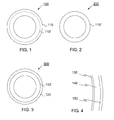
- Figure 1 is a cross section of the roll 100 of a fiber web machine, with a steel shell in the roll.
- the roll 100 comprises a metal shell 110, the outer diameter of which is 1000 mm and shell thickness 20 mm.
- a heat carrier medium such as water vapor, water or oil, can be introduced inside the shell from the end of the roll in order to heat and/or cool the roll.
- Figure 2 is a cross section of a lightened roll 200, which is formed from the roll in Figure 1 by removing a certain material thickness of steel from the outer surface of the shell 110 of the roll depicted in Figure 1 , for example 5 to 50%, preferably 10 to 40%, in this case 25% or 5 mm.
- the lightened steel shell is referred to by the reference number 110'.
- FIG 3 is a cross section of a composite roll 300, which is formed by installing a composite layer 120 on top of the lightened steel shell 110' of the roll 200 depicted in Figure 2 .
- the composite layer 120 comprises a fiberglass layer 130, carbon fiber layer 140 and a wear surface layer or coating 150.
- the wear surface layer 150 can be arranged on the surface of the roll 100 for example when the roll 100 is a soft calender roll, a guide roll or a size press roll.
- the fiberglass layer 130 can reduce the tension between the steel and carbon fiber layers resulting from the different coefficients of heat expansion of these two materials.
- the fiberglass layer, carbon fiber layer and/or wear surface layer can comprise several layers formed in the same stage or in different stages.
- fiber orientation can be used to influence the properties of the layer formed.
- the wear surface layer 150 can be manufactured in conjunction with the manufacture of the composite layer 120 or after the composite layer 120 has already been manufactured in a stage of its own.
- the wear surface layer can be manufactured using rotational casting or winding (for example when using a composite material).
- the wear surface layer 150 can be formed in conjunction with the forming of the composite layer for example so that the material of the composite layer changes gradually towards the outer surface.
- the wear surface layer can be a hot-sprayed layer.
- the thickness of the composite layer can be essentially similar to the thickness of the removed steel layer. It is to be understood that the roll 100 may already have been reconditioned by grinding or turning and that the diameter of the roll with the composite layer 120 may also be greater than the diameter of the roll 100 depicted in Figure 1 .
- the composite layer can be used for changing the vibration properties of the roll so that the vibration of the roll can decrease significantly and/or the running speed of the roll can be raised to the desired running speed without compromising runnability too much. By replacing a certain layer thickness, the running speed of the roll can even be raised without impairing runnability.
- the composite layer can be used for changing for example the density or modulus of elasticity of the shell of the roll or the uniformity of the structure of the material.
- Certain desired properties can be arranged on the surface, which touches the fiber web, of the composite roll 300 depicted in Figure 3 .
- Such properties include smoothness, thermal conductivity, heat resistance, how the web comes off the roll, receptivity of the material applied to the surface, corrosion resistance, electrical conductivity, antistaticity, elasticity, impact resistance, printability, and resistance to temperature variations.
- the surface which touches the fiber web can be composed of a carbon fiber layer 140 or of a wear surface layer 150.
- the invention can especially be applied in conjunction with a paper machine or board machine, for example in the guide rolls in the dryer section, but also in conjunction with finishing machines and other machines where a fiber web runs.
- a coated calender roll is converted for a higher running speed so that the coating on the roll and some of the outer surface of the steel shell of the roll are removed, and a composite layer and a new coating are installed to replace the removed steel layer and coating.
- Table I presents an example of changes in the properties of a roll shell, when the shell of a roll with steel shell is made lighter by replacing steel with carbon fiber which has a modulus of elasticity of 85 GPa or 130 GPa.
- the outer diameter of the shell of the roll in Table 1 is 1000 mm, inner diameter 950 mm, length of shell 9200 mm and length of nip 9000 mm.
- the modulus of elasticity of steel is 210 kN/mm 2 , or 210 GPa.
- the density of steel is 7.5 kg/dm 3 and the density of carbon fiber is 1.8 kg/dm 3 .
- Table I indicates that when steel is replaced with carbon fiber on the outer surface of the shell of a roll, the inertia of the roll decreases on a ratio to the amount of steel replaced with carbon fiber.
- the weight of the shell decreases more.
- the deflection in other words the bending caused by the mass of the roll itself, is therefore considerably smaller with all the values given in the table than the deflection of the original roll.
- the more the shell is made lighter by means of carbon fiber the greater the improvement in deflection. Making the shell lighter is also reflected clearly in an elevated natural frequency of the roll. As an example, the natural frequency grows by more than 14% when a steel layer of 100 mm in the shell is replaced with a carbon fiber layer with a corresponding thickness.
- the replacing carbon fiber layer may even be thicker than the removed steel layer.
- a carbon fiber layer of 15 mm can be installed in the place of a steel layer of 10 mm, in which case the natural frequency increases by almost 19%.
- the increase in diameter can be compensated for by making the wear surface layer, or coating 150, thinner.
Landscapes
- Engineering & Computer Science (AREA)
- General Engineering & Computer Science (AREA)
- Mechanical Engineering (AREA)
- Paper (AREA)
- Rolls And Other Rotary Bodies (AREA)
Applications Claiming Priority (1)
| Application Number | Priority Date | Filing Date | Title |
|---|---|---|---|
| FI20095475A FI122706B (fi) | 2009-04-29 | 2009-04-29 | Menetelmä kuiturainakoneen ajonopeuden nostamiseksi ja kuiturainakoneen tela |
Publications (2)
| Publication Number | Publication Date |
|---|---|
| EP2246471A2 true EP2246471A2 (de) | 2010-11-03 |
| EP2246471A3 EP2246471A3 (de) | 2012-04-18 |
Family
ID=40590353
Family Applications (1)
| Application Number | Title | Priority Date | Filing Date |
|---|---|---|---|
| EP10161100A Withdrawn EP2246471A3 (de) | 2009-04-29 | 2010-04-27 | Verfahren zur Steuerung der Lauffähigkeit einer Maschine zur Herstellung or Behandlung einer Faserstoffbahn |
Country Status (2)
| Country | Link |
|---|---|
| EP (1) | EP2246471A3 (de) |
| FI (1) | FI122706B (de) |
Citations (2)
| Publication number | Priority date | Publication date | Assignee | Title |
|---|---|---|---|---|
| EP1134441B1 (de) | 2000-03-16 | 2005-12-21 | Metso Paper, Inc. | Biegsame Rolle mit einer Verbundschale |
| WO2008155442A1 (en) | 2007-06-19 | 2008-12-24 | Metso Paper, Inc. | A method of coating a filled roll with composite material, and a filled roll coated with composite material |
Family Cites Families (3)
| Publication number | Priority date | Publication date | Assignee | Title |
|---|---|---|---|---|
| US6375602B1 (en) * | 1998-07-23 | 2002-04-23 | Sw Paper Inc. | Supercalendar roll with composite cover |
| SE0502801L (sv) * | 2005-12-19 | 2007-06-20 | Metso Paper Karlstad Ab | Anordning och förfarande för ökning av en pappersmaskins produktivitet eller minskning av dess dimensioner |
| FI20070244A0 (fi) * | 2007-03-23 | 2007-03-23 | Metso Paper Inc | Tela |
-
2009
- 2009-04-29 FI FI20095475A patent/FI122706B/fi not_active IP Right Cessation
-
2010
- 2010-04-27 EP EP10161100A patent/EP2246471A3/de not_active Withdrawn
Patent Citations (2)
| Publication number | Priority date | Publication date | Assignee | Title |
|---|---|---|---|---|
| EP1134441B1 (de) | 2000-03-16 | 2005-12-21 | Metso Paper, Inc. | Biegsame Rolle mit einer Verbundschale |
| WO2008155442A1 (en) | 2007-06-19 | 2008-12-24 | Metso Paper, Inc. | A method of coating a filled roll with composite material, and a filled roll coated with composite material |
Also Published As
| Publication number | Publication date |
|---|---|
| FI20095475A0 (fi) | 2009-04-29 |
| EP2246471A3 (de) | 2012-04-18 |
| FI20095475L (fi) | 2010-10-30 |
| FI122706B (fi) | 2012-05-31 |
Similar Documents
| Publication | Publication Date | Title |
|---|---|---|
| US5609098A (en) | Paper calendering apparatus | |
| EP1784535B1 (de) | Faserbahnverarbeitungsvorrichtung mit metallbandschleife | |
| FI58801C (fi) | Till en pappersmaskin hoerande sk superkalander | |
| US6672028B2 (en) | Support beam | |
| CN1101500C (zh) | 控制砑光机轧点载荷的方法和装置 | |
| US3266414A (en) | Calenders to overcome barring | |
| JP4751396B2 (ja) | ロール | |
| FI122706B (fi) | Menetelmä kuiturainakoneen ajonopeuden nostamiseksi ja kuiturainakoneen tela | |
| CN101522988B (zh) | 一种用于快速打开多辊压光机中辊组的方法和装置 | |
| US6695756B1 (en) | Elastic roll and a method for the manufacture of such a roll | |
| WO2005090802A1 (en) | Inner elongated structure of the roll of a paper/board machine or finishing machine | |
| CN107653731A (zh) | 静压支撑多分区可调辊系统 | |
| EP2447416B1 (de) | Elastische Walzenbeschichtung für ein Pressenelement in einer Faserbahnmachine | |
| US8372245B2 (en) | Roll assembly for a fiber-web machine and method of attenuating vibration of a fiber-web machine roll | |
| US6644653B1 (en) | Damping corrugator roll | |
| US6902691B2 (en) | Process for operating a calendar | |
| FI119851B (fi) | Menetelmä kuiturainakoneen jaksollisen värähtelyn vaimentamiseksi | |
| US20090314447A1 (en) | Arrangement and Methods for Increasing Productivity of a Tissue Papermaking Machine or Minimizing its Dimensions | |
| WO2009125062A1 (en) | A method for manufacturing a belt for a fiber web forming machine, a belt for a fiber web forming machine, and a method for recovering the operating condition of a belt of a fiber web forming machine | |
| JP2005325191A (ja) | 一方向性プリプレグの製造方法および製造装置 | |
| Holik et al. | Paper and Board Machines and Their Components | |
| JPH09156808A (ja) | 圧接ローラ | |
| FI127119B (en) | A system for damping vibrations in the nip of a fiber web machine | |
| WO2004040059A1 (en) | Method and arrangement for calendering a web | |
| CN119487258A (zh) | 机器和方法 |
Legal Events
| Date | Code | Title | Description |
|---|---|---|---|
| PUAI | Public reference made under article 153(3) epc to a published international application that has entered the european phase |
Free format text: ORIGINAL CODE: 0009012 |
|
| AK | Designated contracting states |
Kind code of ref document: A2 Designated state(s): AT BE BG CH CY CZ DE DK EE ES FI FR GB GR HR HU IE IS IT LI LT LU LV MC MK MT NL NO PL PT RO SE SI SK SM TR |
|
| AX | Request for extension of the european patent |
Extension state: AL BA ME RS |
|
| PUAL | Search report despatched |
Free format text: ORIGINAL CODE: 0009013 |
|
| AK | Designated contracting states |
Kind code of ref document: A3 Designated state(s): AT BE BG CH CY CZ DE DK EE ES FI FR GB GR HR HU IE IS IT LI LT LU LV MC MK MT NL NO PL PT RO SE SI SK SM TR |
|
| AX | Request for extension of the european patent |
Extension state: AL BA ME RS |
|
| RIC1 | Information provided on ipc code assigned before grant |
Ipc: F16C 13/00 20060101ALI20120314BHEP Ipc: D21F 1/40 20060101ALI20120314BHEP Ipc: D21F 3/06 20060101ALI20120314BHEP Ipc: D21G 1/02 20060101ALI20120314BHEP Ipc: D21G 1/00 20060101AFI20120314BHEP |
|
| 17P | Request for examination filed |
Effective date: 20121017 |
|
| RAP1 | Party data changed (applicant data changed or rights of an application transferred) |
Owner name: VALMET TECHNOLOGIES, INC. |
|
| 17Q | First examination report despatched |
Effective date: 20140703 |
|
| STAA | Information on the status of an ep patent application or granted ep patent |
Free format text: STATUS: THE APPLICATION IS DEEMED TO BE WITHDRAWN |
|
| 18D | Application deemed to be withdrawn |
Effective date: 20141101 |