EP2243865A1 - Grain-oriented electromagnetic steel sheet excellent in magnetic characteristics - Google Patents
Grain-oriented electromagnetic steel sheet excellent in magnetic characteristics Download PDFInfo
- Publication number
- EP2243865A1 EP2243865A1 EP09704900A EP09704900A EP2243865A1 EP 2243865 A1 EP2243865 A1 EP 2243865A1 EP 09704900 A EP09704900 A EP 09704900A EP 09704900 A EP09704900 A EP 09704900A EP 2243865 A1 EP2243865 A1 EP 2243865A1
- Authority
- EP
- European Patent Office
- Prior art keywords
- steel sheet
- grain
- oriented electrical
- magnetic
- iron loss
- Prior art date
- Legal status (The legal status is an assumption and is not a legal conclusion. Google has not performed a legal analysis and makes no representation as to the accuracy of the status listed.)
- Granted
Links
Images


Classifications
-
- C—CHEMISTRY; METALLURGY
- C23—COATING METALLIC MATERIAL; COATING MATERIAL WITH METALLIC MATERIAL; CHEMICAL SURFACE TREATMENT; DIFFUSION TREATMENT OF METALLIC MATERIAL; COATING BY VACUUM EVAPORATION, BY SPUTTERING, BY ION IMPLANTATION OR BY CHEMICAL VAPOUR DEPOSITION, IN GENERAL; INHIBITING CORROSION OF METALLIC MATERIAL OR INCRUSTATION IN GENERAL
- C23C—COATING METALLIC MATERIAL; COATING MATERIAL WITH METALLIC MATERIAL; SURFACE TREATMENT OF METALLIC MATERIAL BY DIFFUSION INTO THE SURFACE, BY CHEMICAL CONVERSION OR SUBSTITUTION; COATING BY VACUUM EVAPORATION, BY SPUTTERING, BY ION IMPLANTATION OR BY CHEMICAL VAPOUR DEPOSITION, IN GENERAL
- C23C30/00—Coating with metallic material characterised only by the composition of the metallic material, i.e. not characterised by the coating process
-
- B—PERFORMING OPERATIONS; TRANSPORTING
- B32—LAYERED PRODUCTS
- B32B—LAYERED PRODUCTS, i.e. PRODUCTS BUILT-UP OF STRATA OF FLAT OR NON-FLAT, e.g. CELLULAR OR HONEYCOMB, FORM
- B32B15/00—Layered products comprising a layer of metal
- B32B15/01—Layered products comprising a layer of metal all layers being exclusively metallic
- B32B15/011—Layered products comprising a layer of metal all layers being exclusively metallic all layers being formed of iron alloys or steels
-
- B—PERFORMING OPERATIONS; TRANSPORTING
- B32—LAYERED PRODUCTS
- B32B—LAYERED PRODUCTS, i.e. PRODUCTS BUILT-UP OF STRATA OF FLAT OR NON-FLAT, e.g. CELLULAR OR HONEYCOMB, FORM
- B32B15/00—Layered products comprising a layer of metal
- B32B15/01—Layered products comprising a layer of metal all layers being exclusively metallic
- B32B15/013—Layered products comprising a layer of metal all layers being exclusively metallic one layer being formed of an iron alloy or steel, another layer being formed of a metal other than iron or aluminium
- B32B15/015—Layered products comprising a layer of metal all layers being exclusively metallic one layer being formed of an iron alloy or steel, another layer being formed of a metal other than iron or aluminium the said other metal being copper or nickel or an alloy thereof
-
- C—CHEMISTRY; METALLURGY
- C22—METALLURGY; FERROUS OR NON-FERROUS ALLOYS; TREATMENT OF ALLOYS OR NON-FERROUS METALS
- C22C—ALLOYS
- C22C38/00—Ferrous alloys, e.g. steel alloys
- C22C38/08—Ferrous alloys, e.g. steel alloys containing nickel
-
- C—CHEMISTRY; METALLURGY
- C22—METALLURGY; FERROUS OR NON-FERROUS ALLOYS; TREATMENT OF ALLOYS OR NON-FERROUS METALS
- C22C—ALLOYS
- C22C38/00—Ferrous alloys, e.g. steel alloys
- C22C38/18—Ferrous alloys, e.g. steel alloys containing chromium
- C22C38/34—Ferrous alloys, e.g. steel alloys containing chromium with more than 1.5% by weight of silicon
-
- C—CHEMISTRY; METALLURGY
- C22—METALLURGY; FERROUS OR NON-FERROUS ALLOYS; TREATMENT OF ALLOYS OR NON-FERROUS METALS
- C22C—ALLOYS
- C22C38/00—Ferrous alloys, e.g. steel alloys
- C22C38/18—Ferrous alloys, e.g. steel alloys containing chromium
- C22C38/40—Ferrous alloys, e.g. steel alloys containing chromium with nickel
- C22C38/42—Ferrous alloys, e.g. steel alloys containing chromium with nickel with copper
-
- C—CHEMISTRY; METALLURGY
- C22—METALLURGY; FERROUS OR NON-FERROUS ALLOYS; TREATMENT OF ALLOYS OR NON-FERROUS METALS
- C22C—ALLOYS
- C22C38/00—Ferrous alloys, e.g. steel alloys
- C22C38/18—Ferrous alloys, e.g. steel alloys containing chromium
- C22C38/40—Ferrous alloys, e.g. steel alloys containing chromium with nickel
- C22C38/44—Ferrous alloys, e.g. steel alloys containing chromium with nickel with molybdenum or tungsten
-
- C—CHEMISTRY; METALLURGY
- C22—METALLURGY; FERROUS OR NON-FERROUS ALLOYS; TREATMENT OF ALLOYS OR NON-FERROUS METALS
- C22C—ALLOYS
- C22C38/00—Ferrous alloys, e.g. steel alloys
- C22C38/60—Ferrous alloys, e.g. steel alloys containing lead, selenium, tellurium, or antimony, or more than 0.04% by weight of sulfur
-
- Y—GENERAL TAGGING OF NEW TECHNOLOGICAL DEVELOPMENTS; GENERAL TAGGING OF CROSS-SECTIONAL TECHNOLOGIES SPANNING OVER SEVERAL SECTIONS OF THE IPC; TECHNICAL SUBJECTS COVERED BY FORMER USPC CROSS-REFERENCE ART COLLECTIONS [XRACs] AND DIGESTS
- Y10—TECHNICAL SUBJECTS COVERED BY FORMER USPC
- Y10T—TECHNICAL SUBJECTS COVERED BY FORMER US CLASSIFICATION
- Y10T428/00—Stock material or miscellaneous articles
- Y10T428/12—All metal or with adjacent metals
- Y10T428/12472—Microscopic interfacial wave or roughness
Definitions
- the present invention relates to grains-oriented electrical steel sheets used as a soft magnetic material for cores of transformers and other electrical equipment.
- it relates to grain-oriented electrical steel sheets improved in magnetic properties by forming a Ni-Fe alloy film on the surface of the steel sheet.
- a grain-oriented electrical steel sheet is a steel sheet containing Si in 7% or less and is comprised of ⁇ 110 ⁇ 001> oriented crystal grains. This steel sheet is mainly used as a core for transformers and other electrical equipment, in case good magnetic properties are demanded. In particular, a low energy loss, that is, iron loss, is important. Due to the environmental issues and energy issues of recent years, a demand has been growing for grain-oriented electrical steel sheets with low iron loss.
- Japanese Patent Publication (A) No. 53-137016 discloses methods of reducing the iron loss by controlling the magnetic domains by introducing linear strain by scratching by a ball pen, scratching by laser, and scratching by electrodischarge machining.
- these methods of control of the magnetic domain structure cannot be applied to a material for a wound core which is annealed after core formation.
- the object of the present invention is to provide a low iron loss grain-oriented electrical steel sheet which is applied to wound cores, with the magnetic domain control, which does not lose its effect after annealing and does not greatly deteriorate the magnetic flux density.
- the present invention comes up with the new idea of forming a Ni-Fe alloy film on a grain-oriented electrical steel sheet and thereby solves the above problems.
- the gist is as follows:
- the inventors engaged in detailed studies of the factors affecting the magnetic domain structure of the steel sheet containing Si in 0.8 to 7 mass% and having a mainly ⁇ 110 ⁇ 001> orientation texture and of methods of control of the same, found that (a) the magnetic domain widths become larger the higher the ⁇ 110 ⁇ 001> orientation and the thinner the sheet and that (b) the magnetic domains can be subdivided by coating a Ni-Fe alloy film on the surface of the steel sheet (below, sometimes abbreviated as "magnetic coating") and thereby completed the present invention.
- FIG. 1 shows the results of measurement of the magnetic domain widths in the case of changing the thickness of the Ni-Fe alloy film and the tension.
- the magnetic domain width is gradually subdivided by coating a Ni-Fe alloy film. Further, it was found that by using a tension coating to impart tension to the steel sheet, the magnetic domain width is further subdivided.
- Ni-rich Ni-Fe alloy film had the effect of subdividing the magnetic domains and reducing the iron loss even when not applying the tension coating to the steel sheet. Therefore, it was clarified that the mechanism of subdivision of the magnetic domains of the Ni-rich Ni-Fe alloy film differs from subdivision of the magnetic domains by imparting the tension.
- the iron loss reducing effect due to the tension becomes substantially saturated in the region of a tension of over 1 kg/mm 2 .
- the inventors used the same grain-oriented electrical steel sheet as a sample, coated this steel sheet with an Fe-78%Ni alloy film on one surface to a thickness of 0.1 to 0.6 ⁇ m, imparted a tension of 1.0 kg/m 2 , and measured the effects of the Ni-Fe alloy film on the magnetic properties in that state.
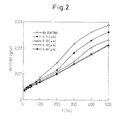
- FIG. 2 shows the results of the measurement of the iron loss per cycle W/f of a sample when changing the excitation frequency f.
- the thickness of the magnetic coating is gradually increased from 0.11 to 0.60 ⁇ m, the iron loss decreases.
- the iron loss is reduced in the total region of the frequency range of 50 to 50OHz. In this case, with a coating thickness of 0.6 ⁇ m or more, the iron loss reducing effect became substantially saturated.
- the inventors measured the magnetic flux density (B8) of these samples, whereupon they found the magnetic coating did not greatly reduce the magnetic flux density.
- FIG. 3 shows the results of the measurement of the iron loss of a sample with no magnetic coating and a sample with the magnetic coating formed by the Ni-Fe alloy film of 0.4 ⁇ m thickness in the case of a frequency of 50Hz when the maximum magnetic flux density changed from 0.6 to 1.7T. From FIG. 3 , it was found that the iron loss is reduced by the magnetic coating at all excitation magnetic flux densities.
- the inventors found that by forming an Ni-Fe alloy film on the surface of grain-oriented electrical steel sheet having a mainly ⁇ 110 ⁇ 001> orientation texture, it is possible to subdivide the magnetic domains of the steel sheet to thereby reduce the iron loss.
- the grain-oriented electrical steel sheet used as the base material on which the Ni-Fe alloy film is formed is not particularly limited.
- Existing grain-oriented electrical steel sheets, steel strips, etc. containing Si in a range of up to 7% and having a texture having a mainly ⁇ 110 ⁇ 001> orientation can be utilized.
- a steel sheet or a steel strip produced by the known methods for example, see Japanese Patent Publication (B2) No. 30-3651 , Japanese Patent Publication (B2) No. 40-15644 , Japanese Patent Publication (B2) No. 51-13469 , and Japanese Patent Publication (B2) No. 62-45285
- a steel foil produced by the known method for example, see Japanese Patent Publication (A) No. 2-277748 .
- the grain-oriented electrical steel sheet generally has a glass film on its surface, so the glass film is removed by pickling etc., then the surface of the steel sheet is coated with a Ni-Fe alloy film. Further, if using a steel sheet produced by the methods of production of a grain-oriented electrical steel sheet not allowing the formation of a glass film on the surface of the sheet (for example, see Japanese Patent Publication (A) No. 7-118750 and Japanese Patent Publication (A) No. 2003-268450 ), it is possible to eliminate the process of removing the glass film.
- the Ni-Fe alloy film is comprised of Fe: 10 to 50% and Ni: 90 to 50%, preferably Fe: 15 to 30% and Ni: 85 to 70%. By forming this range of ratio of composition of Ni-Fe alloy film, the iron loss is reduced.
- the method of forming the Ni-Fe alloy film is not particularly limited. Any method may be used such as PVD, CVD, or other dry coating, plating or other wet coating, coating a material, then firing it by annealing, etc.
- the coating thickness of the Ni-Fe alloy film has to be 0.1 ⁇ m or more in order to obtain the iron loss reducing effect. Even if formed over 0.6 ⁇ m, the iron loss reducing effect ends up becoming saturated.
- the surface on which the Ni-Fe alloy film is coated may be both surfaces or either surface of the steel sheet, but coating of one surface is preferable from the viewpoint of improvement of the magnetic properties.
- the surface roughness of the Ni-Fe alloy film is preferably made a roughness of about the same extent or lower than the roughness of the surface of the steel sheet after removal of the glass film.
- the present invention subdivides the magnetic domain widths of the grain-oriented electrical steel sheet and thereby improves the iron loss, so becomes more effective when it is applied to the material with wider magnetic domains, for example, the material of sharper ⁇ 110 ⁇ 001> orientation and the material of thinner thickness.
- the iron loss reducing effect by tension coating 0.1 kg/mm 2 or more, preferably 0.5 kg/mm 2 or more tension is required. With tension over 1 kg/mm 2 , the iron loss reducing effect is substantially saturated.
- the grain-oriented electrical steel sheet used as base material on which the Ni-Fe alloy film is formed any existing one may be used as mentioned above.
- the grain-oriented electrical steel sheet is not particularly limited in steel composition, but a steel which is based on steel containing Si in 0.8 to 7% and having a balance of Fe and unavoidable impurities and which, in accordance with need, contains one or more of Mn: 1% or less, Cr: 0.3% or less, Cu: 0.4% or less, P: 0.5% or less, N: 1% or less, Mo: 0.1% or less, Sn: 0.3% or less, and Sb: 0.3% or less is preferable.
- C, N, S, Se, Ti, and Al are sometimes added in the steelmaking stage for texture control and inhibitor control for stabilizing secondary recrystallization, but are also elements degrading the iron loss property of the final product, so have to be reduced in the decarburization annealing and in the final annealing etc. of the production process. For this reason, the contents of these elements are, in the final product, 0.005% or less, preferably 0.003% or less.
- Mn is an element effective for raising the specific resistance to lower the iron loss. Further, Mn is an element effective for preventing cracks in hot rolling in the production process, but if the content exceeds 1%, the magnetic flux density of the product will end up falling, so the upper limit in the case of inclusion is made 1%.
- Cr is also an element effective for raising the specific resistance to lower the iron loss. Furthermore, Cr is an element which improves the surface oxide layer after decarburization annealing in the production process and is effective for formation of a glass film. It may be included in a range of 0.3% or less.
- Cu is also an element effective for raising the specific resistance to lower the iron loss, but if the content is over 0.4%, the iron loss reducing effect ends up becoming saturated. In the production process, this becomes a cause of the surface defect of scabs at the time of hot rolling, so the upper limit when including it is made 0.4%.
- P is also an element effective for raising the specific resistance to lower the iron loss, but if the content is over 0.5%, problems arise in the rollability of the steel sheet in the production process, so the upper limit in the case of inclusion is made 0.5%.
- Ni is also an element effective for raising the specific resistance to lower the iron loss. Further, Ni is an element effective in controlling the metal structure of the hot rolled sheet to improve the magnetic properties, but if the content is over 1%, the secondary recrystallization becomes unstable, so the upper limit in the case of inclusion is made 1%.
- Mo is also an element effective for raising the specific resistance to lower the iron loss, but if the content is over 0.1%, problems arise in the rollability of the steel sheet in the production process, so the upper limit in the case of inclusion is made 0.1%.
- Sn and Sb are elements which are effective for stabilizing the secondary recrystallization and promoting the ⁇ 110 ⁇ 001> orientation, but if over 0.3%, have detrimental effects on the formation of the glass film in the production process, so the upper limit in the case of inclusion is made 0.3%.
- Example 1 The sample of Example 1 was used. This sample was worked, then treated by stress-relieving annealing at 750° for 2 hours. The sample after annealing had the iron loss W17/50 of 0.26W/kg.
- (C) 0.14 mm thick grain-oriented electrical steel sheet containing Si: 3.3%, Mn: 0.14%, Cr: 0.12%, P: 0.03%, and Mo: 0.01% and having a mainly ⁇ 110 ⁇ 001> orientation were coated with Fe-78%Ni alloy film on one side to 0.6 ⁇ m, then given a tension coating mainly comprised of colloidal silica, aluminum phosphate, and chromic acid.
- the iron loss improvement before and after magnetic coating is shown in Table 4.
- the present invention it is possible to control the magnetic domains by a method where the effect of improvement of the iron loss is not lost and a drastic drop in the magnetic flux density is not caused even if annealing after core formation.
Landscapes
- Chemical & Material Sciences (AREA)
- Engineering & Computer Science (AREA)
- Materials Engineering (AREA)
- Mechanical Engineering (AREA)
- Metallurgy (AREA)
- Organic Chemistry (AREA)
- Chemical Kinetics & Catalysis (AREA)
- Soft Magnetic Materials (AREA)
- Manufacturing Of Steel Electrode Plates (AREA)
- Electroplating Methods And Accessories (AREA)
- Physical Vapour Deposition (AREA)
- Other Surface Treatments For Metallic Materials (AREA)
Abstract
Description
- The present invention relates to grains-oriented electrical steel sheets used as a soft magnetic material for cores of transformers and other electrical equipment. In particular, it relates to grain-oriented electrical steel sheets improved in magnetic properties by forming a Ni-Fe alloy film on the surface of the steel sheet.
- A grain-oriented electrical steel sheet is a steel sheet containing Si in 7% or less and is comprised of {110}<001> oriented crystal grains. This steel sheet is mainly used as a core for transformers and other electrical equipment, in case good magnetic properties are demanded. In particular, a low energy loss, that is, iron loss, is important. Due to the environmental issues and energy issues of recent years, a demand has been growing for grain-oriented electrical steel sheets with low iron loss.
- Various attempts have been made up to now to reduce the iron loss of grain-oriented electrical steel sheets. Up until now, the following methods have been proposed: (1) a method of sharpening the {110}<001> orientation and reducing the hysteresis loss, (2) a method of reducing inclusions and internal strain in the steel sheet to reduce hysteresis loss, (3) a method of flattening the steel sheet surface to reduce the hysteresis loss, (4) a method of increasing the amount of Si in the steel sheet and raising the specific resistance to reduce the eddy current loss, and (5) a method of reducing the sheet thickness to reduce the eddy current loss.
- Further, apart from the above methods of improving the iron loss of the steel sheet itself, a method of physically controlling the magnetic domain structure to reduce the iron loss has also been proposed.
- For example, Japanese Patent Publication (A) No.
53-137016 55-18566 57-188810 - For this reason, as a method of control of the magnetic domains enabling application of the material for a wound core, the method of introducing linear grooves or fine grains to control the magnetic domains and reduce the iron loss has been proposed in Japanese Patent Publication (A) No.
59-197520 61-117218 62-179105 - Therefore, the object of the present invention is to provide a low iron loss grain-oriented electrical steel sheet which is applied to wound cores, with the magnetic domain control, which does not lose its effect after annealing and does not greatly deteriorate the magnetic flux density.
- The present invention comes up with the new idea of forming a Ni-Fe alloy film on a grain-oriented electrical steel sheet and thereby solves the above problems. The gist is as follows:
- (1) Grain-oriented electrical steel sheet excellent in magnetic properties having mainly {110}<001> orientation texture characterized in that at least one surface of the steel sheet is formed from a Ni-Fe alloy film comprised of a composition of Fe: 10 to 50 mass% and Ni: 90 to 50 mass%.
- (2) Grain-oriented electrical steel sheet excellent in magnetic properties as set forth in the above (1), characterized in that at least one surface of the steel sheet is formed from a tension coating on the surface of the Ni-Fe alloy film and in that the roughness of the interface between the Ni-Fe alloy film and the tension coating is not more than the roughness of the interface between the Ni-Fe alloy film and the base iron.
- (3) Grain-oriented electrical steel sheet excellent in magnetic properties as set forth in the above (1) or (2), characterized in that the thickness of the Ni-Fe alloy film is 0.1 to 0.6 µm.
- (4) Grain-oriented electrical steel sheet excellent in magnetic properties as set forth in the above (1) or (2), characterized in that the surface of the Ni-Fe alloy film is formed from a 0.1 to 1 kg/mm2 tension coating.
- (5) Grain-oriented electrical steel sheet excellent in magnetic properties as set forth in the above (1) or (2), characterized in that a ratio B8/Bs of magnetic flux density B8 of the steel sheet and saturated magnetic flux density Bs of the steel sheet is 0.93 or more.
- (6) Grain-oriented electrical steel sheet excellent in magnetic properties as set forth in the above (1) or (2), characterized by comprising steel containing Si in 0.8 to 7 mass%.
- (7) Grain-oriented electrical steel sheet excellent in magnetic properties as set forth in the above (6), characterized by comprising steel containing, in addition to Si, by mass%, one or more of Mn: 1% or less, Cr: 0.3% or less, Cu: 0.4% or less, P: 0.5% or less, Ni: 1% or less, Mo: 0.1% or less, Sn: 0.3% or less, and Sb: 0.3%.
- According to the above present invention, it is possible to solve the above problems and easily obtain a grain-oriented electrical steel sheet excellent in magnetic properties with low iron loss and high magnetic flux density and to provide a grain-oriented electrical steel sheet meeting recent demands for environmental protection and energy saving.
-
-
FIG. 1 is a view showing the effect of the thickness of the Ni-Fe alloy film and the tension on the magnetic domain width of the grain-oriented electrical steel strip. -
FIG. 2 is a view showing the effect of an excitation frequency f and the thickness of the Ni-Fe alloy film on the iron loss of the grain-oriented electrical steel strip. -
FIG. 3 is a view showing the effect of a maximum excitation magnetic flux density (frequency: 50Hz) and the Ni-Fe alloy film on the iron loss of the grains-oriented electrical steel strip. - The inventors engaged in detailed studies of the factors affecting the magnetic domain structure of the steel sheet containing Si in 0.8 to 7 mass% and having a mainly {110}<001> orientation texture and of methods of control of the same, found that (a) the magnetic domain widths become larger the higher the {110}<001> orientation and the thinner the sheet and that (b) the magnetic domains can be subdivided by coating a Ni-Fe alloy film on the surface of the steel sheet (below, sometimes abbreviated as "magnetic coating") and thereby completed the present invention.
- Below, they will explain the experiments by which these findings were obtained. Note that in the following explanation, the content of elements is expressed in mass%.
- First, the inventors coated one surface of a 0.07 mm thick grain-oriented electrical steel sheet containing Si in 3% and having {110}<001> oriented grains with a Fe-78%Ni alloy film to a 0.2 and 0.6 µm thickness by using the sputtering method, further gave a tension coating over that, and investigated the effects of these coatings on the magnetic domain width.
FIG. 1 shows the results of measurement of the magnetic domain widths in the case of changing the thickness of the Ni-Fe alloy film and the tension. - As clear from
FIG. 1 , it was found that compared with the magnetic domain width of a grain-oriented electrical steel sheet without a magnetic coating, the magnetic domain width is gradually subdivided by coating a Ni-Fe alloy film. Further, it was found that by using a tension coating to impart tension to the steel sheet, the magnetic domain width is further subdivided. - Further, when forming a Ni-rich Ni-Fe alloy film, it became for the first time clear that the Ni-Fe alloy film had the effect of subdividing the magnetic domains and reducing the iron loss even when not applying the tension coating to the steel sheet. Therefore, it was clarified that the mechanism of subdivision of the magnetic domains of the Ni-rich Ni-Fe alloy film differs from subdivision of the magnetic domains by imparting the tension.
- Further, the iron loss reducing effect due to the tension becomes substantially saturated in the region of a tension of over 1 kg/mm2.
- Next, the inventors used the same grain-oriented electrical steel sheet as a sample, coated this steel sheet with an Fe-78%Ni alloy film on one surface to a thickness of 0.1 to 0.6 µm, imparted a tension of 1.0 kg/m2, and measured the effects of the Ni-Fe alloy film on the magnetic properties in that state.
-
FIG. 2 shows the results of the measurement of the iron loss per cycle W/f of a sample when changing the excitation frequency f. As clear fromFIG. 2 , as the thickness of the magnetic coating is gradually increased from 0.11 to 0.60 µm, the iron loss decreases. By applying a magnetic coating of a Ni-Fe alloy film, it could be confirmed that the iron loss is reduced in the total region of the frequency range of 50 to 50OHz. In this case, with a coating thickness of 0.6 µm or more, the iron loss reducing effect became substantially saturated. - The inventors measured the magnetic flux density (B8) of these samples, whereupon they found the magnetic coating did not greatly reduce the magnetic flux density.
- Further,
FIG. 3 shows the results of the measurement of the iron loss of a sample with no magnetic coating and a sample with the magnetic coating formed by the Ni-Fe alloy film of 0.4 µm thickness in the case of a frequency of 50Hz when the maximum magnetic flux density changed from 0.6 to 1.7T. FromFIG. 3 , it was found that the iron loss is reduced by the magnetic coating at all excitation magnetic flux densities. - Due to the above results, the inventors found that by forming an Ni-Fe alloy film on the surface of grain-oriented electrical steel sheet having a mainly {110}<001> orientation texture, it is possible to subdivide the magnetic domains of the steel sheet to thereby reduce the iron loss.
- The mechanism of improvement of the magnetic properties by the Ni-Fe alloy film has not been completely elucidated, but the inventors believe it to be as follows:
- The magnetic domain structure of a {110}<001> orientation grain-oriented electrical steel sheet is basically comprised of 180° magnetic domains arranged in slab shapes in the rolling direction. The width of these 180° magnetic domains has a major effect on the magnetic properties. This magnetic domain width is determined by the magnetostatic energy caused by the surface magnetic poles arising due to the angle of inclination of the <001> axis from the surface and magnetic wall energy. When the surface is coated by Fe-78%Ni or other soft magnetic film, it is believed that the magnetostatic energy due to the surface magnetic poles will change and therefore the width of the 180° magnetic domains will change, and thus the magnetic properties will be improved.
- The present invention based on the above discoveries will be explained below.
- In the present invention, the grain-oriented electrical steel sheet used as the base material on which the Ni-Fe alloy film is formed is not particularly limited. Existing grain-oriented electrical steel sheets, steel strips, etc. containing Si in a range of up to 7% and having a texture having a mainly {110}<001> orientation can be utilized.
- For example, a steel sheet or a steel strip produced by the known methods (for example, see Japanese Patent Publication (B2) No.
30-3651 40-15644 51-13469 62-45285 2-277748 - The grain-oriented electrical steel sheet generally has a glass film on its surface, so the glass film is removed by pickling etc., then the surface of the steel sheet is coated with a Ni-Fe alloy film. Further, if using a steel sheet produced by the methods of production of a grain-oriented electrical steel sheet not allowing the formation of a glass film on the surface of the sheet (for example, see Japanese Patent Publication (A) No.
7-118750 2003-268450 - The Ni-Fe alloy film is comprised of Fe: 10 to 50% and Ni: 90 to 50%, preferably Fe: 15 to 30% and Ni: 85 to 70%. By forming this range of ratio of composition of Ni-Fe alloy film, the iron loss is reduced.
- The method of forming the Ni-Fe alloy film is not particularly limited. Any method may be used such as PVD, CVD, or other dry coating, plating or other wet coating, coating a material, then firing it by annealing, etc.
- The coating thickness of the Ni-Fe alloy film has to be 0.1 µm or more in order to obtain the iron loss reducing effect. Even if formed over 0.6 µm, the iron loss reducing effect ends up becoming saturated.
- The surface on which the Ni-Fe alloy film is coated may be both surfaces or either surface of the steel sheet, but coating of one surface is preferable from the viewpoint of improvement of the magnetic properties.
- When the surface of the Ni-Fe alloy film after coating is rough, the iron loss reducing effect is impaired. Therefore, the surface roughness of the Ni-Fe alloy film is preferably made a roughness of about the same extent or lower than the roughness of the surface of the steel sheet after removal of the glass film.
- The present invention subdivides the magnetic domain widths of the grain-oriented electrical steel sheet and thereby improves the iron loss, so becomes more effective when it is applied to the material with wider magnetic domains, for example, the material of sharper {110}<001> orientation and the material of thinner thickness.
- Therefore, when applying this invention to a material having an indicator of the {110}<001> orientation of the B8/Bs (B8: magnetic flux density when applying magnetic field of 800A/m, Bs: saturated magnetic flux density with ingredients of material) of 0.93 or more, preferably 0.95 or more, the effect of improvement of the iron loss becomes larger.
- After forming the Ni-Fe alloy film, an insulation coating is applied. At this time, if forming a tension coating such as disclosed in Japanese Patent Publication (A) No.
53-28375 - To obtain the iron loss reducing effect by tension coating, 0.1 kg/mm2 or more, preferably 0.5 kg/mm2 or more tension is required. With tension over 1 kg/mm2, the iron loss reducing effect is substantially saturated.
- In the present invention, for the grain-oriented electrical steel sheet used as base material on which the Ni-Fe alloy film is formed, any existing one may be used as mentioned above. The grain-oriented electrical steel sheet is not particularly limited in steel composition, but a steel which is based on steel containing Si in 0.8 to 7% and having a balance of Fe and unavoidable impurities and which, in accordance with need, contains one or more of Mn: 1% or less, Cr: 0.3% or less, Cu: 0.4% or less, P: 0.5% or less, N: 1% or less, Mo: 0.1% or less, Sn: 0.3% or less, and Sb: 0.3% or less is preferable.
- Note that, C, N, S, Se, Ti, and Al are sometimes added in the steelmaking stage for texture control and inhibitor control for stabilizing secondary recrystallization, but are also elements degrading the iron loss property of the final product, so have to be reduced in the decarburization annealing and in the final annealing etc. of the production process. For this reason, the contents of these elements are, in the final product, 0.005% or less, preferably 0.003% or less.
- Here, the reasons for selection of the preferable steel composition of the grain-oriented electrical steel sheet are as follows:
- Si, if the content is increased, results in a higher electrical resistance and an improved iron loss property. However, if added over 7%, cold rolling becomes extremely difficult in the production process. The sheet will end up cracking at the time of rolling and otherwise will be unsuitable for industrial production. Further, if the content is smaller than 0.8%, if the temperature is raised too high at the time of annealing, γ-transformation will occur, and the crystal orientation of the steel sheet will end up being impaired, so 0.8% or more is preferable.
- Mn is an element effective for raising the specific resistance to lower the iron loss. Further, Mn is an element effective for preventing cracks in hot rolling in the production process, but if the content exceeds 1%, the magnetic flux density of the product will end up falling, so the upper limit in the case of inclusion is made 1%.
- Cr is also an element effective for raising the specific resistance to lower the iron loss. Furthermore, Cr is an element which improves the surface oxide layer after decarburization annealing in the production process and is effective for formation of a glass film. It may be included in a range of 0.3% or less.
- Cu is also an element effective for raising the specific resistance to lower the iron loss, but if the content is over 0.4%, the iron loss reducing effect ends up becoming saturated. In the production process, this becomes a cause of the surface defect of scabs at the time of hot rolling, so the upper limit when including it is made 0.4%.
- P is also an element effective for raising the specific resistance to lower the iron loss, but if the content is over 0.5%, problems arise in the rollability of the steel sheet in the production process, so the upper limit in the case of inclusion is made 0.5%.
- Ni is also an element effective for raising the specific resistance to lower the iron loss. Further, Ni is an element effective in controlling the metal structure of the hot rolled sheet to improve the magnetic properties, but if the content is over 1%, the secondary recrystallization becomes unstable, so the upper limit in the case of inclusion is made 1%.
- Mo is also an element effective for raising the specific resistance to lower the iron loss, but if the content is over 0.1%, problems arise in the rollability of the steel sheet in the production process, so the upper limit in the case of inclusion is made 0.1%.
- Sn and Sb are elements which are effective for stabilizing the secondary recrystallization and promoting the {110}<001> orientation, but if over 0.3%, have detrimental effects on the formation of the glass film in the production process, so the upper limit in the case of inclusion is made 0.3%.
- Next, examples of the present invention will be explained. The conditions employed in the examples are illustrations of conditions for confirming the workability and advantageous effects of the present invention. The present invention is not limited to these examples.
- For the samples, a 0.07 mm thick grain-oriented electrical steel sheet containing Si: 3%, Mn: 0.1%, Cr: 0.12%, and P: 0.03% and having a mainly {110}<001> orientation was used. One surface or both surfaces of this steel sheet were plated to give Fe-78%Ni alloy magnetic coating of a thickness of 0.6 µm. Next, a tension coating mainly comprised of colloidal silica, aluminum phosphate, and chromic acid was applied. The magnetic properties of the samples after coating are shown in Table 1.
- As clear from Table 1, by giving Fe-78%Ni alloy film, the iron loss is improved, and by applying it to one surface results in a larger effect of improvement of iron loss than both surfaces.
Table 1 Sample Magnetic coating iron loss
W17/50 (W/kg)Remarks (A) One surface 0.26 Inv. ex. (B) Both surfaces 0.28 Inv. ex. (C) None 0.30 Comp. ex. - For the samples, 0.22 mm thick grain-oriented electrical steel sheets of B8/Bs=0.91 to 0.97 containing Si:3.3% and having a mainly {110}<001> orientation were used. One surface of each steel sheet was plated to give Fe-78%Ni alloy magnetic coating of a thickness of 0.6 µm. Next, a tension coating similar to Example 1 was applied. The improvements in the iron loss of the samples before and after coating are shown in Table 2.
- As clear from Table 2, when the orientation (B8/Bs) of the grain-oriented electrical steel sheet is 0.93 or more, preferably 0.95 or more, the effect of improvement of the iron loss becomes remarkable.
Table 2 Sample Magnetic flux density
B8 (T)Orientation
B8/Bsiron loss improvement
ΔW17/50(W/kg)(D) 1.958 0.97 0.06 (E) 1.924 0.95 0.03 (F) 1.882 0.93 0.01 (G) 1.958 0.92 0.003 - For the samples, a 0.22 mm thick grain-oriented electrical steel sheet of B8/Bs=0.96 containing Si:3.3% and having a mainly {110}<001> orientation was used. One surface of the steel sheet was plated to give Fe-Ni alloy film changed in Ni content in the range of 40 to 95% and form a coating of 0.6 µm thickness. Next, an insulation coating was applied. The improvements in the iron loss of the samples before and after coating are shown in Table 3.
- At clear from Table 3, in the range of Ni content of 50 to 90%, preferably 70 to 85%, the effect of improvement of the iron loss becomes remarkable.
Table 3 Sample Composition
(Ni ratio)
(mass%)iron loss improvement
ΔW17/50 (W/kg)(H) 42 -0.03 (I) 53 0.01 (J) 71 0.03 (K) 78 0.05 (L) 85 0.03 (M) 90 0.01 (N) 94 -0.02 - The sample of Example 1 was used. This sample was worked, then treated by stress-relieving annealing at 750° for 2 hours. The sample after annealing had the iron loss W17/50 of 0.26W/kg.
- As a result, it was confirmed that even if annealing after core formation, the iron loss reducing effect is not lost.
- For the samples, (A) 0.14 mm thick grain-oriented electrical steel sheet containing Si: 3.3%, Mn: 0.1%, Cr: 0.12%, Cu: 0.2%, P: 0.03%, and Sn: 0.06% and having a mainly {110}<001> orientation, (B) 0.14 mm thick grain-oriented electrical steel sheet containing Si: 3.3%, Mn: 0.12%, Ni: 0.1%, P: 0.02%, and Sb: 0.03% and having a mainly {110}<001> orientation, and (C) 0.14 mm thick grain-oriented electrical steel sheet containing Si: 3.3%, Mn: 0.14%, Cr: 0.12%, P: 0.03%, and Mo: 0.01% and having a mainly {110}<001> orientation were coated with Fe-78%Ni alloy film on one side to 0.6 µm, then given a tension coating mainly comprised of colloidal silica, aluminum phosphate, and chromic acid. The iron loss improvement before and after magnetic coating is shown in Table 4.
- In each sample of the different ingredients, a iron loss reducing effect is obtained.
Table 4 Sample iron loss improvement
ΔW17/50 (W/kg)Remarks (A) 0.03 Inv. ex. (B) 0.05 Inv. ex. (C) 0.04 Inv. ex. - According to the present invention, it is possible to control the magnetic domains by a method where the effect of improvement of the iron loss is not lost and a drastic drop in the magnetic flux density is not caused even if annealing after core formation.
- Therefore, it is possible to easily obtain grain-oriented electrical steel sheet excellent in magnetic properties with a low iron loss and a high magnetic flux density and provide grain-oriented electrical steel sheet meeting recent demands for environmental protection and energy saving, so the present invention has great industrial applicability.
Claims (7)
- Grain-oriented electrical steel sheet excellent in magnetic properties having mainly {110}<001> orientation texture characterized in that at least one surface of the steel sheet is formed from a Ni-Fe alloy film comprised of a composition of Fe: 10 to 50 mass% and Ni: 90 to 50 mass%.
- Grain-oriented electrical steel sheet excellent in magnetic properties as set forth in claim 1, characterized in that at least one surface of the steel sheet is formed from a tension coating on the surface of the Ni-Fe alloy film and in that the roughness of the interface between the Ni-Fe alloy film and the tension coating is not more than the roughness of the interface between the Ni-Fe alloy film and the base iron.
- Grain-oriented electrical steel sheet excellent in magnetic properties as set forth in claim 1 or 2, characterized in that the thickness of the Ni-Fe alloy film is 0.1 to 0.6 µm.
- Grain-oriented electrical steel sheet excellent in magnetic properties as set forth in claim 1 or 2, characterized in that the surface of the Ni-Fe alloy film is formed from a 0.1 to 1 kg/mm2 tension coating.
- Grain-oriented electrical steel sheet excellent in magnetic properties as set forth in claim 1 or 2, characterized in that the ratio B8/Bs of magnetic flux density B8 of the steel sheet and saturated magnetic flux density Bs of the steel sheet is 0.93 or more.
- Grain-oriented electrical steel sheet excellent in magnetic properties as set forth in claim 1 or 2, characterized by comprising steel containing Si in 0.8 to 7 mass%.
- Grain-oriented electrical steel sheet excellent in magnetic properties as set forth in claim 6, characterized by comprising steel containing, in addition to Si, by mass%, one or more of Mn: 1% or less, Cr: 0.3% or less, Cu: 0.4% or less, P: 0.5% or less, Ni: 1% or less, Mo: 0.1% or less, Sn: 0.3% or less, and Sb: 0.3%.
Priority Applications (1)
| Application Number | Priority Date | Filing Date | Title |
|---|---|---|---|
| PL09704900T PL2243865T3 (en) | 2008-01-24 | 2009-01-06 | Grain-oriented electromagnetic steel sheet excellent in magnetic characteristics |
Applications Claiming Priority (2)
| Application Number | Priority Date | Filing Date | Title |
|---|---|---|---|
| JP2008013853 | 2008-01-24 | ||
| PCT/JP2009/050263 WO2009093492A1 (en) | 2008-01-24 | 2009-01-06 | Grain-oriented electromagnetic steel sheet excellent in magnetic characteristics |
Publications (3)
| Publication Number | Publication Date |
|---|---|
| EP2243865A1 true EP2243865A1 (en) | 2010-10-27 |
| EP2243865A4 EP2243865A4 (en) | 2016-07-13 |
| EP2243865B1 EP2243865B1 (en) | 2018-08-15 |
Family
ID=40901000
Family Applications (1)
| Application Number | Title | Priority Date | Filing Date |
|---|---|---|---|
| EP09704900.1A Active EP2243865B1 (en) | 2008-01-24 | 2009-01-06 | Grain-oriented electromagnetic steel sheet excellent in magnetic characteristics |
Country Status (8)
| Country | Link |
|---|---|
| US (1) | US20100279142A1 (en) |
| EP (1) | EP2243865B1 (en) |
| JP (1) | JP4734455B2 (en) |
| KR (1) | KR101216656B1 (en) |
| CN (1) | CN101925693A (en) |
| PL (1) | PL2243865T3 (en) |
| RU (1) | RU2454487C2 (en) |
| WO (1) | WO2009093492A1 (en) |
Families Citing this family (4)
| Publication number | Priority date | Publication date | Assignee | Title |
|---|---|---|---|---|
| EP2316980B1 (en) * | 2008-07-22 | 2018-11-14 | Nippon Steel & Sumitomo Metal Corporation | Non-oriented electrical steel sheet and method for manufacturing the same |
| US20130022833A1 (en) * | 2011-07-22 | 2013-01-24 | GM Global Technology Operations LLC | Electromagnetic machine and system including silicon steel sheets |
| CN111868294B (en) * | 2018-03-30 | 2023-09-08 | 杰富意钢铁株式会社 | Target changing device and surface treatment equipment |
| KR102174155B1 (en) * | 2018-09-27 | 2020-11-04 | 주식회사 포스코 | Annealing separating agent composition for grain oriented electrical steel sheet, grain oriented electrical steel sheet, and method for manufacturing grain oriented electrical steel sheet |
Family Cites Families (20)
| Publication number | Priority date | Publication date | Assignee | Title |
|---|---|---|---|---|
| JPS585968B2 (en) | 1977-05-04 | 1983-02-02 | 新日本製鐵株式会社 | Manufacturing method of ultra-low iron loss unidirectional electrical steel sheet |
| JPS5518566A (en) | 1978-07-26 | 1980-02-08 | Nippon Steel Corp | Improving method for iron loss characteristic of directional electrical steel sheet |
| JPS57188810A (en) | 1981-05-18 | 1982-11-19 | Nippon Steel Corp | Improving method for magnetic characteristic of directional electromagnetic steel plate |
| JPS59197520A (en) | 1983-04-20 | 1984-11-09 | Kawasaki Steel Corp | Manufacture of single-oriented electromagnetic steel sheet having low iron loss |
| CA1240949A (en) * | 1983-07-08 | 1988-08-23 | Kyoko Yamaji | Surface treated steel strip with coatings of iron-nickel alloy, tin and chromate |
| JPS61117218A (en) | 1984-11-10 | 1986-06-04 | Nippon Steel Corp | Manufacture of grain oriented magnetic steel sheet of low iron loss |
| JPS62179105A (en) | 1986-02-03 | 1987-08-06 | Nippon Steel Corp | Manufacture of low iron loss unidirectional electromagnetic steel plate |
| JPH0629461B2 (en) * | 1987-12-21 | 1994-04-20 | 川崎製鉄株式会社 | Method for producing silicon steel sheet having good magnetic properties |
| CA2006292C (en) * | 1988-12-22 | 1997-09-09 | Yoshiyuki Ushigami | Very thin electrical steel strip having low core loss and high magnetic flux density and a process for producing the same |
| JPH06116790A (en) * | 1992-10-01 | 1994-04-26 | Nippon Steel Corp | Welding can material with high-speed seam weldability, pitting corrosion resistance, heat resistance, and paint adhesion |
| JP2827861B2 (en) * | 1993-12-20 | 1998-11-25 | 住友金属工業株式会社 | Grain-oriented electrical steel sheet |
| RU2094487C1 (en) * | 1994-04-20 | 1997-10-27 | Научно-производственное предприятие "Эста" | Method of manufacturing textured electric steel |
| DE69625845T2 (en) * | 1995-05-02 | 2003-12-24 | Sumitomo Metal Industries, Ltd. | Magnetic steel sheet with improved magnetic properties and improved punchability |
| JPH0964583A (en) * | 1995-08-23 | 1997-03-07 | Mitsubishi Materials Corp | Electromagnetic shield material and shield cover |
| JP3552501B2 (en) * | 1997-10-28 | 2004-08-11 | Jfeスチール株式会社 | Grain-oriented electrical steel sheet with extremely low iron loss and method for producing the same |
| JPH11222654A (en) * | 1998-01-30 | 1999-08-17 | Kawasaki Steel Corp | Grain-oriented electrical steel sheet with extremely low iron loss |
| JP3969456B2 (en) * | 1998-12-01 | 2007-09-05 | 住友電気工業株式会社 | Electromagnetic induction heating composite and electromagnetic induction heating cooking utensil |
| KR100640510B1 (en) * | 2001-09-13 | 2006-10-31 | 에이케이 스틸 프로퍼티즈 인코포레이티드 | How to produce (110) [001] directional electrical steel using strip casting |
| JP4635457B2 (en) * | 2004-02-27 | 2011-02-23 | Jfeスチール株式会社 | A grain-oriented electrical steel sheet having a phosphate insulating coating that does not contain chromium and has excellent moisture absorption resistance, and a method for forming a phosphate insulating coating that does not contain chromium and has excellent moisture absorption resistance. |
| EP2316980B1 (en) * | 2008-07-22 | 2018-11-14 | Nippon Steel & Sumitomo Metal Corporation | Non-oriented electrical steel sheet and method for manufacturing the same |
-
2009
- 2009-01-06 RU RU2010135358/02A patent/RU2454487C2/en active
- 2009-01-06 PL PL09704900T patent/PL2243865T3/en unknown
- 2009-01-06 EP EP09704900.1A patent/EP2243865B1/en active Active
- 2009-01-06 US US12/809,913 patent/US20100279142A1/en not_active Abandoned
- 2009-01-06 WO PCT/JP2009/050263 patent/WO2009093492A1/en not_active Ceased
- 2009-01-06 KR KR1020107013121A patent/KR101216656B1/en active Active
- 2009-01-06 CN CN2009801028995A patent/CN101925693A/en active Pending
- 2009-01-06 JP JP2009550490A patent/JP4734455B2/en active Active
Non-Patent Citations (1)
| Title |
|---|
| See references of WO2009093492A1 * |
Also Published As
| Publication number | Publication date |
|---|---|
| KR20100092019A (en) | 2010-08-19 |
| CN101925693A (en) | 2010-12-22 |
| PL2243865T3 (en) | 2019-01-31 |
| JP4734455B2 (en) | 2011-07-27 |
| JPWO2009093492A1 (en) | 2011-05-26 |
| RU2454487C2 (en) | 2012-06-27 |
| WO2009093492A1 (en) | 2009-07-30 |
| EP2243865A4 (en) | 2016-07-13 |
| KR101216656B1 (en) | 2012-12-31 |
| RU2010135358A (en) | 2012-02-27 |
| EP2243865B1 (en) | 2018-08-15 |
| US20100279142A1 (en) | 2010-11-04 |
Similar Documents
| Publication | Publication Date | Title |
|---|---|---|
| KR100727333B1 (en) | Electronic steel sheet suitable for small iron core and manufacturing method thereof | |
| CN103140603B (en) | Oriented electromagnetic steel plate | |
| CN107849656A (en) | Grain-oriented electrical steel sheet and manufacturing method thereof | |
| KR20140064936A (en) | Oriented electromagnetic steel sheet and method for manufacturing same | |
| WO2011115120A1 (en) | Method for producing directional electromagnetic steel sheet | |
| JP6436316B2 (en) | Method for producing grain-oriented electrical steel sheet | |
| JP2025500051A (en) | Non-oriented electrical steel sheet and its manufacturing method | |
| JP6624180B2 (en) | Grain-oriented electrical steel sheet and its manufacturing method | |
| JP6769587B1 (en) | Electrical steel sheet and its manufacturing method | |
| EP2243865B1 (en) | Grain-oriented electromagnetic steel sheet excellent in magnetic characteristics | |
| JP4608562B2 (en) | Method for producing grain-oriented electrical steel sheet with extremely high magnetic flux density | |
| JP2024546167A (en) | Non-oriented electrical steel sheet and its manufacturing method | |
| JP4016552B2 (en) | Method for producing non-oriented electrical steel sheets with excellent magnetic properties and surface properties | |
| JP3997712B2 (en) | Manufacturing method of grain-oriented electrical steel sheet for EI core | |
| JP2023554123A (en) | Non-oriented electrical steel sheet and its manufacturing method | |
| JPS6256923B2 (en) | ||
| JP3782273B2 (en) | Electrical steel sheet | |
| JP4692518B2 (en) | Oriented electrical steel sheet for EI core | |
| JP7792057B2 (en) | Grain-oriented electrical steel sheet and its manufacturing method | |
| CN113302321A (en) | Method for producing unidirectional electromagnetic steel sheet | |
| JPH11241120A (en) | Method for producing grain-oriented silicon steel sheet having homogeneous forsterite coating | |
| JPH067527B2 (en) | Ultra-low iron loss grain-oriented silicon steel sheet and method for producing the same | |
| JP3280898B2 (en) | Ultra-low iron loss unidirectional silicon steel sheet | |
| KR960003900B1 (en) | Manufacturing method of oriented electrical steel sheet with excellent magnetic properties | |
| KR20250107895A (en) | Prediction model for oxygen per unit area after decarburization annealing, its preparation method, and manufacturing method of grain-oriented electrical steel sheet |
Legal Events
| Date | Code | Title | Description |
|---|---|---|---|
| PUAI | Public reference made under article 153(3) epc to a published international application that has entered the european phase |
Free format text: ORIGINAL CODE: 0009012 |
|
| 17P | Request for examination filed |
Effective date: 20100813 |
|
| AK | Designated contracting states |
Kind code of ref document: A1 Designated state(s): AT BE BG CH CY CZ DE DK EE ES FI FR GB GR HR HU IE IS IT LI LT LU LV MC MK MT NL NO PL PT RO SE SI SK TR |
|
| AX | Request for extension of the european patent |
Extension state: AL BA RS |
|
| DAX | Request for extension of the european patent (deleted) | ||
| RAP1 | Party data changed (applicant data changed or rights of an application transferred) |
Owner name: NIPPON STEEL & SUMITOMO METAL CORPORATION |
|
| RA4 | Supplementary search report drawn up and despatched (corrected) |
Effective date: 20160613 |
|
| RIC1 | Information provided on ipc code assigned before grant |
Ipc: C23C 30/00 20060101AFI20160607BHEP Ipc: B32B 15/01 20060101ALI20160607BHEP Ipc: C22C 19/05 20060101ALI20160607BHEP Ipc: C22C 38/02 20060101ALI20160607BHEP Ipc: C22C 38/60 20060101ALI20160607BHEP Ipc: C22C 38/08 20060101ALI20160607BHEP Ipc: C22C 38/00 20060101ALI20160607BHEP |
|
| STAA | Information on the status of an ep patent application or granted ep patent |
Free format text: STATUS: EXAMINATION IS IN PROGRESS |
|
| 17Q | First examination report despatched |
Effective date: 20170424 |
|
| GRAP | Despatch of communication of intention to grant a patent |
Free format text: ORIGINAL CODE: EPIDOSNIGR1 |
|
| STAA | Information on the status of an ep patent application or granted ep patent |
Free format text: STATUS: GRANT OF PATENT IS INTENDED |
|
| INTG | Intention to grant announced |
Effective date: 20171004 |
|
| GRAJ | Information related to disapproval of communication of intention to grant by the applicant or resumption of examination proceedings by the epo deleted |
Free format text: ORIGINAL CODE: EPIDOSDIGR1 |
|
| STAA | Information on the status of an ep patent application or granted ep patent |
Free format text: STATUS: EXAMINATION IS IN PROGRESS |
|
| INTC | Intention to grant announced (deleted) | ||
| GRAS | Grant fee paid |
Free format text: ORIGINAL CODE: EPIDOSNIGR3 |
|
| STAA | Information on the status of an ep patent application or granted ep patent |
Free format text: STATUS: GRANT OF PATENT IS INTENDED |
|
| GRAP | Despatch of communication of intention to grant a patent |
Free format text: ORIGINAL CODE: EPIDOSNIGR1 |
|
| INTG | Intention to grant announced |
Effective date: 20180328 |
|
| GRAA | (expected) grant |
Free format text: ORIGINAL CODE: 0009210 |
|
| STAA | Information on the status of an ep patent application or granted ep patent |
Free format text: STATUS: THE PATENT HAS BEEN GRANTED |
|
| AK | Designated contracting states |
Kind code of ref document: B1 Designated state(s): AT BE BG CH CY CZ DE DK EE ES FI FR GB GR HR HU IE IS IT LI LT LU LV MC MK MT NL NO PL PT RO SE SI SK TR |
|
| REG | Reference to a national code |
Ref country code: CH Ref legal event code: EP Ref country code: GB Ref legal event code: FG4D Ref country code: AT Ref legal event code: REF Ref document number: 1029864 Country of ref document: AT Kind code of ref document: T Effective date: 20180815 |
|
| REG | Reference to a national code |
Ref country code: IE Ref legal event code: FG4D |
|
| REG | Reference to a national code |
Ref country code: DE Ref legal event code: R096 Ref document number: 602009053850 Country of ref document: DE |
|
| REG | Reference to a national code |
Ref country code: NL Ref legal event code: MP Effective date: 20180815 |
|
| REG | Reference to a national code |
Ref country code: LT Ref legal event code: MG4D |
|
| REG | Reference to a national code |
Ref country code: AT Ref legal event code: MK05 Ref document number: 1029864 Country of ref document: AT Kind code of ref document: T Effective date: 20180815 |
|
| PG25 | Lapsed in a contracting state [announced via postgrant information from national office to epo] |
Ref country code: AT Free format text: LAPSE BECAUSE OF FAILURE TO SUBMIT A TRANSLATION OF THE DESCRIPTION OR TO PAY THE FEE WITHIN THE PRESCRIBED TIME-LIMIT Effective date: 20180815 Ref country code: SE Free format text: LAPSE BECAUSE OF FAILURE TO SUBMIT A TRANSLATION OF THE DESCRIPTION OR TO PAY THE FEE WITHIN THE PRESCRIBED TIME-LIMIT Effective date: 20180815 Ref country code: BG Free format text: LAPSE BECAUSE OF FAILURE TO SUBMIT A TRANSLATION OF THE DESCRIPTION OR TO PAY THE FEE WITHIN THE PRESCRIBED TIME-LIMIT Effective date: 20181115 Ref country code: IS Free format text: LAPSE BECAUSE OF FAILURE TO SUBMIT A TRANSLATION OF THE DESCRIPTION OR TO PAY THE FEE WITHIN THE PRESCRIBED TIME-LIMIT Effective date: 20181215 Ref country code: NL Free format text: LAPSE BECAUSE OF FAILURE TO SUBMIT A TRANSLATION OF THE DESCRIPTION OR TO PAY THE FEE WITHIN THE PRESCRIBED TIME-LIMIT Effective date: 20180815 Ref country code: NO Free format text: LAPSE BECAUSE OF FAILURE TO SUBMIT A TRANSLATION OF THE DESCRIPTION OR TO PAY THE FEE WITHIN THE PRESCRIBED TIME-LIMIT Effective date: 20181115 Ref country code: LT Free format text: LAPSE BECAUSE OF FAILURE TO SUBMIT A TRANSLATION OF THE DESCRIPTION OR TO PAY THE FEE WITHIN THE PRESCRIBED TIME-LIMIT Effective date: 20180815 Ref country code: GR Free format text: LAPSE BECAUSE OF FAILURE TO SUBMIT A TRANSLATION OF THE DESCRIPTION OR TO PAY THE FEE WITHIN THE PRESCRIBED TIME-LIMIT Effective date: 20181116 Ref country code: FI Free format text: LAPSE BECAUSE OF FAILURE TO SUBMIT A TRANSLATION OF THE DESCRIPTION OR TO PAY THE FEE WITHIN THE PRESCRIBED TIME-LIMIT Effective date: 20180815 |
|
| PG25 | Lapsed in a contracting state [announced via postgrant information from national office to epo] |
Ref country code: LV Free format text: LAPSE BECAUSE OF FAILURE TO SUBMIT A TRANSLATION OF THE DESCRIPTION OR TO PAY THE FEE WITHIN THE PRESCRIBED TIME-LIMIT Effective date: 20180815 Ref country code: ES Free format text: LAPSE BECAUSE OF FAILURE TO SUBMIT A TRANSLATION OF THE DESCRIPTION OR TO PAY THE FEE WITHIN THE PRESCRIBED TIME-LIMIT Effective date: 20180815 Ref country code: HR Free format text: LAPSE BECAUSE OF FAILURE TO SUBMIT A TRANSLATION OF THE DESCRIPTION OR TO PAY THE FEE WITHIN THE PRESCRIBED TIME-LIMIT Effective date: 20180815 |
|
| PG25 | Lapsed in a contracting state [announced via postgrant information from national office to epo] |
Ref country code: IT Free format text: LAPSE BECAUSE OF FAILURE TO SUBMIT A TRANSLATION OF THE DESCRIPTION OR TO PAY THE FEE WITHIN THE PRESCRIBED TIME-LIMIT Effective date: 20180815 Ref country code: EE Free format text: LAPSE BECAUSE OF FAILURE TO SUBMIT A TRANSLATION OF THE DESCRIPTION OR TO PAY THE FEE WITHIN THE PRESCRIBED TIME-LIMIT Effective date: 20180815 Ref country code: CZ Free format text: LAPSE BECAUSE OF FAILURE TO SUBMIT A TRANSLATION OF THE DESCRIPTION OR TO PAY THE FEE WITHIN THE PRESCRIBED TIME-LIMIT Effective date: 20180815 Ref country code: RO Free format text: LAPSE BECAUSE OF FAILURE TO SUBMIT A TRANSLATION OF THE DESCRIPTION OR TO PAY THE FEE WITHIN THE PRESCRIBED TIME-LIMIT Effective date: 20180815 |
|
| REG | Reference to a national code |
Ref country code: DE Ref legal event code: R097 Ref document number: 602009053850 Country of ref document: DE |
|
| PG25 | Lapsed in a contracting state [announced via postgrant information from national office to epo] |
Ref country code: DK Free format text: LAPSE BECAUSE OF FAILURE TO SUBMIT A TRANSLATION OF THE DESCRIPTION OR TO PAY THE FEE WITHIN THE PRESCRIBED TIME-LIMIT Effective date: 20180815 Ref country code: SK Free format text: LAPSE BECAUSE OF FAILURE TO SUBMIT A TRANSLATION OF THE DESCRIPTION OR TO PAY THE FEE WITHIN THE PRESCRIBED TIME-LIMIT Effective date: 20180815 |
|
| REG | Reference to a national code |
Ref country code: DE Ref legal event code: R082 Ref document number: 602009053850 Country of ref document: DE Representative=s name: VOSSIUS & PARTNER PATENTANWAELTE RECHTSANWAELT, DE Ref country code: DE Ref legal event code: R081 Ref document number: 602009053850 Country of ref document: DE Owner name: NIPPON STEEL CORPORATION, JP Free format text: FORMER OWNER: NIPPON STEEL & SUMITOMO METAL CORPORATION, TOKYO, JP |
|
| PLBE | No opposition filed within time limit |
Free format text: ORIGINAL CODE: 0009261 |
|
| STAA | Information on the status of an ep patent application or granted ep patent |
Free format text: STATUS: NO OPPOSITION FILED WITHIN TIME LIMIT |
|
| 26N | No opposition filed |
Effective date: 20190516 |
|
| PG25 | Lapsed in a contracting state [announced via postgrant information from national office to epo] |
Ref country code: MC Free format text: LAPSE BECAUSE OF FAILURE TO SUBMIT A TRANSLATION OF THE DESCRIPTION OR TO PAY THE FEE WITHIN THE PRESCRIBED TIME-LIMIT Effective date: 20180815 Ref country code: SI Free format text: LAPSE BECAUSE OF FAILURE TO SUBMIT A TRANSLATION OF THE DESCRIPTION OR TO PAY THE FEE WITHIN THE PRESCRIBED TIME-LIMIT Effective date: 20180815 |
|
| REG | Reference to a national code |
Ref country code: CH Ref legal event code: PL |
|
| PG25 | Lapsed in a contracting state [announced via postgrant information from national office to epo] |
Ref country code: LU Free format text: LAPSE BECAUSE OF NON-PAYMENT OF DUE FEES Effective date: 20190106 |
|
| REG | Reference to a national code |
Ref country code: BE Ref legal event code: MM Effective date: 20190131 |
|
| REG | Reference to a national code |
Ref country code: IE Ref legal event code: MM4A |
|
| PG25 | Lapsed in a contracting state [announced via postgrant information from national office to epo] |
Ref country code: BE Free format text: LAPSE BECAUSE OF NON-PAYMENT OF DUE FEES Effective date: 20190131 |
|
| PG25 | Lapsed in a contracting state [announced via postgrant information from national office to epo] |
Ref country code: CH Free format text: LAPSE BECAUSE OF NON-PAYMENT OF DUE FEES Effective date: 20190131 Ref country code: LI Free format text: LAPSE BECAUSE OF NON-PAYMENT OF DUE FEES Effective date: 20190131 |
|
| PG25 | Lapsed in a contracting state [announced via postgrant information from national office to epo] |
Ref country code: IE Free format text: LAPSE BECAUSE OF NON-PAYMENT OF DUE FEES Effective date: 20190106 |
|
| PG25 | Lapsed in a contracting state [announced via postgrant information from national office to epo] |
Ref country code: TR Free format text: LAPSE BECAUSE OF FAILURE TO SUBMIT A TRANSLATION OF THE DESCRIPTION OR TO PAY THE FEE WITHIN THE PRESCRIBED TIME-LIMIT Effective date: 20180815 |
|
| PG25 | Lapsed in a contracting state [announced via postgrant information from national office to epo] |
Ref country code: PT Free format text: LAPSE BECAUSE OF FAILURE TO SUBMIT A TRANSLATION OF THE DESCRIPTION OR TO PAY THE FEE WITHIN THE PRESCRIBED TIME-LIMIT Effective date: 20181215 Ref country code: MT Free format text: LAPSE BECAUSE OF NON-PAYMENT OF DUE FEES Effective date: 20190106 |
|
| PG25 | Lapsed in a contracting state [announced via postgrant information from national office to epo] |
Ref country code: CY Free format text: LAPSE BECAUSE OF FAILURE TO SUBMIT A TRANSLATION OF THE DESCRIPTION OR TO PAY THE FEE WITHIN THE PRESCRIBED TIME-LIMIT Effective date: 20180815 |
|
| PG25 | Lapsed in a contracting state [announced via postgrant information from national office to epo] |
Ref country code: HU Free format text: LAPSE BECAUSE OF FAILURE TO SUBMIT A TRANSLATION OF THE DESCRIPTION OR TO PAY THE FEE WITHIN THE PRESCRIBED TIME-LIMIT; INVALID AB INITIO Effective date: 20090106 |
|
| PG25 | Lapsed in a contracting state [announced via postgrant information from national office to epo] |
Ref country code: MK Free format text: LAPSE BECAUSE OF FAILURE TO SUBMIT A TRANSLATION OF THE DESCRIPTION OR TO PAY THE FEE WITHIN THE PRESCRIBED TIME-LIMIT Effective date: 20180815 |
|
| PGFP | Annual fee paid to national office [announced via postgrant information from national office to epo] |
Ref country code: GB Payment date: 20241128 Year of fee payment: 17 |
|
| PGFP | Annual fee paid to national office [announced via postgrant information from national office to epo] |
Ref country code: FR Payment date: 20251128 Year of fee payment: 18 |
|
| PGFP | Annual fee paid to national office [announced via postgrant information from national office to epo] |
Ref country code: PL Payment date: 20251211 Year of fee payment: 18 |
|
| PGFP | Annual fee paid to national office [announced via postgrant information from national office to epo] |
Ref country code: DE Payment date: 20251203 Year of fee payment: 18 |