EP2241296B1 - Inkontinenzartikel in Höschenform - Google Patents
Inkontinenzartikel in Höschenform Download PDFInfo
- Publication number
- EP2241296B1 EP2241296B1 EP09005461A EP09005461A EP2241296B1 EP 2241296 B1 EP2241296 B1 EP 2241296B1 EP 09005461 A EP09005461 A EP 09005461A EP 09005461 A EP09005461 A EP 09005461A EP 2241296 B1 EP2241296 B1 EP 2241296B1
- Authority
- EP
- European Patent Office
- Prior art keywords
- joining
- region
- crotch
- incontinence article
- section
- Prior art date
- Legal status (The legal status is an assumption and is not a legal conclusion. Google has not performed a legal analysis and makes no representation as to the accuracy of the status listed.)
- Active
Links
Images




Classifications
-
- A—HUMAN NECESSITIES
- A61—MEDICAL OR VETERINARY SCIENCE; HYGIENE
- A61F—FILTERS IMPLANTABLE INTO BLOOD VESSELS; PROSTHESES; DEVICES PROVIDING PATENCY TO, OR PREVENTING COLLAPSING OF, TUBULAR STRUCTURES OF THE BODY, e.g. STENTS; ORTHOPAEDIC, NURSING OR CONTRACEPTIVE DEVICES; FOMENTATION; TREATMENT OR PROTECTION OF EYES OR EARS; BANDAGES, DRESSINGS OR ABSORBENT PADS; FIRST-AID KITS
- A61F13/00—Bandages or dressings; Absorbent pads
- A61F13/15—Absorbent pads, e.g. sanitary towels, swabs or tampons for external or internal application to the body; Supporting or fastening means therefor; Tampon applicators
- A61F13/45—Absorbent pads, e.g. sanitary towels, swabs or tampons for external or internal application to the body; Supporting or fastening means therefor; Tampon applicators characterised by the shape
- A61F13/49—Absorbent pads, e.g. sanitary towels, swabs or tampons for external or internal application to the body; Supporting or fastening means therefor; Tampon applicators characterised by the shape specially adapted to be worn around the waist, e.g. diapers, nappies
- A61F13/49007—Form-fitting, self-adjusting disposable diapers
- A61F13/49009—Form-fitting, self-adjusting disposable diapers with elastic means
- A61F13/49011—Form-fitting, self-adjusting disposable diapers with elastic means the elastic means is located at the waist region
-
- A—HUMAN NECESSITIES
- A61—MEDICAL OR VETERINARY SCIENCE; HYGIENE
- A61F—FILTERS IMPLANTABLE INTO BLOOD VESSELS; PROSTHESES; DEVICES PROVIDING PATENCY TO, OR PREVENTING COLLAPSING OF, TUBULAR STRUCTURES OF THE BODY, e.g. STENTS; ORTHOPAEDIC, NURSING OR CONTRACEPTIVE DEVICES; FOMENTATION; TREATMENT OR PROTECTION OF EYES OR EARS; BANDAGES, DRESSINGS OR ABSORBENT PADS; FIRST-AID KITS
- A61F13/00—Bandages or dressings; Absorbent pads
- A61F13/15—Absorbent pads, e.g. sanitary towels, swabs or tampons for external or internal application to the body; Supporting or fastening means therefor; Tampon applicators
- A61F13/45—Absorbent pads, e.g. sanitary towels, swabs or tampons for external or internal application to the body; Supporting or fastening means therefor; Tampon applicators characterised by the shape
- A61F13/49—Absorbent pads, e.g. sanitary towels, swabs or tampons for external or internal application to the body; Supporting or fastening means therefor; Tampon applicators characterised by the shape specially adapted to be worn around the waist, e.g. diapers, nappies
- A61F13/49058—Absorbent pads, e.g. sanitary towels, swabs or tampons for external or internal application to the body; Supporting or fastening means therefor; Tampon applicators characterised by the shape specially adapted to be worn around the waist, e.g. diapers, nappies characterised by the modular concept of constructing the diaper
- A61F13/4906—Absorbent pads, e.g. sanitary towels, swabs or tampons for external or internal application to the body; Supporting or fastening means therefor; Tampon applicators characterised by the shape specially adapted to be worn around the waist, e.g. diapers, nappies characterised by the modular concept of constructing the diaper the diaper having an outer chassis forming the diaper and an independent absorbent structure attached to the chassis
- A61F13/49061—Absorbent pads, e.g. sanitary towels, swabs or tampons for external or internal application to the body; Supporting or fastening means therefor; Tampon applicators characterised by the shape specially adapted to be worn around the waist, e.g. diapers, nappies characterised by the modular concept of constructing the diaper the diaper having an outer chassis forming the diaper and an independent absorbent structure attached to the chassis the diaper having one or two waist members forming the diaper waist region and an independent absorbent structure attached to the one or two waist members forming the crotch region
-
- A—HUMAN NECESSITIES
- A61—MEDICAL OR VETERINARY SCIENCE; HYGIENE
- A61F—FILTERS IMPLANTABLE INTO BLOOD VESSELS; PROSTHESES; DEVICES PROVIDING PATENCY TO, OR PREVENTING COLLAPSING OF, TUBULAR STRUCTURES OF THE BODY, e.g. STENTS; ORTHOPAEDIC, NURSING OR CONTRACEPTIVE DEVICES; FOMENTATION; TREATMENT OR PROTECTION OF EYES OR EARS; BANDAGES, DRESSINGS OR ABSORBENT PADS; FIRST-AID KITS
- A61F13/00—Bandages or dressings; Absorbent pads
- A61F13/15—Absorbent pads, e.g. sanitary towels, swabs or tampons for external or internal application to the body; Supporting or fastening means therefor; Tampon applicators
- A61F13/45—Absorbent pads, e.g. sanitary towels, swabs or tampons for external or internal application to the body; Supporting or fastening means therefor; Tampon applicators characterised by the shape
- A61F13/49—Absorbent pads, e.g. sanitary towels, swabs or tampons for external or internal application to the body; Supporting or fastening means therefor; Tampon applicators characterised by the shape specially adapted to be worn around the waist, e.g. diapers, nappies
- A61F13/496—Absorbent pads, e.g. sanitary towels, swabs or tampons for external or internal application to the body; Supporting or fastening means therefor; Tampon applicators characterised by the shape specially adapted to be worn around the waist, e.g. diapers, nappies in the form of pants or briefs
Definitions
- the invention relates to an incontinence article in panty form for receiving body exudates with a front abdominal portion and a rear back portion, which are connected to each other to form a transverse in the transverse or Hirftschisplatz continuous abdominal and back band with a closed in the hip circumferential hip opening on both sides
- an absorbent body having a crotch portion extending in a longitudinal direction between the abdominal portion and the back portion and being inextricably attached to the abdominal portion and the back portion in connecting portions, wherein both the crotch portion and the abdominal portion and the back portion define the leg openings of the incontinence article.
- Such manufactured from three components incontinence article is for example off WO 2004/052260 A1 .
- an H-shaped basic structure of the incontinence article can be realized after attaching the longitudinally extended crotch portion to the abdominal portion extending substantially in the transverse or waist circumferential direction and the correspondingly extended back portion in the newly expanded state of these three components.
- the incontinence article is then modularly formed from the components crotch section, abdominal section and back section. These components are advantageously first connected to each other via the crotch portion, and preferably thereafter, in bilateral side seam areas, the abdominal portion is connected to the back portion.
- panty form This is a manufacturer-side connection, through which the panty shape is obtained.
- This compound is typically insoluble.
- the panty form can also be separable, in particular along a predetermined breaking line, which can extend in particular in the side seam area, for example for removing a used incontinence article from a person in need of care.
- Incontinence articles in panty form differ in principle from traditional openable and closable incontinence articles in usual diaper form in that usually the hip circumference is predetermined and the adaptation to different body sizes is achieved starting from a number of basic sizes by an elastic extensibility of the article.
- For this elast Deutschenskar usually, in particular in the form of tapes or threads, often referred to as Lycra threads connected in pre-stretched state (stretch bonding method) with chassis materials of the incontinence article, that is, they are in vorgedehntem state on the chassis materials eg fixed by glue. As a result of their bias, these elastomers gather the chassis materials together forming pleats.
- the incontinence article or the elasticized chassis materials of the incontinence article can then be elastically stretched again when the incontinence article is put on the user like a panty.
- Incontinence articles in panty form with such elasticized chassis materials have become known several times and, for example, in the aforementioned WO 2004/052260 A1 treated.
- the object of the present invention is to meet the above-described problems, without this being associated with an impairment of wearing comfort or other consequences which impair the functionality of the incontinence article.
- the arrangement of the joining means within a first and / or second joining region can be full-surface.
- the arrangement of the joining means within a first and / or second joining region can also not be provided over the entire surface.
- Joining means which are not arranged over the entire surface within a joining region may preferably be provided in the form of a punctiform, a strip-shaped or linear arrangement or another pattern-like arrangement within the joining region.
- the joining area also includes the unbonded areas between the joining means.
- the coherence of non-all-around arranged joining means to a joining region is preferably determined by a repetitive arrangement of preferably identical joining means by a distance of the joining means from each other of at most 10 mm.
- the planar extent of the joining area in the longitudinal and transverse directions is limited with the aid of an imaginary connecting line through the respective outer, ie distal, and adjacent joining means or their outermost marginal edges.
- the reinforcing area formed by the second joining area has the dimensions determined for the second joining area in the longitudinal direction and the transverse direction.
- Below the absorption body is understood as a positioning of a planar extension, which is overlapped in plan view of a plan designed incontinence article by the absorption body in the transverse and longitudinal direction.
- joining region below the absorption body describes the arrangement of the joining region in the Z direction, namely between the absorption body and the inside of the stomach section or back section.
- the "inner side” of the crotch section, stomach section or back section is understood here to mean in each case the upper side of the component to be viewed which faces the user's body. Accordingly, the term “outside” is understood to be in each case the upper side of the component to be viewed which faces away from the body of the user and thus faces the clothing.
- the details of lengths and / or widths of the incontinence article as such or of defined areas, such as, for example, the joining areas and its subregions, are always based on dimensions of the incontinence article in its flat, leveled-out state.
- overhang is meant here the extension of the topsheet material or the topsheet material and the backsheet material laterally outside the longitudinal edges of the absorbent body, wherein in each case the maximum extent, that of the longitudinal edges of the absorbent body furthest distal outer Extension of the cover sheet material and / or the backsheet material is used.
- the backsheet material and / or the topsheet material may advantageously consist of several components, for example the cover sheet material may advantageously be a composite of a topsheet material and longitudinally adjacent barrier means.
- lateral area of the abdominal portion and / or back portion is understood to mean the extent of the chassis material of the abdominal portion and / or back portion laterally outside the respective longitudinal edge of the crotch portion to the respective longitudinal edge portion of the abdominal portion or back portion.
- the maximum extent that is to say the furthest distal outer extent of the cover sheet material and / or the backsheet material, as explained above, is used as the longitudinal edge of the crotch portion.
- the side area of the Belly section and / or the back portion is assigned the maximum possible width N.
- width N is always the distance in the transverse direction measured from the longitudinal edge of the crotch portion to the longitudinal edge of the abdominal portion or back portion, which then form the side seam areas of the incontinence article.
- reinforcing regions are formed which allow a stiffening of the overhang of the crotch section, which can be varied only in regions and to the extent possible.
- first and / or second elastification means are arranged at least in a partial area between two longitudinally extending stiffened panels, which are substantially transversely, at least with a significant component in the transverse direction to the first and / or second elastification means run. Namely, while a reinforcing area forms a first stiffened panel, the side seam usually constitutes a second stiffened panel.
- the connecting regions of the crotch section and the back section comprise respectively first and second joining regions, a design and construction of the connection between the crotch section and the abdominal section or back section is possible according to the respective regions of the incontinence article.
- the absorption body is stabilized in its positioning within the incontinence article, in particular with respect to the flexible chassis materials of the abdominal and back sections, by means of the first joining region, which runs at least in sections below the absorbent body.
- This is advantageous because during the application process of an incontinence article in panty form, which differs considerably from the application process of a traditional diaper of the open type, forces act on the entire incontinence article.
- the diaper of the open type according to plan applied to the body of the user without major influence of tensile forces and then subsequently closed, is when creating the manufacturer's closed diaper, for example when pulling up between the legs, the absorption body and the adjacent layers, quite exposed to significant deformation forces.
- a disadvantageous deformation and possibly remaining significant displacement of the crotch section to the chassis materials of the abdominal and back sections is prevented.
- the second joining region in each case overhangs in each case a subregion of the overhang, and then merges over the longitudinal edge of the crotch part into the adjoining subregion of the abdominal section and the back section. Because the second joining region is provided in a region bridging the longitudinal edge of the crotch section, the immediate longitudinal edge of the crotch section is securely bound to the chassis materials of the respective abdominal or back section. This is advantageous because an uncontrolled protrusion of the Studentshargs of the crotch section and thus an uncontrolled wrinkling, which can lead to hard bodies are prevented.
- the formation of a second joining region with joining means in the form of welding points has a further advantage:
- the use of adhesive materials also raises the problem in the mechanical production of incontinence articles that an extremely precise positioning of the adhesive material, which is not readily feasible in high-speed diapering machines, is required in order to prevent the adhesive materials from emerging beyond the edge area thus preventing the adhesion of unintended areas and materials within the incontinence article or between several incontinence articles.
- the leakage of adhesives also results in contamination of the machine tools during manufacture of the incontinence article.
- the use of joining agents in the form of welds avoids the unwanted production-related leaks of adhesive material.
- the joining means in the form of welds ultimately a gain range is obtained without the introduction of additional additional material components, which saves costs.
- the second joining regions and thus the reinforcing regions viewed in the longitudinal direction starting from the step-facing transverse edge of the belly section and the back section extend continuously to at least the respective longitudinal end of the crotch section.
- the second joint regions provided longitudinally in the front and / or rear connection region along the longitudinal edge of the crotch section are preferably arranged symmetrically to one another and preferably each have the same configuration, so that they have, for example, the length, width, degree of overlap, type of joint and / or arrangement of the joining means and / or combinations thereof.
- the second joining regions in the front and rear connecting region differ at least in one the parameter length extension, width, degree of overlap, type of joining means and / or arrangement of the joining means and / or combinations thereof.
- the second joining regions may be advantageous to design differently in the longitudinal extension in the front and rear connection regions. Further preferably, the second joining areas in the rear connection area have a greater length extension than in the front connection area.
- a respective second joining region is arranged outside the contour of the absorption body, ie outside its longitudinal edges.
- the second joining region in the overlapped partial area of the overhang in the transverse direction has a width P 'of greater than 1 mm, preferably greater than 2 mm, more preferably greater than 5 mm, but preferably less than 60 mm, preferably less than 50 mm, more preferably less 40 mm, more preferably less than 30 mm, more preferably less than 20 mm.
- the proportion P '/ H of the partial region of the respective overhang with the width P' overlapped by the second joining region is at least 0.01, in particular at least 0, relative to the respective overhang with a width H in the front and / or rear overlap region , 04, more particularly at least 0.07, more particularly at least 0.10, but preferably at most 0.90, in particular at most 0.80, further in particular at most 0.70, further in particular at most 0.60, further in particular at most 0.50 , more particularly at most 0.40.
- the respective overhang has a width H preferably of at least 10 mm, more particularly of at least 20 mm, more particularly of 20 to 100 mm, more particularly of 20 to 80 mm.
- the second joining region traverses the partial region of the abdominal section and / or the back section adjoining the longitudinal edge of the crotch section with a width P "of greater than 1 mm, preferably greater than 2 mm, more preferably greater than 5 mm, but preferably less than 60 mm , preferably less than 50 mm, more preferably less than 40 mm, more preferably less than 30 mm, more preferably less than 20 mm.
- the proportion P "/ H of the respective partial area of the belly section and / or the back section with the width P" overlapped by the second joining area is at least 0.01, in particular at least 0.04, more particularly based on the respective overhang with a width H. at least 0.07, more particularly at least 0.10, but preferably at most 0.90, in particular at most 0.80, more particularly at most 0.70, more particularly at most 0.60, more particularly at most 0.50, further in particular at most 0 , 40th
- the second joining region and thus the reinforcing region, has an overall width P of 5 to 60 mm, in particular 10 to 50 mm, more particularly 10 to 40 mm, more particularly 10 to 30 mm.
- the proportion P "/ N of the respective partial area of the belly section and / or back section with the width P" overlapped by the second joining area is at least 0.01, in particular at least, with respect to the respective side area of the belly section and / or back section with a width N 0.015, more particularly at least 0.020, but preferably at most 0.35, in particular at most 0.30, more particularly at most 0.25, more particularly at most 0.20, more particularly at most 0.15, further in particular at most 0.10.
- a sufficient reinforcement can be achieved by this proportion of second joining region and thus reinforcement region in the respective side region of the abdominal section and / or back section, without these materials and their elasticizing agents being impaired over a large area in their flexibility and also in their mode of action.
- the proportion P '/ N of the respective partial area of the respective overhang with the width P' overlapped by the second joining area is at least 0.01, in particular at least, with respect to the respective side area of the belly section and / or the back section with a width N 0.015, more particularly at least 0.020, but preferably at most 0.35, in particular at most 0.30, more particularly at most 0.25, more particularly at most 0.20, more particularly at most 0.15, further in particular at most 0.10.
- a respective side region of the belly section and / or the back section extends transversely with a width N of preferably at least 100 mm, more preferably at least 120 mm, and in particular 120 mm to 350 mm, more particularly 120 to 320 mm.
- the second joining region with the overall width P is arranged along the longitudinal edge of the crotch section such that the ratio of the width P 'to the width P "is preferably between 1: 4 and 4: 1, more preferably between 1: 3 and 3: 1, more preferably between 1: 2 and 2: 1, more preferably 1: 1.
- the second joining region is arranged parallel to the longitudinal direction with a constant overall width P.
- the joining means in the second joining region are introduced starting from the inside of the crotch section and the corresponding belly section and / or back section, such that the bonded surfaces obtained by the joining means, namely the welds, are oriented starting from the inside towards the outside.
- the joining means are introduced in particular in such a way that the welds are not pressed onto the outside of the belly section and / or back section and thus are not or hardly recognizable.
- the joining means in the second joining area are designed over the entire surface. In this way, the second joint area with little technical effort and thus also be introduced inexpensively in the incontinence article.
- the area bonded by the joining means accounts for 100% of the total area enclosed by the second joining area.
- the joining means in the second joining region are not configured over the entire surface.
- the joining means are provided within the second joining region in the form of a pattern, in particular in the form of a punctiform and / or strip-shaped and / or linear arrangement and / or another pattern-like arrangement and / or in combinations thereof. This makes it possible to adjust the extent of the stiffening of the second joining areas advantageous. As described above, the stiffener has an advantageous effect on the fit; However, too high a stiffening can lead to uncomfortable perceived hard points.
- the joining means which are not arranged over the entire area in the second joining area, collectively take up a bonded area (joints) with a proportion of at least 1.5%, in particular at least 2.0%, more preferably at least 2.5%, and preferably from not more than 60%, in particular not more than 50%, more particularly not more than 40%, more particularly not more than 30%, more particularly not more than 20%, relative to the total area covered by the second joining area.
- the joining means are arranged in a dot pattern in the second joining region, and the sum of the surface (joints) bound by the joining filter assumes a proportion of at least 1.5%, in particular at least 2.0%, more particularly at least 2.3%. , more particularly at least 2.5%, and preferably at most 20.0%, in particular at most 15%, more particularly at most 10.0%, more particularly at most 8.0%, more particularly at most 7.0%, further in particular at most 6 , 0% relative to the total area transferred from the second joining area.
- the surfaces bound by the individual joining means in a dot pattern in the second joining region have a diameter of at least 0.2 mm, in particular of at least 0.3 mm, more particularly of at least 0.4 mm, more particularly of at least 0, 5 mm and preferably not more than 2.5 mm, in particular not more than 2.0 mm, more particularly of at most 1.5 mm, more particularly of at most 1.2 mm, more particularly of at most 1.0 mm.
- the adjacent individual joining means present in a dot pattern are in each case at a distance of 1-10 mm, in particular 1-8 mm, more particularly 1-6 mm, more particularly 1-5 mm, further in particular 1.5. 4.5 mm, more particularly from 2 to 4 mm, particularly preferably at an equal distance from each other.
- non-adhesive joining means in particular taken from the group of welds, more particularly ultrasonic welding sites, thermal welds and / or calender welds can be used. It has, however, proved to be particularly advantageous to use a bonding agent, in particular a hot melt adhesive, as a joining agent in a first joining region.
- the adhesive or hot melt adhesive has hydrophobic properties. This is advantageous because, in addition to the connecting function, a liquid-free barrier is formed at the same time.
- the crotch portion can advantageously be connected to the abdominal portion and / or to the back portion by means of a non-full-surface adhesive application.
- a non-full-area application of adhesive may be, for example, a strip-shaped pattern, a ridge-shaped continuous or non-continuous lattice structure or island-shaped regions or else a strip-shaped or spirally arranged adhesive structure.
- the first joining region below the absorption body extends at least to the longitudinal edges of the absorption body, but ends before the longitudinal edges of the crotch section. Further advantageously extending the first joining region in the transverse direction beyond the longitudinal edges of the absorbent body, such that an overlap with the respective second joining region is obtained.
- the chassis forming materials of the waist section and / or back section preferably comprise nonwoven materials such as spunbonded nonwovens (S), meltblown nonwovens (M), SM nonwovens, SMS nonwovens, SMMS nonwovens, carded nonwovens or through air bonded carded nonwovens.
- the chassis-forming material of the belly section and / or the back section comprises spunbonded web.
- the nonwoven materials used for the abdominal and / or back sections advantageously have a basis weight of 10 to 30 g / m 2 , more preferably 15 to 25 g / m 2 .
- the belly section and the back section comprise a spunbonded nonwoven made of polypropylene, in particular with a basis weight of 15-25 g / m 2 .
- a backsheet material or a cover sheet material with low basis weights namely of 10-40 g / m 2 or 5 -20 g / m 2 is preferably used. This advantageously implements the softness, adaptability and drapability desired for the user of the incontinence article in these sensitive body regions.
- the chassis-forming shell materials of the crotch section are also advantageously designed:
- the backsheet comprises in particular a film, in particular a basis weight of 10 to 40 g / m 2 .
- the backsheet comprises a liquid-tight but nonetheless breathable, ie water vapor permeable, in particular microporous film.
- the water vapor permeability of the backsheet in particular at least 300 g / m 2 / 24h, more particularly at least 1000 g / m 2 / 24h, more particularly at least 2000 g / m 2 / 24h, more particularly at least 3000 g / m 2 / 24h, more particularly at least 4000 g / m 2 / 24h, more particularly at most 6000 g / m 2 / 24h measured according to DIN 53122-1 (edition: 2001-08).
- the film can advantageously also be provided with a fleece coating, which can impart a textile appearance of the body-remote outside of the incontinence article.
- the nonwoven coating preferably consists of a nonwoven fabric, in particular a spunbonded nonwoven made of polypropylene, in particular having a weight per unit area of 7-25 g / m 2 , 10-20 g / m 2 , in particular of 12-17 g / m 2 .
- the topsheet material preferably comprises nonwoven materials such as spunbonded nonwovens (S), meltblown nonwovens (M), SM nonwovens, SMS nonwovens, SMMS nonwovens, carded nonwovens or through air bonded carded nonwovens
- nonwoven materials such as spunbonded nonwovens (S), meltblown nonwovens (M), SM nonwovens, SMS nonwovens, SMMS nonwovens, carded nonwovens or through air bonded carded nonwovens
- the cover sheet material may preferably be formed only from topsheet material.
- the topsheet material may be a composite of topsheet material and barrier means.
- the cover sheet material is a composite of a liquid-permeable topsheet material with longitudinal edges and adjacent longitudinal edge regions and on both sides of the longitudinal edges or longitudinal edge regions of the topsheet material in joints attached hydrophobic barrier means.
- the topsheet material preferably comprises nonwoven materials, such as spunbonded nonwovens, carded nonwovens or through air bonded carded nonwovens.
- the topsheet material spunbonded comprises.
- the nonwoven materials used for the topsheet further advantageously have a basis weight of 5 to 20 g / m 2 . 8-20 g / m 2 , more preferably 10-18 g / m 2 . in particular preferably from 12 to 16 g / m 2 .
- the topsheet comprises a hydrophilized spunbonded nonwoven, in particular made of polypropylene, in particular with a basis weight of 12-16 g / m 2 .
- the barrier material preferably comprises nonwoven materials, such as spunbonded nonwovens, meltblown nonwovens, carded nonwovens or through-air bonded carded nonwovens.
- the barrier material comprises single-ply or multi-ply webs.
- the barrier material comprises laminates of one or more spunbonded (S) and / or meltblown (M) nonwoven layers, in particular SMS laminates or SMMS laminates, in particular based on polyolefins, such as, for example, polyethylene or polypropylene.
- S spunbonded
- M meltblown
- Such materials are inexpensive and inherent in their nature hydrophobic property suitable to act liquid-retarding.
- the nonwoven materials used for the barrier agent further advantageously have a basis weight of 5 to 20 g / m 2 , preferably 8-20 g / m 2 , more preferably 10 to 18 g / m 2 .
- the barrier means particularly preferably comprises a laminate of spunbonded nonwoven and meltblown nonwoven layers, in particular of polypropylene, in particular with a basis weight of 10 to 18 g / m 2 .
- the hydrophobic barrier means extends beyond the longitudinal edges of the topsheet material, with the formation of a respective upstanding barrier means extending in each case on both sides of the absorption body, which is typically referred to as a cuff element or cuff element.
- the distal ends of the barrier means are advantageously provided with elastification means.
- the barrier means are raised in use of the incontinence article against the skin surface of the user.
- the fixation of the material webs of the cover sheet material composite in the joints can preferably be effected by means of adhesive, in particular hot melt adhesive, thermal calendering (thermobonding) or ultrasonic welding.
- the fixation can be carried out in the form of continuous joints in order to achieve a high bonding force between the topsheet material and the barrier means.
- Conceivable is a continuous line.
- Conceivable and advantageous, however, is a fixation by intermittently attached joints, ie by a sequence of discrete binding points or binding lines or any other binding pattern.
- the backsheet material and the topsheet material have the same extent in the transverse direction. They are congruent, ie congruent with each other. However, it is also advantageous if the backsheet material and cover sheet material are not congruent with one another. Particularly advantageously, the backsheet material has a narrower extent in the transverse direction compared to the cover sheet material. Thus, the backsheet material, such as a film, which may possibly disturb the user in terms of wearing comfort is covered by the skin-friendly nonwoven material of the cover sheet material.
- the proportion of the area of the crotch portion on the entire surface of the incontinence article is 25-55%, in particular 30-47%, more particularly 35-47% and further especially 35-45%.
- the overlapping area between the crotch portion and the abdominal portion is formed in a further development of the invention such that the crotch portion overlaps 15-40%, in particular 15-35% and more particularly 15-25% of the area of the abdominal portion.
- the crotch section overlaps the waist section with an area of 25,000-45,000 mm 2 .
- the overlapping region of crotch portion and back portion is formed in a further development of the invention such that the crotch portion overlaps 20-40%, in particular 20-35% and more particularly 22-32% of the area of the back portion.
- the crotch portion overlaps the spine portion with an area of 35,000 - 65,0000 mm 2 , in particular 40,000 - 55,000 mm 2 .
- the overlap of the crotch portion with the back portion is advantageously greater than the Studentsfappung of the crotch portion with the belly portion.
- the absorption body also overlaps 5-20%, in particular 5-15%, of the area of the abdominal portion and / or 10-20%, in particular 10-15% of the area of the back portion.
- the extension of the belly section and the back section in the side seam region in the longitudinal direction is advantageously at least 100 mm, in particular at least 150 mm and in particular 150 mm to 220 mm.
- the minimum distance of the belly portion and the back portion in the longitudinal direction from each other is advantageously 250 to 400 mm.
- the maximum extension of the crotch section in the transverse direction ie the largest width E, is advantageously at least 200 mm, in particular 200 to 350 mm, further especially 250 to 320 mm.
- the overhang of the backsheet material and / or the cover sheet material in the sum ie on both sides of the longitudinal edges of the absorption body at least 25%, in particular 25-50%, more preferably 30 - 45% and more particularly 35-45% based on the largest width E of the crotch section.
- the relatively large overhang of backsheet material and / or topsheet material on both sides of the absorbent body thus means a wide crotch portion with a relatively narrow absorption body. In this way it is possible to provide leg elastics extending along the leg openings in the crotch portion, which have a relatively large distance from the material-rich and thus flexurally resistant absorption body.
- the material-rich absorption body which is torsionally rigid with respect to thin chassis materials, impedes the formation of a liquid-tight leg termination only slightly; It must therefore not be used to form a fluid-tight leg end with extremely high voltages, which in turn has a positive effect on the comfort of the incontinence article.
- leg elastics end in the longitudinal direction at least 10 mm, in particular at least 20 mm in front of the second elastification. It is particularly advantageous if the leg elastics end in the longitudinal direction in front of the belly section and / or in front of the back section.
- the tension and restoring force exerted by them therefore does not influence the tension conditions of the second elastification means.
- the stress ratios within the crotch-side and leg-facing regions of the abdominal portion and the spine portion in which the second elastification means are fanning out are not affected.
- elastomers such as rubber or Polyetherpolyurethan- or Polyesterpolyurethanfäden, preferably elastic threads such as Lycra®, Creora® or Spandex® threads are used.
- the leg elastomers preferably have a thickness from 300 to 1500 dtex, in particular from 500 to 1200 dtex, more particularly from 500 to 900 dtex.
- the leg elastomers are preferably fixed to the chassis-forming shell materials of the crotch section under a pretension of 1.5-6.0, in particular 2.5-4.5.
- the preload is defined as the factor of the degree of stretch versus the unstretched / relaxed state of the elastifier.
- the first elastification means each extending at a distance from one another and parallel to one another in the transverse or hip circumferential direction. These preferably have the same pretensioning and essentially serve for an area-wide continuous uniform elastification of the belly section and the back section in the region clearly above the leg openings.
- the first elastification means have a greater bias in an upper waist edge region, or a plurality of these elastic means are provided at less distance from each other, to realize a somewhat greater elastication at the waist edge.
- the stress ratios in said crotch-side and leg-facing regions of the abdominal portion and the spine portion are significant in terms of comfort and can be designed to improve comfort.
- the second elastification means extend from the two side seam areas in the direction of a longitudinal central axis of the incontinence article and thereby extend in an arcuate manner with increasing distance from one another.
- the step-side and the leg openings facing region in which the second elastification fan out in the direction of the longitudinal central axis preferably designed so that in planar expansion of this area decreases the restoring force occurring in the direction of the crotch portion.
- the decrease of the restoring force in the said step-side and leg-facing region of the abdominal portion and the back portion is provided so that a decreasing number of folds per cm transverse direction of the incontinence article is formed towards the crotch portion ,
- the abdominal portion and the back portion may stretch according to the user's body shape without the elastic forces thereby formed trying to gather the chassis material with a plurality of wrinkles.
- the decrease in the restoring force in the direction of the crotch portion means that the force which is generated as a result of planar stretching becomes smaller as the crotch portion approaches.
- the restoring force due to planar stretching is therefore greater in an area closer to the side seam than in an area nearer the crotch portion.
- the stress conditions mentioned can be achieved in a great variety of ways, for example by using materials which have different elastic properties in the transverse direction in the region which faces the side of the leg and in which the second elastification means are provided. It would also be conceivable that the bias of the second elasticizing means is reduced with increasing approach to the crotch portion, ie from outside to inside in the direction of a longitudinal median axis. In addition, it would be conceivable that the decrease in the restoring force at areal stretching is achieved in that the distance of the second elastification agent increases from each other, it should be ensured that this is not compensated with a strong increase in the bias due to the fan-shaped course of the elastification or even exceeded in the direction of increasing restoring force.
- the areas of the chassis to be measured can be clamped directly, as it were non-destructive, between two clamping jaws of defined, equal clamping jaw width and the restoring forces at a defined, use-state-simulating elongation of the areas to be measured, in particular 30% or 50% or 80%.
- the initial length (the jaw distance when fixing the area to be measured in unteniped state) are determined.
- the jaws should fix as many, but at least two side-by-side elastification means of the region to be measured and be oriented substantially perpendicular to the course of the elastification means so that the expansion between the clamps takes place substantially in the direction of the course of the elastification agent.
- a minimum distance of the second elastification means from one another (spacing of directly adjacent elastification means) in the side seam areas is 3 to 8 mm, in particular 3 to 7 mm and more particularly 3 to 6 mm.
- the fanning degree F is defined as the ratio of the increase in distance (AB) to the minimum distance (B) in percent.
- the sizes A and B are defined as the distance of the longitudinal outermost second elastification of the in Longitudinal innermost second elastification (ie, not the distance of immediately adjacent to each other second elastification), namely A as the maximum distance, in particular at the longitudinal edge of the crotch portion or on the absorbent body edge, and B as the minimum distance, especially in the side seam area. It has also been recognized that it proves to be advantageous if the fanning-out degree F of the second elastification means in the back section is greater than in the abdominal section.
- the problems discussed here typically prove to be more serious in the back or buttocks area.
- the maximum distance of the second elastification means from one another is greater at an absorption body edge in the back portion than in the belly portion.
- the respective second joining areas and thus the reinforcing areas extend in the longitudinal direction starting from the step-facing transverse edge of the belly section and the back section in the direction of the longitudinal ends of the crotch section, at least to the length that extends from the side seam sections in the direction the longitudinal central axis of the incontinence article arcuately extending, and in particular fanning with increasing distance and opening at the longitudinal edge of the crotch section second elastification are thus detected.
- the respective second joining regions, and thus the reinforcing regions, starting from the step-facing transverse edge of the belly section and the back section extend in the longitudinal direction at least up to the length which, when an imaginary horizontal line is created, coincides with the height of the side seam area in a fruity manner, from which the curved shape starting, and in particular fanning out second elastification begin.
- the stiffening by means of the reinforcement region provided by the second joining region has an advantageous effect on the fit.
- the second elastification agents run continuously from the one side seam area to the other side seam area, which compares in particular to the introduction in a continuous production process
- an overlapping or covering of the material-rich absorption body with the abdominal section and / or the bridge section can occur and thus also
- the material-rich absorption body usually hinders an elastic extensibility of the chassis materials, and it is not necessarily advantageous for the material-rich absorption body to be subjected to additional tension forces.
- the second elastification means are deactivated in terms of their elastic properties in a Obertappungs Scheme with the absorption body of the crotch section
- This deactivation can be achieved, for example, by a number of separating cuts through the second elastification means in the region of the covering with the absorption body, whereby also other separation methods, such as eg. Ex. By ultrasonic welding or laser are conceivable.
- first elastification means in the region of covering with the absorption body can be deactivated with respect to their elastic properties.
- the distance (C) of the step-facing innermost second elastification means of the abdominal portion from the corresponding step-facing innermost second elastification means of the back portion is 250 to 420 mm.
- the distance of the innermost, step-facing second elastification means from the edge contour of the leg-opening and the leg openings facing the belly portion and the back portion is preferably 2 - 40 mm, more preferably 3 - 30 mm, particularly preferably 4-15 mm.
- the first and / or second elastification agents are preferably thread-like or band-shaped elastification agents, such as rubber or polyether polyurethane or polyester polyurethane threads, preferably elastic threads such as Lycra®, Creora ⁇ R ⁇ or Spandex® threads used.
- the first and / or second elastification agents preferably have a thickness of 300-1500 dtex, in particular of 500-900 dtex, more particularly of 500-600 dtex.
- the first and / or second elastification means are preferably fixed under a pretension of 1.5-6.0, in particular of 2.5-5.0, to the chassis-forming covering materials of the abdominal portion and back portion.
- the preload is defined as a factor of the degree of expansion compared to the unstretched / relaxed state of the elastification agent.
- the abdominal portion and the back portion are transversely elastically extensively cross-stretched at least externally of the absorption body over the longitudinal direction, whereby the advantageous stress ratios are also to be maintained or realized in such cases.
- the absorbent body includes body fluid absorbing materials such as natural or synthetic fibers, especially cellulosic fibers, preferably in the form of pulp fluff.
- the absorbent core preferably also comprises superabsorbent materials (SAP), in particular based on surface-crosslinked, partially neutralized polyacrylates.
- SAP superabsorbent materials
- the crotch portion or the longitudinal edges of the crotch portion, which delimit the leg openings, are advantageously contoured in the shape of an arc.
- the figures show a generally designated by the reference numeral 2 incontinence article in panty form for the absorption of solid and liquid body exudates.
- the incontinence article 2 is formed from three largely independently manufacturable components, namely a front belly section 4, a rear back section 6 and a between them arranged and an absorbent body 7 having step portion 8, wherein the crotch portion 8 with a substantial area share with the belly section 4 on the one hand and on the other hand overlaps the back portion 6 and manufacturer instanting in the overlapping area inextricably linked as out FIG. 1 this leads to an H-shaped basic structure of the incontinence article with a longitudinal direction 9 FIG. 1 components that are joined together are then used to form the in FIG.
- panty form at respective lateral longitudinal edge portions 10, 12 of the abdominal portion 4 and the back portion 6 also connected to each other manufacturer side, whereby on both sides side seam areas 14 (FIG. FIG. 6 ).
- the stomach section 4 and the back section 6 extend in the transverse or hip circumferential direction 16 continuously to the side seam areas 14 and thus define a hip opening 18 and leg openings 19 closed in the hip circumferential direction, through which the user passes the incontinence article puts on a panty.
- the abdominal region 4 can be subdivided into a hip-side region 20 and into a region 22 facing the crotch and the leg openings.
- a corresponding subdivision is provided in the back section 6, and likewise in a hip-side region 24 and a step-side region 26 facing the leg openings.
- First elastification means 28 are provided in the hip-side region 20 of the abdominal section 4 and in the hip-side region 24 of the back section 6, which may be, in particular, thread-like elastification means, such as Lycra® threads, which, in the pre-stretched state, are stretched. Bond method, are connected to the flat materials (chassis materials) of the abdominal portion 4 and the back portion 6. These first elastication means 28 extend in the transverse or waist circumferential direction 16 from one side seam area 14 to the other.
- the step-side and the leg openings 19 facing portion 22 of the stomach portion 4 and 26 of the back portion 6 have a deviating from the transverse or Hunscardi 16 in the direction of a transverse central axis 30 of the crotch portion 8 tapered Randkuntur 32 and 34.
- This edge contour 32, 34 also in the presentation FIG. 1 arcuate and therefore suitable for limiting the leg openings 19.
- a relatively large overlap region 36, 38 between the crotch portion 8 and belly portion 4 and back portion 6 is realized, with respect to a tear-resistant Connection of crotch section 8 and belly section 4 or back section 6 is essential.
- the respective step-side and the leg openings 19 facing region 22, 26 of the abdominal portion 4 and the back portion 6 is also trained elastified.
- the second elastication means 40, 42 respectively extend from the side seam regions 14 towards a longitudinal central axis 44 of the incontinence article.
- This fanning of the second elastification means 40 or 42 can be based on FIG. 7 also denote quantitatively in more detail. For example, in FIG.
- This degree of fanning can advantageously be between 50 and 900%, in particular between 100 and 700% and more particularly between 150 and 560%. It is advantageously larger in the back section 6 than in the belly section 4.
- the sizes A and B are defined as the distance of the second elastification means 40, 42 in the longitudinal direction 9 from the innermost second elastification means 40, 42 (ie not the spacing) from immediately adjacent to each other (lying elastification means), namely A as the maximum distance, in particular at the longitudinal edge 48 of the crotch section 8, and B as the minimum distance, in particular in the side seam region 14 (see. FIG. 7 ).
- the degree of fan-out at the second elastification means 40, 42 is sufficient is chosen to be large, it can be in this way a decreasing restoring force within the step-side and the leg openings 19 facing portion 22 and 26 in the direction 56 on the crotch portion 8 realize, if care is taken that as a result of the hip or transverse direction 16 facing away arcuate course of the second elastification means 40, 42 does not give too much increase in the bias due to the larger path of these second elastication means 40, 42 results.
- restoring forces can be determined directly on the chassis of the incontinence article.
- the relevant area of the abdominal portion 4 or the back portion between two jaws 102, 104 (see Fig. 8, 9 ) of defined, same jaw width (b) clamped, and it will then restoring forces at a defined, the use state simulating stretching of the areas to be measured by particular 30% or 50% or 80% of the initial length (the Klemmbackenabstandds in the untensioned state) determined.
- the jaw 102, 104 are each moved away from each other.
- the clamping jaws 102, 104 should fix as many, but at least two juxtaposed elastification means 40, 42 of the region to be measured, and they should be oriented essentially perpendicular to the course of the elasticizing means, so that the expansion between the clamping jaws 102, 104, ie the Dismantling of the jaws 102, 104, takes place substantially in the direction of the course of the elastification. This is in FIGS. 8 and 9 realized.
- a distance C of the crotch-facing innermost second elastification means 40 of the abdominal portion 4 from the corresponding crotch-up innermost second elastication means 42 of the spine portion 6 is between 250 to 420 mm depending on the clothing size of the incontinence article.
- the second elastification means 40, 42 extend substantially to the step-facing transverse edge 58, 60 of the belly section 4 and the back section 6. The distance between the belly section 4 and the back section 6 from each other is 250-400 mm.
- the distance between the innermost, step-facing second elastification means 40, 42 of the leg openings bounding edge contour 32, 34 of the step-side and the leg openings facing portion 22, 26 of the stomach portion 4 and the Haichenabitess 6 is preferably 2-40 mm, more preferably 3-30 mm , in particular preferably 4 -15 mm.
- the extent of the belly section 4 and the back section 6 in the side seam region 14 in the longitudinal direction 9 is advantageously between 100 and 220 mm.
- the extension of the crotch section 8 in the transverse direction 16 is advantageously 200 to 350 mm.
- the crotch portion 8 comprises a liquid-impermeable backsheet material 62 which, in particular, is made from a breathable, but non-porous material liquid-tight sheet material may be formed, and a, preferably nonwoven-based topsheet material 84 which is a composite of a nonwoven-based topsheet material 64 and from both sides arranged barrier means 68. Between the backsheet material and the topsheet material is how out of the FIG. 2 can be seen, the absorption body 7 is arranged. The absorption body 7 has longitudinal edges 46.
- the backsheet material 62 in the transverse direction 16 on both sides of the longitudinal edges 46 in each case forms an overhang 66a, 66b.
- the topsheet 64 projects beyond the absorption body 7 in the transverse direction only relatively slightly; However, on both sides of the absorption body 7 extending in the longitudinal direction 9 each an upstanding barrier means 68 is provided, which is typically referred to as an upstanding cuff or cuff element and preferably formed of a hydrophobic, especially liquid-impermeable nonwoven material which extends in the transverse direction 16 preferably up to the lateral longitudinal edges 48 of the crotch section 8.
- the barrier means 68 is thereby added in joints 76 at the longitudinal edges 210 and the longitudinal edge regions 212 of the topsheet material 64.
- the distal ends 70 of the barrier means 68 are provided with further elastication means 72 which lift the barrier means 68 against the skin surface of the user during use of the incontinence article, as shown in FIG FIG. 5 , A schematic sectional view along the section plane IV - IV from the FIG. 1 , is shown.
- the joints 7 arranged in the longitudinal direction 9 form the continuous cuff base line 80.
- these leg elastics 82 terminate in the longitudinal direction 9 in front of the waist section 4 and the back section 6.
- a relatively large overhang 66a, 66b is realized on both sides of the longitudinal edges 46 of the absorption body 7, in particular also on the belly section 4 or the back section 6 facing areas of the crotch section 8.
- the overlapping area 36 of crotch portion 8 with the abdominal portion 4 comprises at least 12% of the area of the abdominal portion 4
- the overlap area 38 of crotch portion 8 with the back portion 6 comprises at least 20% of the area of the back portion 6.
- FIG. 1 shows an incontinence article 2 with an H-shaped basic structure in its flat expanded state.
- the incontinence article 2 has the first joining regions 310, 312 according to the invention and second joining regions 314a, 314b, 316a, 316b, which are arranged in the front and rear overlapping regions 36, 38 and thus provide a front and a rear connecting region 306, 308 , in which the crotch portion 8 to the abdominal portion 4 and to the back portion 6 insoluble is attached.
- FIG. 2 which is a schematic sectional view taken along the plane II - II FIG. 1 represents (but only the left hand, the second joining region has been drawn schematically), it will be seen that the second joining region 314a, 314b, 316a, 316b is disposed in a respective longitudinal edge 48 of the crotch section 8 bridging region 320a, 320b, 322a, 322b.
- both a subregion 324a, 324b, 326a, 326b of the overhang 66a, 66b and a subregion 328a, 328b, 330a adjoining the longitudinal edge 48 are formed by the second joining region 314a, 314b, 316a, 316b with the joining means 340 arranged therein.
- second joint regions 314a, 314b, 316a, 316b each form a reinforcing region 334a, 334b, 336a, 336b.
- the second joining regions 314a, 314b, 316a, 316b and thus the reinforcing regions 334a, 334b, 336a, 336b extend continuously in the longitudinal direction 9 starting from the step-facing transverse edge 58, 60 of the belly section 4 and the back section 6 in the direction of the longitudinal ends of the crotch section. preferably up to at least one respective longitudinal end 98, 100 of the crotch section 8.
- the second joining regions 314a, 314b, 316a, 316b have an overall width P of preferably 5 to 60 mm, in particular 10 to 50 mm, in particular 10 to 40 mm, more particularly 10 to 30 mm.
- the second joining region has a width P 'of preferably greater than 1 mm, more preferably greater than 2 mm, more preferably greater 5 mm and preferably less than 60 mm, more preferably less than 50 mm, more preferably less than 40 mm, more preferably less than 30 mm, more preferably less than 20 mm, in particular preferably less than 10 mm.
- the second joining region 314a, 314b, 316a, 316b traverses the respective partial region 324a, 324b, 326a, 326b of the overhang 66a, 66b in the transverse direction in such a way that the proportion P7 H of the partial region overlapped by the second joining region 314a, 314b, 318a, 316b 324a, 324b, 326a, 326b of the respective overhang 66a, 66b with the width P 'with respect to the respective overhang 66a, 66b with the width H preferably at least 0.01, in particular at least 0.04, more particularly preferably at least 0.07, more particularly at least 0.10, and preferably at most 0.90, more particularly at most 0.80, more particularly at most 0.70, further in particular at most 0.60, in particular at most 0.50, more particularly at most 0.40.
- the second joining region has a width P "preferably greater than 1 mm, more preferably greater than 2 mm, further preferably greater than 5 mm and preferably less than 60 mm, more preferably less than 50 mm, more preferably less than 40 mm, more preferably less than 30 mm, more preferably less than 20 mm, in particular preferably less than 10 mm.
- the second joint area 314a, 314b. 316a, 316b traverses the respective partial region 328a, 328b, 330a, 330b of the stomach section 4 and the back section 6 in the transverse direction 16 such that the proportion P "/ H of the respective partial region 328a captured by the second joining region 314a, 314b, 316a, 316b, 328b, 330a, 330b of the belly portion and back portion with the width P "with respect to the respective overhang 66a, 66b with the width H preferably at least 0.01, in particular at least 0.04, more particularly at least 0.07, further in particular at least 0, 10 and preferably at most 0.90, in particular at most 0.80, more particularly at most 0.70, more particularly at most 0.60, more particularly at most 0.50 and more particularly at most 0.40.
- the second joining region 314a, 314b, 316a, 316b overhangs an adjacent portion 328a, 328b, 330a, 330b of the belly portion and the back portion.
- the respective side region has a width N.
- the area facing the step 22 may, as in FIG. 1 represented and also as in FIG. 10 dashed lines, take an arcuate edge contour 32.
- the portion P "/ N of the respective partial area 328a, 328b, 330a, 330b of the belly portion and / or the back portion with the width P" overlapped by the second joining area 314a, 314b, 316a, 316b relate to the respective side area 360a, 360b, 362a, 362b of the belly section and / or back section with the width N is preferably at least 0.01, in particular at least 0.015, more particularly at least 0.020, and preferably at most 0.35, in particular at most 0.30, more particularly at most 0.25, further in particular at most 0 , 20, more particularly at most 0.15, more particularly at most 0.10.
- the proportion P '/ N of the respective partial area 324a, 324b, 326a, 326b of the respective overhang 66a, 66b with the width P' overlapped by the second joint area 314a, 314b, 316a, 316b is the respective side area 360a, 360b, 362a, 362b of the belly section and / or back section with the width N preferably at least 0.01, in particular at least 0.015, more particularly at least 0.020 and preferably at most 0.35, in particular at most 0.30, more particularly at most 0.25 in particular at most 0.20, more particularly at most 0.15, more particularly at most 0.10.
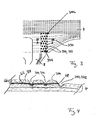
- the in the second joining region 314a, 314b, 316a, 316b ( FIG. 2 ) arranged joining means 340 are welds, preferably ultrasonic welding, which are not arranged over the entire surface within the second joining region.
- the joining means 340 are arranged point-shaped.
- the joining means 340 in the form of ultrasonic welding sites each form a joint (ie, a bonded region) 342, which is spaced from the next joint by an unbonded region 344.
- the respectively outermost joining means 340 or joints 342 are connected by means of an imaginary line 350.
- the joining pencils 340 arranged in the dot pattern form bonded areas (joints) in the total area covered by the second joining area 314b, which sum preferably at least 1.5%, in particular at least 2.0%, more particularly at least 2.3%, more particularly at least 2.5% and preferably at most 20.0%, in particular at most 15.0%, further in particular at most 10.0%, furthermore, in particular at most 8.0%, more particularly at most 7.0%, more particularly at most 6.0%, based on the total area covered by the second joining area.
- the individual joining means have a diameter preferably of at least 0.2 mm, in particular of at least 0.3 mm, more particularly of at least 0.4 mm and preferably of at most 2.5 mm, in particular at most 2.0 mm, more particularly at most 1 , 5 mm, more particularly at most 1.2 mm, in particular at most 1.0 mm.
- the adjacent individual joining means 340 present in the dot pattern have a spacing of preferably 1-10 mm, in particular 1-8 mm, more particularly 1-6 mm, more particularly 1-5 mm, further in particular 1.5. 4.5 mm, more particularly 2-4 mm.
- FIG. 4 shows a sectional view of the second joining region 314 a along the sectional plane IV-IV of FIG. 3 represents.
- the overhang 66b of the crotch portion 8 consisting of a non-woven topsheet material 84 and a film backsheet 62 is bonded to the underlying waist portion 4 by means of joints 342 created by the joining means 340.
- the first joining region 312 extends below the absorption body 7 with the width K, ie also extends beyond the contour, ie the respective longitudinal edge 46 of the absorption body 7, but not outside the contour of the crotch section 8, but ends within the longitudinal edges 48 of FIG Step section 8.
- the crotch section 8 is preferably connected to the back section 6 by means of a full-surface adhesive application.
- the cover sheet material is, as in the present example, a composite of a topsheet 64 and on both sides of the longitudinal edges 210 and the longitudinal edge regions 212 of the Topsheets 64 attached barrier means 68.
- the cover sheet material is by means of an adhesive 200, in particular a hot melt adhesive, overlapping on the absorption body and the side edge 46 of the absorbent body 7 also to an adjacent portion of the backsheet material 62nd
- a separate joining means is provided (in the FIG. 2 not shown). These separate joining agents are not in the form of an adhesive over the entire surface, but applied in the form of an interrupted pattern. These provided in the form of an adhesive separate joining means are thus applied, for example, grid-shaped, strip-shaped or spiral pattern.
- FIG. 10 schematically shows a not yet completed incontinence article 2 with an attached to the crotch section 8 waist section 4 and an advantageous embodiment of the arrangement of the first joining region 310 and the respective second joining regions 314a, 314b.
- the first joining region 310 extends in the transverse direction 16 with the width R advantageously beyond the longitudinal edges 46 of the absorbent body 7 with a width K, but without extending beyond the longitudinal edges 48 of the crotch section 8.
- the respective second joining region 314a, 314b with width P bridges in each case the longitudinal edge 48 of the crotch section 8.
- the joining region 314a, 314b in each case overhangs an adjoining subregion 324a, 324b of the overhang 66a, 66b with the width H, although with the width P '.
- the second joining region 314a, 314b also each traverses an adjacent subregion 328a, 328b of the belly section 4, with the width P ".
- the first joining region 310 extends in such a way in the transverse direction that an overlap with the respective second joining region 324a, 324b is obtained becomes.
Landscapes
- Health & Medical Sciences (AREA)
- Epidemiology (AREA)
- Engineering & Computer Science (AREA)
- Biomedical Technology (AREA)
- Heart & Thoracic Surgery (AREA)
- Vascular Medicine (AREA)
- Life Sciences & Earth Sciences (AREA)
- Animal Behavior & Ethology (AREA)
- General Health & Medical Sciences (AREA)
- Public Health (AREA)
- Veterinary Medicine (AREA)
- Absorbent Articles And Supports Therefor (AREA)
- Orthopedics, Nursing, And Contraception (AREA)
- Undergarments, Swaddling Clothes, Handkerchiefs Or Underwear Materials (AREA)
Priority Applications (8)
| Application Number | Priority Date | Filing Date | Title |
|---|---|---|---|
| EP09005461A EP2241296B1 (de) | 2009-04-17 | 2009-04-17 | Inkontinenzartikel in Höschenform |
| AT09005461T ATE536847T1 (de) | 2009-04-17 | 2009-04-17 | Inkontinenzartikel in höschenform |
| PL09005461T PL2241296T3 (pl) | 2009-04-17 | 2009-04-17 | Artykuł do inkontynencji w formie majtek |
| ES09005461T ES2379502T3 (es) | 2009-04-17 | 2009-04-17 | Artículo de incontinencia en forma de calzoncillo |
| JP2012505077A JP5597694B2 (ja) | 2009-04-17 | 2010-04-07 | パンツ型の失禁用品 |
| AU2010244768A AU2010244768B2 (en) | 2009-04-17 | 2010-04-07 | Incontinence article in the form of underpants |
| US13/138,832 US8905990B2 (en) | 2009-04-17 | 2010-04-07 | Incontinence article in pants form |
| PCT/EP2010/002166 WO2010127750A1 (de) | 2009-04-17 | 2010-04-07 | Inkontinenzartikel in höschenform |
Applications Claiming Priority (1)
| Application Number | Priority Date | Filing Date | Title |
|---|---|---|---|
| EP09005461A EP2241296B1 (de) | 2009-04-17 | 2009-04-17 | Inkontinenzartikel in Höschenform |
Publications (2)
| Publication Number | Publication Date |
|---|---|
| EP2241296A1 EP2241296A1 (de) | 2010-10-20 |
| EP2241296B1 true EP2241296B1 (de) | 2011-12-14 |
Family
ID=41059820
Family Applications (1)
| Application Number | Title | Priority Date | Filing Date |
|---|---|---|---|
| EP09005461A Active EP2241296B1 (de) | 2009-04-17 | 2009-04-17 | Inkontinenzartikel in Höschenform |
Country Status (8)
| Country | Link |
|---|---|
| US (1) | US8905990B2 (pl) |
| EP (1) | EP2241296B1 (pl) |
| JP (1) | JP5597694B2 (pl) |
| AT (1) | ATE536847T1 (pl) |
| AU (1) | AU2010244768B2 (pl) |
| ES (1) | ES2379502T3 (pl) |
| PL (1) | PL2241296T3 (pl) |
| WO (1) | WO2010127750A1 (pl) |
Families Citing this family (14)
| Publication number | Priority date | Publication date | Assignee | Title |
|---|---|---|---|---|
| DE102008046607A1 (de) * | 2008-09-10 | 2010-05-20 | Paul Hartmann Ag | Inkontinenzartikel in Höschenform |
| JP5674303B2 (ja) * | 2009-11-06 | 2015-02-25 | ユニ・チャーム株式会社 | 使い捨て着用物品 |
| JP5539798B2 (ja) * | 2010-07-01 | 2014-07-02 | ユニ・チャーム株式会社 | パンツ型の吸収性着用物品 |
| US10639212B2 (en) | 2010-08-20 | 2020-05-05 | The Procter & Gamble Company | Absorbent article and components thereof having improved softness signals, and methods for manufacturing |
| US20120179125A1 (en) * | 2010-08-20 | 2012-07-12 | Kevin Ronald Kanya | Absorbent Article and Components Thereof Having Improved Softness Signals, and Methods for Manufacturing |
| DE102012208392A1 (de) | 2012-05-18 | 2013-11-21 | Paul Hartmann Ag | Inkontinenzartikel in Höschenform |
| DE102012208395A1 (de) * | 2012-05-18 | 2013-11-21 | Paul Hartmann Ag | Inkontinenzartikel in Höschenform |
| JP6124613B2 (ja) | 2013-02-06 | 2017-05-10 | ユニ・チャーム株式会社 | パンツ型おむつ |
| FR3004900B1 (fr) * | 2013-04-29 | 2015-05-22 | Oreal | Dispositif d'application d'une composition cosmetique sur une surface corporelle, et procede de realisation associe |
| PL229009B1 (pl) * | 2013-05-10 | 2018-05-30 | Torunskie Zakl Materialow Opatrunkowych Spolka Akcyjna | Jednorazowy wyrób chłonny |
| US10231885B2 (en) | 2013-12-06 | 2019-03-19 | Glenna Rae Hovey | Protective undergarment |
| IT201600098504A1 (it) * | 2016-09-30 | 2018-03-30 | Fameccanica Data Spa | Articolo sanitario assorbente |
| EP3682858A1 (en) * | 2017-03-03 | 2020-07-22 | Ontex BVBA | Elasticised absorbent article |
| CN111419546B (zh) * | 2020-04-20 | 2022-03-29 | 广东茵茵股份有限公司 | 一种新型防漏裤式纸尿裤的制备方法 |
Family Cites Families (12)
| Publication number | Priority date | Publication date | Assignee | Title |
|---|---|---|---|---|
| JP3663762B2 (ja) * | 1996-08-12 | 2005-06-22 | 王子製紙株式会社 | 使いすておむつ |
| US6217563B1 (en) * | 1999-02-12 | 2001-04-17 | Kimberly-Clark Worldwide, Inc. | Three-dimensional, inward leg gather disposable garment |
| US20020128626A1 (en) * | 2000-12-21 | 2002-09-12 | S. Scott Friderich | Body fluid sealing extensible gaskets for personal care products |
| US20030028166A1 (en) | 2001-05-14 | 2003-02-06 | Price Cindy L. | Absorbent garment having a body conforming absorbent composite |
| JP3848559B2 (ja) * | 2001-10-24 | 2006-11-22 | ユニ・チャーム株式会社 | パンツ型の使い捨て着用物品 |
| US6755808B2 (en) | 2001-11-02 | 2004-06-29 | Kimberly-Clark Worldwide, Inc. | Absorbent garment having a body comforming absorbent composite |
| JP4392173B2 (ja) * | 2002-01-30 | 2009-12-24 | ユニ・チャーム株式会社 | パンツ型の使い捨て着用物品 |
| US7404813B2 (en) | 2002-12-11 | 2008-07-29 | Kimberly-Clark Worldwide, Inc. | Undergarment having crotch member with unattached end portion |
| KR101055068B1 (ko) | 2003-07-22 | 2011-08-05 | 킴벌리-클라크 월드와이드, 인크. | 불연속성을 갖는 일회용 속옷 및 그의 제조 방법 |
| US7250549B2 (en) * | 2003-12-30 | 2007-07-31 | Kimberly-Clark Worldwide, Inc. | Three-piece garment having an absorbent insert secured with variable adhesive regions |
| CA2614723A1 (en) * | 2005-07-14 | 2007-01-18 | Sca Hygiene Products Ab | Absorbent article |
| JP4926742B2 (ja) | 2007-02-09 | 2012-05-09 | 株式会社リブドゥコーポレーション | 吸収性物品 |
-
2009
- 2009-04-17 EP EP09005461A patent/EP2241296B1/de active Active
- 2009-04-17 PL PL09005461T patent/PL2241296T3/pl unknown
- 2009-04-17 AT AT09005461T patent/ATE536847T1/de active
- 2009-04-17 ES ES09005461T patent/ES2379502T3/es active Active
-
2010
- 2010-04-07 US US13/138,832 patent/US8905990B2/en active Active
- 2010-04-07 WO PCT/EP2010/002166 patent/WO2010127750A1/de not_active Ceased
- 2010-04-07 JP JP2012505077A patent/JP5597694B2/ja not_active Expired - Fee Related
- 2010-04-07 AU AU2010244768A patent/AU2010244768B2/en active Active
Also Published As
| Publication number | Publication date |
|---|---|
| US8905990B2 (en) | 2014-12-09 |
| JP2012523868A (ja) | 2012-10-11 |
| PL2241296T3 (pl) | 2012-05-31 |
| AU2010244768A1 (en) | 2011-09-01 |
| ES2379502T3 (es) | 2012-04-26 |
| AU2010244768B2 (en) | 2013-09-12 |
| US20120046632A1 (en) | 2012-02-23 |
| WO2010127750A1 (de) | 2010-11-11 |
| ATE536847T1 (de) | 2011-12-15 |
| EP2241296A1 (de) | 2010-10-20 |
| JP5597694B2 (ja) | 2014-10-01 |
Similar Documents
| Publication | Publication Date | Title |
|---|---|---|
| EP2241296B1 (de) | Inkontinenzartikel in Höschenform | |
| EP2180864B1 (de) | Inkontinenzartikel in höschenform | |
| EP2180863B1 (de) | Inkontinenzartikel in höschenform | |
| EP2211812B1 (de) | Inkontinenzartikel in höschenform | |
| EP2180862B1 (de) | Inkontinzenzartikel in höschenform | |
| EP2533741B1 (de) | Inkontinenzartikel in höschenform | |
| EP2323604B1 (de) | Inkontinenzartikel in höschenform | |
| EP2180865B1 (de) | Verfahren zum herstellen von inkontinenzartikeln in höschenform | |
| EP2629732B1 (de) | Inkontinenzartikel in höschenform | |
| DE60123322T2 (de) | Wegwerfunterwäsche | |
| EP2849695B1 (de) | Inkontinenzartikel in höschenform | |
| EP2849696B1 (de) | Inkontinenzartikel in höschenform | |
| EP2849694B1 (de) | Inkontinenzartikel in höschenform | |
| DE102007058832A1 (de) | Inkontinenzartikel in Höschenform |
Legal Events
| Date | Code | Title | Description |
|---|---|---|---|
| PUAI | Public reference made under article 153(3) epc to a published international application that has entered the european phase |
Free format text: ORIGINAL CODE: 0009012 |
|
| AK | Designated contracting states |
Kind code of ref document: A1 Designated state(s): AT BE BG CH CY CZ DE DK EE ES FI FR GB GR HR HU IE IS IT LI LT LU LV MC MK MT NL NO PL PT RO SE SI SK TR |
|
| AX | Request for extension of the european patent |
Extension state: AL BA RS |
|
| 17P | Request for examination filed |
Effective date: 20110318 |
|
| RIC1 | Information provided on ipc code assigned before grant |
Ipc: A61F 13/15 20060101AFI20110530BHEP |
|
| GRAP | Despatch of communication of intention to grant a patent |
Free format text: ORIGINAL CODE: EPIDOSNIGR1 |
|
| GRAS | Grant fee paid |
Free format text: ORIGINAL CODE: EPIDOSNIGR3 |
|
| GRAA | (expected) grant |
Free format text: ORIGINAL CODE: 0009210 |
|
| AK | Designated contracting states |
Kind code of ref document: B1 Designated state(s): AT BE BG CH CY CZ DE DK EE ES FI FR GB GR HR HU IE IS IT LI LT LU LV MC MK MT NL NO PL PT RO SE SI SK TR |
|
| REG | Reference to a national code |
Ref country code: GB Ref legal event code: FG4D Free format text: NOT ENGLISH |
|
| REG | Reference to a national code |
Ref country code: CH Ref legal event code: EP |
|
| REG | Reference to a national code |
Ref country code: IE Ref legal event code: FG4D |
|
| REG | Reference to a national code |
Ref country code: DE Ref legal event code: R096 Ref document number: 502009002144 Country of ref document: DE Effective date: 20120308 |
|
| REG | Reference to a national code |
Ref country code: NL Ref legal event code: VDEP Effective date: 20111214 |
|
| REG | Reference to a national code |
Ref country code: SE Ref legal event code: TRGR |
|
| REG | Reference to a national code |
Ref country code: ES Ref legal event code: FG2A Ref document number: 2379502 Country of ref document: ES Kind code of ref document: T3 Effective date: 20120426 |
|
| PG25 | Lapsed in a contracting state [announced via postgrant information from national office to epo] |
Ref country code: NO Free format text: LAPSE BECAUSE OF FAILURE TO SUBMIT A TRANSLATION OF THE DESCRIPTION OR TO PAY THE FEE WITHIN THE PRESCRIBED TIME-LIMIT Effective date: 20120314 Ref country code: LT Free format text: LAPSE BECAUSE OF FAILURE TO SUBMIT A TRANSLATION OF THE DESCRIPTION OR TO PAY THE FEE WITHIN THE PRESCRIBED TIME-LIMIT Effective date: 20111214 |
|
| LTIE | Lt: invalidation of european patent or patent extension |
Effective date: 20111214 |
|
| PG25 | Lapsed in a contracting state [announced via postgrant information from national office to epo] |
Ref country code: SI Free format text: LAPSE BECAUSE OF FAILURE TO SUBMIT A TRANSLATION OF THE DESCRIPTION OR TO PAY THE FEE WITHIN THE PRESCRIBED TIME-LIMIT Effective date: 20111214 Ref country code: LV Free format text: LAPSE BECAUSE OF FAILURE TO SUBMIT A TRANSLATION OF THE DESCRIPTION OR TO PAY THE FEE WITHIN THE PRESCRIBED TIME-LIMIT Effective date: 20111214 Ref country code: GR Free format text: LAPSE BECAUSE OF FAILURE TO SUBMIT A TRANSLATION OF THE DESCRIPTION OR TO PAY THE FEE WITHIN THE PRESCRIBED TIME-LIMIT Effective date: 20120315 Ref country code: HR Free format text: LAPSE BECAUSE OF FAILURE TO SUBMIT A TRANSLATION OF THE DESCRIPTION OR TO PAY THE FEE WITHIN THE PRESCRIBED TIME-LIMIT Effective date: 20111214 Ref country code: NL Free format text: LAPSE BECAUSE OF FAILURE TO SUBMIT A TRANSLATION OF THE DESCRIPTION OR TO PAY THE FEE WITHIN THE PRESCRIBED TIME-LIMIT Effective date: 20111214 |
|
| REG | Reference to a national code |
Ref country code: PL Ref legal event code: T3 |
|
| PG25 | Lapsed in a contracting state [announced via postgrant information from national office to epo] |
Ref country code: CY Free format text: LAPSE BECAUSE OF FAILURE TO SUBMIT A TRANSLATION OF THE DESCRIPTION OR TO PAY THE FEE WITHIN THE PRESCRIBED TIME-LIMIT Effective date: 20111214 |
|
| REG | Reference to a national code |
Ref country code: IE Ref legal event code: FD4D |
|
| PG25 | Lapsed in a contracting state [announced via postgrant information from national office to epo] |
Ref country code: IS Free format text: LAPSE BECAUSE OF FAILURE TO SUBMIT A TRANSLATION OF THE DESCRIPTION OR TO PAY THE FEE WITHIN THE PRESCRIBED TIME-LIMIT Effective date: 20120414 Ref country code: EE Free format text: LAPSE BECAUSE OF FAILURE TO SUBMIT A TRANSLATION OF THE DESCRIPTION OR TO PAY THE FEE WITHIN THE PRESCRIBED TIME-LIMIT Effective date: 20111214 Ref country code: SK Free format text: LAPSE BECAUSE OF FAILURE TO SUBMIT A TRANSLATION OF THE DESCRIPTION OR TO PAY THE FEE WITHIN THE PRESCRIBED TIME-LIMIT Effective date: 20111214 Ref country code: BG Free format text: LAPSE BECAUSE OF FAILURE TO SUBMIT A TRANSLATION OF THE DESCRIPTION OR TO PAY THE FEE WITHIN THE PRESCRIBED TIME-LIMIT Effective date: 20120314 Ref country code: CZ Free format text: LAPSE BECAUSE OF FAILURE TO SUBMIT A TRANSLATION OF THE DESCRIPTION OR TO PAY THE FEE WITHIN THE PRESCRIBED TIME-LIMIT Effective date: 20111214 Ref country code: IE Free format text: LAPSE BECAUSE OF FAILURE TO SUBMIT A TRANSLATION OF THE DESCRIPTION OR TO PAY THE FEE WITHIN THE PRESCRIBED TIME-LIMIT Effective date: 20111214 |
|
| PG25 | Lapsed in a contracting state [announced via postgrant information from national office to epo] |
Ref country code: PT Free format text: LAPSE BECAUSE OF FAILURE TO SUBMIT A TRANSLATION OF THE DESCRIPTION OR TO PAY THE FEE WITHIN THE PRESCRIBED TIME-LIMIT Effective date: 20120416 Ref country code: RO Free format text: LAPSE BECAUSE OF FAILURE TO SUBMIT A TRANSLATION OF THE DESCRIPTION OR TO PAY THE FEE WITHIN THE PRESCRIBED TIME-LIMIT Effective date: 20111214 |
|
| PLBE | No opposition filed within time limit |
Free format text: ORIGINAL CODE: 0009261 |
|
| STAA | Information on the status of an ep patent application or granted ep patent |
Free format text: STATUS: NO OPPOSITION FILED WITHIN TIME LIMIT |
|
| BERE | Be: lapsed |
Owner name: PAUL HARTMANN A.G. Effective date: 20120430 |
|
| PG25 | Lapsed in a contracting state [announced via postgrant information from national office to epo] |
Ref country code: DK Free format text: LAPSE BECAUSE OF FAILURE TO SUBMIT A TRANSLATION OF THE DESCRIPTION OR TO PAY THE FEE WITHIN THE PRESCRIBED TIME-LIMIT Effective date: 20111214 |
|
| 26N | No opposition filed |
Effective date: 20120917 |
|
| PG25 | Lapsed in a contracting state [announced via postgrant information from national office to epo] |
Ref country code: IT Free format text: LAPSE BECAUSE OF FAILURE TO SUBMIT A TRANSLATION OF THE DESCRIPTION OR TO PAY THE FEE WITHIN THE PRESCRIBED TIME-LIMIT Effective date: 20111214 Ref country code: MC Free format text: LAPSE BECAUSE OF NON-PAYMENT OF DUE FEES Effective date: 20120430 |
|
| REG | Reference to a national code |
Ref country code: DE Ref legal event code: R097 Ref document number: 502009002144 Country of ref document: DE Effective date: 20120917 |
|
| PG25 | Lapsed in a contracting state [announced via postgrant information from national office to epo] |
Ref country code: BE Free format text: LAPSE BECAUSE OF NON-PAYMENT OF DUE FEES Effective date: 20120430 |
|
| PG25 | Lapsed in a contracting state [announced via postgrant information from national office to epo] |
Ref country code: MK Free format text: LAPSE BECAUSE OF FAILURE TO SUBMIT A TRANSLATION OF THE DESCRIPTION OR TO PAY THE FEE WITHIN THE PRESCRIBED TIME-LIMIT Effective date: 20111214 |
|
| PG25 | Lapsed in a contracting state [announced via postgrant information from national office to epo] |
Ref country code: FI Free format text: LAPSE BECAUSE OF FAILURE TO SUBMIT A TRANSLATION OF THE DESCRIPTION OR TO PAY THE FEE WITHIN THE PRESCRIBED TIME-LIMIT Effective date: 20111214 |
|
| PG25 | Lapsed in a contracting state [announced via postgrant information from national office to epo] |
Ref country code: MT Free format text: LAPSE BECAUSE OF FAILURE TO SUBMIT A TRANSLATION OF THE DESCRIPTION OR TO PAY THE FEE WITHIN THE PRESCRIBED TIME-LIMIT Effective date: 20111214 |
|
| PG25 | Lapsed in a contracting state [announced via postgrant information from national office to epo] |
Ref country code: TR Free format text: LAPSE BECAUSE OF FAILURE TO SUBMIT A TRANSLATION OF THE DESCRIPTION OR TO PAY THE FEE WITHIN THE PRESCRIBED TIME-LIMIT Effective date: 20111214 |
|
| PG25 | Lapsed in a contracting state [announced via postgrant information from national office to epo] |
Ref country code: LU Free format text: LAPSE BECAUSE OF NON-PAYMENT OF DUE FEES Effective date: 20120417 |
|
| PG25 | Lapsed in a contracting state [announced via postgrant information from national office to epo] |
Ref country code: HU Free format text: LAPSE BECAUSE OF FAILURE TO SUBMIT A TRANSLATION OF THE DESCRIPTION OR TO PAY THE FEE WITHIN THE PRESCRIBED TIME-LIMIT Effective date: 20090417 |
|
| REG | Reference to a national code |
Ref country code: FR Ref legal event code: PLFP Year of fee payment: 8 |
|
| REG | Reference to a national code |
Ref country code: FR Ref legal event code: PLFP Year of fee payment: 9 |
|
| REG | Reference to a national code |
Ref country code: FR Ref legal event code: PLFP Year of fee payment: 10 |
|
| P01 | Opt-out of the competence of the unified patent court (upc) registered |
Effective date: 20230518 |
|
| PGFP | Annual fee paid to national office [announced via postgrant information from national office to epo] |
Ref country code: AT Payment date: 20230414 Year of fee payment: 15 |
|
| PGFP | Annual fee paid to national office [announced via postgrant information from national office to epo] |
Ref country code: GB Payment date: 20240423 Year of fee payment: 16 |
|
| PGFP | Annual fee paid to national office [announced via postgrant information from national office to epo] |
Ref country code: CH Payment date: 20240501 Year of fee payment: 16 |
|
| PGFP | Annual fee paid to national office [announced via postgrant information from national office to epo] |
Ref country code: ES Payment date: 20240517 Year of fee payment: 16 |
|
| PGFP | Annual fee paid to national office [announced via postgrant information from national office to epo] |
Ref country code: SE Payment date: 20240423 Year of fee payment: 16 |
|
| REG | Reference to a national code |
Ref country code: AT Ref legal event code: MM01 Ref document number: 536847 Country of ref document: AT Kind code of ref document: T Effective date: 20240417 |
|
| PG25 | Lapsed in a contracting state [announced via postgrant information from national office to epo] |
Ref country code: AT Free format text: LAPSE BECAUSE OF NON-PAYMENT OF DUE FEES Effective date: 20240417 |
|
| PG25 | Lapsed in a contracting state [announced via postgrant information from national office to epo] |
Ref country code: AT Free format text: LAPSE BECAUSE OF NON-PAYMENT OF DUE FEES Effective date: 20240417 |
|
| PGFP | Annual fee paid to national office [announced via postgrant information from national office to epo] |
Ref country code: PL Payment date: 20250404 Year of fee payment: 17 Ref country code: DE Payment date: 20250417 Year of fee payment: 17 |
|
| PGFP | Annual fee paid to national office [announced via postgrant information from national office to epo] |
Ref country code: FR Payment date: 20250422 Year of fee payment: 17 |
|
| REG | Reference to a national code |
Ref country code: CH Ref legal event code: H13 Free format text: ST27 STATUS EVENT CODE: U-0-0-H10-H13 (AS PROVIDED BY THE NATIONAL OFFICE) Effective date: 20251125 |
|
| REG | Reference to a national code |
Ref country code: SE Ref legal event code: EUG |
|
| GBPC | Gb: european patent ceased through non-payment of renewal fee |
Effective date: 20250417 |
|
| PG25 | Lapsed in a contracting state [announced via postgrant information from national office to epo] |
Ref country code: GB Free format text: LAPSE BECAUSE OF NON-PAYMENT OF DUE FEES Effective date: 20250417 |
|
| PG25 | Lapsed in a contracting state [announced via postgrant information from national office to epo] |
Ref country code: CH Free format text: LAPSE BECAUSE OF NON-PAYMENT OF DUE FEES Effective date: 20250430 |
|
| PG25 | Lapsed in a contracting state [announced via postgrant information from national office to epo] |
Ref country code: SE Free format text: LAPSE BECAUSE OF NON-PAYMENT OF DUE FEES Effective date: 20250418 |