EP2240179B1 - Imidazopyridazine als par1-inhibitoren, ihre herstellung und verwendung als arzneimittel - Google Patents
Imidazopyridazine als par1-inhibitoren, ihre herstellung und verwendung als arzneimittel Download PDFInfo
- Publication number
- EP2240179B1 EP2240179B1 EP09707983.4A EP09707983A EP2240179B1 EP 2240179 B1 EP2240179 B1 EP 2240179B1 EP 09707983 A EP09707983 A EP 09707983A EP 2240179 B1 EP2240179 B1 EP 2240179B1
- Authority
- EP
- European Patent Office
- Prior art keywords
- alkyl
- formula
- compound
- alkylene
- cycloalkyl
- Prior art date
- Legal status (The legal status is an assumption and is not a legal conclusion. Google has not performed a legal analysis and makes no representation as to the accuracy of the status listed.)
- Active
Links
- 239000003814 drug Substances 0.000 title claims description 6
- 238000004519 manufacturing process Methods 0.000 title claims 2
- 239000003112 inhibitor Substances 0.000 title description 2
- MJQSRSOTRPMVKB-UHFFFAOYSA-N 5h-imidazo[4,5-c]pyridazine Chemical compound C1=NNC2=NC=NC2=C1 MJQSRSOTRPMVKB-UHFFFAOYSA-N 0.000 title 1
- 101100361282 Schizosaccharomyces pombe (strain 972 / ATCC 24843) rpm1 gene Proteins 0.000 title 1
- 150000001875 compounds Chemical class 0.000 claims description 130
- -1 pyrrolidine-2.5-dionyl Chemical group 0.000 claims description 80
- 125000004169 (C1-C6) alkyl group Chemical group 0.000 claims description 44
- 125000004435 hydrogen atom Chemical group [H]* 0.000 claims description 35
- 238000000034 method Methods 0.000 claims description 31
- 125000000217 alkyl group Chemical group 0.000 claims description 29
- 150000003839 salts Chemical class 0.000 claims description 29
- PXGOKWXKJXAPGV-UHFFFAOYSA-N Fluorine Chemical compound FF PXGOKWXKJXAPGV-UHFFFAOYSA-N 0.000 claims description 22
- 239000000203 mixture Substances 0.000 claims description 21
- 125000000753 cycloalkyl group Chemical group 0.000 claims description 20
- 239000002904 solvent Substances 0.000 claims description 19
- 125000004178 (C1-C4) alkyl group Chemical group 0.000 claims description 17
- 208000007536 Thrombosis Diseases 0.000 claims description 17
- 229910052731 fluorine Inorganic materials 0.000 claims description 17
- 230000015572 biosynthetic process Effects 0.000 claims description 16
- 239000011737 fluorine Substances 0.000 claims description 16
- CPELXLSAUQHCOX-UHFFFAOYSA-M Bromide Chemical group [Br-] CPELXLSAUQHCOX-UHFFFAOYSA-M 0.000 claims description 13
- MALIONKMKPITBV-UHFFFAOYSA-N 2-(3-chloro-4-hydroxyphenyl)-n-[2-(4-sulfamoylphenyl)ethyl]acetamide Chemical compound C1=CC(S(=O)(=O)N)=CC=C1CCNC(=O)CC1=CC=C(O)C(Cl)=C1 MALIONKMKPITBV-UHFFFAOYSA-N 0.000 claims description 12
- VOPWNXZWBYDODV-UHFFFAOYSA-N Chlorodifluoromethane Chemical compound FC(F)Cl VOPWNXZWBYDODV-UHFFFAOYSA-N 0.000 claims description 11
- AFVFQIVMOAPDHO-UHFFFAOYSA-N Methanesulfonic acid Chemical group CS(O)(=O)=O AFVFQIVMOAPDHO-UHFFFAOYSA-N 0.000 claims description 11
- 125000002947 alkylene group Chemical group 0.000 claims description 11
- 102000009123 Fibrin Human genes 0.000 claims description 10
- 108010073385 Fibrin Proteins 0.000 claims description 10
- BWGVNKXGVNDBDI-UHFFFAOYSA-N Fibrin monomer Chemical compound CNC(=O)CNC(=O)CN BWGVNKXGVNDBDI-UHFFFAOYSA-N 0.000 claims description 10
- 239000002253 acid Substances 0.000 claims description 10
- 229950003499 fibrin Drugs 0.000 claims description 10
- JOXIMZWYDAKGHI-UHFFFAOYSA-N toluene-4-sulfonic acid Chemical group CC1=CC=C(S(O)(=O)=O)C=C1 JOXIMZWYDAKGHI-UHFFFAOYSA-N 0.000 claims description 10
- 238000004587 chromatography analysis Methods 0.000 claims description 9
- HBAQYPYDRFILMT-UHFFFAOYSA-N 8-[3-(1-cyclopropylpyrazol-4-yl)-1H-pyrazolo[4,3-d]pyrimidin-5-yl]-3-methyl-3,8-diazabicyclo[3.2.1]octan-2-one Chemical class C1(CC1)N1N=CC(=C1)C1=NNC2=C1N=C(N=C2)N1C2C(N(CC1CC2)C)=O HBAQYPYDRFILMT-UHFFFAOYSA-N 0.000 claims description 8
- VEXZGXHMUGYJMC-UHFFFAOYSA-M Chloride anion Chemical compound [Cl-] VEXZGXHMUGYJMC-UHFFFAOYSA-M 0.000 claims description 8
- 150000001413 amino acids Chemical class 0.000 claims description 8
- 208000037265 diseases, disorders, signs and symptoms Diseases 0.000 claims description 8
- 238000000926 separation method Methods 0.000 claims description 8
- 239000000126 substance Substances 0.000 claims description 8
- 150000007513 acids Chemical class 0.000 claims description 7
- 238000011282 treatment Methods 0.000 claims description 7
- LHNDOUCLIQXEDU-UHFFFAOYSA-N 2-(2,3-diethoxy-7-iminoimidazo[1,5-b]pyridazin-6-yl)-1-[3-(methylamino)-5-(pentafluoro-$l^{6}-sulfanyl)phenyl]ethanone Chemical compound N=C1N2N=C(OCC)C(OCC)=CC2=CN1CC(=O)C1=CC(NC)=CC(S(F)(F)(F)(F)F)=C1 LHNDOUCLIQXEDU-UHFFFAOYSA-N 0.000 claims description 6
- 230000005526 G1 to G0 transition Effects 0.000 claims description 6
- 239000012190 activator Substances 0.000 claims description 6
- 210000004369 blood Anatomy 0.000 claims description 6
- 239000008280 blood Substances 0.000 claims description 6
- 229910052736 halogen Inorganic materials 0.000 claims description 6
- 150000002367 halogens Chemical class 0.000 claims description 6
- 125000002757 morpholinyl group Chemical group 0.000 claims description 6
- 125000003386 piperidinyl group Chemical group 0.000 claims description 6
- 125000000719 pyrrolidinyl group Chemical group 0.000 claims description 6
- 229910052717 sulfur Inorganic materials 0.000 claims description 6
- 125000004568 thiomorpholinyl group Chemical group 0.000 claims description 6
- 208000005189 Embolism Diseases 0.000 claims description 5
- NINIDFKCEFEMDL-UHFFFAOYSA-N Sulfur Chemical compound [S] NINIDFKCEFEMDL-UHFFFAOYSA-N 0.000 claims description 5
- 230000002378 acidificating effect Effects 0.000 claims description 5
- 239000004480 active ingredient Substances 0.000 claims description 5
- 230000003176 fibrotic effect Effects 0.000 claims description 5
- 239000000546 pharmaceutical excipient Substances 0.000 claims description 5
- 125000004193 piperazinyl group Chemical group 0.000 claims description 5
- 239000011593 sulfur Substances 0.000 claims description 5
- JANKFDRKRYYICE-UHFFFAOYSA-N 1-(3-tert-butyl-4-methoxy-5-morpholin-4-ylphenyl)-2-(7-imino-2,3-dimethoxyimidazo[1,5-b]pyridazin-6-yl)ethanone Chemical compound N=C1N2N=C(OC)C(OC)=CC2=CN1CC(=O)C(C=C(C=1OC)C(C)(C)C)=CC=1N1CCOCC1 JANKFDRKRYYICE-UHFFFAOYSA-N 0.000 claims description 4
- 150000001805 chlorine compounds Chemical group 0.000 claims description 4
- 238000001212 derivatisation Methods 0.000 claims description 4
- 208000035475 disorder Diseases 0.000 claims description 4
- 208000027866 inflammatory disease Diseases 0.000 claims description 4
- 229910052740 iodine Inorganic materials 0.000 claims description 4
- 238000001356 surgical procedure Methods 0.000 claims description 4
- HNNVXGHTNPLCJB-UHFFFAOYSA-N 1-(3-tert-butyl-4-methoxy-5-morpholin-4-ylphenyl)-2-(2,3-diethoxy-7-iminoimidazo[1,5-b]pyridazin-6-yl)ethanone Chemical compound N=C1N2N=C(OCC)C(OCC)=CC2=CN1CC(=O)C(C=C(C=1OC)C(C)(C)C)=CC=1N1CCOCC1 HNNVXGHTNPLCJB-UHFFFAOYSA-N 0.000 claims description 3
- 206010001052 Acute respiratory distress syndrome Diseases 0.000 claims description 3
- 206010051055 Deep vein thrombosis Diseases 0.000 claims description 3
- 208000010378 Pulmonary Embolism Diseases 0.000 claims description 3
- 208000013616 Respiratory Distress Syndrome Diseases 0.000 claims description 3
- 206010047249 Venous thrombosis Diseases 0.000 claims description 3
- 239000000654 additive Substances 0.000 claims description 3
- 230000000996 additive effect Effects 0.000 claims description 3
- 208000011341 adult acute respiratory distress syndrome Diseases 0.000 claims description 3
- 201000000028 adult respiratory distress syndrome Diseases 0.000 claims description 3
- 208000010125 myocardial infarction Diseases 0.000 claims description 3
- 201000008482 osteoarthritis Diseases 0.000 claims description 3
- 239000002243 precursor Substances 0.000 claims description 3
- 238000011321 prophylaxis Methods 0.000 claims description 3
- 230000009863 secondary prevention Effects 0.000 claims description 3
- 201000005665 thrombophilia Diseases 0.000 claims description 3
- 229910052721 tungsten Inorganic materials 0.000 claims description 3
- 208000004476 Acute Coronary Syndrome Diseases 0.000 claims description 2
- 206010002383 Angina Pectoris Diseases 0.000 claims description 2
- 201000001320 Atherosclerosis Diseases 0.000 claims description 2
- 208000006545 Chronic Obstructive Pulmonary Disease Diseases 0.000 claims description 2
- 206010061218 Inflammation Diseases 0.000 claims description 2
- 208000001145 Metabolic Syndrome Diseases 0.000 claims description 2
- 206010027476 Metastases Diseases 0.000 claims description 2
- 206010028980 Neoplasm Diseases 0.000 claims description 2
- 208000018262 Peripheral vascular disease Diseases 0.000 claims description 2
- 206010040047 Sepsis Diseases 0.000 claims description 2
- 208000006011 Stroke Diseases 0.000 claims description 2
- 201000000690 abdominal obesity-metabolic syndrome Diseases 0.000 claims description 2
- 238000002399 angioplasty Methods 0.000 claims description 2
- 206010003119 arrhythmia Diseases 0.000 claims description 2
- 230000007211 cardiovascular event Effects 0.000 claims description 2
- 206010012601 diabetes mellitus Diseases 0.000 claims description 2
- 238000000502 dialysis Methods 0.000 claims description 2
- 208000009190 disseminated intravascular coagulation Diseases 0.000 claims description 2
- 230000003073 embolic effect Effects 0.000 claims description 2
- 230000002439 hemostatic effect Effects 0.000 claims description 2
- 210000004394 hip joint Anatomy 0.000 claims description 2
- 125000002883 imidazolyl group Chemical group 0.000 claims description 2
- 238000002513 implantation Methods 0.000 claims description 2
- 230000002757 inflammatory effect Effects 0.000 claims description 2
- 230000004054 inflammatory process Effects 0.000 claims description 2
- 210000000629 knee joint Anatomy 0.000 claims description 2
- 210000004072 lung Anatomy 0.000 claims description 2
- 230000009401 metastasis Effects 0.000 claims description 2
- JZMJDSHXVKJFKW-UHFFFAOYSA-M methyl sulfate(1-) Chemical group COS([O-])(=O)=O JZMJDSHXVKJFKW-UHFFFAOYSA-M 0.000 claims description 2
- ZSWNWUJOQIWYPS-UHFFFAOYSA-N n-[3-[2-(2,3-diethoxy-7-iminoimidazo[1,5-b]pyridazin-6-yl)acetyl]-5-(pentafluoro-$l^{6}-sulfanyl)phenyl]acetamide Chemical compound N=C1N2N=C(OCC)C(OCC)=CC2=CN1CC(=O)C1=CC(NC(C)=O)=CC(S(F)(F)(F)(F)F)=C1 ZSWNWUJOQIWYPS-UHFFFAOYSA-N 0.000 claims description 2
- 230000002265 prevention Effects 0.000 claims description 2
- 230000009467 reduction Effects 0.000 claims description 2
- 208000037803 restenosis Diseases 0.000 claims description 2
- 230000000250 revascularization Effects 0.000 claims description 2
- 206010039073 rheumatoid arthritis Diseases 0.000 claims description 2
- 230000037390 scarring Effects 0.000 claims description 2
- 230000004614 tumor growth Effects 0.000 claims description 2
- IKHGUXGNUITLKF-UHFFFAOYSA-N Acetaldehyde Chemical compound CC=O IKHGUXGNUITLKF-UHFFFAOYSA-N 0.000 claims 1
- 230000006735 deficit Effects 0.000 claims 1
- 230000003412 degenerative effect Effects 0.000 claims 1
- 230000008030 elimination Effects 0.000 claims 1
- 238000003379 elimination reaction Methods 0.000 claims 1
- 125000004942 pyridazin-6-yl group Chemical group N1=NC=CC=C1* 0.000 claims 1
- YMWUJEATGCHHMB-UHFFFAOYSA-N Dichloromethane Chemical compound ClCCl YMWUJEATGCHHMB-UHFFFAOYSA-N 0.000 description 73
- WEVYAHXRMPXWCK-UHFFFAOYSA-N Acetonitrile Chemical compound CC#N WEVYAHXRMPXWCK-UHFFFAOYSA-N 0.000 description 42
- OKKJLVBELUTLKV-UHFFFAOYSA-N Methanol Chemical compound OC OKKJLVBELUTLKV-UHFFFAOYSA-N 0.000 description 42
- XEKOWRVHYACXOJ-UHFFFAOYSA-N Ethyl acetate Chemical compound CCOC(C)=O XEKOWRVHYACXOJ-UHFFFAOYSA-N 0.000 description 33
- 238000003756 stirring Methods 0.000 description 32
- LFQSCWFLJHTTHZ-UHFFFAOYSA-N Ethanol Chemical compound CCO LFQSCWFLJHTTHZ-UHFFFAOYSA-N 0.000 description 31
- DTQVDTLACAAQTR-UHFFFAOYSA-N Trifluoroacetic acid Chemical class OC(=O)C(F)(F)F DTQVDTLACAAQTR-UHFFFAOYSA-N 0.000 description 28
- 238000004895 liquid chromatography mass spectrometry Methods 0.000 description 28
- XLYOFNOQVPJJNP-UHFFFAOYSA-N water Substances O XLYOFNOQVPJJNP-UHFFFAOYSA-N 0.000 description 27
- CSNNHWWHGAXBCP-UHFFFAOYSA-L Magnesium sulfate Chemical compound [Mg+2].[O-][S+2]([O-])([O-])[O-] CSNNHWWHGAXBCP-UHFFFAOYSA-L 0.000 description 26
- 239000012071 phase Substances 0.000 description 25
- 239000000047 product Substances 0.000 description 22
- 239000000243 solution Substances 0.000 description 19
- 239000002585 base Substances 0.000 description 18
- WYURNTSHIVDZCO-UHFFFAOYSA-N Tetrahydrofuran Chemical compound C1CCOC1 WYURNTSHIVDZCO-UHFFFAOYSA-N 0.000 description 16
- ZMXDDKWLCZADIW-UHFFFAOYSA-N N,N-Dimethylformamide Chemical compound CN(C)C=O ZMXDDKWLCZADIW-UHFFFAOYSA-N 0.000 description 15
- ZMANZCXQSJIPKH-UHFFFAOYSA-N Triethylamine Chemical compound CCN(CC)CC ZMANZCXQSJIPKH-UHFFFAOYSA-N 0.000 description 15
- 229910052739 hydrogen Inorganic materials 0.000 description 15
- 239000001257 hydrogen Substances 0.000 description 15
- 229910052943 magnesium sulfate Inorganic materials 0.000 description 13
- 235000019341 magnesium sulphate Nutrition 0.000 description 13
- 230000008569 process Effects 0.000 description 13
- 108010070519 PAR-1 Receptor Proteins 0.000 description 12
- 102100037136 Proteinase-activated receptor 1 Human genes 0.000 description 12
- 238000002953 preparative HPLC Methods 0.000 description 12
- VEXZGXHMUGYJMC-UHFFFAOYSA-N Hydrochloric acid Chemical compound Cl VEXZGXHMUGYJMC-UHFFFAOYSA-N 0.000 description 11
- 239000012074 organic phase Substances 0.000 description 11
- 150000003254 radicals Chemical class 0.000 description 11
- QAOWNCQODCNURD-UHFFFAOYSA-N Sulfuric acid Chemical compound OS(O)(=O)=O QAOWNCQODCNURD-UHFFFAOYSA-N 0.000 description 10
- 238000001816 cooling Methods 0.000 description 10
- RTZKZFJDLAIYFH-UHFFFAOYSA-N Diethyl ether Chemical compound CCOCC RTZKZFJDLAIYFH-UHFFFAOYSA-N 0.000 description 9
- UFHFLCQGNIYNRP-UHFFFAOYSA-N Hydrogen Chemical compound [H][H] UFHFLCQGNIYNRP-UHFFFAOYSA-N 0.000 description 9
- VYPSYNLAJGMNEJ-UHFFFAOYSA-N Silicium dioxide Chemical class O=[Si]=O VYPSYNLAJGMNEJ-UHFFFAOYSA-N 0.000 description 9
- 230000004913 activation Effects 0.000 description 9
- 239000012043 crude product Substances 0.000 description 9
- ATDGTVJJHBUTRL-UHFFFAOYSA-N cyanogen bromide Chemical compound BrC#N ATDGTVJJHBUTRL-UHFFFAOYSA-N 0.000 description 9
- 239000003480 eluent Substances 0.000 description 9
- 238000002360 preparation method Methods 0.000 description 9
- UIIMBOGNXHQVGW-UHFFFAOYSA-M Sodium bicarbonate Chemical compound [Na+].OC([O-])=O UIIMBOGNXHQVGW-UHFFFAOYSA-M 0.000 description 8
- 239000008346 aqueous phase Substances 0.000 description 8
- 238000006243 chemical reaction Methods 0.000 description 8
- 125000006239 protecting group Chemical group 0.000 description 8
- 239000000741 silica gel Substances 0.000 description 8
- 229910002027 silica gel Inorganic materials 0.000 description 8
- YLQBMQCUIZJEEH-UHFFFAOYSA-N tetrahydrofuran Natural products C=1C=COC=1 YLQBMQCUIZJEEH-UHFFFAOYSA-N 0.000 description 8
- 235000001014 amino acid Nutrition 0.000 description 7
- BWHMMNNQKKPAPP-UHFFFAOYSA-L potassium carbonate Chemical compound [K+].[K+].[O-]C([O-])=O BWHMMNNQKKPAPP-UHFFFAOYSA-L 0.000 description 7
- IJGRMHOSHXDMSA-UHFFFAOYSA-N Atomic nitrogen Chemical compound N#N IJGRMHOSHXDMSA-UHFFFAOYSA-N 0.000 description 6
- IAZDPXIOMUYVGZ-UHFFFAOYSA-N Dimethylsulphoxide Chemical compound CS(C)=O IAZDPXIOMUYVGZ-UHFFFAOYSA-N 0.000 description 6
- PEDCQBHIVMGVHV-UHFFFAOYSA-N Glycerine Chemical compound OCC(O)CO PEDCQBHIVMGVHV-UHFFFAOYSA-N 0.000 description 6
- PMZURENOXWZQFD-UHFFFAOYSA-L Sodium Sulfate Chemical compound [Na+].[Na+].[O-]S([O-])(=O)=O PMZURENOXWZQFD-UHFFFAOYSA-L 0.000 description 6
- YXFVVABEGXRONW-UHFFFAOYSA-N Toluene Chemical compound CC1=CC=CC=C1 YXFVVABEGXRONW-UHFFFAOYSA-N 0.000 description 6
- 230000006870 function Effects 0.000 description 6
- 230000005764 inhibitory process Effects 0.000 description 6
- 238000000746 purification Methods 0.000 description 6
- 229910052938 sodium sulfate Inorganic materials 0.000 description 6
- 235000011152 sodium sulphate Nutrition 0.000 description 6
- 238000003786 synthesis reaction Methods 0.000 description 6
- QAEDZJGFFMLHHQ-UHFFFAOYSA-N trifluoroacetic anhydride Chemical compound FC(F)(F)C(=O)OC(=O)C(F)(F)F QAEDZJGFFMLHHQ-UHFFFAOYSA-N 0.000 description 6
- 102100035792 Kininogen-1 Human genes 0.000 description 5
- 108090000190 Thrombin Proteins 0.000 description 5
- 150000001412 amines Chemical class 0.000 description 5
- JVTAAEKCZFNVCJ-UHFFFAOYSA-N lactic acid Chemical compound CC(O)C(O)=O JVTAAEKCZFNVCJ-UHFFFAOYSA-N 0.000 description 5
- 210000004623 platelet-rich plasma Anatomy 0.000 description 5
- 125000002924 primary amino group Chemical group [H]N([H])* 0.000 description 5
- 239000011541 reaction mixture Substances 0.000 description 5
- 102000005962 receptors Human genes 0.000 description 5
- 108020003175 receptors Proteins 0.000 description 5
- 208000010110 spontaneous platelet aggregation Diseases 0.000 description 5
- 229960004072 thrombin Drugs 0.000 description 5
- PRXNKYBFWAWBNZ-UHFFFAOYSA-N trimethylphenylammonium tribromide Chemical compound Br[Br-]Br.C[N+](C)(C)C1=CC=CC=C1 PRXNKYBFWAWBNZ-UHFFFAOYSA-N 0.000 description 5
- NHOUZLDRSXONNF-UHFFFAOYSA-N 3-nitro-5-(pentafluoro-$l^{6}-sulfanyl)benzoic acid Chemical compound OC(=O)C1=CC([N+]([O-])=O)=CC(S(F)(F)(F)(F)F)=C1 NHOUZLDRSXONNF-UHFFFAOYSA-N 0.000 description 4
- QGZKDVFQNNGYKY-UHFFFAOYSA-N Ammonia Chemical compound N QGZKDVFQNNGYKY-UHFFFAOYSA-N 0.000 description 4
- ZAMOUSCENKQFHK-UHFFFAOYSA-N Chlorine atom Chemical compound [Cl] ZAMOUSCENKQFHK-UHFFFAOYSA-N 0.000 description 4
- HEDRZPFGACZZDS-UHFFFAOYSA-N Chloroform Chemical compound ClC(Cl)Cl HEDRZPFGACZZDS-UHFFFAOYSA-N 0.000 description 4
- 108010054218 Factor VIII Proteins 0.000 description 4
- 102000001690 Factor VIII Human genes 0.000 description 4
- IMNFDUFMRHMDMM-UHFFFAOYSA-N N-Heptane Chemical compound CCCCCCC IMNFDUFMRHMDMM-UHFFFAOYSA-N 0.000 description 4
- PCLIMKBDDGJMGD-UHFFFAOYSA-N N-bromosuccinimide Chemical compound BrN1C(=O)CCC1=O PCLIMKBDDGJMGD-UHFFFAOYSA-N 0.000 description 4
- KDLHZDBZIXYQEI-UHFFFAOYSA-N Palladium Chemical compound [Pd] KDLHZDBZIXYQEI-UHFFFAOYSA-N 0.000 description 4
- 102000003790 Thrombin receptors Human genes 0.000 description 4
- 230000023555 blood coagulation Effects 0.000 description 4
- 125000004432 carbon atom Chemical group C* 0.000 description 4
- 239000000460 chlorine Substances 0.000 description 4
- 229910052801 chlorine Inorganic materials 0.000 description 4
- 201000010099 disease Diseases 0.000 description 4
- 230000007717 exclusion Effects 0.000 description 4
- 239000000284 extract Substances 0.000 description 4
- 229960000301 factor viii Drugs 0.000 description 4
- 150000002431 hydrogen Chemical group 0.000 description 4
- 150000002500 ions Chemical class 0.000 description 4
- CSPHSPKSLUCQJU-UHFFFAOYSA-N n-[3-acetyl-5-(pentafluoro-$l^{6}-sulfanyl)phenyl]-2,2,2-trifluoroacetamide Chemical compound CC(=O)C1=CC(NC(=O)C(F)(F)F)=CC(S(F)(F)(F)(F)F)=C1 CSPHSPKSLUCQJU-UHFFFAOYSA-N 0.000 description 4
- 229910052757 nitrogen Inorganic materials 0.000 description 4
- 101150093826 par1 gene Proteins 0.000 description 4
- 230000002829 reductive effect Effects 0.000 description 4
- 239000007787 solid Substances 0.000 description 4
- FYSNRJHAOHDILO-UHFFFAOYSA-N thionyl chloride Chemical compound ClS(Cl)=O FYSNRJHAOHDILO-UHFFFAOYSA-N 0.000 description 4
- FHZSIZRTNHGLSX-FLMSMKGQSA-N (2s)-1-[(2s)-4-amino-2-[[(2s)-2-[[(2s)-2-[[(2s)-2-[[(2s)-2-[[(2s)-2-amino-3-hydroxypropanoyl]amino]-3-phenylpropanoyl]amino]-4-methylpentanoyl]amino]-4-methylpentanoyl]amino]-5-(diaminomethylideneamino)pentanoyl]amino]-4-oxobutanoyl]pyrrolidine-2-carboxyl Chemical compound C([C@@H](C(=O)N[C@@H](CC(C)C)C(=O)N[C@@H](CC(C)C)C(=O)N[C@@H](CCCN=C(N)N)C(=O)N[C@@H](CC(N)=O)C(=O)N1[C@@H](CCC1)C(O)=O)NC(=O)[C@@H](N)CO)C1=CC=CC=C1 FHZSIZRTNHGLSX-FLMSMKGQSA-N 0.000 description 3
- LYOUBZSZXRHCJJ-UHFFFAOYSA-N 1-(3-tert-butyl-4-methoxy-5-morpholin-4-ylphenyl)-2-[7-imino-2-methoxy-3-(2,2,2-trifluoroethoxy)imidazo[1,5-b]pyridazin-6-yl]ethanone Chemical compound C1=C(OCC(F)(F)F)C(OC)=NN(C2=N)C1=CN2CC(=O)C(C=C(C=1OC)C(C)(C)C)=CC=1N1CCOCC1 LYOUBZSZXRHCJJ-UHFFFAOYSA-N 0.000 description 3
- VOMTUNANAIUNBF-UHFFFAOYSA-N 2,3-diethoxyimidazo[1,5-b]pyridazin-7-amine;2,2,2-trifluoroacetic acid Chemical compound OC(=O)C(F)(F)F.N1=C(OCC)C(OCC)=CC2=CN=C(N)N21 VOMTUNANAIUNBF-UHFFFAOYSA-N 0.000 description 3
- KEAGPNJPLQQIJH-UHFFFAOYSA-N 2-bromo-1-(3-tert-butyl-4-methoxy-5-morpholin-4-ylphenyl)ethanone Chemical compound C1=C(C(=O)CBr)C=C(C(C)(C)C)C(OC)=C1N1CCOCC1 KEAGPNJPLQQIJH-UHFFFAOYSA-N 0.000 description 3
- COYKIXXZKQATBJ-UHFFFAOYSA-N 3-amino-n-methoxy-n-methyl-5-(pentafluoro-$l^{6}-sulfanyl)benzamide Chemical compound CON(C)C(=O)C1=CC(N)=CC(S(F)(F)(F)(F)F)=C1 COYKIXXZKQATBJ-UHFFFAOYSA-N 0.000 description 3
- QSZDOGLESFAOQS-UHFFFAOYSA-N 3-methoxy-6-methyl-4-nitro-1-oxidopyridazin-1-ium Chemical compound COC1=N[N+]([O-])=C(C)C=C1[N+]([O-])=O QSZDOGLESFAOQS-UHFFFAOYSA-N 0.000 description 3
- QTBSBXVTEAMEQO-UHFFFAOYSA-N Acetic acid Chemical compound CC(O)=O QTBSBXVTEAMEQO-UHFFFAOYSA-N 0.000 description 3
- WFDIJRYMOXRFFG-UHFFFAOYSA-N Acetic anhydride Chemical compound CC(=O)OC(C)=O WFDIJRYMOXRFFG-UHFFFAOYSA-N 0.000 description 3
- WKBOTKDWSSQWDR-UHFFFAOYSA-N Bromine atom Chemical compound [Br] WKBOTKDWSSQWDR-UHFFFAOYSA-N 0.000 description 3
- OKTJSMMVPCPJKN-UHFFFAOYSA-N Carbon Chemical group [C] OKTJSMMVPCPJKN-UHFFFAOYSA-N 0.000 description 3
- 108010080865 Factor XII Proteins 0.000 description 3
- ZWZWYGMENQVNFU-UHFFFAOYSA-N Glycerophosphorylserin Natural products OC(=O)C(N)COP(O)(=O)OCC(O)CO ZWZWYGMENQVNFU-UHFFFAOYSA-N 0.000 description 3
- 108010000487 High-Molecular-Weight Kininogen Proteins 0.000 description 3
- 241000282414 Homo sapiens Species 0.000 description 3
- KDXKERNSBIXSRK-YFKPBYRVSA-N L-lysine Chemical compound NCCCC[C@H](N)C(O)=O KDXKERNSBIXSRK-YFKPBYRVSA-N 0.000 description 3
- JRNVZBWKYDBUCA-UHFFFAOYSA-N N-chlorosuccinimide Chemical compound ClN1C(=O)CCC1=O JRNVZBWKYDBUCA-UHFFFAOYSA-N 0.000 description 3
- 108091005804 Peptidases Proteins 0.000 description 3
- 239000004365 Protease Substances 0.000 description 3
- 102100037486 Reverse transcriptase/ribonuclease H Human genes 0.000 description 3
- HEMHJVSKTPXQMS-UHFFFAOYSA-M Sodium hydroxide Chemical compound [OH-].[Na+] HEMHJVSKTPXQMS-UHFFFAOYSA-M 0.000 description 3
- QQIRAVWVGBTHMJ-UHFFFAOYSA-N [dimethyl-(trimethylsilylamino)silyl]methane;lithium Chemical compound [Li].C[Si](C)(C)N[Si](C)(C)C QQIRAVWVGBTHMJ-UHFFFAOYSA-N 0.000 description 3
- 239000005557 antagonist Substances 0.000 description 3
- 230000002785 anti-thrombosis Effects 0.000 description 3
- GDTBXPJZTBHREO-UHFFFAOYSA-N bromine Substances BrBr GDTBXPJZTBHREO-UHFFFAOYSA-N 0.000 description 3
- 229910052794 bromium Inorganic materials 0.000 description 3
- 239000011575 calcium Substances 0.000 description 3
- 150000001735 carboxylic acids Chemical class 0.000 description 3
- 239000003054 catalyst Substances 0.000 description 3
- 230000015271 coagulation Effects 0.000 description 3
- 238000005345 coagulation Methods 0.000 description 3
- 239000002274 desiccant Substances 0.000 description 3
- 239000012634 fragment Substances 0.000 description 3
- 238000004128 high performance liquid chromatography Methods 0.000 description 3
- 230000006623 intrinsic pathway Effects 0.000 description 3
- INQOMBQAUSQDDS-UHFFFAOYSA-N iodomethane Chemical compound IC INQOMBQAUSQDDS-UHFFFAOYSA-N 0.000 description 3
- NXPHGHWWQRMDIA-UHFFFAOYSA-M magnesium;carbanide;bromide Chemical compound [CH3-].[Mg+2].[Br-] NXPHGHWWQRMDIA-UHFFFAOYSA-M 0.000 description 3
- UKWHYYKOEPRTIC-UHFFFAOYSA-N mercury(ii) oxide Chemical compound [Hg]=O UKWHYYKOEPRTIC-UHFFFAOYSA-N 0.000 description 3
- AYKIGZCAMALLIM-UHFFFAOYSA-N n-[3-acetyl-5-(pentafluoro-$l^{6}-sulfanyl)phenyl]-2,2,2-trifluoro-n-methylacetamide Chemical compound FC(F)(F)C(=O)N(C)C1=CC(C(C)=O)=CC(S(F)(F)(F)(F)F)=C1 AYKIGZCAMALLIM-UHFFFAOYSA-N 0.000 description 3
- 239000012038 nucleophile Substances 0.000 description 3
- 230000000144 pharmacologic effect Effects 0.000 description 3
- 150000003905 phosphatidylinositols Chemical class 0.000 description 3
- 150000003904 phospholipids Chemical class 0.000 description 3
- 229910000027 potassium carbonate Inorganic materials 0.000 description 3
- 108090000623 proteins and genes Proteins 0.000 description 3
- 239000007858 starting material Substances 0.000 description 3
- 108010093640 thrombin receptor peptide SFLLRNP Proteins 0.000 description 3
- GQCNFKOQFFYLCD-UHFFFAOYSA-N (5,6-diethoxypyridazin-3-yl)methanamine Chemical compound CCOC1=CC(CN)=NN=C1OCC GQCNFKOQFFYLCD-UHFFFAOYSA-N 0.000 description 2
- PBBHKRQNKYBRAA-UHFFFAOYSA-N (5,6-diethoxypyridazin-3-yl)methanol Chemical compound CCOC1=CC(CO)=NN=C1OCC PBBHKRQNKYBRAA-UHFFFAOYSA-N 0.000 description 2
- SAJUYJMZIMJBET-UHFFFAOYSA-N (5,6-diethoxypyridazin-3-yl)methyl methanesulfonate Chemical compound CCOC1=CC(COS(C)(=O)=O)=NN=C1OCC SAJUYJMZIMJBET-UHFFFAOYSA-N 0.000 description 2
- TZCPCKNHXULUIY-RGULYWFUSA-N 1,2-distearoyl-sn-glycero-3-phosphoserine Chemical compound CCCCCCCCCCCCCCCCCC(=O)OC[C@H](COP(O)(=O)OC[C@H](N)C(O)=O)OC(=O)CCCCCCCCCCCCCCCCC TZCPCKNHXULUIY-RGULYWFUSA-N 0.000 description 2
- 238000005160 1H NMR spectroscopy Methods 0.000 description 2
- PEJHIOXUMVJAAU-UHFFFAOYSA-N 2,3-dimethoxyimidazo[1,5-b]pyridazin-7-amine;2,2,2-trifluoroacetic acid Chemical compound OC(=O)C(F)(F)F.N1=C(OC)C(OC)=CC2=CN=C(N)N21 PEJHIOXUMVJAAU-UHFFFAOYSA-N 0.000 description 2
- HZAXFHJVJLSVMW-UHFFFAOYSA-N 2-Aminoethan-1-ol Chemical compound NCCO HZAXFHJVJLSVMW-UHFFFAOYSA-N 0.000 description 2
- GYVVVZPFTRODCK-UHFFFAOYSA-N 2-bromo-1-[3-(methylamino)-5-(pentafluoro-$l^{6}-sulfanyl)phenyl]ethanone Chemical compound CNC1=CC(C(=O)CBr)=CC(S(F)(F)(F)(F)F)=C1 GYVVVZPFTRODCK-UHFFFAOYSA-N 0.000 description 2
- FZCRMJIKWYGZMQ-UHFFFAOYSA-N 3,4-diethoxy-6-methyl-1-oxidopyridazin-1-ium Chemical compound CCOC1=CC(C)=[N+]([O-])N=C1OCC FZCRMJIKWYGZMQ-UHFFFAOYSA-N 0.000 description 2
- WUTVJWHZFHALGK-UHFFFAOYSA-N 3,4-dimethoxy-6-methyl-1-oxidopyridazin-1-ium Chemical compound COC1=CC(C)=[N+]([O-])N=C1OC WUTVJWHZFHALGK-UHFFFAOYSA-N 0.000 description 2
- VICZZRIJLXDIDO-UHFFFAOYSA-N 3-acetamido-n-methoxy-n-methyl-5-(pentafluoro-$l^{6}-sulfanyl)benzamide Chemical compound CON(C)C(=O)C1=CC(NC(C)=O)=CC(S(F)(F)(F)(F)F)=C1 VICZZRIJLXDIDO-UHFFFAOYSA-N 0.000 description 2
- XGDSZRYCNWGTBH-UHFFFAOYSA-N 3-methoxy-6-methyl-1-oxido-4-(2,2,2-trifluoroethoxy)pyridazin-1-ium Chemical compound COC1=N[N+]([O-])=C(C)C=C1OCC(F)(F)F XGDSZRYCNWGTBH-UHFFFAOYSA-N 0.000 description 2
- YYROPELSRYBVMQ-UHFFFAOYSA-N 4-toluenesulfonyl chloride Chemical compound CC1=CC=C(S(Cl)(=O)=O)C=C1 YYROPELSRYBVMQ-UHFFFAOYSA-N 0.000 description 2
- XKRFYHLGVUSROY-UHFFFAOYSA-N Argon Chemical compound [Ar] XKRFYHLGVUSROY-UHFFFAOYSA-N 0.000 description 2
- 102000015081 Blood Coagulation Factors Human genes 0.000 description 2
- 108010039209 Blood Coagulation Factors Proteins 0.000 description 2
- 101800004538 Bradykinin Proteins 0.000 description 2
- 239000004215 Carbon black (E152) Substances 0.000 description 2
- 0 Cc1c(*)nnc(C(*)N(C(*)(*)C(c2c(C)c(*)c(*)c(*)c2*)=O)C(N*)=S)c1* Chemical compound Cc1c(*)nnc(C(*)N(C(*)(*)C(c2c(C)c(*)c(*)c(*)c2*)=O)C(N*)=S)c1* 0.000 description 2
- 102100022641 Coagulation factor IX Human genes 0.000 description 2
- 102000008186 Collagen Human genes 0.000 description 2
- 108010035532 Collagen Proteins 0.000 description 2
- RGSFGYAAUTVSQA-UHFFFAOYSA-N Cyclopentane Chemical compound C1CCCC1 RGSFGYAAUTVSQA-UHFFFAOYSA-N 0.000 description 2
- XTHFKEDIFFGKHM-UHFFFAOYSA-N Dimethoxyethane Chemical compound COCCOC XTHFKEDIFFGKHM-UHFFFAOYSA-N 0.000 description 2
- 108010076282 Factor IX Proteins 0.000 description 2
- 108010048049 Factor IXa Proteins 0.000 description 2
- 108010061932 Factor VIIIa Proteins 0.000 description 2
- 108010014173 Factor X Proteins 0.000 description 2
- 108010074864 Factor XI Proteins 0.000 description 2
- 102000000429 Factor XII Human genes 0.000 description 2
- 102000003688 G-Protein-Coupled Receptors Human genes 0.000 description 2
- 108090000045 G-Protein-Coupled Receptors Proteins 0.000 description 2
- QXZGBUJJYSLZLT-UHFFFAOYSA-N H-Arg-Pro-Pro-Gly-Phe-Ser-Pro-Phe-Arg-OH Natural products NC(N)=NCCCC(N)C(=O)N1CCCC1C(=O)N1C(C(=O)NCC(=O)NC(CC=2C=CC=CC=2)C(=O)NC(CO)C(=O)N2C(CCC2)C(=O)NC(CC=2C=CC=CC=2)C(=O)NC(CCCN=C(N)N)C(O)=O)CCC1 QXZGBUJJYSLZLT-UHFFFAOYSA-N 0.000 description 2
- 241000282412 Homo Species 0.000 description 2
- 101000610640 Homo sapiens U4/U6 small nuclear ribonucleoprotein Prp3 Proteins 0.000 description 2
- OAKJQQAXSVQMHS-UHFFFAOYSA-N Hydrazine Chemical compound NN OAKJQQAXSVQMHS-UHFFFAOYSA-N 0.000 description 2
- CPELXLSAUQHCOX-UHFFFAOYSA-N Hydrogen bromide Chemical compound Br CPELXLSAUQHCOX-UHFFFAOYSA-N 0.000 description 2
- 239000004472 Lysine Substances 0.000 description 2
- JGFZNNIVVJXRND-UHFFFAOYSA-N N,N-Diisopropylethylamine (DIPEA) Chemical compound CCN(C(C)C)C(C)C JGFZNNIVVJXRND-UHFFFAOYSA-N 0.000 description 2
- LOUPRKONTZGTKE-WZBLMQSHSA-N Quinine Chemical compound C([C@H]([C@H](C1)C=C)C2)C[N@@]1[C@@H]2[C@H](O)C1=CC=NC2=CC=C(OC)C=C21 LOUPRKONTZGTKE-WZBLMQSHSA-N 0.000 description 2
- 239000007868 Raney catalyst Substances 0.000 description 2
- 229910000564 Raney nickel Inorganic materials 0.000 description 2
- NPXOKRUENSOPAO-UHFFFAOYSA-N Raney nickel Chemical compound [Al].[Ni] NPXOKRUENSOPAO-UHFFFAOYSA-N 0.000 description 2
- 101001110823 Saccharomyces cerevisiae (strain ATCC 204508 / S288c) 60S ribosomal protein L6-A Proteins 0.000 description 2
- 101000712176 Saccharomyces cerevisiae (strain ATCC 204508 / S288c) 60S ribosomal protein L6-B Proteins 0.000 description 2
- 108010022999 Serine Proteases Proteins 0.000 description 2
- 102000012479 Serine Proteases Human genes 0.000 description 2
- PXIPVTKHYLBLMZ-UHFFFAOYSA-N Sodium azide Chemical compound [Na+].[N-]=[N+]=[N-] PXIPVTKHYLBLMZ-UHFFFAOYSA-N 0.000 description 2
- FAPWRFPIFSIZLT-UHFFFAOYSA-M Sodium chloride Chemical compound [Na+].[Cl-] FAPWRFPIFSIZLT-UHFFFAOYSA-M 0.000 description 2
- WQDUMFSSJAZKTM-UHFFFAOYSA-N Sodium methoxide Chemical compound [Na+].[O-]C WQDUMFSSJAZKTM-UHFFFAOYSA-N 0.000 description 2
- GWEVSGVZZGPLCZ-UHFFFAOYSA-N Titan oxide Chemical compound O=[Ti]=O GWEVSGVZZGPLCZ-UHFFFAOYSA-N 0.000 description 2
- RHQDFWAXVIIEBN-UHFFFAOYSA-N Trifluoroethanol Chemical compound OCC(F)(F)F RHQDFWAXVIIEBN-UHFFFAOYSA-N 0.000 description 2
- 102100040374 U4/U6 small nuclear ribonucleoprotein Prp3 Human genes 0.000 description 2
- 229930003448 Vitamin K Natural products 0.000 description 2
- 208000027418 Wounds and injury Diseases 0.000 description 2
- 150000008062 acetophenones Chemical class 0.000 description 2
- 239000013543 active substance Substances 0.000 description 2
- 230000001154 acute effect Effects 0.000 description 2
- WNLRTRBMVRJNCN-UHFFFAOYSA-N adipic acid Chemical class OC(=O)CCCCC(O)=O WNLRTRBMVRJNCN-UHFFFAOYSA-N 0.000 description 2
- 230000002776 aggregation Effects 0.000 description 2
- 238000004220 aggregation Methods 0.000 description 2
- 239000000556 agonist Substances 0.000 description 2
- 150000001408 amides Chemical class 0.000 description 2
- 229910021529 ammonia Inorganic materials 0.000 description 2
- GETQZCLCWQTVFV-UHFFFAOYSA-N anhydrous trimethylamine Natural products CN(C)C GETQZCLCWQTVFV-UHFFFAOYSA-N 0.000 description 2
- 239000003146 anticoagulant agent Substances 0.000 description 2
- 229940127218 antiplatelet drug Drugs 0.000 description 2
- 239000003114 blood coagulation factor Substances 0.000 description 2
- QXZGBUJJYSLZLT-FDISYFBBSA-N bradykinin Chemical compound NC(=N)NCCC[C@H](N)C(=O)N1CCC[C@H]1C(=O)N1[C@H](C(=O)NCC(=O)N[C@@H](CC=2C=CC=CC=2)C(=O)N[C@@H](CO)C(=O)N2[C@@H](CCC2)C(=O)N[C@@H](CC=2C=CC=CC=2)C(=O)N[C@@H](CCCNC(N)=N)C(O)=O)CCC1 QXZGBUJJYSLZLT-FDISYFBBSA-N 0.000 description 2
- 125000000484 butyl group Chemical group [H]C([*])([H])C([H])([H])C([H])([H])C([H])([H])[H] 0.000 description 2
- 239000002775 capsule Substances 0.000 description 2
- 125000003178 carboxy group Chemical group [H]OC(*)=O 0.000 description 2
- 238000005119 centrifugation Methods 0.000 description 2
- 239000007795 chemical reaction product Substances 0.000 description 2
- 239000003153 chemical reaction reagent Substances 0.000 description 2
- 238000013375 chromatographic separation Methods 0.000 description 2
- 238000003776 cleavage reaction Methods 0.000 description 2
- 229920001436 collagen Polymers 0.000 description 2
- 230000006378 damage Effects 0.000 description 2
- 230000001419 dependent effect Effects 0.000 description 2
- WGLUMOCWFMKWIL-UHFFFAOYSA-N dichloromethane;methanol Chemical compound OC.ClCCl WGLUMOCWFMKWIL-UHFFFAOYSA-N 0.000 description 2
- 239000008298 dragée Substances 0.000 description 2
- 150000002148 esters Chemical class 0.000 description 2
- PQJJJMRNHATNKG-UHFFFAOYSA-N ethyl bromoacetate Chemical compound CCOC(=O)CBr PQJJJMRNHATNKG-UHFFFAOYSA-N 0.000 description 2
- 230000006624 extrinsic pathway Effects 0.000 description 2
- 229960004222 factor ix Drugs 0.000 description 2
- 238000001914 filtration Methods 0.000 description 2
- 235000010299 hexamethylene tetramine Nutrition 0.000 description 2
- VKYKSIONXSXAKP-UHFFFAOYSA-N hexamethylenetetramine Chemical compound C1N(C2)CN3CN1CN2C3 VKYKSIONXSXAKP-UHFFFAOYSA-N 0.000 description 2
- 125000004051 hexyl group Chemical group [H]C([H])([H])C([H])([H])C([H])([H])C([H])([H])C([H])([H])C([H])([H])* 0.000 description 2
- 229930195733 hydrocarbon Natural products 0.000 description 2
- 150000003949 imides Chemical class 0.000 description 2
- 238000011534 incubation Methods 0.000 description 2
- 239000000543 intermediate Substances 0.000 description 2
- 150000002540 isothiocyanates Chemical class 0.000 description 2
- 150000003951 lactams Chemical class 0.000 description 2
- 239000004310 lactic acid Substances 0.000 description 2
- 235000014655 lactic acid Nutrition 0.000 description 2
- 238000012153 long-term therapy Methods 0.000 description 2
- 230000014759 maintenance of location Effects 0.000 description 2
- IWYDHOAUDWTVEP-UHFFFAOYSA-N mandelic acid Chemical compound OC(=O)C(O)C1=CC=CC=C1 IWYDHOAUDWTVEP-UHFFFAOYSA-N 0.000 description 2
- 239000000463 material Substances 0.000 description 2
- 239000011159 matrix material Substances 0.000 description 2
- 230000007246 mechanism Effects 0.000 description 2
- 125000002496 methyl group Chemical group [H]C([H])([H])* 0.000 description 2
- 239000012452 mother liquor Substances 0.000 description 2
- VLZNSJNUCZBSEX-UHFFFAOYSA-N n-[3-(2-bromoacetyl)-5-(pentafluoro-$l^{6}-sulfanyl)phenyl]-2,2,2-trifluoro-n-methylacetamide Chemical compound FC(F)(F)C(=O)N(C)C1=CC(C(=O)CBr)=CC(S(F)(F)(F)(F)F)=C1 VLZNSJNUCZBSEX-UHFFFAOYSA-N 0.000 description 2
- GQUYBKCQSWBGTB-UHFFFAOYSA-N n-[3-(2-bromoacetyl)-5-(pentafluoro-$l^{6}-sulfanyl)phenyl]acetamide Chemical compound CC(=O)NC1=CC(C(=O)CBr)=CC(S(F)(F)(F)(F)F)=C1 GQUYBKCQSWBGTB-UHFFFAOYSA-N 0.000 description 2
- CRRGTLZNCVPBIS-UHFFFAOYSA-N n-[3-acetyl-5-(pentafluoro-$l^{6}-sulfanyl)phenyl]acetamide Chemical compound CC(=O)NC1=CC(C(C)=O)=CC(S(F)(F)(F)(F)F)=C1 CRRGTLZNCVPBIS-UHFFFAOYSA-N 0.000 description 2
- QBOXJTANXUVIBY-UHFFFAOYSA-N n-methoxy-n-methyl-3-(pentafluoro-$l^{6}-sulfanyl)-5-[(2,2,2-trifluoroacetyl)amino]benzamide Chemical compound CON(C)C(=O)C1=CC(NC(=O)C(F)(F)F)=CC(S(F)(F)(F)(F)F)=C1 QBOXJTANXUVIBY-UHFFFAOYSA-N 0.000 description 2
- QZBWQVXBRYIFCC-UHFFFAOYSA-N n-methoxy-n-methyl-3-nitro-5-(pentafluoro-$l^{6}-sulfanyl)benzamide Chemical compound CON(C)C(=O)C1=CC([N+]([O-])=O)=CC(S(F)(F)(F)(F)F)=C1 QZBWQVXBRYIFCC-UHFFFAOYSA-N 0.000 description 2
- 150000002825 nitriles Chemical group 0.000 description 2
- 229910052763 palladium Inorganic materials 0.000 description 2
- 230000037361 pathway Effects 0.000 description 2
- 125000001147 pentyl group Chemical group C(CCCC)* 0.000 description 2
- SHUZOJHMOBOZST-UHFFFAOYSA-N phylloquinone Natural products CC(C)CCCCC(C)CCC(C)CCCC(=CCC1=C(C)C(=O)c2ccccc2C1=O)C SHUZOJHMOBOZST-UHFFFAOYSA-N 0.000 description 2
- 239000000106 platelet aggregation inhibitor Substances 0.000 description 2
- BASFCYQUMIYNBI-UHFFFAOYSA-N platinum Chemical compound [Pt] BASFCYQUMIYNBI-UHFFFAOYSA-N 0.000 description 2
- 239000002244 precipitate Substances 0.000 description 2
- 230000000069 prophylactic effect Effects 0.000 description 2
- 235000018102 proteins Nutrition 0.000 description 2
- 102000004169 proteins and genes Human genes 0.000 description 2
- 230000004044 response Effects 0.000 description 2
- 230000007017 scission Effects 0.000 description 2
- 235000017557 sodium bicarbonate Nutrition 0.000 description 2
- 229910000030 sodium bicarbonate Inorganic materials 0.000 description 2
- 229910000104 sodium hydride Inorganic materials 0.000 description 2
- 125000001424 substituent group Chemical group 0.000 description 2
- 235000000346 sugar Nutrition 0.000 description 2
- 239000000829 suppository Substances 0.000 description 2
- 239000003826 tablet Substances 0.000 description 2
- 230000001225 therapeutic effect Effects 0.000 description 2
- 150000003585 thioureas Chemical class 0.000 description 2
- RIOQSEWOXXDEQQ-UHFFFAOYSA-N triphenylphosphine Chemical compound C1=CC=CC=C1P(C=1C=CC=CC=1)C1=CC=CC=C1 RIOQSEWOXXDEQQ-UHFFFAOYSA-N 0.000 description 2
- 230000002792 vascular Effects 0.000 description 2
- 230000003966 vascular damage Effects 0.000 description 2
- 235000019168 vitamin K Nutrition 0.000 description 2
- 239000011712 vitamin K Substances 0.000 description 2
- 150000003721 vitamin K derivatives Chemical class 0.000 description 2
- 229940046010 vitamin k Drugs 0.000 description 2
- 230000029663 wound healing Effects 0.000 description 2
- SNICXCGAKADSCV-JTQLQIEISA-N (-)-Nicotine Chemical compound CN1CCC[C@H]1C1=CC=CN=C1 SNICXCGAKADSCV-JTQLQIEISA-N 0.000 description 1
- LISGEMRXLXZRHE-UHFFFAOYSA-N (5,6-dimethoxypyridazin-3-yl)methyl methanesulfonate Chemical compound COC1=CC(COS(C)(=O)=O)=NN=C1OC LISGEMRXLXZRHE-UHFFFAOYSA-N 0.000 description 1
- GMVPRGQOIOIIMI-UHFFFAOYSA-N (8R,11R,12R,13E,15S)-11,15-Dihydroxy-9-oxo-13-prostenoic acid Natural products CCCCCC(O)C=CC1C(O)CC(=O)C1CCCCCCC(O)=O GMVPRGQOIOIIMI-UHFFFAOYSA-N 0.000 description 1
- 125000005913 (C3-C6) cycloalkyl group Chemical group 0.000 description 1
- IWYDHOAUDWTVEP-SSDOTTSWSA-N (R)-mandelic acid Chemical compound OC(=O)[C@H](O)C1=CC=CC=C1 IWYDHOAUDWTVEP-SSDOTTSWSA-N 0.000 description 1
- BJEPYKJPYRNKOW-REOHCLBHSA-N (S)-malic acid Chemical compound OC(=O)[C@@H](O)CC(O)=O BJEPYKJPYRNKOW-REOHCLBHSA-N 0.000 description 1
- 229930182840 (S)-nicotine Natural products 0.000 description 1
- KEQGZUUPPQEDPF-UHFFFAOYSA-N 1,3-dichloro-5,5-dimethylimidazolidine-2,4-dione Chemical compound CC1(C)N(Cl)C(=O)N(Cl)C1=O KEQGZUUPPQEDPF-UHFFFAOYSA-N 0.000 description 1
- RYHBNJHYFVUHQT-UHFFFAOYSA-N 1,4-Dioxane Chemical compound C1COCCO1 RYHBNJHYFVUHQT-UHFFFAOYSA-N 0.000 description 1
- GZWGECWCSTYVAF-UHFFFAOYSA-N 1-[3-amino-5-(pentafluoro-$l^{6}-sulfanyl)phenyl]ethanone Chemical compound CC(=O)C1=CC(N)=CC(S(F)(F)(F)(F)F)=C1 GZWGECWCSTYVAF-UHFFFAOYSA-N 0.000 description 1
- UZRSBFISRKHBJF-UHFFFAOYSA-N 2,3-diethoxyimidazo[1,5-b]pyridazin-7-amine Chemical compound N1=C(OCC)C(OCC)=CC2=CN=C(N)N21 UZRSBFISRKHBJF-UHFFFAOYSA-N 0.000 description 1
- DPZHKLJPVMYFCU-UHFFFAOYSA-N 2-(5-bromopyridin-2-yl)acetonitrile Chemical compound BrC1=CC=C(CC#N)N=C1 DPZHKLJPVMYFCU-UHFFFAOYSA-N 0.000 description 1
- JKMHFZQWWAIEOD-UHFFFAOYSA-N 2-[4-(2-hydroxyethyl)piperazin-1-yl]ethanesulfonic acid Chemical compound OCC[NH+]1CCN(CCS([O-])(=O)=O)CC1 JKMHFZQWWAIEOD-UHFFFAOYSA-N 0.000 description 1
- VHJFQFZQEGYJRP-UHFFFAOYSA-N 2-methoxy-3-(2,2,2-trifluoroethoxy)imidazo[1,5-b]pyridazin-7-amine Chemical compound C1=C(OCC(F)(F)F)C(OC)=NN2C(N)=NC=C21 VHJFQFZQEGYJRP-UHFFFAOYSA-N 0.000 description 1
- NXXPCFDQQLFWRJ-UHFFFAOYSA-N 2-methoxy-3-(2,2,2-trifluoroethoxy)imidazo[1,5-b]pyridazin-7-amine;hydrobromide Chemical compound Br.C1=C(OCC(F)(F)F)C(OC)=NN2C(N)=NC=C21 NXXPCFDQQLFWRJ-UHFFFAOYSA-N 0.000 description 1
- AKFDIYXSRGLRAB-UHFFFAOYSA-N 3-(pentafluoro-$l^{6}-sulfanyl)benzoic acid Chemical compound OC(=O)C1=CC=CC(S(F)(F)(F)(F)F)=C1 AKFDIYXSRGLRAB-UHFFFAOYSA-N 0.000 description 1
- HWEOXFSBSQIWSY-MRXNPFEDSA-N 3-[(6r)-6-[(4-chlorophenyl)sulfonylamino]-2-methyl-5,6,7,8-tetrahydronaphthalen-1-yl]propanoic acid Chemical compound N([C@H]1CC2=CC=C(C(=C2CC1)CCC(O)=O)C)S(=O)(=O)C1=CC=C(Cl)C=C1 HWEOXFSBSQIWSY-MRXNPFEDSA-N 0.000 description 1
- QISOBCMNUJQOJU-UHFFFAOYSA-N 4-bromo-1h-pyrazole-5-carboxylic acid Chemical compound OC(=O)C=1NN=CC=1Br QISOBCMNUJQOJU-UHFFFAOYSA-N 0.000 description 1
- PXRKCOCTEMYUEG-UHFFFAOYSA-N 5-aminoisoindole-1,3-dione Chemical compound NC1=CC=C2C(=O)NC(=O)C2=C1 PXRKCOCTEMYUEG-UHFFFAOYSA-N 0.000 description 1
- GUBGYTABKSRVRQ-XLOQQCSPSA-N Alpha-Lactose Chemical compound O[C@@H]1[C@@H](O)[C@@H](O)[C@@H](CO)O[C@H]1O[C@@H]1[C@@H](CO)O[C@H](O)[C@H](O)[C@H]1O GUBGYTABKSRVRQ-XLOQQCSPSA-N 0.000 description 1
- NLXLAEXVIDQMFP-UHFFFAOYSA-N Ammonium chloride Substances [NH4+].[Cl-] NLXLAEXVIDQMFP-UHFFFAOYSA-N 0.000 description 1
- VHUUQVKOLVNVRT-UHFFFAOYSA-N Ammonium hydroxide Chemical compound [NH4+].[OH-] VHUUQVKOLVNVRT-UHFFFAOYSA-N 0.000 description 1
- 244000105624 Arachis hypogaea Species 0.000 description 1
- 239000004475 Arginine Substances 0.000 description 1
- BSYNRYMUTXBXSQ-UHFFFAOYSA-N Aspirin Chemical compound CC(=O)OC1=CC=CC=C1C(O)=O BSYNRYMUTXBXSQ-UHFFFAOYSA-N 0.000 description 1
- 239000005552 B01AC04 - Clopidogrel Substances 0.000 description 1
- 239000005465 B01AC22 - Prasugrel Substances 0.000 description 1
- BVKZGUZCCUSVTD-UHFFFAOYSA-M Bicarbonate Chemical class OC([O-])=O BVKZGUZCCUSVTD-UHFFFAOYSA-M 0.000 description 1
- COVZYZSDYWQREU-UHFFFAOYSA-N Busulfan Chemical compound CS(=O)(=O)OCCCCOS(C)(=O)=O COVZYZSDYWQREU-UHFFFAOYSA-N 0.000 description 1
- FGUUSXIOTUKUDN-IBGZPJMESA-N C1(=CC=CC=C1)N1C2=C(NC([C@H](C1)NC=1OC(=NN=1)C1=CC=CC=C1)=O)C=CC=C2 Chemical compound C1(=CC=CC=C1)N1C2=C(NC([C@H](C1)NC=1OC(=NN=1)C1=CC=CC=C1)=O)C=CC=C2 FGUUSXIOTUKUDN-IBGZPJMESA-N 0.000 description 1
- BHPQYMZQTOCNFJ-UHFFFAOYSA-N Calcium cation Chemical compound [Ca+2] BHPQYMZQTOCNFJ-UHFFFAOYSA-N 0.000 description 1
- 229920002284 Cellulose triacetate Polymers 0.000 description 1
- 235000001258 Cinchona calisaya Nutrition 0.000 description 1
- OCUCCJIRFHNWBP-IYEMJOQQSA-L Copper gluconate Chemical class [Cu+2].OC[C@@H](O)[C@@H](O)[C@H](O)[C@@H](O)C([O-])=O.OC[C@@H](O)[C@@H](O)[C@H](O)[C@@H](O)C([O-])=O OCUCCJIRFHNWBP-IYEMJOQQSA-L 0.000 description 1
- PMPVIKIVABFJJI-UHFFFAOYSA-N Cyclobutane Chemical compound C1CCC1 PMPVIKIVABFJJI-UHFFFAOYSA-N 0.000 description 1
- XDTMQSROBMDMFD-UHFFFAOYSA-N Cyclohexane Chemical compound C1CCCCC1 XDTMQSROBMDMFD-UHFFFAOYSA-N 0.000 description 1
- LVZWSLJZHVFIQJ-UHFFFAOYSA-N Cyclopropane Chemical compound C1CC1 LVZWSLJZHVFIQJ-UHFFFAOYSA-N 0.000 description 1
- FBPFZTCFMRRESA-KVTDHHQDSA-N D-Mannitol Chemical compound OC[C@@H](O)[C@@H](O)[C@H](O)[C@H](O)CO FBPFZTCFMRRESA-KVTDHHQDSA-N 0.000 description 1
- ODKSFYDXXFIFQN-SCSAIBSYSA-N D-arginine Chemical compound OC(=O)[C@H](N)CCCNC(N)=N ODKSFYDXXFIFQN-SCSAIBSYSA-N 0.000 description 1
- 229930028154 D-arginine Natural products 0.000 description 1
- FEWJPZIEWOKRBE-JCYAYHJZSA-N Dextrotartaric acid Chemical compound OC(=O)[C@H](O)[C@@H](O)C(O)=O FEWJPZIEWOKRBE-JCYAYHJZSA-N 0.000 description 1
- 108010062466 Enzyme Precursors Proteins 0.000 description 1
- 102000010911 Enzyme Precursors Human genes 0.000 description 1
- 108700024394 Exon Proteins 0.000 description 1
- 108010074860 Factor Xa Proteins 0.000 description 1
- 108010010803 Gelatin Proteins 0.000 description 1
- 206010018364 Glomerulonephritis Diseases 0.000 description 1
- WQZGKKKJIJFFOK-GASJEMHNSA-N Glucose Natural products OC[C@H]1OC(O)[C@H](O)[C@@H](O)[C@@H]1O WQZGKKKJIJFFOK-GASJEMHNSA-N 0.000 description 1
- 239000007995 HEPES buffer Substances 0.000 description 1
- 244000020551 Helianthus annuus Species 0.000 description 1
- 101000613565 Homo sapiens PRKC apoptosis WT1 regulator protein Proteins 0.000 description 1
- 101001113471 Homo sapiens Proteinase-activated receptor 4 Proteins 0.000 description 1
- 206010020772 Hypertension Diseases 0.000 description 1
- 235000019766 L-Lysine Nutrition 0.000 description 1
- AHLPHDHHMVZTML-BYPYZUCNSA-N L-Ornithine Chemical compound NCCC[C@H](N)C(O)=O AHLPHDHHMVZTML-BYPYZUCNSA-N 0.000 description 1
- ODKSFYDXXFIFQN-BYPYZUCNSA-P L-argininium(2+) Chemical compound NC(=[NH2+])NCCC[C@H]([NH3+])C(O)=O ODKSFYDXXFIFQN-BYPYZUCNSA-P 0.000 description 1
- GUBGYTABKSRVRQ-QKKXKWKRSA-N Lactose Natural products OC[C@H]1O[C@@H](O[C@H]2[C@H](O)[C@@H](O)C(O)O[C@@H]2CO)[C@H](O)[C@@H](O)[C@H]1O GUBGYTABKSRVRQ-QKKXKWKRSA-N 0.000 description 1
- KDXKERNSBIXSRK-UHFFFAOYSA-N Lysine Natural products NCCCCC(N)C(O)=O KDXKERNSBIXSRK-UHFFFAOYSA-N 0.000 description 1
- 229930195725 Mannitol Natural products 0.000 description 1
- 241001465754 Metazoa Species 0.000 description 1
- 239000012359 Methanesulfonyl chloride Substances 0.000 description 1
- BZLVMXJERCGZMT-UHFFFAOYSA-N Methyl tert-butyl ether Chemical compound COC(C)(C)C BZLVMXJERCGZMT-UHFFFAOYSA-N 0.000 description 1
- 102000014171 Milk Proteins Human genes 0.000 description 1
- 108010011756 Milk Proteins Proteins 0.000 description 1
- 102000002568 Multienzyme Complexes Human genes 0.000 description 1
- 108010093369 Multienzyme Complexes Proteins 0.000 description 1
- PHSHDHPBGMGCFY-UHFFFAOYSA-N N-[3-[2-(2,3-diethoxy-7-iminoimidazo[1,5-b]pyridazin-6-yl)acetyl]-5-(pentamethyl-lambda6-sulfanyl)phenyl]acetamide Chemical compound N=C1N2N=C(OCC)C(OCC)=CC2=CN1CC(=O)C1=CC(NC(C)=O)=CC(S(C)(C)(C)(C)C)=C1 PHSHDHPBGMGCFY-UHFFFAOYSA-N 0.000 description 1
- 238000005481 NMR spectroscopy Methods 0.000 description 1
- GRYLNZFGIOXLOG-UHFFFAOYSA-N Nitric acid Chemical compound O[N+]([O-])=O GRYLNZFGIOXLOG-UHFFFAOYSA-N 0.000 description 1
- AHLPHDHHMVZTML-UHFFFAOYSA-N Orn-delta-NH2 Natural products NCCCC(N)C(O)=O AHLPHDHHMVZTML-UHFFFAOYSA-N 0.000 description 1
- UTJLXEIPEHZYQJ-UHFFFAOYSA-N Ornithine Natural products OC(=O)C(C)CCCN UTJLXEIPEHZYQJ-UHFFFAOYSA-N 0.000 description 1
- 208000001132 Osteoporosis Diseases 0.000 description 1
- 229910019142 PO4 Inorganic materials 0.000 description 1
- 235000019483 Peanut oil Nutrition 0.000 description 1
- BHHGXPLMPWCGHP-UHFFFAOYSA-N Phenethylamine Chemical compound NCCC1=CC=CC=C1 BHHGXPLMPWCGHP-UHFFFAOYSA-N 0.000 description 1
- AJFWREUFUPEYII-UHFFFAOYSA-N Phosphatidylserin Natural products CCCCCCCCCCCCCCCCCC(=O)OCC(COP(O)(=O)OCC([NH3+])C([O-])=O)OC(=O)CCCCCCCC=CCCCCCCCC AJFWREUFUPEYII-UHFFFAOYSA-N 0.000 description 1
- NBIIXXVUZAFLBC-UHFFFAOYSA-N Phosphoric acid Chemical compound OP(O)(O)=O NBIIXXVUZAFLBC-UHFFFAOYSA-N 0.000 description 1
- OAICVXFJPJFONN-UHFFFAOYSA-N Phosphorus Chemical compound [P] OAICVXFJPJFONN-UHFFFAOYSA-N 0.000 description 1
- 108010001014 Plasminogen Activators Proteins 0.000 description 1
- 102000001938 Plasminogen Activators Human genes 0.000 description 1
- 239000002202 Polyethylene glycol Substances 0.000 description 1
- 102100023710 Proteinase-activated receptor 4 Human genes 0.000 description 1
- KEAYESYHFKHZAL-UHFFFAOYSA-N Sodium Chemical compound [Na] KEAYESYHFKHZAL-UHFFFAOYSA-N 0.000 description 1
- 229920002472 Starch Polymers 0.000 description 1
- 235000019486 Sunflower oil Nutrition 0.000 description 1
- 108090000166 Thrombin receptors Proteins 0.000 description 1
- GSEJCLTVZPLZKY-UHFFFAOYSA-N Triethanolamine Chemical compound OCCN(CCO)CCO GSEJCLTVZPLZKY-UHFFFAOYSA-N 0.000 description 1
- OKJPEAGHQZHRQV-UHFFFAOYSA-N Triiodomethane Natural products IC(I)I OKJPEAGHQZHRQV-UHFFFAOYSA-N 0.000 description 1
- 206010047139 Vasoconstriction Diseases 0.000 description 1
- FZNCGRZWXLXZSZ-CIQUZCHMSA-N Voglibose Chemical compound OCC(CO)N[C@H]1C[C@](O)(CO)[C@@H](O)[C@H](O)[C@H]1O FZNCGRZWXLXZSZ-CIQUZCHMSA-N 0.000 description 1
- 206010052428 Wound Diseases 0.000 description 1
- NNLVGZFZQQXQNW-ADJNRHBOSA-N [(2r,3r,4s,5r,6s)-4,5-diacetyloxy-3-[(2s,3r,4s,5r,6r)-3,4,5-triacetyloxy-6-(acetyloxymethyl)oxan-2-yl]oxy-6-[(2r,3r,4s,5r,6s)-4,5,6-triacetyloxy-2-(acetyloxymethyl)oxan-3-yl]oxyoxan-2-yl]methyl acetate Chemical compound O([C@@H]1O[C@@H]([C@H]([C@H](OC(C)=O)[C@H]1OC(C)=O)O[C@H]1[C@@H]([C@@H](OC(C)=O)[C@H](OC(C)=O)[C@@H](COC(C)=O)O1)OC(C)=O)COC(=O)C)[C@@H]1[C@@H](COC(C)=O)O[C@@H](OC(C)=O)[C@H](OC(C)=O)[C@H]1OC(C)=O NNLVGZFZQQXQNW-ADJNRHBOSA-N 0.000 description 1
- 230000005856 abnormality Effects 0.000 description 1
- GPWHDDKQSYOYBF-UHFFFAOYSA-N ac1l2u0q Chemical class Br[Br-]Br GPWHDDKQSYOYBF-UHFFFAOYSA-N 0.000 description 1
- 150000001242 acetic acid derivatives Chemical class 0.000 description 1
- 125000002777 acetyl group Chemical group [H]C([H])([H])C(*)=O 0.000 description 1
- 229960001138 acetylsalicylic acid Drugs 0.000 description 1
- 230000009471 action Effects 0.000 description 1
- 125000003158 alcohol group Chemical group 0.000 description 1
- IAJILQKETJEXLJ-QTBDOELSSA-N aldehydo-D-glucuronic acid Chemical compound O=C[C@H](O)[C@@H](O)[C@H](O)[C@H](O)C(O)=O IAJILQKETJEXLJ-QTBDOELSSA-N 0.000 description 1
- 239000003513 alkali Substances 0.000 description 1
- 229910052783 alkali metal Inorganic materials 0.000 description 1
- 150000001340 alkali metals Chemical class 0.000 description 1
- 229910052784 alkaline earth metal Inorganic materials 0.000 description 1
- 229960000711 alprostadil Drugs 0.000 description 1
- 125000003277 amino group Chemical group 0.000 description 1
- 235000011114 ammonium hydroxide Nutrition 0.000 description 1
- 150000003863 ammonium salts Chemical class 0.000 description 1
- 239000003708 ampul Substances 0.000 description 1
- 238000004458 analytical method Methods 0.000 description 1
- 239000010775 animal oil Substances 0.000 description 1
- 230000003288 anthiarrhythmic effect Effects 0.000 description 1
- 239000003416 antiarrhythmic agent Substances 0.000 description 1
- 229940127219 anticoagulant drug Drugs 0.000 description 1
- 239000002220 antihypertensive agent Substances 0.000 description 1
- 229940030600 antihypertensive agent Drugs 0.000 description 1
- 239000003524 antilipemic agent Substances 0.000 description 1
- 229960004676 antithrombotic agent Drugs 0.000 description 1
- ODKSFYDXXFIFQN-UHFFFAOYSA-N arginine Natural products OC(=O)C(N)CCCNC(N)=N ODKSFYDXXFIFQN-UHFFFAOYSA-N 0.000 description 1
- 229910052786 argon Inorganic materials 0.000 description 1
- 125000003710 aryl alkyl group Chemical group 0.000 description 1
- 125000003118 aryl group Chemical group 0.000 description 1
- 208000006673 asthma Diseases 0.000 description 1
- 150000001540 azides Chemical class 0.000 description 1
- 125000001584 benzyloxycarbonyl group Chemical group C(=O)(OCC1=CC=CC=C1)* 0.000 description 1
- 230000017531 blood circulation Effects 0.000 description 1
- 125000004744 butyloxycarbonyl group Chemical group 0.000 description 1
- 229910001424 calcium ion Inorganic materials 0.000 description 1
- MIOPJNTWMNEORI-UHFFFAOYSA-N camphorsulfonic acid Chemical compound C1CC2(CS(O)(=O)=O)C(=O)CC1C2(C)C MIOPJNTWMNEORI-UHFFFAOYSA-N 0.000 description 1
- PAEBIVWUMLRPSK-IDTAVKCVSA-N cangrelor Chemical compound C1=NC=2C(NCCSC)=NC(SCCC(F)(F)F)=NC=2N1[C@@H]1O[C@H](COP(O)(=O)OP(O)(=O)C(Cl)(Cl)P(O)(O)=O)[C@@H](O)[C@H]1O PAEBIVWUMLRPSK-IDTAVKCVSA-N 0.000 description 1
- 229960001080 cangrelor Drugs 0.000 description 1
- 150000001720 carbohydrates Chemical class 0.000 description 1
- 235000014633 carbohydrates Nutrition 0.000 description 1
- BVKZGUZCCUSVTD-UHFFFAOYSA-N carbonic acid Chemical class OC(O)=O BVKZGUZCCUSVTD-UHFFFAOYSA-N 0.000 description 1
- 150000004649 carbonic acid derivatives Chemical class 0.000 description 1
- 239000000969 carrier Substances 0.000 description 1
- 210000000170 cell membrane Anatomy 0.000 description 1
- 239000006285 cell suspension Substances 0.000 description 1
- 239000001913 cellulose Substances 0.000 description 1
- 229920002678 cellulose Polymers 0.000 description 1
- 235000010980 cellulose Nutrition 0.000 description 1
- 206010008118 cerebral infarction Diseases 0.000 description 1
- 208000026106 cerebrovascular disease Diseases 0.000 description 1
- 239000003638 chemical reducing agent Substances 0.000 description 1
- 210000000349 chromosome Anatomy 0.000 description 1
- LOUPRKONTZGTKE-UHFFFAOYSA-N cinchonine Natural products C1C(C(C2)C=C)CCN2C1C(O)C1=CC=NC2=CC=C(OC)C=C21 LOUPRKONTZGTKE-UHFFFAOYSA-N 0.000 description 1
- 150000001860 citric acid derivatives Chemical class 0.000 description 1
- GKTWGGQPFAXNFI-HNNXBMFYSA-N clopidogrel Chemical compound C1([C@H](N2CC=3C=CSC=3CC2)C(=O)OC)=CC=CC=C1Cl GKTWGGQPFAXNFI-HNNXBMFYSA-N 0.000 description 1
- 229960003009 clopidogrel Drugs 0.000 description 1
- 230000035602 clotting Effects 0.000 description 1
- 239000011248 coating agent Substances 0.000 description 1
- 238000000576 coating method Methods 0.000 description 1
- 239000003026 cod liver oil Substances 0.000 description 1
- 235000012716 cod liver oil Nutrition 0.000 description 1
- 230000009918 complex formation Effects 0.000 description 1
- 230000008878 coupling Effects 0.000 description 1
- 238000010168 coupling process Methods 0.000 description 1
- 238000005859 coupling reaction Methods 0.000 description 1
- 238000002425 crystallisation Methods 0.000 description 1
- 230000008025 crystallization Effects 0.000 description 1
- 125000000113 cyclohexyl group Chemical group [H]C1([H])C([H])([H])C([H])([H])C([H])(*)C([H])([H])C1([H])[H] 0.000 description 1
- 125000002933 cyclohexyloxy group Chemical group C1(CCCCC1)O* 0.000 description 1
- 239000003260 cyclooxygenase 1 inhibitor Substances 0.000 description 1
- 125000001511 cyclopentyl group Chemical group [H]C1([H])C([H])([H])C([H])([H])C([H])(*)C1([H])[H] 0.000 description 1
- DEZRYPDIMOWBDS-UHFFFAOYSA-N dcm dichloromethane Chemical compound ClCCl.ClCCl DEZRYPDIMOWBDS-UHFFFAOYSA-N 0.000 description 1
- ZBCBWPMODOFKDW-UHFFFAOYSA-N diethanolamine Chemical compound OCCNCCO ZBCBWPMODOFKDW-UHFFFAOYSA-N 0.000 description 1
- 238000010790 dilution Methods 0.000 description 1
- 239000012895 dilution Substances 0.000 description 1
- UXGNZZKBCMGWAZ-UHFFFAOYSA-N dimethylformamide dmf Chemical compound CN(C)C=O.CN(C)C=O UXGNZZKBCMGWAZ-UHFFFAOYSA-N 0.000 description 1
- 238000004090 dissolution Methods 0.000 description 1
- CETRZFQIITUQQL-UHFFFAOYSA-N dmso dimethylsulfoxide Chemical compound CS(C)=O.CS(C)=O CETRZFQIITUQQL-UHFFFAOYSA-N 0.000 description 1
- 239000006196 drop Substances 0.000 description 1
- 238000001035 drying Methods 0.000 description 1
- 230000009977 dual effect Effects 0.000 description 1
- 230000000694 effects Effects 0.000 description 1
- 238000002330 electrospray ionisation mass spectrometry Methods 0.000 description 1
- 239000000839 emulsion Substances 0.000 description 1
- 210000002889 endothelial cell Anatomy 0.000 description 1
- 210000003743 erythrocyte Anatomy 0.000 description 1
- 125000001495 ethyl group Chemical group [H]C([H])([H])C([H])([H])* 0.000 description 1
- 238000001704 evaporation Methods 0.000 description 1
- 230000008020 evaporation Effects 0.000 description 1
- 239000002360 explosive Substances 0.000 description 1
- 230000002349 favourable effect Effects 0.000 description 1
- 239000003527 fibrinolytic agent Substances 0.000 description 1
- 210000002950 fibroblast Anatomy 0.000 description 1
- 239000000706 filtrate Substances 0.000 description 1
- 238000003818 flash chromatography Methods 0.000 description 1
- 239000000796 flavoring agent Substances 0.000 description 1
- 235000013355 food flavoring agent Nutrition 0.000 description 1
- 235000003599 food sweetener Nutrition 0.000 description 1
- 238000001640 fractional crystallisation Methods 0.000 description 1
- 235000011389 fruit/vegetable juice Nutrition 0.000 description 1
- VZCYOOQTPOCHFL-OWOJBTEDSA-L fumarate(2-) Chemical class [O-]C(=O)\C=C\C([O-])=O VZCYOOQTPOCHFL-OWOJBTEDSA-L 0.000 description 1
- 125000000524 functional group Chemical group 0.000 description 1
- 239000007789 gas Substances 0.000 description 1
- 239000008273 gelatin Substances 0.000 description 1
- 229920000159 gelatin Polymers 0.000 description 1
- 235000019322 gelatine Nutrition 0.000 description 1
- 235000011852 gelatine desserts Nutrition 0.000 description 1
- 239000008103 glucose Substances 0.000 description 1
- 150000002306 glutamic acid derivatives Chemical class 0.000 description 1
- 239000008187 granular material Substances 0.000 description 1
- DMEGYFMYUHOHGS-UHFFFAOYSA-N heptamethylene Natural products C1CCCCCC1 DMEGYFMYUHOHGS-UHFFFAOYSA-N 0.000 description 1
- 125000005842 heteroatom Chemical group 0.000 description 1
- IPCSVZSSVZVIGE-UHFFFAOYSA-N hexadecanoic acid Chemical compound CCCCCCCCCCCCCCCC(O)=O IPCSVZSSVZVIGE-UHFFFAOYSA-N 0.000 description 1
- 125000004836 hexamethylene group Chemical group [H]C([H])([*:2])C([H])([H])C([H])([H])C([H])([H])C([H])([H])C([H])([H])[*:1] 0.000 description 1
- 150000003840 hydrochlorides Chemical class 0.000 description 1
- USZLCYNVCCDPLQ-UHFFFAOYSA-N hydron;n-methoxymethanamine;chloride Chemical compound Cl.CNOC USZLCYNVCCDPLQ-UHFFFAOYSA-N 0.000 description 1
- 150000004679 hydroxides Chemical class 0.000 description 1
- 239000005457 ice water Substances 0.000 description 1
- 150000005233 imidazopyridazines Chemical class 0.000 description 1
- 150000005232 imidazopyridines Chemical class 0.000 description 1
- 150000002466 imines Chemical class 0.000 description 1
- 238000011065 in-situ storage Methods 0.000 description 1
- 239000011261 inert gas Substances 0.000 description 1
- 230000002401 inhibitory effect Effects 0.000 description 1
- 230000000977 initiatory effect Effects 0.000 description 1
- 238000002347 injection Methods 0.000 description 1
- 239000007924 injection Substances 0.000 description 1
- 208000014674 injury Diseases 0.000 description 1
- 238000007912 intraperitoneal administration Methods 0.000 description 1
- 238000010253 intravenous injection Methods 0.000 description 1
- PNDPGZBMCMUPRI-UHFFFAOYSA-N iodine Chemical compound II PNDPGZBMCMUPRI-UHFFFAOYSA-N 0.000 description 1
- 230000002427 irreversible effect Effects 0.000 description 1
- 125000000959 isobutyl group Chemical group [H]C([H])([H])C([H])(C([H])([H])[H])C([H])([H])* 0.000 description 1
- 125000001972 isopentyl group Chemical group [H]C([H])([H])C([H])(C([H])([H])[H])C([H])([H])C([H])([H])* 0.000 description 1
- 125000001449 isopropyl group Chemical group [H]C([H])([H])C([H])(*)C([H])([H])[H] 0.000 description 1
- 150000002576 ketones Chemical class 0.000 description 1
- 150000003893 lactate salts Chemical class 0.000 description 1
- 239000008101 lactose Substances 0.000 description 1
- 210000000265 leukocyte Anatomy 0.000 description 1
- 230000000670 limiting effect Effects 0.000 description 1
- 238000012417 linear regression Methods 0.000 description 1
- 238000004811 liquid chromatography Methods 0.000 description 1
- YNESATAKKCNGOF-UHFFFAOYSA-N lithium bis(trimethylsilyl)amide Chemical compound [Li+].C[Si](C)(C)[N-][Si](C)(C)C YNESATAKKCNGOF-UHFFFAOYSA-N 0.000 description 1
- 239000000314 lubricant Substances 0.000 description 1
- 230000001050 lubricating effect Effects 0.000 description 1
- 235000018977 lysine Nutrition 0.000 description 1
- ZLNQQNXFFQJAID-UHFFFAOYSA-L magnesium carbonate Chemical compound [Mg+2].[O-]C([O-])=O ZLNQQNXFFQJAID-UHFFFAOYSA-L 0.000 description 1
- 239000001095 magnesium carbonate Substances 0.000 description 1
- 229910000021 magnesium carbonate Inorganic materials 0.000 description 1
- VZCYOOQTPOCHFL-UPHRSURJSA-N maleic acid Chemical compound OC(=O)\C=C/C(O)=O VZCYOOQTPOCHFL-UPHRSURJSA-N 0.000 description 1
- 239000000594 mannitol Substances 0.000 description 1
- 235000010355 mannitol Nutrition 0.000 description 1
- 238000004949 mass spectrometry Methods 0.000 description 1
- 238000001819 mass spectrum Methods 0.000 description 1
- 230000001404 mediated effect Effects 0.000 description 1
- COTNUBDHGSIOTA-UHFFFAOYSA-N meoh methanol Chemical compound OC.OC COTNUBDHGSIOTA-UHFFFAOYSA-N 0.000 description 1
- 229940101209 mercuric oxide Drugs 0.000 description 1
- 229910000474 mercury oxide Inorganic materials 0.000 description 1
- 229910052751 metal Inorganic materials 0.000 description 1
- 239000002184 metal Substances 0.000 description 1
- 229940098779 methanesulfonic acid Drugs 0.000 description 1
- IZDROVVXIHRYMH-UHFFFAOYSA-N methanesulfonic anhydride Chemical compound CS(=O)(=O)OS(C)(=O)=O IZDROVVXIHRYMH-UHFFFAOYSA-N 0.000 description 1
- JZMJDSHXVKJFKW-UHFFFAOYSA-N methyl sulfate Chemical compound COS(O)(=O)=O JZMJDSHXVKJFKW-UHFFFAOYSA-N 0.000 description 1
- 125000004170 methylsulfonyl group Chemical group [H]C([H])([H])S(*)(=O)=O 0.000 description 1
- 235000021239 milk protein Nutrition 0.000 description 1
- 150000007522 mineralic acids Chemical class 0.000 description 1
- 230000004660 morphological change Effects 0.000 description 1
- ULWOJODHECIZAU-UHFFFAOYSA-N n,n-diethylpropan-2-amine Chemical compound CCN(CC)C(C)C ULWOJODHECIZAU-UHFFFAOYSA-N 0.000 description 1
- WOOWBQQQJXZGIE-UHFFFAOYSA-N n-ethyl-n-propan-2-ylpropan-2-amine Chemical compound CCN(C(C)C)C(C)C.CCN(C(C)C)C(C)C WOOWBQQQJXZGIE-UHFFFAOYSA-N 0.000 description 1
- 239000013642 negative control Substances 0.000 description 1
- 125000005244 neohexyl group Chemical group [H]C([H])([H])C(C([H])([H])[H])(C([H])([H])[H])C([H])([H])C([H])([H])* 0.000 description 1
- 125000001971 neopentyl group Chemical group [H]C([*])([H])C(C([H])([H])[H])(C([H])([H])[H])C([H])([H])[H] 0.000 description 1
- 210000002569 neuron Anatomy 0.000 description 1
- 229960002715 nicotine Drugs 0.000 description 1
- 125000004433 nitrogen atom Chemical group N* 0.000 description 1
- 229910000510 noble metal Inorganic materials 0.000 description 1
- 150000007524 organic acids Chemical class 0.000 description 1
- 235000005985 organic acids Nutrition 0.000 description 1
- 150000007530 organic bases Chemical class 0.000 description 1
- 150000002900 organolithium compounds Chemical class 0.000 description 1
- 125000002524 organometallic group Chemical group 0.000 description 1
- 229960003104 ornithine Drugs 0.000 description 1
- 125000001820 oxy group Chemical group [*:1]O[*:2] 0.000 description 1
- 229910052760 oxygen Inorganic materials 0.000 description 1
- 238000012856 packing Methods 0.000 description 1
- 239000000312 peanut oil Substances 0.000 description 1
- 239000008188 pellet Substances 0.000 description 1
- 125000003538 pentan-3-yl group Chemical group [H]C([H])([H])C([H])([H])C([H])(*)C([H])([H])C([H])([H])[H] 0.000 description 1
- 239000008194 pharmaceutical composition Substances 0.000 description 1
- 239000000825 pharmaceutical preparation Substances 0.000 description 1
- UYWQUFXKFGHYNT-UHFFFAOYSA-N phenylmethyl ester of formic acid Natural products O=COCC1=CC=CC=C1 UYWQUFXKFGHYNT-UHFFFAOYSA-N 0.000 description 1
- 235000021317 phosphate Nutrition 0.000 description 1
- 150000003013 phosphoric acid derivatives Chemical class 0.000 description 1
- 229910052698 phosphorus Inorganic materials 0.000 description 1
- 239000011574 phosphorus Substances 0.000 description 1
- XKJCHHZQLQNZHY-UHFFFAOYSA-N phthalimide Chemical compound C1=CC=C2C(=O)NC(=O)C2=C1 XKJCHHZQLQNZHY-UHFFFAOYSA-N 0.000 description 1
- 125000000612 phthaloyl group Chemical group C(C=1C(C(=O)*)=CC=CC1)(=O)* 0.000 description 1
- 210000002381 plasma Anatomy 0.000 description 1
- 229940127126 plasminogen activator Drugs 0.000 description 1
- 229910052697 platinum Inorganic materials 0.000 description 1
- 229920001223 polyethylene glycol Polymers 0.000 description 1
- 229920000642 polymer Polymers 0.000 description 1
- 239000013641 positive control Substances 0.000 description 1
- TYJJADVDDVDEDZ-UHFFFAOYSA-M potassium hydrogencarbonate Chemical class [K+].OC([O-])=O TYJJADVDDVDEDZ-UHFFFAOYSA-M 0.000 description 1
- 239000000843 powder Substances 0.000 description 1
- DTGLZDAWLRGWQN-UHFFFAOYSA-N prasugrel Chemical compound C1CC=2SC(OC(=O)C)=CC=2CN1C(C=1C(=CC=CC=1)F)C(=O)C1CC1 DTGLZDAWLRGWQN-UHFFFAOYSA-N 0.000 description 1
- 229960004197 prasugrel Drugs 0.000 description 1
- 230000000019 pro-fibrinolytic effect Effects 0.000 description 1
- 125000001436 propyl group Chemical group [H]C([*])([H])C([H])([H])C([H])([H])[H] 0.000 description 1
- GMVPRGQOIOIIMI-DWKJAMRDSA-N prostaglandin E1 Chemical compound CCCCC[C@H](O)\C=C\[C@H]1[C@H](O)CC(=O)[C@@H]1CCCCCCC(O)=O GMVPRGQOIOIIMI-DWKJAMRDSA-N 0.000 description 1
- YIBNHAJFJUQSRA-YNNPMVKQSA-N prostaglandin H2 Chemical compound C1[C@@H]2OO[C@H]1[C@H](/C=C/[C@@H](O)CCCCC)[C@H]2C\C=C/CCCC(O)=O YIBNHAJFJUQSRA-YNNPMVKQSA-N 0.000 description 1
- 230000006337 proteolytic cleavage Effects 0.000 description 1
- BCPGZEVUJXKIHK-UHFFFAOYSA-N pyridazin-3-ylmethanamine Chemical compound NCC1=CC=CN=N1 BCPGZEVUJXKIHK-UHFFFAOYSA-N 0.000 description 1
- PJESVVYWPFAJCS-UHFFFAOYSA-N pyridazine-3-carbonitrile Chemical class N#CC1=CC=CN=N1 PJESVVYWPFAJCS-UHFFFAOYSA-N 0.000 description 1
- 150000004892 pyridazines Chemical class 0.000 description 1
- 229960000948 quinine Drugs 0.000 description 1
- 230000007115 recruitment Effects 0.000 description 1
- 230000002441 reversible effect Effects 0.000 description 1
- 125000002914 sec-butyl group Chemical group [H]C([H])([H])C([H])([H])C([H])(*)C([H])([H])[H] 0.000 description 1
- 239000013049 sediment Substances 0.000 description 1
- 239000008159 sesame oil Substances 0.000 description 1
- 235000011803 sesame oil Nutrition 0.000 description 1
- 230000019491 signal transduction Effects 0.000 description 1
- 238000009097 single-agent therapy Methods 0.000 description 1
- 210000000329 smooth muscle myocyte Anatomy 0.000 description 1
- 239000012279 sodium borohydride Substances 0.000 description 1
- 229910000033 sodium borohydride Inorganic materials 0.000 description 1
- 239000011780 sodium chloride Substances 0.000 description 1
- 239000001509 sodium citrate Substances 0.000 description 1
- NLJMYIDDQXHKNR-UHFFFAOYSA-K sodium citrate Chemical compound O.O.[Na+].[Na+].[Na+].[O-]C(=O)CC(O)(CC([O-])=O)C([O-])=O NLJMYIDDQXHKNR-UHFFFAOYSA-K 0.000 description 1
- BEOOHQFXGBMRKU-UHFFFAOYSA-N sodium cyanoborohydride Chemical compound [Na+].[B-]C#N BEOOHQFXGBMRKU-UHFFFAOYSA-N 0.000 description 1
- QDRKDTQENPPHOJ-UHFFFAOYSA-N sodium ethoxide Chemical compound [Na+].CC[O-] QDRKDTQENPPHOJ-UHFFFAOYSA-N 0.000 description 1
- 239000012312 sodium hydride Substances 0.000 description 1
- 239000012321 sodium triacetoxyborohydride Substances 0.000 description 1
- 210000002023 somite Anatomy 0.000 description 1
- 238000004611 spectroscopical analysis Methods 0.000 description 1
- 238000010561 standard procedure Methods 0.000 description 1
- 239000008107 starch Substances 0.000 description 1
- 235000019698 starch Nutrition 0.000 description 1
- 239000008223 sterile water Substances 0.000 description 1
- 238000007920 subcutaneous administration Methods 0.000 description 1
- 150000005846 sugar alcohols Polymers 0.000 description 1
- 150000008163 sugars Chemical class 0.000 description 1
- 150000003467 sulfuric acid derivatives Chemical class 0.000 description 1
- 239000002600 sunflower oil Substances 0.000 description 1
- 239000013589 supplement Substances 0.000 description 1
- 230000004083 survival effect Effects 0.000 description 1
- 239000000725 suspension Substances 0.000 description 1
- 239000003765 sweetening agent Substances 0.000 description 1
- 230000008961 swelling Effects 0.000 description 1
- 239000006188 syrup Substances 0.000 description 1
- 235000020357 syrup Nutrition 0.000 description 1
- 239000000454 talc Substances 0.000 description 1
- 235000012222 talc Nutrition 0.000 description 1
- 229910052623 talc Inorganic materials 0.000 description 1
- 150000003892 tartrate salts Chemical class 0.000 description 1
- LMBFAGIMSUYTBN-MPZNNTNKSA-N teixobactin Chemical compound C([C@H](C(=O)N[C@@H]([C@@H](C)CC)C(=O)N[C@@H](CO)C(=O)N[C@H](CCC(N)=O)C(=O)N[C@H]([C@@H](C)CC)C(=O)N[C@@H]([C@@H](C)CC)C(=O)N[C@@H](CO)C(=O)N[C@H]1C(N[C@@H](C)C(=O)N[C@@H](C[C@@H]2NC(=N)NC2)C(=O)N[C@H](C(=O)O[C@H]1C)[C@@H](C)CC)=O)NC)C1=CC=CC=C1 LMBFAGIMSUYTBN-MPZNNTNKSA-N 0.000 description 1
- 229950001286 terutroban Drugs 0.000 description 1
- WHRNULOCNSKMGB-UHFFFAOYSA-N tetrahydrofuran thf Chemical compound C1CCOC1.C1CCOC1 WHRNULOCNSKMGB-UHFFFAOYSA-N 0.000 description 1
- 125000000383 tetramethylene group Chemical group [H]C([H])([*:1])C([H])([H])C([H])([H])C([H])([H])[*:2] 0.000 description 1
- WROMPOXWARCANT-UHFFFAOYSA-N tfa trifluoroacetic acid Chemical compound OC(=O)C(F)(F)F.OC(=O)C(F)(F)F WROMPOXWARCANT-UHFFFAOYSA-N 0.000 description 1
- 238000002560 therapeutic procedure Methods 0.000 description 1
- 229960000103 thrombolytic agent Drugs 0.000 description 1
- DSNBHJFQCNUKMA-SCKDECHMSA-N thromboxane A2 Chemical compound OC(=O)CCC\C=C/C[C@@H]1[C@@H](/C=C/[C@@H](O)CCCCC)O[C@@H]2O[C@H]1C2 DSNBHJFQCNUKMA-SCKDECHMSA-N 0.000 description 1
- OEKWJQXRCDYSHL-FNOIDJSQSA-N ticagrelor Chemical compound C1([C@@H]2C[C@H]2NC=2N=C(N=C3N([C@H]4[C@@H]([C@H](O)[C@@H](OCCO)C4)O)N=NC3=2)SCCC)=CC=C(F)C(F)=C1 OEKWJQXRCDYSHL-FNOIDJSQSA-N 0.000 description 1
- 229960002528 ticagrelor Drugs 0.000 description 1
- 230000000451 tissue damage Effects 0.000 description 1
- 231100000827 tissue damage Toxicity 0.000 description 1
- 239000004408 titanium dioxide Substances 0.000 description 1
- 125000002088 tosyl group Chemical group [H]C1=C([H])C(=C([H])C([H])=C1C([H])([H])[H])S(*)(=O)=O 0.000 description 1
- 230000009466 transformation Effects 0.000 description 1
- AEXDMFVPDVVSQJ-UHFFFAOYSA-N trifluoro(trifluoromethylsulfonyl)methane Chemical compound FC(F)(F)S(=O)(=O)C(F)(F)F AEXDMFVPDVVSQJ-UHFFFAOYSA-N 0.000 description 1
- LENZDBCJOHFCAS-UHFFFAOYSA-N tris Chemical compound OCC(N)(CO)CO LENZDBCJOHFCAS-UHFFFAOYSA-N 0.000 description 1
- 125000002221 trityl group Chemical group [H]C1=C([H])C([H])=C([H])C([H])=C1C([*])(C1=C(C(=C(C(=C1[H])[H])[H])[H])[H])C1=C([H])C([H])=C([H])C([H])=C1[H] 0.000 description 1
- 229960000281 trometamol Drugs 0.000 description 1
- 238000000870 ultraviolet spectroscopy Methods 0.000 description 1
- 230000025033 vasoconstriction Effects 0.000 description 1
- 229940124549 vasodilator Drugs 0.000 description 1
- 239000003071 vasodilator agent Substances 0.000 description 1
- 235000015112 vegetable and seed oil Nutrition 0.000 description 1
- 239000008158 vegetable oil Substances 0.000 description 1
- 238000005406 washing Methods 0.000 description 1
- 238000005303 weighing Methods 0.000 description 1
- 230000036642 wellbeing Effects 0.000 description 1
- 238000010626 work up procedure Methods 0.000 description 1
- 229910052727 yttrium Inorganic materials 0.000 description 1
Classifications
-
- C—CHEMISTRY; METALLURGY
- C07—ORGANIC CHEMISTRY
- C07D—HETEROCYCLIC COMPOUNDS
- C07D487/00—Heterocyclic compounds containing nitrogen atoms as the only ring hetero atoms in the condensed system, not provided for by groups C07D451/00 - C07D477/00
- C07D487/02—Heterocyclic compounds containing nitrogen atoms as the only ring hetero atoms in the condensed system, not provided for by groups C07D451/00 - C07D477/00 in which the condensed system contains two hetero rings
- C07D487/04—Ortho-condensed systems
-
- A—HUMAN NECESSITIES
- A61—MEDICAL OR VETERINARY SCIENCE; HYGIENE
- A61P—SPECIFIC THERAPEUTIC ACTIVITY OF CHEMICAL COMPOUNDS OR MEDICINAL PREPARATIONS
- A61P11/00—Drugs for disorders of the respiratory system
-
- A—HUMAN NECESSITIES
- A61—MEDICAL OR VETERINARY SCIENCE; HYGIENE
- A61P—SPECIFIC THERAPEUTIC ACTIVITY OF CHEMICAL COMPOUNDS OR MEDICINAL PREPARATIONS
- A61P11/00—Drugs for disorders of the respiratory system
- A61P11/06—Antiasthmatics
-
- A—HUMAN NECESSITIES
- A61—MEDICAL OR VETERINARY SCIENCE; HYGIENE
- A61P—SPECIFIC THERAPEUTIC ACTIVITY OF CHEMICAL COMPOUNDS OR MEDICINAL PREPARATIONS
- A61P13/00—Drugs for disorders of the urinary system
- A61P13/12—Drugs for disorders of the urinary system of the kidneys
-
- A—HUMAN NECESSITIES
- A61—MEDICAL OR VETERINARY SCIENCE; HYGIENE
- A61P—SPECIFIC THERAPEUTIC ACTIVITY OF CHEMICAL COMPOUNDS OR MEDICINAL PREPARATIONS
- A61P19/00—Drugs for skeletal disorders
- A61P19/02—Drugs for skeletal disorders for joint disorders, e.g. arthritis, arthrosis
-
- A—HUMAN NECESSITIES
- A61—MEDICAL OR VETERINARY SCIENCE; HYGIENE
- A61P—SPECIFIC THERAPEUTIC ACTIVITY OF CHEMICAL COMPOUNDS OR MEDICINAL PREPARATIONS
- A61P19/00—Drugs for skeletal disorders
- A61P19/08—Drugs for skeletal disorders for bone diseases, e.g. rachitism, Paget's disease
- A61P19/10—Drugs for skeletal disorders for bone diseases, e.g. rachitism, Paget's disease for osteoporosis
-
- A—HUMAN NECESSITIES
- A61—MEDICAL OR VETERINARY SCIENCE; HYGIENE
- A61P—SPECIFIC THERAPEUTIC ACTIVITY OF CHEMICAL COMPOUNDS OR MEDICINAL PREPARATIONS
- A61P27/00—Drugs for disorders of the senses
- A61P27/02—Ophthalmic agents
-
- A—HUMAN NECESSITIES
- A61—MEDICAL OR VETERINARY SCIENCE; HYGIENE
- A61P—SPECIFIC THERAPEUTIC ACTIVITY OF CHEMICAL COMPOUNDS OR MEDICINAL PREPARATIONS
- A61P29/00—Non-central analgesic, antipyretic or antiinflammatory agents, e.g. antirheumatic agents; Non-steroidal antiinflammatory drugs [NSAID]
-
- A—HUMAN NECESSITIES
- A61—MEDICAL OR VETERINARY SCIENCE; HYGIENE
- A61P—SPECIFIC THERAPEUTIC ACTIVITY OF CHEMICAL COMPOUNDS OR MEDICINAL PREPARATIONS
- A61P3/00—Drugs for disorders of the metabolism
-
- A—HUMAN NECESSITIES
- A61—MEDICAL OR VETERINARY SCIENCE; HYGIENE
- A61P—SPECIFIC THERAPEUTIC ACTIVITY OF CHEMICAL COMPOUNDS OR MEDICINAL PREPARATIONS
- A61P3/00—Drugs for disorders of the metabolism
- A61P3/08—Drugs for disorders of the metabolism for glucose homeostasis
- A61P3/10—Drugs for disorders of the metabolism for glucose homeostasis for hyperglycaemia, e.g. antidiabetics
-
- A—HUMAN NECESSITIES
- A61—MEDICAL OR VETERINARY SCIENCE; HYGIENE
- A61P—SPECIFIC THERAPEUTIC ACTIVITY OF CHEMICAL COMPOUNDS OR MEDICINAL PREPARATIONS
- A61P31/00—Antiinfectives, i.e. antibiotics, antiseptics, chemotherapeutics
- A61P31/04—Antibacterial agents
-
- A—HUMAN NECESSITIES
- A61—MEDICAL OR VETERINARY SCIENCE; HYGIENE
- A61P—SPECIFIC THERAPEUTIC ACTIVITY OF CHEMICAL COMPOUNDS OR MEDICINAL PREPARATIONS
- A61P35/00—Antineoplastic agents
-
- A—HUMAN NECESSITIES
- A61—MEDICAL OR VETERINARY SCIENCE; HYGIENE
- A61P—SPECIFIC THERAPEUTIC ACTIVITY OF CHEMICAL COMPOUNDS OR MEDICINAL PREPARATIONS
- A61P35/00—Antineoplastic agents
- A61P35/04—Antineoplastic agents specific for metastasis
-
- A—HUMAN NECESSITIES
- A61—MEDICAL OR VETERINARY SCIENCE; HYGIENE
- A61P—SPECIFIC THERAPEUTIC ACTIVITY OF CHEMICAL COMPOUNDS OR MEDICINAL PREPARATIONS
- A61P43/00—Drugs for specific purposes, not provided for in groups A61P1/00-A61P41/00
-
- A—HUMAN NECESSITIES
- A61—MEDICAL OR VETERINARY SCIENCE; HYGIENE
- A61P—SPECIFIC THERAPEUTIC ACTIVITY OF CHEMICAL COMPOUNDS OR MEDICINAL PREPARATIONS
- A61P7/00—Drugs for disorders of the blood or the extracellular fluid
- A61P7/02—Antithrombotic agents; Anticoagulants; Platelet aggregation inhibitors
-
- A—HUMAN NECESSITIES
- A61—MEDICAL OR VETERINARY SCIENCE; HYGIENE
- A61P—SPECIFIC THERAPEUTIC ACTIVITY OF CHEMICAL COMPOUNDS OR MEDICINAL PREPARATIONS
- A61P9/00—Drugs for disorders of the cardiovascular system
-
- A—HUMAN NECESSITIES
- A61—MEDICAL OR VETERINARY SCIENCE; HYGIENE
- A61P—SPECIFIC THERAPEUTIC ACTIVITY OF CHEMICAL COMPOUNDS OR MEDICINAL PREPARATIONS
- A61P9/00—Drugs for disorders of the cardiovascular system
- A61P9/02—Non-specific cardiovascular stimulants, e.g. drugs for syncope, antihypotensives
-
- A—HUMAN NECESSITIES
- A61—MEDICAL OR VETERINARY SCIENCE; HYGIENE
- A61P—SPECIFIC THERAPEUTIC ACTIVITY OF CHEMICAL COMPOUNDS OR MEDICINAL PREPARATIONS
- A61P9/00—Drugs for disorders of the cardiovascular system
- A61P9/06—Antiarrhythmics
-
- A—HUMAN NECESSITIES
- A61—MEDICAL OR VETERINARY SCIENCE; HYGIENE
- A61P—SPECIFIC THERAPEUTIC ACTIVITY OF CHEMICAL COMPOUNDS OR MEDICINAL PREPARATIONS
- A61P9/00—Drugs for disorders of the cardiovascular system
- A61P9/10—Drugs for disorders of the cardiovascular system for treating ischaemic or atherosclerotic diseases, e.g. antianginal drugs, coronary vasodilators, drugs for myocardial infarction, retinopathy, cerebrovascula insufficiency, renal arteriosclerosis
-
- A—HUMAN NECESSITIES
- A61—MEDICAL OR VETERINARY SCIENCE; HYGIENE
- A61P—SPECIFIC THERAPEUTIC ACTIVITY OF CHEMICAL COMPOUNDS OR MEDICINAL PREPARATIONS
- A61P9/00—Drugs for disorders of the cardiovascular system
- A61P9/12—Antihypertensives
Definitions
- the invention relates to novel compounds of the formula I. wherein R 1, R 2, R 3, R 4, R 5, R 6, R 7, R 8, R 9, Q 1, Q 2 and Q 3 are as defined below.
- the compounds of the formula I have antithrombotic activity and in particular inhibit the protease-activated receptor 1 (PAR1).
- the invention further relates to a process for the preparation of the compound of the formula I and the compound of the formula I for use as a medicament.
- Protease-activated receptor 1 is a thrombin receptor belonging to the class of G protein-coupled receptors (GPCR).
- GPCR G protein-coupled receptors
- the gene for PAR1 is located on chromosome 5q13, consists of two exons and covers a region of about 27 kb.
- PAR1 is expressed among others in endothelial cells, smooth muscle cells, fibroblasts, neurons and human platelets. On platelets, PAR1 is an important receptor of signal transduction involved in the initiation of aggregation of platelets.
- the PARs are activated by proteolytic cleavage of part of the N-terminus of the PARs, revealing a new N-terminal sequence which then activates the receptor ( Pharmacol Rev 54: 203-217, 2002 ).
- the intrinsic pathway requires the coagulation factors VIII, IX, X, XI and XII as well as precalcine, high molecular weight kininogen, calcium ions and platelet phospholipids. Each of these proteins leads to the activation of the factor X.
- the intrinsic pathway is initiated when prekallekrein, high molecular weight kininogen binds factor XI and XII to a negatively charged surface. This moment is called contact phase. Exposure to a vessel wall collagen is the primary stimulus of the contact phase. The result of the contact phase processes is the transformation of prekallekrein into kallekrein, which in turn activates factor XII. Factor Xlla hydrolyzes further Vorkkallekrein to Kallekrein, so that activation is the result. As factor XII becomes more active, factor XI is activated, leading to the release of bradykinin, a vasodilator. This stops the initial phase of vasoconstriction.
- Bradykinin is formed from high molecular weight kininogen.
- factor Xla activates factor IX.
- Factor IX is a proenzyme that contains vitamin K dependent, c-carboxyglutamate (GLA) residues. Serine protease activity is involved after binding of Ca 2+ ions to these GLA residues.
- GLA c-carboxyglutamate
- Serine protease activity is involved after binding of Ca 2+ ions to these GLA residues.
- Several of the serine proteases of the blood coagulation cascade (Factors II, VII, IX and X) contain such vitamin K-dependent GLA residues.
- Factor IXa cleaves the factor X and leads to the activation factor Xa.
- factor IXa Precondition for the formation of factor IXa is the formation of a protease complex from Ca 2+ ions and the factors VIIIa, IXa and X on the surface of activated platelets.
- One of the reactions of activated platelets is the presentation of phosphatidylserine and phosphatidylinositol along the surfaces. The exposure of these phospholipids makes possible the formation of the protease complex.
- Factor VIII has the function of a receptor for the factors IXa and X in this process. Factor VIII therefore represents a cofactor in the coagulation cascade.
- factor VIIIa The activation of factor VIII with formation of the factor VIIIa, the actual receptor, requires only a minimal amount of thrombin . As the concentration of thrombin increases, factor VIIIa is further cleaved and inactivated by thrombin. This dual activity of thrombin in relation to factor VIII results in self-limiting protease complex formation and thus in limiting blood clotting.
- Inhibitors of PAR 1 are described, for example, in the European patent applications EP1391451 .
- EP1394152 or EP 1 813 282 the American patent applications US 6,063,847 and US 2004/0152736 as well as the international application WO 03/089428 and in Chackalamannil S. et al., Expert Opinion. Ther. Patents, Informa. Healthcare, GB, 2006, Vol. 16 (4), 493-505 described.
- the compounds of the formula I exhibit a high specific inhibition of the protease-activated receptor 1 and are therefore suitable for the prophylactic as well as for the therapeutic use in humans, which suffer from diseases that are associated with thromboses, embolisms, hypercoagulability or fibrotic changes. Examples of such diseases are thrombosis, deep vein thrombosis, pulmonary embolism, cerebral infarction, myocardial infarction, hypertension, inflammatory diseases, rheumatism, asthma, glomerulonephritis or osteoporosis.
- the compounds of the formula I can be used for secondary prevention and are suitable for both acute and long-term therapy.
- the compounds of the formula I can also be used in combination with active substances which act via other antithrombotic principles such as PAR 1.
- the invention therefore relates to a compound of the formula I.
- the invention further relates to a compound of formula I, wherein Q1, Q2 and Q3 are the same and each represents a hydrogen atom, R 1, R 2 and R 3 are identical or different and independently of one another represent hydrogen, - (C 1 -C 4 ) -alkyl, -O-CH 2 -CF 3 or -O- (C 1 -C 6 ) -alkyl, with the proviso that at least one of R1, R2 or R3 is not hydrogen, R4 and R8 are each hydrogen, R5, R6 and R7 are the same or different and are independently hydrogen, - (C 1 -C 6 ) alkyl, -O- (C 1 -C 4 ) alkyl, -SF 5 or -N (R21) -R22, with the proviso that at least one R5, R6 or R7 is not hydrogen, and R9 is hydrogen, R21 and R22 are independently hydrogen or - (C 1 -C 4 ) alkyl, or R21 and R22 in the
- (C 1 -C 4 ) -alkyl or "(C 1 -C 6 ) -alkyl” is understood to mean hydrocarbon radicals whose carbon chain is straight-chain or branched and contains 1 to 4 carbon atoms or 1 to 6 carbon atoms, for example methyl , Ethyl, propyl, isopropyl, butyl, isobutyl, sec-butyl, tertiary-butyl, pentyl, isopentyl, neopentyl, 1-ethylpropyl, hexyl, 2,3-dimethylbutyl or neohexyl.
- - (C 0 -C 4 ) -alkylene or "- (C 1 -C 6 ) -alkylene” is understood to mean hydrocarbon radicals whose carbon chain is straight-chain or branched and containing 1 to 4 or 1-6 carbon atoms, for example, methylene, ethylene, 1-methylmethylene, propylene, 1-methylethylene, butylene, 1-propylmethylene, 1-ethyl-1-methylmethylene, 1,2-dimethylethylene, 1,1 Dimethylmethylene, 1-ethylethylene, 1-methylpropylene, 2-methylpropylene, pentylene, 1-methylbutylene, hexylene, 1-methylpentylene.
- "-C 0 -alkylene” is a covalent bond.
- -O- (C 1 -C 6 ) -alkyl or "-O- (C 1 -C 8 ) -alkyl” is understood to mean alkoxy radicals whose carbon chain is straight-chain or branched and 1 to 6 or 1 to 8 Carbon atoms, for example, methoxy, ethoxy, propoxy, iso-propoxy, butoxy, iso-butoxy, tertiary-butoxy, 1-pentoxy, 2-pentoxy, 3-pentoxy, 1-hexoxy, 2-hexoxy, 3-hexoxy, 1- Heptoxy, 2-heptoxy, 3-heptoxy, 4-heptoxy, 2,4-dimethyl-pentane-3-oxy, 1-octoxy, 2-octoxy, 3-octoxy, 2,2,4-trimethyl-pentane-3 oxy, 2,3,4-trimethyl-pentane-3-oxy or 4-octoxy.
- (C 3 -C 6 ) -cycloalkyl means radicals such as compounds derived from 3- to 6-membered monocycles such as cyclopropane, cyclobutane, cyclopentane or cyclohexane.
- -O- (C 3 -C 6 ) -cycloalkyl is understood to mean cycloalkoxy radicals such as compounds derived from 3- to 6-membered monocycles such as cyclopropoxy, cyclobutoxy, cyclopentoxy or cyclohexoxy.
- alkyl, alkylene or cycloalkyl the hydrogen atoms may be wholly or partly replaced by fluorine” refers to a partially or fully fluorinated alkyl, alkylene or cycloalkyl radical, which, for example, for alkyl from the following radicals -CF 3, -CHF 2 -CH 2 F, -CHF-CF 3 , -CHF-CHF 2 , -CHF-CH 2 F, -CH 2 -CF 3 , -CH 2 -CHF 2 , -CH 2 -CH 2 F, -CF 2 -CF 3 , -CF 2 -CHF 2 , -CF 2 -CH 2 F , -CH 2 -CHF-CF 3 , -CH 2 -CHF-CHF 2 , -CH 2 -CHF-CF 3 , -CH 2 -CHF-CHF 2 , -CH 2 -CHF-CH 2 F, -CH 2 -CHF
- Hal is understood to mean fluorine, chlorine, bromine or iodine, preference is given to fluorine, chlorine or bromine, in particular fluorine or chlorine.
- Functional groups of the intermediates used for example amino or carboxyl groups in the compound of the formula I, can be masked by suitable protective groups.
- suitable protective groups for amino functions are, for example, the t-butoxycarbonyl, the benzyloxycarbonyl or the phthaloyl group and the trityl or tosyl protecting group.
- Suitable protecting groups for the carboxyl function are, for example, alkyl, aryl or arylalkyl esters.
- Protecting groups can be introduced and removed by well-known or described techniques (see Greene, TW, Wuts, PGM, Protective Groups in Organic Synthesis (1999), 3rd ed., Wiley-Interscience , or Kocienski, PJ, Protecting Groups (2004), 3rd ed., Thieme ,
- the term protecting group may also include corresponding polymer-bound protecting groups.
- the compounds of the invention can be prepared by well-known methods or by methods described herein.
- the invention further relates to a process for the preparation of the compound of the formula I according to Scheme 1.
- the educts II and III, where II optionally (if appropriate) in the form of a salt, are advantageously at room temperature or slightly elevated temperature of 40 ° C to 60 ° C, when II is present as a salt, in the presence of a base, preferably Hünig Base, in a solvent, preferably dimethylformamide (DMF), THF or dioxane, converted to the compound of formula I.
- a base preferably Hünig Base
- a solvent preferably dimethylformamide (DMF), THF or dioxane
- X-type compounds which are commercially available in numerous structural variations, can be functionalized on the acetyl group with, inter alia, elemental chlorine, bromine, tribromide derivatives such as phenyltrimethylammonium tribromide, 1,3-dichlorodimethylhydantoin, N-chloro- or N-bromosuccinimide , Compounds of type X 'can be converted, for example, with mesyl or tosyl chloride in the compounds of type II.
- T corresponds to a - (C 1 -C 4 ) -alkyl group
- T ' is ethylene, propylene or butylene
- W' corresponds to a reactive compound such as phenyl-trimethylammonium tribromide, N-bromo or N-chlorosuccinimide.
- compounds of the formula III type can be obtained by reactions with isothiocyanates of the formula XXII type to form intermediate thioureas of the XXIII type. These can then be treated with "sulfur activators" like Methyl iodide, mercury oxide or ethyl bromoacetate in the desired compounds of the formula III type.
- sulfur activators like Methyl iodide, mercury oxide or ethyl bromoacetate in the desired compounds of the formula III type.
- the nitrile function is reduced to amines of type XX with reducing agents such as hydrogen in the presence of metal catalysts such as palladium or Raney nickel. If the nitrile function is reacted before reduction with organometallic reagents such as Grignard or organolithium compounds, the substituent R9 can also be introduced in this way.
- the intermediately obtained imines can be reduced by sodium borohydride, sodium triacetoxyborohydride or sodium cyanoborohydride to the amines XX.
- the radicals R1, R2, R3 and R9 are as defined above. Met stands for -Li or -MgBr.
- compounds of the formula XXVI - optionally in the form of their salts (HA) - in a solvent such as water, methanol, ethanol, acetic acid, acetonitrile, toluene or suitable mixtures of these solvents, preferably toluene, in the presence of a base, preferably Hünig base , with a cyan source XXI, preferably cyanogen bromide cyclized to the desired imidazopyridazines.
- a solvent such as water, methanol, ethanol, acetic acid, acetonitrile, toluene or suitable mixtures of these solvents, preferably toluene
- a base preferably Hünig base
- a cyan source XXI preferably cyanogen bromide cyclized to the desired imidazopyridazines.
- the radicals R1 to R9, Q2, Q3 and Z are as defined above.
- a compound of the formula I prepared according to Scheme 1, or a suitable precursor of the formula I which occurs in enantiomeric forms by virtue of its chemical structure, can be obtained by salt formation with enantiomerically pure acids or bases, chromatography on chiral stationary phases or derivatization using chiral enantiomerically pure compounds such as amino acids, Separation of the thus obtained diastereomers and cleavage of the chiral auxiliary groups are separated into the pure enantiomers (method f)), or the compound of formula I prepared according to Scheme 1 can either isolated in free form or in the presence of acidic or basic groups in physiological acceptable salts are converted (process e)).
- Acidic or basic products of the compound of formula I may be in the form of their salts or in free form.
- pharmacologically acceptable salts for example alkali metal or alkaline earth metal salts or hydrochlorides, sulfates, hemisulfates, methylsulfonates, p-toluenesulfonates, all possible phosphates and salts of the amino acids, natural bases or carboxylic acids such as lactates, citrates, tartrates, acetates, adipinates, fumarates, gluconates , Glutamates, maleinates or pamoates.
- physiologically acceptable salts of compounds capable of salt formation of the formula I is carried out in a manner known per se.
- compounds of the formula I contain acidic functionality, basic reagents such as hydroxides, carbonates, bicarbonates, alcoholates and ammonia or organic bases, for example trimethyl- or triethylamine, ethanolamine, diethanolamine or triethanolamine, trometamol or even basic amino acids, such as lysine, ornithine or arginine, stable alkali, alkaline earth or optionally substituted ammonium salts.
- Basic groups of the compounds of the formula I form acid addition salts with acids.
- inorganic and organic acids such as hydrochloric, hydrobromic, sulfuric, hemicarboxylic, phosphoric, methanesulfonic, benzenesulfonic, p-toluenesulfone-4-bromobenzenesulfone, Cyclohexylamidosulfon-, trifluoromethylsulfone, 2-hydroxyethanesulfone -, acetic, oxalic, tartaric, succinic, glycerol phosphoric, lactic, malic, adipic, citric, fumaric, maleic, gluconic, glucuronic, palmitic or trifluoroacetic acid in question.
- organic acids such as hydrochloric, hydrobromic, sulfuric, hemicarboxylic, phosphoric, methanesulfonic, benzenesulfonic, p-toluenesulfone-4-bromobenzenesulfone, Cy
- the compound of formula I if it occurs as a mixture of diastereomers or enantiomers or obtained in the selected synthesis as their mixtures, separated into the pure stereoisomers, either by chromatography on an optionally chiral support material, or, if the racemic Compound of formula I is capable of salt formation, a fractional crystallization of diastereomeric salts formed with an optically active base or acid as an excipient can also be carried out.
- Suitable chiral stationary phases for the thin-layer or column chromatographic separation of enantiomers are, for example, modified silica gel carriers (so-called Pirkle phases) and high molecular weight carbohydrates such as triacetylcellulose.
- gas chromatographic methods can also be used on chiral stationary phases according to appropriate derivatization known to the person skilled in the art.
- an optically active, usually commercially available base such as (-) - nicotine, (+) - and (-) - phenylethylamine, quinine bases, L-lysine or L- and D-arginine the different soluble formed diastereomeric salts, the less soluble component as a solid isolated, the more readily soluble diastereomer from the mother liquor deposited and recovered from the thus obtained diastereomeric salts, the pure enantiomers.
- racemic compounds of formula I which contain a basic group such as an amino group, with optically active acids such as (+) - camphor-10-sulfonic acid, D- and L-tartaric acid, D- and L- Convert lactic acid and (+) and (-) - mandelic acid into the pure enantiomers.
- optically active acids such as (+) - camphor-10-sulfonic acid, D- and L-tartaric acid, D- and L- Convert lactic acid and (+) and (-) - mandelic acid into the pure enantiomers.
- the chirality of the introduced in enantiomerically pure form amino acid or alcohol residue can be used to separate the isomers by performing a separation of the diastereomers now present by crystallization or chromatography at suitable stationary phases and then splits off the entrained chiral moiety by suitable methods again.
- the invention also relates to pharmaceutical compositions, characterized by an effective content of at least one compound of formula I and / or a physiologically acceptable salt of the compound of formula I and / or an optionally stereoisomeric form of the compound of formula I, together with a pharmaceutically acceptable and physiological compatible carrier, additive and / or other active ingredients and excipients.
- the compounds according to the invention are suitable, for example, for the prophylaxis, secondary prevention and therapy of all diseases which can be treated by inhibiting the protease-activated receptor 1 (PAR1).
- PAR1 protease-activated receptor 1
- the compounds of the invention are suitable for both prophylactic and therapeutic use in humans. They are suitable for both acute treatment and long-term therapy.
- the compounds of formula I can be used in patients suffering from disorders of well-being or diseases associated with thrombosis, embolism, hypercoagulability, fibrotic changes or inflammatory diseases.
- Compounds of formula I are useful in the treatment of patients with disseminated intravascular coagulation, sepsis and other intravascular events associated with inflammation. Furthermore, compounds of the formula I are suitable for the prophylaxis and treatment of patients with atherosclerosis, diabetes and the metabolic syndrome and their consequences. Disorders of the hemostatic system (eg fibrin deposits) have been implicated in mechanisms leading to tumor growth and tumor metastasis, as well as in inflammatory and degenerative joint diseases such as rheumatoid arthritis and osteoarthritis. Compounds of the formula I are suitable for slowing down or preventing such processes.
- fibrotic changes of the lung such as the chronic obstructive pulmonary disease, the adult respiratory distress syndrome (ARDS) and of the eye such as fibrin deposits after eye operations.
- Compounds of formula I are also useful for the prevention and / or treatment of scarring.
- the application of the medicaments according to the invention can be effected by oral, inhalative, rectal or transdermal administration or by subcutaneous, intra-articular, intraperitoneal or intravenous injection.
- the oral application is preferred. It is possible to coat stents with compounds of the formula I and other surfaces which come into contact with blood in the body.
- the invention also relates to a process for the preparation of a medicament which is characterized in that at least one compound of the formula I is brought into a suitable administration form with a pharmaceutically suitable and physiologically tolerable carrier and optionally further suitable active substances, additives or excipients.
- Suitable solid or galenic preparation forms are, for example, granules, powders, dragees, tablets, (micro) capsules, suppositories, syrups, juices, suspensions, emulsions, drops or injectable solutions as well as preparations with protracted release of active ingredient, in the preparation of which customary auxiliaries, such as excipients, Explosive, binding, coating, swelling, lubricating or lubricants, flavoring agents, sweeteners and solubilizers find use.
- customary auxiliaries such as excipients, Explosive, binding, coating, swelling, lubricating or lubricants, flavoring agents, sweeteners and solubilizers find use.
- auxiliaries are magnesium carbonate, titanium dioxide, lactose, mannitol and other sugars, talc, milk protein, gelatin, starch, cellulose and its derivatives, animal and vegetable oils such as cod liver oil, sunflower, peanut or sesame oil, polyethylene glycol and solvents such as sterile Water and mono- or polyhydric alcohols such as glycerol, called.
- the pharmaceutical preparations are prepared and administered in dosage units, each unit containing as active ingredient a specific dose of the compound of formula I according to the invention.
- this dose may be up to about 1000 mg, but preferably about 50 to 300 mg and for injection solutions in ampoule form up to about 300 mg, but preferably about 10 to 100 mg.
- daily doses of about 2 mg to 1000 mg of active ingredient, preferably about 50 mg to 500 mg, are indicated. However, higher or lower daily doses may be appropriate.
- the administration of the Daily dose can be done by single dose in the form of a single dosage unit or several smaller dosage units as well as by multiple subdivided doses at specific intervals.
- Suitable platelet aggregation inhibitors are cyclooxygenase 1 inhibitors such as aspirin, irreversible P2Y 12 antagonists such as clopidogrel or prasugrel, reversible P2Y 12 antagonists such as cangrelor or AZD6140 and thromboxane A 2 / prostaglandin H 2 antagonists such as terutroban.
- antithrombotics anticoagulants and platelet aggregation inhibitors
- thrombolytic agents plasma-activators of any kind
- other profibrinolytic substances antihypertensives
- regulators of blood sugar regulators of blood sugar
- lipid-lowering agents and antiarrhythmics.
- Suitable platelet aggregation inhibitors are cyclooxygenase 1 inhibitors such as aspirin, irreversible P2Y 12 antagonists such as clopidogrel or prasugrel, reversible P2Y 12 antagonists such as cangrelor or AZD6140 and
- End products were usually characterized by a chromatographic mass spectroscopic method (LCUV / ESI-MS coupling) and 1 H-NMR.
- the compounds are described by specifying the associated retention time in the ion current (LCMS-Rt) and the corresponding M + H + signal with positive ionization in the associated mass spectrum. If no M + H + mass signal could be obtained, the 1 H NMR data were alternatively indicated. Used abbreviations are either explained or correspond to the usual conventions.
- Silica gel separations were performed manually (flash chromatography) or assisted by semi-automatic cartridge systems such as Companion (CombiFlash) or Flashmaster II (Jones Chromatography).
- chromatographic separations were performed on silica gel with ethyl acetate / heptane, dichloromethane / ethanol or dichloromethane / methanol mixtures as eluent.
- the evaporation of solvents was usually carried out under reduced pressure at 35 ° C to 45 ° C on a rotary evaporator and is "freed from solvent", “concentrated”, “evaporated”, “dried”, “solvent removed” or similar terms.
- LCUV / MS analyzes were performed under the following conditions: System: Agilent 1100 HPLC system coupled to 1100 LC / MSD Pillar: YMC J'shere ODS H80 20x2,1 mm, packing material 4 ⁇ m Eluent: ACN: H 2 O + 0.05% TFA (flow 1 ml / min) Gradient: 4:96 (0 min) ⁇ 95: 5 (2 min) ⁇ 95: 5 (2.4 min) ⁇ 4: 96 (2.45 min) ionization: ESI +
- Microwave reactions were performed in the Emrys Optimizer by Personal Chemistry in the required 0.5 to 10 ml capacity containers.
- 3-Pentafluorosulfanylbenzoic acid (5.0 g) was dissolved in fuming nitric acid (20 ml) and stirred at RT with exclusion of moisture. Then, concentrated sulfuric acid (3 ml) was added and stirred at 75 ° C. After 5 h of stirring at 75 ° C, more sulfuric acid (1.5 ml) was added and left stirring after 2 h at 75 ° C overnight. Then it was added to ice-water and stirred for 2 h. The precipitate formed was filtered off with suction and dried under high vacuum. There were obtained 4.2 g of 3-pentafluorosulfanyl-5-nitro-benzoic acid.
- Methanesulfonic acid 5,6-diethoxypyridazin-3-ylmethyl ester (620 mg) was dissolved in methanol (10 ml) and added dropwise to an ammonia solution (16 ml, 7 N in methanol) under ice-cooling. After stirring for 6 h and standing overnight, the solvent was removed and the residue was purified by preparative HPLC. The product-containing fractions were combined, freed from acetonitrile and freeze-dried. There was obtained 305 mg of the desired product.
- Methanesulfonic acid (5,6-dimethoxy-pyridazin-3-yl) methyl ester (690 mg) was dissolved in chloroform (10 ml) and added dropwise to a urotropin solution (390 mg in 20 ml of chloroform) at 0 ° C. Thereafter, the cooling bath was removed, stirred at RT for 1.5 h and then at 40 ° C. for 5 h. After standing over the weekend was stirred again at 40 ° C for 5 h. The solvent was then removed, the residue taken up in methanol (40 ml), concentrated hydrochloric acid (1.2 ml) added and stirred at RT for 30 min.
- N-Methoxy-N-methyl-3- (pentafluorosulfanyl) -5- (2,2,2-trifluoro-acetylamino) -benzamide (1.65 g) was dissolved in THF (25 ml). At 0 ° C, lithium bis (trimethylsilyl) amide (0.9 ml) was added with stirring. After 30 minutes methylmagnesium bromide (3.5 ml, 3 M in diethyl ether) was added dropwise. After completion of the addition, the ice bath was removed and stirred for 2 h at RT. With cooling then 1 N hydrochloric acid, water and EA were added. After separating the organic phase, the aqueous phase was extracted twice more with EA.
- the combined EA phases were dried with magnesium sulfate, filtered and concentrated.
- the crude product is a mixture of N- (3-acetyl-5-pentafluorosulfanyl-phenyl) -2,2,2-trifluoro-acetamide and 1- [3-amino-5- (pentafluorosulfanyl) -phenyl] -ethanone, so that the crude product (1.3 g) was taken up in methylene chloride (60 ml) and treated with triethylamine (155 ⁇ l). Thereafter, trifluoroacetic anhydride (160 ⁇ l) was added with stirring.
- N- (3-acetyl-5-pentafluorosulfanyl-phenyl) -2,2,2-trifluoro-acetamide (0.25g) was dissolved in absolute dimethoxyethane (7.5ml), powdered potassium carbonate added and with iodomethane (80 ul) was added. The mixture was then heated in the microwave at 100 ° C for 40 minutes.
- N- [3-Acetyl-5- (pentafluorosulfanyl) -phenyl] -2,2,2-trifluoro-N-methyl-acetamide (1.03 g) was dissolved in a mixture of methanol (20 ml) and THF (20 ml ) solved. With stirring, phenyl trimethylammonium tribromide (1.05 g) was added. After stirring at RT for 5 h, it was allowed to stand overnight, then further phenyltrimethylammonium tribromide (100 mg) was added and the mixture was heated at 60 ° C. for 2 h. After cooling, the reaction mixture was poured into 2N sulfuric acid and stirred for 10 minutes.
- the pharmacological testing of the substances was carried out in the TRAP (thrombin receptor activating peptide) induced platelet aggregation in 96-well format.
- blood was taken from healthy volunteer donors in 20 ml syringes, in which 2 ml of 3.13% sodium citrate solution was placed. After centrifugation at 150 ⁇ g for 20 minutes, the platelet-rich plasma (PRP) was separated and admixed with 1 ⁇ l of PGE1 solution (500 ⁇ g / ml in ethanol) / ml PRP. After 5 minutes incubation at room temperature, centrifugation was carried out at 120 xg for 15 minutes to remove the leukocytes.
- PRP platelet-rich plasma
- the leukocyte-free PRP was transferred into 5 ml portions in 15 ml PP tubes and spun down for 15 minutes at 360 ⁇ g to pellet the platelets. Subsequently, the plasma was decanted and the platelet sediment from 5 ml PRP in 1 ml Tyrode (120 mM NaCl, 2.6 mM KCl, 12 mM NaHCO 3 , 0.39 mM NaH 2 PO 4 .H 2 O, 10 mM HEPES, 0 , 35% BSA, 5.5 mM glucose, pH 7.4) and adjusted with Tyrode to a platelet number of 3 ⁇ 10 5 / microliter ( ⁇ L).
- Tyrode 120 mM NaCl, 2.6 mM KCl, 12 mM NaHCO 3 , 0.39 mM NaH 2 PO 4 .H 2 O, 10 mM HEPES, 0 , 35% BSA, 5.5 mM glucose, pH 7.4
- the substances to be tested were pipetted in duplicate as dilution series, likewise the AUC of each substance concentration was determined and the% inhibition of the AUC against the control was calculated.
- the IC50 was calculated from the% inhibition using non-linear regression analysis according to the 4-parameter equation.
- Table 1 shows the results. Table 1: Connection from example Inhibition of platelet aggregation IC 50 [micro M] Connection from example Inhibition of platelet aggregation IC 50 [micro M] 1 0.005 3 0,004 4 0.18
Landscapes
- Health & Medical Sciences (AREA)
- Organic Chemistry (AREA)
- Chemical & Material Sciences (AREA)
- Pharmacology & Pharmacy (AREA)
- Animal Behavior & Ethology (AREA)
- Medicinal Chemistry (AREA)
- Nuclear Medicine, Radiotherapy & Molecular Imaging (AREA)
- Chemical Kinetics & Catalysis (AREA)
- Veterinary Medicine (AREA)
- Life Sciences & Earth Sciences (AREA)
- General Chemical & Material Sciences (AREA)
- General Health & Medical Sciences (AREA)
- Public Health (AREA)
- Engineering & Computer Science (AREA)
- Bioinformatics & Cheminformatics (AREA)
- Cardiology (AREA)
- Heart & Thoracic Surgery (AREA)
- Diabetes (AREA)
- Rheumatology (AREA)
- Physical Education & Sports Medicine (AREA)
- Pulmonology (AREA)
- Hematology (AREA)
- Orthopedic Medicine & Surgery (AREA)
- Oncology (AREA)
- Urology & Nephrology (AREA)
- Obesity (AREA)
- Communicable Diseases (AREA)
- Pain & Pain Management (AREA)
- Ophthalmology & Optometry (AREA)
- Endocrinology (AREA)
- Emergency Medicine (AREA)
- Immunology (AREA)
- Vascular Medicine (AREA)
- Pharmaceuticals Containing Other Organic And Inorganic Compounds (AREA)
- Nitrogen Condensed Heterocyclic Rings (AREA)
Description
- Die Erfindung betrifft neue Verbindungen der Formel I

- Der Protease-aktivierte Rezeptor 1 (PAR1) ist ein Thrombin Rezeptor, der zur Klasse der G Protein-gekoppelten Rezeptoren (GPCR) gehört. Das Gen für PAR1 liegt auf Chromosom 5q13, besteht aus zwei Exonen und deckt eine Region von etwa 27 kb ab.
- PAR1 wird unter anderem in Endothelzellen, glatten Muskelzellen, Fibroblasten, Neuronen und humanen Blutplättchen exprimiert. Auf Blutplättchen ist PAR1 ein wichtiger Rezeptor der Signalübertragung welcher an der Initiation der Aggregation von Blutplättchen beteiligt ist.
- Die Aktivierung der PARs erfolgt über die proteolytische Abspaltung eines Teils des N-Terminus der PARs, wodurch eine neue N-terminale Sequenz freigelegt wird, die dann den Rezeptor aktiviert (Pharmacol Rev 54:203-217, 2002).
- Die Blutgerinnung ist ein für das Überleben von Säugetieren wesentlicher Vorgang der Kontrolle des Blutstroms. Der Vorgang der Gerinnung und der nachfolgenden Auflösung des Gerinnsels nach erfolgter Wundheilung setzt nach einer Gefäßschädigung ein und lässt sich in vier Phasen einteilen:
- 1. Die Phase der vaskulären Konstriktion: Hierdurch wird der Blutverlust in das geschädigte Areal vermindert.
- 2. Die nächste Phase ist die der Plättchenadhäsion an das freigelegte Kollagen im Subendothel. Diese primäre Adhäsion an die Matrix aktiviert die Plättchen, die daraufhin verschiedene Aktivatoren sekretieren, die zur Verstärkung der Aktivierung führen. Diese Aktivatoren stimulieren zudem die weitere Rekrutierung neuer Plättchen zum Ort der Gefäßschädigung und fördern die Plättchenaggregation. Die Plättchen aggregieren an der Stelle des Gefäßwandschadens und bilden ein noch lockeres Plättchengerinnsel. Weiterhin führt die Aktivierung der Plättchen zur Präsentation von Phosphatidylserin und Phosphatidylinositol entlang der Zellmembranoberflächen. Die Exposition dieser Phospholipide ist zur Bindung und Aktiverung von Multienzymkomplexen der Blutgerinnungskaskade essentiell.
- 3. Das anfänglich noch lockere Plättchenaggregat wird durch Fibrin vernetzt. Wenn der Thrombus lediglich Plättchen und Fibrin enthält, handelt es sich um einen weißen Thrombus. Sind zusätzlich rote Blutkörperchen vorhanden, handelt es sich um einen roten Thrombus.
- 4. Nach Wundheilung wird der Thrombus durch die Einwirkung des Proteins Plasmin aufgelöst.
- Zwei alternative Wege führen zur Bildung eines Fibringerinnsels, der intrinsische und der extrinsische Weg. Diese Wege werden durch unterschiedliche Mechanismen eingeleitet, in späterer Phase konvergieren sie jedoch zu einer gemeinsamen Wegstrecke der Gerinnungskaskade. Die Bildung eines roten Thrombus oder eines Gerinnsels auf dem Boden einer Gefäßwandabnormität ohne Wunde ist das Resultat des intrinsischen Weges. Die Fibringerinnselbildung als Antwort auf einen Gewebsschaden oder eine Verletzung ist das Resultat des extrinsischen Weges. Beide Wege beinhalten eine größere Anzahl von Proteinen, die als Gerinnungsfaktoren bekannt sind.
- Der intrinsische Weg erfordert die Gerinnungsfaktoren VIII, IX, X, XI und XII sowie Präkallekrein, hochmolekulares Kininogen, Calciumionen und Phospholipide aus Plättchen. Jedes dieser Proteine führt zur Aktivierung des Faktors X.
- Der intrinsische Weg wird eingeleitet, wenn Präkallekrein, hochmolekulares Kininogen Faktor XI und XII an eine negativ geladene Oberfläche binden. Dieser Moment wird als Kontaktphase bezeichnet. Die Exposition gegenüber einem Gefäßwandkollagen ist der primäre Stimulus der Kontaktphase. Resultat der Vorgänge der Kontaktphase ist die Umwandlung von Präkallekrein in Kallekrein, das wiederum den Faktor XII aktiviert. Faktor Xlla hydrolysiert weiteres Präkallekrein zu Kallekrein, so dass eine Aktivierung die Folge ist. Mit zunehmender Aktivierung von Faktor XII kommt es zur Aktivierung des Faktors XI, der zu einer Freisetzung von Bradykinin, einem Vasodilatator führt. Dadurch kommt es zur Beendigung der initialen Phase der Vasokonstriktion. Bradykinin entsteht aus dem hochmolekularen Kininogen. In Anwsenheit von Ca2+-Ionen aktiviert der Faktor Xla den Faktor IX. Faktor IX ist ein Proenzym, das Vitamin-K abhängige, c-Karboxiglutamat (GLA)-Reste enthält. Die Serinproteaseaktivität kommt nach Bindung von Ca2+-Ionen an diese GLA-Reste zum Tragen. Mehrere der Serinproteasen der Blutgerinnungskaskade (Faktoren II, VII, IX und X) enthalten derartige Vitamin-K-abhängige GLA-Reste. Faktor IXa spaltet den Faktor X und führt zur Aktivierung zum Faktor Xa. Voraussetzung für die Bildung von Faktor IXa ist die Bildung eines Proteasekomplexes aus von Ca2+-Ionen und den Faktoren VIIIa, IXa und X an der Oberfläche aktivierter Plättchen. Eine der Reaktionen aktivierter Plättchen ist die Präsentation von Phosphatidylserin und Phosphatidylinositol entlang der Oberflächen. Die Exposition dieser Phospholipide macht erst die Bildung des Proteasekomplexes möglich. Faktor VIII hat in diesem Vorgang die Funktion eines Rezeptors für die Faktoren IXa und X. Faktor VIII stellt daher einen Cofaktor in der Gerinnungskaskade dar. Die Aktivierung des Faktors VIII mit Bildung des Faktors VIIIa, dem eigentlichen Rezeptor, bedarf nur einer minimalen Menge von Thrombin. Mit Zunahme der Konzentration von Thrombin wird der Faktor VIIIa schließlich durch Thrombin weiter gespalten und inaktiviert. Diese duale Aktivität des Thrombins in Bezug zum Faktor VIII führt zu einer Selbstbegrenzung der Proteasekomplexbildung und damit zu einer Eingrenzung der Blutgerinnung.
- Bei der Aktivierung von humanen Blutplättchen durch Thrombin spielen PAR1 und PAR4 eine zentrale Rolle; die Aktivierung dieser Rezeptoren führt in Blutplättchen zu morphologischen Veränderungen, Freisetzung von ADP und Aggregation der Blutplättchen (Nature 413:26-27, 2001).
- Inhibitoren von PAR 1 werden beispielsweise in den Europäischen Patentanmeldungen
EP1391451 ,EP1394152 oderEP 1 813 282 , den amerikanischen PatentanmeldungenUS 6,063,847 undUS 2004/0152736 sowie der Internationalen AnmeldungWO 03/089428 - Die Verbindungen der Formel I zeigen eine hohe spezifische Inhibierung des Protease-aktivierten Rezeptor 1 und eignen sich daher für die prophylaktische als auch für die therapeutische Anwendung am Menschen, die an Erkrankungen leiden, die mit Thrombosen, Embolien, Hyperkoagulabilität oder fibrotischen Veränderungen einhergehen. Beispiele solcher Erkrankungen sind Thrombose, tiefe Venenthrombose, Lungenembolien, Gehirninfarkt, Herzinfarkt, Bluthochdruck, Entzündliche Erkrankungen, Rheuma, Asthma, Glomerulonephritis oder Osteoporose. Die Verbindungen der Formel I können zur Sekundär-Prävention eingesetzt werden und eignen sich sowohl für eine akute als auch für eine Langzeittherapie.
Die Verbindungen der Formel I sind auch in Kombination mit Wirkstoffen einsetzbar, die über andere antithrombotische Prinzipien wie PAR 1 wirken. -
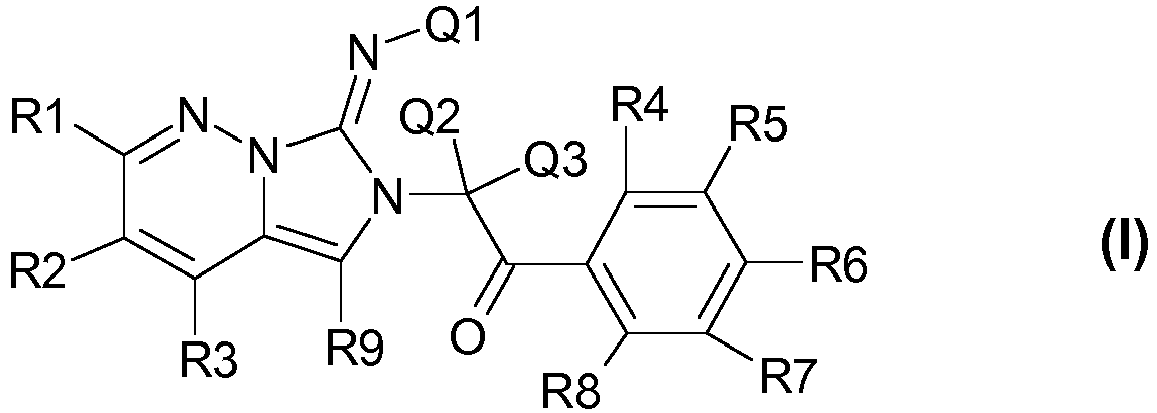
- Q1, Q2 und Q3 gleich oder verschieden sind und unabhängig voneinander für Wasserstoffatom oder -(C1-C6)-Alkyl stehen, wobei in Alkyl die Wasserstoffatome ganz oder teilweise durch Fluor ersetzt sein können,
- R1, R2 und R3 gleich oder verschieden sind und unabhängig voneinander für Wasserstoffatom, -(C1-C6)-Alkyl, -(C3-C6)-Cycloalkyl, -O-(C1-C8)-Alkyl, -O-(C3-C6)-Cycloalkyl, -(C0-C4)-Alkylen-C(O)-N(R11)-R12, -(C0-C4)-Alkylen-C(O)-O-R11, -(C0-C4)-Alkylen-C(O)-R11, -(C0-C4)-Alkylen-N(R11 )-R12, -(C0-C4)-Alkylen-N(R11 )-C(O)-R12, Halogen, OH, -CN, -(C1-C6)-Alkylen-O-(C1-C6)-Alkyl, -O-(C1-C6)-Alkylen-O-(C1-C6)-Alkyl oder -O-(C1-C4)-Alkylen-(C3-C6)-Cycloalkyl,
stehen,
wobei Alkyl, Alkylen und Cycloalkyl jeweils unsubstituiert oder ein-, zwei- oder dreifach unabhängig voneinander durch -(C1-C4)-Alkyl, OH oder -O-(C1-C6)-Alkyl substituiert sind, oder
wobei in Alkyl, Alkylen oder Cycloalkyl die Wasserstoffatome ganz oder teilweise durch Fluor ersetzt sein können,
mit der Maßgabe, das mindestens ein R1, R2 oder R3 nicht Wasserstoffatom ist - R11 und R12 unabhängig voneinander für Wasserstoffatom, -(C1-C6)-Alkyl oder -(C3-C6)-Cycloalkyl stehen,
- R4, R5, R6, R7 und R8 gleich oder verschieden sind und unabhängig voneinander für Wasserstoffatom, -(C1-C6)-Alkyl, -(C3-C6)-Cycloalkyl, OH, -CN, -O-(C1-C8)-Alkyl, -O-(C3-C6)-Cycloalkyl, -(C0-C4)-Alkylen-(CO)-N(R21)-R22, -(C0-C4)-Alkylen-C(O)-O-R21, Halogen, -SF5, -(C0-C4)-Alkylen-C(O)-R21, -(C0-C4)-Alkylen-N(R21)-R22, -(C0-C4)-Alkylen-N(R21)-C(O)-R22, -(C1-C6)-Alkylen-O-(C1-C6)-Alkyl, -(C0-C6)-Alkylen-O-(C1-C6)-Alkylen-O-(C1-C6)-Alkyl, oder -(C0-C6)-Alkylen-O-(C1-C4)-Alkylen-(C3-C6)-Cycloalkyl stehen,
wobei Alkyl, Alkylen und Cycloalkyl jeweils unsubstituiert oder ein-, zwei- oder dreifach unabhängig voneinander durch -(C1-C4)-Alkyl, -(C3-C6)-Cycloalkyl, OH, -O-(C1-C6)-Alkyl oder -O-(C3-C6)-Cycloalkyl, substituiert ist, oder
wobei in Alkyl, Alkylen oder Cycloalkyl die Wasserstoffatome ganz oder teilweise durch Fluor ersetzt sein können,
mit der Maßgabe, das mindestens ein R4, R5, R6, R7 oder R8 nicht Wasserstoffatom ist, - R9 für Wasserstoffatom oder -(C1-C6)-Alkyl steht, wobei in Alkyl die Wasserstoffatome ganz oder teilweise durch Fluor ersetzt sein können,
- R21 und R22 unabhängig voneinander für ein Wasserstoffatom, -(C1-C6)-Alkyl oder -(C3-C6)-Cycloalkyl stehen,
wobei in Alkyl oder Cycloalkyl die Wasserstoffatome ganz oder teilweise durch Fluor ersetzt sein können, oder - R21 und R22 in den Fragmenten "N(R21)-R22" und "N(R21)-C(O)-R22" für einen Ring stehen, ausgewählt aus der Gruppe Pyrrolidinyl, Piperidinyl, Piperazinyl, Morpholinyl, Thiomorpholinyl, Pyrrolidin-2,5-dionyl, Piperidin-2,6-dionyl, Piperazin-2,6-dionyl, Morpholin-3,5-dionyl, Pyrrolidin-2-onyl, Piperidin-2-onyl, Piperazin-2-onyl und Morpholin-3-onyl, wobei der Ring unsubstituiert oder ein- oder zweifach unabhängig voneinander durch -(C1-C4)-Alkyl, -(C3-C6)-Cycloalkyl, OH, -O-(C1-C6)-Alkyl oder -O-(C3-C6)-Cycloalkyl, substituiert ist, wobei in Alkyl oder Cycloalkyl die Wasserstoffatome ganz oder teilweise durch Fluor ersetzt sein können.
- Die Erfindung betrifft ferner eine Verbindung der Formel I, wobei
Q1, Q2 und Q3 gleich sind und für jeweils ein Wasserstoffatom stehen,
R1, R2 und R3 gleich oder verschieden sind und unabhängig voneinander für Wasserstoffatom, -(C1-C4)-Alkyl, -O-CH2-CF3 oder -O-(C1-C6)-Alkyl stehen,
mit der Maßgabe, das mindestens ein R1, R2 oder R3 nicht Wasserstoffatom ist,
R4 und R8 jeweils für ein Wasserstoff steht, R5, R6 und R7 gleich oder verschieden sind und unabhängig voneinander für Wasserstoffatom, -(C1-C6)-Alkyl, -O-(C1-C4)-Alkyl, -SF5 oder -N(R21)-R22 stehen,
mit der Maßgabe, das mindestens ein R5, R6 oder R7 nicht Wasserstoffatom ist, und R9 für Wasserstoffatom steht,
R21 und R22 unabhängig voneinander für Wasserstoffatom oder -(C1-C4)-Alkyl stehen, oder
R21 und R22 in dem Fragment "N(R21 )-R22" für einen Ring stehen, ausgewählt aus der Gruppe Pyrrolidinyl, Piperidinyl, Piperazinyl, Imidazolyl, Morpholinyl, Thiomorpholinyl, Pyrrolidin-2,5-dionyl, Piperidin-2,6-dionyl, Piperazin-2,6-dionyl, Morpholin-3,5-dionyl, Pyrrolidin-2-onyl, Piperidin-2-onyl, Piperazin-2-onyl und Morpholin-3-onyl. - Außerordentlich bevorzugt sind Verbindungen der Formel I, wobei folgende Verbindungen umfasst sind,
1-(3-tert-Butyl-4-methoxy-5-morpholin-4-yl-phenyl)-2-(7-imino-2,3-dimethoxy-imidazo[1,5-b]pyridazin-6-yl)-ethanon als Trifluoressigsäuresalz,
1-(3-tert-Butyl-4-methoxy-5-morpholin-4-yl-phenyl)-2-(2,3-diethoxy-7-imino-imidazo[1,5-b]pyridazin-6-yl)-ethanon als Trifluoressigsäuresalz,
N-{3-[2-(2,3-Diethoxy-7-imino-imidazo[1,5-b]pyridazin-6-yl)-acetyl]-5-pentafluorsulfanyl-phenyl}-acetamid als Trifluoressigsäuresalz,
1-(3-tert-Butyl-4-methoxy-5-morpholin-4-yl-phenyl)-2-[7-imino-2-methoxy-3-(2,2,2-trifluoro-ethoxy)-imidazo[1,5-b]pyridazin-6-yl]-ethanon, 2-(2,3-Diethoxy-7-imino-imidazo[1,5-b]pyridazin-6-yl)-1-(5-methylamino-3-pentafluorsulfanyl-phenyl)-ethanon oder
2-(2,3-Diethoxy-7-imino-imidazo[1,5-b]pyridazin-6-yl)-1-[3-methylamino-5-(pentafluoro-sulfanyl)-phenyl]-ethanon. - Unter dem Begriff "(C1-C4)-Alkyl" oder "(C1-C6)-Alkyl" werden Kohlenwasserstoffreste verstanden, deren Kohlenstoffkette geradkettig oder verzweigt ist und 1 bis 4 Kohlenstoffatome oder 1 bis 6 Kohlenstoffatome enthält, beispielsweise Methyl, Ethyl, Propyl, Isopropyl, Butyl, Isobutyl, sec-Butyl, tertiär-Butyl, Pentyl, Isopentyl, Neopentyl, 1-Ethylpropyl, Hexyl, 2,3-Dimethylbutyl oder Neohexyl.
Unter dem Begriff "-(C0-C4)-Alkylen" oder "-(C1-C6)-Alkylen" werden Kohlenwasserstoffreste verstanden, deren Kohlenstoffkette geradkettig oder verzweigt ist und 1 bis 4 oder 1-6 Kohlenstoffatome enthält, beispielsweise Methylen, Ethylen, 1-Methylmethylen, Propylen, 1-Methylethylen, Butylen, 1-Propylmethylen, 1-Ethyl-1-methylmethylen, 1,2-Dimethylethylen, 1,1-Dimethylmethylen, 1-Ethylethylen, 1-Methylpropylen, 2-Methylpropylen, Pentylen, 1-Methylbutylen, Hexylen, 1-Methylpentylen. "-C0-Alkylen" ist eine kovalente Bindung.
Unter dem Begriff "-O-(C1-C6)-Alkyl" oder "-O-(C1-C8)-Alkyl" werden Alkoxyreste verstanden, deren Kohlenstoffkette geradkettig oder verzweigt ist und 1 bis 6 oder 1 bis 8 Kohlenstoffatome enthält, beispielsweise Methoxy, Ethoxy, Propoxy, Iso-Propoxy, Butoxy, Iso-Butoxy, tertiär-Butoxy, 1-Pentoxy, 2-Pentoxy, 3-Pentoxy, 1-Hexoxy, 2-Hexoxy, 3-Hexoxy, 1-Heptoxy, 2-Heptoxy, 3-Heptoxy, 4-Heptoxy, 2,4-Dimethyl-pentan-3-oxy, 1-Octoxy, 2-Octoxy, 3-Octoxy, 2,2,4-Trimethyl-pentan-3-oxy, 2,3,4-Trimethyl-pentan-3-oxy oder 4-Octoxy.
Unter dem Begriff "(C3-C6)-Cycloalkyl" werden Reste verstanden wie Verbindungen, die sich von 3- bis 6-gliedrige Monocyclen wie Cyclopropan, Cyclobutan, Cyclopentan oder Cyclohexan herleiten.
Unter dem Begriff "-O-(C3-C6)-Cycloalkyl" werden Cycloalkoxy-Reste verstanden wie Verbindungen, die sich von 3- bis 6-gliedrige Monocyclen wie Cyclopropoxy, Cyclobutoxy, Cyclopentoxy oder Cyclohexoxy herleiten.
"R21 und R22 in den Fragmenten "N(R21)-R22" und "N(R21)-C(O)-R22" stehen für einen Ring, der gemeinsam mit dem Stickstoffatom "N" oder der Gruppe "N-C(O)" gebildet wird, wobei cyclische Amine, Imide oder Lactame gebildet werden, die bis zu 2 weitere Heteroatome aus der Gruppe N, O oder S enthalten", wobei die cyclische Amine ausgewählt sind aus Pyrrolidinyl, Piperidinyl, Piperazinyl, Morpholinyl oder Thiomorpholinyl, wobei die Imide ausgewählt sind aus Pyrrolidin-2,5-dionyl, Piperidin-2,6-dionyl, Piperazin-2,6-dionyl, Morpholin-3,5-dionyl, und wobei die Lactame ausgewählt sind aus Pyrrolidin-2-onyl, Piperidin-2-onyl, Piperazin-2-onyl, Morpholin-3-onyl.
Unter der Umschreibung "Alkyl, Alkylen oder Cycloalkyl die Wasserstoffatome ganz oder teilweise durch Fluor ersetzt sein" wird ein partiell oder vollständig fluorierter Alkyl-, Alkylen- oder Cycloalkylrest verstanden, der sich beispielsweise für Alkyl von folgenden Resten -CF3, -CHF2, -CH2F, -CHF-CF3, -CHF-CHF2, -CHF-CH2F, -CH2-CF3, -CH2-CHF2, -CH2-CH2F, -CF2-CF3, -CF2-CHF2, -CF2-CH2F, -CH2-CHF-CF3, -CH2-CHF-CHF2, -CH2-CHF-CH2F, -CH2-CH2-CF3, -CH2-CH2-CHF2, -CH2-CH2-CH2F, -CH2-CF2-CF3, -CH2-CF2-CHF2, -CH2-CF2-CH2F, -CHF-CHF-CF3, -CHF-CHF-CHF2, -CHF-CHF-CH2F, -CHF-CH2-CF3, -CHF-CH2-CHF2, -CHF-CH2-CH2F, -CHF-CF2-CF3, -CHF-CF2-CHF2, -CHF-CF2-CH2F, -CF2-CHF-CF3, -CF2-CHF-CHF2, -CF2-CHF-CH2F, -CF2-CH2-CF3, -CF2-CH2-CHF2, -CF2-CH2-CH2F, -CF2-CF2-CF3, -CF2-CF2-CHF2, -CF2-CF2-CH2F, -CH(CF3)2, -CH(CHF2)2, -CH(CFH2)2, -CH(CFH2)(CHF2), -CH(CFH2)(CF3), -CH(CFH2)(CH3), -CH(CHF2)(CH3), -CH(CF3)(CH3), -CF(CF3)2, -CF(CHF2)2, -CF(CFH2)2, -CF(CFH2)(CHF2), -CF(CFH2)(CF3), -CF(CFH2)(CH3), -CF(CHF2)(CH3), -CF(CF3)(CH3), sowie die weiteren möglichen Kombinationen für Butyl, Pentyl und Hexyl, die wie Propyl auch verzweigt sein können,
für Alkylen beispielsweise von folgenden Resten -CF2-, -CHF-, -CHF-CF2-, -CHF-CHF-, -CHF-CH2-, -CF2-CF2-, -CF2-CH2F, sowie die weiteren möglichen Kombinationen für Propylen, Butylen, Pentylen und Hexylen, die auch verzweigt sein können, und für Cycloalkyl beispielsweise von den Resten

- Unter dem Begriff "Hal" wird Fluor, Chlor, Brom oder Jod verstanden, bevorzugt sind Fluor, Chlor oder Brom, insbesondere Fluor oder Chlor.
- Oben beschriebene Begriffe sind auch beliebig kombinierbar wie beispielsweise in "-(C0-C6)-Alkylen-O-(C0-C6)-Alkylen-(C6-C14)-Aryl".
- Funktionelle Gruppen der verwendeten Intermediate, beispielsweise Amino- oder Carboxylgruppen in der Verbindung der Formel I, können dabei durch geeignete Schutzgruppen maskiert werden. Geeignete Schutzgruppen für Aminofunktionen sind beispielweise die t-Butoxycarbonyl-, die Benzyloxycarbonyl- oder die Phtalolylgruppe sowie die Trityl- oder Tosylschutzgruppe. Geeignete Schutzgruppen für die Carboxylfunktion sind beispielweise Alkyl-, Aryl- oder Arylalkylester. Schutzgruppen können durch wohlbekannte oder hier beschriebene Techniken eingeführt und entfernt werden (siehe Greene, T.W., Wuts, P.G.M., Protective Groups in Organic Synthesis (1999), 3rd Ed., Wiley-Interscience, oder Kocienski, P. J., Protecting Groups (2004), 3rd Ed., Thieme. Der Begriff Schutzgruppe kann auch entsprechende polymergebundene Schutzgruppen umfassen.
Die erfindungsgemäßen Verbindungen können nach wohlbekannten Verfahren oder nach hier beschriebenen Verfahren hergestellt werden. - Die Erfindung betrifft ferner ein Verfahren zur Herstellung der Verbindung der Formel I und/oder einer stereoisomeren Form der Verbindung der Formel I und/oder eines physiologisch verträglichen Salzes der Verbindung der Formel I, das dadurch gekennzeichnet ist, dass man
- a) eine Verbindung der Formel II


- b) eine Verbindung der Formel VII,

- c) eine Verbindung der Formel XXVI,

- d) eine Verbindung der Formel XXVII,

- e) die nach den Verfahren a) bis d) hergestellte Verbindung der Formel I entweder in freier Form isoliert oder aus physiologisch unverträglichen Salzen freisetzt oder im Falle des Vorliegens von sauren oder basischen Gruppen in physiologisch verträgliche Salze umwandelt, oder
- f) eine nach den Verfahren a) bis d) hergestellte Verbindung der Formel I, oder eine geeignete Vorstufe der Formel I, die aufgrund ihrer chemischen Struktur in enantiomeren oder diastereomeren Formen auftritt, durch Salzbildung mit enantiomerenreinen Säuren oder Basen, Chromatographie an chiralen Stationärphasen oder Derivatisierung mittels chiraler enantiomerenreinen Verbindungen wie Aminosäuren, Trennung der somit erhaltenen Diastereomeren, und Abspaltung der chiralen Hilfsgruppen in die reinen Enantiomeren oder Diastereomeren auftrennt.
- Die Erfindung betrifft ferner ein Verfahren zur Herstellung der Verbindung der Formel I nach Schema 1.
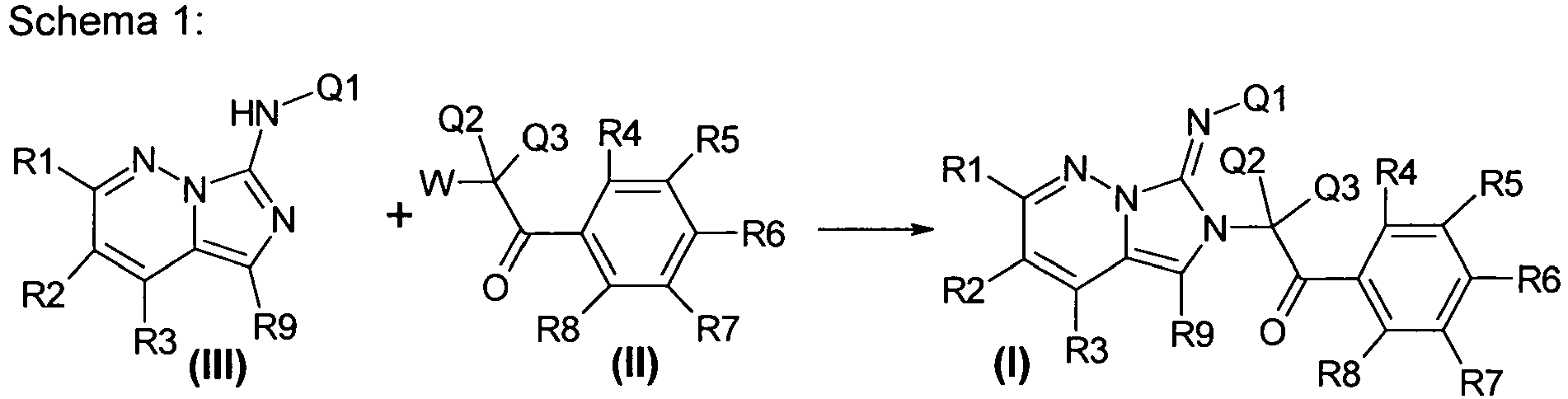
- Die Edukte II und III, wobei II gegebenenfalls (ggf.) in Form eines Salzes vorliegt, werden dabei bei Raumtemperatur oder leicht erhöhter Temperatur von 40 °C bis 60 °C vorteilhafterweise, wenn II als Salz vorliegt, in Gegenwart einer Base, bevorzugt Hünig-Base, in einem Lösungsmittel, bevorzugt Dimethylformamid (DMF), THF oder Dioxan, zu der Verbindung der Formel I umgesetzt. Die Reste R1, R2, R3, R4, R5, R6, R7, R8, R9, Q1, Q2 und Q3 sind wie in Formel I definiert, W entspricht einer guten Fluchtgruppe wie Chlorid, Bromid, Mesylat oder Tosylat, bevorzugt Bromid oder Mesylat.
- Verbindungen der Formel II sind käuflich oder lassen sich nach literaturbekannten Verfahren beispielsweise ausgehend von den korrespondierenden Acetophenonen X oder X' gewinnen (siehe beispielsweise: Phosphorus and Sulfur and the Related Elements (1985), 25(3), 357 oder Tetrahedron Letters (1984), 25(34), 3715). Die wohlbekannten und in zahlreichen Strukturvariationen käuflichen Verbindungen vom Typ X lassen sich beispielsweise an der Acetylgruppe unter anderem mit elementarem Chlor, Brom, Tribromid-Derivaten wie Phenyl-trimethylammonium-tribromid, 1,3-Dichlordimethylhydantoin, N-Chlor- oder N-Bromsuccinimid funktionalisieren. Verbindungen von Typ X' lassen sich beispielsweise mit Mesyl- oder Tosylchlorid in die Verbindungen vom Typ II überführen.

- Für bestimmte Reste R4 bis R8 kann es günstiger sein, die Ketone vom Typ X erst in die Ketale vom Typ XI oder XI' zu überführen, die dann sehr selktiv an der Methylgruppe zu den Verbindungen vom Typ XII funktionalisiert werden können, bevorzugt bromiert, und nach Deketalisierung mit geeigneten Säuren ebenfalls zu Verbindungen vom Typ II führen.
Die Substituenten in Schemata 2 und 3 sind dabei wie oben definiert, T entspricht einer -(C1-C4)-Alkyl-Gruppe, während T' für Ethylen, Propylen oder Butylen steht, W' entspricht einer reaktiven Verbindung wie Phenyl-trimethylammonium-tribromid, N-Brom- oder N-Chlorsuccinimid.
- Zur Synthese von Verbindungen vom Typ der Formel III' (Typ Formel III mit Q1 = H) werden Verbindungen der Formel XX - ggf. in Form ihrer Salze (HA) - bevorzugt in Gegenwart einer Base mit einer Cyan-Quelle vom Typ XXI zu den gewünschten Imidazopyridinen cyclisiert. Als Säuren HA kommen bevorzugt HBr, HCl, Trifluoressigsäure (TFA) und Schwefelsäure in Frage. Z steht für eine gute Fluchtgruppe, bevorzugt Tosylat, Chlorid oder Bromid.

- Alternativ lassen sich Verbindungen vom Typ der Formel III durch Umsetzungen mit Isothiocyanaten vom Typ der Formel XXII gewinnen, wobei intermediär Thioharnstoffe vom Typ XXIII gebildet werden. Diese lassen sich dann mit "Schwefelaktivatoren" wie Methyliodid, Quecksilberoxid oder Bromessigsäureethylester in die gewünschten Verbindungen vom Typ der Formel III überführen.

- Verbindungen vom Typ der Formel XX sind käuflich oder können entsprechend Schema 6 gewonnen werden.

Ein weiterer Zugang zu Aminen von Typ XX ist in Schema 7 dargestellt.
- Ausgehend von 3-Cyanopyridazinen vom Typ XXV wird die Nitrilfunktion mit Reduktionsmitteln wie Wasserstoff in Gegenwart von Metallkatalysatoren wie Palladium oder Raney-Nickel zu den Aminen vom Typ XX reduziert. Wird die Nitrilfunktion vor der Reduktion mit metallorganischen Reagenzien wie Grignard- oder Organolithium-Verbindungen umgesetzt, lässt sich auch auf diesem Weg der Substituent R9 einführen. Die dadurch intermediär erhaltenen Imine lassen sich durch Natriumborhydrid, Natriumtriacetoxyborhydrid oder Natriumcyanoborhydrid zu den Aminen XX reduzieren. Die Reste R1, R2, R3 und R9 sind wie oben definiert. Met steht für -Li oder -MgBr.
- Alternativ lassen sich Verbindungen der Formel I wie in Schema 8 dargestellt herstellen.

- Dabei werden Verbindungen der Formel XXVI - ggf. in Form ihrer Salze (HA)- in einem Lösungsmittel wie Wasser, Methanol, Ethanol, Essigsäure, Acetonitril, Toluol oder geeigneten Gemischen dieser Lösungsmittel, bevorzugt Toluol, in Gegenwart einer Base, bevorzugt Hünig-Base, mit einer Cyan-Quelle XXI, bevorzugt Bromcyan zu den gewünschten Imidazopyridazinen cyclisiert. Die Reste R1 bis R9, Q2, Q3 und Z sind wie oben definiert.
- Verbindungen der Formel XXVI werden entsprechend Schema 9 erhalten, indem Amine der Formel XX mit Acetophenon-Derivaten vom Typ der Formel II umgesetzt werden. Dies geschieht bevorzugt in Lösungsmitteln wie DMF, Tetrahydrofuran (THF) oder Acetonitril, bevorzugt in THF. Als Basen kommen Hünig-Base, Lithiumhexamethyldisilazan oder Kaliumcarbonat in Frage, bevorzugt Lithiumhexamethyldisilazan. Die Reste sind dabei wie oben definiert.

- Alternativ lassen sich Verbindungen der Formel XXVI laut Schema 10 mit Isothiocyanaten vom Typ der Formel XXII zu den Thioharnstoffen XXVII umsetzen. Diese werden nachfolgend mit einem "Schwefelaktivator" wie Quecksilberoxid, Methyliodid oder Bromessigsäureethylester behandelt, so dass sie direkt zu Verbindungen vom Typ der Formel I cyclisieren. Die Reste sind dabei wie oben definiert.

- Die Verbindungen der Formel I können teilweise auch in isomeren Formen auftreten, wobei Q1 in der folgenden Teilformel von Formel I entweder (E) oder (Z) konfiguriert sein kann:

- Eine nach Schema 1 hergestellte Verbindung der Formel I, oder eine geeignete Vorstufe der Formel I, die aufgrund ihrer chemischen Struktur in enantiomeren Formen auftritt, kann durch Salzbildung mit enantiomerenreinen Säuren oder Basen, Chromatographie an chiralen Stationärphasen oder Derivatisierung mittels chiraler enantiomerenreinen Verbindungen wie Aminosäuren, Trennung der somit erhaltenen Diastereomeren und Abspaltung der chiralen Hilfsgruppen in die reinen Enantiomeren aufgetrennt werden (Verfahren f)), oder die nach Schema 1 hergestellte Verbindung der Formel I kann entweder in freier Form isoliert oder im Falle des Vorliegens von sauren oder basischen Gruppen in physiologisch verträgliche Salze umwandelt werden (Verfahren e)).
- Saure oder basische Produkte der Verbindung der Formel I können in Form ihrer Salze oder in freier Form vorliegen. Bevorzugt sind pharmakologisch verträgliche Salze, beispielsweise Alkali- oder Erdalkalimetallsalze oder Hydrochloride, Sulfate, Hemisulfate, Methylsulfonate, p-Toluolsulfonate, alle möglichen Phosphate sowie Salze der Aminosäuren, natürlicher Basen oder Carbonsäuren wie Lactate, Citrate, Tartrate, Acetate, Adipinate, Fumarate, Gluconate, Glutamate, Maleinate oder Pamoate.
Die Herstellung physiologisch verträglicher Salze aus zur Salzbildung befähigten Verbindungen der Formel I, einschließlich deren stereoisomeren Formen, gemäß Verfahrensschritt e) erfolgt in an sich bekannter Weise. Enthalten Verbindungen der Formel I saure Funktionalität, so lassen sich mit basischen Reagenzien wie Hydroxiden, Carbonaten, Hydrogencarbonaten, Alkoholaten sowie Ammoniak oder organischen Basen, beispielsweise Trimethyl- oder Triethylamin, Ethanolamin, Diethanolamin oder Triethanolamin, Trometamol oder auch basischen Aminosäuren, etwa Lysin, Ornithin oder Arginin, stabile Alkali-, Erdalkali- oder gegebenenfalls substituierte Ammoniumsalze bilden. Basische Gruppen der Verbindungen der Formel I, bilden mit Säuren Säureadditionssalze. Hierfür kommen sowohl anorganische als auch organische Säuren wie Chlorwasserstoff-, Bromwasserstoff-, Schwefel-, Hemischwefel-, Phosphor-, Methansulfon-, Benzolsulfon-, p-Toluolsulfon- 4-Brombenzol-sulfon-, Cyclohexylamidosulfon-, Trifluormethylsulfon-, 2-Hydroxyethansulfon-, Essig-, Oxal-, Wein-, Bernstein-, Glycerolphosphor-, Milch-, Äpfel-, Adipin-, Citronen-, Fumar-, Malein-, Glucon-, Glucuron-, Palmitin- oder Trifluoressigsäure in Frage. - Im Verfahrensschritt f) wird die Verbindung der Formel I, sofern sie als Gemisch von Diastereomeren oder Enantiomeren auftritt oder bei der gewählten Synthese als deren Gemische anfällt, in die reinen Stereoisomeren getrennt, entweder durch Chromatographie an einem gegebenenfalls chiralen Trägermaterial, oder, sofern die racemische Verbindung der Formel I zur Salzbildung befähigt ist, kann auch eine fraktionierte Kristallisation der mit einer optisch aktiven Base oder Säure als Hilfsstoff gebildeten diastereomeren Salze durchgeführt werden. Als chirale Stationärphasen für die dünnschicht- oder säulenchromatographische Trennung von Enantiomeren eignen sich zum Beispiel modifizierte Kieselgelträger (sogenannte Pirkle-Phasen) sowie hochmolekulare Kohlenhydrate wie Triacetylcellulose. Für analytische Zwecke sind nach entsprechender, dem Fachmann bekannter Derivatisierung, auch gaschromatographische Methoden an chiralen Stationärphasen anwendbar. Zur Enantiomerentrennung der racemischen Carbonsäuren werden mit einer optisch aktiven, in der Regel kommerziell erhältlichen Base wie (-)-Nicotin, (+)- und (-)-Phenylethylamin, Chininbasen, L-Lysin oder L-und D-Arginin die unterschiedlich löslichen diastereomeren Salze gebildet, die schwerer lösliche Komponente als Feststoff isoliert, das leichter lösliche Diastereomer aus der Mutterlauge abgeschieden und aus den so gewonnenen diastereomeren Salzen die reinen Enantiomeren gewonnen. Auf prinzipiell gleiche Weise kann man die racemischen Verbindungen der Formel I, die eine basische Gruppe wie eine Aminogruppe enthalten, mit optisch aktiven Säuren, wie (+)-Campher-10-sulfonsäure, D- und L- Weinsäure, D-und L-Milchsäure sowie (+) und (-)-Mandelsäure in die reinen Enantiomeren überführen. Auch kann man chirale Verbindungen, die Alkohol- oder Amin-Funktionen enthalten, mit entsprechend aktivierten oder gegebenenfalls N-geschützten enantiomerenreinen Aminosäuren in die entsprechenden Ester oder Amide, oder umgekehrt chirale Carbonsäuren mit carboxygeschützten enantiomerenreinen Aminosäuren in die Amide oder mit enantiomerenreinen Hydroxycarbonsäuren wie Milchsäure, in die entsprechenden chiralen Ester überführen. Sodann kann die Chiralität des in enantiomerenreiner Form eingebrachten Aminosäure- oder Alkoholrestes zur Trennung der Isomeren genutzt werden, indem man eine Trennung der nunmehr vorliegenden Diastereomeren durch Kristallisation oder Chromatographie an geeigneten Stationärphasen vornimmt und danach den mitgeführte chiralen Molekülteil mittels geeigneter Methoden wieder abspaltet.
Weiterhin ergibt sich bei einigen der erfindungsgemäßen Verbindungen die Möglichkeit, zur Herstellung der Gerüststrukturen diastereo- oder enantiomerenreine Ausgangsprodukte einzusetzen. Dadurch können auch andere oder vereinfachte Verfahren zur Aufreinigung der Endprodukte eingesetzt werden. Diese Ausgangsprodukte wurden zuvor nach literatur-bekannten Verfahren enantiomeren- oder diastereomerenrein hergestellt. Das kann insbesondere bedeuten, dass in der Synthese der Grundgerüste entweder enantioselektive Verfahren zum Einsatz kommen, oder aber eine Enantiomeren- (oder Diastereomeren-) Trennung auf früher Synthesestufe und nicht erst auf der Stufe der Endprodukte durchgeführt wird. Ebenso kann eine Vereinfachung der Trennungen dadurch erreicht werden, dass zwei- oder mehrstufig vorgegangen wird. - Die Erfindung betrifft auch Arzneimittel, gekennzeichnet durch einen wirksamen Gehalt an mindestens einer Verbindung der Formel I und/oder eines physiologisch verträglichen Salzes der Verbindung der Formel I und/oder eine gegebenenfalls stereoisomere Form der Verbindung der Formel I, zusammen mit einem pharmazeutisch geeigneten und physiologisch verträglichen Trägerstoff, Zusatzstoff und/oder anderen Wirk- und Hilfsstoffen.
- Aufgrund der pharmakologischen Eigenschaften eignen sich die erfindungsgemäßen Verbindungen beispielsweise zur Prophylaxe, Sekundär-Prävention und Therapie all solcher Erkrankungen, die durch eine Hemmung des Protease-aktivierten Rezeptors 1 (PAR1) behandelbar sind. So eignen sich die erfindungsgemäßen Verbindungen sowohl für eine prophylaktische als auch für eine therapeutische Anwendung am Menschen. Sie eignen sich sowohl für eine akute Behandlung als auch für eine Langzeittherapie. Die Verbindungen der Formel I können eingesetzt werden in Patienten, die an Störungen des Wohlbefindens oder Krankheiten leiden, die mit Thrombosen, Embolien, Hyperkoagulabilität, fibrotischen Veränderungen oder entzündlichen Erkrankungen einhergehen.
Dazu gehören der Myokardinfarkt, die Angina pectoris und alle anderen Formen des akuten Koronarsyndroms, der Schlaganfall, die peripher vaskulären Erkrankungen, die tiefe Venenthrombose, die Lungenembolie, embolische oder thrombotische Ereignisse bedingt durch kardiale Arrhythmien, kardiovaskuläre Ereignisse wie Restenose nach Revaskularisierung, Angioplastie und ähnlichen Eingriffen wie Stentimplantationen und Bypass-Operationen. Weiterhin können die Verbindungen der Formel I eingesetzt werden bei allen Eingriffen, die zu einem Kontakt des Blutes mit Fremdoberflächen führen wie bei Dialysepatienten und Patienten mit Verweilkathetern. Verbindungen der Formel I können eingesetzt werden, um die Thrombosegefahr nach chirurgischen Eingriffen wie bei Knie- und Hüftgelenksoperationen zu reduzieren.
Verbindungen der Formel I eignen sich für die Behandlung von Patienten mit disseminierter intravaskulärer Koagulation, Sepsis und anderen intravaskulären Ereignissen, die mit einer Entzündung einhergehen. Weiterhin eignen sich Verbindungen der Formel I für die Prophylaxe und Behandlung von Patienten mit Atherosklerose, Diabetes und dem metabolischen Syndrom und deren Folgen. Störungen des hämostatischen Systems (beispielsweise Fibrinablagerungen) wurden impliziert in Mechanismen, die zu Tumorwachstum und Tumormetas-tasierung führen, sowie bei entzündlichen und degenerativen Gelenkserkrankungen wie der rheumatoiden Arthritis und der Arthrose. Verbindungen der Formel I eignen sich zur Verlangsamung oder Verhinderung solcher Prozesse.
Weitere Indikationen für den Einsatz der Verbindungen der Formel I sind fibrotische Veränderungen der Lunge wie die chronische obstruktive Lungenerkrankung, das adult respiratory distress syndrome (ARDS) und des Auges wie Fibrinablagerungen nach Augenoperationen. Verbindungen der Formel I eignen sich auch zur Verhinderung und/oder Behandlung von Narbenbildung. - Die Applikation der erfindungsgemäßen Arzneimittel kann durch orale, inhalative, rektale oder transdermale Applikation oder durch subkutane, intraartikuläre, intraperitoneale oder intravenöse Injektion erfolgen. Bevorzugt ist die orale Applikation. Eine Beschichtung von Stents mit Verbindungen der Formel I und anderen Oberflächen, die im Körper mit Blut in Kontakt kommen, ist möglich.
Die Erfindung betrifft auch ein Verfahren zur Herstellung eines Arzneimittels, das dadurch gekennzeichnet ist, dass man mindestens eine Verbindung der Formel I mit einem pharmazeutisch geeigneten und physiologisch verträglichen Träger und gegebenenfalls weiteren geeigneten Wirk-, Zusatz- oder Hilfsstoffen in eine geeignete Darreichungsform bringt.
Geeignete feste oder galenische Zubereitungsformen sind beispielsweise Granulate, Pulver, Dragees, Tabletten, (Mikro)Kapseln, Suppositorien, Sirupe, Säfte, Suspensionen, Emulsionen, Tropfen oder injizierbare Lösungen sowie Präparate mit protrahierter Wirkstoff-Freigabe, bei deren Herstellung übliche Hilfsmittel wie Trägerstoffe, Spreng-, Binde-, Überzugs-, Quellungs-, Gleit- oder Schmiermittel, Geschmacksstoffe, Süßungsmittel und Lösungsvermittler Verwendung finden. Als häufig verwendete Hilfsstoffe seien Magnesiumcarbonat, Titandioxid, Laktose, Mannit und andere Zucker, Talkum, Milcheiweiß, Gelatine, Stärke, Cellulose und ihre Derivate, tierische und pflanzliche Öle wie Lebertran, Sonnenblumen-, Erdnuss- oder Sesamöl, Polyethylenglykol und Lösungsmittel wie etwa steriles Wasser und ein- oder mehrwertige Alkohole wie Glycerin, genannt.
Vorzugsweise werden die pharmazeutischen Präparate in Dosierungseinheiten hergestellt und verabreicht, wobei jede Einheit als aktiven Bestandteil eine bestimmte Dosis der erfindungsgemäßen Verbindung der Formel I enthält. Bei festen Dosierungseinheiten wie Tabletten, Kapseln, Dragees oder Suppositorien, kann diese Dosis bis zu etwa 1000 mg, bevorzugt jedoch etwa 50 bis 300 mg und bei Injektionslösungen in Ampullenform bis zu etwa 300 mg, vorzugsweise aber etwa 10 bis 100 mg, betragen.
Für die Behandlung eines erwachsenen, etwa 70 kg schweren Patienten sind je nach Wirksamkeit der Verbindung gemäß Formel I, Tagesdosen von etwa 2 mg bis 1000 mg Wirkstoff, bevorzugt etwa 50 mg bis 500 mg indiziert. Unter Umständen können jedoch auch höhere oder niedrigere Tagesdosen angebracht sein. Die Verabreichung der Tagesdosis kann sowohl durch Einmalgabe in Form einer einzelnen Dosierungseinheit oder aber mehrerer kleinerer Dosierungseinheiten als auch durch Mehrfachgabe unterteilter Dosen in bestimmten Intervallen erfolgen. - Verbindungen der Formel I können sowohl als Monotherapie als auch in Kombination oder gemeinsam mit allen Antithrombotika (Antikoagulanzien und Plättchenaggregationshemmer), Thrombolytika (Plasminogenaktivatoren jeglicher Art), anderen profibrinolytisch wirksamen Substanzen, Blutdrucksenkern, Regulatoren des Blutzuckers, Lipidsenkern und Antiarrhythmika verabreicht werden. Als Plättchenaggregationshemmer kommen dabei Cyclooxygenase 1-Inhibitoren wie Aspirin, irreversible P2Y12-Antagonisten wie Clopidogrel oder Prasugrel, reversible P2Y12-Antagonisten wie Cangrelor oder AZD6140 und Thromboxan A2/Prostaglandin H2-Antagonisten wie Terutroban in Frage. Additive Effekte von PAR 1-Blockade in Kombination mit P2Y12-Blockade konnten beispielweise bereits gezeigt werden (Eur. Heart J. 2007, 28, Abstract Supplement, 188).
- Endprodukte wurden in der Regel durch eine chromatographisch-massenspektroskopische Methode (LCUV/ESI-MS-Kopplung) und 1H-NMR charakterisiert. Beschrieben sind die Verbindungen durch Angabe der zugehörigen Retentionszeit im Ionenstrom (LCMS-Rt) und des entsprechenden M+H+-Signals bei positiver lonisiation im zugehörigen Massenspektrum. Konnte kein M+H+-Massensignal erhalten werden, wurden alternativ die 1H-NMR-Daten angegeben. Verwendete Abkürzungen sind entweder erläutert oder entsprechen den üblichen Konventionen. Kieselgeltrennungen wurden manuell (Flash-Chromatographie) oder unterstützt durch halbautomatische Kartuschen-Systeme wie Companion (CombiFlash) oder Flashmaster II (Jones Chromatography) durchgeführt. Soweit nicht anders angegeben, wurden chromatographische Trennungen an Kieselgel mit Ethylacetat/Heptan-, Dichlormethan/Ethanol- oder Dichlormethan/Methanol-Gemischen als Laufmittel durchgeführt.
Das Abdampfen von Lösungsmitteln geschah in der Regel unter vermindertem Druck bei 35 °C bis 45 °C am Rotationsverdampfer und wird mit "vom Lösungsmittel befreit", "eingeengt", "einrotiert", "zur Trockne gebracht", "Lösungsmittel entfernt bzw. abgezogen" oder ähnlichen Ausdrücken umschrieben. Wenn nicht anders aufgeführt, wurden die LCUV/MS-Analysen unter folgenden Bedingungen durchgeführt:System: Agilent 1100 HPLC-System gekoppelt an 1100 LC/MSD Säule: YMC J'shere ODS H80 20x2,1 mm, Packungsmaterial 4 µm Laufmittel: ACN:H2O+0,05% TFA (Fluss 1 ml/min) Gradient: 4:96 (0 min) → 95:5 (2 min) → 95:5 (2,4 min) →4:96 (2,45 min) Ionisierung: ESI+ - Präparative HPLC mit Reversed-Phase-(RP)-Kieselgel wurde mit den folgenden Methoden durchgeführt:
Methode A, Standard-Methode, wenn im Text keine andere erwähnt ist. Säule: Merck (Darmstadt, Deutschland) Purosphere® RP18 25x250 mm, 10 µm Laufmittel: ACN:H2O+0,05%TFA (Fluss 25 ml/min) Gradient: 10:90 (0 min) → 90:10 (40 min) Methode B Säule: Merck Purosphere® RP18 25x250 mm, 10 µm Laufmittel: ACN:H2O+0,05%TFA (Fluss 25 ml/min) Gradient: 0:100 (0 min) → 0:100 (5 min) → 20:80 (20 min) Methode C Säule: Agilent Prep-C18, 30 x 250mm, 10 µM Laufmittel: ACN:H2O+0,05%TFA (Fluss 75 ml/min) Gradient: 10:90 (0 min) → 90:10 (12,5 min) → 90:10 (15min) → 10:90 (15,5 min) → 10:90 (17.5 min) - Die Umsetzungen fanden in Standard-Reaktionsapparaturen wie Ein- oder Mehrhalskolben statt, die wenn nicht anders beschrieben, dem Bedarf angemessen 5 ml bis 2000 ml Volumen fassten und je nach Anforderung mit Septum, Stopfen, Kühler, Rührer oder anderen Ausrüstungsgegenständen bestückt waren. Wenn nicht anders erwähnt, fanden alle Reaktionen unter Argon als Schutzgas statt und wurden mit Magnetrührern gerührt.
- Mikrowellenreaktionen wurden im Emrys Optimizer von Personal Chemistry in dem Bedarf angepassten Gefäßen von 0,5 bis 10 ml Fassungsvermögen durchgeführt.
-
- abs.
- absolut
- ACN
- Acetonitril
- Boc
- Butoxycarbonyl
- DCM
- Dichlormethan
- DIPEA
- N,N-Diisopropylethylamin (Hünig-Base)
- DMF
- Dimethylformamid
- DMSO
- Dimethylsulfoxid
- EE
- Essigsäureethylester
- HPLC
- Hochleistungsflüssigkeitschromatographie
- LCMS-Rt
- Retentionszeit der Verbindung im Ionenstrom
- LCUV/MS
- Flüssigkeitschromatographie Ultraviolett-/Massenspektroskopie
- MeOH
- Methanol
- RT
- Raumtemperatur (20 °C bis 25 °C)
- TFA
- Trifluoressigsäure
- THF
- Tetrahydrofuran
-

-
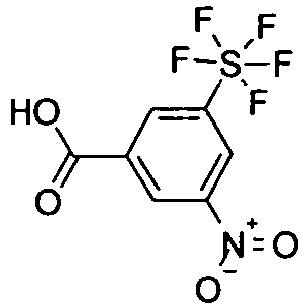
- 3-Pentafluorsulfanyl-benzoesäure (5,0 g) wurde in rauchender Salpetersäure (20 ml) gelöst und bei RT unter Feuchtigkeitsausschluss gerührt. Dann wurde konzentrierte Schwefelsäure (3 ml) zugegeben und bei 75 °C gerührt. Nach 5 h Rühren bei 75°C wurde weitere Schwefelsäure (1,5 ml) zugegeben und nach 2 h Rühren bei 75°C über Nacht stehen gelassen. Dann wurde auf Eiswasser gegeben und 2 h gerührt. Der gebildete Niederschlag wurde abgesaugt und am Hochvakuum getrocknet. Es wurden 4,2 g 3-Pentafluorsulfanyl-5-nitro-benzoesäure erhalten. Weitere 900 mg konnten aus der Mutterlauge nach dreimaligem Extrahieren mit Methylenchlorid, Trockenen der vereinigten Methylenchlorid-Phasen über Magnesiumsulfat und Einengen des Lösungsmittels erhalten werden. Der Niederschlag wurde ohne weitere Reinigung in der nächsten Stufe eingesetzt.
1H-NMR (400 MHz, DMSO-d6) [ppm]: 8,82 (1 H); 8,80 (1 H); 8,62 (1 H) -

- 3-Nitro-5-pentafluorsulfanyl-benzoesäure (4,0 g) wurde unter Rühren in Thionyl-chlorid (25ml) gelöst und 10 h unter Feuchtigkeitsausschluss unter Rückfluss gehalten. Nach Stehen über Nacht bei RT wurde überschüssiges Thionylchlorid im Vakuum entfernt, der erhaltene Rückstand in Dichlormethan (50 ml) gelöst und unter Rühren mit N,O-Dimethylhydroxylamin-Hydrochlorid (1,25 g) und Diethylisopropyl-amin (1,66 g) versetzt. Nach 1 h Rühren bei RT wurde das Gemisch im Vakuum eingeengt, der Rückstand in Essigester gelöst und 5 Mal mit Wasser gewaschen. Die organische Phase wurde über Magnesiumsulfat getrocknet, filtriert und eingeengt. Das erhaltene Rohprodukt (4,2 g) wurde direkt in der nächsten Stufe eingesetzt. LCMS-Rt: 1,50 min [M+H]+: 337,0
-
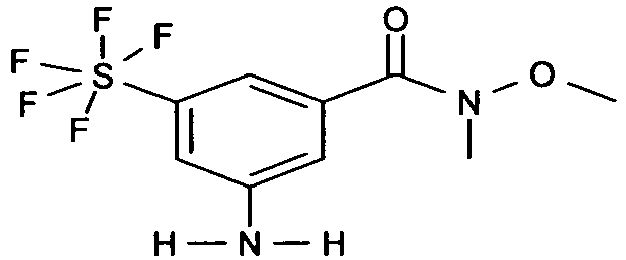
- N-Methoxy-N-methyl-5-nitro-3-pentafluorsulfanyl-benzamid (4,2 g) wurde in Methanol (120 ml) gelöst und Raney - Nickel (etwa 700 mg) zugegeben. Mit aufgesetztem Wasserstoffballon wurde auf einem Magnetrührer hydriert. Nach 5 h wurde der Katalysator abfiltriert und mit Methanol gewaschen. Das Filtrat wurde im Vakuum eingeengt und der Rückstand mittels präparativer HPLC aufgereinigt. Die produktenthaltenden Fraktionen wurden vereinigt, vom Acetonitril befreit, mit Natriumhydrogencarbonat-Lösung basisch gestellt und mit Essigester drei Mal extrahiert. Die vereinigten Extrakte wurden über Magnesiumsulfat getrocknet, filtriert und eingeengt. Es wurden 1,73 g der gewünschten Verbindung erhalten.
LCMS-Rt: 1,27 min [M+H]+: 307,0 -

- 3-Amino-N-methoxy-N-methyl-5-pentafluorsulfanyl-benzamid (1,2 g) wurde in Methylenchlorid (15 ml) gelöst und unter Rühren Triethylamin (0,7 ml) gefolgt von Essigsäureanhydrid (1,75 ml) unter Feuchtigkeitsausschluss zugesetzt. Nach 3 h Rühren bei RT wurden Wasser und gesättigte Natriumhydrogencarbonat-Lösung zugegeben, die Phasen getrennt und die Methylenchlorid-Phase noch drei Mal mit Wasser gewaschen, über Magnesiumsulfat getrocknet, filtriert und eingeengt. Das erhaltene Produkt (1,3 g) wurde ohne weitere Reinigung in der nächsten Stufe eingesetzt. LCMS-Rt: 1,26 min [M+H]+: 349,0
-

- 3-Acetylamino-N-methoxy-N-methyl-5-(pentafluorsulfanyl)-benzamid (1,2 g) wurde in absolutem THF (30 ml) gelöst und bei 0 °C mit Lithiumhexmethyldisilazan (721 µl; Dichte: 0,8 g/l; 23%-ig in tert.-Butylmethylether) 30 min gerührt. Bei 0°C wurde dann unter Rühren Methylmagnesiumbromid (2,87 ml, 3 M in Diethylether) zugetropft. Nach 2,5 h Rühren bei RT wurde weiteres Methylmagnesiumbromid (1 ml, 3 M in Diethylether) zugegeben und erneut 2,5 h gerührt. Zur Aufarbeitung wurde unter Eiskühlung 1 N Salzsäure zugetropft, gefolgt von Wasser und Essigester. Die organische Phase wurde abgetrennt und die Wasserphase noch zwei Mal mit Essigester extrahiert. Die vereinigten Essigesterphasen wurden über Natriumsulfat getrocknet, filtriert und eingeengt. Das Rohprodukt (1,03 g) wurde mit einem in gleicher Weise hergestellten Rohprodukt (75 mg) vereinigt und über Kieselgel mit Dichlormethan-Methanol als Laufmittel aufgereinigt. Es wurden 860 mg der gewünschten Verbindung erhalten. LCMS-Rt: 1,34 min [M+H]+: 304,0
-

- N-[3-Acetyl-5-(pentafluorsulfanyl)-phenyl]-acetamid (859 mg) wurde in einem Gemisch aus Methanol (10 ml) und THF (10 ml) gelöst und unter Rühren portionsweise Phenyltrimethyl-ammonium-tribromid (1,065 g) zugegeben. Nach 2 h Rühren bei RT wurde weitere 3 h auf 40°C erwärmt. Nach dem Erkalten wurde das Reaktionsgemisch in 2 N Schwefelsäure gegeben und die wässrige Phase 3 Mal mit Essigester extrahiert. Die vereinigten Extrakte wurden über Natriumsulfat getrocknet, filtriert und eingeengt. Das Rohprodukt wurde über Kieselgel mit Essigester/Heptan als Laufmittel aufgereinigt. Es wurden 480 mg der gewünschten Verbindung erhalten. LCMS-Rt: 1,47 min [M+H]+: 382,0
-
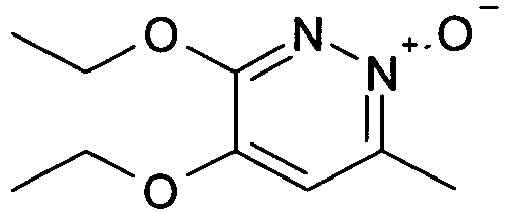
- 3-Methoxy-6-methyl-4-nitropyridazin-1-oxid (2 g) wurde in Ethanol (100 ml) bei RT vorgelegt. Danach wurde unter Rühren portionsweise festes Natriumethylat (1,4 g) zugegeben. Nach 1,5 h Rühren bei 55°C wurde das Reaktionsgemisch auf RT abgekühlt, mit Wasser versetzt und die wässrige Phase 3 Mal mit Dichlormethan extrahiert. Die vereinigten organischen Phasen wurden über Natriumsulfat getrocknet, filtriert und eingeengt. Das Rohprodukt wurde mittels präparativer HPLC aufgereinigt. Die sauberen produktenthaltenden Fraktionen wurden vereinigt, vom Acetonitril befreit und drei Mal mit Dichlormethan extrahiert. Die vereinigten organischen Phasen wurden über Natriumsulfat getrocknet, filtriert und eingeengt. Es wurden 176 mg des gewünschten Produkts erhalten. Die wässrige Phase wurde gefriergetrocknet und lieferte 781 mg des gewünschten Produkts.
Zur Gewinnung weiteren Produkts wurden die verunreinigten Fraktionen aus der Chromatographie vereinigt und gefriergetrocknet. Der Rückstande wurde erneut mittels präparativer HPLC aufgereinigt und das saubere Produkt wie oben beschrieben isoliert. Es wurden weitere 130 mg Produkt erhalten.
LCMS-Rt: 0,72 min [M+H]+: 199,1 -

- 3,4-Diethoxy-6-methyl-pyridazin-1-oxid (1,44 g) wurde in Dichlormethan (50 ml) vorgelegt und bei RT tropfenweise mit Trifluoressigsäureanhydrid (2,5 ml) versetzt. Nach 2,5 h wurde zur Trockne gebracht und der Rückstand mit Ethanol und gesättigter Kaliumcarbonat-Lösung aufgenommen. Nach 4 h Rühren bei RT wurde erneut zur Trockne gebracht und der Rückstand mit Wasser und Dichlormethan versetzt. Nach Abtrennen der organischen Phase wurde noch zweimal mit Dichlormethan extrahiert, die vereinigten organischen Phasen wurden über Magnesiumsulfat getrocknet, filtriert und eingeengt. Der Rückstand wurde zweimal mit Dichlormethan/Methanol als Laufmittel über Kieselgel gereinigt. Die produktenthaltenden Fraktionen wurden vereinigt und zur Trockne gebracht. Es wurden 716 mg des gewünschten Produkts erhalten. LCMS-Rt: 0,57 min [M+H]+: 199,1
-
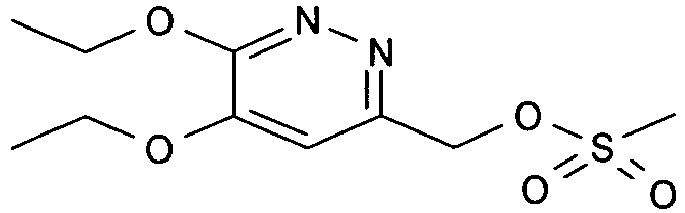
- (5,6-Diethoxy-pyridazin-3-yl)-methanol (716 mg) wurde in Dichlormethan (35 ml) vorgelegt und nacheinander unter Rühren Methansulfonsäureanhydrid (1,7 g in 5 ml Dichlormethan gelöst) und Triethylamin (0,8 ml) zugetropft. Nach 2 h wurde mit Wasser und gesättigter Natriumhydrogencarbonat-Lösung versetzt und drei Mal mit Dichlormethan extrahiert. Die vereinigten organischen Phasen wurden über Natriumsulfat getrocknet, filtriert und eingeengt. Es wurden 1,1 g der gewünschten Verbindung erhalten. LCMS-Rt: 0,98 min [M+H]+: 277,0
-

- Methansulfonsäure 5,6-diethoxy-pyridazin-3-ylmethyl-ester (620 mg) wurde in Methanol (10 ml) gelöst und unter Eiskühlung zu einer Ammoniak-Lösung (16 ml; 7 N in Methanol) getropft. Nach 6 h Rühren und Stehenlassen über Nacht wurde das Lösungsmittel abgezogen und der Rückstand mittels präparativer HPLC aufgereinigt. Die produktenthaltenden Fraktionen wurden vereinigt, vom Acetonitril befreit und gefriergetrocknet. Es wurde 305 mg des gewünschten Produkts erhalten.
LCMS-Rt: 0,62 min [M+H]+: 198,1 -

- C-(5,6-Diethoxy-pyridazin-3-yl)-methylamin (296 mg) wurde in einer Mischung aus Ethanol (15 ml) und Wasser (3 ml) unter Rühren bei RT vorgelegt. Danach tropfte man Bromcyan (0,8 ml; 5 M in Acetonitril) zu. Nach 6 h Rühren und Stehenlassen über Nacht wurde weiteres Bromcyan (0,8 ml) zugegeben. Nach 9 h Rühren und Stehen über Nacht wurde das Lösungsmittel abgezogen und der Rückstand mittels präparativer HPLC aufgereinigt. Die produktenthaltenden Fraktionen wurden vereinigt, vom Acetonitril befreit und gefriergetrocknet. Das noch verunreinigte Produkt wurde zur weiteren Aufreinigung über Kieselgel mit Dichlormethan-Methanol als Laufmittel getrennt. Es wurden 99 mg der gewünschten Verbindung erhalten. LCMS-Rt: 0,83 min [M+H]+: 223,1
- 2,3-Diethoxy-imidazo[1,5-b]pyridazin-7-ylamin-Trifluoressigsäuresalz (22 mg) wurde in absolutem DMF (2,5 ml) bei RT unter Rühren vorgelegt und mit Diisopropylethyl-amin (5 µl) versetzt. Danach tropfte man N-[3-(2-Brom-acetyl)-5-(pentafluorsulfanyl)-phenyl]-acetamid (25 mg), gelöst in absolutem DMF (1 ml), zu. Nach 4 h Rühren und Stehenlassen über Nacht wurde das Lösungsmittel abgezogen und Rückstand mittels präparativer HPLC aufgereinigt. Die produktenthaltenden Fraktionen wurden vereinigt, vom Acetonitril befreit und gefriergetrocknet. Es wurden 24 mg der gewünschten Verbindung erhalten. LCMS-Rt: 1,23 min [M+H]+: 524,0
-

-

- 3-Methoxy-6-methyl-4-nitropyridazin-1-oxid (1 g) wurde analog Beispiel 1g) umgesetzt und aufgearbeitet. Eine Chromatographie des Rohprodukts war nicht notwendig. Dabei wurden als Lösungsmittel Methanol (30 ml) und als Base Natriummethylat (als 30%ige Lösung in Methanol, 1,1 ml) eingesetzt. Ausbeute: 900 mg LCMS-Rt: 0,29 min [M+H]+: 171,1
-

- 3,4-Dimethoxy-6-methyl-pyridazin-1-oxid (880 mg) wurde analog der Sequenz Beispiel 1 h-1 i) in die Titelverbindung übergeführt. Ausbeute: 690 mg
LCMS-Rt: 0,71 min [M+H]+: 249,0 -

- Methansulfonsäure-(5,6-dimethoxy-pyridazin-3-yl)-methylester (690 mg) wurde in Chloroform (10 ml) gelöst und zu einer Urotropin-Lösung (390 mg in 20 ml Chloroform) bei 0 °C getropft. Danach wurde das Kältebad entfernt, 1,5 h bei RT und dann 5 h bei 40°C gerührt. Nach Stehen übers Wochenende wurde erneut 5 h bei 40 °C gerührt. Dann wurde das Lösungsmittel abgezogen, der Rückstand mit Methanol (40 ml) aufgenommen, konzentrierte Salzsäure (1,2 ml) zugegeben und 30 min bei RT gerührt. Dann wurde zur Trockne gebracht, der Rückstand mit Wasser/Acetonitril aufgenommen und gefriergetrocknet. Es wurden 1,2 g des Rohprodukts erhalten. 184 mg davon wurden mittels präparativer HPLC gereinigt. Die Produktent haltenden Fraktionen wurden vereinigt, vom Acetonitril befreit und gefriergetrocknet. Es wurden 40 mg der gewünschten Verbindung erhalten.
LCMS-Rt: 0,20 min [M+H]+: 170,1 -
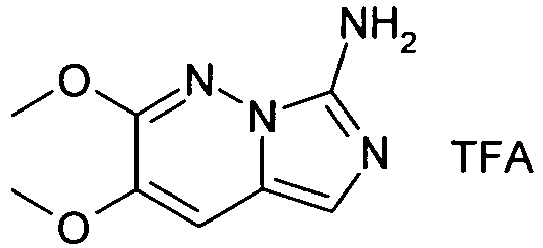
- C-(5,6-Dimethoxy-pyridazin-3-yl)-methylamin-Trifluoressigsäuresalz (37 mg) wurde in einer Mischung aus Ethanol und Wasser (3,75/0,75 ml) unter Rühren bei RT vorgelegt. Danach tropfte man Bromcyan-Lösung (0,1 ml; 5 M in ACN) vorsichtig zu und rührte 3 h bei RT. Dann wurde weitere Bromcyan-Lösung (0,1 ml) zugegeben und über Nacht stehen gelassen. Nach erneuter Zugabe von Bromcyan-Lösung (0,1 ml) wurde 4 h gerührt, übers Wochenende stehen gelassen und dann 2 h auf 40°C erwärmt. Anschließend wurde das Lösungsmittel abgezogen und der Rückstand mittels präparativer HPLC gereinigt. Die Produktent haltenden Fraktionen wurden vereinigt, vom Acetonitril befreit und gefriergetrocknet. Es wurden 18 mg der gewünschten Verbindung erhalten. LCMS-Rt: 0,64 min [M+H]+: 195,1
- 2,3-Dimethoxy-imidazo[1,5-b]pyridazin-7-ylamin-Trifluoressigsäuresalz (15 mg) und 2-Brom-1-(3-tert-butyl-4-methoxy-5-morpholin-4-yl-phenyl)-ethanon (20 mg; Hergestellt wie in
WO 2004/078721 beschrieben) wurden analog Beispiel 11) miteinander umgesetzt, aufgearbeitet und gereinigt. Es wurden 27 mg der Titelverbindung erhalten.
LCMS-Rt: 1,28 min [M+H]+: 484,4 -

- 2,3-Diethoxy-imidazo[1,5-b]pyridazin-7-ylamin-Trifluoressigsäuresalz [Beispiel 1k), 15 mg] und 2-Brom-1-(3-tert-butyl-4-methoxy-5-morpholin-4-yl-phenyl)-ethanon (27 mg; Hergestellt wie in
WO 2004/078721 beschrieben) wurden analog Beispiel 1l) miteinander umgesetzt, aufgearbeitet und gereinigt. Es wurden 27 mg der Titelverbindung erhalten. LCMS-Rt: 1,38 min [M+H]+: 512,3 -

-

- 2,2,2-Trifluorethanol (3 ml) wurde bei RT vorgelegt und unter Eiskühlung portionsweise mit Natriumhydrid (403 mg) versetzt. Danach erwärmte man das Reaktionsgemisch 2 h auf 55°C und tropfte dann 3-Methoxy-6-methyl-4-nitropyridazin-1-oxid-Lösung (500 mg, in 3 ml 2,2,2-Trifluorethanol gelöst) zu. Nach 1 h Rühren bei RT wurde 2,5 h auf 55°C erwärmt. Nach Stehen über Nacht bei RT wurde mit Wasser und DCM versetzt. Nach Abtrennen der DCM-Phase wurde die wässrige Phase noch dreimal mit DCM extrahiert und die vereinigten DCM-Phasen über Natriumsulfat getrocknet, filtriert und eingeengt. Es wurden 571 mg der Titelverbindung erhalten. LCMS-Rt: 0,80 min [M+H]+: 239,1
-

- 3-Methoxy-6-methyl-4-(2,2,2-trifluorethoxy)-pyridazin-1-oxid (570 mg) wurde analog der Sequenz Beispiel 1h-1j) in die Titelverbindung übergeführt. Es wurden wurden 210 mg der Titelverbindung erhalten. LCMS-Rt: 0,64 min [M+H]+: 238,1
-

- C-[6-Methoxy-5-(2,2,2-trifluorethoxy)-pyridazin-3-yl]-methylamin-Trifluoressigsäure-salz204 mg) wurde in einer Mischung aus Ethanol / Wasser (15/3 ml) vorgelegt. Danach tropfte man Bromcyan-Lösung (62 mg in Ethanol/Wasser 3,75/0,75 ml gelöst) zu. Nach 2 h Rühren bei RT wurde die gleiche Menge Bromcyan erneut zugetropft. Nach 4 h Rühren bei RT ließ man über Nacht stehen und rührte dann weitere 4 h. Anschließend gab man weiteres Bromcyan (60 mg in Ethanol/Wasser 1,88/0,38 ml gelöst) zu. Nach 3 h Rühren bei RT ließ man erneut über Nacht stehen und zog dann das Lösungsmittel ab. Der Rückstand wurde über Kieslegel ( 25 g Kartusche, DCM/Methanol-Gradient) aufgereinigt. Die Substanz enthaltenden Fraktionen wurden vereinigt und zur Trockne gebracht. Neben 62 mg Edukt wurden 20 mg der Titelverbindung erhalten. LCMS-Rt: 0,86 min [M+H]+: 263,0
- 2-Methoxy-3-(2,2,2-trifluorethoxy)-imidazo[1,5-b]pyridazin-7-ylamin-Hydrobromid (18 mg) und 2-Brom-1-(3-tert-butyl-4-methoxy-5-morpholin-4-yl-phenyl)-ethanon (22 mg; Hergestellt wie in
WO 2004/078721 beschrieben) wurden analog Beispiel 1l) miteinander umgesetzt, aufgearbeitet und gereinigt. Es wurden 31 mg der Titelverbindung erhalten. LCMS-Rt: 1,39 min [M+H]+: 552,2 -

-

- 3-Amino-N-methoxy-N-methyl-5-pentafluorsulfanyl-benzamid [Beispiel 1 c); 1,45 g] wurde in Methylenchlorid (15 ml) gelöst und unter Rühren Triethylamin (0,8 ml) gefolgt von Trifluoressigsäureanhydrid (0,85 ml) unter Feuchtigkeitsausschluss zugesetzt. Nach 3 h Rühren bei RT und Stehen über Nacht wurden Wasser und gesättigte Natriumhydrogencarbonat-Lösung zugegeben, die Phasen getrennt und die Methylenchlorid-Phase noch dreimal mit Wasser gewaschen, über Magnesiumsulfat getrocknet, filtriert und eingeengt. Das erhaltene Produkt (1,75 g) wurde ohne weitere Reinigung in der nächsten Stufe eingesetzt.
LCMS-Rt: 1,53 min [M+H]+: 403,0 -

- N-Methoxy-N-methyl-3-(pentafluorsulfanyl)-5-(2,2,2-trifluor-acetylamino)-benzamid (1,65 g) wurde in THF (25 ml) gelöst. Bei 0°C wurde unter Rühren Lithium-bis(trimethylsilyl)-amid (0,9 ml) zugegeben. Nach 30 min wurde Methylmagnesiumbromid (3,5 ml, 3 M in Diethylether) zugetropft. Nach beendeter Zugabe wurde das Eisbad entfernt und 2 h bei RT gerührt. Unter Kühlung wurden dann 1 N Salzsäure, Wasser und EE zugegeben. Nach Abtrennen der organischen Phase wurde die wässrige Phase noch zweimal mit EE extrahiert. Die vereinigten EE-Phasen wurden mit Magnesiumsulfat getrocknet, filtriert und eingeengt. Das Rohprodukt ist ein Gemisch aus N-(3-Acetyl-5-pentafluorsulfanyl-phenyl)-2,2,2-trifluor-acetamid und 1-[3-Amino-5-(pentafluorsulfanyl)-phenyl]-ethanon, so dass das Rohprodukt (1,3 g) in Methylenchlorid (60 ml) aufgenommen und mit Triethylamin (155 µl) versetzt wurde. Danach wurde unter Rühren Trifluoressigsäureanhydrid (160 µl) zugegeben. Nach 3 h Rühren bei RT wurden Wasser und gesättigte Natriumhydrogencarbonat-Lösung zugegeben, die Phasen getrennt und die DCM-Phase noch dreimal mit Wasser gewaschen. Die DCM-Phase wurde mit Magnesiumsulfat getrocknet, filtriert und eingeengt. Es wurden 1,3 g der Titelverbindung erhalten. LCMS-Rt: 1,61 min [M+H]+: 358,0
-

- In einem Mikrowelleneinsatz wurde N-(3-Acetyl-5-pentafluorsulfanyl-phenyl)-2,2,2-trifluor-acetamid (0,25 g) in absolutem Dimethoxyethan (7,5 ml) gelöst, gepulvertes Kaliumcarbonat zugegeben und mit Jodmethan (80 µl) versetzt. Anschließend wurde in der Mikrowelle 40 min auf 100°C erhitzt. Nachdem weiteres N-(3-Acetyl-5-pentafluorsulfanyl-phenyl)-2,2,2-trifluor-acetamid (4 x 250 mg) in beschriebener Weise umgesetzt worden war, wurden die fünf Ansätze gemeinsam aufgearbeitet, wobei vom Kaliumcarbonat unter Eiskühlung in 1 N Salzsäure dekantiert wurde. Nach mehrmaligem Waschen des Kaliumcarbonat-Rückstands mit Dimethoxyethan wurde die wässrige Phase fünfmal mit Essigester extrahiert. Die vereinigten Extrakte wurden über Magnesiumsulfat getrocknet, filtriert und eingeengt. Der Rückstand wurde mittels präparativer HPLC gereinigt. Die Produkt enthaltenden Fraktionen wurden vereinigt, vom Acetonitril befreit und fünfmal mit Essigester extrahiert. Die vereinigten Extrakte wurden über Magnesiumsulfat getrocknet, filtriert und eingeengt. Es wurden 1,03 g der gewünschten Verbindung erhalten.
LCMS-Rt: 1,62 min [M+H]+: 372,0 -

- N-[3-Acetyl-5-(pentafluorsulfanyl)-phenyl]-2,2,2-trifluor-N-methyl-acetamid (1,03 g) wurde in einem Gemisch aus Methanol (20 ml) und THF (20 ml) gelöst. Unter Rühren wurde Phenyl-trimethylammoniumtribromid (1,05 g) zugegeben. Nach 5 h Rühren bei RT wurde über Nacht stehen gelassen, dann weiteres Phenyl-trimethylammoniumtribromid (100 mg) zugegeben und 2 h auf 60°C erwärmt. Nach Erkalten wurde das Reaktionsgemisch in 2 N Schwefelsäure gegeben und 10 min gerührt. Dann wurde die wässrige Phase dreimal mit EE extrahiert. Die vereinigten organischen Phasen wurden über Magnesiumsulfat getrocknet und nach Abfiltrieren des Trockenmittels im Vakuum zur Trockne gebracht. Es wurden 1,2 g der Titelverbindung erhalten, die ausreichende Reinheit für die nächsten Umsetzungen hatte. LCMS-Rt: 1,72 min [M+H]+: 449,9
-

- N-[3-(2-Brom-acetyl)-5-(pentafluorsulfanyl)-phenyl]-2,2,2-trifluor-N-methyl-acetamid (01.075; 1,2 g) wurde mit Wasser (15 ml) versetzt und unter Rühren und Eiskühlung konzentrierte Schwefelsäure (15 ml) zugetropft. Es wurde auf 80°C erwärmt und 7 h bei dieser Temperatur gerührt. Nach Erkalten wurde das Reaktionsgemisch langsam in ein Gemisch aus 10 N Natriumhydroxid-Lösung und EE gegeben und die wässrige Phase fünfmal mit EE extrahiert. Die vereinigten organischen Phasen wurden über Magnesiumsulfat getrocknet und nach Abfiltrieren des Trockenmittels im Vakuum zur Trockne gebracht. Der Rückstand wurde mittels präparativer HPLC gereinigt. Die jeweils sauberen Produktfraktionen wurden vereinigt, im Vakuum vom Acetonitril befreit, mit Natriumhydrogencarbonat neutralisiert und dreimal mit EE extrahiert. Die vereinigten organischen Phasen wurden über Magnesiumsulfat getrocknet und nach Abfiltrieren des Trockenmittels im Vakuum zur Trockne gebracht. Es wurden 420 mg der Titelverbindung isoliert. LCMS-Rt: 1,64 min [M+H]+: 354,0
- 2,3-Diethoxy-imidazo[1,5-b]pyridazin-7-ylamin-Trifluoressigsäuresalz [Beispiel 1k), 10 mg] und 2-Brom-1-[3-methylamino-5-(pentafluorsulfanyl)-phenyl]-ethanon (18 mg) wurden analog Beispiel 11) miteinander umgesetzt, aufgearbeitet und gereinigt. Zur Nachreinigung wurde nach der präparativen HPLC noch einmal über Kieselgel chromatographiert (2 g Kartusche; DCM/Methanol-Gradient). Nach Vereinigung der sauberen Fraktionen wurde zur Trockne gebracht. Der Rückstand wurde mir ACN/Wasser (+ 0,05 % TFA) aufgenommen und gefriergetrocknet. Es wurden 4 mg der Titelverbindung erhalten. LCMS-Rt: 1,29 min [M+H]+: 491,1
- Die pharmakologische Testung der Substanzen erfolgte in der durch TRAP (Thrombinrezeptor aktivierendes Peptid) induzierten Thrombozytenaggregation im 96-well Format. Dazu wurde von gesunden freiwilligen Spendern Blut in 20 ml Spritzen abgenommen, in denen 2 ml 3,13 %-ige Natriumcitratlösung vorgelegt war. Nach einer 20-minütigen Zentrifugation bei 150 x g wurde das Plättchenreiche Plasma (PRP) abgetrennt und mit 1 µl PGE1-Lösung (500 µg/ml in Ethanol) / ml PRP versetzt. Nach 5 Minuten Inkubation bei Raumtemperatur wurde 15 Minuten bei 120 x g zentrifugiert um die Leukozyten zu entfernen. Das Leukozytenfreie PRP wurde in 5 ml Portionen in 15 ml PP Röhrchen überführt und 15 Minuten bei 360xg abzentrifugiert, um die Plättchen zu pelletieren. Anschließend wurde das Plasma dekantiert und das Plättchensediment aus 5 ml PRP in 1 ml Tyrode (120 mM NaCl, 2,6 mM KCl, 12 mM NaHCO3, 0,39 mM NaH2PO4 x H2O, 10 mM HEPES, 0,35% BSA, 5,5 mM Glukose, pH 7,4) resuspendiert und mit Tyrode auf eine Plättchenzahl von 3x10⁵ / Mikroliter (µL) eingestellt. 13 ml dieser Zellsuspension wurde dann mit 866 µL 10 mM CaCl2-Lösung versetzt und 120 µL davon pro well einer 96-well-Platte pipettiert, in dem 15 µL der zu testenden Substanz vorgelegt waren. Nach 30 Minuten Inkubation bei Raumtemperatur im Dunklen wurden 15 µL einer TRAP-Lösung (70-100 µM) als Agonist zugegeben und in einem SpectraMax 340 bei 650 nm über 20 Minuten bei 37° C unter Schütteln eine Kinetik aufgezeichnet. Die Flächen unter den Kurven von Negativkontrolle (Tyrode/ DMSO) und Positivkontrolle (15 µl Agonist /DMSO) wurden berechnet und die Differenz als 100 % Wert festgelegt. Die zu testenden Substanzen wurden in Doppelbestimmung als Verdünnungsreihen pipettiert, ebenfalls die AUC jeder Substanzkonzentration bestimmt und die % Hemmung der AUC gegen die Kontrolle errechnet. Anhand der % Hemmung wurde mit Hilfe nichtlinearer Regressionsanalyse gemäß der 4 Parameter-Gleichung die IC50 berechnet.
- Tabelle 1 zeigt die Ergebnisse.
Tabelle 1: Verbindung aus Beispiel Hemmung der Thrombozytenaggregation IC50 [mikro M] Verbindung aus Beispiel Hemmung der Thrombozytenaggregation IC50 [mikro M] 1 0,005 3 0,004 4 0,18
Claims (7)
- Verbindung der Formel I
 Q1, Q2 und Q3 gleich oder verschieden sind und unabhängig voneinander für ein Wasserstoffatom oder -(C1-C6)-Alkyl stehen, wobei in Alkyl die Wasserstoffatome ganz oder teilweise durch Fluor ersetzt sein können,R1, R2 und R3 gleich oder verschieden sind und unabhängig voneinander für Wasserstoffatom, -(C1-C6)-Alkyl, -(C3-C6)-Cycloalkyl, -O-(C1-C8)-Alkyl, -O-(C3-C6)-Cycloalkyl, -(C0-C4)-Alkylen-C(O)-N(R11)-R12, -(C0-C4)-Alkylen-C(O)-O-R11, -(C0-C4)-Alkylen-C(O)-R11, -(C0-C4)-Alkylen-N(R11)-R12, -(C0-C4)-Alkylen-N(R11)-C(O)-R12, Halogen, OH, -CN, -(C1-C6)-Alkylen-O-(C1-C6)-Alkyl, -O-(C1-C6)-Alkylen-O-(C1-C6)-Alkyl oder -O-(C1-C4)-Alkylen-(C3-C6)-Cycloalkyl, stehen,
wobei Alkyl, Alkylen und Cycloalkyl jeweils unsubstituiert oder ein-, zwei- oder dreifach unabhängig voneinander durch -(C1-C4)-Alkyl, OH oder -O-(C1-C6)-Alkyl substituiert sind, oder
wobei in Alkyl, Alkylen oder Cycloalkyl die Wasserstoffatome ganz oder teilweise durch Fluor ersetzt sein können,
mit der Maßgabe, das mindestens ein R1, R2 oder R3 nicht Wasserstoffatom ist,R11 und R12 unabhängig voneinander für Wasserstoffatom, -(C1-C6)-Alkyl oder -(C3-C6)-Cycloalkyl stehen,R4, R5, R6, R7 und R8 gleich oder verschieden sind und unabhängig voneinander für Wasserstoffatom, -(C1-C6)-Alkyl, -(C3-C6)-Cycloalkyl, OH, -CN, -O-(C1-C8)-Alkyl, -O-(C3-C6)-Cycloalkyl, -(C0-C4)-Alkylen-(CO)-N(R21)-R22, -(C0-C4)-Alkylen-C(O)-O-R21, Halogen, -SF5, -(C0-C4)-Alkylen-C(O)-R21, -(C0-C4)-Alkylen-N(R21)-R22, -(C0-C4)-Alkylen-N(R21)-C(O)-R22, -(C1-C6)-Alkylen-O-(C1-C6)-Alkyl, -(C0-C6)-Alkylen-O-(C1-C6)-Alkylen-O-(C1-C6)-Alkyl, oder -(C0-C6)-Alkylen-O-(C1-C4)-Alkylen-(C3-C6)-Cycloalkyl stehen,
wobei Alkyl, Alkylen und Cycloalkyl jeweils unsubstituiert oder ein-, zwei- oder dreifach unabhängig voneinander durch -(C1-C4)-Alkyl, -(C3-C6)-Cycloalkyl, OH, -O-(C1-C6)-Alkyl oder -O-(C3-C6)-Cycloalkyl, substituiert ist, oder
wobei in Alkyl, Alkylen oder Cycloalkyl die Wasserstoffatome ganz oder teilweise durch Fluor ersetzt sein können,
mit der Maßgabe, das mindestens ein R4, R5, R6, R7 oder R8 nicht Wasserstoffatom ist,R9 für ein Wasserstoffatom oder -(C1-C6)-Alkyl steht, wobei in Alkyl die Wasserstoffatome ganz oder teilweise durch Fluor ersetzt sein können,R21 und R22 unabhängig voneinander für ein Wasserstoffatom, -(C1-C6)-Alkyl oder -(C3-C6)-Cycloalkylstehen,
wobei in Alkyl oder Cycloalkyl die Wasserstoffatome ganz oder teilweise durch Fluor ersetzt sein können, oderR21 und R22 in den Fragmenten "N(R21)-R22" und "N(R21)-C(O)-R22" für einen Ring stehen, ausgewählt aus der Gruppe Pyrrolidinyl, Piperidinyl, Piperazinyl, Morpholinyl, Thiomorpholinyl, Pyrrolidin-2,5-dionyl, Piperidin-2,6-dionyl, Piperazin-2,6-dionyl, Morpholin-3,5-dionyl, Pyrrolidin-2-onyl, Piperidin-2-onyl, Piperazin-2-onyl und Morpholin-3-onyl, wobei der Ring unsubstituiert oder ein- oder zweifach unabhängig voneinander durch -(C1-C4)-Alkyl, -(C3-C6)-Cycloalkyl, OH, -O-(C1-C6)-Alkyl oder -O-(C3-C6)-Cycloalkyl, substituiert ist, wobei in Alkyl oder Cycloalkyl die Wasserstoffatome ganz oder teilweise durch Fluor ersetzt sein können. - Verbindung der Formel I gemäß Anspruch 1, wobei
Q1, Q2 und Q3 gleich sind und für jeweils ein Wasserstoffatom stehen, R1, R2 und R3 gleich oder verschieden sind und unabhängig voneinander für Wasserstoffatom, -(C1-C4)-Alkyl, -O-CH2-CF3 oder -O-(C1-C6)-Alkyl stehen, mit der Maßgabe, das mindestens ein R1, R2 oder R3 nicht Wasserstoffatom ist,
R4 und R8 jeweils für ein Wasserstoffatom steht,
R5, R6 und R7 gleich oder verschieden sind und unabhängig voneinander für Wasserstoffatom, -(C1-C6)-Alkyl, -O-(C1-C4)-Alkyl, -SF5 oder -N(R21)-R22 stehen,
mit der Maßgabe, das mindestens ein R5, R6 oder R7 nicht Wasserstoffatom ist, und
R9 für Wasserstoffatom steht,
R21 und R22 unabhängig voneinander für Wasserstoffatom oder -(C1-C4)-Alkyl stehen, oder
R21 und R22 in dem Fragment "N(R21)-R22" für einen Ring stehen, ausgewählt aus der Gruppe Pyrrolidinyl, Piperidinyl, Piperazinyl, Imidazolyl, Morpholinyl, Thiomorpholinyl, Pyrrolidin-2,5-dionyl, Piperidin-2,6-dionyl, Piperazin-2,6-dionyl, Morpholin-3,5-dionyl, Pyrrolidin-2-onyl, Piperidin-2-onyl, Piperazin-2-onyl und Morpholin-3-onyl. - Verbindung der Formel I gemäß Anspruch 1, wobei die Verbindung der Formel I ausgewählt ist aus der Gruppe 1-(3-tert-Butyl-4-methoxy-5-morpholin-4-yl-phenyl)-2-(7-imino-2,3-dimethoxy-imidazo[1,5-b]pyridazin-6-yl)-ethanon, 1-(3-tert-Butyl-4-methoxy-5-morpholin-4-yl-phenyl)-2-(2,3-diethoxy-7-imino-imidazo[1,5-b]pyridazin-6-yl)-ethanon, N-{3-[2-(2,3-Diethoxy-7-imino-imidazo[1,5-b]pyridazin-6-yl)-acetyl]-5-pentafluorsulfanyl-phenyl}-acetamid, 1-(3-tert-Butyl-4-methoxy-5-morpholin-4-yl-phenyl)-2-[7-imino-2-methoxy-3-(2,2,2-trifluoro-ethoxy)-imidazo[1,5-b]pyridazin-6-yl]-ethanon, 2-(2,3-Diethoxy-7-imino-imidazo[1,5-b]pyridazin-6-yl)-1-(5-methylamino-3-pentafluorsulfanyl-phenyl)-ethanon oder 2-(2,3-Diethoxy-7-imino-imidazo[1,5-b]pyridazin-6-yl)-1-[3-methylamino-5-(pentafluorsulfanyl)-phenyl]-ethanon.
- Arzneimittel, gekennzeichnet durch einen wirksamen Gehalt an mindestens einer Verbindung der Formel I gemäß einem oder mehreren der Ansprüche 1 bis 3 zusammen mit einem pharmazeutisch geeigneten und physiologisch verträglichen Trägerstoff, Zusatzstoff und/oder anderen Wirk- und Hilfsstoffen.
- Verwendung der Verbindung der Formel I gemäß einem oder mehreren der Ansprüche 1 bis 3 zur Herstellung eines Arzneimittels zur Prophylaxe, Sekundärprevention und Therapie all solcher Erkrankungen, die die mit Thrombosen, Embolien, Hyperkoagulabilität, fibrotischen Veränderungen oder entzündlichen Erkrankungen einhergehen.
- Verwendung gemäß Anspruch 5, dadurch gekennzeichnet, dass es sich um Myokardinfarkt, Angina pectoris und andere Formen des akuten Koronarsyndroms, den Schlaganfall, die peripher vaskulären Erkrankungen, die tiefe Venenthrombose, die Lungenembolie, embolische oder thrombotische Ereignisse bedingt durch kardiale Arrhythmien, kardiovaskuläre Ereignisse wie Restenose nach Revaskularisierung und Angioplastie und ähnlichen Eingriffen wie Stentimplantationen und Bypass-Operationen handelt, oder die Reduktion der Thrombosegefahr nach chirurgischen Eingriffen wie bei Knie- und Hüftgelenksoperationen, oder Eingriffen, die zu einem Kontakt des Blutes mit Fremdoberflächen führen wie bei Dialysepatienten und Patienten mit Verweilkathetern oder um die disseminierte intravaskuläre Koagulation, Sepsis und anderen intravaskulären Ereignissen, die mit einer Entzündung einhergehen, Atherosklerose, Diabetes und dem metabolischen Syndrom und deren Folgen, Tumorwachstum und Tumormetastasierung, entzündliche und degenerative Gelenkserkrankungen wie der rheumatoiden Arthritis und der Arthrose, Störungen des hämostatischen Systems wie Fibrinablagerungen, fibrotische Veränderungen der Lunge wie die chronische obstruktive Lungenerkrankung, das adult respiratory distress syndrom oder Fibrinablagerungen des Auges nach Augenoperationen oder Verhinderung und/oder Behandlung von Narbenbildung.
- Verfahren zur Herstellung der Verbindung der Formel I gemäß einem oder mehreren der Ansprüche 1 bis 3, dadurch gekennzeichnet, dass mana) eine Verbindung der Formel II

 b) eine Verbindung der Formel VII,
 c) eine Verbindung der Formel XXVI,
 d) eine Verbindung der Formel XXVII,
 e) die nach den Verfahren a) bis d) hergestellte Verbindung der Formel I entweder in freier Form isoliert oder aus physiologisch unverträglichen Salzen freisetzt oder im Falle des Vorliegens von sauren oder basischen Gruppen in physiologisch verträgliche Salze umwandelt, oderf) eine nach den Verfahren a) bis d) hergestellte Verbindung der Formel I, oder eine geeignete Vorstufe der Formel I, die aufgrund ihrer chemischen Struktur in enantiomeren oder diastereomeren Formen auftritt, durch Salzbildung mit enantiomerenreinen Säuren oder Basen, Chromatographie an chiralen Stationärphasen oder Derivatisierung mittels chiraler enantiomerenreinen Verbindungen wie Aminosäuren, Trennung der somit erhaltenen Diastereomeren, und Abspaltung der chiralen Hilfsgruppen in die reinen Enantiomeren oder Diastereomeren auftrennt.
Priority Applications (2)
| Application Number | Priority Date | Filing Date | Title |
|---|---|---|---|
| PL09707983T PL2240179T3 (pl) | 2008-02-05 | 2009-01-23 | Imidazopirydazyny jako inhibitory PAR1, ich wytwarzanie i zastosowanie jako leku |
| EP09707983.4A EP2240179B1 (de) | 2008-02-05 | 2009-01-23 | Imidazopyridazine als par1-inhibitoren, ihre herstellung und verwendung als arzneimittel |
Applications Claiming Priority (3)
| Application Number | Priority Date | Filing Date | Title |
|---|---|---|---|
| EP08290113 | 2008-02-05 | ||
| PCT/EP2009/000409 WO2009097973A2 (de) | 2008-02-05 | 2009-01-23 | Imidazopyridazine als parl-inhibitoren, ihre herstellung und verwendung als arzneimittel |
| EP09707983.4A EP2240179B1 (de) | 2008-02-05 | 2009-01-23 | Imidazopyridazine als par1-inhibitoren, ihre herstellung und verwendung als arzneimittel |
Publications (2)
| Publication Number | Publication Date |
|---|---|
| EP2240179A2 EP2240179A2 (de) | 2010-10-20 |
| EP2240179B1 true EP2240179B1 (de) | 2016-08-17 |
Family
ID=39827108
Family Applications (1)
| Application Number | Title | Priority Date | Filing Date |
|---|---|---|---|
| EP09707983.4A Active EP2240179B1 (de) | 2008-02-05 | 2009-01-23 | Imidazopyridazine als par1-inhibitoren, ihre herstellung und verwendung als arzneimittel |
Country Status (14)
| Country | Link |
|---|---|
| US (1) | US8598177B2 (de) |
| EP (1) | EP2240179B1 (de) |
| JP (1) | JP5570434B2 (de) |
| KR (1) | KR20100121612A (de) |
| CN (1) | CN101980710B (de) |
| AU (1) | AU2009211890B2 (de) |
| BR (1) | BRPI0907700A2 (de) |
| CA (1) | CA2713554C (de) |
| ES (1) | ES2603302T3 (de) |
| IL (1) | IL207200A0 (de) |
| MX (1) | MX2010007892A (de) |
| MY (1) | MY152685A (de) |
| PL (1) | PL2240179T3 (de) |
| WO (1) | WO2009097973A2 (de) |
Families Citing this family (5)
| Publication number | Priority date | Publication date | Assignee | Title |
|---|---|---|---|---|
| PT1863818E (pt) * | 2005-03-23 | 2010-04-09 | Hoffmann La Roche | Derivados de acetilenil-pirazolo-pirimidina como antagonistas de mglur2 |
| MY152040A (en) | 2008-02-05 | 2014-08-15 | Sanofi Aventis | Triazolopyridazines as par1 inhibitors, production thereof, and use as medicaments |
| CA2713551C (en) | 2008-02-05 | 2016-06-14 | Sanofi-Aventis | Triazolium salts as par1 inhibitors, production thereof, and use as medicaments |
| US8673890B2 (en) | 2009-10-29 | 2014-03-18 | Janssen Pharmaceutica Nv | 2,3-dihydro-1H-isoindol-1-imine derivatives useful as thrombin PAR-1 receptor antagonist |
| KR20150003766A (ko) * | 2012-04-26 | 2015-01-09 | 브리스톨-마이어스 스큅 컴퍼니 | 혈소판 응집을 치료하기 위한 프로테아제 활성화 수용체 4 (par4) 억제제로서의 이미다조티아디아졸 및 이미다조피리다진 유도체 |
Family Cites Families (3)
| Publication number | Priority date | Publication date | Assignee | Title |
|---|---|---|---|---|
| RU2270192C2 (ru) * | 2001-04-19 | 2006-02-20 | Эйсай Ко., Лтд. | Производные 2-иминопирролидина |
| WO2006051648A1 (ja) * | 2004-11-09 | 2006-05-18 | Eisai R & D Management Co., Ltd. | トロンビン受容体アンタゴニストを有効成分とするくも膜下出血に伴う血管攣縮の治療剤 |
| RS55630B1 (sr) * | 2005-12-21 | 2017-06-30 | Janssen Pharmaceutica Nv | Triazolopiridazini kao modulatori tirozin kinaze |
-
2009
- 2009-01-23 WO PCT/EP2009/000409 patent/WO2009097973A2/de not_active Ceased
- 2009-01-23 CN CN2009801116089A patent/CN101980710B/zh not_active Expired - Fee Related
- 2009-01-23 MY MYPI20103264 patent/MY152685A/en unknown
- 2009-01-23 EP EP09707983.4A patent/EP2240179B1/de active Active
- 2009-01-23 CA CA2713554A patent/CA2713554C/en not_active Expired - Fee Related
- 2009-01-23 JP JP2010545381A patent/JP5570434B2/ja not_active Expired - Fee Related
- 2009-01-23 ES ES09707983.4T patent/ES2603302T3/es active Active
- 2009-01-23 BR BRPI0907700-6A patent/BRPI0907700A2/pt not_active IP Right Cessation
- 2009-01-23 PL PL09707983T patent/PL2240179T3/pl unknown
- 2009-01-23 AU AU2009211890A patent/AU2009211890B2/en not_active Ceased
- 2009-01-23 MX MX2010007892A patent/MX2010007892A/es active IP Right Grant
- 2009-01-23 KR KR1020107017366A patent/KR20100121612A/ko not_active Ceased
-
2010
- 2010-07-25 IL IL207200A patent/IL207200A0/en unknown
- 2010-08-05 US US12/851,198 patent/US8598177B2/en not_active Expired - Fee Related
Also Published As
| Publication number | Publication date |
|---|---|
| CN101980710A (zh) | 2011-02-23 |
| BRPI0907700A2 (pt) | 2015-07-21 |
| KR20100121612A (ko) | 2010-11-18 |
| MX2010007892A (es) | 2010-08-09 |
| AU2009211890A1 (en) | 2009-08-13 |
| EP2240179A2 (de) | 2010-10-20 |
| HK1148956A1 (en) | 2011-09-23 |
| WO2009097973A3 (de) | 2009-10-01 |
| WO2009097973A2 (de) | 2009-08-13 |
| CA2713554A1 (en) | 2009-08-13 |
| US8598177B2 (en) | 2013-12-03 |
| PL2240179T3 (pl) | 2017-08-31 |
| CN101980710B (zh) | 2013-07-31 |
| JP2011511019A (ja) | 2011-04-07 |
| US20110034456A1 (en) | 2011-02-10 |
| JP5570434B2 (ja) | 2014-08-13 |
| ES2603302T3 (es) | 2017-02-24 |
| IL207200A0 (en) | 2010-12-30 |
| MY152685A (en) | 2014-10-31 |
| AU2009211890B2 (en) | 2014-03-13 |
| CA2713554C (en) | 2016-09-06 |
Similar Documents
| Publication | Publication Date | Title |
|---|---|---|
| EP2242740B1 (de) | Sf5-derivate als par1-inhibitoren, ihre herstellung und verwendung als arzneimittel | |
| EP2240487B1 (de) | Triazolopyridazine als par1-inhibitoren, ihre herstellung und verwendung als arzneimittel | |
| EP2069289B1 (de) | ISOSERINDERIVATE ALS INHIBITOREN DES KOAGULATIONSFAKTORS IXa | |
| EP1740569B1 (de) | Imidazol-derivate als tafia-inhibitoren | |
| EP2240486B1 (de) | Triazoliumsalze als par1-inhibitoren, ihre herstellung und verwendung als arzneimittel | |
| EP2300462B1 (de) | Makrocyclische harnstoff- und sulfamidderivate als inhibitoren von tafia | |
| EP2104497B1 (de) | Sulfamidderivate als inhibitoren von tafia | |
| WO2009097973A2 (de) | Imidazopyridazine als parl-inhibitoren, ihre herstellung und verwendung als arzneimittel | |
| EP2069288B1 (de) | TARTRATDERIVATE ALS INHIBITOREN DES KOAGULATIONSFAKTORS IXa | |
| EP2558465B1 (de) | Trizyklische pyridyl-vinyl-pyrrole als par1-inhibitoren | |
| EP2054412B1 (de) | Imino-imidazo-pyridinderivate mit antithrombotischer aktivität | |
| EP1585728B1 (de) | Iminosäurederivate als inhibitoren von matrix-metalloproteinasen | |
| EP2558462B1 (de) | Pyridyl-vinyl-pyrazolo-chinoline als par1-inhibitoren | |
| EP1763515B1 (de) | 4-trifluormethoxyphenoxybenzol-4'-sulfonsäuren, verfahren zu ihrer herstellung und verwendung in arzneimitteln | |
| EP1709017A1 (de) | Harnstoffderivate | |
| EP0543245A1 (de) | Aminosäurederivate mit reninhemmender Aktivität | |
| HK1148956B (en) | Imidazopyridazines as par1 inhibitors, production thereof, and use thereof as medicaments |
Legal Events
| Date | Code | Title | Description |
|---|---|---|---|
| PUAI | Public reference made under article 153(3) epc to a published international application that has entered the european phase |
Free format text: ORIGINAL CODE: 0009012 |
|
| 17P | Request for examination filed |
Effective date: 20100906 |
|
| AK | Designated contracting states |
Kind code of ref document: A2 Designated state(s): AT BE BG CH CY CZ DE DK EE ES FI FR GB GR HR HU IE IS IT LI LT LU LV MC MK MT NL NO PL PT RO SE SI SK TR |
|
| AX | Request for extension of the european patent |
Extension state: AL BA RS |
|
| RIN1 | Information on inventor provided before grant (corrected) |
Inventor name: STEINHAGEN, HENNING Inventor name: WEHNER, VOLKMAR Inventor name: SCHOENAFINGER, KARL Inventor name: HERRMANN, MATTHIAS Inventor name: HEINELT, UWE |
|
| DAX | Request for extension of the european patent (deleted) | ||
| RAP1 | Party data changed (applicant data changed or rights of an application transferred) |
Owner name: SANOFI |
|
| RAP1 | Party data changed (applicant data changed or rights of an application transferred) |
Owner name: SANOFI |
|
| RAP1 | Party data changed (applicant data changed or rights of an application transferred) |
Owner name: SANOFI |
|
| 17Q | First examination report despatched |
Effective date: 20140423 |
|
| GRAP | Despatch of communication of intention to grant a patent |
Free format text: ORIGINAL CODE: EPIDOSNIGR1 |
|
| RIC1 | Information provided on ipc code assigned before grant |
Ipc: A61K 31/5025 20060101AFI20160413BHEP Ipc: C07D 487/04 20060101ALI20160413BHEP Ipc: A61P 7/02 20060101ALI20160413BHEP |
|
| INTG | Intention to grant announced |
Effective date: 20160510 |
|
| GRAS | Grant fee paid |
Free format text: ORIGINAL CODE: EPIDOSNIGR3 |
|
| GRAA | (expected) grant |
Free format text: ORIGINAL CODE: 0009210 |
|
| AK | Designated contracting states |
Kind code of ref document: B1 Designated state(s): AT BE BG CH CY CZ DE DK EE ES FI FR GB GR HR HU IE IS IT LI LT LU LV MC MK MT NL NO PL PT RO SE SI SK TR |
|
| REG | Reference to a national code |
Ref country code: GB Ref legal event code: FG4D Free format text: NOT ENGLISH |
|
| REG | Reference to a national code |
Ref country code: CH Ref legal event code: EP |
|
| REG | Reference to a national code |
Ref country code: IE Ref legal event code: FG4D Free format text: LANGUAGE OF EP DOCUMENT: GERMAN |
|
| REG | Reference to a national code |
Ref country code: AT Ref legal event code: REF Ref document number: 820388 Country of ref document: AT Kind code of ref document: T Effective date: 20160915 |
|
| REG | Reference to a national code |
Ref country code: DE Ref legal event code: R096 Ref document number: 502009012965 Country of ref document: DE |
|
| REG | Reference to a national code |
Ref country code: NL Ref legal event code: FP |
|
| REG | Reference to a national code |
Ref country code: FR Ref legal event code: PLFP Year of fee payment: 9 |
|
| REG | Reference to a national code |
Ref country code: LT Ref legal event code: MG4D |
|
| PG25 | Lapsed in a contracting state [announced via postgrant information from national office to epo] |
Ref country code: LT Free format text: LAPSE BECAUSE OF FAILURE TO SUBMIT A TRANSLATION OF THE DESCRIPTION OR TO PAY THE FEE WITHIN THE PRESCRIBED TIME-LIMIT Effective date: 20160817 Ref country code: HR Free format text: LAPSE BECAUSE OF FAILURE TO SUBMIT A TRANSLATION OF THE DESCRIPTION OR TO PAY THE FEE WITHIN THE PRESCRIBED TIME-LIMIT Effective date: 20160817 Ref country code: NO Free format text: LAPSE BECAUSE OF FAILURE TO SUBMIT A TRANSLATION OF THE DESCRIPTION OR TO PAY THE FEE WITHIN THE PRESCRIBED TIME-LIMIT Effective date: 20161117 Ref country code: FI Free format text: LAPSE BECAUSE OF FAILURE TO SUBMIT A TRANSLATION OF THE DESCRIPTION OR TO PAY THE FEE WITHIN THE PRESCRIBED TIME-LIMIT Effective date: 20160817 |
|
| REG | Reference to a national code |
Ref country code: ES Ref legal event code: FG2A Ref document number: 2603302 Country of ref document: ES Kind code of ref document: T3 Effective date: 20170224 |
|
| PG25 | Lapsed in a contracting state [announced via postgrant information from national office to epo] |
Ref country code: SE Free format text: LAPSE BECAUSE OF FAILURE TO SUBMIT A TRANSLATION OF THE DESCRIPTION OR TO PAY THE FEE WITHIN THE PRESCRIBED TIME-LIMIT Effective date: 20160817 Ref country code: GR Free format text: LAPSE BECAUSE OF FAILURE TO SUBMIT A TRANSLATION OF THE DESCRIPTION OR TO PAY THE FEE WITHIN THE PRESCRIBED TIME-LIMIT Effective date: 20161118 Ref country code: PT Free format text: LAPSE BECAUSE OF FAILURE TO SUBMIT A TRANSLATION OF THE DESCRIPTION OR TO PAY THE FEE WITHIN THE PRESCRIBED TIME-LIMIT Effective date: 20161219 Ref country code: LV Free format text: LAPSE BECAUSE OF FAILURE TO SUBMIT A TRANSLATION OF THE DESCRIPTION OR TO PAY THE FEE WITHIN THE PRESCRIBED TIME-LIMIT Effective date: 20160817 |
|
| PGFP | Annual fee paid to national office [announced via postgrant information from national office to epo] |
Ref country code: BE Payment date: 20161213 Year of fee payment: 9 |
|
| PGFP | Annual fee paid to national office [announced via postgrant information from national office to epo] |
Ref country code: NL Payment date: 20170110 Year of fee payment: 9 |
|
| PG25 | Lapsed in a contracting state [announced via postgrant information from national office to epo] |
Ref country code: EE Free format text: LAPSE BECAUSE OF FAILURE TO SUBMIT A TRANSLATION OF THE DESCRIPTION OR TO PAY THE FEE WITHIN THE PRESCRIBED TIME-LIMIT Effective date: 20160817 Ref country code: RO Free format text: LAPSE BECAUSE OF FAILURE TO SUBMIT A TRANSLATION OF THE DESCRIPTION OR TO PAY THE FEE WITHIN THE PRESCRIBED TIME-LIMIT Effective date: 20160817 |
|
| PGFP | Annual fee paid to national office [announced via postgrant information from national office to epo] |
Ref country code: CH Payment date: 20170112 Year of fee payment: 9 |
|
| REG | Reference to a national code |
Ref country code: DE Ref legal event code: R097 Ref document number: 502009012965 Country of ref document: DE |
|
| PG25 | Lapsed in a contracting state [announced via postgrant information from national office to epo] |
Ref country code: DK Free format text: LAPSE BECAUSE OF FAILURE TO SUBMIT A TRANSLATION OF THE DESCRIPTION OR TO PAY THE FEE WITHIN THE PRESCRIBED TIME-LIMIT Effective date: 20160817 Ref country code: SK Free format text: LAPSE BECAUSE OF FAILURE TO SUBMIT A TRANSLATION OF THE DESCRIPTION OR TO PAY THE FEE WITHIN THE PRESCRIBED TIME-LIMIT Effective date: 20160817 Ref country code: BG Free format text: LAPSE BECAUSE OF FAILURE TO SUBMIT A TRANSLATION OF THE DESCRIPTION OR TO PAY THE FEE WITHIN THE PRESCRIBED TIME-LIMIT Effective date: 20161117 Ref country code: CZ Free format text: LAPSE BECAUSE OF FAILURE TO SUBMIT A TRANSLATION OF THE DESCRIPTION OR TO PAY THE FEE WITHIN THE PRESCRIBED TIME-LIMIT Effective date: 20160817 |
|
| PLBE | No opposition filed within time limit |
Free format text: ORIGINAL CODE: 0009261 |
|
| STAA | Information on the status of an ep patent application or granted ep patent |
Free format text: STATUS: NO OPPOSITION FILED WITHIN TIME LIMIT |
|
| PGFP | Annual fee paid to national office [announced via postgrant information from national office to epo] |
Ref country code: TR Payment date: 20170105 Year of fee payment: 9 Ref country code: IT Payment date: 20170123 Year of fee payment: 9 |
|
| 26N | No opposition filed |
Effective date: 20170518 |
|
| PG25 | Lapsed in a contracting state [announced via postgrant information from national office to epo] |
Ref country code: SI Free format text: LAPSE BECAUSE OF FAILURE TO SUBMIT A TRANSLATION OF THE DESCRIPTION OR TO PAY THE FEE WITHIN THE PRESCRIBED TIME-LIMIT Effective date: 20160817 |
|
| PGFP | Annual fee paid to national office [announced via postgrant information from national office to epo] |
Ref country code: PL Payment date: 20161215 Year of fee payment: 9 |
|
| REG | Reference to a national code |
Ref country code: FR Ref legal event code: PLFP Year of fee payment: 10 |
|
| REG | Reference to a national code |
Ref country code: CH Ref legal event code: PL |
|
| REG | Reference to a national code |
Ref country code: NL Ref legal event code: MM Effective date: 20180201 |
|
| PG25 | Lapsed in a contracting state [announced via postgrant information from national office to epo] |
Ref country code: MT Free format text: LAPSE BECAUSE OF FAILURE TO SUBMIT A TRANSLATION OF THE DESCRIPTION OR TO PAY THE FEE WITHIN THE PRESCRIBED TIME-LIMIT Effective date: 20160817 |
|
| REG | Reference to a national code |
Ref country code: BE Ref legal event code: MM Effective date: 20180131 |
|
| PG25 | Lapsed in a contracting state [announced via postgrant information from national office to epo] |
Ref country code: LI Free format text: LAPSE BECAUSE OF NON-PAYMENT OF DUE FEES Effective date: 20180131 Ref country code: BE Free format text: LAPSE BECAUSE OF NON-PAYMENT OF DUE FEES Effective date: 20180131 Ref country code: CH Free format text: LAPSE BECAUSE OF NON-PAYMENT OF DUE FEES Effective date: 20180131 Ref country code: NL Free format text: LAPSE BECAUSE OF NON-PAYMENT OF DUE FEES Effective date: 20180201 |
|
| PG25 | Lapsed in a contracting state [announced via postgrant information from national office to epo] |
Ref country code: IT Free format text: LAPSE BECAUSE OF NON-PAYMENT OF DUE FEES Effective date: 20180123 |
|
| PGFP | Annual fee paid to national office [announced via postgrant information from national office to epo] |
Ref country code: FR Payment date: 20181213 Year of fee payment: 11 |
|
| PGFP | Annual fee paid to national office [announced via postgrant information from national office to epo] |
Ref country code: ES Payment date: 20190321 Year of fee payment: 11 Ref country code: GB Payment date: 20190123 Year of fee payment: 11 |
|
| PG25 | Lapsed in a contracting state [announced via postgrant information from national office to epo] |
Ref country code: HU Free format text: LAPSE BECAUSE OF FAILURE TO SUBMIT A TRANSLATION OF THE DESCRIPTION OR TO PAY THE FEE WITHIN THE PRESCRIBED TIME-LIMIT; INVALID AB INITIO Effective date: 20090123 |
|
| REG | Reference to a national code |
Ref country code: ES Ref legal event code: FD2A Effective date: 20190731 |
|
| PG25 | Lapsed in a contracting state [announced via postgrant information from national office to epo] |
Ref country code: CY Free format text: LAPSE BECAUSE OF NON-PAYMENT OF DUE FEES Effective date: 20160817 Ref country code: ES Free format text: LAPSE BECAUSE OF NON-PAYMENT OF DUE FEES Effective date: 20180124 |
|
| PG25 | Lapsed in a contracting state [announced via postgrant information from national office to epo] |
Ref country code: MK Free format text: LAPSE BECAUSE OF FAILURE TO SUBMIT A TRANSLATION OF THE DESCRIPTION OR TO PAY THE FEE WITHIN THE PRESCRIBED TIME-LIMIT Effective date: 20160817 Ref country code: PL Free format text: LAPSE BECAUSE OF NON-PAYMENT OF DUE FEES Effective date: 20180123 |
|
| PG25 | Lapsed in a contracting state [announced via postgrant information from national office to epo] |
Ref country code: IS Free format text: LAPSE BECAUSE OF FAILURE TO SUBMIT A TRANSLATION OF THE DESCRIPTION OR TO PAY THE FEE WITHIN THE PRESCRIBED TIME-LIMIT Effective date: 20161217 |
|
| REG | Reference to a national code |
Ref country code: DE Ref legal event code: R119 Ref document number: 502009012965 Country of ref document: DE |
|
| GBPC | Gb: european patent ceased through non-payment of renewal fee |
Effective date: 20200123 |
|
| PG25 | Lapsed in a contracting state [announced via postgrant information from national office to epo] |
Ref country code: DE Free format text: LAPSE BECAUSE OF NON-PAYMENT OF DUE FEES Effective date: 20200801 Ref country code: FR Free format text: LAPSE BECAUSE OF NON-PAYMENT OF DUE FEES Effective date: 20200131 Ref country code: GB Free format text: LAPSE BECAUSE OF NON-PAYMENT OF DUE FEES Effective date: 20200123 |
|
| PG25 | Lapsed in a contracting state [announced via postgrant information from national office to epo] |
Ref country code: TR Free format text: LAPSE BECAUSE OF NON-PAYMENT OF DUE FEES Effective date: 20180123 |
|
| PGFP | Annual fee paid to national office [announced via postgrant information from national office to epo] |
Ref country code: MC Payment date: 20241230 Year of fee payment: 17 |
|
| PGFP | Annual fee paid to national office [announced via postgrant information from national office to epo] |
Ref country code: IE Payment date: 20241209 Year of fee payment: 17 |
|
| PGFP | Annual fee paid to national office [announced via postgrant information from national office to epo] |
Ref country code: LU Payment date: 20250114 Year of fee payment: 17 |
|
| PGFP | Annual fee paid to national office [announced via postgrant information from national office to epo] |
Ref country code: AT Payment date: 20241227 Year of fee payment: 17 |