EP2239551A1 - Characterisation of soft body impacts - Google Patents
Characterisation of soft body impacts Download PDFInfo
- Publication number
- EP2239551A1 EP2239551A1 EP10250409A EP10250409A EP2239551A1 EP 2239551 A1 EP2239551 A1 EP 2239551A1 EP 10250409 A EP10250409 A EP 10250409A EP 10250409 A EP10250409 A EP 10250409A EP 2239551 A1 EP2239551 A1 EP 2239551A1
- Authority
- EP
- European Patent Office
- Prior art keywords
- bird
- plate
- fragments
- soft recovery
- impact
- Prior art date
- Legal status (The legal status is an assumption and is not a legal conclusion. Google has not performed a legal analysis and makes no representation as to the accuracy of the status listed.)
- Granted
Links
- 238000012512 characterization method Methods 0.000 title description 2
- 238000011084 recovery Methods 0.000 claims abstract description 25
- 238000013467 fragmentation Methods 0.000 claims abstract description 8
- 238000006062 fragmentation reaction Methods 0.000 claims abstract description 8
- 239000012634 fragment Substances 0.000 claims description 32
- 238000004458 analytical method Methods 0.000 description 8
- 238000000034 method Methods 0.000 description 6
- 238000013461 design Methods 0.000 description 3
- 239000002002 slurry Substances 0.000 description 3
- 238000012360 testing method Methods 0.000 description 3
- 238000005259 measurement Methods 0.000 description 2
- 239000004576 sand Substances 0.000 description 2
- 239000001828 Gelatine Substances 0.000 description 1
- 230000009286 beneficial effect Effects 0.000 description 1
- 238000001514 detection method Methods 0.000 description 1
- 230000037406 food intake Effects 0.000 description 1
- 229920000159 gelatin Polymers 0.000 description 1
- 235000019322 gelatine Nutrition 0.000 description 1
- 238000009863 impact test Methods 0.000 description 1
- 230000003116 impacting effect Effects 0.000 description 1
- 239000000463 material Substances 0.000 description 1
- 238000012986 modification Methods 0.000 description 1
- 230000004048 modification Effects 0.000 description 1
- 230000003068 static effect Effects 0.000 description 1
- 238000005303 weighing Methods 0.000 description 1
Images


Classifications
-
- G—PHYSICS
- G01—MEASURING; TESTING
- G01M—TESTING STATIC OR DYNAMIC BALANCE OF MACHINES OR STRUCTURES; TESTING OF STRUCTURES OR APPARATUS, NOT OTHERWISE PROVIDED FOR
- G01M7/00—Vibration-testing of structures; Shock-testing of structures
- G01M7/08—Shock-testing
-
- B—PERFORMING OPERATIONS; TRANSPORTING
- B64—AIRCRAFT; AVIATION; COSMONAUTICS
- B64F—GROUND OR AIRCRAFT-CARRIER-DECK INSTALLATIONS SPECIALLY ADAPTED FOR USE IN CONNECTION WITH AIRCRAFT; DESIGNING, MANUFACTURING, ASSEMBLING, CLEANING, MAINTAINING OR REPAIRING AIRCRAFT, NOT OTHERWISE PROVIDED FOR; HANDLING, TRANSPORTING, TESTING OR INSPECTING AIRCRAFT COMPONENTS, NOT OTHERWISE PROVIDED FOR
- B64F5/00—Designing, manufacturing, assembling, cleaning, maintaining or repairing aircraft, not otherwise provided for; Handling, transporting, testing or inspecting aircraft components, not otherwise provided for
- B64F5/60—Testing or inspecting aircraft components or systems
Definitions
- This invention relates to the design of gas turbine engines, and more particularly to the characterisation of bird impacts, which are a particular problem when such engines are used in aircraft.
- Bird impacts can be very damaging to gas turbine engines, and it is necessary to design engines so that they can be safely run on for a period of time after an impact or, at the very least, safely shut down without causing danger to the aircraft or passengers.
- a soft body is fired at a known position on the inlet of the engine.
- the soft body may be either a dead bird or an artificial soft body designed to replicate closely the impact behaviour of a real bird.
- Such artificial soft bodies are well known.
- the term "bird" can generally be taken to refer either to a real bird or to an artificial soft body used in a test in place of a real bird.
- the initial conditions of the bird, which are used for analysis reflect reality.
- the bird can be modelled as a single fragment whose mass corresponds to that of the largest bird fragment.
- the bird can be modelled as a slurry. In between these two extremes of impact, the bird can be modelled as a combination of fragment(s) and slurry.
- United Kingdom patent application GB0807482.5 describes a method for characterising the fragmentation of a soft body following impact with a surface, and its teaching is incorporated herein by reference.
- a gun 14 of known type fires a bird (not shown) along a trajectory 16 to impact on a surface 18 of a target 20.
- the angle of impact of the bird on the surface 18 is ⁇ .
- the fragmented bird is deflected off the surface 18 towards a soft-recovery system 22.
- This comprises a number of large plastic sacks 24 freely suspended on two parallel ropes 26 (only one is visible).
- the ropes 26 are rigidly fixed at their ends to structure 28.
- ten sacks 24 are used, but any suitable number may be employed.
- the sacks 24 absorb energy from the bird fragments without damaging them, allowing them to fall on to a sheet 30 on the floor for collection and analysis.
- a limitation of this method is that although the masses of the bird fragments can be assessed accurately, it is only possible to assess their trajectories, after impact with the target 20, for a distance of about 2 ft (0.7 m) which is the typical gap between the end of the target 20 and the first sack 24 of the soft-recovery system 22. It would be desirable to assess the trajectories of the bird fragments over a greater distance, to improve the modelling of bird strikes on gas turbine engines situated behind obscuring intakes.
- the invention provides an apparatus and a method for characterising the fragmentation of a soft body following impact with a surface as set out in the claims.
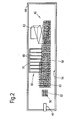
- an apparatus according to the invention is shown generally at 42.
- the apparatus is enclosed in a chamber 44.
- a gun 46 of known type fires a bird (not shown) along a trajectory (48 in Figure 3 ) to impact on a surface 50 of a target plate 52.
- the angle of impact of the bird on the target plate 52 is indicated by ⁇ .
- ⁇ is approximately 25 degrees.
- the target plate 52 is mounted vertically, perpendicular to the floor 54 of the chamber 44. This is in contrast to the arrangement of GB0807482.5 , in which the target plate was mounted essentially horizontally.
- the target plate 52 has a grid pattern to aid measurement of the impact characteristics.
- a high speed camera system is used to track the trajectory of the bird across the target plate 52.
- the vertical mounting of the target plate 52 makes the interpretation of the photographic images easier, because the position of the bird is easier to ascertain than with a horizontally mounted plate.
- the bird's continuing trajectory 56 will initially be broadly parallel to the target plate 52.
- the bird may still be intact, having suffered only quasi-elastic deformation, or it may have broken up to a lesser or greater extent into fragments.
- fragments will be used throughout the rest of this description, but this term should be understood to encompass both a fragmented bird and one that is still intact. It will also be appreciated that the bird fragments will in fact have slightly different trajectories from one another, but for the purposes of most of this description it will suffice to refer to a single trajectory, which should be understood also to encompass the multiple trajectories of the fragments, considered together.
- a soft recovery plate 58 is arranged to deflect the fragments gently and smoothly from this trajectory 56. To facilitate this, the initial part 60 of the soft recovery plate 58 is arranged to be approximately parallel to the target plate 52. The remainder of the plate 58 is gently curved to guide the fragments without damaging or breaking them up further.
- the soft recovery plate 58 has a grid pattern to aid measurement of the trajectory of the fragments.
- a high speed camera system is arranged to track the trajectories of the fragments across the soft recovery plate 58.
- the length of the soft recovery plate 58 is about 12 feet (3.66m). The trajectory of the bird fragments may therefore be tracked over this distance.
- the soft recovery plate may, of course, be made longer if the chamber 44 is large enough.
- the curvature of the soft recovery plate 58 guides the fragments into a spiral duct 62. Friction between the fragments and the duct walls will tend to slow the fragments, before they exit from the duct 62 along a final trajectory 64. The fragments are directed into a soft recovery system 66.
- the soft recovery system 66 is similar to that described in GB0807482.5 , but offers superior performance to that system.
- a number of soft bags 68 each bag having a pair of looped handles (not shown), are suspended by their handles from a pair of parallel poles 70.
- the system has eight bags 68.
- the bags 68 absorb energy from the fragments without damaging them, allowing them to fall to the floor for collection and analysis.
- the bags are free to slide along the poles, thus absorbing energy from the fragments.
- Some of the bags may be weighted with sand to increase their inertia and thereby increase the amount of energy that can be absorbed.
- the invention could be employed with birds weighing between 3.5 oz (0.1 kg) and 12 lb (5.4 kg), the bird being fired at the target plate with a velocity between 30 m/s and 400 m/s.
- the target plate may be mounted horizontally rather than vertically, or indeed at any convenient angle. This may be dictated by the dimensions of the chamber.
- the angle of incidence ⁇ of the bird upon the target plate may be set to any desired value. It is envisaged that the invention will find particular utility with angles between 5° and 60°. Generally, the angle of inclination of the initial part of the soft recovery plate will be the same as the angle ⁇ , although it may be beneficial in some circumstances to arrange it at a different angle.
- the shape and curvature of the soft recovery plate may be arranged in any appropriate manner, to meet particular experimental requirements.
- the configuration of the spiral duct may be different from that shown. In particular, it may contain fewer or more turns, or discharge the fragments in a different direction, depending on the constraints of the chamber. If enough space is available, it would be possible to dispense with the spiral duct altogether.
- the soft recovery system may be provided with fewer or more bags than the eight illustrated in the described embodiment. None, some or all of the bags may be weighted, and any suitable material, not only sand, may be used for this purpose.
- the bags may be mounted in any suitable way, and need not be mounted on poles as shown. In particular, a soft recovery system substantially as described in GB0807482.5 may be used in place of that described.
- the invention can be used in any application in which a bird or other similar soft body is in collision with a stationary surface, and in which it is desirable to understand the behaviour of the system after the collision. It could be used to analyse the behaviour of gelatine birds, or could be used to analyse the behaviour of ice.
- the invention therefore provides a method and apparatus for characterising the fragmentation of a soft body following impact with a surface, in which the trajectories of the bird fragments may be tracked and measured over a considerably greater distance than in known arrangements. This permits improved modelling of bird impacts on gas turbine engines behind obscuring intakes.
- this method can also be used to model the impact characteristics of birds or similar bodies with other structures, such as aircraft, trains, and boats.
Landscapes
- Physics & Mathematics (AREA)
- General Physics & Mathematics (AREA)
- Investigating Strength Of Materials By Application Of Mechanical Stress (AREA)
- Investigating Materials By The Use Of Optical Means Adapted For Particular Applications (AREA)
Abstract
Description
- This invention relates to the design of gas turbine engines, and more particularly to the characterisation of bird impacts, which are a particular problem when such engines are used in aircraft.
- Bird impacts can be very damaging to gas turbine engines, and it is necessary to design engines so that they can be safely run on for a period of time after an impact or, at the very least, safely shut down without causing danger to the aircraft or passengers.
- The basic techniques for carrying out bird ingestion tests on gas turbine engines are well known, and need not be discussed in detail here.
- In such a test, a soft body is fired at a known position on the inlet of the engine. The soft body may be either a dead bird or an artificial soft body designed to replicate closely the impact behaviour of a real bird. Such artificial soft bodies are well known. In the following description, the term "bird" can generally be taken to refer either to a real bird or to an artificial soft body used in a test in place of a real bird. After an impacting bird first hits the structure of the engine (whether static or rotating structure) it will fragment. Damage may be caused to the downstream parts of the engine by these fragments, and the size and trajectories of the fragments will determine the extent of this damage. Normally, the fragmentation can be assessed by viewing photographs or video of the first impact. The observed fragmentation can then be used to model the behaviour of the different parts of the engine following an impact, and thereby to design the engine to minimise damage from bird strikes.
- However, there is a problem when an engine is fitted with an obscuring intake. Such intakes are commonly used on military engines, so that the structure of the intake shields the hot components of the engine and prevents its detection by radar or other systems. The problem is that an incoming bird will strike the surface of the intake and will fragment, but the fragments are then hidden within the intake and so it is not possible to assess their size and trajectories. To obtain an initial bird condition for analysis, it is necessary to perform a separate impact test for each impact condition. This is time-consuming and expensive.
- Previously, impact analyses have been undertaken using a whole, intact bird, a bird fragment or a non-validated slurry.
- For the analysis of the bird strike capabilities of engines that will in use be shielded by an obscuring intake, it is vital that the initial conditions of the bird, which are used for analysis, reflect reality. Following a light impact of a bird on the intake, the bird can be modelled as a single fragment whose mass corresponds to that of the largest bird fragment. Following a severe impact, the bird can be modelled as a slurry. In between these two extremes of impact, the bird can be modelled as a combination of fragment(s) and slurry.
- United Kingdom patent application
GB0807482.5 - One embodiment of the invention described in
GB0807482.5 apparatus 12 as shown inFigure 1 . Agun 14 of known type fires a bird (not shown) along atrajectory 16 to impact on asurface 18 of atarget 20. The angle of impact of the bird on thesurface 18 is θ. The fragmented bird is deflected off thesurface 18 towards a soft-recovery system 22. This comprises a number of largeplastic sacks 24 freely suspended on two parallel ropes 26 (only one is visible). The ropes 26 are rigidly fixed at their ends to structure 28. In this embodiment, tensacks 24 are used, but any suitable number may be employed. Thesacks 24 absorb energy from the bird fragments without damaging them, allowing them to fall on to asheet 30 on the floor for collection and analysis. - A limitation of this method is that although the masses of the bird fragments can be assessed accurately, it is only possible to assess their trajectories, after impact with the
target 20, for a distance of about 2 ft (0.7 m) which is the typical gap between the end of thetarget 20 and thefirst sack 24 of the soft-recovery system 22. It would be desirable to assess the trajectories of the bird fragments over a greater distance, to improve the modelling of bird strikes on gas turbine engines situated behind obscuring intakes. - Accordingly, the invention provides an apparatus and a method for characterising the fragmentation of a soft body following impact with a surface as set out in the claims.
- An embodiment of the invention will now be described, by way of example, with reference to the accompanying drawings in which
-
Figure 2 is a schematic side view of an apparatus according to the invention; and -
Figure 3 is a schematic plan view of the apparatus shown inFigure 2 . - Referring to
Figures 2 and3 , an apparatus according to the invention is shown generally at 42. The apparatus is enclosed in achamber 44. - A
gun 46 of known type fires a bird (not shown) along a trajectory (48 inFigure 3 ) to impact on asurface 50 of atarget plate 52. The angle of impact of the bird on thetarget plate 52 is indicated by ϕ. In this embodiment ϕ is approximately 25 degrees. It will be apparent from the drawings that thetarget plate 52 is mounted vertically, perpendicular to thefloor 54 of thechamber 44. This is in contrast to the arrangement ofGB0807482.5 target plate 52 has a grid pattern to aid measurement of the impact characteristics. In operation, a high speed camera system is used to track the trajectory of the bird across thetarget plate 52. The vertical mounting of thetarget plate 52 makes the interpretation of the photographic images easier, because the position of the bird is easier to ascertain than with a horizontally mounted plate. - After impact with the
target plate 52, the bird's continuingtrajectory 56 will initially be broadly parallel to thetarget plate 52. - Depending on the energy and angle of impact, the bird may still be intact, having suffered only quasi-elastic deformation, or it may have broken up to a lesser or greater extent into fragments. For simplicity, the term "fragments" will be used throughout the rest of this description, but this term should be understood to encompass both a fragmented bird and one that is still intact. It will also be appreciated that the bird fragments will in fact have slightly different trajectories from one another, but for the purposes of most of this description it will suffice to refer to a single trajectory, which should be understood also to encompass the multiple trajectories of the fragments, considered together.
- A
soft recovery plate 58 is arranged to deflect the fragments gently and smoothly from thistrajectory 56. To facilitate this, theinitial part 60 of thesoft recovery plate 58 is arranged to be approximately parallel to thetarget plate 52. The remainder of theplate 58 is gently curved to guide the fragments without damaging or breaking them up further. Thesoft recovery plate 58 has a grid pattern to aid measurement of the trajectory of the fragments. A high speed camera system is arranged to track the trajectories of the fragments across thesoft recovery plate 58. - In this embodiment the length of the
soft recovery plate 58 is about 12 feet (3.66m). The trajectory of the bird fragments may therefore be tracked over this distance. The soft recovery plate may, of course, be made longer if thechamber 44 is large enough. - The curvature of the
soft recovery plate 58 guides the fragments into aspiral duct 62. Friction between the fragments and the duct walls will tend to slow the fragments, before they exit from theduct 62 along afinal trajectory 64. The fragments are directed into asoft recovery system 66. - The
soft recovery system 66 is similar to that described inGB0807482.5 soft bags 68, each bag having a pair of looped handles (not shown), are suspended by their handles from a pair ofparallel poles 70. In this embodiment the system has eightbags 68. Thebags 68 absorb energy from the fragments without damaging them, allowing them to fall to the floor for collection and analysis. The bags are free to slide along the poles, thus absorbing energy from the fragments. Some of the bags may be weighted with sand to increase their inertia and thereby increase the amount of energy that can be absorbed. - It will be appreciated that various modifications may be made to the embodiment described, without departing from the principle of the invention.
- It is envisaged that the invention could be employed with birds weighing between 3.5 oz (0.1 kg) and 12 lb (5.4 kg), the bird being fired at the target plate with a velocity between 30 m/s and 400 m/s.
- The target plate may be mounted horizontally rather than vertically, or indeed at any convenient angle. This may be dictated by the dimensions of the chamber.
- The angle of incidence ϕ of the bird upon the target plate may be set to any desired value. It is envisaged that the invention will find particular utility with angles between 5° and 60°. Generally, the angle of inclination of the initial part of the soft recovery plate will be the same as the angle ϕ, although it may be beneficial in some circumstances to arrange it at a different angle.
- The shape and curvature of the soft recovery plate may be arranged in any appropriate manner, to meet particular experimental requirements.
- The configuration of the spiral duct may be different from that shown. In particular, it may contain fewer or more turns, or discharge the fragments in a different direction, depending on the constraints of the chamber. If enough space is available, it would be possible to dispense with the spiral duct altogether.
- The soft recovery system may be provided with fewer or more bags than the eight illustrated in the described embodiment. None, some or all of the bags may be weighted, and any suitable material, not only sand, may be used for this purpose. The bags may be mounted in any suitable way, and need not be mounted on poles as shown. In particular, a soft recovery system substantially as described in
GB0807482.5 - It will also be appreciated that the invention can be used in any application in which a bird or other similar soft body is in collision with a stationary surface, and in which it is desirable to understand the behaviour of the system after the collision. It could be used to analyse the behaviour of gelatine birds, or could be used to analyse the behaviour of ice.
- The invention therefore provides a method and apparatus for characterising the fragmentation of a soft body following impact with a surface, in which the trajectories of the bird fragments may be tracked and measured over a considerably greater distance than in known arrangements. This permits improved modelling of bird impacts on gas turbine engines behind obscuring intakes.
- It will be appreciated that this method can also be used to model the impact characteristics of birds or similar bodies with other structures, such as aircraft, trains, and boats.
Claims (8)
- An apparatus for characterising the fragmentation of a body following impact with a surface, the apparatus comprising a gun (46), a target plate (52), a soft recovery plate (58) across which the body's trajectory can be tracked, and a soft recovery system (66), characterised in that damage to the body is caused substantially only by the impact on the target plate.
- An apparatus as claimed in claim 1, in which in use the body is fired from the gun towards the target plate at a predetermined angle to the target plate.
- An apparatus as claimed in claim 2, in which the predetermined angle is about 25 degrees.
- An apparatus as claimed in any preceding claim, in which the initial portion of the soft recovery plate is approximately parallel to the expected trajectory of the body or the fragments thereof deflected from the target plate.
- An apparatus as claimed in any preceding claim, in which the soft recovery plate is curved so as to guide the trajectory of the body or the fragments thereof.
- An apparatus as claimed in any preceding claim, and further comprising a spiral duct (62) between the soft recovery plate and the soft recovery system.
- An apparatus as claimed in any preceding claim, and further comprising photographic equipment arranged to record the trajectory of the body or the fragments thereof across the soft recovery plate.
- An apparatus as claimed in any preceding claim, in which the length of the soft recovery plate is about 12 feet.
Applications Claiming Priority (1)
| Application Number | Priority Date | Filing Date | Title |
|---|---|---|---|
| GBGB0905958.5A GB0905958D0 (en) | 2009-04-07 | 2009-04-07 | Characterisation of soft body impacts |
Publications (2)
| Publication Number | Publication Date |
|---|---|
| EP2239551A1 true EP2239551A1 (en) | 2010-10-13 |
| EP2239551B1 EP2239551B1 (en) | 2017-05-03 |
Family
ID=40750194
Family Applications (1)
| Application Number | Title | Priority Date | Filing Date |
|---|---|---|---|
| EP10250409.9A Not-in-force EP2239551B1 (en) | 2009-04-07 | 2010-03-05 | Characterisation of soft body impacts |
Country Status (3)
| Country | Link |
|---|---|
| US (1) | US8220309B2 (en) |
| EP (1) | EP2239551B1 (en) |
| GB (1) | GB0905958D0 (en) |
Families Citing this family (6)
| Publication number | Priority date | Publication date | Assignee | Title |
|---|---|---|---|---|
| CN103963993B (en) * | 2013-01-29 | 2017-04-19 | 中国航空工业集团公司西安飞机设计研究所 | Wing section simulation structure of aircraft iron bird test platform |
| RU2706431C1 (en) * | 2019-04-02 | 2019-11-19 | Федеральное государственное унитарное предприятие "Центральный институт авиационного моторостроения имени П.И. Баранова" | Method of angular aiming of projectile throwing device |
| CN111579190B (en) * | 2020-04-27 | 2021-05-25 | 南京航空航天大学 | Horizontal ejection-impact type blade bird-cutting test device and test method |
| GB2595714A (en) * | 2020-06-04 | 2021-12-08 | Univ Stellenbosch | Containment device |
| CN112208791B (en) * | 2020-10-14 | 2023-10-13 | 航宇救生装备有限公司 | Rifle head recovery system of umbrella shooting gun |
| CN112798211A (en) * | 2020-12-29 | 2021-05-14 | 中国航空工业集团公司西安飞机设计研究所 | An Equivalent Clamping Device for Bird Impact Test |
Citations (4)
| Publication number | Priority date | Publication date | Assignee | Title |
|---|---|---|---|---|
| FR1484155A (en) * | 1965-06-21 | 1967-06-09 | Fiat Spa | Improvements to high-speed guns, in particular for measuring the impact resistance of an aircraft against winged beings |
| US3974313A (en) * | 1974-08-22 | 1976-08-10 | The Boeing Company | Projectile energy absorbing protective barrier |
| US20040037694A1 (en) * | 2002-08-21 | 2004-02-26 | Robert Mather | Energy absorber and deflection device |
| EP2112333A2 (en) * | 2008-04-25 | 2009-10-28 | Rolls-Royce plc | Charactersation of soft body impacts |
Family Cites Families (6)
| Publication number | Priority date | Publication date | Assignee | Title |
|---|---|---|---|---|
| US4300389A (en) * | 1980-06-06 | 1981-11-17 | The United States Of America As Represented By The Secretary Of The Army | Soft recovery method for gunfired shells |
| US5220128A (en) * | 1991-11-22 | 1993-06-15 | Grau John C | Soft-recovery system for gun-launched projectiles |
| USH1150H (en) * | 1992-04-20 | 1993-03-02 | The United States Of America As Represented By The Secretary Of The Army | Parachute recovery system for projectiles |
| JPH0861086A (en) | 1994-08-22 | 1996-03-05 | Toshiba Corp | Evaluation method for foreign matter collision damage on gas turbine blades |
| US5725449A (en) * | 1996-10-18 | 1998-03-10 | Bell & Howell Mail Processing Systems | Impact pulley |
| UA81662C2 (en) | 2005-10-31 | 2008-01-25 | Институт Проблем Машиностроения Им. А.М. Подгорного Национальной Академии Наук Украины | Bird imitator, method to make it and method to test elements of construction of aircrafts on impact strength at collision with bird |
-
2009
- 2009-04-07 GB GBGB0905958.5A patent/GB0905958D0/en not_active Ceased
-
2010
- 2010-03-04 US US12/717,525 patent/US8220309B2/en not_active Expired - Fee Related
- 2010-03-05 EP EP10250409.9A patent/EP2239551B1/en not_active Not-in-force
Patent Citations (4)
| Publication number | Priority date | Publication date | Assignee | Title |
|---|---|---|---|---|
| FR1484155A (en) * | 1965-06-21 | 1967-06-09 | Fiat Spa | Improvements to high-speed guns, in particular for measuring the impact resistance of an aircraft against winged beings |
| US3974313A (en) * | 1974-08-22 | 1976-08-10 | The Boeing Company | Projectile energy absorbing protective barrier |
| US20040037694A1 (en) * | 2002-08-21 | 2004-02-26 | Robert Mather | Energy absorber and deflection device |
| EP2112333A2 (en) * | 2008-04-25 | 2009-10-28 | Rolls-Royce plc | Charactersation of soft body impacts |
Non-Patent Citations (2)
| Title |
|---|
| HOU ET AL: "Soft body impact on laminated composite materials", COMPOSITES PART A: APPLIED SCIENCE AND MANUFACTURING, ELSEVIER SCIENCE PUBLISHERS B.V., AMSTERDAM, NL LNKD- DOI:10.1016/J.COMPOSITESA.2006.02.018, vol. 38, no. 2, 5 December 2006 (2006-12-05), pages 505 - 515, XP005793922, ISSN: 1359-835X * |
| JORIS DEGRIECK ET AL: "Optical measurement of target displacement and velocity in bird strike simulation experiments; Optical measurement of target displacement and velocity in bird strike simulation experiments", MEASUREMENT SCIENCE AND TECHNOLOGY, IOP, BRISTOL, GB LNKD- DOI:10.1088/0957-0233/14/1/301, vol. 14, no. 1, 1 January 2003 (2003-01-01), pages 1 - 6, XP020063690, ISSN: 0957-0233 * |
Also Published As
| Publication number | Publication date |
|---|---|
| GB0905958D0 (en) | 2009-05-20 |
| US8220309B2 (en) | 2012-07-17 |
| US20100251801A1 (en) | 2010-10-07 |
| EP2239551B1 (en) | 2017-05-03 |
Similar Documents
| Publication | Publication Date | Title |
|---|---|---|
| US8220309B2 (en) | Characterisation of soft body impacts | |
| CN111579190B (en) | Horizontal ejection-impact type blade bird-cutting test device and test method | |
| US8280704B2 (en) | Characterisation of soft body impacts | |
| CN111366481A (en) | A high-speed impact test device and method for simulating the action of airflow | |
| Boslough et al. | Hypervelocity testing of advanced shielding concepts for spacecraft against impacts to 10 km/s | |
| Vargas et al. | Ice particle impacts on a moving wedge | |
| CN119124636B (en) | A bird strike test device simulating a real engine | |
| Sielicki et al. | Field test and probabilistic analysis of irregular steel debris casualty risks from a person-borne improvised explosive device | |
| Piekutowski et al. | Performance of Whipple shields at impact velocities above 9 km/s | |
| CN109916589A (en) | Pressure variation characteristic test method in a kind of carrier large sized object air-drop cabin | |
| EP3848696A1 (en) | A testing method with particle erosion firing for high velocities | |
| RU111654U1 (en) | RAIL STAND FOR DYNAMIC TRACK TESTING OF MATERIALS AND STRUCTURES FOR SHOCK IMPACTS | |
| Seng et al. | Dynamic open-rotor composite shield impact test report | |
| CN111855124B (en) | Device and method for controlling bullet posture in impact test | |
| Mithun et al. | Finite element modelling for bird strike analysis and review of existing numerical methods | |
| CN109740266A (en) | A kind of underground structure based on complexity effect field computation injures appraisal procedure | |
| Power | Fy 74 experimental hydraulic ram studies | |
| Horsley | The'Rolls-Royce'way of validating fan integrity | |
| Ruiz-Calavera et al. | Spinner Shed Ice Engine Ingestion Assessment Methodology | |
| Shorr et al. | Computational and experimental study of bird failure at different speeds of collision with a flexible plate | |
| RU98238U1 (en) | TRAP FOR A HIGH SPEED AEROBALLISTIC MODEL WITH TEST MATERIAL | |
| RU2846306C2 (en) | Method of armoured helmet testing for impact resistance and behind-armour effect during ammunition explosion | |
| CN106965944A (en) | A kind of method that anti-bird of jet plane air intake duct multi-buffer hits cover | |
| Mazanishvili et al. | Theoretical-experimental study of optimization of operational parameters of protective nets of aircraft power units | |
| Shimoi | Numerical and experimental investigation of ice shedding |
Legal Events
| Date | Code | Title | Description |
|---|---|---|---|
| PUAI | Public reference made under article 153(3) epc to a published international application that has entered the european phase |
Free format text: ORIGINAL CODE: 0009012 |
|
| 17P | Request for examination filed |
Effective date: 20100809 |
|
| AK | Designated contracting states |
Kind code of ref document: A1 Designated state(s): AT BE BG CH CY CZ DE DK EE ES FI FR GB GR HR HU IE IS IT LI LT LU LV MC MK MT NL NO PL PT RO SE SI SK SM TR |
|
| AX | Request for extension of the european patent |
Extension state: AL BA ME RS |
|
| RAP1 | Party data changed (applicant data changed or rights of an application transferred) |
Owner name: ROLLS-ROYCE PLC |
|
| GRAP | Despatch of communication of intention to grant a patent |
Free format text: ORIGINAL CODE: EPIDOSNIGR1 |
|
| STAA | Information on the status of an ep patent application or granted ep patent |
Free format text: STATUS: GRANT OF PATENT IS INTENDED |
|
| RIC1 | Information provided on ipc code assigned before grant |
Ipc: B64F 5/00 20060101ALI20161114BHEP Ipc: G01M 7/08 20060101AFI20161114BHEP |
|
| INTG | Intention to grant announced |
Effective date: 20161130 |
|
| GRAS | Grant fee paid |
Free format text: ORIGINAL CODE: EPIDOSNIGR3 |
|
| GRAA | (expected) grant |
Free format text: ORIGINAL CODE: 0009210 |
|
| STAA | Information on the status of an ep patent application or granted ep patent |
Free format text: STATUS: THE PATENT HAS BEEN GRANTED |
|
| AK | Designated contracting states |
Kind code of ref document: B1 Designated state(s): AT BE BG CH CY CZ DE DK EE ES FI FR GB GR HR HU IE IS IT LI LT LU LV MC MK MT NL NO PL PT RO SE SI SK SM TR |
|
| REG | Reference to a national code |
Ref country code: GB Ref legal event code: FG4D |
|
| REG | Reference to a national code |
Ref country code: AT Ref legal event code: REF Ref document number: 890511 Country of ref document: AT Kind code of ref document: T Effective date: 20170515 Ref country code: CH Ref legal event code: EP |
|
| REG | Reference to a national code |
Ref country code: IE Ref legal event code: FG4D |
|
| REG | Reference to a national code |
Ref country code: DE Ref legal event code: R096 Ref document number: 602010041984 Country of ref document: DE |
|
| REG | Reference to a national code |
Ref country code: NL Ref legal event code: MP Effective date: 20170503 |
|
| REG | Reference to a national code |
Ref country code: AT Ref legal event code: MK05 Ref document number: 890511 Country of ref document: AT Kind code of ref document: T Effective date: 20170503 |
|
| REG | Reference to a national code |
Ref country code: LT Ref legal event code: MG4D |
|
| PG25 | Lapsed in a contracting state [announced via postgrant information from national office to epo] |
Ref country code: HR Free format text: LAPSE BECAUSE OF FAILURE TO SUBMIT A TRANSLATION OF THE DESCRIPTION OR TO PAY THE FEE WITHIN THE PRESCRIBED TIME-LIMIT Effective date: 20170503 Ref country code: GR Free format text: LAPSE BECAUSE OF FAILURE TO SUBMIT A TRANSLATION OF THE DESCRIPTION OR TO PAY THE FEE WITHIN THE PRESCRIBED TIME-LIMIT Effective date: 20170804 Ref country code: LT Free format text: LAPSE BECAUSE OF FAILURE TO SUBMIT A TRANSLATION OF THE DESCRIPTION OR TO PAY THE FEE WITHIN THE PRESCRIBED TIME-LIMIT Effective date: 20170503 Ref country code: AT Free format text: LAPSE BECAUSE OF FAILURE TO SUBMIT A TRANSLATION OF THE DESCRIPTION OR TO PAY THE FEE WITHIN THE PRESCRIBED TIME-LIMIT Effective date: 20170503 Ref country code: ES Free format text: LAPSE BECAUSE OF FAILURE TO SUBMIT A TRANSLATION OF THE DESCRIPTION OR TO PAY THE FEE WITHIN THE PRESCRIBED TIME-LIMIT Effective date: 20170503 Ref country code: NO Free format text: LAPSE BECAUSE OF FAILURE TO SUBMIT A TRANSLATION OF THE DESCRIPTION OR TO PAY THE FEE WITHIN THE PRESCRIBED TIME-LIMIT Effective date: 20170803 Ref country code: FI Free format text: LAPSE BECAUSE OF FAILURE TO SUBMIT A TRANSLATION OF THE DESCRIPTION OR TO PAY THE FEE WITHIN THE PRESCRIBED TIME-LIMIT Effective date: 20170503 |
|
| PG25 | Lapsed in a contracting state [announced via postgrant information from national office to epo] |
Ref country code: NL Free format text: LAPSE BECAUSE OF FAILURE TO SUBMIT A TRANSLATION OF THE DESCRIPTION OR TO PAY THE FEE WITHIN THE PRESCRIBED TIME-LIMIT Effective date: 20170503 Ref country code: BG Free format text: LAPSE BECAUSE OF FAILURE TO SUBMIT A TRANSLATION OF THE DESCRIPTION OR TO PAY THE FEE WITHIN THE PRESCRIBED TIME-LIMIT Effective date: 20170803 Ref country code: SE Free format text: LAPSE BECAUSE OF FAILURE TO SUBMIT A TRANSLATION OF THE DESCRIPTION OR TO PAY THE FEE WITHIN THE PRESCRIBED TIME-LIMIT Effective date: 20170503 Ref country code: IS Free format text: LAPSE BECAUSE OF FAILURE TO SUBMIT A TRANSLATION OF THE DESCRIPTION OR TO PAY THE FEE WITHIN THE PRESCRIBED TIME-LIMIT Effective date: 20170903 Ref country code: PL Free format text: LAPSE BECAUSE OF FAILURE TO SUBMIT A TRANSLATION OF THE DESCRIPTION OR TO PAY THE FEE WITHIN THE PRESCRIBED TIME-LIMIT Effective date: 20170503 Ref country code: LV Free format text: LAPSE BECAUSE OF FAILURE TO SUBMIT A TRANSLATION OF THE DESCRIPTION OR TO PAY THE FEE WITHIN THE PRESCRIBED TIME-LIMIT Effective date: 20170503 |
|
| PG25 | Lapsed in a contracting state [announced via postgrant information from national office to epo] |
Ref country code: RO Free format text: LAPSE BECAUSE OF FAILURE TO SUBMIT A TRANSLATION OF THE DESCRIPTION OR TO PAY THE FEE WITHIN THE PRESCRIBED TIME-LIMIT Effective date: 20170503 Ref country code: EE Free format text: LAPSE BECAUSE OF FAILURE TO SUBMIT A TRANSLATION OF THE DESCRIPTION OR TO PAY THE FEE WITHIN THE PRESCRIBED TIME-LIMIT Effective date: 20170503 Ref country code: CZ Free format text: LAPSE BECAUSE OF FAILURE TO SUBMIT A TRANSLATION OF THE DESCRIPTION OR TO PAY THE FEE WITHIN THE PRESCRIBED TIME-LIMIT Effective date: 20170503 Ref country code: DK Free format text: LAPSE BECAUSE OF FAILURE TO SUBMIT A TRANSLATION OF THE DESCRIPTION OR TO PAY THE FEE WITHIN THE PRESCRIBED TIME-LIMIT Effective date: 20170503 Ref country code: SK Free format text: LAPSE BECAUSE OF FAILURE TO SUBMIT A TRANSLATION OF THE DESCRIPTION OR TO PAY THE FEE WITHIN THE PRESCRIBED TIME-LIMIT Effective date: 20170503 |
|
| REG | Reference to a national code |
Ref country code: DE Ref legal event code: R097 Ref document number: 602010041984 Country of ref document: DE |
|
| PG25 | Lapsed in a contracting state [announced via postgrant information from national office to epo] |
Ref country code: SM Free format text: LAPSE BECAUSE OF FAILURE TO SUBMIT A TRANSLATION OF THE DESCRIPTION OR TO PAY THE FEE WITHIN THE PRESCRIBED TIME-LIMIT Effective date: 20170503 Ref country code: IT Free format text: LAPSE BECAUSE OF FAILURE TO SUBMIT A TRANSLATION OF THE DESCRIPTION OR TO PAY THE FEE WITHIN THE PRESCRIBED TIME-LIMIT Effective date: 20170503 |
|
| PLBE | No opposition filed within time limit |
Free format text: ORIGINAL CODE: 0009261 |
|
| STAA | Information on the status of an ep patent application or granted ep patent |
Free format text: STATUS: NO OPPOSITION FILED WITHIN TIME LIMIT |
|
| REG | Reference to a national code |
Ref country code: FR Ref legal event code: PLFP Year of fee payment: 9 |
|
| 26N | No opposition filed |
Effective date: 20180206 |
|
| PG25 | Lapsed in a contracting state [announced via postgrant information from national office to epo] |
Ref country code: SI Free format text: LAPSE BECAUSE OF FAILURE TO SUBMIT A TRANSLATION OF THE DESCRIPTION OR TO PAY THE FEE WITHIN THE PRESCRIBED TIME-LIMIT Effective date: 20170503 |
|
| REG | Reference to a national code |
Ref country code: CH Ref legal event code: PL |
|
| PG25 | Lapsed in a contracting state [announced via postgrant information from national office to epo] |
Ref country code: MC Free format text: LAPSE BECAUSE OF FAILURE TO SUBMIT A TRANSLATION OF THE DESCRIPTION OR TO PAY THE FEE WITHIN THE PRESCRIBED TIME-LIMIT Effective date: 20170503 |
|
| REG | Reference to a national code |
Ref country code: BE Ref legal event code: MM Effective date: 20180331 |
|
| REG | Reference to a national code |
Ref country code: IE Ref legal event code: MM4A |
|
| PG25 | Lapsed in a contracting state [announced via postgrant information from national office to epo] |
Ref country code: LU Free format text: LAPSE BECAUSE OF NON-PAYMENT OF DUE FEES Effective date: 20180305 |
|
| PG25 | Lapsed in a contracting state [announced via postgrant information from national office to epo] |
Ref country code: IE Free format text: LAPSE BECAUSE OF NON-PAYMENT OF DUE FEES Effective date: 20180305 |
|
| PG25 | Lapsed in a contracting state [announced via postgrant information from national office to epo] |
Ref country code: LI Free format text: LAPSE BECAUSE OF NON-PAYMENT OF DUE FEES Effective date: 20180331 Ref country code: BE Free format text: LAPSE BECAUSE OF NON-PAYMENT OF DUE FEES Effective date: 20180331 Ref country code: CH Free format text: LAPSE BECAUSE OF NON-PAYMENT OF DUE FEES Effective date: 20180331 |
|
| PG25 | Lapsed in a contracting state [announced via postgrant information from national office to epo] |
Ref country code: MT Free format text: LAPSE BECAUSE OF NON-PAYMENT OF DUE FEES Effective date: 20180305 |
|
| PG25 | Lapsed in a contracting state [announced via postgrant information from national office to epo] |
Ref country code: TR Free format text: LAPSE BECAUSE OF FAILURE TO SUBMIT A TRANSLATION OF THE DESCRIPTION OR TO PAY THE FEE WITHIN THE PRESCRIBED TIME-LIMIT Effective date: 20170503 |
|
| PGFP | Annual fee paid to national office [announced via postgrant information from national office to epo] |
Ref country code: DE Payment date: 20200327 Year of fee payment: 11 Ref country code: GB Payment date: 20200327 Year of fee payment: 11 |
|
| PG25 | Lapsed in a contracting state [announced via postgrant information from national office to epo] |
Ref country code: PT Free format text: LAPSE BECAUSE OF FAILURE TO SUBMIT A TRANSLATION OF THE DESCRIPTION OR TO PAY THE FEE WITHIN THE PRESCRIBED TIME-LIMIT Effective date: 20170503 Ref country code: HU Free format text: LAPSE BECAUSE OF FAILURE TO SUBMIT A TRANSLATION OF THE DESCRIPTION OR TO PAY THE FEE WITHIN THE PRESCRIBED TIME-LIMIT; INVALID AB INITIO Effective date: 20100305 |
|
| PG25 | Lapsed in a contracting state [announced via postgrant information from national office to epo] |
Ref country code: MK Free format text: LAPSE BECAUSE OF NON-PAYMENT OF DUE FEES Effective date: 20170503 Ref country code: CY Free format text: LAPSE BECAUSE OF FAILURE TO SUBMIT A TRANSLATION OF THE DESCRIPTION OR TO PAY THE FEE WITHIN THE PRESCRIBED TIME-LIMIT Effective date: 20170503 |
|
| PGFP | Annual fee paid to national office [announced via postgrant information from national office to epo] |
Ref country code: FR Payment date: 20200325 Year of fee payment: 11 |
|
| REG | Reference to a national code |
Ref country code: DE Ref legal event code: R119 Ref document number: 602010041984 Country of ref document: DE |
|
| GBPC | Gb: european patent ceased through non-payment of renewal fee |
Effective date: 20210305 |
|
| PG25 | Lapsed in a contracting state [announced via postgrant information from national office to epo] |
Ref country code: GB Free format text: LAPSE BECAUSE OF NON-PAYMENT OF DUE FEES Effective date: 20210305 Ref country code: FR Free format text: LAPSE BECAUSE OF NON-PAYMENT OF DUE FEES Effective date: 20210331 Ref country code: DE Free format text: LAPSE BECAUSE OF NON-PAYMENT OF DUE FEES Effective date: 20211001 |