EP2239230A1 - Burned composite metal oxide and process for producing the same - Google Patents
Burned composite metal oxide and process for producing the same Download PDFInfo
- Publication number
- EP2239230A1 EP2239230A1 EP08865587A EP08865587A EP2239230A1 EP 2239230 A1 EP2239230 A1 EP 2239230A1 EP 08865587 A EP08865587 A EP 08865587A EP 08865587 A EP08865587 A EP 08865587A EP 2239230 A1 EP2239230 A1 EP 2239230A1
- Authority
- EP
- European Patent Office
- Prior art keywords
- metal oxide
- composite metal
- metal compound
- burned composite
- burned
- Prior art date
- Legal status (The legal status is an assumption and is not a legal conclusion. Google has not performed a legal analysis and makes no representation as to the accuracy of the status listed.)
- Withdrawn
Links
- 229910044991 metal oxide Inorganic materials 0.000 title claims abstract description 163
- 150000004706 metal oxides Chemical class 0.000 title claims abstract description 163
- 239000002131 composite material Substances 0.000 title claims abstract description 108
- 238000000034 method Methods 0.000 title claims description 48
- 230000008569 process Effects 0.000 title claims description 31
- 150000002736 metal compounds Chemical class 0.000 claims abstract description 91
- 239000002002 slurry Substances 0.000 claims abstract description 77
- 239000007921 spray Substances 0.000 claims abstract description 60
- 238000005469 granulation Methods 0.000 claims abstract description 48
- 230000003179 granulation Effects 0.000 claims abstract description 48
- 239000002904 solvent Substances 0.000 claims abstract description 45
- 239000008187 granular material Substances 0.000 claims abstract description 39
- 238000000354 decomposition reaction Methods 0.000 claims abstract description 22
- 238000010438 heat treatment Methods 0.000 claims abstract description 15
- 229910052751 metal Inorganic materials 0.000 claims abstract description 15
- 239000002184 metal Substances 0.000 claims abstract description 15
- 230000000737 periodic effect Effects 0.000 claims abstract description 9
- 229910000314 transition metal oxide Inorganic materials 0.000 claims abstract description 7
- 150000001339 alkali metal compounds Chemical class 0.000 claims abstract description 6
- 229910052784 alkaline earth metal Inorganic materials 0.000 claims abstract description 6
- 239000002245 particle Substances 0.000 claims description 116
- 239000011148 porous material Substances 0.000 claims description 56
- 239000000463 material Substances 0.000 claims description 25
- 239000007774 positive electrode material Substances 0.000 claims description 17
- 239000011255 nonaqueous electrolyte Substances 0.000 claims description 10
- 238000009826 distribution Methods 0.000 claims description 9
- 229910052742 iron Inorganic materials 0.000 claims description 6
- QSHDDOUJBYECFT-UHFFFAOYSA-N mercury Chemical compound [Hg] QSHDDOUJBYECFT-UHFFFAOYSA-N 0.000 claims description 6
- 229910052753 mercury Inorganic materials 0.000 claims description 6
- 229910052759 nickel Inorganic materials 0.000 claims description 6
- 229910052748 manganese Inorganic materials 0.000 claims description 5
- 229910003002 lithium salt Inorganic materials 0.000 claims description 3
- 159000000002 lithium salts Chemical class 0.000 claims description 3
- 239000000843 powder Substances 0.000 description 61
- QHGJSLXSVXVKHZ-UHFFFAOYSA-N dilithium;dioxido(dioxo)manganese Chemical compound [Li+].[Li+].[O-][Mn]([O-])(=O)=O QHGJSLXSVXVKHZ-UHFFFAOYSA-N 0.000 description 45
- 239000011164 primary particle Substances 0.000 description 42
- 238000010298 pulverizing process Methods 0.000 description 42
- NUJOXMJBOLGQSY-UHFFFAOYSA-N manganese dioxide Chemical compound O=[Mn]=O NUJOXMJBOLGQSY-UHFFFAOYSA-N 0.000 description 36
- 239000011572 manganese Substances 0.000 description 22
- 239000002270 dispersing agent Substances 0.000 description 19
- XGZVUEUWXADBQD-UHFFFAOYSA-L lithium carbonate Chemical compound [Li+].[Li+].[O-]C([O-])=O XGZVUEUWXADBQD-UHFFFAOYSA-L 0.000 description 18
- 229910052808 lithium carbonate Inorganic materials 0.000 description 18
- 229910002097 Lithium manganese(III,IV) oxide Inorganic materials 0.000 description 15
- 229920000642 polymer Polymers 0.000 description 15
- 238000009835 boiling Methods 0.000 description 14
- 229910052744 lithium Inorganic materials 0.000 description 14
- 239000002994 raw material Substances 0.000 description 14
- 230000000630 rising effect Effects 0.000 description 14
- 239000007787 solid Substances 0.000 description 14
- XLYOFNOQVPJJNP-UHFFFAOYSA-N water Substances O XLYOFNOQVPJJNP-UHFFFAOYSA-N 0.000 description 14
- 239000011149 active material Substances 0.000 description 13
- WHXSMMKQMYFTQS-UHFFFAOYSA-N Lithium Chemical compound [Li] WHXSMMKQMYFTQS-UHFFFAOYSA-N 0.000 description 12
- 238000004519 manufacturing process Methods 0.000 description 12
- 238000005259 measurement Methods 0.000 description 12
- 230000000704 physical effect Effects 0.000 description 12
- -1 Lithium transition metal Chemical class 0.000 description 11
- 238000000634 powder X-ray diffraction Methods 0.000 description 11
- 229910052596 spinel Inorganic materials 0.000 description 11
- 239000011029 spinel Substances 0.000 description 11
- LFQSCWFLJHTTHZ-UHFFFAOYSA-N Ethanol Chemical compound CCO LFQSCWFLJHTTHZ-UHFFFAOYSA-N 0.000 description 10
- 238000002441 X-ray diffraction Methods 0.000 description 9
- 230000000052 comparative effect Effects 0.000 description 9
- 239000003570 air Substances 0.000 description 8
- 230000002708 enhancing effect Effects 0.000 description 8
- 238000012360 testing method Methods 0.000 description 8
- 239000011248 coating agent Substances 0.000 description 7
- 238000000576 coating method Methods 0.000 description 7
- 239000003792 electrolyte Substances 0.000 description 7
- SECXISVLQFMRJM-UHFFFAOYSA-N N-Methylpyrrolidone Chemical compound CN1CCCC1=O SECXISVLQFMRJM-UHFFFAOYSA-N 0.000 description 6
- IIPYXGDZVMZOAP-UHFFFAOYSA-N lithium nitrate Chemical compound [Li+].[O-][N+]([O-])=O IIPYXGDZVMZOAP-UHFFFAOYSA-N 0.000 description 6
- ZMXDDKWLCZADIW-UHFFFAOYSA-N N,N-Dimethylformamide Chemical compound CN(C)C=O ZMXDDKWLCZADIW-UHFFFAOYSA-N 0.000 description 5
- 239000011324 bead Substances 0.000 description 5
- 239000011230 binding agent Substances 0.000 description 5
- 238000003795 desorption Methods 0.000 description 5
- 238000001035 drying Methods 0.000 description 5
- 238000005507 spraying Methods 0.000 description 5
- IJGRMHOSHXDMSA-UHFFFAOYSA-N Atomic nitrogen Chemical compound N#N IJGRMHOSHXDMSA-UHFFFAOYSA-N 0.000 description 4
- BVKZGUZCCUSVTD-UHFFFAOYSA-L Carbonate Chemical compound [O-]C([O-])=O BVKZGUZCCUSVTD-UHFFFAOYSA-L 0.000 description 4
- 229910002651 NO3 Inorganic materials 0.000 description 4
- NHNBFGGVMKEFGY-UHFFFAOYSA-N Nitrate Chemical compound [O-][N+]([O-])=O NHNBFGGVMKEFGY-UHFFFAOYSA-N 0.000 description 4
- MCMNRKCIXSYSNV-UHFFFAOYSA-N Zirconium dioxide Chemical compound O=[Zr]=O MCMNRKCIXSYSNV-UHFFFAOYSA-N 0.000 description 4
- NIXOWILDQLNWCW-UHFFFAOYSA-N acrylic acid group Chemical group C(C=C)(=O)O NIXOWILDQLNWCW-UHFFFAOYSA-N 0.000 description 4
- 238000006243 chemical reaction Methods 0.000 description 4
- 150000001875 compounds Chemical class 0.000 description 4
- 230000006870 function Effects 0.000 description 4
- XLYOFNOQVPJJNP-UHFFFAOYSA-M hydroxide Chemical compound [OH-] XLYOFNOQVPJJNP-UHFFFAOYSA-M 0.000 description 4
- 150000002642 lithium compounds Chemical class 0.000 description 4
- 229910001416 lithium ion Inorganic materials 0.000 description 4
- 238000002156 mixing Methods 0.000 description 4
- PXHVJJICTQNCMI-UHFFFAOYSA-N nickel Substances [Ni] PXHVJJICTQNCMI-UHFFFAOYSA-N 0.000 description 4
- 150000003839 salts Chemical class 0.000 description 4
- 239000000243 solution Substances 0.000 description 4
- 238000001694 spray drying Methods 0.000 description 4
- 239000000126 substance Substances 0.000 description 4
- 238000005979 thermal decomposition reaction Methods 0.000 description 4
- ZWEHNKRNPOVVGH-UHFFFAOYSA-N 2-Butanone Chemical compound CCC(C)=O ZWEHNKRNPOVVGH-UHFFFAOYSA-N 0.000 description 3
- QTBSBXVTEAMEQO-UHFFFAOYSA-M Acetate Chemical compound CC([O-])=O QTBSBXVTEAMEQO-UHFFFAOYSA-M 0.000 description 3
- XEKOWRVHYACXOJ-UHFFFAOYSA-N Ethyl acetate Chemical compound CCOC(C)=O XEKOWRVHYACXOJ-UHFFFAOYSA-N 0.000 description 3
- WMFOQBRAJBCJND-UHFFFAOYSA-M Lithium hydroxide Chemical compound [Li+].[OH-] WMFOQBRAJBCJND-UHFFFAOYSA-M 0.000 description 3
- CERQOIWHTDAKMF-UHFFFAOYSA-N Methacrylic acid Chemical compound CC(=C)C(O)=O CERQOIWHTDAKMF-UHFFFAOYSA-N 0.000 description 3
- MUBZPKHOEPUJKR-UHFFFAOYSA-N Oxalic acid Chemical compound OC(=O)C(O)=O MUBZPKHOEPUJKR-UHFFFAOYSA-N 0.000 description 3
- 239000002033 PVDF binder Substances 0.000 description 3
- 239000004952 Polyamide Substances 0.000 description 3
- YXFVVABEGXRONW-UHFFFAOYSA-N Toluene Chemical compound CC1=CC=CC=C1 YXFVVABEGXRONW-UHFFFAOYSA-N 0.000 description 3
- 229910052782 aluminium Inorganic materials 0.000 description 3
- QVGXLLKOCUKJST-UHFFFAOYSA-N atomic oxygen Chemical compound [O] QVGXLLKOCUKJST-UHFFFAOYSA-N 0.000 description 3
- 239000006229 carbon black Substances 0.000 description 3
- 229920001577 copolymer Polymers 0.000 description 3
- 239000013078 crystal Substances 0.000 description 3
- 238000007599 discharging Methods 0.000 description 3
- 238000011156 evaluation Methods 0.000 description 3
- 239000012530 fluid Substances 0.000 description 3
- 239000011888 foil Substances 0.000 description 3
- 239000007789 gas Substances 0.000 description 3
- 238000003780 insertion Methods 0.000 description 3
- 230000037431 insertion Effects 0.000 description 3
- 239000007788 liquid Substances 0.000 description 3
- AMWRITDGCCNYAT-UHFFFAOYSA-L manganese oxide Inorganic materials [Mn].O[Mn]=O.O[Mn]=O AMWRITDGCCNYAT-UHFFFAOYSA-L 0.000 description 3
- 239000002609 medium Substances 0.000 description 3
- 229920003145 methacrylic acid copolymer Polymers 0.000 description 3
- 239000003595 mist Substances 0.000 description 3
- 239000000203 mixture Substances 0.000 description 3
- 229910052760 oxygen Inorganic materials 0.000 description 3
- 239000001301 oxygen Substances 0.000 description 3
- 229920002647 polyamide Polymers 0.000 description 3
- 229920000768 polyamine Polymers 0.000 description 3
- 229920000728 polyester Polymers 0.000 description 3
- 229920002981 polyvinylidene fluoride Polymers 0.000 description 3
- 239000011163 secondary particle Substances 0.000 description 3
- 239000012798 spherical particle Substances 0.000 description 3
- 229910052723 transition metal Inorganic materials 0.000 description 3
- CSCPPACGZOOCGX-UHFFFAOYSA-N Acetone Chemical compound CC(C)=O CSCPPACGZOOCGX-UHFFFAOYSA-N 0.000 description 2
- NLHHRLWOUZZQLW-UHFFFAOYSA-N Acrylonitrile Chemical compound C=CC#N NLHHRLWOUZZQLW-UHFFFAOYSA-N 0.000 description 2
- CURLTUGMZLYLDI-UHFFFAOYSA-N Carbon dioxide Chemical compound O=C=O CURLTUGMZLYLDI-UHFFFAOYSA-N 0.000 description 2
- VEXZGXHMUGYJMC-UHFFFAOYSA-M Chloride anion Chemical compound [Cl-] VEXZGXHMUGYJMC-UHFFFAOYSA-M 0.000 description 2
- 229910032387 LiCoO2 Inorganic materials 0.000 description 2
- 229910003005 LiNiO2 Inorganic materials 0.000 description 2
- 239000004698 Polyethylene Substances 0.000 description 2
- 239000004743 Polypropylene Substances 0.000 description 2
- 239000004793 Polystyrene Substances 0.000 description 2
- UCKMPCXJQFINFW-UHFFFAOYSA-N Sulphide Chemical compound [S-2] UCKMPCXJQFINFW-UHFFFAOYSA-N 0.000 description 2
- WYURNTSHIVDZCO-UHFFFAOYSA-N Tetrahydrofuran Chemical compound C1CCOC1 WYURNTSHIVDZCO-UHFFFAOYSA-N 0.000 description 2
- 239000002253 acid Substances 0.000 description 2
- 125000003368 amide group Chemical group 0.000 description 2
- 238000000137 annealing Methods 0.000 description 2
- 239000007864 aqueous solution Substances 0.000 description 2
- 229910052796 boron Inorganic materials 0.000 description 2
- 230000008859 change Effects 0.000 description 2
- 229910052804 chromium Inorganic materials 0.000 description 2
- 238000011161 development Methods 0.000 description 2
- 230000008034 disappearance Effects 0.000 description 2
- 239000002612 dispersion medium Substances 0.000 description 2
- 238000010828 elution Methods 0.000 description 2
- 239000010419 fine particle Substances 0.000 description 2
- 229910052731 fluorine Inorganic materials 0.000 description 2
- 229910052749 magnesium Inorganic materials 0.000 description 2
- 150000002697 manganese compounds Chemical class 0.000 description 2
- GEYXPJBPASPPLI-UHFFFAOYSA-N manganese(III) oxide Inorganic materials O=[Mn]O[Mn]=O GEYXPJBPASPPLI-UHFFFAOYSA-N 0.000 description 2
- 238000000691 measurement method Methods 0.000 description 2
- 239000002905 metal composite material Substances 0.000 description 2
- 239000000178 monomer Substances 0.000 description 2
- 239000004570 mortar (masonry) Substances 0.000 description 2
- 229910052757 nitrogen Inorganic materials 0.000 description 2
- 229920000620 organic polymer Polymers 0.000 description 2
- 230000002093 peripheral effect Effects 0.000 description 2
- 230000035699 permeability Effects 0.000 description 2
- 229920003229 poly(methyl methacrylate) Polymers 0.000 description 2
- 229920000573 polyethylene Polymers 0.000 description 2
- 239000004926 polymethyl methacrylate Substances 0.000 description 2
- 229920001155 polypropylene Polymers 0.000 description 2
- 229920002223 polystyrene Polymers 0.000 description 2
- BBEAQIROQSPTKN-UHFFFAOYSA-N pyrene Chemical compound C1=CC=C2C=CC3=CC=CC4=CC=C1C2=C43 BBEAQIROQSPTKN-UHFFFAOYSA-N 0.000 description 2
- 230000009257 reactivity Effects 0.000 description 2
- 230000009467 reduction Effects 0.000 description 2
- 229920005989 resin Polymers 0.000 description 2
- 239000011347 resin Substances 0.000 description 2
- 238000001878 scanning electron micrograph Methods 0.000 description 2
- 238000005245 sintering Methods 0.000 description 2
- 229910052717 sulfur Inorganic materials 0.000 description 2
- 239000002344 surface layer Substances 0.000 description 2
- 229920005992 thermoplastic resin Polymers 0.000 description 2
- 150000003624 transition metals Chemical class 0.000 description 2
- 239000013585 weight reducing agent Substances 0.000 description 2
- 229910052725 zinc Inorganic materials 0.000 description 2
- BQCIDUSAKPWEOX-UHFFFAOYSA-N 1,1-Difluoroethene Chemical compound FC(F)=C BQCIDUSAKPWEOX-UHFFFAOYSA-N 0.000 description 1
- NPNPZTNLOVBDOC-UHFFFAOYSA-N 1,1-difluoroethane Chemical compound CC(F)F NPNPZTNLOVBDOC-UHFFFAOYSA-N 0.000 description 1
- SMZOUWXMTYCWNB-UHFFFAOYSA-N 2-(2-methoxy-5-methylphenyl)ethanamine Chemical compound COC1=CC=C(C)C=C1CCN SMZOUWXMTYCWNB-UHFFFAOYSA-N 0.000 description 1
- HRPVXLWXLXDGHG-UHFFFAOYSA-N Acrylamide Chemical compound NC(=O)C=C HRPVXLWXLXDGHG-UHFFFAOYSA-N 0.000 description 1
- OKTJSMMVPCPJKN-UHFFFAOYSA-N Carbon Chemical compound [C] OKTJSMMVPCPJKN-UHFFFAOYSA-N 0.000 description 1
- 229910052684 Cerium Inorganic materials 0.000 description 1
- ZAMOUSCENKQFHK-UHFFFAOYSA-N Chlorine atom Chemical compound [Cl] ZAMOUSCENKQFHK-UHFFFAOYSA-N 0.000 description 1
- OIFBSDVPJOWBCH-UHFFFAOYSA-N Diethyl carbonate Chemical compound CCOC(=O)OCC OIFBSDVPJOWBCH-UHFFFAOYSA-N 0.000 description 1
- KMTRUDSVKNLOMY-UHFFFAOYSA-N Ethylene carbonate Chemical compound O=C1OCCO1 KMTRUDSVKNLOMY-UHFFFAOYSA-N 0.000 description 1
- IAYPIBMASNFSPL-UHFFFAOYSA-N Ethylene oxide Chemical compound C1CO1 IAYPIBMASNFSPL-UHFFFAOYSA-N 0.000 description 1
- YCKRFDGAMUMZLT-UHFFFAOYSA-N Fluorine atom Chemical compound [F] YCKRFDGAMUMZLT-UHFFFAOYSA-N 0.000 description 1
- 229910010584 LiFeO2 Inorganic materials 0.000 description 1
- 229910011116 LiM2O4 Inorganic materials 0.000 description 1
- 229910014169 LiMn2-xMxO4 Inorganic materials 0.000 description 1
- 229910014435 LiMn2−xMxO4 Inorganic materials 0.000 description 1
- 229910003327 LiNbO3 Inorganic materials 0.000 description 1
- 229910001290 LiPF6 Inorganic materials 0.000 description 1
- PWHULOQIROXLJO-UHFFFAOYSA-N Manganese Chemical compound [Mn] PWHULOQIROXLJO-UHFFFAOYSA-N 0.000 description 1
- VVQNEPGJFQJSBK-UHFFFAOYSA-N Methyl methacrylate Chemical compound COC(=O)C(C)=C VVQNEPGJFQJSBK-UHFFFAOYSA-N 0.000 description 1
- FXHOOIRPVKKKFG-UHFFFAOYSA-N N,N-Dimethylacetamide Chemical compound CN(C)C(C)=O FXHOOIRPVKKKFG-UHFFFAOYSA-N 0.000 description 1
- 229910052779 Neodymium Inorganic materials 0.000 description 1
- 229920002845 Poly(methacrylic acid) Polymers 0.000 description 1
- 239000004372 Polyvinyl alcohol Substances 0.000 description 1
- OFOBLEOULBTSOW-UHFFFAOYSA-N Propanedioic acid Natural products OC(=O)CC(O)=O OFOBLEOULBTSOW-UHFFFAOYSA-N 0.000 description 1
- GOOHAUXETOMSMM-UHFFFAOYSA-N Propylene oxide Chemical compound CC1CO1 GOOHAUXETOMSMM-UHFFFAOYSA-N 0.000 description 1
- NRCMAYZCPIVABH-UHFFFAOYSA-N Quinacridone Chemical group N1C2=CC=CC=C2C(=O)C2=C1C=C1C(=O)C3=CC=CC=C3NC1=C2 NRCMAYZCPIVABH-UHFFFAOYSA-N 0.000 description 1
- VYPSYNLAJGMNEJ-UHFFFAOYSA-N Silicium dioxide Chemical compound O=[Si]=O VYPSYNLAJGMNEJ-UHFFFAOYSA-N 0.000 description 1
- NINIDFKCEFEMDL-UHFFFAOYSA-N Sulfur Chemical compound [S] NINIDFKCEFEMDL-UHFFFAOYSA-N 0.000 description 1
- 230000001133 acceleration Effects 0.000 description 1
- 150000003926 acrylamides Chemical class 0.000 description 1
- 150000008360 acrylonitriles Chemical class 0.000 description 1
- 238000005054 agglomeration Methods 0.000 description 1
- 230000002776 aggregation Effects 0.000 description 1
- 229910052783 alkali metal Inorganic materials 0.000 description 1
- XYLMUPLGERFSHI-UHFFFAOYSA-N alpha-Methylstyrene Chemical compound CC(=C)C1=CC=CC=C1 XYLMUPLGERFSHI-UHFFFAOYSA-N 0.000 description 1
- XAGFODPZIPBFFR-UHFFFAOYSA-N aluminium Chemical compound [Al] XAGFODPZIPBFFR-UHFFFAOYSA-N 0.000 description 1
- 125000003277 amino group Chemical group 0.000 description 1
- 125000000129 anionic group Chemical group 0.000 description 1
- 239000003945 anionic surfactant Substances 0.000 description 1
- 229910052787 antimony Inorganic materials 0.000 description 1
- 239000012300 argon atmosphere Substances 0.000 description 1
- 239000012298 atmosphere Substances 0.000 description 1
- 239000012752 auxiliary agent Substances 0.000 description 1
- 229910052788 barium Inorganic materials 0.000 description 1
- 229910002113 barium titanate Inorganic materials 0.000 description 1
- 229910052797 bismuth Inorganic materials 0.000 description 1
- OJIJEKBXJYRIBZ-UHFFFAOYSA-N cadmium nickel Chemical compound [Ni].[Cd] OJIJEKBXJYRIBZ-UHFFFAOYSA-N 0.000 description 1
- 229910052791 calcium Inorganic materials 0.000 description 1
- 229910052799 carbon Inorganic materials 0.000 description 1
- 229910002092 carbon dioxide Inorganic materials 0.000 description 1
- 239000001569 carbon dioxide Substances 0.000 description 1
- 125000003178 carboxy group Chemical group [H]OC(*)=O 0.000 description 1
- 150000007942 carboxylates Chemical class 0.000 description 1
- 239000003093 cationic surfactant Substances 0.000 description 1
- 239000003795 chemical substances by application Substances 0.000 description 1
- 229910052801 chlorine Inorganic materials 0.000 description 1
- 239000000460 chlorine Substances 0.000 description 1
- 238000006482 condensation reaction Methods 0.000 description 1
- 239000004020 conductor Substances 0.000 description 1
- 238000010276 construction Methods 0.000 description 1
- 230000008602 contraction Effects 0.000 description 1
- 238000007796 conventional method Methods 0.000 description 1
- 229910052802 copper Inorganic materials 0.000 description 1
- 238000002425 crystallisation Methods 0.000 description 1
- 230000008025 crystallization Effects 0.000 description 1
- 238000013461 design Methods 0.000 description 1
- 239000003989 dielectric material Substances 0.000 description 1
- 239000006185 dispersion Substances 0.000 description 1
- 230000000694 effects Effects 0.000 description 1
- 239000000806 elastomer Substances 0.000 description 1
- 239000007772 electrode material Substances 0.000 description 1
- 239000003822 epoxy resin Substances 0.000 description 1
- 239000000835 fiber Substances 0.000 description 1
- GVEPBJHOBDJJJI-UHFFFAOYSA-N fluoranthrene Natural products C1=CC(C2=CC=CC=C22)=C3C2=CC=CC3=C1 GVEPBJHOBDJJJI-UHFFFAOYSA-N 0.000 description 1
- 239000011737 fluorine Substances 0.000 description 1
- 229920001519 homopolymer Polymers 0.000 description 1
- 229910052739 hydrogen Inorganic materials 0.000 description 1
- 239000001257 hydrogen Substances 0.000 description 1
- 125000004435 hydrogen atom Chemical class [H]* 0.000 description 1
- 239000012535 impurity Substances 0.000 description 1
- 229910052738 indium Inorganic materials 0.000 description 1
- 230000001939 inductive effect Effects 0.000 description 1
- 238000002347 injection Methods 0.000 description 1
- 239000007924 injection Substances 0.000 description 1
- 229910052500 inorganic mineral Inorganic materials 0.000 description 1
- 229910052746 lanthanum Inorganic materials 0.000 description 1
- 239000010410 layer Substances 0.000 description 1
- 229910052745 lead Inorganic materials 0.000 description 1
- 239000007791 liquid phase Substances 0.000 description 1
- XIXADJRWDQXREU-UHFFFAOYSA-M lithium acetate Chemical compound [Li+].CC([O-])=O XIXADJRWDQXREU-UHFFFAOYSA-M 0.000 description 1
- FUJCRWPEOMXPAD-UHFFFAOYSA-N lithium oxide Chemical compound [Li+].[Li+].[O-2] FUJCRWPEOMXPAD-UHFFFAOYSA-N 0.000 description 1
- 229910001947 lithium oxide Inorganic materials 0.000 description 1
- INHCSSUBVCNVSK-UHFFFAOYSA-L lithium sulfate Inorganic materials [Li+].[Li+].[O-]S([O-])(=O)=O INHCSSUBVCNVSK-UHFFFAOYSA-L 0.000 description 1
- 239000000696 magnetic material Substances 0.000 description 1
- VZCYOOQTPOCHFL-UPHRSURJSA-N maleic acid Chemical compound OC(=O)\C=C/C(O)=O VZCYOOQTPOCHFL-UPHRSURJSA-N 0.000 description 1
- 239000011976 maleic acid Substances 0.000 description 1
- FPYJFEHAWHCUMM-UHFFFAOYSA-N maleic anhydride Chemical compound O=C1OC(=O)C=C1 FPYJFEHAWHCUMM-UHFFFAOYSA-N 0.000 description 1
- LBSANEJBGMCTBH-UHFFFAOYSA-N manganate Chemical compound [O-][Mn]([O-])(=O)=O LBSANEJBGMCTBH-UHFFFAOYSA-N 0.000 description 1
- MIVBAHRSNUNMPP-UHFFFAOYSA-N manganese(2+);dinitrate Chemical compound [Mn+2].[O-][N+]([O-])=O.[O-][N+]([O-])=O MIVBAHRSNUNMPP-UHFFFAOYSA-N 0.000 description 1
- VASIZKWUTCETSD-UHFFFAOYSA-N manganese(II) oxide Inorganic materials [Mn]=O VASIZKWUTCETSD-UHFFFAOYSA-N 0.000 description 1
- 230000003340 mental effect Effects 0.000 description 1
- 239000011707 mineral Substances 0.000 description 1
- 229910052750 molybdenum Inorganic materials 0.000 description 1
- 229940088644 n,n-dimethylacrylamide Drugs 0.000 description 1
- YLGYACDQVQQZSW-UHFFFAOYSA-N n,n-dimethylprop-2-enamide Chemical compound CN(C)C(=O)C=C YLGYACDQVQQZSW-UHFFFAOYSA-N 0.000 description 1
- 229910052758 niobium Inorganic materials 0.000 description 1
- 239000002736 nonionic surfactant Substances 0.000 description 1
- 239000012071 phase Substances 0.000 description 1
- 239000005011 phenolic resin Substances 0.000 description 1
- 229910052698 phosphorus Inorganic materials 0.000 description 1
- 229920000083 poly(allylamine) Polymers 0.000 description 1
- 229920002037 poly(vinyl butyral) polymer Polymers 0.000 description 1
- 229920002246 poly[2-(dimethylamino)ethyl methacrylate] polymer Polymers 0.000 description 1
- 229920001515 polyalkylene glycol Polymers 0.000 description 1
- 229920000647 polyepoxide Polymers 0.000 description 1
- 229920000098 polyolefin Polymers 0.000 description 1
- 229920001343 polytetrafluoroethylene Polymers 0.000 description 1
- 239000004810 polytetrafluoroethylene Substances 0.000 description 1
- 229920002451 polyvinyl alcohol Polymers 0.000 description 1
- 229920000036 polyvinylpyrrolidone Polymers 0.000 description 1
- 239000001267 polyvinylpyrrolidone Substances 0.000 description 1
- 235000013855 polyvinylpyrrolidone Nutrition 0.000 description 1
- 229910052700 potassium Inorganic materials 0.000 description 1
- 238000003825 pressing Methods 0.000 description 1
- 238000005070 sampling Methods 0.000 description 1
- 229910052710 silicon Inorganic materials 0.000 description 1
- 239000007784 solid electrolyte Substances 0.000 description 1
- 239000007790 solid phase Substances 0.000 description 1
- 239000002195 soluble material Substances 0.000 description 1
- 238000001228 spectrum Methods 0.000 description 1
- 229910052712 strontium Inorganic materials 0.000 description 1
- 238000000859 sublimation Methods 0.000 description 1
- 230000008022 sublimation Effects 0.000 description 1
- 239000011593 sulfur Substances 0.000 description 1
- 229910052715 tantalum Inorganic materials 0.000 description 1
- RBTVSNLYYIMMKS-UHFFFAOYSA-N tert-butyl 3-aminoazetidine-1-carboxylate;hydrochloride Chemical compound Cl.CC(C)(C)OC(=O)N1CC(N)C1 RBTVSNLYYIMMKS-UHFFFAOYSA-N 0.000 description 1
- YLQBMQCUIZJEEH-UHFFFAOYSA-N tetrahydrofuran Natural products C=1C=COC=1 YLQBMQCUIZJEEH-UHFFFAOYSA-N 0.000 description 1
- 238000002411 thermogravimetry Methods 0.000 description 1
- 229920002725 thermoplastic elastomer Polymers 0.000 description 1
- 229920002803 thermoplastic polyurethane Polymers 0.000 description 1
- 229920001187 thermosetting polymer Polymers 0.000 description 1
- 229910052718 tin Inorganic materials 0.000 description 1
- 229910052719 titanium Inorganic materials 0.000 description 1
- VZCYOOQTPOCHFL-UHFFFAOYSA-N trans-butenedioic acid Natural products OC(=O)C=CC(O)=O VZCYOOQTPOCHFL-UHFFFAOYSA-N 0.000 description 1
- 230000007704 transition Effects 0.000 description 1
- 150000003623 transition metal compounds Chemical class 0.000 description 1
- 229910052721 tungsten Inorganic materials 0.000 description 1
- 229910052720 vanadium Inorganic materials 0.000 description 1
- 125000000391 vinyl group Chemical group [H]C([*])=C([H])[H] 0.000 description 1
- 229920002554 vinyl polymer Polymers 0.000 description 1
- 238000010333 wet classification Methods 0.000 description 1
- 229910052727 yttrium Inorganic materials 0.000 description 1
- 229910052726 zirconium Inorganic materials 0.000 description 1
- 229910000859 α-Fe Inorganic materials 0.000 description 1
Images

Classifications
-
- C—CHEMISTRY; METALLURGY
- C01—INORGANIC CHEMISTRY
- C01G—COMPOUNDS CONTAINING METALS NOT COVERED BY SUBCLASSES C01D OR C01F
- C01G1/00—Methods of preparing compounds of metals not covered by subclasses C01B, C01C, C01D, or C01F, in general
- C01G1/02—Oxides
-
- C—CHEMISTRY; METALLURGY
- C01—INORGANIC CHEMISTRY
- C01G—COMPOUNDS CONTAINING METALS NOT COVERED BY SUBCLASSES C01D OR C01F
- C01G45/00—Compounds of manganese
- C01G45/12—Complex oxides containing manganese and at least one other metal element
- C01G45/1221—Manganates or manganites with trivalent manganese, tetravalent manganese or mixtures thereof
- C01G45/1242—Manganates or manganites with trivalent manganese, tetravalent manganese or mixtures thereof of the type (Mn2O4)-, e.g. LiMn2O4 or Li(MxMn2-x)O4
-
- H—ELECTRICITY
- H01—ELECTRIC ELEMENTS
- H01M—PROCESSES OR MEANS, e.g. BATTERIES, FOR THE DIRECT CONVERSION OF CHEMICAL ENERGY INTO ELECTRICAL ENERGY
- H01M4/00—Electrodes
- H01M4/02—Electrodes composed of, or comprising, active material
- H01M4/36—Selection of substances as active materials, active masses, active liquids
- H01M4/48—Selection of substances as active materials, active masses, active liquids of inorganic oxides or hydroxides
- H01M4/50—Selection of substances as active materials, active masses, active liquids of inorganic oxides or hydroxides of manganese
- H01M4/505—Selection of substances as active materials, active masses, active liquids of inorganic oxides or hydroxides of manganese of mixed oxides or hydroxides containing manganese for inserting or intercalating light metals, e.g. LiMn2O4 or LiMn2OxFy
-
- C—CHEMISTRY; METALLURGY
- C01—INORGANIC CHEMISTRY
- C01P—INDEXING SCHEME RELATING TO STRUCTURAL AND PHYSICAL ASPECTS OF SOLID INORGANIC COMPOUNDS
- C01P2002/00—Crystal-structural characteristics
- C01P2002/70—Crystal-structural characteristics defined by measured X-ray, neutron or electron diffraction data
- C01P2002/72—Crystal-structural characteristics defined by measured X-ray, neutron or electron diffraction data by d-values or two theta-values, e.g. as X-ray diagram
-
- C—CHEMISTRY; METALLURGY
- C01—INORGANIC CHEMISTRY
- C01P—INDEXING SCHEME RELATING TO STRUCTURAL AND PHYSICAL ASPECTS OF SOLID INORGANIC COMPOUNDS
- C01P2004/00—Particle morphology
- C01P2004/30—Particle morphology extending in three dimensions
- C01P2004/32—Spheres
- C01P2004/34—Spheres hollow
-
- C—CHEMISTRY; METALLURGY
- C01—INORGANIC CHEMISTRY
- C01P—INDEXING SCHEME RELATING TO STRUCTURAL AND PHYSICAL ASPECTS OF SOLID INORGANIC COMPOUNDS
- C01P2004/00—Particle morphology
- C01P2004/50—Agglomerated particles
-
- C—CHEMISTRY; METALLURGY
- C01—INORGANIC CHEMISTRY
- C01P—INDEXING SCHEME RELATING TO STRUCTURAL AND PHYSICAL ASPECTS OF SOLID INORGANIC COMPOUNDS
- C01P2004/00—Particle morphology
- C01P2004/60—Particles characterised by their size
- C01P2004/61—Micrometer sized, i.e. from 1-100 micrometer
-
- C—CHEMISTRY; METALLURGY
- C01—INORGANIC CHEMISTRY
- C01P—INDEXING SCHEME RELATING TO STRUCTURAL AND PHYSICAL ASPECTS OF SOLID INORGANIC COMPOUNDS
- C01P2004/00—Particle morphology
- C01P2004/60—Particles characterised by their size
- C01P2004/62—Submicrometer sized, i.e. from 0.1-1 micrometer
-
- C—CHEMISTRY; METALLURGY
- C01—INORGANIC CHEMISTRY
- C01P—INDEXING SCHEME RELATING TO STRUCTURAL AND PHYSICAL ASPECTS OF SOLID INORGANIC COMPOUNDS
- C01P2006/00—Physical properties of inorganic compounds
- C01P2006/10—Solid density
-
- C—CHEMISTRY; METALLURGY
- C01—INORGANIC CHEMISTRY
- C01P—INDEXING SCHEME RELATING TO STRUCTURAL AND PHYSICAL ASPECTS OF SOLID INORGANIC COMPOUNDS
- C01P2006/00—Physical properties of inorganic compounds
- C01P2006/12—Surface area
-
- C—CHEMISTRY; METALLURGY
- C01—INORGANIC CHEMISTRY
- C01P—INDEXING SCHEME RELATING TO STRUCTURAL AND PHYSICAL ASPECTS OF SOLID INORGANIC COMPOUNDS
- C01P2006/00—Physical properties of inorganic compounds
- C01P2006/14—Pore volume
-
- C—CHEMISTRY; METALLURGY
- C01—INORGANIC CHEMISTRY
- C01P—INDEXING SCHEME RELATING TO STRUCTURAL AND PHYSICAL ASPECTS OF SOLID INORGANIC COMPOUNDS
- C01P2006/00—Physical properties of inorganic compounds
- C01P2006/16—Pore diameter
-
- Y—GENERAL TAGGING OF NEW TECHNOLOGICAL DEVELOPMENTS; GENERAL TAGGING OF CROSS-SECTIONAL TECHNOLOGIES SPANNING OVER SEVERAL SECTIONS OF THE IPC; TECHNICAL SUBJECTS COVERED BY FORMER USPC CROSS-REFERENCE ART COLLECTIONS [XRACs] AND DIGESTS
- Y02—TECHNOLOGIES OR APPLICATIONS FOR MITIGATION OR ADAPTATION AGAINST CLIMATE CHANGE
- Y02E—REDUCTION OF GREENHOUSE GAS [GHG] EMISSIONS, RELATED TO ENERGY GENERATION, TRANSMISSION OR DISTRIBUTION
- Y02E60/00—Enabling technologies; Technologies with a potential or indirect contribution to GHG emissions mitigation
- Y02E60/10—Energy storage using batteries
Definitions
- the present invention relates to a burned composite metal oxide containing a transition metal or the like and an alkaline metal or the like, and a process for producing the burned composite metal oxide.
- the present invention relates to a burned composite metal oxide capable of being suitably used as a positive electrode active material of a lithium battery, and a process for producing the burned composite metal oxide.
- a non-aqueous electrolyte secondary battery which has features of a higher operating voltage and higher energy density than that of a conventional nickel cadmium secondary battery or the like, has been widely used as a power source of an electronic device.
- Lithium transition metal composite oxides represented by LiCoO 2 , LiNiO 2 and LiMn 2 O 4 or the like are used as a positive electrode active material of the non-aqueous electrolyte secondary battery.
- LiMn 2 O 4 and LiMn 2 O 4 where Mn is partially substituted with another metal have the following advantages: a raw material thereof is inexpensively and easily obtained since manganese which is a construction element is present in great quantity as a resource; and the raw material has a low load to the environment.
- a nonaqueous electrolyte secondary battery using the lithium manganate has been conventionally used in the application of a mobile electronic device typified by a portable phone, a laptop computer, a digital camera and the like.
- the non-aqueous electrolyte secondary battery is expected to be applied to power supplies such as batteries for electric automobiles, and the battery which can follow an abrupt start and abrupt acceleration of automobiles and enables high output high-rate discharge is desired.
- a positive electrode active material having micronized primary particles made of lithium manganate is considered as one particle design for embodying the development.
- the positive electrode active material obtained by micronizing the primary particle made of the lithium manganate exemplified is a positive electrode active material obtained by pulverizing lithium manganate or the like using a dry type bead mill or the like.
- Patent Document 2 proposes spherical hollow particles constituted by secondary particles having a spherical surface where primary particles are gathered by techniques such as a spray thermal decomposition method.
- a spray thermal decomposition method disclosed is a method including spraying a solution (not a slurry) containing lithium nitrate and manganese nitrate into a vertical type thermal decomposition furnace to thermally decompose the solution to obtain composite oxide powders, and then annealing the powders at a predetermined temperature.
- Patent Document 3 proposes a high-density active material obtained by mixing a spherical manganese compound with a lithium compound while maintaining the shape of the manganese compound, and heat-treating the mixture.
- the active material has spherical particles filled with an active material substance.
- Patent Document 4 discloses a positive electrode active material obtained by a production process of an active material for a nonaqueous electrolyte secondary battery mainly containing lithium and a transition metal.
- the positive electrode active material is an active material for a nonaqueous electrolyte secondary battery obtained by a process including pulverizing a lithium compound and a transition metal compound in a liquid medium to set the average particle diameter of the pulverized solid compound to 2 ⁇ m or less, then spray-drying the obtained solid-liquid mixture using a spray dryer equipped with a rotary disc type atomizer or a nozzle atomizer, and further burning a powder solid obtained by drying in the presence of oxygen.
- Patent Document 4 describes a lithium compound which is soluble in water as a liquid medium, as a preferred example, and a process for burning a powder solid obtained by spray drying as it is, as a burning step.
- lithium manganates obtained by the conventional techniques described above are not sufficiently enhanced in function.
- the technique for pulverizing the lithium manganate as disclosed in Patent Document 1 may cause reduction in crystallinity depending on a pulverization form. Since the technique produces very fine particles, for example, the technique is apt to deteriorate the moldability of a positive electrode for a nonaqueous electrolyte secondary battery (hereinafter, may be merely referred to as a battery) in forming the positive electrode.
- a battery nonaqueous electrolyte secondary battery
- Patent Document 2 proposes the hollow particles constituted by the secondary particles formed by gathering of the primary particles.
- Patent Document 2 provides the hollow secondary particles without sufficient density to produce an electrode having low energy density.
- Patent Document 3 improves the low energy density, and provides the high-density active material which has the spherical particles filled with the active material substance. It has been found that the high-density active material reduces a rate of Li diffusing into the active material to result in reduction in the high-rate discharge characteristics of the active material.
- Patent Document 4 Furthermore, the production process described in Patent Document 4 does not form fine pores having a suitable size in a burned body obtained after burning. It has been found that Patent Document 4 produces the positive electrode active material having insufficient high-rate discharge characteristics.
- the present invention provides a burned composite metal oxide which is porous and particulate and which has excellent moldability in forming a positive electrode and serves as a positive electrode active material having excellent high-rate discharge characteristics, and a process for producing the burned composite metal oxide.
- the present inventors have found that a positive electrode active material capable of smoothly moving Li is obtained by the following process, and have completed the present invention.
- the process includes subjecting a slurry obtained by dispersing a transition metal oxide or the like and a metal compound such as an alkali metal salt in a solvent to spray granulation, then heating the obtained granules at a specific temperature, and then burning the granules to make the granules porous.
- the burned composite metal oxide of the present invention is a burned composite metal oxide which is porous and particulate and which is obtained by subjecting a slurry comprising at least one metal oxide (a), at least one metal compound (b) and a solvent to spray granulation to obtain granules, and burning the granules, the metal oxide (a) selected from the group consisting of a transition metal oxide and an oxide of a metal belonging to 3B, 4B and 5B of a periodic table, the metal compound (b) selected from the group consisting of an alkali metal compound and an alkali earth metal compound, wherein the metal oxide (a) and the metal compound (b) are sparingly soluble in the solvent; the burning is conducted after a heat-maintaining step of heating the granules obtained by the spray granulation at a temperature in a range of ⁇ 200°C based on the decomposition temperature of the metal compound (b); and the metal compound (b) contains at least a nonmetallic element component desor
- the process for producing a particulate burned composite metal oxide of the present invention is a process for producing a particulate burned compositemetal oxide, the process comprising: a spray granulation step of subjecting a slurry comprising at least one metal oxide (a), at least one metal compound (b) and a solvent to spray granulation to obtain granules, the metal oxide (a) selected from the group consisting of a transition metal oxide and an oxide of a metal belonging to 3B, 4B and 5B of a periodic table, the metal compound (b) selected from the group consisting of an alkali metal compound and an alkali earth metal compound; a heat-maintaining step of heating the granules at a temperature in a range of ⁇ 200°C based on a decomposition temperature of the metal compound (b); and a burning step of burning the granules after the heat-maintaining step to obtain the porous burned composite metal oxide, wherein the metal oxide (a) and the metal compound (b)
- Fig. 1 is a chart showing an X-ray diffraction result of example 1.
- a burned composite metal oxide of the present invention is obtained by the following process.
- the process includes subjecting a slurry containing a metal oxide (a) and a metal compound (b) which satisfy the requirements described above to spray granulation to obtain granules, carrying out a heat-maintaining step of heating the granules at a temperature in a range of ⁇ 200°C based on a decomposition temperature of the metal compound (b), and further burning the granules.
- the present invention can burn the sprayed granules to provide a burned composite metal oxide which is porous and particulate (hereinafter, may be abbreviated as a "granular burned composite metal oxide").
- the burned composite metal oxide is an agglomerated particle formed by agglomeration of a plurality of primary particles produced by a reaction of the metal oxide (a) with the metal compound (b) under the burning.
- the average primary particle diameter of the burned composite metal oxide of the present invention tends to be determined by the average particle diameter of the metal oxide (a) as a raw material. Therefore, the primary particle diameter of the granular burned composite metal oxide of the present invention can be controlled by pulverizing the metal oxide (a) as the raw material to adjust the particle size thereof to a desired particle diameter.
- the primary particle is a minimum unit capable of being confirmed as a particulate when being observed by an electron microscope.
- the average primary particle diameter means the number average particle diameter of the primary particle observed by the electron microscope. Specifically, various kinds of physical values in the present invention are measured by a process described in Examples.
- the agglomerated particle is an aggregate of particles formed by firmer gathering of the primary particles, and means a particle which does not loose even if the metal oxide (a), the metal compound (b) or the burned composite metal oxide or the like according to the present invention is irradiated with ultrasonic waves in solvents such as water, or external forces such as a shear force are applied to the agglomerated particle by a homogenizer or the like.
- the average value of the particle diameters of the particles is referred to as an average aggregated particle diameter. A specific measurement method of the average aggregated particle diameter will be described later.
- the average aggregated particle diameter of the burned composite metal oxide of the present invention can be controlled according to a spray condition or the like of a spray granulation process.
- the spray granulation is a process for spraying a raw material slurry from a spray nozzle and drying the slurry using hot air or the like to produce particles having a spherical shape and having a comparatively sharp particle size distribution.
- the average aggregated particle diameter of the granular burned composite metal oxide of the present invention can be controlled by controlling the size of a droplet generated by spraying.
- the average aggregated particle diameter of the burned composite metal oxide is preferably 15 ⁇ m or less, and more preferably 10 ⁇ m or less from viewpoints of maintaining the smoothness of a coating film in forming a positive electrode of the battery and of enhancing the insertion/desorption ability of Li.
- the average aggregated particle diameter thereof is preferable 0.7 ⁇ m or more, and more preferably 1 ⁇ m or more from a viewpoint of reducing the amount of a binder in producing the coating film.
- the average aggregated particle diameter of the burned composite metal oxide is preferably 0.7 to 15 ⁇ m, and more preferably 1 to 10 ⁇ m.
- the BET specific surface area of the burned composite metal oxide is preferably 1 m 2 /g or more, and more preferably 1.5 m 2 /g from a viewpoint of the permeability of an electrolyte. From a viewpoint of reducing the amount of a binder in producing the positive electrode, the BET specific surface area is preferably 40 m 2 /g or less, more preferably 20 m 2 /g or less, and still more preferably 10 m 2 /g or less. Collectively considering the viewpoints, the BET specific surface area of the burned composite metal oxide is preferably 1 to 40 m 2 /g, more preferably 1.5 to m 2 /g, and still more preferably 1.5 to 10 m 2 /g.
- the metal oxide (a) and the metal compound (b) contained in the slurry are used as the metal oxide (a) and the metal compound (b) contained in the slurry.
- This provides a solid granular burned composite metal oxide filled with a solid matter by the spray granulation. That is, when a soluble material is used for the solvent, the solvent is evaporated while the solvent moves to an outer surface layer part from a central part of a granulation particle in a process in which the droplet generated by the spray granulation is dried. In that case, a material dissolved in the solvent moves to a particle surface with the movement of the solvent, and is concentrated. As a result, a particle having a hollow central part is produced. On the other hand, when a material which is sparingly soluble in the solvent is used, it is considered that a component raw material is not concentrated on a particle surface layer, and thereby solid particles are obtained.
- the granular burned composite metal oxide of the present invention has a porous structure having fine pores.
- the metal compound (b) contains at least a nonmetallic element component desorbed in the heat-maintaining step.
- the fine pores are formed in a process in which the nonmetallic element component of the metal compound (b) is desorbed at least in the heat-maintaining step and the remainder of the metal compound (b) is reacted with the metal oxide (a).
- porosity means a condition of having the pores thus formed). Therefore, since the obtained pores tend to be determined by the average particle diameter of the metal compound (b), a pore diameter can be controlled by controlling the average particle diameter thereof.
- the nonmetallic element component desorbed at least in the heat-maintaining step means a nonmetallic element component which is contained in the metal compound (b) and is desorbed with decomposition, sublimation and the like from the metal compound (b) at least in the heat-maintaining step to be described later.
- a nonmetallic element component include element components such as carbon, nitrogen, hydrogen, oxygen, sulfur and chlorine contained in carbonate, nitrate, hydroxide, sulfide, chloride, acetate, oxalate or the like as a metal compound. That is, metal compounds such as the carbonate and the oxalate which cause the desorption of carbon dioxide or the like, and the hydroxide which causes the desorption of water or the like are used as the metal compound (b).
- a material (c) other than the metal oxide (a) and the metal compound (b) is added into the slurry.
- the material (c) which is sparingly soluble in the slurry solvent, is not thermally decomposed in the spray granulation and but thermally decomposed (for example, oxidatively decomposed) at least by burning after the spray granulation. It is considered that the material (c) can suppress the contraction of the granules before burning the granules after carrying out the spray granulation using the slurry to greatly secure the total pore volume of the granular burned composite metal oxide.
- the average aggregated particle diameter of the material (c) is preferably 50% or less and more preferably 40% or less of the average aggregated particle diameter of the objective granular burned composite metal oxide.
- the content of the material (c) in the slurry is preferably 30% by weight or less, more preferably 25% by weight or less, and still more preferably 20% by weight or less based on the total amount of the metal oxide (a) and the metal compound (b).
- the material (c) can be used as long as the material (c) is not thermally decomposed before the spray granulation but thermally decomposed at least in the burning.
- Examples of the material (c) include carbons, polystyrenes (polystyrene, poly ⁇ -methylstyrene and the like), polyolefins (polyethylene, polypropylene and the like), fluorine-containing resins (polyvinylidene fluoride, polytetrafluoroethylene and the like), poly(meth)acrylic esters, poly(meth)acrylonitriles, poly(meth)acrylamides, and an organic polymer (preferably, a thermoplastic resin) such as a copolymer thereof.
- polystyrenes polystyrene, poly ⁇ -methylstyrene and the like
- polyolefins polyethylene, polypropylene and the like
- fluorine-containing resins polyvinylidene fluoride, polytetrafluoroethylene and the like
- poly(meth)acrylic esters poly(meth)acrylonitriles
- poly(meth)acrylamides preferably,
- thermosetting resins such as a urethane resin, a phenol resin and an epoxy resin
- thermoplastic resins or elastomers such as polyethylene and polypropylene
- a homopolymer or a copolymer of vinylidene fluoride, ethylene fluoride, acrylonitrile, ethylene oxide, propylene oxide, methyl methacrylate, polyvinyl alcohol, polyvinyl butyral and the like can be used.
- an organic short fiber or an organic polymer particle made of polyamide, acrylic, acetate, polyester, polymethylmethacrylate (PMMA) or the like can be also used.
- (meth)acrylic acid means acrylic acid or methacrylic acid.
- (Meth)acrylonitrile and (meth)acrylamide are also the same.
- the granular burned composite metal oxide is formed by using the technique of the spray granulation in the present invention.
- the raw material is dispersed in the solvent to form the slurry.
- the particle diameters of the metal oxide (a) and the metal compound (b) as the raw materials are important as factors for determining the average primary particle diameter and the pore diameter of the granular burned composite metal oxide. From a viewpoint of suppressing the change of the average particle diameters, both the metal oxide (a) and the metal compound (b) need to be sparingly soluble in the solvent.
- the raw material needs to be sparingly soluble in the solvent in order to form the solid granular burned composite metal oxide.
- the raw material is sparingly soluble in the solvent means that the solubility of the raw material based on 100 g of the solvent at 20°C is 5 g or less, preferably 3 g or less, and more preferably 2 g or less.
- the solubility at 20 °C is also merely referred to as "solubility".
- the burned composite metal oxide of the present invention may have any shape as long as the particle form of the burned composite metal oxide can be obtained by the spray granulation.
- the shape of the burned composite metal oxide is preferably a spherical shape usually obtained by the spray granulation.
- the "spherical shape” does not necessarily mean only a perfect spherical shape.
- the "spherical shape” contains a spherical shape having a slightly uneven particle surface, a spherical shape wholly distorted in some degree, a partially dented or lacked spherical shape, and a spherical shape formed by the combination of some spherical particles to be agglomerated.
- the porous burned composite metal oxide is solid.
- solid means a structure where a hollow part other than pores formed by the disappearance of the metal compound (b) or the metal compound (b) and the material (c) does not exist substantially.
- the metal oxide (a) in the present invention is at least one metal oxide selected from the group consisting of a transition metal oxide and an oxide of a metal belonging to 3B, 4B and 5B of a periodic table.
- a transition metal oxide and an oxide of a metal belonging to 3B, 4B and 5B of a periodic table.
- examples thereof include an oxide of a transition mental belonging to 3A, 4A, 5A, 6A, 7A, 8, 1B and 2B of the periodic table, and/or an oxide of at least one metal belonging to 3B, 4B and 5B of the periodic table, or two or more composite oxides selected therefrom.
- those sparingly soluble in water or ethanol are particularly preferable.
- the metal oxide (a) is an oxide of at least onemetal selected from the group consisting of Mn, Fe, Co and Ni when the burned composite metal oxide is used for a material of the battery, and preferably a lithium battery.
- the metal compound (b) in the present invention is at least one metal compound selected from the group consisting of an alkali metal compound and an alkali earth metal compound.
- Specific examples thereof include one or two or more metal compounds of carbonate, nitrate, hydroxide, sulfide or chloride, or organic low molecule carboxylates such as acetate and oxalate, of an element belonging to 1A and 2A of the periodic table.
- those insoluble or sparingly soluble in water or ethanol are preferable.
- Those in which components other than the metal oxide are not left by a heat treatment of 600°C or less are preferable.
- carbonate, nitrate and hydroxide are preferable, and those insoluble in water or ethanol are more preferable.
- the burned composite metal oxide of the present invention is suitable for a functional material obtained by burning.
- a functional material obtained by burning for example, BaTiO 3 as a dielectric material, ferrite (MgFe 2 O 4 ) as a magnetic material, Nb 3 as a piezoelectric device, NaCoO 4 as a thermal electric conversion device, SrZrO 5 as a solid electrolyte, LiNbO 3 as a laser device, LiMn 2 O 4 , LiCoO 2 , LiNiO 2 and LiFeO 2 as a nonaqueous electrolyte secondary battery material (lithium battery material) are exemplified.
- the burned composite metal oxide is more suitably used for lithium manganate such as LiM 2 O 4 as the lithium battery material. Therefore, in the present invention, it is preferable that the metal oxide (a) is an oxide of at least one metal selected from the group consisting of Mn, Fe, Co and Ni, and the metal compound (b) is a lithium salt.
- the lithium manganate (in a precise sense, means a "lithium-manganese metal composite oxide") as an example of the burned composite metal oxide of the present invention is typically represented by the general formula LiMn 2-x M x O 4 (M represents an element other than Mn, preferably 0 ⁇ x ⁇ 0.3).
- the lithium manganate may contain a substitutional element other than Mn.
- x 0 is preferable from a viewpoint of enhancing initial charge/discharge characteristics, and 0 ⁇ x ⁇ 0.3 is preferable from a viewpoint of enhancing repeated charge/discharge characteristics (cycle characteristics).
- the substitutional element M is preferably an element which is substituted with Mn of the lithium manganate, is effective for suppressing the elution of Mn into the electrolyte, and has an effect for improving battery performance and rate characteristics.
- at least one element selected from the group consisting of Li, K, Ca, Mg, Ba, Fe, Ni, Zn, Co, Cr, Al, B, V, Si, Sn, P, Sb, Nb, Ta, Mo, W, F, Ti, Cu, Zr, Pb, Ga, Sc, Sr, Y, In, La, Ce, Nd, S and Bi is preferable.
- Mg, Al, Co, Fe, Cr, Ni, Zn, B and the like are more preferably used.
- the crystal phase of the lithium manganate is preferably a spinel type.
- JCPDS Joint committee on powder diffraction standards
- the slurry in the present invention can be prepared by a slurrying step of pulverizing the metal oxide (a) and the metal compound (b) (for example, Mn oxide (Mn source) as the metal oxide (a) and a Li salt (Li source) as the metal compound (b) when the lithium manganate is produced as the burned composite metal oxide) to a desired particle diameter by techniques such as pulverization, and mixing the pulverized material with a solvent which does not dissolve the pulverized material to form the slurry.
- Mn oxide Mn source
- Li salt Li source
- the pulverization maybe carried out after the metal oxide (a) and the metal compound (b) are mixed, it is preferable that the metal oxide (a) and the metal compound (b) are separately pulverized from a viewpoint of properly controlling the particle diameter thereof after pulverization.
- a spray granulation step of obtaining the granules from the slurry by the spray granulation, a heat-maintaining step of heating the granules at a temperature in a range of ⁇ 200°C based on a decomposition temperature of the metal compound (b), and a burning step of burning the granules after the heat-maintaining step to obtain a porous burned composite metal oxide are carried out to produce a particulate burned composite oxide (for example, lithium manganate).
- the element M added in order to enhance the cycle characteristics of the battery is preferably added when the Li source or the Mn source is pulverized, or slurries of the Li source and the Mn source are mixed.
- a solvent in which a salt containing the M element is dissolved may be added, the salt of the element M may be added in wet pulverization when being insoluble, or the salt of the M element may be added together with the Li source in a form of a solution or a fine particle of 0.5 ⁇ m or less.
- the average primary particle diameter of the lithium manganate tends to be determined by the average aggregated particle diameter of the Mn source. That is, it is considered that the agglomerate (agglomerated particles) of the primary particles of the Mn source is sintered while taking in the Li source in a burning process and is changed to the primary particle of the lithium manganate. Therefore, the primary particle of the lithium manganate to be generated can be controlled by controlling the average aggregated particle diameter of the Mn source by the wet pulverization or the like.
- MnO manganese oxide
- Mn 3 O 4 manganese oxide
- Mn 2 O 3 manganese oxide
- MnO 2 and Mn 2 O 3 are more suitably used.
- lithium compounds such as lithium carbonate, lithium hydroxide, lithium oxide, lithium nitrate, lithium acetate and lithium sulfate are preferable.
- the lithium carbonate is preferably used.
- the average primary particle diameter of the metal oxide (a) before pulverization is not particularly limited. However, from a viewpoint of easiness of pulverization to the desired particle diameter, it is preferably 0.01 to 0.5 ⁇ m, more preferably 0.01 to 0.1 ⁇ m, and still more preferably 0.01 to 0.05 ⁇ m. Furthermore, from a viewpoint of easiness of wet pulverization, the average aggregated particle diameter before pulverization is preferably 0.03 to 100 ⁇ m, and more preferably 0.03 to 50 ⁇ m.
- the average primary particle diameter of the metal compound (b) before pulverization is not particularly limited. However, from a viewpoint of the reactivity with the metal oxide (a), it is preferably 0.01 to 10 ⁇ m. Furthermore, from a viewpoint of the reactivity with the metal oxide (a), the average aggregated particle diameter before pulverization is preferably 0.03 to 100 ⁇ m, and more preferably 0.03 to 50 ⁇ m.
- the average aggregated particle diameter can be controlled by processes such as classification and pulverization.
- wet classification and wet pulverization are preferable. From a viewpoint of productivity, the wet pulverization is preferable.
- ball medium type mills such as a wet bead mill, a ball mill, an attritor and a vibrating mill are preferably used.
- the metal compound (b) which is not dissolved in the solvent is used, the metal compound (b) may be separately wet-pulverized, or may be pulverized with the metal oxide (a). Fromaviewpointof easiness of control of the respective agglomerated particle diameters, it is preferable that the metal oxide (a) and the metal compound (b) are separately wet-pulverized.
- a method for controlling the average aggregated particle diameter a method for adjusting a pulverization time, a method for changing a particle diameter of pulverization media such as a bead, a method for adjusting pulverization energy, a combination thereof or the like can be employed.
- the boiling point of the solvent is preferably 250°C or less, more preferably 200°C or less, and still more preferably 120°C or less. From a viewpoint of handling, the boiling point thereof is still more preferably 70°C to 120°C.
- N-methyl-2-pyrrolidone NMP, boiling point: 202°C
- dimethylformamide DMF, boiling point: 153°C
- dimethylacetamide Boiling point: 165°C
- toluene Boiling point: 110.8°C
- water Boiling point: 100°C
- methyl ethyl ketone Boiling point: 79.5°C
- ethanol Boiling point: 78.3°C
- ethyl acetate Boiling point: 76.8°C
- acetone Boiling point: 56.3°C
- tetrahydrofuran Boiling point: 66°C
- the average aggregated particle diameter of the metal oxide (a) in the slurry used after pulverization, that is, in the spray granulation step is preferably 0.03 ⁇ m to 2.5 ⁇ m, more preferably 0.05 to 2 ⁇ m, and still more preferably 0.10 to 1.8 ⁇ m.
- the average primary particle diameter of the metal oxide (a) used in the spray granulation step is preferably 0.01 to 2.5 ⁇ m, more preferably 0. 03 to 2 ⁇ m, and still more preferably 0.05 to 1.7 ⁇ m.
- the average aggregated particle diameter of the metal compound (b) in the slurry is preferably 0.1 to 10 ⁇ m, more preferably 0.2 to 5 ⁇ m, and still more preferably 0.2 to 3 ⁇ m.
- both the average aggregated particle diameter of the metal oxide (a) and the average aggregated particle diameter of the metal compound (b) in the slurry are in the preferred ranges.
- the solid content total amount of the metal oxide (a) and the metal compound (b) is preferably 1% or more by weight, more preferably 2% or more by weight, and still more preferably 5% or more by weight of the total amount of the slurry. From a viewpoint of the pulverization efficiency of the slurry, it is preferably 70% or less by weight, more preferably 50% or less by weight, and still more preferably 30% or less by weight. Collectively considering the viewpoints, as the concentration in the wet pulverization, it is preferably 1 to 70% by weight, more preferably 2 to 50% by weight, and still more preferably 5 to 30% by weight.
- a dispersant is preferably added.
- an anionic, nonionic or cationic surfactant, or polymer dispersant can be used as the dispersant.
- the polymer dispersant is preferably used. From a viewpoint of highly keeping the purity of the granular burned composite metal oxide of the present invention, the polymer dispersant which is completely decomposed after burning to prevent a residual substance from remaining is more preferable.
- a polycarboxylic acid polymer dispersant having a plurality of carboxyl groups in a molecule a polyamine-based polymer dispersant having a plurality of amino groups in a molecule, a polymer dispersant having a plurality of amide groups in a molecule, and a polymer dispersant containing a plurality of polycyclic aromatic compounds in a molecule are preferable.
- polycarboxylic acid polymer dispersant examples include poly(meth)acrylic acid and a derivative thereof.
- the derivative include a copolymer of (meth)acrylic acid and (meth)acrylic ester, a copolymer of (meth) acrylic acid and maleic anhydride, an amidated compound and an esterified compound thereof, a copolymer of (meth) acrylic acid and maleic acid, and a comb-shaped polymer having a (meth)acrylic acid unit.
- polyamine-based polymer dispersant examples include polyalkyleneimine and a derivative thereof, polyallylamine and a derivative thereof, polydiallylamine and a derivative thereof, poly-N, N-dimethylaminoethyl methacrylate and a derivative thereof, and a comb-shaped polymer obtained by grafting polyester to the polyamine.
- Examples of the polymer dispersant having a plurality of amide groups in a molecule include polyamide obtained by a condensation reaction and a derivative thereof, polyvinylpyrrolidone and a derivative thereof, poly-N,N-dimethylacrylamide and a derivative thereof, and a comb-shaped polymer obtained by grafting polyester and polyalkylene glycol to the polyamides.
- polymer dispersant containing a polycyclic aromatic compound examples include a copolymer of a vinyl monomer having a pyrene or quinacridone skeleton and various monomers.
- dispersants can be used singly or in the form of a combination of two or more.
- the suitable adding amount of the dispersant to be used is 0.05 to 20% by weight based on the slurry. From a viewpoint of preventing a residual substance from remaining after burning, it is more preferably 0.05 to 10% by weight.
- the particle diameters of the metal oxide (a) and the metal compound (b) are factors for determining the average primary particle diameter and the pore diameter of the granular burned composite metal oxide.
- the particle sizes of the metal oxide (a) and the metal compound (b) are separately adjusted.
- slurries respectively adjusted to a desired particle size are mixed, and the obtained slurry is subjected to the spray granulation.
- a mixer used in that case is not particularly limited. It is preferable that the slurries are mixed by using dispersers such as a paddle type agitator, a disper and a homomixer. The dispersers can mix the slurries uniformly.
- the production process of the burned composite metal oxide of the present invention includes: a spray granulation step of subjecting a slurry containing the metal oxide (a), the metal compound (b) and the solvent to spray granulation to obtain granules, a heat-maintaining step of heating the granules at a temperature in a range of ⁇ 200°C based on a decomposition temperature of the metal compound (b); and a burning step of burning the granules after the heat-maintaining step to obtain the porous burned composite metal oxide.
- the production process has the following conditions (I) and (II) .
- the production process of the present invention includes the spray granulation step of subjecting the slurry to the spray granulation to obtain the granules.
- the spray granulation step atomized droplets are formed by spraying the mixed raw material slurry from the spray nozzle, and the droplets are dried. Thereby, spherical powders can be formed.
- the atomized droplets are usually distinguished as follows: when the diameter of the droplets is more than 10 ⁇ m, the droplets are referred to as spray; when the diameter thereof is 10 ⁇ m or less, the droplets are referred to as mist. It is preferable that the droplets of the mist are used. That is, in the spray granulation step in the present invention, it is preferable that the slurry is sprayed so as to set the diameter of the droplets to 10 ⁇ m or less. It is more preferable that the slurry is sprayed so as to set the diameter of the droplets to 0.1 to 10 ⁇ m.
- the droplets of the slurry can be formed by using a rotation disc (change of number of rotations), a pressurization nozzle (fluidpressure), atwo-fluidnozzle (gaspressure), a four-fluid nozzle (gas pressure) or the like.
- the two-fluid nozzle and the four-fluid nozzle as one of nozzles utilizing compressed air can spray the droplets as the mist and thus are preferable.
- a drying process can be carried out by techniques such as a freeze dry, a spray dry and a spray thermal decomposition method.
- the spray dry is preferably carried out.
- a hot air temperature of an inlet of a drier is preferably between the boiling point of the solvent and 800°C, and more preferably between the boiling point of the solvent and 50°C to 350°C.
- the metal compound (b) disappears in the heat-maintaining step after the spray granulation to generate the fine pores of the particulate burned composite metal oxide in the present invention. Since the decomposition temperature of the metal compound (b) is usually lower than the crystallization temperature of the metal oxide (a), the generated pores may disappear in a process for rapidly rising a temperature to a burning temperature.
- the present invention from a viewpoint of forming the desired fine pores, it is necessary to stop the rising temperature in the heat-maintaining step at about the decomposition temperature of the metal compound (b) to heat at the temperature in the range of ⁇ 200°C based on the decomposition temperature. That is, it is necessary to carry out a heat treatment (heat-maintaining step) for holding a heating temperature in a temperature range lower than the burning temperature prior to the heat treatment at the burning temperature in the burning step in the present invention.
- the upper limit temperature of the heating temperature is preferably in a range of +150°C based on the decomposition temperature, more preferably in a range of +100°C based on the decomposition temperature, and still more preferably in a range of +80°C based on the decomposition temperature.
- the lower limit temperature of the heating temperature is preferably in a range of -150°C based on the decomposition temperature, more preferably in a range of -100°C based on the decomposition temperature, and still more preferably in a range of -80°C based on the decomposition temperature.
- the concept of "holding the temperature in the range of ⁇ 200°C based on the decomposition temperature of the metal compound (b)" includes both a case where the temperature is held constant or almost constant and a case where the temperature is held in a constant temperature range (including a case where a rising temperature rate is low, that is, 30°C/hour or less). Furthermore, from the same viewpoint, a holding time is preferably 0.5 to 5 hours, more preferably 0.8 to 4 hours, and still more preferably 1 to 3 hours.
- a suitable average rising temperature rate until the heat-maintaining step is preferably 100 to 400°C/hour, and more preferably 150 to 300°C/hour.
- the production process of the present invention includes a burning step of maintaining the heat in the granules (granulated powders, powders and the like) obtained in the spray granulation step described above and then burning the granules to obtain the porous burned composite metal oxide.
- the metal oxide (a) for example, the Mn source
- the metal compound (b) for example, the Li source
- the metal compound (b) can be decomposed to form the pores.
- burning means heat treating (annealing) until the sprayed granules are sintered after the heat-maintaining step. This enhances the crystallinity of a composite metal oxide. For example, when the composite metal oxide is used for the positive electrode for the battery, the high-rate discharge characteristics are enhanced.
- the burning can provide a positive electrode active material cured in a porous state.
- the sintering means a bonding reaction caused by a pure solid phase or a partial liquid phase between solids when the aggregate of mixed mineral powders is heated, and powder particles are bonded by the bonding reaction ( Kagaku Daijiten 4 (Kyoritsu Shuppan Co., Ltd., issued Oct. 15, 1981 )).
- Kagaku Daijiten 4 Korean Daijiten 4 (Kyoritsu Shuppan Co., Ltd., issued Oct. 15, 1981 )
- preferred is in any one state of the following items according to the burning step.
- a suitable burning condition is that t, T and H satisfy the following contents from viewpoints of the high-rate discharge characteristics and of enhancing the crystallinity.
- H does not exceed 20 in view of securing productivity. It is more preferable that H does not exceed 10. It is still more preferable that H does not exceed 6.
- the burning step can remove gases generated in the burning step, such as air, oxygen and nitrogen, and can also burn while supplying a gas into a burning atmosphere.
- the burned composite metal oxide obtained as described above has very few fixation of the particles, holds the particle diameter in the spray granulation, and can be used as the positive electrode active material. Classification or the like may be carried out by using a sieve in order to enhance the fluidity of the powders.
- the burned composite metal oxide (the burned composite metal oxide of the present invention) obtained in the burning step is porous, and have a peak pore diameter at least in each of a range of 0. 05 to 0.5 ⁇ m (preferably, 0.2 to 0.4 ⁇ m) and a range of more than 0.5 ⁇ m and 10 ⁇ m or less in a pore size distribution measured by a mercury porosimeter.
- the fine pores of 0.05 to 0.5 ⁇ m (preferably, 0.2 to 0.4 ⁇ m), which are formed by the disappearance of the metal compound (b), or of the metal compound (b) and the material (c), are inner fine pores of the burned composite metal oxide as the agglomerated particle.
- the burned composite metal oxide is the lithium manganate, and is used for the positive electrode for the battery
- Li ions enter the fine pores, and thereby the Li ions can be smoothly inserted and desorbed.
- the pores being more than 0.5 ⁇ m may be formed by spaces between the burned composite metal oxides as the agglomerated particles.
- the pores correspond to pores clogged with conductive auxiliary agents such as carbon black when the burned composite metal oxide is the lithium manganate and is used for the positive electrode for the battery, and the pores may correspond to pores which smoothly flow electrons and play a role of reducing the resistance of the electrode.
- the fine pores can exhibit excellent high-rate discharge characteristics.
- lithium manganate LiMn 2 O 4
- SiMn 2 O 4 lithium manganate
- the average aggregated particle diameter of the Li source used after pulverization, that is, in the spray granulation step is preferably 0.1 to 10 ⁇ m, and more preferably 0.1 to 5 ⁇ m.
- the average primary particle diameter of the Li source used in the spray granulation step is preferably 0.01 to 10 ⁇ m, and more preferably 0.01 to 5 ⁇ m.
- a mixing ratio (Li/Mn mole ratio) is preferably 0.5 to 1.1, and more preferably 0.55 to 1.02.
- the mole ratio of Li/(Mn+M) is preferably set to the range.
- the particle size of the granules subjected to the spray granulation can be controlled by the size of the droplets and the particle diameter of raw material particles in spraying. However, the particle size of the granules is determined corresponding to the average aggregated particle diameter of the lithium manganate obtained after burning, that is, the burned composite metal oxide obtained in the burning step.
- the average aggregated particle diameter of the obtained lithium manganate is preferably 15 ⁇ m or less, more preferably 10 ⁇ m or less, and still more preferably 8 ⁇ m or less. From a viewpoint of reducing the amount of the binder in producing the coating film, it is preferably 0.7 ⁇ m or more, and more preferably 1 ⁇ m or more. Collectively considering the viewpoints, the average aggregated particle diameter of the lithium manganate is preferably 0.7 to 15 ⁇ m, more preferably 1 to 10 ⁇ m, and still more preferably 1 to 8 ⁇ m.
- the average primary particle diameter of the lithium manganate is preferably 0.03 to 3 ⁇ m, and more preferably 0.05 to 2 ⁇ m.
- the BET specific surface area of the lithium manganate that is, the BET specific surface area of the granular burned composite metal oxide obtained in the burning step is preferably 1m 2 /g or more, and more preferably 1.5m 2 /g or more. From a viewpoint of reducing the amount of the binder in producing the positive electrode, it is preferably 40m 2 /g or less, more preferably 20m 2 /g or less, and still more preferably 10m 2 /g.
- the BET specific surface area of the lithium manganate is preferably 1 to 40 m 2 /g, more preferably 1.5 to 20 m 2 /g, and still more preferably 1.5 to 10m 2 /g.
- the lithium manganate that is, the burned composite metal oxide obtained in the burning step has the peak pore diameter at least in each of the range of 0.05 to 0.5 ⁇ m (preferably, 0.2 to 0.4 ⁇ m) and the range of more than 0.5 ⁇ m and 10 ⁇ m or less in the pore size distribution measured by the mercury porosimeter.
- the total pore volume of the lithium manganate measured by the mercury porosimeter is preferably 0.6 to 2 ml/g, more preferably 0.6 to 1.4 ml/g, and still more preferably 0.6 to 1 ml/g.
- the strongest peak intensity of the X-ray diffraction spectrum (XRD) of the lithium manganate obtained by a method described in examples is preferably 10000 to 50000.
- the pressed density of the lithium manganate measured by a measurement method described in the examples is preferably 1.92 or more, more preferably 1.95 or more, and still more preferably 2.0 or more from a viewpoint of enhancing the energy density. From a viewpoint of securing the porosity for inducing the movement of the Li ions, it is preferably 2.4 or less, more preferably 2.3 or less, and still more preferably 2.2 or less.
- the lithium manganate obtained in the present invention can be suitably used as the positive electrode active material of the lithium battery.
- a positive electrode is produced by applying a slurry obtained by mixing conductive materials such as a positive electrode active material and carbon black, a binder, and the solvent onto a metal foil as a current collector, and drying the slurry.
- the positive electrode is laminated with a negative electrode and a separator, and an electrolyte is injected to produce a lithium battery.
- the lithium battery produced using the lithium manganate obtained in the present invention has excellent high-rate discharge characteristics.
- the high-rate discharge characteristics defined by an evaluation of battery characteristics to be described later are preferably 55% or more, and more preferably 60% or more.
- the lithium manganate having a moderate average primary particle diameter after burning is easily obtained, and Li is smoothly inserted and desorbed. Since the spray granulation gathers the fine primary particles, the coating film formability for forming the positive electrode is also enhanced to obtain high surface smoothness.
- the coating film formability is further enhanced. Furthermore, the solid particles are obtained by using the raw material sparingly soluble in the solvent, and the fine pores are formed in the disappearing place of the Li source in burning.
- the electrolyte penetrates into the active material smoothly, and the insertion/desorption function of Li is easily exhibited.
- the lithium manganate having excellent high-rate discharge characteristics, particularly, in the lithium battery as compared with conventional lithium manganate.
- the battery can be used for electronic devices such as a laptop PC, an electronic book player, a DVD player, a portable audio player, a video movie, a portable television and a portable phone.
- the battery canbe used for consumer devices such as a cordless cleaner, a cordless power tool, an electromobile, a battery for a hybrid car or the like, and an auxiliary power for a fuel-cell vehicle.
- the battery is suitably used as a battery for an automobile particularly requiring high output.
- Particles were subjected to thermogravimetric analysis from 30°C to 1000°C at a rising temperature rate of 10°C/min under an air flow by using a differential thermobalance (trade name: Thermo Plus 2, manufactured by Rigaku Corporation).
- the particles were obtained by a spray granulation step of subjecting a slurry containing a metal oxide (a), a metal compound (b) and a solvent to spray granulation to obtain granules.
- a peak top temperature of an endotherm or exothermic peak accompanied by the weight reduction of TG first observed at 100°C or more was defined as a decomposition temperature.
- a laser diffraction/scattering particle size distribution analyzer (tradename: LA920, manufactured by HORIBA Ltd.) was used. In the case of the slurry, the same dispersion medium as the slurry was used, and in a case other than the case, water was used as a dispersion medium. A particle size distribution after ultrasonic wave irradiation for 1 minute was measured at a relative refractive index of 1.5 with the memory of the analyzer set to 1.
- a field emission type scanning electron microscope S-4000 (manufactured by Hitachi, Ltd.) was used. Aggregated particles having an average aggregate particle diameter ⁇ (average aggregate particle diameter ⁇ 0.2) of the aggregated particles composed of the aggregated primary particles were selected. The aggregated particles were observed under the abode-mentioned microscope, and an SEM image was photographed at the magnification for which 50 to 100 two-dimensional SEM images (hereinafter, referred to as a primary particle image) of the primary particles exist in a microscopic field. 50 primary particle images were extracted from the photographed primary particle images, and the Feret diameter thereof was measured. The average value of 50 Feret diameters was defined as the average primary particle diameter.
- the Feret diameter of primary particle image of the extracted 50 Feret diameters means a distance between two parallel lines which are most apart from each other in a straight line group parallel to an optional straight line L passing the above-mentioned primary particle image (including contacting).
- the distance between two parallel lines means a length of a line segment of a straight line perpendicular to the two parallel lines cut off by the two parallel lines.
- a BET specific surface area was measured using a specific surface area measuring device (trade name: Flow Sove III 2305, manufactured by Shimadzu Corporation). When a sample was the slurry, the BET specific surface area was measured using the sample in which a solvent was removed.
- a pore volume was measured in a range of 0.008 ⁇ m to 200 ⁇ m using a mercury injection pore size distribution measurement device (trade name: Pore Sizer 9320, manufactured by Shimadzu Corporation). The obtained value was defined as a total pore volume.
- the maximum peak pore diameter observed in a range of 0.05 to 0.5 ⁇ m in peaks of a pore size distribution obtained by the measurement was defined as a fine peak pore diameter.
- the maximum pore diameter in a range of more than 0.5 ⁇ m was defined as an interparticle peak pore diameter.
- the intensity of a diffraction peak near d 4.7 in measuring a sample under conditions of output of 120 kV and 40mA, a scanning speed of 10 degrees/min, and sampling of 0.01 degree using an X-ray diffraction device (trade name: RINT2500VPC, manufactured by Rigaku Corporation) was defined as an XRD strongest peak intensity.
- a coating paste 40 parts by weight of lithium manganate, 5 parts by weight of carbon black, 5 parts by weight of a polyvinylidene fluoride (PVDF) powder, and 75 parts by weight of N-methyl-2-pyrrolidone were uniformly mixed to prepare a coating paste.
- the paste was uniformly coated on an aluminum foil (thickness: 20 ⁇ m) used as a current collector by a coater (a YBA type baker applicator), and dried for 10 minutes or more at 140°C.
- the dried body was molded to a uniform film thickness by a pressing machine, and was then cut to a predetermined size (20 ⁇ 15 mm 2 ) to produce a test positive electrode. At this time, the thickness of an electrode active material layer was set to 25 ⁇ m.
- a test cell was produced using the test positive electrode.
- a metal lithium foil was cut to a predetermined size and was used for a negative electrode.
- Cell guard #2400 (trade name, manufactured by Cell Guard) was used for a separator.
- a solution of ethylene carbonate : diethyl carbonate (1 : 1 vol%) as LiPF 6 of 1 mol/L was used for an electrolyte.
- the test cell was assembled in a glove box under an argon atmosphere. After the test cell was assembled, the test cell was left at 25°C for 24 hours. The high-rate discharge characteristics of the test cell were then evaluated.
- the test cell was charged and discharged under a constant current at 0.2 CA under conditions of an upper limit voltage of 4.2 V and a lower limit voltage of 2.0 V. Then, a ratio of a capacity (A) to a capacity (B) was defined as high-rate discharge characteristics.
- the capacity (A) is obtained by charging under a constant current at 0.5 CA and then discharging under a constant current at 1 CA.
- the capacity (B) is obtained by charging under a constant current at 0. 5 CA and then discharging under a constant current at 60 CA.
- High - Rate Discharge Characteristics % B / A ⁇ 100
- MnO 2 having an average primary particle diameter of 0.03 ⁇ m and an average aggregated particle diameter of 34 ⁇ m was mixed with 2580 g of water. 7 g of POIZ 532A (trade name: manufactured by Kao Corporation) as a dispersant was added thereto.
- the MnO 2 was wet-pulverized under the following conditions by using DYNO-MILL MULTI LAB TYPE (manufactured by Shinmaru Enterprises Corporation, capacity: 0. 6 L, filled with 1836 g of zirconia beads of 0.2 mm) to obtain a slurry of MnO 2 .
- the slurry had an average primary particle diameter of 0.03 ⁇ m and an average aggregated particle diameter of 0.2 ⁇ m.
- lithium carbonate having an average primary particle diameter of 25 ⁇ m and an average aggregated particle diameter of 84 ⁇ m was mixed with 2380 g of water.
- the lithium carbonate was wet-pulverized under the following conditions by using DYNO-MILL MULTI LAB TYPE (manufactured by Shinmaru Enterprises Corporation, capacity: 0.6 L, filled with 1836 g of zirconia beads of 0.2 mm) to obtain a slurry of the lithium carbonate.
- the slurry had an average primary particle diameter of 0.06 ⁇ m and an average aggregated particle diameter of 0.4 ⁇ m.
- the obtained powder was heated to 450°C at a rising temperature rate of 200°C/Hr, and was held at 450°C for 2 hours.
- the powder was then heated to 800 °C at 200°C/Hr, and burned at 800 °C for 5 hours.
- the physical properties of the obtained powder are shown in Table 1.
- the powder corresponded to LiMn 2 O 4 having a spinel structure described in JCPDS No.35-782.
- the X-ray diffraction result of this case is shown in Fig. 1 .
- a numerical value of 2 ⁇ (deg) was read in a chart of Fig.
- ⁇ was the X-ray wavelength used, and was set to 1.5405 ⁇ since a CuK ⁇ -ray was used in this example.
- d ⁇ / 2 ⁇ sin ⁇ / 360 ⁇ 2 ⁇ ⁇
- a slurry of MnO 2 having an average primary particle diameter of 0.03 ⁇ m and an average aggregated particle diameter of 0.2 ⁇ m was obtained in the same manner as in the example 1.
- a slurry of lithium carbonate having an average primary particle diameter of 0.8 ⁇ m and an average aggregated particle diameter of 2.7 ⁇ m was obtained in the same manner as in the example 1 except that the pulverization time was set to 15 minutes.
- 100 parts by weight of the obtained slurry of MnO 2 and 21.8 parts by weight of the slurry of the lithium carbonate were mixed in a disper, and the resultant was then spray-dried and burned under the same condition as that of the example 1 to obtain a powder.
- the physical properties of the obtained powder are shown in Table 1.
- the powder corresponded to LiMn 2 O 4 having a spinel structure described in JCPDS No.35-782.
- a slurry of MnO 2 having an average aggregated particle diameter of 1.1 ⁇ m was obtained in the same manner as in the example 1 except that the pulverization time was adjusted.
- a slurry of lithium carbonate having an average aggregated particle diameter of 1.4 ⁇ m was obtained in the same manner as in the example 1 except that the pulverization time was adjusted.
- 100 parts by weight of the obtained slurry of MnO 2 and 21.8 parts by weight of the slurry of the lithium carbonate were mixed in a disper, and the resultant was then spray-dried and burned under the same condition as that of the example 1 to obtain a powder.
- the physical properties of the obtained powder are shown in Table 1.
- Table 1 As a result of powder X-ray diffraction measurement, the powder corresponded to LiMn 2 O 4 having a spinel structure described in JCPDS No.35-782.
- a slurry of MnO 2 having an average aggregated particle diameter of 1.7 ⁇ m was obtained in the same manner as in the example 1 except that the pulverization time was adjusted.
- a slurry of lithium carbonate having an average aggregated particle diameter of 1.4 ⁇ m was obtained in the same manner as in the example 1 except that the pulverization time was adjusted.
- 100 parts by weight of the obtained slurry of MnO 2 and 21.8 parts by weight of the slurry of the lithium carbonate were mixed in a disper, and the resultant was then spray-dried and burned under the same condition as that of the example 1 to obtain a powder.
- the physical properties of the obtained powder are shown in Table 1.
- Table 1 As a result of powder X-ray diffraction measurement, the powder corresponded to LiMn 2 O 4 having a spinel structure described in JCPDS No.35-782.
- the spray-dried powder obtained in the same manner as in the example 1 was heated to 300 °C at a rising temperature rate of 200°C/Hr, and was held at 300°C for 2 hours.
- the powder was then heated to 800°C at 200°C/Hr, and burned at 800 °C for 5 hours.
- the physical properties of the obtained powder are shown in Table 1.
- the powder corresponded to LiMn 2 O 4 having a spinel structure described in JCPDS No.35-782.
- the spray-dried powder obtained in the same manner as in the example 1 was heated to 600 °C at a rising temperature rate of 200°C/Hr, and was held at 600°C for 2 hours.
- the powder was then heated to 800°C at 200°C/Hr, and burned at 800 °C for 5 hours.
- the physical properties of the obtained powder are shown in Table 1.
- the powder corresponded to LiMn 2 O 4 having a spinel structure described in JCPDS No.35-782.
- a slurry of MnO 2 having an average aggregated particle diameter of 2.7 ⁇ m was obtained in the same manner as in the example 1 except that the pulverization time was adjusted.
- a slurry of lithium carbonate having an average aggregated particle diameter of 1.8 ⁇ m was obtained in the same manner as in the example 1 except that the pulverization time was adjusted.
- 100 parts by weight of the obtained slurry of MnO 2 and 21.8 parts by weight of the slurry of the lithium carbonate were mixed in a disper, and the resultant was then spray-dried and burned under the same condition as that of the example 1 to obtain a powder.
- the physical properties of the obtained powder are shown in Table 1.
- Table 1 As a result of powder X-ray diffraction measurement, the powder corresponded to LiMn 2 O 4 having a spinel structure described in JCPDS No.35-782.
- the obtained powder was dry-pulverized in a rotor speed mill (trade name: P-14, manufactured by Fritsche Co., Ltd.) to obtain a powder having an average primary particle diameter of 0.8 ⁇ m and an average aggregated particle diameter of 1.2 ⁇ m.
- the physical properties of the obtained powder are shown in Table 1.
- the powder corresponded to LiMn 2 O 4 having a spinel structure described in JCPDS No. 35-782.
- the powder obtained by spray-drying in the example 1 was heated to 800°C from a room temperature at a rising temperature rate of 200°C/Hr without carrying out a heat-maintaining step, and was burned at 800°C for 5 hours.
- the physical properties of the obtained powder are shown in Table 1.
- the particles of the examples 1 to 8 exhibited excellent high-rate discharge characteristics as compared with the particles of the comparative examples 1 to 4.
- the particles of the examples 1 to 7 had fine pores of the range of 0.05 to 0.5 ⁇ m. Thereby, it is considered that Li ions were smoothly moved in discharging the battery, and the excellent high-rate discharge characteristics were obtained.
- the average aggregated particle diameter of the metal oxide (a) of the particles of the examples 1 to 7 was 0.03 to 2.5 ⁇ m, it is considered that the fine pores in the examples 1 to 7 were formed as compared with the example 8 to obtain the excellent high-rate discharge characteristics as compared with the example 8.
- the particles of the examples 1 to 7 had the peak pore diameter (interparticle peak pore diameter) even in the range of more than 0.5 ⁇ m and 10 ⁇ m or less.
- the spray granulation was not carried out in the comparative example 1, it is considered that the fine pores were not generated, and thus the high-rate discharge characteristics were not obtained. Since the fine pores were not vacant in the comparative example 2, it is considered that the high-rate discharge characteristics were not obtained. It is considered that the low density of the particles due to the hollow particles was one of causes of the low high-rate discharge characteristics.
- the particles of the comparative example 3 had high density. However, the particles had no fine pores, and thereby it is considered that the high-rate discharge characteristics were lower than those of the present invention.
- the temperature was not held in the range of ⁇ 200°C based on the decomposition temperature of the Li source. As a result, the fine pores were not obtained, and thereby it is considered that the high-rate discharge characteristics were lower than those of the present invention.
Landscapes
- Chemical & Material Sciences (AREA)
- Organic Chemistry (AREA)
- Inorganic Chemistry (AREA)
- Chemical Kinetics & Catalysis (AREA)
- Electrochemistry (AREA)
- General Chemical & Material Sciences (AREA)
- Battery Electrode And Active Subsutance (AREA)
- Inorganic Compounds Of Heavy Metals (AREA)
Abstract
Description
- The present invention relates to a burned composite metal oxide containing a transition metal or the like and an alkaline metal or the like, and a process for producing the burned composite metal oxide. In particular, the present invention relates to a burned composite metal oxide capable of being suitably used as a positive electrode active material of a lithium battery, and a process for producing the burned composite metal oxide.
- A non-aqueous electrolyte secondary battery, which has features of a higher operating voltage and higher energy density than that of a conventional nickel cadmium secondary battery or the like, has been widely used as a power source of an electronic device. Lithium transition metal composite oxides represented by LiCoO2, LiNiO2 and LiMn2O4 or the like are used as a positive electrode active material of the non-aqueous electrolyte secondary battery.
- Among these, LiMn2O4 and LiMn2O4 where Mn is partially substituted with another metal (hereinafter, maybe collectively referred to as lithium manganate) have the following advantages: a raw material thereof is inexpensively and easily obtained since manganese which is a construction element is present in great quantity as a resource; and the raw material has a low load to the environment. In order to utilize the advantages, a nonaqueous electrolyte secondary battery using the lithium manganate has been conventionally used in the application of a mobile electronic device typified by a portable phone, a laptop computer, a digital camera and the like.
- In recent years, in the mobile electronic device, the demand characteristics have been further increased, due to the function advancement such as the application of various functions, and use at high temperature and low temperature, or the like. The non-aqueous electrolyte secondary battery is expected to be applied to power supplies such as batteries for electric automobiles, and the battery which can follow an abrupt start and abrupt acceleration of automobiles and enables high output high-rate discharge is desired.
- Therefore, there is a need for the development of lithium manganate capable of smoothly inserting and desorbing Li. A positive electrode active material having micronized primary particles made of lithium manganate is considered as one particle design for embodying the development.
- For example, as described in Patent Document 1, as the positive electrode active material obtained by micronizing the primary particle made of the lithium manganate, exemplified is a positive electrode active material obtained by pulverizing lithium manganate or the like using a dry type bead mill or the like.
- Patent Document 2 proposes spherical hollow particles constituted by secondary particles having a spherical surface where primary particles are gathered by techniques such as a spray thermal decomposition method. As the spray thermal decomposition method, disclosed is a method including spraying a solution (not a slurry) containing lithium nitrate and manganese nitrate into a vertical type thermal decomposition furnace to thermally decompose the solution to obtain composite oxide powders, and then annealing the powders at a predetermined temperature.
- Furthermore,
Patent Document 3 proposes a high-density active material obtained by mixing a spherical manganese compound with a lithium compound while maintaining the shape of the manganese compound, and heat-treating the mixture. The active material has spherical particles filled with an active material substance. - Patent Document 4 discloses a positive electrode active material obtained by a production process of an active material for a nonaqueous electrolyte secondary battery mainly containing lithium and a transition metal. The positive electrode active material is an active material for a nonaqueous electrolyte secondary battery obtained by a process including pulverizing a lithium compound and a transition metal compound in a liquid medium to set the average particle diameter of the pulverized solid compound to 2 µm or less, then spray-drying the obtained solid-liquid mixture using a spray dryer equipped with a rotary disc type atomizer or a nozzle atomizer, and further burning a powder solid obtained by drying in the presence of oxygen. Patent Document 4 describes a lithium compound which is soluble in water as a liquid medium, as a preferred example, and a process for burning a powder solid obtained by spray drying as it is, as a burning step.
-
- Patent Document 1: Japanese Patent Application Laid-Open No.
2003-48719 - Patent Document 2: Japanese Patent Application Laid-Open No.
10-83816 - Patent Document 3: Japanese Patent Application Laid-Open No.
2002-151079 - Patent Document 4: Japanese Patent Application Laid-Open No.
10-106562 - However, the lithium manganates obtained by the conventional techniques described above are not sufficiently enhanced in function.
- That is, the technique for pulverizing the lithium manganate as disclosed in Patent Document 1 may cause reduction in crystallinity depending on a pulverization form. Since the technique produces very fine particles, for example, the technique is apt to deteriorate the moldability of a positive electrode for a nonaqueous electrolyte secondary battery (hereinafter, may be merely referred to as a battery) in forming the positive electrode.
- On the other hand, Patent Document 2 proposes the hollow particles constituted by the secondary particles formed by gathering of the primary particles. However, Patent Document 2 provides the hollow secondary particles without sufficient density to produce an electrode having low energy density.
-
Patent Document 3 improves the low energy density, and provides the high-density active material which has the spherical particles filled with the active material substance. It has been found that the high-density active material reduces a rate of Li diffusing into the active material to result in reduction in the high-rate discharge characteristics of the active material. - Furthermore, the production process described in Patent Document 4 does not form fine pores having a suitable size in a burned body obtained after burning. It has been found that Patent Document 4 produces the positive electrode active material having insufficient high-rate discharge characteristics.
- Therefore, the present invention provides a burned composite metal oxide which is porous and particulate and which has excellent moldability in forming a positive electrode and serves as a positive electrode active material having excellent high-rate discharge characteristics, and a process for producing the burned composite metal oxide.
- The present inventors have found that a positive electrode active material capable of smoothly moving Li is obtained by the following process, and have completed the present invention. The process includes subjecting a slurry obtained by dispersing a transition metal oxide or the like and a metal compound such as an alkali metal salt in a solvent to spray granulation, then heating the obtained granules at a specific temperature, and then burning the granules to make the granules porous.
- Namely, the burned composite metal oxide of the present invention is a burned composite metal oxide which is porous and particulate and which is obtained by subjecting a slurry comprising at least one metal oxide (a), at least one metal compound (b) and a solvent to spray granulation to obtain granules, and burning the granules, the metal oxide (a) selected from the group consisting of a transition metal oxide and an oxide of a metal belonging to 3B, 4B and 5B of a periodic table, the metal compound (b) selected from the group consisting of an alkali metal compound and an alkali earth metal compound, wherein the metal oxide (a) and the metal compound (b) are sparingly soluble in the solvent; the burning is conducted after a heat-maintaining step of heating the granules obtained by the spray granulation at a temperature in a range of ±200°C based on the decomposition temperature of the metal compound (b); and the metal compound (b) contains at least a nonmetallic element component desorbed in the heat-maintaining step.
- Also, the process for producing a particulate burned composite metal oxide of the present invention is a process for producing a particulate burned compositemetal oxide, the process comprising: a spray granulation step of subjecting a slurry comprising at least one metal oxide (a), at least one metal compound (b) and a solvent to spray granulation to obtain granules, the metal oxide (a) selected from the group consisting of a transition metal oxide and an oxide of a metal belonging to 3B, 4B and 5B of a periodic table, the metal compound (b) selected from the group consisting of an alkali metal compound and an alkali earth metal compound; a heat-maintaining step of heating the granules at a temperature in a range of ±200°C based on a decomposition temperature of the metal compound (b); and a burning step of burning the granules after the heat-maintaining step to obtain the porous burned composite metal oxide, wherein the metal oxide (a) and the metal compound (b) are sparingly soluble in the solvent; and the metal compound (b) contains at least a nonmetallic element component desorbed in the heat-maintaining step.
-
Fig. 1 is a chart showing an X-ray diffraction result of example 1. - A burned composite metal oxide of the present invention is obtained by the following process. The process includes subjecting a slurry containing a metal oxide (a) and a metal compound (b) which satisfy the requirements described above to spray granulation to obtain granules, carrying out a heat-maintaining step of heating the granules at a temperature in a range of ±200°C based on a decomposition temperature of the metal compound (b), and further burning the granules. The present invention can burn the sprayed granules to provide a burned composite metal oxide which is porous and particulate (hereinafter, may be abbreviated as a "granular burned composite metal oxide"). The burned composite metal oxide is an agglomerated particle formed by agglomeration of a plurality of primary particles produced by a reaction of the metal oxide (a) with the metal compound (b) under the burning.
- The average primary particle diameter of the burned composite metal oxide of the present invention tends to be determined by the average particle diameter of the metal oxide (a) as a raw material. Therefore, the primary particle diameter of the granular burned composite metal oxide of the present invention can be controlled by pulverizing the metal oxide (a) as the raw material to adjust the particle size thereof to a desired particle diameter.
- In the present invention, the primary particle is a minimum unit capable of being confirmed as a particulate when being observed by an electron microscope. "The average primary particle diameter" means the number average particle diameter of the primary particle observed by the electron microscope. Specifically, various kinds of physical values in the present invention are measured by a process described in Examples.
- The agglomerated particle is an aggregate of particles formed by firmer gathering of the primary particles, and means a particle which does not loose even if the metal oxide (a), the metal compound (b) or the burned composite metal oxide or the like according to the present invention is irradiated with ultrasonic waves in solvents such as water, or external forces such as a shear force are applied to the agglomerated particle by a homogenizer or the like. The average value of the particle diameters of the particles is referred to as an average aggregated particle diameter. A specific measurement method of the average aggregated particle diameter will be described later.
- The average aggregated particle diameter of the burned composite metal oxide of the present invention can be controlled according to a spray condition or the like of a spray granulation process. The spray granulation is a process for spraying a raw material slurry from a spray nozzle and drying the slurry using hot air or the like to produce particles having a spherical shape and having a comparatively sharp particle size distribution. The average aggregated particle diameter of the granular burned composite metal oxide of the present invention can be controlled by controlling the size of a droplet generated by spraying.
- When the burned composite metal oxide of the present invention is applied to a lithium secondary battery, the average aggregated particle diameter of the burned composite metal oxide is preferably 15 µm or less, and more preferably 10 µm or less from viewpoints of maintaining the smoothness of a coating film in forming a positive electrode of the battery and of enhancing the insertion/desorption ability of Li. The average aggregated particle diameter thereof is preferable 0.7 µm or more, and more preferably 1 µm or more from a viewpoint of reducing the amount of a binder in producing the coating film. Collectively considering the viewpoints, the average aggregated particle diameter of the burned composite metal oxide is preferably 0.7 to 15 µm, and more preferably 1 to 10 µm.
- When the burned composite metal oxide of the present invention is applied to the lithium secondary battery, the BET specific surface area of the burned composite metal oxide is preferably 1 m2/g or more, and more preferably 1.5 m2/g from a viewpoint of the permeability of an electrolyte. From a viewpoint of reducing the amount of a binder in producing the positive electrode, the BET specific surface area is preferably 40 m2/g or less, more preferably 20 m2/g or less, and still more preferably 10 m2/g or less. Collectively considering the viewpoints, the BET specific surface area of the burned composite metal oxide is preferably 1 to 40 m2/g, more preferably 1.5 to m2/g, and still more preferably 1.5 to 10 m2/g.
- Materials which are sparingly soluble in a solvent of the slurry are used as the metal oxide (a) and the metal compound (b) contained in the slurry. This provides a solid granular burned composite metal oxide filled with a solid matter by the spray granulation. That is, when a soluble material is used for the solvent, the solvent is evaporated while the solvent moves to an outer surface layer part from a central part of a granulation particle in a process in which the droplet generated by the spray granulation is dried. In that case, a material dissolved in the solvent moves to a particle surface with the movement of the solvent, and is concentrated. As a result, a particle having a hollow central part is produced. On the other hand, when a material which is sparingly soluble in the solvent is used, it is considered that a component raw material is not concentrated on a particle surface layer, and thereby solid particles are obtained.
- The granular burned composite metal oxide of the present invention has a porous structure having fine pores. In the granular burned composite metal oxide of the present invention, the metal compound (b) contains at least a nonmetallic element component desorbed in the heat-maintaining step. Thereby, it is considered that the fine pores are formed in a process in which the nonmetallic element component of the metal compound (b) is desorbed at least in the heat-maintaining step and the remainder of the metal compound (b) is reacted with the metal oxide (a). That is, it is considered that the metal compound (b) disappears in the heat-maintaining step after the spray granulation to formpores in a place occupied by the metal compound (b) (hereinafter, in the present invention, porosity means a condition of having the pores thus formed). Therefore, since the obtained pores tend to be determined by the average particle diameter of the metal compound (b), a pore diameter can be controlled by controlling the average particle diameter thereof.
- Herein, "the nonmetallic element component desorbed at least in the heat-maintaining step" means a nonmetallic element component which is contained in the metal compound (b) and is desorbed with decomposition, sublimation and the like from the metal compound (b) at least in the heat-maintaining step to be described later. Examples of such a nonmetallic element component include element components such as carbon, nitrogen, hydrogen, oxygen, sulfur and chlorine contained in carbonate, nitrate, hydroxide, sulfide, chloride, acetate, oxalate or the like as a metal compound. That is, metal compounds such as the carbonate and the oxalate which cause the desorption of carbon dioxide or the like, and the hydroxide which causes the desorption of water or the like are used as the metal compound (b).
- In the present invention, from a viewpoint of more greatly securing the total pore volume of the granular burned composite metal oxide, it is preferable that a material (c) other than the metal oxide (a) and the metal compound (b) is added into the slurry. The material (c), which is sparingly soluble in the slurry solvent, is not thermally decomposed in the spray granulation and but thermally decomposed (for example, oxidatively decomposed) at least by burning after the spray granulation. It is considered that the material (c) can suppress the contraction of the granules before burning the granules after carrying out the spray granulation using the slurry to greatly secure the total pore volume of the granular burned composite metal oxide. From a viewpoint of obtaining the solid granular burned composite metal oxide, the average aggregated particle diameter of the material (c) is preferably 50% or less and more preferably 40% or less of the average aggregated particle diameter of the objective granular burned composite metal oxide. From the same viewpoint, the content of the material (c) in the slurry is preferably 30% by weight or less, more preferably 25% by weight or less, and still more preferably 20% by weight or less based on the total amount of the metal oxide (a) and the metal compound (b). From viewpoints of more greatly securing the total pore volume of the granular burned composite metal oxide of the present invention and also of preventing impurities from remaining in the granular burned composite metal oxide of the present invention, the material (c) can be used as long as the material (c) is not thermally decomposed before the spray granulation but thermally decomposed at least in the burning.
- Examples of the material (c) include carbons, polystyrenes (polystyrene, poly α-methylstyrene and the like), polyolefins (polyethylene, polypropylene and the like), fluorine-containing resins (polyvinylidene fluoride, polytetrafluoroethylene and the like), poly(meth)acrylic esters, poly(meth)acrylonitriles, poly(meth)acrylamides, and an organic polymer (preferably, a thermoplastic resin) such as a copolymer thereof. Furthermore, thermosetting resins such as a urethane resin, a phenol resin and an epoxy resin, thermoplastic resins or elastomers such as polyethylene and polypropylene can be used. Alternatively, a homopolymer or a copolymer of vinylidene fluoride, ethylene fluoride, acrylonitrile, ethylene oxide, propylene oxide, methyl methacrylate, polyvinyl alcohol, polyvinyl butyral and the like can be used. Furthermore, an organic short fiber or an organic polymer particle made of polyamide, acrylic, acetate, polyester, polymethylmethacrylate (PMMA) or the like can be also used. In the specification, (meth)acrylic acid means acrylic acid or methacrylic acid. (Meth)acrylonitrile and (meth)acrylamide are also the same.
- As described above, the granular burned composite metal oxide is formed by using the technique of the spray granulation in the present invention. The raw material is dispersed in the solvent to form the slurry. The particle diameters of the metal oxide (a) and the metal compound (b) as the raw materials are important as factors for determining the average primary particle diameter and the pore diameter of the granular burned composite metal oxide. From a viewpoint of suppressing the change of the average particle diameters, both the metal oxide (a) and the metal compound (b) need to be sparingly soluble in the solvent. The raw material needs to be sparingly soluble in the solvent in order to form the solid granular burned composite metal oxide. "The raw material is sparingly soluble in the solvent" means that the solubility of the raw material based on 100 g of the solvent at 20°C is 5 g or less, preferably 3 g or less, and more preferably 2 g or less. Hereinafter, the solubility at 20 °C is also merely referred to as "solubility".
- The burned composite metal oxide of the present invention may have any shape as long as the particle form of the burned composite metal oxide can be obtained by the spray granulation. However, from a viewpoint of the moldability in forming the positive electrode for the battery, the shape of the burned composite metal oxide is preferably a spherical shape usually obtained by the spray granulation. Herein, the "spherical shape" does not necessarily mean only a perfect spherical shape. Conceptually, the "spherical shape" contains a spherical shape having a slightly uneven particle surface, a spherical shape wholly distorted in some degree, a partially dented or lacked spherical shape, and a spherical shape formed by the combination of some spherical particles to be agglomerated.
- From a viewpoint of enhancing the energy density of the electrode, it is preferable that the porous burned composite metal oxide is solid. Herein, the term "solid" means a structure where a hollow part other than pores formed by the disappearance of the metal compound (b) or the metal compound (b) and the material (c) does not exist substantially.
- The metal oxide (a) in the present invention is at least one metal oxide selected from the group consisting of a transition metal oxide and an oxide of a metal belonging to 3B, 4B and 5B of a periodic table. Examples thereof include an oxide of a transition mental belonging to 3A, 4A, 5A, 6A, 7A, 8, 1B and 2B of the periodic table, and/or an oxide of at least one metal belonging to 3B, 4B and 5B of the periodic table, or two or more composite oxides selected therefrom. Among these, those sparingly soluble in water or ethanol are particularly preferable.
- In particular, it is preferable that the metal oxide (a) is an oxide of at least onemetal selected from the group consisting of Mn, Fe, Co and Ni when the burned composite metal oxide is used for a material of the battery, and preferably a lithium battery.
- The metal compound (b) in the present invention is at least one metal compound selected from the group consisting of an alkali metal compound and an alkali earth metal compound. Specific examples thereof include one or two or more metal compounds of carbonate, nitrate, hydroxide, sulfide or chloride, or organic low molecule carboxylates such as acetate and oxalate, of an element belonging to 1A and 2A of the periodic table. Among these, those insoluble or sparingly soluble in water or ethanol are preferable. Those in which components other than the metal oxide are not left by a heat treatment of 600°C or less are preferable. Specifically, carbonate, nitrate and hydroxide are preferable, and those insoluble in water or ethanol are more preferable.
- The burned composite metal oxide of the present invention is suitable for a functional material obtained by burning. For example, BaTiO3 as a dielectric material, ferrite (MgFe2O4) as a magnetic material, Nb3 as a piezoelectric device, NaCoO4 as a thermal electric conversion device, SrZrO5 as a solid electrolyte, LiNbO3 as a laser device, LiMn2O4, LiCoO2, LiNiO2 and LiFeO2 as a nonaqueous electrolyte secondary battery material (lithium battery material) are exemplified. Among these, the burned composite metal oxide is more suitably used for lithium manganate such as LiM2O4 as the lithium battery material. Therefore, in the present invention, it is preferable that the metal oxide (a) is an oxide of at least one metal selected from the group consisting of Mn, Fe, Co and Ni, and the metal compound (b) is a lithium salt.
- The lithium manganate (in a precise sense, means a "lithium-manganese metal composite oxide") as an example of the burned composite metal oxide of the present invention is typically represented by the general formula LiMn2-xMxO4 (M represents an element other than Mn, preferably 0 ≤ x ≤ 0.3). The lithium manganate may contain a substitutional element other than Mn.
- For a substitutional element M, x = 0 is preferable from a viewpoint of enhancing initial charge/discharge characteristics, and 0< x ≤ 0.3 is preferable from a viewpoint of enhancing repeated charge/discharge characteristics (cycle characteristics).
- The substitutional element M is preferably an element which is substituted with Mn of the lithium manganate, is effective for suppressing the elution of Mn into the electrolyte, and has an effect for improving battery performance and rate characteristics. Specifically, at least one element selected from the group consisting of Li, K, Ca, Mg, Ba, Fe, Ni, Zn, Co, Cr, Al, B, V, Si, Sn, P, Sb, Nb, Ta, Mo, W, F, Ti, Cu, Zr, Pb, Ga, Sc, Sr, Y, In, La, Ce, Nd, S and Bi is preferable. Among these, Mg, Al, Co, Fe, Cr, Ni, Zn, B and the like are more preferably used.
- The crystal phase of the lithium manganate is preferably a spinel type. Specifically, as shown in JCPDS (Joint committee on powder diffraction standards) : No.35-782, when a diffraction strength corresponding to d = 4.764 ± 0.030 is defined as 100 for a main peak obtained by X-ray diffraction measurement, a relative diffraction strength corresponding to the other d may be equivalent. It is preferable that a relative diffraction strength corresponding to d= 2.487 ± 0.030 is 20 to 50 and a relative diffraction strength corresponding to d = 2.062 ± 0.030 is 20 to 50.
- The slurry in the present invention can be prepared by a slurrying step of pulverizing the metal oxide (a) and the metal compound (b) (for example, Mn oxide (Mn source) as the metal oxide (a) and a Li salt (Li source) as the metal compound (b) when the lithium manganate is produced as the burned composite metal oxide) to a desired particle diameter by techniques such as pulverization, and mixing the pulverized material with a solvent which does not dissolve the pulverized material to form the slurry. Although the pulverization maybe carried out after the metal oxide (a) and the metal compound (b) are mixed, it is preferable that the metal oxide (a) and the metal compound (b) are separately pulverized from a viewpoint of properly controlling the particle diameter thereof after pulverization. A spray granulation step of obtaining the granules from the slurry by the spray granulation, a heat-maintaining step of heating the granules at a temperature in a range of ±200°C based on a decomposition temperature of the metal compound (b), and a burning step of burning the granules after the heat-maintaining step to obtain a porous burned composite metal oxide are carried out to produce a particulate burned composite oxide (for example, lithium manganate).
- When particulate lithium manganate as an example of the present invention is produced, the element M added in order to enhance the cycle characteristics of the battery is preferably added when the Li source or the Mn source is pulverized, or slurries of the Li source and the Mn source are mixed. As the addition form of the M element, a solvent in which a salt containing the M element is dissolved may be added, the salt of the element M may be added in wet pulverization when being insoluble, or the salt of the M element may be added together with the Li source in a form of a solution or a fine particle of 0.5 µm or less.
- The average primary particle diameter of the lithium manganate tends to be determined by the average aggregated particle diameter of the Mn source. That is, it is considered that the agglomerate (agglomerated particles) of the primary particles of the Mn source is sintered while taking in the Li source in a burning process and is changed to the primary particle of the lithium manganate. Therefore, the primary particle of the lithium manganate to be generated can be controlled by controlling the average aggregated particle diameter of the Mn source by the wet pulverization or the like.
- As the Mn source, one or two or more of MnO, Mn3O4, Mn2O3 and MnO2 is preferably used. Among these, MnO2 and Mn2O3 are more suitably used.
- As the Li source, lithium compounds such as lithium carbonate, lithium hydroxide, lithium oxide, lithium nitrate, lithium acetate and lithium sulfate are preferable. Among these, from viewpoints of easiness of control of the primary particle of the lithium manganate and low solubility inwater as a preferred solvent, the lithium carbonate is preferably used.
- In the present invention, the average primary particle diameter of the metal oxide (a) before pulverization is not particularly limited. However, from a viewpoint of easiness of pulverization to the desired particle diameter, it is preferably 0.01 to 0.5 µm, more preferably 0.01 to 0.1 µm, and still more preferably 0.01 to 0.05 µm. Furthermore, from a viewpoint of easiness of wet pulverization, the average aggregated particle diameter before pulverization is preferably 0.03 to 100 µm, and more preferably 0.03 to 50 µm.
- In the present invention, the average primary particle diameter of the metal compound (b) before pulverization is not particularly limited. However, from a viewpoint of the reactivity with the metal oxide (a), it is preferably 0.01 to 10 µm. Furthermore, from a viewpoint of the reactivity with the metal oxide (a), the average aggregated particle diameter before pulverization is preferably 0.03 to 100 µm, and more preferably 0.03 to 50 µm.
- In the present invention, the average aggregated particle diameter can be controlled by processes such as classification and pulverization. When the slurrying in a post-process is considered, wet classification and wet pulverization are preferable. From a viewpoint of productivity, the wet pulverization is preferable. For the wet pulverization, ball medium type mills such as a wet bead mill, a ball mill, an attritor and a vibrating mill are preferably used. When the metal compound (b) which is not dissolved in the solvent is used, the metal compound (b) may be separately wet-pulverized, or may be pulverized with the metal oxide (a). Fromaviewpointof easiness of control of the respective agglomerated particle diameters, it is preferable that the metal oxide (a) and the metal compound (b) are separately wet-pulverized.
- In the pulverization caused by the wet pulverization or the like, as a method for controlling the average aggregated particle diameter, a method for adjusting a pulverization time, a method for changing a particle diameter of pulverization media such as a bead, a method for adjusting pulverization energy, a combination thereof or the like can be employed.
- From a viewpoint of easiness of drying of the used solvent when the solvent is removed by spray drying, the boiling point of the solvent is preferably 250°C or less, more preferably 200°C or less, and still more preferably 120°C or less. From a viewpoint of handling, the boiling point thereof is still more preferably 70°C to 120°C. As specific examples of such a solvent, N-methyl-2-pyrrolidone (NMP, boiling point: 202°C), dimethylformamide (DMF, boiling point: 153°C), dimethylacetamide (boiling point: 165°C), toluene (boiling point: 110.8°C), water (boiling point: 100°C), methyl ethyl ketone (boiling point: 79.5°C), ethanol (boiling point: 78.3°C), ethyl acetate (boiling point: 76.8°C), acetone (boiling point: 56.3°C), tetrahydrofuran (boiling point: 66°C) and the like are exemplified. Among these, from a viewpoint of easiness of handling, water and ethanol are preferable as the solvent, and water is more preferable.
- From viewpoints of setting the suitable average primary particle diameter of the burned composite metal oxide according to the present invention, and of securing the peak pore diameter of 0.05 to 0.5 µm in the burned composite metal oxide according to the present invention, the average aggregated particle diameter of the metal oxide (a) in the slurry used after pulverization, that is, in the spray granulation step is preferably 0.03 µm to 2.5 µm, more preferably 0.05 to 2 µm, and still more preferably 0.10 to 1.8 µm. From the same viewpoint, the average primary particle diameter of the metal oxide (a) used in the spray granulation step is preferably 0.01 to 2.5 µm, more preferably 0. 03 to 2 µm, and still more preferably 0.05 to 1.7 µm.
- From a viewpoint of applying suitable porosity to the granular burned composite metal oxide, the average aggregated particle diameter of the metal compound (b) in the slurry is preferably 0.1 to 10 µm, more preferably 0.2 to 5 µm, and still more preferably 0.2 to 3 µm.
- Therefore, from the viewpoint described above, it is preferable that both the average aggregated particle diameter of the metal oxide (a) and the average aggregated particle diameter of the metal compound (b) in the slurry are in the preferred ranges.
- As a concentration in the wet pulverization, from a viewpoint of productivity, the solid content total amount of the metal oxide (a) and the metal compound (b) is preferably 1% or more by weight, more preferably 2% or more by weight, and still more preferably 5% or more by weight of the total amount of the slurry. From a viewpoint of the pulverization efficiency of the slurry, it is preferably 70% or less by weight, more preferably 50% or less by weight, and still more preferably 30% or less by weight. Collectively considering the viewpoints, as the concentration in the wet pulverization, it is preferably 1 to 70% by weight, more preferably 2 to 50% by weight, and still more preferably 5 to 30% by weight.
- From a viewpoint of enhancing the pulverization efficiency in the wet pulverization, a dispersant is preferably added. When the dispersant is used, an anionic, nonionic or cationic surfactant, or polymer dispersant can be used as the dispersant. However, from a viewpoint of dispersion performance, the polymer dispersant is preferably used. From a viewpoint of highly keeping the purity of the granular burned composite metal oxide of the present invention, the polymer dispersant which is completely decomposed after burning to prevent a residual substance from remaining is more preferable.
- Various compounds can be used as the polymer dispersant. However, a polycarboxylic acid polymer dispersant having a plurality of carboxyl groups in a molecule, a polyamine-based polymer dispersant having a plurality of amino groups in a molecule, a polymer dispersant having a plurality of amide groups in a molecule, and a polymer dispersant containing a plurality of polycyclic aromatic compounds in a molecule are preferable.
- Examples of the polycarboxylic acid polymer dispersant include poly(meth)acrylic acid and a derivative thereof. Specific examples of the derivative include a copolymer of (meth)acrylic acid and (meth)acrylic ester, a copolymer of (meth) acrylic acid and maleic anhydride, an amidated compound and an esterified compound thereof, a copolymer of (meth) acrylic acid and maleic acid, and a comb-shaped polymer having a (meth)acrylic acid unit.
- Examples of the polyamine-based polymer dispersant include polyalkyleneimine and a derivative thereof, polyallylamine and a derivative thereof, polydiallylamine and a derivative thereof, poly-N, N-dimethylaminoethyl methacrylate and a derivative thereof, and a comb-shaped polymer obtained by grafting polyester to the polyamine.
- Examples of the polymer dispersant having a plurality of amide groups in a molecule include polyamide obtained by a condensation reaction and a derivative thereof, polyvinylpyrrolidone and a derivative thereof, poly-N,N-dimethylacrylamide and a derivative thereof, and a comb-shaped polymer obtained by grafting polyester and polyalkylene glycol to the polyamides.
- Examples of the polymer dispersant containing a polycyclic aromatic compound include a copolymer of a vinyl monomer having a pyrene or quinacridone skeleton and various monomers.
- These dispersants can be used singly or in the form of a combination of two or more. The suitable adding amount of the dispersant to be used is 0.05 to 20% by weight based on the slurry. From a viewpoint of preventing a residual substance from remaining after burning, it is more preferably 0.05 to 10% by weight.
- In the present invention, the particle diameters of the metal oxide (a) and the metal compound (b) are factors for determining the average primary particle diameter and the pore diameter of the granular burned composite metal oxide. Thereby, it is preferable that the particle sizes of the metal oxide (a) and the metal compound (b) are separately adjusted. In that case, slurries respectively adjusted to a desired particle size are mixed, and the obtained slurry is subjected to the spray granulation. However, a mixer used in that case is not particularly limited. It is preferable that the slurries are mixed by using dispersers such as a paddle type agitator, a disper and a homomixer. The dispersers can mix the slurries uniformly.
- Next, a production process of the burned composite metal oxide of the present invention will be described. Since the production process of the burned composite metal oxide of the present invention is a suitable process for producing the burned composite metal oxide of the present invention described above, the overlapping description will be omitted.
- The production process of the burned composite metal oxide of the present invention includes: a spray granulation step of subjecting a slurry containing the metal oxide (a), the metal compound (b) and the solvent to spray granulation to obtain granules, a heat-maintaining step of heating the granules at a temperature in a range of ±200°C based on a decomposition temperature of the metal compound (b); and a burning step of burning the granules after the heat-maintaining step to obtain the porous burned composite metal oxide. In addition, the production process has the following conditions (I) and (II) .
- (I) The metal oxide (a) and the metal compound (b) are sparingly soluble in the solvent.
- (II) The metal compound (b) contains at least a nonmetallic element component desorbed in the heat-maintaining step.
- The production process of the present invention includes the spray granulation step of subjecting the slurry to the spray granulation to obtain the granules. In the spray granulation step, atomized droplets are formed by spraying the mixed raw material slurry from the spray nozzle, and the droplets are dried. Thereby, spherical powders can be formed.
- The atomized droplets are usually distinguished as follows: when the diameter of the droplets is more than 10 µm, the droplets are referred to as spray; when the diameter thereof is 10 µm or less, the droplets are referred to as mist. It is preferable that the droplets of the mist are used. That is, in the spray granulation step in the present invention, it is preferable that the slurry is sprayed so as to set the diameter of the droplets to 10 µm or less. It is more preferable that the slurry is sprayed so as to set the diameter of the droplets to 0.1 to 10 µm.
- The droplets of the slurry can be formed by using a rotation disc (change of number of rotations), a pressurization nozzle (fluidpressure), atwo-fluidnozzle (gaspressure), a four-fluid nozzle (gas pressure) or the like.
- Among these, the two-fluid nozzle and the four-fluid nozzle as one of nozzles utilizing compressed air can spray the droplets as the mist and thus are preferable.
- A drying process can be carried out by techniques such as a freeze dry, a spray dry and a spray thermal decomposition method. However, from a viewpoint of reducing the production cost, the spray dry is preferably carried out. From a viewpoint of controlling the fine pore size, for a dry temperature, a hot air temperature of an inlet of a drier is preferably between the boiling point of the solvent and 800°C, and more preferably between the boiling point of the solvent and 50°C to 350°C.
- It is considered that the metal compound (b) disappears in the heat-maintaining step after the spray granulation to generate the fine pores of the particulate burned composite metal oxide in the present invention. Since the decomposition temperature of the metal compound (b) is usually lower than the crystallization temperature of the metal oxide (a), the generated pores may disappear in a process for rapidly rising a temperature to a burning temperature.
- Therefore, in the present invention, from a viewpoint of forming the desired fine pores, it is necessary to stop the rising temperature in the heat-maintaining step at about the decomposition temperature of the metal compound (b) to heat at the temperature in the range of ±200°C based on the decomposition temperature. That is, it is necessary to carry out a heat treatment (heat-maintaining step) for holding a heating temperature in a temperature range lower than the burning temperature prior to the heat treatment at the burning temperature in the burning step in the present invention. From the same viewpoint, the upper limit temperature of the heating temperature is preferably in a range of +150°C based on the decomposition temperature, more preferably in a range of +100°C based on the decomposition temperature, and still more preferably in a range of +80°C based on the decomposition temperature. From the same viewpoint, the lower limit temperature of the heating temperature is preferably in a range of -150°C based on the decomposition temperature, more preferably in a range of -100°C based on the decomposition temperature, and still more preferably in a range of -80°C based on the decomposition temperature. Herein, for example, the concept of "holding the temperature in the range of ±200°C based on the decomposition temperature of the metal compound (b)" includes both a case where the temperature is held constant or almost constant and a case where the temperature is held in a constant temperature range (including a case where a rising temperature rate is low, that is, 30°C/hour or less). Furthermore, from the same viewpoint, a holding time is preferably 0.5 to 5 hours, more preferably 0.8 to 4 hours, and still more preferably 1 to 3 hours.
- A suitable average rising temperature rate until the heat-maintaining step is preferably 100 to 400°C/hour, and more preferably 150 to 300°C/hour.
- The production process of the present invention includes a burning step of maintaining the heat in the granules (granulated powders, powders and the like) obtained in the spray granulation step described above and then burning the granules to obtain the porous burned composite metal oxide. It is considered that the metal oxide (a) (for example, the Mn source) can be reacted with the metal compound (b) (for example, the Li source) by burning to produce the crystal of the porous burned composite metal oxide (for example, lithium manganate). It is considered that the metal compound (b) can be decomposed to form the pores.
- In the present invention, "burning" means heat treating (annealing) until the sprayed granules are sintered after the heat-maintaining step. This enhances the crystallinity of a composite metal oxide. For example, when the composite metal oxide is used for the positive electrode for the battery, the high-rate discharge characteristics are enhanced. The burning can provide a positive electrode active material cured in a porous state. Herein, the sintering means a bonding reaction caused by a pure solid phase or a partial liquid phase between solids when the aggregate of mixed mineral powders is heated, and powder particles are bonded by the bonding reaction (Kagaku Daijiten 4 (Kyoritsu Shuppan Co., Ltd., issued Oct. 15, 1981)). In the present invention, preferred is in any one state of the following items according to the burning step.
- (1) The half-value width of an X-ray diffraction peak of a (111) plane belonging to the lithium manganate of the granular burned composite metal oxide is 2.5 or less.
- (2) When the granular burned composite metal oxide is heated in air at 600°C for 1 hour, the weight reduction thereof is less than 1%.
- When the inner temperature of a furnace into which the sprayed granules are placed after the heat-maintaining step reaches at T°C at an average rising temperature rate of t°C/hour, and the sprayed granules are then burned at T°C for H hours, a suitable burning condition is that t, T and H satisfy the following contents from viewpoints of the high-rate discharge characteristics and of enhancing the crystallinity.
- That is, preferably, t = 200 to 800, T = 650 to 1200, and H = [4000/10(1+T/273)] to [204000/10(1+T/273)], more preferably, t = 300 to 700, T = 650 to 1000, and H = [4000/10(1+T/273)] to [180000/10(1+T/273)], still more preferably t = 300 to 600, T = 700 to 900, and H = [8500/10(1+T/273)] to [128000/10(1+T/273)], particularly preferably t = 300 to 500, T = 700 to 850, and H = [17000/10(1+T/273)] to [85000/10(1+T/273)].
- It is preferable that H does not exceed 20 in view of securing productivity. It is more preferable that H does not exceed 10. It is still more preferable that H does not exceed 6.
- Note that, in the burning property of the active material, it is empirically known that H is preferably enlarged when T is low, and when T is high, the burning property of the active material can be sufficiently secured even if H is small. The present inventors found that such relationship between T and H is appropriately applied by a product [10(1+T/273)] × H and appropriate H to fixed T can be obtained by satisfying the appropriate range of the product.
- For example, the good sintering state can be obtained by selecting H which satisfies the product = 4000 to 204000 in t = 200 to 800 and T = 650 to 1200.
- The burning step can remove gases generated in the burning step, such as air, oxygen and nitrogen, and can also burn while supplying a gas into a burning atmosphere.
- The burned composite metal oxide obtained as described above has very few fixation of the particles, holds the particle diameter in the spray granulation, and can be used as the positive electrode active material. Classification or the like may be carried out by using a sieve in order to enhance the fluidity of the powders.
- It is preferable that the burned composite metal oxide (the burned composite metal oxide of the present invention) obtained in the burning step is porous, and have a peak pore diameter at least in each of a range of 0. 05 to 0.5 µm (preferably, 0.2 to 0.4 µm) and a range of more than 0.5 µm and 10 µm or less in a pore size distribution measured by a mercury porosimeter. The fine pores of 0.05 to 0.5 µm (preferably, 0.2 to 0.4 µm), which are formed by the disappearance of the metal compound (b), or of the metal compound (b) and the material (c), are inner fine pores of the burned composite metal oxide as the agglomerated particle. When the burned composite metal oxide is the lithium manganate, and is used for the positive electrode for the battery, it is considered that Li ions enter the fine pores, and thereby the Li ions can be smoothly inserted and desorbed. It is considered that the pores being more than 0.5 µm may be formed by spaces between the burned composite metal oxides as the agglomerated particles. It is considered that the pores correspond to pores clogged with conductive auxiliary agents such as carbon black when the burned composite metal oxide is the lithium manganate and is used for the positive electrode for the battery, and the pores may correspond to pores which smoothly flow electrons and play a role of reducing the resistance of the electrode. It is considered that the fine pores can exhibit excellent high-rate discharge characteristics.
- Hereinafter, a specific production process of the lithium manganate (LiMn2O4) which is the most preferable application example as the application of the granular burned composite metal oxide of the present invention will be described.
- From a viewpoint of imparting suitable porosity to the obtained lithium manganate, the average aggregated particle diameter of the Li source used after pulverization, that is, in the spray granulation step is preferably 0.1 to 10 µm, and more preferably 0.1 to 5 µm. From the same viewpoint, the average primary particle diameter of the Li source used in the spray granulation step is preferably 0.01 to 10 µm, and more preferably 0.01 to 5 µm.
- A mixing ratio (Li/Mn mole ratio) is preferably 0.5 to 1.1, and more preferably 0.55 to 1.02. When the substitutional element M is contained, the mole ratio of Li/(Mn+M) is preferably set to the range.
- The particle size of the granules subjected to the spray granulation can be controlled by the size of the droplets and the particle diameter of raw material particles in spraying. However, the particle size of the granules is determined corresponding to the average aggregated particle diameter of the lithium manganate obtained after burning, that is, the burned composite metal oxide obtained in the burning step.
- From viewpoints of maintaining the smoothness of the coating film in forming the positive electrode of the battery, and of enhancing the insertion/desorption ability of Li, the average aggregated particle diameter of the obtained lithium manganate is preferably 15 µm or less, more preferably 10 µm or less, and still more preferably 8 µm or less. From a viewpoint of reducing the amount of the binder in producing the coating film, it is preferably 0.7 µm or more, and more preferably 1 µm or more. Collectively considering the viewpoints, the average aggregated particle diameter of the lithium manganate is preferably 0.7 to 15 µm, more preferably 1 to 10 µm, and still more preferably 1 to 8 µm.
- From viewpoints of suppressing the elution of Mn into the electrolyte, and of stably securing the high-rate discharge characteristics (rate characteristics), the average primary particle diameter of the lithium manganate is preferably 0.03 to 3 µm, and more preferably 0.05 to 2 µm.
- From a viewpoint of the permeability of the electrolyte, the BET specific surface area of the lithium manganate, that is, the BET specific surface area of the granular burned composite metal oxide obtained in the burning step is preferably 1m2/g or more, and more preferably 1.5m2/g or more. From a viewpoint of reducing the amount of the binder in producing the positive electrode, it is preferably 40m2/g or less, more preferably 20m2/g or less, and still more preferably 10m2/g. Collectively considering the viewpoints, the BET specific surface area of the lithium manganate is preferably 1 to 40 m2/g, more preferably 1.5 to 20 m2/g, and still more preferably 1.5 to 10m2/g.
- It is preferable that the lithium manganate, that is, the burned composite metal oxide obtained in the burning step has the peak pore diameter at least in each of the range of 0.05 to 0.5 µm (preferably, 0.2 to 0.4 µm) and the range of more than 0.5 µm and 10 µm or less in the pore size distribution measured by the mercury porosimeter.
- Furthermore, from a viewpoint of the balance of porosity required for the movement of Li and the energy density, the total pore volume of the lithium manganate measured by the mercury porosimeter is preferably 0.6 to 2 ml/g, more preferably 0.6 to 1.4 ml/g, and still more preferably 0.6 to 1 ml/g.
- From a viewpoint of the high-rate discharge characteristics, the strongest peak intensity of the X-ray diffraction spectrum (XRD) of the lithium manganate obtained by a method described in examples is preferably 10000 to 50000.
- Since the lithium manganate obtained in the present invention is constituted by solid porous particles, the pressed density of the lithium manganate measured by a measurement method described in the examples is preferably 1.92 or more, more preferably 1.95 or more, and still more preferably 2.0 or more from a viewpoint of enhancing the energy density. From a viewpoint of securing the porosity for inducing the movement of the Li ions, it is preferably 2.4 or less, more preferably 2.3 or less, and still more preferably 2.2 or less.
- The lithium manganate obtained in the present invention can be suitably used as the positive electrode active material of the lithium battery. When the lithium manganate is used as the positive electrode active material, a positive electrode is produced by applying a slurry obtained by mixing conductive materials such as a positive electrode active material and carbon black, a binder, and the solvent onto a metal foil as a current collector, and drying the slurry. The positive electrode is laminated with a negative electrode and a separator, and an electrolyte is injected to produce a lithium battery.
- The lithium battery produced using the lithium manganate obtained in the present invention has excellent high-rate discharge characteristics. The high-rate discharge characteristics defined by an evaluation of battery characteristics to be described later are preferably 55% or more, and more preferably 60% or more.
- When manganese oxide having a specific average aggregated particle diameter is used in the production process of the burned composite metal oxide of the present invention, it is considered that the lithium manganate having a moderate average primary particle diameter after burning is easily obtained, and Li is smoothly inserted and desorbed. Since the spray granulation gathers the fine primary particles, the coating film formability for forming the positive electrode is also enhanced to obtain high surface smoothness. When the average aggregated particle diameter or the burned composite metal oxide is particularly set to 0.7 to 15 µm, the coating film formability is further enhanced. Furthermore, the solid particles are obtained by using the raw material sparingly soluble in the solvent, and the fine pores are formed in the disappearing place of the Li source in burning. Thereby, it is considered that the electrolyte penetrates into the active material smoothly, and the insertion/desorption function of Li is easily exhibited. As a result, there can be provided the lithium manganate having excellent high-rate discharge characteristics, particularly, in the lithium battery as compared with conventional lithium manganate.
- The application of the battery using the lithiumm manganate is not particularly limited. For example, the battery can be used for electronic devices such as a laptop PC, an electronic book player, a DVD player, a portable audio player, a video movie, a portable television and a portable phone. In addition, the battery canbe used for consumer devices such as a cordless cleaner, a cordless power tool, an electromobile, a battery for a hybrid car or the like, and an auxiliary power for a fuel-cell vehicle. Among these, the battery is suitably used as a battery for an automobile particularly requiring high output.
- Hereafter, examples or the like specifically showing the present invention will de described. The evaluation items in the examples or the like were measured as follows.
- Particles were subjected to thermogravimetric analysis from 30°C to 1000°C at a rising temperature rate of 10°C/min under an air flow by using a differential thermobalance (trade name: Thermo Plus 2, manufactured by Rigaku Corporation). The particles were obtained by a spray granulation step of subjecting a slurry containing a metal oxide (a), a metal compound (b) and a solvent to spray granulation to obtain granules. At this time, a peak top temperature of an endotherm or exothermic peak accompanied by the weight reduction of TG first observed at 100°C or more was defined as a decomposition temperature.
- A laser diffraction/scattering particle size distribution analyzer (tradename: LA920, manufactured by HORIBA Ltd.) was used. In the case of the slurry, the same dispersion medium as the slurry was used, and in a case other than the case, water was used as a dispersion medium. A particle size distribution after ultrasonic wave irradiation for 1 minute was measured at a relative refractive index of 1.5 with the memory of the analyzer set to 1.
- A field emission type scanning electron microscope S-4000 (manufactured by Hitachi, Ltd.) was used. Aggregated particles having an average aggregate particle diameter ±(average aggregate particle diameter × 0.2) of the aggregated particles composed of the aggregated primary particles were selected. The aggregated particles were observed under the abode-mentioned microscope, and an SEM image was photographed at the magnification for which 50 to 100 two-dimensional SEM images (hereinafter, referred to as a primary particle image) of the primary particles exist in a microscopic field. 50 primary particle images were extracted from the photographed primary particle images, and the Feret diameter thereof was measured. The average value of 50 Feret diameters was defined as the average primary particle diameter. The Feret diameter of primary particle image of the extracted 50 Feret diameters means a distance between two parallel lines which are most apart from each other in a straight line group parallel to an optional straight line L passing the above-mentioned primary particle image (including contacting). However, the distance between two parallel lines means a length of a line segment of a straight line perpendicular to the two parallel lines cut off by the two parallel lines. When a sample was slurry, the sample with the solvent removed was observed.
- A BET specific surface area was measured using a specific surface area measuring device (trade name: Flow Sove III 2305, manufactured by Shimadzu Corporation). When a sample was the slurry, the BET specific surface area was measured using the sample in which a solvent was removed.
- A pore volume was measured in a range of 0.008 µm to 200 µm using a mercury injection pore size distribution measurement device (trade name: Pore Sizer 9320, manufactured by Shimadzu Corporation). The obtained value was defined as a total pore volume. The maximum peak pore diameter observed in a range of 0.05 to 0.5 µm in peaks of a pore size distribution obtained by the measurement was defined as a fine peak pore diameter. The maximum pore diameter in a range of more than 0.5 µm was defined as an interparticle peak pore diameter.
- About 1.5 g of a powder was added into a cylindrical metal mold having a diameter of 16 mmφ, and pressed under pressure of 1 ton. A value obtained by dividing the powder mass by the volume of the obtained molded body was defined as a pressed density.
- The intensity of a diffraction peak near d= 4.7 in measuring a sample under conditions of output of 120 kV and 40mA, a scanning speed of 10 degrees/min, and sampling of 0.01 degree using an X-ray diffraction device (trade name: RINT2500VPC, manufactured by Rigaku Corporation) was defined as an XRD strongest peak intensity.
- 40 parts by weight of lithium manganate, 5 parts by weight of carbon black, 5 parts by weight of a polyvinylidene fluoride (PVDF) powder, and 75 parts by weight of N-methyl-2-pyrrolidone were uniformly mixed to prepare a coating paste. The paste was uniformly coated on an aluminum foil (thickness: 20 µm) used as a current collector by a coater (a YBA type baker applicator), and dried for 10 minutes or more at 140°C. The dried body was molded to a uniform film thickness by a pressing machine, and was then cut to a predetermined size (20 × 15 mm2) to produce a test positive electrode. At this time, the thickness of an electrode active material layer was set to 25 µm. A test cell was produced using the test positive electrode. A metal lithium foil was cut to a predetermined size and was used for a negative electrode. Cell guard #2400 (trade name, manufactured by Cell Guard) was used for a separator. A solution of ethylene carbonate : diethyl carbonate (1 : 1 vol%) as LiPF6 of 1 mol/L was used for an electrolyte. The test cell was assembled in a glove box under an argon atmosphere. After the test cell was assembled, the test cell was left at 25°C for 24 hours. The high-rate discharge characteristics of the test cell were then evaluated.
- The test cell was charged and discharged under a constant current at 0.2 CA under conditions of an upper limit voltage of 4.2 V and a lower limit voltage of 2.0 V. Then, a ratio of a capacity (A) to a capacity (B) was defined as high-rate discharge characteristics. (1) The capacity (A) is obtained by charging under a constant current at 0.5 CA and then discharging under a constant current at 1 CA. (2) The capacity (B) is obtained by charging under a constant current at 0. 5 CA and then discharging under a constant current at 60 CA.

- 420 g of MnO2 having an average primary particle diameter of 0.03 µm and an average aggregated particle diameter of 34 µm was mixed with 2580 g of water. 7 g of POIZ 532A (trade name: manufactured by Kao Corporation) as a dispersant was added thereto. The MnO2 was wet-pulverized under the following conditions by using DYNO-MILL MULTI LAB TYPE (manufactured by Shinmaru Enterprises Corporation, capacity: 0. 6 L, filled with 1836 g of zirconia beads of 0.2 mm) to obtain a slurry of MnO2. The slurry had an average primary particle diameter of 0.03 µm and an average aggregated particle diameter of 0.2 µm. Next, 420 g of lithium carbonate having an average primary particle diameter of 25 µm and an average aggregated particle diameter of 84 µm was mixed with 2380 g of water. 20 g of POIZ 532A (trade name, manufactured by Kao Corporation) as a dispersant was added thereto. The lithium carbonate was wet-pulverized under the following conditions by using DYNO-MILL MULTI LAB TYPE (manufactured by Shinmaru Enterprises Corporation, capacity: 0.6 L, filled with 1836 g of zirconia beads of 0.2 mm) to obtain a slurry of the lithium carbonate. The slurry had an average primary particle diameter of 0.06 µm and an average aggregated particle diameter of 0.4 µm. 100 parts by weight of the obtained slurry of MnO2 and 21.8 parts by weight of the slurry of the lithium carbonate were mixed in a disper, and the resultant was spray-dried using a spray dryer (trade name: SD-1000, manufactured by Tokyo Rikakiki Co., Ltd.) under conditions of a hot air supply temperature of about 135°C and an outlet temperature of the drier of about 80°C.
- Disc Peripheral Speed: 14 m/s, Flow Rate: 160 g/min, Time: 150 minutes
- Disc Peripheral Speed: 14 m/s, Flow Rate: 160 g/min, Time: 60 minutes
- The obtained powder was heated to 450°C at a rising temperature rate of 200°C/Hr, and was held at 450°C for 2 hours. The powder was then heated to 800 °C at 200°C/Hr, and burned at 800 °C for 5 hours. The physical properties of the obtained powder are shown in Table 1. As a result of powder X-ray diffraction measurement, the powder corresponded to LiMn2O4 having a spinel structure described in JCPDS No.35-782. The X-ray diffraction result of this case is shown in
Fig. 1 . When the powder was evaluated in the powder X-ray diffraction, a numerical value of 2θ (deg) was read in a chart ofFig. 1 , and a face spacing d of a crystal was obtained according to the following formula. In the following formula, λ was the X-ray wavelength used, and was set to 1.5405 Å since a CuKα-ray was used in this example.
- A slurry of MnO2 having an average primary particle diameter of 0.03 µm and an average aggregated particle diameter of 0.2 µm was obtained in the same manner as in the example 1. A slurry of lithium carbonate having an average primary particle diameter of 0.8 µm and an average aggregated particle diameter of 2.7 µm was obtained in the same manner as in the example 1 except that the pulverization time was set to 15 minutes. 100 parts by weight of the obtained slurry of MnO2 and 21.8 parts by weight of the slurry of the lithium carbonate were mixed in a disper, and the resultant was then spray-dried and burned under the same condition as that of the example 1 to obtain a powder. The physical properties of the obtained powder are shown in Table 1. As a result of powder X-ray diffraction measurement, the powder corresponded to LiMn2O4 having a spinel structure described in JCPDS No.35-782.
- A slurry of MnO2 having an average aggregated particle diameter of 1.1 µm was obtained in the same manner as in the example 1 except that the pulverization time was adjusted. A slurry of lithium carbonate having an average aggregated particle diameter of 1.4 µm was obtained in the same manner as in the example 1 except that the pulverization time was adjusted. 100 parts by weight of the obtained slurry of MnO2 and 21.8 parts by weight of the slurry of the lithium carbonate were mixed in a disper, and the resultant was then spray-dried and burned under the same condition as that of the example 1 to obtain a powder. The physical properties of the obtained powder are shown in Table 1. As a result of powder X-ray diffraction measurement, the powder corresponded to LiMn2O4 having a spinel structure described in JCPDS No.35-782.
- A slurry of MnO2 having an average aggregated particle diameter of 1.7 µm was obtained in the same manner as in the example 1 except that the pulverization time was adjusted. A slurry of lithium carbonate having an average aggregated particle diameter of 1.4 µm was obtained in the same manner as in the example 1 except that the pulverization time was adjusted. 100 parts by weight of the obtained slurry of MnO2 and 21.8 parts by weight of the slurry of the lithium carbonate were mixed in a disper, and the resultant was then spray-dried and burned under the same condition as that of the example 1 to obtain a powder. The physical properties of the obtained powder are shown in Table 1. As a result of powder X-ray diffraction measurement, the powder corresponded to LiMn2O4 having a spinel structure described in JCPDS No.35-782.
- The spray-dried powder obtained in the same manner as in the example 1 was heated to 300 °C at a rising temperature rate of 200°C/Hr, and was held at 300°C for 2 hours. The powder was then heated to 800°C at 200°C/Hr, and burned at 800 °C for 5 hours. The physical properties of the obtained powder are shown in Table 1. As a result of powder X-ray diffraction measurement, the powder corresponded to LiMn2O4 having a spinel structure described in JCPDS No.35-782.
- The spray-dried powder obtained in the same manner as in the example 1 was heated to 600 °C at a rising temperature rate of 200°C/Hr, and was held at 600°C for 2 hours. The powder was then heated to 800°C at 200°C/Hr, and burned at 800 °C for 5 hours. The physical properties of the obtained powder are shown in Table 1. As a result of powder X-ray diffraction measurement, the powder corresponded to LiMn2O4 having a spinel structure described in JCPDS No.35-782.
- 100 parts by weight of a slurry of MnO2 and 21.8 parts by weight of a slurry of lithium carbonate obtained in the same manner as in the example 1, and 1.38 parts by weight of acrylic particles (a material (c) : a pore forming agent) having a diameter of 2 µm were mixed in a disper. A spray-dried powder was then obtained under the same condition as that of the example 1. The powder was then heated to 450°C at a rising temperature rate of 200°C/Hr, and was held at 450°C for 2 hours. The powder was then heated to 800°C at 200°C/Hr, and was burned at 800°C for 5 hours. The physical properties of the obtained powder are shown in Table 1. As a result of powder X-ray diffraction measurement, the powder corresponded to LiMn2O4 having a spinel structure described in JCPDS No.35-782.
- A slurry of MnO2 having an average aggregated particle diameter of 2.7 µm was obtained in the same manner as in the example 1 except that the pulverization time was adjusted. A slurry of lithium carbonate having an average aggregated particle diameter of 1.8 µm was obtained in the same manner as in the example 1 except that the pulverization time was adjusted. 100 parts by weight of the obtained slurry of MnO2 and 21.8 parts by weight of the slurry of the lithium carbonate were mixed in a disper, and the resultant was then spray-dried and burned under the same condition as that of the example 1 to obtain a powder. The physical properties of the obtained powder are shown in Table 1. As a result of powder X-ray diffraction measurement, the powder corresponded to LiMn2O4 having a spinel structure described in JCPDS No.35-782.
- 100 parts by weight of a slurry of MnO2 and 21.8 parts by weight of a slurry of lithium carbonate obtained in the example 1 were mixed in a disper. The resultant was then evaporated to dryness in a rotary evaporator. The obtained powder was pulverized in a mortar. The powder was then heated to 450°C at a rising temperature rate of 200°C/Hr, and held at 450°C for 2 hours. The powder was then heated to 800°C at 200°C/Hr, and was burned at 800°C for 5 hours. The obtained powder was dry-pulverized in a rotor speed mill (trade name: P-14, manufactured by Fritsche Co., Ltd.) to obtain a powder having an average primary particle diameter of 0.8 µm and an average aggregated particle diameter of 1.2 µm. The physical properties of the obtained powder are shown in Table 1. As a result of powder X-ray diffraction measurement, the powder corresponded to LiMn2O4 having a spinel structure described in JCPDS No. 35-782.
- 4.06 parts by weight of LiNO3 was dissolved in 100 parts by weight of water. Next, 30.72 parts by weight of Mn (NO3)2·6H2O was added thereto and stirred to obtain an aqueous solution containing a Li source and a Mn source. The aqueous solution was spray-dried using a spray dryer (trade name: SD-1000, manufactured by Tokyo Rikakiki Co., Ltd.) under conditions of a hot air supply temperature of about 135°C and an outlet temperature of the drier of about 80°C. The obtained powder was heated to 450°C at a rising temperature rate of 200°C/Hr and was held at 450°C for 2 hours. The powder was then heated to 800°C at 200°C/Hr and burned at 800°C for 5 hours. The physical properties of the obtained powder are shown in Table 1.
- 100 parts by weight of spherical MnO2 having a particle diameter of 10 µm, and 18.95 parts by weight of Li2CO3 having a particle diameter of 8 µm were mixed in 300 parts by weight of water. The obtained slurry was then evaporated to dryness in a rotary evaporator. The obtained powder was manually pulverized using an agate mortar having a diameter of 13 cm for 3 minutes. The powder was then heated to 450 °C at a rising temperature rate of 200°C/Hr, and held at 450°C for 2 hours. The powder was then heated to 800°C at 200°C/Hr, and was burned at 800°C for 5 hours. The physical properties of the obtained powder are shown in Table 1. As a result of powder X-ray diffraction measurement, the powder corresponded to LiMn2O4 having a spinel structure described in JCPDS No.35-782.
- The powder obtained by spray-drying in the example 1 was heated to 800°C from a room temperature at a rising temperature rate of 200°C/Hr without carrying out a heat-maintaining step, and was burned at 800°C for 5 hours. The physical properties of the obtained powder are shown in Table 1.
-


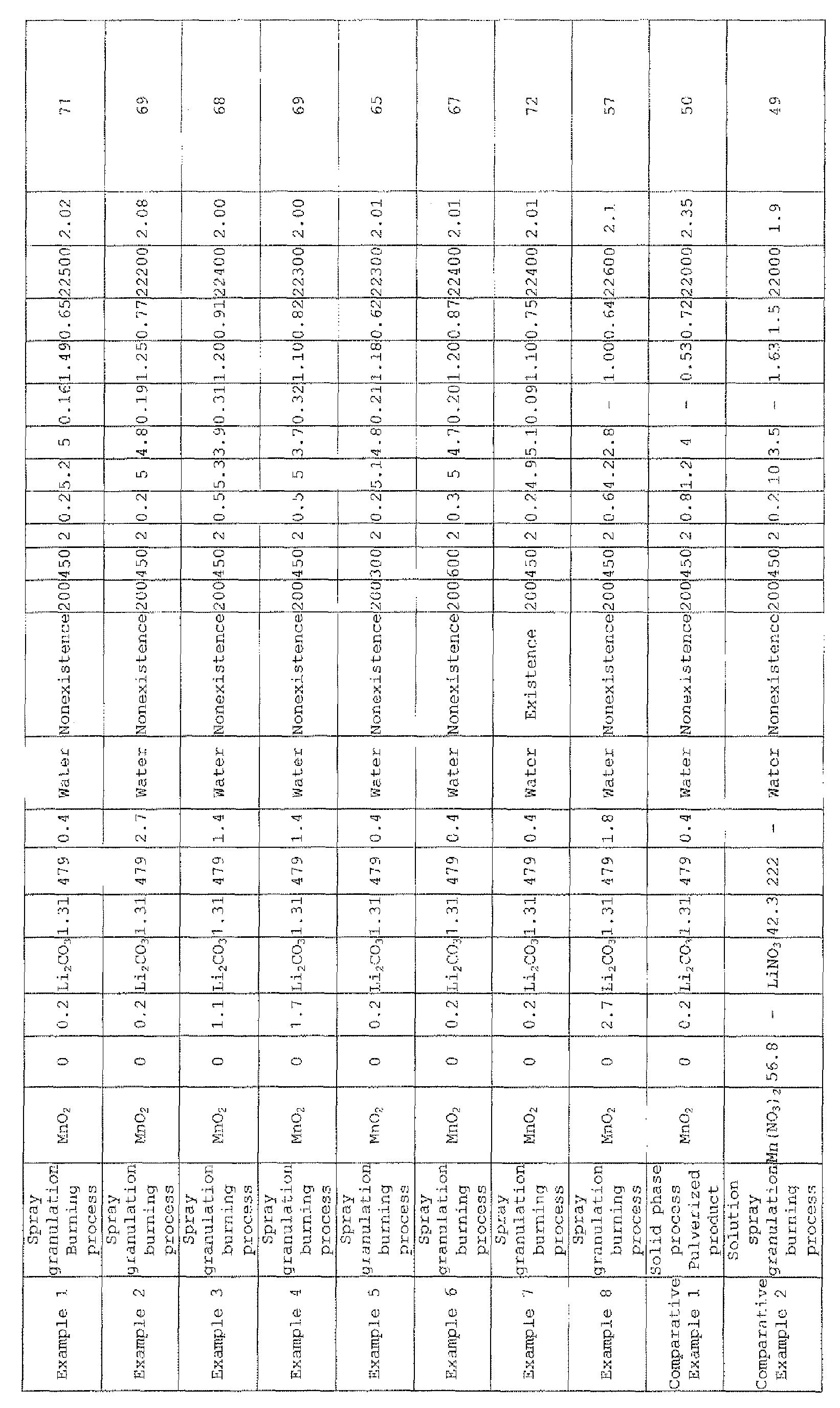

- As shown in the results of Table 1, the particles of the examples 1 to 8 exhibited excellent high-rate discharge characteristics as compared with the particles of the comparative examples 1 to 4. Among these, the particles of the examples 1 to 7 had fine pores of the range of 0.05 to 0.5 µm. Thereby, it is considered that Li ions were smoothly moved in discharging the battery, and the excellent high-rate discharge characteristics were obtained. Since the average aggregated particle diameter of the metal oxide (a) of the particles of the examples 1 to 7 was 0.03 to 2.5 µm, it is considered that the fine pores in the examples 1 to 7 were formed as compared with the example 8 to obtain the excellent high-rate discharge characteristics as compared with the example 8. The particles of the examples 1 to 7 had the peak pore diameter (interparticle peak pore diameter) even in the range of more than 0.5 µm and 10 µm or less.
- Since the spray granulation was not carried out in the comparative example 1, it is considered that the fine pores were not generated, and thus the high-rate discharge characteristics were not obtained. Since the fine pores were not vacant in the comparative example 2, it is considered that the high-rate discharge characteristics were not obtained. It is considered that the low density of the particles due to the hollow particles was one of causes of the low high-rate discharge characteristics. The particles of the comparative example 3 had high density. However, the particles had no fine pores, and thereby it is considered that the high-rate discharge characteristics were lower than those of the present invention. In the comparative example 4, the temperature was not held in the range of ±200°C based on the decomposition temperature of the Li source. As a result, the fine pores were not obtained, and thereby it is considered that the high-rate discharge characteristics were lower than those of the present invention.
Claims (16)
- A burned composite metal oxide which is porous and particulate and which is obtained by subjecting a slurry comprising at least one metal oxide (a), at least one metal compound (b) and a solvent to spray granulation to obtain granules, and burning the granules,
the metal oxide (a) selected from the group consisting of a transition metal oxide and an oxide of a metal belonging to 3B, 4B and 5B of a periodic table,
the metal compound (b) selected from the group consisting of an alkali metal compound and an alkali earth metal compound,
wherein the metal oxide (a) and the metal compound (b) are sparingly soluble in the solvent;
the burning is conducted after a heat-maintaining step of heating the granules obtained by the spray granulation at a temperature in a range of ±200°C based on the decomposition temperature of the metal compound (b); and
the metal compound (b) contains at least a nonmetallic element component desorbed in the heat-maintaining step. - The burned composite metal oxide according to claim 1, wherein the metal oxide (a) is an oxide of at least one metal selected from the group consisting of Mn, Fe, Co and Ni, and the metal compound (b) is a lithium salt.
- The burned composite metal oxide according to claim 1 or 2, wherein an average aggregated particle diameter of the metal oxide (a) is 0.03 to 2.5 µm, and an average aggregated particle diameter of the metal compound (b) in the slurry is 0.1 to 10 µm in the slurry.
- The burned composite metal oxide according to any one of claims 1 to 3, wherein an average aggregated particle diameter of the burned composite metal oxide is 0.7 to 15 µm.
- The burned composite metal oxide according to any one of claims 1 to 4, wherein the burned composite metal oxide has a peak pore diameter at least in each of a range of 0.05 to 0.5 µm and a range of more than 0.5 µm and 10 µm or less in a pore size distribution measured by a mercury porosimeter.
- The burned composite metal oxide according to any one of claims 1 to 5, wherein a BET specific surface area of the burned composite metal oxide is 1 to 40 m2/g.
- The burned composite metal oxide according to any one of claims 1 to 6, wherein the burned composite metal oxide is used for a positive electrode active material for a nonaqueous electrolyte secondary battery.
- The burned composite metal oxide according to any one of claims 1 to 7, wherein the slurry further contains a material (c) different from the metal oxide (a) and the metal compound (b); and
the material (c), which is sparingly soluble in the solvent and is not thermally decomposed in the spray granulation, is thermally decomposed at least by the subsequent burning. - A process for producing a particulate burned composite metal oxide, the process comprising:a spray granulation step of subjecting a slurry comprising at least one metal oxide (a), at least one metal compound (b) and a solvent to spray granulation to obtain granules, the metal oxide (a) selected from the group consisting of a transition metal oxide and an oxide of a metal belonging to 3B, 4B and 5B of a periodic table, the metal compound (b) selected from the group consisting of an alkali metal compound and an alkali earth metal compound;a heat-maintaining step of heating the granules at a temperature in a range of ±200°C based on a decomposition temperature of the metal compound (b); anda burning step of burning the granules after the heat-maintaining step to obtain the porous burned composite metal oxide,wherein the metal oxide (a) and the metal compound (b) are sparingly soluble in the solvent; andthe metal compound (b) contains at least a nonmetallic element component desorbed in the heat-maintaining step.
- The process for producing a burned composite metal oxide according to claim 9, wherein the metal oxide (a) is an oxide of at least one metal selected from the group consisting of Mn, Fe, Co and Ni, and the metal compound (b) is a lithium salt.
- The process for producing a burned composite metal oxide according to claim 9 or 10, wherein an average aggregated particle diameter of the metal oxide (a) is 0.03 to 2. 5 µm, and an average aggregated particle diameter of the metal compound (b) in the slurry is 0.1 to 10 µm in the slurry.
- The process for producing a burned composite metal oxide according to any one of claims 9 to 11, wherein an average aggregated particle diameter of the burned composite metal oxide obtained in the burning step is 0.7 to 15 µm.
- The process for producing a burned composite metal oxide according to any one of claims 9 to 12, wherein the burned composite metal oxide obtained in the burning step has a peak pore diameter at least in each of a range of 0.05 to 0.5 µm and a range of more than 0.5 µm and 10 µm or less in a pore size distribution measured by a mercury porosimeter.
- The process for producing a burned composite metal oxide according to any one of claims 9 to 13, wherein a BET specific surface area of the burned composite metal oxide obtained in the burning step is 1 to 40 m2/g.
- The process for producing a burned composite metal oxide according to any one of claims 9 to 14, wherein the obtained burned composite metal oxide is used for a positive electrode active material for a nonaqueous electrolyte secondary battery.
- The process for producing a burned composite metal oxide according to any one of claims 9 to 15, wherein the slurry further contains a material (c) different from the metal oxide (a) and the metal compound (b); and
the material (c), which is sparingly soluble in the solvent and is not thermally decomposed in the spray granulation, is thermally decomposed at least by the subsequent burning.
Applications Claiming Priority (3)
| Application Number | Priority Date | Filing Date | Title |
|---|---|---|---|
| JP2007332550A JP5166850B2 (en) | 2007-12-25 | 2007-12-25 | Method for producing sintered composite metal oxide |
| JP2007332592A JP5208492B2 (en) | 2007-12-25 | 2007-12-25 | Composite metal oxide fired body |
| PCT/JP2008/071957 WO2009081703A1 (en) | 2007-12-25 | 2008-12-03 | Burned composite metal oxide and process for producing the same |
Publications (2)
| Publication Number | Publication Date |
|---|---|
| EP2239230A1 true EP2239230A1 (en) | 2010-10-13 |
| EP2239230A4 EP2239230A4 (en) | 2017-01-04 |
Family
ID=40801014
Family Applications (1)
| Application Number | Title | Priority Date | Filing Date |
|---|---|---|---|
| EP08865587.3A Withdrawn EP2239230A4 (en) | 2007-12-25 | 2008-12-03 | Burned composite metal oxide and process for producing the same |
Country Status (5)
| Country | Link |
|---|---|
| US (1) | US8444875B2 (en) |
| EP (1) | EP2239230A4 (en) |
| KR (1) | KR20100097222A (en) |
| CN (1) | CN101910067A (en) |
| WO (1) | WO2009081703A1 (en) |
Cited By (2)
| Publication number | Priority date | Publication date | Assignee | Title |
|---|---|---|---|---|
| KR20150132082A (en) * | 2013-03-14 | 2015-11-25 | 제온 코포레이션 | Method for manufacturing composite particles for electrochemical element electrode |
| CN105329932A (en) * | 2015-11-24 | 2016-02-17 | 河南师范大学 | Method for large-scale preparation of carbon-doped mixed transition metal oxide porous microspheres |
Families Citing this family (9)
| Publication number | Priority date | Publication date | Assignee | Title |
|---|---|---|---|---|
| KR101687040B1 (en) * | 2009-01-20 | 2016-12-15 | 도다 고교 가부시끼가이샤 | Positive electrode active material for secondary batteries with nonaqueous electrolytic solution, process for the production of the active material, and secondary batteries with nonaqueous electrolytic solution |
| US9112222B2 (en) * | 2012-07-13 | 2015-08-18 | Sony Corporation | Lithium ion secondary battery active material, lithium ion secondary battery electrode, lithium ion secondary battery, electronic device, electronic power tool, electric vehicle, and power storage system |
| JP6330184B2 (en) * | 2013-01-22 | 2018-05-30 | 国立大学法人茨城大学 | Method for producing lithium manganese composite oxide |
| JP6674580B2 (en) * | 2018-09-14 | 2020-04-01 | 花王株式会社 | Method for producing positive electrode active material for lithium ion secondary battery |
| KR102141059B1 (en) * | 2018-09-28 | 2020-08-04 | 주식회사 포스코 | Positive active material for rechareable lithium battery, method of preparing same, and rechargeable lithium battery including same |
| KR20200051931A (en) * | 2018-11-06 | 2020-05-14 | 주식회사 포스코 | Lithium compound, nickel-based positive active material, method of preparing lithium oxide, mehtod of preparing nickel-based positive active material, and secondary battery using the same |
| JP7230515B2 (en) * | 2019-01-10 | 2023-03-01 | 住友金属鉱山株式会社 | Manufacturing method of positive electrode active material for lithium ion secondary battery, and formed body |
| WO2023050038A1 (en) * | 2021-09-28 | 2023-04-06 | 宁德新能源科技有限公司 | Electrochemical device and electronic device |
| CN115881885A (en) * | 2021-09-28 | 2023-03-31 | 宁夏中化锂电池材料有限公司 | Positive electrode material semi-finished product, positive electrode material preparation method and preparation device |
Family Cites Families (20)
| Publication number | Priority date | Publication date | Assignee | Title |
|---|---|---|---|---|
| JP3047827B2 (en) | 1996-07-16 | 2000-06-05 | 株式会社村田製作所 | Lithium secondary battery |
| US6270926B1 (en) | 1996-07-16 | 2001-08-07 | Murata Manufacturing Co., Ltd. | Lithium secondary battery |
| JP3733659B2 (en) | 1996-09-27 | 2006-01-11 | 住友化学株式会社 | Method for producing active material for non-aqueous electrolyte secondary battery |
| US20020168574A1 (en) * | 1997-06-27 | 2002-11-14 | Soon-Ho Ahn | Lithium ion secondary battery and manufacturing method of the same |
| JP2000072443A (en) * | 1998-08-26 | 2000-03-07 | Ube Ind Ltd | Method for producing lithium manganese composite oxide and use thereof |
| KR100326449B1 (en) * | 2000-01-03 | 2002-02-28 | 김순택 | Positive active material for lithium secondary battery and method of preparing same |
| JP2002151079A (en) | 2000-11-15 | 2002-05-24 | Sumitomo Metal Mining Co Ltd | Positive electrode active material for non-aqueous electrolyte secondary battery and method for producing the same |
| JP2003048719A (en) | 2001-05-31 | 2003-02-21 | Mitsubishi Chemicals Corp | Method for producing lithium transition metal composite oxide, positive electrode material for lithium secondary battery, positive electrode for lithium secondary battery, and lithium secondary battery |
| JP2003142101A (en) * | 2001-10-31 | 2003-05-16 | Nec Corp | Positive electrode for secondary battery and secondary battery using the same |
| WO2003083969A1 (en) * | 2002-03-28 | 2003-10-09 | Mitsubishi Chemical Corporation | Positive electrode material for lithium secondary cell and secondary cell using the same, and method for producing positive electrode material for lithium secondary cell |
| JP2004155631A (en) * | 2002-11-08 | 2004-06-03 | Dainippon Toryo Co Ltd | Lithium manganese-based double oxide particles for non-aqueous lithium secondary battery, method for producing the same, and non-aqueous lithium secondary battery |
| JP4228659B2 (en) | 2002-11-12 | 2009-02-25 | 三菱化学株式会社 | Method for producing lithium transition metal composite oxide |
| US20070003836A1 (en) * | 2003-05-14 | 2007-01-04 | Tdk Corporation | Composite particle for electrode and method for producing same, electrode and method for producing same, and electrochemical device and method for producing same |
| JP2005123179A (en) * | 2003-09-26 | 2005-05-12 | Mitsubishi Chemicals Corp | Lithium composite oxide particles for lithium secondary battery positive electrode material, and positive electrode for lithium secondary battery and lithium secondary battery using the same |
| KR100727332B1 (en) | 2003-09-26 | 2007-06-12 | 미쓰비시 가가꾸 가부시키가이샤 | Lithium composite oxide particles for positive electrode material of lithium secondary battery, positive electrode and lithium secondary battery for lithium secondary battery using same |
| JP2005158401A (en) * | 2003-11-25 | 2005-06-16 | Toyota Motor Corp | Positive electrode active material, method for producing the same, and lithium ion secondary battery |
| JP2007005238A (en) * | 2005-06-27 | 2007-01-11 | Mitsubishi Chemicals Corp | Method for controlling moisture concentration of spray-dried powder and its application to lithium secondary battery |
| CN101146746A (en) * | 2005-09-28 | 2008-03-19 | Agc清美化学股份有限公司 | Method for producing lithium-containing composite oxide |
| EP2337125A1 (en) * | 2006-12-26 | 2011-06-22 | Mitsubishi Chemical Corporation | Lithium transition metal based compound powder and method for manufacturing the same |
| JP2007238434A (en) * | 2007-04-20 | 2007-09-20 | Mitsubishi Chemicals Corp | Method for producing lithium transition metal composite oxide |
-
2008
- 2008-12-03 EP EP08865587.3A patent/EP2239230A4/en not_active Withdrawn
- 2008-12-03 CN CN2008801229650A patent/CN101910067A/en active Pending
- 2008-12-03 KR KR1020107016215A patent/KR20100097222A/en not_active Ceased
- 2008-12-03 WO PCT/JP2008/071957 patent/WO2009081703A1/en not_active Ceased
- 2008-12-03 US US12/746,118 patent/US8444875B2/en not_active Expired - Fee Related
Cited By (2)
| Publication number | Priority date | Publication date | Assignee | Title |
|---|---|---|---|---|
| KR20150132082A (en) * | 2013-03-14 | 2015-11-25 | 제온 코포레이션 | Method for manufacturing composite particles for electrochemical element electrode |
| CN105329932A (en) * | 2015-11-24 | 2016-02-17 | 河南师范大学 | Method for large-scale preparation of carbon-doped mixed transition metal oxide porous microspheres |
Also Published As
| Publication number | Publication date |
|---|---|
| US8444875B2 (en) | 2013-05-21 |
| KR20100097222A (en) | 2010-09-02 |
| WO2009081703A1 (en) | 2009-07-02 |
| US20100270496A1 (en) | 2010-10-28 |
| EP2239230A4 (en) | 2017-01-04 |
| CN101910067A (en) | 2010-12-08 |
Similar Documents
| Publication | Publication Date | Title |
|---|---|---|
| US8444875B2 (en) | Burned composite metal oxide and process for producing the same | |
| EP2157638B1 (en) | Positive electrode active material sintered body for a lithium ion secondary battery | |
| US8273267B2 (en) | Method for producing positive electrode active material for battery | |
| JP4870602B2 (en) | Method for producing lithium manganate | |
| JP4546574B1 (en) | Lithium composite oxide sintered body | |
| JP5135843B2 (en) | Lithium transition metal composite oxide, positive electrode for lithium secondary battery using the same, and lithium secondary battery using the same | |
| JP5208492B2 (en) | Composite metal oxide fired body | |
| WO2014205215A2 (en) | Active materials for lithium ion batteries | |
| JP2005347134A (en) | Method for producing positive electrode active material for lithium ion secondary battery | |
| JP2003051311A (en) | Method for producing lithium transition metal composite oxide and positive electrode material for lithium secondary battery, positive electrode for lithium secondary battery, and lithium secondary battery | |
| JP4735617B2 (en) | Method for producing lithium transition metal composite oxide | |
| US8562857B2 (en) | Process for producing positive electrode active material particles for battery | |
| JP5166850B2 (en) | Method for producing sintered composite metal oxide | |
| JP4144317B2 (en) | Method for producing lithium transition metal composite oxide | |
| Lu et al. | Preparation and electrochemical characteristics of spherical spinel cathode powders via an ultrasonic spray pyrolysis process | |
| JP4674423B2 (en) | Method for producing layered lithium nickel manganese composite oxide powder | |
| JP2003045424A (en) | Electrode active material-containing composition, electrode and lithium secondary battery using the same | |
| JP4630021B2 (en) | Spinel type lithium manganate powder, method for producing the same, electrode and lithium secondary battery | |
| JP2003234099A (en) | Electrode active material-containing composition, electrode and lithium secondary battery using the same | |
| JP2003137554A (en) | Method for producing lithium-transition metal-based composite oxide powder and lithium-transition metal-based composite oxide powder | |
| JP4984413B2 (en) | Method for producing lithium transition metal composite oxide for lithium secondary battery, lithium transition metal composite oxide for lithium secondary battery, positive electrode for lithium secondary battery and lithium secondary battery | |
| JP2002279990A (en) | Method for producing lithium transition metal composite oxide |
Legal Events
| Date | Code | Title | Description |
|---|---|---|---|
| PUAI | Public reference made under article 153(3) epc to a published international application that has entered the european phase |
Free format text: ORIGINAL CODE: 0009012 |
|
| 17P | Request for examination filed |
Effective date: 20100609 |
|
| AK | Designated contracting states |
Kind code of ref document: A1 Designated state(s): AT BE BG CH CY CZ DE DK EE ES FI FR GB GR HR HU IE IS IT LI LT LU LV MC MT NL NO PL PT RO SE SI SK TR |
|
| AX | Request for extension of the european patent |
Extension state: AL BA MK RS |
|
| DAX | Request for extension of the european patent (deleted) | ||
| RA4 | Supplementary search report drawn up and despatched (corrected) |
Effective date: 20161207 |
|
| RIC1 | Information provided on ipc code assigned before grant |
Ipc: H01M 4/505 20100101ALI20161201BHEP Ipc: C01G 45/00 20060101AFI20161201BHEP |
|
| STAA | Information on the status of an ep patent application or granted ep patent |
Free format text: STATUS: THE APPLICATION IS DEEMED TO BE WITHDRAWN |
|
| 18D | Application deemed to be withdrawn |
Effective date: 20170704 |