EP2237010A2 - Cutoff wavelength measuring method and optical communication system - Google Patents
Cutoff wavelength measuring method and optical communication system Download PDFInfo
- Publication number
- EP2237010A2 EP2237010A2 EP10158144A EP10158144A EP2237010A2 EP 2237010 A2 EP2237010 A2 EP 2237010A2 EP 10158144 A EP10158144 A EP 10158144A EP 10158144 A EP10158144 A EP 10158144A EP 2237010 A2 EP2237010 A2 EP 2237010A2
- Authority
- EP
- European Patent Office
- Prior art keywords
- wavelength
- power spectrum
- fiber
- optical fiber
- spectrum
- Prior art date
- Legal status (The legal status is an assumption and is not a legal conclusion. Google has not performed a legal analysis and makes no representation as to the accuracy of the status listed.)
- Granted
Links
- 238000000034 method Methods 0.000 title claims abstract description 70
- 230000003287 optical effect Effects 0.000 title claims description 11
- 238000004891 communication Methods 0.000 title claims description 7
- 238000001228 spectrum Methods 0.000 claims abstract description 125
- 239000000835 fiber Substances 0.000 claims abstract description 80
- 239000013307 optical fiber Substances 0.000 claims abstract description 37
- 238000005452 bending Methods 0.000 claims abstract description 12
- 238000012360 testing method Methods 0.000 claims description 17
- 230000005540 biological transmission Effects 0.000 claims description 6
- 230000001902 propagating effect Effects 0.000 claims description 4
- 238000010586 diagram Methods 0.000 description 6
- 238000005259 measurement Methods 0.000 description 5
- 230000002238 attenuated effect Effects 0.000 description 1
- 230000000694 effects Effects 0.000 description 1
- 238000012986 modification Methods 0.000 description 1
- 230000004048 modification Effects 0.000 description 1
Images




Classifications
-
- G—PHYSICS
- G01—MEASURING; TESTING
- G01M—TESTING STATIC OR DYNAMIC BALANCE OF MACHINES OR STRUCTURES; TESTING OF STRUCTURES OR APPARATUS, NOT OTHERWISE PROVIDED FOR
- G01M11/00—Testing of optical apparatus; Testing structures by optical methods not otherwise provided for
- G01M11/30—Testing of optical devices, constituted by fibre optics or optical waveguides
- G01M11/33—Testing of optical devices, constituted by fibre optics or optical waveguides with a light emitter being disposed at one fibre or waveguide end-face, and a light receiver at the other end-face
Definitions
- the present invention relates to a method for measuring a higher-order mode cutoff wavelength of an optical fiber and to an optical communication system using the method.
- an optical fiber used as an optical transmission path in an optical communication system have a single mode at a signal light wavelength (or a higher-order mode cutoff wavelength is shorter than a signal light wavelength).
- IEC 60793-1-44 JIS C 6825
- the bend reference technique (60793-1-44 ⁇ IEC: 2001 p. 27)
- the multimode reference technique (60793-1-44 ⁇ IEC: 2001 p. 27).
- An object of the present invention is to provide a method for easily measuring a higher-order mode cutoff wavelength of an optical fiber for which it is difficult to measure its cutoff wavelength with the bend reference technique or the multimode reference technique.
- the method according to an aspect of the present invention includes (1) a first step of joining a multimode fiber to a first end of an optical fiber (specimen) under test whose higher-order mode cutoff wavelength is to be measured, allowing light to propagate from the multimode fiber to the specimen, measuring an intensity of light exiting from a second end of the specimen after propagating through the specimen, and determining a first power spectrum on the basis of the measured intensity of light; (2) a second step of joining the multimode fiber to a first end of a reference fiber having bending loss higher than that of the specimen in a predetermine wavelength range, allowing light to propagate from the multimode fiber to the reference fiber, measuring an intensity of light exiting from a second end of the reference fiber after propagating through the reference fiber, and determining a second power spectrum on the basis of the measured intensity of light; (3) a third step of determining a difference spectrum by subtracting the second power spectrum from
- the predetermined wavelength range described above is a range including a wavelength which is expected to be a cutoff wavelength of the specimen and having a span over 200 nm.
- the span preferably be over 300 nm and may be not more than 800 nm.
- the predetermined wavelength range described above is a wavelength range where the first power spectrum or the second power spectrum is determined.
- the fourth step may include (4-1) a first sub-step of determining a specific range where a difference from a minimum value of the difference spectrum is less than 0.1 dB and a derivative of the difference spectrum is substantially 0; (4-2) a second sub-step of determining an average value of the difference spectrum in the specific range; and (4-3) a third sub-step of drawing, in a graph showing the difference spectrum, a straight line representing a value that is 0.1 dB larger than the average value, determining a wavelength at an intersection point of the difference spectrum and the straight line, and determining the wavelength at the intersection point as the higher-order mode cutoff wavelength of the specimen when values of the difference spectrum on a shorter wavelength side where wavelengths are shorter than the wavelength at the intersection point are larger than values of the difference spectrum on a longer wavelength side where wavelengths are longer than the wavelength at the intersection point.
- a length, a bending diameter, or the number of turns of the reference fiber be set such that the first power spectrum is larger than the second power spectrum on a longer wavelength side where wavelengths are longer than a cutoff wavelength of the reference fiber.
- a difference in mode field diameter between the specimen and the reference fiber is preferably 0.5 ⁇ m or less.
- An optical communication system includes, as an optical transmission path, an optical fiber under test whose higher-order mode cutoff wavelength is measured using the method described above.
- signal light having a wavelength longer than the measured cutoff wavelength is transmitted through the optical fiber under test.
- the present invention makes it possible to easily measure a higher-order mode cutoff wavelength of an optical fiber for which it is difficult to measure its cutoff wavelength with the bend reference technique or the multimode reference technique.
- Figures 1A to 1D are conceptual diagrams illustrating a cutoff wavelength measuring method using the bend reference technique.
- Figures 2A to 2D are conceptual diagrams illustrating a cutoff wavelength measuring method using the multimode reference technique.
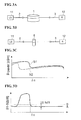
- Figures 3A to 3D are conceptual diagrams illustrating a cutoff wavelength measuring method according to an embodiment of the present invention.
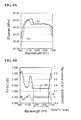
- Figures 4A to 4C are graphs for explaining details of the cutoff wavelength measuring method according to the embodiment of the present invention.
- Figure 5 is a graph showing a first power spectrum S1 and a second power spectrum S2 that corresponds to each of three measuring methods.
- Figure 6 is a graph showing a difference spectrum (S1 - S2) determined by each of the three measuring methods.
- Figure 7A is a graph showing a first power spectrum S1 and a second power spectrum S2 determined by the bend reference technique.
- Figure 7B is a graph showing the corresponding difference spectrum (S1 - S2).
- Figure 8A is a graph showing a first power spectrum S1 and a second power spectrum S2 determined by the multimode reference technique.
- Figure 8B is a graph showing the corresponding difference spectrum (S1 - S2).
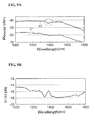
- Figure 9A is a graph showing a first power spectrum S1 and a second power spectrum S2 determined by the multimode reference technique.
- Figure 9B is a graph showing the corresponding difference spectrum (S1 - S2).
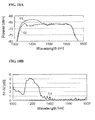
- Figure 10A is a graph showing a first power spectrum S1 and a second power spectrum S2 determined by the method according to the embodiment of the present invention.
- Figure 10B is a graph showing the corresponding difference spectrum (S1 - S2).
- Figures 1A to 1D are conceptual diagrams illustrating a cutoff wavelength measuring method using the bend reference technique.
- a multimode fiber 2 is butt-joined to a first end of an optical fiber (specimen) under test I whose higher-order mode cutoff wavelength ⁇ c is to be measured, while a multimode fiber 3 is butt-joined to a second end of the specimen 1 (see Fig. 1A ).
- Light output from a light source 11 is allowed to propagate through the multimode fiber 2, the specimen 1, and the multimode fiber 3 in this order.
- the intensity of light exiting from the multimode fiber 3 is measured by a detector assembly 12.
- a first power spectrum S1 is determined on the basis of the measured intensity of light.
- the exit end of the specimen 1 is wound to form a smaller diameter bend 4, which blocks higher-order mode light from passing therethrough in a measurement wavelength range (see Fig. 1B ).
- Light output from the light source 11 is allowed to propagate through the multimode fiber 2, the specimen 1, the smaller diameter bend 4, and the multimode fiber 3 in this order.
- the intensity of light exiting from the multimode fiber 3 is measured by the detector assembly 12.
- a second power spectrum S2 is determined on the basis of the measured intensity of light.
- the specimen 1 is set to 2 m in length and wound with a diameter of 280 mm.
- the exit end of the specimen 1 is wound with a small diameter of 60 mm or less.
- the first power spectrum S1 has large power on a shorter wavelength side where wavelengths are shorter than the cutoff wavelength ⁇ c of the specimen 1 since the first power spectrum S1 contains higher-order modes as well as a fundamental mode on the shorter wavelength side, while the first power spectrum S1 has small power on a longer wavelength side where wavelengths are longer than the cutoff wavelength ⁇ c of the specimen 1 since the first power spectrum S1 contains only the fundamental mode on the longer wavelength side.
- the second power spectrum S2 has small power even on the shorter wavelength side since power of the higher order mode attenuated by additional bend.
- Figures 2A to 2D are conceptual diagrams illustrating a cutoff wavelength measuring method using the multimode reference technique.
- the optical fiber under test (specimen) 1, the multimode fiber 2, and the multimode fiber 3 are arranged in the same manner as that in the bend reference technique (see Fig. 2A ).
- the specimen 1 is set to 2 m in length and wound with a diameter of 280 mm.
- Light output from the light source 11 is allowed to propagate through the multimode fiber 2, the specimen 1, and the multimode fiber 3 in this order.
- the intensity of light exiting from the multimode fiber 3 is measured by the detector assembly 12.
- a first power spectrum S1 is determined on the basis of the measured intensity of light.
- a multimode fiber 5 is inserted between the multimode fiber 2 and the multimode fiber 3 (see Fig. 2B ).
- Light output from the light source 11 is allowed to propagate through the multimode fiber 2, the multimode fiber 5, and the multimode fiber 3 in this order.
- the intensity of light exiting from the multimode fiber 3 is measured by the detector assembly 12.
- a second power spectrum S2 is determined on the basis of the measured intensity of light.
- the first power spectrum S1 has large power on a shorter wavelength side where wavelengths are shorter than the cutoff wavelength ⁇ c of the specimen I since the first power spectrum S1 contains higher-order modes as well as a fundamental mode on the shorter wavelength side, while the first power spectrum S1 has small power on a longer wavelength side where wavelengths are longer than the cutoff wavelength ⁇ c of the specimen 1 since the first power spectrum S1 contains only the fundamental mode on the longer wavelength side.
- the second power spectrum S2 has large power as it contains the higher-order modes as well as the fundamental mode.
- Figures 3A to 3D are conceptual diagrams illustrating a cutoff wavelength measuring method according to an embodiment of the present invention.
- the multimode fiber 2 in a first step, is butt-joined to the first end of the optical fiber under test (specimen) 1, while the multimode fiber 3 is butt-joined to the second end of the specimen 1 (see Fig. 3A ).
- Light output from the light source 11 is allowed to propagate through the multimode fiber 2, the specimen 1, and the multimode fiber 3 in this order.
- the intensity of light exiting from the multimode fiber 3 is measured by the detector assembly 12.
- a first power spectrum S1 is determined on the basis of the measured intensity of light.
- the specimen 1 is replaced with a reference fiber 6.
- the multimode fiber 2 is butt-joined to a first end of the reference fiber 6, while the multimode fiber 3 is butt-joined to a second end of the reference fiber 6 (see Fig. 3B ).
- Light output from a light source 11 is allowed to propagate through the multimode fiber 2, the reference fiber 6, and the multimode fiber 3 in this order.
- the intensity of light exiting from the multimode fiber 3 is measured by the detector assembly 12.
- a second power spectrum S2 is determined on the basis of the measured intensity of light.
- the specimen 1 may be set to 2 m in length and wound with a diameter of 280 mm.
- the specimen 1 may be placed in a use environment of an optical transmission path etc. or under conditions equivalent to the use environment.
- the reference fiber 6 has bending loss higher than that of the specimen 1 in a predetermined wavelength range, and has a cutoff wavelength shorter than the cutoff wavelength ⁇ c of the specimen 1. It is preferable to set the length, the bending diameter, or the number of turns of the reference fiber 6 such that the first power spectrum S1 is larger than the second power spectrum S2 on a longer wavelength side where wavelengths are longer than the cutoff wavelength of the reference fiber 6. It is also preferable, in the predetermined wavelength range, that a difference in mode field diameter between the specimen 1 and the reference fiber 6 be 0.5 ⁇ m or less.
- the reference fiber 6 is preferably a low-OH loss fiber compliant with the ITU-T G.652.D standard.
- the reference fiber 6 may be of any length, but can preferably be elongated within a range where the transmission loss does not exceed 0.01 dB.
- the reference fiber 6 is preferably 2 m to 10 m in length.
- the reference fiber 6 may be wound around a mandrel within a range where the bending loss at the cutoff wavelength ⁇ c of the specimen 1 does not exceed 0.01 dB.
- the reference fiber 6 is preferably wound around a 60-mm diameter mandrel. Thus, it is possible to shorten the cutoff wavelength of the reference fiber 6 and extend the range of measurement.
- the first power spectrum S1 has large power on a shorter wavelength side where wavelengths are shorter than the cutoff wavelength ⁇ c of the specimen I since the first power spectrum S1 contains higher-order modes as well as a fundamental mode on the shorter wavelength side, while the first power spectrum S1 has small power on a longer wavelength side where wavelengths are longer than the cutoff wavelength ⁇ c of the specimen 1 since the first power spectrum S1 contains only the fundamental mode on the longer wavelength side.
- the second power spectrum S2 has large power on a shorter wavelength side where wavelengths are shorter than the cutoff wavelength of the reference fiber 6, the cutoff wavelength being shorter than the cutoff wavelength ⁇ c of the specimen 1, since the second power spectrum S2 contains higher-order modes as well as the fundamental mode on the shorter wavelength side.
- the second power spectrum S2 has small power on a longer wavelength side where wavelengths are longer than the cutoff wavelength of the reference fiber 6 since the second power spectrum S2 contains only the fundamental mode on the longer wavelength side.
- a difference spectrum is determined by subtracting the second power spectrum S2 from the first power spectrum S1.
- the higher-order mode cutoff wavelength ⁇ c of the specimen 1 is determined on the basis of the shape of the difference spectrum.
- Figures 4A to 4C are graphs for explaining details of the cutoff wavelength measuring method according to the embodiment of the present invention.
- Figure 4A shows the first power spectrum S1 obtained in the first step and the second power spectrum S2 obtained in the second step.
- a difference spectrum (indicated by a solid line) is determined by subtracting the second power spectrum S2 from the first power spectrum S1.
- a specific range where a difference from a minimum value of the difference spectrum is less than 0.1 dB and a derivative (indicated by a dotted line) of the difference spectrum (S1 - S2) is substantially 0 is determined.
- an average value A of the difference spectrum in the specific range is determined.
- a straight line representing a value B that is 0.1 dB larger than the average value A is drawn, and a wavelength at an intersection point of the difference spectrum and the straight line is determined.
- Figures 5 and 6 are graphs each comparing results of measurements performed by the three measuring methods, that is, the bend reference technique, the multimode reference technique, and the method according to the embodiment of the present invention.
- Figure 5 is a graph showing the first power spectrum S1 and the second power spectra S2.
- Figure 6 is a graph showing the corresponding difference spectra (S1 - S2).
- the cutoff wavelength ⁇ c of the common specimen 1 was measured by each of the three measuring methods.
- Table shows the cutoff wavelength ⁇ c of the specimen 1, the cutoff wavelength ⁇ c being measured by each of the three measuring methods.
- Table Measuring method Determined wavelength nm Bend reference technique 1277 Multimode reference technique 1290 Embodiment 1281 The measured cutoff wavelengths ⁇ c obtained by the three measuring methods well agree with each other.
- Figures 7A, 7B , 8A, 8B , 9A, 9B , 10A, and 10B are graphs for comparing examples of the cutoff wavelengths ⁇ c measured by the three measuring methods, that is, the bend reference technique, the multimode reference technique, and the method according to the embodiment of the present invention.
- the cutoff wavelengths ⁇ c of different specimens were measured.
- Figure 7A is a graph showing a first power spectrum S1 and a second power spectrum S2 obtained by the bend reference technique using an optical fiber having low bending loss in higher-order modes as a specimen.
- Figure 7B is a graph showing the corresponding difference spectrum (S1 - S2). Since the difference between the first power spectrum S1 and the second power spectrum S2 is small, it was difficult to measure the cutoff wavelength ⁇ c of the specimen.
- Figure 8A is a graph showing a first power spectrum S1 and a second power spectrum S2 obtained by the multimode reference technique using an optical fibers having a plurality of higher-order mode cutoff wavelengths close to each other as specimens.
- Figure 8B is a graph showing the corresponding difference spectrum (S1 - S2). As shown in Fig. 8B , since there are a plurality of peaks close to each other (as indicated by arrows) in the difference spectrum (S1 - S2), it was difficult to measure the cutoff wavelength ⁇ c of the specimens.
- Figure 9A is a graph showing a first power spectrum S1 and a second power spectrum S2 obtained by the multimode reference technique using an optical fiber having the cutoff wavelength ⁇ c close to an OH loss wavelength (i.e., a wavelength position enclosed with a dotted line) as a specimen.
- Figure 9B is a graph showing the corresponding difference spectrum (S1 - S2). Since the effect of OH loss of the multimode fibers 2 and 3 appears in the difference spectrum, it was difficult to measure the cutoff wavelength ⁇ c of the specimen.
- Figure 10A is a graph showing a first power spectrum S1 and a second power spectrum S2 obtained by the method according to the embodiment of the present invention.
- Figure 10B is a graph showing the corresponding difference spectrum (S1 - S2).
- the cutoff wavelength measuring method it is possible to measure a higher-order mode cutoff wavelength of a specimen for which it is difficult to measure its cutoff wavelength with a known method. Therefore, when the cutoff wavelength measuring method according to the embodiment of the present invention is used to measure a higher-order mode cutoff wavelength of an optical fiber and signal light having a wavelength longer than the thus measured cutoff wavelength of the optical fiber is transmitted, it is possible to create a reliable optical communication system for single-mode transmission.
Landscapes
- Physics & Mathematics (AREA)
- Optics & Photonics (AREA)
- Chemical & Material Sciences (AREA)
- Analytical Chemistry (AREA)
- General Physics & Mathematics (AREA)
- Testing Of Optical Devices Or Fibers (AREA)
Abstract
Description
- The present invention relates to a method for measuring a higher-order mode cutoff wavelength of an optical fiber and to an optical communication system using the method.
- It is important that an optical fiber used as an optical transmission path in an optical communication system have a single mode at a signal light wavelength (or a higher-order mode cutoff wavelength is shorter than a signal light wavelength). As methods for measuring a higher-order mode cutoff wavelength of an optical fiber, IEC 60793-1-44 (JIS C 6825) describes the bend reference technique (60793-1-44 © IEC: 2001 p. 27) and the multimode reference technique (60793-1-44 © IEC: 2001 p. 27). However, with the bend reference technique or the multimode reference technique, it may be difficult to measure cutoff wavelengths of the following optical fibers:
- an optical fiber having low bending loss in higher-order modes (see Fujikura Giho, No. 105, pp. 6-10 (2003) M. Ikeda, et al.);
- an optical fiber having a plurality of higher-order mode cutoff wavelengths close to each other; and
- an optical fiber having a cutoff wavelength close to an OH induced loss wavelength.
- An object of the present invention is to provide a method for easily measuring a higher-order mode cutoff wavelength of an optical fiber for which it is difficult to measure its cutoff wavelength with the bend reference technique or the multimode reference technique.
- To achieve the object described above, a method for measuring a higher-order mode cutoff wavelength of an optical fiber will be provided. The method according to an aspect of the present invention includes (1) a first step of joining a multimode fiber to a first end of an optical fiber (specimen) under test whose higher-order mode cutoff wavelength is to be measured, allowing light to propagate from the multimode fiber to the specimen, measuring an intensity of light exiting from a second end of the specimen after propagating through the specimen, and determining a first power spectrum on the basis of the measured intensity of light; (2) a second step of joining the multimode fiber to a first end of a reference fiber having bending loss higher than that of the specimen in a predetermine wavelength range, allowing light to propagate from the multimode fiber to the reference fiber, measuring an intensity of light exiting from a second end of the reference fiber after propagating through the reference fiber, and determining a second power spectrum on the basis of the measured intensity of light; (3) a third step of determining a difference spectrum by subtracting the second power spectrum from the first power spectrum; and (4) a fourth step of determining a higher-order mode cutoff wavelength of the specimen on the basis of a shape of the difference spectrum.
- The predetermined wavelength range described above is a range including a wavelength which is expected to be a cutoff wavelength of the specimen and having a span over 200 nm. The span preferably be over 300 nm and may be not more than 800 nm. For example, the predetermined wavelength range described above is a wavelength range where the first power spectrum or the second power spectrum is determined.
- In the method described above, the fourth step may include (4-1) a first sub-step of determining a specific range where a difference from a minimum value of the difference spectrum is less than 0.1 dB and a derivative of the difference spectrum is substantially 0; (4-2) a second sub-step of determining an average value of the difference spectrum in the specific range; and (4-3) a third sub-step of drawing, in a graph showing the difference spectrum, a straight line representing a value that is 0.1 dB larger than the average value, determining a wavelength at an intersection point of the difference spectrum and the straight line, and determining the wavelength at the intersection point as the higher-order mode cutoff wavelength of the specimen when values of the difference spectrum on a shorter wavelength side where wavelengths are shorter than the wavelength at the intersection point are larger than values of the difference spectrum on a longer wavelength side where wavelengths are longer than the wavelength at the intersection point.
- In the second step, it is preferable that a length, a bending diameter, or the number of turns of the reference fiber be set such that the first power spectrum is larger than the second power spectrum on a longer wavelength side where wavelengths are longer than a cutoff wavelength of the reference fiber. In the predetermined wavelength range, a difference in mode field diameter between the specimen and the reference fiber is preferably 0.5 µm or less. In the first step, it is preferable to determine the first power spectrum of the specimen placed under a condition of actual system.
- An optical communication system according to another aspect of the present invention includes, as an optical transmission path, an optical fiber under test whose higher-order mode cutoff wavelength is measured using the method described above. In the optical communication system, signal light having a wavelength longer than the measured cutoff wavelength is transmitted through the optical fiber under test.
- The present invention makes it possible to easily measure a higher-order mode cutoff wavelength of an optical fiber for which it is difficult to measure its cutoff wavelength with the bend reference technique or the multimode reference technique.
-
Figures 1A to 1D are conceptual diagrams illustrating a cutoff wavelength measuring method using the bend reference technique. -
Figures 2A to 2D are conceptual diagrams illustrating a cutoff wavelength measuring method using the multimode reference technique. -
Figures 3A to 3D are conceptual diagrams illustrating a cutoff wavelength measuring method according to an embodiment of the present invention. -
Figures 4A to 4C are graphs for explaining details of the cutoff wavelength measuring method according to the embodiment of the present invention. -
Figure 5 is a graph showing a first power spectrum S1 and a second power spectrum S2 that corresponds to each of three measuring methods. -
Figure 6 is a graph showing a difference spectrum (S1 - S2) determined by each of the three measuring methods. -
Figure 7A is a graph showing a first power spectrum S1 and a second power spectrum S2 determined by the bend reference technique.Figure 7B is a graph showing the corresponding difference spectrum (S1 - S2). -
Figure 8A is a graph showing a first power spectrum S1 and a second power spectrum S2 determined by the multimode reference technique.Figure 8B is a graph showing the corresponding difference spectrum (S1 - S2). -
Figure 9A is a graph showing a first power spectrum S1 and a second power spectrum S2 determined by the multimode reference technique.Figure 9B is a graph showing the corresponding difference spectrum (S1 - S2). -
Figure 10A is a graph showing a first power spectrum S1 and a second power spectrum S2 determined by the method according to the embodiment of the present invention.Figure 10B is a graph showing the corresponding difference spectrum (S1 - S2). - The above-mentioned features and other features, aspects, and advantages of the present invention will be better understood through the following description, appended claims, and accompanying drawings. In the explanation of the drawings, an identical mark is applied to identical elements and an overlapping explanation will be omitted.
-
Figures 1A to 1D are conceptual diagrams illustrating a cutoff wavelength measuring method using the bend reference technique. In the bend reference technique, amultimode fiber 2 is butt-joined to a first end of an optical fiber (specimen) under test I whose higher-order mode cutoff wavelength λc is to be measured, while amultimode fiber 3 is butt-joined to a second end of the specimen 1 (seeFig. 1A ). Light output from alight source 11 is allowed to propagate through themultimode fiber 2, thespecimen 1, and themultimode fiber 3 in this order. The intensity of light exiting from themultimode fiber 3 is measured by adetector assembly 12. Then, a first power spectrum S1 is determined on the basis of the measured intensity of light. - Next, the exit end of the
specimen 1 is wound to form asmaller diameter bend 4, which blocks higher-order mode light from passing therethrough in a measurement wavelength range (seeFig. 1B ). Light output from thelight source 11 is allowed to propagate through themultimode fiber 2, thespecimen 1, thesmaller diameter bend 4, and themultimode fiber 3 in this order. The intensity of light exiting from themultimode fiber 3 is measured by thedetector assembly 12. Then, a second power spectrum S2 is determined on the basis of the measured intensity of light. - To simulate typical usage of the
specimen 1, thespecimen 1 is set to 2 m in length and wound with a diameter of 280 mm. To applying additional bending loss to higher-order mode light by passing through thesmaller diameter bend 4 in the measurement wavelength range, the exit end of thespecimen 1 is wound with a small diameter of 60 mm or less. - As shown in
Fig. 1C , the first power spectrum S1 has large power on a shorter wavelength side where wavelengths are shorter than the cutoff wavelength λc of thespecimen 1 since the first power spectrum S1 contains higher-order modes as well as a fundamental mode on the shorter wavelength side, while the first power spectrum S1 has small power on a longer wavelength side where wavelengths are longer than the cutoff wavelength λc of thespecimen 1 since the first power spectrum S1 contains only the fundamental mode on the longer wavelength side. On the other hand, the second power spectrum S2 has small power even on the shorter wavelength side since power of the higher order mode attenuated by additional bend. Thus, when a difference spectrum is obtained by subtracting the second power spectrum S2 from the firstpower spectrum S 1, it is possible to determine the cutoff wavelength λc of thespecimen 1 on the basis of the shape of the difference spectrum (seeFig. 1D ). -
Figures 2A to 2D are conceptual diagrams illustrating a cutoff wavelength measuring method using the multimode reference technique. In the multimode reference technique, the optical fiber under test (specimen) 1, themultimode fiber 2, and themultimode fiber 3 are arranged in the same manner as that in the bend reference technique (seeFig. 2A ). Again, to simulate typical usage of thespecimen 1, thespecimen 1 is set to 2 m in length and wound with a diameter of 280 mm. Light output from thelight source 11 is allowed to propagate through themultimode fiber 2, thespecimen 1, and themultimode fiber 3 in this order. The intensity of light exiting from themultimode fiber 3 is measured by thedetector assembly 12. Then, a first power spectrum S1 is determined on the basis of the measured intensity of light. - Next, in place of the
specimen 1, amultimode fiber 5 is inserted between themultimode fiber 2 and the multimode fiber 3 (seeFig. 2B ). Light output from thelight source 11 is allowed to propagate through themultimode fiber 2, themultimode fiber 5, and themultimode fiber 3 in this order. The intensity of light exiting from themultimode fiber 3 is measured by thedetector assembly 12. Then, a second power spectrum S2 is determined on the basis of the measured intensity of light. - As shown in
Fig. 2C , the first power spectrum S1 has large power on a shorter wavelength side where wavelengths are shorter than the cutoff wavelength λc of the specimen I since the first power spectrum S1 contains higher-order modes as well as a fundamental mode on the shorter wavelength side, while the first power spectrum S1 has small power on a longer wavelength side where wavelengths are longer than the cutoff wavelength λc of thespecimen 1 since the first power spectrum S1 contains only the fundamental mode on the longer wavelength side. On the other hand, the second power spectrum S2 has large power as it contains the higher-order modes as well as the fundamental mode. Thus, in the multimode reference technique, when a difference spectrum is obtained by subtracting the second power spectrum S2 from the first power spectrum S1, it is possible to determine the cutoff wavelength λc of thespecimen 1 on the basis of the shape of the difference spectrum (seeFig. 2D ). -
Figures 3A to 3D are conceptual diagrams illustrating a cutoff wavelength measuring method according to an embodiment of the present invention. In the cutoff wavelength measuring method according to the embodiment of the present invention, in a first step, themultimode fiber 2 is butt-joined to the first end of the optical fiber under test (specimen) 1, while themultimode fiber 3 is butt-joined to the second end of the specimen 1 (seeFig. 3A ). Light output from thelight source 11 is allowed to propagate through themultimode fiber 2, thespecimen 1, and themultimode fiber 3 in this order. The intensity of light exiting from themultimode fiber 3 is measured by thedetector assembly 12. Then, a first power spectrum S1 is determined on the basis of the measured intensity of light. - In a second step, the
specimen 1 is replaced with areference fiber 6. Themultimode fiber 2 is butt-joined to a first end of thereference fiber 6, while themultimode fiber 3 is butt-joined to a second end of the reference fiber 6 (seeFig. 3B ). Light output from alight source 11 is allowed to propagate through themultimode fiber 2, thereference fiber 6, and themultimode fiber 3 in this order. The intensity of light exiting from themultimode fiber 3 is measured by thedetector assembly 12. Then, a second power spectrum S2 is determined on the basis of the measured intensity of light. - In the cutoff wavelength measuring method according to the embodiment of the present invention, it is preferable again to simulate typical usage of the
specimen 1. Thespecimen 1 may be set to 2 m in length and wound with a diameter of 280 mm. To determine the first power spectrum S1, thespecimen 1 may be placed in a use environment of an optical transmission path etc. or under conditions equivalent to the use environment. - The
reference fiber 6 has bending loss higher than that of thespecimen 1 in a predetermined wavelength range, and has a cutoff wavelength shorter than the cutoff wavelength λc of thespecimen 1. It is preferable to set the length, the bending diameter, or the number of turns of thereference fiber 6 such that the first power spectrum S1 is larger than the second power spectrum S2 on a longer wavelength side where wavelengths are longer than the cutoff wavelength of thereference fiber 6. It is also preferable, in the predetermined wavelength range, that a difference in mode field diameter between thespecimen 1 and thereference fiber 6 be 0.5 µm or less. - The
reference fiber 6 is preferably a low-OH loss fiber compliant with the ITU-T G.652.D standard. Thereference fiber 6 may be of any length, but can preferably be elongated within a range where the transmission loss does not exceed 0.01 dB. For example, thereference fiber 6 is preferably 2 m to 10 m in length. Thereference fiber 6 may be wound around a mandrel within a range where the bending loss at the cutoff wavelength λc of thespecimen 1 does not exceed 0.01 dB. For example, thereference fiber 6 is preferably wound around a 60-mm diameter mandrel. Thus, it is possible to shorten the cutoff wavelength of thereference fiber 6 and extend the range of measurement. - As shown in
Fig. 3C , the first power spectrum S1 has large power on a shorter wavelength side where wavelengths are shorter than the cutoff wavelength λc of the specimen I since the first power spectrum S1 contains higher-order modes as well as a fundamental mode on the shorter wavelength side, while the first power spectrum S1 has small power on a longer wavelength side where wavelengths are longer than the cutoff wavelength λc of thespecimen 1 since the first power spectrum S1 contains only the fundamental mode on the longer wavelength side. The second power spectrum S2 has large power on a shorter wavelength side where wavelengths are shorter than the cutoff wavelength of thereference fiber 6, the cutoff wavelength being shorter than the cutoff wavelength λc of thespecimen 1, since the second power spectrum S2 contains higher-order modes as well as the fundamental mode on the shorter wavelength side. In contrast, the second power spectrum S2 has small power on a longer wavelength side where wavelengths are longer than the cutoff wavelength of thereference fiber 6 since the second power spectrum S2 contains only the fundamental mode on the longer wavelength side. - Thus, as shown in
Fig. 3D , in a third step, a difference spectrum is determined by subtracting the second power spectrum S2 from the first power spectrum S1. Then, in a fourth step, the higher-order mode cutoff wavelength λc of thespecimen 1 is determined on the basis of the shape of the difference spectrum. By performing first to third sub-steps (described below) of the fourth step, it is possible to more accurately determine the cutoff wavelength. -
Figures 4A to 4C are graphs for explaining details of the cutoff wavelength measuring method according to the embodiment of the present invention.Figure 4A shows the first power spectrum S1 obtained in the first step and the second power spectrum S2 obtained in the second step. In the third step, as shown inFigure 4B , a difference spectrum (indicated by a solid line) is determined by subtracting the second power spectrum S2 from the first power spectrum S1. Then, in the first sub-step of the fourth step, a specific range where a difference from a minimum value of the difference spectrum is less than 0.1 dB and a derivative (indicated by a dotted line) of the difference spectrum (S1 - S2) is substantially 0 is determined. - Next, as shown in
Fig. 4C , in the second sub-step of the fourth step, an average value A of the difference spectrum in the specific range is determined. Then, in the third sub-step of the fourth step, in a graph showing the difference spectrum, a straight line representing a value B that is 0.1 dB larger than the average value A is drawn, and a wavelength at an intersection point of the difference spectrum and the straight line is determined. When values of the difference spectrum on a shorter wavelength side where wavelengths are shorter than the wavelength at the intersection point are larger than values of the difference spectrum on a longer wavelength side where wavelengths are longer than the wavelength at the intersection point, the wavelength at the intersection point is determined as the higher-order mode cutoff wavelength λc of thespecimen 1. -
Figures 5 and6 are graphs each comparing results of measurements performed by the three measuring methods, that is, the bend reference technique, the multimode reference technique, and the method according to the embodiment of the present invention.Figure 5 is a graph showing the first power spectrum S1 and the second power spectra S2.Figure 6 is a graph showing the corresponding difference spectra (S1 - S2). Here, the cutoff wavelength λc of thecommon specimen 1 was measured by each of the three measuring methods. Table shows the cutoff wavelength λc of thespecimen 1, the cutoff wavelength λc being measured by each of the three measuring methods.Table Measuring method Determined wavelength nm Bend reference technique 1277 Multimode reference technique 1290 Embodiment 1281 -
Figures 7A, 7B ,8A, 8B ,9A, 9B ,10A, and 10B are graphs for comparing examples of the cutoff wavelengths λc measured by the three measuring methods, that is, the bend reference technique, the multimode reference technique, and the method according to the embodiment of the present invention. Here, the cutoff wavelengths λc of different specimens were measured. -
Figure 7A is a graph showing a first power spectrum S1 and a second power spectrum S2 obtained by the bend reference technique using an optical fiber having low bending loss in higher-order modes as a specimen.Figure 7B is a graph showing the corresponding difference spectrum (S1 - S2). Since the difference between the first power spectrum S1 and the second power spectrum S2 is small, it was difficult to measure the cutoff wavelength λc of the specimen. -
Figure 8A is a graph showing a first power spectrum S1 and a second power spectrum S2 obtained by the multimode reference technique using an optical fibers having a plurality of higher-order mode cutoff wavelengths close to each other as specimens.Figure 8B is a graph showing the corresponding difference spectrum (S1 - S2). As shown inFig. 8B , since there are a plurality of peaks close to each other (as indicated by arrows) in the difference spectrum (S1 - S2), it was difficult to measure the cutoff wavelength λc of the specimens. -
Figure 9A is a graph showing a first power spectrum S1 and a second power spectrum S2 obtained by the multimode reference technique using an optical fiber having the cutoff wavelength λc close to an OH loss wavelength (i.e., a wavelength position enclosed with a dotted line) as a specimen.Figure 9B is a graph showing the corresponding difference spectrum (S1 - S2). Since the effect of OH loss of themultimode fibers -
Figure 10A is a graph showing a first power spectrum S1 and a second power spectrum S2 obtained by the method according to the embodiment of the present invention.Figure 10B is a graph showing the corresponding difference spectrum (S1 - S2). With the cutoff wavelength measuring method according to the embodiment of the present invention, it was possible to easily estimate the cutoff wavelength λc of any of the following specimens: an optical fiber having low bending loss in higher-order modes, an optical fibers having a plurality of higher-order mode cutoff wavelengths close to each other, and an optical fiber having a cutoff wavelength close to an OH loss wavelength of multimode fibers serving as an input fiber and an output fiber in cutoff wavelength measurement. - With the cutoff wavelength measuring method according to the embodiment of the present invention, it is possible to measure a higher-order mode cutoff wavelength of a specimen for which it is difficult to measure its cutoff wavelength with a known method. Therefore, when the cutoff wavelength measuring method according to the embodiment of the present invention is used to measure a higher-order mode cutoff wavelength of an optical fiber and signal light having a wavelength longer than the thus measured cutoff wavelength of the optical fiber is transmitted, it is possible to create a reliable optical communication system for single-mode transmission.
- While this invention has been described in connection with what is presently considered to be the most practical and preferred embodiments, the invention is not limited to the disclosed embodiments, but on the contrary, is intended to cover various modifications and equivalent arrangements included within the spirit and scope of the appended claims.
Claims (6)
- A method for measuring a higher-order mode cutoff wavelength of an optical fiber, comprising:a first step of joining a multimode fiber to a first end of an optical fiber under test whose higher-order mode cutoff wavelength is to be measured, allowing light to propagate from the multimode fiber to the optical fiber under test, measuring an intensity of light exiting from a second end of the optical fiber under test after propagating through the optical fiber under test, and determining a first power spectrum on the basis of the measured intensity of light;a second step of joining the multimode fiber to a first end of a reference fiber having bending loss higher than that of the optical fiber under test in a predetermined wavelength range, allowing light to propagate from the multimode fiber to the reference fiber, measuring an intensity of light exiting from a second end of the reference fiber after propagating through the reference fiber, and determining a second power spectrum on the basis of the measured intensity of light;a third step of determining a difference spectrum by subtracting the second power spectrum from the first power spectrum; anda fourth step of determining a higher-order mode cutoff wavelength of the optical fiber under test on the basis of a shape of the difference spectrum.
- The method according to Claim 1, wherein the fourth step includes
a first sub-step of determining a specific range where a difference from a minimum value of the difference spectrum is less than 0.1 dB and a derivative of the difference spectrum is substantially 0;
a second sub-step of determining an average value of the difference spectrum in the specific range; and
a third sub-step of drawing, in a graph showing the difference spectrum, a straight line representing a value that is 0.1 dB larger than the average value, determining a wavelength at an intersection point of the difference spectrum and the straight line, and determining the wavelength at the intersection point as the higher-order mode cutoff wavelength of the optical fiber under test when values of the difference spectrum on a shorter wavelength side where wavelengths are shorter than the wavelength at the intersection point are larger than values of the difference spectrum on a longer wavelength side where wavelengths are longer than the wavelength at the intersection point. - The method according to Claim 1 or 2, wherein in the second step, a length, a bending diameter, or the number of turns of the reference fiber is set such that the first power spectrum is larger than the second power spectrum on a longer wavelength side where wavelengths are longer than a cutoff wavelength of the reference fiber.
- The method according to any one of the preceding claims, wherein in the predetermined wavelength range, a difference in mode field diameter between the optical fiber under test and the reference fiber is 0.5µm or less.
- The method according to any one of the preceding claims, wherein in the first step, the first power spectrum of the optical fiber under test placed under a condition of actual system is determined.
- An optical communication system comprising, as an optical transmission path, an optical fiber under test whose higher-order mode cutoff wavelength is measured using the method according to Claim 5,
wherein signal light having a wavelength longer than the measured cutoff wavelength is transmitted through the optical fiber under test.
Applications Claiming Priority (2)
| Application Number | Priority Date | Filing Date | Title |
|---|---|---|---|
| US16467309P | 2009-03-30 | 2009-03-30 | |
| JP2009116542A JP5365338B2 (en) | 2009-03-30 | 2009-05-13 | Cut-off wavelength measuring method and optical communication system |
Publications (4)
| Publication Number | Publication Date |
|---|---|
| EP2237010A2 true EP2237010A2 (en) | 2010-10-06 |
| EP2237010A3 EP2237010A3 (en) | 2016-11-02 |
| EP2237010B1 EP2237010B1 (en) | 2017-12-13 |
| EP2237010B8 EP2237010B8 (en) | 2018-02-14 |
Family
ID=42289574
Family Applications (1)
| Application Number | Title | Priority Date | Filing Date |
|---|---|---|---|
| EP10158144.5A Not-in-force EP2237010B8 (en) | 2009-03-30 | 2010-03-29 | Cutoff wavelength measuring method and optical communication system |
Country Status (3)
| Country | Link |
|---|---|
| US (1) | US8223323B2 (en) |
| EP (1) | EP2237010B8 (en) |
| CN (1) | CN101854210B (en) |
Families Citing this family (9)
| Publication number | Priority date | Publication date | Assignee | Title |
|---|---|---|---|---|
| US7463812B2 (en) * | 2007-01-19 | 2008-12-09 | Adc Telecommunications, Inc. | Overhead cable termination arrangement |
| US8625944B1 (en) * | 2009-05-13 | 2014-01-07 | Draka Comteq, B.V. | Low-shrink reduced-diameter buffer tubes |
| US8625945B1 (en) * | 2009-05-13 | 2014-01-07 | Draka Comteq, B.V. | Low-shrink reduced-diameter dry buffer tubes |
| CN102752047B (en) * | 2012-07-27 | 2015-05-06 | 索尔思光电(成都)有限公司 | Fault detecting method and system of optical device |
| JP6402482B2 (en) * | 2014-04-30 | 2018-10-10 | 住友電気工業株式会社 | Optical fiber cut-off wavelength measurement method |
| US9825700B2 (en) | 2015-01-28 | 2017-11-21 | Exfo Inc. | Method and system for measuring an optical power attenuation value of a multimode device under test, receive device and computer-readable memory |
| US20160218802A1 (en) * | 2015-01-28 | 2016-07-28 | Exfo Inc. | Method and system for measuring an optical power attenuation value of a multimode device under test, receive device and computer-readable memory |
| CN105954011A (en) * | 2016-06-03 | 2016-09-21 | 中天科技光纤有限公司 | Fiber macrobend loss test method and test system |
| CN113316731B (en) * | 2019-01-24 | 2024-09-10 | 索尼集团公司 | Optical communication device, optical communication method, and optical communication system |
Family Cites Families (7)
| Publication number | Priority date | Publication date | Assignee | Title |
|---|---|---|---|---|
| IT1157969B (en) * | 1982-12-14 | 1987-02-18 | Cselt Centro Studi Lab Telecom | PROCEDURE FOR MEASURING THE CUTTING WAVE LENGTH OF THE FIRST HIGHER ORDER MODE IN FIBER OPTICS |
| US4552578A (en) * | 1983-05-16 | 1985-11-12 | At&T Bell Laboratories | Optical fiber fabrication process comprising determining mode field radius and cut-off wavelength of single mode optical fibers |
| IT1180071B (en) * | 1984-06-05 | 1987-09-23 | Cselt Centro Studi Lab Telecom | PROCEDURE AND EQUIPMENT FOR THE MEASUREMENT OF THE CUTTING WAVE LENGTH OF THE FIRST UPPER ORDER MODE IN FIBER OPTICS |
| JPS61116634A (en) * | 1984-11-09 | 1986-06-04 | Hamamatsu Photonics Kk | Apparatus for measuring transmission characteristic of optical fiber |
| JPS61128134A (en) * | 1984-11-26 | 1986-06-16 | Sumitomo Electric Ind Ltd | Single mode optical fiber cutoff wavelength measuring device |
| JPS63218838A (en) * | 1987-03-09 | 1988-09-12 | Nippon Telegr & Teleph Corp <Ntt> | Method for checking cut-off wavelength of optical fiber |
| NL1023909C2 (en) * | 2003-07-11 | 2005-01-12 | Draka Fibre Technology Bv | Method for determining the cut-off wavelength of an optical fiber, as well as a suitable device. |
-
2010
- 2010-03-29 EP EP10158144.5A patent/EP2237010B8/en not_active Not-in-force
- 2010-03-30 US US12/750,029 patent/US8223323B2/en not_active Expired - Fee Related
- 2010-03-30 CN CN2010101398272A patent/CN101854210B/en not_active Expired - Fee Related
Non-Patent Citations (1)
| Title |
|---|
| M. IKEDA, FUJIKURA GIHO, 2003, pages 6 - 10 |
Also Published As
| Publication number | Publication date |
|---|---|
| EP2237010A3 (en) | 2016-11-02 |
| US8223323B2 (en) | 2012-07-17 |
| US20100247093A1 (en) | 2010-09-30 |
| EP2237010B8 (en) | 2018-02-14 |
| CN101854210B (en) | 2013-06-19 |
| EP2237010B1 (en) | 2017-12-13 |
| CN101854210A (en) | 2010-10-06 |
Similar Documents
| Publication | Publication Date | Title |
|---|---|---|
| EP2237010B1 (en) | Cutoff wavelength measuring method and optical communication system | |
| US8988669B2 (en) | Power monitor for optical fiber using background scattering | |
| KR20160145049A (en) | System and method for non-contact optical-power measurement | |
| US11754466B2 (en) | Mode-dependent loss measurement device and mode-dependent loss measuring method | |
| US20230044386A1 (en) | Optical fibre based measurment system, method of measuring parameters, and computer program product | |
| CN101479577B (en) | Method for monitoring and measuring optical properties of devices in polarization-maintaining optical fibers using reference fiber Bragg gratings and optical fiber components fabricated therefrom | |
| JPH0815092A (en) | Method for measuring spectrum attenuation of optical waveguide fiber | |
| US9395242B2 (en) | Broadband fiber sensor array | |
| JP2012150002A (en) | Cutoff wavelength measuring method, operation mode determination method and apparatus for the methods | |
| DK2237010T3 (en) | Boundary wavelength measurement method and optical communication system | |
| Chen et al. | Angle-resolved characterization and ray-optics modeling of fiber-optic sensors | |
| JP4246037B2 (en) | Optical line characteristic analysis method and optical line test monitoring system | |
| CN102759406A (en) | Method of measuring cutoff wavelength | |
| JP2025506457A (en) | Optical time-domain reflectometry for hollow-core optical fibers. | |
| CN111256960B (en) | Optical device, optical chip loss testing device and method | |
| JP3388497B2 (en) | Characteristic evaluation method of single mode optical fiber | |
| JP2006078378A (en) | Optical fiber length measurement method | |
| Siuzdak et al. | Influence of modal filtering on the bandwidth of multimode optical fibers | |
| JP5350841B2 (en) | Optical fiber cord evaluation method and apparatus | |
| JP7376410B2 (en) | Measuring method and measuring device | |
| Iho et al. | Characterization of modal coupling of Bragg gratings in large-mode-area fibers | |
| Hatton et al. | Accurately predicting the cutoff wavelength of cabled single-mode fiber | |
| Jasapara et al. | Distinguishing dispersion from distributed scattering in S2 fiber mode analysis | |
| Coppa et al. | Single-mode optical fiber characterization | |
| Bezawada et al. | Experimental Characterization of Attenuation at 1240 nm and 1310 nm for Bend Insensitive Optical Fibers |
Legal Events
| Date | Code | Title | Description |
|---|---|---|---|
| PUAI | Public reference made under article 153(3) epc to a published international application that has entered the european phase |
Free format text: ORIGINAL CODE: 0009012 |
|
| 17P | Request for examination filed |
Effective date: 20100329 |
|
| AK | Designated contracting states |
Kind code of ref document: A2 Designated state(s): AT BE BG CH CY CZ DE DK EE ES FI FR GB GR HR HU IE IS IT LI LT LU LV MC MK MT NL NO PL PT RO SE SI SK SM TR |
|
| AX | Request for extension of the european patent |
Extension state: AL BA ME RS |
|
| PUAL | Search report despatched |
Free format text: ORIGINAL CODE: 0009013 |
|
| AK | Designated contracting states |
Kind code of ref document: A3 Designated state(s): AT BE BG CH CY CZ DE DK EE ES FI FR GB GR HR HU IE IS IT LI LT LU LV MC MK MT NL NO PL PT RO SE SI SK SM TR |
|
| AX | Request for extension of the european patent |
Extension state: AL BA ME RS |
|
| RIC1 | Information provided on ipc code assigned before grant |
Ipc: G01M 11/00 20060101AFI20160926BHEP |
|
| GRAP | Despatch of communication of intention to grant a patent |
Free format text: ORIGINAL CODE: EPIDOSNIGR1 |
|
| INTG | Intention to grant announced |
Effective date: 20170802 |
|
| GRAS | Grant fee paid |
Free format text: ORIGINAL CODE: EPIDOSNIGR3 |
|
| GRAA | (expected) grant |
Free format text: ORIGINAL CODE: 0009210 |
|
| AK | Designated contracting states |
Kind code of ref document: B1 Designated state(s): AT BE BG CH CY CZ DE DK EE ES FI FR GB GR HR HU IE IS IT LI LT LU LV MC MK MT NL NO PL PT RO SE SI SK SM TR |
|
| REG | Reference to a national code |
Ref country code: GB Ref legal event code: FG4D |
|
| REG | Reference to a national code |
Ref country code: AT Ref legal event code: REF Ref document number: 954854 Country of ref document: AT Kind code of ref document: T Effective date: 20171215 Ref country code: CH Ref legal event code: EP |
|
| GRAT | Correction requested after decision to grant or after decision to maintain patent in amended form |
Free format text: ORIGINAL CODE: EPIDOSNCDEC |
|
| RAP2 | Party data changed (patent owner data changed or rights of a patent transferred) |
Owner name: SUMITOMO ELECTRIC INDUSTRIES, LTD. |
|
| REG | Reference to a national code |
Ref country code: IE Ref legal event code: FG4D |
|
| REG | Reference to a national code |
Ref country code: DE Ref legal event code: R096 Ref document number: 602010047300 Country of ref document: DE |
|
| REG | Reference to a national code |
Ref country code: DK Ref legal event code: T3 Effective date: 20180116 |
|
| REG | Reference to a national code |
Ref country code: NL Ref legal event code: FP |
|
| REG | Reference to a national code |
Ref country code: LT Ref legal event code: MG4D |
|
| PG25 | Lapsed in a contracting state [announced via postgrant information from national office to epo] |
Ref country code: SE Free format text: LAPSE BECAUSE OF FAILURE TO SUBMIT A TRANSLATION OF THE DESCRIPTION OR TO PAY THE FEE WITHIN THE PRESCRIBED TIME-LIMIT Effective date: 20171213 Ref country code: FI Free format text: LAPSE BECAUSE OF FAILURE TO SUBMIT A TRANSLATION OF THE DESCRIPTION OR TO PAY THE FEE WITHIN THE PRESCRIBED TIME-LIMIT Effective date: 20171213 Ref country code: NO Free format text: LAPSE BECAUSE OF FAILURE TO SUBMIT A TRANSLATION OF THE DESCRIPTION OR TO PAY THE FEE WITHIN THE PRESCRIBED TIME-LIMIT Effective date: 20180313 Ref country code: LT Free format text: LAPSE BECAUSE OF FAILURE TO SUBMIT A TRANSLATION OF THE DESCRIPTION OR TO PAY THE FEE WITHIN THE PRESCRIBED TIME-LIMIT Effective date: 20171213 |
|
| REG | Reference to a national code |
Ref country code: AT Ref legal event code: MK05 Ref document number: 954854 Country of ref document: AT Kind code of ref document: T Effective date: 20171213 |
|
| PG25 | Lapsed in a contracting state [announced via postgrant information from national office to epo] |
Ref country code: GR Free format text: LAPSE BECAUSE OF FAILURE TO SUBMIT A TRANSLATION OF THE DESCRIPTION OR TO PAY THE FEE WITHIN THE PRESCRIBED TIME-LIMIT Effective date: 20180314 Ref country code: BG Free format text: LAPSE BECAUSE OF FAILURE TO SUBMIT A TRANSLATION OF THE DESCRIPTION OR TO PAY THE FEE WITHIN THE PRESCRIBED TIME-LIMIT Effective date: 20180313 Ref country code: LV Free format text: LAPSE BECAUSE OF FAILURE TO SUBMIT A TRANSLATION OF THE DESCRIPTION OR TO PAY THE FEE WITHIN THE PRESCRIBED TIME-LIMIT Effective date: 20171213 Ref country code: HR Free format text: LAPSE BECAUSE OF FAILURE TO SUBMIT A TRANSLATION OF THE DESCRIPTION OR TO PAY THE FEE WITHIN THE PRESCRIBED TIME-LIMIT Effective date: 20171213 |
|
| PG25 | Lapsed in a contracting state [announced via postgrant information from national office to epo] |
Ref country code: ES Free format text: LAPSE BECAUSE OF FAILURE TO SUBMIT A TRANSLATION OF THE DESCRIPTION OR TO PAY THE FEE WITHIN THE PRESCRIBED TIME-LIMIT Effective date: 20171213 Ref country code: CZ Free format text: LAPSE BECAUSE OF FAILURE TO SUBMIT A TRANSLATION OF THE DESCRIPTION OR TO PAY THE FEE WITHIN THE PRESCRIBED TIME-LIMIT Effective date: 20171213 Ref country code: CY Free format text: LAPSE BECAUSE OF FAILURE TO SUBMIT A TRANSLATION OF THE DESCRIPTION OR TO PAY THE FEE WITHIN THE PRESCRIBED TIME-LIMIT Effective date: 20171213 Ref country code: EE Free format text: LAPSE BECAUSE OF FAILURE TO SUBMIT A TRANSLATION OF THE DESCRIPTION OR TO PAY THE FEE WITHIN THE PRESCRIBED TIME-LIMIT Effective date: 20171213 Ref country code: SK Free format text: LAPSE BECAUSE OF FAILURE TO SUBMIT A TRANSLATION OF THE DESCRIPTION OR TO PAY THE FEE WITHIN THE PRESCRIBED TIME-LIMIT Effective date: 20171213 |
|
| PG25 | Lapsed in a contracting state [announced via postgrant information from national office to epo] |
Ref country code: IS Free format text: LAPSE BECAUSE OF FAILURE TO SUBMIT A TRANSLATION OF THE DESCRIPTION OR TO PAY THE FEE WITHIN THE PRESCRIBED TIME-LIMIT Effective date: 20180413 Ref country code: RO Free format text: LAPSE BECAUSE OF FAILURE TO SUBMIT A TRANSLATION OF THE DESCRIPTION OR TO PAY THE FEE WITHIN THE PRESCRIBED TIME-LIMIT Effective date: 20171213 Ref country code: IT Free format text: LAPSE BECAUSE OF FAILURE TO SUBMIT A TRANSLATION OF THE DESCRIPTION OR TO PAY THE FEE WITHIN THE PRESCRIBED TIME-LIMIT Effective date: 20171213 Ref country code: SM Free format text: LAPSE BECAUSE OF FAILURE TO SUBMIT A TRANSLATION OF THE DESCRIPTION OR TO PAY THE FEE WITHIN THE PRESCRIBED TIME-LIMIT Effective date: 20171213 Ref country code: AT Free format text: LAPSE BECAUSE OF FAILURE TO SUBMIT A TRANSLATION OF THE DESCRIPTION OR TO PAY THE FEE WITHIN THE PRESCRIBED TIME-LIMIT Effective date: 20171213 Ref country code: PL Free format text: LAPSE BECAUSE OF FAILURE TO SUBMIT A TRANSLATION OF THE DESCRIPTION OR TO PAY THE FEE WITHIN THE PRESCRIBED TIME-LIMIT Effective date: 20171213 |
|
| REG | Reference to a national code |
Ref country code: DE Ref legal event code: R097 Ref document number: 602010047300 Country of ref document: DE |
|
| REG | Reference to a national code |
Ref country code: DE Ref legal event code: R119 Ref document number: 602010047300 Country of ref document: DE |
|
| PLBE | No opposition filed within time limit |
Free format text: ORIGINAL CODE: 0009261 |
|
| STAA | Information on the status of an ep patent application or granted ep patent |
Free format text: STATUS: NO OPPOSITION FILED WITHIN TIME LIMIT |
|
| REG | Reference to a national code |
Ref country code: CH Ref legal event code: PL |
|
| 26N | No opposition filed |
Effective date: 20180914 |
|
| GBPC | Gb: european patent ceased through non-payment of renewal fee |
Effective date: 20180329 |
|
| PG25 | Lapsed in a contracting state [announced via postgrant information from national office to epo] |
Ref country code: MC Free format text: LAPSE BECAUSE OF FAILURE TO SUBMIT A TRANSLATION OF THE DESCRIPTION OR TO PAY THE FEE WITHIN THE PRESCRIBED TIME-LIMIT Effective date: 20171213 |
|
| REG | Reference to a national code |
Ref country code: BE Ref legal event code: MM Effective date: 20180331 |
|
| REG | Reference to a national code |
Ref country code: IE Ref legal event code: MM4A |
|
| PG25 | Lapsed in a contracting state [announced via postgrant information from national office to epo] |
Ref country code: LU Free format text: LAPSE BECAUSE OF NON-PAYMENT OF DUE FEES Effective date: 20180329 |
|
| PG25 | Lapsed in a contracting state [announced via postgrant information from national office to epo] |
Ref country code: IE Free format text: LAPSE BECAUSE OF NON-PAYMENT OF DUE FEES Effective date: 20180329 Ref country code: DE Free format text: LAPSE BECAUSE OF NON-PAYMENT OF DUE FEES Effective date: 20181002 |
|
| PG25 | Lapsed in a contracting state [announced via postgrant information from national office to epo] |
Ref country code: LI Free format text: LAPSE BECAUSE OF NON-PAYMENT OF DUE FEES Effective date: 20180331 Ref country code: CH Free format text: LAPSE BECAUSE OF NON-PAYMENT OF DUE FEES Effective date: 20180331 Ref country code: SI Free format text: LAPSE BECAUSE OF FAILURE TO SUBMIT A TRANSLATION OF THE DESCRIPTION OR TO PAY THE FEE WITHIN THE PRESCRIBED TIME-LIMIT Effective date: 20171213 Ref country code: BE Free format text: LAPSE BECAUSE OF NON-PAYMENT OF DUE FEES Effective date: 20180331 Ref country code: GB Free format text: LAPSE BECAUSE OF NON-PAYMENT OF DUE FEES Effective date: 20180329 |
|
| PG25 | Lapsed in a contracting state [announced via postgrant information from national office to epo] |
Ref country code: FR Free format text: LAPSE BECAUSE OF NON-PAYMENT OF DUE FEES Effective date: 20180331 |
|
| PG25 | Lapsed in a contracting state [announced via postgrant information from national office to epo] |
Ref country code: MT Free format text: LAPSE BECAUSE OF NON-PAYMENT OF DUE FEES Effective date: 20180329 |
|
| PG25 | Lapsed in a contracting state [announced via postgrant information from national office to epo] |
Ref country code: TR Free format text: LAPSE BECAUSE OF FAILURE TO SUBMIT A TRANSLATION OF THE DESCRIPTION OR TO PAY THE FEE WITHIN THE PRESCRIBED TIME-LIMIT Effective date: 20171213 |
|
| PG25 | Lapsed in a contracting state [announced via postgrant information from national office to epo] |
Ref country code: PT Free format text: LAPSE BECAUSE OF FAILURE TO SUBMIT A TRANSLATION OF THE DESCRIPTION OR TO PAY THE FEE WITHIN THE PRESCRIBED TIME-LIMIT Effective date: 20171213 Ref country code: HU Free format text: LAPSE BECAUSE OF FAILURE TO SUBMIT A TRANSLATION OF THE DESCRIPTION OR TO PAY THE FEE WITHIN THE PRESCRIBED TIME-LIMIT; INVALID AB INITIO Effective date: 20100329 |
|
| PG25 | Lapsed in a contracting state [announced via postgrant information from national office to epo] |
Ref country code: MK Free format text: LAPSE BECAUSE OF NON-PAYMENT OF DUE FEES Effective date: 20171213 |
|
| PGFP | Annual fee paid to national office [announced via postgrant information from national office to epo] |
Ref country code: NL Payment date: 20210212 Year of fee payment: 12 |
|
| PGFP | Annual fee paid to national office [announced via postgrant information from national office to epo] |
Ref country code: DK Payment date: 20210310 Year of fee payment: 12 |
|
| REG | Reference to a national code |
Ref country code: DK Ref legal event code: EBP Effective date: 20220331 |
|
| REG | Reference to a national code |
Ref country code: NL Ref legal event code: MM Effective date: 20220401 |
|
| PG25 | Lapsed in a contracting state [announced via postgrant information from national office to epo] |
Ref country code: NL Free format text: LAPSE BECAUSE OF NON-PAYMENT OF DUE FEES Effective date: 20220401 |
|
| PG25 | Lapsed in a contracting state [announced via postgrant information from national office to epo] |
Ref country code: DK Free format text: LAPSE BECAUSE OF NON-PAYMENT OF DUE FEES Effective date: 20220331 |