EP2233992B1 - Steuerungseinrichtung für eine portable elektrische Maschine mit einem Kommunikationsbus und Maschine - Google Patents
Steuerungseinrichtung für eine portable elektrische Maschine mit einem Kommunikationsbus und Maschine Download PDFInfo
- Publication number
- EP2233992B1 EP2233992B1 EP10001826.6A EP10001826A EP2233992B1 EP 2233992 B1 EP2233992 B1 EP 2233992B1 EP 10001826 A EP10001826 A EP 10001826A EP 2233992 B1 EP2233992 B1 EP 2233992B1
- Authority
- EP
- European Patent Office
- Prior art keywords
- bus
- potential
- section
- electrical machine
- portable electrical
- Prior art date
- Legal status (The legal status is an assumption and is not a legal conclusion. Google has not performed a legal analysis and makes no representation as to the accuracy of the status listed.)
- Active
Links
- 230000006854 communication Effects 0.000 title claims description 70
- 238000004891 communication Methods 0.000 title claims description 70
- 230000005540 biological transmission Effects 0.000 claims description 40
- 230000002457 bidirectional effect Effects 0.000 claims description 5
- 238000010168 coupling process Methods 0.000 claims description 2
- 238000005859 coupling reaction Methods 0.000 claims description 2
- 239000004020 conductor Substances 0.000 description 9
- 238000001816 cooling Methods 0.000 description 9
- 238000002955 isolation Methods 0.000 description 6
- 238000001514 detection method Methods 0.000 description 5
- 230000001681 protective effect Effects 0.000 description 5
- 238000000926 separation method Methods 0.000 description 4
- 230000006978 adaptation Effects 0.000 description 3
- 238000004140 cleaning Methods 0.000 description 3
- 239000002245 particle Substances 0.000 description 3
- 230000007175 bidirectional communication Effects 0.000 description 2
- 238000010292 electrical insulation Methods 0.000 description 2
- 238000009434 installation Methods 0.000 description 2
- 238000000034 method Methods 0.000 description 2
- 230000003287 optical effect Effects 0.000 description 2
- 230000000149 penetrating effect Effects 0.000 description 2
- 230000008569 process Effects 0.000 description 2
- 239000004065 semiconductor Substances 0.000 description 2
- 240000006240 Linum usitatissimum Species 0.000 description 1
- 235000004431 Linum usitatissimum Nutrition 0.000 description 1
- 240000000528 Ricinus communis Species 0.000 description 1
- 235000004443 Ricinus communis Nutrition 0.000 description 1
- 208000027418 Wounds and injury Diseases 0.000 description 1
- 238000013459 approach Methods 0.000 description 1
- 230000000712 assembly Effects 0.000 description 1
- 238000000429 assembly Methods 0.000 description 1
- 230000008901 benefit Effects 0.000 description 1
- 239000003990 capacitor Substances 0.000 description 1
- 230000000295 complement effect Effects 0.000 description 1
- 150000001875 compounds Chemical class 0.000 description 1
- 230000008878 coupling Effects 0.000 description 1
- 230000006378 damage Effects 0.000 description 1
- 238000013461 design Methods 0.000 description 1
- 238000010586 diagram Methods 0.000 description 1
- 239000000428 dust Substances 0.000 description 1
- 238000009429 electrical wiring Methods 0.000 description 1
- 238000005516 engineering process Methods 0.000 description 1
- 208000014674 injury Diseases 0.000 description 1
- 238000009413 insulation Methods 0.000 description 1
- 239000007788 liquid Substances 0.000 description 1
- 230000014759 maintenance of location Effects 0.000 description 1
- 239000000463 material Substances 0.000 description 1
- 238000012986 modification Methods 0.000 description 1
- 230000004048 modification Effects 0.000 description 1
- 238000012544 monitoring process Methods 0.000 description 1
- 238000005192 partition Methods 0.000 description 1
- 230000002093 peripheral effect Effects 0.000 description 1
- 238000004382 potting Methods 0.000 description 1
- 238000004801 process automation Methods 0.000 description 1
- 230000004044 response Effects 0.000 description 1
- 230000003584 silencer Effects 0.000 description 1
- 210000002023 somite Anatomy 0.000 description 1
- 239000000126 substance Substances 0.000 description 1
Images
Classifications
-
- G—PHYSICS
- G05—CONTROLLING; REGULATING
- G05B—CONTROL OR REGULATING SYSTEMS IN GENERAL; FUNCTIONAL ELEMENTS OF SUCH SYSTEMS; MONITORING OR TESTING ARRANGEMENTS FOR SUCH SYSTEMS OR ELEMENTS
- G05B19/00—Programme-control systems
- G05B19/02—Programme-control systems electric
- G05B19/04—Programme control other than numerical control, i.e. in sequence controllers or logic controllers
- G05B19/042—Programme control other than numerical control, i.e. in sequence controllers or logic controllers using digital processors
-
- A—HUMAN NECESSITIES
- A47—FURNITURE; DOMESTIC ARTICLES OR APPLIANCES; COFFEE MILLS; SPICE MILLS; SUCTION CLEANERS IN GENERAL
- A47L—DOMESTIC WASHING OR CLEANING; SUCTION CLEANERS IN GENERAL
- A47L11/00—Machines for cleaning floors, carpets, furniture, walls, or wall coverings
- A47L11/40—Parts or details of machines not provided for in groups A47L11/02 - A47L11/38, or not restricted to one of these groups, e.g. handles, arrangements of switches, skirts, buffers, levers
-
- A—HUMAN NECESSITIES
- A47—FURNITURE; DOMESTIC ARTICLES OR APPLIANCES; COFFEE MILLS; SPICE MILLS; SUCTION CLEANERS IN GENERAL
- A47L—DOMESTIC WASHING OR CLEANING; SUCTION CLEANERS IN GENERAL
- A47L9/00—Details or accessories of suction cleaners, e.g. mechanical means for controlling the suction or for effecting pulsating action; Storing devices specially adapted to suction cleaners or parts thereof; Carrying-vehicles specially adapted for suction cleaners
- A47L9/28—Installation of the electric equipment, e.g. adaptation or attachment to the suction cleaner; Controlling suction cleaners by electric means
- A47L9/2805—Parameters or conditions being sensed
-
- A—HUMAN NECESSITIES
- A47—FURNITURE; DOMESTIC ARTICLES OR APPLIANCES; COFFEE MILLS; SPICE MILLS; SUCTION CLEANERS IN GENERAL
- A47L—DOMESTIC WASHING OR CLEANING; SUCTION CLEANERS IN GENERAL
- A47L9/00—Details or accessories of suction cleaners, e.g. mechanical means for controlling the suction or for effecting pulsating action; Storing devices specially adapted to suction cleaners or parts thereof; Carrying-vehicles specially adapted for suction cleaners
- A47L9/28—Installation of the electric equipment, e.g. adaptation or attachment to the suction cleaner; Controlling suction cleaners by electric means
- A47L9/2805—Parameters or conditions being sensed
- A47L9/2821—Pressure, vacuum level or airflow
-
- A—HUMAN NECESSITIES
- A47—FURNITURE; DOMESTIC ARTICLES OR APPLIANCES; COFFEE MILLS; SPICE MILLS; SUCTION CLEANERS IN GENERAL
- A47L—DOMESTIC WASHING OR CLEANING; SUCTION CLEANERS IN GENERAL
- A47L9/00—Details or accessories of suction cleaners, e.g. mechanical means for controlling the suction or for effecting pulsating action; Storing devices specially adapted to suction cleaners or parts thereof; Carrying-vehicles specially adapted for suction cleaners
- A47L9/28—Installation of the electric equipment, e.g. adaptation or attachment to the suction cleaner; Controlling suction cleaners by electric means
- A47L9/2836—Installation of the electric equipment, e.g. adaptation or attachment to the suction cleaner; Controlling suction cleaners by electric means characterised by the parts which are controlled
- A47L9/2842—Suction motors or blowers
-
- A—HUMAN NECESSITIES
- A47—FURNITURE; DOMESTIC ARTICLES OR APPLIANCES; COFFEE MILLS; SPICE MILLS; SUCTION CLEANERS IN GENERAL
- A47L—DOMESTIC WASHING OR CLEANING; SUCTION CLEANERS IN GENERAL
- A47L9/00—Details or accessories of suction cleaners, e.g. mechanical means for controlling the suction or for effecting pulsating action; Storing devices specially adapted to suction cleaners or parts thereof; Carrying-vehicles specially adapted for suction cleaners
- A47L9/28—Installation of the electric equipment, e.g. adaptation or attachment to the suction cleaner; Controlling suction cleaners by electric means
- A47L9/2857—User input or output elements for control, e.g. buttons, switches or displays
-
- A—HUMAN NECESSITIES
- A47—FURNITURE; DOMESTIC ARTICLES OR APPLIANCES; COFFEE MILLS; SPICE MILLS; SUCTION CLEANERS IN GENERAL
- A47L—DOMESTIC WASHING OR CLEANING; SUCTION CLEANERS IN GENERAL
- A47L9/00—Details or accessories of suction cleaners, e.g. mechanical means for controlling the suction or for effecting pulsating action; Storing devices specially adapted to suction cleaners or parts thereof; Carrying-vehicles specially adapted for suction cleaners
- A47L9/28—Installation of the electric equipment, e.g. adaptation or attachment to the suction cleaner; Controlling suction cleaners by electric means
- A47L9/2894—Details related to signal transmission in suction cleaners
-
- H—ELECTRICITY
- H04—ELECTRIC COMMUNICATION TECHNIQUE
- H04L—TRANSMISSION OF DIGITAL INFORMATION, e.g. TELEGRAPHIC COMMUNICATION
- H04L12/00—Data switching networks
- H04L12/28—Data switching networks characterised by path configuration, e.g. LAN [Local Area Networks] or WAN [Wide Area Networks]
- H04L12/40—Bus networks
- H04L12/40006—Architecture of a communication node
- H04L12/40013—Details regarding a bus controller
Definitions
- the invention relates to a portable electric machine, in the form of a hand-held machine tool or a suction device, with a control device for controlling at least one component of the machine, in particular an electric motor, according to the preamble of claim 1.
- a two-wire field device for process automation technology for connecting at least one sensor element with a galvanic isolation circuit is off DE 10 2006 060 447 A1 known.
- a basic idea of the invention is to handle the communication between the first and the second potential range-it could also be a third or further potential range-via a data bus, suitable for electrical isolation between the respective potential ranges Transmission means are provided, for example, optocouplers, magnetic transformers or the like. Thus, a potential separation is realized. Via the data bus, a large amount of information can be transmitted between the different potential areas. The number of required data lines is thereby reduced.
- a preferred embodiment of the invention provides that the primary bus section and / or the secondary bus section are designed as a single-wire bus.
- a further bus section is expedient, which is likewise connected via galvanically separating transmission means to the first or second potential region or the primary bus section or the secondary bus section.
- the single-wire bus is expediently designed for bidirectional transmission. In principle, however, it is also possible that only transmission or reception is effected on the respective primary bus section or secondary bus section or a sub-branch thereof. Thus, therefore, on sections of the data bus also unidirectional transfers to be realized on corresponding sub-branches.
- the single-wire bus has the advantage that the number of required lines is minimized. Only a single bus line is required whose potential deviates from a second potential, for example ground or a supply potential.
- the transmission means expediently have a separate transmission device for each transmission direction, for example two separate optical couplers, two separate magnetic transmitters or the like.
- the first transmission device is preferably connected to an output and the second transmission device is connected to a separate input from the output of the first communication device to avoid feedback. It goes without saying that other measures, for example a transistor network, decoupling via operational amplifiers or the like, may be provided to avoid feedback.
- the first transmission device and the second transmission device are expediently connected to one another on the secondary bus section.
- a bidirectional transmission is realized on the part of the at least one second communication device.
- the inventive concept provides that also further communication devices can be connected to the data bus.
- These communication devices may be part of, for example, the portable electric machine or external, separate from the portable electric machine Communication devices, such as displays, diagnostic equipment, computers or the like.
- the third communication device is thus detachably connectable to the primary bus section or the secondary bus section.
- the third or further communication device can be connected to that bus section which allows a bidirectional transmission on one and the same bus line.
- this secondary bus section is advantageous for connecting further communication devices.
- first and / or the at least one second communication device could in principle be formed by bus communication modules that can be controlled, for example, by a microprocessor.
- the first and / or the second communication device are formed directly by a microprocessor.
- the microprocessor is, for example, able to control the at least one component of the machine, for example an electric motor, and at the same time to cope directly with the communication via the data bus.
- the sensor can also be configured to process at least one sensor signal. It is understood that a division of labor is expedient, for example, that a microprocessor assigned to the first potential range is provided for controlling the electrical component, while a second microprocessor, which is assigned to the second potential range, processes sensor signals.
- the data bus for example the primary bus section or the secondary bus section, is expediently bidirectional connected to send and receive connection provided by the microprocessor.
- the primary bus section and / or the secondary bus section are expediently designed as open-collector buses. So here is a simple bus architecture realized, which is inexpensive.
- the first potential region and the second potential region are preferably arranged on a single printed circuit board. It is expedient if the first communication device, the second communication device and / or the transmission means are arranged on the same, single circuit board. It is understood that, for example, the transmission means could also be implemented as a separate component.
- the printed circuit board expediently forms part of a printed circuit board module in which a guide body arrangement with at least one guide body separate from the printed circuit board is arranged on a flat side.
- This guide body serves, for example, for transmitting a network potential which is also present on the printed circuit board on the first or second potential region.
- the guide body is arranged, for example, on a flat side which is opposite to a flat side on which electrical components, for example the communication devices and / or the transmission means, are arranged.
- the guide body expediently has at least one printed circuit board contact projection, which penetrates the printed circuit board at a contact opening or penetrates into the printed circuit board. This contact projection protrudes in front of a guide body connecting portion which runs along the flat side of the printed circuit board.
- an intermediate body is expediently arranged, which is preferably plate-shaped. Also, on a side facing away from the circuit board side of the guide body, it is advantageous if another body, such as a bottom body, is arranged. This further body / bottom body is preferably plate-shaped or trough-like.
- the first potential range is associated, for example, with a network potential of an AC voltage network
- the second potential range is associated with a potential that is lower than the network body potential, for example a touch potential that can be safely touched by a user.
- the communication devices are expediently designed for a competing communication on the data bus. For this purpose, it is advantageous if the communication device has a wait phase "wait" after a start signal announcing a bus message, within which a respective other communication device can start to send a bus message. This avoids collisions.
- the waiting phase is preferably associated with a reception level. Thus, therefore, the communication devices are switched to receive during the waiting phase, so that a second communication device can start with the desired communication from her.
- the length of a waiting phase of a communication device expediently depends on its transmission priority. Thus, it is possible for a higher priority communication device to start transmitting while a lower priority communication device is waiting for a transmission opportunity.
- the communication devices on the data bus by means of a clock integrally containing transmit encoding, such as a Manchester encoding send.
- a kind of digital phase modulation is realized.
- the DC components are minimized, so that, for example, the use of transformers on the data bus is possible.
- the communication devices communicate on the data bus expediently bus messages of variable length, so that an adaptation to the respective transmission requirements is readily possible.
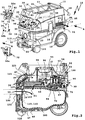
- a suction motor 12 for generating a suction flow 13 is arranged, which is sucked into the sucker housing 11 via a suction inlet 14.
- a hose not shown, can be connected.
- a filter arrangement 15 for separating particles from the suction flow 13.
- a receptacle 17 for receiving the suction hose and / or a connection cable 18, with which the suction device 10 is connected to an electrical supply network with eg 110 volts or 230 volts AC.
- an electrical supply network with eg 110 volts or 230 volts AC.
- a suction device with an accumulator would be possible.
- the suction device 10 is a portable suction device, on the underside driving rollers 19, 20 are arranged.
- the front casters 20 are castors. Furthermore, the suction device 10 can be grasped on a carrying handle 21 on the upper side 16.
- a control wall 23 with controls 24 for operating the suction device 10.
- the control wall 23 is suitably inclined, so that the controls 24 are easy to operate from diagonally above.
- the controls 24 include a switch 25, which forms a main switch, so to speak. With the switch 25, the suction motor 12 can be switched on and off. Further, an automatic mode is adjustable, in which the suction motor 12 always runs when a connected load receives electrical power through the suction device 10, which will be explained later. With the help of a Saugados- or speed switch 26, a power of the suction motor 12 can be adjusted.
- An adaptation switch 27 allows electrical adaptation of the suction device 10 to a respective suction inlet 14 connected suction hose. With a cleaning switch 28, a cleaning function of the suction device 10 can be switched on and / or parameterized.
- An outlet 29 which is firmly installed on the suction device 10 makes it possible to plug in an electrical energy consumer.
- the socket 29 is electrically connected to the connecting cable 18.
- a collecting housing part 31, of the sucker housing 11, an interior space 47 or collecting space 110 for collecting separated from the suction flow 13 particles and / or segregated moisture is provided in which optionally a large-size filter bag 48 of the filter assembly 15 can be arranged.
- a suction inlet 56 leading to the suction motor 12 is preceded by a main filter 61.
- the suction flow 13 is sucked into the filter bag 48 through the suction inlet 14, to which a suction hose 190 can be arranged.
- the filter bag 48 receives in the suction flow 13 contained particles 180.
- the suction flow 13 is generated by the suction motor 12, which sucks the suction flow 13 through the main filter 61 through the suction inlet 56 therethrough.
- the suction inlet 56 is arranged downstream of the suction filter 10 on the upper side of the main filter 61.
- the suction inlet 56 is connected to a turbine inlet 70 of a suction turbine 71 of a motor module 58 containing the suction motor 12 via an air guide arrangement 55.
- the suction turbine 71 sucks the suction flow 13 through the turbine inlet 70 and blows it radially outward through mufflers 84, which may optionally have a filter function at the same time, and then through Saugstromauslässe 85 on the side walls of the sucker housing 11 to the outside of the sucker housing 11 addition.
- a cooling air flow 94 flows through a cooling air inlet 96 on the front wall 22 of the sucker housing 11.
- the cooling air stream 94 initially flows past a control device 97 of the suction device 10 and cools it.
- the cooling air flow 94 flows through the suction motor 12 and then flows out to the rear through a cooling air outlet 99 from the sucker housing 11, on which expediently a silencer 100 is provided.
- a grounding contact 137 is provided at a suction pipe connection 133, to which the suction hose 190 can be connected.
- the grounding contact 137 is configured as a spring contact, for example a spring tongue.
- the suction pipe connection 133, for example a pipe sleeve, and / or the suction hose 190 expediently consist of an electrically conductive material, in particular plastic, in particular in a contact area provided for the grounding contact 137.
- a sensor 121 detects a level of a liquid or other electrically conductive substance in the plenum 110 and generates a sensor signal in response thereto.
- the sensor 121 is preferably arranged on a printed circuit board 123 of the control device 97. From an outside of the sucker housing 11 electrically scannable (see FIG. 1 ) Detecting parts 119, 120 of the sensor 121 are in the collecting space 110, thus in the interior 47 of the collecting housing part 31, before. Signal connections between the detection parts 119, 120 outside the plenum 110, but electrically protected and hidden on the sucker housing 11th
- the control device 97 can be influenced by the operating elements 24.
- the circuit board 123 is disposed below the controls 24, i. below the control wall 23.
- the control device 97 is connected to the suction motor 12, in particular the motor module 58 via electrical lines, not shown, and controls this.
- On the operating wall 23 is a suitably designed in the manner of a receiving shaft, in FIG. 1 provided with a cover plate 38 module receptacle 30 for selectively receiving functional modules 50a-50c provided that provide electrical, optical and acoustic functions.
- the functional module 50a is eg a compressed air module for connecting a compressed air tool.
- the functional module 50a has a compressed air connection arrangement 51 with compressed air connections, to each of which a compressed air hose can be connected.
- a compressed air connection via the connection arrangement 51 by the function module 50a be looped through, wherein a compressed air path in the function module 50a via a compressed air sensor for detecting a compressed air flow leads.
- the compressed air sensor is electrically connected via module signal contacts 32 with suction device signal contacts 33 when the function module 50a is plugged into the module receptacle 30.
- the functional module 50b has a bus connection 34 with a bus contact 35 for connection to a data bus 36 of the suction device 10.
- a bus contact 35 of the suction device signal contacts 33 can be connected to the function module 50b.
- the functional module 50c has e.g. an electrical power supply terminal 73 for connection of an electrical load, such as an electric tool on.
- the power supply connection 73 comprises a socket 74, preferably a safety socket, which can be closed by means of a cover 75.
- Contacts 76, 77 and 78 of the socket 74 are connected via leads to contacts of a connector 82.
- the connector 82 is used to make electrical connections to supply contacts 83 inside the module receptacle 30 of the suction device 10, e.g. are provided for a protective conductor connection, a ground connection and a continuous current connection.
- sensor connections 223 are provided on the circuit board 123, for example post connectors.
- the sucker signal contacts 33 are electrically connected to circuit board signal contacts 224.
- Signal terminals 225 serve to connect further sensors, for example a temperature sensor for the suction motor 12, a flow or pressure sensor for the suction flow 13 or the like.
- the first microprocessor 212 is located on a first potential region 226 of the printed circuit board 123 and is networked with the components 211 located there, while the second microprocessor 213 is arranged in a second potential region 227 and connected to the local components 211, for example to the sensor connections 223 or the signal contact terminals 224, 225.
- the first potential region 226 is connected to a mains potential, which comes via the connection cable 18, while the second potential region 227 has a lower compared to the potential region 226 electric potential, for example in the amount of signal voltages of 5 to 12 volts or so.
- a potential separation between the two potential regions 226, 227 is realized by the optocouplers 214, 215 so that the operator does not come into contact with the higher electrical potential present in the potential region 226.
- the second potential region 227 is indicated in dashed lines.
- the remaining area of the printed circuit board 123 is assigned to the first potential area 226.
- a mains potential 230, a ground potential 231 and a protective conductor potential 232 which are connected via a connection line, not shown, come via the connection cable 18 and are connected via plug connector 233 to a plug connection arrangement 234 of the printed circuit board module 210.
- the plug connection arrangement 234 is electrically connected to further multipolar plug connection arrangements 235 for the electrical connection of the switch 25 of the main switch, for the electrical connection of the function module 50c and a plug connection arrangement 237 for connection to the socket 29.
- guide bodies 238-242 of a guide body arrangement 243 are provided which extend along the lower flat side 219 of the printed circuit board 123.
- the guide bodies 238-242 have a flat shape. Its narrow sides 244 are facing the lower flat side 219.
- the printed circuit board 123 penetrating the printed circuit board contact projections 247, 248 and the Leit stresses plug connections 249, 250 are configured as plug-in projections which project in each case in front of the upper flat side 218 of the printed circuit board 123. There they are ready for contacting by a respective, in particular multi-pin connector, for example a multi-pin connector 251, which is plugged onto the plug connection arrangement 235.
- the connector 251 has in its interior a plurality of the connectors 233 corresponding connection sockets or plug connections 257, which are preferably arranged in a connector housing 252.
- the board contact protrusions 247, 248 are upstanding in front of the conductor connecting portions 253 the baffle 238-242 extending along the lower flat side 219 of the printed circuit board 123.
- connection sections 254, 255 of the guide bodies 238-242 on which the plug connections 249, 250 are provided.
- the plug-in connections 249, 250 protrude to the same side as the contact projections 247, 248, wherein it is quite possible that contact projections and / or plug-in connections in guide bodies used according to the invention protrude on different sides, in particular opposite sides.
- the guide body 238 is a plug-in connection 256 in the longitudinal direction forward, that is transverse to the Leit emotions plug-in connections 250.
- the plug connection 256 serves to connect a connector socket in the manner of the connector 233 to an electrical connection to the ground contact 137 on Suction pipe connection 133 produce.
- plug connection arrangements 234, 236, 237 All electrical contacts of the plug connection arrangements 234, 236, 237 are realized by contact projections of the guide body arrangement 243.
- plug-in connection arrangement 235 which is provided for the functional module 50c, there are also two further electrical plug-in connectors or electrical plug-in connections 257 which are exclusively in electrical connection with the printed circuit board 123.
- the plug housing 252 By optionally equipping receiving chambers of the plug housing 252 with sockets 258 and to each of these connected electrical lines, it is possible, for example, to realize different wiring variants without making any modifications to the printed circuit board module 210.
- the other plug connection arrangements 234, 236, 237 to the different connection lines as required, for example for different country variants or connectors can be connected.
- the two plug-in connections 257 which are connected exclusively to the printed circuit board 123, allow, for example, detection of a current flowing through the socket 74, so that the control device 97 the suction motor 12 with flowing current, that is at a connected to the suction device 10, running electrical Device, the suction motor 12 turns on.
- the socket 74 is designed switchable, so that, for example, only provides power when the switch 25 is switched to the operating position.
- the baffles 238-242 have conductor cross-sections which are larger than the conductor cross-sections of the tracks 220, so that they can conduct larger currents. This is particularly important with regard to the baffle 238 which conducts the protective conductor potential 232.
- the guide body 238 has no electrical contact with the printed circuit board 123 or the conductor tracks 220 or electrical components 211 disposed thereon.
- the guide body 238 penetrates the printed circuit board 123 only in the region of the plug connection arrangement 236 with a guide body contact projection 248. Below approximately in the region of a longitudinal center of the Circuit board 123 arranged plug connection arrangement 235, however, no electrical contact to the circuit board 123 and in particular not to the plug connection arrangement 235 is present. This is possible by the concept according to the invention.
- a substantially plate-like intermediate body 260 is arranged, which expediently is electrically insulating.
- the intermediate body 260 consists for example of plastic material and extends at least in the region of the guide body arrangement 243 below the printed circuit board 123.
- a bottom body 261 is arranged, so to speak, as the base or base.
- the printed circuit board 123, the intermediate body 260, the guide body assembly 243 and finally the bottom body 261 form the essential components of the printed circuit board module 210. These components are expediently cast as a whole, which is advantageous both mechanically and in terms of electrical insulation.
- the printed circuit board 123, the intermediate body 260, and the below-mentioned baffle connecting portions 253 of the baffles 238-242 are received in a tub or a tub portion 262 of the bottom body 261.
- a peripheral wall 263 of the bottom body 261 extends.
- the trough region 262 is suitable for filling with a potting compound, which mechanically stabilizes and electrically insulates the printed circuit board module 210.
- a connection region 264 of the base or bottom body 261 is arranged next to the well region 262, which is integral with the well region 262 and accommodates the connection sections 255 of the guide bodies 238, 239 and 241.
- the guide body receptacles 265 are provided.
- the guide body 238, 239, 241 lie with their flat sides on inner walls of the guide body receptacles 265 substantially flat, so that they have a firm grip.
- the guide body receptacles 265 have plug receptacles 266 at their end regions remote from the well region 262, into the plug ends 267 of the guide bodies 239, 241, and / or the plug connection 256 is distrsteckbar.
- the plug connection 256 protrudes forward in front of an end wall of the printed circuit board module 210.
- the guide body receptacles 265 also extend into the well region 262.
- the guide body 238 associated with the guide body 238 extends away from the guide body receptacles 265 for the guide body 239-242 and is realized in the manner of a receiving groove.
- an optimal electrical isolation of the protective conductor potential 232 is realized.
- the guide body receptacles 265 for the guide bodies 239-242 have a common trough-like receiving area 268.
- the guide body connection portions of the guide bodies 239-242 extend parallel to each other, but are separated from one another by dividers 269.
- a plurality of separating webs 269 are provided, which each have a receiving slot or a receiving groove for the respective guide body 239-242.
- the retaining projections 270 fit in a complementary manner between the partitions 269 of the receiving region 268, which enables an optimum retention of the guide bodies 239-242 between the base body 261 and the intermediate body 260.
- the intermediate body 260 has openings or openings for the passage of the printed circuit board contact projections 247, 248.
- Error-free mounting of the guide bodies 238-242 on the printed circuit board module 210 is realized, for example, by a geometric configuration which may be individual to the guide bodies 238-242. This is a kind of mechanical coding that contributes to the error-free installation available. It should be noted that, for example, the guide body 240, 242 and 239, 241 each have the same shape, which reduces the variety of parts.
- mechanical codings 272 for example projections, are provided, which are provided for engagement in corresponding coding receptacles 273 on the printed circuit board 123.
- the geometric configuration of the guide body receptacles 265, 271 and the codings 272 and the Kodiernessn 273 thus allow a correct polarity and in particular error-free mounting of the guide 238-242 on PCB module 210.
- Board contact projections 247, 248 with little effort in the contact openings 245, 246 insert where they are received with little play.
- the contact openings 245, 246 have a substantially triangular shape.
- An inclined side 275 opposite projection 274 of the contact openings 245, 246 abuts a flat side of a respective printed circuit board contact projection 247, 248, while edge regions of the opposite flat side of the contact projections 247, 248 abut punctiform or line on the inclined sides 275.
- the plug-in connections 249 of the plug connection arrangement 234 are surrounded by insulation bodies 276, which together form a connector housing 277.
- the plug-in terminals 249 are housed by the insulating body 276, so that they are electrically insulated.
- the insulating body 276 or the connector housing 277 is integrally formed on the intermediate body 260 and project upwardly in front of a plate portion 278 of the intermediate body 260 before.
- the connector housing 277 also protrudes upward in front of the upper flat side 218 of the printed circuit board 123.
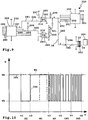
- the microprocessor 212 and the microprocessor 213 communicate with each other via the data bus 36. As a result, the number of required lines between the galvanically isolated potential regions 226, 227 is low.
- the first potential region 226 is assigned a primary bus section 281 of the data bus 36, while a secondary bus section 282 of the data bus 36 extends on the second potential region 227.
- the bus sections 281, 282 are coupled together by transmission means 280.
- the transmission means 280 realize a galvanic isolation.
- the two optocouplers 214, 215 form a first and a second transmission device 283, 284 for transmitting bus data from the primary bus section 281 to the secondary bus section 282 and vice versa.
- the optocouplers 214, 215 cause a galvanic separation of the data bus 36 in the two bus sections 281, 282. It is understood that instead of one or both optocouplers 214, 215 and a magnetic transformer is possible.
- the two microprocessors 212, 213 have different tasks.
- the first microprocessor 212 controls, for example, the power semiconductor or triac 216, for example via a control output 285.
- the microprocessor 212 has further inputs and outputs 286, for example for a speed monitoring the suction motor, a voltage synchronization, for controlling an acoustic signal means or the like. Further inputs and outputs are provided for direct connection to the primary bus section 281 of the data bus 36, namely a bus output 287 and a bus input 288.
- the data bus 36 is directly connected to the microprocessor 212 which directly handles the bus communication. An additional communication device is not necessary.
- the microprocessor 212 forms a first communication device 289.
- the second microprocessor 213 directly forms a communication device, namely a second communication device 290, which is connected to the secondary bus section 282 and thus to the data bus 36.
- the second microprocessor 213 has, in addition to inputs and outputs 291, which are provided, for example, for connecting the detection parts 119, 120, for connecting a temperature sensor, for connecting a sensor in one of the function modules 50a-50c or the like, a bus in / - output 292 which is connected to the secondary bus section 282.
- the bus input / output 292 is configured for bidirectional communication, that is, the microprocessor 213 receives and transmits data on a single bus input / output 292.
- the secondary bus portion 282 is configured as a one-wire bus having only a single bus 293 ,
- the bus line 293, which is intended for bidirectional communication, is connected via one or more pull-up resistors 294 to an upper potential level, for example 5 volts.
- a bus line 295 connected to the bus output 287 is connected via a pull-up resistor 297 and a bus line 296 connected to the bus input 288 via a resistor 299 via a pull-up resistor 298 connected to a ground potential.
- the bus line 295 is connected to a transmission input of the optocoupler 214, the bus line 296 provided with a data transmission for receiving the output of the optocoupler 215.
- the secondary bus section 282 On the side of the secondary bus section 282 this is not required.
- an amplifier circuit 300 with a transistor 301 At the input of the second communication device, that is the optocoupler 215, an amplifier circuit 300 with a transistor 301. It is understood that the amplifier circuit 300 is to be understood only as an example and can also be realized differently or can be dispensed with altogether, for example if a lower voltage is sufficient on the input side to the second communication device 290.
- the design of the secondary bus section 282 as a true single-wire bus, in which a single bus line 293 is sufficient, allows easy connection of other communication devices that can form part of the suction device 10, for example - or - in a preferred embodiment of the invention - can be configured as separate units.
- the bus contact 35 via a protective circuit 302 directly to the secondary bus section 282, thus connected to the data bus 36.
- the bus contact 35 therefore forms an interface 303 for connecting a communication device 304 separate from the machine 10, for example a diagnostic computer, a display device or the like.
- a functional module can be implemented, which is coupled directly to the data bus 36.
- Such a functional module which may be substantially similar in contour to the functional modules 50a-50c serves, for example, to output data communicated on the data bus 36, for example, sensor signals, fault messages, and the like.
- the communication devices 289, 290, 304 communicate with different priorities on the data bus 36.
- One exemplary communication is in FIG FIG. 10 shown.
- the second communication device 290 sends a bus message 305 on the data bus 36.
- the bus message 305 starts with a start pulse SI.
- the communication device 290 lowers a potential U on the data bus 36 from a high rest potential UH to a lower transmission potential UL.
- the data bus 36 is designed as an open-collector bus.
- the communication device 290 signals at the time t1 the desire to send a bus message.
- the start pulse ends and begins a waiting phase W1, within which the communication device 290 waits for transmission requests from other bus users of the data bus 36.
- the shorter waiting phase W2 compared to the waiting phase W1 signals that the bus message 306 has a higher priority than the bus message 305.
- the communication device 290 would omit further sending of the bus message 305 and give priority to the bus message 306.
- an address information AD begins, for example, the nature of the message and / or the sender of the message and / or the content of the message. This is followed at times t4 and t5 information pieces IN1, IN2, for example, contain four or eight bits of data.
- Bus messages on the data bus 36 may have variable lengths, that is, for example, that only the information part IN1 is transmitted or connect to the information part IN2 more, not shown information parts.
Landscapes
- Engineering & Computer Science (AREA)
- Mechanical Engineering (AREA)
- Computer Networks & Wireless Communication (AREA)
- Signal Processing (AREA)
- Physics & Mathematics (AREA)
- General Physics & Mathematics (AREA)
- Automation & Control Theory (AREA)
- Programmable Controllers (AREA)
- Details Of Connecting Devices For Male And Female Coupling (AREA)
- Control Of Electric Motors In General (AREA)
Description
- Die Erfindung betrifft eine portable elektrische Maschine, in Gestalt einer Hand-Werkzeugmaschine oder eines Sauggeräts, mit einer Steuerungseinrichtung zur Steuerung mindestens einer Komponente der Maschine, insbesondere eines elektrischen Motors, gemäß dem Oberbegriff des Anspruchs 1.
- Eine derartige mit einer Steuerungseinrichtung ausgestattete Hand-Werkzeugmaschine ist in der nicht vorveröffentlichten Patentanmeldung
DE 10 2007 048 631 beschrieben. Dort kommuniziert eine Bedieneinrichtung mit einem in einem separaten Antriebsgehäuse angeordneten Antriebsmotor über elektrische Energieversorgungsleitungen, wobei die Bedieneinrichtung Vorgabedaten durch Veränderung der Energieversorgungsspannung bildet. Somit findet eine Art Bus-Übertragung statt. - Soweit dieses elektrische Potential elektrisch isoliert ist, das heißt für einen Bediener nicht zugänglich, ist eine solche Datenübertragung unproblematisch. Das dort vorherrschende elektrische Potential von beispielsweise 110 Volt oder 220 Volt Wechselspannung ist für den Bediener nicht zugänglich, so dass die Gefahr von Verletzungen vermieden ist. Es gibt aber auch elektrische Maschinen, bei denen weitere Potentialbereiche vorhanden sind, beispielsweise für Sensorpotentiale oder dergleichen, mit denen die Steuerungseinrichtung verbunden ist. Bei einem Sauggerät können dies beispielsweise Sensorkontakte zur Erfassung eines Füllstandes in einem Sammelraum des Sauggerätes sein. Diese Sensorkontakte sind frei zugänglich, so dass dort nur ein Berührpotential zulässig ist.
- Ein Zweileiterfeldgerät für die Prozessautomatisierungstechnik zum Anschluss mindestens eines Sensorelements mit einer galvanischen Isolationsschaltung ist aus
DE 10 2006 060 447 A1 bekannt. - Aus
EP 1 538 784 A1 ist ein Umsetzer für ein Installations-Bussystem mit einer galvanischen Trennung bekannt. - Aus
EP 0 217 216 A2 ist ein Staubsauger mit einer optoelektrischen Staubkonzentrations-Messanordnung bekannt, die über einen optoelektrisches Kopplungsglied einen Ansteuerkreis für den Antriebsmotor ansteuert. - Davon ausgehend ist es die Aufgabe der vorliegenden Erfindung, eine mit einer Steuerungseinrichtung ausgestattete portable elektrische Maschine bereitzustellen, bei der unterschiedliche Potentialbereiche und eine optimale Kommunikation möglich sind.
- Zur Lösung der Aufgabe ist eine portable elektrische Maschine mit einer Steuerungseinrichtung gemäß der technischen Lehre des Anspruchs 1 vorgesehen.
- Ein Grundgedanke der Erfindung ist es, die Kommunikation zwischen dem ersten und dem zweiten Potentialbereich - es könnte auch ein dritter oder weiterer Potentialbereich vorhanden sein - über einen Datenbus abzuwickeln, wobei zur galvanischen Trennung zwischen den jeweiligen Potentialbereichen geeignete Übertragungsmittel vorgesehen sind, beispielsweise Optokoppler, magnetische Übertrager oder dergleichen. Somit ist eine Potentialtrennung realisiert. Über den Datenbus kann eine Vielzahl von Informationen zwischen den verschiedenen Potentialbereichen übermittelt werden. Die Anzahl erforderlicher Datenleitungen ist dadurch reduziert.
- Eine bevorzugte Ausführungsform der Erfindung sieht vor, dass der Primärbusabschnitt und/oder der Sekundärbusabschnitt als Eindrahtbus ausgestaltet sind. An dieser Stelle sei erwähnt, dass bei Vorhandensein eines weiteren Potentialbereichs entsprechend ein weiterer Busabschnitt zweckmäßig ist, der ebenfalls über galvanisch trennende Übertragungsmittel mit dem ersten oder zweiten Potentialbereich beziehungsweise dem Primärbusabschnitt oder dem Sekundärbusabschnitt verbunden ist.
- Der Eindrahtbus ist zweckmäßigerweise für eine bidirektionale Übertragung ausgestaltet. Es ist aber prinzipiell auch möglich, dass auf dem jeweiligen Primärbusabschnitt oder Sekundärbusabschnitt oder einem Teilzweig davon nur gesendet oder empfangen wird. Mithin können also auf Abschnitten des Datenbusses auch unidirektionale Übertragungen auf entsprechenden Teilzweigen realisiert sein.
- Der Eindrahtbus hat den Vorteil, dass die Anzahl erforderlicher Leitungen minimiert ist. Es ist lediglich eine einzige Busleitung erforderlich, deren Potential von einem zweiten Potential, beispielsweise Masse oder einem Versorgungspotential, abweicht.
- Die Übertragungsmittel weisen zweckmäßigerweise für jede Übertragungsrichtung eine separate Übertragungseinrichtung auf, beispielsweise zwei separate Optokoppler, zwei separate magnetische Übertrager oder dergleichen.
- Die erste Übertragungseinrichtung ist vorzugsweise an einem Ausgang und die zweite Übertragungseinrichtung an einem von dem Ausgang separaten Eingang der ersten Kommunikationseinrichtung zur Vermeidung einer Rückkopplung angeschlossen. Es versteht sich, dass zur Vermeidung einer Rückkopplung auch andere Maßnahmen, beispielsweise ein Transistornetzwerk, eine Entkopplung über Operationsverstärker oder dergleichen, vorgesehen sein können.
- Die erste Übertragungseinrichtung und die zweite Übertragungseinrichtung sind zweckmäßigerweise auf dem Sekundärbusabschnitt miteinander verbunden. Somit ist also auf Seiten der mindestens einen zweiten Kommunikationseinrichtung beispielsweise eine bidirektionale Übertragung realisiert.
- Das erfindungsgemäße Konzept sieht vor, dass an den Datenbus auch weitere Kommunikationseinrichtungen angeschlossen werden können. Diese Kommunikationseinrichtungen können Bestandteil beispielsweise der portablen elektrischen Maschine sein oder auch externe, von der portablen elektrischen Maschine separate Kommunikationseinrichtungen, beispielsweise Anzeigeeinrichtungen, Diagnoseeinrichtungen, Computer oder dergleichen. Die dritte Kommunikationseinrichtung ist also lösbar mit dem Primärbusabschnitt oder dem Sekundärbusabschnitt verbindbar.
- Zweckmäßigerweise ist die dritte oder weitere Kommunikationseinrichtung an denjenigen Busabschnitt anschließbar, der eine bidirektionale Übertragung auf ein und derselben Busleitung ermöglicht. Wenn also die erste und zweite Übertragungseinrichtung auf dem Sekundärbusabschnitt miteinander verbunden sind, ist dieser Sekundärbusabschnitt zum Anschluss weiterer Kommunikationseinrichtungen vorteilhaft.
- Die erste und/oder die mindestens eine zweite Kommunikationseinrichtung könnten zwar prinzipiell durch Bus-Kommunikationsmodule gebildet sein, die beispielsweise durch einen Mikroprozessor ansteuerbar sind. Vorzugsweise ist jedoch vorgesehen, dass die erste und/oder die zweite Kommunikationseinrichtung unmittelbar durch einen Mikroprozessor gebildet sind. Der Mikroprozessor ist beispielsweise in der Lage, die mindestens eine Komponente der Maschine, beispielsweise einen elektrischen Motor, anzusteuern und zugleich unmittelbar die Kommunikation über den Datenbus zu bewältigen. Der Sensor kann auch zur Verarbeitung mindestens eines Sensorsignals ausgestaltet sein. Es versteht sich, dass eine Arbeitsteilung zweckmäßig ist, dass beispielsweise ein dem ersten Potentialbereich zugeordneter Mikroprozessor zur Ansteuerung der elektrischen Komponente vorgesehen ist, während ein zweiter Mikroprozessor, der dem zweiten Potentialbereich zugeordnet ist, Sensorsignale verarbeitet.
- An den Datenbus, beispielsweise den Primärbusabschnitt oder den Sekundärbusabschnitt, ist zweckmäßigerweise ein bidirektional zum Senden und Empfangen vorgesehener Anschluss des Mikroprozessors angeschlossen.
- Der Primärbusabschnitt und/oder der Sekundärbusabschnitt sind zweckmäßigerweise als Offene-Kollektor-Busse ausgestaltet. Hier ist also eine einfache Busarchitektur realisiert, die preisgünstig ist.
- Der erste Potentialbereich und der zweite Potentialbereich sind vorzugsweise auf einer einzigen Leiterplatte angeordnet. Zweckmäßig ist es dann, wenn die erste Kommunikationseinrichtung, die zweite Kommunikationseinrichtung und/oder die Übertragungsmittel auf derselben, einzigen Leiterplatte angeordnet sind. Es versteht sich, dass man beispielsweise die Übertragungsmittel auch als separate Komponente realisieren könnte.
- Die Leiterplatte bildet zweckmäßigerweise einen Bestandteil eines Leiterplattenmoduls, bei der an einer Flachseite eine Leitkörperanordnung mit mindestens einem von der Leiterplatte separaten Leitkörper angeordnet ist. Dieser Leitkörper dient beispielsweise zur Übertragung eines Netzpotentials, das auf der Leiterplatte auf dem ersten oder zweiten Potentialbereich ebenfalls vorhanden ist. Der Leitkörper ist beispielsweise an einer Flachseite angeordnet, die einer Flachseite entgegengesetzt ist, an der elektrische Komponenten, beispielsweise die Kommunikationseinrichtungen und/oder die Übertragungsmittel, angeordnet sind. Der Leitkörper hat zweckmäßigerweise mindestens einen Leiterplatten-Kontaktvorsprung, der die Leiterplatte an einer Kontaktöffnung durchdringt oder in die Leiterplatte eindringt. Dieser Kontaktvorsprung steht vor einen Leitkörper-Verbindungsabschnitt vor, der entlang der Flachseite der Leiterplatte verläuft.
- Zwischen dem mindestens einen Leitkörper und der Leiterplatte ist zweckmäßigerweise ein Zwischenkörper angeordnet, der vorzugsweise plattenförmig ist. Auch an einer von der Leiterplatte abgewandten Seite des Leitkörpers ist es vorteilhaft, wenn ein weiterer Körper, beispielsweise ein Bodenkörper, angeordnet ist. Dieser weitere Körper / Bodenkörper ist vorzugsweise plattenförmig oder wannenartig.
- Der erste Potentialbereich ist beispielsweise einem Netzpotential eines Wechselspannungsnetzes zugeordnet, während der zweite Potentialbereich einem gegenüber dem Netzkörperpotential niedrigeren Potential zugeordnet ist, zum Beispiel einem Berührpotential, das gefahrlos durch einen Benutzer berührt werden kann.
- Die Kommunikationseinrichtungen sind zweckmäßigerweise zu einer konkurrierenden Kommunikation auf dem Datenbus ausgestaltet. Dazu ist es vorteilhaft, wenn die Kommunikationseinrichtung nach einem eine Busnachricht ankündigenden Startsignal eine Wartephase "Warten" aufweist, innerhalb derer eine jeweils andere Kommunikationseinrichtung mit dem Senden einer Busnachricht beginnen kann. Dadurch werden Kollisionen vermieden. Der Wartephase ist vorzugsweise ein Empfangspegel zugeordnet. Mithin sind also die Kommunikationseinrichtungen während der Wartephase auf Empfang geschaltet, so dass eine zweite Kommunikationseinrichtung mit der von ihr gewünschten Kommunikation beginnen kann.
- Die Länge einer Wartephase einer Kommunikationseinrichtung hängt zweckmäßigerweise von deren Sende-Priorität ab. Somit ist es möglich, dass eine Kommunikationseinrichtung mit höherer Priorität zu senden beginnt, während eine Kommunikationseinrichtung mit niedrigerer Priorität auf eine Sendemöglichkeit wartet.
- Bevorzugt ist es, wenn die Kommunikationseinrichtungen auf dem Datenbus mittels einer einen Takt integral enthaltenden Sendekodierung, beispielsweise einer Manchester-Kodierung, senden. Somit ist eine Art digitale Phasenmodulation realisiert. Die Gleichspannungsanteile sind minimiert, so dass beispielsweise die Verwendung von Übertragern bei dem Datenbus möglich ist.
- Die Kommunikationseinrichtungen kommunizieren auf dem Datenbus zweckmäßigerweise Busnachrichten variabler Länge, so dass eine Anpassung an den jeweiligen Sendebedarf ohne weiteres möglich ist.
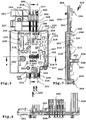
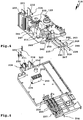
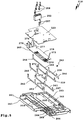
- Nachfolgend wird ein Ausführungsbeispiel der Erfindung anhand der Zeichnung erläutert. Es zeigen:
- Figur 1
- eine perspektivische Frontal-Schrägansicht eines Sauggerätes,
- Figur 2
- eine Querschnittsansicht des Sauggeräts gemäß
Figur 1 etwa entlang einer Schnittlinie A-A inFigur 1 , - Figur 3
- eine Draufsicht auf ein erfindungsgemäßes Leiterplattenmodul,
- Figur 4
- eine perspektivische Schrägansicht des Leiterplattenmoduls gemäß
Figur 3 , jedoch ohne einen Bodenkörper, - Figur 5
- eine Explosionsdarstellung des Leiterplattenmoduls gemäß
Figur 3 , - Figur 6
- das Leiterplattenmodul gemäß
Figur 3 schräg von oben, allerdings ohne auf der Leiterplatte angeordnete elektrische Komponenten, - Figur 7
- eine Querschnittsansicht des Leiterplattenmoduls gemäß
Figur 3 entlang einer Schnittlinie B-B, - Figur 8
- eine Querschnittsansicht des Leiterplattenmoduls gemäß
Figur 3 entlang einer Schnittlinie C-C, - Figur 9
- ein Teilschaltbild einer Steuerungseinrichtung des Sauggeräts gemäß
Figur 1 und - Figur 10
- eine Busnachricht, die auf einem Bus der Steuerungseinrichtung gemäß
Figur 9 übertragen wird. - Im Inneren eines Saugergehäuses 11 eines Sauggeräts 10 ist ein Saugmotor 12 zum Erzeugen eines Saugstroms 13 angeordnet, der über einen Saugeinlass 14 in das Saugergehäuse 11 einsaugbar ist. An den Saugeinlass 14 ist ein nicht dargestellter Schlauch anschließbar. Im Inneren des Saugergehäuses 11 befindet sich ferner eine Filteranordnung 15 zum Absondern von Partikeln aus dem Saugstrom 13.
- An einer Oberseite 16 des Saugergehäuses 11 befindet sich eine Aufnahme 17 zur Aufnahme des Saugschlauches und/oder eines Anschlusskabels 18, mit dem das Sauggerät 10 an ein elektrisches Versorgungsnetz mit z.B. 110 Volt oder 230 Volt Wechselstrom anschließbar ist. Alternativ wäre ein Sauggerät mit einem Akkumulator möglich. Das Sauggerät 10 ist ein transportables Sauggerät, an dessen Unterseite Fahrrollen 19, 20 angeordnet sind. Die vorderen Fahrrollen 20 sind Lenkrollen. Weiterhin kann das Sauggerät 10 an einem Tragegriff 21 an der Oberseite 16 ergriffen werden.
- Zwischen einer den Saugeinlass 14 aufweisenden Frontwand 22 und der Oberseite 16 des Saugergehäuses 11 erstreckt sich eine Bedienwand 23 mit Bedienelementen 24 zur Bedienung des Sauggeräts 10. Die Bedienwand 23 ist zweckmäßigerweise schräg geneigt, so dass die Bedienelemente 24 von schräg oben vorn leicht bedienbar sind.
- Die Bedienelemente 24 umfassen einen Schalter 25, der sozusagen einen Hauptschalter bildet. Mit dem Schalter 25 kann der Saugmotor 12 ein- und ausgeschaltet werden. Ferner ist ein Automatikmodus einstellbar, bei dem der Saugmotor 12 immer dann läuft, wenn ein angeschlossener Verbraucher elektrischen Strom über das Sauggerät 10 erhält, was später noch erläutert wird. Mit Hilfe eines Saugleistungs- oder Drehzahlschalters 26 kann eine Leistung des Saugmotors 12 eingestellt werden. Ein Anpassungsschalter 27 ermöglicht eine elektrische Anpassung des Sauggeräts 10 an einem jeweiligen Saugeinlass 14 angeschlossenen Saugschlauch. Mit einem Reinigungsschalter 28 ist eine Reinigungsfunktion des Sauggeräts 10 einschaltbar und/oder parametrierbar. Eine fest am Sauggerät 10 installierte Steckdose 29 ermöglicht das Einstecken eines elektrischen Energieverbrauchers. Die Steckdose 29 ist mit dem Anschlusskabel 18 elektrisch verbunden.
- In einem unteren Teil, einem Sammelgehäuseteil 31, des Saugergehäuses 11 ist ein dem Innenraum 47 oder Sammelraum 110 zum Sammeln von aus dem Saugstrom 13 abgesonderten Partikeln und/oder abgesonderter Feuchtigkeit vorgesehen, in dem optional ein großformatiger Filtersack 48 der Filteranordnung 15 anordenbar ist. Einem zum Saugmotor 12 führenden Saugeinlass 56 ist ein Hauptfilter 61 vorgelagert.
- Der Saugstrom 13 wird durch den Saugeinlass 14, an dem ein Saugschlauch 190 anordenbar ist, in den Filtersack 48 eingesaugt. Der Filtersack 48 nimmt im Saugstrom 13 enthaltene Partikel 180 auf. Der Saugstrom 13 wird vom Saugmotor 12 erzeugt, der den Saugstrom 13 über den Hauptfilter 61 durch den Saugeinlass 56 hindurch ansaugt. Der Saugeinlass 56 ist strömungsabseitig, beim Sauggerät 10 oberseitig, des Hauptfilters 61 angeordnet. Der Saugeinlass 56 ist mit einem Turbineneinlass 70 einer Saugturbine 71 eines den Saugmotor 12 enthaltenden Motormoduls 58 über eine Luftführungsanordnung 55 verbunden. Die Saugturbine 71 saugt den Saugstrom 13 durch den Turbineneinlass 70 an und bläst ihn nach radial außen über Schalldämpfer 84, die zugleich optional eine Filterfunktion haben können, hindurch und sodann durch Saugstromauslässe 85 an den Seitenwänden des Saugergehäuses 11 nach außen aus dem Saugergehäuse 11 hinaus.
- Ein Kühlluftstrom 94 strömt durch einen Kühllufteinlass 96 an der Frontwand 22 des Saugergehäuses 11 ein. Der Kühlluftstrom 94 strömt zunächst an einer Steuerungseinrichtung 97 des Sauggeräts 10 vorbei und kühlt diese. Über einen zwischen dem Hauptfilter 61 und einer Deckwand 52 des Saugergehäuses 11 verlaufenden Kühlluftkanal 98 strömt der Kühlluftstrom 94 weiter zu einem Motoraufnahmeraum 54 für den Saugmotor 12, in dem der Kühlluftstrom 94 von oben her in einen Kühllufteinlass des Saugmotors 12 einströmt. Der Kühlluftstrom 94 durchströmt den Saugmotor 12 und strömt sodann nach hinten durch einen Kühlluftauslass 99 aus dem Saugergehäuse 11 aus, an dem zweckmäßigerweise ein Schalldämpfer 100 vorgesehen ist.
- An einem Saugrohranschluss 133, an den der Saugschlauch 190 anschließbar ist, ist ein Erdungskontakt 137 vorgesehen. Der Erdungskontakt 137 ist als ein Federkontakt, beispielsweise eine Federzunge, ausgestaltet. Der Saugrohranschluss 133, z.B. eine Rohrmuffe, und/oder der Saugschlauch 190 bestehen zweckmäßigerweise aus einem elektrisch leitfähigen Material, insbesondere Kunststoff, insbesondere in einem für den Erdungskontakt 137 vorgesehenen Berührbereich.
- Ein Sensor 121 detektiert einen Füllstand einer Flüssigkeit oder einer sonstigen elektrisch leitfähigen Substanz in dem Sammelraum 110 und generiert in Abhängigkeit davon ein Sensorsignal. Der Sensor 121 ist vorzugsweise auf einer Leiterplatte 123 der Steuerungseinrichtung 97 angeordnet. Von einer Außenseite des Saugergehäuses 11 elektrisch abtastbare (siehe
Figur 1 ) Erfassungsteile 119, 120 des Sensors 121 stehen in den Sammelraum 110, mithin also in Innenraum 47 des Sammelgehäuseteils 31, vor. Signalverbindungen zwischen den Erfassungsteilen 119, 120 außerhalb des Sammelraums 110, jedoch elektrisch geschützt und verdeckt am Saugergehäuse 11. - Die Steuerungseinrichtung 97 ist mit den Bedienelementen 24 beeinflussbar. Zweckmäßigerweise ist die Leiterplatte 123 unterhalb der Bedienelemente 24 angeordnet, d.h. unterhalb der Bedienwand 23. Die Steuerungseinrichtung 97 ist mit dem Saugmotor 12, insbesondere dem Motormodul 58 über nicht dargestellte elektrische Leitungen verbunden und steuert diesen.
- An der Bedienwand 23 ist eine zweckmäßigerweise in der Art eines Aufnahmeschachtes ausgestaltete, in
Figur 1 mit einer Abdeckplatte 38 abgedeckte Modulaufnahme 30 zur wahlweisen Aufnahme von Funktionsmodulen 50a-50c vorgesehen, die elektrische, optische und akustische Funktionen bereitstellen. - Das Funktionsmodul 50a ist z.B. ein Druckluft-Modul zum Anschließen eines Druckluft-Werkzeuges. Das Funktionsmodul 50a hat eine Druckluft-Anschlussanordnung 51 mit Druckluft-Anschlüssen, an die jeweils ein Druckluftschlauch anschließbar ist. Somit kann also eine Druckluftverbindung über die Anschlussanordnung 51 durch das Funktionsmodul 50a durchgeschleift werden, wobei ein Druckluftpfad im Funktionsmodul 50a über einen Druckluftsensor zum Erfassen eines Druckluftstromes führt. Der Druckluftsensor ist über Modulsignalkontakte 32 mit Sauggerät-Signalkontakten 33 elektrisch verbunden, wenn das Funktionsmodul 50a in die Modulaufnahme 30 eingesteckt ist.
- Das Funktionsmodul 50b weist einen Bus-Anschluss 34 mit einem Buskontakt 35 zum Anschluss an einen Datenbus 36 des Sauggeräts 10 auf. Ein Buskontakt 35 der Sauggerät-Signalkontakte 33 ist mit dem Funktionsmodul 50b verbindbar.
- Das Funktionsmodul 50c weist z.B. einen elektrischen Stromversorgungsanschluss 73 zum Anschluss eines elektrischen Verbrauchers, beispielsweise eines Elektro-Werkzeugs, auf. Der Stromversorgungsanschluss 73 umfasst eine Steckdose 74, vorzugsweise eine Schutzkontaktsteckdose, die mittels eines Deckels 75 verschließbar ist. Kontakte 76, 77 und 78 der Steckdose 74 sind über Leitungen mit Kontakten eines Steckverbinders 82 verbunden. Der Steckverbinder 82 dient zur Herstellung elektrischer Verbindungen zu Versorgungskontakten 83 im Innern der Modulaufnahme 30 des Sauggeräts 10, die z.B. für eine Schutzleiterverbindung, eine Masseverbindung und eine Dauerstrom-Verbindung vorgesehen sind.
- Die Steuerungseinrichtung 97, insbesondere die Anordnung der Leiterplatte 123, sowie das damit in Beziehung stehende elektrische Anschlusskonzept, unter anderem zum Anschluss der Funktionsmodule 50a, 50b oder 50c, sind bei dem Sauggerät 10 innovativ und auf erfindungsgemäße Weise gelöst:
- Die Leiterplatte 123 bildet einen Bestandteil eines Leiterplattenmoduls 210, auf der elektrische Komponenten 211, beispielsweise ein erster und ein zweiter Mikroprozessor 212, 213, die zweckmäßigerweise über Optokoppler 214, 215 oder sonstige galvanisch trennende Komponenten miteinander kommunizieren, Leistungshalbleiter zur Ansteuerung beispielsweise des Saugmotors 12, zum Beispiel ein Triac 216, an einem Kühlkörper 217 sowie weitere, hier nicht im Detail beschriebene Komponenten, beispielsweise Widerstände, Kondensatoren und dergleichen, angeordnet sind. Die elektrischen Komponenten 211 sind auf einer oberen Flachseite 218 angeordnet. An der Flachseite 218 sowie einer dieser gegenüberliegenden unteren Flachseite 219 der Leiterplatte 123 verlaufen schematisch angedeutete Leiterbahnen 220 zur Verbindung der elektrischen Komponenten 211. Weiterhin sind die Bedienelemente 24 elektrisch und/oder mechanisch mit der Steuerungseinrichtung 97 verbunden. Beispielsweise sind Steuerglieder 221, 222 vorgesehen, zum Beispiel Potentiometer, die beispielsweise mit dem Saugleistungsschalter 26, dem Anpassungsschalter 27 sowie dem Reinigungsschalter 28 mechanisch verbunden sind. Somit kann beispielsweise eine Saugleistung des Saugmotors 12, eine Betriebsart oder dergleichen an der Steuerungseinrichtung 97 vorgewählt werden.
- Zur elektrischen Verbindung von Sensoren oder Sensorflächen, zum Beispiel der Erfassungsteile 119, 120, sind an der Leiterplatte 123 Sensoranschlüsse 223 vorgesehen, beispielsweise Pfostenstecker.
- Die Sauggerät-Signalkontakte 33 sind mit Leiterplatten-Signalkontakten 224 elektrisch verbunden. Signalanschlüsse 225 dienen zum Anschluss weiterer Sensoren, beispielsweise eines Temperatursensors für den Saugmotor 12, eines Strömungs- oder Drucksensors für den Saugstrom 13 oder dergleichen.
- Der erste Mikroprozessor 212 befindet sich auf einem ersten Potentialbereich 226 der Leiterplatte 123 und ist mit den dort befindlichen Komponenten 211 vernetzt, während der zweite Mikroprozessor 213 in einem zweiten Potentialbereich 227 angeordnet ist und mit den dortigen Komponenten 211 verbunden ist, beispielsweise mit den Sensoranschlüssen 223 oder den Signalkontakt-Anschlüssen 224, 225. Der erste Potentialbereich 226 ist mit einem Netzpotential, das über das Anschlusskabel 18 kommt, verbunden, während der zweite Potentialbereich 227 ein im Vergleich zum Potentialbereich 226 niedrigeres elektrisches Potential aufweist, beispielsweise in Höhe von Signalspannungen von 5 bis 12 Volt oder dergleichen. Somit ist ein Berührkontakt seitens eines Bedieners bezüglich des zweiten Potentialbereichs 227 möglich, was zum Beispiel im Bereich der Erfassungsteile 119 oder 120 nicht auszuschließen ist. Durch die Optokoppler 214, 215 ist eine Potentialtrennung zwischen den beiden Potentialbereichen 226, 227 realisiert, so dass der Bediener mit dem im Potentialbereich 226 vorhandenen höheren elektrischen Potential nicht in Berührung kommt.
- In
Figur 3 ist der zweite Potentialbereich 227 in gestrichelten Linien angedeutet. Der übrige Bereich der Leiterplatte 123 ist dem ersten Potentialbereich 226 zugeordnet. - Nicht nur im Hinblick auf eine optimierte Potentialtrennung auf der Leiterplatte 123 ist die elektrische Beschaltung und Verdrahtung bei dem Sauggerät 10, insbesondere dessen Steuerungseinrichtung 97, optimal, sondern auch im Hinblick auf das übrige Verdrahtungs- und Anschlusskonzept.
- Über das Anschlusskabel 18 kommen beispielsweise ein Netzpotential 230, ein Massepotential 231 sowie ein Schutzleiterpotential 232, die über eine nicht dargestellte Verbindungsleitung sowie über Steckverbinder 233 an eine Steckanschlussanordnung 234 des Leiterplattenmoduls 210 angeschlossen sind. Die Steckanschlussanordnung 234 ist elektrisch mit weiteren mehrpoligen Steckanschlussanordnungen 235 zum elektrischen Anschluss des Schalters 25 des Hauptschalters, zum elektrischen Anschluss des Funktionsmoduls 50c sowie einer Steckanschlussanordnung 237 zur Verbindung mit der Steckdose 29 verbunden. Dazu sind Leitkörper 238-242 einer Leitkörperanordnung 243 vorgesehen, die an der unteren Flachseite 219 der Leiterplatte 123 entlang verlaufen. Die Leitkörper 238-242 haben eine Flachgestalt. Ihre Schmalseiten 244 sind der unteren Flachseite 219 zugewandt.
- An den Schmalseiten 244 stehen bei den Leitkörpern 238-242 Kontaktvorsprünge vor, nämlich die Leiterplatte 123 an Kontaktöffnungen 245, 246 durchdringende Leiterplatten-Kontaktvorsprünge 247, 248, die Bestandteile der Steckanschlussanordnungen 235, 236 bilden, sowie Leitkörper-Steckanschlüsse 249, 250, die Bestandteile der Steckanschlussanordnungen 234, 237 bilden.
- Die die Leiterplatte 123 durchdringenden Leiterplatten-Kontaktvorsprünge 247, 248 sowie die Leitkörper-Steckanschlüsse 249, 250 sind als Steckvorsprünge ausgestaltet, die jeweils vor die obere Flachseite 218 der Leiterplatte 123 vorstehen. Dort stehen sie zur Kontaktierung durch einen jeweiligen, insbesondere mehrpoligen Steckverbinder bereit, beispielsweise einen mehrpoligen Steckverbinder 251, der auf die Steckanschlussanordnung 235 aufgesteckt ist. Der Steckverbinder 251 weist in seinem Inneren mehrere den Steckverbindern 233 entsprechende Anschlussbuchsen oder Steckanschlüsse 257 auf, die vorzugsweise in einem Steckergehäuse 252 angeordnet sind. Die Leiterplatten-Kontaktvorsprünge 247, 248 stehen nach oben vor Leitkörper-Verbindungsabschnitte 253 der Leitkörper 238-242 vor, die entlang der unteren Flachseite 219 der Leiterplatte 123 verlaufen. Vor die Leiterplatte 123 stehen Anschlussabschnitte 254, 255 der Leitkörper 238-242 vor, an denen die Steckanschlüsse 249, 250 vorgesehen sind. Die Steckanschlüsse 249, 250 stehen zur selben Seite wie die Kontaktvorsprünge 247, 248 vor, wobei es durchaus möglich ist, dass Kontaktvorsprünge und/oder Steckanschlüsse bei erfindungsgemäß verwendeten Leitkörpern an unterschiedlichen Seiten, insbesondere entgegengesetzte Seiten, vorstehen. So steht beispielsweise beim Leitkörper 238 ein Steckanschluss 256 in dessen Längserstreckungsrichtung nach vorn vor, das heißt quer zu den Leitkörper-Steckanschlüssen 250. Der Steckanschluss 256 dient zum Anschluss einer Steckverbinderbuchse in der Art der Steckverbinder 233, um eine elektrische Verbindung zu dem Erdungskontakt 137 am Saugrohranschluss 133 herzustellen.
- Sämtliche elektrischen Kontakte der Steckanschlussanordnungen 234, 236, 237 sind durch Kontaktvorsprünge der Leitkörperanordnung 243 realisiert. Bei der Steckanschlussanordnung 235, die für das Funktionsmodul 50c vorgesehen ist, sind noch zwei weitere elektrische Steckverbinder beziehungsweise elektrische Steckanschlüsse 257 vorhanden, die ausschließlich in elektrischer Verbindung mit der Leiterplatte 123 stehen.
- Durch wahlweise Bestückung von Aufnahmekammern des Steckergehäuses 252 mit Steckbuchsen 258 und an diese jeweils angeschlossene elektrische Leitungen ist es beispielsweise möglich, unterschiedliche Verdrahtungsvarianten zu realisieren, ohne Modifikationen am Leiterplattenmodul 210 vorzunehmen. Eine solche Vorgehensweise ist selbstverständlich auch bezüglich der anderen Steckanschlussanordnungen 234, 236, 237 möglich, an die je nach Bedarf, beispielsweise für unterschiedliche Ländervarianten, unterschiedliche Anschlussleitungen beziehungsweise Steckverbinder angeschlossen werden können. Die beiden Steckanschlüsse 257, die ausschließlich mit der Leiterplatte 123 verbunden sind, ermöglichen beispielsweise eine Erfassung eines über die Steckdose 74 fließenden Stromes, so dass die Steuerungseinrichtung 97 den Saugmotor 12 bei fließendem Strom, das heißt bei einem an das Sauggerät 10 angeschlossenen, laufenden elektrischen Gerät, den Saugmotor 12 einschaltet. Ferner ist es möglich, dass die Steckdose 74 schaltbar ausgestaltet ist, so dass sie beispielsweise nur dann Strom liefert, wenn der Schalter 25 in Betriebsstellung geschaltet ist.
- Die Leitkörper 238-242 haben Leiterquerschnitte, die größer sind als die Leiterquerschnitte der Leiterbahnen 220, so dass sie größere Ströme leiten können. Dies ist insbesondere im Hinblick auf den Leitkörper 238, der das Schutzleiterpotential 232 leitet, wesentlich. Der Leitkörper 238 hat keinen elektrischen Kontakt zu der Leiterplatte 123 beziehungsweise den darauf angeordneten Leiterbahnen 220 oder elektrischen Komponenten 211. Der Leitkörper 238 durchdringt die Leiterplatte 123 lediglich im Bereich der Steckanschlussanordnung 236 mit einem Leitkörper-Kontaktvorsprung 248. Unterhalb der etwa im Bereich einer Längsmitte der Leiterplatte 123 angeordneten Steckanschlussanordnung 235 ist jedoch kein elektrischer Kontakt zur Leiterplatte 123 und insbesondere nicht zur Steckanschlussanordnung 235 vorhanden. Dies ist durch das erfindungsgemäße Konzept möglich.
- Allein schon durch einen Isolationsabstand zwischen der unteren Flachsseite 219 und dem Leitkörper 238 ist eine elektrische Isolation, insbesondere im Bereich der Steckanschlussanordnung 235, realisiert. Zudem ist noch zwischen der Leiterplatte 123 und der Leitkörperanordnung 243 ein im Wesentlichen plattenartiger Zwischenkörper 260 angeordnet, der zweckmäßigerweise elektrisch isolierend ist. Der Zwischenkörper 260 besteht beispielsweise aus Kunststoffmaterial und erstreckt sich zumindest im Bereich der Leitkörperanordnung 243 unterhalb der Leiterplatte 123. Unterhalb des Zwischenkörpers 260 ist sozusagen als Boden oder Basis ein Bodenkörper 261 angeordnet. Die Leiterplatte 123, der Zwischenkörper 260, die Leitkörperanordnung 243 sowie schließlich der Bodenkörper 261 bilden die wesentlichen Komponenten des Leiterplattenmoduls 210. Diese Komponenten sind zweckmäßigerweise insgesamt vergossen, was sowohl in mechanischer Hinsicht als auch in elektrisch isolierender Hinsicht vorteilhaft ist.
- Die Leiterplatte 123, der Zwischenkörper 260 sowie die darunter verlaufenden Leitkörper-Verbindungsabschnitte 253 der Leitkörper 238-242 sind in einer Wanne oder einem Wannenbereich 262 des Bodenkörpers 261 aufgenommen. Entlang der Schmalseiten der Leiterplatte 123 erstreckt sich eine Umfangswand 263 des Bodenkörpers 261. Insbesondere der Wannenbereich 262 eignet sich zu einer Verfüllung mit einer Vergussmasse, was das Leiterplattenmodul 210 mechanisch stabilisiert und elektrisch isoliert.
- Bezüglich der Längserstreckungsrichtung der Leitkörper 238-242 ist neben dem Wannenbereich 262 ein Anschlussbereich 264 des Basis- oder Bodenkörpers 261 angeordnet, der mit dem Wannenbereich 262 einstückig ist und die Anschlussabschnitte 255 der Leitkörper 238, 239 und 241 aufnimmt. Für diese sind Leitkörper-Aufnahmen 265 vorgesehen. Die Leitkörper 238, 239, 241 liegen mit ihren Flachseiten an Innenwänden der Leitkörper-Aufnahmen 265 im Wesentlichen flächig an, so dass sie einen festen Halt haben. Zudem haben die Leitkörper-Aufnahmen 265 Steckaufnahmen 266 an ihren vom Wannenbereich 262 abgewandten Endbereichen, in die Steckenden 267 der Leitkörper 239, 241 einsteckbar beziehungsweise der Steckanschluss 256 durchsteckbar ist. Der Steckanschluss 256 steht nach vorn vor eine Stirnwand des Leiterplattenmoduls 210 vor.
- Die Leitkörper-Aufnahmen 265 erstrecken sich auch in den Wannenbereich 262 hinein. Die dem Leitkörper 238 zugeordnete Leitkörper-Aufnahme 265 verläuft abseits der Leitkörper-Aufnahmen 265 für die Leitkörper 239-242 und ist in der Art einer Aufnahmenut realisiert. Somit ist eine optimale elektrische Isolation des Schutzleiterpotentials 232 realisiert.
- Die Leitkörper-Aufnahmen 265 für die Leitkörper 239-242 haben einen gemeinsamen, muldenartigen Aufnahmebereich 268. In dem Aufnahmebereich 268 des Bodenkörpers 261 verlaufen die Leitkörper-Verbindungsabschnitte der Leitkörper 239-242 parallel nebeneinander, sind jedoch durch Trennstege 269 voneinander getrennt. Bezüglich einer Längserstreckungsrichtung der Leitkörper 239-242 sind mehrere Trennstege 269 vorgesehen, die jeweils einen Aufnahmeschlitz oder eine Aufnahmenut für den jeweiligen Leitkörper 239-242 aufweisen.
- Zwischen die Trennstege 269 passen jeweils in Längserstreckungsrichtung der Leitkörper 238-242 hintereinander angeordnete Gruppen von Haltevorsprüngen 270 am Zwischenkörper 260. Zwischen jeweils zwei quer zur Längserstreckungsrichtung der Leitkörper angeordneten Haltevorsprüngen 270 ist eine Leitkörper-Aufnahme 271 für den jeweiligen Leitkörper 239-242 gebildet.
- Die Haltevorsprünge 270 passen also komplementär zwischen die Trennstege 269 des Aufnahmebereichs 268, was einen optimalen Halt der Leitkörper 239-242 zwischen dem Bodenkörper 261 und dem Zwischenkörper 260 ermöglicht.
- Es versteht sich, dass der Zwischenkörper 260 Durchbrüche oder Öffnungen zum Durchstecken der Leiterplatten-Kontaktvorsprünge 247, 248 aufweist.
- Eine fehlerfreie Montage der Leitkörper 238-242 am Leiterplattenmodul 210 wird beispielsweise durch eine geometrische Ausgestaltung, die für die Leitkörper 238-242 individuell sein kann, realisiert. Dadurch ist eine Art mechanische Kodierung, die zur fehlerfreien Montage beiträgt, vorhanden. Hierbei ist festzuhalten, dass beispielsweise die Leitkörper 240, 242 und 239, 241 jeweils konturgleich sind, was die Teilevielfalt reduziert.
- Zudem sind mechanische Kodierungen 272, beispielsweise Vorsprünge, vorgesehen, die zum Eingriff in korrespondierende Kodieraufnahmen 273 an der Leiterplatte 123 vorgesehen sind.
- Die geometrische Ausgestaltung der Leitkörper-Aufnahmen 265, 271 sowie die Kodierungen 272 und die Kodieraufnahmen 273 erlauben somit eine polrichtige und insbesondere fehlerfreie Montage der Leitkörper 238-242 am Leiterplattenmodul 210. Trotz der dadurch bedingten geringen mechanischen Spielräume bei der Montage ist es möglich, die Leiterplatten-Kontaktvorsprünge 247, 248 mit geringem Aufwand in die Kontaktöffnungen 245, 246 einzustecken, wo sie mit geringem Spiel aufgenommen sind. Die Kontaktöffnungen 245, 246 haben eine im Wesentlichen dreieckförmige Gestalt. Ein den Schrägseiten 275 gegenüberliegender Vorsprung 274 der Kontaktöffnungen 245, 246 liegt an einer Flachseite eines jeweiligen Leiterplatten-Kontaktvorsprungs 247, 248 an, während Randbereiche der entgegengesetzten Flachseite der Kontaktvorsprünge 247, 248 punktförmig oder linienförmig an den Schrägseiten 275 anliegen.
- Die Steckanschlüsse 249 der Steckanschlussanordnung 234 sind von Isolationskörpern 276 umgeben, die insgesamt ein Steckverbindergehäuse 277 bilden. Die Steckanschlüsse 249 sind durch die Isolationskörper 276 eingehaust, so dass sie elektrisch isoliert sind. Die Isolationskörper 276 beziehungsweise das Steckverbindergehäuse 277 ist einstückig an den Zwischenkörper 260 angeformt und stehen nach oben vor einen Plattenabschnitt 278 des Zwischenkörpers 260 vor. Das Steckverbindergehäuse 277 steht auch nach oben vor die obere Flachseite 218 der Leiterplatte 123 vor.
- Der Mikroprozessor 212 und der Mikroprozessor 213 kommunizieren über den Datenbus 36 miteinander. Dadurch ist die Anzahl erforderlicher Leitungen zwischen den galvanisch getrennten Potentialbereichen 226, 227 gering. Dem ersten Potentialbereich 226 ist ein Primärbusabschnitt 281 des Datenbusses 36 zugeordnet, während auf dem zweiten Potentialbereich 227 ein Sekundärbusabschnitt 282 des Datenbusses 36 verläuft. Die Busabschnitte 281, 282 sind durch Übertragungsmittel 280 miteinander gekoppelt. Die Übertragungsmittel 280 realisieren eine galvanische Trennung. Die beiden Optokoppler 214, 215 bilden eine erste und eine zweite Übertragungseinrichtung 283, 284 zur Übertragung von Busdaten vom Primärbusabschnitt 281 auf den Sekundärbusabschnitt 282 und umgekehrt. Die Optokoppler 214, 215 bewirken eine galvanische Trennung des Datenbusses 36 in die beiden Busabschnitte 281, 282. Es versteht sich, dass anstelle eines oder beider Optokoppler 214, 215 auch ein magnetischer Übertrager möglich ist.
- Die beiden Mikroprozessoren 212, 213 haben unterschiedliche Aufgaben. Der erste Mikroprozessor 212 steuert beispielsweise den Leistungshalbleiter oder Triac 216 an, beispielsweise über einen Steuerausgang 285. Der Mikroprozessor 212 hat weitere Eingänge und Ausgänge 286, beispielsweise für eine Drehzahlüberwachung des Saugmotors, eine Spannungssynchronisation, zur Ansteuerung eines akustischen Signalmittels oder dergleichen. Weitere Ein- und Ausgänge sind zum unmittelbaren Anschluss an den Primärbusabschnitt 281 des Datenbusses 36 vorgesehen, nämlich ein Busausgang 287 und ein Buseingang 288. Somit ist der Datenbus 36 unmittelbar auf den Mikroprozessor 212 aufgelegt, der die Buskommunikation direkt bewältigt. Eine zusätzliche Kommunikationseinrichtung ist nicht notwendig. Der Mikroprozessor 212 bildet eine erste Kommunikationseinrichtung 289.
- Auch der zweite Mikroprozessor 213 bildet unmittelbar eine Kommunikationseinrichtung, nämlich eine zweite Kommunikationseinrichtung 290, die an den Sekundärbusabschnitt 282 und somit an den Datenbus 36 angeschlossen ist. Der zweite Mikroprozessor 213 weist neben Ein- und Ausgängen 291, die zum Beispiel zum Anschluss der Erfassungsteile 119, 120, zum Anschluss eines Temperatursensors, zum Anschluss eines Sensors in einem der Funktionsmodule 50a-50c oder dergleichen, vorgesehen sind, einen Busein-/-ausgang 292 auf, der mit dem Sekundärbusabschnitt 282 verbunden ist. Der Busein-/-ausgang 292 ist für eine bidirektionale Kommunikation ausgestaltet, das heißt, der Mikroprozessor 213 empfängt und sendet Daten auf einem einzigen Busein-/-ausgang 292. Der Sekundärbusabschnitt 282 ist als ein Eindrahtbus ausgestaltet, der nur eine einzige Busleitung 293 aufweist.
- Die Busleitung 293, die zur bidirektionalen Kommunikation vorgesehen ist, ist über einen oder mehrere Pull-up-Widerstände 294 mit einem oberen Potentialniveau, beispielsweise 5 Volt, verbunden. Korrespondierend dazu ist eine mit dem Busausgang 287 verbundene Busleitung 295 über einen Pullup-Widerstand 297 und eine mit dem Buseingang 288 über einen Widerstand 299 verbundene Busleitung 296 über einen Pull-up-Widerstand 298 mit einem Massepotential verbunden. Die Busleitung 295 ist mit einem Sendeeingang des Optokopplers 214 verbunden, die Busleitung 296 mit einem zur Übertragung empfangener Daten vorgesehenen Ausgang des Optokopplers 215. Dadurch, dass die beiden Kommunikationseinrichtungen 289, 290 mit voneinander separaten Busanschlüssen 287, 288 des Mikroprozessors 212 beziehungsweise der Kommunikationseinrichtung 289 verbunden sind, wird eine Rückkopplung vermieden.
- Auf der Seite des Sekundärbusabschnittes 282 ist dies nicht erforderlich. Allerdings ist dort am Eingang der zweiten Kommunikationseinrichtung, das heißt des Optokopplers 215, eine Verstärkerschaltung 300 mit einem Transistor 301 vorgesehen. Es versteht sich, dass die Verstärkerschaltung 300 nur exemplarisch zu verstehen ist und auch anders realisiert werden kann oder auch ganz entfallen kann, beispielsweise wenn eingangsseitig an der zweiten Kommunikationseinrichtung 290 eine geringere Spannung ausreichend ist.
- Die Ausgestaltung des Sekundärbusabschnittes 282 als echten Eindrahtbus, bei dem eine einzige Busleitung 293 ausreichend ist, ermöglicht den einfachen Anschluss weiterer Kommunikationseinrichtungen, die beispielsweise Bestandteil des Sauggerätes 10 bilden können oder - in einer bevorzugten Ausgestaltung der Erfindung - auch als separate Baueinheiten ausgestaltet sein können. So ist beispielsweise der Buskontakt 35 über eine Schutzbeschaltung 302 unmittelbar mit dem Sekundärbusabschnitt 282, somit also mit dem Datenbus 36 verbunden. Der Buskontakt 35 bildet daher eine Schnittstelle 303 zum Anschluss einer von der Maschine 10 separaten Kommunikationseinrichtung 304, beispielsweise eines Diagnose-Computers, einer Anzeigeeinrichtung oder dergleichen. Somit kann beispielsweise ein Funktionsmodul realisiert sein, das unmittelbar an den Datenbus 36 angekoppelt ist. Ein solches Funktionsmodul, das im Wesentlichen konturgleich mit den Funktionsmodulen 50a-50c sein kann, dient beispielsweise zur Ausgabe von Daten, die auf dem Datenbus 36 kommuniziert werden, beispielsweise Sensorsignale, Störungsmeldungen und dergleichen.
- Auf dem Datenbus 36 ist eine konkurrierende Kommunikation mehrerer Kommunikationseinrichtungen, beispielsweise der Kommunikationseinrichtungen 289, 290 und 304, ohne weiteres möglich. Die Kommunikationseinrichtungen 289, 290, 304 kommunizieren mit unterschiedlichen Prioritäten auf dem Datenbus 36. Eine beispielhafte Kommunikation ist in
Figur 10 dargestellt. - Beispielsweise sendet die zweite Kommunikationseinrichtung 290 eine Busnachricht 305 auf dem Datenbus 36. Die Busnachricht 305 beginnt mit einem Startimpuls SI. Dabei senkt die Kommunikationseinrichtung 290 ein Potential U auf dem Datenbus 36 von einem hohen Ruhepotential UH auf ein niedrigeres Sendepotential UL. Dabei ist festzuhalten, dass der Datenbus 36 als Offener-Kollektor-Bus ausgeführt ist. Mit dem Startimpuls SI signalisiert die Kommunikationseinrichtung 290 zum Zeitpunkt t1 den Wunsch, eine Busnachricht zu versenden. Zu einem Zeitpunkt t2 endet der Startimpuls und beginnt eine Wartephase W1, innerhalb derer die Kommunikationseinrichtung 290 auf Sendewünsche anderer Busteilnehmer des Datenbusses 36 wartet. Dies könnte beispielsweise eine Busnachricht 306 sein, deren Wartephase W2 kürzer ist als die Wartephase W1. Die im Vergleich zur Wartephase W1 kürzere Wartephase W2 signalisiert, dass die Busnachricht 306 eine höhere Priorität hat als die Busnachricht 305. In diesem Fall würde die Kommunikationseinrichtung 290 das weitere Senden der Busnachricht 305 unterlassen und der Busnachricht 306 den Vorrang geben.
- Nachfolgend wird jedoch die Busnachricht 305 weiter beschrieben: Zu einem Zeitpunkt t3 beginnt eine Adressinformation AD, die beispielsweise die Art der Nachricht und/oder den Sender der Nachricht und/oder den Inhalt der Nachricht betrifft. Daran schließen sich zu Zeitpunkten t4 und t5 Informationsteile IN1, IN2 an, die beispielsweise vier oder acht Datenbits enthalten. Busnachrichten auf dem Datenbus 36 können variable Längen aufweisen, das heißt beispielsweise, dass nur der Informationsteil IN1 übertragen wird oder sich an den Informationsteil IN2 weitere, nicht dargestellte Informationsteile anschließen.
Claims (14)
- Portable elektrische Maschine, in Gestalt einer Hand-Werkzeugmaschine oder eines Sauggeräts (10), mit einer Steuerungseinrichtung zur Steuerung mindestens einer Komponente der Maschine, insbesondere eines elektrischen Motors, wobei die Steuerungseinrichtung (97) Bus-Kommunikationsmittel zur Kommunikation auf einem Datenbus (36) aufweist und mit mindestens einem elektrischen Potential elektrisch verbunden ist, dadurch gekennzeichnet, dass die Steuerungseinrichtung (97) einen ersten Potentialbereich (226) und einen zweiten, von dem ersten Potentialbereich (226) galvanisch getrennten zweiten Potentialbereich (227) aufweist, und dass die Bus-Kommunikationsmittel eine erste, dem ersten Potentialbereich (226) zugeordnete Kommunikationseinrichtung (289) und mindestens eine zweite, dem zweiten Potentialbereich (227) zugeordnete und von der ersten Kommunikationseinrichtung (289) galvanisch getrennte Kommunikationseinrichtung (290) zur Kommunikation über den Datenbus (36) aufweist, und dass der Datenbus (36) zwischen der ersten Kommunikationseinrichtung (289) und der mindestens einen zweiten Kommunikationseinrichtung (290) über Übertragungsmittel (280) geführt ist, die den Datenbus (36) in einen dem ersten Potentialbereich (226) zugeordneten Primärbusabschnitt (281) und einen dem zweiten Potentialbereich (227) zugeordneten Sekundärbusabschnitt (282) galvanisch trennen.
- Portable elektrische Maschine nach Anspruch 1, dadurch gekennzeichnet, dass der Primärbusabschnitt (281) und/oder der Sekundärbusabschnitt (282) als Eindrahtbus ausgestaltet sind, wobei der Eindrahtbus zweckmäßigerweise für eine bidirektionale Übertragung ausgestaltet ist.
- Portable elektrische Maschine nach einem der vorhergehenden Ansprüche, dadurch gekennzeichnet, dass die Übertragungsmittel (280) für jede Übertragungsrichtung eine separate Übertragungseinrichtung (283, 284) aufweisen und/oder dass die Übertragungsmittel (280) mindestens einen Optokoppler (214, 215) und/oder mindestens einen magnetischen Übertrager aufweisen.
- Portable elektrische Maschine nach einem der vorhergehenden Ansprüche, dadurch gekennzeichnet, dass eine erste Übertragungseinrichtung (283) der Übertragungsmittel (280) an einen Ausgang (287) und eine zweite Übertragungseinrichtung (284) an einen von dem Ausgang (287) separaten Eingang (288) der ersten Kommunikationseinrichtung (289) zur Vermeidung einer Rückkopplung angeschlossen sind.
- Portable elektrische Maschine nach Anspruch 4, dadurch gekennzeichnet, dass die erste Übertragungseinrichtung (283) und die zweite Übertragungseinrichtung (284) auf dem Sekundärbusabschnitt (282) miteinander verbunden sind.
- Portable elektrische Maschine nach einem der vorhergehenden Ansprüche, dadurch gekennzeichnet, dass an den Primärbusabschnitt (281) und/oder den Sekundärbusabschnitt (282) mindestens eine dritte Kommunikationseinrichtung (304) angeschlossen oder anschließbar ist.
- Portable elektrische Maschine nach einem der vorhergehenden Ansprüche, dadurch gekennzeichnet, dass die Steuerungseinrichtung (97) eine Schnittstelle (303) zum Anschluss einer von der portablen elektrischen Maschine separaten Kommunikationseinrichtung (304), insbesondere einer Anzeigeeinrichtung und/oder einer Diagnoseeinrichtung, aufweist.
- Portable elektrische Maschine nach einem der vorhergehenden Ansprüche, dadurch gekennzeichnet, dass die erste und/oder die mindestens eine zweite Kommunikationseinrichtung (290) unmittelbar durch einen Mikroprozessor (212, 213) gebildet sind, wobei der Mikroprozessor (212, 213) zweckmäßigerweise zur Ansteuerung der mindestens einer Komponente der Maschine und/oder vorteilhaft zur Verarbeitung mindestens eines Sensorsignals ausgestaltet ist.
- Portable elektrische Maschine nach einem der vorhergehenden Ansprüche, dadurch gekennzeichnet, dass der Primärbusabschnitt (281) und/oder der Sekundärbusabschnitt (282) als Offene-Kollektor-Busse ausgestaltet sind.
- Portable elektrische Maschine nach einem der vorhergehenden Ansprüche, dadurch gekennzeichnet, dass der erste Potentialbereich (226) und der zweite Potentialbereich (227) auf einer einzigen Leiterplatte (123) angeordnet sind.
- Portable elektrische Maschine nach einem der vorhergehenden Ansprüche, dadurch gekennzeichnet, dass eine den ersten Potentialbereich (226) und/oder den zweiten Potentialbereich (227) aufweisende Leiterplatte (123) einen Bestandteil eines Leiterplattenmoduls (210) bildet, bei der an einer vorzugsweise elektrische Komponenten (211) der Steuerungseinrichtung (97) aufweisenden Flachseite (218) oder einer dieser entgegengesetzten Flachseite (219) eine Leitkörperanordnung (243) mit mindestens einem von der Leiterplatte (123) separaten Leitkörper (238-242) angeordnet ist, wobei zweckmäßigerweise zwischen dem mindestens einen Leitkörper (238-242) und der Leiterplatte (123) ein insbesondere plattenförmiger Zwischenkörper (260) und/oder vorteilhaft an einer von der Leiterplatte (123) abgewandten Seite des mindestens einen Leitkörpers (238-242) ein insbesondere plattenförmiger oder wannenartiger Bodenkörper (261) angeordnet ist.
- Portable elektrische Maschine nach einem der vorhergehenden Ansprüche, dadurch gekennzeichnet, dass der erste Potentialbereich (226) einem Netzpotential (230) eines Wechselspannungsnetzes und der zweite Potentialbereich (227) einem gegenüber dem Netzpotential (230) niedrigeren, insbesondere einem Berührpotential, zugeordnet sind.
- Portable elektrische Maschine nach einem der vorhergehenden Ansprüche, dadurch gekennzeichnet, dass die Kommunikationseinrichtungen (289, 290) zur Kommunikation auf dem Datenbus (36) nach einem eine Busnachricht (305, 306) ankündigenden Startsignal eine Wartephase (W1, W2) warten, innerhalb derer eine jeweils andere Kommunikationseinrichtung (289, 290) mit dem Senden einer Busnachricht (305, 306) beginnen kann, wobei zweckmäßigerweise der Wartephase (W1, W2) ein Empfangspegel zugeordnet ist und/oder vorteilhaft eine Länge der Wartephase (W1, W2) einer Kommunikationseinrichtung (289) von deren Sende-Priorität abhängt.
- Portable elektrische Maschine nach einem der vorhergehenden Ansprüche, dadurch gekennzeichnet, dass die Kommunikationseinrichtungen (289, 290) auf dem Datenbus (36) mittels einer einen Takt integral enthaltenden Sendekodierung, insbesondere einer Manchestercodierung, senden und/oder dass die Kommunikationseinrichtungen (289, 290) auf dem Datenbus (36) mit Busnachrichten (305, 306) variabler Länge kommunizieren.
Applications Claiming Priority (1)
| Application Number | Priority Date | Filing Date | Title |
|---|---|---|---|
| DE200910014709 DE102009014709A1 (de) | 2009-03-27 | 2009-03-27 | Steuerungseinrichtung für eine portable elektrische Maschine mit einem Kommunikationsbus und Maschine |
Publications (3)
| Publication Number | Publication Date |
|---|---|
| EP2233992A2 EP2233992A2 (de) | 2010-09-29 |
| EP2233992A3 EP2233992A3 (de) | 2012-04-25 |
| EP2233992B1 true EP2233992B1 (de) | 2017-03-01 |
Family
ID=42236346
Family Applications (1)
| Application Number | Title | Priority Date | Filing Date |
|---|---|---|---|
| EP10001826.6A Active EP2233992B1 (de) | 2009-03-27 | 2010-02-23 | Steuerungseinrichtung für eine portable elektrische Maschine mit einem Kommunikationsbus und Maschine |
Country Status (2)
| Country | Link |
|---|---|
| EP (1) | EP2233992B1 (de) |
| DE (1) | DE102009014709A1 (de) |
Cited By (1)
| Publication number | Priority date | Publication date | Assignee | Title |
|---|---|---|---|---|
| US20220072671A1 (en) * | 2018-12-21 | 2022-03-10 | Robert Bosch Gmbh | Removable Dust Collection Apparatus, in Particular Removable Dust Collection Container, for a Hand-Held Power Tool |
Families Citing this family (2)
| Publication number | Priority date | Publication date | Assignee | Title |
|---|---|---|---|---|
| CN103445726A (zh) * | 2013-08-30 | 2013-12-18 | 郑玉杰 | 用于吸尘器的高效率低功耗电子控制器 |
| US11431224B2 (en) | 2017-02-15 | 2022-08-30 | Black & Decker Inc. | Power and home tools |
Citations (1)
| Publication number | Priority date | Publication date | Assignee | Title |
|---|---|---|---|---|
| EP0217216A2 (de) * | 1985-09-28 | 1987-04-08 | Interlava AG | Staubsauger |
Family Cites Families (9)
| Publication number | Priority date | Publication date | Assignee | Title |
|---|---|---|---|---|
| DE3942430A1 (de) * | 1989-12-21 | 1991-09-19 | Bosch Siemens Hausgeraete | Elektrisches haushaltgeraet oder dgl. |
| US5999389A (en) * | 1996-10-24 | 1999-12-07 | Eaton Corporation | Repeater for bus with bus fault isolation |
| US6182172B1 (en) * | 1998-08-31 | 2001-01-30 | 3Com Corporation | Reintialization circuit for a data communications interface |
| CN2436267Y (zh) * | 2000-07-07 | 2001-06-27 | 金夏生 | 数控机床控制器自动分离式通讯接口 |
| US7340509B2 (en) * | 2002-07-18 | 2008-03-04 | General Electric Company | Reconfigurable appliance control system |
| DE20318766U1 (de) * | 2003-12-04 | 2005-04-21 | Merten Gmbh & Co. Kg | Umsetzer für Installations-Bussysteme |
| DE102006060447A1 (de) * | 2006-12-19 | 2008-06-26 | Endress + Hauser Wetzer Gmbh + Co. Kg | Zweileiterfeldgerät für die Prozessautomatisierungstechnik zum Anschluss mindestens eines Sensorelements |
| US7898786B2 (en) * | 2007-01-26 | 2011-03-01 | Siemens Industry, Inc. | Intrinsically safe galvanically isolated barrier device and method thereof |
| DE102007048631A1 (de) | 2007-10-02 | 2009-05-20 | Festool Gmbh | Hand-Werkzeug |
-
2009
- 2009-03-27 DE DE200910014709 patent/DE102009014709A1/de not_active Withdrawn
-
2010
- 2010-02-23 EP EP10001826.6A patent/EP2233992B1/de active Active
Patent Citations (1)
| Publication number | Priority date | Publication date | Assignee | Title |
|---|---|---|---|---|
| EP0217216A2 (de) * | 1985-09-28 | 1987-04-08 | Interlava AG | Staubsauger |
Cited By (1)
| Publication number | Priority date | Publication date | Assignee | Title |
|---|---|---|---|---|
| US20220072671A1 (en) * | 2018-12-21 | 2022-03-10 | Robert Bosch Gmbh | Removable Dust Collection Apparatus, in Particular Removable Dust Collection Container, for a Hand-Held Power Tool |
Also Published As
| Publication number | Publication date |
|---|---|
| DE102009014709A1 (de) | 2010-10-07 |
| EP2233992A2 (de) | 2010-09-29 |
| EP2233992A3 (de) | 2012-04-25 |
Similar Documents
| Publication | Publication Date | Title |
|---|---|---|
| DE4438805C1 (de) | Feldbusanschlußmodul | |
| CN105684220B (zh) | 用于连接装置的连接栏 | |
| DE19957064B4 (de) | Deckel | |
| WO2002033264A1 (de) | Lüfteranlage | |
| EP1885085A1 (de) | Berührungslose Energie- und Datenversorgung von Busteilnehmern | |
| EP2233992B1 (de) | Steuerungseinrichtung für eine portable elektrische Maschine mit einem Kommunikationsbus und Maschine | |
| WO2018215289A1 (de) | Moduleinheit zum verbinden eines datenbusteilnehmers | |
| EP2234464B1 (de) | Portable elektrische Maschine mit einem Leiterplattenmodul | |
| DE102018129835A1 (de) | Steuerungssystem, Kopplermodul und Verfahren zur Montage eines Steuerungssystems | |
| EP1258957A1 (de) | Schaltgerätesystem | |
| DE102008044429A1 (de) | Energieumwandlungssystem für ein Kraftfahrzeug | |
| EP1921328B1 (de) | Druckluftwartungsvorrichtung | |
| DE19714868A1 (de) | Busfähige elektrische Koppeleinheit | |
| EP2912525B1 (de) | Bussystem mit wechselspannungsversorgung | |
| EP1515050B1 (de) | Steuergerät | |
| DE10005435B4 (de) | Netzwerkverbindungsvorrichtung | |
| EP3475771B1 (de) | Vorrichtung zur potentialgetrennten lüfteransteuerung sowie lüftersystem und ansteuerverfahren | |
| EP2369694B1 (de) | Anschlussvorrichtung und Automatisierungsgerät | |
| WO2015014552A1 (de) | Anordnung zum anschluss einer komponente an ein master- steuergerät eines kraftfahrzeugs | |
| WO2021144290A1 (de) | Vorrichtung zum verarbeiten von signalen zwischen einer steuerung und feldgeräten | |
| EP1564848B1 (de) | Installationsgerät mit kodierbarer Steckschnittstelle und entsprechendes Zusatzmodul | |
| DE102007022906B3 (de) | Vorrichtung zur elektrischen Energieversorgung von mehreren Geräten und Verfahren zum Betreiben | |
| EP0419708B1 (de) | Schnittstellenbaustein für eine Busschnittstelle | |
| DE102006051371B4 (de) | Antrieb mit Elektromotor | |
| EP0419713A1 (de) | Schnittstellenbaustein für eine Busschnittstelle |
Legal Events
| Date | Code | Title | Description |
|---|---|---|---|
| PUAI | Public reference made under article 153(3) epc to a published international application that has entered the european phase |
Free format text: ORIGINAL CODE: 0009012 |
|
| AK | Designated contracting states |
Kind code of ref document: A2 Designated state(s): AT BE BG CH CY CZ DE DK EE ES FI FR GB GR HR HU IE IS IT LI LT LU LV MC MK MT NL NO PL PT RO SE SI SK SM TR |
|
| AX | Request for extension of the european patent |
Extension state: AL BA RS |
|
| PUAL | Search report despatched |
Free format text: ORIGINAL CODE: 0009013 |
|
| AK | Designated contracting states |
Kind code of ref document: A3 Designated state(s): AT BE BG CH CY CZ DE DK EE ES FI FR GB GR HR HU IE IS IT LI LT LU LV MC MK MT NL NO PL PT RO SE SI SK SM TR |
|
| AX | Request for extension of the european patent |
Extension state: AL BA RS |
|
| RIC1 | Information provided on ipc code assigned before grant |
Ipc: G05B 19/042 20060101AFI20120320BHEP Ipc: G06F 13/40 20060101ALI20120320BHEP Ipc: H04L 12/00 20060101ALI20120320BHEP Ipc: A47L 9/28 20060101ALI20120320BHEP |
|
| 17P | Request for examination filed |
Effective date: 20121012 |
|
| RAP1 | Party data changed (applicant data changed or rights of an application transferred) |
Owner name: FESTOOL GROUP GMBH & CO. KG |
|
| 17Q | First examination report despatched |
Effective date: 20130510 |
|
| RAP1 | Party data changed (applicant data changed or rights of an application transferred) |
Owner name: FESTOOL GMBH |
|
| REG | Reference to a national code |
Ref country code: DE Ref legal event code: R079 Ref document number: 502010013217 Country of ref document: DE Free format text: PREVIOUS MAIN CLASS: G05B0019042000 Ipc: A47L0011400000 |
|
| GRAP | Despatch of communication of intention to grant a patent |
Free format text: ORIGINAL CODE: EPIDOSNIGR1 |
|
| RIC1 | Information provided on ipc code assigned before grant |
Ipc: G05B 19/042 20060101ALI20161014BHEP Ipc: A47L 11/40 20060101AFI20161014BHEP Ipc: A47L 9/28 20060101ALI20161014BHEP Ipc: H04L 12/40 20060101ALI20161014BHEP |
|
| INTG | Intention to grant announced |
Effective date: 20161103 |
|
| GRAS | Grant fee paid |
Free format text: ORIGINAL CODE: EPIDOSNIGR3 |
|
| GRAA | (expected) grant |
Free format text: ORIGINAL CODE: 0009210 |
|
| AK | Designated contracting states |
Kind code of ref document: B1 Designated state(s): AT BE BG CH CY CZ DE DK EE ES FI FR GB GR HR HU IE IS IT LI LT LU LV MC MK MT NL NO PL PT RO SE SI SK SM TR |
|
| REG | Reference to a national code |
Ref country code: GB Ref legal event code: FG4D Free format text: NOT ENGLISH |
|
| REG | Reference to a national code |
Ref country code: CH Ref legal event code: EP Ref country code: AT Ref legal event code: REF Ref document number: 870308 Country of ref document: AT Kind code of ref document: T Effective date: 20170315 |
|
| REG | Reference to a national code |
Ref country code: IE Ref legal event code: FG4D Free format text: LANGUAGE OF EP DOCUMENT: GERMAN |
|
| REG | Reference to a national code |
Ref country code: DE Ref legal event code: R096 Ref document number: 502010013217 Country of ref document: DE |
|
| REG | Reference to a national code |
Ref country code: NL Ref legal event code: MP Effective date: 20170301 |
|
| REG | Reference to a national code |
Ref country code: LT Ref legal event code: MG4D |
|
| PG25 | Lapsed in a contracting state [announced via postgrant information from national office to epo] |
Ref country code: LT Free format text: LAPSE BECAUSE OF FAILURE TO SUBMIT A TRANSLATION OF THE DESCRIPTION OR TO PAY THE FEE WITHIN THE PRESCRIBED TIME-LIMIT Effective date: 20170301 Ref country code: NO Free format text: LAPSE BECAUSE OF FAILURE TO SUBMIT A TRANSLATION OF THE DESCRIPTION OR TO PAY THE FEE WITHIN THE PRESCRIBED TIME-LIMIT Effective date: 20170601 Ref country code: FI Free format text: LAPSE BECAUSE OF FAILURE TO SUBMIT A TRANSLATION OF THE DESCRIPTION OR TO PAY THE FEE WITHIN THE PRESCRIBED TIME-LIMIT Effective date: 20170301 Ref country code: HR Free format text: LAPSE BECAUSE OF FAILURE TO SUBMIT A TRANSLATION OF THE DESCRIPTION OR TO PAY THE FEE WITHIN THE PRESCRIBED TIME-LIMIT Effective date: 20170301 Ref country code: GR Free format text: LAPSE BECAUSE OF FAILURE TO SUBMIT A TRANSLATION OF THE DESCRIPTION OR TO PAY THE FEE WITHIN THE PRESCRIBED TIME-LIMIT Effective date: 20170602 |
|
| PG25 | Lapsed in a contracting state [announced via postgrant information from national office to epo] |
Ref country code: SE Free format text: LAPSE BECAUSE OF FAILURE TO SUBMIT A TRANSLATION OF THE DESCRIPTION OR TO PAY THE FEE WITHIN THE PRESCRIBED TIME-LIMIT Effective date: 20170301 Ref country code: ES Free format text: LAPSE BECAUSE OF FAILURE TO SUBMIT A TRANSLATION OF THE DESCRIPTION OR TO PAY THE FEE WITHIN THE PRESCRIBED TIME-LIMIT Effective date: 20170301 Ref country code: BG Free format text: LAPSE BECAUSE OF FAILURE TO SUBMIT A TRANSLATION OF THE DESCRIPTION OR TO PAY THE FEE WITHIN THE PRESCRIBED TIME-LIMIT Effective date: 20170601 Ref country code: LV Free format text: LAPSE BECAUSE OF FAILURE TO SUBMIT A TRANSLATION OF THE DESCRIPTION OR TO PAY THE FEE WITHIN THE PRESCRIBED TIME-LIMIT Effective date: 20170301 |
|
| PG25 | Lapsed in a contracting state [announced via postgrant information from national office to epo] |
Ref country code: NL Free format text: LAPSE BECAUSE OF FAILURE TO SUBMIT A TRANSLATION OF THE DESCRIPTION OR TO PAY THE FEE WITHIN THE PRESCRIBED TIME-LIMIT Effective date: 20170301 |
|
| PG25 | Lapsed in a contracting state [announced via postgrant information from national office to epo] |
Ref country code: EE Free format text: LAPSE BECAUSE OF FAILURE TO SUBMIT A TRANSLATION OF THE DESCRIPTION OR TO PAY THE FEE WITHIN THE PRESCRIBED TIME-LIMIT Effective date: 20170301 Ref country code: SK Free format text: LAPSE BECAUSE OF FAILURE TO SUBMIT A TRANSLATION OF THE DESCRIPTION OR TO PAY THE FEE WITHIN THE PRESCRIBED TIME-LIMIT Effective date: 20170301 Ref country code: CZ Free format text: LAPSE BECAUSE OF FAILURE TO SUBMIT A TRANSLATION OF THE DESCRIPTION OR TO PAY THE FEE WITHIN THE PRESCRIBED TIME-LIMIT Effective date: 20170301 Ref country code: RO Free format text: LAPSE BECAUSE OF FAILURE TO SUBMIT A TRANSLATION OF THE DESCRIPTION OR TO PAY THE FEE WITHIN THE PRESCRIBED TIME-LIMIT Effective date: 20170301 |
|
| REG | Reference to a national code |
Ref country code: FR Ref legal event code: PLFP Year of fee payment: 9 |
|
| PG25 | Lapsed in a contracting state [announced via postgrant information from national office to epo] |
Ref country code: PT Free format text: LAPSE BECAUSE OF FAILURE TO SUBMIT A TRANSLATION OF THE DESCRIPTION OR TO PAY THE FEE WITHIN THE PRESCRIBED TIME-LIMIT Effective date: 20170703 Ref country code: IS Free format text: LAPSE BECAUSE OF FAILURE TO SUBMIT A TRANSLATION OF THE DESCRIPTION OR TO PAY THE FEE WITHIN THE PRESCRIBED TIME-LIMIT Effective date: 20170701 Ref country code: SM Free format text: LAPSE BECAUSE OF FAILURE TO SUBMIT A TRANSLATION OF THE DESCRIPTION OR TO PAY THE FEE WITHIN THE PRESCRIBED TIME-LIMIT Effective date: 20170301 Ref country code: PL Free format text: LAPSE BECAUSE OF FAILURE TO SUBMIT A TRANSLATION OF THE DESCRIPTION OR TO PAY THE FEE WITHIN THE PRESCRIBED TIME-LIMIT Effective date: 20170301 |
|
| REG | Reference to a national code |
Ref country code: DE Ref legal event code: R097 Ref document number: 502010013217 Country of ref document: DE |
|
| PLBE | No opposition filed within time limit |
Free format text: ORIGINAL CODE: 0009261 |
|
| STAA | Information on the status of an ep patent application or granted ep patent |
Free format text: STATUS: NO OPPOSITION FILED WITHIN TIME LIMIT |
|
| PG25 | Lapsed in a contracting state [announced via postgrant information from national office to epo] |
Ref country code: DK Free format text: LAPSE BECAUSE OF FAILURE TO SUBMIT A TRANSLATION OF THE DESCRIPTION OR TO PAY THE FEE WITHIN THE PRESCRIBED TIME-LIMIT Effective date: 20170301 |
|
| 26N | No opposition filed |
Effective date: 20171204 |
|
| PG25 | Lapsed in a contracting state [announced via postgrant information from national office to epo] |
Ref country code: SI Free format text: LAPSE BECAUSE OF FAILURE TO SUBMIT A TRANSLATION OF THE DESCRIPTION OR TO PAY THE FEE WITHIN THE PRESCRIBED TIME-LIMIT Effective date: 20170301 |
|
| REG | Reference to a national code |
Ref country code: CH Ref legal event code: PL |
|
| PG25 | Lapsed in a contracting state [announced via postgrant information from national office to epo] |
Ref country code: MT Free format text: LAPSE BECAUSE OF FAILURE TO SUBMIT A TRANSLATION OF THE DESCRIPTION OR TO PAY THE FEE WITHIN THE PRESCRIBED TIME-LIMIT Effective date: 20170301 Ref country code: MC Free format text: LAPSE BECAUSE OF FAILURE TO SUBMIT A TRANSLATION OF THE DESCRIPTION OR TO PAY THE FEE WITHIN THE PRESCRIBED TIME-LIMIT Effective date: 20170301 |
|
| REG | Reference to a national code |
Ref country code: IE Ref legal event code: MM4A |
|
| REG | Reference to a national code |
Ref country code: BE Ref legal event code: MM Effective date: 20180228 |
|
| PG25 | Lapsed in a contracting state [announced via postgrant information from national office to epo] |
Ref country code: CH Free format text: LAPSE BECAUSE OF NON-PAYMENT OF DUE FEES Effective date: 20180228 Ref country code: LU Free format text: LAPSE BECAUSE OF NON-PAYMENT OF DUE FEES Effective date: 20180223 Ref country code: LI Free format text: LAPSE BECAUSE OF NON-PAYMENT OF DUE FEES Effective date: 20180228 |
|
| PG25 | Lapsed in a contracting state [announced via postgrant information from national office to epo] |
Ref country code: IE Free format text: LAPSE BECAUSE OF NON-PAYMENT OF DUE FEES Effective date: 20180223 |
|
| PG25 | Lapsed in a contracting state [announced via postgrant information from national office to epo] |
Ref country code: BE Free format text: LAPSE BECAUSE OF NON-PAYMENT OF DUE FEES Effective date: 20180228 |
|
| REG | Reference to a national code |
Ref country code: AT Ref legal event code: MM01 Ref document number: 870308 Country of ref document: AT Kind code of ref document: T Effective date: 20180223 |
|
| PG25 | Lapsed in a contracting state [announced via postgrant information from national office to epo] |
Ref country code: AT Free format text: LAPSE BECAUSE OF NON-PAYMENT OF DUE FEES Effective date: 20180223 |
|
| PG25 | Lapsed in a contracting state [announced via postgrant information from national office to epo] |
Ref country code: TR Free format text: LAPSE BECAUSE OF FAILURE TO SUBMIT A TRANSLATION OF THE DESCRIPTION OR TO PAY THE FEE WITHIN THE PRESCRIBED TIME-LIMIT Effective date: 20170301 |
|
| PG25 | Lapsed in a contracting state [announced via postgrant information from national office to epo] |
Ref country code: HU Free format text: LAPSE BECAUSE OF FAILURE TO SUBMIT A TRANSLATION OF THE DESCRIPTION OR TO PAY THE FEE WITHIN THE PRESCRIBED TIME-LIMIT; INVALID AB INITIO Effective date: 20100223 |
|
| PG25 | Lapsed in a contracting state [announced via postgrant information from national office to epo] |
Ref country code: CY Free format text: LAPSE BECAUSE OF FAILURE TO SUBMIT A TRANSLATION OF THE DESCRIPTION OR TO PAY THE FEE WITHIN THE PRESCRIBED TIME-LIMIT Effective date: 20170301 Ref country code: MK Free format text: LAPSE BECAUSE OF NON-PAYMENT OF DUE FEES Effective date: 20170301 |
|
| P01 | Opt-out of the competence of the unified patent court (upc) registered |
Effective date: 20230517 |
|
| PGFP | Annual fee paid to national office [announced via postgrant information from national office to epo] |
Ref country code: IT Payment date: 20240111 Year of fee payment: 15 |
|
| PGFP | Annual fee paid to national office [announced via postgrant information from national office to epo] |
Ref country code: DE Payment date: 20250129 Year of fee payment: 16 |
|
| PGFP | Annual fee paid to national office [announced via postgrant information from national office to epo] |
Ref country code: FR Payment date: 20250129 Year of fee payment: 16 |
|
| PGFP | Annual fee paid to national office [announced via postgrant information from national office to epo] |
Ref country code: GB Payment date: 20250129 Year of fee payment: 16 |