EP2232513B9 - Optoelectronic and/or electrochemical device comprising an electrolyte comprising a ternary ionic liquid - Google Patents
Optoelectronic and/or electrochemical device comprising an electrolyte comprising a ternary ionic liquid Download PDFInfo
- Publication number
- EP2232513B9 EP2232513B9 EP08866366.1A EP08866366A EP2232513B9 EP 2232513 B9 EP2232513 B9 EP 2232513B9 EP 08866366 A EP08866366 A EP 08866366A EP 2232513 B9 EP2232513 B9 EP 2232513B9
- Authority
- EP
- European Patent Office
- Prior art keywords
- ionic liquid
- optoelectronic
- alkyl
- electrochemical device
- electrolyte
- Prior art date
- Legal status (The legal status is an assumption and is not a legal conclusion. Google has not performed a legal analysis and makes no representation as to the accuracy of the status listed.)
- Active
Links
Images


Classifications
-
- H—ELECTRICITY
- H01—ELECTRIC ELEMENTS
- H01G—CAPACITORS; CAPACITORS, RECTIFIERS, DETECTORS, SWITCHING DEVICES, LIGHT-SENSITIVE OR TEMPERATURE-SENSITIVE DEVICES OF THE ELECTROLYTIC TYPE
- H01G9/00—Electrolytic capacitors, rectifiers, detectors, switching devices, light-sensitive or temperature-sensitive devices; Processes of their manufacture
- H01G9/20—Light-sensitive devices
- H01G9/2004—Light-sensitive devices characterised by the electrolyte, e.g. comprising an organic electrolyte
- H01G9/2013—Light-sensitive devices characterised by the electrolyte, e.g. comprising an organic electrolyte the electrolyte comprising ionic liquids, e.g. alkyl imidazolium iodide
-
- H—ELECTRICITY
- H01—ELECTRIC ELEMENTS
- H01G—CAPACITORS; CAPACITORS, RECTIFIERS, DETECTORS, SWITCHING DEVICES, LIGHT-SENSITIVE OR TEMPERATURE-SENSITIVE DEVICES OF THE ELECTROLYTIC TYPE
- H01G9/00—Electrolytic capacitors, rectifiers, detectors, switching devices, light-sensitive or temperature-sensitive devices; Processes of their manufacture
- H01G9/20—Light-sensitive devices
- H01G9/2027—Light-sensitive devices comprising an oxide semiconductor electrode
- H01G9/2031—Light-sensitive devices comprising an oxide semiconductor electrode comprising titanium oxide, e.g. TiO2
-
- H—ELECTRICITY
- H01—ELECTRIC ELEMENTS
- H01G—CAPACITORS; CAPACITORS, RECTIFIERS, DETECTORS, SWITCHING DEVICES, LIGHT-SENSITIVE OR TEMPERATURE-SENSITIVE DEVICES OF THE ELECTROLYTIC TYPE
- H01G9/00—Electrolytic capacitors, rectifiers, detectors, switching devices, light-sensitive or temperature-sensitive devices; Processes of their manufacture
- H01G9/20—Light-sensitive devices
- H01G9/2059—Light-sensitive devices comprising an organic dye as the active light absorbing material, e.g. adsorbed on an electrode or dissolved in solution
-
- H—ELECTRICITY
- H10—SEMICONDUCTOR DEVICES; ELECTRIC SOLID-STATE DEVICES NOT OTHERWISE PROVIDED FOR
- H10K—ORGANIC ELECTRIC SOLID-STATE DEVICES
- H10K85/00—Organic materials used in the body or electrodes of devices covered by this subclass
- H10K85/30—Coordination compounds
- H10K85/341—Transition metal complexes, e.g. Ru(II)polypyridine complexes
- H10K85/344—Transition metal complexes, e.g. Ru(II)polypyridine complexes comprising ruthenium
-
- Y—GENERAL TAGGING OF NEW TECHNOLOGICAL DEVELOPMENTS; GENERAL TAGGING OF CROSS-SECTIONAL TECHNOLOGIES SPANNING OVER SEVERAL SECTIONS OF THE IPC; TECHNICAL SUBJECTS COVERED BY FORMER USPC CROSS-REFERENCE ART COLLECTIONS [XRACs] AND DIGESTS
- Y02—TECHNOLOGIES OR APPLICATIONS FOR MITIGATION OR ADAPTATION AGAINST CLIMATE CHANGE
- Y02E—REDUCTION OF GREENHOUSE GAS [GHG] EMISSIONS, RELATED TO ENERGY GENERATION, TRANSMISSION OR DISTRIBUTION
- Y02E10/00—Energy generation through renewable energy sources
- Y02E10/50—Photovoltaic [PV] energy
- Y02E10/542—Dye sensitized solar cells
Definitions
- the present invention generally relates to the fields of electrolytes, optoelectronic and electrochemical devices. More particularly, the present invention relates to an optoelectronic and/or electrochemical device comprising an electrolyte comprising a composed ionic liquid comprising at least three component salts.
- ionic liquids generally refers to salts having an organic component and that have a melting point below 100 °C.
- a lot of compounds are used as ionic liquids.
- Hurley and Wier disclosed solvent-free ionic liquids in a series of US patents. ( US2446331 , US2446339 , and US2446350 ). These "room temperature melting salts" are based on AlCl 3 and various salts of n-alkyl pyridinium halide.
- Ionic-liquid-supported synthesis A novel liquid-phase strategy for organic synthesis, Acc. Chem. Res. 39(12), 2006, 897-908 ; Seddon K. R., Ionic liquids for clean technology, J Chem Technol Biotechnol, 68(4), 1997, 351-354 ; Gordon C. M., New developments in catalysis using ionic liquids, Applied Catalysis A: General, 222, 2001, 101-117 ; Zhao D. et al., Ionic liquids: applications in catalysis, Catalysis Today 74, 2002, 157-189 ; Sheldon R., Catalytic reactions in ionic liquids, Chem.
- Ionic liquids have drawn much attention due to their properties of high conductivity, extremely low vapor pressure, thermal stability and difficulty to burn, amongst others.
- Rajeshwar et al. used the Ionic liquid such as PyCl/AlCl 3 as electrolyte, and n-GaAs or n-InP as photoanode, to produce a photoelectrochemical cell with the efficiency of 1.7% ( P. Singh, K. Rajeshwar, J. DuBow, R. Job, J. Am. Chem. Soc., 102, 1980,4676 ; P. Singh, R. Singh, K. Rajeshwar, J. DuBow, J. Electrochem. Soc., 128, 1981, 1724 ; K. Rajeshwar, P. Singh, R. Thapar, J. Electrochem. Soc., 128, 1981, 1750 ).
- M. Grätzel et al. used a mixture of 1-hexyl-3-methylimidazolium iodide (HMII) (high viscosity) and 1-ethyl-3-methylimidazolium triflate (EMItriflate) (low viscosity) in the ratio of 1:9 as an electrolyte of a dye-sensitized solar cell and the resultant power conversion efficiency was below 0.5% ( N. Papageorgiou, Y. Athanassov, M. Armand, P. Bonstructure, H. Pettersson, A. Azam, M. Grätzel, Inorg. Chem, 35, 1996, 1168 ). In 2001, Matsumoto et al.
- HMII 1-hexyl-3-methylimidazolium iodide
- EMItriflate 1-ethyl-3-methylimidazolium triflate
- M. Grätzel et al. used 1-propyl-3-methylimidazolium iodide (PMII) as the electrolyte of a dye-sensitized solar cell, and the resultant efficiency was 5.3% ( P. Wang, S. M. Zakeeruddin, I. Exnar, M. Grätzel, Chem. Commun, 2972 ). These results meant a breakthrough in the use of ionic liquids in dye-sensitized solar cells.
- PMII 1-propyl-3-methylimidazolium iodide
- US 2005/0175867 teaches that, to obtain a room-temperature molten salt being liquid and having a remarkably lowered solidifying point by mixing two or more organic salts, the cationic and anionic moieties of the two or more mixed organic salts have to be different. If the cationic or the anionic moieties of the two or more mixed organic salts are the same, the resulting mixture is not liquid.
- EP1819005 describes an electrolyte comprising an ionic liquid based on tetracyanoborate anion and organic cation and at least one further ionic liquid with iodide as an anion.
- the presence of the ionic liquid based on tetracynoborate anion and organic cation in the electrolyte of an electrochemical and/or optoelectronic device improves the performance and the stability of said device. Therefore, a dye sensitized solar cells using such electrolyte retains more than 90% of the initial photovolataic value even after 1000 hours aging at 80°C and light soaking at 60°C.
- an optoelectronic and/or electrochemical device which is selected from a photoelectric conversion device, a photovoltaic cell and a dye-sensitized solar cell, and which has an electrolyte comprising a composed ionic liquid, said composed ionic liquid having a low melting point, preferably around or below room temperature (25°C), and/or which has a higher conductivity in the liquid (molten) state.
- an electrolyte for an optoelectronic and/or electrochemical device which is selected from a photoelectric conversion device, a photovoltaic cell and a dye-sensitized solar cell, said electrolyte comprising a composed ionic liquid as defined above.
- the composed ionic liquids used in the present invention comprise three or more component salts.
- the composed ionic liquids have improved properties.
- optoelectronic and/or electrochemical devices with improved characteristics are obtained.
- an optoelectronic and/or electrochemical device which is selected from a photoelectric conversion device, a photovoltaic cell and a dye-sensitized solar cell, and has an electrolyte comprising a composed ionic liquid in liquid form at room temperature (25°C), comprising three or more component salts, wherein at least one of said component salts has a melting point above room temperature, wherein at least three of said component salts comprise a cation independently selected from organic compounds comprising at least one charged atom selected from the group of N + , P + , C + , S + , and optionally comprising one or more heteroatoms; and wherein two or more of said component salts of said composed ionic liquid have the same anion or the same cation; and wherein at least one of said component salts comprises an anion selected from the group of I - , [B(CN) 4 ] - , and NCS - .
- the present invention provides an electrolyte for an optoelectronic and/or electrochemical device, which is selected from a photoelectric conversion device, a photovoltaic cell and a dye-sensitized solar cell, said electrolyte comprising a composed ionic liquid as defined above.
- the present invention provides many advantages. First, all the compounds of the present invention have salt-like properties, and can very easily dissolved in organic solvents.
- the composed ionic liquid used in the present invention has a surprisingly low melting point. Furthermore, the composed ionic liquid has a good stability. It can be stored at room temperature.
- the composed ionic liquid used in the present invention can be readily prepared with high yield (normally above 80%, preferably above 90%), and raw materials for its preparation are readily available.
- the composed ionic liquid used in the present invention may be used as the solvent of various synthetic or catalyzing reactions.
- the ionic liquid can be used as a non-aqueous, polarising species, as a phase transfer catalyst and/or as a medium making a homogenous heterogeneous catalysis.
- Past research shows the tendency to use anions and small size cations with a high concentration of electro-active iodine as the electrolyte system of dye sensitised solar cells.
- the imidazolium type composed ionic liquid which may be used in the present invention is based on ions of small size, and thus results in a breakthrough of non-volatility and low viscosity ionic liquid electrolytes.
- Photoelectric conversion devices, in particular dye-sensitized solar cells using electrolytes based on the composed ionic liquid used in the present invention achieve power conversion efficiencies of 7.1% and 8.2%, which the highest level so far achieved with ionic liquid-based dye-sensitized solar cells.
- the composed ionic liquid used in the present invention comprises three or more component salts.
- the terms “comprising” and “comprise” mean “Including, amongst others”. These terms are not intended to mean “consist only of”.
- At least one of the component salts of the composed ionic liquid is a ionic liquid itself.
- an "ionic liquid” is a salt that is liquid at 100°C.
- a material is considered liquid, if it has any measurable liquid properties, in particular, if it has the property of a fluid (as opposed to a solid body) and any measurable viscosity.
- the terms "molten”, “co-melted” also refer to "liquid” as defined herein. The term liquid does not refer to the gaseous state.
- the melting point of at least one of said component salts of the ionic liquid of the present invention is above room temperature.
- room temperature refers to the temperature of 25°C.
- the composed ionic liquid of the present invention is itself liquid at room temperature.
- one, two, three, four, a part of or all of the component salts that are comprised in the composed ionic liquid are ionic liquids.
- two or more of said component salts of said composed ionic liquid comprise the same anion or the same cation.
- At least three of the component salts of the composed ionic liquid used in the invention comprises a cation, which is independently selected from organic compounds comprising at least one charged atom selected from the group of N + , P + , C + , S + , and combinations thereof, wherein said organic compound is a hydrocarbon optionally being substituted and optionally comprising, one or several heteroatoms.
- Preferred heteroatoms include O, N, S, P, and halogen, such as F, Cl, Br, I.
- the organic compound is a hydrocarbon comprising a positively charged nitrogen atom (N + ) and optionally comprising one or more further hetero atoms, in other words, the cation comprises at least one heteroatom, in case that the charged atom (N + , P + , C + , S + ) is a heteroatoms, or 0, one or more heteroatoms, in case that said charged atom is not a heteroatom (C + ).
- One, two, three, four or more of the cations of the composed ionic liquid may be selected from hydrocarbons comprising from 1-100 carbons and from 0-20, preferably 1-10 heteroatoms.
- one, two, three, four or more of the of the cations of the composed ionic liquid are selected from hydrocarbons comprising from 1-25 carbons and from 0-10, preferably 1-5 heteroatoms.
- 1, 2, 3, or more of said cations are selected from hydrocarbons comprising from 1-10 carbons and from 1-5 heteroatoms.
- the cations of the component salts are independently selected from: wherein
- Two or more R of said organic cations may be coupled with each other to form a ring fused to the structure of organic cations given above.
- a cyclic compound, a bicyclo compound and/or a polycyclo compound may be obtained, for example.
- Preferred substituents R of the organic cations of the composed ionic liquid may be independently selected from -F, -Cl, -Br, -I, -CH 3 , -C 2 H 5 , -C 3 H 7 , -CH(CH 3 ) 2 , -C 4 H 9 , -C(CH 3 ) 3 , -C 5 H 11 , -C 6 H 13 , -C 7 H 15 , -C 8 H 17 , -C 9 H 19 , -C 10 H 21 , -C 12 H 25 , -C 20 H 41 , -OCH 3 , -OCH(CH 3 ) 2 , -CH 2 OCH 3 , -C 2 H 4 OCH(CH 3 ) 2 , -SCH 3 , -SCH(CH 3 ) 2 , -C 2 H 4 SC 2 H 5 , -C 2 H 4 SCH(CH 3 ) 2 , -S(O)CH
- the organic cations of the component salts of the present invention are selected from:
- At least one of said component salts of the composed ionic liquid of the invention comprises a cation of formula (I) below: wherein R 2 and R 3 are independently of one another selected from C1-C10, preferably C1-C4 alkyl and C2-C10 alkenyl, wherein said alkyl and alkenyl may be linear, or, if it comprises at least three carbons, branched or cyclic, and may be partially or totally halogenated
- said alkyl if the compound of formula (I) is is a C1-C4, preferably C1-C3 alkyl and said alkenyl is a C2-C4, preferably a C2-C3 alkenyl.
- the composed ionic liquid of the invention comprises two different cations, which are selected, independently, from substituted imidazolium compounds as defined further above, and/or from compounds of formula (I).
- the composed ionic liquid of the invention comprises one or more cations selected from 1-ethyl-3-methylimidazolium (EMII), 1,3-dimethylimidazolium (DMII), 1-propyl-3-methylimidazolium (PMII), and 1-allyl-3-methylimidazolium (AMII).
- EMII 1-ethyl-3-methylimidazolium
- DMII 1,3-dimethylimidazolium
- PMII 1-propyl-3-methylimidazolium
- AMII 1-allyl-3-methylimidazolium
- the composed ionic liquid of the invention comprises one or more anions selected from iodide (I - ), tetracyanoborate ([B(CN) 4 ] - ) and thiocyanate (NCS - ).
- the present disclosure further provides methods for preparing the composed ionic liquids used in the present invention.
- the present disclosure provides a method for preparing a composed ionic liquid, the method comprising the step of introducing one or more component salts to a pure system containing one other component salt, so that the entropy of the system is increased and the melting point is reduced. This is also referred to as "co-melting", which results from the increase of the entropy of the system.
- ⁇ G represents the change of the Gibbs free energy
- ⁇ H the change of the enthalpy
- ⁇ S the change of the entropy
- T Kelvin degree.
- Tfus the melting point.
- the ionic liquids may be obtained by mixing component salts and heating.
- At least one component salt is dissolved in a solvent.
- a solvent Preferably, all component salts can easily be dissolved in the solvent.
- the solvent has a low boiling point, for example below 150°C.
- the solvent is volatile (can be easily volatised). Suitable solvents may be selected, for example, from alcohols, such as methanol, methyl cyanides, and from water.
- preparation methods comprising a step of heating, drying, and/or evaporating, said step of heating, drying, and/or evaporating, respectively, is conducted so as to keep the temperature below the decomposing temperature of any of the component salts.
- the preparation method is at least partly conducted in a sealed container. It may be conducted under a protective atmosphere.
- the present invention provides an electrolyte comprising the composed ionic liquid used in the present invention.
- the electrolyte is a ternary, quaternary or quintary electrolyte ionic liquid electrolyte, meaning that it comprises 3, 4, 5, or 5 component salts, preferably ionic liquids, resulting in an ionic liquid.
- the electrolyte may comprise more than 5 component salts.
- the electrolyte of the invention has many applications. For example, it may be used in an optoelectronic and/or electrochemical device.
- the optoelectronic and/or electrochemical device may be, for example, a photoelectric conversion device, such as a photovoltaic cell, an electrochemical battery, for example a lithium ion battery, a double layer capacitor, a light emitting device, an electrochromic or photo-electrochromic device, an electrochemical sensor and/or biosensor.
- the electrochemical device may be an electrochemical display or an electrochemical capacitor, for example a super capacitor.
- the device is a photovoltaic cell, for example a dye-sensitized photovoltaic (solar) cell (DSSC).
- DSSC dye-sensitized photovoltaic
- a dye-sensitized photovoltaic cell comprises a photoelectrode, a counter electrode and, between the photoelectrode and the counterelectrode, an electrolyte or a charge transporting material, and wherein a sensitising dye is absorbed on the surface of the photoelectrode, on the side facing the counterelectrode.
- the photoelectrode preferably comprises a nanocrystalline, porous layer of a semiconductor material, said porous layer being characterized by a roughness factor of larger than 20, preferably larger than 200 and even larger than 1000.
- the photoelectrode is a photoanode.
- the photoelectrode and the counterelectrode are preferably provided on support substrates, such as transparent glass or plastic, at least one of which is transparent.
- Electrode (photo- and counterelectrode) materials that are suitable for the photovoltaic cells of the present invention are disclosed in EP1507307 , WO2006/010290 , WO2007/093961 , and in many more.
- Typical pohotoanode materials include semiconductor based on material selected from the group of Si, TiO2, SnO2, Fe2O3, WO3, ZnO, Nb2O5, CdS, ZnS, PbS, Bi2S3, CdSe, GaP, InP, GaAs, CdTe, CuInS2, and/or CuInSe2.
- the manufacturing of such devices is also disclosed.
- Figure 1 of EP1507307 an embodiment of a possible structure of devices of the present invention is disclosed. On page 8, line 10 to page 9, line 51, general information and suitable materials of the preparation of devices encompassed by the present invention is disclosed.
- Electrolytes of dye-sensitized solar cells further contain additives.
- additives may be added in the form of salts or as neutral compounds.
- some typical additives or added to the electrolyte may be added in the form of salts or as neutral compounds.
- Example 1 Physical properties of Ionic Liquids and in Particular of Composed Ionic Liquids of the Present Invention
- the conductivities of different ionic liquids a-h are shown in Figure 1 .
- the conductivity is measured according to the standard method mentioned in the user manual of the used conductivity meter, which is the CDM210 type conductivity meter of French Radiometer-Analytical corp., and the used electrode is CDC-749 type.
- the conductivity of d (melting point 90°C-92°C), e (melting point 78°C-80°C), and f (melting point 58°C -60°C) in the high temperature zone are all above those of a, b, and c. These ionic liquids are less preferred in dye-sensitized solar cells due to their high melting temperature.
- a mixture of d and e in the molar ratio 1:1 results in the composed ionic liquid g, which has a similar conductivity as d and e, yet the melting point of g is reduced to 45-47°C.
- ionic liquid h which is a ternary co-melt, room temperature molten ionic liquid with high conductivity, lower viscosity and which is not volatile.
- Viscosities of the composed ionic liquid h at different temperatures are shown in Table 1 below. Viscosities are determined using a LVDV-II+ Pro viscosity meter of the Brookfield corp. using the standard method mentioned of the original manual of the viscosimeter. Table 1: Viscosity of the composed ionic liquid DMII/EMII/AMII (1/1/1 molar ratio) at different temperatures Temperature (°C) 25 30 35 40 45 Viscosity (cP) 491 344.8 255.5 179.3 133.1 Temperature (°C) 50 55 60 65 70 Viscosity (cP) 102.5 78.89 60.76 48.46 39.37
- the densities of the composed ionic liquid h at different temperatures are shown in Table 2 below. Densities are determined using a DMA-35N type density meter of the Anton Paar corp using the standard method mentioned of the original manual of the density meter. Table 2: Density of the composed ionic liquid DMII/EMII/AMII (1/1/1 molar ratio) at different temperatures Temperature (°C) 25 27.5 30 32.5 Density (g/cm 3 ) 1.6432 1.6406 1.6383 1.6364 Temperature (°C) 35 37.5 40 Density (g/cm 3 ) 1.6337 1.6313 1.6284
- Example 2 The Preparation of a Composed Ionic Liquid of the Invention by Heating
- DMII 1,3-dimethylimidazolium iodide
- EMII 1-ethyl-3-methylimidazolium iodide
- AMII 1-allyl-3-methylimidazolium iodide
- Example 7 Preparation of a Dye-Sensitized Solar Cell Using the Ionic Liquid of the Invention
- a 7 ⁇ m-thick film of 20 nm sized TiO 2 particles was first printed on a fluorine-doped SnO 2 conducting glass electrode, and further coated by a 5 nm-thick second layer of 400-nm-sized light-scattering anastase particles.
- the sintered electrodes were immersed at room temperature for 12 h into a solution containing 300 ⁇ M Z907Na dye and 300 mM 3-phenylpropionic acid in acetonitrile and t -butyl alcohol (1:1, v/v). More details on the fabrication of device are provided in the publication of P.
- a glass electrode coated with nano-size platinum is used, as disclosed in the literature: preparation of P. Wang, et al., A Solvent-Free, SeCN-/(SeCN)3- Based Ionic liquid Electrolyte for High-Efficiency Dye-Sensitized Nanocrystalline Solar Cell, J. Am. Chem. Soc. 126, 2004, 7164 ). The device is assembled accordingly.
- Device characteristics are measured when exposing the solar cell to the standard AM 1.5G (sunlight) simulation at a light intensity of 100mW/cm 2 .
- FIG. 2 shows the photocurrent density-voltage (J-V) characteristics of the devices.
- Short circuit current (J sc ) is 13.26mA/cm 2
- open circuit photo voltage (V oc ) is 712.62mV
- fill factor (ff) is 0.75
- power conversion efficiency is 7.1%.
- This power conversion efficiency is much higher than that of 6% previously reported for a solvent free, PMII-based ionic liquid electrolyte.
- this ternary electrolyte composed of simple imidazolium iodides has shown a comparable efficiency to previously reported solvent-free electrolytes containing relatively expensive ionic liquids.
- Example 8 Preparation of a Dye-Sensitized Solar Cell Using the Ionic Liquid of the Invention
- the device was tested under the same conditions as in Example 7.
- FIG. 3 shows the device characteristics obtained with this solar cell: J sc is 13.22 mA/cm 2 , open circuit photo voltage (V oc ) is 743.13mV, fill factor (ff) is 0.774, power conversion efficiency is 7.6%.
- Example 9 Fabrication of a Dye-Sensitized Solar Cell Using the Ionic Liquid of the Invention
- the device was tested under the same conditions as in Example 7.
- FIG. 4 shows the device characteristics obtained with this solar cell: J sc is 14.26 mA/cm 2 , V oc is 741mV, ff is 0.774, ⁇ is 8.2%.
- J sc is 14.26 mA/cm 2
- V oc is 741mV
- ff is 0.774
- ⁇ 8.2%.
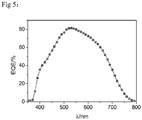
- FIG. 5 shows the photocurrent action spectrum of this device.
- the incident photon-to-current conversion efficiencies (IPCEs) exceed 60% in a broad spectral range from 460 to 650 nm, reaching its maximum of about 81% at 540 nm.
- IPCEs incident photon-to-current conversion efficiencies
Landscapes
- Chemical & Material Sciences (AREA)
- Chemical Kinetics & Catalysis (AREA)
- Electrochemistry (AREA)
- Engineering & Computer Science (AREA)
- Power Engineering (AREA)
- Microelectronics & Electronic Packaging (AREA)
- Hybrid Cells (AREA)
- Secondary Cells (AREA)
- Electric Double-Layer Capacitors Or The Like (AREA)
- Organic Low-Molecular-Weight Compounds And Preparation Thereof (AREA)
- Photovoltaic Devices (AREA)
Description
- The present invention generally relates to the fields of electrolytes, optoelectronic and electrochemical devices. More particularly, the present invention relates to an optoelectronic and/or electrochemical device comprising an electrolyte comprising a composed ionic liquid comprising at least three component salts.
- The term ionic liquids generally refers to salts having an organic component and that have a melting point below 100 °C. In the state of the art, a lot of compounds are used as ionic liquids. For example, Hurley and Wier disclosed solvent-free ionic liquids in a series of US patents. (
US2446331 ,US2446339 , andUS2446350 ). These "room temperature melting salts" are based on AlCl3 and various salts of n-alkyl pyridinium halide. Recently, some reviews on this subject have been published which explained the synthetic, property of pyridinium type, imidazolium type, quarternary ammonium salt type, as well as its use in the field of catalysis, synthesis, lithium battery, fuel cell and solar cell, etc.. Some of these reviews are cited: Welton T., Room-temperature molten liquids. Solvents for synthesis and catalysis, Chem. Rev. 99(8), 1999, 2071-83; Dupont J. et al. Ionic Liquid (molten salt) phase organometallic catalysis, Chem. Rev., 102 (10), 2002, 3667-3691; Miaou W. S. et al. Ionic-liquid-supported synthesis: A novel liquid-phase strategy for organic synthesis, Acc. Chem. Res. 39(12), 2006, 897-908; Seddon K. R., Ionic liquids for clean technology, J Chem Technol Biotechnol, 68(4), 1997, 351-354; Gordon C. M., New developments in catalysis using ionic liquids, Applied Catalysis A: General, 222, 2001, 101-117; Zhao D. et al., Ionic liquids: applications in catalysis, Catalysis Today 74, 2002, 157-189; Sheldon R., Catalytic reactions in ionic liquids, Chem. Comm., 23, 2001, 2399-2407; Peter Wasserscheid, Ionic Liquids in Synthesis, 2002, Wiley, Weinheim; Ohno H., Electrochemical Aspects of ionic liquids, 2005, Wiley, New Jersey; Rogers R. D., Seddon K. R., eds. Ionic Liquids as Green Solvents: Progress and Prospects. ACS Symposium Series 856, Washington, DC: American Chemical Society, 2003; Rogers R., Seddon K. R. eds. Ionic Liquids: Industrial Applications to Green Chemistry. ACS Symposium Series 818. Washington DC: American Chemical Society, 2002. - Ionic liquids have drawn much attention due to their properties of high conductivity, extremely low vapor pressure, thermal stability and difficulty to burn, amongst others. In the early 1980's, Rajeshwar et al. used the Ionic liquid such as PyCl/AlCl3 as electrolyte, and n-GaAs or n-InP as photoanode, to produce a photoelectrochemical cell with the efficiency of 1.7% (P. Singh, K. Rajeshwar, J. DuBow, R. Job, J. Am. Chem. Soc., 102, 1980,4676; P. Singh, R. Singh, K. Rajeshwar, J. DuBow, J. Electrochem. Soc., 128, 1981, 1724; K. Rajeshwar, P. Singh, R. Thapar, J. Electrochem. Soc., 128, 1981, 1750).
- In 1996, M. Grätzel et al. used a mixture of 1-hexyl-3-methylimidazolium iodide (HMII) (high viscosity) and 1-ethyl-3-methylimidazolium triflate (EMItriflate) (low viscosity) in the ratio of 1:9 as an electrolyte of a dye-sensitized solar cell and the resultant power conversion efficiency was below 0.5% (N. Papageorgiou, Y. Athanassov, M. Armand, P. Bonhôte, H. Pettersson, A. Azam, M. Grätzel, Inorg. Chem, 35, 1996, 1168). In 2001, Matsumoto et al. used a mixture of the ionic liquid EMIF(HF)2.3 (ultra-low viscosity) and DMHII as the electrolyte of a dye-sensitized solar cell and the resultant power conversion efficiency was 2.1% (H. Matsumoto, T. Matsuda, T. Tsuda, R. Hagiwara, Y. Ito, Y. Miyazaki, Chem. Lett., 26,2001).
- In 2002, M. Grätzel et al. used 1-propyl-3-methylimidazolium iodide (PMII) as the electrolyte of a dye-sensitized solar cell, and the resultant efficiency was 5.3% (P. Wang, S. M. Zakeeruddin, I. Exnar, M. Grätzel, Chem. Commun, 2972). These results meant a breakthrough in the use of ionic liquids in dye-sensitized solar cells.
-
US 2005/0175867 teaches that, to obtain a room-temperature molten salt being liquid and having a remarkably lowered solidifying point by mixing two or more organic salts, the cationic and anionic moieties of the two or more mixed organic salts have to be different. If the cationic or the anionic moieties of the two or more mixed organic salts are the same, the resulting mixture is not liquid. -
EP1819005 describes an electrolyte comprising an ionic liquid based on tetracyanoborate anion and organic cation and at least one further ionic liquid with iodide as an anion. The presence of the ionic liquid based on tetracynoborate anion and organic cation in the electrolyte of an electrochemical and/or optoelectronic device improves the performance and the stability of said device. Therefore, a dye sensitized solar cells using such electrolyte retains more than 90% of the initial photovolataic value even after 1000 hours aging at 80°C and light soaking at 60°C. - It is a general objective of the present invention to provide an optoelectronic and/or electrochemical device, which is selected from a photoelectric conversion device, a photovoltaic cell and a dye-sensitized solar cell, and which has an electrolyte comprising a composed ionic liquid, said composed ionic liquid having improved properties, such as conductivity, fluidity, melting points and/or others characteristics, which contribute to the improvement of the systems, devices and/or processes in which this composed ionic liquid is used.
- For example, it is an objective to provide an optoelectronic and/or electrochemical device, which is selected from a photoelectric conversion device, a photovoltaic cell and a dye-sensitized solar cell, and which has an electrolyte comprising a composed ionic liquid, said composed ionic liquid having a low melting point, preferably around or below room temperature (25°C), and/or which has a higher conductivity in the liquid (molten) state.
- It is also an objective to the present invention to provide an electrolyte for an optoelectronic and/or electrochemical device, which is selected from a photoelectric conversion device, a photovoltaic cell and a dye-sensitized solar cell, said electrolyte comprising a composed ionic liquid as defined above.
- With respect to optoelectronic and/or electrochemical devices, it is an objective of the present invention to improve the device characteristics.
- For example, with respect to photoelectric conversion devices, it is an objective to provide a ionic liquid that can be used in such a device and that results in improved short-circuit photocurrent density (Jsc), open-circuit voltage (V oc), fill factor (ff) and/or photoelectric conversion (η), and/or that contributes to the long-term stability of such devices.
- The composed ionic liquids used in the present invention comprise three or more component salts. Remarkably, the composed ionic liquids have improved properties. In particular, on the basis of these composed ionic liquids, optoelectronic and/or electrochemical devices with improved characteristics are obtained.
- The present invention provides, in a first aspect, an optoelectronic and/or electrochemical device, which is selected from a photoelectric conversion device, a photovoltaic cell and a dye-sensitized solar cell, and has an electrolyte comprising a composed ionic liquid in liquid form at room temperature (25°C), comprising three or more component salts, wherein at least one of said component salts has a melting point above room temperature, wherein at least three of said component salts comprise a cation independently selected from organic compounds comprising at least one charged atom selected from the group of N+, P+, C+, S+, and optionally comprising one or more heteroatoms; and wherein two or more of said component salts of said composed ionic liquid have the same anion or the same cation; and wherein at least one of said component salts comprises an anion selected from the group of I-, [B(CN)4]-, and NCS-.
- In an aspect, the present invention provides an electrolyte for an optoelectronic and/or electrochemical device, which is selected from a photoelectric conversion device, a photovoltaic cell and a dye-sensitized solar cell, said electrolyte comprising a composed ionic liquid as defined above.
- Further aspects and preferred embodiments of the present invention are provided in the appended claims.
- The present invention provides many advantages. First, all the compounds of the present invention have salt-like properties, and can very easily dissolved in organic solvents.
- Compared to the known ionic liquids, the composed ionic liquid used in the present invention has a surprisingly low melting point. Furthermore, the composed ionic liquid has a good stability. It can be stored at room temperature.
- The composed ionic liquid used in the present invention can be readily prepared with high yield (normally above 80%, preferably above 90%), and raw materials for its preparation are readily available.
- The composed ionic liquid used in the present invention may be used as the solvent of various synthetic or catalyzing reactions. For example, the ionic liquid can be used as a non-aqueous, polarising species, as a phase transfer catalyst and/or as a medium making a homogenous heterogeneous catalysis.
- Past research shows the tendency to use anions and small size cations with a high concentration of electro-active iodine as the electrolyte system of dye sensitised solar cells.
- In general, the smaller the size of the component ions, the higher is the melting point of the salt / ionic liquid. When the melting point is above room temperature, the ionic liquid cannot be used widely even if it has many superior properties in various aspects. The imidazolium type composed ionic liquid which may be used in the present invention is based on ions of small size, and thus results in a breakthrough of non-volatility and low viscosity ionic liquid electrolytes. Photoelectric conversion devices, in particular dye-sensitized solar cells using electrolytes based on the composed ionic liquid used in the present invention achieve power conversion efficiencies of 7.1% and 8.2%, which the highest level so far achieved with ionic liquid-based dye-sensitized solar cells.
- In the drawings,
-
Figure 1 shows the conductivity of a series imidazolium type ionic liquids as a function of temperature (0-100°C). The meaning of the letters in the figure are as follows:- a: 1-hexyl-3-methylimidazolium iodide (HMII); b: 1-butyl-3-methylimidazolium iodide (BMII); c: 1-propyl-3-methyimidazolium iodide (PMII); d: 1-ethyl-3-methylimidazolium iodide (EMII); e: 1,3-dimethylimidazolium iodide (DMII); f: 1-allyl-3-methylimidazolium iodide (AMII);
- g: a composed ionic liquid based on EMII and DMII at a molar ratio of 1:1;
- h: a composed ionic liquid according to the invention based on EMII, DMII and AMII at a molar ratio of 1:1:1.
-
Figures 2 is the J-V coordinate graph of the dye-sensitized solar cell of Example 7, comprising a ternary ionic liquid in accordance with the present invention (DMII, EMII and AMII). The results are indicated in the graph. A power conversion efficiency of 7.1% is obtained. -
Figures 3 is the J-V coordinate graph of the dye-sensitized solar cell of Example 8, comprising a ternary ionic liquid in accordance with the present invention (DMII, EMII, EMINCS). The results are indicated in the graph. A power conversion efficiency of 7.6% is obtained. -
Figure 4 is the J-V coordinate graph of the dye-sensitized solar cell of Example 9, comprising a ternary ionic liquid in accordance with the present invention (DMII, EMII, EMITCB). The results are indicated in the graph. A power conversion efficiency of 8.2% is obtained. - The composed ionic liquid used in the present invention comprises three or more component salts. For the purpose of the present specification, the terms "comprising" and "comprise" mean "Including, amongst others". These terms are not intended to mean "consist only of".
- According to a preferred embodiment, at least one of the component salts of the composed ionic liquid is a ionic liquid itself. According to the generally used definition of the term, an "ionic liquid" is a salt that is liquid at 100°C.
- A material is considered liquid, if it has any measurable liquid properties, in particular, if it has the property of a fluid (as opposed to a solid body) and any measurable viscosity. According to a preferred embodiment, a material is considered as liquid, if it has a viscosity of 20'000cPs (centipoises) (1cP=10-3 Pa·s) or less, preferably 15'000cPs or less, more preferably 10'000cPs or less. The terms "molten", "co-melted" also refer to "liquid" as defined herein. The term liquid does not refer to the gaseous state.
- According to the present invention the melting point of at least one of said component salts of the ionic liquid of the present invention is above room temperature. The term "room temperature" refers to the temperature of 25°C.
- According to the present invention the composed ionic liquid of the present invention is itself liquid at room temperature.
- According to a preferred embodiment, one, two, three, four, a part of or all of the component salts that are comprised in the composed ionic liquid are ionic liquids.
- According to the present invention two or more of said component salts of said composed ionic liquid comprise the same anion or the same cation.
- According to the present invention at least three of the component salts of the composed ionic liquid used in the invention comprises a cation, which is independently selected from organic compounds comprising at least one charged atom selected from the group of N+, P+, C+, S+, and combinations thereof, wherein said organic compound is a hydrocarbon optionally being substituted and optionally comprising, one or several heteroatoms. Preferred heteroatoms include O, N, S, P, and halogen, such as F, Cl, Br, I. Preferably, the organic compound is a hydrocarbon comprising a positively charged nitrogen atom (N+) and optionally comprising one or more further hetero atoms, in other words, the cation comprises at least one heteroatom, in case that the charged atom (N+, P+, C+, S+) is a heteroatoms, or 0, one or more heteroatoms, in case that said charged atom is not a heteroatom (C+).
- One, two, three, four or more of the cations of the composed ionic liquid may be selected from hydrocarbons comprising from 1-100 carbons and from 0-20, preferably 1-10 heteroatoms. According to a still preferred embodiment, one, two, three, four or more of the of the cations of the composed ionic liquid are selected from hydrocarbons comprising from 1-25 carbons and from 0-10, preferably 1-5 heteroatoms. Most preferably, 1, 2, 3, or more of said cations are selected from hydrocarbons comprising from 1-10 carbons and from 1-5 heteroatoms. The advantages of having component ions of small size were mentioned above.
- According to an embodiment, the cations of the component salts are independently selected from:


- 1) any R is independently selected from:
- H, provided that at least one R connected to a heteroatom is not H;
- a straight alkyl or branched alkyl containing 1-20 carbon atoms; or,
- straight alkenyl or branched alkenyl containing 2-20 carbon atoms and one or more double bonds;
- a straight alkynyl or branched alkynyl containing 2-20 carbon atoms and one or more triple bonds;
- a saturated, partial saturated or completely unsaturated cyclic alkyl containing 3-7 carbon atom; or,
- halogen, particularly F or Cl, provided that the respective R is not connected to a hetero atom;
- -NO2, provided that the respective R is not connected to a heteroatom with positive charge and at least one R is not NO2;
- CN, provided that the respective R in not connected to a heteroatom with positive charge and at least one R is not CN.
- (2) wherein
- the various R are the same or different in various cases;
- two or more R may be coupled with each other via one or more single and/or double bonds;
- one or more R are hydrogen-substituted partially or completely by halogen, particularly by -F or -Cl, or partially substituted by -CN or -NO2, provided that at least one R is not halogenated;
- one or two carbon atoms of R are replaced by the hetero atoms, or selected from:-O-, C(O)-, C(O)O-, -S-, -S(O)-, -SO2-, -S(O)2O-, -N=, -P=, -NR'-, -PR'-, -P(O)(OR')-, -P(O) (OR')O-, -P(O) (NR' R')-, -P(O) (NR' R')O-, -P(O) (NR' R') NR'-, -S(O) NR'- or -S(O)2 NR'-;
wherein - R' is H, unfluorinated, partially fluorinated, or completely fluorinated alkyl containing 1-6 carbon atoms, or unfluorinated, partially fluorinated, or completely fluorinated phenyl.
- Two or more R of said organic cations may be coupled with each other to form a ring fused to the structure of organic cations given above. In this way, a cyclic compound, a bicyclo compound and/or a polycyclo compound may be obtained, for example.
- In case that an R is completely halogenated, at least one R is not completely halogenated.
- In other words, not all R are completely halogenated.
- Preferred substituents R of the organic cations of the composed ionic liquid may be independently selected from -F, -Cl, -Br, -I, -CH3, -C2H5, -C3H7, -CH(CH3)2, -C4H9, -C(CH3)3, -C5H11, -C6H13, -C7H15, -C8H17, -C9H19, -C10H21, -C12H25, -C20H41, -OCH3, -OCH(CH3)2, -CH2OCH3, -C2H4OCH(CH3)2, -SCH3, -SCH(CH3)2, -C2H4SC2H5, -C2H4SCH(CH3)2, -S(O)CH3, -SO2CH3, -SO2C2H5, -SO2C3H7, -SO2CH(CH3)2, -CH2SO2CH3, -OSO2CH3, -OSO2CF3, -CH2NHC2H5, -N(CH3)C3H5, -N(CH3)CF3, -O-C4H8-O-C4H9, -S-C2H4-N(C4H9)2, -OCF3, -S(O)CF3, -SO2CF3, -CF3, -C2F5, -C3F7, -C4F9, -C(CF3)3, -CF2SO2CF3, -C2F4N(C2F5)C2F5, -CF=CF2, -C(CF3)=CFCF3, -CF2CF=CFCF3, -CF=CFN(CF3)CF3, -CFH2, -CHF2, -CH2CF3, -C2F2H3, -C3FH6, -CH2C3F7, -C(CFH2)3, -CHO, -C(O)OH, -CHC(O)OH, -CH2C(O)C2H5, -CH2C(O)OCH3, -CH2C(O)OC2H5, -C(O)CH3, -C(O)OCH3,


- According to a preferred embodiment, the organic cations of the component salts of the present invention are selected from:




- According to a preferred embodiment, at least one of said component salts of the composed ionic liquid of the invention comprises a cation of formula (I) below:

- According to a preferred embodiment, said alkyl if the compound of formula (I) is is a C1-C4, preferably C1-C3 alkyl and said alkenyl is a C2-C4, preferably a C2-C3 alkenyl.
- According to a preferred embodiment, the composed ionic liquid of the invention comprises two different cations, which are selected, independently, from substituted imidazolium compounds as defined further above, and/or from compounds of formula (I).
- According to a preferred embodiment, the composed ionic liquid of the invention comprises one or more cations selected from 1-ethyl-3-methylimidazolium (EMII), 1,3-dimethylimidazolium (DMII), 1-propyl-3-methylimidazolium (PMII), and 1-allyl-3-methylimidazolium (AMII).
- According to the present invention, the composed ionic liquid of the invention comprises one or more anions selected from iodide (I-), tetracyanoborate ([B(CN)4]-) and thiocyanate (NCS-).
- The present disclosure further provides methods for preparing the composed ionic liquids used in the present invention.
- In an aspect, the present disclosure provides a method for preparing a composed ionic liquid, the method comprising the step of introducing one or more component salts to a pure system containing one other component salt, so that the entropy of the system is increased and the melting point is reduced. This is also referred to as "co-melting", which results from the increase of the entropy of the system.
- There is a relationship for the transforming process:

- Herein, ΔG represents the change of the Gibbs free energy, ΔH is the change of the enthalpy, ΔS is the change of the entropy, T is Kelvin degree. For a melting process, ΔG=0, so ΔH = TfusΔS, Tfus is the melting point. Without wishing to be bound by theory, it is believed that ehen several types of ionic liquids are mixed, the entropy increases considerably, which results in the increase of ΔS. For the system, although ΔH>0, the change of the enthalpy is less than that of the entropy. Since Tfus= ΔH/ΔS, the melting point is reduced.
- According to other aspects, the ionic liquids may be obtained by mixing component salts and heating.
- According to the method of solvent vaporization (or evaporation), at least one component salt is dissolved in a solvent. Preferably, all component salts can easily be dissolved in the solvent. Preferably, the solvent has a low boiling point, for example below 150°C. Preferably, the solvent is volatile (can be easily volatised). Suitable solvents may be selected, for example, from alcohols, such as methanol, methyl cyanides, and from water.
- In all preparation methods comprising a step of heating, drying, and/or evaporating, said step of heating, drying, and/or evaporating, respectively, is conducted so as to keep the temperature below the decomposing temperature of any of the component salts. The preparation method is at least partly conducted in a sealed container. It may be conducted under a protective atmosphere.
- The present invention provides an electrolyte comprising the composed ionic liquid used in the present invention.
- In the present invention, the electrolyte is a ternary, quaternary or quintary electrolyte ionic liquid electrolyte, meaning that it comprises 3, 4, 5, or 5 component salts, preferably ionic liquids, resulting in an ionic liquid. Of course, the electrolyte may comprise more than 5 component salts.
- The electrolyte of the invention has many applications. For example, it may be used in an optoelectronic and/or electrochemical device. The optoelectronic and/or electrochemical device may be, for example, a photoelectric conversion device, such as a photovoltaic cell, an electrochemical battery, for example a lithium ion battery, a double layer capacitor, a light emitting device, an electrochromic or photo-electrochromic device, an electrochemical sensor and/or biosensor. The electrochemical device may be an electrochemical display or an electrochemical capacitor, for example a super capacitor.
- According to the present invention, the device is a photovoltaic cell, for example a dye-sensitized photovoltaic (solar) cell (DSSC).
- For example, a dye-sensitized photovoltaic cell comprises a photoelectrode, a counter electrode and, between the photoelectrode and the counterelectrode, an electrolyte or a charge transporting material, and wherein a sensitising dye is absorbed on the surface of the photoelectrode, on the side facing the counterelectrode.
- The photoelectrode preferably comprises a nanocrystalline, porous layer of a semiconductor material, said porous layer being characterized by a roughness factor of larger than 20, preferably larger than 200 and even larger than 1000. Preferably, the photoelectrode is a photoanode. The photoelectrode and the counterelectrode are preferably provided on support substrates, such as transparent glass or plastic, at least one of which is transparent.
- Electrode (photo- and counterelectrode) materials that are suitable for the photovoltaic cells of the present invention are disclosed in
EP1507307 ,WO2006/010290 ,WO2007/093961 , and in many more. Typical pohotoanode materials include semiconductor based on material selected from the group of Si, TiO2, SnO2, Fe2O3, WO3, ZnO, Nb2O5, CdS, ZnS, PbS, Bi2S3, CdSe, GaP, InP, GaAs, CdTe, CuInS2, and/or CuInSe2. In the above references, the manufacturing of such devices is also disclosed. InFigure 1 ofEP1507307 , an embodiment of a possible structure of devices of the present invention is disclosed. On page 8,line 10 to page 9, line 51, general information and suitable materials of the preparation of devices encompassed by the present invention is disclosed. - Electrolytes of dye-sensitized solar cells further contain additives. Such additives may be added in the form of salts or as neutral compounds. In the solar cells of examples 7-9 below, some typical additives or added to the electrolyte.
- The invention is now illustrated by way of the examples below, which are not intended do limit the scope of the present invention.
- The conductivities of different ionic liquids a-h are shown in
Figure 1 . The conductivity is measured according to the standard method mentioned in the user manual of the used conductivity meter, which is the CDM210 type conductivity meter of French Radiometer-Analytical corp., and the used electrode is CDC-749 type. - The conductivity of d (
melting point 90°C-92°C), e (melting point 78°C-80°C), and f (melting point 58°C -60°C) in the high temperature zone are all above those of a, b, and c. These ionic liquids are less preferred in dye-sensitized solar cells due to their high melting temperature. - A mixture of d and e in the molar ratio 1:1 results in the composed ionic liquid g, which has a similar conductivity as d and e, yet the melting point of g is reduced to 45-47°C.
- The introduction of f into g to, while keeping the molar ratio of d, e, f at 1:1:1, results in the composed ionic liquid h, which is a ternary co-melt, room temperature molten ionic liquid with high conductivity, lower viscosity and which is not volatile.
- The viscosities of the composed ionic liquid h at different temperatures are shown in Table 1 below. Viscosities are determined using a LVDV-II+ Pro viscosity meter of the Brookfield corp. using the standard method mentioned of the original manual of the viscosimeter.
Table 1: Viscosity of the composed ionic liquid DMII/EMII/AMII (1/1/1 molar ratio) at different temperatures Temperature (°C) 25 30 35 40 45 Viscosity (cP) 491 344.8 255.5 179.3 133.1 Temperature (°C) 50 55 60 65 70 Viscosity (cP) 102.5 78.89 60.76 48.46 39.37 - The densities of the composed ionic liquid h at different temperatures are shown in Table 2 below. Densities are determined using a DMA-35N type density meter of the Anton Paar corp using the standard method mentioned of the original manual of the density meter.
Table 2: Density of the composed ionic liquid DMII/EMII/AMII (1/1/1 molar ratio) at different temperatures Temperature (°C) 25 27.5 30 32.5 Density (g/cm3) 1.6432 1.6406 1.6383 1.6364 Temperature (°C) 35 37.5 40 Density (g/cm3) 1.6337 1.6313 1.6284 - 1,3-dimethylimidazolium iodide (DMII), 1-ethyl-3-methylimidazolium iodide (EMII) and 1-allyl-3-methylimidazolium iodide (AMII) are ionic liquids based on cationic imidazolium derivatives, which are all solids at room temperature.
- Twenty (20) mmol of each of said ionic liquids are mixed in a single recipient, heated to 100-150°C for 20-40 min, while stirred. In this way, the component salts are all melted and evenly dispersed, and a ternary ionic liquid, which is molten (liquid) at room temperature (RT, 25°C), is obtained.
- Ten (10) mmol S-ethyl tetrahydrothiophenium iodide (
melting point 80°C) is dissolved in 20ml alcohol, followed by the addition of 20 mmol S-ethyl-tetrahydrothiophenium dicyanamide. The mixture was stirred for couple hours and evaporated the ethanol solvent on a rotatory avaporator under vaccum to obtain a binary room temperature co-melted ionic liquid. - Ten (10) mmol diethyl-methyl-sulfonium iodide (having a melting point of 35°C), and 30 mmol diethylmethylsulfonium dicyanamide are put into the mortar and ground until all solid vanishes. In this way, a binary sulfonium salt type ionic liquid is obtained, which is liquid at room temperature (25°C).
- 15 mmol 1,3-dimethylimidazolium iodide (solid at RT), 15 mmol 1-ethyl-3-methyllimidazolium iodide (solid at RT), and 20 mmol 1-ethyl-3-methylimidazolium thiocyanate (liquid at RT) are added and mixed. The obtained mixture is treated with ultrasound in the ultrasound device for 15-20 min, with the power of 200W, resulting in the complete melting of all solids. In this way, a ternary imidazolium type co-melted ionic liquid, which is liquid at room temperature (25°C), is obtained.
- 60 mmol iodoethane was added to a mixture of 25 mmol N-methyl-imidazole and 25 mmol tetrahydrothiophene while stirring under the Ar atmosphere, reaction mixture was refluxed overnight with stirring. After this time the reaction mixture was cooled to room temperature and water was added. To this water dichloromethane was added and extracted three times to remove unreacted reactants. Then the water was evaporated on a rotatory evaporator to obtain a binary ionic liquid, which is liquid at room temperature.
- A 7 µm-thick film of 20 nm sized TiO2 particles was first printed on a fluorine-doped SnO2 conducting glass electrode, and further coated by a 5 nm-thick second layer of 400-nm-sized light-scattering anastase particles. The sintered electrodes were immersed at room temperature for 12 h into a solution containing 300 µM Z907Na dye and 300 mM 3-phenylpropionic acid in acetonitrile and t-butyl alcohol (1:1, v/v). More details on the fabrication of device are provided in the publication of P. Wang, et al., Enhance the Performance of Dye-Sensitized Solar Cells by Co-grafting Amphiphilic Sensitizer and Hexadecylmalonic Acid on TiO2 Nanocrystals, J. Phys. Chem. B., 107, 2003, 14336. The Z907 dye is disclosed in the publication of P. Wang et al., Charge separation and efficient Light Energy in Sensitized Solar Cells Based on Binary Ionic Liquids, J. Am. Chem. Soc. 127, 2005, 6850 and P. Wang et al., A Binary Ionic Liquid Electrolyte to Achieve ≥7% Power Conversion in Dye-Solar Cells. Chem. Mater. 16, 2004, 2694-2696.
- As an electrolyte, a composition based on the following components was used:
- 1,3-dimethylimidazolium iodide (DMII);
- 1-ethyl-3-methylimidazolium iodide (EMII);
- 1-allyl-3-methylimidazolium iodide (AMII);
- iodine (I2);
- N-butylbenzoimidazole (NBB, additive);
- guanidinium thiocyanate (additive).
- These components were added in a mol ratio of 8:8:8:1:2:0.4. As a counter electrode, a glass electrode coated with nano-size platinum is used, as disclosed in the literature: preparation of P. Wang, et al., A Solvent-Free, SeCN-/(SeCN)3- Based Ionic liquid Electrolyte for High-Efficiency Dye-Sensitized Nanocrystalline Solar Cell, J. Am. Chem. Soc. 126, 2004, 7164). The device is assembled accordingly.
- Device characteristics are measured when exposing the solar cell to the standard AM 1.5G (sunlight) simulation at a light intensity of 100mW/cm2.
-
Figure 2 shows the photocurrent density-voltage (J-V) characteristics of the devices. Short circuit current (Jsc) is 13.26mA/cm2, open circuit photo voltage (Voc) is 712.62mV, fill factor (ff) is 0.75, power conversion efficiency is 7.1%. This power conversion efficiency is much higher than that of 6% previously reported for a solvent free, PMII-based ionic liquid electrolyte. Remarkably, this ternary electrolyte composed of simple imidazolium iodides has shown a comparable efficiency to previously reported solvent-free electrolytes containing relatively expensive ionic liquids. - A further device was made according to the instructions given in Example 7, with the only difference being the electrolyte composition, which is given below:
- 1,3-dimethylimidazolium iodide (DMII);
- 1-ethyl-3-methylimidazolium iodide (EMII);
- 1-ethyl-3-methylimidazolium thiocyanate (EMI NCS);
- iodine (I2);
- N-butylbenzoimidazole (NBB, additive);
- guanidinium thiocyanate (additive).
- These components were added in a mol ratio of 6:6:8:1:1:0.2.
- The device was tested under the same conditions as in Example 7.
-
Figure 3 shows the device characteristics obtained with this solar cell: Jsc is 13.22 mA/cm2, open circuit photo voltage (Voc) is 743.13mV, fill factor (ff) is 0.774, power conversion efficiency is 7.6%. - A further device was made according to the instructions given in Example 7, with the only difference being the electrolyte composition, which is given below:
- 1,3-dimethylimidazolium iodide (DMII);
- 1-ethyl-3-methylimidazolium iodide (EMII);
- 1-ethyl-3-methylimidazolium tetracyanoborate (EMITCB);
- iodine (I2);
- N-butylbenzoimidazole (NBB, additive);
- guanidinium thiocyanate (additive).
- These components were added in a mol ratio of in the mol ratio 12:12:16:1.67:3.33:0.67.
- The device was tested under the same conditions as in Example 7.
-
Figure 4 shows the device characteristics obtained with this solar cell: Jsc is 14.26 mA/cm2, Voc is 741mV, ff is 0.774, η is 8.2%. For the first time, such a high conversion efficiency under AM 1.5G sunlight is obtained for a dye-sensitized solar cell with solvent free electrolyte. It is particularly remarkable that by simply replacing the PMII room temperature ionic liquid by the eutectic melt of DMII and EMII without changing the sensitizer or titania film has resulted in a 17% enhancement of photovoltaic performance. -
Figure 5 shows the photocurrent action spectrum of this device. The incident photon-to-current conversion efficiencies (IPCEs) exceed 60% in a broad spectral range from 460 to 650 nm, reaching its maximum of about 81% at 540 nm. From the overlap integral of this curve with the standard AM 1.5 solar emission spectrum, a short-circuit photocurrent density (JSC) of 14.30 mA cm-2 is calculated, which is in excellent agreement with the measured photocurrent. This confirms that there is no mismatch between the simulator used and AM 1.5 solar emission, showing that the conversion efficiency value of 8.2% truly refers to the standard reporting condition.
Claims (8)
- An optoelectronic and/or electrochemical device, which is selected from a photoelectric conversion device, a photovoltaic cell and a dye-sensitized solar cell, and has an electrolyte comprising a composed ionic liquid in liquid form at room temperature (25°C) comprising three or more component salts, wherein at least one of said component salts has a melting point above room temperature; wherein at least three of said component salts comprise a cation independently selected from organic compounds comprising at least one charged atom selected from the group of N+, P+, C+, S+, and optionally comprising one or more heteroatoms; wherein two or more of said component salts of said composed ionic liquid have the same anion or the same cation; and characterized in that at least one of said component salts comprises an anion selected from the group of I-, [B(CN)4]-, and NCS-.
- The optoelectronic and/or electrochemical device according to claim 1, wherein said component salts are ionic liquids.
- The optoelectronic and/or electrochemical device according to any one of claims 1 to 2, wherein the cation of said component salts are independently selected from:

 1) Any R is independently selected from:- H, provided that at least one R connected to a heteroatom is not H;- a straight alkyl or branched alkyl containing 1-20 carbon atoms; or,- straight alkenyl or branched alkenyl containing 2-20 carbon atoms and one or more double bonds;- a straight alkynyl or branched alkynyl containing 2-20 carbon atoms and one or more triple bonds;- a saturated, partially saturated or completely unsaturated cyclic alkyl containing 3-7 carbon atom; or,- halogen, particularly F or Cl, provided that the respective R is not connected to a heteroatom;- -NO2, provided that the respective R is not connected to a heteroatom with positive charge and at least one R is not NO2;- CN, provided that the respective R in not connected to a heteroatom with positive charge and at least one R is not CN;2) Wherein- the various R are the same or different in various cases;- two or more R may be coupled with each other via one or more single and/or double bonds;- one or more R are hydrogen-substituted partially or completely by halogen, particularly by -F or -Cl, or partially substituted by -CN or -NO2, provided that at least one R is not halogenated;- one or two carbon atoms of R may be replaced by the heteroatoms, or selected from: -O-, -C(O)-, -C(O)O-, -S-, -S(O)-, -SO2-, -S(O)2O-, -N=, -P=, -NR'-, -PR'-, -P(O)(OR')-, -P(O)(OR')O-, -P(O)(NR'R')-, -P(O)(NR'R')O-, -P(O)(NR'R')NR'-, -S(O)NR'- and -S(O)2NR'-;wherein R' is H, unfluorinated, partially fluorinated, or completely fluorinated alkyl containing 1-6 carbon atoms, or unfluorinated, partially fluorinated, or completely fluorinated phenyl.
 - The optoelectronic and/or electrochemical device according to any one of claims 1 to 3, wherein at least one of said component salts comprises a cation of formula (I) below:

- The optoelectronic and/or electrochemical device according to any one of claims 3 and 4, wherein said alkyl is a C1-C4 alkyl, preferably a C1-C3 alkyl and said alkenyl is a C2-C4 alkenyl, preferably a C2-C3 alkenyl.
- The optoelectronic and/or electrochemical device according to any one of claims 1 to 5, wherein at least two of said component salts comprises, each, a different cation independently selected from the group of substituted imidazolium compounds as defined in claim 3, and compounds of formula (I).
- The optoelectronic and/or electrochemical device according to any one of claims 1 to 6, wherein at least one of said component salts is selected from the group of 1-ethyl-3-methylimidazolium iodide (EMII), 1,3-dimethylimidazolium iodide (DMII), 1-propyl-3-methylimidazolium iodide (PMII), and 1-allyl-3-methylimidazolium iodide (AMII).
- An electrolyte for an optoelectronic and/or electrochemical device being selected from a photoelectric conversion device, a photovoltaic cell and a dye-sensitized solar cell, said electrolyte comprising a composed ionic liquid as defined in any one of claims 1 to 7.
Applications Claiming Priority (2)
| Application Number | Priority Date | Filing Date | Title |
|---|---|---|---|
| CN2007103066621A CN101232080B (en) | 2007-12-29 | 2007-12-29 | Congruent melting room temperature ionic liquid and preparing method and application thereof |
| PCT/IB2008/055507 WO2009083901A1 (en) | 2007-12-29 | 2008-12-23 | Eutectic melts |
Publications (3)
| Publication Number | Publication Date |
|---|---|
| EP2232513A1 EP2232513A1 (en) | 2010-09-29 |
| EP2232513B1 EP2232513B1 (en) | 2018-07-11 |
| EP2232513B9 true EP2232513B9 (en) | 2019-01-02 |
Family
ID=39898372
Family Applications (1)
| Application Number | Title | Priority Date | Filing Date |
|---|---|---|---|
| EP08866366.1A Active EP2232513B9 (en) | 2007-12-29 | 2008-12-23 | Optoelectronic and/or electrochemical device comprising an electrolyte comprising a ternary ionic liquid |
Country Status (6)
| Country | Link |
|---|---|
| US (2) | US8686285B2 (en) |
| EP (1) | EP2232513B9 (en) |
| JP (1) | JP5480160B2 (en) |
| KR (1) | KR101507630B1 (en) |
| CN (1) | CN101232080B (en) |
| WO (1) | WO2009083901A1 (en) |
Families Citing this family (36)
| Publication number | Priority date | Publication date | Assignee | Title |
|---|---|---|---|---|
| CN101232080B (en) * | 2007-12-29 | 2012-11-07 | 中国科学院长春应用化学研究所 | Congruent melting room temperature ionic liquid and preparing method and application thereof |
| FR2935382B1 (en) * | 2008-08-29 | 2010-10-08 | Centre Nat Rech Scient | SALT OF PENTACYLIC ANION AND ITS USE AS ELECTROLYTE |
| CN101615513B (en) * | 2009-07-17 | 2011-05-11 | 新奥科技发展有限公司 | Electrolyte solution for dye-sensitized solar cells |
| US8835667B2 (en) | 2010-01-18 | 2014-09-16 | Merck Patent Gmbh | Electrolyte formulations |
| WO2011085967A1 (en) | 2010-01-18 | 2011-07-21 | Merck Patent Gmbh | Compounds containing perfluoroalkyl-cyano-alkoxy-borate anions or perfluoroalkyl-cyano-alkoxy-fluoro-borate anions |
| JP5810097B2 (en) * | 2010-01-18 | 2015-11-11 | メルク パテント ゲゼルシャフト ミット ベシュレンクテル ハフツングMerck Patent Gesellschaft mit beschraenkter Haftung | Process for the preparation of perfluoroalkyl cyano or perfluoroalkyl cyanofluoroborate |
| TW201132629A (en) | 2010-01-18 | 2011-10-01 | Merck Patent Gmbh | Electrolyte formulations |
| JP2011204662A (en) * | 2010-03-05 | 2011-10-13 | Sony Corp | Photoelectric conversion element and method of manufacturing the same, and electronic apparatus |
| WO2011125024A1 (en) | 2010-04-05 | 2011-10-13 | Ecole Polytechnique Federale De Lausanne (Epfl) | Improved electrode |
| DE112011102797B4 (en) * | 2010-08-25 | 2021-07-22 | The Yokohama Rubber Co., Ltd. | Electrolyte for photoelectric conversion element, photoelectric conversion element using the electrolyte, and dye-sensitized solar cell using the electrolyte |
| CN101950675B (en) * | 2010-09-26 | 2012-06-20 | 华南理工大学 | Dye sensitized solar cell electrolyte based on ionic liquid and preparation method thereof |
| KR20130118322A (en) | 2010-09-27 | 2013-10-29 | 메르크 파텐트 게엠베하 | Functionalized fluoroalkyl fluorophosphate salts |
| EP2621934A1 (en) * | 2010-09-28 | 2013-08-07 | Merck Patent GmbH | Electrolyte formulations containing cyano-alkoxy-borate anions |
| KR101779243B1 (en) | 2010-09-30 | 2017-09-18 | 메르크 파텐트 게엠베하 | Electrolyte formulations, an electrochemical and/or optoelectronic device |
| JP5834391B2 (en) * | 2010-10-05 | 2015-12-24 | 日立化成株式会社 | ORGANIC ELECTROLUMINESCENT ELEMENT, DISPLAY ELEMENT, LIGHTING DEVICE, AND DISPLAY DEVICE |
| JP5750770B2 (en) * | 2010-10-13 | 2015-07-22 | 国立大学法人東京工業大学 | LIGHT CONVERSION ELEMENT CONTAINING ION LIQUID, MANUFACTURING METHOD THEREOF, AND APPARATUS INCLUDING LIGHT CONVERSION ELEMENT |
| US9779879B2 (en) | 2011-02-25 | 2017-10-03 | Ecole Polytechnique Federale De Lausanne (Epfl) | Redox couple for electrochemical and optoelectronic devices |
| EP2492277A1 (en) | 2011-02-25 | 2012-08-29 | Ecole Polytechnique Fédérale de Lausanne (EPFL) | Improved redox couple for electrochemical and optoelectronic devices |
| AU2012265220A1 (en) | 2011-05-31 | 2014-01-16 | Merck Patent Gmbh | Electrolyte formulations |
| US9073937B2 (en) | 2011-06-16 | 2015-07-07 | Board Of Trustees Of The University Of Alabama | Organic photovoltaic-battery hybrid device |
| US9058935B2 (en) | 2011-07-15 | 2015-06-16 | Merc Patent Gmbh | Compounds containing alkyl-cyano-borate or alkyl-cyano-fluoroborate anions |
| EP2731954B1 (en) | 2011-07-15 | 2015-06-17 | Merck Patent GmbH | Compounds containing alkyl-alkoxy-cyano-borate anions |
| JP2013047217A (en) * | 2011-07-27 | 2013-03-07 | Nichia Corp | Ionic liquid |
| EP2748145B1 (en) * | 2011-08-24 | 2016-10-19 | Basf Se | Sulfur-containing additives for electrochemical or optoelectronic devices |
| US9159499B2 (en) * | 2011-08-25 | 2015-10-13 | Merck Patent Gmbh | Additives for dye-sensitized solar cells |
| JP6224600B2 (en) | 2011-10-18 | 2017-11-01 | エコール ポリテクニーク フェデラル ドゥ ローザンヌ(エーペーエフエル) | Compounds for electrochemical and / or optoelectronic devices |
| CN103130783B (en) * | 2011-12-01 | 2016-04-13 | 海洋王照明科技股份有限公司 | Tetramethylene sulfide class ionic liquid of carbonate-containing group and its preparation method and application |
| EP2788995B9 (en) | 2011-12-08 | 2018-07-04 | Ecole Polytechnique Fédérale de Lausanne (EPFL) | Semiconductor electrode comprising a blocking layer |
| WO2014084296A1 (en) * | 2012-11-30 | 2014-06-05 | 日本化薬株式会社 | Dye-sensitized solar cell |
| KR20160004389A (en) | 2013-05-06 | 2016-01-12 | 그레이트셀 솔라 에스.에이. | Organic-Inorganic Perovskite Based Solar Cell |
| EP2883915A1 (en) | 2013-12-13 | 2015-06-17 | Ecole Polytechnique Federale de Lausanne (EPFL) | Porphyrin based sensitizer for dye-sensitized solar cell |
| US10175557B2 (en) * | 2014-01-31 | 2019-01-08 | Nippon Kayaku Kabushikikaisha | Optical wavelength conversion element containing ionic liquid, and article equipped with said optical wavelength conversion element |
| GB201604133D0 (en) * | 2016-03-10 | 2016-04-27 | Zapgocharger Ltd | Supercapacitor with integrated heater |
| JP2017178790A (en) * | 2016-03-28 | 2017-10-05 | Tdk株式会社 | Sulfonium salt, electrolytic solution, and lithium ion secondary battery |
| EP3407361A1 (en) | 2017-05-24 | 2018-11-28 | Ecole Polytechnique Fédérale de Lausanne (EPFL) | Redox melts formed by copper (i)/(ii) complexes as charge transfer and charge storage materials |
| CN111003713A (en) * | 2019-12-20 | 2020-04-14 | 辽宁大学 | A method for preparing inorganic porous materials based on ionic liquid ternary system |
Family Cites Families (8)
| Publication number | Priority date | Publication date | Assignee | Title |
|---|---|---|---|---|
| JP2771607B2 (en) * | 1989-06-22 | 1998-07-02 | 三菱化学株式会社 | Method for producing room temperature molten salt |
| GB9221997D0 (en) | 1992-10-20 | 1992-12-02 | Ici Plc | Inhibition of microbial growth in swimming pools and spas |
| US6291763B1 (en) | 1999-04-06 | 2001-09-18 | Fuji Photo Film Co., Ltd. | Photoelectric conversion device and photo cell |
| JP5081345B2 (en) | 2000-06-13 | 2012-11-28 | 富士フイルム株式会社 | Method for manufacturing photoelectric conversion element |
| AU2003242371A1 (en) * | 2002-06-18 | 2003-12-31 | Daikin Industries, Ltd. | Room-temperature molten salt, process for producing the same and applications thereof |
| JP2005166313A (en) * | 2003-11-28 | 2005-06-23 | Ngk Spark Plug Co Ltd | Dye-sensitized solar cell |
| EP1819005A1 (en) * | 2006-02-13 | 2007-08-15 | Ecole Polytechnique Fédérale de Lausanne (EPFL) | Ionic liquid electrolyte |
| CN101232080B (en) * | 2007-12-29 | 2012-11-07 | 中国科学院长春应用化学研究所 | Congruent melting room temperature ionic liquid and preparing method and application thereof |
-
2007
- 2007-12-29 CN CN2007103066621A patent/CN101232080B/en not_active Expired - Fee Related
-
2008
- 2008-12-23 EP EP08866366.1A patent/EP2232513B9/en active Active
- 2008-12-23 KR KR1020107017052A patent/KR101507630B1/en active Active
- 2008-12-23 WO PCT/IB2008/055507 patent/WO2009083901A1/en not_active Ceased
- 2008-12-23 JP JP2010540202A patent/JP5480160B2/en active Active
- 2008-12-23 US US12/735,281 patent/US8686285B2/en active Active
-
2013
- 2013-12-12 US US14/104,020 patent/US9396882B2/en active Active
Also Published As
| Publication number | Publication date |
|---|---|
| JP5480160B2 (en) | 2014-04-23 |
| EP2232513A1 (en) | 2010-09-29 |
| KR101507630B1 (en) | 2015-03-31 |
| EP2232513B1 (en) | 2018-07-11 |
| CN101232080A (en) | 2008-07-30 |
| US20140097376A1 (en) | 2014-04-10 |
| US9396882B2 (en) | 2016-07-19 |
| WO2009083901A1 (en) | 2009-07-09 |
| JP2011509503A (en) | 2011-03-24 |
| US8686285B2 (en) | 2014-04-01 |
| CN101232080B (en) | 2012-11-07 |
| KR20100114056A (en) | 2010-10-22 |
| US20110012048A1 (en) | 2011-01-20 |
Similar Documents
| Publication | Publication Date | Title |
|---|---|---|
| EP2232513B1 (en) | Optoelectronic and/or electrochemical device comprising an electrolyte comprising a ternary ionic liquid | |
| CN101385170B (en) | Ionic liquid electrolyte | |
| CN103140905B (en) | Electrolyte preparaton | |
| EP2925768B1 (en) | Cobaltcomplex salts | |
| EP2883881A1 (en) | Cobaltcomplex salts and mixtures of Cobaltcomplex salts for use in DSSC | |
| JP5925541B2 (en) | Metal complex dye for photoelectric conversion element, photoelectric conversion element, dye-sensitized solar cell, dye-adsorbing composition liquid for dye-sensitized solar cell, semiconductor electrode for dye-sensitized solar cell, and method for producing dye-sensitized solar cell | |
| EP2925767A1 (en) | Cobalt complexes with tricyanoborate or dicyanoborate counter-anions for electrochemical or optoelectronic devices | |
| KR20110134470A (en) | Dye-sensitized solar cell, photoelectric conversion element and pigment used in it | |
| JP2009269987A (en) | Novel compound, photoelectric transducer and solar cell | |
| JP5350851B2 (en) | Composition for photoelectric conversion element and photoelectric conversion element using the same | |
| US8829201B2 (en) | Electrolyte Formulations | |
| JP5233318B2 (en) | Photoelectric conversion element and solar cell | |
| JP5223362B2 (en) | Photoelectric conversion element and solar cell | |
| KR100996236B1 (en) | Novel ruthenium-based dyes and preparation methods thereof | |
| CN103897428B (en) | The synthetic method of bipyridyl ruthenium class complex |
Legal Events
| Date | Code | Title | Description |
|---|---|---|---|
| PUAI | Public reference made under article 153(3) epc to a published international application that has entered the european phase |
Free format text: ORIGINAL CODE: 0009012 |
|
| 17P | Request for examination filed |
Effective date: 20100728 |
|
| AK | Designated contracting states |
Kind code of ref document: A1 Designated state(s): AT BE BG CH CY CZ DE DK EE ES FI FR GB GR HR HU IE IS IT LI LT LU LV MC MT NL NO PL PT RO SE SI SK TR |
|
| AX | Request for extension of the european patent |
Extension state: AL BA MK RS |
|
| DAX | Request for extension of the european patent (deleted) | ||
| 17Q | First examination report despatched |
Effective date: 20130208 |
|
| GRAP | Despatch of communication of intention to grant a patent |
Free format text: ORIGINAL CODE: EPIDOSNIGR1 |
|
| INTG | Intention to grant announced |
Effective date: 20180320 |
|
| GRAS | Grant fee paid |
Free format text: ORIGINAL CODE: EPIDOSNIGR3 |
|
| GRAA | (expected) grant |
Free format text: ORIGINAL CODE: 0009210 |
|
| AK | Designated contracting states |
Kind code of ref document: B1 Designated state(s): AT BE BG CH CY CZ DE DK EE ES FI FR GB GR HR HU IE IS IT LI LT LU LV MC MT NL NO PL PT RO SE SI SK TR |
|
| REG | Reference to a national code |
Ref country code: GB Ref legal event code: FG4D |
|
| REG | Reference to a national code |
Ref country code: CH Ref legal event code: EP |
|
| REG | Reference to a national code |
Ref country code: AT Ref legal event code: REF Ref document number: 1017777 Country of ref document: AT Kind code of ref document: T Effective date: 20180715 |
|
| REG | Reference to a national code |
Ref country code: IE Ref legal event code: FG4D |
|
| REG | Reference to a national code |
Ref country code: DE Ref legal event code: R096 Ref document number: 602008056005 Country of ref document: DE |
|
| REG | Reference to a national code |
Ref country code: CH Ref legal event code: NV Representative=s name: ABREMA AGENCE BREVET ET MARQUES, GANGUILLET, CH |
|
| REG | Reference to a national code |
Ref country code: NL Ref legal event code: FP |
|
| REG | Reference to a national code |
Ref country code: LT Ref legal event code: MG4D |
|
| REG | Reference to a national code |
Ref country code: CH Ref legal event code: PK Free format text: BERICHTIGUNG B9 |
|
| REG | Reference to a national code |
Ref country code: AT Ref legal event code: MK05 Ref document number: 1017777 Country of ref document: AT Kind code of ref document: T Effective date: 20180711 |
|
| PG25 | Lapsed in a contracting state [announced via postgrant information from national office to epo] |
Ref country code: AT Free format text: LAPSE BECAUSE OF FAILURE TO SUBMIT A TRANSLATION OF THE DESCRIPTION OR TO PAY THE FEE WITHIN THE PRESCRIBED TIME-LIMIT Effective date: 20180711 Ref country code: SE Free format text: LAPSE BECAUSE OF FAILURE TO SUBMIT A TRANSLATION OF THE DESCRIPTION OR TO PAY THE FEE WITHIN THE PRESCRIBED TIME-LIMIT Effective date: 20180711 Ref country code: BG Free format text: LAPSE BECAUSE OF FAILURE TO SUBMIT A TRANSLATION OF THE DESCRIPTION OR TO PAY THE FEE WITHIN THE PRESCRIBED TIME-LIMIT Effective date: 20181011 Ref country code: IS Free format text: LAPSE BECAUSE OF FAILURE TO SUBMIT A TRANSLATION OF THE DESCRIPTION OR TO PAY THE FEE WITHIN THE PRESCRIBED TIME-LIMIT Effective date: 20181111 Ref country code: PL Free format text: LAPSE BECAUSE OF FAILURE TO SUBMIT A TRANSLATION OF THE DESCRIPTION OR TO PAY THE FEE WITHIN THE PRESCRIBED TIME-LIMIT Effective date: 20180711 Ref country code: NO Free format text: LAPSE BECAUSE OF FAILURE TO SUBMIT A TRANSLATION OF THE DESCRIPTION OR TO PAY THE FEE WITHIN THE PRESCRIBED TIME-LIMIT Effective date: 20181011 Ref country code: LT Free format text: LAPSE BECAUSE OF FAILURE TO SUBMIT A TRANSLATION OF THE DESCRIPTION OR TO PAY THE FEE WITHIN THE PRESCRIBED TIME-LIMIT Effective date: 20180711 Ref country code: GR Free format text: LAPSE BECAUSE OF FAILURE TO SUBMIT A TRANSLATION OF THE DESCRIPTION OR TO PAY THE FEE WITHIN THE PRESCRIBED TIME-LIMIT Effective date: 20181012 Ref country code: FI Free format text: LAPSE BECAUSE OF FAILURE TO SUBMIT A TRANSLATION OF THE DESCRIPTION OR TO PAY THE FEE WITHIN THE PRESCRIBED TIME-LIMIT Effective date: 20180711 |
|
| PG25 | Lapsed in a contracting state [announced via postgrant information from national office to epo] |
Ref country code: HR Free format text: LAPSE BECAUSE OF FAILURE TO SUBMIT A TRANSLATION OF THE DESCRIPTION OR TO PAY THE FEE WITHIN THE PRESCRIBED TIME-LIMIT Effective date: 20180711 Ref country code: LV Free format text: LAPSE BECAUSE OF FAILURE TO SUBMIT A TRANSLATION OF THE DESCRIPTION OR TO PAY THE FEE WITHIN THE PRESCRIBED TIME-LIMIT Effective date: 20180711 Ref country code: ES Free format text: LAPSE BECAUSE OF FAILURE TO SUBMIT A TRANSLATION OF THE DESCRIPTION OR TO PAY THE FEE WITHIN THE PRESCRIBED TIME-LIMIT Effective date: 20180711 |
|
| REG | Reference to a national code |
Ref country code: DE Ref legal event code: R097 Ref document number: 602008056005 Country of ref document: DE |
|
| PG25 | Lapsed in a contracting state [announced via postgrant information from national office to epo] |
Ref country code: IT Free format text: LAPSE BECAUSE OF FAILURE TO SUBMIT A TRANSLATION OF THE DESCRIPTION OR TO PAY THE FEE WITHIN THE PRESCRIBED TIME-LIMIT Effective date: 20180711 Ref country code: EE Free format text: LAPSE BECAUSE OF FAILURE TO SUBMIT A TRANSLATION OF THE DESCRIPTION OR TO PAY THE FEE WITHIN THE PRESCRIBED TIME-LIMIT Effective date: 20180711 Ref country code: CZ Free format text: LAPSE BECAUSE OF FAILURE TO SUBMIT A TRANSLATION OF THE DESCRIPTION OR TO PAY THE FEE WITHIN THE PRESCRIBED TIME-LIMIT Effective date: 20180711 Ref country code: RO Free format text: LAPSE BECAUSE OF FAILURE TO SUBMIT A TRANSLATION OF THE DESCRIPTION OR TO PAY THE FEE WITHIN THE PRESCRIBED TIME-LIMIT Effective date: 20180711 |
|
| PLBE | No opposition filed within time limit |
Free format text: ORIGINAL CODE: 0009261 |
|
| STAA | Information on the status of an ep patent application or granted ep patent |
Free format text: STATUS: NO OPPOSITION FILED WITHIN TIME LIMIT |
|
| PG25 | Lapsed in a contracting state [announced via postgrant information from national office to epo] |
Ref country code: DK Free format text: LAPSE BECAUSE OF FAILURE TO SUBMIT A TRANSLATION OF THE DESCRIPTION OR TO PAY THE FEE WITHIN THE PRESCRIBED TIME-LIMIT Effective date: 20180711 Ref country code: SK Free format text: LAPSE BECAUSE OF FAILURE TO SUBMIT A TRANSLATION OF THE DESCRIPTION OR TO PAY THE FEE WITHIN THE PRESCRIBED TIME-LIMIT Effective date: 20180711 |
|
| 26N | No opposition filed |
Effective date: 20190412 |
|
| PG25 | Lapsed in a contracting state [announced via postgrant information from national office to epo] |
Ref country code: SI Free format text: LAPSE BECAUSE OF FAILURE TO SUBMIT A TRANSLATION OF THE DESCRIPTION OR TO PAY THE FEE WITHIN THE PRESCRIBED TIME-LIMIT Effective date: 20180711 Ref country code: MC Free format text: LAPSE BECAUSE OF FAILURE TO SUBMIT A TRANSLATION OF THE DESCRIPTION OR TO PAY THE FEE WITHIN THE PRESCRIBED TIME-LIMIT Effective date: 20180711 Ref country code: LU Free format text: LAPSE BECAUSE OF NON-PAYMENT OF DUE FEES Effective date: 20181223 |
|
| REG | Reference to a national code |
Ref country code: IE Ref legal event code: MM4A |
|
| REG | Reference to a national code |
Ref country code: BE Ref legal event code: MM Effective date: 20181231 |
|
| PG25 | Lapsed in a contracting state [announced via postgrant information from national office to epo] |
Ref country code: IE Free format text: LAPSE BECAUSE OF NON-PAYMENT OF DUE FEES Effective date: 20181223 |
|
| PG25 | Lapsed in a contracting state [announced via postgrant information from national office to epo] |
Ref country code: BE Free format text: LAPSE BECAUSE OF NON-PAYMENT OF DUE FEES Effective date: 20181231 |
|
| PG25 | Lapsed in a contracting state [announced via postgrant information from national office to epo] |
Ref country code: MT Free format text: LAPSE BECAUSE OF NON-PAYMENT OF DUE FEES Effective date: 20181223 |
|
| PG25 | Lapsed in a contracting state [announced via postgrant information from national office to epo] |
Ref country code: TR Free format text: LAPSE BECAUSE OF FAILURE TO SUBMIT A TRANSLATION OF THE DESCRIPTION OR TO PAY THE FEE WITHIN THE PRESCRIBED TIME-LIMIT Effective date: 20180711 |
|
| PG25 | Lapsed in a contracting state [announced via postgrant information from national office to epo] |
Ref country code: PT Free format text: LAPSE BECAUSE OF FAILURE TO SUBMIT A TRANSLATION OF THE DESCRIPTION OR TO PAY THE FEE WITHIN THE PRESCRIBED TIME-LIMIT Effective date: 20180711 |
|
| PG25 | Lapsed in a contracting state [announced via postgrant information from national office to epo] |
Ref country code: CY Free format text: LAPSE BECAUSE OF FAILURE TO SUBMIT A TRANSLATION OF THE DESCRIPTION OR TO PAY THE FEE WITHIN THE PRESCRIBED TIME-LIMIT Effective date: 20180711 Ref country code: HU Free format text: LAPSE BECAUSE OF FAILURE TO SUBMIT A TRANSLATION OF THE DESCRIPTION OR TO PAY THE FEE WITHIN THE PRESCRIBED TIME-LIMIT; INVALID AB INITIO Effective date: 20081223 |
|
| REG | Reference to a national code |
Ref country code: CH Ref legal event code: PFUS Owner name: ECOLE POLYTECHNIQUE FEDERALE DE LAUSANNE (EPFL, CH Free format text: FORMER OWNER: ECOLE POLYTECHNIQUE FEDERALE DE LAUSANNE (EPFL), CH |
|
| REG | Reference to a national code |
Ref country code: DE Ref legal event code: R082 Ref document number: 602008056005 Country of ref document: DE Representative=s name: KARAKATSANIS, GEORGIOS, DR., DE |
|
| REG | Reference to a national code |
Ref country code: CH Ref legal event code: U11 Free format text: ST27 STATUS EVENT CODE: U-0-0-U10-U11 (AS PROVIDED BY THE NATIONAL OFFICE) Effective date: 20260101 |
|
| PGFP | Annual fee paid to national office [announced via postgrant information from national office to epo] |
Ref country code: DE Payment date: 20251211 Year of fee payment: 18 |
|
| PGFP | Annual fee paid to national office [announced via postgrant information from national office to epo] |
Ref country code: GB Payment date: 20251219 Year of fee payment: 18 |
|
| PGFP | Annual fee paid to national office [announced via postgrant information from national office to epo] |
Ref country code: NL Payment date: 20251219 Year of fee payment: 18 Ref country code: FR Payment date: 20251222 Year of fee payment: 18 |
|
| PGFP | Annual fee paid to national office [announced via postgrant information from national office to epo] |
Ref country code: CH Payment date: 20260101 Year of fee payment: 18 |