EP2231327B1 - Catalyst composition including zirconium compounds for esterfication reaction and method for preparing ester compounds - Google Patents
Catalyst composition including zirconium compounds for esterfication reaction and method for preparing ester compounds Download PDFInfo
- Publication number
- EP2231327B1 EP2231327B1 EP08866807.4A EP08866807A EP2231327B1 EP 2231327 B1 EP2231327 B1 EP 2231327B1 EP 08866807 A EP08866807 A EP 08866807A EP 2231327 B1 EP2231327 B1 EP 2231327B1
- Authority
- EP
- European Patent Office
- Prior art keywords
- acid
- carbon atoms
- substituted
- unsubstituted
- group
- Prior art date
- Legal status (The legal status is an assumption and is not a legal conclusion. Google has not performed a legal analysis and makes no representation as to the accuracy of the status listed.)
- Active
Links
- 0 CC(C(C)C1=C(*2)C(**)C(B**O)C(C)(C)C1*C=C)C2=O Chemical compound CC(C(C)C1=C(*2)C(**)C(B**O)C(C)(C)C1*C=C)C2=O 0.000 description 10
Classifications
-
- B—PERFORMING OPERATIONS; TRANSPORTING
- B01—PHYSICAL OR CHEMICAL PROCESSES OR APPARATUS IN GENERAL
- B01J—CHEMICAL OR PHYSICAL PROCESSES, e.g. CATALYSIS OR COLLOID CHEMISTRY; THEIR RELEVANT APPARATUS
- B01J21/00—Catalysts comprising the elements, oxides, or hydroxides of magnesium, boron, aluminium, carbon, silicon, titanium, zirconium, or hafnium
- B01J21/06—Silicon, titanium, zirconium or hafnium; Oxides or hydroxides thereof
-
- B—PERFORMING OPERATIONS; TRANSPORTING
- B01—PHYSICAL OR CHEMICAL PROCESSES OR APPARATUS IN GENERAL
- B01J—CHEMICAL OR PHYSICAL PROCESSES, e.g. CATALYSIS OR COLLOID CHEMISTRY; THEIR RELEVANT APPARATUS
- B01J21/00—Catalysts comprising the elements, oxides, or hydroxides of magnesium, boron, aluminium, carbon, silicon, titanium, zirconium, or hafnium
- B01J21/06—Silicon, titanium, zirconium or hafnium; Oxides or hydroxides thereof
- B01J21/066—Zirconium or hafnium; Oxides or hydroxides thereof
-
- B—PERFORMING OPERATIONS; TRANSPORTING
- B01—PHYSICAL OR CHEMICAL PROCESSES OR APPARATUS IN GENERAL
- B01J—CHEMICAL OR PHYSICAL PROCESSES, e.g. CATALYSIS OR COLLOID CHEMISTRY; THEIR RELEVANT APPARATUS
- B01J21/00—Catalysts comprising the elements, oxides, or hydroxides of magnesium, boron, aluminium, carbon, silicon, titanium, zirconium, or hafnium
- B01J21/18—Carbon
-
- B—PERFORMING OPERATIONS; TRANSPORTING
- B01—PHYSICAL OR CHEMICAL PROCESSES OR APPARATUS IN GENERAL
- B01J—CHEMICAL OR PHYSICAL PROCESSES, e.g. CATALYSIS OR COLLOID CHEMISTRY; THEIR RELEVANT APPARATUS
- B01J27/00—Catalysts comprising the elements or compounds of halogens, sulfur, selenium, tellurium, phosphorus or nitrogen; Catalysts comprising carbon compounds
-
- B—PERFORMING OPERATIONS; TRANSPORTING
- B01—PHYSICAL OR CHEMICAL PROCESSES OR APPARATUS IN GENERAL
- B01J—CHEMICAL OR PHYSICAL PROCESSES, e.g. CATALYSIS OR COLLOID CHEMISTRY; THEIR RELEVANT APPARATUS
- B01J27/00—Catalysts comprising the elements or compounds of halogens, sulfur, selenium, tellurium, phosphorus or nitrogen; Catalysts comprising carbon compounds
- B01J27/02—Sulfur, selenium or tellurium; Compounds thereof
- B01J27/053—Sulfates
-
- B—PERFORMING OPERATIONS; TRANSPORTING
- B01—PHYSICAL OR CHEMICAL PROCESSES OR APPARATUS IN GENERAL
- B01J—CHEMICAL OR PHYSICAL PROCESSES, e.g. CATALYSIS OR COLLOID CHEMISTRY; THEIR RELEVANT APPARATUS
- B01J27/00—Catalysts comprising the elements or compounds of halogens, sulfur, selenium, tellurium, phosphorus or nitrogen; Catalysts comprising carbon compounds
- B01J27/24—Nitrogen compounds
-
- C—CHEMISTRY; METALLURGY
- C07—ORGANIC CHEMISTRY
- C07C—ACYCLIC OR CARBOCYCLIC COMPOUNDS
- C07C67/00—Preparation of carboxylic acid esters
- C07C67/08—Preparation of carboxylic acid esters by reacting carboxylic acids or symmetrical anhydrides with the hydroxy or O-metal group of organic compounds
-
- C—CHEMISTRY; METALLURGY
- C07—ORGANIC CHEMISTRY
- C07C—ACYCLIC OR CARBOCYCLIC COMPOUNDS
- C07C2602/00—Systems containing two condensed rings
- C07C2602/36—Systems containing two condensed rings the rings having more than two atoms in common
- C07C2602/42—Systems containing two condensed rings the rings having more than two atoms in common the bicyclo ring system containing seven carbon atoms
Definitions
- the present invention relates to an esterification catalyst composition that includes a zirconium compound and a method for producing an ester compound by using the same.
- the esterification reaction frequently uses a coupling agent and an auxiliary activator in an amount of 1 equivalent or more on the basis of reactants, and after the reaction, since a great amount of side products are generated, an additional purification process such as distillation or recrystallization is required.
- Korean Patent Application Laid-Open No. 2003-0042011 relates to a method for producing an ester condensate, and a synthesis reaction of a monomer ester or thioester, or polyester or polythioester by using a tetravalent hafnium compound represented by hafnium chloride (IV), particularly, hafnium chloride (IV) (THF) 2 or hafnium (IV)t-butoxide as a (poly)condensation catalyst.
- hafnium chloride (IV) particularly, hafnium chloride (IV) (THF) 2 or hafnium (IV)t-butoxide
- the hafnium compound, the zirconium halogenate, and the zirconium compound have excellent performance, there is a disadvantage in that it is not well dissolved in a nonpolar solvent such as heptane, octane, and toluene at normal temperature because of a characteristic of inorganic salt compound.
- a nonpolar solvent such as heptane, octane, and toluene at normal temperature.
- catalyst residuals remain on a wall of a reactor.
- Korean Patent Application Laid-Open No. 2005-0050549 discloses an example of production of carboxylic acid ester by reacting a carboxylic acid and a , monohydroxy compound in the presence of a catalyst after the zirconium catalyst is produced by reacting the monohydroxy compound and a Zr(OR) 4 type of (R is an alkyl group or an aryl group) zirconium compound with each other.
- a ligand that is bonded to a zirconium element is a form where an oxygen atom is included in one single molecule (monodentate).
- US 3,551,095A discloses a process for producing carbonate hydrous zirconia substantially free from iron which comprises reacting barium zirconate containing iron as an impurity with an aqueous solution of an alkali bicarbonate to form a soluble zirconium complex, CO 2 being introduced into the reactants, filtering of insolubles containing iron, hydrolyzing the soluble zirconium complex and filtering off and washing the carbonated hydrous zirconia thus produced.
- US 3,510,254A discloses a process for making a carbonated hydrate of zirconium in readily filterable form which comprises dissolving the crystalline oxychloride of said metal in a solvent comprising water, reacting said oxychloride with an effective amount of a sulfate donor to convert said oxychloride to the corresponding sulfate, suspending said sulfate particles in water and reacting same with the carbonate to convert the sulfate to the corresponding carbonated hydrate.
- US 4,042,672A discloses a process for preparing carbonated zirconium oxide hydrate which comprises adding zirconium oxychloride . 8 H 2 O to a saturated aqueous ammonium chloride and/or alkali chloride solution which contains at least equimolecular amounts of ammonium carbonate and/or alkali carbonate, separating the resulting precipitated reaction product and washing said product chloride-free with water.
- the present invention has been made keeping in mind the problems of low solubility to a nonpolar solvent of the known esterification catalyst and a difficulty in application to a mass synthesis process because the esterification is performed under an inert gas atmosphere, and an object of the present invention is to provide an esterification catalyst composition including a zirconium compound, and a method for producing an ester compound using the same.
- An inventive esterification catalyst composition has high solubility to a nonpolar solvent and is capable of reducing degradation in catalyst by moisture adsorption, thus an esterification reaction may be desirably performed under a dry inert gas atmosphere such as nitrogen gas and in a state exposed to an atmosphere. Accordingly, the composition may be applied to a mass production process.
- the composition comprises a zirconium carbonate basic hydrate ([3ZrO 2 ⁇ CO 2 ⁇ (H 2 O) x ]).
- X of the zirconium compounds is a variable integer in the range of 1 to 12 according to a reaction condition and an atmosphere around a zirconium atom unit.
- the esterification catalyst composition according to the present invention may be used while being carried in a solid phase or a particulate support phase.
- the particulate support is one or more selected from the group consisting of silica, titania, silica/cromia, silica/cromia/titania, silica/alumina, aluminium phosphate gel, silanated silica, silica hydro gel, montmorilonite clay and zeolite.
- the ester compound may be produced.
- Alcohol that is used in the production method of the ester compound according to the present invention includes compounds that are represented by the following Formulas 2 to 7.
- n is an integer in the range of 0 to 4
- Y is a direct bond, or is selected from the group consisting of -C(O)-O-, -O-C(O)-, -C(O)N(R 3 )-, -OC(O)N(R 3 )-, - N(R 3 )-, -C(O)-, -SO 2 -, -SO 3 - and -OSO 2 -
- X is selected from the group consisting of a direct bond; -(OCH 2 ) m - (m is an integer in the range of 0 to 10); substituted or unsubstituted alkylene having 1 to 20 carbon atoms; substituted or unsubstituted alkenylene having 2 to 20 carbon atoms; substituted or unsubstituted cycloalkylene having 5 to 12 carbon atoms; substituted or unsubstituted arylene having 6 to 40 carbon atoms; substituted
- A is a direct bond; or any one selected from the group consisting of substituted or unsubstituted alkylene having 1 to 20 carbon atoms; carbonyl [-C(O)-]; carboxy [-C(O)O- or -OC(O)-]; and substituted or unsubstituted arylene having 6 to 40 carbon atoms
- B is a direct bond
- oxygen, sulfur or -NH-, Z is oxygen or sulfur
- R 9 is a direct bond
- R' 10 , R' 11 , R' 12 , R' 13 , R' 14 , R' 15 , R' 16 , R' 17 and R' 18 are each independently selected from the group consisting of hydrogen; halogen; substituted or unsubstituted alkyl having 1 to 20 carbon atoms; substituted or unsubstituted alkoxy having 1 to 20 carbon atoms; substituted or unsubstituted aryloxy having 6 to 30 carbon atoms; and substituted or unsubstituted aryl having 6 to 40 carbon atoms.
- the hydrocarbons may be selected from the group consisting of an alkyl group including a methyl group, an ethyl group, a propyl group, an isopropyl group, a butyl group, a tertiary-butyl group, a pentyl group, a hexyl group, and a heptyl group; a cycloalkyl group including a cyclopentyl group and a cyclohexyl group; and an aryl group including a phenyl group, a naphthyl group, an anthracenyl group, a biphenyl group, a pyrenyl group, and a perylenyl group, and in the case of when substituted or unsubstituted alkylene, alkenylene, cyclo alkylene, arylene, aralkylene, and alkynylene are substituted, they may be substituted with the above hydrocarbons.
- alcohol that includes primary alcohol, secondary alcohol, tertiary alcohol and the like, and has straight-chained or cyclic substituent groups such as alkyl group, alkenyl group, aryl group and the like may be used.
- examples of the alcohol may include aliphatic primary alcohols including methanol, ethanol, n-propanol, n-butanol, n-hexanol, n-heptanol, n-octanol, n-decanol, n-dodecanol, stearyl alcohol, 2-ethylhexane-1-ol and neopentyl alcohol; aromatic primary alcohols of benzyl alcohol; aliphatic secondary alcohols including isopropyl alcohol, s-butyl alcohol and 1-methylhexane-1-ol; alicyclic secondary alcohols including cyclohexanol and 2-adamanthirol; tertiary alcohols including t-butyl alcohol, 1-adamanthirol, phenol, o-cresol, m-cresol, p-cresol, 3,5-dimethylphenol, ⁇ -naphthol and ⁇ -napht
- the alcohol may be used alone or as a mixture of two or more species.
- a condensation reaction of a carboxylic acid having a large volume and a primary hydroxy group may be selectively generated, or as a distance between the primary hydroxy group and the secondary hydroxy group is increased, a condensation reaction with the primary hydroxy group may be selectively generated, thus an ester condensate may be chemically selectively generated.
- the carboxylic acid that is used in the production method of the ester compound according to the present invention includes compounds that are represented by the following Formulas 8 to 13.
- p is an integer in the range of 0 to 4
- Y is a direct bond; or selected from the group consisting of -C(O)-O-, -O-C(O)-, -C(O)N(R 3 )-, -OC(O)N(R 3 )-, - N(R 3 )-, -C(O)-, -SO 2 -, -SO 3 - and -OSO 2 -
- X is selected from the group consisting of a direct bond; -(OCH 2 )q- (q is an integer in the range of 0 to 10); substituted or unsubstituted alkylene having 1 to 20 carbon atoms; substituted or unsubstituted alkenylene having 2 to 20 carbon atoms; substituted or unsubstituted cycloalkylene having 5 to 12 carbon atoms; substituted or unsubstituted arylene having 6 to 40 carbon atoms; substituted or unsubsti
- A, B, C, Z, R 9 , R 10 , R 11 , R 12 , R 13 and R 14 are as defined in Formulas 4 to 7.
- the hydrocarbons may be selected from the group consisting of an alkyl group including a methyl group, an ethyl group, a propyl group, an isopropyl group, a butyl group, a tertiary-butyl group, a pentyl group, a hexyl group, and a heptyl group; a cycloalkyl group including a cyclopentyl group and a cyclohexyl group; and an aryl group including a phenyl group, a naphthyl group, an anthracenyl group, a biphenyl group, a pyrenyl group, and a perylenyl group, and in the case of when substituted or unsubstituted alkylene, alkenylene, cyclo alkylene, arylene, aralkylene, and alkynylene are substituted, they may be substituted with the above hydrocarbons.
- carboxylic acid used in the esterification reaction is chain type or cyclic type of fatty acids or aromatic acids as monocarboxylic acids or acids having unsaturated bonds or substituent groups to them.
- the carboxylic acid compound may include fatty acids including acetic acid, a propionic acid, a n-butyric acid, an isobutyric acid, a n-valeric acid, an isovaleric acid, methylethyl acetic acid, trimethyl acetic acid, a caproic acid, an enantic acid, a caprylic acid, a pelargonic acid, a capric acid, an undercylic acid, a lauric acid, a tridecylic acid, a myricstic acid, a pentadecylic acid, a palmitic acid, a heptadecylic acid, a stearic acid, an acrylic acid, a crotonic acid, an isocrotonic acid, a undecylenic acid, an oleic acid, an elaidic acid, an erucic acid, a brassidic acid, a sorbic acid, a lino
- alcohol and carboxylic acid compounds may be used in the same mole number, thus efficiently producing an ester compound.
- an ester monomer is obtained, and if polyvalent carboxylic acid such as ⁇ , ⁇ -aliphatic dicarboxylic acids and polyvalent alcohol such as ⁇ , ⁇ -aliphatic diol are used, polyester may be synthesized.
- the esterification catalyst composition is added at a ratio of 0.01 to 20 on the basis of a mole number of the compound that is added in a smaller amount among the alcohol and carboxylic acid compounds in the reaction solution. If the amount of the esterification catalyst composition is less than 0.01 mole, there is a problem in that the yield is reduced. If the amount is more than 20 mole, there is a problem in that since reaction byproducts are increased.
- a ⁇ -hydroxycarboxylic acid that each has independently a hydroxyl group and a carboxy group at both ends in one molecule may be used.
- the ⁇ -hydroxycarboxylic acid includes ⁇ -hydroxy undecanoic acid, hydroxy dodecanoic acid, p-hydroxy benzoic acid, m-hydroxy benzoic acid, 6-hydroxynaphthalene-2-carboxylic acid, 4-(p-hydroxyphenoxy) benzoic acid, 3-(p-hydroxyphenoxy) benzoic acid, 4-(m-hydroxyphenoxy) benzoic acid and 3-(m-hydroxyphenoxy) benzoic acid.
- the solvent that is used in the production method of the ester compound according to the present invention is not particularly limited, and a polar solvent, a nonpolar solvent or a mixed solvent thereof may be used.
- the nonpolar solvent is preferable because of easiness of removal of the products by the esterification reaction to the outside of the reaction system.
- the organic solvent used while the catalyst composition according to the present invention is dissolved therein is preferable because it forms an azeotropic point in conjunction with water.
- the total weight of the organic solvent in the above reaction system is in the range of 0.1 to 100 on the basis of a weight of the compound that is added in a smaller amount among the alcohol and carboxylic acid compounds, and it is more preferable that the total weight is in the range of 0.5 to 50.
- the nonpolar solvent is selected from the group consisting of heptane, octane, toluene, chlorobenzene, o-xylene, m-xylene, p-xylene, mecithylene, pentamethylbenzene, benzene, ethylbenzene, 1,3,5-triisopropylbenzene, o-dichlorobenzene, 1,2,4-trichlorobenzene and a mixture thereof.
- the esterification reaction using this may be smoothly performed under an atmospheric exposure state.
- the esterification reaction may be carried out under a dry inert gas atmosphere generally used, for example, under an argon or nitrogen atmosphere.
- the argon atmosphere may be generated by using a method where argon is allowed to slowly flow, and dehydration and deoxygenation atmospheres may be simultaneously accomplished by performing the reaction under the argon atmosphere.
- the reaction in the condensation reaction of the monovalent carboxylic acid and monovalent alcohol or the polycondensation reaction of aliphatic polyvalent carboxylic acid and aliphatic polyvalent alcohol, it is preferable that the reaction is carried out under hot reflux at 100 to 250°C for 24 to 72 hours. It is more preferable that the reaction is carried out at 120 to 180°C for 1 to 24 hours.
- the reaction is carried out under hot reflux at 120 to 250°C. It is more preferable that the reaction is carried out at 150 to 200°C for 24 to 72 hours.
- ester compound that is obtained by the above esterification reaction condition does not generate side reactions by using the carboxylic acid and alcohol in almost the same mole number, it is not necessary to perform the purification, thus it is economical and convenient.
- the following treatment may be carried out.
- the ionic liquid is added to the reaction system, the zirconium compound that is included in the esterification catalyst composition according to the present invention is extracted with the ionic liquid layer by using the ionic liquid, and the ester compound may be obtained from the organic layer.
- the ionic liquid means a salt that has a property where the salt becomes liquid at room temperature or at a temperature that is close to room temperature. Since it has very high polarity and well dissolves metal salts, it may be suitably used to extract the catalyst used in the production method of the ester compound according to the present invention.
- the ionic liquid extracting the catalyst is washed with another organic solvent according to the necessity, and may be repeatedly used as a catalyst solution of the esterification reaction while the solvent is not removed under reduced pressure.
- the ionic liquid that is used in the production method of the ester compound according to the present invention is not limited, but preferably 1-butyl-3-methylimidasoliumtrifluoromethansulfonimide, 1-ethyl-3-methylimidasoliumtrifluoromethansulfonate, N-alkylpyrydiniumtrifluoromethansulfonateimide, and more preferably N-butylpyrydiniumtrifluoromethansulfonateimide.
- the use amount of the ionic liquid is in the range of preferably 5 to 20 ml and more preferably 10 to 15 ml on the basis of 0.5 mmol of the total use amount of the catalyst.
- the solvent such as xylene, toluene and the like was directly used while being not particularly purified.
- Example 1 Reaction of 5-norbomene-2-methanol and the cinnamic acid - Use of the zirconium carbonate basic hydrate catalyst
- Example 4 Reaction of benzyl alcohol and the 4-phenyl butyric acid - Use of the zirconium carbonate basic hydrate catalyst
- Benzyl alcohol (1.62 g, 15 mmol), 4-phenyl butyric acid (2.46 g, 15 mmol) and 25 ml of toluene were continuously added to the 250 ml flask.
- Zirconium carbonate basic hydrate [3ZrO 2 ⁇ CO 2 ⁇ (H 2 O) X ] (0.0648 g, 0.15 mmol, 1 mol%) was added thereto, and azeotropic reflux was performed.
- the temperature of the heated bath was controlled to 150°C and the reaction was performed for 18 hours. After that, the reaction was finished after the GC check, and it was cooled to normal temperature. Thereafter, 30 ml of ethyl acetic acid was added thereto.
- an esterification catalyst composition and a method for producing an ester compound using the same according to the present invention since the solubility to a nonpolar solvent is excellent and the activity of the reaction is excellent in an atmosphere exposure state, they are very easily applied to a mass production process.
Landscapes
- Chemical & Material Sciences (AREA)
- Organic Chemistry (AREA)
- Engineering & Computer Science (AREA)
- Materials Engineering (AREA)
- Chemical Kinetics & Catalysis (AREA)
- Organic Low-Molecular-Weight Compounds And Preparation Thereof (AREA)
- Low-Molecular Organic Synthesis Reactions Using Catalysts (AREA)
- Catalysts (AREA)
Description
- The present invention relates to an esterification catalyst composition that includes a zirconium compound and a method for producing an ester compound by using the same.
- An esterification reaction that is one of representative reactions of organic synthesis is an important reaction that has high utility value in views of environmentally friendly chemical processes, and many studies thereof have been reported.
- For example, in order to synthesize biodiesel having high quality from vegetable-oil including an oleic acid and a stearic acid, an esterification reaction is applied using a catalyst, an importance of which has been embossed (Nature 438, 178, 2005).
- In general, the esterification reaction frequently uses a coupling agent and an auxiliary activator in an amount of 1 equivalent or more on the basis of reactants, and after the reaction, since a great amount of side products are generated, an additional purification process such as distillation or recrystallization is required.
- In addition, in a real reaction, if any one of a carboxylic acid and alcohol is not used in an excessive amount, there is a problem in that it is impossible to obtain efficiently ester (for example, see Synthesis, 1978 p. 929, Chem. Lett, 1977 p.55, Chem. Lett. 1981 p.663, Tetrahedron. Lett. 28, 1987 p.3713, J. Org. Chem. 56, 1991 p.5307). However, as described above, it is ideal to directly perform esterification from the carboxylic acid and alcohol in the same or similar mole number while the reactant is used in an excessive amount.
- Accordingly, currently, by using the carboxylic acid and alcohol in almost the same mole number, a catalyst for synthesizing ester has been developed.
- For example, Korean Patent Application Laid-Open No.
2003-0042011 - In addition, there is an example of esterification reaction by using a catalyst that includes zirconium(IV) compound and/or hafnium(IV) compound and iron compound and/or gallium compound. At this time, as the zirconium(IV) compound, a compound that is represented by Zr(OH)a(OR1)b (R1 is an acyl group or an alkyl group, a and b are each an integer in the range of 0 or 1∼4, and a + b = 4), or zirconium(IV) halogenate is used.
- However, even though the hafnium compound, the zirconium halogenate, and the zirconium compound have excellent performance, there is a disadvantage in that it is not well dissolved in a nonpolar solvent such as heptane, octane, and toluene at normal temperature because of a characteristic of inorganic salt compound. In addition, after the reaction is finished, while the post-treatment is performed, catalyst residuals remain on a wall of a reactor. Thus, there is a problem in that it is difficult to remove the residuals.
- In addition, Korean Patent Application Laid-Open No.
2005-0050549 -
US 3,551,095A discloses a process for producing carbonate hydrous zirconia substantially free from iron which comprises reacting barium zirconate containing iron as an impurity with an aqueous solution of an alkali bicarbonate to form a soluble zirconium complex, CO2 being introduced into the reactants, filtering of insolubles containing iron, hydrolyzing the soluble zirconium complex and filtering off and washing the carbonated hydrous zirconia thus produced. -
US 3,510,254A discloses a process for making a carbonated hydrate of zirconium in readily filterable form which comprises dissolving the crystalline oxychloride of said metal in a solvent comprising water, reacting said oxychloride with an effective amount of a sulfate donor to convert said oxychloride to the corresponding sulfate, suspending said sulfate particles in water and reacting same with the carbonate to convert the sulfate to the corresponding carbonated hydrate. -
US 4,042,672A discloses a process for preparing carbonated zirconium oxide hydrate which comprises adding zirconium oxychloride . 8 H2O to a saturated aqueous ammonium chloride and/or alkali chloride solution which contains at least equimolecular amounts of ammonium carbonate and/or alkali carbonate, separating the resulting precipitated reaction product and washing said product chloride-free with water. - The present invention has been made keeping in mind the problems of low solubility to a nonpolar solvent of the known esterification catalyst and a difficulty in application to a mass synthesis process because the esterification is performed under an inert gas atmosphere, and an object of the present invention is to provide an esterification catalyst composition including a zirconium compound, and a method for producing an ester compound using the same.
- Hereinafter, the present inveniton will be described in detail.
- An esterification catalyst composition according to the present invention is provided in claim 1, a method in claim 3 and 8. Preferred embodiments are disclosed in the subclaims.
- An inventive esterification catalyst composition has high solubility to a nonpolar solvent and is capable of reducing degradation in catalyst by moisture adsorption, thus an esterification reaction may be desirably performed under a dry inert gas atmosphere such as nitrogen gas and in a state exposed to an atmosphere. Accordingly, the composition may be applied to a mass production process.
- In addition, the composition comprises a zirconium carbonate basic hydrate ([3ZrO2 · CO2 · (H2O)x]). At this time, X of the zirconium compounds is a variable integer in the range of 1 to 12 according to a reaction condition and an atmosphere around a zirconium atom unit.
- The esterification catalyst composition according to the present invention may be used while being carried in a solid phase or a particulate support phase. At this time, it is preferable that the particulate support is one or more selected from the group consisting of silica, titania, silica/cromia, silica/cromia/titania, silica/alumina, aluminium phosphate gel, silanated silica, silica hydro gel, montmorilonite clay and zeolite.
- According to a method for producing an ester compound according to the present invention, by esterifying alcohol and carboxylic acid compounds by using the esterification catalyst composition, the ester compound may be produced.
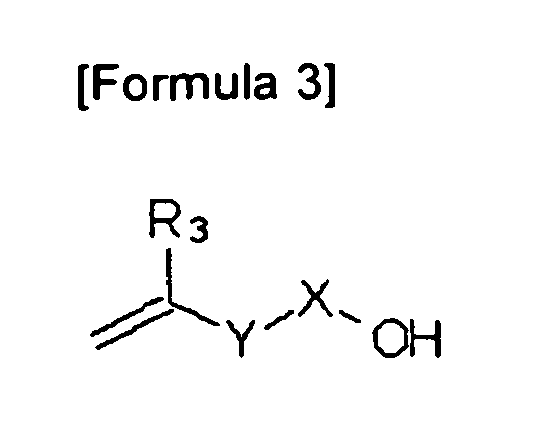
- Alcohol that is used in the production method of the ester compound according to the present invention includes compounds that are represented by the following Formulas 2 to 7.


- In Formulas 2 and 3,
n is an integer in the range of 0 to 4,
Y is a direct bond, or is selected from the group consisting of -C(O)-O-, -O-C(O)-, -C(O)N(R3)-, -OC(O)N(R3)-, - N(R3)-, -C(O)-, -SO2-, -SO3- and -OSO2-,
X is selected from the group consisting of a direct bond; -(OCH2)m- (m is an integer in the range of 0 to 10); substituted or unsubstituted alkylene having 1 to 20 carbon atoms; substituted or unsubstituted alkenylene having 2 to 20 carbon atoms; substituted or unsubstituted cycloalkylene having 5 to 12 carbon atoms; substituted or unsubstituted arylene having 6 to 40 carbon atoms; substituted or unsubstituted aralkylene having 7 to 15 carbon atoms; and substituted or unsubstituted alkynylene having 2 to 20 carbon atoms;
R3, R4 and R5 are each independently selected from the group consisting of hydrogen; halogen; straight- or branched-chained alkyl having 1 to 20 carbon atoms; straight- or branched-chained alkenyl or vinyl having 2 to 20 carbon atoms; alkynyl having 2 to 20 carbon atoms; cycloalkyl that is unsubstituted or substituted with hydrocarbons and has 3 to 12 carbon atoms; aryl that is unsubstituted or substituted with hydrocarbons and has 6 to 40 carbon atoms; and aralkyl that is unsubstituted or substituted with hydrocarbons and has 7 to 15 carbon atoms,
R3, R4 and R5 are each independently selected from the group consisting of hydrogen; halogen; straight- or branched-chained alkyl having 1 to 20 carbon atoms; straight- or branched-chained alkenyl or vinyl having 2 to 20 carbon atoms; alkynyl having 2 to 20 carbon atoms; cycloalkyl that is unsubstituted or substituted with hydrocarbons and has 5 to 12 carbon atoms; aryl that is unsubstituted or substituted with hydrocarbons and has 6 to 40 carbon atoms; and aralkyl that is unsubstituted or substituted with hydrocarbons and has 7 to 15 carbon atoms,


- In the compounds that are represented by Formulas 4 to 7,
A is a direct bond; or any one selected from the group consisting of substituted or unsubstituted alkylene having 1 to 20 carbon atoms; carbonyl [-C(O)-]; carboxy [-C(O)O- or -OC(O)-]; and substituted or unsubstituted arylene having 6 to 40 carbon atoms,
B is a direct bond; oxygen, sulfur or -NH-,
Z is oxygen or sulfur,
R9 is a direct bond; or any one selected from the group consisting of substituted or unsubstituted alkylene having 1 to 20 carbon atoms; substituted or unsubstituted alkenylene having 2 to 20 carbon atoms; substituted or unsubstituted cycloalkylene having 5 to 12 carbon atoms; substituted or unsubstituted arylene having 6 to 40 carbon atoms; substituted or unsubstituted aralkylene having 7 to 15 carbon atoms; and substituted or unsubstituted alkynylene having 2 to 20 carbon atoms,
R10, R11, R21 R13 and R14 are each independently selected from the group consisting of hydrogen; substituted or unsubstituted alkyl having 1 to 20 carbon atoms; substituted or unsubstituted alkoxy having 1 to 20 carbon atoms; substituted or unsubstituted aryloxy having 6 to 30 carbon atoms; and substituted or unsubstituted aryl having 6 to 40 carbon atoms, and
C is a compound that includes hetero aryl including Groups 14, 15, or 16 heteroatoms, for example, heteroatoms including S, O, N and the like, and having 6 to 40 carbon atoms; and aryl having 6 to 40 carbon atoms. In detail, they may be represented by the following Formulas.


- The hydrocarbons may be selected from the group consisting of an alkyl group including a methyl group, an ethyl group, a propyl group, an isopropyl group, a butyl group, a tertiary-butyl group, a pentyl group, a hexyl group, and a heptyl group; a cycloalkyl group including a cyclopentyl group and a cyclohexyl group; and an aryl group including a phenyl group, a naphthyl group, an anthracenyl group, a biphenyl group, a pyrenyl group, and a perylenyl group, and in the case of when substituted or unsubstituted alkylene, alkenylene, cyclo alkylene, arylene, aralkylene, and alkynylene are substituted, they may be substituted with the above hydrocarbons.
- As the alcohol, alcohol that includes primary alcohol, secondary alcohol, tertiary alcohol and the like, and has straight-chained or cyclic substituent groups such as alkyl group, alkenyl group, aryl group and the like may be used.
- For example, examples of the alcohol may include aliphatic primary alcohols including methanol, ethanol, n-propanol, n-butanol, n-hexanol, n-heptanol, n-octanol, n-decanol, n-dodecanol, stearyl alcohol, 2-ethylhexane-1-ol and neopentyl alcohol; aromatic primary alcohols of benzyl alcohol; aliphatic secondary alcohols including isopropyl alcohol, s-butyl alcohol and 1-methylhexane-1-ol; alicyclic secondary alcohols including cyclohexanol and 2-adamanthirol; tertiary alcohols including t-butyl alcohol, 1-adamanthirol, phenol, o-cresol, m-cresol, p-cresol, 3,5-dimethylphenol, α-naphthol and β-naphthol; and polyvalent alcohols including ethylene glycol, propylene glycol, trimethylene glycol, 1,4-butanediol, 1,5-pentanediol, 1,6-hexanediol, 1,7-heptanediol, 1,8-octanediol, pinacol, neopentyl glycol, trimethylol propane, trimethylol ethane, pentaerythritol, dipentaerythritol, sorbitol and polyvinyl alcohol.
- The alcohol may be used alone or as a mixture of two or more species. For example, in polyvalent alcohol that has a primary hydroxy group and a secondary hydroxy group, a condensation reaction of a carboxylic acid having a large volume and a primary hydroxy group may be selectively generated, or as a distance between the primary hydroxy group and the secondary hydroxy group is increased, a condensation reaction with the primary hydroxy group may be selectively generated, thus an ester condensate may be chemically selectively generated.
- The carboxylic acid that is used in the production method of the ester compound according to the present invention includes compounds that are represented by the following Formulas 8 to 13.


- In Formula 8 and 9,
p is an integer in the range of 0 to 4,
Y is a direct bond; or selected from the group consisting of -C(O)-O-, -O-C(O)-, -C(O)N(R3)-, -OC(O)N(R3)-, - N(R3)-, -C(O)-, -SO2-, -SO3- and -OSO2-,
X is selected from the group consisting of a direct bond; -(OCH2)q- (q is an integer in the range of 0 to 10); substituted or unsubstituted alkylene having 1 to 20 carbon atoms; substituted or unsubstituted alkenylene having 2 to 20 carbon atoms; substituted or unsubstituted cycloalkylene having 5 to 12 carbon atoms; substituted or unsubstituted arylene having 6 to 40 carbon atoms; substituted or unsubstituted aralkylene having 7 to 15 carbon atoms; and substituted or unsubstituted alkynylene having 2 to 20 carbon atoms;
R3, R4 and R5 are each independently selected from the group consisting of hydrogen; halogen; straight- or branched-chained alkyl having 1 to 20 carbon atoms; straight- or branched-chained alkenyl or vinyl having 2 to 20 carbon atoms; cycloalkyl that is unsubstituted or substituted with hydrocarbons and has 5 to 12 carbon atoms; aryl that is unsubstituted or substituted with hydrocarbons and has 6 to 40 carbon atoms; aralkyl that is unsubstituted or substituted with hydrocarbons and has 7 to 15 carbon atoms; and alkynyl having 2 to 20 carbon atoms,


- In Formula 10 to 13,
A, B, C, Z, R9, R10, R11, R12, R13 and R14 are as defined in Formulas 4 to 7. - The hydrocarbons may be selected from the group consisting of an alkyl group including a methyl group, an ethyl group, a propyl group, an isopropyl group, a butyl group, a tertiary-butyl group, a pentyl group, a hexyl group, and a heptyl group; a cycloalkyl group including a cyclopentyl group and a cyclohexyl group; and an aryl group including a phenyl group, a naphthyl group, an anthracenyl group, a biphenyl group, a pyrenyl group, and a perylenyl group, and in the case of when substituted or unsubstituted alkylene, alkenylene, cyclo alkylene, arylene, aralkylene, and alkynylene are substituted, they may be substituted with the above hydrocarbons.
- It is preferable that the carboxylic acid used in the esterification reaction is chain type or cyclic type of fatty acids or aromatic acids as monocarboxylic acids or acids having unsaturated bonds or substituent groups to them.
- For example, the carboxylic acid compound may include fatty acids including acetic acid, a propionic acid, a n-butyric acid, an isobutyric acid, a n-valeric acid, an isovaleric acid, methylethyl acetic acid, trimethyl acetic acid, a caproic acid, an enantic acid, a caprylic acid, a pelargonic acid, a capric acid, an undercylic acid, a lauric acid, a tridecylic acid, a myricstic acid, a pentadecylic acid, a palmitic acid, a heptadecylic acid, a stearic acid, an acrylic acid, a crotonic acid, an isocrotonic acid, a undecylenic acid, an oleic acid, an elaidic acid, an erucic acid, a brassidic acid, a sorbic acid, a linoleic acid and a linolenic acid; aromatic acids such as benzoic acid; dicarboxylic acids such as a malonic acid, a succinic acid, a glutaric acid, an adipic acid, a pimelic acid, a suberic acid, an azelaic acid, a sebacic acid, a dodecanedioic acid, a fumaric acid, a maleic acid, a mesaconic acid, a citraconic acid, a phthalic acid, a terephthalic acid, an isophthalic acid and a diphenyl ether-4,4'-dicarboxylic acid; tricarboxylic acids including a butane-1,2,4-tricarboxylic acid, a cyclohexane-1,2,3-tricarboxylic acid, a benzene-1,2,4-tricarboxylic acid and a naphthalene-1,2,4-tricarboxylic acid; and tetracarboxylic acids including a butane-1,2,3,4-tetracarboxylic acid, a cyclobutane-1,2,3,4-tetracarboxylic acid, a benzene-1,2,4,5-tetracarboxylic acid, a 3,3',4,4'-benzophenone tetracarboxylic acid and a 3,3',4,4'-diphenylether tetracarboxylic acid.
- In the method for producing an ester compound according to the present invention, by using the esterification catalyst composition according to the present invention, alcohol and carboxylic acid compounds may be used in the same mole number, thus efficiently producing an ester compound. In detail, if the monovalent carboxylic acid and alcohol are used, an ester monomer is obtained, and if polyvalent carboxylic acid such as α,ω-aliphatic dicarboxylic acids and polyvalent alcohol such as α,ω-aliphatic diol are used, polyester may be synthesized.
- In addition, in the production method of the ester compound, it is preferable that the esterification catalyst composition is added at a ratio of 0.01 to 20 on the basis of a mole number of the compound that is added in a smaller amount among the alcohol and carboxylic acid compounds in the reaction solution. If the amount of the esterification catalyst composition is less than 0.01 mole, there is a problem in that the yield is reduced. If the amount is more than 20 mole, there is a problem in that since reaction byproducts are increased.
- In addition, as the alcohol and carboxylic acid that are used in the production method of the ester compound according to the present invention, a ω-hydroxycarboxylic acid that each has independently a hydroxyl group and a carboxy group at both ends in one molecule may be used.
- For example, the ω -hydroxycarboxylic acid includes ω-hydroxy undecanoic acid, hydroxy dodecanoic acid, p-hydroxy benzoic acid, m-hydroxy benzoic acid, 6-hydroxynaphthalene-2-carboxylic acid, 4-(p-hydroxyphenoxy) benzoic acid, 3-(p-hydroxyphenoxy) benzoic acid, 4-(m-hydroxyphenoxy) benzoic acid and 3-(m-hydroxyphenoxy) benzoic acid.
- The solvent that is used in the production method of the ester compound according to the present invention is not particularly limited, and a polar solvent, a nonpolar solvent or a mixed solvent thereof may be used. The nonpolar solvent is preferable because of easiness of removal of the products by the esterification reaction to the outside of the reaction system. The organic solvent used while the catalyst composition according to the present invention is dissolved therein is preferable because it forms an azeotropic point in conjunction with water.
- It is preferable that the total weight of the organic solvent in the above reaction system is in the range of 0.1 to 100 on the basis of a weight of the compound that is added in a smaller amount among the alcohol and carboxylic acid compounds, and it is more preferable that the total weight is in the range of 0.5 to 50.
- It is preferable that the nonpolar solvent is selected from the group consisting of heptane, octane, toluene, chlorobenzene, o-xylene, m-xylene, p-xylene, mecithylene, pentamethylbenzene, benzene, ethylbenzene, 1,3,5-triisopropylbenzene, o-dichlorobenzene, 1,2,4-trichlorobenzene and a mixture thereof.
- Since the esterification catalyst composition according to the present invention may reduce deterioration in catalyst by moisture adsorption, the esterification reaction using this may be smoothly performed under an atmospheric exposure state. In addition, the esterification reaction may be carried out under a dry inert gas atmosphere generally used, for example, under an argon or nitrogen atmosphere. In addition, the argon atmosphere may be generated by using a method where argon is allowed to slowly flow, and dehydration and deoxygenation atmospheres may be simultaneously accomplished by performing the reaction under the argon atmosphere.
- In addition, in the condensation reaction of the monovalent carboxylic acid and monovalent alcohol or the polycondensation reaction of aliphatic polyvalent carboxylic acid and aliphatic polyvalent alcohol, it is preferable that the reaction is carried out under hot reflux at 100 to 250°C for 24 to 72 hours. It is more preferable that the reaction is carried out at 120 to 180°C for 1 to 24 hours.
- Meanwhile, in the condensation reaction of the aromatic carboxylic acid and the aromatic alcohol, it is preferable that the reaction is carried out under hot reflux at 120 to 250°C. It is more preferable that the reaction is carried out at 150 to 200°C for 24 to 72 hours.
- In the present invention, since the ester compound that is obtained by the above esterification reaction condition does not generate side reactions by using the carboxylic acid and alcohol in almost the same mole number, it is not necessary to perform the purification, thus it is economical and convenient.
- After the reaction of ester is finished, in order to repeatedly use the used catalyst, the following treatment may be carried out. The ionic liquid is added to the reaction system, the zirconium compound that is included in the esterification catalyst composition according to the present invention is extracted with the ionic liquid layer by using the ionic liquid, and the ester compound may be obtained from the organic layer. Here, the ionic liquid means a salt that has a property where the salt becomes liquid at room temperature or at a temperature that is close to room temperature. Since it has very high polarity and well dissolves metal salts, it may be suitably used to extract the catalyst used in the production method of the ester compound according to the present invention. The ionic liquid extracting the catalyst is washed with another organic solvent according to the necessity, and may be repeatedly used as a catalyst solution of the esterification reaction while the solvent is not removed under reduced pressure.
- The ionic liquid that is used in the production method of the ester compound according to the present invention is not limited, but preferably 1-butyl-3-methylimidasoliumtrifluoromethansulfonimide, 1-ethyl-3-methylimidasoliumtrifluoromethansulfonate, N-alkylpyrydiniumtrifluoromethansulfonateimide, and more preferably N-butylpyrydiniumtrifluoromethansulfonateimide. The use amount of the ionic liquid is in the range of preferably 5 to 20 mℓ and more preferably 10 to 15 mℓ on the basis of 0.5 mmol of the total use amount of the catalyst.
- Hereinafter, the present invention will be described in detail in light of Examples and Experimental Examples. The present invention may, however, be embodied in many different forms and should not be construed as being limited to the Examples and Experimental Examples set forth herein. Rather, these Examples and Experimental Examples are provided such that this disclosure will be thorough and complete and will fully convey the concept of the present invention to those skilled in the art.
- In the following Examples, the solvent such as xylene, toluene and the like was directly used while being not particularly purified.
- 5-norbornene-2-methanol (3.72 g, 30 mmol), the cinnamic acid (4.23 g, 33 mmol), and 30 mℓ of xylene were continuously added to the 250 mℓ flask. Zirconium carbonate basic hydrate [3ZrO2 · CO2 · (H2O)X] (1.3 g, 3 mmol, 10 mol%) was added thereto, and azeotropic reflux was performed. The temperature of the heated bath was controlled to 180°C and the reaction was performed for 18 hours. After that, the reaction was finished after the GC check, and it was cooled to normal temperature. Thereafter, 30 mℓ of ethyl acetic acid was added thereto. After the undissolved solid compound is precipitated, 30 mℓ of 1 M (mol/L) dilute hydrochloric acid solution was added thereto, and the washing was performed. This process was performed twice, and 30 mℓ of the saturated aq.NaHCO3 solution was added thereto and washed. This process was performed twice, and MgSO4 was added to the separated organic solution to remove a small amount of water. After this was filtered by using MgSO4, the solvent was removed under reduced pressure, and the purification process was carried out to obtain 6.95 g of cinnamic norbornene methyl ester (NB-Cin-H compound) that was the light yellow liquid compound (molecular weight = 284.35, yield 90.7%).
- Benzyl alcohol (1.62 g, 15 mmol), 4-phenyl butyric acid (2.46 g, 15 mmol) and 25 mℓ of toluene were continuously added to the 250 mℓ flask. Zirconium carbonate basic hydrate [3ZrO2 · CO2 · (H2O)X] (0.0648 g, 0.15 mmol, 1 mol%) was added thereto, and azeotropic reflux was performed. The temperature of the heated bath was controlled to 150°C and the reaction was performed for 18 hours. After that, the reaction was finished after the GC check, and it was cooled to normal temperature. Thereafter, 30 mℓ of ethyl acetic acid was added thereto. After the undissolved solid compound is precipitated, 30 mℓ of 1 M (mol/L) dilute hydrochloric acid solution was added thereto, and the washing was performed. This process was performed twice, and 30 mℓ of the saturated aq.NaHCO3 solution was added thereto and washed. This process was performed twice, and MgSO4 was added to the separated organic solution to remove a small amount of water. After water was removed, this was filtered by using MgSO4, and the solvent was removed under reduced pressure. The purification process was carried out to obtain 2.8 g of the colorless liquid compound (molecular weight = 189.24, yield 98.6%).
- According to an esterification catalyst composition and a method for producing an ester compound using the same according to the present invention, since the solubility to a nonpolar solvent is excellent and the activity of the reaction is excellent in an atmosphere exposure state, they are very easily applied to a mass production process.
Claims (9)
- An esterification catalyst composition comprising zirconium carbonate basic hydrate [3ZrO2.CO2.(H2O)x], wherein x is an integer in the range of 1 to 12.
- The esterification catalyst composition as set forth in claim 1, wherein the esterification catalyst composition is carried in a particulate support including one or more selected from the group consisting of silica, titania, silica/cromia, silica/cromia/titania, silica/alumina, aluminium phosphate gel, silanated silica, silica hydro gel, montmorilonite clay and zeolite.
- A method for producing an ester compound, the method comprising the steps of:esterifying alcohol and carboxylic acid compounds by using the esterification catalyst composition according claim 1,wherein the alcohol includes one or more selected from the group consisting of compounds that are represented by the following Formulas 2 to 7:

 wherein n is an integer in the range of 0 to 4,Y is a direct bond, or is selected from the group consisting of -C(O)-O-, - O-C(O)-, -C(O)N(R3)-, -OC(O)N(R3)-, -N(R3)-, -C(O)-, -SO2-, -SO3- and -OSO2-,X is selected from the group consisting of a direct bond; -(OCH2) m- (m is an integer in the range of 0 to 10); substituted or unsubstituted alkylene having 1 to 20 carbon atoms; substituted or unsubstituted alkenylene having 2 to 20 carbon atoms; substituted or unsubstituted cycloalkylene having 5 to 12 carbon atoms; substituted or unsubstituted arylene having 6 to 40 carbon atoms; substituted or unsubstituted aralkylene having 7 to 15 carbon atoms; and substituted or unsubstituted alkenylene having 2 to 20 carbon atoms;R3, R4 and R5 are each independently selected from the group consisting of hydrogen; halogen; straight- or branched-chained alkyl having 1 to 20 carbon atoms; straight- or branched-chained vinyl or alkenyl having 2 to 20 carbon atoms; alkynyl having 2 to 20 carbon atoms; cycloalkyl that is unsubstituted or substituted with hydrocarbons and has 5 to 12 carbon atoms; aryl that is unsubstituted or substituted with hydrocarbons and has 6 to 40 carbon atoms; and aralkyl that is unsubstituted or substituted with hydrocarbons and has 7 to 15 carbon atoms,


 wherein A is a direct bond; or selected from the group consisting of substituted or unsubstituted alkylene having 1 to 20 carbon atoms; carbonyl [-C(O)-]; carboxy [-C(O)O- or -OC(O)-]; and substituted or unsubstituted arylene having 6 to 40 carbon atoms,B is a direct bond; oxygen, sulfur or -NH-,Z is oxygen or sulfur,R9 is a direct bond; or selected from the group consisting of substituted or unsubstituted alkylene having 1 to 20 carbon atoms; substituted or unsubstituted alkenylene having 2 to 20 carbon atoms; substituted or unsubstituted cycloalkylene having 5 to 12 carbon atoms; substituted or unsubstituted arylene having 6 to 40 carbon atoms; substituted or unsubstituted aralkylene having 7 to 15 carbon atoms; and substituted or unsubstituted alkynylene having 2 to 20 carbon atoms,R10, R11, R12, R13 and R14 are each independently selected from the group consisting of substituted or unsubstituted alkyl having 1 to 20 carbon atoms; substituted or unsubstituted alkoxy having 1 to 20 carbon atoms; substituted or unsubstituted aryloxy having 6 to 30 carbon atoms; and substituted or unsubstituted aryl having 6 to 40 carbon atoms, andC is a compound that includes hetero aryl including Groups 14, 15, or 16 hetero atoms and having 6 to 40 carbon atoms; or aryl having 6 to 40 carbon atoms, andwherein the carboxylic acid compound includes one or more selected from the group consisting of compounds that are represented by the following Formulas 8 to 13:
 whereinp is an integer in the range of 0 to 4,Y is a direct bond; or selected from the group consisting of -C(O)-O-, -O- C(O)-, -C(O)N(R3)-, -OC(O)N(R3)-, -N(R3)-, -C(O)-, -SO2-, -SO3- and -OSO2-,X is selected from the group consisting of a direct bond; -(OCH2)q- (q is an integer in the range of 0 to 10); substituted or unsubstituted alkylene having 1 to 20 carbon atoms; substituted or unsubstituted alkenylene having 2 to 20 carbon atoms; substituted or unsubstituted cycloalkylene having 5 to 12 carbon atoms; substituted or unsubstituted arylene having 6 to 40 carbon atoms; substituted or unsubstituted aralkylene having 7 to 15 carbon atoms; and substituted or unsubstituted alkynylene having 2 to 20 carbon atoms;R3, R4 and R5 are each independently selected from the group consisting of hydrogen; halogen; straight- or branched-chained alkyl having 1 to 20 carbon atoms; straight- or branched-chained vinyl or alkenyl having 2 to 20 carbon atoms; cycloalkyl that is substituted or unsubstituted with hydrocarbons and has 5 to 12 carbon atoms; aryl that is substituted or unsubstituted with hydrocarbons and has 6 to 40 carbon atoms; aralkyl that is substituted or unsubstituted with hydrocarbons and has 7 to 15 carbon atoms; and alkynyl having 2 to 20 carbon atoms,


 wherein A, B, C, Z, R9, R10 R11, R12, R13 and R14 are as defined in Formulas 4 to 7.
 - The method for producing an ester compound as set forth in claim 3,
wherein the esterification catalyst composition is used at a ratio of 0.01 to 20 on the basis of a mole number of the compound that is added in a smaller amount among the alcohol and carboxylic acid compounds. - The method for producing an ester compound as set forth in claim 3, wherein C of Formulas 4 to 6 is selected from the group consisting of the following

- The method for producing an ester compound as set forth in claim 3, wherein the alcohol includes one or more selected from the group consisting of aliphatic primary alcohols including methanol, ethanol, n-propanol, n-butanol, n-hexanol, n-heptanol, n-octanol, n-decanol, n-dodecanol, stearyl alcohol, 2-ethylhexane-1-ol and neopentyl alcohol; aromatic primary alcohols of benzyl alcohol; aliphatic secondary alcohols including isopropyl alcohol, s-butyl alcohol and 1-methylhexane-1-ol; alicyclic secondary alcohols including cyclohexanol and 2-adamanthirol; tertiary alcohols including t-butyl alcohol, 1-adamanthirol, phenol, o-cresol, m-cresol, p-cresol, 3,5-dimethylphenol, α-naphthol and β-naphthol; and polyvalent alcohols including ethylene glycol, propylene glycol, trimethylene glycol, 1,4-butanediol, 1,5-pentanediol, 1,6-hexanediol, 1,7-heptanediol, 1,8-octanediol, pinacol, neopentyl glycol, trimethylol propane, trimethylol ethane, pentaerythritol, dipentaerythritol, sorbitol and polyvinyl alcohol.
- The method for producing an ester compound as set forth in claim 3, wherein the carboxylic acid compound includes one or more selected from the group consisting of fatty acids including an acetic acid, a propionic acid, a n-butyric acid, an isobutyric acid, a n-valeric acid, an isovaleric acid, methylethyl acetic acid, trimethyl acetic acid, a caproic acid, an enantic acid, a caprylic acid, a pelargonic acid, a capric acid, an undercylic acid, a lauric acid, a tridecylic acid, a myricstic acid, a pentadecylic acid, a palmitic acid, a heptadecylic acid, a stearic acid, an acrylic acid, a crotonic acid, an isocrotonic acid, a undecylenic acid, an oleic acid, an elaidic acid, an erucic acid, a brassidic acid, a sorbic acid, a linoleic acid and a linolenic acid; aromatic acids such as benzoic acid; dicarboxylic acids such as a malonic acid, a succinic acid, a glutaric acid, an adipic acid, a pimelic acid, a suberic acid, an azelaic acid, a sebacic acid, a dodecanedioic acid, a fumaric acid, a maleic acid, a mesaconic acid, a citraconic acid, a phthalic acid, a terephthalic acid, an isophthalic acid and a diphenyl ether-4,4' -di carboxylic acid; tricarboxylic acids including a butane-1,2,4-tricarboxylic acid, a cyclohexane-1,2,3-tricarboxylic acid, a benzene-1,2,4-tricarboxylic acid and a naphthalene-1,2,4-tricarboxylic acid; and tetracarboxylic acids including a butane-1,2,3,4-tetracarboxylic acid, a cyclobutane-1,2,3,4-tetracarboxylic acid, a benzene-1,2,4,5-tetracarboxylic acid, a 3,3' ,4,4'-benzophenone tetracarboxylic acid and a 3,3' ,4,4' -diphenylether tetracarboxylic acid.
- A method for producing an ester compound, the method comprising the steps of:esterifying a w-hydroxycarboxylic acid that each has independently a hydroxyl group and a carboxy group at both ends in one molecule using the esterification catalyst composition according to claim 1.
- The method for producing an ester compound as set forth in claim 8, wherein the w-hydroxycarboxylic acid includes w-hydroxy undecanoic acid, hydroxy dodecanoic acid, p-hydroxy benzoic acid, m-hydroxy benzoic acid, 6-hydroxynaphthalene-2-carboxylic acid, 4-(p-hydroxyphenoxy)benzoic acid, 3-(p-hydroxyphenoxy)benzoic acid, 4-(m-hydroxyphenoxy)benzoic acid and 3-(m-hydroxyphenoxy)benzoic acid.
Applications Claiming Priority (2)
| Application Number | Priority Date | Filing Date | Title |
|---|---|---|---|
| KR1020070139034A KR101044393B1 (en) | 2007-12-27 | 2007-12-27 | Esterification Catalyst Composition Comprising Zirconium Compounds and Method of Producing Ester Compounds Using the Same |
| PCT/KR2008/007669 WO2009084862A2 (en) | 2007-12-27 | 2008-12-24 | Catalyst composition including zirconium compounds for esterfication reaction and method for preparing ester compounds |
Publications (3)
| Publication Number | Publication Date |
|---|---|
| EP2231327A2 EP2231327A2 (en) | 2010-09-29 |
| EP2231327A4 EP2231327A4 (en) | 2011-09-28 |
| EP2231327B1 true EP2231327B1 (en) | 2013-10-16 |
Family
ID=40824884
Family Applications (1)
| Application Number | Title | Priority Date | Filing Date |
|---|---|---|---|
| EP08866807.4A Active EP2231327B1 (en) | 2007-12-27 | 2008-12-24 | Catalyst composition including zirconium compounds for esterfication reaction and method for preparing ester compounds |
Country Status (6)
| Country | Link |
|---|---|
| US (2) | US20100274039A1 (en) |
| EP (1) | EP2231327B1 (en) |
| JP (1) | JP5230752B2 (en) |
| KR (1) | KR101044393B1 (en) |
| CN (1) | CN101909744A (en) |
| WO (1) | WO2009084862A2 (en) |
Families Citing this family (15)
| Publication number | Priority date | Publication date | Assignee | Title |
|---|---|---|---|---|
| CN106083577B (en) * | 2016-06-14 | 2018-09-28 | 广州嘉德乐生化科技有限公司 | A kind of preparation method and application of methyl glycol fatty acid ester |
| CN106565471A (en) * | 2016-10-29 | 2017-04-19 | 湖北绿色家园材料技术股份有限公司 | Synthetic method of dipropylene glycol dibenzoate |
| CN110090667A (en) * | 2018-01-30 | 2019-08-06 | 南京大学昆山创新研究院 | The preparation method and applications of zirconium metal organic framework UiO-66 catalyst |
| CN109092344B (en) * | 2018-09-19 | 2021-07-27 | 上海师范大学 | A kind of multi-level eggshell structure g-C3N4/TiO2 composite material and its preparation method and application |
| EP3978107B1 (en) * | 2019-05-28 | 2024-02-14 | Kao Corporation | Co-surfactant, surfactant composition, and composition for oil recovery |
| WO2020241786A1 (en) | 2019-05-28 | 2020-12-03 | 花王株式会社 | Surfactant and surfactant composition |
| WO2020241784A1 (en) | 2019-05-28 | 2020-12-03 | 花王株式会社 | Rust inhibitor, rust inhibitor composition, coating formation material, coating, and metal composition |
| EP3978468B1 (en) | 2019-05-28 | 2023-04-26 | Kao Corporation | Compound and composition |
| EP3978587B1 (en) | 2019-05-28 | 2024-10-16 | Kao Corporation | Oil agent additive and oil agent composition |
| CN114206845A (en) | 2019-07-30 | 2022-03-18 | 杰富意工程技术株式会社 | Synthetic method of zirconium complex |
| JP7834482B2 (en) | 2020-01-16 | 2026-03-24 | Jfeエンジニアリング株式会社 | Method for synthesizing zirconium complexes |
| CN114805121B (en) * | 2021-01-22 | 2024-03-01 | 江苏和成新材料有限公司 | Esterification reaction method |
| CN113416136B (en) * | 2021-06-21 | 2023-12-22 | 河南工业大学 | Application of acidic ionic liquid in catalyzing reaction of cinnamic acid and benzyl alcohol to prepare benzyl cinnamate and method for preparing benzyl cinnamate |
| CN114029072B (en) * | 2021-12-01 | 2023-07-11 | 万华化学集团股份有限公司 | Solid super acid catalyst and method for preparing isooctyl p-methoxycinnamate by using same |
| US20250171407A1 (en) * | 2022-02-22 | 2025-05-29 | Basf Se | Ultraviolet absorber |
Family Cites Families (31)
| Publication number | Priority date | Publication date | Assignee | Title |
|---|---|---|---|---|
| US3510254A (en) * | 1967-09-11 | 1970-05-05 | Stauffer Chemical Co | Preparation of carbonated zirconium hydrate in readily filterable form,from zirconyl chloride |
| US3551095A (en) * | 1968-01-02 | 1970-12-29 | Nat Lead Co | Production of iron-free carbonated hydrous zirconia |
| US3961026A (en) | 1970-09-09 | 1976-06-01 | Pokhodenko Vladimir Nikiforovi | Method of producing basic zirconium carbonate |
| JPS4926944B1 (en) * | 1970-12-30 | 1974-07-13 | ||
| US4042672A (en) * | 1974-10-30 | 1977-08-16 | Th. Goldschmidt Ag | Process for preparing carbonated zirconium oxide hydrate |
| FR2304571A1 (en) * | 1975-03-21 | 1976-10-15 | Goldschmidt Ag Th | PROCESS FOR THE PREPARATION OF ZIRCONIUM HYDRATE CARBONATE OXIDE |
| US5236987A (en) * | 1987-07-02 | 1993-08-17 | Velsicol Chemical Corporation | Isodecyl benzoate coalescing agents in latex compositions |
| US5191139A (en) * | 1991-11-04 | 1993-03-02 | Texaco Chemical Company | Process for oligomerizing olefins using sulfate-activated group IV oxides |
| JPH06321878A (en) * | 1993-05-17 | 1994-11-22 | Inoue Koryo Seizosho:Kk | Production of ester |
| IT1271312B (en) * | 1994-12-21 | 1997-05-27 | Enirisorse Spa | SOL-GEL PROCESS FOR OBTAINING SPHERES, MICROSPHERES OR COATINGS OF CELL-SHAPED MONOLITES, CONSTITUTED FROM PURE OR ZIRCONIUM OXIDE WITH OTHER OXIDES, USEFUL AS CATALYSTS OR SUPPORTS FOR CATALYSTS |
| US5614650A (en) * | 1995-03-07 | 1997-03-25 | Sandler; Stanley R. | Zirconium compounds of sulfonic acids |
| JP3734542B2 (en) * | 1995-10-13 | 2006-01-11 | 株式会社ジャパンエナジー | Solid acid catalyst and method for producing the same |
| GB9612161D0 (en) * | 1996-06-11 | 1996-08-14 | Tioxide Specialties Ltd | Esterification process |
| US6448198B1 (en) * | 1997-10-13 | 2002-09-10 | Total Raffinage Distribution S.A. | Acid catalyst with a sulfated zirconia base and its uses |
| EP0922478A3 (en) * | 1997-11-18 | 1999-08-04 | Ngk Insulators, Ltd. | Porous ceramic filter and method for producing same |
| JPH11152249A (en) * | 1997-11-21 | 1999-06-08 | Mitsubishi Chemical Corp | Method for producing unsaturated carboxylic acid ester |
| GB9725419D0 (en) * | 1997-12-02 | 1998-01-28 | Tioxide Specialties Ltd | Esterification catalysts |
| JP3989078B2 (en) * | 1998-03-04 | 2007-10-10 | 株式会社ジャパンエナジー | Method for producing solid acid catalyst |
| US20030023112A1 (en) * | 2001-04-11 | 2003-01-30 | Jiamin Lang | Benzoate/alkanoate ester compositions |
| US7056966B2 (en) * | 2001-08-30 | 2006-06-06 | Velsicol Chemical Corporation | Liquid benzoate ester compositions and aqueous polymer compositions containing same as plasticizers |
| BR0301254B1 (en) * | 2003-05-06 | 2012-05-02 | "process for extraction and catalytic esterification of fatty acids present in sewage scum". | |
| EP1674444B9 (en) | 2003-10-02 | 2013-11-20 | Japan Science and Technology Agency | Method for producing ester condensed product |
| US6963004B2 (en) * | 2003-12-23 | 2005-11-08 | Unilever Home & Personal Care Usa, Division Of Conopco, Inc. | Process for making directly esterified fatty acid isethionate using group 4 metal based, particularly zirconium based catalysts |
| KR100899058B1 (en) * | 2004-04-08 | 2009-05-25 | 캐털리틱 디스틸레이션 테크놀로지스 | Process for making dialkyl carbonates |
| WO2006064685A1 (en) * | 2004-12-13 | 2006-06-22 | Gifu University | Process for producing carboxylic acid ester and esterification catalyst |
| KR100789247B1 (en) * | 2005-01-05 | 2008-01-02 | 주식회사 엘지화학 | Photoreactive Polymers and Methods for Making the Same |
| JP4791045B2 (en) | 2005-01-14 | 2011-10-12 | 独立行政法人科学技術振興機構 | Method for producing ester condensate |
| JP4996779B2 (en) * | 2006-02-22 | 2012-08-08 | 日本ポリプロ株式会社 | Olefin polymerization catalyst component, method for producing the catalyst component, and method for producing an olefin polymer with a polymerization catalyst using the catalyst component |
| JP5017173B2 (en) * | 2007-05-16 | 2012-09-05 | 三菱レイヨン株式会社 | Catalyst for producing α-acyloxyacrylic acid and / or ester thereof and method for producing α-acyloxyacrylic acid and / or ester thereof |
| US8207253B2 (en) * | 2007-09-14 | 2012-06-26 | Eastman Specialties Holdings Corporation | Mixed aryl/alkyl diester compositions |
| WO2009063891A1 (en) * | 2007-11-14 | 2009-05-22 | Toagosei Co., Ltd. | Method for production of hexagonal zirconium phosphate powder |
-
2007
- 2007-12-27 KR KR1020070139034A patent/KR101044393B1/en not_active Expired - Fee Related
-
2008
- 2008-12-24 EP EP08866807.4A patent/EP2231327B1/en active Active
- 2008-12-24 CN CN2008801226756A patent/CN101909744A/en active Pending
- 2008-12-24 US US12/810,683 patent/US20100274039A1/en not_active Abandoned
- 2008-12-24 WO PCT/KR2008/007669 patent/WO2009084862A2/en not_active Ceased
- 2008-12-24 JP JP2010540579A patent/JP5230752B2/en not_active Expired - Fee Related
-
2011
- 2011-01-28 US US13/016,672 patent/US20110130574A1/en not_active Abandoned
Also Published As
| Publication number | Publication date |
|---|---|
| CN101909744A (en) | 2010-12-08 |
| JP5230752B2 (en) | 2013-07-10 |
| US20100274039A1 (en) | 2010-10-28 |
| US20110130574A1 (en) | 2011-06-02 |
| JP2011507695A (en) | 2011-03-10 |
| EP2231327A4 (en) | 2011-09-28 |
| WO2009084862A3 (en) | 2009-10-01 |
| EP2231327A2 (en) | 2010-09-29 |
| KR20090070882A (en) | 2009-07-01 |
| KR101044393B1 (en) | 2011-06-27 |
| WO2009084862A2 (en) | 2009-07-09 |
Similar Documents
| Publication | Publication Date | Title |
|---|---|---|
| US20110130574A1 (en) | Catalyst composition including zirconium compounds for esterfication reaction and method for preparing ester compounds | |
| US20090187042A1 (en) | Method for producing ester condensed product | |
| US6376701B1 (en) | Process for the transesterification of keto esters using solid acids as catalysts | |
| Firouzabadi et al. | Aluminum dodecatungstophosphate (AlPW12O40) as a non-hygroscopic Lewis acid catalyst for the efficient Friedel–Crafts acylation of aromatic compounds under solvent-less conditions | |
| US20020111508A1 (en) | Method for producing esters of citric acids | |
| KR101292329B1 (en) | Preparation method of alkyllactate and process for preparing lactamide using the same | |
| JP3773777B2 (en) | Method for producing ester condensate | |
| WO2012046857A1 (en) | 3,4-dialkylbiphenyldicarboxylic acid compound, 3,4-dicarboalkoxybiphenyl-3',4'-dicarboxylic acid and corresponding acid anhydrides, and processes for producing these compounds | |
| US8563764B2 (en) | Catalyst composition including zirconium compounds for esterfication reaction and method for preparing ester compounds | |
| CN101198580A (en) | Method for producing carbonic esters | |
| JP4152696B2 (en) | Method for producing ester condensate | |
| JP2003292471A (en) | Method for producing ester condensate | |
| JP4791045B2 (en) | Method for producing ester condensate | |
| JPH05194324A (en) | Production of allyl ester | |
| JP2004250388A (en) | Method for producing ester condensate | |
| JP2003292590A (en) | Copolyester produced from hydroxymethylcyclohexanecarboxylic acids as raw material | |
| JP3877363B2 (en) | Method for esterification of aromatic dicarboxylic acid | |
| IL115855A (en) | Process for the preparation of disubstituted benzophenones, their novel intermediates and process for the preparation of said intermediates |
Legal Events
| Date | Code | Title | Description |
|---|---|---|---|
| PUAI | Public reference made under article 153(3) epc to a published international application that has entered the european phase |
Free format text: ORIGINAL CODE: 0009012 |
|
| 17P | Request for examination filed |
Effective date: 20100624 |
|
| AK | Designated contracting states |
Kind code of ref document: A2 Designated state(s): AT BE BG CH CY CZ DE DK EE ES FI FR GB GR HR HU IE IS IT LI LT LU LV MC MT NL NO PL PT RO SE SI SK TR |
|
| AX | Request for extension of the european patent |
Extension state: AL BA MK RS |
|
| DAX | Request for extension of the european patent (deleted) | ||
| A4 | Supplementary search report drawn up and despatched |
Effective date: 20110826 |
|
| RIC1 | Information provided on ipc code assigned before grant |
Ipc: B01J 21/06 20060101AFI20110822BHEP Ipc: C07C 67/08 20060101ALI20110822BHEP Ipc: B01J 27/053 20060101ALI20110822BHEP |
|
| 17Q | First examination report despatched |
Effective date: 20120530 |
|
| GRAP | Despatch of communication of intention to grant a patent |
Free format text: ORIGINAL CODE: EPIDOSNIGR1 |
|
| INTG | Intention to grant announced |
Effective date: 20130506 |
|
| GRAS | Grant fee paid |
Free format text: ORIGINAL CODE: EPIDOSNIGR3 |
|
| GRAA | (expected) grant |
Free format text: ORIGINAL CODE: 0009210 |
|
| AK | Designated contracting states |
Kind code of ref document: B1 Designated state(s): AT BE BG CH CY CZ DE DK EE ES FI FR GB GR HR HU IE IS IT LI LT LU LV MC MT NL NO PL PT RO SE SI SK TR |
|
| REG | Reference to a national code |
Ref country code: GB Ref legal event code: FG4D |
|
| REG | Reference to a national code |
Ref country code: CH Ref legal event code: EP |
|
| REG | Reference to a national code |
Ref country code: IE Ref legal event code: FG4D |
|
| REG | Reference to a national code |
Ref country code: AT Ref legal event code: REF Ref document number: 636197 Country of ref document: AT Kind code of ref document: T Effective date: 20131115 |
|
| REG | Reference to a national code |
Ref country code: DE Ref legal event code: R096 Ref document number: 602008028200 Country of ref document: DE Effective date: 20131212 |
|
| REG | Reference to a national code |
Ref country code: CH Ref legal event code: NV Representative=s name: KAMINSKI HARMANN PATENTANWAELTE AG, LI |
|
| REG | Reference to a national code |
Ref country code: NL Ref legal event code: VDEP Effective date: 20131016 |
|
| REG | Reference to a national code |
Ref country code: AT Ref legal event code: MK05 Ref document number: 636197 Country of ref document: AT Kind code of ref document: T Effective date: 20131016 |
|
| REG | Reference to a national code |
Ref country code: LT Ref legal event code: MG4D |
|
| PG25 | Lapsed in a contracting state [announced via postgrant information from national office to epo] |
Ref country code: BE Free format text: LAPSE BECAUSE OF FAILURE TO SUBMIT A TRANSLATION OF THE DESCRIPTION OR TO PAY THE FEE WITHIN THE PRESCRIBED TIME-LIMIT Effective date: 20131016 Ref country code: IS Free format text: LAPSE BECAUSE OF FAILURE TO SUBMIT A TRANSLATION OF THE DESCRIPTION OR TO PAY THE FEE WITHIN THE PRESCRIBED TIME-LIMIT Effective date: 20140216 Ref country code: NO Free format text: LAPSE BECAUSE OF FAILURE TO SUBMIT A TRANSLATION OF THE DESCRIPTION OR TO PAY THE FEE WITHIN THE PRESCRIBED TIME-LIMIT Effective date: 20140116 Ref country code: FI Free format text: LAPSE BECAUSE OF FAILURE TO SUBMIT A TRANSLATION OF THE DESCRIPTION OR TO PAY THE FEE WITHIN THE PRESCRIBED TIME-LIMIT Effective date: 20131016 Ref country code: HR Free format text: LAPSE BECAUSE OF FAILURE TO SUBMIT A TRANSLATION OF THE DESCRIPTION OR TO PAY THE FEE WITHIN THE PRESCRIBED TIME-LIMIT Effective date: 20131016 Ref country code: NL Free format text: LAPSE BECAUSE OF FAILURE TO SUBMIT A TRANSLATION OF THE DESCRIPTION OR TO PAY THE FEE WITHIN THE PRESCRIBED TIME-LIMIT Effective date: 20131016 Ref country code: SE Free format text: LAPSE BECAUSE OF FAILURE TO SUBMIT A TRANSLATION OF THE DESCRIPTION OR TO PAY THE FEE WITHIN THE PRESCRIBED TIME-LIMIT Effective date: 20131016 Ref country code: LT Free format text: LAPSE BECAUSE OF FAILURE TO SUBMIT A TRANSLATION OF THE DESCRIPTION OR TO PAY THE FEE WITHIN THE PRESCRIBED TIME-LIMIT Effective date: 20131016 |
|
| PG25 | Lapsed in a contracting state [announced via postgrant information from national office to epo] |
Ref country code: LV Free format text: LAPSE BECAUSE OF FAILURE TO SUBMIT A TRANSLATION OF THE DESCRIPTION OR TO PAY THE FEE WITHIN THE PRESCRIBED TIME-LIMIT Effective date: 20131016 Ref country code: ES Free format text: LAPSE BECAUSE OF FAILURE TO SUBMIT A TRANSLATION OF THE DESCRIPTION OR TO PAY THE FEE WITHIN THE PRESCRIBED TIME-LIMIT Effective date: 20131016 Ref country code: CY Free format text: LAPSE BECAUSE OF FAILURE TO SUBMIT A TRANSLATION OF THE DESCRIPTION OR TO PAY THE FEE WITHIN THE PRESCRIBED TIME-LIMIT Effective date: 20131016 Ref country code: AT Free format text: LAPSE BECAUSE OF FAILURE TO SUBMIT A TRANSLATION OF THE DESCRIPTION OR TO PAY THE FEE WITHIN THE PRESCRIBED TIME-LIMIT Effective date: 20131016 |
|
| PG25 | Lapsed in a contracting state [announced via postgrant information from national office to epo] |
Ref country code: PT Free format text: LAPSE BECAUSE OF FAILURE TO SUBMIT A TRANSLATION OF THE DESCRIPTION OR TO PAY THE FEE WITHIN THE PRESCRIBED TIME-LIMIT Effective date: 20140217 |
|
| REG | Reference to a national code |
Ref country code: DE Ref legal event code: R097 Ref document number: 602008028200 Country of ref document: DE |
|
| PG25 | Lapsed in a contracting state [announced via postgrant information from national office to epo] |
Ref country code: EE Free format text: LAPSE BECAUSE OF FAILURE TO SUBMIT A TRANSLATION OF THE DESCRIPTION OR TO PAY THE FEE WITHIN THE PRESCRIBED TIME-LIMIT Effective date: 20131016 |
|
| PLBE | No opposition filed within time limit |
Free format text: ORIGINAL CODE: 0009261 |
|
| STAA | Information on the status of an ep patent application or granted ep patent |
Free format text: STATUS: NO OPPOSITION FILED WITHIN TIME LIMIT |
|
| PG25 | Lapsed in a contracting state [announced via postgrant information from national office to epo] |
Ref country code: IT Free format text: LAPSE BECAUSE OF FAILURE TO SUBMIT A TRANSLATION OF THE DESCRIPTION OR TO PAY THE FEE WITHIN THE PRESCRIBED TIME-LIMIT Effective date: 20131016 Ref country code: RO Free format text: LAPSE BECAUSE OF FAILURE TO SUBMIT A TRANSLATION OF THE DESCRIPTION OR TO PAY THE FEE WITHIN THE PRESCRIBED TIME-LIMIT Effective date: 20131016 Ref country code: PL Free format text: LAPSE BECAUSE OF FAILURE TO SUBMIT A TRANSLATION OF THE DESCRIPTION OR TO PAY THE FEE WITHIN THE PRESCRIBED TIME-LIMIT Effective date: 20131016 Ref country code: SK Free format text: LAPSE BECAUSE OF FAILURE TO SUBMIT A TRANSLATION OF THE DESCRIPTION OR TO PAY THE FEE WITHIN THE PRESCRIBED TIME-LIMIT Effective date: 20131016 Ref country code: CZ Free format text: LAPSE BECAUSE OF FAILURE TO SUBMIT A TRANSLATION OF THE DESCRIPTION OR TO PAY THE FEE WITHIN THE PRESCRIBED TIME-LIMIT Effective date: 20131016 Ref country code: LU Free format text: LAPSE BECAUSE OF FAILURE TO SUBMIT A TRANSLATION OF THE DESCRIPTION OR TO PAY THE FEE WITHIN THE PRESCRIBED TIME-LIMIT Effective date: 20131224 Ref country code: MC Free format text: LAPSE BECAUSE OF FAILURE TO SUBMIT A TRANSLATION OF THE DESCRIPTION OR TO PAY THE FEE WITHIN THE PRESCRIBED TIME-LIMIT Effective date: 20131016 |
|
| 26N | No opposition filed |
Effective date: 20140717 |
|
| GBPC | Gb: european patent ceased through non-payment of renewal fee |
Effective date: 20140116 |
|
| REG | Reference to a national code |
Ref country code: IE Ref legal event code: MM4A |
|
| REG | Reference to a national code |
Ref country code: FR Ref legal event code: ST Effective date: 20140829 |
|
| PG25 | Lapsed in a contracting state [announced via postgrant information from national office to epo] |
Ref country code: DK Free format text: LAPSE BECAUSE OF FAILURE TO SUBMIT A TRANSLATION OF THE DESCRIPTION OR TO PAY THE FEE WITHIN THE PRESCRIBED TIME-LIMIT Effective date: 20131016 |
|
| REG | Reference to a national code |
Ref country code: DE Ref legal event code: R097 Ref document number: 602008028200 Country of ref document: DE Effective date: 20140717 |
|
| PG25 | Lapsed in a contracting state [announced via postgrant information from national office to epo] |
Ref country code: IE Free format text: LAPSE BECAUSE OF NON-PAYMENT OF DUE FEES Effective date: 20131224 |
|
| PG25 | Lapsed in a contracting state [announced via postgrant information from national office to epo] |
Ref country code: GB Free format text: LAPSE BECAUSE OF NON-PAYMENT OF DUE FEES Effective date: 20140116 Ref country code: FR Free format text: LAPSE BECAUSE OF NON-PAYMENT OF DUE FEES Effective date: 20131231 |
|
| PG25 | Lapsed in a contracting state [announced via postgrant information from national office to epo] |
Ref country code: SI Free format text: LAPSE BECAUSE OF FAILURE TO SUBMIT A TRANSLATION OF THE DESCRIPTION OR TO PAY THE FEE WITHIN THE PRESCRIBED TIME-LIMIT Effective date: 20131016 |
|
| PG25 | Lapsed in a contracting state [announced via postgrant information from national office to epo] |
Ref country code: TR Free format text: LAPSE BECAUSE OF FAILURE TO SUBMIT A TRANSLATION OF THE DESCRIPTION OR TO PAY THE FEE WITHIN THE PRESCRIBED TIME-LIMIT Effective date: 20131016 |
|
| PG25 | Lapsed in a contracting state [announced via postgrant information from national office to epo] |
Ref country code: BG Free format text: LAPSE BECAUSE OF FAILURE TO SUBMIT A TRANSLATION OF THE DESCRIPTION OR TO PAY THE FEE WITHIN THE PRESCRIBED TIME-LIMIT Effective date: 20131016 Ref country code: HU Free format text: LAPSE BECAUSE OF FAILURE TO SUBMIT A TRANSLATION OF THE DESCRIPTION OR TO PAY THE FEE WITHIN THE PRESCRIBED TIME-LIMIT; INVALID AB INITIO Effective date: 20081224 |
|
| PG25 | Lapsed in a contracting state [announced via postgrant information from national office to epo] |
Ref country code: MT Free format text: LAPSE BECAUSE OF FAILURE TO SUBMIT A TRANSLATION OF THE DESCRIPTION OR TO PAY THE FEE WITHIN THE PRESCRIBED TIME-LIMIT Effective date: 20131016 Ref country code: GR Free format text: LAPSE BECAUSE OF NON-PAYMENT OF DUE FEES Effective date: 20131016 |
|
| PG25 | Lapsed in a contracting state [announced via postgrant information from national office to epo] |
Ref country code: GR Free format text: LAPSE BECAUSE OF FAILURE TO SUBMIT A TRANSLATION OF THE DESCRIPTION OR TO PAY THE FEE WITHIN THE PRESCRIBED TIME-LIMIT Effective date: 20140117 |
|
| PGFP | Annual fee paid to national office [announced via postgrant information from national office to epo] |
Ref country code: DE Payment date: 20231120 Year of fee payment: 16 |
|
| PGFP | Annual fee paid to national office [announced via postgrant information from national office to epo] |
Ref country code: CH Payment date: 20240101 Year of fee payment: 16 |
|
| REG | Reference to a national code |
Ref country code: DE Ref legal event code: R119 Ref document number: 602008028200 Country of ref document: DE |
|
| REG | Reference to a national code |
Ref country code: CH Ref legal event code: PL |
|
| PG25 | Lapsed in a contracting state [announced via postgrant information from national office to epo] |
Ref country code: DE Free format text: LAPSE BECAUSE OF NON-PAYMENT OF DUE FEES Effective date: 20250701 |
|
| PG25 | Lapsed in a contracting state [announced via postgrant information from national office to epo] |
Ref country code: CH Free format text: LAPSE BECAUSE OF NON-PAYMENT OF DUE FEES Effective date: 20241231 |