EP2228381A2 - Conjugués dipeptidiques antagonistes de l'alpha-MSH - Google Patents
Conjugués dipeptidiques antagonistes de l'alpha-MSH Download PDFInfo
- Publication number
- EP2228381A2 EP2228381A2 EP10157084A EP10157084A EP2228381A2 EP 2228381 A2 EP2228381 A2 EP 2228381A2 EP 10157084 A EP10157084 A EP 10157084A EP 10157084 A EP10157084 A EP 10157084A EP 2228381 A2 EP2228381 A2 EP 2228381A2
- Authority
- EP
- European Patent Office
- Prior art keywords
- lys
- palm
- acid
- cosmetic
- arg
- Prior art date
- Legal status (The legal status is an assumption and is not a legal conclusion. Google has not performed a legal analysis and makes no representation as to the accuracy of the status listed.)
- Withdrawn
Links
- 108010016626 Dipeptides Proteins 0.000 title claims abstract description 33
- 239000005557 antagonist Substances 0.000 title description 10
- WHNFPRLDDSXQCL-UAZQEYIDSA-N α-msh Chemical compound C([C@@H](C(=O)N[C@@H](CO)C(=O)N[C@@H](CCSC)C(=O)N[C@@H](CCC(O)=O)C(=O)N[C@@H](CC=1NC=NC=1)C(=O)N[C@@H](CC=1C=CC=CC=1)C(=O)N[C@@H](CCCNC(N)=N)C(=O)N[C@@H](CC=1C2=CC=CC=C2NC=1)C(=O)NCC(=O)N[C@@H](CCCCN)C(=O)N1[C@@H](CCC1)C(=O)N[C@@H](C(C)C)C(N)=O)NC(=O)[C@H](CO)NC(C)=O)C1=CC=C(O)C=C1 WHNFPRLDDSXQCL-UAZQEYIDSA-N 0.000 title description 10
- 102400000740 Melanocyte-stimulating hormone alpha Human genes 0.000 title description 9
- 101710200814 Melanotropin alpha Proteins 0.000 title description 9
- 150000001413 amino acids Chemical class 0.000 claims abstract description 16
- 239000000203 mixture Substances 0.000 claims abstract description 16
- DCXYFEDJOCDNAF-REOHCLBHSA-N L-asparagine Chemical compound OC(=O)[C@@H](N)CC(N)=O DCXYFEDJOCDNAF-REOHCLBHSA-N 0.000 claims abstract description 8
- AYFVYJQAPQTCCC-GBXIJSLDSA-N L-threonine Chemical compound C[C@@H](O)[C@H](N)C(O)=O AYFVYJQAPQTCCC-GBXIJSLDSA-N 0.000 claims abstract description 7
- HBAQYPYDRFILMT-UHFFFAOYSA-N 8-[3-(1-cyclopropylpyrazol-4-yl)-1H-pyrazolo[4,3-d]pyrimidin-5-yl]-3-methyl-3,8-diazabicyclo[3.2.1]octan-2-one Chemical class C1(CC1)N1N=CC(=C1)C1=NNC2=C1N=C(N=C2)N1C2C(N(CC1CC2)C)=O HBAQYPYDRFILMT-UHFFFAOYSA-N 0.000 claims abstract description 5
- AGBQKNBQESQNJD-UHFFFAOYSA-N lipoic acid Chemical compound OC(=O)CCCCC1CCSS1 AGBQKNBQESQNJD-UHFFFAOYSA-N 0.000 claims abstract description 5
- IZFHEQBZOYJLPK-SSDOTTSWSA-N (R)-dihydrolipoic acid Chemical compound OC(=O)CCCC[C@@H](S)CCS IZFHEQBZOYJLPK-SSDOTTSWSA-N 0.000 claims abstract description 4
- 125000002887 hydroxy group Chemical group [H]O* 0.000 claims abstract description 4
- 235000019136 lipoic acid Nutrition 0.000 claims abstract description 4
- 229960002663 thioctic acid Drugs 0.000 claims abstract description 4
- 150000001576 beta-amino acids Chemical class 0.000 claims abstract description 3
- 125000001997 phenyl group Chemical group [H]C1=C([H])C([H])=C(*)C([H])=C1[H] 0.000 claims abstract description 3
- 125000002924 primary amino group Chemical group [H]N([H])* 0.000 claims abstract description 3
- 150000002763 monocarboxylic acids Chemical class 0.000 claims abstract 2
- 239000002537 cosmetic Substances 0.000 claims description 15
- 210000003491 skin Anatomy 0.000 claims description 10
- 210000002615 epidermis Anatomy 0.000 claims description 8
- IPCSVZSSVZVIGE-UHFFFAOYSA-N hexadecanoic acid Chemical compound CCCCCCCCCCCCCCCC(O)=O IPCSVZSSVZVIGE-UHFFFAOYSA-N 0.000 claims description 8
- 239000008194 pharmaceutical composition Substances 0.000 claims description 7
- 208000012641 Pigmentation disease Diseases 0.000 claims description 6
- 230000019612 pigmentation Effects 0.000 claims description 6
- 235000021314 Palmitic acid Nutrition 0.000 claims description 4
- WQEPLUUGTLDZJY-UHFFFAOYSA-N n-Pentadecanoic acid Natural products CCCCCCCCCCCCCCC(O)=O WQEPLUUGTLDZJY-UHFFFAOYSA-N 0.000 claims description 4
- 230000002087 whitening effect Effects 0.000 claims description 4
- 239000007854 depigmenting agent Substances 0.000 claims description 3
- 239000003814 drug Substances 0.000 claims description 3
- 238000000034 method Methods 0.000 claims description 3
- 239000000546 pharmaceutical excipient Substances 0.000 claims description 3
- 206010014970 Ephelides Diseases 0.000 claims description 2
- 208000016311 Freckling Diseases 0.000 claims description 2
- 206010061598 Immunodeficiency Diseases 0.000 claims description 2
- 208000029462 Immunodeficiency disease Diseases 0.000 claims description 2
- 208000003351 Melanosis Diseases 0.000 claims description 2
- 208000000453 Skin Neoplasms Diseases 0.000 claims description 2
- 230000032683 aging Effects 0.000 claims description 2
- 208000022531 anorexia Diseases 0.000 claims description 2
- 235000019789 appetite Nutrition 0.000 claims description 2
- 230000036528 appetite Effects 0.000 claims description 2
- 230000037396 body weight Effects 0.000 claims description 2
- 206010061428 decreased appetite Diseases 0.000 claims description 2
- 208000037265 diseases, disorders, signs and symptoms Diseases 0.000 claims description 2
- 230000009390 immune abnormality Effects 0.000 claims description 2
- 230000007813 immunodeficiency Effects 0.000 claims description 2
- 230000036186 satiety Effects 0.000 claims description 2
- 235000019627 satiety Nutrition 0.000 claims description 2
- 238000011200 topical administration Methods 0.000 claims description 2
- 210000000653 nervous system Anatomy 0.000 claims 1
- DTQVDTLACAAQTR-UHFFFAOYSA-N Trifluoroacetic acid Chemical compound OC(=O)C(F)(F)F DTQVDTLACAAQTR-UHFFFAOYSA-N 0.000 description 20
- WEVYAHXRMPXWCK-UHFFFAOYSA-N Acetonitrile Chemical compound CC#N WEVYAHXRMPXWCK-UHFFFAOYSA-N 0.000 description 16
- 239000002253 acid Substances 0.000 description 15
- -1 Leu Chemical group 0.000 description 14
- YMWUJEATGCHHMB-UHFFFAOYSA-N Dichloromethane Chemical compound ClCCl YMWUJEATGCHHMB-UHFFFAOYSA-N 0.000 description 13
- 235000001014 amino acid Nutrition 0.000 description 13
- 229940024606 amino acid Drugs 0.000 description 13
- IAZDPXIOMUYVGZ-UHFFFAOYSA-N Dimethylsulphoxide Chemical compound CS(C)=O IAZDPXIOMUYVGZ-UHFFFAOYSA-N 0.000 description 12
- 150000001875 compounds Chemical class 0.000 description 10
- 239000000126 substance Substances 0.000 description 9
- DHMQDGOQFOQNFH-UHFFFAOYSA-N Glycine Chemical compound NCC(O)=O DHMQDGOQFOQNFH-UHFFFAOYSA-N 0.000 description 8
- ZDXPYRJPNDTMRX-VKHMYHEASA-N L-glutamine Chemical compound OC(=O)[C@@H](N)CCC(N)=O ZDXPYRJPNDTMRX-VKHMYHEASA-N 0.000 description 8
- 210000004027 cell Anatomy 0.000 description 8
- MTCFGRXMJLQNBG-REOHCLBHSA-N (2S)-2-Amino-3-hydroxypropansäure Chemical compound OC[C@H](N)C(O)=O MTCFGRXMJLQNBG-REOHCLBHSA-N 0.000 description 7
- KDXKERNSBIXSRK-UHFFFAOYSA-N Lysine Natural products NCCCCC(N)C(O)=O KDXKERNSBIXSRK-UHFFFAOYSA-N 0.000 description 7
- JGFZNNIVVJXRND-UHFFFAOYSA-N N,N-Diisopropylethylamine (DIPEA) Chemical compound CCN(C(C)C)C(C)C JGFZNNIVVJXRND-UHFFFAOYSA-N 0.000 description 7
- 241001465382 Physalis alkekengi Species 0.000 description 7
- 108090000765 processed proteins & peptides Proteins 0.000 description 7
- XUJNEKJLAYXESH-REOHCLBHSA-N L-Cysteine Chemical compound SC[C@H](N)C(O)=O XUJNEKJLAYXESH-REOHCLBHSA-N 0.000 description 6
- ODKSFYDXXFIFQN-BYPYZUCNSA-N L-arginine Chemical compound OC(=O)[C@@H](N)CCCN=C(N)N ODKSFYDXXFIFQN-BYPYZUCNSA-N 0.000 description 6
- CKLJMWTZIZZHCS-REOHCLBHSA-N L-aspartic acid Chemical compound OC(=O)[C@@H](N)CC(O)=O CKLJMWTZIZZHCS-REOHCLBHSA-N 0.000 description 6
- WHUUTDBJXJRKMK-VKHMYHEASA-N L-glutamic acid Chemical compound OC(=O)[C@@H](N)CCC(O)=O WHUUTDBJXJRKMK-VKHMYHEASA-N 0.000 description 6
- OKKJLVBELUTLKV-UHFFFAOYSA-N Methanol Chemical compound OC OKKJLVBELUTLKV-UHFFFAOYSA-N 0.000 description 6
- MBMBGCFOFBJSGT-KUBAVDMBSA-N all-cis-docosa-4,7,10,13,16,19-hexaenoic acid Chemical compound CC\C=C/C\C=C/C\C=C/C\C=C/C\C=C/C\C=C/CCC(O)=O MBMBGCFOFBJSGT-KUBAVDMBSA-N 0.000 description 6
- 102000005962 receptors Human genes 0.000 description 6
- 108020003175 receptors Proteins 0.000 description 6
- 238000003786 synthesis reaction Methods 0.000 description 6
- XLYOFNOQVPJJNP-UHFFFAOYSA-N water Substances O XLYOFNOQVPJJNP-UHFFFAOYSA-N 0.000 description 6
- RTZKZFJDLAIYFH-UHFFFAOYSA-N Diethyl ether Chemical compound CCOCC RTZKZFJDLAIYFH-UHFFFAOYSA-N 0.000 description 5
- WHUUTDBJXJRKMK-UHFFFAOYSA-N Glutamic acid Natural products OC(=O)C(N)CCC(O)=O WHUUTDBJXJRKMK-UHFFFAOYSA-N 0.000 description 5
- COLNVLDHVKWLRT-QMMMGPOBSA-N L-phenylalanine Chemical compound OC(=O)[C@@H](N)CC1=CC=CC=C1 COLNVLDHVKWLRT-QMMMGPOBSA-N 0.000 description 5
- 102000004378 Melanocortin Receptors Human genes 0.000 description 5
- 108090000950 Melanocortin Receptors Proteins 0.000 description 5
- 108010008364 Melanocortins Proteins 0.000 description 5
- NQRYJNQNLNOLGT-UHFFFAOYSA-N Piperidine Chemical compound C1CCNCC1 NQRYJNQNLNOLGT-UHFFFAOYSA-N 0.000 description 5
- QTBSBXVTEAMEQO-UHFFFAOYSA-N acetic acid Substances CC(O)=O QTBSBXVTEAMEQO-UHFFFAOYSA-N 0.000 description 5
- 230000015572 biosynthetic process Effects 0.000 description 5
- 230000006870 function Effects 0.000 description 5
- 239000002865 melanocortin Substances 0.000 description 5
- 239000003643 water by type Substances 0.000 description 5
- AGPKZVBTJJNPAG-WHFBIAKZSA-N L-isoleucine Chemical compound CC[C@H](C)[C@H](N)C(O)=O AGPKZVBTJJNPAG-WHFBIAKZSA-N 0.000 description 4
- ROHFNLRQFUQHCH-YFKPBYRVSA-N L-leucine Chemical compound CC(C)C[C@H](N)C(O)=O ROHFNLRQFUQHCH-YFKPBYRVSA-N 0.000 description 4
- OUYCCCASQSFEME-QMMMGPOBSA-N L-tyrosine Chemical compound OC(=O)[C@@H](N)CC1=CC=C(O)C=C1 OUYCCCASQSFEME-QMMMGPOBSA-N 0.000 description 4
- ZMXDDKWLCZADIW-UHFFFAOYSA-N N,N-Dimethylformamide Chemical compound CN(C)C=O ZMXDDKWLCZADIW-UHFFFAOYSA-N 0.000 description 4
- KZSNJWFQEVHDMF-UHFFFAOYSA-N Valine Chemical compound CC(C)C(N)C(O)=O KZSNJWFQEVHDMF-UHFFFAOYSA-N 0.000 description 4
- 238000010511 deprotection reaction Methods 0.000 description 4
- 239000003480 eluent Substances 0.000 description 4
- 238000002474 experimental method Methods 0.000 description 4
- ZDXPYRJPNDTMRX-UHFFFAOYSA-N glutamine Natural products OC(=O)C(N)CCC(N)=O ZDXPYRJPNDTMRX-UHFFFAOYSA-N 0.000 description 4
- 238000004128 high performance liquid chromatography Methods 0.000 description 4
- 102000004196 processed proteins & peptides Human genes 0.000 description 4
- 238000000746 purification Methods 0.000 description 4
- ZGYICYBLPGRURT-UHFFFAOYSA-N tri(propan-2-yl)silicon Chemical compound CC(C)[Si](C(C)C)C(C)C ZGYICYBLPGRURT-UHFFFAOYSA-N 0.000 description 4
- 125000003088 (fluoren-9-ylmethoxy)carbonyl group Chemical group 0.000 description 3
- 108091003079 Bovine Serum Albumin Proteins 0.000 description 3
- 101800000414 Corticotropin Proteins 0.000 description 3
- QIVBCDIJIAJPQS-VIFPVBQESA-N L-tryptophane Chemical compound C1=CC=C2C(C[C@H](N)C(O)=O)=CNC2=C1 QIVBCDIJIAJPQS-VIFPVBQESA-N 0.000 description 3
- 239000004743 Polypropylene Substances 0.000 description 3
- 239000004793 Polystyrene Substances 0.000 description 3
- HXWJFEZDFPRLBG-UHFFFAOYSA-N Timnodonic acid Natural products CCCC=CC=CCC=CCC=CCC=CCCCC(O)=O HXWJFEZDFPRLBG-UHFFFAOYSA-N 0.000 description 3
- QIVBCDIJIAJPQS-UHFFFAOYSA-N Tryptophan Natural products C1=CC=C2C(CC(N)C(O)=O)=CNC2=C1 QIVBCDIJIAJPQS-UHFFFAOYSA-N 0.000 description 3
- 150000007513 acids Chemical class 0.000 description 3
- 150000001408 amides Chemical group 0.000 description 3
- 238000004458 analytical method Methods 0.000 description 3
- 230000003491 cAMP production Effects 0.000 description 3
- 238000003776 cleavage reaction Methods 0.000 description 3
- 230000021615 conjugation Effects 0.000 description 3
- IDLFZVILOHSSID-OVLDLUHVSA-N corticotropin Chemical compound C([C@@H](C(=O)N[C@@H](CO)C(=O)N[C@@H](CCSC)C(=O)N[C@@H](CCC(O)=O)C(=O)N[C@@H](CC=1NC=NC=1)C(=O)N[C@@H](CC=1C=CC=CC=1)C(=O)N[C@@H](CCCNC(N)=N)C(=O)N[C@@H](CC=1C2=CC=CC=C2NC=1)C(=O)NCC(=O)N[C@@H](CCCCN)C(=O)N1[C@@H](CCC1)C(=O)N[C@@H](C(C)C)C(=O)NCC(=O)N[C@@H](CCCCN)C(=O)N[C@@H](CCCCN)C(=O)N[C@@H](CCCNC(N)=N)C(=O)N[C@@H](CCCNC(N)=N)C(=O)N1[C@@H](CCC1)C(=O)N[C@@H](C(C)C)C(=O)N[C@@H](CCCCN)C(=O)N[C@@H](C(C)C)C(=O)N[C@@H](CC=1C=CC(O)=CC=1)C(=O)N1[C@@H](CCC1)C(=O)N[C@@H](CC(N)=O)C(=O)NCC(=O)N[C@@H](C)C(=O)N[C@@H](CCC(O)=O)C(=O)N[C@@H](CC(O)=O)C(=O)N[C@@H](CCC(O)=O)C(=O)N[C@@H](CO)C(=O)N[C@@H](C)C(=O)N[C@@H](CCC(O)=O)C(=O)N[C@@H](C)C(=O)N[C@@H](CC=1C=CC=CC=1)C(=O)N1[C@@H](CCC1)C(=O)N[C@@H](CC(C)C)C(=O)N[C@@H](CCC(O)=O)C(=O)N[C@@H](CC=1C=CC=CC=1)C(O)=O)NC(=O)[C@@H](N)CO)C1=CC=C(O)C=C1 IDLFZVILOHSSID-OVLDLUHVSA-N 0.000 description 3
- 229960000258 corticotropin Drugs 0.000 description 3
- 230000000694 effects Effects 0.000 description 3
- 239000012894 fetal calf serum Substances 0.000 description 3
- 210000005260 human cell Anatomy 0.000 description 3
- 238000004519 manufacturing process Methods 0.000 description 3
- VIKNJXKGJWUCNN-XGXHKTLJSA-N norethisterone Chemical compound O=C1CC[C@@H]2[C@H]3CC[C@](C)([C@](CC4)(O)C#C)[C@@H]4[C@@H]3CCC2=C1 VIKNJXKGJWUCNN-XGXHKTLJSA-N 0.000 description 3
- 229920001155 polypropylene Polymers 0.000 description 3
- 230000007017 scission Effects 0.000 description 3
- UCSJYZPVAKXKNQ-HZYVHMACSA-N streptomycin Chemical compound CN[C@H]1[C@H](O)[C@@H](O)[C@H](CO)O[C@H]1O[C@@H]1[C@](C=O)(O)[C@H](C)O[C@H]1O[C@@H]1[C@@H](NC(N)=N)[C@H](O)[C@@H](NC(N)=N)[C@H](O)[C@H]1O UCSJYZPVAKXKNQ-HZYVHMACSA-N 0.000 description 3
- 229960004799 tryptophan Drugs 0.000 description 3
- 238000005406 washing Methods 0.000 description 3
- XXMYDXUIZKNHDT-DIPNUNPCSA-N (2r)-2-(9h-fluoren-9-ylmethoxycarbonylamino)-3-(1-tritylimidazol-4-yl)propanoic acid Chemical compound C([C@H](C(=O)O)NC(=O)OCC1C2=CC=CC=C2C2=CC=CC=C21)C(N=C1)=CN1C(C=1C=CC=CC=1)(C=1C=CC=CC=1)C1=CC=CC=C1 XXMYDXUIZKNHDT-DIPNUNPCSA-N 0.000 description 2
- ADOHASQZJSJZBT-AREMUKBSSA-N (2r)-2-(9h-fluoren-9-ylmethoxycarbonylamino)-3-[1-[(2-methylpropan-2-yl)oxycarbonyl]indol-3-yl]propanoic acid Chemical compound C12=CC=CC=C2N(C(=O)OC(C)(C)C)C=C1C[C@H](C(O)=O)NC(=O)OCC1C2=CC=CC=C2C2=CC=CC=C21 ADOHASQZJSJZBT-AREMUKBSSA-N 0.000 description 2
- SJVFAHZPLIXNDH-JOCHJYFZSA-N (2r)-2-(9h-fluoren-9-ylmethoxycarbonylamino)-3-phenylpropanoic acid Chemical compound C([C@H](C(=O)O)NC(=O)OCC1C2=CC=CC=C2C2=CC=CC=C21)C1=CC=CC=C1 SJVFAHZPLIXNDH-JOCHJYFZSA-N 0.000 description 2
- QWXZOFZKSQXPDC-LLVKDONJSA-N (2r)-2-(9h-fluoren-9-ylmethoxycarbonylamino)propanoic acid Chemical compound C1=CC=C2C(COC(=O)N[C@H](C)C(O)=O)C3=CC=CC=C3C2=C1 QWXZOFZKSQXPDC-LLVKDONJSA-N 0.000 description 2
- ZPGDWQNBZYOZTI-SFHVURJKSA-N (2s)-1-(9h-fluoren-9-ylmethoxycarbonyl)pyrrolidine-2-carboxylic acid Chemical compound OC(=O)[C@@H]1CCCN1C(=O)OCC1C2=CC=CC=C2C2=CC=CC=C21 ZPGDWQNBZYOZTI-SFHVURJKSA-N 0.000 description 2
- XXMYDXUIZKNHDT-QNGWXLTQSA-N (2s)-2-(9h-fluoren-9-ylmethoxycarbonylamino)-3-(1-tritylimidazol-4-yl)propanoic acid Chemical compound C([C@@H](C(=O)O)NC(=O)OCC1C2=CC=CC=C2C2=CC=CC=C21)C(N=C1)=CN1C(C=1C=CC=CC=1)(C=1C=CC=CC=1)C1=CC=CC=C1 XXMYDXUIZKNHDT-QNGWXLTQSA-N 0.000 description 2
- REITVGIIZHFVGU-IBGZPJMESA-N (2s)-2-(9h-fluoren-9-ylmethoxycarbonylamino)-3-[(2-methylpropan-2-yl)oxy]propanoic acid Chemical compound C1=CC=C2C(COC(=O)N[C@@H](COC(C)(C)C)C(O)=O)C3=CC=CC=C3C2=C1 REITVGIIZHFVGU-IBGZPJMESA-N 0.000 description 2
- JAUKCFULLJFBFN-VWLOTQADSA-N (2s)-2-(9h-fluoren-9-ylmethoxycarbonylamino)-3-[4-[(2-methylpropan-2-yl)oxy]phenyl]propanoic acid Chemical compound C1=CC(OC(C)(C)C)=CC=C1C[C@@H](C(O)=O)NC(=O)OCC1C2=CC=CC=C2C2=CC=CC=C21 JAUKCFULLJFBFN-VWLOTQADSA-N 0.000 description 2
- SJVFAHZPLIXNDH-QFIPXVFZSA-N (2s)-2-(9h-fluoren-9-ylmethoxycarbonylamino)-3-phenylpropanoic acid Chemical compound C([C@@H](C(=O)O)NC(=O)OCC1C2=CC=CC=C2C2=CC=CC=C21)C1=CC=CC=C1 SJVFAHZPLIXNDH-QFIPXVFZSA-N 0.000 description 2
- CBPJQFCAFFNICX-IBGZPJMESA-N (2s)-2-(9h-fluoren-9-ylmethoxycarbonylamino)-4-methylpentanoic acid Chemical compound C1=CC=C2C(COC(=O)N[C@@H](CC(C)C)C(O)=O)C3=CC=CC=C3C2=C1 CBPJQFCAFFNICX-IBGZPJMESA-N 0.000 description 2
- BUBGAUHBELNDEW-SFHVURJKSA-N (2s)-2-(9h-fluoren-9-ylmethoxycarbonylamino)-4-methylsulfanylbutanoic acid Chemical compound C1=CC=C2C(COC(=O)N[C@@H](CCSC)C(O)=O)C3=CC=CC=C3C2=C1 BUBGAUHBELNDEW-SFHVURJKSA-N 0.000 description 2
- KJYAFJQCGPUXJY-UMSFTDKQSA-N (2s)-2-(9h-fluoren-9-ylmethoxycarbonylamino)-4-oxo-4-(tritylamino)butanoic acid Chemical compound C([C@@H](C(=O)O)NC(=O)OCC1C2=CC=CC=C2C2=CC=CC=C21)C(=O)NC(C=1C=CC=CC=1)(C=1C=CC=CC=1)C1=CC=CC=C1 KJYAFJQCGPUXJY-UMSFTDKQSA-N 0.000 description 2
- OTKXCALUHMPIGM-FQEVSTJZSA-N (2s)-2-(9h-fluoren-9-ylmethoxycarbonylamino)-5-[(2-methylpropan-2-yl)oxy]-5-oxopentanoic acid Chemical compound C1=CC=C2C(COC(=O)N[C@@H](CCC(=O)OC(C)(C)C)C(O)=O)C3=CC=CC=C3C2=C1 OTKXCALUHMPIGM-FQEVSTJZSA-N 0.000 description 2
- UMRUUWFGLGNQLI-QFIPXVFZSA-N (2s)-2-(9h-fluoren-9-ylmethoxycarbonylamino)-6-[(2-methylpropan-2-yl)oxycarbonylamino]hexanoic acid Chemical compound C1=CC=C2C(COC(=O)N[C@@H](CCCCNC(=O)OC(C)(C)C)C(O)=O)C3=CC=CC=C3C2=C1 UMRUUWFGLGNQLI-QFIPXVFZSA-N 0.000 description 2
- QWXZOFZKSQXPDC-NSHDSACASA-N (2s)-2-(9h-fluoren-9-ylmethoxycarbonylamino)propanoic acid Chemical compound C1=CC=C2C(COC(=O)N[C@@H](C)C(O)=O)C3=CC=CC=C3C2=C1 QWXZOFZKSQXPDC-NSHDSACASA-N 0.000 description 2
- HNICLNKVURBTKV-NDEPHWFRSA-N (2s)-5-[[amino-[(2,2,4,6,7-pentamethyl-3h-1-benzofuran-5-yl)sulfonylamino]methylidene]amino]-2-(9h-fluoren-9-ylmethoxycarbonylamino)pentanoic acid Chemical compound C12=CC=CC=C2C2=CC=CC=C2C1COC(=O)N[C@H](C(O)=O)CCCN=C(N)NS(=O)(=O)C1=C(C)C(C)=C2OC(C)(C)CC2=C1C HNICLNKVURBTKV-NDEPHWFRSA-N 0.000 description 2
- HXQHFNIKBKZGRP-URPRIDOGSA-N (5Z,9Z,12Z)-octadecatrienoic acid Chemical compound CCCCC\C=C/C\C=C/CC\C=C/CCCC(O)=O HXQHFNIKBKZGRP-URPRIDOGSA-N 0.000 description 2
- NDKDFTQNXLHCGO-UHFFFAOYSA-N 2-(9h-fluoren-9-ylmethoxycarbonylamino)acetic acid Chemical compound C1=CC=C2C(COC(=O)NCC(=O)O)C3=CC=CC=C3C2=C1 NDKDFTQNXLHCGO-UHFFFAOYSA-N 0.000 description 2
- 239000000275 Adrenocorticotropic Hormone Substances 0.000 description 2
- 102000054930 Agouti-Related Human genes 0.000 description 2
- 101710127426 Agouti-related protein Proteins 0.000 description 2
- 239000004475 Arginine Substances 0.000 description 2
- DCXYFEDJOCDNAF-UHFFFAOYSA-N Asparagine Natural products OC(=O)C(N)CC(N)=O DCXYFEDJOCDNAF-UHFFFAOYSA-N 0.000 description 2
- IJGRMHOSHXDMSA-UHFFFAOYSA-N Atomic nitrogen Chemical compound N#N IJGRMHOSHXDMSA-UHFFFAOYSA-N 0.000 description 2
- 239000004471 Glycine Substances 0.000 description 2
- AHLPHDHHMVZTML-BYPYZUCNSA-N L-Ornithine Chemical compound NCCC[C@H](N)C(O)=O AHLPHDHHMVZTML-BYPYZUCNSA-N 0.000 description 2
- QNAYBMKLOCPYGJ-REOHCLBHSA-N L-alanine Chemical compound C[C@H](N)C(O)=O QNAYBMKLOCPYGJ-REOHCLBHSA-N 0.000 description 2
- 125000000998 L-alanino group Chemical group [H]N([*])[C@](C([H])([H])[H])([H])C(=O)O[H] 0.000 description 2
- 125000000393 L-methionino group Chemical group [H]OC(=O)[C@@]([H])(N([H])[*])C([H])([H])C(SC([H])([H])[H])([H])[H] 0.000 description 2
- 125000000174 L-prolyl group Chemical group [H]N1C([H])([H])C([H])([H])C([H])([H])[C@@]1([H])C(*)=O 0.000 description 2
- 125000000510 L-tryptophano group Chemical group [H]C1=C([H])C([H])=C2N([H])C([H])=C(C([H])([H])[C@@]([H])(C(O[H])=O)N([H])[*])C2=C1[H] 0.000 description 2
- KZSNJWFQEVHDMF-BYPYZUCNSA-N L-valine Chemical compound CC(C)[C@H](N)C(O)=O KZSNJWFQEVHDMF-BYPYZUCNSA-N 0.000 description 2
- ROHFNLRQFUQHCH-UHFFFAOYSA-N Leucine Natural products CC(C)CC(N)C(O)=O ROHFNLRQFUQHCH-UHFFFAOYSA-N 0.000 description 2
- 239000004472 Lysine Substances 0.000 description 2
- 206010028980 Neoplasm Diseases 0.000 description 2
- AHLPHDHHMVZTML-UHFFFAOYSA-N Orn-delta-NH2 Natural products NCCCC(N)C(O)=O AHLPHDHHMVZTML-UHFFFAOYSA-N 0.000 description 2
- UTJLXEIPEHZYQJ-UHFFFAOYSA-N Ornithine Natural products OC(=O)C(C)CCCN UTJLXEIPEHZYQJ-UHFFFAOYSA-N 0.000 description 2
- 244000025272 Persea americana Species 0.000 description 2
- 235000008673 Persea americana Nutrition 0.000 description 2
- ONIBWKKTOPOVIA-UHFFFAOYSA-N Proline Natural products OC(=O)C1CCCN1 ONIBWKKTOPOVIA-UHFFFAOYSA-N 0.000 description 2
- HXQHFNIKBKZGRP-UHFFFAOYSA-N Ranuncelin-saeure-methylester Natural products CCCCCC=CCC=CCCC=CCCCC(O)=O HXQHFNIKBKZGRP-UHFFFAOYSA-N 0.000 description 2
- AYFVYJQAPQTCCC-UHFFFAOYSA-N THREONINE Chemical compound CC(O)C(N)C(O)=O AYFVYJQAPQTCCC-UHFFFAOYSA-N 0.000 description 2
- 239000004480 active ingredient Substances 0.000 description 2
- 235000004279 alanine Nutrition 0.000 description 2
- JAZBEHYOTPTENJ-JLNKQSITSA-N all-cis-5,8,11,14,17-icosapentaenoic acid Chemical compound CC\C=C/C\C=C/C\C=C/C\C=C/C\C=C/CCCC(O)=O JAZBEHYOTPTENJ-JLNKQSITSA-N 0.000 description 2
- DTOSIQBPPRVQHS-PDBXOOCHSA-N alpha-linolenic acid Chemical compound CC\C=C/C\C=C/C\C=C/CCCCCCCC(O)=O DTOSIQBPPRVQHS-PDBXOOCHSA-N 0.000 description 2
- 125000000539 amino acid group Chemical group 0.000 description 2
- 230000003042 antagnostic effect Effects 0.000 description 2
- ODKSFYDXXFIFQN-UHFFFAOYSA-N arginine Natural products OC(=O)C(N)CCCNC(N)=N ODKSFYDXXFIFQN-UHFFFAOYSA-N 0.000 description 2
- 235000009582 asparagine Nutrition 0.000 description 2
- 229960001230 asparagine Drugs 0.000 description 2
- 201000011510 cancer Diseases 0.000 description 2
- 229910052799 carbon Inorganic materials 0.000 description 2
- 230000008878 coupling Effects 0.000 description 2
- 238000010168 coupling process Methods 0.000 description 2
- 238000005859 coupling reaction Methods 0.000 description 2
- XUJNEKJLAYXESH-UHFFFAOYSA-N cysteine Natural products SCC(N)C(O)=O XUJNEKJLAYXESH-UHFFFAOYSA-N 0.000 description 2
- 235000015872 dietary supplement Nutrition 0.000 description 2
- 235000020669 docosahexaenoic acid Nutrition 0.000 description 2
- 235000020673 eicosapentaenoic acid Nutrition 0.000 description 2
- 239000007789 gas Substances 0.000 description 2
- 239000000499 gel Substances 0.000 description 2
- HNDVDQJCIGZPNO-UHFFFAOYSA-N histidine Natural products OC(=O)C(N)CC1=CN=CN1 HNDVDQJCIGZPNO-UHFFFAOYSA-N 0.000 description 2
- 230000005764 inhibitory process Effects 0.000 description 2
- AGPKZVBTJJNPAG-UHFFFAOYSA-N isoleucine Natural products CCC(C)C(N)C(O)=O AGPKZVBTJJNPAG-UHFFFAOYSA-N 0.000 description 2
- 229960000310 isoleucine Drugs 0.000 description 2
- 239000003446 ligand Substances 0.000 description 2
- 210000002752 melanocyte Anatomy 0.000 description 2
- 125000001624 naphthyl group Chemical group 0.000 description 2
- 235000020660 omega-3 fatty acid Nutrition 0.000 description 2
- 229960003104 ornithine Drugs 0.000 description 2
- 229920002223 polystyrene Polymers 0.000 description 2
- 238000002360 preparation method Methods 0.000 description 2
- 239000002904 solvent Substances 0.000 description 2
- 238000012360 testing method Methods 0.000 description 2
- OUYCCCASQSFEME-UHFFFAOYSA-N tyrosine Natural products OC(=O)C(N)CC1=CC=C(O)C=C1 OUYCCCASQSFEME-UHFFFAOYSA-N 0.000 description 2
- 239000004474 valine Substances 0.000 description 2
- SBHCLVQMTBWHCD-METXMMQOSA-N (2e,4e,6e,8e,10e)-icosa-2,4,6,8,10-pentaenoic acid Chemical compound CCCCCCCCC\C=C\C=C\C=C\C=C\C=C\C(O)=O SBHCLVQMTBWHCD-METXMMQOSA-N 0.000 description 1
- HNICLNKVURBTKV-MUUNZHRXSA-N (2r)-5-[[amino-[(2,2,4,6,7-pentamethyl-3h-1-benzofuran-5-yl)sulfonylamino]methylidene]amino]-2-(9h-fluoren-9-ylmethoxycarbonylamino)pentanoic acid Chemical compound C12=CC=CC=C2C2=CC=CC=C2C1COC(=O)N[C@@H](C(O)=O)CCCN=C(N)NS(=O)(=O)C1=C(C)C(C)=C2OC(C)(C)CC2=C1C HNICLNKVURBTKV-MUUNZHRXSA-N 0.000 description 1
- ADOHASQZJSJZBT-SANMLTNESA-N (2s)-2-(9h-fluoren-9-ylmethoxycarbonylamino)-3-[1-[(2-methylpropan-2-yl)oxycarbonyl]indol-3-yl]propanoic acid Chemical compound C12=CC=CC=C2N(C(=O)OC(C)(C)C)C=C1C[C@@H](C(O)=O)NC(=O)OCC1C2=CC=CC=C2C2=CC=CC=C21 ADOHASQZJSJZBT-SANMLTNESA-N 0.000 description 1
- BLCJBICVQSYOIF-UHFFFAOYSA-N 2,2-diaminobutanoic acid Chemical compound CCC(N)(N)C(O)=O BLCJBICVQSYOIF-UHFFFAOYSA-N 0.000 description 1
- SKWCZPYWFRTSDD-UHFFFAOYSA-N 2,3-bis(azaniumyl)propanoate;chloride Chemical compound Cl.NCC(N)C(O)=O SKWCZPYWFRTSDD-UHFFFAOYSA-N 0.000 description 1
- OBKXEAXTFZPCHS-UHFFFAOYSA-N 4-phenylbutyric acid Chemical compound OC(=O)CCCC1=CC=CC=C1 OBKXEAXTFZPCHS-UHFFFAOYSA-N 0.000 description 1
- 102000006822 Agouti Signaling Protein Human genes 0.000 description 1
- 108010072151 Agouti Signaling Protein Proteins 0.000 description 1
- KNFLNGRLKALWRF-LDXSYGEZSA-N CSCC[C@H](N)C(=O)N1CCC[C@H]1C(=O)N[C@@H](C(=O)N[C@@H](CCCN=C(N)N)C(=O)N[C@H](CC=1C2=CC=CC=C2NC=1)C(=O)N[C@@H](CC=1C=CC=CC=1)C(=O)N[C@@H](CCCCN)C(=O)N1[C@@H](CCC1)C(=O)N[C@@H](C(C)C)C(N)=O)CC1=CC=CC=C1 Chemical compound CSCC[C@H](N)C(=O)N1CCC[C@H]1C(=O)N[C@@H](C(=O)N[C@@H](CCCN=C(N)N)C(=O)N[C@H](CC=1C2=CC=CC=C2NC=1)C(=O)N[C@@H](CC=1C=CC=CC=1)C(=O)N[C@@H](CCCCN)C(=O)N1[C@@H](CCC1)C(=O)N[C@@H](C(C)C)C(N)=O)CC1=CC=CC=C1 KNFLNGRLKALWRF-LDXSYGEZSA-N 0.000 description 1
- 101100119767 Caenorhabditis elegans fat-4 gene Proteins 0.000 description 1
- 101100468762 Caenorhabditis elegans ric-3 gene Proteins 0.000 description 1
- 102000008186 Collagen Human genes 0.000 description 1
- 108010035532 Collagen Proteins 0.000 description 1
- 241000484025 Cuniculus Species 0.000 description 1
- 239000006144 Dulbecco’s modified Eagle's medium Substances 0.000 description 1
- 108091006027 G proteins Proteins 0.000 description 1
- 102000003688 G-Protein-Coupled Receptors Human genes 0.000 description 1
- 108090000045 G-Protein-Coupled Receptors Proteins 0.000 description 1
- 102000030782 GTP binding Human genes 0.000 description 1
- 108091000058 GTP-Binding Proteins 0.000 description 1
- 241001415961 Gaviidae Species 0.000 description 1
- 206010061218 Inflammation Diseases 0.000 description 1
- ZGUNAGUHMKGQNY-ZETCQYMHSA-N L-alpha-phenylglycine zwitterion Chemical compound OC(=O)[C@@H](N)C1=CC=CC=C1 ZGUNAGUHMKGQNY-ZETCQYMHSA-N 0.000 description 1
- FFEARJCKVFRZRR-BYPYZUCNSA-N L-methionine Chemical compound CSCC[C@H](N)C(O)=O FFEARJCKVFRZRR-BYPYZUCNSA-N 0.000 description 1
- 241000234435 Lilium Species 0.000 description 1
- 108010007013 Melanocyte-Stimulating Hormones Proteins 0.000 description 1
- 101800001751 Melanocyte-stimulating hormone alpha Proteins 0.000 description 1
- 239000004909 Moisturizer Substances 0.000 description 1
- 229930182555 Penicillin Natural products 0.000 description 1
- JGSARLDLIJGVTE-MBNYWOFBSA-N Penicillin G Chemical compound N([C@H]1[C@H]2SC([C@@H](N2C1=O)C(O)=O)(C)C)C(=O)CC1=CC=CC=C1 JGSARLDLIJGVTE-MBNYWOFBSA-N 0.000 description 1
- 108010069820 Pro-Opiomelanocortin Proteins 0.000 description 1
- 102100027467 Pro-opiomelanocortin Human genes 0.000 description 1
- MTCFGRXMJLQNBG-UHFFFAOYSA-N Serine Natural products OCC(N)C(O)=O MTCFGRXMJLQNBG-UHFFFAOYSA-N 0.000 description 1
- 101100269618 Streptococcus pneumoniae serotype 4 (strain ATCC BAA-334 / TIGR4) aliA gene Proteins 0.000 description 1
- 239000004473 Threonine Substances 0.000 description 1
- 239000006035 Tryptophane Substances 0.000 description 1
- CLZISMQKJZCZDN-UHFFFAOYSA-N [benzotriazol-1-yloxy(dimethylamino)methylidene]-dimethylazanium Chemical compound C1=CC=C2N(OC(N(C)C)=[N+](C)C)N=NC2=C1 CLZISMQKJZCZDN-UHFFFAOYSA-N 0.000 description 1
- 235000011054 acetic acid Nutrition 0.000 description 1
- 230000002378 acidificating effect Effects 0.000 description 1
- 239000000556 agonist Substances 0.000 description 1
- 150000001298 alcohols Chemical class 0.000 description 1
- 125000000217 alkyl group Chemical group 0.000 description 1
- 235000020661 alpha-linolenic acid Nutrition 0.000 description 1
- 125000000637 arginyl group Chemical group N[C@@H](CCCNC(N)=N)C(=O)* 0.000 description 1
- 125000003118 aryl group Chemical group 0.000 description 1
- 235000003704 aspartic acid Nutrition 0.000 description 1
- 239000012298 atmosphere Substances 0.000 description 1
- OQFSQFPPLPISGP-UHFFFAOYSA-N beta-carboxyaspartic acid Natural products OC(=O)C(N)C(C(O)=O)C(O)=O OQFSQFPPLPISGP-UHFFFAOYSA-N 0.000 description 1
- 230000027455 binding Effects 0.000 description 1
- 230000004071 biological effect Effects 0.000 description 1
- 210000004899 c-terminal region Anatomy 0.000 description 1
- 125000004432 carbon atom Chemical group C* 0.000 description 1
- 150000001735 carboxylic acids Chemical class 0.000 description 1
- 239000006143 cell culture medium Substances 0.000 description 1
- 230000006037 cell lysis Effects 0.000 description 1
- 210000003169 central nervous system Anatomy 0.000 description 1
- 238000005119 centrifugation Methods 0.000 description 1
- PBAYDYUZOSNJGU-UHFFFAOYSA-N chelidonic acid Natural products OC(=O)C1=CC(=O)C=C(C(O)=O)O1 PBAYDYUZOSNJGU-UHFFFAOYSA-N 0.000 description 1
- 239000003153 chemical reaction reagent Substances 0.000 description 1
- 239000003795 chemical substances by application Substances 0.000 description 1
- 229920001436 collagen Polymers 0.000 description 1
- 238000012875 competitive assay Methods 0.000 description 1
- 230000000295 complement effect Effects 0.000 description 1
- 239000000470 constituent Substances 0.000 description 1
- 230000001276 controlling effect Effects 0.000 description 1
- 239000007822 coupling agent Substances 0.000 description 1
- 239000006071 cream Substances 0.000 description 1
- 235000018417 cysteine Nutrition 0.000 description 1
- 238000010908 decantation Methods 0.000 description 1
- 238000013461 design Methods 0.000 description 1
- 208000035475 disorder Diseases 0.000 description 1
- 239000006185 dispersion Substances 0.000 description 1
- MBMBGCFOFBJSGT-SFGLVEFQSA-N docosa-4,7,10,13,16,19-hexaenoic acid Chemical compound CC\C=C\C\C=C\C\C=C\C\C=C\C\C=C\C\C=C\CCC(O)=O MBMBGCFOFBJSGT-SFGLVEFQSA-N 0.000 description 1
- 229940090949 docosahexaenoic acid Drugs 0.000 description 1
- 238000001035 drying Methods 0.000 description 1
- 239000000975 dye Substances 0.000 description 1
- 230000020595 eating behavior Effects 0.000 description 1
- 229960005135 eicosapentaenoic acid Drugs 0.000 description 1
- JAZBEHYOTPTENJ-UHFFFAOYSA-N eicosapentaenoic acid Natural products CCC=CCC=CCC=CCC=CCC=CCCCC(O)=O JAZBEHYOTPTENJ-UHFFFAOYSA-N 0.000 description 1
- 238000000132 electrospray ionisation Methods 0.000 description 1
- 239000003995 emulsifying agent Substances 0.000 description 1
- 239000000839 emulsion Substances 0.000 description 1
- 230000019439 energy homeostasis Effects 0.000 description 1
- 230000002255 enzymatic effect Effects 0.000 description 1
- 230000009986 erectile function Effects 0.000 description 1
- 150000002148 esters Chemical class 0.000 description 1
- 150000002170 ethers Chemical class 0.000 description 1
- 210000003499 exocrine gland Anatomy 0.000 description 1
- 239000006260 foam Substances 0.000 description 1
- 239000003517 fume Substances 0.000 description 1
- 235000013922 glutamic acid Nutrition 0.000 description 1
- 239000004220 glutamic acid Substances 0.000 description 1
- 150000002334 glycols Chemical class 0.000 description 1
- 210000004209 hair Anatomy 0.000 description 1
- 230000013632 homeostatic process Effects 0.000 description 1
- 239000005556 hormone Substances 0.000 description 1
- 229940088597 hormone Drugs 0.000 description 1
- 230000004054 inflammatory process Effects 0.000 description 1
- 229910052500 inorganic mineral Inorganic materials 0.000 description 1
- 150000002500 ions Chemical class 0.000 description 1
- 150000002611 lead compounds Chemical class 0.000 description 1
- 229960004488 linolenic acid Drugs 0.000 description 1
- 239000006210 lotion Substances 0.000 description 1
- 238000001819 mass spectrum Methods 0.000 description 1
- 238000005259 measurement Methods 0.000 description 1
- 239000002609 medium Substances 0.000 description 1
- 201000001441 melanoma Diseases 0.000 description 1
- 229930182817 methionine Natural products 0.000 description 1
- 235000013336 milk Nutrition 0.000 description 1
- 210000004080 milk Anatomy 0.000 description 1
- 239000011707 mineral Substances 0.000 description 1
- 235000010755 mineral Nutrition 0.000 description 1
- 230000001333 moisturizer Effects 0.000 description 1
- 150000002762 monocarboxylic acid derivatives Chemical class 0.000 description 1
- 101150109310 msrAB1 gene Proteins 0.000 description 1
- 229910052757 nitrogen Inorganic materials 0.000 description 1
- 239000002417 nutraceutical Substances 0.000 description 1
- 235000021436 nutraceutical agent Nutrition 0.000 description 1
- 239000002674 ointment Substances 0.000 description 1
- 125000001312 palmitoyl group Chemical group O=C([*])C([H])([H])C([H])([H])C([H])([H])C([H])([H])C([H])([H])C([H])([H])C([H])([H])C([H])([H])C([H])([H])C([H])([H])C([H])([H])C([H])([H])C([H])([H])C([H])([H])C([H])([H])[H] 0.000 description 1
- 230000037361 pathway Effects 0.000 description 1
- 230000035515 penetration Effects 0.000 description 1
- 229940049954 penicillin Drugs 0.000 description 1
- 239000002304 perfume Substances 0.000 description 1
- COLNVLDHVKWLRT-UHFFFAOYSA-N phenylalanine Natural products OC(=O)C(N)CC1=CC=CC=C1 COLNVLDHVKWLRT-UHFFFAOYSA-N 0.000 description 1
- 229920001184 polypeptide Polymers 0.000 description 1
- 235000020777 polyunsaturated fatty acids Nutrition 0.000 description 1
- 230000004481 post-translational protein modification Effects 0.000 description 1
- 238000001556 precipitation Methods 0.000 description 1
- 239000003755 preservative agent Substances 0.000 description 1
- 239000000047 product Substances 0.000 description 1
- 230000001105 regulatory effect Effects 0.000 description 1
- 239000011347 resin Substances 0.000 description 1
- 229920005989 resin Polymers 0.000 description 1
- 238000004007 reversed phase HPLC Methods 0.000 description 1
- 150000003839 salts Chemical class 0.000 description 1
- 210000002966 serum Anatomy 0.000 description 1
- 230000019491 signal transduction Effects 0.000 description 1
- 150000003384 small molecules Chemical class 0.000 description 1
- 239000007790 solid phase Substances 0.000 description 1
- 239000000243 solution Substances 0.000 description 1
- 238000001228 spectrum Methods 0.000 description 1
- 239000007921 spray Substances 0.000 description 1
- 239000003381 stabilizer Substances 0.000 description 1
- 238000010561 standard procedure Methods 0.000 description 1
- 238000003860 storage Methods 0.000 description 1
- 229960005322 streptomycin Drugs 0.000 description 1
- 239000004094 surface-active agent Substances 0.000 description 1
- 230000002195 synergetic effect Effects 0.000 description 1
- TUNFSRHWOTWDNC-HKGQFRNVSA-N tetradecanoic acid Chemical compound CCCCCCCCCCCCC[14C](O)=O TUNFSRHWOTWDNC-HKGQFRNVSA-N 0.000 description 1
- 230000001225 therapeutic effect Effects 0.000 description 1
- 239000002562 thickening agent Substances 0.000 description 1
- 235000013619 trace mineral Nutrition 0.000 description 1
- 239000011573 trace mineral Substances 0.000 description 1
- 102000027257 transmembrane receptors Human genes 0.000 description 1
- 108091008578 transmembrane receptors Proteins 0.000 description 1
- 239000000341 volatile oil Substances 0.000 description 1
Classifications
-
- C—CHEMISTRY; METALLURGY
- C07—ORGANIC CHEMISTRY
- C07K—PEPTIDES
- C07K5/00—Peptides containing up to four amino acids in a fully defined sequence; Derivatives thereof
- C07K5/04—Peptides containing up to four amino acids in a fully defined sequence; Derivatives thereof containing only normal peptide links
- C07K5/08—Tripeptides
- C07K5/0815—Tripeptides with the first amino acid being basic
-
- A—HUMAN NECESSITIES
- A23—FOODS OR FOODSTUFFS; TREATMENT THEREOF, NOT COVERED BY OTHER CLASSES
- A23L—FOODS, FOODSTUFFS OR NON-ALCOHOLIC BEVERAGES, NOT OTHERWISE PROVIDED FOR; PREPARATION OR TREATMENT THEREOF
- A23L33/00—Modifying nutritive qualities of foods; Dietetic products; Preparation or treatment thereof
- A23L33/10—Modifying nutritive qualities of foods; Dietetic products; Preparation or treatment thereof using additives
- A23L33/17—Amino acids, peptides or proteins
- A23L33/18—Peptides; Protein hydrolysates
-
- A—HUMAN NECESSITIES
- A61—MEDICAL OR VETERINARY SCIENCE; HYGIENE
- A61K—PREPARATIONS FOR MEDICAL, DENTAL OR TOILETRY PURPOSES
- A61K8/00—Cosmetics or similar toiletry preparations
- A61K8/18—Cosmetics or similar toiletry preparations characterised by the composition
- A61K8/30—Cosmetics or similar toiletry preparations characterised by the composition containing organic compounds
- A61K8/64—Proteins; Peptides; Derivatives or degradation products thereof
-
- A—HUMAN NECESSITIES
- A61—MEDICAL OR VETERINARY SCIENCE; HYGIENE
- A61P—SPECIFIC THERAPEUTIC ACTIVITY OF CHEMICAL COMPOUNDS OR MEDICINAL PREPARATIONS
- A61P17/00—Drugs for dermatological disorders
-
- A—HUMAN NECESSITIES
- A61—MEDICAL OR VETERINARY SCIENCE; HYGIENE
- A61P—SPECIFIC THERAPEUTIC ACTIVITY OF CHEMICAL COMPOUNDS OR MEDICINAL PREPARATIONS
- A61P17/00—Drugs for dermatological disorders
- A61P17/16—Emollients or protectives, e.g. against radiation
-
- A—HUMAN NECESSITIES
- A61—MEDICAL OR VETERINARY SCIENCE; HYGIENE
- A61P—SPECIFIC THERAPEUTIC ACTIVITY OF CHEMICAL COMPOUNDS OR MEDICINAL PREPARATIONS
- A61P25/00—Drugs for disorders of the nervous system
-
- A—HUMAN NECESSITIES
- A61—MEDICAL OR VETERINARY SCIENCE; HYGIENE
- A61P—SPECIFIC THERAPEUTIC ACTIVITY OF CHEMICAL COMPOUNDS OR MEDICINAL PREPARATIONS
- A61P25/00—Drugs for disorders of the nervous system
- A61P25/18—Antipsychotics, i.e. neuroleptics; Drugs for mania or schizophrenia
-
- A—HUMAN NECESSITIES
- A61—MEDICAL OR VETERINARY SCIENCE; HYGIENE
- A61P—SPECIFIC THERAPEUTIC ACTIVITY OF CHEMICAL COMPOUNDS OR MEDICINAL PREPARATIONS
- A61P3/00—Drugs for disorders of the metabolism
- A61P3/04—Anorexiants; Antiobesity agents
-
- A—HUMAN NECESSITIES
- A61—MEDICAL OR VETERINARY SCIENCE; HYGIENE
- A61P—SPECIFIC THERAPEUTIC ACTIVITY OF CHEMICAL COMPOUNDS OR MEDICINAL PREPARATIONS
- A61P35/00—Antineoplastic agents
-
- A—HUMAN NECESSITIES
- A61—MEDICAL OR VETERINARY SCIENCE; HYGIENE
- A61P—SPECIFIC THERAPEUTIC ACTIVITY OF CHEMICAL COMPOUNDS OR MEDICINAL PREPARATIONS
- A61P37/00—Drugs for immunological or allergic disorders
-
- A—HUMAN NECESSITIES
- A61—MEDICAL OR VETERINARY SCIENCE; HYGIENE
- A61P—SPECIFIC THERAPEUTIC ACTIVITY OF CHEMICAL COMPOUNDS OR MEDICINAL PREPARATIONS
- A61P37/00—Drugs for immunological or allergic disorders
- A61P37/02—Immunomodulators
-
- A—HUMAN NECESSITIES
- A61—MEDICAL OR VETERINARY SCIENCE; HYGIENE
- A61P—SPECIFIC THERAPEUTIC ACTIVITY OF CHEMICAL COMPOUNDS OR MEDICINAL PREPARATIONS
- A61P43/00—Drugs for specific purposes, not provided for in groups A61P1/00-A61P41/00
-
- A—HUMAN NECESSITIES
- A61—MEDICAL OR VETERINARY SCIENCE; HYGIENE
- A61Q—SPECIFIC USE OF COSMETICS OR SIMILAR TOILETRY PREPARATIONS
- A61Q19/00—Preparations for care of the skin
- A61Q19/02—Preparations for care of the skin for chemically bleaching or whitening the skin
-
- C—CHEMISTRY; METALLURGY
- C07—ORGANIC CHEMISTRY
- C07K—PEPTIDES
- C07K5/00—Peptides containing up to four amino acids in a fully defined sequence; Derivatives thereof
- C07K5/04—Peptides containing up to four amino acids in a fully defined sequence; Derivatives thereof containing only normal peptide links
- C07K5/06—Dipeptides
- C07K5/06008—Dipeptides with the first amino acid being neutral
- C07K5/06078—Dipeptides with the first amino acid being neutral and aromatic or cycloaliphatic
-
- C—CHEMISTRY; METALLURGY
- C07—ORGANIC CHEMISTRY
- C07K—PEPTIDES
- C07K5/00—Peptides containing up to four amino acids in a fully defined sequence; Derivatives thereof
- C07K5/04—Peptides containing up to four amino acids in a fully defined sequence; Derivatives thereof containing only normal peptide links
- C07K5/06—Dipeptides
- C07K5/06086—Dipeptides with the first amino acid being basic
- C07K5/06095—Arg-amino acid
-
- A—HUMAN NECESSITIES
- A61—MEDICAL OR VETERINARY SCIENCE; HYGIENE
- A61K—PREPARATIONS FOR MEDICAL, DENTAL OR TOILETRY PURPOSES
- A61K2800/00—Properties of cosmetic compositions or active ingredients thereof or formulation aids used therein and process related aspects
- A61K2800/40—Chemical, physico-chemical or functional or structural properties of particular ingredients
- A61K2800/57—Compounds covalently linked to a(n inert) carrier molecule, e.g. conjugates, pro-fragrances
-
- A—HUMAN NECESSITIES
- A61—MEDICAL OR VETERINARY SCIENCE; HYGIENE
- A61K—PREPARATIONS FOR MEDICAL, DENTAL OR TOILETRY PURPOSES
- A61K38/00—Medicinal preparations containing peptides
Definitions
- the present invention relates to novel dipeptide antagonists of alpha-MSH and their use as a medicament or depigmenting agent.
- the melanocortin receptors belong to the superfamily of seven G-protein-coupled transmembrane receptors and they stimulate the cAMP signal transduction pathway ( Cone et al. Recent Prog. Horm. Res. 1996, 51, pages 287-317 ).
- the melanocortin system is involved in multiple physiological pathways including pigmentation, inflammation, erectile function, eating behavior, energy homeostasis, weight homeostasis, and exocrine gland function.
- the ligands of the endogenous agonists for these melanocortin receptors are derived by post-translational modification of the transcript of the proopiomelanocortin gene, which during the differential treatment results in the generation of the ⁇ , ⁇ and ⁇ -stimulating hormones melanocytes (MSH) and the corticotrophin (ACTH).
- MSH melanocytes
- ACTH corticotrophin
- the melanocortin receptor subtypes are activated by all peptides of endogenous melanocortin, with the exception of the melanocortin MC 2 receptor which is only stimulated by corticotrophin.
- the family of melanocortin receptors also has two endogenous antagonists, agouti and agouti-related protein (AGRP) ( Lu et al. Nature 1994, 371, pages 799-802 , Ollmann et al., Science 1997, pages 135-138 , Shulter et al., Gen. Dev. 1997, 11, pp. 593-602 ) which are the only known naturally occurring antagonists of these G protein-coupled receptors discovered to date. These are polypeptides of, respectively, 132 and 49 amino acid residues.
- melanocortin receptor ligands are those of skin melanocortin MC 1 receptors that are involved in the pigmentation and coloration of animal fur ( Hruby et al. Ann. NY Acad. Sci. 1993, 680, pages 51-63 ; Lerner et al. Nature 1961, pages 189, 176 ; Mountjoy, et al. Science 1992, 257, pp. 1248-1251 ).
- the nonapeptide 153 N-6 Jayawickreme et al., J. Biol. Chem. 1994, 269, pp.
- EP 1 174 437 discloses di or tripeptides having a naphthyl group and in particular a naphthylalanyl group.
- the presence of the naphthyl group increases the manufacturing cost of the product.
- non-natural amino acid-based peptides can not be sold for cosmetic applications.
- no dipeptide activity is indicated.
- C-terminal conjugated dipeptides with carboxylic acids have alpha MSH antagonistic activity. These antagonists have a very low molecular weight, are easy to optimize, have good bioavailability and are very easy to prepare.
- the amino acids in the dipeptide conjugate of formula (I) may have a D, L or DL configuration if not otherwise specified.
- the dipeptide conjugates of formula (I) can comprise one or more asymmetric carbon atoms. They can therefore exist as enantiomers or diastereoisomers. These enantiomers, diastereoisomers, as well as their mixtures, including the racemic mixtures are part of the invention.
- dipeptide conjugates mentioned above and which are the subject of the present invention are obtained in the terminal NH 2 form (in other words having an amide function).
- the conjugated dipeptides according to the present invention are linked in the form of salts or esters with the acid of formula II.
- the conjugations according to the present The invention can be carried out by reacting the acid function of the amino acid with the acid function of the acid of formula II, or even the presence of a hydroxy function on the acid of formula II can be exploited. .
- the present invention relates to all these conjugations as well as the non-functional conjugates.
- the conjugations are physical or chemical.
- At least one of the amino acids AA 2 or AA 1 represents a basic amino acid, advantageously chosen from the group consisting of Arg, His, Dap, Dab, Orn or Lys, advantageously it is Arg.
- Advantageously AA2 represents a basic amino acid advantageously chosen from the group consisting of Arg, His, Lys, Orn, Dap or Dab, advantageously it is Arg.
- Advantageously AA1 and / or AA2 do not represent Trp.
- Advantageously AA1 and / or AA2 do not represent Cys.
- at least one of the amino acids AA1 or AA2 is chosen from the group consisting of Ser and Pro.
- Advantageously AA1 represents Pro.
- Advantageously AA2 represents Ser.
- the acid of formula (II) is a polyunsaturated fatty acid, that is to say comprising from 1 to 6 unsaturations. Even more advantageously, it is an omega-3 acid.
- these omega-3 acids include ⁇ -linolenic acid, cervonic acid, timnodonic acid and pinolenic acid.
- Acids cervonic, timnodonic and pinolenic acid are also known under the respective names 4,7,10,13,16,19-docosahexaenoic acid (DHA), 5,8,11,14,17-eicosapentaenoic acid (EPA) and of 5,9,12-octodecatrienoic acid.
- A represents a monocarboxylic acid radical of general formula (II), it may advantageously be chosen from acetic acid, myristic acid, palmitic acid, hydroxydecenoic and decenoic acids, and in particular, trans-acid. 10-hydroxy- ⁇ 2-decenoic acid and trans-oxo-9-decene-2-oic acid.
- the acid of formula (II) is an acid chosen from lipoic acid (Lip) or its reduced form dihydrolipoic acid, N-lipoyl-lysine or phenylbutyric acid (Pbu).
- A represents the radical corresponding to palmitic acid (Palm).
- the dipeptide conjugates which are the subject of the present invention can be obtained either advantageously by conventional chemical synthesis or by enzymatic synthesis, according to any methods known to those skilled in the art.
- the present invention further relates to a cosmetic, dermatological or pharmaceutical composition or a dietary supplement comprising a dipeptide conjugate according to the present invention and optionally a cosmetically or pharmaceutically acceptable excipient.
- the dipeptide conjugates can be administered for their cosmetic or pharmaceutical use topically. They can also be used in food supplements, in other words in the oral nutraceutical field.
- the dipeptide conjugates according to the invention are preferentially administered, topically.
- the cosmetic, pharmaceutical or dermatological composition according to the present invention intended for topical administration may be in the forms that are usually known for this type of administration, that is to say in particular lotions, foams, gels, dispersions, sprays, serums, masks, body milks, ointments, solutions, emulsions, gels, or creams for example, with excipients allowing in particular skin penetration to improve the properties and accessibility of the active ingredient.
- These compositions generally contain, in addition to the dipeptide conjugate according to the present invention, a physiologically acceptable medium, generally based on water or solvent, for example alcohols, ethers or glycols.
- They may also contain surfactants, preservatives, stabilizing agents, emulsifiers, thickeners, other active ingredients leading to a complementary or possibly synergistic effect, trace elements, essential oils, perfumes, dyes, collagen, chemical or mineral filters, moisturizers or thermal waters.
- the dipeptide conjugate according to the invention can be present at a concentration of between 10 -8 M and 10 -3 M, advantageously between 10 -7 M and 10 -5 M.
- the present invention furthermore relates to a dipeptide conjugate according to the present invention or a pharmaceutical composition according to the present invention for its use as a medicament, advantageously intended to prevent, improve or treat immune abnormalities, immunodeficiency, regulate the body weight controlling appetite, treating disorders of the central nervous system, regulating satiety, treating anorexia or certain skin cancers.
- the present invention furthermore relates to the use of a cosmetic composition according to the present invention as a depigmenting agent for lightening or whitening the epidermis, eliminating skin stains, in particular aging or freckling, or preventing pigmentation. of the epidermis.
- the present invention relates to a cosmetic treatment method for lightening, depigmenting or whitening the epidermis, eliminating skin stains, in particular old age or freckles, or preventing the pigmentation of the epidermis, including the application on the skin.
- skin of a cosmetic composition according to the present invention skin of a cosmetic composition according to the present invention.
- the standard method of manufacturing these dipeptides comprises the following steps:
- the steps of the Fmoc deprotection were carried out by immersing the immobilized lanterns on a support of 96 rods in a mixture of dimethylsulfoxide (DMF) / piperidine (80/20, v / v) for 30 minutes. Rectangular polypropylene containers of the same size as a standard 96-well plate were used. Excess deprotection solution was simply removed by vigorously shaking the stalk support.
- DMF dimethylsulfoxide
- piperidine 80/20, v / v
- washing steps were carried out by sequentially immersing the arranged lanterns in a Multipin format in polypropylene containers containing DMF (3 x 5 min), methanol (2 x 5 min). and dichloromethane (DCM) (1 x 5 min), successively.
- the lanterns were air-dried for 5 minutes under a fume hood after the last washing with DCM.
- Palm dipeptides tested appeared to be antagonists of the melanocortin MC 1 receptor using human cell lines M4Be melanoma cells. These dipeptide conjugates have an IC 50 in micromolar range. These dipeptides are the first example of short synthesis antagonist compounds that bind to the MC 1 receptor and open up the field of non-peptide small molecule antagonists of ⁇ -MSH. In particular, these compounds comprise an arginine residue at position AA2. Interestingly, compound 125 (Palm-Ser-Pro-NH 2 ), having no basic residue in its sequence, showed an IC 50 value of 17 ⁇ M. This result showed that the binding on the MC 1 receptor does not necessarily require a positively charged radical. With only two amino acid residues, these palmitoyl compounds can be considered as useful lead compounds for the design of non-peptide ⁇ -MSH antagonists.
Landscapes
- Health & Medical Sciences (AREA)
- Chemical & Material Sciences (AREA)
- Life Sciences & Earth Sciences (AREA)
- Organic Chemistry (AREA)
- General Health & Medical Sciences (AREA)
- Medicinal Chemistry (AREA)
- Animal Behavior & Ethology (AREA)
- Veterinary Medicine (AREA)
- Public Health (AREA)
- Engineering & Computer Science (AREA)
- Pharmacology & Pharmacy (AREA)
- Nuclear Medicine, Radiotherapy & Molecular Imaging (AREA)
- Bioinformatics & Cheminformatics (AREA)
- General Chemical & Material Sciences (AREA)
- Chemical Kinetics & Catalysis (AREA)
- Molecular Biology (AREA)
- Proteomics, Peptides & Aminoacids (AREA)
- Biochemistry (AREA)
- Genetics & Genomics (AREA)
- Biophysics (AREA)
- Dermatology (AREA)
- Immunology (AREA)
- Mycology (AREA)
- Epidemiology (AREA)
- Neurology (AREA)
- Biomedical Technology (AREA)
- Neurosurgery (AREA)
- Birds (AREA)
- Polymers & Plastics (AREA)
- Food Science & Technology (AREA)
- Nutrition Science (AREA)
- Child & Adolescent Psychology (AREA)
- Diabetes (AREA)
- Hematology (AREA)
- Obesity (AREA)
- Psychiatry (AREA)
- Toxicology (AREA)
- Peptides Or Proteins (AREA)
- Medicines That Contain Protein Lipid Enzymes And Other Medicines (AREA)
- Cosmetics (AREA)
Abstract
Description
- La présente invention concerne de nouveaux conjugués dipeptidiques antagonistes de l'alpha-MSH et leur utilisation en tant que médicament ou en tant que dépigmentant.
- Les récepteurs de la mélanocortine appartiennent à la superfamille de sept récepteurs transmembranaires couplés à la protéine G et ils stimulent la voie de la transduction du signal de l'AMPc (Cone et al. Recent Prog. Horm. Res. 1996, 51, pages 287-317). Le système de la mélanocortine est impliqué dans de multiples voies physiologiques y compris la pigmentation, l'inflammation, la fonction érectile, le comportement alimentaire, l'homéostasie énergétique, l'homéostasie pondérale et la fonction des glandes exocrines. Les ligands des agonistes endogènes pour ces récepteurs de la mélanocortine sont dérivés par modification post-traductionnelle du transcrit du gène de la proopiomélanocortine, qui lors du traitement différentiel entraîne la génération des hormones α, β et y stimulant les mélanocytes (MSH) et de la corticotrophine (ACTH). Les sous-types des récepteurs de la mélanocortine sont activés par tous les peptides de la mélanocortine endogène, à l'exception du récepteur de la mélanocortine MC2 qui est uniquement stimulé par la corticotrophine. La famille des récepteurs de la mélanocortine a aussi deux antagonistes endogènes, l'agouti et la protéine apparentée à l'agouti (AGRP) (Lu et al. Nature 1994, 371, pages 799-802, Ollmann et al., Science 1997, pages 135-138, Shulter et al., Genes Dev. 1997, 11, pages 593-602) qui sont les seuls antagonistes connus existant à l'état naturel de ces récepteurs couplés à la protéine G découverts à ce jour. Ce sont des polypeptides de, respectivement, 132 et 49 résidus d'acides aminés. Les ligands des récepteurs de la mélanocortine les mieux étudiés sont ceux des récepteurs MC1 de la mélanocortine de la peau qui sont impliqués dans la pigmentation et la coloration du pelage des animaux (Hruby et al. Ann. N.Y. Acad. Sci. 1993, 680, pages 51-63 ; Lerner et al. Nature 1961, pages 189, 176 ; Mountjoy, et al. Science 1992, 257, pages 1248-1251).
Le nonapeptide 153 N-6 (Jayawickreme et al., J. Biol. Chem. 1994, 269, pages 29846-29854) (H-Met-Pro-D-Phe-Arg-d-Trp-Phe-Lys-Pro-Val-NH2: Ki = 11 nM) est un antagoniste de synthèse du récepteur MC1. Toutefois, ce composé est de haut poids moléculaire et possède donc une activité thérapeutique ou cosmétique très limitée. En effet, sa taille le rend difficile à optimiser et sa biodisponibilité est limitée. De plus, il est cher et difficile à préparer.
Le tripeptide D-Trp-Arg-Leu-NH2 (Proc. Natl. Acad. Sci. (1995), 92, pages 2894 - 2898) a également une activité antagoniste. Toutefois, il contient le tryptophan qui est un acide aminé instable et peut donc poser des problèmes de stabilité au stockage. -
EP 1 174 437 décrit des di ou tripeptides comportant un groupe naphtyle et en particulier un groupe naphtylalanyle. Toutefois, la présence du groupe naphtyle augmente le prix de fabrication du produit. Par ailleurs, dans certains pays comme le Japon, les peptides à base d'acide aminé non naturel ne peuvent être vendus pour des applications cosmétiques. En outre aucune activité de dipeptides n'est indiquée. - Les inventeurs ont découvert de façon surprenante que des dipeptides conjugués au niveau du C-terminal avec des acides carboxyliques ont une activité antagoniste de l'alpha MSH. Ces antagonistes ont un très faible poids moléculaire, sont donc faciles à optimiser, ont une bonne biodisponibilité et sont très faciles à préparer.
- La présente invention concerne donc un conjugué dipeptidique de formule générale I suivante :
A-AA2-AA1-NH2 I
dans laquelle - A représente le radical correspondant à un acide monocarboxylique de formule générale II suivante :
- un radical aliphatique en C1-C24 linéaire ou ramifié, éventuellement substitué par un groupe hydroxyle, pouvant comporter une ou plusieurs insaturations, avantageusement de 1 à 6 insaturations, et/ou pouvant comporter un groupe phényle
- ou l'acide lipoïque ou sa forme réduite l'acide dihydrolipoïque ou la N-lipoyl-lysine,
AA1 et AA2 représentent des acides aminés identiques ou différents choisis dans le groupe constitué par Ala, Asn, Cys, Gln, Gly, Ile, Leu, Met, Phe, Pro, Ser, Thr, Trp, Tyr, Val, Asp, Glu, Arg, His, Lys, Orn, Dap, Dab, les homoacides aminés correspondants et les béta-acides aminés correspondants, - Les acides aminés dans le conjugué dipeptidique de formule (I) peuvent avoir une configuration D, L ou DL si cela n'est pas spécifié autrement.
Ainsi, les conjugués dipeptidiques de formule (I) peuvent comporter un ou plusieurs atomes de carbone asymétriques. Ils peuvent donc exister sous forme d'énantiomères ou de diastéréoisomères. Ces énantiomères, diastéréoisomères, ainsi que leurs mélanges, y compris les mélanges racémiques font partie de l'invention. - Dans le cadre de la présente invention, on entend par :
- Ala, l'Alanine,
- Asn, l'Asparagine,
- Cys, la Cystéine,
- Gln, la Glutamine,
- Gly, la Glycine,
- Ile, l'Isoleucine,
- Leu, la Leucine,
- Met, la Méthionine,
- Phe, la Phénylalanine, ou ses analogues, en particulier un dérivé halogéné, en particulier la para-fluoro-Phe, la Homo-Phe, la para-nitro-Phe ou la phénylglycine,
- Pro, la Proline,
- Ser, la Sérine,
- Thr, la Thréonine,
- Trp, le Tryptophane,
- Tyr, la Tyrosine,
- Val, la Valine,
- Asp, l'Acide Aspartique,
- Glu, l'Acide Glutamique,
- Arg, l'Arginine,
- His, l'Histidine,
- Lys, la Lysine,
- Orn, l'Ornithine,
- Dap, l'Acide diaminopropionique,
- Dab, l'Acide diaminobutyrique.
- Il est également précisé que les conjugués dipeptidiques mentionnés ci-dessus et faisant l'objet de la présente invention, sont obtenus sous la forme terminale NH2 (autrement dit présentant une fonction amide).
- Les dipeptides conjugués selon la présente invention sont liés sous forme de sels ou d'esters à l'acide de formule II. Les conjugaisons selon la présente invention peuvent être effectués en faisant réagir la fonction acide de l'acide aminé avec la fonction acide de l'acide de formule II, ou même il est possible de mettre à profit la présence d'une fonction hydroxy sur l'acide de formule II.
La présente invention concerne l'ensemble de ces conjugaisons ainsi que les conjugués non fonctionnels.
Les conjugaisons sont physiques ou chimique. - Avantageusement au moins un des acides aminés AA2 ou AA1, avantageusement les deux, représente un acide aminé basique, avantageusement choisi dans le groupe constitué par Arg, His, Dap, Dab, Orn ou Lys, avantageusement il s'agit de Arg.
De façon avantageuse AA2 représente un acide aminé basique avantageusement choisi dans le groupe constitué par Arg, His, Lys, Orn, Dap ou Dab, avantageusement il s'agit de Arg.
Avantageusement AA1 et/ou AA2 ne représentent pas Trp.
Avantageusement AA1 et/ou AA2 ne représentent pas Cys.
Avantageusement au moins un des acides aminés AA1 ou AA2 est choisi dans le groupe constitué par Ser et Pro. Avantageusement AA1 représente Pro.
Avantageusement AA2 représente Ser.
Avantageusement, l'acide de formule (II) est un acide gras polyinsaturé, c'est-à-dire comprenant de 1 à 6 insaturations. De manière encore plus avantageuse, il s'agit d'un acide oméga-3.
Parmi ces acides oméga-3 on peut notamment citer l'acide a-linolénique, l'acide cervonique, l'acide timnodonique et l'acide pinolénique. Les acides cervonique, timnodonique et pinolénique sont également connus sous les dénominations respectives d'acide 4,7,10,13,16,19-docosahexaenoïque (DHA), d'acide 5,8,11,14,17-eicosapentaénoïque (EPA) et d'acide 5,9,12- octodécatriénoïque.
Lorsque A représente un radical d'acide monocarboxylique de formule générale (II), il peut être avantageusement choisi parmi l'acide acétique, l'acide myristique, l'acide palmitique, les acides hydroxydécénoïques et décénoïques et notamment, l'acide trans-10-hydroxy-Δ2-décénoïque et l'acide trans-oxo-9-decene-2-oïque.
Avantageusement, l'acide de formule (II) est un acide choisi parmi l'acide lipoïque (Lip) ou sa forme réduite l'acide dihydrolipoïque, la N-lipoyl-lysine ou l'acide phénylbutyrique (Pbu). - De façon avantageuse, A représente le radical correspondant à l'acide palmitique (Palm).
- Parmi les conjugués dipeptidiques de l'invention on peut citer les conjugués dipeptidiques choisis dans le groupe constitué par
- a) A-Arg-His-NH2,
- b) A-Arg-Arg-NH2,
- c) A-Arg-Pro-NH2.
- d) A-Arg-Lys-NH2,
- e) A-Ser-Pro-NH2.
- f) A-DPhe-Arg-NH2.
- Parmi les conjugués dipeptidiques de l'invention on peut citer les conjugués dipeptidiques choisis dans le groupe constitué par
- 39) Palm-Arg-His-NH2,
- 41) Palm-Arg-Arg-NH2,
- 49) Palm-Arg-Pro-NH2,
- 50) Palm-Arg-Lys-NH2,
- 125) Palm-Ser-Pro-NH2.
- 269) Palm-DPhe-Arg-NH2,
- 362) Pbu-DPhe-Arg-NH2,
- 363) Lip-DPhe-Arg-NH2.
- Les conjugués dipeptidiques objet de la présente invention, peuvent être obtenus soit avantageusement par synthèse chimique classique, soit par synthèse enzymatique, selon des procédés quelconques connus de l'homme du métier.
- La présente invention concerne en outre une composition cosmétique, dermatologique ou pharmaceutique ou un complément alimentaire comprenant un conjugué dipeptidique selon la présente invention et éventuellement un excipient cosmétiquement ou pharmaceutiquement acceptable.
- Les conjugués dipeptidiques peuvent être administrés pour leur utilisation cosmétique ou pharmaceutique par voie topique. Ils peuvent aussi être utilisés dans des compléments alimentaires, autrement dit dans le domaine nutraceutique par voie orale.
- Les conjugués dipeptidiques selon l'invention sont préférentiellement administrés, par voie topique.
- La composition cosmétique, pharmaceutique ou dermatologique selon la présente invention destinée à une administration par voie topique pourra se présenter sous les formes qui sont habituellement connues pour ce type d'administration, c'est à dire notamment les lotions, les mousses, les gels, les dispersions, les sprays, les sérums, les masques, les laits corporels, les pommades, les solutions, les émulsions, les gels, ou les crèmes par exemple, avec des excipients permettant notamment une pénétration cutanée afin d'améliorer les propriétés et l'accessibilité du principe actif. Ces compositions contiennent généralement outre le conjugué dipeptidique selon la présente invention, un milieu physiologiquement acceptable, en général à base d'eau ou de solvant, par exemple des alcools, des éthers ou des glycols. Elles peuvent également contenir des agents tensioactifs, des conservateurs, des agents stabilisants, des émulsifiants, des épaississants, d'autres principes actifs conduisant à un effet complémentaire ou éventuellement synergique, des oligo-éléments, des huiles essentielles, des parfums, des colorants, du collagène, des filtres chimiques ou minéraux, des agents hydratants ou des eaux thermales.
- Dans la composition selon la présente invention, le conjugué dipeptidique selon l'invention peut être présent à une concentration comprise entre 10-8 M et 10-3 M, avantageusement comprise entre 10-7 M et 10-5 M.
- La présente invention concerne de plus un conjugué dipeptidique selon la présente invention ou une composition pharmaceutique selon la présente invention pour son utilisation en tant que médicament, avantageusement destiné à prévenir, améliorer ou traiter les anormalités immunitaires, l'immunodéficience, réguler le poids du corps en contrôlant l'appétit, traiter les désordres du système nerveux central, réguler la satiété, traiter l'anorexie ou certains cancers cutanés.
- La présente invention concerne en outre l'utilisation d'une composition cosmétique selon la présente invention en tant que dépigmentant, pour éclaircir ou blanchir l'épiderme, éliminer les tâches de la peau, en particulier de vieillesse ou de rousseur, ou prévenir la pigmentation de l'épiderme.
- Enfin, la présente invention concerne un procédé de traitement cosmétique pour éclaircir, dépigmenter ou blanchir l'épiderme, éliminer les tâches de la peau, en particulier de vieillesse ou de rousseur, ou prévenir la pigmentation de l'épiderme comprenant l'application sur la peau d'une composition cosmétique selon la présente invention.
- Les exemples suivants sont donnés à titre indicatif non limitatif.
- Une banque de dipeptides acylés de 361 membres a été synthétisée en utilisant des Lanternes SynPhase™ et une stratégie "split and pool" (séparation et groupage) de marquage de couleur tel que décrit dans l'article de Feliu et al. (J. Comb. Chem., 2003, 5, pages 256-361). Ainsi, ces 361 composés ont été synthétisés sur des Lanternes SynPhase™ de série D avec de la résine Rink amide PS en utilisant la stratégie standard de synthèse Fmoc (9-fluorényl-méthoxycarbonyle) en phase solide utilisant un format d'arrangement Multipin 96. Les blocs constitutifs AA1 et AA2 ont été choisis dans un ensemble chimique de 19 acides aminés D et L comprenant plusieurs types de chaînes latérales (alkyle, aromatiques, acides, volumineuses, basiques) pour produire 19 x 19 = 361 combinaisons.
Les produits chimiques utilisés sont les suivants : - Les acides aminés protégés à l'extrémité N-terminale par un groupe α-Fmoc, Fmoc-Ala-OH, Fmoc-D-Ala-OH, Fmoc-Arg(Pbf)-OH, Fmoc-D-Arg(Pbf)-OH, Fmoc-His(Trt)-OH, Fmoc-D-His(Trt)-OH, Fmoc-Lys(Boc)-OH, Fmoc-Phe-OH, Fmoc-D-Phe-OH, Fmoc-Trp(Boc)-OH, Fmoc-D-Trp(Boc)-OH, Fmoc-Met-OH, Fmoc-Glu(OtBu)-OH, Fmoc-Ser(tBu)-OH, Fmoc-Leu-OH, Fmoc-Tyr(tBu)-OH, Fmoc-Gly-OH, Fmoc-Pro-OH, Fmoc-Asn(trt)-OH, ont été achetés chez SENN chemicals et chez Advanced Chemtech.
- L'agent de couplage, le HBTU (hexafluorophosphate de 2-(1-H-benzotriazol-1-yl)-1,1,3,3-tétraméthyl-uronium), a été acheté chez SENN chemicals.
- Le N,N-diméthylformamide (DMF), le dichlorométhane, le méthanol, l'acétonitrile, l'éther éthylique, l'acide trifluoroacétique (TFA), la pipéridine ont été achetés chez Riedel-de Haën, Carlo Erba ou Acros organics et utilisés sans purification.
- La N,N-diisopropyléthylamine (DIEA), le triisopropylsilane, l'acide palmitique ont été achetés chez Aldrich ou Avocado. Tous les réactifs et produits chimiques étaient de qualité analytique et ils ont été utilisés sans autre purification.
- Les Lanternes Polystyrene Rink amide Synphase de la série D ont été fournies par Mimotopes, Pty.
- Le procédé standard de fabrication de ces dipeptides comportent les étapes suivantes :
- Les étapes de la déprotection Fmoc ont été réalisées en immergeant les lanternes immobilisées sur un support de 96 tiges dans un mélange de diméthylsulfoxide(DMF)/pipéridine (80/20, v/v) pendant 30 minutes. Des récipients rectangulaires en polypropylène de la même taille qu'une plaque standard à 96 puits, ont été utilisé. L'excès de solution de déprotection a été simplement éliminé en agitant vigoureusement le support des tiges.
- Après l'étape de couplage ou de déprotection, des étapes de lavage ont été réalisées en plongeant successivement les lanternes arrangées selon un format Multipin dans des récipients en polypropylène contenant du DMF (3 x 5 min), du méthanol (2 x 5 min) et du dichlorométhane (DCM) (1 x 5 min), successivement. Les lanternes ont été séchées à l'air pendant 5 min sous une hotte à vapeurs après le dernier lavage avec du DCM.
- Des solutions 0,4 M de chaque acide aminé Fmoc, de HBTU et de DIEA ont été préparées dans du DMF et maintenues à 4°C pendant toute la synthèse. 200 µl de solution d'acide aminé ont été distribués dans des plaques à 96 puits profonds. 200 µl de solution de DIEA et 200 µl de solution de HBTU ont été ajoutés ensuite et finalement, le support des tiges portant les lanternes a été adapté à la plaque à puits profonds pendant 2 heures.
- 500 µl de solution de TFA/eau/triisopropylsilane (95/2,5/2,5, v/v/v) ont été distribués dans des tubes individuels en polypropylène arrangés dans les plaques Micronic à 96 puits. Le clivage a été réalisé pendant 3 heures. Le cocktail de clivage a été concentré directement à partir des plaques en utilisant une centrifugeuse sous vide Jouan RC1010. Les composés ont été précipités avec de l'éther diéthylique sec, centrifugés et décantés un par un. Les opérations de précipitation, de centrifugation et de décantation ont été répétées deux fois. 500 µl d'acétonitrile/eau (50/50, v/v) contenant 0,1 % de TFA ont été distribués dans chaque tube pour solubiliser les échantillons. Les échantillons ont été ensuite congelés à -80°C et lyophilisés. Cette opération a été répétée deux fois pour éliminer complètement le groupe épurateur triisopropylsilane.
- Les banques complètes et les peptides simples resynthétisés ont été analysés par CLHP en phase inverse et CL/SM. 500 µl d'acétonitrile/eau (50/50, v/v) contenant 0,1 % de TFA ont été distribués sur les composés lyophilisés. 10 µl de chaque tube ont été prélevés pour l'analyse de CLHP et de CL/SM ESI+.
Les analyses de CLHP ont été réalisées sur un système de CLHP Waters Alliance 2690 et un détecteur à barrette de photodiodes Waters 996 et une colonne C18 Merck Chromolith Speed ROD de 50 x 4,6 mm. Un débit de 5 ml/min et un gradient de 100 % de B à 100 % de C sur 3 min ont été utilisés (Eluant B, eau/0,1 % de TFA ; Eluant C, acétonitrile/0,1 % de TFA). Les estimations de la pureté sont basées sur le pourcentage de surface des pics détectés à 214 nm.
Le système de CL/SM était constitué d'une CLHP Waters Alliance 2690 couplée à un spectromètre Micromass Platform II (mode ionisation par électronébulisation, ESI+). Toutes les analyses ont été réalisées en utilisant une colonne Waters Symmetry C18, 3,5 µm, 2,1 x 30 mm. Un débit de 600 µl/min et un gradient de 100 % de B à 100 % de C sur 3 min ont été utilisés (Eluant B, eau/0,1 % de TFA ; Eluant C, acétonitrile/0,1 % de TFA).
Les spectres de masse par électronébulisation ionique positive ont été acquis à un débit de solvant de 100 ml/min. De l'azote a été utilisé à la fois pour le gaz nébulisant et pour le gaz séchant. Les données ont été acquises en mode lecture de m/z 400 à 1400 dans des intervalles de 0,1-s; 10 lectures ont été additionnées pour produire le spectre final.
Les poids moléculaires de tous les composés ont été calculés en utilisant des masses mono-isotopiques (C = 12,000, H = 1,007, N = 14,003, O = 15,994, S = 31, 972) . - Les résultats des analyses sont présentés dans le Tableau 1 suivant.
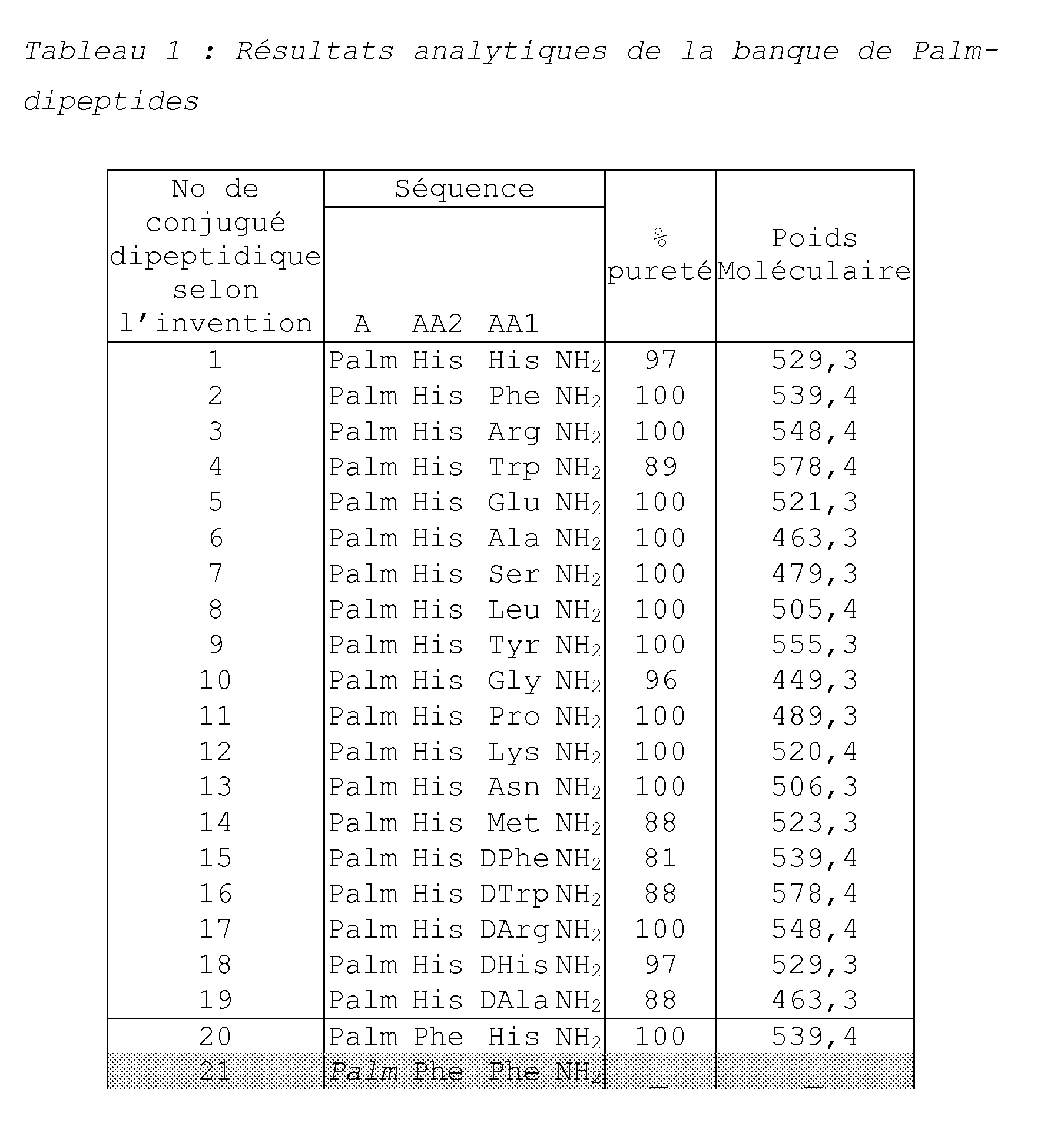


- Sauf pour 35 membres de la banque (grisés), tous les composés ont été détectés par analyse ES+ CL/SM. La pureté moyenne déterminée sur la base du pourcentage de la surface du pic attendu détecté à 214 nm sur le chromatogramme est supérieure à 83 %.
- Des expériences d'inhibition de la production d'AMPc ont été réalisées sur la lignée cellulaire humaine M4Be avec une concentration de 5.10-8 M d'α-MSH. 5 Palm-dipeptides selon la présente invention ont été introduits à diverses concentrations et chaque mesure a été faite en triple. Deux ou trois séries d'expériences ont été réalisées.
Les essais ont été réalisés de la façon suivante : - La lignée cellulaire humaine M4Be (Jacubovichet al. Cancer Immunol. Immunother. 1979, 7, 59-64), une lignée cellulaire de mélanocytes capable de produire des mélanines, a été utilisée dans cette étude pour déterminer les valeurs de CI50.
- Les cellules ont été maintenues dans du milieu Eagle modifié de Dulbecco avec 10 % de sérum de veau foetal (FCS), 1 mM de glutamine, 100 U/ml de pénicilline et 10-4 g/ml de streptomycine.
- Toutes les lignées cellulaires ont été maintenues à 37°C dans une atmosphère à 5 % de CO2 et les milieux de culture des cellules ont été renouvelés tous les deux jours. Les cellules ont été plaquées sur une plaque à 96 puits (Nunc, Roskilde) 24 heures avant le contact des dipeptides selon l'invention.
- L'AMPc a été mesuré de la façon suivante :
- Les cellules plaquées la veille à 8.104 cellules par puits sont mises en présence d'un des 5 conjugués dipeptidique selon l'invention à diverses concentrations pendant 10 minutes à 37°C avec 5.10-8 M d'α-MSH. Après ce temps, la lyse des cellules a été réalisée et la teneur en AMPc a été mesurée en utilisant un coffret de test de liaison par compétition (RPN225, Amersham Pharmacia Biotech). Chaque expérience indépendante a été réalisée au moins deux fois en triple.
- L'activité peptidique a été déterminée en se reportant au taux d'AMPc synthétisé par des cellules non traitées et à la production d'AMPc induite par l'α-MSH seule. Les courbes ont été ajustées et les valeurs de CI50 ont été déterminées avec la régression non linéaire dans le GraphPad Prism (logiciel GraphPad, San Diego, CA, Etats-Unis).
- Les résultats sont présentés dans le Tableau 2 suivant.
Tableau 2 : Expériences d'inhibition de la production d'AMPc sur des cellules M4Be Composés Séquence Pureté (%) CI50 (µm) exp1 CI50 (µm) exp2 CI50 (µm) exp3 CI50 (µM) moyenne 39 Palm-Arg-His-NH2 94 29 4,6 4,4 13 41 Palm-Arg-Arg-NH2 100 36 17 - 26 49 Palm-Arg-Pro-NH2 87 20 26 - 23 50 Palm-Arg-Lys-NH2 100 48 9,6 - 29 125 Palm-Ser-Pro-NH2 100 45 5,5 1,0 17 - Ainsi, de manière inattendue, les Palm-dipeptides testés sont apparus être des antagonistes du récepteur MC1 humain de la mélanocortine en utilisant des lignées cellulaires de mélanome M4Be. Ces conjugués dipeptidiques présentent une CI50 dans une plage micromolaire. Ces dipeptides sont le premier exemple de composés antagonistes de synthèse courts se liant au récepteur MC1 et ils ouvrent le champ des antagonistes à petite molécule non peptidique de l'α-MSH.
En particulier ces composés comprennent un résidu arginine en position AA2. De manière intéressante, le composé 125 (Palm-Ser-Pro-NH2), n'ayant aucun résidu basique dans sa séquence, a montré une valeur de CI50 de 17 µM. Ce résultat a montré que la liaison sur le récepteur MC1 ne nécessite pas obligatoirement un radical chargé positivement.
Avec seulement deux résidus d'acides aminés, ces composés palmitoylés peuvent être considérés comme des composés chefs de file utiles pour la conception d'antagonistes non peptidiques de l'α-MSH.
HOOC-R II
dans laquelle R représente
Claims (7)
- Composition cosmétique ou pharmaceutique destinée à une administration par voie orale ou par voie topique comprenant un conjugué dipeptidique de formule générale I suivante :
A-AA2-AA1-NH2 I
dans laquelle
A représente le radical correspondant à un acide monocarboxylique de formule générale II suivante :
HOOC-R II
dans laquelle R représente- un radical aliphatique en C1-C24 linéaire ou ramifié, éventuellement substitué par un groupe hydroxyle, pouvant comporter une ou plusieurs insaturations, avantageusement de 1 à 6 insaturations, et/ou pouvant comporter un groupe phényle- ou l'acide lipoïque ou sa forme réduite l'acide dihydrolipoïque ou la N-lipoyl-lysine,
AA1 et AA2 représentent des acides aminés identiques ou différents choisis dans le groupe constitué par Ala, Asn, Cys, Gln, Gly, Ile, Leu, Met, Phe, Pro, Ser, Thr, Trp, Tyr, Val, Asp, Glu, His, Lys, Orn, Dap, Dab les homoacides aminés correspondants et les béta-acides aminés correspondants
sous forme d'énantiomères ou de diastéréoisomères ainsi que leurs mélanges, y compris les mélanges racémiques, à la condition qu'au moins un des acides aminés AA1 ou AA2 est Lys
et un excipient cosmétiquement ou pharmaceutiquement acceptable. - Composition cosmétique ou pharmaceutique selon la revendication 1 caractérisée en ce que AA2 représente un acide aminé choisi dans le groupe constitué par His, Lys, Orn, Dap ou Dab.
- Composition cosmétique ou pharmaceutique selon la revendication 1 ou 2 caractérisée en ce que A représente le radical correspondant à l'acide palmitique.
- Composition cosmétique ou pharmaceutique selon l'une quelconque des revendications 1 à 3 caractérisée en ce que le conjugué dipeptidique de formule générale I est choisi dans le groupe constitué par12) Palm-His-Lys-NH2,31) Palm-Phe-Lys-NH2,69) Palm-Trp-Lys-NH2,88) Palm-Glu-Lys-NH2,107) Palm-Ala-Lys-NH2,126) Palm-Ser-Lys-NH2,145) Palm-Leu-Lys-NH2,164) Palm-Tyr-Lys-NH2,183) Palm-Gly-Lys-NH2,202) Palm-Pro-Lys-NH2,210) Palm-Lys-His-NH2,213) Palm-Lys-Trp-NH2,214) Palm-Lys-Glu-NH2,215) Palm-Lys-Ala-NH2,216) Palm-Lys-Ser-NH2,217) Palm-Lys-Leu-NH2,218) Palm-Lys-Tyr-NH2,219) Palm-Lys-Gly-NH2,220) Palm-Lys-Pro-NH2,221) Palm-Lys-Lys-NH2,223) Palm-Lys-Met-NH2,224) Palm-Lys-DPhe-NH2,225) Palm-Lys-DTrp-NH2,226) Palm-Lys-DArg-NH2,227) Palm-Lys-DHis-NH2,228) Palm-Lys-DAla-NH2,240) Palm-Asn-Lys-NH2,259) Palm-Met-Lys-NH2,278) Palm-DPhe-Lys-NH2,297) Palm-DTrp-Lys-NH2,335) Palm-DHis-Lys-NH2,354) Palm-DAla-Lys-NH2.
- Composition pharmaceutique selon l'une quelconque des revendications 1 à 4 à titre de médicament, avantageusement destinée à prévenir, améliorer ou traiter les anormalités immunitaires, l'immunodéficience, réguler le poids du corps en contrôlant l'appétit, traiter les désordres du système nerveux central, réguler la satiété, traiter l'anorexie ou traiter certains cancers cutanés.
- Utilisation d'une composition cosmétique selon l'une quelconque des revendications 1 à 4 en tant que dépigmentant, pour éclaircir ou blanchir l'épiderme, éliminer les tâches de la peau, en particulier de vieillesse ou de rousseur, ou prévenir la pigmentation de l'épiderme.
- Procédé de traitement cosmétique pour éclaircir, dépigmenter ou blanchir l'épiderme, éliminer les tâches de la peau, en particulier de vieillesse ou de rousseur, ou prévenir la pigmentation de l'épiderme comprenant l'application sur la peau d'une composition cosmétique selon l'une quelconque des revendications 1 à 4.
Applications Claiming Priority (3)
| Application Number | Priority Date | Filing Date | Title |
|---|---|---|---|
| FR0405069A FR2870242B1 (fr) | 2004-05-11 | 2004-05-11 | Peptides ou conjugues peptidiques derives de la msh et leur utilisation dans le traitement cosmetique de la canitie. |
| FR0411279A FR2870244B1 (fr) | 2004-05-11 | 2004-10-22 | Conjugues dipeptidiques antagonistes de l'alpha-msh |
| EP05770970A EP1750528A2 (fr) | 2004-05-11 | 2005-05-10 | Conjugues dipeptidiques antagonistes de l'alpha-msh |
Related Parent Applications (1)
| Application Number | Title | Priority Date | Filing Date |
|---|---|---|---|
| EP05770970.1 Division | 2005-05-10 |
Publications (2)
| Publication Number | Publication Date |
|---|---|
| EP2228381A2 true EP2228381A2 (fr) | 2010-09-15 |
| EP2228381A3 EP2228381A3 (fr) | 2010-12-29 |
Family
ID=34973223
Family Applications (2)
| Application Number | Title | Priority Date | Filing Date |
|---|---|---|---|
| EP10157084A Withdrawn EP2228381A3 (fr) | 2004-05-11 | 2005-05-10 | Conjugués dipeptidiques antagonistes de l'alpha-MSH |
| EP05770970A Withdrawn EP1750528A2 (fr) | 2004-05-11 | 2005-05-10 | Conjugues dipeptidiques antagonistes de l'alpha-msh |
Family Applications After (1)
| Application Number | Title | Priority Date | Filing Date |
|---|---|---|---|
| EP05770970A Withdrawn EP1750528A2 (fr) | 2004-05-11 | 2005-05-10 | Conjugues dipeptidiques antagonistes de l'alpha-msh |
Country Status (6)
| Country | Link |
|---|---|
| US (1) | US8097590B2 (fr) |
| EP (2) | EP2228381A3 (fr) |
| JP (2) | JP4897969B2 (fr) |
| CA (1) | CA2566478A1 (fr) |
| FR (3) | FR2870244B1 (fr) |
| WO (1) | WO2005115174A2 (fr) |
Families Citing this family (16)
| Publication number | Priority date | Publication date | Assignee | Title |
|---|---|---|---|---|
| FR2870244B1 (fr) * | 2004-05-11 | 2011-01-07 | Centre Nat Rech Scient | Conjugues dipeptidiques antagonistes de l'alpha-msh |
| DE102006011883A1 (de) * | 2006-03-09 | 2007-09-13 | Beiersdorf Ag | Tropolon- und Hydroxybenzol-substituierte Oligopeptide zur Depigmentierung |
| FR2900573B1 (fr) * | 2006-05-05 | 2014-05-16 | Sederma Sa | Nouvelles compositions cosmetiques renfermant au moins un peptide contenant au moins un cycle aromatique bloque |
| CN107028792A (zh) * | 2008-05-29 | 2017-08-11 | 唐纳德·欧文 | 皮肤美容组合物中的寡聚生物表面活性剂 |
| CA2853791C (fr) * | 2011-10-28 | 2017-10-24 | Ruey J. Yu | Derives n-acyldipeptides et leurs utilisations |
| DK2827907T3 (da) * | 2012-03-20 | 2019-06-11 | Helix Biomedix Inc | Korte antimikrobielle lipopeptider |
| FR2998570B1 (fr) | 2012-11-26 | 2016-12-02 | Sederma Sa | Peptides, compositions les comprenant et utilisations notamment cosmetiques propigmentantes |
| KR101553637B1 (ko) * | 2014-01-27 | 2015-09-16 | (주)셀인바이오 | 펩타이드 지방산 유도체 및 이를 함유하는 주름 개선용 화장품 조성물 |
| EP3393604B1 (fr) | 2015-12-24 | 2026-02-11 | Unilever Global IP Limited | Inhibiteurs de la tyrosinase |
| FR3047990B1 (fr) * | 2016-02-18 | 2020-12-25 | Rpm Dermatologie | Composition cosmetique cutanee comprenant un peptide sdkp ou un analogue de celui-ci |
| US12435056B2 (en) | 2016-03-14 | 2025-10-07 | Neostrata Company, Inc. | N-lipoic-amino acid or peptide, derivatives and their uses |
| EP3429577B1 (fr) * | 2016-03-14 | 2021-12-29 | NeoStrata Company, Inc. | Acide aminé ou peptide n-lipoïque, dérivés et leurs utilisations |
| WO2019208700A1 (fr) * | 2018-04-26 | 2019-10-31 | ゼリア新薬工業株式会社 | Dipeptide et composition pharmaceutique le contenant |
| CN111100890B (zh) * | 2018-10-26 | 2022-04-08 | 中国石油化工股份有限公司 | 一种提高木质纤维素糖化率的方法 |
| KR102163568B1 (ko) * | 2020-08-21 | 2020-10-07 | 주식회사 비드테크 | 지방산 항균펩타이드 및 이를 함유하는 항균 조성물 |
| CN114292312B (zh) * | 2022-01-13 | 2025-10-14 | 湖南微肽生物医药有限公司 | 一种全液相合成9肽-1的方法 |
Citations (1)
| Publication number | Priority date | Publication date | Assignee | Title |
|---|---|---|---|---|
| EP1174437A1 (fr) | 1999-04-26 | 2002-01-23 | Ajinomoto Co., Inc. | Inhibiteur hormonal stimulant les melanocytes |
Family Cites Families (29)
| Publication number | Priority date | Publication date | Assignee | Title |
|---|---|---|---|---|
| DE1184770C2 (de) | 1961-06-01 | 1965-09-02 | Hoffmann La Roche | Verfahren zur Herstellung von antibacteriell wirksamen Peptiden |
| FR1327363A (fr) * | 1962-05-21 | 1963-05-17 | Hoffmann La Roche | Peptides et procédé pour leur préparation |
| US5674839A (en) | 1987-05-22 | 1997-10-07 | Competitive Technologies, Inc. | Cyclic analogs of alpha-MSH fragments |
| EP0389950A1 (fr) | 1989-03-23 | 1990-10-03 | Lion Corporation | Inhibiteur de l'hormone stimulant les mélanocytes et préparation à usage externe la contenant |
| AU5609694A (en) * | 1992-11-24 | 1994-06-22 | University Of Cincinnati, The | Melanogenic inhibitor, and methods of producing and using the same |
| FR2710340B1 (fr) | 1993-09-22 | 1995-12-15 | D Hinterland Lucien Dussourd | Dérivés peptidiques de l'alpha-MSH et leur application . |
| US5786332A (en) * | 1995-03-06 | 1998-07-28 | Trega Biosciences, Inc. | Cytokine restraining agents and methods of use in pathologies and conditions associated with altered cytokine levels |
| US6054556A (en) * | 1995-04-10 | 2000-04-25 | The Arizona Board Of Regents On Behalf Of The University Of Arizona | Melanocortin receptor antagonists and agonists |
| JP4105763B2 (ja) * | 1995-06-23 | 2008-06-25 | ザ ガバメント オブ ザ ユナイテッド ステイツ オブ アメリカ,アズ リプレゼンテッド バイ ザ セクレタリー デパートメント オブ ヘルス アンド ヒューマン サービシーズ | アグーチシグナルタンパク質およびそのペプチドの脱色活性 |
| FR2741075B1 (fr) * | 1995-11-15 | 1998-01-30 | Rech De Pathologie Appliquee S | Conjugues peptidiques, leur utilisation a titre de medicament et compositions les contenant |
| US5714567A (en) * | 1996-02-15 | 1998-02-03 | Council Of Scientific & Ind. Research | Process for the preparation of aromatic polyesters |
| US6372717B1 (en) * | 1996-08-23 | 2002-04-16 | Sederma S.A. | Synthetic peptides and their use in cosmetic or dermopharmaceutical compositions |
| DE19653736C2 (de) | 1996-12-12 | 2002-11-21 | Lancaster Group Gmbh | Kosmetisches Präparat mit Peptidzusatz |
| US6228840B1 (en) * | 1998-02-27 | 2001-05-08 | Edward T. Wei | Melanocortin receptor antagonists and modulations of melanocortin receptor activity |
| FR2781157B1 (fr) | 1998-07-15 | 2000-08-25 | Oreal | Composition anti-inflammatoire |
| FR2805744B1 (fr) | 2000-03-03 | 2006-08-25 | Sederma Sa | Compositions cosmetiques ou dermopharmaceutiques contenant le dipeptide val-trp pour faciliter le drainage lymphatique et diminuer la masse adipeuse |
| BR0111718A (pt) | 2000-06-16 | 2003-09-09 | Hercules Inc | Peptìdeos quimicamente modificados, composições e métodos de produção e uso |
| FR2810323B1 (fr) | 2000-06-16 | 2002-09-06 | Shiseido Int France | Utilisation cosmetique d'un lipopeptide |
| US6911447B2 (en) | 2001-04-25 | 2005-06-28 | The Procter & Gamble Company | Melanocortin receptor ligands |
| US20030194445A1 (en) * | 2001-11-12 | 2003-10-16 | Kuhner Carla H. | Compositions and methods of use of peptides in combination with biocides and/or germicides |
| JP4158382B2 (ja) * | 2002-01-30 | 2008-10-01 | 株式会社ナリス化粧品 | 口紅用組成物 |
| FR2835528B1 (fr) * | 2002-02-01 | 2004-03-12 | Inst Europ Biolog Cellulaire | Nouveaux derives peptidiques, leur preparation et leur application therapeutique et cosmetique |
| FR2836042B1 (fr) * | 2002-02-15 | 2004-04-02 | Sederma Sa | Compositions cosmetiques ou dermopharmaceutiques pour diminuer les poches et cernes sous les yeux |
| US20040010010A1 (en) * | 2002-04-30 | 2004-01-15 | Ebetino Frank Hallock | Melanocortin receptor ligands |
| US7034004B2 (en) | 2002-05-07 | 2006-04-25 | University Of Florida | Peptides and methods for the control of obesity |
| PL1625150T3 (pl) | 2003-05-08 | 2007-05-31 | Dsm Ip Assets Bv | Tripeptydy i ich pochodne do stosowania w kosmetyce w celu poprawy struktury skóry |
| WO2004110341A2 (fr) | 2003-06-19 | 2004-12-23 | Yeda Research & Development Co. Ltd. | Lipopeptides antimicrobiens et anticancereux |
| FR2870244B1 (fr) * | 2004-05-11 | 2011-01-07 | Centre Nat Rech Scient | Conjugues dipeptidiques antagonistes de l'alpha-msh |
| FR2870242B1 (fr) | 2004-05-11 | 2010-08-20 | Inst Europeen Biologie Cellulaire | Peptides ou conjugues peptidiques derives de la msh et leur utilisation dans le traitement cosmetique de la canitie. |
-
2004
- 2004-10-22 FR FR0411279A patent/FR2870244B1/fr not_active Expired - Fee Related
-
2005
- 2005-05-10 WO PCT/FR2005/001164 patent/WO2005115174A2/fr not_active Ceased
- 2005-05-10 JP JP2007512280A patent/JP4897969B2/ja not_active Expired - Fee Related
- 2005-05-10 US US11/596,286 patent/US8097590B2/en not_active Expired - Fee Related
- 2005-05-10 EP EP10157084A patent/EP2228381A3/fr not_active Withdrawn
- 2005-05-10 EP EP05770970A patent/EP1750528A2/fr not_active Withdrawn
- 2005-05-10 CA CA002566478A patent/CA2566478A1/fr not_active Abandoned
-
2010
- 2010-03-19 FR FR1051995A patent/FR2941459A1/fr active Pending
- 2010-04-13 JP JP2010092089A patent/JP2010235608A/ja active Pending
- 2010-08-05 FR FR1056469A patent/FR2945809A1/fr not_active Withdrawn
Patent Citations (1)
| Publication number | Priority date | Publication date | Assignee | Title |
|---|---|---|---|---|
| EP1174437A1 (fr) | 1999-04-26 | 2002-01-23 | Ajinomoto Co., Inc. | Inhibiteur hormonal stimulant les melanocytes |
Non-Patent Citations (10)
| Title |
|---|
| CONE ET AL., RECENT PROG. HORM. RES., vol. 51, 1996, pages 287 - 317 |
| FELIU ET AL., J. COMB. CHEM., vol. 5, 2003, pages 256 - 361 |
| HRUBY ET AL., ANN. N.Y. ACAD. SCI., vol. 680, 1993, pages 51 - 63 |
| JAYAWICKREME ET AL., J. BIOL. CHEM., vol. 269, 1994, pages 29846 - 29854 |
| LERNER ET AL., NATURE, 1961, pages 189,176 |
| LU ET AL., NATURE, vol. 371, 1994, pages 799 - 802 |
| MOUNTJOY ET AL., SCIENCE, vol. 257, 1992, pages 1248 - 1251 |
| OLLMANN ET AL., SCIENCE, 1997, pages 135 - 138 |
| PROC. NATL. ACAD. SCI., vol. 92, 1995, pages 2894 - 2898 |
| SHULTER ET AL., GENES DEV., vol. 11, 1997, pages 593 - 602 |
Also Published As
| Publication number | Publication date |
|---|---|
| JP4897969B2 (ja) | 2012-03-14 |
| US8097590B2 (en) | 2012-01-17 |
| CA2566478A1 (fr) | 2005-12-08 |
| EP1750528A2 (fr) | 2007-02-14 |
| FR2945809A1 (fr) | 2010-11-26 |
| FR2941459A1 (fr) | 2010-07-30 |
| WO2005115174A2 (fr) | 2005-12-08 |
| WO2005115174A3 (fr) | 2006-05-26 |
| US20070231284A1 (en) | 2007-10-04 |
| JP2010235608A (ja) | 2010-10-21 |
| FR2870244B1 (fr) | 2011-01-07 |
| JP2007537213A (ja) | 2007-12-20 |
| FR2870244A1 (fr) | 2005-11-18 |
| EP2228381A3 (fr) | 2010-12-29 |
Similar Documents
| Publication | Publication Date | Title |
|---|---|---|
| FR2941459A1 (fr) | Conjugues dipeptidiques antagonistes de l'alpha-msh | |
| FR2835528A1 (fr) | Nouveaux derives peptidiques, leur preparation et leur application therapeutique et cosmetique | |
| WO2000043417A1 (fr) | Utilisation cosmetique ou pharmaceutique de peptides pour la regulation des dysfonctionnements immunologiques et dans l'inflammation cutanes | |
| JP2008515815A (ja) | 対象者におけるメラニン形成を誘導するための組成物および方法 | |
| WO2017159922A1 (fr) | Conjugué de finastéride avec un peptide | |
| EP1663285B1 (fr) | Utilisation de conjugues peptidiques pour la preparation de compositions destinees au traitement preventif et curatif del'alopecie | |
| EP1753781B1 (fr) | Peptides ou conjugues peptidiques derives de la msh et leur utilisation dans le traitement cosmetique de la canitie | |
| EP1745071B1 (fr) | Conjugues tripeptidiques agonistes de la msh | |
| EP0837881A2 (fr) | CONJUGUES D'alpha-MSH AVEC UN ACIDE GRAS, LEUR PROCEDE DE PREPARATION ET LEUR UTILISATION A TITRE DE MEDICAMENT | |
| EP0316322B1 (fr) | Tetrapeptide inhibiteur de l'entree en cycle des cellules souches hematopo etiques, procedes pour son obtention et ses applications | |
| CN110612125B (zh) | 异维a酸和肽的偶联物 | |
| CA2532869C (fr) | Nouveaux conjugues peptidiques utiles dans le traitement preventif et curatif de l`alopecie | |
| EP3416730B1 (fr) | Composition cosmétique cutanée comprenant un peptide sdkp ou un analogue de celui-ci | |
| US9624265B2 (en) | Short peptides and a method of use as an antioxidant | |
| OA19680A (en) | Conjugate of Isotretinoin and Peptide. |
Legal Events
| Date | Code | Title | Description |
|---|---|---|---|
| PUAI | Public reference made under article 153(3) epc to a published international application that has entered the european phase |
Free format text: ORIGINAL CODE: 0009012 |
|
| AC | Divisional application: reference to earlier application |
Ref document number: 1750528 Country of ref document: EP Kind code of ref document: P |
|
| AK | Designated contracting states |
Kind code of ref document: A2 Designated state(s): AT BE BG CH CY CZ DE DK EE ES FI FR GB GR HU IE IS IT LI LT LU MC NL PL PT RO SE SI SK TR |
|
| PUAL | Search report despatched |
Free format text: ORIGINAL CODE: 0009013 |
|
| AK | Designated contracting states |
Kind code of ref document: A3 Designated state(s): AT BE BG CH CY CZ DE DK EE ES FI FR GB GR HU IE IS IT LI LT LU MC NL PL PT RO SE SI SK TR |
|
| STAA | Information on the status of an ep patent application or granted ep patent |
Free format text: STATUS: THE APPLICATION IS DEEMED TO BE WITHDRAWN |
|
| 18D | Application deemed to be withdrawn |
Effective date: 20110630 |