EP2227031A2 - Verfahren und Systeme zur Erkennung und Lokalisierung von übersprungenen Rahmen in einer Videoabfolge - Google Patents
Verfahren und Systeme zur Erkennung und Lokalisierung von übersprungenen Rahmen in einer Videoabfolge Download PDFInfo
- Publication number
- EP2227031A2 EP2227031A2 EP10155703A EP10155703A EP2227031A2 EP 2227031 A2 EP2227031 A2 EP 2227031A2 EP 10155703 A EP10155703 A EP 10155703A EP 10155703 A EP10155703 A EP 10155703A EP 2227031 A2 EP2227031 A2 EP 2227031A2
- Authority
- EP
- European Patent Office
- Prior art keywords
- segment
- frames
- frame
- pair
- test
- Prior art date
- Legal status (The legal status is an assumption and is not a legal conclusion. Google has not performed a legal analysis and makes no representation as to the accuracy of the status listed.)
- Withdrawn
Links
Images

Classifications
-
- H—ELECTRICITY
- H04—ELECTRIC COMMUNICATION TECHNIQUE
- H04N—PICTORIAL COMMUNICATION, e.g. TELEVISION
- H04N17/00—Diagnosis, testing or measuring for television systems or their details
- H04N17/004—Diagnosis, testing or measuring for television systems or their details for digital television systems
Definitions
- Embodiments of the present invention relate, in general, to methods and systems for video processing, and more particularly, to methods and systems for video quality measurements and analysis.
- Video quality measurements and analysis may require each frame in a test video sequence to be played at the same time as the corresponding frame of a reference video sequence is played. This may be referred to as temporal registration of the test video sequence and the reference video sequence.
- Temporal registration may be difficult to perform, either manually or by an automated method, due to differing video formats, differing frame rates, temporal distortions, temporal impairments and other differences between the test video sequence and the reference video sequence.
- encoding, transporting, broadcasting, distributing, decoding, and other processing of video may contribute to one, or more, frames being skipped in a video sequence as illustrated in the exemplary reference and test sequences:
- Automated methods and systems to measure the number and location of skipped frames in a test video sequence relative to a reference video sequence may be desirable.
- Accurate and computationally efficient methods and systems may also be desirable.
- Embodiments of the present invention comprise methods and systems for detecting and locating skipped frames in a test video sequence in relation to a reference video sequence. Some embodiments of the present invention comprise identifying pairs of temporally aligned reference segments and test segments. An alignment offset and freeze-frame count associated with each segment pair may be received and used to calculate a number of skipped frames between a first segment pair and a second segment pair, wherein the second segment pair is temporally subsequent to the first segment pair.
- a number of skipped frames between the first segment pair and the second segment pair may be determined by calculating a segment offset between the two segment pairs and subtracting the segment offset value from the sum of the number of freeze frames associated with the first segment pair and all temporally intervening segment pairs between the first segment pair and the second segment pair.
- Some embodiments of the present invention comprise calculating a similarity measure between corresponding frames in segment pairs and identifying discontinuities in the calculated similarity measures.
- the location of skipped frames may be determined by resolving the discontinuities using the skipped-frame and freeze-frame counts associated with the segment pairs.
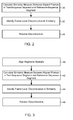
- Fig. 1 is a chart showing exemplary embodiments of the present invention comprising forming temporally aligned segment pairs and calculating the number of skipped frames using alignment offset and freeze-frame count;
- Fig. 2 is a chart showing exemplary embodiments of the present invention comprising similarity-measure calculation, similarity-measure discontinuity identification and discontinuity resolution for locating skipped frames;
- Fig. 3 is a chart showing exemplary embodiments of the present invention comprising spatial alignment prior to similarity-measure calculation
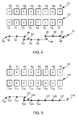
- Fig. 4 is a picture illustrating similarity-measure discontinuity resolution, for an exemplary reference segment and test segment, according to embodiments of the present invention
- Fig. 5 is a picture illustrating similarity-measure discontinuity resolution, for an exemplary reference segment and test segment, according to embodiments of the present invention.
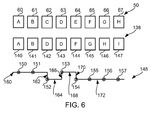
- Fig. 6 is a picture illustrating similarity-measure discontinuity resolution, for an exemplary reference segment and test segment, according to embodiments of the present invention.
- Embodiments of the present invention may be implemented within a test and measurement instrument.
- embodiments of the present invention may be implemented in a video test instrument, such as a picture quality analyzer.
- Picture quality analyzers such as the TEKTRONIX® PQA500 may incorporate embodiments of the present invention.
- Embodiments of the present invention may be used to process signals originating from video equipment. These video signals might be produced by playback equipment, such as DVD players, set-top boxes or production equipment used by broadcasters, or other content providers, prior to transmission of content to end-users.
- playback equipment such as DVD players, set-top boxes or production equipment used by broadcasters, or other content providers
- Video quality measurements and analysis may require each frame in a test video sequence to be played at the same time as the corresponding frame of a reference video sequence is played. This may be referred to as temporal registration of the test video sequence and the reference video sequence.
- Temporal registration may be difficult to perform, either manually or by an automated method, due to differing video formats, differing frame rates, temporal distortions, temporal impairments and other differences between the test video sequence and the reference video sequence.
- encoding, transporting, broadcasting, distributing, decoding, and other processing of video may contribute to one, or more, frames being skipped in a video sequence as illustrated in the exemplary reference and test sequences:
- Automated methods and systems to measure the number and location of skipped frames in a test video sequence relative to a reference video sequence may be desirable.
- Accurate and computationally efficient methods and systems may also be desirable.
- Embodiments of the present invention comprise methods and system for detecting and locating skipped frames in a test video sequence, also considered a test sequence, relative to a reference video sequence, also considered a reference sequence.
- test sequence and a reference sequence may be received 10.
- the reference sequence may be segmented 12, and test-sequence segments may be temporally aligned 14 to the reference-sequence segments, thereby producing pairs of temporally aligned segments.
- An alignment offset associated with each test-sequence segment may be determined 16.
- a test-sequence segment alignment offset may be the offset in the test sequence relative to the reference sequence of the starting frame of the reference-sequence segment and the starting frame of the test-sequence segment in a segment pair.
- the number of freeze frames in each test-sequence segment may be determined 18.
- the location of the skipped frames may be determined 22 based on the number of skipped frames detected between pairs of segments.
- an incorrect skipped-frame count may be determined when a skipped frame occurs substantially close to the beginning of the first segment or substantially close to the end of the last segment. These outcomes may be referred to as end-point-based inconsistent results.
- a skipped frame that is not detected between two segment pairs may be detected between two other segment pairs.
- Calculation 20 of the number of skipped frames may be understood in relation to the following example.
- a reference sequence comprising a sequence of reference frames and a test sequence comprising a sequence of test frames
- a B C D E F G H I J K L M N O P Q R S T U V W X Y Z a b c d e f g h i j k l m and A B C D E F I J K L M N N O P R S T U V W X Y Z a b c d d d e f g h i j k l m, respectively, wherein frames G, H and Q are skipped in the test sequence in relation to the reference sequence, and frames N and d in the test sequence are freeze frames with freeze-frame occurrences of one and two, respectively.
- Exemplary segment alignments may be given by the segment pairs:
- the number of freeze frames and alignment offsets may be used to calculate 20 the number of skipped frames between segment pairs.
- the number of freeze frames and alignment information is summarized in Table 1 for this example.
- Table 1 Segment Summary for Example SEGMENT s ALIGNMENT OFFSET align OS ( s ) NUMBER OF FREEZE FRAMES FreezeFrames ( s ) 0 0 0 1 -2 1 2 -2 0 3 -2 2 4 0 0 0
- the number of skipped frames is determined to be two, which is consistent since reference frames G and H are skipped in the test segment.
- the number of skipped frames is determined to be three, which is consistent since reference frames G, H and Q are skipped in the test segment.
- the number of skipped frames is determined to be three, which is consistent since reference frames G, H and Q are skipped in the test segments.
- the number of skipped frames is determined to be three, which is consistent since reference frames G, H and Q are skipped in the test segments.
- the number of skipped frames is determined to be one, which is consistent since reference frame Q is skipped in the test segment.
- the number of skipped frames is determined to be one, which is consistent since reference frame Q is skipped in the test segments.
- the number of skipped frames is determined to be one, which is consistent since reference frame Q is skipped in the test segments.
- the number of skipped frames is determined to be zero, which is inconsistent due to end-point conditions.
- the number of skipped frames is determined to be zero, which is consistent since no frames are skipped in the test segment.
- temporal alignment 14, offset determination 16 and freeze-frame determination 18 for each segment pair may be performed according to methods and systems developed by Kevin M. Ferguson, the present inventor, and described in U.S. Patent Application Serial Number 12/104,380 , hereinafter the '380 application, entitled “Systems and Methods for Robust Video Temporal Registration,” filed on April 16, 2008, and which is hereby incorporated herein by reference in its entirety.
- the '380 application claims the benefit of U.S. Provisional Patent Application Serial Number 60/912,167 entitled “Systems and Methods for Robust Video Temporal Registration," filed on April 16, 2007, and which is hereby incorporated herein by reference in its entirety.
- the methods and systems of the '380 application may be applied successively using each segment result to initialize the next search.
- temporal alignment 14, offset determination 16 and freeze-frame determination 18 may be performed according to alternative methods.
- Exemplary alternative methods may include manual methods, automated methods and other methods known in the art.
- determining 22 the location of skipped frames within one, or more, pairs of segments may comprise measuring 30 the similarity between reference-sequence frames and test-sequence frames in the segment pairs.
- Exemplary similarity measures may comprise calculating peak-signal-to-noise ratio (PSNR), a correlation or other measures of similarity known in the art.
- PSNR peak-signal-to-noise ratio
- Frame-level discontinuities in similarity may be identified 32 and resolved 34 to locate the skipped frames.
- determining 22 the location of skipped frames may comprise spatial alignment 40 prior to similarity calculation 42, discontinuity identification 44 and discontinuity resolution 46.
- spatial alignment 40 may be performed according to methods and systems developed by Kevin M. Ferguson, the present inventor, and described in U.S. Patent Application Serial Number 11/944,050 , hereinafter the '050 application, entitled “Measurement Apparatus and Method of Measurement of Video Spatial Scale, Offset and Cropping," filed on November 21, 2007, and which is hereby incorporated herein by reference in its entirety.
- the '050 application claims the benefit of U.S. Provisional Patent Application Serial Number 60/867,087, filed on November 22, 2006 , and which is hereby incorporated herein by reference in its entirety.
- discontinuity resolution 34, 46 may comprise alignment compensation for freeze frames.
- multiple skipped frames per segment pair may be located by alignment adjustment of the segments within the segment pair to favor the portion with the poorest alignment at a previously determined skipped-frame discontinuity and successively locating, according to the above-described embodiments, additional skipped frames.
- Discontinuity resolution may be understood in relation to the following examples depicted in Figure 4, Figure 5 and Figure 6 .
- Figure 4 depicts an exemplary reference segment 50 and an exemplary test segment 52.
- the exemplary reference segment 50 comprises eight frames 60-67 labeled A, B, C, D, E, F, G and H, respectively, and the exemplary test segment 52 comprises eight frames 70-77, wherein, relative to the reference segment 50, frame C has been skipped and segment F 74, 75 appears twice.
- the freeze-frame count for this exemplary segment pair is one, and the skipped-frame count is one.
- An exemplary similarity plot 78 is shown, wherein similar frames yield high 90, 98 similarity-measure values, and dissimilar frames yield low 94 similarity-measure values. Discontinuities 92, 96 occur at the transitions between high and low similarity-measure values.
- reference frame A 60 and test frame A 70 are aligned and yield a high similarity-measure value 80; reference frame B 61 and test frame B 71 are aligned and yield a high similarity-measure value 81; reference frame C 62 and test frame D 72 are not aligned and yield a low similarity-measure value 82; reference frame D 63 and test frame E 73 are not aligned and yield a low similarity-measure value 83; reference frame E 64 and test frame F 74 are not aligned and yield a low similarity-measure value 84; reference frame F 65 and test frame (freeze frame) F 75 are aligned and yield a high similarity-measure value 85; reference frame G 66 and test frame G 76 are aligned and yield a high similarity-measure value 86; and reference frame H 67 and test frame H 77 are aligned and yield a high similarity-measure value 87.
- Figure 5 depicts an exemplary reference segment 50 and an exemplary test segment 102.
- the exemplary reference segment 50 comprises eight frames 60-67 labeled A, B, C, D, E, F, G and H, respectively, and the exemplary test segment 102 comprises eight frames 110-117, wherein, relative to the reference segment 50, frames C and E have been skipped and segment F 113, 114 appears twice.
- the freeze-frame count for this exemplary segment pair is one, and the skipped-frame count is two.
- An exemplary similarity plot 118 is shown, wherein similar frames yield high 130 similarity-measure values, and dissimilar frames yield low 134 similarity-measure values.
- a discontinuity 132 occurs at the transition between the high and the low similarity-measure values.
- reference frame A 60 and test frame A 110 are aligned and yield a high similarity-measure value 120; reference frame B 61 and test frame B 111 are aligned and yield a high similarity-measure value 121; reference frame C 62 and test frame D 112 are not aligned and yield a low similarity-measure value 122; reference frame D 63 and test frame F 113 are not aligned and yield a low similarity-measure value 123; reference frame E 64 and test frame (freeze frame) F 114 are not aligned and yield a low similarity-measure value 124; reference frame F 65 and test frame G 115 are not aligned and yield a low similarity-measure value 125; reference frame G 66 and test frame H 116 are not aligned and yield a low similarity-measure value 126; and reference frame H 67 and test frame I 117 are not aligned and yield a low similarity-measure value 87.
- Figure 6 depicts an exemplary reference segment 50 and an exemplary test segment 138.
- the exemplary reference segment 50 comprises eight frames 60-67 labeled A, B, C, D, E, F, G and H, respectively, and the exemplary test segment 138 comprises eight frames 140-147, wherein, relative to the reference segment 50, frames C and E have been skipped and segment D 142, 143 appears twice.
- the freeze-frame count for this exemplary segment pair is one, and the skipped-frame count is two.
- An exemplary similarity plot 148 is shown, wherein similar frames yield high 160, 168 similarity-measure values, and dissimilar frames yield low 164, 172 similarity-measure values. Discontinuities 162, 166, 170 occur at the transitions between high and low similarity-measure values.
- reference frame A 60 and test frame A 140 are aligned and yield a high similarity-measure value 150; reference frame B 61 and test frame B 141 are aligned and yield a high similarity-measure value 151; reference frame C 62 and test frame D 142 are not aligned and yield a low similarity-measure value 152; reference frame D 63 and test frame (freeze frame) D 143 are aligned and yield a high similarity-measure value 153; reference frame E 64 and test frame F 144 are not aligned and yield a low similarity-measure value 154; reference frame F 65 and test frame G 145 are not aligned and yield a low similarity-measure value 155; reference frame G 66 and test frame H 146 are not aligned and yield a low similarity-measure value 156; and reference frame H 67 and test frame I 147 are not aligned and yield a low similarity-measure value 157.
- a discontinuity 162 occurs at the location of frame C in the reference segment 50, and thus the location of a first skipped frame is known.
- the similarity measure jumps 166 from a low value 164 to a high value 168 when the freeze frame brings the segments back into alignment.
- a subsequent discontinuity 170 indicates a second skipped frame since the freeze frame corresponding to the freeze-frame count of one has already been consumed in the discontinuity resolution. Thus, the two skipped frames and one freeze frame have been resolved.
Landscapes
- Engineering & Computer Science (AREA)
- Health & Medical Sciences (AREA)
- Biomedical Technology (AREA)
- General Health & Medical Sciences (AREA)
- Multimedia (AREA)
- Signal Processing (AREA)
- Testing, Inspecting, Measuring Of Stereoscopic Televisions And Televisions (AREA)
- Television Signal Processing For Recording (AREA)
- Indexing, Searching, Synchronizing, And The Amount Of Synchronization Travel Of Record Carriers (AREA)
Applications Claiming Priority (1)
| Application Number | Priority Date | Filing Date | Title |
|---|---|---|---|
| US12/398,725 US8184163B2 (en) | 2009-03-05 | 2009-03-05 | Methods and systems for detecting and locating skipped frames in a video sequence |
Publications (2)
| Publication Number | Publication Date |
|---|---|
| EP2227031A2 true EP2227031A2 (de) | 2010-09-08 |
| EP2227031A3 EP2227031A3 (de) | 2013-02-20 |
Family
ID=42138926
Family Applications (1)
| Application Number | Title | Priority Date | Filing Date |
|---|---|---|---|
| EP10155703A Withdrawn EP2227031A3 (de) | 2009-03-05 | 2010-03-05 | Verfahren und Systeme zur Erkennung und Lokalisierung von übersprungenen Rahmen in einer Videoabfolge |
Country Status (3)
| Country | Link |
|---|---|
| US (1) | US8184163B2 (de) |
| EP (1) | EP2227031A3 (de) |
| JP (1) | JP5448926B2 (de) |
Cited By (1)
| Publication number | Priority date | Publication date | Assignee | Title |
|---|---|---|---|---|
| US20220232275A1 (en) * | 2019-12-13 | 2022-07-21 | At&T Intellectual Property I, L.P. | Adaptive bitrate video testing from screen recording |
Families Citing this family (9)
| Publication number | Priority date | Publication date | Assignee | Title |
|---|---|---|---|---|
| US7978933B2 (en) * | 2007-04-16 | 2011-07-12 | Tektronix, Inc. | Systems and methods for robust video temporal registration |
| WO2010089384A2 (en) * | 2009-02-06 | 2010-08-12 | Thomson Licensing | Method for two-step temporal video registration |
| US8437577B2 (en) * | 2009-03-05 | 2013-05-07 | Tektronix, Inc. | Methods and systems for image registration |
| JP5185346B2 (ja) | 2010-09-15 | 2013-04-17 | 株式会社日本自動車部品総合研究所 | ヒートシンク |
| CN103747238B (zh) * | 2013-02-20 | 2015-07-08 | 华为技术有限公司 | 视频静止失真程度评估方法和装置 |
| US9641809B2 (en) | 2014-03-25 | 2017-05-02 | Nxp Usa, Inc. | Circuit arrangement and method for processing a digital video stream and for detecting a fault in a digital video stream, digital video system and computer readable program product |
| US20170249521A1 (en) * | 2014-05-15 | 2017-08-31 | Arris Enterprises, Inc. | Automatic video comparison of the output of a video decoder |
| US11064204B2 (en) | 2014-05-15 | 2021-07-13 | Arris Enterprises Llc | Automatic video comparison of the output of a video decoder |
| US9826252B2 (en) * | 2014-07-29 | 2017-11-21 | Nxp Usa, Inc. | Method and video system for freeze-frame detection |
Citations (1)
| Publication number | Priority date | Publication date | Assignee | Title |
|---|---|---|---|---|
| US10438008B2 (en) | 2014-10-30 | 2019-10-08 | Microsoft Technology Licensing, Llc | Row level security |
Family Cites Families (15)
| Publication number | Priority date | Publication date | Assignee | Title |
|---|---|---|---|---|
| US5933567A (en) * | 1993-01-13 | 1999-08-03 | Hitachi America, Ltd. | Method and apparatus for controlling the position of the heads of a digital video tape recorder during trick play operation and for recording digital data on a tape |
| US5642294A (en) * | 1993-12-17 | 1997-06-24 | Nippon Telegraph And Telephone Corporation | Method and apparatus for video cut detection |
| JPH0918900A (ja) * | 1995-06-30 | 1997-01-17 | Sony Corp | デイジタルビデオ機器の評価装置 |
| US5835163A (en) * | 1995-12-21 | 1998-11-10 | Siemens Corporate Research, Inc. | Apparatus for detecting a cut in a video |
| JP4021545B2 (ja) * | 1998-03-12 | 2007-12-12 | 株式会社東芝 | デジタル動画像処理装置およびデジタル動画像処理方法 |
| US6906743B1 (en) * | 1999-01-13 | 2005-06-14 | Tektronix, Inc. | Detecting content based defects in a video stream |
| US6377297B1 (en) * | 1999-12-07 | 2002-04-23 | Tektronix, Inc. | Detection of repeated and frozen frames in a video signal |
| US7110454B1 (en) * | 1999-12-21 | 2006-09-19 | Siemens Corporate Research, Inc. | Integrated method for scene change detection |
| US7889211B2 (en) * | 2002-04-15 | 2011-02-15 | Tektronix, Inc. | Measuring PSNR of full color video |
| US7010046B2 (en) * | 2002-05-02 | 2006-03-07 | Lsi Logic Corporation | Method and/or architecture for implementing MPEG frame display using four frame stores |
| US7586515B2 (en) * | 2005-05-23 | 2009-09-08 | Tektronix, Inc. | Instrument for real-time video quality measurement |
| US7920758B2 (en) * | 2006-11-22 | 2011-04-05 | Tektronix, Inc. | Measurement apparatus and method of measurement of video spatial scale, offset and cropping |
| GB0706496D0 (en) * | 2007-04-03 | 2007-05-09 | British Telecomm | Method and system for video quality assessment |
| EP2137976B1 (de) * | 2007-04-09 | 2017-06-07 | Tektronix, Inc. | Systeme und verfahren für räumlich isolierte dissektion, klassifikation und messung von artefakten |
| US7978933B2 (en) * | 2007-04-16 | 2011-07-12 | Tektronix, Inc. | Systems and methods for robust video temporal registration |
-
2009
- 2009-03-05 US US12/398,725 patent/US8184163B2/en active Active
-
2010
- 2010-02-26 JP JP2010042677A patent/JP5448926B2/ja not_active Expired - Fee Related
- 2010-03-05 EP EP10155703A patent/EP2227031A3/de not_active Withdrawn
Patent Citations (1)
| Publication number | Priority date | Publication date | Assignee | Title |
|---|---|---|---|---|
| US10438008B2 (en) | 2014-10-30 | 2019-10-08 | Microsoft Technology Licensing, Llc | Row level security |
Cited By (2)
| Publication number | Priority date | Publication date | Assignee | Title |
|---|---|---|---|---|
| US20220232275A1 (en) * | 2019-12-13 | 2022-07-21 | At&T Intellectual Property I, L.P. | Adaptive bitrate video testing from screen recording |
| US12238357B2 (en) * | 2019-12-13 | 2025-02-25 | At&T Intellectual Property I, L.P. | Adaptive bitrate video testing from screen recording |
Also Published As
| Publication number | Publication date |
|---|---|
| JP5448926B2 (ja) | 2014-03-19 |
| US20100225767A1 (en) | 2010-09-09 |
| EP2227031A3 (de) | 2013-02-20 |
| US8184163B2 (en) | 2012-05-22 |
| JP2010206793A (ja) | 2010-09-16 |
Similar Documents
| Publication | Publication Date | Title |
|---|---|---|
| EP2227031A2 (de) | Verfahren und Systeme zur Erkennung und Lokalisierung von übersprungenen Rahmen in einer Videoabfolge | |
| US8437577B2 (en) | Methods and systems for image registration | |
| US9055179B2 (en) | Audio video offset detector | |
| US6295083B1 (en) | High precision image alignment detection | |
| CN101682797B (zh) | 用于稳健视频时间配准的系统和方法 | |
| US8036485B2 (en) | Systems and methods for measuring loss of detail in a video codec block | |
| JP2010525674A5 (de) | ||
| EP1107614B1 (de) | Detektion von Gauss-Geräusch in Videosignalen | |
| CN100385953C (zh) | 移动估计的单元和方法以及装备有此类移动估计单元的图像处理设备 | |
| EP0967811B1 (de) | Kombinierte räumlich-zeitliche Ausrichtung von Videosequenzen | |
| US20060218619A1 (en) | Block artifacts detection | |
| US8908093B2 (en) | Determining aspect ratio for display of video | |
| JP3526227B2 (ja) | ビデオ・シーケンス位置合わせ方法 | |
| US8185334B2 (en) | Methods and systems for filtering a digital signal | |
| KR100933284B1 (ko) | 동영상 화질평가 시스템, 동영상 송신장치, 동영상 수신장치 및 그의 방법 | |
| KR100339368B1 (ko) | 영상 신호의 잡음 크기 추정 방법 및 장치 | |
| US9804924B2 (en) | Method and system for recovering an image error using data hiding | |
| EP0950899B1 (de) | Verfahren zur Schätzung des Rauschpegels in einer Videosequenz | |
| Ibrar-ul-Haque et al. | Image quality assessment using image details in frequency domain | |
| JP2007052244A (ja) | 音声信号のセグメント境界整合方式 | |
| KR20060103775A (ko) | 프로비디오 포맷 측정 방법 |
Legal Events
| Date | Code | Title | Description |
|---|---|---|---|
| PUAI | Public reference made under article 153(3) epc to a published international application that has entered the european phase |
Free format text: ORIGINAL CODE: 0009012 |
|
| AK | Designated contracting states |
Kind code of ref document: A2 Designated state(s): AT BE BG CH CY CZ DE DK EE ES FI FR GB GR HR HU IE IS IT LI LT LU LV MC MK MT NL NO PL PT RO SE SI SK SM TR |
|
| AX | Request for extension of the european patent |
Extension state: AL BA ME RS |
|
| PUAL | Search report despatched |
Free format text: ORIGINAL CODE: 0009013 |
|
| AK | Designated contracting states |
Kind code of ref document: A3 Designated state(s): AT BE BG CH CY CZ DE DK EE ES FI FR GB GR HR HU IE IS IT LI LT LU LV MC MK MT NL NO PL PT RO SE SI SK SM TR |
|
| AX | Request for extension of the european patent |
Extension state: AL BA ME RS |
|
| RIC1 | Information provided on ipc code assigned before grant |
Ipc: H04N 17/00 20060101AFI20130114BHEP |
|
| RIN1 | Information on inventor provided before grant (corrected) |
Inventor name: FERGUSON, KEVIN M. |
|
| STAA | Information on the status of an ep patent application or granted ep patent |
Free format text: STATUS: THE APPLICATION IS DEEMED TO BE WITHDRAWN |
|
| 18D | Application deemed to be withdrawn |
Effective date: 20130821 |