EP2225230B1 - Solid forms of 3-(6-(1-(2,2-difluorobenzo[d][1,3]dioxol-5-yl) cyclopropanecarboxamido)-3-methylpyridin-2-yl) benzoic acid - Google Patents
Solid forms of 3-(6-(1-(2,2-difluorobenzo[d][1,3]dioxol-5-yl) cyclopropanecarboxamido)-3-methylpyridin-2-yl) benzoic acid Download PDFInfo
- Publication number
- EP2225230B1 EP2225230B1 EP08855812.7A EP08855812A EP2225230B1 EP 2225230 B1 EP2225230 B1 EP 2225230B1 EP 08855812 A EP08855812 A EP 08855812A EP 2225230 B1 EP2225230 B1 EP 2225230B1
- Authority
- EP
- European Patent Office
- Prior art keywords
- degrees
- peak
- further characterized
- cftr
- methylpyridin
- Prior art date
- Legal status (The legal status is an assumption and is not a legal conclusion. Google has not performed a legal analysis and makes no representation as to the accuracy of the status listed.)
- Active
Links
- 0 Cc1c(-c2cccc(O)c2)*(O)ccc1 Chemical compound Cc1c(-c2cccc(O)c2)*(O)ccc1 0.000 description 2
- UFSKUSARDNFIRC-UHFFFAOYSA-N Cc1ccc(NC(C2(CC2)c(cc2)cc(O3)c2OC3(F)F)=O)nc1-c1cc(C(O)=O)ccc1 Chemical compound Cc1ccc(NC(C2(CC2)c(cc2)cc(O3)c2OC3(F)F)=O)nc1-c1cc(C(O)=O)ccc1 UFSKUSARDNFIRC-UHFFFAOYSA-N 0.000 description 2
Images





Classifications
-
- C—CHEMISTRY; METALLURGY
- C07—ORGANIC CHEMISTRY
- C07D—HETEROCYCLIC COMPOUNDS
- C07D405/00—Heterocyclic compounds containing both one or more hetero rings having oxygen atoms as the only ring hetero atoms, and one or more rings having nitrogen as the only ring hetero atom
- C07D405/02—Heterocyclic compounds containing both one or more hetero rings having oxygen atoms as the only ring hetero atoms, and one or more rings having nitrogen as the only ring hetero atom containing two hetero rings
- C07D405/12—Heterocyclic compounds containing both one or more hetero rings having oxygen atoms as the only ring hetero atoms, and one or more rings having nitrogen as the only ring hetero atom containing two hetero rings linked by a chain containing hetero atoms as chain links
-
- A—HUMAN NECESSITIES
- A61—MEDICAL OR VETERINARY SCIENCE; HYGIENE
- A61K—PREPARATIONS FOR MEDICAL, DENTAL OR TOILETRY PURPOSES
- A61K31/00—Medicinal preparations containing organic active ingredients
- A61K31/33—Heterocyclic compounds
- A61K31/395—Heterocyclic compounds having nitrogen as a ring hetero atom, e.g. guanethidine or rifamycins
- A61K31/435—Heterocyclic compounds having nitrogen as a ring hetero atom, e.g. guanethidine or rifamycins having six-membered rings with one nitrogen as the only ring hetero atom
- A61K31/44—Non condensed pyridines; Hydrogenated derivatives thereof
- A61K31/4427—Non condensed pyridines; Hydrogenated derivatives thereof containing further heterocyclic ring systems
- A61K31/443—Non condensed pyridines; Hydrogenated derivatives thereof containing further heterocyclic ring systems containing a five-membered ring with oxygen as a ring hetero atom
-
- A—HUMAN NECESSITIES
- A61—MEDICAL OR VETERINARY SCIENCE; HYGIENE
- A61K—PREPARATIONS FOR MEDICAL, DENTAL OR TOILETRY PURPOSES
- A61K31/00—Medicinal preparations containing organic active ingredients
- A61K31/33—Heterocyclic compounds
- A61K31/395—Heterocyclic compounds having nitrogen as a ring hetero atom, e.g. guanethidine or rifamycins
- A61K31/435—Heterocyclic compounds having nitrogen as a ring hetero atom, e.g. guanethidine or rifamycins having six-membered rings with one nitrogen as the only ring hetero atom
- A61K31/47—Quinolines; Isoquinolines
- A61K31/4709—Non-condensed quinolines and containing further heterocyclic rings
-
- A—HUMAN NECESSITIES
- A61—MEDICAL OR VETERINARY SCIENCE; HYGIENE
- A61P—SPECIFIC THERAPEUTIC ACTIVITY OF CHEMICAL COMPOUNDS OR MEDICINAL PREPARATIONS
- A61P1/00—Drugs for disorders of the alimentary tract or the digestive system
- A61P1/18—Drugs for disorders of the alimentary tract or the digestive system for pancreatic disorders, e.g. pancreatic enzymes
-
- A—HUMAN NECESSITIES
- A61—MEDICAL OR VETERINARY SCIENCE; HYGIENE
- A61P—SPECIFIC THERAPEUTIC ACTIVITY OF CHEMICAL COMPOUNDS OR MEDICINAL PREPARATIONS
- A61P11/00—Drugs for disorders of the respiratory system
-
- A—HUMAN NECESSITIES
- A61—MEDICAL OR VETERINARY SCIENCE; HYGIENE
- A61P—SPECIFIC THERAPEUTIC ACTIVITY OF CHEMICAL COMPOUNDS OR MEDICINAL PREPARATIONS
- A61P13/00—Drugs for disorders of the urinary system
- A61P13/12—Drugs for disorders of the urinary system of the kidneys
-
- A—HUMAN NECESSITIES
- A61—MEDICAL OR VETERINARY SCIENCE; HYGIENE
- A61P—SPECIFIC THERAPEUTIC ACTIVITY OF CHEMICAL COMPOUNDS OR MEDICINAL PREPARATIONS
- A61P15/00—Drugs for genital or sexual disorders; Contraceptives
-
- A—HUMAN NECESSITIES
- A61—MEDICAL OR VETERINARY SCIENCE; HYGIENE
- A61P—SPECIFIC THERAPEUTIC ACTIVITY OF CHEMICAL COMPOUNDS OR MEDICINAL PREPARATIONS
- A61P19/00—Drugs for skeletal disorders
- A61P19/08—Drugs for skeletal disorders for bone diseases, e.g. rachitism, Paget's disease
-
- A—HUMAN NECESSITIES
- A61—MEDICAL OR VETERINARY SCIENCE; HYGIENE
- A61P—SPECIFIC THERAPEUTIC ACTIVITY OF CHEMICAL COMPOUNDS OR MEDICINAL PREPARATIONS
- A61P25/00—Drugs for disorders of the nervous system
-
- A—HUMAN NECESSITIES
- A61—MEDICAL OR VETERINARY SCIENCE; HYGIENE
- A61P—SPECIFIC THERAPEUTIC ACTIVITY OF CHEMICAL COMPOUNDS OR MEDICINAL PREPARATIONS
- A61P25/00—Drugs for disorders of the nervous system
- A61P25/28—Drugs for disorders of the nervous system for treating neurodegenerative disorders of the central nervous system, e.g. nootropic agents, cognition enhancers, drugs for treating Alzheimer's disease or other forms of dementia
-
- A—HUMAN NECESSITIES
- A61—MEDICAL OR VETERINARY SCIENCE; HYGIENE
- A61P—SPECIFIC THERAPEUTIC ACTIVITY OF CHEMICAL COMPOUNDS OR MEDICINAL PREPARATIONS
- A61P27/00—Drugs for disorders of the senses
- A61P27/02—Ophthalmic agents
- A61P27/04—Artificial tears; Irrigation solutions
-
- A—HUMAN NECESSITIES
- A61—MEDICAL OR VETERINARY SCIENCE; HYGIENE
- A61P—SPECIFIC THERAPEUTIC ACTIVITY OF CHEMICAL COMPOUNDS OR MEDICINAL PREPARATIONS
- A61P3/00—Drugs for disorders of the metabolism
-
- A—HUMAN NECESSITIES
- A61—MEDICAL OR VETERINARY SCIENCE; HYGIENE
- A61P—SPECIFIC THERAPEUTIC ACTIVITY OF CHEMICAL COMPOUNDS OR MEDICINAL PREPARATIONS
- A61P3/00—Drugs for disorders of the metabolism
- A61P3/06—Antihyperlipidemics
-
- A—HUMAN NECESSITIES
- A61—MEDICAL OR VETERINARY SCIENCE; HYGIENE
- A61P—SPECIFIC THERAPEUTIC ACTIVITY OF CHEMICAL COMPOUNDS OR MEDICINAL PREPARATIONS
- A61P3/00—Drugs for disorders of the metabolism
- A61P3/08—Drugs for disorders of the metabolism for glucose homeostasis
- A61P3/10—Drugs for disorders of the metabolism for glucose homeostasis for hyperglycaemia, e.g. antidiabetics
-
- A—HUMAN NECESSITIES
- A61—MEDICAL OR VETERINARY SCIENCE; HYGIENE
- A61P—SPECIFIC THERAPEUTIC ACTIVITY OF CHEMICAL COMPOUNDS OR MEDICINAL PREPARATIONS
- A61P43/00—Drugs for specific purposes, not provided for in groups A61P1/00-A61P41/00
-
- A—HUMAN NECESSITIES
- A61—MEDICAL OR VETERINARY SCIENCE; HYGIENE
- A61P—SPECIFIC THERAPEUTIC ACTIVITY OF CHEMICAL COMPOUNDS OR MEDICINAL PREPARATIONS
- A61P5/00—Drugs for disorders of the endocrine system
- A61P5/14—Drugs for disorders of the endocrine system of the thyroid hormones, e.g. T3, T4
- A61P5/16—Drugs for disorders of the endocrine system of the thyroid hormones, e.g. T3, T4 for decreasing, blocking or antagonising the activity of the thyroid hormones
-
- A—HUMAN NECESSITIES
- A61—MEDICAL OR VETERINARY SCIENCE; HYGIENE
- A61P—SPECIFIC THERAPEUTIC ACTIVITY OF CHEMICAL COMPOUNDS OR MEDICINAL PREPARATIONS
- A61P5/00—Drugs for disorders of the endocrine system
- A61P5/48—Drugs for disorders of the endocrine system of the pancreatic hormones
- A61P5/50—Drugs for disorders of the endocrine system of the pancreatic hormones for increasing or potentiating the activity of insulin
-
- A—HUMAN NECESSITIES
- A61—MEDICAL OR VETERINARY SCIENCE; HYGIENE
- A61P—SPECIFIC THERAPEUTIC ACTIVITY OF CHEMICAL COMPOUNDS OR MEDICINAL PREPARATIONS
- A61P7/00—Drugs for disorders of the blood or the extracellular fluid
- A61P7/04—Antihaemorrhagics; Procoagulants; Haemostatic agents; Antifibrinolytic agents
-
- A—HUMAN NECESSITIES
- A61—MEDICAL OR VETERINARY SCIENCE; HYGIENE
- A61P—SPECIFIC THERAPEUTIC ACTIVITY OF CHEMICAL COMPOUNDS OR MEDICINAL PREPARATIONS
- A61P7/00—Drugs for disorders of the blood or the extracellular fluid
- A61P7/12—Antidiuretics, e.g. drugs for diabetes insipidus
-
- A—HUMAN NECESSITIES
- A61—MEDICAL OR VETERINARY SCIENCE; HYGIENE
- A61P—SPECIFIC THERAPEUTIC ACTIVITY OF CHEMICAL COMPOUNDS OR MEDICINAL PREPARATIONS
- A61P9/00—Drugs for disorders of the cardiovascular system
-
- C—CHEMISTRY; METALLURGY
- C07—ORGANIC CHEMISTRY
- C07D—HETEROCYCLIC COMPOUNDS
- C07D405/00—Heterocyclic compounds containing both one or more hetero rings having oxygen atoms as the only ring hetero atoms, and one or more rings having nitrogen as the only ring hetero atom
- C07D405/02—Heterocyclic compounds containing both one or more hetero rings having oxygen atoms as the only ring hetero atoms, and one or more rings having nitrogen as the only ring hetero atom containing two hetero rings
- C07D405/08—Heterocyclic compounds containing both one or more hetero rings having oxygen atoms as the only ring hetero atoms, and one or more rings having nitrogen as the only ring hetero atom containing two hetero rings linked by a carbon chain containing alicyclic rings
-
- C—CHEMISTRY; METALLURGY
- C07—ORGANIC CHEMISTRY
- C07B—GENERAL METHODS OF ORGANIC CHEMISTRY; APPARATUS THEREFOR
- C07B2200/00—Indexing scheme relating to specific properties of organic compounds
- C07B2200/13—Crystalline forms, e.g. polymorphs
Definitions
- the present invention relates to the crystalline Form I of 3-(6-(1-(2,2-difluorobenzo[d][1,3]dioxol-5-yl)cyclopropanecarboxamido)-3-methylpyridin-2-yl)benzoic acid, pharmaceutical compositions thereof, and use therewith.
- CFTR is a cAMP/ATP-mediated anion channel that is expressed in a variety of cells types, including absorptive and secretory epithelia cells, where it regulates anion flux across the membrane, as well as the activity of other ion channels and proteins. In epithelia cells, normal functioning of CFTR is critical for the maintenance of electrolyte transport throughout the body, including respiratory and digestive tissue.
- CFTR is composed of approximately 1480 amino acids that encode a protein made up of a tandem repeat of transmembrane domains, each containing six transmembrane helices and a nucleotide binding domain. The two transmembrane domains are linked by a large, polar, regulatory (R)-domain with multiple phosphorylation sites that regulate channel activity and cellular trafficking.
- CFTR cystic fibrosis
- a defect in this gene causes mutations in CFTR resulting in cystic fibrosis ("CF"), the most common fatal genetic disease in humans. Cystic fibrosis affects approximately one in every 2,500 infants in the United States. Within the general United States population, up to 10 million people carry a single copy of the defective gene without apparent ill effects. In contrast, individuals with two copies of the CF associated gene suffer from the debilitating and fatal effects of CF, including chronic lung disease.
- CFTR endogenously expressed in respiratory epithelia leads to reduced apical anion secretion causing an imbalance in ion and fluid transport.
- anion transport contributes to enhanced mucus accumulation in the lung and the accompanying microbial infections that ultimately cause death in CF patients.
- CF patients In addition to respiratory disease, CF patients typically suffer from gastrointestinal problems and pancreatic insufficiency that, if left untreated, results in death.
- the majority of males with cystic fibrosis are infertile and fertility is decreased among females with cystic fibrosis.
- individuals with a single copy of the CF associated gene exhibit increased resistance to cholera and to dehydration resulting from diarrhea - perhaps explaining the relatively high frequency of the CF gene within the population.
- the most prevalent mutation is a deletion of phenylalanine at position 508 of the CFTR amino acid sequence, and is commonly referred to as ⁇ F508-CFTR. This mutation occurs in approximately 70% of the cases of cystic fibrosis and is associated with a severe disease.
- CFTR transports a variety of molecules in addition to anions
- this role represents one element in an important mechanism of transporting ions and water across the epithelium.
- the other elements include the epithelial Na + channel, ENaC, Na + /2Cl - /K + co-transporter, Na + -K + -ATPase pump and the basolateral membrane K + channels, that are responsible for the uptake of chloride into the cell.
- Chloride absorption takes place by the coordinated activity of ENaC and CFTR present on the apical membrane and the Na + -K + -ATPase pump and Cl- channels expressed on the basolateral surface of the cell.
- Secondary active transport of chloride from the luminal side leads to the accumulation of intracellular chloride, which can then passively leave the cell via Cl - channels, resulting in a vectorial transport.
- the present invention relates to the crystalline Form I of 3-(6-(1-(2,2-difluorobenzo[d][1,3]dioxol-5-yl) cyclopropanecarboxamido)-3-methylpyridin-2-yl)benzoic acid (hereinafter "Compound 1”) which has the structure below:
- Compound 1 and pharmaceutically acceptable compositions thereof are useful for treating or lessening the severity of cystic fibrosis.
- Compound 1 is in a substantially crystalline and salt free form referred to as Form I as described and characterized herein.
- Processes described herein can be used to prepare the compositions of this invention comprising Form I.
- the amounts and the features of the components used in the processes would be as described herein.
- CFTR cystic fibrosis transmembrane conductance regulator or a mutation thereof capable of regulator activity, including, but not limited to, ⁇ F508 CFTR and G551D CFTR (see, e.g., http://www.genet.sickkids.on.ca/cftr/, for CFTR mutations).
- crystalline refers to compounds or compositions where the structural units are arranged in fixed geometric patterns or lattices, so that crystalline solids have rigid long range order.
- the structural units that constitute the crystal structure can be atoms, molecules, or ions. Crystalline solids show definite melting points.
- modulating means increasing or decreasing, e.g. activity, by a measurable amount.
- the invention features a form of 3-(6-(1-(2,2-difluorobenzo[d][1,3]dioxol-5-yl) cyclopropanecarboxamido)-3-methylpyridin-2-yl)benzoic acid characterized as Form I.
- Form I is characterized by one or more peaks at 15.2 to 15.6 degrees, 16.1 to 16.5 degrees, and 14.3 to 14.7 degrees in an X-ray powder diffraction obtained using Cu K alpha radiation.
- Form I is characterized by one or more peaks at 15.4, 16.3, and 14.5 degrees.
- Form I is further characterized by a peak at 14.6 to 15.0 degrees.
- Form I is further characterized by a peak at 14.8 degrees.
- Form I is further characterized by a peak at 17.6 to 18.0 degrees.
- Form I is further characterized by a peak at 17.8 degrees.
- Form I is further characterized by a peak at 16.4 to 16.8 degrees.
- Form I is further characterized by a peak at 16.4 to 16.8 degrees.
- Form I is further characterized by a peak at 16.6 degrees.
- Form I is further characterized by a peak at 7.6 to 8.0 degrees.
- Form I is further characterized by a peak at 7.8 degrees.
- Form I is further characterized by a peak at 25.8 to 26.2 degrees.
- Form I is further characterized by a peak at 26.0 degrees.
- Form I is further characterized by a peak at 21.4 to 21.8 degrees.
- Form I is further characterized by a peak at 21.6 degrees.
- Form I is further characterized by a peak at 23.1 to 23.5 degrees.
- Form I is further characterized by a peak at 23.3 degrees.
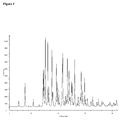
- Form I is characterized by a diffraction pattern substantially similar to that of Figure 1 .
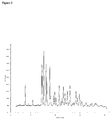
- Form I is characterized by a diffraction pattern substantially similar to that of Figure 2 .
- the particle size distribution of D90 is about 82 ⁇ m or less for Form I.
- the particle size distribution of D50 is about 30 ⁇ m or less for Form I.
- the invention features a pharmaceutical composition comprising Form I and a pharmaceutically acceptable carrier.
- the present invention features Form I for use in treating a CFTR mediated disease in a human comprising administering to the human an effective amount of Form I.
- the use comprises administering an additional therapeutic agent.
- the disease is selected from cystic fibrosis, hereditary emphysema, hereditary hemochromatosis, coagulation-fibrinolysis deficiencies, such as protein C deficiency, Type 1 hereditary angioedema, lipid processing deficiencies, such as familial hypercholesterolemia, Type 1 chylomicronemia, abetalipoproteinemia, lysosomal storage diseases, such as I-cell disease/pseudo-Hurler, mucopolysaccharidoses, Sandhof/Tay-Sachs, Crigler-Najjar type II, polyendocrinopathy/hyperinsulemia, Diabetes mellitus, Laron dwarfism, myleoperoxidase deficiency, primary hypoparathyroidism, melanoma, glycanosis CDG type 1, hereditary emphysema, congenital hyperthyroidism, osteogenesis imperfecta, hereditary hypof
- the present invention provides Form I for use in treating cystic fibrosis in a human, comprising administering to said human an effective amount of Form I.
- the present invention features a kit comprising Form I and instructions for use thereof.
- the present invention features a process of preparing Form I comprising dispersing or dissolving the HCl salt of 3-(6-(1-(2,2-difluorobenzo[d][1,3]dioxol-5-yl) cyclopropanecarboxamido)-3-methylpyridin-2-yl)benzoic acid in an appropriate solvent for an effective amount of time.
- the present invention features a process of preparing Form I comprising dispersing the HCl salt of 3-(6-(1-(2,2-difluorobenzo[d][1,3]dioxol-5-yl) cyclopropanecarboxamido)-3-methylpyridin-2-yl)benzoic acid in an appropriate solvent for an effective amount of time.
- the appropriate solvent is water or a alcohol/water mixture.
- the appropriate solvent is water or 50% methanol/water mixture.
- the appropriate solvent is water.
- the appropriate solvent is a mixture comprising 50% methanol and 50% water.
- the effective amount of time is about 2 to about a day. In some embodiments, the effective amount of time is about 2 to about 18 hours. In some embodiments, the effective amount of time is about 2 to about 12 hours. In some embodiments, the effective amount of time is about 2 to about 6 hours.
- Form I is prepared from dispersing or dissolving a salt form, such as HCL, of 3-(6-(1-(2,2-difluorobenzo[d][1,3]dioxol-5-yl) cyclopropanecarboxamido)-3-methylpyridin-2-yl)benzoic acid in an appropriate solvent for an effective amount of time.
- a salt form such as HCL
- Form I is prepared from dispersing a salt form, such as HCL, of 3-(6-(1-(2,2-difluorobenzo[d][1,3]dioxol-5-yl) cyclopropanecarboxamido)-3-methylpyridin-2-yl)benzoic acid in an appropriate solvent for an effective amount of time.
- Form I is formed directly from 3-(6-(1-(2,2-difluorobenzo[d][1,3]dioxol-5-yl)cyclopropanecarboxamido)-3-methylpyridin-2-yl)-t-butylbenzoate and an appropriate acid, such as formic acid.
- the HCl salt form of 3-(6-(1-(2,2-difluorobenzo[d][1,3]dioxol-5-yl) cyclopropanecarboxamido)-3-methylpyridin-2-yl)benzoic acid is the starting point and in one embodiment can be prepared by coupling an acid chloride moiety with an amine moiety according to Schemes 1-3.
- Form I can be formed in high yields by dispersing or dissolving the HCl salt form of 3-(6-(1-(2,2-difluorobenzo[d][1,3]dioxol-5-yl) cyclopropanecarboxamido)-3-methylpyridin-2-yl)benzoic acid in an appropriate solvent for an effective amount of time.
- salt forms of 3-(6-(1-(2,2-difluorobenzo[d][1,3]dioxol-5-yl) cyclopropanecarboxamido)-3-methylpyridin-2-yl)benzoic acid may be used such as, for example, other mineral or organic acid forms.
- the other salt forms result from hydrolysis of the t-butyl ester with the corresponding acid.
- Other acids/salt forms include nitric, sulfuric, phosphoric, boric, acetic, benzoic, malonic, and the like.
- the salt form of 3-(6-(1-(2,2-difluorobenzo[d][1,3]dioxol-5-yl)cyclopropanecarboxamido)-3-methylpyridin-2-yl)benzoic acid may or may not be soluble depending upon the solvent used, but lack of solubility does not hinder formation of Form I.
- the appropriate solvent may be water or an alcohol/water mixture such as 50% methanol/water mixture, even though the HCl salt form of 3-(6-(1-(2,2-difluorobenzo[d][1,3]dioxol-5-yl) cyclopropanecarboxamido)-3-methylpyridin-2-yl)benzoic acid is only sparingly soluble in water.
- the appropriate solvent is water.
- the effective amount of time for formation of Form I from the salt form of 3-(6-(1-(2,2-difluorobenzo[d][1,3]dioxol-5-yl)cyclopropanecarboxamido)-3-methylpyridin-2-yl)benzoic acid can be any time between 2 to 24 hours or greater. Generally, greater than 24 hours is not needed to obtain high yields ( ⁇ 98%), but certain solvents may require greater amounts of time. It is also recognized that the amount of time needed is inversely proportional to the temperature. That is, the higher the temperature the less time needed to affect dissociation of acid to form Form I. When the solvent is water, stirring the dispersion for approximately 24 hours at room temperature gives Form I in an approximately 98% yield.
- substantially pure refers to greater than about 90% purity. In another embodiment, substantially pure refers to greater than about 95% purity. In another embodiment, substantially pure refers to greater than about 98% purity. In another embodiment, substantially pure refers to greater than about 99% purity.
- the temperature selected depends in part on the solvent used and is well within the capabilities of someone of ordinary skill in the art to determine. In one embodiment, the temperature is between room temperature and about 80 °C. In another embodiment, the temperature is between room temperature and about 40 °C. In another embodiment, the temperature is between about 40 °C and about 60 °C. In another embodiment, the temperature is between about 60 °C and about 80 °C.
- Form I may be further purified by recrystallization from an organic solvent.
- organic solvents include, but are not limited to, toluene, cumene, anisole, 1-butanol, isopropylacetate, butyl acetate, isobutyl acetate, methyl t-butyl ether, methyl isobutyl ketone, or 1-propanol/water (at various ratios).
- Temperature may be used as described above.
- Form I is dissolved in 1-butanol at 75 °C until it is completely dissolved. Cooling down the solution to 10 °C at a rate of 0.2 °C/min yields crystals of Form I which may be isolated by filtration.
- compositions are provided.
- compositions comprising Form I as described herein, and optionally comprise a pharmaceutically acceptable carrier, adjuvant or vehicle.
- these compositions optionally further comprise one or more additional therapeutic agents.
- the pharmaceutically acceptable compositions of the present invention additionally comprise a pharmaceutically acceptable carrier, adjuvant, or vehicle, which, as used herein, includes any and all solvents, diluents, or other liquid vehicle, dispersion or suspension aids, surface active agents, isotonic agents, thickening or emulsifying agents, preservatives, solid binders, lubricants and the like, as suited to the particular dosage form desired.
- a pharmaceutically acceptable carrier, adjuvant, or vehicle which, as used herein, includes any and all solvents, diluents, or other liquid vehicle, dispersion or suspension aids, surface active agents, isotonic agents, thickening or emulsifying agents, preservatives, solid binders, lubricants and the like, as suited to the particular dosage form desired.
- Remington's Pharmaceutical Sciences, Sixteenth Edition, E. W. Martin (Mack Publishing Co., Easton, Pa., 1980 ) discloses various carriers used in formulating pharmaceutically acceptable composition
- any conventional carrier medium is incompatible with the compounds of the invention, such as by producing any undesirable biological effect or otherwise interacting in a deleterious manner with any other component(s) of the pharmaceutically acceptable composition, its use is contemplated to be within the scope of this invention.
- materials which can serve as pharmaceutically acceptable carriers include, but are not limited to, ion exchangers, alumina, aluminum stearate, lecithin, serum proteins, such as human serum albumin, buffer substances such as phosphates, glycine, sorbic acid, or potassium sorbate, partial glyceride mixtures of saturated vegetable fatty acids, water, salts or electrolytes, such as protamine sulfate, disodium hydrogen phosphate, potassium hydrogen phosphate, sodium chloride, zinc salts, colloidal silica, magnesium trisilicate, polyvinyl pyrrolidone, polyacrylates, waxes, polyethylene-polyoxypropylene-block polymers, wool fat, sugars such as lactose, glucose and sucrose; starches such as corn starch and potato starch; cellulose and its derivatives such as sodium carboxymethyl cellulose, ethyl cellulose and cellulose acetate; powdered tragacanth; malt; gelatin; talc
- the present invention provides Form I for use in treating a condition, disease, or disorder implicated by CFTR.
- the present invention provides Form I for use in treating a condition, disease, or disorder implicated by a deficiency of CFTR activity, comprising administering a composition comprising a solid state form of Form I described herein to a subject, preferably a mammal, in need thereof.
- a “CFTR-mediated disease” as used herein is a disease selected from cystic fibrosis, Hereditary emphysema, Hereditary hemochromatosis, Coagulation-Fibrinolysis deficiencies, such as Protein C deficiency, Type 1 hereditary angioedema, Lipid processing deficiencies, such as Familial hypercholesterolemia, Type 1 chylomicronemia, Abetalipoproteinemia, Lysosomal storage diseases, such as I-cell disease/Pseudo-Hurler, Mucopolysaccharidoses, Sandhof/Tay-Sachs, Crigler-Najjar type II,
- Polyendocrinopathy/Hyperinsulemia Diabetes mellitus, Laron dwarfism, Myleoperoxidase deficiency, Primary hypoparathyroidism, Melanoma, Glycanosis CDG type 1, Hereditary emphysema, Congenital hyperthyroidism, Osteogenesis imperfecta, Hereditary hypofibrinogenemia, ACT deficiency, Diabetes insipidus (DI), Neurophyseal DI, Neprogenic DI, Charcot-Marie Tooth syndrome, Perlizaeus-Merzbacher disease, neurodegenerative diseases such as Alzheimer's disease, Parkinson's disease, Amyotrophic lateral sclerosis, Progressive supranuclear plasy, Pick's disease, several polyglutamine neurological disorders a such as Huntington, Spinocerebullar ataxia type I, Spinal and bulbar muscular atrophy, Dentatorubal pallidoluysian, and Myotonic dystrophy, as well as Spongi
- the present invention provides Form I for use in treating a CFTR-mediated disease in a human comprising the step of administering to said human an effective amount of a composition comprising Form I described herein.
- the present invention provides Form I for use in treating cystic fibrosis in a human comprising the step of administering to said human a composition comprising Form I described herein.
- an "effective amount" of Form I or a pharmaceutically acceptable composition thereof is that amount effective for treating or lessening the severity of any of the diseases recited above.
- Form I or a pharmaceutically acceptable composition thereof may be administered using any amount and any route of administration effective for treating or lessening the severity of one or more of the diseases reicted above.
- Form I described herein or a pharmaceutically acceptable composition thereof is useful for treating or lessening the severity of cystic fibrosis in patients who exhibit residual CFTR activity in the apical membrane of respiratory and non-respiratory epithelia.
- the presence of residual CFTR activity at the epithelial surface can be readily detected using methods known in the art, e.g., standard electrophysiological, biochemical, or histochemical techniques. Such methods identify CFTR activity using in vivo or ex vivo electrophysiological techniques, measurement of sweat or salivary Cl - concentrations, or ex vivo biochemical or histochemical techniques to monitor cell surface density. Using such methods, residual CFTR activity can be readily detected in patients heterozygous or homozygous for a variety of different mutations, including patients homozygous or heterozygous for the most common mutation, ⁇ F508.
- Form I described herein or a pharmaceutically acceptable composition thereof is useful for treating or lessening the severity of cystic fibrosis in patients within certain genotypes exhibiting residual CFTR activity, e.g., class III mutations (impaired regulation or gating), class IV mutations (altered conductance), or class V mutations (reduced synthesis) ( Lee R. Choo-Kang, Pamela L., Zeitlin, Type I, II, III, IV, and V cystic fibrosis Tansmembrane Conductance Regulator Defects and Opportunities of Therapy; Current Opinion in Pulmonary Medicine 6:521 - 529, 2000 ).
- Other patient genotypes that exhibit residual CFTR activity include patients homozygous for one of these classes or heterozygous with any other class of mutations, including class I mutations, class II mutations, or a mutation that lacks classification.
- Form I described herein or a pharmaceutically acceptable composition thereof is useful for treating or lessening the severity of cystic fibrosis in patients within certain clinical phenotypes, e.g., a moderate to mild clinical phenotype that typically correlates with the amount of residual CFTR activity in the apical membrane of epithelia.
- phenotypes include patients exhibiting pancreatic insufficiency or patients diagnosed with idiopathic pancreatitis and congenital bilateral absence of the vas deferens, or mild lung disease.
- the exact amount required will vary from subject to subject, depending on the species, age, and general condition of the subject, the severity of the infection, the particular agent, its mode of administration, and the like.
- the compounds of the invention are preferably formulated in dosage unit form for ease of administration and uniformity of dosage.
- dosage unit form refers to a physically discrete unit of agent appropriate for the patient to be treated. It will be understood, however, that the total daily usage of the compounds and compositions of the present invention will be decided by the attending physician within the scope of sound medical judgment.
- the specific effective dose level for any particular patient or organism will depend upon a variety of factors including the disorder being treated and the severity of the disorder; the activity of the specific compound employed; the specific composition employed; the age, body weight, general health, sex and diet of the patient; the time of administration, route of administration, and rate of excretion of the specific compound employed; the duration of the treatment; drugs used in combination or coincidental with the specific compound employed, and like factors well known in the medical arts.
- patient means an animal, preferably a mammal, and most preferably a human.
- compositions of this invention can be administered to humans and other animals orally, rectally, parenterally, intracisternally, intravaginally, intraperitoneally, topically (as by powders, ointments, or drops), bucally, as an oral or nasal spray, or the like, depending on the severity of the infection being treated.
- the compounds of the invention may be administered orally or parenterally at dosage levels of about 0.01 mg/kg to about 50 mg/kg and preferably from about 1 mg/kg to about 25 mg/kg, of subject body weight per day, one or more times a day, to obtain the desired therapeutic effect.
- the dosage amount of Form I in the dosage unit form is from 100 mg to 1,000 mg. In another embodiment, the dosage amount of Form I is from 200 mg to 900 mg. In another embodiment, the dosage amount of Form I is from 300 mg to 800 mg. In another embodiment, the dosage amount of Form I is from 400 mg to 700 mg. In another embodiment, the dosage amount of Form I is from 500 mg to 600 mg.
- sterile injectable aqueous or oleaginous suspensions may be formulated according to the known art using suitable dispersing or wetting agents and suspending agents.
- the sterile injectable preparation may also be a sterile injectable solution, suspension or emulsion in a nontoxic parenterally acceptable diluent or solvent, for example, as a solution in 1,3-butanediol.
- acceptable vehicles and solvents that may be employed are water, Ringer's solution, U.S.P. and isotonic sodium chloride solution.
- sterile, fixed oils are conventionally employed as a solvent or suspending medium.
- any bland fixed oil can be employed including synthetic mono- or diglycerides.
- fatty acids such as oleic acid are used in the preparation of injectables.
- the injectable formulations can be sterilized, for example, by filtration through a bacterial-retaining filter, or by incorporating sterilizing agents in the form of sterile solid compositions which can be dissolved or dispersed in sterile water or other sterile injectable medium prior to use.
- compositions for rectal or vaginal administration are preferably suppositories which can be prepared by mixing the compounds of this invention with suitable non-irritating excipients or carriers such as cocoa butter, polyethylene glycol or a suppository wax which are solid at ambient temperature but liquid at body temperature and therefore melt in the rectum or vaginal cavity and release the active compound.
- suitable non-irritating excipients or carriers such as cocoa butter, polyethylene glycol or a suppository wax which are solid at ambient temperature but liquid at body temperature and therefore melt in the rectum or vaginal cavity and release the active compound.
- Solid dosage forms for oral administration include capsules, tablets, pills, powders, and granules.
- the active compound is mixed with at least one inert, pharmaceutically acceptable excipient or carrier such as sodium citrate or dicalcium phosphate and/or a) fillers or extenders such as starches, lactose, sucrose, glucose, mannitol, and silicic acid, b) binders such as, for example, carboxymethylcellulose, alginates, gelatin, polyvinylpyrrolidinone, sucrose, and acacia, c) humectants such as glycerol, d) disintegrating agents such as agar--agar, calcium carbonate, potato or tapioca starch, alginic acid, certain silicates, and sodium carbonate, e) solution retarding agents such as paraffin, f) absorption accelerators such as quaternary ammonium compounds, g) wetting agents such as, for example, cetyl alcohol and g
- Solid compositions of a similar type may also be employed as fillers in soft and hard-filled gelatin capsules using such excipients as lactose or milk sugar as well as high molecular weight polyethylene glycols and the like.
- the solid dosage forms of tablets, dragees, capsules, pills, and granules can be prepared with coatings and shells such as enteric coatings and other coatings well known in the pharmaceutical formulating art. They may optionally contain opacifying agents and can also be of a composition that they release the active ingredient(s) only, or preferentially, in a certain part of the intestinal tract, optionally, in a delayed manner. Examples of embedding compositions that can be used include polymeric substances and waxes. Solid compositions of a similar type may also be employed as fillers in soft and hard-filled gelatin capsules using such excipients as lactose or milk sugar as well as high molecular weight polethylene glycols and the like.
- the active compounds can also be in microencapsulated form with one or more excipients as noted above.
- the solid dosage forms of tablets, dragees, capsules, pills, and granules can be prepared with coatings and shells such as enteric coatings, release controlling coatings and other coatings well known in the pharmaceutical formulating art.
- the active compound may be admixed with at least one inert diluent such as sucrose, lactose or starch.
- Such dosage forms may also comprise, as is normal practice, additional substances other than inert diluents, e.g., tableting lubricants and other tableting aids such a magnesium stearate and microcrystalline cellulose.
- the dosage forms may also comprise buffering agents. They may optionally contain opacifying agents and can also be of a composition that they release the active ingredient(s) only, or preferentially, in a certain part of the intestinal tract, optionally, in a delayed manner.
- buffering agents include polymeric substances and waxes.
- Form I described herein or a pharmaceutically acceptable composition thereof can be employed in combination therapies, that is, Form I can be administered concurrently with, prior to, or subsequent to, one or more other desired therapeutics or medical procedures.
- the particular combination of therapies (therapeutics or procedures) to employ in a combination regimen will take into account compatibility of the desired therapeutics and/or procedures and the desired therapeutic effect to be achieved.
- the therapies employed may achieve a desired effect for the same disorder (for example, an inventive compound may be administered concurrently with another agent used to treat the same disorder), or they may achieve different effects (e.g., control of any adverse effects).
- additional therapeutic agents that are normally administered to treat or prevent a particular disease, or condition are known as "appropriate for the disease, or condition, being treated”.
- the additional agent is selected from a mucolytic agent, bronchodialator, an anti-biotic, an anti-infective agent, an anti-inflammatory agent, a CFTR modulator other than a compound of the present invention, or a nutritional agent.
- the additional agent is a compound selected from gentamicin, curcumin, cyclophosphamide, 4-phenylbutyrate, miglustat, felodipine, nimodipine, Philoxin B, geniestein, Apigenin, cAMP/cGMP modulators such as rolipram, sildenafil, milrinone, tadalafil, amrinone, isoproterenol, albuterol, and almeterol, deoxyspergualin, HSP 90 inhibitors, HSP 70 inhibitors, proteosome inhibitors such as epoxomicin, lactacystin, etc.
- the additional agent is a compound disclosed in WO 2004028480 , WO 2004110352 , WO 2005094374 , WO 2005120497 , or WO 2006101740 .
- the additiona agent is a benzo(c)quinolizinium derivative that exhibits CFTR modulation activity or a benzopyran derivative that exhibits CFTR modulation activity.
- the addditional agent is a compound disclosed in US7202262 , US6992096 , US20060148864 , US20060148863 , US20060035943 , US20050164973 , WO2006110483 , WO2006044456 , WO2006044682 , WO2006044505 , WO2006044503 , WO2006044502 , or WO2004091502 .
- the additional agent is a compound disclosed in WO2004080972 , WO2004111014 , WO2005035514 , WO2005049018 , WO2006002421 , WO2006099256 , WO2006127588 , or WO2007044560 .
- the an additional agent selected from compounds disclosed in U.S. Patent Application Serial No. 11/165,818 , published as U.S. Published Patent Application No. 2006/0074075, filed June 24, 2005 .
- the additional agent is N-(5-hydroxy-2,4-ditert-butyl-phenyl)-4-oxo-1H-quinoline-3-carboxamide. These combinations are useful for treating the diseases described herein including cystic fibrosis. These combinations are also useful in the kits described herein.
- the amount of additional therapeutic agent present in the compositions of this invention will be no more than the amount that would normally be administered in a composition comprising that therapeutic agent as the only active agent.
- the amount of additional therapeutic agent in the presently disclosed compositions will range from about 50% to 100% of the amount normally present in a composition comprising that agent as the only therapeutically active agent.
- Form I described herein or a pharmaceutically acceptable composition thereof may also be incorporated into compositions for coating an implantable medical device, such as prostheses, artificial valves, vascular grafts, stents and catheters.
- the present invention in another aspect, includes a composition for coating an implantable device comprising Form I described herein or a pharmaceutically acceptable composition thereof, and in classes and subclasses herein, and a carrier suitable for coating said implantable device.
- the present invention includes an implantable device coated with a composition comprising Form I described herein or a pharmaceutically acceptable composition thereof, and a carrier suitable for coating said implantable device.
- Suitable coatings and the general preparation of coated implantable devices are described in US Patents 6,099,562 ; 5,886,026 ; and 5,304,121 .
- the coatings are typically biocompatible polymeric materials such as a hydrogel polymer, polymethyldisiloxane, polycaprolactone, polyethylene glycol, polylactic acid, ethylene vinyl acetate, and mixtures thereof.
- the coatings may optionally be further covered by a suitable topcoat of fluorosilicone, polysaccarides, polyethylene glycol, phospholipids or combinations thereof to impart controlled release characteristics in the composition.
- DSC Differential scanning calorimetry
- X-Ray diffraction (XRD) data of Form 1 were collected on a Bruker D8 DISCOVER powder diffractometer with HI-STAR 2-dimensional detector and a flat graphite monochromator. Cu sealed tube with K ⁇ radiation was used at 40 kV, 35mA. The samples were placed on zero-background silicon wafers at 25°C. For each sample, two data frames were collected at 120 seconds each at 2 different ⁇ 2 angles: 8° and 26°. The data were integrated with GADDS software and merged with DIFFRACT plus EVA software. Uncertainties for the reported peak positions are ⁇ 0.2 degrees.
- Vitride® sodium bis(2-methoxyethoxy)aluminum hydride [or NaAlH 2 (OCH 2 CH 2 OCH 3 ) 2 ], 65 wgt% solution in toluene was purchased from Aldrich Chemicals.
- 2,2-Difluoro-1,3-benzodioxole-5-carboxylic acid was purchased from Saltigo (an affiliate of the Lanxess Corporation).
- 1-(2,2-difluoro-1,3-benzodioxol-5-yl)-cyclopropanecarboxylic acid (1.2 eq) is slurried in toluene (2.5 vol) and the mixture heated to 60 °C. SOCl 2 (1.4 eq) is added via addition funnel. The toluene and SOCl 2 are distilled from the reaction mixture after 30 minutes. Additional toluene (2.5 vol) is added and distilled again.
- the organic phase is then washed with water (3.5 vol) and extracted with 10% aqueous methanesulfonic acid (2 eq MsOH, 7.7 vol).
- the aqueous phase is made basic with 50% aqueous NaOH (2 eq) and extracted with EtOAc (8 vol).
- the organic layer is concentrated to afford crude tert -butyl-3-(3-methylpyridin-2-yl)benzoate (82%) that is used directly in the next step.
- tert -Butyl-3-(3-methylpyridin-2-yl)benzoate (1.0 eq) is dissolved in EtOAc (6 vol). Water (0. 3 vol) is added followed by urea-hydrogen peroxide (3 eq). The phthalic anhydride (3 eq) is added portion-wise as a solid to maintain the temperature in the reactor below 45 °C. After completion of phthalic anhydride addition, the mixture is heated to 45 °C. After stirring for an additional 4 hours, the heat is turned off. 10% w/w aqueous Na 2 SO 3 (1.5 eq) is added via addition funnel. After completion of Na 2 SO 3 addition, the mixture is stirred for an additional 30 minutes and the layers separated.
- the crude acid chloride is dissolved in toluene (2.5 vol based on acid chloride) and added via addition funnel to a mixture of tert -butyl-3-(6-amino-3-methylpyridin-2-yl)benzoate (1 eq), dimethylaminopyridine (DMAP, 0.02 eq), and triethylamine (3.0 eq) in toluene (4 vol based on tert -butyl-3-(6-amino-3-methylpyridin-2-yl)benzoate). After 2 hours, water (4 vol based on tert -butyl-3-(6-amino-3-methylpyridin-2-yl)benzoate) is added to the reaction mixture.
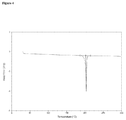
- the DSC trace of Compound 1 in Form I is shown in Figure 4 . Melting for Compound 1 in Form I occurs at about 204 °C.
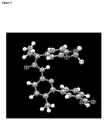
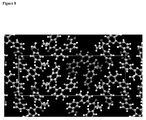
- FIG. 5-8 Conformational pictures of Compound 1 in Form I based on single crystal X-ray analysis are shown in Figures 5-8 .
- Figures 6-8 show hydrogen bonding between carboxylic acid groups of a dimer and the resulting stacking that occurs in the crystal. The crystal structure reveals a dense packing of the molecules.
- the optical membrane potential assay utilized voltage-sensitive FRET sensors described by Gonzalez and Tsien ( See, Gonzalez, J. E. and R. Y. Tsien (1995) "Voltage sensing by fluorescence resonance energy transfer in single cells” Biophys J 69(4): 1272-80 , and Gonzalez, J. E. and R. Y. Tsien (1997) “Improved indicators of cell membrane potential that use fluorescence resonance energy transfer” Chem Biol 4(4): 269-77 ) in combination with instrumentation for measuring fluorescence changes such as the Voltage/Ion Probe Reader (VIPR) ( See, Gonzalez, J. E., K. Oades, et al. (1999) "Cell-based assays and instrumentation for screening ion-channel targets” Drug Discov Today 4(9): 431-439 ).
- VIPR Voltage/Ion Probe Reader
- These voltage sensitive assays are based on the change in fluorescence resonant energy transfer (FRET) between the membrane-soluble, voltage-sensitive dye, DiSBAC 2 (3), and a fluorescent phospholipid, CC2-DMPE, which is attached to the outer leaflet of the plasma membrane and acts as a FRET donor.
- FRET fluorescence resonant energy transfer
- V m fluorescent phospholipid
- the changes in fluorescence emission were monitored using VIPR TM II, which is an integrated liquid handler and fluorescent detector designed to conduct cell-based screens in 96- or 384-well microtiter plates.
- Bath Solution #1 (in mM) NaCl 160, KC14.5, CaCl 2 2, MgCl 2 1, HEPES 10, pH 7.4 with NaOH.
- Chloride-free bath solution Chloride salts in Bath Solution #1 are substituted with gluconate salts.
- CC2-DMPE Prepared as a 10 mM stock solution in DMSO and stored at -20°C.
- DiSBAC 2 (3) Prepared as a 10 mM stock in DMSO and stored at -20°C.
- NIH3T3 mouse fibroblasts stably expressing ⁇ F508-CFTR are used for optical measurements of membrane potential.
- the cells are maintained at 37 °C in 5% CO 2 and 90 % humidity in Dulbecco's modified Eagle's medium supplemented with 2 mM glutamine, 10 % fetal bovine serum, 1 X NEAA, ⁇ -ME, 1 X pen/strep, and 25 mM HEPES in 175 cm 2 culture flasks.
- the cells were seeded at 30,000/well in 384-well matrigel-coated plates and cultured for 2 hrs at 37 °C before culturing at 27 °C for 24 hrs for the potentiator assay.
- the cells are cultured at 27 °C or 37 °C with and without compounds for 16 - 24 hours.
- FRT ⁇ F508-CFTR epithelial cells grown on Costar Snapwell cell culture inserts were mounted in an Ussing chamber (Physiologic Instruments, Inc., San Diego, CA), and the monolayers were continuously short-circuited using a Voltage-clamp System (Department of Bioengineering, University of Iowa, IA, and, Physiologic Instruments, Inc., San Diego, CA). Transepithelial resistance was measured by applying a 2-mV pulse. Under these conditions, the FRT epithelia demonstrated resistances of 4 K ⁇ /cm 2 or more.
- the solutions were maintained at 27 °C and bubbled with air.
- the electrode offset potential and fluid resistance were corrected using a cell-free insert. Under these conditions, the current reflects the flow of Cl - through ⁇ F508-CFTR expressed in the apical membrane.
- the I SC was digitally acquired using an MP100A-CE interface and AcqKnowledge software (v3.2.6; BIOPAC Systems, Santa Barbara, CA).
- Typical protocol utilized a basolateral to apical membrane Cl - concentration gradient. To set up this gradient, normal ringer was used on the basolateral membrane, whereas apical NaCl was replaced by equimolar sodium gluconate (titrated to pH 7.4 with NaOH) to give a large Cl - concentration gradient across the epithelium. All experiments were performed with intact monolayers. To fully activate ⁇ F508-CFTR, forskolin (10 ⁇ M) and the PDE inhibitor, IBMX (100 ⁇ M), were applied followed by the addition of the CFTR potentiator, genistein (50 ⁇ M).
- Typical protocol utilized a basolateral to apical membrane Cl - concentration gradient.
- normal ringers was used on the basolateral membrane and was permeabilized with nystatin (360 ⁇ g/ml), whereas apical NaCl was replaced by equimolar sodium gluconate (titrated to pH 7.4 with NaOH) to give a large Cl - concentration gradient across the epithelium. All experiments were performed 30 min after nystatin permeabilization. Forskolin (10 ⁇ M) and all test compounds were added to both sides of the cell culture inserts. The efficacy of the putative ⁇ F508-CFTR potentiators was compared to that of the known potentiator, genistein.
- Basolateral solution in mM: NaCl (135), CaCl 2 (1.2), MgCl 2 (1.2), K 2 HPO 4 (2.4), KHPO 4 (0.6), N-2-hydroxyethylpiperazine-N'-2-ethanesulfonic acid (HEPES) (10), and dextrose (10).
- the solution was titrated to pH 7.4 with NaOH.
- Apical solution in mM: Same as basolateral solution with NaCl replaced with Na Gluconate (135).
- FRT Fisher rat epithelial cells expressing ⁇ F508-CFTR
- FRT ⁇ F508-CFTR Fisher rat epithelial cells expressing ⁇ F508-CFTR
- the cells were cultured on Costar Snapwell cell culture inserts and cultured for five days at 37 °C and 5% CO 2 in Coon's modified Ham's F-12 medium supplemented with 5% fetal calf serum, 100 U/ml penicillin, and 100 ⁇ g/ml streptomycin.
- the cells Prior to use for characterizing the potentiator activity of compounds, the cells were incubated at 27 °C for 16 - 48 hrs to correct for the ⁇ F508-CFTR. To determine the activity of corrections compounds, the cells were incubated at 27 °C or 37 °C with and without the compounds for 24 hours.
- the macroscopic ⁇ F508-CFTR current (I ⁇ F508 ) in temperature- and test compound-corrected NIH3T3 cells stably expressing ⁇ F508-CFTR were monitored using the perforated-patch, whole-cell recording. Briefly, voltage-clamp recordings of I ⁇ F508 were performed at room temperature using an Axopatch 200B patch-clamp amplifier (Axon Instruments Inc., Foster City, CA). All recordings were acquired at a sampling frequency of 10 kHz and low-pass filtered at 1 kHz. Pipettes had a resistance of 5 - 6 M ⁇ when filled with the intracellular solution.
- the cells were incubated with 10 ⁇ M of the test compound for 24 hours at 37°C and the current density was compared to the 27°C and 37°C controls (% activity). Prior to recording, the cells were washed 3X with extracellular recording medium to remove any remaining test compound. Preincubation with 10 ⁇ M of correction compounds significantly increased the cAMP- and genistein-dependent current compared to the 37°C controls.
- ⁇ F508-CFTR potentiators to increase the macroscopic ⁇ F508-CFTR Cl - current (I ⁇ F508 ) in NIH3T3 cells stably expressing ⁇ F508-CFTR was also investigated using perforated-patch-recording techniques.
- the potentiators identified from the optical assays evoked a dose-dependent increase in I ⁇ F508 with similar potency and efficacy observed in the optical assays.
- the reversal potential before and during potentiator application was around -30 mV, which is the calculated E Cl (-28 mV).
- Intracellular solution in mM: Cs-aspartate (90), CsCl (50), MgCl 2 (1), HEPES (10), and 240 ⁇ g/ml amphotericin-B (pH adjusted to 7.35 with CsOH).
- Extracellular solution in mM: N -methyl-D-glucamine (NMDG)-Cl (150), MgCl 2 (2), CaCl 2 (2), HEPES (10) (pH adjusted to 7.35 with HCl).
- NIH3T3 mouse fibroblasts stably expressing ⁇ F508-CFTR are used for whole-cell recordings.
- the cells are maintained at 37 °C in 5% CO 2 and 90 % humidity in Dulbecco's modified Eagle's medium supplemented with 2 mM glutamine, 10 % fetal bovine serum, 1 X NEAA, ⁇ -ME, 1 X pen/strep, and 25 mM HEPES in 175 cm 2 culture flasks.
- 2,500 - 5,000 cells were seeded on poly-L-lysine-coated glass coverslips and cultured for 24 - 48 hrs at 27 °C before use to test the activity of potentiators; and incubated with or without the correction compound at 37 °C for measuring the activity of correctors.
- the single-channel actdivities of temperature-corrected ⁇ F508-CFTR stably expressed in NIH3T3 cells and activities of potentiator compounds were observed using excised inside-out membrane patch.
- voltage-clamp recordings of single-channel activity were performed at room temperature with an Axopatch 200B patch-clamp amplifier (Axon Instruments Inc.). All recordings were acquired at a sampling frequency of 10 kHz and low-pass filtered at 400 Hz.
- Patch pipettes were fabricated from Corning Kovar Sealing #7052 glass (World Precision Instruments, Inc., Sarasota, FL) and had a resistance of 5 - 8 M ⁇ when filled with the extracellular solution.
- the ⁇ F508-CFTR was activated after excision, by adding 1 mM Mg-ATP, and 75 nM of the cAMP-dependent protein kinase, catalytic subunit (PKA; Promega Corp. Madison, WI). After channel activity stabilized, the patch was perifused using a gravity-driven microperfusion system. The inflow was placed adjacent to the patch, resulting in complete solution exchange within 1 - 2 sec. To maintain ⁇ F508-CFTR activity during the rapid perifusion, the nonspecific phosphatase inhibitor F - (10 mM NaF) was added to the bath solution. Under these recording conditions, channel activity remained constant throughout the duration of the patch recording (up to 60 min). Currents produced by positive charge moving from the intra- to extracellular solutions (anions moving in the opposite direction) are shown as positive currents. The pipette potential (V p ) was maintained at 80 mV.
- V p The pipette potential
- Channel activity was analyzed from membrane patches containing ⁇ 2 active channels. The maximum number of simultaneous openings determined the number of active channels during the course of an experiment.
- the data recorded from 120 sec of ⁇ F508-CFTR activity was filtered "off-line" at 100 Hz and then used to construct all-point amplitude histograms that were fitted with multigaussian functions using Bio-Patch Analysis software (Bio-Logic Comp. France).
- Extracellular solution in mM: NMDG (150), aspartic acid (150), CaCl 2 (5), MgCl 2 (2), and HEPES (10) (pH adjusted to 7.35 with Tris base).
- Intracellular solution in mM: NMDG-Cl (150), MgCl 2 (2), EGTA (5), TES (10), and Tris base (14) (pH adjusted to 7.35 with HCl).
- NIH3T3 mouse fibroblasts stably expressing ⁇ F508-CFTR are used for excised-membrane patch-clamp recordings.
- the cells are maintained at 37 °C in 5% CO 2 and 90 % humidity in Dulbecco's modified Eagle's medium supplemented with 2 mM glutamine, 10 % fetal bovine serum, 1 X NEAA, ⁇ -ME, 1 X pen/strep, and 25 mM HEPES in 175 cm 2 culture flasks.
- 2,500 - 5,000 cells were seeded on poly-L-lysine-coated glass coverslips and cultured for 24 - 48 hrs at 27 °C before use.
Landscapes
- Health & Medical Sciences (AREA)
- Chemical & Material Sciences (AREA)
- Organic Chemistry (AREA)
- Veterinary Medicine (AREA)
- Public Health (AREA)
- General Health & Medical Sciences (AREA)
- Animal Behavior & Ethology (AREA)
- Life Sciences & Earth Sciences (AREA)
- Pharmacology & Pharmacy (AREA)
- Medicinal Chemistry (AREA)
- Engineering & Computer Science (AREA)
- Bioinformatics & Cheminformatics (AREA)
- Nuclear Medicine, Radiotherapy & Molecular Imaging (AREA)
- General Chemical & Material Sciences (AREA)
- Chemical Kinetics & Catalysis (AREA)
- Diabetes (AREA)
- Hematology (AREA)
- Endocrinology (AREA)
- Epidemiology (AREA)
- Neurology (AREA)
- Obesity (AREA)
- Biomedical Technology (AREA)
- Neurosurgery (AREA)
- Physical Education & Sports Medicine (AREA)
- Cardiology (AREA)
- Hospice & Palliative Care (AREA)
- Psychiatry (AREA)
- Ophthalmology & Optometry (AREA)
- Urology & Nephrology (AREA)
- Reproductive Health (AREA)
- Orthopedic Medicine & Surgery (AREA)
- Heart & Thoracic Surgery (AREA)
- Rheumatology (AREA)
- Pulmonology (AREA)
- Emergency Medicine (AREA)
- Pharmaceuticals Containing Other Organic And Inorganic Compounds (AREA)
- Plural Heterocyclic Compounds (AREA)
- Cosmetics (AREA)
- Pyridine Compounds (AREA)
- Measuring Or Testing Involving Enzymes Or Micro-Organisms (AREA)
Description
- The present invention relates to the crystalline Form I of 3-(6-(1-(2,2-difluorobenzo[d][1,3]dioxol-5-yl)cyclopropanecarboxamido)-3-methylpyridin-2-yl)benzoic acid, pharmaceutical compositions thereof, and use therewith.
- CFTR is a cAMP/ATP-mediated anion channel that is expressed in a variety of cells types, including absorptive and secretory epithelia cells, where it regulates anion flux across the membrane, as well as the activity of other ion channels and proteins. In epithelia cells, normal functioning of CFTR is critical for the maintenance of electrolyte transport throughout the body, including respiratory and digestive tissue. CFTR is composed of approximately 1480 amino acids that encode a protein made up of a tandem repeat of transmembrane domains, each containing six transmembrane helices and a nucleotide binding domain. The two transmembrane domains are linked by a large, polar, regulatory (R)-domain with multiple phosphorylation sites that regulate channel activity and cellular trafficking.
- The gene encoding CFTR has been identified and sequenced (See Gregory, R. J. et al. (1990) Nature 347:382-386; Rich, D. P. et al. (1990) Nature 347:358-362), (Riordan, J. R. et al. (1989) Science 245:1066-1073). A defect in this gene causes mutations in CFTR resulting in cystic fibrosis ("CF"), the most common fatal genetic disease in humans. Cystic fibrosis affects approximately one in every 2,500 infants in the United States. Within the general United States population, up to 10 million people carry a single copy of the defective gene without apparent ill effects. In contrast, individuals with two copies of the CF associated gene suffer from the debilitating and fatal effects of CF, including chronic lung disease.
- In patients with cystic fibrosis, mutations in CFTR endogenously expressed in respiratory epithelia leads to reduced apical anion secretion causing an imbalance in ion and fluid transport. The resulting decrease in anion transport contributes to enhanced mucus accumulation in the lung and the accompanying microbial infections that ultimately cause death in CF patients. In addition to respiratory disease, CF patients typically suffer from gastrointestinal problems and pancreatic insufficiency that, if left untreated, results in death. In addition, the majority of males with cystic fibrosis are infertile and fertility is decreased among females with cystic fibrosis. In contrast to the severe effects of two copies of the CF associated gene, individuals with a single copy of the CF associated gene exhibit increased resistance to cholera and to dehydration resulting from diarrhea - perhaps explaining the relatively high frequency of the CF gene within the population.
- Sequence analysis of the CFTR gene of CF chromosomes has revealed a variety of disease causing mutations (Cutting, G. R. et al. (1990) Nature 346:366-369; Dean, M. et al. (1990) Cell 61:863:870; and Kerem, B-S. et al. (1989) Science 245:1073-1080; Kerem, B-S et al. (1990) Proc. Natl. Acad. Sci. USA 87:8447-8451). To date, > 1000 disease causing mutations in the CF gene have been identified (http://www.genet.sickkids.on.ca/cftr/). The most prevalent mutation is a deletion of phenylalanine at position 508 of the CFTR amino acid sequence, and is commonly referred to as ΔF508-CFTR. This mutation occurs in approximately 70% of the cases of cystic fibrosis and is associated with a severe disease.
- The deletion of residue 508 in ΔF508-CFTR prevents the nascent protein from folding correctly. This results in the inability of the mutant protein to exit the ER, and traffic to the plasma membrane. As a result, the number of channels present in the membrane is far less than observed in cells expressing wild-type CFTR. In addition to impaired trafficking, the mutation results in defective channel gating. Together, the reduced number of channels in the membrane and the defective gating lead to reduced anion transport across epithelia leading to defective ion and fluid transport. (Quinton, P. M. (1990), FASEB J. 4: 2709-2727). Studies have shown, however, that the reduced numbers of ΔF508-CFTR in the membrane are functional, albeit less than wild-type CFTR. (Dalemans et al. (1991), Nature Lond. 354: 526-528; Denning et al., supra; Pasyk and Foskett (1995), J. Cell. Biochem. 270: 12347-50). In addition to ΔF508-CFTR, other disease causing mutations in CFTR that result in defective trafficking, synthesis, and/or channel gating could be up- or down-regulated to alter anion secretion and modify disease progression and/or severity.
- Although CFTR transports a variety of molecules in addition to anions, it is clear that this role (the transport of anions) represents one element in an important mechanism of transporting ions and water across the epithelium. The other elements include the epithelial Na+ channel, ENaC, Na+/2Cl-/K+ co-transporter, Na+-K+-ATPase pump and the basolateral membrane K+ channels, that are responsible for the uptake of chloride into the cell.
- These elements work together to achieve directional transport across the epithelium via their selective expression and localization within the cell. Chloride absorption takes place by the coordinated activity of ENaC and CFTR present on the apical membrane and the Na+-K+-ATPase pump and Cl- channels expressed on the basolateral surface of the cell. Secondary active transport of chloride from the luminal side leads to the accumulation of intracellular chloride, which can then passively leave the cell via Cl- channels, resulting in a vectorial transport. Arrangement of Na+/2Cl-/K+ co-transporter, Na+-K+-ATPase pump and the basolateral membrane K+ channels on the basolateral surface and CFTR on the luminal side coordinate the secretion of chloride via CFTR on the luminal side. Because water is probably never actively transported itself, its flow across epithelia depends on tiny transepithelial osmotic gradients generated by the bulk flow of sodium and chloride.
- As discussed above, it is believed that the deletion of residue 508 in ΔF508-CFTR prevents the nascent protein from folding correctly, resulting in the inability of this mutant protein to exit the ER, and traffic to the plasma membrane. As a result, insufficient amounts of the mature protein are present at the plasma membrane and chloride transport within epithelial tissues is significantly reduced. Infact, this cellular phenomenon of defective ER processing of ABC transporters by the ER machinery, has been shown to be the underlying basis not only for CF disease, but for a wide range of other isolated and inherited diseases. The two ways that the ER machinery can malfunction is either by loss of coupling to ER export of the proteins leading to degradation, or by the ER accumulation of these defective/misfolded proteins [Aridor M, et al., Nature Med., 5(7), pp 745- 751 (1999); Shastry, B.S., et al., Neurochem. International, 43, pp 1-7 (2003); Rutishauser, J., et al., Swiss Med Wkly, 132, pp 211-222 (2002); Morello, JP et al., TIPS, 21, pp. 466- 469 (2000); Bross P., et al., Human Mut., 14, pp. 186-198 (1999)].
- 3-(6-(1-(2,2-Difluorobenzo[d][1,3]dioxol-5-yl) cyclopropanecarboxamido)-3-methylpyridin-2-yl)benzoic acid in salt form is disclosed in International PCT Publication
WO 2007056341 as a modulator of CFTR activity and thus useful in treating CFTR-mediated diseases such as cystic fibrosis. However, there is a need for stable solid forms of said compound that can be used readily in pharmaceutical compositions suitable for use as therapeutics. - The present invention relates to the crystalline Form I of 3-(6-(1-(2,2-difluorobenzo[d][1,3]dioxol-5-yl) cyclopropanecarboxamido)-3-methylpyridin-2-yl)benzoic acid (hereinafter "Compound 1") which has the structure below:

- Compound 1 and pharmaceutically acceptable compositions thereof are useful for treating or lessening the severity of cystic fibrosis. In one aspect, Compound 1 is in a substantially crystalline and salt free form referred to as Form I as described and characterized herein.
- Processes described herein can be used to prepare the compositions of this invention comprising Form I. The amounts and the features of the components used in the processes would be as described herein.
-
-
Figure 1 is an X-ray diffraction pattern calculated from a single crystal structure of Compound 1 in Form I. -
Figure 2 is an actual X-ray powder diffraction pattern of Compound 1 in Form I. -
Figure 3 is an overlay of an X-ray diffraction pattern calculated from a single crystal of Compound 1 in Form I, and an actual X-ray powder diffraction pattern of Compound 1 in Form I. -
Figure 4 is a differential scanning calorimetry (DSC) trace of Compound 1 in Form I. -
Figure 5 is a conformational picture of Compound 1 in Form I based on single crystal X-ray analysis. -
Figure 6 is a conformational picture of Compound 1 in Form I based on single crystal X-ray analysis as a dimer formed through the carboxylic acid groups. -
Figure 7 is a conformational picture of Compound 1 in Form I based on single crystal X-ray analysis showing that the molecules are stacked upon each other. -
Figure 8 is conformational picture of Compound 1 in Form I based on single crystal X-ray analysis showing a different view (down a). -
Figure 9 is an 1HNMR analysis of Compound 1 in Form I in a 50 mg/mL, 0.5 methyl cellulose-polysorbate 80 suspension at T(0). -
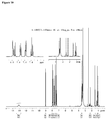
Figure 10 is an 1HNMR analysis of Compound 1 in Form I in a 50 mg/mL, 0.5 methyl cellulose-polysorbate 80 suspension stored at room temperature for 24 hours. -
Figure 11 is an 1HNMR analysis of Compound 1 • HCl standard. - As used herein, the following definitions shall apply unless otherwise indicated.
- The term "CFTR" as used herein means cystic fibrosis transmembrane conductance regulator or a mutation thereof capable of regulator activity, including, but not limited to, ΔF508 CFTR and G551D CFTR (see, e.g., http://www.genet.sickkids.on.ca/cftr/, for CFTR mutations).
- As used herein "crystalline" refers to compounds or compositions where the structural units are arranged in fixed geometric patterns or lattices, so that crystalline solids have rigid long range order. The structural units that constitute the crystal structure can be atoms, molecules, or ions. Crystalline solids show definite melting points.
- The term "modulating" as used herein means increasing or decreasing, e.g. activity, by a measurable amount.
- In one aspect, the invention features a form of 3-(6-(1-(2,2-difluorobenzo[d][1,3]dioxol-5-yl) cyclopropanecarboxamido)-3-methylpyridin-2-yl)benzoic acid characterized as Form I.
- In another embodiment, Form I is characterized by one or more peaks at 15.2 to 15.6 degrees, 16.1 to 16.5 degrees, and 14.3 to 14.7 degrees in an X-ray powder diffraction obtained using Cu K alpha radiation.
- In another embodiment, Form I is characterized by one or more peaks at 15.4, 16.3, and 14.5 degrees.
- In another embodiment, Form I is further characterized by a peak at 14.6 to 15.0 degrees.
- In another embodiment, Form I is further characterized by a peak at 14.8 degrees.
- In another embodiment, Form I is further characterized by a peak at 17.6 to 18.0 degrees.
- In another embodiment, Form I is further characterized by a peak at 17.8 degrees.
- In another embodiment, Form I is further characterized by a peak at 16.4 to 16.8 degrees.
- In another embodiment, Form I is further characterized by a peak at 16.4 to 16.8 degrees.
- In another embodiment, Form I is further characterized by a peak at 16.6 degrees.
- In another embodiment, Form I is further characterized by a peak at 7.6 to 8.0 degrees.
- In another embodiment, Form I is further characterized by a peak at 7.8 degrees.
- In another embodiment, Form I is further characterized by a peak at 25.8 to 26.2 degrees.
- In another embodiment, Form I is further characterized by a peak at 26.0 degrees.
- In another embodiment, Form I is further characterized by a peak at 21.4 to 21.8 degrees.
- In another embodiment, Form I is further characterized by a peak at 21.6 degrees.
- In another embodiment, Form I is further characterized by a peak at 23.1 to 23.5 degrees.
- In another embodiment, Form I is further characterized by a peak at 23.3 degrees.
- In some embodiments, Form I is characterized by a diffraction pattern substantially similar to that of
Figure 1 . - In some embodiments, Form I is characterized by a diffraction pattern substantially similar to that of
Figure 2 . - In some embodiments, the particle size distribution of D90 is about 82 µm or less for Form I.
- In some embodiments, the particle size distribution of D50 is about 30 µm or less for Form I.
- In one aspect, the invention features a pharmaceutical composition comprising Form I and a pharmaceutically acceptable carrier.
- In one aspect, the present invention features Form I for use in treating a CFTR mediated disease in a human comprising administering to the human an effective amount of Form I.
- In some embodiments, the use comprises administering an additional therapeutic agent.
- In some embodiments, the disease is selected from cystic fibrosis, hereditary emphysema, hereditary hemochromatosis, coagulation-fibrinolysis deficiencies, such as protein C deficiency, Type 1 hereditary angioedema, lipid processing deficiencies, such as familial hypercholesterolemia, Type 1 chylomicronemia, abetalipoproteinemia, lysosomal storage diseases, such as I-cell disease/pseudo-Hurler, mucopolysaccharidoses, Sandhof/Tay-Sachs, Crigler-Najjar type II, polyendocrinopathy/hyperinsulemia, Diabetes mellitus, Laron dwarfism, myleoperoxidase deficiency, primary hypoparathyroidism, melanoma, glycanosis CDG type 1, hereditary emphysema, congenital hyperthyroidism, osteogenesis imperfecta, hereditary hypofibrinogenemia, ACT deficiency, Diabetes insipidus (DI), neurophyseal DI, neprogenic DI, Charcot-Marie Tooth syndrome, Perlizaeus-Merzbacher disease, neurodegenerative diseases such as Alzheimer's disease, Parkinson's disease, amyotrophic lateral sclerosis, progressive supranuclear plasy, Pick's disease, several polyglutamine neurological disorders a such as Huntington, spinocerebullar ataxia type I, spinal and bulbar muscular atrophy, dentatorubal pallidoluysian, and myotonic dystrophy, as well as spongiform encephalopathies, such as hereditary Creutzfeldt-Jakob disease, Fabry disease, Straussler-Scheinker syndrome, COPD, dry-eye disease, and Sjogren's disease.
- In one embodiment, the present invention provides Form I for use in treating cystic fibrosis in a human, comprising administering to said human an effective amount of Form I.
- In one aspect, the present invention features a kit comprising Form I and instructions for use thereof.
- In one aspect, the present invention features a process of preparing Form I comprising dispersing or dissolving the HCl salt of 3-(6-(1-(2,2-difluorobenzo[d][1,3]dioxol-5-yl) cyclopropanecarboxamido)-3-methylpyridin-2-yl)benzoic acid in an appropriate solvent for an effective amount of time.
- In one embodiment, the present invention features a process of preparing Form I comprising dispersing the HCl salt of 3-(6-(1-(2,2-difluorobenzo[d][1,3]dioxol-5-yl) cyclopropanecarboxamido)-3-methylpyridin-2-yl)benzoic acid in an appropriate solvent for an effective amount of time.
- In some embodiments, the appropriate solvent is water or a alcohol/water mixture.
- In some embodiments, the appropriate solvent is water or 50% methanol/water mixture.
- In some embodiments, the appropriate solvent is water.
- In some embodiments, the appropriate solvent is a mixture comprising 50% methanol and 50% water.
- In some embodiments, the effective amount of time is about 2 to about a day. In some embodiments, the effective amount of time is about 2 to about 18 hours. In some embodiments, the effective amount of time is about 2 to about 12 hours. In some embodiments, the effective amount of time is about 2 to about 6 hours.
- In one aspect, the invention features a crystal form of 3-(6-(1-(2,2-difluorobenzo[d][1,3]dioxol-5-yl) cyclopropanecarboxamido)-3-methylpyridin-2-yl)benzoic acid having a monoclinic crystal system, a P21/n space group, and the following unit cell dimensions: a = 4.9626 (7) Å , b = 12.2994 (18) Å, c = 33.075 (4) Å, α = 90°, β = 93.938 (9)°, and γ = 90°.
- In one embodiment, Form I is prepared from dispersing or dissolving a salt form, such as HCL, of 3-(6-(1-(2,2-difluorobenzo[d][1,3]dioxol-5-yl) cyclopropanecarboxamido)-3-methylpyridin-2-yl)benzoic acid in an appropriate solvent for an effective amount of time. In another embodiment, Form I is prepared from dispersing a salt form, such as HCL, of 3-(6-(1-(2,2-difluorobenzo[d][1,3]dioxol-5-yl) cyclopropanecarboxamido)-3-methylpyridin-2-yl)benzoic acid in an appropriate solvent for an effective amount of time. In another embodiment, Form I is formed directly from 3-(6-(1-(2,2-difluorobenzo[d][1,3]dioxol-5-yl)cyclopropanecarboxamido)-3-methylpyridin-2-yl)-t-butylbenzoate and an appropriate acid, such as formic acid. In one embodiment, the HCl salt form of 3-(6-(1-(2,2-difluorobenzo[d][1,3]dioxol-5-yl) cyclopropanecarboxamido)-3-methylpyridin-2-yl)benzoic acid is the starting point and in one embodiment can be prepared by coupling an acid chloride moiety with an amine moiety according to Schemes 1-3.


- Using the HCl, for example, salt form of 3-(6-(1-(2,2-difluorobenzo[d][1,3]dioxol-5-yl) cyclopropanecarboxamido)-3-methylpyridin-2-yl)benzoic acid as a starting point, Form I can be formed in high yields by dispersing or dissolving the HCl salt form of 3-(6-(1-(2,2-difluorobenzo[d][1,3]dioxol-5-yl) cyclopropanecarboxamido)-3-methylpyridin-2-yl)benzoic acid in an appropriate solvent for an effective amount of time. Other salt forms of 3-(6-(1-(2,2-difluorobenzo[d][1,3]dioxol-5-yl) cyclopropanecarboxamido)-3-methylpyridin-2-yl)benzoic acid may be used such as, for example, other mineral or organic acid forms. The other salt forms result from hydrolysis of the t-butyl ester with the corresponding acid. Other acids/salt forms include nitric, sulfuric, phosphoric, boric, acetic, benzoic, malonic, and the like. The salt form of 3-(6-(1-(2,2-difluorobenzo[d][1,3]dioxol-5-yl)cyclopropanecarboxamido)-3-methylpyridin-2-yl)benzoic acid may or may not be soluble depending upon the solvent used, but lack of solubility does not hinder formation of Form I. For example, in one embodiment, the appropriate solvent may be water or an alcohol/water mixture such as 50% methanol/water mixture, even though the HCl salt form of 3-(6-(1-(2,2-difluorobenzo[d][1,3]dioxol-5-yl) cyclopropanecarboxamido)-3-methylpyridin-2-yl)benzoic acid is only sparingly soluble in water. In one embodiment, the appropriate solvent is water.
- The effective amount of time for formation of Form I from the salt form of 3-(6-(1-(2,2-difluorobenzo[d][1,3]dioxol-5-yl)cyclopropanecarboxamido)-3-methylpyridin-2-yl)benzoic acid can be any time between 2 to 24 hours or greater. Generally, greater than 24 hours is not needed to obtain high yields (~98%), but certain solvents may require greater amounts of time. It is also recognized that the amount of time needed is inversely proportional to the temperature. That is, the higher the temperature the less time needed to affect dissociation of acid to form Form I. When the solvent is water, stirring the dispersion for approximately 24 hours at room temperature gives Form I in an approximately 98% yield. If a solution of the salt form of 3-(6-(1-(2,2-difluorobenzo[d][1,3]dioxol-5-yl)cyclopropanecarboxamido)-3-methylpyridin-2-yl)benzoic acid is desired for process purposes, an elevated temperature may be used. After stirring the solution for an effective amount of time at the elevated temperature, recrystallization upon cooling yields substantially pure forms of Form I. In one embodiment, substantially pure refers to greater than about 90% purity. In another embodiment, substantially pure refers to greater than about 95% purity. In another embodiment, substantially pure refers to greater than about 98% purity. In another embodiment, substantially pure refers to greater than about 99% purity. The temperature selected depends in part on the solvent used and is well within the capabilities of someone of ordinary skill in the art to determine. In one embodiment, the temperature is between room temperature and about 80 °C. In another embodiment, the temperature is between room temperature and about 40 °C. In another embodiment, the temperature is between about 40 °C and about 60 °C. In another embodiment, the temperature is between about 60 °C and about 80 °C.
- In some embodiments, Form I may be further purified by recrystallization from an organic solvent. Examples of organic solvents include, but are not limited to, toluene, cumene, anisole, 1-butanol, isopropylacetate, butyl acetate, isobutyl acetate, methyl t-butyl ether, methyl isobutyl ketone, or 1-propanol/water (at various ratios). Temperature may be used as described above. For example, in one embodiment, Form I is dissolved in 1-butanol at 75 °C until it is completely dissolved. Cooling down the solution to 10 °C at a rate of 0.2 °C/min yields crystals of Form I which may be isolated by filtration.
- In another aspect of the present invention, pharmaceutically acceptable compositions are provided, wherein these compositions comprise Form I as described herein, and optionally comprise a pharmaceutically acceptable carrier, adjuvant or vehicle. In certain embodiments, these compositions optionally further comprise one or more additional therapeutic agents.
- As described above, the pharmaceutically acceptable compositions of the present invention additionally comprise a pharmaceutically acceptable carrier, adjuvant, or vehicle, which, as used herein, includes any and all solvents, diluents, or other liquid vehicle, dispersion or suspension aids, surface active agents, isotonic agents, thickening or emulsifying agents, preservatives, solid binders, lubricants and the like, as suited to the particular dosage form desired. Remington's Pharmaceutical Sciences, Sixteenth Edition, E. W. Martin (Mack Publishing Co., Easton, Pa., 1980) discloses various carriers used in formulating pharmaceutically acceptable compositions and known techniques for the preparation thereof. Except insofar as any conventional carrier medium is incompatible with the compounds of the invention, such as by producing any undesirable biological effect or otherwise interacting in a deleterious manner with any other component(s) of the pharmaceutically acceptable composition, its use is contemplated to be within the scope of this invention. Some examples of materials which can serve as pharmaceutically acceptable carriers include, but are not limited to, ion exchangers, alumina, aluminum stearate, lecithin, serum proteins, such as human serum albumin, buffer substances such as phosphates, glycine, sorbic acid, or potassium sorbate, partial glyceride mixtures of saturated vegetable fatty acids, water, salts or electrolytes, such as protamine sulfate, disodium hydrogen phosphate, potassium hydrogen phosphate, sodium chloride, zinc salts, colloidal silica, magnesium trisilicate, polyvinyl pyrrolidone, polyacrylates, waxes, polyethylene-polyoxypropylene-block polymers, wool fat, sugars such as lactose, glucose and sucrose; starches such as corn starch and potato starch; cellulose and its derivatives such as sodium carboxymethyl cellulose, ethyl cellulose and cellulose acetate; powdered tragacanth; malt; gelatin; talc; excipients such as cocoa butter and suppository waxes; oils such as peanut oil, cottonseed oil; safflower oil; sesame oil; olive oil; corn oil and soybean oil; glycols; such a propylene glycol or polyethylene glycol; esters such as ethyl oleate and ethyl laurate; agar; buffering agents such as magnesium hydroxide and aluminum hydroxide; alginic acid; pyrogen-free water; isotonic saline; Ringer's solution; ethyl alcohol, and phosphate buffer solutions, as well as other non-toxic compatible lubricants such as sodium lauryl sulfate and magnesium stearate, as well as coloring agents, releasing agents, coating agents, sweetening, flavoring and perfuming agents, preservatives and antioxidants can also be present in the composition, according to the judgment of the formulator.
- In yet another aspect, the present invention provides Form I for use in treating a condition, disease, or disorder implicated by CFTR. In certain embodiments, the present invention provides Form I for use in treating a condition, disease, or disorder implicated by a deficiency of CFTR activity, comprising administering a composition comprising a solid state form of Form I described herein to a subject, preferably a mammal, in need thereof.
- A "CFTR-mediated disease" as used herein is a disease selected from cystic fibrosis, Hereditary emphysema, Hereditary hemochromatosis, Coagulation-Fibrinolysis deficiencies, such as Protein C deficiency, Type 1 hereditary angioedema, Lipid processing deficiencies, such as Familial hypercholesterolemia, Type 1 chylomicronemia, Abetalipoproteinemia, Lysosomal storage diseases, such as I-cell disease/Pseudo-Hurler, Mucopolysaccharidoses, Sandhof/Tay-Sachs, Crigler-Najjar type II,
- Polyendocrinopathy/Hyperinsulemia, Diabetes mellitus, Laron dwarfism, Myleoperoxidase deficiency, Primary hypoparathyroidism, Melanoma, Glycanosis CDG type 1, Hereditary emphysema, Congenital hyperthyroidism, Osteogenesis imperfecta, Hereditary hypofibrinogenemia, ACT deficiency, Diabetes insipidus (DI), Neurophyseal DI, Neprogenic DI, Charcot-Marie Tooth syndrome, Perlizaeus-Merzbacher disease, neurodegenerative diseases such as Alzheimer's disease, Parkinson's disease, Amyotrophic lateral sclerosis, Progressive supranuclear plasy, Pick's disease, several polyglutamine neurological disorders a such as Huntington, Spinocerebullar ataxia type I, Spinal and bulbar muscular atrophy, Dentatorubal pallidoluysian, and Myotonic dystrophy, as well as Spongiform encephalopathies, such as Hereditary Creutzfeldt-Jakob disease, Fabry disease, Straussler-Scheinker syndrome, COPD, dry-eye disease, and Sjogren's disease.
- In certain embodiments, the present invention provides Form I for use in treating a CFTR-mediated disease in a human comprising the step of administering to said human an effective amount of a composition comprising Form I described herein.
- According to an alternative preferred embodiment, the present invention provides Form I for use in treating cystic fibrosis in a human comprising the step of administering to said human a composition comprising Form I described herein.
- According to the invention an "effective amount" of Form I or a pharmaceutically acceptable composition thereof is that amount effective for treating or lessening the severity of any of the diseases recited above.
- Form I or a pharmaceutically acceptable composition thereof may be administered using any amount and any route of administration effective for treating or lessening the severity of one or more of the diseases reicted above.
- In certain embodiments, Form I described herein or a pharmaceutically acceptable composition thereof is useful for treating or lessening the severity of cystic fibrosis in patients who exhibit residual CFTR activity in the apical membrane of respiratory and non-respiratory epithelia. The presence of residual CFTR activity at the epithelial surface can be readily detected using methods known in the art, e.g., standard electrophysiological, biochemical, or histochemical techniques. Such methods identify CFTR activity using in vivo or ex vivo electrophysiological techniques, measurement of sweat or salivary Cl- concentrations, or ex vivo biochemical or histochemical techniques to monitor cell surface density. Using such methods, residual CFTR activity can be readily detected in patients heterozygous or homozygous for a variety of different mutations, including patients homozygous or heterozygous for the most common mutation, ΔF508.
- In one embodiment, Form I described herein or a pharmaceutically acceptable composition thereof is useful for treating or lessening the severity of cystic fibrosis in patients within certain genotypes exhibiting residual CFTR activity, e.g., class III mutations (impaired regulation or gating), class IV mutations (altered conductance), or class V mutations (reduced synthesis) (Lee R. Choo-Kang, Pamela L., Zeitlin, Type I, II, III, IV, and V cystic fibrosis Tansmembrane Conductance Regulator Defects and Opportunities of Therapy; Current Opinion in Pulmonary Medicine 6:521 - 529, 2000). Other patient genotypes that exhibit residual CFTR activity include patients homozygous for one of these classes or heterozygous with any other class of mutations, including class I mutations, class II mutations, or a mutation that lacks classification.
- In one embodiment, Form I described herein or a pharmaceutically acceptable composition thereof is useful for treating or lessening the severity of cystic fibrosis in patients within certain clinical phenotypes, e.g., a moderate to mild clinical phenotype that typically correlates with the amount of residual CFTR activity in the apical membrane of epithelia. Such phenotypes include patients exhibiting pancreatic insufficiency or patients diagnosed with idiopathic pancreatitis and congenital bilateral absence of the vas deferens, or mild lung disease.
- The exact amount required will vary from subject to subject, depending on the species, age, and general condition of the subject, the severity of the infection, the particular agent, its mode of administration, and the like. The compounds of the invention are preferably formulated in dosage unit form for ease of administration and uniformity of dosage. The expression "dosage unit form" as used herein refers to a physically discrete unit of agent appropriate for the patient to be treated. It will be understood, however, that the total daily usage of the compounds and compositions of the present invention will be decided by the attending physician within the scope of sound medical judgment. The specific effective dose level for any particular patient or organism will depend upon a variety of factors including the disorder being treated and the severity of the disorder; the activity of the specific compound employed; the specific composition employed; the age, body weight, general health, sex and diet of the patient; the time of administration, route of administration, and rate of excretion of the specific compound employed; the duration of the treatment; drugs used in combination or coincidental with the specific compound employed, and like factors well known in the medical arts. The term "patient", as used herein, means an animal, preferably a mammal, and most preferably a human.
- The pharmaceutically acceptable compositions of this invention can be administered to humans and other animals orally, rectally, parenterally, intracisternally, intravaginally, intraperitoneally, topically (as by powders, ointments, or drops), bucally, as an oral or nasal spray, or the like, depending on the severity of the infection being treated. In certain embodiments, the compounds of the invention may be administered orally or parenterally at dosage levels of about 0.01 mg/kg to about 50 mg/kg and preferably from about 1 mg/kg to about 25 mg/kg, of subject body weight per day, one or more times a day, to obtain the desired therapeutic effect.
- In certain embodiments, the dosage amount of Form I in the dosage unit form is from 100 mg to 1,000 mg. In another embodiment, the dosage amount of Form I is from 200 mg to 900 mg. In another embodiment, the dosage amount of Form I is from 300 mg to 800 mg. In another embodiment, the dosage amount of Form I is from 400 mg to 700 mg. In another embodiment, the dosage amount of Form I is from 500 mg to 600 mg.
- Injectable preparations, for example, sterile injectable aqueous or oleaginous suspensions may be formulated according to the known art using suitable dispersing or wetting agents and suspending agents. The sterile injectable preparation may also be a sterile injectable solution, suspension or emulsion in a nontoxic parenterally acceptable diluent or solvent, for example, as a solution in 1,3-butanediol. Among the acceptable vehicles and solvents that may be employed are water, Ringer's solution, U.S.P. and isotonic sodium chloride solution. In addition, sterile, fixed oils are conventionally employed as a solvent or suspending medium. For this purpose any bland fixed oil can be employed including synthetic mono- or diglycerides. In addition, fatty acids such as oleic acid are used in the preparation of injectables.
- The injectable formulations can be sterilized, for example, by filtration through a bacterial-retaining filter, or by incorporating sterilizing agents in the form of sterile solid compositions which can be dissolved or dispersed in sterile water or other sterile injectable medium prior to use.
- Compositions for rectal or vaginal administration are preferably suppositories which can be prepared by mixing the compounds of this invention with suitable non-irritating excipients or carriers such as cocoa butter, polyethylene glycol or a suppository wax which are solid at ambient temperature but liquid at body temperature and therefore melt in the rectum or vaginal cavity and release the active compound.
- Solid dosage forms for oral administration include capsules, tablets, pills, powders, and granules. In such solid dosage forms, the active compound is mixed with at least one inert, pharmaceutically acceptable excipient or carrier such as sodium citrate or dicalcium phosphate and/or a) fillers or extenders such as starches, lactose, sucrose, glucose, mannitol, and silicic acid, b) binders such as, for example, carboxymethylcellulose, alginates, gelatin, polyvinylpyrrolidinone, sucrose, and acacia, c) humectants such as glycerol, d) disintegrating agents such as agar--agar, calcium carbonate, potato or tapioca starch, alginic acid, certain silicates, and sodium carbonate, e) solution retarding agents such as paraffin, f) absorption accelerators such as quaternary ammonium compounds, g) wetting agents such as, for example, cetyl alcohol and glycerol monostearate, h) absorbents such as kaolin and bentonite clay, and i) lubricants such as talc, calcium stearate, magnesium stearate, solid polyethylene glycols, sodium lauryl sulfate, and mixtures thereof. In the case of capsules, tablets and pills, the dosage form may also comprise buffering agents.
- Solid compositions of a similar type may also be employed as fillers in soft and hard-filled gelatin capsules using such excipients as lactose or milk sugar as well as high molecular weight polyethylene glycols and the like. The solid dosage forms of tablets, dragees, capsules, pills, and granules can be prepared with coatings and shells such as enteric coatings and other coatings well known in the pharmaceutical formulating art. They may optionally contain opacifying agents and can also be of a composition that they release the active ingredient(s) only, or preferentially, in a certain part of the intestinal tract, optionally, in a delayed manner. Examples of embedding compositions that can be used include polymeric substances and waxes. Solid compositions of a similar type may also be employed as fillers in soft and hard-filled gelatin capsules using such excipients as lactose or milk sugar as well as high molecular weight polethylene glycols and the like.
- The active compounds can also be in microencapsulated form with one or more excipients as noted above. The solid dosage forms of tablets, dragees, capsules, pills, and granules can be prepared with coatings and shells such as enteric coatings, release controlling coatings and other coatings well known in the pharmaceutical formulating art. In such solid dosage forms the active compound may be admixed with at least one inert diluent such as sucrose, lactose or starch. Such dosage forms may also comprise, as is normal practice, additional substances other than inert diluents, e.g., tableting lubricants and other tableting aids such a magnesium stearate and microcrystalline cellulose. In the case of capsules, tablets and pills, the dosage forms may also comprise buffering agents. They may optionally contain opacifying agents and can also be of a composition that they release the active ingredient(s) only, or preferentially, in a certain part of the intestinal tract, optionally, in a delayed manner. Examples of embedding compositions that can be used include polymeric substances and waxes.
- It will also be appreciated that Form I described herein or a pharmaceutically acceptable composition thereof can be employed in combination therapies, that is, Form I can be administered concurrently with, prior to, or subsequent to, one or more other desired therapeutics or medical procedures. The particular combination of therapies (therapeutics or procedures) to employ in a combination regimen will take into account compatibility of the desired therapeutics and/or procedures and the desired therapeutic effect to be achieved. It will also be appreciated that the therapies employed may achieve a desired effect for the same disorder (for example, an inventive compound may be administered concurrently with another agent used to treat the same disorder), or they may achieve different effects (e.g., control of any adverse effects). As used herein, additional therapeutic agents that are normally administered to treat or prevent a particular disease, or condition, are known as "appropriate for the disease, or condition, being treated".
- In one embodiment, the additional agent is selected from a mucolytic agent, bronchodialator, an anti-biotic, an anti-infective agent, an anti-inflammatory agent, a CFTR modulator other than a compound of the present invention, or a nutritional agent.
- In another embodiment, the additional agent is a compound selected from gentamicin, curcumin, cyclophosphamide, 4-phenylbutyrate, miglustat, felodipine, nimodipine, Philoxin B, geniestein, Apigenin, cAMP/cGMP modulators such as rolipram, sildenafil, milrinone, tadalafil, amrinone, isoproterenol, albuterol, and almeterol, deoxyspergualin, HSP 90 inhibitors, HSP 70 inhibitors, proteosome inhibitors such as epoxomicin, lactacystin, etc.
- In another embodiment, the additional agent is a compound disclosed in
WO 2004028480 ,WO 2004110352 ,WO 2005094374 ,WO 2005120497 , orWO 2006101740 . - In another embodiment, the additiona agent is a benzo(c)quinolizinium derivative that exhibits CFTR modulation activity or a benzopyran derivative that exhibits CFTR modulation activity.
- In another embodiment, the addditional agent is a compound disclosed in
US7202262 ,US6992096 ,US20060148864 ,US20060148863 ,US20060035943 ,US20050164973 ,WO2006110483 ,WO2006044456 ,WO2006044682 ,WO2006044505 ,WO2006044503 ,WO2006044502 , orWO2004091502 . - In another embodiment, the additional agent is a compound disclosed in
WO2004080972 ,WO2004111014 ,WO2005035514 ,WO2005049018 ,WO2006002421 ,WO2006099256 ,WO2006127588 , orWO2007044560 . - In another embodiment, the an additional agent selected from compounds disclosed in
U.S. Patent Application Serial No. 11/165,818 , published asU.S. Published Patent Application No. 2006/0074075, filed June 24, 2005 . In another embodiment, the additional agent is N-(5-hydroxy-2,4-ditert-butyl-phenyl)-4-oxo-1H-quinoline-3-carboxamide. These combinations are useful for treating the diseases described herein including cystic fibrosis. These combinations are also useful in the kits described herein. - The amount of additional therapeutic agent present in the compositions of this invention will be no more than the amount that would normally be administered in a composition comprising that therapeutic agent as the only active agent. Preferably the amount of additional therapeutic agent in the presently disclosed compositions will range from about 50% to 100% of the amount normally present in a composition comprising that agent as the only therapeutically active agent.
- Form I described herein or a pharmaceutically acceptable composition thereof may also be incorporated into compositions for coating an implantable medical device, such as prostheses, artificial valves, vascular grafts, stents and catheters. Accordingly, the present invention, in another aspect, includes a composition for coating an implantable device comprising Form I described herein or a pharmaceutically acceptable composition thereof, and in classes and subclasses herein, and a carrier suitable for coating said implantable device. In still another aspect, the present invention includes an implantable device coated with a composition comprising Form I described herein or a pharmaceutically acceptable composition thereof, and a carrier suitable for coating said implantable device. Suitable coatings and the general preparation of coated implantable devices are described in
US Patents 6,099,562 ;5,886,026 ; and5,304,121 . The coatings are typically biocompatible polymeric materials such as a hydrogel polymer, polymethyldisiloxane, polycaprolactone, polyethylene glycol, polylactic acid, ethylene vinyl acetate, and mixtures thereof. The coatings may optionally be further covered by a suitable topcoat of fluorosilicone, polysaccarides, polyethylene glycol, phospholipids or combinations thereof to impart controlled release characteristics in the composition. - In order that the invention described herein may be more fully understood, the following examples are set forth. It should be understood that these examples are for illustrative purposes only and are not to be construed as limiting this invention in any manner.
- The Differential scanning calorimetry (DSC) data of Form I were collected using a DSC Q100 V9.6 Build 290 (TA Instruments, New Castle, DE). Temperature was calibrated with indium and heat capacity was calibrated with sapphire. Samples of 3-6 mg were weighed into aluminum pans that were crimped using lids with 1 pin hole. The samples were scanned from 25°C to 350°C at a heating rate of 1.0°C/min and with a nitrogen gas purge of 50 ml/min. Data were collected by Thermal Advantage Q SeriesTM version 2.2.0.248 software and analyzed by Universal Analysis software version 4.1D (TA Instruments, New Castle, DE). The reported numbers represent single analyses.
- The X-Ray diffraction (XRD) data of Form 1 were collected on a Bruker D8 DISCOVER powder diffractometer with HI-STAR 2-dimensional detector and a flat graphite monochromator. Cu sealed tube with Kα radiation was used at 40 kV, 35mA. The samples were placed on zero-background silicon wafers at 25°C. For each sample, two data frames were collected at 120 seconds each at 2 different θ2 angles: 8° and 26°. The data were integrated with GADDS software and merged with DIFFRACTplusEVA software. Uncertainties for the reported peak positions are ± 0.2 degrees.
- Vitride® (sodium bis(2-methoxyethoxy)aluminum hydride [or NaAlH2(OCH2CH2OCH3)2], 65 wgt% solution in toluene) was purchased from Aldrich Chemicals.
- 2,2-Difluoro-1,3-benzodioxole-5-carboxylic acid was purchased from Saltigo (an affiliate of the Lanxess Corporation).
- Anywhere in the present application where a name of a compound may not correctly describe the structure of the compound, the structure supersedes the name and governs.
-

- Commercially available 2,2-difluoro-1,3-benzodioxole-5-carboxylic acid (1.0 eq) is slurried in toluene (10 vol). Vitride® (2 eq) is added via addition funnel at a rate to maintain the temperature at 15-25 °C. At the end of addition the temperature is increased to 40 °C for 2 h then 10% (w/w) aq. NaOH (4.0 eq) is carefully added via addition funnel maintaining the temperature at 40-50 °C. After stirring for an additional 30 minutes, the layers are allowed to separate at 40 °C. The organic phase is cooled to 20 °C then washed with water (2 x 1.5 vol), dried (Na2SO4), filtered, and concentrated to afford crude (2,2-difluoro-1,3-benzodioxol-5-yl)-methanol that is used directly in the next step.
-

- (2,2-difluoro-1,3-benzodioxol-5-yl)-methanol (1.0 eq) is dissolved in MTBE (5 vol). A catalytic amount of DMAP (1 mol %) is added and SOCl2 (1.2 eq) is added via addition funnel. The SOCl2 is added at a rate to maintain the temperature in the reactor at 15-25 °C. The temperature is increased to 30 °C for 1 hour then cooled to 20 °C then water (4 vol) is added via addition funnel maintaining the temperature at less than 30 °C. After stirring for an additional 30 minutes, the layers are allowed to separate. The organic layer is stirred and 10% (w/v) aq. NaOH (4.4 vol) is added. After stirring for 15 to 20 minutes, the layers are allowed to separate. The organic phase is then dried (Na2SO4), filtered, and concentrated to afford crude 5-chloromethyl-2,2-difluoro-1,3-benzodioxole that is used directly in the next step.
-

- A solution of 5-chloromethyl-2,2-difluoro-1,3-benzodioxole (1 eq) in DMSO (1.25 vol) is added to a slurry of NaCN (1.4 eq) in DMSO (3 vol) maintaining the temperature between 30-40 °C. The mixture is stirred for 1 hour then water (6 vol) is added followed by MTBE (4 vol). After stirring for 30 min, the layers are separated. The aqueous layer is extracted with MTBE (1.8 vol). The combined organic layers are washed with water (1.8 vol), dried (Na2SO4), filtered, and concentrated to afford crude (2,2-difluoro-1,3-benzodioxol-5-yl)-acetonitrile (95%) that is used directly in the next step.
-

- A mixture of (2,2-difluoro-1,3-benzodioxol-5-yl)-acetonitrile (1.0 eq), 50 wt % aqueous KOH (5.0 eq) 1-bromo-2-chloroethane (1.5 eq), and Oct4NBr (0.02 eq) is heated at 70 °C for 1 h. The reaction mixture is cooled then worked up with MTBE and water. The organic phase is washed with water and brine then the solvent is removed to afford (2,2-difluoro-1,3-benzodioxol-5-yl)-cyclopropanecarbonitrile.
-

- (2,2-difluoro-1,3-benzodioxol-5-yl)-cyclopropanecarbonitrile is hydrolyzed using 6 M NaOH (8 equiv) in ethanol (5 vol) at 80 °C overnight. The mixture is cooled to room temperature and ethanol is evaporated under vacuum. The residue is taken into water and MTBE, 1 M HCl was added and the layers are separated. The MTBE layer was then treated with dicyclohexylamine (0.97 equiv). The slurry is cooled to 0 °C, filtered and washed with heptane to give the corresponding DCHA salt. The salt is taken into MTBE and 10% citric acid and stirred until all solids dissolve. The layers are separated and the MTBE layer was washed with water and brine. Solvent swap to heptane followed by filtration gives 1-(2,2-difluoro-1,3-benzodioxol-5-yl)-cyclopropanecarboxylic acid after drying in a vacuum oven at 50 °C overnight.
-

- 1-(2,2-difluoro-1,3-benzodioxol-5-yl)-cyclopropanecarboxylic acid (1.2 eq) is slurried in toluene (2.5 vol) and the mixture heated to 60 °C. SOCl2 (1.4 eq) is added via addition funnel. The toluene and SOCl2 are distilled from the reaction mixture after 30 minutes. Additional toluene (2.5 vol) is added and distilled again.
-

- 2-Bromo-3-methylpyridine (1.0 eq) is dissolved in toluene (12 vol). K2CO3 (4.8 eq) is added followed by water (3.5 vol) and the mixture heated to 65 °C under a stream of N2 for 1 hour. 3-(t-Butoxycarbonyl)phenylboronic acid (1.05 eq) and Pd(dppf)Cl2-CH2Cl2 (0.015 eq) are then added and the mixture is heated to 80 °C. After 2 hours, the heat is turned off, water is added (3.5 vol) and the layers are allowed to separate. The organic phase is then washed with water (3.5 vol) and extracted with 10% aqueous methanesulfonic acid (2 eq MsOH, 7.7 vol). The aqueous phase is made basic with 50% aqueous NaOH (2 eq) and extracted with EtOAc (8 vol). The organic layer is concentrated to afford crude tert-butyl-3-(3-methylpyridin-2-yl)benzoate (82%) that is used directly in the next step.
-

- tert-Butyl-3-(3-methylpyridin-2-yl)benzoate (1.0 eq) is dissolved in EtOAc (6 vol). Water (0. 3 vol) is added followed by urea-hydrogen peroxide (3 eq). The phthalic anhydride (3 eq) is added portion-wise as a solid to maintain the temperature in the reactor below 45 °C. After completion of phthalic anhydride addition, the mixture is heated to 45 °C. After stirring for an additional 4 hours, the heat is turned off. 10% w/w aqueous Na2SO3 (1.5 eq) is added via addition funnel. After completion of Na2SO3 addition, the mixture is stirred for an additional 30 minutes and the layers separated. The organic layer is stirred and 10% w/w aq. Na2CO3 (2 eq) is added. After stirring for 30 minutes, the layers are allowed to separate. The organic phase is washed 13% w/v aq NaCl. The organic phase is then filtered and concentrated to afford crude 2-(3-(tert-butoxycarbonyl)phenyl)-3-methylpyridine-1-oxide (95%) that is used directly in the next step.
-

- A solution of 2-(3-(tert-butoxycarbonyl)phenyl)-3-methylpyridine-1-oxide (1 eq) and pyridine (4 eq) in MeCN (8 vol) is heated to 70 °C. A solution of methanesulfonic anhydride (1.5 eq) in MeCN (2 vol) is added over 50 min via addition funnel maintaining the temperature at less than 75 °C. The mixture is stirred for an additional 0.5 hours after complete addition. The mixture is then allowed to cool to ambient. Ethanolamine (10 eq) is added via addition funnel. After stirring for 2 hours, water (6 vol) is added and the mixture is cooled to 10 °C. After stirring for
NLT 3 hours, the solid is collected by filtration and washed with water (3 vol), 2:1 MeCN/water (3 vol), and MeCN (2 x 1.5 vol). The solid is dried to constant weight (<1% difference) in a vacuum oven at 50 °C with a slight N2 bleed to afford tert-butyl-3-(6-amino-3-methylpyridin-2-yl)benzoate as a red-yellow solid (53% yield). -

- The crude acid chloride is dissolved in toluene (2.5 vol based on acid chloride) and added via addition funnel to a mixture of tert-butyl-3-(6-amino-3-methylpyridin-2-yl)benzoate (1 eq), dimethylaminopyridine (DMAP, 0.02 eq), and triethylamine (3.0 eq) in toluene (4 vol based on tert-butyl-3-(6-amino-3-methylpyridin-2-yl)benzoate). After 2 hours, water (4 vol based on tert-butyl-3-(6-amino-3-methylpyridin-2-yl)benzoate) is added to the reaction mixture. After stirring for 30 minutes, the layers are separated. The organic phase is then filtered and concentrated to afford a thick oil of 3-(6-(1-(2,2-difluorobenzo[d][1,3]dioxol-5-yl) cyclopropanecarboxamido)-3-methylpyridin-2-yl)-t-butylbenzoate (quantitative crude yield). MeCN (3 vol based on crude product) is added and distilled until crystallization occurs. Water (2 vol based on crude product) is added and the mixture stirred for 2 h. The solid is collected by filtration, washed with 1:1 (by volume) MeCN/water (2 x 1 vol based on crude product), and partially dried on the filter under vacuum. The solid is dried to constant weight (<1% difference) in a vacuum oven at 60 °C with a slight N2 bleed to afford 3-(6-(1-(2,2-difluorobenzo[d][1,3]dioxol-5-yl) cyclopropanecarboxamido)-3-methylpyridin-2-yl)-t-butylbenzoate as a brown solid.
-

- To a slurry of 3-(6-(1-(2,2-difluorobenzo[d][1,3]dioxol-5-yl) cyclopropanecarboxamido)-3-methylpyridin-2-yl)-t-butylbenzoate (1.0 eq) in MeCN (3.0 vol) is added water (0.83 vol) followed by concentrated aqueous HCl (0.83 vol). The mixture is heated to 45 ± 5 °C. After stirring for 24 to 48 hours the reaction is complete and the mixture is allowed to cool to ambient. Water (1.33 vol) is added and the mixture stirred. The solid is collected by filtration, washed with water (2 x 0.3 vol), and partially dried on the filter under vacuum. The solid is dried to constant weight (<1% difference) in a vacuum oven at 60 °C with a slight N2 bleed to afford 3-(6-(1-(2,2-difluorobenzo[d][1,3]dioxol-5-yl)cyclopropanecarboxamido)-3-methylpyridin-2-yl)benzoic acid • HCl as an off-white solid.
-
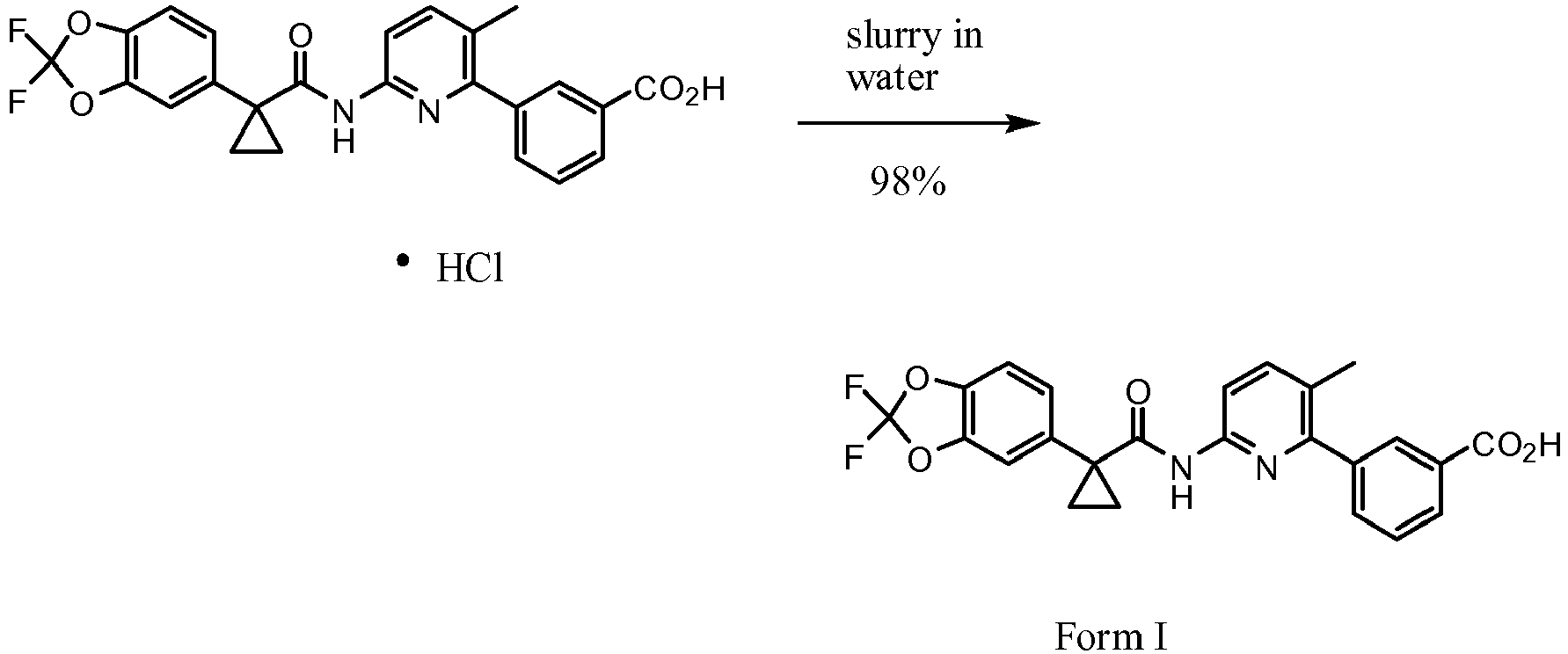
- A slurry of 3-(6-(1-(2,2-difluorobenzo[d][1,3]dioxol-5-yl) cyclopropanecarboxamido)-3-methylpyridin-2-yl)benzoic acid • HCl (1 eq) in water (10 vol) is stirred at ambient temperature. A sample is taken after stirring for 24 hours. The sample is filtered and the solid washed with water (2 x). The solid sample is submitted for DSC analysis. When DSC analysis indicates complete conversion to Form I, the solid is collected by filtration, washed with water (2 x 1.0 vol), and partially dried on the filter under vacuum. The solid is dried to constant weight (<1% difference) in a vacuum oven at 60 °C with a slight N2 bleed to afford Form I as an off-white solid (98% yield). 1H NMR (400 MHz, DMSO-d6) 9.14 (s, 1H), 7.99-7.93 (m, 3H), 7.80-7.78 (m, 1H), 7.74-7.72 (m, 1H), 7.60-7.55 (m, 2H), 7.41-7.33 (m, 2H), 2.24 (s, 3H), 1.53-1.51 (m, 2H), 1.19-1.17 (m, 2H).
-

- To a slurry of 3-(6-(1-(2,2-difluorobenzo[d][1,3]dioxol-5-yl) cyclopropanecarboxamido)-3-methylpyridin-2-yl)benzoic acid • HCl (1 eq) in water (10 vol) stirred at ambient temperature is added 50% w/w aq. NaOH (2.5 eq). The mixture is stirred for NLT 15 min or until a homogeneous solution. Concentrated HCl (4 eq) is added to crystallize Form I. The mixture is heated to 60 °C or 90 °C if needed to reduce the level of the t-butylbenzoate ester. The mixture is heated until HPLC analysis indicates NMT 0.8% (AUC) t-butylbenzoate ester. The mixture is then cooled to ambient and the solid is collected by filtration, washed with water (3 x 3.4 vol), and partially dried on the filter under vacuum. The solid is dried to constant weight (<1% difference) in a vacuum oven at 60 °C with a slight N2 bleed to afford Form I as an off-white solid (97% yield).
-

- A solution of 3-(6-(1-(2,2-difluorobenzo[d][1,3]dioxol-5-yl) cyclopropanecarboxamido)-3-methylpyridin-2-yl)-t-butylbenzoate (1.0 eq) in formic acid (3.0 vol) is heated to 70 ± 10 °C. The reaction is continued until the reaction is complete (NMT 1.0% AUC 3-(6-(1-(2,2-difluorobenzo[d][1,3]dioxol-5-yl)cyclopropanecarboxamido)-3-methylpyridin-2-yl)-t-butylbenzoate) or heating for NMT 8 h. The mixture is allowed to cool to ambient. The solution is added to water (6 vol) heated at 50 °C and the mixture stirred. The mixture is then heated to 70 ± 10 °C until the level of 3-(6-(1-(2,2-difluorobenzo[d][1,3]dioxol-5-yl) cyclopropanecarboxamido)-3-methylpyridin-2-yl)-t-butylbenzoate is NMT 0.8% (AUC). The solid is collected by filtration, washed with water (2 x 3 vol), and partially dried on the filter under vacuum. The solid is dried to constant weight (<1% difference) in a vacuum oven at 60 °C with a slight N2 bleed to afford Compound 1 in Form I as an off-white solid.
- An X-ray diffraction pattern calculated from a single crystal structure of Compound 1 in Form I is shown in
Figure 1 . Table 1 lists the calculated peaks forFigure 1 .Table 1. Peak Rank 2θ Angle [degrees] Relative Intensity [%] 11 14.41 48.2 8 14.64 58.8 1 15.23 100.0 2 16.11 94.7 3 17.67 81.9 7 19.32 61.3 4 21.67 76.5 5 23.40 68.7 9 23.99 50.8 6 26.10 67.4 10 28.54 50.1 - An actual X-ray powder diffraction pattern of Compound 1 in Form I is shown in
Figure 2 . Table 2 lists the actual peaks forFigure 2 .Table 2. Peak Rank 2θ Angle [degrees] Relative Intensity [%] 7 7.83 37.7 3 14.51 74.9 4 14.78 73.5 1 15.39 100.0 2 16.26 75.6 6 16.62 42.6 5 17.81 70.9 9 21.59 36.6 10 23.32 34.8 11 24.93 26.4 8 25.99 36.9 - An overlay of an X-ray diffraction pattern calculated from a single crystal structure of Compound 1 in Form I, and an actual X-ray powder diffraction pattern of Compound 1 in Form I is shown in
Figure 3 . The overlay shows good agreement between the calculated and actual peak positions, the difference being only about 0.15 degrees. - The DSC trace of Compound 1 in Form I is shown in
Figure 4 . Melting for Compound 1 in Form I occurs at about 204 °C. - Conformational pictures of Compound 1 in Form I based on single crystal X-ray analysis are shown in
Figures 5-8 .Figures 6-8 show hydrogen bonding between carboxylic acid groups of a dimer and the resulting stacking that occurs in the crystal. The crystal structure reveals a dense packing of the molecules. Compound 1 in Form I is monoclinic, P21/n, with the following unit cell dimensions: a = 4.9626(7) Å, b = 12.299(2) Å, c = 33.075 (4) Å, β = 93.938(9)°, V = 2014.0 Å3, Z = 4. Density of Compound 1 in Form I calculated from structural data is 1.492 g/cm3 at 100 K. - 1HNMR spectra of Compound 1 are shown in
Figures 9-11 (Figures 9 and10 depict Compound 1 in Form I in a 50 mg/mL, 0.5 methyl cellulose-polysorbate 80 suspension, andFigure 11 depicts Compound 1 as an HCl salt). - Table 3 below recites additional analytical data for Compound 1.
Table 3. Cmpd. No. LC/MS M+1 LC/RT min NMR 1 453.3 1.93 H NMR (400 MHz, DMSO-d6) 9.14 (s, 1 H), 7.99-7.93 (m, 3H), 7.80-7.78 (m, 1H), 7.74-7.72 (m, 1H), 7.60-7.55 (m, 2H), 7.41-7.33 (m, 2H), 2.24 (s, 3H), 1.53-1.51 (m, 2H), 1.19-1.17 (m, 2H) - The optical membrane potential assay utilized voltage-sensitive FRET sensors described by Gonzalez and Tsien (See, Gonzalez, J. E. and R. Y. Tsien (1995) "Voltage sensing by fluorescence resonance energy transfer in single cells" Biophys J 69(4): 1272-80, and Gonzalez, J. E. and R. Y. Tsien (1997) "Improved indicators of cell membrane potential that use fluorescence resonance energy transfer" Chem Biol 4(4): 269-77) in combination with instrumentation for measuring fluorescence changes such as the Voltage/Ion Probe Reader (VIPR) (See, Gonzalez, J. E., K. Oades, et al. (1999) "Cell-based assays and instrumentation for screening ion-channel targets" Drug Discov Today 4(9): 431-439).
- These voltage sensitive assays are based on the change in fluorescence resonant energy transfer (FRET) between the membrane-soluble, voltage-sensitive dye, DiSBAC2(3), and a fluorescent phospholipid, CC2-DMPE, which is attached to the outer leaflet of the plasma membrane and acts as a FRET donor. Changes in membrane potential (Vm) cause the negatively charged DiSBAC2(3) to redistribute across the plasma membrane and the amount of energy transfer from CC2-DMPE changes accordingly. The changes in fluorescence emission were monitored using VIPR™ II, which is an integrated liquid handler and fluorescent detector designed to conduct cell-based screens in 96- or 384-well microtiter plates.
- To identify small molecules that correct the trafficking defect associated with ΔF508-CFTR; a single-addition HTS assay format was developed. The cells were incubated in serum-free medium for 16 hrs at 37 °C in the presence or absence (negative control) of test compound. As a positive control, cells plated in 384-well plates were incubated for 16 hrs at 27 °C to "temperature-correct" ΔF508-CFTR. The cells were subsequently rinsed 3X with Krebs Ringers solution and loaded with the voltage-sensitive dyes. To activate ΔF508-CFTR, 10 µM forskolin and the CFTR potentiator, genistein (20 µM), were added along with Cl--free medium to each well. The addition of Cl--free medium promoted Cl- efflux in response to ΔF508-CFTR activation and the resulting membrane depolarization was optically monitored using the FRET-based voltage-sensor dyes.
- To identify potentiators of ΔF508-CFTR, a double-addition HTS assay format was developed. During the first addition, a Cl--free medium with or without test compound was added to each well. After 22 sec, a second addition of Cl--free medium containing 2 - 10 µM forskolin was added to activate ΔF508-CFTR. The extracellular Cl- concentration following both additions was 28 mM, which promoted Cl- efflux in response to ΔF508-CFTR activation and the resulting membrane depolarization was optically monitored using the FRET-based voltage-sensor dyes.
-
Bath Solution #1: (in mM) NaCl 160, KC14.5, CaCl 2 2, MgCl2 1,HEPES 10, pH 7.4 with NaOH.Chloride-free bath solution: Chloride salts in Bath Solution #1 are substituted with gluconate salts. CC2-DMPE: Prepared as a 10 mM stock solution in DMSO and stored at -20°C. DiSBAC2(3): Prepared as a 10 mM stock in DMSO and stored at -20°C. - NIH3T3 mouse fibroblasts stably expressing ΔF508-CFTR are used for optical measurements of membrane potential. The cells are maintained at 37 °C in 5% CO2 and 90 % humidity in Dulbecco's modified Eagle's medium supplemented with 2 mM glutamine, 10 % fetal bovine serum, 1 X NEAA, β-ME, 1 X pen/strep, and 25 mM HEPES in 175 cm2 culture flasks. For all optical assays, the cells were seeded at 30,000/well in 384-well matrigel-coated plates and cultured for 2 hrs at 37 °C before culturing at 27 °C for 24 hrs for the potentiator assay. For the correction assays, the cells are cultured at 27 °C or 37 °C with and without compounds for 16 - 24 hours.
- Using chamber experiments were performed on polarized epithelial cells expressing ΔF508-CFTR to further characterize the ΔF508-CFTR modulators identified in the optical assays. FRTΔF508-CFTR epithelial cells grown on Costar Snapwell cell culture inserts were mounted in an Ussing chamber (Physiologic Instruments, Inc., San Diego, CA), and the monolayers were continuously short-circuited using a Voltage-clamp System (Department of Bioengineering, University of Iowa, IA, and, Physiologic Instruments, Inc., San Diego, CA). Transepithelial resistance was measured by applying a 2-mV pulse. Under these conditions, the FRT epithelia demonstrated resistances of 4 KΩ/cm2 or more. The solutions were maintained at 27 °C and bubbled with air. The electrode offset potential and fluid resistance were corrected using a cell-free insert. Under these conditions, the current reflects the flow of Cl- through ΔF508-CFTR expressed in the apical membrane. The ISC was digitally acquired using an MP100A-CE interface and AcqKnowledge software (v3.2.6; BIOPAC Systems, Santa Barbara, CA).
- Typical protocol utilized a basolateral to apical membrane Cl- concentration gradient. To set up this gradient, normal ringer was used on the basolateral membrane, whereas apical NaCl was replaced by equimolar sodium gluconate (titrated to pH 7.4 with NaOH) to give a large Cl- concentration gradient across the epithelium. All experiments were performed with intact monolayers. To fully activate ΔF508-CFTR, forskolin (10 µM) and the PDE inhibitor, IBMX (100 µM), were applied followed by the addition of the CFTR potentiator, genistein (50 µM).
- As observed in other cell types, incubation at low temperatures of FRT cells stably expressing ΔF508-CFTR increases the functional density of CFTR in the plasma membrane. To determine the activity of correction compounds, the cells were incubated with 10 µM of the test compound for 24 hours at 37°C and were subsequently washed 3X prior to recording. The cAMP- and genistein-mediated ISC in compound-treated cells was normalized to the 27°C and 37°C controls and expressed as percentage activity. Preincubation of the cells with the correction compound significantly increased the cAMP- and genistein-mediated ISC compared to the 37°C controls.
- Typical protocol utilized a basolateral to apical membrane Cl- concentration gradient. To set up this gradient, normal ringers was used on the basolateral membrane and was permeabilized with nystatin (360 µg/ml), whereas apical NaCl was replaced by equimolar sodium gluconate (titrated to pH 7.4 with NaOH) to give a large Cl- concentration gradient across the epithelium. All experiments were performed 30 min after nystatin permeabilization. Forskolin (10 µM) and all test compounds were added to both sides of the cell culture inserts. The efficacy of the putative ΔF508-CFTR potentiators was compared to that of the known potentiator, genistein.
-
Basolateral solution (in mM): NaCl (135), CaCl2 (1.2), MgCl2 (1.2), K2HPO4 (2.4), KHPO4 (0.6), N-2-hydroxyethylpiperazine-N'-2-ethanesulfonic acid (HEPES) (10), and dextrose (10). The solution was titrated to pH 7.4 with NaOH. Apical solution (in mM): Same as basolateral solution with NaCl replaced with Na Gluconate (135). - Fisher rat epithelial (FRT) cells expressing ΔF508-CFTR (FRTΔF508-CFTR) were used for Ussing chamber experiments for the putative ΔF508-CFTR modulators identified from our optical assays. The cells were cultured on Costar Snapwell cell culture inserts and cultured for five days at 37 °C and 5% CO2 in Coon's modified Ham's F-12 medium supplemented with 5% fetal calf serum, 100 U/ml penicillin, and 100 µg/ml streptomycin. Prior to use for characterizing the potentiator activity of compounds, the cells were incubated at 27 °C for 16 - 48 hrs to correct for the ΔF508-CFTR. To determine the activity of corrections compounds, the cells were incubated at 27 °C or 37 °C with and without the compounds for 24 hours.
- The macroscopic ΔF508-CFTR current (IΔF508) in temperature- and test compound-corrected NIH3T3 cells stably expressing ΔF508-CFTR were monitored using the perforated-patch, whole-cell recording. Briefly, voltage-clamp recordings of IΔF508 were performed at room temperature using an Axopatch 200B patch-clamp amplifier (Axon Instruments Inc., Foster City, CA). All recordings were acquired at a sampling frequency of 10 kHz and low-pass filtered at 1 kHz. Pipettes had a resistance of 5 - 6 MΩ when filled with the intracellular solution. Under these recording conditions, the calculated reversal potential for Cl- (ECl) at room temperature was -28 mV. All recordings had a seal resistance > 20 GΩ and a series resistance < 15 MΩ. Pulse generation, data acquisition, and analysis were performed using a PC equipped with a Digidata 1320 A/D interface in conjunction with Clampex 8 (Axon Instruments Inc.). The bath contained < 250 µl of saline and was continuously perifused at a rate of 2 ml/min using a gravity-driven perfusion system.
- To determine the activity of correction compounds for increasing the density of functional ΔF508-CFTR in the plasma membrane, we used the above-described perforated-patch-recording techniques to measure the current density following 24-hr treatment with the correction compounds. To fully activate ΔF508-CFTR, 10 µM forskolin and 20 µM genistein were added to the cells. Under our recording conditions, the current density following 24-hr incubation at 27°C was higher than that observed following 24-hr incubation at 37 °C. These results are consistent with the known effects of low-temperature incubation on the density of ΔF508-CFTR in the plasma membrane. To determine the effects of correction compounds on CFTR current density, the cells were incubated with 10 µM of the test compound for 24 hours at 37°C and the current density was compared to the 27°C and 37°C controls (% activity). Prior to recording, the cells were washed 3X with extracellular recording medium to remove any remaining test compound. Preincubation with 10 µM of correction compounds significantly increased the cAMP- and genistein-dependent current compared to the 37°C controls.
- The ability of ΔF508-CFTR potentiators to increase the macroscopic ΔF508-CFTR Cl- current (IΔF508) in NIH3T3 cells stably expressing ΔF508-CFTR was also investigated using perforated-patch-recording techniques. The potentiators identified from the optical assays evoked a dose-dependent increase in IΔF508 with similar potency and efficacy observed in the optical assays. In all cells examined, the reversal potential before and during potentiator application was around -30 mV, which is the calculated ECl (-28 mV).
-
Intracellular solution (in mM): Cs-aspartate (90), CsCl (50), MgCl2 (1), HEPES (10), and 240 µg/ml amphotericin-B (pH adjusted to 7.35 with CsOH). Extracellular solution (in mM): N-methyl-D-glucamine (NMDG)-Cl (150), MgCl2 (2), CaCl2 (2), HEPES (10) (pH adjusted to 7.35 with HCl). - NIH3T3 mouse fibroblasts stably expressing ΔF508-CFTR are used for whole-cell recordings. The cells are maintained at 37 °C in 5% CO2 and 90 % humidity in Dulbecco's modified Eagle's medium supplemented with 2 mM glutamine, 10 % fetal bovine serum, 1 X NEAA, β-ME, 1 X pen/strep, and 25 mM HEPES in 175 cm2 culture flasks. For whole-cell recordings, 2,500 - 5,000 cells were seeded on poly-L-lysine-coated glass coverslips and cultured for 24 - 48 hrs at 27 °C before use to test the activity of potentiators; and incubated with or without the correction compound at 37 °C for measuring the activity of correctors.
- The single-channel actdivities of temperature-corrected ΔF508-CFTR stably expressed in NIH3T3 cells and activities of potentiator compounds were observed using excised inside-out membrane patch. Briefly, voltage-clamp recordings of single-channel activity were performed at room temperature with an Axopatch 200B patch-clamp amplifier (Axon Instruments Inc.). All recordings were acquired at a sampling frequency of 10 kHz and low-pass filtered at 400 Hz. Patch pipettes were fabricated from Corning Kovar Sealing #7052 glass (World Precision Instruments, Inc., Sarasota, FL) and had a resistance of 5 - 8 MΩ when filled with the extracellular solution. The ΔF508-CFTR was activated after excision, by adding 1 mM Mg-ATP, and 75 nM of the cAMP-dependent protein kinase, catalytic subunit (PKA; Promega Corp. Madison, WI). After channel activity stabilized, the patch was perifused using a gravity-driven microperfusion system. The inflow was placed adjacent to the patch, resulting in complete solution exchange within 1 - 2 sec. To maintain ΔF508-CFTR activity during the rapid perifusion, the nonspecific phosphatase inhibitor F- (10 mM NaF) was added to the bath solution. Under these recording conditions, channel activity remained constant throughout the duration of the patch recording (up to 60 min). Currents produced by positive charge moving from the intra- to extracellular solutions (anions moving in the opposite direction) are shown as positive currents. The pipette potential (Vp) was maintained at 80 mV.
- Channel activity was analyzed from membrane patches containing ≤ 2 active channels. The maximum number of simultaneous openings determined the number of active channels during the course of an experiment. To determine the single-channel current amplitude, the data recorded from 120 sec of ΔF508-CFTR activity was filtered "off-line" at 100 Hz and then used to construct all-point amplitude histograms that were fitted with multigaussian functions using Bio-Patch Analysis software (Bio-Logic Comp. France). The total microscopic current and open probability (Po) were determined from 120 sec of channel activity. The Po was determined using the Bio-Patch software or from the relationship Po = I/i(N), where I = mean current, i = single-channel current amplitude, and N = number of active channels in patch.
-
Extracellular solution (in mM): NMDG (150), aspartic acid (150), CaCl2 (5), MgCl2 (2), and HEPES (10) (pH adjusted to 7.35 with Tris base). Intracellular solution (in mM): NMDG-Cl (150), MgCl2 (2), EGTA (5), TES (10), and Tris base (14) (pH adjusted to 7.35 with HCl). - NIH3T3 mouse fibroblasts stably expressing ΔF508-CFTR are used for excised-membrane patch-clamp recordings. The cells are maintained at 37 °C in 5% CO2 and 90 % humidity in Dulbecco's modified Eagle's medium supplemented with 2 mM glutamine, 10 % fetal bovine serum, 1 X NEAA, β-ME, 1 X pen/strep, and 25 mM HEPES in 175 cm2 culture flasks. For single channel recordings, 2,500 - 5,000 cells were seeded on poly-L-lysine-coated glass coverslips and cultured for 24 - 48 hrs at 27 °C before use.
- Using the procedures described above, the activity, i.e., EC50s, of Compound 1 has been measured and is shown in Table 4.

Claims (31)
- 3-(6-(1-(2,2-Difluorobenzo[d][1,3]dioxol-5-yl)cyclopropanecarboxamido)-3-methylpyridin-2-yl)benzoic acid characterized as Form I, wherein the Form I is characterized by one or more peaks at 15.2 to 15.6 degrees, 16.1 to 16.5 degrees, and 14.3 to 14.7 degrees in an X-ray powder diffraction obtained using Cu K alpha radiation at 40 kV, 35 mA.
- Form I of claim 1, wherein the Form I is characterized by one or more peaks at 15.4, 16.3, and 14.5 degrees.
- Form I of claim 1, wherein the Form I is further characterized by a peak at 14.6 to 15.0 degrees.
- Form I of claim 3, wherein the Form I is further characterized by a peak at 14.8 degrees.
- Form I of claim 3, wherein the Form I is further characterized by a peak at 17.6 to 18.0 degrees.
- Form I of claim 5, wherein the Form I is further characterized by a peak at 17.8 degrees.
- Form I of claim 5, wherein the Form I is further characterized by a peak at 16.4 to 16.8 degrees.
- Form I of claim 7, wherein the Form I is further characterized by a peak at 16.4 to 16.8 degrees.
- Form I of claim 8, wherein the Form I is further characterized by a peak at 16.6 degrees.
- Form I of claim 8, wherein the Form I is further characterized by a peak at 7.6 to 8.0 degrees.
- Form I of claim 10, wherein the Form I is further characterized by a peak at 7.8 degrees.
- Form I of claim 10, wherein the Form I is further characterized by a peak at 25.8 to 26.2 degrees.
- Form I of claim 12, wherein the Form I is further characterized by a peak at 26.0 degrees.
- Form I of claim 12, wherein the Form I is further characterized by a peak at 21.4 to 21.8 degrees.
- Form I of claim 14, wherein the Form I is further characterized by a peak at 21.6 degrees.
- Form I of claim 14, wherein the Form I is further characterized by a peak at 23.1 to 23.5 degrees.
- Form I of claim 16, wherein the Form I is further characterized by a peak at 23.3 degrees.
- Form I of claim 1, wherein the Form I is characterized by a diffraction pattern substantially similar to that of Figure 1.
- Form I of claim 1, wherein the Form I is characterized by a diffraction pattern substantially similar to that of Figure 2.
- Form I of claim 1, wherein the particle size distribution of D90 is about 82 µm or less.
- Form I of claim 1, wherein the particle size distribution of D50 is about 30 µm or less.
- A pharmaceutical composition comprising Form I of claim 1, and a pharmaceutically acceptable carrier.
- Form I of claim 1 for use in treating cystic fibrosis in a mammal comprising administering to the mammal an effective amount of said Form I.
- Form I for use as defined by claim 23, wherein the use comprises administering an additional therapeutic agent.
- A kit comprising Form I of claim 1 and instructions for use thereof.
- A process for preparing the Form I of claim 1 comprising suspending or dissolving the HCl salt of 3-(6-(1-(2,2-difluorobenzo[d][1,3]dioxol-5-yl) cyclopropanecarboxamido)-3-methylpyridin-2-yl)benzoic acid in an appropriate solvent for an effective amount of time.
- The process of claim 26, wherein the appropriate solvent is water or 50% methanol/water mixture.
- The process of claim 26, wherein the appropriate solvent is water.
- The process of claim 26, wherein the effective amount of time is 2 to 24 hours.
- The process of claim 26, wherein the effective amount of time is 2 to 6 hours.
- A crystal form of 3-(6-(1-(2,2-difluorobenzo[d][1,3]dioxol-5-yl) cyclopropanecarboxamido)-3-methylpyridin-2-yl)benzoic acid according to claim 1 having a monoclinic crystal system, a P21/n space group, and the following unit cell dimensions:
a = 4.9626 (7) Å α = 90° b = 12.2994 (18) Å β = 93.938 (9)° c = 33.075 (4) Å γ = 90°.
Priority Applications (13)
| Application Number | Priority Date | Filing Date | Title |
|---|---|---|---|
| EP16198922.3A EP3170818B1 (en) | 2007-12-07 | 2008-12-04 | Solid forms of 3-(6-(1-(2,2-difluorobenzo[d][1,3]dioxol-5-yl) cyclopropanecarboxamido)-3-methylpyridin-2-yl) benzoic acid |
| RS20170004A RS55559B1 (en) | 2007-12-07 | 2008-12-04 | SOLID FORMS 3- (6- (1- (2,2-DIFLUOROBENZO [D] [1,3] DIOXOL-5-IL) CYCLOPROPANECARBOXAMIDO) -3-METHYLPYRIDIN-2-yl) BENZOIC ACIDS |
| SI200831762A SI2225230T1 (en) | 2007-12-07 | 2008-12-04 | Solid forms of 3-(6-(1-(2,2-difluorobenzo(d)(1,3)dioxol-5-yl) cyclopropanecarboxamido)-3-methylpyridin-2-yl) benzoic acid |
| PL16198922T PL3170818T3 (en) | 2007-12-07 | 2008-12-04 | Solid forms of 3-(6-(1-(2,2-difluorobenzo[d][1,3]dioxol-5-yl) cyclopropanecarboxamido)-3-methylpyridin-2-yl) benzoic acid |
| HRP20170241TT HRP20170241T2 (en) | 2007-12-07 | 2008-12-04 | SOLID FORMS OF 3-(6-(1-(2,2-DIFLUOROBENZO[D][1,3]DIOXOL-5-YL)CYCLOPROPANECARBOXAMIDO)-3-METHYLPYRIDIN-2-YL)BENZOIC ACIDS |
| DK16198922.3T DK3170818T3 (en) | 2007-12-07 | 2008-12-04 | SOLID FORMS OF 3- (6- (1- (2,2-DIFLUOROBENZO [D] [1,3] DIOXOL-5-YL) CYCLOPROPANCARBOXAMIDO) -3-METHYLPYRIDIN-2-YL) BENZOIC ACID |
| PL08855812T PL2225230T3 (en) | 2007-12-07 | 2008-12-04 | Solid forms of 3-(6-(1-(2,2-difluorobenzo[d][1,3]dioxol-5-yl) cyclopropanecarboxamido)-3-methylpyridin-2-yl) benzoic acid |
| EP20157902.6A EP3683218B1 (en) | 2007-12-07 | 2008-12-04 | Solid forms of 3-(6-(1-(2,2-difluorobenzo[d][1,3]dioxol-5-yl) cyclopropanecarboxamido)-3-methylpyridin-2-yl) benzoic acid |
| CY20201100432T CY1122895T1 (en) | 2007-12-07 | 2020-05-11 | 3-(6-(1-(2,2-DIFLUOROBENZO[D][1,3]DIOXOL-5-YL)-CYCLOPANECARBOXAMIDO)-3-METHYLPYRIDIN-3-YL)-BENZOIC ACID SOLID |
| NO2020025C NO2020025I1 (en) | 2007-12-07 | 2020-08-12 | A combination of (a) 3-(6-(1-(2,2-difluorobenzo[d][1,3]dioxol-5-yl cyclopropanecarboxamido)-3-methylpyridin-2-yl)benzoic acid and (b) N -(5-hydroxy-2,4-di-tert-butyl-phenyl)-4-oxo-1H-quinoline-3-carboxamide or a pharmaceutically acceptable salt thereof |
| HUS2000030C HUS2000030I1 (en) | 2007-12-07 | 2020-08-13 | Solid forms of 3- (6- (1- (2,2-Difluorobenzo [d] [1,3] dioxol-5-yl) cyclopropanecarboxamido) -3-methylpyridin-2-yl) benzoic acid |
| LTPA2020525C LTC3170818I2 (en) | 2007-12-07 | 2020-08-14 | 3-(6-(1-(2,2-DIFLUORBENZO[D][1,3]DIOXOL-5-YL)CYCLOPROPANECARBOXAMIDO)-3-METHYLPYRIDIN-2-YL)BENZOIC ACID SOLID |
| CY2020030C CY2020030I1 (en) | 2007-12-07 | 2020-08-18 | 3-(6-(1-(2,2-DIFLUOROBENZO[D][1,3]DIOXOL-5-YL)-CYCLOPROPANECARBOXAMYL)-3-METHYLPYRIDIN-3-YL)-BENZOIC ACID SOLID |
Applications Claiming Priority (2)
| Application Number | Priority Date | Filing Date | Title |
|---|---|---|---|
| US1216207P | 2007-12-07 | 2007-12-07 | |
| PCT/US2008/085456 WO2009073757A1 (en) | 2007-12-07 | 2008-12-04 | Solid forms of 3-(6-(1-(2,2-difluorobenzo[d][1,3] dioxol-5-yl) cyclopropanecarboxamido)-3-methylpyridin-2-yl) benzoic acid |
Related Child Applications (2)
| Application Number | Title | Priority Date | Filing Date |
|---|---|---|---|
| EP16198922.3A Division EP3170818B1 (en) | 2007-12-07 | 2008-12-04 | Solid forms of 3-(6-(1-(2,2-difluorobenzo[d][1,3]dioxol-5-yl) cyclopropanecarboxamido)-3-methylpyridin-2-yl) benzoic acid |
| EP20157902.6A Division EP3683218B1 (en) | 2007-12-07 | 2008-12-04 | Solid forms of 3-(6-(1-(2,2-difluorobenzo[d][1,3]dioxol-5-yl) cyclopropanecarboxamido)-3-methylpyridin-2-yl) benzoic acid |
Publications (2)
| Publication Number | Publication Date |
|---|---|
| EP2225230A1 EP2225230A1 (en) | 2010-09-08 |
| EP2225230B1 true EP2225230B1 (en) | 2016-11-16 |
Family
ID=40344271
Family Applications (3)
| Application Number | Title | Priority Date | Filing Date |
|---|---|---|---|
| EP08855812.7A Active EP2225230B1 (en) | 2007-12-07 | 2008-12-04 | Solid forms of 3-(6-(1-(2,2-difluorobenzo[d][1,3]dioxol-5-yl) cyclopropanecarboxamido)-3-methylpyridin-2-yl) benzoic acid |
| EP16198922.3A Active EP3170818B1 (en) | 2007-12-07 | 2008-12-04 | Solid forms of 3-(6-(1-(2,2-difluorobenzo[d][1,3]dioxol-5-yl) cyclopropanecarboxamido)-3-methylpyridin-2-yl) benzoic acid |
| EP20157902.6A Active EP3683218B1 (en) | 2007-12-07 | 2008-12-04 | Solid forms of 3-(6-(1-(2,2-difluorobenzo[d][1,3]dioxol-5-yl) cyclopropanecarboxamido)-3-methylpyridin-2-yl) benzoic acid |
Family Applications After (2)
| Application Number | Title | Priority Date | Filing Date |
|---|---|---|---|
| EP16198922.3A Active EP3170818B1 (en) | 2007-12-07 | 2008-12-04 | Solid forms of 3-(6-(1-(2,2-difluorobenzo[d][1,3]dioxol-5-yl) cyclopropanecarboxamido)-3-methylpyridin-2-yl) benzoic acid |
| EP20157902.6A Active EP3683218B1 (en) | 2007-12-07 | 2008-12-04 | Solid forms of 3-(6-(1-(2,2-difluorobenzo[d][1,3]dioxol-5-yl) cyclopropanecarboxamido)-3-methylpyridin-2-yl) benzoic acid |
Country Status (28)
| Country | Link |
|---|---|
| US (8) | US8507534B2 (en) |
| EP (3) | EP2225230B1 (en) |
| JP (6) | JP2011506330A (en) |
| KR (3) | KR20160040745A (en) |
| CN (2) | CN103626744B (en) |
| AU (1) | AU2008333845C1 (en) |
| BR (1) | BRPI0821039B8 (en) |
| CA (2) | CA2986286C (en) |
| CL (1) | CL2010000607A1 (en) |
| CY (3) | CY1118630T1 (en) |
| DK (2) | DK2225230T3 (en) |
| EA (1) | EA201070698A1 (en) |
| ES (3) | ES2611077T3 (en) |
| HR (2) | HRP20170241T2 (en) |
| HU (3) | HUE049642T2 (en) |
| IL (2) | IL206203A (en) |
| LT (3) | LT2225230T (en) |
| MX (2) | MX2010006179A (en) |
| NO (2) | NO2017009I2 (en) |
| NZ (4) | NZ599889A (en) |
| PL (2) | PL3170818T3 (en) |
| PT (2) | PT3170818T (en) |
| RS (2) | RS60229B1 (en) |
| SG (1) | SG186638A1 (en) |
| SI (2) | SI2225230T1 (en) |
| UA (1) | UA102534C2 (en) |
| WO (1) | WO2009073757A1 (en) |
| ZA (1) | ZA201003623B (en) |
Cited By (1)
| Publication number | Priority date | Publication date | Assignee | Title |
|---|---|---|---|---|
| EP4321162A1 (en) | 2022-08-08 | 2024-02-14 | Consejo Superior de Investigaciones Científicas (CSIC) | Antiviral agents for the treatment of infections by coronaviruses |
Families Citing this family (117)
| Publication number | Priority date | Publication date | Assignee | Title |
|---|---|---|---|---|
| ZA200602755B (en) | 2003-09-06 | 2007-06-27 | Vertex Pharma | Modulators of ATP-binding cassette transporters |
| JP4869072B2 (en) * | 2003-11-14 | 2012-02-01 | バーテックス ファーマシューティカルズ インコーポレイテッド | Thiazoles and oxazoles useful as modulators of ATP binding cassette transporters |
| US7977322B2 (en) | 2004-08-20 | 2011-07-12 | Vertex Pharmaceuticals Incorporated | Modulators of ATP-binding cassette transporters |
| LT2502911T (en) | 2004-06-24 | 2017-09-11 | Vertex Pharmaceuticals Incorporated | Modulators of ATP-binding cassette transporters |
| ATE512145T1 (en) | 2005-08-11 | 2011-06-15 | Vertex Pharma | CYSTIC FIBROSIS TRANSMEMBRANE CONDUCTANCE REGULATOR MODULATORS |
| EP1945632B1 (en) | 2005-11-08 | 2013-09-18 | Vertex Pharmaceuticals Incorporated | Heterocyclic modulators of atp-binding cassette transporters |
| WO2007079139A2 (en) | 2005-12-28 | 2007-07-12 | Vertex Pharmaceuticals, Inc. | Solid forms of n-[2,4-bis(1,1-dimethylethyl)-5-hydroxyphenyl]-1,4-dihydro-4-oxoquinoline-3-carboxamide |
| AU2006336504C9 (en) * | 2005-12-28 | 2015-05-14 | Vertex Pharmaceuticals Incorporated | 1-(benzo [D] [1,3] dioxol-5-yl) -N- (phenyl) cyclopropane- carboxamide derivatives and related compounds as modulators of ATP-Binding Cassette transporters for the treatment of Cystic Fibrosis |
| US7671221B2 (en) * | 2005-12-28 | 2010-03-02 | Vertex Pharmaceuticals Incorporated | Modulators of ATP-Binding Cassette transporters |
| US7645789B2 (en) | 2006-04-07 | 2010-01-12 | Vertex Pharmaceuticals Incorporated | Indole derivatives as CFTR modulators |
| USRE50453E1 (en) | 2006-04-07 | 2025-06-10 | Vertex Pharmaceuticals Incorporated | Indole derivatives as CFTR modulators |
| NZ571803A (en) | 2006-04-07 | 2011-12-22 | Vertex Pharma | Amide indole derivatives as modulators of ATP-binding cassette transporters |
| US10022352B2 (en) | 2006-04-07 | 2018-07-17 | Vertex Pharmaceuticals Incorporated | Modulators of ATP-binding cassette transporters |
| US8563573B2 (en) * | 2007-11-02 | 2013-10-22 | Vertex Pharmaceuticals Incorporated | Azaindole derivatives as CFTR modulators |
| US8969386B2 (en) | 2007-05-09 | 2015-03-03 | Vertex Pharmaceuticals Incorporated | Modulators of CFTR |
| MX2009012678A (en) * | 2007-05-25 | 2012-09-20 | Vertex Pharma | Ion channel modulators and methods of use. |
| HUE028426T2 (en) | 2007-08-24 | 2016-12-28 | Vertex Pharma | Isothiazolopyridinones useful for the treatment of (inter alia) cystic fibrosis |
| SI2217572T1 (en) * | 2007-11-16 | 2014-05-30 | Vertex Pharmaceuticals Incorporated | Isoquinoline modulators of atp-binding cassette transporters |
| US20100036130A1 (en) | 2007-12-07 | 2010-02-11 | Vertex Pharmaceuticals Incorporated | Processes for producing cycloalkylcarboxamido-pyridine benzoic acids |
| WO2009076141A2 (en) * | 2007-12-07 | 2009-06-18 | Vertex Pharmaceuticals Incorporated | Formulations of 3-(6-(1-(2,2-difluorobenzo[d][1,3]dioxol-5-yl) cycklopropanecarboxamido)-3-methylpyridin-2-yl)benzoic acid |
| EP2639224B1 (en) | 2007-12-07 | 2016-08-24 | Vertex Pharmaceuticals Incorporated | Process for producing cycloalkylcarboxiamido-pyridine benzoic acids |
| SI2225230T1 (en) | 2007-12-07 | 2017-03-31 | Vertex Pharmaceuticals Incorporated | Solid forms of 3-(6-(1-(2,2-difluorobenzo(d)(1,3)dioxol-5-yl) cyclopropanecarboxamido)-3-methylpyridin-2-yl) benzoic acid |
| NZ720282A (en) | 2008-02-28 | 2017-12-22 | Vertex Pharma | Heteroaryl derivatives as cftr modulators |
| EP2271621B1 (en) * | 2008-03-31 | 2013-11-20 | Vertex Pharmaceuticals Incorporated | Pyridyl derivatives as cftr modulators |
| US20100074949A1 (en) | 2008-08-13 | 2010-03-25 | William Rowe | Pharmaceutical composition and administration thereof |
| US12458635B2 (en) | 2008-08-13 | 2025-11-04 | Vertex Pharmaceuticals Incorporated | Pharmaceutical composition and administrations thereof |
| JP2012504143A (en) * | 2008-09-29 | 2012-02-16 | バーテックス ファーマシューティカルズ インコーポレイテッド | 3- (6- (1- (2,2-difluorobenzo [d] [1,3] dioxol-5-yl) cyclopropanecarboxamido) -3-methylpyridin-2-yl) benzoic acid dosage unit |
| NZ592685A (en) * | 2008-10-23 | 2013-04-26 | Vertex Pharma | Modulators of cystic fibrosis transmembrane conductance regulator |
| SI2408750T1 (en) | 2009-03-20 | 2015-11-30 | Vertex Pharmaceuticals Incorporated | Process for making modulators of cystic fibrosis transmembrane conductance regulator |
| US20110098311A1 (en) * | 2009-10-22 | 2011-04-28 | Vertex Pharmaceuticals Incorported | Compositions for treatment of cystic fibrosis and other chronic diseases |
| US20110251253A1 (en) * | 2010-03-25 | 2011-10-13 | Vertex Pharmaceuticals Incorporated | Solid forms of (r)-1-(2,2-difluorobenzo[d][1,3]dioxol-5-yl)-n-(1-(2,3-dihydroxypropyl)-6-fluoro-2-(1-hydroxy-2-methylpropan-2-yl)-1h-indol-5-yl) cyclopropanecarboxamide |
| US8802868B2 (en) | 2010-03-25 | 2014-08-12 | Vertex Pharmaceuticals Incorporated | Solid forms of (R)-1(2,2-difluorobenzo[D][1,3]dioxo1-5-yl)-N-(1-(2,3-dihydroxypropyl-6-fluoro-2-(1-hydroxy-2-methylpropan2-yl)-1H-Indol-5-yl)-Cyclopropanecarboxamide |
| HRP20160682T1 (en) * | 2010-04-07 | 2016-07-29 | Vertex Pharmaceuticals Incorporated | SOLID FORMS 3- (6- (1- (2,2-DIFLUOROBENZO [D] [1,3] DIOXOL-5-IL) CYCLOPROPANECARBOXYAMIDO) -3-METHYLPYRIDIN-2-YL) BENZOIC ACIDS |
| HRP20211752T1 (en) * | 2010-04-07 | 2022-02-18 | Vertex Pharmaceuticals Incorporated | Pharmaceutical compositions of 3-(6-(1-(2,2-difluorobenzo[d][1,3]dioxol-5-yl)cyclopropanecarboxamido)-3-methylpyriodin-2-yl)benzoic acid and administration thereof |
| AU2011242454A1 (en) | 2010-04-22 | 2012-11-08 | Vertex Pharmaceuticals Incorporated | Pharmaceutical compositions and administrations thereof |
| CA2796642A1 (en) | 2010-04-22 | 2011-10-27 | Vertex Pharmaceuticals Incorporated | Pharmaceutical compositions and administrations thereof |
| NZ603044A (en) * | 2010-04-22 | 2015-08-28 | Vertex Pharma | Pharmaceutical compositions comprising cftr modulators and administrations thereof |
| ES2608474T3 (en) | 2010-04-22 | 2017-04-11 | Vertex Pharmaceuticals Incorporated | Production process of indole compounds cycloalkylcarboxamido |
| US8563593B2 (en) | 2010-06-08 | 2013-10-22 | Vertex Pharmaceuticals Incorporated | Formulations of (R)-1-(2,2-difluorobenzo[D] [1,3] dioxol-5-yl)-N-(1-(2,3-dihydroxypropyl)-6-fluoro-2-(1-hydroxy-2-methylpropan-2-yl)-1H-indol-5-yl)cyclopropanecarboxamide |
| HUE047354T2 (en) | 2011-05-18 | 2020-04-28 | Vertex Pharmaceuticals Europe Ltd | Deuterated derivatives of ivacaftor |
| WO2013059677A1 (en) * | 2011-10-19 | 2013-04-25 | Calcimedica, Inc. | Compounds that modulate intracellular calcium |
| IN2014KN00885A (en) | 2011-11-08 | 2015-10-02 | Vertex Pharma | |
| WO2013112804A1 (en) * | 2012-01-25 | 2013-08-01 | Vertex Pharmaceuticals Incorporated | Formulations of 3-(6-(1-(2.2-difluorobenzo[d][1,3]dioxol-5-yl) cyclopropanecarboxamido)-3-methylpyridin-2-yl)benzoic acid |
| EP2819670A1 (en) | 2012-02-27 | 2015-01-07 | Vertex Pharmaceuticals Incorporated | Pharmaceutical composition and administration thereof |
| US8674108B2 (en) | 2012-04-20 | 2014-03-18 | Vertex Pharmaceuticals Incorporated | Solid forms of N-[2,4-bis(1,1-dimethylethy)-5-hydroxyphenyl]-1,4-dihydro-4-oxoquinoline-3-carboxamide |
| WO2014014841A1 (en) | 2012-07-16 | 2014-01-23 | Vertex Pharmaceuticals Incorporated | Pharmaceutical compositions of (r)-1-(2,2-diflurorbenzo[d][1,3]dioxol-5-yl)-n-(1-(2,3-dihydroxypropyl)-6-fluoro-2-(1-hydroxy-2-methylpropan-2-yl)-1h-indol-5-yl) cyclopropanecarboxamide and administration thereof |
| LT3470063T (en) | 2012-11-02 | 2025-02-10 | Vertex Pharmaceuticals Incorporated | PHARMACEUTICAL COMPOSITIONS FOR THE TREATMENT OF CFTR-RELATED DISEASES |
| EP2968323A4 (en) | 2013-03-13 | 2016-12-14 | Flatley Discovery Lab | Pyridazinone compounds and methods for the treatment of cystic fibrosis |
| JP6963896B2 (en) | 2013-11-12 | 2021-11-10 | バーテックス ファーマシューティカルズ インコーポレイテッドVertex Pharmaceuticals Incorporated | Methods of Preparing Pharmaceutical Compositions for the Treatment of CFTR-mediated Diseases |
| ES2885181T3 (en) | 2014-04-15 | 2021-12-13 | Vertex Pharma | Pharmaceutical compositions for the treatment of diseases mediated by the transmembrane conductance regulator of cystic fibrosis |
| GB201415381D0 (en) | 2014-08-29 | 2014-10-15 | Algipharma As | Inhalable powder formulations of alginate oligomers |
| TWI735416B (en) | 2014-10-06 | 2021-08-11 | 美商維泰克斯製藥公司 | Modulators of cystic fibrosis transmembrane conductance regulator |
| KR20170063954A (en) | 2014-10-07 | 2017-06-08 | 버텍스 파마슈티칼스 인코포레이티드 | Co-crystals of modulators of cystic fibrosis transmembrane conductance regulator |
| PT3221692T (en) | 2014-11-18 | 2021-09-10 | Vertex Pharma | Process of conducting high throughput testing high performance liquid chromatography |
| GB201504878D0 (en) | 2015-03-23 | 2015-05-06 | Algipharma As | Use of alginate oligomers and CFTR modulators in the treatment of conditions associated with CFTR dysfuntion |
| WO2017017696A1 (en) * | 2015-07-27 | 2017-02-02 | Mylan Laboratories Limited | Process for the preparation of lumacaftor |
| CN106432209A (en) | 2015-08-11 | 2017-02-22 | 苏州晶云药物科技有限公司 | New crystal form of lumacaftor, and preparation method thereof |
| HK1258473A1 (en) | 2015-09-25 | 2019-11-15 | Vertex Pharmaceuticals (Europe) Limited | Deuterated cftr potentiators |
| CA3000600A1 (en) * | 2015-09-29 | 2017-04-06 | Mylan Laboratories Limited | Novel forms of lumacaftor and processes for the preparation thereof |
| WO2017056031A1 (en) * | 2015-10-01 | 2017-04-06 | Glenmark Pharmaceuticals Limited | Process for preparation of lumacaftor |
| GB201517639D0 (en) | 2015-10-06 | 2015-11-18 | Algipharma As | Use of alginate oligomers to treat or prevent microbial overgrowth in the intestinal tract |
| WO2017118915A1 (en) * | 2016-01-04 | 2017-07-13 | Dr. Reddy's Laboratories Limited | Amorphous and crystalline solid forms of lumacaftor or its complex and preparative processes thereof |
| WO2017137900A1 (en) * | 2016-02-10 | 2017-08-17 | Lupin Limited | Amorphous lumacaftor and its solid dispersion |
| US10206915B2 (en) | 2016-04-25 | 2019-02-19 | Druggability Technologies Ip Holdco Limited | Complexes of Ivacaftor and its salts and derivatives, process for the preparation thereof and pharmaceutical compositions containing them |
| HUP1600269A2 (en) | 2016-04-25 | 2017-10-30 | Druggability Tech Ip Holdco Ltd | Complexes of lumacaftor and its salts and derivatives, process for the preparation thereof and pharmaceutical compositions containing them |
| US10376501B2 (en) | 2016-04-25 | 2019-08-13 | Druggability Technologies Ip Holdco Limited | Complexes of lumacaftor and its salts and derivatives, process for the preparation thereof and pharmaceutical compositions containing them |
| HUP1600271A2 (en) | 2016-04-25 | 2017-10-30 | Druggability Tech Ip Holdco Ltd | Pharmaceutical composition comprising complex formulations of ivacaftor and lumacaftor and their salts and derivatives, process for their preparation thereof and pharmaceutical compositions containing them |
| US10383865B2 (en) | 2016-04-25 | 2019-08-20 | Druggability Technologies Ip Holdco Limited | Pharmaceutical combination composition comprising complex formulations of Ivacaftor and Lumacaftor and their salts and derivatives, process for their preparation thereof and pharmaceutical compositions containing them |
| SI3519401T1 (en) | 2016-09-30 | 2022-01-31 | Vertex Pharmaceuticals Incorporated | Modulator of cystic fibrosis transmembrane conductance regulator, pharmaceutical compositions, methods of treatment, and process for making the modulator |
| US10432856B2 (en) * | 2016-10-27 | 2019-10-01 | Mediatek Inc. | Method and apparatus of video compression for pre-stitched panoramic contents |
| CN110267948B (en) | 2016-12-09 | 2023-12-08 | 弗特克斯药品有限公司 | Modulators of cystic fibrosis transmembrane conductance modulators, pharmaceutical compositions, treatment methods and methods of preparing said modulators |
| WO2018127846A1 (en) * | 2017-01-09 | 2018-07-12 | Laurus Labs Limited | Process and crystalline forms of lumacaftor |
| AU2018279646B2 (en) | 2017-06-08 | 2023-04-06 | Vertex Pharmaceuticals Incorporated | Methods of treatment for cystic fibrosis |
| MA49631A (en) | 2017-07-17 | 2020-05-27 | Vertex Pharma | CYSTIC FIBROSIS TREATMENT METHODS |
| TWI799435B (en) | 2017-08-02 | 2023-04-21 | 美商維泰克斯製藥公司 | Processes for preparing compounds |
| CA3078504A1 (en) | 2017-10-04 | 2019-04-11 | Ohio State Innovation Foundation | Bicyclic peptidyl inhibitors |
| CA3020592A1 (en) | 2017-10-17 | 2019-04-17 | Apotex Inc. | Novel crystalline form of lumacaftor |
| US10654829B2 (en) | 2017-10-19 | 2020-05-19 | Vertex Pharmaceuticals Incorporated | Crystalline forms and compositions of CFTR modulators |
| CA3082444A1 (en) | 2017-12-01 | 2019-06-06 | Vertex Pharmaceuticals Incorporated | Processes for making modulators of cystic fibrosis transmembrane conductance regulator |
| KR102716244B1 (en) | 2017-12-08 | 2024-10-14 | 버텍스 파마슈티칼스 인코포레이티드 | Method for preparing a modulator of a cystic fibrosis transmembrane conductance regulator |
| US20190210973A1 (en) | 2018-01-05 | 2019-07-11 | The Curators Of The University Of Missouri | Compounds and methods for treatment of cystic fibrosis |
| WO2019148195A2 (en) | 2018-01-29 | 2019-08-01 | Ohio State Innovation Foundation | Cyclic peptidyl inhibitors of cal-pdz binding domain |
| TWI810243B (en) | 2018-02-05 | 2023-08-01 | 美商維泰克斯製藥公司 | Pharmaceutical compositions for treating cystic fibrosis |
| AU2019222758B2 (en) | 2018-02-15 | 2022-07-07 | Vertex Pharmaceuticals Incorporated | Macrocycles as modulators of cystic fibrosis transmembrane conductance regulator, pharmaceutical compositions thereof, their use in the treatment of cystic fibrosis, and process for making them |
| EP3774825A1 (en) | 2018-04-13 | 2021-02-17 | Vertex Pharmaceuticals Incorporated | Modulators of cystic fibrosis transmembrane conductance regulator, pharmaceutical compositions, methods of treatment, and process for making the modulator |
| TWI848092B (en) | 2019-04-03 | 2024-07-11 | 美商維泰克斯製藥公司 | Cystic fibrosis transmembrane conductance regulator modulating agents |
| WO2020214921A1 (en) | 2019-04-17 | 2020-10-22 | Vertex Pharmaceuticals Incorporated | Solid forms of modulators of cftr |
| TWI867024B (en) | 2019-08-14 | 2024-12-21 | 美商維泰克斯製藥公司 | Modulators of cystic fibrosis transmembrane conductance regulator |
| CN114585628B (en) | 2019-08-14 | 2024-03-26 | 弗特克斯药品有限公司 | Modulators of cystic fibrosis transmembrane conductance regulator |
| CA3150162A1 (en) | 2019-08-14 | 2021-02-18 | Vertex Pharmaceuticals Incorporated | Crystalline forms of cftr modulators |
| TWI899097B (en) | 2019-08-14 | 2025-10-01 | 美商維泰克斯製藥公司 | Process of making cftr modulators |
| WO2021095015A1 (en) * | 2019-11-15 | 2021-05-20 | Laurus Labs Limited | Solid forms of tezacaftor, processes for their preparation and pharmaceutical compositions thereof |
| CR20230120A (en) | 2020-08-07 | 2023-09-01 | Vertex Pharma | Modulators of cystic fibrosis transmembrane conductance regulator |
| IL300413A (en) | 2020-08-13 | 2023-04-01 | Vertex Pharma | Crystalline forms of cftr modulators |
| KR20230052954A (en) | 2020-08-20 | 2023-04-20 | 더 보드 오브 트러스티스 오브 더 리랜드 스탠포드 쥬니어 유니버시티 | Methods for the treatment of respiratory diseases characterized by mucus hypersecretion |
| WO2022076626A1 (en) | 2020-10-07 | 2022-04-14 | Vertex Pharmaceuticals Incorporated | Modulators of cystic fibrosis transmembrane conductance regulator |
| EP4225765A2 (en) | 2020-10-07 | 2023-08-16 | Vertex Pharmaceuticals Incorporated | Modulators of cystic fibrosis transmembrane conductance regulator |
| WO2022076629A1 (en) | 2020-10-07 | 2022-04-14 | Vertex Pharmaceuticals Incorporated | Modulators of cystic fibrosis transmembrane conductance regulator |
| EP4225446A1 (en) | 2020-10-07 | 2023-08-16 | Vertex Pharmaceuticals Incorporated | Modulators of cystic fibrosis transmembrane conductance regulator |
| US20230373935A1 (en) | 2020-10-07 | 2023-11-23 | Vertex Pharmaceuticals Incorporated | Modulators of cystic fibrosis transmembrane conductance regulator |
| EP4225762A1 (en) | 2020-10-07 | 2023-08-16 | Vertex Pharmaceuticals Incorporated | Modulators of cystic fibrosis transmembrane conductance regulator |
| EP4225447A1 (en) | 2020-10-07 | 2023-08-16 | Vertex Pharmaceuticals Incorporated | Modulators of cystic fibrosis transmembrane conductance regulator |
| MX2023004074A (en) | 2020-10-07 | 2023-07-05 | Vertex Pharma | MODULATORS OF THE REGULATOR OF TRANSMEMBRANE CONDUCTANCE OF CYSTIC FIBROSIS. |
| WO2022076628A1 (en) | 2020-10-07 | 2022-04-14 | Vertex Pharmaceuticals Incorporated | Modulators of cystic fibrosis transmembrane conductance regulator |
| US20230374038A1 (en) | 2020-10-07 | 2023-11-23 | Vertex Pharmaceuticals Incorporated | Modulators of cystic fibrosis transmembrane conductance regulator |
| US12324802B2 (en) | 2020-11-18 | 2025-06-10 | Vertex Pharmaceuticals Incorporated | Modulators of cystic fibrosis transmembrane conductance regulator |
| AU2021397294A1 (en) | 2020-12-10 | 2023-07-06 | Vertex Pharmaceuticals Incorporated | Methods of treatment for cystic fibrosis |
| JP2025505577A (en) | 2022-02-03 | 2025-02-28 | バーテックス ファーマシューティカルズ インコーポレイテッド | Preparation method and crystalline form of (6A,12A)-17-amino-12-methyl-6,15-bis(trifluoromethyl)-13,19-dioxa-3,4,18-triazatricyclo[12.3.1.12,5]nonadeca-1(18),2,4,14,16-pentaen-6-ol |
| IL314449A (en) | 2022-02-03 | 2024-09-01 | Vertex Pharma | Cystic fibrosis treatment methods |
| WO2023154291A1 (en) | 2022-02-08 | 2023-08-17 | Vertex Pharmaceuticals Incorporated | Modulators of cystic fibrosis transmembrane conductance regulator |
| IL315715A (en) | 2022-04-06 | 2024-11-01 | Vertex Pharma | Modulators of cystic fibrosis transmembrane conductance regulator |
| CA3253977A1 (en) | 2022-05-16 | 2023-11-23 | Vertex Pharmaceuticals Incorporated | Solid forms of a macrocyclic compounds as cftr modulators and their preparation |
| EP4525858A1 (en) | 2022-05-16 | 2025-03-26 | Vertex Pharmaceuticals Incorporated | Methods of treatment for cystic fibrosis |
| KR20250084132A (en) | 2022-09-15 | 2025-06-10 | 이도르시아 파마슈티컬스 리미티드 | Macrocyclic CFTR modulators |
| TW202421102A (en) | 2022-09-15 | 2024-06-01 | 瑞士商愛杜西亞製藥有限公司 | Combination of macrocyclic cftr modulators with cftr correctors and/or cftr potentiators |
| WO2025076235A1 (en) | 2023-10-04 | 2025-04-10 | Vertex Pharmaceuticals Incorporated | Modulators of cystic fibrosis transmembrane conductance regulator |
| WO2025186214A1 (en) | 2024-03-05 | 2025-09-12 | Idorsia Pharmaceuticals Ltd | Macrocyclic cftr modulators |
Family Cites Families (275)
| Publication number | Priority date | Publication date | Assignee | Title |
|---|---|---|---|---|
| US3758475A (en) | 1971-07-20 | 1973-09-11 | Sandoz Ag | Pyrido(2,3-d)pyrimidin 2 ones |
| IT1226048B (en) | 1981-12-14 | 1990-12-10 | Medea Res Srl | COMPOUNDS WITH ANTI-INFLAMMATORY ACTIVITY, PROCESS FOR THEIR PREPARATION AND RELATIVE PHARMACEUTICAL COMPOSITIONS |
| EP0081756B1 (en) | 1981-12-14 | 1985-05-15 | MEDEA RESEARCH S.r.l. | New compounds with antiinflammatory and antitussive activity, process for their preparation and relative pharmaceutical compositions |
| US4501729A (en) * | 1982-12-13 | 1985-02-26 | Research Corporation | Aerosolized amiloride treatment of retained pulmonary secretions |
| EP0278374A3 (en) | 1987-02-06 | 1989-03-01 | Pharmatest Apparatebau Gmbh | Device for testing the release of active components by pharmaceutical products |
| US5304121A (en) | 1990-12-28 | 1994-04-19 | Boston Scientific Corporation | Drug delivery system making use of a hydrogel polymer coating |
| US5981714A (en) | 1990-03-05 | 1999-11-09 | Genzyme Corporation | Antibodies specific for cystic fibrosis transmembrane conductance regulator and uses therefor |
| JP3167762B2 (en) | 1990-11-27 | 2001-05-21 | 武田薬品工業株式会社 | Pyridopyridazine derivatives and uses thereof |
| AU3136293A (en) | 1991-11-15 | 1993-06-15 | Isp Investments Inc. | Pharmaceutical tablet with pvp having an enhanced drug dissolution rate |
| US5612360A (en) | 1992-06-03 | 1997-03-18 | Eli Lilly And Company | Angiotensin II antagonists |
| CA2107196A1 (en) | 1992-09-29 | 1994-03-30 | Mitsubishi Chemical Corporation | Carboxamide derivatives |
| US6060024A (en) | 1993-07-14 | 2000-05-09 | Zymark Corporation | Automatic dissolution testing system |
| US5886026A (en) | 1993-07-19 | 1999-03-23 | Angiotech Pharmaceuticals Inc. | Anti-angiogenic compositions and methods of use |
| GB9317764D0 (en) | 1993-08-26 | 1993-10-13 | Pfizer Ltd | Therapeutic compound |
| KR100342275B1 (en) | 1993-10-21 | 2002-12-05 | 지.디. 썰 엘엘씨 | Amidino derivatives useful as nitric oxide synthase inhibitors |
| DE4405712A1 (en) | 1994-02-23 | 1995-08-24 | Basf Ag | Substituted naphthyridines and their use |
| CZ289317B6 (en) | 1994-04-11 | 2002-01-16 | Sankyo Company Limited | Heterocyclic compound, pharmaceutical preparations in which the compound is comprised and use thereof |
| RU2154064C2 (en) | 1994-09-27 | 2000-08-10 | Жансен Фармасетика Н.В. | N-substituted piperidinylbenzoates, their n-oxide forms, pharmaceutically acceptable salts of additive acid salts and stereochemically isomeric forms, methods of their synthesis, pharmaceutical composition based on thereof and intermediate substance |
| DK0788600T3 (en) | 1994-10-28 | 2002-08-05 | Sophion Bioscience As | Patch-clamp apparatus and technique with high throughput and low fluid volume requirements |
| US5656256A (en) * | 1994-12-14 | 1997-08-12 | The University Of North Carolina At Chapel Hill | Methods of treating lung disease by an aerosol containing benzamil or phenamil |
| US5510379A (en) | 1994-12-19 | 1996-04-23 | Warner-Lambert Company | Sulfonate ACAT inhibitors |
| US5585115A (en) | 1995-01-09 | 1996-12-17 | Edward H. Mendell Co., Inc. | Pharmaceutical excipient having improved compressability |
| US6099562A (en) | 1996-06-13 | 2000-08-08 | Schneider (Usa) Inc. | Drug coating with topcoat |
| WO1997036876A1 (en) | 1996-04-03 | 1997-10-09 | Merck & Co., Inc. | Inhibitors of farnesyl-protein transferase |
| AU4159297A (en) | 1996-08-23 | 1998-03-06 | Agouron Acquisition Corp. | Neuropeptide-y ligands |
| CA2276081A1 (en) | 1996-12-30 | 1998-07-09 | Lekhanh O. Tran | Inhibitors of farnesyl-protein transferase |
| CO4920215A1 (en) | 1997-02-14 | 2000-05-29 | Novartis Ag | OXACARBAZEPINE TABLETS COATED WITH A FILM AND METHOD FOR THE PRODUCTION OF THESE FORMULATIONS |
| US5948814A (en) | 1997-02-20 | 1999-09-07 | The Curators Of The University Of Missouri | Genistein for the treatment of cystic fibrosis |
| WO1998047868A1 (en) | 1997-04-18 | 1998-10-29 | Smithkline Beecham Plc | Heterocycle-containing urea derivatives as 5ht1a, 5ht1b and 5ht1d receptor antagonists |
| WO1999018066A1 (en) | 1997-10-02 | 1999-04-15 | Sankyo Company, Limited | Amidocarboxylic acid derivatives |
| ES2216495T3 (en) | 1998-02-17 | 2004-10-16 | G.D. SEARLE & CO. | PROCEDURE FOR THE ENZYMATIC RESOLUTION OF LACTAMAS. |
| EP1086078B1 (en) | 1998-06-08 | 2003-02-05 | Schering Corporation | Neuropeptide y5 receptor antagonists |
| US6426331B1 (en) | 1998-07-08 | 2002-07-30 | Tularik Inc. | Inhibitors of STAT function |
| AUPP609198A0 (en) | 1998-09-22 | 1998-10-15 | Curtin University Of Technology | Use of non-peptidyl compounds for the treatment of insulin related ailments |
| DE69926806D1 (en) | 1998-12-18 | 2005-09-22 | Bristol Myers Squibb Pharma Co | N-UREIDOALKYLPIPERIDINES AS MODULATORS OF THE ACTIVITY OF CHEMOKIN RECEPTORS |
| PT1035115E (en) | 1999-02-24 | 2005-01-31 | Hoffmann La Roche | 4-PHENYLPYRIDINE DERIVATIVES AND THEIR USE AS NK-1 RECEPTOR ANTAGONISTS |
| KR100437587B1 (en) | 1999-02-24 | 2004-06-30 | 에프. 호프만-라 로슈 아게 | 3-phenylpyridine derivatives and their use as nk-1 receptor antagonists |
| TR200102490T2 (en) | 1999-02-24 | 2001-12-21 | F.Hoffmann-La Roche Ag | Phenyl and pyridinyl derivatives |
| JP3472180B2 (en) | 1999-03-08 | 2003-12-02 | 日本電信電話株式会社 | Three-dimensional periodic structure, two-dimensional periodic structure, and method for producing them |
| UA71971C2 (en) | 1999-06-04 | 2005-01-17 | Agoron Pharmaceuticals Inc | Diaminothiazoles, composition based thereon, a method for modulation of protein kinases activity, a method for the treatment of diseases mediated by protein kinases |
| BR0012291A (en) | 1999-06-18 | 2002-03-26 | Bayer Ag | Fenoxifluorpirimidines |
| UA74539C2 (en) | 1999-12-08 | 2006-01-16 | Pharmacia Corp | Crystalline polymorphous forms of celecoxib (variants), a method for the preparation thereof (variants), a pharmaceutical composition (variants) |
| WO2001046165A2 (en) | 1999-12-16 | 2001-06-28 | Novartis Ag | N-heteroaryl-amides and their use as parasiticides |
| EP1248869A2 (en) | 2000-01-07 | 2002-10-16 | Transform Pharmaceuticals, Inc. | High-throughput formation, identification, and analysis of diverse solid-forms |
| WO2001054690A1 (en) | 2000-01-28 | 2001-08-02 | Biogen, Inc. | Pharmaceutical compositions containing anti-beta 1 integrin compounds and uses |
| WO2001056989A2 (en) | 2000-02-01 | 2001-08-09 | Cor Therapeutics, Inc. | Inhibitors of factor xa |
| US20010047100A1 (en) | 2000-04-26 | 2001-11-29 | Kjaersgaard Hans Joergen | Chiral imidazoyl intermediates for the synthesis of 2-(4-imidazoyl)-cyclopropyl derivatives |
| WO2001083517A1 (en) | 2000-05-03 | 2001-11-08 | Tularik Inc. | Stat4 and stat6 binding dipeptide derivatives |
| US6499984B1 (en) | 2000-05-22 | 2002-12-31 | Warner-Lambert Company | Continuous production of pharmaceutical granulation |
| CN1386118A (en) | 2000-06-01 | 2002-12-18 | 布里斯托尔-迈尔斯斯奎布药品公司 | Lactams substituted by cyclic succinates as inhibitors of A beta protein production |
| TWI259180B (en) | 2000-08-08 | 2006-08-01 | Hoffmann La Roche | 4-Phenyl-pyridine derivatives |
| WO2002022605A1 (en) | 2000-09-15 | 2002-03-21 | Vertex Pharmaceuticals Incorporated | Pyrazole compounds useful as protein kinase inhibitors |
| JP4272338B2 (en) | 2000-09-22 | 2009-06-03 | バイエル アクチェンゲゼルシャフト | Pyridine derivatives |
| WO2002028348A2 (en) | 2000-10-04 | 2002-04-11 | The Children's Hospital Of Philadelphia | Compositions and methods for treatment of cystic fibrosis |
| GB2367816A (en) | 2000-10-09 | 2002-04-17 | Bayer Ag | Urea- and thiourea-containing derivatives of beta-amino acids |
| ATE269856T1 (en) | 2000-10-20 | 2004-07-15 | Merck Patent Gmbh | CHIRAL BINAPHTOL COMPOUNDS |
| US6884782B2 (en) | 2000-11-08 | 2005-04-26 | Amgen Inc. | STAT modulators |
| JP4323802B2 (en) | 2000-12-01 | 2009-09-02 | エムジーアイ・ジーピー・インコーポレーテッド | Compounds and uses thereof |
| GB0102687D0 (en) | 2001-02-02 | 2001-03-21 | Pharmacia & Upjohn Spa | Oxazolyl-pyrazole derivatives active as kinase inhibitors,process for their preparation and pharmaceutical compositions comprising them |
| US6531597B2 (en) | 2001-02-13 | 2003-03-11 | Hoffmann-La Roche Inc. | Process for preparation of 2-phenyl acetic acid derivatives |
| US6962674B2 (en) | 2001-02-28 | 2005-11-08 | Varian, Inc. | Dissolution test apparatus |
| WO2003084997A1 (en) | 2001-04-10 | 2003-10-16 | Transtech Pharma, Inc. | Probes, systems and methods for drug discovery |
| CA2444395C (en) | 2001-04-23 | 2010-12-21 | F. Hoffmann-La Roche Ag | Use of nk-1 receptor antagonists against benign prostatic hyperplasia |
| HUP0400316A2 (en) | 2001-05-22 | 2005-02-28 | Neurogen Corporation | 5-subtituted-2-arylpyridines as crf1 modulators and pharmaceutical compositions containing them |
| US20030083345A1 (en) | 2001-07-10 | 2003-05-01 | Torsten Hoffmann | Method of treatment and/or prevention of brain, spinal or nerve injury |
| US6627646B2 (en) * | 2001-07-17 | 2003-09-30 | Sepracor Inc. | Norastemizole polymorphs |
| CA2448737C (en) | 2001-07-20 | 2010-06-01 | Boehringer Ingelheim (Canada) Ltd. | Viral polymerase inhibitors |
| WO2003007888A2 (en) | 2001-07-20 | 2003-01-30 | Adipogenix, Inc. | Fat accumulation-modulating compounds |
| AU2002333524A1 (en) | 2001-09-11 | 2003-03-24 | Glaxosmithkline K.K. | Furo-and thienopyrimidine derivatives as angiogenesis inhibitors |
| PA8557501A1 (en) | 2001-11-12 | 2003-06-30 | Pfizer Prod Inc | BENZAMIDA, HETEROARILAMIDA AND INVESTED AMIDAS |
| JP2003155285A (en) | 2001-11-19 | 2003-05-27 | Toray Ind Inc | Cyclic nitrogen-containing derivative |
| JP2003221386A (en) | 2001-11-26 | 2003-08-05 | Takeda Chem Ind Ltd | Bicylic derivative, method for producing the same, and use of the same |
| PL370989A1 (en) | 2001-12-21 | 2005-06-13 | Novo Nordisk A/S | Amide derivatives as gk activators |
| TW200307539A (en) | 2002-02-01 | 2003-12-16 | Bristol Myers Squibb Co | Cycloalkyl inhibitors of potassium channel function |
| TW200304820A (en) | 2002-03-25 | 2003-10-16 | Avanir Pharmaceuticals | Use of benzimidazole analogs in the treatment of cell proliferation |
| TW200403058A (en) | 2002-04-19 | 2004-03-01 | Bristol Myers Squibb Co | Heterocyclo inhibitors of potassium channel function |
| FR2840807B1 (en) | 2002-06-12 | 2005-03-11 | COSMETIC CARE AND / OR MAKEUP COMPOSITION, STRUCTURED BY SILICONE POLYMERS AND ORGANOGELATORS, IN RIGID FORM | |
| AU2003265398A1 (en) | 2002-08-09 | 2004-02-25 | Transtech Pharma, Inc. | Aryl and heteroaryl compounds and methods to modulate coagulation |
| GB0221443D0 (en) | 2002-09-16 | 2002-10-23 | Glaxo Group Ltd | Pyridine derivates |
| AU2003277162C1 (en) | 2002-09-30 | 2009-12-24 | The Regents Of The University Of California | Cystic fibrosis transmembrane conductance regulator protein inhibitors and uses thereof |
| JP3546208B2 (en) | 2002-10-02 | 2004-07-21 | 明治製菓株式会社 | Antibacterial pharmaceutical composition with improved oral absorption |
| WO2004035571A1 (en) | 2002-10-15 | 2004-04-29 | Rigel Pharmaceuticals, Inc. | Substituted indoles and their use as hcv inhibitors |
| EP1558576A4 (en) | 2002-10-30 | 2008-04-16 | Merck & Co Inc | PIPERIDINYL CYCLOPENTYL ARYL BENZYLAMIDE COMPOUNDS MODULATORS OF CHEMOKINE RECEPTOR ACTIVITY |
| WO2004040295A1 (en) | 2002-10-31 | 2004-05-13 | Nanostream, Inc. | Parallel detection chromatography systems |
| ES2379075T3 (en) | 2002-11-26 | 2012-04-20 | Universiteit Gent | Process and apparatus for continuous wet granulation of powder material |
| MXPA05006367A (en) | 2002-12-12 | 2005-08-29 | Pharmacia Corp | Method of using aminocyanopyridine compounds as mitogen activated protein kinase-activated protein kinase-2 inhibitors. |
| DE60336850D1 (en) | 2003-01-06 | 2011-06-01 | Lilly Co Eli | Substituierte arylcyclopropylacetamide als glucokinaseaktivatoren |
| RU2351590C2 (en) | 2003-02-10 | 2009-04-10 | Вертекс Фармасьютикалз Инкорпорейтед | Method of producing diarylamine |
| US7223788B2 (en) | 2003-02-14 | 2007-05-29 | Sanofi-Aventis Deutschland Gmbh | Substituted N-aryl heterocycles, process for their preparation and their use as medicaments |
| WO2004080972A1 (en) | 2003-03-12 | 2004-09-23 | Vertex Pharmaceuticals Incorporated | Pirazole modulators of atp-binding cassette transporters |
| HUE047569T2 (en) | 2003-04-11 | 2020-04-28 | Ptc Therapeutics Inc | 1,2,4-oxadiazole benzoic acid compound and its use for nonsense suppression and the treatment of disease |
| BRPI0409914A (en) | 2003-04-30 | 2006-04-25 | Inst For Pharm Discovery Inc | substituted carboxylic acids |
| US7696244B2 (en) | 2003-05-16 | 2010-04-13 | The Regents Of The University Of California | Compounds having activity in increasing ion transport by mutant-CFTR and uses thereof |
| EP1646615B1 (en) | 2003-06-06 | 2009-08-26 | Vertex Pharmaceuticals Incorporated | Pyrimidine derivatives as modulators of atp-binding cassette transporters |
| GB0315111D0 (en) | 2003-06-27 | 2003-07-30 | Cancer Rec Tech Ltd | Substituted 5-membered ring compounds and their use |
| CA2530075C (en) | 2003-06-27 | 2012-08-21 | Harvey Pollard | Amphiphilic pyridinium compounds, method of making and use thereof |
| JP2005053902A (en) | 2003-07-18 | 2005-03-03 | Nippon Nohyaku Co Ltd | Phenylpyridines, intermediates thereof, and herbicides containing the same as active ingredients |
| AR045582A1 (en) | 2003-09-05 | 2005-11-02 | Neurogen Corp | PYRAZINES PYRAZINAS AND PYRIMIDINES HETEROARILO FUSED AS RECEIVING LIGANDS OF CRF1 |
| ZA200602755B (en) | 2003-09-06 | 2007-06-27 | Vertex Pharma | Modulators of ATP-binding cassette transporters |
| US7534894B2 (en) | 2003-09-25 | 2009-05-19 | Wyeth | Biphenyloxy-acids |
| US20050070718A1 (en) | 2003-09-30 | 2005-03-31 | Abbott Gmbh & Co. Kg | Heteroaryl-substituted 1,3-dihydroindol-2-one derivatives and medicaments containing them |
| MXPA06004005A (en) | 2003-10-08 | 2006-06-28 | Vertex Pharma | Modulators of atp-binding cassette transporters containing cycloalkyl or pyranyl groups. |
| JPWO2005037269A1 (en) | 2003-10-21 | 2006-12-28 | 住友製薬株式会社 | Novel piperidine derivatives |
| FR2861304B1 (en) | 2003-10-23 | 2008-07-18 | Univ Grenoble 1 | CFTR CHANNEL MODULATORS |
| GB0325956D0 (en) | 2003-11-06 | 2003-12-10 | Addex Pharmaceuticals Sa | Novel compounds |
| JP4869072B2 (en) | 2003-11-14 | 2012-02-01 | バーテックス ファーマシューティカルズ インコーポレイテッド | Thiazoles and oxazoles useful as modulators of ATP binding cassette transporters |
| EP1687001A2 (en) | 2003-11-19 | 2006-08-09 | Glaxo Group Limited | Use of cyclooxygenase-2 selective inhibitors for the treatment of schizophrenic disorders |
| JP3746062B2 (en) | 2003-12-05 | 2006-02-15 | 第一製薬株式会社 | Solid preparation and method for producing the same |
| ES2238001B1 (en) * | 2004-01-21 | 2006-11-01 | Vita Cientifica, S.L. | NEW POLYMORPHIC FORMS OF ONDANSETRON, PROCEDURES FOR THEIR PREPARATION, PHARMACEUTICAL COMPOSITIONS CONTAINING THEM AND THEIR USE AS ANANTIMETICS. |
| US7977322B2 (en) | 2004-08-20 | 2011-07-12 | Vertex Pharmaceuticals Incorporated | Modulators of ATP-binding cassette transporters |
| MXPA06008606A (en) | 2004-01-30 | 2007-04-13 | Vertex Pharma | Modulators of atp-binding cassette transporters. |
| US7522995B2 (en) | 2004-02-05 | 2009-04-21 | Nortrup Edward H | Method and system for providing travel time information |
| CN100567270C (en) | 2004-02-19 | 2009-12-09 | 万有制药株式会社 | Sulfone amide derivative |
| KR101836467B1 (en) | 2004-03-25 | 2018-03-08 | 아스텔라스세이야쿠 가부시키가이샤 | Composition for solid pharmaceutical preparation of solifenacin or salt thereof |
| BRPI0509282A (en) | 2004-03-30 | 2007-09-18 | Univ California | cftr inhibitor hydrazide containing compounds and their uses |
| ES2241496B1 (en) | 2004-04-15 | 2006-12-01 | Almirall Prodesfarma, S.A. | NEW DERIVATIVES OF PIRIDINA. |
| EP1734820A4 (en) | 2004-04-16 | 2008-01-23 | Neurogen Corp | Imidazopyrazines, imidazopyridines, and imidazopyrimidines as crf1 receptor ligands |
| US7585885B2 (en) | 2004-04-22 | 2009-09-08 | Eli Lilly And Company | Pyrrolidine derivatives useful as BACE inhibitors |
| US7618978B2 (en) | 2004-04-22 | 2009-11-17 | Eli Lilly And Company | Amides as BACE inhibitors |
| CA2568499A1 (en) | 2004-06-01 | 2005-12-15 | Tm Bioscience Corporation | Method of detecting cystic fibrosis associated mutations |
| AU2005251745A1 (en) | 2004-06-04 | 2005-12-22 | The Regents Of The University Of California | Compounds having activity in increasing ion transport by mutant-CFTR and uses thereof |
| TWI428271B (en) | 2004-06-09 | 2014-03-01 | Smithkline Beecham Corp | Apparatus and method for pharmaceutical production |
| US20140343098A1 (en) | 2004-06-24 | 2014-11-20 | Vertex Pharmaceuticals Incorporated | Modulators of atp-binding cassette transporters |
| US8354427B2 (en) | 2004-06-24 | 2013-01-15 | Vertex Pharmaceutical Incorporated | Modulators of ATP-binding cassette transporters |
| LT2502911T (en) | 2004-06-24 | 2017-09-11 | Vertex Pharmaceuticals Incorporated | Modulators of ATP-binding cassette transporters |
| BRPI0512829A (en) | 2004-07-01 | 2008-04-08 | Warner Lambert Co | preparation of pharmaceutical compositions containing nanoparticles |
| CA2572292A1 (en) | 2004-07-02 | 2006-02-09 | Advancis Pharmaceutical Corporation | Tablet for pulsed delivery |
| ZA200700811B (en) | 2004-08-06 | 2008-10-29 | Otsuka Pharma Co Ltd | Aromatic compound |
| EP1794135A1 (en) | 2004-09-27 | 2007-06-13 | Amgen Inc. | Substituted heterocyclic compounds and methods of use |
| BRPI0516093A (en) | 2004-10-12 | 2008-08-19 | Astrazeneca Ab | quinazoline derivative, process for preparing it, pharmaceutical composition, use of a quinazoline derivative, and method for treating cell proliferative disorders in a warm-blooded animal |
| EP2402323A3 (en) | 2004-10-13 | 2012-05-30 | PTC Therapeutics, Inc. | Pyrazole or triazole compounds and their use for the manufacture of a medicament for treating somatic mutation-related diseases |
| JP5036126B2 (en) | 2004-10-19 | 2012-09-26 | 日医工株式会社 | Ebastine preparation for oral administration |
| WO2006051394A1 (en) | 2004-11-15 | 2006-05-18 | Pfizer Products Inc. | Azabenzoxazoles for the treatment of cns disorders |
| CA2589495C (en) | 2004-12-15 | 2013-10-01 | Dompe Pha.R.Ma. S.P.A. | 2-arylpropionic acid derivatives and pharmaceutical compositions containing them |
| JP4790260B2 (en) | 2004-12-22 | 2011-10-12 | 出光興産株式会社 | Organic electroluminescence device using anthracene derivative |
| KR101276987B1 (en) | 2005-01-25 | 2013-06-25 | 바이엘 크롭사이언스 아게 | Method of analyzing phosphorous acid, fosetyl-al or both simultaneously |
| WO2006080884A1 (en) | 2005-01-27 | 2006-08-03 | Astrazeneca Ab | Novel biaromatic compounds, inhibitors of the p2x7-receptor |
| US7888374B2 (en) | 2005-01-28 | 2011-02-15 | Abbott Laboratories | Inhibitors of c-jun N-terminal kinases |
| WO2006082952A1 (en) | 2005-02-01 | 2006-08-10 | Takeda Pharmaceutical Company Limited | Amide compound |
| EP2363128B1 (en) | 2005-03-11 | 2016-02-17 | Vertex Pharmaceuticals Incorporated | Indole modulators of ATP-binding cassette transporters |
| CA2600869A1 (en) | 2005-03-18 | 2006-09-28 | The Regents Of The University Of California | Compounds having activity in correcting mutant-cftr processing and uses thereof |
| US7402596B2 (en) | 2005-03-24 | 2008-07-22 | Renovis, Inc. | Bicycloheteroaryl compounds as P2X7 modulators and uses thereof |
| TWI377206B (en) * | 2005-04-06 | 2012-11-21 | Theravance Inc | Crystalline form of a quinolinone-carboxamide compound |
| PT2402002T (en) | 2005-04-08 | 2018-10-08 | Ptc Therapeutics Inc | Compositions comprising an 1,2,4-oxadiazole and uses thereof for treating diseases associated with a premature stop codon |
| EP1710246A1 (en) | 2005-04-08 | 2006-10-11 | Schering Aktiengesellschaft | Sulfoximine-pyrimidine Macrocycles and the salts thereof, a process for making them, and their pharmaceutical use against cancer |
| TW200716594A (en) | 2005-04-18 | 2007-05-01 | Neurogen Corp | Substituted heteroaryl CB1 antagonists |
| WO2006113919A2 (en) | 2005-04-19 | 2006-10-26 | Bayer Pharmaceuticals Corporation | Aryl alkyl acid derivatives for and use thereof |
| JP2008538561A (en) * | 2005-04-20 | 2008-10-30 | メルク エンド カムパニー インコーポレーテッド | Angiotensin II receptor antagonist |
| EP1879875A1 (en) * | 2005-04-22 | 2008-01-23 | Wyeth | Crystal forms opf {[(2r)-7-(2,6-dichlorophenyl)-5-fluoro-2,3-dihydro-1-benzofuran-2-yl]methyl}amine hydrochloride |
| GB0510139D0 (en) | 2005-05-18 | 2005-06-22 | Addex Pharmaceuticals Sa | Novel compounds B1 |
| EP1891018B1 (en) | 2005-05-24 | 2011-11-16 | Vertex Pharmaceuticals, Inc. | Modulators of atp-binding cassette transporters |
| JP2008545744A (en) | 2005-06-02 | 2008-12-18 | バイエル・クロツプサイエンス・アクチエンゲゼルシヤフト | Phenylalkyl-substituted heteroaryl derivatives |
| JP2008543919A (en) | 2005-06-21 | 2008-12-04 | アステックス・セラピューティクス・リミテッド | Pharmaceutical compounds |
| ES2367844T3 (en) | 2005-08-11 | 2011-11-10 | Vertex Pharmaceuticals, Inc. | MODULATORS OF THE REGULATOR OF THE TRANSMEMBRANE CONDUCTANCE OF THE CHYSICAL FIBROSIS. |
| ATE512145T1 (en) | 2005-08-11 | 2011-06-15 | Vertex Pharma | CYSTIC FIBROSIS TRANSMEMBRANE CONDUCTANCE REGULATOR MODULATORS |
| EA013909B1 (en) | 2005-09-09 | 2010-08-30 | Смитклайн Бичам Корпорейшн | Pyridine derivatives and their use in the treatment of psychotic disorders |
| CN103893145A (en) | 2005-09-23 | 2014-07-02 | 弗·哈夫曼-拉罗切有限公司 | New formulations |
| AU2006302371A1 (en) | 2005-10-06 | 2007-04-19 | Vertex Pharmaceuticals Incorporated | Modulators of ATP-Binding cassette transporters |
| DK1940821T3 (en) | 2005-10-19 | 2013-06-10 | Gruenenthal Gmbh | Novel vanilloid receptor ligands and their use in the manufacture of drugs. |
| EP1945632B1 (en) | 2005-11-08 | 2013-09-18 | Vertex Pharmaceuticals Incorporated | Heterocyclic modulators of atp-binding cassette transporters |
| US20120232059A1 (en) | 2005-11-08 | 2012-09-13 | Vertex Pharmaceuticals Incorporated | Modulators of ATP-Binding Cassette Transporters |
| WO2007054480A1 (en) | 2005-11-08 | 2007-05-18 | N.V. Organon | 2-(benzimidazol-1-yl)-acetamide biaryl derivatives and their use as inhibitors of the trpv1 receptor |
| GB0606891D0 (en) | 2006-04-05 | 2006-05-17 | Council Cent Lab Res Councils | Raman Analysis Of Pharmaceutical Tablets |
| JP5103403B2 (en) | 2005-12-05 | 2012-12-19 | スミスクライン ビーチャム コーポレーション | 2-pyrimidinylpyrazolopyridine ErbB kinase inhibitor |
| CA2634113A1 (en) | 2005-12-24 | 2007-07-05 | Vertex Pharmaceuticals Incorporated | Quinolin- 4 - one derivatives as modulators of abc transporters |
| AU2006331565A1 (en) | 2005-12-27 | 2007-07-05 | Vertex Pharmaceuticals Incorporated | Compounds useful in CFTR assays and methods therewith |
| US7671221B2 (en) | 2005-12-28 | 2010-03-02 | Vertex Pharmaceuticals Incorporated | Modulators of ATP-Binding Cassette transporters |
| AU2006336504C9 (en) | 2005-12-28 | 2015-05-14 | Vertex Pharmaceuticals Incorporated | 1-(benzo [D] [1,3] dioxol-5-yl) -N- (phenyl) cyclopropane- carboxamide derivatives and related compounds as modulators of ATP-Binding Cassette transporters for the treatment of Cystic Fibrosis |
| WO2007079139A2 (en) | 2005-12-28 | 2007-07-12 | Vertex Pharmaceuticals, Inc. | Solid forms of n-[2,4-bis(1,1-dimethylethyl)-5-hydroxyphenyl]-1,4-dihydro-4-oxoquinoline-3-carboxamide |
| EP1966585A2 (en) | 2005-12-30 | 2008-09-10 | Caliper Life Sciences, Inc. | Integrated dissolution processing and sample transfer system |
| US10022352B2 (en) | 2006-04-07 | 2018-07-17 | Vertex Pharmaceuticals Incorporated | Modulators of ATP-binding cassette transporters |
| US7645789B2 (en) | 2006-04-07 | 2010-01-12 | Vertex Pharmaceuticals Incorporated | Indole derivatives as CFTR modulators |
| NZ571803A (en) | 2006-04-07 | 2011-12-22 | Vertex Pharma | Amide indole derivatives as modulators of ATP-binding cassette transporters |
| EP2021797B1 (en) | 2006-05-12 | 2011-11-23 | Vertex Pharmaceuticals, Inc. | Compositions of n-ý2,4-bis(1,1-dimethylethyl)-5-hydroxyphenyl¨-1,4-dihydro-4-oxoquinoline-3-carboxamide |
| US20090252790A1 (en) | 2006-05-13 | 2009-10-08 | Novo Nordisk A/S | Tablet formulation |
| US8563573B2 (en) | 2007-11-02 | 2013-10-22 | Vertex Pharmaceuticals Incorporated | Azaindole derivatives as CFTR modulators |
| CA2668305C (en) | 2006-11-03 | 2017-01-03 | Vertex Pharmaceuticals Incorporated | Azaindole derivatives as cftr modulators |
| US7754739B2 (en) | 2007-05-09 | 2010-07-13 | Vertex Pharmaceuticals Incorporated | Modulators of CFTR |
| JP5318400B2 (en) | 2006-11-20 | 2013-10-16 | 第一三共株式会社 | Tablets containing levofloxacin |
| JP2010510974A (en) | 2006-11-27 | 2010-04-08 | ノバルティス アーゲー | Substituted dihydroimidazoles and their use in the treatment of tumors |
| JP5023716B2 (en) | 2007-01-25 | 2012-09-12 | カシオ計算機株式会社 | Evaporable getter material, getter pump, decompression structure, reactor, power generator and electronic equipment |
| US20080260820A1 (en) | 2007-04-19 | 2008-10-23 | Gilles Borrelly | Oral dosage formulations of protease-resistant polypeptides |
| KR101509829B1 (en) | 2007-05-02 | 2015-04-06 | 포톨라 파마슈티컬스, 인코포레이티드 | Combination therapy with a compound acting as a platelet adp receptor inhibitor |
| US8969386B2 (en) | 2007-05-09 | 2015-03-03 | Vertex Pharmaceuticals Incorporated | Modulators of CFTR |
| WO2008147952A1 (en) | 2007-05-25 | 2008-12-04 | Vertex Pharmaceuticals Incorporated | Modulators of cystic fibrosis transmembrane conductance regulator |
| US20110177999A1 (en) | 2007-08-09 | 2011-07-21 | Vertex Pharmaceuticals Incorporated | Therapeutic Combinations Useful in Treating CFTR Related Diseases |
| HUE028426T2 (en) | 2007-08-24 | 2016-12-28 | Vertex Pharma | Isothiazolopyridinones useful for the treatment of (inter alia) cystic fibrosis |
| DE102007042754A1 (en) | 2007-09-07 | 2009-03-12 | Bayer Healthcare Ag | Substituted 6-phenyl-nicotinic acids and their use |
| AU2008298545B2 (en) | 2007-09-14 | 2013-12-12 | Vertex Pharmaceuticals Incorporated | Modulators of cystic fibrosis transmembrane conductance regulator |
| WO2009038683A2 (en) | 2007-09-14 | 2009-03-26 | Vertex Pharmaceuticals Incorporated | Solid forms of n-[2,4-bis(1,1-dimethylethyl)-5-hydroxyphenyl]-1,4-dihydro-4-oxoquinoline-3-carboxamide |
| US8118283B2 (en) | 2007-09-21 | 2012-02-21 | Lanny Vlasak | Apparatus for aerating an aqueous solution |
| FR2921657A1 (en) | 2007-09-28 | 2009-04-03 | Sanofi Aventis Sa | New nicotinamide derivatives useful for the preparation of a medicament for the treatment or prevention of cancer |
| SI2217572T1 (en) | 2007-11-16 | 2014-05-30 | Vertex Pharmaceuticals Incorporated | Isoquinoline modulators of atp-binding cassette transporters |
| DE102007058718A1 (en) | 2007-12-06 | 2009-06-10 | Erweka Gmbh | Apparatus and method for the automatic release and measurement of drugs from a drug preparation |
| SI2225230T1 (en) | 2007-12-07 | 2017-03-31 | Vertex Pharmaceuticals Incorporated | Solid forms of 3-(6-(1-(2,2-difluorobenzo(d)(1,3)dioxol-5-yl) cyclopropanecarboxamido)-3-methylpyridin-2-yl) benzoic acid |
| EP2639224B1 (en) | 2007-12-07 | 2016-08-24 | Vertex Pharmaceuticals Incorporated | Process for producing cycloalkylcarboxiamido-pyridine benzoic acids |
| US20100036130A1 (en) | 2007-12-07 | 2010-02-11 | Vertex Pharmaceuticals Incorporated | Processes for producing cycloalkylcarboxamido-pyridine benzoic acids |
| WO2009076141A2 (en) | 2007-12-07 | 2009-06-18 | Vertex Pharmaceuticals Incorporated | Formulations of 3-(6-(1-(2,2-difluorobenzo[d][1,3]dioxol-5-yl) cycklopropanecarboxamido)-3-methylpyridin-2-yl)benzoic acid |
| JP5637859B2 (en) | 2007-12-13 | 2014-12-10 | バーテックス ファーマシューティカルズ インコーポレイテッドVertex Pharmaceuticals Incorporated | Modulator of cystic fibrosis membrane conductance regulator |
| WO2009100258A1 (en) | 2008-02-05 | 2009-08-13 | Hollis-Eden Pharmaceuticals, Inc. | Pharmaceutical solid state forms |
| NZ720282A (en) | 2008-02-28 | 2017-12-22 | Vertex Pharma | Heteroaryl derivatives as cftr modulators |
| WO2009111228A2 (en) | 2008-02-29 | 2009-09-11 | Waters Technologies Corporation | Chromatography-based monitoring and control of multiple process streams |
| EP2271621B1 (en) | 2008-03-31 | 2013-11-20 | Vertex Pharmaceuticals Incorporated | Pyridyl derivatives as cftr modulators |
| GB0813709D0 (en) | 2008-07-26 | 2008-09-03 | Univ Dundee | Method and product |
| US20100074949A1 (en) | 2008-08-13 | 2010-03-25 | William Rowe | Pharmaceutical composition and administration thereof |
| HRP20180328T1 (en) | 2008-08-13 | 2018-04-20 | Vertex Pharmaceuticals Inc. | PHARMACEUTICAL PREPARATION N- [2,4-bis (1,1-dimethylethyl) -5-hydroxyphenyl] -1,4-dihydro-4-oxoquinoline-3-carboxamide and its administration |
| US20100256184A1 (en) | 2008-08-13 | 2010-10-07 | Vertex Pharmaceuticals Incorporated | Pharmaceutical composition and administrations thereof |
| JP2012504143A (en) | 2008-09-29 | 2012-02-16 | バーテックス ファーマシューティカルズ インコーポレイテッド | 3- (6- (1- (2,2-difluorobenzo [d] [1,3] dioxol-5-yl) cyclopropanecarboxamido) -3-methylpyridin-2-yl) benzoic acid dosage unit |
| US20110257223A1 (en) | 2008-10-23 | 2011-10-20 | Vertex Pharmaceuticals Incorporated | Modulators of Cystic Fibrosis Transmembrane Conductance Regulator |
| PT2358680E (en) | 2008-10-23 | 2013-05-14 | Vertex Pharma | Solid forms of n-(4-(7-azabicyclo[2.2.1]heptan-7-yl)-2-(trifluoromethyl)phenyl)-4-oxo-5-(trifluoromethyl)-1,4-dihydroquinoline-3-carboxamide |
| NZ592685A (en) | 2008-10-23 | 2013-04-26 | Vertex Pharma | Modulators of cystic fibrosis transmembrane conductance regulator |
| US8314239B2 (en) | 2008-10-23 | 2012-11-20 | Vertex Pharmaceutical Incorporated | Modulators of cystic fibrosis transmembrane conductance regulator |
| BRPI0919895B1 (en) | 2008-10-31 | 2019-08-13 | Bio Merieux Inc | method for identifying an unknown microorganism from a test sample |
| UA104876C2 (en) | 2008-11-06 | 2014-03-25 | Вертекс Фармасьютікалз Інкорпорейтед | Modulators of atp-binding cassette transporters |
| EP2365972B1 (en) | 2008-11-06 | 2014-12-17 | Vertex Pharmaceuticals Incorporated | Modulators of atp-binding cassette transporters |
| EP2382197B1 (en) | 2008-12-30 | 2016-10-05 | Vertex Pharmaceuticals Incorporated | Modulators of cystic fibrosis transmembrane conductance regulator |
| HRP20181261T1 (en) | 2009-03-20 | 2018-12-14 | Vertex Pharmaceuticals Incorporated | TRANSMEMBRANE CONDUCTIVITY MODULATORS OF CYST FIBROSIS |
| SI2408750T1 (en) | 2009-03-20 | 2015-11-30 | Vertex Pharmaceuticals Incorporated | Process for making modulators of cystic fibrosis transmembrane conductance regulator |
| US8481678B2 (en) | 2009-03-30 | 2013-07-09 | E I Du Pont De Nemours And Company | Peptide-based tooth whitening reagents |
| EP2427166B1 (en) | 2009-05-07 | 2013-10-16 | Gea Pharma Systems Limited | Tablet production module and method for continuous production of tablets |
| JP5355269B2 (en) | 2009-07-16 | 2013-11-27 | 大日本住友製薬株式会社 | Measuring method of particle size of dispersed particles in solid materials by micro Raman spectroscopy |
| BR112012006031A2 (en) | 2009-09-17 | 2019-09-24 | Vertex Pharma | process for preparing azabicyclic compounds. |
| US20110098311A1 (en) | 2009-10-22 | 2011-04-28 | Vertex Pharmaceuticals Incorported | Compositions for treatment of cystic fibrosis and other chronic diseases |
| WO2011050220A1 (en) | 2009-10-23 | 2011-04-28 | Vertex Pharmaceuticals Incorporated | Solid forms of n-(4-(7-azabicyclo[2.2.1]heptan-7-yl)-2-trifluoromethyl)phenyl)-4-oxo-5-(trifluoromethyl)-1,4-dihydroquinoline-3-carboxamide |
| CN102648182A (en) | 2009-10-23 | 2012-08-22 | 沃泰克斯药物股份有限公司 | Process for preparing modulators of cystic fibrosis transmembrane conductance regulator |
| US8471029B2 (en) | 2010-03-19 | 2013-06-25 | Vertex Pharmaceutical Incorporated | Solid forms of N-[2,4-bis(1,1-dimethylethyl)-5-hydroxyphenyl]-1,4-dihydro-4-oxoquinoline-3-carboxamide |
| US8802868B2 (en) | 2010-03-25 | 2014-08-12 | Vertex Pharmaceuticals Incorporated | Solid forms of (R)-1(2,2-difluorobenzo[D][1,3]dioxo1-5-yl)-N-(1-(2,3-dihydroxypropyl-6-fluoro-2-(1-hydroxy-2-methylpropan2-yl)-1H-Indol-5-yl)-Cyclopropanecarboxamide |
| US20110251253A1 (en) | 2010-03-25 | 2011-10-13 | Vertex Pharmaceuticals Incorporated | Solid forms of (r)-1-(2,2-difluorobenzo[d][1,3]dioxol-5-yl)-n-(1-(2,3-dihydroxypropyl)-6-fluoro-2-(1-hydroxy-2-methylpropan-2-yl)-1h-indol-5-yl) cyclopropanecarboxamide |
| HRP20160682T1 (en) | 2010-04-07 | 2016-07-29 | Vertex Pharmaceuticals Incorporated | SOLID FORMS 3- (6- (1- (2,2-DIFLUOROBENZO [D] [1,3] DIOXOL-5-IL) CYCLOPROPANECARBOXYAMIDO) -3-METHYLPYRIDIN-2-YL) BENZOIC ACIDS |
| HRP20211752T1 (en) | 2010-04-07 | 2022-02-18 | Vertex Pharmaceuticals Incorporated | Pharmaceutical compositions of 3-(6-(1-(2,2-difluorobenzo[d][1,3]dioxol-5-yl)cyclopropanecarboxamido)-3-methylpyriodin-2-yl)benzoic acid and administration thereof |
| AU2011242454A1 (en) | 2010-04-22 | 2012-11-08 | Vertex Pharmaceuticals Incorporated | Pharmaceutical compositions and administrations thereof |
| NZ603044A (en) | 2010-04-22 | 2015-08-28 | Vertex Pharma | Pharmaceutical compositions comprising cftr modulators and administrations thereof |
| CA2796642A1 (en) | 2010-04-22 | 2011-10-27 | Vertex Pharmaceuticals Incorporated | Pharmaceutical compositions and administrations thereof |
| ES2608474T3 (en) | 2010-04-22 | 2017-04-11 | Vertex Pharmaceuticals Incorporated | Production process of indole compounds cycloalkylcarboxamido |
| TW201202250A (en) | 2010-05-20 | 2012-01-16 | Vertex Pharma | Processes for producing modulators of cystic fibrosis transmembrane conductance regulator |
| CA2798412A1 (en) | 2010-05-20 | 2011-11-24 | Vertex Pharmaceuticals Incorporated | Pharmaceutical compositions and administrations thereof |
| US8563593B2 (en) | 2010-06-08 | 2013-10-22 | Vertex Pharmaceuticals Incorporated | Formulations of (R)-1-(2,2-difluorobenzo[D] [1,3] dioxol-5-yl)-N-(1-(2,3-dihydroxypropyl)-6-fluoro-2-(1-hydroxy-2-methylpropan-2-yl)-1H-indol-5-yl)cyclopropanecarboxamide |
| CA2808501A1 (en) | 2010-08-23 | 2012-03-01 | Vertex Pharmaceuticals Incorporated | Pharmaceutical composition of (r)-1-(2,2-difluorobenzo[d][1,3]dioxol-5-yl)-n-(1-(2,3-dihydroxy propyl)-6-fluoro-2-(1-hydroxy-2-methylpropan-2-yl)-1h-indol-5-yl) cyclopropanecarboxamide and administration therof |
| RU2013113627A (en) | 2010-08-27 | 2014-10-10 | Вертекс Фармасьютикалз Инкорпорейтед | PHARMACEUTICAL COMPOSITION AND ITS INTRODUCTION |
| CN102058889A (en) | 2010-11-05 | 2011-05-18 | 王定豪 | Dispersible tablet containing anticoagulants and application thereof |
| US8802700B2 (en) | 2010-12-10 | 2014-08-12 | Vertex Pharmaceuticals Incorporated | Modulators of ATP-Binding Cassette transporters |
| JP5798400B2 (en) | 2011-07-26 | 2015-10-21 | 富士電機株式会社 | Pharmaceutical manufacturing control device, pharmaceutical manufacturing control method, pharmaceutical manufacturing control program, pharmaceutical manufacturing system |
| CN102507770A (en) | 2011-10-25 | 2012-06-20 | 中国检验检疫科学研究院 | High performance liquid chromatography for detecting hexachlorophene in cosmetics |
| CN103073508B (en) * | 2011-10-25 | 2016-06-01 | 北京大学深圳研究生院 | The method of inhibitors of kinases and treatment relevant disease |
| EP2773349A1 (en) | 2011-11-02 | 2014-09-10 | Vertex Pharmaceuticals Incorporated | Use of (n- [2, 4 -bis (1, 1 -dimethylethyl) - 5 - hydroxyphenyl]- 1, 4 - dihydro - 4 - oxoquinoline - 3 - carboxamide) for treating cftr mediated diseases |
| US20140127901A1 (en) | 2012-11-08 | 2014-05-08 | Taiwan Semiconductor Manufacturing Company, Ltd. | Low-k damage free integration scheme for copper interconnects |
| IN2014KN00885A (en) | 2011-11-08 | 2015-10-02 | Vertex Pharma | |
| WO2013112804A1 (en) | 2012-01-25 | 2013-08-01 | Vertex Pharmaceuticals Incorporated | Formulations of 3-(6-(1-(2.2-difluorobenzo[d][1,3]dioxol-5-yl) cyclopropanecarboxamido)-3-methylpyridin-2-yl)benzoic acid |
| EP2819670A1 (en) | 2012-02-27 | 2015-01-07 | Vertex Pharmaceuticals Incorporated | Pharmaceutical composition and administration thereof |
| US8674108B2 (en) | 2012-04-20 | 2014-03-18 | Vertex Pharmaceuticals Incorporated | Solid forms of N-[2,4-bis(1,1-dimethylethy)-5-hydroxyphenyl]-1,4-dihydro-4-oxoquinoline-3-carboxamide |
| JP2013253790A (en) | 2012-06-05 | 2013-12-19 | Chube Univ | Analytical method of nivalenol |
| AU2013270681A1 (en) | 2012-06-08 | 2014-12-18 | Vertex Pharmaceuticals Incorporated | Pharmaceutical compositions for the treatment of CFTR -mediated disorders |
| WO2014014841A1 (en) | 2012-07-16 | 2014-01-23 | Vertex Pharmaceuticals Incorporated | Pharmaceutical compositions of (r)-1-(2,2-diflurorbenzo[d][1,3]dioxol-5-yl)-n-(1-(2,3-dihydroxypropyl)-6-fluoro-2-(1-hydroxy-2-methylpropan-2-yl)-1h-indol-5-yl) cyclopropanecarboxamide and administration thereof |
| US20140092376A1 (en) | 2012-10-01 | 2014-04-03 | Momentive Performance Materials, Inc. | Container and method for in-line analysis of protein compositions |
| LT3470063T (en) | 2012-11-02 | 2025-02-10 | Vertex Pharmaceuticals Incorporated | PHARMACEUTICAL COMPOSITIONS FOR THE TREATMENT OF CFTR-RELATED DISEASES |
| US9636301B2 (en) | 2012-12-04 | 2017-05-02 | Arbutus Biopharma Corporation | In vitro release assay for liposome encapsulated vincristine |
| US20140221424A1 (en) | 2013-01-30 | 2014-08-07 | Vertex Pharmaceuticals Incorporated | Pharmaceutical compositions for use in the treatment of cystic fibrosis |
| CN103743826B (en) | 2013-08-28 | 2015-12-02 | 合肥久诺医药科技有限公司 | A kind of HPLC analytical method of Azilsartan |
| CN103822976B (en) | 2013-10-15 | 2015-05-27 | 辽宁省食品药品检验所 | Method for measuring 4-potassium methoxysalicylate in cosmetics |
| JP6963896B2 (en) | 2013-11-12 | 2021-11-10 | バーテックス ファーマシューティカルズ インコーポレイテッドVertex Pharmaceuticals Incorporated | Methods of Preparing Pharmaceutical Compositions for the Treatment of CFTR-mediated Diseases |
| ES2885181T3 (en) | 2014-04-15 | 2021-12-13 | Vertex Pharma | Pharmaceutical compositions for the treatment of diseases mediated by the transmembrane conductance regulator of cystic fibrosis |
| CN104090038B (en) | 2014-07-07 | 2015-09-30 | 黄宏南 | A kind of method of Chinese caterpillar fungus polysaccharide peptide content in direct mensuration Cordyceps sinensis product |
| CN104122346B (en) | 2014-07-31 | 2016-03-16 | 国家烟草质量监督检验中心 | The assay method of urea content in a kind of water base adhesive |
| CN104122345B (en) | 2014-07-31 | 2015-08-12 | 国家烟草质量监督检验中心 | The assay method of 1,1,1-trimethylolpropane in cigarette paper using |
| TWI735416B (en) | 2014-10-06 | 2021-08-11 | 美商維泰克斯製藥公司 | Modulators of cystic fibrosis transmembrane conductance regulator |
| KR20170063954A (en) | 2014-10-07 | 2017-06-08 | 버텍스 파마슈티칼스 인코포레이티드 | Co-crystals of modulators of cystic fibrosis transmembrane conductance regulator |
| PT3221692T (en) | 2014-11-18 | 2021-09-10 | Vertex Pharma | Process of conducting high throughput testing high performance liquid chromatography |
| MA41031A (en) | 2014-11-26 | 2017-10-03 | Catabasis Pharmaceuticals Inc | CYSTEAMINE-FATTY ACID CONJUGATES AND THEIR USE AS AUTOPHAGIC ACTIVATORS |
| WO2016086136A1 (en) | 2014-11-26 | 2016-06-02 | Catabasis Pharmaceuticals, Inc. | Fatty acid cysteamine conjugates of cftr modulators and their use in treating medical disorders |
| US10414768B2 (en) | 2014-12-05 | 2019-09-17 | Centre National De La Recherche Scientifique (Cnrs) | Compounds for treating cystic fibrosis |
| EP3767448A3 (en) | 2015-01-07 | 2021-04-07 | Samsung Electronics Co., Ltd. | Display device and operating method thereof |
| JP6662885B2 (en) | 2015-01-26 | 2020-03-11 | ライジェル ファーマシューティカルズ, インコーポレイテッド | Tetrazolone as a carboxylic acid bioisostere |
| TWI730959B (en) | 2015-05-19 | 2021-06-21 | 英商葛蘭素史克智慧財產發展有限公司 | Heterocyclic amides as kinase inhibitors |
| CN105890945A (en) | 2016-04-01 | 2016-08-24 | 中国热带农业科学院分析测试中心 | Ultrasonic centrifuged seepage sample injecting method for quickly measuring rapidly available potassium in soil |
| WO2018183367A1 (en) | 2017-03-28 | 2018-10-04 | Van Goor Fredrick F | Methods of treating cystic fibrosis in patients with residual function mutations |
-
2008
- 2008-12-04 SI SI200831762A patent/SI2225230T1/en unknown
- 2008-12-04 NZ NZ59988908A patent/NZ599889A/en unknown
- 2008-12-04 HU HUE16198922A patent/HUE049642T2/en unknown
- 2008-12-04 PL PL16198922T patent/PL3170818T3/en unknown
- 2008-12-04 SG SG2012090205A patent/SG186638A1/en unknown
- 2008-12-04 ES ES08855812.7T patent/ES2611077T3/en active Active
- 2008-12-04 ES ES20157902T patent/ES2993060T3/en active Active
- 2008-12-04 MX MX2010006179A patent/MX2010006179A/en active IP Right Grant
- 2008-12-04 KR KR1020167008872A patent/KR20160040745A/en not_active Ceased
- 2008-12-04 EP EP08855812.7A patent/EP2225230B1/en active Active
- 2008-12-04 KR KR1020157013201A patent/KR20150063170A/en not_active Ceased
- 2008-12-04 CA CA2986286A patent/CA2986286C/en active Active
- 2008-12-04 UA UAA201008467A patent/UA102534C2/en unknown
- 2008-12-04 RS RS20200428A patent/RS60229B1/en unknown
- 2008-12-04 CA CA2706920A patent/CA2706920C/en active Active
- 2008-12-04 RS RS20170004A patent/RS55559B1/en unknown
- 2008-12-04 ES ES16198922T patent/ES2790830T3/en active Active
- 2008-12-04 LT LTEP08855812.7T patent/LT2225230T/en unknown
- 2008-12-04 WO PCT/US2008/085456 patent/WO2009073757A1/en not_active Ceased
- 2008-12-04 PT PT161989223T patent/PT3170818T/en unknown
- 2008-12-04 EP EP16198922.3A patent/EP3170818B1/en active Active
- 2008-12-04 BR BRPI0821039A patent/BRPI0821039B8/en active IP Right Grant
- 2008-12-04 CN CN201310554645.5A patent/CN103626744B/en active Active
- 2008-12-04 EA EA201070698A patent/EA201070698A1/en unknown
- 2008-12-04 HU HUE08855812A patent/HUE031913T2/en unknown
- 2008-12-04 DK DK08855812.7T patent/DK2225230T3/en active
- 2008-12-04 US US12/327,902 patent/US8507534B2/en active Active
- 2008-12-04 AU AU2008333845A patent/AU2008333845C1/en active Active
- 2008-12-04 PL PL08855812T patent/PL2225230T3/en unknown
- 2008-12-04 MX MX2014001537A patent/MX367154B/en unknown
- 2008-12-04 SI SI200832116T patent/SI3170818T1/en unknown
- 2008-12-04 NZ NZ585880A patent/NZ585880A/en unknown
- 2008-12-04 HR HRP20170241TT patent/HRP20170241T2/en unknown
- 2008-12-04 NZ NZ61415108A patent/NZ614151A/en unknown
- 2008-12-04 PT PT88558127T patent/PT2225230T/en unknown
- 2008-12-04 DK DK16198922.3T patent/DK3170818T3/en active
- 2008-12-04 NZ NZ702159A patent/NZ702159A/en unknown
- 2008-12-04 EP EP20157902.6A patent/EP3683218B1/en active Active
- 2008-12-04 JP JP2010537037A patent/JP2011506330A/en not_active Withdrawn
- 2008-12-04 LT LTEP16198922.3T patent/LT3170818T/en unknown
- 2008-12-04 CN CN2008801238880A patent/CN101910156B/en active Active
- 2008-12-04 KR KR20107014875A patent/KR20100101130A/en not_active Ceased
-
2010
- 2010-05-21 ZA ZA2010/03623A patent/ZA201003623B/en unknown
- 2010-06-06 IL IL206203A patent/IL206203A/en active IP Right Grant
- 2010-06-09 CL CL2010000607A patent/CL2010000607A1/en unknown
-
2012
- 2012-05-09 US US13/467,185 patent/US8653103B2/en active Active
-
2013
- 2013-07-02 US US13/933,223 patent/US8846718B2/en active Active
- 2013-09-20 JP JP2013194966A patent/JP2013253111A/en active Pending
-
2014
- 2014-02-18 JP JP2014028062A patent/JP2014088447A/en active Pending
- 2014-08-27 US US14/470,836 patent/US9150552B2/en active Active
-
2015
- 2015-05-15 JP JP2015099613A patent/JP2015145426A/en active Pending
- 2015-08-31 US US14/841,163 patent/US9434717B2/en active Active
-
2016
- 2016-04-12 US US15/097,252 patent/US9840499B2/en active Active
- 2016-07-06 IL IL246644A patent/IL246644A0/en unknown
- 2016-10-24 JP JP2016207622A patent/JP6227741B2/en active Active
-
2017
- 2017-02-14 CY CY20171100198T patent/CY1118630T1/en unknown
- 2017-03-24 NO NO2017009C patent/NO2017009I2/en unknown
- 2017-06-07 JP JP2017112429A patent/JP2017149778A/en active Pending
- 2017-11-09 US US15/807,663 patent/US10597384B2/en active Active
-
2020
- 2020-02-06 US US16/783,338 patent/US12065432B2/en active Active
- 2020-04-24 HR HRP20200664TT patent/HRP20200664T1/en unknown
- 2020-05-11 CY CY20201100432T patent/CY1122895T1/en unknown
- 2020-08-12 NO NO2020025C patent/NO2020025I1/en unknown
- 2020-08-13 HU HUS2000030C patent/HUS2000030I1/en unknown
- 2020-08-14 LT LTPA2020525C patent/LTC3170818I2/en unknown
- 2020-08-18 CY CY2020030C patent/CY2020030I1/en unknown
Cited By (1)
| Publication number | Priority date | Publication date | Assignee | Title |
|---|---|---|---|---|
| EP4321162A1 (en) | 2022-08-08 | 2024-02-14 | Consejo Superior de Investigaciones Científicas (CSIC) | Antiviral agents for the treatment of infections by coronaviruses |
Also Published As
Similar Documents
| Publication | Publication Date | Title |
|---|---|---|
| US12065432B2 (en) | Solid forms of 3-(6-(1-(2,2-difluorobenzo[d][1,3]dioxol-5-yl)cyclopropanecarboxamido)-3-methylpyridin-2-yl) benzoic acid | |
| EP2555754B1 (en) | Solid forms of 3-(6-(1-(2,2-difluorobenzo[d][1,3]dioxol-5-yl) cyclopropanecarboxamido)-3-methylpyridin-2-yl)benzoic acid | |
| EP2349223A2 (en) | Dosage units of 3-(6-(1-(2,2-difluorobenzo [d][1,3]dioxol-5-yl) cyclopropanecarboxamido)-3-methylpyridin-2-yl)benzoic acid | |
| AU2016200431B2 (en) | Solid forms of 3-(6-(1-(2,2-difluorobenzo[d][1,3]dioxol-5-yl)cyclopropanecarboxamido)-3-methylpyridin-2-yl)benzoic acid | |
| AU2013231109B2 (en) | Solid forms of 3-(6-(1-(2,2-difluorobenzo[d][1,3]dioxol-5-yl)cyclopropanecarboxamido)-3-methylpyridin-2-yl)benzoic acid | |
| HK1236523A (en) | Solid forms of 3-(6-(1-(2,2-difluorobenzo[d][1,3]dioxol-5-yl)cyclopropanecarboxamido)-3-methylpyridin-2-yl) benzoic acid | |
| HK1236523A1 (en) | Solid forms of 3-(6-(1-(2,2-difluorobenzo[d][1,3]dioxol-5-yl) cyclopropanecarboxamido)-3-methylpyridin-2-yl) benzoic acid | |
| HK40030600A (en) | Solid forms of 3-(6-(1-(2,2-difluorobenzo[d][1,3]dioxol-5-yl) cyclopropanecarboxamido)-3-methylpyridin-2-yl) benzoic acid | |
| HK1236523B (en) | Solid forms of 3-(6-(1-(2,2-difluorobenzo[d][1,3]dioxol-5-yl) cyclopropanecarboxamido)-3-methylpyridin-2-yl) benzoic acid | |
| AU2015221470B2 (en) | Solid forms of 3-(6-(1-(2,2-difluorobenzo[d][1,3]dioxol-5-yl) cyclopropanecarboxamido)-3-methylpyridin-2-yl)benzoic acid |
Legal Events
| Date | Code | Title | Description |
|---|---|---|---|
| PUAI | Public reference made under article 153(3) epc to a published international application that has entered the european phase |
Free format text: ORIGINAL CODE: 0009012 |
|
| 17P | Request for examination filed |
Effective date: 20100629 |
|
| AK | Designated contracting states |
Kind code of ref document: A1 Designated state(s): AT BE BG CH CY CZ DE DK EE ES FI FR GB GR HR HU IE IS IT LI LT LU LV MC MT NL NO PL PT RO SE SI SK TR |
|
| AX | Request for extension of the european patent |
Extension state: AL BA MK RS |
|
| RAX | Requested extension states of the european patent have changed |
Extension state: AL Payment date: 20100629 Extension state: RS Payment date: 20100629 Extension state: BA Payment date: 20100629 |
|
| 17Q | First examination report despatched |
Effective date: 20131211 |
|
| RAP1 | Party data changed (applicant data changed or rights of an application transferred) |
Owner name: VERTEX PHARMACEUTICALS INC. |
|
| RAP1 | Party data changed (applicant data changed or rights of an application transferred) |
Owner name: VERTEX PHARMACEUTICALS INCORPORATED |
|
| GRAP | Despatch of communication of intention to grant a patent |
Free format text: ORIGINAL CODE: EPIDOSNIGR1 |
|
| INTG | Intention to grant announced |
Effective date: 20151217 |
|
| GRAP | Despatch of communication of intention to grant a patent |
Free format text: ORIGINAL CODE: EPIDOSNIGR1 |
|
| INTG | Intention to grant announced |
Effective date: 20160527 |
|
| GRAS | Grant fee paid |
Free format text: ORIGINAL CODE: EPIDOSNIGR3 |
|
| GRAA | (expected) grant |
Free format text: ORIGINAL CODE: 0009210 |
|
| REG | Reference to a national code |
Ref country code: FR Ref legal event code: PLFP Year of fee payment: 9 |
|
| AK | Designated contracting states |
Kind code of ref document: B1 Designated state(s): AT BE BG CH CY CZ DE DK EE ES FI FR GB GR HR HU IE IS IT LI LT LU LV MC MT NL NO PL PT RO SE SI SK TR |
|
| AX | Request for extension of the european patent |
Extension state: AL BA RS |
|
| REG | Reference to a national code |
Ref country code: GB Ref legal event code: FG4D |
|
| REG | Reference to a national code |
Ref country code: CH Ref legal event code: EP Ref country code: CH Ref legal event code: NV Representative=s name: E. BLUM AND CO. AG PATENT- UND MARKENANWAELTE , CH |
|
| REG | Reference to a national code |
Ref country code: PT Ref legal event code: SC4A Ref document number: 2225230 Country of ref document: PT Date of ref document: 20161207 Kind code of ref document: T Free format text: AVAILABILITY OF NATIONAL TRANSLATION Effective date: 20161129 |
|
| REG | Reference to a national code |
Ref country code: IE Ref legal event code: FG4D |
|
| REG | Reference to a national code |
Ref country code: AT Ref legal event code: REF Ref document number: 845798 Country of ref document: AT Kind code of ref document: T Effective date: 20161215 |
|
| REG | Reference to a national code |
Ref country code: DE Ref legal event code: R096 Ref document number: 602008047451 Country of ref document: DE |
|
| REG | Reference to a national code |
Ref country code: DE Ref legal event code: R096 Ref document number: 602008047451 Country of ref document: DE |
|
| REG | Reference to a national code |
Ref country code: NL Ref legal event code: FP |
|
| REG | Reference to a national code |
Ref country code: DK Ref legal event code: T3 Effective date: 20170118 |
|
| REG | Reference to a national code |
Ref country code: RO Ref legal event code: EPE |
|
| REG | Reference to a national code |
Ref country code: HR Ref legal event code: TUEP Ref document number: P20170241 Country of ref document: HR |
|
| REG | Reference to a national code |
Ref country code: SE Ref legal event code: TRGR |
|
| REG | Reference to a national code |
Ref country code: NO Ref legal event code: T2 Effective date: 20161116 |
|
| REG | Reference to a national code |
Ref country code: NO Ref legal event code: SPCF Free format text: PRODUCT NAME: 3-6-(1-(2,2-DIFLUOR-1,3-; REG. NO/DATE: EU/1/15/1059 20151210 Spc suppl protection certif: 2017009 Filing date: 20170324 |
|
| REG | Reference to a national code |
Ref country code: HR Ref legal event code: T1PR Ref document number: P20170241 Country of ref document: HR |
|
| REG | Reference to a national code |
Ref country code: EE Ref legal event code: FG4A Ref document number: E013347 Country of ref document: EE Effective date: 20170216 |
|
| REG | Reference to a national code |
Ref country code: ES Ref legal event code: FG2A Ref document number: 2611077 Country of ref document: ES Kind code of ref document: T3 Effective date: 20170504 |
|
| REG | Reference to a national code |
Ref country code: DE Ref legal event code: R097 Ref document number: 602008047451 Country of ref document: DE |
|
| REG | Reference to a national code |
Ref country code: HU Ref legal event code: AG4A Ref document number: E031913 Country of ref document: HU |
|
| PLBE | No opposition filed within time limit |
Free format text: ORIGINAL CODE: 0009261 |
|
| STAA | Information on the status of an ep patent application or granted ep patent |
Free format text: STATUS: NO OPPOSITION FILED WITHIN TIME LIMIT |
|
| 26N | No opposition filed |
Effective date: 20170817 |
|
| REG | Reference to a national code |
Ref country code: FR Ref legal event code: PLFP Year of fee payment: 10 |
|
| REG | Reference to a national code |
Ref country code: NO Ref legal event code: SPCG Free format text: PRODUCT NAME: 3-6-(1-(2,2-DIFLUOR-1,3-; REG. NO/DATE: EU/1/15/1059 20151210 Spc suppl protection certif: 2017009 Filing date: 20170324 Extension date: 20301124 |
|
| REG | Reference to a national code |
Ref country code: HR Ref legal event code: ODRP Ref document number: P20170241 Country of ref document: HR Payment date: 20181121 Year of fee payment: 11 |
|
| REG | Reference to a national code |
Ref country code: AT Ref legal event code: UEP Ref document number: 845798 Country of ref document: AT Kind code of ref document: T Effective date: 20161116 |
|
| REG | Reference to a national code |
Ref country code: HR Ref legal event code: ODRP Ref document number: P20170241 Country of ref document: HR Payment date: 20191120 Year of fee payment: 12 |
|
| REG | Reference to a national code |
Ref country code: HR Ref legal event code: ODRP Ref document number: P20170241 Country of ref document: HR Payment date: 20201120 Year of fee payment: 13 |
|
| REG | Reference to a national code |
Ref country code: HR Ref legal event code: ODRP Ref document number: P20170241 Country of ref document: HR Payment date: 20211122 Year of fee payment: 14 |
|
| REG | Reference to a national code |
Ref country code: HR Ref legal event code: ODRP Ref document number: P20170241 Country of ref document: HR Payment date: 20221122 Year of fee payment: 15 |
|
| REG | Reference to a national code |
Ref country code: HR Ref legal event code: T2IS Ref document number: P20170241 Country of ref document: HR |
|
| P01 | Opt-out of the competence of the unified patent court (upc) registered |
Effective date: 20230524 |
|
| P02 | Opt-out of the competence of the unified patent court (upc) changed |
Effective date: 20230527 |
|
| REG | Reference to a national code |
Ref country code: HR Ref legal event code: ODRP Ref document number: P20170241 Country of ref document: HR Payment date: 20231120 Year of fee payment: 16 |
|
| REG | Reference to a national code |
Ref country code: HR Ref legal event code: ODRP Ref document number: P20170241 Country of ref document: HR Payment date: 20241120 Year of fee payment: 17 |
|
| PGFP | Annual fee paid to national office [announced via postgrant information from national office to epo] |
Ref country code: PT Payment date: 20251118 Year of fee payment: 18 |
|
| REG | Reference to a national code |
Ref country code: HR Ref legal event code: ODRP Ref document number: P20170241 Country of ref document: HR Payment date: 20251120 Year of fee payment: 18 |
|
| REG | Reference to a national code |
Ref country code: CH Ref legal event code: U11 Free format text: ST27 STATUS EVENT CODE: U-0-0-U10-U11 (AS PROVIDED BY THE NATIONAL OFFICE) Effective date: 20260101 |
|
| PGFP | Annual fee paid to national office [announced via postgrant information from national office to epo] |
Ref country code: IS Payment date: 20251205 Year of fee payment: 18 |
|
| PGFP | Annual fee paid to national office [announced via postgrant information from national office to epo] |
Ref country code: GB Payment date: 20251229 Year of fee payment: 18 Ref country code: LT Payment date: 20251118 Year of fee payment: 18 |
|
| PGFP | Annual fee paid to national office [announced via postgrant information from national office to epo] |
Ref country code: NO Payment date: 20251231 Year of fee payment: 18 Ref country code: MC Payment date: 20251120 Year of fee payment: 18 |
|
| PGFP | Annual fee paid to national office [announced via postgrant information from national office to epo] |
Ref country code: AT Payment date: 20251230 Year of fee payment: 18 |
|
| PGFP | Annual fee paid to national office [announced via postgrant information from national office to epo] |
Ref country code: IT Payment date: 20251219 Year of fee payment: 18 Ref country code: FI Payment date: 20251226 Year of fee payment: 18 Ref country code: DK Payment date: 20251226 Year of fee payment: 18 |
|
| PGFP | Annual fee paid to national office [announced via postgrant information from national office to epo] |
Ref country code: LU Payment date: 20251229 Year of fee payment: 18 Ref country code: HR Payment date: 20251120 Year of fee payment: 18 Ref country code: HU Payment date: 20251124 Year of fee payment: 18 Ref country code: FR Payment date: 20251226 Year of fee payment: 18 Ref country code: NL Payment date: 20251226 Year of fee payment: 18 |
|
| PGFP | Annual fee paid to national office [announced via postgrant information from national office to epo] |
Ref country code: BE Payment date: 20251229 Year of fee payment: 18 Ref country code: TR Payment date: 20251121 Year of fee payment: 18 Ref country code: GR Payment date: 20251230 Year of fee payment: 18 |
|
| PGFP | Annual fee paid to national office [announced via postgrant information from national office to epo] |
Ref country code: SE Payment date: 20251227 Year of fee payment: 18 |
|
| PGFP | Annual fee paid to national office [announced via postgrant information from national office to epo] |
Ref country code: IE Payment date: 20251229 Year of fee payment: 18 Ref country code: CZ Payment date: 20251121 Year of fee payment: 18 Ref country code: CY Payment date: 20251120 Year of fee payment: 18 |
|
| PGFP | Annual fee paid to national office [announced via postgrant information from national office to epo] |
Ref country code: MT Payment date: 20251121 Year of fee payment: 18 Ref country code: LV Payment date: 20251119 Year of fee payment: 18 |
|
| PGFP | Annual fee paid to national office [announced via postgrant information from national office to epo] |
Ref country code: BG Payment date: 20251210 Year of fee payment: 18 Ref country code: PL Payment date: 20251201 Year of fee payment: 18 |
|
| PGFP | Annual fee paid to national office [announced via postgrant information from national office to epo] |
Ref country code: EE Payment date: 20251121 Year of fee payment: 18 |
|
| PGFP | Annual fee paid to national office [announced via postgrant information from national office to epo] |
Ref country code: RO Payment date: 20251125 Year of fee payment: 18 Ref country code: SK Payment date: 20251119 Year of fee payment: 18 |
|
| PGFP | Annual fee paid to national office [announced via postgrant information from national office to epo] |
Ref country code: SI Payment date: 20251117 Year of fee payment: 18 |
|
| PGFP | Annual fee paid to national office [announced via postgrant information from national office to epo] |
Ref country code: ES Payment date: 20260102 Year of fee payment: 18 |
|
| PGFP | Annual fee paid to national office [announced via postgrant information from national office to epo] |
Ref country code: DE Payment date: 20251229 Year of fee payment: 18 |
|
| PGFP | Annual fee paid to national office [announced via postgrant information from national office to epo] |
Ref country code: CH Payment date: 20260101 Year of fee payment: 18 |