EP2219592B1 - Ultraviolet absorber water-dispersed composition - Google Patents
Ultraviolet absorber water-dispersed composition Download PDFInfo
- Publication number
- EP2219592B1 EP2219592B1 EP08850824.7A EP08850824A EP2219592B1 EP 2219592 B1 EP2219592 B1 EP 2219592B1 EP 08850824 A EP08850824 A EP 08850824A EP 2219592 B1 EP2219592 B1 EP 2219592B1
- Authority
- EP
- European Patent Office
- Prior art keywords
- water
- ultraviolet absorber
- dispersed composition
- groups
- composition
- Prior art date
- Legal status (The legal status is an assumption and is not a legal conclusion. Google has not performed a legal analysis and makes no representation as to the accuracy of the status listed.)
- Active
Links
Classifications
-
- A—HUMAN NECESSITIES
- A61—MEDICAL OR VETERINARY SCIENCE; HYGIENE
- A61K—PREPARATIONS FOR MEDICAL, DENTAL OR TOILETRY PURPOSES
- A61K8/00—Cosmetics or similar toiletry preparations
- A61K8/18—Cosmetics or similar toiletry preparations characterised by the composition
- A61K8/30—Cosmetics or similar toiletry preparations characterised by the composition containing organic compounds
- A61K8/33—Cosmetics or similar toiletry preparations characterised by the composition containing organic compounds containing oxygen
- A61K8/39—Derivatives containing from 2 to 10 oxyalkylene groups
-
- A—HUMAN NECESSITIES
- A61—MEDICAL OR VETERINARY SCIENCE; HYGIENE
- A61K—PREPARATIONS FOR MEDICAL, DENTAL OR TOILETRY PURPOSES
- A61K31/00—Medicinal preparations containing organic active ingredients
- A61K31/33—Heterocyclic compounds
- A61K31/395—Heterocyclic compounds having nitrogen as a ring hetero atom, e.g. guanethidine or rifamycins
- A61K31/41—Heterocyclic compounds having nitrogen as a ring hetero atom, e.g. guanethidine or rifamycins having five-membered rings with two or more ring hetero atoms, at least one of which being nitrogen, e.g. tetrazole
- A61K31/4192—1,2,3-Triazoles
-
- A—HUMAN NECESSITIES
- A61—MEDICAL OR VETERINARY SCIENCE; HYGIENE
- A61K—PREPARATIONS FOR MEDICAL, DENTAL OR TOILETRY PURPOSES
- A61K8/00—Cosmetics or similar toiletry preparations
- A61K8/02—Cosmetics or similar toiletry preparations characterised by special physical form
- A61K8/04—Dispersions; Emulsions
- A61K8/044—Suspensions
-
- A—HUMAN NECESSITIES
- A61—MEDICAL OR VETERINARY SCIENCE; HYGIENE
- A61K—PREPARATIONS FOR MEDICAL, DENTAL OR TOILETRY PURPOSES
- A61K8/00—Cosmetics or similar toiletry preparations
- A61K8/18—Cosmetics or similar toiletry preparations characterised by the composition
- A61K8/30—Cosmetics or similar toiletry preparations characterised by the composition containing organic compounds
- A61K8/49—Cosmetics or similar toiletry preparations characterised by the composition containing organic compounds containing heterocyclic compounds
-
- A—HUMAN NECESSITIES
- A61—MEDICAL OR VETERINARY SCIENCE; HYGIENE
- A61K—PREPARATIONS FOR MEDICAL, DENTAL OR TOILETRY PURPOSES
- A61K8/00—Cosmetics or similar toiletry preparations
- A61K8/18—Cosmetics or similar toiletry preparations characterised by the composition
- A61K8/30—Cosmetics or similar toiletry preparations characterised by the composition containing organic compounds
- A61K8/49—Cosmetics or similar toiletry preparations characterised by the composition containing organic compounds containing heterocyclic compounds
- A61K8/494—Cosmetics or similar toiletry preparations characterised by the composition containing organic compounds containing heterocyclic compounds with more than one nitrogen as the only hetero atom
- A61K8/496—Triazoles or their condensed derivatives, e.g. benzotriazoles
-
- A—HUMAN NECESSITIES
- A61—MEDICAL OR VETERINARY SCIENCE; HYGIENE
- A61Q—SPECIFIC USE OF COSMETICS OR SIMILAR TOILETRY PREPARATIONS
- A61Q17/00—Barrier preparations; Preparations brought into direct contact with the skin for affording protection against external influences, e.g. sunlight, X-rays or other harmful rays, corrosive materials, bacteria or insect stings
- A61Q17/04—Topical preparations for affording protection against sunlight or other radiation; Topical sun tanning preparations
-
- A—HUMAN NECESSITIES
- A61—MEDICAL OR VETERINARY SCIENCE; HYGIENE
- A61Q—SPECIFIC USE OF COSMETICS OR SIMILAR TOILETRY PREPARATIONS
- A61Q1/00—Make-up preparations; Body powders; Preparations for removing make-up
- A61Q1/02—Preparations containing skin colorants, e.g. pigments
-
- A—HUMAN NECESSITIES
- A61—MEDICAL OR VETERINARY SCIENCE; HYGIENE
- A61Q—SPECIFIC USE OF COSMETICS OR SIMILAR TOILETRY PREPARATIONS
- A61Q1/00—Make-up preparations; Body powders; Preparations for removing make-up
- A61Q1/02—Preparations containing skin colorants, e.g. pigments
- A61Q1/10—Preparations containing skin colorants, e.g. pigments for eyes, e.g. eyeliner, mascara
-
- A—HUMAN NECESSITIES
- A61—MEDICAL OR VETERINARY SCIENCE; HYGIENE
- A61Q—SPECIFIC USE OF COSMETICS OR SIMILAR TOILETRY PREPARATIONS
- A61Q19/00—Preparations for care of the skin
-
- A—HUMAN NECESSITIES
- A61—MEDICAL OR VETERINARY SCIENCE; HYGIENE
- A61Q—SPECIFIC USE OF COSMETICS OR SIMILAR TOILETRY PREPARATIONS
- A61Q19/00—Preparations for care of the skin
- A61Q19/10—Washing or bathing preparations
-
- A—HUMAN NECESSITIES
- A61—MEDICAL OR VETERINARY SCIENCE; HYGIENE
- A61Q—SPECIFIC USE OF COSMETICS OR SIMILAR TOILETRY PREPARATIONS
- A61Q5/00—Preparations for care of the hair
- A61Q5/06—Preparations for styling the hair, e.g. by temporary shaping or colouring
Definitions
- the present invention relates to an ultraviolet absorber water-dispersed composition, and more specifically relates to an ultraviolet absorber water-dispersed composition having excellent salt tolerance, and even in the presence of salt, being capable of inhibiting the agglomeration of a benzotriazole-type ultraviolet absorber and stably maintaining the dispersed state.
- UV-C region from 200 nm to 280 nm cut by the ozone layer
- UV-B region from 280 nm to 320 nm causing so-called sunburn, that is to turn the skin red due to exposure
- UV-A region from 320 nm to 400 nm causing darkening after the redness is reduced.
- organic ultraviolet absorbers generally have problems, such as (1) being inferior in solubility in oils generally used for cosmetic products, particularly in silicones, (2) being sticky and causing an unfavorable feel in use, (3) being inferior in light stability, and (4) causing change in color and smell over time.
- particulate titanium oxide and particulate zinc oxide which are inorganic ultraviolet scattering agents, have problems such as (1) deteriorating the usability, (2) whitening upon application, and (3) having photocatalytic activity, they were limited in the amount to be blended into cosmetics.
- the actual condition was that almost no ultraviolet protective agent existed in which a single ultraviolet protective agent alone protects widely over the UV-A and -B regions.
- Patent Document 1 a method for manufacturing a benzotriazole-type ultraviolet absorber that is excellent in light stability, has a wide range of ultraviolet absorption spectrum, and is insoluble in water and oils generally used for cosmetics.
- Patent Document 2 a technique is disclosed in which this substance is particulated to a mean particle diameter for demonstrating favorable ultraviolet protection capability in water phase components in the presence of alkyl polyglucoside or its ester to improve the convenience in formulation design (Patent Document 2), and products according to this technique are already on the market (TINOSORB ®M: Ciba (Ciba Holding Incorporated)).
- cosmetics are generally blended with salt, typically as amino acids, chelators, and buffers, and particularly water-in-oil emulsion cosmetics are often blended with salt such as magnesium sulfate and sodium chloride in the formulation to improve emulsion stability, which results in disadvantages of this technique in which combination of salt causes agglomeration of the benzotriazole-type ultraviolet absorber and thus the ultraviolet protection effect is reduced.
- salt typically as amino acids, chelators, and buffers
- salt such as magnesium sulfate and sodium chloride
- a dispersion is also disclosed that uses an amphipathic copolymer consisting of a hydrophilic block and a hydrophobic block (Patent Document 3). Since the amphipathic copolymer is not a dispersant excellent in salt tolerance, such disadvantage was still considered that combination of salt caused agglomeration of the benzotriazole-type ultraviolet absorber and thus the ultraviolet protection effect was reduced.
- US 2006/275226 discloses the combination of (a) inorganic UV filter titanium dioxide and (b) organic micro dispersion (components B1 - B4) comprising methylenebisbenzo-triazolyl-phenol as organic UV filter.
- a benzotriazole-type ultraviolet absorber can be stably exist in a particulated state without agglomeration by dispersing the benzotriazole-type ultraviolet absorber in water using polyglycerol monoalkyl ester with a mean degree of polymerization of 5 or more, and (A) a benzotriazole-type ultraviolet absorber represented by a general formula (1) below wherein
- the water-dispersed composition of the present invention enables a benzotriazole-type ultraviolet absorber to be stably dispersed in a particulated state without agglomeration even in the presence of salt, it has a high degree of freedom in formulation design, can be blended with cosmetics of various formulations, and thus enables to give an excellent ultraviolet protection effect. Further, it can prevent color degradation due to the light of dyes contained in cosmetics and maintain the color tone.
- Component (A) employed for the present invention is a benzotriazole-type ultraviolet absorber represented by the formula (1) below.
- R 1 and R 2 denote alkyl groups having a carbon number from 1 to 18, may be identical or different, and may be substituted by one or two or more groups selected from the group consisting of alkyl groups having a carbon number from 1 to 4, and cycloalkyl groups and aryl groups both having a carbon number from 5 to 12.
- the benzotriazole-type ultraviolet absorber is a known methylenebis (hydroxyphenyl-benzotriazole) derivative, and may be manufactured by a manufacturing process of, for example, Specification of US Patent No. 5,237,071 , Specification of US Patent No. 5,166,355 , Japanese Laid-open Patent [Kokai] Publication No. H04-290877 , etc..
- R 1 and R 2 in the Formula (1) are linear or branched alkyl groups having a carbon atom number from 1 to 18, and the examples may include methyl groups, ethyl groups, n-propyl groups, isopropyl groups, n-butyl groups, tert-butyl groups, tert-octyl groups, n-amyl groups, n-hexyl groups, n-heptyl groups, n-octyl groups, iso-octyl groups, n-nonyl groups, n-decyl groups, n-undecyl groups, n-dodecyl groups, tetramethylbutyl groups, tetradecyl groups, hexyldecyl groups, and octadecyl groups.
- alkyl groups having a carbon atom number from 1 to 18 may be substituted by one or two or more substituents selected from the group consisting of alkyl groups having a carbon number from 1 to 4, and cycloalkyl groups and aryl groups both having a carbon number from 5 to 12.
- the cycloalkyl groups having a carbon atom number from 5 to 12 may include, for example, cyclopentyl groups, cyclohexyl groups, and cyclooctyl groups, and examples of the aryl groups both having the same may include phenyl groups and benzil groups.
- R 1 and R 2 are identical and each of these groups is a methyl group, a 1,1,3,3-tetramethylbutyl group, or a tert-butyl group, and it is extremely favorable that each of R 1 and R 2 is a 1,1,3,3-tetramethylbutyl group.
- the extremely favorable 2,2'-methylenebis[6-(2H-benzotriazol-2-yl)-4-(1,1,3,3-tetramethylbutyl)phenol] can be manufactured according to the methods described in, for example, EXAMPLE 1 of Specification of US Patent No. 5,237,071 and Examples 1 through 3 of Japanese Laid-open Patent [Kokai] Publication No. H04-290877 .
- component (B) employed for the present invention is polyglycerol monoalkyl ester with a mean degree of polymerization of glycerol of 5 or more.
- examples may include decaglyceryl caprate, decaglyceryl laurate, decaglyceryl myristate, decaglyceryl oleate, decaglyceryl stearate, decaglyceryl isostearate, hexaglyceryl caprate, hexaglyceryl laurate, hexaglyceryl myristate, hexaglyceryl oleate, hexaglyceryl stearate, hexaglyceryl isostearate, pentaglyceryl caprate, pentaglyceryl laurate, pentaglyceryl myristate, pentaglyceryl oleate, pentaglyceryl stearate, and pentaglyceryl isostearate.
- decaglyceryl caprate may include Sunsoft Q-10Y and Q-10S (manufactured by Taiyo Kagaku Co., Ltd.), and commercial products of decaglyceryl laurate may include Sun Soft Q-12Y, Q-12S, and M-12J (manufactured by Taiyo Kagaku Co., Ltd.), NIKKOL Decaglyn 1-L (manufactured by Nikko Chemicals Co., Ltd.), and RYOTO-Polyglycerylester L-10D and L-7D (manufactured by Mitsubishi-Kagaku Foods Corp.).
- decaglyceryl myristate may include Sun Soft Q-14Y and Q-14S (manufactured by Taiyo Kagaku Co., Ltd.), NIKKOL Decaglyn 1-M (manufactured by Nikko Chemicals Co., Ltd.), and RYOTO polyglyester M-10D, M-7D (manufactured by Mitsubishi-Kagaku Foods Corp.).
- decaglyceryl stearate Commercial products of decaglyceryl stearate may include Sun Soft Q-18Y and Q-18S (manufactured by Taiyo Kagaku Co., Ltd.), NIKKOL Decaglyn 1-SV (manufactured by Nikko Chemicals Co., Ltd.), and RYOTO polyglyester S-15D (manufactured by Mitsubishi-Kagaku Foods Corp.), and commercial products of hexaglyceryl caprate may include Sun Soft Q-81 F (manufactured by Taiyo Kagaku Co., Ltd.).
- hexaglyceryl laurate may include NIKKOL Hexaglyn 1-L (manufactured by Nikko Chemicals Co., Ltd.), Glysurf 6ML (manufactured byAoki Oil Industrial Co., Ltd.), and Unigly GL-106 (manufactured by Nippon Oil & Fats Co.,Ltd.).
- hexaglyceryl myristate may include NIKKOL Hexaglyn 1-M (manufactured by Nikko Chemicals Co., Ltd.), commercial products of hexaglyceryl laurate may include NIKKOL Hexaglyn 1-OV (manufactured by Nikko Chemicals Co., Ltd.), commercial products of hexaglyceryl stearate may include NIKKOL Hexaglyn 1-SV (manufactured by Nikko Chemicals Co., Ltd.) and EMALEXMSG-6K (manufactured by Nihon-Emulsion Co., Ltd.), and commercial products of hexaglyceryl isostearate may include Matsunate MI-610 (manufactured by Matsumoto Fine Chemical Co.Ltd.).
- pentaglyceryl caprate may include Sun Soft A-10E
- pentaglyceryl laurate may include Sun Soft A12E and A-121E
- pentaglyceryl myristate may include Sun Soft A14E and A-141 E
- pentaglyceryl oleate may include Sun Soft A-17E and A-171 E
- pentaglyceryl stearate may include Sun Soft A-18E and A-181 E
- pentaglyceryl isostearate may include Sun Soft A-19E (all manufactured by Taiyo Kagaku Co., Ltd.).
- Those having an HLB of less than 14.5 may take a longer time for dispersion of benzotriazole-type ultraviolet absorber in water phase components.
- the amount of component (A) to be blended in the ultraviolet absorber water-dispersed composition is preferably from 10-50 mass% (hereinafter, simply referred to as "%"), and more preferably from 30-50%. In the case of less than 10%, there may be the cases in which the composition cannot be blended in a sufficient amount for exhibiting an ultraviolet prevention effect when blended with a cosmetic as a masterbatch (an intermediate material), and in the case of more than 50%, since it requires a large amoung of polyglycerol monoalkyl ester of component (B) for particulation, a cosmetic film easily may run with sweat, sebum, and the like when blended with a cosmetic.
- the mass ratio of the content of component (B) to the content of component (A) is preferably from 0.05 to 0.5 (component (B) / component (A)), and more preferably from 0.1 to 0.3.
- the ultraviolet absorber may not be dispersed to an optimum particle diameter, and in the case of more than 0.5, a cosmetic film may easily run with sweat, sebum, and the like when blended with a cosmetic.
- the aforementioned component (A) exists being dispersed in water, which is a dispersion medium, by component (B) acting as a dispersant, and such water includes purified water, spa water, deep water, and plant-extracted water extracted from plants such as apple water and plum fruit water.
- such water may contain, to the extent that effects of the present invention are not impaired, aqueous components like: alcohols, such as ethanol and isopropanol; polyhydric alcohols, such as glycerol, diglycerol, 1,5-pentanediol, 1,3-propanediol, 1,3-butylene glycol, 1,2-pentanediol, 1,6-hexanediol, ethylene glycol, diethylene glycol, dipropylene glycol, and propylene glycol; sugars, such as glucose, trehalose, maltose; sugar alcohols, such as mannitol and sorbitol; and preservatives, such as methylparaben and phenoxyethanol.
- alcohols such as ethanol and isopropanol
- polyhydric alcohols such as glycerol, diglycerol, 1,5-pentanediol, 1,3-propanediol, 1,3-butylene
- the ultraviolet absorber water-dispersed composition of the present invention can be manufactured by mixing water and aforementioned components (A) and (B), and uniformly dispersing and grinding the mixture according to a common method, and applicable dispersion devices include, for example, a two-roller mill, a three-roller mill, a ball mill, a sand mill, a bucket mill, a homomixer, a vertical bead mill, a horizontal bead mill, a pin bead mill, a colloid mill, an attritor, a superhigh pressure homogenizer, and an ultrasonic disperser.
- the mean particle diameter of component (A) after dispersion process is preferably from 10-2000 nm, more preferably from 20-1500 nm, and further preferably ranging from 50-1000 nm. In the case of less than 10 nm, absorption in the UV-A region may be reduced, and in the case of more than 2000 nm, the ultraviolet prevention effect may be reduced and agglomeration and precipitation may be developed over time. It should be noted that, in this specification, a mean particle diameter means a mean particle diameter measured by a particle size distribution analyzer (Coulter N4 PLUS; manufactured by Bechman Coulter Inc.).
- the ultraviolet absorber water-dispersed composition thus obtained is excellent in salt tolerance and includes a benzotriazole-type ultraviolet absorber stably dispersed, it can be blended with various cosmetics to impart the ultraviolet protection effect.
- the amount of the ultraviolet absorber water-dispersed composition of the present invention to be blended with a cosmetic is preferably an amount that the content of component (A), which is a benzotriazole-type ultraviolet absorber, in the cosmetic falls within a range from 0.1-10% in terms of solid content for good usability as a cosmetic and an excellent ultraviolet protection effect.
- components generally blended into cosmetics may appropriately be blended, as needed.
- it may be blended with, for example: solid/semisolid oils, such as vaselines, lanolins, ceresins, microcrystalline waxes, carnauba waxes, candelilla waxes, higher fatty acids, and higher alcohols; liquid oils, such as squalenes, liquid paraffins, ester oils, diglycerides, triglycerides, silicone oils, olive oils, avocado oils, and mink oils; fluorine oils, such as perfluoropolyethers, perfluorodecalins, and perfluorooctanes; water- and oil-soluble polymers; surfactants; polyhydric alcohols; sugars; metal soaps; lecithins; amino acids; collagens; inorganic and organic pigments; various surface treatement powders; coloring agents, such as tar dyes and natural dyes; ethanols;
- octyl methoxycinnamate as an ultraviolet absorber together with component (A), a synergistic ultraviolet prevention effect can be obtained.
- the octyl methoxycinnamate is a clear liquid in light yellow, has a slight characteristic odor, and is a versatile UV-B absorber employed for cosmetic products, and available commercial products of such may include Parsol MCX (manufactured by DSM Nutritional Products, Inc.), Uvinul MC-80 (manufactured by BASF SE), and Nomcort TAB (manufactured by Nisshin OilliO Group Ltd.).
- coloring agents when coloring agents are contained in a cosmetic, it can prevent color degradation of the agents due to light and maintain good appearance.
- the cosmetic of the present invention is not particularly limited in form, type of product, etc. and examples of the possible form include water-in-oil, oil-in-water, water-dispersed, and powdery and examples of the possible product type may include: cosmetics for skin care, such as foaming and cream cleansers, makeup removers, massage creams, masks, facial lotions, emulsions, creams, serums, makeup bases, and sunscreens; makeup cosmetics, such as foundations, face powders, eyeshadows, eyeliners, mascaras, eyebrow makeups, concealers, lipsticks, and lip balms; and hair cosmetics such as hair mists, shampoos, conditioners, treatments, hair tonics, hair creams, pomades, mustache/hair waxes, hair dressing liquids, hair styling lotions, hair sprays, and hair dyes.
- cosmetics like sunscreens, foundations, and makeup bases easily exhibit the effects of the present invention.
- the water-dispersed compositions obtained in Examples 1 through 5 and Comparative Examples 1 through 5 were stored at 50°C for one month and diluted with purified water so as to contain 2,2'-methylenebis[6-(2H-benzotriazol-2-yl)-4-(1,1,3,3-tetramethylbutyl)phenol] at a concentration of 0.01%, and mean particle diameters (D50) were measured by a particle size distribution analyzer (Coulter N4 PLUS; manufactured by Bechman Coulter Inc.). The results are shown in Table 1.
- the water-dispersed compositions obtained in Examples 1 through 5 and Comparative Examples 1 through 5 were diluted with purified water so as to contain 2,2'-methylenebis[6-(2H-benzotriazol-2-yl)-4-(1,1,3,3-tetramethylbutyl)phenol] at a concentration of 0.5% and added with 0.5% of sodium chloride, and left standing at 50°C for seven days to evaluate the behavior of 2,2'-methylenebis[6-(2H-benzotriazol-2-yl)-4-(1,1,3,3-tetramethylbutyl)phenol] according to the precipitation criteria above.
- Test Example 1 D50 (nm) Test Example 2 Stability Test Example 3 Salt Tolerance Example 1 197 ⁇ ⁇ Example 2 185 ⁇ ⁇ Example 3 200 ⁇ ⁇ Example 4 195 ⁇ ⁇ Example 5 198 ⁇ ⁇ Comparative Example 1 200 ⁇ ⁇ Comparative Example 2 351 ⁇ ⁇ Comparative Example 3 800 ⁇ ⁇ Comparative Example 4 3000 ⁇ O Comparative Example 5 2500 ⁇ ⁇
- Test Example 1 the stability of 2,2'-methylenebis[6-(2H-benzotriazol-2-yl)-4-(1,1,3,3-tetramethylbutyl)phenol] in a particulated state was excellent in Examples 1 through 5 and Comparative Examples 1 through 3, whereas the particle diameter became extremely large in Comparative Examples 4 and 5 and it was found that polyglycerol dialkyl ester was not suitable as a dispersant for the ultraviolet absorber.
- Test Examples 1 through 5 demonstrated excellent stability and salt tolerance
- Comparative Examples 4 and 5 showed the results that the over-time stability was inferior as a water-dispersed composition and Comparative Examples 1 through 3 showed the results that the salt tolerance was inferior.
- W/O sunscreen creams of the composition shown in Table 2 below were prepared in the preparation below, and the samples were applied on Transpore Tape (manufactured by 3M Corporation) uniformly at 2 mL/cm 2 , followed by air drying for 15 minutes to measure in-vitro SPF with an SPF analyzer (UV-1000S; manufactured by Labsphere, Inc.). The results are also shown in Table 2.
- Component (9) is added to oil phase components (1) through (8) that were heated and dissolved and the mixture was uniformly dispersed with a mixer. Water phase components (10) through (15), heated and dissolved in another container, were added to the dispersion and emulsified, and then cooled to room temperature to obtain the desired sunscreen creams. Table 2 (%) Blended Components Example 6 Example 7 Comp . Ex. 6 Comp . Ex. 7 Comp. Ex. 8 Comp. Ex.
- Example 6 of the present invention demonstrated a higher ultraviolet protection capability compared to Comparative Example 6, in which no water-dispersed composition was blended.
- Example 7 further added with octyl methoxycinnamate has a higher synergistic effect compared to Comparative Example 7, in which no water-dispersed composition was blended.
- Comparative Example 8 using the water-dispersed composition of Comparative Example 1 and Comparative Example 9 further added with octyl methoxycinnamate showed the results inferior to the products of the present invention although the ultraviolet protection capability was slightly improved. According to these findings, Examples 6 and 7 were W/O sunscreen creams excellent in ultraviolet protection capability.
- shampoos of composition shown in Table 4 below were prepared according to the preparation below for color degradation test under exposure to sunlight. That is, the shampoos were placed outdoors, and color tone changes of the shampoos due to light over days were visually evaluated based on the evaluation criteria below. The results are also shown in Table 3.
- Components (1) through (13) are heated, followed by stirring and dissolving.
- the solution was cooled to room temperature, and then (14) and (15) were added and stirred to obtain the desired shampoos.
- the shampoo of the present invention in Example 8 maintained the color at the time of preparation. There was, however, color degradation in the shampoo of Comparative Example 10, and the color at the time of preparation was not maintained. From the results, it was found that a shampoo was obtained that has high lightfastness to ultraviolet light and is prevented from color degradation over time by adding the water-dispersed composition of the present invention to a cosmetic.
- a W/O emulsion-type foundation of the formula below was prepared in the preparation below.
- Powder components (11) through (13), stirred and mixed by a Henschel mixer in advance, are added to oil phase components (1) through (7), and uniformly dispersed by a mixer.
- Components (8) through (10), mixed in another container, were added to the dispersion, and afteremulsification, and the mixture was cooled to room temperature to obtain a W/O emulsion-type foundation.
- the W/O emulsion-type foundation thus obtained had an in-vitro SPF value of 30.5, and thus it was excellent in the effect of protecting the skin from ultraviolet damages, and when applied on the skin, it was not sticky, easily spread, and excellent in makeup endurance.
- composition (%) (1) Squalene 3.0 (2) Dimethylpolysiloxane (100 cs) 0.2 (3) Neopentyl glycol dicaprate 1.0 (4) POE (60) hydrogenated castor oil 1.0 (5) Carboxyvinyl polymer 0.2 (6) Sodium hyaluronate 1% aqueous solution 3.0 (7) Pyrus cydonia seed Extract 2% aqueous solution 5.0 (8) Potassium hydroxide 0.1 (9) 1,3-butylene glycol 6.0 (10) Water-dispersed composition of Example 2 3.0 (11) Purified water Balance (12) Preservative q.s. (13) Chelator q.s.
- (1) through (4) are mixed and heated.
- (5) through (13) are mixed and heated in another container.
- the (1) through (4) were added to the (5) through (13) and emulsified, and cooled to room temperature to obtain an emulsion.
- the emulsion thus obtained had an in-vitro SPF value of 3.2, and was excellent in the effect of protecting the skin from ultraviolet damages, and when applied on the skin, it was an emulsion that was not sticky, was easily spread, gave moist texture because of the slight thickness thereof, and was excellent in stability without developing discoloration and the like to ultraviolet.
- composition (%) (1) Alkyl-modified carboxyvinyl polymer 0.4 (2) 1,3-Butylene glycol 4.0 (3) glycerol 2.0 (4) Water-dispersed composition of Example 1 5.0 (5) Preservative q.s. (6) Chelator q.s. (7) Sodium hyaluronate 1% aqueous solution 5.0 (8) Purified water 83.1 (9) Potassium hydroxide 0.2 (10) PEG-40 hydrogenated castor oil isostearate 0.3 (11) Neopentyl glycol dicaprate 3.0 (12) Octyl methoxycinnamate 3.0
- (10) through (12) are mixed and heated.
- (1) through (9) are mixed and heated in another container.
- the (10) through (12) were added to the (1) through (9) and emulsified, and cooled to room temperature to obtain a cream.
- the O/W sunscreen cream thus obtained had an in-vitro SPF value of 16, and was excellent in the effect of protecting the skin from ultraviolet damages, and when applied on the skin, it was an O/W sunscreen cream that was not sticky, was easily spread, and gave moist texture because of the slight thickness thereof.
- a foaming cleanser of the composition below was prepared in the preparation below.
- Composition (%) (1) Sodium lauroyl glutamate 35.0 (2) Potassium laurate 3.5 (3) Cocamid methyl mEA 1.0 (4) Ceteareth-60 myristyl glycol 1.0 (5) 1,3-Butylene glycol 20.0 (6) Purified water Balance (7) PCA-Na 50% aqueous solution 5.0 (8) Water-dispersed composition of Example 3 5.0 (9) Preservative q.s. (10) Blue No. 1 q.s. (11) Antioxidant q.s.
- (1) through (11) are heated and mixed to be uniformly dissolved.
- the mixture was cooled to 30°C by stirring to obtain an amino acid based foaming cleanser.
- the foaming cleanser thus obtained was excellent in product stability without developing discoloration due to ultraviolet.
- (1) through (7) are heated and uniformly dissolved. After that, (8) is added and uniformly dispersed.
- (9) through (12) are heated and dissolved in another container. The (9) through (12) were added to the (1) through (8) and emulsified, and then cooled to room temperature to obtain an eyeliner.
- the eyeliner thus obtained was an eyeliner excellent in stability without developing discoloration due to ultraviolet.
- a mascara of the composition below was prepared in the preparation below.
- Composition (%) (1) Purified water 26.0 (2) Polyvinyl pyrrolidone 2.0 (3) 1,3-Butylene glycol 2.0 (4) Cationized cellulose 1% aqueous solution 10.0 (5) Bentonite 0.5 (6) Triethanolamine 1.7 (7) Talc 3.7 (8) Yellow iron oxide 0.9 (9) Red iron oxide 0.9 (10) Black iron oxide 4.8 (11) Carnauba wax 5.5 (12) Beeswax 9.0 (13) Stearic acid 2.0 (14) Self-Emulsifiable glyceryl stearate 2.0 (15) Propylene glycol stearate 2.0 (16) Hydrogenated polyisobutene 2.0 (17) Decamethylcyclopentasiloxane 4.0 (18) Water-dispersed composition of Example 3 1.0 (19) Preservative q.s. (20) Antioxidant q.s. (21) Alkyl acrylate copolymer emulsion 20.0
- (11) through (20) were heated and dissolved in another container.
- the (11) through (20) were added to the(1) through (10) and emulsified, and then cooled to 40°C, followed by addition of (21) and cooled to room temperature to obtain a mascara.
- the mascara thus obtained was excellent in the effect of protecting the eyelashes from ultraviolet damages, had a properly glossy appearance, and was excellent in adhesion to the eyelashes and product stability.
- composition (%) (1) Cetanol 3.0 (2) Squalene 1.0 (3) Glyceryl 2-ethylhexanoate 2.0 (4) Cetyltrimethylammonium chloride 5.5 (5) Hydroxypropyl methyl cellulose 0.2 (6) Citric acid 0.1 (7) Water-dispersed composition of Example 3 1.0 (8) Purified water Balance (9) Preservative q.s. (10) Chelator q.s.
- (1) through (4) are mixed and heated.
- (5) through (10) are mixed and heated in another container.
- the (1) through (4) were added to the (5) through (10) and emulsified, and cooled to room temperature to obtain a treatment.
- the treatment thus obtained was exellent in the effect of protecting the hair from ultraviolet damages and capable of maintaining a glossy appearance of the hair, inhibiting the drying out of damaged hair, and giving a moist and soft feel.
- (1) through (6) are heated and uniformly dispersed.
- (7) through (13) are heated and dissolved in another container.
- the (7) through (13) were added to the (1) through (6) and emulsified, followed by cooling to room temperature to obtain a hair styling cream.
- the hair styling cream thus obtained was a hair styling cream excellent in the effect of protecting the hair from ultraviolet damages, and when applied on the hair, gave moist texture, was easily spread and not sticky, and excellent in styling maintainance.
- composition (%) (1) Purified water Balance (2) Glycosyl trehalose 0.1 (3) Glycerol 1.5 (4) 1,3-Butylene glycol 1.0 (5) Preservative q.s. (6) Hydrolyzed silk 0.1 (7) Hydrolyzed hyaluronic acid 0.3 (8) Water-dispersed composition of Example 1 0.5 (9) Ethanol 10.0
- (1) through (9) are heated and uniformly dispersed.
- the dispersion was cooled to room temperature to obtain a hair mist.
- the hair mist thus obtained was a hair mist excellent in the effect of protecting the hair from ultraviolet damages and not sticky.
- composition (%) (1) Talc 10.0 (2) Lauroyl lysine 2.0 (3) Coloring agent 5.0 (4) Titanated mica 15.0 (5) Stearic acid 3.0 (6) Octyldodecyl isostearate 8.0 (7) Squalene 2.0 (8) Octyl methoxycinnamate 2.0 (9) Propylene glycol monolaurate 3.0 (10) Purified water Balance (11) Water-dispersed composition of Example 1 5.0 (12) 1,3-Butylene glycol 6.0 (13) Triethanolamine 1.2 (14) Preservative q.s. (15) Chelator q.s.
- Powder components (5) through (9), stirted and mixed by a Henschel mixer in advance, are added to water phase components (1) through (4) to be uniformly dispersed by a mixer.
- (10) through (15) are heated and dissolved in another container.
- the dispersions of (1) through (4) and (5) through (9) were added to the mixture of (10) through (15) and emulsified, followed by cooling to room temperature to obtain an emulsion eyeshadow.
- the emulsion eyeshadow thus obtained was excellent in ultraviolet prevention effect and product stability.
- composition (%) (1) Carboxyvinyl polymer 0.2 (2) Xanthan gum 0.1 (3) Purified water Balance (4) Triethanolamine 0.1 (5) POE (50) hydrogenated castor oil isostearate 0.3 (6) Fragrance q.s. (7) Ethanol 10.0 (8) Glycerol 5.0 (9) Dipropylene glycol 5.0 (10) Polyoxyethylene methyl glucoside 5.0 (11) Zinc oxide 2.0 (12) Titanium oxide 2.0 (13) Polyoxyethylene lauryl ether phosphate 2.0 (14) Water-dispersed composition of Example 1 8.0
- (1) through (4) are uniformly mixed and swelled.
- (5) through (7) are uniformly mixed in another container.
- (8) through (13) are uniformly dispersed by a homogenizer.
- the (5) through (7) and (8) through (13) and (14) were added to the (1) through (4) and uniformly dispersed to obtain an aqueous gel.
- the aqueous gel thus obtained was an aqueous gel which, when applied on the skin, easily spreads and not sticky with refreshing feel.
- the water-dispersed composition of the present invention can, even in the presence of salt, inhibit the agglomeration of benzotriazole-type ultraviolet absorbers and maintain the stably dispersed state, combination in cosmetics enables to exhibit the ultraviolet absorption action, and in addition, prevent color degradation due to light of contained dyes to maintain good color tone. This is accordingly extremely useful as a composition for cosmetics.
Landscapes
- Health & Medical Sciences (AREA)
- Life Sciences & Earth Sciences (AREA)
- Animal Behavior & Ethology (AREA)
- General Health & Medical Sciences (AREA)
- Public Health (AREA)
- Veterinary Medicine (AREA)
- Epidemiology (AREA)
- Birds (AREA)
- Emergency Medicine (AREA)
- Dermatology (AREA)
- Chemical & Material Sciences (AREA)
- Dispersion Chemistry (AREA)
- Pharmacology & Pharmacy (AREA)
- Medicinal Chemistry (AREA)
- Cosmetics (AREA)
- Compositions Of Macromolecular Compounds (AREA)
Description
- The present invention relates to an ultraviolet absorber water-dispersed composition, and more specifically relates to an ultraviolet absorber water-dispersed composition having excellent salt tolerance, and even in the presence of salt, being capable of inhibiting the agglomeration of a benzotriazole-type ultraviolet absorber and stably maintaining the dispersed state.
- Ultraviolet light may be roughly classified into the UV-C region from 200 nm to 280 nm cut by the ozone layer, the UV-B region from 280 nm to 320 nm causing so-called sunburn, that is to turn the skin red due to exposure, and the UV-A region from 320 nm to 400 nm causing darkening after the redness is reduced. Not only such harm to the skin of the UV-A and -B mentioned above, recent studies suggested that UV-A had some effect on pigmentation, dry skin, rough skin, and skin sagging, and the harm of ultraviolet has been widely recognized. Moreover, environmental factors, such as the depletion of the ozone layer, is also considered, and thus there is a higher demand on cosmetics for ultraviolet protective functions.
- However, among ultraviolet protective agents to be blended in cosmetics, organic ultraviolet absorbers generally have problems, such as (1) being inferior in solubility in oils generally used for cosmetic products, particularly in silicones, (2) being sticky and causing an unfavorable feel in use, (3) being inferior in light stability, and (4) causing change in color and smell over time. In contrast, since particulate titanium oxide and particulate zinc oxide, which are inorganic ultraviolet scattering agents, have problems such as (1) deteriorating the usability, (2) whitening upon application, and (3) having photocatalytic activity, they were limited in the amount to be blended into cosmetics. In addition, the actual condition was that almost no ultraviolet protective agent existed in which a single ultraviolet protective agent alone protects widely over the UV-A and -B regions.
- With such being the situation, reported was a method for manufacturing a benzotriazole-type ultraviolet absorber that is excellent in light stability, has a wide range of ultraviolet absorption spectrum, and is insoluble in water and oils generally used for cosmetics (Patent Document 1). Furthermore, a technique is disclosed in which this substance is particulated to a mean particle diameter for demonstrating favorable ultraviolet protection capability in water phase components in the presence of alkyl polyglucoside or its ester to improve the convenience in formulation design (Patent Document 2), and products according to this technique are already on the market (TINOSORB ®M: Ciba (Ciba Holding Incorporated)).
- However, cosmetics are generally blended with salt, typically as amino acids, chelators, and buffers, and particularly water-in-oil emulsion cosmetics are often blended with salt such as magnesium sulfate and sodium chloride in the formulation to improve emulsion stability, which results in disadvantages of this technique in which combination of salt causes agglomeration of the benzotriazole-type ultraviolet absorber and thus the ultraviolet protection effect is reduced.
- In addition, a dispersion is also disclosed that uses an amphipathic copolymer consisting of a hydrophilic block and a hydrophobic block (Patent Document 3). Since the amphipathic copolymer is not a dispersant excellent in salt tolerance, such disadvantage was still considered that combination of salt caused agglomeration of the benzotriazole-type ultraviolet absorber and thus the ultraviolet protection effect was reduced.
- Patent Document 1:
Japanese Laid-open Patent [Kokai] Publication No. Hei 04-290877 - Patent Document 2:
Japanese Laid-open Patent [Kohyo] Publication No. 2000-501064 - Patent Document 3:
Japanese Laid-open Patent [Kokai] Publication No. 2003-137719 -
US 2006/275226 discloses the combination of (a) inorganic UV filter titanium dioxide and (b) organic micro dispersion (components B1 - B4) comprising methylenebisbenzo-triazolyl-phenol as organic UV filter. - Therefore, there has been a demand for developing a technique in which, even when salt is blended, a benzotriazole-type ultraviolet absorber having high light stability and a wide range of ultraviolet absorption spectrum can be stably dispersed in a particulated state without developing agglomeration, and thus the ultraviolet protection effect can be effectively exhibited.
- As a result of keen examination to solve the problems, the applicants found that, even in the presence of salt, a benzotriazole-type ultraviolet absorber can be stably exist in a particulated state without agglomeration by dispersing the benzotriazole-type ultraviolet absorber in water using polyglycerol monoalkyl ester with a mean degree of polymerization of 5 or more, and (A) a benzotriazole-type ultraviolet absorber represented by a general formula (1) below

- R1 and R2 denote alkyl groups having a carbon number from 1 to 18, may be identical or different, and may be substituted by one or two or more groups selected from the group consisting of alkyl groups having a carbon number from 1 to 4, and cycloalkyl groups and aryl groups both having a carbon number from 5 to 12]; and
- (B) polyglycerol monoalkyl ester with a mean degree of polymerization of glycerol of 5 or more selected from decaglyceryl caprate or decaglyceryl) laurate.
- Since the water-dispersed composition of the present invention enables a benzotriazole-type ultraviolet absorber to be stably dispersed in a particulated state without agglomeration even in the presence of salt, it has a high degree of freedom in formulation design, can be blended with cosmetics of various formulations, and thus enables to give an excellent ultraviolet protection effect. Further, it can prevent color degradation due to the light of dyes contained in cosmetics and maintain the color tone.
- Component (A) employed for the present invention is a benzotriazole-type ultraviolet absorber represented by the formula (1) below.
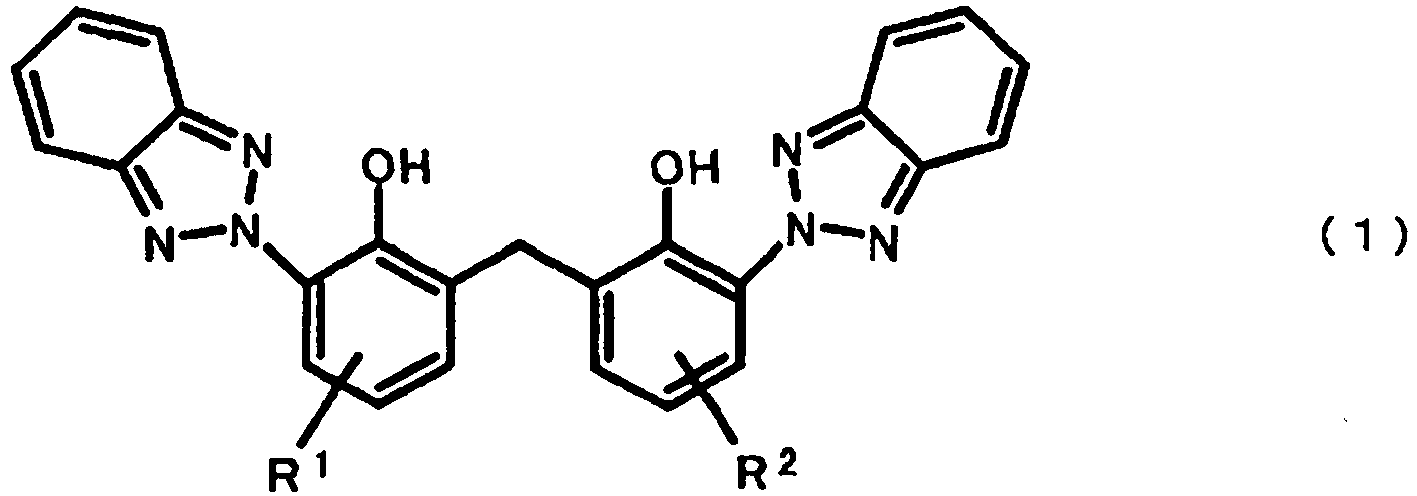
- In the formula, R1 and R2 denote alkyl groups having a carbon number from 1 to 18, may be identical or different, and may be substituted by one or two or more groups selected from the group consisting of alkyl groups having a carbon number from 1 to 4, and cycloalkyl groups and aryl groups both having a carbon number from 5 to 12.
- The benzotriazole-type ultraviolet absorber is a known methylenebis (hydroxyphenyl-benzotriazole) derivative, and may be manufactured by a manufacturing process of, for example, Specification of
US Patent No. 5,237,071 , Specification ofUS Patent No. 5,166,355 ,Japanese Laid-open Patent [Kokai] Publication No. H04-290877 - R1 and R2 in the Formula (1) are linear or branched alkyl groups having a carbon atom number from 1 to 18, and the examples may include methyl groups, ethyl groups, n-propyl groups, isopropyl groups, n-butyl groups, tert-butyl groups, tert-octyl groups, n-amyl groups, n-hexyl groups, n-heptyl groups, n-octyl groups, iso-octyl groups, n-nonyl groups, n-decyl groups, n-undecyl groups, n-dodecyl groups, tetramethylbutyl groups, tetradecyl groups, hexyldecyl groups, and octadecyl groups. In addition, these alkyl groups having a carbon atom number from 1 to 18 may be substituted by one or two or more substituents selected from the group consisting of alkyl groups having a carbon number from 1 to 4, and cycloalkyl groups and aryl groups both having a carbon number from 5 to 12. The cycloalkyl groups having a carbon atom number from 5 to 12 may include, for example, cyclopentyl groups, cyclohexyl groups, and cyclooctyl groups, and examples of the aryl groups both having the same may include phenyl groups and benzil groups.
- Among these, it is favorable that R1 and R2 are identical and each of these groups is a methyl group, a 1,1,3,3-tetramethylbutyl group, or a tert-butyl group, and it is extremely favorable that each of R1 and R2 is a 1,1,3,3-tetramethylbutyl group. The extremely favorable 2,2'-methylenebis[6-(2H-benzotriazol-2-yl)-4-(1,1,3,3-tetramethylbutyl)phenol] can be manufactured according to the methods described in, for example, EXAMPLE 1 of Specification of
US Patent No. 5,237,071 and Examples 1 through 3 ofJapanese Laid-open Patent [Kokai] Publication No. H04-290877 - In addition, component (B) employed for the present invention is polyglycerol monoalkyl ester with a mean degree of polymerization of glycerol of 5 or more. Specifically, examples may include decaglyceryl caprate, decaglyceryl laurate, decaglyceryl myristate, decaglyceryl oleate, decaglyceryl stearate, decaglyceryl isostearate, hexaglyceryl caprate, hexaglyceryl laurate, hexaglyceryl myristate, hexaglyceryl oleate, hexaglyceryl stearate, hexaglyceryl isostearate, pentaglyceryl caprate, pentaglyceryl laurate, pentaglyceryl myristate, pentaglyceryl oleate, pentaglyceryl stearate, and pentaglyceryl isostearate.
- Commercial products of decaglyceryl caprate may include Sunsoft Q-10Y and Q-10S (manufactured by Taiyo Kagaku Co., Ltd.), and commercial products of decaglyceryl laurate may include Sun Soft Q-12Y, Q-12S, and M-12J (manufactured by Taiyo Kagaku Co., Ltd.), NIKKOL Decaglyn 1-L (manufactured by Nikko Chemicals Co., Ltd.), and RYOTO-Polyglycerylester L-10D and L-7D (manufactured by Mitsubishi-Kagaku Foods Corp.). In addition, commercial products of decaglyceryl myristate may include Sun Soft Q-14Y and Q-14S (manufactured by Taiyo Kagaku Co., Ltd.), NIKKOL Decaglyn 1-M (manufactured by Nikko Chemicals Co., Ltd.), and RYOTO polyglyester M-10D, M-7D (manufactured by Mitsubishi-Kagaku Foods Corp.).
- Commercial products of decaglyceryl stearate may include Sun Soft Q-18Y and Q-18S (manufactured by Taiyo Kagaku Co., Ltd.), NIKKOL Decaglyn 1-SV (manufactured by Nikko Chemicals Co., Ltd.), and RYOTO polyglyester S-15D (manufactured by Mitsubishi-Kagaku Foods Corp.), and commercial products of hexaglyceryl caprate may include Sun Soft Q-81 F (manufactured by Taiyo Kagaku Co., Ltd.). In addition, commercial products of hexaglyceryl laurate may include NIKKOL Hexaglyn 1-L (manufactured by Nikko Chemicals Co., Ltd.), Glysurf 6ML (manufactured byAoki Oil Industrial Co., Ltd.), and Unigly GL-106 (manufactured by Nippon Oil & Fats Co.,Ltd.).
- Commercial products of hexaglyceryl myristate may include NIKKOL Hexaglyn 1-M (manufactured by Nikko Chemicals Co., Ltd.), commercial products of hexaglyceryl laurate may include NIKKOL Hexaglyn 1-OV (manufactured by Nikko Chemicals Co., Ltd.), commercial products of hexaglyceryl stearate may include NIKKOL Hexaglyn 1-SV (manufactured by Nikko Chemicals Co., Ltd.) and EMALEXMSG-6K (manufactured by Nihon-Emulsion Co., Ltd.), and commercial products of hexaglyceryl isostearate may include Matsunate MI-610 (manufactured by Matsumoto Fine Chemical Co.Ltd.). In addition, pentaglyceryl caprate may include Sun Soft A-10E, pentaglyceryl laurate may include Sun Soft A12E and A-121E, pentaglyceryl myristate may include Sun Soft A14E and A-141 E, pentaglyceryl oleate may include Sun Soft A-17E and A-171 E, pentaglyceryl stearate may include Sun Soft A-18E and A-181 E, and pentaglyceryl isostearate may include Sun Soft A-19E (all manufactured by Taiyo Kagaku Co., Ltd.).
- Those having an HLB of less than 14.5 may take a longer time for dispersion of benzotriazole-type ultraviolet absorber in water phase components.
- The amount of component (A) to be blended in the ultraviolet absorber water-dispersed composition is preferably from 10-50 mass% (hereinafter, simply referred to as "%"), and more preferably from 30-50%. In the case of less than 10%, there may be the cases in which the composition cannot be blended in a sufficient amount for exhibiting an ultraviolet prevention effect when blended with a cosmetic as a masterbatch (an intermediate material), and in the case of more than 50%, since it requires a large amoung of polyglycerol monoalkyl ester of component (B) for particulation, a cosmetic film easily may run with sweat, sebum, and the like when blended with a cosmetic.
- In addition, the mass ratio of the content of component (B) to the content of component (A) is preferably from 0.05 to 0.5 (component (B) / component (A)), and more preferably from 0.1 to 0.3. In the case of less than 0.05, the ultraviolet absorber may not be dispersed to an optimum particle diameter, and in the case of more than 0.5, a cosmetic film may easily run with sweat, sebum, and the like when blended with a cosmetic.
- In the ultraviolet absorber water-dispersed composition of the present invention, the aforementioned component (A) exists being dispersed in water, which is a dispersion medium, by component (B) acting as a dispersant, and such water includes purified water, spa water, deep water, and plant-extracted water extracted from plants such as apple water and plum fruit water. In addition, such water may contain, to the extent that effects of the present invention are not impaired, aqueous components like: alcohols, such as ethanol and isopropanol; polyhydric alcohols, such as glycerol, diglycerol, 1,5-pentanediol, 1,3-propanediol, 1,3-butylene glycol, 1,2-pentanediol, 1,6-hexanediol, ethylene glycol, diethylene glycol, dipropylene glycol, and propylene glycol; sugars, such as glucose, trehalose, maltose; sugar alcohols, such as mannitol and sorbitol; and preservatives, such as methylparaben and phenoxyethanol.
- The ultraviolet absorber water-dispersed composition of the present invention can be manufactured by mixing water and aforementioned components (A) and (B), and uniformly dispersing and grinding the mixture according to a common method, and applicable dispersion devices include, for example, a two-roller mill, a three-roller mill, a ball mill, a sand mill, a bucket mill, a homomixer, a vertical bead mill, a horizontal bead mill, a pin bead mill, a colloid mill, an attritor, a superhigh pressure homogenizer, and an ultrasonic disperser.
- The mean particle diameter of component (A) after dispersion process is preferably from 10-2000 nm, more preferably from 20-1500 nm, and further preferably ranging from 50-1000 nm. In the case of less than 10 nm, absorption in the UV-A region may be reduced, and in the case of more than 2000 nm, the ultraviolet prevention effect may be reduced and agglomeration and precipitation may be developed over time. It should be noted that, in this specification, a mean particle diameter means a mean particle diameter measured by a particle size distribution analyzer (Coulter N4 PLUS; manufactured by Bechman Coulter Inc.).
- Since the ultraviolet absorber water-dispersed composition thus obtained is excellent in salt tolerance and includes a benzotriazole-type ultraviolet absorber stably dispersed, it can be blended with various cosmetics to impart the ultraviolet protection effect. The amount of the ultraviolet absorber water-dispersed composition of the present invention to be blended with a cosmetic is preferably an amount that the content of component (A), which is a benzotriazole-type ultraviolet absorber, in the cosmetic falls within a range from 0.1-10% in terms of solid content for good usability as a cosmetic and an excellent ultraviolet protection effect.
- Into the cosmetic of the present invention, components generally blended into cosmetics may appropriately be blended, as needed. Within a range where effects of the present invention are not impaired, it may be blended with, for example: solid/semisolid oils, such as vaselines, lanolins, ceresins, microcrystalline waxes, carnauba waxes, candelilla waxes, higher fatty acids, and higher alcohols; liquid oils, such as squalenes, liquid paraffins, ester oils, diglycerides, triglycerides, silicone oils, olive oils, avocado oils, and mink oils; fluorine oils, such as perfluoropolyethers, perfluorodecalins, and perfluorooctanes; water- and oil-soluble polymers; surfactants; polyhydric alcohols; sugars; metal soaps; lecithins; amino acids; collagens; inorganic and organic pigments; various surface treatement powders; coloring agents, such as tar dyes and natural dyes; ethanols; preservatives; antioxidants; thickeners; pH adjusters; fragrances; ultraviolet absorbers; humectants; blood circulation accelerators; infrigidants; disinfectants; skin activators; and water.
- Among these, by using, in particular, octyl methoxycinnamate as an ultraviolet absorber together with component (A), a synergistic ultraviolet prevention effect can be obtained. The octyl methoxycinnamate is a clear liquid in light yellow, has a slight characteristic odor, and is a versatile UV-B absorber employed for cosmetic products, and available commercial products of such may include Parsol MCX (manufactured by DSM Nutritional Products, Inc.), Uvinul MC-80 (manufactured by BASF SE), and Nomcort TAB (manufactured by Nisshin OilliO Group Ltd.). Moreover, when coloring agents are contained in a cosmetic, it can prevent color degradation of the agents due to light and maintain good appearance.
- In addition, the cosmetic of the present invention is not particularly limited in form, type of product, etc. and examples of the possible form include water-in-oil, oil-in-water, water-dispersed, and powdery and examples of the possible product type may include: cosmetics for skin care, such as foaming and cream cleansers, makeup removers, massage creams, masks, facial lotions, emulsions, creams, serums, makeup bases, and sunscreens; makeup cosmetics, such as foundations, face powders, eyeshadows, eyeliners, mascaras, eyebrow makeups, concealers, lipsticks, and lip balms; and hair cosmetics such as hair mists, shampoos, conditioners, treatments, hair tonics, hair creams, pomades, mustache/hair waxes, hair dressing liquids, hair styling lotions, hair sprays, and hair dyes. Among these, cosmetics like sunscreens, foundations, and makeup bases easily exhibit the effects of the present invention.
- Hereinafter, the present invention is described in detail with Examples and the like. It should be noted that they are merely for illustration and the technical scope of the present invention is not limited to them.
- Producing a benzotriazole-type ultraviolet absorber (2,2'-methylenebis[6-(2H-benzotriazol-2-yl)-4-(1,1,3,3-tetramethylbutyl)phenol):
- In a double-jacket flask of 0.75 L tested at 1.5 bar overpressure and provided with a cryocooler, having a gas inlet tube and a receiving flask, and a vacuum connection tube, having a cold trap to a vacuum pump, 323.2 g (1.0 mol) of 4-(1,1,3,3-tetramethyl) butyl-6-benzotriazol-2-ylphenol and 16.5 g (0.55 mol) of paraformaldehyde were charged.
- After evacuating the flask at 20 mbar and sealing it, the mixture was melted at a jacket temperature of 120°C, and consequently the pressure was increased to approximately 270 mbar. After that, 24.8 g (0.55 mol) of dimethylamine gas was incorporated into a melted material capable of being easily stirred at temperatures from 100°C to 105°C over 30 minutes. The final pressure is increased to from 900 mbar to 1000 mbar. The reaction mixture is heated to 135°C and stirred at the temperature for two to four hours at a pressure raised to 1800 mbar. After cooling to 90°C, water from reaction together with unreacted amine were removed by decompressing and heating to 130°C. The pressure was alleviated with nitrogen, followed by adding 2.2 g (0.04 mol) of sodium methylate as a catalyst to the reaction mass, reducing the pressure at 200 mbar, and then rapidly heating to 200°C.
- Separation of dimethylamine was observed at approximately from 145°C to 155°C. After stirring at 200°C and approximately 200 mbar for two to four hours, the deamination reaction was terminated, and the reaction was completed. After dissolving the melted material in 200 g of a xylene mixture, impurities were removed by neutralizing the alkaline catalyst with 3.2 mL of formic acid (85%) and filtering the solution at 130°C, and the filtrate was washed with 75 g of a xylene mixture. Crystallization occurred by cooling to approximately 0°C.
- After suction filtering the viscous suspension and washing it with 100 g of a xylene mixture, the product was dried in a vacuum drying oven at 120°C to obtain [2,2'-methylenebis[6-(2H-benzotriazol-2-yl)-4-(1,1,3,3-tetramethylbutyl)phenol]. Yield: a product of 294 g in a form of yellow powder (89.3% of a theoretical value based on consumed benzotriazolyl phenol), melting point 197.6°C, transmittance at 450 nm (5% in cloroform): 96.4%, transmittance at 500 nm: 97.7%.
- In a 200 mL capacity beaker, 52 g of purified water and 8 g of decaglyceryl laurate (HLB: 15.5) were added and mixed. The mixture was charged into a dispermixer (LR-1 type; manufactured by Mizuho Industrial Co., Ltd.), and while stirring, 40 g of 2,2'-methylenebis[6-(2H-benzotriazol-2-yl)-4-(1,1,3,3-tetramethylbutyl)phenol] obtained in Production Example 1 was added and stirred for 5 minutes. Subsequently, 200 g of φ 1.0 mm zirconia beads were added, and the mixture was subjected to dispersing and grinding process for 120 minutes with a sand mill (Paint Conditioner; manufactured by Red Devil Inc.) to obtain a water-dispersed composition of 2,2'-methylenebis[6-(2H-benzotriazol-2-yl)-4-(1,1,3,3-tetrame-thylbutyl)phenol].
- In a 200 mL capacity beaker, 78 g of purified water and 2 g of decaglyceryl laurate (HLB: 15.5) were added and mixed. The mixture was charged into a dispermixer, and while stirring, 20 g of 2,2'-methylenebis[6-(2H-benzotriazol-2-yl)-4-(1,1,3,3-tetramethylbutyl)phenol] obtained in Production Example 1 [obtained in Production Example 1](sic) was added and stirred for 5 minutes in the dispermixer. Subsequently, 200 g of φ 1.0 mm zirconia beads were added, and the mixture was subjected to dispersing and grinding process for 120 minutes with a sand mill to obtain a water-dispersed composition.
- In a 200 mL capacity beaker, 89.5 g of purified water and 0.5 g of decaglyceryl laurate (HLB: 15.5) were added and mixed. The mixture was chargedcharged into a dispermixer, and while stirring, 10 g of 2,2'-methylenebis[6-(2H-benzotriazol-2-yl)-4-(1,1,3,3-tetramethylbutyl)phenol] obtained in Production Example 1 was added and stirred for 5 minutes. Subsequently, 200 g of φ 1.0 mm zirconia beads were added, and the mixture was subjected to dispersing and grinding process for 120 minutes with a sand mill to obtain a water-dispersed composition.
- In a 200 mL capacity beaker, 45 g of purified water and 10 g of decaglyceryl caprate (HLB: 16.5) were added and mixed. The mixture was chargedcharged into a dispermixer. While stirring, 45 g of 2,2'-methylenebis[6-(2H-benzotriazol-2-yl)-4-(1,1,3,3-tetramethylbutyl)phenol] obtained in Production Example 1 was added and stirred for 5 minutes. Subsequently, 200 g of φ 1.0 mm zirconia beads were added, and the mixture was subjected to dispersing and grinding process for 120 minutes with a sand mill to obtain a water-dispersed composition.
- In a 200 mL capacity beaker, 62 g of purified water and 8 g of pentaglyceryl laurate (HLB: 14.5) were added and mixed. The mixture was chargedcharged into a dispermixer, and while stirring, 30 g of 2,2'-methylenebis[6-(2H-benzotriazol-2-yl)-4-(1,1,3,3-tetramethylbutyl)phenol] obtained in Production Example 1 was added and stirred for 5 minutes. Subsequently, 200 g of φ 1.0 mm zirconia beads were added, and the mixture was subjected to dispersing and grinding process for 120 minutes with a sand mill to obtain a water-dispersed composition.
- In a 200 mL capacity beaker, 52 g of purified water and 8 g of decyl glucoside were added and mixed. The mixture was charged into a dispermixer, and while stirringd, 40 g of 2,2'-methylenebis[6-(2H-benzotriazol-2-yl)-4-(1,1,3,3-tetramethylbutyl)phenol] obtained in Production Example 1 was added and stirred for 5 minutes. Subsequently, 200 g of φ 1.0 mm zirconia beads were added, and the mixture was subjected to dispersing and grinding process for 120 minutes with a sand mill to obtain a water-dispersed composition.
- In a 200 mL capacity beaker, 52 g of purified water and 8 g of polysorbate 20 (HLB: 16.7) were added and mixed. The mixture was charged into a dispermixer, and while stirring, 40 g of 2,2'-methylenebis[6-(2H-benzotriazol-2-yl)-4-(1,1,3,3-tetramethylbutyl)phenol]obtained in Production Example 1 was added and stirred for 5 minutes. Subsequently, 200 g of φ 1.0 mm zirconia beads were added, and the mixture was subjected to dispersing and grinding process for 120 minutes with a sand mill to obtain a water-dispersed composition.
- In a 200 mL capacity beaker, 52 g of purified water and 8 g of polysorbate 80 (HLB: 15.0) were added and mixed. The mixture was charged into a dispermixer, and while stirring, 40 g of 2,2'-methylenebis[6-(2H-benzotriazol-2-yl)-4-(1,1,3,3-tetramethylbutyl)phenol] obtained in Production Example 1 was added and stirred for 5 minutes. Subsequently, 200 g of φ 1.0 mm zirconia beads were added, and the mixture was subjected to dispersing and grinding process for 120 minutes with a sand mill to obtain a water-dispersed composition.
- In a 200 mL capacity beaker, 52 g of purified water and 8 g of decaglyceryl diisostearate (HLB: 11.1) were added and mixed. The mixture was charged into a dispermixer, and while stirring, 40 g of 2,2'-methylenebis[6-(2H-benzotriazol-2-yl)-4-(1,1,3,3-tetramethylbutyl)phenol] obtained in Production Example 1 was added and stirred for 5 minutes. Subsequently, 200 g of φ 1.0 mm zirconia beads were added, and the mixture was subjected to dispersing and grinding process for 120 minutes with a sand mill to obtain a water-dispersed composition.
- In a 200 mL capacity beaker, 52 g of purified water and 8 g of decaglyceryl dilaurate (HLB: 12.0) were added and mixed. The mixture was charged into a dispermixer, and while stirring, 40 g of 2,2'-methylenebis[6-(2H-benzotriazol-2-yl)-4-(1,1,3,3-tetramethylbutyl)phenol] obtained in Production Example 1 was added and stirred for 5 minutes in the dispermixer. Subsequently, 200 g of φ 1.0 mm zirconia beads were added, and the mixture was subjected to dispersing and grinding process for 120 minutes with a sand mill to obtain a water-dispersed composition.
- The water-dispersed compositions obtained in Examples 1 through 5 and Comparative Examples 1 through 5 were stored at 50°C for one month and diluted with purified water so as to contain 2,2'-methylenebis[6-(2H-benzotriazol-2-yl)-4-(1,1,3,3-tetramethylbutyl)phenol] at a concentration of 0.01%, and mean particle diameters (D50) were measured by a particle size distribution analyzer (Coulter N4 PLUS; manufactured by Bechman Coulter Inc.). The results are shown in Table 1.
- The water-dispersed compositions obtained in Examples 1 through 5 and Comparative Examples 1 through 5 were stored at 50°C for one month and evaluated the behavior of 2,2'-methylenebis[6-(2H-benzotriazol-2-yl)-4-(1,1,3,3-tetramethylbutyl)phenol] according to the criteria below. The results are shown in Table 1.
-
- ○: Slight separation in upper layer
- Δ: Precipitation of ultraviolet absorber
- X: Caking of ultraviolet absorber at a lower portion
- The water-dispersed compositions obtained in Examples 1 through 5 and Comparative Examples 1 through 5 were diluted with purified water so as to contain 2,2'-methylenebis[6-(2H-benzotriazol-2-yl)-4-(1,1,3,3-tetramethylbutyl)phenol] at a concentration of 0.5% and added with 0.5% of sodium chloride, and left standing at 50°C for seven days to evaluate the behavior of 2,2'-methylenebis[6-(2H-benzotriazol-2-yl)-4-(1,1,3,3-tetramethylbutyl)phenol] according to the precipitation criteria above.
Table 1: Test Example 1 D50 (nm) Test Example 2 Stability Test Example 3 Salt Tolerance Example 1 197 ⊚ ⊚ Example 2 185 ⊚ ⊚ Example 3 200 ⊚ ⊚ Example 4 195 ○ ○ Example 5 198 ⊚ ⊚ Comparative Example 1 200 ⊚ × Comparative Example 2 351 Δ × Comparative Example 3 800 Δ × Comparative Example 4 3000 × O Comparative Example 5 2500 × ⊚ - According to Test Example 1, the stability of 2,2'-methylenebis[6-(2H-benzotriazol-2-yl)-4-(1,1,3,3-tetramethylbutyl)phenol] in a particulated state was excellent in Examples 1 through 5 and Comparative Examples 1 through 3, whereas the particle diameter became extremely large in Comparative Examples 4 and 5 and it was found that polyglycerol dialkyl ester was not suitable as a dispersant for the ultraviolet absorber. In addition, according to Test Examples 2 and 3, Examples 1 through 5 demonstrated excellent stability and salt tolerance, whereas Comparative Examples 4 and 5 showed the results that the over-time stability was inferior as a water-dispersed composition and Comparative Examples 1 through 3 showed the results that the salt tolerance was inferior.
- Using the water-dispersed composition prepared in Example 1 and Comparative Examples 1 and 2, W/O sunscreen creams of the composition shown in Table 2 below were prepared in the preparation below, and the samples were applied on Transpore Tape (manufactured by 3M Corporation) uniformly at 2 mL/cm2, followed by air drying for 15 minutes to measure in-vitro SPF with an SPF analyzer (UV-1000S; manufactured by Labsphere, Inc.). The results are also shown in Table 2.
- Component (9) is added to oil phase components (1) through (8) that were heated and dissolved and the mixture was uniformly dispersed with a mixer. Water phase components (10) through (15), heated and dissolved in another container, were added to the dispersion and emulsified, and then cooled to room temperature to obtain the desired sunscreen creams.
Table 2 (%) Blended Components Example 6 Example 7 Comp . Ex. 6 Comp . Ex. 7 Comp. Ex. 8 Comp. Ex. 9 (1) Polyoxyethylene-methylpolysiloxane copolymer 3 3 3 3 3 3 (2) Decamethylcyclopentasiloxane 20.8 15.8 20.8 15.8 20.8 15.8 (3) Neopentyl glycol dicaprate 5 5 5 5 5 5 (4) Squalene 5 5 5 5 5 5 (5) Dextrin palmitate 1.5 1.5 1.5 1.5 1.5 1.5 (6) Octyl methoxycinnamate 5 5 5 5 5 5 (7) Preservative q.s. q.s. q.s. q.s. q.s. q.s. (8) Antioxidant q.s. q.s. q.s. q.s. q.s. q.s. (9) Particulate titanium oxide 37.5% dispersion** 20 20 20 20 20 20 (10) Purified water Balance Balance Balance Balance Balance Balance (11 Water-dispersed composition of Example 1 7 7 (12) Water-dispersed composition of comparative Example 1 7 7 (13) 1.3-butylene glycol 4 4 4 4 4 4 (14) Preservative q.s. q.s. q.s. q.s. q.s. q.s. (15) Sodium chloride 1 1 1 1 1 1 In-vitro SPF measurement 30.4 50.3 20.4 35.3 24.4 43.2 *: Rheopearl KL (manufactured by Chiba Flour Milling Co., Ltd.)
**: Cosmeserve WP-UF (V) (manufactured by Dainihon Kasei Co., Ltd.) - As apparent from Table 2, Example 6 of the present invention demonstrated a higher ultraviolet protection capability compared to Comparative Example 6, in which no water-dispersed composition was blended. In addition, it was confirmed that Example 7 further added with octyl methoxycinnamate has a higher synergistic effect compared to Comparative Example 7, in which no water-dispersed composition was blended. In contrast, Comparative Example 8 using the water-dispersed composition of Comparative Example 1 and Comparative Example 9 further added with octyl methoxycinnamate showed the results inferior to the products of the present invention although the ultraviolet protection capability was slightly improved. According to these findings, Examples 6 and 7 were W/O sunscreen creams excellent in ultraviolet protection capability.
- Using the water-dispersed composition prepared in Example 1, shampoos of composition shown in Table 4 below were prepared according to the preparation below for color degradation test under exposure to sunlight. That is, the shampoos were placed outdoors, and color tone changes of the shampoos due to light over days were visually evaluated based on the evaluation criteria below. The results are also shown in Table 3.
- Components (1) through (13) are heated, followed by stirring and dissolving. The solution was cooled to room temperature, and then (14) and (15) were added and stirred to obtain the desired shampoos.
- Evaluation was carried out by comparing with samples kept in a dark place at 25°C.
- ○: No Change
- Δ: Some Color Degradation
- ×: Serious Color Degradation
- As shown in Table 3, the shampoo of the present invention in Example 8 maintained the color at the time of preparation. There was, however, color degradation in the shampoo of Comparative Example 10, and the color at the time of preparation was not maintained. From the results, it was found that a shampoo was obtained that has high lightfastness to ultraviolet light and is prevented from color degradation over time by adding the water-dispersed composition of the present invention to a cosmetic.
- A W/O emulsion-type foundation of the formula below was prepared in the preparation below.
Composition (%) (1) Squalene 4.0 (2) Octyl methoxycinnamate 4.0 (3) Dimethylpolysiloxane (6 cs) 2.0 (4) Decamethylcyclopentasiloxane 12.8 (5) Polyoxyethylene-methylpolysiloxane copolymer (HLB= 4.5) 4.0 (6) Preservative q.s. (7) Antioxidant q.s. (8) Purified water Balance (9) 1,3-Butylene glycol 5.0 (10) Water-dispersed composition of Example 1 10.0 (11) Titanium oxide 5.0 (12) Sericite 5.0 (13) Coloring agent q.s. - Powder components (11) through (13), stirred and mixed by a Henschel mixer in advance, are added to oil phase components (1) through (7), and uniformly dispersed by a mixer. Components (8) through (10), mixed in another container, were added to the dispersion, and afteremulsification, and the mixture was cooled to room temperature to obtain a W/O emulsion-type foundation.
- The W/O emulsion-type foundation thus obtained had an in-vitro SPF value of 30.5, and thus it was excellent in the effect of protecting the skin from ultraviolet damages, and when applied on the skin, it was not sticky, easily spread, and excellent in makeup endurance.
- An emulsion of the composition below was prepared in the preparation below.
Composition (%) (1) Squalene 3.0 (2) Dimethylpolysiloxane (100 cs) 0.2 (3) Neopentyl glycol dicaprate 1.0 (4) POE (60) hydrogenated castor oil 1.0 (5) Carboxyvinyl polymer 0.2 (6) Sodium hyaluronate 1% aqueous solution 3.0 (7) Pyrus cydonia seed Extract 2% aqueous solution 5.0 (8) Potassium hydroxide 0.1 (9) 1,3-butylene glycol 6.0 (10) Water-dispersed composition of Example 2 3.0 (11) Purified water Balance (12) Preservative q.s. (13) Chelator q.s. - (1) through (4) are mixed and heated. (5) through (13) are mixed and heated in another container. The (1) through (4) were added to the (5) through (13) and emulsified, and cooled to room temperature to obtain an emulsion.
- The emulsion thus obtained had an in-vitro SPF value of 3.2, and was excellent in the effect of protecting the skin from ultraviolet damages, and when applied on the skin, it was an emulsion that was not sticky, was easily spread, gave moist texture because of the slight thickness thereof, and was excellent in stability without developing discoloration and the like to ultraviolet.
- An O/W sunscreen cream of the composition below was prepared in the preparation below.
Composition (%) (1) Alkyl-modified carboxyvinyl polymer 0.4 (2) 1,3-Butylene glycol 4.0 (3) glycerol 2.0 (4) Water-dispersed composition of Example 1 5.0 (5) Preservative q.s. (6) Chelator q.s. (7) Sodium hyaluronate 1% aqueous solution 5.0 (8) Purified water 83.1 (9) Potassium hydroxide 0.2 (10) PEG-40 hydrogenated castor oil isostearate 0.3 (11) Neopentyl glycol dicaprate 3.0 (12) Octyl methoxycinnamate 3.0 - (10) through (12) are mixed and heated. (1) through (9) are mixed and heated in another container. The (10) through (12) were added to the (1) through (9) and emulsified, and cooled to room temperature to obtain a cream.
- The O/W sunscreen cream thus obtained had an in-vitro SPF value of 16, and was excellent in the effect of protecting the skin from ultraviolet damages, and when applied on the skin, it was an O/W sunscreen cream that was not sticky, was easily spread, and gave moist texture because of the slight thickness thereof.
- A foaming cleanser of the composition below was prepared in the preparation below.
Composition (%) (1) Sodium lauroyl glutamate 35.0 (2) Potassium laurate 3.5 (3) Cocamid methyl mEA 1.0 (4) Ceteareth-60 myristyl glycol 1.0 (5) 1,3-Butylene glycol 20.0 (6) Purified water Balance (7) PCA-Na 50% aqueous solution 5.0 (8) Water-dispersed composition of Example 3 5.0 (9) Preservative q.s. (10) Blue No. 1 q.s. (11) Antioxidant q.s. - (1) through (11) are heated and mixed to be uniformly dissolved. The mixture was cooled to 30°C by stirring to obtain an amino acid based foaming cleanser.
- The foaming cleanser thus obtained was excellent in product stability without developing discoloration due to ultraviolet.
- An eyeliner of the composition below was prepared in the preparation below.
Composition (%) (1) Sorbitan sesquioleate 0.3 (2) Polyoxyethylene sorbitan monooleate (20 E.O.) 0.1 (3) Polyoxyethylene-modified silicone (HLB = 4.5) 0.5 (4) Decamethylcyclopentasiloxane 29.4 (5) Light liquid isoparaffin 17.5 (6) Dextrin palmitate 2.0 (7) Organic modified bentonite 1.0 (8) Black Iron oxide 14.0 (9) Preservative q.s. (10) Purified water Balance (11) 1,3-Butylene glycol 7.0 (12) Water-dispersed composition of Example 5 5.0 - (1) through (7) are heated and uniformly dissolved. After that, (8) is added and uniformly dispersed. (9) through (12) are heated and dissolved in another container. The (9) through (12) were added to the (1) through (8) and emulsified, and then cooled to room temperature to obtain an eyeliner.
- The eyeliner thus obtained was an eyeliner excellent in stability without developing discoloration due to ultraviolet.
- A mascara of the composition below was prepared in the preparation below.
Composition (%) (1) Purified water 26.0 (2) Polyvinyl pyrrolidone 2.0 (3) 1,3-Butylene glycol 2.0 (4) Cationized cellulose 1% aqueous solution 10.0 (5) Bentonite 0.5 (6) Triethanolamine 1.7 (7) Talc 3.7 (8) Yellow iron oxide 0.9 (9) Red iron oxide 0.9 (10) Black iron oxide 4.8 (11) Carnauba wax 5.5 (12) Beeswax 9.0 (13) Stearic acid 2.0 (14) Self-Emulsifiable glyceryl stearate 2.0 (15) Propylene glycol stearate 2.0 (16) Hydrogenated polyisobutene 2.0 (17) Decamethylcyclopentasiloxane 4.0 (18) Water-dispersed composition of Example 3 1.0 (19) Preservative q.s. (20) Antioxidant q.s. (21) Alkyl acrylate copolymer emulsion 20.0 - Powder components (7) through (10), stirred and mixed by a Henschel mixer in advance, were added to water phase components (1) through (6) to be uniformly dispersed by a mixer. (11) through (20) were heated and dissolved in another container. The (11) through (20) were added to the(1) through (10) and emulsified, and then cooled to 40°C, followed by addition of (21) and cooled to room temperature to obtain a mascara.
- The mascara thus obtained was excellent in the effect of protecting the eyelashes from ultraviolet damages, had a properly glossy appearance, and was excellent in adhesion to the eyelashes and product stability.
- A treatment of the composition below was prepared in the preparation below.
Composition (%) (1) Cetanol 3.0 (2) Squalene 1.0 (3) Glyceryl 2-ethylhexanoate 2.0 (4) Cetyltrimethylammonium chloride 5.5 (5) Hydroxypropyl methyl cellulose 0.2 (6) Citric acid 0.1 (7) Water-dispersed composition of Example 3 1.0 (8) Purified water Balance (9) Preservative q.s. (10) Chelator q.s. - (1) through (4) are mixed and heated. (5) through (10) are mixed and heated in another container. The (1) through (4) were added to the (5) through (10) and emulsified, and cooled to room temperature to obtain a treatment.
- The treatment thus obtained was exellent in the effect of protecting the hair from ultraviolet damages and capable of maintaining a glossy appearance of the hair, inhibiting the drying out of damaged hair, and giving a moist and soft feel.
- A hair styling cream of the composition below was prepared in the preparation below.
Composition (%) (1) Isoparaffin 7.9 (2) Dimethylpolysiloxane (500 cs) 7.0 (3) Polyoxyethylene-methylpolysiloxane copolymer (HLB = 4.5) 1.5 (4) Isotridecyl isononanoate 1.0 (5) Acrylic resin alkanol amine liquid 3.0 (6) Isostearic acid 0.1 (7) Purified water Balance (8) Glycerol 3.0 (9) Water-dispersed composition of Example 4 5.0 (10) Ethanol 6.0 (11) Magnesium sulfate 1.0 (12) Polyethylene glycol (molecular weight 10000) 2.0 (13) Preservative q.s. - (1) through (6) are heated and uniformly dispersed. (7) through (13) are heated and dissolved in another container. The (7) through (13) were added to the (1) through (6) and emulsified, followed by cooling to room temperature to obtain a hair styling cream.
- The hair styling cream thus obtained was a hair styling cream excellent in the effect of protecting the hair from ultraviolet damages, and when applied on the hair, gave moist texture, was easily spread and not sticky, and excellent in styling maintainance.
- A hair mist of the composition below was prepared in the preparation below.
Composition (%) (1) Purified water Balance (2) Glycosyl trehalose 0.1 (3) Glycerol 1.5 (4) 1,3-Butylene glycol 1.0 (5) Preservative q.s. (6) Hydrolyzed silk 0.1 (7) Hydrolyzed hyaluronic acid 0.3 (8) Water-dispersed composition of Example 1 0.5 (9) Ethanol 10.0 - (1) through (9) are heated and uniformly dispersed. The dispersion was cooled to room temperature to obtain a hair mist.
- The hair mist thus obtained was a hair mist excellent in the effect of protecting the hair from ultraviolet damages and not sticky.
- An eyeshadow of the composition below was prepared in the preparation below.
Composition (%) (1) Talc 10.0 (2) Lauroyl lysine 2.0 (3) Coloring agent 5.0 (4) Titanated mica 15.0 (5) Stearic acid 3.0 (6) Octyldodecyl isostearate 8.0 (7) Squalene 2.0 (8) Octyl methoxycinnamate 2.0 (9) Propylene glycol monolaurate 3.0 (10) Purified water Balance (11) Water-dispersed composition of Example 1 5.0 (12) 1,3-Butylene glycol 6.0 (13) Triethanolamine 1.2 (14) Preservative q.s. (15) Chelator q.s. - Powder components (5) through (9), stirted and mixed by a Henschel mixer in advance, are added to water phase components (1) through (4) to be uniformly dispersed by a mixer. (10) through (15) are heated and dissolved in another container. The dispersions of (1) through (4) and (5) through (9) were added to the mixture of (10) through (15) and emulsified, followed by cooling to room temperature to obtain an emulsion eyeshadow.
- The emulsion eyeshadow thus obtained was excellent in ultraviolet prevention effect and product stability.
- An aqueous gel of the composition below was prepared in the preparation below:
Composition (%) (1) Carboxyvinyl polymer 0.2 (2) Xanthan gum 0.1 (3) Purified water Balance (4) Triethanolamine 0.1 (5) POE (50) hydrogenated castor oil isostearate 0.3 (6) Fragrance q.s. (7) Ethanol 10.0 (8) Glycerol 5.0 (9) Dipropylene glycol 5.0 (10) Polyoxyethylene methyl glucoside 5.0 (11) Zinc oxide 2.0 (12) Titanium oxide 2.0 (13) Polyoxyethylene lauryl ether phosphate 2.0 (14) Water-dispersed composition of Example 1 8.0 - (1) through (4) are uniformly mixed and swelled. (5) through (7) are uniformly mixed in another container. (8) through (13) are uniformly dispersed by a homogenizer. The (5) through (7) and (8) through (13) and (14) were added to the (1) through (4) and uniformly dispersed to obtain an aqueous gel.
- The aqueous gel thus obtained was an aqueous gel which, when applied on the skin, easily spreads and not sticky with refreshing feel.
- Since the water-dispersed composition of the present invention can, even in the presence of salt, inhibit the agglomeration of benzotriazole-type ultraviolet absorbers and maintain the stably dispersed state, combination in cosmetics enables to exhibit the ultraviolet absorption action, and in addition, prevent color degradation due to light of contained dyes to maintain good color tone. This is accordingly extremely useful as a composition for cosmetics.
| Table 3 | (%) | ||
| Blended Components | Example 8 | Comparative Example 10 | |
| (1) | Sodium laureth sulfate | 18.50 | 18.50 |
| (2) | (C12-14) Pareth sulfosuccinate-2 sodium | 6.00 | 18.50 |
| (3) | Sodium lauryliminodiacetate | 7.00 | 7.00 |
| (4) | Lauramidopropyl betaine | 15.00 | 15.00 |
| (5) | Methyl gluceth-20 | 2.00 | 2.00 |
| (6) | PEG-120 Methyl glucose dioleate | 2.00 | 2.00 |
| (7) | 1,3-Butylene glycol | 2.00 | 2.00 |
| (8) | Polyoxyethylene coconut oil fatty acid glyceryl | 2.00 | 2.00 |
| (9) | Polyquaternium-7 1% dispersion | 15 | 15 |
| (10) | Polyquaternium-10 1% dispersion | 25 | 25 |
| (11) | Chelator | q.s. | q.s. |
| (12) | Preservative | q.s. | q.s. |
| (13) | Purified water | Balance | Balance |
| (14) | Blue No. 1 | 0.01 | 0.01 |
| (15) | Water-dispersed composition of Example 1 | 5.00 | - |
| Color Tone Evaluation | Immediately after preparation | ○ | ○ |
| One month after preparation | ○ | Δ | |
Claims (7)
- An ultraviolet absorber water-dispersed composition, comprising the following components (A) and (B);(A) a benzotriazole-type ultraviolet absorber represented by a general formula (1) below
 (B) polyglycerol monoalkyl ester with a mean degree of polymerization of glycerol of 5 or more selected from decaglyceryl caprate and decaglyceryl laurate.
 - The ultraviolet absorber water-dispersed composition of claim 1, wherein component (A) has a mean particle diameter of from 10 nm to 2000 nm.
- The ultraviolet absorber water-dispersed composition of claim 1 or 2, wherein each of R1 and R2 in the general formula (1) of component (A) is a 1,1,3,3-tetramethyl butyl group.
- The ultraviolet absorber water-dispersed composition of any of claims 1 through 3, wherein component (A) is contained from 10 mass% to 50 mass%.
- The ultraviolet absorber water-dispersed composition of any of claims 1 through 4 wherein a mass ratio of a content of component (B) to a content of component (A) is from 0.05 to 0.5.
- A cosmetic comprising the ultraviolet absorber water-dispersed composition of any of claims 1 through 5.
- The cosmetic of claim 6, further comprising octyl methoxycinnamate.
Applications Claiming Priority (2)
| Application Number | Priority Date | Filing Date | Title |
|---|---|---|---|
| JP2007293190A JP5270134B2 (en) | 2007-11-12 | 2007-11-12 | Ultraviolet absorber water dispersion composition |
| PCT/IB2008/054703 WO2009063392A2 (en) | 2007-11-12 | 2008-11-10 | Ultraviolet absorber water-dispersed composition |
Publications (2)
| Publication Number | Publication Date |
|---|---|
| EP2219592A2 EP2219592A2 (en) | 2010-08-25 |
| EP2219592B1 true EP2219592B1 (en) | 2016-05-18 |
Family
ID=40548706
Family Applications (1)
| Application Number | Title | Priority Date | Filing Date |
|---|---|---|---|
| EP08850824.7A Active EP2219592B1 (en) | 2007-11-12 | 2008-11-10 | Ultraviolet absorber water-dispersed composition |
Country Status (8)
| Country | Link |
|---|---|
| US (1) | US8420061B2 (en) |
| EP (1) | EP2219592B1 (en) |
| JP (1) | JP5270134B2 (en) |
| KR (1) | KR101536789B1 (en) |
| CN (2) | CN105250150B (en) |
| BR (1) | BRPI0820166B1 (en) |
| ES (1) | ES2587406T3 (en) |
| WO (1) | WO2009063392A2 (en) |
Families Citing this family (108)
| Publication number | Priority date | Publication date | Assignee | Title |
|---|---|---|---|---|
| WO2009068469A2 (en) * | 2007-11-29 | 2009-06-04 | Basf Se | Grinding aids for micronized organic uv absorbers |
| FR2983720B1 (en) * | 2011-12-07 | 2015-02-20 | Oreal | COSMETIC COMPOSITION FOR COATING KERATINIC FIBERS |
| US9255180B2 (en) * | 2012-06-28 | 2016-02-09 | Johnson & Johnson Consumer Inc. | Ultraviolet radiation absorbing polyethers |
| US20140004057A1 (en) | 2012-06-28 | 2014-01-02 | Johnson & Johnson Consumer Companies, Inc. | Sunscreen compositions containing an ultraviolet radiation-absorbing polyester |
| JP5928191B2 (en) * | 2012-06-28 | 2016-06-01 | ライオン株式会社 | Hair cleaning composition |
| US9469725B2 (en) * | 2012-06-28 | 2016-10-18 | Johnson & Johnson Consumer Inc. | Ultraviolet radiation absorbing polymers |
| WO2014004474A2 (en) * | 2012-06-28 | 2014-01-03 | Johnson & Johnson Consumer Companies, Inc. | Sunscreen compositions containing an ultraviolet radiation-absorbing polymer |
| DE102012219588A1 (en) * | 2012-10-25 | 2014-04-30 | Henkel Ag & Co. Kgaa | Hair care preparations containing selected cationic alkyl oligoglucosides and selected polyglycerol esters |
| FR3001131B1 (en) | 2013-01-21 | 2015-06-19 | Oreal | COSMETIC OR DERMATOLOGICAL EMULSION COMPRISING A MEROCYANINE AND AN EMULSIFYING SYSTEM COMPRISING A GEMINE SURFACTANT. |
| FR3001137B1 (en) | 2013-01-21 | 2015-02-27 | Oreal | COSMETIC OR DERMATOLOGICAL WATER-IN-OIL EMULSION COMPRISING A MEROCYANINE AND AT LEAST ONE EMULSIFYING POLYMER OF THE ESTER TYPE OF FATTY ACID AND GLYCOL POLYOXYALKYLENE |
| FR3001133B1 (en) | 2013-01-21 | 2015-03-20 | Oreal | COSMETIC OR DERMATOLOGICAL COMPOSITION COMPRISING A MEROCYANINE AND AN OILY PHASE COMPRISING AT LEAST ONE PARTICULATE AMIDE COMPOUND |
| WO2014111567A2 (en) | 2013-01-21 | 2014-07-24 | L'oreal | Cosmetic or dermatological composition comprising a merocyanine and a uva-screening agent of the amino-substituted 2-hydroxybenzophenone type and/or a hydrophilic organic uva-screening agent |
| CN105705131B (en) | 2013-01-21 | 2019-12-17 | 莱雅公司 | Cosmetic or dermatological composition comprising merocyanine and UV-screening agent |
| BR112015017289B1 (en) | 2013-01-21 | 2020-03-10 | L'oreal | Cosmetic composition, non-therapeutic cosmetic processes for the care and / or makeup of a keratin material, to limit skin darkening and to prevent and / or treat the signs of aging and uses of a cosmetic composition |
| FR3001216B1 (en) | 2013-01-21 | 2015-02-27 | Oreal | COSMETIC OR DERMATOLOGICAL COMPOSITION COMPRISING A MEROCYANINE, AN OILY PHASE AND A C4 MONO-ALKANOL |
| FR3001128B1 (en) | 2013-01-21 | 2015-06-19 | Oreal | COSMETIC OR DERMATOLOGICAL EMULSION COMPRISING A MEROCYANINE AND AN EMULSIFYING SYSTEM CONTAINING AN ALKALINE METAL SALT OF ESTER OF PHOSPHORIC ACID AND FATTY ALCOHOL |
| ES2691870T3 (en) | 2013-01-21 | 2018-11-29 | L'oréal | Cosmetic or dermatological composition comprising a merocyanine and a lipophilic benzotriazole UV filtering agent and / or a bis-resorcinyl-triazine compound |
| FR3001136B1 (en) | 2013-01-21 | 2015-06-19 | Oreal | COSMETIC OR DERMATOLOGICAL EMULSION COMPRISING A MEROCYANINE AND AN EMULSIFIER SYSTEM CONTAINING AN AMPHIPHILIC POLYMER COMPRISING AT LEAST ONE ACRYLAMIDO 2-METHYLPROPANE SULFONIC ACIDIC PATTERN |
| FR3001138B1 (en) | 2013-01-21 | 2015-06-19 | Oreal | COSMETIC OR DERMATOLOGICAL ANHYDROUS COMPOSITION COMPRISING A MEROCYANINE AND AN OILY PHASE |
| FR3006176B1 (en) | 2013-05-29 | 2015-06-19 | Oreal | COMPOSITE PARTICLES BASED ON INORGANIC UV FILTER AND PERLITE; COSMETIC OR DERMATOLOGICAL COMPOSITIONS CONTAINING THEM |
| DE102014202956A1 (en) | 2014-02-18 | 2015-08-20 | Beiersdorf Ag | Cosmetic emulsifier combination |
| US10874603B2 (en) * | 2014-05-12 | 2020-12-29 | Johnson & Johnson Consumer Inc. | Sunscreen compositions containing a UV-absorbing polyglycerol and a non-UV-absorbing polyglycerol |
| EP3185843B2 (en) | 2014-08-28 | 2025-07-02 | L'oreal | Gel composition and gel comprising a uv filter |
| WO2016083404A1 (en) | 2014-11-24 | 2016-06-02 | L'oreal | Cosmetic composition comprising a synthetic phyllosilicate and a polyol and/or a uv filter |
| FR3037243B1 (en) | 2015-06-11 | 2018-11-16 | L'oreal | COMPOSITION COMPRISING UV FILTER, ANIONIC CROSSLINKABLE HYDROPHILIC POLYMER, SURFACTANT HAVING HLB LESS THAN OR EQUAL TO 5 AND SILICONE COPOLYMER |
| FR3046929B1 (en) | 2016-01-26 | 2018-03-02 | L'oreal | COSMETIC OR DERMATOLOGICAL COMPOSITION COMPRISING A MEROCYANINE AND AN OILY PHASE COMPRISING AT LEAST ONE DI OR TRICARBOXYLIC ACID ESTER |
| FR3046928B1 (en) | 2016-01-26 | 2019-08-09 | L'oreal | COSMETIC OR DERMATOLOGICAL COMPOSITION COMPRISING A MEROCYANINE AND AN OILY PHASE COMPRISING AT LEAST ONE N-SUBSTITUTED AMIDE |
| FR3046927B1 (en) | 2016-01-26 | 2018-03-02 | L'oreal | COSMETIC OR DERMATOLOGICAL COMPOSITION COMPRISING A MEROCYANINE AND AN OILY PHASE COMPRISING AT LEAST ONE ISOSORBIDE ETHER |
| FR3046930B1 (en) | 2016-01-26 | 2018-03-02 | L'oreal | COSMETIC OR DERMATOLOGICAL COMPOSITION COMPRISING A MEROCYANINE AND AN OILY PHASE COMPRISING AT LEAST ONE POLYALKYLENE GLYCOL |
| BR112018073279B1 (en) * | 2016-05-19 | 2022-03-03 | Basf Se | Aqueous dispersion and sun protection composition |
| RU2752091C2 (en) | 2016-06-16 | 2021-07-22 | Джонсон энд Джонсон Консьюмер Инк. | Sunscreen compositions containing combination of linear uv-absorbing polyester and other uv-protecting compounds |
| CN106317139B (en) * | 2016-08-15 | 2019-05-10 | 江南大学 | A new type of water-soluble reactive ultraviolet absorber and preparation method thereof |
| US10596087B2 (en) | 2016-10-05 | 2020-03-24 | Johnson & Johnson Consumer Inc. | Ultraviolet radiation absorbing polymer composition |
| KR102758827B1 (en) | 2016-10-11 | 2025-01-23 | 디에스엠 아이피 어셋츠 비.브이. | Preparation of nano-sized UV absorbers |
| JP7124255B2 (en) * | 2016-10-11 | 2022-08-24 | ディーエスエム アイピー アセッツ ビー.ブイ. | cosmetic composition |
| FR3060361B1 (en) | 2016-12-21 | 2018-12-07 | L'oreal | WATER-IN-OIL EMULSION COMPRISING A PARTICULAR EMULSIFYING SYSTEM, A LIPOPHILIC CLAY, AN ELASTOMERIC ORGANOPOLYSILOXANE POWDER COATED WITH A SILICONE RESIN |
| FR3060355B1 (en) | 2016-12-21 | 2020-01-24 | L'oreal | WATER-IN-OIL EMULSION CONTAINING BAICALIN, XANTHIC BASE, VITAMIN B3 AND MULTIVALENT METAL CATION SALT |
| FR3061000A1 (en) * | 2016-12-22 | 2018-06-29 | L'oreal | AQUEOUS PHOTOPROTECTIVE COMPOSITION CONTAINING POLYACRYLATE CONCENTRATED PARTICLES AND AT LEAST ONE ORGANIC OR INORGANIC INSOLUBLE UV FILTER |
| FR3060997B1 (en) | 2016-12-23 | 2019-05-31 | L'oreal | COMPOSITION COMPRISING BAICALIN |
| FR3066107B1 (en) | 2017-05-12 | 2019-07-12 | L'oreal | PHOTOSTABLE COMPOSITION BASED ON PERLITE / TITANIUM / SILICE COMPOSITE PARTICLES |
| FR3068354B1 (en) | 2017-06-29 | 2020-07-31 | Oreal | PHOTOPROTECTOR COMPOSITIONS CONSISTING OF A DIBENZOYLMETHANE DERIVATIVE, A MEROCYANINE COMPOUND AND A COMPOUND LIKELY TO ACCEPT THE TRIPLET EXCITE LEVEL ENERGY OF THE DIBENZOYLMETHANE COMPOUND |
| FR3073400B1 (en) | 2017-11-15 | 2024-08-09 | Oreal | COSMETIC EMULSION CONTAINING A GEMINE SURFACTANT AND A LIPOPHILIC POLYMER |
| FR3073408B1 (en) | 2017-11-15 | 2019-10-11 | L'oreal | COMPOSITIONS COMPRISING AT LEAST ONE ACRYLIC POLYMER AND AT LEAST ONE INSOLUBLE ORGANIC FILTER |
| FR3073402B1 (en) | 2017-11-15 | 2020-05-15 | L'oreal | COMPOSITION COMPRISING BAICALIN AND / OR A DERIVATIVE THEREOF AND A PARTICULAR ACRYLIC POLYMER |
| FR3073409B1 (en) | 2017-11-15 | 2019-10-11 | L'oreal | COSMETIC OR DERMATOLOGICAL COMPOSITION COMPRISING A MEROCYANINE AND AN ACRYLIC POLYMER. |
| FR3083097B1 (en) | 2018-06-28 | 2020-11-27 | Oreal | COSMETIC OR DERMATOLOGICAL COMPOSITION COMPRISING A MEROCYANINE AND AN OILY PHASE CONTAINING AT LEAST ONE ALKYL OR ALKYLENE CARBONATE |
| FR3083093A1 (en) | 2018-06-28 | 2020-01-03 | L'oreal | PHOTOPROTECTOR COMPOSITION COMPRISING COLLOIDAL SILICA PARTICLES |
| FR3090337B1 (en) | 2018-12-21 | 2021-10-29 | Oreal | FLUID PHOTOPROTECTOR COMPOSITION |
| FR3103705B1 (en) | 2019-11-29 | 2021-12-17 | Oreal | A composition comprising a UV filter, a block polymer containing a phosphonic acid group and a hydrocarbon oil |
| FR3103704B1 (en) | 2019-11-29 | 2022-07-08 | Oreal | Composition comprising a UV filter, an ethylenic polymer with a phosphonic acid group and a hydrocarbon oil |
| US20230310295A1 (en) * | 2020-09-03 | 2023-10-05 | Basf Se | Sunscreen or daily care composition comprising micronized methylene bis-benzotriazolyl tetramethylbutylphenol |
| KR20230115325A (en) * | 2020-12-09 | 2023-08-02 | 디에스엠 아이피 어셋츠 비.브이. | Reduction of stickiness of cosmetic composition containing bisoctrizol |
| JP7792749B2 (en) * | 2020-12-17 | 2025-12-26 | 株式会社ミルボン | Hair styling composition, hair styling aerosol spray, and hair styling method |
| FR3117824B1 (en) | 2020-12-18 | 2026-02-06 | Oreal | Cosmetic or dermatological composition comprising a merocyanin and an oily phase comprising at least one citric acid ester |
| FR3117825B1 (en) | 2020-12-18 | 2026-02-20 | Oreal | Cosmetic or dermatological composition comprising a merocyanin, a triazine UV filter, and a polysaccharide modified by hydrophobic chains |
| JP2022115766A (en) * | 2021-01-28 | 2022-08-09 | 御国色素株式会社 | Ultraviolet absorber aqueous composition |
| JP7679006B2 (en) * | 2021-01-28 | 2025-05-19 | 御国色素株式会社 | UV absorber aqueous composition |
| JP7635919B2 (en) * | 2021-01-28 | 2025-02-26 | 御国色素株式会社 | UV absorber aqueous composition |
| FR3119988B1 (en) | 2021-02-25 | 2023-12-29 | Oreal | Aqueous composition comprising an organic UV filter, a superabsorbent polymer, perlite and a fatty alcohol |
| FR3122578B1 (en) | 2021-05-07 | 2025-04-25 | Oreal | Oil-in-water emulsion comprising a particular mixture of surfactants and the association of starch grafted by an acrylic polymer and starch not grafted by an acrylic polymer |
| JP2023047218A (en) * | 2021-09-24 | 2023-04-05 | リードケミカル株式会社 | Water dispersion containing 2-methylphenyl p-methoxycinnamate particulate |
| US20250235392A1 (en) | 2021-12-17 | 2025-07-24 | L'oreal | Cosmetic or dermatological composition comprising a merocyanine and a gamma-butyrolactone and/or a gamma-butyrolactam |
| FR3130598B1 (en) | 2021-12-17 | 2025-04-25 | Oreal | Cosmetic or dermatological composition comprising a merocyanine and pentaerythrityl di-t-butyl tetrahydroxycinnamate |
| FR3130595B1 (en) | 2021-12-17 | 2025-03-21 | Oreal | Cosmetic or dermatological composition comprising at least one merocyanine and one hydrotrope |
| FR3130593B1 (en) | 2021-12-17 | 2025-04-25 | Oreal | Cosmetic or dermatological composition comprising a merocyanine and dipropylene glycol |
| FR3130594B1 (en) | 2021-12-17 | 2025-04-25 | Oreal | Cosmetic or dermatological composition comprising a merocyanine and resveratrol and/or a resveratrol derivative |
| FR3130597B1 (en) | 2021-12-17 | 2025-07-18 | Oreal | Cosmetic or dermatological composition comprising a merocyanine and at least one diol comprising 4 to 7 carbon atoms |
| FR3141059A1 (en) | 2022-10-20 | 2024-04-26 | L'oreal | Cosmetic or dermatological composition comprising a merocyanine and a gamma-butyrolactone and/or a gamma-butyrolactam |
| FR3130599B1 (en) | 2021-12-17 | 2025-02-14 | Oreal | Cosmetic or dermatological composition comprising a merocyanine and a gamma-butyrolactone and/or a gamma-butyrolactam |
| FR3130596A1 (en) | 2021-12-17 | 2023-06-23 | L'oreal | Cosmetic and/or dermatological composition comprising at least one merocyanine and at least ascorbic acid and/or one of its derivatives |
| FR3131529B1 (en) | 2021-12-31 | 2025-04-18 | Oreal | Cosmetic composition customization kit |
| FR3132637B1 (en) | 2022-02-15 | 2025-05-02 | Oreal | Cosmetic or dermatological composition comprising a merocyanine and a polyionic complex |
| CN114855472B (en) * | 2022-03-08 | 2023-07-25 | 常州大学 | A method for preparing antibacterial and anti-ultraviolet finishing fabrics by utilizing natural dyes of acacia |
| FR3133311B1 (en) | 2022-03-10 | 2025-12-12 | Oreal | COMPOSITION COMPRISING AT LEAST ONE AMPS® COPOLYMER, AT LEAST ONE ALKYL POLYGLUCOSIDE, AT LEAST ONE UV FILTER AND ISOPROPYL MYRISTATE |
| EP4507659A1 (en) | 2022-04-15 | 2025-02-19 | L'oreal | Direct emulsion comprising a uv-screening agent, a lipophilic acrylic polymer, a fatty acid ester of a polyol and a carboxylic anionic surfactant |
| FR3134516B1 (en) | 2022-04-15 | 2025-06-06 | Oreal | Direct emulsion comprising a UV filter, a lipophilic acrylic polymer, a fatty acid and polyol ester and an amino acid derivative |
| FR3146591A1 (en) | 2023-03-16 | 2024-09-20 | L'oreal | Direct emulsion comprising a UV filter, a lipophilic acrylic polymer, a fatty acid ester and a polyol and a carboxylic anionic surfactant, with a pH greater than or equal to 6. |
| FR3138306A1 (en) | 2022-07-26 | 2024-02-02 | L'oreal | Composition comprising a UV filter, a superabsorbent polymer and a phospholipid |
| WO2024024866A1 (en) * | 2022-07-27 | 2024-02-01 | 御国色素株式会社 | Ultraviolet ray absorber water-based coating composition |
| WO2024083567A1 (en) | 2022-10-21 | 2024-04-25 | L'oreal | Composition comprising a lipophilic organic screening agent, a hydrophilic organic screening agent, with an amount by weight of fatty phase between 20 and 70% |
| FR3141062A1 (en) | 2022-10-21 | 2024-04-26 | L'oreal | Composition comprising a lipophilic organic filter, a hydrophilic organic filter, with a quantity by weight of fatty phase between 20 and 70% and a mass ratio of hydrophilic organic filters/lipophilic organic filters greater than 0.3 |
| FR3141061B1 (en) | 2022-10-21 | 2026-02-06 | Oreal | Composition comprising a lipophilic organic filter, a hydrophilic organic filter, spherical porous silica particles, spherical cellulose particles, and an N-acylated amino acid powder |
| FR3141060A1 (en) | 2022-10-21 | 2024-04-26 | L'oreal | Composition comprising a lipophilic organic UV filter, a hydrophilic organic UV filter and a specific hydrophilic gelling polymer |
| FR3142897A1 (en) | 2022-12-09 | 2024-06-14 | L'oreal | Composition comprising a water-dispersible organic filter and at least one polyionic complex containing a cationic polysaccharide and a non-polymeric acid having at least 3 pKa values and/or one of its salts |
| FR3143344A1 (en) | 2022-12-16 | 2024-06-21 | L'oreal | Composition comprising a UV filter, a suitably selected lipophilic polymer, and a carrageenan |
| FR3143340B1 (en) | 2022-12-20 | 2025-10-24 | Oreal | Anti-aging care kit for keratinous tissues |
| CN116023238A (en) * | 2023-03-30 | 2023-04-28 | 山东新华莎罗雅生物技术有限公司 | Preparation method of 4-chloro-2-benzyl phenol derivative with sterilization and cleaning effects |
| FR3149779A1 (en) | 2023-06-16 | 2024-12-20 | L'oreal | Composition comprising a UV filter, at least 1% by weight of ascorbic acid and a scleroglucan gum |
| FR3149778A1 (en) | 2023-06-16 | 2024-12-20 | L'oreal | Composition comprising at least 1% by weight of ascorbic acid and a suitably selected lipophilic polymer |
| FR3149780A1 (en) | 2023-06-16 | 2024-12-20 | L'oreal | Composition comprising at least 1% by weight of ascorbic acid, a water-soluble organic UV filter and additional UV filters |
| FR3149786A1 (en) | 2023-06-16 | 2024-12-20 | L'oreal | Composition comprising a UV filter, a semi-crystalline polymer containing at least one alkyl acrylate chain and a scleroglucan gum |
| FR3149777A1 (en) | 2023-06-16 | 2024-12-20 | L'oreal | Aqueous cosmetic or dermatological composition comprising a merocyanine and a water-soluble UV filter |
| FR3156037A1 (en) | 2023-12-01 | 2025-06-06 | L'oreal | Composition comprising a lipophilic organic UV filter, a geminate surfactant and at least 8% by weight of a C1-C4 mono-alcohol |
| FR3156034A1 (en) | 2023-12-01 | 2025-06-06 | L'oreal | Composition comprising a lipophilic organic UV filter, a geminium surfactant, a semi-crystalline polymer containing at least one alkyl acrylate chain and a polyol |
| WO2025114438A1 (en) | 2023-12-01 | 2025-06-05 | L'oreal | Composition comprising a lipophilic organic uv-screening agent, a gemini surfactant and at least 8% by weight of a c1-c4 monoalcohol |
| FR3156035A1 (en) | 2023-12-01 | 2025-06-06 | L'oreal | Composition comprising a lipophilic organic UV filter, a geminate surfactant and an anionic surfactant derived from an amino acid |
| JP7626290B1 (en) | 2023-12-25 | 2025-02-04 | artience株式会社 | COMPOSITION AND METHOD FOR MANUFACTURING ULTRAVIOLET-ABSORBING OPTICAL LENS - Patent application |
| WO2025141605A1 (en) | 2023-12-27 | 2025-07-03 | L'oreal | A formulation of punica granatum extract with enhanced stability and applications thereof |
| FR3157800A1 (en) | 2023-12-28 | 2025-07-04 | L'oreal | Cosmetic composition in the form of an oil-in-water emulsion comprising a lipophilic organic UV filter and its use in cosmetics |
| FR3161116A1 (en) | 2024-04-11 | 2025-10-17 | L'oreal | Composition comprising an organic UV filter, a specific hydrophilic gelling polymer and a fatty acid and sugar ester |
| FR3161108A1 (en) | 2024-04-11 | 2025-10-17 | L'oreal | Composition comprising Drometrizole Trisiloxane, a hydrophilic organic filter, with a mass ratio of hydrophilic organic filters / lipophilic organic filters greater than 0.3, alcohol-free |
| FR3162628A1 (en) | 2024-05-31 | 2025-12-05 | L'oreal | Composition comprising a solid lipophilic organic UV filter and at least one phospholipid |
| FR3162627A1 (en) | 2024-06-04 | 2025-12-05 | L'oreal | Cosmetic composition comprising hydrophilic or water-dispersible organic UVA filters |
| FR3163847A1 (en) | 2024-06-28 | 2026-01-02 | L'oreal | Cosmetic composition comprising an organic acid ester, resveratrol and tocopherol |
| WO2026002817A1 (en) | 2024-06-28 | 2026-01-02 | L'oreal | Cosmetic composition comprising an organic acid ester, resveratrol, tocopherol and ascorbic acid |
| FR3163846A1 (en) | 2024-06-28 | 2026-01-02 | L'oreal | Cosmetic composition comprising an organic acid ester, resveratrol, tocopherol and ascorbic acid |
| FR3163858A1 (en) | 2024-06-28 | 2026-01-02 | L'oreal | Composition comprising a UV filter, a superabsorbent polymer, a fatty acid ester and an anionic surfactant |
| FR3167293A1 (en) | 2024-10-10 | 2026-04-17 | L'oreal | Photoprotective composition comprising at least one linear fatty acid monoester and lipid-soluble filters |
Family Cites Families (12)
| Publication number | Priority date | Publication date | Assignee | Title |
|---|---|---|---|---|
| DE59103040D1 (en) | 1990-12-11 | 1994-10-27 | Ciba Geigy Ag | Process for the preparation of symmetrical 2,2'-methylene-bis-benzotriazolylphenols. |
| JP3661706B2 (en) * | 1993-10-28 | 2005-06-22 | 三省製薬株式会社 | Topical skin preparation |
| GB9515048D0 (en) | 1995-07-22 | 1995-09-20 | Ciba Geigy Ag | Sunscreen compositions |
| DE19726184A1 (en) * | 1997-06-20 | 1998-12-24 | Beiersdorf Ag | Oil-in-water or multiple emulsion with high concentration of suspended UVB filter |
| DE10140536A1 (en) * | 2001-08-17 | 2003-02-27 | Beiersdorf Ag | Cosmetic and dermatological light protection formulations containing benzotriazoles and iminodisuccinic acid and / or their salts |
| DE10140546A1 (en) * | 2001-08-17 | 2003-03-06 | Beiersdorf Ag | Cosmetic and dermatological light protection formulations containing oil-soluble UV filter substances and iminodisuccinic acid and / or their salts |
| FR2830773B1 (en) * | 2001-10-11 | 2004-07-23 | Oreal | USE OF AMPHIPHILIC COPOLYMERS FOR STABILIZING DISPERSIONS OF INSOLUBLE ORGANIC COMPOUNDS FILTERING UV RADIATION, DISPERSIONS STABILIZED BY SUCH COPOLYMERS AND COSMETIC COMPOSITIONS CONTAINING THE SAME |
| DE10154627A1 (en) * | 2001-11-07 | 2003-05-15 | Beiersdorf Ag | Cosmetic or dermatological impregnated wipes |
| US20060275226A1 (en) * | 2003-05-22 | 2006-12-07 | Kemira Pigments Oy | Titanium dioxide and methylene-bis-benzotriazolyl-phenol mixture |
| FR2858777B1 (en) * | 2003-08-12 | 2007-02-09 | B Rossow Et Cie Ets | METHOD FOR FORMULATING COMPLEX AND STABLE OIL-IN-WATER EMULSIONS, FORMULATIONS OBTAINED THEREBY, AND PROCESS FOR FORMULATING PRODUCTS COMPRISING SAID EMULSIONS |
| GB2433499A (en) * | 2005-12-20 | 2007-06-27 | Ciba Sc Holding Ag | Merocyanine derivatives useful as UV absorbing agents |
| DE102007055483A1 (en) * | 2007-11-21 | 2009-05-28 | Evonik Goldschmidt Gmbh | Cosmetic and dermatological formulations containing isononyl benzoate |
-
2007
- 2007-11-12 JP JP2007293190A patent/JP5270134B2/en active Active
-
2008
- 2008-11-10 WO PCT/IB2008/054703 patent/WO2009063392A2/en not_active Ceased
- 2008-11-10 ES ES08850824.7T patent/ES2587406T3/en active Active
- 2008-11-10 BR BRPI0820166A patent/BRPI0820166B1/en active IP Right Grant
- 2008-11-10 KR KR1020107012865A patent/KR101536789B1/en active Active
- 2008-11-10 CN CN201510527119.9A patent/CN105250150B/en active Active
- 2008-11-10 EP EP08850824.7A patent/EP2219592B1/en active Active
- 2008-11-10 CN CN2008801156611A patent/CN101896158A/en active Pending
-
2010
- 2010-12-17 US US12/971,064 patent/US8420061B2/en active Active
Also Published As
| Publication number | Publication date |
|---|---|
| WO2009063392A2 (en) | 2009-05-22 |
| JP2009120638A (en) | 2009-06-04 |
| EP2219592A2 (en) | 2010-08-25 |
| KR20100095445A (en) | 2010-08-30 |
| ES2587406T3 (en) | 2016-10-24 |
| BRPI0820166A2 (en) | 2014-09-30 |
| US8420061B2 (en) | 2013-04-16 |
| CN105250150B (en) | 2019-07-05 |
| KR101536789B1 (en) | 2015-07-14 |
| BRPI0820166B1 (en) | 2016-10-25 |
| JP5270134B2 (en) | 2013-08-21 |
| US20110117034A1 (en) | 2011-05-19 |
| CN101896158A (en) | 2010-11-24 |
| WO2009063392A3 (en) | 2009-07-02 |
| CN105250150A (en) | 2016-01-20 |
| WO2009063392A9 (en) | 2010-04-22 |
Similar Documents
| Publication | Publication Date | Title |
|---|---|---|
| US8420061B2 (en) | Ultraviolet absorber water-dispersed composition | |
| CN102300549B (en) | Water-in-oil-type emulsion sunscreen cosmetic | |
| EP1832272B1 (en) | Modified powder and cosmetic composition using same | |
| EP2368540B1 (en) | Titanium oxide dispersion and cosmetics wherein same is blended | |
| EP0797984A2 (en) | Anti-aging cosmetic composition | |
| JP5053804B2 (en) | Oil-in-water emulsified cosmetic | |
| US20120263661A1 (en) | Broad Spectrum UVA Stable, Non-Toxic, Zinc Oxide Based Complex | |
| BR112018073279B1 (en) | Aqueous dispersion and sun protection composition | |
| JPWO2014115726A1 (en) | Antibacterial composition | |
| EP1535938A1 (en) | Use of acrylates copolymer as waterproofing agent in personal care applications | |
| JPH09278625A (en) | Cosmetic composition for sun care | |
| EP1414396B1 (en) | Personal care compositions | |
| JP3843627B2 (en) | Sunscreen cosmetics | |
| EP2301519A1 (en) | Ultraviolet absorbing composition | |
| JP2009513661A (en) | Silicone vesicles containing activators | |
| KR101598623B1 (en) | UV blocking agents containing ethylhexyltriazone and the preparation method thereof, and the cosmetic composition containing the same | |
| CN102781403A (en) | A photostable sunscreen composition | |
| KR102286911B1 (en) | Surfactant-free silicone emulsion | |
| KR100684367B1 (en) | Cosmetic composition containing sunscreen polysilsesquioxane spherical particles | |
| JP4138679B2 (en) | Irritation relief agent | |
| JP4053966B2 (en) | Skin external preparation and skin irritation relieving agent | |
| TWI850381B (en) | Sunscreen composition comprising a complex formulation of bis-ethylhexyloxyphenol methoxyphenyl triazine | |
| EP4005552B1 (en) | Hydrophilized organic powder and cosmetic including hydrophilized organic powder | |
| EP1977730A1 (en) | Sunscreen cosmetics | |
| JP2001187724A (en) | Cosmetic |
Legal Events
| Date | Code | Title | Description |
|---|---|---|---|
| PUAI | Public reference made under article 153(3) epc to a published international application that has entered the european phase |
Free format text: ORIGINAL CODE: 0009012 |
|
| 17P | Request for examination filed |
Effective date: 20100614 |
|
| AK | Designated contracting states |
Kind code of ref document: A2 Designated state(s): AT BE BG CH CY CZ DE DK EE ES FI FR GB GR HR HU IE IS IT LI LT LU LV MC MT NL NO PL PT RO SE SI SK TR |
|
| AX | Request for extension of the european patent |
Extension state: AL BA MK RS |
|
| 17Q | First examination report despatched |
Effective date: 20110408 |
|
| DAX | Request for extension of the european patent (deleted) | ||
| GRAP | Despatch of communication of intention to grant a patent |
Free format text: ORIGINAL CODE: EPIDOSNIGR1 |
|
| INTG | Intention to grant announced |
Effective date: 20151216 |
|
| GRAS | Grant fee paid |
Free format text: ORIGINAL CODE: EPIDOSNIGR3 |
|
| GRAA | (expected) grant |
Free format text: ORIGINAL CODE: 0009210 |
|
| AK | Designated contracting states |
Kind code of ref document: B1 Designated state(s): AT BE BG CH CY CZ DE DK EE ES FI FR GB GR HR HU IE IS IT LI LT LU LV MC MT NL NO PL PT RO SE SI SK TR |
|
| REG | Reference to a national code |
Ref country code: GB Ref legal event code: FG4D |
|
| REG | Reference to a national code |
Ref country code: CH Ref legal event code: EP |
|
| REG | Reference to a national code |
Ref country code: IE Ref legal event code: FG4D Ref country code: AT Ref legal event code: REF Ref document number: 799782 Country of ref document: AT Kind code of ref document: T Effective date: 20160615 |
|
| REG | Reference to a national code |
Ref country code: DE Ref legal event code: R096 Ref document number: 602008044356 Country of ref document: DE |
|
| REG | Reference to a national code |
Ref country code: NL Ref legal event code: MP Effective date: 20160518 |
|
| REG | Reference to a national code |
Ref country code: LT Ref legal event code: MG4D |
|
| REG | Reference to a national code |
Ref country code: ES Ref legal event code: FG2A Ref document number: 2587406 Country of ref document: ES Kind code of ref document: T3 Effective date: 20161024 |
|
| PG25 | Lapsed in a contracting state [announced via postgrant information from national office to epo] |
Ref country code: LT Free format text: LAPSE BECAUSE OF FAILURE TO SUBMIT A TRANSLATION OF THE DESCRIPTION OR TO PAY THE FEE WITHIN THE PRESCRIBED TIME-LIMIT Effective date: 20160518 Ref country code: FI Free format text: LAPSE BECAUSE OF FAILURE TO SUBMIT A TRANSLATION OF THE DESCRIPTION OR TO PAY THE FEE WITHIN THE PRESCRIBED TIME-LIMIT Effective date: 20160518 Ref country code: NL Free format text: LAPSE BECAUSE OF FAILURE TO SUBMIT A TRANSLATION OF THE DESCRIPTION OR TO PAY THE FEE WITHIN THE PRESCRIBED TIME-LIMIT Effective date: 20160518 Ref country code: NO Free format text: LAPSE BECAUSE OF FAILURE TO SUBMIT A TRANSLATION OF THE DESCRIPTION OR TO PAY THE FEE WITHIN THE PRESCRIBED TIME-LIMIT Effective date: 20160818 |
|
| REG | Reference to a national code |
Ref country code: AT Ref legal event code: MK05 Ref document number: 799782 Country of ref document: AT Kind code of ref document: T Effective date: 20160518 |
|
| REG | Reference to a national code |
Ref country code: FR Ref legal event code: PLFP Year of fee payment: 9 |
|
| PG25 | Lapsed in a contracting state [announced via postgrant information from national office to epo] |
Ref country code: HR Free format text: LAPSE BECAUSE OF FAILURE TO SUBMIT A TRANSLATION OF THE DESCRIPTION OR TO PAY THE FEE WITHIN THE PRESCRIBED TIME-LIMIT Effective date: 20160518 Ref country code: GR Free format text: LAPSE BECAUSE OF FAILURE TO SUBMIT A TRANSLATION OF THE DESCRIPTION OR TO PAY THE FEE WITHIN THE PRESCRIBED TIME-LIMIT Effective date: 20160819 Ref country code: LV Free format text: LAPSE BECAUSE OF FAILURE TO SUBMIT A TRANSLATION OF THE DESCRIPTION OR TO PAY THE FEE WITHIN THE PRESCRIBED TIME-LIMIT Effective date: 20160518 Ref country code: PT Free format text: LAPSE BECAUSE OF FAILURE TO SUBMIT A TRANSLATION OF THE DESCRIPTION OR TO PAY THE FEE WITHIN THE PRESCRIBED TIME-LIMIT Effective date: 20160919 Ref country code: SE Free format text: LAPSE BECAUSE OF FAILURE TO SUBMIT A TRANSLATION OF THE DESCRIPTION OR TO PAY THE FEE WITHIN THE PRESCRIBED TIME-LIMIT Effective date: 20160518 |
|
| PG25 | Lapsed in a contracting state [announced via postgrant information from national office to epo] |
Ref country code: SK Free format text: LAPSE BECAUSE OF FAILURE TO SUBMIT A TRANSLATION OF THE DESCRIPTION OR TO PAY THE FEE WITHIN THE PRESCRIBED TIME-LIMIT Effective date: 20160518 Ref country code: RO Free format text: LAPSE BECAUSE OF FAILURE TO SUBMIT A TRANSLATION OF THE DESCRIPTION OR TO PAY THE FEE WITHIN THE PRESCRIBED TIME-LIMIT Effective date: 20160518 Ref country code: EE Free format text: LAPSE BECAUSE OF FAILURE TO SUBMIT A TRANSLATION OF THE DESCRIPTION OR TO PAY THE FEE WITHIN THE PRESCRIBED TIME-LIMIT Effective date: 20160518 Ref country code: CZ Free format text: LAPSE BECAUSE OF FAILURE TO SUBMIT A TRANSLATION OF THE DESCRIPTION OR TO PAY THE FEE WITHIN THE PRESCRIBED TIME-LIMIT Effective date: 20160518 Ref country code: DK Free format text: LAPSE BECAUSE OF FAILURE TO SUBMIT A TRANSLATION OF THE DESCRIPTION OR TO PAY THE FEE WITHIN THE PRESCRIBED TIME-LIMIT Effective date: 20160518 |
|
| REG | Reference to a national code |
Ref country code: DE Ref legal event code: R097 Ref document number: 602008044356 Country of ref document: DE |
|
| PG25 | Lapsed in a contracting state [announced via postgrant information from national office to epo] |
Ref country code: PL Free format text: LAPSE BECAUSE OF FAILURE TO SUBMIT A TRANSLATION OF THE DESCRIPTION OR TO PAY THE FEE WITHIN THE PRESCRIBED TIME-LIMIT Effective date: 20160518 Ref country code: AT Free format text: LAPSE BECAUSE OF FAILURE TO SUBMIT A TRANSLATION OF THE DESCRIPTION OR TO PAY THE FEE WITHIN THE PRESCRIBED TIME-LIMIT Effective date: 20160518 Ref country code: BE Free format text: LAPSE BECAUSE OF FAILURE TO SUBMIT A TRANSLATION OF THE DESCRIPTION OR TO PAY THE FEE WITHIN THE PRESCRIBED TIME-LIMIT Effective date: 20160518 |
|
| PLBE | No opposition filed within time limit |
Free format text: ORIGINAL CODE: 0009261 |
|
| STAA | Information on the status of an ep patent application or granted ep patent |
Free format text: STATUS: NO OPPOSITION FILED WITHIN TIME LIMIT |
|
| 26N | No opposition filed |
Effective date: 20170221 |
|
| PG25 | Lapsed in a contracting state [announced via postgrant information from national office to epo] |
Ref country code: SI Free format text: LAPSE BECAUSE OF FAILURE TO SUBMIT A TRANSLATION OF THE DESCRIPTION OR TO PAY THE FEE WITHIN THE PRESCRIBED TIME-LIMIT Effective date: 20160518 |
|
| REG | Reference to a national code |
Ref country code: IE Ref legal event code: MM4A |
|
| PG25 | Lapsed in a contracting state [announced via postgrant information from national office to epo] |
Ref country code: LU Free format text: LAPSE BECAUSE OF NON-PAYMENT OF DUE FEES Effective date: 20161130 |
|
| REG | Reference to a national code |
Ref country code: FR Ref legal event code: PLFP Year of fee payment: 10 |
|
| PG25 | Lapsed in a contracting state [announced via postgrant information from national office to epo] |
Ref country code: IE Free format text: LAPSE BECAUSE OF NON-PAYMENT OF DUE FEES Effective date: 20161110 |
|
| PG25 | Lapsed in a contracting state [announced via postgrant information from national office to epo] |
Ref country code: HU Free format text: LAPSE BECAUSE OF FAILURE TO SUBMIT A TRANSLATION OF THE DESCRIPTION OR TO PAY THE FEE WITHIN THE PRESCRIBED TIME-LIMIT; INVALID AB INITIO Effective date: 20081110 Ref country code: CY Free format text: LAPSE BECAUSE OF FAILURE TO SUBMIT A TRANSLATION OF THE DESCRIPTION OR TO PAY THE FEE WITHIN THE PRESCRIBED TIME-LIMIT Effective date: 20160518 |
|
| PG25 | Lapsed in a contracting state [announced via postgrant information from national office to epo] |
Ref country code: IS Free format text: LAPSE BECAUSE OF FAILURE TO SUBMIT A TRANSLATION OF THE DESCRIPTION OR TO PAY THE FEE WITHIN THE PRESCRIBED TIME-LIMIT Effective date: 20160518 Ref country code: TR Free format text: LAPSE BECAUSE OF FAILURE TO SUBMIT A TRANSLATION OF THE DESCRIPTION OR TO PAY THE FEE WITHIN THE PRESCRIBED TIME-LIMIT Effective date: 20160518 Ref country code: MC Free format text: LAPSE BECAUSE OF FAILURE TO SUBMIT A TRANSLATION OF THE DESCRIPTION OR TO PAY THE FEE WITHIN THE PRESCRIBED TIME-LIMIT Effective date: 20160518 |
|
| PG25 | Lapsed in a contracting state [announced via postgrant information from national office to epo] |
Ref country code: BG Free format text: LAPSE BECAUSE OF FAILURE TO SUBMIT A TRANSLATION OF THE DESCRIPTION OR TO PAY THE FEE WITHIN THE PRESCRIBED TIME-LIMIT Effective date: 20160518 |
|
| PG25 | Lapsed in a contracting state [announced via postgrant information from national office to epo] |
Ref country code: MT Free format text: LAPSE BECAUSE OF NON-PAYMENT OF DUE FEES Effective date: 20161110 |
|
| REG | Reference to a national code |
Ref country code: CH Ref legal event code: U11 Free format text: ST27 STATUS EVENT CODE: U-0-0-U10-U11 (AS PROVIDED BY THE NATIONAL OFFICE) Effective date: 20251201 |
|
| PGFP | Annual fee paid to national office [announced via postgrant information from national office to epo] |
Ref country code: DE Payment date: 20251126 Year of fee payment: 18 |
|
| PGFP | Annual fee paid to national office [announced via postgrant information from national office to epo] |
Ref country code: GB Payment date: 20251125 Year of fee payment: 18 |
|
| PGFP | Annual fee paid to national office [announced via postgrant information from national office to epo] |
Ref country code: IT Payment date: 20251121 Year of fee payment: 18 |
|
| PGFP | Annual fee paid to national office [announced via postgrant information from national office to epo] |
Ref country code: FR Payment date: 20251124 Year of fee payment: 18 |
|
| PGFP | Annual fee paid to national office [announced via postgrant information from national office to epo] |
Ref country code: CH Payment date: 20251201 Year of fee payment: 18 |
|
| PGFP | Annual fee paid to national office [announced via postgrant information from national office to epo] |
Ref country code: ES Payment date: 20251209 Year of fee payment: 18 |