EP2215865B1 - Spektrumskoordinationskontroller - Google Patents
Spektrumskoordinationskontroller Download PDFInfo
- Publication number
- EP2215865B1 EP2215865B1 EP08853871.5A EP08853871A EP2215865B1 EP 2215865 B1 EP2215865 B1 EP 2215865B1 EP 08853871 A EP08853871 A EP 08853871A EP 2215865 B1 EP2215865 B1 EP 2215865B1
- Authority
- EP
- European Patent Office
- Prior art keywords
- network
- channel
- communication
- frequencies
- channel assignment
- Prior art date
- Legal status (The legal status is an assumption and is not a legal conclusion. Google has not performed a legal analysis and makes no representation as to the accuracy of the status listed.)
- Active
Links
Images





Classifications
-
- H—ELECTRICITY
- H04—ELECTRIC COMMUNICATION TECHNIQUE
- H04W—WIRELESS COMMUNICATION NETWORKS
- H04W16/00—Network planning, e.g. coverage or traffic planning tools; Network deployment, e.g. resource partitioning or cells structures
- H04W16/14—Spectrum sharing arrangements between different networks
Definitions
- the present invention generally relates to the field of wireless communications, and more particularly relates to managing allocation of communication frequencies available in a host/primary network to one or more secondary networks.
- Wireless communication technology has evolved greatly over the recent years.
- Wireless communication networks can include a variety of different network technologies.
- one wireless communication network may comprise underused spectrum that another wireless communication network can utilize on a secondary basis.
- wireless communication technology allows for systems to co-exist independently while sharing a common resource, such as spectrum.
- traditional wireless communication systems do not coordinate the use of the spectrum. Interoperability of systems using the same spectrum can be resolved, for example, through cooperative operation among network devices, e.g., synchronization and spatial scheduling can be employed to mitigate interference associated with network operation.
- the systems do not coordinate the use of critical system resources such as spectrum.
- the first system may be the primary licensed system that was allocated the spectrum and the second system may be licensed to use the spectrum on a secondary basis; namely, allowed to use the spectrum provided that harmful interference does not degrade the performance of the primary licensed system.
- current technology generally does not provide an efficient and advantageous way for maintaining proper synchronization and critical time-aligned operations between the secondary and the host/primary networks for mitigating harmful interference to the host/primary network.
- US 2007/195731 A1 discloses to detect an unused channel assigned to a cellular network and to use the free channel for P2P-communication.
- a method that defines communication channel allocation includes monitoring communication channel allocation commands associated with a first network.
- the first network comprises a plurality of communication frequencies assigned by the communication channel allocation commands.
- a set of communication frequencies are determined that have been assigned to wireless devices associated with the first network in response to the monitoring.
- a specification of unused communication frequencies within the plurality of communication frequencies are transmitted to a second network in response to the determining.
- a wireless communication controller in another embodiment, includes a channel assignment monitor adapted to monitor communication channel allocation commands associated with a first network.
- the first network comprises a plurality of communication frequencies assigned by communication channel allocation commands.
- a channel assignment tracker is communicatively coupled to the channel assignment monitor.
- the channel assignment tracker is adapted to determine, in response to monitoring by the channel assignment monitor, a set of communication frequencies that have been assigned to wireless devices associated with the first network.
- a channel availability transmitter is communicatively coupled to the channel assignment tracker.
- the channel availability transmitter is adapted to transmit, in response to determinations by the channel assignment tracker, to a second network, a specification of unused communication frequencies within the plurality of communication frequencies.
- an information processing system in yet another embodiment, includes a memory and a processor that is communicatively coupled to the memory.
- the information processing system also includes a wireless communication controller that is communicatively coupled to the memory and the processor.
- the wireless communication controller includes a channel assignment monitor adapted to monitor communication channel allocation commands associated with a first network.
- the first network comprises a plurality of communication frequencies assigned by the communication channel allocation commands.
- a channel assignment tracker is communicatively coupled to the channel assignment monitor.
- the channel assignment tracker is adapted to determine, in response to monitoring by the channel assignment monitor, a set of communication frequencies that have been assigned to wireless devices associated with the first network.
- a channel availability transmitter is communicatively coupled to the channel assignment tracker.
- the channel availability transmitter is adapted to transmit, in response to determinations by the channel assignment tracker, to a second network, a specification of unused communication frequencies within the plurality of communication frequencies.
- An advantage of the various embodiments of the present invention is that the allocation of available spectrum in one wireless communication network to one or more additional wireless communication networks is coordinated. This coordination prevents the degradation of service quality of the host incumbent primary network.
- the various embodiments of the present invention also maintain proper synchronization and critical time-aligned operations between the host/primary and the secondary networks to mitigate harmful interference to the host/primary network.
- the various embodiments of the present invention also increase the overall spectral efficiency of the shared spectrum.
- the terms “a” or “an”, as used herein, are defined as one or more than one.
- the term plurality, as used herein, is defined as two or more than two.
- the term another, as used herein, is defined as at least a second or more.
- the terms including and/or having, as used herein, are defined as comprising (i.e., open language).
- the term coupled, as used herein, is defined as connected, although not necessarily directly, and not necessarily mechanically.
- wireless device is intended to broadly cover many different types of devices that can wirelessly receive signals, and optionally can wirelessly transmit signals, and may also operate in a wireless communication system.
- a wireless communication device can include (but is not limited to) any one or a combination of the following: a two-way radio, a cellular telephone, a mobile phone, a smartphone, a two-way pager, a wireless messaging device, a laptop/computer, automotive gateway, or a residential gateway.
- a wireless communication system 100 is illustrated.
- Figure 1 shows a plurality of networks 102, 104.
- the wireless communication system 100 can comprise additional networks.
- one of the networks 102 is a host/primary network and one or more of the additional networks are secondary networks 104.
- a host/primary network can be an underlay network and a secondary network can be an overlay network.
- the host/primary network 102 is assigned RF spectrum that is divided into channels that can potentially be used by the secondary network(s) 104.
- the terms "host” and "primary” that refer to, for example, host/primary network 102 are used interchangeably.
- Each of the wireless communication networks 102, 104 can include one or more communication networks 112, 114 such as a circuit service network and/or a packet data network.
- the communication networks 112, 114 can either be wired or wireless. Throughout the following discussion the communication networks 112, 114 are referred to as wired communication networks 112, 114 as a non-limiting example.
- the wireless communications standard of the networks 102, 104 coupling bases stations 116, 118 to mobiles 108/110 can comprise Code Division Multiple Access (“CDMA”), Time Division Multiple Access (“TDMA”), Global System for Mobile Communications (“GSM”), General Packet Radio Service (“GPRS”), Frequency Division Multiple Access (“FDMA”), other IEEE 802.16 standards, Orthogonal Frequency Division Multiplexing (“OFDM”), Orthogonal Frequency Division Multiple Access (“OFDMA”), Wireless LAN (“WLAN”), WiMAX, or the like.
- CDMA Code Division Multiple Access
- TDMA Time Division Multiple Access
- GSM Global System for Mobile Communications
- GPRS General Packet Radio Service
- FDMA Frequency Division Multiple Access
- OFDM Orthogonal Frequency Division Multiplexing
- OFDMA Orthogonal Frequency Division Multiple Access
- WLAN Wireless LAN
- WiMAX WiMAX
- These networks are able to comprise an Evolution Data Only (“EV-DO”) network, a General Packet Radio Service (“GPRS”) network, a Universal Mobile Telecommunications System (“UMTS”) network, an 802.11 network, an 802.16 (WiMAX) network, Ethernet connectivity, dial-up modem connectivity, or the like.
- EV-DO Evolution Data Only
- GPRS General Packet Radio Service
- UMTS Universal Mobile Telecommunications System
- 802.11 802.11
- WiMAX 802.16
- Ethernet connectivity dial-up modem connectivity, or the like.
- a circuit services network is able to provide, among other things, voice services to the wireless devices 108, 110 communicatively coupled to one or both of networks 102, 104.
- Other applicable communications standards include those used for Public Safety Communication Networks including TErrestrial TRunked rAdio ("TETRA") and P25 Trunking.
- TETRA TErrestrial TRunked rAdio
- P25 Trunking P25 Trunking.
- the following discussion uses an example of an host/primary network 102 providing Land Mobile Radio System (“LMRS”) services such as P25 Trunking and a secondary network 104 providing WiMAX communication system services. It should be noted that these network technologies are only used as an illustrative example and do not limit further embodiments of the present invention.
- LMRS Land Mobile Radio System
- Each of the wireless communication networks includes a plurality of base stations 116, 118.
- Each of the base stations 116, 118 is communicatively coupled to an information processing system 120, 122 such as a site controller 120, 122.
- Each of the site “call" controllers 120, 122 includes a channel assignment manager 124, 128 and a call manager 126, 130.
- the channel assignment manager 124, 128 and the call manager 126, 130 are discussed in greater detail below.
- the wireless communication system 100 also includes one or more information processing systems 132 that monitor control messages, such as channel assignment and de-assignment messages sent between the channel assignment manager 124 of the host/primary network 102 and the base stations 116 of the host/primary network 102. These control messages can be intercepted by the information processing system 132 or interact with an interface to the site controller 120 such as (but not limited to) an API or a billing interface to monitor assignment information.
- the functions of the information processing system(s) 132 can also be implemented at the Host site controller 120.
- the control messages are sent through the wired communication network 112 and passively monitored by a monitor link 106.
- the monitor link 106 can be wireless or wired (such as fiber optic).
- the information processing system 132 includes one or more spectrum coordination controllers ("SCC") 134 that coordinates the allocation of available spectrum/communication frequencies not used by the host/primary network 102 to the secondary network 104.
- the information processing system 132 includes a computer program storage medium that includes a channel assignment monitor 136, a channel assignment tracker 138, a channel availability transmitter 140, a second channel assignment monitor 150, a second channel availability transmitter 152, and a channel assignment database 142.
- the SCC 134 and each of its components are discussed in greater detail below. Specifications of channels that are unassigned by the host/primary network 102 are communicated to the secondary network 104 through a data link 107. It should be noted that the data link 107 can be wireless or wired (such as fiber optic).
- the existing host/primary network 102 is a narrowband voice system (e.g., P25 LMRS) and the secondary network 104 is a wide band data-centric solution used to transport content such as video (e.g., WiMAX).
- the host/primary network 102 follows a given channel filling algorithm for allocating communication frequencies. For example, channel selection can start from the low end of the band to the high end of the band or vice versa.
- the SCC 134 of one embodiment, as discussed above, is communicatively coupled to both the host/primary network 102 and the secondary network 104 so as to allow the SCC 134 to monitor control messages of the host/primary network 102 and provide available spectrum information to the secondary network 104.
- the channel assignment monitor 136 monitors spectrum/communication channel allocations at the host/primary network 102. For example, the channel assignment monitor 136 monitors for and detects channel allocation and de-allocation commands, which are generally referred to herein as channel allocation commands, issued by the channel assignment manager 124 at the host/primary network 102.
- the SCC 134 analyzes the monitored channel allocation and de-allocation information and stores the information in a channel assignment database 142. For example, the SCC 134 determines which communication frequencies are currently assigned/unassigned in the host/primary network 102 and tracks these assignments via the channel assignment database 142.
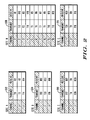
- a channel assignment tracker 138 determines, in response to the monitoring of channel assignments, a set of communication frequencies that have been assigned to wireless devices associated with the host/primary network 102. Based on the channels assigned by the host/primary network 102, the channel assignment tracker is able to determine the communication frequencies or range of channels that can be utilized by the secondary network 104. It should be noted that the term "spectrum" refers to channel frequencies that are used within a network for communication/data services. Examples of channel frequencies identified by the SCC 134 across various base stations of sites are illustrated in Figure 2 . Examples of channel frequencies identified by the channel assignment monitor 136 as being either assigned/unassigned are illustrated in Figure 3 .
- Figure 2 shows a table 202, 204, 206, 208, 210 for each monitored site/base station 116 in a primary network(s) 102.
- Each table 202, 204, 206, 208, 210 illustrates the frequency allocation used by the site within the host network.
- the table 202 for Site A indicates that Site A utilizes Channels 1-3.
- Channel 1 has a transmit frequency of T11 and a receive frequency of R11.
- Channel 2 has a transmit frequency of T2 and a receive frequency of R2.
- Channel 3 has a transmit frequency of T14 and a receive frequency of R14.
- the channel availability transmitter 140 transmits, in response to determinations by the channel assignment tracker 138, to the secondary network 104, a specification of unused communication frequencies within the plurality of communication frequencies.
- Figure 3 shows a table 302, 304, 306, 308, 310 for each of the sites in Figure 2 illustrating potentially available spectrum that can be utilized by the secondary network 102. It is important to note that channel assignments may not be contiguous and if a channel is deemed available, the adjacent spectrum below and above the channel to neighboring channels can also be utilized by a secondary network. For example, these tables show that the minimum frequency of the host/primary network 102 is n and the maximum frequency is n+x. As discussed above with respect to Figure 2 , the channel assignment monitor 136 has determined that the following frequencies T2, T11, T14, R2, R11, and R14 have been allocated to Site A and at some point may be available for use. The tables of Figure 3 also identify the delta, or separation, between each frequency. For example, the table 302 associated with Site A shows that the delta between T2 and T11 is 1.80 MHz.
- the channel assignment tracker 138 has also identified portions of the spectrum utilized by each of the sites of the host/primary network 102 that can potentially be used by the secondary network 104, as shown in Figure 3 .
- the spectrum between T2 and T11 corresponding to the delta of 1.80 MHz has been identified by the channel assignment tracker 138 as potential spectrum that can be utilized by the secondary network 104.
- Each of the rows in Figure 3 that include underlined values in the "delta" column such as row 303 illustrates potential spectrum that is not utilized by the system and that can be used by the secondary network 104.
- underlined numbers indicate potential blocks of spectrum that is not used by the host/primary network 102 and may be suitable for the secondary network 104.
- Figure 4 illustrates spectrum 400 that is allocated/non-allocated by the entire host/primary network comprising sites A, B, C, D, and E associated with the tables of Figure 2 and Figure 3 .
- Figure 4 shows the receiver and transmit frequency pairs separated by a guard band 402.
- the guard band 402 is 4 MHz wide and is located from T(n+j) 404 to R(n) 406 or the difference between the highest transmit frequency and the lowest receive frequency of the primary system.
- the host/primary network 102 comprises spectrum that can be utilized by the secondary network 104.
- the secondary network 104 determines the location of a "home" or "control" channel, perhaps in the guard band 402 or in some of the other identified holes.
- the "home" channel can be relocated or can grow or shrink in a contiguous and non-contiguous manner depending on the usage requirements of the host/primary network 102.
- the SCC 134 communicates spectrum information to the secondary network 104 via the link 107 (in this example).
- the channel assignment manager 128 of the secondary network 104 receives this information and determines the available frequencies in the host/primary network 102 that it can utilize.
- the secondary network 104 in one example, utilizes orthogonal frequency division multiplexing ("OFDM"), which is used to create a wideband modulus comprising a multiplicity of narrowband channels.
- OFDM orthogonal frequency division multiplexing
- the channel assignment manager 128 of the secondary network also establishes a home or control channel within spectrum that has the highest probability of going unused by the host/primary network such as in the guard band area 402 illustrated in Figure 4 .
- a control channel of the secondary network allows a wireless device to transmit call request, receive traffic channel assignments, and perform other similar functions.
- the SCC 134 includes a second channel assignment monitor 150 that determines the frequency or frequency ranges that are being utilized by the secondary network 104 as its control channel. The SCC 134 of that further embodiment then updates its channel assignment database 142 accordingly.
- the second channel assignments monitor 150 monitors the channel allocation commands and control information issued by the channel assignment manager 128 of the secondary network 104.
- the second channel assignment monitor 150 is adapted to accept a message from at least one secondary network 104 that comprises a second specification of communication frequencies from the plurality of communication frequencies that are not to be used by the host/primary network 102.
- Such operations by this further embodiment allow the SCC 134 to identify spectrum being utilized by the secondary network 104 and provide instructions to the host/primary network 102, in embodiments that support such instructions, to not use the spectrum currently used by the secondary network 104.
- a channel assignment manager 128 of a further embodiment is able to allocate a communication channel to the device 110 from the set of available communication frequencies identified by the SCC 134.
- the second channel assignment monitor 150 of this further embodiment detects this channel assignment and updates its channel assignment database 142 accordingly.
- a second channel availability transmitter 152 then transmits the specification of communication frequencies that are not to be used by the host/primary network 102 to the host/primary network 102.
- one embodiment of the present invention is advantageous in that it increases the overall spectral efficiency of networks by providing real-time coordinated use of common spectrum between separate networks incorporating potentially dissimilar networking technologies.
- One embodiment of the present invention monitors spectrum allocation commands and control information associated with an existing host/primary network to identify unused spectrum.
- One embodiment of the present invention then instructs a secondary network to utilize the unused spectrum by adapting to and scavenging spectrum not used by the host/primary network at any given time.
- the allocation commands associated with the host/primary network 102 monitored by the SCC 134 can also comprise commands indicating that a particular frequency or frequency range(s) is to be prevented from being utilized by the secondary network 104.
- the SCC 134 does not include that particular frequency or frequency range in the listing of available frequencies sent to the secondary network 104.
- the secondary network 104 can also issue a command that instructs the host/primary network 104 to not allocate a particular frequency or frequency range(s).
- the SCC 134 receives the command and instructs the host/primary network 102 accordingly.
- the available spectrum of the host/primary network 102 is dynamic. In other words, the available spectrum changes over time.
- a wireless device 108 at the host/primary network 102 can request a call setup.
- the call manager 124 at the host/primary network 102 and the channel assignment manager 124 allocates a particular channel to the device 108 to service that call. However, that channel may be currently in use by the secondary network 104.
- the SCC 134 detects an allocation command for that particular channel. Therefore, the SCC 134 issues a command to the secondary network 104 to de-allocate that channel. If the secondary system is using that channel, it is de-allocated by the secondary network 104. Hence, secondary use policies determining how the secondary network 104 utilizes the available spectrum can be enforced. In one embodiment, the secondary network 104 can be instructed to yield right-of-way to the host/primary network so that the host/primary network 102 gets priority over the use of the spectrum. It is obvious to those skilled in the art that other policies/etiquette can be developed and enforced. For example, the device 108 can issue an emergency call request that must be assigned immediately.
- Figure 5 shows a transactional diagram illustrating this process. Time is depicted in Figure 5 by the vertical scale.
- a wireless device 108 subscribing to the host/primary network 102 submits a call request 520 to its host base station 116.
- the call request 522 is sent to the host core 506 and the call request is granted at time T 2 .
- the channel assignment manager 124 of the host/primary network 102 allocates a channel to the requesting device 108.
- the SCC 134 at time T 3 , detects the channel assignment via an allocation command 528, which is monitored by the monitor link 106.
- the SCC 134 also instructs the base station 118 at the secondary network 104 to not use the channel.
- the base station 118 at the secondary network 104 performs the de-allocation of that channel.
- the base station 116 at the host/primary network 102 at time T 5 , initiates use of the channel.
- the wireless device 108 of the host/primary network 102 adjusts its synthesizer to the channel at time T 6 so that the call requested by the device 108 can be made.
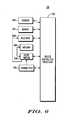
- FIG. 6 is a block diagram illustrating a detailed view of the wireless device 108, 110 according to one embodiment of the present invention. It is assumed that the reader is familiar with wireless communication devices. To simplify the present description, only that portion of a wireless communication device that is relevant to the present invention is discussed.
- the wireless device 108 operates under the control of a device controller/processor 602, that controls the sending and receiving of wireless communication signals. In receive mode, the device controller 602 electrically couples an antenna 604 through a transmit/receive switch 606 to a receiver 608. The receiver 608 decodes the received signals and provides those decoded signals to the device controller 602.
- the device controller 602 electrically couples the antenna 604, through the transmit/receive switch 606, to a transmitter 610.
- the receiver 608 and the transmitter 610 are a dual mode receiver and a dual mode transmitter for receiving/transmitting over various access networks providing different air interface types.
- a separate receiver and transmitter is used for each of type of air interface.
- the device controller 602 operates the transmitter and receiver according to instructions stored in the memory 612. These instructions include, for example, a neighbor cell measurement-scheduling algorithm.
- the wireless device 108 also includes non-volatile storage memory 614 for storing, for example, an application waiting to be executed (not shown) on the wireless device 108.
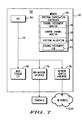
- FIG. 7 is a block diagram illustrating a more detailed view of an information processing system 132.
- the information processing system 132 includes a computer 702.
- the computer 702 has a CPU processor 704 that is connected to a main memory 706, a mass storage interface 708, a man-machine interface 710, and network adapter hardware 716.
- a system bus 714 interconnects these system components.
- the main memory 706 includes the SCC 134, which comprises a channel assignment monitor 136, a channel assignment tracker 138, a channel availability transmitter 140, a channel availability transmitter, a second channel assignment monitor 150, a second channel availability transmitter 152, and a channel assignment database 142, which have all been discussed in greater detail above.
- SCC 134 comprises a channel assignment monitor 136, a channel assignment tracker 138, a channel availability transmitter 140, a channel availability transmitter, a second channel assignment monitor 150, a second channel availability transmitter 152, and a channel assignment database 142, which have all been discussed in greater detail above.
- the main memory 706 also includes the channel assignment database 142. Although illustrated as concurrently resident in the main memory 706, it is clear that respective components of the main memory 706 are not required to be completely resident in the main memory 706 at all times or even at the same time. Furthermore, one or more of these components can be implemented as hardware.
- the mass storage interface 708 can store data on a hard-drive or media such as a CD or DVD.
- the man-machine interface 710 allows technicians, administrators, and other users to directly connect to the information processing system 130 via one or more terminals 718.
- the network adapter hardware 716 in one embodiment, is used to provide an interface to the communication network 112, 114.
- Embodiments of the present invention are able to be adapted to work with any data communications links, including present day analog and/or digital techniques or via a future networking mechanism.
- Figure 8 is an operational flow diagram illustrating a process of coordinating spectrum use between a host/primary network 102 and one or more secondary networks 104.
- the operational flow diagram of Figure 8 begins at step 801 and flows directly to step 802.
- the SCC 134 at step 802, analyzes the host/primary network 102 and determines the frequency spectrum being used within the network 102. In one embodiment, the SCC 134 can analyze initial data to help identify the host/primary network 102 that it is to center on. However, this is not required.
- the SCC at step 804, monitors the host/primary network 102 for allocation and de-allocation commands and control information.
- the SCC 134, at step 806, determines if an allocation command has been detected.
- the SCC 134 continues to monitor for allocation commands and control information. If the result of this determination is positive, the SCC 134, determines at step 807, if the host/primary network de-allocated a channel. If the host/primary network did de-allocate a channel, the processing continues by the SCC instructing, at step 808, the secondary controller to use the channel de-allocated by the host network. After such instruction, or if the SCC determined that the host/primary network did not de-allocate a channel, the SCC updates, at step 809, its channel assignment database 142.
- the SCC 134 determines a set of frequencies and/or frequency ranges that are currently unused at the host/primary network 102.
- the SCC 134 transmits the set of frequencies and/or frequency ranges to the secondary network 104.
- the host/primary network 102 can issue a command to base stations in that network that is monitored by the SCC 134 that indicates one or more frequencies or frequency ranges are used by the host network, and therefore are not to be utilized by the secondary network 104.
- the secondary network 104 receives the set of frequencies and/or frequency ranges and may designate one or more of the frequencies as a control/home channel.
- the SCC 134 assumes that all frequency ranges indicated to the secondary overly network 104 as available are used by that network.
- the SCC 134 is able to identify the frequency(s) utilized by the secondary network 104 designated as the control/home channel by, for example, monitoring assignments made by the secondary network 104.
- the SCC 134 at step 816, updates its channel assignment database 142 accordingly.
- the wireless subscribers 110 of the secondary network 104, at step 816 are also updated with the control/home channel information.
- the SCC 134 monitors the host/primary network 102 for channel assignments and updates its channel assignment database 142 accordingly. For example, if the SCC 134 detects that the host/primary network 102 has assigned a channel to a wireless device 108, the SCC 134 updates the channel assignment database. It should be noted that the SCC 134 is also continuing to monitor the channel assignments and deassignments at the host/primary network 102.
- the SCC 134 determines if the host/primary network 102 is allocating channels, which can be a home (control) or expansion channel (e.g., a channel used by the secondary network 104 as a traffic channel). If the result of this determination is negative, the SCC 134 continues to monitor for channel assignments/de-assignments by the host/primary network 102. If the result of this determination is positive, the control flows to entry point A of Figure 9 .
- the SCC 134 instructs the secondary network 104 that the channel is no longer available for use and must de-allocate that channel for its use.
- the secondary network 104 instructs the wireless device 110 assigned to that particular channel to vacate the channel. If the channel is a home/control channel then all of the wireless devices 110 subscribing to the secondary network 104 are instructed to vacate the channel.
- the wireless devices 110 at step 906, attempt to resynchronize with their new home channel.
- the wireless devices 110 determine if the home channel is available. If the result of this determination is positive, the control flows back to step 818 of Figure 8 . If the result of the determination is negative, the wireless devices 110, at step 910, await for home channel allocation instructions from the secondary network 104. Once instructions are received the wireless devices try to synchronize with the new home channel at step 908.
- the site controller 122 of the secondary system 104 determines if another channel is available for the secondary network 104 to use as a home channel.
- the secondary network 104 at step 916, notifies its wireless subscribers 110 that spectrum from the host/primary network 104 is not going to be used.
- the control flow returns to step 906. If the result of the determination at step 912 is positive, the wireless subscribers 110 of the secondary network 104, at step 920, proceed to use the indicated channel or channels.
Landscapes
- Engineering & Computer Science (AREA)
- Computer Networks & Wireless Communication (AREA)
- Signal Processing (AREA)
- Mobile Radio Communication Systems (AREA)
Claims (15)
- Verfahren zum Definieren einer Kommunikationskanalzuweisung, wobei das Verfahren umfasst:Überwachen (804) von Kommunikationskanalzuweisungskommandos, die zu einem ersten Netzwerk gehören, wobei das erste Netzwerk eine Vielzahl von Kommunikationsfrequenzen aufweist, die durch die Kommunikationskanalzuweisungskommandos zugeordnet werden;Bestimmen (809), als Antwort auf das Überwachen, eines Satzes von Kommunikationsfrequenzen, die Drahtlos-Geräten zugeordnet wurden, die zu dem ersten Netzwerk gehören; undSenden (812), als Antwort auf das Bestimmen, einer Spezifikation von ungenutzten Kommunikationsfrequenzen innerhalb der Vielzahl von Kommunikationsfrequenzen an ein zweites Netzwerk.
- Verfahren nach Anspruch 1, bei dem die Kommunikationskanalzuweisungskommandos zwischen zumindest einigen Komponenten des ersten Netzwerkes über eine drahtgebundene Verbindung kommuniziert werden.
- Verfahren nach Anspruch 1, das weiterhin umfasst:Akzeptieren einer Nachricht von dem zweiten Netzwerk, die eine zweite Spezifikation von Kommunikationsfrequenzen aus der Vielzahl von Kommunikationsfrequenzen umfasst, die von dem ersten Netzwerk nicht zu verwenden sind; undSenden der Spezifikation von Kommunikationsfrequenzen, die von dem ersten Netzwerk nicht zu verwenden sind, an das erste Netzwerk.
- Verfahren nach Anspruch 1, bei dem das zweite Netzwerk die Spezifikation von ungenutzten Kommunikationsfrequenzen akzeptiert und eine der ungenutzten Kommunikationsfrequenzen einem Drahtlos-Gerät zuordnet, das zu dem zweiten Netzwerk gehört.
- Verfahren nach Anspruch 1, bei dem der Drahtlos-Kommunikationscontroller, der zu dem zweiten Netzwerk gehört, die Spezifikation von ungenutzten Kommunikationsfrequenzen akzeptiert und einen ungenutzten Kommunikationskanal als einen drahtlos austauschenden Steuerungskanal für das zweite Netzwerk bestimmt.
- Verfahren nach Anspruch 1, das weiterhin umfasst:Feststellen, auf der Grundlage der Überwachung, dass das erste Netzwerk einen Kommunikationskanal innerhalb der Spezifikation von ungenutzten Kommunikationsfrequenzen zugeordnet hat; undBenachrichtigen des zweiten Netzwerkes über eine Unverfügbarkeit des ungenutzten Kommunikationskanals.
- Verfahren nach Anspruch 6, das weiterhin umfasst:Feststellen durch das zweite Netzwerk als Antwort auf die Benachrichtigung, dass der ungenutzte Kommunikationskanal durch das erste Netzwerk zugeordnet ist; undEntziehen, durch das zweite Netzwerk, als Antwort auf die Feststellung, des ungenutzten Kommunikationskanals, der durch das erste Netzwerk zugeordnet wurde.
- Verfahren nach Anspruch 1, das weiterhin umfasst:Empfangen, als Antwort auf das Senden, einer Anforderung von dem zweiten Netzwerk, einen Kommunikationskanal in der Vielzahl von Kommunikationsfrequenzen zu reservieren; undAnweisen, als Antwort auf das Empfangen, des ersten Netzwerkes, den Kommunikationskanal zu reservieren.
- Drahtlos-Kommunikationscontroller, der aufweist:einen Kanalzuordnungsmonitor (136), der dazu ausgelegt ist, Kommunikationskanalzuweisungskommandos zu überwachen, die zu einem ersten Netzwerk gehören, wobei das erste Netzwerk eine Vielzahl von Kommunikationsfrequenzen aufweist, die durch die Kommunikationskanalzuweisungskommandos zugeordnet werden;einen Kanalzuordnungsverfolger (138), der kommunikativ mit dem Kanalzuordnungsmonitor gekoppelt und dazu ausgelegt ist, als Antwort auf die Überwachung durch den Kanalzuordnungsmonitor einen Satz von Kommunikationsfrequenzen festzustellen, die Drahtlos-Geräten zugeordnet wurden, die zu dem ersten Netzwerk gehören; undeinen Kanalverfügbarkeitssender (140), der kommunikativ mit dem Kanalzuordnungsverfolger gekoppelt und dazu ausgelegt ist, als Antwort auf die Feststellungen durch den Kanalzuordnungsverfolger eine Spezifikation von ungenutzten Kommunikationsfrequenzen innerhalb der Vielzahl von Kommunikationsfrequenzen zu einem zweiten Netzwerk zu senden.
- Drahtlos-Kommunikationscontroller nach Anspruch 9, bei dem die Kommunikationskanalzuweisungskommandos zumindest zwischen einigen Komponenten des ersten Netzwerkes über eine drahtgebundene Verbindung kommuniziert werden, und bei dem der Kanalzuordnungsmonitor dazu ausgelegt ist, die drahtgebundene Verbindung zu überwachen.
- Drahtlos-Kommunikationscontroller nach Anspruch 9, der weiterhin aufweist:einen zweiten Kanalzuordnungsmonitor, der kommunikativ mit dem Kanalzuordnungsverfolger gekoppelt und dazu ausgelegt ist, eine Nachricht von dem zweiten Netzwerk zu akzeptieren, die eine zweite Spezifikation von Kommunikationsfrequenzen aus der Vielzahl von Kommunikationsfrequenzen umfasst, die von dem ersten Netzwerk nicht zu verwenden sind; undeinen zweiten Kanalverfügbarkeitssender, der kommunikativ mit dem zweiten Kanalzuordnungsmonitor gekoppelt und dazu ausgelegt ist, die Spezifikation von Kommunikationsfrequenzen, die von dem ersten Netzwerk nicht zu verwenden sind, an das erste Netzwerk zu senden.
- Drahtlos-Kommunikationscontroller nach Anspruch 9, bei dem das zweite Netzwerk die Spezifikation von ungenutzten Kommunikationsfrequenzen akzeptiert und eine der ungenutzten Kommunikationsfrequenzen einem Drahtlos-Gerät zuordnet, das zu dem zweiten Netzwerk gehört.
- Drahtlos-Kommunikationscontroller nach Anspruch 9, bei dem ein Drahtlos-Kommunikationscontroller, der zu dem zweiten Netzwerk gehört, die Spezifikation von ungenutzten Kommunikationsfrequenzen akzeptiert und einen ungenutzten Kommunikationskanal als einen drahtlos austauschenden Steuerungskanal für das zweite Netzwerk festlegt.
- Drahtlos-Kommunikationscontroller nach Anspruch 9,
wobei der Kanalzuordnungsverfolger weiterhin dazu ausgelegt ist, auf der Grundlage der Überwachung festzustellen, dass das erste Netzwerk einen Kommunikationskanal innerhalb der Spezifikation von ungenutzten Kommunikationsfrequenzen zugewiesen hat, und
wobei der Kanalverfügbarkeitssender weiterhin dazu ausgelegt ist, das zweite Netzwerk über eine Unverfügbarkeit des ungenutzten Kommunikationskanals zu informieren. - Drahtlos-Kommunikationscontroller nach Anspruch 9, der weiterhin aufweist:einen zweiten Kanalzuordnungsmonitor, der kommunikativ mit dem Kanalzuordnungsverfolger gekoppelt und dazu ausgelegt ist, eine Anfrage von dem zweiten Netzwerk zu empfangen, einen Kommunikationskanal in der Vielzahl von Kommunikationsfrequenzen zu reservieren; undeinen zweiten Kanalverfügbarkeitssender, der kommunikativ mit dem zweiten Kanalzuordnungsmonitor und dem Kanalzuordnungsverfolger gekoppelt und dazu ausgelegt ist, das erste Netzwerk anzuweisen, den zumindest einen Kommunikationskanal zu reservieren.
Applications Claiming Priority (2)
| Application Number | Priority Date | Filing Date | Title |
|---|---|---|---|
| US11/946,247 US8040815B2 (en) | 2007-11-28 | 2007-11-28 | Spectrum coordination controller |
| PCT/US2008/079360 WO2009070386A1 (en) | 2007-11-28 | 2008-10-09 | Spectrum coordination controller |
Publications (2)
| Publication Number | Publication Date |
|---|---|
| EP2215865A1 EP2215865A1 (de) | 2010-08-11 |
| EP2215865B1 true EP2215865B1 (de) | 2014-07-16 |
Family
ID=40340728
Family Applications (1)
| Application Number | Title | Priority Date | Filing Date |
|---|---|---|---|
| EP08853871.5A Active EP2215865B1 (de) | 2007-11-28 | 2008-10-09 | Spektrumskoordinationskontroller |
Country Status (3)
| Country | Link |
|---|---|
| US (1) | US8040815B2 (de) |
| EP (1) | EP2215865B1 (de) |
| WO (1) | WO2009070386A1 (de) |
Families Citing this family (22)
| Publication number | Priority date | Publication date | Assignee | Title |
|---|---|---|---|---|
| US8437276B2 (en) * | 2007-11-29 | 2013-05-07 | Tridinetworks Ltd. | Control systems, commissioning tools, configuration adapters and method for wireless and wired networks design, installation and automatic formation |
| JP5067866B2 (ja) * | 2008-01-08 | 2012-11-07 | キヤノン株式会社 | 通信装置及び制御方法 |
| US8305917B2 (en) * | 2009-03-23 | 2012-11-06 | Motorola Solutions, Inc. | System and method for maintaining a backup radio operating parameter list in a secondary use communication system |
| US8521087B2 (en) * | 2009-07-15 | 2013-08-27 | Lg Electronics Inc. | System and method for cognitive radio transmission |
| US8750886B2 (en) * | 2010-05-06 | 2014-06-10 | Nokia Corporation | Apparatus and method for dynamic resolution of secondary communication system resources |
| US8711721B2 (en) * | 2010-07-15 | 2014-04-29 | Rivada Networks Llc | Methods and systems for dynamic spectrum arbitrage |
| TWI524799B (zh) | 2010-10-12 | 2016-03-01 | 內數位專利控股公司 | 電視閒置頻段頻道選擇及網路配置以服務為基礎之方法 |
| US9204450B2 (en) * | 2010-11-30 | 2015-12-01 | Nokia Solutions And Networks Oy | Dynamic spectrum refarming with multiple carriers |
| BR112013022764A2 (pt) * | 2011-03-10 | 2016-12-06 | Koninkl Philips Nv | sistema médico e método |
| WO2012170195A1 (en) * | 2011-06-04 | 2012-12-13 | Dinan Esmael Hejazi | Multicarrier ofdm transmission using carrier aggregation |
| US9504034B2 (en) * | 2011-07-05 | 2016-11-22 | Tait Limited | Overlay of bearers in a radio communication system |
| FR2979045B1 (fr) * | 2011-08-09 | 2013-09-20 | Cassidian | Procede de coexistence radioelectrique entre deux dispositifs pmr dont l'un est en bande etroite et l'autre a large bande |
| US9185697B2 (en) | 2012-12-27 | 2015-11-10 | Google Technology Holdings LLC | Method and apparatus for device-to-device communication |
| US9143291B2 (en) | 2012-12-27 | 2015-09-22 | Google Technology Holdings LLC | Method and apparatus for device-to-device communication |
| US9042938B2 (en) | 2012-12-27 | 2015-05-26 | Google Technology Holdings LLC | Method and apparatus for device-to-device communication |
| EP2959708B1 (de) * | 2013-02-22 | 2018-10-10 | Rivada Networks LLC | Verfahren und system für dynamische spektrumsbeurteilung |
| US9370035B2 (en) | 2013-08-12 | 2016-06-14 | Google Technology Holdings LLC | Methods and devices for mobile station device-to-device beacon window determination |
| US9392615B2 (en) | 2013-08-20 | 2016-07-12 | Google Technology Holdings LLC | Methods and devices for allocating resources in device-to-device communication |
| US20170078896A1 (en) * | 2015-09-11 | 2017-03-16 | Laird Technologies, Inc. | Using network-provided information to tune wireless network client performance |
| US10123309B2 (en) * | 2016-12-06 | 2018-11-06 | Cisco Technology, Inc. | System and method for discovery and acquisition of a control channel using guard bands |
| US10772052B2 (en) * | 2017-06-16 | 2020-09-08 | Qualcomm Incorporated | Controlling coexistent radio systems in a wireless device |
| US20240147320A1 (en) * | 2022-11-02 | 2024-05-02 | At&T Intellectual Property I, L.P. | Method and system for channel coordination in network core and cbrs |
Family Cites Families (25)
| Publication number | Priority date | Publication date | Assignee | Title |
|---|---|---|---|---|
| GB2214758A (en) * | 1988-01-22 | 1989-09-06 | Philips Electronic Associated | Signal distribution network system |
| US5040238A (en) | 1990-06-29 | 1991-08-13 | Motorola, Inc. | Trunking system communication resource reuse method |
| US5212831A (en) | 1990-11-28 | 1993-05-18 | Bell Communications Research, Inc. | Method and apparatus for autonomous adaptive frequency assignment in TDMA portable radio systems |
| KR100304238B1 (ko) * | 1993-07-16 | 2001-11-22 | 맨스 에케로프 | 무선통신시스템에서송수신기작동을제어하는방법및장치 |
| US5428668A (en) * | 1993-11-04 | 1995-06-27 | Ericsson Ge Mobile Communications Inc. | Radio personal communications system and method for allocating frequencies for communications between a cellular terminal and a base station |
| US6101176A (en) | 1996-07-24 | 2000-08-08 | Nokia Mobile Phones | Method and apparatus for operating an indoor CDMA telecommunications system |
| US6055432A (en) | 1997-08-15 | 2000-04-25 | Lucent Technologies Inc. | Dynamic channel allocation in macrocells with random exclusion for allowing underlaying autonomous microcells |
| US6047190A (en) | 1997-08-15 | 2000-04-04 | Lucent Technologies Inc | Dynamic channel allocation in macrocells with deterministic exclusion for allowing underlaying autonomous microcells |
| US6442507B1 (en) | 1998-12-29 | 2002-08-27 | Wireless Communications, Inc. | System for creating a computer model and measurement database of a wireless communication network |
| US6940845B2 (en) | 2000-03-23 | 2005-09-06 | At & T, Corp. | Asymmetric measurement-based dynamic packet assignment system and method for wireless data services |
| US7095754B2 (en) | 2000-11-03 | 2006-08-22 | At&T Corp. | Tiered contention multiple access (TCMA): a method for priority-based shared channel access |
| US7181225B1 (en) | 2000-12-19 | 2007-02-20 | Bellsouth Intellectual Property Corporation | System and method for surveying wireless device users by location |
| US7035275B2 (en) | 2001-01-16 | 2006-04-25 | Texas Instruments Incorporated | Non-collaborative mechanisms for enhanced coexistence of wireless networks |
| US7162507B2 (en) | 2001-03-08 | 2007-01-09 | Conexant, Inc. | Wireless network site survey tool |
| US8195172B2 (en) * | 2002-04-03 | 2012-06-05 | Illinois Institute Of Technology | Process to allocate channels in a sectorized and tiered cellular network |
| US7058796B2 (en) | 2002-05-20 | 2006-06-06 | Airdefense, Inc. | Method and system for actively defending a wireless LAN against attacks |
| US7184777B2 (en) | 2002-11-27 | 2007-02-27 | Cognio, Inc. | Server and multiple sensor system for monitoring activity in a shared radio frequency band |
| US7184770B1 (en) | 2003-03-05 | 2007-02-27 | Aruba Networks, Inc. | System and method for positioning and calibrating wireless network devices |
| US7027827B2 (en) | 2003-05-19 | 2006-04-11 | Motorola, Inc. | Method and apparatus for channel sharing between multiple communication systems |
| US7110756B2 (en) | 2003-10-03 | 2006-09-19 | Cognio, Inc. | Automated real-time site survey in a shared frequency band environment |
| US7002943B2 (en) | 2003-12-08 | 2006-02-21 | Airtight Networks, Inc. | Method and system for monitoring a selected region of an airspace associated with local area networks of computing devices |
| ATE411716T1 (de) | 2005-07-04 | 2008-10-15 | Motorola Inc | Vorrichtung und verfahren zum gemeinsamen benutzen von betriebsmitteln zwischen mehreren kommunikationsnetzen |
| US7171324B1 (en) | 2005-10-14 | 2007-01-30 | Agilent Technologies, Inc. | System and method for removing measurement errors from measurement systems |
| CN101371608B (zh) | 2006-01-11 | 2013-01-23 | 高通股份有限公司 | 支持同步的无线通信方法和装置 |
| US20070195731A1 (en) | 2006-02-21 | 2007-08-23 | Camp William O Jr | Methods, systems and computer program products for establishing a point-to-point communication connection |
-
2007
- 2007-11-28 US US11/946,247 patent/US8040815B2/en active Active
-
2008
- 2008-10-09 EP EP08853871.5A patent/EP2215865B1/de active Active
- 2008-10-09 WO PCT/US2008/079360 patent/WO2009070386A1/en not_active Ceased
Also Published As
| Publication number | Publication date |
|---|---|
| WO2009070386A1 (en) | 2009-06-04 |
| US8040815B2 (en) | 2011-10-18 |
| US20090135767A1 (en) | 2009-05-28 |
| EP2215865A1 (de) | 2010-08-11 |
Similar Documents
| Publication | Publication Date | Title |
|---|---|---|
| EP2215865B1 (de) | Spektrumskoordinationskontroller | |
| US11012930B2 (en) | Dynamic spectrum resource allocation for full spectrum sharing | |
| US9137805B2 (en) | Spectrum management in dynamic spectrum access wireless systems | |
| JP3816334B2 (ja) | 無線リソース割当方法及び基地局 | |
| CN101584233B (zh) | 无线电通信网络之间的动态频带分配 | |
| KR101881433B1 (ko) | 트래픽의 서비스 품질(QoS) 제약조건에 기초한 허가 또는 비허가 스펙트럼 상의 트래픽 통신 시스템 및 방법 | |
| KR102048757B1 (ko) | 인가 및 비인가 스펙트럼에 대한 동적 리소스 할당을 위한 시스템 및 방법 | |
| EP2934033B1 (de) | Verfahren und basisstation zur interferenzkoordination in einem lte-trunkierungskommunikationssystem | |
| US9301149B2 (en) | Method for providing information such that different types of access points can coexist | |
| EP2587874B1 (de) | Verfahren und vorrichtung zur gewinnung von trägerinformationen und zur anzeige von trägerinformationen | |
| US8730900B2 (en) | Method and device for adaptive adjusting uplink and downlink bandwidth | |
| JP6575850B2 (ja) | 無線通信端末及び基地局割当方法 | |
| CN104956752A (zh) | 移动通信设备和用于基于ue能力分配虚拟载波外部的资源的方法 | |
| CN101310556A (zh) | 动态频谱接入无线系统中的频谱管理 | |
| JP6575851B2 (ja) | 無線通信端末及び周波数割当方法 | |
| WO2018173418A1 (ja) | 装置、方法及び記録媒体 | |
| US8923329B2 (en) | Apparatus and method for supporting various system bandwidths in a broadband wireless communication system | |
| WO2017115130A1 (en) | Method and scheduling apparatus for transmitting uplink scheduling information for an unlicensed band | |
| CN113055895B (zh) | 频谱资源的共享方法及设备 | |
| CN103067925B (zh) | 一种认知无线电系统前导码格式的重配方法及系统 | |
| CN111491376B (zh) | 一种空口资源调度方法及设备 | |
| CN111356235B (zh) | 一种宽窄融合系统下pdt和lte的频率分配方法 | |
| CN111294805B (zh) | 一种lte系统与其他系统共享tdd频谱的方法及基站设备 | |
| CN107920391B (zh) | 物理上行控制信道的调度方法、系统以及设备 | |
| JPH089464A (ja) | セルラ移動通信システムの無線チャネル割当方法 |
Legal Events
| Date | Code | Title | Description |
|---|---|---|---|
| PUAI | Public reference made under article 153(3) epc to a published international application that has entered the european phase |
Free format text: ORIGINAL CODE: 0009012 |
|
| 17P | Request for examination filed |
Effective date: 20100505 |
|
| AK | Designated contracting states |
Kind code of ref document: A1 Designated state(s): AT BE BG CH CY CZ DE DK EE ES FI FR GB GR HR HU IE IS IT LI LT LU LV MC MT NL NO PL PT RO SE SI SK TR |
|
| AX | Request for extension of the european patent |
Extension state: AL BA MK RS |
|
| DAX | Request for extension of the european patent (deleted) | ||
| RAP1 | Party data changed (applicant data changed or rights of an application transferred) |
Owner name: MOTOROLA SOLUTIONS, INC. |
|
| GRAP | Despatch of communication of intention to grant a patent |
Free format text: ORIGINAL CODE: EPIDOSNIGR1 |
|
| INTG | Intention to grant announced |
Effective date: 20140128 |
|
| GRAS | Grant fee paid |
Free format text: ORIGINAL CODE: EPIDOSNIGR3 |
|
| GRAA | (expected) grant |
Free format text: ORIGINAL CODE: 0009210 |
|
| AK | Designated contracting states |
Kind code of ref document: B1 Designated state(s): AT BE BG CH CY CZ DE DK EE ES FI FR GB GR HR HU IE IS IT LI LT LU LV MC MT NL NO PL PT RO SE SI SK TR |
|
| REG | Reference to a national code |
Ref country code: GB Ref legal event code: FG4D |
|
| REG | Reference to a national code |
Ref country code: CH Ref legal event code: EP |
|
| REG | Reference to a national code |
Ref country code: IE Ref legal event code: FG4D |
|
| REG | Reference to a national code |
Ref country code: AT Ref legal event code: REF Ref document number: 678259 Country of ref document: AT Kind code of ref document: T Effective date: 20140815 |
|
| REG | Reference to a national code |
Ref country code: DE Ref legal event code: R096 Ref document number: 602008033378 Country of ref document: DE Effective date: 20140828 |
|
| REG | Reference to a national code |
Ref country code: SE Ref legal event code: TRGR |
|
| REG | Reference to a national code |
Ref country code: NL Ref legal event code: VDEP Effective date: 20140716 |
|
| REG | Reference to a national code |
Ref country code: AT Ref legal event code: MK05 Ref document number: 678259 Country of ref document: AT Kind code of ref document: T Effective date: 20140716 |
|
| REG | Reference to a national code |
Ref country code: LT Ref legal event code: MG4D |
|
| PG25 | Lapsed in a contracting state [announced via postgrant information from national office to epo] |
Ref country code: LT Free format text: LAPSE BECAUSE OF FAILURE TO SUBMIT A TRANSLATION OF THE DESCRIPTION OR TO PAY THE FEE WITHIN THE PRESCRIBED TIME-LIMIT Effective date: 20140716 Ref country code: GR Free format text: LAPSE BECAUSE OF FAILURE TO SUBMIT A TRANSLATION OF THE DESCRIPTION OR TO PAY THE FEE WITHIN THE PRESCRIBED TIME-LIMIT Effective date: 20141017 Ref country code: FI Free format text: LAPSE BECAUSE OF FAILURE TO SUBMIT A TRANSLATION OF THE DESCRIPTION OR TO PAY THE FEE WITHIN THE PRESCRIBED TIME-LIMIT Effective date: 20140716 Ref country code: BG Free format text: LAPSE BECAUSE OF FAILURE TO SUBMIT A TRANSLATION OF THE DESCRIPTION OR TO PAY THE FEE WITHIN THE PRESCRIBED TIME-LIMIT Effective date: 20141016 Ref country code: NO Free format text: LAPSE BECAUSE OF FAILURE TO SUBMIT A TRANSLATION OF THE DESCRIPTION OR TO PAY THE FEE WITHIN THE PRESCRIBED TIME-LIMIT Effective date: 20141016 Ref country code: PT Free format text: LAPSE BECAUSE OF FAILURE TO SUBMIT A TRANSLATION OF THE DESCRIPTION OR TO PAY THE FEE WITHIN THE PRESCRIBED TIME-LIMIT Effective date: 20141117 Ref country code: ES Free format text: LAPSE BECAUSE OF FAILURE TO SUBMIT A TRANSLATION OF THE DESCRIPTION OR TO PAY THE FEE WITHIN THE PRESCRIBED TIME-LIMIT Effective date: 20140716 |
|
| PG25 | Lapsed in a contracting state [announced via postgrant information from national office to epo] |
Ref country code: CY Free format text: LAPSE BECAUSE OF FAILURE TO SUBMIT A TRANSLATION OF THE DESCRIPTION OR TO PAY THE FEE WITHIN THE PRESCRIBED TIME-LIMIT Effective date: 20140716 Ref country code: LV Free format text: LAPSE BECAUSE OF FAILURE TO SUBMIT A TRANSLATION OF THE DESCRIPTION OR TO PAY THE FEE WITHIN THE PRESCRIBED TIME-LIMIT Effective date: 20140716 Ref country code: PL Free format text: LAPSE BECAUSE OF FAILURE TO SUBMIT A TRANSLATION OF THE DESCRIPTION OR TO PAY THE FEE WITHIN THE PRESCRIBED TIME-LIMIT Effective date: 20140716 Ref country code: AT Free format text: LAPSE BECAUSE OF FAILURE TO SUBMIT A TRANSLATION OF THE DESCRIPTION OR TO PAY THE FEE WITHIN THE PRESCRIBED TIME-LIMIT Effective date: 20140716 Ref country code: NL Free format text: LAPSE BECAUSE OF FAILURE TO SUBMIT A TRANSLATION OF THE DESCRIPTION OR TO PAY THE FEE WITHIN THE PRESCRIBED TIME-LIMIT Effective date: 20140716 Ref country code: IS Free format text: LAPSE BECAUSE OF FAILURE TO SUBMIT A TRANSLATION OF THE DESCRIPTION OR TO PAY THE FEE WITHIN THE PRESCRIBED TIME-LIMIT Effective date: 20141116 |
|
| REG | Reference to a national code |
Ref country code: DE Ref legal event code: R097 Ref document number: 602008033378 Country of ref document: DE |
|
| PG25 | Lapsed in a contracting state [announced via postgrant information from national office to epo] |
Ref country code: SK Free format text: LAPSE BECAUSE OF FAILURE TO SUBMIT A TRANSLATION OF THE DESCRIPTION OR TO PAY THE FEE WITHIN THE PRESCRIBED TIME-LIMIT Effective date: 20140716 Ref country code: RO Free format text: LAPSE BECAUSE OF FAILURE TO SUBMIT A TRANSLATION OF THE DESCRIPTION OR TO PAY THE FEE WITHIN THE PRESCRIBED TIME-LIMIT Effective date: 20140716 Ref country code: DK Free format text: LAPSE BECAUSE OF FAILURE TO SUBMIT A TRANSLATION OF THE DESCRIPTION OR TO PAY THE FEE WITHIN THE PRESCRIBED TIME-LIMIT Effective date: 20140716 Ref country code: EE Free format text: LAPSE BECAUSE OF FAILURE TO SUBMIT A TRANSLATION OF THE DESCRIPTION OR TO PAY THE FEE WITHIN THE PRESCRIBED TIME-LIMIT Effective date: 20140716 Ref country code: IT Free format text: LAPSE BECAUSE OF FAILURE TO SUBMIT A TRANSLATION OF THE DESCRIPTION OR TO PAY THE FEE WITHIN THE PRESCRIBED TIME-LIMIT Effective date: 20140716 Ref country code: CZ Free format text: LAPSE BECAUSE OF FAILURE TO SUBMIT A TRANSLATION OF THE DESCRIPTION OR TO PAY THE FEE WITHIN THE PRESCRIBED TIME-LIMIT Effective date: 20140716 |
|
| PLBE | No opposition filed within time limit |
Free format text: ORIGINAL CODE: 0009261 |
|
| STAA | Information on the status of an ep patent application or granted ep patent |
Free format text: STATUS: NO OPPOSITION FILED WITHIN TIME LIMIT |
|
| PG25 | Lapsed in a contracting state [announced via postgrant information from national office to epo] |
Ref country code: MC Free format text: LAPSE BECAUSE OF FAILURE TO SUBMIT A TRANSLATION OF THE DESCRIPTION OR TO PAY THE FEE WITHIN THE PRESCRIBED TIME-LIMIT Effective date: 20140716 Ref country code: LU Free format text: LAPSE BECAUSE OF FAILURE TO SUBMIT A TRANSLATION OF THE DESCRIPTION OR TO PAY THE FEE WITHIN THE PRESCRIBED TIME-LIMIT Effective date: 20141009 |
|
| REG | Reference to a national code |
Ref country code: CH Ref legal event code: PL |
|
| 26N | No opposition filed |
Effective date: 20150417 |
|
| PG25 | Lapsed in a contracting state [announced via postgrant information from national office to epo] |
Ref country code: BE Free format text: LAPSE BECAUSE OF NON-PAYMENT OF DUE FEES Effective date: 20141031 |
|
| REG | Reference to a national code |
Ref country code: IE Ref legal event code: MM4A |
|
| PG25 | Lapsed in a contracting state [announced via postgrant information from national office to epo] |
Ref country code: LI Free format text: LAPSE BECAUSE OF NON-PAYMENT OF DUE FEES Effective date: 20141031 Ref country code: CH Free format text: LAPSE BECAUSE OF NON-PAYMENT OF DUE FEES Effective date: 20141031 |
|
| PG25 | Lapsed in a contracting state [announced via postgrant information from national office to epo] |
Ref country code: IE Free format text: LAPSE BECAUSE OF NON-PAYMENT OF DUE FEES Effective date: 20141009 |
|
| PG25 | Lapsed in a contracting state [announced via postgrant information from national office to epo] |
Ref country code: SI Free format text: LAPSE BECAUSE OF FAILURE TO SUBMIT A TRANSLATION OF THE DESCRIPTION OR TO PAY THE FEE WITHIN THE PRESCRIBED TIME-LIMIT Effective date: 20140716 |
|
| PG25 | Lapsed in a contracting state [announced via postgrant information from national office to epo] |
Ref country code: TR Free format text: LAPSE BECAUSE OF FAILURE TO SUBMIT A TRANSLATION OF THE DESCRIPTION OR TO PAY THE FEE WITHIN THE PRESCRIBED TIME-LIMIT Effective date: 20140716 Ref country code: BE Free format text: LAPSE BECAUSE OF FAILURE TO SUBMIT A TRANSLATION OF THE DESCRIPTION OR TO PAY THE FEE WITHIN THE PRESCRIBED TIME-LIMIT Effective date: 20140716 Ref country code: MT Free format text: LAPSE BECAUSE OF FAILURE TO SUBMIT A TRANSLATION OF THE DESCRIPTION OR TO PAY THE FEE WITHIN THE PRESCRIBED TIME-LIMIT Effective date: 20140716 Ref country code: HR Free format text: LAPSE BECAUSE OF FAILURE TO SUBMIT A TRANSLATION OF THE DESCRIPTION OR TO PAY THE FEE WITHIN THE PRESCRIBED TIME-LIMIT Effective date: 20140716 Ref country code: HU Free format text: LAPSE BECAUSE OF FAILURE TO SUBMIT A TRANSLATION OF THE DESCRIPTION OR TO PAY THE FEE WITHIN THE PRESCRIBED TIME-LIMIT; INVALID AB INITIO Effective date: 20081009 |
|
| REG | Reference to a national code |
Ref country code: DE Ref legal event code: R082 Ref document number: 602008033378 Country of ref document: DE Representative=s name: SCHUMACHER & WILLSAU PATENTANWALTSGESELLSCHAFT, DE Ref country code: FR Ref legal event code: PLFP Year of fee payment: 9 Ref country code: DE Ref legal event code: R081 Ref document number: 602008033378 Country of ref document: DE Owner name: MOTOROLA SOLUTIONS, INC., CHICAGO, US Free format text: FORMER OWNER: MOTOROLA SOLUTIONS, INC., SCHAUMBURG, ILL., US |
|
| REG | Reference to a national code |
Ref country code: FR Ref legal event code: PLFP Year of fee payment: 10 |
|
| REG | Reference to a national code |
Ref country code: FR Ref legal event code: CA Effective date: 20180105 |
|
| REG | Reference to a national code |
Ref country code: FR Ref legal event code: PLFP Year of fee payment: 11 |
|
| P01 | Opt-out of the competence of the unified patent court (upc) registered |
Effective date: 20230523 |
|
| PGFP | Annual fee paid to national office [announced via postgrant information from national office to epo] |
Ref country code: GB Payment date: 20250923 Year of fee payment: 18 |
|
| PGFP | Annual fee paid to national office [announced via postgrant information from national office to epo] |
Ref country code: FR Payment date: 20250924 Year of fee payment: 18 |
|
| PGFP | Annual fee paid to national office [announced via postgrant information from national office to epo] |
Ref country code: SE Payment date: 20250923 Year of fee payment: 18 |
|
| PGFP | Annual fee paid to national office [announced via postgrant information from national office to epo] |
Ref country code: DE Payment date: 20250923 Year of fee payment: 18 |
|
| REG | Reference to a national code |
Ref country code: DE Ref legal event code: R082 Ref document number: 602008033378 Country of ref document: DE Representative=s name: PUSCHMANN BORCHERT KAISER KLETTNER PATENTANWAE, DE |