EP2213691A1 - Cycloolefin addition polymer and making method - Google Patents
Cycloolefin addition polymer and making method Download PDFInfo
- Publication number
- EP2213691A1 EP2213691A1 EP10250141A EP10250141A EP2213691A1 EP 2213691 A1 EP2213691 A1 EP 2213691A1 EP 10250141 A EP10250141 A EP 10250141A EP 10250141 A EP10250141 A EP 10250141A EP 2213691 A1 EP2213691 A1 EP 2213691A1
- Authority
- EP
- European Patent Office
- Prior art keywords
- cycloolefin
- formula
- polymer
- catalyst
- compound
- Prior art date
- Legal status (The legal status is an assumption and is not a legal conclusion. Google has not performed a legal analysis and makes no representation as to the accuracy of the status listed.)
- Withdrawn
Links
- WHRYLXXHLFPFNZ-UHFFFAOYSA-N CN(C(C1C2C3C=CC1C3)=O)C2=O Chemical compound CN(C(C1C2C3C=CC1C3)=O)C2=O WHRYLXXHLFPFNZ-UHFFFAOYSA-N 0.000 description 1
- ZTUKZULGOCFJET-UHFFFAOYSA-N O=C(CCC1=O)N1c1ccccc1 Chemical compound O=C(CCC1=O)N1c1ccccc1 ZTUKZULGOCFJET-UHFFFAOYSA-N 0.000 description 1
Images


Classifications
-
- C—CHEMISTRY; METALLURGY
- C08—ORGANIC MACROMOLECULAR COMPOUNDS; THEIR PREPARATION OR CHEMICAL WORKING-UP; COMPOSITIONS BASED THEREON
- C08F—MACROMOLECULAR COMPOUNDS OBTAINED BY REACTIONS ONLY INVOLVING CARBON-TO-CARBON UNSATURATED BONDS
- C08F4/00—Polymerisation catalysts
- C08F4/42—Metals; Metal hydrides; Metallo-organic compounds; Use thereof as catalyst precursors
- C08F4/44—Metals; Metal hydrides; Metallo-organic compounds; Use thereof as catalyst precursors selected from light metals, zinc, cadmium, mercury, copper, silver, gold, boron, gallium, indium, thallium, rare earths or actinides
- C08F4/60—Metals; Metal hydrides; Metallo-organic compounds; Use thereof as catalyst precursors selected from light metals, zinc, cadmium, mercury, copper, silver, gold, boron, gallium, indium, thallium, rare earths or actinides together with refractory metals, iron group metals, platinum group metals, manganese, rhenium technetium or compounds thereof
- C08F4/70—Iron group metals, platinum group metals or compounds thereof
-
- B—PERFORMING OPERATIONS; TRANSPORTING
- B01—PHYSICAL OR CHEMICAL PROCESSES OR APPARATUS IN GENERAL
- B01D—SEPARATION
- B01D71/00—Semi-permeable membranes for separation processes or apparatus characterised by the material; Manufacturing processes specially adapted therefor
- B01D71/06—Organic material
- B01D71/44—Polymers obtained by reactions only involving carbon-to-carbon unsaturated bonds, not provided for in a single one of groups B01D71/26-B01D71/42
-
- B—PERFORMING OPERATIONS; TRANSPORTING
- B01—PHYSICAL OR CHEMICAL PROCESSES OR APPARATUS IN GENERAL
- B01D—SEPARATION
- B01D71/00—Semi-permeable membranes for separation processes or apparatus characterised by the material; Manufacturing processes specially adapted therefor
- B01D71/06—Organic material
- B01D71/70—Polymers having silicon in the main chain, with or without sulfur, nitrogen, oxygen or carbon only
-
- B—PERFORMING OPERATIONS; TRANSPORTING
- B01—PHYSICAL OR CHEMICAL PROCESSES OR APPARATUS IN GENERAL
- B01D—SEPARATION
- B01D71/00—Semi-permeable membranes for separation processes or apparatus characterised by the material; Manufacturing processes specially adapted therefor
- B01D71/06—Organic material
- B01D71/76—Macromolecular material not specifically provided for in a single one of groups B01D71/08 - B01D71/74
- B01D71/82—Macromolecular material not specifically provided for in a single one of groups B01D71/08 - B01D71/74 characterised by the presence of specified groups, e.g. introduced by chemical after-treatment
-
- C—CHEMISTRY; METALLURGY
- C08—ORGANIC MACROMOLECULAR COMPOUNDS; THEIR PREPARATION OR CHEMICAL WORKING-UP; COMPOSITIONS BASED THEREON
- C08F—MACROMOLECULAR COMPOUNDS OBTAINED BY REACTIONS ONLY INVOLVING CARBON-TO-CARBON UNSATURATED BONDS
- C08F232/00—Copolymers of cyclic compounds containing no unsaturated aliphatic radicals in a side chain, and having one or more carbon-to-carbon double bonds in a carbocyclic ring system
- C08F232/08—Copolymers of cyclic compounds containing no unsaturated aliphatic radicals in a side chain, and having one or more carbon-to-carbon double bonds in a carbocyclic ring system having condensed rings
-
- C—CHEMISTRY; METALLURGY
- C08—ORGANIC MACROMOLECULAR COMPOUNDS; THEIR PREPARATION OR CHEMICAL WORKING-UP; COMPOSITIONS BASED THEREON
- C08F—MACROMOLECULAR COMPOUNDS OBTAINED BY REACTIONS ONLY INVOLVING CARBON-TO-CARBON UNSATURATED BONDS
- C08F30/00—Homopolymers or copolymers of compounds having one or more unsaturated aliphatic radicals, each having only one carbon-to-carbon double bond, and containing phosphorus, selenium, tellurium or a metal
- C08F30/04—Homopolymers or copolymers of compounds having one or more unsaturated aliphatic radicals, each having only one carbon-to-carbon double bond, and containing phosphorus, selenium, tellurium or a metal containing a metal
- C08F30/08—Homopolymers or copolymers of compounds having one or more unsaturated aliphatic radicals, each having only one carbon-to-carbon double bond, and containing phosphorus, selenium, tellurium or a metal containing a metal containing silicon
-
- C—CHEMISTRY; METALLURGY
- C08—ORGANIC MACROMOLECULAR COMPOUNDS; THEIR PREPARATION OR CHEMICAL WORKING-UP; COMPOSITIONS BASED THEREON
- C08F—MACROMOLECULAR COMPOUNDS OBTAINED BY REACTIONS ONLY INVOLVING CARBON-TO-CARBON UNSATURATED BONDS
- C08F32/00—Homopolymers and copolymers of cyclic compounds having no unsaturated aliphatic radicals in a side chain, and having one or more carbon-to-carbon double bonds in a carbocyclic ring system
- C08F32/08—Homopolymers and copolymers of cyclic compounds having no unsaturated aliphatic radicals in a side chain, and having one or more carbon-to-carbon double bonds in a carbocyclic ring system having two condensed rings
Definitions
- This invention relates to cycloolefin addition polymers, and more particularly, to cycloolefin addition polymers having organosiloxane pendants, and a method for preparing the same.
- air conditioners are essential in buildings, houses, automobiles and the like for presenting comfortable living and working spaces.
- air conditioners are installed in an environment which is closed for energy efficiency.
- the space is gradually depleted of oxygen to detract from working efficiency.
- oxygen depletion is soporific and likely to raise a safety problem.
- Open windows prevent a lowering of oxygen concentration, but lead to an energy loss and permit entry of pollen, sand, dust and debris, impairing the once established comfortable environment.
- oxygen enriching membranes for selective permeation of oxygen were developed for use in air conditioners. Their performance is still unsatisfactory.
- organopolysiloxane One known oxygen permeable material is organopolysiloxane.
- the organopolysiloxane itself is low in mechanical strength and problematic on practical use.
- JP-B H04-001652 discloses copolymers of organopolysiloxane and polycarbonate and JP-A H05-285216 discloses polysiloxane-aromatic polyamide block copolymers.
- these copolymers are complex to synthesize and lack long-term stability because of hydrolysis.
- silicon-containing styrene derivatives JP-A H04-88004
- silicon-containing stilbene derivatives JP-A H08-198881
- silicon-containing celluloses JP-A 2001-79375 . None of them meet the requirements of oxygen permeability, thermal stability and mechanical strength.
- JP-A 2007-291150 discloses polymers obtained from ring-opening polymerization of a cycloolefin compound having an organosiloxane pendant and hydrides thereof. However, most polymers are poor in heat resistance and film strength and lack long-term stability because of potential depolymerization.
- An object of the invention is to provide a cycloolefin addition polymer which is easy to manufacture on an industrial scale and has both high thermal stability and mechanical strength as well as good gas permeability. Another object is to provide a method for preparing the same.
- a cycloolefin addition polymer is obtained from addition polymerization of a cycloolefin-functionalized siloxane having the formula (1) or a cycloolefin-functionalized siloxane having the formula (1) and a cycloolefin compound having the formula (2) in the presence of a catalyst A and a co-catalyst B.
- structural units derived from the cycloolefin-functionalized siloxane having formula (1) are present in an amount of 35 to 100 mol% of the polymer.
- the polymer has a number average molecular weight (Mn) of 200,000 to 1,000,000 as measured by GPC versus polystyrene standards.
- Mn number average molecular weight
- the cycloolefin addition polymer of this specific structure has good properties of oxygen permeability, heat resistance and mechanical strength. The invention is predicated on this finding.
- the invention provides a cycloolefin addition polymer obtained from addition polymerization of a cycloolefin-functionalized siloxane having the formula (1) and optionally a cycloolefin compound having the formula (2) in the presence of a catalyst A and a co-catalyst B, structural units derived from the cycloolefin-functionalized siloxane having formula (1) being present in an amount of 35 to 100 mol% of the polymer, the polymer having a number average molecular weight (Mn) of 200,000 to 1,000,000 as measured by GPC versus polystyrene standards.
- Mn number average molecular weight
- the cycloolefin-functionalized siloxane has the formula (1): wherein R 1 is each independently a monovalent organic radical free of aliphatic unsaturation, s is an integer of 0 to 2, and j is 0 or 1.
- the cycloolefin compound has the formula (2): wherein A 1 to A 4 are each independently a substituent radical selected from the group consisting of hydrogen, halogen, C 1 -C 10 alkyl, alkenyl, cycloalkyl, aryl, alkoxy, aryloxy and halogenated hydrocarbon radicals, or a polar substituent radical selected from the group consisting of oxetanyl and alkoxycarbonyl, or A 1 and A 2 , or A 1 and A 3 may bond together to form an alicyclic structure, aromatic ring structure, carbonimide radical or acid anhydride radical with the carbon atom(s) to which they are attached, and i is 0 or 1.
- Catalyst A is a transition metal complex in which at least a cyclopentadienyl ligand coordinates with a transition metal selected from nickel and palladium, having the formula (3): ML n ⁇ K 1 x ⁇ K 2 y ⁇ K 3 z wherein M is nickel or palladium, L is a cyclopentadienyl ligand selected from cyclopentadienyl and derivatives thereof, K 1 , K 2 , and K 3 are different negative or neutral ligands, n is an integer of 1 to 3, x, y and z are each independently an integer of 0 to 7, x+y+z is an integer of 0 to 7.
- Co-catalyst B is at least one compound selected from the group consisting of (a) an organoaluminum compound, (b) an ionic compound capable of reacting with catalyst A to form a cationic transition metal compound, and (c) a compound capable of promoting dissociation of the ligand from the complex as catalyst A.
- structural units derived from the cycloolefin-functionalized siloxane having formula (1) are present in an amount of 40 to 95 mol% of the polymer, and structural units derived from the cycloolefin compound having formula (2) are present in an amount of 5 to 60 mol% of the polymer.
- R 1 is methyl and s is 0, or R 1 is methyl and s is 1.
- all A 1 to A 4 are hydrogen and i is 0.
- the polymer preferably has a polydispersity index (Mw/Mn) of 1.0 to 3.0 and also preferably a Tg of 200 to 400°C.
- the polymer takes the form of a membrane, sheet or film.
- the invention provides a method for preparing cycloolefin addition polymers defined above, comprising effecting addition polymerization of a cycloolefin-functionalized siloxane having the formula (1) and optionally a cycloolefin compound having the formula (2) in the presence of a catalyst A and a co-catalyst B.
- the cycloolefin-functionalized siloxane having formula (1), the cycloolefin having formula (2), catalyst A, and co-catalyst B are as defined above.
- the addition polymerization is effected in an inert gas atmosphere at a temperature of -20 to 100° C.
- the cycloolefin polymer can be prepared by vinyl addition polymerization of cycloolefin in the presence of catalyst A and co-catalyst B.
- the polymer has good gas permeability, especially oxygen permeability, and possesses high thermal stability (or heat resistance) and film strength (or mechanical strength).
- a polymer is obtained from addition polymerization of a cycloolefin-functionalized siloxane having the formula (1) and optionally a cycloolefin compound having the formula (2) in the presence of a catalyst A and a co-catalyst B.
- the cycloolefin-functionalized siloxane has the formula (1): wherein R 1 which may be the same or different is a monovalent organic radical free of aliphatic unsaturation, s is an integer of 0 to 2, and j is 0 or 1.
- the cycloolefin compound has the formula (2): wherein A 1 to A 4 are each independently a substituent radical selected from the group consisting of hydrogen, halogen, C 1 -C 10 alkyl, alkenyl, cycloalkyl, aryl, alkoxy, aryloxy and halogenated hydrocarbon radicals, or a polar substituent radical selected from the group consisting of oxetanyl and alkoxycarbonyl, or A 1 and A 2 , or A 1 and A 3 may bond together to form an alicyclic structure, aromatic ring structure, carbonimide radical or acid anhydride radical with the carbon atom or atoms to which they are attached, and i is 0 or 1.
- R 1 is each independently selected from monovalent organic radicals free of aliphatic unsaturation, preferably monovalent hydrocarbon radicals of 1 to 10 carbon atoms, for example, alkyl radicals such as methyl, ethyl, n-propyl, butyl and pentyl, aryl radicals such as phenyl, tolyl and xylyl, aralkyl radicals such as 2-phenylethyl and 3-phenylpropyl, and substituted forms of the foregoing in which one or more hydrogen atoms are substituted by halogen atoms such as fluorine, chlorine and bromine.
- alkyl radicals such as methyl, ethyl, n-propyl, butyl and pentyl
- aryl radicals such as phenyl, tolyl and xylyl
- aralkyl radicals such as 2-phenylethyl and 3-phenylpropyl
- the cycloolefin-functionalized siloxanes having formula (1) may be used alone or in admixture of two or more.
- the cycloolefin-functionalized siloxane having formula (1) may be prepared by any desired process.
- a first process it may be synthesized by Diels-Alder reaction of an olefin-terminated siloxane with dicyclopentadiene according to the following reaction scheme.
- a 1 to A 4 are each independently a substituent radical selected from hydrogen, halogen atoms such as fluorine, chlorine and bromine, C 1 -C 10 , alkyl radicals such as methyl, ethyl, propyl, isopropyl, butyl, isobutyl, tert-butyl, pentyl, neopentyl, hexyl, octyl, nonyl and decyl, alkenyl radicals such as vinyl, allyl, butenyl and hexenyl, cycloalkyl radicals such as cyclohexyl, aryl radicals such as phenyl, tolyl, xylyl and naphthyl, alkoxy radicals such as methoxy, ethoxy and propoxy, aryloxy radicals such as phenoxy, and halogenated hydrocarbon radicals such as 3,3,3-trifluoropropyl, 2-(perfluorine,
- a 1 and A 2 , or A 1 and A 3 may bond together to form an alicyclic structure, aromatic ring structure, carbonimide radical or acid anhydride radical with the carbon atom or atoms to which they are attached.
- the subscript i is 0 or 1.
- the alicyclic structure is typically of 4 to 10 carbon atoms, and the aromatic ring structure is typically of 6 to 12 carbon atoms. Exemplary such structures are shown below. alicyclic structure aromatic ring structure carbonimide acid anhydride
- cycloolefin compound having formula (2) examples include, but not limited to, bicyclo[2.2.1]hept-2-ene,
- the cycloolefin compound having formula (2) do not contain an unsaturated bond in its structure. Therefore, when addition polymerization is conducted using an unsaturated bond-containing compound such as 5-vinyl-bicyclo[2.2.1]hept-2-ene, the carbon-carbon double bond on a side chain of the resulting polymer is preferably hydrogenated or hydrosilylated. This is because the polymer is then improved in heat resistance and oxidative degradability.
- the cycloolefin compound having formula (2) having a polar radical such as ester has a tendency that the resulting polymer enhances its adhesion to substrates and solubility in organic solvents, but loses its gas permeability.
- an artisan may determine whether or not the cycloolefin compound contains a polar radical.
- the relative proportions of the functionalized siloxane having formula (1) and the cycloolefin having formula (2) influence the gas permeability. They can be determined in accordance with the desired properties.
- Preferably structural units derived from the siloxane having formula (1) are present in an amount of 35 to 100 mol%, more preferably 40 to 100 mol% of the polymer.
- the polymer may consist of structural units derived from (1) and (2). More preferably, structural units derived from formula (1) are present in an amount of 40 to 95 mol%, the structural units derived from formula (2) are present in an amount of 5 to 60 mol% of the polymer.
- the cycloolefin addition polymer of the invention is prepared by addition polymerization of a cycloolefin-functionalized siloxane having formula (1) and a cycloolefin compound having formula (2) in the presence of catalyst A and co-catalyst B.
- Prior art catalysts known for addition polymerization of cycloolefin compounds include transition metal complexes having a center metal selected from the elements of Groups 8, 9, and 10 in the Periodic Table, for example, iron (Fe), cobalt (Co), nickel (Ni), ruthenium (Ru), rhodium (Rh), palladium (Pd), and platinum (Pt).
- the catalyst in order to produce a cycloolefin addition polymer having the desired physical properties, the catalyst must be able to enhance the reactivity of the cycloolefin-functionalized siloxane having formula (1) and act such that the resulting polymer may have a fully high molecular weight.
- catalyst A having a center metal of nickel or palladium and a specific ligand as represented by formula (3) must be used in combination with co-catalyst B.
- Catalyst A is a transition metal complex in which at least a cyclopentadienyl ligand coordinates with a transition metal selected from nickel and palladium belonging to Group 10 in the Periodic Table.
- the complex has the formula (3). ML n K 1 x K 2 y K 3 z (3)
- L is a cyclopentadienyl ligand selected from cyclopentadienyl and derivatives thereof.
- Suitable cyclopentadienyl derivatives represented by L include substituted forms of cyclopentadienyl in which hydrogen is substituted by a substituent radical to be described below, indenyl and fluorenyl. Also included in the cyclopentadienyl derivatives are indenyl and fluorenyl derivatives in which hydrogen is substituted by a substituent radical to be described below.
- substituent radicals include C 1 -C 20 hydrocarbon radicals such as methyl, ethyl, n-propyl, isopropyl, n-butyl, t-butyl, phenyl, benzyl, and neopentyl, and hydrocarbon-substituted silyl radicals such as trimethylsilyl.
- substituent radicals include radicals having heteroatoms such as oxygen, nitrogen, sulfur, phosphorus and halogen (e.g., F, Cl, B) atoms and exhibiting polarity.
- substituent radicals include radicals having heteroatoms such as oxygen, nitrogen, sulfur, phosphorus and halogen (e.g., F, Cl, B) atoms and exhibiting polarity.
- examples are RO, RCO, ROCO, RCOO, R 2 N, R 2 NCO, NC, RS, RCS, RSO, and R 2 S radicals wherein R is a C 1 -C 12 hydrocarbon radical. Where more than one R is present, they may be the same or different.
- R examples include alkyl radicals such as methyl, ethyl, n-propyl, isopropyl, n-butyl, t-butyl, hexyl, and octyl, aryl radicals such as phenyl, and aralkyl radicals such as benzyl, with C 1 -C 4 alkyl radicals being most preferred.
- substituent radicals include methoxy, ethoxy, t-butoxy, acetyl, propionyl, dimethylamino, diethylamino, nitrile, dimethylaminocarbonyl, and diethylaminocarbonyl. Similar substituent radicals are applicable to the substituted forms of indenyl and fluorenyl.
- L are cyclopentadienyl, cyclopentadienyl having 1 to 5 methyl radicals, phenylcyclopentadienyl, benzylcyclopentadienyl, and indenyl.
- K 1 , K 2 , and K 3 are different negative or neutral ligands.
- Exemplary negative ligands of K 1 , K 2 , and K 3 include hydrogen atoms; oxygen atoms; halogen atoms such as fluorine, chlorine, bromine and iodine atoms; straight or branched C 1 -C 20 alkyl radicals such as methyl, ethyl, n-propyl, isopropyl, n-butyl, t-butyl, isobutyl, octyl and 2-ethylhexyl; C 6 -C 20 aryl, alkylaryl and arylalkyl radicals such as phenyl, tolyl, xylyl and benzyl; hydroxyl; C 1 -C 20 alkoxy radicals such as methoxy, ethoxy, propoxy and butoxy; C 6 -C 20 aryloxy radicals such as phenoxy, methylphen
- Exemplary neutral ligands of K 1 , K 2 , and K 3 include an oxygen molecule; nitrogen molecule; ethylene; ethers such as diethyl ether and tetrahydrofuran; nitriles such as acetonitrile and benzonitrile; esters such as ethyl benzoate; amines such as triethylamine, 2,2'-bipyridine and phenanthroline; trialkylphosphines such as trimethylphosphine and triethylphosphine; triarylphosphines such as triphenylphosphine; silicon-substituted hydrocarbon radicals such as (trimethylsilyl)methyl; Lewis bases such as sulfoxides, isocyanides, phosphonic acids and thiocyanates; aromatic hydrocarbons such as benzene, toluene and xylene; and cyclic unsaturated hydrocarbons such as cycloheptatriene, cycloo
- K 1 , K 2 , and K 3 in formula (3) it is acceptable that all be negative ligands, or all be neutral ligands, or some be negative ligands and the remaining be neutral ligands.
- n is an integer of 1 to 3
- x, y and z are each independently an integer of 0 to 7
- the sum of x+y+z is an integer of 0 to 7.
- Examples of catalyst A having formula (3) include cyclopentadienyl(methyl)(triphenylphosphine)nickel, methylcyclopentadienyl(methyl)(triphenylphosphine)nickel, pentamethylcyclopentadienyl(methyl)(triphenylphosphine)nickel, indenyl(methyl)(triphenylphosphine)nickel, fluorenyl(methyl)(triphenylphosphine)nickel, cyclopentadienyl(methyl)(tricyclohexylphosphine)nickel, pentamethylcyclopentadienyl(methyl)(tricyclohexylphosphine)-nickel, indenyl(methyl)(tricyclohexylphosphine)nickel, fluorenyl(methyl)(tricyclohexylphosphine)nickel, cyclopentadienyl( ⁇ -allyl)palladium,
- the transition metal complex having formula (3) may be prepared by the method described in H. Yamazaki et al., Bull. Chem. Soc. Jpn., 1964, 37, 907 .
- the co-catalyst B used herein is at least one compound selected from (a) an organoaluminum compound, (b) an ionic compound capable of reacting with catalyst A to form a cationic transition metal compound, and (c) a compound capable of promoting dissociation of the ligand from the complex as catalyst A. These compounds may be used alone or in combination of two or more.
- the organoaluminum compounds are aluminum compounds having hydrocarbon radicals, examples of which include organoaluminum compounds, halogenated organoaluminum compounds, hydrogenated organoaluminum compounds, and organoaluminum oxy compounds.
- Suitable organoaluminum compounds include trimethylaluminum, triethylaluminum, triisobutylaluminum, trihexylaluminum, and trioctylaluminum.
- Suitable halogenated organoaluminum compounds include dimethylaluminum chloride, diethylaluminum chloride, sesquiethylaluminum chloride, and ethylaluminum dichloride.
- Suitable hydrogenated organoaluminum compounds include diethylaluminum hydride and sesquiethylaluminum hydride.
- the organoaluminum oxy compounds which are also referred to as aluminoxane, are linear or cyclic polymers having the following general formula.
- R' is selected from C 1 -C 10 hydrocarbon radicals and substituted C 1 -C 10 hydrocarbon radicals in which some hydrogen atoms are substituted by halogen atoms (e.g., fluorine, chlorine, bromine) and/or R'O radicals.
- R' is preferably methyl, ethyl, propyl or isobutyl.
- the subscript k indicative of a degree of polymerization is at least 5, preferably at least 10.
- organoaluminum compounds (a) halogenated organoaluminum compounds and organoaluminum oxy compounds are preferred.
- diethylaluminum chloride, sesquiethylaluminum chloride, methylaluminoxane, ethylaluminoxane, and ethylchloroaluminoxane are more preferred.
- the ionic compound capable of reacting with catalyst A to form a cationic complex include ionic compounds having non-coordinative anions combined with cations, as shown below.
- Suitable non-coordinative anions include tetra(phenyl)borate, tetra(fluorophenyl)borate, tetrakis(difluorophenyl)borate, tetrakis(trifluorophenyl)borate, tetrakis(tetrafluorophenyl)borate, tetrakis(pentafluorophenyl)borate, tetrakis(tetrafluoromethylphenyl)borate, tetra(triyl)borate, tetra(xylyl)borate, (triphenyl, pentafluorophenyl)borate, [tris(pentafluorophenyl), phenyl]borate, and 7,8-dicarbaundecaborate tridecahydride.
- Suitable cations include carbonium, oxonium, ammonium, phosphonium, cycloheptyltrienyl cations, ferrocenium cations having a transition metal, and alkyl-substituted (typically methyl-substituted) ferrocenium cations.
- Exemplary carbonium cations include triphenylcarbonium cations and tri-substituted carbonium cations such as tri(substituted phenyl)carbonium cations, e.g., tri(methylphenyl)carbonium and tri(dimethylphenyl)carbonium cations.
- Exemplary ammonium cations include trialkylammonium cations such as trimethylammonium, triethylammonium, tripropylammonium, tributylammonium, and tri(n-butyl)ammonium, N,N-dialkylanilinium cations such as N,N-dimethylanilinium, N,N-diethylanilinium, and N,N-2,4,6-pentamethylanilinium, and dialkylammonium cations such as di(isopropyl)ammonium and dicyclohexylammonium.
- trialkylammonium cations such as trimethylammonium, triethylammonium, tripropylammonium, tributylammonium, and tri(n-butyl)ammonium
- N,N-dialkylanilinium cations such as N,N-dimethylanilinium, N,N-diethylanilinium, and N
- Exemplary phosphonium cations include triarylphosphonium cations such as triphenylphosphonium, tri(methylphenyl)phosphonium, and tri(dimethylphenyl)phosphonium.
- Preferred examples of the ionic compound (b) include trityltetra(pentafluorophenyl)borate, triphenylcarbonium tetra(fluorophenyl)borate, N,N-dimethylanilinium tetra(pentafluorophenyl)borate, and 1,1'-dimethylferrocenium tetra(pentafluorophenyl)borate.
- Examples of the compound capable of promoting dissociation of the ligand from the complex as catalyst A include tris(pentafluorophenyl)boron, tris(monofluorophenyl)boron, tris(difluorophenyl)boron, triphenylboron, and bis(cyclooctadiene)nickel.
- each of catalyst A and co-catalyst B may be used alone or in combination of two or more.
- cycloolefin addition polymers or norbornene polymers are prepared using a complex having formula (3) wherein M is nickel (Ni) or palladium (Pd), L is cyclopentadienyl or indenyl, and other ligands are methyl (CH 3 -) and triphenylphosphine (PPh 3 ), chlorine (Cl) and PPh 3 , or allyl (C 3 H 5 -), as catalyst A and tris(pentafluorophenyl)boron ([B(C 6 F 5 ) 3 ])' trityltetra(pentafluorophenyl)borate ([Ph 3 C][B(C 6 F 5 ) 4 ]) or methylaminoxane (MAO) as co-catalyst B.
- M nickel (Ni) or palladium (Pd)
- cycloolefin addition polymers or norbornene polymers are prepared using a complex having formula (3) wherein M is nickel (Ni) or palladium (Pd), L is cyclopentadienyl, and other ligands are methyl (CH 3 -) and triphenylphosphine (PPh 3 ) or allyl (C 3 H 5 -), as catalyst A and tris(pentafluorophenyl)boron ([B(C 6 F 5 ) 3 ]) or trityltetra(pentafluorophenyl)borate ([Ph 3 C][B(C 6 F 5 ) 4 ]) as co-catalyst B.
- M nickel (Ni) or palladium (Pd)
- L is cyclopentadienyl
- other ligands are methyl (CH 3 -) and triphenylphosphine (PPh 3 ) or allyl (C 3 H 5 -),
- Catalyst A is preferably used in an amount of 0.01 to 100 mmol atom, more preferably 0.05 to 10 mmol atom per mole of the monomers having formulae (1) and (2) combined.
- Co-catalyst B is preferably used in an amount of 0.5 to 10,000 moles, more preferably 1 to 1,000 moles per mole of catalyst A.
- Cycloolefin addition polymers may be prepared by polymerizing the monomers in a solvent in the presence of catalyst A and co-catalyst B.
- the solvent include alicyclic hydrocarbon solvents such as cyclohexane and cyclopentane, aliphatic hydrocarbon solvents such as hexane and octane, aromatic hydrocarbon solvents such as toluene, benzene and xylene, halogenated hydrocarbon solvents such as dichloromethane, tetrachloroethylene and chlorobenzene, and cyclic polysiloxane solvents such as octamethylcyclotetrasiloxane and decamethylcyclopentasiloxane, which may be used alone or in admixture of two or more.
- the solvent is preferably used such amounts that a weight ratio (S/M) of the solvent S to the cycloolefin monomer M (monomers having formulae (1) and (2) combined) is in the range between 1 and 30, more preferably between 1 and 20. If the amount of solvent is below the range of weight ratio S/M, the monomer solution may have a high viscosity and be difficult to handle. A weight ratio S/M beyond the range may adversely affect polymerization activity.
- S/M weight ratio of the solvent S to the cycloolefin monomer M (monomers having formulae (1) and (2) combined) is in the range between 1 and 30, more preferably between 1 and 20. If the amount of solvent is below the range of weight ratio S/M, the monomer solution may have a high viscosity and be difficult to handle. A weight ratio S/M beyond the range may adversely affect polymerization activity.
- Polymerization is preferably carried out by feeding the solvent, the cycloolefin monomers having formulae (1) and (2), catalyst A, and co-catalyst B to a reactor in an inert gas atmosphere such as nitrogen or argon, and holing the reactor at a temperature of -20 to 100°C, especially 0 to 80°C, for 1 to 72 hours, especially 2 to 48 hours for reaction to take place. Outside the range, lower reaction temperatures may adversely affect polymerization activity whereas higher reaction temperatures may cause gelation or make it difficult to modify the molecular weight.
- an inert gas atmosphere such as nitrogen or argon
- a molecular weight modifier may be added to the polymerization system.
- Suitable molecular weight modifiers include hydrogen, ⁇ -olefins such as ethylene, butene and hexene, aromatic vinyl compounds such as styrene, 3-methylstyrene and divinylbenzene, and vinyl silicon compounds such as tris(trimethylmethoxy)vinylsilane, divinyldihydrosilane, and vinylcyclotetrasiloxane.
- the molecular weight of a polymer is adjusted in accordance with the amount of polymerization catalyst and the amount of molecular weight modifier added, the percent conversion from monomer to polymer, or the polymerization temperature.
- Polymerization may be stopped by adding a compound selected from water, alcohols, ketones, and organic acids.
- a mixture of an acid e.g., lactic acid, malic acid or oxalic acid
- water and an alcohol is added to the polymerization solution, after which the catalyst residues may be separated or removed from the polymerization solution.
- adsorption removal using such an adsorbent as activated carbon, diatomaceous earth, alumina or silica or filtration removal by a filter or the like is also applicable.
- the polymer may be recovered by pouring the polymer solution to an alcohol (e.g., methanol or ethanol) or a ketone (e.g., acetone or methyl ethyl ketone), causing the polymer to coagulate, and vacuum drying at 60 to 150°C for 6 to 48 hours.
- an alcohol e.g., methanol or ethanol
- a ketone e.g., acetone or methyl ethyl ketone
- the catalyst residues and unreacted monomers remaining in the polymer solution are also removed.
- the unreacted siloxane-bearing monomer may be readily removed using a mixture of the alcohol or ketone and a cyclic polysiloxane such as octamethylcyclotetrasiloxane or decamethylcyclopentasiloxane.
- the cycloolefin addition polymer thus obtained comprises recurring units of the formula (4) resulting from addition polymerization of the cycloolefin-functionalized siloxane having formula (1) as a monomer.
- R 1 , s and j are as defined in formula (1).
- the cycloolefin addition polymer may further comprise recurring units of the formula (5) resulting from addition polymerization of the cycloolefin compound having formula (2) as an additional monomer.
- a 1 to A 4 and i are as defined in formula (2).
- structural units of formula (4) are generally incorporated in a proportion of 35 to 100 mol%, preferably 40 to 100 mol%.
- a polymer containing less than 35 mol% of structural units of formula (4) may be less gas permeable. From the standpoints of gas permeability, solubility in organic solvent, and mechanical strength, the polymer preferably comprises 40 to 95 mol% of structural units derived from formula (1) and 5 to 60 mol% of structural units derived from formula (2).
- structural units of formulae (4) and (5) may be arrayed randomly or localized in blocks.
- the molecular weight of the cycloolefin addition polymer is an important factor dictating the development of good physical properties.
- the polymer should have a number average molecular weight (Mn) of 200,000 to 1,000,000, preferably 250,000 to 900,000, as measured by gel permeation chromatography (GPC) versus polystyrene standards.
- the polymer should preferably have a polydispersity index (Mw/Mn) of 1.0 to 3.0, more preferably 1.0 to 2.5, as given by weight average molecular weight (Mw) divided by number average molecular weight (Mn), measured by GPC versus polystyrene standards.
- a polymer with Mn of less than 200,000 is formed into a membrane, film or sheet which may be brittle and liable to break, failing to gain a practically acceptable film strength.
- a polymer with Mn of more than 1,000,000 may be less moldable and less soluble in solvents, and form a solution having too high a viscosity to handle. If the polydispersity index (Mw/Mn) is in excess of 3.0, the polymer may become fragile and brittle.
- catalyst A and co-catalyst B in the polymerization system ensures to produce a cycloolefin addition polymer having a Mn of 200,000 to 1,000,000 and a polydispersity index (Mw/Mn) of 1.0 to 3.0, that is, a narrow molecular weight distribution.
- the polymer is formed into a membrane, film or sheet which is devoid of fragile and brittle problems.
- the cycloolefin addition polymer should preferably have a glass transition temperature (Tg) of 200 to 400°C, more preferably 220 to 380°C, as measured by thermal mechanical analysis (TMA).
- Tg glass transition temperature
- TMA thermal mechanical analysis
- a polymer with a Tg of lower than 200°C may be undesirably heat deformable during molding of the polymer or during service of the molded polymer.
- a polymer with a Tg of higher than 400°C must be heat processed at a high temperature which may cause thermal degradation to the molded polymer.
- the structure of the cycloolefin addition polymer may be confirmed by nuclear magnetic resonance spectroscopy (specifically, 1 H-NMR or 29 Si-NMR).
- the structure can be confirmed from absorption peaks and integral ratios thereof, and such peaks include, in the case of 1 H-NMR (in deuterated chloroform), absorption assigned to -C 6 H 5 of -O-Si(C 6 H 5 )-O- at 7.8 to 6.5 ppm, absorption assigned to alicyclic hydrocarbon at 0.6 to 3.0 ppm, absorption assigned to -Si-CH 2 -, -Si-CH 3 and -O-Si-CH 3 at 0.0 to 0.6 ppm, and absorption assigned to -O-Si(CH 3 )-O- at -0.1 to 0.0 ppm; and in the case of 29 Si -NMR (in deuterated benzene), absorption assigned to M unit (R 3 : methyl at 10.0 to 5.0 ppm
- the cycloolefin addition polymer is used in the form of a membrane, sheet or film.
- the thickness of membrane, sheet or film is not particularly limited, the thickness is generally selected in the range of 10 nm to 3 mm in accordance with a particular purpose.
- the polymer may be formed into a membrane, sheet or film by any desired methods.
- the methods preferred for suppressing degradation of the polymer by thermal hysteresis include a solution casting method involving dissolving the polymer in a suitable solvent, applying the solution to a support, and evaporating off the solvent to dry the coating, and a water surface spreading method involving adding dropwise a polymer solution to the surface of water so that the polymer spreads to form a film and transferring the film to a support.
- the solvents used in the solution casting and water surface spreading methods are those in which the addition polymer is dissolvable.
- Suitable solvents include aliphatic hydrocarbon solvents such as cyclopentane, hexane, cyclohexane and decane, aromatic hydrocarbon solvents such as toluene, xylene and ethylbenzene, halogenated hydrocarbon solvents such as dichloromethane and chloroform, and polysiloxane solvents such as hexamethyldisiloxane, methyltris(trimethylsiloxy)silane, and decamethylcyclopentasiloxane, which may be used alone or in admixture, because most addition polymers are dissolvable therein.
- cycloolefin addition polymers are fully soluble in these solvents, it sometimes becomes difficult to remove the residual solvent upon drying, depending on the film thickness and coating conditions. For this reason, those solvents having a relatively low boiling point, specifically solvents based on hexane, cyclohexane, toluene or the like are preferred. When influence on the human body and environment load are taken into account, those solvents based on safer polysiloxane solvents such as methyltris(trimethylsiloxy)silane and decamethylcyclopentasiloxane are preferred.
- any well-known antioxidants may be contained for improving oxidation stability.
- Suitable antioxidants used herein include phenols and hydroquinones such as 2,6-di-t-butyl-4-methylphenol, 4,4'-thiobis(6-t-butyl-3-methylphenol), 1,1'-bis(4-hydroxyphenyl)cyclohexane, 2,5-di-t-butylhydroquinone, and pentaerythrityl tetrakis[3-(3,5-di-t-butyl-4-hydroxyphenyl)]-propionate; phosphorus compounds such as tris(4-methoxy-3,5-diphenyl)phosphite, tris(nonylphenyl)phosphite, tris(2,4-di-t-butylphenyl)phosphite, and bis(2,4-di-t-butylphenyl)pent
- the antioxidant may be used in an amount of 0.05 to 5.0 parts by weight per 100 parts by weight of the cycloolefin addition polymer.
- Me is methyl
- Ph is phenyl
- Cy is cyclohexyl
- Polymers were analyzed for molecular weight and molecular weight distribution, monomer compositional ratio, solubility, glass transition temperature, breaking strength, elongation at break, and oxygen transmission rate by the following methods.
- a nitrogen-purged glass reactor was charged with 30.0 g (0.077 mol) of Monomer A having formula (7), 9.4 g (0.100 mol) of Monomer B (norbornene) having formula (8), and 37 mg (40 ⁇ mol) of trityltetra(pentafluorophenyl)borate ([Ph 3 C][B(C 6 F 5 ) 4 ]), which were dissolved in 140 ml of toluene.
- a catalyst solution which was separately prepared by dissolving 9 mg (40 ⁇ mol) of cyclopentadienyl(allyl)palladium (C 5 H 5 PdC 3 H 5 ) and 12 mg (40 ⁇ mol) of tricyclohexylphosphine (PCy 3 ) in 15 ml of toluene was added to the reactor where polymerization reaction took place at room temperature (25°C) for 3 hours.
- a nitrogen-purged glass reactor was charged with 44.8 g (0.115 mol) of Monomer A having formula (7), 5.8 g (0.062 mol) of Monomer B (norbornene) having formula (8), and 37 mg (40 ⁇ mol) of trityltetra(pentafluorophenyl)borate ([Ph 3 C][B(C 6 F 5 ) 4 ]), which were dissolved in 140 ml of toluene.
- a catalyst solution which was separately prepared by dissolving 9 mg (40 ⁇ mol) of cyclopentadienyl(allyl)palladium (C 5 H 5 PdC 3 H 5 ) and 12 mg (40 ⁇ mol) of tricyclohexylphosphine (PCy 3 ) in 15 ml of toluene was added to the reactor where polymerization reaction took place at room temperature (25°C) for 5 hours.
- Example 1 The procedure of Example 1 was repeated aside from using 30.2 g (0.100 mol) of Monomer C having formula (9) instead of Monomer A. There was obtained 24.0 g (yield 61%) of Polymer P-3.
- Polymer P-3 was dissolved in toluene to form a 10% by weight polymer solution. Using the solution casting method, the polymer solution was cast and dried at 60°C for 24 hours to form a polymer film F-3.
- a nitrogen-purged glass reactor was charged with 7.0 g (0.018 mol) of Monomer A having formula (7) and 14.9 g (0.159 mol) of Monomer B (norbornene) having formula (8), which were dissolved in 240 ml of toluene.
- a catalyst solution which was separately prepared by dissolving 23 mg (89 ⁇ mol) of bis(acetylacetate)nickel (Ni[acac] 2 ) and 228 mg (445 ⁇ mol) of tris(pentafluorophenyl)boron (B(C 6 F 5 ) 3 ) in-15 ml of toluene was added to the reactor where polymerization reaction took place at room temperature (25°C) for 1 hour.
- a nitrogen-purged glass reactor was charged with 30.0 g (0.077 mol) of Monomer A having formula (7) and 9.4 g (0.100 mol) of Monomer B (norbornene) having formula (8), which were dissolved in 240 ml of toluene.
- a catalyst solution which was separately prepared by dissolving 23 mg (89 ⁇ mol) of bis(acetylacetate)nickel (Ni[acac] 2 ) and 228 mg (445 ⁇ mol) of tris(pentafluorophenyl)boron (B(C 6 F 5 )]) in 15 ml of toluene was added to the reactor where polymerization reaction took place at 50°C for 24 hours.
- reaction solution was poured to a large volume of methanol for precipitation. This was followed by filtration, washing and vacuum drying at 60°C for 5 hours, obtaining 19.7 g (yield 50%) of Polymer P-5.
- a nitrogen-purged glass reactor was charged with 7.0 g (0.018 mol) of Monomer C having formula (9) and 14.9 g (0.159 mol) of Monomer B (norbornene) having formula (8), which were dissolved in 240 ml of toluene.
- a catalyst solution which was separately prepared by dissolving 23 mg (89 ⁇ mol) of bis(acetylacetate)nickel (Ni[acac] 2 ) and 228 mg (445 ⁇ mol) of tris(pentafluorophenyl)boron (B(C 6 F 5 ) 3 ) in 15 ml of toluene was added to the reactor where polymerization reaction took place at room temperature (25°C) for 2 hours.
- Table 1 reports the yield, composition, Mn, and Mw/Mn of Polymers P-1 to P-6 obtained in Examples 1 to 3 and Comparative Examples 1 to 3.
- Table 2 reports the solubility in various solvents of Polymers P-1 to P-6.
- Table 3 reports the test results of polymer films F-1 to F-6 obtained in Examples 1 to 3 and Comparative Examples 1 to 3.
- cycloolefin addition polymers having organosiloxane pendant according to the invention met the requirements of dissolution, film formation, gas transmission, heat resistance and mechanical strength and can be readily prepared using a combination of catalyst and co-catalyst of specific structure.
- the cycloolefin addition polymers having organosiloxane pendant according to the invention are easy to form a film and have excellent gas transmission, heat resistance and mechanical strength. They are expected to find application in oxygen enrichment membranes in air conditioners and fuel cells, contact lenses, and the like. In addition, the polymers are fully soluble in organic solvents and polysiloxane solvents and thus expected to find application as film-forming agents in cosmetics.
Landscapes
- Chemical & Material Sciences (AREA)
- Chemical Kinetics & Catalysis (AREA)
- Health & Medical Sciences (AREA)
- Medicinal Chemistry (AREA)
- Polymers & Plastics (AREA)
- Organic Chemistry (AREA)
- Engineering & Computer Science (AREA)
- Materials Engineering (AREA)
- Addition Polymer Or Copolymer, Post-Treatments, Or Chemical Modifications (AREA)
- Transition And Organic Metals Composition Catalysts For Addition Polymerization (AREA)
Abstract
A cycloolefin addition polymer is prepared by addition polymerization of a cycloolefin-functionalized siloxane and optionally norbornene in the presence of catalyst A which is a nickel or palladium complex having a cyclopentadienyl ligand and a methyl, triphenylphosphine or allyl ligand and co-catalyst B, typically tris(pentafluorophenyl)boron or trityltetra(pentafluorophenyl)borate. The polymer is easy to manufacture and has high thermal stability and mechanical strength as well as good gas permeability.
Description
- This invention relates to cycloolefin addition polymers, and more particularly, to cycloolefin addition polymers having organosiloxane pendants, and a method for preparing the same.
- In the modern world, air conditioners are essential in buildings, houses, automobiles and the like for presenting comfortable living and working spaces. Generally, air conditioners are installed in an environment which is closed for energy efficiency. As people continue working in such a closed space, the space is gradually depleted of oxygen to detract from working efficiency. Particularly in a passenger car, such oxygen depletion is soporific and likely to raise a safety problem. Open windows prevent a lowering of oxygen concentration, but lead to an energy loss and permit entry of pollen, sand, dust and debris, impairing the once established comfortable environment. Under the circumstances, oxygen enriching membranes for selective permeation of oxygen were developed for use in air conditioners. Their performance is still unsatisfactory.
- One known oxygen permeable material is organopolysiloxane. However, the organopolysiloxane itself is low in mechanical strength and problematic on practical use.
JP-B H04-001652 JP-A H05-285216 - Also proposed are various polymers substituted with organic silicon radicals, for example, silicon-containing styrene derivatives (
JP-A H04-88004 JP-A H08-198881 JP-A 2001-79375 -
JP-A 2007-291150 -
- Patent Document 1:
JP-B H04-001652 - Patent Document 2:
JP-A H05-285216 - Patent Document 3:
JP-A H04-88004 - Patent Document 4:
JP-A H08-198881 - Patent Document 5:
JP-A 2001-79375 - Patent Document 6:
JP-A 2007-291150 - An object of the invention is to provide a cycloolefin addition polymer which is easy to manufacture on an industrial scale and has both high thermal stability and mechanical strength as well as good gas permeability. Another object is to provide a method for preparing the same.
- The inventors have found that a cycloolefin addition polymer is obtained from addition polymerization of a cycloolefin-functionalized siloxane having the formula (1) or a cycloolefin-functionalized siloxane having the formula (1) and a cycloolefin compound having the formula (2) in the presence of a catalyst A and a co-catalyst B. Specifically, structural units derived from the cycloolefin-functionalized siloxane having formula (1) are present in an amount of 35 to 100 mol% of the polymer. The polymer has a number average molecular weight (Mn) of 200,000 to 1,000,000 as measured by GPC versus polystyrene standards. The cycloolefin addition polymer of this specific structure has good properties of oxygen permeability, heat resistance and mechanical strength. The invention is predicated on this finding.
- In one aspect, the invention provides a cycloolefin addition polymer obtained from addition polymerization of a cycloolefin-functionalized siloxane having the formula (1) and optionally a cycloolefin compound having the formula (2) in the presence of a catalyst A and a co-catalyst B, structural units derived from the cycloolefin-functionalized siloxane having formula (1) being present in an amount of 35 to 100 mol% of the polymer, the polymer having a number average molecular weight (Mn) of 200,000 to 1,000,000 as measured by GPC versus polystyrene standards.
- The cycloolefin-functionalized siloxane has the formula (1):

- The cycloolefin compound has the formula (2):

- Catalyst A is a transition metal complex in which at least a cyclopentadienyl ligand coordinates with a transition metal selected from nickel and palladium, having the formula (3):

wherein M is nickel or palladium, L is a cyclopentadienyl ligand selected from cyclopentadienyl and derivatives thereof, K1, K2, and K3 are different negative or neutral ligands, n is an integer of 1 to 3, x, y and z are each independently an integer of 0 to 7, x+y+z is an integer of 0 to 7. - Co-catalyst B is at least one compound selected from the group consisting of (a) an organoaluminum compound, (b) an ionic compound capable of reacting with catalyst A to form a cationic transition metal compound, and (c) a compound capable of promoting dissociation of the ligand from the complex as catalyst A.
- In a preferred embodiment, structural units derived from the cycloolefin-functionalized siloxane having formula (1) are present in an amount of 40 to 95 mol% of the polymer, and structural units derived from the cycloolefin compound having formula (2) are present in an amount of 5 to 60 mol% of the polymer. Typically in formula (1), R1 is methyl and s is 0, or R1 is methyl and s is 1. Typically in formula (2), all A1 to A4 are hydrogen and i is 0. The polymer preferably has a polydispersity index (Mw/Mn) of 1.0 to 3.0 and also preferably a Tg of 200 to 400°C.
- Typically the polymer takes the form of a membrane, sheet or film.
- In another aspect, the invention provides a method for preparing cycloolefin addition polymers defined above, comprising effecting addition polymerization of a cycloolefin-functionalized siloxane having the formula (1) and optionally a cycloolefin compound having the formula (2) in the presence of a catalyst A and a co-catalyst B. The cycloolefin-functionalized siloxane having formula (1), the cycloolefin having formula (2), catalyst A, and co-catalyst B are as defined above. Preferably the addition polymerization is effected in an inert gas atmosphere at a temperature of -20 to 100° C.
- The cycloolefin polymer can be prepared by vinyl addition polymerization of cycloolefin in the presence of catalyst A and co-catalyst B. The polymer has good gas permeability, especially oxygen permeability, and possesses high thermal stability (or heat resistance) and film strength (or mechanical strength).
-
-
FIG. 1 is a 1H-NMR chart of Polymer P-1 in Example 1. -
FIG. 2 is a 1H-NMR chart of Polymer P-2 in Example 2. - In this disclosure, the singular forms "a," "an" and "the" include plural referents unless the context clearly dictates otherwise. "Optional" or "optionally" means that the subsequently described event or circumstances may or may not occur, and that description includes instances where the event or circumstance occurs and instances where it does not. The notation (Cn-Cm) means a radical containing from n to m carbon atoms per radical. The abbreviation Me stands for methyl, and Ph stands for phenyl.
- According to the invention, a polymer is obtained from addition polymerization of a cycloolefin-functionalized siloxane having the formula (1) and optionally a cycloolefin compound having the formula (2) in the presence of a catalyst A and a co-catalyst B.
- The cycloolefin-functionalized siloxane has the formula (1):

- The cycloolefin compound has the formula (2):

- In formula (1), R1 is each independently selected from monovalent organic radicals free of aliphatic unsaturation, preferably monovalent hydrocarbon radicals of 1 to 10 carbon atoms, for example, alkyl radicals such as methyl, ethyl, n-propyl, butyl and pentyl, aryl radicals such as phenyl, tolyl and xylyl, aralkyl radicals such as 2-phenylethyl and 3-phenylpropyl, and substituted forms of the foregoing in which one or more hydrogen atoms are substituted by halogen atoms such as fluorine, chlorine and bromine.
- Examples of the cycloolefin-functionalized siloxane having formula (1) are given below, but not limited thereto.


- The cycloolefin-functionalized siloxanes having formula (1) may be used alone or in admixture of two or more.
- The cycloolefin-functionalized siloxane having formula (1) may be prepared by any desired process. For example, the siloxane having formula (1) wherein R1 is methyl, j=0, and s=0 may be prepared by the following processes.
- In a first process, it may be synthesized by Diels-Alder reaction of an olefin-terminated siloxane with dicyclopentadiene according to the following reaction scheme.

- In a second process, it may be synthesized by addition reaction of norbornadiene and an SiH-containing functional siloxane in the presence of a platinum catalyst according to the following reaction scheme.

- In formula (2), A1 to A4 are each independently a substituent radical selected from hydrogen, halogen atoms such as fluorine, chlorine and bromine, C1-C10, alkyl radicals such as methyl, ethyl, propyl, isopropyl, butyl, isobutyl, tert-butyl, pentyl, neopentyl, hexyl, octyl, nonyl and decyl, alkenyl radicals such as vinyl, allyl, butenyl and hexenyl, cycloalkyl radicals such as cyclohexyl, aryl radicals such as phenyl, tolyl, xylyl and naphthyl, alkoxy radicals such as methoxy, ethoxy and propoxy, aryloxy radicals such as phenoxy, and halogenated hydrocarbon radicals such as 3,3,3-trifluoropropyl, 2-(perfluorobutyl)ethyl, 2-(perfluorooctyl)ethyl and p-chlorophenyl, or a polar substituent radical selected from oxetanyl radicals and alkoxycarbonyl radicals whose alkoxy moiety preferably has 1 to 10 carbon atoms, especially 1 to 6 carbon atoms, such as methoxycarbonyl and tert-butoxycarbonyl. Alternatively, A1 and A2, or A1 and A3 may bond together to form an alicyclic structure, aromatic ring structure, carbonimide radical or acid anhydride radical with the carbon atom or atoms to which they are attached. The subscript i is 0 or 1.
- In formula (2), the alicyclic structure is typically of 4 to 10 carbon atoms, and the aromatic ring structure is typically of 6 to 12 carbon atoms. Exemplary such structures are shown below.
alicyclic structure aromatic ring structure 


carbonimide acid anhydride 


- The linkages of these structures with norbornene ring are exemplified below. Note that these examples correspond to formula (2) wherein i=0; i=1 has analogous examples.
alicyclic structure aromatic ring structure 


carbonimide acid anhydride 


- Examples of the cycloolefin compound having formula (2) include, but not limited to, bicyclo[2.2.1]hept-2-ene,
- 5-methyl-bicyclo[2.2.1]hept-2-ene,
5-ethyl-bicyclo[2.2.1]hept-2-ene,
5-propyl-bicyclo[2.2.1]hept-2-ene,
5-butyl-bicyclo[2.2.1]hept-2-ene,
5-pentyl-bicyclo[2.2.1]hept-2-ene,
5-hexyl-bicyclo[2.2.1]hept-2-ene,
5-octyl-bicyclo[2.2.1]hept-2-ene,
5-decyl-bicyclo[2.2.1]hept-2-ene,
5-phenyl-bicyclo[2.2.1]hept-2-ene,
5-vinyl-bicyclo[2.2.1]hept-2-ene,
5-allyl-bicyclo[2.2.1]hept-2-ene,
5-isopropylidene-bicyclo[2.2.1]hept-2-ene,
5-cyclohexyl-bicyclo[2.2.1]hept-2-ene,
5-fluoro-bicyclo[2.2.1]hept-2-ene,
5-chloro-bicyclo[2.2.1]hept-2-ene,
methyl bicyclo[2.2.1]hept-5-ene-2-carboxylate,
ethyl bicyclo[2.2.1]hept-5-ene-2-carboxylate,
butyl bicyclo[2.2.1]hept-5-ene-2-carboxylate,
methyl 2-methyl-bicyclo[2.2.1]hept-5-ene-2-carboxylate,
ethyl 2-methyl-bicyclo[2.2.1]hept-5-ene-2-carboxylate,
propyl 2-methyl-bicyclo[2.2.1]hept-5-ene-2-carboxylate,
trifluoroethyl 2-methyl-bicyclo[2.2.1]hept-5-ene-2-carboxylate,
ethyl 2-methyl-bicyclo[2.2.1]hept-2-enylacetate,
2-methyl-bicyclo[2.2.1]hept-5-enyl acrylate,
2-methyl-bicyclo[2.2.1]hept-5-enyl methacrylate,
dimethyl bicyclo[2.2.1]hept-5-ene-2,3-dicarboxylate, tricyclo [4.3.0.12,5] dec-3-ene, and
tetracyclo[4.4.0.12,5.17,10]dodec-3-ene. These cycloolefin compounds may be used alone or in combination of two or more. - It is preferred from the standpoints of heat resistance and oxidative degradability of the polymer that the cycloolefin compound having formula (2) do not contain an unsaturated bond in its structure. Therefore, when addition polymerization is conducted using an unsaturated bond-containing compound such as 5-vinyl-bicyclo[2.2.1]hept-2-ene, the carbon-carbon double bond on a side chain of the resulting polymer is preferably hydrogenated or hydrosilylated. This is because the polymer is then improved in heat resistance and oxidative degradability.
- Notably, the cycloolefin compound having formula (2) having a polar radical such as ester has a tendency that the resulting polymer enhances its adhesion to substrates and solubility in organic solvents, but loses its gas permeability. Depending on a particular purpose, an artisan may determine whether or not the cycloolefin compound contains a polar radical.
- The relative proportions of the functionalized siloxane having formula (1) and the cycloolefin having formula (2) influence the gas permeability. They can be determined in accordance with the desired properties. Preferably structural units derived from the siloxane having formula (1) are present in an amount of 35 to 100 mol%, more preferably 40 to 100 mol% of the polymer. The polymer may consist of structural units derived from (1) and (2).
More preferably, structural units derived from formula (1) are present in an amount of 40 to 95 mol%, the structural units derived from formula (2) are present in an amount of 5 to 60 mol% of the polymer. - As described above, the cycloolefin addition polymer of the invention is prepared by addition polymerization of a cycloolefin-functionalized siloxane having formula (1) and a cycloolefin compound having formula (2) in the presence of catalyst A and co-catalyst B. Prior art catalysts known for addition polymerization of cycloolefin compounds include transition metal complexes having a center metal selected from the elements of
Groups 8, 9, and 10 in the Periodic Table, for example, iron (Fe), cobalt (Co), nickel (Ni), ruthenium (Ru), rhodium (Rh), palladium (Pd), and platinum (Pt). However, in order to produce a cycloolefin addition polymer having the desired physical properties, the catalyst must be able to enhance the reactivity of the cycloolefin-functionalized siloxane having formula (1) and act such that the resulting polymer may have a fully high molecular weight. In this regard, catalyst A having a center metal of nickel or palladium and a specific ligand as represented by formula (3) must be used in combination with co-catalyst B. - Catalyst A is a transition metal complex in which at least a cyclopentadienyl ligand coordinates with a transition metal selected from nickel and palladium belonging to Group 10 in the Periodic Table. The complex has the formula (3).
MLnK1 xK2 yK3 z (3)
- Herein M is nickel or palladium. L is a cyclopentadienyl ligand selected from cyclopentadienyl and derivatives thereof. Suitable cyclopentadienyl derivatives represented by L include substituted forms of cyclopentadienyl in which hydrogen is substituted by a substituent radical to be described below, indenyl and fluorenyl. Also included in the cyclopentadienyl derivatives are indenyl and fluorenyl derivatives in which hydrogen is substituted by a substituent radical to be described below.
- For the substituted forms of cyclopentadienyl, examples of the substituent radical include C1-C20 hydrocarbon radicals such as methyl, ethyl, n-propyl, isopropyl, n-butyl, t-butyl, phenyl, benzyl, and neopentyl, and hydrocarbon-substituted silyl radicals such as trimethylsilyl.
- For the substituted forms of cyclopentadienyl, other suitable substituent radicals include radicals having heteroatoms such as oxygen, nitrogen, sulfur, phosphorus and halogen (e.g., F, Cl, B) atoms and exhibiting polarity. Examples are RO, RCO, ROCO, RCOO, R2N, R2NCO, NC, RS, RCS, RSO, and R2S radicals wherein R is a C1-C12 hydrocarbon radical. Where more than one R is present, they may be the same or different. Examples of R include alkyl radicals such as methyl, ethyl, n-propyl, isopropyl, n-butyl, t-butyl, hexyl, and octyl, aryl radicals such as phenyl, and aralkyl radicals such as benzyl, with C1-C4 alkyl radicals being most preferred.
- For the substituted forms of cyclopentadienyl, still other substituent radicals include methoxy, ethoxy, t-butoxy, acetyl, propionyl, dimethylamino, diethylamino, nitrile, dimethylaminocarbonyl, and diethylaminocarbonyl. Similar substituent radicals are applicable to the substituted forms of indenyl and fluorenyl.
- Preferred examples of L are cyclopentadienyl, cyclopentadienyl having 1 to 5 methyl radicals, phenylcyclopentadienyl, benzylcyclopentadienyl, and indenyl.
- K1, K2, and K3 are different negative or neutral ligands. Exemplary negative ligands of K1, K2, and K3 include hydrogen atoms; oxygen atoms; halogen atoms such as fluorine, chlorine, bromine and iodine atoms; straight or branched C1-C20 alkyl radicals such as methyl, ethyl, n-propyl, isopropyl, n-butyl, t-butyl, isobutyl, octyl and 2-ethylhexyl; C6-C20 aryl, alkylaryl and arylalkyl radicals such as phenyl, tolyl, xylyl and benzyl; hydroxyl; C1-C20 alkoxy radicals such as methoxy, ethoxy, propoxy and butoxy; C6-C20 aryloxy radicals such as phenoxy, methylphenoxy, 2,6-dimethylphenoxy and naphthyloxy; dialkylamino, diarylamino and alkylarylamino radicals in which the alkyl moiety is C1-C20 alkyl, such as dimethylamino, diethylamino, di(n-propyl)amino, di(isopropyl)amino, di(n-butyl)amino, di(t-butyl)amino, di(isobutyl)amino, diphenylamino, and methylphenylamino; π-allyl; C3-C20 substituted allyl radicals; acetylacetonato radicals; C5-C20 substituted acetylacetonato radicals; hydrocarbon-substituted silyl radicals such as trimethylsilyl; carbonyl; and carboxyl.
- Exemplary neutral ligands of K1, K2, and K3 include an oxygen molecule; nitrogen molecule; ethylene; ethers such as diethyl ether and tetrahydrofuran; nitriles such as acetonitrile and benzonitrile; esters such as ethyl benzoate; amines such as triethylamine, 2,2'-bipyridine and phenanthroline; trialkylphosphines such as trimethylphosphine and triethylphosphine; triarylphosphines such as triphenylphosphine; silicon-substituted hydrocarbon radicals such as (trimethylsilyl)methyl; Lewis bases such as sulfoxides, isocyanides, phosphonic acids and thiocyanates; aromatic hydrocarbons such as benzene, toluene and xylene; and cyclic unsaturated hydrocarbons such as cycloheptatriene, cyclooctadiene, cyclooctatriene, cyclooctatetraene, and derivatives thereof.
- With respect to K1, K2, and K3 in formula (3), it is acceptable that all be negative ligands, or all be neutral ligands, or some be negative ligands and the remaining be neutral ligands.
- In formula (3), n is an integer of 1 to 3, x, y and z are each independently an integer of 0 to 7, and the sum of x+y+z is an integer of 0 to 7.
- Examples of catalyst A having formula (3) include
cyclopentadienyl(methyl)(triphenylphosphine)nickel,
methylcyclopentadienyl(methyl)(triphenylphosphine)nickel,
pentamethylcyclopentadienyl(methyl)(triphenylphosphine)nickel,
indenyl(methyl)(triphenylphosphine)nickel,
fluorenyl(methyl)(triphenylphosphine)nickel,
cyclopentadienyl(methyl)(tricyclohexylphosphine)nickel,
pentamethylcyclopentadienyl(methyl)(tricyclohexylphosphine)-nickel,
indenyl(methyl)(tricyclohexylphosphine)nickel,
fluorenyl(methyl)(tricyclohexylphosphine)nickel,
cyclopentadienyl(π-allyl)palladium,
methylcyclopentadienyl(π-allyl)palladium,
pentamethylcyclopentadienyl(π-allyl)palladium,
indenyl(π-allyl)palladium, fluorenyl(π-allyl)palladium, and
cyclopentadienyl(π-allyl)(tricyclohexylphosphine)palladium. - The transition metal complex having formula (3) may be prepared by the method described in H. Yamazaki et al., Bull. Chem. Soc. Jpn., 1964, 37, 907.
- The co-catalyst B used herein is at least one compound selected from (a) an organoaluminum compound, (b) an ionic compound capable of reacting with catalyst A to form a cationic transition metal compound, and (c) a compound capable of promoting dissociation of the ligand from the complex as catalyst A. These compounds may be used alone or in combination of two or more.
- The organoaluminum compounds are aluminum compounds having hydrocarbon radicals, examples of which include organoaluminum compounds, halogenated organoaluminum compounds, hydrogenated organoaluminum compounds, and organoaluminum oxy compounds.
- Suitable organoaluminum compounds include trimethylaluminum, triethylaluminum, triisobutylaluminum, trihexylaluminum, and trioctylaluminum. Suitable halogenated organoaluminum compounds include dimethylaluminum chloride, diethylaluminum chloride, sesquiethylaluminum chloride, and ethylaluminum dichloride. Suitable hydrogenated organoaluminum compounds include diethylaluminum hydride and sesquiethylaluminum hydride. The organoaluminum oxy compounds, which are also referred to as aluminoxane, are linear or cyclic polymers having the following general formula.
-(Al(R')O)k-
Herein R' is selected from C1-C10 hydrocarbon radicals and substituted C1-C10 hydrocarbon radicals in which some hydrogen atoms are substituted by halogen atoms (e.g., fluorine, chlorine, bromine) and/or R'O radicals. R' is preferably methyl, ethyl, propyl or isobutyl. The subscript k indicative of a degree of polymerization is at least 5, preferably at least 10. - Of the organoaluminum compounds (a), halogenated organoaluminum compounds and organoaluminum oxy compounds are preferred. Inter alia, diethylaluminum chloride, sesquiethylaluminum chloride, methylaluminoxane, ethylaluminoxane, and ethylchloroaluminoxane are more preferred.
- The ionic compound capable of reacting with catalyst A to form a cationic complex include ionic compounds having non-coordinative anions combined with cations, as shown below.
- Suitable non-coordinative anions include tetra(phenyl)borate, tetra(fluorophenyl)borate,
tetrakis(difluorophenyl)borate,
tetrakis(trifluorophenyl)borate,
tetrakis(tetrafluorophenyl)borate,
tetrakis(pentafluorophenyl)borate,
tetrakis(tetrafluoromethylphenyl)borate, tetra(triyl)borate,
tetra(xylyl)borate, (triphenyl, pentafluorophenyl)borate,
[tris(pentafluorophenyl), phenyl]borate, and
7,8-dicarbaundecaborate tridecahydride. - Suitable cations include carbonium, oxonium, ammonium, phosphonium, cycloheptyltrienyl cations, ferrocenium cations having a transition metal, and alkyl-substituted (typically methyl-substituted) ferrocenium cations.
- Exemplary carbonium cations include triphenylcarbonium cations and tri-substituted carbonium cations such as tri(substituted phenyl)carbonium cations, e.g., tri(methylphenyl)carbonium and tri(dimethylphenyl)carbonium cations.
- Exemplary ammonium cations include trialkylammonium cations such as trimethylammonium, triethylammonium, tripropylammonium, tributylammonium, and tri(n-butyl)ammonium, N,N-dialkylanilinium cations such as N,N-dimethylanilinium, N,N-diethylanilinium, and N,N-2,4,6-pentamethylanilinium, and dialkylammonium cations such as di(isopropyl)ammonium and dicyclohexylammonium.
- Exemplary phosphonium cations include triarylphosphonium cations such as triphenylphosphonium, tri(methylphenyl)phosphonium, and tri(dimethylphenyl)phosphonium.
- Preferred examples of the ionic compound (b) include trityltetra(pentafluorophenyl)borate, triphenylcarbonium tetra(fluorophenyl)borate, N,N-dimethylanilinium tetra(pentafluorophenyl)borate, and 1,1'-dimethylferrocenium tetra(pentafluorophenyl)borate.
- Examples of the compound capable of promoting dissociation of the ligand from the complex as catalyst A include tris(pentafluorophenyl)boron, tris(monofluorophenyl)boron, tris(difluorophenyl)boron, triphenylboron, and bis(cyclooctadiene)nickel.
- In the practice of the invention, each of catalyst A and co-catalyst B may be used alone or in combination of two or more. In one preferred embodiment, cycloolefin addition polymers or norbornene polymers are prepared using a complex having formula (3) wherein M is nickel (Ni) or palladium (Pd), L is cyclopentadienyl or indenyl, and other ligands are methyl (CH3-) and triphenylphosphine (PPh3), chlorine (Cl) and PPh3, or allyl (C3H5-), as catalyst A and tris(pentafluorophenyl)boron ([B(C6F5)3])' trityltetra(pentafluorophenyl)borate ([Ph3C][B(C6F5)4]) or methylaminoxane (MAO) as co-catalyst B.
- In a more preferred embodiment, cycloolefin addition polymers or norbornene polymers are prepared using a complex having formula (3) wherein M is nickel (Ni) or palladium (Pd), L is cyclopentadienyl, and other ligands are methyl (CH3-) and triphenylphosphine (PPh3) or allyl (C3H5-), as catalyst A and tris(pentafluorophenyl)boron ([B(C6F5)3]) or trityltetra(pentafluorophenyl)borate ([Ph3C][B(C6F5)4]) as co-catalyst B.
- Amounts of catalyst A and co-catalyst B used are in the following ranges. Catalyst A is preferably used in an amount of 0.01 to 100 mmol atom, more preferably 0.05 to 10 mmol atom per mole of the monomers having formulae (1) and (2) combined. Co-catalyst B is preferably used in an amount of 0.5 to 10,000 moles, more preferably 1 to 1,000 moles per mole of catalyst A.
- Cycloolefin addition polymers may be prepared by polymerizing the monomers in a solvent in the presence of catalyst A and co-catalyst B. Examples of the solvent include alicyclic hydrocarbon solvents such as cyclohexane and cyclopentane, aliphatic hydrocarbon solvents such as hexane and octane, aromatic hydrocarbon solvents such as toluene, benzene and xylene, halogenated hydrocarbon solvents such as dichloromethane, tetrachloroethylene and chlorobenzene, and cyclic polysiloxane solvents such as octamethylcyclotetrasiloxane and decamethylcyclopentasiloxane, which may be used alone or in admixture of two or more. The solvent is preferably used such amounts that a weight ratio (S/M) of the solvent S to the cycloolefin monomer M (monomers having formulae (1) and (2) combined) is in the range between 1 and 30, more preferably between 1 and 20. If the amount of solvent is below the range of weight ratio S/M, the monomer solution may have a high viscosity and be difficult to handle. A weight ratio S/M beyond the range may adversely affect polymerization activity.
- Polymerization is preferably carried out by feeding the solvent, the cycloolefin monomers having formulae (1) and (2), catalyst A, and co-catalyst B to a reactor in an inert gas atmosphere such as nitrogen or argon, and holing the reactor at a temperature of -20 to 100°C, especially 0 to 80°C, for 1 to 72 hours, especially 2 to 48 hours for reaction to take place. Outside the range, lower reaction temperatures may adversely affect polymerization activity whereas higher reaction temperatures may cause gelation or make it difficult to modify the molecular weight.
- If desired, a molecular weight modifier may be added to the polymerization system. Suitable molecular weight modifiers include hydrogen, α-olefins such as ethylene, butene and hexene, aromatic vinyl compounds such as styrene, 3-methylstyrene and divinylbenzene, and vinyl silicon compounds such as tris(trimethylmethoxy)vinylsilane, divinyldihydrosilane, and vinylcyclotetrasiloxane.
- Since the above-mentioned factors including a solvent/monomer ratio, polymerization temperature, polymerization time, and an amount of molecular weight modifier largely depend on the catalyst, the structure of monomers and the like, it is difficult to determine these factors unequivocally. These factors may be determined as appropriate for a particular purpose so as to provide the polymer with a specific structure. Most often, the molecular weight of a polymer is adjusted in accordance with the amount of polymerization catalyst and the amount of molecular weight modifier added, the percent conversion from monomer to polymer, or the polymerization temperature.
- Polymerization may be stopped by adding a compound selected from water, alcohols, ketones, and organic acids. A mixture of an acid (e.g., lactic acid, malic acid or oxalic acid), water and an alcohol is added to the polymerization solution, after which the catalyst residues may be separated or removed from the polymerization solution. For removal of the catalyst residues, adsorption removal using such an adsorbent as activated carbon, diatomaceous earth, alumina or silica or filtration removal by a filter or the like is also applicable.
- The polymer may be recovered by pouring the polymer solution to an alcohol (e.g., methanol or ethanol) or a ketone (e.g., acetone or methyl ethyl ketone), causing the polymer to coagulate, and vacuum drying at 60 to 150°C for 6 to 48 hours. In the course of recovery, the catalyst residues and unreacted monomers remaining in the polymer solution are also removed. Also, the unreacted siloxane-bearing monomer may be readily removed using a mixture of the alcohol or ketone and a cyclic polysiloxane such as octamethylcyclotetrasiloxane or decamethylcyclopentasiloxane.
- The cycloolefin addition polymer thus obtained comprises recurring units of the formula (4) resulting from addition polymerization of the cycloolefin-functionalized siloxane having formula (1) as a monomer.

- The cycloolefin addition polymer may further comprise recurring units of the formula (5) resulting from addition polymerization of the cycloolefin compound having formula (2) as an additional monomer.

- Although the recurring units of formula (5) represent 2,3-addition structural units when all A1 to A4 are hydrogen and i=0, they may further include 2,7-addition structural units resulting from addition polymerization of a cycloolefin of formula (2) as a monomer. This is also true to the recurring units of formula (4).
- In the cycloolefin addition polymer, structural units of formula (4) are generally incorporated in a proportion of 35 to 100 mol%, preferably 40 to 100 mol%. A polymer containing less than 35 mol% of structural units of formula (4) may be less gas permeable. From the standpoints of gas permeability, solubility in organic solvent, and mechanical strength, the polymer preferably comprises 40 to 95 mol% of structural units derived from formula (1) and 5 to 60 mol% of structural units derived from formula (2).
- In the cycloolefin addition polymer, structural units of formulae (4) and (5) may be arrayed randomly or localized in blocks.
- The molecular weight of the cycloolefin addition polymer is an important factor dictating the development of good physical properties. The polymer should have a number average molecular weight (Mn) of 200,000 to 1,000,000, preferably 250,000 to 900,000, as measured by gel permeation chromatography (GPC) versus polystyrene standards. The polymer should preferably have a polydispersity index (Mw/Mn) of 1.0 to 3.0, more preferably 1.0 to 2.5, as given by weight average molecular weight (Mw) divided by number average molecular weight (Mn), measured by GPC versus polystyrene standards. A polymer with Mn of less than 200,000 is formed into a membrane, film or sheet which may be brittle and liable to break, failing to gain a practically acceptable film strength. A polymer with Mn of more than 1,000,000 may be less moldable and less soluble in solvents, and form a solution having too high a viscosity to handle. If the polydispersity index (Mw/Mn) is in excess of 3.0, the polymer may become fragile and brittle. The presence of catalyst A and co-catalyst B in the polymerization system ensures to produce a cycloolefin addition polymer having a Mn of 200,000 to 1,000,000 and a polydispersity index (Mw/Mn) of 1.0 to 3.0, that is, a narrow molecular weight distribution. The polymer is formed into a membrane, film or sheet which is devoid of fragile and brittle problems.
- The cycloolefin addition polymer should preferably have a glass transition temperature (Tg) of 200 to 400°C, more preferably 220 to 380°C, as measured by thermal mechanical analysis (TMA). A polymer with a Tg of lower than 200°C may be undesirably heat deformable during molding of the polymer or during service of the molded polymer. A polymer with a Tg of higher than 400°C must be heat processed at a high temperature which may cause thermal degradation to the molded polymer.
- The structure of the cycloolefin addition polymer may be confirmed by nuclear magnetic resonance spectroscopy (specifically, 1H-NMR or 29Si-NMR). The structure can be confirmed from absorption peaks and integral ratios thereof, and such peaks include, in the case of 1H-NMR (in deuterated chloroform), absorption assigned to -C6H5 of -O-Si(C6H5)-O- at 7.8 to 6.5 ppm, absorption assigned to alicyclic hydrocarbon at 0.6 to 3.0 ppm, absorption assigned to -Si-CH2-, -Si-CH3 and -O-Si-CH3 at 0.0 to 0.6 ppm, and absorption assigned to -O-Si(CH3)-O- at -0.1 to 0.0 ppm; and in the case of 29Si -NMR (in deuterated benzene), absorption assigned to M unit (R3: methyl at 10.0 to 5.0 ppm), absorption assigned to D unit (R3: methyl at -15.0 to -25.0 ppm, R3: phenyl, -45.0 to -50.0 ppm), and absorption assigned to T unit (R3: alkyl at -65.0 to -70.0 ppm), as shown in formula (6) below.

- Advantageously the cycloolefin addition polymer is used in the form of a membrane, sheet or film. Although the thickness of membrane, sheet or film is not particularly limited, the thickness is generally selected in the range of 10 nm to 3 mm in accordance with a particular purpose. The polymer may be formed into a membrane, sheet or film by any desired methods. The methods preferred for suppressing degradation of the polymer by thermal hysteresis include a solution casting method involving dissolving the polymer in a suitable solvent, applying the solution to a support, and evaporating off the solvent to dry the coating, and a water surface spreading method involving adding dropwise a polymer solution to the surface of water so that the polymer spreads to form a film and transferring the film to a support.
- The solvents used in the solution casting and water surface spreading methods are those in which the addition polymer is dissolvable. Suitable solvents include aliphatic hydrocarbon solvents such as cyclopentane, hexane, cyclohexane and decane, aromatic hydrocarbon solvents such as toluene, xylene and ethylbenzene, halogenated hydrocarbon solvents such as dichloromethane and chloroform, and polysiloxane solvents such as hexamethyldisiloxane, methyltris(trimethylsiloxy)silane, and decamethylcyclopentasiloxane, which may be used alone or in admixture, because most addition polymers are dissolvable therein. Although the cycloolefin addition polymers are fully soluble in these solvents, it sometimes becomes difficult to remove the residual solvent upon drying, depending on the film thickness and coating conditions. For this reason, those solvents having a relatively low boiling point, specifically solvents based on hexane, cyclohexane, toluene or the like are preferred. When influence on the human body and environment load are taken into account, those solvents based on safer polysiloxane solvents such as methyltris(trimethylsiloxy)silane and decamethylcyclopentasiloxane are preferred.
- In the solution of the cycloolefin addition polymer, any well-known antioxidants may be contained for improving oxidation stability. Suitable antioxidants used herein include phenols and hydroquinones such as 2,6-di-t-butyl-4-methylphenol, 4,4'-thiobis(6-t-butyl-3-methylphenol), 1,1'-bis(4-hydroxyphenyl)cyclohexane, 2,5-di-t-butylhydroquinone, and pentaerythrityl tetrakis[3-(3,5-di-t-butyl-4-hydroxyphenyl)]-propionate; phosphorus compounds such as tris(4-methoxy-3,5-diphenyl)phosphite, tris(nonylphenyl)phosphite, tris(2,4-di-t-butylphenyl)phosphite, and bis(2,4-di-t-butylphenyl)pentaerythritol diphosphite; thioether and lactone compounds. Of these, those having a decomposition temperature (temperature providing a 5% weight loss) of at least 250°C are preferred. The antioxidant may be used in an amount of 0.05 to 5.0 parts by weight per 100 parts by weight of the cycloolefin addition polymer.
- Examples and Comparative Examples are given below by way of illustration and not by way of limitation. Herein, Me is methyl, Ph is phenyl, and Cy is cyclohexyl.
- Polymers were analyzed for molecular weight and molecular weight distribution, monomer compositional ratio, solubility, glass transition temperature, breaking strength, elongation at break, and oxygen transmission rate by the following methods.
- 1) The weight average molecular weight (Mw), number average molecular weight (Mn) and molecular weight distribution (polydispersity index, Mw/Mn) of a polymer were determined by gel permeation chromatography (GPC) versus polystyrene standards.
- 2) The compositional ratio of norbornene/norbornene derivative in a copolymer is computed from an integral ratio of peaks in 1H-NMR.
- 3) The solubility of a polymer in an organic solvent was evaluated as a 10% by weight solution. The solvents tested were toluene, decane, hexane, dichloromethane, hexamethyldisiloxane (designated M2), methyltris(trimethylsiloxy)silane (designated M3T), and decamethylcyclopentasiloxane (designated D5).
- 4) The glass transition temperature (Tg) of a polymer was measured by using a TMA analyzer, attaching a film sample of 100 to 200 µm thick, 3 mm wide, and 20 mm long to the probe, and heating from room temperature at a rate of 10° C/min.
- 5) Breaking strength and elongation at break were measured by punching a film of 100 to 200 µm thick into No. 2 dumbbell specimen, mounting the specimen to a tensile tester, and pulling the sample at a rate of 50 mm/min.
- 6) Oxygen transmission rate was measured by the isotactic method using a disk sample of 50 to 100 µm thick and 10 cm in diameter.
- A nitrogen-purged glass reactor was charged with 30.0 g (0.077 mol) of Monomer A having formula (7), 9.4 g (0.100 mol) of Monomer B (norbornene) having formula (8), and 37 mg (40 µmol) of trityltetra(pentafluorophenyl)borate ([Ph3C][B(C6F5)4]), which were dissolved in 140 ml of toluene. A catalyst solution which was separately prepared by dissolving 9 mg (40 µmol) of cyclopentadienyl(allyl)palladium (C5H5PdC3H5) and 12 mg (40 µmol) of tricyclohexylphosphine (PCy3) in 15 ml of toluene was added to the reactor where polymerization reaction took place at room temperature (25°C) for 3 hours.


- After the completion of reaction, the reaction solution was poured to a large volume of methanol for precipitation. This was followed by filtration, washing and vacuum drying at 60°C for 5 hours, obtaining 28.5 g (yield 72%) of Polymer P-1.
- Polymer P-1 had Mn = 778,100 and Mw/Mn = 1.53 as measured by GPC. On 1H-MMR analysis as shown in
FIG. 1 , the polymer was found to contain structural units derived from Monomer A and structural units derived from Monomer B in a compositional ratio A/B = 43/57 (mol/mol). Polymer P-1 was dissolved in toluene to form a 10% by weight polymer solution. Using the solution casting method, the polymer solution was cast and dried at 60°C for 24 hours to form a polymer film F-1. - A nitrogen-purged glass reactor was charged with 44.8 g (0.115 mol) of Monomer A having formula (7), 5.8 g (0.062 mol) of Monomer B (norbornene) having formula (8), and 37 mg (40 µmol) of trityltetra(pentafluorophenyl)borate ([Ph3C][B(C6F5)4]), which were dissolved in 140 ml of toluene. A catalyst solution which was separately prepared by dissolving 9 mg (40 µmol) of cyclopentadienyl(allyl)palladium (C5H5PdC3H5) and 12 mg (40 µmol) of tricyclohexylphosphine (PCy3) in 15 ml of toluene was added to the reactor where polymerization reaction took place at room temperature (25°C) for 5 hours.
- After the completion of reaction, the reaction solution was poured to a large volume of methanol for precipitation. This was followed by filtration, washing and vacuum drying at 60°C for 5 hours, obtaining 31.8 g (yield 63%) of Polymer P-2.
- Polymer P-2 had Mn = 601,300 and Mw/Mn = 1.49 as measured by GPC. On 1H-NMR analysis as shown in
FIG. 2 , the polymer was found to contain structural units derived from Monomer A and structural units derived from Monomer B in a compositional ratio A/B = 67/33 (mol/mol). Polymer P-2 was dissolved in toluene to form a 10% by weight polymer solution. Using the solution casting method, the polymer solution was cast and dried at 60°C for 24 hours to form a polymer film F-2. - The procedure of Example 1 was repeated aside from using 30.2 g (0.100 mol) of Monomer C having formula (9) instead of Monomer A. There was obtained 24.0 g (yield 61%) of Polymer P-3.
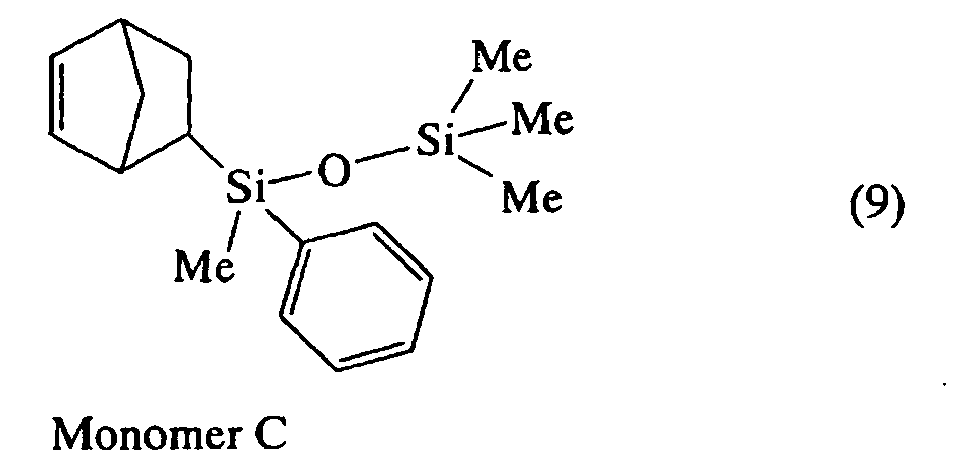
- Polymer P-3 had Mn = 735,800 and Mw/Mn = 1.24 as measured by GPC. The polymer was found to contain structural units derived from Monomer C and structural units derived from Monomer B in a compositional ratio C/B = 50/50 (mol/mol). Polymer P-3 was dissolved in toluene to form a 10% by weight polymer solution. Using the solution casting method, the polymer solution was cast and dried at 60°C for 24 hours to form a polymer film F-3.
- A nitrogen-purged glass reactor was charged with 7.0 g (0.018 mol) of Monomer A having formula (7) and 14.9 g (0.159 mol) of Monomer B (norbornene) having formula (8), which were dissolved in 240 ml of toluene. A catalyst solution which was separately prepared by dissolving 23 mg (89 µmol) of bis(acetylacetate)nickel (Ni[acac]2) and 228 mg (445 µmol) of tris(pentafluorophenyl)boron (B(C6F5)3) in-15 ml of toluene was added to the reactor where polymerization reaction took place at room temperature (25°C) for 1 hour.
- After the completion of reaction, the reaction solution was poured to a large volume of methanol for precipitation. This was followed by filtration, washing and vacuum drying at 60°C for 5 hours, obtaining 15.5 g (yield 71%) of Polymer P-4.
- Polymer P-4 had Mn = 313,000 and Mw/Mn = 2.07 as measured by GPC. On 1H-NMR analysis, the polymer was found to contain structural units derived from Monomer A and structural units derived from Monomer B in a compositional ratio A/B = 7/93 (mol/mol). Polymer P-4 was dissolved in toluene to form a 10% by weight polymer solution. Using the solution casting method, the polymer solution was cast and dried at 60°C for 24 hours to form a polymer film F-4.
- A nitrogen-purged glass reactor was charged with 30.0 g (0.077 mol) of Monomer A having formula (7) and 9.4 g (0.100 mol) of Monomer B (norbornene) having formula (8), which were dissolved in 240 ml of toluene. A catalyst solution which was separately prepared by dissolving 23 mg (89 µmol) of bis(acetylacetate)nickel (Ni[acac]2) and 228 mg (445 µmol) of tris(pentafluorophenyl)boron (B(C6F5)]) in 15 ml of toluene was added to the reactor where polymerization reaction took place at 50°C for 24 hours.
- After the completion of reaction, the reaction solution was poured to a large volume of methanol for precipitation. This was followed by filtration, washing and vacuum drying at 60°C for 5 hours, obtaining 19.7 g (yield 50%) of Polymer P-5.
- Polymer P-5 had Mn = 52,100 and Mw/Mn = 2.45 as measured by GPC. On 1H-NMR analysis, the polymer was found to contain structural units derived from Monomer A and structural units derived from Monomer B in a compositional ratio A/B = 46/53 (mol/mol). Polymer P-5 was dissolved in toluene to form a 10% by weight polymer solution. Using the solution casting method, the polymer solution was cast to form a polymer film F-5 which was too brittle to evaluate.
- A nitrogen-purged glass reactor was charged with 7.0 g (0.018 mol) of Monomer C having formula (9) and 14.9 g (0.159 mol) of Monomer B (norbornene) having formula (8), which were dissolved in 240 ml of toluene. A catalyst solution which was separately prepared by dissolving 23 mg (89 µmol) of bis(acetylacetate)nickel (Ni[acac]2) and 228 mg (445 µmol) of tris(pentafluorophenyl)boron (B(C6F5)3) in 15 ml of toluene was added to the reactor where polymerization reaction took place at room temperature (25°C) for 2 hours.
- After the completion of reaction, the reaction solution was poured to a large volume of methanol for precipitation. This was followed by filtration, washing and vacuum drying at 60°C for 5 hours, obtaining 9.2 g (yield 42%) of Polymer P-6.
- Polymer P-6 had Mn = 234,000 and Mw/Mn = 2.26 as measured by GPC. On 1H-NMR analysis, the polymer was found to contain structural units derived from Monomer C and structural units derived from Monomer B in a compositional ratio C/B = 7/93 (mol/mol). Polymer P-6 was dissolved in toluene to form a 10% by weight polymer solution. Using the solution casting method, the polymer solution was cast and dried at 60°C for 24 hours to form a polymer film F-6.
- Table 1 reports the yield, composition, Mn, and Mw/Mn of Polymers P-1 to P-6 obtained in Examples 1 to 3 and Comparative Examples 1 to 3.
- Table 2 reports the solubility in various solvents of Polymers P-1 to P-6.
- Table 3 reports the test results of polymer films F-1 to F-6 obtained in Examples 1 to 3 and Comparative Examples 1 to 3.
Table 1 Polymer No. Yield, % Composition, mol% Mn Mw/Mn Example 1 P-1 72 A/B = 43/57 778,100 1.53 2 P-2 63 A/B = 67/33 601,300 1.49 3 P-3 61 C/B = 50/50 735,800 1.24 Comparative Example 1 P-4 71 A/B = 7/93 313,000 2.07 2 P-5 50 A/B = 46/53 52,100 2.45 3 P-6 42 C/B = 7/93 234,000 2.26 Table 2 Polymer No. Solubility (as 10 wt% solution) toluene decane hexane dichloromethane M2 M3T D5 Example 1 P-1 ○ ○ ○ Δ ○ ○ ○ 2 P-2 ○ ○ ○ × ○ ○ ○ 3 P-3 ○ ○ ○ ○ ○ ○ ○ Comparative Example 1 P-4 ○ × × Δ × × × 2 P-5 ○ ○ ○ Δ ○ ○ ○ 3 P-6 ○ × × ○ × × × Rating
○: dissolved
Δ: partly dissolved
×: not dissolved
Polysiloxane solvents
M2: hexamethyldisiloxane
M3T: methyltris(trimethylsiloxy)silane
D5: decamethylcyclopentasiloxaneTable 3 Film No Tg, °C Breaking strength, MPa Elongation at break, % Oxygen transmission rate across 0.05-mm film, cc/m2/24h/atm Example 1 F-1 302 30 7 390.000 2 F-2 318 26 4 570.000 3 F-3 283 29 5 64.000 Comparative Example 1 F-4 360 67 <1 44,000 2 F-5 film not testable 3 F-6 341 69 <1 15,000 - It is evident from the test results that cycloolefin addition polymers having organosiloxane pendant according to the invention met the requirements of dissolution, film formation, gas transmission, heat resistance and mechanical strength and can be readily prepared using a combination of catalyst and co-catalyst of specific structure.
- The cycloolefin addition polymers having organosiloxane pendant according to the invention are easy to form a film and have excellent gas transmission, heat resistance and mechanical strength. They are expected to find application in oxygen enrichment membranes in air conditioners and fuel cells, contact lenses, and the like. In addition, the polymers are fully soluble in organic solvents and polysiloxane solvents and thus expected to find application as film-forming agents in cosmetics.
- In respect of numerical ranges disclosed in the present application it will of course be understood that the normal way the technical criterion for the upper limit is different from the technical criterion for the lower limit, i.e. the upper and lower limits are intrinsically distinct proposals.
Claims (10)
- A cycloolefin addition polymer obtained from addition polymerization of a cycloolefin-functionalized siloxane having the formula (1) and optionally a cycloolefin compound having the formula (2) in the presence of a catalyst A and a co-catalyst B, structural units derived from the cycloolefin-functionalized siloxane having formula (1) being present in an amount of 35 to 100 mol% of the polymer, the polymer having a number average molecular weight (Mn) of 200,000 to 1,000,000 as measured by GPC versus polystyrene standards, wherein
the cycloolefin-functionalized siloxane has the formula (1):
the cycloolefin compound has the formula (2):
catalyst A is a transition metal complex in which at least a cyclopentadienyl ligand coordinates with a transition metal selected from nickel and palladium, having the formula (3):
wherein M is nickel or palladium, L is a cyclopentadienyl ligand selected from cyclopentadienyl and derivatives thereof, K1, K2, and K3 are different negative or neutral ligands, n is an integer of 1 to 3, x, y and z are each independently an integer of 0 to 7, x+y+z is an integer of 0 to 7, and
co-catalyst B is at least one compound selected from the group consisting of (a) an organoaluminum compound, (b) an ionic compound capable of reacting with catalyst A to form a cationic transition metal compound, and (c) a compound capable of promoting dissociation of the ligand from the complex as catalyst A. - The cycloolefin addition polymer of claim 1 wherein structural units derived from the cycloolefin-functionalized siloxane having formula (1) being present in an amount of 40 to 95 mol% of the polymer, and structural units derived from the cycloolefin compound having formula (2) being present in an amount of 5 to 60 mol% of the polymer.
- The cycloolefin addition polymer of claim 1 or 2 wherein in formula (1), R1 is methyl and s is 0.
- The cycloolefin addition polymer of claim 1 or 2 wherein in formula (1), R1 is methyl and s is 1.
- The cycloolefin addition polymer of any one of claims 1 to 4 wherein in formula (2), all A1 to A4 are hydrogen and i is 0.
- The cycloolefin addition polymer of any one of claims 1 to 5 which has a polydispersity index (Mw/Mn) of 1.0 to 3.0, as given by weight average molecular weight (Mw) divided by number average molecular weight (Mn), measured by GPC versus polystyrene standards.
- The cycloolefin addition polymer of any one of claims 1 to 6 which has a glass transition temperature of 200 to 400°C.
- The cycloolefin addition polymer of any one of claims 1 to 7 which takes the form of a membrane, sheet or film.
- A method for preparing the cycloolefin addition polymer of any one of claims 1 to 8, comprising effecting addition polymerization of a cycloolefin-functionalized siloxane having the formula (1) and optionally a cycloolefin compound having the formula (2) in the presence of a catalyst A and a co-catalyst B, wherein
the cycloolefin-functionalized siloxane has the formula (1):
the cycloolefin has the formula (2):
catalyst A is a transition metal complex in which at least a cyclopentadienyl ligand coordinates with a transition metal selected from nickel and palladium, having the formula (3):
wherein M is nickel or palladium, L is a cyclopentadienyl ligand selected from cyclopentadienyl and derivatives thereof, K1, K2, and K3 are different negative or neutral ligand, n is an integer of 1 to 3, x, y and z are each independently an integer of 0 to 7, x+y+z is an integer of 0 to 7, and
co-catalyst B is at least one compound selected from the group consisting of (a) an organoaluminum compound, (b) an ionic compound capable of reacting with catalyst A to form a cationic transition metal compound, and (c) a compound capable of promoting dissociation of the ligand from the complex as catalyst A. - The method of claim 9 wherein the addition polymerization is effected in an inert gas atmosphere at a temperature of -20 to 100°C.
Applications Claiming Priority (1)
| Application Number | Priority Date | Filing Date | Title |
|---|---|---|---|
| JP2009016812A JP2010174099A (en) | 2009-01-28 | 2009-01-28 | Cycloolefin addition polymer and method for producing the same |
Publications (1)
| Publication Number | Publication Date |
|---|---|
| EP2213691A1 true EP2213691A1 (en) | 2010-08-04 |
Family
ID=42045339
Family Applications (1)
| Application Number | Title | Priority Date | Filing Date |
|---|---|---|---|
| EP10250141A Withdrawn EP2213691A1 (en) | 2009-01-28 | 2010-01-28 | Cycloolefin addition polymer and making method |
Country Status (4)
| Country | Link |
|---|---|
| US (1) | US20100190950A1 (en) |
| EP (1) | EP2213691A1 (en) |
| JP (1) | JP2010174099A (en) |
| KR (1) | KR20100087643A (en) |
Cited By (3)
| Publication number | Priority date | Publication date | Assignee | Title |
|---|---|---|---|---|
| EP2412732A1 (en) * | 2010-07-30 | 2012-02-01 | Shin-Etsu Chemical Co., Ltd. | Method for preparing cyclic olefin addition polymer of high gas permeability |
| EP2444062A3 (en) * | 2010-06-08 | 2012-12-12 | Shin-Etsu Chemical Co., Ltd. | Cosmetic product containing film-forming polymer |
| EP3858327A4 (en) * | 2018-09-28 | 2022-07-20 | Kao Corporation | COMPOSITION FOR EXTERNAL PREPARATION |
Families Citing this family (16)
| Publication number | Priority date | Publication date | Assignee | Title |
|---|---|---|---|---|
| JP5155255B2 (en) * | 2009-06-30 | 2013-03-06 | 信越化学工業株式会社 | Asymmetric membrane of siloxane functional cyclic olefin (co) polymer and process for producing the same |
| JP2011084681A (en) * | 2009-10-19 | 2011-04-28 | Shin-Etsu Chemical Co Ltd | Highly gas-permeable cyclic olefin addition polymer and method for producing the same |
| US8440765B2 (en) * | 2010-03-12 | 2013-05-14 | The Regents Of The University Of California | Nanostructured polymer membranes for selective alcohol transport |
| JP5585508B2 (en) * | 2011-03-25 | 2014-09-10 | 信越化学工業株式会社 | Cyclic olefin addition polymer and process for producing the same |
| JP5849889B2 (en) * | 2011-08-02 | 2016-02-03 | 株式会社デンソー | Air conditioning system |
| JP5592328B2 (en) * | 2011-09-30 | 2014-09-17 | 信越化学工業株式会社 | Temporary adhesive composition and thin wafer manufacturing method using the same |
| JP2013091759A (en) * | 2011-10-27 | 2013-05-16 | Shin-Etsu Chemical Co Ltd | Resin fine particle |
| JP2014129998A (en) | 2012-11-30 | 2014-07-10 | Akira Ishibashi | Wall, high-clean room system, manufacturing method thereof and architectural structure |
| KR101752525B1 (en) * | 2013-06-07 | 2017-06-29 | 주식회사 엘지화학 | Polyamide water-treatment membranes having a high oxidation resistance and a high chlorine resistance, and manufacturing method thereof |
| CN106457933B (en) * | 2014-04-30 | 2018-07-06 | 倍耐力轮胎股份公司 | The method that production is used for the tire equipped with accessory of wheel |
| US9896527B2 (en) | 2016-03-01 | 2018-02-20 | Saudi Arabian Oil Company | Highly selective polynorbornene homopolymer membranes for natural gas upgrading |
| JP7536490B2 (en) * | 2020-04-01 | 2024-08-20 | 花王株式会社 | Skin care composition |
| WO2021200351A1 (en) * | 2020-04-01 | 2021-10-07 | 花王株式会社 | Makeup application method |
| WO2021200352A1 (en) * | 2020-04-01 | 2021-10-07 | 花王株式会社 | Makeup application method |
| CN115427013B (en) * | 2020-04-01 | 2024-12-20 | 花王株式会社 | Skin external use composition |
| WO2022061226A1 (en) * | 2020-09-19 | 2022-03-24 | Augusta University Research Institute, Inc. | Compositions and methods for inhibiting trem-1 |
Citations (3)
| Publication number | Priority date | Publication date | Assignee | Title |
|---|---|---|---|---|
| EP1826221A1 (en) * | 2004-12-15 | 2007-08-29 | Nihon University | Method for producing norbornene based addition (co)polymer |
| EP1849806A1 (en) * | 2006-04-20 | 2007-10-31 | Shin-Etsu Chemical Company, Ltd. | Highly oxygen permeable polymer |
| EP1878488A1 (en) * | 2006-07-13 | 2008-01-16 | Shin-Etsu Chemical Company, Ltd. | Oxygen enrichment membrane and composition for preparing the membrane |
Family Cites Families (4)
| Publication number | Priority date | Publication date | Assignee | Title |
|---|---|---|---|---|
| US6372020B2 (en) * | 1999-08-26 | 2002-04-16 | Jae-Jin Hong | Oxygen enriching membrane |
| JP2003068446A (en) * | 2001-08-29 | 2003-03-07 | Jsr Corp | Plastic substrate for electroluminescence |
| JP2006305816A (en) * | 2005-04-27 | 2006-11-09 | Univ Nihon | Method for producing norbornene polymer film and norbornene polymer film |
| JP4889097B2 (en) * | 2005-08-11 | 2012-02-29 | 信越化学工業株式会社 | Polycycloolefin functional polysiloxane |
-
2009
- 2009-01-28 JP JP2009016812A patent/JP2010174099A/en active Pending
-
2010
- 2010-01-22 KR KR1020100006168A patent/KR20100087643A/en not_active Withdrawn
- 2010-01-27 US US12/694,444 patent/US20100190950A1/en not_active Abandoned
- 2010-01-28 EP EP10250141A patent/EP2213691A1/en not_active Withdrawn
Patent Citations (3)
| Publication number | Priority date | Publication date | Assignee | Title |
|---|---|---|---|---|
| EP1826221A1 (en) * | 2004-12-15 | 2007-08-29 | Nihon University | Method for producing norbornene based addition (co)polymer |
| EP1849806A1 (en) * | 2006-04-20 | 2007-10-31 | Shin-Etsu Chemical Company, Ltd. | Highly oxygen permeable polymer |
| EP1878488A1 (en) * | 2006-07-13 | 2008-01-16 | Shin-Etsu Chemical Company, Ltd. | Oxygen enrichment membrane and composition for preparing the membrane |
Non-Patent Citations (2)
| Title |
|---|
| E.FINKELSHTEIN, K.MAKOVETSKII,M.GRINOLTS,Y.ROGAN.T.GOLENKO.ESTARRANIKOVA,Y.YAMPOLSKII,V.SHANTAROVITCH,T.SUZUKI: "Addition-Type polynorbornenes with (SiCH3)3 Side Groups: Synthesis, Gas Permeability, and Free volume", MACROMOLECULES, vol. 39, 9 December 2006 (2006-12-09), pages 7022 - 7029, XP002576350 * |
| FINKELSHTEIN E SH ET AL: "Addition polymerization of silyl-containing norbornenes in the presence of Ni-based catalysts", JOURNAL OF MOLECULAR CATALYSIS. A, CHEMICAL, ELSEVIER, AMSTERDAM, NL LNKD- DOI:10.1016/J.MOLCATA.2006.04.035, vol. 257, no. 1-2, 1 September 2006 (2006-09-01), pages 9 - 13, XP025155866, ISSN: 1381-1169, [retrieved on 20060901] * |
Cited By (4)
| Publication number | Priority date | Publication date | Assignee | Title |
|---|---|---|---|---|
| EP2444062A3 (en) * | 2010-06-08 | 2012-12-12 | Shin-Etsu Chemical Co., Ltd. | Cosmetic product containing film-forming polymer |
| EP2412732A1 (en) * | 2010-07-30 | 2012-02-01 | Shin-Etsu Chemical Co., Ltd. | Method for preparing cyclic olefin addition polymer of high gas permeability |
| US8158732B2 (en) | 2010-07-30 | 2012-04-17 | Shin-Etsu Chemical Co., Ltd. | Method for preparing cyclic olefin addition polymer of high gas permeability |
| EP3858327A4 (en) * | 2018-09-28 | 2022-07-20 | Kao Corporation | COMPOSITION FOR EXTERNAL PREPARATION |
Also Published As
| Publication number | Publication date |
|---|---|
| US20100190950A1 (en) | 2010-07-29 |
| KR20100087643A (en) | 2010-08-05 |
| JP2010174099A (en) | 2010-08-12 |
Similar Documents
| Publication | Publication Date | Title |
|---|---|---|
| US20100190950A1 (en) | Cycloolefin addition polymer and making method | |
| EP2391661B1 (en) | Norbornene copolymer and production method thereof | |
| EP1849806A1 (en) | Highly oxygen permeable polymer | |
| EP2412732B1 (en) | Method for preparing cyclic olefin addition polymer of high gas permeability | |
| EP2614091B1 (en) | Catalyst for polymerizing norbornene monomers and a method for producing norbornene polymer | |
| JP5353043B2 (en) | Cyclic olefin addition polymer and process for producing the same | |
| US7015293B2 (en) | Cycloolefin addition copolymer and optical transparent material | |
| US5561216A (en) | Late transition metal catalysts for the CO- and terpolymerization of olefin and alkyne monomers with carbon monoxide | |
| JP4645858B2 (en) | Cyclic olefin addition copolymer and method for producing the same, composition for crosslinking, crosslinked material and method for producing the same | |
| US20130116113A1 (en) | Catalyst composition, production process for norbornene base copolymer by using catalyst composition, norbornene base copolymer and heat resistant film prepared by using the same | |
| EP2634197B1 (en) | Catalyst for norbornene monomer polymerization and method for producing norbornene polymer | |
| JP2011084681A (en) | Highly gas-permeable cyclic olefin addition polymer and method for producing the same | |
| JP5864966B2 (en) | Method for producing norbornene polymer | |
| US20060166511A1 (en) | Method for treatment of film or sheet | |
| JP5585508B2 (en) | Cyclic olefin addition polymer and process for producing the same | |
| JP2004074662A (en) | Method for producing cyclic olefin addition polymer film or sheet, and film or sheet | |
| JP2014040532A (en) | Cyclic olefin addition polymer and method of producing the same | |
| JP2018536751A (en) | Monofunctional or telechelic copolymers of 1,3-diene and ethylene or α-monoolefin | |
| YAMPOLSKII | Topchiev Institute of Petrochemical Synthesis, Russian Academy of Sciences, 29, Leninskii prospect, 119991 Moscow, Russia |
Legal Events
| Date | Code | Title | Description |
|---|---|---|---|
| PUAI | Public reference made under article 153(3) epc to a published international application that has entered the european phase |
Free format text: ORIGINAL CODE: 0009012 |
|
| AK | Designated contracting states |
Kind code of ref document: A1 Designated state(s): AT BE BG CH CY CZ DE DK EE ES FI FR GB GR HR HU IE IS IT LI LT LU LV MC MK MT NL NO PL PT RO SE SI SK SM TR |
|
| AX | Request for extension of the european patent |
Extension state: AL BA RS |
|
| STAA | Information on the status of an ep patent application or granted ep patent |
Free format text: STATUS: THE APPLICATION IS DEEMED TO BE WITHDRAWN |
|
| 18D | Application deemed to be withdrawn |
Effective date: 20110205 |