EP2212801B1 - System und verfahren zur grössenänderung einer laufwerkpartition und austausch von partitionsgrössen zwischen einer flash-speichersteuerung und einer chipkarte - Google Patents
System und verfahren zur grössenänderung einer laufwerkpartition und austausch von partitionsgrössen zwischen einer flash-speichersteuerung und einer chipkarte Download PDFInfo
- Publication number
- EP2212801B1 EP2212801B1 EP08849107.1A EP08849107A EP2212801B1 EP 2212801 B1 EP2212801 B1 EP 2212801B1 EP 08849107 A EP08849107 A EP 08849107A EP 2212801 B1 EP2212801 B1 EP 2212801B1
- Authority
- EP
- European Patent Office
- Prior art keywords
- microcontroller
- computer
- peripheral
- flash memory
- parameter
- Prior art date
- Legal status (The legal status is an assumption and is not a legal conclusion. Google has not performed a legal analysis and makes no representation as to the accuracy of the status listed.)
- Not-in-force
Links
Images




Classifications
-
- G—PHYSICS
- G06—COMPUTING OR CALCULATING; COUNTING
- G06F—ELECTRIC DIGITAL DATA PROCESSING
- G06F3/00—Input arrangements for transferring data to be processed into a form capable of being handled by the computer; Output arrangements for transferring data from processing unit to output unit, e.g. interface arrangements
- G06F3/06—Digital input from, or digital output to, record carriers, e.g. RAID, emulated record carriers or networked record carriers
- G06F3/0601—Interfaces specially adapted for storage systems
- G06F3/0628—Interfaces specially adapted for storage systems making use of a particular technique
- G06F3/0638—Organizing or formatting or addressing of data
- G06F3/0644—Management of space entities, e.g. partitions, extents, pools
-
- G—PHYSICS
- G06—COMPUTING OR CALCULATING; COUNTING
- G06F—ELECTRIC DIGITAL DATA PROCESSING
- G06F21/00—Security arrangements for protecting computers, components thereof, programs or data against unauthorised activity
- G06F21/70—Protecting specific internal or peripheral components, in which the protection of a component leads to protection of the entire computer
- G06F21/78—Protecting specific internal or peripheral components, in which the protection of a component leads to protection of the entire computer to assure secure storage of data
-
- G—PHYSICS
- G06—COMPUTING OR CALCULATING; COUNTING
- G06F—ELECTRIC DIGITAL DATA PROCESSING
- G06F3/00—Input arrangements for transferring data to be processed into a form capable of being handled by the computer; Output arrangements for transferring data from processing unit to output unit, e.g. interface arrangements
- G06F3/06—Digital input from, or digital output to, record carriers, e.g. RAID, emulated record carriers or networked record carriers
- G06F3/0601—Interfaces specially adapted for storage systems
- G06F3/0602—Interfaces specially adapted for storage systems specifically adapted to achieve a particular effect
- G06F3/062—Securing storage systems
- G06F3/0623—Securing storage systems in relation to content
-
- G—PHYSICS
- G06—COMPUTING OR CALCULATING; COUNTING
- G06F—ELECTRIC DIGITAL DATA PROCESSING
- G06F3/00—Input arrangements for transferring data to be processed into a form capable of being handled by the computer; Output arrangements for transferring data from processing unit to output unit, e.g. interface arrangements
- G06F3/06—Digital input from, or digital output to, record carriers, e.g. RAID, emulated record carriers or networked record carriers
- G06F3/0601—Interfaces specially adapted for storage systems
- G06F3/0628—Interfaces specially adapted for storage systems making use of a particular technique
- G06F3/0629—Configuration or reconfiguration of storage systems
- G06F3/0632—Configuration or reconfiguration of storage systems by initialisation or re-initialisation of storage systems
-
- G—PHYSICS
- G06—COMPUTING OR CALCULATING; COUNTING
- G06F—ELECTRIC DIGITAL DATA PROCESSING
- G06F3/00—Input arrangements for transferring data to be processed into a form capable of being handled by the computer; Output arrangements for transferring data from processing unit to output unit, e.g. interface arrangements
- G06F3/06—Digital input from, or digital output to, record carriers, e.g. RAID, emulated record carriers or networked record carriers
- G06F3/0601—Interfaces specially adapted for storage systems
- G06F3/0668—Interfaces specially adapted for storage systems adopting a particular infrastructure
- G06F3/0671—In-line storage system
- G06F3/0673—Single storage device
- G06F3/0679—Non-volatile semiconductor memory device, e.g. flash memory, one time programmable memory [OTP]
-
- G—PHYSICS
- G06—COMPUTING OR CALCULATING; COUNTING
- G06F—ELECTRIC DIGITAL DATA PROCESSING
- G06F2221/00—Indexing scheme relating to security arrangements for protecting computers, components thereof, programs or data against unauthorised activity
- G06F2221/21—Indexing scheme relating to G06F21/00 and subgroups addressing additional information or applications relating to security arrangements for protecting computers, components thereof, programs or data against unauthorised activity
- G06F2221/2153—Using hardware token as a secondary aspect
Definitions
- the present invention relates generally to secure USB flash memory devices and more particularly to USB flash memory devices having both a microcontroller and a smart card.
- USB flash drives are one example of such small portable devices that are becoming a very popular mechanism for storing computerized information and for physically moving the stored information from one computer to another. There are many popular uses; some common uses include personal data transport and data transfer.
- USB flash drives there is also a growing culture of using USB flash drives to move data to computers belonging to persons other than the owner of the USB flash drive.
- the owner of the USB flash drive provides the USB flash drive to another person for connection to that persons computer via a USB port either for the purpose of receiving data files from the owner of the computer or vice versa.
- the USB flash drive owner is subjected to having data moved, intentionally or unintentionally, from the USB flash drive to the computer to which it is being attached, or viewed by the owner of the computer.
- the owner of the computer could, again either with intent or inadvertently, cause information stored on the USB flash drive to be deleted or corrupted.
- Encryption technology is available on many computers.
- one way to avoid some of the aforementioned problems is to use the encryption processing capabilities to encrypt and decrypt files stored on the USB flash memory device. While that solution may work to solve specific needs of particular users, it is not a good general solution to the data security problems that arise with USB flash memory devices.
- One problem is that multiple encryption standards exist.
- the encryption technology used to encrypt a file on one computer may not be available when the same file is to be decrypted on another computer.
- a more severe issue is that often a user would store the encryption key on the computer with which the USB flash memory device is most often used.
- the likelihood that the computer and USB flash memory device are lost together or stolen together is high and consequently a hacker may be able to find the encryption key for the USB flash memory device somewhere on the computer.
- USB flash memory devices that provide encryption of a data zone having private data.
- the encryption and decryption is performed by the USB flash memory microcontroller and the encryption key is stored inside the microcontroller.
- this solution provides a higher level of security than USB flash memory devices that have no security features and also improves security with respect to using a host computer for encryption and decryption, it is a solution that is vulnerable to certain attacks. For example, denial of service attacks may be launched against files in the private data zone by deleting files from that area of the device.
- hackers have developed many clever techniques for deducing the activity inside a microcontroller, for example, examining power consumption patterns, and can use those techniques for determining encryption keys.
- USB flash memory device that provides yet a higher level of data security to protect data stored thereon.
- US2003070083 discloses a method and a device for secure encryption of data on a mass storage media with a smart card.
- US2007180167 relates to dynamic partition mapping in a hot-pluggable data storage apparatus.
- Drive partitions are displayed to the user as separate drive letters (such as C: , E: , F: and so forth).
- US2004162932 discloses a memory device comprising an IC chip and a single interface to an external device.
- a USB flash drive having a smart card module operating in conjunction with the USB flash drive microcontroller provides an hitherto unavailable level of security. Furthermore, a USB flash drive having a smart card as described herein provides for a secure mechanism to coordinate that any parameter updates to the USB flash drive are performed securely and in a manner so that the smart card's capability for parameter update is utilized while communicating parameter updates to the USB flash drive microcontroller.
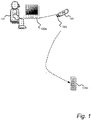
- FIG 1 is a schematic diagram illustrating a typical use of a USB flash drive 101.
- a user 111 operates a computer 103. On that computer the user 111 has stored certain files (not shown). It is often the case that a computer user 111 needs to access these same files at other locations. For example, a user 111 may need to access a file, which was created on a work computer, using his home computer 103. One way to transfer the file would be via a computer network or by sending the file via electronic mail. However, that may not always be practical.
- USB flash drives 101 is one such storage medium.
- a USB flash drive 101 having a USB connector 105 is inserted into a USB port of the user's computer 103a.
- the USB flash drive 101 then enumerates on the user's computer 103a 1 .
- letter suffixes are used in conjunction with reference numerals to designate specific instantiations of a class of objects having common generic features. The class is referred to using numerals only.
- 103a is a specific computer 103. Any reference to a device solely by a numerical reference is meant to apply equally to all members of the class unless the context prohibits such an interpretation.
- USB enumeration process includes performing a reset operation of a USB flash drive 101 and the USB flash drive 101 is assigned a unique identifier.
- a drive letter is assigned to the USB flash drive 101 so that a user 111 can access the USB flash drive 101 from his computer.
- the USB flash drive 101 has been assigned a drive letter, e.g., "H:” or "K:", by which the USB flash drive 101 is uniquely identified in the computer's operating system.
- the user 111 can copy files from the computer 103a to the USB flash drive 101.
- the files have become physically portable and the user 111 can move the files to another computer 103b by inserting the USB flash drive 101 into a USB port of that computer 103b.
- the user 111 can now read the file using the file browser or application programs on that computer 103b.
- USB flash drive 101 may be used to create, read, delete and otherwise manipulate files as permitted by the operating system and application programs running on the computers to which it is connected 103.
- FIG. 2 is a high-level block diagram illustrating the basic components of a prior art USB flash drive 101.
- a USB flash drive 101 typically has a hard shell housing 201, e.g., plastic or aluminum, to contain and protect the internal components of the USB flash drive 101.
- the USB flash drive 101 has a connector for connecting the USB flash drive 101 to a host computer 103 and to provide a communications interface to the host computer 103 to which it is connected.
- a prior art USB flash drive 101 further contains a USB mass storage controller 203.
- Flash memories are block-oriented and are subject to wear (a limit on the number of read-write cycles that a flash memory can handle).
- the USB mass storage controller 203 implements a USB host controller and provides a linear interface to block-oriented serial flash devices while hiding the complexities of block-orientation, block erasure, and wear leveling, or wear balancing.
- the controller contains a small RISC microprocessor 205 and a small amount of on-chip ROM 207 and RAM 209.
- a USB flash drive 101 further contains a flash memory chip 211, typically a NAND flash memory chip, for storing data, e.g., computer files.
- a flash memory chip 211 typically a NAND flash memory chip, for storing data, e.g., computer files.
- a USB flash drive 101 further contains a crystal oscillator for producing a clock signal, and may contain LEDs, write protect switches, and a myriad of non-electrical components for aesthetic or portability purposes. These are not important to the present discussion.
- USB flash drive 101 is extremely vulnerable to security threats. These devices provide no defense against the risk that the data stored thereon would come into the wrong hands if the device is stolen or lost. Furthermore, when inserted into a stranger's computer 103, the data on a USB flash drive 101 may be either inadvertently or intentionally copied to that computer 103 or be deleted from the USB flash drive 101.
- FIG 3 is a block diagram illustrating a high-level view of the architecture of a USB flash drive 101 incorporating a smart card module for providing security functionality, e.g., authentication and cryptographic services, to enhance the security of data stored on the USB flash drive 101 (referred to hereinafter as a USB flash drive SC).
- security functionality e.g., authentication and cryptographic services
- a USB flash drive SC 301 is constructed with a USB connector 105 at one end, and has a USB flash drive microcontroller 303 having a microprocessor 305, a ROM 307, and a RAM 309, as well as a flash memory chip 311. Additionally the USB flash drive SC 301 contains a smart card module 313 connected to the USB flash drive microcontroller 303.
- the smart card module 313 is used by the USB flash drive SC 301 to authenticate a user and to provide certain cryptographic capabilities.
- a logon screen may be presented to the user 111 requesting the user 111 to authenticate himself using a PIN or password.
- Authentication is then entirely a negotiation between the host computer 103 and the smart card module 313 with only the result presented to the USB flash drive microcontroller 303.
- the communication between the host the computer 103 and the USB flash drive SC 301 is performed using the USB mass storage protocol and the USB CCID (Chip Card Interface Device) protocol.
- USB CCID Chip Card Interface Device
- the firmware control program 315 contains start-up instructions executed on initialization of the USB flash drive SC 301. Several of the start-up procedures are discussed in greater detail hereinbelow.
- USB enumeration is one function performed during startup.
- the USB flash drive SC 301 enumerates itself as a plurality of a USB mass storage drives and as a smart card interface device (akin to a USB smart card reader) to allow for communication using the CCID protocol.
- the firmware control program 315 contains the necessary instructions to act as a CCID device when the host computer 103 directs communication to the smart card module 313.
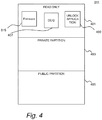
- Figure 4 is a block diagram illustrating an exemplary layout of the addressable space of the memory of the flash memory 311.
- the addressable space of the flash memory is partitioned into three partitions: a read only partition 401, a private data partition 403, and a public data partition 405.
- the read only partition 401 contains the control program firmware 315 and a CCID module 407 for managing interaction with the host computer 103 over the CCID protocol.
- the communication with the smart card module 313 is carried over the USB Human Interface Device (HID) protocol, or any other suitable communications protocol.
- the CCID module 407 would be replaced with communications modules appropriate for such protocols allowing the USB flash drive SC 301 to enumerate as such a device, e.g., as an HID device.
- the read only partition 401 also contains a host computer application program, the unlock application 409.
- the unlock application 409 may be an autorun application that automatically launches on the host computer 103 or may appear as a launchable application when the read only partition 401 is browsed to using the host computer 103 operating system.
- the unlock application 409 may be used by a user 111 to perform several tasks associated with managing the USB flash drive SC 301.
- the unlock application 409 may, for example, be used by the user 111 to authenticate to the USB flash drive SC 301.
- the USB flash drive SC 301 enumerates as three USB mass storage partitions, one corresponding to the read only partition 401, one as the private partition 403 and one as the public partition 405.
- the private partition 403 enumerates as a drive without media, i.e., a user 111 would be able to see a drive letter designated for the drive, however, it would appear as an empty disk drive.
- the user 111 may unlock the private partition 403 to have access to files stored therein.
- data in the private partition 403 is encrypted using an AES key (e.g., a 256 bit key).
- the AES key is stored in the smart card module 313.
- the smart card module 313 encrypts the AES key in a manner in which the USB flash drive microcontroller 303 can decrypt.
- the USB flash drive microcontroller 303 uses the decrypted AES key to decrypt information stored in the private drive.
- the USB flash drive microcontroller 303 stores the AES key only temporarily. Thus, when the USB flash drive SC 301 is removed from the host computer 103 the AES key is only stored in the smart card module 313.
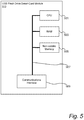
- FIG. 5 is a block diagram illustrating a high-level view of the architecture of a smart card module 313 used in the USB flash drive SC 301.
- the smart card module 313 contains a central processing unit 501, a RAM 503, and a non-volatile memory 505. These components are connected via a bus 507. Also connected to the bus 507 is a communications interface 509 for providing a connection between the bus 507, and consequently, the CPU 501, RAM 503, and non-volatile memory 505, and the USB flash drive microcontroller 303.
- communication between the USB flash drive microcontroller 303 and the smart card module 313 is over the ISO-7816 APDU protocol.
- Several special instructions are added to facilitate particular interactions required for coordinating the operations of the smart card module 313 and the USB flash drive microcontroller 303.
- Smart card modules are often well suited for storing small pieces of data whereas USB flash drives are better suited for dealing with large chunks of data.
- a smart card may be used to store individual pieces of information such as decryption keys or dollar balances in an electronic purse application.
- USB flash drives on the other hand are typically used to store large data units such as entire data files.
- the relative suitability of a smart card module 313 for storing smaller data items may be exploited by using the smart card module 313 for storing parameters that control the operation of the USB flash drive 101. It is also advantageous to use the smart card module 313 for storing parameters that impact the overall security solution.
- One such set of parameters is the relative sizes of the partitions of the flash memory 311.
- Flash memories come in many different sizes. Common sizes include 256MB, 516MB, 1GB, and 2GB. However, it is likely that larger sizes will become increasingly common. It is desirable that a particular smart card module 313 does not need to be aware of the size of the flash memory 311 of the USB flash drive SC 301, that the particular smart card module 313 is part of. Therefore, in one embodiment of the invention the smart card module 313 refers to the relative partition sizes by percentages by default and through interaction with the USB flash drive microcontroller 303 the smart card module 313 obtains the actual memory addresses associated with particular partitions if necessary.
- the smart card module 313 is used to store the partition sizes.
- a user 111 may be able to change the partition sizes through interaction with the unlock application 409. More generally, the smart card module 313 may be used to store a parameter list defining properties of the USB flash drive 101.
- Figure 6 is a block diagram illustrating the interaction between a user 111 and the unlock application 409.
- the unlock application 409 which is either auto launched from the read-only partition 401 of the flash memory 311 or manually started, e.g., by clicking on an icon associated with it in an operating system browser, may be used for a variety of tasks associated with the operation of the USB flash drive SC 301, for example, to authenticate to the USB flash drive SC 301.
- One such task is resizing the partitions of the flash memory 311.
- a screen on the user's 111 computer 103 may display a window 601 containing size information for the partitions.
- the user 111 may through interaction with that window 601 change relative drive sizes.
- actual sizes or addresses for the partitions are displayed and altered by the user 111.
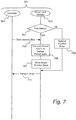
- Figure 7 is a timing sequence diagram illustrating the startup logic of the USB flash drive SC 301.
- the smart card module 313 determines if this is the first time the smart card module 313 has been started up within the USB flash drive SC 301, step 701. If so, the smart card module 313 only knows default percentage values for the various partitions. These can be set on an enterprise level during an enterprise-wide deployment of USB flash drive SCs 301.
- the smart card module 313 obtains a total memory size from the USB flash drive microcontroller 303, step 703, and computes the actual partition sizes based on the total memory size and the default percentages, step 705. The smart card module 313 then stores those values in NVM 505, step 707.
- the smart card module 313 If, on the other hand, it is not a first startup, the smart card module 313 already has stored in NVM 505 the partition sizes. The smart card module 313 then retrieves the partition values, step 709.
- the smart card transmits the partition sizes to the USB flash drive microcontroller 303, step 711.
- the USB flash drive microcontroller 303 may then use that information to determine which areas are protected as private areas and which are public areas.
- Figure 8 is a timing sequence diagram illustrating the update of parameters, e.g., partition sizes.
- the unlock application 409 is launched on the host computer 103 from the read-only partition 401 of the flash memory 311. This may be accomplished through either an autolaunch or by manual start from an operating system browser.
- the user 111 navigates in the unlock application 409 to a parameter setting tool, step 803.
- Instructions in the unlock application 409 instruct the host computer 103 to issue a RequestPartitionSize instruction to the smart card module 313, step 805.
- the smart card module 313 retrieves the partition sizes from NVM 505, step 807, and responds to the host computer 103 with the partition sizes, step 809.
- the unlock application 409 then displays the partition sizes in the dialog window 601 on the user's 111 computer 103, step 811. If the user 111 makes a change to the partition sizes, the updated partition sizes are transmitted to the smart card module 313, step 813. The smart card module 313 then updates the partition sizes in NVM 505, step 815.
- the partition sizes are not updated at this point in the USB flash drive microcontroller 303.
- the USB flash drive SC 301 should be reinitialized by being removed and reinserted into the host computer 103. Therefore, the user 111 is prompted to do so by the unlock application 409, step 817.
- the user 111 may be required to authenticate himself as an administrator of the USB flash drive SC 301. Both the unlock application 409 and the smart card module 313 may enforce that requirement. For example, some enterprises' security policies may not allow end-users to change partition size or to even have a public partition on the USB flash drive SC 301. To remove a partition, e.g., the public partition, that partition's size is merely set to zero.
- USB flash drive SC 301 provides an efficient, flexible, and secure mechanism for maintaining modifiable partition sizes between read-only, private and public memory areas of the flash memory. The same mechanism may be employed for other operating parameters of the USB flash drive SC 301.
Landscapes
- Engineering & Computer Science (AREA)
- Theoretical Computer Science (AREA)
- Physics & Mathematics (AREA)
- General Engineering & Computer Science (AREA)
- General Physics & Mathematics (AREA)
- Human Computer Interaction (AREA)
- Computer Security & Cryptography (AREA)
- Computer Hardware Design (AREA)
- Software Systems (AREA)
- Storage Device Security (AREA)
Claims (12)
- Verfahren zur Steuerung eines Geräts (301), das an einen Computer angeschlossen ist (103), bestehend aus mindestens einem neu konfigurierbaren Konfigurationsparameter, der eine Betriebseigenschaft des Geräts definiert, einem Speichermedium (311), das von einem ersten Mikrocontroller (303) und einem zweiten Mikrocontroller (313) gesteuert wird, wobei der neu konfigurierbare Parameter einen Aspekt im Zusammenhang mit dem Speichermedium steuert, wobei das Verfahren die folgenden Schritte umfasst:Betrieb des Geräts zur Selbstidentifizierung am Computer als ein erstes kommunikationsfähiges Peripheriegerät, wozu ein erstes Protokoll verwendet wird, das mit dem Speichermedium assoziiert ist, und als ein kommunikationsfähiges 10-Sekunden-Peripheriegerät, wozu ein zweites Protokoll verwendet wird, das mit dem zweiten Mikrocontroller assoziiert ist;als Reaktion auf den Erhalt einer Nachricht vom Gerät zur Selbstidentifizierung am Computer als ein erstes kommunikationsfähiges Peripheriegerät, wozu ein erstes Protokoll verwendet wird, das mit dem Speichermedium assoziiert ist, Betrieb des Computers zur Assoziierung einer ersten eindeutigen Peripheriegerätekennung mit dem an ein Speichermedium angeschlossenen Mikrocontroller, wobei der Computer die eindeutige Peripheriegerätekennung nutzt, um das Speichermedium des Geräts anzusprechen;als Reaktion auf den Erhalt einer Nachricht vom Gerät zur Selbstidentifizierung am Computer als ein zweites kommunikationsfähiges Peripheriegerät, wozu ein zweites Protokoll verwendet wird, das mit dem Mikrocontroller assoziiert ist, Betrieb des Computers zur Assoziierung einer zweiten eindeutigen Peripheriegerätekennung mit dem zweiten Mikrocontroller, wobei der mindestens eine neu konfigurierbare Parameter über den zweiten Mikrocontroller gesteuert wird;Steuerung der Aktualisierungen des Werts des mindestens einen neu konfigurierbaren Parameters mit dem zweiten Mikrocontroller;Speicherung des Werts des mindestens einen neu konfigurierbaren Parameters in einem nichtflüchtigen Speicher (505) auf dem zweiten Mikrocontroller undnach der Inbetriebnahme des Geräts Übermittlung des Werts des mindestens einen neu konfigurierbaren Parameters vom zweiten Mikrocontroller an den ersten Mikrocontroller.
- Verfahren nach Anspruch 1 ferner umfassend:Erhalt durch das zweite Peripheriegerät einer Änderung des Werts des mindestens einen neu konfigurierbaren Parameters von einem Steuerprogramm, das auf dem Computer ausgeführt wird, an den das Gerät angeschlossen ist, undals Reaktion auf den Erhalt der Aktualisierung des Werts des mindestens einen neu konfigurierbaren Parameters Änderung der Einstellung des Werts des mindestens einen neu konfigurierbaren Parameters in einem Speicherort, der vom zweiten Peripheriegerät gesteuert wird.
- Verfahren nach Anspruch 1, wobei der Betrieb des Geräts zur Selbstidentifizierung am Computer als ein erstes kommunikationsfähiges Peripheriegerät, wozu ein erstes Protokoll verwendet wird, das mit dem Speichermedium assoziiert ist, folgende Schritte umfasst:Betrieb des Geräts zur Selbstidentifizierung am Computer als ein erstes Laufwerk mit einer ersten Größe und als ein zweites Laufwerk mit einer zweiten Größe und wobei der mindestens eine konfigurierbare Parameter ein Größenparameter ist, der mindestens die erste Größe definiert, undals Reaktion auf den Erhalt einer Nachricht von dem Gerät, das sich am Computer als ein erstes Laufwerk mit einer ersten Größe und als ein zweites Laufwerk mit einer zweiten Größe identifiziert, umfasst der Schritt zum Betrieb des Computers zur Assoziierung einer zweiten Peripheriegerätekennung mit dem zweiten Mikrocontroller die Zuweisung von Laufwerksbuchstabenkennungen an jeweils das erste Laufwerk und das zweite Laufwerk.
- Verfahren nach Anspruch 3 ferner umfassend:nach der Inbetriebnahme des Geräts Übermittlung eines voreingestellten Standardwerts des mindestens einen neu konfigurierbaren Parameters vom ersten Mikrocontroller an den zweiten Mikrocontroller;als Reaktion darauf, dass der zweiten Mikrocontroller einen Unterschied im Wert des mindestens einen neu konfigurierbaren Parameters erkennt, Übermittlung eines Überschreibungswertes vom zweiten Mikrocontroller an den ersten Mikrocontroller.
- Verfahren nach Anspruch 1, wobei das erste Peripheriegerät einem Flash-Laufwerk-Mikrocontroller entspricht, der an einen Flash-Speicher angeschlossen ist, und das zweite Peripheriegerät einem Chipkartenmodul entspricht, dass an einen Flash-Laufwerk-Mikrocontroller angeschlossen ist.
- Verfahren nach Anspruch 5 ferner umfassend:zusätzlich zum Betrieb des Geräts zur Selbstidentifizierung am Computer als ein erstes kommunikationsfähiges Peripheriegerät, wozu ein erstes Protokoll verwendet wird, und als ein kommunikationsfähiges Peripheriegerät, wozu ein zweites Protokoll verwendet wird, Betrieb des Geräts zur Selbstidentifizierung am Computer als ein drittes, ebenfalls kommunikationsfähiges Peripheriegerät, wozu ein erstes Protokoll verwendet wird, wobei das und das dritte Peripheriegerät am Computer als Speicherlaufwerke identifiziert sind, die den Speicherpartitionen im Flash-Speicher entsprechen; undwobei der mindestens eine neu konfigurierbare Parameter die Größe der Speicherpartitionen definiert, die dem ersten und dritten Peripheriegerät entsprechen.
- Verfahren nach Anspruch 1 bis 6, wobei das Gerät ein Flash-Speichergerät ist, an das der erste Mikrocontroller angeschlossen ist, welcher den Flash-Speicher steuert, und der zweite Mikrocontroller an den ersten Mikrocontroller angeschlossen ist, umfassend:Betrieb des Flash-Speichergeräts zur Selbstidentifizierung am Computer als das erste kommunikationsfähige Peripheriegerät, wozu das erste Protokoll verwendet wird, das mit dem Speicher assoziiert ist, und als das zweite kommunikationsfähige Peripheriegerät, wozu das zweite Protokoll verwendet wird, das mit dem zweiten Mikrocontroller assoziiert ist;als Reaktion auf den Erhalt einer Nachricht vom Flash-Speichergerät zur Selbstidentifizierung am Computer als das erste kommunikationsfähige Peripheriegerät, wozu ein erstes Protokoll verwendet wird, das mit dem Flash-Speicher assoziiert ist, Betrieb des Computers zur Assoziierung der ersten eindeutigen Peripheriegerätekennung mit dem Flash-Speicher, wobei der Computer die eindeutige Peripheriegerätekennung nutzt, um das Speichermedium des Geräts anzusprechen;als Reaktion auf den Erhalt einer Nachricht vom Gerät zur Selbstidentifizierung am Computer als das zweite kommunikationsfähige Peripheriegerät, wozu ein zweites Protokoll verwendet wird, das mit dem Mikrocontroller assoziiert ist, Betrieb des Computers zur Assoziierung der zweiten eindeutigen Peripheriegerätekennung mit dem zweiten Mikrocontroller;Speicherung im nichtflüchtigen Speicher des zweiten Mikrocontrollers von mindestens einem Größenparameter, der die relativen Größen von mindestens zwei Partitionen des Flash-Speichers definiert;als Reaktion auf den Erhalt einer Anfrage zur Änderung der Partitionsgröße vom Computer, an den das Flash-Speichergerät angeschlossen ist:Betrieb des zweiten Mikrocontrollers zur Änderung der ersten und zweiten Partitionsgröße durch Zurücksetzen des mindestens einen Größenparameters als Reaktion auf die Anfrage zur Änderung der Partitionsgröße; undnach der Inbetriebnahme des Flash-Speichergeräts Übermittlung vom zweiten Mikrocontroller an den ersten Mikrocontroller des Werts des mindestens einen Größenparameters, der den Flash-Speicher in eine erste Speicherpartition und eine zweite Speicherpartition aufteilt.
- Verfahren nach Anspruch 7, wobei der mindestens eine Größenparameter einen vorprogrammierten Standardwert hat und nach der Inbetriebnahme des Flash-Speichergeräts der mindestens eine Größenparameter vom ersten Mikrocontroller an den zweiten Mikrocontroller übermittelt wird, und wenn zuvor keine Anfrage zur Größenänderung vom Computer an das Flash-Speichergerät übermittelt wurde, wird der vorprogrammierte Standardwert an einem Speicherort im zweiten Mikrocontroller zur Speicherung des mindestens einen Größenparameters gespeichert, wodurch eine erste Partitionierung entsprechend des vorprogrammierten Standardwerts eingerichtet wird.
- Verfahren nach Anspruch 1 bis 6, wobei das Gerät ein Massenspeichergerät ist, umfassend:nach Anschluss des Massenspeichergeräts an den Computer Identifizierung des Massenspeichergeräts am Computer als eine Vielzahl von Massenspeicherlaufwerken und als ein Chipkarten-Lesegerät, wobei jedes im Computer identifizierte Massenspeicherlaufwerk einer Partition in einem Massenspeicher entspricht, der an den ersten Mikrocontroller des Massenspeichergeräts angeschlossen ist, dadurch Veranlassung des Computers zur Zuweisung einer Massenspeicherlaufwerkkennung an jedes identifizierte Massenspeicherlaufwerk und einer Chipkarten-Lesegerätkennung zur Identifizierung des Massenspeichergeräts als Chipkarten-Lesegerät, das mit dem zweiten Mikrocontroller des Massenspeichergeräts assoziiert ist;Speicherung eines Werts für mindestens einen Größenparameter in dem zweiten Mikrocontroller, der eine Größe von mindestens einer Partition im Flash-Speicher anzeigt;nach der Inbetriebnahme des Flash-Speichergeräts Übermittlung vom ersten Mikrocontroller an den zweiten Mikrocontroller des Werts des mindestens einen Größenparameters, der die Größe von mindestens einer Partition im Flash-Speicher anzeigt;Initialisierung des mindestens einen Größenparameters, der im zweiten Mikrocontroller gespeichert ist, auf einen vorprogrammierten Standardparameter, der vom ersten Mikrocontroller an den zweiten Mikrocontroller übermittelt wurde;nach Erhalt von Befehlen für das Chipkarten-Lesegerät Übermittlung der Befehle für das Chipkarten-Lesegerät vom ersten Mikrocontroller an den zweiten Mikrocontroller;als Reaktion auf den Erhalt eines Befehl zur Anpassung des mindestens einen Größenparameters vom Computer in einem Befehl vom Chipkarten-Lesegerät Betrieb des zweiten Mikrocontrollers zur Anpassung des Werts des mindestens einen Größenparameters; undals Reaktion auf den Erhalt des Größenparameters vom zweiten Mikrocontroller Ermittlung, ob der Größenparameter zuvor angepasst wurde und wenn der Größenparameter zuvor angepasst wurde, Übermittlung des angepassten Größenparameters vom zweiten Mikrocontroller an den ersten Mikrocontroller.
- Peripheriespeichergerät (301), das an einen Computer (103) anschließbar ist und umfassend:einen ersten Mikrocontroller (303), ein an den ersten Mikrocontroller angeschlossenes Speichermodul (311), wobei das Speichermodul mindestens einen damit assoziierten neu konfigurierbaren Parameter aufweist und der eine Betriebseigenschaft des Speichermoduls steuert;einen zweiten Mikrocontroller (313), der an den ersten Mikrocontroller angeschlossen ist;wobei der erste Mikrocontroller von einer Firmware gesteuert wird, die Anweisungen beinhaltet, umdas Peripheriespeichergerät am Computer als ein erstes kommunikationsfähiges Peripheriegerät zu identifizieren, wozu ein erstes Protokoll verwendet wird, das mit dem Speichermodul assoziiert ist, und als ein zweites kommunikationsfähiges Peripheriegerät, wozu ein zweites Protokoll verwendet wird, das mit dem zweiten Mikrocontroller assoziiert ist, was den Computer veranlasst, eine erste Peripheriegerätekennung und eine zweite Peripheriegerätekennung mit dem Peripheriespeichergerät zu assoziieren; undwobei der zweite Mikrocontroller von einer Firmware gesteuert wird, die Anweisungen beinhaltet, umnach der Initialisierung des Peripheriespeichergeräts einen Standardwert für den mindestens einen neu konfigurierbaren Parameter zu speichern;Aktualisierungsanfragen für den mindestens einen neu konfigurierbaren Parameter zu erhalten und zu bearbeiten, der eine Betriebseigenschaft des Speichermoduls des ersten Mikrocontrollers steuert; undnach der Inbetriebnahme des Peripheriespeichergeräts den Wert des mindestens einen neu konfigurierbaren Parameters vom zweiten Mikrocontroller an den ersten Mikrocontroller übermittelt.
- Peripheriespeichergerät nach Anspruch 10, wobei das zweite Peripheriegerät von einer Firmware gesteuert wird, um von einem Steuerprogramm, das auf dem Computer ausgeführt wird, an den das Speichergerät angeschlossen ist, einen Befehl zur Änderung des mindestens einen neu konfigurierbaren Werts zu erhalten; undals Reaktion auf den Erhalt der Aktualisierung des mindestens einen neu konfigurierbaren Parameters die Einstellung des mindestens einen neu konfigurierbaren Parameters in einem Speicherort zu ändern, der vom zweiten Peripheriegerät gesteuert wird.
- Peripheriespeichergerät nach Anspruch 11, wobei der erste Mikrocontroller ein Flash-Laufwerkcontroller ist und der zweite Mikrocontroller ein Chipkartenmodul ist, wobei der erste Mikrocontroller von einer Firmware gesteuert wird, um das Peripheriespeichergerät am Computer als eine Vielzahl von Massenspeicherlaufwerken zu identifizieren, die einer Partition im Speichermodul entsprechen, wobei der mindestens eine neu konfigurierbare Parameter die relative Größe der Vielzahl der Massenspeicherlaufwerke definiert, und um das Peripheriespeichergerät am Computer als ein Chipkarten-Lesegerät zu identifizieren.
Applications Claiming Priority (2)
| Application Number | Priority Date | Filing Date | Title |
|---|---|---|---|
| US11/938,775 US8307131B2 (en) | 2007-11-12 | 2007-11-12 | System and method for drive resizing and partition size exchange between a flash memory controller and a smart card |
| PCT/EP2008/065413 WO2009062972A1 (en) | 2007-11-12 | 2008-11-12 | System and method for resizing a drive's partition and exchanging partition sizes between a flash memory controller and a smart card |
Publications (2)
| Publication Number | Publication Date |
|---|---|
| EP2212801A1 EP2212801A1 (de) | 2010-08-04 |
| EP2212801B1 true EP2212801B1 (de) | 2017-09-27 |
Family
ID=40227634
Family Applications (1)
| Application Number | Title | Priority Date | Filing Date |
|---|---|---|---|
| EP08849107.1A Not-in-force EP2212801B1 (de) | 2007-11-12 | 2008-11-12 | System und verfahren zur grössenänderung einer laufwerkpartition und austausch von partitionsgrössen zwischen einer flash-speichersteuerung und einer chipkarte |
Country Status (3)
| Country | Link |
|---|---|
| US (1) | US8307131B2 (de) |
| EP (1) | EP2212801B1 (de) |
| WO (1) | WO2009062972A1 (de) |
Families Citing this family (23)
| Publication number | Priority date | Publication date | Assignee | Title |
|---|---|---|---|---|
| US20110191377A1 (en) * | 2006-12-17 | 2011-08-04 | Robert Allen Wilson | Software installation authorization system |
| US20100023650A1 (en) * | 2007-11-12 | 2010-01-28 | Gemalto Inc | System and method for using a smart card in conjunction with a flash memory controller to detect logon authentication |
| US8887270B2 (en) | 2007-11-12 | 2014-11-11 | Micron Technology, Inc. | Smart storage device |
| US8443260B2 (en) | 2007-12-27 | 2013-05-14 | Sandisk Il Ltd. | Error correction in copy back memory operations |
| CN101256612B (zh) * | 2008-04-01 | 2010-11-03 | 北京飞天诚信科技有限公司 | 基于.Net卡的程序保护方法和系统 |
| US9594679B2 (en) * | 2008-05-01 | 2017-03-14 | Sandisk Il Ltd. | Flash cache flushing method and system |
| TWM345280U (en) * | 2008-05-21 | 2008-11-21 | Huveur Technologies Inc | Data accessing device with wireless networking application service |
| TWI472927B (zh) * | 2010-08-12 | 2015-02-11 | Phison Electronics Corp | 資料串分派與傳送方法、記憶體控制器與記憶體儲存裝置 |
| US8812756B2 (en) * | 2008-06-13 | 2014-08-19 | Phison Electronics Corp. | Method of dispatching and transmitting data streams, memory controller and storage apparatus |
| US8812769B2 (en) * | 2008-10-30 | 2014-08-19 | Sandisk Il Ltd. | Data storage devices |
| DE102009019982A1 (de) * | 2009-05-05 | 2010-11-18 | Giesecke & Devrient Gmbh | Verfahren zum Zugriff auf einen tragbaren Speicherdatenträger mit Zusatzmodul und tragbarer Speicherdatenträger |
| CN101655823B (zh) * | 2009-06-12 | 2012-12-19 | 中兴通讯股份有限公司 | 免安装数据卡驱动的实现方法、操作方法及系统 |
| US8321956B2 (en) * | 2009-06-17 | 2012-11-27 | Microsoft Corporation | Remote access control of storage devices |
| EP2467799A1 (de) * | 2009-08-17 | 2012-06-27 | Cram, Inc. | Verwaltung und bereitstellung von digitalen inhalten |
| US9633391B2 (en) | 2011-03-30 | 2017-04-25 | Cram Worldwide, Llc | Secure pre-loaded drive management at kiosk |
| TWI430104B (zh) * | 2011-07-04 | 2014-03-11 | Phison Electronics Corp | 資料串分派與傳送方法、記憶體控制器與記憶體儲存裝置 |
| US9848074B2 (en) * | 2012-01-24 | 2017-12-19 | David Roberts, JR. | Cellphone transfer stick |
| KR20150065435A (ko) * | 2013-12-05 | 2015-06-15 | 삼성전자주식회사 | 저장 장치 및 컴퓨팅 시스템 |
| US10051111B2 (en) | 2014-11-20 | 2018-08-14 | At&T Intellectual Property I, L.P. | Separating sensitive data from mobile devices for theft prevention |
| CN106445722B (zh) * | 2016-10-20 | 2019-08-06 | 积成电子股份有限公司 | 一种嵌入式系统中基于闪存存储器进行参数存储的方法 |
| US10880296B2 (en) | 2017-03-30 | 2020-12-29 | Kingston Digital Inc. | Smart security storage |
| US11936645B2 (en) | 2017-03-30 | 2024-03-19 | Kingston Digital, Inc. | Smart security storage system |
| CN109308163A (zh) * | 2017-07-26 | 2019-02-05 | 英业达科技有限公司 | 非挥发性记忆体磁区规划方法 |
Citations (1)
| Publication number | Priority date | Publication date | Assignee | Title |
|---|---|---|---|---|
| US20040162932A1 (en) * | 2003-02-06 | 2004-08-19 | Renesas Technology Corp. | Memory device |
Family Cites Families (76)
| Publication number | Priority date | Publication date | Assignee | Title |
|---|---|---|---|---|
| JPS62236055A (ja) | 1986-04-07 | 1987-10-16 | Matsushita Electric Ind Co Ltd | Eeprom機密保持回路 |
| US5901311A (en) * | 1996-12-18 | 1999-05-04 | Intel Corporation | Access key protection for computer system data |
| US6266736B1 (en) * | 1997-01-31 | 2001-07-24 | Sony Corporation | Method and apparatus for efficient software updating |
| WO1999057641A1 (en) * | 1998-05-01 | 1999-11-11 | Powerquest Corporation | Manipulation of virtual and live computer storage device partitions |
| US6402028B1 (en) * | 1999-04-06 | 2002-06-11 | Visa International Service Association | Integrated production of smart cards |
| US6577229B1 (en) * | 1999-06-10 | 2003-06-10 | Cubic Corporation | Multiple protocol smart card communication device |
| US6591327B1 (en) * | 1999-06-22 | 2003-07-08 | Silicon Storage Technology, Inc. | Flash memory with alterable erase sector size |
| US7299316B2 (en) * | 2004-02-26 | 2007-11-20 | Super Talent Electronics, Inc. | Memory flash card reader employing an indexing scheme |
| US20060161725A1 (en) * | 2005-01-20 | 2006-07-20 | Lee Charles C | Multiple function flash memory system |
| US7788553B2 (en) * | 2000-01-06 | 2010-08-31 | Super Talent Electronics, Inc. | Mass production testing of USB flash cards with various flash memory cells |
| US7802155B2 (en) * | 2000-01-06 | 2010-09-21 | Super Talent Electronics, Inc. | Non-volatile memory device manufacturing process testing systems and methods thereof |
| US7278051B2 (en) * | 2000-07-06 | 2007-10-02 | Onspec Electronic, Inc. | Field-operable, stand-alone apparatus for media recovery and regeneration |
| US7165109B2 (en) * | 2001-01-12 | 2007-01-16 | Microsoft Corporation | Method and system to access software pertinent to an electronic peripheral device based on an address stored in a peripheral device |
| JP2002229861A (ja) * | 2001-02-07 | 2002-08-16 | Hitachi Ltd | 著作権保護機能つき記録装置 |
| CN1592877B (zh) * | 2001-09-28 | 2010-05-26 | 高密度装置公司 | 用于对大容量存储设备上数据加密/解密的方法和装置 |
| US6868480B2 (en) * | 2001-09-28 | 2005-03-15 | Ui Evolution, Inc. | Removable active application specific medium |
| KR100450080B1 (ko) * | 2001-11-13 | 2004-10-06 | (주)지에스텔레텍 | 유에스비기반의 이동형 저장장치 및 그 제어방법 |
| US20030154355A1 (en) * | 2002-01-24 | 2003-08-14 | Xtec, Incorporated | Methods and apparatus for providing a memory challenge and response |
| US7231643B1 (en) * | 2002-02-22 | 2007-06-12 | Lexar Media, Inc. | Image rescue system including direct communication between an application program and a device driver |
| US20040060984A1 (en) * | 2002-04-18 | 2004-04-01 | Connelly Paul J. | Smart card handling system |
| GB0212143D0 (en) * | 2002-05-27 | 2002-07-03 | Sendo Int Ltd | Processor Monitor |
| US7083090B2 (en) * | 2002-08-09 | 2006-08-01 | Patrick Zuili | Remote portable and universal smartcard authentication and authorization device |
| JP3806077B2 (ja) * | 2002-08-26 | 2006-08-09 | 株式会社東芝 | メモリカード認識システム、容量切り替え型メモリカード・ホスト機器、容量切り替え型メモリカード、記憶容量設定方法及び記憶容量設定プログラム |
| JP2004104539A (ja) * | 2002-09-11 | 2004-04-02 | Renesas Technology Corp | メモリカード |
| US20040088562A1 (en) * | 2002-10-31 | 2004-05-06 | Schlumberger Malco, Inc. | Authentication framework for smart cards |
| US7478248B2 (en) * | 2002-11-27 | 2009-01-13 | M-Systems Flash Disk Pioneers, Ltd. | Apparatus and method for securing data on a portable storage device |
| JP2004199138A (ja) * | 2002-12-16 | 2004-07-15 | Matsushita Electric Ind Co Ltd | メモリデバイスとそれを使用する電子機器 |
| JP4308551B2 (ja) * | 2003-03-06 | 2009-08-05 | 株式会社ルネサステクノロジ | メモリカードおよびホスト装置 |
| AU2003901095A0 (en) | 2003-03-11 | 2003-03-27 | Digisafe Pte Ltd | Method and apparatus for controlling the provision of digital content |
| US20040255145A1 (en) * | 2003-05-06 | 2004-12-16 | Jerry Chow | Memory protection systems and methods for writable memory |
| US20050035200A1 (en) * | 2003-08-11 | 2005-02-17 | Colin Hendrick | Secure smartcard sleeve |
| US7509487B2 (en) * | 2003-09-29 | 2009-03-24 | Gemalto Inc. | Secure networking using a resource-constrained device |
| US7117288B2 (en) * | 2003-10-24 | 2006-10-03 | Motorola Inc. | USB dynamic service switch for dual processor architecture |
| US7762470B2 (en) * | 2003-11-17 | 2010-07-27 | Dpd Patent Trust Ltd. | RFID token with multiple interface controller |
| US7213766B2 (en) * | 2003-11-17 | 2007-05-08 | Dpd Patent Trust Ltd | Multi-interface compact personal token apparatus and methods of use |
| US7073010B2 (en) * | 2003-12-02 | 2006-07-04 | Super Talent Electronics, Inc. | USB smart switch with packet re-ordering for interleaving among multiple flash-memory endpoints aggregated as a single virtual USB endpoint |
| US7373498B2 (en) * | 2003-12-23 | 2008-05-13 | Intel Corporation | Method and apparatus for updating a system configuration through an active or passive update |
| US7370166B1 (en) * | 2004-04-30 | 2008-05-06 | Lexar Media, Inc. | Secure portable storage device |
| KR100579053B1 (ko) * | 2004-08-26 | 2006-05-12 | 삼성전자주식회사 | 스마트 카드와 메모리 카드간의 멀티 인터페이스 방법 및멀티 인터페이스 카드 |
| DK3422583T3 (da) * | 2004-08-30 | 2020-09-28 | Google Llc | System og fremgangsmåde for at tilvejebringe ikke-flygtig hukommelsesadministration i trådløse telefoner |
| US20060053247A1 (en) * | 2004-09-08 | 2006-03-09 | Hugo Cheung | Incremental erasing of flash memory to improve system performance |
| US7660938B1 (en) * | 2004-10-01 | 2010-02-09 | Super Talent Electronics, Inc. | Flash card reader and data exchanger utilizing low power extended USB protocol without polling |
| US20060242346A2 (en) * | 2004-10-06 | 2006-10-26 | Cory Vuong | Method and aparatus for plug-and-play webserver |
| JP2006155190A (ja) * | 2004-11-29 | 2006-06-15 | Sony Corp | データ記憶装置、データ処理方法、記録媒体、およびプログラム |
| US20060143600A1 (en) * | 2004-12-29 | 2006-06-29 | Andrew Cottrell | Secure firmware update |
| US7721115B2 (en) * | 2005-02-16 | 2010-05-18 | Cypress Semiconductor Corporation | USB secure storage apparatus and method |
| US7853960B1 (en) * | 2005-02-25 | 2010-12-14 | Vmware, Inc. | Efficient virtualization of input/output completions for a virtual device |
| TWI269167B (en) * | 2005-05-04 | 2006-12-21 | Apacer Technology Inc | Dynamic memory management method and computer-readable recording medium for making a computer execute the method |
| US7584347B2 (en) * | 2005-06-10 | 2009-09-01 | Dell Products L.P. | System and method for identifying bootable device by generating a signature for each bootable device where the signature is independent of a location of the bootable device |
| US7827376B2 (en) * | 2005-06-27 | 2010-11-02 | Lenovo (Singapore) Pte. Ltd. | System and method for protecting hidden protected area of HDD during operation |
| US7457910B2 (en) * | 2005-06-29 | 2008-11-25 | Sandisk Corproation | Method and system for managing partitions in a storage device |
| US20070043667A1 (en) * | 2005-09-08 | 2007-02-22 | Bahman Qawami | Method for secure storage and delivery of media content |
| US7673129B2 (en) * | 2005-09-27 | 2010-03-02 | Intel Corporation | Secure booting from a memory device |
| US8528096B2 (en) * | 2005-10-07 | 2013-09-03 | Stmicroelectronics, Inc. | Secure universal serial bus (USB) storage device and method |
| KR20080078820A (ko) * | 2005-11-09 | 2008-08-28 | 일렉트로닉 플라스틱스, 엘엘씨 | 안전한 작업 환경을 제공하고 가상 인터페이스를 이용하는장치 |
| US20070156998A1 (en) * | 2005-12-21 | 2007-07-05 | Gorobets Sergey A | Methods for memory allocation in non-volatile memories with a directly mapped file storage system |
| US20070143546A1 (en) * | 2005-12-21 | 2007-06-21 | Intel Corporation | Partitioned shared cache |
| US20070239935A1 (en) * | 2005-12-23 | 2007-10-11 | Power Data Communications Co., Ltd. & Chien-Yuan Chen | Digital storage device |
| US20070180167A1 (en) * | 2006-02-02 | 2007-08-02 | Seagate Technology Llc | Dynamic partition mapping in a hot-pluggable data storage apparatus |
| JP2007233638A (ja) * | 2006-02-28 | 2007-09-13 | Sony Corp | 情報処理装置、および情報処理方法、並びにコンピュータ・プログラム |
| CN100580642C (zh) * | 2006-02-28 | 2010-01-13 | 国际商业机器公司 | 通用串行总线存储设备及其访问控制方法 |
| US9081946B2 (en) * | 2006-03-29 | 2015-07-14 | Stmicroelectronics, Inc. | Secure mass storage device |
| US20070283095A1 (en) * | 2006-06-06 | 2007-12-06 | Alcor Micro, Corp. | Method to access storage device through universal serial bus |
| WO2008008326A2 (en) * | 2006-07-10 | 2008-01-17 | Wms Gaming Inc. | Partition management in a wagering game system |
| US8959311B2 (en) * | 2006-08-25 | 2015-02-17 | Texas Instruments Incorporated | Methods and systems involving secure RAM |
| US20080082725A1 (en) * | 2006-09-28 | 2008-04-03 | Reuven Elhamias | End of Life Recovery and Resizing of Memory Cards |
| JP2008090519A (ja) * | 2006-09-29 | 2008-04-17 | Toshiba Corp | 記憶装置 |
| US7765394B2 (en) * | 2006-10-31 | 2010-07-27 | Dell Products, Lp | System and method for restoring a master boot record in association with accessing a hidden partition |
| JP2008167013A (ja) | 2006-12-27 | 2008-07-17 | Funai Electric Co Ltd | 再生装置 |
| US8429677B2 (en) * | 2007-04-19 | 2013-04-23 | Microsoft Corporation | Composite solid state drive identification and optimization technologies |
| US8010768B2 (en) * | 2007-05-09 | 2011-08-30 | Kingston Technology Corporation | Secure and scalable solid state disk system |
| US7561979B2 (en) * | 2007-05-10 | 2009-07-14 | Mediatek Inc. | Device and method for calibrating data processing apparatus by tuning firmware trim value |
| US7970983B2 (en) * | 2007-10-14 | 2011-06-28 | Sandisk Il Ltd. | Identity-based flash management |
| US8162227B2 (en) * | 2007-11-12 | 2012-04-24 | Micron Technology, Inc. | Intelligent controller system and method for smart card memory modules |
| US8286883B2 (en) * | 2007-11-12 | 2012-10-16 | Micron Technology, Inc. | System and method for updating read-only memory in smart card memory modules |
| US8370645B2 (en) * | 2009-03-03 | 2013-02-05 | Micron Technology, Inc. | Protection of security parameters in storage devices |
-
2007
- 2007-11-12 US US11/938,775 patent/US8307131B2/en active Active
-
2008
- 2008-11-12 WO PCT/EP2008/065413 patent/WO2009062972A1/en not_active Ceased
- 2008-11-12 EP EP08849107.1A patent/EP2212801B1/de not_active Not-in-force
Patent Citations (1)
| Publication number | Priority date | Publication date | Assignee | Title |
|---|---|---|---|---|
| US20040162932A1 (en) * | 2003-02-06 | 2004-08-19 | Renesas Technology Corp. | Memory device |
Also Published As
| Publication number | Publication date |
|---|---|
| US20090125643A1 (en) | 2009-05-14 |
| EP2212801A1 (de) | 2010-08-04 |
| WO2009062972A1 (en) | 2009-05-22 |
| US8307131B2 (en) | 2012-11-06 |
Similar Documents
| Publication | Publication Date | Title |
|---|---|---|
| US8307131B2 (en) | System and method for drive resizing and partition size exchange between a flash memory controller and a smart card | |
| US20090125645A1 (en) | System and method for supporting multiple tokens having a smart card to control parameters of a flash memory device | |
| US8898477B2 (en) | System and method for secure firmware update of a secure token having a flash memory controller and a smart card | |
| US8108692B1 (en) | Solid-state storage subsystem security solution | |
| US7765373B1 (en) | System for controlling use of a solid-state storage subsystem | |
| CN100555298C (zh) | 虚拟个人办公环境的方法和设备 | |
| US20100023650A1 (en) | System and method for using a smart card in conjunction with a flash memory controller to detect logon authentication | |
| EP3306515B1 (de) | Sichere speichervorrichtungen, mit physikalischer eingabevorrichtung, zur sicheren konfiguration in einem konfigurationsbereiten modus | |
| US10359957B2 (en) | Integrated circuit device that includes a secure element and a wireless component for transmitting protected data over short range wireless point-to-point communications | |
| US7873837B1 (en) | Data security for electronic data flash card | |
| EP2368190B1 (de) | Verwalten des zugangs zu einem adressenbereich in einer speicheranordnung | |
| US7370166B1 (en) | Secure portable storage device | |
| US8301909B2 (en) | System and method for managing external storage devices | |
| US20160174068A1 (en) | Integrated Circuit Device That Includes A Secure Element And A Wireless Component For Transmitting Protected Data Over A Local Point-To-Point Wireless Communication Connection | |
| US20090164709A1 (en) | Secure storage devices and methods of managing secure storage devices | |
| KR20120104175A (ko) | 일회기록 다회판독 메모리 장치의 인증 및 보안 | |
| CN1592877A (zh) | 用于对大容量存储设备上数据加密/解密的方法和装置 | |
| TWI423064B (zh) | A method and apparatus for coupling a computer memory and a motherboard | |
| CN103617127B (zh) | 带分区的存储装置及存储器分区的方法 | |
| US20160344749A1 (en) | Method and apparatus for protecting computer files from cpu resident malware | |
| CN101320355A (zh) | 存储装置、存储卡存取装置及其读写方法 | |
| CN1284090C (zh) | 含指纹传感器的存储器储存装置及其储存数据的保护方法 | |
| CN100416517C (zh) | 用于管理存储装置与主机设备间数据访问的方法 | |
| US20080126810A1 (en) | Data protection method for optical storage media/device | |
| Dolgunov | Enabling optimal security for removable storage devices |
Legal Events
| Date | Code | Title | Description |
|---|---|---|---|
| PUAI | Public reference made under article 153(3) epc to a published international application that has entered the european phase |
Free format text: ORIGINAL CODE: 0009012 |
|
| 17P | Request for examination filed |
Effective date: 20100507 |
|
| AK | Designated contracting states |
Kind code of ref document: A1 Designated state(s): AT BE BG CH CY CZ DE DK EE ES FI FR GB GR HR HU IE IS IT LI LT LU LV MC MT NL NO PL PT RO SE SI SK TR |
|
| AX | Request for extension of the european patent |
Extension state: AL BA MK RS |
|
| DAX | Request for extension of the european patent (deleted) | ||
| 17Q | First examination report despatched |
Effective date: 20110718 |
|
| RIC1 | Information provided on ipc code assigned before grant |
Ipc: G06F 3/06 20060101ALI20170118BHEP Ipc: G06F 21/78 20130101ALI20170118BHEP Ipc: G06F 13/38 20060101AFI20170118BHEP |
|
| GRAP | Despatch of communication of intention to grant a patent |
Free format text: ORIGINAL CODE: EPIDOSNIGR1 |
|
| STAA | Information on the status of an ep patent application or granted ep patent |
Free format text: STATUS: GRANT OF PATENT IS INTENDED |
|
| INTG | Intention to grant announced |
Effective date: 20170324 |
|
| GRAS | Grant fee paid |
Free format text: ORIGINAL CODE: EPIDOSNIGR3 |
|
| GRAA | (expected) grant |
Free format text: ORIGINAL CODE: 0009210 |
|
| STAA | Information on the status of an ep patent application or granted ep patent |
Free format text: STATUS: THE PATENT HAS BEEN GRANTED |
|
| AK | Designated contracting states |
Kind code of ref document: B1 Designated state(s): AT BE BG CH CY CZ DE DK EE ES FI FR GB GR HR HU IE IS IT LI LT LU LV MC MT NL NO PL PT RO SE SI SK TR |
|
| REG | Reference to a national code |
Ref country code: GB Ref legal event code: FG4D |
|
| REG | Reference to a national code |
Ref country code: CH Ref legal event code: EP |
|
| REG | Reference to a national code |
Ref country code: AT Ref legal event code: REF Ref document number: 932591 Country of ref document: AT Kind code of ref document: T Effective date: 20171015 |
|
| REG | Reference to a national code |
Ref country code: IE Ref legal event code: FG4D |
|
| REG | Reference to a national code |
Ref country code: FR Ref legal event code: PLFP Year of fee payment: 10 |
|
| REG | Reference to a national code |
Ref country code: DE Ref legal event code: R096 Ref document number: 602008052298 Country of ref document: DE |
|
| PG25 | Lapsed in a contracting state [announced via postgrant information from national office to epo] |
Ref country code: SE Free format text: LAPSE BECAUSE OF FAILURE TO SUBMIT A TRANSLATION OF THE DESCRIPTION OR TO PAY THE FEE WITHIN THE PRESCRIBED TIME-LIMIT Effective date: 20170927 Ref country code: NO Free format text: LAPSE BECAUSE OF FAILURE TO SUBMIT A TRANSLATION OF THE DESCRIPTION OR TO PAY THE FEE WITHIN THE PRESCRIBED TIME-LIMIT Effective date: 20171227 Ref country code: FI Free format text: LAPSE BECAUSE OF FAILURE TO SUBMIT A TRANSLATION OF THE DESCRIPTION OR TO PAY THE FEE WITHIN THE PRESCRIBED TIME-LIMIT Effective date: 20170927 Ref country code: HR Free format text: LAPSE BECAUSE OF FAILURE TO SUBMIT A TRANSLATION OF THE DESCRIPTION OR TO PAY THE FEE WITHIN THE PRESCRIBED TIME-LIMIT Effective date: 20170927 Ref country code: LT Free format text: LAPSE BECAUSE OF FAILURE TO SUBMIT A TRANSLATION OF THE DESCRIPTION OR TO PAY THE FEE WITHIN THE PRESCRIBED TIME-LIMIT Effective date: 20170927 |
|
| REG | Reference to a national code |
Ref country code: NL Ref legal event code: MP Effective date: 20170927 |
|
| REG | Reference to a national code |
Ref country code: LT Ref legal event code: MG4D |
|
| REG | Reference to a national code |
Ref country code: AT Ref legal event code: MK05 Ref document number: 932591 Country of ref document: AT Kind code of ref document: T Effective date: 20170927 |
|
| PG25 | Lapsed in a contracting state [announced via postgrant information from national office to epo] |
Ref country code: GR Free format text: LAPSE BECAUSE OF FAILURE TO SUBMIT A TRANSLATION OF THE DESCRIPTION OR TO PAY THE FEE WITHIN THE PRESCRIBED TIME-LIMIT Effective date: 20171228 Ref country code: LV Free format text: LAPSE BECAUSE OF FAILURE TO SUBMIT A TRANSLATION OF THE DESCRIPTION OR TO PAY THE FEE WITHIN THE PRESCRIBED TIME-LIMIT Effective date: 20170927 Ref country code: BG Free format text: LAPSE BECAUSE OF FAILURE TO SUBMIT A TRANSLATION OF THE DESCRIPTION OR TO PAY THE FEE WITHIN THE PRESCRIBED TIME-LIMIT Effective date: 20171227 |
|
| PG25 | Lapsed in a contracting state [announced via postgrant information from national office to epo] |
Ref country code: NL Free format text: LAPSE BECAUSE OF FAILURE TO SUBMIT A TRANSLATION OF THE DESCRIPTION OR TO PAY THE FEE WITHIN THE PRESCRIBED TIME-LIMIT Effective date: 20170927 |
|
| PG25 | Lapsed in a contracting state [announced via postgrant information from national office to epo] |
Ref country code: RO Free format text: LAPSE BECAUSE OF FAILURE TO SUBMIT A TRANSLATION OF THE DESCRIPTION OR TO PAY THE FEE WITHIN THE PRESCRIBED TIME-LIMIT Effective date: 20170927 Ref country code: CZ Free format text: LAPSE BECAUSE OF FAILURE TO SUBMIT A TRANSLATION OF THE DESCRIPTION OR TO PAY THE FEE WITHIN THE PRESCRIBED TIME-LIMIT Effective date: 20170927 Ref country code: ES Free format text: LAPSE BECAUSE OF FAILURE TO SUBMIT A TRANSLATION OF THE DESCRIPTION OR TO PAY THE FEE WITHIN THE PRESCRIBED TIME-LIMIT Effective date: 20170927 |
|
| PG25 | Lapsed in a contracting state [announced via postgrant information from national office to epo] |
Ref country code: IS Free format text: LAPSE BECAUSE OF FAILURE TO SUBMIT A TRANSLATION OF THE DESCRIPTION OR TO PAY THE FEE WITHIN THE PRESCRIBED TIME-LIMIT Effective date: 20180127 Ref country code: IT Free format text: LAPSE BECAUSE OF FAILURE TO SUBMIT A TRANSLATION OF THE DESCRIPTION OR TO PAY THE FEE WITHIN THE PRESCRIBED TIME-LIMIT Effective date: 20170927 Ref country code: AT Free format text: LAPSE BECAUSE OF FAILURE TO SUBMIT A TRANSLATION OF THE DESCRIPTION OR TO PAY THE FEE WITHIN THE PRESCRIBED TIME-LIMIT Effective date: 20170927 Ref country code: EE Free format text: LAPSE BECAUSE OF FAILURE TO SUBMIT A TRANSLATION OF THE DESCRIPTION OR TO PAY THE FEE WITHIN THE PRESCRIBED TIME-LIMIT Effective date: 20170927 Ref country code: SK Free format text: LAPSE BECAUSE OF FAILURE TO SUBMIT A TRANSLATION OF THE DESCRIPTION OR TO PAY THE FEE WITHIN THE PRESCRIBED TIME-LIMIT Effective date: 20170927 |
|
| REG | Reference to a national code |
Ref country code: DE Ref legal event code: R097 Ref document number: 602008052298 Country of ref document: DE |
|
| PG25 | Lapsed in a contracting state [announced via postgrant information from national office to epo] |
Ref country code: MC Free format text: LAPSE BECAUSE OF FAILURE TO SUBMIT A TRANSLATION OF THE DESCRIPTION OR TO PAY THE FEE WITHIN THE PRESCRIBED TIME-LIMIT Effective date: 20170927 |
|
| PG25 | Lapsed in a contracting state [announced via postgrant information from national office to epo] |
Ref country code: CH Free format text: LAPSE BECAUSE OF NON-PAYMENT OF DUE FEES Effective date: 20171130 Ref country code: LI Free format text: LAPSE BECAUSE OF NON-PAYMENT OF DUE FEES Effective date: 20171130 Ref country code: DK Free format text: LAPSE BECAUSE OF FAILURE TO SUBMIT A TRANSLATION OF THE DESCRIPTION OR TO PAY THE FEE WITHIN THE PRESCRIBED TIME-LIMIT Effective date: 20170927 |
|
| PLBE | No opposition filed within time limit |
Free format text: ORIGINAL CODE: 0009261 |
|
| STAA | Information on the status of an ep patent application or granted ep patent |
Free format text: STATUS: NO OPPOSITION FILED WITHIN TIME LIMIT |
|
| PG25 | Lapsed in a contracting state [announced via postgrant information from national office to epo] |
Ref country code: PL Free format text: LAPSE BECAUSE OF FAILURE TO SUBMIT A TRANSLATION OF THE DESCRIPTION OR TO PAY THE FEE WITHIN THE PRESCRIBED TIME-LIMIT Effective date: 20170927 Ref country code: LU Free format text: LAPSE BECAUSE OF NON-PAYMENT OF DUE FEES Effective date: 20171112 |
|
| REG | Reference to a national code |
Ref country code: BE Ref legal event code: MM Effective date: 20171130 |
|
| 26N | No opposition filed |
Effective date: 20180628 |
|
| REG | Reference to a national code |
Ref country code: IE Ref legal event code: MM4A |
|
| PG25 | Lapsed in a contracting state [announced via postgrant information from national office to epo] |
Ref country code: MT Free format text: LAPSE BECAUSE OF NON-PAYMENT OF DUE FEES Effective date: 20171112 |
|
| REG | Reference to a national code |
Ref country code: FR Ref legal event code: PLFP Year of fee payment: 11 |
|
| PG25 | Lapsed in a contracting state [announced via postgrant information from national office to epo] |
Ref country code: IE Free format text: LAPSE BECAUSE OF NON-PAYMENT OF DUE FEES Effective date: 20171112 |
|
| PG25 | Lapsed in a contracting state [announced via postgrant information from national office to epo] |
Ref country code: SI Free format text: LAPSE BECAUSE OF FAILURE TO SUBMIT A TRANSLATION OF THE DESCRIPTION OR TO PAY THE FEE WITHIN THE PRESCRIBED TIME-LIMIT Effective date: 20170927 Ref country code: BE Free format text: LAPSE BECAUSE OF NON-PAYMENT OF DUE FEES Effective date: 20171130 |
|
| PG25 | Lapsed in a contracting state [announced via postgrant information from national office to epo] |
Ref country code: HU Free format text: LAPSE BECAUSE OF FAILURE TO SUBMIT A TRANSLATION OF THE DESCRIPTION OR TO PAY THE FEE WITHIN THE PRESCRIBED TIME-LIMIT; INVALID AB INITIO Effective date: 20081112 |
|
| PG25 | Lapsed in a contracting state [announced via postgrant information from national office to epo] |
Ref country code: CY Free format text: LAPSE BECAUSE OF NON-PAYMENT OF DUE FEES Effective date: 20170927 |
|
| PG25 | Lapsed in a contracting state [announced via postgrant information from national office to epo] |
Ref country code: TR Free format text: LAPSE BECAUSE OF FAILURE TO SUBMIT A TRANSLATION OF THE DESCRIPTION OR TO PAY THE FEE WITHIN THE PRESCRIBED TIME-LIMIT Effective date: 20170927 |
|
| PG25 | Lapsed in a contracting state [announced via postgrant information from national office to epo] |
Ref country code: PT Free format text: LAPSE BECAUSE OF FAILURE TO SUBMIT A TRANSLATION OF THE DESCRIPTION OR TO PAY THE FEE WITHIN THE PRESCRIBED TIME-LIMIT Effective date: 20170927 |
|
| PGFP | Annual fee paid to national office [announced via postgrant information from national office to epo] |
Ref country code: FR Payment date: 20201021 Year of fee payment: 13 Ref country code: GB Payment date: 20201021 Year of fee payment: 13 Ref country code: DE Payment date: 20201020 Year of fee payment: 13 |
|
| REG | Reference to a national code |
Ref country code: DE Ref legal event code: R119 Ref document number: 602008052298 Country of ref document: DE |
|
| GBPC | Gb: european patent ceased through non-payment of renewal fee |
Effective date: 20211112 |
|
| PG25 | Lapsed in a contracting state [announced via postgrant information from national office to epo] |
Ref country code: GB Free format text: LAPSE BECAUSE OF NON-PAYMENT OF DUE FEES Effective date: 20211112 Ref country code: DE Free format text: LAPSE BECAUSE OF NON-PAYMENT OF DUE FEES Effective date: 20220601 |
|
| PG25 | Lapsed in a contracting state [announced via postgrant information from national office to epo] |
Ref country code: FR Free format text: LAPSE BECAUSE OF NON-PAYMENT OF DUE FEES Effective date: 20211130 |