EP2210697B1 - Verfahren zum spanenden Bearbeiten eines Werkstücks - Google Patents
Verfahren zum spanenden Bearbeiten eines Werkstücks Download PDFInfo
- Publication number
- EP2210697B1 EP2210697B1 EP10000789.7A EP10000789A EP2210697B1 EP 2210697 B1 EP2210697 B1 EP 2210697B1 EP 10000789 A EP10000789 A EP 10000789A EP 2210697 B1 EP2210697 B1 EP 2210697B1
- Authority
- EP
- European Patent Office
- Prior art keywords
- sealing medium
- workpiece
- recesses
- wax
- machining
- Prior art date
- Legal status (The legal status is an assumption and is not a legal conclusion. Google has not performed a legal analysis and makes no representation as to the accuracy of the status listed.)
- Not-in-force
Links
- 238000000034 method Methods 0.000 title claims description 46
- 238000003754 machining Methods 0.000 title claims description 36
- 238000007789 sealing Methods 0.000 claims description 111
- 239000001993 wax Substances 0.000 claims description 42
- 239000000463 material Substances 0.000 claims description 14
- 239000007787 solid Substances 0.000 claims description 13
- 239000002826 coolant Substances 0.000 claims description 7
- 238000010438 heat treatment Methods 0.000 claims description 7
- 239000000314 lubricant Substances 0.000 claims description 7
- 238000001816 cooling Methods 0.000 claims description 5
- 238000002844 melting Methods 0.000 claims description 5
- 230000008018 melting Effects 0.000 claims description 5
- 150000002148 esters Chemical class 0.000 claims description 4
- 239000012170 montan wax Substances 0.000 claims description 4
- 230000009969 flowable effect Effects 0.000 claims description 3
- 238000005299 abrasion Methods 0.000 claims description 2
- 239000012178 vegetable wax Substances 0.000 claims description 2
- 235000013311 vegetables Nutrition 0.000 claims description 2
- 235000011837 pasties Nutrition 0.000 description 20
- 238000004140 cleaning Methods 0.000 description 7
- 239000002904 solvent Substances 0.000 description 7
- 239000006260 foam Substances 0.000 description 5
- 239000004033 plastic Substances 0.000 description 5
- 239000007788 liquid Substances 0.000 description 4
- 238000013459 approach Methods 0.000 description 3
- 239000000498 cooling water Substances 0.000 description 3
- 239000003599 detergent Substances 0.000 description 3
- 239000000203 mixture Substances 0.000 description 3
- 238000004886 process control Methods 0.000 description 3
- 238000012545 processing Methods 0.000 description 3
- 239000012535 impurity Substances 0.000 description 2
- 238000003780 insertion Methods 0.000 description 2
- 230000037431 insertion Effects 0.000 description 2
- 239000000155 melt Substances 0.000 description 2
- 230000007935 neutral effect Effects 0.000 description 2
- 230000000704 physical effect Effects 0.000 description 2
- XLYOFNOQVPJJNP-UHFFFAOYSA-N water Substances O XLYOFNOQVPJJNP-UHFFFAOYSA-N 0.000 description 2
- 239000000654 additive Substances 0.000 description 1
- 238000004220 aggregation Methods 0.000 description 1
- 230000002776 aggregation Effects 0.000 description 1
- 229910052782 aluminium Inorganic materials 0.000 description 1
- XAGFODPZIPBFFR-UHFFFAOYSA-N aluminium Chemical compound [Al] XAGFODPZIPBFFR-UHFFFAOYSA-N 0.000 description 1
- 238000005266 casting Methods 0.000 description 1
- 238000001311 chemical methods and process Methods 0.000 description 1
- 238000006243 chemical reaction Methods 0.000 description 1
- 239000012459 cleaning agent Substances 0.000 description 1
- 150000001875 compounds Chemical class 0.000 description 1
- 239000000470 constituent Substances 0.000 description 1
- 239000000356 contaminant Substances 0.000 description 1
- 238000013461 design Methods 0.000 description 1
- 238000002309 gasification Methods 0.000 description 1
- 229910052602 gypsum Inorganic materials 0.000 description 1
- 239000010440 gypsum Substances 0.000 description 1
- 238000002347 injection Methods 0.000 description 1
- 239000007924 injection Substances 0.000 description 1
- 230000001050 lubricating effect Effects 0.000 description 1
- 230000014759 maintenance of location Effects 0.000 description 1
- 229910052751 metal Inorganic materials 0.000 description 1
- 239000002184 metal Substances 0.000 description 1
- 238000000465 moulding Methods 0.000 description 1
- 230000035515 penetration Effects 0.000 description 1
- 239000000843 powder Substances 0.000 description 1
- 238000011112 process operation Methods 0.000 description 1
- 238000010791 quenching Methods 0.000 description 1
- 230000000171 quenching effect Effects 0.000 description 1
- 238000004064 recycling Methods 0.000 description 1
- 238000007493 shaping process Methods 0.000 description 1
- 239000000243 solution Substances 0.000 description 1
- 230000006641 stabilisation Effects 0.000 description 1
- 238000011105 stabilization Methods 0.000 description 1
- 239000000126 substance Substances 0.000 description 1
- 238000005496 tempering Methods 0.000 description 1
- 238000005979 thermal decomposition reaction Methods 0.000 description 1
- 238000012549 training Methods 0.000 description 1
- 238000009736 wetting Methods 0.000 description 1
Images
Classifications
-
- B—PERFORMING OPERATIONS; TRANSPORTING
- B23—MACHINE TOOLS; METAL-WORKING NOT OTHERWISE PROVIDED FOR
- B23Q—DETAILS, COMPONENTS, OR ACCESSORIES FOR MACHINE TOOLS, e.g. ARRANGEMENTS FOR COPYING OR CONTROLLING; MACHINE TOOLS IN GENERAL CHARACTERISED BY THE CONSTRUCTION OF PARTICULAR DETAILS OR COMPONENTS; COMBINATIONS OR ASSOCIATIONS OF METAL-WORKING MACHINES, NOT DIRECTED TO A PARTICULAR RESULT
- B23Q11/00—Accessories fitted to machine tools for keeping tools or parts of the machine in good working condition or for cooling work; Safety devices specially combined with or arranged in, or specially adapted for use in connection with, machine tools
- B23Q11/0042—Devices for removing chips
Definitions
- the invention relates to a method for machining a workpiece.
- a liquid or viscous sealing medium is introduced into recesses before machining, which flows into the openings and channels of the workpiece, so that can be prevented by this sealing medium that chips or other contaminants in such recesses, such as cooling channels, screw holes or Cylinder of a cylinder head, which is to be reworked machined, penetrate.
- the introduced medium can be removed again by heating or similar measures. This approach has the particular advantage that chips can not settle in very small channels, from which they can be reliably removed only with considerable effort.
- the sealing medium can also be used as a coolant and / or lubricant for the machining process.
- the use of a corresponding plastic, gypsum or metal is proposed.
- the DE 44 24 452 A1 a generic method in which the cavities of the workpiece with a meltable at a harmless for the workpiece temperature or easily and residue-free dissolving or gasifying hard or semi-hard curing foam are filled. If the foam has hardened hard or semi-hard, the hollow machining process can be carried out in this state, with the foam located in the cavities subsequently being melted out, dissolved out or removed by gassing.
- the present invention proposes a method having the features of claim 1.
- the workpiece it would be possible to temper the workpiece to at least 25 ° C prior to applying or applying the sealing medium, and to temper both the workpiece and the sealing medium to a temperature differential of 30 ° C or less.
- the temperature difference is 25 ° C or less, in particular, the workpiece can be heated to above 28 ° C or above 30 ° C.
- Tempering per se makes it possible for the sealing medium to be distinguished by its physical properties, such as state of aggregation and the like, but also by its chemical properties, such as reaction rates, can be controlled in terms of its process behavior suitable, for example, to determine the depth of penetration into cavities, the temperature of both the workpiece and the Abdichtmediums ensures that quenching, for example, a sufficient compound by a sufficient wetting between the sealing medium and workpiece prevent, can be avoided.
- the good thermal control of the sealing medium moreover enables the sealing medium to pass reliably into deep and narrow cavities, so that even when the machining is to penetrate correspondingly deep into such cavities, reliable sealing is ensured.
- a pasty sealing medium in particular a wax in a pasty state.
- the term "pasty" in the present context refers to a state in which a medium, in particular the sealing medium, although spreadable, so not solid, but over the duration of insertion or application is sufficiently dimensionally stable and in particular does not flow. It is understood that the corresponding sealing medium cooled after insertion and application and thus can be stabilized. On the other hand, stabilization can also take place by other means, for example by chemical processes. In deviation from the prior art, in particular according to the DE 101 33 003 A1 respectively.
- WO 2003/004216 A1 or after the DE 195 28 429 A1 in which a liquid sealing medium, possibly a viscous sealing medium, is used, which still flows and is very difficult to control in its flowing motion, a pasty medium is advantageously used in the present case, which independently substantially changes the shape, in particular over the duration the introduction or application does not perform.
- a sufficiently tight connection between the workpiece and the sealing medium can be reliably ensured by suitable temperature control, in particular also of the workpiece, in a particularly advantageous embodiment of the method according to the invention.
- a method for machining a workpiece in which a sealing medium is introduced into recess before recutting or applied in front of recesses and which is characterized in that before the machining as a sealing medium introduced a pasty wax in recesses or applied in front of recesses, can also be used advantageously independently of the other features of the present invention.
- the use of a pasty medium makes it possible for the sealing medium to be coated or coated in order to correspondingly seal recesses or cavities.
- the sealing medium in particular if it is used as a pasty medium, are applied or introduced as a strand.
- Such process operations can be carried out particularly easily and reliably with a pasty medium.
- Such process guides, with which a sealing medium can be introduced into recesses or applied in front of recesses, are in no way disclosed by the prior art, which merely represent an injection of the sealing medium into corresponding cavities, which requires much more sealing medium for a reliable process control and , especially when using viscous medium, difficult to operate safely, for example, due to possible dripping or unmanageable creep, is to control.
- a working medium introduced into a cavity has a strand-like appearance.
- colloquial speech is not spoken of in such a shaping of a medium by a strand.
- a strand has less than 50% of its surface contact with a solid, wherein a strand will be formed regularly from a moldable medium, such as a liquid, a viscous medium, a pasty medium or, for example, one of a powder or a bed ,
- a moldable medium such as a liquid, a viscous medium, a pasty medium or, for example, one of a powder or a bed ,
- a method for machining a workpiece in which prior to machining a sealing medium is introduced into recesses or applied in front of recesses and which is characterized in that introduced before the machining as a sealing medium pasty wax in recesses or recesses is applied.
- the latter also applies to a method for machining a workpiece, in which wax is introduced as a sealing medium in recesses or applied in front of recesses before machining and which is characterized in that the sealing medium is coated or coated.
- the sealing medium can alscel sequentially. are introduced, with two spaced-apart sequences applied or introduced portions of the Abdichtmediums touch each other in an interface.
- This sequential procedure makes it possible, with minimal material expenditure and thus correspondingly low costs, independently of the other features of the present invention, in a method for machining a workpiece, in which a sealing medium is introduced into the recesses or applied in front of recesses prior to machining. To seal such recesses.
- separate sequestering steps can be carried out by the sequential application or introduction, by means of which larger recesses can be bridged intrinsically stable by the sealing medium, even if the thickness of the sealing medium in a flowable or pasty state would have insufficient intrinsic stability in order to achieve such an expansion to bridge.
- two contacting portions of the sealing medium may be formed of the same material.
- the latter can be implemented, for example, by first attaching a strand or a certain amount of working medium to the edge of a recess, wherein the sealing medium projects into the recess.
- another section can then be applied elsewhere on the edge or on the possibly slightly cured already attached sealing medium, which forms an overall seal over an interface with the already existing sealing medium.
- the spaced-apart sequences can be performed completely separated from each other, for example by first a first specific amount of sealing medium is attached to the edge of a recess, while after a short waiting time, a second can be applied accordingly in a second sequence.
- the two sequences are indeed spaced apart from each other, but that between these two sequences continuously sealing medium is applied or introduced, which can be done, for example, by placing a circular strand around the edge of a recess, said Beginning and end of the strand touching each other at an interface, but at different times or sequences, which are temporally discrete from each other, have been introduced or introduced.
- At least two contacting portions of the sealing medium may be formed of different materials. So it is conceivable, for example, to attach a solid lid, for example made of cured sealing medium or plastic or the like, via a pasty sealing medium in a recess to seal in this way the recess. Such an approach can be very time-saving depending on the specific embodiment of the method. In addition, this way, the amount of pasty sealing medium can be minimized if it is possible to remove the portion of the sealing medium, which is formed from a different material separately and, if necessary, to reuse.
- the sealing medium to be introduced is preferably converted into a pasty state by heating with respect to room temperature. This requires the advantages already explained above with regard to the use of a pasty medium as sealing medium during application or introduction. On the other hand, if the workpiece itself and the space surrounding this workpiece have a lower temperature, the sealing medium after the application or application can thermally solidify, so that further processing of the workpiece is readily possible.
- this can also be used as a coolant and / or lubricant, in particular if a machining operation is to be carried out in the region of the seal.
- the conditional by the machining temperature increase can be used to liquefy the Abdichtmediums, so this is available as a coolant and / or lubricant available.
- this approach involves the not inconsiderable risk that the heating also reaches other non-machined areas of the workpiece and the seal melts there, which can be reliably avoided only by a larger amount of sealing medium, and also makes extremely high demands on the Material chosen as the sealing medium, since this must also have cooling or lubricating properties in addition to the material properties necessary for the sealing medium.
- a coolant and / or lubricant deviating from the sealing medium is applied to the workpiece or to a tool.
- These coolants and / or lubricants can on the one hand be optimized for its task and on the other hand also be used for rinsing chips.
- Pre-cleaning preferably takes place before removal of the applied or introduced sealing medium, in particular without substantial removal of the applied or introduced sealing medium.
- a pre-cleaning in particular chips but also other impurities, such as coolant or lubricant residues or abrasion, can be removed from the workpiece and / or from the surface of the sealing medium.
- Such pre-cleaning for example, mechanically, by compressed air or by water or a suitable solvent.
- Such pre-cleaning can effectively prevent any impurities, despite the sealing medium, from entering the correspondingly sealed recesses when the sealing medium is removed.
- pre-cleaning may optionally be used as a solvent and a commercial household detergent or a cleaner with a composition that corresponds to a commercial household cleaner, are used.
- the sealing medium applied or introduced in a solid or pasty state can be removed by removal. This can be done for example by a corresponding scraper, by the action of compressed air or by other mechanical action. In this way, an energy input or the amount of required cleaning agent can be minimized. In addition, a recycling of at least parts of the Abdichtmediums is much easier possible. This applies in particular if, for example, the sealing medium has solid constituents, for example in the form of solid shaped bodies which are possibly made of plastic or the like. Such moldings can be easily mechanically removed in such a step, optionally cleaned and then reused.
- the applied or introduced sealing medium can be removed after processing by at least a portion of the sealing medium is liquefied for removal.
- the latter can be done for example by a corresponding temperature.
- suitable solvents can also be used.
- optionally parts of the sealing medium can also be glazed.
- the liquefied removal of the sealing medium can be carried out in two stages, on the one hand a thermal liquefaction takes place, for example, a drainage of the Abdichtmediums conditions, and on the other hand, a corresponding solvent, such as a commercial neutral detergent is used.
- a vegetable and / or plant-based modified wax is preferably used as the sealing medium, it being understood that the use of such a wax as a sealing medium for sealing recesses during machining is also advantageous independently of the other features of the present invention ,
- waxes enable good preforming properties in the selection from all possible materials, which are viscous or pasty at easily controllable operating temperatures, so that the wax can be applied or introduced in a highly reliable manner even with complex shaped recesses.
- Montan wax or montan ester wax has proved to be particularly advantageous, since it can ensure sufficient tightness, both in itself and with the workpiece, even in the case of the temperature fluctuations expected according to the method.
- such wax can also be pressed from a nozzle into a strand, which allows a particularly advantageous Anlagenfiihrung.
- the sealing medium has a melting point below 60 ° C. In this way the required energies can be kept to a minimum.
- Such waxes also make it possible because of their relatively shrinkage behavior with a decrease in temperature that the material in the pasty state off or can be introduced without it solves on cooling of the workpiece to be machined or cracks in the wax.
- the dropping point of the sealing medium is preferably selected to be less than or equal to 58 ° C. In this way, it is ensured that the sealing medium can be attached to a workpiece sufficiently flexibly, even at lower temperatures, or introduced into recesses, so that, in particular, the workpiece does not have to be heated too much, if care is to be taken on a tempered temperature gradient between the sealing medium and the workpiece ,
- the sealing medium has a dropping point greater than or equal to 55 ° C, so that it is inherently stable enough, until the temperatures are lowered.
- the sealing medium should preferably be solid at temperatures of 50 ° C or less, so that even with a significant heating of the workpiece during machining an adequate seal or sufficient stability of the seal can be ensured.
- the temperature points of melting point, dropping point or strength point of the sealing medium can be adjusted by methods known per se in the prior art.
- this includes a suitable material composition of the respective sealing media.
- waxes whose physical properties can be suitably selected, for example, by a mixture of different waxes, wherein it has proved advantageous, as already explained above, to use at least one notable proportion of montan wax or montan ester wax.
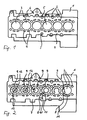
- a surface area 7 of the cylinder block 1 is subsequently milled plan to provide a sealing surface against the subsequently als strictureden cylinder head (not shown).
- the cooling water openings 4 and oil supply channels 5 usually do not require a subsequent machining. On the other hand, this does not apply to the threaded holes 6, which must be drilled to the necessary extent and threaded through a tap.
- the recesses 2 are closed in the present embodiment by means of a wax, which consists predominantly of montan wax and montan ester wax.
- a wax which consists predominantly of montan wax and montan ester wax.
- the wax is tuned in terms of its temperature behavior in a conventional manner such that it has a melting point of about 62 ° C and a dropping point of about 56 ° C has. Also, the vote is such that the wax at 48 ° C is already fixed.
- this is heated to 53 ° C to 54 ° C, so it is present as a pasty medium.
- the cylinder block 1 is heated to about 34 ° C.
- Connecting the wax is by means of a nozzle which is attached to a robot arm or other manipulator, strand-shaped at the desired locations of the cylinder block or introduced.
- the wax cures relatively quickly, with flow being prevented during the application or introduction until hardening due to the selected application temperature.
- the Wach is introduced in several sequences in the corresponding recess 2, as this in FIG. 2 is shown as an example.
- a strand 9 of the wax is introduced into the respective recess 2 until the strand 9 extends nikförrnig at the edge of the recess 2 and closes at the starting point 8 via an interface 10, as this with reference to the three right cylinder 3 in FIG. 2 is shown sequentially by way of example.
- the remaining opening will, as also in FIG. 2 indicated schematically, reduced with a second strand 12, to be finally completely closed by means of a punkformigen strand 13 (see left cylinder in FIG. 2 ).
- the machining operations can be performed. It is understood that, depending on the specific design of the machining process, also portions of the sealing medium can be removed as long as the actual sealing function is ensured.
- the wax is removed, depending on the specific process control, where appropriate, a mechanical removal of the wax and a mechanical removal of any plastic discs or the like can take place.
- the temperature is raised to 65 ° C, so that the wax goes into melt and by means of a solvent, For example, by means of neutral detergent, can be permanently removed.
- a solvent For example, by means of neutral detergent
- the heating of the wax on the cylinder block 1 it can be dispensed with a complete liquefaction of the wax, if this liquefied at the interfaces between the cylinder block 1 and wax, so that the wax falls out of the recesses out of itself, without completely in the Melt passed over.
- the solvent which may also be used subsequently in a separate step to a heating, wax residues are reliably removed, so that the further processing of the machined cylinder block 1 can be done easily.
Landscapes
- Engineering & Computer Science (AREA)
- Mechanical Engineering (AREA)
- Lubricants (AREA)
Priority Applications (1)
| Application Number | Priority Date | Filing Date | Title |
|---|---|---|---|
| PL10000789T PL2210697T3 (pl) | 2009-01-27 | 2010-01-27 | Sposób obróbki skrawaniem przedmiotu obrabianego |
Applications Claiming Priority (1)
| Application Number | Priority Date | Filing Date | Title |
|---|---|---|---|
| DE102009006321A DE102009006321A1 (de) | 2009-01-27 | 2009-01-27 | Verfahren zum spanenden Bearbeiten eines Werkstücks und Verwendung eines pflanzlichen bzw. eines von pflanzlicher Basis aus modifizierten Wachs |
Publications (2)
| Publication Number | Publication Date |
|---|---|
| EP2210697A1 EP2210697A1 (de) | 2010-07-28 |
| EP2210697B1 true EP2210697B1 (de) | 2014-08-06 |
Family
ID=42153927
Family Applications (1)
| Application Number | Title | Priority Date | Filing Date |
|---|---|---|---|
| EP10000789.7A Not-in-force EP2210697B1 (de) | 2009-01-27 | 2010-01-27 | Verfahren zum spanenden Bearbeiten eines Werkstücks |
Country Status (3)
| Country | Link |
|---|---|
| EP (1) | EP2210697B1 (pl) |
| DE (1) | DE102009006321A1 (pl) |
| PL (1) | PL2210697T3 (pl) |
Families Citing this family (1)
| Publication number | Priority date | Publication date | Assignee | Title |
|---|---|---|---|---|
| DE102015220256A1 (de) * | 2015-10-19 | 2017-04-20 | Mahle International Gmbh | Verfahren zur Herstellung eines Kolbens |
Family Cites Families (6)
| Publication number | Priority date | Publication date | Assignee | Title |
|---|---|---|---|---|
| US4862575A (en) * | 1987-04-23 | 1989-09-05 | Nippon Denso Co., Ltd. | Method and apparatus for finishing grooved articles |
| US5283020A (en) * | 1989-09-28 | 1994-02-01 | United Technologies Corporation | Component protection from contaminants |
| DE4424452A1 (de) | 1994-07-12 | 1996-01-18 | Opel Adam Ag | Verfahren zum Verhindern von Bearbeitungsrückständen in spanend zu bearbeitenden Hohlkörpern, insbesondere Zylinderblöcken von flüssigkeitsgekühlten Brennkraftmaschinen |
| DE19528429A1 (de) | 1995-08-02 | 1997-02-06 | Bayerische Motoren Werke Ag | Verfahren zur spanabhebenden Bearbeitung eines mit einem Hohlraum ausgebildeten Werkstückes, insbesondere eines Motor-Gußteiles mit Kühlmittelräumen |
| DE10133003B4 (de) | 2001-07-06 | 2009-06-25 | Dürr Ecoclean GmbH | Verfahren und Vorrichtung zum spanenden Bearbeiten eines Werkstücks |
| DE10220485A1 (de) * | 2002-05-07 | 2003-11-27 | Volkswagen Ag | Verfahren zum Verschließen eines mit einer Öffnung ausgestalteten Werkstücks |
-
2009
- 2009-01-27 DE DE102009006321A patent/DE102009006321A1/de not_active Withdrawn
-
2010
- 2010-01-27 PL PL10000789T patent/PL2210697T3/pl unknown
- 2010-01-27 EP EP10000789.7A patent/EP2210697B1/de not_active Not-in-force
Also Published As
| Publication number | Publication date |
|---|---|
| DE102009006321A1 (de) | 2010-07-29 |
| PL2210697T3 (pl) | 2015-01-30 |
| EP2210697A1 (de) | 2010-07-28 |
Similar Documents
| Publication | Publication Date | Title |
|---|---|---|
| DE4104433C2 (de) | Spritzgießverfahren und Vorrichtung zur Durchführung dieses Verfahrens | |
| DE102020118836B3 (de) | Fertigungsverfahren für ein formgebendes Werkzeugteil eines Formwerkzeugs | |
| EP3381593B1 (de) | Verfahren zum strahlbasierten selektiven schmelzen oder sintern | |
| DE102005047035B3 (de) | Verfahren zur Herstellung eines Kolbens für einen Verbrennungsmotor sowie danach hergestellter Kolben | |
| WO2018069411A1 (de) | Verfahren zum herstellen eines gegenstandes mittels laserschmelzen | |
| EP2210697B1 (de) | Verfahren zum spanenden Bearbeiten eines Werkstücks | |
| DE4240017C2 (de) | Verfahren zur Herstellung von zumindest zweiseitig offenen hohlen Formteilen | |
| DE10206169B4 (de) | Verfahren zum Herstellen eines Plastifizierzylinders mit Innenbeschichtung | |
| DE102004029588B4 (de) | Verfahren zur Herstellung von Profilen aus Magnesiumwerkstoffen | |
| DE102010038171A1 (de) | Verfahren zur Herstellung einer Mehrkomponenten-Kraftfahrzeugblendenleiste oder einer Mehrkomponenten-Kraftfahrzeugzierleiste | |
| DE2106527A1 (de) | Verfahren zur Herstellung eines Metall teils und Vorrichtung zur Durchfuhrung des Verfahrens | |
| DE102008054318A1 (de) | Verfahren und Anlage zur Herstellung eines Gussbauteils | |
| DE102023003860B3 (de) | Verfahren zum Aufbringen eines Trennmittels auf einer Oberfläche einer Gussform | |
| DE4124021A1 (de) | Verfahren und vorrichtung zur herstellung von gussteilen | |
| DE102006046568B4 (de) | Verfahren zum Aufbringen einer Trennmittelsuspension sowie Vorrichtung zur Durchführung des Verfahrens | |
| DE102004042634B4 (de) | Heißkanaldüse und -block sowie Herstellungsverfahren dafür | |
| DE102009019815A1 (de) | Verfahren zum Schützen eines Werkstückes und Schutzmittel zur Verwendung in einem derartigen Verfahren | |
| DE1704371C3 (de) | Verfahren und Vorrichtung zum Herstellen eines Hohlkörpers aus verformbaren organischen Kunststoff nach dem Spritzblasverfahren. Ausscheidung aus: 1479800 | |
| DE1483648A1 (de) | Verfahren und Vorrichtung zur Herstellung hohler Gusskoerper | |
| DE10310213A1 (de) | Verfahren zur Herstellung verbesserten Werkstoffoberflächenverhaltens von Bauteilen sowie deren Verwendung an Spritzgießmaschinen | |
| DE102017116556B4 (de) | Schmiedeverfahren, insbesondere Leichtbaulegierungsschmiedeverfahren | |
| DE102009032320B4 (de) | Verfahren zum Spritzgießen eines Bauteils | |
| DE102005026825A1 (de) | Verfahren zum Herstellen eines Türaussengriffs für Fahrzeuge | |
| EP2812136B1 (de) | GIEßVERFAHREN | |
| AT515970B1 (de) | Verfahren und Vorrichtung zum Gießen zumindest eines Bauteils |
Legal Events
| Date | Code | Title | Description |
|---|---|---|---|
| PUAI | Public reference made under article 153(3) epc to a published international application that has entered the european phase |
Free format text: ORIGINAL CODE: 0009012 |
|
| AK | Designated contracting states |
Kind code of ref document: A1 Designated state(s): AT BE BG CH CY CZ DE DK EE ES FI FR GB GR HR HU IE IS IT LI LT LU LV MC MK MT NL NO PL PT RO SE SI SK SM TR |
|
| AX | Request for extension of the european patent |
Extension state: AL BA RS |
|
| 17P | Request for examination filed |
Effective date: 20110128 |
|
| 17Q | First examination report despatched |
Effective date: 20130527 |
|
| GRAP | Despatch of communication of intention to grant a patent |
Free format text: ORIGINAL CODE: EPIDOSNIGR1 |
|
| INTG | Intention to grant announced |
Effective date: 20140213 |
|
| GRAS | Grant fee paid |
Free format text: ORIGINAL CODE: EPIDOSNIGR3 |
|
| GRAA | (expected) grant |
Free format text: ORIGINAL CODE: 0009210 |
|
| AK | Designated contracting states |
Kind code of ref document: B1 Designated state(s): AT BE BG CH CY CZ DE DK EE ES FI FR GB GR HR HU IE IS IT LI LT LU LV MC MK MT NL NO PL PT RO SE SI SK SM TR |
|
| REG | Reference to a national code |
Ref country code: GB Ref legal event code: FG4D Free format text: NOT ENGLISH |
|
| REG | Reference to a national code |
Ref country code: CH Ref legal event code: EP Ref country code: AT Ref legal event code: REF Ref document number: 680775 Country of ref document: AT Kind code of ref document: T Effective date: 20140815 |
|
| REG | Reference to a national code |
Ref country code: IE Ref legal event code: FG4D Free format text: LANGUAGE OF EP DOCUMENT: GERMAN |
|
| REG | Reference to a national code |
Ref country code: DE Ref legal event code: R096 Ref document number: 502010007584 Country of ref document: DE Effective date: 20140918 |
|
| REG | Reference to a national code |
Ref country code: NL Ref legal event code: VDEP Effective date: 20140806 |
|
| REG | Reference to a national code |
Ref country code: LT Ref legal event code: MG4D |
|
| PG25 | Lapsed in a contracting state [announced via postgrant information from national office to epo] |
Ref country code: SE Free format text: LAPSE BECAUSE OF FAILURE TO SUBMIT A TRANSLATION OF THE DESCRIPTION OR TO PAY THE FEE WITHIN THE PRESCRIBED TIME-LIMIT Effective date: 20140806 Ref country code: GR Free format text: LAPSE BECAUSE OF FAILURE TO SUBMIT A TRANSLATION OF THE DESCRIPTION OR TO PAY THE FEE WITHIN THE PRESCRIBED TIME-LIMIT Effective date: 20141107 Ref country code: LT Free format text: LAPSE BECAUSE OF FAILURE TO SUBMIT A TRANSLATION OF THE DESCRIPTION OR TO PAY THE FEE WITHIN THE PRESCRIBED TIME-LIMIT Effective date: 20140806 Ref country code: NO Free format text: LAPSE BECAUSE OF FAILURE TO SUBMIT A TRANSLATION OF THE DESCRIPTION OR TO PAY THE FEE WITHIN THE PRESCRIBED TIME-LIMIT Effective date: 20141106 Ref country code: PT Free format text: LAPSE BECAUSE OF FAILURE TO SUBMIT A TRANSLATION OF THE DESCRIPTION OR TO PAY THE FEE WITHIN THE PRESCRIBED TIME-LIMIT Effective date: 20141209 Ref country code: FI Free format text: LAPSE BECAUSE OF FAILURE TO SUBMIT A TRANSLATION OF THE DESCRIPTION OR TO PAY THE FEE WITHIN THE PRESCRIBED TIME-LIMIT Effective date: 20140806 Ref country code: BG Free format text: LAPSE BECAUSE OF FAILURE TO SUBMIT A TRANSLATION OF THE DESCRIPTION OR TO PAY THE FEE WITHIN THE PRESCRIBED TIME-LIMIT Effective date: 20141106 Ref country code: ES Free format text: LAPSE BECAUSE OF FAILURE TO SUBMIT A TRANSLATION OF THE DESCRIPTION OR TO PAY THE FEE WITHIN THE PRESCRIBED TIME-LIMIT Effective date: 20140806 |
|
| REG | Reference to a national code |
Ref country code: PL Ref legal event code: T3 |
|
| PG25 | Lapsed in a contracting state [announced via postgrant information from national office to epo] |
Ref country code: LV Free format text: LAPSE BECAUSE OF FAILURE TO SUBMIT A TRANSLATION OF THE DESCRIPTION OR TO PAY THE FEE WITHIN THE PRESCRIBED TIME-LIMIT Effective date: 20140806 Ref country code: IS Free format text: LAPSE BECAUSE OF FAILURE TO SUBMIT A TRANSLATION OF THE DESCRIPTION OR TO PAY THE FEE WITHIN THE PRESCRIBED TIME-LIMIT Effective date: 20141206 Ref country code: HR Free format text: LAPSE BECAUSE OF FAILURE TO SUBMIT A TRANSLATION OF THE DESCRIPTION OR TO PAY THE FEE WITHIN THE PRESCRIBED TIME-LIMIT Effective date: 20140806 Ref country code: CY Free format text: LAPSE BECAUSE OF FAILURE TO SUBMIT A TRANSLATION OF THE DESCRIPTION OR TO PAY THE FEE WITHIN THE PRESCRIBED TIME-LIMIT Effective date: 20140806 Ref country code: NL Free format text: LAPSE BECAUSE OF FAILURE TO SUBMIT A TRANSLATION OF THE DESCRIPTION OR TO PAY THE FEE WITHIN THE PRESCRIBED TIME-LIMIT Effective date: 20140806 |
|
| REG | Reference to a national code |
Ref country code: FR Ref legal event code: PLFP Year of fee payment: 6 |
|
| PG25 | Lapsed in a contracting state [announced via postgrant information from national office to epo] |
Ref country code: DK Free format text: LAPSE BECAUSE OF FAILURE TO SUBMIT A TRANSLATION OF THE DESCRIPTION OR TO PAY THE FEE WITHIN THE PRESCRIBED TIME-LIMIT Effective date: 20140806 Ref country code: EE Free format text: LAPSE BECAUSE OF FAILURE TO SUBMIT A TRANSLATION OF THE DESCRIPTION OR TO PAY THE FEE WITHIN THE PRESCRIBED TIME-LIMIT Effective date: 20140806 Ref country code: SK Free format text: LAPSE BECAUSE OF FAILURE TO SUBMIT A TRANSLATION OF THE DESCRIPTION OR TO PAY THE FEE WITHIN THE PRESCRIBED TIME-LIMIT Effective date: 20140806 Ref country code: IT Free format text: LAPSE BECAUSE OF FAILURE TO SUBMIT A TRANSLATION OF THE DESCRIPTION OR TO PAY THE FEE WITHIN THE PRESCRIBED TIME-LIMIT Effective date: 20140806 Ref country code: RO Free format text: LAPSE BECAUSE OF FAILURE TO SUBMIT A TRANSLATION OF THE DESCRIPTION OR TO PAY THE FEE WITHIN THE PRESCRIBED TIME-LIMIT Effective date: 20140806 |
|
| REG | Reference to a national code |
Ref country code: DE Ref legal event code: R097 Ref document number: 502010007584 Country of ref document: DE |
|
| PLBE | No opposition filed within time limit |
Free format text: ORIGINAL CODE: 0009261 |
|
| STAA | Information on the status of an ep patent application or granted ep patent |
Free format text: STATUS: NO OPPOSITION FILED WITHIN TIME LIMIT |
|
| PG25 | Lapsed in a contracting state [announced via postgrant information from national office to epo] |
Ref country code: BE Free format text: LAPSE BECAUSE OF NON-PAYMENT OF DUE FEES Effective date: 20150131 |
|
| 26N | No opposition filed |
Effective date: 20150507 |
|
| REG | Reference to a national code |
Ref country code: HU Ref legal event code: AG4A Ref document number: E023780 Country of ref document: HU |
|
| REG | Reference to a national code |
Ref country code: CH Ref legal event code: PL |
|
| PG25 | Lapsed in a contracting state [announced via postgrant information from national office to epo] |
Ref country code: LU Free format text: LAPSE BECAUSE OF FAILURE TO SUBMIT A TRANSLATION OF THE DESCRIPTION OR TO PAY THE FEE WITHIN THE PRESCRIBED TIME-LIMIT Effective date: 20150127 |
|
| PGFP | Annual fee paid to national office [announced via postgrant information from national office to epo] |
Ref country code: FR Payment date: 20150423 Year of fee payment: 6 |
|
| GBPC | Gb: european patent ceased through non-payment of renewal fee |
Effective date: 20150127 |
|
| PG25 | Lapsed in a contracting state [announced via postgrant information from national office to epo] |
Ref country code: MC Free format text: LAPSE BECAUSE OF FAILURE TO SUBMIT A TRANSLATION OF THE DESCRIPTION OR TO PAY THE FEE WITHIN THE PRESCRIBED TIME-LIMIT Effective date: 20140806 |
|
| PG25 | Lapsed in a contracting state [announced via postgrant information from national office to epo] |
Ref country code: LI Free format text: LAPSE BECAUSE OF NON-PAYMENT OF DUE FEES Effective date: 20150131 Ref country code: CH Free format text: LAPSE BECAUSE OF NON-PAYMENT OF DUE FEES Effective date: 20150131 Ref country code: GB Free format text: LAPSE BECAUSE OF NON-PAYMENT OF DUE FEES Effective date: 20150127 |
|
| REG | Reference to a national code |
Ref country code: IE Ref legal event code: MM4A |
|
| PG25 | Lapsed in a contracting state [announced via postgrant information from national office to epo] |
Ref country code: SI Free format text: LAPSE BECAUSE OF FAILURE TO SUBMIT A TRANSLATION OF THE DESCRIPTION OR TO PAY THE FEE WITHIN THE PRESCRIBED TIME-LIMIT Effective date: 20140806 |
|
| PG25 | Lapsed in a contracting state [announced via postgrant information from national office to epo] |
Ref country code: IE Free format text: LAPSE BECAUSE OF NON-PAYMENT OF DUE FEES Effective date: 20150127 |
|
| REG | Reference to a national code |
Ref country code: FR Ref legal event code: ST Effective date: 20160930 |
|
| PG25 | Lapsed in a contracting state [announced via postgrant information from national office to epo] |
Ref country code: FR Free format text: LAPSE BECAUSE OF NON-PAYMENT OF DUE FEES Effective date: 20160201 |
|
| PG25 | Lapsed in a contracting state [announced via postgrant information from national office to epo] |
Ref country code: MT Free format text: LAPSE BECAUSE OF FAILURE TO SUBMIT A TRANSLATION OF THE DESCRIPTION OR TO PAY THE FEE WITHIN THE PRESCRIBED TIME-LIMIT Effective date: 20140806 |
|
| PG25 | Lapsed in a contracting state [announced via postgrant information from national office to epo] |
Ref country code: SM Free format text: LAPSE BECAUSE OF FAILURE TO SUBMIT A TRANSLATION OF THE DESCRIPTION OR TO PAY THE FEE WITHIN THE PRESCRIBED TIME-LIMIT Effective date: 20140806 |
|
| PG25 | Lapsed in a contracting state [announced via postgrant information from national office to epo] |
Ref country code: TR Free format text: LAPSE BECAUSE OF FAILURE TO SUBMIT A TRANSLATION OF THE DESCRIPTION OR TO PAY THE FEE WITHIN THE PRESCRIBED TIME-LIMIT Effective date: 20140806 |
|
| PG25 | Lapsed in a contracting state [announced via postgrant information from national office to epo] |
Ref country code: MK Free format text: LAPSE BECAUSE OF FAILURE TO SUBMIT A TRANSLATION OF THE DESCRIPTION OR TO PAY THE FEE WITHIN THE PRESCRIBED TIME-LIMIT Effective date: 20140806 |
|
| PGFP | Annual fee paid to national office [announced via postgrant information from national office to epo] |
Ref country code: CZ Payment date: 20181228 Year of fee payment: 10 Ref country code: PL Payment date: 20181221 Year of fee payment: 10 |
|
| PGFP | Annual fee paid to national office [announced via postgrant information from national office to epo] |
Ref country code: AT Payment date: 20190129 Year of fee payment: 10 Ref country code: HU Payment date: 20181228 Year of fee payment: 10 |
|
| REG | Reference to a national code |
Ref country code: AT Ref legal event code: MM01 Ref document number: 680775 Country of ref document: AT Kind code of ref document: T Effective date: 20200127 |
|
| PG25 | Lapsed in a contracting state [announced via postgrant information from national office to epo] |
Ref country code: CZ Free format text: LAPSE BECAUSE OF NON-PAYMENT OF DUE FEES Effective date: 20200127 |
|
| PG25 | Lapsed in a contracting state [announced via postgrant information from national office to epo] |
Ref country code: AT Free format text: LAPSE BECAUSE OF NON-PAYMENT OF DUE FEES Effective date: 20200127 Ref country code: HU Free format text: LAPSE BECAUSE OF NON-PAYMENT OF DUE FEES Effective date: 20200128 |
|
| PGFP | Annual fee paid to national office [announced via postgrant information from national office to epo] |
Ref country code: DE Payment date: 20210127 Year of fee payment: 12 |
|
| PG25 | Lapsed in a contracting state [announced via postgrant information from national office to epo] |
Ref country code: PL Free format text: LAPSE BECAUSE OF NON-PAYMENT OF DUE FEES Effective date: 20200127 |
|
| REG | Reference to a national code |
Ref country code: DE Ref legal event code: R119 Ref document number: 502010007584 Country of ref document: DE |
|
| PG25 | Lapsed in a contracting state [announced via postgrant information from national office to epo] |
Ref country code: DE Free format text: LAPSE BECAUSE OF NON-PAYMENT OF DUE FEES Effective date: 20220802 |