EP2207679B1 - Articles rotomoulés multicouches - Google Patents
Articles rotomoulés multicouches Download PDFInfo
- Publication number
- EP2207679B1 EP2207679B1 EP08846261.9A EP08846261A EP2207679B1 EP 2207679 B1 EP2207679 B1 EP 2207679B1 EP 08846261 A EP08846261 A EP 08846261A EP 2207679 B1 EP2207679 B1 EP 2207679B1
- Authority
- EP
- European Patent Office
- Prior art keywords
- layer
- prepared
- polyethylene
- barrier
- process according
- Prior art date
- Legal status (The legal status is an assumption and is not a legal conclusion. Google has not performed a legal analysis and makes no representation as to the accuracy of the status listed.)
- Active
Links
- -1 polyethylene Polymers 0.000 claims description 56
- 229920000573 polyethylene Polymers 0.000 claims description 49
- 239000004952 Polyamide Substances 0.000 claims description 48
- 239000004698 Polyethylene Substances 0.000 claims description 48
- 229920002647 polyamide Polymers 0.000 claims description 48
- 229920000098 polyolefin Polymers 0.000 claims description 36
- 239000000203 mixture Substances 0.000 claims description 34
- 238000001175 rotational moulding Methods 0.000 claims description 25
- 238000000034 method Methods 0.000 claims description 20
- 239000012530 fluid Substances 0.000 claims description 19
- 230000004888 barrier function Effects 0.000 claims description 18
- 230000008569 process Effects 0.000 claims description 15
- 238000009826 distribution Methods 0.000 claims description 13
- 229920000554 ionomer Polymers 0.000 claims description 9
- 229920005989 resin Polymers 0.000 claims description 8
- 239000011347 resin Substances 0.000 claims description 8
- 229920013716 polyethylene resin Polymers 0.000 claims description 6
- 229920000642 polymer Polymers 0.000 claims description 6
- 239000002828 fuel tank Substances 0.000 claims description 5
- 238000004519 manufacturing process Methods 0.000 claims description 5
- 239000008188 pellet Substances 0.000 claims description 5
- 229920001400 block copolymer Polymers 0.000 claims description 3
- 239000000843 powder Substances 0.000 claims description 3
- 229920000219 Ethylene vinyl alcohol Polymers 0.000 claims 2
- UFRKOOWSQGXVKV-UHFFFAOYSA-N ethene;ethenol Chemical compound C=C.OC=C UFRKOOWSQGXVKV-UHFFFAOYSA-N 0.000 claims 2
- 239000004715 ethylene vinyl alcohol Substances 0.000 claims 2
- 239000000463 material Substances 0.000 description 15
- 229920001577 copolymer Polymers 0.000 description 12
- 238000010438 heat treatment Methods 0.000 description 12
- VGGSQFUCUMXWEO-UHFFFAOYSA-N Ethene Chemical compound C=C VGGSQFUCUMXWEO-UHFFFAOYSA-N 0.000 description 8
- 239000005977 Ethylene Substances 0.000 description 8
- 229910052751 metal Inorganic materials 0.000 description 8
- 239000002184 metal Substances 0.000 description 8
- 238000001816 cooling Methods 0.000 description 7
- 150000004985 diamines Chemical class 0.000 description 7
- 239000002253 acid Substances 0.000 description 5
- 229920000139 polyethylene terephthalate Polymers 0.000 description 5
- 239000005020 polyethylene terephthalate Substances 0.000 description 5
- 239000000047 product Substances 0.000 description 5
- 230000009467 reduction Effects 0.000 description 5
- 150000001412 amines Chemical class 0.000 description 4
- 150000003951 lactams Chemical class 0.000 description 4
- 239000000155 melt Substances 0.000 description 4
- 125000000217 alkyl group Chemical group 0.000 description 3
- 125000003277 amino group Chemical group 0.000 description 3
- 150000008064 anhydrides Chemical class 0.000 description 3
- 230000008901 benefit Effects 0.000 description 3
- 239000003054 catalyst Substances 0.000 description 3
- 238000009833 condensation Methods 0.000 description 3
- 230000005494 condensation Effects 0.000 description 3
- 239000003607 modifier Substances 0.000 description 3
- 239000000178 monomer Substances 0.000 description 3
- 238000000465 moulding Methods 0.000 description 3
- 239000003921 oil Substances 0.000 description 3
- 229920003023 plastic Polymers 0.000 description 3
- 239000004033 plastic Substances 0.000 description 3
- 239000011342 resin composition Substances 0.000 description 3
- KWKAKUADMBZCLK-UHFFFAOYSA-N 1-octene Chemical compound CCCCCCC=C KWKAKUADMBZCLK-UHFFFAOYSA-N 0.000 description 2
- PBLZLIFKVPJDCO-UHFFFAOYSA-N 12-aminododecanoic acid Chemical compound NCCCCCCCCCCCC(O)=O PBLZLIFKVPJDCO-UHFFFAOYSA-N 0.000 description 2
- NIXOWILDQLNWCW-UHFFFAOYSA-M Acrylate Chemical compound [O-]C(=O)C=C NIXOWILDQLNWCW-UHFFFAOYSA-M 0.000 description 2
- KAKZBPTYRLMSJV-UHFFFAOYSA-N Butadiene Chemical compound C=CC=C KAKZBPTYRLMSJV-UHFFFAOYSA-N 0.000 description 2
- LYCAIKOWRPUZTN-UHFFFAOYSA-N Ethylene glycol Chemical compound OCCO LYCAIKOWRPUZTN-UHFFFAOYSA-N 0.000 description 2
- 239000002033 PVDF binder Substances 0.000 description 2
- 239000004743 Polypropylene Substances 0.000 description 2
- VYPSYNLAJGMNEJ-UHFFFAOYSA-N Silicium dioxide Chemical compound O=[Si]=O VYPSYNLAJGMNEJ-UHFFFAOYSA-N 0.000 description 2
- KKEYFWRCBNTPAC-UHFFFAOYSA-N Terephthalic acid Chemical compound OC(=O)C1=CC=C(C(O)=O)C=C1 KKEYFWRCBNTPAC-UHFFFAOYSA-N 0.000 description 2
- WNLRTRBMVRJNCN-UHFFFAOYSA-N adipic acid Chemical compound OC(=O)CCCCC(O)=O WNLRTRBMVRJNCN-UHFFFAOYSA-N 0.000 description 2
- 239000000956 alloy Substances 0.000 description 2
- 229910045601 alloy Inorganic materials 0.000 description 2
- 239000004411 aluminium Substances 0.000 description 2
- 229910052782 aluminium Inorganic materials 0.000 description 2
- XAGFODPZIPBFFR-UHFFFAOYSA-N aluminium Chemical compound [Al] XAGFODPZIPBFFR-UHFFFAOYSA-N 0.000 description 2
- 150000001735 carboxylic acids Chemical class 0.000 description 2
- 238000007796 conventional method Methods 0.000 description 2
- 239000012809 cooling fluid Substances 0.000 description 2
- JBKVHLHDHHXQEQ-UHFFFAOYSA-N epsilon-caprolactam Chemical compound O=C1CCCCCN1 JBKVHLHDHHXQEQ-UHFFFAOYSA-N 0.000 description 2
- 229920002313 fluoropolymer Polymers 0.000 description 2
- 239000004811 fluoropolymer Substances 0.000 description 2
- 239000000446 fuel Substances 0.000 description 2
- NAQMVNRVTILPCV-UHFFFAOYSA-N hexane-1,6-diamine Chemical compound NCCCCCCN NAQMVNRVTILPCV-UHFFFAOYSA-N 0.000 description 2
- 229920001519 homopolymer Polymers 0.000 description 2
- QQVIHTHCMHWDBS-UHFFFAOYSA-N isophthalic acid Chemical compound OC(=O)C1=CC=CC(C(O)=O)=C1 QQVIHTHCMHWDBS-UHFFFAOYSA-N 0.000 description 2
- 238000002844 melting Methods 0.000 description 2
- 230000008018 melting Effects 0.000 description 2
- BDJRBEYXGGNYIS-UHFFFAOYSA-N nonanedioic acid Chemical compound OC(=O)CCCCCCCC(O)=O BDJRBEYXGGNYIS-UHFFFAOYSA-N 0.000 description 2
- 229920001155 polypropylene Polymers 0.000 description 2
- 229920002981 polyvinylidene fluoride Polymers 0.000 description 2
- 230000000750 progressive effect Effects 0.000 description 2
- 230000009257 reactivity Effects 0.000 description 2
- 150000003839 salts Chemical class 0.000 description 2
- CXMXRPHRNRROMY-UHFFFAOYSA-N sebacic acid Chemical compound OC(=O)CCCCCCCCC(O)=O CXMXRPHRNRROMY-UHFFFAOYSA-N 0.000 description 2
- TYFQFVWCELRYAO-UHFFFAOYSA-N suberic acid Chemical compound OC(=O)CCCCCCC(O)=O TYFQFVWCELRYAO-UHFFFAOYSA-N 0.000 description 2
- 238000003466 welding Methods 0.000 description 2
- 239000004711 α-olefin Substances 0.000 description 2
- GUOSQNAUYHMCRU-UHFFFAOYSA-N 11-Aminoundecanoic acid Chemical compound NCCCCCCCCCCC(O)=O GUOSQNAUYHMCRU-UHFFFAOYSA-N 0.000 description 1
- WMRCTEPOPAZMMN-UHFFFAOYSA-N 2-undecylpropanedioic acid Chemical compound CCCCCCCCCCCC(C(O)=O)C(O)=O WMRCTEPOPAZMMN-UHFFFAOYSA-N 0.000 description 1
- DZIHTWJGPDVSGE-UHFFFAOYSA-N 4-[(4-aminocyclohexyl)methyl]cyclohexan-1-amine Chemical compound C1CC(N)CCC1CC1CCC(N)CC1 DZIHTWJGPDVSGE-UHFFFAOYSA-N 0.000 description 1
- SLXKOJJOQWFEFD-UHFFFAOYSA-N 6-aminohexanoic acid Chemical compound NCCCCCC(O)=O SLXKOJJOQWFEFD-UHFFFAOYSA-N 0.000 description 1
- XDOLZJYETYVRKV-UHFFFAOYSA-N 7-Aminoheptanoic acid Chemical compound NCCCCCCC(O)=O XDOLZJYETYVRKV-UHFFFAOYSA-N 0.000 description 1
- FLFNHHSXSLXYQB-UHFFFAOYSA-L CC1=CC(C(=CC=C2)C=3C=CC=CC=3)=C2C1[Zr](Cl)(Cl)(=[Si](C)C)C1C(C)=CC2=C1C=CC=C2C1=CC=CC=C1 Chemical compound CC1=CC(C(=CC=C2)C=3C=CC=CC=3)=C2C1[Zr](Cl)(Cl)(=[Si](C)C)C1C(C)=CC2=C1C=CC=C2C1=CC=CC=C1 FLFNHHSXSLXYQB-UHFFFAOYSA-L 0.000 description 1
- 239000004593 Epoxy Substances 0.000 description 1
- JHWNWJKBPDFINM-UHFFFAOYSA-N Laurolactam Chemical compound O=C1CCCCCCCCCCCN1 JHWNWJKBPDFINM-UHFFFAOYSA-N 0.000 description 1
- OFOBLEOULBTSOW-UHFFFAOYSA-N Malonic acid Chemical compound OC(=O)CC(O)=O OFOBLEOULBTSOW-UHFFFAOYSA-N 0.000 description 1
- CERQOIWHTDAKMF-UHFFFAOYSA-N Methacrylic acid Chemical compound CC(=C)C(O)=O CERQOIWHTDAKMF-UHFFFAOYSA-N 0.000 description 1
- 239000004721 Polyphenylene oxide Substances 0.000 description 1
- 239000004959 Rilsan Substances 0.000 description 1
- 239000011954 Ziegler–Natta catalyst Substances 0.000 description 1
- FDLQZKYLHJJBHD-UHFFFAOYSA-N [3-(aminomethyl)phenyl]methanamine Chemical compound NCC1=CC=CC(CN)=C1 FDLQZKYLHJJBHD-UHFFFAOYSA-N 0.000 description 1
- 150000007513 acids Chemical class 0.000 description 1
- 235000011037 adipic acid Nutrition 0.000 description 1
- 239000001361 adipic acid Substances 0.000 description 1
- 229920003232 aliphatic polyester Polymers 0.000 description 1
- 150000001413 amino acids Chemical class 0.000 description 1
- 229960002684 aminocaproic acid Drugs 0.000 description 1
- 125000003118 aryl group Chemical group 0.000 description 1
- CJYXCQLOZNIMFP-UHFFFAOYSA-N azocan-2-one Chemical compound O=C1CCCCCCN1 CJYXCQLOZNIMFP-UHFFFAOYSA-N 0.000 description 1
- 230000015556 catabolic process Effects 0.000 description 1
- 239000012018 catalyst precursor Substances 0.000 description 1
- 125000002091 cationic group Chemical group 0.000 description 1
- 239000013043 chemical agent Substances 0.000 description 1
- 230000002301 combined effect Effects 0.000 description 1
- 238000013329 compounding Methods 0.000 description 1
- 238000004132 cross linking Methods 0.000 description 1
- 239000003431 cross linking reagent Substances 0.000 description 1
- 230000003247 decreasing effect Effects 0.000 description 1
- 238000006731 degradation reaction Methods 0.000 description 1
- 125000004427 diamine group Chemical group 0.000 description 1
- 150000001993 dienes Chemical class 0.000 description 1
- QFTYSVGGYOXFRQ-UHFFFAOYSA-N dodecane-1,12-diamine Chemical compound NCCCCCCCCCCCCN QFTYSVGGYOXFRQ-UHFFFAOYSA-N 0.000 description 1
- 238000005553 drilling Methods 0.000 description 1
- 230000006353 environmental stress Effects 0.000 description 1
- 150000002118 epoxides Chemical class 0.000 description 1
- 150000002148 esters Chemical class 0.000 description 1
- 239000012467 final product Substances 0.000 description 1
- 125000000524 functional group Chemical group 0.000 description 1
- 125000003055 glycidyl group Chemical group C(C1CO1)* 0.000 description 1
- 229920001112 grafted polyolefin Polymers 0.000 description 1
- 238000000227 grinding Methods 0.000 description 1
- 229920001903 high density polyethylene Polymers 0.000 description 1
- 239000004700 high-density polyethylene Substances 0.000 description 1
- WGCNASOHLSPBMP-UHFFFAOYSA-N hydroxyacetaldehyde Natural products OCC=O WGCNASOHLSPBMP-UHFFFAOYSA-N 0.000 description 1
- 230000001788 irregular Effects 0.000 description 1
- 229920000092 linear low density polyethylene Polymers 0.000 description 1
- 239000004707 linear low-density polyethylene Substances 0.000 description 1
- 238000003754 machining Methods 0.000 description 1
- FPYJFEHAWHCUMM-UHFFFAOYSA-N maleic anhydride Chemical compound O=C1OC(=O)C=C1 FPYJFEHAWHCUMM-UHFFFAOYSA-N 0.000 description 1
- 150000002739 metals Chemical class 0.000 description 1
- 238000003801 milling Methods 0.000 description 1
- 238000002156 mixing Methods 0.000 description 1
- ZETYUTMSJWMKNQ-UHFFFAOYSA-N n,n',n'-trimethylhexane-1,6-diamine Chemical compound CNCCCCCCN(C)C ZETYUTMSJWMKNQ-UHFFFAOYSA-N 0.000 description 1
- TVMXDCGIABBOFY-UHFFFAOYSA-N n-Octanol Natural products CCCCCCCC TVMXDCGIABBOFY-UHFFFAOYSA-N 0.000 description 1
- 238000005580 one pot reaction Methods 0.000 description 1
- 239000003960 organic solvent Substances 0.000 description 1
- 125000002524 organometallic group Chemical group 0.000 description 1
- 238000004806 packaging method and process Methods 0.000 description 1
- 239000002245 particle Substances 0.000 description 1
- 230000035699 permeability Effects 0.000 description 1
- 239000000575 pesticide Substances 0.000 description 1
- 239000003348 petrochemical agent Substances 0.000 description 1
- 239000004417 polycarbonate Substances 0.000 description 1
- 229920000515 polycarbonate Polymers 0.000 description 1
- 229920000570 polyether Polymers 0.000 description 1
- 229920002635 polyurethane Polymers 0.000 description 1
- 239000004814 polyurethane Substances 0.000 description 1
- 239000004800 polyvinyl chloride Substances 0.000 description 1
- 238000002360 preparation method Methods 0.000 description 1
- 150000003141 primary amines Chemical group 0.000 description 1
- 239000000377 silicon dioxide Substances 0.000 description 1
- 238000007711 solidification Methods 0.000 description 1
- 230000008023 solidification Effects 0.000 description 1
- 239000007921 spray Substances 0.000 description 1
- 239000000126 substance Substances 0.000 description 1
- 238000004073 vulcanization Methods 0.000 description 1
- XLYOFNOQVPJJNP-UHFFFAOYSA-N water Substances O XLYOFNOQVPJJNP-UHFFFAOYSA-N 0.000 description 1
Images





Classifications
-
- B—PERFORMING OPERATIONS; TRANSPORTING
- B32—LAYERED PRODUCTS
- B32B—LAYERED PRODUCTS, i.e. PRODUCTS BUILT-UP OF STRATA OF FLAT OR NON-FLAT, e.g. CELLULAR OR HONEYCOMB, FORM
- B32B27/00—Layered products comprising a layer of synthetic resin
- B32B27/32—Layered products comprising a layer of synthetic resin comprising polyolefins
-
- B—PERFORMING OPERATIONS; TRANSPORTING
- B29—WORKING OF PLASTICS; WORKING OF SUBSTANCES IN A PLASTIC STATE IN GENERAL
- B29C—SHAPING OR JOINING OF PLASTICS; SHAPING OF MATERIAL IN A PLASTIC STATE, NOT OTHERWISE PROVIDED FOR; AFTER-TREATMENT OF THE SHAPED PRODUCTS, e.g. REPAIRING
- B29C41/00—Shaping by coating a mould, core or other substrate, i.e. by depositing material and stripping-off the shaped article; Apparatus therefor
- B29C41/02—Shaping by coating a mould, core or other substrate, i.e. by depositing material and stripping-off the shaped article; Apparatus therefor for making articles of definite length, i.e. discrete articles
- B29C41/04—Rotational or centrifugal casting, i.e. coating the inside of a mould by rotating the mould
- B29C41/042—Rotational or centrifugal casting, i.e. coating the inside of a mould by rotating the mould by rotating a mould around its axis of symmetry
-
- B—PERFORMING OPERATIONS; TRANSPORTING
- B29—WORKING OF PLASTICS; WORKING OF SUBSTANCES IN A PLASTIC STATE IN GENERAL
- B29C—SHAPING OR JOINING OF PLASTICS; SHAPING OF MATERIAL IN A PLASTIC STATE, NOT OTHERWISE PROVIDED FOR; AFTER-TREATMENT OF THE SHAPED PRODUCTS, e.g. REPAIRING
- B29C41/00—Shaping by coating a mould, core or other substrate, i.e. by depositing material and stripping-off the shaped article; Apparatus therefor
- B29C41/34—Component parts, details or accessories; Auxiliary operations
- B29C41/38—Moulds, cores or other substrates
-
- B—PERFORMING OPERATIONS; TRANSPORTING
- B29—WORKING OF PLASTICS; WORKING OF SUBSTANCES IN A PLASTIC STATE IN GENERAL
- B29C—SHAPING OR JOINING OF PLASTICS; SHAPING OF MATERIAL IN A PLASTIC STATE, NOT OTHERWISE PROVIDED FOR; AFTER-TREATMENT OF THE SHAPED PRODUCTS, e.g. REPAIRING
- B29C41/00—Shaping by coating a mould, core or other substrate, i.e. by depositing material and stripping-off the shaped article; Apparatus therefor
- B29C41/34—Component parts, details or accessories; Auxiliary operations
- B29C41/46—Heating or cooling
-
- B—PERFORMING OPERATIONS; TRANSPORTING
- B32—LAYERED PRODUCTS
- B32B—LAYERED PRODUCTS, i.e. PRODUCTS BUILT-UP OF STRATA OF FLAT OR NON-FLAT, e.g. CELLULAR OR HONEYCOMB, FORM
- B32B27/00—Layered products comprising a layer of synthetic resin
- B32B27/06—Layered products comprising a layer of synthetic resin as the main or only constituent of a layer, which is next to another layer of the same or of a different material
- B32B27/08—Layered products comprising a layer of synthetic resin as the main or only constituent of a layer, which is next to another layer of the same or of a different material of synthetic resin
-
- B—PERFORMING OPERATIONS; TRANSPORTING
- B32—LAYERED PRODUCTS
- B32B—LAYERED PRODUCTS, i.e. PRODUCTS BUILT-UP OF STRATA OF FLAT OR NON-FLAT, e.g. CELLULAR OR HONEYCOMB, FORM
- B32B27/00—Layered products comprising a layer of synthetic resin
- B32B27/28—Layered products comprising a layer of synthetic resin comprising synthetic resins not wholly covered by any one of the sub-groups B32B27/30 - B32B27/42
-
- B—PERFORMING OPERATIONS; TRANSPORTING
- B32—LAYERED PRODUCTS
- B32B—LAYERED PRODUCTS, i.e. PRODUCTS BUILT-UP OF STRATA OF FLAT OR NON-FLAT, e.g. CELLULAR OR HONEYCOMB, FORM
- B32B27/00—Layered products comprising a layer of synthetic resin
- B32B27/30—Layered products comprising a layer of synthetic resin comprising vinyl (co)polymers; comprising acrylic (co)polymers
- B32B27/304—Layered products comprising a layer of synthetic resin comprising vinyl (co)polymers; comprising acrylic (co)polymers comprising vinyl halide (co)polymers, e.g. PVC, PVDC, PVF, PVDF
-
- B—PERFORMING OPERATIONS; TRANSPORTING
- B32—LAYERED PRODUCTS
- B32B—LAYERED PRODUCTS, i.e. PRODUCTS BUILT-UP OF STRATA OF FLAT OR NON-FLAT, e.g. CELLULAR OR HONEYCOMB, FORM
- B32B27/00—Layered products comprising a layer of synthetic resin
- B32B27/30—Layered products comprising a layer of synthetic resin comprising vinyl (co)polymers; comprising acrylic (co)polymers
- B32B27/306—Layered products comprising a layer of synthetic resin comprising vinyl (co)polymers; comprising acrylic (co)polymers comprising vinyl acetate or vinyl alcohol (co)polymers
-
- B—PERFORMING OPERATIONS; TRANSPORTING
- B32—LAYERED PRODUCTS
- B32B—LAYERED PRODUCTS, i.e. PRODUCTS BUILT-UP OF STRATA OF FLAT OR NON-FLAT, e.g. CELLULAR OR HONEYCOMB, FORM
- B32B27/00—Layered products comprising a layer of synthetic resin
- B32B27/30—Layered products comprising a layer of synthetic resin comprising vinyl (co)polymers; comprising acrylic (co)polymers
- B32B27/308—Layered products comprising a layer of synthetic resin comprising vinyl (co)polymers; comprising acrylic (co)polymers comprising acrylic (co)polymers
-
- B—PERFORMING OPERATIONS; TRANSPORTING
- B32—LAYERED PRODUCTS
- B32B—LAYERED PRODUCTS, i.e. PRODUCTS BUILT-UP OF STRATA OF FLAT OR NON-FLAT, e.g. CELLULAR OR HONEYCOMB, FORM
- B32B27/00—Layered products comprising a layer of synthetic resin
- B32B27/32—Layered products comprising a layer of synthetic resin comprising polyolefins
- B32B27/327—Layered products comprising a layer of synthetic resin comprising polyolefins comprising polyolefins obtained by a metallocene or single-site catalyst
-
- B—PERFORMING OPERATIONS; TRANSPORTING
- B32—LAYERED PRODUCTS
- B32B—LAYERED PRODUCTS, i.e. PRODUCTS BUILT-UP OF STRATA OF FLAT OR NON-FLAT, e.g. CELLULAR OR HONEYCOMB, FORM
- B32B27/00—Layered products comprising a layer of synthetic resin
- B32B27/34—Layered products comprising a layer of synthetic resin comprising polyamides
-
- B—PERFORMING OPERATIONS; TRANSPORTING
- B32—LAYERED PRODUCTS
- B32B—LAYERED PRODUCTS, i.e. PRODUCTS BUILT-UP OF STRATA OF FLAT OR NON-FLAT, e.g. CELLULAR OR HONEYCOMB, FORM
- B32B27/00—Layered products comprising a layer of synthetic resin
- B32B27/36—Layered products comprising a layer of synthetic resin comprising polyesters
-
- B—PERFORMING OPERATIONS; TRANSPORTING
- B32—LAYERED PRODUCTS
- B32B—LAYERED PRODUCTS, i.e. PRODUCTS BUILT-UP OF STRATA OF FLAT OR NON-FLAT, e.g. CELLULAR OR HONEYCOMB, FORM
- B32B2270/00—Resin or rubber layer containing a blend of at least two different polymers
-
- B—PERFORMING OPERATIONS; TRANSPORTING
- B32—LAYERED PRODUCTS
- B32B—LAYERED PRODUCTS, i.e. PRODUCTS BUILT-UP OF STRATA OF FLAT OR NON-FLAT, e.g. CELLULAR OR HONEYCOMB, FORM
- B32B2307/00—Properties of the layers or laminate
- B32B2307/30—Properties of the layers or laminate having particular thermal properties
- B32B2307/308—Heat stability
-
- B—PERFORMING OPERATIONS; TRANSPORTING
- B32—LAYERED PRODUCTS
- B32B—LAYERED PRODUCTS, i.e. PRODUCTS BUILT-UP OF STRATA OF FLAT OR NON-FLAT, e.g. CELLULAR OR HONEYCOMB, FORM
- B32B2307/00—Properties of the layers or laminate
- B32B2307/40—Properties of the layers or laminate having particular optical properties
- B32B2307/412—Transparent
-
- B—PERFORMING OPERATIONS; TRANSPORTING
- B32—LAYERED PRODUCTS
- B32B—LAYERED PRODUCTS, i.e. PRODUCTS BUILT-UP OF STRATA OF FLAT OR NON-FLAT, e.g. CELLULAR OR HONEYCOMB, FORM
- B32B2307/00—Properties of the layers or laminate
- B32B2307/50—Properties of the layers or laminate having particular mechanical properties
-
- B—PERFORMING OPERATIONS; TRANSPORTING
- B32—LAYERED PRODUCTS
- B32B—LAYERED PRODUCTS, i.e. PRODUCTS BUILT-UP OF STRATA OF FLAT OR NON-FLAT, e.g. CELLULAR OR HONEYCOMB, FORM
- B32B2307/00—Properties of the layers or laminate
- B32B2307/70—Other properties
- B32B2307/714—Inert, i.e. inert to chemical degradation, corrosion
-
- B—PERFORMING OPERATIONS; TRANSPORTING
- B32—LAYERED PRODUCTS
- B32B—LAYERED PRODUCTS, i.e. PRODUCTS BUILT-UP OF STRATA OF FLAT OR NON-FLAT, e.g. CELLULAR OR HONEYCOMB, FORM
- B32B2307/00—Properties of the layers or laminate
- B32B2307/70—Other properties
- B32B2307/726—Permeability to liquids, absorption
- B32B2307/7265—Non-permeable
-
- B—PERFORMING OPERATIONS; TRANSPORTING
- B32—LAYERED PRODUCTS
- B32B—LAYERED PRODUCTS, i.e. PRODUCTS BUILT-UP OF STRATA OF FLAT OR NON-FLAT, e.g. CELLULAR OR HONEYCOMB, FORM
- B32B2307/00—Properties of the layers or laminate
- B32B2307/70—Other properties
- B32B2307/732—Dimensional properties
- B32B2307/734—Dimensional stability
-
- B—PERFORMING OPERATIONS; TRANSPORTING
- B32—LAYERED PRODUCTS
- B32B—LAYERED PRODUCTS, i.e. PRODUCTS BUILT-UP OF STRATA OF FLAT OR NON-FLAT, e.g. CELLULAR OR HONEYCOMB, FORM
- B32B2439/00—Containers; Receptacles
-
- B—PERFORMING OPERATIONS; TRANSPORTING
- B32—LAYERED PRODUCTS
- B32B—LAYERED PRODUCTS, i.e. PRODUCTS BUILT-UP OF STRATA OF FLAT OR NON-FLAT, e.g. CELLULAR OR HONEYCOMB, FORM
- B32B2605/00—Vehicles
Definitions
- This invention relates to the field of multilayer articles prepared by rotational moulding with a robotised rotomoulding machine wherein the mould is directly heated by ducts carrying hot fluid.
- Polyethylene represents more than 90 % of the polymers used in the rotomoulding market. This is due to the outstanding resistance of polyethylene to thermal degradation during processing, to its easy grinding, its good flowability, and its low temperature impact properties.
- Rotomoulding is used for the manufacture of simple to complex, hollow plastic products. It can be used to mould a variety of materials such as polyethylene, polypropylene, polycarbonate polyamide, polyethylene terephthalate (PET), ethylene/vinyl alcohol copolymers (EVOH) or polyvinyl chloride (PVC).
- Linear low density polyethylene is preferably used as disclosed for example in " Some new results on rotational molding of metallocene polyethylenes" by D. Annechini, E. Takacs and J. Vlachopoulos in ANTEC, vol. 1, 2001 .
- Polyethylenes prepared with a Ziegler-Natta catalyst are generally used in rotomoulding, but metallocene-produced polyethylenes are desirable, because their narrow molecular distribution allows better impact properties and shorter cycle time in processing.
- the metallocene-produced polyethylenes of the prior art suffer from high shrinkage and warpage and for some applications, where transparency is desired, from their whiteness in natural state.
- Plastoelastomeric compositions such as described in US-5,457,159 can also be used in rotomoulding, but they require complex processing steps of mixing and vulcanisation.
- US-6,124,400 discloses the use for rotomoulding of polymer alloys containing semicrystalline polyolefin sequences with chains of different controlled microstructure prepared in a "one-pot" polymerisation process from a single monomer.
- the polymerisation of these polymer alloys requires a complex catalyst system comprising organometallic catalyst precursors, cationic forming cocatalysts and cross-linking agents.
- the present disclosure relates to the use of a robotised rotomoulded machine as described in European patent application n° 07005758.3 , in order to prepare rotomoulded articles having at least two layers and comprising:
- the heat-regulating fluid is contained in pipes that are included in the mould.
- any one layer, but preferably layer B preferably has a thicknes of less than 1 mm, preferably of less than 0.7 mm and can be as thin as or thinner than 0.5 mm. At the same time it is characterised by a very even thickness distribution, even in parts of the article having a very complex structure. This is particularly important in the field of fuel tanks wherein layer B is the barrier layer.
- adhesion between layer A and layer B is developed by the functional or grafted polyolefin or ionomer present in either layer, preferably in layer A.
- the functionalised polyolefins are polyolefins grafted with a material that provides polarity and/or reactivity and they therefore depend upon the nature of the adjacent layers.
- the polyolefins are grafted with anhydride and preferably, the polyolefin is polyethylene or polypropylene, more preferably, it is polyethylene.
- the functionalised polyolefin is an ionomer. Grafted polyethylene provides excellent adhesion properties whereas ionomers enhance mechanical properties.
- the functionalised polyolefin is a mixture of ionomer and grafted polyethylene.
- the NPO When using FPO, the NPO has reactive species for creating the bond.
- the PO When using PO-g-NPO, the PO is compatible with the NPO section.
- the PO-g-NPO can be a polyolefin-g-polyamide.
- the outer layer which may be layer A or layer B comprises homopolymers or copolymers of ethylene, and/or polyamide, and/or PET, and/or ethylene/vinyl alcohol copolymers (EVOH), and/or functional fluoropolymer, and optionally a functionalised polyolefin.
- copolymers are prepared from one monomer and one or more comonomers.
- the composition of layer A comprises polyethylene prepared with a metallocene-based catalyst system. It can be a blend of polyethylenes.
- the composition of layer A comprises from 70 to 98 wt% and more preferably from 80 to 95 wt% of polyethylene, and preferably from 30 to 2 wt% and more preferably from 20 to 5 wt% of functionalised polyolefin or ionomer or combination thereof.
- the article has two layers wherein the external layer is a composition consisting of polyethylene and a functionalised polyolefin and the internal layer comprises polyamide (PA) or ethylene/vinyl alcohol copolymer (EVOH), or polyvinylidene fluoride (PVDF), or polyethylene terephthalate (PET), or fluoropolymers containing functional groups.
- the external layer is a composition consisting of polyethylene and a functionalised polyolefin
- the internal layer comprises polyamide (PA) or ethylene/vinyl alcohol copolymer (EVOH), or polyvinylidene fluoride (PVDF), or polyethylene terephthalate (PET), or fluoropolymers containing functional groups.
- PA polyamide
- EVOH ethylene/vinyl alcohol copolymer
- PVDF polyvinylidene fluoride
- PET polyethylene terephthalate
- layer A is preferably prepared from a polyethylene composition.
- layer B When layer B is prepared from EVOH, it is included between layer A and layer C that are preferably both prepared from the same polyethylene composition.
- the main advantage of the present rotomoulding machine is its capability of easily achieving any heat regulation path, even on complex surfaces, while also insuring a constant distance of the latter from the internal surface of the mold. It is also characterised by a homogeneous heat conduction and thus an excellent heat exchange between the heat-regulating fluid and the metal of the mould.
- the heating system is exactly adapted to each mould and is not a standard oven used for moulds of all shapes and sizes. Homogeneous heating and cooling of the mould is obtained, as shown in figure 1 , through rotating joints 14 that allow passage of the fluid between two parts of the frame in reciprocal movement.
- Heating or cooling fluid feeding unit 15 sends the appropriate fluid to mould 13 to condition its temperature in accordance with predetermined requirements.
- the fluid can be for example oil, steam or water with or without glycol.
- the mould is realised with fluid ducts 30 incorporated directly in the mass of its walls. This can be obtained by means of co-founding piping or compatible material in the mould. Aluminium is the preferred material.
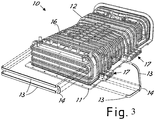
- FIG 3 shows diagrammatically mould 10 for rotary moulding prepared in accordance with European patent application 07005758.3 .
- Mould 10 includes a mould body 11. The interior reproduces the desired shape. On the external surface, there are grooves 16, forming channels that are open on the top. Advantageously the grooves are formed laterally by ribs 12, appropriately separated, and projecting from the external surface of the mould to form the side surfaces of the channels.
- the channel grooves or ribs can be obtained by mechanical removal of material or directly when melting the mould body. This can also be done to conform to the technique of realisation of the metal mould shell: the side walls of the heat-regulation system can be conveniently realised by mechanical processing from a metallic block or by melting.
- the preferred metal is aluminium.
- Each channel is closed in segments by metallic strips welded between the ribs.
- the strips include straight sheet metal bands 13 in the straight sections, that are cut from a ribbon and possibly bent, and from curves of sheet metal handlebar 14, advantageously cut from a metal sheet, welded over the pairs of ribs which realise the channel sides.
- the channels end in unions 17 for connection of known means (not shown) for circulation of the heat-regulation fluids, both for heating and for cooling.
- the material of the bands and curves of suitable thickness can be the same as that of the ribs.
- the unions between one strip segment and the other can also be obtained advantageously by welding.
- the circulation tubing have the fluid access and outlet holes positioned at a few centimeters apart and that the fluid delivery and return sections be arranged in alternating positions so as to compensate on the mould surface for the progressive cooling of the fluid during baking and progressive heating during the solidification step as a consequence of the thermal exchange with the mould.
- the arrangement of the tubing in alternating order between the delivery and return sections of the heating and cooling fluids of the mould achieves the purpose of balancing the temperature gap between the delivery and returning fluid.
- the same piping can be used for both heating and cooling of the mould.
- the present machine is also designed to operate simultaneously with several moulds of different shapes and sizes, each having its own heating system.
- the various resins for each mould are dropped in appropriate feeders and the system automatically fills each mould with the appropriate resin at the appropriate time in the cycle.
- all rotomoulded articles are automatically demoulded and stored.
- the present disclosure also relates to a process to prepare two-layer articles in a robotised rotomoulding machine that comprises the steps of:
- the resins for layers A, B and optional C can be used in three different forms:
- the ratio DPE/DPA of the particle diameters is of at most 0.5.
- the resin compositions are in powder form or in micro-pellet form or combination thereof.
- micro-pellets are most preferred.
- the preferred polyethylene according to the present disclosure is a homo- or copolymer of ethylene produced with a catalyst comprising a metallocene on a silica/aluminoxane support. More preferably, the metallocene component is ethylene-bis-tetrahydroindenyl zirconium dichloride or dimethylsilylene-bis(2-methyl-4-phenyl-indenyl) zirconium dichloride. The most preferred metallocene component is ethylene-bis-tetrahydroindenyl zirconium dichloride.
- copolymer refers to the polymerisation product of one monomer and one or more comonomers.
- the melt index of the polyethylene resin used in the present disclosure are typically larger than 0.05 dg/min, preferably larger than 0.1 dg/min, more preferably larger than 0.2 dg/min, most preferably larger than 0.5 dg/min.
- the melt index is typically of at most 25 dg/min, preferably of at most 20 dg/min and most preferably of at most 16 dg/min.
- the melt flow index MI2 is measured following the method of standard test ASTM D 1283 at a temperature of 190°C and a load of 2.16 kg.
- the resin has a density of at least 0.910 g/cc, more preferably of at least 0.915 g/cc.
- the density is measured at a temperature of 23 °C following the method of standard test ASTM D 1505.
- the polyethylene of the present disclosure may also have a bi- or multimodal molecular weight distributions, i.e. they may be a blend of two or more polyolefins with different molecular weight distributions, which can be blended either physically or chemically, i.e. produced sequentially in two or more reactors.
- the polydispersity D of the polyethylene suitable for the present disclosure is in the range 2 to 20, preferably 2 to 10, more preferably less than or equal to 6, and most preferably less than or equal to 4, the latter range being typically associated with the preferred metallocene-prepared polyethylene resins.
- the polydispersity index D is defined as the ratio Mw/Mn of the weight average molecular weight Mw over the number average molecular weight Mn.
- polyamides that can be used in the present disclosure are the products of condensation:
- PA 6 and PA 6-6, PA-7 or PA-11 examples of polyamides.
- copolyamides Mention may be made of the copolyamides resulting from the condensation of at least two ⁇ , ⁇ -aminocarboxylic acids or of two lactams or of one lactam and one ⁇ , ⁇ -aminocarboxylic acid. Mention may also be made of the copolyamides resulting from the condensation of at least one ⁇ , ⁇ -aminocarboxylic acid (or a lactam), at least one diamine and at least one dicarboxylic acid.
- the copolyamide is chosen from PA 6/12 and and PA 6/6-6.
- polyamide and polyolefins can also be used as layer B.
- the polyamide is as disclosed hereabove.
- the polyolefin can be a functionalised or a non-functionalised polyolefin or can be a mixture of at least one functionalised and/or of at least one non-functionalised polyolefin.
- a non-functionalised polyolefin is conventionally a homopolymer or copolymer of ⁇ -olefins or of diolefins such as, for example, ethylene, propylene, 1-butene, 1-octene or butadiene.
- a functionalised polyolefin is a polyolefin grafted or copolymerised with a material that provides polarity and/or reactivity and it therefore depends upon the nature of the adjacent layers. It can be an ⁇ -olefin polymer containing reactive units (functionalities); such reactive units are acid, anhydride or epoxy functions.
- reactive units functionalities
- amine terminated materials can also be used in layer B and they are preferably selected from polyamide diamine (PAdiNH 2 ).
- PAdiNH 2 polyamide diamine
- the polyamides may have excesses of acid or amine end groups or may even have a proportion of alkyl or other end groups, for example aryl or any other function, deriving from the structure of the limiter chosen.
- the excess of acid end groups derives from a diacid chain limiter.
- the excess of amine end groups derives from a diamine chain limiter.
- a primary amine chain limiter leads to a polyamide chain having an alkyl end and an amine end.
- PAdiNH 2 The name diamine polyamide, PAdiNH 2 , refers to a polyamide which satisfies the following criteria:
- the polyamides that can be used in layer B may also be impact-modified polyamides.
- Supple modifiers may be made, for example, of functionalised polyolefins, grafted aliphatic polyesters, optionally grafted copolymers containing polyether blocks and polyamide blocks, and copolymers of ethylene and of an alkyl (meth)acrylate and/or of a saturated vinylcarboxylic acid ester.
- the modifier may also be a polyolefin chain with polyamide grafts or polyamide oligomers thus having affinities with the polyolefins and the polyamides.
- the supple modifier may also be a block copolymer.
- Foamed polyethylene may be used for layer A and/or foamed polyamide may be used for layer B.
- Layer B may further advantageously be prepared from polyurethane or from a composition comprising polyamide and ethylene/vinyl alcohol copolymers (EVOH), and more generally, from a composition comprising polyamide or EVOH and optionally another barrier layer.
- EVOH ethylene/vinyl alcohol copolymers
- EVOH is a crystalline polymer that has a molecular structure represented by the following formula:
- Plastic fuel tanks including EVOH are safe, light in weight and have a highly effective barrier against fuel vapour permeation, ensuring that they meet the most stringent international emission standards.
- the fuel barrier of EVOH is about 4,400 times stronger than that of high-density polyethylene.
- the second layer is prepared from polyamide.
- Polyamide is known to provide barrier properties and the addition of a polyamide layer thus provides improved barrier properties to the structure.
- the polyamide layer can be used as an inside layer to provide for example permeation resistance, or as an outside layer, with for example an inner layer allowing for food contact.
- layer B is prepared from EVOH.
- EVOH gives excellent barrier properties but it is fragile.
- the rotomoulded article thus preferably consists of three layers: a polyethylene composition layer/ an EVOH layer/ a polyethylene composition layer.
- both polyethylen compositions are the same.
- a polyamide (PA) layer also provides temperature stability at elevated temperatures of up to 115 °C.
- rotomoulded articles conventionally prepared with polyethylene exhibit temperature stability up to temperatures of at most 60 °C.
- a PA layer further provides good environmental stress crack resistance (ESCR).
- ESCR environmental stress crack resistance
- each layer is determined by the size of the final product, by the desired properties and by the cost.
- the thickness of any one layer is of at least 1 mm. Accordingly, the permeability requirements for fuel tanks are specified for layers having a thickness of at least 1 mm.
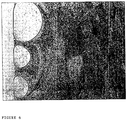
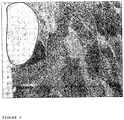
- the use of the new robotised rotomoulded machine described in European patent applications n°s 07000013.8 , 07005758.3 and Italian patent application MI2007000510 allows to reduce the thickness of any one layer to less than 1 mm. Thickness of as little as or smaller than 0.5 mm are easily obtained with an even thickness distribution. This can be seen in figures 4 and 5 relative to the present disclosure that show an even thickness distribution for the thin polyamide layer.
- the articles may contain additional layers for which the adherence is provided by conventional methods such as for example by a bonding layer.
- the combination of the specific resin compositions and of the robotised rotomoulding machine is particularly advantageous as it allows a much better control of the rotomoulding temperature throughout the cycle than in classical oven-based rotomoulding machines.
- This precise temperature control of the robotised machine allows a very even thickness distribution of the 2 or more layers whereas the resin compositions of the 2 or more layers allows an optimal adhesion between the layers.
- the final products thus have excellent thickness distribution even in complex structures, as well as excellent adhesion between the layers.
- wall thickness can be reduced while keeping the same performance. This allows the preparation of rotomoulded articles having excellent quality with much less material.
- the rejected articles amount to 10 to 30 % of the production. In the present disclosure, the amount of unsatisfactory articles is of less than 3% of the production.
- the method according to the present disclosure also allows a substantial reduction in cycle time of at least 25 % as can be seen from figure 10 : the larger the part, the larger the reduction in cycle time.
- This reduction in cycle time results from the combined effects of the selection of a metallocene-produced polyethylene resin and the selection of the rotomoulding machine with direct mould-heating device.
- the disclosed process is useful for preparing barrier containers and particularly useful for preparing fuel tanks for motorcycles, cars and lorries with a size ranging from 1 L to 600 L and more generally for preparing complex structures.
- the inner layer was a blend prepared by compounding 94 wt% of a metallocene-produced polyethylene resin sold by Total petrochemicals under the commercial name mPE M3670, having a melt flow index MI2 of 4 dg/min, and a density of 0.940 g/cm 3 , with 6 wt% of functionalised polyolefin consisting of 5 parts by weight of grafted polyethylene and 1 part by weight of ionomer and sold by Solvay under the name PRIEX®.
- the outer layer was a polyamide sold by Arkema under the name RILSAN® PA-11 RDG231 .
- the bottles had a capacity of 7 litres and a total wall thickness of about 4 mm.
- the polyamide layer was of about 0.5 mm and the polyethylene layer of about 3.5 mm.
- the bottles were prepared respectively according to the present invention as displayed in figures 1 and 2 and with the prior art equipment as displayed in figures 3 and 4 .
- Figure 7 shows the cycle times for preparing the bottles according to the present invention (Leonardo) and with the prior art equipment (Ferry). It can be seen that the total cycle time is reduced from 25 minutes for conventional rotomoulding to 15 minutes for the present invention.
Landscapes
- Engineering & Computer Science (AREA)
- Mechanical Engineering (AREA)
- Chemical & Material Sciences (AREA)
- Chemical Kinetics & Catalysis (AREA)
- Laminated Bodies (AREA)
Claims (11)
- Procédé de préparation d'articles rotomoulés ayant au moins deux couches dans une machine de rotomoulage comprenant plusieurs alimentateurs séparés et plusieurs moules, ledit procédé comprenant les étapes suivantes :a) fourniture d'une première composition de polyéthylène pour la couche A comprenant de 40 à 99 % en poids d'une résine de polyéthylène (PE) et de 60 à 1 % en poids d'une polyoléfine fonctionnalisée (FPO) ou d'un ionomère ou d'une polyoléfine (PO) greffée à un constituant non-polyoléfinique (NPO) sous forme d'un copolymère séquencé (PO-g-NPO) ou d'un mélange de ceux-ci ;b) fourniture d'une couche barrière B, ladite couche B étant en polyamide ou en EVOH ;d) alimentation de chaque résine dans un alimentateur séparé de la machine de rotomoulage ;e) installation d'un ou plusieurs moules de formes et de tailles identiques ou différentes ;f) démarrage du cycle de rotomoulage automatique ;g) démoulage et récupération automatiques des articles rotomoulés ;le procédé étant caractérisé en ce que les articles sont préparés dans une machine de rotomoulage robotisée dans laquelle chaque moule comprend des conduits conçus pour être traversés par un fluide thermorégulateur et lesdits conduits sont réalisés par des rainures sur les surfaces externes du moule, et en ce que la couche B a une distribution d'épaisseur uniforme et une épaisseur inférieure à 1 mm.
- Procédé selon la revendication 1, caractérisé en ce qu'il comprend en outre une étape c) de fourniture d'une seconde composition de polyéthylène pour la couche C préparée à partir d'un polymère qui comprend de 40 à 99 % en poids de polyéthylène et de 60 à 1 % en poids de polyéthylène fonctionnalisé, ladite composition étant identique ou différente de celle de la couche A ; dans lequel la couche C est adjacente à la couche A et/ou à la couche B et est en outre caractérisée en ce qu'elle a une bonne adhérence à la couche A et/ou à la couche B et n'est pas un mélange de la couche A et de la couche B.
- Procédé selon la revendication 1 ou 2, caractérisé en ce que la couche A est un mélange de 70 à 98 % en poids d'un polyéthylène préparé à partir d'un métallocène et de 30 à 2 % en poids d'une polyoléfine fonctionnalisée.
- Procédé selon l'une quelconque des revendications 1 à 3, caractérisé en ce que la polyoléfine fonctionnalisée est un mélange de polyéthylène greffé et d'ionomère.
- Procédé selon l'une quelconque des revendications 1 à 4, caractérisé en ce que les résines sont sous forme de poudre ou sous forme de micro-pastilles.
- Procédé selon l'une quelconque des revendications 1 à 5, caractérisé en ce que la couche B a une épaisseur inférieure à 0,7 mm.
- Procédé selon l'une quelconque des revendications 1 à 6, caractérisé en ce que la couche B a une épaisseur égale ou inférieure à 0,5 mm.
- Contenants barrières préparés par le procédé selon l'une quelconque des revendications 1 à 7, dans lesquels la couche barrière B est préparée à partir de polyamide et la couche C est absente.
- Contenants barrières préparés par le procédé selon l'une quelconque des revendications 2 à 7, dans lesquels la couche barrière B est préparée à partir d'EVOH et la couche C est présente, est la même que la couche A et n'est pas adjacente à la couche A.
- Réservoirs barrières préparés à partir des contenants barrières selon la revendication 8 ou la revendication 9.
- Réservoirs de carburant préparés à partir des réservoirs barrières selon la revendication 10.
Priority Applications (1)
| Application Number | Priority Date | Filing Date | Title |
|---|---|---|---|
| EP08846261.9A EP2207679B1 (fr) | 2007-11-07 | 2008-11-04 | Articles rotomoulés multicouches |
Applications Claiming Priority (3)
| Application Number | Priority Date | Filing Date | Title |
|---|---|---|---|
| EP07120135A EP2058121A1 (fr) | 2007-11-07 | 2007-11-07 | Articles rotomoulés multicouches |
| EP08846261.9A EP2207679B1 (fr) | 2007-11-07 | 2008-11-04 | Articles rotomoulés multicouches |
| PCT/EP2008/064948 WO2009059974A1 (fr) | 2007-11-07 | 2008-11-04 | Articles multicouches rotomoulés |
Publications (2)
| Publication Number | Publication Date |
|---|---|
| EP2207679A1 EP2207679A1 (fr) | 2010-07-21 |
| EP2207679B1 true EP2207679B1 (fr) | 2020-09-09 |
Family
ID=39370767
Family Applications (2)
| Application Number | Title | Priority Date | Filing Date |
|---|---|---|---|
| EP07120135A Withdrawn EP2058121A1 (fr) | 2007-11-07 | 2007-11-07 | Articles rotomoulés multicouches |
| EP08846261.9A Active EP2207679B1 (fr) | 2007-11-07 | 2008-11-04 | Articles rotomoulés multicouches |
Family Applications Before (1)
| Application Number | Title | Priority Date | Filing Date |
|---|---|---|---|
| EP07120135A Withdrawn EP2058121A1 (fr) | 2007-11-07 | 2007-11-07 | Articles rotomoulés multicouches |
Country Status (6)
| Country | Link |
|---|---|
| US (1) | US8658070B2 (fr) |
| EP (2) | EP2058121A1 (fr) |
| CN (1) | CN101855079B (fr) |
| AU (1) | AU2008324183B2 (fr) |
| WO (1) | WO2009059974A1 (fr) |
| ZA (1) | ZA201003921B (fr) |
Families Citing this family (6)
| Publication number | Priority date | Publication date | Assignee | Title |
|---|---|---|---|---|
| US8967674B2 (en) * | 2009-06-02 | 2015-03-03 | Prinsco, Inc. | Rib construction for large diameter pipe fittings |
| EP2832519B1 (fr) | 2013-07-30 | 2016-03-16 | Confindustria Bergamo | Moule pour moulage rotatif et procédé de chauffage dudit moule |
| EP2832520B1 (fr) | 2013-07-30 | 2016-04-06 | Confindustria Bergamo | Machine et procédé de moulage rotatif d'objets creux en matière thermoplastique |
| US10814530B2 (en) * | 2016-10-12 | 2020-10-27 | Plastigi | Mold device for a rotational molding device |
| CN108407165B (zh) * | 2018-03-14 | 2020-10-30 | 西陇科学股份有限公司 | 具有梯度结构的超纯试剂包装用桶的滚塑制备方法 |
| CN108422609A (zh) * | 2018-05-17 | 2018-08-21 | 烟台环通滚塑设备有限公司 | 一种导热油加热的滚塑机 |
Family Cites Families (5)
| Publication number | Priority date | Publication date | Assignee | Title |
|---|---|---|---|---|
| FR2128241A2 (en) * | 1971-03-10 | 1972-10-20 | Secmer | Rotational moulding machine - with induction heating tubes perforated for accelerated cooling |
| GB9014430D0 (en) * | 1990-06-28 | 1990-08-22 | Weber Reinhart | Method of producing nickel shell molds |
| ATE554924T1 (de) * | 2002-11-21 | 2012-05-15 | Total Petrochemicals Res Feluy | Mehrschichtiges rotationsformen |
| US20070063370A1 (en) * | 2005-09-16 | 2007-03-22 | New Heat Llc | Molding system and method |
| ITMI20060557A1 (it) * | 2006-03-24 | 2007-09-25 | Persico Spa | Stampo con condotti di termoregolazione e suo metodo di realizzazione |
-
2007
- 2007-11-07 EP EP07120135A patent/EP2058121A1/fr not_active Withdrawn
-
2008
- 2008-11-04 WO PCT/EP2008/064948 patent/WO2009059974A1/fr not_active Ceased
- 2008-11-04 CN CN2008801151726A patent/CN101855079B/zh not_active Expired - Fee Related
- 2008-11-04 EP EP08846261.9A patent/EP2207679B1/fr active Active
- 2008-11-04 AU AU2008324183A patent/AU2008324183B2/en not_active Ceased
- 2008-11-04 US US12/740,851 patent/US8658070B2/en not_active Expired - Fee Related
-
2010
- 2010-06-02 ZA ZA2010/03921A patent/ZA201003921B/en unknown
Non-Patent Citations (1)
| Title |
|---|
| None * |
Also Published As
| Publication number | Publication date |
|---|---|
| EP2058121A1 (fr) | 2009-05-13 |
| US8658070B2 (en) | 2014-02-25 |
| AU2008324183B2 (en) | 2012-05-03 |
| CN101855079A (zh) | 2010-10-06 |
| EP2207679A1 (fr) | 2010-07-21 |
| CN101855079B (zh) | 2013-12-11 |
| ZA201003921B (en) | 2014-10-29 |
| AU2008324183A1 (en) | 2009-05-14 |
| US20110017749A1 (en) | 2011-01-27 |
| WO2009059974A1 (fr) | 2009-05-14 |
Similar Documents
| Publication | Publication Date | Title |
|---|---|---|
| US9962911B2 (en) | Multilayer rotational moulding | |
| US9815228B2 (en) | Rotomoulded articles prepared from a blend of polyethylene powders | |
| EP2207679B1 (fr) | Articles rotomoulés multicouches | |
| US9327430B2 (en) | Rotomoulded structural parts having asymmetrical layering | |
| US9718090B2 (en) | Method for preparing rotolined articles |
Legal Events
| Date | Code | Title | Description |
|---|---|---|---|
| PUAI | Public reference made under article 153(3) epc to a published international application that has entered the european phase |
Free format text: ORIGINAL CODE: 0009012 |
|
| 17P | Request for examination filed |
Effective date: 20100326 |
|
| AK | Designated contracting states |
Kind code of ref document: A1 Designated state(s): AT BE BG CH CY CZ DE DK EE ES FI FR GB GR HR HU IE IS IT LI LT LU LV MC MT NL NO PL PT RO SE SI SK TR |
|
| AX | Request for extension of the european patent |
Extension state: AL BA MK RS |
|
| DAX | Request for extension of the european patent (deleted) | ||
| RAP1 | Party data changed (applicant data changed or rights of an application transferred) |
Owner name: PERSICO S.P.A. Owner name: TOTAL RESEARCH & TECHNOLOGY FELUY |
|
| STAA | Information on the status of an ep patent application or granted ep patent |
Free format text: STATUS: EXAMINATION IS IN PROGRESS |
|
| 17Q | First examination report despatched |
Effective date: 20170719 |
|
| GRAP | Despatch of communication of intention to grant a patent |
Free format text: ORIGINAL CODE: EPIDOSNIGR1 |
|
| STAA | Information on the status of an ep patent application or granted ep patent |
Free format text: STATUS: GRANT OF PATENT IS INTENDED |
|
| INTG | Intention to grant announced |
Effective date: 20200326 |
|
| GRAS | Grant fee paid |
Free format text: ORIGINAL CODE: EPIDOSNIGR3 |
|
| GRAA | (expected) grant |
Free format text: ORIGINAL CODE: 0009210 |
|
| STAA | Information on the status of an ep patent application or granted ep patent |
Free format text: STATUS: THE PATENT HAS BEEN GRANTED |
|
| AK | Designated contracting states |
Kind code of ref document: B1 Designated state(s): AT BE BG CH CY CZ DE DK EE ES FI FR GB GR HR HU IE IS IT LI LT LU LV MC MT NL NO PL PT RO SE SI SK TR |
|
| REG | Reference to a national code |
Ref country code: GB Ref legal event code: FG4D |
|
| REG | Reference to a national code |
Ref country code: AT Ref legal event code: REF Ref document number: 1311079 Country of ref document: AT Kind code of ref document: T Effective date: 20200915 Ref country code: CH Ref legal event code: EP |
|
| REG | Reference to a national code |
Ref country code: DE Ref legal event code: R096 Ref document number: 602008063236 Country of ref document: DE |
|
| REG | Reference to a national code |
Ref country code: IE Ref legal event code: FG4D |
|
| REG | Reference to a national code |
Ref country code: LT Ref legal event code: MG4D |
|
| PG25 | Lapsed in a contracting state [announced via postgrant information from national office to epo] |
Ref country code: SE Free format text: LAPSE BECAUSE OF FAILURE TO SUBMIT A TRANSLATION OF THE DESCRIPTION OR TO PAY THE FEE WITHIN THE PRESCRIBED TIME-LIMIT Effective date: 20200909 Ref country code: HR Free format text: LAPSE BECAUSE OF FAILURE TO SUBMIT A TRANSLATION OF THE DESCRIPTION OR TO PAY THE FEE WITHIN THE PRESCRIBED TIME-LIMIT Effective date: 20200909 Ref country code: LT Free format text: LAPSE BECAUSE OF FAILURE TO SUBMIT A TRANSLATION OF THE DESCRIPTION OR TO PAY THE FEE WITHIN THE PRESCRIBED TIME-LIMIT Effective date: 20200909 Ref country code: GR Free format text: LAPSE BECAUSE OF FAILURE TO SUBMIT A TRANSLATION OF THE DESCRIPTION OR TO PAY THE FEE WITHIN THE PRESCRIBED TIME-LIMIT Effective date: 20201210 Ref country code: FI Free format text: LAPSE BECAUSE OF FAILURE TO SUBMIT A TRANSLATION OF THE DESCRIPTION OR TO PAY THE FEE WITHIN THE PRESCRIBED TIME-LIMIT Effective date: 20200909 Ref country code: NO Free format text: LAPSE BECAUSE OF FAILURE TO SUBMIT A TRANSLATION OF THE DESCRIPTION OR TO PAY THE FEE WITHIN THE PRESCRIBED TIME-LIMIT Effective date: 20201209 Ref country code: BG Free format text: LAPSE BECAUSE OF FAILURE TO SUBMIT A TRANSLATION OF THE DESCRIPTION OR TO PAY THE FEE WITHIN THE PRESCRIBED TIME-LIMIT Effective date: 20201209 |
|
| REG | Reference to a national code |
Ref country code: AT Ref legal event code: MK05 Ref document number: 1311079 Country of ref document: AT Kind code of ref document: T Effective date: 20200909 |
|
| REG | Reference to a national code |
Ref country code: NL Ref legal event code: MP Effective date: 20200909 |
|
| PG25 | Lapsed in a contracting state [announced via postgrant information from national office to epo] |
Ref country code: PL Free format text: LAPSE BECAUSE OF FAILURE TO SUBMIT A TRANSLATION OF THE DESCRIPTION OR TO PAY THE FEE WITHIN THE PRESCRIBED TIME-LIMIT Effective date: 20200909 Ref country code: LV Free format text: LAPSE BECAUSE OF FAILURE TO SUBMIT A TRANSLATION OF THE DESCRIPTION OR TO PAY THE FEE WITHIN THE PRESCRIBED TIME-LIMIT Effective date: 20200909 |
|
| PG25 | Lapsed in a contracting state [announced via postgrant information from national office to epo] |
Ref country code: NL Free format text: LAPSE BECAUSE OF FAILURE TO SUBMIT A TRANSLATION OF THE DESCRIPTION OR TO PAY THE FEE WITHIN THE PRESCRIBED TIME-LIMIT Effective date: 20200909 Ref country code: PT Free format text: LAPSE BECAUSE OF FAILURE TO SUBMIT A TRANSLATION OF THE DESCRIPTION OR TO PAY THE FEE WITHIN THE PRESCRIBED TIME-LIMIT Effective date: 20210111 Ref country code: RO Free format text: LAPSE BECAUSE OF FAILURE TO SUBMIT A TRANSLATION OF THE DESCRIPTION OR TO PAY THE FEE WITHIN THE PRESCRIBED TIME-LIMIT Effective date: 20200909 Ref country code: EE Free format text: LAPSE BECAUSE OF FAILURE TO SUBMIT A TRANSLATION OF THE DESCRIPTION OR TO PAY THE FEE WITHIN THE PRESCRIBED TIME-LIMIT Effective date: 20200909 Ref country code: CZ Free format text: LAPSE BECAUSE OF FAILURE TO SUBMIT A TRANSLATION OF THE DESCRIPTION OR TO PAY THE FEE WITHIN THE PRESCRIBED TIME-LIMIT Effective date: 20200909 |
|
| PG25 | Lapsed in a contracting state [announced via postgrant information from national office to epo] |
Ref country code: AT Free format text: LAPSE BECAUSE OF FAILURE TO SUBMIT A TRANSLATION OF THE DESCRIPTION OR TO PAY THE FEE WITHIN THE PRESCRIBED TIME-LIMIT Effective date: 20200909 Ref country code: ES Free format text: LAPSE BECAUSE OF FAILURE TO SUBMIT A TRANSLATION OF THE DESCRIPTION OR TO PAY THE FEE WITHIN THE PRESCRIBED TIME-LIMIT Effective date: 20200909 Ref country code: IS Free format text: LAPSE BECAUSE OF FAILURE TO SUBMIT A TRANSLATION OF THE DESCRIPTION OR TO PAY THE FEE WITHIN THE PRESCRIBED TIME-LIMIT Effective date: 20210109 |
|
| REG | Reference to a national code |
Ref country code: DE Ref legal event code: R097 Ref document number: 602008063236 Country of ref document: DE |
|
| PG25 | Lapsed in a contracting state [announced via postgrant information from national office to epo] |
Ref country code: MC Free format text: LAPSE BECAUSE OF FAILURE TO SUBMIT A TRANSLATION OF THE DESCRIPTION OR TO PAY THE FEE WITHIN THE PRESCRIBED TIME-LIMIT Effective date: 20200909 Ref country code: SK Free format text: LAPSE BECAUSE OF FAILURE TO SUBMIT A TRANSLATION OF THE DESCRIPTION OR TO PAY THE FEE WITHIN THE PRESCRIBED TIME-LIMIT Effective date: 20200909 |
|
| REG | Reference to a national code |
Ref country code: CH Ref legal event code: PL |
|
| PLBE | No opposition filed within time limit |
Free format text: ORIGINAL CODE: 0009261 |
|
| STAA | Information on the status of an ep patent application or granted ep patent |
Free format text: STATUS: NO OPPOSITION FILED WITHIN TIME LIMIT |
|
| PG25 | Lapsed in a contracting state [announced via postgrant information from national office to epo] |
Ref country code: LU Free format text: LAPSE BECAUSE OF NON-PAYMENT OF DUE FEES Effective date: 20201104 |
|
| 26N | No opposition filed |
Effective date: 20210610 |
|
| PG25 | Lapsed in a contracting state [announced via postgrant information from national office to epo] |
Ref country code: CH Free format text: LAPSE BECAUSE OF NON-PAYMENT OF DUE FEES Effective date: 20201130 Ref country code: DK Free format text: LAPSE BECAUSE OF FAILURE TO SUBMIT A TRANSLATION OF THE DESCRIPTION OR TO PAY THE FEE WITHIN THE PRESCRIBED TIME-LIMIT Effective date: 20200909 Ref country code: SI Free format text: LAPSE BECAUSE OF FAILURE TO SUBMIT A TRANSLATION OF THE DESCRIPTION OR TO PAY THE FEE WITHIN THE PRESCRIBED TIME-LIMIT Effective date: 20200909 Ref country code: LI Free format text: LAPSE BECAUSE OF NON-PAYMENT OF DUE FEES Effective date: 20201130 |
|
| PG25 | Lapsed in a contracting state [announced via postgrant information from national office to epo] |
Ref country code: IE Free format text: LAPSE BECAUSE OF NON-PAYMENT OF DUE FEES Effective date: 20201104 |
|
| PGFP | Annual fee paid to national office [announced via postgrant information from national office to epo] |
Ref country code: DE Payment date: 20211118 Year of fee payment: 14 Ref country code: GB Payment date: 20211118 Year of fee payment: 14 Ref country code: FR Payment date: 20211122 Year of fee payment: 14 |
|
| PGFP | Annual fee paid to national office [announced via postgrant information from national office to epo] |
Ref country code: IT Payment date: 20211119 Year of fee payment: 14 Ref country code: BE Payment date: 20211118 Year of fee payment: 14 |
|
| PG25 | Lapsed in a contracting state [announced via postgrant information from national office to epo] |
Ref country code: TR Free format text: LAPSE BECAUSE OF FAILURE TO SUBMIT A TRANSLATION OF THE DESCRIPTION OR TO PAY THE FEE WITHIN THE PRESCRIBED TIME-LIMIT Effective date: 20200909 Ref country code: MT Free format text: LAPSE BECAUSE OF FAILURE TO SUBMIT A TRANSLATION OF THE DESCRIPTION OR TO PAY THE FEE WITHIN THE PRESCRIBED TIME-LIMIT Effective date: 20200909 Ref country code: CY Free format text: LAPSE BECAUSE OF FAILURE TO SUBMIT A TRANSLATION OF THE DESCRIPTION OR TO PAY THE FEE WITHIN THE PRESCRIBED TIME-LIMIT Effective date: 20200909 |
|
| REG | Reference to a national code |
Ref country code: DE Ref legal event code: R119 Ref document number: 602008063236 Country of ref document: DE |
|
| GBPC | Gb: european patent ceased through non-payment of renewal fee |
Effective date: 20221104 |
|
| REG | Reference to a national code |
Ref country code: BE Ref legal event code: MM Effective date: 20221130 |
|
| PG25 | Lapsed in a contracting state [announced via postgrant information from national office to epo] |
Ref country code: IT Free format text: LAPSE BECAUSE OF NON-PAYMENT OF DUE FEES Effective date: 20221104 Ref country code: GB Free format text: LAPSE BECAUSE OF NON-PAYMENT OF DUE FEES Effective date: 20221104 Ref country code: DE Free format text: LAPSE BECAUSE OF NON-PAYMENT OF DUE FEES Effective date: 20230601 |
|
| PG25 | Lapsed in a contracting state [announced via postgrant information from national office to epo] |
Ref country code: FR Free format text: LAPSE BECAUSE OF NON-PAYMENT OF DUE FEES Effective date: 20221130 Ref country code: BE Free format text: LAPSE BECAUSE OF NON-PAYMENT OF DUE FEES Effective date: 20221130 |