EP2206680A2 - Synthesis of Alkali Metal Dodecaborates - Google Patents
Synthesis of Alkali Metal Dodecaborates Download PDFInfo
- Publication number
- EP2206680A2 EP2206680A2 EP09178854A EP09178854A EP2206680A2 EP 2206680 A2 EP2206680 A2 EP 2206680A2 EP 09178854 A EP09178854 A EP 09178854A EP 09178854 A EP09178854 A EP 09178854A EP 2206680 A2 EP2206680 A2 EP 2206680A2
- Authority
- EP
- European Patent Office
- Prior art keywords
- atoms
- heteroatoms
- ring
- combinations
- alkali metal
- Prior art date
- Legal status (The legal status is an assumption and is not a legal conclusion. Google has not performed a legal analysis and makes no representation as to the accuracy of the status listed.)
- Withdrawn
Links
Classifications
-
- C—CHEMISTRY; METALLURGY
- C01—INORGANIC CHEMISTRY
- C01B—NON-METALLIC ELEMENTS; COMPOUNDS THEREOF; METALLOIDS OR COMPOUNDS THEREOF NOT COVERED BY SUBCLASS C01C
- C01B6/00—Hydrides of metals including fully or partially hydrided metals, alloys or intermetallic compounds ; Compounds containing at least one metal-hydrogen bond, e.g. (GeH3)2S, SiH GeH; Monoborane or diborane; Addition complexes thereof
- C01B6/06—Hydrides of aluminium, gallium, indium, thallium, germanium, tin, lead, arsenic, antimony, bismuth or polonium; Monoborane; Diborane; Addition complexes thereof
- C01B6/10—Monoborane; Diborane; Addition complexes thereof
- C01B6/13—Addition complexes of monoborane or diborane, e.g. with phosphine, arsine or hydrazine
- C01B6/15—Metal borohydrides; Addition complexes thereof
- C01B6/19—Preparation from other compounds of boron
- C01B6/21—Preparation of borohydrides of alkali metals, alkaline earth metals, magnesium or beryllium; Addition complexes thereof, e.g. LiBH4.2N2H4, NaB2H7
Definitions
- This invention relates generally to a method for preparing M 2 B 12 H 12 from amine borane and sodium borohydride.
- the problem addressed by this invention is to provide a more efficient process for producing M 2 B 12 H 12 from boranes and borohydride salts.
- the present invention is directed to a method for preparing M 2 B 12 H 12 , wherein M is an alkali metal, from an alkali metal borohydride and an amine borane.
- the method comprises allowing the alkali metal borohydride to react with excess amine borane in contact with a complexing agent selected from the group consisting of: (i) rings containing nine to twenty ring atoms, at least three of which are heteroatoms which are O, N, S or combinations thereof; and (ii) acyclic compounds having at least four atoms other than hydrogen atoms, at least two of which are heteroatoms which are O, N, S or combinations thereof, and in which said heteroatoms are separated by two or three carbon atoms.
- alkyl group is a saturated hydrocarbyl group having from one to twenty carbon atoms, and may be linear, branched or cyclic. In some embodiments of the invention, alkyl groups are linear or branched, alternatively they are linear. In some embodiments, alkyl groups have from one to six carbon atoms, alternatively from one to four carbon atoms.
- the amine borane is represented as R 3 NBH 3 , wherein R may represent the same or different alkyl groups and/or hydrogen, provided that at least two alkyl groups are present.
- the alkyl groups are C 1 -C 4 acyclic alkyl groups, alternatively methyl or ethyl.
- R does not represent hydrogen
- the amine is a trialkylamine.
- M is sodium or potassium.
- the complexing agent is at least one compound comprising a ring containing nine to twenty ring atoms.
- the ring is a carbon-containing ring which also contains at least three heteroatoms selected from O, N, S and combinations thereof.
- the atoms forming the ring consist of carbon and heteroatoms selected from O, N, S and combinations thereof.
- the ring is attached by covalent bonding to a polymer chain, i.e., the polymer chain is a substituent on one or more ring atoms.
- the polymer-ring combination will precipitate from water or acidic solutions, enabling its separation from reaction products.
- the complexing agent ring includes atoms which are part of another ring, e.g., the complexing agent ring may include one of more units of formula (I) wherein X represents O, S or NH; alternatively at least two units, alternatively no more than four units.
- atoms in the included ring are counted as atoms in the larger complexing agent ring in such a way as to use the lowest possible number of atoms from the included ring, so that in the case illustrated in formula (I), X and its two adjacent carbon atoms are considered part of the complexing agent ring for the purposes of determining whether the ring has from nine to twenty atoms, and of determining the total number of heteroatoms in the ring.
- the complexing agent ring contains from two to six units of formula -(CH 2 CH 2 X)-, wherein X represents O, S or NH, alternatively from three to six, alternatively from four to six, alternatively five or six.
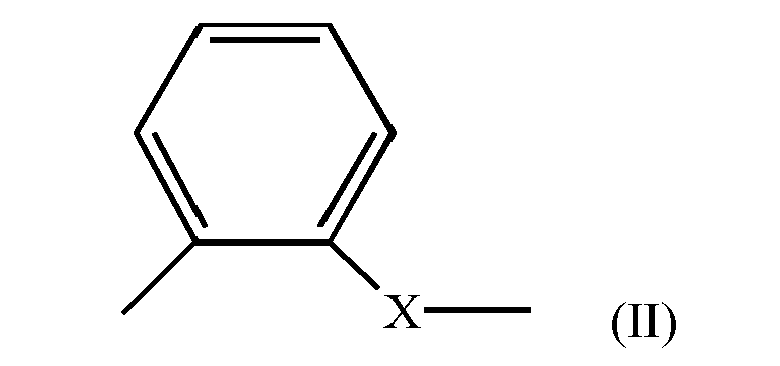
- two to four units including an aromatic ring may be present in the ring, e.g., those including two carbon atoms from an aromatic ring, like units of formula (II) and those including four carbon atoms from an aromatic ring, like units of formula (III)
- Units of formula (II) are in some cases derived from catechol or 1,2-phenylenediamine.
- aromatic groups are attached to the complexing agent ring, e.g., the ring contains at least one unit of formula -(CHZCH 2 X)-, wherein Z is a C 6 -C 16 substituent group containing at least one aromatic ring, alternatively at least two unit, alternatively no more than 6 units, alternatively no more than 5 units, alternatively no more than 4 units.
- Z is benzyloxy, benzyloxy substituted with alkyl or alkoxy groups, or naphthyloxy.
- Substituents also may be situated between the benzyloxy group and the -(CHZCH 2 X)- unit, e.g., one or more ethyleneoxy or ethylenimine units. Any combination of the various structural units described above may be present.
- the heteroatoms are selected from O, N and combinations thereof.
- the ring contains at least twelve ring atoms, alternatively at least fifteen ring atoms, alternatively no more than eighteen ring atoms.
- the ring contains at least four heteroatoms, alternatively at least five heteroatoms.
- the heteroatom is oxygen.
- the complexing agent is an acyclic compound having at least four atoms other than hydrogen atoms, at least two of which are heteroatoms selected from O, N, S and combinations thereof, and in which said heteroatoms are separated by two or three carbon atoms, i.e., there are units of structure X-C-C-X or X-C-C-C-X, such that each heteroatom is separated from each of its nearest neighbor heteroatoms by two or three carbon atoms.
- the acyclic compound is a carbon-containing compound which also contains the specified number and type of heteroatoms. Examples of such compounds are derivatives of ethylene glycol and ethylenediamine.
- the complexing agent is an acyclic compound having at least seven atoms, at least three of which are O, N, S or combinations thereof; alternatively at least ten atoms, at least four of which are O, N, S or combinations thereof. In some embodiments of the invention, the complexing agent is an acyclic compound having heteroatoms selected only from among O, N and combinations thereof.
- the complexing agent may be a combination of ring compounds and acyclic compounds.
- complexing agents are used for which the log (base 10) of the formation constant for the complex with sodium or potassium ion, measured at 25°C, is at least 1, alternatively at least 2, alternatively at least 3.
- the amount of complexing agent is from 0.1% to 10% of the amount of alkali metal borohydride, alternatively from 0.5% to 7%, alternatively from 1% to 5%.
- the reaction occurs at a temperature in the range from 50°C to 200°C, alternatively at least 75°C, alternatively at least 90°C, alternatively no greater than 170°C, alternatively no greater than 150°C, alternatively no greater than 140°C, alternatively no greater than 120°C.
Landscapes
- Chemical & Material Sciences (AREA)
- Organic Chemistry (AREA)
- Life Sciences & Earth Sciences (AREA)
- General Life Sciences & Earth Sciences (AREA)
- Geology (AREA)
- Inorganic Chemistry (AREA)
Abstract
Description
- This invention relates generally to a method for preparing M2B12H12 from amine borane and sodium borohydride.
- Processes for production of M2B12H12 from boranes and sodium borohydride are well known. For example,
U.S. Pat. No. 3,551,120 describes preparation of M2B12H12 from boranes and sodium borohydride. However, yields are low due to formation of other hydroborate species as products. - The problem addressed by this invention is to provide a more efficient process for producing M2B12H12 from boranes and borohydride salts.
- The present invention is directed to a method for preparing M2B12H12, wherein M is an alkali metal, from an alkali metal borohydride and an amine borane. The method comprises allowing the alkali metal borohydride to react with excess amine borane in contact with a complexing agent selected from the group consisting of: (i) rings containing nine to twenty ring atoms, at least three of which are heteroatoms which are O, N, S or combinations thereof; and (ii) acyclic compounds having at least four atoms other than hydrogen atoms, at least two of which are heteroatoms which are O, N, S or combinations thereof, and in which said heteroatoms are separated by two or three carbon atoms.
- Unless otherwise specified, all percentages herein are stated as weight percentages and temperatures are in °C. Amounts in parts per million (ppm) are on the basis of weight/volume.
- An "alkyl" group is a saturated hydrocarbyl group having from one to twenty carbon atoms, and may be linear, branched or cyclic. In some embodiments of the invention, alkyl groups are linear or branched, alternatively they are linear. In some embodiments, alkyl groups have from one to six carbon atoms, alternatively from one to four carbon atoms.
- The reaction of an alkali metal borohydride and an amine borane is shown in the following equation for the case where M is sodium and the amine borane is triethylamine borane
2 NaBH4 + Excess NEt3BH3 → 50-79 % Na2B12H12 + 5-10 % Na2B6H6 + 5-35% Na2B10H10 + 1-50% NaB12H11-x(NEt3)x + 10 NEt3 + 13 H2
The method of the present invention maximizes the amount of the desired product, M2B12H12 and minimizes formation of competitive hydroborate species. In general, the amine borane is represented as R3NBH3, wherein R may represent the same or different alkyl groups and/or hydrogen, provided that at least two alkyl groups are present. Preferably, the alkyl groups are C1-C4 acyclic alkyl groups, alternatively methyl or ethyl. Preferably, R does not represent hydrogen, and the amine is a trialkylamine. Preferably, M is sodium or potassium. - In some embodiments of the invention, the complexing agent is at least one compound comprising a ring containing nine to twenty ring atoms. The ring is a carbon-containing ring which also contains at least three heteroatoms selected from O, N, S and combinations thereof. In some embodiments of the invention, the atoms forming the ring consist of carbon and heteroatoms selected from O, N, S and combinations thereof. In some embodiments of the invention, the ring is attached by covalent bonding to a polymer chain, i.e., the polymer chain is a substituent on one or more ring atoms. In some embodiments, the polymer-ring combination will precipitate from water or acidic solutions, enabling its separation from reaction products. In some embodiments of the invention, the complexing agent ring includes atoms which are part of another ring, e.g., the complexing agent ring may include one of more units of formula (I)


- In some embodiments of the invention, the complexing agent is an acyclic compound having at least four atoms other than hydrogen atoms, at least two of which are heteroatoms selected from O, N, S and combinations thereof, and in which said heteroatoms are separated by two or three carbon atoms, i.e., there are units of structure X-C-C-X or X-C-C-C-X, such that each heteroatom is separated from each of its nearest neighbor heteroatoms by two or three carbon atoms. The acyclic compound is a carbon-containing compound which also contains the specified number and type of heteroatoms. Examples of such compounds are derivatives of ethylene glycol and ethylenediamine. Oligomers of these compounds, including di-, tri-, tetra- and penta-ethyleneglycols, glymes and other di-alkyl glycol ethers, diethylenetriamine, triethylenetetramine, tetraethylenepentamine, polyethylene glycols and polyethyleneimines also are suitable. Compounds in which the heteroatoms are part of amide or thioamide groups also are suitable, e.g., proteins. In some embodiments of the invention, the complexing agent is an acyclic compound having at least seven atoms, at least three of which are O, N, S or combinations thereof; alternatively at least ten atoms, at least four of which are O, N, S or combinations thereof. In some embodiments of the invention, the complexing agent is an acyclic compound having heteroatoms selected only from among O, N and combinations thereof.
- The complexing agent may be a combination of ring compounds and acyclic compounds.
- In some embodiments of the invention, complexing agents are used for which the log (base 10) of the formation constant for the complex with sodium or potassium ion, measured at 25°C, is at least 1, alternatively at least 2, alternatively at least 3.
- In some embodiments of the invention the amount of complexing agent is from 0.1% to 10% of the amount of alkali metal borohydride, alternatively from 0.5% to 7%, alternatively from 1% to 5%.
- Preferably, the reaction occurs at a temperature in the range from 50°C to 200°C, alternatively at least 75°C, alternatively at least 90°C, alternatively no greater than 170°C, alternatively no greater than 150°C, alternatively no greater than 140°C, alternatively no greater than 120°C.
Claims (10)
- A method for preparing M2B12H12, wherein M is an alkali metal, from an alkali metal borohydride and an amine borane; said method comprising allowing the alkali metal borohydride to react with excess amine borane in contact with a complexing agent selected from the group consisting of: (i) rings containing nine to twenty ring atoms, at least three of which are heteroatoms selected from O, N, S and combinations thereof; and (ii) acyclic compounds having at least four atoms other than hydrogen atoms, at least two of which are heteroatoms which are O, N, S or combinations thereof, and in which said heteroatoms are separated by two or three carbon atoms.
- The method of claim 1 in which M is sodium or potassium.
- The method of claim 2 in which the complexing agent is a ring containing twelve to twenty ring atoms, at least four of which are heteroatoms which are O, N or combinations thereof.
- The method of claim 3 in which the ring contains from two to six units of formula -(CH2CH2X)-, wherein X represents O, S or NH.
- The method of claim 4 in which the ring contains from fifteen to eighteen ring atoms.
- The method of claim 5 in which X is O.
- The method of claim 2 in which the complexing agent is an acyclic compound having at least seven atoms other than hydrogen atoms, at least three of which are heteroatoms which are O, N, S or combinations thereof.
- The method of claim 7 in which each heteroatom is separated from each of its nearest neighboring heteroatoms by two carbon atoms.
- The method of claim 8 in which the heteroatoms are selected from O, N and combinations thereof.
- The method of claim 9 in which the complexing agent has at least ten atoms other than hydrogen atoms, at least four of which are heteroatoms which are O, N or combinations thereof.
Applications Claiming Priority (1)
| Application Number | Priority Date | Filing Date | Title |
|---|---|---|---|
| US20475209P | 2009-01-09 | 2009-01-09 |
Publications (2)
| Publication Number | Publication Date |
|---|---|
| EP2206680A2 true EP2206680A2 (en) | 2010-07-14 |
| EP2206680A3 EP2206680A3 (en) | 2011-04-06 |
Family
ID=42110358
Family Applications (1)
| Application Number | Title | Priority Date | Filing Date |
|---|---|---|---|
| EP09178854A Withdrawn EP2206680A3 (en) | 2009-01-09 | 2009-12-11 | Synthesis of Alkali Metal Dodecaborates |
Country Status (7)
| Country | Link |
|---|---|
| US (1) | US20100178228A1 (en) |
| EP (1) | EP2206680A3 (en) |
| JP (1) | JP2010159205A (en) |
| KR (1) | KR20100082719A (en) |
| CN (1) | CN101792122A (en) |
| CA (1) | CA2688684A1 (en) |
| TW (1) | TW201029930A (en) |
Cited By (2)
| Publication number | Priority date | Publication date | Assignee | Title |
|---|---|---|---|---|
| US9598352B2 (en) | 2011-11-18 | 2017-03-21 | The Curators Of The University Of Missouri | Process and device for the production of polyhedral boranes |
| CZ308510B6 (en) * | 2019-08-07 | 2020-10-07 | Katchem Spol. S R.O. | Process for preparing anhydrous salts of the anion B12H12 2- with group I.A and II.A cations |
Families Citing this family (3)
| Publication number | Priority date | Publication date | Assignee | Title |
|---|---|---|---|---|
| RU2573679C2 (en) * | 2013-05-07 | 2016-01-27 | Российская Федерация, от имени которой выступает Министерство промышленности и торговли (Минпромторг России) | Method for obtaining potassium dodecahydro-closo-dodecaborate |
| RU2556930C2 (en) * | 2013-09-26 | 2015-07-20 | Федеральное государственное бюджетное учреждение науки Институт химии Дальневосточного отделения Российской академии наук (ИХ ДВО РАН) | Polyethyleneimine dodecahydro-closo-dodecarbonate and method of obtaining thereof |
| CN106829865A (en) * | 2017-01-21 | 2017-06-13 | 北京理工大学 | One kind prepares K2B12H12Method |
Family Cites Families (11)
| Publication number | Priority date | Publication date | Assignee | Title |
|---|---|---|---|---|
| US3355261A (en) * | 1963-04-29 | 1967-11-28 | Du Pont | Chemical process |
| FR2584398A1 (en) * | 1985-07-02 | 1987-01-09 | Elf Aquitaine | Process for the selective preparation of decahydrodecaborates and/or of dodecahydrododecaborates |
| US6410774B1 (en) * | 2001-03-30 | 2002-06-25 | General Electric Company | Method for recovery of catalyst components |
| US20050238573A1 (en) * | 2004-04-14 | 2005-10-27 | Qinglin Zhang | Systems and methods for hydrogen generation from solid hydrides |
| US20060196112A1 (en) * | 2005-03-02 | 2006-09-07 | Grant Berry | Borohydride fuel compositions and methods |
| US20060286020A1 (en) * | 2005-06-16 | 2006-12-21 | Ivanov Sergei V | Method for producing dodecahydrododecaborates |
| US7718154B2 (en) * | 2005-06-16 | 2010-05-18 | Air Products And Chemicals, Inc. | Process for producing boranes |
| CA2576585C (en) * | 2006-02-16 | 2011-06-21 | Rohm And Haas Company | Borohydride fuel formulation |
| CA2576588C (en) * | 2006-02-16 | 2011-08-16 | Rohm And Haas Company | Method for generation of hydrogen gas from borohydride |
| JP4836990B2 (en) * | 2007-06-05 | 2011-12-14 | ローム アンド ハース カンパニー | Hydrogen generating composition |
| JP2009114174A (en) * | 2007-11-05 | 2009-05-28 | Rohm & Haas Co | Preparation of MnB12H12 |
-
2009
- 2009-12-11 EP EP09178854A patent/EP2206680A3/en not_active Withdrawn
- 2009-12-14 JP JP2009282399A patent/JP2010159205A/en active Pending
- 2009-12-15 CA CA2688684A patent/CA2688684A1/en not_active Abandoned
- 2009-12-16 US US12/653,716 patent/US20100178228A1/en not_active Abandoned
- 2009-12-21 TW TW098143841A patent/TW201029930A/en unknown
-
2010
- 2010-01-06 KR KR1020100000860A patent/KR20100082719A/en not_active Ceased
- 2010-01-08 CN CN201010003573A patent/CN101792122A/en active Pending
Cited By (2)
| Publication number | Priority date | Publication date | Assignee | Title |
|---|---|---|---|---|
| US9598352B2 (en) | 2011-11-18 | 2017-03-21 | The Curators Of The University Of Missouri | Process and device for the production of polyhedral boranes |
| CZ308510B6 (en) * | 2019-08-07 | 2020-10-07 | Katchem Spol. S R.O. | Process for preparing anhydrous salts of the anion B12H12 2- with group I.A and II.A cations |
Also Published As
| Publication number | Publication date |
|---|---|
| CN101792122A (en) | 2010-08-04 |
| KR20100082719A (en) | 2010-07-19 |
| JP2010159205A (en) | 2010-07-22 |
| TW201029930A (en) | 2010-08-16 |
| CA2688684A1 (en) | 2010-07-09 |
| US20100178228A1 (en) | 2010-07-15 |
| EP2206680A3 (en) | 2011-04-06 |
Similar Documents
| Publication | Publication Date | Title |
|---|---|---|
| US20100178228A1 (en) | Synthesis of M2B12H12 | |
| Wang et al. | Metal BNH hydrogen-storage compound: Development and perspectives | |
| BR112012014695A2 (en) | epoxidization start-up process | |
| US9006425B2 (en) | Aluminum complexes and their use in the synthesis of cyclic carbonates | |
| US7563934B2 (en) | Preparation of MnB12H12 | |
| KR101046281B1 (en) | Amine Borane Synthesis | |
| RU2466999C1 (en) | METHOD OF OBTAINING A, α,ω-BIS-(1, 5, 3-DITHIAZEPINAN-3-YL)ALKANES | |
| CN101691378A (en) | Benzo or naphtha isoxazolidine derivatives and synthesis method thereof | |
| Du et al. | Intramolecular redox reaction for the synthesis of N-aryl pyrroles catalyzed by Lewis acids | |
| TW200611895A (en) | Process for preparing diphenylazetidinone derivatives | |
| CN102219799B (en) | A kind of preparation method of organic boric acid ester containing azacycle | |
| IN2012DN05166A (en) | ||
| Jeon et al. | Syntheses of sulfur and selenium analogues of pachastrissamine via double displacements of cyclic sulfate | |
| EP4140992A1 (en) | Method for preparing s-nicotine | |
| JP2011506323A5 (en) | ||
| KR101264166B1 (en) | Method for preparing 1,2-bis(5-aminotetrazol-1-yl)ethane | |
| EP2019083B1 (en) | Preparation of a hydrogen source for fuel cells | |
| CN106432309A (en) | Preparation method of alpha-amino acid boron trifluoride compound | |
| Williams et al. | A p-methoxybenzyl (PMB) protection/deprotection approach toward the synthesis of 5-phenoxy-4-chloro-N-(aryl/alkyl) thiophene-2-sulfonamides | |
| Choudhary | Development of Amine-Boranes and Derivatives for Reductive Amination | |
| RU2342378C2 (en) | Method of obtaining 3,4-fullero [60]tetrahydrothiophene | |
| Olar et al. | Synthesis, characterisation and thermal behaviour of some complexes with ligands having 1, 3, 4-thiadiazole moieties | |
| TW200706529A (en) | A process for preparing an alkenylether compound | |
| RU2349593C1 (en) | Method of producing 2,3-fullero-7-thiabicyclo [2,2,1]heptane | |
| RU2305098C1 (en) | Method for preparing di-[(6-benzyl-4,2,6-thiadiazolidine-2-yl)methyl]sulfide |
Legal Events
| Date | Code | Title | Description |
|---|---|---|---|
| PUAI | Public reference made under article 153(3) epc to a published international application that has entered the european phase |
Free format text: ORIGINAL CODE: 0009012 |
|
| 17P | Request for examination filed |
Effective date: 20091211 |
|
| AK | Designated contracting states |
Kind code of ref document: A2 Designated state(s): AT BE BG CH CY CZ DE DK EE ES FI FR GB GR HR HU IE IS IT LI LT LU LV MC MK MT NL NO PL PT RO SE SI SK SM TR |
|
| PUAL | Search report despatched |
Free format text: ORIGINAL CODE: 0009013 |
|
| AK | Designated contracting states |
Kind code of ref document: A3 Designated state(s): AT BE BG CH CY CZ DE DK EE ES FI FR GB GR HR HU IE IS IT LI LT LU LV MC MK MT NL NO PL PT RO SE SI SK SM TR |
|
| 17Q | First examination report despatched |
Effective date: 20120102 |
|
| STAA | Information on the status of an ep patent application or granted ep patent |
Free format text: STATUS: THE APPLICATION IS DEEMED TO BE WITHDRAWN |
|
| 18D | Application deemed to be withdrawn |
Effective date: 20120713 |