EP2201079B1 - Thermally conductive composition - Google Patents
Thermally conductive composition Download PDFInfo
- Publication number
- EP2201079B1 EP2201079B1 EP07838253.8A EP07838253A EP2201079B1 EP 2201079 B1 EP2201079 B1 EP 2201079B1 EP 07838253 A EP07838253 A EP 07838253A EP 2201079 B1 EP2201079 B1 EP 2201079B1
- Authority
- EP
- European Patent Office
- Prior art keywords
- thermally conductive
- conductive composition
- surface area
- oxide
- fillers
- Prior art date
- Legal status (The legal status is an assumption and is not a legal conclusion. Google has not performed a legal analysis and makes no representation as to the accuracy of the status listed.)
- Not-in-force
Links
- 239000000203 mixture Substances 0.000 title claims description 81
- 239000000945 filler Substances 0.000 claims description 88
- 239000003795 chemical substances by application Substances 0.000 claims description 46
- 229920001577 copolymer Polymers 0.000 claims description 20
- PZNSFCLAULLKQX-UHFFFAOYSA-N Boron nitride Chemical group N#B PZNSFCLAULLKQX-UHFFFAOYSA-N 0.000 claims description 18
- 229910052582 BN Inorganic materials 0.000 claims description 17
- 125000000524 functional group Chemical group 0.000 claims description 15
- RAXXELZNTBOGNW-UHFFFAOYSA-N imidazole Natural products C1=CNC=N1 RAXXELZNTBOGNW-UHFFFAOYSA-N 0.000 claims description 15
- BQCADISMDOOEFD-UHFFFAOYSA-N Silver Chemical compound [Ag] BQCADISMDOOEFD-UHFFFAOYSA-N 0.000 claims description 14
- 229920005989 resin Polymers 0.000 claims description 14
- 239000011347 resin Substances 0.000 claims description 14
- 238000000034 method Methods 0.000 claims description 13
- 239000004593 Epoxy Substances 0.000 claims description 10
- 229910052709 silver Inorganic materials 0.000 claims description 10
- 239000004332 silver Substances 0.000 claims description 10
- 229920003171 Poly (ethylene oxide) Polymers 0.000 claims description 9
- PXHVJJICTQNCMI-UHFFFAOYSA-N Nickel Chemical compound [Ni] PXHVJJICTQNCMI-UHFFFAOYSA-N 0.000 claims description 8
- 239000011230 binding agent Substances 0.000 claims description 8
- 238000002844 melting Methods 0.000 claims description 8
- 230000008018 melting Effects 0.000 claims description 8
- 229920001296 polysiloxane Polymers 0.000 claims description 8
- 239000011148 porous material Substances 0.000 claims description 8
- 229920001223 polyethylene glycol Polymers 0.000 claims description 7
- 239000011248 coating agent Substances 0.000 claims description 6
- 238000000576 coating method Methods 0.000 claims description 6
- 238000011049 filling Methods 0.000 claims description 5
- -1 fluorosilicones Polymers 0.000 claims description 5
- 229920001451 polypropylene glycol Polymers 0.000 claims description 5
- 230000008569 process Effects 0.000 claims description 5
- OKTJSMMVPCPJKN-UHFFFAOYSA-N Carbon Chemical compound [C] OKTJSMMVPCPJKN-UHFFFAOYSA-N 0.000 claims description 4
- RYGMFSIKBFXOCR-UHFFFAOYSA-N Copper Chemical compound [Cu] RYGMFSIKBFXOCR-UHFFFAOYSA-N 0.000 claims description 4
- UQSXHKLRYXJYBZ-UHFFFAOYSA-N Iron oxide Chemical compound [Fe]=O UQSXHKLRYXJYBZ-UHFFFAOYSA-N 0.000 claims description 4
- VYPSYNLAJGMNEJ-UHFFFAOYSA-N Silicium dioxide Chemical compound O=[Si]=O VYPSYNLAJGMNEJ-UHFFFAOYSA-N 0.000 claims description 4
- XLOMVQKBTHCTTD-UHFFFAOYSA-N Zinc monoxide Chemical compound [Zn]=O XLOMVQKBTHCTTD-UHFFFAOYSA-N 0.000 claims description 4
- 239000000853 adhesive Substances 0.000 claims description 4
- 230000001070 adhesive effect Effects 0.000 claims description 4
- 229910052782 aluminium Inorganic materials 0.000 claims description 4
- XAGFODPZIPBFFR-UHFFFAOYSA-N aluminium Chemical compound [Al] XAGFODPZIPBFFR-UHFFFAOYSA-N 0.000 claims description 4
- 230000008859 change Effects 0.000 claims description 4
- 229910052802 copper Inorganic materials 0.000 claims description 4
- 239000010949 copper Substances 0.000 claims description 4
- 239000010408 film Substances 0.000 claims description 4
- 229910052759 nickel Inorganic materials 0.000 claims description 4
- 150000002924 oxiranes Chemical class 0.000 claims description 4
- 229920003192 poly(bis maleimide) Polymers 0.000 claims description 4
- 229920000647 polyepoxide Polymers 0.000 claims description 4
- NDVLTYZPCACLMA-UHFFFAOYSA-N silver oxide Chemical compound [O-2].[Ag+].[Ag+] NDVLTYZPCACLMA-UHFFFAOYSA-N 0.000 claims description 4
- 239000000758 substrate Substances 0.000 claims description 4
- 150000001412 amines Chemical class 0.000 claims description 3
- 238000001035 drying Methods 0.000 claims description 3
- 239000004519 grease Substances 0.000 claims description 3
- 229910052751 metal Inorganic materials 0.000 claims description 3
- 239000002184 metal Substances 0.000 claims description 3
- 239000006072 paste Substances 0.000 claims description 3
- 150000003923 2,5-pyrrolediones Chemical class 0.000 claims description 2
- 125000003903 2-propenyl group Chemical group [H]C([*])([H])C([H])=C([H])[H] 0.000 claims description 2
- NIXOWILDQLNWCW-UHFFFAOYSA-M Acrylate Chemical compound [O-]C(=O)C=C NIXOWILDQLNWCW-UHFFFAOYSA-M 0.000 claims description 2
- 229910001369 Brass Inorganic materials 0.000 claims description 2
- QPLDLSVMHZLSFG-UHFFFAOYSA-N Copper oxide Chemical compound [Cu]=O QPLDLSVMHZLSFG-UHFFFAOYSA-N 0.000 claims description 2
- 239000005751 Copper oxide Substances 0.000 claims description 2
- FYYHWMGAXLPEAU-UHFFFAOYSA-N Magnesium Chemical compound [Mg] FYYHWMGAXLPEAU-UHFFFAOYSA-N 0.000 claims description 2
- 239000004642 Polyimide Substances 0.000 claims description 2
- QYKIQEUNHZKYBP-UHFFFAOYSA-N Vinyl ether Chemical class C=COC=C QYKIQEUNHZKYBP-UHFFFAOYSA-N 0.000 claims description 2
- PNEYBMLMFCGWSK-UHFFFAOYSA-N aluminium oxide Inorganic materials [O-2].[O-2].[O-2].[Al+3].[Al+3] PNEYBMLMFCGWSK-UHFFFAOYSA-N 0.000 claims description 2
- 239000010951 brass Substances 0.000 claims description 2
- 239000006229 carbon black Substances 0.000 claims description 2
- 239000002041 carbon nanotube Substances 0.000 claims description 2
- 229910021393 carbon nanotube Inorganic materials 0.000 claims description 2
- 229910000431 copper oxide Inorganic materials 0.000 claims description 2
- PMHQVHHXPFUNSP-UHFFFAOYSA-M copper(1+);methylsulfanylmethane;bromide Chemical compound Br[Cu].CSC PMHQVHHXPFUNSP-UHFFFAOYSA-M 0.000 claims description 2
- 239000004643 cyanate ester Substances 0.000 claims description 2
- 150000001913 cyanates Chemical class 0.000 claims description 2
- 239000010432 diamond Substances 0.000 claims description 2
- 229910003460 diamond Inorganic materials 0.000 claims description 2
- 125000003700 epoxy group Chemical group 0.000 claims description 2
- 239000003822 epoxy resin Substances 0.000 claims description 2
- 150000002194 fatty esters Chemical class 0.000 claims description 2
- VZCYOOQTPOCHFL-OWOJBTEDSA-L fumarate(2-) Chemical class [O-]C(=O)\C=C\C([O-])=O VZCYOOQTPOCHFL-OWOJBTEDSA-L 0.000 claims description 2
- 239000011521 glass Substances 0.000 claims description 2
- PCHJSUWPFVWCPO-UHFFFAOYSA-N gold Chemical compound [Au] PCHJSUWPFVWCPO-UHFFFAOYSA-N 0.000 claims description 2
- 229910052737 gold Inorganic materials 0.000 claims description 2
- 239000010931 gold Substances 0.000 claims description 2
- 239000010439 graphite Substances 0.000 claims description 2
- 229910002804 graphite Inorganic materials 0.000 claims description 2
- 239000012948 isocyanate Substances 0.000 claims description 2
- 150000002513 isocyanates Chemical class 0.000 claims description 2
- LVHBHZANLOWSRM-UHFFFAOYSA-N itaconic acid Chemical class OC(=O)CC(=C)C(O)=O LVHBHZANLOWSRM-UHFFFAOYSA-N 0.000 claims description 2
- 239000011777 magnesium Substances 0.000 claims description 2
- 229910052749 magnesium Inorganic materials 0.000 claims description 2
- 235000012245 magnesium oxide Nutrition 0.000 claims description 2
- AXZKOIWUVFPNLO-UHFFFAOYSA-N magnesium;oxygen(2-) Chemical class [O-2].[Mg+2] AXZKOIWUVFPNLO-UHFFFAOYSA-N 0.000 claims description 2
- 150000002688 maleic acid derivatives Chemical class 0.000 claims description 2
- 239000000178 monomer Substances 0.000 claims description 2
- 150000002848 norbornenes Chemical class 0.000 claims description 2
- 239000011146 organic particle Substances 0.000 claims description 2
- 150000002918 oxazolines Chemical class 0.000 claims description 2
- 229920000728 polyester Polymers 0.000 claims description 2
- 229920001721 polyimide Polymers 0.000 claims description 2
- 229920000642 polymer Polymers 0.000 claims description 2
- 229920000098 polyolefin Polymers 0.000 claims description 2
- 235000013824 polyphenols Nutrition 0.000 claims description 2
- 229920002635 polyurethane Polymers 0.000 claims description 2
- 239000000377 silicon dioxide Substances 0.000 claims description 2
- 229910001923 silver oxide Inorganic materials 0.000 claims description 2
- 150000003553 thiiranes Chemical class 0.000 claims description 2
- 229920001567 vinyl ester resin Polymers 0.000 claims description 2
- 125000000391 vinyl group Chemical group [H]C([*])=C([H])[H] 0.000 claims description 2
- 239000011787 zinc oxide Substances 0.000 claims description 2
- IAYPIBMASNFSPL-UHFFFAOYSA-N Ethylene oxide Chemical compound C1CO1 IAYPIBMASNFSPL-UHFFFAOYSA-N 0.000 claims 1
- GOOHAUXETOMSMM-UHFFFAOYSA-N Propylene oxide Chemical compound CC1CO1 GOOHAUXETOMSMM-UHFFFAOYSA-N 0.000 claims 1
- 229920001400 block copolymer Polymers 0.000 claims 1
- 239000003431 cross linking reagent Substances 0.000 claims 1
- RVGRUAULSDPKGF-UHFFFAOYSA-N Poloxamer Chemical compound C1CO1.CC1CO1 RVGRUAULSDPKGF-UHFFFAOYSA-N 0.000 description 12
- 239000004065 semiconductor Substances 0.000 description 10
- 229920001983 poloxamer Polymers 0.000 description 9
- 239000002904 solvent Substances 0.000 description 9
- XLYOFNOQVPJJNP-UHFFFAOYSA-N water Substances O XLYOFNOQVPJJNP-UHFFFAOYSA-N 0.000 description 9
- 229920002012 Pluronic® F 38 Polymers 0.000 description 8
- 239000010410 layer Substances 0.000 description 7
- 238000011068 loading method Methods 0.000 description 6
- 238000009472 formulation Methods 0.000 description 5
- 229920001774 Perfluoroether Polymers 0.000 description 4
- 239000002318 adhesion promoter Substances 0.000 description 4
- 239000003054 catalyst Substances 0.000 description 4
- 230000007423 decrease Effects 0.000 description 4
- UJMWVICAENGCRF-UHFFFAOYSA-N oxygen difluoride Chemical compound FOF UJMWVICAENGCRF-UHFFFAOYSA-N 0.000 description 4
- 239000000843 powder Substances 0.000 description 4
- LFQSCWFLJHTTHZ-UHFFFAOYSA-N Ethanol Chemical compound CCO LFQSCWFLJHTTHZ-UHFFFAOYSA-N 0.000 description 3
- OKKJLVBELUTLKV-UHFFFAOYSA-N Methanol Chemical compound OC OKKJLVBELUTLKV-UHFFFAOYSA-N 0.000 description 3
- 238000001069 Raman spectroscopy Methods 0.000 description 3
- BLRPTPMANUNPDV-UHFFFAOYSA-N Silane Chemical compound [SiH4] BLRPTPMANUNPDV-UHFFFAOYSA-N 0.000 description 3
- 239000000654 additive Substances 0.000 description 3
- 239000011231 conductive filler Substances 0.000 description 3
- 239000003085 diluting agent Substances 0.000 description 3
- 238000005243 fluidization Methods 0.000 description 3
- 239000002245 particle Substances 0.000 description 3
- 229910000077 silane Inorganic materials 0.000 description 3
- 239000000126 substance Substances 0.000 description 3
- ULKLGIFJWFIQFF-UHFFFAOYSA-N 5K8XI641G3 Chemical compound CCC1=NC=C(C)N1 ULKLGIFJWFIQFF-UHFFFAOYSA-N 0.000 description 2
- CSCPPACGZOOCGX-UHFFFAOYSA-N Acetone Chemical compound CC(C)=O CSCPPACGZOOCGX-UHFFFAOYSA-N 0.000 description 2
- 229920005682 EO-PO block copolymer Polymers 0.000 description 2
- KFZMGEQAYNKOFK-UHFFFAOYSA-N Isopropanol Chemical compound CC(C)O KFZMGEQAYNKOFK-UHFFFAOYSA-N 0.000 description 2
- 229910019142 PO4 Inorganic materials 0.000 description 2
- 239000002202 Polyethylene glycol Substances 0.000 description 2
- 238000005054 agglomeration Methods 0.000 description 2
- 230000002776 aggregation Effects 0.000 description 2
- 239000003963 antioxidant agent Substances 0.000 description 2
- 239000011324 bead Substances 0.000 description 2
- 230000003247 decreasing effect Effects 0.000 description 2
- 239000004744 fabric Substances 0.000 description 2
- 239000012530 fluid Substances 0.000 description 2
- SLGWESQGEUXWJQ-UHFFFAOYSA-N formaldehyde;phenol Chemical compound O=C.OC1=CC=CC=C1 SLGWESQGEUXWJQ-UHFFFAOYSA-N 0.000 description 2
- 229920001519 homopolymer Polymers 0.000 description 2
- 150000002460 imidazoles Chemical class 0.000 description 2
- 238000009413 insulation Methods 0.000 description 2
- 239000011159 matrix material Substances 0.000 description 2
- 238000000386 microscopy Methods 0.000 description 2
- 230000004048 modification Effects 0.000 description 2
- 238000012986 modification Methods 0.000 description 2
- 239000003607 modifier Substances 0.000 description 2
- 238000004806 packaging method and process Methods 0.000 description 2
- 239000012071 phase Substances 0.000 description 2
- 229920001568 phenolic resin Polymers 0.000 description 2
- NBIIXXVUZAFLBC-UHFFFAOYSA-K phosphate Chemical compound [O-]P([O-])([O-])=O NBIIXXVUZAFLBC-UHFFFAOYSA-K 0.000 description 2
- 239000010452 phosphate Substances 0.000 description 2
- BDERNNFJNOPAEC-UHFFFAOYSA-N propan-1-ol Chemical compound CCCO BDERNNFJNOPAEC-UHFFFAOYSA-N 0.000 description 2
- 230000002787 reinforcement Effects 0.000 description 2
- 239000006254 rheological additive Substances 0.000 description 2
- 229920002379 silicone rubber Polymers 0.000 description 2
- 125000006850 spacer group Chemical group 0.000 description 2
- 239000004094 surface-active agent Substances 0.000 description 2
- 239000000080 wetting agent Substances 0.000 description 2
- FBHPRUXJQNWTEW-UHFFFAOYSA-N 1-benzyl-2-methylimidazole Chemical compound CC1=NC=CN1CC1=CC=CC=C1 FBHPRUXJQNWTEW-UHFFFAOYSA-N 0.000 description 1
- LXBGSDVWAMZHDD-UHFFFAOYSA-N 2-methyl-1h-imidazole Chemical compound CC1=NC=CN1 LXBGSDVWAMZHDD-UHFFFAOYSA-N 0.000 description 1
- DMKKMGYBLFUGTO-UHFFFAOYSA-N 2-methyloxirane;oxirane Chemical compound C1CO1.C1CO1.CC1CO1 DMKKMGYBLFUGTO-UHFFFAOYSA-N 0.000 description 1
- UUPZYGOIJITHQD-UHFFFAOYSA-N 2-methyloxirane;oxirane Chemical compound C1CO1.CC1CO1.CC1CO1 UUPZYGOIJITHQD-UHFFFAOYSA-N 0.000 description 1
- ZCUJYXPAKHMBAZ-UHFFFAOYSA-N 2-phenyl-1h-imidazole Chemical compound C1=CNC(C=2C=CC=CC=2)=N1 ZCUJYXPAKHMBAZ-UHFFFAOYSA-N 0.000 description 1
- LLEASVZEQBICSN-UHFFFAOYSA-N 2-undecyl-1h-imidazole Chemical compound CCCCCCCCCCCC1=NC=CN1 LLEASVZEQBICSN-UHFFFAOYSA-N 0.000 description 1
- UIDDPPKZYZTEGS-UHFFFAOYSA-N 3-(2-ethyl-4-methylimidazol-1-yl)propanenitrile Chemical compound CCC1=NC(C)=CN1CCC#N UIDDPPKZYZTEGS-UHFFFAOYSA-N 0.000 description 1
- SESYNEDUKZDRJL-UHFFFAOYSA-N 3-(2-methylimidazol-1-yl)propanenitrile Chemical compound CC1=NC=CN1CCC#N SESYNEDUKZDRJL-UHFFFAOYSA-N 0.000 description 1
- TYOXIFXYEIILLY-UHFFFAOYSA-N 5-methyl-2-phenyl-1h-imidazole Chemical compound N1C(C)=CN=C1C1=CC=CC=C1 TYOXIFXYEIILLY-UHFFFAOYSA-N 0.000 description 1
- 238000004566 IR spectroscopy Methods 0.000 description 1
- RTAQQCXQSZGOHL-UHFFFAOYSA-N Titanium Chemical compound [Ti] RTAQQCXQSZGOHL-UHFFFAOYSA-N 0.000 description 1
- 230000000996 additive effect Effects 0.000 description 1
- 150000001298 alcohols Chemical class 0.000 description 1
- 230000003078 antioxidant effect Effects 0.000 description 1
- 229910052799 carbon Inorganic materials 0.000 description 1
- 239000000919 ceramic Substances 0.000 description 1
- 238000006243 chemical reaction Methods 0.000 description 1
- 239000003086 colorant Substances 0.000 description 1
- 239000002131 composite material Substances 0.000 description 1
- 150000001875 compounds Chemical class 0.000 description 1
- 239000004020 conductor Substances 0.000 description 1
- 238000007796 conventional method Methods 0.000 description 1
- 238000005260 corrosion Methods 0.000 description 1
- 230000007797 corrosion Effects 0.000 description 1
- 239000013530 defoamer Substances 0.000 description 1
- 235000014113 dietary fatty acids Nutrition 0.000 description 1
- 239000002270 dispersing agent Substances 0.000 description 1
- 238000009826 distribution Methods 0.000 description 1
- 238000010292 electrical insulation Methods 0.000 description 1
- 238000001704 evaporation Methods 0.000 description 1
- 239000000194 fatty acid Substances 0.000 description 1
- 229930195729 fatty acid Natural products 0.000 description 1
- 150000004665 fatty acids Chemical class 0.000 description 1
- 230000004907 flux Effects 0.000 description 1
- 239000003365 glass fiber Substances 0.000 description 1
- 238000009499 grossing Methods 0.000 description 1
- LNEPOXFFQSENCJ-UHFFFAOYSA-N haloperidol Chemical compound C1CC(O)(C=2C=CC(Cl)=CC=2)CCN1CCCC(=O)C1=CC=C(F)C=C1 LNEPOXFFQSENCJ-UHFFFAOYSA-N 0.000 description 1
- 239000003112 inhibitor Substances 0.000 description 1
- 239000003999 initiator Substances 0.000 description 1
- 150000002576 ketones Chemical class 0.000 description 1
- 230000031700 light absorption Effects 0.000 description 1
- 239000007791 liquid phase Substances 0.000 description 1
- 238000001579 optical reflectometry Methods 0.000 description 1
- 150000002978 peroxides Chemical class 0.000 description 1
- 238000004375 physisorption Methods 0.000 description 1
- 229920003023 plastic Polymers 0.000 description 1
- 239000004033 plastic Substances 0.000 description 1
- 239000004014 plasticizer Substances 0.000 description 1
- 229920000233 poly(alkylene oxides) Polymers 0.000 description 1
- 239000004814 polyurethane Substances 0.000 description 1
- 150000003254 radicals Chemical class 0.000 description 1
- 238000007789 sealing Methods 0.000 description 1
- 150000004756 silanes Chemical class 0.000 description 1
- 229910000679 solder Inorganic materials 0.000 description 1
- 239000007787 solid Substances 0.000 description 1
- 239000003381 stabilizer Substances 0.000 description 1
- 238000003756 stirring Methods 0.000 description 1
- 239000002344 surface layer Substances 0.000 description 1
- ZSDSQXJSNMTJDA-UHFFFAOYSA-N trifluralin Chemical compound CCCN(CCC)C1=C([N+]([O-])=O)C=C(C(F)(F)F)C=C1[N+]([O-])=O ZSDSQXJSNMTJDA-UHFFFAOYSA-N 0.000 description 1
Images


Classifications
-
- C—CHEMISTRY; METALLURGY
- C09—DYES; PAINTS; POLISHES; NATURAL RESINS; ADHESIVES; COMPOSITIONS NOT OTHERWISE PROVIDED FOR; APPLICATIONS OF MATERIALS NOT OTHERWISE PROVIDED FOR
- C09K—MATERIALS FOR MISCELLANEOUS APPLICATIONS, NOT PROVIDED FOR ELSEWHERE
- C09K5/00—Heat-transfer, heat-exchange or heat-storage materials, e.g. refrigerants; Materials for the production of heat or cold by chemical reactions other than by combustion
- C09K5/08—Materials not undergoing a change of physical state when used
- C09K5/14—Solid materials, e.g. powdery or granular
Definitions
- This invention relates to a thermally conductive composition that is utilized to transfer heat from a heat-generating electronic device to a cold sink, which absorbs and dissipates the transferred heat.
- Thermally conductive compositions are used to improve the heat flux between hot devices/substrates and cold sinks/spreaders.
- Thermally conductive compositions may consist of thermally conductive fillers and a resin binder. As the concentration of thermally conductive fillers increase, the thermal conductivity of the system improves. However, increasing filler loading can sacrifice performance characteristics (e.g. adhesion, flexibility) or application requirements (e.g. paste viscosity, handling characteristics of film compositions).
- Thermally conductive compositions with a low viscosity and good flowability are desirable for the more powerful and denser semiconductor chips currently being designed.
- Low viscosity thermally conductive compositions are desirable for fragile chips and for the solder bonds that attach the chips to a substrate, because of the minimal force necessary to apply the composition to the semiconductor chip and the resulting decrease in the risk of compromising the integrity of the chip.
- WO2004/015002 relates to a thermoconductive silicone elastomer compositions that contains the thermoconductive filler whose surface has been treated or coated with a fatty acid and thereafter has also been treated or coated with an epoxy-functional compound and a curing catalyst for epoxy resins. Furthermore, '002 encompasses a semiconductor device afforded by coating a semiconductor chip with the thermoconductive silicone elastomer composition and curing.
- US2006/0127422 relates to a low viscosity filler boron nitride agglomerate particles having a generally spherical shape bound together by an organic binder and to a process for producing a BN powder composition of spherically shaped boron nitride agglomerated particles having a treated surface layer which controls its viscosity.
- WO00/21900 relates to a prepreg for an electronic support, wherein the prepreg comprises (a) a polymeric matrix material; and (b) a fabric comprising a strand comprising glass fibers, at least a portion of the fabric having a coating, which is compatible with the polymeric matrix material, and wherein the prepreg has a drill trip percent wear of no greater than about 32 percent, and a chip load of 0.001 with a 0.46 mm.
- US2005/0228093 relates to a thermoconductive composition
- a thermoconductive composition comprising wax and spherical boron nitride, wherein said spherical boron nitride has an average particle size of 20 to 100 [mu]m.
- compositions prepared with physically treated fillers are particularly useful in packaging products such as electronic devices and electronic components.
- the fillers suitable for use in the present invention may be mixtures of fillers, and/or composite fillers, capable of providing the desired properties of thermal conductivity, electrical conductivity, thermal insulation, electrical insulation, sound insulation, light absorption, light reflectivity, or combinations of such properties.
- This invention is directed to a thermally conductive composition
- a thermally conductive composition comprising a filler and a resin binder, wherein the filler is physically treated with a surface area modifying agent, wherein the surface area modifying agent has a melting point of 25°C to 150°C and, wherein the surface area modifying agent is selected from the group consisting of ethylene oxide-propylene oxide copolymers with -OH functional groups, ethylene oxide-propylene oxide-ethylene oxide copolymers with -OH functional groups, propylene oxide-ethylene oxide- propylene oxide copolymers with -OH functional groups, polyethylene glycols, polyethylene oxide, polypropylene oxide, and mixtures thereof, and wherein the physical treatment of the fillers is conducted by coating the outer layers of the fillers and/or filling the thermal pores of the fillers with the surface area modifying agent.
- the surface area modifying agent has a melting point between 30°C to 80°C.
- the physical treatment of fillers is conducted by coating the outer layers of the fillers and/or filling the internal pores of the fillers with a surface area modifying agent.
- exemplary surface area modifying agents are ethylene oxide-propylene oxide (EO-PO) copolymers terminated with -OH functional groups, ethylene oxide-propylene oxide-ethylene oxide (EO-PO-EO) copolymers terminated with -OH functional groups, propylene oxide-ethylene oxide- propylene oxide (PO-EO-PO) copolymers terminated with -OH functional groups, polyethylene glycols, polyethylene oxide, polypropylene oxide, wax, and copolymers and blends.
- EO-PO ethylene oxide-propylene oxide
- PO-EO-PO propylene oxide-ethylene oxide- propylene oxide
- compositions are directed to a physically treated agglomerate of boron nitride.
- the agglomerate of boron nitride is physically treated with a polyethylene oxide homopolymer or copolymer.
- the composition further optionally comprises one or more of the following: curing agent, curing accelerator, catalyst, adhesion promoter, reactive diluent, non-reactive diluent, surfactant, wetting agent, antioxidant, thixotrope, reinforcement composition, silane, titanate, wax, phenol formaldehyde, silane functional perfluoroether, phosphate functional perfluoroether, air release agent, flow additive, adhesion promoter, rheology modifier, defoamer and spacer bead.
- this invention is a method for physically treating filler comprising dissolving a surface area modifying agent in a solvent, dispersing the untreated fillers in the solvent-surface area modifying agent solution, evaporating the solvent, and drying the fillers that has now been physically treated with a surface area modifying agent.
- Yet another embodiment provides articles manufactured using the thermally conductive composition of the invention.
- Another aspect of the present invention provides an electronic device containing a heat-generating component, a cold sink and a thermally conductive composition.
- Still another aspect is directed to a process of sealing and/or making or forming an intimate contact between a semiconductor and a cold sink.
- These processes comprise applying the thermally conductive composition of the invention onto a substrate and curing/drying the thermally conductive composition to form a pad, grease, phase change composition, film, paste, adhesives and the like.
- Application can be, for example, by dispensing, stencil, screen rotogravure or flexo printing.
- the filler of the invention comprises porous filler with rough surfaces. Physical treatment of the filler introduces the surface area modifying agent into the pores of the filler and onto the surface of the filler, thereby decreasing the overall surface area of the filler. Compositions comprising the resultant physically treated filler exhibit lower viscosity than compositions comprising the same loading of non-physically treated filler. Additionally, the compositions comprising the physically treated fillers have improved thermal conductivity as compared to compositions comprising fillers that are not so physically treated.
- the thermally conductive compositions of this invention comprise physically treated thermally conductive fillers. These fillers may either be electrically conductive or non-conductive. Typically, fillers preferred for physical treatment are those that have a rough surface and/or a porous structure.
- the untreated fillers may comprise any suitable thermally conductive material, including boron nitride, aluminum nitride, copper, silver, aluminum, magnesium, brass, gold, nickel, alumina, zinc oxide, magnesium oxides, iron oxide, silver oxide, copper oxide, metal-coated organic particles, silver plated nickel, silver plated copper, silver plated aluminum, silver plated glass, silver flake, silver powder, carbon black, graphite, diamond, carbon nanotube, silica and mixtures thereof.
- the untreated fillers are boron nitride. More preferably the untreated fillers are agglomerated boron nitride, available under the trade name PTX60 from Momentive Performance Inc., Ohio or PCTL7MHF from Saint Gobain Ceramics, New York.
- the surface area modifying agent is used to control the morphology of the filler shape and/or fill the internal voids/pores of the fillers.
- the introduction of surface area modifying agent decreases the overall surface area of the filler.
- the surface area modifying agent is a solid at room temperature and has a melting temperature below curing temperature of the resin.
- the melting point of the surface area modifying agent is from 25°C to 150°C. In another embodiment, the melting point of the surface area modifying agent is from 30°C to 80°C.
- the low melting point enables filler-filler contacts at elevated temperatures for improved thermal conductivity.
- the solid-to-liquid phase change at the melting temperature of the surface area modifying agent can absorb the heat generated from the device while temporarily maintaining low interfacial temperature.
- the surface area modifying agent for the filler is selected from the group consisting of ethylene oxide-propylene oxide copolymers with -OH functional groups, ethylene oxide-propylene oxide-ethylene oxide copolymers with -OH functional groups, propylene oxide-ethylene oxide- propylene oxide copolymers with -OH functional groups, polyethylene glycols, polyethylene oxide, polypropylene oxide, and mixtures thereof.
- Non-limiting examples of polyalkene oxide include polyethylene oxide homopolymers and copolymers.
- Preferred surface area modifying agents are ethylene oxide-propylene oxide (EO-PO) copolymers with -OH functional groups, EO-PO-EO copolymers with -OH functional groups, PO-EO-PO copolymers with - OH functional groups, polyethylene glycols, polyethylene oxide, polypropylene oxide, wax, and mixtures thereof.
- EO-PO ethylene oxide-propylene oxide
- the surface area modifying agent is included in the composition in amount of from 0.1 % to 30 % by the total weight of the filler. More preferably, the surface area modifying agent is in a range from about 0.5 % to 20 % by the total weight of the filler.
- the surface area modifying agent is soluble in a solvent.
- solvents are water miscible and volatile.
- Non-limiting solvents include water, low molecular weight alcohols, such as ethanol, methanol, n-propanol, isopropanol; and low molecular weight ketones, such as acetone and MEK.
- the surface area modifying agent is not soluble in the resin binder.
- fillers There are several methods to physically treat the fillers.
- One non-limiting example is to dissolve the surface area modifying agent in a solvent, disperse the fillers in the solution of surface area modifying agent-solvent, evaporate the solvent and dry the physically treated fillers.
- the physical treatment of fillers can be effected by dissolving the surface area modifying agent in water, followed by placing the fillers and the solution of surface area modifying agent-solvent in a fluid bed coater. It should be understood that other conventional methods may be used to physically treat the fillers.
- the physically treated filler mean size is from 0.01 microns to 1000 microns. In another embodiment, the physically treated filler mean size is from 1 to 300 microns. In a further embodiment, the physically treated filler mean size is from 10 to 200 microns.
- the fillers may be discrete in size, multimodal, or have a broad size distribution.
- the physically treated fillers comprise in the range of 10 % to 40 % by volume of the total composition, preferably in the range of 15 to 35 % by volume.
- the resin binder of the thermally conductive composition may be selected from any resins currently used throughout the industry.
- the resin binder is selected from the group consisting of epoxies, silicones, epoxide terminated silicones, maleimides, bismaleimides, vinyl ethers, vinyl esters, itaconates, fumarates, polyimides, cyanate esters, fluorosilicones, polyurethanes, acrylate monomers and polymers, fatty esters, maleates, isocyanates, polyolefines, norbornenes, episulfides, benzoxanzines, styrenics, oxazolines, amines, phenolics, allyl compounds polyesters and mixtures thereof.
- the resin is selected from the group consisting of flexible epoxy, silicones, epoxide terminated silicones and bismaleimides.
- Flexible epoxy may be synthesized according to US Patent 5,717,054 .
- Silicone is commercially available from Nusil, under the trade name of PLY7500.
- Epoxide terminated silicones is commercially available from Hans Chemie, under the trade name of Albiflex.
- Bismaleimides may be synthesized according to US Patents 6,300,456 , 6,307,001 or 6,441,121 .
- the resin may be cured with any of the known curing agents including, for example, imidazoles, peroxides and amines, free radical initiator and metal catalysts.
- curing agents include blocked imidazoles, 2-ethyl-4-methylimidazole, 2-methylimidazole, 2-phenylimidazole, 2-phenyl-4-methylimidazole, 2-undecylimidazole, 1-benzyl-2-methylimidazole, 1-cyanoethyl-2-methylimidazole, 1-cyanoethyl-2-ethyl-4-methylimidazole, dicyanediamine, or mixtures thereof.
- additives that may be included are diluents (reactive and non-reacting), antioxidants, plasticizers, stabilizers, dispersing agents, coloring agents, tackifiers, adhesives, corrosion inhibitors, catalysts, adhesion promoters, surface active agents, wetting agents, thixotropes, reinforcement compositions, silanes, titanates, wax, phenol formaldehyde, silane functional perfluoroether, phosphate functional perfluoroether, air release agents, flow additives, adhesion promoters, rheology modifiers, defoamers, spacer beads and mixtures thereof.
- the use of physically treated fillers increases the overall thermal conductivity of the composition.
- the use of the physically treated fillers can increase the thermal conductivity of the composition by at least 5 %, up to above 50 % when compared to compositions with non-physically treated fillers at a similar viscosity.
- the thermally conductive composition of the present invention may be utilized with virtually any heat-generating component for which it is desired to dissipate the heat.
- the thermally conductive composition is useful for aiding in the dissipation of heat from heat-generating components in semiconductor devices.
- the thermally conductive composition forms a layer between the heat-generating component and the cold sink and transfers the heat to be dissipated to the cold sink.
- the thermally conductive composition may also be used in a device containing a heat spreader. In such a device, a layer of thermally conductive composition may be placed between the heat-generating component and the heat spreader and a second layer, which is usually thicker than the first layer, may be placed between the heat spreader and the cold sink.
- the thermally conductive composition may be formed into a pad, grease, phase change compositions, film, paste, adhesives, and the like.
- the thermally conductive composition may be employed in any consumer product with a heat-generating device and heat-dissipating device.
- Applications include microprocessor packaging, bearing housings, heat-exchanger applications such as heat sinks for microprocessors and integrated circuit chips, plastic ball grid array packages, quad flat packs, and other common surface-mounted integrated circuit packages, and the like, particularly applications demanding a high thermal conductivity.
- computers and computer equipment e.g., printers, fax machines, scanners and the like, and household appliances, and personal electronic devices, such as cameras, CD-players, DVD-players, cassette tape recorders and the like.
- Such articles typically comprise electronic components which have been adhered by such electrically conductive composition
- Example 1 Physical treatment of Filler with Surface area modifying agent
- Pluronic F38-water solution 91 g of boron nitride fillers (PTX60, available from Momentive Performance Inc., OH) were dispersed. The water was then evaporated with constant stirring and vacuum overnight. The resultant dry powder weighed 100 g.
- Pluronic F38-water solution 91 g of boron nitride fillers (PTX60) were placed in a fluid bed coater (Model MFL.01 by Vector Corporation, IA) to physically treat the fillers.
- the resultant dry powder weighed 100g.
- Example 1A Five grams of the physically treated BN using Example 1A method was dispersed in 100 g of water, stirred overnight and then centrifuged. The supernate was transferred to an empty container and dried in air. The dried supernate was collected as 0.79g. This indicated that more than 90% of the surface modifier can be recovered by one wash. Infrared spectroscopy (Nicolet Magna-IR 560 Spectrometer) confirmed that the dried supernate was Pluronic F38. The reversibility of the process indicated that there was no chemical reaction between the BN powder and the surface area modifying agent.
- PCTL7MHF Another BN agglomerate, PCTL7MHF (available from Saint Gobain), was physically treated to reduce the surface area.
- the BET surface area values of untreated and 9% Pluronics F38 treated PCTL7MHF were 2.99 and 1.58 m 2 /g, respectively.
- Example 5 Viscosity vs. Filler Weight Percent Loading
- Figure 3 shows a graph of Viscosity vs. Filler Weight Percent Loading.
- Flexible epoxy synthesized according to US Patent 5,717,054 and fillers (A, B, C and F, separately) were combined using a high speed mixer (FlackTek, model DAC150FVZ-K).
- the viscosity was measured with a strain controlled ARES rheometer (TA Instrument, model ARES-4X727802) at 25°C, with shear rate of 1.2/s.
- Table 2 lists the components and the thermal conductivity for various formulations at a specific viscosity. Formulations were made to achieve viscosities of 100PaS, 200PaS and 300PaS at 1.2/s shear rate using various fillers. Formulations were then crosslinked (at 150°C in conventional oven for 60 minutes) and the thermal conductivity values were measured with photo flash instrument by Netzsch (Burlington, MA). Table 2.
- Thermal Conductivity at a given Viscosity Formulation 1 2 3 4 Resin Epoxy a Epoxy a Epoxy a Epoxy a Curing agent Imidazole b Imidazole b Imidazole b Imidazole b Filler A C D F thermal conductivity at viscosity of 100PaS (W/m°K) 1.3 1.6 1.7 1.7 thermal conductivity at viscosity of 200PaS (W/m°K) 1.4 2.1 2.0 2.4 thermal conductivity at viscosity of 300PaS (W/m°K) 1.7 2.8 2.8 2.8 2.8 a Flexible Epoxy synthesized according to US Patent 5,717,054 b 2-ethyl-4-methyl-imidazole, available from Aldridch
- the thermal conductivity was higher for those formulations containing fillers with lower surface area.
- the standard deviation of the thermal conductivity values are ⁇ 0.1 W/m°K.
Landscapes
- Chemical & Material Sciences (AREA)
- Engineering & Computer Science (AREA)
- Physics & Mathematics (AREA)
- Chemical Kinetics & Catalysis (AREA)
- Combustion & Propulsion (AREA)
- Thermal Sciences (AREA)
- Materials Engineering (AREA)
- Organic Chemistry (AREA)
- Compositions Of Macromolecular Compounds (AREA)
Description
- This invention relates to a thermally conductive composition that is utilized to transfer heat from a heat-generating electronic device to a cold sink, which absorbs and dissipates the transferred heat.
- Electronic devices, such as those containing semiconductors, typically generate a significant amount of heat during operation. To cool the semiconductors, a thermally conductive composition is used to provide an intimate contact between the semiconductor and a cold sink to facilitate the heat transfer out of the semiconductor and to the cold sink. Thermally conductive compositions are used to improve the heat flux between hot devices/substrates and cold sinks/spreaders. Thermally conductive compositions may consist of thermally conductive fillers and a resin binder. As the concentration of thermally conductive fillers increase, the thermal conductivity of the system improves. However, increasing filler loading can sacrifice performance characteristics (e.g. adhesion, flexibility) or application requirements (e.g. paste viscosity, handling characteristics of film compositions).
- Thermally conductive compositions with a low viscosity and good flowability are desirable for the more powerful and denser semiconductor chips currently being designed. Low viscosity thermally conductive compositions are desirable for fragile chips and for the solder bonds that attach the chips to a substrate, because of the minimal force necessary to apply the composition to the semiconductor chip and the resulting decrease in the risk of compromising the integrity of the chip.
-
WO2004/015002 relates to a thermoconductive silicone elastomer compositions that contains the thermoconductive filler whose surface has been treated or coated with a fatty acid and thereafter has also been treated or coated with an epoxy-functional compound and a curing catalyst for epoxy resins. Furthermore, '002 encompasses a semiconductor device afforded by coating a semiconductor chip with the thermoconductive silicone elastomer composition and curing. -
US2006/0127422 relates to a low viscosity filler boron nitride agglomerate particles having a generally spherical shape bound together by an organic binder and to a process for producing a BN powder composition of spherically shaped boron nitride agglomerated particles having a treated surface layer which controls its viscosity. -
WO00/21900 -
US2005/0228093 relates to a thermoconductive composition comprising wax and spherical boron nitride, wherein said spherical boron nitride has an average particle size of 20 to 100 [mu]m. - There continues to be a need in the art for a thermally conductive composition with good thermal conductivity and good flowability. The present invention addresses this need.
- It has now been discovered that physical treatment of the fillers with a surface area modifying agent by coating the outer layer and filling the internal pores of the fillers improves the thermal conductivity of compositions containing these treated fillers compared to those compositions that contain fillers that are not so treated with the surface area modifying agent. The compositions prepared with physically treated fillers are particularly useful in packaging products such as electronic devices and electronic components. The fillers suitable for use in the present invention may be mixtures of fillers, and/or composite fillers, capable of providing the desired properties of thermal conductivity, electrical conductivity, thermal insulation, electrical insulation, sound insulation, light absorption, light reflectivity, or combinations of such properties.
- This invention is directed to a thermally conductive composition comprising a filler and a resin binder, wherein the filler is physically treated with a surface area modifying agent, wherein the surface area modifying agent has a melting point of 25°C to 150°C and, wherein the surface area modifying agent is selected from the group consisting of ethylene oxide-propylene oxide copolymers with -OH functional groups, ethylene oxide-propylene oxide-ethylene oxide copolymers with -OH functional groups, propylene oxide-ethylene oxide- propylene oxide copolymers with -OH functional groups, polyethylene glycols, polyethylene oxide, polypropylene oxide, and mixtures thereof, and wherein the physical treatment of the fillers is conducted by coating the outer layers of the fillers and/or filling the thermal pores of the fillers with the surface area modifying agent.
- In a further embodiment, the surface area modifying agent has a melting point between 30°C to 80°C.
- In still another embodiment, the physical treatment of fillers is conducted by coating the outer layers of the fillers and/or filling the internal pores of the fillers with a surface area modifying agent. Exemplary surface area modifying agents are ethylene oxide-propylene oxide (EO-PO) copolymers terminated with -OH functional groups, ethylene oxide-propylene oxide-ethylene oxide (EO-PO-EO) copolymers terminated with -OH functional groups, propylene oxide-ethylene oxide- propylene oxide (PO-EO-PO) copolymers terminated with -OH functional groups, polyethylene glycols, polyethylene oxide, polypropylene oxide, wax, and copolymers and blends.
- Another embodiment of the composition is directed to a physically treated agglomerate of boron nitride.
- In a further embodiment of the composition, the agglomerate of boron nitride is physically treated with a polyethylene oxide homopolymer or copolymer.
- In another embodiment, the composition further optionally comprises one or more of the following: curing agent, curing accelerator, catalyst, adhesion promoter, reactive diluent, non-reactive diluent, surfactant, wetting agent, antioxidant, thixotrope, reinforcement composition, silane, titanate, wax, phenol formaldehyde, silane functional perfluoroether, phosphate functional perfluoroether, air release agent, flow additive, adhesion promoter, rheology modifier, defoamer and spacer bead.
- In another embodiment, this invention is a method for physically treating filler comprising dissolving a surface area modifying agent in a solvent, dispersing the untreated fillers in the solvent-surface area modifying agent solution, evaporating the solvent, and drying the fillers that has now been physically treated with a surface area modifying agent.
- Yet another embodiment provides articles manufactured using the thermally conductive composition of the invention.
- Another aspect of the present invention provides an electronic device containing a heat-generating component, a cold sink and a thermally conductive composition.
- Still another aspect is directed to a process of sealing and/or making or forming an intimate contact between a semiconductor and a cold sink. These processes comprise applying the thermally conductive composition of the invention onto a substrate and curing/drying the thermally conductive composition to form a pad, grease, phase change composition, film, paste, adhesives and the like. Application can be, for example, by dispensing, stencil, screen rotogravure or flexo printing.
-
-
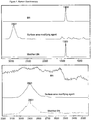
Figure 1 is a Raman Spectroscopy of boron nitride, surface area modifying agent (Pluronic F38) and surface area modified boron nitride. -
Figure 2 is the Scanning Electronic Microscopy figures of BN size and agglomeration before and after the physical treatment. -
Figure 3 shows the relationship of viscosity vs. filler loading of BN and surface area modified BN. - It has been discovered that control of the morphology of the fillers, of the internal voids/pores of the fillers, and of the compatibility of the filler surface and the resin, can control the viscosity and the overall thermal conductivity of the composition.
- The filler of the invention comprises porous filler with rough surfaces. Physical treatment of the filler introduces the surface area modifying agent into the pores of the filler and onto the surface of the filler, thereby decreasing the overall surface area of the filler. Compositions comprising the resultant physically treated filler exhibit lower viscosity than compositions comprising the same loading of non-physically treated filler. Additionally, the compositions comprising the physically treated fillers have improved thermal conductivity as compared to compositions comprising fillers that are not so physically treated.
- It is understood in the art that physical treatment is different than chemical treatment. Unlike chemical treatment, physical treatment does not create or break new chemical bonds.
- The thermally conductive compositions of this invention comprise physically treated thermally conductive fillers. These fillers may either be electrically conductive or non-conductive. Typically, fillers preferred for physical treatment are those that have a rough surface and/or a porous structure. The untreated fillers may comprise any suitable thermally conductive material, including boron nitride, aluminum nitride, copper, silver, aluminum, magnesium, brass, gold, nickel, alumina, zinc oxide, magnesium oxides, iron oxide, silver oxide, copper oxide, metal-coated organic particles, silver plated nickel, silver plated copper, silver plated aluminum, silver plated glass, silver flake, silver powder, carbon black, graphite, diamond, carbon nanotube, silica and mixtures thereof. Preferably, the untreated fillers are boron nitride. More preferably the untreated fillers are agglomerated boron nitride, available under the trade name PTX60 from Momentive Performance Inc., Ohio or PCTL7MHF from Saint Gobain Ceramics, New York.
- The surface area modifying agent is used to control the morphology of the filler shape and/or fill the internal voids/pores of the fillers. The introduction of surface area modifying agent decreases the overall surface area of the filler.
- The surface area modifying agent is a solid at room temperature and has a melting temperature below curing temperature of the resin. The melting point of the surface area modifying agent is from 25°C to 150°C. In another embodiment, the melting point of the surface area modifying agent is from 30°C to 80°C. The low melting point enables filler-filler contacts at elevated temperatures for improved thermal conductivity. The solid-to-liquid phase change at the melting temperature of the surface area modifying agent can absorb the heat generated from the device while temporarily maintaining low interfacial temperature.
- The surface area modifying agent for the filler is selected from the group consisting of ethylene oxide-propylene oxide copolymers with -OH functional groups, ethylene oxide-propylene oxide-ethylene oxide copolymers with -OH functional groups, propylene oxide-ethylene oxide- propylene oxide copolymers with -OH functional groups, polyethylene glycols, polyethylene oxide, polypropylene oxide, and mixtures thereof. Non-limiting examples of polyalkene oxide include polyethylene oxide homopolymers and copolymers.
- Preferred surface area modifying agents are ethylene oxide-propylene oxide (EO-PO) copolymers with -OH functional groups, EO-PO-EO copolymers with -OH functional groups, PO-EO-PO copolymers with - OH functional groups, polyethylene glycols, polyethylene oxide, polypropylene oxide, wax, and mixtures thereof.
- The surface area modifying agent is included in the composition in amount of from 0.1 % to 30 % by the total weight of the filler. More preferably, the surface area modifying agent is in a range from about 0.5 % to 20 % by the total weight of the filler.
- In a further embodiment, the surface area modifying agent is soluble in a solvent. Exemplary solvents are water miscible and volatile. Non-limiting solvents include water, low molecular weight alcohols, such as ethanol, methanol, n-propanol, isopropanol; and low molecular weight ketones, such as acetone and MEK. However, the surface area modifying agent is not soluble in the resin binder.
- There are several methods to physically treat the fillers. One non-limiting example is to dissolve the surface area modifying agent in a solvent, disperse the fillers in the solution of surface area modifying agent-solvent, evaporate the solvent and dry the physically treated fillers. In another non-limiting example, the physical treatment of fillers can be effected by dissolving the surface area modifying agent in water, followed by placing the fillers and the solution of surface area modifying agent-solvent in a fluid bed coater. It should be understood that other conventional methods may be used to physically treat the fillers.
- The physically treated filler mean size is from 0.01 microns to 1000 microns. In another embodiment, the physically treated filler mean size is from 1 to 300 microns. In a further embodiment, the physically treated filler mean size is from 10 to 200 microns.
- The fillers may be discrete in size, multimodal, or have a broad size distribution.
- The physically treated fillers comprise in the range of 10 % to 40 % by volume of the total composition, preferably in the range of 15 to 35 % by volume.
- The resin binder of the thermally conductive composition may be selected from any resins currently used throughout the industry. In general, the resin binder is selected from the group consisting of epoxies, silicones, epoxide terminated silicones, maleimides, bismaleimides, vinyl ethers, vinyl esters, itaconates, fumarates, polyimides, cyanate esters, fluorosilicones, polyurethanes, acrylate monomers and polymers, fatty esters, maleates, isocyanates, polyolefines, norbornenes, episulfides, benzoxanzines, styrenics, oxazolines, amines, phenolics, allyl compounds polyesters and mixtures thereof.
- In one embodiment, the resin is selected from the group consisting of flexible epoxy, silicones, epoxide terminated silicones and bismaleimides. Flexible epoxy may be synthesized according to
US Patent 5,717,054 . Silicone is commercially available from Nusil, under the trade name of PLY7500. Epoxide terminated silicones is commercially available from Hans Chemie, under the trade name of Albiflex. Bismaleimides may be synthesized according toUS Patents 6,300,456 ,6,307,001 or6,441,121 . - The resin may be cured with any of the known curing agents including, for example, imidazoles, peroxides and amines, free radical initiator and metal catalysts. Non-limiting examples of curing agents include blocked imidazoles, 2-ethyl-4-methylimidazole, 2-methylimidazole, 2-phenylimidazole, 2-phenyl-4-methylimidazole, 2-undecylimidazole, 1-benzyl-2-methylimidazole, 1-cyanoethyl-2-methylimidazole, 1-cyanoethyl-2-ethyl-4-methylimidazole, dicyanediamine, or mixtures thereof.
- It should be understood that a wide range of cure conditions are possible, that is, the time, temperature and pressure applied during cure, and these can be determined by the practitioner for the chosen resin without undue experimentation.
- Various additives that may be included are diluents (reactive and non-reacting), antioxidants, plasticizers, stabilizers, dispersing agents, coloring agents, tackifiers, adhesives, corrosion inhibitors, catalysts, adhesion promoters, surface active agents, wetting agents, thixotropes, reinforcement compositions, silanes, titanates, wax, phenol formaldehyde, silane functional perfluoroether, phosphate functional perfluoroether, air release agents, flow additives, adhesion promoters, rheology modifiers, defoamers, spacer beads and mixtures thereof.
- The use of physically treated fillers increases the overall thermal conductivity of the composition. The use of the physically treated fillers can increase the thermal conductivity of the composition by at least 5 %, up to above 50 % when compared to compositions with non-physically treated fillers at a similar viscosity.
- The thermally conductive composition of the present invention may be utilized with virtually any heat-generating component for which it is desired to dissipate the heat. In particular, the thermally conductive composition is useful for aiding in the dissipation of heat from heat-generating components in semiconductor devices. In such devices, the thermally conductive composition forms a layer between the heat-generating component and the cold sink and transfers the heat to be dissipated to the cold sink. The thermally conductive composition may also be used in a device containing a heat spreader. In such a device, a layer of thermally conductive composition may be placed between the heat-generating component and the heat spreader and a second layer, which is usually thicker than the first layer, may be placed between the heat spreader and the cold sink.
- The thermally conductive composition may be formed into a pad, grease, phase change compositions, film, paste, adhesives, and the like. The thermally conductive composition may be employed in any consumer product with a heat-generating device and heat-dissipating device. Applications include microprocessor packaging, bearing housings, heat-exchanger applications such as heat sinks for microprocessors and integrated circuit chips, plastic ball grid array packages, quad flat packs, and other common surface-mounted integrated circuit packages, and the like, particularly applications demanding a high thermal conductivity. Encompassed are computers and computer equipment, e.g., printers, fax machines, scanners and the like, and household appliances, and personal electronic devices, such as cameras, CD-players, DVD-players, cassette tape recorders and the like. Such articles typically comprise electronic components which have been adhered by such electrically conductive composition
- The invention is further illustrated by the following non-limiting examples:
- Two different methods of physically treating fillers with a surface area modifying agent have been described.
- Nine grams of Pluronic F38 (EO-PO block copolymers with -OH terminations, Mw=4700g/mol, available from BASF) was dissolved into 200mL of water. Into the Pluronic F38-water solution, 91 g of boron nitride fillers (PTX60, available from Momentive Performance Inc., OH) were dispersed. The water was then evaporated with constant stirring and vacuum overnight. The resultant dry powder weighed 100 g.
- Nine grams of Pluronic F38 (EO-PO block copolymers with -OH terminations, Mw=4700g/mol, available from BASF) was dissolved into 45mL of water. The Pluronic F38-water solution and 91 g of boron nitride fillers (PTX60) were placed in a fluid bed coater (Model MFL.01 by Vector Corporation, IA) to physically treat the fillers. The resultant dry powder weighed 100g.
- Five grams of the physically treated BN using Example 1A method was dispersed in 100 g of water, stirred overnight and then centrifuged. The supernate was transferred to an empty container and dried in air. The dried supernate was collected as 0.79g. This indicated that more than 90% of the surface modifier can be recovered by one wash. Infrared spectroscopy (Nicolet Magna-IR 560 Spectrometer) confirmed that the dried supernate was Pluronic F38. The reversibility of the process indicated that there was no chemical reaction between the BN powder and the surface area modifying agent.
- Raman spectroscopy (Nicolet Almega XR by Thermal Fisher Scientific, MA) of untreated BN, surface modifier (Pluronic F38) and physically treated BN with Pluronic F38 are shown in
Figure 1 . As shown inFigure 1 , the characteristic peak of BN at 2891 cm-1 did not shift after the physical treatment the filler with Pluronic F38, indicating that Pluronic F38 did not chemically react with BN. - Various amounts of surface area modifying agents were used to treat BN (PTX60) to result in different surface areas, listed in Table 1. The surface area of the unmodified and modified BN agglomerates was measured with Brunauer, Emmett and Teller (BET) method (
Micromeritics TriStar 3000 Automated Physisorption Analyzer by Micromeritics, GA). As shown in Table 1, there is a direct correlation between the amount of agent and the resultant surface area.Figure 2 (Scanning Electronic Microscopy JSM-6380LV by JEOL USA, MA) showed that the filler size and agglomeration remained the same before and after the modification, indicating the decrease of surface area is attributed to filling the pores and/or smoothing out the rough exterior of the filler.Table 1. Surface Area of Fillers Sample Surface area modifying agent % Surface area modifying agent Method of Physical Treatment SA (m2/g) A none 0 None 3.95 B Pluronics F38a 6 Fluidization 2.06 C Pluronics F38a 9 Solution 1.95 D Pluronics F68b 9 Fluidization 1.73 E Pluronics F38a 9 Solution 1.79 F Pluronics F38a 17 Solution 1.14 G Pluronics F68b 17 Solution 1.17 H PEGc 17 Solution 1.49 I PEOd 17 Solution 1.35 a EO-PO copolymer, 4700g/mol, mp 48°C available from BASF, NJ
b EO-PO copolymer, 8400g/mol, mp 52°C available from BASF, NJ
c Polyethylene glycol, 4,600g/mol, mp 62°C available from Sigma Aldrich.
d Polyethylene oxide, 50,000g/mol, mp 65°C available from Sigma Aldrich. - As shown in Table 1, the surface area of boron nitride treated fillers was reduced after the physical modification.
- Another BN agglomerate, PCTL7MHF (available from Saint Gobain), was physically treated to reduce the surface area. The BET surface area values of untreated and 9% Pluronics F38 treated PCTL7MHF were 2.99 and 1.58 m2/g, respectively.
-
Figure 3 shows a graph of Viscosity vs. Filler Weight Percent Loading. Flexible epoxy, synthesized according toUS Patent 5,717,054 and fillers (A, B, C and F, separately) were combined using a high speed mixer (FlackTek, model DAC150FVZ-K). The viscosity was measured with a strain controlled ARES rheometer (TA Instrument, model ARES-4X727802) at 25°C, with shear rate of 1.2/s. - As shown in
Figure 3 , as the surface area of the filler decreases, the viscosity decreased when compared to the same filler loading of higher surface area fillers. - Table 2 lists the components and the thermal conductivity for various formulations at a specific viscosity. Formulations were made to achieve viscosities of 100PaS, 200PaS and 300PaS at 1.2/s shear rate using various fillers. Formulations were then crosslinked (at 150°C in conventional oven for 60 minutes) and the thermal conductivity values were measured with photo flash instrument by Netzsch (Burlington, MA).
Table 2. Thermal Conductivity at a given Viscosity Formulation 1 2 3 4 Resin Epoxya Epoxya Epoxya Epoxya Curing agent Imidazoleb Imidazoleb Imidazoleb Imidazoleb Filler A C D F thermal conductivity at viscosity of 100PaS (W/m°K) 1.3 1.6 1.7 1.7 thermal conductivity at viscosity of 200PaS (W/m°K) 1.4 2.1 2.0 2.4 thermal conductivity at viscosity of 300PaS (W/m°K) 1.7 2.8 2.8 2.8 a Flexible Epoxy synthesized according to US Patent 5,717,054
b 2-ethyl-4-methyl-imidazole, available from Aldridch - For a given viscosity, the thermal conductivity was higher for those formulations containing fillers with lower surface area. The standard deviation of the thermal conductivity values are ± 0.1 W/m°K. The specific embodiments described herein are offered by way of example only, and the invention is to be limited only by the terms of the appended claims.
Claims (11)
- A thermally conductive composition comprising a filler and a resin binder, wherein the filler is physically treated with a surface area modifying agent, wherein the surface area modifying agent has a melting point of 25°C to 150°C and, wherein the surface area modifying agent is selected from the group consisting of ethylene oxide-propylene oxide copolymers with -OH functional groups, ethylene oxide-propylene oxide-ethylene oxide copolymers with -OH functional groups, propylene oxide-ethylene oxide- propylene oxide copolymers with -OH functional groups, polyethylene glycols, polyethylene oxide, polypropylene oxide, and mixtures thereof, and wherein the physical treatment of the fillers is conducted by coating the outer layers of the fillers and/or filling the thermal pores of the fillers with the surface area modifying agent.
- The thermally conductive composition of claim 1, wherein the filler is selected from the group consisting of boron nitride, aluminum nitride, copper, silver, aluminum, magnesium, brass, gold, nickel, alumina, zinc oxide, magnesium oxides, iron oxide, silver oxide, copper oxide, metal-coated organic particles, silver plated nickel, silver plated copper, silver plated aluminum, silver plated glass, silver flake, silver powder, carbon black, graphite, diamond, carbon nanotube, silica and mixtures thereof.
- The thermally conductive composition of claim 2, wherein the filler is boron nitride.
- The thermally conductive composition of claim 3, wherein the boron nitride is agglomerated or porous.
- The thermally conductive composition of claim 4, wherein the filler has a size range from about 0.01 to about 1,000 micron.
- The thermally conductive composition of claim 1, wherein the resin binder is selected from the group consisting of epoxies, silicones, epoxide terminated silicones, maleimides, bismaleimides, vinyl ethers, vinyl esters, itaconates, fumarates, polyimides, cyanate esters, fluorosilicones, polyurethaness, acrylate monomers and polymers, fatty esters, maleates, isocyanates, polyolefines, norbornenes, episulfides, benzoxanzines, styrenics, oxazolines, amines, phenolics, allyl compounds polyesters and mixtures thereof.
- The thermally conductive composition of claim 1, wherein the composition is cured/dried to a pad, grease, phase change composition, film, paste or adhesive.
- The thermally conductive composition comprising physically treated porous boron nitride with ethylene oxide/propylene oxide block copolymer, an epoxy resin and an imidazole crosslinking agent.
- A process for making or forming an electronic device with the thermally conductive composition of claim 1 comprising: applying the thermally conductive composition by dispensing, stencil, screen rotogravure or flexo printing onto a substrate and curing and/or drying said composition.
- An electronic device comprising the thermally conductive composition of claim 1.
- An electronic device comprising a heat-generating component, a cold sink and the thermally conductive composition of claim 1.
Applications Claiming Priority (1)
| Application Number | Priority Date | Filing Date | Title |
|---|---|---|---|
| PCT/US2007/020018 WO2009035439A1 (en) | 2007-09-14 | 2007-09-14 | Thermally conductive composition |
Publications (3)
| Publication Number | Publication Date |
|---|---|
| EP2201079A1 EP2201079A1 (en) | 2010-06-30 |
| EP2201079A4 EP2201079A4 (en) | 2014-02-19 |
| EP2201079B1 true EP2201079B1 (en) | 2017-08-23 |
Family
ID=40452275
Family Applications (1)
| Application Number | Title | Priority Date | Filing Date |
|---|---|---|---|
| EP07838253.8A Not-in-force EP2201079B1 (en) | 2007-09-14 | 2007-09-14 | Thermally conductive composition |
Country Status (4)
| Country | Link |
|---|---|
| EP (1) | EP2201079B1 (en) |
| CN (1) | CN101815772A (en) |
| TW (1) | TW200911973A (en) |
| WO (1) | WO2009035439A1 (en) |
Families Citing this family (41)
| Publication number | Priority date | Publication date | Assignee | Title |
|---|---|---|---|---|
| US9469790B2 (en) | 2009-09-29 | 2016-10-18 | The Boeing Company | Adhesive compositions comprising electrically insulating-coated carbon-based particles and methods for their use and preparation |
| US8709538B1 (en) | 2009-09-29 | 2014-04-29 | The Boeing Company | Substantially aligned boron nitride nano-element arrays and methods for their use and preparation |
| DE102009046680A1 (en) * | 2009-11-13 | 2011-05-19 | BSH Bosch und Siemens Hausgeräte GmbH | Domestic appliance with heat exchanger made of thermoplastic material containing, as well as such a heat exchanger |
| CN102208377B (en) * | 2010-03-30 | 2013-05-15 | 陈盈同 | Heat dissipation unit with anti-oxidation nano film and deposition method of anti-oxidation nano film |
| CN101831264B (en) * | 2010-04-26 | 2013-02-13 | 常州合润新材料科技有限公司 | Isotropic high-performance thermal conductive adhesive for filling carbon nano tube |
| CN102532606B (en) * | 2010-12-31 | 2013-05-15 | 中国科学院理化技术研究所 | A modified aluminum nitride filled epoxy resin composite material |
| CN102649878B (en) * | 2011-02-25 | 2014-04-02 | 深圳市锦固鸿五金科技有限公司 | Radiator made of one-step molding nanometer plastic radiating material and processing method thereof |
| CN102277121B (en) * | 2011-07-04 | 2013-07-10 | 淄博海特曼化工有限公司 | Single-component moisture curing polyurethane sealant with heat-conducting property and preparation method thereof |
| KR20130044847A (en) | 2011-10-25 | 2013-05-03 | 엘지이노텍 주식회사 | Paste composition for printing and touch panel |
| CN103958400B (en) * | 2011-11-29 | 2016-06-29 | 三菱化学株式会社 | Boron nitride agglomerated particle, composition containing the particle, and three-dimensional integrated circuit having a layer containing the composition |
| CN102516896A (en) * | 2011-12-30 | 2012-06-27 | 常熟市富邦胶带有限责任公司 | Heat conductive coating-type polyimide film for copper cladding and preparation method thereof |
| TW201331353A (en) * | 2012-01-17 | 2013-08-01 | Regal Paper Tech Co Ltd | Heat dissipation material, heat dissipation structure, preparation method and use thereof |
| JP2013222836A (en) * | 2012-04-17 | 2013-10-28 | Shin Etsu Chem Co Ltd | Electronic device excellent in heat dissipation and reworkability and manufacturing method thereof |
| CN102746560B (en) * | 2012-07-27 | 2014-11-05 | 深圳市飞荣达科技股份有限公司 | Heat-conducting plastic and preparation method thereof |
| US9434870B2 (en) | 2012-09-19 | 2016-09-06 | Momentive Performance Materials Inc. | Thermally conductive plastic compositions, extrusion apparatus and methods for making thermally conductive plastics |
| US20140080951A1 (en) | 2012-09-19 | 2014-03-20 | Chandrashekar Raman | Thermally conductive plastic compositions, extrusion apparatus and methods for making thermally conductive plastics |
| CN103911084B (en) * | 2012-12-18 | 2016-03-02 | 苏州斯迪克新材料科技股份有限公司 | Acrylate adhesive tape |
| WO2014116996A1 (en) * | 2013-01-25 | 2014-07-31 | Washington State University Research Foundation | Derivatives of fatty esters, fatty acids and rosins |
| CN103642410A (en) * | 2013-11-27 | 2014-03-19 | 常熟市富邦胶带有限责任公司 | Heat conducting double sided tape and preparation process thereof |
| CN104672604B (en) * | 2013-11-27 | 2016-05-25 | 绵阳市盛宇新材料有限公司 | A kind of heat-conducting plastic and preparation method thereof |
| CN103910905B (en) * | 2014-04-02 | 2018-01-09 | 合肥杰事杰新材料股份有限公司 | A kind of fullerene boron carbide composite material and preparation method thereof and purposes |
| JP5582553B1 (en) * | 2014-05-02 | 2014-09-03 | 清二 加川 | High thermal conductivity heat dissipation sheet and method for manufacturing the same |
| CN104479291A (en) * | 2014-12-04 | 2015-04-01 | 中国科学院过程工程研究所 | Heat-conducting insulated epoxy resin composition and preparation method and use thereof |
| CN104726076B (en) * | 2015-01-29 | 2017-09-22 | 海门市瑞泰纺织科技有限公司 | One kind burning furnace internal-lining Heat Conduction Material |
| JP6527031B2 (en) * | 2015-06-19 | 2019-06-05 | 株式会社ダイセル | Heat transport medium containing latent heat storage material, mixed liquid for heat transport and heat transport method |
| US10590023B2 (en) * | 2015-07-31 | 2020-03-17 | Nippon Sheet Glass Company, Limited | Glass flakes and resin composition |
| CN108602671B (en) * | 2016-01-26 | 2021-08-06 | 富士胶片株式会社 | Surface-modified inorganic substance and method for producing the same, resin composition, thermally conductive material, device, and lubricant |
| CN106633211A (en) * | 2016-10-21 | 2017-05-10 | 吉首大学 | Formula of radiating fin material for computer mainboard |
| CN107033851B (en) * | 2017-05-11 | 2020-09-22 | 中国科学院山西煤炭化学研究所 | A kind of method for surface treatment of phase change composite material particles |
| CN107033854A (en) * | 2017-05-18 | 2017-08-11 | 聂超 | A kind of novel heat-conducting material and preparation method thereof |
| CN107641183A (en) * | 2017-08-31 | 2018-01-30 | 山东鼎拓电子科技有限公司 | A kind of heat conductive silica gel and its production technology in LED |
| CN107722157B (en) * | 2017-10-10 | 2019-06-28 | 西安科技大学 | A kind of lightweight, thermally conductive insulating polymer rigid foam material and preparation method thereof |
| EP3831775A4 (en) * | 2018-07-30 | 2022-05-11 | Adeka Corporation | COMPOSITE MATERIAL |
| CN109206853B (en) * | 2018-08-27 | 2020-04-17 | 华东理工大学 | High-thermal-conductivity epoxy resin-based composite material, and preparation method and application thereof |
| CN111635616B (en) * | 2019-03-01 | 2021-07-30 | 广东生益科技股份有限公司 | Halogen-free flame-retardant thermosetting resin composition, prepreg for printed circuit, and metal-clad laminate |
| JP7247003B2 (en) * | 2019-04-12 | 2023-03-28 | 本田技研工業株式会社 | Heat-dissipating paint composition and method for producing heat-dissipating coating |
| JP2023508288A (en) * | 2019-12-19 | 2023-03-02 | ヘンケル・アクチェンゲゼルシャフト・ウント・コムパニー・コマンディットゲゼルシャフト・アウフ・アクチェン | Silicone-free thermal interface materials with reactive diluents |
| CN112151212B (en) * | 2020-09-28 | 2022-03-01 | 国网河南省电力公司周口供电公司 | An optical fiber composite carbon fiber wire |
| CN116536027B (en) * | 2023-05-23 | 2023-10-17 | 江西天永诚高分子材料有限公司 | Low-stress organosilicon two-component pouring sealant and preparation method thereof |
| CN117186734B (en) * | 2023-09-08 | 2025-04-01 | 金华联创塑粉科技有限公司 | Insulating coating applied to the surface of aluminum shell of lithium-ion battery core and preparation method thereof |
| TWI871096B (en) * | 2023-11-20 | 2025-01-21 | 翌驊實業股份有限公司 | Non-conductive and highly thermal conductive cuo attach adhesive and manufacturing method thereof |
Family Cites Families (8)
| Publication number | Priority date | Publication date | Assignee | Title |
|---|---|---|---|---|
| US5717054A (en) | 1995-06-07 | 1998-02-10 | National Starch & Chemical Investment Holding Corp. | Epoxy resins consisting of flexible chains terminated with glycidyloxyphenyl groups for use in microelectronics adhesives |
| EP1124770A1 (en) * | 1998-10-13 | 2001-08-22 | PPG Industries Ohio, Inc. | Glass fiber-reinforced prepregs, laminates, electronic circuit boards and methods for assembling a fabric |
| US6432320B1 (en) * | 1998-11-02 | 2002-08-13 | Patrick Bonsignore | Refrigerant and heat transfer fluid additive |
| US7976941B2 (en) * | 1999-08-31 | 2011-07-12 | Momentive Performance Materials Inc. | Boron nitride particles of spherical geometry and process for making thereof |
| JP2002030223A (en) * | 2000-07-18 | 2002-01-31 | Sekisui Chem Co Ltd | Thermal conductive resin composition |
| US20050228093A1 (en) * | 2001-09-21 | 2005-10-13 | Yoshinao Yamazaki | Thermoconductive composition |
| WO2004015002A2 (en) * | 2002-08-07 | 2004-02-19 | Dow Corning Toray Silicone Co., Ltd. | Thermoconductive filler, thermocoductive silicone elastomer composition, and semiconductor devices |
| JP2006036931A (en) * | 2004-07-27 | 2006-02-09 | Three M Innovative Properties Co | Heat-conductive composition |
-
2007
- 2007-09-14 WO PCT/US2007/020018 patent/WO2009035439A1/en not_active Ceased
- 2007-09-14 CN CN200780100910A patent/CN101815772A/en active Pending
- 2007-09-14 EP EP07838253.8A patent/EP2201079B1/en not_active Not-in-force
-
2008
- 2008-05-20 TW TW097118436A patent/TW200911973A/en unknown
Non-Patent Citations (1)
| Title |
|---|
| None * |
Also Published As
| Publication number | Publication date |
|---|---|
| EP2201079A1 (en) | 2010-06-30 |
| CN101815772A (en) | 2010-08-25 |
| WO2009035439A1 (en) | 2009-03-19 |
| EP2201079A4 (en) | 2014-02-19 |
| TW200911973A (en) | 2009-03-16 |
Similar Documents
| Publication | Publication Date | Title |
|---|---|---|
| EP2201079B1 (en) | Thermally conductive composition | |
| US8586650B2 (en) | Thermally conductive composition | |
| KR100685013B1 (en) | Thermal interface material | |
| EP1356477B1 (en) | Compliant and crosslinkable thermal interface materials | |
| TW202010707A (en) | Hexagonal crystal boron nitride powder and its manufacturing method, composition and heat dissipation material using the same | |
| KR20040030561A (en) | Interface materials and methods of production and use thereof | |
| CN1799107A (en) | Thermal interconnect and interface system, its preparation method and application | |
| JP2008189814A (en) | Thermally conductive filler, method for producing the same, and method for producing a resin molded product | |
| JP2022041651A (en) | Inorganic filler, boron nitride composition, method of producing inorganic filler, and method of producing boron nitride composition | |
| EP4095187A1 (en) | Thermally conductive silicone composition and cured product thereof | |
| JP2019119883A (en) | Heat release insulation sheet, and laminate structure having sheet cured article as insulation layer | |
| TWI906612B (en) | Adhesive compositions and film-like adhesives, and semiconductor packaging using film-like adhesives and methods for manufacturing thereof. | |
| CN111479773A (en) | Glass-coated aluminum nitride particles, process for producing the same, and heat-radiating resin composition containing the same | |
| JP7383971B2 (en) | Resin compositions, cured resin products and composite molded bodies | |
| JP2015189609A (en) | Method for producing boron nitride sheet | |
| JP2003193016A (en) | Highly thermo resistant adhesive film with high heat dissipation | |
| KR20170123394A (en) | Coating composition with improved thermal conductivity and method of forming coating film | |
| JP6715033B2 (en) | Heat conductive adhesive composition, heat conductive adhesive sheet and method for producing laminated body | |
| KR101341154B1 (en) | Conductive die adhesive composition for semiconductor comprising silver or copper coated with silver | |
| CN116997607A (en) | Resin compositions, sheet cured products, composite molded articles, and semiconductor devices | |
| KR20170032665A (en) | Coating composition for radiating heat, its preparing method, and coating method using the same | |
| CN114806081B (en) | Polymer composite material based on aromatic compound modified heat-conducting insulating composite powder and preparation thereof | |
| TWI917598B (en) | Resin compounds, sheet curing materials, composite materials and semiconductor devices | |
| JP2023147228A (en) | Thermosetting resin compositions, cured products, composite molded bodies, and semiconductor devices | |
| JP2025130241A (en) | Thermosetting composition, thermosetting sheet, thermally conductive sheet, composite molded body, heat dissipating laminate, heat dissipating circuit board, semiconductor device and power module |
Legal Events
| Date | Code | Title | Description |
|---|---|---|---|
| PUAI | Public reference made under article 153(3) epc to a published international application that has entered the european phase |
Free format text: ORIGINAL CODE: 0009012 |
|
| 17P | Request for examination filed |
Effective date: 20100408 |
|
| AK | Designated contracting states |
Kind code of ref document: A1 Designated state(s): AT BE BG CH CY CZ DE DK EE ES FI FR GB GR HU IE IS IT LI LT LU LV MC MT NL PL PT RO SE SI SK TR |
|
| AX | Request for extension of the european patent |
Extension state: AL BA HR MK RS |
|
| RIN1 | Information on inventor provided before grant (corrected) |
Inventor name: XIAO, ALLISON, Y. Inventor name: ZHANG, YIMIN |
|
| DAX | Request for extension of the european patent (deleted) | ||
| A4 | Supplementary search report drawn up and despatched |
Effective date: 20140117 |
|
| RIC1 | Information provided on ipc code assigned before grant |
Ipc: C09K 5/00 20060101AFI20140113BHEP |
|
| 17Q | First examination report despatched |
Effective date: 20140211 |
|
| GRAP | Despatch of communication of intention to grant a patent |
Free format text: ORIGINAL CODE: EPIDOSNIGR1 |
|
| INTG | Intention to grant announced |
Effective date: 20170412 |
|
| GRAS | Grant fee paid |
Free format text: ORIGINAL CODE: EPIDOSNIGR3 |
|
| GRAA | (expected) grant |
Free format text: ORIGINAL CODE: 0009210 |
|
| AK | Designated contracting states |
Kind code of ref document: B1 Designated state(s): AT BE BG CH CY CZ DE DK EE ES FI FR GB GR HU IE IS IT LI LT LU LV MC MT NL PL PT RO SE SI SK TR |
|
| REG | Reference to a national code |
Ref country code: GB Ref legal event code: FG4D |
|
| REG | Reference to a national code |
Ref country code: CH Ref legal event code: EP |
|
| REG | Reference to a national code |
Ref country code: AT Ref legal event code: REF Ref document number: 921317 Country of ref document: AT Kind code of ref document: T Effective date: 20170915 |
|
| REG | Reference to a national code |
Ref country code: IE Ref legal event code: FG4D |
|
| REG | Reference to a national code |
Ref country code: FR Ref legal event code: PLFP Year of fee payment: 11 |
|
| REG | Reference to a national code |
Ref country code: DE Ref legal event code: R096 Ref document number: 602007052116 Country of ref document: DE |
|
| REG | Reference to a national code |
Ref country code: NL Ref legal event code: FP |
|
| REG | Reference to a national code |
Ref country code: LT Ref legal event code: MG4D |
|
| REG | Reference to a national code |
Ref country code: AT Ref legal event code: MK05 Ref document number: 921317 Country of ref document: AT Kind code of ref document: T Effective date: 20170823 |
|
| PG25 | Lapsed in a contracting state [announced via postgrant information from national office to epo] |
Ref country code: SE Free format text: LAPSE BECAUSE OF FAILURE TO SUBMIT A TRANSLATION OF THE DESCRIPTION OR TO PAY THE FEE WITHIN THE PRESCRIBED TIME-LIMIT Effective date: 20170823 Ref country code: AT Free format text: LAPSE BECAUSE OF FAILURE TO SUBMIT A TRANSLATION OF THE DESCRIPTION OR TO PAY THE FEE WITHIN THE PRESCRIBED TIME-LIMIT Effective date: 20170823 Ref country code: FI Free format text: LAPSE BECAUSE OF FAILURE TO SUBMIT A TRANSLATION OF THE DESCRIPTION OR TO PAY THE FEE WITHIN THE PRESCRIBED TIME-LIMIT Effective date: 20170823 Ref country code: LT Free format text: LAPSE BECAUSE OF FAILURE TO SUBMIT A TRANSLATION OF THE DESCRIPTION OR TO PAY THE FEE WITHIN THE PRESCRIBED TIME-LIMIT Effective date: 20170823 |
|
| PG25 | Lapsed in a contracting state [announced via postgrant information from national office to epo] |
Ref country code: PL Free format text: LAPSE BECAUSE OF FAILURE TO SUBMIT A TRANSLATION OF THE DESCRIPTION OR TO PAY THE FEE WITHIN THE PRESCRIBED TIME-LIMIT Effective date: 20170823 Ref country code: LV Free format text: LAPSE BECAUSE OF FAILURE TO SUBMIT A TRANSLATION OF THE DESCRIPTION OR TO PAY THE FEE WITHIN THE PRESCRIBED TIME-LIMIT Effective date: 20170823 Ref country code: GR Free format text: LAPSE BECAUSE OF FAILURE TO SUBMIT A TRANSLATION OF THE DESCRIPTION OR TO PAY THE FEE WITHIN THE PRESCRIBED TIME-LIMIT Effective date: 20171124 Ref country code: BG Free format text: LAPSE BECAUSE OF FAILURE TO SUBMIT A TRANSLATION OF THE DESCRIPTION OR TO PAY THE FEE WITHIN THE PRESCRIBED TIME-LIMIT Effective date: 20171123 Ref country code: IS Free format text: LAPSE BECAUSE OF FAILURE TO SUBMIT A TRANSLATION OF THE DESCRIPTION OR TO PAY THE FEE WITHIN THE PRESCRIBED TIME-LIMIT Effective date: 20171223 Ref country code: ES Free format text: LAPSE BECAUSE OF FAILURE TO SUBMIT A TRANSLATION OF THE DESCRIPTION OR TO PAY THE FEE WITHIN THE PRESCRIBED TIME-LIMIT Effective date: 20170823 |
|
| PG25 | Lapsed in a contracting state [announced via postgrant information from national office to epo] |
Ref country code: DK Free format text: LAPSE BECAUSE OF FAILURE TO SUBMIT A TRANSLATION OF THE DESCRIPTION OR TO PAY THE FEE WITHIN THE PRESCRIBED TIME-LIMIT Effective date: 20170823 Ref country code: CZ Free format text: LAPSE BECAUSE OF FAILURE TO SUBMIT A TRANSLATION OF THE DESCRIPTION OR TO PAY THE FEE WITHIN THE PRESCRIBED TIME-LIMIT Effective date: 20170823 Ref country code: RO Free format text: LAPSE BECAUSE OF FAILURE TO SUBMIT A TRANSLATION OF THE DESCRIPTION OR TO PAY THE FEE WITHIN THE PRESCRIBED TIME-LIMIT Effective date: 20170823 |
|
| REG | Reference to a national code |
Ref country code: CH Ref legal event code: PL |
|
| REG | Reference to a national code |
Ref country code: DE Ref legal event code: R097 Ref document number: 602007052116 Country of ref document: DE |
|
| PG25 | Lapsed in a contracting state [announced via postgrant information from national office to epo] |
Ref country code: SK Free format text: LAPSE BECAUSE OF FAILURE TO SUBMIT A TRANSLATION OF THE DESCRIPTION OR TO PAY THE FEE WITHIN THE PRESCRIBED TIME-LIMIT Effective date: 20170823 Ref country code: IT Free format text: LAPSE BECAUSE OF FAILURE TO SUBMIT A TRANSLATION OF THE DESCRIPTION OR TO PAY THE FEE WITHIN THE PRESCRIBED TIME-LIMIT Effective date: 20170823 Ref country code: MC Free format text: LAPSE BECAUSE OF FAILURE TO SUBMIT A TRANSLATION OF THE DESCRIPTION OR TO PAY THE FEE WITHIN THE PRESCRIBED TIME-LIMIT Effective date: 20170823 Ref country code: EE Free format text: LAPSE BECAUSE OF FAILURE TO SUBMIT A TRANSLATION OF THE DESCRIPTION OR TO PAY THE FEE WITHIN THE PRESCRIBED TIME-LIMIT Effective date: 20170823 |
|
| REG | Reference to a national code |
Ref country code: IE Ref legal event code: MM4A |
|
| REG | Reference to a national code |
Ref country code: BE Ref legal event code: MM Effective date: 20170930 |
|
| PG25 | Lapsed in a contracting state [announced via postgrant information from national office to epo] |
Ref country code: LU Free format text: LAPSE BECAUSE OF NON-PAYMENT OF DUE FEES Effective date: 20170914 |
|
| PLBE | No opposition filed within time limit |
Free format text: ORIGINAL CODE: 0009261 |
|
| STAA | Information on the status of an ep patent application or granted ep patent |
Free format text: STATUS: NO OPPOSITION FILED WITHIN TIME LIMIT |
|
| PG25 | Lapsed in a contracting state [announced via postgrant information from national office to epo] |
Ref country code: IE Free format text: LAPSE BECAUSE OF NON-PAYMENT OF DUE FEES Effective date: 20170914 Ref country code: CH Free format text: LAPSE BECAUSE OF NON-PAYMENT OF DUE FEES Effective date: 20170930 Ref country code: LI Free format text: LAPSE BECAUSE OF NON-PAYMENT OF DUE FEES Effective date: 20170930 |
|
| 26N | No opposition filed |
Effective date: 20180524 |
|
| PG25 | Lapsed in a contracting state [announced via postgrant information from national office to epo] |
Ref country code: SI Free format text: LAPSE BECAUSE OF FAILURE TO SUBMIT A TRANSLATION OF THE DESCRIPTION OR TO PAY THE FEE WITHIN THE PRESCRIBED TIME-LIMIT Effective date: 20170823 Ref country code: BE Free format text: LAPSE BECAUSE OF NON-PAYMENT OF DUE FEES Effective date: 20170930 |
|
| REG | Reference to a national code |
Ref country code: FR Ref legal event code: PLFP Year of fee payment: 12 |
|
| PG25 | Lapsed in a contracting state [announced via postgrant information from national office to epo] |
Ref country code: MT Free format text: LAPSE BECAUSE OF NON-PAYMENT OF DUE FEES Effective date: 20170914 |
|
| PG25 | Lapsed in a contracting state [announced via postgrant information from national office to epo] |
Ref country code: HU Free format text: LAPSE BECAUSE OF FAILURE TO SUBMIT A TRANSLATION OF THE DESCRIPTION OR TO PAY THE FEE WITHIN THE PRESCRIBED TIME-LIMIT; INVALID AB INITIO Effective date: 20070914 |
|
| PG25 | Lapsed in a contracting state [announced via postgrant information from national office to epo] |
Ref country code: CY Free format text: LAPSE BECAUSE OF NON-PAYMENT OF DUE FEES Effective date: 20170823 |
|
| PG25 | Lapsed in a contracting state [announced via postgrant information from national office to epo] |
Ref country code: TR Free format text: LAPSE BECAUSE OF FAILURE TO SUBMIT A TRANSLATION OF THE DESCRIPTION OR TO PAY THE FEE WITHIN THE PRESCRIBED TIME-LIMIT Effective date: 20170823 |
|
| PG25 | Lapsed in a contracting state [announced via postgrant information from national office to epo] |
Ref country code: PT Free format text: LAPSE BECAUSE OF FAILURE TO SUBMIT A TRANSLATION OF THE DESCRIPTION OR TO PAY THE FEE WITHIN THE PRESCRIBED TIME-LIMIT Effective date: 20170823 |
|
| PGFP | Annual fee paid to national office [announced via postgrant information from national office to epo] |
Ref country code: NL Payment date: 20210920 Year of fee payment: 15 Ref country code: FR Payment date: 20210921 Year of fee payment: 15 |
|
| PGFP | Annual fee paid to national office [announced via postgrant information from national office to epo] |
Ref country code: GB Payment date: 20210920 Year of fee payment: 15 Ref country code: DE Payment date: 20210920 Year of fee payment: 15 |
|
| REG | Reference to a national code |
Ref country code: DE Ref legal event code: R119 Ref document number: 602007052116 Country of ref document: DE |
|
| REG | Reference to a national code |
Ref country code: NL Ref legal event code: MM Effective date: 20221001 |
|
| GBPC | Gb: european patent ceased through non-payment of renewal fee |
Effective date: 20220914 |
|
| PG25 | Lapsed in a contracting state [announced via postgrant information from national office to epo] |
Ref country code: NL Free format text: LAPSE BECAUSE OF NON-PAYMENT OF DUE FEES Effective date: 20221001 |
|
| PG25 | Lapsed in a contracting state [announced via postgrant information from national office to epo] |
Ref country code: FR Free format text: LAPSE BECAUSE OF NON-PAYMENT OF DUE FEES Effective date: 20220930 Ref country code: DE Free format text: LAPSE BECAUSE OF NON-PAYMENT OF DUE FEES Effective date: 20230401 |
|
| PG25 | Lapsed in a contracting state [announced via postgrant information from national office to epo] |
Ref country code: GB Free format text: LAPSE BECAUSE OF NON-PAYMENT OF DUE FEES Effective date: 20220914 |