EP2201061B1 - Improved fuser fluid - Google Patents
Improved fuser fluid Download PDFInfo
- Publication number
- EP2201061B1 EP2201061B1 EP08843171.3A EP08843171A EP2201061B1 EP 2201061 B1 EP2201061 B1 EP 2201061B1 EP 08843171 A EP08843171 A EP 08843171A EP 2201061 B1 EP2201061 B1 EP 2201061B1
- Authority
- EP
- European Patent Office
- Prior art keywords
- amine
- release
- release oil
- fuser
- molecular weight
- Prior art date
- Legal status (The legal status is an assumption and is not a legal conclusion. Google has not performed a legal analysis and makes no representation as to the accuracy of the status listed.)
- Not-in-force
Links
- GDOPTJXRTPNYNR-UHFFFAOYSA-N CC1CCCC1 Chemical compound CC1CCCC1 GDOPTJXRTPNYNR-UHFFFAOYSA-N 0.000 description 1
Images


Classifications
-
- C—CHEMISTRY; METALLURGY
- C08—ORGANIC MACROMOLECULAR COMPOUNDS; THEIR PREPARATION OR CHEMICAL WORKING-UP; COMPOSITIONS BASED THEREON
- C08L—COMPOSITIONS OF MACROMOLECULAR COMPOUNDS
- C08L83/00—Compositions of macromolecular compounds obtained by reactions forming in the main chain of the macromolecule a linkage containing silicon with or without sulfur, nitrogen, oxygen or carbon only; Compositions of derivatives of such polymers
- C08L83/04—Polysiloxanes
- C08L83/08—Polysiloxanes containing silicon bound to organic groups containing atoms other than carbon, hydrogen and oxygen
-
- C—CHEMISTRY; METALLURGY
- C08—ORGANIC MACROMOLECULAR COMPOUNDS; THEIR PREPARATION OR CHEMICAL WORKING-UP; COMPOSITIONS BASED THEREON
- C08G—MACROMOLECULAR COMPOUNDS OBTAINED OTHERWISE THAN BY REACTIONS ONLY INVOLVING UNSATURATED CARBON-TO-CARBON BONDS
- C08G77/00—Macromolecular compounds obtained by reactions forming a linkage containing silicon with or without sulfur, nitrogen, oxygen or carbon in the main chain of the macromolecule
- C08G77/04—Polysiloxanes
- C08G77/22—Polysiloxanes containing silicon bound to organic groups containing atoms other than carbon, hydrogen and oxygen
- C08G77/26—Polysiloxanes containing silicon bound to organic groups containing atoms other than carbon, hydrogen and oxygen nitrogen-containing groups
-
- G—PHYSICS
- G03—PHOTOGRAPHY; CINEMATOGRAPHY; ANALOGOUS TECHNIQUES USING WAVES OTHER THAN OPTICAL WAVES; ELECTROGRAPHY; HOLOGRAPHY
- G03G—ELECTROGRAPHY; ELECTROPHOTOGRAPHY; MAGNETOGRAPHY
- G03G15/00—Apparatus for electrographic processes using a charge pattern
- G03G15/20—Apparatus for electrographic processes using a charge pattern for fixing, e.g. by using heat
- G03G15/2003—Apparatus for electrographic processes using a charge pattern for fixing, e.g. by using heat using heat
- G03G15/2014—Apparatus for electrographic processes using a charge pattern for fixing, e.g. by using heat using heat using contact heat
- G03G15/2017—Structural details of the fixing unit in general, e.g. cooling means, heat shielding means
- G03G15/2025—Structural details of the fixing unit in general, e.g. cooling means, heat shielding means with special means for lubricating and/or cleaning the fixing unit, e.g. applying offset preventing fluid
Definitions
- the present invention relates to electrostatographic image reproduction and, more particularly, to a polysiloxane release oil where a certain proportion of the poly(dimethylsiloxane) (PDMS) chains are terminated at one end with an alkyl amine, and only a certain proportion are terminated at both ends with an alkyl amine.
- PDMS poly(dimethylsiloxane)
- the original to be copied is rendered in the form of a latent electrostatic image on a photosensitive member.
- This latent image is made visible by the application of electrically charged toner.
- the toner forming the image is transferred to a substrate also referred to in the art as a receiver such as paper or transparent film, and fixed or fused to the substrate.
- a substrate also referred to in the art as a receiver such as paper or transparent film
- the usual method of fixing the toner to the substrate involves applying heat to the toner, once it is on the substrate surface, to soften it, and then allowing the toner to cool.
- This application of heat in the fusing process is preferably at a temperature of about 90°C-220°C. Pressure may be employed in conjunction with the heat.
- Various additives and oils are used to aid the transfer of the particles. Silicone oil is commonly used as a release oil because it is thermally stable and incompatible with the toner particles and other polymers in the printer.
- a system or assembly for providing the requisite heat and pressure is generally provided as a fusing subsystem, and customarily includes a fuser member and a support member.
- the various members that comprise the fusing subsystem are considered to be fusing members; of these, the fuser member is the particular member that contacts the toner to be fused by the fusing subsystem.
- Heat energy employed in the fusing process is transmitted to the toner on the substrate by the fuser member. Specifically, the fuser member is heated; to transfer heat energy to the toner situated on a surface of the substrate, the fuser member contacts this toner, and also can contact this surface of the substrate itself.
- the support member contacts an opposing surface of the substrate.
- the substrate can be situated or positioned between the fuser and support members, so that these members can act together on the substrate to provide the requisite pressure in the fusing process.
- the fuser and support members define a nip, or contact arc, through which the substrate is passed.
- the fuser and support members are in the form of fuser and pressure rollers, respectively.
- One or both of the fuser and support members have a soft layer that increases the nip, to effect better transfer of heat to fuse the toner.
- toner can be offset from the substrate to the fuser member.
- Toner transferred to the fuser member in turn may be passed on to other members in the electrostatographic apparatus, or to subsequent substrates subjected to fusing.
- Toner on the fusing member can interfere with the operation of the electrostatographic apparatus and with the quality of the ultimate product of the electrostatographic process.
- This offset toner is regarded as contamination of the fuser member, and preventing or at least minimizing this contamination is a desirable objective.
- Toner offset is a particular problem when polyester toners are used. Polyester toners are frequently used in high quality color and black and white printing applications.
- offset to the fuser member can collect on other members of the fusing subsystem, such as external heating members for heating fuser members, and release agent applicators e.g., oilers.
- release agents can be applied to fusing members during the fusing process, to prevent or minimize toner offset.
- These agents usually are or include polyorganosiloxanes, particularly polyorganosiloxane oils. The polysiloxanes have anti-adhesive properties that are favorable for protecting the surface of the fuser member, and maintaining the durability of the fuser member.
- Modified polysiloxanes having functional groups provide a protective barrier by attaching to the fuser surface via specific interactions between the functional groups and the fuser surface. The interaction of the functional groups with the fuser surface allows the polysiloxane to sterically block contact of the toner with the fuser member surface and provide a protective barrier.
- Mono-functional polysiloxanes with one reactive functional group may interact with the fuser member or toner surface to provide a protective coating as well as increase the wetting of nonfunctional components in the polymeric release agent composition.
- Multifunctional polysiloxanes with more than one reactive group also interact in the same manner to provide a protective coating; however, the presence of more than one functional group may allow undesired additional interaction with other components.
- U.S. Patent 6,261,688 and U.S. Publication No. 2001/0019768 disclose polymeric release agents comprising organosiloxane polymers with tertiary amino functional groups.
- U.S. Patent 5,157,445 discloses a toner release oil composition containing an organopolysiloxane with one or more secondary amino substituents, where the secondary amine N atom has a C 1-8 alkylene substituent terminated by NH 2 .
- eligible release oil ingredients are organopolysiloxanes having aromatic secondary amino substituents.
- U.S. Patents 5,531,813 and 5,512,409 disclose secondary amino functional polyorganosiloxanes, where the N atom can have, besides the H atom, a C 1-18 alkyl or arylalkyl substituent. These patents also disclose the polyorganosiloxanes as monoamino functional polymers, with the monoamino functionality interacting with the hydro-fluoroelastomer surface of a fuser member; this interaction is stated to provide a barrier to the toner, as well as a low surface energy film to release the toner from the surface. Additionally as to monoamino functionality in particular, branched T-type monoamino functional poly-siloxanes, in which the reactive group is attached to a central silicon atom, are disclosed in U.S. Patent 5,516,361 .
- U.S. Patents 5,141,788 and 5,281,506 disclose a fuser member comprising a polyorganosiloxane having reactive functional groups that are grafted to the surface of the cured fluoroelastomer layer.
- U.S. Patent 4,853,737 discloses a fuser roller having an outer layer comprising a cured fluoroelastomer, with polydiorganosiloxane segments that are covalently bonded to the backbone of the fluoroelastomer; the polydiorganosiloxanes have functional groups, at least one of which is present on the polydiorganosiloxane chain to form the covalent bond to the fluoroelastomer backbone.
- U.S. Patent. 7,074,488 discloses mono-functional branched polysiloxanes, wherein the branched siloxane chain provides enhanced coverage of the surface and resistance to extension under shear. This provisional application is incorporated herein in its entirety, by reference thereto.
- polysiloxane release fluids have been modified with non-reactive organo groups that promote interaction or wetting of surface components.
- U.S. Patent. 5,780,545 discloses a stabilized polyether modified organosiloxane that acts as a surfactant to promote wetting and that reduces offset.
- U.S. Patents 5,568,239 , 5,641,603 , 5,627,000 , and 5,636,012 disclose polyorganosiloxanes modified with side groups or end groups of fluorocarbon chains, for promoting the wetting of fluorocarbon surfaces such as tetrafluoroethylene.
- Patents 5,783,719 and 5,959,056 disclose long chain hydrocarbon modification of organosiloxanes as solid release agents, and as being useful for other purposes e.g., sealing toner cartridges; further, it is suggested that the long hydrocarbon chain may also act as a surfactant for the toner.
- U.S. Patents 7,208,258 ; 7,214,462 ; 7,198,875 ; 7,186,462 and U.S. Patent Application US 2005/0287372 to Xerox states that the level of multifunctional aminosiloxane in the release fluid is related to the amount of gel formed on the fuser roller. This in turn affects toner offset to the fuser roller and print quality defects.
- These patents teach techniques to control the level of functionality of the siloxane, to make amino-siloxanes where the functional group is internal or pendant to the polymer backbone. The functional groups are located along internal parts of the polymer chain but are not solely at the end of the chains.
- the present invention is a release oil comprising poly(dimethylsiloxane) polymers of the general formulae: and wherein (Z) is an alkyl amine.
- the solvent extracted portion of the release oil has a ratio of A:B less than 1:5. Less than 10 % of the molecular weight distribution of the release oil is less than m/z 1000.
- the release oil preferably has a viscosity of between 200 and 500 centistokes.
- the present invention relates to functional polysiloxanes dispersed in a nonfunctional siloxane where the functionality is an amino group at the end of the siloxane chain.
- the functional siloxane chain is primarily mono-functional.
- the polymers of the invention are used as a toner release fluid and have a number average molecular weight of about 3,000 or greater. More preferably, polymers of the invention have a number average molecular weight of from about 4,000 to about 250,000, and still more preferably of from about 6,000 to about 100,000.
- the siloxane fluid has a viscosity of from about 200 mm 2 /s (cSt) to about 500 mm 2 /s (cSt) and an amine concentration between 0.0080 and 0.018 meq/g.
- the present invention provides superior fuser fluids can be prepared from amino-siloxanes where the functional group is terminal to the polymer backbone and predominantly only at one end. This is done by carrying out the polymerization to produce a desired level of mono-functional polymers where the functionality is on the end of the polymer chain.
- the mono-functional aminosiloxane polymer reacts with imperfections in the fuser roller surface to form a thin protective layer of low surface energy PDMS.
- the low level of difunctionality was accomplished by a modification of the procedure shown in Scheme 1.
- the superior fluids are readily recognized by a combination of chemical analysis.
- mass spectrometry can be applied to identify the individual polymer chains that make up the fluid.
- the combination of these techniques allows for strong correlation between the chemical structure produced by the polymerization technique and the imaging properties of these aminosiloxane fluids.
- the synthesis can be done in a one step or two step process that involves variations on the ring opening polymerization reaction depicted in Scheme 1.
- Ring opening polymerization of octamethylcyclotetrasiloxane (D4) terminated or endcapped with 1,3-bis(3-aminoproyl)tetramethyldisiloxane (1) and hexamethyldisiloxane (2) can be used to prepare aminosiloxane for release agents in electrophotographic printers.
- the reaction is an equilibrium polymerization and other monomer sources of dimethylsiloxane can be used in place of the four membered ring.
- n is determined by the ratio of D4 or other dimethylsiloxane source to the endcappers. Higher n results in higher viscosity due to higher polymer molecular weight.
- the number of amine end groups compared to the number of unfunctionalized end groups is determined by the ratio of end cappers to each other.
- Equal molar concentrations (1) and (2) produce polymers with a 1/2/1 ratio of nonfunctional to monoaminofuncitonal to diaminofunctional end groups.
- a desired level of the aminosiloxane can then be prepared by blending the aminosiloxane concentrate with non-functionalized PDMS, which is commercially available in a variety of molecular weights.
- viscosity of 330 CPS may be mixed with one part of the aminosiloxane concentrate to prepare the final release agent. This will be referred to as the blended method of synthesis.
- An alternative synthetic scheme is to prepare the final product in one polymerization. Instead of preparing a concentrate of the aminofunctionalized siloxane and then mixing with nonfunctional polymer to give a desired amine level, the polymerization is carried out in one step in a single reaction kettle. This is referred to as a one-pot method of synthesis. The same products are made by both procedures but the distribution of the products is a consequence of which method is used to make the polymer. As the level of non-functionalized endcapper (1) is increased in comparison to the amino endcapper (2), the amount of the mono-functionalized polymer increases and the amount of difunctional polymer decreases. This is a desirable outcome of the one-pot polymerization because high levels of difunctional aminosiloxane in the release oil will gel on the fuser roller, which leads to unwanted image artifacts in the electrophotographic prints.
- Scheme 1 also shows that the level of bisamine is greatly decreased if the entire sample of release fluid is prepared by the one pot process.
- the proper ratio of endcappers to employ in the polymerization can be determined by applying the equation below. A ratio of 8 times as much nonfunctional end capper to difunctional endcapper results in a 16 fold excess of mono-functional polymer to difunctional polymer.
- x and y represent the nonfunctional and difunctional endcappers, respectively
- a and b represent the molar ratio of each in the starting material of the polymerization.
- This polymer would produce 16 molecules of mono-functional material for each molecule difunctional polymer and 64 PDMS chains that have nonfunctional trimethylsilyl end groups. Thus about 20% of the molecules carry functional groups.
- the concentrate polymerization should produce 1 part nonfunctional PDMS, 2 parts mono-functional aminosiloxane, and 1 part of the difunctional aminosiloxane polymer.
- the concentrate would then mixed with about 7 parts of nonfunctional PDMS to produce the final fuser oil with the correct level of aminosiloxane that would be useful as a release fluid.
- These two levels are contrasted in Scheme 1.
- this calculation is an idealized reaction.
- the true kinetics of polymerization would produce different ratios. For example, the rate of polymerization of the substituted chain is probably slightly different than the nonfunctional polymer chain. Nonetheless, we have found that application of this approach to making fuser fluids produces highly desirable materials.
- the level of amine in the release fluids can be determined by titration with an acid.
- the value is preferably between 0.0080 and 0.018 meq/g, most preferably between 0.010 and 0.016 meq/g, dictated by the requirements to prevent toner offset and contamination onto the fuser roller.
- the level of amine must remain relatively constant in a release fluid, which restricts amounts of amine used in the synthesis.
- the molecular weight of the siloxane polymer is important to control the viscosity of the fluid. As the molecular weight is increased, the number of chains ends is decreased. Thus there is an optimum molecular weight that gives a desired viscosity while also controlling the functionality of the chain ends.
- a release fluid that has a desired ratio of chain end functionality can be produced which has superior fusing performance.
- the amines are present on the chain ends as dictated by the functional endcapping moiety that is employed.
- the ratios of the mono-functional and difunctional amino-siloxanes, as well as the level of non-functional siloxane can all be controlled to produce release fluids that have less tendency to form gels on the fusing roller or lead to contamination of other fusing components. Additionally the viscosity can be controlled so that fusing performance does not suffer.
- mono-functional and difunctional are meant to relate to the number of silicon end groups that carry amino functionality.
- Each of these chains could have a number of alkylamines in either a linear or a cyclic fashion.
- amine endcappers include N-(2-aminoethyl)-3-aminopropyl, N-(6-aminohexyl)aminopropyl, N-(2-aminoethyl)-3-aminoisobutyl, 4-aminobutyl or 2-aminoethylaminomethyl.
- release oils with these types of functional groups may be less thermally stable and/or have a greater tendency to form gels than the molecules with a single aminopropyl end group.
- Preferred end cappers are the combination where (1) in Scheme 1 is hexamethyldisiloxane and (2) is 1,3-bis(3-aminopropyl)tetramethyldisiloxane.
- the end mono-functional endcapper 3-aminopropylpentamethyldisiloxane could be used along with hexamethyldisiloxane to produce a similar distribution of functional groups on the release oil.
- the aminosiloxane is sufficiently reactive to add to the double bond and cover this surface defect.
- the mono-functional aminosiloxane polymer reacts with these and other imperfections in the fuser roller surface (such as an exposed filler particles) to form a thin protective layer of low surface energy PDMS.
- high levels of difunctional amino-siloxanes in the fuser fluid will lead to the formation of thick gels on the fuser roller that cause image artifacts in fused prints.
- the difunctional aminosiloxane is thought to leave a highly reactive amine exposed on the surface of the roller.
- NMR can be used to determine the composition of the release fluid, including whether the amine is in the terminal position or pendant on the polymer similar to a side group. NMR can also be used to determine the molar concentration of the amine. But NMR cannot determine the distribution of the end group functionality within the polymer system. In other words, one could not use titration, NMR, size exclusion chromatography (SEC) or UV-visible infra red spectroscopy to determine what ratio of mono-functional and difunctional end groups are present in a polymer used as a release fluid. We describe below how mass spectroscopy can be used to determine release fluids with superior properties.
- the fuser oil samples exist as a blend of aminopropyl-PDMS made from the concentrate as shown in Scheme 1 with trimethylsilyl (TMS) terminated-PDMS ( ⁇ 1:7). This dilution in trimethylsilyl-PDMS made it difficult to express the aminopropyl-PDMS component(s) of the oils by MALDI.
- the aminopropyl-PDMS component(s) was known to be present based on NMR and titration evidence.
- the samples were extracted with methanol. It was demonstrated (by SEC) that only the low MW portion of the polymer distribution is being extracted into the methanol, which simplifies the sample with regard to molar mass.
- the amine-containing components were known to form protonated molecular ions by MALDI, while TMS-terminated PDMS form Na-cationized molecular ions. Care was taken to eliminate residual sodium from the sample preparation process, causing the cationization of TMS-terminated PDMS to be suppressed, in order to express only the amine-containing components of the samples. This included using plastic vials to prepare solutions and extractions, using low-sodium matrix material, treating the matrix solution with cation-exchange resin, adding 18-crown-6 to the sample preparation as a sodium-scavenger, and washing the sample plate with ammonium citrate. The resulting MALDI spectra show the expression of the amine-containing components of the samples.
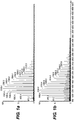
- the MALDI mass spectra of the amine portions of two extracted release oil samples are in Figure 1 . It is important to note that there are two types of discrimination issues that are possible with the direct MALDI analysis of this polymer. First, since it is a fairly high molar mass PDMS, it most likely has a broad polymer distribution. The peaks observed in the MALDI spectrum are likely biased towards the low molecular weight end of the distribution. Second, since there are multiple distributions present with end groups of varying polarity (e.g. amine vs. no amine), there is likely a bias in the relative intensity of these distributions due to ionization discrimination issues. Therefore, the relative intensities should not be considered quantitative. After looking at a range of samples, we determined that the relative intensities of the amine-containing components can be used to make directional comparisons.
- end groups of varying polarity e.g. amine vs. no amine
- FIG. 1 shows the MALDI spectra of the extracted release oil made from the concentrate method and the one-pot method.
- the lower spectrum ( FIG. 1b ) is that of the 1/2/1 concentrate diluted with trimethylsilyl terminated PDMS.
- the spectrum consists of two distributions of singly charged ions covering the molecular weight range of m/z 800 to 4800. The larger of the two sets of peaks in each case is the mono-aminosiloxane oligomer series. The smaller set of peaks is the diaminosiloxane oligomer series. It is important to note that the difunctional siloxane is clearly visible in the spectrum of the material made from the blended method but not in the spectrum of the one-pot sample ( FIG. 1a ). The low intensity of the difunctional amine peaks indicates a lower concentration of the difunctional siloxane is formed in the one-pot method.
- the mono-amine siloxane oligomers have a combined end-group mass of 205.132.
- the PDMS repeat unit is 74.0188.
- the mono-aminosiloxane oligomers in protonated spectra such as these MALDI samples should have molecular ions with even mono-isotopic m/z values.
- the difference in the chemical composition of the release oil shows the expected trend of high levels of bisamine oligomers when the release oil is prepared by the blend method.
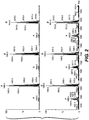
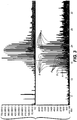
- the MALDI is consistent with expected trends of functionality on the siloxane oligomer based on Equation 1. Additional evidence for this prediction is gained by the related analytical technique of gas chromatography/mass spectroscopy (GC/MS) shown in Figure 3 .
- GC/MS compliments the type of information that is obtainable by MALDI. Samples made by the blend and one-pot methods were analyzed to look for differences in mono- and bisaminopropyl PDMS species. These samples were extracted with acetone prior to GC/MS analysis. The acetone extraction in the GC/MS analysis served two purposes.
- the upper chromatogram represents linear and cyclic PDMS and derivatized mono and bis-aminopropyl linear PDMS compounds detected in the sample extracts. This contains both functional and non-functional siloxanes making up the Total Ion Chromatogram (TIC).
- TIC Total Ion Chromatogram
- the chromatogram is dominated by PDMS that contains no functionality, the portion of which was soluble in acetone and volatile enough to go through the GC column.
- the spectrum is fairly symmetrical. This should not be taken as quantitative evidence of the sample distribution, but is useful to compare samples.
- Superimposed on the large peaks are other sets of peaks, which correspond to the mono-substituted (B) and bisaminosiloxanes (A).
- the lower spectrum in Figure 3 shows only the amino-siloxanes.
- Extracted ion chromatograms (m/z 156) unique to the derivatized amino species (imines) are included with the peaks labeled (A) for the bisaminosiloxane series and (B) for the mono-aminosiloxane series.
- the series of bisaminosiloxane peaks (A) is the smaller set that is more visible on the left side of the lower chromatogram in Figure 3 .
- the gas chromatography column does not differentiate the bisaminosiloxane peaks as well from the larger distribution of mono-aminosiloxane peaks (B). The two distributions become superimposed and hard to see.
- the 156 ion is unique to the mass spectra for the derivatized amino compounds and is not found in the linear and cyclic PDMS species. Further, in Figure 3 all MW labels correspond to the derivatized mono-amino compounds (imines) and are 40 amu higher than the underivatized mono-amino species.
- the silicone oils described above that had high levels of bisaminosiloxane functionality were inferior fuser fluids to those that had low levels of bisaminesiloxane oligomers. But the presence of some bisamine did not result in a bad release fluid.
- the presence of a low level of bisamines inherent in the terminal positioning of the amine functional groups provide a protective layer against toner contamination, an advantage over the internal or pendent type functional group.
- the amine fluids produced by the one-pot method gave long life in fusing test of stress documents, lasting far longer without significant gel formation on the fusing roller and without contamination of the fuser compared to the materials made by the blend method.
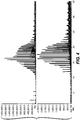
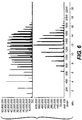
- a second parameter besides the bisamine functional group ratio that was found to be important for superior release fluids was the extent level of lower molecular weight species. Included in the lower molecular weight fraction of the fluid that is undesirable for the release fluid are low molecular weight mono and difunctional amino-siloxanes. These low molecular weight oligomers were removed by stripping the siloxane oils under high temperature and vacuum. The composition of these extracts removed by stripping was examined by mass spectrometry as shown in Figure 5 .
- the MALDI spectrum of the stripped portion of the fluid in Figure 5 shows monoamine peaks predominantly below m/z 1000. There is little evidence of the bisaminosiloxane because this material was made by the one pot method.
- the stripped material was a clear, colorless liquid but with much lower viscosity than the release oil from which it was distilled. It was readily soluble in methanol that eliminated the extraction step used for analysis of the fuser fluids.
- the spectrum is probably more representative of the entire sample than observed in the spectra of the release oils themselves, and more representative of the real distribution of the sample.
- the largest peak in the spectrum is at m/z 872.3.
- One metric used to compare the oils made from the concentrates and those made by the one-pot method is the rate of detrimental gel build-up during a stress printing experiment.
- the stress document used was of an image of flatfields, bars, and blank areas in such a pattern that it will produce differential gloss and cross track artifacts on the fuser when printed repeatedly.
- Periodic image document "keepers" were printed for image quality analysis to determine the level of gloss and cross track artifacts that were caused by the gel on the fuser roller.
- the gel level was measured using ATR-IR spectroscopy.
- the intensity of the silicone signal was compared to known silicone and fuser roller base cushion reference samples to give the percent of contamination.
- the contamination is effected by the spread of toner throughout the fuser subsystem, including the fuser roller, pressure roller, web cleaner, and oiler.
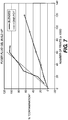
- the gel level is plotted by measuring the percent contamination as a function of the number of images x 1000 when running a stress document image in the printer.
- the graph in Figure 7 shows a rapid build-up of gel on the fuser roller when the material was made from the blended release fluid.
- the lower line is the result of a much slower gel build-up when using a release fluid from a one-pot synthesis where the bisamine content was lower.
- the fluoropolymer that makes up the fuser roller overcoat has the composition of 50% vinylidene fluoride(VF), 10% hexafluoropropylene(HFP), and 40% tetrafluoroethylene(TFE).
- Sample Extraction Samples were extracted with methanol prior to MALDI analysis. Using plastic vials, 1 mL methanol was added to 100 mg sample and vortex mixed for 1 min. The mixture was centrifuged to separate the two layers. The top (methanol) layer was used for MALDI analysis.
- MALDI Sample Preparation In a plastic vial, a stock solution of 2,5-dihydroxybenzoic acid (DHB) matrix was prepared at 20 mg/mL in methanol and mixed with 50 mg of cation-exchange (hydrogen form) resin to remove residual sodium. In a plastic vial, a stock solution of 18-crown-6 was prepared at 0.5 mg/mL in methanol. Samples were prepared for MALDI analysis by mixing 20 ⁇ L of DHB stock solution with 10 ⁇ L of methanol layer of the sample extraction and 10 ⁇ L of 18-crown-6 stock solution. A 0.5 ⁇ L portion of the mixture was deposited onto a stainless steel sample plate and allowed to dry.
- DHB 2,5-dihydroxybenzoic acid
- Table 1A gives the amine concentration as determined by titration. The level of amine is similar in all of the samples ranging from 0.010 to 0.012 meq/g, MALDI determination of the total molecular weight distribution of the methanol extracted portions of the oil and the molecular weight distribution of the mono-aminosiloxane is also listed in Table 1A. The molecular weight distribution of the bisaminosiloxane extracted in methanol is listed in Table 1B. Additionally, the relative amounts of mono and bisaminosiloxane in the release oil is compared in the last two columns of Table 1B.
- Tables 2A and 2B show machine testing of the same eight release fluids described in Table 1. A heavier weight coated receiver is discussed first in Table 2A. The tests were carried out by placing the various fluids separately into Kodak Nexpress Color PrintersTM as fuser oils and printing up to 62 thousand equivalent A4 duplex prints of a striped target to act as a stress document. The decrease in gloss on the prints was monitored as a function of the number of prints and the appearance of cross-track lines on the fuser roller was also monitored as a function of the print count. The first column of data show that the four blended oils produced prints with inferior gloss, a loss of at least 3 gloss units in less than 5,000 prints. In sharp contrast, more than 30,000 prints were produced using the one-pot release fluids before a comparable loss of gloss was observed.
- Comparative Example 4a where the loss of 6 gloss units was not observed until after 40,000 prints. This is almost as long as some of the one-pot release oils ran without producing gloss numbers of 6.
- Comparative Example 4 also had the lowest level of bisaminosiloxane of the four samples made from the concentrates with 16.4 % reported in Table 1B. This highlights the importance of the composition of the oil having a low bisaminosiloxane content. The samples with higher bisamine content produced a loss of gloss with fewer prints, indicating a shorter lifetime for these oils.
- the third column of data in Table 2A shows the relationship between the release fluids and how quickly a defect on the fuser roller surface is produced. Comparative Examples 1 and 2 both showed early formation of the cross track-line artifacts. These samples had bisaminosiloxane levels greater than 20%. The cross track-line artifact is thought to be related to gel formation on the fuser roller and it appears the gel formation can be related directly to the bisaminosiloxane content of the release oil. Table 2A.
- Table 2B gives the results of the machine performance made using the same criteria to compare the release fluids as Table 2A, with the additional parameter of measuring the amount of contamination on the web used to clean the fuser roller. Higher levels of density cleaning web indicate higher levels of contamination in the fuser. All four Comparative Examples 1-4, but only Examples 1-2, were tested. The conclusions drawn from the data are much the same as from Table 2A. The samples with higher levels of bisamine content do not perform as well in the fusing tests. The samples from the concentrates produced prints with lower gloss more quickly, and tended to show cross track-line artifacts more quickly than the samples from the one-pot procedure. Additionally the samples from the one-pot synthesis had lower cleaning web densities than the samples that had the higher bisamine content.
- the volatiles level was 0.5, 0.3, and 0.1 % for a given amount of sample over a given time at an elevated temperature.
- the volatile measurement was determined by the change in weight of a stripped sample by heating under vacuum.
- the lower volatile level should produce a sample with higher purity.
- Lower levels of volatiles should correspond to lower levels of low molecular weight impurities left over from the polymerization, including cyclic and linear siloxanes, the latter composed of nonfunctional, monoamino- and bisaminosiloxanes.
- the Table 3 compares the targeted and the actual levels for these twelve samples. Table 3.
- Table 4 shows a comparison of the mass spectroscopy data from some of these Examples. The same trend is seen in the two techniques, but the GC/MS data not as discriminating as the MALDI data. In fact for the GC/MS data, many of the other samples were below the detectability limits of the bisamine due to the higher baseline noise in this measurement. It was therefore assumed that these samples all had less than 10 % bisaminosiloxane based on the GC/MS spectra because the response was so low compared to the mono-aminosiloxane. What is apparent is the release oils made with higher content of diamine endcapper produced higher levels of bisamine.
- Examples 5-9 were made with the higher level of amine endcapper, and these samples all showed higher levels of bisaminosiloxane (A) than Examples 10-16 that were made using lower levels of amine endcapper. This was true even though these oils were made by the one-pot technique, as would be predicted for a polymerization with higher ratio of functional endcapper aminopropyldisiloxane (1) to the non-functional endcapper hexamethyldisiloxane (2) .
- Table 4 also shows that viscosity is not an important component in determining the distribution of mono and bisaminosiloxane in this region of molecular weight change.
- the bisamine content should increase with increased viscosity, but the effect is complicated by the different levels of stripping for the samples.
- Examples 5 and 8 were made in the same way except the first one had a higher viscosity, and indeed Example 5 has a higher level of (A) at 12.4% compared to 11.7 % for Example 8. These differences are so small that the significance may be questionable. The same can be said for the other samples throughout the chart. However the trend is seen throughout the experiment, which lends support to the argument that the viscosity effect is subtle but real.
- Examples 5, 8, 10, and 13 all have amine contents greater than 10 %, and these are the samples that were stripped to only 0.5 % volatiles. Because the Comparative Example 1 has an amine content of 9.8 % below m/z 1000, it is desirable that the release oil samples have no higher than 10 % of the amine content below m/z 1000. Machine testing supported the contention that the molecular weight distribution of the samples is important for minimizing differential gloss in the prints. Release oils that had lower levels of the low molecular weight components did not show large changes in gloss, while samples with high levels of low molecular weight component due to less efficient stripping did not perform as well.
- a series of nine polymerizations were carried out at optimal one-pot polymerization conditions with a targeted viscosity of 330 mm 2 /s and an amine concentration of 0.012 meq/g.
- the samples were stripped under high vacuum at elevated temperature to remove volatiles and low molecular weight materials.
- MALDI analysis showed all of the bisaminosiloxane (A) content was less that 10% of the total amine content, and that all of the samples had greater than 90% of the amine content greater than m/z 1000.
Landscapes
- Chemical & Material Sciences (AREA)
- Health & Medical Sciences (AREA)
- Chemical Kinetics & Catalysis (AREA)
- Medicinal Chemistry (AREA)
- Polymers & Plastics (AREA)
- Organic Chemistry (AREA)
- Physics & Mathematics (AREA)
- General Physics & Mathematics (AREA)
- Silicon Polymers (AREA)
- Fixing For Electrophotography (AREA)
- Developing Agents For Electrophotography (AREA)
- Lubricants (AREA)
- Organic Insulating Materials (AREA)
Applications Claiming Priority (2)
| Application Number | Priority Date | Filing Date | Title |
|---|---|---|---|
| US11/875,264 US8012915B2 (en) | 2007-10-19 | 2007-10-19 | Fuser fluid |
| PCT/US2008/011672 WO2009054893A2 (en) | 2007-10-19 | 2008-10-10 | Improved fuser fluid |
Publications (2)
| Publication Number | Publication Date |
|---|---|
| EP2201061A2 EP2201061A2 (en) | 2010-06-30 |
| EP2201061B1 true EP2201061B1 (en) | 2018-01-10 |
Family
ID=40473407
Family Applications (1)
| Application Number | Title | Priority Date | Filing Date |
|---|---|---|---|
| EP08843171.3A Not-in-force EP2201061B1 (en) | 2007-10-19 | 2008-10-10 | Improved fuser fluid |
Country Status (4)
| Country | Link |
|---|---|
| US (1) | US8012915B2 (enExample) |
| EP (1) | EP2201061B1 (enExample) |
| JP (1) | JP2011504241A (enExample) |
| WO (1) | WO2009054893A2 (enExample) |
Families Citing this family (2)
| Publication number | Priority date | Publication date | Assignee | Title |
|---|---|---|---|---|
| CN103003490B (zh) * | 2011-07-04 | 2015-06-03 | 曼泰克株式会社 | 污染防止剂组合物 |
| US20130122416A1 (en) * | 2011-11-16 | 2013-05-16 | Jerry Alan Pickering | Release fluid for reducing gel build |
Family Cites Families (28)
| Publication number | Priority date | Publication date | Assignee | Title |
|---|---|---|---|---|
| US4101686A (en) * | 1974-07-24 | 1978-07-18 | Xerox Corporation | Method of fusing toner images using functionalized polymeric release agents |
| US4272179A (en) * | 1979-04-04 | 1981-06-09 | Xerox Corporation | Metal-filled elastomer fuser member |
| US4264181A (en) * | 1979-04-04 | 1981-04-28 | Xerox Corporation | Metal-filled nucleophilic addition cured elastomer fuser member |
| US4705704A (en) * | 1985-10-01 | 1987-11-10 | General Electric Company | Novel aminofunctional polysiloxane emulsions for treating textiles |
| US4853737A (en) * | 1988-05-31 | 1989-08-01 | Eastman Kodak Company | Roll useful in electrostatography |
| US5157445A (en) * | 1990-04-12 | 1992-10-20 | Fuji Xerox Co., Ltd. | Fixing device |
| US5141788A (en) * | 1990-12-21 | 1992-08-25 | Xerox Corporation | Fuser member |
| JP3084692B2 (ja) * | 1991-09-30 | 2000-09-04 | 富士ゼロックス株式会社 | 定着装置 |
| JPH06175532A (ja) * | 1992-12-08 | 1994-06-24 | Tokai Rubber Ind Ltd | フッ素ゴム表面処理方法 |
| JPH07331226A (ja) * | 1993-08-27 | 1995-12-19 | Asahi Glass Co Ltd | 加熱定着ロール防汚用オイル |
| US5516361A (en) * | 1993-12-10 | 1996-05-14 | Xerox Corporation | Fusing system with T-type amino functional silicone release agent |
| US5531813A (en) * | 1993-12-10 | 1996-07-02 | Xerox Corporation | Fusing system with monoamino functional silicone release agent |
| US5512409A (en) * | 1993-12-10 | 1996-04-30 | Xerox Corporation | Fusing method and system with hydrofluoroelastomers fuser member for use with amino functional silicone oils |
| JP3496168B2 (ja) * | 1994-10-05 | 2004-02-09 | コニカミノルタホールディングス株式会社 | 熱定着方法 |
| US5627000A (en) * | 1994-10-07 | 1997-05-06 | Konica Corporation | Heat fixing method |
| US5636012A (en) * | 1994-12-13 | 1997-06-03 | Konica Corporation | Toner image fixing device |
| US5780545A (en) * | 1996-03-08 | 1998-07-14 | Eastman Kodak Company | Stable release agents |
| US5783719A (en) * | 1997-05-13 | 1998-07-21 | Lexmark International, Inc. | Method for making silicone copolymers |
| US6084049A (en) * | 1997-05-13 | 2000-07-04 | Lexmark International, Inc. | Release agent for electrophotographic process |
| CN100370364C (zh) * | 1998-06-25 | 2008-02-20 | 松下电器产业株式会社 | 调色剂及其制造方法 |
| US6261688B1 (en) * | 1999-08-20 | 2001-07-17 | Xerox Corporation | Tertiary amine functionalized fuser fluids |
| US20020019768A1 (en) * | 1999-12-30 | 2002-02-14 | Fredrickson James W. | Method and system for managing advertisements |
| US7074488B2 (en) * | 2001-07-18 | 2006-07-11 | Eastman Kodak Company | Monofunctional branched polysiloxanes, compositions and processes of preparing the same |
| JP2004184925A (ja) * | 2002-12-06 | 2004-07-02 | Hitachi Printing Solutions Ltd | 電子写真式印刷装置の定着装置 |
| US7198875B2 (en) * | 2004-06-25 | 2007-04-03 | Xerox Corporation | Amino-functional siloxane copolymer release agents for fuser members |
| US7208258B2 (en) * | 2004-06-25 | 2007-04-24 | Xerox Corporation | Blended amino functional siloxane release agents for fuser members |
| US7186462B2 (en) * | 2004-06-25 | 2007-03-06 | Xerox Corporation | T-type amino functional release agent for fuser members |
| US7214462B2 (en) * | 2004-06-25 | 2007-05-08 | Xerox Corporation | Blended amino functional siloxane release agents for fuser members |
-
2007
- 2007-10-19 US US11/875,264 patent/US8012915B2/en active Active
-
2008
- 2008-10-10 WO PCT/US2008/011672 patent/WO2009054893A2/en not_active Ceased
- 2008-10-10 EP EP08843171.3A patent/EP2201061B1/en not_active Not-in-force
- 2008-10-10 JP JP2010529921A patent/JP2011504241A/ja active Pending
Also Published As
| Publication number | Publication date |
|---|---|
| EP2201061A2 (en) | 2010-06-30 |
| WO2009054893A2 (en) | 2009-04-30 |
| JP2011504241A (ja) | 2011-02-03 |
| US20090105100A1 (en) | 2009-04-23 |
| WO2009054893A3 (en) | 2009-06-04 |
| US8012915B2 (en) | 2011-09-06 |
Similar Documents
| Publication | Publication Date | Title |
|---|---|---|
| US6261688B1 (en) | Tertiary amine functionalized fuser fluids | |
| US5531813A (en) | Fusing system with monoamino functional silicone release agent | |
| US5512409A (en) | Fusing method and system with hydrofluoroelastomers fuser member for use with amino functional silicone oils | |
| DE19709253A1 (de) | Fixierglied mit einer Fluorelastomerbeschichtung | |
| EP0662645B1 (en) | Fusing system and fluid release agent | |
| EP0344481B1 (en) | Roll useful in electrostatography | |
| EP3582027A1 (en) | Fixing member and heat fixing device | |
| US7208258B2 (en) | Blended amino functional siloxane release agents for fuser members | |
| US6225409B1 (en) | Fluorosilicone interpenetrating network and methods of preparing same | |
| EP2681630B1 (en) | Fixing member, fixing device, and image forming apparatus | |
| US8012915B2 (en) | Fuser fluid | |
| US6297302B1 (en) | Stabilized fluorosilicone materials | |
| JP7527770B2 (ja) | 硬化性シリコーンゴム混合物、電子写真用部材、および電子写真画像形成装置 | |
| US20200172701A1 (en) | Curable silicone rubber mixture, electrophotographic member, and electrophotographic image forming apparatus | |
| US7198875B2 (en) | Amino-functional siloxane copolymer release agents for fuser members | |
| US7074488B2 (en) | Monofunctional branched polysiloxanes, compositions and processes of preparing the same | |
| EP1296198B1 (en) | Fuser system with donor roller having a controlled swell release agent surface layer | |
| US11415913B2 (en) | Electrophotographic member and electrophotographic image forming apparatus | |
| DE102012206749A1 (de) | Aufschmelzelement und Apparatur zum Herstellen eines Bildes | |
| JP2007525717A (ja) | 架橋により定着された液体現像液を使用して記録媒体に印刷する方法 | |
| JP7592544B2 (ja) | 電子写真用部材、及び電子写真画像形成装置 | |
| US7494756B2 (en) | Release fluid compositions | |
| US7214462B2 (en) | Blended amino functional siloxane release agents for fuser members | |
| US6014155A (en) | Printing machine with a heated imaging member | |
| US20060275063A1 (en) | Oil-less fuser member |
Legal Events
| Date | Code | Title | Description |
|---|---|---|---|
| PUAI | Public reference made under article 153(3) epc to a published international application that has entered the european phase |
Free format text: ORIGINAL CODE: 0009012 |
|
| 17P | Request for examination filed |
Effective date: 20100325 |
|
| AK | Designated contracting states |
Kind code of ref document: A2 Designated state(s): AT BE BG CH CY CZ DE DK EE ES FI FR GB GR HR HU IE IS IT LI LT LU LV MC MT NL NO PL PT RO SE SI SK TR |
|
| AX | Request for extension of the european patent |
Extension state: AL BA MK RS |
|
| DAX | Request for extension of the european patent (deleted) | ||
| GRAP | Despatch of communication of intention to grant a patent |
Free format text: ORIGINAL CODE: EPIDOSNIGR1 |
|
| STAA | Information on the status of an ep patent application or granted ep patent |
Free format text: STATUS: GRANT OF PATENT IS INTENDED |
|
| INTG | Intention to grant announced |
Effective date: 20170804 |
|
| GRAS | Grant fee paid |
Free format text: ORIGINAL CODE: EPIDOSNIGR3 |
|
| GRAA | (expected) grant |
Free format text: ORIGINAL CODE: 0009210 |
|
| STAA | Information on the status of an ep patent application or granted ep patent |
Free format text: STATUS: THE PATENT HAS BEEN GRANTED |
|
| AK | Designated contracting states |
Kind code of ref document: B1 Designated state(s): AT BE BG CH CY CZ DE DK EE ES FI FR GB GR HR HU IE IS IT LI LT LU LV MC MT NL NO PL PT RO SE SI SK TR |
|
| REG | Reference to a national code |
Ref country code: GB Ref legal event code: FG4D |
|
| REG | Reference to a national code |
Ref country code: CH Ref legal event code: EP Ref country code: AT Ref legal event code: REF Ref document number: 962350 Country of ref document: AT Kind code of ref document: T Effective date: 20180115 |
|
| REG | Reference to a national code |
Ref country code: IE Ref legal event code: FG4D |
|
| REG | Reference to a national code |
Ref country code: NL Ref legal event code: FP |
|
| REG | Reference to a national code |
Ref country code: DE Ref legal event code: R096 Ref document number: 602008053738 Country of ref document: DE |
|
| REG | Reference to a national code |
Ref country code: AT Ref legal event code: MK05 Ref document number: 962350 Country of ref document: AT Kind code of ref document: T Effective date: 20180110 |
|
| PG25 | Lapsed in a contracting state [announced via postgrant information from national office to epo] |
Ref country code: ES Free format text: LAPSE BECAUSE OF FAILURE TO SUBMIT A TRANSLATION OF THE DESCRIPTION OR TO PAY THE FEE WITHIN THE PRESCRIBED TIME-LIMIT Effective date: 20180110 Ref country code: HR Free format text: LAPSE BECAUSE OF FAILURE TO SUBMIT A TRANSLATION OF THE DESCRIPTION OR TO PAY THE FEE WITHIN THE PRESCRIBED TIME-LIMIT Effective date: 20180110 Ref country code: LT Free format text: LAPSE BECAUSE OF FAILURE TO SUBMIT A TRANSLATION OF THE DESCRIPTION OR TO PAY THE FEE WITHIN THE PRESCRIBED TIME-LIMIT Effective date: 20180110 Ref country code: CY Free format text: LAPSE BECAUSE OF FAILURE TO SUBMIT A TRANSLATION OF THE DESCRIPTION OR TO PAY THE FEE WITHIN THE PRESCRIBED TIME-LIMIT Effective date: 20180110 Ref country code: NO Free format text: LAPSE BECAUSE OF FAILURE TO SUBMIT A TRANSLATION OF THE DESCRIPTION OR TO PAY THE FEE WITHIN THE PRESCRIBED TIME-LIMIT Effective date: 20180410 Ref country code: FI Free format text: LAPSE BECAUSE OF FAILURE TO SUBMIT A TRANSLATION OF THE DESCRIPTION OR TO PAY THE FEE WITHIN THE PRESCRIBED TIME-LIMIT Effective date: 20180110 |
|
| PG25 | Lapsed in a contracting state [announced via postgrant information from national office to epo] |
Ref country code: IS Free format text: LAPSE BECAUSE OF FAILURE TO SUBMIT A TRANSLATION OF THE DESCRIPTION OR TO PAY THE FEE WITHIN THE PRESCRIBED TIME-LIMIT Effective date: 20180510 Ref country code: GR Free format text: LAPSE BECAUSE OF FAILURE TO SUBMIT A TRANSLATION OF THE DESCRIPTION OR TO PAY THE FEE WITHIN THE PRESCRIBED TIME-LIMIT Effective date: 20180411 Ref country code: BG Free format text: LAPSE BECAUSE OF FAILURE TO SUBMIT A TRANSLATION OF THE DESCRIPTION OR TO PAY THE FEE WITHIN THE PRESCRIBED TIME-LIMIT Effective date: 20180410 Ref country code: SE Free format text: LAPSE BECAUSE OF FAILURE TO SUBMIT A TRANSLATION OF THE DESCRIPTION OR TO PAY THE FEE WITHIN THE PRESCRIBED TIME-LIMIT Effective date: 20180110 Ref country code: AT Free format text: LAPSE BECAUSE OF FAILURE TO SUBMIT A TRANSLATION OF THE DESCRIPTION OR TO PAY THE FEE WITHIN THE PRESCRIBED TIME-LIMIT Effective date: 20180110 Ref country code: LV Free format text: LAPSE BECAUSE OF FAILURE TO SUBMIT A TRANSLATION OF THE DESCRIPTION OR TO PAY THE FEE WITHIN THE PRESCRIBED TIME-LIMIT Effective date: 20180110 Ref country code: PL Free format text: LAPSE BECAUSE OF FAILURE TO SUBMIT A TRANSLATION OF THE DESCRIPTION OR TO PAY THE FEE WITHIN THE PRESCRIBED TIME-LIMIT Effective date: 20180110 |
|
| REG | Reference to a national code |
Ref country code: DE Ref legal event code: R097 Ref document number: 602008053738 Country of ref document: DE |
|
| PG25 | Lapsed in a contracting state [announced via postgrant information from national office to epo] |
Ref country code: RO Free format text: LAPSE BECAUSE OF FAILURE TO SUBMIT A TRANSLATION OF THE DESCRIPTION OR TO PAY THE FEE WITHIN THE PRESCRIBED TIME-LIMIT Effective date: 20180110 Ref country code: EE Free format text: LAPSE BECAUSE OF FAILURE TO SUBMIT A TRANSLATION OF THE DESCRIPTION OR TO PAY THE FEE WITHIN THE PRESCRIBED TIME-LIMIT Effective date: 20180110 Ref country code: IT Free format text: LAPSE BECAUSE OF FAILURE TO SUBMIT A TRANSLATION OF THE DESCRIPTION OR TO PAY THE FEE WITHIN THE PRESCRIBED TIME-LIMIT Effective date: 20180110 |
|
| PLBE | No opposition filed within time limit |
Free format text: ORIGINAL CODE: 0009261 |
|
| STAA | Information on the status of an ep patent application or granted ep patent |
Free format text: STATUS: NO OPPOSITION FILED WITHIN TIME LIMIT |
|
| PG25 | Lapsed in a contracting state [announced via postgrant information from national office to epo] |
Ref country code: CZ Free format text: LAPSE BECAUSE OF FAILURE TO SUBMIT A TRANSLATION OF THE DESCRIPTION OR TO PAY THE FEE WITHIN THE PRESCRIBED TIME-LIMIT Effective date: 20180110 Ref country code: DK Free format text: LAPSE BECAUSE OF FAILURE TO SUBMIT A TRANSLATION OF THE DESCRIPTION OR TO PAY THE FEE WITHIN THE PRESCRIBED TIME-LIMIT Effective date: 20180110 Ref country code: SK Free format text: LAPSE BECAUSE OF FAILURE TO SUBMIT A TRANSLATION OF THE DESCRIPTION OR TO PAY THE FEE WITHIN THE PRESCRIBED TIME-LIMIT Effective date: 20180110 |
|
| 26N | No opposition filed |
Effective date: 20181011 |
|
| PG25 | Lapsed in a contracting state [announced via postgrant information from national office to epo] |
Ref country code: SI Free format text: LAPSE BECAUSE OF FAILURE TO SUBMIT A TRANSLATION OF THE DESCRIPTION OR TO PAY THE FEE WITHIN THE PRESCRIBED TIME-LIMIT Effective date: 20180110 |
|
| REG | Reference to a national code |
Ref country code: CH Ref legal event code: PL |
|
| REG | Reference to a national code |
Ref country code: BE Ref legal event code: MM Effective date: 20181031 |
|
| PG25 | Lapsed in a contracting state [announced via postgrant information from national office to epo] |
Ref country code: MC Free format text: LAPSE BECAUSE OF FAILURE TO SUBMIT A TRANSLATION OF THE DESCRIPTION OR TO PAY THE FEE WITHIN THE PRESCRIBED TIME-LIMIT Effective date: 20180110 Ref country code: LU Free format text: LAPSE BECAUSE OF NON-PAYMENT OF DUE FEES Effective date: 20181010 |
|
| REG | Reference to a national code |
Ref country code: IE Ref legal event code: MM4A |
|
| PG25 | Lapsed in a contracting state [announced via postgrant information from national office to epo] |
Ref country code: BE Free format text: LAPSE BECAUSE OF NON-PAYMENT OF DUE FEES Effective date: 20181031 Ref country code: FR Free format text: LAPSE BECAUSE OF NON-PAYMENT OF DUE FEES Effective date: 20181031 Ref country code: CH Free format text: LAPSE BECAUSE OF NON-PAYMENT OF DUE FEES Effective date: 20181031 Ref country code: LI Free format text: LAPSE BECAUSE OF NON-PAYMENT OF DUE FEES Effective date: 20181031 |
|
| PG25 | Lapsed in a contracting state [announced via postgrant information from national office to epo] |
Ref country code: IE Free format text: LAPSE BECAUSE OF NON-PAYMENT OF DUE FEES Effective date: 20181010 |
|
| PG25 | Lapsed in a contracting state [announced via postgrant information from national office to epo] |
Ref country code: MT Free format text: LAPSE BECAUSE OF NON-PAYMENT OF DUE FEES Effective date: 20181010 |
|
| PG25 | Lapsed in a contracting state [announced via postgrant information from national office to epo] |
Ref country code: TR Free format text: LAPSE BECAUSE OF FAILURE TO SUBMIT A TRANSLATION OF THE DESCRIPTION OR TO PAY THE FEE WITHIN THE PRESCRIBED TIME-LIMIT Effective date: 20180110 |
|
| PG25 | Lapsed in a contracting state [announced via postgrant information from national office to epo] |
Ref country code: PT Free format text: LAPSE BECAUSE OF FAILURE TO SUBMIT A TRANSLATION OF THE DESCRIPTION OR TO PAY THE FEE WITHIN THE PRESCRIBED TIME-LIMIT Effective date: 20180110 |
|
| PG25 | Lapsed in a contracting state [announced via postgrant information from national office to epo] |
Ref country code: HU Free format text: LAPSE BECAUSE OF FAILURE TO SUBMIT A TRANSLATION OF THE DESCRIPTION OR TO PAY THE FEE WITHIN THE PRESCRIBED TIME-LIMIT; INVALID AB INITIO Effective date: 20081010 |
|
| P01 | Opt-out of the competence of the unified patent court (upc) registered |
Effective date: 20230823 |
|
| PGFP | Annual fee paid to national office [announced via postgrant information from national office to epo] |
Ref country code: NL Payment date: 20241026 Year of fee payment: 17 |
|
| PGFP | Annual fee paid to national office [announced via postgrant information from national office to epo] |
Ref country code: DE Payment date: 20241029 Year of fee payment: 17 |
|
| PGFP | Annual fee paid to national office [announced via postgrant information from national office to epo] |
Ref country code: GB Payment date: 20241028 Year of fee payment: 17 |
|
| REG | Reference to a national code |
Ref country code: DE Ref legal event code: R119 Ref document number: 602008053738 Country of ref document: DE |
|
| REG | Reference to a national code |
Ref country code: NL Ref legal event code: MM Effective date: 20251101 |
|
| GBPC | Gb: european patent ceased through non-payment of renewal fee |
Effective date: 20251010 |
|
| PG25 | Lapsed in a contracting state [announced via postgrant information from national office to epo] |
Ref country code: GB Free format text: LAPSE BECAUSE OF NON-PAYMENT OF DUE FEES Effective date: 20251010 |
|
| PG25 | Lapsed in a contracting state [announced via postgrant information from national office to epo] |
Ref country code: DE Free format text: LAPSE BECAUSE OF NON-PAYMENT OF DUE FEES Effective date: 20260501 |
|
| PG25 | Lapsed in a contracting state [announced via postgrant information from national office to epo] |
Ref country code: NL Free format text: LAPSE BECAUSE OF NON-PAYMENT OF DUE FEES Effective date: 20251101 |