EP2201052B1 - Molekular geprägte polymere zur erkennung von glutathion-gsh, verfahren zu ihrer herstellung und verwendungen davon - Google Patents
Molekular geprägte polymere zur erkennung von glutathion-gsh, verfahren zu ihrer herstellung und verwendungen davon Download PDFInfo
- Publication number
- EP2201052B1 EP2201052B1 EP08845161A EP08845161A EP2201052B1 EP 2201052 B1 EP2201052 B1 EP 2201052B1 EP 08845161 A EP08845161 A EP 08845161A EP 08845161 A EP08845161 A EP 08845161A EP 2201052 B1 EP2201052 B1 EP 2201052B1
- Authority
- EP
- European Patent Office
- Prior art keywords
- gsh
- glutathione
- medium
- molecularly imprinted
- imprinted polymer
- Prior art date
- Legal status (The legal status is an assumption and is not a legal conclusion. Google has not performed a legal analysis and makes no representation as to the accuracy of the status listed.)
- Not-in-force
Links
- RWSXRVCMGQZWBV-WDSKDSINSA-N glutathione Chemical compound OC(=O)[C@@H](N)CCC(=O)N[C@@H](CS)C(=O)NCC(O)=O RWSXRVCMGQZWBV-WDSKDSINSA-N 0.000 title claims description 388
- 229960003180 glutathione Drugs 0.000 title claims description 186
- 229920000344 molecularly imprinted polymer Polymers 0.000 title claims description 87
- 108010024636 Glutathione Proteins 0.000 title claims description 73
- 238000000034 method Methods 0.000 title claims description 39
- 235000003969 glutathione Nutrition 0.000 claims description 87
- 230000015572 biosynthetic process Effects 0.000 claims description 25
- 238000000605 extraction Methods 0.000 claims description 24
- 239000000178 monomer Substances 0.000 claims description 23
- 229940000406 drug candidate Drugs 0.000 claims description 17
- 231100000820 toxicity test Toxicity 0.000 claims description 12
- 238000009602 toxicology test Methods 0.000 claims description 11
- 125000003396 thiol group Chemical group [H]S* 0.000 claims description 10
- 238000001514 detection method Methods 0.000 claims description 9
- 230000008569 process Effects 0.000 claims description 8
- 239000011159 matrix material Substances 0.000 claims description 7
- 238000000926 separation method Methods 0.000 claims description 7
- 238000007334 copolymerization reaction Methods 0.000 claims description 5
- 125000005395 methacrylic acid group Chemical group 0.000 claims description 5
- 229920006395 saturated elastomer Polymers 0.000 claims description 5
- NIXOWILDQLNWCW-UHFFFAOYSA-N acrylic acid group Chemical group C(C=C)(=O)O NIXOWILDQLNWCW-UHFFFAOYSA-N 0.000 claims description 4
- 125000005842 heteroatom Chemical group 0.000 claims description 4
- 230000014759 maintenance of location Effects 0.000 claims description 4
- 229910052760 oxygen Inorganic materials 0.000 claims description 4
- 229910052717 sulfur Inorganic materials 0.000 claims description 4
- 229920002554 vinyl polymer Polymers 0.000 claims description 4
- 238000006243 chemical reaction Methods 0.000 claims description 3
- 238000003776 cleavage reaction Methods 0.000 claims description 3
- 125000004122 cyclic group Chemical group 0.000 claims description 3
- 238000000746 purification Methods 0.000 claims description 3
- 230000007017 scission Effects 0.000 claims description 3
- 238000001179 sorption measurement Methods 0.000 claims description 3
- 125000000391 vinyl group Chemical group [H]C([*])=C([H])[H] 0.000 claims description 3
- PQLIJYXBMZPSNT-WFGXUCIJSA-N CC(=C)C(O)=O.OC(=O)[C@@H](N)CCC(=O)N(C(=O)OC(C)(C)C)[C@H](C(=O)NCC(O)=O)CSSC[C@@H](C(=O)NCC(O)=O)NC(=O)CC[C@H](N)C(O)=O Chemical compound CC(=C)C(O)=O.OC(=O)[C@@H](N)CCC(=O)N(C(=O)OC(C)(C)C)[C@H](C(=O)NCC(O)=O)CSSC[C@@H](C(=O)NCC(O)=O)NC(=O)CC[C@H](N)C(O)=O PQLIJYXBMZPSNT-WFGXUCIJSA-N 0.000 claims description 2
- 238000010521 absorption reaction Methods 0.000 claims description 2
- 125000003636 chemical group Chemical group 0.000 claims description 2
- 238000013270 controlled release Methods 0.000 claims description 2
- 125000002228 disulfide group Chemical group 0.000 claims description 2
- 150000002430 hydrocarbons Chemical class 0.000 claims description 2
- 238000006068 polycondensation reaction Methods 0.000 claims description 2
- 230000002349 favourable effect Effects 0.000 claims 2
- 125000003903 2-propenyl group Chemical group [H]C([*])([H])C([H])=C([H])[H] 0.000 claims 1
- 239000004215 Carbon black (E152) Substances 0.000 claims 1
- 229930195733 hydrocarbon Natural products 0.000 claims 1
- 125000003011 styrenyl group Chemical group [H]\C(*)=C(/[H])C1=C([H])C([H])=C([H])C([H])=C1[H] 0.000 claims 1
- WEVYAHXRMPXWCK-UHFFFAOYSA-N Acetonitrile Chemical compound CC#N WEVYAHXRMPXWCK-UHFFFAOYSA-N 0.000 description 41
- 239000000243 solution Substances 0.000 description 26
- 238000013459 approach Methods 0.000 description 25
- LYCAIKOWRPUZTN-UHFFFAOYSA-N Ethylene glycol Chemical compound OCCO LYCAIKOWRPUZTN-UHFFFAOYSA-N 0.000 description 21
- XLYOFNOQVPJJNP-UHFFFAOYSA-N water Substances O XLYOFNOQVPJJNP-UHFFFAOYSA-N 0.000 description 21
- XEKOWRVHYACXOJ-UHFFFAOYSA-N Ethyl acetate Chemical compound CCOC(C)=O XEKOWRVHYACXOJ-UHFFFAOYSA-N 0.000 description 20
- OZAIFHULBGXAKX-UHFFFAOYSA-N 2-(2-cyanopropan-2-yldiazenyl)-2-methylpropanenitrile Chemical compound N#CC(C)(C)N=NC(C)(C)C#N OZAIFHULBGXAKX-UHFFFAOYSA-N 0.000 description 16
- QTBSBXVTEAMEQO-UHFFFAOYSA-N Acetic acid Chemical compound CC(O)=O QTBSBXVTEAMEQO-UHFFFAOYSA-N 0.000 description 15
- YMWUJEATGCHHMB-UHFFFAOYSA-N Dichloromethane Chemical compound ClCCl YMWUJEATGCHHMB-UHFFFAOYSA-N 0.000 description 15
- WMYLYYNMCFINGV-CKCBUVOCSA-N (2s)-2-amino-5-[[(2r)-1-(carboxymethylamino)-1-oxo-3-sulfanylpropan-2-yl]amino]-5-oxopentanoic acid Chemical compound OC(=O)[C@@H](N)CCC(=O)N[C@@H](CS)C(=O)NCC(O)=O.OC(=O)[C@@H](N)CCC(=O)N[C@@H](CS)C(=O)NCC(O)=O WMYLYYNMCFINGV-CKCBUVOCSA-N 0.000 description 14
- IJGRMHOSHXDMSA-UHFFFAOYSA-N Atomic nitrogen Chemical compound N#N IJGRMHOSHXDMSA-UHFFFAOYSA-N 0.000 description 14
- 230000003993 interaction Effects 0.000 description 14
- 239000000463 material Substances 0.000 description 14
- 239000002207 metabolite Substances 0.000 description 14
- 238000004128 high performance liquid chromatography Methods 0.000 description 13
- -1 heteroaryl radical Chemical class 0.000 description 12
- 239000000203 mixture Substances 0.000 description 11
- 239000000047 product Substances 0.000 description 11
- 238000004458 analytical method Methods 0.000 description 10
- 241000894007 species Species 0.000 description 10
- 238000003786 synthesis reaction Methods 0.000 description 10
- CSCPPACGZOOCGX-UHFFFAOYSA-N Acetone Chemical compound CC(C)=O CSCPPACGZOOCGX-UHFFFAOYSA-N 0.000 description 9
- 230000006870 function Effects 0.000 description 9
- 229910052757 nitrogen Inorganic materials 0.000 description 9
- 238000006116 polymerization reaction Methods 0.000 description 9
- 229920000642 polymer Polymers 0.000 description 8
- HWLDEBICSINTBN-UTLUCORTSA-N (4s)-4-amino-5-[[(2r)-1-[(2-ethoxy-2-oxoethyl)amino]-3-[(2r)-2-hydroxypropanoyl]sulfanyl-1-oxopropan-2-yl]amino]-5-oxopentanoic acid Chemical compound CCOC(=O)CNC(=O)[C@H](CSC(=O)[C@@H](C)O)NC(=O)[C@@H](N)CCC(O)=O HWLDEBICSINTBN-UTLUCORTSA-N 0.000 description 7
- 238000005406 washing Methods 0.000 description 7
- OKKJLVBELUTLKV-UHFFFAOYSA-N Methanol Chemical compound OC OKKJLVBELUTLKV-UHFFFAOYSA-N 0.000 description 6
- VYPSYNLAJGMNEJ-UHFFFAOYSA-N Silicium dioxide Chemical compound O=[Si]=O VYPSYNLAJGMNEJ-UHFFFAOYSA-N 0.000 description 6
- 230000004048 modification Effects 0.000 description 6
- 238000012986 modification Methods 0.000 description 6
- 239000002245 particle Substances 0.000 description 6
- NIXOWILDQLNWCW-UHFFFAOYSA-M Acrylate Chemical compound [O-]C(=O)C=C NIXOWILDQLNWCW-UHFFFAOYSA-M 0.000 description 5
- CERQOIWHTDAKMF-UHFFFAOYSA-M Methacrylate Chemical compound CC(=C)C([O-])=O CERQOIWHTDAKMF-UHFFFAOYSA-M 0.000 description 5
- 239000003480 eluent Substances 0.000 description 5
- 238000002360 preparation method Methods 0.000 description 5
- 230000000717 retained effect Effects 0.000 description 5
- 239000002904 solvent Substances 0.000 description 5
- 238000013456 study Methods 0.000 description 5
- RYHBNJHYFVUHQT-UHFFFAOYSA-N 1,4-Dioxane Chemical compound C1COCCO1 RYHBNJHYFVUHQT-UHFFFAOYSA-N 0.000 description 4
- KFDVPJUYSDEJTH-UHFFFAOYSA-N 4-ethenylpyridine Chemical compound C=CC1=CC=NC=C1 KFDVPJUYSDEJTH-UHFFFAOYSA-N 0.000 description 4
- BWGNESOTFCXPMA-UHFFFAOYSA-N Dihydrogen disulfide Chemical compound SS BWGNESOTFCXPMA-UHFFFAOYSA-N 0.000 description 4
- XYFCBTPGUUZFHI-UHFFFAOYSA-N Phosphine Chemical compound P XYFCBTPGUUZFHI-UHFFFAOYSA-N 0.000 description 4
- FAPWRFPIFSIZLT-UHFFFAOYSA-M Sodium chloride Chemical compound [Na+].[Cl-] FAPWRFPIFSIZLT-UHFFFAOYSA-M 0.000 description 4
- 230000005587 bubbling Effects 0.000 description 4
- 238000012512 characterization method Methods 0.000 description 4
- 150000001875 compounds Chemical class 0.000 description 4
- 125000000118 dimethyl group Chemical group [H]C([H])([H])* 0.000 description 4
- 238000011534 incubation Methods 0.000 description 4
- 238000002347 injection Methods 0.000 description 4
- 239000007924 injection Substances 0.000 description 4
- 238000002156 mixing Methods 0.000 description 4
- 238000011084 recovery Methods 0.000 description 4
- SGVGXZUYPSIJPZ-IUCAKERBSA-N (2S)-5-[[(2R)-1-(carboxymethylamino)-1-oxo-3-sulfanylpropan-2-yl]amino]-2-[(2-methylpropan-2-yl)oxycarbonylamino]-5-oxopentanoic acid Chemical compound CC(C)(C)OC(=O)N[C@H](C(O)=O)CCC(=O)N[C@@H](CS)C(=O)NCC(O)=O SGVGXZUYPSIJPZ-IUCAKERBSA-N 0.000 description 3
- CYUZOYPRAQASLN-UHFFFAOYSA-N 3-prop-2-enoyloxypropanoic acid Chemical compound OC(=O)CCOC(=O)C=C CYUZOYPRAQASLN-UHFFFAOYSA-N 0.000 description 3
- 108010053070 Glutathione Disulfide Proteins 0.000 description 3
- ZMANZCXQSJIPKH-UHFFFAOYSA-N Triethylamine Chemical compound CCN(CC)CC ZMANZCXQSJIPKH-UHFFFAOYSA-N 0.000 description 3
- DTQVDTLACAAQTR-UHFFFAOYSA-N Trifluoroacetic acid Chemical compound OC(=O)C(F)(F)F DTQVDTLACAAQTR-UHFFFAOYSA-N 0.000 description 3
- HAXFWIACAGNFHA-UHFFFAOYSA-N aldrithiol Chemical compound C=1C=CC=NC=1SSC1=CC=CC=N1 HAXFWIACAGNFHA-UHFFFAOYSA-N 0.000 description 3
- 239000007864 aqueous solution Substances 0.000 description 3
- 238000000149 argon plasma sintering Methods 0.000 description 3
- 239000003431 cross linking reagent Substances 0.000 description 3
- YPZRWBKMTBYPTK-BJDJZHNGSA-N glutathione disulfide Chemical compound OC(=O)[C@@H](N)CCC(=O)N[C@H](C(=O)NCC(O)=O)CSSC[C@@H](C(=O)NCC(O)=O)NC(=O)CC[C@H](N)C(O)=O YPZRWBKMTBYPTK-BJDJZHNGSA-N 0.000 description 3
- 239000003550 marker Substances 0.000 description 3
- 238000002414 normal-phase solid-phase extraction Methods 0.000 description 3
- 239000012074 organic phase Substances 0.000 description 3
- 239000000843 powder Substances 0.000 description 3
- 239000000377 silicon dioxide Substances 0.000 description 3
- 238000003756 stirring Methods 0.000 description 3
- 239000000126 substance Substances 0.000 description 3
- 150000003573 thiols Chemical class 0.000 description 3
- MYWOJODOMFBVCB-UHFFFAOYSA-N 1,2,6-trimethylphenanthrene Chemical compound CC1=CC=C2C3=CC(C)=CC=C3C=CC2=C1C MYWOJODOMFBVCB-UHFFFAOYSA-N 0.000 description 2
- MYRTYDVEIRVNKP-UHFFFAOYSA-N 1,2-Divinylbenzene Chemical compound C=CC1=CC=CC=C1C=C MYRTYDVEIRVNKP-UHFFFAOYSA-N 0.000 description 2
- XOJWAAUYNWGQAU-UHFFFAOYSA-N 4-(2-methylprop-2-enoyloxy)butyl 2-methylprop-2-enoate Chemical compound CC(=C)C(=O)OCCCCOC(=O)C(C)=C XOJWAAUYNWGQAU-UHFFFAOYSA-N 0.000 description 2
- DBCAQXHNJOFNGC-UHFFFAOYSA-N 4-bromo-1,1,1-trifluorobutane Chemical compound FC(F)(F)CCCBr DBCAQXHNJOFNGC-UHFFFAOYSA-N 0.000 description 2
- 108010008488 Glycylglycine Proteins 0.000 description 2
- JUJWROOIHBZHMG-UHFFFAOYSA-N Pyridine Chemical compound C1=CC=NC=C1 JUJWROOIHBZHMG-UHFFFAOYSA-N 0.000 description 2
- 241001080024 Telles Species 0.000 description 2
- 241001122767 Theaceae Species 0.000 description 2
- HVVWZTWDBSEWIH-UHFFFAOYSA-N [2-(hydroxymethyl)-3-prop-2-enoyloxy-2-(prop-2-enoyloxymethyl)propyl] prop-2-enoate Chemical compound C=CC(=O)OCC(CO)(COC(=O)C=C)COC(=O)C=C HVVWZTWDBSEWIH-UHFFFAOYSA-N 0.000 description 2
- 239000003463 adsorbent Substances 0.000 description 2
- 150000001412 amines Chemical group 0.000 description 2
- 239000012491 analyte Substances 0.000 description 2
- 239000003637 basic solution Substances 0.000 description 2
- 230000008901 benefit Effects 0.000 description 2
- 210000004027 cell Anatomy 0.000 description 2
- 238000007385 chemical modification Methods 0.000 description 2
- 239000003153 chemical reaction reagent Substances 0.000 description 2
- 239000003795 chemical substances by application Substances 0.000 description 2
- HVYWMOMLDIMFJA-DPAQBDIFSA-N cholesterol Chemical compound C1C=C2C[C@@H](O)CC[C@]2(C)[C@@H]2[C@@H]1[C@@H]1CC[C@H]([C@H](C)CCCC(C)C)[C@@]1(C)CC2 HVYWMOMLDIMFJA-DPAQBDIFSA-N 0.000 description 2
- 230000003750 conditioning effect Effects 0.000 description 2
- 239000002537 cosmetic Substances 0.000 description 2
- 125000001295 dansyl group Chemical group [H]C1=C([H])C(N(C([H])([H])[H])C([H])([H])[H])=C2C([H])=C([H])C([H])=C(C2=C1[H])S(*)(=O)=O 0.000 description 2
- 239000003814 drug Substances 0.000 description 2
- 229940079593 drug Drugs 0.000 description 2
- 229940082150 encore Drugs 0.000 description 2
- STVZJERGLQHEKB-UHFFFAOYSA-N ethylene glycol dimethacrylate Substances CC(=C)C(=O)OCCOC(=O)C(C)=C STVZJERGLQHEKB-UHFFFAOYSA-N 0.000 description 2
- 238000011156 evaluation Methods 0.000 description 2
- 239000002778 food additive Substances 0.000 description 2
- 235000013373 food additive Nutrition 0.000 description 2
- 239000000499 gel Substances 0.000 description 2
- YMAWOPBAYDPSLA-UHFFFAOYSA-N glycine anhydride Natural products [NH3+]CC(=O)NCC([O-])=O YMAWOPBAYDPSLA-UHFFFAOYSA-N 0.000 description 2
- 229940043257 glycylglycine Drugs 0.000 description 2
- 239000003112 inhibitor Substances 0.000 description 2
- 239000003999 initiator Substances 0.000 description 2
- 238000002372 labelling Methods 0.000 description 2
- ZIUHHBKFKCYYJD-UHFFFAOYSA-N n,n'-methylenebisacrylamide Chemical compound C=CC(=O)NCNC(=O)C=C ZIUHHBKFKCYYJD-UHFFFAOYSA-N 0.000 description 2
- 238000007254 oxidation reaction Methods 0.000 description 2
- 229910000073 phosphorus hydride Inorganic materials 0.000 description 2
- 238000002203 pretreatment Methods 0.000 description 2
- 238000011002 quantification Methods 0.000 description 2
- 230000005855 radiation Effects 0.000 description 2
- 229930195734 saturated hydrocarbon Natural products 0.000 description 2
- 239000011780 sodium chloride Substances 0.000 description 2
- 239000007790 solid phase Substances 0.000 description 2
- 238000002470 solid-phase micro-extraction Methods 0.000 description 2
- 239000000725 suspension Substances 0.000 description 2
- 238000012360 testing method Methods 0.000 description 2
- 229930195735 unsaturated hydrocarbon Natural products 0.000 description 2
- AGGVESWXCMESMU-AAQZBYNGSA-N (2s)-2-amino-5-[[(2r)-3-[[(2r)-2-[[(4s)-4-amino-4-carboxybutanoyl]amino]-3-(carboxymethylamino)-3-oxopropyl]disulfanyl]-1-(carboxymethylamino)-1-oxopropan-2-yl]amino]-5-oxopentanoic acid;2-methylprop-2-enoic acid Chemical compound CC(=C)C(O)=O.OC(=O)[C@@H](N)CCC(=O)N[C@H](C(=O)NCC(O)=O)CSSC[C@@H](C(=O)NCC(O)=O)NC(=O)CC[C@H](N)C(O)=O AGGVESWXCMESMU-AAQZBYNGSA-N 0.000 description 1
- IBVPVTPPYGGAEL-UHFFFAOYSA-N 1,3-bis(prop-1-en-2-yl)benzene Chemical compound CC(=C)C1=CC=CC(C(C)=C)=C1 IBVPVTPPYGGAEL-UHFFFAOYSA-N 0.000 description 1
- WEERVPDNCOGWJF-UHFFFAOYSA-N 1,4-bis(ethenyl)benzene Chemical compound C=CC1=CC=C(C=C)C=C1 WEERVPDNCOGWJF-UHFFFAOYSA-N 0.000 description 1
- SDTADDXWFMZCEW-UHFFFAOYSA-N 1-(pyridin-2-yldisulfanyl)ethanol Chemical compound CC(O)SSC1=CC=CC=N1 SDTADDXWFMZCEW-UHFFFAOYSA-N 0.000 description 1
- YERHJBPPDGHCRJ-UHFFFAOYSA-N 1-[4-(1-oxoprop-2-enyl)-1-piperazinyl]-2-propen-1-one Chemical compound C=CC(=O)N1CCN(C(=O)C=C)CC1 YERHJBPPDGHCRJ-UHFFFAOYSA-N 0.000 description 1
- XXMFJKNOJSDQBM-UHFFFAOYSA-N 2,2,2-trifluoroacetic acid;hydrate Chemical compound [OH3+].[O-]C(=O)C(F)(F)F XXMFJKNOJSDQBM-UHFFFAOYSA-N 0.000 description 1
- GDOBGDUGIFUCJV-UHFFFAOYSA-N 2,2-dimethylbutane;2-methylprop-2-enoic acid Chemical compound CCC(C)(C)C.CC(=C)C(O)=O.CC(=C)C(O)=O.CC(=C)C(O)=O GDOBGDUGIFUCJV-UHFFFAOYSA-N 0.000 description 1
- 125000000143 2-carboxyethyl group Chemical group [H]OC(=O)C([H])([H])C([H])([H])* 0.000 description 1
- PIYJQTKZHLLZQE-UHFFFAOYSA-N 2-methyl-n-[2-(2-methylprop-2-enoylamino)ethyl]prop-2-enamide Chemical compound CC(=C)C(=O)NCCNC(=O)C(C)=C PIYJQTKZHLLZQE-UHFFFAOYSA-N 0.000 description 1
- GPZMMHLFZGNTRW-UHFFFAOYSA-N 2-methyl-n-[3-(2-methylprop-2-enoylamino)phenyl]prop-2-enamide Chemical compound CC(=C)C(=O)NC1=CC=CC(NC(=O)C(C)=C)=C1 GPZMMHLFZGNTRW-UHFFFAOYSA-N 0.000 description 1
- LRBAGBSJVWOHDF-UHFFFAOYSA-N 2-methyl-n-[4-(2-methylprop-2-enoylamino)butyl]prop-2-enamide Chemical compound CC(=C)C(=O)NCCCCNC(=O)C(C)=C LRBAGBSJVWOHDF-UHFFFAOYSA-N 0.000 description 1
- YBKWKURHPIBUEM-UHFFFAOYSA-N 2-methyl-n-[6-(2-methylprop-2-enoylamino)hexyl]prop-2-enamide Chemical compound CC(=C)C(=O)NCCCCCCNC(=O)C(C)=C YBKWKURHPIBUEM-UHFFFAOYSA-N 0.000 description 1
- COUSKCJMTHTAAP-UHFFFAOYSA-N 3,5-bis(prop-2-enoylamino)benzoic acid Chemical compound OC(=O)C1=CC(NC(=O)C=C)=CC(NC(=O)C=C)=C1 COUSKCJMTHTAAP-UHFFFAOYSA-N 0.000 description 1
- QTBSBXVTEAMEQO-UHFFFAOYSA-M Acetate Chemical compound CC([O-])=O QTBSBXVTEAMEQO-UHFFFAOYSA-M 0.000 description 1
- BQAOGEPSOXHMHO-OZZZDHQUSA-N C(=O)(OC(C)(C)C)N[C@H](C(=O)O)CCC(=O)N[C@@H](CS)C(=O)NCC(=O)O.C(C(=C)C)(=O)O Chemical compound C(=O)(OC(C)(C)C)N[C@H](C(=O)O)CCC(=O)N[C@@H](CS)C(=O)NCC(=O)O.C(C(=C)C)(=O)O BQAOGEPSOXHMHO-OZZZDHQUSA-N 0.000 description 1
- XDTMQSROBMDMFD-UHFFFAOYSA-N Cyclohexane Chemical compound C1CCCCC1 XDTMQSROBMDMFD-UHFFFAOYSA-N 0.000 description 1
- WOBHKFSMXKNTIM-UHFFFAOYSA-N Hydroxyethyl methacrylate Chemical compound CC(=C)C(=O)OCCO WOBHKFSMXKNTIM-UHFFFAOYSA-N 0.000 description 1
- 231100000750 In vitro toxicology Toxicity 0.000 description 1
- 101100449785 Mus musculus Gsx2 gene Proteins 0.000 description 1
- WXJRZSRVUUJKAX-WDSKDSINSA-N N[C@@H](CCC(N[C@@H](CS)C(NCC(O)O)=O)=O)C(O)=O Chemical compound N[C@@H](CCC(N[C@@H](CS)C(NCC(O)O)=O)=O)C(O)=O WXJRZSRVUUJKAX-WDSKDSINSA-N 0.000 description 1
- PGQBJEAECNFBER-GEMLJDPKSA-N N[C@H](C(=O)O)CCC(=O)N[C@@H](CS)C(=O)NCC(=O)O.C(C1(CS1)C)(=[O+][S-])O Chemical compound N[C@H](C(=O)O)CCC(=O)N[C@@H](CS)C(=O)NCC(=O)O.C(C1(CS1)C)(=[O+][S-])O PGQBJEAECNFBER-GEMLJDPKSA-N 0.000 description 1
- 229930040373 Paraformaldehyde Natural products 0.000 description 1
- 239000004695 Polyether sulfone Substances 0.000 description 1
- 239000004697 Polyetherimide Substances 0.000 description 1
- 229920002873 Polyethylenimine Polymers 0.000 description 1
- 239000004642 Polyimide Substances 0.000 description 1
- 239000004721 Polyphenylene oxide Substances 0.000 description 1
- 239000004372 Polyvinyl alcohol Substances 0.000 description 1
- FVRWSIPJNWXCEO-YUMQZZPRSA-N S-acetylglutathione Chemical compound OC(=O)CNC(=O)[C@H](CSC(=O)C)NC(=O)CC[C@H](N)C(O)=O FVRWSIPJNWXCEO-YUMQZZPRSA-N 0.000 description 1
- RSTYNRFIUBELCA-ZDUSSCGKSA-N [(2s)-3-phenyl-2-(prop-2-enoylamino)propyl] prop-2-enoate Chemical compound C=CC(=O)OC[C@@H](NC(=O)C=C)CC1=CC=CC=C1 RSTYNRFIUBELCA-ZDUSSCGKSA-N 0.000 description 1
- MDMKOESKPAVFJF-UHFFFAOYSA-N [4-(2-methylprop-2-enoyloxy)phenyl] 2-methylprop-2-enoate Chemical compound CC(=C)C(=O)OC1=CC=C(OC(=O)C(C)=C)C=C1 MDMKOESKPAVFJF-UHFFFAOYSA-N 0.000 description 1
- 239000004480 active ingredient Substances 0.000 description 1
- 239000013543 active substance Substances 0.000 description 1
- 125000000217 alkyl group Chemical group 0.000 description 1
- 125000000746 allylic group Chemical group 0.000 description 1
- 239000008346 aqueous phase Substances 0.000 description 1
- 239000003125 aqueous solvent Substances 0.000 description 1
- 125000003118 aryl group Chemical group 0.000 description 1
- 229920000402 bisphenol A polycarbonate polymer Polymers 0.000 description 1
- 239000000872 buffer Substances 0.000 description 1
- 239000007853 buffer solution Substances 0.000 description 1
- CREMABGTGYGIQB-UHFFFAOYSA-N carbon carbon Chemical compound C.C CREMABGTGYGIQB-UHFFFAOYSA-N 0.000 description 1
- 239000011203 carbon fibre reinforced carbon Substances 0.000 description 1
- 239000003638 chemical reducing agent Substances 0.000 description 1
- 239000013626 chemical specie Substances 0.000 description 1
- 235000012000 cholesterol Nutrition 0.000 description 1
- 238000004587 chromatography analysis Methods 0.000 description 1
- 238000004737 colorimetric analysis Methods 0.000 description 1
- 239000012230 colorless oil Substances 0.000 description 1
- 230000000052 comparative effect Effects 0.000 description 1
- 230000008260 defense mechanism Effects 0.000 description 1
- 238000011161 development Methods 0.000 description 1
- 238000003745 diagnosis Methods 0.000 description 1
- 239000000539 dimer Substances 0.000 description 1
- VHJLVAABSRFDPM-QWWZWVQMSA-N dithiothreitol Chemical compound SC[C@@H](O)[C@H](O)CS VHJLVAABSRFDPM-QWWZWVQMSA-N 0.000 description 1
- 238000010828 elution Methods 0.000 description 1
- 239000000839 emulsion Substances 0.000 description 1
- 210000003527 eukaryotic cell Anatomy 0.000 description 1
- 239000000706 filtrate Substances 0.000 description 1
- 125000000524 functional group Chemical group 0.000 description 1
- 239000011521 glass Substances 0.000 description 1
- 229940045883 glutathione disulfide Drugs 0.000 description 1
- PCHJSUWPFVWCPO-UHFFFAOYSA-N gold Chemical compound [Au] PCHJSUWPFVWCPO-UHFFFAOYSA-N 0.000 description 1
- 239000010931 gold Substances 0.000 description 1
- 229910052737 gold Inorganic materials 0.000 description 1
- 230000036541 health Effects 0.000 description 1
- 229910052739 hydrogen Inorganic materials 0.000 description 1
- 239000001257 hydrogen Substances 0.000 description 1
- 230000002209 hydrophobic effect Effects 0.000 description 1
- 238000003384 imaging method Methods 0.000 description 1
- 238000011065 in-situ storage Methods 0.000 description 1
- 230000002452 interceptive effect Effects 0.000 description 1
- 230000003834 intracellular effect Effects 0.000 description 1
- 238000010982 kinetic investigation Methods 0.000 description 1
- 230000007774 longterm Effects 0.000 description 1
- 238000004949 mass spectrometry Methods 0.000 description 1
- 229940126601 medicinal product Drugs 0.000 description 1
- VHRYZQNGTZXDNX-UHFFFAOYSA-N methacryloyl chloride Chemical compound CC(=C)C(Cl)=O VHRYZQNGTZXDNX-UHFFFAOYSA-N 0.000 description 1
- CSJDCSCTVDEHRN-UHFFFAOYSA-N methane;molecular oxygen Chemical compound C.O=O CSJDCSCTVDEHRN-UHFFFAOYSA-N 0.000 description 1
- YQCIWBXEVYWRCW-UHFFFAOYSA-N methane;sulfane Chemical compound C.S YQCIWBXEVYWRCW-UHFFFAOYSA-N 0.000 description 1
- 239000004530 micro-emulsion Substances 0.000 description 1
- 210000001589 microsome Anatomy 0.000 description 1
- YSGITULMFHYMSG-UHFFFAOYSA-N n-[4-(prop-2-enoylamino)phenyl]prop-2-enamide Chemical compound C=CC(=O)NC1=CC=C(NC(=O)C=C)C=C1 YSGITULMFHYMSG-UHFFFAOYSA-N 0.000 description 1
- 239000002547 new drug Substances 0.000 description 1
- 238000009206 nuclear medicine Methods 0.000 description 1
- 239000012038 nucleophile Substances 0.000 description 1
- 239000003921 oil Substances 0.000 description 1
- 230000003287 optical effect Effects 0.000 description 1
- 239000003960 organic solvent Substances 0.000 description 1
- 230000003647 oxidation Effects 0.000 description 1
- 238000005325 percolation Methods 0.000 description 1
- 239000012071 phase Substances 0.000 description 1
- 239000008055 phosphate buffer solution Substances 0.000 description 1
- 229920000371 poly(diallyldimethylammonium chloride) polymer Polymers 0.000 description 1
- 229920002401 polyacrylamide Polymers 0.000 description 1
- 229920000058 polyacrylate Polymers 0.000 description 1
- 229920002239 polyacrylonitrile Polymers 0.000 description 1
- 229920000570 polyether Polymers 0.000 description 1
- 229920006393 polyether sulfone Polymers 0.000 description 1
- 229920001601 polyetherimide Polymers 0.000 description 1
- 229920001721 polyimide Polymers 0.000 description 1
- 229920000193 polymethacrylate Polymers 0.000 description 1
- 229920006324 polyoxymethylene Polymers 0.000 description 1
- 229920001296 polysiloxane Polymers 0.000 description 1
- 229920002451 polyvinyl alcohol Polymers 0.000 description 1
- 229920000915 polyvinyl chloride Polymers 0.000 description 1
- 239000004800 polyvinyl chloride Substances 0.000 description 1
- 229920000036 polyvinylpyrrolidone Polymers 0.000 description 1
- 239000001267 polyvinylpyrrolidone Substances 0.000 description 1
- 235000013855 polyvinylpyrrolidone Nutrition 0.000 description 1
- 231100000683 possible toxicity Toxicity 0.000 description 1
- 239000002244 precipitate Substances 0.000 description 1
- 238000001556 precipitation Methods 0.000 description 1
- UMJSCPRVCHMLSP-UHFFFAOYSA-N pyridine Natural products COC1=CC=CN=C1 UMJSCPRVCHMLSP-UHFFFAOYSA-N 0.000 description 1
- 238000004451 qualitative analysis Methods 0.000 description 1
- 238000004445 quantitative analysis Methods 0.000 description 1
- 150000003254 radicals Chemical class 0.000 description 1
- 230000009257 reactivity Effects 0.000 description 1
- 230000009467 reduction Effects 0.000 description 1
- QEVHRUUCFGRFIF-MDEJGZGSSA-N reserpine Chemical compound O([C@H]1[C@@H]([C@H]([C@H]2C[C@@H]3C4=C(C5=CC=C(OC)C=C5N4)CCN3C[C@H]2C1)C(=O)OC)OC)C(=O)C1=CC(OC)=C(OC)C(OC)=C1 QEVHRUUCFGRFIF-MDEJGZGSSA-N 0.000 description 1
- 238000012552 review Methods 0.000 description 1
- 239000012047 saturated solution Substances 0.000 description 1
- 238000012216 screening Methods 0.000 description 1
- 230000035945 sensitivity Effects 0.000 description 1
- 239000007787 solid Substances 0.000 description 1
- 238000004611 spectroscopical analysis Methods 0.000 description 1
- 239000007858 starting material Substances 0.000 description 1
- 238000000092 stir-bar solid-phase extraction Methods 0.000 description 1
- 238000003860 storage Methods 0.000 description 1
- 125000001424 substituent group Chemical group 0.000 description 1
- 125000003107 substituted aryl group Chemical group 0.000 description 1
- 239000000758 substrate Substances 0.000 description 1
- XBXCNNQPRYLIDE-UHFFFAOYSA-N tert-butylcarbamic acid Chemical compound CC(C)(C)NC(O)=O XBXCNNQPRYLIDE-UHFFFAOYSA-N 0.000 description 1
- 238000002560 therapeutic procedure Methods 0.000 description 1
- 231100000419 toxicity Toxicity 0.000 description 1
- 230000001988 toxicity Effects 0.000 description 1
- 238000002604 ultrasonography Methods 0.000 description 1
- 239000000273 veterinary drug Substances 0.000 description 1
- 239000002699 waste material Substances 0.000 description 1
- DGVVWUTYPXICAM-UHFFFAOYSA-N β‐Mercaptoethanol Chemical compound OCCS DGVVWUTYPXICAM-UHFFFAOYSA-N 0.000 description 1
Images
Classifications
-
- G—PHYSICS
- G01—MEASURING; TESTING
- G01N—INVESTIGATING OR ANALYSING MATERIALS BY DETERMINING THEIR CHEMICAL OR PHYSICAL PROPERTIES
- G01N33/00—Investigating or analysing materials by specific methods not covered by groups G01N1/00 - G01N31/00
- G01N33/48—Biological material, e.g. blood, urine; Haemocytometers
- G01N33/50—Chemical analysis of biological material, e.g. blood, urine; Testing involving biospecific ligand binding methods; Immunological testing
- G01N33/68—Chemical analysis of biological material, e.g. blood, urine; Testing involving biospecific ligand binding methods; Immunological testing involving proteins, peptides or amino acids
-
- C—CHEMISTRY; METALLURGY
- C08—ORGANIC MACROMOLECULAR COMPOUNDS; THEIR PREPARATION OR CHEMICAL WORKING-UP; COMPOSITIONS BASED THEREON
- C08F—MACROMOLECULAR COMPOUNDS OBTAINED BY REACTIONS ONLY INVOLVING CARBON-TO-CARBON UNSATURATED BONDS
- C08F220/00—Copolymers of compounds having one or more unsaturated aliphatic radicals, each having only one carbon-to-carbon double bond, and only one being terminated by only one carboxyl radical or a salt, anhydride ester, amide, imide or nitrile thereof
- C08F220/02—Monocarboxylic acids having less than ten carbon atoms; Derivatives thereof
- C08F220/10—Esters
- C08F220/38—Esters containing sulfur
- C08F220/387—Esters containing sulfur and containing nitrogen and oxygen
-
- G—PHYSICS
- G01—MEASURING; TESTING
- G01N—INVESTIGATING OR ANALYSING MATERIALS BY DETERMINING THEIR CHEMICAL OR PHYSICAL PROPERTIES
- G01N2600/00—Assays involving molecular imprinted polymers/polymers created around a molecular template
Definitions
- the present invention relates to the field of molecular imprinted polymers (also called “molecularly inprinted polymers” or “MIPs" in English) useful for the recognition of target molecules.
- molecular imprinted polymers also called “molecularly inprinted polymers” or “MIPs” in English
- Glutathione naturally exists in two chemical forms, namely the oxidized form (GSSG) and the reduced form (GSH) which accounts for about 98 to 99% of total glutathione.
- GSSG oxidized form
- GSH reduced form
- Reduced glutathione (or ⁇ -L-glutamyl-L-cysteinylglycine, denoted glutathione GSH or simply GSH) is a tripeptide synthesized by all the cells of the body and constitutes the compound comprising a free thiol (-SH) of low molecular weight most abundant in eukaryotic cells. It plays a major role in cell defense mechanisms thanks to its sulfhydryl function which is at the origin of its high reactivity and its powerful reducing power. The intracellular concentration of GSH is thus considered by some authors as a true marker of the state of health of an individual.
- GSH is routinely used for the implementation of in vitro toxicology tests as a chemical trapping agent useful for the characterization and mechanistic study of reactive metabolites of active molecules.
- active molecules that may be subjected to such glutathione toxicology tests, mention may be made, for example, of food additives, phytosanitary products, cosmetic active ingredients, drug candidates, human and veterinary medicinal products, and their active metabolites.
- a molecule when a molecule is identified as potentially interesting in therapy or for diagnosis, it is subjected to early stage toxicity tests, in order to highlight as soon as possible its possible toxicity and to allow laboratories to take a decision on its development as quickly as possible.
- the toxicology tests on drug candidates involving GSH consist in bringing together, on the one hand, the drug candidate and microsomes (allowing the formation of the main metabolites of the drug candidate) and, on the other hand , a very important amount (usually 20 to 500 times larger) of GSH, in order to generate the different adducts of GSH with the drug candidate and / or some of its metabolites.
- the quantification and determination of the nature and structure of the adducts formed from the drug candidate and / or some of its metabolites with GSH provide valuable information to the researchers in charge of the search for new drugs, and in particular make it possible to select the best drug candidates.
- a first technique is to use a radiolabelled drug candidate.
- the metabolites of the drug candidate will also be radiolabeled, and therefore their adducts with GSH will be also.
- the use of a chromatographic system coupled with a radiosensitive detector then makes it possible to separate the drug candidate, its metabolites and adducts with GSH from the glutathione molecules present in excess, the latter not being present. not detected since they are not radiolabelled.
- This technique therefore involves the prior marking of drug candidates, which is not always feasible, and has the disadvantage of being relatively long to implement and expensive.
- a second method which is the most widely used today, is to use labeled glutathione (ie radiolabelled, fluorescent or chemically modified). According to this second method, when the GSH will react with the drug candidate and / or some of its metabolites, it will form an adduct also marked.
- this approach involves finding an analytical method for separating labeled glutathione (usually 20 to 500 times more present) from the labeled GSH adducts.
- radiolabelled glutathione As radiolabelled glutathione, it is known to use tritiated GSH, making it possible to directly quantify the peaks corresponding to the adducts. However, the separation between GSH and its adducts is not easy and the results are unsatisfactory from the point of view of sensitivity ( Thompson DC Chem. Res. Toxicol. 1995, 8, 55-60 ). In addition, the use of radiolabelled reagents involves special adjustments and specific waste management, as well as the purchase of expensive reagents.
- QA-GSH quaternary ammonium-modified GSH
- this second alternative which requires the synthesis or purchase of labeled GSH, also does not give complete satisfaction to the analysis of GSH adducts.
- the present invention aims precisely to meet these needs.
- MIPs molecular imprinted polymers
- the invention also relates to molecular imprinted polymers (MIPs) obtainable by the method described above.
- MIPs molecular imprinted polymers
- the present application discloses a molecular imprinted polymer (MIP) comprising at least two recognition sites for a glutathione entity GSH and / or for one of its analogues, including at least one recognition site capable of interacting with the sulfhydryl function of said glutathione entity GSH and / or one of said analogues.
- MIP molecular imprinted polymer
- Said recognition site may carry a -SSZ motif, -SZ being a residue intended to be displaced during the interaction of GSH glutathione and / or one of its analogues with said MIP, in particular when interaction of the sulfhydryl -SH function of glutathione GSH and / or one of its analogues with said recognition site.
- Z may for example be an optionally substituted aryl radical containing from 4 to 10 members, or an optionally substituted heteroaryl radical containing from 4 to 10 members, of which 1 to 4 heteroatoms selected from O, S, N, NR, with R representing H or alkyl itself optionally substituted.
- Z can in particular represent
- said medium may be a complex medium capable of comprising, in addition to glutathione GSH and / or one of its analogues, at least one or more adducts of GSH.
- the MIPs according to the present invention prove particularly particularly advantageous from the analytical point of view when it is desired to detect the presence, or even to dose the amount of GSH adducts formed in the presence of a significant amount of GSH and / or one of its analogues.
- the MIP according to the invention which is more particularly selective with respect to GSH and / or one of its analogs, makes it possible to extract it more selectively from such a medium and thus facilitates the subsequent characterization of the GSH adducts likely to exist therein.
- the invention therefore also relates to the use of at least one molecular imprinted polymer (MIP) according to the invention for the treatment of a medium which may comprise, or comprises, at least GSH glutathione and / or one of its analogues and adducts of GSH.
- MIP molecular imprinted polymer
- the MIPs according to the invention can also constitute a simple and easy-to-use tool for the determination of GSH and / or one of its like.
- the invention also relates to the use of at least one molecular imprinted polymer (MIP) according to the invention for purposes of extraction, detection, separation, purification, absorption, adsorption , retention or controlled release of the GSH glutathione free form and / or one of its analogues.
- MIP molecular imprinted polymer
- the advantages of the invention are, moreover, the advantages associated with the use of molecular imprinted polymers, namely high affinity and selectivity, advantageous price, simplicity of preparation and chemical, mechanical and thermal stabilities, which allows its use especially in conditions where the cold chain is not respected, and long-term storage without loss of efficiency.
- affinity refers to the ability of a species to interact with a recognition site of a MIP. High affinity thus translates, in the sense of the invention, a strong ability for this species to interact with at least one recognition site of a MIP.
- reaction means the formation of weak bonds (for example of the Van der Waals bond type, hydrogen bonds, pi-donor-pi bonds acceptor, or hydrophobic interactions) and / or strong bonds (for example of the ionic bonds, covalent bonds, or ionocovalent bonds, and preferably of the covalent labile bond type).
- the polymerization step of the MIP around a boss entity uses techniques known to those skilled in the art. We can thus refer to the article Peter AG Cormack et al., Journal of Chromatography B, 804 (2004) 173-182 , which presents a review of available techniques around aspects of the polymerization of MIPs.
- the interaction takes place at least in two distinct sites of the recognition site as is for example disclosed in Wulff G. et al. Macromol. Chem. Phys. 1989, 190, 1717 and 1727 .
- a third approach (called “semi-covalent” approach in the following) consists in using, for the synthesis of MIPs, specific monomers according to the targeted target molecule (s), and in particular at least in part of the monomers derived from a target molecule, thus partly playing the role of the polymer of the matrix and partly the role of the boss entity. In other words, some of these monomers, once polymerized, is intended to be eliminated so as to give birth to the recognition sites.
- X may represent a monovalent group chosen from vinyl, acrylic, methacrylic, allylic, styrenic or any other unsaturated group capable of reacting by a radical route, and the chemical groups allowing a polycondensation or solubility reaction. gel.
- It may especially be a polymerizable group of vinyl, acrylic or methacrylic type, in particular an acrylic or methacrylic group, and preferably a methacrylic group.
- R may represent a linear hydrocarbon chain C 1 -C 4 , in particular C 2 -C 4 and preferably C 2 .
- Y may represent a disulfide function -SS-.
- G may represent a residue of a glutathione analogue, preferably N-boc-glutathione.
- disulfide methacrylate N-boc-glutathione which is derived from the methacrylate disulfide glutathione, itself derived from glutathione.
- the molecular imprinted polymer according to the present invention is capable of being obtained by further copolymerization of at least one other monomer, especially chosen from crosslinking agents.
- crosslinking agent mention may be made especially of p-divinylbenzene (DVB), 1,3-diisopropenyl benzene (DIP), ethylene glycol dimethacrylate (EGDMA), tetramethylene dimethacrylate (TDMA), N , O- bisacryloyl- L-phenylalaninol, 2,6-bisacryloylamidopyridine, 1,4-phenylene diacrylamide, N , N '-1,3-phenylenebis (2-methyl-2-propenamide) (PDBMP), 3,5-bisacrylamido benzoic acid, 1, 4-diacryloyl piperazine (DAP), N, N'-methylene bisacrylamide (MDAA) N, N'-ethylene bismethacrylamide, N, N'-tetramethylene bismethacrylamide, N, N '-hexamethylene bismethacrylamide, anhydroerythritol dimethacrylate, 1, 4, 3,6-dianhydro-
- the crosslinking agent is preferably chosen from dimethacrylate of ethylene glycol and divinylbenzene.
- Synthesis of the molecular fingerprint can be by solution, emulsion, suspension, precipitation, microemulsion, dispersed phase polymerization or microgel preparation polymerization.
- the matrix of the formed molecular imprint may be of polyacrylate, polymethacrylate, polyacrylamide, polyvinyl, polyacryline, polyacrylonitrile, polyvinyl alcohol, polyalkylvinylketone, polybenzothiazole, bisphenol A polycarbonate, poly (diallyldimethylammonium chloride) ), polyvinyl chloride, polysiloxane, polyether aromatic, polyethersulfone, polyetherimide, polyethyleneimine, polyimide, polyimidazole, polyoxymethylene, polyoxazole, polyoxyphenylene, polyoxytetramethylene, polyvinylalkylether, polyvinylpyrrolidone and polyvinylmethylketone.
- the MIPs that can be obtained by copolymerization of at least one monomer of general formula (I) as defined above have a more selective recognition for GSH glutathione and / or its analogues, than MIPs obtained according to a conventional approach.
- This aspect is particularly illustrated by Example 5 which highlights the important difference in selectivity between a MIP synthesized according to the conventional approach and a MIP according to the invention.
- the MIPs according to the invention also have a more selective recognition for GSH glutathione and / or its analogues than for the GSH adducts.
- a purified medium is thus obtained, that is to say significantly depleted, or devoid of GSH and / or one of its analogues.
- entities that have no interaction with MIP for example the drug candidate, may remain in the purified environment.
- step (b) may be followed by a specific release of GSH and / or its analogs.
- the treated medium may be an incubation medium for an active molecule used in a glutathione toxicology test, for example as defined above.
- the preceding method according to the invention may be followed by a qualitative and / or quantitative analysis of the treated medium obtained at the end of step (b) for the characterization of the GSH adducts according to any method known to man of the job.
- This medium can then undergo step (a) of the process according to the invention.
- MIPs can be implemented on any suitable medium.
- support is very broadly understood to mean any solid, flexible or rigid substrate on or in which the MIPs are capable of being bound, glued, deposited, synthesized in situ, filled and / or packaged.
- the supports that can be used according to the invention can be of any kind, for example of a biological, non-biological, organic or inorganic nature, or even of a combination thereof. They can be in any form, including in the form of particles, gels, leaves, tubes, spheres, capillaries, dots, films, wells, any size and any shape.
- They may, for example, be in the form of particles of uniform size, in particular between 10 nm and 10 mm, preferably between 25 and 45 ⁇ m, which can therefore be packaged in the form of a cartridge.
- the MIPs can for example be used on or in a support chosen from an SPE cartridge, a multiwell plate, such as for example a 96-well plate, a patch, a tea bag ("tea bag" in English language), a microtube, an HPLC column, a strip, chips, slides, silica plates, thin layers, a porous surface, a non-porous surface, a microfluidic system.
- a multiwell plate such as for example a 96-well plate, a patch, a tea bag ("tea bag” in English language)
- a microtube such as for example a 96-well plate, a patch, a tea bag ("tea bag" in English language), a microtube, an HPLC column, a strip, chips, slides, silica plates, thin layers, a porous surface, a non-porous surface, a microfluidic system.
- the molecular imprinted polymers can be implemented on an extraction column, for example an SPE cartridge.
- the method may comprise at least one solid phase extraction step (SPE).
- SPE solid phase extraction step
- a solid phase extraction procedure generally has three or four steps.
- the first is the conditioning of the adsorbent contained in the extraction cartridge, which makes it possible to wet the support by solvating the functional groups present on its surface.
- the solution to be treated is percolated on the MIP, so that the entities having no affinity with the latter are not retained.
- the target molecule (s), and possibly other entities having a high affinity with the adsorbent remain on the support at the end of this step.
- An additional washing step may be performed to remove weakly retained entities (eg, the drug candidate) from the support by means of a solvent of suitable eluting force to elute these entities while keeping the molecule (s) target (s) on the media.
- weakly retained entities eg, the drug candidate
- the interest is to retain the target molecules of the MIP according to the invention. (ie GSH glutathione and / or its analogues) on the support and to obtain an eluted solution comprising GSH adducts (retained less selectively on the support) and depleted in GSH glutathione and / or its analogues.
- GSH glutathione and / or its analogues on the support and to obtain an eluted solution comprising GSH adducts (retained less selectively on the support) and depleted in GSH glutathione and / or its analogues.
- the solvents used during a solid phase extraction can be organic solvents such as, for example, acetonitrile, methanol, dichloromethane, aqueous solvents such as water, buffer solutions, solvents that can be used mixed and with different conditions of salinity, pH, polarity.
- organic solvents such as, for example, acetonitrile, methanol, dichloromethane
- aqueous solvents such as water, buffer solutions
- solvents that can be used mixed and with different conditions of salinity, pH, polarity solvents that can be used mixed and with different conditions of salinity, pH, polarity.
- pretreatment steps for example solid phase microextraction (SPME), solid phase dynamic extraction (SPDE or solid phase). dynamic extraction “in English), extraction on stirring bars (SBSE or” Stir Bar Sorption Extraction “in English), capillaries, bands, chips.
- SPME solid phase microextraction
- SPDE solid phase dynamic extraction
- SBSE stirring bars
- Stir Bar Sorption Extraction in English
- capillaries bands, chips.
- the cavity of the MIP according to the invention may contain a covalently or non-covalently attached molecule distinct from the GSH or one of its analogues, by example a marker, and being intended to be moved by the GSH and / or one of its analogues during the interaction thereof with its recognition site.
- the marker can in particular be detected, for example after release, by visible colorimetry, for example by the naked eye, by radiochemistry, by nuclear medicine, for example by scintigraphy, by imaging, by resonance (MRI), by X-ray, by light scattering, by mass spectrometry, by spectroscopy, for example by fluorescence or UV-visible, by ultrasound, by radioactivity, by refractometry, by optical, piezoelectric, acoustic, electrochemical or conductivity detections, by pH metry, or alternatively biologically, and preferably by the naked eye.
- visible colorimetry for example by the naked eye
- radiochemistry by nuclear medicine, for example by scintigraphy, by imaging, by resonance (MRI), by X-ray, by light scattering, by mass spectrometry, by spectroscopy, for example by fluorescence or UV-visible, by ultrasound, by radioactivity, by refractometry, by optical, piezoelectric, acoustic, electrochemical or conductivity detections, by pH metry,
- the dimethyl acrylate of ethylene glycol is washed several times with a basic solution saturated with NaCl to remove the inhibitor. It is dried on MgSO 4 .
- the azobisisobutyronitrile (AIBN) initiator is recrystallized from acetone.
- Printed material (imprint) No. 1 is prepared by mixing 279 mg of N-BOC-GS-Ac, 4.9 g of ethylene glycol dimethyl acrylate, 551 mg of acrylate, 2-carboxyethyl and 131 mg of 4-vinylpyridine in 6.9 mL of anhydrous acetonitrile. The mixture is degassed by bubbling nitrogen for 10 minutes and then 57 mg of AIBN are added. The polymerization is carried out at 50 ° C for 72 hours to form a colored monolith.
- Unprinted material No. 1 was prepared by mixing 5.0 g of ethylene glycol dimethyl acrylate, 524 mg of 2-carboxyethyl acrylate and 143 mg of 4-vinylpyridine in 6.9 ml of anhydrous acetonitrile. The mixture is degassed by bubbling nitrogen for 10 minutes and then 57 mg of AIBN are added. The polymerization is carried out at 50 ° C for 72 hours to form a colored monolith.
- the matrices prepared above are crushed and sieved.
- the particles, the size of which is between 25 and 45 ⁇ m, are introduced into a 150 x 4.6 mm HPLC column and then pressed down and washed with a mixture of 5% Acetic Acetate in acetonitrile / H 2 O (97.5 / 2.5). then acetonitrile for the study of HPLC recognition. There are thus 2 HPLC columns.
- N-Boc glutathione disulfide methacrylate was synthesized in 4 steps, with an overall yield of 13%.
- the first stage is described by several authors, including Lapeyre et al.
- the second step is described by Bulmus et al with a yield of 35% by weight; the procedure was slightly modified, and the product was obtained with a yield of 63%.
- the third step made it possible to quantitatively obtain the monomer derived from glutathione.
- the last step is the protection of the amine function by a group t-butyl carbamate.
- Methacrylate monomer of glutathione disulfide Methacrylate monomer of glutathione disulfide .
- the dimethyl acrylate of ethylene glycol is washed several times with a basic solution saturated with NaCl to remove the inhibitor. It is dried on MgSO 4 .
- the azobisisobutyronitrile (AIBN) initiator is recrystallized from acetone.
- Printed material (imprint) No. 2 is prepared by mixing 344 mg of disulfide methacrylate monomer of N-Boc glutathione, 4.96 g of ethylene glycol dimethyl acrylate, 540 mg of 2-carboxyethyl acrylate and 131 mg. of 4-vinylpyridine in 6.9 mL of anhydrous acetonitrile. The mixture is degassed by bubbling nitrogen for 10 minutes and then 57 mg of AIBN are added. The polymerization is carried out at 50 ° C for 72 hours to form a colored monolith.
- Unprinted material No. 2 was prepared by mixing 5.0 g of ethylene glycol dimethyl acrylate, 540 mg of 2-carboxyethyl acrylate, 81 mg of 2-hydroxyethyl methacrylate and 131 mg of 4-vinylpyridine in 6 9 mL of anhydrous acetonitrile. The mixture is degassed by bubbling nitrogen for 10 minutes and then 57 mg of AIBN are added. The polymerization is carried out at 50 ° C for 72 hours to form a colored monolith.
- the matrices prepared above are crushed and sieved.
- the particles whose size is between 25 and 45 microns are introduced into a 150 x 4.6 mm HPLC column and then compressed by pressure.
- the columns are then washed with water and then with ACN, for the study of HPLC recognition. Thus we have 2 HPLC columns.
- the eluent used is a 90/10 mixture of Acetonitrile / 10 mM buffer at different pH with a flow rate of 1 mL / min. Glutathione detection is done with a light scattering detector (DEDL). Injection volumes are 20 ⁇ L.
- the eluent used is an acetonitrile / water mixture with different percentages and in the presence or absence of acetic acid with a flow rate of 1 ml / min.
- Glutathione detection is done with a light scattering detector (DEDL). Injection volumes are 20 ⁇ L.
- the eluent used is a mixture of 1% Acetic Acetonitrile / Water with a ratio of 90/10 with a flow rate of 1 mL / min.
- the detection of glutathione and adducts is done with a DEDL. Injection volumes are 20 ⁇ L.
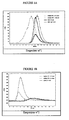
- the imprint No. 1 is selectively selective compared to adducts.
- the imprint No. 2 is more selective glutathione than the imprint No. 1.
- An SPE cartridge is made by introducing 200 mg of impression No. 2 between two sintered glasses. Prior to extraction, 5 mL of acetonitrile and 6 mL of a 90/10 ACN solution (1% AA) / H 2 O are passed over the cartridge for conditioning before introducing the solution to be poured. Then 1 mL of a solution containing 182.89 ⁇ g of GSH (0.60 mM), 5.8 ⁇ g of adduct 2 (0.015 mM) and 4.14 ⁇ g of adduct 3 (0.009 mM) in 90/10 MeCN (1% AA) / Water is drilled on the SPE cartridge. Several fractions of 500 ⁇ L 90/10 MeCN (1% AA) / Water are used as the wash solution. Subsequently 3 mL of 85/15 ACN / H 2 O solution are percolated. The various fractions are then analyzed by HPLC-UV.
- MIP prepared by a conventional approach is recognized for both GSH and its adducts while MIP prepared by a semi-covalent approach has greater recognition for GSH, and therefore better selectivity.
- the MIP obtained from a semi-covalent approach can make it possible to carry out a pre-treatment step before analyzing the incubation media.
- This pre-treatment step makes it possible to selectively eliminate the GSH, while retaining in the pre-treated GSH adducts and proceed to a purification, and possibly enrichment, of GSH adducts.
Landscapes
- Life Sciences & Earth Sciences (AREA)
- Health & Medical Sciences (AREA)
- Engineering & Computer Science (AREA)
- Molecular Biology (AREA)
- Chemical & Material Sciences (AREA)
- Biomedical Technology (AREA)
- Urology & Nephrology (AREA)
- Hematology (AREA)
- Immunology (AREA)
- Biotechnology (AREA)
- Microbiology (AREA)
- Cell Biology (AREA)
- Proteomics, Peptides & Aminoacids (AREA)
- Food Science & Technology (AREA)
- Medicinal Chemistry (AREA)
- Physics & Mathematics (AREA)
- Analytical Chemistry (AREA)
- Biochemistry (AREA)
- General Health & Medical Sciences (AREA)
- General Physics & Mathematics (AREA)
- Pathology (AREA)
- Peptides Or Proteins (AREA)
Claims (12)
- Verfahren zur Herstellung eines molekular geprägten Polymers (MIP), das zur selektiven Erkennung der reduzierten Form von Glutathion, GSH, oder eines Analogons vorgesehen ist, wobei das Verfahren mindestens umfasst:- Copolymerisation eines Monomers oder von Monomeren, das/die zum Ausbilden einer Matrix der molekularen Prägung bestimmt ist/sind, mit mindestens einem Monomer der allgemeinen Formel (I):
X-(R)n-Y-G (I),
worin.:- X eine monovalente polymerisierbare Gruppe repräsentiert,- n 0 oder 1 ist,- R eine lineare, verzweigte oder cyclische, gesättigte oder ungesättigte, C1-C10-, insbesondere C1-C5-Kohlenwasserstoffkette repräsentiert, die gegebenenfalls durch ein oder mehrere Heteroatome, ausgewählt aus N, O und S, unterbrochen ist und gegebenenfalls substituiert ist,- Y eine Funktion einer labilen Bindung repräsentiert, die die Sulfhydryl-Funktion des Glutathions GSH oder eines seiner Analoga mit einschließt,- G den Rest des Glutathions GSH oder eines seiner entsprechenden Analoga repräsentiert,unter Bedingungen, die für die Ausbildung der molekularen Prägung günstig sind, und- Freisetzung des Restes G durch Spaltung der Bindungsfunktion Y. - Verfahren gemäß Anspruch 1, dadurch charakterisiert, dass X eine monovalente Gruppe, ausgewählt aus Vinyl-, Acryl-, Methacryl-, Alkyl-, Styrol-Gruppen oder einer jeglichen anderen ungesättigten Gruppe, die fähig ist, radikalisch zur reagieren, und den chemischen Gruppen, die eine Polykondensations- oder Sol-Gel-Reaktion erlauben, repräsentiert.
- Verfahren gemäß einem jeglichen der vorstehenden Ansprüche, dadurch charakterisiert, dass Y eine Disulildfusktion -SS- repräsentiert.
- Verfahren gemäß einem jeglichen der vorstehenden Ansprüche, dadurch charakterisiert, dass mindestens ein Monomer der allgemeinen Formel (I) N-Boc-Glutathiondisulfid-Methacrylat ist.
- Molekular geprägtes Polymer (MIP), das durch das Verfahren gemäß einem jeglichen der vorstehenden Ansprüche erhältlich ist.
- Verfahren zur Behandlung eines Mediums, das mindestens Glutathion GSH und/oder eines seiner Analoga umfassen kann oder umfasst, wobei das Verfahren mindestens umfasst:(a) einen Schritt eines In-Kontakt-Bringens des Mediums mit mindestens einem gemäß Anspruch 5 erhaltenen molekular geprägten Polymer unter Bedingungen, die für eine Extraktion des Glutathions GSH und/oder seiner Analoga, falls vorhanden, durch die molekulare Prägung günstig sind,(b) Abtrennung des molekular geprägten Polymers von dem so behandelten Medium und(c) gegebenenfalls Freisetzung des Glutathions GSH und/oder seiner Analoga von dem sich aus Schritt (b) ergebenden molekular geprägten Polymer.
- Verfahren gemäß dem vorstehenden Anspruch, dadurch charakterisiert, dass das molekular geprägte Polymer auf einer Extraktionssäule, z.B. einer SPE-Kartusche, verwendet wird.
- Verfahren gemäß Anspruch 6 oder 7, wobei das Medium ein komplexes Medium ist, das neben dem Glutathion GSH und/oder einem seiner Analoga mindestens ein oder mehrere GSH-Addukte umfassen kann.
- Verfahren gemäß Anspruch 8, dadurch charakterisiert, dass es ferner vor dem Schritt (a) mindestens umfasst:(i) eine Schritt eines In-Kontakt-Bringens des Mediums mit mindestens einem ersten molekular geprägten Polymer, das geeignet ist, mit den GSH-Addukten, dem Glutathion und seinen Analoga zu interagieren, unter Bedingungen, die für eine Extraktion der GSH-Addukte, des Glutathions und seiner Analoga geeignet sind,(ii) Abtrennung des molekular geprägten Polymers von dem so behandelten Medium und(iii) Ausbildung eines Mediums, das an den GSH-Addukten, dem Glutathion und seinen Analoga angereicht ist, durch Freisetzung der GSH-Addukte, des Glutathions und seiner Analoga von dem sich aus Schritt (ii) ergebenden molekular geprägten Polymer.
- Verfahren gemäß einem jeglichen der Ansprüche 8 oder 9, wobei das komplexe Medium ein Inkubationsmedium für ein aktives Molekül, das in einem Toxikologietest auf Glutathion verwendet wird, wie z.B. ein Inkubationsmedium für ein Kandidatenmedikament, ist.
- Verwendung mindestens eines nach Anspruch 5 erhaltenen molekular geprägten Polymers zum Zweck einer Extraktion, Detektion, Abtrennung, Aufreinigung, Absorbtion, Adsorption, Retention oder kontrollierten Freisetzung der freien Form von Glutathion GSH und/oder eines seiner Analoga.
- Verwendung mindestens eines nach Anspruch 5 erhaltenen molekular geprägten Polymers zur Behandlung eines Mediums, das mindestens Glutathion GSH und/oder eines seiner Analoga und GSH-Addukte umfassen kann oder umfasst.
Applications Claiming Priority (2)
| Application Number | Priority Date | Filing Date | Title |
|---|---|---|---|
| FR0758193A FR2922213B1 (fr) | 2007-10-10 | 2007-10-10 | Polymeres a empreintes moleculaires pour la reconnaissance du glutathion gsh, leurs procede de preparation et utilisations |
| PCT/FR2008/051815 WO2009056716A1 (fr) | 2007-10-10 | 2008-10-08 | Polymeres a empreintes moleculaires pour la reconnaissance du glutathion gsh, leurs procedes de preparation et utilisations |
Publications (2)
| Publication Number | Publication Date |
|---|---|
| EP2201052A1 EP2201052A1 (de) | 2010-06-30 |
| EP2201052B1 true EP2201052B1 (de) | 2012-12-12 |
Family
ID=39102982
Family Applications (1)
| Application Number | Title | Priority Date | Filing Date |
|---|---|---|---|
| EP08845161A Not-in-force EP2201052B1 (de) | 2007-10-10 | 2008-10-08 | Molekular geprägte polymere zur erkennung von glutathion-gsh, verfahren zu ihrer herstellung und verwendungen davon |
Country Status (4)
| Country | Link |
|---|---|
| US (1) | US8344082B2 (de) |
| EP (1) | EP2201052B1 (de) |
| FR (1) | FR2922213B1 (de) |
| WO (1) | WO2009056716A1 (de) |
Families Citing this family (1)
| Publication number | Priority date | Publication date | Assignee | Title |
|---|---|---|---|---|
| CN102485758A (zh) * | 2010-12-03 | 2012-06-06 | 江南大学 | 谷胱甘肽分子印迹聚合物及其制备和应用方法 |
Family Cites Families (1)
| Publication number | Priority date | Publication date | Assignee | Title |
|---|---|---|---|---|
| US7169576B2 (en) | 2004-01-08 | 2007-01-30 | Bristol-Myers Squibb Company | Method for identifying drug metabolites with dansylated glutathione |
-
2007
- 2007-10-10 FR FR0758193A patent/FR2922213B1/fr not_active Expired - Fee Related
-
2008
- 2008-10-08 WO PCT/FR2008/051815 patent/WO2009056716A1/fr not_active Ceased
- 2008-10-08 EP EP08845161A patent/EP2201052B1/de not_active Not-in-force
- 2008-10-08 US US12/681,977 patent/US8344082B2/en not_active Expired - Fee Related
Also Published As
| Publication number | Publication date |
|---|---|
| WO2009056716A1 (fr) | 2009-05-07 |
| EP2201052A1 (de) | 2010-06-30 |
| FR2922213B1 (fr) | 2009-11-20 |
| FR2922213A1 (fr) | 2009-04-17 |
| US20100234565A1 (en) | 2010-09-16 |
| US8344082B2 (en) | 2013-01-01 |
Similar Documents
| Publication | Publication Date | Title |
|---|---|---|
| Owens et al. | Molecular imprinting for bio-and pharmaceutical analysis | |
| Lanza et al. | Method for synthesis and screening of large groups of molecularly imprinted polymers | |
| Levi et al. | Optical detection of chloramphenicol using molecularly imprinted polymers | |
| Haupt | Molecularly imprinted polymers in analytical chemistry | |
| CN103217523B (zh) | 糖链捕获物及其用途 | |
| WO2008132384A2 (fr) | Kit d'analyse comprenant au moins deux polymeres a empreintes moleculaires et au moins un marqueur, ainsi que le procede d'analyse l'utilisant | |
| Fairhurst et al. | A direct comparison of the performance of ground, beaded and silica-grafted MIPs in HPLC and Turbulent Flow Chromatography applications | |
| Huang et al. | Electrochemical aptasensor for multi-antibiotics detection based on endonuclease and exonuclease assisted dual recycling amplification strategy | |
| Suárez-Rodrı́guez et al. | Fluorescent competitive flow-through assay for chloramphenicol using molecularly imprinted polymers | |
| Rebocho et al. | Development of a ferrocenyl-based MIP in supercritical carbon dioxide: Towards an electrochemical sensor for bisphenol A | |
| Wu et al. | Synthesis of bilirubin imprinted polymer thin film for the continuous detection of bilirubin in an MIP/QCM/FIA system | |
| Dolak et al. | Molecularly imprinted affinity cryogels for the selective recognition of myoglobin in blood serum | |
| Liu et al. | Sugar acrylate‐based polymers as chiral molecularly imprintable hydrogels | |
| Martin et al. | Comparison of extraction of a β-blocker from plasma onto a molecularly imprinted polymer with liquid–liquid extraction and solid phase extraction methods | |
| Hsieh et al. | Designing a molecularly imprinted polymer as an artificial receptor for the specific recognition of creatinine in serums | |
| KR101747812B1 (ko) | 콜레스테롤 검출용 탄소 점-헤모글로빈 복합체 | |
| CN107936035A (zh) | 一种半胱氨酸改性的石墨烯量子点gqcy及制备方法与制备多巴胺荧光检测试剂上的应用 | |
| FR2935806A1 (fr) | Kit utile pour la detection, la separation et/ou la caracterisation d'une molecule d'interet. | |
| CN101310855A (zh) | 用于从食品中提取组分的分子印迹聚合物 | |
| EP2201052B1 (de) | Molekular geprägte polymere zur erkennung von glutathion-gsh, verfahren zu ihrer herstellung und verwendungen davon | |
| Wang et al. | Synthesis and application of dehydroabietylisothiocyante as a new chiral derivatizing agent for the enantiomeric separation of chiral compounds by capillary electrophoretic | |
| Syu et al. | Binding specificity of α-bilirubin-imprinted poly (methacrylic acid-co-ethylene glycol dimethylacrylate) toward α-bilirubin | |
| CN119978404A (zh) | 一种氢键有机框架材料、制备方法及其在多巴胺检测中的应用 | |
| CN108191848A (zh) | 制备用于检测半胱氨酸的试剂盒的方法 | |
| CN111072876A (zh) | 一种表面载有苯硼酸基团的聚合物微球及其制备方法和应用 |
Legal Events
| Date | Code | Title | Description |
|---|---|---|---|
| PUAI | Public reference made under article 153(3) epc to a published international application that has entered the european phase |
Free format text: ORIGINAL CODE: 0009012 |
|
| 17P | Request for examination filed |
Effective date: 20100412 |
|
| AK | Designated contracting states |
Kind code of ref document: A1 Designated state(s): AT BE BG CH CY CZ DE DK EE ES FI FR GB GR HR HU IE IS IT LI LT LU LV MC MT NL NO PL PT RO SE SI SK TR |
|
| AX | Request for extension of the european patent |
Extension state: AL BA MK RS |
|
| DAX | Request for extension of the european patent (deleted) | ||
| 17Q | First examination report despatched |
Effective date: 20101223 |
|
| REG | Reference to a national code |
Ref country code: DE Ref legal event code: R079 Ref document number: 602008020858 Country of ref document: DE Free format text: PREVIOUS MAIN CLASS: C08F0220380000 Ipc: C08F0246000000 |
|
| GRAP | Despatch of communication of intention to grant a patent |
Free format text: ORIGINAL CODE: EPIDOSNIGR1 |
|
| RIC1 | Information provided on ipc code assigned before grant |
Ipc: C08F 226/06 20060101ALN20120404BHEP Ipc: C08F 222/10 20060101ALN20120404BHEP Ipc: B01J 20/26 20060101ALI20120404BHEP Ipc: G01N 33/68 20060101ALI20120404BHEP Ipc: C08F 246/00 20060101AFI20120404BHEP Ipc: C08F 220/28 20060101ALN20120404BHEP |
|
| RIC1 | Information provided on ipc code assigned before grant |
Ipc: C08F 220/28 20060101ALN20120420BHEP Ipc: C08F 226/06 20060101ALN20120420BHEP Ipc: C08F 246/00 20060101AFI20120420BHEP Ipc: C08F 222/10 20060101ALN20120420BHEP Ipc: B01J 20/26 20060101ALI20120420BHEP Ipc: G01N 33/68 20060101ALI20120420BHEP |
|
| GRAS | Grant fee paid |
Free format text: ORIGINAL CODE: EPIDOSNIGR3 |
|
| GRAA | (expected) grant |
Free format text: ORIGINAL CODE: 0009210 |
|
| AK | Designated contracting states |
Kind code of ref document: B1 Designated state(s): AT BE BG CH CY CZ DE DK EE ES FI FR GB GR HR HU IE IS IT LI LT LU LV MC MT NL NO PL PT RO SE SI SK TR |
|
| REG | Reference to a national code |
Ref country code: GB Ref legal event code: FG4D Free format text: NOT ENGLISH |
|
| REG | Reference to a national code |
Ref country code: CH Ref legal event code: EP |
|
| REG | Reference to a national code |
Ref country code: AT Ref legal event code: REF Ref document number: 588309 Country of ref document: AT Kind code of ref document: T Effective date: 20121215 |
|
| REG | Reference to a national code |
Ref country code: IE Ref legal event code: FG4D Free format text: LANGUAGE OF EP DOCUMENT: FRENCH |
|
| REG | Reference to a national code |
Ref country code: DE Ref legal event code: R096 Ref document number: 602008020858 Country of ref document: DE Effective date: 20130207 |
|
| PG25 | Lapsed in a contracting state [announced via postgrant information from national office to epo] |
Ref country code: LT Free format text: LAPSE BECAUSE OF FAILURE TO SUBMIT A TRANSLATION OF THE DESCRIPTION OR TO PAY THE FEE WITHIN THE PRESCRIBED TIME-LIMIT Effective date: 20121212 Ref country code: FI Free format text: LAPSE BECAUSE OF FAILURE TO SUBMIT A TRANSLATION OF THE DESCRIPTION OR TO PAY THE FEE WITHIN THE PRESCRIBED TIME-LIMIT Effective date: 20121212 Ref country code: ES Free format text: LAPSE BECAUSE OF FAILURE TO SUBMIT A TRANSLATION OF THE DESCRIPTION OR TO PAY THE FEE WITHIN THE PRESCRIBED TIME-LIMIT Effective date: 20130323 Ref country code: HR Free format text: LAPSE BECAUSE OF FAILURE TO SUBMIT A TRANSLATION OF THE DESCRIPTION OR TO PAY THE FEE WITHIN THE PRESCRIBED TIME-LIMIT Effective date: 20121212 Ref country code: NO Free format text: LAPSE BECAUSE OF FAILURE TO SUBMIT A TRANSLATION OF THE DESCRIPTION OR TO PAY THE FEE WITHIN THE PRESCRIBED TIME-LIMIT Effective date: 20130312 Ref country code: SE Free format text: LAPSE BECAUSE OF FAILURE TO SUBMIT A TRANSLATION OF THE DESCRIPTION OR TO PAY THE FEE WITHIN THE PRESCRIBED TIME-LIMIT Effective date: 20121212 |
|
| REG | Reference to a national code |
Ref country code: NL Ref legal event code: VDEP Effective date: 20121212 |
|
| REG | Reference to a national code |
Ref country code: AT Ref legal event code: MK05 Ref document number: 588309 Country of ref document: AT Kind code of ref document: T Effective date: 20121212 |
|
| REG | Reference to a national code |
Ref country code: LT Ref legal event code: MG4D |
|
| PG25 | Lapsed in a contracting state [announced via postgrant information from national office to epo] |
Ref country code: GR Free format text: LAPSE BECAUSE OF FAILURE TO SUBMIT A TRANSLATION OF THE DESCRIPTION OR TO PAY THE FEE WITHIN THE PRESCRIBED TIME-LIMIT Effective date: 20130313 Ref country code: SI Free format text: LAPSE BECAUSE OF FAILURE TO SUBMIT A TRANSLATION OF THE DESCRIPTION OR TO PAY THE FEE WITHIN THE PRESCRIBED TIME-LIMIT Effective date: 20121212 Ref country code: LV Free format text: LAPSE BECAUSE OF FAILURE TO SUBMIT A TRANSLATION OF THE DESCRIPTION OR TO PAY THE FEE WITHIN THE PRESCRIBED TIME-LIMIT Effective date: 20121212 |
|
| PG25 | Lapsed in a contracting state [announced via postgrant information from national office to epo] |
Ref country code: IS Free format text: LAPSE BECAUSE OF FAILURE TO SUBMIT A TRANSLATION OF THE DESCRIPTION OR TO PAY THE FEE WITHIN THE PRESCRIBED TIME-LIMIT Effective date: 20130412 Ref country code: SK Free format text: LAPSE BECAUSE OF FAILURE TO SUBMIT A TRANSLATION OF THE DESCRIPTION OR TO PAY THE FEE WITHIN THE PRESCRIBED TIME-LIMIT Effective date: 20121212 Ref country code: BG Free format text: LAPSE BECAUSE OF FAILURE TO SUBMIT A TRANSLATION OF THE DESCRIPTION OR TO PAY THE FEE WITHIN THE PRESCRIBED TIME-LIMIT Effective date: 20130312 Ref country code: CZ Free format text: LAPSE BECAUSE OF FAILURE TO SUBMIT A TRANSLATION OF THE DESCRIPTION OR TO PAY THE FEE WITHIN THE PRESCRIBED TIME-LIMIT Effective date: 20121212 Ref country code: EE Free format text: LAPSE BECAUSE OF FAILURE TO SUBMIT A TRANSLATION OF THE DESCRIPTION OR TO PAY THE FEE WITHIN THE PRESCRIBED TIME-LIMIT Effective date: 20121212 Ref country code: AT Free format text: LAPSE BECAUSE OF FAILURE TO SUBMIT A TRANSLATION OF THE DESCRIPTION OR TO PAY THE FEE WITHIN THE PRESCRIBED TIME-LIMIT Effective date: 20121212 |
|
| PG25 | Lapsed in a contracting state [announced via postgrant information from national office to epo] |
Ref country code: PL Free format text: LAPSE BECAUSE OF FAILURE TO SUBMIT A TRANSLATION OF THE DESCRIPTION OR TO PAY THE FEE WITHIN THE PRESCRIBED TIME-LIMIT Effective date: 20121212 Ref country code: RO Free format text: LAPSE BECAUSE OF FAILURE TO SUBMIT A TRANSLATION OF THE DESCRIPTION OR TO PAY THE FEE WITHIN THE PRESCRIBED TIME-LIMIT Effective date: 20121212 Ref country code: NL Free format text: LAPSE BECAUSE OF FAILURE TO SUBMIT A TRANSLATION OF THE DESCRIPTION OR TO PAY THE FEE WITHIN THE PRESCRIBED TIME-LIMIT Effective date: 20121212 Ref country code: PT Free format text: LAPSE BECAUSE OF FAILURE TO SUBMIT A TRANSLATION OF THE DESCRIPTION OR TO PAY THE FEE WITHIN THE PRESCRIBED TIME-LIMIT Effective date: 20130412 |
|
| PLBE | No opposition filed within time limit |
Free format text: ORIGINAL CODE: 0009261 |
|
| STAA | Information on the status of an ep patent application or granted ep patent |
Free format text: STATUS: NO OPPOSITION FILED WITHIN TIME LIMIT |
|
| PG25 | Lapsed in a contracting state [announced via postgrant information from national office to epo] |
Ref country code: DK Free format text: LAPSE BECAUSE OF FAILURE TO SUBMIT A TRANSLATION OF THE DESCRIPTION OR TO PAY THE FEE WITHIN THE PRESCRIBED TIME-LIMIT Effective date: 20121212 |
|
| 26N | No opposition filed |
Effective date: 20130913 |
|
| PG25 | Lapsed in a contracting state [announced via postgrant information from national office to epo] |
Ref country code: CY Free format text: LAPSE BECAUSE OF FAILURE TO SUBMIT A TRANSLATION OF THE DESCRIPTION OR TO PAY THE FEE WITHIN THE PRESCRIBED TIME-LIMIT Effective date: 20121212 |
|
| PG25 | Lapsed in a contracting state [announced via postgrant information from national office to epo] |
Ref country code: IT Free format text: LAPSE BECAUSE OF FAILURE TO SUBMIT A TRANSLATION OF THE DESCRIPTION OR TO PAY THE FEE WITHIN THE PRESCRIBED TIME-LIMIT Effective date: 20121212 |
|
| REG | Reference to a national code |
Ref country code: DE Ref legal event code: R097 Ref document number: 602008020858 Country of ref document: DE Effective date: 20130913 |
|
| PGFP | Annual fee paid to national office [announced via postgrant information from national office to epo] |
Ref country code: FR Payment date: 20131030 Year of fee payment: 6 |
|
| BERE | Be: lapsed |
Owner name: POLYINTELL Effective date: 20131031 |
|
| PG25 | Lapsed in a contracting state [announced via postgrant information from national office to epo] |
Ref country code: MC Free format text: LAPSE BECAUSE OF FAILURE TO SUBMIT A TRANSLATION OF THE DESCRIPTION OR TO PAY THE FEE WITHIN THE PRESCRIBED TIME-LIMIT Effective date: 20121212 |
|
| REG | Reference to a national code |
Ref country code: CH Ref legal event code: PL |
|
| GBPC | Gb: european patent ceased through non-payment of renewal fee |
Effective date: 20131008 |
|
| REG | Reference to a national code |
Ref country code: IE Ref legal event code: MM4A |
|
| PG25 | Lapsed in a contracting state [announced via postgrant information from national office to epo] |
Ref country code: GB Free format text: LAPSE BECAUSE OF NON-PAYMENT OF DUE FEES Effective date: 20131008 Ref country code: LI Free format text: LAPSE BECAUSE OF NON-PAYMENT OF DUE FEES Effective date: 20131031 Ref country code: CH Free format text: LAPSE BECAUSE OF NON-PAYMENT OF DUE FEES Effective date: 20131031 |
|
| REG | Reference to a national code |
Ref country code: DE Ref legal event code: R119 Ref document number: 602008020858 Country of ref document: DE Effective date: 20140501 |
|
| PG25 | Lapsed in a contracting state [announced via postgrant information from national office to epo] |
Ref country code: DE Free format text: LAPSE BECAUSE OF NON-PAYMENT OF DUE FEES Effective date: 20140501 |
|
| PG25 | Lapsed in a contracting state [announced via postgrant information from national office to epo] |
Ref country code: BE Free format text: LAPSE BECAUSE OF NON-PAYMENT OF DUE FEES Effective date: 20131031 |
|
| PG25 | Lapsed in a contracting state [announced via postgrant information from national office to epo] |
Ref country code: IE Free format text: LAPSE BECAUSE OF NON-PAYMENT OF DUE FEES Effective date: 20131008 |
|
| PG25 | Lapsed in a contracting state [announced via postgrant information from national office to epo] |
Ref country code: TR Free format text: LAPSE BECAUSE OF FAILURE TO SUBMIT A TRANSLATION OF THE DESCRIPTION OR TO PAY THE FEE WITHIN THE PRESCRIBED TIME-LIMIT Effective date: 20121212 |
|
| PG25 | Lapsed in a contracting state [announced via postgrant information from national office to epo] |
Ref country code: HU Free format text: LAPSE BECAUSE OF FAILURE TO SUBMIT A TRANSLATION OF THE DESCRIPTION OR TO PAY THE FEE WITHIN THE PRESCRIBED TIME-LIMIT; INVALID AB INITIO Effective date: 20081008 Ref country code: LU Free format text: LAPSE BECAUSE OF NON-PAYMENT OF DUE FEES Effective date: 20131008 |
|
| REG | Reference to a national code |
Ref country code: FR Ref legal event code: ST Effective date: 20150630 |
|
| PG25 | Lapsed in a contracting state [announced via postgrant information from national office to epo] |
Ref country code: MT Free format text: LAPSE BECAUSE OF FAILURE TO SUBMIT A TRANSLATION OF THE DESCRIPTION OR TO PAY THE FEE WITHIN THE PRESCRIBED TIME-LIMIT Effective date: 20121212 Ref country code: FR Free format text: LAPSE BECAUSE OF NON-PAYMENT OF DUE FEES Effective date: 20141031 |