EP2199343B1 - Klebezusammensetzung, die nach Vernetzung abziehbar ist - Google Patents
Klebezusammensetzung, die nach Vernetzung abziehbar ist Download PDFInfo
- Publication number
- EP2199343B1 EP2199343B1 EP09015020.2A EP09015020A EP2199343B1 EP 2199343 B1 EP2199343 B1 EP 2199343B1 EP 09015020 A EP09015020 A EP 09015020A EP 2199343 B1 EP2199343 B1 EP 2199343B1
- Authority
- EP
- European Patent Office
- Prior art keywords
- adhesive composition
- substrate
- radical
- adhesive
- article
- Prior art date
- Legal status (The legal status is an assumption and is not a legal conclusion. Google has not performed a legal analysis and makes no representation as to the accuracy of the status listed.)
- Active
Links
Images
Classifications
-
- C—CHEMISTRY; METALLURGY
- C09—DYES; PAINTS; POLISHES; NATURAL RESINS; ADHESIVES; COMPOSITIONS NOT OTHERWISE PROVIDED FOR; APPLICATIONS OF MATERIALS NOT OTHERWISE PROVIDED FOR
- C09J—ADHESIVES; NON-MECHANICAL ASPECTS OF ADHESIVE PROCESSES IN GENERAL; ADHESIVE PROCESSES NOT PROVIDED FOR ELSEWHERE; USE OF MATERIALS AS ADHESIVES
- C09J143/00—Adhesives based on homopolymers or copolymers of compounds having one or more unsaturated aliphatic radicals, each having only one carbon-to-carbon double bond, and containing boron, silicon, phosphorus, selenium, tellurium, or a metal; Adhesives based on derivatives of such polymers
- C09J143/04—Homopolymers or copolymers of monomers containing silicon
-
- C—CHEMISTRY; METALLURGY
- C08—ORGANIC MACROMOLECULAR COMPOUNDS; THEIR PREPARATION OR CHEMICAL WORKING-UP; COMPOSITIONS BASED THEREON
- C08G—MACROMOLECULAR COMPOUNDS OBTAINED OTHERWISE THAN BY REACTIONS ONLY INVOLVING UNSATURATED CARBON-TO-CARBON BONDS
- C08G18/00—Polymeric products of isocyanates or isothiocyanates
- C08G18/06—Polymeric products of isocyanates or isothiocyanates with compounds having active hydrogen
- C08G18/28—Polymeric products of isocyanates or isothiocyanates with compounds having active hydrogen characterised by the compounds used containing active hydrogen
- C08G18/40—High-molecular-weight compounds
- C08G18/48—Polyethers
- C08G18/4825—Polyethers containing two hydroxy groups
-
- C—CHEMISTRY; METALLURGY
- C08—ORGANIC MACROMOLECULAR COMPOUNDS; THEIR PREPARATION OR CHEMICAL WORKING-UP; COMPOSITIONS BASED THEREON
- C08G—MACROMOLECULAR COMPOUNDS OBTAINED OTHERWISE THAN BY REACTIONS ONLY INVOLVING UNSATURATED CARBON-TO-CARBON BONDS
- C08G18/00—Polymeric products of isocyanates or isothiocyanates
- C08G18/06—Polymeric products of isocyanates or isothiocyanates with compounds having active hydrogen
- C08G18/70—Polymeric products of isocyanates or isothiocyanates with compounds having active hydrogen characterised by the isocyanates or isothiocyanates used
- C08G18/71—Monoisocyanates or monoisothiocyanates
- C08G18/718—Monoisocyanates or monoisothiocyanates containing silicon
-
- C—CHEMISTRY; METALLURGY
- C08—ORGANIC MACROMOLECULAR COMPOUNDS; THEIR PREPARATION OR CHEMICAL WORKING-UP; COMPOSITIONS BASED THEREON
- C08G—MACROMOLECULAR COMPOUNDS OBTAINED OTHERWISE THAN BY REACTIONS ONLY INVOLVING UNSATURATED CARBON-TO-CARBON BONDS
- C08G18/00—Polymeric products of isocyanates or isothiocyanates
- C08G18/06—Polymeric products of isocyanates or isothiocyanates with compounds having active hydrogen
- C08G18/70—Polymeric products of isocyanates or isothiocyanates with compounds having active hydrogen characterised by the isocyanates or isothiocyanates used
- C08G18/72—Polyisocyanates or polyisothiocyanates
- C08G18/74—Polyisocyanates or polyisothiocyanates cyclic
- C08G18/75—Polyisocyanates or polyisothiocyanates cyclic cycloaliphatic
- C08G18/751—Polyisocyanates or polyisothiocyanates cyclic cycloaliphatic containing only one cycloaliphatic ring
- C08G18/752—Polyisocyanates or polyisothiocyanates cyclic cycloaliphatic containing only one cycloaliphatic ring containing at least one isocyanate or isothiocyanate group linked to the cycloaliphatic ring by means of an aliphatic group
- C08G18/753—Polyisocyanates or polyisothiocyanates cyclic cycloaliphatic containing only one cycloaliphatic ring containing at least one isocyanate or isothiocyanate group linked to the cycloaliphatic ring by means of an aliphatic group containing one isocyanate or isothiocyanate group linked to the cycloaliphatic ring by means of an aliphatic group having a primary carbon atom next to the isocyanate or isothiocyanate group
- C08G18/755—Polyisocyanates or polyisothiocyanates cyclic cycloaliphatic containing only one cycloaliphatic ring containing at least one isocyanate or isothiocyanate group linked to the cycloaliphatic ring by means of an aliphatic group containing one isocyanate or isothiocyanate group linked to the cycloaliphatic ring by means of an aliphatic group having a primary carbon atom next to the isocyanate or isothiocyanate group and at least one isocyanate or isothiocyanate group linked to a secondary carbon atom of the cycloaliphatic ring, e.g. isophorone diisocyanate
-
- C—CHEMISTRY; METALLURGY
- C08—ORGANIC MACROMOLECULAR COMPOUNDS; THEIR PREPARATION OR CHEMICAL WORKING-UP; COMPOSITIONS BASED THEREON
- C08G—MACROMOLECULAR COMPOUNDS OBTAINED OTHERWISE THAN BY REACTIONS ONLY INVOLVING UNSATURATED CARBON-TO-CARBON BONDS
- C08G65/00—Macromolecular compounds obtained by reactions forming an ether link in the main chain of the macromolecule
- C08G65/02—Macromolecular compounds obtained by reactions forming an ether link in the main chain of the macromolecule from cyclic ethers by opening of the heterocyclic ring
- C08G65/32—Polymers modified by chemical after-treatment
- C08G65/329—Polymers modified by chemical after-treatment with organic compounds
- C08G65/336—Polymers modified by chemical after-treatment with organic compounds containing silicon
-
- C—CHEMISTRY; METALLURGY
- C08—ORGANIC MACROMOLECULAR COMPOUNDS; THEIR PREPARATION OR CHEMICAL WORKING-UP; COMPOSITIONS BASED THEREON
- C08L—COMPOSITIONS OF MACROMOLECULAR COMPOUNDS
- C08L33/00—Compositions of homopolymers or copolymers of compounds having one or more unsaturated aliphatic radicals, each having only one carbon-to-carbon double bond, and only one being terminated by only one carboxyl radical, or of salts, anhydrides, esters, amides, imides or nitriles thereof; Compositions of derivatives of such polymers
- C08L33/04—Homopolymers or copolymers of esters
- C08L33/06—Homopolymers or copolymers of esters of esters containing only carbon, hydrogen and oxygen, which oxygen atoms are present only as part of the carboxyl radical
-
- C—CHEMISTRY; METALLURGY
- C08—ORGANIC MACROMOLECULAR COMPOUNDS; THEIR PREPARATION OR CHEMICAL WORKING-UP; COMPOSITIONS BASED THEREON
- C08L—COMPOSITIONS OF MACROMOLECULAR COMPOUNDS
- C08L71/00—Compositions of polyethers obtained by reactions forming an ether link in the main chain; Compositions of derivatives of such polymers
- C08L71/02—Polyalkylene oxides
-
- C—CHEMISTRY; METALLURGY
- C08—ORGANIC MACROMOLECULAR COMPOUNDS; THEIR PREPARATION OR CHEMICAL WORKING-UP; COMPOSITIONS BASED THEREON
- C08L—COMPOSITIONS OF MACROMOLECULAR COMPOUNDS
- C08L75/00—Compositions of polyureas or polyurethanes; Compositions of derivatives of such polymers
- C08L75/04—Polyurethanes
-
- C—CHEMISTRY; METALLURGY
- C08—ORGANIC MACROMOLECULAR COMPOUNDS; THEIR PREPARATION OR CHEMICAL WORKING-UP; COMPOSITIONS BASED THEREON
- C08L—COMPOSITIONS OF MACROMOLECULAR COMPOUNDS
- C08L75/00—Compositions of polyureas or polyurethanes; Compositions of derivatives of such polymers
- C08L75/04—Polyurethanes
- C08L75/08—Polyurethanes from polyethers
-
- C—CHEMISTRY; METALLURGY
- C09—DYES; PAINTS; POLISHES; NATURAL RESINS; ADHESIVES; COMPOSITIONS NOT OTHERWISE PROVIDED FOR; APPLICATIONS OF MATERIALS NOT OTHERWISE PROVIDED FOR
- C09J—ADHESIVES; NON-MECHANICAL ASPECTS OF ADHESIVE PROCESSES IN GENERAL; ADHESIVE PROCESSES NOT PROVIDED FOR ELSEWHERE; USE OF MATERIALS AS ADHESIVES
- C09J133/00—Adhesives based on homopolymers or copolymers of compounds having one or more unsaturated aliphatic radicals, each having only one carbon-to-carbon double bond, and at least one being terminated by only one carboxyl radical, or of salts, anhydrides, esters, amides, imides, or nitriles thereof; Adhesives based on derivatives of such polymers
- C09J133/04—Homopolymers or copolymers of esters
- C09J133/06—Homopolymers or copolymers of esters of esters containing only carbon, hydrogen and oxygen, the oxygen atom being present only as part of the carboxyl radical
-
- C—CHEMISTRY; METALLURGY
- C09—DYES; PAINTS; POLISHES; NATURAL RESINS; ADHESIVES; COMPOSITIONS NOT OTHERWISE PROVIDED FOR; APPLICATIONS OF MATERIALS NOT OTHERWISE PROVIDED FOR
- C09J—ADHESIVES; NON-MECHANICAL ASPECTS OF ADHESIVE PROCESSES IN GENERAL; ADHESIVE PROCESSES NOT PROVIDED FOR ELSEWHERE; USE OF MATERIALS AS ADHESIVES
- C09J171/00—Adhesives based on polyethers obtained by reactions forming an ether link in the main chain; Adhesives based on derivatives of such polymers
- C09J171/02—Polyalkylene oxides
-
- C—CHEMISTRY; METALLURGY
- C09—DYES; PAINTS; POLISHES; NATURAL RESINS; ADHESIVES; COMPOSITIONS NOT OTHERWISE PROVIDED FOR; APPLICATIONS OF MATERIALS NOT OTHERWISE PROVIDED FOR
- C09J—ADHESIVES; NON-MECHANICAL ASPECTS OF ADHESIVE PROCESSES IN GENERAL; ADHESIVE PROCESSES NOT PROVIDED FOR ELSEWHERE; USE OF MATERIALS AS ADHESIVES
- C09J175/00—Adhesives based on polyureas or polyurethanes; Adhesives based on derivatives of such polymers
- C09J175/04—Polyurethanes
- C09J175/08—Polyurethanes from polyethers
-
- C—CHEMISTRY; METALLURGY
- C09—DYES; PAINTS; POLISHES; NATURAL RESINS; ADHESIVES; COMPOSITIONS NOT OTHERWISE PROVIDED FOR; APPLICATIONS OF MATERIALS NOT OTHERWISE PROVIDED FOR
- C09J—ADHESIVES; NON-MECHANICAL ASPECTS OF ADHESIVE PROCESSES IN GENERAL; ADHESIVE PROCESSES NOT PROVIDED FOR ELSEWHERE; USE OF MATERIALS AS ADHESIVES
- C09J183/00—Adhesives based on macromolecular compounds obtained by reactions forming in the main chain of the macromolecule a linkage containing silicon, with or without sulfur, nitrogen, oxygen, or carbon only; Adhesives based on derivatives of such polymers
- C09J183/04—Polysiloxanes
- C09J183/06—Polysiloxanes containing silicon bound to oxygen-containing groups
-
- C—CHEMISTRY; METALLURGY
- C08—ORGANIC MACROMOLECULAR COMPOUNDS; THEIR PREPARATION OR CHEMICAL WORKING-UP; COMPOSITIONS BASED THEREON
- C08G—MACROMOLECULAR COMPOUNDS OBTAINED OTHERWISE THAN BY REACTIONS ONLY INVOLVING UNSATURATED CARBON-TO-CARBON BONDS
- C08G18/00—Polymeric products of isocyanates or isothiocyanates
- C08G18/06—Polymeric products of isocyanates or isothiocyanates with compounds having active hydrogen
- C08G18/08—Processes
- C08G18/10—Prepolymer processes involving reaction of isocyanates or isothiocyanates with compounds having active hydrogen in a first reaction step
-
- C—CHEMISTRY; METALLURGY
- C08—ORGANIC MACROMOLECULAR COMPOUNDS; THEIR PREPARATION OR CHEMICAL WORKING-UP; COMPOSITIONS BASED THEREON
- C08G—MACROMOLECULAR COMPOUNDS OBTAINED OTHERWISE THAN BY REACTIONS ONLY INVOLVING UNSATURATED CARBON-TO-CARBON BONDS
- C08G2650/00—Macromolecular compounds obtained by reactions forming an ether link in the main chain of the macromolecule
- C08G2650/28—Macromolecular compounds obtained by reactions forming an ether link in the main chain of the macromolecule characterised by the polymer type
- C08G2650/58—Ethylene oxide or propylene oxide copolymers, e.g. pluronics
-
- C—CHEMISTRY; METALLURGY
- C08—ORGANIC MACROMOLECULAR COMPOUNDS; THEIR PREPARATION OR CHEMICAL WORKING-UP; COMPOSITIONS BASED THEREON
- C08L—COMPOSITIONS OF MACROMOLECULAR COMPOUNDS
- C08L2666/00—Composition of polymers characterized by a further compound in the blend, being organic macromolecular compounds, natural resins, waxes or and bituminous materials, non-macromolecular organic substances, inorganic substances or characterized by their function in the composition
- C08L2666/02—Organic macromolecular compounds, natural resins, waxes or and bituminous materials
-
- C—CHEMISTRY; METALLURGY
- C08—ORGANIC MACROMOLECULAR COMPOUNDS; THEIR PREPARATION OR CHEMICAL WORKING-UP; COMPOSITIONS BASED THEREON
- C08L—COMPOSITIONS OF MACROMOLECULAR COMPOUNDS
- C08L43/00—Compositions of homopolymers or copolymers of compounds having one or more unsaturated aliphatic radicals, each having only one carbon-to-carbon double bond, and containing boron, silicon, phosphorus, selenium, tellurium or a metal; Compositions of derivatives of such polymers
- C08L43/04—Homopolymers or copolymers of monomers containing silicon
-
- C—CHEMISTRY; METALLURGY
- C08—ORGANIC MACROMOLECULAR COMPOUNDS; THEIR PREPARATION OR CHEMICAL WORKING-UP; COMPOSITIONS BASED THEREON
- C08L—COMPOSITIONS OF MACROMOLECULAR COMPOUNDS
- C08L83/00—Compositions of macromolecular compounds obtained by reactions forming in the main chain of the macromolecule a linkage containing silicon with or without sulfur, nitrogen, oxygen or carbon only; Compositions of derivatives of such polymers
-
- C—CHEMISTRY; METALLURGY
- C08—ORGANIC MACROMOLECULAR COMPOUNDS; THEIR PREPARATION OR CHEMICAL WORKING-UP; COMPOSITIONS BASED THEREON
- C08L—COMPOSITIONS OF MACROMOLECULAR COMPOUNDS
- C08L83/00—Compositions of macromolecular compounds obtained by reactions forming in the main chain of the macromolecule a linkage containing silicon with or without sulfur, nitrogen, oxygen or carbon only; Compositions of derivatives of such polymers
- C08L83/04—Polysiloxanes
- C08L83/06—Polysiloxanes containing silicon bound to oxygen-containing groups
-
- C—CHEMISTRY; METALLURGY
- C09—DYES; PAINTS; POLISHES; NATURAL RESINS; ADHESIVES; COMPOSITIONS NOT OTHERWISE PROVIDED FOR; APPLICATIONS OF MATERIALS NOT OTHERWISE PROVIDED FOR
- C09J—ADHESIVES; NON-MECHANICAL ASPECTS OF ADHESIVE PROCESSES IN GENERAL; ADHESIVE PROCESSES NOT PROVIDED FOR ELSEWHERE; USE OF MATERIALS AS ADHESIVES
- C09J175/00—Adhesives based on polyureas or polyurethanes; Adhesives based on derivatives of such polymers
- C09J175/04—Polyurethanes
Definitions
- the present invention relates to an adhesive composition and a method implementing it, in particular by consumers, for fixing various objects, for example for the purpose of furnishing or decorating homes.
- Adhesives also known as adhesives or mastics
- Adhesives are commonly used by individuals in their interior work to fix the most diverse objects on floors, walls or ceilings and thus avoid the use of traditional mechanical fastening systems. base for example of nails, screws and / or dowels.
- the fixing mastics currently available today thus make it possible to fix, for example on a vertical wall, objects of very high weight corresponding to application on the bonding joint (or adhesive seal) shear stresses of the order of 15 kg / cm 2 100 kg / cm 2 .
- the nature of the substrate on which the object can be fixed is itself very varied; there may be mentioned plaster or ceramic tiles, concrete, fiber cement, or wood.
- the strength of the assembly thus produced results from the excellent cohesion of the adhesive seal of about 0.1 to 2 millimeters thick through which the object is attached to the substrate.
- the strength of the assembly is also the consequence of the quality of the adhesion between the 2 faces of said seal and, respectively, object and the substrate.
- the patent application US 2006/0178470 discloses a composition suitable for use as a fixing adhesive which comprises less than 15% by weight of a polyurethane with silyl group and from 20 to 95% by weight of a filler.
- This glue provides a good ability to separate the bonded object and the substrate, also referred to as reversible adhesive behavior; this separation is effected by a cut made in the mass of the adhesive joint by means of a suitable cutting tool such as a spatula, a scraper or a wire.
- the present invention aims to overcome this disadvantage.
- Another object of the present invention is to provide an adhesive suitable for fixing objects against a vertical wall such as a wall, which provides a shear strength of the corresponding adhesive joint of 3 to 20 kg / cm 2 .
- Another object of the present invention is to provide an adhesive suitable for fastening objects to the ceiling, which provides a tensile strength of the adhesive seal corresponding to a value of 5 to 30 kg / cm 2 when said seal is between 2 rigid wooden supports.
- Another object of the present invention is to provide an adhesive suitable for fixing objects on various substrates and such that the object solidarizing adhesive seal with the substrate can be conveniently subjected to a break which is essentially at its interface with said object or said substrate, such a break being described as "adhesive break".
- Another object of the present invention is to provide an adhesive suitable for fixing objects on various substrates and such that the object after fixation can be separated from the substrate without damaging both the latter and said object.
- the adhesive composition according to the invention is particularly suitable for use as a fixing adhesive.
- said object after its application for fixing an object on a substrate, said object can be conveniently separated from said substrate by means of an adhesive break.
- the corresponding behavior of the adhesive joint solidarizing the object and the substrate is also described as "peelable”.
- the peelability of the adhesive joint obtained by using as adhesive for fixing the adhesive composition according to the invention advantageously makes it possible to separate the fixed object from the substrate without leaving residues attached to the surface of the object and / or the substrate .
- the alkoxysilane radical may be connected to the main chain of the polymer (A) directly by its available bond or indirectly, especially via a divalent hydrocarbon radical, preferably an alkylene radical such as for example the radical of formula: CH 2 -CH 2 -CH 2 -.
- the alkoxysilane radical is chosen from the radicals of the following formula: -Si (OCH 3 ) 3 , -Si (CH 3 ) (OCH 3 ) 2 , -Si (OCH 2 CH 3 ) 3 , -Si (CH 3 ) (OCH 2 CH 3 ) 2 .
- the polymers (A) are prepared according to methods known per se and for example exposed by the application US 2006/0178470 already mentioned.
- the polymers having the main chain (A3) can be prepared according to processes described in the patent applications EP 1657155 or EP 1371670 . Many of these polymers (A) are commonly available commercially.
- polyethers with an alkoxysilane end-radical are available from Kancka, for example the product S303H.
- the polymer of formula (II) can be obtained according to the following process.
- a polyurethane comprising 2 hydroxyl end groups and having formula (III): reacting one mole of diisocyanate of formula (IV): NCO-R 3 -NCO (IV) with about two moles of a polyether diol of formula (V): H- [OR 4 ] n -OH (V) which corresponds to a ratio of the number of NCO / OH functions equal to approximately 0.5.
- the reaction is carried out at a temperature between 60 and 90 ° C, for a time of about 2 to 8 hours, and optionally in the presence of a catalyst.
- the polyurethane of formula (III) is in a second step converted to polyurethane of formula (II) by a silylation reaction with an isocyanatosilane of formula (VI): NCO-R 5 -Si (R 2 ) p (OR 1 ) 3-p (VI) at a rate of about one mole of polyurethane of formula (III) for 2 moles of the compound of formula (VI).
- the polyether diols of formula (V) are widely available commercially, and the isocyanatosilanes of formula (VI) are also commercially available. There may be mentioned by way of example gamma-isocyanato-n-propyl-trimethoxysilane, which is available under the trade name GENIOSIL ® GF 40 or the alpha-isocyanato-n-methyl-methyldimethoxysilane which is available under the trade name GENIOSIL ® XL 42, both from Wackcr.
- the silica (B) used in the adhesive composition according to the invention is generally obtained by pyrogenation and is widely available commercially.
- a fumed silica which is marketed by Wacker, with a specific surface of between 150 and 200 m 2 / g, is used.
- the oligomer (C) used in the adhesive composition according to the invention is prepared according to known methods and is widely available commercially. These include the DYNASYLAN ® 6490 which is an oligomer do vinyltrimethoxysilane sold by Degussa soc reconsider, having the molecular weight about 900 Da.
- the crosslinking catalyst (D) that can be used in the composition according to the invention may be any catalyst known to those skilled in the art for the silanol condensation.
- catalysts include organometallic compounds based on divalent or tetravalent iron or tin.
- Such compounds are commercially available by example from the company EVONIK such TEGOKAT ® 223 which is a catalyst based on dioctyltin.
- this comprises from 60 to 77% of polymer (A), from 10 to 18% of fumed silica (B), from 5 to 12% of the oligomer ( C), and from 0.1 to 2% of catalyst (D).
- the adhesive composition according to the invention may furthermore comprise various additives such as UV stabilizers, adhesion promoters, thickeners and desiccants, various mineral fillers such as calcium carbonate.
- various additives such as UV stabilizers, adhesion promoters, thickeners and desiccants, various mineral fillers such as calcium carbonate.
- the composition according to the invention comprises up to 3% of a hydrolyzable alkoxysilane derivative, as desiccant, and preferably a trimethoxysilane derivative.
- a hydrolyzable alkoxysilane derivative as desiccant
- trimethoxysilane derivative Such an agent advantageously prolongs the shelf life of the composition according to the invention during storage and transport, before use.
- These include eg vinyltriméthoxysitane available under the trade name DYNASYLAN® VTMO ® from Degussa.
- composition according to the invention also comprises from 0.1 to 5% of non-spherical rubber granules having a size of between 0.5 and 2 mm, preferably between 0.8 and 1.2 mm.
- non-spherical rubber granules having a size of between 0.5 and 2 mm, preferably between 0.8 and 1.2 mm.
- the adhesive composition according to the invention may be prepared by simply mixing at room temperature its ingredients.
- the adhesive composition is generally packaged away from the air in a closed container (or cartridge) equipped with a cannula (or nozzle), into which it is conveyed until to the end user.
- a closed container or cartridge
- a cannula or nozzle
- the cartridge is placed in a pistol which allows to extrude the adhesive composition through the nozzle, in the form of a bead whose diameter is defined by the diameter of the nozzle, generally between 2 and 10 mm.
- This method is preferred for fixing objects on a substrate included in a vertical wall, such as a wall or a partition.
- the method according to the invention advantageously allows the attachment of objects whose weight corresponds to a shear stress exerted on the joint consisting of the crosslinked adhesive composition, ranging from 3 to 20 kg / cm 2 .
- objects that can be used for the purpose of furnishing or decorating dwellings such as, for example, lighting spots, hooks, mirrors, coat hooks or variously shaped coat racks, curtain rod supports and shelf supports for storing dishes, kitchen utensils or books.
- the substrates on which an object can be fixed are very varied and include in particular plaster tiles (possibly coated or not with a layer of paint or a coating of paper), ceramic tiles, concrete, fiber cement, wood, compressed wood particle board, possibly laminated with a synthetic coating, or rigid plastic panels such as polyvinyl chloride or polymethylmethacrylate.
- the amount of adhesive composition to be deposited varies according to the size and weight of the object to be fixed and can cover from 10 to 70% of the surface of the object to be bonded, preferably from 20 to 40%.
- the bead of adhesive composition is preferably placed on the upper half of the flat surface of the object intended to be in contact with the substrate, in the vicinity of the line of contact between said surface and the substrate.
- the invention finally relates to a method of separating the object fixed to a substrate according to the method defined above, comprising the implementation of an adhesive break.
- an adhesive break has the effect of separating the object of the substrate at the interface of the crosslinked glue adhesive seal with the object or the substrate.
- the possibility of obtaining such a rupture advantageously allows to avoid the presence of crosslinked adhesive residues from the adhesive seal and remaining attached to the surface of the object and / or the substrate after their separation.
- an adhesive break enabling the object to be separated from the substrate can be initiated by introducing a thin metal plate with a thickness of at most about 1 mm in the interface between, on the one hand, the crosslinked glue adhesive joint and, on the other hand, the object or the substrate.
- the break thus initiated is continued by simple manual constraints on the object exerted by the particular perpendicular to the plane of the substrate.
- the initiation of the adhesive break is made easier when, in accordance with a preferred embodiment of the adhesive composition according to the invention, it further comprises from 0.1 to 5% non-spherical rubber granules. having a size between 0.5 and 2 mm, preferably between 0.8 and 1.2 mm.
- the initiation of the adhesive rupture is further facilitated for the preferred variant of the fixing method according to the invention wherein the bead of adhesive composition is placed on the upper half of the flat surface of the object intended to be in contact with the substrate. in the vicinity of the line of contact between said surface and the substrate.
- polyether (or PE) silanized Using a polyether radical alkoxysilane terminal (A1) obtained after Kaneka under the name MS Polymer S303H ®, hereinafter referred to as polyether (or PE) silanized.
- the adhesive composition shown in the following table is prepared by simply mixing the indicated ingredients.
- the peelability, the tensile strength and the shear strength of the adhesive composition thus obtained are evaluated, after crosslinking, by the following tests.
- the principle of this test is to obtain an adhesive seal consisting of the crosslinked adhesive composition and fixed on a substrate, said seal having the shape of a parallelepiped of 28 cm long, 2 cm wide and 2 mm thick .
- This seal is adhesively bonded to said substrate with the exception of its two free ends over a length of about 2 cm each, so that these ends can be easily lifted manually to peel at a desired angle. about 180 °.
- Two 3 cm wide adhesive tape is deposited along 2 opposite sides of the substrate tile.
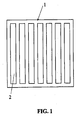
- the square grid is then superimposed on the substrate tile, so that the two adhesive tapes are perpendicular to the recesses 2, and then the grid is fixed to the substrate tile by means of another adhesive tape.
- One or more recesses are then filled with the adhesive composition or compositions to be tested by eliminating any overflows with a spatula.
- the grid is then separated from the substrate: the crosslinked adhesive composition gaskets adhere to the substrate tile, except at the two ends left free due to the protection of the substrate by the adhesive tape.
- the crosslinked test specimens are then manually peeled with the aid of their free ends.
- the tensile stress causing the rupture of the adhesive joint is measured.
- the principle of this measurement is to stretch in a tensile machine, whose moving jaw is moving at a constant speed, a standard dumbbell-shaped test piece made of the crosslinked adhesive composition and to record the stress applied at the moment when the rupture of the test piece.
- dumbbell used conforms to type 1 of the NF ISO 37 standard.
- the shear stress resulting in the rupture of the adhesive joint is measured.
- the principle of this measurement is to solicit in a tensile machine, whose moving jaw moves at a constant speed, a standard-shaped test piece made of the adhesive composition crosslinked between 2 rigid wooden supports, and to record the stress applied at the moment. where the test piece breaks.
- Example 1 is repeated by preparing the compositions appearing in the table in which the polymer (A2) is an alkoxysilane end-radical polyurethane, called silanized PU.
- This mixture is kept under constant stirring at 85 ° C. and under nitrogen for 3 hours, until complete reaction of the NCO functions of the IPDI.
- the hydroxyl-terminated polyurethane thus obtained is then added 24.6 g (0.1165 mole) of gamma-isocyanato-n-propyl-trimethoxysilane and the mixture is maintained at 85 ° C until complete disappearance of the NCO functions.
- the polyurethane F obtained has a viscosity of 55 Pa.s (measured by a Brookfield viscometer at 23 ° C., with a needle rotating at 20 rpm), a molar mass of about 20 kDa and a polymolecularity index of about 1.3.
- Example 1 is repeated by preparing the composition appearing in the table in which the polymer (A2) is the silanized PU F.
- Example 7 is repeated with the content indicated for silanized PU F.
- Examples 2 to 6 are repeated with the silanized PU content indicated in the table and also incorporating aggregates of non-spherical shaped rubbers having a size between 0.8 and 1.2 mm, with a content of said aggregates also indicated in the table.
- the peelability of the adhesive compositions of Examples 1 to 10 shows a characteristic behavior of an adhesive rupture.
Landscapes
- Chemical & Material Sciences (AREA)
- Organic Chemistry (AREA)
- Chemical Kinetics & Catalysis (AREA)
- Health & Medical Sciences (AREA)
- Medicinal Chemistry (AREA)
- Polymers & Plastics (AREA)
- General Chemical & Material Sciences (AREA)
- Adhesives Or Adhesive Processes (AREA)
Claims (14)
- Klebstoffzusammensetzung, umfassend:- 58 bis 80% eines feuchtigkeitsvernetzbaren Polymers (A) mit einem endständigen Alkoxysilanrest;- 8 bis 20% einer Kieselsäure (B) mit einer spezifischen BET-Oberfläche zwischen 150 und 250 m2/g;- 4 bis 15% eines Oligomers (C), das eine Molmasse zwischen 500 und 5000 Da aufweist und durch Oligomerisation eines Vinylderivats eines Alkoxyalkylsilans erhältlich ist,- 0,01 bis 3% eines Vernetzungskatalysators (D).
- Klebstoffzusammensetzung nach Anspruch 1, dadurch gekennzeichnet, dass die Hauptkette des Polymers (A) aus den folgenden Polymerketten ausgewählt ist:- (A1) Polyoxyalkylenen (oder Polyethern) mit einer Molmasse zwischen 500 und 30.000 Da;- (A2) Polyurethanen mit einer Molmasse zwischen 600 Da und 60 kDa, erhalten durch Kondensation eines Polyols mit Polyisocyanaten;- (A3) Homopolymeren und Copolymeren mit einer Molmasse zwischen 5 und 100 kDa, erhalten aus mindestens einem Monomer vom Alkyl(meth)-acrylat-Typ mit einem Alkylrest mit 1 bis 15 Kohlenstoffatomen.
- Klebstoffzusammensetzung nach einem der Ansprüche 1 oder 2, dadurch gekennzeichnet, dass die Hauptkette des Polymers (A) aus Polyoxyethylenen und Polyoxypropylenen ausgewählt ist.
- Klebstoffzusammensetzung nach einem der Ansprüche 1 bis 3, dadurch gekennzeichnet, dass der endständige Alkoxysilanrest die Formel (I) aufweist:
-S1(R1)p(OR2)3-p
worin:- R1 und R2 gleich oder verschieden sind und jeweils für einen linearen oder verzweigten Alkylrest mit 1 bis 4 Kohlenstoffatomen steht, wobei dann, wenn mehrere Reste R1 (oder R2) vorliegen, diese Reste gleich oder verschieden sein können;- p für eine ganze Zahl mit einem Wert von 0, 1 oder 2 steht;wobei der Alkoxysilanrest direkt über seine verfügbare Bindung oder indirekt, insbesondere über einen zweiwertigen Kohlenwasserstoffrest, vorzugsweise einen Alkylenrest, an die Hauptkette gebunden ist. - Klebstoffzusammensetzung nach einem der Ansprüche 1, 2 oder 4, dadurch gekennzeichnet, dass das Polymer (A) die Formel (II) aufweist:


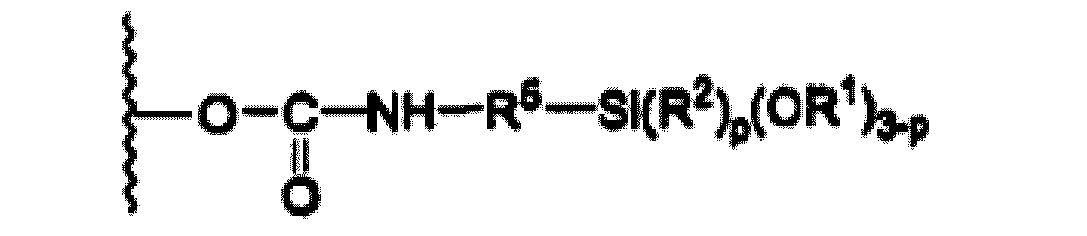 - R1 und R2 wie oben definiert sind;- R3 für einen zweiwertigen Kohlenwasserstoffrest mit 5 bis 15 Kohlenstoffatomen, der aromatisch oder aliphatisch, linear, verzweigt oder cyclisch sein kann, steht;- R4 für einen linearen oder verzweigten zweiwertigen Alkylenrest mit 1 bis 4 Kohlenstoffatomen steht;- R5 für einen linearen zweiwertigen Alkylenrest mit 1 bis 3 Kohlenstoffatomen steht;- n für eine solche ganze Zahl steht, dass die Molmasse des Polyetherblocks der Formel -[OR4]n-zwischen 300 Da und 30 kDa liegt;- m für eine solche ganze Zahl steht, dass die Molmasse des Polymers der Formel (II) zwischen 600 Da und 60 kDa liegt;- p wie oben definiert ist.
 - Klebstoffzusammensetzung nach einem der Ansprüche 1 bis 5, dadurch gekennzeichnet, dass sie 60 bis 77% Polymer (A), 10 bis 18% pyrogen hergestellte Kieselsäure (B), 5 bis 12% Oligomer (C) und 0,1 bis 2% Katalysator (D) umfasst.
- Klebstoffzusammensetzung nach einem der Ansprüche 1 bis 6, dadurch gekennzeichnet, dass sie außerdem bis zu 3% eines hydrolysierbaren Alkoxysilanderivats als Trockenmittel umfasst.
- Klebstoffzusammensetzung nach einem der Ansprüche 1 bis 7, dadurch gekennzeichnet, dass sie außerdem 0,1 bis 5% Kautschukgranulat in nichtsphärischer Form mit einer Größe zwischen 0,5 und 2 mm, vorzugsweise zwischen 0,8 und 1,2 mm, umfasst.
- Verfahren zum Befestigen eines Gegenstands an einem in den Böden, vertikalen Wänden und/oder Decken von Wohnungen enthaltenen Substrat, umfassend:i) Aufbringen der Klebstoffzusammensetzung gemäß einem der Ansprüche 1 bis 8 in Form einer Raupe mit einem Durchmesser von 2 bis 10 mm, vorzugsweise 4 bis 10 mm, auf die für den Kontakt vorgesehenen Oberflächen des Gegenstands oder des Substrats,ii) Aufbringen des Gegenstands durch einfachen manuellen Druck auf das Substrat, danniii) Vernetzen der Klebstoffzusammensetzung unter der Einwirkung von Luftfeuchtigkeit über einen Zeitraum zwischen 1 Stunde und 48 Stunden, vorzugsweise zwischen 4 Stunden und 24 Stunden.
- Verfahren nach Anspruch 9, dadurch gekennzeichnet, dass das Substrat in einer vertikalen Wand enthalten ist und die Raupe aus der Klebstoffzusammensetzung auf der für den Kontakt mit dem Substrat bestimmten ebenen Oberfläche des Gegenstands aufgebracht wird.
- Verfahren nach Anspruch 10, dadurch gekennzeichnet, dass das Gewicht des zu befestigenden Gegenstands auf die aus der vernetzten Klebstoffzusammensetzung bestehende Verbindung eine Scherspannung im Bereich von 3 bis 20 kg/cm2 ausübt.
- Verfahren nach einem der Ansprüche 9 bis 11, dadurch gekennzeichnet, dass der zu befestigende Gegenstand zur Ausstattung oder Dekoration von Wohnungen verwendbar ist.
- Verfahren nach einem der Ansprüche 10 bis 12, dadurch gekennzeichnet, dass die Raupe aus der Klebstoffzusammensetzung auf der oberen Hälfte der für den Kontakt mit dem Substrat bestimmten ebenen Oberfläche des Gegenstands in der Nähe der Kontaktlinie zwischen der Oberfläche und dem Substrat angeordnet wird.
- Verfahren zum Ablösen des gemäß dem Verfahren nach einem der Ansprüche 9 bis 13 an einem Substrat befestigten Gegenstands mit Realisierung von adhäsivem Versagen.
Applications Claiming Priority (1)
| Application Number | Priority Date | Filing Date | Title |
|---|---|---|---|
| FR0807125A FR2940312B1 (fr) | 2008-12-18 | 2008-12-18 | Composition adhesive pelable apres reticulation |
Publications (2)
| Publication Number | Publication Date |
|---|---|
| EP2199343A1 EP2199343A1 (de) | 2010-06-23 |
| EP2199343B1 true EP2199343B1 (de) | 2013-04-10 |
Family
ID=40791389
Family Applications (1)
| Application Number | Title | Priority Date | Filing Date |
|---|---|---|---|
| EP09015020.2A Active EP2199343B1 (de) | 2008-12-18 | 2009-12-04 | Klebezusammensetzung, die nach Vernetzung abziehbar ist |
Country Status (6)
| Country | Link |
|---|---|
| US (1) | US9518201B2 (de) |
| EP (1) | EP2199343B1 (de) |
| CN (1) | CN101838512A (de) |
| AU (1) | AU2009250970B2 (de) |
| FR (1) | FR2940312B1 (de) |
| NZ (1) | NZ581888A (de) |
Families Citing this family (6)
| Publication number | Priority date | Publication date | Assignee | Title |
|---|---|---|---|---|
| FR2940312B1 (fr) | 2008-12-18 | 2011-02-25 | Bostik Sa | Composition adhesive pelable apres reticulation |
| DE102011081264A1 (de) | 2011-08-19 | 2013-02-21 | Wacker Chemie Ag | Vernetzbare Massen auf Basis von organyloxysilanterminierten Polymeren |
| DE102012201734A1 (de) | 2012-02-06 | 2013-08-08 | Wacker Chemie Ag | Massen auf Basis von organyloxysilanterminierten Polymeren |
| KR102264801B1 (ko) * | 2016-04-28 | 2021-06-11 | 아라까와 가가꾸 고교 가부시끼가이샤 | 열경화성 이형 코팅제, 이형필름, 이형필름의 제조방법 |
| CN110734730A (zh) * | 2018-07-20 | 2020-01-31 | 东莞市博君来胶粘材料科技有限公司 | 一种硅烷改性聚醚双组份密封胶及其制备方法 |
| CN112680161A (zh) * | 2020-12-23 | 2021-04-20 | 东莞市瑞朗电子有限公司 | 一种固化密封胶黏剂及其制备方法 |
Family Cites Families (17)
| Publication number | Priority date | Publication date | Assignee | Title |
|---|---|---|---|---|
| JPH06299103A (ja) * | 1993-04-14 | 1994-10-25 | Daiyuu Paint Kk | 防水塗材 |
| US6602964B2 (en) * | 1998-04-17 | 2003-08-05 | Crompton Corporation | Reactive diluent in moisture curable system |
| US6310170B1 (en) * | 1999-08-17 | 2001-10-30 | Ck Witco Corporation | Compositions of silylated polymer and aminosilane adhesion promoters |
| US20030225237A1 (en) * | 2002-05-31 | 2003-12-04 | Roesler Richard R. | Moisture-curable, polyether urethanes with reactive silane groups and their use as sealants, adhesives and coatings |
| CN1320057C (zh) * | 2002-07-25 | 2007-06-06 | 株式会社钟化 | 固化性组合物与披叠板的密封方法 |
| US7189781B2 (en) * | 2003-03-13 | 2007-03-13 | H.B. Fuller Licensing & Finance Inc. | Moisture curable, radiation curable sealant composition |
| US6803412B2 (en) * | 2003-03-13 | 2004-10-12 | H.B. Fuller Licensing & Financing Inc. | Moisture curable hot melt sealants for glass constructions |
| US7109263B2 (en) | 2003-05-02 | 2006-09-19 | National Starch And Chemical Investment Holding Corporation | Labeling adhesive |
| DE10350481A1 (de) * | 2003-10-29 | 2005-06-16 | Henkel Kgaa | Festigkeitsoptimierte Polymere mit gemischten Oxyalkyleneinheiten |
| DE10351804A1 (de) * | 2003-11-06 | 2005-06-09 | Wacker-Chemie Gmbh | Verfahren zur Erhöhung der Elastizität von feuchtigkeitsgehärteten Elastomeren |
| FR2863624B1 (fr) * | 2003-12-11 | 2007-02-09 | Bostik Findley | Compositions adhesives recticulables a l'humidite |
| WO2005097934A1 (en) * | 2004-03-31 | 2005-10-20 | The Glidden Company | Curable adhesive composition, adhesive kit and method of adhering substrates |
| DE102005023050A1 (de) * | 2005-05-13 | 2006-11-16 | Henkel Kgaa | Wässrige, lagerstabile Emulsion α-silyl terminierter Polymere, deren Herstellung und Verwendung |
| DE102005054008A1 (de) * | 2005-11-10 | 2007-05-16 | Henkel Kgaa | Silanvernetzender Kleb-, Dicht-oder Beschichtungsstoff und seine Verwendung |
| DE102006022095A1 (de) * | 2006-05-11 | 2007-11-15 | Wacker Chemie Ag | Alkoxysilanterminierte Polymere enthaltende transparente Polymerabmischungen |
| US7789990B2 (en) * | 2006-07-24 | 2010-09-07 | Dow Global Technologies Inc. | Silane functional adhesive composition and method of bonding a window to a substrate without a primer |
| FR2940312B1 (fr) | 2008-12-18 | 2011-02-25 | Bostik Sa | Composition adhesive pelable apres reticulation |
-
2008
- 2008-12-18 FR FR0807125A patent/FR2940312B1/fr active Active
-
2009
- 2009-12-04 EP EP09015020.2A patent/EP2199343B1/de active Active
- 2009-12-11 NZ NZ581888A patent/NZ581888A/en unknown
- 2009-12-16 AU AU2009250970A patent/AU2009250970B2/en active Active
- 2009-12-18 US US12/642,197 patent/US9518201B2/en active Active
- 2009-12-18 CN CN200910262406A patent/CN101838512A/zh active Pending
Also Published As
| Publication number | Publication date |
|---|---|
| EP2199343A1 (de) | 2010-06-23 |
| AU2009250970A1 (en) | 2010-07-08 |
| US20100154991A1 (en) | 2010-06-24 |
| FR2940312A1 (fr) | 2010-06-25 |
| CN101838512A (zh) | 2010-09-22 |
| NZ581888A (en) | 2011-04-29 |
| FR2940312B1 (fr) | 2011-02-25 |
| AU2009250970B2 (en) | 2014-11-20 |
| US9518201B2 (en) | 2016-12-13 |
Similar Documents
| Publication | Publication Date | Title |
|---|---|---|
| EP2235133B1 (de) | Druckempfindliche klebstoffe, die über eine temperaturbeständige klebekraft verfügen | |
| EP2468783B1 (de) | Polyurethan mit Polyether- und Polyesterblocks, und Alkoxysilan-Endgruppe | |
| EP2456803B1 (de) | Organotinfreier leim für reparaturen und befestigungen | |
| EP2889349B1 (de) | Auf Schaumstoff angeordneter selbstklebender Artikel | |
| EP2336208B1 (de) | Hitzehärtende Klebezusammensetzung | |
| EP2199343B1 (de) | Klebezusammensetzung, die nach Vernetzung abziehbar ist | |
| EP3898748B1 (de) | Neuartige hitzehärtbaren zusammensetzungen und haftklebartikel davon | |
| EP2889348B1 (de) | Auf Schaumstoff angeordneter selbstklebender Artikel | |
| JP2020534383A (ja) | 熱可塑性樹脂に対する改善された接着性を有する、シラン末端ポリマーに基づく組成物 | |
| WO2018078271A1 (fr) | Composition auto-adhésive pour le collage de substrats de basse énergie de surface | |
| EP4198100B1 (de) | Durch wärme vernetzbare klebstoffzusammensetzung, die eine temperaturstabile klebverbindung bildet | |
| EP2655476B1 (de) | Verfahren zum verlegen von parkettböden mit verbesserter dimensionsstabilität | |
| WO2019115952A1 (fr) | Composition adhesive multicomposante et ses utilisations | |
| FR3039154B1 (fr) | Poly(uree-urethane) a blocs polyurethane-polyether et polyurethane-polyester et groupe terminal alkoxysilane | |
| EP4367194B1 (de) | Neue vernetzbare zusammensetzung mit silylterminiertem polymer und zugehöriger selbstklebender artikel | |
| EP3497144B1 (de) | Verfahren zur synthese von silylierten polyurethanen und silylierte polyurethanzusammensetzung |
Legal Events
| Date | Code | Title | Description |
|---|---|---|---|
| PUAI | Public reference made under article 153(3) epc to a published international application that has entered the european phase |
Free format text: ORIGINAL CODE: 0009012 |
|
| 17P | Request for examination filed |
Effective date: 20091204 |
|
| AK | Designated contracting states |
Kind code of ref document: A1 Designated state(s): AT BE BG CH CY CZ DE DK EE ES FI FR GB GR HR HU IE IS IT LI LT LU LV MC MK MT NL NO PL PT RO SE SI SK SM TR |
|
| AX | Request for extension of the european patent |
Extension state: AL BA RS |
|
| GRAP | Despatch of communication of intention to grant a patent |
Free format text: ORIGINAL CODE: EPIDOSNIGR1 |
|
| RIC1 | Information provided on ipc code assigned before grant |
Ipc: C09J 5/00 20060101ALI20121029BHEP Ipc: C08K 3/36 20060101ALI20121029BHEP Ipc: C08L 83/04 20060101ALI20121029BHEP Ipc: C08G 65/336 20060101ALI20121029BHEP Ipc: C08G 18/71 20060101ALI20121029BHEP Ipc: C08L 75/08 20060101ALI20121029BHEP Ipc: C08L 75/04 20060101ALI20121029BHEP Ipc: C09J 171/02 20060101ALI20121029BHEP Ipc: C09J 133/06 20060101ALI20121029BHEP Ipc: C08G 18/75 20060101ALI20121029BHEP Ipc: C08L 33/06 20060101ALI20121029BHEP Ipc: C09J 175/04 20060101ALI20121029BHEP Ipc: C08L 71/02 20060101AFI20121029BHEP Ipc: C09J 183/06 20060101ALI20121029BHEP Ipc: C09J 143/04 20060101ALI20121029BHEP Ipc: C08G 18/48 20060101ALI20121029BHEP Ipc: C09J 175/08 20060101ALI20121029BHEP |
|
| GRAS | Grant fee paid |
Free format text: ORIGINAL CODE: EPIDOSNIGR3 |
|
| GRAA | (expected) grant |
Free format text: ORIGINAL CODE: 0009210 |
|
| AK | Designated contracting states |
Kind code of ref document: B1 Designated state(s): AT BE BG CH CY CZ DE DK EE ES FI FR GB GR HR HU IE IS IT LI LT LU LV MC MK MT NL NO PL PT RO SE SI SK SM TR |
|
| REG | Reference to a national code |
Ref country code: GB Ref legal event code: FG4D Free format text: NOT ENGLISH |
|
| REG | Reference to a national code |
Ref country code: CH Ref legal event code: EP Ref country code: AT Ref legal event code: REF Ref document number: 605999 Country of ref document: AT Kind code of ref document: T Effective date: 20130415 |
|
| REG | Reference to a national code |
Ref country code: IE Ref legal event code: FG4D Free format text: LANGUAGE OF EP DOCUMENT: FRENCH |
|
| REG | Reference to a national code |
Ref country code: DE Ref legal event code: R096 Ref document number: 602009014768 Country of ref document: DE Effective date: 20130606 |
|
| REG | Reference to a national code |
Ref country code: SE Ref legal event code: TRGR |
|
| REG | Reference to a national code |
Ref country code: NL Ref legal event code: T3 |
|
| PG25 | Lapsed in a contracting state [announced via postgrant information from national office to epo] |
Ref country code: SI Free format text: LAPSE BECAUSE OF FAILURE TO SUBMIT A TRANSLATION OF THE DESCRIPTION OR TO PAY THE FEE WITHIN THE PRESCRIBED TIME-LIMIT Effective date: 20130410 |
|
| REG | Reference to a national code |
Ref country code: AT Ref legal event code: MK05 Ref document number: 605999 Country of ref document: AT Kind code of ref document: T Effective date: 20130410 |
|
| REG | Reference to a national code |
Ref country code: LT Ref legal event code: MG4D |
|
| PG25 | Lapsed in a contracting state [announced via postgrant information from national office to epo] |
Ref country code: PT Free format text: LAPSE BECAUSE OF FAILURE TO SUBMIT A TRANSLATION OF THE DESCRIPTION OR TO PAY THE FEE WITHIN THE PRESCRIBED TIME-LIMIT Effective date: 20130812 Ref country code: GR Free format text: LAPSE BECAUSE OF FAILURE TO SUBMIT A TRANSLATION OF THE DESCRIPTION OR TO PAY THE FEE WITHIN THE PRESCRIBED TIME-LIMIT Effective date: 20130711 Ref country code: LT Free format text: LAPSE BECAUSE OF FAILURE TO SUBMIT A TRANSLATION OF THE DESCRIPTION OR TO PAY THE FEE WITHIN THE PRESCRIBED TIME-LIMIT Effective date: 20130410 Ref country code: AT Free format text: LAPSE BECAUSE OF FAILURE TO SUBMIT A TRANSLATION OF THE DESCRIPTION OR TO PAY THE FEE WITHIN THE PRESCRIBED TIME-LIMIT Effective date: 20130410 Ref country code: ES Free format text: LAPSE BECAUSE OF FAILURE TO SUBMIT A TRANSLATION OF THE DESCRIPTION OR TO PAY THE FEE WITHIN THE PRESCRIBED TIME-LIMIT Effective date: 20130721 Ref country code: NO Free format text: LAPSE BECAUSE OF FAILURE TO SUBMIT A TRANSLATION OF THE DESCRIPTION OR TO PAY THE FEE WITHIN THE PRESCRIBED TIME-LIMIT Effective date: 20130710 Ref country code: FI Free format text: LAPSE BECAUSE OF FAILURE TO SUBMIT A TRANSLATION OF THE DESCRIPTION OR TO PAY THE FEE WITHIN THE PRESCRIBED TIME-LIMIT Effective date: 20130410 Ref country code: IS Free format text: LAPSE BECAUSE OF FAILURE TO SUBMIT A TRANSLATION OF THE DESCRIPTION OR TO PAY THE FEE WITHIN THE PRESCRIBED TIME-LIMIT Effective date: 20130810 |
|
| PG25 | Lapsed in a contracting state [announced via postgrant information from national office to epo] |
Ref country code: HR Free format text: LAPSE BECAUSE OF FAILURE TO SUBMIT A TRANSLATION OF THE DESCRIPTION OR TO PAY THE FEE WITHIN THE PRESCRIBED TIME-LIMIT Effective date: 20130410 Ref country code: CY Free format text: LAPSE BECAUSE OF FAILURE TO SUBMIT A TRANSLATION OF THE DESCRIPTION OR TO PAY THE FEE WITHIN THE PRESCRIBED TIME-LIMIT Effective date: 20130410 Ref country code: PL Free format text: LAPSE BECAUSE OF FAILURE TO SUBMIT A TRANSLATION OF THE DESCRIPTION OR TO PAY THE FEE WITHIN THE PRESCRIBED TIME-LIMIT Effective date: 20130410 Ref country code: BG Free format text: LAPSE BECAUSE OF FAILURE TO SUBMIT A TRANSLATION OF THE DESCRIPTION OR TO PAY THE FEE WITHIN THE PRESCRIBED TIME-LIMIT Effective date: 20130710 Ref country code: LV Free format text: LAPSE BECAUSE OF FAILURE TO SUBMIT A TRANSLATION OF THE DESCRIPTION OR TO PAY THE FEE WITHIN THE PRESCRIBED TIME-LIMIT Effective date: 20130410 |
|
| PG25 | Lapsed in a contracting state [announced via postgrant information from national office to epo] |
Ref country code: CZ Free format text: LAPSE BECAUSE OF FAILURE TO SUBMIT A TRANSLATION OF THE DESCRIPTION OR TO PAY THE FEE WITHIN THE PRESCRIBED TIME-LIMIT Effective date: 20130410 Ref country code: EE Free format text: LAPSE BECAUSE OF FAILURE TO SUBMIT A TRANSLATION OF THE DESCRIPTION OR TO PAY THE FEE WITHIN THE PRESCRIBED TIME-LIMIT Effective date: 20130410 Ref country code: DK Free format text: LAPSE BECAUSE OF FAILURE TO SUBMIT A TRANSLATION OF THE DESCRIPTION OR TO PAY THE FEE WITHIN THE PRESCRIBED TIME-LIMIT Effective date: 20130410 Ref country code: SK Free format text: LAPSE BECAUSE OF FAILURE TO SUBMIT A TRANSLATION OF THE DESCRIPTION OR TO PAY THE FEE WITHIN THE PRESCRIBED TIME-LIMIT Effective date: 20130410 |
|
| PLBE | No opposition filed within time limit |
Free format text: ORIGINAL CODE: 0009261 |
|
| STAA | Information on the status of an ep patent application or granted ep patent |
Free format text: STATUS: NO OPPOSITION FILED WITHIN TIME LIMIT |
|
| PG25 | Lapsed in a contracting state [announced via postgrant information from national office to epo] |
Ref country code: RO Free format text: LAPSE BECAUSE OF FAILURE TO SUBMIT A TRANSLATION OF THE DESCRIPTION OR TO PAY THE FEE WITHIN THE PRESCRIBED TIME-LIMIT Effective date: 20130410 |
|
| 26N | No opposition filed |
Effective date: 20140113 |
|
| REG | Reference to a national code |
Ref country code: DE Ref legal event code: R097 Ref document number: 602009014768 Country of ref document: DE Effective date: 20140113 |
|
| REG | Reference to a national code |
Ref country code: CH Ref legal event code: PL |
|
| PG25 | Lapsed in a contracting state [announced via postgrant information from national office to epo] |
Ref country code: LU Free format text: LAPSE BECAUSE OF FAILURE TO SUBMIT A TRANSLATION OF THE DESCRIPTION OR TO PAY THE FEE WITHIN THE PRESCRIBED TIME-LIMIT Effective date: 20131204 Ref country code: MC Free format text: LAPSE BECAUSE OF FAILURE TO SUBMIT A TRANSLATION OF THE DESCRIPTION OR TO PAY THE FEE WITHIN THE PRESCRIBED TIME-LIMIT Effective date: 20130410 |
|
| REG | Reference to a national code |
Ref country code: IE Ref legal event code: MM4A |
|
| PG25 | Lapsed in a contracting state [announced via postgrant information from national office to epo] |
Ref country code: CH Free format text: LAPSE BECAUSE OF NON-PAYMENT OF DUE FEES Effective date: 20131231 Ref country code: IE Free format text: LAPSE BECAUSE OF NON-PAYMENT OF DUE FEES Effective date: 20131204 Ref country code: LI Free format text: LAPSE BECAUSE OF NON-PAYMENT OF DUE FEES Effective date: 20131231 |
|
| PG25 | Lapsed in a contracting state [announced via postgrant information from national office to epo] |
Ref country code: SM Free format text: LAPSE BECAUSE OF FAILURE TO SUBMIT A TRANSLATION OF THE DESCRIPTION OR TO PAY THE FEE WITHIN THE PRESCRIBED TIME-LIMIT Effective date: 20130410 |
|
| PG25 | Lapsed in a contracting state [announced via postgrant information from national office to epo] |
Ref country code: TR Free format text: LAPSE BECAUSE OF FAILURE TO SUBMIT A TRANSLATION OF THE DESCRIPTION OR TO PAY THE FEE WITHIN THE PRESCRIBED TIME-LIMIT Effective date: 20130410 |
|
| PG25 | Lapsed in a contracting state [announced via postgrant information from national office to epo] |
Ref country code: MK Free format text: LAPSE BECAUSE OF FAILURE TO SUBMIT A TRANSLATION OF THE DESCRIPTION OR TO PAY THE FEE WITHIN THE PRESCRIBED TIME-LIMIT Effective date: 20130410 Ref country code: HU Free format text: LAPSE BECAUSE OF FAILURE TO SUBMIT A TRANSLATION OF THE DESCRIPTION OR TO PAY THE FEE WITHIN THE PRESCRIBED TIME-LIMIT; INVALID AB INITIO Effective date: 20091204 |
|
| PG25 | Lapsed in a contracting state [announced via postgrant information from national office to epo] |
Ref country code: MT Free format text: LAPSE BECAUSE OF FAILURE TO SUBMIT A TRANSLATION OF THE DESCRIPTION OR TO PAY THE FEE WITHIN THE PRESCRIBED TIME-LIMIT Effective date: 20130410 |
|
| REG | Reference to a national code |
Ref country code: FR Ref legal event code: PLFP Year of fee payment: 7 |
|
| REG | Reference to a national code |
Ref country code: FR Ref legal event code: PLFP Year of fee payment: 8 |
|
| REG | Reference to a national code |
Ref country code: FR Ref legal event code: PLFP Year of fee payment: 9 |
|
| REG | Reference to a national code |
Ref country code: DE Ref legal event code: R081 Ref document number: 602009014768 Country of ref document: DE Owner name: BOSTIK S.A., FR Free format text: FORMER OWNER: BOSTIK SA, COURBEVOIE, FR |
|
| REG | Reference to a national code |
Ref country code: BE Ref legal event code: PD Owner name: BOSTIK SA; FR Free format text: DETAILS ASSIGNMENT: CHANGE OF OWNER(S), AUTRE, ADRESSE MAIS AUTRE NO.; FORMER OWNER NAME: BOSTIK SA Effective date: 20200707 |
|
| P01 | Opt-out of the competence of the unified patent court (upc) registered |
Effective date: 20230526 |
|
| REG | Reference to a national code |
Ref country code: DE Ref legal event code: R081 Ref document number: 602009014768 Country of ref document: DE Owner name: BOSTIK SA, FR Free format text: FORMER OWNER: BOSTIK S.A., COLOMBES, FR |
|
| REG | Reference to a national code |
Ref country code: BE Ref legal event code: PD Owner name: BOSTIK SA; FR Free format text: DETAILS ASSIGNMENT: CHANGE OF OWNER(S), OTHER; FORMER OWNER NAME: BOSTIK SA Effective date: 20250626 |
|
| PGFP | Annual fee paid to national office [announced via postgrant information from national office to epo] |
Ref country code: NL Payment date: 20251112 Year of fee payment: 17 |
|
| PGFP | Annual fee paid to national office [announced via postgrant information from national office to epo] |
Ref country code: DE Payment date: 20251028 Year of fee payment: 17 |
|
| PGFP | Annual fee paid to national office [announced via postgrant information from national office to epo] |
Ref country code: GB Payment date: 20251030 Year of fee payment: 17 |
|
| PGFP | Annual fee paid to national office [announced via postgrant information from national office to epo] |
Ref country code: IT Payment date: 20251121 Year of fee payment: 17 |
|
| PGFP | Annual fee paid to national office [announced via postgrant information from national office to epo] |
Ref country code: FR Payment date: 20251110 Year of fee payment: 17 |
|
| PGFP | Annual fee paid to national office [announced via postgrant information from national office to epo] |
Ref country code: BE Payment date: 20251117 Year of fee payment: 17 |
|
| PGFP | Annual fee paid to national office [announced via postgrant information from national office to epo] |
Ref country code: SE Payment date: 20251028 Year of fee payment: 17 |