EP2192089A1 - Ferric arsenate powder - Google Patents
Ferric arsenate powder Download PDFInfo
- Publication number
- EP2192089A1 EP2192089A1 EP08792799A EP08792799A EP2192089A1 EP 2192089 A1 EP2192089 A1 EP 2192089A1 EP 08792799 A EP08792799 A EP 08792799A EP 08792799 A EP08792799 A EP 08792799A EP 2192089 A1 EP2192089 A1 EP 2192089A1
- Authority
- EP
- European Patent Office
- Prior art keywords
- powder
- arsenic
- solution
- iron
- concentration
- Prior art date
- Legal status (The legal status is an assumption and is not a legal conclusion. Google has not performed a legal analysis and makes no representation as to the accuracy of the status listed.)
- Granted
Links
Images
Classifications
-
- C—CHEMISTRY; METALLURGY
- C01—INORGANIC CHEMISTRY
- C01G—COMPOUNDS CONTAINING METALS NOT COVERED BY SUBCLASSES C01D OR C01F
- C01G28/00—Compounds of arsenic
- C01G28/02—Arsenates; Arsenites
-
- C—CHEMISTRY; METALLURGY
- C01—INORGANIC CHEMISTRY
- C01G—COMPOUNDS CONTAINING METALS NOT COVERED BY SUBCLASSES C01D OR C01F
- C01G49/00—Compounds of iron
-
- C—CHEMISTRY; METALLURGY
- C01—INORGANIC CHEMISTRY
- C01G—COMPOUNDS CONTAINING METALS NOT COVERED BY SUBCLASSES C01D OR C01F
- C01G49/00—Compounds of iron
- C01G49/0018—Mixed oxides or hydroxides
-
- C—CHEMISTRY; METALLURGY
- C01—INORGANIC CHEMISTRY
- C01G—COMPOUNDS CONTAINING METALS NOT COVERED BY SUBCLASSES C01D OR C01F
- C01G49/00—Compounds of iron
- C01G49/14—Sulfates
-
- C—CHEMISTRY; METALLURGY
- C02—TREATMENT OF WATER, WASTE WATER, SEWAGE, OR SLUDGE
- C02F—TREATMENT OF WATER, WASTE WATER, SEWAGE, OR SLUDGE
- C02F1/00—Treatment of water, waste water, or sewage
- C02F1/52—Treatment of water, waste water, or sewage by flocculation or precipitation of suspended impurities
- C02F1/5236—Treatment of water, waste water, or sewage by flocculation or precipitation of suspended impurities using inorganic agents
-
- C—CHEMISTRY; METALLURGY
- C01—INORGANIC CHEMISTRY
- C01P—INDEXING SCHEME RELATING TO STRUCTURAL AND PHYSICAL ASPECTS OF SOLID INORGANIC COMPOUNDS
- C01P2002/00—Crystal-structural characteristics
- C01P2002/70—Crystal-structural characteristics defined by measured X-ray, neutron or electron diffraction data
- C01P2002/77—Crystal-structural characteristics defined by measured X-ray, neutron or electron diffraction data by unit-cell parameters, atom positions or structure diagrams
-
- C—CHEMISTRY; METALLURGY
- C01—INORGANIC CHEMISTRY
- C01P—INDEXING SCHEME RELATING TO STRUCTURAL AND PHYSICAL ASPECTS OF SOLID INORGANIC COMPOUNDS
- C01P2004/00—Particle morphology
- C01P2004/60—Particles characterised by their size
- C01P2004/61—Micrometer sized, i.e. from 1-100 micrometer
-
- C—CHEMISTRY; METALLURGY
- C01—INORGANIC CHEMISTRY
- C01P—INDEXING SCHEME RELATING TO STRUCTURAL AND PHYSICAL ASPECTS OF SOLID INORGANIC COMPOUNDS
- C01P2006/00—Physical properties of inorganic compounds
- C01P2006/12—Surface area
-
- C—CHEMISTRY; METALLURGY
- C02—TREATMENT OF WATER, WASTE WATER, SEWAGE, OR SLUDGE
- C02F—TREATMENT OF WATER, WASTE WATER, SEWAGE, OR SLUDGE
- C02F2101/00—Nature of the contaminant
- C02F2101/10—Inorganic compounds
- C02F2101/103—Arsenic compounds
-
- C—CHEMISTRY; METALLURGY
- C02—TREATMENT OF WATER, WASTE WATER, SEWAGE, OR SLUDGE
- C02F—TREATMENT OF WATER, WASTE WATER, SEWAGE, OR SLUDGE
- C02F2103/00—Nature of the water, waste water, sewage or sludge to be treated
- C02F2103/10—Nature of the water, waste water, sewage or sludge to be treated from quarries or from mining activities
Definitions
- the present invention relates generally to an iron arsenate powder. More specifically, the invention relates to an iron arsenate powder produced from a high purity and high concentration arsenic containing solution, such as an arsenic containing solution obtained by treating an arsenic containing substance which contains various elements in addition to arsenic, such as intermediate products in non-ferrous metal smelting or refining processes.
- a high purity and high concentration arsenic containing solution such as an arsenic containing solution obtained by treating an arsenic containing substance which contains various elements in addition to arsenic, such as intermediate products in non-ferrous metal smelting or refining processes.
- Japanese Patent Publication No. 61-24329 has proposed the method for recovering an arsenic containing solution, but it does not propose a method for fixing the recovered arsenic containing solution as a stable substance which does not elute metals.
- the inventors have made the present invention.
- the iron arsenate powder is preferably a powder of dihydrate of iron arsenate.
- an iron arsenate powder from an arsenic containing solution, the concentration of arsenic eluted or released from the produced iron arsenate powder being very low.
- the concentration of arsenic eluted or released from the powder being far lower than 0.3 mg/L which is a reference value of concentration of eluted or released arsenic.
- the iron arsenate powder is preferably a powder of dihydrate of iron arsenate.
- such an iron arsenate powder can be produced by a method comprising the steps of: adding ferrous ions to an arsenic containing solution to cause the molar ratio (Fe/As) of iron to arsenic in the solution to be not lower than 1; adding an oxidizing agent to the solution; heating the solution to a temperature of not lower than 70 °C while stirring the solution, to allow a reaction; and then, carrying out a solid-liquid separation to wash the obtained solid part.
- the concentration of As is preferably 10 g/L or higher, and more preferably 20 g/L or higher.
- the pH of the arsenic containing solution is preferably 2 or lower.
- ferrous ion source soluble FeSO 4 ⁇ 7H 2 O is preferably used.
- the molar ratio (Fe/As) of iron to arsenic in the solution is preferably 1 or higher, and more preferably in the range of from about 1.0 to about 1.5.
- any one of oxidizing agents capable of oxidizing Fe 2+ may be used, and oxygen gas may be used.
- oxygen gas may be used.
- the oxidizing performance of air is slightly lower than that of oxygen gas. Therefore, if air is used, the oxidizing performance may be improved by using a catalyst, such as Cu.
- the reaction temperature is 50 °C or higher, the compound of Fe and As can be deposited.
- the reaction temperature is preferably 70 °C or higher, and more preferably in the range of from about 80 °C to about 95 °C.
- an arsenic solution (reagent produced by Wako Junyaku Kogyo, Co., Ltd.) having an arsenic concentration (quinquevalent arsenic ion concentration) of 500 g/L was diluted with pure water to prepare an arsenic solution having an arsenic concentration of 10 g/L.
- heptahydrate of ferrous sulfate (FeSO 4 ⁇ 7H 2 O) (reagent produced by Wako Junyaku Kogyo, Co. , Ltd.) was diluted with pure water to prepare a ferrous sulfate solution having an iron concentration (ferrous ion concentration) of 11.18 g/L.
- the arsenic solution and the ferrous sulfate solution thus prepared are mixed to prepare 0.7 L of a mixed solution having a molar ratio (Fe/As) of 1.5.
- the mixed solution thus prepared was placed in a 2L glass beaker in which a double turbine disk and four baffle plates were set.
- the powder X-ray diffraction, moisture percentage content, mean particle size and specific surface area of the powder thus obtained were measured.
- the obtained powder had a crystal of Scorodite type iron arsenate having a crystal structure of rhombic system, and the moisture percentage content was 12%.
- the mean particle size was 20.41 ⁇ m, and the specific surface area was 0.25 m 2 /g (BET one-point method).
- a laser diffraction type particle size distribution measuring apparatus (LA-500 produced by Horiba Seisakusho, Co., Ltd.) was used for measuring a particle size distribution to obtain a median diameter as the mean particle size.
- the concentration of arsenic, which is eluted from the obtained iron arsenate powder, in an aqueous solution is an important factor for evaluating the stability of the iron arsenate powder.
- the concentration of eluted arsenic was evaluated by the eluted metal content test for analyzing the concentration of arsenic in a solution obtained by filtering using a filter having a pore size of 0.45 ⁇ m after mixing the obtained iron arsenate powder with water of pH6 in a mass ratio of 1:10 and shaking the mixture for six hours by a shaker.
- the concentration of eluted arsenic it was evaluated that the concentration was low if it was not higher than 0.3 mg/L and that the concentration was high if it was higher than 0.3 mg/L.
- Table 1 Lattice Constant a (nm) Lattice Constant b (nm) Lattice Constant c (nm) Concentration of Eluted Arsenic (mg/L) Ex. 1 0.8951 1.0322 1.0043 0.01 Ex. 2 0.8952 1.0321 1.0047 0.02 Ex. 3 0.8952 1.0322 1.0047 0.02 Ex.
- Powders were obtained by the same method as that in Example 1, except that a mixed solution obtained by mixing an arsenic solution having an arsenic concentration of 20 g/L with a ferrous sulfate solution having an iron concentration of 22.36 g/L was used in Example 2, that a mixed solution obtained by mixing an arsenic solution having an arsenic concentration of 30 g/L with a ferrous sulfate solution having an iron concentration of 33.55 g/L was used in Example 3, and that a mixed solution obtained by mixing an arsenic solution having an arsenic concentration of 50 g/L with a ferrous sulfate solution having an iron concentration of 55.91 g/L was used in Example 4. Then, the lattice constants and characteristics of the powders thus obtained were examined by the same method as that in Example 1.
- the concentration of arsenic eluted from the iron arsenate powder was low.
- Example 1 A powder obtained by the same method as that in Example 1, except that 4L of the same mixed solution as that in Example 1 was prepared to be placed in a 5L glass beaker. Then, the lattice constants and characteristics of the powder thus obtained were examined by the same method as that in Example 1.
Landscapes
- Chemical & Material Sciences (AREA)
- Organic Chemistry (AREA)
- Inorganic Chemistry (AREA)
- Environmental & Geological Engineering (AREA)
- Hydrology & Water Resources (AREA)
- Engineering & Computer Science (AREA)
- Life Sciences & Earth Sciences (AREA)
- Water Supply & Treatment (AREA)
- Compounds Of Iron (AREA)
- Inorganic Compounds Of Heavy Metals (AREA)
- Manufacture And Refinement Of Metals (AREA)
- Removal Of Specific Substances (AREA)
- Saccharide Compounds (AREA)
- Pharmaceuticals Containing Other Organic And Inorganic Compounds (AREA)
Abstract
Description
- The present invention relates generally to an iron arsenate powder. More specifically, the invention relates to an iron arsenate powder produced from a high purity and high concentration arsenic containing solution, such as an arsenic containing solution obtained by treating an arsenic containing substance which contains various elements in addition to arsenic, such as intermediate products in non-ferrous metal smelting or refining processes.
- Various intermediate products and raw materials produced in non-ferrous metal smelting or refining processes contain unfavorable elements, such as arsenic, although they contain valuable metals.
- As a conventional method for leaching, separating and recovering arsenic from arsenic containing intermediate products in smelting or refining processes, there has been proposed a method for separating arsenic from an arsenic containing intermediate product by a wet reaction to recover an arsenic containing solution (see, e.g., Japanese Patent Publication No.
61-24329 11-277075 2000-219920 2005-161123 - Japanese Patent Publication No.
61-24329 11-277075 2000-219920 2005-161123 2005-161123 - It is therefore an object of the present invention to eliminate the aforementioned conventional problems and to provide an iron arsenate powder which is produced from an arsenic containing solution and which has a very low concentration of arsenic eluted or released from the powder.
- In order to accomplish the aforementioned object, the inventors have diligently studied and found that the concentration of arsenic eluted or released from an iron arsenate powder is very low if the iron arsenate powder has a crystal structure of rhombic system and has lattice constants of a = 0.8950 to 0.8956 nm, b = 1.0321 to 1.0326 nm and c = 1.0042 to 1.0050 nm at room temperatures and atmospheric pressure. Thus, the inventors have made the present invention.
- That is, an iron arsenate powder according to the present invention has a crystal structure of rhombic system and has lattice constants of a = 0.8950 to 0.8956 nm, b = 1.0321 to 1.0326 nm and c = 1.0042 to 1.0050 nm at room temperatures and atmospheric pressure. The iron arsenate powder is preferably a powder of dihydrate of iron arsenate.
- According to the present invention, it is possible to produce an iron arsenate powder from an arsenic containing solution, the concentration of arsenic eluted or released from the produced iron arsenate powder being very low. In particular, it is possible to produce an iron arsenate powder, the concentration of arsenic eluted or released from the powder being far lower than 0.3 mg/L which is a reference value of concentration of eluted or released arsenic.
-
-
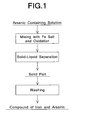
FIG. 1 is a process drawing which schematically shows a method for producing the preferred embodiment of an iron arsenate powder according to the present invention. - The preferred embodiment of an iron arsenate powder according to the present invention has a crystal structure of rhombic system and has lattice constants of a = 0.8950 to 0.8956 nm, b = 1.0321 to 1.0326 nm and c = 1.0042 to 1.0050 nm at room temperatures and atmospheric pressure. The iron arsenate powder is preferably a powder of dihydrate of iron arsenate.
- For example, as shown in
FIG. 1 , such an iron arsenate powder can be produced by a method comprising the steps of: adding ferrous ions to an arsenic containing solution to cause the molar ratio (Fe/As) of iron to arsenic in the solution to be not lower than 1; adding an oxidizing agent to the solution; heating the solution to a temperature of not lower than 70 °C while stirring the solution, to allow a reaction; and then, carrying out a solid-liquid separation to wash the obtained solid part. - If the concentration of As is low in the arsenic containing solution, it tends to be difficult to increase the grain size of the compound of Fe and As during the growth of the compound after the deposition of the compound. Therefore, the concentration of As is preferably 10 g/L or higher, and more preferably 20 g/L or higher. In addition, the pH of the arsenic containing solution is preferably 2 or lower.
- As the ferrous ion source, soluble FeSO4 · 7H2O is preferably used. The molar ratio (Fe/As) of iron to arsenic in the solution is preferably 1 or higher, and more preferably in the range of from about 1.0 to about 1.5.
- As the oxidizing agent, any one of oxidizing agents capable of oxidizing Fe2+ may be used, and oxygen gas may be used. Although air may be used, the oxidizing performance of air is slightly lower than that of oxygen gas. Therefore, if air is used, the oxidizing performance may be improved by using a catalyst, such as Cu.
- If the reaction temperature is 50 °C or higher, the compound of Fe and As can be deposited. In order to decrease the concentration of eluted As, the reaction temperature is preferably 70 °C or higher, and more preferably in the range of from about 80 °C to about 95 °C.
- After the powder thus obtained was analyzed by X-ray diffraction, it was found that the powder was a powder of dihydrate of ferric arsenate (FeAsO4 · 2H2O).
- Examples of an iron arsenate powder according to the present invention will be described below in detail.
- First, an arsenic solution (reagent produced by Wako Junyaku Kogyo, Co., Ltd.) having an arsenic concentration (quinquevalent arsenic ion concentration) of 500 g/L was diluted with pure water to prepare an arsenic solution having an arsenic concentration of 10 g/L. Then, heptahydrate of ferrous sulfate (FeSO4 · 7H2O) (reagent produced by Wako Junyaku Kogyo, Co. , Ltd.) was diluted with pure water to prepare a ferrous sulfate solution having an iron concentration (ferrous ion concentration) of 11.18 g/L.
- Then, the arsenic solution and the ferrous sulfate solution thus prepared are mixed to prepare 0.7 L of a mixed solution having a molar ratio (Fe/As) of 1.5. The mixed solution thus prepared was placed in a 2L glass beaker in which a double turbine disk and four baffle plates were set.
- Then, while the mixed solution was strongly stirred by rotating the double turbine disk at 800 rpm, the solution was heated to hold the temperature thereof at 95 °C, and oxygen gas having a purity of 99% was blown into the solution at a flow rate of 4.0 L/min to allow the solution to react at atmospheric pressure for three hours while holding the temperature, stirring conditions and flow rate of oxygen gas. After the temperature of a mixed slurry containing precipitates obtained by the reaction was lowered to 70 °C, filtration was carried out to recover a solid part.
- Then, pure water was added to the recovered solid part (wet cake) to cause the pulp density to be 100 g/L, and then, repulping washing was carried out for one hour while stirring the solution by rotating the double turbine disk at 500 rpm using the four baffle plates. Then, filtration was carried out at 30 °C to recover a solid part, and then, the recovered solid part was dried at 60 °C for 18 hours to obtain a powder.
- The powder X-ray diffraction, moisture percentage content, mean particle size and specific surface area of the powder thus obtained were measured. As a result, the obtained powder had a crystal of Scorodite type iron arsenate having a crystal structure of rhombic system, and the moisture percentage content was 12%. The mean particle size was 20.41 µm, and the specific surface area was 0.25 m2/g (BET one-point method).
- Furthermore, a laser diffraction type particle size distribution measuring apparatus (LA-500 produced by Horiba Seisakusho, Co., Ltd.) was used for measuring a particle size distribution to obtain a median diameter as the mean particle size.
- In the measurement of the powder X-ray diffraction, a filling X-ray vessel using a copper target was used as a radiation source, and a divergent beam integrated optical system diffractometer was used. In addition, diffraction X-rays from a sample were changed to monochromatic rays by means of a graphite counter monochromator, and CuK characteristic lines were counted. Moreover, in the determination of the lattice constants of the obtained powder (iron arsenate powder), the total diffraction pattern resolution fitting (R. W. Cheary and A. Coelho "A Fundamental Parameters Approach to X-ray Line-Profile Fitting", J. Appl. Cryst. 25, pp109-121 (1992)) was carried out by the Pawley method (G. S. Pawley "Unit-Cell Refinement From Powder Diffraction Scans", J. Appl. Cryst. 14, pp357-361 (1981)) in view of the device constants with the profile function fitting of diffraction peaks based on a basic parameter method. Furthermore, the crystal structure of iron arsenate is a rhombic system which is indicated by lattice constants a, b and c (unit: nm). The precision of the measured lattice constants a, b and c is ±0.0001 nm which is a sufficient precision for evaluating the lattice constants of iron arsenate.
- The concentration of arsenic, which is eluted from the obtained iron arsenate powder, in an aqueous solution is an important factor for evaluating the stability of the iron arsenate powder. On the basis of Bulletin No. 13 of the Ministry of the Environment of Japan, the concentration of eluted arsenic was evaluated by the eluted metal content test for analyzing the concentration of arsenic in a solution obtained by filtering using a filter having a pore size of 0.45 µm after mixing the obtained iron arsenate powder with water of pH6 in a mass ratio of 1:10 and shaking the mixture for six hours by a shaker. In this evaluation of the concentration of eluted arsenic, it was evaluated that the concentration was low if it was not higher than 0.3 mg/L and that the concentration was high if it was higher than 0.3 mg/L.
- As a result, as shown in Table 1, in this example, the lattice constants of the crystal structure of the obtained iron arsenate powder were a = 0.8951 nm, b = 1.0322 nm and c = 1.0043 nm, and the concentration of arsenic eluted from the iron arsenate powder was low.
Table 1 Lattice Constant a (nm) Lattice Constant b (nm) Lattice Constant c (nm) Concentration of Eluted Arsenic (mg/L) Ex. 1 0.8951 1.0322 1.0043 0.01 Ex. 2 0.8952 1.0321 1.0047 0.02 Ex. 3 0.8952 1.0322 1.0047 0.02 Ex. 4 0.8953 1.0323 1.0048 0.02 Ex. 5 0.8954 1.0325 1.0048 0.01 Ex. 6 0.8955 1.0324 1.0049 0.01 Comp. 1 0.8943 1.0276 1.0061 0.48 Comp. 2 0.8941 1.0280 1.0059 2.45 - Powders were obtained by the same method as that in Example 1, except that a mixed solution obtained by mixing an arsenic solution having an arsenic concentration of 20 g/L with a ferrous sulfate solution having an iron concentration of 22.36 g/L was used in Example 2, that a mixed solution obtained by mixing an arsenic solution having an arsenic concentration of 30 g/L with a ferrous sulfate solution having an iron concentration of 33.55 g/L was used in Example 3, and that a mixed solution obtained by mixing an arsenic solution having an arsenic concentration of 50 g/L with a ferrous sulfate solution having an iron concentration of 55.91 g/L was used in Example 4. Then, the lattice constants and characteristics of the powders thus obtained were examined by the same method as that in Example 1.
- As a result, as shown in Table 1, the lattice constants of the crystal structure of the obtained powder (iron arsenate powder) were a = 0.8952 nm, b = 1.0321 nm and c = 1.0047 nm in Example 2; a = 0.8952 nm, b = 1.0322 nm and c = 1.0047 nm in Example 3; and a = 0.8953 nm, b = 1.0323 nm and c = 1.0048 nm in Example 4. In all of Examples 2-4, the concentration of arsenic eluted from the iron arsenate powder was low.
- A powder obtained by the same method as that in Example 1, except that the reaction time was seven hours. Then, the lattice constants and characteristics of the powder thus obtained were examined by the same method as that in Example 1.
- As a result, as shown in Table 1, the lattice constants of the crystal structure of the obtained powder (iron arsenate powder) were a = 0.8954 nm, b = 1.0325 nm and c = 1.0048 nm, and the concentration of arsenic eluted from the iron arsenate powder was low.
- A powder obtained by the same method as that in Example 1, except that 4L of the same mixed solution as that in Example 1 was prepared to be placed in a 5L glass beaker. Then, the lattice constants and characteristics of the powder thus obtained were examined by the same method as that in Example 1.
- As a result, as shown in Table 1, the lattice constants of the crystal structure of the obtained powder (iron arsenate powder) were a = 0.8955 nm, b = 1.0324 nm and c = 1.0049 nm, and the concentration of arsenic eluted from the iron arsenate powder was low.
- A powder obtained by the same method as that in Example 1, except that a polyvalent iron solution having an iron concentration (ferric ion concentration) of 53.77 g/L was used in place of the ferrous sulfate solution in Example 1, that a closed vessel was used in place of the glass beaker, that oxygen gas was blown into the solution so that the partial pressure of O2 was 0.3 MPa, and that an autoclave was used for allowing the reaction at 175 °C for five hours. Then, the lattice constants and characteristics of the powder thus obtained were examined by the same method as that in Example 1.
- As a result, as shown in Table 1, the lattice constants of the crystal structure of the obtained powder (iron arsenate powder) were a = 0.8943 nm, b = 1.0276 nm and c = 1.0061 nm, and the concentration of arsenic eluted from the iron arsenate powder was high.
- A powder obtained by the same method as that in Example 1, except that an arsenic solution having an arsenic concentration (trivalent arsenic ion concentration) of 47.97 g/L was used in place of the arsenic solution in Example 1, that a polyvalent iron solution having an iron concentration (ferric ion concentration) of 53.77 g/L was used in place of the ferrous sulfate solution in Example 1, that a closed vessel was used in place of the glass beaker, that oxygen gas was blown into the solution so that the partial pressure of O2 was 0.3 MPa, and that an autoclave was used for allowing the reaction at 175 °C for five hours. Then, the lattice constants and characteristics of the powder thus obtained were examined by the same method as that in Example 1.
- As a result, as shown in Table 1, the lattice constants of the crystal structure of the obtained powder (iron arsenate powder) were a = 0.8941 nm, b = 1.0280 nm and c = 1.0059 nm, and the concentration of arsenic eluted from the iron arsenate powder was high.
- As can be seen from the results in these examples and comparative examples, it is found that, if an iron arsenate powder has a crystal structure of rhombic system and has lattice constants of a = 0.8950 to 0.8956 nm, b = 1.0321 to 1.0326 nm and c = 1.0042 to 1.0050 nm at room temperatures and atmospheric pressure as Examples 1-5, the iron arsenate powder is suitable for stable storage since the concentration of arsenic eluted from the powder is low, whereas if the lattice constants of an iron arsenate powder are beyond the above-described ranges as Comparative Examples 1-2, the iron arsenate powder is not suitable for stable storage since the concentration of arsenic eluted from the powder is high.
Claims (2)
- An iron arsenate powder which has a crystal structure of rhombic system and which has lattice constants of a = 0.8950 to 0.8956 nm, b = 1.0321 to 1.0326 nm and c = 1.0042 to 1.0050 nm at room temperatures and atmospheric pressure.
- An iron arsenate powder as set forth in claim 1, wherein said iron arsenate powder is a powder of dihydrate of iron arsenate.
Priority Applications (1)
| Application Number | Priority Date | Filing Date | Title |
|---|---|---|---|
| PL08792799T PL2192089T3 (en) | 2007-08-24 | 2008-08-22 | Ferric arsenate powder |
Applications Claiming Priority (2)
| Application Number | Priority Date | Filing Date | Title |
|---|---|---|---|
| JP2007218855A JP5107637B2 (en) | 2007-08-24 | 2007-08-24 | Iron arsenate powder |
| PCT/JP2008/065474 WO2009028636A1 (en) | 2007-08-24 | 2008-08-22 | Ferric arsenate powder |
Publications (3)
| Publication Number | Publication Date |
|---|---|
| EP2192089A1 true EP2192089A1 (en) | 2010-06-02 |
| EP2192089A4 EP2192089A4 (en) | 2011-02-09 |
| EP2192089B1 EP2192089B1 (en) | 2012-03-28 |
Family
ID=40387349
Family Applications (1)
| Application Number | Title | Priority Date | Filing Date |
|---|---|---|---|
| EP08792799A Active EP2192089B1 (en) | 2007-08-24 | 2008-08-22 | Ferric arsenate powder |
Country Status (11)
| Country | Link |
|---|---|
| US (1) | US8075868B2 (en) |
| EP (1) | EP2192089B1 (en) |
| JP (1) | JP5107637B2 (en) |
| KR (1) | KR101375033B1 (en) |
| CN (1) | CN101952204B (en) |
| AT (1) | ATE551297T1 (en) |
| AU (1) | AU2008292349B2 (en) |
| CA (1) | CA2696325C (en) |
| ES (1) | ES2384593T3 (en) |
| PL (1) | PL2192089T3 (en) |
| WO (1) | WO2009028636A1 (en) |
Families Citing this family (11)
| Publication number | Priority date | Publication date | Assignee | Title |
|---|---|---|---|---|
| JP4538481B2 (en) * | 2007-09-25 | 2010-09-08 | 日鉱金属株式会社 | Method for producing scorodite and method for recycling liquid after synthesis of scorodite |
| JP4620100B2 (en) * | 2007-10-23 | 2011-01-26 | Jx日鉱日石金属株式会社 | Manufacturing method and cleaning method of scorodite |
| JP2010202443A (en) * | 2009-03-03 | 2010-09-16 | Dowa Metals & Mining Co Ltd | Iron arsenate powder and method for producing the same |
| AU2010248410A1 (en) * | 2009-05-13 | 2011-11-03 | Dowa Metals & Mining Co., Ltd. | Scorodite-type iron-arsenic compound particles, production method, and arsenic-containing solid |
| JP5232806B2 (en) * | 2010-01-25 | 2013-07-10 | Jx日鉱日石金属株式会社 | Manufacturing method and cleaning method of scorodite |
| CN102674526B (en) * | 2012-05-14 | 2013-11-27 | 中南大学 | A method for precipitating arsenic and stabilizing arsenic from arsenic-containing solution |
| JP6102590B2 (en) * | 2013-07-10 | 2017-03-29 | 住友金属鉱山株式会社 | Method for producing scorodite |
| WO2015068558A1 (en) | 2013-11-05 | 2015-05-14 | 三菱樹脂株式会社 | Adhesive composition |
| TWI826613B (en) | 2018-12-14 | 2023-12-21 | 日商三菱化學股份有限公司 | Adhesive resin composition, adhesive resin cured product, adhesive sheet, and image display device laminate |
| CN110980899A (en) * | 2019-12-09 | 2020-04-10 | 昆明理工大学 | FeS2Method for stabilizing ferric arsenate by adopting Fe composite material |
| CN110981026A (en) * | 2019-12-25 | 2020-04-10 | 昆明理工大学 | A method for harmless disposal of arsenic-containing polluted acid in non-ferrous smelting |
Family Cites Families (11)
| Publication number | Priority date | Publication date | Assignee | Title |
|---|---|---|---|---|
| US1376153A (en) * | 1919-12-11 | 1921-04-26 | Moore William | Insecticide |
| JPS53123368A (en) * | 1977-04-02 | 1978-10-27 | Dowa Mining Co | Removal of arsenic |
| JPS54160590A (en) | 1978-06-09 | 1979-12-19 | Sumitomo Metal Mining Co | Method of separating and recovering arsenic from refining intermediate in state of sulfide containing arsenic |
| US4625311A (en) | 1984-06-18 | 1986-11-25 | Monolithic Memories, Inc. | Programmable array logic circuit with testing and verification circuitry |
| SU1662938A1 (en) * | 1989-06-26 | 1991-07-15 | Тбилисский Государственный Университет | Method of producing iron (iii) arsenate |
| SU1730039A1 (en) * | 1990-05-21 | 1992-04-30 | Тбилисский Государственный Университет Им.И.Джавахишвили | Method of producing iron (iii) arsenate |
| JP4126415B2 (en) * | 1998-03-31 | 2008-07-30 | Dowaホールディングス株式会社 | Method for removing and fixing arsenic present in iron sulfate solution |
| JP3756687B2 (en) | 1999-01-29 | 2006-03-15 | 同和鉱業株式会社 | Method for removing and fixing arsenic from arsenic-containing solutions |
| US7314604B1 (en) * | 1999-09-30 | 2008-01-01 | Billiton Intellectual Property, B.V. | Stable ferric arsenate precipitation from acid copper solutions whilst minimising copper losses |
| JP4411057B2 (en) * | 2003-11-28 | 2010-02-10 | 三井金属鉱業株式会社 | Arsenic removal method from smoke ash |
| FI119438B (en) * | 2005-05-03 | 2008-11-14 | Outokumpu Oy | Process for recovery of valuable metals and arsenic from a solution |
-
2007
- 2007-08-24 JP JP2007218855A patent/JP5107637B2/en active Active
-
2008
- 2008-08-22 CA CA2696325A patent/CA2696325C/en active Active
- 2008-08-22 AT AT08792799T patent/ATE551297T1/en active
- 2008-08-22 EP EP08792799A patent/EP2192089B1/en active Active
- 2008-08-22 KR KR1020107003907A patent/KR101375033B1/en active Active
- 2008-08-22 ES ES08792799T patent/ES2384593T3/en active Active
- 2008-08-22 AU AU2008292349A patent/AU2008292349B2/en active Active
- 2008-08-22 US US12/672,693 patent/US8075868B2/en active Active
- 2008-08-22 CN CN2008801047811A patent/CN101952204B/en active Active
- 2008-08-22 PL PL08792799T patent/PL2192089T3/en unknown
- 2008-08-22 WO PCT/JP2008/065474 patent/WO2009028636A1/en not_active Ceased
Non-Patent Citations (2)
| Title |
|---|
| E. KRAUSE, V.A. ETTEL: "Solubilities and Stabilities of Ferric Arsenate Compounds", HYDROMETALLURGY, vol. 22, 1989, pages 311-337, XP002615158, * |
| See also references of WO2009028636A1 * |
Also Published As
| Publication number | Publication date |
|---|---|
| PL2192089T3 (en) | 2012-07-31 |
| CA2696325C (en) | 2013-07-09 |
| KR20100044229A (en) | 2010-04-29 |
| EP2192089B1 (en) | 2012-03-28 |
| CN101952204B (en) | 2012-10-17 |
| KR101375033B1 (en) | 2014-03-14 |
| EP2192089A4 (en) | 2011-02-09 |
| AU2008292349B2 (en) | 2013-02-21 |
| CA2696325A1 (en) | 2009-03-05 |
| ATE551297T1 (en) | 2012-04-15 |
| WO2009028636A1 (en) | 2009-03-05 |
| JP5107637B2 (en) | 2012-12-26 |
| US8075868B2 (en) | 2011-12-13 |
| CN101952204A (en) | 2011-01-19 |
| ES2384593T3 (en) | 2012-07-09 |
| JP2009051689A (en) | 2009-03-12 |
| AU2008292349A1 (en) | 2009-03-05 |
| US20110027167A1 (en) | 2011-02-03 |
Similar Documents
| Publication | Publication Date | Title |
|---|---|---|
| EP2192089B1 (en) | Ferric arsenate powder | |
| Elzinga et al. | Spectroscopic investigation of U (VI) sorption at the calcite-water interface | |
| JP5415215B2 (en) | Magnesium oxide powder having excellent dispersibility and method for producing the same | |
| US7311840B2 (en) | Inorganic ion exchangers for removing contaminant metal ions from liquid streams | |
| Peterson et al. | Synthesis and characterization of oxyapatite [Ca2Nd8 (SiO4) 6O2] and mixed-alkaline-earth powellite [(Ca, Sr, Ba) MoO4] for a glass-ceramic waste form | |
| CN102421708A (en) | Scorodite-type iron-arsenic compound particles, production method, and arsenic-containing solid | |
| JP2005001949A (en) | Magnesium oxide powder and method of manufacturing the same | |
| JP7460015B2 (en) | Precious metal adsorbent, precious metal recovery method, and precious metal adsorbent regeneration method | |
| CN101663241B (en) | Porous iron oxide, process for producing the same, and method of treating water | |
| JP4609660B2 (en) | Adsorbent | |
| JP5548956B2 (en) | Arsenic sorbent and arsenic contaminant purification method | |
| JP7536054B2 (en) | Fluorine adsorbent | |
| Le Berre et al. | Hydrothermal synthesis and stability evaluation of mansfieldite in comparison to scorodite | |
| JP4189652B2 (en) | Adsorbent | |
| JP5070525B2 (en) | Thallium-containing iron and arsenic compound, process for producing the same, and method for treating arsenic and thallium-containing aqueous solution | |
| Yang et al. | Transformation of hazardous lead into aluminosilicate ceramics: structure evolution and lead leaching | |
| JP2010202443A (en) | Iron arsenate powder and method for producing the same | |
| Dutrizac et al. | Factors affecting the precipitation of chromium (III) in jarosite-type compounds | |
| JP5099349B2 (en) | Adsorbent | |
| JP5020488B2 (en) | Hydrotalcite-like compound, method for producing the same, and anion remover | |
| Yuan et al. | Synthesis and solubility of crystalline annabergite (Ni3 (AsO4) 2.8 H2O) | |
| Onoda et al. | Preparation of calcium phosphates from artificial phosphorus wastewater and sea urchin shells | |
| JP2012224492A (en) | Method for storing iron arsenate powder | |
| JP4863192B2 (en) | Layered double hydroxides with high anion exchange ability and high carbon dioxide contamination resistance and their synthesis | |
| JP2006335578A (en) | Leaf-like dihydrate gypsum and method for producing the same |
Legal Events
| Date | Code | Title | Description |
|---|---|---|---|
| PUAI | Public reference made under article 153(3) epc to a published international application that has entered the european phase |
Free format text: ORIGINAL CODE: 0009012 |
|
| 17P | Request for examination filed |
Effective date: 20100309 |
|
| AK | Designated contracting states |
Kind code of ref document: A1 Designated state(s): AT BE BG CH CY CZ DE DK EE ES FI FR GB GR HR HU IE IS IT LI LT LU LV MC MT NL NO PL PT RO SE SI SK TR |
|
| AX | Request for extension of the european patent |
Extension state: AL BA MK RS |
|
| RIN1 | Information on inventor provided before grant (corrected) |
Inventor name: FUJITA, TETSUO Inventor name: SHINODA, KOZO Inventor name: NAKAMURA, TAKASHI Inventor name: SUZUKI, SHIGERU |
|
| DAX | Request for extension of the european patent (deleted) | ||
| A4 | Supplementary search report drawn up and despatched |
Effective date: 20110112 |
|
| GRAP | Despatch of communication of intention to grant a patent |
Free format text: ORIGINAL CODE: EPIDOSNIGR1 |
|
| GRAS | Grant fee paid |
Free format text: ORIGINAL CODE: EPIDOSNIGR3 |
|
| GRAA | (expected) grant |
Free format text: ORIGINAL CODE: 0009210 |
|
| AK | Designated contracting states |
Kind code of ref document: B1 Designated state(s): AT BE BG CH CY CZ DE DK EE ES FI FR GB GR HR HU IE IS IT LI LT LU LV MC MT NL NO PL PT RO SE SI SK TR |
|
| REG | Reference to a national code |
Ref country code: GB Ref legal event code: FG4D |
|
| REG | Reference to a national code |
Ref country code: CH Ref legal event code: EP |
|
| REG | Reference to a national code |
Ref country code: AT Ref legal event code: REF Ref document number: 551297 Country of ref document: AT Kind code of ref document: T Effective date: 20120415 |
|
| REG | Reference to a national code |
Ref country code: IE Ref legal event code: FG4D |
|
| REG | Reference to a national code |
Ref country code: DE Ref legal event code: R096 Ref document number: 602008014498 Country of ref document: DE Effective date: 20120524 |
|
| REG | Reference to a national code |
Ref country code: SE Ref legal event code: TRGR |
|
| REG | Reference to a national code |
Ref country code: ES Ref legal event code: FG2A Ref document number: 2384593 Country of ref document: ES Kind code of ref document: T3 Effective date: 20120709 |
|
| REG | Reference to a national code |
Ref country code: NL Ref legal event code: VDEP Effective date: 20120328 |
|
| PG25 | Lapsed in a contracting state [announced via postgrant information from national office to epo] |
Ref country code: LT Free format text: LAPSE BECAUSE OF FAILURE TO SUBMIT A TRANSLATION OF THE DESCRIPTION OR TO PAY THE FEE WITHIN THE PRESCRIBED TIME-LIMIT Effective date: 20120328 Ref country code: HR Free format text: LAPSE BECAUSE OF FAILURE TO SUBMIT A TRANSLATION OF THE DESCRIPTION OR TO PAY THE FEE WITHIN THE PRESCRIBED TIME-LIMIT Effective date: 20120328 |
|
| REG | Reference to a national code |
Ref country code: PL Ref legal event code: T3 |
|
| REG | Reference to a national code |
Ref country code: NO Ref legal event code: T2 Effective date: 20120328 |
|
| LTIE | Lt: invalidation of european patent or patent extension |
Effective date: 20120328 |
|
| PG25 | Lapsed in a contracting state [announced via postgrant information from national office to epo] |
Ref country code: GR Free format text: LAPSE BECAUSE OF FAILURE TO SUBMIT A TRANSLATION OF THE DESCRIPTION OR TO PAY THE FEE WITHIN THE PRESCRIBED TIME-LIMIT Effective date: 20120629 Ref country code: FI Free format text: LAPSE BECAUSE OF FAILURE TO SUBMIT A TRANSLATION OF THE DESCRIPTION OR TO PAY THE FEE WITHIN THE PRESCRIBED TIME-LIMIT Effective date: 20120328 Ref country code: LV Free format text: LAPSE BECAUSE OF FAILURE TO SUBMIT A TRANSLATION OF THE DESCRIPTION OR TO PAY THE FEE WITHIN THE PRESCRIBED TIME-LIMIT Effective date: 20120328 |
|
| REG | Reference to a national code |
Ref country code: AT Ref legal event code: MK05 Ref document number: 551297 Country of ref document: AT Kind code of ref document: T Effective date: 20120328 |
|
| PG25 | Lapsed in a contracting state [announced via postgrant information from national office to epo] |
Ref country code: CY Free format text: LAPSE BECAUSE OF FAILURE TO SUBMIT A TRANSLATION OF THE DESCRIPTION OR TO PAY THE FEE WITHIN THE PRESCRIBED TIME-LIMIT Effective date: 20120328 |
|
| PG25 | Lapsed in a contracting state [announced via postgrant information from national office to epo] |
Ref country code: IS Free format text: LAPSE BECAUSE OF FAILURE TO SUBMIT A TRANSLATION OF THE DESCRIPTION OR TO PAY THE FEE WITHIN THE PRESCRIBED TIME-LIMIT Effective date: 20120728 Ref country code: SI Free format text: LAPSE BECAUSE OF FAILURE TO SUBMIT A TRANSLATION OF THE DESCRIPTION OR TO PAY THE FEE WITHIN THE PRESCRIBED TIME-LIMIT Effective date: 20120328 Ref country code: RO Free format text: LAPSE BECAUSE OF FAILURE TO SUBMIT A TRANSLATION OF THE DESCRIPTION OR TO PAY THE FEE WITHIN THE PRESCRIBED TIME-LIMIT Effective date: 20120328 Ref country code: EE Free format text: LAPSE BECAUSE OF FAILURE TO SUBMIT A TRANSLATION OF THE DESCRIPTION OR TO PAY THE FEE WITHIN THE PRESCRIBED TIME-LIMIT Effective date: 20120328 Ref country code: CZ Free format text: LAPSE BECAUSE OF FAILURE TO SUBMIT A TRANSLATION OF THE DESCRIPTION OR TO PAY THE FEE WITHIN THE PRESCRIBED TIME-LIMIT Effective date: 20120328 |
|
| PGFP | Annual fee paid to national office [announced via postgrant information from national office to epo] |
Ref country code: NO Payment date: 20120814 Year of fee payment: 5 |
|
| PG25 | Lapsed in a contracting state [announced via postgrant information from national office to epo] |
Ref country code: SK Free format text: LAPSE BECAUSE OF FAILURE TO SUBMIT A TRANSLATION OF THE DESCRIPTION OR TO PAY THE FEE WITHIN THE PRESCRIBED TIME-LIMIT Effective date: 20120328 Ref country code: PT Free format text: LAPSE BECAUSE OF FAILURE TO SUBMIT A TRANSLATION OF THE DESCRIPTION OR TO PAY THE FEE WITHIN THE PRESCRIBED TIME-LIMIT Effective date: 20120730 |
|
| PG25 | Lapsed in a contracting state [announced via postgrant information from national office to epo] |
Ref country code: NL Free format text: LAPSE BECAUSE OF FAILURE TO SUBMIT A TRANSLATION OF THE DESCRIPTION OR TO PAY THE FEE WITHIN THE PRESCRIBED TIME-LIMIT Effective date: 20120328 Ref country code: AT Free format text: LAPSE BECAUSE OF FAILURE TO SUBMIT A TRANSLATION OF THE DESCRIPTION OR TO PAY THE FEE WITHIN THE PRESCRIBED TIME-LIMIT Effective date: 20120328 Ref country code: DK Free format text: LAPSE BECAUSE OF FAILURE TO SUBMIT A TRANSLATION OF THE DESCRIPTION OR TO PAY THE FEE WITHIN THE PRESCRIBED TIME-LIMIT Effective date: 20120328 |
|
| PLBE | No opposition filed within time limit |
Free format text: ORIGINAL CODE: 0009261 |
|
| STAA | Information on the status of an ep patent application or granted ep patent |
Free format text: STATUS: NO OPPOSITION FILED WITHIN TIME LIMIT |
|
| PG25 | Lapsed in a contracting state [announced via postgrant information from national office to epo] |
Ref country code: IT Free format text: LAPSE BECAUSE OF FAILURE TO SUBMIT A TRANSLATION OF THE DESCRIPTION OR TO PAY THE FEE WITHIN THE PRESCRIBED TIME-LIMIT Effective date: 20120328 |
|
| 26N | No opposition filed |
Effective date: 20130103 |
|
| REG | Reference to a national code |
Ref country code: CH Ref legal event code: PL |
|
| PG25 | Lapsed in a contracting state [announced via postgrant information from national office to epo] |
Ref country code: MC Free format text: LAPSE BECAUSE OF NON-PAYMENT OF DUE FEES Effective date: 20120831 |
|
| GBPC | Gb: european patent ceased through non-payment of renewal fee |
Effective date: 20120822 |
|
| REG | Reference to a national code |
Ref country code: DE Ref legal event code: R097 Ref document number: 602008014498 Country of ref document: DE Effective date: 20130103 |
|
| PG25 | Lapsed in a contracting state [announced via postgrant information from national office to epo] |
Ref country code: CH Free format text: LAPSE BECAUSE OF NON-PAYMENT OF DUE FEES Effective date: 20120831 Ref country code: LI Free format text: LAPSE BECAUSE OF NON-PAYMENT OF DUE FEES Effective date: 20120831 |
|
| REG | Reference to a national code |
Ref country code: FR Ref legal event code: ST Effective date: 20130430 |
|
| REG | Reference to a national code |
Ref country code: IE Ref legal event code: MM4A |
|
| PG25 | Lapsed in a contracting state [announced via postgrant information from national office to epo] |
Ref country code: IE Free format text: LAPSE BECAUSE OF NON-PAYMENT OF DUE FEES Effective date: 20120822 Ref country code: BG Free format text: LAPSE BECAUSE OF FAILURE TO SUBMIT A TRANSLATION OF THE DESCRIPTION OR TO PAY THE FEE WITHIN THE PRESCRIBED TIME-LIMIT Effective date: 20120628 Ref country code: GB Free format text: LAPSE BECAUSE OF NON-PAYMENT OF DUE FEES Effective date: 20120822 |
|
| PG25 | Lapsed in a contracting state [announced via postgrant information from national office to epo] |
Ref country code: FR Free format text: LAPSE BECAUSE OF NON-PAYMENT OF DUE FEES Effective date: 20120831 |
|
| PG25 | Lapsed in a contracting state [announced via postgrant information from national office to epo] |
Ref country code: MT Free format text: LAPSE BECAUSE OF FAILURE TO SUBMIT A TRANSLATION OF THE DESCRIPTION OR TO PAY THE FEE WITHIN THE PRESCRIBED TIME-LIMIT Effective date: 20120328 |
|
| PG25 | Lapsed in a contracting state [announced via postgrant information from national office to epo] |
Ref country code: TR Free format text: LAPSE BECAUSE OF FAILURE TO SUBMIT A TRANSLATION OF THE DESCRIPTION OR TO PAY THE FEE WITHIN THE PRESCRIBED TIME-LIMIT Effective date: 20120328 Ref country code: NO Free format text: LAPSE BECAUSE OF NON-PAYMENT OF DUE FEES Effective date: 20130831 |
|
| PG25 | Lapsed in a contracting state [announced via postgrant information from national office to epo] |
Ref country code: LU Free format text: LAPSE BECAUSE OF NON-PAYMENT OF DUE FEES Effective date: 20120822 |
|
| PG25 | Lapsed in a contracting state [announced via postgrant information from national office to epo] |
Ref country code: HU Free format text: LAPSE BECAUSE OF FAILURE TO SUBMIT A TRANSLATION OF THE DESCRIPTION OR TO PAY THE FEE WITHIN THE PRESCRIBED TIME-LIMIT Effective date: 20080822 |
|
| PGFP | Annual fee paid to national office [announced via postgrant information from national office to epo] |
Ref country code: ES Payment date: 20250901 Year of fee payment: 18 |
|
| PGFP | Annual fee paid to national office [announced via postgrant information from national office to epo] |
Ref country code: DE Payment date: 20250702 Year of fee payment: 18 |
|
| PGFP | Annual fee paid to national office [announced via postgrant information from national office to epo] |
Ref country code: PL Payment date: 20250701 Year of fee payment: 18 |
|
| PGFP | Annual fee paid to national office [announced via postgrant information from national office to epo] |
Ref country code: BE Payment date: 20250703 Year of fee payment: 18 |
|
| PGFP | Annual fee paid to national office [announced via postgrant information from national office to epo] |
Ref country code: SE Payment date: 20250702 Year of fee payment: 18 |