EP2180388A1 - Verfahren zur Projektierung einer busorientierten programmierbaren Elektroinstallation - Google Patents
Verfahren zur Projektierung einer busorientierten programmierbaren Elektroinstallation Download PDFInfo
- Publication number
- EP2180388A1 EP2180388A1 EP09012991A EP09012991A EP2180388A1 EP 2180388 A1 EP2180388 A1 EP 2180388A1 EP 09012991 A EP09012991 A EP 09012991A EP 09012991 A EP09012991 A EP 09012991A EP 2180388 A1 EP2180388 A1 EP 2180388A1
- Authority
- EP
- European Patent Office
- Prior art keywords
- configuration
- program
- bus
- configuration program
- oriented
- Prior art date
- Legal status (The legal status is an assumption and is not a legal conclusion. Google has not performed a legal analysis and makes no representation as to the accuracy of the status listed.)
- Granted
Links
Images
Classifications
-
- G—PHYSICS
- G05—CONTROLLING; REGULATING
- G05B—CONTROL OR REGULATING SYSTEMS IN GENERAL; FUNCTIONAL ELEMENTS OF SUCH SYSTEMS; MONITORING OR TESTING ARRANGEMENTS FOR SUCH SYSTEMS OR ELEMENTS
- G05B19/00—Program-control systems
- G05B19/02—Program-control systems electric
- G05B19/04—Program control other than numerical control, i.e. in sequence controllers or logic controllers
- G05B19/042—Program control other than numerical control, i.e. in sequence controllers or logic controllers using digital processors
-
- G—PHYSICS
- G05—CONTROLLING; REGULATING
- G05B—CONTROL OR REGULATING SYSTEMS IN GENERAL; FUNCTIONAL ELEMENTS OF SUCH SYSTEMS; MONITORING OR TESTING ARRANGEMENTS FOR SUCH SYSTEMS OR ELEMENTS
- G05B2219/00—Program-control systems
- G05B2219/20—Pc systems
- G05B2219/23—Pc programming
- G05B2219/23273—Select, associate the real hardware to be used in the program
-
- G—PHYSICS
- G05—CONTROLLING; REGULATING
- G05B—CONTROL OR REGULATING SYSTEMS IN GENERAL; FUNCTIONAL ELEMENTS OF SUCH SYSTEMS; MONITORING OR TESTING ARRANGEMENTS FOR SUCH SYSTEMS OR ELEMENTS
- G05B2219/00—Program-control systems
- G05B2219/20—Pc systems
- G05B2219/25—Pc structure of the system
- G05B2219/25011—Domotique, I-O bus, home automation, building automation
-
- G—PHYSICS
- G05—CONTROLLING; REGULATING
- G05B—CONTROL OR REGULATING SYSTEMS IN GENERAL; FUNCTIONAL ELEMENTS OF SUCH SYSTEMS; MONITORING OR TESTING ARRANGEMENTS FOR SUCH SYSTEMS OR ELEMENTS
- G05B2219/00—Program-control systems
- G05B2219/20—Pc systems
- G05B2219/26—Pc applications
- G05B2219/2642—Domotique, domestic, home control, automation, smart house
Definitions
- the invention relates to a method for configuring a bus-oriented programmable electrical installation according to the preamble of claim 1 and a corresponding computer program.
- bus technology is the European Installation Bus (EIB), via the installed in a building electrical appliances (actuators), such as. As light sources, blinds, fans, heaters, alarm systems, and controls (sensors), such. As buttons, switches, dimmers, can be connected and controlled.
- EIB European Installation Bus
- actuators such as.
- sensors such as.
- buttons, switches, dimmers can be connected and controlled.
- This bus system is based on the fact that each bus participant has its own microprocessor and thus manages its data independently and independently of a central processor.
- Each bus user is assigned an application program with communication objects and parameters.
- the communication relationships and parameters of the bus participants must be configured.
- the engineering tool software (ETS) is frequently used here.
- the ETS is a database-based graphical tool for configuring a bus-oriented programmable electrical installation.
- the configuration data ie the communication relationships and the device parameters, are created separately for each bus user or application program in the ETS, and finally via a Interface fed into the bus system and its participants.
- the device-specific configuration is associated with a very high cost, especially in the field of functional buildings with several hundred installation devices.
- the object of the present invention is to facilitate the configuration of a bus-oriented programmable electrical installation.
- the invention according to claim 1 is to carry out the project planning of an electrical installation with the aid of a first configuration program and a second configuration program, wherein configuration data of the second configuration program are ported to the first configuration program and taken over there or further processed.
- databases are stored in both programs.
- the second configuration program contains a database in which a wide variety of configuration solutions and models are stored, which can be selected according to various application criteria when configuring an electrical installation and are project-specifically adapted to form a new installation project. Selectable application criteria are z. B. building architectures, equipment scopes or functionalities as well as security solutions or energy management applications. In particular, configuration data can be evaluated and changed in terms of energy, so that a configuration can also be optimized in terms of cost-benefit ratio.
- Application-oriented configuration data are thus generated in the second configuration program, with the individual bus subscribers not being configured individually but in groups according to the selected application criteria.
- the data from the second configuration program are transferred to the first configuration program, preferably the ETS.
- the configuration data (communication connections and device parameters) are preferably transferred automatically and directly into the final configuration after their transmission within the first configuration program and thus need not be programmed individually for each bus user.
- the configuration data of specific bus users can be edited and corrected in this way.
- the method is suitable for configuring a bus-oriented programmable electrical installation and is preferably used for a bus system according to the European Installation Bus (EIB) in order to connect and parameters of installed in the building electrical appliances (actuators), such.
- actuators As light sources, blinds, fans, heaters, A-larmanlagen, and controls (sensors), such.
- EIB system is based on the fact that each bus user has its own microprocessor and thus manages its data independently and independently of a central processor.
- the respective communication relationships and parameters are assigned to the bus participants.
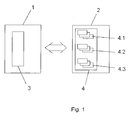
- a first configuration program 1 and a second configuration program 2 is used. Both programs 1 and 2 are database-based graphical tools.
- the configuration data is fed via an interface in the bus system or the bus participants.
- the first configuration program 1 is the Engineering Tool Software (ETS).
- ETS Engineering Tool Software
- configuration data i. the communication relationships and the device parameters, created separately for each bus user or its application program.
- the second configuration program 2 is implemented in the first configuration program 1 so that the program mechanisms and user interfaces can be uniformly designed and used with each other.
- the second configuration program 2 contains a database 4, in which a wide variety of configuration solutions and models 4.1, 4.2 and 4.3 are stored, which can be selected under different application criteria and are project-specifically adapted to form a new installation project. Selectable application criteria are z. B. building architectures, Equipment scopes or functionalities as well as safety solutions or energy management applications etc.
- the architecture of an installation project can be defined in terms of building use, number and shape of floors and rooms.
- equipment variants base to premium
- functional ranges for light, temperature, shading and their control options can be set.
- configuration data can be evaluated and changed in terms of energy, so that a configuration can also be optimized with regard to the cost-benefit ratio. This results in detailed solutions for the concrete assembly of the entire installation project.
- application-oriented configuration data are generated in a simple manner, with the individual bus users being configured in groups according to the selected application criteria.
- the data from the second configuration program 2 are transferred to the first configuration program 1.
- the configuration data (communication relationships, parameters, application programs) from the second configuration program 2 are preferably read into and taken over into the first configuration program 1 or its internal database 3 without explicit export or import.
- the export or import of the configuration data takes place in a structured format, in particular XML (Extensible Markup Language).
- XML Extensible Markup Language
- another standardized metalanguage can be used for the configuration data transfer, such as SGML (Standard Generalized Markup Language), HTML (Hypertext Markup Language) or CSV (Comma-Separated Values).
- the export and Import of the configuration data in the XML format is preferably implemented by ETS's own readout or read-in algorithms. These implement the conversion of the configuration data from the proprietary ETS format into XML format and back. Due to the structured storage in the exported XML file, the ETS import algorithm that is active during import is able to interpret the data structure.
- the transferred data are automatically and directly transferred to the final configuration within the first configuration program 1 and no longer need to be programmed individually for each bus user. Of course, parameters and settings not covered by the second configuration program 2 must continue to be entered separately and manually within the first configuration program 1.
- parameters stored in the ETS database are given unique names and default values. Based on the parameter names stored in the ETS database, the import and export of the parameters integrated in the ETS takes place by searching for parameters with the same parameter name. If there is a match, the parameter value is accepted.
Landscapes
- Physics & Mathematics (AREA)
- General Physics & Mathematics (AREA)
- Engineering & Computer Science (AREA)
- Automation & Control Theory (AREA)
- Programmable Controllers (AREA)
- Stored Programmes (AREA)
Abstract
Description
- Die Erfindung betrifft ein Verfahren zur Projektierung einer busorientierten programmierbaren Elektroinstallation nach dem Oberbegriff des Patentanspruches 1 sowie ein entsprechendes Computerprogramm.
- Elektroinstallationen in Gebäuden werden häufig unter Verwendung von Bustechnik verwirklicht. Eines dieser Bussysteme ist der European Installation Bus (EIB), über den in einem Gebäude installierte Elektrogeräte (Aktoren), wie z. B. Lichtquellen, Jalousien, Ventilatoren, Heizungen, Alarmanlagen, und Bedienungselemente (Sensoren), wie z. B. Taster, Schalter, Dimmer, verbunden und gesteuert werden können. Dieses Bussystem basiert darauf, dass jeder Busteilnehmer über einen eigenen Mikroprozessor verfügt und somit selbständig und unabhängig von einem zentralen Prozessor seine Daten verwaltet. Jedem Busteilnehmer ist hierzu ein Applikationsprogramm mit Kommunikationsobjekten und Parametern zugeordnet.
- Bei der Inbetriebnahme eines derartigen Bussystems müssen die Kommunikationsbeziehungen und Parameter der Busteilnehmer projektiert werden. Im Falle des EIB kommt hierbei häufig die Engineering-Tool-Software (ETS) zum Einsatz. Bei der ETS handelt es sich um ein datenbankbasiertes grafisches Werkzeug zur Projektierung einer busorientierten programmierbaren Elektroinstallation. Unter Verwendung der Datenbank werden in der ETS die Projektierungsdaten, d.h. die Kommunikationsbeziehungen und die Geräteparameter, für jeden Busteilnehmer bzw. jedes Applikationsprogramm separat erstellt und abschließend über eine Schnittstelle in das Bussystem und deren Teilnehmer eingespeist. Die gerätespezifische Projektierung ist insbesondere im Bereich von Zweckbauten mit mehreren Hundert Installationsgeräten mit einem sehr hohen Aufwand verbunden.
- Die Aufgabe der vorliegenden Erfindung besteht darin, die Projektierung einer busorientierten programmierbaren Elektroinstallation zu erleichtern.
- Gelöst wird diese Aufgabe durch ein im Patentanspruch 1 angegebenes Verfahren und durch ein im Patentanspruch 7 angegebenes Computerprogramm. Vorteilhafte Ausgestaltungen ergeben sich aus den Unteransprüchen.
- Die Erfindung gemäß dem Patentanspruch 1 besteht darin, die Projektierung einer Elektroinstallation mit Hilfe eines ersten Konfigurationsprogramms und eines zweiten Konfigurationsprogramms durchzuführen, wobei Projektierungsdaten des zweiten Konfigurationsprogramms in das erste Konfigurationsprogramm portiert werden und dort übernommen oder weiterbearbeitet werden. Vorzugsweise sind in beiden Programmen Datenbanken hinterlegt.
- Das zweite Konfigurationsprogramm enthält eine Datenbank, in der unterschiedlichste Projektierungslösungen und -modelle abgelegt sind, die nach verschiedenen Anwendungskriterien bei der Projektierung einer Elektroinstallation auswählbar sind und projektspezifisch angepasst zur Bildung eines neuen Installationsprojektes dienen. Auswählbare Anwendungskriterien sind z. B. Gebäudearchitekturen, Ausstattungsumfänge oder Funktionalitäten sowie Sicherheitslösungen oder Energiemanagementanwendungen. Insbesondere lassen sich Konfigurationsdaten unter energetischen Aspekten bewerten und verändern, so dass eine Projektierung auch hinsichtlich des Kosten-Nutzen-Verhältnis optimiert werden kann.
- In dem zweiten Konfigurationsprogramm werden somit anwendungsorientierte Projektierungsdaten erzeugt, wobei die einzelnen Busteilnehmer nicht mehr einzeln sondern entsprechend der ausgewählten Anwendungskriterien gruppenweise konfiguriert werden. Nach Abschluss der anwendungsrelevanten Projektierung werden die Daten aus dem zweiten Konfigurationsprogramm in das erste Konfigurationsprogramm, vorzugsweise die ETS, übertragen. Die Projektierungsdaten (Kommunikationsverbindungen und Geräteparameter) werden nach ihrer Übermittlung innerhalb des ersten Konfigurationsprogramms vorzugsweise automatisch und direkt in die endgültige Projektierung übernommen und müssen somit nicht einzeln für jeden Busteilnehmer programmiert werden.
- In dem ersten Konfigurationsprogramm kann aber weiterhin auf die einzelnen Gerätekonfigurationen zugegriffen werden, so dass nicht von dem zweiten Konfigurationsprogramm erfasste Einstellungen separat und manuell vorgenommen werden können. Darüber hinaus können auf diese Weise die Konfigurationsdaten spezifischer Busteilnehmer nachbearbeitet und korrigiert werden.
- Durch dieses Verfahren wird die Projektierung einer busorientierten programmierbaren Elektroinstallation erheblich vereinfacht, da der Umfang der einzeln einzugebenden Konfigurationsdaten drastisch reduziert wird. Bisher notwendige Detailkenntnisse sind für die Projektierung einer Elektroinstallation nur noch bedingt erforderlich, so dass das Programm von einer Mehrzahl von Anwendern genutzt werden kann. Vorteilhafterweise ist durch entsprechende Projektierungsmodelle ein wirtschaftlich und technisch sinnvoller Einsatz von Ressourcen (Busteilnehmern) möglich, wodurch falsche oder falsch eingestellte Busteilnehmer vermieden werden können.
- Weitere Einzelheiten, Merkmale und Vorteile der Erfindung ergeben sich aus nachfolgender Beschreibung eines bevorzugten Ausführungsbeispieles anhand der Zeichnungen.
- Es zeigt:
- Figur 1
- eine stark vereinfachte schematische Darstellung des erfindungsgemäßen Verfahrens.
- Gleiche oder gleichwirkende Bauteile sind in der nachfolgenden Beschreibung mit gleichen Bezugszeichen versehen.
- Nachfolgend wird die Funktionsweise des erfindungsgemäßen Verfahrens anhand eines Ausführungsbeispieles schematisch beschrieben.
- Das Verfahren eignet sich zur Projektierung einer busorientierten programmierbaren Elektroinstallation und wird vorzugsweise für ein Bussystem gemäß dem European Installation Bus (EIB) verwendet, um Verbindungen und Parameter der in dem Gebäude installierten Elektrogeräte (Aktoren), wie z. B. Lichtquellen, Jalousien, Ventilatoren, Heizungen, A-larmanlagen, und Bedienungselemente (Sensoren), wie z. B. Taster, Schalter, Dimmer, zu konfigurieren. Das EIB-System basiert darauf, dass jeder Busteilnehmer über einen eigenen Mikroprozessor verfügt und somit selbständig und unabhängig von einem zentralen Prozessor seine Daten verwaltet.
- Bei der Projektierung des Bussystems werden den Busteilnehmern die jeweiligen Kommunikationsbeziehungen und Parameter zugeordnet. Gemäß
Figur 1 wird hierzu ein erstes Konfigurationsprogramm 1 und ein zweites Konfigurationsprogramm 2 verwendet. Bei beiden Programmen 1 und 2 handelt es sich um datenbankbasierte grafische Werkzeuge. Nach Abschluss der vorteilhafterweise extern stattfindenden Projektierung werden die Projektierungsdaten über eine Schnittstelle in das Bussystem bzw. die Busteilnehmer eingespeist. - Bei dem ersten Konfigurationsprogramm 1 handelt es sich um die Engineering-Tool-Software (ETS). Unter Verwendung einer internen Datenbank 3 werden in der ETS die Konfigurationsdaten, d.h. die Kommunikationsbeziehungen und die Geräteparameter, für jeden Busteilnehmer bzw. dessen Applikationsprogramm separat erstellt. Für die Projektierung eines sehr komplexen Installationsprojektes mit einer Vielzahl an Busteilnehmern erfordert dies einen erheblichen manuellen Projektierungsaufwand.
- Erfindungsgemäß ist es vorgesehen, die Projektierung durch ein zweites Konfigurationsprogramm 2 mit zusätzlichen Funktionalitäten zu vereinfachen, wobei Projektierungsdaten des zweiten Konfigurationsprogramms 2 in das erste Konfigurationsprogramm 1 portiert werden und dort übernommen oder weiterbearbeitet werden. In der erfindungsgemäßen Ausführungsform wird das zweite Konfigurationsprogramm 2 in das erste Konfigurationsprogramm implementiert 1, so dass die Programmmechanismen und -oberflächen einheitlich gestaltet und untereinander genutzt werden können.
- Das zweite Konfigurationsprogramm 2 enthält eine Datenbank 4, in der unterschiedlichste Projektierungslösungen und -modelle 4.1, 4.2 und 4.3 abgelegt sind, die unter verschiedenen Anwendungskriterien auswählbar sind und projektspezifisch angepasst zur Bildung eines neuen Installationsprojektes dienen. Auswählbare Anwendungskriterien sind z. B. Gebäudearchitekturen, Ausstattungsumfänge oder Funktionalitäten sowie Sicherheitslösungen oder Energiemanagementanwendungen usw.
- Beispielsweise lässt sich die Architektur eines Installationsprojektes hinsichtlich Gebäudenutzung, Anzahl und Form von Etagen und Räumen definieren. Weiterhin sind unterschiedlichste Ausstattungsvarianten (Basis bis Premium) sowie Funktionsumfänge für Licht, Temperatur, Beschattung und deren Steuerungsmöglichkeiten einstellbar. Insbesondere lassen sich Konfigurationsdaten unter energetischen Aspekten bewerten und verändern, so dass eine Projektierung auch hinsichtlich des Kosten-Nutzen-Verhältnis optimiert werden kann. Es ergeben sich dadurch detaillierte Lösungsvorschläge für die konkrete Bestückung des gesamten Installationsprojektes.
- Dadurch werden auf einfache Weise anwendungsorientierte Projektierungsdaten erzeugt, wobei die einzelnen Busteilnehmer entsprechend der ausgewählten Anwendungskriterien gruppenweise konfiguriert werden. Nach Abschluss dieser anwendungsrelevanten Projektierung werden die Daten aus dem zweiten Konfigurationsprogramm 2 in das erste Konfigurationsprogramm 1 übertragen. Die Projektierungsdaten (Kommunikationsbeziehungen, Parameter, Applikationsprogramme) aus dem zweiten Konfigurationsprogramm 2 werden vorzugsweise ohne expliziten Export bzw. Import in das erste Konfigurationsprogramm 1 bzw. deren interner Datenbank 3 eingelesen und übernommen.
- Der Export bzw. Import der Projektierungsdaten erfolgt dabei in einem strukturierten Format, insbesondere XML (Extensible Markup Language). Anstelle von XML kann auch eine andere standardisierte Metasprache für die Projektierungsdaten-Übergabe verwendet werden wie beispielsweise SGML (Standard Generalized Markup Language), HTML (Hypertext Markup Language) oder CSV (Comma-Separated Values). Der Export und Import der Projektierungsdaten in dem XML-Format ist vorzugsweise durch ETS-eigene Auslese- bzw. Einlesealgorithmen implementiert. Diese verwirklichen die Konvertierung der Projektierungsdaten aus dem proprietären ETS-Format in das XML-Format und zurück. Aufgrund der strukturierten Ablage in der exportierten XML-Datei ist der während des Importierens tätige Einlesealgorithmus der ETS in der Lage, eine Interpretation der Datenstruktur vorzunehmen.
- Die übernommenen Daten werden innerhalb des ersten Konfigurationsprogramms 1 automatisch und direkt in die endgültige Projektierung übernommen und müssen nicht mehr einzeln für jeden Busteilnehmer programmiert werden. Nicht von dem zweiten Konfigurationsprogramm 2 erfasste Parameter und Einstellungen müssen natürlich weiterhin separat und manuell innerhalb des ersten Konfigurationsprogramms 1 eingegeben werden.
- Für die gerätespezifische Konfiguration der Busteilnehmer sind in der ETS-Datenbank abgelegte Parameter mit eindeutigen Bezeichnungen und voreingestellten Standardwerten versehen. Anhand der in der ETS-Datenbank hinterlegten Parameternamen erfolgt der in die ETS integrierte Im- und Export der Parameter, indem nach Parametern mit dem gleichen Parameternamen gesucht wird. Bei einer Übereinstimmung wird der Parameterwert übernommen.
- Die vorstehende Beschreibung des Ausführungsbeispieles dient nur zu illustrativen Zwecken und nicht zum Zwecke der Beschränkung der Erfindung. Im Rahmen der Erfindung sind verschiedene Änderungen und Modifikationen möglich, ohne den Umfang der Erfindung sowie ihrer Äquivalente zu verlassen.
Claims (7)
- Verfahren zur Projektierung einer busorientierten programmierbaren Elektroinstallation, gekennzeichnet durch ein erstes datenbankorientiertes Konfigurationsprogramm (1) und ein zweites datenbankorientiertes Konfigurationsprogramm (2), wobei in dem zweiten Konfigurationsprogramm (2) eine anwendungsorientierte Programmierung erfolgt, bei der Projektierungsdaten aus einer Datenbank (4) mit Projektierungslösungen (4.1, 4.2, 4.3) erstellt werden, und wobei die Projektierungsdaten des zweiten Konfigurationsprogramms (2) in das erste Konfigurationsprogramm (1) portiert werden und dort übernommen oder weiterbearbeitet werden.
- Verfahren nach Patentanspruch 1, dadurch gekennzeichnet, dass die Projektierungsdaten von dem zweiten Konfigurationsprogramm (2) automatisch in das erste Konfigurationsprogramm (1) übertragen und eingelesen werden.
- Verfahren nach einem der vorhergehenden Patentansprüche, dadurch gekennzeichnet, dass der Export und/oder der Import der Projektierungsdaten in einem strukturierten Format erfolgt.
- Verfahren nach einem der vorhergehenden Patentansprüche, dadurch gekennzeichnet, dass in dem ersten Konfigurationsprogramm (1) gerätespezifische Projektierungsdaten erstellt werden.
- Verfahren nach einem der vorhergehenden Patentansprüche, dadurch gekennzeichnet, dass die Projektierungsdaten in dem zweiten Konfigurationsprogramm (2) aus Projektierungslösungen (4.1, 4.2, 4.3) der Datenbank (4), die Gebäudearchitekturen, Ausstattungsumfänge oder Funktionalitäten sowie Sicherheitslösungen oder Energiemanagementanwendungen beinhalten, erstellt werden.
- Verfahren nach einem der vorhergehenden Patentansprüche, dadurch gekennzeichnet, dass sich die Projektierungsdaten des zweiten Konfigurationsprogramms (2) unter energetischen Aspekten bewerten und verändern lassen.
- Computerprogramm zur Projektierung einer busorientierten programmierbaren Elektroinstallation mit Rechenbefehlen zur Ausführung des Verfahrens nach einem der Patentansprüche 1 bis 6.
Applications Claiming Priority (1)
| Application Number | Priority Date | Filing Date | Title |
|---|---|---|---|
| DE200810052913 DE102008052913A1 (de) | 2008-10-23 | 2008-10-23 | Verfahren zur Projektierung einer busorientierten programmierbaren Elektroinstallation |
Publications (2)
| Publication Number | Publication Date |
|---|---|
| EP2180388A1 true EP2180388A1 (de) | 2010-04-28 |
| EP2180388B1 EP2180388B1 (de) | 2013-06-19 |
Family
ID=41346020
Family Applications (1)
| Application Number | Title | Priority Date | Filing Date |
|---|---|---|---|
| EP20090012991 Not-in-force EP2180388B1 (de) | 2008-10-23 | 2009-10-14 | Verfahren zur Projektierung einer busorientierten programmierbaren Elektroinstallation |
Country Status (4)
| Country | Link |
|---|---|
| EP (1) | EP2180388B1 (de) |
| DE (1) | DE102008052913A1 (de) |
| DK (1) | DK2180388T3 (de) |
| ES (1) | ES2425147T3 (de) |
Cited By (1)
| Publication number | Priority date | Publication date | Assignee | Title |
|---|---|---|---|---|
| EP2482152A1 (de) * | 2011-01-28 | 2012-08-01 | Niko NV | Verfahren zur Gebrauch bei der Installation eines Hausautomatisierungssystems, eines Computermediums und eines Computerprogramms |
Families Citing this family (1)
| Publication number | Priority date | Publication date | Assignee | Title |
|---|---|---|---|---|
| DE102015205744A1 (de) * | 2015-03-31 | 2016-10-06 | Siemens Schweiz Ag | Verfahren zur Projektierung einer busorientierten programmierbaren Elektroinstallation |
Citations (6)
| Publication number | Priority date | Publication date | Assignee | Title |
|---|---|---|---|---|
| EP1134864A1 (de) * | 2000-03-14 | 2001-09-19 | Siemens Aktiengesellschaft | Verfahren und graphisches Werkzeug zum Projektieren von Elektroinstallationskomponenten eines Gebäudes |
| DE10241875A1 (de) * | 2002-09-09 | 2004-03-18 | Gira Giersiepen Gmbh & Co. Kg | Datenverarbeitungssystem |
| EP1450279A2 (de) * | 2003-02-11 | 2004-08-25 | Siemens Aktiengesellschaft | Verfahren zur Projektierung eines elektrischen Systems |
| DE10311055B3 (de) * | 2003-03-13 | 2004-10-21 | Siemens Ag | Verfahren und Anordnung zur Projektierung eines elektrischen Systems |
| EP1584998A1 (de) * | 2004-04-05 | 2005-10-12 | Siemens Aktiengesellschaft | Verfahren zur Projektierung einer busorientierten programmierbaren Elektroinstallation |
| DE102005019570A1 (de) * | 2005-04-27 | 2006-11-09 | Siemens Ag | Ermittlungsvorrichtung und Verfahren zur Ermittlung eines Stromverbrauchs |
-
2008
- 2008-10-23 DE DE200810052913 patent/DE102008052913A1/de not_active Withdrawn
-
2009
- 2009-10-14 EP EP20090012991 patent/EP2180388B1/de not_active Not-in-force
- 2009-10-14 DK DK09012991T patent/DK2180388T3/da active
- 2009-10-14 ES ES09012991T patent/ES2425147T3/es active Active
Patent Citations (6)
| Publication number | Priority date | Publication date | Assignee | Title |
|---|---|---|---|---|
| EP1134864A1 (de) * | 2000-03-14 | 2001-09-19 | Siemens Aktiengesellschaft | Verfahren und graphisches Werkzeug zum Projektieren von Elektroinstallationskomponenten eines Gebäudes |
| DE10241875A1 (de) * | 2002-09-09 | 2004-03-18 | Gira Giersiepen Gmbh & Co. Kg | Datenverarbeitungssystem |
| EP1450279A2 (de) * | 2003-02-11 | 2004-08-25 | Siemens Aktiengesellschaft | Verfahren zur Projektierung eines elektrischen Systems |
| DE10311055B3 (de) * | 2003-03-13 | 2004-10-21 | Siemens Ag | Verfahren und Anordnung zur Projektierung eines elektrischen Systems |
| EP1584998A1 (de) * | 2004-04-05 | 2005-10-12 | Siemens Aktiengesellschaft | Verfahren zur Projektierung einer busorientierten programmierbaren Elektroinstallation |
| DE102005019570A1 (de) * | 2005-04-27 | 2006-11-09 | Siemens Ag | Ermittlungsvorrichtung und Verfahren zur Ermittlung eines Stromverbrauchs |
Non-Patent Citations (1)
| Title |
|---|
| BFE-OLDENBURG: "Tutorial ETS 3 Professional passage", TUTORIAL ETS3 PROFESSIONAL, XX, XX, 25 March 2004 (2004-03-25), pages 1 - 37, XP002334286 * |
Cited By (2)
| Publication number | Priority date | Publication date | Assignee | Title |
|---|---|---|---|---|
| EP2482152A1 (de) * | 2011-01-28 | 2012-08-01 | Niko NV | Verfahren zur Gebrauch bei der Installation eines Hausautomatisierungssystems, eines Computermediums und eines Computerprogramms |
| BE1019783A3 (nl) * | 2011-01-28 | 2012-12-04 | Niko Nv | Werkwijze voor gebruik bij de installatie van een domoticasysteem, computermedium en computerprogramma. |
Also Published As
| Publication number | Publication date |
|---|---|
| ES2425147T3 (es) | 2013-10-11 |
| DK2180388T3 (da) | 2013-09-08 |
| EP2180388B1 (de) | 2013-06-19 |
| DE102008052913A1 (de) | 2010-04-29 |
Similar Documents
| Publication | Publication Date | Title |
|---|---|---|
| EP2012201B1 (de) | Verfahren zum Programmieren einer Sicherheitssteuerung | |
| DE102014016180B4 (de) | Verfahren und Einrichtung zur Verwaltung und Konfiguration von Feldgeräten einer Automatisierungsanlage | |
| EP2608026A1 (de) | Verfahren zur Generierung eines Software-Moduls für ein Feldgerät aus einer Gerätebeschreibungsdatei sowie Gerätebeschreibungsdatei | |
| EP2180388B1 (de) | Verfahren zur Projektierung einer busorientierten programmierbaren Elektroinstallation | |
| EP3391611B1 (de) | Zugangsschlüssel für ein feldgerät | |
| EP2456124A1 (de) | Geberschnittstellenengineering | |
| DE10336648A1 (de) | System und Verfahren zur web-basierten Überwachung und Steuerung mehrerer räumlich verteilter Anlagen | |
| AT512963B1 (de) | Programmiervorlage für verteilte Anwendungsprogramme | |
| EP3088975B1 (de) | Kanalbezogene geräteparametrierung | |
| DE102014019368A1 (de) | Einrichtung zur Verwaltung und Konfiguration von Feldgeräten einer Automatisierungsanlage | |
| EP4123396A1 (de) | Technik zur realisierung einer visualisierung für eine automatisierungstechnische anlage mit einer speicherprogrammierbaren steuerung | |
| DE102005062810B4 (de) | Verfahren zum Ansteuern einer Geräte- und Maschinenbaugruppenanordnung | |
| DE102009017816A1 (de) | Verfahren zum Parametrieren von Betriebsmitteln | |
| EP1584998A1 (de) | Verfahren zur Projektierung einer busorientierten programmierbaren Elektroinstallation | |
| EP3847516B1 (de) | Identifizieren von steuergeräten in automatisierungssystemen | |
| EP2839348B1 (de) | Verfahren zum konfigurieren eines automatisierungssystems | |
| DE102010049671B4 (de) | Verfahren zum Steuern von Komponenten eines Automationssystems | |
| EP2455831A1 (de) | Engineering einer Datenkommunikation | |
| EP1134864A1 (de) | Verfahren und graphisches Werkzeug zum Projektieren von Elektroinstallationskomponenten eines Gebäudes | |
| DE102008057003B4 (de) | Verfahren zur sicheren Parametierung von AS Interface Slaves | |
| DE202015009348U1 (de) | Anordnung zur Projektierung einer busorientierten programmierbaren Elektroinstallation | |
| DE102013211967A1 (de) | Schweisssteuerung und Verfahren zum Aufzeichnen von Änderungen bei einer Schweisssteuerung | |
| EP2028575B1 (de) | Verfahren zum Auslesen und/oder Schreiben von Eigenschaften oder Parametern eines an ein Bussystem angeschlossenen Installationsgerätes | |
| DE10222296A1 (de) | Verfahren und System zum Konfigurieren und Spezifizieren einer Kraftanlage | |
| EP4509935A1 (de) | Verfahren zum konfigurieren eines sps-geräts und ein sps-verwaltungssystem zum ausführen des verfahrens |
Legal Events
| Date | Code | Title | Description |
|---|---|---|---|
| PUAI | Public reference made under article 153(3) epc to a published international application that has entered the european phase |
Free format text: ORIGINAL CODE: 0009012 |
|
| AK | Designated contracting states |
Kind code of ref document: A1 Designated state(s): AT BE BG CH CY CZ DE DK EE ES FI FR GB GR HR HU IE IS IT LI LT LU LV MC MK MT NL NO PL PT RO SE SI SK SM TR |
|
| AX | Request for extension of the european patent |
Extension state: AL BA RS |
|
| 17P | Request for examination filed |
Effective date: 20101020 |
|
| 17Q | First examination report despatched |
Effective date: 20101122 |
|
| GRAP | Despatch of communication of intention to grant a patent |
Free format text: ORIGINAL CODE: EPIDOSNIGR1 |
|
| GRAS | Grant fee paid |
Free format text: ORIGINAL CODE: EPIDOSNIGR3 |
|
| GRAA | (expected) grant |
Free format text: ORIGINAL CODE: 0009210 |
|
| RAP1 | Party data changed (applicant data changed or rights of an application transferred) |
Owner name: SCHNEIDER ELECTRIC INDUSTRIES SAS |
|
| AK | Designated contracting states |
Kind code of ref document: B1 Designated state(s): AT BE BG CH CY CZ DE DK EE ES FI FR GB GR HR HU IE IS IT LI LT LU LV MC MK MT NL NO PL PT RO SE SI SK SM TR |
|
| REG | Reference to a national code |
Ref country code: GB Ref legal event code: FG4D Free format text: NOT ENGLISH |
|
| REG | Reference to a national code |
Ref country code: CH Ref legal event code: EP |
|
| REG | Reference to a national code |
Ref country code: AT Ref legal event code: REF Ref document number: 617981 Country of ref document: AT Kind code of ref document: T Effective date: 20130715 |
|
| REG | Reference to a national code |
Ref country code: IE Ref legal event code: FG4D Free format text: LANGUAGE OF EP DOCUMENT: GERMAN |
|
| REG | Reference to a national code |
Ref country code: DE Ref legal event code: R096 Ref document number: 502009007349 Country of ref document: DE Effective date: 20130814 |
|
| REG | Reference to a national code |
Ref country code: DK Ref legal event code: T3 |
|
| REG | Reference to a national code |
Ref country code: SE Ref legal event code: TRGR |
|
| REG | Reference to a national code |
Ref country code: ES Ref legal event code: FG2A Ref document number: 2425147 Country of ref document: ES Kind code of ref document: T3 Effective date: 20131011 |
|
| REG | Reference to a national code |
Ref country code: NL Ref legal event code: T3 |
|
| PG25 | Lapsed in a contracting state [announced via postgrant information from national office to epo] |
Ref country code: GR Free format text: LAPSE BECAUSE OF FAILURE TO SUBMIT A TRANSLATION OF THE DESCRIPTION OR TO PAY THE FEE WITHIN THE PRESCRIBED TIME-LIMIT Effective date: 20130920 Ref country code: SI Free format text: LAPSE BECAUSE OF FAILURE TO SUBMIT A TRANSLATION OF THE DESCRIPTION OR TO PAY THE FEE WITHIN THE PRESCRIBED TIME-LIMIT Effective date: 20130619 Ref country code: LT Free format text: LAPSE BECAUSE OF FAILURE TO SUBMIT A TRANSLATION OF THE DESCRIPTION OR TO PAY THE FEE WITHIN THE PRESCRIBED TIME-LIMIT Effective date: 20130619 |
|
| REG | Reference to a national code |
Ref country code: NO Ref legal event code: T2 Effective date: 20130619 |
|
| REG | Reference to a national code |
Ref country code: LT Ref legal event code: MG4D |
|
| PG25 | Lapsed in a contracting state [announced via postgrant information from national office to epo] |
Ref country code: BG Free format text: LAPSE BECAUSE OF FAILURE TO SUBMIT A TRANSLATION OF THE DESCRIPTION OR TO PAY THE FEE WITHIN THE PRESCRIBED TIME-LIMIT Effective date: 20130919 Ref country code: HR Free format text: LAPSE BECAUSE OF FAILURE TO SUBMIT A TRANSLATION OF THE DESCRIPTION OR TO PAY THE FEE WITHIN THE PRESCRIBED TIME-LIMIT Effective date: 20130619 |
|
| PG25 | Lapsed in a contracting state [announced via postgrant information from national office to epo] |
Ref country code: LV Free format text: LAPSE BECAUSE OF FAILURE TO SUBMIT A TRANSLATION OF THE DESCRIPTION OR TO PAY THE FEE WITHIN THE PRESCRIBED TIME-LIMIT Effective date: 20130619 |
|
| PG25 | Lapsed in a contracting state [announced via postgrant information from national office to epo] |
Ref country code: IS Free format text: LAPSE BECAUSE OF FAILURE TO SUBMIT A TRANSLATION OF THE DESCRIPTION OR TO PAY THE FEE WITHIN THE PRESCRIBED TIME-LIMIT Effective date: 20131019 Ref country code: PT Free format text: LAPSE BECAUSE OF FAILURE TO SUBMIT A TRANSLATION OF THE DESCRIPTION OR TO PAY THE FEE WITHIN THE PRESCRIBED TIME-LIMIT Effective date: 20131021 Ref country code: EE Free format text: LAPSE BECAUSE OF FAILURE TO SUBMIT A TRANSLATION OF THE DESCRIPTION OR TO PAY THE FEE WITHIN THE PRESCRIBED TIME-LIMIT Effective date: 20130619 Ref country code: SK Free format text: LAPSE BECAUSE OF FAILURE TO SUBMIT A TRANSLATION OF THE DESCRIPTION OR TO PAY THE FEE WITHIN THE PRESCRIBED TIME-LIMIT Effective date: 20130619 Ref country code: CY Free format text: LAPSE BECAUSE OF FAILURE TO SUBMIT A TRANSLATION OF THE DESCRIPTION OR TO PAY THE FEE WITHIN THE PRESCRIBED TIME-LIMIT Effective date: 20130828 |
|
| PG25 | Lapsed in a contracting state [announced via postgrant information from national office to epo] |
Ref country code: RO Free format text: LAPSE BECAUSE OF FAILURE TO SUBMIT A TRANSLATION OF THE DESCRIPTION OR TO PAY THE FEE WITHIN THE PRESCRIBED TIME-LIMIT Effective date: 20130619 Ref country code: PL Free format text: LAPSE BECAUSE OF FAILURE TO SUBMIT A TRANSLATION OF THE DESCRIPTION OR TO PAY THE FEE WITHIN THE PRESCRIBED TIME-LIMIT Effective date: 20130619 |
|
| PG25 | Lapsed in a contracting state [announced via postgrant information from national office to epo] |
Ref country code: CY Free format text: LAPSE BECAUSE OF FAILURE TO SUBMIT A TRANSLATION OF THE DESCRIPTION OR TO PAY THE FEE WITHIN THE PRESCRIBED TIME-LIMIT Effective date: 20130619 |
|
| PLBE | No opposition filed within time limit |
Free format text: ORIGINAL CODE: 0009261 |
|
| STAA | Information on the status of an ep patent application or granted ep patent |
Free format text: STATUS: NO OPPOSITION FILED WITHIN TIME LIMIT |
|
| BERE | Be: lapsed |
Owner name: SCHNEIDER ELECTRIC INDUSTRIES SAS Effective date: 20131031 |
|
| 26N | No opposition filed |
Effective date: 20140320 |
|
| PG25 | Lapsed in a contracting state [announced via postgrant information from national office to epo] |
Ref country code: MC Free format text: LAPSE BECAUSE OF FAILURE TO SUBMIT A TRANSLATION OF THE DESCRIPTION OR TO PAY THE FEE WITHIN THE PRESCRIBED TIME-LIMIT Effective date: 20130619 |
|
| REG | Reference to a national code |
Ref country code: CH Ref legal event code: PL |
|
| GBPC | Gb: european patent ceased through non-payment of renewal fee |
Effective date: 20131014 |
|
| REG | Reference to a national code |
Ref country code: DE Ref legal event code: R097 Ref document number: 502009007349 Country of ref document: DE Effective date: 20140320 |
|
| REG | Reference to a national code |
Ref country code: IE Ref legal event code: MM4A |
|
| PG25 | Lapsed in a contracting state [announced via postgrant information from national office to epo] |
Ref country code: LI Free format text: LAPSE BECAUSE OF NON-PAYMENT OF DUE FEES Effective date: 20131031 Ref country code: GB Free format text: LAPSE BECAUSE OF NON-PAYMENT OF DUE FEES Effective date: 20131014 Ref country code: CH Free format text: LAPSE BECAUSE OF NON-PAYMENT OF DUE FEES Effective date: 20131031 |
|
| PG25 | Lapsed in a contracting state [announced via postgrant information from national office to epo] |
Ref country code: BE Free format text: LAPSE BECAUSE OF NON-PAYMENT OF DUE FEES Effective date: 20131031 |
|
| PG25 | Lapsed in a contracting state [announced via postgrant information from national office to epo] |
Ref country code: IE Free format text: LAPSE BECAUSE OF NON-PAYMENT OF DUE FEES Effective date: 20131014 |
|
| PGFP | Annual fee paid to national office [announced via postgrant information from national office to epo] |
Ref country code: TR Payment date: 20140923 Year of fee payment: 6 |
|
| PG25 | Lapsed in a contracting state [announced via postgrant information from national office to epo] |
Ref country code: SM Free format text: LAPSE BECAUSE OF FAILURE TO SUBMIT A TRANSLATION OF THE DESCRIPTION OR TO PAY THE FEE WITHIN THE PRESCRIBED TIME-LIMIT Effective date: 20130619 |
|
| PG25 | Lapsed in a contracting state [announced via postgrant information from national office to epo] |
Ref country code: LU Free format text: LAPSE BECAUSE OF NON-PAYMENT OF DUE FEES Effective date: 20131014 Ref country code: HU Free format text: LAPSE BECAUSE OF FAILURE TO SUBMIT A TRANSLATION OF THE DESCRIPTION OR TO PAY THE FEE WITHIN THE PRESCRIBED TIME-LIMIT; INVALID AB INITIO Effective date: 20091014 Ref country code: MK Free format text: LAPSE BECAUSE OF FAILURE TO SUBMIT A TRANSLATION OF THE DESCRIPTION OR TO PAY THE FEE WITHIN THE PRESCRIBED TIME-LIMIT Effective date: 20130619 |
|
| PG25 | Lapsed in a contracting state [announced via postgrant information from national office to epo] |
Ref country code: MT Free format text: LAPSE BECAUSE OF FAILURE TO SUBMIT A TRANSLATION OF THE DESCRIPTION OR TO PAY THE FEE WITHIN THE PRESCRIBED TIME-LIMIT Effective date: 20130619 |
|
| REG | Reference to a national code |
Ref country code: AT Ref legal event code: MM01 Ref document number: 617981 Country of ref document: AT Kind code of ref document: T Effective date: 20141014 |
|
| PG25 | Lapsed in a contracting state [announced via postgrant information from national office to epo] |
Ref country code: AT Free format text: LAPSE BECAUSE OF NON-PAYMENT OF DUE FEES Effective date: 20141014 |
|
| PGFP | Annual fee paid to national office [announced via postgrant information from national office to epo] |
Ref country code: CZ Payment date: 20151008 Year of fee payment: 7 |
|
| REG | Reference to a national code |
Ref country code: FR Ref legal event code: PLFP Year of fee payment: 8 |
|
| PG25 | Lapsed in a contracting state [announced via postgrant information from national office to epo] |
Ref country code: CZ Free format text: LAPSE BECAUSE OF NON-PAYMENT OF DUE FEES Effective date: 20161014 |
|
| REG | Reference to a national code |
Ref country code: FR Ref legal event code: PLFP Year of fee payment: 9 |
|
| REG | Reference to a national code |
Ref country code: FR Ref legal event code: PLFP Year of fee payment: 10 |
|
| PGFP | Annual fee paid to national office [announced via postgrant information from national office to epo] |
Ref country code: NL Payment date: 20230915 Year of fee payment: 15 Ref country code: IT Payment date: 20230913 Year of fee payment: 15 |
|
| PGFP | Annual fee paid to national office [announced via postgrant information from national office to epo] |
Ref country code: SE Payment date: 20230830 Year of fee payment: 15 Ref country code: FR Payment date: 20230911 Year of fee payment: 15 |
|
| PGFP | Annual fee paid to national office [announced via postgrant information from national office to epo] |
Ref country code: ES Payment date: 20231108 Year of fee payment: 15 |
|
| PGFP | Annual fee paid to national office [announced via postgrant information from national office to epo] |
Ref country code: NO Payment date: 20231010 Year of fee payment: 15 Ref country code: FI Payment date: 20231011 Year of fee payment: 15 Ref country code: DK Payment date: 20231016 Year of fee payment: 15 Ref country code: DE Payment date: 20230830 Year of fee payment: 15 |
|
| PG25 | Lapsed in a contracting state [announced via postgrant information from national office to epo] |
Ref country code: TR Free format text: LAPSE BECAUSE OF NON-PAYMENT OF DUE FEES Effective date: 20161014 |
|
| REG | Reference to a national code |
Ref country code: DE Ref legal event code: R119 Ref document number: 502009007349 Country of ref document: DE |
|
| REG | Reference to a national code |
Ref country code: DK Ref legal event code: EBP Effective date: 20241031 |
|
| REG | Reference to a national code |
Ref country code: SE Ref legal event code: EUG |
|
| REG | Reference to a national code |
Ref country code: NL Ref legal event code: MM Effective date: 20241101 |
|
| PG25 | Lapsed in a contracting state [announced via postgrant information from national office to epo] |
Ref country code: FI Free format text: LAPSE BECAUSE OF NON-PAYMENT OF DUE FEES Effective date: 20241014 |
|
| PG25 | Lapsed in a contracting state [announced via postgrant information from national office to epo] |
Ref country code: DE Free format text: LAPSE BECAUSE OF NON-PAYMENT OF DUE FEES Effective date: 20250501 |
|
| PG25 | Lapsed in a contracting state [announced via postgrant information from national office to epo] |
Ref country code: NO Free format text: LAPSE BECAUSE OF NON-PAYMENT OF DUE FEES Effective date: 20241031 |
|
| PG25 | Lapsed in a contracting state [announced via postgrant information from national office to epo] |
Ref country code: NL Free format text: LAPSE BECAUSE OF NON-PAYMENT OF DUE FEES Effective date: 20241101 |
|
| PG25 | Lapsed in a contracting state [announced via postgrant information from national office to epo] |
Ref country code: FR Free format text: LAPSE BECAUSE OF NON-PAYMENT OF DUE FEES Effective date: 20241031 |
|
| PG25 | Lapsed in a contracting state [announced via postgrant information from national office to epo] |
Ref country code: DK Free format text: LAPSE BECAUSE OF NON-PAYMENT OF DUE FEES Effective date: 20241031 |
|
| PG25 | Lapsed in a contracting state [announced via postgrant information from national office to epo] |
Ref country code: SE Free format text: LAPSE BECAUSE OF NON-PAYMENT OF DUE FEES Effective date: 20241015 Ref country code: IT Free format text: LAPSE BECAUSE OF NON-PAYMENT OF DUE FEES Effective date: 20241014 |
|
| REG | Reference to a national code |
Ref country code: ES Ref legal event code: FD2A Effective date: 20251128 |
|
| PG25 | Lapsed in a contracting state [announced via postgrant information from national office to epo] |
Ref country code: ES Free format text: LAPSE BECAUSE OF NON-PAYMENT OF DUE FEES Effective date: 20241015 |