EP2178892B1 - Nouveaux materiaux photochromes - Google Patents
Nouveaux materiaux photochromes Download PDFInfo
- Publication number
- EP2178892B1 EP2178892B1 EP08829134A EP08829134A EP2178892B1 EP 2178892 B1 EP2178892 B1 EP 2178892B1 EP 08829134 A EP08829134 A EP 08829134A EP 08829134 A EP08829134 A EP 08829134A EP 2178892 B1 EP2178892 B1 EP 2178892B1
- Authority
- EP
- European Patent Office
- Prior art keywords
- formula
- dabco
- materials
- real number
- organic
- Prior art date
- Legal status (The legal status is an assumption and is not a legal conclusion. Google has not performed a legal analysis and makes no representation as to the accuracy of the status listed.)
- Not-in-force
Links
- 239000000463 material Substances 0.000 title claims description 46
- IMNIMPAHZVJRPE-UHFFFAOYSA-N triethylenediamine Chemical compound C1CN2CCN1CC2 IMNIMPAHZVJRPE-UHFFFAOYSA-N 0.000 claims description 14
- 239000012973 diazabicyclooctane Substances 0.000 claims description 13
- 239000000203 mixture Substances 0.000 claims description 10
- 239000011521 glass Substances 0.000 claims description 8
- 239000002537 cosmetic Substances 0.000 claims description 5
- 229910052708 sodium Inorganic materials 0.000 claims description 5
- 238000004980 dosimetry Methods 0.000 claims description 4
- 229910052700 potassium Inorganic materials 0.000 claims description 4
- 125000004122 cyclic group Chemical group 0.000 claims description 2
- 150000002892 organic cations Chemical class 0.000 claims description 2
- 125000004400 (C1-C12) alkyl group Chemical group 0.000 claims 1
- 125000006273 (C1-C3) alkyl group Chemical group 0.000 claims 1
- 229910052783 alkali metal Inorganic materials 0.000 claims 1
- 150000001340 alkali metals Chemical group 0.000 claims 1
- XLYOFNOQVPJJNP-UHFFFAOYSA-N water Substances O XLYOFNOQVPJJNP-UHFFFAOYSA-N 0.000 description 13
- ZOKXTWBITQBERF-UHFFFAOYSA-N Molybdenum Chemical compound [Mo] ZOKXTWBITQBERF-UHFFFAOYSA-N 0.000 description 5
- 150000001875 compounds Chemical class 0.000 description 5
- 229910052750 molybdenum Inorganic materials 0.000 description 5
- 239000011733 molybdenum Substances 0.000 description 5
- 239000000243 solution Substances 0.000 description 5
- RTZKZFJDLAIYFH-UHFFFAOYSA-N Diethyl ether Chemical compound CCOCC RTZKZFJDLAIYFH-UHFFFAOYSA-N 0.000 description 4
- LFQSCWFLJHTTHZ-UHFFFAOYSA-N Ethanol Chemical compound CCO LFQSCWFLJHTTHZ-UHFFFAOYSA-N 0.000 description 4
- VEXZGXHMUGYJMC-UHFFFAOYSA-N Hydrochloric acid Chemical compound Cl VEXZGXHMUGYJMC-UHFFFAOYSA-N 0.000 description 4
- 150000001768 cations Chemical class 0.000 description 4
- 238000004040 coloring Methods 0.000 description 4
- 230000008859 change Effects 0.000 description 3
- 239000006071 cream Substances 0.000 description 3
- 239000002244 precipitate Substances 0.000 description 3
- 229910015667 MoO4 Inorganic materials 0.000 description 2
- 239000002253 acid Substances 0.000 description 2
- 230000008901 benefit Effects 0.000 description 2
- 229910052792 caesium Inorganic materials 0.000 description 2
- 230000036571 hydration Effects 0.000 description 2
- 238000006703 hydration reaction Methods 0.000 description 2
- 229910052744 lithium Inorganic materials 0.000 description 2
- 230000003287 optical effect Effects 0.000 description 2
- 239000002243 precursor Substances 0.000 description 2
- 229910052701 rubidium Inorganic materials 0.000 description 2
- 238000003756 stirring Methods 0.000 description 2
- 239000000725 suspension Substances 0.000 description 2
- IIUPTHVVXMBJMQ-UHFFFAOYSA-N 3-amino-6-chloro-n-(diaminomethylidene)-5-(dimethylamino)pyrazine-2-carboxamide;hydrochloride Chemical compound Cl.CN(C)C1=NC(N)=C(C(=O)N=C(N)N)N=C1Cl IIUPTHVVXMBJMQ-UHFFFAOYSA-N 0.000 description 1
- 229910004616 Na2MoO4.2H2 O Inorganic materials 0.000 description 1
- 208000000453 Skin Neoplasms Diseases 0.000 description 1
- 230000006750 UV protection Effects 0.000 description 1
- 238000010521 absorption reaction Methods 0.000 description 1
- 230000006978 adaptation Effects 0.000 description 1
- 125000003342 alkenyl group Chemical group 0.000 description 1
- 125000000217 alkyl group Chemical group 0.000 description 1
- 125000000304 alkynyl group Chemical group 0.000 description 1
- 239000007864 aqueous solution Substances 0.000 description 1
- 230000015572 biosynthetic process Effects 0.000 description 1
- 238000004061 bleaching Methods 0.000 description 1
- 230000001186 cumulative effect Effects 0.000 description 1
- 238000010586 diagram Methods 0.000 description 1
- 239000012153 distilled water Substances 0.000 description 1
- 230000000694 effects Effects 0.000 description 1
- 210000002615 epidermis Anatomy 0.000 description 1
- 125000001495 ethyl group Chemical group [H]C([H])([H])C([H])([H])* 0.000 description 1
- 238000011156 evaluation Methods 0.000 description 1
- 230000005284 excitation Effects 0.000 description 1
- 238000001914 filtration Methods 0.000 description 1
- 238000009472 formulation Methods 0.000 description 1
- 230000004313 glare Effects 0.000 description 1
- 230000005283 ground state Effects 0.000 description 1
- 230000037308 hair color Effects 0.000 description 1
- 238000010438 heat treatment Methods 0.000 description 1
- 229910052739 hydrogen Inorganic materials 0.000 description 1
- 239000001257 hydrogen Substances 0.000 description 1
- 238000005286 illumination Methods 0.000 description 1
- 230000001939 inductive effect Effects 0.000 description 1
- 239000000976 ink Substances 0.000 description 1
- 229910010272 inorganic material Inorganic materials 0.000 description 1
- 239000011147 inorganic material Substances 0.000 description 1
- 230000003993 interaction Effects 0.000 description 1
- 125000001449 isopropyl group Chemical group [H]C([H])([H])C([H])(*)C([H])([H])[H] 0.000 description 1
- 239000006210 lotion Substances 0.000 description 1
- 238000004519 manufacturing process Methods 0.000 description 1
- 229910052751 metal Inorganic materials 0.000 description 1
- 238000000034 method Methods 0.000 description 1
- 125000002496 methyl group Chemical group [H]C([H])([H])* 0.000 description 1
- 125000004123 n-propyl group Chemical group [H]C([H])([H])C([H])([H])C([H])([H])* 0.000 description 1
- 239000013110 organic ligand Substances 0.000 description 1
- 230000008520 organization Effects 0.000 description 1
- 238000004806 packaging method and process Methods 0.000 description 1
- 230000007170 pathology Effects 0.000 description 1
- 238000004321 preservation Methods 0.000 description 1
- 239000011252 protective cream Substances 0.000 description 1
- 230000005855 radiation Effects 0.000 description 1
- 230000009257 reactivity Effects 0.000 description 1
- 239000002453 shampoo Substances 0.000 description 1
- 210000003491 skin Anatomy 0.000 description 1
- 201000000849 skin cancer Diseases 0.000 description 1
- 239000007787 solid Substances 0.000 description 1
- 239000002904 solvent Substances 0.000 description 1
- 238000003786 synthesis reaction Methods 0.000 description 1
- 239000004753 textile Substances 0.000 description 1
- 230000007704 transition Effects 0.000 description 1
- 238000009281 ultraviolet germicidal irradiation Methods 0.000 description 1
Images
Classifications
-
- C—CHEMISTRY; METALLURGY
- C07—ORGANIC CHEMISTRY
- C07F—ACYCLIC, CARBOCYCLIC OR HETEROCYCLIC COMPOUNDS CONTAINING ELEMENTS OTHER THAN CARBON, HYDROGEN, HALOGEN, OXYGEN, NITROGEN, SULFUR, SELENIUM OR TELLURIUM
- C07F11/00—Compounds containing elements of Groups 6 or 16 of the Periodic Table
- C07F11/005—Compounds containing elements of Groups 6 or 16 of the Periodic Table compounds without a metal-carbon linkage
Definitions
- the invention relates to novel organic-inorganic hybrid materials based on molybdenum with photochromic properties. It also relates to their use, especially in cosmetics and in the field of glasses, such as in glass or the manufacture of spectacle lenses.
- Photochromic materials of a purely organic or purely inorganic nature have been known for a long time.
- a new family of photochromic materials has been the subject of numerous studies: hybrid organic-inorganic materials.
- R 1 R 2 .
- R 1 and R 2 are chosen from C 1 -C 10 and even better C 1 -C 6 alkyls.
- x 0.8.
- y 0.7.
- Z represents the hydration rate of the molecule, and advantageously 0 ⁇ z ⁇ 6.
- the material of the invention corresponds to formula (Ia) below: (H 2 DABCO 2+ ) 2 ((CH 3 ) 2 NH 2 + ) 0.5 (Na) 0.8 (H 3 O + ) 0.7 (Mo 8 O 27 ). 3 (H 2 O) (Ia)
- the materials of The invention has numerous advantages: greater rapidity of coloration, reversibility of the coloring when the material is no longer subjected to external stimulus, stability of the material, intensity of the coloring.
- the materials of the invention have the property of being insoluble in water, which has the consequence that, when they are placed in the presence of a medium containing water, their photochromic properties are not affected by water.
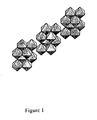
- the material of formula (I) consists of infinite chains 1 / ⁇ [Mo 8 O 27 ] 6- as shown in FIG. figure 1 . These chains are surrounded by organic cations, X + , H 3 O + and possibly H 2 O molecules.
- FIG 1 On the figure 1 is schematically represented the chain 1 / ⁇ [Mo 8 O 27 ] 6- .
- An octahedron represents a group MoO 6 , the metal center occupying the center of the octahedron.
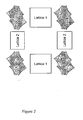
- the organization of the two sub-networks occupied by cations around the 1 / ⁇ [Mo 8 O 27 ] 6- chain is carried out as indicated schematically on the figure 2 .
- the chains 1 / ⁇ [Mo 8 O 27 ] 6- y are represented parallel to their axis of propagation.
- the chains 1 / ⁇ [Mo 8 O 27 ] 6- are held parallel by two sub-networks ("lattices" 1 and 2 on the figure 2 ) in which the cations are distributed.
- the lattice 1 is occupied by H 2 DABCO 2+ cations which link the 1 / ⁇ [Mo 8 O 27 ] 6 chains via hydrogen bonds.
- the HDMA + , Na + and H 3 O + cations are distributed in lattice 2.
- the water molecules are not shown in the diagram.
- the material of the invention has at ambient temperature an optical gap of approximately 3.1 eV.
- the stability of the material, and the preservation of its properties when it is in the presence of water make it possible to envisage its use in many compositions, and in particular in tinted creams, in eyeshadow, blushes, mascaras, lipsticks, foundations, nail polishes, hair coloring compositions, such as coloring creams, color lotions, coloring shampoos in compositions for making body tattoos.
- tinted creams in eyeshadow, blushes, mascaras, lipsticks, foundations, nail polishes, hair coloring compositions, such as coloring creams, color lotions, coloring shampoos in compositions for making body tattoos.
- water contained in the compositions that comprise it nor the water of the epidermis destabilizes the material of the invention.
- Another object of the invention is a cosmetic composition, characterized in that it comprises at least one material of formula (I).
- the molecules of formula (I) may be used as an indicator of exposure to UV radiation, so as to allow a reliable evaluation of the intensity of this exposure and this in order to prevent the appearance of pathologies associated with too much UV exposure. like skin cancer.
- the materials of formula (I) may be introduced into patches to be applied to the skin. A comparison with a colored sample makes it possible to know when a dose of UV, defined in advance, has been received by the user of the patch and thus indicates to him that an application of anti-UV protective cream should be applied, or that exposure should be interrupted.
- the materials of formula (I) can also be placed in a UV dosimetry kit, for example in a transparent glass or plastic composition whose hue varies according to the cumulative UV dose, possibly associated with a sample indicating the maximum.
- Another object of the invention is a UV dosimetry article characterized in that it comprises at least one material of formula (I).
- Such items, patches or UV dosimetry kit could be combined in a single commercial package with a UV protection cream.
- the material of the invention can be used in a conventional manner to produce a coloration of the glass (organic or inorganic) when it is exposed to UV, and thus to avoid the glare of the glass. user.
- this use can be envisaged for eyeglasses, for car windshields, for packaging bottles of UV-sensitive materials.
- another object of the invention is an organic or inorganic glass composition, characterized in that it comprises at least one material of formula (I).
Landscapes
- Chemical & Material Sciences (AREA)
- Organic Chemistry (AREA)
- Cosmetics (AREA)
- Glass Compositions (AREA)
Description
- L'invention a pour objet de nouveaux matériaux hybrides organique-inorganique à base de Molybdène dotés de propriétés photochromes. Elle a également pour objet leur utilisation, notamment en cosmétique et dans le domaine des verres, comme par exemple dans les vitrages ou la fabrication de verres de lunettes.
- Les matériaux photochromes de nature purement organique ou purement inorganique sont connus de longue date. Depuis plusieurs années, une nouvelle famille de matériaux photochromes a fait l'objet de nombreuses études : les matériaux hybrides organique-inorganique. On peut par exemple se reporter à T. Yamase, Chem. Rev. 98 (1998) 307-325 ; V. Coué et al., J. Solid State Chemistry, 179 (2006) 3615-3627 ; V. Coué et al., Inorganic Chemistry, 46 (2007) 2824-2835.
- Parmi les matériaux hybrides organique-inorganique connus, plusieurs étaient à base de Molybdène. Toutefois, il a été constaté que la présence de chaînes polyoxyde de Molybdène associées à des ligands organiques tels que H2DABCO2+ n'était nullement suffisante pour obtenir des composés photochromes (M. Evain et al., Acta Cryst. (2006), B62, 790-797). En réalité, il a été constaté que le photochromisme et la réversibilité de ce phénomène dépendait de l'interaction entre la partie organique et la partie inorganique du matériau, sans que des règles permettant de prévoir ces propriétés aient pu être mises en évidence (T. Yamase, Chem. Rev. 98 (1998) 307-325)
- En outre, il a été constaté que les caractéristiques du phénomène de photochromisme (cinétique de changement de couleur, énergie d'excitation, stabilité de l'état photo-induit, vitesse de blanchiment) étaient extrêmement variables d'un matériau à un autre.
- La Demanderesse a maintenant découvert un nouveau matériau dérivé du Molybdène qui est doté de propriétés photochromiques supérieures à celles décrites pour les matériaux de l'art antérieur.
- Ce nouveau matériau répond à la formule (I) ci-dessous :
(H2DABCO2+)2(R1R2NH2 +)(2-x-y)(X)x(H3O+)y (Mo8O27).z(H2O) (I)
dans laquelle : - R1, R2 identiques ou différents représentent chacun un groupement alkyle en C1-C12, alcényle en C1-C12, ou alcynyle en C1-C12, qui peut être linéaire, ramifié ou cyclique ;
- X représente un atome alcalin, choisi notamment parmi : Li, Na, K, Rb, Cs;
- x est un nombre réel 0 ≤ x ≤ 2 ;
- y est un nombre réel 0 ≤ y < 2 ;
- z est un nombre réel 0 ≤ z ≤ 10 ;
- DABCO désigne, comme cela est connu, la molécule 1,4-diazabicyclo[2.2.2] octane.
- De façon avantageuse, dans la formule (I) R1 = R2.
- De façon avantageuse, dans la formule (I), R1 et R2 sont choisis parmi les alkyles en C1-C10, encore mieux en C1-C6.
- De façon encore plus préférentielle dans la formule (I), R1 et R2 sont choisis parmi les alkyles en C1-C3 comme le méthyle, l'éthyle, le n-propyle, l'isopropyle, et encore plus préférentiellement R1 = R2 = CH3.
- De préférence 0,5 ≤ x ≤ 1, encore plus préférentiellement x = 0,8.
- De préférence 0,5 ≤ y ≤ 1, encore plus préférentiellement y= 0,7.
- Z représente le taux d'hydratation de la molécule, et de façon avantageuse 0 ≤ z ≤ 6.
- De préférence X représente un atome choisi parmi Na et K, avantageusement, X = Na.
- De préférence, le matériau de l'invention répond à la formule (Ia) ci-dessous :
(H2DABCO2+)2((CH3)2NH2 +)0.5(Na)0.8(H3O+)0.7(Mo8O27). 3(H2O) (Ia)
- Par rapport aux matériaux photochromes de l'art antérieur, et en particulier par rapport aux autres matériaux dérivés de Mo8O27, les matériaux de l'invention sont dotés de nombreux avantages : plus grande rapidité de coloration, réversibilité de la coloration lorsque le matériau n'est plus soumis à un stimulus externe, stabilité du matériau, intensité de la coloration. En outre, les matériaux de l'invention ont la propriété d'être insolubles dans l'eau, ce qui a pour conséquence le fait que, lorsqu'ils sont mis en présence d'un milieu contenant de l'eau, leurs propriétés photochromes ne sont pas affectées par l'eau.
- Le matériau de l'invention peut être préparé suivant le procédé décrit ci-dessous :
- Le composé précurseur X2MoO4.nH2O est dissous dans de l'eau, avec 0,2 à 0,3 équivalents, de préférence environ 0,25 équivalents, de DABCO et 0,8 à 1,2 équivalents, de préférence environ 1 équivalent, de R1R2N+H2, Cl-. La variable n représente le taux d'hydratation du composé X2MoO4. Elle varie en fonction de X, par exemple lorsque X représente Na, on peut choisir n=2, lorsque X représente K, on peut choisir n=0. Ces précurseurs sont disponibles commercialement. Le pH de la solution est ajusté à une valeur inférieure à 5, de préférence 4, à l'aide d'une solution aqueuse d'un acide tel que HCl. Le matériau attendu précipite. Il est alors filtré et lavé à l'eau et éventuellement avec de l'éthanol et/ou de l'éther éthylique.
- Le matériau de formule (I) consiste en des chaînes infinies 1/∞[Mo8O27]6- comme illustré sur la
figure 1 . Ces chaînes sont entourées des cations organiques, de X+, de H3O+ et éventuellement de molécules H2O. - Sur la
figure 1 est représentée de façon schématique la chaîne 1/∞[Mo8O27]6-. Un octaèdre représente un groupement MoO6, le centre métallique occupant le centre de l'octaèdre. L'organisation des deux sous réseaux occupés par des cations autour de la chaîne 1/∞[Mo8O27]6- s'effectue comme indiqué de façon schématique sur lafigure 2 . Les chaînes 1/∞[Mo8O27]6- y sont représentées parallèlement à leur axe de propagation. Les chaînes 1/∞[Mo8O27]6- sont maintenues parallèles par deux sous réseaux ("lattices" 1 et 2 sur lafigure 2 ) dans lesquels se répartissent les cations. La lattice 1 est occupée par les cations H2DABCO2+ qui relient les chaînes 1/∞[Mo8O27]6- par l'intermédiaire de liaisons hydrogène. Les cations HDMA+, Na+ et H3O+ se répartissent dans la lattice 2. Les molécules d'eau ne sont pas représentées sur le schéma. - Le matériau de l'invention présente à température ambiante un gap optique d'environ 3,1 eV.
- Sous irradiation UV (λex = 365 nm par exemple) ou à la simple lumière du jour, leur couleur passe du blanc au violet-pourpre en l'espace de quelques minutes : ce changement de couleur est associé à la coexistence de MoVI et MoV avec dès lors existence de transitions optiques d-d et de possibles transferts d'intervalence induisant un phénomène d'absorption dans le visible. Le retour vers l'état fondamental se fait soit par chauffage modéré du matériau, soit à température ambiante dans le noir au bout de quelques heures. Ces matériaux peuvent donner lieu à des applications en cosmétologie, dans des vitrages ou la lunetterie, les textiles, les encres.
- Notamment, pour une application en cosmétique, la stabilité du matériau, et la conservation de ses propriétés lorsqu'il se trouve en présence d'eau, permettent d'envisager son utilisation dans de nombreuses compositions, et notamment dans des crèmes teintées, dans des fards à paupières, des fards à joues, dans des mascaras, des rouges à lèvres, dans des fonds de teint, dans des vernis à ongles, dans des compositions colorantes pour les cheveux, telles que des crèmes colorantes, des lotions de coloration, des shampoings colorants, dans des compositions destinées à la réalisation de tatouages corporels. Ni l'eau contenue dans les compositions qui le comprennent, ni l'eau de l'épiderme ne déstabilisent le matériau de l'invention.
- L'homme du métier sait adapter les formulations cosmétiques existantes pour y introduire des composés de formule (I), au besoin à l'aide d'agents de solubilisation ou de composés permettant sa mise en suspension.
- Par conséquent, un autre objet de l'invention est une composition cosmétique, caractérisée en ce qu'elle comprend au moins un matériau de formule (I).
- La capacité des molécules de formule (I) à changer de couleur lorsqu'elles sont soumises à un éclairage UV ou à la lumière du jour permet de faire varier la teinte du maquillage en fonction de l'exposition à la lumière, ce qui présente un double avantage : ludique tout d'abord, car l'effet est surprenant pour un observateur, et esthétique également, car l'intensité du maquillage sera renforcée lorsque la personne qui le porte est dans un environnement très éclairé. La réactivité du matériau permet une adaptation rapide, sans être brutale, à son environnement lumineux
- D'autres applications peuvent être envisagées, notamment les molécules de formule (I) peuvent être utilisées comme indicateur d'exposition aux rayonnements UV, de façon à permettre une évaluation fiable de l'intensité de cette exposition et ce dans le but de prévenir l'apparition des pathologies associées à une trop forte exposition aux UV. comme les cancers de la peau. A cet effet, les matériaux de formule (I) peuvent être introduits dans des patches à appliquer sur la peau. Une comparaison avec un échantillon coloré permet de savoir quand une dose d'UV, définie à l'avance, a été reçue par l'utilisateur du patch et ainsi lui indique qu'une application de crème protectrice anti-UV devrait être appliquée, ou que l'exposition devrait être interrompue. Pour cette utilisation, les matériaux de formule (I) peuvent également être placés dans un kit de dosimétrie d'UV, par exemple dans une composition de verre ou de plastique transparent dont la teinte varie en fonction de la dose d'UV cumulée, éventuellement associée avec un échantillon indicateur du maximum.
- Par conséquent, un autre objet de l'invention est un article de dosimétrie UV caractérisé en ce qu'il comporte au moins un matériau de formule (I).
- De tels articles, patches ou kit de dosimétrie UV, pourraient être associés dans un même emballage commercial avec une crème de protection contre les UV.
- Dans les vitrages et les lunettes de vue, le matériau de l'invention peut être utilisé de façon classique pour produire une coloration du verre (organique ou inorganique) lorsque celui-ci est exposé aux UV, et ainsi éviter l'éblouissement de l'utilisateur. Notamment, cette utilisation peut être envisagée pour les lunettes de vue, pour les pare-brise de voitures, pour les flacons d'emballage de matériaux sensibles aux UV.
- Par conséquent, un autre objet de l'invention est une composition de verre organique ou inorganique, caractérisée en ce qu'elle comporte au moins un matériau de formule (I).
- Na2MoO4.2H2O (3.388 g - 14 mmol) est dissous dans 30 mL d'eau disttillée. Après ajout de DABCO (0.392 g - 3.5 mmol) et de DMA.HCl (1.141 g - 14 mmol), la solution est laissée à agiter quelques minutes puis le pH est ajusté par ajout au goutte à goutte d'une solution d'acide chlorhydrique 1M jusqu'à pH=4, provoquant l'apparition d'un précipité jaune pâle. La suspension est laissée à agiter pendant trois heures, puis le précipité est isolé par filtration, lavé à l'eau, à l'éthanol et à l'éther. Le rendement en molybdène est de l'ordre de 95 %.
Claims (12)
- Matériau répondant à la formule (I):
(H2DABCO2+)2(R1R2NH2 +)(2-x-y)(X)xCH3O+)y (Mo8O27).z(H2O) (I)
dans laquelle :R1, R2 identiques ou différents représentent chacun un groupement alkyle en C1-C12, alcényle en C1-C12, ou alcynyle en C1-C12, qui peut être linéaire, ramifié ou cyclique ;X représente un atome alcalin ;x est un nombre réel 0 ≤ x ≤ 2 ;y est un nombre réel 0 ≤ y < 2 ;z est un nombre réel 0 ≤ z ≤ 10 ;DABCO désigne la molécule 1,4-diazabicyclo[2.2.2] octane. - Matériau selon la revendication 1, caractérisé en ce que dans la formule (I) R1 = R2.
- Matériau selon la revendication 1 ou la revendication 2, caractérisé en ce que dans la formule (I) R1 et R2 sont choisis parmi les alkyles en C1-C3
- Matériau selon l'une quelconque des revendications précédentes, caractérisé en ce que dans la formule (I) R1 = R2 = CH3.
- Matériau selon l'une quelconque des revendications précédentes, caractérisé en ce que dans la formule (I) 0,5 ≤ x ≤ 1, encore plus préférentiellement x = 0,8.
- Matériau selon l'une quelconque des revendications précédentes, caractérisé en ce que dans la formule (I) 0,5 ≤ y ≤ 1, encore plus préférentiellement y= 0,7.
- Matériau selon l'une quelconque des revendications précédentes, caractérisé en ce que dans la formule (I) X représente un atome choisi parmi Na et K, avantageusement, X = Na.
- Matériau selon l'une quelconque des revendications précédentes, caractérisé en ce qu'il répond à la formule (Ia) :
(H2DABCO2+)2((CH3)2NH2 +)0.5(Na)0.8(H3O+)0.7(Mo8O27).3(H2O) (Ia)
- Matériau selon l'une quelconque des revendications précédentes, caractérisé en ce qu'il consiste en des chaînes infinies 1/∞[Mo8O27] entourées des cations organiques de X+, de H3O+ et éventuellement de molécules H2O.
- Composition cosmétique, caractérisée en ce qu'elle comprend au moins un matériau de formule (I).
- Composition de verre organique ou inorganique, caractérisée en ce qu'elle comporte au moins un matériau de formule (I).
- Article de dosimétrie UV caractérisé en ce qu'il comporte au moins un matériau de formule (I).
Applications Claiming Priority (2)
| Application Number | Priority Date | Filing Date | Title |
|---|---|---|---|
| FR0705149A FR2918985B1 (fr) | 2007-07-17 | 2007-07-17 | Nouveaux meteriaux photochromes. |
| PCT/FR2008/001041 WO2009030831A2 (fr) | 2007-07-17 | 2008-07-16 | Nouveaux materiaux photochromes |
Publications (2)
| Publication Number | Publication Date |
|---|---|
| EP2178892A2 EP2178892A2 (fr) | 2010-04-28 |
| EP2178892B1 true EP2178892B1 (fr) | 2012-09-05 |
Family
ID=39047185
Family Applications (1)
| Application Number | Title | Priority Date | Filing Date |
|---|---|---|---|
| EP08829134A Not-in-force EP2178892B1 (fr) | 2007-07-17 | 2008-07-16 | Nouveaux materiaux photochromes |
Country Status (4)
| Country | Link |
|---|---|
| US (1) | US20100216990A1 (fr) |
| EP (1) | EP2178892B1 (fr) |
| FR (1) | FR2918985B1 (fr) |
| WO (1) | WO2009030831A2 (fr) |
-
2007
- 2007-07-17 FR FR0705149A patent/FR2918985B1/fr not_active Expired - Fee Related
-
2008
- 2008-07-16 EP EP08829134A patent/EP2178892B1/fr not_active Not-in-force
- 2008-07-16 US US12/669,709 patent/US20100216990A1/en not_active Abandoned
- 2008-07-16 WO PCT/FR2008/001041 patent/WO2009030831A2/fr not_active Ceased
Also Published As
| Publication number | Publication date |
|---|---|
| EP2178892A2 (fr) | 2010-04-28 |
| FR2918985A1 (fr) | 2009-01-23 |
| WO2009030831A3 (fr) | 2009-04-30 |
| WO2009030831A2 (fr) | 2009-03-12 |
| FR2918985B1 (fr) | 2009-10-30 |
| US20100216990A1 (en) | 2010-08-26 |
Similar Documents
| Publication | Publication Date | Title |
|---|---|---|
| US4698374A (en) | Optical lens system incorporating melanin as an absorbing pigment for protection against electromagnetic radiation | |
| Helmy et al. | Photoswitching using visible light: a new class of organic photochromic molecules | |
| Lerch et al. | Unraveling the photoswitching mechanism in donor–acceptor Stenhouse adducts | |
| CN105555912B (zh) | 电致变色组合物 | |
| US11029541B2 (en) | Optical article with blue cut, high UV cut and high clarity | |
| EP2553501B1 (fr) | Composes chromophores ajustableset materiaux contenant de tels composes | |
| FR2723218A1 (fr) | Composes photochromiques de structure spiro (indoline-(2,3')-benzoxazine) a groupement cyano en 6', et leur utilisation dans le domaine de l'optique ophtalmique | |
| RU2466173C1 (ru) | Светочувствительная композиция для светофильтров защитно-профилактического назначения | |
| JPH01501172A (ja) | 紫外線放射及び青色光阻子光学透明体 | |
| FR2801052A1 (fr) | Naphtopyranes anneles en c5-c6 par un carbocycle de type indene ou dihydronaphtalene et les compositions et matrices (co) polymeres les renfermant | |
| Balasubramanian | Photodynamics of Cataract: An Update on Endogenous Chromophores and Antioxidants¶ | |
| FR3006452A3 (fr) | Dioptre configure pour reduire les radiations electromagnetiques qui endommagent le systeme visuel | |
| FR2712593A1 (fr) | Nouvelles spirooxazines et leur utilisation dans le domaine de l'optique ophtalmique. | |
| FR2751648A1 (fr) | Naphtopyranes photochromiques, compositions et articles les contenant | |
| JP4225612B2 (ja) | 眼用レンズ材料 | |
| FR2815034A1 (fr) | Naphtopyranes anneles en c5-c6 par un carbocycle de type dihydrobenzocycloheptatriene et les compositions et matrices les refermant | |
| KR20220142504A (ko) | 자외선 광 조사시 자동으로 색상이 변할 수 있는 화장품용 투명한 착색 화장료 성분 | |
| FR2794748A1 (fr) | Naphtopyranes anneles en c5-c6 avec un cycle c6 de type lactame et les compositions et matrices (co)polymeres les renfermant | |
| EP2178892A2 (fr) | Nouveaux materiaux photochromes | |
| Magaji et al. | Synthesis, photostability and antibacterial activity of a series of symmetrical α, β-unsaturated ketones as potential UV filters | |
| Pardo et al. | Thin film photochromic materials: Effect of the sol-gel ormosil matrix on the photochromic properties of naphthopyrans | |
| FR2786186A1 (fr) | [pyrrole]naphtopyranes, leur preparation, les compostions et matrices (co)polymeres les renfermant | |
| KR102654801B1 (ko) | 청색광 차단 하이드로겔 콘택트렌즈 조성물 및 이를 포함하는 하이드로겔 콘택트렌즈 | |
| Islam et al. | The study of photochromic performance and photofatigue behavior of spirooxazine | |
| US20110114903A1 (en) | Ultraviolet shielding compound |
Legal Events
| Date | Code | Title | Description |
|---|---|---|---|
| PUAI | Public reference made under article 153(3) epc to a published international application that has entered the european phase |
Free format text: ORIGINAL CODE: 0009012 |
|
| 17P | Request for examination filed |
Effective date: 20100212 |
|
| AK | Designated contracting states |
Kind code of ref document: A2 Designated state(s): AT BE BG CH CY CZ DE DK EE ES FI FR GB GR HR HU IE IS IT LI LT LU LV MC MT NL NO PL PT RO SE SI SK TR |
|
| AX | Request for extension of the european patent |
Extension state: AL BA MK RS |
|
| RIN1 | Information on inventor provided before grant (corrected) |
Inventor name: BUJOLI-DOEUFF, MARTINE Inventor name: COUE, VIOLAINE Inventor name: JOBIC, STEPHANE Inventor name: DESSAPT, REMI |
|
| 17Q | First examination report despatched |
Effective date: 20110701 |
|
| GRAP | Despatch of communication of intention to grant a patent |
Free format text: ORIGINAL CODE: EPIDOSNIGR1 |
|
| DAX | Request for extension of the european patent (deleted) | ||
| GRAS | Grant fee paid |
Free format text: ORIGINAL CODE: EPIDOSNIGR3 |
|
| GRAA | (expected) grant |
Free format text: ORIGINAL CODE: 0009210 |
|
| AK | Designated contracting states |
Kind code of ref document: B1 Designated state(s): AT BE BG CH CY CZ DE DK EE ES FI FR GB GR HR HU IE IS IT LI LT LU LV MC MT NL NO PL PT RO SE SI SK TR |
|
| REG | Reference to a national code |
Ref country code: GB Ref legal event code: FG4D Free format text: NOT ENGLISH |
|
| REG | Reference to a national code |
Ref country code: CH Ref legal event code: EP |
|
| REG | Reference to a national code |
Ref country code: AT Ref legal event code: REF Ref document number: 574082 Country of ref document: AT Kind code of ref document: T Effective date: 20120915 |
|
| REG | Reference to a national code |
Ref country code: IE Ref legal event code: FG4D Free format text: LANGUAGE OF EP DOCUMENT: FRENCH |
|
| REG | Reference to a national code |
Ref country code: DE Ref legal event code: R096 Ref document number: 602008018604 Country of ref document: DE Effective date: 20121031 |
|
| REG | Reference to a national code |
Ref country code: AT Ref legal event code: MK05 Ref document number: 574082 Country of ref document: AT Kind code of ref document: T Effective date: 20120905 |
|
| REG | Reference to a national code |
Ref country code: NL Ref legal event code: VDEP Effective date: 20120905 |
|
| PG25 | Lapsed in a contracting state [announced via postgrant information from national office to epo] |
Ref country code: LT Free format text: LAPSE BECAUSE OF FAILURE TO SUBMIT A TRANSLATION OF THE DESCRIPTION OR TO PAY THE FEE WITHIN THE PRESCRIBED TIME-LIMIT Effective date: 20120905 Ref country code: AT Free format text: LAPSE BECAUSE OF FAILURE TO SUBMIT A TRANSLATION OF THE DESCRIPTION OR TO PAY THE FEE WITHIN THE PRESCRIBED TIME-LIMIT Effective date: 20120905 Ref country code: FI Free format text: LAPSE BECAUSE OF FAILURE TO SUBMIT A TRANSLATION OF THE DESCRIPTION OR TO PAY THE FEE WITHIN THE PRESCRIBED TIME-LIMIT Effective date: 20120905 Ref country code: HR Free format text: LAPSE BECAUSE OF FAILURE TO SUBMIT A TRANSLATION OF THE DESCRIPTION OR TO PAY THE FEE WITHIN THE PRESCRIBED TIME-LIMIT Effective date: 20120905 Ref country code: NO Free format text: LAPSE BECAUSE OF FAILURE TO SUBMIT A TRANSLATION OF THE DESCRIPTION OR TO PAY THE FEE WITHIN THE PRESCRIBED TIME-LIMIT Effective date: 20121205 Ref country code: CY Free format text: LAPSE BECAUSE OF FAILURE TO SUBMIT A TRANSLATION OF THE DESCRIPTION OR TO PAY THE FEE WITHIN THE PRESCRIBED TIME-LIMIT Effective date: 20120905 |
|
| REG | Reference to a national code |
Ref country code: CH Ref legal event code: NV Representative=s name: ISLER AND PEDRAZZINI AG, CH |
|
| REG | Reference to a national code |
Ref country code: CH Ref legal event code: NV Representative=s name: ISLER AND PEDRAZZINI AG, CH |
|
| REG | Reference to a national code |
Ref country code: LT Ref legal event code: MG4D Effective date: 20120905 |
|
| PG25 | Lapsed in a contracting state [announced via postgrant information from national office to epo] |
Ref country code: SE Free format text: LAPSE BECAUSE OF FAILURE TO SUBMIT A TRANSLATION OF THE DESCRIPTION OR TO PAY THE FEE WITHIN THE PRESCRIBED TIME-LIMIT Effective date: 20120905 Ref country code: SI Free format text: LAPSE BECAUSE OF FAILURE TO SUBMIT A TRANSLATION OF THE DESCRIPTION OR TO PAY THE FEE WITHIN THE PRESCRIBED TIME-LIMIT Effective date: 20120905 Ref country code: LV Free format text: LAPSE BECAUSE OF FAILURE TO SUBMIT A TRANSLATION OF THE DESCRIPTION OR TO PAY THE FEE WITHIN THE PRESCRIBED TIME-LIMIT Effective date: 20120905 Ref country code: GR Free format text: LAPSE BECAUSE OF FAILURE TO SUBMIT A TRANSLATION OF THE DESCRIPTION OR TO PAY THE FEE WITHIN THE PRESCRIBED TIME-LIMIT Effective date: 20121206 |
|
| PG25 | Lapsed in a contracting state [announced via postgrant information from national office to epo] |
Ref country code: ES Free format text: LAPSE BECAUSE OF FAILURE TO SUBMIT A TRANSLATION OF THE DESCRIPTION OR TO PAY THE FEE WITHIN THE PRESCRIBED TIME-LIMIT Effective date: 20121216 Ref country code: RO Free format text: LAPSE BECAUSE OF FAILURE TO SUBMIT A TRANSLATION OF THE DESCRIPTION OR TO PAY THE FEE WITHIN THE PRESCRIBED TIME-LIMIT Effective date: 20120905 Ref country code: CZ Free format text: LAPSE BECAUSE OF FAILURE TO SUBMIT A TRANSLATION OF THE DESCRIPTION OR TO PAY THE FEE WITHIN THE PRESCRIBED TIME-LIMIT Effective date: 20120905 Ref country code: EE Free format text: LAPSE BECAUSE OF FAILURE TO SUBMIT A TRANSLATION OF THE DESCRIPTION OR TO PAY THE FEE WITHIN THE PRESCRIBED TIME-LIMIT Effective date: 20120905 Ref country code: NL Free format text: LAPSE BECAUSE OF FAILURE TO SUBMIT A TRANSLATION OF THE DESCRIPTION OR TO PAY THE FEE WITHIN THE PRESCRIBED TIME-LIMIT Effective date: 20120905 Ref country code: IS Free format text: LAPSE BECAUSE OF FAILURE TO SUBMIT A TRANSLATION OF THE DESCRIPTION OR TO PAY THE FEE WITHIN THE PRESCRIBED TIME-LIMIT Effective date: 20130105 |
|
| PG25 | Lapsed in a contracting state [announced via postgrant information from national office to epo] |
Ref country code: PT Free format text: LAPSE BECAUSE OF FAILURE TO SUBMIT A TRANSLATION OF THE DESCRIPTION OR TO PAY THE FEE WITHIN THE PRESCRIBED TIME-LIMIT Effective date: 20130107 Ref country code: SK Free format text: LAPSE BECAUSE OF FAILURE TO SUBMIT A TRANSLATION OF THE DESCRIPTION OR TO PAY THE FEE WITHIN THE PRESCRIBED TIME-LIMIT Effective date: 20120905 Ref country code: PL Free format text: LAPSE BECAUSE OF FAILURE TO SUBMIT A TRANSLATION OF THE DESCRIPTION OR TO PAY THE FEE WITHIN THE PRESCRIBED TIME-LIMIT Effective date: 20120905 |
|
| PLBE | No opposition filed within time limit |
Free format text: ORIGINAL CODE: 0009261 |
|
| STAA | Information on the status of an ep patent application or granted ep patent |
Free format text: STATUS: NO OPPOSITION FILED WITHIN TIME LIMIT |
|
| PG25 | Lapsed in a contracting state [announced via postgrant information from national office to epo] |
Ref country code: DK Free format text: LAPSE BECAUSE OF FAILURE TO SUBMIT A TRANSLATION OF THE DESCRIPTION OR TO PAY THE FEE WITHIN THE PRESCRIBED TIME-LIMIT Effective date: 20120905 Ref country code: BG Free format text: LAPSE BECAUSE OF FAILURE TO SUBMIT A TRANSLATION OF THE DESCRIPTION OR TO PAY THE FEE WITHIN THE PRESCRIBED TIME-LIMIT Effective date: 20121205 |
|
| 26N | No opposition filed |
Effective date: 20130606 |
|
| PG25 | Lapsed in a contracting state [announced via postgrant information from national office to epo] |
Ref country code: IT Free format text: LAPSE BECAUSE OF FAILURE TO SUBMIT A TRANSLATION OF THE DESCRIPTION OR TO PAY THE FEE WITHIN THE PRESCRIBED TIME-LIMIT Effective date: 20120905 |
|
| REG | Reference to a national code |
Ref country code: DE Ref legal event code: R097 Ref document number: 602008018604 Country of ref document: DE Effective date: 20130606 |
|
| BERE | Be: lapsed |
Owner name: CENTRE NATIONAL DE LA RECHERCHE SCIENTIFIQUE Effective date: 20130731 |
|
| PG25 | Lapsed in a contracting state [announced via postgrant information from national office to epo] |
Ref country code: MC Free format text: LAPSE BECAUSE OF FAILURE TO SUBMIT A TRANSLATION OF THE DESCRIPTION OR TO PAY THE FEE WITHIN THE PRESCRIBED TIME-LIMIT Effective date: 20120905 |
|
| REG | Reference to a national code |
Ref country code: CH Ref legal event code: PL |
|
| GBPC | Gb: european patent ceased through non-payment of renewal fee |
Effective date: 20130716 |
|
| REG | Reference to a national code |
Ref country code: IE Ref legal event code: MM4A |
|
| REG | Reference to a national code |
Ref country code: DE Ref legal event code: R119 Ref document number: 602008018604 Country of ref document: DE Effective date: 20140201 |
|
| REG | Reference to a national code |
Ref country code: FR Ref legal event code: ST Effective date: 20140331 |
|
| PG25 | Lapsed in a contracting state [announced via postgrant information from national office to epo] |
Ref country code: CH Free format text: LAPSE BECAUSE OF NON-PAYMENT OF DUE FEES Effective date: 20130731 Ref country code: GB Free format text: LAPSE BECAUSE OF NON-PAYMENT OF DUE FEES Effective date: 20130716 Ref country code: LI Free format text: LAPSE BECAUSE OF NON-PAYMENT OF DUE FEES Effective date: 20130731 Ref country code: DE Free format text: LAPSE BECAUSE OF NON-PAYMENT OF DUE FEES Effective date: 20140201 Ref country code: BE Free format text: LAPSE BECAUSE OF NON-PAYMENT OF DUE FEES Effective date: 20130731 |
|
| PG25 | Lapsed in a contracting state [announced via postgrant information from national office to epo] |
Ref country code: FR Free format text: LAPSE BECAUSE OF NON-PAYMENT OF DUE FEES Effective date: 20130731 |
|
| PG25 | Lapsed in a contracting state [announced via postgrant information from national office to epo] |
Ref country code: IE Free format text: LAPSE BECAUSE OF NON-PAYMENT OF DUE FEES Effective date: 20130716 |
|
| PG25 | Lapsed in a contracting state [announced via postgrant information from national office to epo] |
Ref country code: TR Free format text: LAPSE BECAUSE OF FAILURE TO SUBMIT A TRANSLATION OF THE DESCRIPTION OR TO PAY THE FEE WITHIN THE PRESCRIBED TIME-LIMIT Effective date: 20120905 Ref country code: MT Free format text: LAPSE BECAUSE OF FAILURE TO SUBMIT A TRANSLATION OF THE DESCRIPTION OR TO PAY THE FEE WITHIN THE PRESCRIBED TIME-LIMIT Effective date: 20120905 |
|
| PG25 | Lapsed in a contracting state [announced via postgrant information from national office to epo] |
Ref country code: HU Free format text: LAPSE BECAUSE OF FAILURE TO SUBMIT A TRANSLATION OF THE DESCRIPTION OR TO PAY THE FEE WITHIN THE PRESCRIBED TIME-LIMIT; INVALID AB INITIO Effective date: 20080716 Ref country code: LU Free format text: LAPSE BECAUSE OF NON-PAYMENT OF DUE FEES Effective date: 20130716 |