EP2178528B1 - Stabilisierte tolterodintartrat-formulierungen - Google Patents
Stabilisierte tolterodintartrat-formulierungen Download PDFInfo
- Publication number
- EP2178528B1 EP2178528B1 EP07863132.2A EP07863132A EP2178528B1 EP 2178528 B1 EP2178528 B1 EP 2178528B1 EP 07863132 A EP07863132 A EP 07863132A EP 2178528 B1 EP2178528 B1 EP 2178528B1
- Authority
- EP
- European Patent Office
- Prior art keywords
- acid
- tartrate
- tolterodine
- dosage form
- release
- Prior art date
- Legal status (The legal status is an assumption and is not a legal conclusion. Google has not performed a legal analysis and makes no representation as to the accuracy of the status listed.)
- Not-in-force
Links
- 239000000203 mixture Substances 0.000 title claims description 71
- YYSCJLLOWOUSHH-UHFFFAOYSA-N 4,4'-disulfanyldibutanoic acid Chemical compound OC(=O)CCCSSCCCC(O)=O YYSCJLLOWOUSHH-UHFFFAOYSA-N 0.000 title description 22
- 229960003553 tolterodine tartrate Drugs 0.000 title description 22
- 238000009472 formulation Methods 0.000 title description 14
- 239000011324 bead Substances 0.000 claims description 171
- TWHNMSJGYKMTRB-KXYUELECSA-N (2r,3r)-2,3-dihydroxybutanedioic acid;2-[(1r)-3-[di(propan-2-yl)amino]-1-phenylpropyl]-4-methylphenol Chemical compound OC(=O)[C@H](O)[C@@H](O)C(O)=O.C1([C@@H](CCN(C(C)C)C(C)C)C=2C(=CC=C(C)C=2)O)=CC=CC=C1 TWHNMSJGYKMTRB-KXYUELECSA-N 0.000 claims description 108
- 229920000642 polymer Polymers 0.000 claims description 108
- 238000013270 controlled release Methods 0.000 claims description 95
- 229940079593 drug Drugs 0.000 claims description 91
- 239000003814 drug Substances 0.000 claims description 91
- 238000000576 coating method Methods 0.000 claims description 84
- 239000011248 coating agent Substances 0.000 claims description 73
- 239000002775 capsule Substances 0.000 claims description 55
- ZZSNKZQZMQGXPY-UHFFFAOYSA-N Ethyl cellulose Chemical compound CCOCC1OC(OC)C(OCC)C(OCC)C1OC1C(O)C(O)C(OC)C(CO)O1 ZZSNKZQZMQGXPY-UHFFFAOYSA-N 0.000 claims description 49
- 239000007787 solid Substances 0.000 claims description 43
- 239000002552 dosage form Substances 0.000 claims description 41
- 229960004045 tolterodine Drugs 0.000 claims description 41
- BDIAUFOIMFAIPU-UHFFFAOYSA-N valepotriate Natural products CC(C)CC(=O)OC1C=C(C(=COC2OC(=O)CC(C)C)COC(C)=O)C2C11CO1 BDIAUFOIMFAIPU-UHFFFAOYSA-N 0.000 claims description 41
- 239000004480 active ingredient Substances 0.000 claims description 39
- 239000002253 acid Substances 0.000 claims description 38
- OOGJQPCLVADCPB-HXUWFJFHSA-N tolterodine Chemical compound C1([C@@H](CCN(C(C)C)C(C)C)C=2C(=CC=C(C)C=2)O)=CC=CC=C1 OOGJQPCLVADCPB-HXUWFJFHSA-N 0.000 claims description 38
- 229920003088 hydroxypropyl methyl cellulose Polymers 0.000 claims description 32
- 239000001866 hydroxypropyl methyl cellulose Substances 0.000 claims description 32
- 235000010979 hydroxypropyl methyl cellulose Nutrition 0.000 claims description 32
- UFVKGYZPFZQRLF-UHFFFAOYSA-N hydroxypropyl methyl cellulose Chemical compound OC1C(O)C(OC)OC(CO)C1OC1C(O)C(O)C(OC2C(C(O)C(OC3C(C(O)C(O)C(CO)O3)O)C(CO)O2)O)C(CO)O1 UFVKGYZPFZQRLF-UHFFFAOYSA-N 0.000 claims description 32
- 238000000034 method Methods 0.000 claims description 28
- 239000000463 material Substances 0.000 claims description 26
- 229920003169 water-soluble polymer Polymers 0.000 claims description 25
- FEWJPZIEWOKRBE-UHFFFAOYSA-N Tartaric acid Natural products [H+].[H+].[O-]C(=O)C(O)C(O)C([O-])=O FEWJPZIEWOKRBE-UHFFFAOYSA-N 0.000 claims description 24
- 239000001856 Ethyl cellulose Substances 0.000 claims description 22
- 229920001249 ethyl cellulose Polymers 0.000 claims description 22
- 235000019325 ethyl cellulose Nutrition 0.000 claims description 22
- 239000012729 immediate-release (IR) formulation Substances 0.000 claims description 21
- 239000006186 oral dosage form Substances 0.000 claims description 21
- 230000002209 hydrophobic effect Effects 0.000 claims description 19
- FEWJPZIEWOKRBE-JCYAYHJZSA-N Dextrotartaric acid Chemical compound OC(=O)[C@H](O)[C@@H](O)C(O)=O FEWJPZIEWOKRBE-JCYAYHJZSA-N 0.000 claims description 18
- 239000011975 tartaric acid Substances 0.000 claims description 16
- 235000002906 tartaric acid Nutrition 0.000 claims description 16
- -1 alkyl methacrylates Chemical class 0.000 claims description 15
- 238000000151 deposition Methods 0.000 claims description 15
- QTBSBXVTEAMEQO-UHFFFAOYSA-N Acetic acid Chemical compound CC(O)=O QTBSBXVTEAMEQO-UHFFFAOYSA-N 0.000 claims description 12
- 229920002678 cellulose Polymers 0.000 claims description 12
- KRKNYBCHXYNGOX-UHFFFAOYSA-N citric acid Chemical compound OC(=O)CC(O)(C(O)=O)CC(O)=O KRKNYBCHXYNGOX-UHFFFAOYSA-N 0.000 claims description 12
- 239000000546 pharmaceutical excipient Substances 0.000 claims description 12
- 230000000087 stabilizing effect Effects 0.000 claims description 12
- 229920001577 copolymer Polymers 0.000 claims description 11
- 229940081735 acetylcellulose Drugs 0.000 claims description 9
- 229920002301 cellulose acetate Polymers 0.000 claims description 9
- CIWBSHSKHKDKBQ-JLAZNSOCSA-N Ascorbic acid Chemical compound OC[C@H](O)[C@H]1OC(=O)C(O)=C1O CIWBSHSKHKDKBQ-JLAZNSOCSA-N 0.000 claims description 8
- VZCYOOQTPOCHFL-OWOJBTEDSA-N Fumaric acid Chemical compound OC(=O)\C=C\C(O)=O VZCYOOQTPOCHFL-OWOJBTEDSA-N 0.000 claims description 8
- WPYMKLBDIGXBTP-UHFFFAOYSA-N benzoic acid Chemical compound OC(=O)C1=CC=CC=C1 WPYMKLBDIGXBTP-UHFFFAOYSA-N 0.000 claims description 8
- XBDQKXXYIPTUBI-UHFFFAOYSA-N dimethylselenoniopropionate Natural products CCC(O)=O XBDQKXXYIPTUBI-UHFFFAOYSA-N 0.000 claims description 8
- JVTAAEKCZFNVCJ-UHFFFAOYSA-N lactic acid Chemical compound CC(O)C(O)=O JVTAAEKCZFNVCJ-UHFFFAOYSA-N 0.000 claims description 8
- 229920003176 water-insoluble polymer Polymers 0.000 claims description 7
- 229920000623 Cellulose acetate phthalate Polymers 0.000 claims description 6
- 125000005250 alkyl acrylate group Chemical group 0.000 claims description 6
- 150000003863 ammonium salts Chemical class 0.000 claims description 6
- 229940081734 cellulose acetate phthalate Drugs 0.000 claims description 6
- 229920003086 cellulose ether Polymers 0.000 claims description 6
- 229940031704 hydroxypropyl methylcellulose phthalate Drugs 0.000 claims description 6
- 229920003132 hydroxypropyl methylcellulose phthalate Polymers 0.000 claims description 6
- 229920003145 methacrylic acid copolymer Polymers 0.000 claims description 6
- 150000007524 organic acids Chemical class 0.000 claims description 6
- 229920000193 polymethacrylate Polymers 0.000 claims description 6
- 125000005591 trimellitate group Chemical group 0.000 claims description 6
- 238000011049 filling Methods 0.000 claims description 5
- 229910052500 inorganic mineral Inorganic materials 0.000 claims description 5
- 239000011707 mineral Substances 0.000 claims description 5
- BJEPYKJPYRNKOW-REOHCLBHSA-N (S)-malic acid Chemical compound OC(=O)[C@@H](O)CC(O)=O BJEPYKJPYRNKOW-REOHCLBHSA-N 0.000 claims description 4
- 239000005711 Benzoic acid Substances 0.000 claims description 4
- 235000011054 acetic acid Nutrition 0.000 claims description 4
- BJEPYKJPYRNKOW-UHFFFAOYSA-N alpha-hydroxysuccinic acid Natural products OC(=O)C(O)CC(O)=O BJEPYKJPYRNKOW-UHFFFAOYSA-N 0.000 claims description 4
- 235000010323 ascorbic acid Nutrition 0.000 claims description 4
- 239000011668 ascorbic acid Substances 0.000 claims description 4
- 229960005070 ascorbic acid Drugs 0.000 claims description 4
- 235000010233 benzoic acid Nutrition 0.000 claims description 4
- 235000015165 citric acid Nutrition 0.000 claims description 4
- 239000001530 fumaric acid Substances 0.000 claims description 4
- 239000004310 lactic acid Substances 0.000 claims description 4
- 235000014655 lactic acid Nutrition 0.000 claims description 4
- 239000001630 malic acid Substances 0.000 claims description 4
- 235000011090 malic acid Nutrition 0.000 claims description 4
- 238000004519 manufacturing process Methods 0.000 claims description 4
- 235000019260 propionic acid Nutrition 0.000 claims description 4
- IUVKMZGDUIUOCP-BTNSXGMBSA-N quinbolone Chemical compound O([C@H]1CC[C@H]2[C@H]3[C@@H]([C@]4(C=CC(=O)C=C4CC3)C)CC[C@@]21C)C1=CCCC1 IUVKMZGDUIUOCP-BTNSXGMBSA-N 0.000 claims description 4
- VZCYOOQTPOCHFL-UHFFFAOYSA-N trans-butenedioic acid Natural products OC(=O)C=CC(O)=O VZCYOOQTPOCHFL-UHFFFAOYSA-N 0.000 claims description 4
- 235000011087 fumaric acid Nutrition 0.000 claims description 3
- 239000001358 L(+)-tartaric acid Substances 0.000 claims description 2
- 235000011002 L(+)-tartaric acid Nutrition 0.000 claims description 2
- FEWJPZIEWOKRBE-LWMBPPNESA-N L-(+)-Tartaric acid Natural products OC(=O)[C@@H](O)[C@H](O)C(O)=O FEWJPZIEWOKRBE-LWMBPPNESA-N 0.000 claims description 2
- FEWJPZIEWOKRBE-JCYAYHJZSA-L L-tartrate(2-) Chemical compound [O-]C(=O)[C@H](O)[C@@H](O)C([O-])=O FEWJPZIEWOKRBE-JCYAYHJZSA-L 0.000 claims description 2
- FEWJPZIEWOKRBE-XIXRPRMCSA-N Mesotartaric acid Chemical compound OC(=O)[C@@H](O)[C@@H](O)C(O)=O FEWJPZIEWOKRBE-XIXRPRMCSA-N 0.000 claims description 2
- AUONNNVJUCSETH-UHFFFAOYSA-N icosanoyl icosanoate Chemical compound CCCCCCCCCCCCCCCCCCCC(=O)OC(=O)CCCCCCCCCCCCCCCCCCC AUONNNVJUCSETH-UHFFFAOYSA-N 0.000 claims description 2
- 239000010410 layer Substances 0.000 description 134
- GLDOVTGHNKAZLK-UHFFFAOYSA-N octadecan-1-ol Chemical compound CCCCCCCCCCCCCCCCCCO GLDOVTGHNKAZLK-UHFFFAOYSA-N 0.000 description 30
- KFZMGEQAYNKOFK-UHFFFAOYSA-N Isopropanol Chemical compound CC(C)O KFZMGEQAYNKOFK-UHFFFAOYSA-N 0.000 description 18
- 239000011230 binding agent Substances 0.000 description 15
- GOQYKNQRPGWPLP-UHFFFAOYSA-N n-heptadecyl alcohol Natural products CCCCCCCCCCCCCCCCCO GOQYKNQRPGWPLP-UHFFFAOYSA-N 0.000 description 15
- 229920000036 polyvinylpyrrolidone Polymers 0.000 description 14
- 235000013855 polyvinylpyrrolidone Nutrition 0.000 description 14
- 229940121948 Muscarinic receptor antagonist Drugs 0.000 description 13
- 235000021355 Stearic acid Nutrition 0.000 description 13
- 210000000936 intestine Anatomy 0.000 description 13
- QIQXTHQIDYTFRH-UHFFFAOYSA-N octadecanoic acid Chemical compound CCCCCCCCCCCCCCCCCC(O)=O QIQXTHQIDYTFRH-UHFFFAOYSA-N 0.000 description 13
- OQCDKBAXFALNLD-UHFFFAOYSA-N octadecanoic acid Natural products CCCCCCCC(C)CCCCCCCCC(O)=O OQCDKBAXFALNLD-UHFFFAOYSA-N 0.000 description 13
- 239000001267 polyvinylpyrrolidone Substances 0.000 description 13
- 239000008117 stearic acid Substances 0.000 description 13
- 239000006185 dispersion Substances 0.000 description 12
- 238000009505 enteric coating Methods 0.000 description 12
- 239000002702 enteric coating Substances 0.000 description 12
- BXWNKGSJHAJOGX-UHFFFAOYSA-N hexadecan-1-ol Chemical compound CCCCCCCCCCCCCCCCO BXWNKGSJHAJOGX-UHFFFAOYSA-N 0.000 description 12
- 239000002198 insoluble material Substances 0.000 description 12
- 229920000663 Hydroxyethyl cellulose Polymers 0.000 description 11
- 239000004354 Hydroxyethyl cellulose Substances 0.000 description 11
- 230000001419 dependent effect Effects 0.000 description 11
- 235000019447 hydroxyethyl cellulose Nutrition 0.000 description 11
- 229940071826 hydroxyethyl cellulose Drugs 0.000 description 11
- 239000012535 impurity Substances 0.000 description 11
- VEXZGXHMUGYJMC-UHFFFAOYSA-N Hydrochloric acid Chemical compound Cl VEXZGXHMUGYJMC-UHFFFAOYSA-N 0.000 description 10
- 150000001875 compounds Chemical class 0.000 description 10
- 210000002784 stomach Anatomy 0.000 description 10
- 229920002134 Carboxymethyl cellulose Polymers 0.000 description 9
- 239000004372 Polyvinyl alcohol Substances 0.000 description 9
- 239000013543 active substance Substances 0.000 description 9
- 239000007900 aqueous suspension Substances 0.000 description 9
- 239000001768 carboxy methyl cellulose Substances 0.000 description 9
- 235000010948 carboxy methyl cellulose Nutrition 0.000 description 9
- 239000008112 carboxymethyl-cellulose Substances 0.000 description 9
- 229920001223 polyethylene glycol Polymers 0.000 description 9
- 229920002451 polyvinyl alcohol Polymers 0.000 description 9
- 238000002360 preparation method Methods 0.000 description 9
- XLYOFNOQVPJJNP-UHFFFAOYSA-N water Substances O XLYOFNOQVPJJNP-UHFFFAOYSA-N 0.000 description 9
- AHOUBRCZNHFOSL-UHFFFAOYSA-N 3-(1,3-benzodioxol-5-yloxymethyl)-4-(4-fluorophenyl)piperidine Chemical compound C1=CC(F)=CC=C1C1C(COC=2C=C3OCOC3=CC=2)CNCC1 AHOUBRCZNHFOSL-UHFFFAOYSA-N 0.000 description 8
- XIQVNETUBQGFHX-UHFFFAOYSA-N Ditropan Chemical compound C=1C=CC=CC=1C(O)(C(=O)OCC#CCN(CC)CC)C1CCCCC1 XIQVNETUBQGFHX-UHFFFAOYSA-N 0.000 description 8
- 229920002153 Hydroxypropyl cellulose Polymers 0.000 description 8
- 239000007864 aqueous solution Substances 0.000 description 8
- 230000015556 catabolic process Effects 0.000 description 8
- 239000003795 chemical substances by application Substances 0.000 description 8
- 238000006731 degradation reaction Methods 0.000 description 8
- 150000002148 esters Chemical class 0.000 description 8
- 239000001863 hydroxypropyl cellulose Substances 0.000 description 8
- 235000010977 hydroxypropyl cellulose Nutrition 0.000 description 8
- 238000002156 mixing Methods 0.000 description 8
- 229960005434 oxybutynin Drugs 0.000 description 8
- 239000011148 porous material Substances 0.000 description 8
- 239000000243 solution Substances 0.000 description 8
- 238000013268 sustained release Methods 0.000 description 8
- 239000012730 sustained-release form Substances 0.000 description 8
- LFQSCWFLJHTTHZ-UHFFFAOYSA-N Ethanol Chemical compound CCO LFQSCWFLJHTTHZ-UHFFFAOYSA-N 0.000 description 7
- 229920000168 Microcrystalline cellulose Polymers 0.000 description 7
- 230000001022 anti-muscarinic effect Effects 0.000 description 7
- 150000001732 carboxylic acid derivatives Chemical class 0.000 description 7
- 239000012792 core layer Substances 0.000 description 7
- HXGBXQDTNZMWGS-RUZDIDTESA-N darifenacin Chemical compound C=1C=CC=CC=1C([C@H]1CN(CCC=2C=C3CCOC3=CC=2)CC1)(C(=O)N)C1=CC=CC=C1 HXGBXQDTNZMWGS-RUZDIDTESA-N 0.000 description 7
- 229960002677 darifenacin Drugs 0.000 description 7
- 230000000694 effects Effects 0.000 description 7
- 235000019813 microcrystalline cellulose Nutrition 0.000 description 7
- 239000008108 microcrystalline cellulose Substances 0.000 description 7
- 229940016286 microcrystalline cellulose Drugs 0.000 description 7
- 230000008569 process Effects 0.000 description 7
- VTYYLEPIZMXCLO-UHFFFAOYSA-L Calcium carbonate Chemical compound [Ca+2].[O-]C([O-])=O VTYYLEPIZMXCLO-UHFFFAOYSA-L 0.000 description 6
- NBIIXXVUZAFLBC-UHFFFAOYSA-N Phosphoric acid Chemical compound OP(O)(O)=O NBIIXXVUZAFLBC-UHFFFAOYSA-N 0.000 description 6
- 239000002202 Polyethylene glycol Substances 0.000 description 6
- QAOWNCQODCNURD-UHFFFAOYSA-N Sulfuric acid Chemical compound OS(O)(=O)=O QAOWNCQODCNURD-UHFFFAOYSA-N 0.000 description 6
- 235000010980 cellulose Nutrition 0.000 description 6
- 229960000541 cetyl alcohol Drugs 0.000 description 6
- 230000008021 deposition Effects 0.000 description 6
- 239000007788 liquid Substances 0.000 description 6
- 229920000609 methyl cellulose Polymers 0.000 description 6
- 239000001923 methylcellulose Substances 0.000 description 6
- 235000010981 methylcellulose Nutrition 0.000 description 6
- 229940002612 prodrug Drugs 0.000 description 6
- 239000000651 prodrug Substances 0.000 description 6
- 150000003839 salts Chemical class 0.000 description 6
- GUBGYTABKSRVRQ-XLOQQCSPSA-N Alpha-Lactose Chemical compound O[C@@H]1[C@@H](O)[C@@H](O)[C@@H](CO)O[C@H]1O[C@@H]1[C@@H](CO)O[C@H](O)[C@H](O)[C@H]1O GUBGYTABKSRVRQ-XLOQQCSPSA-N 0.000 description 5
- GUBGYTABKSRVRQ-QKKXKWKRSA-N Lactose Natural products OC[C@H]1O[C@@H](O[C@H]2[C@H](O)[C@@H](O)C(O)O[C@@H]2CO)[C@H](O)[C@@H](O)[C@H]1O GUBGYTABKSRVRQ-QKKXKWKRSA-N 0.000 description 5
- 229920002472 Starch Polymers 0.000 description 5
- CZMRCDWAGMRECN-UGDNZRGBSA-N Sucrose Chemical compound O[C@H]1[C@H](O)[C@@H](CO)O[C@@]1(CO)O[C@@H]1[C@H](O)[C@@H](O)[C@H](O)[C@@H](CO)O1 CZMRCDWAGMRECN-UGDNZRGBSA-N 0.000 description 5
- 229930006000 Sucrose Natural products 0.000 description 5
- 150000007513 acids Chemical class 0.000 description 5
- 239000008101 lactose Substances 0.000 description 5
- 239000012528 membrane Substances 0.000 description 5
- 230000007935 neutral effect Effects 0.000 description 5
- 239000003381 stabilizer Substances 0.000 description 5
- 229940032147 starch Drugs 0.000 description 5
- 235000019698 starch Nutrition 0.000 description 5
- 239000008107 starch Substances 0.000 description 5
- 239000005720 sucrose Substances 0.000 description 5
- UFTFJSFQGQCHQW-UHFFFAOYSA-N triformin Chemical compound O=COCC(OC=O)COC=O UFTFJSFQGQCHQW-UHFFFAOYSA-N 0.000 description 5
- 239000003232 water-soluble binding agent Substances 0.000 description 5
- YQSHYGCCYVPRDI-UHFFFAOYSA-N (4-propan-2-ylphenyl)methanamine Chemical compound CC(C)C1=CC=C(CN)C=C1 YQSHYGCCYVPRDI-UHFFFAOYSA-N 0.000 description 4
- TVYLLZQTGLZFBW-ZBFHGGJFSA-N (R,R)-tramadol Chemical compound COC1=CC=CC([C@]2(O)[C@H](CCCC2)CN(C)C)=C1 TVYLLZQTGLZFBW-ZBFHGGJFSA-N 0.000 description 4
- VBICKXHEKHSIBG-UHFFFAOYSA-N 1-monostearoylglycerol Chemical compound CCCCCCCCCCCCCCCCCC(=O)OCC(O)CO VBICKXHEKHSIBG-UHFFFAOYSA-N 0.000 description 4
- CIVCELMLGDGMKZ-UHFFFAOYSA-N 2,4-dichloro-6-methylpyridine-3-carboxylic acid Chemical compound CC1=CC(Cl)=C(C(O)=O)C(Cl)=N1 CIVCELMLGDGMKZ-UHFFFAOYSA-N 0.000 description 4
- FEDJGPQLLNQAIY-UHFFFAOYSA-N 2-[(6-oxo-1h-pyridazin-3-yl)oxy]acetic acid Chemical compound OC(=O)COC=1C=CC(=O)NN=1 FEDJGPQLLNQAIY-UHFFFAOYSA-N 0.000 description 4
- MEAPRSDUXBHXGD-UHFFFAOYSA-N 3-chloro-n-(4-propan-2-ylphenyl)propanamide Chemical compound CC(C)C1=CC=C(NC(=O)CCCl)C=C1 MEAPRSDUXBHXGD-UHFFFAOYSA-N 0.000 description 4
- IKBZAUYPBWFMDI-UHFFFAOYSA-N 5-bromo-4-methoxy-7-methyl-2,3-dihydro-1h-indene Chemical compound C1=C(Br)C(OC)=C2CCCC2=C1C IKBZAUYPBWFMDI-UHFFFAOYSA-N 0.000 description 4
- WQZGKKKJIJFFOK-GASJEMHNSA-N Glucose Natural products OC[C@H]1OC(O)[C@H](O)[C@@H](O)[C@@H]1O WQZGKKKJIJFFOK-GASJEMHNSA-N 0.000 description 4
- WHNWPMSKXPGLAX-UHFFFAOYSA-N N-Vinyl-2-pyrrolidone Chemical compound C=CN1CCCC1=O WHNWPMSKXPGLAX-UHFFFAOYSA-N 0.000 description 4
- GIYXAJPCNFJEHY-UHFFFAOYSA-N N-methyl-3-phenyl-3-[4-(trifluoromethyl)phenoxy]-1-propanamine hydrochloride (1:1) Chemical compound Cl.C=1C=CC=CC=1C(CCNC)OC1=CC=C(C(F)(F)F)C=C1 GIYXAJPCNFJEHY-UHFFFAOYSA-N 0.000 description 4
- BYPFEZZEUUWMEJ-UHFFFAOYSA-N Pentoxifylline Chemical compound O=C1N(CCCCC(=O)C)C(=O)N(C)C2=C1N(C)C=N2 BYPFEZZEUUWMEJ-UHFFFAOYSA-N 0.000 description 4
- VYPSYNLAJGMNEJ-UHFFFAOYSA-N Silicium dioxide Chemical compound O=[Si]=O VYPSYNLAJGMNEJ-UHFFFAOYSA-N 0.000 description 4
- GWEVSGVZZGPLCZ-UHFFFAOYSA-N Titan oxide Chemical compound O=[Ti]=O GWEVSGVZZGPLCZ-UHFFFAOYSA-N 0.000 description 4
- BGDKAVGWHJFAGW-UHFFFAOYSA-N Tropicamide Chemical compound C=1C=CC=CC=1C(CO)C(=O)N(CC)CC1=CC=NC=C1 BGDKAVGWHJFAGW-UHFFFAOYSA-N 0.000 description 4
- 206010046543 Urinary incontinence Diseases 0.000 description 4
- DOQPXTMNIUCOSY-UHFFFAOYSA-N [4-cyano-4-(3,4-dimethoxyphenyl)-5-methylhexyl]-[2-(3,4-dimethoxyphenyl)ethyl]-methylazanium;chloride Chemical compound [H+].[Cl-].C1=C(OC)C(OC)=CC=C1CCN(C)CCCC(C#N)(C(C)C)C1=CC=C(OC)C(OC)=C1 DOQPXTMNIUCOSY-UHFFFAOYSA-N 0.000 description 4
- 230000002378 acidificating effect Effects 0.000 description 4
- WQZGKKKJIJFFOK-VFUOTHLCSA-N beta-D-glucose Chemical compound OC[C@H]1O[C@@H](O)[C@H](O)[C@@H](O)[C@@H]1O WQZGKKKJIJFFOK-VFUOTHLCSA-N 0.000 description 4
- 229960004367 bupropion hydrochloride Drugs 0.000 description 4
- OSGAYBCDTDRGGQ-UHFFFAOYSA-L calcium sulfate Chemical compound [Ca+2].[O-]S([O-])(=O)=O OSGAYBCDTDRGGQ-UHFFFAOYSA-L 0.000 description 4
- 239000008380 degradant Substances 0.000 description 4
- 239000007857 degradation product Substances 0.000 description 4
- 229960003782 dextromethorphan hydrobromide Drugs 0.000 description 4
- 239000008121 dextrose Substances 0.000 description 4
- CURUTKGFNZGFSE-UHFFFAOYSA-N dicyclomine Chemical compound C1CCCCC1C1(C(=O)OCCN(CC)CC)CCCCC1 CURUTKGFNZGFSE-UHFFFAOYSA-N 0.000 description 4
- 229960002777 dicycloverine Drugs 0.000 description 4
- 229960005316 diltiazem hydrochloride Drugs 0.000 description 4
- 229960000525 diphenhydramine hydrochloride Drugs 0.000 description 4
- 229960001066 disopyramide Drugs 0.000 description 4
- UVTNFZQICZKOEM-UHFFFAOYSA-N disopyramide Chemical compound C=1C=CC=NC=1C(C(N)=O)(CCN(C(C)C)C(C)C)C1=CC=CC=C1 UVTNFZQICZKOEM-UHFFFAOYSA-N 0.000 description 4
- 238000004090 dissolution Methods 0.000 description 4
- 229960000855 flavoxate Drugs 0.000 description 4
- SPIUTQOUKAMGCX-UHFFFAOYSA-N flavoxate Chemical compound C1=CC=C2C(=O)C(C)=C(C=3C=CC=CC=3)OC2=C1C(=O)OCCN1CCCCC1 SPIUTQOUKAMGCX-UHFFFAOYSA-N 0.000 description 4
- 229960000389 fluoxetine hydrochloride Drugs 0.000 description 4
- 229960001888 ipratropium Drugs 0.000 description 4
- OEXHQOGQTVQTAT-JRNQLAHRSA-N ipratropium Chemical compound O([C@H]1C[C@H]2CC[C@@H](C1)[N@@+]2(C)C(C)C)C(=O)C(CO)C1=CC=CC=C1 OEXHQOGQTVQTAT-JRNQLAHRSA-N 0.000 description 4
- HQKMJHAJHXVSDF-UHFFFAOYSA-L magnesium stearate Chemical compound [Mg+2].CCCCCCCCCCCCCCCCCC([O-])=O.CCCCCCCCCCCCCCCCCC([O-])=O HQKMJHAJHXVSDF-UHFFFAOYSA-L 0.000 description 4
- 229960004329 metformin hydrochloride Drugs 0.000 description 4
- OETHQSJEHLVLGH-UHFFFAOYSA-N metformin hydrochloride Chemical compound Cl.CN(C)C(=N)N=C(N)N OETHQSJEHLVLGH-UHFFFAOYSA-N 0.000 description 4
- XZWYZXLIPXDOLR-UHFFFAOYSA-N metformin hydrochloride Natural products CN(C)C(=N)NC(N)=N XZWYZXLIPXDOLR-UHFFFAOYSA-N 0.000 description 4
- 229960005183 paroxetine hydrochloride Drugs 0.000 description 4
- 229960001476 pentoxifylline Drugs 0.000 description 4
- 239000008194 pharmaceutical composition Substances 0.000 description 4
- RMHMFHUVIITRHF-UHFFFAOYSA-N pirenzepine Chemical compound C1CN(C)CCN1CC(=O)N1C2=NC=CC=C2NC(=O)C2=CC=CC=C21 RMHMFHUVIITRHF-UHFFFAOYSA-N 0.000 description 4
- 229960004633 pirenzepine Drugs 0.000 description 4
- 229960004604 propranolol hydrochloride Drugs 0.000 description 4
- AQHHHDLHHXJYJD-UHFFFAOYSA-N propranolol hydrochloride Natural products C1=CC=C2C(OCC(O)CNC(C)C)=CC=CC2=C1 AQHHHDLHHXJYJD-UHFFFAOYSA-N 0.000 description 4
- 239000008109 sodium starch glycolate Substances 0.000 description 4
- 229920003109 sodium starch glycolate Polymers 0.000 description 4
- 229940079832 sodium starch glycolate Drugs 0.000 description 4
- 229960003855 solifenacin Drugs 0.000 description 4
- FBOUYBDGKBSUES-VXKWHMMOSA-N solifenacin Chemical compound C1([C@H]2C3=CC=CC=C3CCN2C(O[C@@H]2C3CCN(CC3)C2)=O)=CC=CC=C1 FBOUYBDGKBSUES-VXKWHMMOSA-N 0.000 description 4
- 238000012360 testing method Methods 0.000 description 4
- LERNTVKEWCAPOY-DZZGSBJMSA-N tiotropium Chemical compound O([C@H]1C[C@@H]2[N+]([C@H](C1)[C@@H]1[C@H]2O1)(C)C)C(=O)C(O)(C=1SC=CC=1)C1=CC=CS1 LERNTVKEWCAPOY-DZZGSBJMSA-N 0.000 description 4
- 229940110309 tiotropium Drugs 0.000 description 4
- 229960004380 tramadol Drugs 0.000 description 4
- TVYLLZQTGLZFBW-GOEBONIOSA-N tramadol Natural products COC1=CC=CC([C@@]2(O)[C@@H](CCCC2)CN(C)C)=C1 TVYLLZQTGLZFBW-GOEBONIOSA-N 0.000 description 4
- 238000011282 treatment Methods 0.000 description 4
- 229960004791 tropicamide Drugs 0.000 description 4
- 229960000881 verapamil hydrochloride Drugs 0.000 description 4
- OWEGMIWEEQEYGQ-UHFFFAOYSA-N 100676-05-9 Natural products OC1C(O)C(O)C(CO)OC1OCC1C(O)C(O)C(O)C(OC2C(OC(O)C(O)C2O)CO)O1 OWEGMIWEEQEYGQ-UHFFFAOYSA-N 0.000 description 3
- CSCPPACGZOOCGX-UHFFFAOYSA-N Acetone Chemical compound CC(C)=O CSCPPACGZOOCGX-UHFFFAOYSA-N 0.000 description 3
- 229920000178 Acrylic resin Polymers 0.000 description 3
- 239000004925 Acrylic resin Substances 0.000 description 3
- 229920002785 Croscarmellose sodium Polymers 0.000 description 3
- FBPFZTCFMRRESA-FSIIMWSLSA-N D-Glucitol Natural products OC[C@H](O)[C@H](O)[C@@H](O)[C@H](O)CO FBPFZTCFMRRESA-FSIIMWSLSA-N 0.000 description 3
- FBPFZTCFMRRESA-JGWLITMVSA-N D-glucitol Chemical compound OC[C@H](O)[C@@H](O)[C@H](O)[C@H](O)CO FBPFZTCFMRRESA-JGWLITMVSA-N 0.000 description 3
- 208000008967 Enuresis Diseases 0.000 description 3
- 229930091371 Fructose Natural products 0.000 description 3
- 239000005715 Fructose Substances 0.000 description 3
- RFSUNEUAIZKAJO-ARQDHWQXSA-N Fructose Chemical compound OC[C@H]1O[C@](O)(CO)[C@@H](O)[C@@H]1O RFSUNEUAIZKAJO-ARQDHWQXSA-N 0.000 description 3
- 108010010803 Gelatin Proteins 0.000 description 3
- GUBGYTABKSRVRQ-PICCSMPSSA-N Maltose Natural products O[C@@H]1[C@@H](O)[C@H](O)[C@@H](CO)O[C@@H]1O[C@@H]1[C@@H](CO)OC(O)[C@H](O)[C@H]1O GUBGYTABKSRVRQ-PICCSMPSSA-N 0.000 description 3
- 239000002535 acidifier Substances 0.000 description 3
- 239000008186 active pharmaceutical agent Substances 0.000 description 3
- 229910000147 aluminium phosphate Inorganic materials 0.000 description 3
- GUBGYTABKSRVRQ-QUYVBRFLSA-N beta-maltose Chemical compound OC[C@H]1O[C@H](O[C@H]2[C@H](O)[C@@H](O)[C@H](O)O[C@@H]2CO)[C@H](O)[C@@H](O)[C@@H]1O GUBGYTABKSRVRQ-QUYVBRFLSA-N 0.000 description 3
- 229910000019 calcium carbonate Inorganic materials 0.000 description 3
- 150000001733 carboxylic acid esters Chemical class 0.000 description 3
- 229940105329 carboxymethylcellulose Drugs 0.000 description 3
- 239000004359 castor oil Substances 0.000 description 3
- 235000019438 castor oil Nutrition 0.000 description 3
- 239000001913 cellulose Substances 0.000 description 3
- 229960000913 crospovidone Drugs 0.000 description 3
- 230000007423 decrease Effects 0.000 description 3
- 229940076405 detrol Drugs 0.000 description 3
- 238000001035 drying Methods 0.000 description 3
- 150000002191 fatty alcohols Chemical class 0.000 description 3
- 239000012530 fluid Substances 0.000 description 3
- 239000008273 gelatin Substances 0.000 description 3
- 229920000159 gelatin Polymers 0.000 description 3
- 239000007903 gelatin capsule Substances 0.000 description 3
- 235000019322 gelatine Nutrition 0.000 description 3
- 235000011852 gelatine desserts Nutrition 0.000 description 3
- ZEMPKEQAKRGZGQ-XOQCFJPHSA-N glycerol triricinoleate Natural products CCCCCC[C@@H](O)CC=CCCCCCCCC(=O)OC[C@@H](COC(=O)CCCCCCCC=CC[C@@H](O)CCCCCC)OC(=O)CCCCCCCC=CC[C@H](O)CCCCCC ZEMPKEQAKRGZGQ-XOQCFJPHSA-N 0.000 description 3
- 235000011167 hydrochloric acid Nutrition 0.000 description 3
- 229920001477 hydrophilic polymer Polymers 0.000 description 3
- 239000003149 muscarinic antagonist Substances 0.000 description 3
- 239000003921 oil Substances 0.000 description 3
- 235000019198 oils Nutrition 0.000 description 3
- 235000011007 phosphoric acid Nutrition 0.000 description 3
- 229920005862 polyol Polymers 0.000 description 3
- 150000003077 polyols Chemical class 0.000 description 3
- 229920000523 polyvinylpolypyrrolidone Polymers 0.000 description 3
- 235000013809 polyvinylpolypyrrolidone Nutrition 0.000 description 3
- 230000009467 reduction Effects 0.000 description 3
- 239000011347 resin Substances 0.000 description 3
- 229920005989 resin Polymers 0.000 description 3
- 239000000600 sorbitol Substances 0.000 description 3
- 235000010356 sorbitol Nutrition 0.000 description 3
- 239000000725 suspension Substances 0.000 description 3
- WRIDQFICGBMAFQ-UHFFFAOYSA-N (E)-8-Octadecenoic acid Natural products CCCCCCCCCC=CCCCCCCC(O)=O WRIDQFICGBMAFQ-UHFFFAOYSA-N 0.000 description 2
- SMZOUWXMTYCWNB-UHFFFAOYSA-N 2-(2-methoxy-5-methylphenyl)ethanamine Chemical compound COC1=CC=C(C)C=C1CCN SMZOUWXMTYCWNB-UHFFFAOYSA-N 0.000 description 2
- LQJBNNIYVWPHFW-UHFFFAOYSA-N 20:1omega9c fatty acid Natural products CCCCCCCCCCC=CCCCCCCCC(O)=O LQJBNNIYVWPHFW-UHFFFAOYSA-N 0.000 description 2
- QSBYPNXLFMSGKH-UHFFFAOYSA-N 9-Heptadecensaeure Natural products CCCCCCCC=CCCCCCCCC(O)=O QSBYPNXLFMSGKH-UHFFFAOYSA-N 0.000 description 2
- 102000017925 CHRM3 Human genes 0.000 description 2
- 101150060249 CHRM3 gene Proteins 0.000 description 2
- FBPFZTCFMRRESA-KVTDHHQDSA-N D-Mannitol Chemical compound OC[C@@H](O)[C@@H](O)[C@H](O)[C@H](O)CO FBPFZTCFMRRESA-KVTDHHQDSA-N 0.000 description 2
- 229930195725 Mannitol Natural products 0.000 description 2
- CERQOIWHTDAKMF-UHFFFAOYSA-N Methacrylic acid Chemical compound CC(=C)C(O)=O CERQOIWHTDAKMF-UHFFFAOYSA-N 0.000 description 2
- 102000014415 Muscarinic acetylcholine receptor Human genes 0.000 description 2
- 108050003473 Muscarinic acetylcholine receptor Proteins 0.000 description 2
- 239000005642 Oleic acid Substances 0.000 description 2
- ZQPPMHVWECSIRJ-UHFFFAOYSA-N Oleic acid Natural products CCCCCCCCC=CCCCCCCCC(O)=O ZQPPMHVWECSIRJ-UHFFFAOYSA-N 0.000 description 2
- FAPWRFPIFSIZLT-UHFFFAOYSA-M Sodium chloride Chemical compound [Na+].[Cl-] FAPWRFPIFSIZLT-UHFFFAOYSA-M 0.000 description 2
- TVXBFESIOXBWNM-UHFFFAOYSA-N Xylitol Natural products OCCC(O)C(O)C(O)CCO TVXBFESIOXBWNM-UHFFFAOYSA-N 0.000 description 2
- VJHCJDRQFCCTHL-UHFFFAOYSA-N acetic acid 2,3,4,5,6-pentahydroxyhexanal Chemical compound CC(O)=O.OCC(O)C(O)C(O)C(O)C=O VJHCJDRQFCCTHL-UHFFFAOYSA-N 0.000 description 2
- 230000015572 biosynthetic process Effects 0.000 description 2
- 239000001506 calcium phosphate Substances 0.000 description 2
- 229910000389 calcium phosphate Inorganic materials 0.000 description 2
- 235000011010 calcium phosphates Nutrition 0.000 description 2
- 235000011132 calcium sulphate Nutrition 0.000 description 2
- 239000002131 composite material Substances 0.000 description 2
- 229960005168 croscarmellose Drugs 0.000 description 2
- 239000001767 crosslinked sodium carboxy methyl cellulose Substances 0.000 description 2
- 230000003247 decreasing effect Effects 0.000 description 2
- 238000010586 diagram Methods 0.000 description 2
- 239000007884 disintegrant Substances 0.000 description 2
- 230000003628 erosive effect Effects 0.000 description 2
- 239000007888 film coating Substances 0.000 description 2
- 238000009501 film coating Methods 0.000 description 2
- 150000004676 glycans Chemical class 0.000 description 2
- 229940075507 glyceryl monostearate Drugs 0.000 description 2
- 239000008172 hydrogenated vegetable oil Substances 0.000 description 2
- 239000004615 ingredient Substances 0.000 description 2
- 229910017053 inorganic salt Inorganic materials 0.000 description 2
- QXJSBBXBKPUZAA-UHFFFAOYSA-N isooleic acid Natural products CCCCCCCC=CCCCCCCCCC(O)=O QXJSBBXBKPUZAA-UHFFFAOYSA-N 0.000 description 2
- 238000002386 leaching Methods 0.000 description 2
- 235000019359 magnesium stearate Nutrition 0.000 description 2
- 239000000594 mannitol Substances 0.000 description 2
- 235000010355 mannitol Nutrition 0.000 description 2
- HEBKCHPVOIAQTA-UHFFFAOYSA-N meso ribitol Natural products OCC(O)C(O)C(O)CO HEBKCHPVOIAQTA-UHFFFAOYSA-N 0.000 description 2
- 239000012046 mixed solvent Substances 0.000 description 2
- 238000012986 modification Methods 0.000 description 2
- 230000004048 modification Effects 0.000 description 2
- 239000001788 mono and diglycerides of fatty acids Substances 0.000 description 2
- 239000000178 monomer Substances 0.000 description 2
- ZQPPMHVWECSIRJ-KTKRTIGZSA-N oleic acid Chemical compound CCCCCCCC\C=C/CCCCCCCC(O)=O ZQPPMHVWECSIRJ-KTKRTIGZSA-N 0.000 description 2
- 235000021313 oleic acid Nutrition 0.000 description 2
- 239000008203 oral pharmaceutical composition Substances 0.000 description 2
- 230000035699 permeability Effects 0.000 description 2
- 230000004962 physiological condition Effects 0.000 description 2
- 229920005597 polymer membrane Polymers 0.000 description 2
- 229920001282 polysaccharide Polymers 0.000 description 2
- 239000005017 polysaccharide Substances 0.000 description 2
- 239000000377 silicon dioxide Substances 0.000 description 2
- 210000000813 small intestine Anatomy 0.000 description 2
- 238000005507 spraying Methods 0.000 description 2
- 229920001059 synthetic polymer Polymers 0.000 description 2
- 239000004408 titanium dioxide Substances 0.000 description 2
- QORWJWZARLRLPR-UHFFFAOYSA-H tricalcium bis(phosphate) Chemical compound [Ca+2].[Ca+2].[Ca+2].[O-]P([O-])([O-])=O.[O-]P([O-])([O-])=O QORWJWZARLRLPR-UHFFFAOYSA-H 0.000 description 2
- 239000000811 xylitol Substances 0.000 description 2
- HEBKCHPVOIAQTA-SCDXWVJYSA-N xylitol Chemical compound OC[C@H](O)[C@@H](O)[C@H](O)CO HEBKCHPVOIAQTA-SCDXWVJYSA-N 0.000 description 2
- 235000010447 xylitol Nutrition 0.000 description 2
- 229960002675 xylitol Drugs 0.000 description 2
- OVJNATACTARGSL-UHFFFAOYSA-N 2-[3-[[3-(2-hydroxy-5-methylphenyl)-3-phenylpropyl]-propan-2-ylamino]-1-phenylpropyl]-4-methylphenol Chemical compound C=1C=CC=CC=1C(C=1C(=CC=C(C)C=1)O)CCN(C(C)C)CCC(C=1C(=CC=C(C)C=1)O)C1=CC=CC=C1 OVJNATACTARGSL-UHFFFAOYSA-N 0.000 description 1
- 206010010774 Constipation Diseases 0.000 description 1
- 229920002148 Gellan gum Polymers 0.000 description 1
- 229920002907 Guar gum Polymers 0.000 description 1
- 206010020853 Hypertonic bladder Diseases 0.000 description 1
- 239000005913 Maltodextrin Substances 0.000 description 1
- 229920002774 Maltodextrin Polymers 0.000 description 1
- 241000124008 Mammalia Species 0.000 description 1
- 208000009722 Overactive Urinary Bladder Diseases 0.000 description 1
- 208000005946 Xerostomia Diseases 0.000 description 1
- DPXJVFZANSGRMM-UHFFFAOYSA-N acetic acid;2,3,4,5,6-pentahydroxyhexanal;sodium Chemical compound [Na].CC(O)=O.OCC(O)C(O)C(O)C(O)C=O DPXJVFZANSGRMM-UHFFFAOYSA-N 0.000 description 1
- 239000000654 additive Substances 0.000 description 1
- 150000001335 aliphatic alkanes Chemical class 0.000 description 1
- 239000011260 aqueous acid Substances 0.000 description 1
- 239000007963 capsule composition Substances 0.000 description 1
- 238000002144 chemical decomposition reaction Methods 0.000 description 1
- 238000007906 compression Methods 0.000 description 1
- 230000006835 compression Effects 0.000 description 1
- 229960001681 croscarmellose sodium Drugs 0.000 description 1
- 235000010947 crosslinked sodium carboxy methyl cellulose Nutrition 0.000 description 1
- 150000001924 cycloalkanes Chemical class 0.000 description 1
- 238000007598 dipping method Methods 0.000 description 1
- 238000007922 dissolution test Methods 0.000 description 1
- 238000002474 experimental method Methods 0.000 description 1
- 238000013265 extended release Methods 0.000 description 1
- 210000004051 gastric juice Anatomy 0.000 description 1
- 230000030135 gastric motility Effects 0.000 description 1
- 235000010492 gellan gum Nutrition 0.000 description 1
- 239000000216 gellan gum Substances 0.000 description 1
- 239000000665 guar gum Substances 0.000 description 1
- 235000010417 guar gum Nutrition 0.000 description 1
- 229960002154 guar gum Drugs 0.000 description 1
- 229920001600 hydrophobic polymer Polymers 0.000 description 1
- 238000000338 in vitro Methods 0.000 description 1
- 229940035034 maltodextrin Drugs 0.000 description 1
- 238000002844 melting Methods 0.000 description 1
- 239000002207 metabolite Substances 0.000 description 1
- 239000012768 molten material Substances 0.000 description 1
- 238000000465 moulding Methods 0.000 description 1
- 208000020629 overactive bladder Diseases 0.000 description 1
- 239000003002 pH adjusting agent Substances 0.000 description 1
- 239000008363 phosphate buffer Substances 0.000 description 1
- 229940069328 povidone Drugs 0.000 description 1
- 238000012545 processing Methods 0.000 description 1
- 239000000047 product Substances 0.000 description 1
- 102000005962 receptors Human genes 0.000 description 1
- 108020003175 receptors Proteins 0.000 description 1
- 239000002356 single layer Substances 0.000 description 1
- 239000011780 sodium chloride Substances 0.000 description 1
- 239000002904 solvent Substances 0.000 description 1
- 230000008685 targeting Effects 0.000 description 1
- 229920001169 thermoplastic Polymers 0.000 description 1
- 239000004416 thermosoftening plastic Substances 0.000 description 1
Images


Classifications
-
- A—HUMAN NECESSITIES
- A61—MEDICAL OR VETERINARY SCIENCE; HYGIENE
- A61K—PREPARATIONS FOR MEDICAL, DENTAL OR TOILETRY PURPOSES
- A61K9/00—Medicinal preparations characterised by special physical form
- A61K9/14—Particulate form, e.g. powders, Processes for size reducing of pure drugs or the resulting products, Pure drug nanoparticles
- A61K9/16—Agglomerates; Granulates; Microbeadlets ; Microspheres; Pellets; Solid products obtained by spray drying, spray freeze drying, spray congealing,(multiple) emulsion solvent evaporation or extraction
- A61K9/167—Agglomerates; Granulates; Microbeadlets ; Microspheres; Pellets; Solid products obtained by spray drying, spray freeze drying, spray congealing,(multiple) emulsion solvent evaporation or extraction with an outer layer or coating comprising drug; with chemically bound drugs or non-active substances on their surface
- A61K9/1676—Agglomerates; Granulates; Microbeadlets ; Microspheres; Pellets; Solid products obtained by spray drying, spray freeze drying, spray congealing,(multiple) emulsion solvent evaporation or extraction with an outer layer or coating comprising drug; with chemically bound drugs or non-active substances on their surface having a drug-free core with discrete complete coating layer containing drug
-
- A—HUMAN NECESSITIES
- A61—MEDICAL OR VETERINARY SCIENCE; HYGIENE
- A61K—PREPARATIONS FOR MEDICAL, DENTAL OR TOILETRY PURPOSES
- A61K31/00—Medicinal preparations containing organic active ingredients
- A61K31/13—Amines
- A61K31/135—Amines having aromatic rings, e.g. ketamine, nortriptyline
- A61K31/137—Arylalkylamines, e.g. amphetamine, epinephrine, salbutamol, ephedrine or methadone
-
- A—HUMAN NECESSITIES
- A61—MEDICAL OR VETERINARY SCIENCE; HYGIENE
- A61K—PREPARATIONS FOR MEDICAL, DENTAL OR TOILETRY PURPOSES
- A61K31/00—Medicinal preparations containing organic active ingredients
- A61K31/13—Amines
- A61K31/135—Amines having aromatic rings, e.g. ketamine, nortriptyline
-
- A—HUMAN NECESSITIES
- A61—MEDICAL OR VETERINARY SCIENCE; HYGIENE
- A61K—PREPARATIONS FOR MEDICAL, DENTAL OR TOILETRY PURPOSES
- A61K47/00—Medicinal preparations characterised by the non-active ingredients used, e.g. carriers or inert additives; Targeting or modifying agents chemically bound to the active ingredient
- A61K47/06—Organic compounds, e.g. natural or synthetic hydrocarbons, polyolefins, mineral oil, petrolatum or ozokerite
- A61K47/08—Organic compounds, e.g. natural or synthetic hydrocarbons, polyolefins, mineral oil, petrolatum or ozokerite containing oxygen, e.g. ethers, acetals, ketones, quinones, aldehydes, peroxides
- A61K47/12—Carboxylic acids; Salts or anhydrides thereof
-
- A—HUMAN NECESSITIES
- A61—MEDICAL OR VETERINARY SCIENCE; HYGIENE
- A61K—PREPARATIONS FOR MEDICAL, DENTAL OR TOILETRY PURPOSES
- A61K9/00—Medicinal preparations characterised by special physical form
- A61K9/48—Preparations in capsules, e.g. of gelatin, of chocolate
- A61K9/50—Microcapsules having a gas, liquid or semi-solid filling; Solid microparticles or pellets surrounded by a distinct coating layer, e.g. coated microspheres, coated drug crystals
- A61K9/5073—Microcapsules having a gas, liquid or semi-solid filling; Solid microparticles or pellets surrounded by a distinct coating layer, e.g. coated microspheres, coated drug crystals having two or more different coatings optionally including drug-containing subcoatings
- A61K9/5078—Microcapsules having a gas, liquid or semi-solid filling; Solid microparticles or pellets surrounded by a distinct coating layer, e.g. coated microspheres, coated drug crystals having two or more different coatings optionally including drug-containing subcoatings with drug-free core
-
- A—HUMAN NECESSITIES
- A61—MEDICAL OR VETERINARY SCIENCE; HYGIENE
- A61K—PREPARATIONS FOR MEDICAL, DENTAL OR TOILETRY PURPOSES
- A61K9/00—Medicinal preparations characterised by special physical form
- A61K9/48—Preparations in capsules, e.g. of gelatin, of chocolate
- A61K9/50—Microcapsules having a gas, liquid or semi-solid filling; Solid microparticles or pellets surrounded by a distinct coating layer, e.g. coated microspheres, coated drug crystals
- A61K9/5084—Mixtures of one or more drugs in different galenical forms, at least one of which being granules, microcapsules or (coated) microparticles according to A61K9/16 or A61K9/50, e.g. for obtaining a specific release pattern or for combining different drugs
-
- A—HUMAN NECESSITIES
- A61—MEDICAL OR VETERINARY SCIENCE; HYGIENE
- A61P—SPECIFIC THERAPEUTIC ACTIVITY OF CHEMICAL COMPOUNDS OR MEDICINAL PREPARATIONS
- A61P13/00—Drugs for disorders of the urinary system
- A61P13/10—Drugs for disorders of the urinary system of the bladder
-
- A—HUMAN NECESSITIES
- A61—MEDICAL OR VETERINARY SCIENCE; HYGIENE
- A61P—SPECIFIC THERAPEUTIC ACTIVITY OF CHEMICAL COMPOUNDS OR MEDICINAL PREPARATIONS
- A61P43/00—Drugs for specific purposes, not provided for in groups A61P1/00-A61P41/00
Definitions
- the subject matter disclosed herein relates to stabilized tolterodine tartrate formulations.
- the subject matter further relates generally to pharmaceutical dosage forms comprising stabilized tolterodine tartrate.
- the subject matter additionally relates to formulations containing immediate and/or controlled release beads, and to methods of preparing said beads.
- Tolterodine tartrate is a known muscarinic receptor antagonist that is used to treat urinary incontinence. Tolterodine acts on M2 and M3 subtypes of muscarinic receptors whereas most antimuscarinic treatments for overactive bladder only act on M3 receptors making them more selective. Tolterodine, although it acts on two types of receptors, has fewer side effects than other antimuscarinics, such as oxybutynin (which is selective for M3 receptors only) as tolterodine targets the bladder more than other areas of the body. This means that less drug needs to be given daily (due to efficient targeting of the bladder) and so there are fewer side effects. Common side effects of tolterodine tartrate include hyposalivation, constipation, and decreased gastric motility.
- Tolterodine is highly water soluble, having solubility in water of 12 g/1000 mL.
- degradation of the tolterodine active agent may be evidenced as measurable levels of tolterodine impurities which arise in pharmaceutical dosage forms stored under normal conditions of heat and humidity.
- Such degradation may lead to reduction of active agent, decreased potency of the tolterodine dosage forms and unacceptably high levels of impurities resulting from the chemical degradation of tolterodine.
- Various exemplary embodiments disclosed herein include solid oral dosage forms comprising an effective amount of a stabilized tolterodine L-tartrate as sole active ingredient and optionally pharmaceutically acceptable excipients.
- the tolterodine L-tartrate is stabilized with a pharmaceutically acceptable non-polymeric pH-modifying acid having a p.Ka of less than 5.0 said pharmaceutically acceptable pH-modifying acid being selected from the group consisting of an organic acid and a mineral acid, wherein the acid is present in an amount effective for stabilizing tolteridone L-tartrate of from 0.1wt% ot 10.0 wt% of the dosage form.
- the acid is present in an amount effective for stabilizing tolterodine L-tartrate.
- Various exemplary embodiments disclosed herein include methods of making a drug-containing bead. These methods include a step of combining tolterodine-L-tartrate with a stabilizing amount of a pharmaceutically acceptable pH- modifying acid to obtain an acid-stabilized tolterodine-L-tartrate. A seal layer is deposited on an inert core, where the seal layer is formed from a non polymeric hydrophobic material; and a layer containing the acid-stabilized tolterodine-L-tartrate is then deposited on the seal layer.
- Various exemplary embodiments disclosed herein include methods of making tablets or capsules containing drug-containing beads. These methods include a step of combining tolterodine-L-tartrate with a stabilizing amount of a pharmaceutically acceptable pH-modifying acid to obtain an acid-stabilized tolterodine-L-tartrate. The acid-stabilized tolterodine-L-tartrate is combined with excipients and compressed into a tablet or filled into a capsule.
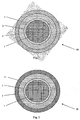
- FIG. 1 is a cross-sectional view of an exemplary embodiment of a controlled release bead 10 which allows for gradual release of the drug.
- the exemplary bead 10 includes an inert core 1 made of a water-soluble or water-swellable material.
- the core 1 may be made of a low molecular weight sugar, such as maltose, lactose, dextrose, or sucrose.
- the bead may be made of a hydrophilic polysaccharide, such as starch, microcrystalline cellulose, carboxymethylcellulose, croscarmellose, hydroxyethylcellulose, or hydroxypropyl methylcellulose.
- the core 1 is made of a partially or completely water-soluble pharmaceutically acceptable inorganic salt.
- the core 1 is made of a water-swellable synthetic polymer, such as crosslinked acrylic or methacrylic acid polymers and copolymers or crospovidone.
- coating 3 of a non-polymeric water-insoluble material is positioned on core 1.
- the non-polymeric water-insoluble material prevents water from entering into the core and causing the core to dissolve or swell.
- the non-polymeric hydrophobic material is a fatty alcohol, a fatty carboxylic acid, a fatty carboxylic acid ester, a hydrogenated oil, a triglyceride fat, a wax, or a mixture thereof.
- the non-polymeric hydrophobic material is a C 12 -C 20 fatty alcohol, a C 12 -C 20 fatty carboxylic acid, an ester of a C 12 -C 20 fatty carboxylic acid, a hydrogenated vegetable oil, a triglyceride fat, or a mixture thereof.
- the non-polymeric hydrophobic material is stearyl alcohol; cetyl alcohol; stearic acid; an ester of stearic acid with a lower alcohol or polyol, such as glyceryl monostearate; an ester of cetyl alcohol; hydrogenated castor oil; and a mixture thereof.
- Coating 5 may include a drug and, optionally, a binder.
- the drug is a water-soluble drug.
- Suitable water-soluble drugs include tolterodine tartrate, diltiazem hydrochloride, verapamil hydrochloride, bupropion hydrochloride, metformin hydrochloride, propranolol hydrochloride, dextromethorphan hydrobromide, diphenhydramine hydrochloride, disopyramide hydrochloride, tramadol, fluoxetine hydrochloride, paroxetine hydrochloride, pentoxifylline hydrochloride and the like.
- the drug in coating 5 is an antimuscarinic, such as synthetic or semisynthetic muscarinic receptor antagonists.
- muscarinic receptor antagonists act on one or both of the M2 and M3 subtypes of muscarinic receptors.
- Suitable muscarinic receptor antagonists include dicyclomine, flavoxate, ipratropium, oxybutynin, pirenzepine, tiotropium, tolterodine, tropicamide, solifenacin, darifenacin, and combinations thereof.
- the drug in coating 5 is a synthetic or semisynthetic muscarinic receptor antagonists suitable for treating human or non-human mammalian patients with bladder control problems, such as urinary incontinence or enuresis.
- Suitable muscarinic receptor antagonists for treatment of patients with bladder control problems include oxybutynin, tolterodine, darifenacin, salts thereof, stereoisomers thereof, prodrugs thereof, and mixtures thereof.
- the drug in coating 5 is the (R)-enantiomer of tolterodine, the (R)-enantiomer of the 5-hydroxymethyl metabolite of tolterodine, the (S)-enantiomer of tolterodine, the 5-hydroxymethyl metabolite of the (S)-enantiomer of tolterodine, the racemate of tolterodine, a prodrug form of tolterodine, a pharmacologically acceptable salt of tolterodine, or a mixture thereof.
- the drug in coating 5 may be tolterodine L-tartrate.
- dosage forms containing a stabilized tolterodine L-tartrate composition as the drug in coating 5 are disclosed.
- Solid oral pharmaceutical compositions containing tolterodine tartrate as the active pharmaceutical ingredient (API) are found to be stabilized using at least one organic or mineral acid excipient. The use of one or more of these additives in a tablet or capsule pharmaceutical composition has been shown to decrease the formation of degradants and increase the stability of the composition.
- tolterodine tartrate Under certain conditions, such as those found in pharmaceutical tablets and capsules stored over time, tolterodine tartrate can undergo slow topochemical degradation, leading to a reduction in the potency and purity of the dosage form.
- the addition of at least one acidifying agent to tableted or encapsulated dosage forms of tolterodine tartrate can lead to a dramatic reduction of degradation, thereby providing improved quality and a longer useful shelf-life of the pharmaceutical dosage form.
- the inclusion of a pharmaceutically acceptable amount of a pH modifying compound into pharmaceutical compositions of tolterodine tartrate for the purpose of reducing - the apparent pH of the composition improves the stability of the active pharmaceutical ingredient in the composition.
- the pH modifying compound is an organic acid, a mineral acid, or a mixture thereof.
- the pH modifying compound within drug layer 5 would be one or more of the acidifying agents commonly used in the preparation of solid oral pharmaceutical compositions. These pH modifying compounds may be organic or mineral acids. In various exemplary embodiments, the pH modifying compounds are non-polymeric acids having at least a first pK a of less than 5.0, as shown in Table 1. In various exemplary embodiments, the pH modifying compounds may be acetic acid, benzoic acid, fumaric acid, lactic acid, malic acid, propionic acid, hydrochloric acid, phosphoric acid, sulfuric acid, stereoisomers thereof, or mixtures thereof.
- the pH modifying compounds may be a solid acidifying agent selected from the group including tartaric acid, citric acid, ascorbic acid, stereoisomers thereof, or mixtures thereof. Pharmaceutically acceptable levels of these pH modifiers range from 0.1 % to 10.0% of the pharmaceutical composition by weight. In various exemplary embodiments, the pH modifying acids are present in a range of from 0.4% to 2.5 % by weight of the composition. In various exemplary embodiments, the pH modifying acids are present in a range of from 0.8% to 1.5% by weight. Table 1.
- dosage forms containing stabilized tolterodine L-tartrate within drug layer 5 contain tolterodine L-tartrate stabilized with from 0.1 to 10 wt % of the dosage form of a pH modifying compound. In various exemplary embodiments, dosage forms contain tolterodine L-tartrate within drug layer 5, where tolterodine L-tartrate is stabilized with from 0.8 to 1.5 wt % of the dosage form of a pH modifying compound.
- the pH modifying compound may be L-(+)-tartaric acid, D-(-)-tartaric acid, meso-tartaric acid, racemic tartaric acid, or a mixture thereof.
- coating 5 may include a binder in addition to the drug.
- Suitable binders are typically water-soluble or water-swellable polymers.
- water soluble binders include polyvinyl alcohol, polymers and copolymers of hydroxyalkyl acrylates and hydroxyalkyl methacrylates, polyvinylpyrrolidone, hydroxyethylcellulose, hydroxypropylcellulose, hydroxypropylmethylcellulose, polyethylene glycols, and combinations thereof.
- water soluble binders include hydroxypropylmethylcellulose binders sold under the brand names Opadry II ® Clear, Opadry ® Clear, or a mixture thereof. Opadry II ® Clear and Opadry ® Clear, manufactured by Colorcon, Inc, USA, are used as an aqueous mixture containing hydroxypropylmethylcellulose.
- a controlled release coating 7 is positioned on drug-containing layer 5.
- the controlled release coating 7 is a layer of at least one pH-independent water-insoluble non-enteric polymer with or without a pore forming agent.
- the polymeric membrane in coating 7 becomes permeable upon exposure to aqueous environments within the human body, allowing the drug within underlying layer 5 to gradually leach through the release controlling coating 7.
- the water-insoluble non-enteric polymer includes polyacrylic resins and cellulose derivatives such as cellulose ethers and cellulose esters.
- Suitable polymers include acrylic resins, preferably insoluble polymers or copolymers of alkyl acrylates or alkyl methacrylates, or water-insoluble celluloses such as ethylcellulose and cellulose acetate.
- water-soluble polymers or non polymers may optionally be used in coating 7 in amounts of up to 50 wt. % as a pore forming agent to increase the permeability of the membrane and therefore increase the release rate of the active substance.
- these pore forming agents are hydroxypropylmethylcellulose, hydroxyethyl cellulose, hydroxypropylcellulose, methylcellulose, carboxymethylcellulose, polyethylene glycol, polyvinylpyrrolidone, or polyvinyl alcohol.
- Opadry ® Clear and Opadry II ® Clear may be used as pore forming agents to increase the release rate of the active substance.
- Water-soluble non-polymeric pore-forming agents such as, for example, sucrose, lactose, mannitol, NaCl, and maltose may also be present in the release-controlling layer 7 of water-insoluble polymers to increase the release rate of the active substance.
- the release-controlling layer or membrane is comprised of at least one water-insoluble, non-pH dependent polymer with or without a pore forming agent.
- the release controlling membrane becomes permeable in an aqueous environment, thereby allowing release of the active ingredient.
- the pore former may be a water soluble or water mobile polymer or non polymer, organic or inorganic.
- the release-controlling layer or membrane is comprised of two water-insoluble non-pH dependent polymers of different permeability with or without a pore forming agent.
- a composite release-controlling polymer membrane may include an inner layer of a water-insoluble, non-pH dependent polymer, and an outer layer of a pH dependent enteric polymer.
- a composite release-controlling polymer membrane may include both water-insoluble, non-pH dependent polymer and pH dependent polymer with the later functioning as a pore forming agent.
- the release rate of the active substance may be slowed in the acidic environment of the stomach by adding pH-sensitive enteric polymers to release controlling layer 7. These polymers do not dissolve until the bead enters the neutral environment of the small intestine.
- Suitable enteric polymers useful for this purpose include cellulose acetate phthalate, hydroxypropyl methylcellulose phthalate, cellulose acetate trimellitate, polymethacrylates, and an ammonium salt of a copolymer of methacrylic acid and methacrylic acid alkyl ester.
- FIG. 2 is a cross-sectional view of an exemplary embodiment of a controlled release bead 20 which prevents release of drug in the stomach.
- the exemplary bead 20 includes an inert core 1 made of a water-soluble or water-swellable material.
- a coating 3 of a non-polymeric water-insoluble material is positioned on core 1.
- a drug-containing coating 5 is positioned on non-polymeric water-insoluble material layer 3.
- a controlled release coating 11 is positioned on drug-containing layer 5.
- the constitution of core 1 and of coatings 3 and 5 is substantially identical to the constitution of core 1 and of coatings 3 and 5 in previously described bead 10, as shown in FIG. 1 .
- controlled release coating 11 unlike the controlled release coating 7 on bead 10, is not a layer of a pH-independent water-insoluble non-enteric polymer. Rather, controlled release coating 11 on bead 20 is a layer of a pH-dependent enteric polymer. Accordingly, in the acidic environment of the stomach (pH 1-3), the pH- dependent enteric polymers in release controlling layer 11 are insoluble. These enteric polymers do not dissolve until the bead enters a neutral environment. Therefore, release controlling layer 11 remains intact in the stomach, but dissolves in the intestine (pH 6-8). This prevents the drug in layer 5 from being released until bead 20 enters the intestine.
- Suitable enteric polymers useful for this purpose include cellulose acetate phthalate, hydroxypropyl methylcellulose phthalate, cellulose acetate trimellitate, polymethacrylates, and an ammonium salt of a copolymer of methacrylic acid and methacrylic acid alkyl ester.
- FIG. 3 is a cross-sectional view of an exemplary embodiment of a controlled release bead 30 which both prevents release of drug in the stomach and allows for gradual release of the drug in the intestine.
- the exemplary bead 30 includes an inert core 1 made of a water-soluble or water-swellable material.
- a coating 3 of a non-polymeric water-insoluble material is positioned on core 1.
- a drug-containing coating 5 is positioned on non-polymeric water-insoluble material layer 3.
- a controlled release coating 21 is positioned on drug-containing layer 5.
- the constitution of core 1 and of coatings 3 and 5 is substantially identical to the constitution of core 1 and of coatings 3 and 5 in previously described beads 10 and 20, as shown in FIGS. 1 and 2 .
- controlled release coating 21 unlike the controlled release coating 7 on bead 10 and the controlled release coating 11 on bead 20, is not a single layer of a controlled release polymer. Rather, coating 21 includes an inner controlled release layer 7 of a water-insoluble non-enteric polymer, and an outer layer 11 of a pH-dependent enteric polymer.
- the pH-dependent enteric polymers in outer layer 11 are insoluble in the acidic environment of the stomach (pH 1-3), thereby preventing any release of the drug in the stomach. These enteric polymers do not dissolve until the bead enters the neutral environment of the intestines (pH 6-8). After release controlling layer 11 dissolves in the intestine, the water-insoluble non-enteric polymer in layer 7 of bead 30 gradually erodes, allowing the drug in layer 5 to gradually escape from the bead by leaching through the inner release controlling layer 7.
- the enteric polymer in layer 11 of bead 30 may be cellulose acetate phthalate, hydroxypropyl methylcellulose phthalate, cellulose acetate trimellitate, polymethacrylates, or an ammonium salt of a copolymer of methacrylic acid and methacrylic acid alkyl ester.
- the water-insoluble non-enteric polymer in layer 7 of bead 30 is selected from the group consisting of polyacrylic resins and cellulose derivatives selected from the group consisting of cellulose ethers and cellulose esters.
- Suitable polymers include acrylic resins, preferably insoluble polymers or copolymers of alkyl acrylates or alkyl methacrylates, or water-insoluble celluloses such as ethylcellulose and cellulose acetate.
- coating 7 of bead 30 may include water-soluble polymers in order to increase the release rate of the active substance in the intestine.
- FIG. 4 is a cross-sectional view of an exemplary embodiment of a controlled release bead 40 which allows for gradual release of a first drug in the intestine.
- the exemplary bead 40 includes an inert core 1 made of a water-soluble or water-swellable material.
- a coating 3 of a non-polymeric water-insoluble material is positioned on core 1.
- a drug-containing coating 5 is positioned on non-polymeric water-insoluble material layer 3.
- a controlled release coating 7 is positioned on drug-containing layer 5.
- the constitution of core 1 and of coatings 3, 5 and 7 is substantially identical to the constitution of core 1 and of coatings 3, 5 and 7 in previously described bead 10, as shown in FIG. 1 .
- Suitable soluble polymers for layer 31 include hydroxypropyl methyl cellulose, hydroxyethyl cellulose, hydroxypropyl cellulose, methylcellulose, carboxymethylcellulose, polyethylene glycol, polyvinylpyrrolidone, and polyvinyl alcohol.
- Opadry ® Clear or Opadry II ® Clear may be used to form water soluble polymer coatings 31 in bead 40.
- FIG. 5 is a cross-sectional view of an exemplary embodiment of a controlled release bead 45 which allows for gradual release of a first drug in the intestine.
- bead 45 may include an inert core 1; a coating of a non-polymeric water-insoluble material positioned on core 3; and a drug-containing coating positioned on layer 5.
- An enteric coating 11 may be positioned on drug-containing layer. On top of the enteric coating 11 is deposited one or more layers of water-soluble polymer 31, which may serve to reduce tackiness of the beads. Alternatively, the water-soluble polymer may contain an active ingredient for immediate release.
- FIG. 6 is a cross-sectional view of an exemplary embodiment of an immediate release bead 47.
- the exemplary bead 47 includes an inert core 1 made of a water-soluble or water-swellable material.
- a coating 3 of a non-polymeric water-insoluble material is positioned on core 1.
- a drug-containing coating 5 is positioned on non-polymeric water-insoluble material layer 3.
- the constitution of core 1 and of coatings 3 and 5 is substantially identical to the constitution of core 1 and of coatings 3 and 5 in previously described bead 10, as shown in FIG. 1 . Since no controlled release polymer is present, the drug is released rapidly when exposed to an aqeous solution at physiological pH.
- an additional coating of a water-soluble or water-swellable polymer may be deposited on drug-containing coating 5.
- This additional coating may include polyvinyl alcohol, polymers and copolymers of hydroxyalkyl acrylates and hydroxyalkyl methacrylates, polyvinylpyrrolidone, hydroxyethylcellulose, hydroxypropyl methyl cellulose, polyethylene glycols, and combinations thereof.
- controlled release dosage forms comprising a plurality of beads.
- Each of these beads includes an inert water-soluble or water-swellable core; a seal layer formed from a non-polymeric hydrophobic material positioned on said core layer; a layer containing at least one active ingredient positioned on said seal layer; and a layer of a release-controlling polymer positioned on said layer containing at least one active ingredient.
- the beads may be beads 10, beads 20, beads 30, beads 40, beads 45, or mixtures thereof.
- the controlled release dosage forms may be tablets. These controlled release tablets may be formed by compressing the plurality of beads in a mold.
- the beads Prior to compression, the beads may be combined with various pharmaceutically acceptable tabletting excipients.
- Suitable tabletting excipients include binders such as croscarmellose sodium, crospovidone, gellan gum, hydroxypropyl cellulose, hydroxypropylmethylcellulose, povidone, sodium starch glycolate, and starch. Additional excipients may include calcium carbonate, dextrose, fructose, lactose, microcrystalline cellulose, maltodextrin, maltose, mannitol, microcrystalline cellulose, guar gum, sorbitol, and sucrose.
- the controlled release tablets may be coated with an enteric coating subsequent to molding.
- controlled release tablets coated with an enteric coating contain non-enteric coated beads; these non-enteric coated beads may be beads 10, beads 40, or mixtures thereof.
- the controlled release tablets contain at least one active ingredient in the controlled release beads, where the at least one active ingredient is a water-soluble drug.
- Suitable water-soluble drugs include tolterodine tartrate, diltiazem hydrochloride, verapamil hydrochloride, bupropion hydrochloride, metformin hydrochloride, propranolol hydrochloride, dextromethorphan hydrobromide, diphenhydramine hydrochloride, disopyramide hydrochloride, tramadol, fluoxetine hydrochloride, paroxetine hydrochloride, pentoxifylline hydrochloride and the like.
- the drug in the controlled release beads is an antimuscarinic, such as synthetic or semisynthetic muscarinic receptor antagonists.
- Suitable muscarinic receptor antagonists include Dicyclomine, Flavoxate, Ipratropium, Oxybutynin, Pirenzepine, Tiotropium, Tolterodine, Tropicamide, Solifenacin, Darifenacin, and combinations thereof.
- the drug in the controlled release beads is tolterodine tartrate.
- controlled release capsules containing a plurality of beads are provided.
- Each of these beads includes an inert water-soluble or water-swellable core; a seal layer formed from a non-polymeric hydrophobic material positioned on said core layer; a layer containing at least one active ingredient positioned on said seal layer; and a layer of a release-controlling polymer positioned on said layer containing at least one active ingredient.
- the beads may be beads 10, beads 20, beads 30, beads 40, beads 45, or mixtures thereof.
- These controlled release capsules may be formed by filling a plurality of controlled release beads into a gelatin shell.
- the controlled release capsules may be sealed with a polymeric coating subsequent to filling of beads into the shells; the polymeric coating may be made from a hydrophilic polymeric material, a hydrophilic polymeric material, or an enteric polymeric material.
- controlled release capsules are coated with an enteric coating and contain non-enteric coated beads; these non-enteric coated beads may be beads 10, beads 40, or mixtures thereof.
- the controlled release capsules contain at least one active ingredient in the controlled release beads, where the at least one active ingredient is a water-soluble drug.
- Suitable water-soluble drugs include tolterodine tartrate, diltiazem hydrochloride, verapamil hydrochloride, bupropion hydrochloride, metformin hydrochloride, propranolol hydrochloride, dextromethorphan hydrobromide, diphenhydramine hydrochloride, disopyramide hydrochloride, tramadol, fluoxetine hydrochloride, paroxetine hydrochloride, pentoxifylline hydrochloride and the like.
- the drug in the controlled release beads is an antimuscarinic, such as synthetic or semisynthetic muscarinic receptor antagonists.
- Suitable muscarinic receptor antagonists include Dicyclomine, Flavoxate, Ipratropium, Oxybutynin, Pirenzepine, Tiotropium, Tolterodine, Tropicamide, Solifenacin, Darifenacin, and combinations thereof.
- the drug in the controlled release beads is tolterodine tartrate.
- the capsules or tablets containing the immediate release beads 47 or controlled release beads 10, beads 20, beads 30, beads 40, beads 45, or mixtures thereof may be used to treat a human or other mammal with enuresis, urinary incontinence, or other types of bladder control problems. This is done by administering one or more controlled release tablets or capsules containing an effective amount of an antimuscarinic agent approved for treatment of bladder control problems to the patient.
- Each controlled release tablet or capsule comprises a plurality of controlled release beads 10, controlled release beads 20, controlled release beads 30, controlled release beads 40, controlled release beads 45, or mixtures thereof.
- each of the controlled release beads includes at least one antimuscarinic active ingredient selected from the group consisting of Oxybutynin, Tolterodine, Darifenacin, salts thereof, stereoisomers thereof, prodrugs thereof, metabolites thereof, and mixtures thereof.
- the at least one active ingredient is selected from the group consisting of the (R)-enantiomer of tolterodine, the (R)-enantiomer of the 5-hydroxymethyl metabolite of tolterodine, the (S)-enantiomer of tolterodine, the 5-hydroxymethyl metabolite of the (S)-enantiomer of tolterodine, the racemate of tolterodine, prodrug forms of tolterodine, pharmacologically acceptable salts thereof, and mixtures thereof.
- the at least one active ingredient is tolterodine tartrate.
- the process begins with uncoated inert cores or beads 50.
- the cores 50 may be made of a hydrophilic polysaccharide, such as starch, microcrystalline cellulose, carboxymethylcellulose, croscarmellose, hydroxyethylcellulose, or hydroxypropyl methylcellulose.
- the bead may be made of a partially or completely water-soluble pharmaceutically acceptable inorganic salt.
- the bead may be made of a water-swellable synthetic polymer, such as crosslinked acrylic or methacrylic acid polymers and copolymers or crospovidone.
- a seal layer is deposited on inert core 50 to produce seal-coated cores 60.
- the seal layer is formed from a non-polymeric hydrophobic material.
- the non-polymeric hydrophobic material may be a fatty alcohol, a fatty carboxylic acid, a fatty carboxylic acid ester, a hydrogenated oil, a triglyceride fat, a wax, or a mixture thereof.
- the non-polymeric hydrophobic material may be a C 12 -C 20 fatty alcohol, a C 12 -C 20 fatty carboxylic acid, an ester of a C 12 -C 20 fatty carboxylic acid, a hydrogenated vegetable oil, a triglyceride fat, or a mixture thereof.
- the non-polymeric hydrophobic material may be stearyl alcohol; cetyl alcohol; stearic acid; an ester of stearic acid with a lower alcohol or polyol, such as glyceryl monostearate; an ester of cetyl alcohol; hydrogenated castor oil; and a mixture thereof.
- step 55 of depositing a seal layer on said inert core 50 is performed by treating the inert core 50 with a non-aqueous solution or dispersion of the non-polymeric hydrophobic material.
- Suitable solvents for the non-aqueous solution or dispersion include ethanol, isopropyl alcohol, acetone, and lower alkanes or cycloalkanes.
- step 55 of depositing a seal layer on said inert core 50 is performed by treating the inert core 50 with an aqueous solution or dispersion of the non-polymeric hydrophobic material.
- step 55 of depositing a seal layer on said inert core 50 is performed by treating inert core 50 with a low-melting non-polymeric hydrophobic material in a molten state. This may be done by spraying the non-polymeric hydrophobic molten material onto core 50, or dipping core 50 into a pool of molten non-polymeric hydrophobic material.
- a layer containing an active ingredient is deposited on seal-coated core 60 to produce active ingredient-coated beads 70.
- the layer deposited in step 65 includes a drug and, optionally, a binder.
- the drug is a water-soluble drug.
- Suitable water-soluble drugs include tolterodine tartrate, diltiazem hydrochloride, verapamil hydrochloride, bupropion hydrochloride, metformin hydrochloride, propranolol hydrochloride, dextromethorphan hydrobromide, diphenhydramine hydrochloride, disopyramide hydrochloride, tramadol, fluoxetine hydrochloride, paroxetine hydrochloride, pentoxifylline hydrochloride and the like.
- the drug deposited in step 65 is an antimuscarinic.
- Suitable muscarinic receptor antagonists include dicyclomine, flavoxate, ipratropium, oxybutynin, pirenzepine, tiotropium, tolterodine, tropicamide, solifenacin, darifenacin, and combinations thereof.
- the drug deposited in step 65 is a synthetic or semisynthetic muscarinic receptor antagonists suitable for treating human or non-human mammalian patients with bladder control problems, such as urinary incontinence or enuresis.
- Suitable muscarinic receptor antagonists for treatment of patients with bladder control problems include oxybutynin, tolterodine, darifenacin, salts thereof, stereoisomers thereof, prodrugs thereof, and mixtures thereof.
- the drug in coating 5 is the (R)-enantiomer of tolterodine, the (R)-enantiomer of the 5-hydroxymethyl metabolite of tolterodine, the (S)-enantiomer of tolterodine, the 5-hydroxymethyl metabolite of the (S)-enantiomer of tolterodine, the racemate of tolterodine, a prodrug form of tolterodine, a pharmacologically acceptable salt of tolterodine, or a mixture thereof.
- the drug deposited in step 65 may be tolterodine L-tartrate.
- the drug deposited in step 65 is acid-stabilized tolterodine L-tartrate, where the acid-stabilized tolterodine L-tartrate is prepared by mixing tolterodine L-tartrate with a stabilizing amount of a non-polymeric pH modifying acid having a pK a of less than 5.0.
- the tolterodine L-tartrate may be mixed with the acid prior to deposition or during deposition.
- the binder deposited in step 65 in addition to the drug may be a water-soluble polymer.
- water soluble binders include polyvinyl alcohol, polymers and copolymers of hydroxyalkyl acrylates and hydroxyalkyl methacrylates, polyvinylpyrrolidone, hydroxyethylcellulose, hydroxypropylmethylcellulose, polyethylene glycols, and combinations thereof.
- step 65 of depositing a layer containing at least one active ingredient is performed by coating the seal-coated cores 60 with a non-aqueous solution or dispersion of said at least one active ingredient and, optionally, a binder; or coating the seal-coated cores 60 with an aqueous solution or dispersion of said at least one active ingredient and, optionally, a binder.
- beads 70 may be used as immediate-release drug-containing beads.
- active ingredient-coated beads 70 containing a water-soluble binder in the layer containing the active ingredient may be segregated into two groups. If desired, a first group of beads 70 may be set aside and reserved for use as immediate release drug containing beads, where the active ingredient is released upon dissolution of the water-soluble binder. A second group of beads 70 is coated with a controlled release polymer. These portions may then be recombined and used to produce dosage forms having a first portion of drug which undergoes immediate release, and a second portion of drug which undergoes controlled release.
- a layer of a non-enteric release-controlling polymer is deposited on active-ingredient-coated beads 70 to produce controlled release beads 80.
- Step 75 of depositing a layer of a non-enteric release-controlling polymer is performed by coating said layer containing at least one active ingredient with a non-aqueous solution or dispersion of said release-controlling polymer; or coating said seal layer with an aqueous solution or dispersion of said release-controlling polymer.
- Controlled release beads 80 may be used in preparation of controlled release tablets or capsules, as previously described.
- controlled release beads 80 may be combined with active ingredient-coated beads 70, which have been held in reserve for use as immediate release beads, prior to preparation of tablets or capsules. This allows preparation of a dosage form which allows immediate release of one portion of the drug, and release of a second portion of the drug over an extended period of time.
- the non-enteric release-controlling polymer deposited in step 75 is a water-insoluble non-enteric polymer selected from the group consisting of polyacrylic resins and cellulose derivatives selected from the group consisting of cellulose ethers and cellulose esters.
- Suitable polymers include acrylic resins, preferably insoluble polymers or copolymers of alkyl acrylates or alkyl methacrylates, or water-insoluble celluloses such as ethylcellulose and cellulose acetate.
- water-soluble polymers may be combined with the water-insoluble non-enteric polymer in amounts of up to 30 wt. %.
- These soluble polymers may be hydroxypropylmethyl cellulose, hydroxyethyl cellulose, hydroxypropyl cellulose, methylcellulose, carboxymethylcellulose, polyethylene glycol, polyvinylpyrrolidone, or polyvinyl alcohol.
- a layer of an enteric polymer is deposited on active-ingredient-coated beads 70 to produce enteric coated beads 90.
- Suitable enteric polymers useful for this purpose include cellulose acetate phthalate, hydroxypropyl methylcellulose phthalate, cellulose acetate trimellitate, polymethacrylates, and an ammonium salt of a copolymer of methacrylic acid and methacrylic acid alkyl ester.
- Step 77 of depositing a layer of an enteric polymer on the layer containing the active ingredient is performed by coating the layer containing the active ingredient with a non-aqueous solution or dispersion of the enteric polymer; coating the layer containing the active ingredient with an aqueous dispersion of enteric polymer; or coating the layer containing the active ingredient with a solution of the enteric polymer in aqueous acid, and then treating the enteric coated beads with aqueous base to neutralize the enteric polymer.
- Enteric coated beads 90 may be used in preparation of controlled release tablets or capsules, as previously described. If desired, enteric coated beads 90 may be combined with active ingredient-coated beads 70, which have been held in reserve for use as immediate release beads, prior to preparation of tablets or capsules. This allows preparation of a dosage form which allows immediate release of one portion of the drug, and subsequent release of a second portion of the drug, after the beads pass from the stomach into the intestine.
- step 75 a layer of a non-enteric release-controlling polymer is deposited on active-ingredient-coated beads 70 to produce controlled release beads 80, as previously described.
- step 87 a layer of an enteric polymer is deposited on controlled release beads 80 to produce enteric coated beads 115. Deposition of the enteric polymer in step 87 is carried out in essentially the same manner as deposition of the enteric polymer in step 77. The resulting beads have enteric coatings on top of water-insoluble controlled release coatings.
- enteric coatings do not dissolve in the stomach, but remain intact until the bead enters the neutral environment of the intestine (pH 6-8). After the enteric coatings dissolve in the intestine, the water-insoluble non-enteric polymer layer beneath gradually erodes, allowing the drug in the bead to gradually escape by leaching through the water-insoluble non-enteric polymer layer. Enteric coated beads 115 may be used in preparation of controlled release tablets or capsules, as previously described.
- step 85 a layer of a water-soluble polymer is deposited on controlled release beads 80 to produce controlled release beads having water soluble shells 100.
- step 95 a layer of a water-soluble polymer is deposited on enteric coated beads 90 to produce enteric coated beads with water-soluble shells 110. Deposition of the water-soluble polymer in step 95 is carried out in essentially the same manner as deposition of the water-soluble polymer in step 85.
- the polymers in the soluble shells may be used as binders for immediate release drug containing layers, or for polymers used to reduce tackiness of the finished beads.
- the layer of water soluble polymer may contain immediate release drugs, which may be the same as or different from the drug in the drug-containing layer deposited in step 65.
- Suitable soluble polymers for the layer of water soluble polymer include hydroxypropylmethylcellulose, hydroxyethyl cellulose, hydroxypropyl cellulose, methylcellulose, carboxymethylcellulose, polyethylene glycol, polyvinylpyrrolidone, and polyvinyl alcohol.
- Beads 110 and 110 may be used in preparation of controlled release tablets or capsules, as previously described.
- Additional exemplary embodiments of pharmaceutical dosage forms contain stabilized tolterodine L-tartrate.
- These exemplary embodiments are solid oral dosage forms comprising an effective amount of tolterodine L-tartrate and pharmaceutically acceptable excipients, wherein the tolterodine L-tartrate is stabilized with a pharmaceutically acceptable non-polymeric pH-modifying acid having a pK a of less than 5.0.
- the acid may be hydrochloric acid, phosphoric acid, sulfuric acid, acetic acid, benzoic acid, fumaric acid, lactic acid, malic acid, propionic acid, tartaric acid, citric acid, ascorbic acid, stereoisomers thereof, or mixtures thereof.
- solid oral dosage forms containing stabilized tolterodine L-tartrate are controlled release dosage forms.
- These controlled release dosage form comprise acid-stabilized tolterodine L-tartrate and a release-controlling polymer.
- the acid-stabilized tolterodine L-tartrate is dispersed in the release-controlling polymer, where the release-controlling polymer is a pH-insensitive water-insoluble polymer.
- the drug is released by erosion of the polymer upon exposure to an aqueous environment under physiological conditions.
- the polymer may be a polymer or copolymer of alkyl acrylates or alkyl methacrylates, a cellulose ether such as ethylcellulose, or a cellulose ester.
- the acid-stabilized tolterodine L-tartrate present in a core layer of the dosage form.
- the drug-containing core layer is coated by a layer of a release-controlling polymer, where the release-controlling polymer is a pH-insensitive water-insoluble polymer or an enteric polymer.
- the release-controlling polymeric coating is a pH-insensitive water-insoluble polymer
- the drug is released by erosion of the polymer upon exposure to an aqueous environment under physiological conditions.
- the pH-insensitive water-insoluble polymer may be a polymer or copolymer of alkyl acrylates or alkyl methacrylates, a cellulose ether such as ethylcellulose, or a cellulose ester.
- the enteric polymer may be cellulose acetate phthalate, hydroxypropyl methylcellulose phthalate, cellulose acetate trimellitate, polymethacrylates, or an ammonium salt of a copolymer of methacrylic acid and methacrylic acid alkyl ester.
- the release-controlling polymeric coating is an enteric polymer, the drug is released upon dissolution of the enteric coating in the intestines.
- solid oral dosage forms containing stabilized tolterodine L-tartrate are immediate release dosage forms.
- These immediate release dosage forms contain acid-stabilized tolterodine L-tartrate and a water-swellable or water-soluble polymer.
- the acid-stabilized tolterodine L-tartrate is dispersed in said water-swellable or water-soluble polymeric binder.
- Non-limiting examples of water-swellable or water-soluble polymers which may be used in such exemplary embodiments include hydroxypropylmethyl cellulose, hydroxyethyl cellulose, hydroxypropyl cellulose, methylcellulose, carboxymethylcellulose, polyethylene glycol, polyvinylpyrrolidone, and polyvinyl alcohol.
- Hydroxypropylmethyl cellulose is a useful water-swellable or water-soluble polymer which may be used in a commercially available form, such as Opadry ® Clear or Opadry II® Clear.
- the acid-stabilized tolterodine L-tartrate and the water-swellable or water-soluble polymeric binder may be provided as a homogeneous composition.
- This composition may be prepared by mixing the tolterodine L-tartrate with a stabilizing amount of an acid, such as tartaric acid; mixing the resulting acid-stabilized tolterodine L-tartrate with a water-swellable or water-soluble polymeric binder; and compressing the mixture to form tablets or filling the mixture into a capsule shell.
- the total amount of tolterodine L-tartrate in the final dosage form may range 0.5 to 4 mg.
- the immediate release solid oral dosage form may be a non-homogeneous dosage form including a core layer containing the acid-stabilized tolterodine L-tartrate and a layer containing a water-swellable or water-soluble polymer polymer.
- the layer containing the acid-stabilized tolterodine L-tartrate is surrounded by the layer of said water-swellable or water-soluble polymer polymer.
- the layer containing the acid-stabilized tolterodine L-tartrate contains, in addition to the drug, disintegrants such as microcrystalline cellulose, carboxymethylcellulose, sodium starch glycolate, or mixtures thereof.
- the outer layer of a water-swellable or water-soluble polymer contains hydroxypropylmethylcellulose, hydroxyethylcellulose, hydroxypropylcellulose, methylcellulose, carboxymethylcellulose, polyethylene glycol, polyvinylpyrrolidone, polyvinyl alcohol, or a mixture thereof.
- the layer containing the acid-stabilized tolterodine L-tartrate may be a core layer of said dosage form, and the layer containing said water-swellable or water-soluble polymer surrounds the core layer.
- This composition may be prepared by mixing the tolterodine L-tartrate with a stabilizing amount of an acid, such as tartaric acid; mixing the resulting acid-stabilized tolterodine L-tartrate with a disintegrant; and compressing the resulting mixture to form tolterodine L-tartrate containing cores.
- the cores are then coated with a water-swellable or water-soluble polymeric binder.
- the solid oral dosage form may be a non-homogeneous dosage form including an inert core, a layer containing the acid-stabilized tolterodine L-tartrate surrounding the core, and a layer containing a water-swellable or water-soluble polymer.
- the layer containing said water-swellable or water-soluble polymer surrounds the acid-stabilized tolterodine L-tartrate layer.
- This composition may be prepared by mixing the tolterodine L-tartrate with a stabilizing amount of an acid, such as tartaric acid, and coating the inert cores with the resulting acid-stabilized tolterodine L-tartrate.
- the drug-coated cores may be coated with a water-swellable or water-soluble polymeric binder to produce an immediate release dosage form, or with a controlled release polymer to produce a controlled release dosage form.
- a seal layer may be deposited on the inert cores prior to coating the inert cores with the acid-stabilized tolterodine L-tartrate.
- the seal layer if used in the acid-stabilized tolterodine L-tartrate dosage form, may be prepared from a hydrophilic polymer, a hydrophobic polymer, or a water-insoluble non-polymeric material.
- the water-insoluble non-polymeric material is selected from the group consisting of a fatty alcohol, a fatty carboxylic acid, a fatty carboxylic acid ester, a hydrogenated oil, a triglyceride fat, a wax, and mixtures thereof.
- the non-polymeric hydrophobic material in the seal layer is selected from the group consisting of stearyl alcohol, cetyl alcohol, stearic acid, an ester of stearic acid with a lower alcohol or polyol, an ester of cetyl alcohol, hydrogenated castor oil, and mixtures thereof.
- tablets containing acid stabilized tolterodine-L-tartrate may be prepared.
- the method of preparing tablets includes a first step of mixing tolterodine-L-tartrate with a pharmaceutically acceptable pH-modifying acid to obtain an acid-stabilized tolterodine-L-tartrate.
- the acid-stabilized tolterodine-L-tartrate is then combined with at least one pharmaceutically acceptable excipient to form an acid-stabilized mixture.
- the pharmaceutically acceptable excipients usable with acid-stabilized tolterodine-L-tartrate include microcrystalline cellulose, sucrose, hydroxypropylmethylcellulose, sodium starch glycolate, starch, xylitol, fructose, sorbitol, calcium phosphate, calcium sulfate, magnesium stearate, oleic acid, stearic acid, stearyl alcohol, calcium carbonate, dextrose, lactose, polyvinylpyrrolidone, crosslinked polyvinylpyrrolidone, silica, titanium dioxide, gelatin, trigycerides, or a mixture thereof.
- the acid-stabilized mixture is then compressed to form a tablet.
- the tablet may be coated with a polymer.
- the polymer may be a hydrophilic polymer, such as hydroxypropylmethylcellulose, or a hydrophobic controlled release polymer, such as ethylcellulose.
- capsules containing acid stabilized tolterodine-L-tartrate may be prepared.
- the method of preparing capsules includes a first step of mixing tolterodine-L-tartrate with a pharmaceutically acceptable pH-modifying acid to obtain an acid-stabilized tolterodine-L-tartrate.
- the acid-stabilized tolterodine-L-tartrate is then combined with at least one pharmaceutically acceptable excipient to form an acid-stabilized mixture.
- the pharmaceutically acceptable excipients usable with acid-stabilized tolterodine-L-tartrate include microcrystalline cellulose, sucrose, hydroxypropylmethylcellulose, sodium starch glycolate, starch, xylitol, fructose, sorbitol, calcium phosphate, calcium sulfate, magnesium stearate, oleic acid, stearic acid, stearyl alcohol, calcium carbonate, dextrose, lactose, polyvinylpyrrolidone, crosslinked polyvinylpyrrolidone, silica, titanium dioxide, gelatin, trigycerides, or a mixture thereof.
- the acid-stabilized mixture is then filled into a capsule shell.
- the capsule may be coated with a polymer.
- the polymer may be a hydrophilic polymer, such as hydroxypropylmethylcellulose, or a hydrophobic controlled release polymer, such as ethylcellulose.
- An exemplary capsule containing 4 mg/unit acid-stabilized tolterodine L- tartrate as active ingredient comprises a plurality of beads.
- Each bead includes as an inert core, a sugar sphere, 20-25 mesh (20/25).
- stearyl alcohol is deposited on the sugar sphere.
- a layer containing Tolterodine L-tartrate, tartaric acid, and an Opadry II Clear dispersion containing hydroxypropylmethylcellulose (HPMC) is deposited on the seal layer.
- a third layer of Surelease® and Opadry Clear is deposited on the Tolterodine L-tartrate layer as a release-controlling layer.
- the ratio of Surelease® solids:Opadry Clear is 80:20.
- Surelease® is an aqueous film-coating dispersion, about 25% solids, and is manufactured by Colorcon, Inc, USA.
- Tolterodine Tartrate Capsules Component mg/unit Sugar Spheres 20/25 121.06 Stearyl Alcohol 30.26 Tolterodine L-tartrate 4.00 Tartaric Acid 1.26 Opadry II ® Clear 1.32 Surelease Ethylcellulose Suspension 17.68 Opadry ® Clear 4.42 Total 180.0
- Tolterodine L-tartrate capsules were prepared by the process described in Example 1, except for the step of coating the beads with a sustained release coating liquid of an ethylcellulose aqueous suspension composed of Surelease® and Opadry ® Clear.
- the ethylcellulose aqueous suspension was composed of Surelease® and Opadry ® Clear in a ratio of 85:15 w/w solids.
- Tolterodine L-tartrate capsules were prepared by the process described in Example 1, except for the step of coating the beads with a sustained release coating liquid of an ethylcellulose aqueous suspension composed of Surelease ® and Opadry ® Clear.
- the ethylcellulose aqueous suspension was composed of Surelease ® and Opadry ® Clear in a ratio of 75:25 w/w solids.
- Tolterodine L-tartrate capsules were prepared by the process described in Example 1, except for the step of coating the beads with a sustained release coating liquid of an ethylcellulose aqueous suspension composed of Surelease ® and Opadry ® Clear.
- the ethylcellulose aqueous suspension was composed of Surelease ® and Opadry ® Clear in a ratio of 82.5:17.5 w/w solids.
- the in vitro drug release rate was measured at 37° C in a phosphate buffer of pH 6.8.
- the USP dissolution test apparatus I was used at 100 rpm.
- the results are shown in the diagrams in FIG. 8 .
- As shown in FIG. 8 as the percentage of plasticized ethylcellulose (Surelease ® ) in the controlled release layer increases, the drug release rate decreases.
- Surelease ® makes up 75% of the controlled release layer, essentially 100% of the Tolterodine L-tartrate was released after 7 hr.
- Surelease ® makes up 85% of the controlled release layer, only 50% of the Tolterodine L-tartrate was released after 7 hr.
- the capsules of Example 2 exhibit nearly linear, zero order release of Tolterodine L-tartrate over a range of time beginning approximately 2 hr after the start of the test to at least a time of 7 hr after the start of the test. Further, it is seen that the capsules of Example 4, where Surelease ® makes up 82.5% of the controlled release layer, also exhibit nearly linear, zero order release of Tolterodine L-tartrate over a range of time of 1 hr after the start of the test to at least a time of 7 hr after the start of the test.
- An exemplary capsule containing 4 mg/unit tolterodine L-tartrate as active ingredient comprises a plurality of beads; no organic stabilizing acid was included in the drug layer.
- Each bead includes as an inert core, a sugar sphere, 20-25 mesh (20/25).
- stearyl alcohol is deposited on the sugar sphere.
- a layer of Tolterodine L-tartrate and hydroxypropylmethylcellulose (HPMC) is deposited on the seal layer.
- a third layer of Surelease ® and HPMC is deposited on the Tolterodine L-tartrate layer as a release-controlling layer.
- Surelease ® is an aqueous film-coating dispersion, about 25% solids, and is manufactured by Colorcon, Inc, USA.
- the resulting Tolterodine L-tartrate/Opadry ® Clear coating contains Tolterodine L-tartrate and Opadry ® Clear solids in a 4:1 ratio.
- the beads are then coated with a sustained release coating liquid of an ethylcellulose aqueous suspension composed of Surelease ® and Opadry ® Clear in a ratio of 85:15 w/w solids.
- Tolterodine Tartrate Capsules Component mg/unit Sugar Spheres 20/25 120.83 Stearyl Alcohol 24.17 Tolterodine L-tartrate 4.00 Tartaric Acid 0.00 Opadry ® Clear (in drug layer) 1.00 Surelease Ethylcellulose Suspension 25.50 Opadry ® Clear (in sustained release coating) 4.50 Total 180.0
- a study of the effect of a stabilizing amount of tartaric acid on the degradation of the tolterodine L-tartrate was performed.
- the effect of the tartaric acid was tested by exposing capsules prepared according to Example 6, with no acid stabilizer, and capsules of Example 1, containing 0.8 wt.% tartaric acid stabilizer, to elevated temperate and humidity (40°C and 75% relative humidity). Concentrations of total degradation products, an unknown degradation product, and tolterodine monomer degradant were monitored over time.
- Tolterodine dimer and tolterodine tartrate 4B are other known degradation products; however, since concentrations of these products were essentially constant over the course of stability experiments, they were not individually reported.
- formation of degradation products in the commercially available tolterodine tartrate extended release formulation Detrol ® LA was also monitored.
- Detrol ® LA has an initial impurity level of 0.37 wt. %. After three months of exposure to elevated temperate and humidity, the impurity level has increased to 1.27 wt. %.
- Example 1 Acid-stabilized Example 1, on the other hand, has a much lower level of impurities, with an impurity level of 0.16 wt.%.
- Table 4 Tolterodine Capsule Formulations - Accelerated Stability Lot Stability Timepoint Monomer Degradant (%) Unknown Degradant (%) Total Impurity Level (%) Detrol ® LA
- Initial 0.05 0.25 0.37 Commercially available formulation 1 month 0.12 0.50 0.70 2 month 0.26 0.96 1.29 3 month 0.26 0.93 1.27
- Example 6 Initial 0.05 LT 0.07 0.05 Bead formulation without acid stabilizer 1 month 0.19 0.55 0.74 3 month 0.28 0.89 1.17
- Example 1 Initial 0.05 LT 0.05 0.05 Bead formulation with 0.8 wt% tartaric acid 1 month LT 0.05 LT 0.05 LT 0.05 2 month 0.05 LT 0.05 0.05 3 month 0.05 0.11 0.16
- An exemplary capsule containing 4 mg/unit tolterodine L-tartrate as active ingredient comprises a plurality of beads.
- Each bead includes as an inert core, a sugar sphere, 20-25 mesh (20/25).
- stearic acid is deposited on the sugar sphere.
- a layer of Tolterodine L-tartrate and hydroxypropylmethylcellulose (HPMC) is deposited on the seal layer.
- a third layer of Surelease ® and HPMC is deposited on the Tolterodine L-tartrate layer as a release-controlling layer.
- the ratio of Surelease ® solids:HPMC is 75:25.
- Tolterodine Tartrate Capsules Component mg/unit Sugar Spheres 20/25 130.91 Stearic Acid 13.09 Tolterodine L-tartrate 4.00 Opadry ® Clear in drug layer 2.00 Surelease Ethylcellulose Suspension 22.50 Opadry ® Clear in sustained release coating 7.50 Total 180.0
Landscapes
- Health & Medical Sciences (AREA)
- Engineering & Computer Science (AREA)
- Bioinformatics & Cheminformatics (AREA)
- Chemical & Material Sciences (AREA)
- Animal Behavior & Ethology (AREA)
- Veterinary Medicine (AREA)
- Medicinal Chemistry (AREA)
- Public Health (AREA)
- General Health & Medical Sciences (AREA)
- Pharmacology & Pharmacy (AREA)
- Life Sciences & Earth Sciences (AREA)
- Epidemiology (AREA)
- General Chemical & Material Sciences (AREA)
- Chemical Kinetics & Catalysis (AREA)
- Organic Chemistry (AREA)
- Nuclear Medicine, Radiotherapy & Molecular Imaging (AREA)
- Oil, Petroleum & Natural Gas (AREA)
- Emergency Medicine (AREA)
- Urology & Nephrology (AREA)
- Medicinal Preparation (AREA)
- Acyclic And Carbocyclic Compounds In Medicinal Compositions (AREA)
Claims (14)
- Feste orale Darreichungsform, umfassend:Tolterodin-L-tartrat als einzigen Wirkstoff;eine pharmazeutisch unbedenkliche nichtpolymere pH-Wert-modifizierende Säure mit einem pKs-Wert von kleiner als 5,0, wobei die pharmazeutisch unbedenkliche pH-Wert-modifizierende Säure aus der aus einer organischen Säure und einer anorganischen Säure bestehenden Gruppe ausgewählt ist; und gegebenenfallspharmazeutisch unbedenkliche Hilfsstoffe;wobei die Säure in einer die Stabilisierung von Tolterodin-L-tartrat bewirkenden Menge von 0,1 Gew.-% bis 10,0 Gew.-% der Darreichungsform vorliegt.
- Feste orale Darreichungsform nach Anspruch 1, wobei es sich bei der pharmazeutisch unbedenklichen pH-Wert-modifizierenden Säure um eine organische Säure handelt, die aus der aus Essigsäure, Benzoesäure, Fumarsäure, Milchsäure, Äpfelsäure, Propionsäure, Weinsäure, Citronensäure, Ascorbinsäure, Stereoisomeren davon und Gemischen davon bestehenden Gruppe ausgewählt ist.
- Feste orale Darreichungsform nach Anspruch 1, wobei es sich bei der pharmazeutisch unbedenklichen pH-Wert-modifizierenden Säure um die organische Säure handelt, wobei die organische Säure aus der aus L-(+)-Weinsäure, D-(-)-Weinsäure, meso-Weinsäure, racemischer Weinsäure und Gemischen davon bestehenden Gruppe ausgewählt ist.
- Feste orale Darreichungsform nach einem der Ansprüche 1, 2 und 3, wobei die feste orale Darreichungsform eine Darreichungsform mit kontrollierter Freisetzung ist, welche das säurestabilisierte Tolterodin-L-tartrat und ein die Freisetzung kontrollierendes Polymer umfasst.
- Feste orale Darreichungsform nach Anspruch 4, wobei es sich bei dem die Freisetzung kontrollierenden Polymer um Folgendes handelt:ein pH-unempfindliches wasserlösliches Polymer, das aus der aus einem Polymer oder Copolymer aus Alkylacrylaten oder Alkylmethacrylaten, einem Celluloseether und einem Celluloseester bestehenden Gruppe ausgewählt ist; oderein pH-empfindliches magensaftresistentes Polymer, das aus der aus Celluloseacetatphthalat, Hydroxypropylmethylcellulosephthalat, Celluloseacetattrimellitat, Polymethacrylaten oder einem Ammoniumsalz eines Copolymers aus Methacrylsäure und Methacrylsäurealkylester bestehenden Gruppe ausgewählt ist.
- Feste orale Darreichungsform nach Anspruch 1, wobei:die feste orale Darreichungsform eine Darreichungsform mit kontrollierter Freisetzung ist, welche das säurestabilisierte Tolterodin-L-tartrat und ein die Freisetzung kontrollierendes Polymer umfasst; unddas säurestabilisierte Tolterodin-L-tartrat in dem die Freisetzung kontrollierenden Polymer dispergiert ist.
- Feste orale Darreichungsform nach Anspruch 1, wobei:die feste orale Darreichungsform eine Darreichungsform mit kontrollierter Freisetzung ist, die eine das säurestabilisierte Tolterodin-L-tartrat enthaltende Schicht und eine ein die Freisetzung kontrollierendes Polymer enthaltende Schicht umfasst,wobei die das säurestabilisierte Tolterodin-L-tartrat enthaltende Schicht mit der Schicht, welche das die Freisetzung kontrollierende Polymer enthält, umhüllt ist.
- Feste orale Darreichungsform nach Anspruch 7, ferner umfassend einen inneren Kern und eine Versiegelungsschicht;
wobei die das säurestabilisierte Tolterodin-L-tartrat enthaltende Schicht den Kern umhüllt; und;
wobei die Schicht, welche das die Freisetzung kontrollierende Polymer enthält, die das säurestabilisierte Tolterodin-L-tartrat enthaltende Schicht umhüllt;
wobei die Versiegelungsschicht zwischen dem Kern und der das säurestabilisierte Tolterodin-L-tartrat enthaltenden Schicht angeordnet ist. - Feste orale Darreichungsform nach einem der Ansprüche 1, 2 und 3, wobei die feste orale Darreichungsform eine Darreichungsform mit sofortiger Freisetzung ist, wobei die Darreichungsform mit sofortiger Freisetzung das säurestabilisierte Tolterodin-L-tartrat und ein wasserquellbares oder wasserlösliches Polymer umfasst.
- Verfahren zur Herstellung einer festen oralen Darreichungsform nach einem der Ansprüche 1, 2 oder 3, wobei das Verfahren die folgenden Schritte umfasst:A) Kombinieren von Tolterodin-L-tartrat mit einer stabilisierenden Menge einer pharmazeutisch unbedenklichen pH-Wert-modifizierenden Säure unter Erhalt eines säurestabilisierten Tolterodin-L-tartrats; undB) Formulieren des säurestabilisierten Tolterodin-L-tartrats zu einer Tablette, einer Kapsel oder einem arzneimittelhaltigen Kügelchen.
- Verfahren zur Herstellung einer festen oralen Darreichungsform nach Anspruch 10, wobei das Verfahren das Formulieren des säurestabilisierten Tolterodin-L-tartrats zu dem arzneimittelhaltigen Kügelchen durch:Herstellen des arzneimittelhaltigen Kügelchen durch:i) Aufbringen einer Versiegelungsschicht auf einen inneren Kern, wobei die Versiegelungsschicht aus einem nichtpolymeren hydrophoben Material besteht; undii) Aufbringen einer das säurestabilisierte Tolterodin-L-tartrat enthaltenden Schicht auf die Versiegelungsschichtumfasst.
- Verfahren nach Anspruch 11, wobei:das Verfahren ferner einen Schritt umfasst, bei dem eine ein die Freisetzung kontrollierendes Polymer enthaltende Schicht auf die das säurestabilisierte Tolterodin-L-tartrat enthaltende Schicht aufgebracht wird.
- Verfahren nach Anspruch 10, wobei das Verfahren das Formulieren des säurestabilisierten Tolterodin-L-tartrats zu der Tablette durch:Verpressen des säurestabilisierten Gemischs unter Bildung der Tablette umfasst, undwobei das Verfahren ferner das Beschichten der Tablette mit einem Polymer, das aus der aus Hydroxypropylmethylcellulose, Ethylcellulose und Gemischen davon bestehenden Gruppe ausgewählt ist, umfasst.
- Verfahren nach Anspruch 10, wobei das Verfahren das Formulieren des säurestabilisierten Tolterodin-L-tartrats zu der Kapsel durch:Füllen des säurestabilisierten Gemischs in eine Kapselhülle unter Bildung der Kapsel umfasst; undwobei das Verfahren ferner das Beschichten der Kapsel mit einem Polymer, das aus der aus Hydroxypropylmethylcellulose und Ethylcellulose bestehenden Gruppe ausgewählt ist, umfasst.
Applications Claiming Priority (2)
| Application Number | Priority Date | Filing Date | Title |
|---|---|---|---|
| US11/878,037 US8486452B2 (en) | 2007-07-20 | 2007-07-20 | Stabilized tolterodine tartrate formulations |
| PCT/US2007/025970 WO2009014532A1 (en) | 2007-07-20 | 2007-12-20 | Stabilized tolterodine tartrate formulations |
Publications (3)
| Publication Number | Publication Date |
|---|---|
| EP2178528A1 EP2178528A1 (de) | 2010-04-28 |
| EP2178528A4 EP2178528A4 (de) | 2013-01-02 |
| EP2178528B1 true EP2178528B1 (de) | 2016-03-23 |
Family
ID=40265023
Family Applications (1)
| Application Number | Title | Priority Date | Filing Date |
|---|---|---|---|
| EP07863132.2A Not-in-force EP2178528B1 (de) | 2007-07-20 | 2007-12-20 | Stabilisierte tolterodintartrat-formulierungen |
Country Status (6)
| Country | Link |
|---|---|
| US (2) | US8486452B2 (de) |
| EP (1) | EP2178528B1 (de) |
| JP (1) | JP5411854B2 (de) |
| CA (1) | CA2693163C (de) |
| WO (1) | WO2009014532A1 (de) |
| ZA (1) | ZA201001159B (de) |
Families Citing this family (20)
| Publication number | Priority date | Publication date | Assignee | Title |
|---|---|---|---|---|
| UA78974C2 (en) | 2001-10-20 | 2007-05-10 | Boehringer Ingelheim Pharma | Use of flibanserin for treating disorders of sexual desire |
| US10675280B2 (en) | 2001-10-20 | 2020-06-09 | Sprout Pharmaceuticals, Inc. | Treating sexual desire disorders with flibanserin |
| EP1912650B8 (de) | 2005-08-03 | 2017-10-18 | Sprout Pharmaceuticals, Inc. | Verwendung von flibanserin bei der behandlung von fettsucht |
| US8722682B2 (en) * | 2006-12-20 | 2014-05-13 | Sprout Pharmaceuticals, Inc. | Sulfated benzimidazolone derivatives having mixed serotonin receptor affinity |
| WO2009019599A2 (en) | 2007-08-08 | 2009-02-12 | Themis Laboratories Private Limited | Extended release compositions comprising tolterodine |
| EP2090297A1 (de) * | 2008-02-13 | 2009-08-19 | Boehringer Ingelheim International GmbH | Formulierungen aus Flibanserin |
| CA2753416A1 (en) * | 2009-02-23 | 2010-08-26 | Gopi Venkatesh | Controlled release compositions comprising anti-cholinergic drugs |
| FR2943546A1 (fr) * | 2009-03-31 | 2010-10-01 | Nouveaux Produits Pharma Sas | Excipient pharmaceutique fonctionnalise ameliorant la biodisponibilite de substances actives peu solubles, microgranules l'incorporant. |
| KR20110001103A (ko) * | 2009-06-29 | 2011-01-06 | 에스케이케미칼주식회사 | 보관 안정성이 향상된 톨테로딘 함유 경피 투여 조성물 |
| US20140112995A1 (en) * | 2009-07-31 | 2014-04-24 | Ranbaxy Laboratories Limited | Multi-layered, multiple unit pharmaceutical compositions |
| AU2010277207B2 (en) * | 2009-07-31 | 2014-06-26 | Sun Pharmaceutical Industries Limited | Multi-layered, multiple unit pharmaceutical compositions |
| WO2011061616A2 (en) * | 2009-11-23 | 2011-05-26 | Micro Labs Limited | Extended release compositions containing tolterodine and process for preparing the same |
| EP2508173A1 (de) * | 2011-04-08 | 2012-10-10 | LEK Pharmaceuticals d.d. | Stabile pharmazeutische Zusammensetzung mit Fesoterodin |
| WO2013009701A2 (en) * | 2011-07-08 | 2013-01-17 | The University Of North Carolina At Chapel Hill | Metal bisphosphonate nanoparticles for anti-cancer therapy and imaging and for treating bone disorders |
| WO2015069926A1 (en) | 2013-11-06 | 2015-05-14 | The University Of Chicago | Nanoscale carriers for the delivery or co-delivery of chemotherapeutics, nucleic acids and photosensitizers |
| AU2014246617A1 (en) * | 2013-12-23 | 2015-07-09 | Sun Pharmaceutical Industries Limited | Multi-layered, multiple unit pharmaceutical compositions |
| EP3439666A4 (de) | 2016-05-20 | 2019-12-11 | The University of Chicago | Nanopartikel zur chemotherapie, gezielte therapie, photodynamische therapie, immuntherapie und alle kombinationen davon |
| CN111194232B (zh) | 2017-08-02 | 2023-01-31 | 芝加哥大学 | 纳米级金属有机层和金属有机纳米片 |
| CN107952416B (zh) * | 2017-11-23 | 2021-04-23 | 浙江海洋大学 | 一种吸附重金属的贝壳粉壳聚糖复合微球及其制备方法 |
| CN109701461B (zh) * | 2018-10-25 | 2021-06-08 | 西南交通大学 | 一种基于PEG/Dex双水相的碳酸钙/海藻酸钙复合微囊的制备及其应用 |
Family Cites Families (33)
| Publication number | Priority date | Publication date | Assignee | Title |
|---|---|---|---|---|
| US1731142A (en) * | 1928-09-24 | 1929-10-08 | John J Lee | Thrashing machine |
| US3265153A (en) * | 1962-06-27 | 1966-08-09 | Electro Voice | Acoustical device with protective screen |
| US3256153A (en) | 1963-02-08 | 1966-06-14 | Smith Kline French Lab | Method of stabilizing wax-fat coating materials and product thereof |
| US3696189A (en) | 1970-05-18 | 1972-10-03 | Frank M Snyder | Stabilized antibiotic and method |
| US3996189A (en) * | 1975-04-29 | 1976-12-07 | American Optical Corporation | Optically clear filled silicone elastomers |
| JPS62103012A (ja) * | 1985-10-23 | 1987-05-13 | Eisai Co Ltd | 多重顆粒 |
| JP2643222B2 (ja) * | 1988-02-03 | 1997-08-20 | エーザイ株式会社 | 多重層顆粒 |
| US5472710A (en) * | 1988-04-16 | 1995-12-05 | Schwarz Pharma Ag | Pharmaceutical preparation to be administered orally with controlled release of active substance and method for its manufacture |
| IE61651B1 (en) * | 1990-07-04 | 1994-11-16 | Zambon Spa | Programmed release oral solid pharmaceutical dosage form |
| WO1992001446A1 (en) | 1990-07-20 | 1992-02-06 | Aps Research Limited | Sustained-release formulations |
| JP2538134B2 (ja) * | 1991-04-08 | 1996-09-25 | 田辺製薬株式会社 | 徐放性製剤およびその製造法 |
| FR2704145B1 (fr) * | 1993-04-21 | 1995-07-21 | Pasteur Institut | Vecteur particulaire et composition pharmaceutique le contenant. |
| US5358970A (en) * | 1993-08-12 | 1994-10-25 | Burroughs Wellcome Co. | Pharmaceutical composition containing bupropion hydrochloride and a stabilizer |
| FR2711525B1 (fr) * | 1993-10-29 | 1996-01-12 | Virbac Laboratoires | Forme Galénique à administration orale pour animaux, son procédé de préparation et ses applications. |
| US5411745A (en) * | 1994-05-25 | 1995-05-02 | Euro-Celtique, S.A. | Powder-layered morphine sulfate formulations |
| US5744164A (en) * | 1994-12-16 | 1998-04-28 | Nestec S.A. | Sustained release microparticulate caffeine formulation |
| KR20000057548A (ko) * | 1996-12-13 | 2000-09-25 | 알프레드 엘. 미첼슨 | 광학적 전송물질 및 결합재 |
| NZ503086A (en) * | 1997-08-29 | 2002-03-01 | Upjohn Co | An orally administrable pharmaceutical composition comprising an inner core and two outer layers, which render it substantially free of unpleasant tastes |
| DK173431B1 (da) * | 1998-03-20 | 2000-10-23 | Gea Farmaceutisk Fabrik As | Farmaceutisk formulering omfattende en 2-[[(2-pyridinyl)methyl]sulfinyl]benzimidazol med anti-ulcusaktivitet samt fremgangs |
| SE9803871D0 (sv) * | 1998-11-11 | 1998-11-11 | Pharmacia & Upjohn Ab | Therapeutic method and formulation |
| US6770295B1 (en) * | 1998-08-27 | 2004-08-03 | Pharmacia Ab | Therapeutic formulation for administering tolterodine with controlled release |
| KR20070091374A (ko) * | 1999-11-11 | 2007-09-10 | 화이자 헬스 에이비 | 톨테로딘을 포함하는 약학 제제 및 이의 용도 |
| US6541025B1 (en) * | 1999-12-30 | 2003-04-01 | Shear/Kershman Laboratories, Inc. | Method for preparing solid delivery system for encapsulated and non-encapsulated pharmaceuticals |
| US6951655B2 (en) * | 2001-10-11 | 2005-10-04 | Imi Biomed, Inc. | Pro-micelle pharmaceutical compositions |
| US20030185882A1 (en) * | 2001-11-06 | 2003-10-02 | Vergez Juan A. | Pharmaceutical compositions containing oxybutynin |
| AU2002360717A1 (en) * | 2001-12-20 | 2003-07-09 | Pharmacia Corporation | Controlled release dosage form having improved drug release properties |
| US7005449B2 (en) * | 2002-04-23 | 2006-02-28 | Pharmacia & Upjohn Company | Tolterodine salts |
| AU2003245504A1 (en) * | 2002-06-14 | 2003-12-31 | Andrx Corporation | Pharmaceutical compositions for drugs having ph-dependentsolubility |
| BRPI0412190A (pt) * | 2003-07-01 | 2006-08-22 | Pharmacia & Upjohn Co Llc | sólidos com camada de difusão modulada |
| US20080152719A1 (en) | 2005-03-29 | 2008-06-26 | Roehm Gmbh | Multiparticulate Pharmaceutical Form Comprising Pellets With a Matrix Which Influences the Delivery of a Modulatory Substance |
| US20060280795A1 (en) | 2005-06-08 | 2006-12-14 | Dexcel Pharma Technologies, Ltd. | Specific time-delayed burst profile delivery system |
| JP5044398B2 (ja) | 2005-06-09 | 2012-10-10 | 武田薬品工業株式会社 | 固形製剤 |
| EP1931632A4 (de) * | 2005-08-18 | 2011-05-11 | Microbia Inc | Nützliche indolverbindungen |
-
2007
- 2007-07-20 US US11/878,037 patent/US8486452B2/en active Active
- 2007-12-20 EP EP07863132.2A patent/EP2178528B1/de not_active Not-in-force
- 2007-12-20 WO PCT/US2007/025970 patent/WO2009014532A1/en not_active Ceased
- 2007-12-20 CA CA2693163A patent/CA2693163C/en not_active Expired - Fee Related
- 2007-12-20 JP JP2010516960A patent/JP5411854B2/ja active Active
-
2010
- 2010-02-17 ZA ZA201001159A patent/ZA201001159B/xx unknown
-
2013
- 2013-06-11 US US13/915,367 patent/US8778397B2/en active Active
Also Published As
| Publication number | Publication date |
|---|---|
| ZA201001159B (en) | 2010-10-27 |
| JP5411854B2 (ja) | 2014-02-12 |
| EP2178528A1 (de) | 2010-04-28 |
| CA2693163A1 (en) | 2009-01-29 |
| US20090022797A1 (en) | 2009-01-22 |
| US8778397B2 (en) | 2014-07-15 |
| CA2693163C (en) | 2015-10-13 |
| US8486452B2 (en) | 2013-07-16 |
| WO2009014532A1 (en) | 2009-01-29 |
| US20130296439A1 (en) | 2013-11-07 |
| JP2010534202A (ja) | 2010-11-04 |
| EP2178528A4 (de) | 2013-01-02 |
Similar Documents
| Publication | Publication Date | Title |
|---|---|---|
| EP2178528B1 (de) | Stabilisierte tolterodintartrat-formulierungen | |
| US8110226B2 (en) | Drug formulations having inert sealed cores | |
| US7427414B2 (en) | Modified release oral dosage form using co-polymer of polyvinyl acetate | |
| US20120301541A1 (en) | Compressed core for pharmaceutical composition | |
| CA2793973A1 (en) | Pharmaceutical compositions of carvedilol salts and process for preparation thereof | |
| EP1711169B1 (de) | Beschichtete minitabletten von venlafaxinhydrochlorid mit verlängerter freisetzung | |
| US20090220593A1 (en) | Extended release dosage forms of quetiapine | |
| US20080118554A1 (en) | Pharmaceutical compositions comprising a combination of piperidinoalkanol and decongestant | |
| EP3166599B1 (de) | Kapseldosierform von metoprololsuccinat | |
| CA2718753A1 (en) | Novel oral controlled release pharmaceutical formulations | |
| EP2736496B1 (de) | Pharmazeutische zusammensetzung mit einem antimuskarinischen wirkstoff und herstellungsverfahren dafür | |
| US9700530B2 (en) | Capsule dosage form of metoprolol succinate | |
| US20140112995A1 (en) | Multi-layered, multiple unit pharmaceutical compositions | |
| TR2023000985A2 (tr) | Kontrollü salim sağlayan propi̇veri̇n formülasyonu | |
| EP2886110A1 (de) | Mehrschichtige pharmazeutische Zusammensetzungen mit mehreren Einheiten | |
| KR20060136409A (ko) | 벤라팍신 히드로클로라이드의 방출연장형 코팅 미니정제 | |
| HK1091137B (en) | Extended release coated minitablets of venlafaxine hydrochloride | |
| CA2795893A1 (en) | Controlled release formulations of tolterodine and process of manufacturing |
Legal Events
| Date | Code | Title | Description |
|---|---|---|---|
| PUAI | Public reference made under article 153(3) epc to a published international application that has entered the european phase |
Free format text: ORIGINAL CODE: 0009012 |
|
| 17P | Request for examination filed |
Effective date: 20100216 |
|
| AK | Designated contracting states |
Kind code of ref document: A1 Designated state(s): AT BE BG CH CY CZ DE DK EE ES FI FR GB GR HU IE IS IT LI LT LU LV MC MT NL PL PT RO SE SI SK TR |
|
| AX | Request for extension of the european patent |
Extension state: AL BA HR MK RS |
|
| DAX | Request for extension of the european patent (deleted) | ||
| REG | Reference to a national code |
Ref country code: HK Ref legal event code: DE Ref document number: 1143549 Country of ref document: HK |
|
| A4 | Supplementary search report drawn up and despatched |
Effective date: 20121129 |
|
| RIC1 | Information provided on ipc code assigned before grant |
Ipc: A61K 47/12 20060101ALI20121123BHEP Ipc: A61K 9/50 20060101ALI20121123BHEP Ipc: A61K 9/16 20060101ALI20121123BHEP Ipc: A61K 31/205 20060101AFI20121123BHEP |
|
| 17Q | First examination report despatched |
Effective date: 20140311 |
|
| GRAP | Despatch of communication of intention to grant a patent |
Free format text: ORIGINAL CODE: EPIDOSNIGR1 |
|
| INTG | Intention to grant announced |
Effective date: 20150707 |
|
| GRAS | Grant fee paid |
Free format text: ORIGINAL CODE: EPIDOSNIGR3 |
|
| GRAA | (expected) grant |
Free format text: ORIGINAL CODE: 0009210 |
|
| INTG | Intention to grant announced |
Effective date: 20160129 |
|
| AK | Designated contracting states |
Kind code of ref document: B1 Designated state(s): AT BE BG CH CY CZ DE DK EE ES FI FR GB GR HU IE IS IT LI LT LU LV MC MT NL PL PT RO SE SI SK TR |
|
| REG | Reference to a national code |
Ref country code: GB Ref legal event code: FG4D |
|
| REG | Reference to a national code |
Ref country code: CH Ref legal event code: EP |
|
| REG | Reference to a national code |
Ref country code: AT Ref legal event code: REF Ref document number: 782439 Country of ref document: AT Kind code of ref document: T Effective date: 20160415 |
|
| REG | Reference to a national code |
Ref country code: IE Ref legal event code: FG4D |
|
| REG | Reference to a national code |
Ref country code: DE Ref legal event code: R096 Ref document number: 602007045477 Country of ref document: DE |
|
| REG | Reference to a national code |
Ref country code: LT Ref legal event code: MG4D |
|
| REG | Reference to a national code |
Ref country code: NL Ref legal event code: MP Effective date: 20160323 |
|
| PG25 | Lapsed in a contracting state [announced via postgrant information from national office to epo] |
Ref country code: GR Free format text: LAPSE BECAUSE OF FAILURE TO SUBMIT A TRANSLATION OF THE DESCRIPTION OR TO PAY THE FEE WITHIN THE PRESCRIBED TIME-LIMIT Effective date: 20160624 Ref country code: FI Free format text: LAPSE BECAUSE OF FAILURE TO SUBMIT A TRANSLATION OF THE DESCRIPTION OR TO PAY THE FEE WITHIN THE PRESCRIBED TIME-LIMIT Effective date: 20160323 |
|
| REG | Reference to a national code |
Ref country code: AT Ref legal event code: MK05 Ref document number: 782439 Country of ref document: AT Kind code of ref document: T Effective date: 20160323 |
|
| PG25 | Lapsed in a contracting state [announced via postgrant information from national office to epo] |
Ref country code: LV Free format text: LAPSE BECAUSE OF FAILURE TO SUBMIT A TRANSLATION OF THE DESCRIPTION OR TO PAY THE FEE WITHIN THE PRESCRIBED TIME-LIMIT Effective date: 20160323 Ref country code: SE Free format text: LAPSE BECAUSE OF FAILURE TO SUBMIT A TRANSLATION OF THE DESCRIPTION OR TO PAY THE FEE WITHIN THE PRESCRIBED TIME-LIMIT Effective date: 20160323 Ref country code: NL Free format text: LAPSE BECAUSE OF FAILURE TO SUBMIT A TRANSLATION OF THE DESCRIPTION OR TO PAY THE FEE WITHIN THE PRESCRIBED TIME-LIMIT Effective date: 20160323 Ref country code: LT Free format text: LAPSE BECAUSE OF FAILURE TO SUBMIT A TRANSLATION OF THE DESCRIPTION OR TO PAY THE FEE WITHIN THE PRESCRIBED TIME-LIMIT Effective date: 20160323 |
|
| PG25 | Lapsed in a contracting state [announced via postgrant information from national office to epo] |
Ref country code: PL Free format text: LAPSE BECAUSE OF FAILURE TO SUBMIT A TRANSLATION OF THE DESCRIPTION OR TO PAY THE FEE WITHIN THE PRESCRIBED TIME-LIMIT Effective date: 20160323 Ref country code: EE Free format text: LAPSE BECAUSE OF FAILURE TO SUBMIT A TRANSLATION OF THE DESCRIPTION OR TO PAY THE FEE WITHIN THE PRESCRIBED TIME-LIMIT Effective date: 20160323 Ref country code: IS Free format text: LAPSE BECAUSE OF FAILURE TO SUBMIT A TRANSLATION OF THE DESCRIPTION OR TO PAY THE FEE WITHIN THE PRESCRIBED TIME-LIMIT Effective date: 20160723 |
|
| PG25 | Lapsed in a contracting state [announced via postgrant information from national office to epo] |
Ref country code: AT Free format text: LAPSE BECAUSE OF FAILURE TO SUBMIT A TRANSLATION OF THE DESCRIPTION OR TO PAY THE FEE WITHIN THE PRESCRIBED TIME-LIMIT Effective date: 20160323 Ref country code: RO Free format text: LAPSE BECAUSE OF FAILURE TO SUBMIT A TRANSLATION OF THE DESCRIPTION OR TO PAY THE FEE WITHIN THE PRESCRIBED TIME-LIMIT Effective date: 20160323 Ref country code: CZ Free format text: LAPSE BECAUSE OF FAILURE TO SUBMIT A TRANSLATION OF THE DESCRIPTION OR TO PAY THE FEE WITHIN THE PRESCRIBED TIME-LIMIT Effective date: 20160323 Ref country code: ES Free format text: LAPSE BECAUSE OF FAILURE TO SUBMIT A TRANSLATION OF THE DESCRIPTION OR TO PAY THE FEE WITHIN THE PRESCRIBED TIME-LIMIT Effective date: 20160323 Ref country code: PT Free format text: LAPSE BECAUSE OF FAILURE TO SUBMIT A TRANSLATION OF THE DESCRIPTION OR TO PAY THE FEE WITHIN THE PRESCRIBED TIME-LIMIT Effective date: 20160725 Ref country code: SK Free format text: LAPSE BECAUSE OF FAILURE TO SUBMIT A TRANSLATION OF THE DESCRIPTION OR TO PAY THE FEE WITHIN THE PRESCRIBED TIME-LIMIT Effective date: 20160323 |
|
| PG25 | Lapsed in a contracting state [announced via postgrant information from national office to epo] |
Ref country code: IT Free format text: LAPSE BECAUSE OF FAILURE TO SUBMIT A TRANSLATION OF THE DESCRIPTION OR TO PAY THE FEE WITHIN THE PRESCRIBED TIME-LIMIT Effective date: 20160323 Ref country code: BE Free format text: LAPSE BECAUSE OF FAILURE TO SUBMIT A TRANSLATION OF THE DESCRIPTION OR TO PAY THE FEE WITHIN THE PRESCRIBED TIME-LIMIT Effective date: 20160323 |
|
| REG | Reference to a national code |
Ref country code: DE Ref legal event code: R097 Ref document number: 602007045477 Country of ref document: DE |
|
| PLBE | No opposition filed within time limit |
Free format text: ORIGINAL CODE: 0009261 |
|
| STAA | Information on the status of an ep patent application or granted ep patent |
Free format text: STATUS: NO OPPOSITION FILED WITHIN TIME LIMIT |
|
| PG25 | Lapsed in a contracting state [announced via postgrant information from national office to epo] |
Ref country code: DK Free format text: LAPSE BECAUSE OF FAILURE TO SUBMIT A TRANSLATION OF THE DESCRIPTION OR TO PAY THE FEE WITHIN THE PRESCRIBED TIME-LIMIT Effective date: 20160323 |
|
| PG25 | Lapsed in a contracting state [announced via postgrant information from national office to epo] |
Ref country code: BG Free format text: LAPSE BECAUSE OF FAILURE TO SUBMIT A TRANSLATION OF THE DESCRIPTION OR TO PAY THE FEE WITHIN THE PRESCRIBED TIME-LIMIT Effective date: 20160623 |
|
| 26N | No opposition filed |
Effective date: 20170102 |
|
| PG25 | Lapsed in a contracting state [announced via postgrant information from national office to epo] |
Ref country code: SI Free format text: LAPSE BECAUSE OF FAILURE TO SUBMIT A TRANSLATION OF THE DESCRIPTION OR TO PAY THE FEE WITHIN THE PRESCRIBED TIME-LIMIT Effective date: 20160323 |
|
| REG | Reference to a national code |
Ref country code: DE Ref legal event code: R119 Ref document number: 602007045477 Country of ref document: DE |
|
| REG | Reference to a national code |
Ref country code: CH Ref legal event code: PL |
|
| GBPC | Gb: european patent ceased through non-payment of renewal fee |
Effective date: 20161220 |
|
| PG25 | Lapsed in a contracting state [announced via postgrant information from national office to epo] |
Ref country code: MC Free format text: LAPSE BECAUSE OF FAILURE TO SUBMIT A TRANSLATION OF THE DESCRIPTION OR TO PAY THE FEE WITHIN THE PRESCRIBED TIME-LIMIT Effective date: 20160323 |
|
| REG | Reference to a national code |
Ref country code: FR Ref legal event code: ST Effective date: 20170831 |
|
| REG | Reference to a national code |
Ref country code: IE Ref legal event code: MM4A |
|
| PG25 | Lapsed in a contracting state [announced via postgrant information from national office to epo] |
Ref country code: CH Free format text: LAPSE BECAUSE OF NON-PAYMENT OF DUE FEES Effective date: 20161231 Ref country code: LI Free format text: LAPSE BECAUSE OF NON-PAYMENT OF DUE FEES Effective date: 20161231 Ref country code: LU Free format text: LAPSE BECAUSE OF NON-PAYMENT OF DUE FEES Effective date: 20161220 Ref country code: FR Free format text: LAPSE BECAUSE OF NON-PAYMENT OF DUE FEES Effective date: 20170102 |
|
| PG25 | Lapsed in a contracting state [announced via postgrant information from national office to epo] |
Ref country code: DE Free format text: LAPSE BECAUSE OF NON-PAYMENT OF DUE FEES Effective date: 20170701 Ref country code: IE Free format text: LAPSE BECAUSE OF NON-PAYMENT OF DUE FEES Effective date: 20161220 Ref country code: GB Free format text: LAPSE BECAUSE OF NON-PAYMENT OF DUE FEES Effective date: 20161220 |
|
| PG25 | Lapsed in a contracting state [announced via postgrant information from national office to epo] |
Ref country code: CY Free format text: LAPSE BECAUSE OF FAILURE TO SUBMIT A TRANSLATION OF THE DESCRIPTION OR TO PAY THE FEE WITHIN THE PRESCRIBED TIME-LIMIT Effective date: 20160323 Ref country code: HU Free format text: LAPSE BECAUSE OF FAILURE TO SUBMIT A TRANSLATION OF THE DESCRIPTION OR TO PAY THE FEE WITHIN THE PRESCRIBED TIME-LIMIT; INVALID AB INITIO Effective date: 20071220 |
|
| PG25 | Lapsed in a contracting state [announced via postgrant information from national office to epo] |
Ref country code: TR Free format text: LAPSE BECAUSE OF FAILURE TO SUBMIT A TRANSLATION OF THE DESCRIPTION OR TO PAY THE FEE WITHIN THE PRESCRIBED TIME-LIMIT Effective date: 20160323 |
|
| PG25 | Lapsed in a contracting state [announced via postgrant information from national office to epo] |
Ref country code: MT Free format text: LAPSE BECAUSE OF NON-PAYMENT OF DUE FEES Effective date: 20161220 |