EP2175240A2 - Kombinierte Routenberechnung - Google Patents
Kombinierte Routenberechnung Download PDFInfo
- Publication number
- EP2175240A2 EP2175240A2 EP09167918A EP09167918A EP2175240A2 EP 2175240 A2 EP2175240 A2 EP 2175240A2 EP 09167918 A EP09167918 A EP 09167918A EP 09167918 A EP09167918 A EP 09167918A EP 2175240 A2 EP2175240 A2 EP 2175240A2
- Authority
- EP
- European Patent Office
- Prior art keywords
- route
- tji
- partial
- routes
- calculation method
- Prior art date
- Legal status (The legal status is an assumption and is not a legal conclusion. Google has not performed a legal analysis and makes no representation as to the accuracy of the status listed.)
- Granted
Links
Images

Classifications
-
- G—PHYSICS
- G01—MEASURING; TESTING
- G01C—MEASURING DISTANCES, LEVELS OR BEARINGS; SURVEYING; NAVIGATION; GYROSCOPIC INSTRUMENTS; PHOTOGRAMMETRY OR VIDEOGRAMMETRY
- G01C21/00—Navigation; Navigational instruments not provided for in groups G01C1/00 - G01C19/00
- G01C21/26—Navigation; Navigational instruments not provided for in groups G01C1/00 - G01C19/00 specially adapted for navigation in a road network
- G01C21/34—Route searching; Route guidance
- G01C21/3446—Details of route searching algorithms, e.g. Dijkstra, A*, arc-flags or using precalculated routes
-
- G—PHYSICS
- G01—MEASURING; TESTING
- G01C—MEASURING DISTANCES, LEVELS OR BEARINGS; SURVEYING; NAVIGATION; GYROSCOPIC INSTRUMENTS; PHOTOGRAMMETRY OR VIDEOGRAMMETRY
- G01C21/00—Navigation; Navigational instruments not provided for in groups G01C1/00 - G01C19/00
- G01C21/26—Navigation; Navigational instruments not provided for in groups G01C1/00 - G01C19/00 specially adapted for navigation in a road network
- G01C21/34—Route searching; Route guidance
- G01C21/3407—Route searching; Route guidance specially adapted for specific applications
- G01C21/3415—Dynamic re-routing, e.g. recalculating the route when the user deviates from calculated route or after detecting real-time traffic data or accidents
Definitions
- the invention relates to a route calculation method, the route calculation method comprising the following steps: a first step of calculating an overall route from a start position to a destination and a second step following the first step of calculating at least one partial route.
- the invention relates to a route guidance method.
- the invention further relates to a route calculation device, in particular a destination guidance device, wherein the route calculation device comprises a computing unit for calculating overall routes and / or partial routes, a first memory for storing a digital traffic route map, a second memory for storing total and / or partial routes and an output unit for issuing driving recommendations.
- Under traffic route is here a route section, for example, a road of a road network, understood.
- forward route calculation methods have the following advantages over the reverse ones:
- route-dependent or node-related predicted arrival times result (due to the incremental forward calculation by means of accumulation of predicted travel times) the individual sections, intersections, sub-routes and / or generalization levels.
- the predicted arrival times are generated as a secondary result in the same calculation run, so that a further calculation pass or even multiple iteration steps can not be performed. Consequently, in the course of a (simple) forward calculation, it is also possible to include in the route calculation time-dependent, in particular time of day, variable travel times, and / or time-dependent traffic restrictions in a simple manner.
- reverse route calculation method there is the advantage of simply calculating arrival times at individual traffic routes and traffic junctions only if the route calculation is carried out for a user-requested arrival time at the destination.
- reverse route calculation methods - such as those in DE 101 45 299 A1 used for a first and last route segment - the disadvantage that no arrival times are available for the individual traffic routes and traffic junctions.
- these are needed to include a time-dependent, in particular a time-variable driving time and / or in particular a time-dependent traffic restriction for the traffic route and / or the traffic node in the route calculation.
- a route that is optimal from a temporal point of view can not be easily calculated.
- One possibility might be here still by training to an iterative process, which, however, the computational effort, time and power consumption, ie the consumption of resources, would rise.
- the object of the invention is to provide a generic route calculation method with which, with the least possible consumption of resources, an optimal route can be calculated from a temporal point of view, wherein in case of departure from the route without delay a new driving recommendation can be given. Moreover, it is an object of the invention to provide a generic route guidance method and route calculation device having this advantage.
- the invention is based on the generic route calculation method in that the calculation of the at least one partial route is carried out from an intermediate position lying on the entire route from the back. In the degenerate case, the intermediate position is identical to the destination.
- the calculation of the at least one partial route takes place taking into account at least one time-dependent, in particular one time-variable travel time and / or in particular a time-dependent traffic restriction.
- a further preferred embodiment provides that the calculation of the at least one partial route is carried out as soon as an object guided by the route calculation method has moved so far along the overall route that a measure, in particular a cost measure, is reached until a partial route-specific intermediate position is reached.
- a measure in particular a cost measure
- At least one alternative partial route is calculated in the step of calculating the at least one partial route.
- a preferred embodiment of the method provides that, in the step of calculating the at least one partial route, at least one alternative partial route is calculated for a partial area along the entire route.
- a particularly preferred embodiment provides that, in the step of calculating the at least one partial route, an alternative partial route for a plurality of traffic routes, in particular each traffic route, and / or for a plurality of traffic nodes, in particular each traffic node, of the subarea along the overall route is calculated.
- a size of the sub-area can be increased as soon as the object in the sub-area has left all alternative routes calculated for the sub-area and / or once the object has fallen below a predetermined minimum distance to an edge of the sub-area.
- the invention is based on the generic route guidance method in that the route guidance method comprises the steps of the route calculation method according to the invention.
- the invention is based on the generic route calculation device in that the computing unit calculates overall routes and / or partial routes according to the route calculation method according to the invention.
- a route calculation device 10 shown as a block diagram shows a possible system structure.
- an input unit 14, a route calculation unit 16, a memory unit 20 for storing electronic map data of a traffic route network, a computing unit 22, a program and data memory 24, an output unit 26 and a route memory 28 are connected to a data bus 12.
- Two or more units can be grouped together.
- a route calculation program code which is intended to be executed on the computing unit 22 may be stored in the program and data memory 24.
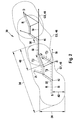
- Fig. 2 shows a section of a traffic route network 30 with the traffic node Ki, which are partially interconnected by means of the traffic routes Si.
- a user Bi who wants to drive from a starting position S to a destination D, can choose one of several alternative routes for this purpose.
- an in-vehicle route guidance system 10 proposes driving on the route R after entering a name, a coordinate or an address of the destination D (by means of the input unit 14). It often happens that the user Bi overrules the suggestion or the recommendation of the route guidance system 10, for example by leaving the suggested route R while driving. This is done by not taking a calculated turn 32 - deliberately or accidentally - or making a turn that was not recommended to him.
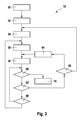
- route calculation method 33 are read after a start 50 of the route calculation traffic route data from a memory 20 in which a digital map is stored (step 52). Based on these data, a total route R to a destination D is calculated (step 54). In this case, a residual cost estimate for the destination D is preferably carried out, so that not all traffic routes Si with respect to the route R need to be evaluated. In the course of this calculation, the expected travel time for each of the traffic routes Si is also calculated, so that a respective arrival time is known for each traffic route Si. This also time-varying travel times and / or time-dependent traffic restrictions - for example, blockages for certain types of vehicles, vehicle heights or widths or general blockages - are taken into account in the route calculation. The result is stored in a route memory 28.
- a first calculation area G1 is determined which initially contains at least the starting position S of the route R stored in the route memory 28 (step 56).
- a length 34 and / or a width 36 of the first calculation area G1 taking into account a summed route length and / or summed travel time and / or number of traffic routes Si of the route R stored in the route memory 28.
- each part of the first calculation area G1 extends in the travel direction 38 on the left or right side of the route R.
- An edge 46 of the first calculation area G1 can be determined taking into account a predetermined geometric distance 42 from the route R and / or a topological distance from the Route R (ie, a number of traffic routes Si away from the route R) and / or an estimated traffic resistance and / or an estimated travel time and / or estimated calculation costs.
- the traffic routes Si of the total traffic route network 30 selected for the thus determined first calculation area G1 are stored in a memory 24, this being possible as a partial copy of the data from the memory 20 or as a list or directory of the traffic routes Si to be taken from the memory 20.
- route costs of partial routes T1i are calculated which connect backwards as viewed at traffic nodes Ki of the overall route R in the travel direction 38 (step 58).
- a partial route T1i then results in the first calculation area G1, which leads to the originally calculated overall route R (back) with minimal costs.
- partial routes T1i are calculated for all traffic routes Si and / or for all traffic nodes Ki which lie in the first calculation area G1.
- the well-known algorithm according to Bellman-Ford-Moore is suitable.
- a new calculation area Gj is determined (step 56), until finally the destination D of the total route R is contained in the calculation area Gj. If the new calculation area Gj also includes the destination D, it may happen that one or more of the alternative routes Tji "approach" the destination D so that the alternative route Tji has no common traffic route Si and / or traffic junction Ki more in common with the overall route R. ,
- the calculation area Gj may be increased by a selectable amount and / or in a direction to the image of the actual location are shifted (step 64), then for the enlarged or shifted calculation area Gj also alternative routes Tji are calculated (step 58).
- calculation regions Gj and alternative routes Tji are then calculated along these newly calculated total route R (steps 56 and 58).
- the route calculation process is ended (step 70).
Landscapes
- Engineering & Computer Science (AREA)
- Radar, Positioning & Navigation (AREA)
- Remote Sensing (AREA)
- Automation & Control Theory (AREA)
- Physics & Mathematics (AREA)
- General Physics & Mathematics (AREA)
- Navigation (AREA)
- Traffic Control Systems (AREA)
Abstract
Description
- Die Erfindung betrifft ein Routenberechnungsverfahren, wobei das Routenberechnungsverfahren folgende Schritte umfasst: einen ersten Schritt eines Berechnens einer Gesamtroute von einer Startposition zu einem Reiseziel und einen auf den ersten Schritt folgenden zweiten Schritt eines Berechnens zumindest einer Teilroute.
- Außerdem betrifft die Erfindung ein Zielführungsverfahren.
- Des Weiteren betrifft die Erfindung eine Routenberechnungsvorrichtung, insbesondere eine Zielführungsvorrichtung, wobei die Routenberechnungsvorrichtung eine Recheneinheit zum Berechnen von Gesamtrouten und/oder Teilrouten, einen ersten Speicher zum Speichern einer digitalen Verkehrwegekarte, einen zweiten Speicher zum Speichern von Gesamt- und/oder Teilrouten und eine Ausgabeeinheit zum Ausgeben von Fahrempfehlungen umfasst. Unter Verkehrsweg wird hier ein Streckenabschnitt, beispielsweise eine Straße eines Straßennetzes, verstanden.
- Konventionelle Routenberechnungsverfahren führen in der Regel entweder eine vorwärtsgerichtete oder eine rückwärtsgerichtete Berechnung durch. In der vorwärtsgerichteten Berechnung wird eine Route ausgehend von einer Startposition in Richtung zu einem Reiseziel berechnet. In der rückwärtsgerichteten Berechnung hingegen, wird die Route ausgehend von dem Reisziel in Richtung zu der Startposition berechnet. Im Vergleich zu vorwärtsgerichteten Routenberechnungsverfahren haben rückwärts gerichtete Routenberechnungsverfahren unter anderem den Vorteil, dass einem Nutzer (beispielsweise Fahrer) nach einem versehentlichen oder vorsätzlichem Abweichen von einer Routenempfehlung ohne Zeitverzug eine neue Fahrempfehlung gegeben werden kann. Dieses Leistungsmerkmal schätzen die Nutzer insbesondere in engmaschigen Innenstadtstraßennetzen. Andererseits haben vorwärtsgerichtete Routenberechnungsverfahren gegenüber den rückwärtsgerichteten folgenden Vorteil: Bei der Berechnung und Auswahl von Teilrouten, die auf dem Weg zwischen Startposition und Reiseziel liegen, ergeben sich (aufgrund der schrittweisen Berechnung in Vorwärtsrichtung mittels Akkumulation prognostizierter Fahrzeiten) strecken- bzw. knotenbezogene prognostizierte Ankunftszeiten an den einzelnen Streckenabschnitten, Kreuzungen, Teilrouten und/oder Generalisierungsebenen. Die prognostizierten Ankunftszeiten werden im gleichen Berechnungsdurchgang als Nebenergebnis erzeugt, so dass dafür ein weiterer Berechnungsdurchgang oder gar mehrere Iterationsschritte nicht durchzuführen sind. Folglich können im Zuge einer (einfachen) Vorwärtsberechnung auch zeitabhängige, insbesondere tageszeitlich veränderlichen Fahrzeiten, und/oder zeitabhängige Verkehrsbeschränkungen auf einfache Weise in die Routenberechnung einbezogen werden.
- Bei dem rückwärtsgerichteten Routenberechnungsverfahren besteht der Vorteil einer einfachen Berechnung von Ankunftszeiten an einzelnen Verkehrswegen und Verkehrsknoten nur dann, wenn die Routenberechnung für eine vom Nutzer gewünschte Ankunftszeit am Reiseziel erfolgt. Wenn jedoch von einer gewünschten oder tatsächlichen Abfahrtzeit ausgegangen werden soll, haben rückwärtsgerichteten Routenberechnungsverfahren - wie das in
DE 101 45 299 A1 für ein erstes und letztes Routensegment benutzte - den Nachteil, dass zu den einzelnen Verkehrwegen und Verkehrsknoten keine Ankunftszeiten zur Verfügung stehen. Diese werden aber dafür benötigt, um eine zeitabhängige, insbesondere eine tageszeitlich veränderliche Fahrzeit und/oder insbesondere eine zeitabhängige Verkehrsbeschränkung für den Verkehrsweg und/oder den Verkehrsknoten in die Routenberechnung einzubeziehen. Eine auch unter zeitlichen Gesichtspunkten optimale Route kann dann nicht ohne Weiteres berechnet werden. Eine Möglichkeit bestünde hier vielleicht noch durch Weiterbildung zu einem Iterationsverfahren, wodurch allerdings der Rechenaufwand, Zeitaufwand und Stromverbrauch, also der Ressourcenverbrauch, steigen würde. - Der Erfindung liegt die Aufgabe zugrunde, ein gattungsgemäßes Routenberechnungsverfahren bereitzustellen, mit der mit möglichst geringem Ressourcenverbrauch eine auch unter zeitlichen Gesichtspunkten optimale Route berechnet werden kann,
wobei bei einem Abweichen von der Route ohne Zeitverzug eine neue Fahrempfehlung gegeben werden kann. Darüber hinaus ist es eine Aufgabe der Erfindung, ein gattungsgemäßes Zielführungsverfahren und eine Routenberechnungsvorrichtung mit diesem Vorteil bereitzustellen. - Diese Aufgabe wird mit den Merkmalen der unabhängigen Ansprüche gelöst. Vorteilhafte Ausführungsformen der Erfindung sind in den abhängigen Ansprüchen angegeben.
- Die Erfindung baut auf dem gattungsgemäßen Routenberechnungsverfahren dadurch auf, dass die Berechnung der zumindest einen Teilroute von einer auf der Gesamtroute liegenden Zwischenposition aus rückwärts erfolgt. Im entarteten Fall ist die Zwischenposition mit dem Reiseziel identisch.
- In einer bevorzugten Ausführungsform erfolgt das Berechnen der zumindest einen Teilroute unter Berücksichtigung mindestens einer zeitabhängigen, insbesondere einer tageszeitlich veränderlichen Fahrzeit und/oder insbesondere einer zeitabhängigen Verkehrsbeschränkung.
- Eine weitere bevorzugte Ausführungsform sieht vor, dass das Berechnen der zumindest einen Teilroute durchgeführt wird, sobald ein durch das Routenberechnungsverfahren zielgeführtes Objekt sich entlang der Gesamtroute soweit bewegt hat, dass ein Maß, insbesondere ein Kostenmaß, bis zum Erreichen einer teilroutenspezifischen Zwischenposition unterschritten wird. Unter Objekt wird hier ein Fahrzeug oder ein Nutzer verstanden.
- In einer ebenso bevorzugten Ausführungsform des Verfahrens wird in dem Schritt des Berechnens der zumindest einen Teilroute mindestens eine Alternativteilroute berechnet.
- Eine bevorzugte Weiterbildung der Verfahrens sieht vor, dass in dem Schritt des Berechnens der zumindest einen Teilroute mindestens eine Alternativteilroute für ein Teilgebiet entlang der Gesamtroute berechnet wird.
- Eine besonders bevorzugte Ausführungsform sieht vor, dass in dem Schritt des Berechnens der zumindest einen Teilroute jeweils eine Alternativteilroute für mehrere Verkehrswege, insbesondere jeden Verkehrsweg, und/oder für mehrere Verkehrsknoten, insbesondere jeden Verkehrsknoten, des Teilgebiets entlang der Gesamtroute berechnet wird.
- Außerdem kann eine Größe des Teilgebiets vergrößert werden, sobald das Objekt in dem Teilgebiet alle für das Teilgebiet berechneten Alternativrouten verlassen hat und/oder sobald das Objekt einen vorbestimmten Mindestabstand zu einem Rand des Teilgebiets unterschritten hat.
- Auch kann es vorteilhaft sein, den Schritt des Berechnens der zumindest einen Teilroute für jede oder nahezu jede Abzweigung auf der Gesamtroute durchzuführen.
- Die Erfindung baut auf dem gattungsgemäßen Zielführungsverfahren dadurch auf, dass das Zielführungsverfahren die Schritte des erfindungsgemäßen Routenberechnungsverfahren umfasst.
- Die Erfindung baut auf der gattungsgemäßen Routenberechungsvorrichtung dadurch auf, dass die die Recheneinheit Gesamtrouten und/oder Teilrouten gemäß dem erfindungsgemäßen Routenberechnungsverfahren berechnet.
- Die Erfindung wird nun mit Bezug auf die begleitenden Figuren anhand besonders bevorzugter Ausführungsformen beispielhaft erläutert.
-
- Fig. 1
- ein schematisches Blockschaltbild von einer erfindungsgemäßen Routenberechnungsvorrichtung;
- Fig. 2
- einen schematisches Übersichtsbild über ein Verkehrswegenetz; und
- Fig. 3
- eine Ablaufdiagramm des erfindungsgemäßen Routenbeechnungsverfahrens.
- Im Folgenden werden Merkmale der in den Figuren dargestellten Anordnungen beschrieben, welche in einer gemeinsamen Ausführungsform verwirklicht sein können. Durch Verwendung übereinstimmender Bezugszeichen werden Verfahrensschritte und Komponenten hilfsweise auch mittels solcher Beschreibungsteile beschrieben, die anderen Figuren zugeordnet sind.
- Die in
Fig. 1 als Blockschaltbild gezeigte Routenberechnungsvorrichtung 10 zeigt eine mögliche Systemstruktur. Hierbei sind an einem Datenbus 12 eine Eingabeeinheit 14, eine Routenberechnungseinheit 16, eine Speichereinheit 20 zur Speicherung von elektronischen Kartendaten eines Verkehrswegenetzes, eine Recheneinheit 22, ein Programm- und Datenspeicher 24, eine Ausgabeeinheit 26 und ein Routenspeicher 28 angeschlossen. Zwei oder mehr Einheiten können zu einer gemeinsamen Einheit zusammengefasst sein. Insbesondere kann in dem Programm- und Datenspeicher 24 ein Routenberechnungsprogrammcode gespeichert sein, der dazu vorgesehen ist, auf der Recheneinheit 22 ausgeführt zu werden. -
Fig. 2 zeigt einen Ausschnitt eines Verkehrswegenetzes 30 mit den Verkehrsknoten Ki, die mittels der Verkehrswege Si teilvermascht verbunden sind. Ein Nutzer Bi, der von einer Startposition S zu einem Reiseziel D fahren will, kann hierfür eine von mehreren alternativen Routen wählen. Zur Erläuterung des erfindungsgemäßen Verfahrens wird nun als Beispiel angenommen, dass ein im Fahrzeug befindliches Zielführungssystem 10 nach Eingabe eines Namens, einer Koordinate oder einer Adresse des Reiseziels D (mittels der Eingabeeinheit 14) ein Befahren der Route R vorschlägt. Es kommt öfters vor, dass sich der Nutzer Bi über den Vorschlag oder die Empfehlung des Zielführungssystems 10 hinwegsetzt, beispielsweise indem er beim Fahren die vorgeschlagene Route R verlässt. Dies geschieht dadurch, dass er eine berechnete Abbiegung 32 - vorsätzlich oder versehentlich - nicht nimmt oder dass er eine Abbiegung ausführt, die ihm nicht empfohlen wurde. - In dem in
Fig. 3 dargestellten Routenberechnungsverfahren 33 werden nach einem Start 50 der Routenberechnung Verkehrswegdaten aus einem Speicher 20 eingelesen, in dem eine digitale Karte gespeichert ist (Schritt 52). Anhand dieser Daten wird eine Gesamtroute R zu einem Reiseziel D berechnet (Schritt 54). Vorzugsweise wird dabei eine Restkostenabschätzung zum Reiseziel D durchgeführt, damit nicht alle Verkehrswege Si bezüglich der Route R bewertet werden müssen. Im Zuge dieser Berechnung wird die erwartete Fahrzeit für jeden der Verkehrswege Si mitberechnet, so dass für jeden Verkehrsweg Si eine jeweilige Ankunftszeit bekannt ist. Damit können auch zeitlich veränderliche Fahrzeiten und/oder zeitabhängige Verkehrsbeschränkungen - beispielsweise Sperrungen für bestimmte Fahrzeugarten, Fahrzeughöhen oder -breiten oder generelle Sperrungen - bei der Routenberechnung berücksichtigt werden.
Das Ergebnis wird in einem Routenspeicher 28 abgelegt. - Dann wird zur Berechnung von Alternativrouten Tji ein erstes Berechnungsgebiet G1 bestimmt, das zunächst mindestens die Startposition S der im Routenspeicher 28 abgelegten Route R enthält (Schritt 56). Vorzugsweise wird eine Länge 34 und/oder eine Breite 36 des ersten Berechnungsgebiets G1 unter Berücksichtigung einer summierten Streckenlänge und/oder summierten Fahrzeit und/oder Anzahl von Verkehrswegen Si der im Routenspeicher 28 abgelegten Route R bestimmt. Typischerweise erstrecken sich je ein Teil des ersten Berechnungsgebiets G1 in Reiserichtung 38 betrachtet links- bzw. rechtsseits der Route R. Ein Rand 46 des ersten Berechnungsgebiets G1 kann unter Berücksichtigung eines vorgegebenen geometrischen Abstands 42 von der Route R und/oder eines topologischen Abstands von der Route R (d.h. einer Anzahl von Verkehrswegen Si weg von der Route R) und/oder eines geschätzten Verkehrswiderstands und/oder einer geschätzten Reisezeit und/oder geschätzter Berechnungskosten erfolgen.
- Die für das so bestimmte erste Berechnungsgebiet G1 ausgewählten Verkehrswege Si des Gesamtverkehrswegenetzes 30 werden in einem Speicher 24 abgelegt, wobei dies als Teilkopie der Daten aus dem Speicher 20 erfolgen kann oder als Liste oder Verzeichnis der aus dem Speicher 20 zu berücksichtigenden Verkehrswege Si. Anschließend werden für dieses erste Berechnungsgebiet G1 Routenkosten von Teilrouten T1i berechnet, die an Verkehrsknoten Ki der Gesamtroute R in Reiserichtung 38 betrachtet rückwärts anschließen (Schritt 58). Es ergibt sich dann für mehrere Verkehrswege Si und/oder für mehrere Verkehrsknoten Ki in dem ersten Berechnungsgebiet G1 je eine Teilroute T1i, die mit minimalen Kosten zur ursprünglich berechneten Gesamtroute R (zurück)führt. Damit wird erreicht, dass während der Reise auch an nicht geplanten Durchreiseorten Zi je eine auf Vorrat berechnete Alternativroute T1i ohne Zeitverzug vorliegt. Vorzugsweise werden für das erste Berechnungsgebiet G1 Teilrouten T1i für alle Verkehrswege Si und/oder für alle Verkehrsknoten Ki berechnet, die in dem ersten Berechnungsgebiet G1 liegen. Hierzu eignet sich beispielsweise der an sich bekannte Algorithmus nach Bellman-Ford-Moore. Folgt der Nutzer Bi der ursprünglich berechneten Route R und nähert sich dabei dem Rand 46 des ersten Berechnungsgebiets G1 so weit, dass dabei ein bestimmtes Entfernungsmaß 48 unterschritten wird (Abfrage 60), so wird ein weiteres Berechnungsgebiet Gj bestimmt (Schritt 56), in dem Teilrouten Tji wie für das erste Berechnungsgebiet G1 berechnet werden (Schritt 58). Mit jeder erneuten Annäherung an den Rand 46 des jeweiligen weiteren Berechnungsgebiets Gj wird ein neues Berechnungsgebiet Gj bestimmt (Schritt 56), bis schließlich auch das Reiseziel D der Gesamtroute R in dem Berechnungsgebiet Gj enthalten ist. Wenn das neue Berechnungsgebiet Gj auch das Reiseziel D einschließt, kann es vorkommen, dass eine oder mehrere der Alternativrouten Tji das Reiseziel D so "anfahren", dass die Alternativroute Tji keinen Verkehrsweg Si und/oder keinen Verkehrsknoten Ki mehr mit der Gesamtroute R gemeinsam hat.
- Wenn der Benutzer Bi im Begriff ist, auch die Alternativrouten Tji des Berechnungsgebiets Gj und den Rand 46 des Berechnungsgebiets Gj zu verlassen (Abfrage 62), kann das Berechnungsgebiet Gj um ein wählbares Maß vergrößert werden und/oder in einer Richtung zum Abbild des tatsächlichen Aufenthaltsorts verschoben werden (Schritt 64), wobei dann für das vergrößerte bzw. verschobene Berechnungsgebiet Gj ebenfalls Alternativrouten Tji berechnet werden (Schritt 58).
- Wenn die Verschiebung und/oder Vergrößerung des Berechnungsgebiets Gj ein wählbares Maximalmaß erreicht hat und sich der Benutzer Bi weiterhin einem Rand 46 dieses Berechnungsgebiets Gj nähert (Abfrage 66), kann dies eine Neuberechnung einer neuen Gesamtroute R vom aktuellen Aufenthaltsort Zi bis zum Reiseziel D auslösen (Schritt 54). Typischerweise werden dann - wie zuvor beschrieben - entlang dieser neu berechneten Gesamtroute R wiederum Berechnungsgebiete Gj und Alternativrouten Tji berechnet (Schritte 56 und 58). So wird der Nutzer auch dann mit einer Alternativroutenführung unterstützt, wenn er von der neu berechneten Gesamtroute Gj auch wieder abweicht. Wenn der Nutzer das Reiseziel erreicht hat (Abfrage 68), wird das Routenberechnungsverfahren beendet (Schritt 70) .
- Die in der vorstehenden Beschreibung, in den Zeichnungen sowie in den Ansprüchen offenbarten Merkmale der Erfindung und des Stands der Technik können sowohl einzeln als auch in beliebiger Kombination für die Verwirklichung der Erfindung wesentlich sein.
Claims (10)
- Routenberechnungsverfahren (33), wobei das Routenberechnungsverfahren (33) folgende Schritte umfasst:- einen ersten Schritt (54) eines Berechnens einer Gesamtroute (R) von einer Startposition (S) zu einem Reiseziel (D); und- einen auf den ersten Schritt (54) folgenden zweiten Schritt (58) eines Berechnens zumindest einer Teilroute (Tji),wobei das Routenberechnungsverfahren (33) dadurch gekennzeichnet ist, dass die Berechnung der zumindest einen Teilroute (Tji) von einer auf der Gesamtroute (R) liegenden Zwischenposition (Ki) aus rückwärts erfolgt.
- Routenberechnungsverfahren (33) gemäß Anspruch 1, dadurch gekennzeichnet, dass das Berechnen der zumindest einen Teilroute (Tji) unter Berücksichtigung mindestens einer zeitabhängigen, insbesondere einer tageszeitlich veränderlichen Fahrzeit und/oder insbesondere einer zeitabhängigen Verkehrsbeschränkung, erfolgt.
- Routenberechnungsverfahren (33) gemäß Anspruch 1 oder 2, dadurch gekennzeichnet, dass das Berechnen der zumindest einen Teilroute (Tji) durchgeführt wird, sobald ein durch das Routenberechnungsverfahren zielgeführtes Objekt (Bi) sich entlang der Gesamtroute (R) soweit bewegt hat, dass ein Maß (48), insbesondere ein Kostenmaß (48), bis zum Erreichen einer teilroutenspezifischen Zwischenposition (Ki) unterschritten wird.
- Routenberechnungsverfahren (33) gemäß einem der Ansprüche 1 bis 3, dadurch gekennzeichnet, dass in dem Schritt des Berechnens der zumindest einen Teilroute (Tji) mindestens eine Alternativteilroute (Tji) berechnet wird.
- Routenberechnungsverfahren (33) gemäß Anspruch 4, dadurch gekennzeichnet, dass in dem Schritt (58) des Berechnens der zumindest einen Teilroute (Tji) mindestens eine Alternativteilroute (Tji) für ein Teilgebiet (Gj) entlang der Gesamtroute (R) berechnet wird.
- Routenberechnungsverfahren (33) gemäß Anspruch 5, dadurch gekennzeichnet, dass in dem Schritt (58) des Berechnens der zumindest einen Teilroute (Tji) jeweils eine Alternativteilroute (Tji) für mehrere Verkehrswege (Si), insbesondere jeden Verkehrsweg (Si), und/oder für mehrere Verkehrsknoten (Ki), insbesondere jeden Verkehrsknoten (Ki), des Teilgebiets (Tji) entlang der Gesamtroute (R) berechnet wird.
- Routenberechnungsverfahren (33) gemäß Anspruch 4 oder 5, dadurch gekennzeichnet, dass eine Größe (34, 36) des Teilgebiets (Gj) vergrößert wird, sobald das Objekt (Bi) in dem Teilgebiet (Gj) alle für das Teilgebiet (Gj) berechneten Alternativrouten (Tji) verlassen hat und/oder sobald das Objekt (Bi) einen vorbestimmten Mindestabstand (48) zu einem Rand (46) des Teilgebiets (Gj) unterschritten hat.
- Routenberechnungsverfahren (33) gemäß einem der Ansprüche 1 bis 7, dadurch gekennzeichnet, dass der Schritt (58) des Berechnens der zumindest einen Teilroute (Tji) für jede oder nahezu jede Abzweigung (Ki) auf der Gesamtroute (R) durchgeführt wird.
- Zielführungsverfahren (33), dadurch gekennzeichnet, dass das Zielführungsverfahren (33) die Schritte (54, 58) des Routenberechnungsverfahrens (33) gemäß einem der Ansprüche 1 bis 8 umfasst.
- Routenberechnungsvorrichtung (10), insbesondere Zielführungsvorrichtung, wobei die Routenberechnungsvorrichtung (10) umfasst:- eine Recheneinheit (22) zum Berechnen von Gesamtrouten (R) und/oder Teilrouten (Tji);- einen ersten Speicher (20) zum Speichern einer digitalen Verkehrwegekarte;- einen zweiten Speicher (28) zum Speichern von Gesamtrouten (R) und/oder Teilrouten (Tji); und- eine Ausgabeeinheit (26) zum Ausgeben von Fahrempfehlungen;wobei die Routenberechnungsvorrichtung (10) dadurch gekennzeichnet ist, dass die Recheneinheit (22) Gesamtrouten (R) und/oder Teilrouten (Tji) gemäß einem der Ansprüche 1 bis 9 berechnet.
Priority Applications (1)
| Application Number | Priority Date | Filing Date | Title |
|---|---|---|---|
| PL09167918T PL2175240T3 (pl) | 2008-10-09 | 2009-08-14 | Obliczanie trasy łączonej |
Applications Claiming Priority (1)
| Application Number | Priority Date | Filing Date | Title |
|---|---|---|---|
| DE102008042698A DE102008042698A1 (de) | 2008-10-09 | 2008-10-09 | Kombinierte Routenberechnung |
Publications (3)
| Publication Number | Publication Date |
|---|---|
| EP2175240A2 true EP2175240A2 (de) | 2010-04-14 |
| EP2175240A3 EP2175240A3 (de) | 2012-08-15 |
| EP2175240B1 EP2175240B1 (de) | 2017-10-11 |
Family
ID=41479236
Family Applications (1)
| Application Number | Title | Priority Date | Filing Date |
|---|---|---|---|
| EP09167918.3A Active EP2175240B1 (de) | 2008-10-09 | 2009-08-14 | Kombinierte Routenberechnung |
Country Status (3)
| Country | Link |
|---|---|
| EP (1) | EP2175240B1 (de) |
| DE (1) | DE102008042698A1 (de) |
| PL (1) | PL2175240T3 (de) |
Cited By (2)
| Publication number | Priority date | Publication date | Assignee | Title |
|---|---|---|---|---|
| CN104121922B (zh) * | 2014-07-18 | 2017-03-22 | 百度在线网络技术(北京)有限公司 | 一种地图路径获取方法及装置 |
| WO2019037959A1 (de) * | 2017-08-23 | 2019-02-28 | Neusoft Technology Solutions Gmbh | Verfahren zur erzeugung alternativer routenvorschläge |
Citations (1)
| Publication number | Priority date | Publication date | Assignee | Title |
|---|---|---|---|---|
| DE10145299A1 (de) | 2001-09-14 | 2003-04-03 | Bosch Gmbh Robert | Verfahren zur automatischen Berechnung von optimalen Routen |
Family Cites Families (4)
| Publication number | Priority date | Publication date | Assignee | Title |
|---|---|---|---|---|
| DE19616071A1 (de) * | 1996-04-23 | 1997-10-30 | Vdo Schindling | Verfahren und Einrichtung zur Zielführung eines Fahrzeuges |
| DE10162359B4 (de) * | 2001-12-18 | 2012-10-31 | Robert Bosch Gmbh | Verfahren zur Bereitstellung von Routendaten für ein Navigationsgerät |
| JP3928962B2 (ja) * | 2003-08-21 | 2007-06-13 | 株式会社日立製作所 | 通信型車両ナビゲーションシステムのサーバ装置及び車載端末装置 |
| US20060116818A1 (en) * | 2004-12-01 | 2006-06-01 | Televigation, Inc. | Method and system for multiple route navigation |
-
2008
- 2008-10-09 DE DE102008042698A patent/DE102008042698A1/de not_active Withdrawn
-
2009
- 2009-08-14 PL PL09167918T patent/PL2175240T3/pl unknown
- 2009-08-14 EP EP09167918.3A patent/EP2175240B1/de active Active
Patent Citations (1)
| Publication number | Priority date | Publication date | Assignee | Title |
|---|---|---|---|---|
| DE10145299A1 (de) | 2001-09-14 | 2003-04-03 | Bosch Gmbh Robert | Verfahren zur automatischen Berechnung von optimalen Routen |
Cited By (3)
| Publication number | Priority date | Publication date | Assignee | Title |
|---|---|---|---|---|
| CN104121922B (zh) * | 2014-07-18 | 2017-03-22 | 百度在线网络技术(北京)有限公司 | 一种地图路径获取方法及装置 |
| WO2019037959A1 (de) * | 2017-08-23 | 2019-02-28 | Neusoft Technology Solutions Gmbh | Verfahren zur erzeugung alternativer routenvorschläge |
| US11320275B2 (en) | 2017-08-23 | 2022-05-03 | Neusoft Technology Solutions Gmbh | Method for producing alternative route suggestions |
Also Published As
| Publication number | Publication date |
|---|---|
| EP2175240A3 (de) | 2012-08-15 |
| EP2175240B1 (de) | 2017-10-11 |
| DE102008042698A1 (de) | 2010-04-15 |
| PL2175240T3 (pl) | 2018-03-30 |
Similar Documents
| Publication | Publication Date | Title |
|---|---|---|
| EP1497618B1 (de) | Verfahren und system zur dynamischen zielführung eines fahrzeuges | |
| EP1297310B1 (de) | Verfahren zur auswahl von karteninformationen und navigationsvorrichtung | |
| EP2507589B1 (de) | Verfahren zur vereinfachung einer beschreibung einer fahrtroute | |
| DE102019102664A1 (de) | Parkassistenzvorrichtung | |
| EP2989422B1 (de) | Verfahren und vorrichtung zum auswählen einer route zum befahren durch ein fahrzeug | |
| DE102007058093B4 (de) | Verfahren und Vorrichtung zum Ermitteln einer Routenempfehlung aus einer Mehrzahl von Wegstrecken | |
| EP3279049B1 (de) | Steuerungs-system und steuerungs-verfahren zum bestimmen einer fahrbahn | |
| EP1430273B1 (de) | Verfahren zur automatischen berechnung von optimalen routen | |
| WO2020148051A1 (de) | Verfahren zur routenplanung in einem navigationssystem eines fahrzeugs, navigationssystem für ein fahrzeug und fahrzeug mit demselben | |
| DE102020000692A1 (de) | Verfahren und Vorrichtung zur Steuerung eines Verkehrsflusses über einen Verkehrsnetzknoten | |
| WO2003060429A1 (de) | Verfahren zum bestimmen einer reisezeit | |
| DE102018131898A1 (de) | Verfahren zum Bestimmen einer Trajektorie durch tangentiales Anlegen von Bézierkurven an geometrische Strukturen; Steuereinheit; Fahrerassistenzsystem; Computerprogrammprodukt sowie computerlesbares Medium | |
| EP2175240B1 (de) | Kombinierte Routenberechnung | |
| DE102018008323A1 (de) | Verfahren zum Ermitteln einer Fahrtroute für ein Kraftfahrzeug | |
| DE10159872B4 (de) | Verfahren und Anordnung sowie Computerprogramm mit Programmcode-Mitteln und Computerprogramm-Produkt zur Ermittlung einer Manöverinformation aus einem Satz von vorgebbaren Manöverinformationen für eine mobile Einheit unter Verwendung von Fuzzy-Logik | |
| EP0813986B1 (de) | Verfahren zur Abstandsregelung für ein Fahrzeug | |
| DE112019007147T5 (de) | Fahrzeugpfad-Erzeugungsvorrichtung, Fahrzeugpfad-Erzeugungsverfahren und Fahrzeugsteuerungsvorrichtung | |
| DE102023201878A1 (de) | Verfahren zum Überprüfen einer Beförderungsfahrt eines Nutzers, sowie elektronisches Beförderungsinformationssystem und Computerprogramm | |
| DE102014206539A1 (de) | Vorrichtung zur Darstellung und Änderung einer Betriebsstrategie eines Hybridfahrzeuges | |
| WO2023222274A1 (de) | Verfahren zum bereitstellen einer menge von entscheidungspunkten während einer fahrt mit einem fahrzeug von einem backend-server an das fahrzeug, computerlesbares medium, system und fahrzeug | |
| EP4562369A1 (de) | Erstellen eines logischen wegenetzes in parkräumen | |
| WO2009059574A1 (de) | Verfahren zum betrieb eines navigationssystems | |
| DE102023202623B3 (de) | Verfahren zur Verwendung von Navigationsdaten in einem Fahrerassistenzsystem | |
| EP2881297B1 (de) | Verfahren zur vorausschauenden Beeinflussung einer Fahrzeuggeschwindigkeit | |
| DE102017202564A1 (de) | Verfahren und Vorrichtung zum Ermitteln einer Navigationsroute |
Legal Events
| Date | Code | Title | Description |
|---|---|---|---|
| PUAI | Public reference made under article 153(3) epc to a published international application that has entered the european phase |
Free format text: ORIGINAL CODE: 0009012 |
|
| AK | Designated contracting states |
Kind code of ref document: A2 Designated state(s): AT BE BG CH CY CZ DE DK EE ES FI FR GB GR HR HU IE IS IT LI LT LU LV MC MK MT NL NO PL PT RO SE SI SK SM TR |
|
| AX | Request for extension of the european patent |
Extension state: AL BA RS |
|
| RIC1 | Information provided on ipc code assigned before grant |
Ipc: G01C 21/34 20060101AFI20120312BHEP |
|
| PUAL | Search report despatched |
Free format text: ORIGINAL CODE: 0009013 |
|
| AK | Designated contracting states |
Kind code of ref document: A3 Designated state(s): AT BE BG CH CY CZ DE DK EE ES FI FR GB GR HR HU IE IS IT LI LT LU LV MC MK MT NL NO PL PT RO SE SI SK SM TR |
|
| AX | Request for extension of the european patent |
Extension state: AL BA RS |
|
| RIC1 | Information provided on ipc code assigned before grant |
Ipc: G01C 21/34 20060101AFI20120710BHEP |
|
| 17P | Request for examination filed |
Effective date: 20130215 |
|
| 17Q | First examination report despatched |
Effective date: 20151125 |
|
| GRAP | Despatch of communication of intention to grant a patent |
Free format text: ORIGINAL CODE: EPIDOSNIGR1 |
|
| RIC1 | Information provided on ipc code assigned before grant |
Ipc: G01C 21/34 20060101AFI20170302BHEP |
|
| INTG | Intention to grant announced |
Effective date: 20170323 |
|
| INTG | Intention to grant announced |
Effective date: 20170328 |
|
| GRAS | Grant fee paid |
Free format text: ORIGINAL CODE: EPIDOSNIGR3 |
|
| GRAA | (expected) grant |
Free format text: ORIGINAL CODE: 0009210 |
|
| AK | Designated contracting states |
Kind code of ref document: B1 Designated state(s): AT BE BG CH CY CZ DE DK EE ES FI FR GB GR HR HU IE IS IT LI LT LU LV MC MK MT NL NO PL PT RO SE SI SK SM TR |
|
| REG | Reference to a national code |
Ref country code: GB Ref legal event code: FG4D Free format text: NOT ENGLISH |
|
| REG | Reference to a national code |
Ref country code: CH Ref legal event code: EP |
|
| REG | Reference to a national code |
Ref country code: IE Ref legal event code: FG4D Free format text: LANGUAGE OF EP DOCUMENT: GERMAN |
|
| REG | Reference to a national code |
Ref country code: AT Ref legal event code: REF Ref document number: 936448 Country of ref document: AT Kind code of ref document: T Effective date: 20171115 |
|
| REG | Reference to a national code |
Ref country code: DE Ref legal event code: R096 Ref document number: 502009014431 Country of ref document: DE |
|
| REG | Reference to a national code |
Ref country code: NL Ref legal event code: MP Effective date: 20171011 |
|
| REG | Reference to a national code |
Ref country code: LT Ref legal event code: MG4D |
|
| PG25 | Lapsed in a contracting state [announced via postgrant information from national office to epo] |
Ref country code: NL Free format text: LAPSE BECAUSE OF FAILURE TO SUBMIT A TRANSLATION OF THE DESCRIPTION OR TO PAY THE FEE WITHIN THE PRESCRIBED TIME-LIMIT Effective date: 20171011 |
|
| PG25 | Lapsed in a contracting state [announced via postgrant information from national office to epo] |
Ref country code: ES Free format text: LAPSE BECAUSE OF FAILURE TO SUBMIT A TRANSLATION OF THE DESCRIPTION OR TO PAY THE FEE WITHIN THE PRESCRIBED TIME-LIMIT Effective date: 20171011 Ref country code: NO Free format text: LAPSE BECAUSE OF FAILURE TO SUBMIT A TRANSLATION OF THE DESCRIPTION OR TO PAY THE FEE WITHIN THE PRESCRIBED TIME-LIMIT Effective date: 20180111 Ref country code: LT Free format text: LAPSE BECAUSE OF FAILURE TO SUBMIT A TRANSLATION OF THE DESCRIPTION OR TO PAY THE FEE WITHIN THE PRESCRIBED TIME-LIMIT Effective date: 20171011 Ref country code: SE Free format text: LAPSE BECAUSE OF FAILURE TO SUBMIT A TRANSLATION OF THE DESCRIPTION OR TO PAY THE FEE WITHIN THE PRESCRIBED TIME-LIMIT Effective date: 20171011 Ref country code: FI Free format text: LAPSE BECAUSE OF FAILURE TO SUBMIT A TRANSLATION OF THE DESCRIPTION OR TO PAY THE FEE WITHIN THE PRESCRIBED TIME-LIMIT Effective date: 20171011 |
|
| PG25 | Lapsed in a contracting state [announced via postgrant information from national office to epo] |
Ref country code: IS Free format text: LAPSE BECAUSE OF FAILURE TO SUBMIT A TRANSLATION OF THE DESCRIPTION OR TO PAY THE FEE WITHIN THE PRESCRIBED TIME-LIMIT Effective date: 20180211 Ref country code: LV Free format text: LAPSE BECAUSE OF FAILURE TO SUBMIT A TRANSLATION OF THE DESCRIPTION OR TO PAY THE FEE WITHIN THE PRESCRIBED TIME-LIMIT Effective date: 20171011 Ref country code: HR Free format text: LAPSE BECAUSE OF FAILURE TO SUBMIT A TRANSLATION OF THE DESCRIPTION OR TO PAY THE FEE WITHIN THE PRESCRIBED TIME-LIMIT Effective date: 20171011 Ref country code: GR Free format text: LAPSE BECAUSE OF FAILURE TO SUBMIT A TRANSLATION OF THE DESCRIPTION OR TO PAY THE FEE WITHIN THE PRESCRIBED TIME-LIMIT Effective date: 20180112 Ref country code: BG Free format text: LAPSE BECAUSE OF FAILURE TO SUBMIT A TRANSLATION OF THE DESCRIPTION OR TO PAY THE FEE WITHIN THE PRESCRIBED TIME-LIMIT Effective date: 20180111 |
|
| REG | Reference to a national code |
Ref country code: DE Ref legal event code: R097 Ref document number: 502009014431 Country of ref document: DE |
|
| PG25 | Lapsed in a contracting state [announced via postgrant information from national office to epo] |
Ref country code: EE Free format text: LAPSE BECAUSE OF FAILURE TO SUBMIT A TRANSLATION OF THE DESCRIPTION OR TO PAY THE FEE WITHIN THE PRESCRIBED TIME-LIMIT Effective date: 20171011 Ref country code: DK Free format text: LAPSE BECAUSE OF FAILURE TO SUBMIT A TRANSLATION OF THE DESCRIPTION OR TO PAY THE FEE WITHIN THE PRESCRIBED TIME-LIMIT Effective date: 20171011 Ref country code: CZ Free format text: LAPSE BECAUSE OF FAILURE TO SUBMIT A TRANSLATION OF THE DESCRIPTION OR TO PAY THE FEE WITHIN THE PRESCRIBED TIME-LIMIT Effective date: 20171011 Ref country code: SK Free format text: LAPSE BECAUSE OF FAILURE TO SUBMIT A TRANSLATION OF THE DESCRIPTION OR TO PAY THE FEE WITHIN THE PRESCRIBED TIME-LIMIT Effective date: 20171011 |
|
| PLBE | No opposition filed within time limit |
Free format text: ORIGINAL CODE: 0009261 |
|
| STAA | Information on the status of an ep patent application or granted ep patent |
Free format text: STATUS: NO OPPOSITION FILED WITHIN TIME LIMIT |
|
| REG | Reference to a national code |
Ref country code: FR Ref legal event code: PLFP Year of fee payment: 10 |
|
| PG25 | Lapsed in a contracting state [announced via postgrant information from national office to epo] |
Ref country code: SM Free format text: LAPSE BECAUSE OF FAILURE TO SUBMIT A TRANSLATION OF THE DESCRIPTION OR TO PAY THE FEE WITHIN THE PRESCRIBED TIME-LIMIT Effective date: 20171011 Ref country code: RO Free format text: LAPSE BECAUSE OF FAILURE TO SUBMIT A TRANSLATION OF THE DESCRIPTION OR TO PAY THE FEE WITHIN THE PRESCRIBED TIME-LIMIT Effective date: 20171011 |
|
| 26N | No opposition filed |
Effective date: 20180712 |
|
| PG25 | Lapsed in a contracting state [announced via postgrant information from national office to epo] |
Ref country code: MT Free format text: LAPSE BECAUSE OF FAILURE TO SUBMIT A TRANSLATION OF THE DESCRIPTION OR TO PAY THE FEE WITHIN THE PRESCRIBED TIME-LIMIT Effective date: 20171011 |
|
| PG25 | Lapsed in a contracting state [announced via postgrant information from national office to epo] |
Ref country code: SI Free format text: LAPSE BECAUSE OF FAILURE TO SUBMIT A TRANSLATION OF THE DESCRIPTION OR TO PAY THE FEE WITHIN THE PRESCRIBED TIME-LIMIT Effective date: 20171011 |
|
| PGFP | Annual fee paid to national office [announced via postgrant information from national office to epo] |
Ref country code: PL Payment date: 20180801 Year of fee payment: 10 |
|
| PG25 | Lapsed in a contracting state [announced via postgrant information from national office to epo] |
Ref country code: MC Free format text: LAPSE BECAUSE OF FAILURE TO SUBMIT A TRANSLATION OF THE DESCRIPTION OR TO PAY THE FEE WITHIN THE PRESCRIBED TIME-LIMIT Effective date: 20171011 |
|
| REG | Reference to a national code |
Ref country code: CH Ref legal event code: PL |
|
| PG25 | Lapsed in a contracting state [announced via postgrant information from national office to epo] |
Ref country code: LI Free format text: LAPSE BECAUSE OF NON-PAYMENT OF DUE FEES Effective date: 20180831 Ref country code: LU Free format text: LAPSE BECAUSE OF NON-PAYMENT OF DUE FEES Effective date: 20180814 Ref country code: CH Free format text: LAPSE BECAUSE OF NON-PAYMENT OF DUE FEES Effective date: 20180831 |
|
| REG | Reference to a national code |
Ref country code: BE Ref legal event code: MM Effective date: 20180831 |
|
| REG | Reference to a national code |
Ref country code: IE Ref legal event code: MM4A |
|
| PG25 | Lapsed in a contracting state [announced via postgrant information from national office to epo] |
Ref country code: IE Free format text: LAPSE BECAUSE OF NON-PAYMENT OF DUE FEES Effective date: 20180814 |
|
| PG25 | Lapsed in a contracting state [announced via postgrant information from national office to epo] |
Ref country code: BE Free format text: LAPSE BECAUSE OF NON-PAYMENT OF DUE FEES Effective date: 20180831 |
|
| REG | Reference to a national code |
Ref country code: AT Ref legal event code: MM01 Ref document number: 936448 Country of ref document: AT Kind code of ref document: T Effective date: 20180814 |
|
| PGFP | Annual fee paid to national office [announced via postgrant information from national office to epo] |
Ref country code: IT Payment date: 20190821 Year of fee payment: 11 Ref country code: FR Payment date: 20190822 Year of fee payment: 11 |
|
| PG25 | Lapsed in a contracting state [announced via postgrant information from national office to epo] |
Ref country code: AT Free format text: LAPSE BECAUSE OF NON-PAYMENT OF DUE FEES Effective date: 20180814 |
|
| PG25 | Lapsed in a contracting state [announced via postgrant information from national office to epo] |
Ref country code: TR Free format text: LAPSE BECAUSE OF FAILURE TO SUBMIT A TRANSLATION OF THE DESCRIPTION OR TO PAY THE FEE WITHIN THE PRESCRIBED TIME-LIMIT Effective date: 20171011 |
|
| PG25 | Lapsed in a contracting state [announced via postgrant information from national office to epo] |
Ref country code: PT Free format text: LAPSE BECAUSE OF FAILURE TO SUBMIT A TRANSLATION OF THE DESCRIPTION OR TO PAY THE FEE WITHIN THE PRESCRIBED TIME-LIMIT Effective date: 20171011 Ref country code: HU Free format text: LAPSE BECAUSE OF FAILURE TO SUBMIT A TRANSLATION OF THE DESCRIPTION OR TO PAY THE FEE WITHIN THE PRESCRIBED TIME-LIMIT; INVALID AB INITIO Effective date: 20090814 |
|
| PG25 | Lapsed in a contracting state [announced via postgrant information from national office to epo] |
Ref country code: MK Free format text: LAPSE BECAUSE OF NON-PAYMENT OF DUE FEES Effective date: 20171011 Ref country code: CY Free format text: LAPSE BECAUSE OF FAILURE TO SUBMIT A TRANSLATION OF THE DESCRIPTION OR TO PAY THE FEE WITHIN THE PRESCRIBED TIME-LIMIT Effective date: 20171011 |
|
| REG | Reference to a national code |
Ref country code: DE Ref legal event code: R084 Ref document number: 502009014431 Country of ref document: DE |
|
| PG25 | Lapsed in a contracting state [announced via postgrant information from national office to epo] |
Ref country code: IT Free format text: LAPSE BECAUSE OF NON-PAYMENT OF DUE FEES Effective date: 20200814 Ref country code: FR Free format text: LAPSE BECAUSE OF NON-PAYMENT OF DUE FEES Effective date: 20200831 |
|
| PG25 | Lapsed in a contracting state [announced via postgrant information from national office to epo] |
Ref country code: PL Free format text: LAPSE BECAUSE OF NON-PAYMENT OF DUE FEES Effective date: 20190814 |
|
| PGFP | Annual fee paid to national office [announced via postgrant information from national office to epo] |
Ref country code: GB Payment date: 20230824 Year of fee payment: 15 |
|
| GBPC | Gb: european patent ceased through non-payment of renewal fee |
Effective date: 20240814 |
|
| PG25 | Lapsed in a contracting state [announced via postgrant information from national office to epo] |
Ref country code: GB Free format text: LAPSE BECAUSE OF NON-PAYMENT OF DUE FEES Effective date: 20240814 |
|
| PGFP | Annual fee paid to national office [announced via postgrant information from national office to epo] |
Ref country code: DE Payment date: 20251021 Year of fee payment: 17 |