EP2172623A2 - Sound attenuation system and method - Google Patents
Sound attenuation system and method Download PDFInfo
- Publication number
- EP2172623A2 EP2172623A2 EP09171705A EP09171705A EP2172623A2 EP 2172623 A2 EP2172623 A2 EP 2172623A2 EP 09171705 A EP09171705 A EP 09171705A EP 09171705 A EP09171705 A EP 09171705A EP 2172623 A2 EP2172623 A2 EP 2172623A2
- Authority
- EP
- European Patent Office
- Prior art keywords
- sound
- openings
- attenuating
- projections
- sound waves
- Prior art date
- Legal status (The legal status is an assumption and is not a legal conclusion. Google has not performed a legal analysis and makes no representation as to the accuracy of the status listed.)
- Withdrawn
Links
- 238000000034 method Methods 0.000 title claims abstract description 21
- 239000000463 material Substances 0.000 claims description 27
- 230000000903 blocking effect Effects 0.000 claims description 7
- 230000003467 diminishing effect Effects 0.000 claims description 2
- 238000011144 upstream manufacturing Methods 0.000 claims description 2
- 230000001629 suppression Effects 0.000 abstract description 18
- 230000004888 barrier function Effects 0.000 abstract description 8
- 238000009423 ventilation Methods 0.000 description 8
- 239000007789 gas Substances 0.000 description 6
- 238000003780 insertion Methods 0.000 description 6
- 230000037431 insertion Effects 0.000 description 6
- 238000004378 air conditioning Methods 0.000 description 4
- 230000007613 environmental effect Effects 0.000 description 4
- 230000002238 attenuated effect Effects 0.000 description 3
- 238000010586 diagram Methods 0.000 description 3
- 239000000284 extract Substances 0.000 description 3
- 238000010438 heat treatment Methods 0.000 description 3
- 230000007423 decrease Effects 0.000 description 2
- 238000013461 design Methods 0.000 description 2
- 238000011161 development Methods 0.000 description 2
- 238000005516 engineering process Methods 0.000 description 2
- 238000004519 manufacturing process Methods 0.000 description 2
- 238000012986 modification Methods 0.000 description 2
- 230000004048 modification Effects 0.000 description 2
- 238000013459 approach Methods 0.000 description 1
- 230000009286 beneficial effect Effects 0.000 description 1
- 230000005540 biological transmission Effects 0.000 description 1
- 230000015572 biosynthetic process Effects 0.000 description 1
- 239000011094 fiberboard Substances 0.000 description 1
- 239000011152 fibreglass Substances 0.000 description 1
- 239000012530 fluid Substances 0.000 description 1
- 239000006260 foam Substances 0.000 description 1
- 239000000446 fuel Substances 0.000 description 1
- 239000003517 fume Substances 0.000 description 1
- 230000002401 inhibitory effect Effects 0.000 description 1
- 230000000670 limiting effect Effects 0.000 description 1
- 230000003137 locomotive effect Effects 0.000 description 1
- 230000014759 maintenance of location Effects 0.000 description 1
- 239000002184 metal Substances 0.000 description 1
- 239000011490 mineral wool Substances 0.000 description 1
- 239000011087 paperboard Substances 0.000 description 1
- 230000036961 partial effect Effects 0.000 description 1
- 239000004033 plastic Substances 0.000 description 1
- 238000010248 power generation Methods 0.000 description 1
- 230000002829 reductive effect Effects 0.000 description 1
- 238000004904 shortening Methods 0.000 description 1
- 238000012360 testing method Methods 0.000 description 1
- 239000013585 weight reducing agent Substances 0.000 description 1
Images




Classifications
-
- F—MECHANICAL ENGINEERING; LIGHTING; HEATING; WEAPONS; BLASTING
- F02—COMBUSTION ENGINES; HOT-GAS OR COMBUSTION-PRODUCT ENGINE PLANTS
- F02C—GAS-TURBINE PLANTS; AIR INTAKES FOR JET-PROPULSION PLANTS; CONTROLLING FUEL SUPPLY IN AIR-BREATHING JET-PROPULSION PLANTS
- F02C7/00—Features, components parts, details or accessories, not provided for in, or of interest apart form groups F02C1/00 - F02C6/00; Air intakes for jet-propulsion plants
- F02C7/24—Heat or noise insulation
-
- F—MECHANICAL ENGINEERING; LIGHTING; HEATING; WEAPONS; BLASTING
- F01—MACHINES OR ENGINES IN GENERAL; ENGINE PLANTS IN GENERAL; STEAM ENGINES
- F01D—NON-POSITIVE DISPLACEMENT MACHINES OR ENGINES, e.g. STEAM TURBINES
- F01D25/00—Component parts, details, or accessories, not provided for in, or of interest apart from, other groups
- F01D25/30—Exhaust heads, chambers, or the like
-
- F—MECHANICAL ENGINEERING; LIGHTING; HEATING; WEAPONS; BLASTING
- F02—COMBUSTION ENGINES; HOT-GAS OR COMBUSTION-PRODUCT ENGINE PLANTS
- F02C—GAS-TURBINE PLANTS; AIR INTAKES FOR JET-PROPULSION PLANTS; CONTROLLING FUEL SUPPLY IN AIR-BREATHING JET-PROPULSION PLANTS
- F02C7/00—Features, components parts, details or accessories, not provided for in, or of interest apart form groups F02C1/00 - F02C6/00; Air intakes for jet-propulsion plants
- F02C7/04—Air intakes for gas-turbine plants or jet-propulsion plants
- F02C7/045—Air intakes for gas-turbine plants or jet-propulsion plants having provisions for noise suppression
-
- F—MECHANICAL ENGINEERING; LIGHTING; HEATING; WEAPONS; BLASTING
- F24—HEATING; RANGES; VENTILATING
- F24F—AIR-CONDITIONING; AIR-HUMIDIFICATION; VENTILATION; USE OF AIR CURRENTS FOR SCREENING
- F24F13/00—Details common to, or for air-conditioning, air-humidification, ventilation or use of air currents for screening
- F24F13/24—Means for preventing or suppressing noise
-
- F—MECHANICAL ENGINEERING; LIGHTING; HEATING; WEAPONS; BLASTING
- F05—INDEXING SCHEMES RELATING TO ENGINES OR PUMPS IN VARIOUS SUBCLASSES OF CLASSES F01-F04
- F05D—INDEXING SCHEME FOR ASPECTS RELATING TO NON-POSITIVE-DISPLACEMENT MACHINES OR ENGINES, GAS-TURBINES OR JET-PROPULSION PLANTS
- F05D2260/00—Function
- F05D2260/96—Preventing, counteracting or reducing vibration or noise
-
- Y—GENERAL TAGGING OF NEW TECHNOLOGICAL DEVELOPMENTS; GENERAL TAGGING OF CROSS-SECTIONAL TECHNOLOGIES SPANNING OVER SEVERAL SECTIONS OF THE IPC; TECHNICAL SUBJECTS COVERED BY FORMER USPC CROSS-REFERENCE ART COLLECTIONS [XRACs] AND DIGESTS
- Y02—TECHNOLOGIES OR APPLICATIONS FOR MITIGATION OR ADAPTATION AGAINST CLIMATE CHANGE
- Y02T—CLIMATE CHANGE MITIGATION TECHNOLOGIES RELATED TO TRANSPORTATION
- Y02T50/00—Aeronautics or air transport
- Y02T50/60—Efficient propulsion technologies, e.g. for aircraft
Definitions
- the invention relates generally to noise suppression techniques, and more particularly to systems and methods that provide improved sound attenuation properties.
- HVAC heating ventilation and air conditioning
- noise suppression devices are often fitted within ventilation ducts, ventilation intakes and exhausts, air extracts, etc.
- noise suppression technology is often applied to exhaust ducts, exhaust stacks, and air intake ducts to machinery such as compressors.
- loud machinery is often contained within acoustic enclosures fitted with sound dampening barrier walls.
- vents are often equipped with acoustic hoods, louvers, silencers or some combination thereof.
- Insertion loss is the reduction in sound amplitude which results from inserting a sound-attenuating device in a sound conducting channel, and is often measured in decibels.
- insertion loss may be defined as a ratio of the sound amplitude without the sound-attenuating device inserted (A1) to the sound amplitude with the sound-attenuating device inserted (A2).
- Insertion loss db 20 log A ⁇ 1 / A ⁇ 2
- the insertion loss of such devices increases as the length of the device increases.
- the overall cross-sectional area of the device may be enlarged to compensate for the air flow resistance caused by the sound attenuation elements. Therefore, noise suppression equipment may tend to be bulky and expensive. As a result, it may be beneficial to provide a device with improved sound attenuation.
- Embodiments of the present disclosure provide for methods and devices that increase the sound attenuation properties of certain noise suppression devices. More specifically, sound-attenuating cavities are provided which include improved sound capturing openings that tend to retain sound within the cavity rather than allow the sound to exit back through the openings. In some embodiments, the sound capturing openings include holes surrounded by projections. In other embodiments, the sound capturing openings include angled slats. Embodiments also provide noise suppression devices that include the improved sound-attenuating cavities. Still other embodiments provide noise producing machinery that includes the improved sound-attenuating cavities.
- noise suppression devices in accordance with certain embodiments include sound attenuating cavities with improved openings that provide better sound-capturing and sound retention characteristics compared to prior art.
- the improved openings increase the insertion loss of noise suppression devices made in accordance with the techniques described herein.
- noise suppression devices may be made smaller, lighter, and less expensive compared to prior art devices that provide the same level of sound attenuation.
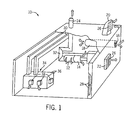
- FIG. 1 depicts an exemplary building 10 with various sources of noise and various air intake and exhaust points where noise can escape to the outside environment.
- the building 10 may be an industrial complex or residential building.
- the building 10 includes one or more noise sources such as the machinery 12, which may include heating systems, air conditioning systems, motors, turbines, compressors, pumps, machine tools, etc.
- the noise created by these sources may cause annoyance to people inside or around the building 10.
- the machinery 12 may include an air in-take 14, which may provide air to a gas compressor of the machinery 12, for example.
- the building 10 may also include a ventilation system. Accordingly, the building 10 may include ventilation intakes 16 that draw air from the outside and distribute the air through the building 10 through air ducts 18.
- the building 10 may also include an air extract 20 for providing outside air to machinery within the building 10 such an air conditioning unit, for example.
- the building 10 may also include a ventilation exhaust 22.
- the machinery 12 may produce exhaust fumes that may exit through the exhaust stack 24.
- the air intake and exhaust points may provide an opportunity for noise produced within the building 10 to escape to the outside environment.
- various sound attenuation devices in accordance with the disclosed embodiments may be acoustically coupled to the noise sources throughout the building 10.
- the air extract 20 and the ventilation exhaust 22 may include sound blocking louvers 26.
- the exterior walls of the building 10 may also be fitted with noise blocking panels 28.
- the air ducts 30 and exhaust duct 32 may be fitted with silencers that absorb sound produced by the machinery 12.
- loud machinery may be housed with an enclosure 34, which may include barrier walls 36 and may be fitted within noise blocking ventilation hoods 38.
- FIG. 2 is a block diagram of an exemplary system 40 that includes a gas turbine engine 42 acoustically coupled to sound attenuation equipment in accordance with embodiments of the present technique.
- the system 40 may include an aircraft, a watercraft, a locomotive, a power generation system, or combinations thereof.
- the load 44 may include a generator, a propeller, a transmission, a drive system, or combinations thereof.
- the illustrated gas turbine engine 42 includes an air intake section 46, a compressor 48, a combustor section 50, a turbine 52, and an exhaust section 54.
- the turbine 52 is drivingly coupled to the compressor 48 via a shaft 56.
- the illustrated combustor section 50 includes a combustor housing 58 disposed concentrically or annularly about the shaft 56 between the compressor 48 and the turbine 52. Inside the combustor housing 58, the combustor section 50 includes a plurality of combustors 60 disposed at multiple radial positions in a circular or annular configuration about the shaft 56.
- the compressed air from the compressor 48 enters each of the combustors 60, and then mixes and combusts with fuel within the respective combustors 60 to drive the turbine 52. Some or all of the resulting power may be used to drive the shaft 56 into rotation for powering the compressor 48 and/or the load 64.
- the exhaust air is used as a source of thrust for a vehicle such as a jet plane.
- the system 40 includes two main areas for noise to escape. Specifically, noise originating in the combustor section 50, compressor section 48, turbine section 52, or a combination thereof may tend to escape from the system 40 at the intake section 46 and the exhaust section 54, as illustrated by the sound waves 66.
- the system 40 may include sound-attenuating devices in accordance with present embodiments, such as silencers, in or along the flow path to/from the intake section 46 and the exhaust section 54.
- the sound-attenuating devices which will be described further below, allow the air to pass while reducing the amplitude of the sound.
- FIG. 3 depicts an exemplary sound-attenuating conduit 68 that may be employed in the various sound-attenuating devices described above in accordance with embodiments.
- the conduit 68 may include side walls 70 that direct a flow of air and attenuate sound waves traveling through the conduit 68.
- the direction of the air flowing through the conduit 68 is indicated by arrow 74 while the direction of sound emanating from the conduit 68 is indicated by the arrow 72.
- the conduit 68 as depicted in FIG. 3 is an intake conduit.
- the conduit 68 or an array of conduits 68 may also act as an exhaust, in which case the sound and the air may travel in the same direction.
- the conduit 68 may be acoustically coupled to a noise producing device such as the turbine 52 or the compressor 48 as shown in FIG. 2 .
- the conduit 68 may also be acoustically coupled to the machinery 12 or within air ducts 18 and 30, as shown in FIG. 1 .
- the present disclosure refers to air conduits, it will be appreciated that the disclosed embodiments may also include conduits that conduct any gas or fluid through which sound may travel.
- the side walls 70 of the conduit 68 may be hollow enclosures that form sound-attenuating cavities 77. It should be noted that the term “hollow,” as used in the present application, is intended to describe the form of the side walls 70 and does not refer to whether the side walls 70 are filled with sound attenuating material.
- the openings 76 may be specially shaped to enable sound to enter the sound-attenuating cavities 77 and substantially retain the sound within the sound-attenuating cavities 77.
- the cavities 77 may be filled with sound-attenuating material 78, such as mineral wool, fiberglass, foam, or any other material suitable for attenuating sound.
- sound-attenuating material 78 such as mineral wool, fiberglass, foam, or any other material suitable for attenuating sound.
- the sound-attenuating cavities 77 may be left empty.
- the dimensions of the conduit 68 may be controlled to balance the sound attenuation and air flow properties of the conduit 68.
- the noise attenuation of the conduit 68 may be increased by increasing the wall thickness 80, which may increase the size of the sound-attenuating cavity and the amount of sound-attenuating material 78 included in the side wall 70.
- the length 82 may be increased to improve the sound attenuation properties of the conduit 68.
- increasing the wall thickness 80 and/or the length 82 may increase the airflow resistance of the conduit 68. Therefore, to maintain proper air flow, the height 84 and/or width 86 of the conduit 68 may be varied.
- Increasing the size of the conduit increases weight, space consumption and cost of the device. Additionally, many applications have a limited amount of space available for noise suppression devices. For these reasons it is desirable to improve the sound attenuation of the conduit in a smaller space.
- the openings 76 provide for increased sound attenuation, the desired level of sound attenuation may be obtained with a smaller conduit 68, i.e. a conduit 68 with reduced height 84, width 86, length 82, or wall thickness 80, as compared to prior art devices. Reducing the size of the conduit 68 may provide increased airflow through the conduit 68, while also providing the cost savings, space savings, and weight reduction of a smaller device.
- FIG. 4 depicts another embodiment of a sound-attenuating conduit 68.
- the conduit 68 includes baffles 88 that increase the level of sound attenuation provided by the conduit 68.
- the baffles 88 may be enclosures that form sound-attenuating cavities filled with sound-attenuating material 78.
- both sides of the baffles 88 may include openings 76.
- the illustrated embodiment provides better noise attenuation.
- placing baffles 88 within the conduit 68 may also tend to increase airflow resistance through the conduit 68, which may be compensated for by increasing the cross-sectional area of the conduit 68.
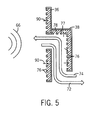
- FIG. 5 is a diagram of an exemplary embodiment of a barrier wall 36 with a vent hood 38.
- Both the barrier wall 36 and the vent hood 38 include enclosures that form sound-attenuating cavities 77 filled with sound-attenuating material 78 and include openings 76 through which sound waves may enter the sound-attenuating cavity 77, as illustrated by the arrows 90.
- sound waves 66 pass through the vent hood 38, as illustrated by the arrow 72, while air passes through the vent hood 38, as illustrated by arrow 74.
- the vent hood 38 depicted may be placed over any vent or opening from which sound may tend to escape into an outside environment, and provides a sound barrier which may tend to attenuate a portion of the sound passing through the vent hood 38.
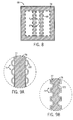
- FIG. 6 illustrates a conduit 68 with openings 76 on the internal surfaces of the conduit 68 in accordance with certain embodiments described above.
- Line 7-7 shows the location of a close-up view illustrated in FIGS 7A, 7B, and 7C.
- FIGS. 7A, 7B, and 7C illustrate three alternate close-up views of the internal wall of the conduit 68 shown in FIG. 6 and provides more detail regarding the shape of the openings 76 that lead into the sound-attenuating cavity 77.
- the openings 76 may include a hole 98 through which sound may enter into the sound-attenuating cavity 77 and a projection 100 that surrounds the hole 98 and projects into or out of the sound-attenuating cavity 77.
- the projection 100 may be angled over the hole such that the opening 76 faces toward the noise source. Additionally, the projection may partially or completely cover the hole as viewed from a direction perpendicular to the panel. As will be explained further below, the shape of the projection 100 serves to capture and retain sound within the sound-attenuating cavity, preventing sound from being reflected back out through the hole 98.
- the openings 76 form a pattern of non-flat perforations formed in the sheet 92.
- the openings 76 may include holes 98 and the perforations 100 that may be any of a variety of sound capturing and retaining shapes.
- the hole 98 may form a triangular shape and the projection 100 may form a semi-circle as viewed in a direction parallel to the sheet 92.
- the projections 100 may also be tapered, forming a semi-conical covering over the hole that is open at the base of the cone.
- the base of the conical projection 100 may face in the direction of oncoming sound waves to better attenuate sound traveling through the conduit 68.
- the hole 98 may form a rectangle and the projections 100 may form a rectangle as viewed in a direction parallel to the panel.
- the tapering of the rectangular projections 100 may form a triangular prism that is open at the side facing the direction of oncoming sound waves and the side facing the hole.
- the hole 98 may form a triangular shape and the projections 100 may form a triangle as viewed in a direction parallel to the panel.
- the tapering of the triangular projections 100 may form a pyramidal shaped covering that is open at the side of the pyramid that faces in the direction of oncoming sound waves and the side facing the hole. It will be appreciated that the examples provided in FIGS. 7A, 7B, and 7C are not limiting and that the present disclosure is not limited to a particular shape of hole 98 or projection 100.
- the openings 76 described above may be formed by simultaneously deforming and perforating a sheet 92 with a stamp, which simultaneously forms the hole 98 and the projection 100. Furthermore, the sheet 92 may be processed to add several openings 76 simultaneously. Alternatively, the hole 98 and the projection 100 may be formed separately. For example, the hole 98 may be formed in the sheet 92 first, and the projection 100 may be attached to the sheet 92 after formation of the hole.
- the sheet 92 may be made of any rigid or semi-rigid material, such as metal, plastic, wood, paperboard, or fiberboard, for example.
- FIG. 8 shows a cross-section of a conduit 68 with baffles 88.
- the side walls 70 of the conduit 68 define sound-attenuating cavities 77 that may be filled with a sound-attenuating material 78.
- the openings 76 may be disposed on the internal surfaces of the conduit 68, as shown.
- Line 9-9 shows the location of the close-up views provided in FIGS. 9A and 9B .
- openings 76 are shown wherein the projections 100 extend outward, away from the sound-attenuating cavity 77 and into the air flow path. Extending the projections 100 into the air flow path may increase the air resistance of the conduit 68, but may also increase the sound capturing qualities of the openings 76.
- openings 76 are shown wherein the projections 100 extend inward, toward the inside of the sound-attenuating cavity 77. Extending the projections 100 into the cavity 77 and out of the air flow path may tend to reduce air turbulence and air-flow generated noise within the conduit 68 and may decrease the air flow resistance of the conduit 68. In either embodiment, the openings 76 may be angled in a manner that improves sound capturing, and reduces sound escape from the cavity 77.
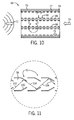
- FIG. 10 is a cross-sectional top view of the sound-attenuating conduit 68 of FIG. 4 .
- the conduit 68 includes the side walls 70 and baffles 88.
- sound is traveling through the conduit 68 in the direction indicated by arrow 72, while air is travelling through the conduit 68 in the direction indicated by the arrow 74.
- a portion of the sound enters through the openings 76 as indicated by arrows 90.
- Line 11-11 shows the location of a close-up view shown in FIG. 11 that illustrates the sound capturing properties of the baffle 88 in accordance with the embodiments.
- FIG. 11 it can be seen how the openings 76 allow the baffle 88 to retain the sound waves that enter the baffle 88.
- sound enters through the openings 76 as indicated by the arrow 102.
- the sound wave is then attenuated by the sound-attenuating material 78 within the sound-attenuating cavity 77.
- the amplitude of the sound wave decreases as it moves through the sound-attenuating material 78. The longer that the sound wave travels through the sound-attenuating material 78, the more the sound wave is attenuated.
- FIG. 11 it can be seen how the openings 76 allow the baffle 88 to retain the sound waves that enter the baffle 88.
- the projections 100 prevent the existence of an unobstructed, straight-line path that leads from one opening 76 to another opening 76 on the opposite side of the baffle 88. Therefore, as the sound wave approaches the opposite side of the baffle 88, the sound wave is reflected from the projections 100 rather than exiting the sound-attenuating cavity 77. Furthermore, the sound waves may be repeatedly reflected throughout the sound-attenuating cavity 77 resulting in an increased attenuation of the sound wave. It will be appreciated that without the projections 100, the sound wave would have a less obstructed path by which to exit the sound-attenuating cavity 77. In the disclosed embodiment, inward projections, outward projections, or both may be used to improve the sound capturing ability of the walls and baffles, thereby forcing the sound to pass through material 78 for improved attenuation.
- FIGS. 12 and 13 another embodiment of a conduit 68 that includes a sound-attenuating baffle 88 is depicted.
- the embodiment shown in FIGS. 10 and 11 may include a conduit 68 with baffles 88 that increase the level of sound attenuation provided by the conduit 68.
- the baffles 88 may be filled with sound-attenuating material 78, and both sides of the baffles 88 may include openings 76.
- the sides of the baffles 88 may include angled slats 106 held in place by a frame 108.
- the slats 106 may be located on both sides of baffle 88 and may form the sound-attenuating cavity 77. Furthermore, the slats 106 may be slanted toward the noise source, i.e. angled inward to provide an opening whereby sound waves 72 can easily enter the sound-attenuating cavity 77, as indicated by the arrow 102. Additionally, the angle and positioning of the slats 106 also prevent the sound waves from easily exiting the sound-attenuating cavity 77. Accordingly, the slats 106 may repeatedly reflect the sound waves internally through the sound-attenuating material 78 as indicated by the arrows 104, increasing the sound attenuation of the baffle 88.
- Embodiments of the present techniques may include a wide range of noise inhibiting devices such as silencers, noise suppressing hoods, noise suppressing barrier walls, etc. Such sound-attenuating devices may be included in duct work, in air exchanges, exhaust ducts, air intake ducts, or any other application where noise may escape to an outside environment. Embodiments of the present techniques may also include certain machinery with sound suppression devices included in the air intake or exhaust sections of the machinery, such as gas turbine engines, or jet engines. Other applications of the sound-attenuating devices described above or occur to those of ordinary skill in the art.
Landscapes
- Engineering & Computer Science (AREA)
- Chemical & Material Sciences (AREA)
- Combustion & Propulsion (AREA)
- Mechanical Engineering (AREA)
- General Engineering & Computer Science (AREA)
- Soundproofing, Sound Blocking, And Sound Damping (AREA)
- Exhaust Silencers (AREA)
Abstract
A method and a device for increasing the sound attenuation properties of a noise suppression device are provided. Various embodiments include sound-attenuating cavities (77) with improved sound capturing openings (76). In some embodiments, the sound capturing openings (76) include holes surrounded by projections (100). In other embodiments, the sound capturing openings (76) include angled slats (106). Embodiments also include sound capturing devices that include the improved sound capturing openings (76), such as silencers, vent hoods, barrier walls, air exchanges, and air intake and exhaust ducts.
Description
- The invention relates generally to noise suppression techniques, and more particularly to systems and methods that provide improved sound attenuation properties.
- The environmental noise caused by airplanes, automobiles, and other modem machinery can often be an annoyance. To maintain noise below acceptable levels, noise suppression techniques are often employed. Noise suppression has, therefore, become an important technology with a wide variety of industrial and residential applications. Noise suppression devices are often applied in heating ventilation and air conditioning (HVAC) systems, industrial machinery and complexes, transportation vehicles, and any machinery that may tend to produce unacceptably high levels of noise.
- Accordingly, various devices and techniques exist for the suppression of noise. For example, to reduce the noise produced by heating and air conditioning systems, noise suppression devices are often fitted within ventilation ducts, ventilation intakes and exhausts, air extracts, etc. In the industrial setting, noise suppression technology is often applied to exhaust ducts, exhaust stacks, and air intake ducts to machinery such as compressors. To further reduce environmental noise, loud machinery is often contained within acoustic enclosures fitted with sound dampening barrier walls. To provide air circulation for acoustic enclosures while still reducing noise, vents are often equipped with acoustic hoods, louvers, silencers or some combination thereof.
- The level of sound reduction, or attenuation, provided by such devices is often described in terms of the device's insertion loss. Insertion loss is the reduction in sound amplitude which results from inserting a sound-attenuating device in a sound conducting channel, and is often measured in decibels. In a test configuration wherein the sound amplitude is measured at the output of a sound conducting channel, insertion loss may be defined as a ratio of the sound amplitude without the sound-attenuating device inserted (A1) to the sound amplitude with the sound-attenuating device inserted (A2). This ratio may then be represented according to the following equation:

Typically, the insertion loss of such devices increases as the length of the device increases. Furthermore, to maintain acceptable air flow, the overall cross-sectional area of the device may be enlarged to compensate for the air flow resistance caused by the sound attenuation elements. Therefore, noise suppression equipment may tend to be bulky and expensive. As a result, it may be beneficial to provide a device with improved sound attenuation. - Embodiments of the present disclosure provide for methods and devices that increase the sound attenuation properties of certain noise suppression devices. More specifically, sound-attenuating cavities are provided which include improved sound capturing openings that tend to retain sound within the cavity rather than allow the sound to exit back through the openings. In some embodiments, the sound capturing openings include holes surrounded by projections. In other embodiments, the sound capturing openings include angled slats. Embodiments also provide noise suppression devices that include the improved sound-attenuating cavities. Still other embodiments provide noise producing machinery that includes the improved sound-attenuating cavities.
- There follows a detailed description of embodiments of the invention by way of example only with reference to the accompanying drawings, in which:
-
FIG. 1 is an environmental view of an exemplary building showing various noise sources to which sound attenuation equipment may be fitted in accordance with certain embodiments; -
FIG. 2 is a block diagram of an exemplary system having a gas turbine engine to which sound attenuation equipment may be fitted in accordance with certain embodiments; -
FIGS. 3 and 4 are perspective views showing exemplary sound-attenuating conduits that may be applied to the various noise sources depicted inFIGS. 1 and2 in accordance with certain embodiments; -
FIG. 5 is a cross-sectional view that illustrates an exemplary sound-attenuating barrier wall and vent hood in accordance with certain embodiments; -
FIG. 6 is a perspective view of an exemplary sound-attenuating conduit in accordance with certain embodiments. -
FIGS. 7A, 7B, and 7C are close-up views of an inside wall of an exemplary sound-absorbing conduit illustrating the sound-capturing openings shown inFIGS. 3, 4 , and5 in accordance with certain embodiments; -
FIG. 8 is a cross-sectional view of an exemplary sound-attenuating conduit with baffles in accordance with certain embodiments. -
FIGS. 9A and 9B are cross-sectional views of an exemplary sound-attenuating baffle, illustrating the sound-capturing openings shown inFIGS. 3, 4 , and5 in accordance with certain embodiments; -
FIG. 10 is a cross-sectional top view of an exemplary sound-attenuating conduit with baffles in accordance with certain embodiments; -
FIG. 11 is a close-up view of an exemplary sound-attenuating baffle illustrating the sound attenuation properties of the sound-capturing openings shown inFIGS. 3, 4 , and5 ; -
FIG. 12 is a perspective view of an exemplary sound-attenuating conduit that includes baffles with sound-capturing slats in accordance with certain embodiments; and -
FIG. 13 is a cross-sectional view of an exemplary sound-attenuating baffle illustrating the sound attenuation properties of the sound-capturing slats shown inFIG. 10 . - One or more specific embodiments of the present invention will be described below. In an effort to provide a concise description of these embodiments, all features of an actual implementation may not be described in the specification. It should be appreciated that in the development of any such actual implementation, as in any engineering or design project, numerous implementation-specific decisions must be made to achieve the developers' specific goals, such as compliance with system-related and business-related constraints, which may vary from one implementation to another. Moreover, it should be appreciated that such a development effort might be complex and time consuming, but would nevertheless be a routine undertaking of design, fabrication, and manufacture for those of ordinary skill having the benefit of this disclosure.
- Aspects of the present invention relate to improved noise suppression techniques. Specifically, noise suppression devices in accordance with certain embodiments include sound attenuating cavities with improved openings that provide better sound-capturing and sound retention characteristics compared to prior art. The improved openings increase the insertion loss of noise suppression devices made in accordance with the techniques described herein. As a result, noise suppression devices may be made smaller, lighter, and less expensive compared to prior art devices that provide the same level of sound attenuation.
- Turning now to the figures,
FIG. 1 depicts anexemplary building 10 with various sources of noise and various air intake and exhaust points where noise can escape to the outside environment. Thebuilding 10 may be an industrial complex or residential building. Thebuilding 10 includes one or more noise sources such as themachinery 12, which may include heating systems, air conditioning systems, motors, turbines, compressors, pumps, machine tools, etc. The noise created by these sources may cause annoyance to people inside or around thebuilding 10. - The
machinery 12 may include an air in-take 14, which may provide air to a gas compressor of themachinery 12, for example. Thebuilding 10 may also include a ventilation system. Accordingly, thebuilding 10 may includeventilation intakes 16 that draw air from the outside and distribute the air through thebuilding 10 throughair ducts 18. Thebuilding 10 may also include anair extract 20 for providing outside air to machinery within thebuilding 10 such an air conditioning unit, for example. Thebuilding 10 may also include aventilation exhaust 22. In addition, themachinery 12 may produce exhaust fumes that may exit through theexhaust stack 24. - It will be appreciated that the air intake and exhaust points may provide an opportunity for noise produced within the
building 10 to escape to the outside environment. To comply with government enacted safety and environmental standards and otherwise reduce noise, various sound attenuation devices in accordance with the disclosed embodiments may be acoustically coupled to the noise sources throughout thebuilding 10. For example, theair extract 20 and theventilation exhaust 22 may includesound blocking louvers 26. The exterior walls of thebuilding 10 may also be fitted withnoise blocking panels 28. Additionally, theair ducts 30 andexhaust duct 32 may be fitted with silencers that absorb sound produced by themachinery 12. Furthermore, loud machinery may be housed with anenclosure 34, which may includebarrier walls 36 and may be fitted within noise blockingventilation hoods 38. -
FIG. 2 is a block diagram of anexemplary system 40 that includes agas turbine engine 42 acoustically coupled to sound attenuation equipment in accordance with embodiments of the present technique. For example, thesystem 40 may include an aircraft, a watercraft, a locomotive, a power generation system, or combinations thereof. Accordingly, theload 44 may include a generator, a propeller, a transmission, a drive system, or combinations thereof. The illustratedgas turbine engine 42 includes anair intake section 46, acompressor 48, acombustor section 50, aturbine 52, and anexhaust section 54. Theturbine 52 is drivingly coupled to thecompressor 48 via ashaft 56. - As indicated by the arrows, air flows through the
intake section 46 and into thecompressor 48, which compresses the air prior to entry into thecombustor section 50. The illustratedcombustor section 50 includes acombustor housing 58 disposed concentrically or annularly about theshaft 56 between thecompressor 48 and theturbine 52. Inside thecombustor housing 58, thecombustor section 50 includes a plurality ofcombustors 60 disposed at multiple radial positions in a circular or annular configuration about theshaft 56. The compressed air from thecompressor 48 enters each of thecombustors 60, and then mixes and combusts with fuel within therespective combustors 60 to drive theturbine 52. Some or all of the resulting power may be used to drive theshaft 56 into rotation for powering thecompressor 48 and/or theload 64. In some embodiments, the exhaust air is used as a source of thrust for a vehicle such as a jet plane. - As depicted in
FIG. 2 , thesystem 40 includes two main areas for noise to escape. Specifically, noise originating in thecombustor section 50,compressor section 48,turbine section 52, or a combination thereof may tend to escape from thesystem 40 at theintake section 46 and theexhaust section 54, as illustrated by the sound waves 66. To reduce the noise released by thesystem 40 to acceptable levels, thesystem 40 may include sound-attenuating devices in accordance with present embodiments, such as silencers, in or along the flow path to/from theintake section 46 and theexhaust section 54. The sound-attenuating devices, which will be described further below, allow the air to pass while reducing the amplitude of the sound. -
FIG. 3 depicts an exemplary sound-attenuatingconduit 68 that may be employed in the various sound-attenuating devices described above in accordance with embodiments. Theconduit 68 may includeside walls 70 that direct a flow of air and attenuate sound waves traveling through theconduit 68. The direction of the air flowing through theconduit 68 is indicated byarrow 74 while the direction of sound emanating from theconduit 68 is indicated by thearrow 72. As indicated by the direction of air and the sound, it will be appreciated that theconduit 68 as depicted inFIG. 3 is an intake conduit. In some embodiments, however, theconduit 68 or an array ofconduits 68 may also act as an exhaust, in which case the sound and the air may travel in the same direction. Theconduit 68 may be acoustically coupled to a noise producing device such as theturbine 52 or thecompressor 48 as shown inFIG. 2 . Theconduit 68 may also be acoustically coupled to themachinery 12 or withinair ducts FIG. 1 . Although, for convenience, the present disclosure refers to air conduits, it will be appreciated that the disclosed embodiments may also include conduits that conduct any gas or fluid through which sound may travel. - To absorb sound, the
side walls 70 of theconduit 68 may be hollow enclosures that form sound-attenuatingcavities 77. It should be noted that the term "hollow," as used in the present application, is intended to describe the form of theside walls 70 and does not refer to whether theside walls 70 are filled with sound attenuating material. Along the internal surfaces ofconduit 68 there may beseveral openings 76 that enable sound to enter the sound-attenuatingcavities 77. As will be described further below, theopenings 76 are specially shaped to enable sound to enter the sound-attenuatingcavities 77 and substantially retain the sound within the sound-attenuatingcavities 77. To increase the level of sound attenuation, thecavities 77 may be filled with sound-attenuatingmaterial 78, such as mineral wool, fiberglass, foam, or any other material suitable for attenuating sound. In some embodiments, the sound-attenuatingcavities 77 may be left empty. As the sound travels through theconduit 68, sound enters theopenings 76 and is attenuated by the sound-attenuatingmaterial 78, thereby reducing the amplitude of the sound exiting theconduit 68. - The dimensions of the
conduit 68 may be controlled to balance the sound attenuation and air flow properties of theconduit 68. For example, the noise attenuation of theconduit 68 may be increased by increasing the wall thickness 80, which may increase the size of the sound-attenuating cavity and the amount of sound-attenuatingmaterial 78 included in theside wall 70. Additionally, thelength 82 may be increased to improve the sound attenuation properties of theconduit 68. However, increasing the wall thickness 80 and/or thelength 82 may increase the airflow resistance of theconduit 68. Therefore, to maintain proper air flow, theheight 84 and/orwidth 86 of theconduit 68 may be varied. Increasing the size of the conduit increases weight, space consumption and cost of the device. Additionally, many applications have a limited amount of space available for noise suppression devices. For these reasons it is desirable to improve the sound attenuation of the conduit in a smaller space. - Nevertheless, because the
openings 76 provide for increased sound attenuation, the desired level of sound attenuation may be obtained with asmaller conduit 68, i.e. aconduit 68 with reducedheight 84,width 86,length 82, or wall thickness 80, as compared to prior art devices. Reducing the size of theconduit 68 may provide increased airflow through theconduit 68, while also providing the cost savings, space savings, and weight reduction of a smaller device. -
FIG. 4 depicts another embodiment of a sound-attenuatingconduit 68. As shown inFIG. 4 , theconduit 68 includesbaffles 88 that increase the level of sound attenuation provided by theconduit 68. Like theside walls 70, thebaffles 88 may be enclosures that form sound-attenuating cavities filled with sound-attenuatingmaterial 78. However, unlike theside walls 70, both sides of thebaffles 88 may includeopenings 76. By including thebaffles 88, the amount of sound-attenuating surface area and volume within theconduit 68 may be increased, thus shortening thelength 82 of theconduit 68 that will provide a desired level of sound attenuation. Thus, for a set amount of space, the illustrated embodiment provides better noise attenuation. However, placing baffles 88 within theconduit 68 may also tend to increase airflow resistance through theconduit 68, which may be compensated for by increasing the cross-sectional area of theconduit 68. -
FIG. 5 is a diagram of an exemplary embodiment of abarrier wall 36 with avent hood 38. Both thebarrier wall 36 and thevent hood 38 include enclosures that form sound-attenuatingcavities 77 filled with sound-attenuatingmaterial 78 and includeopenings 76 through which sound waves may enter the sound-attenuatingcavity 77, as illustrated by thearrows 90. In the embodiment shown,sound waves 66 pass through thevent hood 38, as illustrated by thearrow 72, while air passes through thevent hood 38, as illustrated byarrow 74. Thevent hood 38 depicted may be placed over any vent or opening from which sound may tend to escape into an outside environment, and provides a sound barrier which may tend to attenuate a portion of the sound passing through thevent hood 38. -
FIG. 6 illustrates aconduit 68 withopenings 76 on the internal surfaces of theconduit 68 in accordance with certain embodiments described above. Line 7-7 shows the location of a close-up view illustrated inFIGS 7A, 7B, and 7C. FIGS. 7A, 7B, and 7C illustrate three alternate close-up views of the internal wall of theconduit 68 shown inFIG. 6 and provides more detail regarding the shape of theopenings 76 that lead into the sound-attenuatingcavity 77. As shown inFIG. 7A , theopenings 76 may include ahole 98 through which sound may enter into the sound-attenuatingcavity 77 and aprojection 100 that surrounds thehole 98 and projects into or out of the sound-attenuatingcavity 77. To acoustically bias theopening 76 toward the direction of the oncoming sound waves, theprojection 100 may be angled over the hole such that theopening 76 faces toward the noise source. Additionally, the projection may partially or completely cover the hole as viewed from a direction perpendicular to the panel. As will be explained further below, the shape of theprojection 100 serves to capture and retain sound within the sound-attenuating cavity, preventing sound from being reflected back out through thehole 98. - As shown in
FIGS. 7A, 7B and 7C , theopenings 76 form a pattern of non-flat perforations formed in thesheet 92. Furthermore, theopenings 76 may includeholes 98 and theperforations 100 that may be any of a variety of sound capturing and retaining shapes. For example, as shown inFIG. 7A , thehole 98 may form a triangular shape and theprojection 100 may form a semi-circle as viewed in a direction parallel to thesheet 92. Theprojections 100 may also be tapered, forming a semi-conical covering over the hole that is open at the base of the cone. The base of theconical projection 100 may face in the direction of oncoming sound waves to better attenuate sound traveling through theconduit 68. As seen inFIG. 7B , thehole 98 may form a rectangle and theprojections 100 may form a rectangle as viewed in a direction parallel to the panel. In this example, the tapering of therectangular projections 100 may form a triangular prism that is open at the side facing the direction of oncoming sound waves and the side facing the hole. As seen inFIG. 7C , thehole 98 may form a triangular shape and theprojections 100 may form a triangle as viewed in a direction parallel to the panel. In this example, the tapering of thetriangular projections 100 may form a pyramidal shaped covering that is open at the side of the pyramid that faces in the direction of oncoming sound waves and the side facing the hole. It will be appreciated that the examples provided inFIGS. 7A, 7B, and 7C are not limiting and that the present disclosure is not limited to a particular shape ofhole 98 orprojection 100. - The
openings 76 described above may be formed by simultaneously deforming and perforating asheet 92 with a stamp, which simultaneously forms thehole 98 and theprojection 100. Furthermore, thesheet 92 may be processed to addseveral openings 76 simultaneously. Alternatively, thehole 98 and theprojection 100 may be formed separately. For example, thehole 98 may be formed in thesheet 92 first, and theprojection 100 may be attached to thesheet 92 after formation of the hole. Thesheet 92 may be made of any rigid or semi-rigid material, such as metal, plastic, wood, paperboard, or fiberboard, for example. - Turning to
FIGS. 8, 9A, and 9B , additional embodiments of theopenings 76 are shown.FIG. 8 shows a cross-section of aconduit 68 withbaffles 88. As can be seen inFIG. 8 , theside walls 70 of theconduit 68 define sound-attenuatingcavities 77 that may be filled with a sound-attenuatingmaterial 78. Furthermore, theopenings 76 may be disposed on the internal surfaces of theconduit 68, as shown. Line 9-9 shows the location of the close-up views provided inFIGS. 9A and 9B . - Turning specifically to the close-up view of
FIG. 9A ,openings 76 are shown wherein theprojections 100 extend outward, away from the sound-attenuatingcavity 77 and into the air flow path. Extending theprojections 100 into the air flow path may increase the air resistance of theconduit 68, but may also increase the sound capturing qualities of theopenings 76. Turning specifically to the close-up view ofFIG. 9B ,openings 76 are shown wherein theprojections 100 extend inward, toward the inside of the sound-attenuatingcavity 77. Extending theprojections 100 into thecavity 77 and out of the air flow path may tend to reduce air turbulence and air-flow generated noise within theconduit 68 and may decrease the air flow resistance of theconduit 68. In either embodiment, theopenings 76 may be angled in a manner that improves sound capturing, and reduces sound escape from thecavity 77. -
FIG. 10 is a cross-sectional top view of the sound-attenuatingconduit 68 ofFIG. 4 . As described above, theconduit 68 includes theside walls 70 and baffles 88. In the embodiment depicted, sound is traveling through theconduit 68 in the direction indicated byarrow 72, while air is travelling through theconduit 68 in the direction indicated by thearrow 74. As the sound travels through theconduit 68, a portion of the sound enters through theopenings 76 as indicated byarrows 90. Line 11-11 shows the location of a close-up view shown inFIG. 11 that illustrates the sound capturing properties of thebaffle 88 in accordance with the embodiments. - Referring to the close-up view of
FIG. 11 , it can be seen how theopenings 76 allow thebaffle 88 to retain the sound waves that enter thebaffle 88. First, sound enters through theopenings 76 as indicated by thearrow 102. The sound wave is then attenuated by the sound-attenuatingmaterial 78 within the sound-attenuatingcavity 77. The amplitude of the sound wave decreases as it moves through the sound-attenuatingmaterial 78. The longer that the sound wave travels through the sound-attenuatingmaterial 78, the more the sound wave is attenuated. As shown inFIG. 11 , theprojections 100 prevent the existence of an unobstructed, straight-line path that leads from oneopening 76 to anotheropening 76 on the opposite side of thebaffle 88. Therefore, as the sound wave approaches the opposite side of thebaffle 88, the sound wave is reflected from theprojections 100 rather than exiting the sound-attenuatingcavity 77. Furthermore, the sound waves may be repeatedly reflected throughout the sound-attenuatingcavity 77 resulting in an increased attenuation of the sound wave. It will be appreciated that without theprojections 100, the sound wave would have a less obstructed path by which to exit the sound-attenuatingcavity 77. In the disclosed embodiment, inward projections, outward projections, or both may be used to improve the sound capturing ability of the walls and baffles, thereby forcing the sound to pass throughmaterial 78 for improved attenuation. - Referring now to
FIGS. 12 and 13 , another embodiment of aconduit 68 that includes a sound-attenuatingbaffle 88 is depicted. As with previous embodiments, the embodiment shown inFIGS. 10 and 11 may include aconduit 68 withbaffles 88 that increase the level of sound attenuation provided by theconduit 68. Furthermore, thebaffles 88 may be filled with sound-attenuatingmaterial 78, and both sides of thebaffles 88 may includeopenings 76. However, in the present embodiment, the sides of thebaffles 88 may includeangled slats 106 held in place by aframe 108. - As shown in
FIG. 13 , theslats 106 may be located on both sides ofbaffle 88 and may form the sound-attenuatingcavity 77. Furthermore, theslats 106 may be slanted toward the noise source, i.e. angled inward to provide an opening wherebysound waves 72 can easily enter the sound-attenuatingcavity 77, as indicated by thearrow 102. Additionally, the angle and positioning of theslats 106 also prevent the sound waves from easily exiting the sound-attenuatingcavity 77. Accordingly, theslats 106 may repeatedly reflect the sound waves internally through the sound-attenuatingmaterial 78 as indicated by thearrows 104, increasing the sound attenuation of thebaffle 88. - According to the techniques described above, the sound attenuation properties of a noise suppression device may be increased compared to prior art devices. Embodiments of the present techniques may include a wide range of noise inhibiting devices such as silencers, noise suppressing hoods, noise suppressing barrier walls, etc. Such sound-attenuating devices may be included in duct work, in air exchanges, exhaust ducts, air intake ducts, or any other application where noise may escape to an outside environment. Embodiments of the present techniques may also include certain machinery with sound suppression devices included in the air intake or exhaust sections of the machinery, such as gas turbine engines, or jet engines. Other applications of the sound-attenuating devices described above or occur to those of ordinary skill in the art.
- While only certain features of the invention have been illustrated and described herein, many modifications and changes will occur to those skilled in the art. It is, therefore, to be understood that the appended claims are intended to cover all such modifications and changes as fall within the true spirit of the invention.
- Various aspects and embodiments of the present invention are defined by the following numbered clauses:
- 1. A system, comprising:
- a turbine engine; and
- a sound-attenuating device positioned to receive sound waves upstream or downstream of the turbine engine, wherein the sound-attenuating device comprises:
- a hollow wall;
- a sound-attenuating material disposed in the hollow wall; and
- a plurality of openings into the hollow wall, wherein the openings are disposed adjacent projections that enable entry of the sound waves into the hollow wall and substantially block departure of the sound waves away from the hollow wall.
- 2. The system of clause 1, comprising a conduit having the hollow wall, wherein the plurality of openings are disposed along an interior of the conduit.
- 3. The system of clause 1, wherein the projections overlap the openings to block a straight path through the openings.
- 4. The system of clause 1, wherein the openings and projections collectively define a pattern of non-flat perforations in at least one side of the hollow wall.
- 5. The system of clause 1, wherein the projections extend into the hollow wall.
- 6. The system of clause 1, wherein the projections extend outwardly from the hollow wall.
- 7. The system of clause 1, wherein the projections comprise a plurality of angled slats in a series along at least one side of the hollow wall, and the openings are disposed between the angled slats.
- 8. A system, comprising:
- a sound-attenuating device, comprising:
- a perforated wall having a non-flat pattern of openings; and
- a sound capturing region adjacent the perforated wall.
- a sound-attenuating device, comprising:
- 9. The system of clause 8, comprising a sound-attenuating material disposed in the perforated wall.
- 10. The system of clause 8, wherein the perforated wall comprises a sheet having a plurality of deformed portions defining both projections and openings of the non-flat pattern.
- 11. The system of clause 8, wherein the non-flat pattern comprises raised portions having a taper over openings.
- 12. The system of clause 8, wherein the non-flat pattern comprises angles portions that are slanted toward the noise source.
- 13. The system of clause 8, wherein the non-flat pattern comprises a plurality of partial conical projections above or below a plane of the perforated wall.
- 14. A system, comprising:
- a sound dampening panel, comprising:
- a sound-attenuating material; and
- an enclosure disposed about the sound-attenuating material, wherein the enclosure comprises at least one perforated wall having a plurality of projected openings with tapered paths into the sound-attenuating material.
- a sound dampening panel, comprising:
- 15. The system of
clause 14, wherein the plurality of projected openings with tapered paths block a straight line path of sound waves in a perpendicular direction through the perforated panel. - 16. The system of
clause 14, comprising a conduit having the sound dampening panel. - 17. The system of
clause 16, wherein the sound dampening panel comprises a baffle within the conduit, and the at least one perforated panel comprises first and second perforated panels on opposite sides of the baffle within the conduit. - 18. The system of
clause 14, comprising a vent hood having the sound dampening panel. - 19. A system comprising:
- a sound dampening panel, comprising:
- an enclosure comprising a cavity configured to receive and retain sound emitted by a source; and
- the enclosure comprising a plurality of slats supported by a frame and angled inward toward the cavity, wherein the slats are configured to enable sound to enter the cavity through spacings between the slats, and the slats are configured to block the sound from exiting the cavity.
- a sound dampening panel, comprising:
- 20. The system of clause 19, wherein the panel is positioned within a conduit parallel to a direction of air flow such that no significant amount of air flows through the panel.
- 21. The system of clause 19, wherein the slats are located on parallel sides of the enclosure and wherein the slats are angled such that sound waves entering the cavity through the first parallel side are blocked from exiting the cavity by the slats on the second parallel side.
- 22. A method of attenuating sound waves, comprising:
- receiving sound waves from a noise source through one or more openings in an enclosure that defines a sound-attenuating cavity; and
- blocking the sound waves from exiting through the one or more openings with one or more raised portions that surround the one or more openings.
- 23. The method of
clause 22, wherein receiving sound waves comprises directing the sound waves into the sound-attenuating cavity with angle portions slanted toward the noise source. - 24. The method of
clause 22, wherein blocking the sound waves from exiting through the one or more openings comprises reflecting the sound waves from the one or more raised portions. - 25. The method of
clause 22, comprising diminishing the amplitude of the sound waves by passing the sound waves through a sound dampening material positioned within the cavity.
Claims (15)
- A system, comprising:a turbine engine (42); anda sound-attenuating device (68) positioned to receive sound waves upstream or downstream of the turbine engine (42), wherein the sound-attenuating device (68) comprises: a hollow wall (70);a sound-attenuating material (78) disposed in the hollow wall (70); anda plurality of openings (76) into the hollow wall (70), wherein the openings (76) are disposed adjacent projections (100) that enable entry of the sound waves into the hollow wall (70) and substantially block departure of the sound waves away from the hollow wall (70).
- The system of claim 1, comprising a conduit having the hollow wall (70), wherein the plurality of openings (76) are disposed along an interior of the conduit.
- The system of claim 1 or 2, wherein the projections (100) overlap the openings (76) to block a straight path through the openings (76).
- The system of any of the preceding claims, wherein the openings (76) and projections (100) collectively define a pattern of non-flat perforations in at least one side of the hollow wall (70).
- The system of any of the preceding claims, wherein the projections (100) extend into the hollow wall (70).
- The system of any of the claims 1 to 4, wherein the projections (100) extend outwardly from the hollow wall (70).
- The system of any of claims 1 to 4, wherein the projections (100) comprise a plurality of angled slats (106) in a series along at least one side of the hollow wall (70), and the openings (76) are disposed between the angled slats (106).
- A system, comprising:a sound-attenuating device (68), comprising:a perforated wall (70) having a non-flat pattern of openings (76); anda sound capturing region adjacent the perforated wall (70).
- The system of claim 8, comprising a sound-attenuating material (78) disposed in the perforated wall (70), wherein the perforated wall (70) comprises a sheet having a plurality of deformed portions defining both projections (100) and openings (76) of the non-flat pattern.
- The system of claim 8 or 9, wherein the non-flat pattern comprises angles portions (100) that are slanted toward the noise source.
- A system, comprising:a sound dampening panel, comprising:a sound-attenuating material; andan enclosure disposed about the sound-attenuating material, wherein the enclosure comprises at least one perforated wall having a plurality of projected openings with tapered paths into the sound-attenuating material.
- A method of attenuating sound waves, comprising:receiving sound waves from a noise source through one or more openings in an enclosure that defines a sound-attenuating cavity; andblocking the sound waves from exiting through the one or more openings with one or more raised portions that surround the one or more openings.
- The method of claim 12, wherein receiving sound waves comprises directing the sound waves into the sound-attenuating cavity with angle portions slanted toward the noise source.
- The method of claims 12 or 13, wherein blocking the sound waves from exiting through the one or more openings comprises reflecting the sound waves from the one or more raised portions.
- The method of any of claims 12 to 14, comprising diminishing the amplitude of the sound waves by passing the sound waves through a sound dampening material positioned within the cavity.
Applications Claiming Priority (1)
| Application Number | Priority Date | Filing Date | Title |
|---|---|---|---|
| US12/243,923 US8459407B2 (en) | 2008-10-01 | 2008-10-01 | Sound attenuation systems and methods |
Publications (1)
| Publication Number | Publication Date |
|---|---|
| EP2172623A2 true EP2172623A2 (en) | 2010-04-07 |
Family
ID=41347869
Family Applications (1)
| Application Number | Title | Priority Date | Filing Date |
|---|---|---|---|
| EP09171705A Withdrawn EP2172623A2 (en) | 2008-10-01 | 2009-09-29 | Sound attenuation system and method |
Country Status (4)
| Country | Link |
|---|---|
| US (1) | US8459407B2 (en) |
| EP (1) | EP2172623A2 (en) |
| JP (1) | JP5738524B2 (en) |
| CN (1) | CN101713335B (en) |
Families Citing this family (43)
| Publication number | Priority date | Publication date | Assignee | Title |
|---|---|---|---|---|
| GB201113034D0 (en) * | 2011-07-28 | 2011-09-14 | Airbus Uk Ltd | An conditioning system exhaust silencer for an aircraft |
| US8685302B2 (en) | 2012-02-20 | 2014-04-01 | Honeywell International Inc. | Monolithic acoustically-treated composite structures and methods for fabricating the same |
| JP5972619B2 (en) * | 2012-03-16 | 2016-08-17 | 三菱重工業株式会社 | Air intake duct |
| KR101807783B1 (en) * | 2012-06-18 | 2018-01-18 | 목포해양대학교 산학협력단 | Soundproof duct for ship propellors using resonators |
| JP5907916B2 (en) * | 2013-03-15 | 2016-04-26 | 三菱重工業株式会社 | Exhaust system |
| JP6057790B2 (en) | 2013-03-15 | 2017-01-11 | 三菱重工業株式会社 | Silencer for gas turbine and gas turbine having the same |
| US9305539B2 (en) | 2013-04-04 | 2016-04-05 | Trane International Inc. | Acoustic dispersing airflow passage |
| US20150069763A1 (en) * | 2013-09-10 | 2015-03-12 | General Electric Company | Load cover |
| EP2871636B1 (en) * | 2013-11-08 | 2021-01-06 | Volvo Car Corporation | Sound reduction system |
| DE102014209323A1 (en) * | 2014-05-16 | 2015-11-19 | Mahle International Gmbh | Plastic component |
| US9290274B2 (en) * | 2014-06-02 | 2016-03-22 | Mra Systems, Inc. | Acoustically attenuating sandwich panel constructions |
| CN106687674A (en) * | 2014-09-03 | 2017-05-17 | 通用电气公司 | Acoustic Treatment Components for Turbine Systems |
| KR101637231B1 (en) * | 2015-05-19 | 2016-07-07 | (주)성신엔스텍 | Vessel Gas turbine Noise Reduction Device |
| US10577973B2 (en) | 2016-02-18 | 2020-03-03 | General Electric Company | Service tube for a turbine engine |
| US20170276397A1 (en) * | 2016-03-24 | 2017-09-28 | VAW Systems Ltd. | Sound Attenuating Baffle Including a Non-Eroding Liner Sheet |
| CN106128446A (en) * | 2016-08-29 | 2016-11-16 | 江苏标榜装饰新材料股份有限公司 | Micropunch abatvoix |
| BE1024535B1 (en) * | 2016-09-05 | 2018-04-04 | Safran Aero Boosters S.A. | TURBOMACHINE TEST BENCH WITH ACTIVE NOISE CONTROL |
| US20180135514A1 (en) * | 2016-09-27 | 2018-05-17 | General Electric Company | Sound attenuating system for gas turbine engine |
| US11891796B2 (en) | 2017-04-13 | 2024-02-06 | Davies Collision Cave Pty Ltd | Aero-acoustic materials processing plant with noise attenuation system |
| US10980391B2 (en) | 2017-04-28 | 2021-04-20 | Owens Corning Intellectual Capital, Llc | Appliance with acoustically insulated ductwork |
| US10662839B2 (en) * | 2017-06-28 | 2020-05-26 | General Electric Company | Exhaust stack assemblies with acoustic attenuation features |
| CN107869459B (en) * | 2017-11-14 | 2024-10-25 | 美的集团股份有限公司 | Water Pump |
| US10626886B2 (en) * | 2018-04-18 | 2020-04-21 | Honeywell International Inc. | Sound attenuation apparatus and methods |
| US11047304B2 (en) * | 2018-08-08 | 2021-06-29 | General Electric Company | Acoustic cores with sound-attenuating protuberances |
| CN109119059B (en) * | 2018-09-21 | 2020-11-27 | 同济大学 | A Double Negative Acoustic Metamaterial Structure Based on Helmholtz Resonator Coupling |
| US11592205B2 (en) * | 2018-12-18 | 2023-02-28 | Johnson Controls Tyco IP Holdings LLP | Silencer assembly for air handling unit of an HVAC system |
| US10815833B1 (en) * | 2019-05-21 | 2020-10-27 | Marine Turbine Technologies, LLC | Exhaust baffle apparatus and method |
| US11028732B2 (en) * | 2019-09-05 | 2021-06-08 | Rolls-Royce North American Technologies Inc. | High temperature panel damper for sheet metal structures |
| US12292067B2 (en) | 2019-09-06 | 2025-05-06 | Yantai Jereh Petroleum Equipment & Technologies Co., Ltd. | Turbine engine air intake system and cabin |
| CN110454285A (en) * | 2019-09-06 | 2019-11-15 | 烟台杰瑞石油装备技术有限公司 | A kind of sound insulation cabin of turbogenerator |
| WO2021042371A1 (en) * | 2019-09-06 | 2021-03-11 | 烟台杰瑞石油装备技术有限公司 | Sound insulation compartment for turbine engine |
| US12540575B2 (en) | 2019-09-06 | 2026-02-03 | Yantai Jereh Petroleum Equipment & Technologies Co., Ltd. | Hydraulic fracturing system for driving a plunger pump with a turbine engine and noise reduction thereof |
| KR102300999B1 (en) | 2019-09-09 | 2021-09-10 | 두산중공업 주식회사 | Stud connection structure for noise shield wall |
| CN110940201A (en) * | 2019-10-22 | 2020-03-31 | 浙江万享科技股份有限公司 | Counter-flow low-noise closed cooling tower for direct-current power transmission |
| CN110940083B (en) * | 2019-12-31 | 2023-10-24 | 天津丽茂源松节能技术有限公司 | Silencing device of fresh air system |
| KR102284717B1 (en) * | 2020-02-28 | 2021-08-02 | 지이텍 주식회사 | Noise reduction device having water eliminating function and blower comprising the same |
| CN212899157U (en) | 2020-07-27 | 2021-04-06 | 开利公司 | Noise reduction device for fan outlet side and heat exchange system comprising same |
| JP7544398B2 (en) | 2020-10-30 | 2024-09-03 | 国立研究開発法人宇宙航空研究開発機構 | Pressure Fluctuation Absorption Structure |
| US12283262B2 (en) * | 2021-06-24 | 2025-04-22 | Tyco Fire & Security Gmbh | Tunable silencer for air handling unit |
| US20240367809A1 (en) * | 2021-11-17 | 2024-11-07 | Verdego Aero, Inc. | Inlet and outlet air geometry and components to reduce noise from an aircraft component enclosure |
| JP7737874B2 (en) * | 2021-11-19 | 2025-09-11 | 三菱重工業株式会社 | Noise suppression device |
| JP2025075508A (en) * | 2023-10-31 | 2025-05-15 | シャープ株式会社 | Sound-reducing pipes, silencers, vacuum cleaners |
| US20250297578A1 (en) * | 2024-03-25 | 2025-09-25 | Rtx Corporation | Integrated surface treatment for drag and noise reduction |
Family Cites Families (19)
| Publication number | Priority date | Publication date | Assignee | Title |
|---|---|---|---|---|
| US1918149A (en) * | 1931-05-08 | 1933-07-11 | Burgess Lab Inc C F | Sound transmitting and sound absorbing construction |
| US2489048A (en) * | 1947-12-03 | 1949-11-22 | Johns Manville | Insulated duct |
| US2959243A (en) * | 1956-03-29 | 1960-11-08 | Gen Sound Control Inc | Sound absorbing structure |
| US3019850A (en) * | 1958-04-08 | 1962-02-06 | John J March | Prefabricated insulated duct and sound trap |
| US3522863A (en) * | 1968-07-15 | 1970-08-04 | Vincent E Ignoffo | Glass-packed muffler |
| CA1027002A (en) * | 1974-08-30 | 1978-02-28 | Horst W.W. Hehmann | Phased treatment noise suppressor for acoustic duct applications |
| US4184565A (en) * | 1978-12-15 | 1980-01-22 | Harris V C | Exhaust muffler |
| US4316522A (en) * | 1979-11-07 | 1982-02-23 | Industrial Acoustics Company, Inc. | Acoustic filter silencer |
| US4325459A (en) * | 1980-09-29 | 1982-04-20 | Martin Mack M | Muffler diffuser |
| JPS6217675Y2 (en) * | 1980-12-05 | 1987-05-07 | ||
| US4487290A (en) * | 1983-04-29 | 1984-12-11 | Mustang Units Co. | Light aircraft engine muffler |
| US4645032A (en) * | 1985-09-05 | 1987-02-24 | The Garrett Corporation | Compact muffler apparatus and associated methods |
| AU2094288A (en) * | 1988-08-16 | 1990-02-15 | Fujitsubo Giken Co. Ltd. | Automobile muffler |
| US5809770A (en) * | 1995-07-31 | 1998-09-22 | Donaldson Company, Inc. | Silencer for a gas flow |
| CA2164370A1 (en) * | 1995-12-04 | 1997-06-05 | Donald L. Allen | Reactive acoustic silencer |
| US6116377A (en) * | 1998-12-29 | 2000-09-12 | Dugan; Jimmie Robert | Sound attenuation devices for internal combustion engines |
| US6679351B2 (en) * | 2001-02-15 | 2004-01-20 | Ttr Hp, Inc. | Air turbine for combustion engine |
| US20050161280A1 (en) * | 2002-12-26 | 2005-07-28 | Fujitsu Limited | Silencer and electronic equipment |
| DE102004053383A1 (en) * | 2004-11-02 | 2006-05-04 | Eads Deutschland Gmbh | Acoustic absorber for aircraft engines |
-
2008
- 2008-10-01 US US12/243,923 patent/US8459407B2/en not_active Expired - Fee Related
-
2009
- 2009-09-29 EP EP09171705A patent/EP2172623A2/en not_active Withdrawn
- 2009-09-30 JP JP2009225683A patent/JP5738524B2/en not_active Expired - Fee Related
- 2009-09-30 CN CN200910204755.2A patent/CN101713335B/en not_active Expired - Fee Related
Also Published As
| Publication number | Publication date |
|---|---|
| US20100077754A1 (en) | 2010-04-01 |
| CN101713335B (en) | 2014-11-19 |
| CN101713335A (en) | 2010-05-26 |
| US8459407B2 (en) | 2013-06-11 |
| JP2010084768A (en) | 2010-04-15 |
| JP5738524B2 (en) | 2015-06-24 |
Similar Documents
| Publication | Publication Date | Title |
|---|---|---|
| US8459407B2 (en) | Sound attenuation systems and methods | |
| US8240427B2 (en) | Sound attenuation systems and methods | |
| US8230967B2 (en) | Vane type silencers in elbow for gas turbine | |
| US5297517A (en) | Noise suppression enclosure for an engine | |
| EP2705232B1 (en) | Device for damping of sounds and motor vehicle comprising such a device | |
| JP6840670B2 (en) | Active noise control system | |
| US10494969B2 (en) | Active noise cancelation systems and devices | |
| EP3034945B1 (en) | Gas turbine fuel pipe comprising a damper | |
| JP6530977B2 (en) | Air intake structure of construction machine | |
| EP3144501A1 (en) | Silencer duct having silencing element extending therethrough | |
| CN106545417A (en) | Noise reduction panel section and related silencing pipeline | |
| CN108071488A (en) | The system and method for hydroacoustics processing | |
| CN109878741B (en) | Internal structure of main exhaust duct of turbine, turbine and aircraft | |
| WO1993004272A1 (en) | Noise suppression enclosure for an engine | |
| JP4982165B2 (en) | Silencer | |
| CN210343440U (en) | Sound-proof housing for turbonator | |
| JP2021110260A (en) | Blower module | |
| CN213751946U (en) | Compressed air discharging silencer | |
| JPH11148700A (en) | Low-noise air-conditioning grille | |
| CN222670109U (en) | Air duct structure and integrated kitchen | |
| JPH07504379A (en) | Buildings for testing aircraft engines, especially of the propeller type. | |
| CN106545416A (en) | Noise reduction panel and silene system | |
| Wirt | Gas turbine exhaust noise and its attenuation | |
| WO2023091583A1 (en) | Inlet and outlet air geometry and components to reduce noise from an aircraft component enclosure | |
| CN106438048A (en) | Inlet system for a gas turbine and gas turbine |
Legal Events
| Date | Code | Title | Description |
|---|---|---|---|
| PUAI | Public reference made under article 153(3) epc to a published international application that has entered the european phase |
Free format text: ORIGINAL CODE: 0009012 |
|
| AK | Designated contracting states |
Kind code of ref document: A2 Designated state(s): AT BE BG CH CY CZ DE DK EE ES FI FR GB GR HR HU IE IS IT LI LT LU LV MC MK MT NL NO PL PT RO SE SI SK SM TR |
|
| AX | Request for extension of the european patent |
Extension state: AL BA RS |
|
| STAA | Information on the status of an ep patent application or granted ep patent |
Free format text: STATUS: THE APPLICATION IS DEEMED TO BE WITHDRAWN |
|
| 18D | Application deemed to be withdrawn |
Effective date: 20160401 |