EP2172472A2 - Aminophosphonic acid derivative, salt thereof and modulator of S1P receptor - Google Patents
Aminophosphonic acid derivative, salt thereof and modulator of S1P receptor Download PDFInfo
- Publication number
- EP2172472A2 EP2172472A2 EP09178067A EP09178067A EP2172472A2 EP 2172472 A2 EP2172472 A2 EP 2172472A2 EP 09178067 A EP09178067 A EP 09178067A EP 09178067 A EP09178067 A EP 09178067A EP 2172472 A2 EP2172472 A2 EP 2172472A2
- Authority
- EP
- European Patent Office
- Prior art keywords
- group
- carbon atoms
- compound
- colorless oil
- general formula
- Prior art date
- Legal status (The legal status is an assumption and is not a legal conclusion. Google has not performed a legal analysis and makes no representation as to the accuracy of the status listed.)
- Granted
Links
- 0 *CC(*)(*c1ccc(*c2cccc(*Cc3ccccc3)c2)cc1)N Chemical compound *CC(*)(*c1ccc(*c2cccc(*Cc3ccccc3)c2)cc1)N 0.000 description 12
- LTDDLAYANHJJSP-UHFFFAOYSA-N CC(C)(C)OC(NC(CCCc(c(Cl)c1)ccc1Sc1cc(OCc2ccccc2)ccc1)(CO)COCOC)=O Chemical compound CC(C)(C)OC(NC(CCCc(c(Cl)c1)ccc1Sc1cc(OCc2ccccc2)ccc1)(CO)COCOC)=O LTDDLAYANHJJSP-UHFFFAOYSA-N 0.000 description 1
- VUZCVTMNWLNIQX-UHFFFAOYSA-N OCCCc(c(Cl)c1)ccc1Sc1cc(OCc2ccccc2)ccc1 Chemical compound OCCCc(c(Cl)c1)ccc1Sc1cc(OCc2ccccc2)ccc1 VUZCVTMNWLNIQX-UHFFFAOYSA-N 0.000 description 1
Classifications
-
- C—CHEMISTRY; METALLURGY
- C07—ORGANIC CHEMISTRY
- C07C—ACYCLIC OR CARBOCYCLIC COMPOUNDS
- C07C47/00—Compounds having —CHO groups
- C07C47/52—Compounds having —CHO groups bound to carbon atoms of six—membered aromatic rings
- C07C47/575—Compounds having —CHO groups bound to carbon atoms of six—membered aromatic rings containing ether groups, groups, groups, or groups
-
- C—CHEMISTRY; METALLURGY
- C07—ORGANIC CHEMISTRY
- C07F—ACYCLIC, CARBOCYCLIC OR HETEROCYCLIC COMPOUNDS CONTAINING ELEMENTS OTHER THAN CARBON, HYDROGEN, HALOGEN, OXYGEN, NITROGEN, SULFUR, SELENIUM OR TELLURIUM
- C07F9/00—Compounds containing elements of Groups 5 or 15 of the Periodic Table
- C07F9/02—Phosphorus compounds
- C07F9/06—Phosphorus compounds without P—C bonds
- C07F9/08—Esters of oxyacids of phosphorus
- C07F9/09—Esters of phosphoric acids
-
- A—HUMAN NECESSITIES
- A61—MEDICAL OR VETERINARY SCIENCE; HYGIENE
- A61K—PREPARATIONS FOR MEDICAL, DENTAL OR TOILETRY PURPOSES
- A61K31/00—Medicinal preparations containing organic active ingredients
- A61K31/66—Phosphorus compounds
- A61K31/661—Phosphorus acids or esters thereof not having P—C bonds, e.g. fosfosal, dichlorvos, malathion or mevinphos
-
- A—HUMAN NECESSITIES
- A61—MEDICAL OR VETERINARY SCIENCE; HYGIENE
- A61P—SPECIFIC THERAPEUTIC ACTIVITY OF CHEMICAL COMPOUNDS OR MEDICINAL PREPARATIONS
- A61P1/00—Drugs for disorders of the alimentary tract or the digestive system
-
- A—HUMAN NECESSITIES
- A61—MEDICAL OR VETERINARY SCIENCE; HYGIENE
- A61P—SPECIFIC THERAPEUTIC ACTIVITY OF CHEMICAL COMPOUNDS OR MEDICINAL PREPARATIONS
- A61P1/00—Drugs for disorders of the alimentary tract or the digestive system
- A61P1/04—Drugs for disorders of the alimentary tract or the digestive system for ulcers, gastritis or reflux esophagitis, e.g. antacids, inhibitors of acid secretion, mucosal protectants
-
- A—HUMAN NECESSITIES
- A61—MEDICAL OR VETERINARY SCIENCE; HYGIENE
- A61P—SPECIFIC THERAPEUTIC ACTIVITY OF CHEMICAL COMPOUNDS OR MEDICINAL PREPARATIONS
- A61P1/00—Drugs for disorders of the alimentary tract or the digestive system
- A61P1/16—Drugs for disorders of the alimentary tract or the digestive system for liver or gallbladder disorders, e.g. hepatoprotective agents, cholagogues, litholytics
-
- A—HUMAN NECESSITIES
- A61—MEDICAL OR VETERINARY SCIENCE; HYGIENE
- A61P—SPECIFIC THERAPEUTIC ACTIVITY OF CHEMICAL COMPOUNDS OR MEDICINAL PREPARATIONS
- A61P11/00—Drugs for disorders of the respiratory system
-
- A—HUMAN NECESSITIES
- A61—MEDICAL OR VETERINARY SCIENCE; HYGIENE
- A61P—SPECIFIC THERAPEUTIC ACTIVITY OF CHEMICAL COMPOUNDS OR MEDICINAL PREPARATIONS
- A61P11/00—Drugs for disorders of the respiratory system
- A61P11/02—Nasal agents, e.g. decongestants
-
- A—HUMAN NECESSITIES
- A61—MEDICAL OR VETERINARY SCIENCE; HYGIENE
- A61P—SPECIFIC THERAPEUTIC ACTIVITY OF CHEMICAL COMPOUNDS OR MEDICINAL PREPARATIONS
- A61P11/00—Drugs for disorders of the respiratory system
- A61P11/06—Antiasthmatics
-
- A—HUMAN NECESSITIES
- A61—MEDICAL OR VETERINARY SCIENCE; HYGIENE
- A61P—SPECIFIC THERAPEUTIC ACTIVITY OF CHEMICAL COMPOUNDS OR MEDICINAL PREPARATIONS
- A61P13/00—Drugs for disorders of the urinary system
-
- A—HUMAN NECESSITIES
- A61—MEDICAL OR VETERINARY SCIENCE; HYGIENE
- A61P—SPECIFIC THERAPEUTIC ACTIVITY OF CHEMICAL COMPOUNDS OR MEDICINAL PREPARATIONS
- A61P13/00—Drugs for disorders of the urinary system
- A61P13/12—Drugs for disorders of the urinary system of the kidneys
-
- A—HUMAN NECESSITIES
- A61—MEDICAL OR VETERINARY SCIENCE; HYGIENE
- A61P—SPECIFIC THERAPEUTIC ACTIVITY OF CHEMICAL COMPOUNDS OR MEDICINAL PREPARATIONS
- A61P17/00—Drugs for dermatological disorders
-
- A—HUMAN NECESSITIES
- A61—MEDICAL OR VETERINARY SCIENCE; HYGIENE
- A61P—SPECIFIC THERAPEUTIC ACTIVITY OF CHEMICAL COMPOUNDS OR MEDICINAL PREPARATIONS
- A61P17/00—Drugs for dermatological disorders
- A61P17/02—Drugs for dermatological disorders for treating wounds, ulcers, burns, scars, keloids, or the like
-
- A—HUMAN NECESSITIES
- A61—MEDICAL OR VETERINARY SCIENCE; HYGIENE
- A61P—SPECIFIC THERAPEUTIC ACTIVITY OF CHEMICAL COMPOUNDS OR MEDICINAL PREPARATIONS
- A61P19/00—Drugs for skeletal disorders
- A61P19/02—Drugs for skeletal disorders for joint disorders, e.g. arthritis, arthrosis
-
- A—HUMAN NECESSITIES
- A61—MEDICAL OR VETERINARY SCIENCE; HYGIENE
- A61P—SPECIFIC THERAPEUTIC ACTIVITY OF CHEMICAL COMPOUNDS OR MEDICINAL PREPARATIONS
- A61P21/00—Drugs for disorders of the muscular or neuromuscular system
- A61P21/04—Drugs for disorders of the muscular or neuromuscular system for myasthenia gravis
-
- A—HUMAN NECESSITIES
- A61—MEDICAL OR VETERINARY SCIENCE; HYGIENE
- A61P—SPECIFIC THERAPEUTIC ACTIVITY OF CHEMICAL COMPOUNDS OR MEDICINAL PREPARATIONS
- A61P25/00—Drugs for disorders of the nervous system
-
- A—HUMAN NECESSITIES
- A61—MEDICAL OR VETERINARY SCIENCE; HYGIENE
- A61P—SPECIFIC THERAPEUTIC ACTIVITY OF CHEMICAL COMPOUNDS OR MEDICINAL PREPARATIONS
- A61P27/00—Drugs for disorders of the senses
- A61P27/02—Ophthalmic agents
- A61P27/14—Decongestants or antiallergics
-
- A—HUMAN NECESSITIES
- A61—MEDICAL OR VETERINARY SCIENCE; HYGIENE
- A61P—SPECIFIC THERAPEUTIC ACTIVITY OF CHEMICAL COMPOUNDS OR MEDICINAL PREPARATIONS
- A61P29/00—Non-central analgesic, antipyretic or antiinflammatory agents, e.g. antirheumatic agents; Non-steroidal antiinflammatory drugs [NSAID]
-
- A—HUMAN NECESSITIES
- A61—MEDICAL OR VETERINARY SCIENCE; HYGIENE
- A61P—SPECIFIC THERAPEUTIC ACTIVITY OF CHEMICAL COMPOUNDS OR MEDICINAL PREPARATIONS
- A61P3/00—Drugs for disorders of the metabolism
- A61P3/08—Drugs for disorders of the metabolism for glucose homeostasis
- A61P3/10—Drugs for disorders of the metabolism for glucose homeostasis for hyperglycaemia, e.g. antidiabetics
-
- A—HUMAN NECESSITIES
- A61—MEDICAL OR VETERINARY SCIENCE; HYGIENE
- A61P—SPECIFIC THERAPEUTIC ACTIVITY OF CHEMICAL COMPOUNDS OR MEDICINAL PREPARATIONS
- A61P31/00—Antiinfectives, i.e. antibiotics, antiseptics, chemotherapeutics
- A61P31/04—Antibacterial agents
-
- A—HUMAN NECESSITIES
- A61—MEDICAL OR VETERINARY SCIENCE; HYGIENE
- A61P—SPECIFIC THERAPEUTIC ACTIVITY OF CHEMICAL COMPOUNDS OR MEDICINAL PREPARATIONS
- A61P35/00—Antineoplastic agents
-
- A—HUMAN NECESSITIES
- A61—MEDICAL OR VETERINARY SCIENCE; HYGIENE
- A61P—SPECIFIC THERAPEUTIC ACTIVITY OF CHEMICAL COMPOUNDS OR MEDICINAL PREPARATIONS
- A61P37/00—Drugs for immunological or allergic disorders
-
- A—HUMAN NECESSITIES
- A61—MEDICAL OR VETERINARY SCIENCE; HYGIENE
- A61P—SPECIFIC THERAPEUTIC ACTIVITY OF CHEMICAL COMPOUNDS OR MEDICINAL PREPARATIONS
- A61P37/00—Drugs for immunological or allergic disorders
- A61P37/02—Immunomodulators
-
- A—HUMAN NECESSITIES
- A61—MEDICAL OR VETERINARY SCIENCE; HYGIENE
- A61P—SPECIFIC THERAPEUTIC ACTIVITY OF CHEMICAL COMPOUNDS OR MEDICINAL PREPARATIONS
- A61P37/00—Drugs for immunological or allergic disorders
- A61P37/02—Immunomodulators
- A61P37/06—Immunosuppressants, e.g. drugs for graft rejection
-
- A—HUMAN NECESSITIES
- A61—MEDICAL OR VETERINARY SCIENCE; HYGIENE
- A61P—SPECIFIC THERAPEUTIC ACTIVITY OF CHEMICAL COMPOUNDS OR MEDICINAL PREPARATIONS
- A61P37/00—Drugs for immunological or allergic disorders
- A61P37/08—Antiallergic agents
-
- A—HUMAN NECESSITIES
- A61—MEDICAL OR VETERINARY SCIENCE; HYGIENE
- A61P—SPECIFIC THERAPEUTIC ACTIVITY OF CHEMICAL COMPOUNDS OR MEDICINAL PREPARATIONS
- A61P43/00—Drugs for specific purposes, not provided for in groups A61P1/00-A61P41/00
-
- A—HUMAN NECESSITIES
- A61—MEDICAL OR VETERINARY SCIENCE; HYGIENE
- A61P—SPECIFIC THERAPEUTIC ACTIVITY OF CHEMICAL COMPOUNDS OR MEDICINAL PREPARATIONS
- A61P9/00—Drugs for disorders of the cardiovascular system
-
- A—HUMAN NECESSITIES
- A61—MEDICAL OR VETERINARY SCIENCE; HYGIENE
- A61P—SPECIFIC THERAPEUTIC ACTIVITY OF CHEMICAL COMPOUNDS OR MEDICINAL PREPARATIONS
- A61P9/00—Drugs for disorders of the cardiovascular system
- A61P9/04—Inotropic agents, i.e. stimulants of cardiac contraction; Drugs for heart failure
-
- A—HUMAN NECESSITIES
- A61—MEDICAL OR VETERINARY SCIENCE; HYGIENE
- A61P—SPECIFIC THERAPEUTIC ACTIVITY OF CHEMICAL COMPOUNDS OR MEDICINAL PREPARATIONS
- A61P9/00—Drugs for disorders of the cardiovascular system
- A61P9/10—Drugs for disorders of the cardiovascular system for treating ischaemic or atherosclerotic diseases, e.g. antianginal drugs, coronary vasodilators, drugs for myocardial infarction, retinopathy, cerebrovascula insufficiency, renal arteriosclerosis
-
- A—HUMAN NECESSITIES
- A61—MEDICAL OR VETERINARY SCIENCE; HYGIENE
- A61P—SPECIFIC THERAPEUTIC ACTIVITY OF CHEMICAL COMPOUNDS OR MEDICINAL PREPARATIONS
- A61P9/00—Drugs for disorders of the cardiovascular system
- A61P9/14—Vasoprotectives; Antihaemorrhoidals; Drugs for varicose therapy; Capillary stabilisers
-
- C—CHEMISTRY; METALLURGY
- C07—ORGANIC CHEMISTRY
- C07C—ACYCLIC OR CARBOCYCLIC COMPOUNDS
- C07C45/00—Preparation of compounds having >C = O groups bound only to carbon or hydrogen atoms; Preparation of chelates of such compounds
- C07C45/61—Preparation of compounds having >C = O groups bound only to carbon or hydrogen atoms; Preparation of chelates of such compounds by reactions not involving the formation of >C = O groups
- C07C45/67—Preparation of compounds having >C = O groups bound only to carbon or hydrogen atoms; Preparation of chelates of such compounds by reactions not involving the formation of >C = O groups by isomerisation; by change of size of the carbon skeleton
- C07C45/68—Preparation of compounds having >C = O groups bound only to carbon or hydrogen atoms; Preparation of chelates of such compounds by reactions not involving the formation of >C = O groups by isomerisation; by change of size of the carbon skeleton by increase in the number of carbon atoms
- C07C45/70—Preparation of compounds having >C = O groups bound only to carbon or hydrogen atoms; Preparation of chelates of such compounds by reactions not involving the formation of >C = O groups by isomerisation; by change of size of the carbon skeleton by increase in the number of carbon atoms by reaction with functional groups containing oxygen only in singly bound form
- C07C45/71—Preparation of compounds having >C = O groups bound only to carbon or hydrogen atoms; Preparation of chelates of such compounds by reactions not involving the formation of >C = O groups by isomerisation; by change of size of the carbon skeleton by increase in the number of carbon atoms by reaction with functional groups containing oxygen only in singly bound form being hydroxy groups
-
- C—CHEMISTRY; METALLURGY
- C07—ORGANIC CHEMISTRY
- C07F—ACYCLIC, CARBOCYCLIC OR HETEROCYCLIC COMPOUNDS CONTAINING ELEMENTS OTHER THAN CARBON, HYDROGEN, HALOGEN, OXYGEN, NITROGEN, SULFUR, SELENIUM OR TELLURIUM
- C07F7/00—Compounds containing elements of Groups 4 or 14 of the Periodic Table
- C07F7/02—Silicon compounds
- C07F7/08—Compounds having one or more C—Si linkages
- C07F7/18—Compounds having one or more C—Si linkages as well as one or more C—O—Si linkages
- C07F7/1804—Compounds having Si-O-C linkages
-
- C—CHEMISTRY; METALLURGY
- C07—ORGANIC CHEMISTRY
- C07F—ACYCLIC, CARBOCYCLIC OR HETEROCYCLIC COMPOUNDS CONTAINING ELEMENTS OTHER THAN CARBON, HYDROGEN, HALOGEN, OXYGEN, NITROGEN, SULFUR, SELENIUM OR TELLURIUM
- C07F9/00—Compounds containing elements of Groups 5 or 15 of the Periodic Table
- C07F9/02—Phosphorus compounds
- C07F9/28—Phosphorus compounds with one or more P—C bonds
- C07F9/38—Phosphonic acids [RP(=O)(OH)2]; Thiophosphonic acids ; [RP(=X1)(X2H)2(X1, X2 are each independently O, S or Se)]
-
- C—CHEMISTRY; METALLURGY
- C07—ORGANIC CHEMISTRY
- C07F—ACYCLIC, CARBOCYCLIC OR HETEROCYCLIC COMPOUNDS CONTAINING ELEMENTS OTHER THAN CARBON, HYDROGEN, HALOGEN, OXYGEN, NITROGEN, SULFUR, SELENIUM OR TELLURIUM
- C07F9/00—Compounds containing elements of Groups 5 or 15 of the Periodic Table
- C07F9/02—Phosphorus compounds
- C07F9/28—Phosphorus compounds with one or more P—C bonds
- C07F9/38—Phosphonic acids [RP(=O)(OH)2]; Thiophosphonic acids ; [RP(=X1)(X2H)2(X1, X2 are each independently O, S or Se)]
- C07F9/3804—Phosphonic acids [RP(=O)(OH)2]; Thiophosphonic acids ; [RP(=X1)(X2H)2(X1, X2 are each independently O, S or Se)] not used, see subgroups
- C07F9/3826—Acyclic unsaturated acids
-
- C—CHEMISTRY; METALLURGY
- C07—ORGANIC CHEMISTRY
- C07F—ACYCLIC, CARBOCYCLIC OR HETEROCYCLIC COMPOUNDS CONTAINING ELEMENTS OTHER THAN CARBON, HYDROGEN, HALOGEN, OXYGEN, NITROGEN, SULFUR, SELENIUM OR TELLURIUM
- C07F9/00—Compounds containing elements of Groups 5 or 15 of the Periodic Table
- C07F9/02—Phosphorus compounds
- C07F9/28—Phosphorus compounds with one or more P—C bonds
- C07F9/38—Phosphonic acids [RP(=O)(OH)2]; Thiophosphonic acids ; [RP(=X1)(X2H)2(X1, X2 are each independently O, S or Se)]
- C07F9/3804—Phosphonic acids [RP(=O)(OH)2]; Thiophosphonic acids ; [RP(=X1)(X2H)2(X1, X2 are each independently O, S or Se)] not used, see subgroups
- C07F9/3882—Arylalkanephosphonic acids
-
- C—CHEMISTRY; METALLURGY
- C07—ORGANIC CHEMISTRY
- C07F—ACYCLIC, CARBOCYCLIC OR HETEROCYCLIC COMPOUNDS CONTAINING ELEMENTS OTHER THAN CARBON, HYDROGEN, HALOGEN, OXYGEN, NITROGEN, SULFUR, SELENIUM OR TELLURIUM
- C07F9/00—Compounds containing elements of Groups 5 or 15 of the Periodic Table
- C07F9/02—Phosphorus compounds
- C07F9/28—Phosphorus compounds with one or more P—C bonds
- C07F9/38—Phosphonic acids [RP(=O)(OH)2]; Thiophosphonic acids ; [RP(=X1)(X2H)2(X1, X2 are each independently O, S or Se)]
- C07F9/40—Esters thereof
- C07F9/4003—Esters thereof the acid moiety containing a substituent or a structure which is considered as characteristic
- C07F9/4015—Esters of acyclic unsaturated acids
-
- C—CHEMISTRY; METALLURGY
- C07—ORGANIC CHEMISTRY
- C07F—ACYCLIC, CARBOCYCLIC OR HETEROCYCLIC COMPOUNDS CONTAINING ELEMENTS OTHER THAN CARBON, HYDROGEN, HALOGEN, OXYGEN, NITROGEN, SULFUR, SELENIUM OR TELLURIUM
- C07F9/00—Compounds containing elements of Groups 5 or 15 of the Periodic Table
- C07F9/02—Phosphorus compounds
- C07F9/28—Phosphorus compounds with one or more P—C bonds
- C07F9/38—Phosphonic acids [RP(=O)(OH)2]; Thiophosphonic acids ; [RP(=X1)(X2H)2(X1, X2 are each independently O, S or Se)]
- C07F9/40—Esters thereof
- C07F9/4003—Esters thereof the acid moiety containing a substituent or a structure which is considered as characteristic
- C07F9/4056—Esters of arylalkanephosphonic acids
-
- C—CHEMISTRY; METALLURGY
- C07—ORGANIC CHEMISTRY
- C07F—ACYCLIC, CARBOCYCLIC OR HETEROCYCLIC COMPOUNDS CONTAINING ELEMENTS OTHER THAN CARBON, HYDROGEN, HALOGEN, OXYGEN, NITROGEN, SULFUR, SELENIUM OR TELLURIUM
- C07F9/00—Compounds containing elements of Groups 5 or 15 of the Periodic Table
- C07F9/02—Phosphorus compounds
- C07F9/547—Heterocyclic compounds, e.g. containing phosphorus as a ring hetero atom
- C07F9/6527—Heterocyclic compounds, e.g. containing phosphorus as a ring hetero atom having nitrogen and oxygen atoms as the only ring hetero atoms
- C07F9/653—Five-membered rings
Definitions
- the present invention relates to aminophosphonic acid derivatives, salts and hydrates thereof that are useful as modulators of sphingosine-1-phosphate (SIP) receptor.
- SIP sphingosine-1-phosphate
- SIP Sphingosine-1-phosphate
- SIP Sphingosine-1-phosphate
- SIP induces signal transduction via a family of cell membrane G-protein-coupled receptors designated as Edg (which stands for Endothelial Differential Gene) (Non-Patent Article 1 and Non-Patent Article 3).
- Edg which stands for Endothelial Differential Gene
- Non-Patent Article 3 Non-Patent Article 3
- S1P 1 , S1P 3 , S1P 2 , S1P 4 and S1P 5 are also referred to as S1P 1 , S1P 3 , S1P 2 , S1P 4 and S1P 5 , respectively.
- SIP receptor modulators which bind to these receptors and act as agonists or antagonists of S1P receptors, are effective against a broad spectrum of diseases.
- compounds that act on Edg-5 have been shown effective against arteriosclerosis, renal fibrosis, pulmonary fibrosis and hepatic fibrosis (Patent Article 1).
- compounds that act as Edg-1 agonists have been shown to be effective therapeutic or prophylactic agents for peripheral vascular diseases, such as arteriosclerosis obliterans, thromboangiitis obliterans, Buerger's disease and diabetic neuropathy, septicemia, angiitis, nephritis, pneumonia, cerebral infarction, myocardial infarction, edema, arteriosclerosis, varicose veins, such as piles, anal fissure and anal fistula, dissecting arterial aneurysm, stenocardia, DIC, pleuritis, congestive heart failure, multiple organ failure, bed sore, burn, ulcerative colitis, Crohn's disease, heart transplantation, kidney transplantation, skin transplantation, liver transplantation, bone marrow transplantation, osteoporosis, chronic hepatitis, hepatic cirrhosis, chronic renal failure and glomerulosclerosis (Patent Article 3).
- Non-Patent Article 4 and Non-Patent Article 5 compounds that act as agonists of SIP receptors have been shown to modulate the migration of leukocytes.
- Non-Patent Article 4 and Non-Patent Article 5 compounds that act as agonists of SIP receptors have been shown to modulate the migration of leukocytes.
- the derivatives mentioned in the aforementioned Non-Patent Articles have been shown effective not only against various organ transplants and GVHD, but also against autoimmune diseases, such as rheumatoid arthritis, lupus nephritis, systemic lupus erythematosus, Hashimoto's disease, multiple sclerosis, myasthenia gravis, type I and type II diabetes and Crohn's disease, allergic diseases, such as atopic dermatitis, allergic rhinitis, allergic conjunctivitis, allergic contact dermatitis, and inflammatory diseases, such as inflammatory bowel disease and ulcerative colitis (Patent Article 4
- the present inventors have conducted extensive studies to find compounds that have an ability to modulate S1P receptors and are highly safe. As a result, the inventors have found that certain aminophosphonic acid derivatives with a diarylsulfide or diarylether group that have a different structure from any of previously known SIP receptor modulators act as potent modulators of SIP receptors. It is this finding that led to the present invention.
- the present invention provides an S1P receptor modulator containing as an active ingredient at least one of aminophosphonic acid derivatives represented by the following general formula (1): [wherein R 1 is a hydrogen atom, a halogen atom, a halogenated or unhalogenated lower alkyl group having 1 to 4 carbon atoms, a hydroxy group, a phenyl group, an aralkyl group, a lower alkoxy group having 1 to 4 carbon atoms, a trifluoromethyloxy group, a substituted or unsubstituted phenoxy group, a cyclohexylmethyloxy group, a substituted or unsubstituted aralkyloxy group, a pyridylmethyloxy group, a cinnamyloxy group, a naphthylmethyloxy group, a phenoxymethyl group, a hydroxymethyl group, a hydroxyethyl group, a lower alkylthio group having 1 to 4 carbon atoms
- the compounds of the general formulae (1), (1a) and (1b) are novel compounds.
- aminophosphonic acid ester derivatives according to claim 1, including 1) 2-amino-5-[4-(3-benzyloxyphenylthio)-2-chlorophenyl]-2-methylpentylphosphonic acid monoester, 2) 2-amino-4-[4-(3-benzyloxyphenylthio)-2-chlorophenyl]-2-methylbutylphosphonic acid monoester, 3) 2-amino-5-[4-(3-benzyloxyphenylthio)-2-chlorophenyl]-2-hydroxymethylpentylphosphonic acid monoester, 4) 2-amino-4-[4-(3-benzyloxyphenylthio)-2-chlorophenyl]-2-hydroxymethylbutylphosphonic acid monoester, 5) 3-amino-5-[4-(3-benzyloxyphenylthio)-2-chlorophenyl]-3-hydroxymethylpentylphosphonic acid and 6)
- Pharmaceutically acceptable alkaline salts of the compounds represented by the general formula (1) according to the present invention include sodium salts, potassium salts, magnesium salts, calcium salts and aluminum salts.
- Acid salts of the compounds represented by the general formula (1) include hydrochlorides, hydrobromides, acetates, trifluoroacetates, methanesulfonates, citrates and tartarates.
- the halogen atom in the general formula (1) may be fluorine, chlorine, bromine or iodine.
- the lower alkyl group as in the "lower alkyl group having 1 to 4 carbon atoms," the “lower alkoxy group having 1 to 4 carbon atoms,” the “lower alkylthio group having 1 to 4 carbon atoms,” the “lower alkyl group sulfinyl having 1 to 4 carbon atoms,” the “lower alkyl sulfonyl group having 1 to 4 carbon atoms” or the “lower alkoxymethyl group having 1 to 4 carbon atoms" in the general formula (1) is a straight-chained or branched hydrocarbon having 1 to 4 carbon atoms, including methyl, ethyl, propyl, isopropyl, butyl and t-butyl.
- the "substituted or unsubstituted phenoxy group " or “substituted or unsubstituted aralkyl group " in the general formula (1) is a phenoxy or aralkyl group that has at some position on its benzene ring a halogen atom, such as a fluorine atom, a chlorine atom, a bromine atom and an iodine atom, a trifluoromethyl group, a lower alkyl group having 1 to 4 carbon atoms or a lower alkoxy group having 1 to 4 carbon atoms.
- a halogen atom such as a fluorine atom, a chlorine atom, a bromine atom and an iodine atom, a trifluoromethyl group, a lower alkyl group having 1 to 4 carbon atoms or a lower alkoxy group having 1 to 4 carbon atoms.
- aralkyl group as in “aralkyl group” or “aralkyloxy group” in the general formula (1) may be a benzyl group, a diphenylmethyl group, a phenethyl group or a phenylpropyl group.
- the compound represented by the following general formula (3): (wherein R 7 is a lower alkyl group having 1 to 4 carbon atoms; and R 1 , R 2 , R 3 , R 4 , X and n are as defined above) can be obtained by reacting a compound represented by the following general formula (2): (wherein A is a chlorine atom, a bromine atom or an iodine atom; and R 1 , R 2 , R 3 , X and n are as defined above) with a compound represented by the following general formula (8): (wherein R 4 and R 7 are as defined above) in the presence of a base (Step A).
- This reaction may use methanol, ethanol, 1,4-dioxane, dimethylsulfoxide (DMSO), N,N-dimethylformamide (DMF) or tetrahydrofurane (THF) as a reaction solvent and may be carried out at a reaction temperature of 0°C to reflux temperature, preferably 80°C to 100°C, and in the presence of an inorganic base such as sodium hydride, potassium hydride, sodium alkoxide, potassium alkoxide, potassium carbonate and sodium carbonate.
- DMSO dimethylsulfoxide
- DMF N,N-dimethylformamide
- THF tetrahydrofurane
- the compound represented by the following general formula (4) (wherein R 1 , R 2 , R 3 , R 4 , R 7 , X and n are as defined above) can be obtained by hydrolysis of the compound of the general formula (3) (Step B).
- This reaction may use methanol, ethanol, 1,4-dioxane, DMF or DMSO as a reaction solvent and may be carried out at a reaction temperature of 0°C to reflux temperature and in the presence of a base, such as aqueous solution of sodium hydroxide, potassium hydroxide or lithium hydroxide.
- a base such as aqueous solution of sodium hydroxide, potassium hydroxide or lithium hydroxide.
- the compound of the general formula (3) is reacted with potassium hydroxide in an ethanol solvent at 50°C.
- the compound represented by the following general formula (5): (wherein R 8 is a lower alkyl group having I to 4 carbon atoms; and R 1 , R 2 , R 3 , R 4 , R 7 , X and n are as defined above) can be obtained by allowing the compound of the general formula (4) to undergo Curtis rearrangement (Step C) .
- This reaction can be carried out by using common techniques for converting a carboxyl group into a carbamate.
- One such technique involves the use of ethyl chlorocarbonate and NaN 3 .
- Another preferred technique involves heating diphenylphosphoryl azide (DPPA) in a benzene or toluene solvent in the presence of a base such as triethylamine while stirring the mixture, followed by addition of a lower alcohol such as methanol, ethanol, propanol, isopropanol, butanol and t-butanol and then further heating while stirring the mixture.
- a lower alcohol such as methanol, ethanol, propanol, isopropanol, butanol and t-butanol
- the reaction may use only a lower alcohol as a reaction solvent and is carried out by heating and stirring the mixture and, preferably, by heat-refluxing the mixture.
- This reaction may use an alkylborane derivative such as borane (BH 3 ) and 9-borabicyclo[3.3.1]nonane(9-BBN) and a metal hydride complex such as diisobutylaluminum hydride ((iBu) 2 AlH), sodium borohydride (NaBH 4 ) and lithium aluminum hydride (LiAlH 4 ), preferably lithium borohydride (LiBH 4 ), and uses THF, 1,4-dioxane, ethanol or methanol as a reaction solvent.
- the reaction may typically be carried out at a reaction temperature of 0°C to reflux temperature, preferably at room temperature.
- the compound represented by the following general formula (7): (wherein R 1 , R 2 , R 3 , R 4 , R 6 , R 8 , X and n are as defined above) can be obtained by reacting the compound of the general formula (6) with a compound represented by the following general formula (9): P(OR 6 ) 3 (9) (wherein R 6 is as described above) (Step E).
- This reaction may be carried out without any solvent or by using methylene chloride, chloroform, acetonitrile, ethyl acetate, THF or ether as a dilution solvent and may be carried out at a reaction temperature of 0°C to room temperature and in the presence of carbon tetrabromide and pyridine.
- the compound of the general formula (1c) can be obtained by acidolysis or hydrolysis of the compound of the general formula (7) (Step F).
- This reaction may be carried out in an inorganic acid or organic acid such as acetic acid, hydrochloric acid, hydrobromic acid, methanesulfonic acid and trifluoroacetic acid or in a mixture with an organic solvent such as methanol, ethanol, THF, 1,4-dioxane and ethyl acetate and may be carried out at a reaction temperature of 0°C to room temperature.
- organic acid such as acetic acid, hydrochloric acid, hydrobromic acid, methanesulfonic acid and trifluoroacetic acid
- organic solvent such as methanol, ethanol, THF, 1,4-dioxane and ethyl acetate
- the reaction may use methanol, ethanol, 1,4-dioxane, DMSO, DMF or THF as a reaction solvent and may be carried out at a reaction temperature of 0°C to reflux temperature, preferably 80°C to 100°C, and in the presence of a base such as an aqueous solution of sodium hydroxide, potassium hydroxide or lithium hydroxide.
- a reaction temperature 0°C to reflux temperature, preferably 80°C to 100°C, and in the presence of a base such as an aqueous solution of sodium hydroxide, potassium hydroxide or lithium hydroxide.
- R 4 is a hydrogen atom or a hydroxymethyl group
- R 5 is a lower alkyl group having 1 to 4 carbon atoms
- Y is - CH 2 O- and which are represented by the following general formula (1d): (wherein Rg is a hydrogen atom or a hydroxymethyl group; and R 1 , R 2 , R 3 , R 6 , X and n are as defined above) can be produced through the following pathway:
- the compound represented by the following general formula (10): (wherein Boc is t-butoxycarbonyl group; and R 1 , R 2 , R 3 , R 7 , X and n are as defined above) can be obtained by reacting the compound of the general formula (2) with a compound represented by the following general formula (13): (wherein R 7 and Boc are as defined above) in the presence of a base (Step G) .
- This reaction may use methanol, ethanol, 1,4-dioxane, DMSO, DMF or THF as a reaction solvent and may be carried out at a reaction temperature of 0°C to reflux temperature, preferably 80°C to 100°C, and in the presence of an inorganic base such as sodium hydride, potassium hydride, sodium alkoxide, potassium alkoxide, potassium carbonate and sodium carbonate.
- an inorganic base such as sodium hydride, potassium hydride, sodium alkoxide, potassium alkoxide, potassium carbonate and sodium carbonate.
- This reaction may use an alkylborane derivative such as BH 3 and 9-BBN and a metal hydride complex such as (iBu) 2 AlH, NaBH 4 and LiAlH 4 , preferably LiBH 4 , and uses THF, 1,4-dioxane, ethanol or methanol as a reaction solvent.
- the reaction may be carried out at a reaction temperature of 0°C to reflux temperature, preferably at room temperature.
- the compound represented by the following general formula (12): (wherein R 1 , R 2 , R 3 , R 6 , R 9 , X, Boc and n are as defined above) can be obtained by reacting the compound of the general formula (11) with a compound represented by the following general formula (9) : P(OR 6 ) 3 (9) (wherein R 6 is as described above) (Step I).
- This reaction may be carried out without any solvent or by using methylene chloride, chloroform, acetonitrile, ethyl acetate, THF or ether as a solvent and may be carried out at a reaction temperature of 0°C to room temperature and in the presence of carbon tetrabromide and pyridine.
- the compound of the general formula (1d) can be obtained by acidolysis of the compound of the general formula (12) (Step J).
- This reaction may be carried out in an inorganic acid or organic acid such as acetic acid, hydrochloric acid, hydrobromic acid, methanesulfonic acid and trifluoroacetic acid or in a mixture with an organic solvent such as methanol, ethanol, THF, 1,4-dioxane and ethyl acetate and may be carried out at a reaction temperature of 0°C to room temperature.
- organic acid such as acetic acid, hydrochloric acid, hydrobromic acid, methanesulfonic acid and trifluoroacetic acid
- organic solvent such as methanol, ethanol, THF, 1,4-dioxane and ethyl acetate
- This reaction may be carried out using a common technique for oxidizing alcohol into aldehyde.
- agents used in these techniques are chromium oxide/pyridine complexes, such as pyridinium chlorochromate and pyridinium dichromate, and metal oxidizing agents, such as chromium oxide, silver carbonate and manganese dioxide.
- DMSO oxidation using DMSO activating agents, such as oxalyl chloride, anhydrous trifluoroacetic acid, anhydrous acetic acid, DCC and sulfur trioxide/pyridine complex may also be employed.
- the compound represented by the following general formula (15): (wherein R 1 , R 2 , R 3 , R 4 , R 6 , R 8 , X and n are as defined above) can be obtained by reacting the compound of the general formula (14) with a compound represented by the following general formula (19): (wherein R 6 are as defined above) in the presence of a base (Step L).
- This reaction may use THF, ether or 1,4-dioxane as a reaction solvent and can be carried out at a reaction temperature of -78°C to room temperature and in the presence of sodium hydride, potassium hydride, sodium alkoxide or potassium alkoxide, preferably n-butyllithium.
- the compound represented by the following general formula (16): (wherein R 1 , R 2 , R 3 , R 4 , R 6 , X and n are as defined above) can be obtained by acidolysis or hydrolysis of the compound of the general formula (15) (Step M).
- This reaction may be carried out in an inorganic acid or organic acid such as acetic acid, hydrochloric acid, hydrobromic acid, methanesulfonic acid and trifluoroacetic acid or in a mixture with an organic solvent such as methanol, ethanol, THF, 1,4-dioxane and ethyl acetate and is preferably carried out at a reaction temperature of 0°C to room temperature.
- an inorganic acid or organic acid such as acetic acid, hydrochloric acid, hydrobromic acid, methanesulfonic acid and trifluoroacetic acid
- an organic solvent such as methanol, ethanol, THF, 1,4-dioxane and ethyl acetate
- the reaction may use methanol, ethanol, 1,4-dioxane, DMSO, DMF or THF as a reaction solvent and may be carried out at a reaction temperature of 0°C to reflux temperature, preferably 80°C to 100°C, and in the presence of a base such as an aqueous solution of sodium hydroxide, potassium hydroxide or lithium hydroxide.
- a reaction temperature 0°C to reflux temperature, preferably 80°C to 100°C, and in the presence of a base such as an aqueous solution of sodium hydroxide, potassium hydroxide or lithium hydroxide.
- This reaction can be carried out in the presence of a reduction catalyst, such as palladium carbon, platinum carbon, platinum oxide, rhodium carbon and ruthenium carbon, and in such a solvent as ethanol, methanol, THF, DMF and ethyl acetate and is carried out at room temperature under a hydrogen pressure of atmospheric or higher pressure.
- a reduction catalyst such as palladium carbon, platinum carbon, platinum oxide, rhodium carbon and ruthenium carbon
- the compound represented by the following general formula (18): (wherein R 1 , R 2 , R 3 , R 4 , R 6 , X and n are as defined above) can be obtained by acidolysis or hydrolysis of the compound of the general formula (17) (Step O).
- This reaction may be carried out in an inorganic acid or organic acid such as acetic acid, hydrochloric acid, hydrobromic acid, methanesulfonic acid and trifluoroacetic acid or in a mixture with an organic solvent such as methanol, ethanol, THF, 1,4-dioxane and ethyl acetate and may be carried out at a reaction temperature of 0°C to room temperature.
- organic acid such as acetic acid, hydrochloric acid, hydrobromic acid, methanesulfonic acid and trifluoroacetic acid
- organic solvent such as methanol, ethanol, THF, 1,4-dioxane and ethyl acetate
- the reaction may use methanol, ethanol, 1,4-dioxane, DMSO, DMF or THF as a reaction solvent and may be carried out at a reaction temperature of 0°C to reflux temperature, preferably 80°C to 100°C, and in the presence of a base such as an aqueous solution of sodium hydroxide, potassium hydroxide or lithium hydroxide.
- a reaction temperature 0°C to reflux temperature, preferably 80°C to 100°C, and in the presence of a base such as an aqueous solution of sodium hydroxide, potassium hydroxide or lithium hydroxide.
- the compound of the general formula (18) can also be obtained by reduction of the compound of the general formula (16) (Step P).
- the reaction may be carried out in the presence of a reduction catalyst, such as palladium carbon, platinum carbon, platinum oxide, rhodium carbon and ruthenium carbon, and in such a solvent as ethanol, methanol, THF, DMF and ethyl acetate and may be carried out under a hydrogen pressure of atmospheric or higher pressure at room temperature.
- a reduction catalyst such as palladium carbon, platinum carbon, platinum oxide, rhodium carbon and ruthenium carbon
- the compound represented by the following general formula (20): (wherein R 1 , R 2 , R 3 , R 4 , R 6 , R 8 , X and n are as defined above) can be obtained by reacting the compound of the general formula (14) with the compound represented by the following general formula (24): FBr 2 CPO(OR 6 ) 2 (24) (wherein R 6 is as defined above) in the presence of chlorotrimethylsilane (Step Q).
- This reaction may use n-butyllithium or lithium diisopropylamide as a base and 1,4-dioxane, ether or, preferably, THF as a solvent and may be carried out at -78°C to 0°C.
- the compound represented by the following general formula (21): (wherein R 1 , R 2 , R 3 , R 4 , R 6 , X and n are as defined above) can be obtained by acidolysis or hydrolysis of the compound of the general formula (20) (Step R).
- This reaction may be carried out in an inorganic acid or organic acid such as acetic acid, hydrochloric acid, hydrobromic acid, methanesulfonic acid and trifluoroacetic acid or in a mixture with an organic solvent such as methanol, ethanol, THF, 1,4-dioxane and ethyl acetate and may be carried out at a reaction temperature of 0°C to room temperature.
- organic acid such as acetic acid, hydrochloric acid, hydrobromic acid, methanesulfonic acid and trifluoroacetic acid
- organic solvent such as methanol, ethanol, THF, 1,4-dioxane and ethyl acetate
- the reaction may use methanol, ethanol, 1,4-dioxane, DMSO, DMF or THF as a reaction solvent and may be carried out at a reaction temperature of 0°C to reflux temperature, preferably 80°C to 100°C, and in the presence of a base such as an aqueous solution of sodium hydroxide, potassium hydroxide or lithium hydroxide.
- a reaction temperature 0°C to reflux temperature, preferably 80°C to 100°C, and in the presence of a base such as an aqueous solution of sodium hydroxide, potassium hydroxide or lithium hydroxide.
- This reaction can be carried out in the presence of a reduction catalyst, such as palladium carbon, platinum carbon, platinum oxide, rhodium carbon and ruthenium carbon, and in such a solvent as ethanol, methanol, THF, DMF and ethyl acetate and may be carried out at room temperature under a hydrogen pressure of atmospheric or higher pressure.
- a reduction catalyst such as palladium carbon, platinum carbon, platinum oxide, rhodium carbon and ruthenium carbon
- the compound represented by the following general formula (23): (wherein R 1 , R 2 , R 3 , R 4 , R 6 , X and n are as defined above) can be obtained by reduction of the compound of the general formula (21) (Step T) or acidolysis or hydrolysis of the compound of the general formula (22) (Step U).
- This reduction process can be carried out in the presence of a reduction catalyst, such as palladium carbon, platinum carbon, platinum oxide, rhodium carbon and ruthenium carbon, and in such a solvent as ethanol, methanol, THF, DMF and ethyl acetate and may be carried out at room temperature under a hydrogen pressure of atmospheric or higher pressure.
- a reduction catalyst such as palladium carbon, platinum carbon, platinum oxide, rhodium carbon and ruthenium carbon
- the acidolysis or hydrolysis process may be carried out in an inorganic acid or organic acid such as acetic acid, hydrochloric acid, hydrobromic acid, methanesulfonic acid and trifluoroacetic acid or in a mixture with an organic solvent such as methanol, ethanol, THF, 1,4-dioxane and ethyl acetate and may be carried out at a reaction temperature of 0°C to room temperature.
- an inorganic acid or organic acid such as acetic acid, hydrochloric acid, hydrobromic acid, methanesulfonic acid and trifluoroacetic acid
- organic solvent such as methanol, ethanol, THF, 1,4-dioxane and ethyl acetate
- the reaction may use methanol, ethanol, 1,4-dioxane, DMSO, DMF or THF as a reaction solvent and may be carried out at a reaction temperature of 0°C to reflux temperature, preferably 80°C to 100°C, and in the presence of a base such as an aqueous solution of sodium hydroxide, potassium hydroxide or lithium hydroxide.
- a reaction temperature 0°C to reflux temperature, preferably 80°C to 100°C, and in the presence of a base such as an aqueous solution of sodium hydroxide, potassium hydroxide or lithium hydroxide.
- R 5 is a lower alkyl group having 1 to 4 carbon atoms and Y is -CH 2 -, -CH 2 CH 2 -, -CH 2 CHF- or -CH 2 CF 2 -, which are represented by the following general formula (1g): (wherein T is -CH 2 -, -CH 2 CH 2 -, -CH 2 CHF- or -CH 2 CF 2 -; and R 1 , R 2 , R 3 , R 4 , R 6 , X and n are as defined above) can be produced through the following synthetic pathway 5:
- the compound represented by the following general formula (25): (wherein U is an iodine atom, a bromine atom, a methanesulfonyloxy group or a trifluoromethanesulfonyloxy group; and R 1 , R 2 , R 3 , R 4 , R 8 , X and n are as defined above) can be produced from the compound of the general formula (6) (Step V).
- an organic solvent such as methylene chloride, chloroform, ethyl acetate and THF is used along with a base such as triethylamine, diisopropylethylamine, pyridine, lutidine and 2,4,6-trimethylpyridine, and the compound of the general formula (6) is preferably reacted with methanesulfonyl chloride or anhydrous trifluoromethanesulfonate at -45°C to room temperature.
- the brominated or iodized compound is synthesized by reacting the methanesulfonyloxylated product obtained in the above process with sodium bromide, sodium iodide, potassium bromide, potassium iodide, lithium bromide or lithium iodide at room temperature to reflux temperature in a solvent such as toluene, benzene or THF.
- the compound represented by the following general formula (26-1): (wherein R 1 , R 2 , R 3 , R 4 , R 6 , R 8 , X and n are as defined above) can be obtained by reacting the compound of the general formula (25) with a compound represented by the following general formula (27): PO(OR 6 ) 3 (27) (wherein R 6 is as defined above) (Step W-1).
- This reaction is preferably carried out in the absence of solvent and using the compound of the general formula (27) as a solvent and is preferably carried out at 100 to 150°C or at reflux temperature.
- the compound represented by the following general formula (26-2): (wherein V is a fluorinated or unfluorinated methylene group; and R 1 , R 2 , R 3 , R 4 , R 6 , R 8 , X and n are as defined above) can be obtained by reacting the compound of the general formula (25) with a compound represented by the following general formula (28) : HVPO(OR 6 ) 2 (28) (wherein R 6 and V are as defined above) in the presence of a base (Step W-2).
- This reaction may be carried out in the presence of such a base as lithium diisopropylamide, lithium hexamethyldisilazide and lithium tetramethylpiperidide in such a reaction solvent as THF and 1,4-dioxane and may be carried out at a reaction temperature of -78°C to room temperature.
- a base as lithium diisopropylamide, lithium hexamethyldisilazide and lithium tetramethylpiperidide
- a reaction solvent as THF and 1,4-dioxane
- the compound of the general formula (1g) can be obtained by acidolysis or hydrolysis of the compound of the general formula (26-1) or (26-2) (Step X).
- This reaction may be carried out in an inorganic acid or organic acid such as acetic acid, hydrochloric acid, hydrobromic acid, methanesulfonic acid and trifluoroacetic acid or in a mixture with an organic solvent such as methanol, ethanol, THF, 1,4-dioxane and ethyl acetate and may be carried out at a reaction temperature of 0°C to room temperature.
- organic acid such as acetic acid, hydrochloric acid, hydrobromic acid, methanesulfonic acid and trifluoroacetic acid
- organic solvent such as methanol, ethanol, THF, 1,4-dioxane and ethyl acetate
- the reaction may use methanol, ethanol, 1,4-dioxane, DMSO, DMF or THF as a reaction solvent and may be carried out at a reaction temperature of 0°C to reflux temperature, preferably 80°C to 100°C, and in the presence of a base such as an aqueous solution of sodium hydroxide, potassium hydroxide or lithium hydroxide.
- a reaction temperature 0°C to reflux temperature, preferably 80°C to 100°C, and in the presence of a base such as an aqueous solution of sodium hydroxide, potassium hydroxide or lithium hydroxide.
- R 5 is a lower alkyl group having 1 to 4 carbon atoms and Y is -CH(OH)CF 2 - and which are represented by the following general formula (1h): (wherein R 1 , R 2 , R 3 , R 4 , R 6 , X and n are as defined above) can be synthesized through the following synthetic pathway 6:
- the compound represented by the following general formula (29): (wherein R 1 , R 2 , R 3 , R 4 , R 6 , R 8 , X and n are as defined above) can be obtained by reacting the compound of the general formula (14) with a compound represented by the following general formula (30): HCF 2 PO(OR 6 ) 2 (30) (wherein R 6 is as defined above) in the presence of a base (Step Y).
- This reaction may use n-butyllithium, preferably lithium diisopropylamide, as a base and 1,4-dioxane or ether, preferably THE, as a solvent and may be carried out at -78°C to 0°C.
- n-butyllithium preferably lithium diisopropylamide
- 1,4-dioxane or ether preferably THE
- the compound of the general formula (1h) can be obtained by acidolysis or hydrolysis of the compound of the general formula (29) (Step Z).
- This reaction may be carried out in an inorganic acid or organic acid such as acetic acid, hydrochloric acid, hydrobromic acid, methanesulfonic acid and trifluoroacetic acid or in a mixture with an organic solvent such as methanol, ethanol, THF, 1,4-dioxane and ethyl acetate and may be carried out at a reaction temperature of 0°C to room temperature.
- organic acid such as acetic acid, hydrochloric acid, hydrobromic acid, methanesulfonic acid and trifluoroacetic acid
- organic solvent such as methanol, ethanol, THF, 1,4-dioxane and ethyl acetate
- the reaction may use methanol, ethanol, 1,4-dioxane, DMSO, DMF or THF as a reaction solvent and may be carried out at a reaction temperature of 0°C to reflux temperature, preferably 80°C to 100°C, and in the presence of a base such as an aqueous solution of sodium hydroxide, potassium hydroxide or lithium hydroxide.
- a reaction temperature 0°C to reflux temperature, preferably 80°C to 100°C, and in the presence of a base such as an aqueous solution of sodium hydroxide, potassium hydroxide or lithium hydroxide.
- R 5 is hydrogen and which are represented by the following general formula (1i): (wherein R 1 , R 2 , R 3 , R 4 , X, Y and n are as defined above) can be obtained by acidolysis or treatment with trimethylsilyl bromide or trimethylsilyl iodide of the compound represented by the following general formula (31): (wherein R 10 is a hydrogen atom or a lower alkoxycarbonyl group having 1 to 4 carbon atoms; and R 1 , R 2 , R 3 , R 4 , R 6 , X, Y and n are as defined above).
- the acidolysis process is preferably carried out in an inorganic acid such as hydrochloric acid and hydrobromic acid or in a mixture with an organic acid such as methanol and ethanol and is preferably carried out at reflux temperature.
- an inorganic acid such as hydrochloric acid and hydrobromic acid
- an organic acid such as methanol and ethanol
- the reaction may use acetonitrile or methylene chloride as a solvent and the compound of the general formula (31) may be treated with trimethylsilyl bromide or trimethylsilyl iodide, or the combination of trimethylsilyl chloride and sodium bromide or sodium iodide.
- the reaction is preferably carried out at 0°C to room temperature.
- the compounds of the respective general formulae in which X is SO or SO 2 may also be obtained by oxidation of the corresponding compounds in which X is S.
- Such a reaction may use 1,4-dioxane, DMSO, DMF, THF, methylene chloride or chloroform as a reaction solvent and potassium permanganate, m-chlorobenzoic acid or aqueous hydrogen peroxide as an oxidizing agent and is preferably carried out at 0°C to reflux temperature, preferably at room temperature.
- 3-(trifluoromethyl)phenylboric acid (1.03g) and 2-fluoro-4-hydroxybenzaldehyde (760mg) were dissolved in methylene chloride (20mL). While the mixture was stirred, copper acetate (985mg), molecular sieve 4A (800mg) and triethylamine (3.76mL) were added to the mixture. An equal amount of copper acetate was added after 6 hours and after 24 hours. After 48 hours of stirring, the insoluble materials were removed by filtration and the filtrate was poured in water and was extracted with ethyl acetate.
- the resulting powder was dissolved in DMF (50mL). To this solution, potassium carbonate (1.04g) and benzyl bromide (0.602mL) were added and the mixture was stirred at room temperature for 8 hours. Subsequently, the reaction mixture was poured into ice water, and the mixture was extracted with ethyl acetate and was washed sequentially with water and a saturated aqueous solution of sodium chloride. The organic phase was then dried over anhydrous sodium sulfate. The solvent was removed under reduced pressure to give the desired product as a brown oil.
- the compound of Reference Example 185 (7.40g) was dissolved in THF (100mL). While this solution was stirred at 0°C, lithium aluminum hydride (500mg) was added. After 10min, a 20% aqueous solution of NaOH was added and the crystallized insoluble inorganic residue was removed by filtration through Celite. The filtrate was extracted with ethyl acetate and the extract was washed sequentially with water and a saturated aqueous solution of sodium chloride. The organic phase was then dried over anhydrous sodium sulfate. The solvent was removed under reduced pressure to give the desired product as a colorless oil (6.37g).
- the compound of Reference Example 189 (1.38g) was dissolved in THF (20mL) While this solution was stirred at 0°C, imidazole (545mg), triphenylphosphine (2.10g) and iodine (2.00g) were added. The mixture was stirred 2 hours at this temperature and subsequent 1.5 hours at room temperature, and additional imidazole (160mg), triphenyl phosphine (600mg) and iodine (500mg) were added. The mixture was stirred overnight, followed by the addition of water and then sodium thiosulfate. The reaction mixture was then extracted with ethyl acetate and the extract was washed sequentially with water and a saturated aqueous solution of sodium chloride.
- the compound of Reference Example 53 was treated in the same manner as in Reference Example 189 to obtain an alcohol.
- the alcohol (5.64g) was dissolved in methylene chloride (100mL) and phosphorus tribromide (2.25mL) was added dropwise. Following stirring at room temperature for 1 hour, ice water was added and the mixture was extracted with ethyl acetate. The extract was washed sequentially with water and an aqueous solution of sodium chloride, and the organic phase was dried over anhydrous sodium sulfate. The solvent was removed by distillation to obtain a pale yellow oil.
- the cyano-product (3.81g) and potassium hydroxide (3.68g) were added to a mixture of ethanol (80mL) and water (10mL), and the solution was refluxed for 6 hours. Subsequently, the solution was allowed to cool and the insoluble material was removed by filtration. The filtrate was neutralized with diluted hydrochloric acid. This mixture was extracted with ethyl acetate and the extract was washed sequentially with water and a saturated aqueous solution of sodium chloride. The organic phase was then dried over anhydrous sodium sulfate. The solvent was removed by distillation and ethanol (50mL) and thionyl chloride (2mL) were added to the resulting residue.
- Example 69 The compound of Example 69 was reduced in the same manner as in Reference Example 123.
- the resulting phenol product (850mg) was dissolved in DMF (20mL).
- 2-iodopropane (0.2mL) and potassium carbonate (500mg) were added and the mixture was stirred for 4 hours at 60°C.
- the mixture was extracted with ethyl acetate and the extract was washed sequentially with water and a saturated aqueous solution of sodium chloride.
- the organic phase was dried over anhydrous sodium sulfate.
- Example 69 The compound of Example 69 was reduced in the same manner as in Reference Example 123.
- m-chloroperbenzoic acid 610mg
- Example 62 The compound of Example 62 (1.50g) was dissolved in methylene chloride (80mL). While this solution was stirred at 0°C, m-chloroperbenzoic acid (450mg) was added in small portions. The mixture was then stirred for 1 hour at this temperature and 2 hours at room temperature. Subsequently, water was added to the reaction mixture and the mixture was extracted with ethyl acetate. The extract was washed sequentially with a saturated aqueous solution of sodium hydrogen carbonate and with a saturated aqueous solution of sodium chloride. The organic phase was dried over anhydrous sodium sulfate.
- methylene chloride 80mL
- Example 64 In a similar manner to Example 73, the compound of Example 64 was used to obtain the desired product as a colorless oil. FABMS:600 ([M+H] + ).
- Example 69 In a similar manner to Reference Example 123, the compound of Example 69 was reduced and, then, in a similar manner to Example 71, the resulting phenol was reacted with 3,5-bis(trifluoromethyl)phenylboric acid to give the desired product as a pale yellow oil.
- Example 82 In a similar manner to Example 185, the compound of Example 82 was reacted to obtain the desired product as a colorless oil.
- Example 128 The compound of Example 128 (3.30g) was dissolved in THF (80mL). While this solution was kept at 0°C, 60% sodium hydride (600mg) was added and the mixture was stirred for 24 hours at room temperature. Subsequently, ice water was added and the mixture was extracted with ethyl acetate. The extract was washed sequentially with water and a saturated aqueous solution of sodium chloride. The organic phase was then dried over anhydrous sodium sulfate.
- Example 187 The compound of Example 187 (2.37g) was dissolved in pyridine (30mL). To this solution, p-toluenesulfonylchloride (1.33g) was added and the mixture was stirred for 24 hours at room temperature and a further 5 hours at 60°C. Following addition of water, the mixture was extracted with ethyl acetate. The extract was then washed sequentially with water, diluted hydrochloric acid and a saturated aqueous solution of sodium chloride. The organic phase was dried over anhydrous sodium sulfate.
- the sulfonic acid ester (2.14g) was dissolved in acetone (20mL), followed by addition of sodium iodide (2.55g) and refluxing for 10 hours. Subsequently, water was added and the mixture was extracted with ethyl acetate. The extract was washed sequentially with water and a saturated aqueous solution of sodium chloride. The organic phase was then dried over anhydrous sodium sulfate.
- Example 188 The compound of Example 188 (1.47g) was dissolved in THF (30mL). To this solution, NaSMe (210mg) was added and the mixture was stirred for 2 hours at room temperature. Following addition of water, the mixture was extracted with ethyl acetate. The extract was then washed with a saturated aqueous solution of sodium chloride and the organic phase was dried over anhydrous sodium sulfate. The solvent was concentrated under reduced pressure to give the desired product as a colorless oil (1.27g). FABMS: 514 ([M+H] + ).
- Example 146 The compound of Example 146 (3.25g) was dissolved in DMF (18mL). To this solution, diisopropylethylamine (10.5mL) and t-BuPh 2 SiCl (1.73g) were added and the mixture was stirred for 8 hours at room temperature. Subsequently, ice water was added and the mixture was extracted with ethyl acetate. The extract was washed sequentially with water, diluted hydrochloric acid, water and a saturated aqueous solution of sodium chloride. The organic phase was then dried over anhydrous sodium sulfate.
- Example 194 The compound of Example 194 (2.74g) was dissolved in ethanol (10mL). To this solution, potassium hydroxide (330mg) was added and the mixture was stirred overnight at 50°C. Subsequently, the reaction mixture was diluted with water, followed by addition of 2mol/L hydrochloric acid and extraction with ethyl acetate. The ethyl acetate layer was washed with a saturated aqueous solution of sodium chloride, was dried over anhydrous magnesium sulfate, and was then concentrated.
- Example 195 Using the compound of Example 195, the reaction was carried out in the same manner as in Example 198 to give the desired product as a yellow oil.
- Example 196 Using the compound of Example 196, the reaction was carried out in the same manner as in Example 198 to give the desired product as a pale yellow oil.
- Example 197 Using the compound of Example 197, the reaction was carried out in the same manner as in Example 198 to give the desired product as a pale yellow oil.
- Example 198 The compound of Example 198 (2.38g) was dissolved in benzene (20mL). To this solution, triethylamine (0.711mL) and DPPA (1.10mL) were added. The mixture was then stirred for 10min at room temperature and for a further 1 hour and 30min while being refluxed. Subsequently, methanol (3.76mL) was added over 30min and the mixture was stirred overnight. The reaction mixture was diluted with water and was extracted with ethyl acetate. The ethyl acetate layer was washed with a saturated aqueous solution of sodium chloride and was dried over anhydrous magnesium sulfate.
- Example 201 Using the compound of Example 201, the reaction was carried out in the same manner as in Example 202 to obtain the desired product as a pale yellow oil.
- Example 202 Using the compound of Example 202, the reaction was carried out in the same manner as in Example 76 to obtain the desired product as a colorless oil.
- 1 H-NMR(400MHz, CDCl 3 ) ⁇ 1.18(3H, s), 1.57-1.84(4H, m), 2.71(2H, t, J 7.3Hz), 3.59-3.69(3H, m), 3.63(3H, s), 4.71(1H, br s), 5.02(2H, s), 6.86-6.94(3H, m), 7.13-7.17(2H, m), 7.21-7.25(1H, m), 7.30-7.41(6H, m).
- HPLC high performance liquid chromatography
- Example 203 Using the compound of Example 203, the reaction was carried out in the same manner as in Example 76 to obtain the desired compound as a pale yellow oil.
- Example 215 was optically resolved under similar conditions to those used in Examples 213 and 214.
- Example 203 Using the compound of Example 199 and t-butanol instead of methanol, the same procedure was followed as in Example 203 and the reactant was reduced in the same manner as in Example 76 to obtain the desired product as a colorless oil.
- a colorless oil was obtained from each of the first eluate and the second eluate (Example 220 and Example 221, respectively).
- Example 1208 Using the compound of Example 128, the reaction was carried out in the same manner as in Example 219 to obtain the desired product as a colorless oil.
- Example 206 The compound of Example 206 (527mg) was dissolved in a mixed solvent composed of a 5mol/L aqueous solution of potassium hydroxide (2mL), tetrahydrofuran (2mL) and methanol (3mL). This mixture was refluxed and stirred for 4 days. Subsequently, the reaction mixture was diluted with water and was extracted with ethyl acetate. The ethyl acetate layer was then washed with a saturated aqueous solution of sodium chloride, was dried over anhydrous magnesium sulfate, and was then concentrated.
- a mixed solvent composed of a 5mol/L aqueous solution of potassium hydroxide (2mL), tetrahydrofuran (2mL) and methanol (3mL). This mixture was refluxed and stirred for 4 days. Subsequently, the reaction mixture was diluted with water and was extracted with ethyl acetate. The ethyl acetate layer was then washed
- Example 2208 Using the compound of Example 228, the reaction was carried out in the same manner as in Example 229 to obtain the desired product as a pale yellow oil.
- Ethyl methylenebisphosphonate (940mg) in THF (5mL) was chilled to -78°C under an argon gas atmosphere.
- a 1.6mol/L n-BuL-hexane solution (2mL) was added dropwise and the mixture was stirred for 30min, followed by dropwise addition of a THF solution (15mL) of the compound of Example 193 (1.58g).
- a saturated ammonium chloride solution was added and the mixture was extracted with ethyl acetate.
- the organic phase was washed with water and a saturated aqueous solution of sodium chloride and was dried over anhydrous sodium sulfate.
- Example 232 The compound of Example 232 (300mg) was dissolved in methanol (10mL) containing 10% hydrochloric acid in an ice bath. The mixture was stirred for 6 hours until room temperature and the solvent was concentrated. This gave the desired product as a colorless oil (250mg). FABMS: 560 ([M+H] + ).
- Example 232 The compound of Example 232 was reduced in the same manner as in Reference Example 125 to obtain the desired product as a colorless oil.
- Example 234 The compound of Example 234 was reacted in the same manner as in Example 233 to obtain the desired product as a pale brown oil.
- 1 H-NMR(400MHz, DMSOd 6 ) ⁇ 1.21(6H, t, J 6.7Hz), 1.59-1.85(8H, m), 2.67(2H, br s), 3.15(1H, br s), 3.91-4.01(4H, m), 5.08(2H, s), 6.88-6.99(3H, m), 7.21-7.39(9H, m), 8.08(3H, br s).
- Example 236 was carried out at room temperature to give the desired product as a colorless powder.
- Example 229 The compound of Example 229 was reacted in the same manner as in Example 236 to obtain the desired product as a colorless powder.
- Example 232 Using the compound of Example 232, the reaction was carried out in the same manner as in Example 236 to obtain the desired product as a colorless powder.
- Example 126 The compound of Example 126 was reacted with t-BuMe 2 SiCl in the same manner as in Example 191. The resulting compound was reacted in the same manner as in Example 223 to give the desired product as a colorless oil.
- Example 127 The compound of Example 127 was oxidized in the same manner as in Example 193 to obtain an aldehyde for use in the subsequent reaction.
- Example 193 The compound of Example 193 was reacted in the same manner as in Examples 251 and 252 to obtain the desired Z-form (Example 255) and the E-form (Example 256), respectively. Each product was obtained as a yellow oil.
- Z-form Example 255 FABMS: 678 ([M+H] + ).
- Example 226 Following the same procedure as in Example 229, the compound of Example 226 was reacted to form a Boc product and, following the same procedure as in Example 193, the product was oxidized to an aldehyde. Subsequently, using methyl methylenebisphosphonate, the same procedure was followed as in Example 232 to give the desired product as a pale yellow oil.
- Example 258 The compound of Example 258 was reacted in the same manner as in Example 236 to obtain the desired product as a colorless powder.
- Example 222 The compound of Example 222 was reacted in the same manner as in Example 232 to obtain the desired product as a colorless oil.
- Example 262 The compound of Example 262 was reacted in the same manner as in Example 236 to obtain the desired product as a colorless powder.
- Example 264 was reacted in the same manner as in Example 236 to obtain the desired product as a colorless powder.
- m.p. 193-196°C. Elemental analysis (%) C 26 H 31 ClNO 5 PS ⁇ 1H 2 O C H N Calcd : 56.36 6.00 2.53 Found : 56.18 5.61 2.51
- Example 193 Following the same procedure as in Example 193, the compound of Example 219 was oxidized and, following the same procedure as in Example 232, the product was reacted with methyl methylenebisphosphonate to obtain the desired product as a colorless oil.
- Example 266 The compound of Example 266 was reacted in the same manner as in Example 236 to obtain the desired product as a colorless powder.
- Example 268 was reacted in the same manner as in Example 236 to obtain the desired product as a colorless oil.
- FABMS 522([M+H] + ).
- m.p. 205-208°C. Elemental analysis (%) C 25 H 29 ClNO 5 PS ⁇ H 2 O C H N Calcd : 55.60 5.79 2.59 Found : 55.21 5.40 2.68
- Example 245 (250mg) was dissolved in a 10% hydrochloric acid-methanol solution (10mL) and the mixture was allowed to stand overnight. Subsequently, the solvent was removed by distillation and the residue was dissolved in ethyl acetate, followed by addition of triethylamine to adjust the pH to 7. The crystallized triethylamine hydrochloride was separated by filtration and was washed with ethyl acetate. The solvent was removed by distillation to give a Boc-free product as a colorless oil (250mg). This product was dissolved in acetonitrile (5mL) while the solution was chilled in an ice bath.
- Example 252 Using diethyl propylmalonate, the compound of Reference Example 252 was reacted in the same manner as in Example 194 to obtain ethyl 5-[4-(3-benzyloxyphenylthio)-2-chlorophenyl]-2-ethoxycarbonyl-2-propylpentanoate as a yellow oil.
- This product was hydrolyzed as in Example 198 to obtain a half ester.
- the half ester was treated in the same manner as in Example 202 to obtain the desired product as a colorless oil.
- Example 272 Using the compound of Example 272, the reaction was carried out in the same manner as in Example 76 to obtain the desired product as a colorless oil.
- Example 273 Using the compound of Example 273, the reaction was carried out in the same manner as in Example 226 to synthesize 2-amino-5-[4-(3-benzyloxyphenylthio)-2-chlorophenyl]-2-propylpentane-1-ol. As in Example 229, the product was reacted to form a Boc product, thereby obtaining the desired compound as a colorless oil.
- the desired products were obtained from the first eluate (Example 275) and the second eluate (Example 276), respectively, each as a colorless oil.
- Example 274 Using the compound of Example 274, the reaction was carried out in the same manner as in Example 193 to obtain the desired product as a colorless oil.
- Example 232 the compound of Example 277 was reacted with methyl methylenebisphosphonate to obtain the desired product as a colorless oil.
- Example 279 Using the compound of Example 279, the reaction was carried out in the same manner as in Example 236 to obtain the desired product as a colorless powder.
- 1 H-NMR(400MHz, DMSOd 6 ) ⁇ 0.85(3H, t, J 7.3Hz), 1.18-1.21(2H, m), 1.42-1.54(8H, m), 1.68-1.74(2H, m), 2.67(2H, br s), 5.08(2H, s), 6.88-7.00(3H, m), 7.22-7.41(9H, m).
- Elemental analysis (%) :C 28 H 35 ClNO 4 PS ⁇ H 2 O C H N Calcd : 59.41 6.59 1.83 Found : 59.05 6.14 2.29 m.p. 197-199°C.
- Example 28.5 The compound of Example 28.5 was reacted in the same manner as in Example 190 and the resulting compound was reacted in the same manner as in Example 233 to obtain the desired product as a colorless powder.
- Example 130 The compound of Example 130 was reacted with t-BuMe 2 SiCl in the same manner as in Example 191.
- the resulting silyl product was oxidized in the same manner as in Example 193 to obtain an aldehyde.
- this aldehyde was reacted with methyl methylenebisphosphonate in the same manner as in Example 232 to obtain the desired product as a pale yellow oil.
- Example 287 The compound of Example 287 was reduced in the same manner as in Reference Example 123 and the resulting compound (107mg) was dissolved in tetrahydrofuran (5.0mL). A 1mol/L TBAF-tetrahydrofuran solution (160 ⁇ L) was added dropwise and the mixture was stirred for 3 hours at room temperature. Subsequently, water was added and the reaction mixture was extracted with ethyl acetate. The extract was washed sequentially with water and a saturated aqueous solution of sodium chloride and the organic phase was dried over anhydrous sodium sulfate.
- Example 287 Following the same procedure as in Example 244, the compound of Example 287 was desilylated and the resulting product was reacted in the same manner as in Example 236 to obtain the desired product as a colorless powder.
- Example 128 The compound of Example 128 was reacted with t-BuMe 2 SiCl in the same manner as in Example 191.
- the resulting silyl product was oxidized in the same manner as in Example 193 to obtain an aldehyde.
- This aldehyde was reacted as follows: a 1.58mol/L-LDA-tetrahydrofuran solution (1.50mL) was added to a tetrahydrofuran solution (9mL) while the mixture was kept at - 78°C. To the resulting mixture, diethyl difluoromethylphosphonate (372 ⁇ L) was added dropwise over 15min and the mixture was stirred for 20min.
- Example 291 Following the same procedure as in Example 244, the compound of Example 291 was desilylated and the resulting product was reacted in the same manner as in Example 233 to obtain the desired product as a colorless amorphous product.
- Example 292 Using the compound of Example 292, the reaction was carried out in the same manner as in Example 236 to obtain the desired product as a colorless amorphous product.
- Example 149 The compound of Example 149 was reacted with t-BuMe 2 SiCl in the same manner as in Example 191.
- the resulting silyl product was oxidized in the same manner as in Example 193 to obtain an aldehyde.
- this aldehyde was condensed with methyl methylenebisphosphonate and, following the same procedure as in Reference Example 123, the resulting product was reduced to give the desired product as a colorless oil.
- Example 294 Following the same procedure as in Example 244, the compound of Example 294 was desilylated and the resulting product was reacted in the same manner as in Example 233 to obtain the desired product as a colorless amorphous product.
- Example 295 Using the compound of Example 295, the reaction was carried out in the same manner as in Example 236 to obtain the desired product as a colorless amorphous product.
- Example 76 The compound of Example 76 was reacted in the same manner as in Example 294 and the resulting compound was reacted in the same manner as in Example 295 to obtain the desired product as a colorless oil.
- Example 76 Following the same procedure as in Example 191, the compound of Example 76 was reacted with t-HuMe 2 SiCl and, following the same procedure as in Example 223, the resulting silyl product was reacted to give the desired product as a colorless oil.
- the resulting compound (1.00g) was dissolved in a 10% hydrochloric acid-methanol solution (20mL) and the mixture was left overnight at room temperature. Subsequently, the solvent was removed by distillation and the residue was dissolved in ethyl acetate. The solution was neutralized with triethylamine. The crystallized triethylamine hydrochloride was separated by filtration and the solvent was removed by distillation to give a colorless oil (1.00g).
- Example 149 The compound of Example 149 was reacted in the same manner as in Example 298 and the resulting compound was reacted in the same manner as in Example 299 to obtain the desired product as a colorless powder.
- Example 302 The compound of Example 302 was treated in the same manner as in Example 294 and the resulting compound was reacted in the same manner as in Example 295 to obtain the desired product as a colorless amorphous product.
- Example 303 The compound of Example 303 was reacted in the same manner as in Example 287 and the resulting compound was desilylated in the same manner as in Example 244. The desilylated product was then reacted in the same manner as in Example 233 to obtain the desired product as an amorphous product.
- Example 303 Using the compound of Example 303, the reaction was carried out in the same manner as in Example 305 to obtain the desired product as a colorless amorphous product.
- Example 304 The compound of Example 304 was reacted in the same manner as in Example 294 and the resulting compound was reacted in the same manner as in Example 290 to obtain the desired product as a colorless powder.
- Example 304 The compound of Example 304 was reacted in the same manner as in Example 298 and the resulting compound was reacted in the same manner as in Example 299 to obtain the desired product as a colorless powder.
- Example 1 Test for the ability of test compounds to induce intracellular Ca 2+ mobilization in cells expressing human SIP (sphingosine-1-phosphate) receptors
- CHO cells expressing human SIP receptors i.e., CHO cells expressing hS1P 1 receptors or hS1P 3 receptors
- CHO cells expressing hS1P 1 receptors or hS1P 3 receptors were subcultured on Ham's F-12 medium supplemented with 10% fetal bovine serum and 200 ⁇ g/mL Geneticin.
- the cells were seeded on a 96-well black clear bottom plate (COSTAR) at 4x10 4 cells/well and were cultured overnight at 37°C in 5% CO 2 .
- a fluorescent reagent that emits fluorescence upon binding to Ca 2+ (Calcium Screening Kit (DOJINDO)) was added to the culture and the cells were further cultured for 60min at 37°C in 5% CO 2 .
- microplate spectrofluorometer FLEX station, MOLECULAR DEVICE
- FLEX station MOLECULAR DEVICE
- Each test compound solution was added 18sec. after beginning of the measurement of fluorescence.
- the fluorescence intensity was measured every 1.5sec for 100sec.
- the difference between the maximum fluorescence intensity and the minimum fluorescence intensity i.e., increase in fluorescence
- the rate of fluorescence increase (%) for each test compound was calculated by the difference (100%) of the fluorescence increase between solvent only and SIP (10 -6 M). Using this value as an index of the ability of the test compound to induce intracellular Ca 2+ mobilization, EC50 was determined by PRISM software (GraphPad).
- Example 2 Test for the ability of test compounds to induce activation of extracellular regulatory kinase (ERK) in cells expressing human SIP receptors
- CHO cells expressing human SIP receptors i.e., CHO cells expressing hS1P 4 receptors
- Ham's F-12 medium supplemented with 10% fetal bovine serum and 200 ⁇ g/mL Geneticin.
- the cells were seeded on a 6-well cell culture plate (COSTER) at 3x10 5 cells/well and were cultured overnight at 37°C in 5% CO 2 .
- the medium was replaced with FBS-free Ham's F-12 medium (containing 0.1% fatty acid-free bovine serum albumin) and the cells were cultured overnight at 37°C in 5% CO 2 .
- a lysis buffer (20mmol/L Tris-HCl pH7.5, 1% Triton X-100, 1mmol/L EDTA, 1mmol/L EGTA, 0.5mmol/L Na 3 VO 4 , 0.1% ⁇ -mercaptoethanol, 50mmol/L NaF, 5mmol/L Na 4 O 7 P 3 , 10mmol/L C 3 H 7 O 6 Na, 1 ⁇ mol/L Microcystin LR, 1 ⁇ Complete Protease Inhibitor Cocktail (ROCHE)) was then added to the cells and the reaction was carried out on ice for 5min to lyse the cells.
- ROCHE Replete Protease Inhibitor Cocktail
- the cell lysate was subjected to sodium dodecyl sulfate-polyacrylamide gel electrophoresis (SDS-PAGE) to separate proteins.
- the proteins were transferred to a PVDF membrane (Hybond-P, Amersham Biosciences).
- the membrane was reacted overnight at 4°C with anti-phospho ERK (p42/44 MAPK) monoclonal antibody (E10, Cell Signaling Technologies) diluted 1000-fold, and was subsequently reacted for I hour at room temperature with alkaline phosphatase-labeled anti-mouse IgG antibody (Molecular Probe) diluted 6000-fold.
- the PVDF membrane was fluorostained with DDAO phosphate (DyeChrome Western Blot Stain Kit, Molecular Probe), a fluorescent substrate of alkaline phosphatase.
- the fluorescence was detected using a variable image analyzer (Typhoon 8600, Amersham Biosciences).
- the detected signal of phosphorylated ERK was quantified using ImageQuant software (Molecular Dynamics).
- the rate of ERK activation (%) for each test compound was calculated by the difference (100%) of the signal intensity between solvent only and SIP (10 -6 mol/L). The results are shown in Table 12 below. Tables 12 Example No.
- mitamycin C KYOWA HAKKO KOGYO Co., Ltd.
- mitamycin C KYOWA HAKKO KOGYO Co., Ltd.
- the cells were centrifuged three times in RPMI-1640 medium for washing and were resuspended in an RPMI-1640 medium so that the medium would contain 2.5 X 10 8 cells/mL.
- This suspension served as a "stimulation cell suspension.”
- 20 ⁇ L (5 X 10 6 cells/mouse) of the stimulation cell suspension was subcutaneously injected into the right hind footpad of 6 to 8 week old male C3H/HeN mice (CLEA JAPAN).
- Normal control group was injected with RPMI-1640 medium alone.
- right popliteal lymph nodes were collected and were weighed on a Mettler AT201 electronic scale (METTLER TOLEDO Co., Ltd.). Each animal was intraperitoneally administered a test compound once a day for four consecutive days starting on the day of the injection of the stimulation cells (i.e., total of 4 times).
- Control groups were administered the same vehicle as that used in the preparation of each test compound. The results are shown in Table 13 below.
- the inhibition (%) was determined using the following formula Weight of right popliteal lymph nodes of positive control group - Weight of right popliteal lymph nodes of test compound group ⁇ 100 / Weight of right popliteal lymph nodes of positive control group - Weight of right popliteal lymph nodes of normal control group Table 13
- Example No. Dose (mg/kg) Inhibition (%) 233 30 53 235 30 56 236 0.03 73 237 0.1 75 238 3 65 239 0.03 65 241 10 46 242 10 62 247 0.03 63
- the present invention has been devised in recognition of the fact that the novel aminophosphonic acid derivatives with a diarylsulfide or diarylether group exhibit a strong ability to modulate SIP receptors.
- Effective modulators of S1P receptors the compounds of the present invention have a great potential as a prophylactic or therapeutic agent against peripheral vascular diseases, such as arteriosclerosis, arteriosclerosis obliterans, renal fibrosis, hepatic fibrosis, chronic bronchial asthma, diffuse pulmonary hamartoangiomyomatosis, adult respiratory distress syndrome (ARDS), chronic obstructive pulmonary disease (COPD), interstitial pneumonia, idiopathic interstitial pneumonia, lung cancer, hypersensitivity pneumonitis, Buerger's disease, diabetic neuropathy, septicemia, angiitis, nephritis, pneumonia, cerebral infarction, myocardial infarction, edema, varicose veins, dissecting arterial aneurysm
- the compounds of the present invention also act as effective prophylactic or therapeutic agents against rejection of heart transplants, kidney transplants, skin grafts, liver transplants and bone marrow transplants, or against rheumatoid arthritis, lupus nephritis, systemic lupus erythematosus, Hashimoto's disease, multiple sclerosis, myasthenia gravis, diabetes, atopic dermatitis, allergic rhinitis, allergic conjunctivitis, allergic contact dermatitis and various other diseases.
Landscapes
- Health & Medical Sciences (AREA)
- Chemical & Material Sciences (AREA)
- Organic Chemistry (AREA)
- Life Sciences & Earth Sciences (AREA)
- General Health & Medical Sciences (AREA)
- Chemical Kinetics & Catalysis (AREA)
- Bioinformatics & Cheminformatics (AREA)
- Engineering & Computer Science (AREA)
- Medicinal Chemistry (AREA)
- Veterinary Medicine (AREA)
- Pharmacology & Pharmacy (AREA)
- Animal Behavior & Ethology (AREA)
- Public Health (AREA)
- General Chemical & Material Sciences (AREA)
- Nuclear Medicine, Radiotherapy & Molecular Imaging (AREA)
- Biochemistry (AREA)
- Molecular Biology (AREA)
- Immunology (AREA)
- Pulmonology (AREA)
- Cardiology (AREA)
- Heart & Thoracic Surgery (AREA)
- Urology & Nephrology (AREA)
- Diabetes (AREA)
- Dermatology (AREA)
- Physical Education & Sports Medicine (AREA)
- Orthopedic Medicine & Surgery (AREA)
- Vascular Medicine (AREA)
- Rheumatology (AREA)
- Neurology (AREA)
- Oncology (AREA)
- Emergency Medicine (AREA)
- Communicable Diseases (AREA)
- Transplantation (AREA)
- Biomedical Technology (AREA)
- Obesity (AREA)
- Neurosurgery (AREA)
- Hematology (AREA)
- Endocrinology (AREA)
- Pain & Pain Management (AREA)
- Ophthalmology & Optometry (AREA)
Abstract
Description
- The present invention relates to aminophosphonic acid derivatives, salts and hydrates thereof that are useful as modulators of sphingosine-1-phosphate (SIP) receptor.
-
- Patent Article 1
WO pamphlet 0198301 - Patent Article 2
WO pamphlet 03020313 - Patent Article 3
WO pamphlet 02092068 - Patent Article 4
WO pamphlet 0218395 - Patent Article 5
WO pamphlet 02076995 - Patent Article 6 Japanese Patent Laid-Open Publication No.
Hei 2003-137894 - Patent Article 7
WO Pamphlet 03040097 - Patent Article 8
WO Pamphlet 02064616 - Patent Article 9
WO Pamphlet 02062389 - Patent Article 10
WO Pamphlet 03051876 - Patent Article 11
WO Pamphlet 03061567 - Patent Article 12
WO Pamphlet 03062248 - Patent Article 13
WO Pamphlet 03062252 - Patent Article 14
WO Pamphlet 03073986 - Y. Takuma et al., Mol. Cell. Endocrinol., 177, 3(2001)
- Non-Patent Article 2 Y. Igarashi, Ann, N.Y. Acad. Sci., 845, 19(1998)
- Non-Patent Article 3 H. Okazaki et al., Biochem. Biophs. Res. Commun., 190, 1104(1993)
- Non-Patent Article 4 S. Mandala et al., Science, 296, 346(2002)
- Non-Patent Article 5 V. Brinkmann et al., J. Biol. Chem., 277, 21453(2002)
- Sphingosine-1-phosphate (referred to simply as SIP, hereinafter), which was previously considered a mere intermediate product in the metabolism of sphingosine, has proven to have an ability to facilitate cell growth and regulate cell motility. Studies have now shown that SIP, a previously unknown lipid mediator, is involved in a wide range of physiological actions, including apoptisis, modification of cell morphology and vascular contraction (Non-Patent Article 1 and Non-Patent Article 2). The lipid acts both as an intracellular second messenger and as an intercellular mediator; its role as an intercellular mediator has been particularly intensively studied. SIP induces signal transduction via a family of cell membrane G-protein-coupled receptors designated as Edg (which stands for Endothelial Differential Gene) (Non-Patent Article 1 and Non-Patent Article 3). Currently known subtypes of SIP receptors are Edg-1, Edg-3, Edg-5, Edg-6 and Edg-8, which are also referred to as S1P1, S1P3, S1P2, S1P4 and S1P5, respectively.
- Many studies of these SIP receptors suggest that SIP receptor modulators, which bind to these receptors and act as agonists or antagonists of S1P receptors, are effective against a broad spectrum of diseases. For example, compounds that act on Edg-5 have been shown effective against arteriosclerosis, renal fibrosis, pulmonary fibrosis and hepatic fibrosis (Patent Article 1). Compounds that act on Edg-1, Edg-3 or Edg-5 have been shown to be effective therapeutic or prophylactic agents against various respiratory diseases, including chronic bronchial asthma, diffuse pulmonary hamartoangiomyomatosis, adult respiratory distress syndrome (ARDS), chronic obstructive pulmonary disease (COPD), interstitial pneumonia, idiopathic interstitial pneumonia, lung cancer and hypersensitivity pneumonitis (Patent Article 2). In addition, compounds that act as Edg-1 agonists have been shown to be effective therapeutic or prophylactic agents for peripheral vascular diseases, such as arteriosclerosis obliterans, thromboangiitis obliterans, Buerger's disease and diabetic neuropathy, septicemia, angiitis, nephritis, pneumonia, cerebral infarction, myocardial infarction, edema, arteriosclerosis, varicose veins, such as piles, anal fissure and anal fistula, dissecting arterial aneurysm, stenocardia, DIC, pleuritis, congestive heart failure, multiple organ failure, bed sore, burn, ulcerative colitis, Crohn's disease, heart transplantation, kidney transplantation, skin transplantation, liver transplantation, bone marrow transplantation, osteoporosis, chronic hepatitis, hepatic cirrhosis, chronic renal failure and glomerulosclerosis (Patent Article 3). Furthermore, compounds that act as agonists of SIP receptors have been shown to modulate the migration of leukocytes (Non-Patent Article 4 and Non-Patent Article 5). Moreover, the derivatives mentioned in the aforementioned Non-Patent Articles have been shown effective not only against various organ transplants and GVHD, but also against autoimmune diseases, such as rheumatoid arthritis, lupus nephritis, systemic lupus erythematosus, Hashimoto's disease, multiple sclerosis, myasthenia gravis, type I and type II diabetes and Crohn's disease, allergic diseases, such as atopic dermatitis, allergic rhinitis, allergic conjunctivitis, allergic contact dermatitis, and inflammatory diseases, such as inflammatory bowel disease and ulcerative colitis (Patent Article 4 and Patent Article 5). Phosphoric acid derivatives similar to what are described in Patent Articles 4 and 5 and act as antagonists of SIP receptors are described in Patent Article 6. Other SIP receptor modulators are disclosed in Patent Articles 7, 8, 9 and 10.
- In the course of the studies to develop compounds that have an ability to modulate SIP receptors, which are involved in the onset of various disorders, the present inventors have drawn the attention to aminophosphonic acid derivatives having different structures from previously known compounds and have made an effort in searching for novel modulators of SIP receptors. Quite recently, SIP receptor agonists having an amino group along with a phosphonic acid unit were disclosed in Patent Articles 11, 12 and 13. Each of these compounds has a structure in which the amino group is integrated in their linking backbone. This structure differs from the structure of the compounds of the present invention, which essentially has the form of β-aminophosphonic acid or γ-aminophosphonic acid in which an amino group exists on the linking backbone. Patent Article 14 describes similar compounds but the compounds of the present invention are not included.
- It is thus an objective of the present invention to provide an aminophophonic acid derivative that can effectively modulate SIP receptors with less side effects.
- The present inventors have conducted extensive studies to find compounds that have an ability to modulate S1P receptors and are highly safe. As a result, the inventors have found that certain aminophosphonic acid derivatives with a diarylsulfide or diarylether group that have a different structure from any of previously known SIP receptor modulators act as potent modulators of SIP receptors. It is this finding that led to the present invention.
- Accordingly, the present invention provides an S1P receptor modulator containing as an active ingredient at least one of aminophosphonic acid derivatives represented by the following general formula (1):

- More specifically,
- (I) the present invention provides: an aminophosphonic acid derivative represented by the following general formula (1):

- (II) 2-aminophosphonic acid monoester derivative represented by the following general formula (1a):

- (III) 2-aminophosphonic acid monoester derivative represented by the general formula (1a) and the optical isomer, and the pharmaceutically acceptable salt and the hydrate thereof;
- (IV) 3-aminophosphonic acid derivative represented by the following general formula (1b):

- (V) 3-aminophosphonic acid derivative represented by the general formula (1b), and the optical isomer, and the pharmaceutically acceptable salt and the hydrate thereof, wherein R3 is a chlorine atom; and
- (VI) An SIP receptor modulator containing as an active ingredient at least one of the compounds of (I) to (V) above.
- The compounds of the general formulae (1), (1a) and (1b) are novel compounds.
- Among preferred compounds of the present invention are aminophosphonic acid ester derivatives according to claim 1, including 1) 2-amino-5-[4-(3-benzyloxyphenylthio)-2-chlorophenyl]-2-methylpentylphosphonic acid monoester, 2) 2-amino-4-[4-(3-benzyloxyphenylthio)-2-chlorophenyl]-2-methylbutylphosphonic acid monoester, 3) 2-amino-5-[4-(3-benzyloxyphenylthio)-2-chlorophenyl]-2-hydroxymethylpentylphosphonic acid monoester, 4) 2-amino-4-[4-(3-benzyloxyphenylthio)-2-chlorophenyl]-2-hydroxymethylbutylphosphonic acid monoester, 5) 3-amino-5-[4-(3-benzyloxyphenylthio)-2-chlorophenyl]-3-hydroxymethylpentylphosphonic acid and 6) 3-amino-6-[4-(3-benzyloxyphenylthio)-2-chlorophenyl]-3-hydroxymethylhexylphosphonic acid, and pharmaceutically acceptable salts and hydrates thereof.
- Pharmaceutically acceptable alkaline salts of the compounds represented by the general formula (1) according to the present invention include sodium salts, potassium salts, magnesium salts, calcium salts and aluminum salts. Acid salts of the compounds represented by the general formula (1) include hydrochlorides, hydrobromides, acetates, trifluoroacetates, methanesulfonates, citrates and tartarates.
- The halogen atom in the general formula (1) may be fluorine, chlorine, bromine or iodine. The lower alkyl group as in the "lower alkyl group having 1 to 4 carbon atoms," the "lower alkoxy group having 1 to 4 carbon atoms," the "lower alkylthio group having 1 to 4 carbon atoms," the "lower alkyl group sulfinyl having 1 to 4 carbon atoms," the "lower alkyl sulfonyl group having 1 to 4 carbon atoms" or the "lower alkoxymethyl group having 1 to 4 carbon atoms" in the general formula (1) is a straight-chained or branched hydrocarbon having 1 to 4 carbon atoms, including methyl, ethyl, propyl, isopropyl, butyl and t-butyl. The "substituted or unsubstituted phenoxy group " or "substituted or unsubstituted aralkyl group " in the general formula (1) is a phenoxy or aralkyl group that has at some position on its benzene ring a halogen atom, such as a fluorine atom, a chlorine atom, a bromine atom and an iodine atom, a trifluoromethyl group, a lower alkyl group having 1 to 4 carbon atoms or a lower alkoxy group having 1 to 4 carbon atoms. The "aralkyl group" as in "aralkyl group" or "aralkyloxy group" in the general formula (1) may be a benzyl group, a diphenylmethyl group, a phenethyl group or a phenylpropyl group.
- Of the compounds represented by the general formula (I) according to the present invention, those in which Y is -CH2O- and R5 is a lower alkyl group having 1 to 4 carbon atoms, which are represented by the following general formula (1c):


- In the synthetic pathway 1, the compound represented by the following general formula (3):


- This reaction may use methanol, ethanol, 1,4-dioxane, dimethylsulfoxide (DMSO), N,N-dimethylformamide (DMF) or tetrahydrofurane (THF) as a reaction solvent and may be carried out at a reaction temperature of 0°C to reflux temperature, preferably 80°C to 100°C, and in the presence of an inorganic base such as sodium hydride, potassium hydride, sodium alkoxide, potassium alkoxide, potassium carbonate and sodium carbonate.
- In the synthetic pathway 1, the compound represented by the following general formula (4):

- This reaction may use methanol, ethanol, 1,4-dioxane, DMF or DMSO as a reaction solvent and may be carried out at a reaction temperature of 0°C to reflux temperature and in the presence of a base, such as aqueous solution of sodium hydroxide, potassium hydroxide or lithium hydroxide. Preferably, the compound of the general formula (3) is reacted with potassium hydroxide in an ethanol solvent at 50°C.
- In the synthetic pathway 1, the compound represented by the following general formula (5):

- This reaction can be carried out by using common techniques for converting a carboxyl group into a carbamate. One such technique involves the use of ethyl chlorocarbonate and NaN3. Another preferred technique involves heating diphenylphosphoryl azide (DPPA) in a benzene or toluene solvent in the presence of a base such as triethylamine while stirring the mixture, followed by addition of a lower alcohol such as methanol, ethanol, propanol, isopropanol, butanol and t-butanol and then further heating while stirring the mixture. Alternatively, the reaction may use only a lower alcohol as a reaction solvent and is carried out by heating and stirring the mixture and, preferably, by heat-refluxing the mixture.
- In the synthetic pathway 1, the compound represented by the following general formula (6):

- This reaction may use an alkylborane derivative such as borane (BH3) and 9-borabicyclo[3.3.1]nonane(9-BBN) and a metal hydride complex such as diisobutylaluminum hydride ((iBu)2AlH), sodium borohydride (NaBH4) and lithium aluminum hydride (LiAlH4), preferably lithium borohydride (LiBH4), and uses THF, 1,4-dioxane, ethanol or methanol as a reaction solvent. The reaction may typically be carried out at a reaction temperature of 0°C to reflux temperature, preferably at room temperature.
- In the synthetic pathway 1, the compound represented by the following general formula (7):

P(OR6)3 (9)
(wherein R6 is as described above) (Step E). - This reaction may be carried out without any solvent or by using methylene chloride, chloroform, acetonitrile, ethyl acetate, THF or ether as a dilution solvent and may be carried out at a reaction temperature of 0°C to room temperature and in the presence of carbon tetrabromide and pyridine.
- In the synthetic pathway 1, the compound of the general formula (1c) can be obtained by acidolysis or hydrolysis of the compound of the general formula (7) (Step F).
- This reaction may be carried out in an inorganic acid or organic acid such as acetic acid, hydrochloric acid, hydrobromic acid, methanesulfonic acid and trifluoroacetic acid or in a mixture with an organic solvent such as methanol, ethanol, THF, 1,4-dioxane and ethyl acetate and may be carried out at a reaction temperature of 0°C to room temperature. Alternatively, the reaction may use methanol, ethanol, 1,4-dioxane, DMSO, DMF or THF as a reaction solvent and may be carried out at a reaction temperature of 0°C to reflux temperature, preferably 80°C to 100°C, and in the presence of a base such as an aqueous solution of sodium hydroxide, potassium hydroxide or lithium hydroxide.
- Of the compounds represented by the general formula (1), those in which R4 is a hydrogen atom or a hydroxymethyl group, R5 is a lower alkyl group having 1 to 4 carbon atoms and Y is - CH2O- and which are represented by the following general formula (1d):


- In the synthetic pathway 2, the compound represented by the following general formula (10):


- This reaction may use methanol, ethanol, 1,4-dioxane, DMSO, DMF or THF as a reaction solvent and may be carried out at a reaction temperature of 0°C to reflux temperature, preferably 80°C to 100°C, and in the presence of an inorganic base such as sodium hydride, potassium hydride, sodium alkoxide, potassium alkoxide, potassium carbonate and sodium carbonate.
- In the synthetic pathway 2, the compound represented by the following general formula (11):

- This reaction may use an alkylborane derivative such as BH3 and 9-BBN and a metal hydride complex such as (iBu)2AlH, NaBH4 and LiAlH4, preferably LiBH4, and uses THF, 1,4-dioxane, ethanol or methanol as a reaction solvent. The reaction may be carried out at a reaction temperature of 0°C to reflux temperature, preferably at room temperature.
- In the synthetic pathway 2, the compound represented by the following general formula (12):

P(OR6)3 (9)
(wherein R6 is as described above) (Step I). - This reaction may be carried out without any solvent or by using methylene chloride, chloroform, acetonitrile, ethyl acetate, THF or ether as a solvent and may be carried out at a reaction temperature of 0°C to room temperature and in the presence of carbon tetrabromide and pyridine.
- In the synthetic pathway 2, the compound of the general formula (1d) can be obtained by acidolysis of the compound of the general formula (12) (Step J).
- This reaction may be carried out in an inorganic acid or organic acid such as acetic acid, hydrochloric acid, hydrobromic acid, methanesulfonic acid and trifluoroacetic acid or in a mixture with an organic solvent such as methanol, ethanol, THF, 1,4-dioxane and ethyl acetate and may be carried out at a reaction temperature of 0°C to room temperature.
- Of the compounds represented by the general formula (1), those in which Y is -CH=CH- or -CH2-CH2- and R5 is a lower alkyl group, which are represented by the following general formula (1e):


- In the synthetic pathway 3, the compound represented by the following general formula (14):

- This reaction may be carried out using a common technique for oxidizing alcohol into aldehyde. Among agents used in these techniques are chromium oxide/pyridine complexes, such as pyridinium chlorochromate and pyridinium dichromate, and metal oxidizing agents, such as chromium oxide, silver carbonate and manganese dioxide. DMSO oxidation using DMSO activating agents, such as oxalyl chloride, anhydrous trifluoroacetic acid, anhydrous acetic acid, DCC and sulfur trioxide/pyridine complex, may also be employed.
- In the synthetic pathway 3, the compound represented by the following general formula (15):

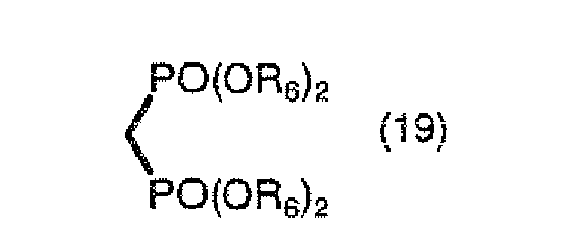
- This reaction may use THF, ether or 1,4-dioxane as a reaction solvent and can be carried out at a reaction temperature of -78°C to room temperature and in the presence of sodium hydride, potassium hydride, sodium alkoxide or potassium alkoxide, preferably n-butyllithium.
- In the synthetic pathway 3, the compound represented by the following general formula (16):

- This reaction may be carried out in an inorganic acid or organic acid such as acetic acid, hydrochloric acid, hydrobromic acid, methanesulfonic acid and trifluoroacetic acid or in a mixture with an organic solvent such as methanol, ethanol, THF, 1,4-dioxane and ethyl acetate and is preferably carried out at a reaction temperature of 0°C to room temperature. Alternatively, the reaction may use methanol, ethanol, 1,4-dioxane, DMSO, DMF or THF as a reaction solvent and may be carried out at a reaction temperature of 0°C to reflux temperature, preferably 80°C to 100°C, and in the presence of a base such as an aqueous solution of sodium hydroxide, potassium hydroxide or lithium hydroxide.
- In the synthetic pathway 3, the compound represented by the following general formula (17):

- This reaction can be carried out in the presence of a reduction catalyst, such as palladium carbon, platinum carbon, platinum oxide, rhodium carbon and ruthenium carbon, and in such a solvent as ethanol, methanol, THF, DMF and ethyl acetate and is carried out at room temperature under a hydrogen pressure of atmospheric or higher pressure.
- In the synthetic pathway 3, the compound represented by the following general formula (18):

- This reaction may be carried out in an inorganic acid or organic acid such as acetic acid, hydrochloric acid, hydrobromic acid, methanesulfonic acid and trifluoroacetic acid or in a mixture with an organic solvent such as methanol, ethanol, THF, 1,4-dioxane and ethyl acetate and may be carried out at a reaction temperature of 0°C to room temperature. Alternatively, the reaction may use methanol, ethanol, 1,4-dioxane, DMSO, DMF or THF as a reaction solvent and may be carried out at a reaction temperature of 0°C to reflux temperature, preferably 80°C to 100°C, and in the presence of a base such as an aqueous solution of sodium hydroxide, potassium hydroxide or lithium hydroxide.
- The compound of the general formula (18) can also be obtained by reduction of the compound of the general formula (16) (Step P). In such a case, the reaction may be carried out in the presence of a reduction catalyst, such as palladium carbon, platinum carbon, platinum oxide, rhodium carbon and ruthenium carbon, and in such a solvent as ethanol, methanol, THF, DMF and ethyl acetate and may be carried out under a hydrogen pressure of atmospheric or higher pressure at room temperature.
- Of the compounds represented by the general formula (1), those in which Y is -CH=CF- or -CH2CHF- and R5 is a lower alkyl group having 1 to 4 carbon atoms, which are represented by the following general formula (1f):


- In the synthetic pathway 4, the compound represented by the following general formula (20):
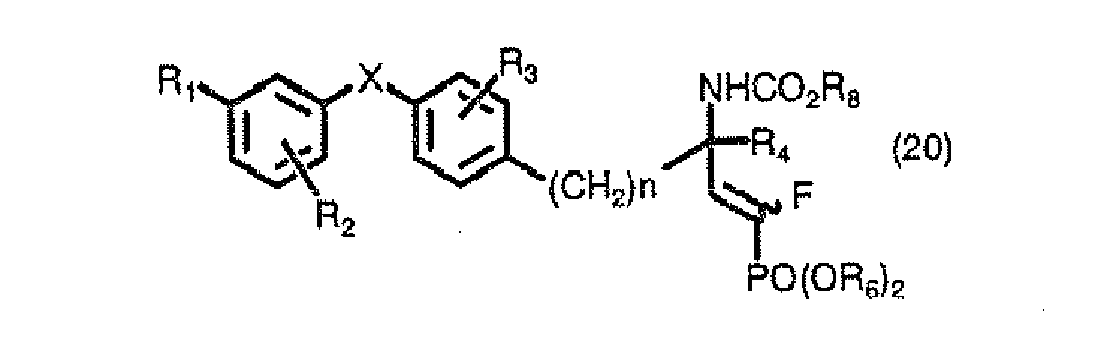
FBr2CPO(OR6)2 (24)
(wherein R6 is as defined above) in the presence of chlorotrimethylsilane (Step Q). - This reaction may use n-butyllithium or lithium diisopropylamide as a base and 1,4-dioxane, ether or, preferably, THF as a solvent and may be carried out at -78°C to 0°C.
- In the synthetic pathway 4, the compound represented by the following general formula (21):

- This reaction may be carried out in an inorganic acid or organic acid such as acetic acid, hydrochloric acid, hydrobromic acid, methanesulfonic acid and trifluoroacetic acid or in a mixture with an organic solvent such as methanol, ethanol, THF, 1,4-dioxane and ethyl acetate and may be carried out at a reaction temperature of 0°C to room temperature. Alternatively, the reaction may use methanol, ethanol, 1,4-dioxane, DMSO, DMF or THF as a reaction solvent and may be carried out at a reaction temperature of 0°C to reflux temperature, preferably 80°C to 100°C, and in the presence of a base such as an aqueous solution of sodium hydroxide, potassium hydroxide or lithium hydroxide.
- In the synthetic pathway 4, the compound represented by the following general formula (22):

- This reaction can be carried out in the presence of a reduction catalyst, such as palladium carbon, platinum carbon, platinum oxide, rhodium carbon and ruthenium carbon, and in such a solvent as ethanol, methanol, THF, DMF and ethyl acetate and may be carried out at room temperature under a hydrogen pressure of atmospheric or higher pressure.
- In the synthetic pathway 4, the compound represented by the following general formula (23):

- This reduction process can be carried out in the presence of a reduction catalyst, such as palladium carbon, platinum carbon, platinum oxide, rhodium carbon and ruthenium carbon, and in such a solvent as ethanol, methanol, THF, DMF and ethyl acetate and may be carried out at room temperature under a hydrogen pressure of atmospheric or higher pressure. The acidolysis or hydrolysis process may be carried out in an inorganic acid or organic acid such as acetic acid, hydrochloric acid, hydrobromic acid, methanesulfonic acid and trifluoroacetic acid or in a mixture with an organic solvent such as methanol, ethanol, THF, 1,4-dioxane and ethyl acetate and may be carried out at a reaction temperature of 0°C to room temperature. Alternatively, the reaction may use methanol, ethanol, 1,4-dioxane, DMSO, DMF or THF as a reaction solvent and may be carried out at a reaction temperature of 0°C to reflux temperature, preferably 80°C to 100°C, and in the presence of a base such as an aqueous solution of sodium hydroxide, potassium hydroxide or lithium hydroxide.
- Of the compounds represented by the general formula (1), those in which R5 is a lower alkyl group having 1 to 4 carbon atoms and Y is -CH2-, -CH2CH2-, -CH2CHF- or -CH2CF2-, which are represented by the following general formula (1g):


- In the synthetic pathway 5, the compound represented by the following general formula (25):

- For the introduction of methanesulfonyloxy group or trifluoromethanesulfonyloxy group, an organic solvent such as methylene chloride, chloroform, ethyl acetate and THF is used along with a base such as triethylamine, diisopropylethylamine, pyridine, lutidine and 2,4,6-trimethylpyridine, and the compound of the general formula (6) is preferably reacted with methanesulfonyl chloride or anhydrous trifluoromethanesulfonate at -45°C to room temperature.
- The brominated or iodized compound is synthesized by reacting the methanesulfonyloxylated product obtained in the above process with sodium bromide, sodium iodide, potassium bromide, potassium iodide, lithium bromide or lithium iodide at room temperature to reflux temperature in a solvent such as toluene, benzene or THF.
- In the synthetic pathway 5, the compound represented by the following general formula (26-1):

PO(OR6)3 (27)
(wherein R6 is as defined above) (Step W-1). - This reaction is preferably carried out in the absence of solvent and using the compound of the general formula (27) as a solvent and is preferably carried out at 100 to 150°C or at reflux temperature.
- In the synthetic pathway 5, the compound represented by the following general formula (26-2):

HVPO(OR6)2 (28)
(wherein R6 and V are as defined above) in the presence of a base (Step W-2). - This reaction may be carried out in the presence of such a base as lithium diisopropylamide, lithium hexamethyldisilazide and lithium tetramethylpiperidide in such a reaction solvent as THF and 1,4-dioxane and may be carried out at a reaction temperature of -78°C to room temperature.
- In the synthetic pathway 5, the compound of the general formula (1g) can be obtained by acidolysis or hydrolysis of the compound of the general formula (26-1) or (26-2) (Step X).
- This reaction may be carried out in an inorganic acid or organic acid such as acetic acid, hydrochloric acid, hydrobromic acid, methanesulfonic acid and trifluoroacetic acid or in a mixture with an organic solvent such as methanol, ethanol, THF, 1,4-dioxane and ethyl acetate and may be carried out at a reaction temperature of 0°C to room temperature. Alternatively, the reaction may use methanol, ethanol, 1,4-dioxane, DMSO, DMF or THF as a reaction solvent and may be carried out at a reaction temperature of 0°C to reflux temperature, preferably 80°C to 100°C, and in the presence of a base such as an aqueous solution of sodium hydroxide, potassium hydroxide or lithium hydroxide.
- Of the compounds represented by the general formula (1), those in which R5 is a lower alkyl group having 1 to 4 carbon atoms and Y is -CH(OH)CF2- and which are represented by the following general formula (1h):


- In the synthetic pathway 6, the compound represented by the following general formula (29):

HCF2PO(OR6)2 (30)
(wherein R6 is as defined above) in the presence of a base (Step Y). - This reaction may use n-butyllithium, preferably lithium diisopropylamide, as a base and 1,4-dioxane or ether, preferably THE, as a solvent and may be carried out at -78°C to 0°C.
- In the synthetic pathway 6, the compound of the general formula (1h) can be obtained by acidolysis or hydrolysis of the compound of the general formula (29) (Step Z).
- This reaction may be carried out in an inorganic acid or organic acid such as acetic acid, hydrochloric acid, hydrobromic acid, methanesulfonic acid and trifluoroacetic acid or in a mixture with an organic solvent such as methanol, ethanol, THF, 1,4-dioxane and ethyl acetate and may be carried out at a reaction temperature of 0°C to room temperature. Alternatively, the reaction may use methanol, ethanol, 1,4-dioxane, DMSO, DMF or THF as a reaction solvent and may be carried out at a reaction temperature of 0°C to reflux temperature, preferably 80°C to 100°C, and in the presence of a base such as an aqueous solution of sodium hydroxide, potassium hydroxide or lithium hydroxide.
- Of the compounds represented by the general formula (1), those in which R5 is hydrogen and which are represented by the following general formula (1i):


- The acidolysis process is preferably carried out in an inorganic acid such as hydrochloric acid and hydrobromic acid or in a mixture with an organic acid such as methanol and ethanol and is preferably carried out at reflux temperature.
- Alternatively, the reaction may use acetonitrile or methylene chloride as a solvent and the compound of the general formula (31) may be treated with trimethylsilyl bromide or trimethylsilyl iodide, or the combination of trimethylsilyl chloride and sodium bromide or sodium iodide. In such a case, the reaction is preferably carried out at 0°C to room temperature.
- The compounds of the respective general formulae in which X is SO or SO2 may also be obtained by oxidation of the corresponding compounds in which X is S.
- Such a reaction may use 1,4-dioxane, DMSO, DMF, THF, methylene chloride or chloroform as a reaction solvent and potassium permanganate, m-chlorobenzoic acid or aqueous hydrogen peroxide as an oxidizing agent and is preferably carried out at 0°C to reflux temperature, preferably at room temperature.
- Some embodiments of the present invention are summarized in the following items:
- 1. An aminophosphonic acid derivative represented by the following general formula (1):
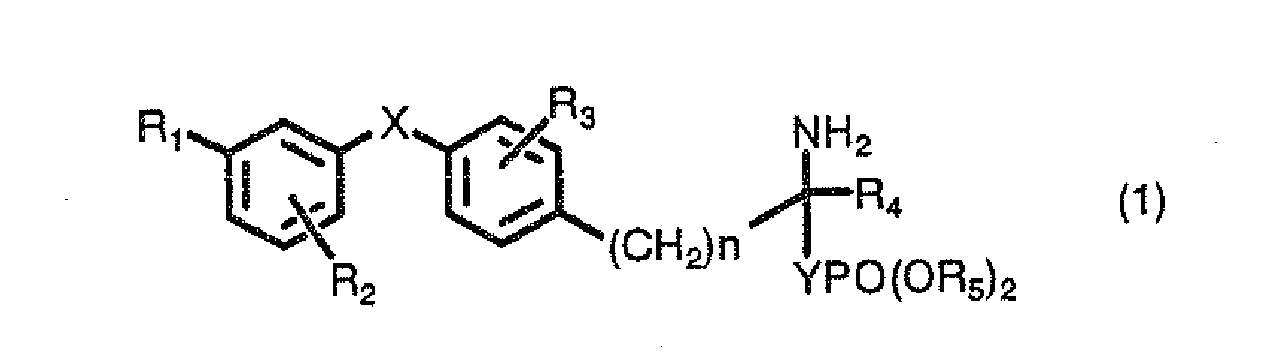
- 2. The 2-aminophosphonic acid monoester derivative according to item 1, an optical isomer, a pharmaceutically acceptable salt or a hydrate thereof, wherein the compounds represented by the general formula (1) comprise compounds represented by the following general formula (1a):

- 3. The 2-aminophosphonic acid monoester derivative according to item 2, an optical isomer, a pharmaceutically acceptable salt or a hydrate thereof, wherein R3 is a chlorine atom.
- 4. The 3-aminophosphonic acid derivative according to item 1, an optical isomer, a pharmaceutically acceptable salt or a hydrate thereof, wherein the compounds represented by the general formula (1) comprise compounds represented by the following general formula (1b):

- 5. The 3-aminophosphonic acid derivative according to item 4, an optical isomer, a pharmaceutically acceptable salt or a hydrate thereof, wherein R3 is a chlorine atom.
- 6. The aminophosphonic acid ester derivative according to item 1, a pharmaceutically acceptable salt or a hydrate thereof, wherein the compound represented by the general formula (1) is
- 1) 2-amino-5-[4-(3-benzyloxyphenylthio)-2-chlorophenyl]-2 methylpentylphosphonic acid monoester,
- 2) -2-amino-4-[4-(3-benzyloxyphenylthio)-2-chlorophenyl]-2 methylbutylphosphonic acid monoester,
- 3) 2-amino-5-[4-(3-benzyloxyphenylthio)-2-chlorophenyl]-2-hydroxymethylpentylphosphonic acid monoester,
- 4) 2-amino-4-[4-(3-benzyloxyphenylthio)-2-chlorophenyl]-2 hydroxymethylbutylphosphonic acid monoester,
- 5) 3-amino-5-[4-(3-benzyloxyphenylthio)-2-chlorophenyl]-3-hydroxymethylpentylphosphonic acid, or
- 6) 3-amino-6-[4-(3-benzyloxyphenylthio)-2-chlorophenyl]-3 hydroxymethylhexylphosphonic acid.
- 7. An S1P receptor modulator containing as an active ingredient at least one of aminophosphonic acid derivatives represented by the following general formula (1):

- 8. The SIP receptor modulator according to item 7, wherein the compound represented by the general formula (1) contains as an active ingredient at least one of 2-aminophosphonic acid monoester derivatives represented by the following general formula (1a):

- 9. The SIP receptor modulator according to item 7, wherein the compound represented by the general formula (1) contains as an active ingredient at least one of 2-aminophosphonic acid derivatives represented by the following general formula (1b):

- 10. A pharmaceutical agent containing as an active ingredient at least one of the aminophosphonic acid derivatives according to any one of items 1 to 9, the optical isomers, the pharmaceutically acceptable salts and the hydrates thereof.
- The present invention will now be described with reference to specific examples, which are not intended to limit the scope of the invention in any way.
-

- To a DMF solution (20mL) of 2-chloro-4-fluorobenzaldehyde(1.15g) and 3-(trifluoromethyl)thiophenol(1.33g), potassium carbonate (2.76g) was added and the mixture was stirred for 1 hour at 120°C. Subsequently, the reaction mixture was poured into water and was extracted with ethyl acetate. The extract was washed sequentially with water and a saturated aqueous solution of sodium chloride and the organic phase was dried over anhydrous sodium sulfate. The solvent was removed under reduced pressure and the resulting residue was purified on a silica gel column chromatography (hexane : ethyl acetate = 10 : 1). This gave the desired product as a pale yellow oil (1.96g).
- In a similar manner to Reference Example 1, different thiophenols and phenols were used to synthesize the different compounds shown in Table 1 below.
Table 1 
Reference Examples R1 R2 R2 R4 X Reference Examples R1 R2 R3 R4 X 2 Cl c-Cl H Cl O 30 i-PrO c-iPr H Cl O 3 t-Bu H H H O 31 i-PrO c-iPr H H O 4 Me H H H O 32 PhO H H Cl O 5 i-Pr c-i-Pr H Cl O 33 PhCH2O H H H O 6 C5H11 H H H O 34 PhCH2O H H Br O 7 C7H15 H H H O 35 PhCH2O H H SMe O 8 CF3 H H H O 36 PhCH2O H H Me O 9 CF3 H OMe H O 37 PHCH2O H H Et O 10 CF3 H H OMs O 38 PhCH2O c-Cl H Cl O 11 CF3 H H OCH2Ph O 39 PhCH2O H H CF3 O 12 CF3 H CF3 H O 40 PhCH2O H H Ph O 13 CF3 H H CP3 O 41 PhCH2O c-PhCH2O H Cl O 14 CF3 c-CF3 H H O 42 PhCH2O c-PhCH2O H H O 15 CF3 c-CF3 H Cl O 43 PhCH2O c-PhCH2O H i-Pr O 16 CF3 b-Cl H H O 44 MeO c-CF3 H H O 17 CF3 a-Cl H H O 45 MeS H H H O 18 CF3 d-Cl H H O 46 PhCH2S H H H O 19 OF3 c-MeO H Cl O 47 PhCH2S H H Cl O 20 Ph(CH2)2 H H Cl O 48 Cl c-Cl H H S 21 Ph(CH2)2 H H OF3 O 49 CF3 c-CF3 H Cl S 22 Ph(CH2)2 c-CF3 H H O 50 CF3 c-CF3 H H S 23 Ph(CH2)2 c-CF3 H Cl O 51 CF3 H H H S 24 Ph(CH2)2c-Ph(CH2)2 H H O 52 CF3 H H CF3 S 25 Ph(CH2)2c-Ph(CH2)2 H CF3 O 53 MeO H H Cl S 26 Ph(CH2)2c-Ph(CH2)2 H Cl O 54 MeO H H H S 27 CF3 c-NO2 H H O 55 MeO H H CF3 S 28 CF3 H Cl H O 56 PhCH2O H H Cl O 29 CF3 H H Cl O 57 PhCH2O H H i-Pr O -

- 3-(trifluoromethyl)phenylboric acid (1.03g) and 2-fluoro-4-hydroxybenzaldehyde (760mg) were dissolved in methylene chloride (20mL). While the mixture was stirred, copper acetate (985mg), molecular sieve 4A (800mg) and triethylamine (3.76mL) were added to the mixture. An equal amount of copper acetate was added after 6 hours and after 24 hours. After 48 hours of stirring, the insoluble materials were removed by filtration and the filtrate was poured in water and was extracted with ethyl acetate. The extract was washed sequentially with water and a saturated aqueous solution of sodium chloride, and the organic phase was dried over anhydrous magnesium sulfate. The solvent was removed under reduced pressure and the resulting residue was purified on a silica gel column chromatography (hexane : ethyl acetate = 7 : 1 then 2 : 1). This gave the desired product as a pale yellow oil (265mg).
-
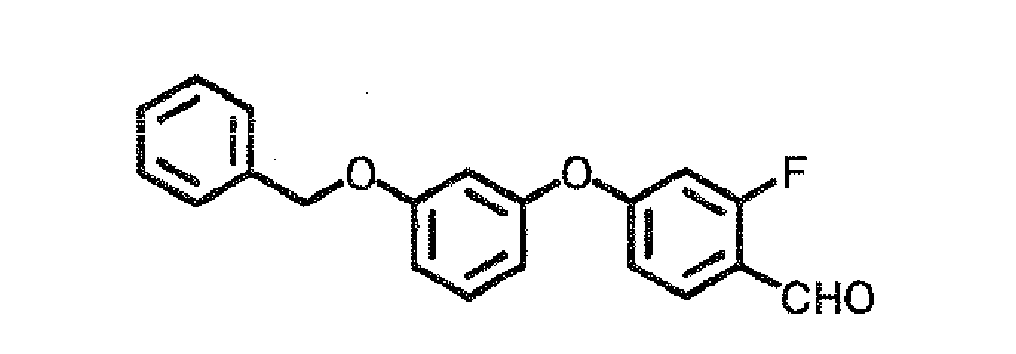
- In a similar manner to Reference Example 58, 3-benzyloxyphenylboric acid and 2-fluoro-4-hydroxybenzaldehyde were used to obtain the desired product as a colorless oil.
-

- At 0°C and under a stream of argon gas, 60% sodium hydride (272mg) was added to a THF solution (30mL) of ethyl diethylphosphonoacetate (1.35mL). The mixture was stirred for 30min and a THF solution (15mL) of the compound of Reference Example 1 (1.96g) was added dropwise. The mixture was stirred for 2 hours while kept at the same temperature. This was followed by addition of water and extraction with ethyl acetate. The extract was washed sequentially with water and a saturated aqueous solution of sodium chloride, and the organic phase was dried over anhydrous sodium sulfate. The solvent was removed under reduced pressure and the residue was purified on a silica gel column chromatography (hexane: ethyl acetate = 10: 1). This gave the desired product as a colorless oil (1.72g).
- In a similar manner to Reference Example 60, the compounds of Reference Examples 2 through 59 were used to synthesize the compounds shown in Table 2 below.
Table 2 
Reference Examples R1 R2 R3 R4 X Reference Examples R1 R2 R3 R4 X 61 Cl c-cl H Cl O 90 I-prO c-IPr H Cl O 62 t-Bu H H H O 91 I-prO c-Ipr H H O 63 Me H H H O 92 PhO H H Cl O 64 I-Pr c-I-Pr H Cl O 93 PhCH2O H H H O 65 C5H11 H H H O 94 PhCH2O H H Br O 66 C7H15 H H H O 95 PhCH2O H H SMe O 67 CF3 H H H O 96 PhCH2O H H Me O 68 CF3 H OMe H O 97 PhCH2O H H Et O 69 CF3 H H OMe O 98 PhCH2O c-Cl H Cl O 70 CF3 H H OCH2PH O 99 PhCH2O H H CF3 O 71 CF3 H CF3 H O 100 PhOH2O H H Ph O 72 CF3 H H CF3 O 101 PhCH2O c-PhCH2O H Cl O 73 CF3 c-CF3 H H O 102 PhCH2O c-PhCH2O H H O 74 CF3 c-CF3 H Cl O 103 PhCH2O c-PhCH2O H I-Pr O 75 CF3 b-Cl H H O 104 MeO c-CF3 H H O 76 CF3 a-Cl H H O 105 MaS H H H O 77 CF3 d-Cl H H O 106 PhCH2S H H H O 78 CF3 c-MeO H Cl O 107 PhCH2S H H cl O 79 Ph(CH2)2 H H Cl O 108 Cl c-Cl H H S 80 Ph(CH2)2 H H CF3 O 109 CF3 c-CF3 H Cl S 81 Ph(CH2)2 c-CF3 H H O 110 CF3 c-CF3 H H S 82 Ph(CH2)2 c-CF3 H Cl O 111 CF3 H H H S 83 Ph(CH2)2 c-Ph(CH2)2 H H O 112 CF3 H H CF3 S 84 Ph(CH2)2 c-Ph(CH2)2 H CF3 O 113 MeO H H Cl S 85 Ph(CH2)2 c-Ph(CH2)2 H Cl O 114 MeO H H H S 86 CF3 H H F O 115 MeO H H CF3 S 87 PhCH2O H H F O 116 CF3 c-NO2 H H O 88 CF3 H Cl H O 117 PhCH2O H H cl O 89 CF3 H H Cl O 118 PhCH2O H H I-pr O -

- To a DMF solution (50mL) of 3-ethylphenol (1.13g) and methyl 4'-fluorocinnamate (834mg), potassium carbonate (1.92g) was added and the mixture was stirred for 8 hours at 140°C. The reaction mixture was poured into water and was extracted with ethyl acetate. The extract was washed sequentially with water and a saturated aqueous solution of sodium chloride and the organic phase was dried over anhydrous sodium sulfate. The solvent was removed under reduced pressure and the resulting residue was purified on a silica gel column chromatography (hexane: ethyl acetate = 30: 1). This gave the desired product as a yellow oil (540mg).
-

- To a DMF solution (10mL) of 3-isobutylphenol (451mg) and methyl 4'-fluorocinnamate (541mg), potassium carbonate (622mg) was added and the mixture was stirred for 8 hours at 140°C. The reaction mixture was poured into water and was extracted with ethyl acetate. The extract was washed sequentially with water and a saturated aqueous solution of sodium chloride and the organic phase was dried over anhydrous sodium sulfate. The solvent was removed under reduced pressure and the resulting residue was purified on a silica gel column chromatography (hexane: ethyl acetate = 30: 1). This gave the desired product as a yellow oil (278mg).
-
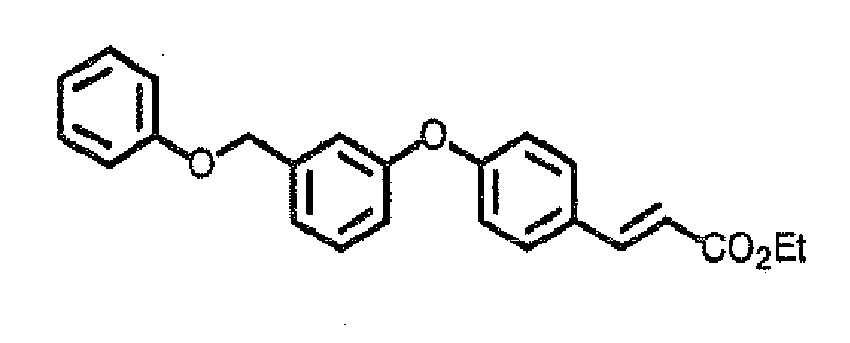
- The compound of Reference Example 63 (2.82g) was dissolved in tetrachlorocarbon (50mL). To this solution, N-bromosuccinimide (2.31g) was added and the mixture was stirred while heated and exposed to light. After 24 hours, the solvent was removed under reduced pressure and the resulting residue was extracted with ethyl acetate. The extract was washed sequentially with water and a saturated aqueous solution of sodium chloride and the organic phase was dried over anhydrous sodium sulfate. The solvent was removed under reduced pressure and the resulting residue was purified on a silica gel column chromatography (hexane: ethyl acetate = 6 : 1). This gave ethyl 4'-[(3-bromomethyl)phenoxy]cinnamate as a yellow oil (1.30g). The resultant brominated product (1.24g) was dissolved in DMF (25mL). To this solution, phenol (380mg) and potassium carbonate (500mg) were added and the mixture was stirred for 3 hours at 60°C. The reaction mixture was poured into water and was extracted with ethyl acetate. The extract was washed sequentially with water and a saturated aqueous solution of sodium chloride and the organic phase was dried over anhydrous sodium sulfate. The solvent was removed under reduced pressure and the resulting residue was purified on a silica gel column chromatography (hexane: ethyl acetate = 4 : 1). This gave the desired product as a colorless oil (1.30g).
-

- The compound of Reference Example 60 (1.72g) was dissolved in ethanol (70mL). While the solution was stirred at 0°C, bismuth chloride (703mg) was added. Subsequently, sodium borohydride (673mg) was added in small portions and the mixture was stirred for 1 hour at this temperature and 3 hours at room temperature. Ice water was added and the crystallized insoluble inorganic residue was removed by filtration through Celite. The filtrate was extracted with ethyl acetate and the extract was washed sequentially with water and a saturated aqueous solution of sodium chloride. The organic phase was then dried over anhydrous sodium sulfate. The solvent was removed under reduced pressure to give the desired product as a colorless oil (1.50g) (Process A).
-

- The compound of Reference Example 119 (540mg) was dissolved in ethanol (20mL) and 10%-Pd/C (80.0mg) was added. Under a stream of hydrogen, the mixture was stirred at room temperature for 3 hours. The catalyst was removed by filtration and the filtrate was concentrated under reduced pressure to give the desired product as a colorless oil (Process B).
-

- The compound of Reference Example 70 (2.29mg) was dissolved in ethyl acetate (30mL) and 5%-Pd/C-ethylenediamine complex (230mg) was added. Under a stream of hydrogen, the mixture was stirred at room temperature for 3.5 hours. The catalyst was removed by filtration and the solvent was removed under reduced pressure to give the desired product as a pale yellow oil (2.30g) (Process C).
-

- Under a stream of argon gas, the compound of Reference Example 105 (4.07g) was dissolved in methanol (50mL). While the solution was stirred at 10°C, magnesium (1.00g) was added. The mixture was stirred for 3 hours while kept at this temperature, and diluted hydrochloric acid was added. The mixture was extracted with ethyl acetate and was washed sequentially with water and a saturated aqueous solution of sodium chloride. The organic phase was then dried over anhydrous sodium sulfate. The solvent was removed under reduced pressure to give the desired product as a colorless oil (3.70g) (Process D).
- Similarly, the compounds of Reference Examples 61 through 69, 71 through 104, 106 through 116, 117 and 118, and 120 and 121 were used to synthesize the compounds shown in Table 3 below.
Table 3 
Reference Examples R1 R2 R3 R4 X Process Reference Examples R1 R2 R3 R4 X Process 126 Cl c-Cl H Cl 0 A 155 I-PrO c-IPr H Cl O C 127 t-Bu H H H O B 156 I-PrO c-IPr H H O B 128 Me H H H O B 157 PhO H H Cl O A 129 I-Pr c-I-Pr H Cl O A 158 PhCH2O H H H O A 130 C5H11 H H H O B B 59 PhCH2O H H Br O A 131 C7H15 H H H O B 160 PhCH2O H H SMs. O A 132 CF3 H H H O B 161 PHCH2O H H Me O A 133 CF3 H OMe H O B 162 PhCH2O H H Et O A 134 CF3 H H OMe O B 163 PhCH2O c-Cl H Cl O A 135 CF3 H CF3 H O B 164 PhCH2O H H CF3 O A 136 CF3 H H CF3 O B 165 PhCH2O H H Ph O A 137 CF3 c-CF3 H H O B 166 PhCH2O c-PhCH2O H Cl O A 138 CF3 c-CF3 H Cl O B 167 PhCH2O c-PhCH2O H H O A 139 CF3 b-Cl H H O A 168 PhCH2O c-PhCH2O H I-Pr O A 140 CF3 a-Cl H H O A 169 MeO c-CF3 H H O B 141 CF3 d-Cl H H O A 170 PhCH2S H H H O A 142 CF3 c-MeO H Cl O B 171 PhCH2S H H Cl O A 143 Ph(CH2)2 H H Cl O A 172 Cl H H H S D 144 Ph(CH2)2 H H CF3 O B 173 CF3 c-CF3 H Cl S A 145 Ph(CH2)2 c-CF3 H H O B 174 CF3 c-Me H H S D 146 Ph(CH2)2 c-CF3 H Cl O A 175 CF3 H H H S A 147 Ph(CH2)2 c-Ph(CH2)2 H H O B 176 CF3 H H CF3 S A 148 Ph(CH2)2 c-Ph(CH2)2 H CF3 O B 177 MeO H H Cl S A 149 Ph(CH2)2 c-Ph(CH2)2 H Cl O A 178 MeO H H H S A 150 CF3 H H F O B 179 MeO H H CF3 S A 151 PhCH2O H H F O A 180 I-Bu H H H O B 152 PhOCH2 H H H O A 181 PhCH2O H H Cl O A 153 CF3 H Cl H O A 182 PHCH2O H H iPr O A 154 CF3 H H Cl O A D=Methyl ester -

- The compound of Reference Example 116 was reacted in the same manner as in Reference Example 124 to obtain ethyl 4'-[3-amino-5-(trifluoromethyl)phenoxy]dihydrocinnamate. An MeCN solution (15mL) containing this compound (1.27g) was added to an MeCN solution (40mL) containing copper chloride (725mg) and tBuONO (0.51mL). This mixture was stirred for 3 hours at room temperature, followed by addition of water and extraction with ethyl acetate. The extract was then washed with water and the organic phase was dried over anhydrous sodium sulfate. The solvent was removed by distillation and the residue was purified on a silica gel column chromatography (hexane: ethyl acetate = 20: 1). This gave the desired product as a pale yellow oil (1.10g).
-

- The compound of Reference Example 169 (840m.g) was dissolved in methylene chloride (20mL). While the solution was stirred at 0°C, a 1mol/L methylene chloride solution of tribromoboron (3.42mL) was added dropwise. The reaction mixture was stirred at room temperature overnight. Subsequently, ice water was added, and the mixture was extracted with ethyl acetate and was washed sequentially with water and a saturated aqueous solution of sodium chloride. The organic phase was dried over anhydrous sodium sulfate. The solvent was then removed under reduced pressure to give 4'-(3-trifluoromethyl-5-hydroxyphenoxy)dihydrocinnamic acid as a pale brown powder (750mg). The resulting powder was dissolved in DMF (50mL). To this solution, potassium carbonate (1.04g) and benzyl bromide (0.602mL) were added and the mixture was stirred at room temperature for 8 hours. Subsequently, the reaction mixture was poured into ice water, and the mixture was extracted with ethyl acetate and was washed sequentially with water and a saturated aqueous solution of sodium chloride. The organic phase was then dried over anhydrous sodium sulfate. The solvent was removed under reduced pressure to give the desired product as a brown oil.
-

- Using the compound of Reference Example 177, the reaction was carried out in the same manner as in Reference Example 184 to give the desired product as a yellow oil.
-

- Using the compound of Reference Example 178, the reaction was carried out in the same manner as in Reference Example 184 to give the desired product as a yellow oil.
-

- In the same manner as in Reference Example 184, the compound of Reference Example 142 was reacted to give 2'-chloro-4'-(3-trifluoromethyl-5-hydroxyphenoxy)dihydrocinnamic acid. This cinnamic acid (1.47g) was dissolved in ethanol (10mL). While this solution was stirred at 0°C, thionyl chloride (3mL) was added dropwise. The mixture was stirred for 2 hours while kept at this temperature. Subsequently, the solvent was removed under reduced pressure and the residue was purified on a silica gel column chromatography (hexane: ethyl acetate = 10:1 and then 6:1) to give ethyl 2'-chloro-4'-(3-trifluoromethyl-5-hydroxyphenoxy)dihydrocinnamate as a colorless oil (1.38g). In the same manner as in Reference Example 184, the resulting ester was converted into a benzyl ether using potassium carbonate and benzyl bromide. This gave the desired product as a colorless oil.
-

- Using the compound of Reference Example 179, the reaction was carried out in the same manner as in Reference Example 187 to give the desired product as a colorless oil.
-

- The compound of Reference Example 185 (7.40g) was dissolved in THF (100mL). While this solution was stirred at 0°C, lithium aluminum hydride (500mg) was added. After 10min, a 20% aqueous solution of NaOH was added and the crystallized insoluble inorganic residue was removed by filtration through Celite. The filtrate was extracted with ethyl acetate and the extract was washed sequentially with water and a saturated aqueous solution of sodium chloride. The organic phase was then dried over anhydrous sodium sulfate. The solvent was removed under reduced pressure to give the desired product as a colorless oil (6.37g).
- In a similar manner to Reference Example 189, the compounds of Reference Examples 122 through 141, 143 through 168, 170 through 177 and 180 through 188 were used to synthesize the compounds shown in Table 4 below.
Table 4 
Reference Examples R1 R2 R3 R4 X Reference Examples R1 R2 R3 R4 X 190 Cl c-Cl H Cl O 221 I-PrO c-IPr H Cl O 191 t-Bu H H H O 222 I-PrO c-IPr H H O 192 Me H H H O 223 PhO H H Cl O 193 I-Pr c-I-Pr H Cl O 224 PhCH2O H H H O 194 C5H11 H H H O 225 PhCH2O H H Br O 195 C7H15 H H H O 228 PhCH2O H H SMe O 196 CF3 H H H O 227 PhCH2O H H Me O 197 CF3 H OMe H O 228 PhCH2O H H Et O 198 CF3 H H OMe O 229 PhCH2O c-Cl H Cl O 199 CF3 H CF3 H O 230 PhCH2O H H CF3 O 200 CF3 H H CF3 O 231 PhCH2O H H Ph O 201 CF3 c-CF3 H H O 232 PhCH2O c-PhCH2O H Cl O 202 CF3 c-CF3 H Cl O 233 PhCH2O o-PhCH2O H H O 203 CF3 b-Cl H H O 234 PhCH2O c-PhCH2O H I-Pr O 204 CF3 a-Cl H H O 235 PhCH2O c-CF3 H H O 205 CF3 d-Cl H H O 236 PhCH2S H H H O 206 CF3 c-PhCH2O H Cl O 237 PhCH2S H H Cl O 207 Ph(CH2)2 H H Cl O 238 Cl H H H S 208 Ph(CH2)2 H H CF3 O 239 CF3 o-CF3 H Cl S 209 Ph(CH2)2 c-CF3 H H O 240 CF3 c-Me H H S 210 ph(CH2)2 c-CF3 H Cl O 241 CF3 H H H S 211 Ph(CH2)2 o-Ph(CH2)2 H H O 242 CF3 H H CF3 S 212 Ph(CH2)2 o-Ph(cH2)2 H CF3 O 243 MeO H H Cl S 213 Ph(CH2)2 o-Ph(CH2)2 H Cl O 244 PhCH2O H H H S 214 CF3 H H F O 245 PhCH2O H H CF3 S 215 PhCH2O H H F O 246 I-Bu H H H O 216 CF3 H H Cl S 247 PhOCH2 H H H O 217 Et H H H O 248 CF3 c-Cl H H O 218 CF3 H H PhCH2O O 249 MeS H H H O 219 CF3 H Cl H O 250 PhCH2O H H Cl O 220 CF3 H H Cl O 251 PhCH2O H H I-Pr O -

- The compound of Reference Example 189 (1.38g) was dissolved in THF (20mL) While this solution was stirred at 0°C, imidazole (545mg), triphenylphosphine (2.10g) and iodine (2.00g) were added. The mixture was stirred 2 hours at this temperature and subsequent 1.5 hours at room temperature, and additional imidazole (160mg), triphenyl phosphine (600mg) and iodine (500mg) were added. The mixture was stirred overnight, followed by the addition of water and then sodium thiosulfate. The reaction mixture was then extracted with ethyl acetate and the extract was washed sequentially with water and a saturated aqueous solution of sodium chloride. The organic phase was then dried over anhydrous sodium sulfate. The solvent was removed under reduced pressure and the residue was purified on a silica gel column chromatography (hexane: ethyl acetate = 50:1) to give the desired product as a colorless oil (1.55g).
- In a similar manner to Reference Example 252, the compounds of Reference Examples 190 through 251 were used to synthesize the compounds shown in Table 5 below.
Table 5 
Reference Examples R1 R2 R3 R4 X Reference Examples R1 R2 R3 R4 X 253 Cl c-Cl H Cl O 284 i-PrO c-iPr H Cl O 254 t-Bu H H H O 285 i-PrO c-iPr H H O 255 Me H H H O 286 PhO H H Cl O 258 i-Pr c-i-Pr H Cl O 287 PhCH2O H H H O 257 C5H11 H H H O 288 PhcH2O H H Br O 258 C7H15 H H H O 289 PhCH2O H H SMe O 259 CF3 H H H O 290 PhCH2O H H Me O 260 CF3 H OMe H O 291 PhCH2O H H Et O 261 CF3 H H OMe O 292 PhCH2O c-Cl H Cl O 262 CF3 H CF3 H O 293 PhCH2O H H CF3 O 263 CF3 H H CF3 O 294 PhCH2O H H Ph O 264 CF3 c-CF3 H H O 295 PhCH2O c-PhCH2O H cl O 265 CF3 c-CF3 H Cl O 296 PhCH2O c-PhCH2O H H O 268 CF3 b-Cl H H O 297 PhCH2O c-PhCH2O H i-Pr O 267 CF3 a-Cl H H O 298 PhCH2O c-CF3 H H O 268 CF3 d-Cl H H O 299 PhCH2S H H H O 269 CF3 c-PhCH2O H Cl O 300 PhCH2S H H Cl O 270 Ph(CH2)2 H H Cl O 301 Cl H H H S 271 Ph(CH2)2 H H CF3 O 302 GF3 c-CF3 H Cl S 272 Ph(CH2)2 c-CF3 H H O 303 CF3 c-Me H H S 273 Ph(CH2)2 c-CF3 H Cl O 304 CF3 H H H S 274 Ph(CH2)2 c-Ph(CH2)2 H H O 305 CF3 H H CF3 S 275 Ph(CH2)2 c-Ph(CH2)2 H CF3 O 306 MeO H H Cl S 276 Ph(CH2)2 c-Ph(CH2)2 H Cl O 307 PhCH2O H H H S 277 CF3 H H F O 308 PhCH2O H H CF3 S 278 PhCH2O H H F O 309 I-Bu H H H O 279 CF3 H H Cl S 310 PhOCH2 H H H O 280 Et H H H O 311 CF3 c-Cl H H O 281 CF3 H H PhCH2O O 312 MeS H H H O 282 CF3 H Cl H O 313 PhCH2O H H Cl O 283 CF3 H H Cl O 314 PhCH2O H H i-Pr O -

- Using 3,5-dichlorophenol and 4-fluorobenzaldehyde, the reaction was carried out in the same manner as in Reference Example 1 to obtain 4-(3,5-dichlorophenoxy)benzaldehyde. Subsequently, the same procedure as in Reference Example 189 was followed using sodium borohydride in place of the lithium aluminum hydride. This gave 4-(3,5-dichlorophenoxy)benzyl alcohol. The resulting alcohol (2.03g), along with carbon tetrabromide (2.75g), was dissolved in methylene chloride (30mL). While this solution was stirred at 0°C, triphenyl phosphine (2.17g) was added. The mixture was stirred at 0°C for 1 hour and at room temperature for the subsequent 30min. The solvent was removed under reduced pressure and the residue was purified on a silica gel column chromatography (hexane: ethyl acetate = 20 : 1) to give the desired product as a colorless oil (3.12g).
-

- The compound of Reference Example 312 (1.80g) was dissolved in methylene chloride (30mL). While this solution was stirred at 0°C, m-chlorobenzoic acid (770mg) was added in small portions. The mixture was stirred at this temperature for 1 hour and at room temperature for the subsequent 24 hours. Following addition of water, the mixture was extracted with ethyl acetate and the extract was washed sequentially with a saturated aqueous solution of sodium carbonate and a saturated aqueous solution of sodium chloride. The organic phase was then dried over anhydrous sodium sulfate. The solvent was removed under reduced pressure and the residue was purified on a silica gel column chromatography (hexane: ethyl acetate = 2:1 and then 1:2) to give the desired product as a yellow oil (1.29g).
-

-

- The compound of Reference Example 53 was treated in the same manner as in Reference Example 189 to obtain an alcohol. The alcohol (5.64g) was dissolved in methylene chloride (100mL) and phosphorus tribromide (2.25mL) was added dropwise. Following stirring at room temperature for 1 hour, ice water was added and the mixture was extracted with ethyl acetate. The extract was washed sequentially with water and an aqueous solution of sodium chloride, and the organic phase was dried over anhydrous sodium sulfate. The solvent was removed by distillation to obtain a pale yellow oil. The oil and potassium cyanide (1.56g) were dissolved in a mixture of DMSO (25mL) and water (10mL) and the solution was stirred at 90°C for 5 hours. Following addition of water, the mixture was extracted with ethyl acetate and the extract was washed sequentially with water and a saturated aqueous solution of sodium chloride. The organic phase was dried over anhydrous sodium sulfate. The solvent was removed by distillation and the residue was purified on a silica gel column chromatography (hexane: ethyl acetate = 10 : 1) to give the desired cyano-product as a pale yellow oil (3.81g).
-

- The cyano-product (3.81g) and potassium hydroxide (3.68g) were added to a mixture of ethanol (80mL) and water (10mL), and the solution was refluxed for 6 hours. Subsequently, the solution was allowed to cool and the insoluble material was removed by filtration. The filtrate was neutralized with diluted hydrochloric acid. This mixture was extracted with ethyl acetate and the extract was washed sequentially with water and a saturated aqueous solution of sodium chloride. The organic phase was then dried over anhydrous sodium sulfate. The solvent was removed by distillation and ethanol (50mL) and thionyl chloride (2mL) were added to the resulting residue. This mixture was stirred at room temperature for 1 hour and the solvent was removed by distillation. The resulting residue was purified on a silica gel column chromatography (hexane: ethyl acetate = 10:1) to give the ethyl ester product as a colorless oil (3.89g).
- The ethyl ester was reacted in the same manner as in Reference Example 187 to obtain ethyl 4'-(3-benzyloxyphenylthio)-2'-chlorophenyl=acetate. The product was reduced as in Reference Example 189 to obtain an alcohol, which in turn was reacted in the same manner as in Reference Example 252 to give the desired product as a colorless oil.
-

-

- Ethyl 4'-(3-benzyloxyphenylthio)-2'-chlorophenylacetate obtained in Reference Example 317-3 was subjected to alkali-hydrolysis. The resulting product was condensed with N,O-dimethylhydroxylamine to form an amide product, which in turn was reduced in the same manner as in Reference Example 189 to give the desired aldehyde product as a yellow oil.
-

- The compound of Reference Example 318-1 was reacted in the same manner as in Reference Example 60 and the unsaturated bonds of the resulting product were reduced in the same manner as in Reference Example 122 to give the desired ethyl butyrate derivative.
- The compound of Reference Example 318-2 was reacted in the same manner as in Reference Example 189 to obtain an alcohol product, which in turn was reacted in the same manner as in Reference Example 252 to give the desired product as a colorless oil.
-

- The compound of Reference Example 56 was reacted in the same manner as in Reference Example 317 to obtain the desired product as a yellow oil.
-

- The compound of Reference Example 56 was reacted in the same manner as in Reference Example 318 to obtain the desired product as a pale yellow oil.
-

- 4'-benzyloxydihydrocinnamyl alcohol was reacted in the same manner as in Reference Example 252 to obtain the desired product as a yellow powder.
-

- In place of 2-chloro-4-fluorobenzaldehyde, 2-chloro-4-fluorobenzonitrile was reacted in the same manner as in Reference Example I to obtain 2-chloro-4-(3-methoxyphenylthio)benzonitrile. Following the same procedure as in Reference Example 317-2, this product was hydrolyzed and, then, following the same procedure as in Reference Example 187, the methoxy group was decomposed and esterified to convert the product into a benzyl ether. The product was then reacted in the same manner as in Reference Example 189 to be converted into an alcohol. Subsequently, the product was reacted with carbon tetrabromide in the same manner as in Reference Example 315 to obtain the desired product as a colorless oil.
-

- Using p-trifluoromethylphenol, the reaction was carried out in the same manner as in Reference Example 1 to obtain an aldehyde. Following the same procedure as in Reference Example 60, the aldehyde was subjected to Horner-Emmons reaction. Subsequently, following the same procedure as in Reference Example 123, the resulting product was reduced and, then, following the same procedure as in Reference Example 189, the reduced product was converted into an alcohol. Subsequently, the alcohol was iodized in the same manner as in Reference Example 252 to give the desired product as a colorless oil. MS(EI+): 440 ([M]+).
1H-NMR(400MHz, CDCl3) δ 2.12-2.19(2H, m), 2.85(2H, t, J=7.3Hz), 3.21(2H, t, J=7.3Hz), 6.90(1H, dd, J=2.5, 8.6Hz), 7.04-7.08(3H, m), 7.23-7.27(1H, m), 7.60(2H, d, J=8.6Hz). -

- Using o-trifluoromethylphenol, the reaction was carried out in the same manner as in Reference Example 232 to obtain the desired product as a colorless oil.
MS(EI+): 440([M]+).
1H-NMR(400MHz, CDCl3) δ 2.11-2.18(2H, m), 2.83(2H, t, J=7.3Hz), 3.21(2H, t, J=7.3Hz), 6.88(1H, dd, J=2.5, 8.5Hz), 6.96(1H, d, J=8.6Hz), 7.04(1H, d, J=2.5Hz), 7.18-7.26(2H, m), 7.49(1H, t, J=8.6Hz), 7.68(1H, d, J=8.0Hz). -

- p-hydroxythiophenol (2.12g) was dissolved in N,N-dimethylformamide (40mL). To this solution, 2-chloro-4-fluorobenzaldehyde (2.66g) and potassium carbonate (4.64g) were added and the mixture was stirred for 2 hours at 50°C. Subsequently, benzyl bromide (4.00mL) was added and the mixture was stirred for 1.5 hours at 50°C and then for 2.5 hours at 70°C. The reaction mixture was extracted with ethyl acetate and the extract was washed sequentially with water and a saturated aqueous solution of sodium chloride. The organic phase was then dried over anhydrous sodium sulfate. Following addition of water, the solvent was removed by distillation and the residue was purified on a silica gel column chromatography (hexane: ethyl acetate = 10: 1). This gave the desired product as a colorless solid (5.70g).
1H-NMR(400MHz, CDCl3) δ 5.12(2H, s), 6.96-7.03(3H, m), 7.06 (2H, m), 7.38-7.50(6H, m), 8.56(1H, d, J=8.6Hz), 10.33(1H, s). -

- To an ice-cold tetrahydrofuran solution (160mL) of (Methoxymethyl)triphenylphosphonium chloride (8.28g), t-butoxy potassium (2.71g) was added and the mixture was stirred for 1 hour, followed by addition of the compound of Reference Example 325 (5.70g) and 1 hour of stirring. Subsequently, water was added to the mixture and the mixture was extracted with ethyl acetate and the extract was washed sequentially with water and a saturated aqueous solution of sodium chloride. The organic phase was then dried over anhydrous sodium sulfate. The solvent was removed by distillation and the resulting residue was purified on a silica gel column chromatography (hexane: ethyl acetate = 6 : 1). This gave the desired vinyl ether product as a pale yellow oil (6.50g). This product was dissolved in tetrahydrofuran (90mL). To this solution, a 6mol/L aqueous solution of hydrochloric acid (60mL) was added and the mixture was stirred for 5 hours at 60°C. Subsequently, the reaction mixture was extracted with ethyl acetate. The extract was washed sequentially with water and a saturated aqueous solution of sodium chloride and the organic phase was dried over anhydrous sodium sulfate. Following addition of water, the solvent was removed by distillation and the residue was purified on a silica gel column chromatography (hexane: ethyl acetate = 9 : 1). This gave the desired product as a colorless powder (4.48g).
1H-NMR(400MHz, CDCl3) δ 3.77(2H, d, J=1.8Hz), 5.09(2H, s), 6.97-7.04(3H, m), 7.05-7.10(1H, m), 7.15(1H, d, J=1.8Hz), 7.32-7.46(7H, m), 9.72(1H, t, J=1.8Hz). -

- Following the same procedure as in Reference Example 189, the compound of Example 326 was converted into an alcohol. Then, using the same procedure as in Reference Example 252, this alcohol was iodized to give the desired product as a pale yellow oil.
1H-NMR(400MHz, CDCl3) δ 3.22(2H, t, J=7.3Hz), 3.30(2H, t, J=7.3Hz), 5.09(2H, s) 6.96-7.02(3H, m), 7.09(2H, d, J=7.9Hz), 7.33-7.45(7H, m). -

- At room temperature and under a stream of argon gas, sodium t-butoxide (490mg) was added to diethyl 2-t-butoxycarbonylaminomalonate (1.3mL) in a mixture of THF (35mL) and DMF (4mL). This mixture was stirred for 20min at 80°C and was allowed to cool to room temperature. To the cooled mixture, a THF solution (5mL) of the compound of Reference Example 279 (1.55g) was added dropwise. The resulting mixture was refluxed for 5 hours, was poured into ice water, and was extracted with ethyl acetate. The extract was washed sequentially with water and a saturated aqueous solution of sodium chloride. The organic phase was then dried over anhydrous sodium sulfate. The solvent was removed under reduced pressure and the residue was purified on a silica gel column chromatography (hexane: ethyl acetate = 5 : 1) to give the desired product as a colorless oil (1.87g).
1H-NMR(400MHz, CDCl3) δ 1.22-1.36(6H, m), 1.42(9H, s), 1.45-1.53(2H, m), 2.37(2H, br), 2.74(2H, t, J=7.8Hz), 4.23(4H, m), 5.94(1H, s), 7.16-7.21(2H, m), 7.36-7.56(5H, m). - In a similar manner to Example 1, the halogen derivatives of respective Reference Examples were used to synthesize the compounds shown in Tables 6 and 7 below.
Table 6 
Examples R1 R2 R3 R4 X n Characteristics Yield (%) 2 Cl c-Cl H Cl O 3 Colorless oil 74 3 t-Bu H H H O 3 Colorless oil 64 4 CF3 H H H O 3 Colorless oil 100 5 CF3 H OMe H O 3 Colorless oil 100 6 CF3 H H OMe O 3 Colorless oil 100 7 CF3 H CF3 H O 3 Colorless oil 100 8 CF3 H H CF3 O 3 Colorless oil 92 9 CF3 c-CF3 H H O 3 Yellow oil 47 10 CF3 c-CF3 H Cl O 3 Colorless oil 89 11 CF3 b-Cl H H O 3 Colorless oil 94 12 CF3 c-PhCH2O H Cl O 3 Colorless oil 91 13 Ph(CH2)2 H H Cl O 3 Colorless oil 83 14 Ph(CH2)2 H H CF3 O 3 Colorless oil 90 15 Ph(CH2)2 c-CF3 H H O 3 Colorless oil 97 16 Ph(CH2)2 c-Ph(CH2)2 H H O 3 Colorless oil 95 17 Ph(CH2)2 c-Ph(CH2)2 H CF3 O 3 Colorless oil 100 18 Ph(CH2)2 c-Ph(CH2)2 H Cl O 3 Colorless oil 98 19 I-PrO c-iPr H Cl O 3 Colorless oil 100 20 PhO H H Cl O 3 Colorless oil 92 21 PhCH2O H H H O 3 Colorless oil 95 22 PhCH2O H H Br O 3 Colorless oil 100 23 PhCH2O H H SMe O 3 Colorless oil - 24 PhCH2O H H Me O 3 Colorless oil 100 25 PhCH2O H H Et O 3 Colorless oil 72 26 PhCH2O H H Cl S 2 Pale yellow oil 100 27 PhCH2O H H Cl S 3 Colorless oil 100 28 PhCH2O H H Cl S 4 Colorless oil 100 29 PhCH2O c-CF3 H H O 3 Colorless oil 99 30 Cl H H H S 3 Colorless oil 62 31 CF3 c-CF3 H Cl S 3 Colorless oil 66 32 El H H H O 3 Colorless oil 100 33 SOMe H H H O 3 Colorless oil 100 34 Cl c-Cl H H O 1 colorless oil 56 35 CF3 H H PhCH2O O 3 Colorless oil 100 36 PhCH2O H H Cl O 3 colorless oil 100 37 CF3 H Cl H O 3 Colorless oil 100 38 CF3 H H Cl O 3 Colorless oil 100 39 PhCH2O H H F O 3 Colorless oil 100 40 CF3 a-Cl H H O 3 Colorless oil 100 - Yield is shown in Tables 8-10 in association with the subsequent step. Table 7 
Examples R1 R2 R3 R4 X n Characteristics Yield (%) 41 CF3 c-Cl H H O 3 Pale yellow oil 41 42 CF3 d-Cl H H O 3 Pale yellow oil 72 43 Ph(CH2)2 c-CF3 H Cl O 3 Colorless oil 93 44 PhCH2O H H Cl O 2 Colorless oil - 45 PhCH2O H H Cl O 4 Colorless oil - 46 CF3 H H F O 3 Colorless oil 100 47 PhCH2O c-PhCH2O H H O 3 Colorless oil - 48 PhCH2O c-PhCH2O H Cl O 3 Colorless oil - 49 PhCH2O c-Cl H Cl O 3 Colorless oil 100 50 PhCH2O H H CF3 O 3 Colorless oil 100 51 PhCH2O H H Ph O 3 Colorless oil - 52 MeS H H H O 3 Colorless oil 83 53 n-C5H11 H H H O 3 Colorless oil 86 54 c-C7H15 H H H O 3 Colorless oil 88 55 iPr c-IPrO H H O 3 Colorless oil 95 56 iPr c-iPr H Cl O 3 Colorless oil 66 57 PhCH2S H H H O 3 ColorCess ail - 58 PhCH2S H H Cl O 3 Colorless oil - 59 i-Bu H H H O 3 Colorless oil 76 60 PhOCH2 H H H O 3 Colorless oil 100 61 PhCH2O H H i-Pr O 3 Colourless oil - 62 CF3 H H H S 3 Colorless oil 90 63 CF3 H H CF3 S 3 Pale yellow oil 53 64 CF3 c-Me H H S 3 Colorless oil 100 65 MeO H H Cl S 3 Colorless oil 87 66 PhCH2O H H H S 3 Colorless oil - 67 PhCH2O H H CF3 S 3 Colorless oil 100 68 PhCH2O H H Cl S 1 Colorless oil 100 - Yield is shown in Tables 8-10 in association with the subsequent step. -

- The compound of Reference Example 321 was reacted in the same manner as in Example 1 to give the desired product as a pale yellow oil.
1H-NMR(400MHz, CDCl3) δ 1.22(6H, t, J=7.1Hz), 1.42(9H, s), 1.44-1.47(2H, m), 2.31(2H, br s), 2.57(2H, t, J=7.6Hz), 4.11-4.27(4H, m), 5.03(2H, s), 5.92(1H, br s), 6.88(2H, d, J=8.8Hz), 7.06(2H, d, J=8.8Hz), 7.29-7.43(5H, m). -

- The compound of Example 69 was reduced in the same manner as in Reference Example 123. The resulting phenol product (850mg) was dissolved in DMF (20mL). To this solution, 2-iodopropane (0.2mL) and potassium carbonate (500mg) were added and the mixture was stirred for 4 hours at 60°C. Following addition of water, the mixture was extracted with ethyl acetate and the extract was washed sequentially with water and a saturated aqueous solution of sodium chloride. The organic phase was dried over anhydrous sodium sulfate. The solvent was removed under reduced pressure and the residue was purified on a silica gel column chromatography (hexane: ethyl acetate = 4 : 1) to give the desired product as a colorless oil (760mg).
1H-NMR(400MHz, CDCl3) δ 1.23(6H, t, J=7.3Hz), 1.31(6H, d, J=5.9Hz), 1.42(9H, s), 1.45-1.52(2H, m), 2.34(2H, br), 2.61(2H, t, J=7.8Hz), 4.17-4.27(4H, m), 4.50(1H, heptet, 5.9Hz), 5.94(1H, br s), 6.50-6.53(2H, m), 6.59-6.62(1H, m), 6.92(2H, d, J=8.8Hz), 7.10(2H, d, J=8.8Hz), 7.18(1H, t, J=8.8Hz). -

- The compound of Example 69 was reduced in the same manner as in Reference Example 123. The resulting phenol product (1.27g), along with 3,5-dichlorophenylboric acid (1.18g), was dissolved in methylene chloride (30mL). While this solution was being stirred, copper acetate (676mg) and triethylamine (0.86mL) were added. After 16 hours and a further 8 hours later, the same amount of additional copper acetate was added and the mixture was stirred for the subsequent 40 hours. Subsequently, the insoluble material was removed by filtration. The filtrate was poured into water and the mixture was extracted with ethyl acetate. The extract was washed sequentially with water and a saturated aqueous solution of sodium chloride. The organic phase was then dried over anhydrous magnesium sulfate. The solvent was removed under reduced pressure and the residue was purified on a silica gel column chromatography (hexane: ethyl acetate = 20 : 1) to give the desired product as a pale blue oil (333mg).
-

- The compound of Example 33 (1.00g) was dissolved in methylene chloride (30mL). To this solution, m-chloroperbenzoic acid (610mg) was added and the mixture was stirred for 6 hours at room temperature. Following addition of water, the mixture was extracted with ethyl acetate and the extract was washed sequentially with a saturated aqueous solution of sodium hydrogen carbonate and with a saturated aqueous solution of sodium chloride. The organic phase was dried over anhydrous sodium sulfate. The solvent was removed under reduced pressure and the residue was purified on a silica gel column chromatography (hexane: ethyl acetate = 1 : 1) to give the desired product as a colorless oil (610mg).
1H-NMR(400MHz, CDCl3) δ 1.24(6H, t, J=7.3Hz), 1.42(9H, s), 1.47-1.56(2H, m), 2.34(2H, br), 2.64(2H, t, J=7.8Hz), 3.04(3H, s), 4.18-4.26(4H, m), 5.95(1H, br), 6.95(2H, d, J=8.8Hz), 7.17(2H, t, J=8.8Hz), 7.20-7.30(3H, m), 7.47-7.52(2H, m), 7.62(1H, d, J=8.8Hz). -

- The compound of Example 62 (1.50g) was dissolved in methylene chloride (80mL). While this solution was stirred at 0°C, m-chloroperbenzoic acid (450mg) was added in small portions. The mixture was then stirred for 1 hour at this temperature and 2 hours at room temperature. Subsequently, water was added to the reaction mixture and the mixture was extracted with ethyl acetate. The extract was washed sequentially with a saturated aqueous solution of sodium hydrogen carbonate and with a saturated aqueous solution of sodium chloride. The organic phase was dried over anhydrous sodium sulfate. The solvent was removed under reduced pressure and the residue was purified on a silica gel column chromatography (hexane: ethyl acetate = 1 : 1) to give the desired product as a yellow oil (1.10g).
1H-NMR(400MHz, CDCl3) δ 1.18-1.21(6H, m), 1.40(9H, s), 1.44-1.52(2H, m), 2.30(2H, br), 2.66(2H, t, J=7.3Hz), 4.14-4.22(4H, m), 5.91(1H, br ), 7.27(2H, d, J=8.3Hz), 7.56(2H, d, J=8.3Hz), 7.59(1H, t, J=8.3Hz), 7.69(1H, d, J=8.3Hz), 7.78(1H, d, J=8.3Hz), 7.95(1H, s). -

- In a similar manner to Example 73, the compound of Example 64 was used to obtain the desired product as a colorless oil.
FABMS:600 ([M+H]+).
1H-NMR(400MHz, CDCl3) δ 1.18-1.22(6H, m), 1.41(9H, s), 1.46-1.50(2H, m), 2.31(2H, br), 2.45(3H, s), 2.66(2H, t, J=7.3Hz), 4.14-4.22(4H, m), 5.92(1H, br s), 7.27(2H, d, J=7.8Hz), 7.48(1H, s), 7.55(2H, d, J=7.8Hz), 7.62(1H, s), 7.70(1H, s). -

- In a similar manner to Reference Example 123, the compound of Example 69 was reduced and, then, in a similar manner to Example 71, the resulting phenol was reacted with 3,5-bis(trifluoromethyl)phenylboric acid to give the desired product as a pale yellow oil.
1H-NMR(400MHz, CDCl3) δ 1.24(6H, t, J=7.3Hz), 1.43(9H, s), 1.47-1.58(4H, m), 2.36(2H, br s), 2.66(2H, t, J=7.3Hz), 4.18-4.26(4H, m), 5.96(1H, br s), 6.96(2H, d, J=8.3Hz), 7.20(2H, d, J=8.3Hz), 7.36(2H, s), 7.55(1H, s). -


- The compound of Example 1 (1.87g) was dissolved in THF (30mL). While this solution was stirred at 0°C, lithium borohydride (675mg) was added. Ethanol (5mL) was added and the mixture was allowed to gradually warm to room temperature while being stirred overnight. Subsequently, ice water was added to the mixture and the organic solvent was removed under reduced pressure. A 10% aqueous citric acid was added to the residue to adjust the pH to 3, followed by extraction with ethyl acetate. The extract was washed sequentially with water and a saturated aqueous solution of sodium chloride. The organic phase was then dried over anhydrous sodium sulfate and the solvent was removed under reduced pressure. The residue was purified on a silica gel column chromatography (hexane: ethyl acetate = 1 : 1) to give the diol (1.10g) or the mongol (0.27g), each as a colorless oil.
- FABMS:520([M+H]+).
1H-NMR(400MHz, CDCl3) δ1.43(9H, s), 1.62-1.65(4H, m), 2.72(2H,br), 3.31(2H, br), 3.57-3.62(2H, m), 3.81-3.85(2H, m), 4.93(1H, s), 7.20-7.27(3H, m), 7.38-7.55(4H, m). - FABMS:490([M+H]+).
1H-NMR(400MHz, CDCl3) 5 1.44(9H, s), 1.63-1.73(4H, m), 2.72-2.78(2H, m), 3.57(1H, br), 3.68-3.70(2H, m), 4.61(1H, br s), 7.20-7.22(2H, m), 7.39-7.55(5H, m). - In a similar manner to Example 76, the compounds of 2 through 68 and 70 through 74 were used to synthesize compounds shown in Tables 8 through 10 below.
Table 8 
Examples R1 R2 R3 R4 R5 X n Characteristics Yield (%) 78 Cl c-Cl H Cl CH2OH O 3 Colorless oil 79 79 Cl c-Cl H Cl H O 3 Colorless oil 12 80 t-Bu H H H CH2OH O 3 Colorless oil 78 81 t-Bu H H H H O 3 Colorless oil 15 82 CF3 H H H CH2OH O 3 Colorless oil 74 83 CF3 H H H H O 3 Colorless oil 17 84 CF3 H OMe H CH2OH O 3 Colorless oil 76 85 CF3 H OMe H H O 3 Colorless oil 5 86 CF3 H H OMe CH2OH O 3 Colorless oil 45 87 CF3 H H OMe H O 3 Colorless oil 17 88 CF3 H CF3 H CH2OH O 3 Colorless oil 68 89 CF3 H CF3 H H O 3 Colorless oil 16 90 CF3 H H CF3 CH2OH O 3 Colorless oil 41 91 CF3 H H CF3 H O 3 Colorless oil 22 92 CF3 c-CF3 H H CH2OH O 3 Colorless oil 72 93 CF3 c-CF3 H H H O 3 Yellow oil 14 94 CF3 c-CF3 H Cl CH2OH O 3 Colorless oil 77 95 CF3 c-CF3 H Cl H O 3 Colorless oil 19 96 CF3 b-Cl H H CH2OH O 3 Colorless powder 62 97 CF3 b-Cl H H H O 3 Colorless powder 29 98 CF3 c-PhCH2O H Cl CH2OH O 3 Colorless oil 67 99 CF3 c-PhCH2O H Cl H O 3 Colorless oil 12 100 Ph(CH2)2 H H Cl CH2OH O 3 Colorless oil 84 101 Ph(CH2)2 H H Cl H O 3 Colorless oil 15 102 Ph(CH2)2 H H CF3 CH2OH O 3 Colorless oil 72 103 Ph(CH2)2 H H CF3 H O 3 Colorless oil 18 104 Ph(CH2)2 c-CF3 H H CH2OH O 3 Colorless oil 80 105 Ph(CH2)2 c-CF3 H H H O 3 Colorless oil 16 106 Ph(CH2)2 c-Ph(CH2)2 H H CH2OH O 3 Colorless oil 71 107 Ph(CH2)2 c-Ph(CH2)2 H H H O 3 Colorless oil 11 108 Ph(CH2)2 c-Ph(CH2)2 H CF3 CH2OH O 3 Colorless oil 54 109 Ph(CH2)2 c-Ph(CH2)2 H CF3 H O 3 Colorless oil 13 110 Ph(CH2)2 c-Ph(CH2)2 H Cl CH2OH O 3 Colorless oil 61 111 Ph(CH2)2 c-Ph(CH2)2 H Cl H O 3 Colorless oil 10 112 I-PrO c-IPr H Cl CH2OH O 3 Colorless oil 82 113 I-PrO c-IPr H Cl H O 3 Colorless oil 7 114 PhO H H Cl CH2OH O 3 Colorless oil 76 115 PhO H H Cl H O 3 Colorless oil 17 116 PhCH2O H H H CH2OH O 3 Colorless oil 76 117 PhCH2O H H H H O 3 Colorless oil 11 116 PhCH2O H H Br CH2OH O 3 Colorless oil 61 119 PhCH2O H H Br H O 3 Colorless oil 11 120 PhCH2O H H SMe CH2OH O 3 Colorless oil (38) 121 PhCH2O H H SMe H O 3 Colorless oil (10) Numbers in parentheses are cumulative yields from the previous step. Table 9 Examples R1 R2 R3 R4 R5 X n Characteristics Yield (%) 122 PhCH2O H H Me CH2OH O 3 Colorless oil 75 123 PhCH2O H H Me H O 3 Colorless oil 11 124 PhCH2O H H Et CH2OH O 3 Colorless oil 61 126 PhCH2O H H Et H O 3 Colorless oil 8 128 PhCH2O H H Cl CH2OH S 2 Colorless powder 41 127 PhCH2O H H Cl H S 2 Pale yellow oil 11 128 PHCH2O H H Cl CH2OH S 3 Colorless powder 65 129 PhCH2O H H Cl H S 3 Colorless oil 26 130 PhCH2O H H Cl CH2OH S 4 Colorless oil 76 131 PhCH2O H H Cl H S 4 Colorless oil 15 132 PhCH2O c-CF3 H H CH2OH O 3 Colorless oil 83 133 PhCH2O c-cF3 H H H O 3 Colorless oil 10 134 Cl H H H CH2OH S 3 Colorless oil 41 135 Cl H H H H S 3 Colorless oil 31 136 CF3 c-CF3 H Cl CH2OH S 3 Colorless amorphous 66 137 OF3 c-CF3 H Cl H S 3 Colorless oil 13 138 Et H H H CH2OH O 3 Colorless oil 76 139 Et H H H H O 3 Colorless oil 13 140 SOMe H H H CH2OH O 3 Colourless oil 67 141 SOMe H H H H O 3 Colorless oil 27 142 Cl c-Cl H H CH2OH O 1 Colorless amorphous 56 143 Cl c-Cl H H H O 1 Colorless powder 24 144 CF3 H H PhCH2O CH2OH O 3 Colorless oil 64 145 CF3 H H PhCH2O H O 3 Colorless oil 5 146 PhCH2O H H Cl CH2OH O 3 Colorless oil 77 147 PhCH2O H H Cl H O 3 Colorless oil 19 148 CF3 H Cl H CH2OH O 3 Colorless oil 58 149 CF3 H H Cl CH2OH O 3 Colorless oil 68 150 PhCH2O H H F CH2OH O 3 Colorless oil 34 151 CF3 a-Cl H H CH2OH O 3 Colorless oil 57 152 CF3 c-Cl H H CH2OH O 3 Colorless oil 51 153 CF3 d-Cl H H CH2OH O 3 Colorless oil 37 154 Ph(CH2)2 c-CF3 H Cl CH2OH O 3 Colorless oil 46 155 PhCH2O H H Cl CH2OH O 2 Colorless powder (49) 158 PhCH2O H H Cl CH2OH O 4 Colorless oil (72) 157 OF2 H H F CH2OH O 3 Colorless oil 63 158 PhCH2O c-PhCH2O H H CH2OH O 3 Colorless oil (45) 159 PhCH2O c-PhCH2O H Cl CH2OH O 3 Colorless oil (17) 160 PhCH2O c-Cl H Cl CH2OH O 3 Colorless oil 61 161 PhCH2O H H CF3 PH2OH O 3 Colorless oil 83 162 PhCH2O H H Ph CH2OH O 3 Colorless oil (50) 163 MeS H H H CH2OH O 3 Colorless powder 58 164 n-C5H11 H H H CH2OH O 3 Colorless oil 98 165 c-C7H13 H H H CH2OH O 3 Colorless oil 90 166 IPr c-IPrO H H CH2OH O 3 Colorless oil 72 167 IPr c-IPr H Cl CH2OH O 3 Colorless oil 33 168 PhCH2S H H H CH2OH O 3 Colorless oil (20) Numbers in parentheses are cumulative yields from the previous step. Table 10 Examples R1 R2 R3 R4 R5 X n Characteristics Yield 169 PhCH2S H H Cl CH2OH O 3 Colorless oil (11) 170 i-Bu H H H CH2OH O 3 Colorless oil 92 171 PhOCH2 H H H CH2OH O 3 Colorless oil 64 172 PhCH2O H H I-Pr CH2OH O 3 Colorless oil (62) 173 CF3 H H H CH2OH S 3 Colorless powder 89 174 CF3 H H H CH2OH SO 3 Colorless amorphous 71 175 CF3 H H CF3 CH2OH S 3 Colorless oil 51 176 CF3 c-Me H H CH2OH S 3 Colorless powder 81 177 CF3 c-Me H H CH2OH SO 3 Colorless powder 65 178 MeO H H Cl CH2OH S 3 Colorless oil 56 179 PhCH2O H H H CH2OH S 3 Colorless oil (45) 180 PhCH2O H H CF3 CH2OH S 3 Colorless oil 66 181 Cl c-Cl H H CH2OH O 3 Colorless oil 50 182 Cl c-Cl H H H O 3 Colorless oil 13 183 MeSO2 H H H CH2OH O 3 Colorless amorphous 78 184 I-PrO H H H CH2OH O 3 Colorless oil 68 Numbers in parentheses are cumulative yields from the previous step. -

- The compound of Example 146 (720mg) was dissolved in acetonitrile (20mL). To this solution, Ag2O (1.85g) and MeI (3mL) were added and the mixture was stirred for 7 days at room temperature. Subsequently, the mixture was filtered through Celite and the filtrate was concentrated and purified on a silica gel column chromatography (hexane: ethyl acetate = 3:1). This gave the desired product as a colorless oil (310mg).
FABMS: 556 ([M+H]+).
1H-NMR(400MHz, CDCl3) 5 1.43(9H, s), 1.48-1.81(4H, m), 2.68(2H, t, J=7.8Hz), 3.33(1H, d, J=8.8Hz), 3.36(3H, s), 3.57(1H, d, 8.8Hz), 3.65(2H, d, J=6.8Hz), 5.03(2H, s), 5.10(1H, br s), 6.59-6.62(2H, m), 6.74(1H, dd, J=8.3, 2.4Hz), 6.84(1H, dd, J=8.3, 2.4Hz), 7.00(1H, d, J=2.4Hz), 7.15(1H, d, J=8.3Hz), 7.23(1H, t, J=8.3Hz), 7.33-7.42(5H, m). -

- In a similar manner to Example 185, the compound of Example 82 was reacted to obtain the desired product as a colorless oil.
FABMS: 484 ([M+H]+) .
1H-NMR(400MHz, CDCl3) δ 1.42(9H, s), 1.48-1.83(4H, m), 2.57-2.65(2H, m), 3.33(1H, d, J=8.8Hz), 3.37(3H, s), 3.58(1H, d, 8.8Hz), 3.62(2H, br s), 5.07(1H, br s), 6.94(2H, d, J=6.4Hz), 7.10-7.21(4H, m),7.30(1H, d, J=7.8Hz), 7.40(1H, t, J=7.8Hz). -

- The compound of Example 128 (3.30g) was dissolved in THF (80mL). While this solution was kept at 0°C, 60% sodium hydride (600mg) was added and the mixture was stirred for 24 hours at room temperature. Subsequently, ice water was added and the mixture was extracted with ethyl acetate. The extract was washed sequentially with water and a saturated aqueous solution of sodium chloride. The organic phase was then dried over anhydrous sodium sulfate. The solvent was removed by distillation and the residue was purified on a silica gel column chromatography (hexane: ethyl acetate = 1 : 1 then 100% ethyl acetate) to give the desired product as a pale yellow oil (2.37g).
1H-NMR(400MHz, CDCl3) δ 1.63-1.72(4H, m), 2.74(2H, t, J=6.8Hz), 3.51(1H,
d, J=11.2Hz), 3.58(1H, d, J=11.2Hz), 4.09(1H, d, J=8.8Hz), 4.24(1H, d, J=8.8Hz), 5.02(2H, s), 5.28(1H, br s), 6.87-6.90(1H, m), 6.94-7.00(2H, m), 7.09-7.16(2H, m), 7.22-7.52(7H, m) . -
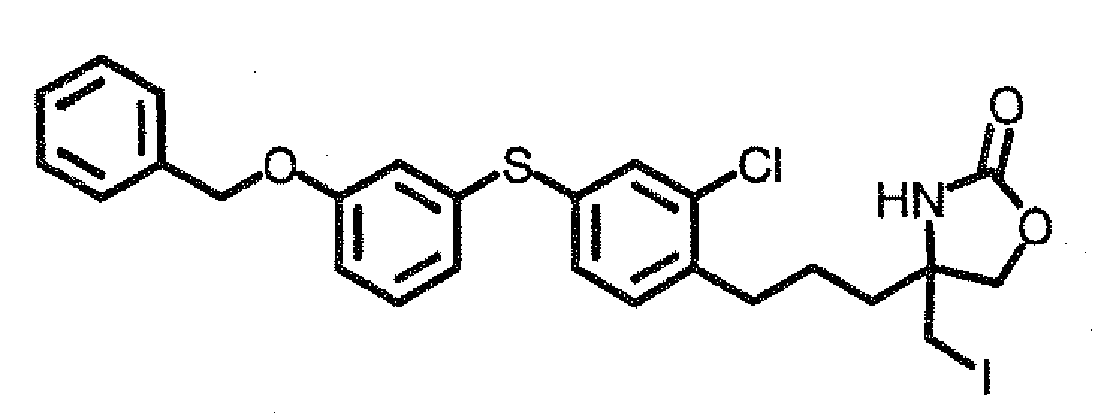
- The compound of Example 187 (2.37g) was dissolved in pyridine (30mL). To this solution, p-toluenesulfonylchloride (1.33g) was added and the mixture was stirred for 24 hours at room temperature and a further 5 hours at 60°C. Following addition of water, the mixture was extracted with ethyl acetate. The extract was then washed sequentially with water, diluted hydrochloric acid and a saturated aqueous solution of sodium chloride. The organic phase was dried over anhydrous sodium sulfate. The solvent was removed by distillation and the residue was purified on a silica gel chlomatography (hexane : ethyl acetate = 1 : 1) to obtain a sulfonic acid ester as a colorless oil (2.14g). The sulfonic acid ester (2.14g) was dissolved in acetone (20mL), followed by addition of sodium iodide (2.55g) and refluxing for 10 hours. Subsequently, water was added and the mixture was extracted with ethyl acetate. The extract was washed sequentially with water and a saturated aqueous solution of sodium chloride. The organic phase was then dried over anhydrous sodium sulfate. The solvent was removed by distillation and the residue was purified on a silica gel chlomatography (hexane : ethyl acetate = 1 : 1) to give the desired product as a colorless oil (1.47g).
1H-NMR(400MHz, CDCl3) δ 1.59-1.65(2H, m), 1.83-1.89(2H, m), 2.75(2H, t, J=7.8Hz), 3.31(2H, s), 4.19(1H, d, J=9.3Hz), 4.21(1H, d, J=9.3Hz), 5.02(2H, s), 5.13(1H, br s), 6.88(1H, dd, J=7.8, 2.0Hz), 6.94-7.00(2H, m), 7.11(1H, d, J=7.8Hz), 7.16(1H, dd, J=7.8, 2.0Hz), 7.22-7.41(7H, m). -

- The compound of Example 188 (1.47g) was dissolved in THF (30mL). To this solution, NaSMe (210mg) was added and the mixture was stirred for 2 hours at room temperature. Following addition of water, the mixture was extracted with ethyl acetate. The extract was then washed with a saturated aqueous solution of sodium chloride and the organic phase was dried over anhydrous sodium sulfate. The solvent was concentrated under reduced pressure to give the desired product as a colorless oil (1.27g).
FABMS: 514 ([M+H]+).
1H-NMR(400MHz, CDCl3) δ 1.62-1.77(4H, m), 2.17(3H, s), 2.68(1H, d, J=13.2Hz), 2.74(2H, t, J=7.3Hz), 2.78(1H, d, J=13.2Hz), 4.15(1H, d, J=9.0Hz), 4.20(1H, d, J=9.0Hz), 5.03(2H, s), 5.22(1H, br s), 6.87-6.90(1H, m), 6.93-6.97(2H, m), 7.10-7.17(2H, m), 7.22-7.41(7H, m). -

- The compound of Example 189 (1.27g) was dissolved in acetonitrile (20mL). To this solution, Boc2O (1.09g) and dimethylaminopyridine (100mg) were added and the mixture was stirred for 30min at room temperature. The solvent was removed under reduced pressure and the residue was purified on a silica gel chlomatography (hexane : ethyl acetate = 4 : 1) to obtain an N-Boc-oxazolidinone as a colorless oil (1.48g). This product was dissolved in methanol (20mL), followed by addition of cesium carbonate (410mg) and stirring overnight at room temperature. Subsequently, the solvent was removed by distillation and the residue was dissolved in ethyl acetate. The mixture was then washed sequentially with diluted hydrochloric acid and water and the organic phase was dried over anhydrous sodium sulfate. The solvent was removed by distillation and the residue was purified on a silica gel chlomatography (hexane : ethyl acetate = 2 : 1) to give the desired product as a colorless oil (1.28g).
FABMS: 588 ([M+H]+).
1H-NMR(400MHz, CDCl3) δ 1.43(9H, s), 1.51-1.66(3H, m), 1.82-1.85(1H, m), 2.15(3H, s), 2.69(2H, t, J=7.3Hz), 2.75(1H, d, J=13.4Hz), 2.90(1H, d, J=13.4Hz), 3.69-3.70(2H, m), 4.02(1H, br), 4.99(1H, br s), 5.02 (2H, s), 6.86-6.94(3H, m), 7.12-7.17(2H, m), 7.21-7.41(7H, m). -

- The compound of Example 146 (3.25g) was dissolved in DMF (18mL). To this solution, diisopropylethylamine (10.5mL) and t-BuPh2SiCl (1.73g) were added and the mixture was stirred for 8 hours at room temperature. Subsequently, ice water was added and the mixture was extracted with ethyl acetate. The extract was washed sequentially with water, diluted hydrochloric acid, water and a saturated aqueous solution of sodium chloride. The organic phase was then dried over anhydrous sodium sulfate. The solvent was removed by distillation and the residue was purified on a silica gel column chromatography (hexane: ethyl acetate = 7 : 1) to give the desired product as a colorless oil (1.64g).
1H-NMR(400MHz, CDCl3) δ 1.06(9H, s), 1.43(9H, s), 1.49-1.82(4H, m), 2.66(2H, t, J=7.8Hz), 3.54(1H, d, J=10.3Hz), 3.65-3.67(2H, m), 3.74(1H, d, J=10.3Hz), 5.03(2H, s), 5.05(1H, br s), 6.59(1H, dd, J=8.3, 2.4Hz), 6.63(1H, t, J=2.4Hz), 6.74(1H, dd, J=8.3, 2.4Hz), 6.82(1H, dd, J=8.3, 2.4Hz), 6.99(1H, d, J=2.4Hz), 7.10(1H, d, J=8.3Hz), 7.23(1H, t, J=8.3Hz), 7.31-7.45(11H, m), 7.6.1-7.64(4H, m). -
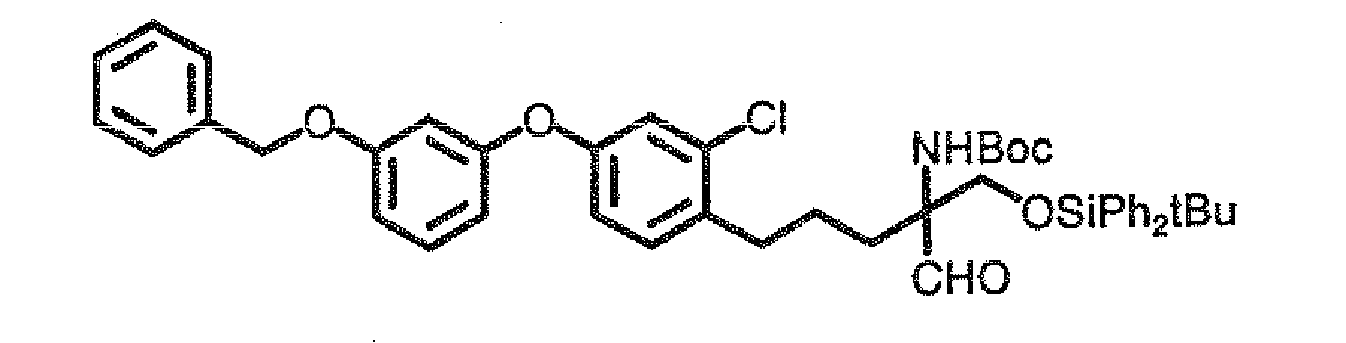
- The compound of Example 191 (940mg) was dissolved in DMF (10mL). To this solution, pyridinium dichromate (800mg) was added and the mixture was stirred for 48 hours at room temperature. Following addition of water, the mixture was extracted with ethyl acetate. The extract was then washed sequentially with water and a saturated aqueous solution of sodium chloride. The organic phase was dried over anhydrous sodium sulfate. The solvent was concentrated and the residue was purified on a silica gel chlomatography (hexane : ethyl acetate = 3 : 1) to give the desired product as a colorless oil (710mg).
1H-NMR(400MHz, CDCl3) δ 1.01 (9H, s), 1.44(9H, s), 1.49-1.73(4H, m), 2.64(2H, br s), 3.84(1H, d, J=10.3Hz), 4.13(1H, d, J=10.3Hz), 5.03(2H, s), 5.43(1H, br s), 6.58(1H, dd, J=8.3, 2.4Hz), 6.62(1H, t, J=2.4Hz), 6.74(1H, dd, J=8.3, 2.4Hz), 6.82(1H, dd, J=8.3, 2.4Hz), 6.99(1H, d, J=2.4Hz), 7.08(1H, d, J=8.3Hz), 7.23(1H, t, J=8.3Hz), 7.30-7.43(11H, m), 7.56-7.64(4H, m), 9.36(1H, s). -

- To an oxalyl chloride solution (1.0mL) of methylene chloride (20mL), a mixture of DMSO (1.7mL) and methylene chloride (10mL) was added while the mixtures were kept at - 78°C. The compound of Example 129 (5.59g) in methylene chloride (20mL) was then added dropwise. After 15min, triethylamine (7.2mL) was added and the mixture was stirred for 2 hours until room temperature. Following addition of water, the mixture was extracted with ethyl acetate and the organic phase was dried over anhydrous sodium sulfate. The solvent was then concentrated and the residue was purified on a silica gel chlomatography (hexane : ethyl acetate = 3 : 1) to give the desired product as a pale yellow oil (4.75g).
1H-NMR(400MHz, CDCl3) δ 1.44(9H, s), 1.60-1.74(3H, m), 1.96(1H, br), 2.72-2.77 (2H, m), 4.28(1H, br), 5.02(2H, s), 6.87-6.95(3H, m), 7.10-7.16(2H, m), 7.23(1H, t, J=7.8Hz), 7.28-7.52(5H, m), 9.58(1H, s). -

- Sodium hydride (242mg) was dissolved in DMF (5mL). To this solution, diethyl methylmalonate (0.956mL) was added and the mixture was stirred for 30min. The compound of Reference Example 252 (2.50g) in DMF (5mL) was then added and the mixture was further stirred for I hour. Subsequently, the reaction mixture was diluted with water and was extracted with ethyl acetate. The ethyl acetate layer was washed with a saturated aqueous solution of sodium chloride and was dried over anhydrous sodium sulfate. The dried organic phase was concentrated and the resulting residue was purified on a silica gel chromatography (hexane: ethyl acetate = 20 : 1 to 10 : 1) to give the desired product as a yellow oil (2.74g). MS (EI) : 540 ([M]+).
1H-NMR(400MHz, CDCl3) δ 1.23(6H, t, J=7.3Hz), 1.40(3H, s), 1.52-1.60(2H, m), 1.91-1.95(2H, m), 2.70(2H, t, J=7.9Hz), 4.16(4H, q, J=7.3Hz), 5.02(2H, s), 6.86-6.94(3H, m), 7.11-7.14 (2H, m), 7.20-7.24(1H, m), 7.31-7.40(6H, m). -

- Using diethyl ethylmalonate, the reaction was carried out in the same manner as in Reference Example 194 to give the desired product as a yellow oil.
MS (EI) : 554 ([M]+).
1H-NMR(400MHz, CDCl3) δ 0.80(3H, t, J=7.3Hz), 1.22(6H, t, J=7.3Hz), 1.45-1.53(2H, m), 1.89-1.97(4H, m), 2.70(2H, t, J=7.3Hz), 4.16(4H, q, J=7.3Hz), 5.02(2H, s), 6.86-6.94(3H, m), 7.11-7.16(2H, m), 7.20-7.24(1H, m) , 7.31-7.40(6H, m). -

- Using the compound of Reference Example 317, the reaction was carried out in the same manner as in Example 194 to give the desired product as a pale yellow oil.
MS(EI): 526 ([M]+).
1H-NMR(400MHz, CDCl3) δ 1.27(6H, t, J=7.3Hz), 1.52(3H, s), 2.10-2.14(2H, m), 2.65-2.69(2H, m), 4.20(4H, q, J=7.3Hz), 5.02(2H, s), 6.86-6.96(3H, m), 7.15(2H, s), 7.23(1H, t, J=8.0), 7.31-7.41(6H, m). -

- Using the compound of Reference Example 317, the reaction was carried out in the same manner as in Example 195 to give the desired product as a colorless oil.
MS(EI): 540 ([M]+).
1H-NMR(400MHz, CDCl3) δ 0.82(3H, t, J=7.3Hz), 1.17(6H, t, J=7.3Hz), 1.93(2H, q, J=7.3Hz), 1.98-2.02 (2H, m), 2.45-2.51 (2H, m), 4.13(4H, q, J=7.3Hz), 5.10(2H, s), 6.92-7.01(3H, m), 7.21(1H, dd, J=8.0, 1.9Hz), 7.30-7.41(8H, m). -

- The compound of Example 194 (2.74g) was dissolved in ethanol (10mL). To this solution, potassium hydroxide (330mg) was added and the mixture was stirred overnight at 50°C. Subsequently, the reaction mixture was diluted with water, followed by addition of 2mol/L hydrochloric acid and extraction with ethyl acetate. The ethyl acetate layer was washed with a saturated aqueous solution of sodium chloride, was dried over anhydrous magnesium sulfate, and was then concentrated. The resulting residue was purified on a silica gel chlomatography (hexane : ethyl acetate = 10 : 1 to 2 : 1) to give the desired product as a yellow oil (2.38g).
MS(EI): 512 ([M+]).
1H-NMR(400MHz, CDCl3) δ 1.26(3H, t, J=7.3Hz), 1.47(3H, s), 1.53-1.62(2H, m), 1.92-2.03(2H, m), 2.71(2H, t, J=7.9Hz), 4.22(2H, q, J=7.3Hz), 5.02(2H, s), 6.87-6.94(3H, m), 7.10-7.14(2H, m), 7.21-7.25(1H, m) , 7.31-7.40(6H, m). -
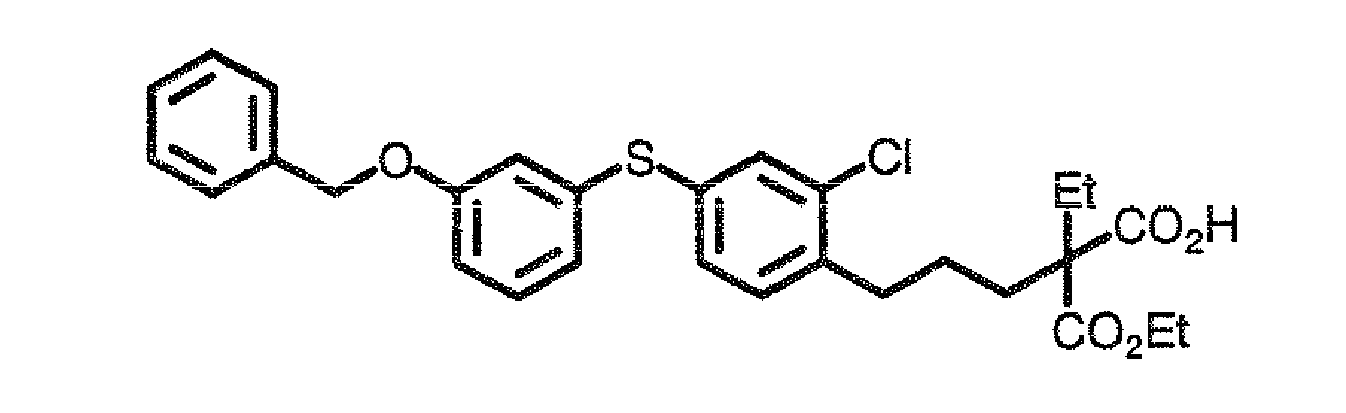
- Using the compound of Example 195, the reaction was carried out in the same manner as in Example 198 to give the desired product as a yellow oil.
MS(EI): 526 ([M]+)
1H-NMR(400MHz, CDCl3) δ 0.84(3H, t, J=7.3Hz), 1.28(3H, t, J=7.3Hz), 1.42-1.59(2H, m), 1.85-1.95(2H, m), 2.00-2.13(2H, m), 2.66-2.70(2H, m), 4.23-4.31(2H, m), 5.02(2H, s), 6.86-6.94(3H, m), 7.08-7.15(2H, m), 7.21-7.25(1H, m) , 7.30-7.40(6H, m). -

- Using the compound of Example 196, the reaction was carried out in the same manner as in Example 198 to give the desired product as a pale yellow oil.
MS(EI): 499 ([M]+).
1H-NMR(400MHz, CDCl3) δ 1.30(3H, t, J=7.3Hz), 1.57(3H, s), 2.11-2.19(2H, m), 2.69(2H, t, J=8.5Hz), 4.24(2H, q, J=7.3Hz), 5.02(2H, s), 6.87-6.96(3H, m), 7.14(2H, s), 7.23(1H, t, J=8.0Hz), 7.31-7.40(6H, m). -

- Using the compound of Example 197, the reaction was carried out in the same manner as in Example 198 to give the desired product as a pale yellow oil.
1H-NMR(400MHz, CDCl3) δ 0.90(3H, t, J=7.3Hz), 1.33(3H, t, J=7.3Hz), 1.94-1.99(1H, m), 2.05-2.12(1H, m), 2.19-2.24(2H, m), 2.59-2.64(2H, m), 4.20-4.31(2H, m), 5.02(2H, s), 6.87-6.94(3H, m), 7.09-7.14(2H, m), 7.23(1H, t, J=8.0Hz), 7.29-7.40(6H, m). -

- The compound of Example 198 (2.38g) was dissolved in benzene (20mL). To this solution, triethylamine (0.711mL) and DPPA (1.10mL) were added. The mixture was then stirred for 10min at room temperature and for a further 1 hour and 30min while being refluxed. Subsequently, methanol (3.76mL) was added over 30min and the mixture was stirred overnight. The reaction mixture was diluted with water and was extracted with ethyl acetate. The ethyl acetate layer was washed with a saturated aqueous solution of sodium chloride and was dried over anhydrous magnesium sulfate. The dried organic phase was concentrated and the resulting residue was purified on a silica gel chlomatography (hexane: ethyl acetate = 20 : 1 to 10 : 1) to give the desired product as a yellow oil (2.04g).
MS(EI): 541 ([M]+).
1H-NMR(400MHz, CDCl3) δ 1.24(3H, t, J=7.3Hz), 1.36-1.40(1H, m), 1.54(3H, s), 1.56-1.65(1H, m), 1.80-1.87(1H, m), 2.28(1H, m), 2.65-2.69(2H, m), 3.63(3H, s), 4.15-4.22(2H, m), 5.02(2H, s), 5.61(1H, br s), 6.86-6.94(3H, m), 7.09-7.15(2H, m), 7.20-7.24(1H, m), 7.31-7.40(6H, m). -

- Using the compound of Example 199, the reaction was carried out in the same manner as in Example 202 to obtain the desired product as a yellow oil.
MS (EI) : 555 ([M]+).
1H-NMR(400MHz, CDCl3) δ 0.74 (3H, t, J=7.3Hz), 1.24(3H, t, J=7.3Hz), 1.28-1.32(1H, m), 1.57-1.58(1H, m), 1.70-1.84(2H, m), 2.34-2.44(2H, m), 2.62-2.72(2H, m), 3.63(3H, s), 4.16-4.22(2H, m), 5.02(2H, s), 5.78(1H, br s), 6.86-6.94(3H, m), 7.08-7.15(2H, m), 7.20-7.24(1H, m), 7.31-7.40(6H, m). -

- Using the compound of Example 200 and t-butanol instead of methanol, the reaction was carried out in the same manner as in Example 202 to obtain the desired product as a pale yellow oil.
FABMS: 569 ([M+H]+).
1H-NMR(400MHz, CDCl3) δ 1.29(3H, t, J=7.3Hz), 1.46(9H, s), 1.58(3H, s), 2.10(1H, td, J=13.0, 4.9Hz), 2.41(1H, br), 2.53(1H, td, J=13.0, 4.9Hz), 2.67(1H, td, J=13.0, 4.9Hz), 4.19(2H, q, J=7.3Hz), 5.02(2H, s), 5.46(1H, br s), 6.86-6.94(3H, m), 7.08-7.15(2H, m), 7.23(1H, t, J=8.0Hz), 7.30-7.40(6H, m). -

- Using the compound of Example 201, the reaction was carried out in the same manner as in Example 202 to obtain the desired product as a pale yellow oil.
MS(EI): 541 ([M]+).
1H-NMR(400MHz, CDCl3) δ 0.77(3H, t, J=7.3Hz), 1.30(3H, t, J=7.3Hz), 1.75-1.80(1H, m), 2.05-2.15(1H, m), 2.36-2.49(2H, m), 2.59-2.68(2H, m), 3.66(3H, s), 4.11-4.27(2H, m), 5.02(2H, s), 5.87(1H, br), 6.86-6.93(3H, m), 7.08-7.14(2H, m), 7.22(1H, t, J=8.0Hz), 7.30-7.40(6H, m). -

- Using the compound of Example 202, the reaction was carried out in the same manner as in Example 76 to obtain the desired product as a colorless oil.
MS (EI): 499 ([M]+).
1H-NMR(400MHz, CDCl3) δ 1.18(3H, s), 1.57-1.84(4H, m), 2.71(2H, t, J=7.3Hz), 3.59-3.69(3H, m), 3.63(3H, s), 4.71(1H, br s), 5.02(2H, s), 6.86-6.94(3H, m), 7.13-7.17(2H, m), 7.21-7.25(1H, m), 7.30-7.41(6H, m). - The compound of Example 206 was optically resolved by a high performance liquid chromatography (HPLC) (chiralcel OD, hexane : isopropanol = 70 : 30, detection wavelength = UV 254nm, flow rate = 3mL/min).
- The compound obtained from the first eluate had an optical rotation [α]24.0 D of +15° (C = 1.0, chloroform) (Example 207), while the compound obtained from the second eluate had an optical rotation [α]24.7 D of -12° (C = 1.0, chloroform) (Example 208).
-

- Using the compound of Example 203, the reaction was carried out in the same manner as in Example 76 to obtain the desired compound as a pale yellow oil.
MS(EI): 513 ([M]+).
1H-NMR(400MHz, CDCl3) δ 0.83(3H, t, J=7.3Hz), 1.51-1.73(6H, m), 2.70 (2H, t, J=7.3Hz), 3.63(3H, s), 3.65-3.70(3H, m), 4.63(1H, br s), 5.02(2H, s), 6.86-6.94(3H, m), 7.12-7.17(2H, m), 7.20-7.24(1H, m) , 7.30-7.40(6H, m). - The compound of Example 209 was optically resolved by HPLC (chiralcel OD, hexane : isopropanol = 60 : 40, detection wavelength = UV 254nm, flow rate = 3mL/min).
- The colorless oil obtained from the first eluate had an optical rotation [α]25.6 D of +14° (C = 1.0, chloroform) (Example 210), while the colorless oil obtained from the second eluate had an optical rotation [α]25.7 D of -15° (C = 1.0, chloroform) (Example 211).
-

- Using the compound of Example 204, the reaction was carried out in the same manner as in Example 76 to obtain the desired compound as a colorless oil.
MS (EI): 527 ([M]+).
1H-NMR(400MHz, CDCl3) 5 1.25(3H, s), 1.44(9H, s), 1.82(1H, td, J=13.0, 4.9Hz), 2.06(1H, td, J=13.0, 4.9Hz), 2.65-2.80(2H, m), 3.66-3.74(2H, m), 4.68(1H, br s), 5.02(2H, s), 6.86-6.94(3H, m), 7.15(2H, s), 7.23(1H, t, J=8.0Hz), 7.32-7.40(6H, m). - The compound of Example 212 was optically resolved by HPLC (chiralpak AD, hexane : isopropanol = 85 : 15, detection wavelength = UV 254nm, flow rate = 3mL/min).
- The colorless oil obtained from the first eluate had an optical rotation [α]25.3 D of +4.6° (C = 1.0, chloroform) (Example 213), while the colorless oil obtained from the second eluate had an optical rotation [α]25.6 D of -2.2° (C = 1.0, chloroform) (Example 214).
-

- Using the compound of Example 205, the reaction was carried out in the same manner as in Example 76 to obtain the desired product as a colorless oil.
MS (EI): 499 ([M]+).
1H-NMR(400MHz, CDCl3) δ 0.94(3H, t, J=7.3Hz), 1.69(2H, q, J=7.3Hz), 1.80-1.94(2H, m), 2.62-2.75(2H, m), 3.65(3H, s), 3.77(3H, m), 4.77(1H, br), 5.02(2H, s), 6.86-6.95(3H, m), 7.16(2H, s), 7.23(1H, t, J=8.0Hz), 7.32-7.41(6H, m). - The compound of Example 215 was optically resolved under similar conditions to those used in Examples 213 and 214.
- The colorless oil obtained from the first eluate had an optical rotation [α]25.6 D of +11.1° (C = 1.0, chloroform) (Example 216), while the colorless oil obtained from the second eluate had an optical rotation [α]26.1 D of -9.67° (C = 1.0, chloroform) (Example 217).
-

- Using the compound of Example 199 and t-butanol instead of methanol, the same procedure was followed as in Example 203 and the reactant was reduced in the same manner as in Example 76 to obtain the desired product as a colorless oil.
MS (EI): 555 ([M]+).
1H-NMR(400MHz, CDCl3) δ 0.83(3H, t, J=7.3Hz), 1.42(9H, s), 1.55-1.72(6H, m), 2.70(2H, t, J=6.7Hz), 3.64-3.66(2H, m), 4.49(1H, br s), 5.02(2H, s), 6.82-6.95(3H, m), 7.12-7.17(2H, m), 7.20-7.25(1H, m) , 7.30-7.41(6H, m). -

- The compound of Example 126 (4.00g) was dissolved in methylene chloride (100mL). To this solution, diisopropylethylamine (1.54mL) was added, followed by dropwise addition of methoxymethylchloride (710mg) at 0°C. The mixture was stirred for one day until room temperature. Following addition of ice water, the mixture was extracted with ethyl acetate. The extract was then dried over anhydrous sodium sulfate and the solvent was removed by distillation. The resulting residue was purified on a silica gel chlomatography (hexane : ethyl acetate = 2 : 1) to give the desired product as a colorless oil (2.60g).
1H-NMR(400MHz, CDCl3) δ 1.45(9H, s), 1.90-2.00(2H, m), 2.68-2.78(2H, m), 3.39(3H, s), 3.54(1H, d, J=9.8Hz), 3.77(2H, d, J=6.1Hz), 3.79(1H, d, J=9.8Hz), 3.99(1H, br), 4.65(2H, s), 5.02(2H, s), 5.20(1H, br s), 6.86-6.94(3H, m), 7.13-7.17(2H, m), 7.22(1H, t, J=8.0Hz), 7.31-7.40(6H, m). - The compound of Example 219 was optically resolved by HPLC (chiralpak AD-H, hexane : isopropanol = 85 : 15, detection wavelength = UV 254nm, flow rate = 3mL/min).
- A colorless oil was obtained from each of the first eluate and the second eluate (Example 220 and Example 221, respectively).
-
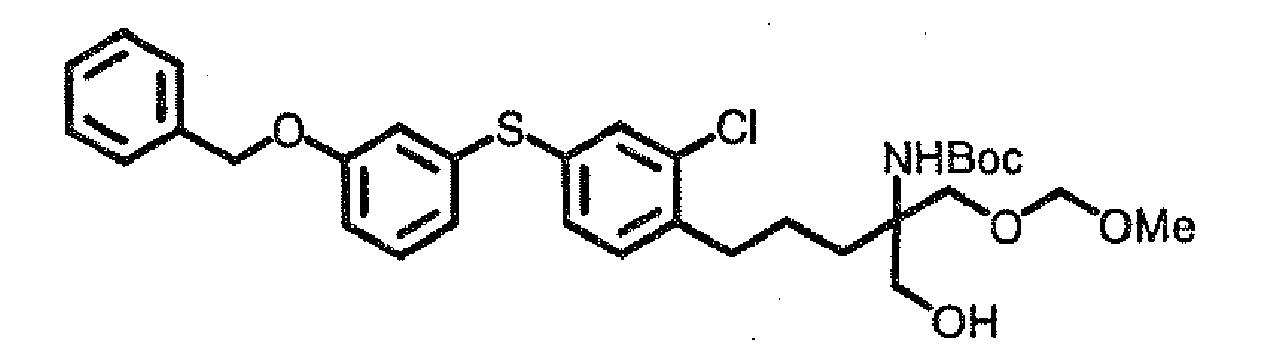
- Using the compound of Example 128, the reaction was carried out in the same manner as in Example 219 to obtain the desired product as a colorless oil.
1H-NMR(400MHz, CDCl3) δ 1.43(9H, s), 1.56-1.68(3H, m), 1.81-1.84(1H, m), 2.67(2H, t, J=7.8Hz), 3.35(3H, s), 3.46(1H, d, J=9.8Hz), 3.66-3.68(2H, m), 3.71(1H, d, J=9.8Hz), 4.61(2H, s), 5.02(2H, s), 5.07(1H br s), 6.87(1H, ddd, J=8.3, 2.5, 1.0Hz), 6.91-6.95(2H, m), 7.12-7.16(2H, m), 7.23(1H, t, J=7.8Hz), 7.31-7.40(6H, m). -
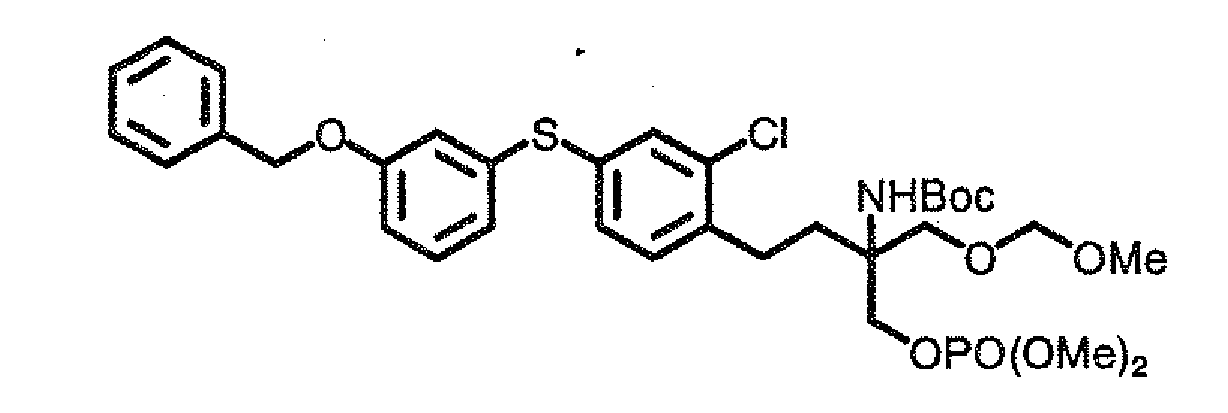
- To a methylene chloride solution (2mL) containing the compound of Example 219 (860mg), carbon tetrabromide (533mg) and pyridine (2mL), trimethyl phosphite (0.19mL) was added while the mixture was stirred at 0°C and the mixture was stirred for 5 hours until room temperature. Subsequently, water was added and the mixture was extracted with ethyl acetate. The extract was washed sequentially with water and a saturated aqueous solution of sodium chloride. The organic phase was then dried over anhydrous sodium sulfate. The solvent was removed by distillation and the residue was purified on a silica gel column chromatography (hexane : ethyl acetate = 1 : 1) to obtain the desired product as a colorless oil (830mg).
FABMS: 696 ([M+H]+).
1H-NMR(400MHz, CDCl3) δ 1.45(9H, s), 1.95-2.03(1H, m), 2.08-2.21(1H, m), 2.69-2.78(2H, m), 3.39(3H, s), 3.68(1H, d, J=9.8Hz), 3.74(1H, d, J=9.8Hz), 3.78(6H, d, J=11.0Hz),4.22-4.29(2H, m), 4.65(2H, s), 4.97(1H, br s), 5.02(2H, s), 6.88(1H, dd, J=7.9, 2.4Hz), 6.91-6.95(2H, m), 7.14(2H, s), 7.23(1H, t, J=7.8Hz), 7.31-7.40(6H, m). - Using the compound of Example 220 (first eluate), the reaction was carried out in the same manner as in Example 223 to obtain the desired product as a colorless oil.
[α]26 D = -3.01°(C = 0.93, chloroform). - Using the compound of Example 221 (second eluate), the reaction was carried out in the same manner as in Example 223 to obtain the desired product as a colorless oil.
[α]26 D = +1.39° (C = 1.03, chloroform). -

- The compound of Example 206 (527mg) was dissolved in a mixed solvent composed of a 5mol/L aqueous solution of potassium hydroxide (2mL), tetrahydrofuran (2mL) and methanol (3mL). This mixture was refluxed and stirred for 4 days. Subsequently, the reaction mixture was diluted with water and was extracted with ethyl acetate. The ethyl acetate layer was then washed with a saturated aqueous solution of sodium chloride, was dried over anhydrous magnesium sulfate, and was then concentrated. The resulting residue was purified on a silica gel column chromatography (aminated silica gel, ethyl acetate : ethanol = 20 : 1) to give the desired product as a pale yellow oil (311mg).
FABMS: 442([M+H]+).
1H-NMR(400MHz, CDCl3) δ 1.04(3H, s), 1.37-1.67(4H, m), 2.70(2H, t, J=7.3Hz), 3.29(2H, q, J=9.2Hz), 5.02(2H, s), 6.86-6.94(3H, m), 7.12-7.17(2H, m), 7.21-7.25(1H, m) , 7.31-7.41(6H, m). - Using the compound of Example 207 (first eluate), the reaction was carried out in the same manner as in Example 226 to obtain the desired product as a pale yellow oil. Elemental analysis (%) : C25H28ClNO2S·1/3H2O
C H N Calcd: 67.00 6.45 3.13 Found: 67.03 6.51 3.20 - Using the compound of Example 208 (second eluate), the reaction was carried out in the same manner as in Example 226 to give the desired product as a pale yellow oil.
Elemental analysis (%): C25H28ClNO2S·1/4H2OC H N Calcd: 67.23 6.44 3.14 Found: 67.19 6.44 3.15 -

- The compound of Example 227 (410mg) was dissolved in acetonitrile (10mL) While this solution was chilled in an ice bath, Boc2O (303mg) was added and the mixture was stirred for 3 hours at room temperature. The reaction mixture was concentrated and the residue was dissolved in ethyl acetate. This solution was washed with water and a saturated aqueous solution of sodium chloride. The organic phase was then dried over anhydrous sodium sulfate and was concentrated. The resulting residue was purified on a silica gel column chromatography (hexane : ethyl acetate = 5 : 1) to give a t-butoxycarbonylamino product as a pale yellow oil (473mg). The resulting compound (473mg), along with carbon tetrabromide (434mg), was dissolved in pyridine (2.00mL). While this solution was chilled in an ice bath, trimethyl phosphite (0.205mL) was added and the mixture was allowed to warm to room temperature and was stirred for 2 hours. Subsequently, the reaction mixture was diluted with water and was extracted with ethyl acetate. The extract was then washed with a saturated aqueous solution of sodium chloride, was dried over anhydrous magnesium sulfate, and was then concentrated. The resulting residue was purified on a silica gel column chromatography (hexane : ethyl acetate = 5 : 1 to 1 : 1) to give the desired product as a pale yellow oil (534mg). 1H-NMR(400MHz, CDCl3) δ 1.25(3H, s), 1.41(9H, s), 1.58-1.91(4H, m), 2.70(2H, t, J = 7.3Hz), 3.77(6H, d, J=11.0Hz), 3.96-4.00(1H, m), 4.13-4.16(1H, m), 4.51(1H, brs), 5.02(2H, s), 6.86-6.89(1H, m), 6.92-6.96(2H, m), 7.11-7.16(2H, m), 7.23(1H, t, J = 7.9Hz), 7.31-7.34(2H, m), 7.35-7.39(4H, m).
- Using the compound of Example 228, the reaction was carried out in the same manner as in Example 229 to obtain the desired product as a pale yellow oil.
1H-NMR(400MHz, CDCl3) δ 1.25(3H, s), 1.41(9H, s), 1.58-1.91(4H, m), 2.70(2H, t, J = 7.3Hz), 3.77(6H, d, J=11.0Hz), 3.97-4.00(1H, m), 4.13-4.17(1H, m), 4.51(1H, brs), 5.02(2H, s). 6.86-6.89(1H, m), 6.92-6.95(2H, m), 7.11-7.16(2H, m), 7.23(1H, t, J = 7.9Hz), 7.32-7.34(2H, m), 7.35-7.40(4H, m). -

- Using the compound of Example 222, the reaction was carried out in the same manner as in Example 223 to obtain the desired product as a colorless oil.
FABMS: 710 ([M+H]+).
1H-NMR(400MHz, CDCl3) δ 1.41(9H, s), 1.57-1.62(2H, m), 1.76-1.80(1H, m), 2.00-2.05(1H, m), 2.70(2H, t, J=7.8Hz), 3.34(3H, s), 3.57(1H d, J=9.5Hz), 3.65(1H, d, J=9.5Hz), 3.77(6H, d, J=11.0Hz), 4.12(2H, d, J=7.1Hz), 4.60(2H, s), 4.81(1H, br s), 5.02(2H, s), 6.87(1H, ddd, J=8.3, 2.5, 1.0Hz), 6.92-7.00(2H, m), 7.10-7.16(2H, m), 7.23(1H, t, J=7.8Hz), 7.28-7.52(6H, m). -

- Ethyl methylenebisphosphonate (940mg) in THF (5mL) was chilled to -78°C under an argon gas atmosphere. To this solution, a 1.6mol/L n-BuL-hexane solution (2mL) was added dropwise and the mixture was stirred for 30min, followed by dropwise addition of a THF solution (15mL) of the compound of Example 193 (1.58g). After 3 hours, a saturated ammonium chloride solution was added and the mixture was extracted with ethyl acetate. The organic phase was washed with water and a saturated aqueous solution of sodium chloride and was dried over anhydrous sodium sulfate. The solvent was removed by distillation to give the desired product as a colorless oil (1.71g).
FABMS: 660([M+H]+).
1H-NMR(400MHz, CDCl3) 5 1.29-1.33(6H, m), 1.43(9H, s), 1.54-1.68(4H, m), 2.71-2.73(2H, m), 4.03-4.11(4H, m), 4.32(1H br), 4.47(1H, br), 5.03(2H, s), 5.77(1H, t, J=17.7Hz), 6.60-6.71(1H, m), 6.87-6.96(3H, m), 7.09-7.15(2H, m), 7.21-7.41(7H, m). -

- The compound of Example 232 (300mg) was dissolved in methanol (10mL) containing 10% hydrochloric acid in an ice bath. The mixture was stirred for 6 hours until room temperature and the solvent was concentrated. This gave the desired product as a colorless oil (250mg).
FABMS: 560 ([M+H]+).
1H-NMR(400MHz, DMSOd6) δ 1.16-1.22(6H, m), 1.53-1.77(4H, m), 2.68-2.69(2H, m ), 3.05(1H, br), 3.94-4.07(4H, m), 5.09(2H, s), 6.13(1H, t, J=17.8Hz), 6.46-6.55(1H, m), 6.89-7.00(3H, m), 7.20-7.22(1H, m), 7.29-7.41(8H, m), 8.44(3H, br s). -

- The compound of Example 232 was reduced in the same manner as in Reference Example 125 to obtain the desired product as a colorless oil.
FABMS: 662 ([M+H]+).
1H-NMR(400MHz, CDCl3) δ 1.32(6H, t, J=7.3Hz), 1.43(9H, s), 1.46-1.82(8H, m), 2.67-2.73(2H, m ), 3.62(1H, br), 4.03-4.13(4H, m), 4.32-4.34(1H, br), 5.02(2H, s), 6.86-6.95(3H, m), 7.10-7.16(2H, m), 7.23(1H, t, J=8.0Hz), 7.32-7.40(6H, m). -

- The compound of Example 234 was reacted in the same manner as in Example 233 to obtain the desired product as a pale brown oil.
FABMS: 562([M+H]+).
1H-NMR(400MHz, DMSOd6) δ 1.21(6H, t, J=6.7Hz), 1.59-1.85(8H, m), 2.67(2H, br s), 3.15(1H, br s), 3.91-4.01(4H, m), 5.08(2H, s), 6.88-6.99(3H, m), 7.21-7.39(9H, m), 8.08(3H, br s). -

- To an acetonitrile solution (5mL) of the compound of Example 231 (500mg), TMSI (0.5mL) was added and the mixture was stirred for 3 hours. The solvent was concentrated and the residue was purified on a silica gel column chromatography to obtain the desired product as a colorless powder (120mg).
FABMS: 538 ([M+H]+).
1H-NMR(400MHz, DMSOd6) δ 1.60(4H, br s), 2.63(2H, br s), 3.38-3.44(2H, m), 3.72(2H, br s), 5.08(2H, s), 6.87-6.98(3H, m), 7.20-7.38(9H, m).
Elemental analysis(%): C25H29ClNO6SP·H2OC H N Calcd : 54.00 5.62 2.52 Found : 54.10 5.37 2.62 -

- Using the compound of Example 223, the reaction was carried out in the same manner as in Example 236 to obtain the desired product as a colorless powder.
FABMS: 524 ([M+H]+).
1H-NMR(400MHz, DMSOd6) δ 1.77-1.78(2H, m), 2.71-2.75(2H, m), 3.50-3.58(2H, m), 3.76-3.88(2H, m), 5.08(2H, s), 6.89(1H, t, J=7.3Hz), 6.96-6.99(2H, m), 7.21-7.38(9H, m).
Elemental analysis(%) : C24H27ClNO6SPC H N Calcd : 55.01 5.19 2.67 Found : 54.94 5.26 2.77 -

- Instead of ice-cold environment, the experiment of Example 236 was carried out at room temperature to give the desired product as a colorless powder.
FABMS: 448 ([M+H]+).
1H-NMR(400MHz, DMSOd6) δ 1.54-1.62(4H, m), 2.51-2.73(2H, m), 3.37-3.41(2H, m), 3.57-3.75 (2H, m), 6.62(1H, dd, J=8.0, 1.8Hz), 6.67-6.68(1H, m), 6.75(1H, dd, J=8.6, 1.2Hz), 7.15(1H, t, J=8.0Hz), 7.27(1H, dd, J=8.0, 2.0Hz), 7.34-7.36(2H, m). Elemental analysis (%) : C18H23ClNO6SP·0.5H2OC H N Calcd : 47.32 5.29 3.07 Found : 47.06 5.07 3.07 -

- The compound of Example 229 was reacted in the same manner as in Example 236 to obtain the desired product as a colorless powder.
HR-MS(FAB+): 522.1255 (-1.6mmu).
1H-NMR(400MHz, DMSOd6) δ 1.12(3H, s), 1.51-1.65(4H, m), 2.64-2.70(2H, m), 3.66(2H, d, J = 11Hz), 5.09(2H, s), 6.91(1H, d, J = 7.3Hz), 6.97-7.01(2H, m), 7.20-7.24(1H, m) , 7.30-7.42(8H, m).
Elemental analysis (%) :C25H29ClNO5PS·1/2H2OC H N Calcd : 56.55 5.69 2.64 Found : 56.40 5.60 2.77
m.p. = 207-210°C. - Using the compound of Example 228, the reaction was carried out in the same manner as in Example 236 to obtain the desired product as a colorless powder.
HR-MS(FAB+): 522.1277 (+0.6mmu).
1H-NMR(400MHz, DMSOd6) δ 1.12(3H, s), 1.51-1.65(4H, m), 2.63-2.70(2H, m), 3.67(2H, d, J = 12Hz), 5.09(2H, s), 6.89-6.92(1H, m), 6.96-7.01(2H, m), 7.22-7.24(1H, m) , 7.32-7.42(8H, m).
[α]23.4 D -3.1°(C = 1.0, methanol).
m.p. = 200-203°C. -

- Using the compound of Example 234, the reaction was carried out in the same manner as in Example 236 to obtain the desired product as a colorless powder.
FABMS: 506([M+H]+).
1H-NMR(400MHz, DMSOd6) δ 1.56-1.72(8H, m), 2.67(2H, br s), 3.18(1H, br s), 5.08(2H, s), 6.88-7.00(3H, m), 7.21-7.40(9H, m) .
Elemental analysis (%) :C25H29ClO4PS·1/2H2OC H N Calcd : 58.30 5.87 2.72 Found : 58.29 5.71 2.80 -

- Using the compound of Example 232, the reaction was carried out in the same manner as in Example 236 to obtain the desired product as a colorless powder.
FABMS: 504 ([M+H]+).
1H-NMR(400MHz, DMSOd6) δ 1.53-1.70(4H, m), 2.69(2H, t, J=7.3Hz), 3.83-3.99(1H, m), 5.12(2H, s), 6.03(1H, t, J=16.5Hz), 6.28(1H, d,d,d, J=16.5, 10.0, 7.3Hz), 6.89-7.01(3H, m), 7.20-7.41(9H, m). -

- The compound of Example 126 was reacted with t-BuMe2SiCl in the same manner as in Example 191. The resulting compound was reacted in the same manner as in Example 223 to give the desired product as a colorless oil.
FABMS: 766([M+H]+).
1H-NMR(40oMHz, CDCl3) δ 0.09(6H, s), 0.91(9H, s), 1.45(9H, s), 1.86-1.98(1H, m), 2.05-2.15(1H m), 2.72(2H, t, J=8.6Hz), 3.72(2H, s), 3.78(6H, d, J=11.0Hz), 4.17-4.24(2H, m), 4.78(1H br s), 5.02(2H, s), 6.86-6.95(3H, m), 7.21(2H, s), 7.23(1H, t, J=7.3Hz), 7.31-7.41(6H, m). -
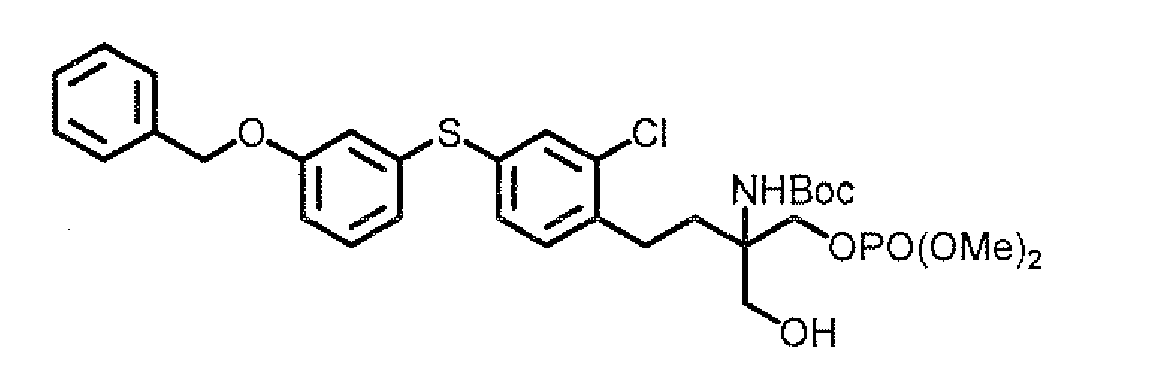
- To a THF solution (30mL) of the compound of Example 243 (2.70g), 1mol/L tetrabutylammonium fluoride in THF (5mL) was added and the mixture was stirred for 1 hour at room temperature. Following addition of water, the mixture was extracted with ethyl acetate. The extract was washed with a saturated aqueous solution of sodium chloride and the organic phase was dried over anhydrous sodium sulfate. The solvent was removed by distillation and the residue was purified on a silica gel column chromatography (hexane : ethyl acetate = 2 : 1) to obtain the desired product as a colorless oil (2.30g). FABMS: 652([M+H]+).
1H-NMR(400MHz, CDCl3) δ 1.45(9H, s), 1.83-1.90(1H, m), 2.09-2.17(1H, m), 2.71(2H, t, J=8.6Hz), 3.71-3.77(2H, m), 3.79(6H, d, J=11.0Hz), 4.04(1H, br), 4.17-4.29(2H, m), 5.00(1H, br s), 5.02(2H, s), 6.86-6.95(3H, m), 7.14-7.15(2H, m), 7.23(1H, t, J=7.3Hz), 7.31-7.39(6H, m). - The compound of Example 244 was optically resolved by HPLC (chiralpak AS-H, hexane : isopropanol = 8 : 2, detection wavelength = UV 254nm, flow rate = 1mL/min). The colorless oil obtained from the first eluate had an optical rotation [α]26 D of -6.12° (C = 1.0, methanol) (Example 245), while the colorless oil obtained from the second eluate had an optical rotation [α]27 D of +5.79° (C = 1.0, methanol) (Example 246).
-

- Using the compound of Example 213, the reaction was carried out in the same manner as in Example 223 to obtain the desired product as a pale brown oil.
FABMS: 636 ([M+H]+).
1H-NMR(400MHz, CDCl3) δ 1.36(3H, s), 1.44(9H, s), 1.77-1.82(1H, m), 2.05-2.15(1H, m), 2.68-2.74(2H, m), 3.78(6H, d, J=11.0Hz), 4.01-4.05(1H, m), 4.21-4.25 (1H, m), 4.63(1H, br), 5.02(2H, s), 6.87-6.94(3H, m), 7.23-7.27(3H, m), 7.32-7.42(6H, m). - Using the compound of Example 214, the reaction was carried out in the same manner as in Example 223 to obtain the desired product as a pale brown oil.
FABMS: 636([M+H]+).
1H-NMR(400MHz, CDCl3) δ 1.36(3H, s), 1.44(9H, s), 1.74-1.82(1H, m), 2.05-2.15(1H, m), 2.66-2.76(2H, m), 3.78(6H, d, J=11.0Hz), 4.01-4.05(1H, m), 4.21-4.25 (1H, m), 4.63(1H, br), 5.02(2H, s), 6.86-6.95(3H, m), 7.21-7.27(3H, m), 7.31-7.41(6H, m). -

- Using the compound of Example 247, the reaction was carried out in the same manner as in Example 236 to obtain the desired product as a colorless powder.
FABMS: 508([M+H]+).
1H-NMR(400MHz, DMSOd6-TFA) δ 1.29(3H, s), 1.72-1.84(2H, m), 2.71(2H, t, J=7.9Hz), 3.87(1H, dd, J=4.9, 11.0Hz), 3.93(1H, dd, J=4.9, 11.0H), 5.08(2H, s), 6.91(1H, d, 7.3Hz), 6.96-7.01(2H, m), 7.23(1H, dd, J=1.8, 7.9Hz), 7.29-7.40(8H, m).
[α]25.6 D +15.1°(C = 1.0, 10%TFA in DMSO).
Elemental analysis(%) C24H27ClNO5PS·2/3 CF3CO2HC H N Calcd : 52.10 4.78 2.40 Found : 52.29 4.75 2.68 - Using the compound of Example 248, the reaction was carried out in the same manner as in Example 236 to obtain the desired product as a colorless powder.
FABMS: 508([M+H+]).
1H-NMR(400MHz, DMSO-TFA) δ 1.29(3H, s), 1.76-1.90(2H, m), 2.71(2H, t, J=7.9Hz), 3.87(1H dd, J=4.9, 11.0Hz), 3.93(1H, dd, J=4.9, 11.0Hz), 5.08(2H, s), 6.90-7.01(3H, m), 7.24(1H, dd, J=1.8, 7.9Hz), 7.29-7.40(8H, m).
[α]26.3 D -12.6°(C = 1.0, 10%TFA in DMSO).
Elemental analysis(%) : C24H27ClNO5PS·1/2H2OC H N Calcd : 55.76 5.46 2.71 Found : 55.77 5.19 2.97 -

- The compound of Example 127 was oxidized in the same manner as in Example 193 to obtain an aldehyde for use in the subsequent reaction.
- Meanwhile, trimethylchlorosilane (1.0mL) was added to diethyl dibromofluoromethylphosphate (1.48mL) in THF (75mL), and the mixture was cooled to -78°C. Subsequently, 1.6mol/L n-butyllithium in hexane (11.3mL) was added dropwise and the mixture was stirred for 40min. Subsequently, the aldehyde obtained above (3.68g) in THF (25.0mL) was added dropwise over 10min. The mixture was allowed to warm to 0°C and was stirred for 5 hours. Following addition of aqueous ammonium chloride, the mixture was extracted with ethyl acetate. The ethyl acetate layer was then washed with a saturated aqueous solution of sodium chloride, was dried over anhydrous sodium sulfate, and was concentrated. The resulting residue was purified on a silica gel column chromatography (hexane : ethyl acetate = 10 : I to I : 1). As a result, the Z-form was obtained from the first eluate as a yellow oil (1.70g), and the E-form was obtained from the second eluate as a yellow oil (667mg).
Z-form : Example 251
FABMS: 664 ([M+H]+).
1H-NMR(400MHz, CDCl3) δ 1.31-1.38(6H, m), 1.43(9H, s), 1.88-2.00(2H, m), 2.69-2.83(2H, m), 4.13-4.22(4H, m), 4.80-4.90(1H, m), 5.02(2H, s), 5.15-5.30(1H, br), 6.08-6.30(1H, m), 6.87-6.88(1H, m), 6.90-6.95(2H, m), 7.11-7.15(2H, m), 7.22(1H t, J=7.9Hz), 7.31-7.39(6H, m).
E-form : Example 252
FABMS: 663 ([M]+) .
1H-NMR(400MHz, CDCl3) δ 1.34-1.36(6H, m), 1.44(9H, s), 1.82-1.88(2H, m), 2.71-2.78(2H, m), 4.15-4.23(4H, m), 4.60-4.65(2H, m), 5.02(2H, s), 5.80-6.00(1H, m), 6.89(1H, dd, J=1.4, 7.9Hz), 6.93-6.95(2H, m), 7.11-7.17(2H, m), 7.23(1H, t, J=7.9Hz), 7.31-7.41(6H, m). -

- Using the compound of Example 251, the reaction was carried out in the same manner as in Example 236 to obtain the desired product as a colorless powder.
FABMS: 508([M+H]+).
1H-NMR(400MHz, DMSd6) δ 1.78-1.98(2H, m), 2.69(2H, t, J=7.9Hz), 4.19(1H, br), 5.08(2H, s), 5.47-5.62(1H, m), 6.90(1H, d, J=7.9Hz), 6.97-6.99(2H, m), 7.20(1H, d, J=7.9Hz), 7.29-7.40(8H, m), 8.67(2H, br).
m.p. = 285-288°C.
Elemental analysis (%) :C24H24ClFNO4PS·13/10H2OC H N Calcd : 54.25 5.05 2.64 Found : 54.54 5.49 2.44 -
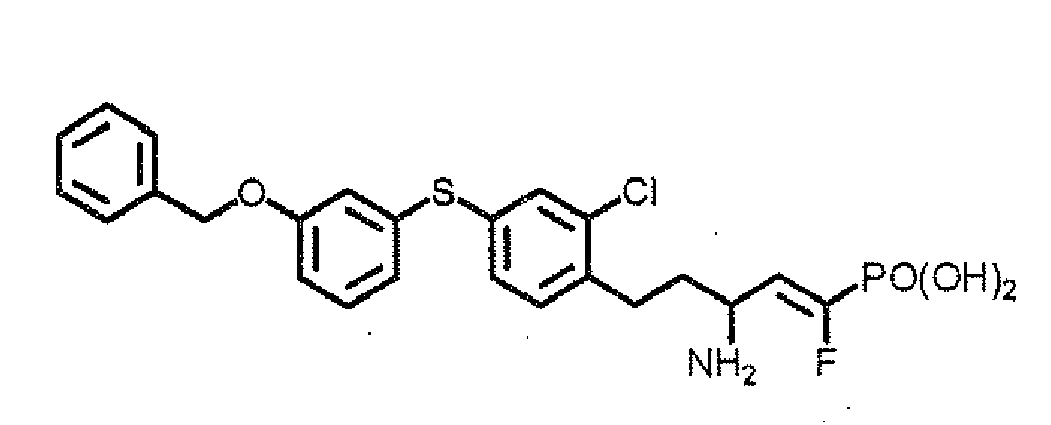
- Using the compound of Example 252, the reaction was carried out in the same manner as in Example 236 to obtain the desired product as a colorless powder.
FABMS: 508 ([M+H]+).
1H-NMR(400MHz, CDCl3) δ 1.79-1.91(1H, m), 1.91-2.02(1H, m), 2.58-2.70(2H, m), 3.84-3.98(1H, m), 5.08(2H, s), 5.43-5.62(1H, m), 6.90(1H, m), 6.95-6.99(2H, m), 7.17-7.38(9H, m), 8.68(2H, br).
m.p. = 288-290°C. -

- The compound of Example 193 was reacted in the same manner as in Examples 251 and 252 to obtain the desired Z-form (Example 255) and the E-form (Example 256), respectively. Each product was obtained as a yellow oil.
Z-form : Example 255
FABMS: 678 ([M+H]+).
1H-NMR(400MHz, CDCl3) δ 1.31-1.37(6H, m), 1.41(9H, s), 1.61-1.71(4H, m), 2.73(2H, m), 4.10-4.18(4H, m), 4.84(1H, br), 5.02(2H, s), 5.06-5.15(1H, m), 6.01-6.19(1H, m), 6.87(1H, dd, J=1.2, 9.7Hz), 6.91-6.94(2H, m), 7.12-7.16(2H, m), 7.22(1H, t, J=7.9Hz), 7.30-7.39(6H, m).
E-form : Example 256
FABMS: 678([M+H]+).
1H-NMR(400MHz, CDCl3) δ 1.32-1.37(6H, m), 1.43(9H, s), 1.61-1.66(4H, m), 2.72(2H, t, J=7.3Hz), 4.11-4.17(4H, m), 4.50-4.60(2H, m), 5.02(2H, s), 5.73-5.90(1H, m), 6.86-6.89(1H, m), 6.92-6.96(2H, m), 7.10(1H, d, J=7.9Hz), 7.13(1H dd, J=1.2, 7.9Hz), 7.23(1H, t, J=7.9Hz), 7.31-7.40(6H, m). -

- Using the compounds of Examples 255 and 256, the reaction was carried out in the same manner as in Reference Example 123 to obtain the desired product as a yellow oil.
PABMS: 679([M+H]+).
1H-NMR(400MHz, CDCl3) 5 1.35(6H, s), 1.43(9H, s), 1.49-1.57(2H, m), 1.58-1.75(4H, m), 2.65-2.80(2H, m), 3.82-3.94(1H, m), 4.20 (4H, q, J=7.3Hz), 4.35-4.55(1H, m), 4.74-4.94(1H, m), 5.02(2H, s), 6.87-6.99(1H, m), 6.92-6.95(2H, m), 7.11-7.17(2H, m), 7.23(1H t, J=7.9Hz), 7.32-7.43(6H, m). -

- Following the same procedure as in Example 229, the compound of Example 226 was reacted to form a Boc product and, following the same procedure as in Example 193, the product was oxidized to an aldehyde. Subsequently, using methyl methylenebisphosphonate, the same procedure was followed as in Example 232 to give the desired product as a pale yellow oil.
FABMS: 646([M+H]+)
1H-NMR(400MHz, CDCl3) δ 1.36(3H, s), 1.40(9H, s), 1.54-1.64(2H, m), 1.67-1.70(1H, m), 1.82-1.92(1H, m), 2.69(2H, t, J=7.9Hz), 3.72(6H, d, J=11.0Hz), 4.55(1H, br), 5.02(2H, s), 5.62(1H, dd, J=17.1, 18.3Hz), 6.75(1H, dd, J=17.1, 22.6Hz), 6.80-6.89(1H, m), 6.93-6.96(2H, m), 7.10(1H, d, J=7.9Hz), 7.15(1H, dd, J=1.8, 7.9Hz), 7.23(1H, t, J=7.9Hz), 7.31-7.41(6H, m). -

- The compound of Example 258 was reacted in the same manner as in Reference Example 123 to obtain the desired product as a pale yellow oil.
FABMS: 648([M+H]+).
1H-NMR(400MHz, CDCl3) 5 1.13(3H, s), 1.41(9H, s), 1.50-1.60(2H, m), 1.65-1.86(4H, m), 2.02-2.08(2H, m), 2.68(2H, t, J=7.3Hz), 3.73(6H, d, J=11.0Hz), 4.32(1H, br), 5.01(2H, s), 6.87(1H, dd, J=2.4, 8.5Hz), 6.91-6.95(2H, m), 7.11(1H, d, J=7.9Hz), 7.14(1H, dd, J=1.8, 7.9Hz), 7.22(1H, t, J=7.9Hz), 7.31-7.40(6H, m). -

- The compound of Example 259 was reacted in the same manner as in Reference Example 236 to obtain the desired product as a colorless powder.
FABMS: 520([M+H]+).
1H-NMR(400MHz, DMSOd6) δ 1.16(3H, s), 1.20(2H, br), 1.50-1.60(6H, m), 1.73(2H, t, J=7.3HZ), 2.65-2.70(2H, m), 5.07(2H, s), 6.89(1H, d, J=7.4Hz), 6.94-6.98(2H, m), 7.21-7.22(1H, m), 7.31-7.37(8H, m).
m.p. = 195-197°C. -

- The compound of Example 258 was reacted in the same manner as in Example 236 to obtain the desired product as a colorless powder.
FABMS: 518([M+H]+).
1H-NMR(400MHz, DMSOd6) δ 1.25(3H, s), 1.39-1.57(2H, m), 1.65-1.79(2H, m), 2.52-2.70(2H, m), 5.05(2H, s), 5.77-5.94(1H, m), 6.08-6.26(1H, m), 6.85(1H, d, J=6.7Hz), 6.91-6.99(2H, m), 7.10-7.42(9H, m), 8.39-9.20(2H, br).
m.p. = 243-245°C.
Elemental analysis (%) : C26H29ClFNO4PS·H2OC H N Calcd: 58.26 5.83 2.61 Found: 57.80 5.31 2.74 -

- The compound of Example 222 was reacted in the same manner as in Example 232 to obtain the desired product as a colorless oil.
FABMS: 706(M+H]+).
1H-NMR(400MHz, CDCl3) δ 1.41(9H, s), 1.56-1.69(2H, m), 1.75-1.90(1H, m), 1.93-1.99(1H, m), 2.69(2H, t, J=7.9Hz), 3.33(3H, s), 3.60-3.63(2H, m), 3.71(6H, d, J=11.0Hz), 4.58(2H, s), 4.88(1H, br), 5.02(2H, s), 5.70(1H, dd, J=17.7, 18.4Hz), 6.75(1H, dd, J=17.7, 23.2Hz), 6.87(1H dd, J=2.4, 9.2Hz), 6.92-6.96(2H, m), 7.10(1H, d, J=7.9), 7.14(1H, dd, J=1.8, 7.9Hz), 7.23(1H t, J=7.9Hz), 7.30-7.41(6H, m). -

- The compound of Example 262 was reacted in the same manner as in Example 236 to obtain the desired product as a colorless powder.
FABMS: 534 ([M+H]+).
1H-NMR(400MHz, DMSOd6) δ 1.46-1.74(4H, m), 2.57-2.61(2H, m), 3. 47-3. 52 (2H, m), 5.07(2H, s), 5.87-5.96(1H, m), 6.03-6.16(1H, m), 6.87(1H, d, J=7.3Hz), 6.95-6.97(2H, m), 7.19(1H, d, J=9.0Hz), 7.27-7.39(8H, m), 7.81-8.83(2H, br).
m.p. =243-246°C. -

- The compound of Example 262 was reacted in the same manner as in Reference Example 123 to obtain the desired product as a colorless powder.
FABMS: 708([M+H]+).
1H-NMR(400MHz, CDCl3) δ 1.41(9H, s), 1.51-1.67(2H, m), 1.70-2.05(6H, m), 2.68 (2H, t, J=7.9Hz), 3.33(3H, s), 3.47-3.53(2H, m), 3.73(6H, d, J=11.0Hz), 4.58(2H, s), 4.61(1H, br), 5.02(2H, s), 6.88(1H, dd, J=1.8, 7.9Hz), 5.92-6.96(2H, m), 7.11(1H, d, J=7.9Hz), 7.14(1H, dd, J=1.8, 7.9Hz), 7.23(1H, t, J=7.9Hz), 7.30-7.41(6H, m). -

- The compound of Example 264 was reacted in the same manner as in Example 236 to obtain the desired product as a colorless powder.
FABMS: 536([M+H]+).
1H-NMR(400MHz, DMSOd6) δ 1.36-1.73(8H, m), 2.60-2.68(2H, m), 3.31-3.40(2H, m), 5.07(2H, s), 6.88(1H, d, J=7.9Hz), 6.96-6.98(2H, m), 7.20-7.40(9H, m), 7.94-8.94(2H, br).
m.p. = 193-196°C.
Elemental analysis (%) C26H31ClNO5PS·1H2OC H N Calcd : 56.36 6.00 2.53 Found : 56.18 5.61 2.51 - Dimethyl 5-[4-(3-benzyloxyphenylthio)-2-chlorophenyl]-3-t-butoxycarbonylamino-3-methoxymethyloxymethyl-1-pentenylphosphonate
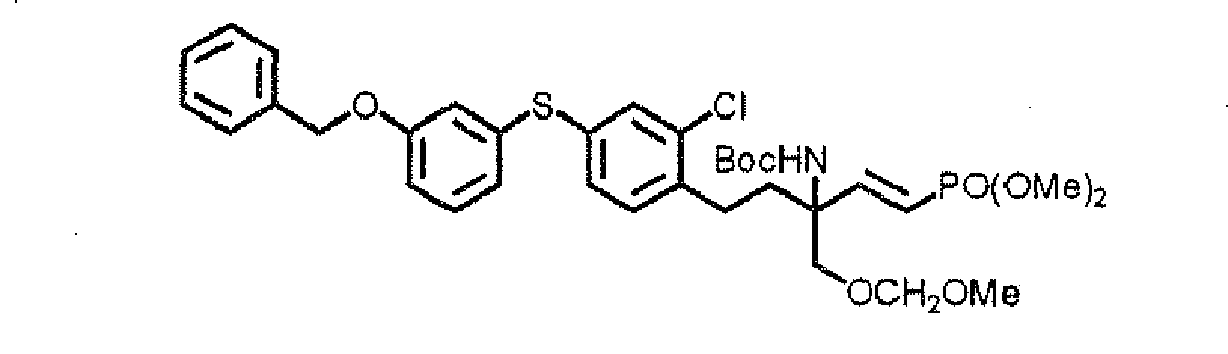
- Following the same procedure as in Example 193, the compound of Example 219 was oxidized and, following the same procedure as in Example 232, the product was reacted with methyl methylenebisphosphonate to obtain the desired product as a colorless oil.
FABMS: 692 ([M+H]+).
1H-NMR(400MHz, CDCl3) δ 1.45(9H, s), 2.10-2.17(2H, m), 2.66-2.73(2H, m), 3.36(3H, s), 3.67-3.78(2H, m), 3.73(6H, d, J=11.0Hz), 4.63(2H, s), 4.80-4.85(1H, br), 5.02(2H, s), 5.78(1H, dd, J=17.8, 18.3Hz), 6.82(1H, dd, J=17.8, 24.2Hz), 6.87-6.95(3H, m), 7.12-7.13(2H, m), 7.23(1H, t, J=7.9Hz), 7.30-7.41(6H, m). -

- The compound of Example 266 was reacted in the same manner as in Example 236 to obtain the desired product as a colorless powder.
FABMS: 520([M+H]+)
1H-NMR(400MHz, DMSOd6) δ 1.76-1.98(2H, br), 2.50-2.72(2H, br), 3.47-3.70(3H, m), 5.05(2H, s), 6.03-6.11(1H, m), 6.21-6.33(1H, m), 6.85(1H, d, J==7.4Hz), 6.94(2H, m), 7.15-7.36(9H, m), 8.74(2H, br s).
m.p. = 245-248°C. -

- The compound of Example 266 was reacted in the same manner as in Reference Example 123 to obtain the desired product as a colorless oil.
FABMS: 694([M+H]+).
1H-NMR(400MHz, CDCl3) δ 1.44(9H, s), 1.54-1.60(2H, m), 1.82-1.87(2H, m), 1.98-2.05(2H, m), 2.67-2.70(2H, m), 3.39(3H, s), 3.58-3.64(2H, m), 3.74(6H, d, J=11.0Hz), 4.64(2H, s), 4.74(1H, br), 5.02(2H, s), 6.87(1H, dd, J=1.8, 7.9Hz), 6.91-6.95(2H, m), 7.10-7.15(2H, m), 7.23(1H, t, J=7.9Hz), 7.31-7.41(6H, m). -

- The compound of Example 268 was reacted in the same manner as in Example 236 to obtain the desired product as a colorless oil.
FABMS: 522([M+H]+).
1H-NMR(400MHz, DMSOd6) δ 1.45-1.58(2H, m), 1.69-1.91(4H, m), 2.58-2.72(2H,m), 3.10-3.75(2H, br), 5.07(2H, s), 6.88(1H, d, J=7.3Hz), 6.96-6.99(2H, m), 7.21(1H, d, J=7.9Hz), 7.27-7.40(8H, m), 7.93-9.02(2H, br).
m.p. = 205-208°C.
Elemental analysis (%) C25H29ClNO5PS·H2OC H N Calcd : 55.60 5.79 2.59 Found : 55.21 5.40 2.68 - Example 245 (250mg) was dissolved in a 10% hydrochloric acid-methanol solution (10mL) and the mixture was allowed to stand overnight. Subsequently, the solvent was removed by distillation and the residue was dissolved in ethyl acetate, followed by addition of triethylamine to adjust the pH to 7. The crystallized triethylamine hydrochloride was separated by filtration and was washed with ethyl acetate. The solvent was removed by distillation to give a Boc-free product as a colorless oil (250mg). This product was dissolved in acetonitrile (5mL) while the solution was chilled in an ice bath. To this solution, trimethylsilyl iodide (26.7µL) was added and the mixture was stirred for 30min at the same temperature. Subsequently, the solvent was removed by distillation and the residue was purified on a silica gel column chromatography (reversed phase silica chromatography, water: acetonitrile = 9 : 1 to 6 : 1 to 3 : 1 to 1 : 1 to only acetonitrile) to give the desired product as a colorless powder (97mg).
[α] 25°C= +2.77(c=1.00, DMSO)
FABMS: 524 ([M+H]+).
1H-NMR(400MHz, DMSO+TFA) δ 1.78-1.85(2H, m), 2.78-2.80(2H, m), 3.56(1H, d, J=11.0Hz), 3.61 (1H, d, J=11.0Hz), 3.97(2H, d, J=5.5Hz), 5.08(2H, s), 6.87-6.98(3H, m), 7.20-7.38(9H, m). Elemental analysis (%) :C24H27ClNO6PS ·H2OC H N Calcd : 53.56 5.25 2.60 Found : 53.21 5.25 2.41 - Using the compound of Example 246, the reaction was carried out in the same manner as in Example 270 to obtain the desired product as a colorless powder.
[α] 25°C=-2.61(c =1.00, DMSO).
FABMS: 524 ([M+H]+).
1H-NMR(400MHz, DMSO+TFA) δ 1.76-1.85(2H, m), 2.68-2.78(2H, m), 3.57(1H, d, J=11.0Hz), 3.60 (1H, d, J=11.0Hz), 3.97(2H, d, J=5.5Hz), 5.08(2H, s), 6.87-6.98(3H, m), 7.20-7.38(9H, m). -

- Using diethyl propylmalonate, the compound of Reference Example 252 was reacted in the same manner as in Example 194 to obtain ethyl 5-[4-(3-benzyloxyphenylthio)-2-chlorophenyl]-2-ethoxycarbonyl-2-propylpentanoate as a yellow oil. This product was hydrolyzed as in Example 198 to obtain a half ester. The half ester was treated in the same manner as in Example 202 to obtain the desired product as a colorless oil. 1H-NMR(400MHz, CDCl3) δ 0.87(3H, t, J=7.3Hz), 0.89-1.02(1H, m), 1.24(3H, t, J=7.3Hz), 1.23-1.33(2H, m), 1.52-1.78(3H, m), 2.24-2..40(2H, m), 2.63-2.68(2H, m), 3.62(3H, s), 4.17-4.22(2H, m), 5.02(2H, s), 5.79(1H br s), 6.85-6.94(3H, m), 7.09(1H, d, J=7.9Hz), 7.14(1H, dd, J=1.8, 7.9Hz), 7.22(1H, t, J=7.9Hz), 7.29-7.43(6H, m).
-

- Using the compound of Example 272, the reaction was carried out in the same manner as in Example 76 to obtain the desired product as a colorless oil.
FABMS: 528 ([M+H]+).
1H-NMR(400MHz, CDCl3) δ 0.90(3H, t, J=7.3Hz), 1.15-1.35(2H, m), 1.48-1.69(6H, m), 2.69(2H, t, J=7.3Hz), 3.62(3H, s), 3.70(2H, s), 4.71(1H, br s), 5.01(2H, s), 6.85-6.94(3H, m), 7.12-7.24(3H, m), 7.31-7.40(6H, m). -

- Using the compound of Example 273, the reaction was carried out in the same manner as in Example 226 to synthesize 2-amino-5-[4-(3-benzyloxyphenylthio)-2-chlorophenyl]-2-propylpentane-1-ol. As in Example 229, the product was reacted to form a Boc product, thereby obtaining the desired compound as a colorless oil.
1H-NMR(400MHz, CDCl3) δ 0.90(3H, t, J-7.3Hz), 1.15-1.35(2H, m), 1.42(9H, s), 1.48-1.73(6H, m), 2.70(2H, t, J=7.3Hz), 3.63-3.66(2H, m), 4.51(1H, br s), 5.02(2H, s), 6.86-6.95(3H, m), 7.12-7.24(3H, m), 7.33-7.41(6H, m). - The compound of Example 274 was optically resolved by HPLC(chiralpak OD-H, hexane : ethanol = 97 : 3, detection wavelength = UV 254nm, flow rate = 3mL/min). The desired products were obtained from the first eluate (Example 275) and the second eluate (Example 276), respectively, each as a colorless oil.
Example 275 [α]25 D-10.2°10.2°(C = 1.08, CHCl3);
Example 276 [α]23 D +9.48°(C = 1.16, CHCl3). -

- Using the compound of Example 274, the reaction was carried out in the same manner as in Example 193 to obtain the desired product as a colorless oil.
1H-NMR(400MHz, CDCl3) δ 0.88 (3H, t, J=7.3Hz), 1.03-1.37(2H, m), 1.42(9H, s), 1.48-1.77(4H, m), 2.02-2.25(2H, m), 2.65-2.70(2H, m), 5.02(2H, s), 5.27(1H, br s), 6.86-6.94(3H, m), 7.07-7.14(2H, m), 7.23(1H, t, J=7.8Hz), 7.30-7.41(6H, m), 9.23(1H, s). -

- As in Example 232, the compound of Example 277 was reacted with methyl methylenebisphosphonate to obtain the desired product as a colorless oil.
FABMS: 674 ([M+H]+).
1H-NMR(400MHz, CDCl3) δ 0.88(3H, t, J=7.3Hz), 1.17-1.23(2H, m), 1.40(9H, m), 1.51-1.87(6H, m), 2.68(2H, t, J=7.9Hz), 3.69(3H, d, J=11.0Hz), 3.70(1H, d, J=11.0Hz), 4.47(1H, br), 5.02(2H, s), 5.59(1H, t, J=17.7Hz), 6.65(1H, dd, J=23.3, 17.1Hz), 6.86-6.89(3H, m), 7.09-7.15(2H, m), 7.23(1H, t, J=7.9Hz), 7.31-7.41(6H, m). -

- Using the compound of Example 278, the reaction was carried out in the same manner as in Reference Example 123 to obtain the desired product as a colorless oil.
FABMS: 676([M+H]+).
1H-NMR(400MHz, CDCl3) δ 0.88(3H, t, J=7.3Hz), 1.15-1.28(2H, m), 1.40(9H, m), 1.51-2.02(10H, m), 2.67(2H, t, J=7.9Hz), 3.72(6H, d, J=11.0Hz), 4.13(1H, br), 5.02(2H, s), 6.87-6.95(3H, m), 7.10-7.25(3H, m), 7.32-7.39(6H, m). -

- Using the compound of Example 278, the reaction was carried out in the same manner as in Example 233 to obtain the desired product as a colorless oil.
FABMS: 574 ([M+H]+).
1H-NMR(400MHz, DMSO6) δ 0.85(3H, t, J=7.3Hz), 1.15-1.28(2H, m), 1.53-1.76(6H, m), 2.66(2H, t, J=7.9Hz), 3.59(3H, d, J=11.0Hz), 3.62(3H, d, J=11.0Hz), 5.08(2H, s), 6.00(1H, t, J=17.7Hz), 6.57(1H, dd, J=23.8, 17.7Hz), 6.89-7.00(3H, m), 7.22-7.41(9H, m), 8.47(3H, br s). - Using the compound of Example 275, the same procedures as in Examples 277, 278 and 280 were sequentially followed to obtain the desired product as a pale yellow amorphous compound ([α]28.2 D +2.9°(C = 1.0, MeOH)) (Example 281). Furthermore, using the compound of Example 276, the same procedure was followed as in Example 281 to obtain the desired product as a pale yellow amorphous compound ([α]28.1 D -1.9°(C = 1.0, MeOH)) (Example 282).
-

- Using the compound of Example 278, the reaction was carried out in the same manner as in Example 236 to obtain the desired product as a colorless powder.
FABMS: 546([M+H]+).
1H-NMR(400MHz, DMSOd6) 5 0.85(3H, t, J=7.3Hz), 1.19-1.21(2H, m), 1.51-1.69(6H, m), 2.67(2H, t, J=7.9Hz), 5.08(2H, s), 5.87(1H, dd, J=17.7, 15,2Hz), 6.32(1H, dd, J=23.8, 17.7Hz), 6.88-7.00(3H, m), 7.22-7.41(9H, m).
Elemental analysis (%) :C28H33ClNO4PS·2/3H2OC H N Calcd : 60.26 6.20 2.51 Found : 60.11 5.91 2.32 -

- Using the compound of Example 279, the reaction was carried out in the same manner as in Example 236 to obtain the desired product as a colorless powder.
FABMS: 548 ([M+H]+).
1H-NMR(400MHz, DMSOd6) δ 0.85(3H, t, J=7.3Hz), 1.18-1.21(2H, m), 1.42-1.54(8H, m), 1.68-1.74(2H, m), 2.67(2H, br s), 5.08(2H, s), 6.88-7.00(3H, m), 7.22-7.41(9H, m).
Elemental analysis (%) :C28H35ClNO4PS·H2OC H N Calcd : 59.41 6.59 1.83 Found : 59.05 6.14 2.29 -

- The compound of Example 188 (330mg) was dissolved in triethyl phosphite (120µL) and the solution was refluxed for 3 hours. Subsequently, the reaction mixture was purified on a silica gel column chromatography (hexane : ethyl acetate = 1 : 1 to 1 : 5) to give the desired product as a pale yellow oil (320mg).
FABMS: 604([M+H]+).
1H-NMR(400MHz, CDCl3) δ 1.31-1.35(6H, m), 1.59-1.72(2H, m), 1.84-1.88(2H, m), 2.10(1H, d, J==19.0Hz), 2.11(1H, d, J=19.0Hz), 2.74(2H, t, J=7.3Hz), 4.06-4.14(5H, m), 4.17-4.20(1H, m), 5.03(2H, s), 5.89(1H, br s), 6.88(1H dd, J=1.2, 7.3Hz), 6.94-6.97(2H, m), 7.10(1H, d, J=7.9Hz), 7.14(1H, dd, J=1.8, 7.9Hz), 7.24(1H, t, J=7.9Hz), 7.31-7.41(6H, m). -

- The compound of Example 28.5 was reacted in the same manner as in Example 190 and the resulting compound was reacted in the same manner as in Example 233 to obtain the desired product as a colorless powder.
FABMS: 522 ([M+H]+)
1H-NMR(400MHz, DMSOd6) δ 1.54-1.62(2H, m), 1.72-1.78(2H, m), 2.64-2.66(2H, m), 3.20-3.31(2H, m), 3.43-3.52(2H, m), 5.08(2H, s), 6.88-6.90(1H, m), 6.94-7.00(2H, m), 7.21-7.24(1H, dd, J=2.5, 7.9Hz), 7.29-7.41(8H, m).
m.p. = 98-101°C.
Elemental analysis (%) :C25H29ClNO5PS·HClC H N Calcd : 53.77 5.41 2.51 Found : 54.18 5.29 2.49 -

- The compound of Example 130 was reacted with t-BuMe2SiCl in the same manner as in Example 191. The resulting silyl product was oxidized in the same manner as in Example 193 to obtain an aldehyde. Subsequently, this aldehyde was reacted with methyl methylenebisphosphonate in the same manner as in Example 232 to obtain the desired product as a pale yellow oil. FABMS: 790 ([M+H]+).
1H-NMR(400MHz, CDCl3) δ 0.04(6H, s), 0.89(9H, s), 1.30-1.37(2H, m), 1.41(9H, s), 1.50-1.60(2H, m), 1.75-1.85(2H, m), 2.68(2H, t, J=7.3Hz), 3.64-3.70(2H, m), 3.71(6H, d, J=11.6Hz), 4.77(1H br s), 5.02(2H, s), 5.67(1H, dd, J=17.1, 18.3Hz), 6.72(1H, dd, J=17.1, 22.6Hz), 6.67-6.88(1H, m), 6.91-6.94(2H, m), 7.11(1H, d, J=7.9Hz), 7.14(1H, dd, J=1.8, 7.9Hz), 7.22(1H, t, J=7.9Hz), 7.31-7.39(6H, m). -

- The compound of Example 287 was reduced in the same manner as in Reference Example 123 and the resulting compound (107mg) was dissolved in tetrahydrofuran (5.0mL). A 1mol/L TBAF-tetrahydrofuran solution (160µL) was added dropwise and the mixture was stirred for 3 hours at room temperature. Subsequently, water was added and the reaction mixture was extracted with ethyl acetate. The extract was washed sequentially with water and a saturated aqueous solution of sodium chloride and the organic phase was dried over anhydrous sodium sulfate. The solvent was removed by distillation and the residue was purified on a silica gel column chromatography (ethyl acetate only) to obtain the desired product as a colorless oil (47mg).
FABMS: 678 ([M+H]+).
1H-NMR(400MHz, CDCl3) δ 1.42(9H, s), 1.25-1.38(6H, s), 1.70-1.80(2H, m), 1.83-1.95(2H, m), 2.70(2H, t, J=7.9Hz), 3.62(2H, br s), 3.75(6H, d, J=11.0Hz), 4.63(1H, br s), 5.02(2H, s), 6.86-6.89(1H, m), 6.92-6.94(2H, m), 7.10-7.16(2H, m), 7.21-7.23.(1H, m) 7.30-7.40(6H, m). -

- Using the compound of Example 288, the reaction was carried out in the same manner as in Example 236 to obtain the desired product as a colorless powder.
FABMS: 550 ([M+H]+).
1H-NMR(400MHz, DMSOd6) δ 1.22-1.32(2H, m), 1.48-1.60(6H, m), 1.68-1.76(2H, m), 2.64-2.68(2H, m), 3.39-3.50(2H, m), 5.08(2H, s), 6.88-6.90(1H, m), 6.95-6.99(2H, m), 7.20(1H, dd, J=1.9, 9.8Hz), 7.28-7.40(8H, m).
m.p. = 180-183°C. -

- Following the same procedure as in Example 244, the compound of Example 287 was desilylated and the resulting product was reacted in the same manner as in Example 236 to obtain the desired product as a colorless powder.
FABMS: 548 ([M+H]+).
1H-NMR(400MHz, DMSOD6) δ 1.27-1.38(2H, m), 1.43-1.52(2H, m), 1.61-1.72(2H, m), 2.53-2.66(2H, m), 3.46-3.58(2H, m), 5.02(2H, s), 5.88-5.97(1H, m), 6.06-6.17(1H, m), 6.85-6.87(1H, m), 6.94-6.96(2H, m), 7.15-7.17(1H, m), 7.26-7.38(8H, m).
m.p. = 258-260°C. -

- The compound of Example 128 was reacted with t-BuMe2SiCl in the same manner as in Example 191. The resulting silyl product was oxidized in the same manner as in Example 193 to obtain an aldehyde. This aldehyde was reacted as follows: a 1.58mol/L-LDA-tetrahydrofuran solution (1.50mL) was added to a tetrahydrofuran solution (9mL) while the mixture was kept at - 78°C. To the resulting mixture, diethyl difluoromethylphosphonate (372µL) was added dropwise over 15min and the mixture was stirred for 20min. To this mixture, the aldehyde (490mg) in tetrahydrofuran (1.0my) was added dropwise over 20min while the internal temperature was kept at -73°C or below. Subsequently, the mixture was stirred for 1.5 hours. A saturated aqueous solution of ammonium chloride was then added to the reaction mixture and the mixture was extracted with ethyl acetate. The extract was washed sequentially with water and a saturated aqueous solution of sodium chloride and the organic phase was dried over anhydrous sodium sulfate. The solvent was removed by distillation and the resulting residue was purified on a silica gel column chromatography (hexane: ethyl acetate = 3 : 1) to obtain the desired product as a colorless oil (439mg).
FABMS: 858([M+H]+).
1H-NMR(400MHz, CDCl3) δ 0.06(6H, s), 0.88(9H, s), 1.33-1.40(6H, m), 1.46(9H, s), 1.56-1.70(4H, m), 2.69(2H, t, J=7.3Hz), 3.82-3.84(1H, m), 4.23-4.33(6H, m), 5.02(2H, s), 5.05(1H, br s), 6.85-6.88(1H, m), 6.91-6.95(2H, m), 7.12-7.14(2H, m), 7.22(1H, t, J=7.9Hz), 7.31-7.40(6H, m). -

- Following the same procedure as in Example 244, the compound of Example 291 was desilylated and the resulting product was reacted in the same manner as in Example 233 to obtain the desired product as a colorless amorphous product.
FABMS: 644 ([M+H]+).
1H-NMR(400MHz, CDCl3) δ 1.22-1.27(6H, m), 1.55-1.79(4H, m), 2.62-2.65(2H, m), 3.59-3.73(2H, m), 4.04-4.11(4H, m), 4.68-4.90(1H, m), 5.09(2H, s), 6.88-6.90(1H, m), 6.94-7.00(2H, m), 7.22-7.25(1H, m), 7.29-7.41(8H, m). -

- Using the compound of Example 292, the reaction was carried out in the same manner as in Example 236 to obtain the desired product as a colorless amorphous product.
FABMS: 588([M+H]+).
1H-NMR(400MHz, DMSOd6) 5 1.55-1.86(4H, m), 2.55-2.65(2H, m), 3.51-3.67(4H, m), 3.78-3.84(1H, m), 5.08(2H, s), 6.88(1H. d, J=7.9Hz), 6.90-7.00(2H, m), 7.28-7.23(1H, m), 7.29-7.41(8H, m). -

- The compound of Example 149 was reacted with t-BuMe2SiCl in the same manner as in Example 191. The resulting silyl product was oxidized in the same manner as in Example 193 to obtain an aldehyde. Subsequently, following the same procedure as in Example 232, this aldehyde was condensed with methyl methylenebisphosphonate and, following the same procedure as in Reference Example 123, the resulting product was reduced to give the desired product as a colorless oil.
1H-NMR(400MHz, CDCl3) δ 0.04(6H, s), 0.88(9H, s), 1.42(9H, s), 1.56-1.64(4H, m), 1.64-1.77(2H, m), 1.90-1.97(2H, m), 2.69(2H, t, J=7.3Hz), 3.49-3.58(2H, m), 3.73(6H, d, J=11.0Hz), 4.47(1H, br s), 6.85(1H, dd, J=2.5, 8.6Hz), 7.01(1H, d, J=2.5Hz), 7.14-7.18(2H, m), 7.25-7.26(1H, m), 7.36(1H, t, J=7.9Hz), 7.45(1H, t, J=7.9Hz). -

- Following the same procedure as in Example 244, the compound of Example 294 was desilylated and the resulting product was reacted in the same manner as in Example 233 to obtain the desired product as a colorless amorphous product.
FABMS: 510([M+H]+).
1H-NMR(400MHz, DMSOd6) δ 1.54-1.64(4H, m), 1.67-1.80(4H, m), 2.65-2.69(2H, m), 3.40-3.41(2H, m), 3.68(6H, d, J=10.4Hz), 5.51(1H, br s), 7.03(1H, dd, J=2.4, 8.6Hz), 7.20(1H, d, J=2.4Hz), 7.28-7.29(1H, m), 7.35(1H, s), 7.39(1H, d, J=7.9Hz), 7.51(1H, d, J=7.9Hz), 7.63(1H, t, J=7.9Hz), 7.91(3H, br s). -

- Using the compound of Example 295, the reaction was carried out in the same manner as in Example 236 to obtain the desired product as a colorless amorphous product.
FARMS: 482 ([M+H]+).
1H-NMR(400MHz, DMSOd6) δ 1.48-1.60(6H, m), 1.60-1.75(2H, m), 2.60-2.67(2H, m), 3.40(2H, s), 7.01(1H, dd, J=2.4, 7.9Hz), 7.15-7.19(1H, m), 7.28(1H, d, J=7.9Hz), 7.35(1H, s), 7.39(1H, d, J=7.9Hz), 7.50(1H, d, J=7.9Hz), 7.62(1H, t, J=7.9), 7.77-8.11(3H, br). -

- The compound of Example 76 was reacted in the same manner as in Example 294 and the resulting compound was reacted in the same manner as in Example 295 to obtain the desired product as a colorless oil.
FABMS: 525([M+H]+).
1H-NMR(400MHz, DMSOd6) δ 1.46-1.62(4H, m), 1.62-1.83(4H, m), 2.64-2.66(2H, m), 3.40-3.45(2H, m), 3.61(6H, d, J=10.4Hz), 7.34(1H dd, J=1.8, 8.0Hz), 7.40-7,42(1H, m), 7.49(1H, dd, J=1.8Hz), 7.54-7.56(1H, m), 7.59-7.62(2H, m), 7.66-7.68(1H, m), 7.86(3H, br s). -

- Following the same procedure as in Example 191, the compound of Example 76 was reacted with t-HuMe2SiCl and, following the same procedure as in Example 223, the resulting silyl product was reacted to give the desired product as a colorless oil.
FABMS: 741([M+H]+).
1H-NMR(400MHz, CDCl3) δ 0.05(6H, s), 0.87(9H, s), 1.41(9H, s), 1.60-1.91(4H, m), 2.71(2H, t, J=7.9Hz), 3.60(1H, d, J=9.2Hz), 3.64(1H, d, J=9.2Hz), 3.76(6H, d, J=11.0Hz), 4.09-4.15(2H, m), 4.66(1H, br), 7.14-7.20(2H, m), 7.30-7.55(5H, m). -

- To a tetrahydrofuran solution (20mL) of the compound of Example 298 (1.29g), a 1mol/L TBAF-tetrahydrofuran solution (2.09mL) was added dropwise and the mixture was stirred for 4 hours at room temperature. Subsequently, water was added and the reaction mixture was extracted with ethyl acetate. The extract was washed sequentially with water and a saturated aqueous solution of sodium chloride and the organic phase was dried over anhydrous sodium sulfate. The solvent was removed by distillation and the residue was purified on a silica gel column chromatography (hexane : ethyl acetate = 1 : 1 to ethyl acetate only) to obtain a desilylated product as a colorless oil (1.00g). The resulting compound (1.00g) was dissolved in a 10% hydrochloric acid-methanol solution (20mL) and the mixture was left overnight at room temperature. Subsequently, the solvent was removed by distillation and the residue was dissolved in ethyl acetate. The solution was neutralized with triethylamine. The crystallized triethylamine hydrochloride was separated by filtration and the solvent was removed by distillation to give a colorless oil (1.00g). The oil was dissolved in acetonitrile (15mL) while the solution was chilled in an ice bath. To this solution, TMSI (905µL) was added and the mixture was stirred for 60min. The reaction mixture was concentrated and was purified on a silica gel column chromatography (water : acetonitrile = 9 : 1 to 6 : 1 to 3 : 1 to 1 : 1 to acetonitrile only) to obtain the desired product as a colorless powder (384g).
FABMS: 500([M+H]+).
1H-NMR(400MHz, DMSOd6) δ 1.60(4H, br s), 2.66(2H, br s), 3.36-3.45(2H, m), 3.68-3.76(2H, m), 7.32(1H, dd, J=1.8, 8.5Hz), 7.38-7.45(2H, m), 7.50-7.56(1H, m), 7.57-7.68(3H, m).
Elemental analysis (%) :C19H22ClF5NO5PS·1/4H2OC H N Calcd : 45.24 4.50 2.78 Found : 45.05 4.31 2.72 -

- The compound of Example 149 was reacted in the same manner as in Example 298 and the resulting compound was reacted in the same manner as in Example 299 to obtain the desired product as a colorless powder.
FABMS: 484([M+H]+).
1H-NMR(400MHz, DMSOd6) δ 1.61(4H, br), 2.64(2H, br), 3.41 (1H, d, J=11.6Hz), 3.51(1H, d, J=11.6Hz), 3.69-3.80(2H, m), 7.00(1H, dd, J=2.5, 8.6Hz), 7.16(1H, d, J=2.5Hz), 7.29(1H, dd, J=2.5, 8.6Hz), 7.35(1H, s), 7.40(1H, d, J=8.6Hz), 7.50(1H, d, J=8.0Hz), 7.61(1H, t, J==8.0Hz). -

- Using the compound of Example 223, the reaction was carried out in the same manner as in Example 238 to obtain the desired product as a colorless powder.
FABMS: 434([M+H]+).
1H-NMR(400MHz, DMSOd6) δ 1.72-1.92(2H, m), 2.6.3-2.82(2H, m), 3.48-3.60(2H, m), 3.71-3.90(2H, m), 6.66-6.78(3H, m), 7.14-7.37(4H, m). -

- The compound of Reference Example 323 was reacted in the same manner as in Example 1 and the resulting compound was reduced in the same manner as in Example 76 to obtain the desired product as a colorless powder.
1H-NMR(400MHz, CDCl3) δ 1.44(9H, s), 1.57-1.74(4H, m), 2.70(2H, t, J=6.7Hz), 3.33(2H, br s), 3.61(2H, d,d, J=6.7, 11.6Hz), 3.84(2H, d,d, J=6.7, 11.6Hz), 4.93(1H, br s), 6.89(1H, dd, J=2.5, 8.0Hz), 6.98-7.07(3H, m), 7.21(1H, d, J=8.6Hz), 7.59(2H, d, J=8.6Hz). -
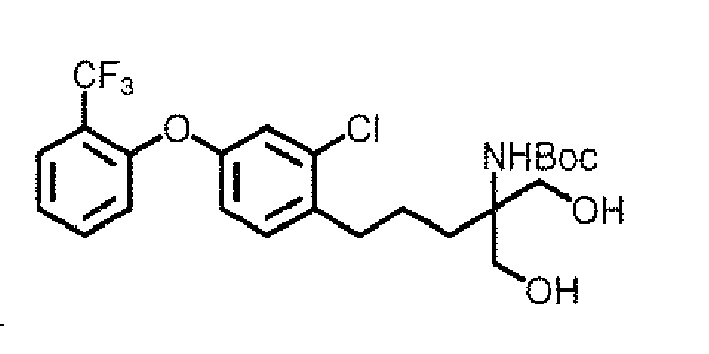
- The compound of Reference Example 324 was reacted in the same manner as in Example 1 and the resulting compound was reduced in the same manner as in Example 76 to obtain the desired product as a colorless powder.
FABMS: 504 ([M+H]+).
1H-NMR(400MHz, CDCl3) δ 1.44(9H, s), 1.58-1.66(4H, m), 2.70(2H, t, J=6.7Hz), 3.35(2H, br s), 3.60(2H, d,d, J=7.3, 11.6Hz), 3.84(2H, d,d, J=7.3, 11.6Hz), 4.92(1H, br s), 6.87(1H, dd, J=2.5, 8.0Hz), 6.96(1H, d, J=8.0Hz), 7.03(1H, d=2.5Hz), 7.15-7.22(2H, m), 7.48(1H, t, J=7.3Hz), 7.68(1H, d, J=6.7Hz). -

- The compound of Reference Example 327 was reacted in the same manner as in Example 1 and the resulting compound was reduced in the same manner as in Example 76 to obtain the desired product as a colorless oil.
FABMS: 543([M+H]+).
1H-NMR(400MHz, CDCl3) δ 1.45(9H, s), 1.78-1.84(2H, m), 2.64-2.71(2H, m), 3.23-3.39(2H, m), 3.65(2H, d,d, J=6.7, 11.6Hz), 3.84(2H, d,d, J=6.7, 11.6Hz), 5.07(1H, s), 5.08(2H, s), 6.96-7.00(3H, m), 7.07-7.13 (2H, m), 7.345-7.44(7H, m). -

- The compound of Example 302 was treated in the same manner as in Example 294 and the resulting compound was reacted in the same manner as in Example 295 to obtain the desired product as a colorless amorphous product.
FABMS: 510([M+H]+).
1H-NMR(400MHz, DMSOd6) δ 1.52-1.60(4H, m), 1.65-1.82(4H, m), 2.68(2H, br s), 3.42(2H, s), 3.61(6H, d, J=11.0Hz), 7.08(1H, dd, J=2.4, 8.6Hz), 7.15(2H, d, J=8.6Hz), 7.26(1H, d, J=2.4Hz), 7.42(1H, s, 8.6Hz), 7.75(2H, d, 8.6HzHz), 7.89(3H, br s). -

- The compound of Example 303 was reacted in the same manner as in Example 287 and the resulting compound was desilylated in the same manner as in Example 244. The desilylated product was then reacted in the same manner as in Example 233 to obtain the desired product as an amorphous product.
FABMS: 508([M+H]+).
1H-NMR(400MHz, DMSOd6) δ 1.42-1.62(2H, m), 1.68-1.82(2H, m), 2.66(2H, t, J=2.7Hz), 3.42 (2H, br s), 3.60(6H, d, J=11.0Hz), 6.00(1H, t, J=17.7Hz), 6.56(1H, dd, J=17.7, 22.6Hz), 6.97(1H, dd, J=2.5, 8.6Hz), 7.11(1H, d, J=8.6 Hz), 7.13(1H, d=2.5Hz), 7.32-7.40(2H, m), 7.67(1H, t, J=8.0Hz), 7.79(1H, t, J=7.3Hz), 8.22-8.38(3H, br s). -

- Using the compound of Example 303, the reaction was carried out in the same manner as in Example 305 to obtain the desired product as a colorless amorphous product.
FABMS: 510 ([M+H]+).
1H-NMR(400MHz, DMSOd6) δ 1.50-1.60(4H, m), 1.65-1.82(4H, m), 2. 60-2. 70 (2H, m), 3.52-3.55(2H, m), 3,61(6H, d, J=11.0Hz), 6.98(1H, dd, J=2.4, 8.6Hz), 7.08(1H, d, J=8.6Hz), 7.13(1H, d, J =2.4Hz), 7.33-7.41(2H, m), 7.68(1H, t, J=7.3), 7.80(1H, d, J=7.3Hz), 7.75-7.85(3H, br s). -

- The compound of Example 304 was reacted in the same manner as in Example 294 and the resulting compound was reacted in the same manner as in Example 290 to obtain the desired product as a colorless powder.
FABMS: 522([M+H]+).
1H-NMR(400MHz, DMSOd6) δ 1.47-1.62(2H, m), 1.62-1.91(4H, m), 2.55-2.67(2H, m), 3.40-3.54(2H, m), 5.12(2H, s), 6.98-7.10(4H, m), 7.25-7.51(8H, m). -

- The compound of Example 304 was reacted in the same manner as in Example 298 and the resulting compound was reacted in the same manner as in Example 299 to obtain the desired product as a colorless powder.
FARMS: 524 ([M+H]+).
1H-NMR(400MHz, DMSOd6) δ 1.70-1.77(2H, m), 2.65-2.69(2H, m), 3.49-3.53(2H, m), 3.72-3.86(2H, m), 5.13(2H, s), 7.06-7.10(4H, m), 7.25-7.27(1H, m), 7.33-7.46(7H, m). - Next, some experiment examples will be described, that demonstrate the efficacy of the compound of the present invention.
- CHO cells expressing human SIP receptors (i.e., CHO cells expressing hS1P1 receptors or hS1P3 receptors) were subcultured on Ham's F-12 medium supplemented with 10% fetal bovine serum and 200µg/mL Geneticin. The cells were seeded on a 96-well black clear bottom plate (COSTAR) at 4x10⁴ cells/well and were cultured overnight at 37°C in 5% CO2. A fluorescent reagent that emits fluorescence upon binding to Ca2+ (Calcium Screening Kit (DOJINDO)) was added to the culture and the cells were further cultured for 60min at 37°C in 5% CO2. After culturing, microplate spectrofluorometer (FLEX station, MOLECULAR DEVICE) was used to measure the fluorescence intensity at an excitation wavelength of 485 nm and a detection wavelength of 525 nm. SIP or a test compound adjusted with cultural medium to a concentration 10 times higher than the final concentration (final DMSO concentration = 0.1%). Each test compound solution was added 18sec. after beginning of the measurement of fluorescence. The fluorescence intensity was measured every 1.5sec for 100sec. For each test compound, the difference between the maximum fluorescence intensity and the minimum fluorescence intensity (i.e., increase in fluorescence) was determined from the measurements. The rate of fluorescence increase (%) for each test compound was calculated by the difference (100%) of the fluorescence increase between solvent only and SIP (10-6M). Using this value as an index of the ability of the test compound to induce intracellular Ca2+ mobilization, EC50 was determined by PRISM software (GraphPad). In Table 11, the symbol "-" indicates that the test compound was determined to have an EC50 of 1µmol/L or higher, the symbol "+" indicates that the test compound had an EC50 of lower than 1µmol/L and higher than or equal to 0.1µmol/L, the symbol "++" indicates that the test compound had an EC50 of lower than 0.1µmol/L and higher than or equal to 0.01µmol/L, and the symbol "+++" indicates that the test compound had an EC50 of lower than 0.1µmol/L.
Table 11 Example No. S1P1 S1P3 Example No. S1P1 S1P3 236 ++ ++ 265 +++ + 237 +++ +++ 267 +++ - 238 + - 269 ++ - 239 +++ +++ 280 + + 240 ++ + 283 ++ ++ 241 + - 284 ++ + 242 + - 286 ++ - 249 ++ +++ 290 +++ ++ 250 + - 293 + + 253 + + 296 ++ - 254 ++ - 299 ++ - 260 ++ + 300 ++ - 261 + - 307 + - 263 +++ + 308 + - - These results indicate that the compounds of the present invention act on human SIP receptors.
- CHO cells expressing human SIP receptors (i.e., CHO cells expressing hS1P4 receptors) were subcultured on Ham's F-12 medium supplemented with 10% fetal bovine serum and 200µg/mL Geneticin. The cells were seeded on a 6-well cell culture plate (COSTER) at 3x10⁵ cells/well and were cultured overnight at 37°C in 5% CO2. On the following day, the medium was replaced with FBS-free Ham's F-12 medium (containing 0.1% fatty acid-free bovine serum albumin) and the cells were cultured overnight at 37°C in 5% CO2. S1P or a test compound adjusted with Ham's F-12 medium (with 0.1% fatty acid-free bovine serum albumin) to a concentration 10 times higher than the final concentration (final DMSO concentration = 0.1%). Each test compound solution was added to this culture plate. The cells were cultured for 5min at 37°C in 5% CO2. The medium was removed and the cells were washed with a 200µmol/L ice-cold PBS containing Na3VO4. A lysis buffer (20mmol/L Tris-HCl pH7.5, 1% Triton X-100, 1mmol/L EDTA, 1mmol/L EGTA, 0.5mmol/L Na3VO4, 0.1% β-mercaptoethanol, 50mmol/L NaF, 5mmol/L Na4O7P3, 10mmol/L C3H7O6Na, 1µmol/L Microcystin LR, 1×Complete Protease Inhibitor Cocktail (ROCHE)) was then added to the cells and the reaction was carried out on ice for 5min to lyse the cells. The cell lysate was subjected to sodium dodecyl sulfate-polyacrylamide gel electrophoresis (SDS-PAGE) to separate proteins. The proteins were transferred to a PVDF membrane (Hybond-P, Amersham Biosciences). The membrane was reacted overnight at 4°C with anti-phospho ERK (p42/44 MAPK) monoclonal antibody (E10, Cell Signaling Technologies) diluted 1000-fold, and was subsequently reacted for I hour at room temperature with alkaline phosphatase-labeled anti-mouse IgG antibody (Molecular Probe) diluted 6000-fold. After washing with 20mmol/L Tris-HCl and 150mmol/L NaCl solution, the PVDF membrane was fluorostained with DDAO phosphate (DyeChrome Western Blot Stain Kit, Molecular Probe), a fluorescent substrate of alkaline phosphatase. The fluorescence was detected using a variable image analyzer (Typhoon 8600, Amersham Biosciences). The detected signal of phosphorylated ERK was quantified using ImageQuant software (Molecular Dynamics). The rate of ERK activation (%) for each test compound was calculated by the difference (100%) of the signal intensity between solvent only and SIP (10-6mol/L). The results are shown in Table 12 below.
Tables 12 Example No. Compound Cone (nmol/L) Induction effect of ERK activation on hS1P-expressing CHO cells (Activation rate (%) relative to the activated ERK at S1P10-6mol/L) 236 1 8.0 10 119.5 237 1 35.8 10 80.7 - These results indicate that the compounds of the present invention induce ERK activation by acting on human SIP receptors .
- This experiment was performed according to the method described in Transplantation 55(3) (1993): 578-591. Spleens were collected from 6 to 16 week old male BALB/c mice (CHARLES RIVER JAPAN). The spleens were placed in an RPMI-1640 medium (SIGMA) and were gently pressed between two slide glasses and then passed through a cell strainer (70µm, Falcon) to form a cell suspension. The suspension was then centrifuged and the supernatant was discarded. An ammonium chloride-Tris isotonic buffer was added to the suspension to lyse erythrocytes. The cells were then centrifuged three times in RPMI-1640 medium for washing and were resuspended in an RPMI-1640 medium. To this suspension, mitamycin C (KYOWA HAKKO KOGYO Co., Ltd.) was added to a final concentration of 25µg/mL and the suspension was incubated for 30 minutes at 37°C in a 5% CO2 atmosphere. The cells were centrifuged three times in RPMI-1640 medium for washing and were resuspended in an RPMI-1640 medium so that the medium would contain 2.5 X 10⁸ cells/mL. This suspension served as a "stimulation cell suspension." Using a 27G needle with a microsyringe (Hamilton), 20µL (5 X 10⁶ cells/mouse) of the stimulation cell suspension was subcutaneously injected into the right hind footpad of 6 to 8 week old male C3H/HeN mice (CLEA JAPAN). Normal control group was injected with RPMI-1640 medium alone. 4 days after the injection, right popliteal lymph nodes were collected and were weighed on a Mettler AT201 electronic scale (METTLER TOLEDO Co., Ltd.). Each animal was intraperitoneally administered a test compound once a day for four consecutive days starting on the day of the injection of the stimulation cells (i.e., total of 4 times). Control groups were administered the same vehicle as that used in the preparation of each test compound. The results are shown in Table 13 below. The inhibition (%) was determined using the following formula

Table 13 Example No. Dose (mg/kg) Inhibition (%) 233 30 53 235 30 56 236 0.03 73 237 0.1 75 238 3 65 239 0.03 65 241 10 46 242 10 62 247 0.03 63 - As set forth, the present invention has been devised in recognition of the fact that the novel aminophosphonic acid derivatives with a diarylsulfide or diarylether group exhibit a strong ability to modulate SIP receptors. Effective modulators of S1P receptors, the compounds of the present invention have a great potential as a prophylactic or therapeutic agent against peripheral vascular diseases, such as arteriosclerosis, arteriosclerosis obliterans, renal fibrosis, hepatic fibrosis, chronic bronchial asthma, diffuse pulmonary hamartoangiomyomatosis, adult respiratory distress syndrome (ARDS), chronic obstructive pulmonary disease (COPD), interstitial pneumonia, idiopathic interstitial pneumonia, lung cancer, hypersensitivity pneumonitis, Buerger's disease, diabetic neuropathy, septicemia, angiitis, nephritis, pneumonia, cerebral infarction, myocardial infarction, edema, varicose veins, dissecting arterial aneurysm, stenocardia, DIC, pleuritis, congestive heart failure, multiple organ failure, bed sore, burn, ulcerative colitis and Crohn's disease. The compounds of the present invention also act as effective prophylactic or therapeutic agents against rejection of heart transplants, kidney transplants, skin grafts, liver transplants and bone marrow transplants, or against rheumatoid arthritis, lupus nephritis, systemic lupus erythematosus, Hashimoto's disease, multiple sclerosis, myasthenia gravis, diabetes, atopic dermatitis, allergic rhinitis, allergic conjunctivitis, allergic contact dermatitis and various other diseases.
Claims (9)
- An aminophosphonic acid derivative represented by the following general formula (1):

- The 2-aminophosphonic acid monoester derivative according to claim 1, an optical isomer, a pharmaceutically acceptable salt or a hydrate thereof, wherein the compounds represented by the general formula (1) comprise compounds represented by the following general formula (1a):

- The 2-aminophosphonic acid monoester derivative according to claim 2, an optical isomer, a pharmaceutically acceptable salt or a hydrate thereof, wherein R3 is a chlorine atom.
- The 3-aminophosphonic acid derivative according to claim 1, an optical isomer, a pharmaceutically acceptable salt or a hydrate thereof, wherein the compounds represented by the general formula (1) comprise compounds represented by the following general formula (1b):

- The 3-aminophosphonic acid derivative according to claim 4, an optical isomer, a pharmaceutically acceptable salt or a hydrate thereof, wherein R3 is a chlorine atom.
- An SIP receptor modulator containing as an active ingredient at least one of aminophosphonic acid derivatives represented by the following general formula (1):

- The SIP receptor modulator according to claim 6, wherein the compound represented by the general formula (1) contains as an active ingredient at least one of 2-aminophosphonic acid monoester derivatives represented by the following general formula (1a):
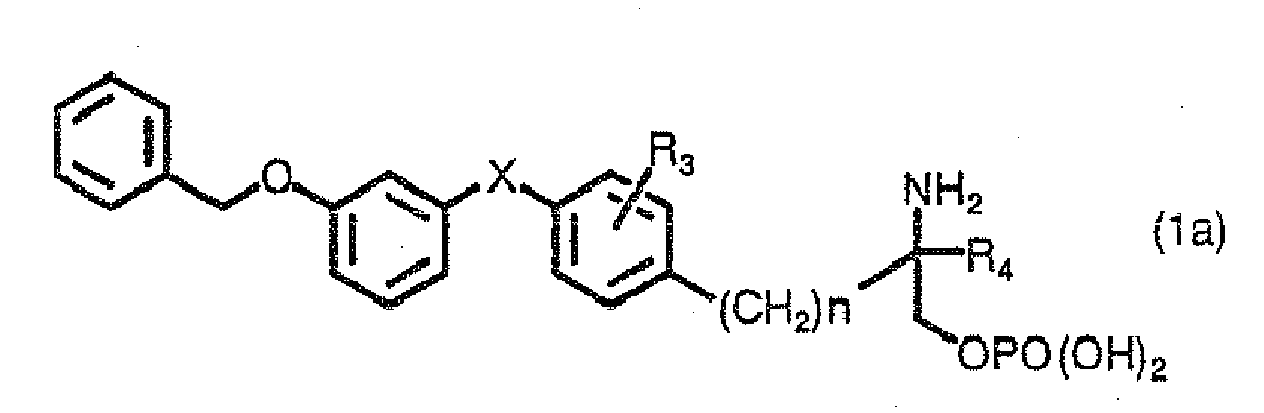
- The SIP receptor modulator according to claim 6, wherein the compound represented by the general formula (1) contains as an active ingredient at least one of 2-aminophosphonic acid derivatives represented by the following general formula (1b):

- A pharmaceutical agent containing as an active ingredient at least one of the aminophosphonic acid derivatives according to any one of claims I to 8, the optical isomers, the pharmaceutically acceptable salts and the hydrates thereof.
Applications Claiming Priority (2)
| Application Number | Priority Date | Filing Date | Title |
|---|---|---|---|
| JP2003039269 | 2003-02-18 | ||
| EP04712184A EP1602660B1 (en) | 2003-02-18 | 2004-02-18 | Aminophosphonic acid derivatives, addition salts thereof and s1p receptor modulators |
Related Parent Applications (1)
| Application Number | Title | Priority Date | Filing Date |
|---|---|---|---|
| EP04712184.3 Division | 2004-02-18 |
Publications (3)
| Publication Number | Publication Date |
|---|---|
| EP2172472A2 true EP2172472A2 (en) | 2010-04-07 |
| EP2172472A3 EP2172472A3 (en) | 2010-06-30 |
| EP2172472B1 EP2172472B1 (en) | 2012-12-26 |
Family
ID=32905163
Family Applications (2)
| Application Number | Title | Priority Date | Filing Date |
|---|---|---|---|
| EP09178067A Expired - Lifetime EP2172472B1 (en) | 2003-02-18 | 2004-02-18 | Aminophosphonic acid derivative, salt thereof and modulator of S1P receptor |
| EP04712184A Expired - Lifetime EP1602660B1 (en) | 2003-02-18 | 2004-02-18 | Aminophosphonic acid derivatives, addition salts thereof and s1p receptor modulators |
Family Applications After (1)
| Application Number | Title | Priority Date | Filing Date |
|---|---|---|---|
| EP04712184A Expired - Lifetime EP1602660B1 (en) | 2003-02-18 | 2004-02-18 | Aminophosphonic acid derivatives, addition salts thereof and s1p receptor modulators |
Country Status (17)
| Country | Link |
|---|---|
| US (2) | US7456157B2 (en) |
| EP (2) | EP2172472B1 (en) |
| JP (1) | JP4564918B2 (en) |
| KR (1) | KR101005171B1 (en) |
| CN (1) | CN100344638C (en) |
| AT (1) | ATE504590T1 (en) |
| AU (1) | AU2004213297B2 (en) |
| BR (1) | BRPI0407658A (en) |
| CA (1) | CA2515574C (en) |
| CY (1) | CY1111529T1 (en) |
| DE (1) | DE602004032118D1 (en) |
| DK (1) | DK1602660T3 (en) |
| ES (1) | ES2360394T3 (en) |
| MX (1) | MXPA05008760A (en) |
| PT (1) | PT1602660E (en) |
| SI (1) | SI1602660T1 (en) |
| WO (1) | WO2004074297A1 (en) |
Cited By (1)
| Publication number | Priority date | Publication date | Assignee | Title |
|---|---|---|---|---|
| US8569270B2 (en) | 2009-07-09 | 2013-10-29 | Kyorin Pharmaceutical Co., Ltd. | Diphenyl sulfide derivatives and medicines containing same as active ingredient |
Families Citing this family (49)
| Publication number | Priority date | Publication date | Assignee | Title |
|---|---|---|---|---|
| AU2003264430B2 (en) * | 2002-09-19 | 2009-03-19 | Kyorin Pharmaceutical Co., Ltd. | Amino alcohol derivative, addition salt thereof, and immunosuppressant |
| DK1602660T3 (en) * | 2003-02-18 | 2011-05-23 | Kyorin Seiyaku Kk | Aminophosphonic acid derivatives, addition salts thereof, and S1P receptor modulators |
| WO2005041899A2 (en) | 2003-11-03 | 2005-05-12 | University Of Virginia Patent Foundation | Orally available sphingosine 1-phosphate receptor agonists and antagonists |
| ATE502630T1 (en) | 2004-07-16 | 2011-04-15 | Kyorin Seiyaku Kk | METHOD FOR EFFECTIVE USE OF A MEDICATION AND METHOD FOR PREVENTING SIDE EFFECTS |
| AU2005272619A1 (en) | 2004-08-13 | 2006-02-23 | Praecis Pharmaceuticals, Inc. | Methods and compositions for modulating sphingosine-1-phosphate (SIP) receptor activity |
| US20060223866A1 (en) * | 2004-08-13 | 2006-10-05 | Praecis Pharmaceuticals, Inc. | Methods and compositions for modulating sphingosine-1-phosphate (S1P) receptor activity |
| AU2005292984B2 (en) * | 2004-10-12 | 2011-01-20 | Kyorin Pharmaceutical Co., Ltd. | Process for producing 2-amino-2-[2-[4-(3-benzyloxyphenylthio)-2-chlorophenyl]ethyl]-1,3-propanediol hydrochloride or hydrate thereof and intermediate for the same |
| JP2008522977A (en) | 2004-12-06 | 2008-07-03 | ユニバーシティ オブ バージニア パテント ファンデーション | Sphingosine = 1-phosphate arylamide analog |
| NZ588372A (en) * | 2005-09-09 | 2012-03-30 | Novartis Ag | Diphenyl ether or thioether derivatives for treatment of autoimmune diseases |
| RU2421214C2 (en) * | 2005-10-07 | 2011-06-20 | Киорин Фармасьютикал Ко., Лтд. | Therapeutic agent for treating hepatitis, and method of treating hepatitis |
| MX2008009579A (en) | 2006-01-27 | 2008-09-25 | Univ Virginia | Method for treatment of neuropathic pain. |
| TWI389683B (en) * | 2006-02-06 | 2013-03-21 | Kyorin Seiyaku Kk | A therapeutic agent for an inflammatory bowel disease or an inflammatory bowel disease treatment using a 2-amino-1,3-propanediol derivative as an active ingredient |
| AU2007212193A1 (en) | 2006-02-09 | 2007-08-16 | University Of Virginia Patent Foundation | Bicyclic sphingosine 1-phosphate analogs |
| EP2099768A2 (en) * | 2006-08-04 | 2009-09-16 | Praecis Pharmaceuticals Incorporated | Agonists of the sphingosine-1-phosphate receptor |
| US8232319B2 (en) * | 2006-08-08 | 2012-07-31 | Kyorin Pharmaceutical Co., Ltd. | Amino phosphate derivative and S1P receptor modulator having same as an active ingredient |
| JP5140593B2 (en) * | 2006-08-08 | 2013-02-06 | 杏林製薬株式会社 | Amino alcohol derivatives and immunosuppressants containing them as active ingredients |
| AU2007323618A1 (en) | 2006-11-21 | 2008-05-29 | University Of Virginia Patent Foundation | Tetralin analogs having sphingosine 1-phosphate agonist activity |
| WO2008064337A2 (en) * | 2006-11-21 | 2008-05-29 | University Of Virginia Patent Foundation | Benzocycloheptyl analogs having sphingosine 1-phosphate receptor activity |
| EP2099741A2 (en) | 2006-11-21 | 2009-09-16 | University Of Virginia Patent Foundation | Hydrindane analogs having sphingosine 1-phosphate receptor agonist activity |
| PT2465492E (en) | 2007-10-12 | 2015-10-15 | Novartis Ag | Compositions comprising sphingosine i phosphate (sip) receptor modulators |
| TW200946105A (en) | 2008-02-07 | 2009-11-16 | Kyorin Seiyaku Kk | Therapeutic agent or preventive agent for inflammatory bowel disease containing amino alcohol derivative as active ingredient |
| CN106366027A (en) | 2008-03-24 | 2017-02-01 | 杏林制药株式会社 | Method for crystallization of 2-amino-2-[2-[4-(3- benzyloxyphenylthio)-2-chlorophenyl]ethyl]-1,3-propanediol hydrochloride |
| CA2724450A1 (en) * | 2008-05-19 | 2009-11-26 | Takeshi Tsubuki | Method for producing optically active aminoalcohol derivative |
| EP2305305A4 (en) * | 2008-05-20 | 2013-02-13 | Kyorin Seiyaku Kk | INDUCTION / MAINTENANCE TRANSMITTER |
| HRP20161133T1 (en) | 2008-07-23 | 2016-12-02 | Arena Pharmaceuticals, Inc. | DERIVATIVES OF SUBSTITUTED 1,2,3,4-TETRAHYDROCYCLOPENT [b] INDOL-3-IL-ACETIC ACIDS USED IN THE TREATMENT OF AUTOIMMUNE AND INFLAMMATORY DISORDERS |
| CA2733390A1 (en) | 2008-08-01 | 2010-02-04 | Bioxiness Pharmaceuticals, Inc. | Methionine analogs and methods of using same |
| CN105816453B (en) | 2008-08-27 | 2021-03-05 | 艾尼纳制药公司 | Substituted tricyclic acid derivatives as S1P1 receptor agonists for the treatment of autoimmune and inflammatory disorders |
| JP2012505836A (en) * | 2008-10-17 | 2012-03-08 | アカール ファーマ ピーティーワイ リミテッド | S1P receptor modulators and their use |
| CA2786994C (en) | 2010-01-27 | 2018-01-16 | Arena Pharmaceuticals, Inc. | Processes for the preparation of (r)-2-(7-(4-cyclopentyl-3-(trifluoromethyl)benzyloxy)-1,2,3,4-tetrahydrocyclopenta[b]indol-3-yl)acetic acid and salts thereof |
| CN105503882B (en) | 2010-03-03 | 2019-07-05 | 艾尼纳制药公司 | The method for preparing S1P1 receptor modulators and its crystal form |
| NZ603999A (en) * | 2010-05-06 | 2014-06-27 | Novartis Ag | Treatment of autoimmune diseases |
| AU2011249789B2 (en) | 2010-05-06 | 2015-03-19 | Novartis Ag | Dosage regimen of diaryl sulfide derivatives |
| EP2643331A1 (en) | 2010-11-22 | 2013-10-02 | Allergan, Inc. | Novel compounds as receptor modulators with therapeutic utility |
| TWI519539B (en) * | 2010-12-21 | 2016-02-01 | Kyorin Seiyaku Kk | Diphenyl sulfide derivatives and pharmaceuticals as an active ingredient |
| US8673308B2 (en) | 2011-02-23 | 2014-03-18 | Als Therapy Development Institute | Targeting of CD8+ T-lymphocytes to treat neurodegenerative diseases |
| WO2012136121A1 (en) * | 2011-04-02 | 2012-10-11 | 中国人民解放军军事医学科学院毒物药物研究所 | Amino phenylpropanoid compound and use thereof for preparing immunosuppressant |
| US8946301B2 (en) | 2011-11-29 | 2015-02-03 | Als Therapy Development Institute | Targeting of T-lymphocytes to treat amyotrophic lateral sclerosis |
| US9657043B2 (en) | 2012-04-23 | 2017-05-23 | Mitsubishi Tanabe Pharma Corporation | Amine compound and use thereof for medical purposes |
| AU2016205361C1 (en) | 2015-01-06 | 2021-04-08 | Arena Pharmaceuticals, Inc. | Methods of treating conditions related to the S1P1 receptor |
| PL3310760T3 (en) | 2015-06-22 | 2023-03-06 | Arena Pharmaceuticals, Inc. | Crystalline l-arginine salt of (r)-2-(7-(4-cyclopentyl-3-(trifluoromethyl)benzyloxy)-1,2,3,4-tetrahydrocyclo-penta[b]indol-3-yl)acetic acid for use in s1p1 receptor-associated disorders |
| KR20190116416A (en) | 2017-02-16 | 2019-10-14 | 아레나 파마슈티칼스, 인크. | Compounds and Methods for Treating Primary Bile Cholangitis |
| JP2020507610A (en) | 2017-02-16 | 2020-03-12 | アリーナ ファーマシューティカルズ, インコーポレイテッド | Compounds and methods for the treatment of inflammatory bowel disease with parenteral symptoms |
| AU2019280822A1 (en) | 2018-06-06 | 2021-01-07 | Arena Pharmaceuticals, Inc. | Methods of treating conditions related to the S1P1 receptor |
| EP3847158A1 (en) | 2018-09-06 | 2021-07-14 | Arena Pharmaceuticals, Inc. | Compounds useful in the treatment of autoimmune and inflammatory disorders |
| KR20230136603A (en) | 2021-01-28 | 2023-09-26 | 프리오테라 에스에이에스 | Treatment methods using S1P receptor modulators |
| WO2022162409A1 (en) | 2021-01-28 | 2022-08-04 | Priothera Sas | Methods of treatment with s1p receptor modulators |
| TW202341971A (en) | 2022-02-16 | 2023-11-01 | 法商普萊歐塞拉公司 | Methods of treatment with car cells in combination with s1p receptor modulators |
| EP4282407A1 (en) | 2022-05-27 | 2023-11-29 | Priothera SAS | Treatment of cancer with s1p receptor agonists |
| WO2025109119A1 (en) | 2023-11-22 | 2025-05-30 | Priothera Sas | Methods of treatment with multispecific antigen-binding proteins in combination with s1p receptor modulators |
Family Cites Families (19)
| Publication number | Priority date | Publication date | Assignee | Title |
|---|---|---|---|---|
| US5447922A (en) * | 1994-08-24 | 1995-09-05 | Bristol-Myers Squibb Company | α-phosphonosulfinic squalene synthetase inhibitors |
| AU2001264313A1 (en) | 2000-06-20 | 2002-01-02 | Japan Tobacco Inc. | Pyrazolopyridine compounds and use thereof as drugs |
| AU8533101A (en) | 2000-08-31 | 2002-03-13 | Merck & Co Inc | Phosphate derivatives as immunoregulatory agents |
| EP1383778B1 (en) | 2001-01-30 | 2009-10-21 | University Of Virginia Patent Foundation | Agonists and antagonists of sphingosine-1-phosphate receptors |
| EP1364659B1 (en) | 2001-02-08 | 2009-11-11 | Ono Pharmaceutical Co., Ltd. | Remedies for urinary diseases comprising lpa receptor controlling agents |
| US7326801B2 (en) | 2001-03-26 | 2008-02-05 | Novartis Ag | 2-amino-propanol derivatives |
| US7179817B2 (en) | 2001-05-10 | 2007-02-20 | Ono Pharmaceutical Co., Ltd. | Carboxylic acid derivatives and drugs containing the same as the active ingredient |
| US20040235794A1 (en) | 2001-09-04 | 2004-11-25 | Shinji Nakade | Remedies for respiratory diseases comprising sphingosine-1-phosphate receptor controller |
| JP2005112721A (en) | 2001-11-06 | 2005-04-28 | Maruha Corp | Nitrogen-containing compound, production method, and use thereof |
| JP4035759B2 (en) | 2001-11-06 | 2008-01-23 | 独立行政法人産業技術総合研究所 | Aminoalcohol phosphate compound, production method, and method of use thereof |
| WO2003051876A1 (en) | 2001-12-14 | 2003-06-26 | Japan Tobacco Inc. | Pyrazolopyridine derivatives and medicinal use thereof |
| AU2003202994B2 (en) | 2002-01-18 | 2007-11-22 | Merck Sharp & Dohme Corp. | N-(benzyl)aminoalkylcarboxylates, phosphinates, phosphonates and tetrazoles as Edg receptor agonists |
| ATE441654T1 (en) | 2002-01-18 | 2009-09-15 | Merck & Co Inc | EDG RECEPTOR AGONISTS |
| US20050070506A1 (en) * | 2002-01-18 | 2005-03-31 | Doherty George A. | Selective s1p1/edg1 receptor agonists |
| JP2005531506A (en) | 2002-03-01 | 2005-10-20 | メルク エンド カムパニー インコーポレーテッド | Aminoalkylphosphonates and related compounds as agonists of EDG receptors |
| CA2483594C (en) * | 2002-05-16 | 2011-02-15 | Novartis Ag | Use of edg receptor binding agents in cancer |
| AU2003273865A1 (en) * | 2002-09-13 | 2004-04-30 | Novartis Ag | Amino-propanol derivatives |
| JP4505449B2 (en) * | 2003-02-11 | 2010-07-21 | アイアールエム・リミテッド・ライアビリティ・カンパニー | Novel bicyclic compounds and compositions |
| DK1602660T3 (en) | 2003-02-18 | 2011-05-23 | Kyorin Seiyaku Kk | Aminophosphonic acid derivatives, addition salts thereof, and S1P receptor modulators |
-
2004
- 2004-02-18 DK DK04712184.3T patent/DK1602660T3/en active
- 2004-02-18 ES ES04712184T patent/ES2360394T3/en not_active Expired - Lifetime
- 2004-02-18 CA CA2515574A patent/CA2515574C/en not_active Expired - Fee Related
- 2004-02-18 EP EP09178067A patent/EP2172472B1/en not_active Expired - Lifetime
- 2004-02-18 DE DE602004032118T patent/DE602004032118D1/en not_active Expired - Lifetime
- 2004-02-18 BR BRPI0407658-3A patent/BRPI0407658A/en not_active Application Discontinuation
- 2004-02-18 KR KR1020057015237A patent/KR101005171B1/en not_active Expired - Fee Related
- 2004-02-18 CN CNB200480004551XA patent/CN100344638C/en not_active Expired - Fee Related
- 2004-02-18 WO PCT/JP2004/001783 patent/WO2004074297A1/en not_active Ceased
- 2004-02-18 JP JP2005502730A patent/JP4564918B2/en not_active Expired - Fee Related
- 2004-02-18 US US10/545,790 patent/US7456157B2/en not_active Expired - Lifetime
- 2004-02-18 EP EP04712184A patent/EP1602660B1/en not_active Expired - Lifetime
- 2004-02-18 AT AT04712184T patent/ATE504590T1/en active
- 2004-02-18 AU AU2004213297A patent/AU2004213297B2/en not_active Ceased
- 2004-02-18 PT PT04712184T patent/PT1602660E/en unknown
- 2004-02-18 SI SI200431656T patent/SI1602660T1/en unknown
- 2004-02-18 MX MXPA05008760A patent/MXPA05008760A/en active IP Right Grant
-
2008
- 2008-06-16 US US12/213,187 patent/US7759326B2/en not_active Expired - Fee Related
-
2011
- 2011-06-06 CY CY20111100542T patent/CY1111529T1/en unknown
Cited By (1)
| Publication number | Priority date | Publication date | Assignee | Title |
|---|---|---|---|---|
| US8569270B2 (en) | 2009-07-09 | 2013-10-29 | Kyorin Pharmaceutical Co., Ltd. | Diphenyl sulfide derivatives and medicines containing same as active ingredient |
Also Published As
| Publication number | Publication date |
|---|---|
| CA2515574C (en) | 2012-03-13 |
| US20060160771A1 (en) | 2006-07-20 |
| JPWO2004074297A1 (en) | 2006-06-01 |
| BRPI0407658A (en) | 2006-02-21 |
| PT1602660E (en) | 2011-06-15 |
| DK1602660T3 (en) | 2011-05-23 |
| US7456157B2 (en) | 2008-11-25 |
| AU2004213297A1 (en) | 2004-09-02 |
| EP1602660A1 (en) | 2005-12-07 |
| EP2172472B1 (en) | 2012-12-26 |
| ES2360394T3 (en) | 2011-06-03 |
| EP1602660A4 (en) | 2008-03-19 |
| CN100344638C (en) | 2007-10-24 |
| KR20050109069A (en) | 2005-11-17 |
| SI1602660T1 (en) | 2011-06-30 |
| MXPA05008760A (en) | 2006-03-21 |
| ATE504590T1 (en) | 2011-04-15 |
| CA2515574A1 (en) | 2004-09-02 |
| KR101005171B1 (en) | 2011-01-04 |
| AU2004213297B2 (en) | 2009-03-19 |
| EP1602660B1 (en) | 2011-04-06 |
| JP4564918B2 (en) | 2010-10-20 |
| CN1751054A (en) | 2006-03-22 |
| US7759326B2 (en) | 2010-07-20 |
| EP2172472A3 (en) | 2010-06-30 |
| WO2004074297A1 (en) | 2004-09-02 |
| CY1111529T1 (en) | 2015-08-05 |
| DE602004032118D1 (en) | 2011-05-19 |
| US20080275008A1 (en) | 2008-11-06 |
Similar Documents
| Publication | Publication Date | Title |
|---|---|---|
| EP1602660B1 (en) | Aminophosphonic acid derivatives, addition salts thereof and s1p receptor modulators | |
| JPWO2005044780A1 (en) | Aminocarboxylic acid derivatives and their addition salts and S1P receptor modulators | |
| EP1431275B1 (en) | Diaryl ether derivative, addition salt thereof, and immunosuppressant | |
| Prakash et al. | Perfluoroalkylation with organosilicon reagents | |
| CN1312125C (en) | Amino alcohol derivative, addition salt thereof, and immunosuppressant | |
| WO1992016486A1 (en) | Substituted diphenylethylenes and analogues or derivatives thereof | |
| JP3957303B2 (en) | Method for the synthesis of 1α-hydroxy-2-methylene-19-nor-homopregnacalciferol | |
| WO1993025521A1 (en) | Aryl aliphatic acids | |
| EP1961734B1 (en) | Amine compound and use thereof for medical purposes | |
| JPH0717595B2 (en) | PHENOL DERIVATIVE, PROCESS FOR PRODUCING THE SAME, AND PHARMACEUTICAL COMPOSITION HAVING ANTIESTROGEN EFFECT CONTAINING THE COMPOUND | |
| JP3507435B2 (en) | Cyclohexanediol derivative | |
| FI88708C (en) | Foerfarande Foer framstaellning av therapeutiskt anvaendbara nya fenolderivat | |
| Ivanova et al. | Synthesis of Ethyl Ethers 13, 14-Dehydro-16-aryloxy-11-deoxyprostaglandin E1 | |
| FR2887873A1 (en) | PROCESS FOR THE PREPARATION OF AN ALKYNE HAVING AN OPTICALLY ACTIVE HYDROXYL GROUP IN THE POSITION B OR G OF A TRIPLE BINDING AND INTERMEDIATE PRODUCTS OBTAINED | |
| Grieco et al. | Synthesis and biological evaluation of the methyl esters of (+)-12-fluoro-13, 14-dihydroprostaglandin F2. alpha. and (+)-15-epi-12-fluoro-13, 14-dihydroprostaglandin F2. alpha. | |
| JPH1143459A (en) | Phenyl-substituted hydroxycyclopentenone analogs | |
| FR2903693A1 (en) | AROMATIC SULFONYL SULFINATES AND HALOGENIDES, AND THEIR PREPARATION. | |
| KR20260018878A (en) | Method for preparing HIV capsid inhibitor | |
| JPH0717913A (en) | Alicyclic phospholipase A2 inhibitor | |
| WO2003024909A1 (en) | Method of preparing symmetrical polyhydroxystilbenes | |
| KR840002463B1 (en) | Process for preparing aromatic phosphono formic acid monoester | |
| HUT63599A (en) | Process for producing intermediary products usable in the production of s-ketoprofen | |
| CH651575A5 (en) | HALIDES OF S-ALCOYL ALCOYLPHOSPHONOTHIOIC ACIDS AND PROCESS FOR THEIR PREPARATION. | |
| JPH1143460A (en) | Phenyl-substituted hydroxycyclopentenone analogs | |
| JPH07267920A (en) | Method for producing fluorine-containing compound |
Legal Events
| Date | Code | Title | Description |
|---|---|---|---|
| PUAI | Public reference made under article 153(3) epc to a published international application that has entered the european phase |
Free format text: ORIGINAL CODE: 0009012 |
|
| AC | Divisional application: reference to earlier application |
Ref document number: 1602660 Country of ref document: EP Kind code of ref document: P |
|
| AK | Designated contracting states |
Kind code of ref document: A2 Designated state(s): AT BE BG CH CY CZ DE DK EE ES FI FR GB GR HU IE IT LI LU MC NL PT RO SE SI SK TR |
|
| AX | Request for extension of the european patent |
Extension state: AL LT LV MK |
|
| PUAL | Search report despatched |
Free format text: ORIGINAL CODE: 0009013 |
|
| RIN1 | Information on inventor provided before grant (corrected) |
Inventor name: HORI, WATARU Inventor name: KURIYAMA, KAZUHIKO Inventor name: TANAKA, KIYOAKI Inventor name: KOHNO, YASUSHI |
|
| AK | Designated contracting states |
Kind code of ref document: A3 Designated state(s): AT BE BG CH CY CZ DE DK EE ES FI FR GB GR HU IE IT LI LU MC NL PT RO SE SI SK TR |
|
| AX | Request for extension of the european patent |
Extension state: AL LT LV MK |
|
| 17P | Request for examination filed |
Effective date: 20101223 |
|
| 17Q | First examination report despatched |
Effective date: 20110706 |
|
| GRAP | Despatch of communication of intention to grant a patent |
Free format text: ORIGINAL CODE: EPIDOSNIGR1 |
|
| GRAS | Grant fee paid |
Free format text: ORIGINAL CODE: EPIDOSNIGR3 |
|
| GRAA | (expected) grant |
Free format text: ORIGINAL CODE: 0009210 |
|
| AC | Divisional application: reference to earlier application |
Ref document number: 1602660 Country of ref document: EP Kind code of ref document: P |
|
| AK | Designated contracting states |
Kind code of ref document: B1 Designated state(s): AT BE BG CH CY CZ DE DK EE ES FI FR GB GR HU IE IT LI LU MC NL PT RO SE SI SK TR |
|
| REG | Reference to a national code |
Ref country code: GB Ref legal event code: FG4D |
|
| REG | Reference to a national code |
Ref country code: CH Ref legal event code: EP |
|
| REG | Reference to a national code |
Ref country code: AT Ref legal event code: REF Ref document number: 590411 Country of ref document: AT Kind code of ref document: T Effective date: 20130115 |
|
| REG | Reference to a national code |
Ref country code: DE Ref legal event code: R096 Ref document number: 602004040590 Country of ref document: DE Effective date: 20130228 |
|
| PG25 | Lapsed in a contracting state [announced via postgrant information from national office to epo] |
Ref country code: SE Free format text: LAPSE BECAUSE OF FAILURE TO SUBMIT A TRANSLATION OF THE DESCRIPTION OR TO PAY THE FEE WITHIN THE PRESCRIBED TIME-LIMIT Effective date: 20121226 Ref country code: FI Free format text: LAPSE BECAUSE OF FAILURE TO SUBMIT A TRANSLATION OF THE DESCRIPTION OR TO PAY THE FEE WITHIN THE PRESCRIBED TIME-LIMIT Effective date: 20121226 |
|
| REG | Reference to a national code |
Ref country code: AT Ref legal event code: MK05 Ref document number: 590411 Country of ref document: AT Kind code of ref document: T Effective date: 20121226 |
|
| REG | Reference to a national code |
Ref country code: NL Ref legal event code: VDEP Effective date: 20121226 |
|
| PG25 | Lapsed in a contracting state [announced via postgrant information from national office to epo] |
Ref country code: SI Free format text: LAPSE BECAUSE OF FAILURE TO SUBMIT A TRANSLATION OF THE DESCRIPTION OR TO PAY THE FEE WITHIN THE PRESCRIBED TIME-LIMIT Effective date: 20121226 Ref country code: GR Free format text: LAPSE BECAUSE OF FAILURE TO SUBMIT A TRANSLATION OF THE DESCRIPTION OR TO PAY THE FEE WITHIN THE PRESCRIBED TIME-LIMIT Effective date: 20130327 |
|
| PG25 | Lapsed in a contracting state [announced via postgrant information from national office to epo] |
Ref country code: AT Free format text: LAPSE BECAUSE OF FAILURE TO SUBMIT A TRANSLATION OF THE DESCRIPTION OR TO PAY THE FEE WITHIN THE PRESCRIBED TIME-LIMIT Effective date: 20121226 Ref country code: SK Free format text: LAPSE BECAUSE OF FAILURE TO SUBMIT A TRANSLATION OF THE DESCRIPTION OR TO PAY THE FEE WITHIN THE PRESCRIBED TIME-LIMIT Effective date: 20121226 Ref country code: EE Free format text: LAPSE BECAUSE OF FAILURE TO SUBMIT A TRANSLATION OF THE DESCRIPTION OR TO PAY THE FEE WITHIN THE PRESCRIBED TIME-LIMIT Effective date: 20121226 Ref country code: BE Free format text: LAPSE BECAUSE OF FAILURE TO SUBMIT A TRANSLATION OF THE DESCRIPTION OR TO PAY THE FEE WITHIN THE PRESCRIBED TIME-LIMIT Effective date: 20121226 Ref country code: ES Free format text: LAPSE BECAUSE OF FAILURE TO SUBMIT A TRANSLATION OF THE DESCRIPTION OR TO PAY THE FEE WITHIN THE PRESCRIBED TIME-LIMIT Effective date: 20130406 Ref country code: CZ Free format text: LAPSE BECAUSE OF FAILURE TO SUBMIT A TRANSLATION OF THE DESCRIPTION OR TO PAY THE FEE WITHIN THE PRESCRIBED TIME-LIMIT Effective date: 20121226 Ref country code: BG Free format text: LAPSE BECAUSE OF FAILURE TO SUBMIT A TRANSLATION OF THE DESCRIPTION OR TO PAY THE FEE WITHIN THE PRESCRIBED TIME-LIMIT Effective date: 20130326 |
|
| PG25 | Lapsed in a contracting state [announced via postgrant information from national office to epo] |
Ref country code: NL Free format text: LAPSE BECAUSE OF FAILURE TO SUBMIT A TRANSLATION OF THE DESCRIPTION OR TO PAY THE FEE WITHIN THE PRESCRIBED TIME-LIMIT Effective date: 20121226 Ref country code: PT Free format text: LAPSE BECAUSE OF FAILURE TO SUBMIT A TRANSLATION OF THE DESCRIPTION OR TO PAY THE FEE WITHIN THE PRESCRIBED TIME-LIMIT Effective date: 20130426 Ref country code: RO Free format text: LAPSE BECAUSE OF FAILURE TO SUBMIT A TRANSLATION OF THE DESCRIPTION OR TO PAY THE FEE WITHIN THE PRESCRIBED TIME-LIMIT Effective date: 20121226 |
|
| PG25 | Lapsed in a contracting state [announced via postgrant information from national office to epo] |
Ref country code: MC Free format text: LAPSE BECAUSE OF NON-PAYMENT OF DUE FEES Effective date: 20130228 |
|
| REG | Reference to a national code |
Ref country code: CH Ref legal event code: PL |
|
| PG25 | Lapsed in a contracting state [announced via postgrant information from national office to epo] |
Ref country code: CH Free format text: LAPSE BECAUSE OF NON-PAYMENT OF DUE FEES Effective date: 20130228 Ref country code: LI Free format text: LAPSE BECAUSE OF NON-PAYMENT OF DUE FEES Effective date: 20130228 Ref country code: DK Free format text: LAPSE BECAUSE OF FAILURE TO SUBMIT A TRANSLATION OF THE DESCRIPTION OR TO PAY THE FEE WITHIN THE PRESCRIBED TIME-LIMIT Effective date: 20121226 |
|
| PLBE | No opposition filed within time limit |
Free format text: ORIGINAL CODE: 0009261 |
|
| STAA | Information on the status of an ep patent application or granted ep patent |
Free format text: STATUS: NO OPPOSITION FILED WITHIN TIME LIMIT |
|
| PG25 | Lapsed in a contracting state [announced via postgrant information from national office to epo] |
Ref country code: CY Free format text: LAPSE BECAUSE OF FAILURE TO SUBMIT A TRANSLATION OF THE DESCRIPTION OR TO PAY THE FEE WITHIN THE PRESCRIBED TIME-LIMIT Effective date: 20121226 |
|
| 26N | No opposition filed |
Effective date: 20130927 |
|
| REG | Reference to a national code |
Ref country code: IE Ref legal event code: MM4A |
|
| PG25 | Lapsed in a contracting state [announced via postgrant information from national office to epo] |
Ref country code: IT Free format text: LAPSE BECAUSE OF FAILURE TO SUBMIT A TRANSLATION OF THE DESCRIPTION OR TO PAY THE FEE WITHIN THE PRESCRIBED TIME-LIMIT Effective date: 20121226 |
|
| REG | Reference to a national code |
Ref country code: DE Ref legal event code: R097 Ref document number: 602004040590 Country of ref document: DE Effective date: 20130927 |
|
| PG25 | Lapsed in a contracting state [announced via postgrant information from national office to epo] |
Ref country code: IE Free format text: LAPSE BECAUSE OF NON-PAYMENT OF DUE FEES Effective date: 20130218 |
|
| PG25 | Lapsed in a contracting state [announced via postgrant information from national office to epo] |
Ref country code: TR Free format text: LAPSE BECAUSE OF FAILURE TO SUBMIT A TRANSLATION OF THE DESCRIPTION OR TO PAY THE FEE WITHIN THE PRESCRIBED TIME-LIMIT Effective date: 20121226 |
|
| PG25 | Lapsed in a contracting state [announced via postgrant information from national office to epo] |
Ref country code: LU Free format text: LAPSE BECAUSE OF NON-PAYMENT OF DUE FEES Effective date: 20130218 Ref country code: HU Free format text: LAPSE BECAUSE OF FAILURE TO SUBMIT A TRANSLATION OF THE DESCRIPTION OR TO PAY THE FEE WITHIN THE PRESCRIBED TIME-LIMIT; INVALID AB INITIO Effective date: 20040218 |
|
| REG | Reference to a national code |
Ref country code: FR Ref legal event code: PLFP Year of fee payment: 13 |
|
| REG | Reference to a national code |
Ref country code: FR Ref legal event code: PLFP Year of fee payment: 14 |
|
| REG | Reference to a national code |
Ref country code: FR Ref legal event code: PLFP Year of fee payment: 15 |
|
| PGFP | Annual fee paid to national office [announced via postgrant information from national office to epo] |
Ref country code: DE Payment date: 20200204 Year of fee payment: 17 Ref country code: GB Payment date: 20200206 Year of fee payment: 17 |
|
| PGFP | Annual fee paid to national office [announced via postgrant information from national office to epo] |
Ref country code: FR Payment date: 20200113 Year of fee payment: 17 |
|
| REG | Reference to a national code |
Ref country code: DE Ref legal event code: R119 Ref document number: 602004040590 Country of ref document: DE |
|
| GBPC | Gb: european patent ceased through non-payment of renewal fee |
Effective date: 20210218 |
|
| PG25 | Lapsed in a contracting state [announced via postgrant information from national office to epo] |
Ref country code: FR Free format text: LAPSE BECAUSE OF NON-PAYMENT OF DUE FEES Effective date: 20210228 Ref country code: GB Free format text: LAPSE BECAUSE OF NON-PAYMENT OF DUE FEES Effective date: 20210218 Ref country code: DE Free format text: LAPSE BECAUSE OF NON-PAYMENT OF DUE FEES Effective date: 20210901 |