EP2165846A1 - Recording medium - Google Patents
Recording medium Download PDFInfo
- Publication number
- EP2165846A1 EP2165846A1 EP09170399A EP09170399A EP2165846A1 EP 2165846 A1 EP2165846 A1 EP 2165846A1 EP 09170399 A EP09170399 A EP 09170399A EP 09170399 A EP09170399 A EP 09170399A EP 2165846 A1 EP2165846 A1 EP 2165846A1
- Authority
- EP
- European Patent Office
- Prior art keywords
- recording medium
- layer
- medium according
- antistatic agent
- titanium oxide
- Prior art date
- Legal status (The legal status is an assumption and is not a legal conclusion. Google has not performed a legal analysis and makes no representation as to the accuracy of the status listed.)
- Granted
Links
- 239000002245 particle Substances 0.000 claims abstract description 99
- 239000002216 antistatic agent Substances 0.000 claims abstract description 69
- GWEVSGVZZGPLCZ-UHFFFAOYSA-N Titan oxide Chemical compound O=[Ti]=O GWEVSGVZZGPLCZ-UHFFFAOYSA-N 0.000 claims abstract description 65
- OGIDPMRJRNCKJF-UHFFFAOYSA-N titanium oxide Inorganic materials [Ti]=O OGIDPMRJRNCKJF-UHFFFAOYSA-N 0.000 claims abstract description 61
- 229910001887 tin oxide Inorganic materials 0.000 claims abstract description 60
- XOLBLPGZBRYERU-UHFFFAOYSA-N tin dioxide Chemical compound O=[Sn]=O XOLBLPGZBRYERU-UHFFFAOYSA-N 0.000 claims abstract description 59
- 229920005989 resin Polymers 0.000 claims abstract description 34
- 239000011347 resin Substances 0.000 claims abstract description 34
- 239000011230 binding agent Substances 0.000 claims abstract description 23
- 239000010410 layer Substances 0.000 claims description 143
- 239000004372 Polyvinyl alcohol Substances 0.000 claims description 51
- 229920002451 polyvinyl alcohol Polymers 0.000 claims description 51
- VYPSYNLAJGMNEJ-UHFFFAOYSA-N Silicium dioxide Chemical group O=[Si]=O VYPSYNLAJGMNEJ-UHFFFAOYSA-N 0.000 claims description 26
- 238000010521 absorption reaction Methods 0.000 claims description 20
- 239000002346 layers by function Substances 0.000 claims description 18
- 239000001023 inorganic pigment Substances 0.000 claims description 17
- 239000004745 nonwoven fabric Substances 0.000 claims description 4
- 239000007788 liquid Substances 0.000 description 88
- 239000011248 coating agent Substances 0.000 description 44
- 238000000576 coating method Methods 0.000 description 44
- 239000000843 powder Substances 0.000 description 38
- XLYOFNOQVPJJNP-UHFFFAOYSA-N water Substances O XLYOFNOQVPJJNP-UHFFFAOYSA-N 0.000 description 36
- -1 sodium chloride Chemical class 0.000 description 33
- 239000007864 aqueous solution Substances 0.000 description 24
- 238000000151 deposition Methods 0.000 description 22
- 230000008021 deposition Effects 0.000 description 20
- 230000000694 effects Effects 0.000 description 18
- 230000000052 comparative effect Effects 0.000 description 17
- 239000000975 dye Substances 0.000 description 17
- 239000000463 material Substances 0.000 description 17
- WPYMKLBDIGXBTP-UHFFFAOYSA-N benzoic acid Chemical compound OC(=O)C1=CC=CC=C1 WPYMKLBDIGXBTP-UHFFFAOYSA-N 0.000 description 16
- 239000000203 mixture Substances 0.000 description 13
- 239000000126 substance Substances 0.000 description 13
- 230000000740 bleeding effect Effects 0.000 description 12
- FWQHNLCNFPYBCA-UHFFFAOYSA-N fluoran Chemical compound C12=CC=CC=C2OC2=CC=CC=C2C11OC(=O)C2=CC=CC=C21 FWQHNLCNFPYBCA-UHFFFAOYSA-N 0.000 description 12
- 239000003921 oil Substances 0.000 description 12
- 239000002585 base Substances 0.000 description 11
- VTYYLEPIZMXCLO-UHFFFAOYSA-L Calcium carbonate Chemical compound [Ca+2].[O-]C([O-])=O VTYYLEPIZMXCLO-UHFFFAOYSA-L 0.000 description 10
- XLOMVQKBTHCTTD-UHFFFAOYSA-N Zinc monoxide Chemical compound [Zn]=O XLOMVQKBTHCTTD-UHFFFAOYSA-N 0.000 description 10
- 238000012360 testing method Methods 0.000 description 10
- 238000004040 coloring Methods 0.000 description 9
- 230000005611 electricity Effects 0.000 description 9
- 238000002360 preparation method Methods 0.000 description 9
- 230000003068 static effect Effects 0.000 description 9
- 229920001577 copolymer Polymers 0.000 description 7
- 238000005520 cutting process Methods 0.000 description 7
- 239000000945 filler Substances 0.000 description 7
- 238000009472 formulation Methods 0.000 description 7
- 239000004094 surface-active agent Substances 0.000 description 7
- WNZQDUSMALZDQF-UHFFFAOYSA-N 2-benzofuran-1(3H)-one Chemical compound C1=CC=C2C(=O)OCC2=C1 WNZQDUSMALZDQF-UHFFFAOYSA-N 0.000 description 6
- LYCAIKOWRPUZTN-UHFFFAOYSA-N ethylene glycol Natural products OCCO LYCAIKOWRPUZTN-UHFFFAOYSA-N 0.000 description 6
- 229910052751 metal Inorganic materials 0.000 description 6
- 239000002184 metal Substances 0.000 description 6
- 239000004014 plasticizer Substances 0.000 description 6
- 239000004576 sand Substances 0.000 description 6
- 229910000019 calcium carbonate Inorganic materials 0.000 description 5
- 229920002678 cellulose Polymers 0.000 description 5
- 239000001913 cellulose Substances 0.000 description 5
- 235000010980 cellulose Nutrition 0.000 description 5
- 235000014113 dietary fatty acids Nutrition 0.000 description 5
- 239000006185 dispersion Substances 0.000 description 5
- 239000000194 fatty acid Substances 0.000 description 5
- 229930195729 fatty acid Natural products 0.000 description 5
- XLYOFNOQVPJJNP-UHFFFAOYSA-M hydroxide Chemical compound [OH-] XLYOFNOQVPJJNP-UHFFFAOYSA-M 0.000 description 5
- WGCNASOHLSPBMP-UHFFFAOYSA-N hydroxyacetaldehyde Natural products OCC=O WGCNASOHLSPBMP-UHFFFAOYSA-N 0.000 description 5
- 239000000314 lubricant Substances 0.000 description 5
- 239000000047 product Substances 0.000 description 5
- 150000003839 salts Chemical class 0.000 description 5
- 239000007787 solid Substances 0.000 description 5
- 238000003860 storage Methods 0.000 description 5
- 239000012815 thermoplastic material Substances 0.000 description 5
- 239000011787 zinc oxide Substances 0.000 description 5
- RNIHAPSVIGPAFF-UHFFFAOYSA-N Acrylamide-acrylic acid resin Chemical compound NC(=O)C=C.OC(=O)C=C RNIHAPSVIGPAFF-UHFFFAOYSA-N 0.000 description 4
- FAPWRFPIFSIZLT-UHFFFAOYSA-M Sodium chloride Chemical compound [Na+].[Cl-] FAPWRFPIFSIZLT-UHFFFAOYSA-M 0.000 description 4
- 239000000654 additive Substances 0.000 description 4
- 150000001447 alkali salts Chemical class 0.000 description 4
- HSFWRNGVRCDJHI-UHFFFAOYSA-N alpha-acetylene Natural products C#C HSFWRNGVRCDJHI-UHFFFAOYSA-N 0.000 description 4
- WNROFYMDJYEPJX-UHFFFAOYSA-K aluminium hydroxide Chemical compound [OH-].[OH-].[OH-].[Al+3] WNROFYMDJYEPJX-UHFFFAOYSA-K 0.000 description 4
- TZCXTZWJZNENPQ-UHFFFAOYSA-L barium sulfate Chemical compound [Ba+2].[O-]S([O-])(=O)=O TZCXTZWJZNENPQ-UHFFFAOYSA-L 0.000 description 4
- 125000002091 cationic group Chemical group 0.000 description 4
- 239000003795 chemical substances by application Substances 0.000 description 4
- 150000001875 compounds Chemical class 0.000 description 4
- 239000000839 emulsion Substances 0.000 description 4
- 238000005516 engineering process Methods 0.000 description 4
- 150000004665 fatty acids Chemical class 0.000 description 4
- 230000006872 improvement Effects 0.000 description 4
- 150000002736 metal compounds Chemical class 0.000 description 4
- 239000000049 pigment Substances 0.000 description 4
- 229920000728 polyester Polymers 0.000 description 4
- 230000035945 sensitivity Effects 0.000 description 4
- 239000000377 silicon dioxide Substances 0.000 description 4
- 239000000243 solution Substances 0.000 description 4
- 229920003169 water-soluble polymer Polymers 0.000 description 4
- UHOVQNZJYSORNB-UHFFFAOYSA-N Benzene Chemical compound C1=CC=CC=C1 UHOVQNZJYSORNB-UHFFFAOYSA-N 0.000 description 3
- BRLQWZUYTZBJKN-UHFFFAOYSA-N Epichlorohydrin Chemical compound ClCC1CO1 BRLQWZUYTZBJKN-UHFFFAOYSA-N 0.000 description 3
- IAYPIBMASNFSPL-UHFFFAOYSA-N Ethylene oxide Chemical class C1CO1 IAYPIBMASNFSPL-UHFFFAOYSA-N 0.000 description 3
- 229910019142 PO4 Inorganic materials 0.000 description 3
- 229920003171 Poly (ethylene oxide) Polymers 0.000 description 3
- 239000004952 Polyamide Substances 0.000 description 3
- RTAQQCXQSZGOHL-UHFFFAOYSA-N Titanium Chemical compound [Ti] RTAQQCXQSZGOHL-UHFFFAOYSA-N 0.000 description 3
- 150000001463 antimony compounds Chemical class 0.000 description 3
- 238000001035 drying Methods 0.000 description 3
- 230000005484 gravity Effects 0.000 description 3
- 238000000034 method Methods 0.000 description 3
- 230000003287 optical effect Effects 0.000 description 3
- 239000003960 organic solvent Substances 0.000 description 3
- 235000021317 phosphate Nutrition 0.000 description 3
- 229920003023 plastic Polymers 0.000 description 3
- 239000004033 plastic Substances 0.000 description 3
- 229920002647 polyamide Polymers 0.000 description 3
- 230000000153 supplemental effect Effects 0.000 description 3
- 150000003606 tin compounds Chemical class 0.000 description 3
- HPGGPRDJHPYFRM-UHFFFAOYSA-J tin(iv) chloride Chemical compound Cl[Sn](Cl)(Cl)Cl HPGGPRDJHPYFRM-UHFFFAOYSA-J 0.000 description 3
- IXPNQXFRVYWDDI-UHFFFAOYSA-N 1-methyl-2,4-dioxo-1,3-diazinane-5-carboximidamide Chemical compound CN1CC(C(N)=N)C(=O)NC1=O IXPNQXFRVYWDDI-UHFFFAOYSA-N 0.000 description 2
- XAAILNNJDMIMON-UHFFFAOYSA-N 2'-anilino-6'-(dibutylamino)-3'-methylspiro[2-benzofuran-3,9'-xanthene]-1-one Chemical compound C=1C(N(CCCC)CCCC)=CC=C(C2(C3=CC=CC=C3C(=O)O2)C2=C3)C=1OC2=CC(C)=C3NC1=CC=CC=C1 XAAILNNJDMIMON-UHFFFAOYSA-N 0.000 description 2
- PYSRRFNXTXNWCD-UHFFFAOYSA-N 3-(2-phenylethenyl)furan-2,5-dione Chemical compound O=C1OC(=O)C(C=CC=2C=CC=CC=2)=C1 PYSRRFNXTXNWCD-UHFFFAOYSA-N 0.000 description 2
- NIXOWILDQLNWCW-UHFFFAOYSA-M Acrylate Chemical compound [O-]C(=O)C=C NIXOWILDQLNWCW-UHFFFAOYSA-M 0.000 description 2
- 239000005995 Aluminium silicate Substances 0.000 description 2
- 229920002134 Carboxymethyl cellulose Polymers 0.000 description 2
- 241000283070 Equus zebra Species 0.000 description 2
- LFQSCWFLJHTTHZ-UHFFFAOYSA-N Ethanol Chemical compound CCO LFQSCWFLJHTTHZ-UHFFFAOYSA-N 0.000 description 2
- 239000001856 Ethyl cellulose Substances 0.000 description 2
- ZZSNKZQZMQGXPY-UHFFFAOYSA-N Ethyl cellulose Chemical compound CCOCC1OC(OC)C(OCC)C(OCC)C1OC1C(O)C(O)C(OC)C(CO)O1 ZZSNKZQZMQGXPY-UHFFFAOYSA-N 0.000 description 2
- 108010010803 Gelatin Proteins 0.000 description 2
- 229920000663 Hydroxyethyl cellulose Polymers 0.000 description 2
- 239000004354 Hydroxyethyl cellulose Substances 0.000 description 2
- CERQOIWHTDAKMF-UHFFFAOYSA-M Methacrylate Chemical compound CC(=C)C([O-])=O CERQOIWHTDAKMF-UHFFFAOYSA-M 0.000 description 2
- PXHVJJICTQNCMI-UHFFFAOYSA-N Nickel Chemical compound [Ni] PXHVJJICTQNCMI-UHFFFAOYSA-N 0.000 description 2
- 239000004698 Polyethylene Substances 0.000 description 2
- 239000004743 Polypropylene Substances 0.000 description 2
- GOOHAUXETOMSMM-UHFFFAOYSA-N Propylene oxide Chemical class CC1CO1 GOOHAUXETOMSMM-UHFFFAOYSA-N 0.000 description 2
- 229920002472 Starch Polymers 0.000 description 2
- 229920000147 Styrene maleic anhydride Polymers 0.000 description 2
- 229920002433 Vinyl chloride-vinyl acetate copolymer Polymers 0.000 description 2
- 235000010724 Wisteria floribunda Nutrition 0.000 description 2
- 238000005299 abrasion Methods 0.000 description 2
- 239000002253 acid Substances 0.000 description 2
- 230000002411 adverse Effects 0.000 description 2
- 239000003513 alkali Substances 0.000 description 2
- 235000012211 aluminium silicate Nutrition 0.000 description 2
- 229920006318 anionic polymer Polymers 0.000 description 2
- FAPDDOBMIUGHIN-UHFFFAOYSA-K antimony trichloride Chemical compound Cl[Sb](Cl)Cl FAPDDOBMIUGHIN-UHFFFAOYSA-K 0.000 description 2
- 230000008901 benefit Effects 0.000 description 2
- 239000001768 carboxy methyl cellulose Substances 0.000 description 2
- 235000010948 carboxy methyl cellulose Nutrition 0.000 description 2
- 239000008112 carboxymethyl-cellulose Substances 0.000 description 2
- 239000005018 casein Substances 0.000 description 2
- BECPQYXYKAMYBN-UHFFFAOYSA-N casein, tech. Chemical compound NCCCCC(C(O)=O)N=C(O)C(CC(O)=O)N=C(O)C(CCC(O)=N)N=C(O)C(CC(C)C)N=C(O)C(CCC(O)=O)N=C(O)C(CC(O)=O)N=C(O)C(CCC(O)=O)N=C(O)C(C(C)O)N=C(O)C(CCC(O)=N)N=C(O)C(CCC(O)=N)N=C(O)C(CCC(O)=N)N=C(O)C(CCC(O)=O)N=C(O)C(CCC(O)=O)N=C(O)C(COP(O)(O)=O)N=C(O)C(CCC(O)=N)N=C(O)C(N)CC1=CC=CC=C1 BECPQYXYKAMYBN-UHFFFAOYSA-N 0.000 description 2
- 235000021240 caseins Nutrition 0.000 description 2
- 230000008859 change Effects 0.000 description 2
- 238000006243 chemical reaction Methods 0.000 description 2
- 239000004927 clay Substances 0.000 description 2
- 229910052570 clay Inorganic materials 0.000 description 2
- 239000003086 colorant Substances 0.000 description 2
- 229920000547 conjugated polymer Polymers 0.000 description 2
- KZTYYGOKRVBIMI-UHFFFAOYSA-N diphenyl sulfone Chemical compound C=1C=CC=CC=1S(=O)(=O)C1=CC=CC=C1 KZTYYGOKRVBIMI-UHFFFAOYSA-N 0.000 description 2
- 235000010944 ethyl methyl cellulose Nutrition 0.000 description 2
- 239000005038 ethylene vinyl acetate Substances 0.000 description 2
- 238000011156 evaluation Methods 0.000 description 2
- 235000013305 food Nutrition 0.000 description 2
- 229920000159 gelatin Polymers 0.000 description 2
- 239000008273 gelatin Substances 0.000 description 2
- 235000019322 gelatine Nutrition 0.000 description 2
- 235000011852 gelatine desserts Nutrition 0.000 description 2
- LEQAOMBKQFMDFZ-UHFFFAOYSA-N glyoxal Chemical compound O=CC=O LEQAOMBKQFMDFZ-UHFFFAOYSA-N 0.000 description 2
- 238000010438 heat treatment Methods 0.000 description 2
- 230000003301 hydrolyzing effect Effects 0.000 description 2
- 235000019447 hydroxyethyl cellulose Nutrition 0.000 description 2
- 239000003317 industrial substance Substances 0.000 description 2
- NLYAJNPCOHFWQQ-UHFFFAOYSA-N kaolin Chemical compound O.O.O=[Al]O[Si](=O)O[Si](=O)O[Al]=O NLYAJNPCOHFWQQ-UHFFFAOYSA-N 0.000 description 2
- 238000004519 manufacturing process Methods 0.000 description 2
- 125000000956 methoxy group Chemical group [H]C([H])([H])O* 0.000 description 2
- 229920000609 methyl cellulose Polymers 0.000 description 2
- 239000001923 methylcellulose Substances 0.000 description 2
- 235000010981 methylcellulose Nutrition 0.000 description 2
- 229920003087 methylethyl cellulose Polymers 0.000 description 2
- 238000002156 mixing Methods 0.000 description 2
- 239000002736 nonionic surfactant Substances 0.000 description 2
- 229920001200 poly(ethylene-vinyl acetate) Polymers 0.000 description 2
- 229920001495 poly(sodium acrylate) polymer Polymers 0.000 description 2
- 229920001467 poly(styrenesulfonates) Polymers 0.000 description 2
- 229920002401 polyacrylamide Polymers 0.000 description 2
- 229920001515 polyalkylene glycol Polymers 0.000 description 2
- 229920000573 polyethylene Polymers 0.000 description 2
- 239000005518 polymer electrolyte Substances 0.000 description 2
- 229920001155 polypropylene Polymers 0.000 description 2
- 229920002635 polyurethane Polymers 0.000 description 2
- 239000004814 polyurethane Substances 0.000 description 2
- 229920002689 polyvinyl acetate Polymers 0.000 description 2
- 239000011118 polyvinyl acetate Substances 0.000 description 2
- 229920000036 polyvinylpyrrolidone Polymers 0.000 description 2
- 239000001267 polyvinylpyrrolidone Substances 0.000 description 2
- 235000013855 polyvinylpyrrolidone Nutrition 0.000 description 2
- 238000012545 processing Methods 0.000 description 2
- 238000011160 research Methods 0.000 description 2
- 235000012239 silicon dioxide Nutrition 0.000 description 2
- 235000010413 sodium alginate Nutrition 0.000 description 2
- 239000000661 sodium alginate Substances 0.000 description 2
- 229940005550 sodium alginate Drugs 0.000 description 2
- 239000011780 sodium chloride Substances 0.000 description 2
- 229940006186 sodium polystyrene sulfonate Drugs 0.000 description 2
- 239000008107 starch Substances 0.000 description 2
- 235000019698 starch Nutrition 0.000 description 2
- 229920003048 styrene butadiene rubber Polymers 0.000 description 2
- 229920000468 styrene butadiene styrene block copolymer Polymers 0.000 description 2
- 150000003457 sulfones Chemical class 0.000 description 2
- QAOWNCQODCNURD-UHFFFAOYSA-N sulfuric acid Substances OS(O)(=O)=O QAOWNCQODCNURD-UHFFFAOYSA-N 0.000 description 2
- 239000000725 suspension Substances 0.000 description 2
- 239000000454 talc Substances 0.000 description 2
- 229910052623 talc Inorganic materials 0.000 description 2
- 229920001897 terpolymer Polymers 0.000 description 2
- 239000004408 titanium dioxide Substances 0.000 description 2
- SOLUNJPVPZJLOM-UHFFFAOYSA-N trizinc;distiborate Chemical compound [Zn+2].[Zn+2].[Zn+2].[O-][Sb]([O-])([O-])=O.[O-][Sb]([O-])([O-])=O SOLUNJPVPZJLOM-UHFFFAOYSA-N 0.000 description 2
- 239000001993 wax Substances 0.000 description 2
- LIZLYZVAYZQVPG-UHFFFAOYSA-N (3-bromo-2-fluorophenyl)methanol Chemical compound OCC1=CC=CC(Br)=C1F LIZLYZVAYZQVPG-UHFFFAOYSA-N 0.000 description 1
- DDMUCNBBNKTNCX-UHFFFAOYSA-N 1,3-bis(3-chlorophenyl)thiourea Chemical compound ClC1=CC=CC(NC(=S)NC=2C=C(Cl)C=CC=2)=C1 DDMUCNBBNKTNCX-UHFFFAOYSA-N 0.000 description 1
- WJFKNYWRSNBZNX-UHFFFAOYSA-N 10H-phenothiazine Chemical compound C1=CC=C2NC3=CC=CC=C3SC2=C1 WJFKNYWRSNBZNX-UHFFFAOYSA-N 0.000 description 1
- JFNWGAYGVJGNBG-UHFFFAOYSA-N 2'-anilino-3'-methyl-6'-pyrrolidin-1-ylspiro[2-benzofuran-3,9'-xanthene]-1-one Chemical compound CC1=CC=2OC3=CC(N4CCCC4)=CC=C3C3(C4=CC=CC=C4C(=O)O3)C=2C=C1NC1=CC=CC=C1 JFNWGAYGVJGNBG-UHFFFAOYSA-N 0.000 description 1
- HUOKHAMXPNSWBJ-UHFFFAOYSA-N 2'-chloro-6'-(diethylamino)-3'-methylspiro[2-benzofuran-3,9'-xanthene]-1-one Chemical compound O1C(=O)C2=CC=CC=C2C21C1=CC(Cl)=C(C)C=C1OC1=CC(N(CC)CC)=CC=C21 HUOKHAMXPNSWBJ-UHFFFAOYSA-N 0.000 description 1
- GSCLSACFHWKTQU-UHFFFAOYSA-N 2'-chloro-6'-(diethylamino)spiro[2-benzofuran-3,9'-xanthene]-1-one Chemical compound O1C(=O)C2=CC=CC=C2C21C1=CC(Cl)=CC=C1OC1=CC(N(CC)CC)=CC=C21 GSCLSACFHWKTQU-UHFFFAOYSA-N 0.000 description 1
- KGRVJHAUYBGFFP-UHFFFAOYSA-N 2,2'-Methylenebis(4-methyl-6-tert-butylphenol) Chemical compound CC(C)(C)C1=CC(C)=CC(CC=2C(=C(C=C(C)C=2)C(C)(C)C)O)=C1O KGRVJHAUYBGFFP-UHFFFAOYSA-N 0.000 description 1
- JHJUYGMZIWDHMO-UHFFFAOYSA-N 2,6-dibromo-4-(3,5-dibromo-4-hydroxyphenyl)sulfonylphenol Chemical compound C1=C(Br)C(O)=C(Br)C=C1S(=O)(=O)C1=CC(Br)=C(O)C(Br)=C1 JHJUYGMZIWDHMO-UHFFFAOYSA-N 0.000 description 1
- NWIBNQGTUBWBJE-UHFFFAOYSA-N 2-(2-chlorophenyl)-3',6'-bis(diethylamino)spiro[isoindole-3,9'-xanthene]-1-one Chemical compound C=1C(N(CC)CC)=CC=C2C=1OC1=CC(N(CC)CC)=CC=C1C2(C1=CC=CC=C1C1=O)N1C1=CC=CC=C1Cl NWIBNQGTUBWBJE-UHFFFAOYSA-N 0.000 description 1
- JAHNSTQSQJOJLO-UHFFFAOYSA-N 2-(3-fluorophenyl)-1h-imidazole Chemical compound FC1=CC=CC(C=2NC=CN=2)=C1 JAHNSTQSQJOJLO-UHFFFAOYSA-N 0.000 description 1
- XKZQKPRCPNGNFR-UHFFFAOYSA-N 2-(3-hydroxyphenyl)phenol Chemical compound OC1=CC=CC(C=2C(=CC=CC=2)O)=C1 XKZQKPRCPNGNFR-UHFFFAOYSA-N 0.000 description 1
- XBQRPFBBTWXIFI-UHFFFAOYSA-N 2-chloro-4-[2-(3-chloro-4-hydroxyphenyl)propan-2-yl]phenol Chemical compound C=1C=C(O)C(Cl)=CC=1C(C)(C)C1=CC=C(O)C(Cl)=C1 XBQRPFBBTWXIFI-UHFFFAOYSA-N 0.000 description 1
- YFHKLSPMRRWLKI-UHFFFAOYSA-N 2-tert-butyl-4-(3-tert-butyl-4-hydroxy-5-methylphenyl)sulfanyl-6-methylphenol Chemical compound CC(C)(C)C1=C(O)C(C)=CC(SC=2C=C(C(O)=C(C)C=2)C(C)(C)C)=C1 YFHKLSPMRRWLKI-UHFFFAOYSA-N 0.000 description 1
- NQQDJQMOEYVMCD-UHFFFAOYSA-N 2-tert-butyl-4-[1-(3-tert-butyl-4-hydroxy-5-methylphenyl)butyl]-6-methylphenol Chemical compound C=1C(C)=C(O)C(C(C)(C)C)=CC=1C(CCC)C1=CC(C)=C(O)C(C(C)(C)C)=C1 NQQDJQMOEYVMCD-UHFFFAOYSA-N 0.000 description 1
- ZDRSNHRWLQQICP-UHFFFAOYSA-N 2-tert-butyl-4-[2-(3-tert-butyl-4-hydroxyphenyl)propan-2-yl]phenol Chemical compound C1=C(O)C(C(C)(C)C)=CC(C(C)(C)C=2C=C(C(O)=CC=2)C(C)(C)C)=C1 ZDRSNHRWLQQICP-UHFFFAOYSA-N 0.000 description 1
- GPNYZBKIGXGYNU-UHFFFAOYSA-N 2-tert-butyl-6-[(3-tert-butyl-5-ethyl-2-hydroxyphenyl)methyl]-4-ethylphenol Chemical compound CC(C)(C)C1=CC(CC)=CC(CC=2C(=C(C=C(CC)C=2)C(C)(C)C)O)=C1O GPNYZBKIGXGYNU-UHFFFAOYSA-N 0.000 description 1
- VEORPZCZECFIRK-UHFFFAOYSA-N 3,3',5,5'-tetrabromobisphenol A Chemical compound C=1C(Br)=C(O)C(Br)=CC=1C(C)(C)C1=CC(Br)=C(O)C(Br)=C1 VEORPZCZECFIRK-UHFFFAOYSA-N 0.000 description 1
- YMTYZTXUZLQUSF-UHFFFAOYSA-N 3,3'-Dimethylbisphenol A Chemical compound C1=C(O)C(C)=CC(C(C)(C)C=2C=C(C)C(O)=CC=2)=C1 YMTYZTXUZLQUSF-UHFFFAOYSA-N 0.000 description 1
- ABJAMKKUHBSXDS-UHFFFAOYSA-N 3,3-bis(6-amino-1,4-dimethylcyclohexa-2,4-dien-1-yl)-2-benzofuran-1-one Chemical compound C1=CC(C)=CC(N)C1(C)C1(C2(C)C(C=C(C)C=C2)N)C2=CC=CC=C2C(=O)O1 ABJAMKKUHBSXDS-UHFFFAOYSA-N 0.000 description 1
- DJRJYWNDMBCUSJ-UHFFFAOYSA-N 3,3-bis[4-(dibutylamino)phenyl]-2-benzofuran-1-one Chemical compound C1=CC(N(CCCC)CCCC)=CC=C1C1(C=2C=CC(=CC=2)N(CCCC)CCCC)C2=CC=CC=C2C(=O)O1 DJRJYWNDMBCUSJ-UHFFFAOYSA-N 0.000 description 1
- PGAAZCXJMPDCHO-UHFFFAOYSA-N 3-(4-chloro-2-hydroxy-5-methylphenyl)-3-[4-(dimethylamino)-2-methoxyphenyl]-2-benzofuran-1-one Chemical compound COC1=CC(N(C)C)=CC=C1C1(C=2C(=CC(Cl)=C(C)C=2)O)C2=CC=CC=C2C(=O)O1 PGAAZCXJMPDCHO-UHFFFAOYSA-N 0.000 description 1
- RHWGUGLTKRIMRC-UHFFFAOYSA-N 3-(5-chloro-2-methoxyphenyl)-3-[4-(dimethylamino)-2-hydroxyphenyl]-2-benzofuran-1-one Chemical compound COC1=CC=C(Cl)C=C1C1(C=2C(=CC(=CC=2)N(C)C)O)C2=CC=CC=C2C(=O)O1 RHWGUGLTKRIMRC-UHFFFAOYSA-N 0.000 description 1
- WMOULUHRMJQPDK-UHFFFAOYSA-N 3-[4-(diethylamino)-2-hydroxyphenyl]-3-(2-methoxy-5-methylphenyl)-2-benzofuran-1-one Chemical compound OC1=CC(N(CC)CC)=CC=C1C1(C=2C(=CC=C(C)C=2)OC)C2=CC=CC=C2C(=O)O1 WMOULUHRMJQPDK-UHFFFAOYSA-N 0.000 description 1
- LSYHVTSZEQZQNJ-UHFFFAOYSA-N 3-[4-(dimethylamino)-2-hydroxyphenyl]-3-(2-methoxy-5-nitrophenyl)-2-benzofuran-1-one Chemical compound COC1=CC=C([N+]([O-])=O)C=C1C1(C=2C(=CC(=CC=2)N(C)C)O)C2=CC=CC=C2C(=O)O1 LSYHVTSZEQZQNJ-UHFFFAOYSA-N 0.000 description 1
- CDOUZKKFHVEKRI-UHFFFAOYSA-N 3-bromo-n-[(prop-2-enoylamino)methyl]propanamide Chemical compound BrCCC(=O)NCNC(=O)C=C CDOUZKKFHVEKRI-UHFFFAOYSA-N 0.000 description 1
- NYMQRLJHQHVCAD-UHFFFAOYSA-N 4,5,6,7-tetrachloro-3,3-bis[2-[4-(dimethylamino)phenyl]-2-(4-methoxyphenyl)ethenyl]-2-benzofuran-1-one Chemical compound C1=CC(OC)=CC=C1C(C=1C=CC(=CC=1)N(C)C)=CC1(C=C(C=2C=CC(OC)=CC=2)C=2C=CC(=CC=2)N(C)C)C(C(Cl)=C(Cl)C(Cl)=C2Cl)=C2C(=O)O1 NYMQRLJHQHVCAD-UHFFFAOYSA-N 0.000 description 1
- UWPJWCBDMZHMTN-UHFFFAOYSA-N 4-(4-phenylmethoxyphenyl)sulfonylphenol Chemical compound C1=CC(O)=CC=C1S(=O)(=O)C(C=C1)=CC=C1OCC1=CC=CC=C1 UWPJWCBDMZHMTN-UHFFFAOYSA-N 0.000 description 1
- PVFQHGDIOXNKIC-UHFFFAOYSA-N 4-[2-[3-[2-(4-hydroxyphenyl)propan-2-yl]phenyl]propan-2-yl]phenol Chemical compound C=1C=CC(C(C)(C)C=2C=CC(O)=CC=2)=CC=1C(C)(C)C1=CC=C(O)C=C1 PVFQHGDIOXNKIC-UHFFFAOYSA-N 0.000 description 1
- FBEZGURIIDZGTJ-UHFFFAOYSA-N 4-[3-(4-hydroxyphenyl)sulfanylpropylsulfanyl]phenol Chemical compound C1=CC(O)=CC=C1SCCCSC1=CC=C(O)C=C1 FBEZGURIIDZGTJ-UHFFFAOYSA-N 0.000 description 1
- PRWJPWSKLXYEPD-UHFFFAOYSA-N 4-[4,4-bis(5-tert-butyl-4-hydroxy-2-methylphenyl)butan-2-yl]-2-tert-butyl-5-methylphenol Chemical compound C=1C(C(C)(C)C)=C(O)C=C(C)C=1C(C)CC(C=1C(=CC(O)=C(C=1)C(C)(C)C)C)C1=CC(C(C)(C)C)=C(O)C=C1C PRWJPWSKLXYEPD-UHFFFAOYSA-N 0.000 description 1
- KGYNGVVNFRUOOZ-UHFFFAOYSA-N 5-chloro-2-hydroxy-n-phenylbenzamide Chemical compound OC1=CC=C(Cl)C=C1C(=O)NC1=CC=CC=C1 KGYNGVVNFRUOOZ-UHFFFAOYSA-N 0.000 description 1
- GFGSEGIRJFDXFP-UHFFFAOYSA-N 6'-(diethylamino)-2'-(2,4-dimethylanilino)-3'-methylspiro[2-benzofuran-3,9'-xanthene]-1-one Chemical compound C=1C(N(CC)CC)=CC=C(C2(C3=CC=CC=C3C(=O)O2)C2=C3)C=1OC2=CC(C)=C3NC1=CC=C(C)C=C1C GFGSEGIRJFDXFP-UHFFFAOYSA-N 0.000 description 1
- LYCCNHVQBSOODL-UHFFFAOYSA-N 6-(diethylamino)-3,3-bis[4-(dimethylamino)phenyl]-2-benzofuran-1-one Chemical compound C=1C(N(CC)CC)=CC=C2C=1C(=O)OC2(C=1C=CC(=CC=1)N(C)C)C1=CC=C(N(C)C)C=C1 LYCCNHVQBSOODL-UHFFFAOYSA-N 0.000 description 1
- KCBLOCLSUSTAMW-UHFFFAOYSA-N 6-chloro-3,3-bis[4-(dimethylamino)phenyl]-2-benzofuran-1-one Chemical compound C1=CC(N(C)C)=CC=C1C1(C=2C=CC(=CC=2)N(C)C)C2=CC=C(Cl)C=C2C(=O)O1 KCBLOCLSUSTAMW-UHFFFAOYSA-N 0.000 description 1
- KDSOMGJHOISAKK-UHFFFAOYSA-N 7-oxabicyclo[4.1.0]heptane-4,5-dicarboxylic acid Chemical compound OC(=O)C1C(C(=O)O)CCC2OC21 KDSOMGJHOISAKK-UHFFFAOYSA-N 0.000 description 1
- QTBSBXVTEAMEQO-UHFFFAOYSA-M Acetate Chemical compound CC([O-])=O QTBSBXVTEAMEQO-UHFFFAOYSA-M 0.000 description 1
- RLFWWDJHLFCNIJ-UHFFFAOYSA-N Aminoantipyrine Natural products CN1C(C)=C(N)C(=O)N1C1=CC=CC=C1 RLFWWDJHLFCNIJ-UHFFFAOYSA-N 0.000 description 1
- HTVITOHKHWFJKO-UHFFFAOYSA-N Bisphenol B Chemical compound C=1C=C(O)C=CC=1C(C)(CC)C1=CC=C(O)C=C1 HTVITOHKHWFJKO-UHFFFAOYSA-N 0.000 description 1
- OYPRJOBELJOOCE-UHFFFAOYSA-N Calcium Chemical compound [Ca] OYPRJOBELJOOCE-UHFFFAOYSA-N 0.000 description 1
- 229920002284 Cellulose triacetate Polymers 0.000 description 1
- IPAJDLMMTVZVPP-UHFFFAOYSA-N Crystal violet lactone Chemical compound C1=CC(N(C)C)=CC=C1C1(C=2C=CC(=CC=2)N(C)C)C2=CC=C(N(C)C)C=C2C(=O)O1 IPAJDLMMTVZVPP-UHFFFAOYSA-N 0.000 description 1
- RPWFJAMTCNSJKK-UHFFFAOYSA-N Dodecyl gallate Chemical compound CCCCCCCCCCCCOC(=O)C1=CC(O)=C(O)C(O)=C1 RPWFJAMTCNSJKK-UHFFFAOYSA-N 0.000 description 1
- 239000004606 Fillers/Extenders Substances 0.000 description 1
- 229920000877 Melamine resin Polymers 0.000 description 1
- FCSHMCFRCYZTRQ-UHFFFAOYSA-N N,N'-diphenylthiourea Chemical compound C=1C=CC=CC=1NC(=S)NC1=CC=CC=C1 FCSHMCFRCYZTRQ-UHFFFAOYSA-N 0.000 description 1
- 241000047703 Nonion Species 0.000 description 1
- 239000004721 Polyphenylene oxide Substances 0.000 description 1
- 239000004793 Polystyrene Substances 0.000 description 1
- 229910002039 SYLYSIA SY350 Inorganic materials 0.000 description 1
- 229910002046 SYLYSIA SY430 Inorganic materials 0.000 description 1
- ULUAUXLGCMPNKK-UHFFFAOYSA-N Sulfobutanedioic acid Chemical class OC(=O)CC(C(O)=O)S(O)(=O)=O ULUAUXLGCMPNKK-UHFFFAOYSA-N 0.000 description 1
- 239000007983 Tris buffer Substances 0.000 description 1
- 239000004110 Zinc silicate Substances 0.000 description 1
- NNLVGZFZQQXQNW-ADJNRHBOSA-N [(2r,3r,4s,5r,6s)-4,5-diacetyloxy-3-[(2s,3r,4s,5r,6r)-3,4,5-triacetyloxy-6-(acetyloxymethyl)oxan-2-yl]oxy-6-[(2r,3r,4s,5r,6s)-4,5,6-triacetyloxy-2-(acetyloxymethyl)oxan-3-yl]oxyoxan-2-yl]methyl acetate Chemical compound O([C@@H]1O[C@@H]([C@H]([C@H](OC(C)=O)[C@H]1OC(C)=O)O[C@H]1[C@@H]([C@@H](OC(C)=O)[C@H](OC(C)=O)[C@@H](COC(C)=O)O1)OC(C)=O)COC(=O)C)[C@@H]1[C@@H](COC(C)=O)O[C@@H](OC(C)=O)[C@H](OC(C)=O)[C@H]1OC(C)=O NNLVGZFZQQXQNW-ADJNRHBOSA-N 0.000 description 1
- YKTSYUJCYHOUJP-UHFFFAOYSA-N [O--].[Al+3].[Al+3].[O-][Si]([O-])([O-])[O-] Chemical compound [O--].[Al+3].[Al+3].[O-][Si]([O-])([O-])[O-] YKTSYUJCYHOUJP-UHFFFAOYSA-N 0.000 description 1
- 238000009825 accumulation Methods 0.000 description 1
- NIXOWILDQLNWCW-UHFFFAOYSA-N acrylic acid group Chemical group C(C=C)(=O)O NIXOWILDQLNWCW-UHFFFAOYSA-N 0.000 description 1
- 239000012190 activator Substances 0.000 description 1
- 230000000996 additive effect Effects 0.000 description 1
- 239000000853 adhesive Substances 0.000 description 1
- 230000001070 adhesive effect Effects 0.000 description 1
- 150000008055 alkyl aryl sulfonates Chemical class 0.000 description 1
- 150000004996 alkyl benzenes Chemical class 0.000 description 1
- 125000000217 alkyl group Chemical class 0.000 description 1
- 150000008051 alkyl sulfates Chemical class 0.000 description 1
- 229940045714 alkyl sulfonate alkylating agent Drugs 0.000 description 1
- 150000008052 alkyl sulfonates Chemical class 0.000 description 1
- 150000001412 amines Chemical class 0.000 description 1
- 239000012164 animal wax Substances 0.000 description 1
- 150000001450 anions Chemical class 0.000 description 1
- 229910000410 antimony oxide Inorganic materials 0.000 description 1
- VEQOALNAAJBPNY-UHFFFAOYSA-N antipyrine Chemical compound CN1C(C)=CC(=O)N1C1=CC=CC=C1 VEQOALNAAJBPNY-UHFFFAOYSA-N 0.000 description 1
- 125000005228 aryl sulfonate group Chemical group 0.000 description 1
- JPIYZTWMUGTEHX-UHFFFAOYSA-N auramine O free base Chemical compound C1=CC(N(C)C)=CC=C1C(=N)C1=CC=C(N(C)C)C=C1 JPIYZTWMUGTEHX-UHFFFAOYSA-N 0.000 description 1
- MSALVKYEWHLRGS-UHFFFAOYSA-N benzyl 2,2-bis(4-hydroxyphenyl)acetate Chemical compound C1=CC(O)=CC=C1C(C=1C=CC(O)=CC=1)C(=O)OCC1=CC=CC=C1 MSALVKYEWHLRGS-UHFFFAOYSA-N 0.000 description 1
- WOLNKQJMEVXQKB-UHFFFAOYSA-N benzyl 3,4-dihydroxybenzoate Chemical compound C1=C(O)C(O)=CC=C1C(=O)OCC1=CC=CC=C1 WOLNKQJMEVXQKB-UHFFFAOYSA-N 0.000 description 1
- 125000001797 benzyl group Chemical group [H]C1=C([H])C([H])=C(C([H])=C1[H])C([H])([H])* 0.000 description 1
- 230000015572 biosynthetic process Effects 0.000 description 1
- YXVFYQXJAXKLAK-UHFFFAOYSA-N biphenyl-4-ol Chemical group C1=CC(O)=CC=C1C1=CC=CC=C1 YXVFYQXJAXKLAK-UHFFFAOYSA-N 0.000 description 1
- FPFZBTUMXCSRLU-UHFFFAOYSA-N bis[(4-methylphenyl)methyl] oxalate Chemical compound C1=CC(C)=CC=C1COC(=O)C(=O)OCC1=CC=C(C)C=C1 FPFZBTUMXCSRLU-UHFFFAOYSA-N 0.000 description 1
- IISBACLAFKSPIT-UHFFFAOYSA-N bisphenol A Chemical compound C=1C=C(O)C=CC=1C(C)(C)C1=CC=C(O)C=C1 IISBACLAFKSPIT-UHFFFAOYSA-N 0.000 description 1
- 239000001273 butane Substances 0.000 description 1
- 239000011575 calcium Substances 0.000 description 1
- 229910052791 calcium Inorganic materials 0.000 description 1
- 235000010216 calcium carbonate Nutrition 0.000 description 1
- 239000000378 calcium silicate Substances 0.000 description 1
- 229910052918 calcium silicate Inorganic materials 0.000 description 1
- 235000012241 calcium silicate Nutrition 0.000 description 1
- OYACROKNLOSFPA-UHFFFAOYSA-N calcium;dioxido(oxo)silane Chemical compound [Ca+2].[O-][Si]([O-])=O OYACROKNLOSFPA-UHFFFAOYSA-N 0.000 description 1
- 238000003490 calendering Methods 0.000 description 1
- 125000003178 carboxy group Chemical group [H]OC(*)=O 0.000 description 1
- 150000001768 cations Chemical class 0.000 description 1
- 229920006026 co-polymeric resin Polymers 0.000 description 1
- 239000011247 coating layer Substances 0.000 description 1
- 239000007859 condensation product Substances 0.000 description 1
- 229920001940 conductive polymer Polymers 0.000 description 1
- 239000004020 conductor Substances 0.000 description 1
- 238000007796 conventional method Methods 0.000 description 1
- 238000011161 development Methods 0.000 description 1
- 230000018109 developmental process Effects 0.000 description 1
- 235000019329 dioctyl sodium sulphosuccinate Nutrition 0.000 description 1
- 238000009826 distribution Methods 0.000 description 1
- ZOIVSVWBENBHNT-UHFFFAOYSA-N dizinc;silicate Chemical compound [Zn+2].[Zn+2].[O-][Si]([O-])([O-])[O-] ZOIVSVWBENBHNT-UHFFFAOYSA-N 0.000 description 1
- 235000010386 dodecyl gallate Nutrition 0.000 description 1
- 239000003792 electrolyte Substances 0.000 description 1
- 230000002708 enhancing effect Effects 0.000 description 1
- 150000002148 esters Chemical class 0.000 description 1
- 230000001747 exhibiting effect Effects 0.000 description 1
- 229940015043 glyoxal Drugs 0.000 description 1
- 238000006460 hydrolysis reaction Methods 0.000 description 1
- 229920003063 hydroxymethyl cellulose Polymers 0.000 description 1
- 229940031574 hydroxymethyl cellulose Drugs 0.000 description 1
- 230000001771 impaired effect Effects 0.000 description 1
- 230000010365 information processing Effects 0.000 description 1
- 150000002500 ions Chemical class 0.000 description 1
- 125000001449 isopropyl group Chemical group [H]C([H])([H])C([H])(*)C([H])([H])[H] 0.000 description 1
- 150000002576 ketones Chemical class 0.000 description 1
- 238000002372 labelling Methods 0.000 description 1
- MHCFAGZWMAWTNR-UHFFFAOYSA-M lithium perchlorate Chemical compound [Li+].[O-]Cl(=O)(=O)=O MHCFAGZWMAWTNR-UHFFFAOYSA-M 0.000 description 1
- 229910001486 lithium perchlorate Inorganic materials 0.000 description 1
- ZLNQQNXFFQJAID-UHFFFAOYSA-L magnesium carbonate Chemical compound [Mg+2].[O-]C([O-])=O ZLNQQNXFFQJAID-UHFFFAOYSA-L 0.000 description 1
- 239000001095 magnesium carbonate Substances 0.000 description 1
- 229910000021 magnesium carbonate Inorganic materials 0.000 description 1
- VTHJTEIRLNZDEV-UHFFFAOYSA-L magnesium dihydroxide Chemical compound [OH-].[OH-].[Mg+2] VTHJTEIRLNZDEV-UHFFFAOYSA-L 0.000 description 1
- 239000000347 magnesium hydroxide Substances 0.000 description 1
- 229910001862 magnesium hydroxide Inorganic materials 0.000 description 1
- HCWCAKKEBCNQJP-UHFFFAOYSA-N magnesium orthosilicate Chemical compound [Mg+2].[Mg+2].[O-][Si]([O-])([O-])[O-] HCWCAKKEBCNQJP-UHFFFAOYSA-N 0.000 description 1
- 239000000395 magnesium oxide Substances 0.000 description 1
- CPLXHLVBOLITMK-UHFFFAOYSA-N magnesium oxide Inorganic materials [Mg]=O CPLXHLVBOLITMK-UHFFFAOYSA-N 0.000 description 1
- 239000000391 magnesium silicate Substances 0.000 description 1
- 229910052919 magnesium silicate Inorganic materials 0.000 description 1
- 235000019792 magnesium silicate Nutrition 0.000 description 1
- AXZKOIWUVFPNLO-UHFFFAOYSA-N magnesium;oxygen(2-) Chemical compound [O-2].[Mg+2] AXZKOIWUVFPNLO-UHFFFAOYSA-N 0.000 description 1
- 230000007246 mechanism Effects 0.000 description 1
- JDSHMPZPIAZGSV-UHFFFAOYSA-N melamine Chemical compound NC1=NC(N)=NC(N)=N1 JDSHMPZPIAZGSV-UHFFFAOYSA-N 0.000 description 1
- 238000002844 melting Methods 0.000 description 1
- 230000008018 melting Effects 0.000 description 1
- 125000002496 methyl group Chemical group [H]C([H])([H])* 0.000 description 1
- LVHBHZANLOWSRM-UHFFFAOYSA-N methylenebutanedioic acid Natural products OC(=O)CC(=C)C(O)=O LVHBHZANLOWSRM-UHFFFAOYSA-N 0.000 description 1
- 239000012184 mineral wax Substances 0.000 description 1
- IJDNQMDRQITEOD-UHFFFAOYSA-N n-butane Chemical compound CCCC IJDNQMDRQITEOD-UHFFFAOYSA-N 0.000 description 1
- OFBQJSOFQDEBGM-UHFFFAOYSA-N n-pentane Natural products CCCCC OFBQJSOFQDEBGM-UHFFFAOYSA-N 0.000 description 1
- 229910052759 nickel Inorganic materials 0.000 description 1
- BRNPAEUKZMBRLQ-UHFFFAOYSA-N octadecyl 3,4,5-trihydroxybenzoate Chemical compound CCCCCCCCCCCCCCCCCCOC(=O)C1=CC(O)=C(O)C(O)=C1 BRNPAEUKZMBRLQ-UHFFFAOYSA-N 0.000 description 1
- NRPKURNSADTHLJ-UHFFFAOYSA-N octyl gallate Chemical compound CCCCCCCCOC(=O)C1=CC(O)=C(O)C(O)=C1 NRPKURNSADTHLJ-UHFFFAOYSA-N 0.000 description 1
- 235000010387 octyl gallate Nutrition 0.000 description 1
- 239000000574 octyl gallate Substances 0.000 description 1
- 150000007524 organic acids Chemical class 0.000 description 1
- 235000005985 organic acids Nutrition 0.000 description 1
- 150000002894 organic compounds Chemical class 0.000 description 1
- 239000012860 organic pigment Substances 0.000 description 1
- 229920000620 organic polymer Polymers 0.000 description 1
- TWNQGVIAIRXVLR-UHFFFAOYSA-N oxo(oxoalumanyloxy)alumane Chemical compound O=[Al]O[Al]=O TWNQGVIAIRXVLR-UHFFFAOYSA-N 0.000 description 1
- VTRUBDSFZJNXHI-UHFFFAOYSA-N oxoantimony Chemical compound [Sb]=O VTRUBDSFZJNXHI-UHFFFAOYSA-N 0.000 description 1
- 230000037361 pathway Effects 0.000 description 1
- 239000012169 petroleum derived wax Substances 0.000 description 1
- 235000019381 petroleum wax Nutrition 0.000 description 1
- 229960005222 phenazone Drugs 0.000 description 1
- 150000002989 phenols Chemical class 0.000 description 1
- 229950000688 phenothiazine Drugs 0.000 description 1
- FCJSHPDYVMKCHI-UHFFFAOYSA-N phenyl benzoate Chemical compound C=1C=CC=CC=1C(=O)OC1=CC=CC=C1 FCJSHPDYVMKCHI-UHFFFAOYSA-N 0.000 description 1
- 150000003014 phosphoric acid esters Chemical class 0.000 description 1
- 229920001490 poly(butyl methacrylate) polymer Polymers 0.000 description 1
- 229920000058 polyacrylate Polymers 0.000 description 1
- 229920006122 polyamide resin Polymers 0.000 description 1
- 229920001707 polybutylene terephthalate Polymers 0.000 description 1
- 229920006267 polyester film Polymers 0.000 description 1
- 229920000570 polyether Polymers 0.000 description 1
- 229920000139 polyethylene terephthalate Polymers 0.000 description 1
- 239000005020 polyethylene terephthalate Substances 0.000 description 1
- 229920000642 polymer Polymers 0.000 description 1
- 229920000098 polyolefin Polymers 0.000 description 1
- 229920002223 polystyrene Polymers 0.000 description 1
- 229920005990 polystyrene resin Polymers 0.000 description 1
- 239000004800 polyvinyl chloride Substances 0.000 description 1
- 229920000915 polyvinyl chloride Polymers 0.000 description 1
- 238000003825 pressing Methods 0.000 description 1
- 125000002924 primary amino group Chemical group [H]N([H])* 0.000 description 1
- 239000011241 protective layer Substances 0.000 description 1
- 239000013055 pulp slurry Substances 0.000 description 1
- 238000001454 recorded image Methods 0.000 description 1
- WKEDVNSFRWHDNR-UHFFFAOYSA-N salicylanilide Chemical compound OC1=CC=CC=C1C(=O)NC1=CC=CC=C1 WKEDVNSFRWHDNR-UHFFFAOYSA-N 0.000 description 1
- 229950000975 salicylanilide Drugs 0.000 description 1
- 150000004760 silicates Chemical class 0.000 description 1
- 229910052709 silver Inorganic materials 0.000 description 1
- 239000004332 silver Substances 0.000 description 1
- 238000004513 sizing Methods 0.000 description 1
- 239000000344 soap Substances 0.000 description 1
- 239000011734 sodium Substances 0.000 description 1
- 229910052708 sodium Inorganic materials 0.000 description 1
- 159000000000 sodium salts Chemical class 0.000 description 1
- 238000003756 stirring Methods 0.000 description 1
- 239000000758 substrate Substances 0.000 description 1
- 229920001169 thermoplastic Polymers 0.000 description 1
- 229920005992 thermoplastic resin Polymers 0.000 description 1
- 239000004416 thermosoftening plastic Substances 0.000 description 1
- RMVRSNDYEFQCLF-UHFFFAOYSA-N thiophenol Chemical class SC1=CC=CC=C1 RMVRSNDYEFQCLF-UHFFFAOYSA-N 0.000 description 1
- 150000003585 thioureas Chemical class 0.000 description 1
- 239000010936 titanium Substances 0.000 description 1
- 229910052719 titanium Inorganic materials 0.000 description 1
- AAAQKTZKLRYKHR-UHFFFAOYSA-N triphenylmethane Chemical compound C1=CC=CC=C1C(C=1C=CC=CC=1)C1=CC=CC=C1 AAAQKTZKLRYKHR-UHFFFAOYSA-N 0.000 description 1
- 239000012178 vegetable wax Substances 0.000 description 1
- 230000000007 visual effect Effects 0.000 description 1
- 239000002492 water-soluble polymer binding agent Substances 0.000 description 1
- UGZADUVQMDAIAO-UHFFFAOYSA-L zinc hydroxide Chemical compound [OH-].[OH-].[Zn+2] UGZADUVQMDAIAO-UHFFFAOYSA-L 0.000 description 1
- 229940007718 zinc hydroxide Drugs 0.000 description 1
- 229910021511 zinc hydroxide Inorganic materials 0.000 description 1
- 235000019352 zinc silicate Nutrition 0.000 description 1
- JSJRNOPWLMLETK-UHFFFAOYSA-L zinc;1-acetyloxynaphthalene-2-carboxylate Chemical compound [Zn+2].C1=CC=C2C(OC(=O)C)=C(C([O-])=O)C=CC2=C1.C1=CC=C2C(OC(=O)C)=C(C([O-])=O)C=CC2=C1 JSJRNOPWLMLETK-UHFFFAOYSA-L 0.000 description 1
- PYVUIQLDECPNNB-UHFFFAOYSA-L zinc;2-acetyloxynaphthalene-1-carboxylate Chemical compound [Zn+2].C1=CC=CC2=C(C([O-])=O)C(OC(=O)C)=CC=C21.C1=CC=CC2=C(C([O-])=O)C(OC(=O)C)=CC=C21 PYVUIQLDECPNNB-UHFFFAOYSA-L 0.000 description 1
- NDPSWYMNYJXGGH-UHFFFAOYSA-L zinc;3-acetyloxynaphthalene-2-carboxylate Chemical compound [Zn+2].C1=CC=C2C=C(C([O-])=O)C(OC(=O)C)=CC2=C1.C1=CC=C2C=C(C([O-])=O)C(OC(=O)C)=CC2=C1 NDPSWYMNYJXGGH-UHFFFAOYSA-L 0.000 description 1
- MLVWCBYTEFCFSG-UHFFFAOYSA-L zinc;dithiocyanate Chemical compound [Zn+2].[S-]C#N.[S-]C#N MLVWCBYTEFCFSG-UHFFFAOYSA-L 0.000 description 1
Classifications
-
- B—PERFORMING OPERATIONS; TRANSPORTING
- B41—PRINTING; LINING MACHINES; TYPEWRITERS; STAMPS
- B41M—PRINTING, DUPLICATING, MARKING, OR COPYING PROCESSES; COLOUR PRINTING
- B41M5/00—Duplicating or marking methods; Sheet materials for use therein
- B41M5/26—Thermography ; Marking by high energetic means, e.g. laser otherwise than by burning, and characterised by the material used
- B41M5/30—Thermography ; Marking by high energetic means, e.g. laser otherwise than by burning, and characterised by the material used using chemical colour formers
- B41M5/337—Additives; Binders
- B41M5/3377—Inorganic compounds, e.g. metal salts of organic acids
-
- B—PERFORMING OPERATIONS; TRANSPORTING
- B41—PRINTING; LINING MACHINES; TYPEWRITERS; STAMPS
- B41M—PRINTING, DUPLICATING, MARKING, OR COPYING PROCESSES; COLOUR PRINTING
- B41M5/00—Duplicating or marking methods; Sheet materials for use therein
- B41M5/26—Thermography ; Marking by high energetic means, e.g. laser otherwise than by burning, and characterised by the material used
- B41M5/40—Thermography ; Marking by high energetic means, e.g. laser otherwise than by burning, and characterised by the material used characterised by the base backcoat, intermediate, or covering layers, e.g. for thermal transfer dye-donor or dye-receiver sheets; Heat, radiation filtering or absorbing means or layers; combined with other image registration layers or compositions; Special originals for reproduction by thermography
- B41M5/41—Base layers supports or substrates
-
- B—PERFORMING OPERATIONS; TRANSPORTING
- B41—PRINTING; LINING MACHINES; TYPEWRITERS; STAMPS
- B41M—PRINTING, DUPLICATING, MARKING, OR COPYING PROCESSES; COLOUR PRINTING
- B41M5/00—Duplicating or marking methods; Sheet materials for use therein
- B41M5/26—Thermography ; Marking by high energetic means, e.g. laser otherwise than by burning, and characterised by the material used
- B41M5/40—Thermography ; Marking by high energetic means, e.g. laser otherwise than by burning, and characterised by the material used characterised by the base backcoat, intermediate, or covering layers, e.g. for thermal transfer dye-donor or dye-receiver sheets; Heat, radiation filtering or absorbing means or layers; combined with other image registration layers or compositions; Special originals for reproduction by thermography
- B41M5/42—Intermediate, backcoat, or covering layers
- B41M5/426—Intermediate, backcoat, or covering layers characterised by inorganic compounds, e.g. metals, metal salts, metal complexes
-
- B—PERFORMING OPERATIONS; TRANSPORTING
- B41—PRINTING; LINING MACHINES; TYPEWRITERS; STAMPS
- B41M—PRINTING, DUPLICATING, MARKING, OR COPYING PROCESSES; COLOUR PRINTING
- B41M5/00—Duplicating or marking methods; Sheet materials for use therein
- B41M5/50—Recording sheets characterised by the coating used to improve ink, dye or pigment receptivity, e.g. for ink-jet or thermal dye transfer recording
- B41M5/502—Recording sheets characterised by the coating used to improve ink, dye or pigment receptivity, e.g. for ink-jet or thermal dye transfer recording characterised by structural details, e.g. multilayer materials
- B41M5/504—Backcoats
-
- B—PERFORMING OPERATIONS; TRANSPORTING
- B41—PRINTING; LINING MACHINES; TYPEWRITERS; STAMPS
- B41M—PRINTING, DUPLICATING, MARKING, OR COPYING PROCESSES; COLOUR PRINTING
- B41M5/00—Duplicating or marking methods; Sheet materials for use therein
- B41M5/50—Recording sheets characterised by the coating used to improve ink, dye or pigment receptivity, e.g. for ink-jet or thermal dye transfer recording
- B41M5/502—Recording sheets characterised by the coating used to improve ink, dye or pigment receptivity, e.g. for ink-jet or thermal dye transfer recording characterised by structural details, e.g. multilayer materials
- B41M5/506—Intermediate layers
-
- B—PERFORMING OPERATIONS; TRANSPORTING
- B41—PRINTING; LINING MACHINES; TYPEWRITERS; STAMPS
- B41M—PRINTING, DUPLICATING, MARKING, OR COPYING PROCESSES; COLOUR PRINTING
- B41M5/00—Duplicating or marking methods; Sheet materials for use therein
- B41M5/50—Recording sheets characterised by the coating used to improve ink, dye or pigment receptivity, e.g. for ink-jet or thermal dye transfer recording
- B41M5/502—Recording sheets characterised by the coating used to improve ink, dye or pigment receptivity, e.g. for ink-jet or thermal dye transfer recording characterised by structural details, e.g. multilayer materials
- B41M5/508—Supports
-
- B—PERFORMING OPERATIONS; TRANSPORTING
- B41—PRINTING; LINING MACHINES; TYPEWRITERS; STAMPS
- B41M—PRINTING, DUPLICATING, MARKING, OR COPYING PROCESSES; COLOUR PRINTING
- B41M5/00—Duplicating or marking methods; Sheet materials for use therein
- B41M5/50—Recording sheets characterised by the coating used to improve ink, dye or pigment receptivity, e.g. for ink-jet or thermal dye transfer recording
- B41M5/52—Macromolecular coatings
- B41M5/5218—Macromolecular coatings characterised by inorganic additives, e.g. pigments, clays
-
- B—PERFORMING OPERATIONS; TRANSPORTING
- B41—PRINTING; LINING MACHINES; TYPEWRITERS; STAMPS
- B41M—PRINTING, DUPLICATING, MARKING, OR COPYING PROCESSES; COLOUR PRINTING
- B41M2205/00—Printing methods or features related to printing methods; Location or type of the layers
- B41M2205/02—Dye diffusion thermal transfer printing (D2T2)
-
- B—PERFORMING OPERATIONS; TRANSPORTING
- B41—PRINTING; LINING MACHINES; TYPEWRITERS; STAMPS
- B41M—PRINTING, DUPLICATING, MARKING, OR COPYING PROCESSES; COLOUR PRINTING
- B41M2205/00—Printing methods or features related to printing methods; Location or type of the layers
- B41M2205/04—Direct thermal recording [DTR]
-
- B—PERFORMING OPERATIONS; TRANSPORTING
- B41—PRINTING; LINING MACHINES; TYPEWRITERS; STAMPS
- B41M—PRINTING, DUPLICATING, MARKING, OR COPYING PROCESSES; COLOUR PRINTING
- B41M2205/00—Printing methods or features related to printing methods; Location or type of the layers
- B41M2205/36—Backcoats; Back layers
-
- B—PERFORMING OPERATIONS; TRANSPORTING
- B41—PRINTING; LINING MACHINES; TYPEWRITERS; STAMPS
- B41M—PRINTING, DUPLICATING, MARKING, OR COPYING PROCESSES; COLOUR PRINTING
- B41M2205/00—Printing methods or features related to printing methods; Location or type of the layers
- B41M2205/38—Intermediate layers; Layers between substrate and imaging layer
-
- B—PERFORMING OPERATIONS; TRANSPORTING
- B41—PRINTING; LINING MACHINES; TYPEWRITERS; STAMPS
- B41M—PRINTING, DUPLICATING, MARKING, OR COPYING PROCESSES; COLOUR PRINTING
- B41M2205/00—Printing methods or features related to printing methods; Location or type of the layers
- B41M2205/40—Cover layers; Layers separated from substrate by imaging layer; Protective layers; Layers applied before imaging
-
- Y—GENERAL TAGGING OF NEW TECHNOLOGICAL DEVELOPMENTS; GENERAL TAGGING OF CROSS-SECTIONAL TECHNOLOGIES SPANNING OVER SEVERAL SECTIONS OF THE IPC; TECHNICAL SUBJECTS COVERED BY FORMER USPC CROSS-REFERENCE ART COLLECTIONS [XRACs] AND DIGESTS
- Y10—TECHNICAL SUBJECTS COVERED BY FORMER USPC
- Y10T—TECHNICAL SUBJECTS COVERED BY FORMER US CLASSIFICATION
- Y10T428/00—Stock material or miscellaneous articles
- Y10T428/24—Structurally defined web or sheet [e.g., overall dimension, etc.]
- Y10T428/24802—Discontinuous or differential coating, impregnation or bond [e.g., artwork, printing, retouched photograph, etc.]
Definitions
- the present invention relates to a recording medium.
- An inkjet recording system is a system where images or characters are recorded by jetting small droplets of an ink according to various operating principles, and depositing the ink on a recording medium such as a piece of paper.
- Printers applying the inkjet recording system have characteristics such that a recording can be performed at high speed and with low noise, images can be easily produced in various colors, there is a large flexibility in recording patterns, and no special developing and/or fixing processing is necessary. For these reasons, use of such printers has been rapidly spread as recording devices of various images in various applications including information devices.
- the inkjet recording system has recently been significantly improved as the technology that enables to attain images of high accuracy and high quality.
- the inkjet recording system has been rapidly developed to occupy a large part of the market of the image forming technology, resulted from the rapid spread of personal computers or internet, or the social needs such as the necessity of visual presentations.
- the static electricity generated near a surface of an ink-receiving layer is problematic, and this gives adverse influence to handlings such as conveyance, also scattering an ink at the time of recording to thereby cause background depositions.
- static electricity also causes, other than background depositions, inferior conveyance such as conveyance of sheets with being stacked, at the time when recording mediums in the shape of sheets are conveyed, causing paper jam in the conveyance system. Therefore, an improvement is desired to solve such the problems.
- an antistatic agent is added to an inkjet recording medium.
- JP-A Japanese Patent Application Laid-Open
- JP-A No. 2004-196988 discloses that an inkjet recording medium the size or shape of which can be easily changed by using a conductive conjugated polymer in the ink recording medium.
- JP-A Nos. 2001-11125 and 2005-511343 disclose that an inkjet recording medium of excellent antistatic property can be provided by using an ionic antistatic agent as an antistatic agent.
- the antistatic agent using such ionic conductivity exhibits its antistatic function due to absorbing absorption thereof, and thus has poor water resistance. Therefore, in the case where a recording medium is immersed in water after inkjet recording, the recorded image is smeared, or is in the wet condition so that the image bleeding is caused with rubbing, to thereby lower the image density.
- the antistatic effect thereof tends to depend on the humidity, and such antistatic agent has weak antistatic function under the low temperature-low humidity environment.
- JP-A No. 2005-231095 discloses an inkjet recording medium including an ink-receiving layer, in which the ink-receiving layer is formed of a high molecular binder material and is doped with metal antimonate such as zinc antimonate
- JP-A No. 2003-182206 discloses an inkjet recording medium having an ink-receiving layer containing a conductive polymer and metal antimonate such as zinc antimonate.
- the antimony compound has a high antistatic effect compared to other inorganic antistatic agents, and thus is a material which has been used for a long time.
- the antimony compound is Class 1 Designated Chemical Substance, meaning that the antimony compound is harmful and thus designated by the government as a substance a handling of which needs to be controlled and monitored. Therefore, use of such compound in a product that can be touched by people, such as an inkjet recording medium, is not preferable in view of hazard thereof.
- JP-A No. 2002-356057 discloses an ink-receiving body having a back layer using conductive tin oxide sol particles as an antistatic agent.
- conductive tin oxide sol particles are extremely expensive, and thus it is a current situation that such expensive material cannot be used for a recording medium which is sold at low price, such as an inkjet recording medium.
- JP-A No. 2000-250250 discloses a recording paper which is formed by making paper from pulp slurry containing at least two white extender pigments selected from titanium dioxide, calcium carbonate, and white carbon, and size pressing using a surface sizing agent containing an antistatic agent and a high molecular binder material. This recording paper is excellent as it has an anti-offset effect and prevents bleeding.
- an inkjet recording medium which has high ink absorption, excellent water resistance, excellent antistatic properties, excellent properties for preventing the powder from falling off and high safety has been strongly desired to be provided.
- Thermosensitive recording mediums have advantages such as (1) images are easily recorded only by a heating process; and (2) a device for use has a simple mechanism and can be easily downsized and the recording medium is easy to handle and cheap.
- thermosensitive recording has been used in various fields, such as information processing (e.g. output such as electronic desk calculators, and computers), recorders for medical instrumentations, low and high speed facsimiles, automated ticket vendors (for thickets such as railway tickets, and admission tickets), thermosensitive copying, labeling of POS system, and tabs.
- information processing e.g. output such as electronic desk calculators, and computers
- recorders for medical instrumentations e.g. output such as electronic desk calculators, and computers
- low and high speed facsimiles e.g., automated ticket vendors (for thickets such as railway tickets, and admission tickets)
- thermosensitive copying e.g., labeling of POS system
- tabs e.g., thermosensitive copying, labeling of POS system, and tabs.
- thermosensitive recording medium a coloring substance-containing layer is generally disposed on a paper support, and the coloring substance induces a coloring reaction by heating.
- the thermosensitive recording medium used for thickets is mounted to a printer in the shape of a roll, and is cut by a cutter disposed at the printer outlet after the image formation by a thermal head, to thereby give out a thicket.
- paper powder is generated from the support when cut at the printer outlet, and is accumulated inside the printer as a number of given thickets is increased.
- the paper powder and also dusts scattered in the air are deposited onto a surface of a thermosensitive recording medium by static electricity generated by a friction with a platen roll or a thermal head during printing in the printer, the deposited paper powder or dusts are nipped between the thermosensitive recording medium and the thermal head during printing, so that an image failure such as a phenomenon that a blank portion is formed in the shape of lines within the image at or near the part where the paper powder or dusts are deposited (hereinafter this phenomenon is referred as white lines), tends to be occurred.
- thermosensitive recording medium in which an antistatic agent is added in a recording surface or the opposite surface (hereinafter, may be referred as a back layer).
- inorganic salts such as sodium chloride, (2) anionic polymer electrolytes such as sodium polystyrene sulfonate, and (3) conductive oxides such as conductive zinc oxide and conductive tin oxide, or conductive metal compounds such as silver, cupper, nickel are used.
- JP-A No. 2007-76251 discloses a thermosensitive recording medium including a back layer using a binder resin material containing an antistatic agent formed of polyalkylene glycol and lithium perchlorate
- JP-A No. 2007-223257 discloses a thermosensitive recording material including a back layer using a crosslinkable acrylic emulsion binder material containing a water-soluble organic polymer antistatic agent.
- the inorganic salts such as sodium chloride and the anionic polymer electrolytes such as sodium polystyrene sulfonate has a low effect considering the amount thereof to be added, and change their antistatic performances depending on the humidity. Moreover, they have stickiness under the high humidity environment because of the properties of the electrolytes thereof, and are hard to be dissolved in water.
- JP-A No. 63-230388 discloses a thermosensitive recording material including a back layer using a binder resin material containing an antistatic agent that is conductive oxide titanium powder, the conductive oxide titanium powder being prepared by processing tin oxide powder with antimony oxide.
- JP-A No. 63-230388 discloses a thermosensitive recording material including a back layer using a binder resin material containing an antistatic agent that is conductive oxide titanium powder, the conductive oxide titanium powder being prepared by processing tin oxide powder with antimony oxide.
- this conductive titanium oxide antistatic agent is "produced by a method containing adding a hydrochloric solution of antimony chloride and tin chloride into a suspension of titanium oxide powder, and hydrolyzing antimony chloride and tin chloride on the surface of each titanium oxide powder," but such description is far from the conventional method in which a hydrolyzing metal compound in the solution is hydrolyzed in the presence of alkali to form hydroxide, and hydroxide is sintered so as to modify the same into oxide.
- the conductive metal compound exhibit an effect with a small amount thereof without depending on the temperature, but it has a drawback in terms of safety.
- thermosensitive recording medium is used as a POS label for food or a thicket. Accordingly, the material may be wet with water in case of the label for fresh food, and may be wet with rain outside in case of the ticket, and thus it is important that the thermosensitive recording material has a water-proof property for the use of the thermosensitive recording medium.
- thermosensitive recording medium which has a low charging amount during printing, a low amount of the paper powder generated at the time of cutting the medium to thereby reduce conveyance failures or a deposition amount of the powder or dusts on the printing surface, is highly sensitive and excellent in storage stability, is excellent in terms of safety without influencing the environment, and has excellent water resistance.
- the present invention aims to solve the aforementioned various problems in the art, and to achieve the following objects.
- a first object of the present invention is to provide a recording medium which has high ink absorption, is excellent in water resistance, antistatic properties, and properties for preventing the powder from falling off, and is highly safe.
- a second object of the present invention is to provide a recording medium which has a small amount of the paper powder generated at the time of cutting, is excellent in safety without influencing the environment, exhibits a sufficient antistatic effect, is highly sensitive and excellent in storage stability, and water resistance.
- a recording medium which has high ink absorption, is excellent in water resistance, antistatic properties, and properties for preventing the powder from falling off, and is highly safe, can be obtained; and also a recording medium, which has a small amount of the paper powder generated at the time of cutting, is excellent in safety without influencing the environment, exhibits a sufficient antistatic effect, is highly sensitive and excellent in storage stability, and water resistance, can be obtained.
- the present invention is based upon the insights of the present inventors, and means for solving the aforementioned problems are as follow:
- a recording medium which has high ink absorption, is excellent in water resistance, antistatic properties, and properties for preventing the powder from falling off, and is highly safe, and also a recording medium which has a small amount of the paper powder generated at the time of cutting, is excellent in safety without influencing the environment, exhibits a sufficient antistatic effect, is highly sensitive and excellent in storage stability, and water resistance.
- the recording medium of the present invention contains at least a support and an antistatic agent-containing layer disposed on the support, and may further contain other layers, if necessary.
- the recording medium is suitably selected depending on the intended purpose without any restriction, but it is suitable for an inkjet recording medium, a thermosensitive recording medium, a thermosensitive-inkjet hybrid recording medium or the like.
- the antistatic agent-containing layer contains at least a binder resin and a tin oxide-coated titanium oxide particles, and may further contains other components such as a high oil-absorbing inorganic pigment, if necessary.
- the antistatic agent-containing layer may be of a single layered structure, or a laminate structure of two or more layers.
- the antistatic agent-containing layer is used as an ink-receiving layer in the case where the recording medium is an inkjet recording medium, is used as a back layer or over layer in the case where the recording medium is a thermosensitive recording medium, and is used as an ink-receiving layer and a back layer or over layer in the case where the recording medium is a thermosensitive-inkjet hybrid recording medium.
- the tin oxide-coated titanium oxide particles are used as an antistatic agent.
- the use of the tin oxide-coated titanium oxide particles is advantageous, because the tin oxide-coated titanium oxide particles exhibit the effect thereof regardless of the temperature and humidity of the environment, without causing the aforementioned problems such as low image density or low water fastness, unlike organic antistatic agents.
- the tin oxide-coated titanium oxide particles are formed of an antimony-free conductive metal compound, and thus the use thereof is also advantageous in terms of safety.
- the use of the tin oxide-coated titanium oxide particles is advantageous as the amount of tin oxide for use can be small.
- Tin oxide has a conducting function. By contacting tin oxide particles to each other, an electric conducting path is formed, to thereby give an antistatic function. Since the inner portion of the particle does not contribute to the conductivity, the amount of tin oxide for use can be reduced by using titanium oxide, which is highly safe, for the inner portion of the particle.
- the tin oxide-coated titanium oxide particles tend to locate at the bottom of the layer when coated in a wet condition. As a result, the contacts between the thin oxide-coated titanium oxide particles are increased and hence the antistatic function is easy to exhibit.
- the method for producing the aforementioned titanium oxide coated with tin oxide is suitably selected depending on the intended purpose without any restriction.
- an aqueous solution of a hydrolyzable tin compound such as tin chloride, an aqueous solution in which a water miscible organic solvent is mixed, or a solution of a water miscible organic solvent (especially suitable in the case where an alkoxy tin compound is used as the hydrolysable tin compound) is added; an aqueous solution in which a water miscible organic solvent is mixed (for the purpose of making a hydrolysis reaction mild and uniformly depositing a hydroxide product), is further added thereto, if necessary; alkali is added thereto so as to hydrolyze the tin compound and form a hydroxide product on a surface of each of the titanium oxide particles; and then the hydroxide product is transformed to an oxide product by baking or the like.
- a hydrolyzable tin compound such as tin chloride, an aqueous solution
- the titanium oxide coated with tin oxide is inexpensive, has no problem in terms of safety, and is capable of attaining an antistatic effect.
- a volume average particle diameter of the tin oxide-coated titanium oxide particles is suitably selected depending on the intended purpose without any restriction, and is preferably 0.2 ⁇ m to 5.0 ⁇ m.
- the volume average particle diameter is a value obtained by measuring a dispersion of the tin oxide-coated titanium oxide particles by means of a laser scattering particle distribution analyzer.
- the volume average particle diameter thereof When the volume average particle diameter thereof is smaller than 0.20 ⁇ m, the tin oxide that coats the titanium oxide peels off and thus the antistatic effect may be lowered.
- the volume average particle diameter thereof is larger than 5.0 ⁇ m, the pigment of high specific gravity, such as titanium oxide, is settled in a dispersion so that the coating liquid may become unstable or a wear amount of the cutter may be increased at the time of cutting the paper in the printer.
- the aforementioned titanium oxide coated with tin oxide attains a conductive effect by contacting the particles thereof to each other within the particles containing layer, and thus a contact between particles are spoiled when the particle diameter is too small or too large.
- the volume average particle diameter of the tin oxide-coated titanium oxide particles is preferably 0.20 ⁇ m to 5.0 ⁇ m.
- An amount of the tin oxide-coated titanium oxide particles contained in the antistatic agent-containing layer is suitably adjusted depending on the intended purpose without any restriction, and is preferably 0.1 g/m 2 to 1.0 g/m 2 .
- the antistatic effect tends to be low.
- the recording medium is an inkjet recording medium
- the recording medium is a thermosensitive recording medium, with addition of more than 1.0 g/m 2 of the tin oxide-coated titanium oxide particles, the wear amount of the cutter is increased at the time of cutting the paper in the printer.
- an amount of the tin oxide-coated titanium oxide particles is suitably adjusted depending on the intended purpose without any restriction, and is preferably 5% to 50% of the antistatic agent-containing layer on a weight ratio.
- the tin oxide-coated titanium oxide particles form an electric conduction path by contacting the particles to each other in the particles containing layer to thereby attain a conductive effect.
- the amount thereof is less than 5%, the number of the contacting points of the particles is reduced, and thus the antistatic function is lowered.
- the amount thereof is more than 50%, smearing of images may be more recognizable at the time of inkjet recording as the proportion of the high oil-absorbing inorganic pigment is reduced, or the pigment component may be fallen off (hereinafter may be referred as powder falling) due to insufficient binding as the proportion of the binder resin is reduced. Accordingly, such amounts are not preferable.
- an ionic conductive antistatic agent of anion, cation or nonion, a conductive conjugated polymer, and other antimony-free conductive inorganic pigments may be added in the amount small enough to adversely affect the water resistance, image density, antistatic properties, or increase in cost.
- the antistatic agent-containing layer (hereinafter may be referred as a back layer) is disposed on the opposite surface of the support to the surface thereof where a thermosensitive recording layer is disposed.
- the back layer is disposed so as to control the curling of the thermosensitive recording medium at the time when the thermosensitive recording surface of the support is coated, and to improve the conveyance performance of the printer, or so as to prevent the image density from lowering affected by the plasticizer contained in the adhesive when the thermosensitive recording medium is processed to be a label.
- the deposition amount of the back layer is suitably adjusted depending on the intended purpose without any restriction, and is preferably 0.1 g/m 2 to 10.0 g/m 2 , more preferably 0.5g/m 2 to 5.0g/m 2 .
- the tin oxide-coated titanium oxide particles can be added to the surface of the support where the thermosensitive recording layer is disposed, but it is more preferably to add the same in the back layer in view of the influence to the image density or image preserving stability.
- the binder resin is suitably selected from the conventional water-soluble polymer and/or water-soluble polymer emulsion depending on the intended purpose without any restriction.
- the binder resin include: water-soluble polymers such as polyvinyl alcohol, e.g. diacetone-modified polyvinyl alcohol, itaconic acid-modified polyvinyl alcohol, carboxy-modified polyvinyl alcohol, starch and derivatives thereof, cellulose derivatives, e.g.
- the itaconic acid-modified polyvinyl alcohol is capable of easily forming sodium salts or the like as it contains carboxyl group as the modified group, and is ion-containing polyvinyl alcohol and thus is able to increase conductivity using together with the tin oxide-coated titanium oxide particles.
- the use of the itaconic acid-modified polyvinyl alcohol has a significant advantage because it increases the binding force between the tin oxide-coated titanium oxide particles used as an antistatic agent and the support, and reduces the amount of the paper powder generated from the thermosensitive recording medium in the case where the thermosensitive recording medium is cut at the outlet of the conveyance pathway of the printer and then used.
- thermosensitive recording medium in the roll form As a result, in the case where printing is continuously performed on the thermosensitive recording medium in the roll form, the amount of the paper powder generated at the time of cutting within the printer is reduced, and the amount of static electricity generated on the thermosensitive recording medium is reduced. Accordingly, printing image failures especially caused by the paper powder, which blocks the thermal energy transferred from the thermal head during image recording, are significantly improved.
- the antistatic layer preferably contains a high oil-absorbing inorganic pigment.
- the high oil-absorbing inorganic pigment is suitably selected from the conventional organic pigments used as fillers, without any restriction.
- the inorganic pigment examples include: silicates such as silicon dioxide, kaolin, calcium silicate, magnesium silicate, aluminum silicate, zinc silicate, amorphous silica; and inorganic pigments such as zinc oxide, aluminum oxide, titanium dioxide, aluminum hydroxide, barium sulfate, talc, clay, magnesium oxide, magnesium hydroxide, calcium carbonate, and magnesium carbonate. These pigments may be used in combination, if necessary.
- the fillers having large oil absorption such as silicon dioxide, kaolin, calcium carbonate, and the like are desirable, as these absorb an inkjet ink, and the preferred are silica particles having the oil absorption of 150 mL/100 g to 350 mL/100 g.
- the ink absorption amount becomes small, and thus it may cause bleeding of inkjet images, or in the worst case, it may cause background depositions as the drying speed is slow and thus the ink is smeared.
- the oil absorption is more than 350 mL/100 g, it provides desirable properties to inkjet, but at the time when the coating liquid is prepared for coating the support during the production, the stability of the coating liquid may become unstable as the water absorption is too large.
- the weight ratio of the high oil-absorbing inorganic pigment is preferably 80% to 200% with respect to the binder resin.
- the absorption amount of the ink is low and thus bleeding of an inkjet image is occurred easily.
- it is more than 200%, it may cause the powder to fall off due to a weak binding force.
- the recording medium of the present invention may further contain other components.
- Examples of other components include a surfactant for improving coating ability or dispersion stability, a mordant for fixing an inkjet image, and a lubricant for improving conveyance performance or abrasion resistance.
- surfactant examples include metal soaps of fatty acid, polycarboxylic acid polymer activators, sulfuric acid ester salts of higher alcohol, sulfuric acid ester salts of alkyl polyether, ethylene oxide adducts of higher alcohol, alkyl aryl sulfonates, alkyl sulfonates, aryl sulfonates, phosphoric acid esters, aliphatic phosphoric acid esters, aromatic phosphoric acid esters, polyoxyethylene alkyl sulfates, polyoxyethylene aryl sulfates, polyoxyethylene alkylaryl sulfates, dialkyl sulfosuccinates, alkyl benzene sulfonates, polyoxyalkylene alkyl ether phosphates, polyoxyalkylene aryl ether phosphates, polyoxyalkylene alkylaryl ether phosphates, sodium alkyl sulfates, dioctyl sodium sulfos,
- mordant cationic resins or surfactants are generally added as the inkjet ink is negatively charged in most cases.
- Specific examples of the mordant are those listed in JP-A No. 2006-240287 .
- Examples of the lubricant includes higher fatty acid and metal salts thereof, higher fatty acid amide, higher fatty acid ester, and various wax such as animal wax, vegetable wax, mineral wax and petroleum wax.
- the antistatic agent-containing layer is formed of two layers, a conductive functional layer and an inkjet functional layer, for the purpose of enhancing suitability for inkjet and an antistatic effect.
- the conductive functional layer is a layer containing the tin oxide-coated titanium oxide particles.
- the inkjet functional layer is a layer which does not contains the tin oxide-coated titanium oxide particles.
- the antistatic agent-containing layer is capable of exhibiting a high antistatic function with a small amount of an expensive conductive inorganic pigment.
- More preferable structure is such that the conductive functional layer is disposed on the support, and the inkjet functional layer is disposed on the conductive functional layer.
- the support is suitably selected depending on the intended purpose without any restriction, and is preferably selected from a paper base, a nonwoven fabric base, a synthetic paper base, and a resin film base.
- a paper base using pulp as a main material has been commonly used, but other examples which can be used include: polyester films such as polyethylene terephthalate, and polybutylene terephthalate; cellulose derivative films such as cellulose triacetate; polyolefin films such as polypropylene, and polyethylene; polystyrene films; nonwoven fabric; and laminates thereof.
- a plastic base of a synthetic paper mainly formed of polypropylene or the like can be also used as the support.
- the antistatic agent-containing layer for use in the present invention exhibits a significant effect to reduce static electricity.
- the recording medium may contain a thermosensitive recording layer on the opposite surface of the support to the surface thereof where the antistatic agent-containing layer is disposed.
- the recording medium By containing the thermosensitive recording layer, the recording medium can be used as a thermosensitive recording medium.
- thermosensitive recording medium contains at least a leuco dye and a developer, and may further contain other components, if necessary.
- thermosensitive recording medium for use in the present invention, any coloring substance which induces a coloring reaction by heat can be arbitrarily selected and used.
- the thermosensitive recording layer contains, as a main component thereof, coloring substances consisting of a leuco dye, which is generally colorless or slightly tinted, and a developer which colors the dye at the time when heat is applied, as it excels in coloring sensitivity and color density.
- Such leuco dye is suitably selected from those generally used in a thermosensitive recording layer, and suitable examples thereof include leuco compounds of triphenyl methane dyes, fluoran dyes, phenothiazine dyes, auramine dyes, spiropyran dyes, and indolino-phthalide dyes.
- the leuco dye are 3,3-bis(p-dimethylaminophenyl)-phthalide, 3,3-bis(p-dimethylaminophenyl)-6-dimethylaminophthalide (i.e. crystal violet lactone), 3,3-bis(p-dimethylaminophenyl)-6-diethylaminophthalide, 3,3-bis(p-dimethylaminophenyl)-6-chlorophthalide, 3,3-bis(p-dibutylaminophenyl)phthalide, 3-cyclohexylamino-6-chlorofluorane, 3-dimethylamino-5,7-dimethylfluoran, 3-(N-methylN-isobutylamino)-6-methyl-7-anilinofluoran, 3-(N-ethyl-N-isoamylamino)-6-methyl-7-anilinofluoran, 3-diethylamino-7-chlorofluoran, 3-
- the leuco dye may be used independently or in combination.
- various electron-accepting compounds such as phenol compounds, thiophenol compounds, thiourea derivatives, organic acids, and metal salts thereof, can be used.
- Specific examples thereof include 4,4'-isopropylidene bisphenol, 4,4'-isopropylidene bis(o-methylphenol), 4,4'-sec-butylidene bisphenol, 4,4'-isopropylidene bis(2-tert-butylphenol), 4,4'-cyclohexylidne diphenol, 4,4'-isopropylidene bis(2-chlorophenol), 2,2'-methylene bis(4-methyl-6-tert-butylphenol), 2,2'-methylene bis(4-ethyl-6-tert-butylphenol), 4,4'-butylidene bis(6-tert-butyl-2-methylphenol), 1,1,3-tris(2-methyl-4-hydroxy-5-tert-butylphenyl)butane, 1,1-3
- n an integer of 1 to 7.
- conventionally used various binders can be arbitrarily selected and used to combine and support the leuco dye and the developer on the support.
- water-soluble polymers such as polyvinyl alcohol, carboxy-modified polyvinyl alcohol, starch and derivatives thereof, cellulose derivatives, e.g. methoxy cellulose, hydroxyethyl cellulose, carboxymethyl cellulose, methyl cellulose, and ethyl cellulose, polysodium acrylate, polyvinyl pyrrolidone, acrylamide-acrylic acid ester copolymer, acrylamide-acrylic acid ester-methacrylic acid terpolymer, alkali salt of styrene-maleic anhydride copolymer, alkali salt of isobutylene-maleic anhydride copolymer, polyacryl amide, sodium alginate, gelatin, and casein; emulsions such as polyvinyl acetate, polyurethane, polyester acrylate, polyester methacrylate, vinyl chloride-vinyl acetate copolymer, and ethylene-vinyl acetate copolymer
- thermosensitive recording layer in combination with the leuco dye and the developer, various supplemental additive substances, which are conventionally used for a thermosensitive recording layer, may be used.
- supplemental additive substances include fillers, surfactants, thermoplastic materials (or lubricants) and the like.
- examples of the fillers include: inorganic powder such as powder of calcium carbonate, silica, zinc oxide, titanium oxide, aluminum hydroxide, zinc hydroxide, barium sulfate, clay, talc, or surface-treated calcium or silica; and organic powder such as powder of urea-formalin resin, styrene-methacylic acid copolymer, or polystyrene resin.
- inorganic powder such as powder of calcium carbonate, silica, zinc oxide, titanium oxide, aluminum hydroxide, zinc hydroxide, barium sulfate, clay, talc, or surface-treated calcium or silica
- organic powder such as powder of urea-formalin resin, styrene-methacylic acid copolymer, or polystyrene resin.
- thermoplastic materials include those having a melting point of approximately 50°C to 200°C, such as higher fatty acid or ester thereof, amid or metal salt thereof, various wax, condensation products of aromatic carboxylic acid and amine, phenyl benzoate, higher linear glycol, dialkyl 3,4-epoxy-hexahydrophthalate, higher ketone, and other thermoplastic organic compounds.
- the thermosensitive recording layer can be formed by dispersing a thermosensitive coloring substance, e.g. a generally colorless or slightly tinted leuco dye, a developer, a binder, and arbitrarily added supplemental additives in water so as to prepare a coating liquid of the thermosensitive recording layer, applying the coating liquid onto a support, and drying.
- a thermosensitive coloring substance e.g. a generally colorless or slightly tinted leuco dye
- a developer e.g. a generally colorless or slightly tinted leuco dye
- a binder e.g. a generally colorless or slightly tinted leuco dye
- supplemental additives e.g. a generally colorless or slightly tinted leuco dye
- the recording medium of the present invention preferably further contains an over layer mainly formed of a water-soluble resin disposed on the thermosensitive recording layer for improving anti-plasticizer and anti-oil properties of the colored images.
- a water-soluble resin disposed on the thermosensitive recording layer for improving anti-plasticizer and anti-oil properties of the colored images.
- Specific examples of the water-soluble resin include those listed as the water-soluble polymer binder in connection with the thermosensitive recording layer.
- the over layer may contain tin oxide-coated titanium oxide particles.
- the water-soluble resin is preferably used in combination with the conventional water proof agent that provides water resistant properties to the water-soluble resin.
- the water proof agent include hormaldehyde, glyoxal, chloroalum, melamine, melamine-hormaldehyde resin, polyamide resin, and polyamide-epichlorohydrin resin.
- the over layer preferably further contains the conventional supplemental additives such as fillers, thermoplastic materials (lubricants) and surfactants, for preventing a thermal head from sticking, if necessary.
- the fillers and the thermoplastic materials are those listed in connection with the thermosensitive recording layer.
- the over layer for use in the present invention can be formed by using an aqueous solution of a water-soluble resin, or adding water proof agent, filler, a thermoplastic material (a lubricant), a surfactant and the like to the aqueous solution of the water-soluble resin so as to prepare a coating liquid, applying the coating liquid onto the thermosensitive recording layer, and drying.
- the recording medium preferably contains an under layer mainly formed of hollow particles for improving the sensitivity of the coloring layer (the thermosensitive recording layer).
- hollow particles for example, those having shells of a thermoplastic resin, each having hollowness of 30% or more (within the range of 33% to 99%), and having the volume average particle diameter of 0.4 ⁇ m to 10 ⁇ m can be used.
- the hollowness is a ratio of the outer diameter of the hollow particle to the inner diameter thereof, and represented by the formula: an inner diameter of a hollow particle / an outer diameter of a hollow particle ⁇ 100 % .
- the under layer is formed in the deposition amount of 2 g/m 2 to 10 g/m 2 on the dry basis. It is preferable that the under layer contains the hollow particles having the hollowness of 80% or more and the volume average particle diameter of 2 ⁇ m to 10 ⁇ m, and has a weight of 2.5 g/m 2 to 7 g/m 2 on the dry basis.
- Such the hollow particles are contained in the formulation of the under layer in the weight ratio of 35% to 80%.
- the contained amount of the hollow particles in terms of the weight ratio is reduced as the hollowness thereof increases because of the change in the specific gravity related to the hollowness, but when the contained amount thereof is less than 35%, the effect for attaining the sensitivity cannot be easily exhibited, and when the amount thereof is more than 80%, the binding of the layers may be impaired.
- the under layer containing the hollow particles realizes the improvement of the sensitivity, but such the under layer increases the accumulation of the charged amount in the thermosensitive recording medium at the same time. Therefore, it is effective that it is used together with the back layer and over layer containing the tin oxide-coated titanium particles that function as an antistatic agent in the present invention.
- thermosensitive recording layer By forming a thermosensitive recording layer on an opposite surface of the support to the surface where the antistatic agent-containing layer is disposed, the recording medium becomes a hybrid recording medium having both recording performances of inkjet recording and thermosensitive recording.
- a mixture consisting of the following formulation were dispersed by means of a homomixer to thereby prepare [A1 liquid].
- [A1 liquid] Amorphous silica (SYLYSIA 430, manufactured by Fuji Silysia Chemical Ltd., having oil absorption of 220 mL/100 g) 20 parts Surfactant 1 part Water 80 parts
- a mixture consisting of the following formulation were dispersed by means of a sand grinder so as to have a volume average particle diameter of 0.9 ⁇ m to thereby prepare [B1 liquid].
- [B1 liquid] Tin oxide-coated titanium oxide particles (W-4, manufactured by Mitsubishi Materials Corporation) 20 parts 10% polyvinyl alcohol aqueous solution 20 parts Water 60 parts
- a coating liquid of the antistatic agent-containing layer was prepared by using [A1 liquid] and [B1 liquid] and mixing the same with the formulation presented below, and the prepared coating liquid was applied on a commercial fine paper (basis weight of 80 g/m 2 ) by means of a Labo coating machine and dried so as to have a deposition amount of 5.0 g/m 2 on the dry basis to thereby prepare paper coated with an antistatic agent-containing layer.
- [Coating liquid of an antistatic agent-containing layer] [A1 liquid] 50 parts
- Example A-2 The inkjet recording medium of Example A-2 was prepared in the same manner as in Example A-1, provided that a volume average particle diameter of [B1 liquid] was adjusted to 0.2 ⁇ m.
- Example A-3 The inkjet recording medium of Example A-3 was prepared in the same manner as in Example A-1, provided that a volume average particle diameter of [B1 liquid] was adjusted to 0.1 ⁇ m.
- Example A-4 The inkjet recording medium of Example A-4 was prepared in the same manner as in Example A-1, provided that a volume average particle diameter of [B1 liquid] was adjusted to 5 ⁇ m.
- Example A-5 The inkjet recording medium of Example A-5 was prepared in the same manner as in Example A-1, provided that a volume average particle diameter of [B1 liquid] was adjusted to 7 ⁇ m.
- the inkjet recording medium of Example A-6 was prepared in the same manner as in Example A-1, provided that an amount of [B1 liquid] to be added was changed to 6 parts.
- the inkjet recording medium of Example A-7 was prepared in the same manner as in Example A-1, provided that an amount of [B1 liquid] to be added was changed to 4 parts.
- Example A-8 The inkjet recording medium of Example A-8 was prepared in the same manner as in Example A-1, provided that an amount of [B1 liquid] to be added was changed to 125 parts.
- the inkjet recording medium of Example A-9 was prepared in the same manner as in Example A-1, provided that an amount of [B1 liquid] to be added was changed to 200 parts.
- the inkjet recording medium of Example A-10 was prepared in the same manner as in Example A-1, provided that an amount of [A1 liquid] to be added was changed to 40 parts.
- the inkjet recording medium of Example A-11 was prepared in the same manner as in Example A-1, provided that an amount of [A1 liquid] to be added was changed to 30 parts.
- the inkjet recording medium of Example A-12 was prepared in the same manner as in Example A-1, provided that an amount of [A1 liquid] to be added was changed to 100 parts.
- Example A-13 The inkjet recording medium of Example A-13 was prepared in the same manner as in Example A-1, provided that an amount of [A1 liquid] to be added was changed to 125 parts.
- Example A-14 The inkjet recording medium of Example A-14 was prepared in the same manner as in Example A-1, provided that amorphous silica contained in [A1 liquid] was replaced with those having oil absorption of 150 mL/100 g (MIZUKASIL P-527, manufactured by MIZUSAWA INDUSTRIAL CHEMICALS, LTD.).
- Example A-15 The inkjet recording medium of Example A-15 was prepared in the same manner as in Example A-1, provided that amorphous silica contained in [A1 liquid] was replaced with those having oil absorption of 110 mL/100 g (MIZUKASIL P-603, manufactured by MIZUSAWA INDUSTRIAL CHEMICALS, LTD.).
- Example A-16 The inkjet recording medium of Example A-16 was prepared in the same manner as in Example A-1, provided that amorphous silica contained in [A1 liquid] was replaced with those having oil absorption of 350 mL/100 g (SYLYSIA 350, manufactured by Fuji Silysia Chemical Ltd.).
- Example A-17 The inkjet recording medium of Example A-17 was prepared in the same manner as in Example A-1, provided that amorphous silica contained in [A1 liquid] was replaced with those having oil absorption of 400 mL/100 g (a test model).
- Example A-18 The inkjet recording medium of Example A-18 was prepared in the same manner as in Example A-1, provided that completely saponificated polyvinyl alcohol contained in [Coating liquid of an antistatic agent-containing layer] was replaced with itaconic acid-modified polyvinyl alcohol.
- the prepared [Coating liquid of a conductive functional layer] was applied and dried on a commercial fine paper (basis weight of 80 g/m 2 ) by means of a Labo coating machine so as to have a deposition amount of 1.6 g/m 2 on the dry basis, and then the prepared [Coating liquid of an inkjet functional layer] was applied and dried thereon so as to have a deposition amount of 3.4 g/m 2 to thereby an inkjet recording medium of Example A-19 in which the antistatic agent-containing layer had a two-layered structure and was functionally separated.
- the inkjet recording medium of Comparative Example A-2 was prepared in the same manner as in Example A-1, provided that the tin oxide-coated titanium oxide particles contained in [B1 liquid] were replaced with aluminum-doped zinc oxide (23-K, manufactured by HakusuiTech Co., Ltd.).
- the inkjet recording medium of Comparative Example A-4 was prepared in the same manner as in Example A-1, provided that [B1 liquid] was replaced with 4 parts of a nonionic surfactant (low molecular weight) antistatic agent (EMULGEN 404, manufactured by Kao Corporation, having a solid content of 100%).
- EMULGEN 404 low molecular weight antistatic agent
- A-15 P-603 110 100 0.9 0.7 15 Ex.
- A-16 SYLYSI A 350 350 100 0.9 0.7 15 Ex.
- A-17 Test model 400 100 0.9 0.7 15 Ex.
- A-18 SYLYSI A 430 220 100 0.9 0.7 15 Ex.
- A-1 9 (First layer) SYLYSI A 430 220 100 0.9 0.4 25 (Second layer) SYLYSI A 430 220 100 None - 0 0 Comp. Ex.
- A-1 SYLYSI A 430 220 100 None - 0 - Comp. Ex.
- A-2 SYLYSI A 430 220 100 Al-doped zinc oxide 0.9 0.7 15 Comp. Ex.
- the thus prepared inkjet recording medium was evaluated in the following manner. The results are shown in Table 2.
- the image density of the printed black solid pattern was measured by means of a Macbeth optical densitometer RD-914 and a gray level thereof was recorded.
- the printed sample of the barcoade pattern was immersed in water at 20°C for 10 minutes, and thereafter the surface of the printed sample was rubbed with a finger for 10 times.
- the condition of the smeared image and the condition of the lowered color density were evaluated based upon the following criteria:
- thermosensitive printer 96 Xi III plus, manufactured by Zebra Technologies Corporation
- V charged amount of the inkjet recording medium at the outlet roller part
- ELECTROSTATIC VOLTMETER MODEL 542, manufactured by TREK Japan KK
- the prepared inkjet recording medium was cut into a piece having a width of 3 cm, and the cut piece was then torn by hand for 200 times and the amount of paper powder generated during tearing was visually observed.
- thermosensitive recording layer ⁇ Preparation of a coating liquid of a thermosensitive recording layer>
- thermosensitive recording layer A coating liquid of a thermosensitive recording layer in which A2 liquid, B2 liquid and C2 liquid were mixed in the ratio of 2/7/6, was applied on one surface of a commercial fine paper (basis weight of 80 g/m 2 ) by bar coating, and dried at 100°C to thereby form a thermosensitive recording layer having a dye deposition amount of 0.5 g/m 2 on the dry basis.
- the mixture of the above formulation was pulverized and dispersed so as to have an average particle diameter of 1.00 ⁇ m.
- -A coating liquid of an antistatic agent-containing layer- 10% itaconic acid modified polyvinyl alcohol aqueous solution (SD-1000, manufactured by KURARAY Co., Ltd.) 36 parts D2 liquid 22 parts Water 42 parts
- the obtained coating liquid of the antistatic agent-containing layer was applied on the opposite surface of the support to the surface thereof where the thermosensitive recording layer had been formed by bar coating, and then dried at 100°C to thereby form an antistatic agent-containing layer having a deposition amount of 3.0 g/m 2 on the dry basis.
- the deposition amount of the tin oxide-coated titanium oxide particles was 1.50 g/m 2 .
- thermosensitive recording medium Thereafter, calendering was performed thereon to thereby form a thermosensitive recording medium.
- thermosensitive recording medium was prepared in the same manner as in Example B-1, provided that the deposition amount of the tin oxide-coated titanium oxide particles was changed to 0.10 g/m 2 .
- thermosensitive recording medium was prepared in the same manner as in Example B-1, provided that the deposition amount of the tin oxide-coated titanium oxide particles was changed to 0.05 g/m 2 .
- thermosensitive recording medium was prepared in the same manner as in Example B-3, provided that the average particle diameter of D2 liquid was changed to 5.00 ⁇ m by means of a sand mill during the preparation of D2 liquid.
- thermosensitive recording medium was prepared in the same manner as in Example B-3, provided that the average particle diameter of D2 liquid was changed to 0.20 ⁇ m by means of a sand mill during the preparation of D2 liquid.
- plastic hollow particles styrene-acryl copolymer, having hollowness of 50% and an average particle diameter of 1.0 ⁇ m
- polyvinyl alcohol partially saponificated carboxy-modified
- the thus prepared coating liquid of the under layer was applied onto one surface of a commercial fine paper (basis weight of 80 g/m 2 ) by bar coating, and dried at 100°C to thereby form an under layer so as to have the deposition amount thereof of 3.5 g/m 2 on the dry basis.
- thermosensitive recording layer was formed on the under layer using the coating liquid of the thermosensitive recording layer in the same manner as in Example B-3, and an antistatic agent-containing layer was formed on the opposite surface of the support to the surface thereof where the thermosensitive recording layer had been formed using the coating layer of the antistatic agent-containing layer in the same manner as in Example B-3, to thereby prepare a thermosensitive recording medium.
- thermosensitive recording medium was prepared in the same manner as in Example B-11, provided that the following coating liquid of the over layer was used.
- 10% polyvinyl alcohol aqueous solution 10 parts
- 10% aluminum hydroxide aqueous dispersion 3 parts
- 10% polyamide-epichlorohydrin resin aqueous solution 3 parts
- D2 liquid 1 part
- thermosensitive/inkjet hybrid recording medium was prepared in the same manner as in Example B-11, provided that the following coating liquid of the antistatic agent-containing layer was used.
- thermosensitive recording medium was prepared in the same manner as in Example B-1, provided that the following coating liquid of the antistatic agent-containing layer was used.
- 10% polyvinyl alcohol aqueous solution 36 parts Cationic antistatic agent (CHEMISTAT 7005, manufactured by Sanyo Chemical Industries, Ltd . ) 11 parts Water 53 parts
- thermosensitive recording medium was prepared in the same manner as in Example B-13, provided that D2 liquid was removed from the coating liquid of the antistatic agent-containing layer.
- thermosensitive recording medium in the size of A4 was torn by hands for 50 times, and the amount of paper powder generated during tearing was visually observed.
- thermosensitive recording mediums in the size of A4 Three pieces of the prepared thermosensitive recording mediums in the size of A4 were stacked, and the two pieces thereof from the top were cut in the lengthwise direction by a cutter (HA-100S Standard, manufactured by KOKUYO Co., Ltd.). After performing this procedure for 100 times, the wear amount of the cutter was observed under a laser microscope (VK-8510, manufactured by KEYENCE Corporation).
- test piece On a test piece to which printing had been performed by means of a printing simulator for a thermosensitive recording material manufactured by Okura Denki Co., Ltd. at 0.45 mj/dot, three layers of polyvinyl chloride wrapping films were placed, 10 pieces of fine paper were placed thereon, and weights were further placed thereon so as to be about 200 g/cm 2 .
- the test piece was stored at 40°C for 24 hours. Thereafter, the density of the image part was measured, and the remaining rate [(density after the test/density before the test) ⁇ 100(%)] of the printed image was calculated. High remaining rate means that the amount of color loss due to the influence from a plasticizer was small, and it is excellent in anti-plasticizer (storage stability).
Landscapes
- Chemical & Material Sciences (AREA)
- Inorganic Chemistry (AREA)
- Physics & Mathematics (AREA)
- Optics & Photonics (AREA)
- Chemical Kinetics & Catalysis (AREA)
- General Chemical & Material Sciences (AREA)
- Heat Sensitive Colour Forming Recording (AREA)
- Ink Jet Recording Methods And Recording Media Thereof (AREA)
Abstract
Description
- The present invention relates to a recording medium.
- In recent years, researches and developments have been made to various recording materials, such as inkjet recording mediums and thermosensitive recording mediums, in the field of information recording, and the results thereform have also be made into practice so as to meet the diversity of information and needs in the art.
- An inkjet recording system is a system where images or characters are recorded by jetting small droplets of an ink according to various operating principles, and depositing the ink on a recording medium such as a piece of paper.
- Printers applying the inkjet recording system have characteristics such that a recording can be performed at high speed and with low noise, images can be easily produced in various colors, there is a large flexibility in recording patterns, and no special developing and/or fixing processing is necessary. For these reasons, use of such printers has been rapidly spread as recording devices of various images in various applications including information devices.
- Moreover, the inkjet recording system has recently been significantly improved as the technology that enables to attain images of high accuracy and high quality.
- Furthermore, the inkjet recording system has been rapidly developed to occupy a large part of the market of the image forming technology, resulted from the rapid spread of personal computers or internet, or the social needs such as the necessity of visual presentations.
- However, along with the improvements of performances, e.g. a recording speed, of the recent inkjet printers, some of the inkjet printers generates a large amount of static electricity.
- Especially, the static electricity generated near a surface of an ink-receiving layer is problematic, and this gives adverse influence to handlings such as conveyance, also scattering an ink at the time of recording to thereby cause background depositions.
- Since particles contained in an ink have recently been getting smaller and smaller to achieve high accuracy and high image quality, such particles are easily influenced by static electricity. Therefore, occurrences of background depositions become a serious problem.
- Moreover, static electricity also causes, other than background depositions, inferior conveyance such as conveyance of sheets with being stacked, at the time when recording mediums in the shape of sheets are conveyed, causing paper jam in the conveyance system. Therefore, an improvement is desired to solve such the problems.
- To solve such problems due to static electricity, an antistatic agent is added to an inkjet recording medium.
- For example, Japanese Patent Application Laid-Open (JP-A) No.
2004-196988 - Moreover,
JP-A Nos. 2001-11125 2005-511343 - However, the antistatic agent using such ionic conductivity exhibits its antistatic function due to absorbing absorption thereof, and thus has poor water resistance. Therefore, in the case where a recording medium is immersed in water after inkjet recording, the recorded image is smeared, or is in the wet condition so that the image bleeding is caused with rubbing, to thereby lower the image density.
- Moreover, the antistatic effect thereof tends to depend on the humidity, and such antistatic agent has weak antistatic function under the low temperature-low humidity environment.
- Furthermore,
JP-A No. 2005-231095 JP-A No. 2003-182206 - The antimony compound has a high antistatic effect compared to other inorganic antistatic agents, and thus is a material which has been used for a long time. However, the antimony compound is Class 1 Designated Chemical Substance, meaning that the antimony compound is harmful and thus designated by the government as a substance a handling of which needs to be controlled and monitored. Therefore, use of such compound in a product that can be touched by people, such as an inkjet recording medium, is not preferable in view of hazard thereof.
- Furthermore,
JP-A No. 2002-356057 JP-A No. 2000-250250 - Accordingly, an inkjet recording medium which has high ink absorption, excellent water resistance, excellent antistatic properties, excellent properties for preventing the powder from falling off and high safety has been strongly desired to be provided.
- Thermosensitive recording mediums have advantages such as (1) images are easily recorded only by a heating process; and (2) a device for use has a simple mechanism and can be easily downsized and the recording medium is easy to handle and cheap.
- Therefore, the techniques of the thermosensitive recording have been used in various fields, such as information processing (e.g. output such as electronic desk calculators, and computers), recorders for medical instrumentations, low and high speed facsimiles, automated ticket vendors (for thickets such as railway tickets, and admission tickets), thermosensitive copying, labeling of POS system, and tabs.
- In the thermosensitive recording medium, a coloring substance-containing layer is generally disposed on a paper support, and the coloring substance induces a coloring reaction by heating. The thermosensitive recording medium used for thickets is mounted to a printer in the shape of a roll, and is cut by a cutter disposed at the printer outlet after the image formation by a thermal head, to thereby give out a thicket.
- However, paper powder is generated from the support when cut at the printer outlet, and is accumulated inside the printer as a number of given thickets is increased.
- According to this, the paper powder and also dusts scattered in the air are deposited onto a surface of a thermosensitive recording medium by static electricity generated by a friction with a platen roll or a thermal head during printing in the printer, the deposited paper powder or dusts are nipped between the thermosensitive recording medium and the thermal head during printing, so that an image failure such as a phenomenon that a blank portion is formed in the shape of lines within the image at or near the part where the paper powder or dusts are deposited (hereinafter this phenomenon is referred as white lines), tends to be occurred.
- To solve these problems, there is proposed a thermosensitive recording medium in which an antistatic agent is added in a recording surface or the opposite surface (hereinafter, may be referred as a back layer).
- For this antistatic agent, (1) inorganic salts such as sodium chloride, (2) anionic polymer electrolytes such as sodium polystyrene sulfonate, and (3) conductive oxides such as conductive zinc oxide and conductive tin oxide, or conductive metal compounds such as silver, cupper, nickel are used.
- For example,
JP-A No. 2007-76251 JP-A No. 2007-223257 - However, the inorganic salts such as sodium chloride and the anionic polymer electrolytes such as sodium polystyrene sulfonate has a low effect considering the amount thereof to be added, and change their antistatic performances depending on the humidity. Moreover, they have stickiness under the high humidity environment because of the properties of the electrolytes thereof, and are hard to be dissolved in water.
-
JP-A No. 63-230388 JP-A No. 63-230388 - Moreover, the thermosensitive recording medium is used as a POS label for food or a thicket. Accordingly, the material may be wet with water in case of the label for fresh food, and may be wet with rain outside in case of the ticket, and thus it is important that the thermosensitive recording material has a water-proof property for the use of the thermosensitive recording medium.
- Accordingly, it is a current situation that there has been strongly desired a thermosensitive recording medium, which has a low charging amount during printing, a low amount of the paper powder generated at the time of cutting the medium to thereby reduce conveyance failures or a deposition amount of the powder or dusts on the printing surface, is highly sensitive and excellent in storage stability, is excellent in terms of safety without influencing the environment, and has excellent water resistance.
- The present invention aims to solve the aforementioned various problems in the art, and to achieve the following objects.
- A first object of the present invention is to provide a recording medium which has high ink absorption, is excellent in water resistance, antistatic properties, and properties for preventing the powder from falling off, and is highly safe.
- A second object of the present invention is to provide a recording medium which has a small amount of the paper powder generated at the time of cutting, is excellent in safety without influencing the environment, exhibits a sufficient antistatic effect, is highly sensitive and excellent in storage stability, and water resistance.
- As a result of dedicated researches and studies conducted by the present inventors to solve the above problems, it has been found that by having at least an antistatic agent-containing layer containing a binder resin and tin oxide-coated titanium oxide particles on a support, a recording medium, which has high ink absorption, is excellent in water resistance, antistatic properties, and properties for preventing the powder from falling off, and is highly safe, can be obtained; and also a recording medium, which has a small amount of the paper powder generated at the time of cutting, is excellent in safety without influencing the environment, exhibits a sufficient antistatic effect, is highly sensitive and excellent in storage stability, and water resistance, can be obtained.
- The present invention is based upon the insights of the present inventors, and means for solving the aforementioned problems are as follow:
- <1> A recording medium containing: a support; and an antistatic agent-containing layer containing a binder resin and tin oxide-coated titanium oxide particles.
- <2> The recording medium according to <1>, wherein the binder resin is itaconic acid-modified polyvinyl alcohol.
- <3> The recording medium according to any of <1> or <2>, wherein the tin oxide-coated titanium oxide particles have a volume average particle diameter of 0.2 µm to 5.0 µm.
- <4> The recording medium according to any one of <1> to <3>, wherein the antistatic agent-containing layer comprises the tin oxide-coated titanium oxide particles in an amount of 0.1 g/m2 to 1.0 g/m2.
- <5> The recording medium according to any one of <1> to <4>, wherein the support is any of a paper base, a nonwoven fabric base, a synthetic paper base, or a resin film base.
- <6> The recording medium according to any one of <1> to <5>, wherein the antistatic agent-containing layer contains the tin oxide-coated titanium oxide particles in an amount of 5% to 50% in a weight ratio.
- <7> The recording medium according to any one of <1> to <6>, wherein the antistatic agent-containing layer further contains a high oil-absorbing inorganic pigment.
- <8> The recording medium according to <7>, wherein a weight ratio of the high oil-absorbing inorganic pigment to the binder resin is 80% to 200%.
- <9> The recording medium according to any of <7> or <8>, wherein the high oil-absorbing inorganic pigment is silica particles having oil absorption of 150 mL/100 g to 350 mL/100 g.
- <10> The recording medium according to any one of <1> to <9>, the antistatic agent-containing layer has a two layered structure consisting of a conductive functional layer comprising the tin oxide-coated titanium oxide particles and an inkjet functional layer comprising no tin oxide-coated titanium oxide particles.
- <11> The recording medium according to any one of <1> to <10>, wherein the recording medium is an inkjet recording medium.
- <12> The recording medium according to any one of <1> to <10>, further containing a thermosensitive recording layer disposed on the opposite surface of the support to the surface thereof where the antistatic agent containing layer is disposed, the thermosensitive recording layer containing a leuco dye and a developer.
- <13> The recording medium according to <12>, further containing an under layer disposed between the support and the thermosensitive recording layer, the under layer containing hollow particles.
- <14> The recording medium according to any of <12> or <13>, further containing an over layer disposed on the thermosensitive recording layer.
- <15> The recording medium according to <14>, wherein the over layer contains tin oxide-coated titanium oxide particles.
- <16> The recording medium according to any one of <12> to <15>, wherein the recording medium is a thermosensitive recording medium.
- <17> The recording medium according to any one of <12> to <15>, wherein the recording medium is a thermosensitive-inkjet hybrid recording medium.
- According to the present invention, there can be provided a recording medium which has high ink absorption, is excellent in water resistance, antistatic properties, and properties for preventing the powder from falling off, and is highly safe, and also a recording medium which has a small amount of the paper powder generated at the time of cutting, is excellent in safety without influencing the environment, exhibits a sufficient antistatic effect, is highly sensitive and excellent in storage stability, and water resistance.
- The recording medium of the present invention contains at least a support and an antistatic agent-containing layer disposed on the support, and may further contain other layers, if necessary.
- Use of the recording medium is suitably selected depending on the intended purpose without any restriction, but it is suitable for an inkjet recording medium, a thermosensitive recording medium, a thermosensitive-inkjet hybrid recording medium or the like.
- The antistatic agent-containing layer contains at least a binder resin and a tin oxide-coated titanium oxide particles, and may further contains other components such as a high oil-absorbing inorganic pigment, if necessary.
- The antistatic agent-containing layer may be of a single layered structure, or a laminate structure of two or more layers.
- The antistatic agent-containing layer is used as an ink-receiving layer in the case where the recording medium is an inkjet recording medium, is used as a back layer or over layer in the case where the recording medium is a thermosensitive recording medium, and is used as an ink-receiving layer and a back layer or over layer in the case where the recording medium is a thermosensitive-inkjet hybrid recording medium.
- The tin oxide-coated titanium oxide particles are used as an antistatic agent.
- The use of the tin oxide-coated titanium oxide particles is advantageous, because the tin oxide-coated titanium oxide particles exhibit the effect thereof regardless of the temperature and humidity of the environment, without causing the aforementioned problems such as low image density or low water fastness, unlike organic antistatic agents.
- Moreover, the tin oxide-coated titanium oxide particles are formed of an antimony-free conductive metal compound, and thus the use thereof is also advantageous in terms of safety.
- The use of the tin oxide-coated titanium oxide particles is advantageous as the amount of tin oxide for use can be small. Tin oxide has a conducting function. By contacting tin oxide particles to each other, an electric conducting path is formed, to thereby give an antistatic function. Since the inner portion of the particle does not contribute to the conductivity, the amount of tin oxide for use can be reduced by using titanium oxide, which is highly safe, for the inner portion of the particle.
- Moreover, as specific gravity of titanium oxide is large, the tin oxide-coated titanium oxide particles tend to locate at the bottom of the layer when coated in a wet condition. As a result, the contacts between the thin oxide-coated titanium oxide particles are increased and hence the antistatic function is easy to exhibit.
- The method for producing the aforementioned titanium oxide coated with tin oxide is suitably selected depending on the intended purpose without any restriction. For example, to suspension of titanium oxide particles, an aqueous solution of a hydrolyzable tin compound such as tin chloride, an aqueous solution in which a water miscible organic solvent is mixed, or a solution of a water miscible organic solvent (especially suitable in the case where an alkoxy tin compound is used as the hydrolysable tin compound) is added; an aqueous solution in which a water miscible organic solvent is mixed (for the purpose of making a hydrolysis reaction mild and uniformly depositing a hydroxide product), is further added thereto, if necessary; alkali is added thereto so as to hydrolyze the tin compound and form a hydroxide product on a surface of each of the titanium oxide particles; and then the hydroxide product is transformed to an oxide product by baking or the like.
- The titanium oxide coated with tin oxide is inexpensive, has no problem in terms of safety, and is capable of attaining an antistatic effect.
- A volume average particle diameter of the tin oxide-coated titanium oxide particles is suitably selected depending on the intended purpose without any restriction, and is preferably 0.2 µm to 5.0 µm.
- The volume average particle diameter is a value obtained by measuring a dispersion of the tin oxide-coated titanium oxide particles by means of a laser scattering particle distribution analyzer.
- When the volume average particle diameter thereof is smaller than 0.20 µm, the tin oxide that coats the titanium oxide peels off and thus the antistatic effect may be lowered. When the volume average particle diameter thereof is larger than 5.0 µm, the pigment of high specific gravity, such as titanium oxide, is settled in a dispersion so that the coating liquid may become unstable or a wear amount of the cutter may be increased at the time of cutting the paper in the printer.
- Moreover, the aforementioned titanium oxide coated with tin oxide attains a conductive effect by contacting the particles thereof to each other within the particles containing layer, and thus a contact between particles are spoiled when the particle diameter is too small or too large. For this reason, the volume average particle diameter of the tin oxide-coated titanium oxide particles is preferably 0.20 µm to 5.0 µm.
- An amount of the tin oxide-coated titanium oxide particles contained in the antistatic agent-containing layer is suitably adjusted depending on the intended purpose without any restriction, and is preferably 0.1 g/m2 to 1.0 g/m2.
- When the amount of the tin oxide-coated titanium oxide particles contained in the antistatic agent-containing layer is smaller than 0.1 g/m2, the antistatic effect tends to be low. In the case where the recording medium is an inkjet recording medium, even if more than 1.0 g/m2 of the tin oxide-coated titanium oxide particles are added, an additional improvement for the antistatic effect cannot be largely expected, and smearing of images becomes recognizable as the proportion of the high oil-absorbing inorganic pigment is reduced. In the case where the recording medium is a thermosensitive recording medium, with addition of more than 1.0 g/m2 of the tin oxide-coated titanium oxide particles, the wear amount of the cutter is increased at the time of cutting the paper in the printer.
- In the case where the recording medium is an inkjet recording medium, an amount of the tin oxide-coated titanium oxide particles is suitably adjusted depending on the intended purpose without any restriction, and is preferably 5% to 50% of the antistatic agent-containing layer on a weight ratio.
- As mentioned above, the tin oxide-coated titanium oxide particles form an electric conduction path by contacting the particles to each other in the particles containing layer to thereby attain a conductive effect. When the amount thereof is less than 5%, the number of the contacting points of the particles is reduced, and thus the antistatic function is lowered. When the amount thereof is more than 50%, smearing of images may be more recognizable at the time of inkjet recording as the proportion of the high oil-absorbing inorganic pigment is reduced, or the pigment component may be fallen off (hereinafter may be referred as powder falling) due to insufficient binding as the proportion of the binder resin is reduced. Accordingly, such amounts are not preferable.
- Note that, an ionic conductive antistatic agent of anion, cation or nonion, a conductive conjugated polymer, and other antimony-free conductive inorganic pigments may be added in the amount small enough to adversely affect the water resistance, image density, antistatic properties, or increase in cost.
- In the case where the recording medium is a thermosensitive recording medium, the antistatic agent-containing layer (hereinafter may be referred as a back layer) is disposed on the opposite surface of the support to the surface thereof where a thermosensitive recording layer is disposed.
- The back layer is disposed so as to control the curling of the thermosensitive recording medium at the time when the thermosensitive recording surface of the support is coated, and to improve the conveyance performance of the printer, or so as to prevent the image density from lowering affected by the plasticizer contained in the adhesive when the thermosensitive recording medium is processed to be a label. The deposition amount of the back layer is suitably adjusted depending on the intended purpose without any restriction, and is preferably 0.1 g/m2 to 10.0 g/m2, more preferably 0.5g/m2 to 5.0g/m2.
- The tin oxide-coated titanium oxide particles can be added to the surface of the support where the thermosensitive recording layer is disposed, but it is more preferably to add the same in the back layer in view of the influence to the image density or image preserving stability.
- The binder resin is suitably selected from the conventional water-soluble polymer and/or water-soluble polymer emulsion depending on the intended purpose without any restriction. Examples of the binder resin include: water-soluble polymers such as polyvinyl alcohol, e.g. diacetone-modified polyvinyl alcohol, itaconic acid-modified polyvinyl alcohol, carboxy-modified polyvinyl alcohol, starch and derivatives thereof, cellulose derivatives, e.g. hydroxymethyl cellulose, methoxy cellulose, hydroxyethyl cellulose, carboxymethyl cellulose, methyl cellulose, and ethyl cellulose, polysodium acrylate, polyvinyl pyrrolidone, acrylamide-acrylic acid ester copolymer, acrylamide-acrylic acid ester-methacrylic acid terpolymer, alkali salt of styrene-maleic anhydride copolymer, alkali salt of isobutylene-maleic anhydride copolymer, polyacryl amide, sodium alginate, gelatin, and casein; emulsions such as polyvinyl acetate, polyurethane, polyacrylate, polyester acrylate, polyester methacrylate, vinyl chloride-vinyl acetate copolymer, polybutyl methacrylate, and ethylene-vinyl acetate copolymer; and latexes such as styrene-butadiene copolymer, and styrene-butadiene-acryl copolymer. Among them, itaconic acid-modified polyvinyl alcohol is preferable as it can prevent powder falling.
- The itaconic acid-modified polyvinyl alcohol is capable of easily forming sodium salts or the like as it contains carboxyl group as the modified group, and is ion-containing polyvinyl alcohol and thus is able to increase conductivity using together with the tin oxide-coated titanium oxide particles.
- Moreover, it has been found by the inventors that the use of the itaconic acid-modified polyvinyl alcohol has a significant advantage because it increases the binding force between the tin oxide-coated titanium oxide particles used as an antistatic agent and the support, and reduces the amount of the paper powder generated from the thermosensitive recording medium in the case where the thermosensitive recording medium is cut at the outlet of the conveyance pathway of the printer and then used.
- As a result, in the case where printing is continuously performed on the thermosensitive recording medium in the roll form, the amount of the paper powder generated at the time of cutting within the printer is reduced, and the amount of static electricity generated on the thermosensitive recording medium is reduced. Accordingly, printing image failures especially caused by the paper powder, which blocks the thermal energy transferred from the thermal head during image recording, are significantly improved.
- In the case where the recording medium is an inkjet recording medium, the antistatic layer preferably contains a high oil-absorbing inorganic pigment.
- The high oil-absorbing inorganic pigment is suitably selected from the conventional organic pigments used as fillers, without any restriction.
- Examples of the inorganic pigment include: silicates such as silicon dioxide, kaolin, calcium silicate, magnesium silicate, aluminum silicate, zinc silicate, amorphous silica; and inorganic pigments such as zinc oxide, aluminum oxide, titanium dioxide, aluminum hydroxide, barium sulfate, talc, clay, magnesium oxide, magnesium hydroxide, calcium carbonate, and magnesium carbonate. These pigments may be used in combination, if necessary.
- Especially, the fillers having large oil absorption, such as silicon dioxide, kaolin, calcium carbonate, and the like are desirable, as these absorb an inkjet ink, and the preferred are silica particles having the oil absorption of 150 mL/100 g to 350 mL/100 g.
- When the oil absorption is less than 150 mL/100 g, the ink absorption amount becomes small, and thus it may cause bleeding of inkjet images, or in the worst case, it may cause background depositions as the drying speed is slow and thus the ink is smeared.
- Moreover, when the oil absorption is more than 350 mL/100 g, it provides desirable properties to inkjet, but at the time when the coating liquid is prepared for coating the support during the production, the stability of the coating liquid may become unstable as the water absorption is too large.
- Furthermore, the weight ratio of the high oil-absorbing inorganic pigment is preferably 80% to 200% with respect to the binder resin.
- When it is less than 80%, the absorption amount of the ink is low and thus bleeding of an inkjet image is occurred easily. When it is more than 200%, it may cause the powder to fall off due to a weak binding force.
- The recording medium of the present invention may further contain other components.
- Examples of other components include a surfactant for improving coating ability or dispersion stability, a mordant for fixing an inkjet image, and a lubricant for improving conveyance performance or abrasion resistance.
- Examples of the surfactant include metal soaps of fatty acid, polycarboxylic acid polymer activators, sulfuric acid ester salts of higher alcohol, sulfuric acid ester salts of alkyl polyether, ethylene oxide adducts of higher alcohol, alkyl aryl sulfonates, alkyl sulfonates, aryl sulfonates, phosphoric acid esters, aliphatic phosphoric acid esters, aromatic phosphoric acid esters, polyoxyethylene alkyl sulfates, polyoxyethylene aryl sulfates, polyoxyethylene alkylaryl sulfates, dialkyl sulfosuccinates, alkyl benzene sulfonates, polyoxyalkylene alkyl ether phosphates, polyoxyalkylene aryl ether phosphates, polyoxyalkylene alkylaryl ether phosphates, sodium alkyl sulfates, dioctyl sodium sulfosuccinate, polyalkylene glycol (e.g., polyoxyethylene nonylphenyl ether), acetylene glycol, ethylene oxide adducts of acetylene glycol, propylene oxide adducts of acetylene glycol, and ethylene oxide and propylene oxide adducts of acetylene glycol.
- As the mordant, cationic resins or surfactants are generally added as the inkjet ink is negatively charged in most cases. Specific examples of the mordant are those listed in
JP-A No. 2006-240287 - Examples of the lubricant includes higher fatty acid and metal salts thereof, higher fatty acid amide, higher fatty acid ester, and various wax such as animal wax, vegetable wax, mineral wax and petroleum wax.
- In the case where the recording medium is an inkjet recording medium, it is preferable that the antistatic agent-containing layer is formed of two layers, a conductive functional layer and an inkjet functional layer, for the purpose of enhancing suitability for inkjet and an antistatic effect.
- The conductive functional layer is a layer containing the tin oxide-coated titanium oxide particles.
- The inkjet functional layer is a layer which does not contains the tin oxide-coated titanium oxide particles.
- As a result of the two-layered structure, the antistatic agent-containing layer is capable of exhibiting a high antistatic function with a small amount of an expensive conductive inorganic pigment.
More preferable structure is such that the conductive functional layer is disposed on the support, and the inkjet functional layer is disposed on the conductive functional layer. - The support is suitably selected depending on the intended purpose without any restriction, and is preferably selected from a paper base, a nonwoven fabric base, a synthetic paper base, and a resin film base.
- As the support, a paper base using pulp as a main material has been commonly used, but other examples which can be used include: polyester films such as polyethylene terephthalate, and polybutylene terephthalate; cellulose derivative films such as cellulose triacetate; polyolefin films such as polypropylene, and polyethylene; polystyrene films; nonwoven fabric; and laminates thereof.
- A plastic base of a synthetic paper mainly formed of polypropylene or the like can be also used as the support.
- Since the support, especially using a plastic base, tends to generate static electricity during the conveyance in the printer, the antistatic agent-containing layer for use in the present invention exhibits a significant effect to reduce static electricity.
- The recording medium may contain a thermosensitive recording layer on the opposite surface of the support to the surface thereof where the antistatic agent-containing layer is disposed.
- By containing the thermosensitive recording layer, the recording medium can be used as a thermosensitive recording medium.
- The thermosensitive recording medium contains at least a leuco dye and a developer, and may further contain other components, if necessary.
- In the thermosensitive recording medium for use in the present invention, any coloring substance which induces a coloring reaction by heat can be arbitrarily selected and used. However, it is more preferable that the thermosensitive recording layer contains, as a main component thereof, coloring substances consisting of a leuco dye, which is generally colorless or slightly tinted, and a developer which colors the dye at the time when heat is applied, as it excels in coloring sensitivity and color density.
- Such leuco dye is suitably selected from those generally used in a thermosensitive recording layer, and suitable examples thereof include leuco compounds of triphenyl methane dyes, fluoran dyes, phenothiazine dyes, auramine dyes, spiropyran dyes, and indolino-phthalide dyes.
- Specific examples of the leuco dye are
3,3-bis(p-dimethylaminophenyl)-phthalide,
3,3-bis(p-dimethylaminophenyl)-6-dimethylaminophthalide (i.e. crystal
violet lactone), 3,3-bis(p-dimethylaminophenyl)-6-diethylaminophthalide,
3,3-bis(p-dimethylaminophenyl)-6-chlorophthalide,
3,3-bis(p-dibutylaminophenyl)phthalide,
3-cyclohexylamino-6-chlorofluorane,
3-dimethylamino-5,7-dimethylfluoran,
3-(N-methylN-isobutylamino)-6-methyl-7-anilinofluoran,
3-(N-ethyl-N-isoamylamino)-6-methyl-7-anilinofluoran,
3-diethylamino-7-chlorofluoran, 3-diethylamino-7-methylfluoran,
3-diethylamino-7,8-benzfluoran,
3-diethylamino-6-methyl-7-chlorofluoran,
8-(N-p-toryl-N-ethylamino)-6-methyl-7-anilinofluoran,
3-pyrrolidino-6-methyl-7-anilinofluoran,
2-[N-(3'-trifluoromethylphenyl)amino]-6-diethylaminofluoran,
2-[3,6-bis(diethylamino)-9-(o-chloroanilino)xanthyl]benzoic acid lactam,
3-diethylamino-6-methyl-7-(m-trichloromethylanilino)fluoran,
3-dimethylamino-7-(o-chloroanilino)fluoran,
3-dibutylamino-7-(o-chloroanilino)fluoran,
3-N-methyl-N-amylamino-6-methyl-7-anilinofluoran,
3-N-methyl-N-cyclohexylamino-6-methyl-7-anilinofluoran,
3-diethylamino-6-methyl-7-anilinofluoran,
3-diethylamino-6-methyl-7-(2',4'-dimethylanilino)fluoran,
3-(N,N-diethylamino)-5-methyl-7-(N,N-benzylamino)fluoran, benzyl leuco methylene blue, 6'-chloro-8'-methoxy-benzindolino-spiropyran,
6'-bromo-3'-methoxybenzindolinospiropyran,
3-(2'-hydroxy-4'-dimethylaminophenyl)-3-(2'-methoxy-5'-chlorophenyl) phthalide,
3-(2'-hydroxy-4'-dimethylaminophenyl)-3-(2'-methoxy-5'-nitrophenyl) phthalide,
3-(2'-hydroxy-4'-diethylaminophenyl)-3-(2'-methoxy-5'-methylphenyl) phthalide,
3-(2'-methoxy-4'-dimethylaminophenyl)-3-(2'-hydroxy-4'-chloro-5'-methyl phenyl)phthalide,
3-morpholino-7-(N-propyl-trifluoromethylanilino)fluoran,
3-pyrrolidino-7-trifluoromethylanilinofluoran,
3-diethylamino-5-chloro-7-(N-benzyl-trifluoromethylanilino)fluoran,
3-pyrrolidino-7-(di-p-chlorophenyl)methylaminofluoran,
3-diethylamino-5-chloro-7-(a-phenylethylamino)fluoran,
3-(N-ethyl-p-toluidino)-7-(α-phenylethylamino)fluoran, 3-diethylamino-7-(o-methoxycarbonylphenylamino)fluoran,
3-diethylamino-5-methyl-7-(a-phenylethylamino)fluoran,
3-diethylamino-7-piperidinofluoran,
2-chloro-3-(N-methyltoluidino)-7-(p-n-butylanilino)fluoran,
3-(N-methyl-N-isopropylamino)-6-methyl-7-anilinofluoran,
3-dibutylamino-6-methyl-7-anilinofluoran,
3,6-bis(dimethylamino)fluorinespiro(9,3')-6'-dimethylaminophthalide,
3-(N-benzyl-N-cyclohexylamino)-5,6-benz-7-a-naphthylamino-4'-bromofluoran, 3-diethylamino-6-chloro-7-anilinofluoran,
3-N-ethyl-N-(2-ethoxydipropyl)amino-6-methyl-7-anilinofluoran,
3-N-ethyl-N-tetrahydrofurfurylamino-6-methyl-7-anilinofluoran,
3-diethylamino-6-methyl-7-mesidino-4',5'-benzfluoran,
3-(p-dimethylaminophenyl)-3-[1,1-bis(p-dimethylaminophenyl)ethylen-2-yl]phthalide,
3-(p-dimethylaminophenyl)-3[1,1-bis(p-dimethylaminophenyl)ethylene-2-yl]-6-dimethylaminophthalide,
3-(p-dimethylaminophenyl)-3-(1-p-dimethylaminophenylethylen-2-yl) phthalide,
3-(p-dimethylaminophenyl)-3-(1-p-dimethylaminophenyl-1-p-chloro phenylethylen-2-yl)-6-dimethylaminophthalide,
3-(4'-dimethylamino-2'-methoxy)-3-(1"-p-dimethylaminophenyl-1"-p-chlorophenyl-1",3"-butadien-4"-1-yl)benzphthalide, 3-(4'-dimethylamino-2'-benzyloxy)-3-(1"-p-dimethylaminophenyl-1"-phenyl-1",3"-butadien-4"-yl)benzphthalide,
3-dimethylamino-6-dimethylaminofluorene-9-spiro-3'-(6'-dimethylamino) phthalide,
3,3-bis[2-(p-dimethylaminophenyl)-2-(p-methoxyphenyl)ethenyl]-4,5,6,7-tetrachlorophthalide,
3-bis[1,1-bis(4-pyrrolidinophenyl)ethylen-2-yl]-5,6-dichloro-4,7-dibromophthalide,
bis(p-dimethylaminostyryl)-1-napthalenesulfonylmethane, and the like. - The leuco dye may be used independently or in combination.
- As the developer for use in the present invention, various electron-accepting compounds, such as phenol compounds, thiophenol compounds, thiourea derivatives, organic acids, and metal salts thereof, can be used. Specific examples thereof include 4,4'-isopropylidene bisphenol, 4,4'-isopropylidene bis(o-methylphenol), 4,4'-sec-butylidene bisphenol, 4,4'-isopropylidene bis(2-tert-butylphenol), 4,4'-cyclohexylidne diphenol, 4,4'-isopropylidene bis(2-chlorophenol), 2,2'-methylene bis(4-methyl-6-tert-butylphenol), 2,2'-methylene bis(4-ethyl-6-tert-butylphenol), 4,4'-butylidene bis(6-tert-butyl-2-methylphenol), 1,1,3-tris(2-methyl-4-hydroxy-5-tert-butylphenyl)butane, 1,1-3-tris(2-methyl-4-hydroxy-5-cyclohexylphenyl)butane, 4,4'-thiobis(6-tert-butyl-2-methylphenol), 4,4'-diphenol sulfone, 4-isopropoxy-4'-hydroxydiphenyl sulfone, 4-benzyloxy-4'-hydroxydiphenyl sulfone, 4,4'-diphenol sulfoxide, isopropyl p-hydroxybenzonate, benzyl p-hydroxybenzonate, protocatechuic acid benzyl ester, stearyl gallate, lauryl gallate, octyl gallate, 1,3-bis(4-hydroxyphenyl thio)-propane, 1,8-bis(4-hydroxyphenyl thio)-2-hydroxy propane, N,N'-diphenyl thiourea, N,N'-di(m-chlorophenyl)thiourea, salicylanilide, 5-chlorosalicylanilide, methyl bis(4-hydroxydiphenyl)acetate, benzyl bis(4-hydroxyphenyl)acetate, 1,3-bis(4-hydroxycumyl)benzene, 1,4-bis(4-hydroxychloro)benzene, 2,4'-diphenyl sulfone, 2,2'-diallyl-4,4'-diphenol sulfone, 3,4-dihydroxy-4'-methyldiphenyl sulfone, zinc 1-acetyloxy-2-naphthoate, zinc 2-acetyloxy-1-naphthoate, zinc 2-acetyloxy-3-naphthoate, α,α-bis(4-hydroxydiphenyl)-α-methyl toluene, antipyrine complex of zinc thiocyanate, tetrabromo bisphenol A, tetrabromo bisphenol S, a diphenyl sulfone cross-linked compound represented by the following general formula 1, and urea-urethane derivative compound represented by the following general formula 2:

- In General Formula 1, n represents an integer of 1 to 7.
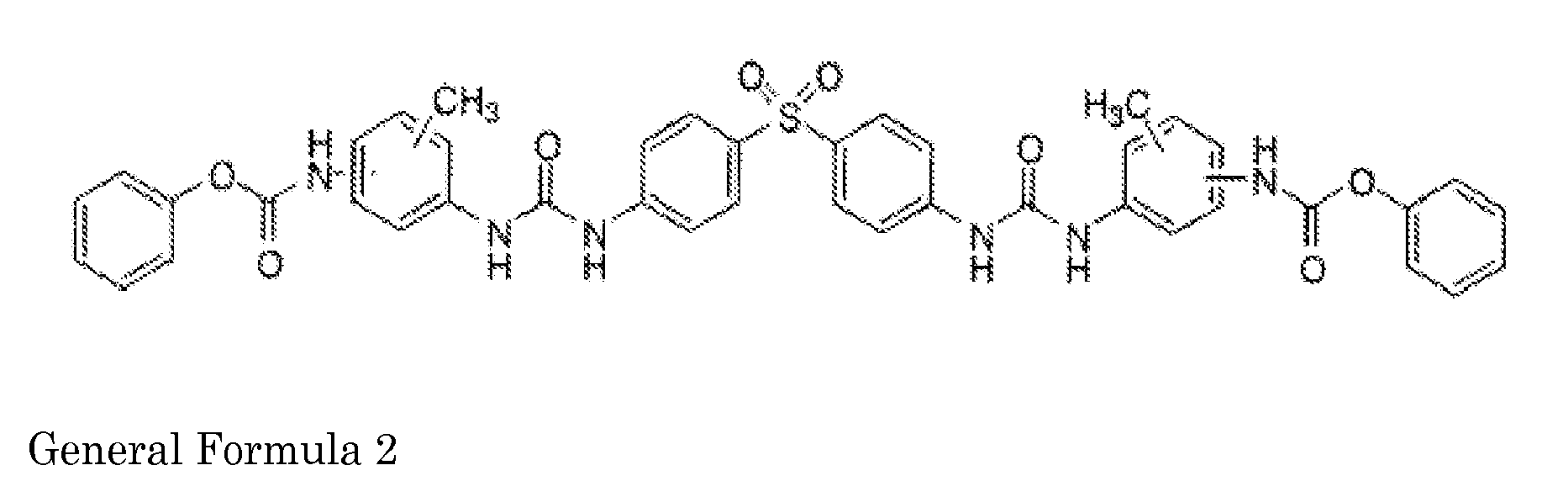
- In the present invention, conventionally used various binders can be arbitrarily selected and used to combine and support the leuco dye and the developer on the support.
- Specific examples thereof include: water-soluble polymers such as polyvinyl alcohol, carboxy-modified polyvinyl alcohol, starch and derivatives thereof, cellulose derivatives, e.g. methoxy cellulose, hydroxyethyl cellulose, carboxymethyl cellulose, methyl cellulose, and ethyl cellulose, polysodium acrylate, polyvinyl pyrrolidone, acrylamide-acrylic acid ester copolymer, acrylamide-acrylic acid ester-methacrylic acid terpolymer, alkali salt of styrene-maleic anhydride copolymer, alkali salt of isobutylene-maleic anhydride copolymer, polyacryl amide, sodium alginate, gelatin, and casein; emulsions such as polyvinyl acetate, polyurethane, polyester acrylate, polyester methacrylate, vinyl chloride-vinyl acetate copolymer, and ethylene-vinyl acetate copolymer; and latexes such as styrene-butadiene copolymer, and styrene-butadiene-acryl copolymer.
- Moreover, in combination with the leuco dye and the developer, various supplemental additive substances, which are conventionally used for a thermosensitive recording layer, may be used. Examples thereof include fillers, surfactants, thermoplastic materials (or lubricants) and the like.
- In this case, examples of the fillers include: inorganic powder such as powder of calcium carbonate, silica, zinc oxide, titanium oxide, aluminum hydroxide, zinc hydroxide, barium sulfate, clay, talc, or surface-treated calcium or silica; and organic powder such as powder of urea-formalin resin, styrene-methacylic acid copolymer, or polystyrene resin.
- Examples of the thermoplastic materials include those having a melting point of approximately 50°C to 200°C, such as higher fatty acid or ester thereof, amid or metal salt thereof, various wax, condensation products of aromatic carboxylic acid and amine, phenyl benzoate, higher linear glycol, dialkyl 3,4-epoxy-hexahydrophthalate, higher ketone, and other thermoplastic organic compounds.
- In the present invention, the thermosensitive recording layer can be formed by dispersing a thermosensitive coloring substance, e.g. a generally colorless or slightly tinted leuco dye, a developer, a binder, and arbitrarily added supplemental additives in water so as to prepare a coating liquid of the thermosensitive recording layer, applying the coating liquid onto a support, and drying.
- The recording medium of the present invention preferably further contains an over layer mainly formed of a water-soluble resin disposed on the thermosensitive recording layer for improving anti-plasticizer and anti-oil properties of the colored images. Specific examples of the water-soluble resin include those listed as the water-soluble polymer binder in connection with the thermosensitive recording layer.
- The over layer may contain tin oxide-coated titanium oxide particles.
- For improving the water resistance of the over layer, the water-soluble resin is preferably used in combination with the conventional water proof agent that provides water resistant properties to the water-soluble resin. Specific examples of the water proof agent include hormaldehyde, glyoxal, chloroalum, melamine, melamine-hormaldehyde resin, polyamide resin, and polyamide-epichlorohydrin resin. Moreover, the over layer preferably further contains the conventional supplemental additives such as fillers, thermoplastic materials (lubricants) and surfactants, for preventing a thermal head from sticking, if necessary. Specific examples of the fillers and the thermoplastic materials are those listed in connection with the thermosensitive recording layer. The over layer for use in the present invention can be formed by using an aqueous solution of a water-soluble resin, or adding water proof agent, filler, a thermoplastic material (a lubricant), a surfactant and the like to the aqueous solution of the water-soluble resin so as to prepare a coating liquid, applying the coating liquid onto the thermosensitive recording layer, and drying.
- In the present invention, as mentioned earlier, the recording medium preferably contains an under layer mainly formed of hollow particles for improving the sensitivity of the coloring layer (the thermosensitive recording layer).
- As hollow particles, for example, those having shells of a thermoplastic resin, each having hollowness of 30% or more (within the range of 33% to 99%), and having the volume average particle diameter of 0.4 µm to 10 µm can be used.
- Here, the hollowness is a ratio of the outer diameter of the hollow particle to the inner diameter thereof, and represented by the formula:

- The under layer is formed in the deposition amount of 2 g/m2 to 10 g/m2 on the dry basis. It is preferable that the under layer contains the hollow particles having the hollowness of 80% or more and the volume average particle diameter of 2 µm to 10 µm, and has a weight of 2.5 g/m2 to 7 g/m2 on the dry basis.
- Such the hollow particles are contained in the formulation of the under layer in the weight ratio of 35% to 80%. The contained amount of the hollow particles in terms of the weight ratio is reduced as the hollowness thereof increases because of the change in the specific gravity related to the hollowness, but when the contained amount thereof is less than 35%, the effect for attaining the sensitivity cannot be easily exhibited, and when the amount thereof is more than 80%, the binding of the layers may be impaired.
- The under layer containing the hollow particles realizes the improvement of the sensitivity, but such the under layer increases the accumulation of the charged amount in the thermosensitive recording medium at the same time. Therefore, it is effective that it is used together with the back layer and over layer containing the tin oxide-coated titanium particles that function as an antistatic agent in the present invention.
- By forming a thermosensitive recording layer on an opposite surface of the support to the surface where the antistatic agent-containing layer is disposed, the recording medium becomes a hybrid recording medium having both recording performances of inkjet recording and thermosensitive recording.
- Hereinafter, the present invention will be specifically explained with reference to examples and comparative examples thereof, but the examples shall not be construed to limit the scope of the present invention.
- In the following examples and comparative examples, all parts and % are on weight basis.
- A mixture consisting of the following formulation were dispersed by means of a homomixer to thereby prepare [A1 liquid].
[A1 liquid] Amorphous silica (SYLYSIA 430, manufactured by Fuji Silysia Chemical Ltd., having oil absorption of 220 mL/100 g) 20 parts Surfactant 1 part Water 80 parts - A mixture consisting of the following formulation were dispersed by means of a sand grinder so as to have a volume average particle diameter of 0.9 µm to thereby prepare [B1 liquid].
[B1 liquid] Tin oxide-coated titanium oxide particles (W-4, manufactured by Mitsubishi Materials Corporation) 20 parts 10% polyvinyl alcohol aqueous solution 20 parts Water 60 parts - Then, a coating liquid of the antistatic agent-containing layer was prepared by using [A1 liquid] and [B1 liquid] and mixing the same with the formulation presented below, and the prepared coating liquid was applied on a commercial fine paper (basis weight of 80 g/m2) by means of a Labo coating machine and dried so as to have a deposition amount of 5.0 g/m2 on the dry basis to thereby prepare paper coated with an antistatic agent-containing layer.
[Coating liquid of an antistatic agent-containing layer] [A1 liquid] 50 parts [B1 liquid] 20 parts 10% completely saponificated polyvinyl alcohol aqueous solution 100 part 25% polyamide epichlorohydrin aqueous solution 12 parts - The inkjet recording medium of Example A-2 was prepared in the same manner as in Example A-1, provided that a volume average particle diameter of [B1 liquid] was adjusted to 0.2 µm.
- The inkjet recording medium of Example A-3 was prepared in the same manner as in Example A-1, provided that a volume average particle diameter of [B1 liquid] was adjusted to 0.1 µm.
- The inkjet recording medium of Example A-4 was prepared in the same manner as in Example A-1, provided that a volume average particle diameter of [B1 liquid] was adjusted to 5 µm.
- The inkjet recording medium of Example A-5 was prepared in the same manner as in Example A-1, provided that a volume average particle diameter of [B1 liquid] was adjusted to 7 µm.
- The inkjet recording medium of Example A-6 was prepared in the same manner as in Example A-1, provided that an amount of [B1 liquid] to be added was changed to 6 parts.
- The inkjet recording medium of Example A-7 was prepared in the same manner as in Example A-1, provided that an amount of [B1 liquid] to be added was changed to 4 parts.
- The inkjet recording medium of Example A-8 was prepared in the same manner as in Example A-1, provided that an amount of [B1 liquid] to be added was changed to 125 parts.
- The inkjet recording medium of Example A-9 was prepared in the same manner as in Example A-1, provided that an amount of [B1 liquid] to be added was changed to 200 parts.
- The inkjet recording medium of Example A-10 was prepared in the same manner as in Example A-1, provided that an amount of [A1 liquid] to be added was changed to 40 parts.
- The inkjet recording medium of Example A-11 was prepared in the same manner as in Example A-1, provided that an amount of [A1 liquid] to be added was changed to 30 parts.
- The inkjet recording medium of Example A-12 was prepared in the same manner as in Example A-1, provided that an amount of [A1 liquid] to be added was changed to 100 parts.
- The inkjet recording medium of Example A-13 was prepared in the same manner as in Example A-1, provided that an amount of [A1 liquid] to be added was changed to 125 parts.
- The inkjet recording medium of Example A-14 was prepared in the same manner as in Example A-1, provided that amorphous silica contained in [A1 liquid] was replaced with those having oil absorption of 150 mL/100 g (MIZUKASIL P-527, manufactured by MIZUSAWA INDUSTRIAL CHEMICALS, LTD.).
- The inkjet recording medium of Example A-15 was prepared in the same manner as in Example A-1, provided that amorphous silica contained in [A1 liquid] was replaced with those having oil absorption of 110 mL/100 g (MIZUKASIL P-603, manufactured by MIZUSAWA INDUSTRIAL CHEMICALS, LTD.).
- The inkjet recording medium of Example A-16 was prepared in the same manner as in Example A-1, provided that amorphous silica contained in [A1 liquid] was replaced with those having oil absorption of 350 mL/100 g (SYLYSIA 350, manufactured by Fuji Silysia Chemical Ltd.).
- The inkjet recording medium of Example A-17 was prepared in the same manner as in Example A-1, provided that amorphous silica contained in [A1 liquid] was replaced with those having oil absorption of 400 mL/100 g (a test model).
- The inkjet recording medium of Example A-18 was prepared in the same manner as in Example A-1, provided that completely saponificated polyvinyl alcohol contained in [Coating liquid of an antistatic agent-containing layer] was replaced with itaconic acid-modified polyvinyl alcohol.
- [Coating liquid of a conductive functional layer] and [Coating liquid of an inkjet functional layer] were respectively prepared by mixing and stirring each of chemical solutions presented in the following formulations.
[Coating liquid of a conductive functional layer] [A1 liquid] 20 parts [B1 liquid] 30 parts 10% itaconic acid-modified polyvinyl alcohol aqueous solution 100 part 25% polyamide epichlorohydrin aqueous solution 12 parts [Coating liquid of an inkjet functional layer] [A1 liquid] 50 parts 10% itaconic acid-modified polyvinyl alcohol aqueous solution 100 part 25% polyamide epichlorohydrin aqueous solution 12 parts - The prepared [Coating liquid of a conductive functional layer] was applied and dried on a commercial fine paper (basis weight of 80 g/m2) by means of a Labo coating machine so as to have a deposition amount of 1.6 g/m2 on the dry basis, and then the prepared [Coating liquid of an inkjet functional layer] was applied and dried thereon so as to have a deposition amount of 3.4 g/m2 to thereby an inkjet recording medium of Example A-19 in which the antistatic agent-containing layer had a two-layered structure and was functionally separated.
- The inkjet recording medium of Comparative Example A-1 was prepared in the same manner as in Example A-1, provided that [B1 liquid] was not added therein.
- The inkjet recording medium of Comparative Example A-2 was prepared in the same manner as in Example A-1, provided that the tin oxide-coated titanium oxide particles contained in [B1 liquid] were replaced with aluminum-doped zinc oxide (23-K, manufactured by HakusuiTech Co., Ltd.).
- The inkjet recording medium of Comparative Example A-3 was prepared in the same manner as in Example A-1, provided that [B1 liquid] was replaced with 10 parts of a cationic resinous antistatic agent (CHEMISTAT 7005, manufactured by Sanyo Chemical Industries, Ltd., having a solid content of 40%).
- The inkjet recording medium of Comparative Example A-4 was prepared in the same manner as in Example A-1, provided that [B1 liquid] was replaced with 4 parts of a nonionic surfactant (low molecular weight) antistatic agent (EMULGEN 404, manufactured by Kao Corporation, having a solid content of 100%).
- The composition of the materials of each of Examples A-1 to A-19 and Comparative Examples A-1 to A-4 are summarized in Table 1-1, Table 1-2 below.
Table 1-1 Inorganic pigment Conductive material Type Oil absorption Ratio Type Average particle diameter Deposition amount Proportion in the layer - mL/100g % - pm g/m2 % Ex. A-1 SYLYSI A 430 220 100 Tin oxide-coated titanium oxide particles 0.9 0.7 15 Ex. A-2 SYLYSI A 430 220 100 0.2 0.7 15 Ex. A-3 SYLYSI A 430 220 100 0.1 0.7 15 Ex. A-4 SYLYSI A 430 220 100 5 0.7 15 Ex. A-5 SYLYSI A 430 220 100 7 0.7 15 Ex. A-6 SYLYSI A 430 220 100 0.9 0.25 5 Ex. A-7 SYLYSI A 430 220 100 0.9 0.17 3 Ex. A-8 SYLYSI A 430 220 100 0.9 2.5 50 Ex. A-9 SYLYSI A 430 220 100 0.9 3 60 Ex. A-10 SYLYSI A 430 220 80 0.9 0.7 15 Ex. A-11 SYLYSI A 430 220 60 0.9 0.7 15 Ex. A-12 SYLYSI A 430 220 200 0.9 0.7 15 Ex. A-13 SYLYSI A 430 220 250 0.9 0.7 15 Ex. A-14 P-527 150 100 0.9 0.7 15 Ex. A-15 P-603 110 100 0.9 0.7 15 Ex. A-16 SYLYSI A 350 350 100 0.9 0.7 15 Ex. A-17 Test model 400 100 0.9 0.7 15 Ex. A-18 SYLYSI A 430 220 100 0.9 0.7 15 Ex. A-1 9 (First layer) SYLYSI A 430 220 100 0.9 0.4 25 (Second layer) SYLYSI A 430 220 100 None - 0 0 Comp. Ex. A-1 SYLYSI A 430 220 100 None - 0 - Comp. Ex. A-2 SYLYSI A 430 220 100 Al-doped zinc oxide 0.9 0.7 15 Comp. Ex. A-3 SYLYSI A 430 220 100 Cationic resin - 0.7 15 Comp. Ex. A-4 SYLYSI A 430 220 100 Nonionic surfactant - 0.7 15 Table 1-2 Binder resin Other conditions Type - - Ex. A-1 Completely saponificated PVA Ex. A-2 Completely saponificated PVA Ex. A-3 Completely saponificated PVA Ex. A-4 Completely saponificated PVA Ex. A-5 Completely saponificated PVA Ex. A-6 Completely saponificated PVA Ex. A-7 Completely saponificated PVA Ex. A-8 Completely saponificated PVA Ex. A-9 Completely saponificated PVA Ex. A-10 Completely saponificated PVA Ex. A-11 Completely saponificated PVA Ex. A-12 Completely saponificated PVA Ex. A-13 Completely saponificated PVA Ex. A-14 Completely saponificated PVA Ex. A-15 Completely saponificated PVA Ex. A-16 Completely saponificated PVA Ex. A-17 Completely saponificated PVA Ex. A-18 Itaconic acid-modified PVA Ex. A-19 (First layer) Itaconic acid-modified PVA Itaconic acid-modified PVA Two layered structure (Second layer) Itaconic acid-modified PVA Comp. Ex. A-1 Completely saponificated PVA Comp. Ex. A-2 Completely saponificated PVA Comp. Ex. A-3 Completely saponificated PVA Comp. Ex. A-4 Completely saponificated PVA - The thus prepared inkjet recording medium was evaluated in the following manner. The results are shown in Table 2.
- The thus obtained inkjet recording medium was subjected to printing of a black solid pattern, a lattice pattern having a print image ratio of 50%, and a barcode pattern by means of a commercial inkjet printer (PM-A700, manufactured by SEIKO EPSON CORPORATION), and then dried. Thereafter, the printed inkjet recording medium was evaluated as follows.
- The image density of the printed black solid pattern was measured by means of a Macbeth optical densitometer RD-914 and a gray level thereof was recorded.
- On the printed sample of the lattice pattern, the degree of bleeding of the printed portion was evaluated based on the following criteria.
- A: no bleeding, or no ink flow
- B: slight bleeding and ink flow were observed, but levels thereof were not problematic in view of the image quality
- C: bleeding and ink flow were observed, and levels thereof were problematic in view of the image quality
- The printed sample of the barcoade pattern was immersed in water at 20°C for 10 minutes, and thereafter the surface of the printed sample was rubbed with a finger for 10 times. The condition of the smeared image and the condition of the lowered color density were evaluated based upon the following criteria:
- A: no ink was come off, and no bleeding or smearing
- B: no ink was come off, but slight bleeding or smearing
- C: some ink was come off, and the density was slightly lowered
- D: the ink was come off, and the density was largely lowered
- The thus prepared inkjet recording medium was conveyed by using a thermosensitive printer (96 Xi III plus, manufactured by Zebra Technologies Corporation) at a conveyance speed of 4 ips, and the charged amount (V) of the inkjet recording medium at the outlet roller part was measured by ELECTROSTATIC VOLTMETER (MODEL 542, manufactured by TREK Japan KK). This evaluation test was carried out at the temperature of 23°C, and humidity of 50%.
- The prepared inkjet recording medium was cut into a piece having a width of 3 cm, and the cut piece was then torn by hand for 200 times and the amount of paper powder generated during tearing was visually observed.
- A: no paper powder was generated
- B: paper powder was slightly generated
- C: paper powder was generated at a large amount
- The mixture of the following formulation was pulverized and dispersed by means of a sand mill so as to have an average particle diameter of 1 µm.
(A2 liquid) 3-dibutylamino-6-methyl-7-anilinofluoran 20 parts 10% polyvinyl alcohol aqueous solution 20 parts Water 60 parts (B2 liquid) 4-hydroxyphenyl-4'-isopropoxyphenylsulfone 10 parts di(p-methylbenzyl)oxalate 4 parts 10% polyvinyl alcohol aqueous solution 10 parts Water 76 parts (C2 liquid) Calcium carbonate 20 parts 10% polyvinyl alcohol aqueous solution 10 parts Water 70 parts - A coating liquid of a thermosensitive recording layer in which A2 liquid, B2 liquid and C2 liquid were mixed in the ratio of 2/7/6, was applied on one surface of a commercial fine paper (basis weight of 80 g/m2) by bar coating, and dried at 100°C to thereby form a thermosensitive recording layer having a dye deposition amount of 0.5 g/m2 on the dry basis.
-
-D2 liquid- 10% polyvinyl alcohol aqueous solution 20 parts Tin oxide-coated titanium oxide particles (W-4, manufactured by Mitsubishi Materials Corporation) 20 parts Water 60 parts - The mixture of the above formulation was pulverized and dispersed so as to have an average particle diameter of 1.00 µm.
-A coating liquid of an antistatic agent-containing layer- 10% itaconic acid modified polyvinyl alcohol aqueous solution (SD-1000, manufactured by KURARAY Co., Ltd.) 36 parts D2 liquid 22 parts Water 42 parts - The obtained coating liquid of the antistatic agent-containing layer was applied on the opposite surface of the support to the surface thereof where the thermosensitive recording layer had been formed by bar coating, and then dried at 100°C to thereby form an antistatic agent-containing layer having a deposition amount of 3.0 g/m2 on the dry basis.
- Here, the deposition amount of the tin oxide-coated titanium oxide particles was 1.50 g/m2.
- Thereafter, calendering was performed thereon to thereby form a thermosensitive recording medium.
- The thermosensitive recording medium was prepared in the same manner as in Example B-1, provided that the deposition amount of the tin oxide-coated titanium oxide particles was changed to 1.00 g/m2.
- The thermosensitive recording medium was prepared in the same manner as in Example B-1, provided that the deposition amount of the tin oxide-coated titanium oxide particles was changed to 0.50 g/m2.
- The thermosensitive recording medium was prepared in the same manner as in Example B-1, provided that the deposition amount of the tin oxide-coated titanium oxide particles was changed to 0.10 g/m2.
- The thermosensitive recording medium was prepared in the same manner as in Example B-1, provided that the deposition amount of the tin oxide-coated titanium oxide particles was changed to 0.05 g/m2.
- The thermosensitive recording medium was prepared in the same manner as in Example B-3, provided that the average particle diameter of D2 liquid was changed to 5.00 µm by means of a sand mill during the preparation of D2 liquid.
- The thermosensitive recording medium was prepared in the same manner as in Example B-3, provided that the average particle diameter of D2 liquid was changed to 6.00 µm by means of a sand mill during the preparation of D2 liquid.
- The thermosensitive recording medium was prepared in the same manner as in Example B-3, provided that the average particle diameter of D2 liquid was changed to 0.20 µm by means of a sand mill during the preparation of D2 liquid.
- The thermosensitive recording medium was prepared in the same manner as in Example B-3, provided that the average particle diameter of D2 liquid was changed to 0.06 µm by means of a sand mill during the preparation of D2 liquid.
- To 100 parts by weight of plastic hollow particles (styrene-acryl copolymer, having hollowness of 50% and an average particle diameter of 1.0 µm), 5 parts by weight of polyvinyl alcohol (partially saponificated carboxy-modified) was added, then added and diluted with water, and the mixture was stirred for 30 minutes to thereby prepare a coating liquid having a solid content of 22.0%.
- The thus prepared coating liquid of the under layer was applied onto one surface of a commercial fine paper (basis weight of 80 g/m2) by bar coating, and dried at 100°C to thereby form an under layer so as to have the deposition amount thereof of 3.5 g/m2 on the dry basis.
- Moreover, a thermosensitive recording layer was formed on the under layer using the coating liquid of the thermosensitive recording layer in the same manner as in Example B-3, and an antistatic agent-containing layer was formed on the opposite surface of the support to the surface thereof where the thermosensitive recording layer had been formed using the coating layer of the antistatic agent-containing layer in the same manner as in Example B-3, to thereby prepare a thermosensitive recording medium.
- A thermosensitive recording medium was prepared in the same manner as in Example B-10, provided that the following coating liquid of the over layer was used, and applied on the thermosensitive recording layer of Example B-10 by bar coating so as to have a deposition amount of 3.0 g/m2 on the dry basis.
<Preparation of a coating liquid of an over layer> 10% polyvinyl alcohol aqueous solution 10 parts 10% aluminum hydroxide aqueous dispersion 3 parts 10% polyamide-epichlorohydrin resin aqueous solution 3 parts - A thermosensitive recording medium was prepared in the same manner as in Example B-11, provided that the following coating liquid of the over layer was used.
10% polyvinyl alcohol aqueous solution 10 parts 10% aluminum hydroxide aqueous dispersion 3 parts 10% polyamide-epichlorohydrin resin aqueous solution 3 parts D2 liquid 1 part - A thermosensitive recording medium was prepared in the same manner as in Example B-11, provided that a polyethylene stretched synthetic film was used as the substrate in place of the fine paper.
- An thermosensitive/inkjet hybrid recording medium was prepared in the same manner as in Example B-11, provided that the following coating liquid of the antistatic agent-containing layer was used.
A1 liquid 50 parts B1 liquid 20 parts 10% itaconic acid-modified polyvinyl alcohol aqueous solution 100 parts 20% polyamide-epichlorohydrin resin aqueous solution 12 parts - A thermosensitive recording medium was prepared in the same manner as in Example B-1, provided that D2 liquid was removed from the coating liquid of the antistatic agent-containing layer.
- A thermosensitive recording medium was prepared in the same manner as in Example B-10, provided that D2 liquid was removed from the coating liquid of the antistatic agent-containing layer.
- A thermosensitive recording medium was prepared in the same manner as in Comparative Example B-2, provided that itaconic acid-modified polyvinyl alcohol used as a binder resin in the coating liquid of the antistatic agent-containing layer was replaced with polyvinyl alcohol.
- A thermosensitive recording medium was prepared in the same manner as in Example B-1, provided that the following coating liquid of the antistatic agent-containing layer was used.
10% polyvinyl alcohol aqueous solution 36 parts Cationic antistatic agent (CHEMISTAT 7005, manufactured by Sanyo Chemical Industries, Ltd.) 11 parts Water 53 parts - A thermosensitive recording medium was prepared in the same manner as in Example B-13, provided that D2 liquid was removed from the coating liquid of the antistatic agent-containing layer.
- The thus prepared thermosensitive recording medium was subjected to the following tests, and the results are shown in Table 3.
- The thus prepared thermosensitive recording medium was conveyed by using a thermosensitive printer (96 Xi III plus, manufactured by Zebra Technologies Corporation) at a conveyance speed of 4 ips, and the charged amount (V) of the thermosensitive recording medium at the outlet roller part was measured by ELECTROSTATIC VOLTMETER (MODEL 542, manufactured by TREK Japan KK). This evaluation test was carried out at the temperature of 23°C, and humidity of 50%, and also at the temperature of 5°C, and humidity of 30%.
- The prepared thermosensitive recording medium in the size of A4 was torn by hands for 50 times, and the amount of paper powder generated during tearing was visually observed.
- A: no paper powder was generated
- B: paper powder was slightly generated
- C: paper powder was generated in the large amount
- Three pieces of the prepared thermosensitive recording mediums in the size of A4 were stacked, and the two pieces thereof from the top were cut in the lengthwise direction by a cutter (HA-100S Standard, manufactured by KOKUYO Co., Ltd.). After performing this procedure for 100 times, the wear amount of the cutter was observed under a laser microscope (VK-8510, manufactured by KEYENCE Corporation).
- A: no wearing of the cutter was observed
- B: slight wearing of the cutter was observed
- C: a significant amount of wearing was observed in the cutter
- Printing was performed by means of a thermal gradient testing machine at 150°C and 2 kg/cm2 × 1s, and the color optical density thereof was measured by a Macbeth optical densitometer RD-914.
- On a test piece to which printing had been performed by means of a printing simulator for a thermosensitive recording material manufactured by Okura Denki Co., Ltd. at 0.45 mj/dot, three layers of polyvinyl chloride wrapping films were placed, 10 pieces of fine paper were placed thereon, and weights were further placed thereon so as to be about 200 g/cm2. In this condition, the test piece was stored at 40°C for 24 hours. Thereafter, the density of the image part was measured, and the remaining rate [(density after the test/density before the test) × 100(%)] of the printed image was calculated. High remaining rate means that the amount of color loss due to the influence from a plasticizer was small, and it is excellent in anti-plasticizer (storage stability).
Table 3 Charged amount Paper powder generated amount Cutter wearing Image density Anti-plasticizer 23°C, 50% 5°C, 30% Ex. B-1 3.2 KV 3.5 KV A B 1.25 40% Ex. B-2 3.5 KV 3.5 KV A A 1.24 42% Ex. B-3 3.4 KV 3.5 KV A A 1.28 39% Ex. B-4 3.5 KV 3.7 KV A A 1.28 40% Ex. B-5 4.8 KV 4.8 KV A A 1.25 40% Ex. B-6 3.5 KV 3.4 KV A A 1.25 42% Ex. B-7 4.5 KV 4.2 KV A B 1.26 41% Ex. B-8 3.6 KV 3.8 KV A A 1.26 42% Ex. B-9 5.0 KV 5.2 KV A A 1.25 40% Ex. B-10 4.0 KV 4.1 KV A A 1.45 40% Ex. B-11 4.0 KV 4.0 KV A A 1.40 85% Ex. B-12 3.1 KV 3.1 KV A B 1.41 86% Ex. B-13 4.8 KV 5.1 KV A A 1.40 85% Ex. B-14 3.1 KV 3.3 KV A B 1.41 86% Comp. Ex. B-1 8.2 KV 8.5 KV A A 1.24 40% Comp. Ex. B-2 9.0 KV 9.8 KV A A 1.45 40% Comp. Ex. B-3 9.0 KV 9.8 KV C A 1.44 40% Comp. Ex. B-4 3.2 KV 6.5 KV C A 1.25 39% Comp. Ex. B-5 9.9 KV 11.1 KV A A 1.40 85%
| Inkjet properties | Antistatic properties | Others | |||
| Density | Bleeding | Water resistance | Charged amount | Powder falling | |
| Ex. A-1 | 1.37 | A | A | 3.2 KV | B |
| Ex. A-2 | 1.37 | B | A | 3.4 KV | B |
| Ex. A-3 | 1.36 | B | A | 3.8 KV | B |
| Ex. A-4 | 1.37 | B | A | 3.3 KV | B |
| Ex. A-5 | 1.38 | B | A | 3.2 KV | B |
| Ex. A-6 | 1.44 | B | A | 3.5 KV | B |
| Ex. A-7 | 1.47 | B | A | 3.9 KV | B |
| Ex. A-8 | 1.35 | B | A | 2.4 KV | B |
| Ex. A-9 | 1.34 | B | A | 2.2 KV | B |
| Ex. A-10 | 1.35 | B | B | 2.9 KV | A |
| Ex. A-11 | 1.33 | B | B | 3.1 KV | A |
| Ex. A-12 | 1.43 | B | A | 3.6 KV | B |
| Ex. A-13 | 1.47 | B | A | 3.7 KV | B |
| Ex. A-14 | 1.35 | B | A | 3.2 KV | A |
| Ex. A-15 | 1.33 | B | A | 3.2 KV | A |
| Ex. A-16 | 1.53 | A | A | 3.3 KV | B |
| Ex. A-17 | 1.60 | A | A | 3.3 KV | B |
| Ex. A-18 | 1.36 | B | A | 3.1 KV | A |
| Ex. A-19 | 1.51 | A | A | 2.5 KV | B |
| Comp. Ex. A-1 | 1.36 | B | A | 8.5 KV | B |
| Comp. Ex. A-2 | 1.37 | B | A | 6.4 KV | B |
| Comp. Ex. A-3 | 1.12 | B | D | 2.1 KV | A |
| Comp. Ex. A-4 | 1.24 | C | D | 2.9 KV | B |
Claims (15)
- A recording medium comprising:a support; andan antistatic agent-containing layer comprising a binder resin and tin oxide-coated titanium oxide particles.
- The recording medium according to claim 1, wherein the binder resin is itaconic acid-modified polyvinyl alcohol.
- The recording medium according to any of claim 1 or 2, wherein the tin oxide-coated titanium oxide particles have a volume average particle diameter of 0.2 µm to 5.0 µm.
- The recording medium according to any one of claims 1 to 3, wherein the antistatic agent-containing layer comprises the tin oxide-coated titanium oxide particles in an amount of 0.1 g/m2 to 1.0 g/m2.
- The recording medium according to any one of claims 1 to 4, wherein the support is any of a paper base, a nonwoven fabric base, a synthetic paper base, or a resin film base.
- The recording medium according to any one of claims 1 to 5, wherein the antistatic agent-containing layer comprises the tin oxide-coated titanium oxide particles in an amount of 5% to 50% in a weight ratio.
- The recording medium according to any one of claims 1 to 6, wherein the antistatic agent-containing layer further comprises a high oil-absorbing inorganic pigment.
- The recording medium according to claim 7, wherein a weight ratio of the high oil-absorbing inorganic pigment to the binder resin is 80% to 200%.
- The recording medium according to any of claim 7 or 8, wherein the high oil-absorbing inorganic pigment is silica particles having oil absorption of 150 mL/100 g to 350 mL/100 g.
- The recording medium according to any one of claims 1 to 9, the antistatic agent-containing layer has a two layered structure consisting of a conductive functional layer comprising the tin oxide-coated titanium oxide particles and an inkjet functional layer comprising no tin oxide-coated titanium oxide particles.
- The recording medium according to any one of claims 1 to 10, wherein the recording medium is an inkjet recording medium.
- The recording medium according to any one of claims 1 to 10, further comprising a thermosensitive recording layer disposed on the opposite surface of the support to the surface thereof where the antistatic agent containing layer is disposed, the thermosensitive recording layer comprising a leuco dye and a developer.
- The recording medium according to claim 12, further comprising an under layer disposed between the support and the thermosensitive recording layer, the under layer comprising hollow particles.
- The recording medium according to any of claim 12 or 13, further comprising an over layer disposed on the thermosensitive recording layer.
- The recording medium according to any one of claims 12 to 14, wherein the recording medium is a thermosensitive-inkjet hybrid recording medium.
Applications Claiming Priority (2)
| Application Number | Priority Date | Filing Date | Title |
|---|---|---|---|
| JP2008237542 | 2008-09-17 | ||
| JP2008237537 | 2008-09-17 |
Publications (2)
| Publication Number | Publication Date |
|---|---|
| EP2165846A1 true EP2165846A1 (en) | 2010-03-24 |
| EP2165846B1 EP2165846B1 (en) | 2012-10-31 |
Family
ID=41404161
Family Applications (1)
| Application Number | Title | Priority Date | Filing Date |
|---|---|---|---|
| EP09170399A Not-in-force EP2165846B1 (en) | 2008-09-17 | 2009-09-16 | Recording medium |
Country Status (3)
| Country | Link |
|---|---|
| US (1) | US8298653B2 (en) |
| EP (1) | EP2165846B1 (en) |
| CN (1) | CN101676123B (en) |
Cited By (2)
| Publication number | Priority date | Publication date | Assignee | Title |
|---|---|---|---|---|
| EP2500178A3 (en) * | 2011-03-18 | 2014-03-19 | Ricoh Company, Ltd. | Reversible thermosensitive recording medium and reversible thermosensitive recording member |
| WO2020014384A1 (en) * | 2018-07-11 | 2020-01-16 | Appvion Operations, Inc. | Media adapted for both direct thermal recording and memjet-type printing |
Families Citing this family (5)
| Publication number | Priority date | Publication date | Assignee | Title |
|---|---|---|---|---|
| JP5659636B2 (en) * | 2010-08-31 | 2015-01-28 | 株式会社リコー | Reversible thermosensitive recording medium and reversible thermosensitive recording member |
| ES2592530T3 (en) | 2011-06-17 | 2016-11-30 | Fiberweb, Llc | Multi-layer vapor permeable article, substantially waterproof |
| CN103747955B (en) | 2011-06-23 | 2017-03-22 | 纤维网公司 | Vapor permeable, substantially water impermeable multilayer article |
| WO2012178027A2 (en) | 2011-06-23 | 2012-12-27 | Fiberweb, Inc. | Vapor-permeable, substantially water-impermeable multilayer article |
| US9765459B2 (en) | 2011-06-24 | 2017-09-19 | Fiberweb, Llc | Vapor-permeable, substantially water-impermeable multilayer article |
Citations (15)
| Publication number | Priority date | Publication date | Assignee | Title |
|---|---|---|---|---|
| EP0283032A2 (en) * | 1987-03-18 | 1988-09-21 | Kanzaki Paper Manufacturing Company Limited | Heat-sensitive recording material |
| US5284705A (en) * | 1990-09-06 | 1994-02-08 | Garland Floor Co. | Antistatic coating comprising tin-oxide-rich pigments and process and coated substrate |
| WO1994005506A1 (en) * | 1992-09-02 | 1994-03-17 | Imperial Chemical Industries Plc | Sheet for use in thermal transfer printing |
| EP1008618A1 (en) * | 1997-08-27 | 2000-06-14 | Otsuka Kagaku Kabushiki Kaisha | Printing sheets |
| JP2000250250A (en) | 1999-02-26 | 2000-09-14 | Ricoh Co Ltd | Recording paper and its manufacturing method |
| JP2001011125A (en) | 1999-06-25 | 2001-01-16 | Mitsubishi Chemicals Corp | Cationic resin, antistatic agent based on the resin, and inkjet recording material |
| EP1238818A1 (en) * | 2001-03-05 | 2002-09-11 | Oji Paper Co., Ltd. | Thermal transfer recording sheet |
| JP2002356057A (en) | 2001-03-28 | 2002-12-10 | Mitsubishi Paper Mills Ltd | Inkjet recording materials |
| JP2003182206A (en) | 2001-12-13 | 2003-07-03 | Konica Corp | Inkjet recording material |
| JP2005511343A (en) | 2001-11-02 | 2005-04-28 | チバ スペシャルティ ケミカルズ ホールディング インコーポレーテッド | Inkjet recording medium |
| JP2005231095A (en) | 2004-02-18 | 2005-09-02 | Mitsubishi Paper Mills Ltd | Inkjet recording material |
| EP1655144A1 (en) * | 2003-08-05 | 2006-05-10 | Oji Paper Co., Ltd. | Thermal transfer receptive sheet, process for producing the same and method of image forming therewith |
| JP2006240287A (en) | 2005-02-04 | 2006-09-14 | Fuji Photo Film Co Ltd | Support for image recording material and image recording material |
| JP2007076251A (en) | 2005-09-15 | 2007-03-29 | Ricoh Co Ltd | Thermal recording medium |
| JP2007223257A (en) | 2006-02-27 | 2007-09-06 | Ricoh Co Ltd | Thermal recording material |
Family Cites Families (11)
| Publication number | Priority date | Publication date | Assignee | Title |
|---|---|---|---|---|
| ES2096796T3 (en) | 1992-04-25 | 1997-03-16 | Merck Patent Gmbh | PIGMENT CONDUCTOR OF ELECTRICITY. |
| US6464351B1 (en) * | 2000-07-27 | 2002-10-15 | Eastman Kodak Company | Ink jet printing method |
| US6497481B1 (en) * | 2000-11-30 | 2002-12-24 | Eastman Kodak Company | Ink jet printing method |
| JP4484389B2 (en) | 2001-04-02 | 2010-06-16 | 株式会社リコー | Image forming method and image forming apparatus |
| US7335407B2 (en) * | 2001-12-20 | 2008-02-26 | Eastman Kodak Company | Multilayer inkjet recording element with porous polyester particle |
| JP4404544B2 (en) | 2002-12-19 | 2010-01-27 | トッパン・フォームズ株式会社 | Non-contact type IC media using ink-jet ink containing antistatic material |
| EP1702762B1 (en) | 2005-03-14 | 2007-12-05 | Ricoh Company, Ltd. | Heat-sensitive recording material |
| US7341812B2 (en) * | 2005-04-14 | 2008-03-11 | Xerox Corporation | Photosensitive member having two layer undercoat |
| KR100967532B1 (en) | 2005-08-30 | 2010-07-05 | 가부시키가이샤 구라레 | Thermal recording material |
| US7425522B2 (en) | 2006-01-18 | 2008-09-16 | Ricoh Company, Ltd. | Thermosensitive recording material |
| WO2008014608A1 (en) | 2006-08-04 | 2008-02-07 | Oliver Tiura | Handle with air conditioning system for racket, paddle or tool |
-
2009
- 2009-09-15 US US12/559,709 patent/US8298653B2/en not_active Expired - Fee Related
- 2009-09-16 EP EP09170399A patent/EP2165846B1/en not_active Not-in-force
- 2009-09-17 CN CN2009101747567A patent/CN101676123B/en not_active Expired - Fee Related
Patent Citations (16)
| Publication number | Priority date | Publication date | Assignee | Title |
|---|---|---|---|---|
| EP0283032A2 (en) * | 1987-03-18 | 1988-09-21 | Kanzaki Paper Manufacturing Company Limited | Heat-sensitive recording material |
| JPS63230388A (en) | 1987-03-18 | 1988-09-26 | Kanzaki Paper Mfg Co Ltd | Thermal recording material |
| US5284705A (en) * | 1990-09-06 | 1994-02-08 | Garland Floor Co. | Antistatic coating comprising tin-oxide-rich pigments and process and coated substrate |
| WO1994005506A1 (en) * | 1992-09-02 | 1994-03-17 | Imperial Chemical Industries Plc | Sheet for use in thermal transfer printing |
| EP1008618A1 (en) * | 1997-08-27 | 2000-06-14 | Otsuka Kagaku Kabushiki Kaisha | Printing sheets |
| JP2000250250A (en) | 1999-02-26 | 2000-09-14 | Ricoh Co Ltd | Recording paper and its manufacturing method |
| JP2001011125A (en) | 1999-06-25 | 2001-01-16 | Mitsubishi Chemicals Corp | Cationic resin, antistatic agent based on the resin, and inkjet recording material |
| EP1238818A1 (en) * | 2001-03-05 | 2002-09-11 | Oji Paper Co., Ltd. | Thermal transfer recording sheet |
| JP2002356057A (en) | 2001-03-28 | 2002-12-10 | Mitsubishi Paper Mills Ltd | Inkjet recording materials |
| JP2005511343A (en) | 2001-11-02 | 2005-04-28 | チバ スペシャルティ ケミカルズ ホールディング インコーポレーテッド | Inkjet recording medium |
| JP2003182206A (en) | 2001-12-13 | 2003-07-03 | Konica Corp | Inkjet recording material |
| EP1655144A1 (en) * | 2003-08-05 | 2006-05-10 | Oji Paper Co., Ltd. | Thermal transfer receptive sheet, process for producing the same and method of image forming therewith |
| JP2005231095A (en) | 2004-02-18 | 2005-09-02 | Mitsubishi Paper Mills Ltd | Inkjet recording material |
| JP2006240287A (en) | 2005-02-04 | 2006-09-14 | Fuji Photo Film Co Ltd | Support for image recording material and image recording material |
| JP2007076251A (en) | 2005-09-15 | 2007-03-29 | Ricoh Co Ltd | Thermal recording medium |
| JP2007223257A (en) | 2006-02-27 | 2007-09-06 | Ricoh Co Ltd | Thermal recording material |
Cited By (2)
| Publication number | Priority date | Publication date | Assignee | Title |
|---|---|---|---|---|
| EP2500178A3 (en) * | 2011-03-18 | 2014-03-19 | Ricoh Company, Ltd. | Reversible thermosensitive recording medium and reversible thermosensitive recording member |
| WO2020014384A1 (en) * | 2018-07-11 | 2020-01-16 | Appvion Operations, Inc. | Media adapted for both direct thermal recording and memjet-type printing |
Also Published As
| Publication number | Publication date |
|---|---|
| US20100068426A1 (en) | 2010-03-18 |
| CN101676123A (en) | 2010-03-24 |
| EP2165846B1 (en) | 2012-10-31 |
| CN101676123B (en) | 2012-01-11 |
| US8298653B2 (en) | 2012-10-30 |
Similar Documents
| Publication | Publication Date | Title |
|---|---|---|
| JP5157287B2 (en) | Thermal recording material and recording method using the same | |
| EP1452334B1 (en) | Thermosensitive recording material | |
| EP1834800B1 (en) | Fluid dispersion, and thermosensitive recording material and method for preparing the same | |
| EP2165846B1 (en) | Recording medium | |
| EP2103444B1 (en) | Thermosensitive recording material | |
| EP1810835B1 (en) | Thermosensitive recording material | |
| EP1900543B1 (en) | Thermosensitive recording material | |
| WO2010110209A1 (en) | Heat-sensitive recording material | |
| EP1702762B1 (en) | Heat-sensitive recording material | |
| JP3971453B2 (en) | Thermal recording material | |
| JP5446651B2 (en) | Inkjet recording medium | |
| JP2003276334A (en) | Thermal recording material | |
| JP3750786B2 (en) | Thermal recording material | |
| JP4651106B2 (en) | Thermal recording material | |
| JP5315734B2 (en) | Thermal recording material | |
| JP4467001B2 (en) | Thermal recording material and its use | |
| JP3824254B2 (en) | Small roll roll recording material | |
| JP2009051049A (en) | Thermal recording medium | |
| JPH0524353A (en) | Thermal recording paper | |
| US5158925A (en) | Thermosensitive recording material | |
| JP2012091451A (en) | Thermal sensitive inkjet recording material | |
| JPH05185726A (en) | Thermal recording material | |
| JPH06115255A (en) | Thermal recording material | |
| JPH08258426A (en) | Thermal recording material | |
| JP5298693B2 (en) | Thermal recording material |
Legal Events
| Date | Code | Title | Description |
|---|---|---|---|
| PUAI | Public reference made under article 153(3) epc to a published international application that has entered the european phase |
Free format text: ORIGINAL CODE: 0009012 |
|
| AK | Designated contracting states |
Kind code of ref document: A1 Designated state(s): AT BE BG CH CY CZ DE DK EE ES FI FR GB GR HR HU IE IS IT LI LT LU LV MC MK MT NL NO PL PT RO SE SI SK SM TR |
|
| AX | Request for extension of the european patent |
Extension state: AL BA RS |
|
| 17P | Request for examination filed |
Effective date: 20100723 |
|
| 17Q | First examination report despatched |
Effective date: 20100819 |
|
| GRAP | Despatch of communication of intention to grant a patent |
Free format text: ORIGINAL CODE: EPIDOSNIGR1 |
|
| GRAS | Grant fee paid |
Free format text: ORIGINAL CODE: EPIDOSNIGR3 |
|
| GRAA | (expected) grant |
Free format text: ORIGINAL CODE: 0009210 |
|
| AK | Designated contracting states |
Kind code of ref document: B1 Designated state(s): AT BE BG CH CY CZ DE DK EE ES FI FR GB GR HR HU IE IS IT LI LT LU LV MC MK MT NL NO PL PT RO SE SI SK SM TR |
|
| REG | Reference to a national code |
Ref country code: GB Ref legal event code: FG4D Ref country code: CH Ref legal event code: EP |
|
| REG | Reference to a national code |
Ref country code: AT Ref legal event code: REF Ref document number: 581772 Country of ref document: AT Kind code of ref document: T Effective date: 20121115 |
|
| REG | Reference to a national code |
Ref country code: IE Ref legal event code: FG4D |
|
| REG | Reference to a national code |
Ref country code: DE Ref legal event code: R096 Ref document number: 602009010774 Country of ref document: DE Effective date: 20121227 |
|
| REG | Reference to a national code |
Ref country code: AT Ref legal event code: MK05 Ref document number: 581772 Country of ref document: AT Kind code of ref document: T Effective date: 20121031 |
|
| REG | Reference to a national code |
Ref country code: LT Ref legal event code: MG4D |
|
| REG | Reference to a national code |
Ref country code: NL Ref legal event code: VDEP Effective date: 20121031 |
|
| PG25 | Lapsed in a contracting state [announced via postgrant information from national office to epo] |
Ref country code: IS Free format text: LAPSE BECAUSE OF FAILURE TO SUBMIT A TRANSLATION OF THE DESCRIPTION OR TO PAY THE FEE WITHIN THE PRESCRIBED TIME-LIMIT Effective date: 20130228 Ref country code: ES Free format text: LAPSE BECAUSE OF FAILURE TO SUBMIT A TRANSLATION OF THE DESCRIPTION OR TO PAY THE FEE WITHIN THE PRESCRIBED TIME-LIMIT Effective date: 20130211 Ref country code: HR Free format text: LAPSE BECAUSE OF FAILURE TO SUBMIT A TRANSLATION OF THE DESCRIPTION OR TO PAY THE FEE WITHIN THE PRESCRIBED TIME-LIMIT Effective date: 20121031 Ref country code: NO Free format text: LAPSE BECAUSE OF FAILURE TO SUBMIT A TRANSLATION OF THE DESCRIPTION OR TO PAY THE FEE WITHIN THE PRESCRIBED TIME-LIMIT Effective date: 20130131 Ref country code: NL Free format text: LAPSE BECAUSE OF FAILURE TO SUBMIT A TRANSLATION OF THE DESCRIPTION OR TO PAY THE FEE WITHIN THE PRESCRIBED TIME-LIMIT Effective date: 20121031 Ref country code: LT Free format text: LAPSE BECAUSE OF FAILURE TO SUBMIT A TRANSLATION OF THE DESCRIPTION OR TO PAY THE FEE WITHIN THE PRESCRIBED TIME-LIMIT Effective date: 20121031 Ref country code: FI Free format text: LAPSE BECAUSE OF FAILURE TO SUBMIT A TRANSLATION OF THE DESCRIPTION OR TO PAY THE FEE WITHIN THE PRESCRIBED TIME-LIMIT Effective date: 20121031 Ref country code: SE Free format text: LAPSE BECAUSE OF FAILURE TO SUBMIT A TRANSLATION OF THE DESCRIPTION OR TO PAY THE FEE WITHIN THE PRESCRIBED TIME-LIMIT Effective date: 20121031 |
|
| PG25 | Lapsed in a contracting state [announced via postgrant information from national office to epo] |
Ref country code: BE Free format text: LAPSE BECAUSE OF FAILURE TO SUBMIT A TRANSLATION OF THE DESCRIPTION OR TO PAY THE FEE WITHIN THE PRESCRIBED TIME-LIMIT Effective date: 20121031 Ref country code: GR Free format text: LAPSE BECAUSE OF FAILURE TO SUBMIT A TRANSLATION OF THE DESCRIPTION OR TO PAY THE FEE WITHIN THE PRESCRIBED TIME-LIMIT Effective date: 20130201 Ref country code: PT Free format text: LAPSE BECAUSE OF FAILURE TO SUBMIT A TRANSLATION OF THE DESCRIPTION OR TO PAY THE FEE WITHIN THE PRESCRIBED TIME-LIMIT Effective date: 20130228 Ref country code: LV Free format text: LAPSE BECAUSE OF FAILURE TO SUBMIT A TRANSLATION OF THE DESCRIPTION OR TO PAY THE FEE WITHIN THE PRESCRIBED TIME-LIMIT Effective date: 20121031 Ref country code: SI Free format text: LAPSE BECAUSE OF FAILURE TO SUBMIT A TRANSLATION OF THE DESCRIPTION OR TO PAY THE FEE WITHIN THE PRESCRIBED TIME-LIMIT Effective date: 20121031 Ref country code: PL Free format text: LAPSE BECAUSE OF FAILURE TO SUBMIT A TRANSLATION OF THE DESCRIPTION OR TO PAY THE FEE WITHIN THE PRESCRIBED TIME-LIMIT Effective date: 20121031 |
|
| PG25 | Lapsed in a contracting state [announced via postgrant information from national office to epo] |
Ref country code: AT Free format text: LAPSE BECAUSE OF FAILURE TO SUBMIT A TRANSLATION OF THE DESCRIPTION OR TO PAY THE FEE WITHIN THE PRESCRIBED TIME-LIMIT Effective date: 20121031 |
|
| PG25 | Lapsed in a contracting state [announced via postgrant information from national office to epo] |
Ref country code: DK Free format text: LAPSE BECAUSE OF FAILURE TO SUBMIT A TRANSLATION OF THE DESCRIPTION OR TO PAY THE FEE WITHIN THE PRESCRIBED TIME-LIMIT Effective date: 20121031 Ref country code: CZ Free format text: LAPSE BECAUSE OF FAILURE TO SUBMIT A TRANSLATION OF THE DESCRIPTION OR TO PAY THE FEE WITHIN THE PRESCRIBED TIME-LIMIT Effective date: 20121031 Ref country code: BG Free format text: LAPSE BECAUSE OF FAILURE TO SUBMIT A TRANSLATION OF THE DESCRIPTION OR TO PAY THE FEE WITHIN THE PRESCRIBED TIME-LIMIT Effective date: 20130131 Ref country code: SK Free format text: LAPSE BECAUSE OF FAILURE TO SUBMIT A TRANSLATION OF THE DESCRIPTION OR TO PAY THE FEE WITHIN THE PRESCRIBED TIME-LIMIT Effective date: 20121031 Ref country code: EE Free format text: LAPSE BECAUSE OF FAILURE TO SUBMIT A TRANSLATION OF THE DESCRIPTION OR TO PAY THE FEE WITHIN THE PRESCRIBED TIME-LIMIT Effective date: 20121031 |
|
| PG25 | Lapsed in a contracting state [announced via postgrant information from national office to epo] |
Ref country code: IT Free format text: LAPSE BECAUSE OF FAILURE TO SUBMIT A TRANSLATION OF THE DESCRIPTION OR TO PAY THE FEE WITHIN THE PRESCRIBED TIME-LIMIT Effective date: 20121031 Ref country code: RO Free format text: LAPSE BECAUSE OF FAILURE TO SUBMIT A TRANSLATION OF THE DESCRIPTION OR TO PAY THE FEE WITHIN THE PRESCRIBED TIME-LIMIT Effective date: 20121031 |
|
| PLBE | No opposition filed within time limit |
Free format text: ORIGINAL CODE: 0009261 |
|
| STAA | Information on the status of an ep patent application or granted ep patent |
Free format text: STATUS: NO OPPOSITION FILED WITHIN TIME LIMIT |
|
| 26N | No opposition filed |
Effective date: 20130801 |
|
| REG | Reference to a national code |
Ref country code: DE Ref legal event code: R097 Ref document number: 602009010774 Country of ref document: DE Effective date: 20130801 |
|
| PG25 | Lapsed in a contracting state [announced via postgrant information from national office to epo] |
Ref country code: CY Free format text: LAPSE BECAUSE OF FAILURE TO SUBMIT A TRANSLATION OF THE DESCRIPTION OR TO PAY THE FEE WITHIN THE PRESCRIBED TIME-LIMIT Effective date: 20121031 |
|
| PG25 | Lapsed in a contracting state [announced via postgrant information from national office to epo] |
Ref country code: MC Free format text: LAPSE BECAUSE OF FAILURE TO SUBMIT A TRANSLATION OF THE DESCRIPTION OR TO PAY THE FEE WITHIN THE PRESCRIBED TIME-LIMIT Effective date: 20121031 |
|
| REG | Reference to a national code |
Ref country code: CH Ref legal event code: PL |
|
| REG | Reference to a national code |
Ref country code: IE Ref legal event code: MM4A |
|
| PG25 | Lapsed in a contracting state [announced via postgrant information from national office to epo] |
Ref country code: IE Free format text: LAPSE BECAUSE OF NON-PAYMENT OF DUE FEES Effective date: 20130916 Ref country code: LI Free format text: LAPSE BECAUSE OF NON-PAYMENT OF DUE FEES Effective date: 20130930 Ref country code: CH Free format text: LAPSE BECAUSE OF NON-PAYMENT OF DUE FEES Effective date: 20130930 |
|
| PGFP | Annual fee paid to national office [announced via postgrant information from national office to epo] |
Ref country code: DE Payment date: 20140922 Year of fee payment: 6 |
|
| PGFP | Annual fee paid to national office [announced via postgrant information from national office to epo] |
Ref country code: GB Payment date: 20140919 Year of fee payment: 6 Ref country code: FR Payment date: 20140919 Year of fee payment: 6 |
|
| PG25 | Lapsed in a contracting state [announced via postgrant information from national office to epo] |
Ref country code: SM Free format text: LAPSE BECAUSE OF FAILURE TO SUBMIT A TRANSLATION OF THE DESCRIPTION OR TO PAY THE FEE WITHIN THE PRESCRIBED TIME-LIMIT Effective date: 20121031 |
|
| PG25 | Lapsed in a contracting state [announced via postgrant information from national office to epo] |
Ref country code: MT Free format text: LAPSE BECAUSE OF FAILURE TO SUBMIT A TRANSLATION OF THE DESCRIPTION OR TO PAY THE FEE WITHIN THE PRESCRIBED TIME-LIMIT Effective date: 20121031 Ref country code: TR Free format text: LAPSE BECAUSE OF FAILURE TO SUBMIT A TRANSLATION OF THE DESCRIPTION OR TO PAY THE FEE WITHIN THE PRESCRIBED TIME-LIMIT Effective date: 20121031 |
|
| PG25 | Lapsed in a contracting state [announced via postgrant information from national office to epo] |
Ref country code: LU Free format text: LAPSE BECAUSE OF NON-PAYMENT OF DUE FEES Effective date: 20130916 Ref country code: MK Free format text: LAPSE BECAUSE OF FAILURE TO SUBMIT A TRANSLATION OF THE DESCRIPTION OR TO PAY THE FEE WITHIN THE PRESCRIBED TIME-LIMIT Effective date: 20121031 Ref country code: HU Free format text: LAPSE BECAUSE OF FAILURE TO SUBMIT A TRANSLATION OF THE DESCRIPTION OR TO PAY THE FEE WITHIN THE PRESCRIBED TIME-LIMIT; INVALID AB INITIO Effective date: 20090916 |
|
| REG | Reference to a national code |
Ref country code: DE Ref legal event code: R119 Ref document number: 602009010774 Country of ref document: DE |
|
| GBPC | Gb: european patent ceased through non-payment of renewal fee |
Effective date: 20150916 |
|
| REG | Reference to a national code |
Ref country code: FR Ref legal event code: ST Effective date: 20160531 |
|
| PG25 | Lapsed in a contracting state [announced via postgrant information from national office to epo] |
Ref country code: DE Free format text: LAPSE BECAUSE OF NON-PAYMENT OF DUE FEES Effective date: 20160401 Ref country code: GB Free format text: LAPSE BECAUSE OF NON-PAYMENT OF DUE FEES Effective date: 20150916 |
|
| PG25 | Lapsed in a contracting state [announced via postgrant information from national office to epo] |
Ref country code: FR Free format text: LAPSE BECAUSE OF NON-PAYMENT OF DUE FEES Effective date: 20150930 |