EP2157717B1 - Method and system and device for CQI estimation disturbance cancellation - Google Patents
Method and system and device for CQI estimation disturbance cancellation Download PDFInfo
- Publication number
- EP2157717B1 EP2157717B1 EP08162581A EP08162581A EP2157717B1 EP 2157717 B1 EP2157717 B1 EP 2157717B1 EP 08162581 A EP08162581 A EP 08162581A EP 08162581 A EP08162581 A EP 08162581A EP 2157717 B1 EP2157717 B1 EP 2157717B1
- Authority
- EP
- European Patent Office
- Prior art keywords
- noise
- interference power
- interference
- received signal
- difference
- Prior art date
- Legal status (The legal status is an assumption and is not a legal conclusion. Google has not performed a legal analysis and makes no representation as to the accuracy of the status listed.)
- Not-in-force
Links
- 238000000034 method Methods 0.000 title claims description 33
- 230000021615 conjugation Effects 0.000 claims description 10
- 125000004122 cyclic group Chemical group 0.000 description 9
- 230000005540 biological transmission Effects 0.000 description 8
- 230000000875 corresponding effect Effects 0.000 description 7
- 239000011159 matrix material Substances 0.000 description 6
- 230000001413 cellular effect Effects 0.000 description 5
- 238000010295 mobile communication Methods 0.000 description 5
- 230000001360 synchronised effect Effects 0.000 description 5
- 230000000737 periodic effect Effects 0.000 description 4
- 108010076504 Protein Sorting Signals Proteins 0.000 description 2
- 230000001419 dependent effect Effects 0.000 description 2
- 238000012935 Averaging Methods 0.000 description 1
- 239000000654 additive Substances 0.000 description 1
- 230000000996 additive effect Effects 0.000 description 1
- 238000013459 approach Methods 0.000 description 1
- 230000002596 correlated effect Effects 0.000 description 1
- 230000000694 effects Effects 0.000 description 1
- 238000001914 filtration Methods 0.000 description 1
- 235000019580 granularity Nutrition 0.000 description 1
- 230000007774 longterm Effects 0.000 description 1
- 238000007620 mathematical function Methods 0.000 description 1
- 230000004044 response Effects 0.000 description 1
- 238000004088 simulation Methods 0.000 description 1
- 238000012546 transfer Methods 0.000 description 1
Images




Classifications
-
- H—ELECTRICITY
- H04—ELECTRIC COMMUNICATION TECHNIQUE
- H04B—TRANSMISSION
- H04B17/00—Monitoring; Testing
- H04B17/30—Monitoring; Testing of propagation channels
- H04B17/309—Measuring or estimating channel quality parameters
- H04B17/345—Interference values
-
- H—ELECTRICITY
- H04—ELECTRIC COMMUNICATION TECHNIQUE
- H04B—TRANSMISSION
- H04B17/00—Monitoring; Testing
- H04B17/30—Monitoring; Testing of propagation channels
- H04B17/309—Measuring or estimating channel quality parameters
- H04B17/336—Signal-to-interference ratio [SIR] or carrier-to-interference ratio [CIR]
Definitions
- the invention relates to a method of determining a quality of a received signal.
- the invention further relates to a corresponding device and system.
- each cell in the network may employ a base station, e.g. an eNodeB, which communicates with user equipment (UE), such as for example a cellular mobile telephone, a laptop, or a PDA, which is located within its respective cell.
- UE user equipment
- Performance of a packet based wireless networks may rely on efficient channel-dependent scheduling.
- An accurate channel quality index (CQI) reported by a UE to a cell may be a prerequisite for successful operation of such a wireless networks.
- CQI may be reported by the user equipment using several granularities. Additionally, CQI may be reported on a wideband or sub-band basis. Wideband CQI reporting may be performed along the entire network bandwidth and may be mapped onto 16 different CQI values. Sub-band CQI reporting may be reported differentially with respect to the wideband CQI.
- CQI parameters reported by the UE may be determined by the network/cell. For example, the network may determine whether wideband CQI should be reported by the user equipment or whether sub-band CQI down to the level of one or more resource blocks (RBs) should be reported by the user equipment.
- RBs resource blocks
- CQI may comprise a number of elements such as:
- the reference symbols are transmitted in a certain pattern of the OFDM time-frequency grid.
- synchronized networks i.e. where the radio frame structure of several eNodeBs are synchronized in time
- the reference symbol patterns of a plurality of the cells/eNodeBs may overlap and create interference to UEs.
- a mobile phone at an edge between two or more cells/eNodeBs may receive reference symbols from a plurality of cells/eNodeBs.
- the 3GPP LTE standard has taken two measures:
- the estimated noise-and-interference power ⁇ 2 is typically estimated from the reference symbols in the UE, where the neighbouring cells in a low load network do transmit reference symbols, the noise-and-interference power estimate ⁇ 2 based on the reference symbols may be much higher than the noise-and-interference power of the data symbols, where the neighbouring cells in a low load network substantially do not transmit. Therefore, the UE may report very pessimistic CQI values i.e. the UE may report a low CQI value indicating high noise level while the actual CQI value is high indicating low noise level. Network simulations have shown a 40% total network throughput loss in low load scenarios due to this effect.
- WO 2007/021159 shows a method and a device of an OFDM system in which a CINR (carrier to interference-plus noise ratio) is estimated when a transmit power of a preamble subcarrier or pilot subcarrier is different from a transmit power of a data subcarrier in the OFDM system.
- An average of the CINR is calculated using the CINR value of the preamble and the non-transmit subcarrier noise power.
- a method of determining a quality of a received signal comprises receiving a signal comprising a first part and a second part and wherein at least the second part of the received signal comprises a scrambling sequence period; and determining a first noise-and-interference power of the first part of the received signal by removing a second noise-and-interference power of the second part of the signal, wherein the scrambling sequence period is utilized in the removal.
- the invention is able to, e.g. in synchronized networks such as for example LTE TDD or LTE FDD where reference symbols from different cells, e.g. serving cell and neighboring cells, may overlap/interfere and substantially reduce the interference by utilizing information regarding the periodicity of the scrambling sequence.
- the scrambling sequence is applied to reference symbols of. all cells/transmitters and the scrambling sequence is periodic with a period of 10ms in the standard configuration.
- the invention is able to estimate the noise-and-interference power of a received signal by cancelling neighboring cell interference using the fact that the scrambling sequence is periodic.
- the invention is able to provide a correct noise-and-interference power when no synchronous reference symbol interference exists, e.g. in a less dense network.
- the invention may provide a more accurate noise-and-interference power estimate and thereby a more accurate CQI estimate, which may be correlated to the noise-and-interference estimate e.g. via a table using the noise-and-interference estimate as index.
- the invention may reduce cell-planning requirements to a wireless network because the invention is able to provide more accurate CQI estimates and thereby, the cells in the wireless network may be placed with fewer restrictions.
- the determining a first noise-and-interference power comprises summing over a first frequency interval and a first time-interval a Hermitian conjugate of a difference between a channel estimate and a received signal at a first time and a second time, wherein the Hermitian conjugation is multiplied with a difference between a channel estimate and a received signal at a first time and a second time, and wherein the difference between the first and second time equals a multiple of the scrambling sequence period.
- d comprises the length of scrambling sequence period.
- the method further comprises determining a second noise-and-interference power by summing a Hermitian conjugate of a difference between a channel estimate and a received signal over the first frequency interval and the first time-interval, wherein the Hermitian conjugation is multiplied with a difference between a channel estimate and a received signal over the first frequency interval and the first time-interval and wherein the method further comprises determining a minimum of the first noise-and-interference power and the second noise-and-interference power.
- the invention is able to determine the lowest value of the two estimates of the noise-and-interference power i.e. the lowest value of the first noise-and-interference power and the second noise-and-interference power and thus, the invention is able to accurately estimate the noise-and-interference power in a user equipment moving at any velocity.
- the method further comprises comparing the first noise-and-interference power to the second noise-and-interference power and if the first noise-and-interference power is substantially equal to the second noise-and-interference power then determining that interference between the first part and the second part of the received signal is due to other sources and otherwise determining that the interference is due to neighbour interference.
- the invention is able to determine whether interference observed in the received signal is due to neighbour reference symbol interference or whether it is due to e.g. thermal noise or noise from data from neighbouring cells. If, for example, the first and second estimates of the noise-and-interference power are substantially equal then it may be concluded that the interference is due to other sources than neighbour reference symbol interference because otherwise the second noise-and-interference power estimate comprising the neighbour reference symbol interference should be greater than the first noise-and-interference power estimate not comprising the neighbour reference symbol interference.
- the method further comprises determining a CQI value based on a table lookup using the minimum as index to the table and transmitting the CQI value to a network.
- the method is able to report a CQI value to a network e.g. to adjust data transfer according to the quality of a channel over which the method receives data (received signal).
- the quality of a received signal is determined as the first noise-and-interference power if a velocity of the user equipment is in a range up to and including a Doppler frequency of 10Hz and as a minimum of the first noise-and-interference power and the second noise-and-interference power otherwise.
- the invention is able to accurately estimate the received signal quality irrespective of the velocity of the user equipment.
- the invention also relates to a device for determining a quality of a received signal, wherein the device comprises at least one receiver adapted to receive a signal comprising a first part and a second part and wherein at least the second part of the received signal comprises a scrambling sequence period; and at least one estimator adapted to determine a first noise-and-interference power of the first part of the received signal by removing a second noise-and-interference power of the second part of the signal, wherein a length of the scrambling sequence period is utilized in the removal.
- the device and embodiments thereof correspond to the method and embodiments thereof and have the same advantages for the same reasons.
- Embodiments of the present invention also relates to a system for determining a quality of a received signal, wherein the system comprises a device according to an embodiment and a serving cell and at least one neighboring cell.
- Figure 1 a shows the time domain structure for 3GPP LTE transmission in the case of FDD.
- Figure 1b shows the corresponding time domain structure for 3GPP LTE transmission in the case of TDD.
- Figure 2a shows a 3GPP LTE resource block and resource elements and reference symbols.
- Figure 2b shows a 3GPP LTE resource element comprising a number of reference symbols from a number of cells.
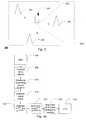
- FIG. 3 shows a system 300 comprising a user equipment (UE) 301 such as a mobile communication device and a wireless network comprising a number of cells.
- UE user equipment
- Figure 4a shows a flow chart of an embodiment of determining a quality of a received signal.
- Figure 4b shows a flow chart of an embodiment of determining a quality of a received signal.
- Figure 5 shows an embodiment of a device for determining a quality of a received signal.
- Figure 6 shows an example of an advantage of utilizing an embodiment to determine CQI.
- Orthogonal Frequency Division Multiplexing a multi carrier approach, in which an original data stream to be transmitted from a transmitter to a receiver is multiplexed into a number of parallel data streams with a correspondingly low symbol rate, is used to reduce inter symbol interference (ISI) by reducing the symbol rate without reducing the data rate.
- ISI inter symbol interference
- the inter symbol interference is caused by delay spread of the channel impulse response for the multipath channel over which the signals are transmitted.
- Each of the parallel data streams are modulated with a different sub-carrier frequency and the resulting signals are transmitted together in the same band from a transmitter to a receiver e.g. from a cell to a UE.
- a high number of different sub-carrier frequencies i.e. several hundreds or even thousands, will be used, and these frequencies will be very close to each other.
- FFT Fast Fourier Transform
- 3GPP LTE is a proposal for a new flexible mobile cellular system using OFDM as multiple access technique in the downlink.
- the description below uses 3GPP LTE as an example, but it is noted that other systems can be used as well.
- 3GPP LTE supports both frequency- and time-division-based duplex.
- Frequency Division Duplex implies that downlink and uplink transmission takes place on different frequency bands
- Time Division Duplex implies that downlink and uplink transmission take place in different, non-overlapping time slots.
- Figure 1a illustrates the time domain structure for 3GPP LTE transmission in the case of FDD, which defines a frame of 10 ms length consisting of ten equally sized subframes of length 1 ms.
- Each 1 ms subframe consists of two equally sized slots of length 0.5 ms, and each slot consists of a number (seven symbols in normal cyclic prefix and six in extended cyclic prefix) of OFDM symbols.
- the first and sixth subframes of each frame include synchronization signals, which are transmitted on the downlink of each cell for use in the cell search procedure.
- a primary synchronization signal (P-SCH) and a secondary synchronization signal (S-SCH) are provided, which are specific sequences that are inserted into the last two OFDM symbols in the first slot of the first and sixth subframes.
- Figure 1b illustrates the corresponding time domain structure for 3GPP LTE transmission in the case of TDD, where the secondary synchronization signal is transmitted in the last symbol of the first and sixth subframes, and the primary synchronization signal is transmitted in the third symbol of the next slot, which is also called the DwPTS slot. In this slot the switch between downlink and uplink transmission occurs.
- the basic LTE downlink physical resource can be seen as a time-frequency resource grid, where each resource element corresponds to one OFDM subcarrier during one OFDM symbol interval.
- reference symbols e.g. R 1 and R 2
- R 1 and R 2 are inserted into the OFDM time-frequency grid. They are inserted within the first and the third last OFDM symbols of each slot and with a frequency-domain spacing of six subcarriers, and there is a frequency-domain staggering of three subcarriers between the first and second reference symbols.
- the reference symbols are also referred to as CQI (Channel Quality Indicator) pilots.
- Channel estimation may, for example, be performed by using knowledge regarding position of the reference symbols in the OFDM time-frequency grid to estimate a frequency-channel around the location of a reference symbol.
- the estimation of the frequency-channel may, for example, be performed using minimum-mean-square-error estimation based on knowledge of the channel time/frequency-domain characteristics.
- the complex values of the reference symbols will vary between different reference symbol positions and between different cells.
- the LTE reference signal sequence can be seen as an indicator of the cell identity.
- Each reference signal sequence can be considered as a product of a two-dimensional pseudo-random sequence and a two-dimensional orthogonal sequence.
- the LTE specification defines a total of 168 different pseudo-random sequences, each corresponding to one out of 168 cell identity groups. There are defined three orthogonal sequences, each corresponding to a specific cell identity within each cell identity group.
- the orthogonal sequence used for a sequence of transmitted reference symbols is to be determined in a receiver for detecting the cell identity of a new or another cell in a third step of a cell search procedure. This is done by correlating a received sequence of reference symbols with each one of the possible known orthogonal sequences and identifying the received as the known sequence giving the largest correlation result.
- the reference symbols may be scrambled with a pseudo-random sequence to discriminate between cells in different cell groups and then orthogonal sequences are applied on the reference symbols, where the orthogonality is within the cell group.
- all reference symbols RSs may be scrambled (even the serving cell RS). Once the RSs have been de-scrambled by a scrambling sequence contained in the UE, the serving cell RS appear in "clear" i.e. readable by the UE, whereas all other RSs remain scrambled.
- FIG. 3 shows a system 300 comprising a user equipment (UE) 301 such as a mobile communication device e.g. a mobile cellular telephone, for example a mobile cellular telephone, and a wireless network 306 comprising a number of cells 302, 303, 304.
- UE user equipment
- a cell may employ a base station such as for example an eNodeBs.
- One or more of the cells 302, 303, 304 may, for example, be LTE TDD cells. Alternatively or additionally, a number of the cells 302, 303, 304 may, for example, be LTE FDD cells.
- One of the cells may be the serving cell for the UE 301 whereby the UE 301 may be connected to said serving cell 303 and the UE 301 may, for example, receive data representing e.g. a telephone call and/or a SMS or the like, via said serving cell 303. Additionally or alternatively, the serving cell 303 may transmit reference symbols e.g. to the UE 301 connected to the serving cell 303.
- the other cells 302, 304 may, for example, be neighbouring cells to the serving cell 303.
- the other cells 302, 304 may, for example, transmit data representing e.g. a telephone call and/or a SMS or the like, to UEs connected to the respective other cells 302, 304. Additionally or alternatively, the other cells may transmit reference symbols e.g. to the UEs connected to the respective other cells.
- the dotted line 305 may, for example, represent cell edges defining respective areas A, B and C in which the cells 302, 303 and 304 are the respective serving cells.
- the network 306 may be a dense network, such as for example in a city, wherein reference symbols from several neighbouring cells 302, 304 in the network 306 may interfere, partly or in whole, with the serving cell's 303 reference symbols.
- reference symbols from the cells 302, 303, 304 may interfere.
- Reference symbols from the cells 302, 303, 304 in LTE FDD may, for example, also interfere.
- the network 306 may be a sparse network, such as for example a rural area network, wherein reference symbols neighbouring cells 302, 304 in a network 306 substantially do not interfere or interfere partly with the serving cell's 303 reference symbols.
- the network 306 may, for example, be a sparse LTE TDD or FDD network.
- the network 306 may be any type of network i.e. a dense network or a sparse network or a network with a density of cells anywhere in between the dense network's and the sparse network's density of cells such that the reference symbols from the neighbouring cells 302, 304 may interfere partly or in whole or may not interfere with the reference symbols from the serving cell 303.
- the UE 301 connected to the serving cell 303 may receive, as shown in Figure 2b , a number of reference symbols in a LTE resource element e.g. 4 reference symbols R SC .
- R NC1 , R NC2 , R NCn a number of reference symbols in a LTE resource element e.g. 4 reference symbols R SC .
- R NC1 , R NC2 , R NCn a number of reference symbols in a LTE resource element e.g. 4 reference symbols R SC .
- R NC1 , R NC2 , R NCn wherein a first part 2001 of the reference symbols R SC in the LTE resource element may be transmitted from the serving cell 303 and wherein a second part 2002 of the reference symbols R NC1 , R NC2 , ..., R NCn , may be transmitted from the neighbouring cells 302, 304.
- the serving cell's reference symbol is 1.
- H k , l represents the channel for subcarrier k at time I between the serving cell 303 and the UE 301.
- G k , l may represent a sum of channels between neighbouring cells 302, 304 and the UE 301, wherein the neighbouring cells' reference symbols may interfere with the reference symbols of the serving cell 303 received at the UE 301.
- c k , l may represent a scrambling sequence at subcarrier k and at time I of the reference symbols transmitted by the neighbouring cells 302, 304.
- ⁇ k , l may represent white additive zero-mean noise with a variance ⁇ k , l noise 2 .
- K bias may be a constant, the value of which constant may, for example, depend on the filtering applied to obtain the channel estimate ⁇ k , l and/or on the size of the averaging set S(k,l).
- ⁇ ⁇ , ⁇ ⁇ S k ⁇ l .. is a summation over the indices ⁇ , ⁇ with values in the set S(k,l).
- S(k,l) may, for example, comprise all subcarriers in the bandwidth of the network 306 and one radio frame comprising 10 sub-frames.
- the superscript H denotes a Hermitian conjugation i.e. a complex conjugate transpose of the vector or matrix on which the Hermitian conjugation is performed.
- d may be a number of symbols which corresponds to the length of the reference symbol scrambling sequence period.
- the scrambling sequence may be periodic with a period of 10ms. 10ms equals one radio frame equalling 10 sub-frames.
- the estimated noise-and-interference power is determined in the UE 301 as ⁇ ⁇ k , l 2 ⁇ ⁇ ⁇ k , l extended 2 .
- ⁇ k , l 2 represents the actual noise-and-interference power of the reference symbol received by the UE 301 from the serving cell 303.
- an estimate of the actual noise-and-interference power ⁇ k , l 2 of the reference symbol received by the UE 301 from the serving cell 303 may be determined in the UE 301 approximately as the expectation value of the estimated noise-and-interference power ⁇ ⁇ k , l extended 2 e.g. when the velocity which the UE moves with is low i.e.
- the UE 301 may, using the above equation (7), be able to determine an estimate of the actual noise-and-interference power ⁇ k , l 2 of the reference symbol received by the UE 301 from the serving cell 303 accurately using the second ⁇ ⁇ k , l extended 2 noise-and-interference power estimate.
- the UE 301 may utilize equation (7) to determine an estimate of the actual noise-and-interference power ⁇ k , l 2 when the UE 301 velocity is below or equal to a Doppler frequency of 10Hz.
- the UE 301 determines an estimate of the actual noise-and-interference power ⁇ k , l 2 of the reference symbol received by the UE 301 from the serving cell 303 using the first ⁇ ⁇ k , l basic 2 noise-and-interference power estimate i.e.
- the estimate of the actual noise-and-interference power ⁇ k , l 2 may be determined as provided in equation (10) and in this case equation (10) approximates equation (7) because in this case E ⁇ G k , l - d - G k , l H ⁇ G k , l - d - G k , l ⁇ ⁇ E ⁇ G k , l H ⁇ G k , l ⁇ .
- the estimate of the actual noise-and-interference power ⁇ k , l 2 may be determined as provided in equation (10).
- E ⁇ ( G k , l - d - G k , l ) H ( G k , l-d -G k , l ) ⁇ or E ⁇ G k , l H G k , l ⁇ may be the smallest term.
- E ⁇ ( G k ,/- d - G k,l ) H ( G k,l-d - G k , l ) ⁇ E ⁇ G k,l H G k , l ⁇ .
- Figure 4a shows a flow chart of an embodiment of determining a quality of a received signal.
- the UE 301 may connect to a network 306, for example, by connecting to a serving cell such as 303.
- the UE 301 may determine a scrambling sequence period length d of the reference symbols received from the serving cell 303 and the neighbouring cells 302, 304.
- the UE 301 may estimate the channel power e.g. the channel between the UE 301 and the serving cell 303.
- the UE 301 may determine the first ⁇ ⁇ k , l basic 2 and the second ⁇ ⁇ k , l extended 2 noise-and-interference power estimate e.g. in a processor adapted to use equations (3) and (4) above to determine the first ⁇ ⁇ k , l basic 2 and the second ⁇ ⁇ k , l extended 2 noise-and-interference power estimate.
- the UE 301 may determine an estimated noise-and-interference power e.g. in a processor adapted to use equations (3) and (4) and (9) above to determine the estimated noise-and-interference power ⁇ ⁇ k , l 2 and thus the estimate of the actual noise-and-interference power ⁇ k , l 2 .
- the UE 301 may determine a CQI-value from a table correlating ⁇ k , l 2 to CQI-value e.g. by using ⁇ k , l 2 as an index in the table to determine the CQI-value.
- the table may, for example, be stored in a memory of the UE 301.
- the CQI-value may be transmitted from the UE 301 to the network 306, e.g. via the serving cell 303.
- step 435 the method ends.
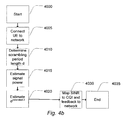
- Figure 4b shows a flow chart of an embodiment of determining a quality of a received signal.
- Steps 4005 - 4015 are identical to steps 405 - 415 of figure 4a .
- the UE 301 may determine the second ⁇ ⁇ k , l extended 2 noise-and-interference power estimate e.g. in a processor adapted to use equations (4) above to determine the second ⁇ ⁇ k , l extended 2 noise-and-interference power estimate.
- the UE 301 may determine a CQI-value from a table correlating ⁇ ⁇ k , l extended 2 to CQI-value e.g. by using ⁇ ⁇ k , l extended 2 as an index in the table to determine the CQI-value.
- the table may, for example, be stored in a memory of the UE 301.
- the COI-value may be transmitted from the UE 301 to the network 306, e.g. via the serving cell 303.
- step 4035 the method ends.
- Figure 5 shows an embodiment of a device for determining a quality of a received signal.
- the device 500 may, for example, be part of a mobile communication device 301.
- the device 500 may comprise an antenna 501.
- the device 500 may be connected to an antenna 501 of a mobile communication device 301.
- the antenna 501 may receive a signal 510 from the network 300 via, for example, a serving cell 303.
- the received signal 510 may, for example, comprise data regarding one or more reference symbols and/or a periodic scrambling sequence and/or data representing e.g. a telephone call and/or a SMS or the like.
- the received signal 510 may be down-converted to a base band signal in a front-end receiver 502.
- the base band signal may be analogue filtered in an analogue filter 503 and the analogue filtered signal may be converted to a digital signal in an analogue to digital converter (ADC) 504.
- ADC analogue to digital converter
- the digital signal may be digital filtered in a digital filter 505.
- a fast Fourier transformer (FFT) 506 may determine a frequency-domain representation of the digital filtered signal. From the frequency-domain representation of the digital filtered signal, the FFT may determine the resource elements corresponding to reference symbols and the resource elements may be transmitted to a channel and interference estimator 508. In order to determine the resource elements corresponding to reference symbols, the FFT may receive and utilize timing information 512 from a cell search unit e.g. contained in a UE 301. The timing information may be determined by the cell search unit e.g. from the primary and secondary synchronizations signals.
- a cell search unit e.g. contained in a UE 301. The timing information may be determined by the cell search unit e.g. from the primary and secondary synchronizations signals.
- the channel and interference estimator 508 may determine, for example, the estimate of the actual noise-and-interference power ⁇ k , l 2 based on equation (7). Additionally, the channel and interference estimator 508 may determine, for example, the estimate of the actual noise-and-interference power ⁇ k , l 2 based on equation (8). In order to determine the estimate of the actual noise-and-interference power ⁇ k , l 2 based on equation (7), the channel and interference estimator 508 may receive information regarding reference symbol periodicity 511. The reference symbol periodicity may be determined based on information on, for example, cell identification, and cyclic prefix length (six symbols in extended cyclic prefix length and seven symbols in normal cyclic prefix length).
- the cyclic prefix length and the cell identification may, for example, be received from the network via the serving cell.
- the channel and interference estimator 508 may, for example, determine the reference symbol scrambling sequence period length d (i.e. the reference symbol scrambling periodicity) from a number of indirect estimations during cell search or the channel and interference estimator 508 may, for example, receive the reference symbol scrambling sequence period length d in the neighbouring cell list via the serving cell.
- the estimates of the actual noise-and-interference power ⁇ k , l 2 based on equation (7) and equation (8) may be transmitted to a control unit 509 from the channel and interference estimator 508.
- the control unit 509 may, for example, determine a minimum of the estimates the actual noise-and-interference power ⁇ k , l 2 obtained using equations (7) and (8).
- the control unit 509 may map the SINR and the pre-coding matrix and the rank to a CQI value e.g. via a lookup in a table using the SINR and the estimated pre-coding matrix and the rank as indices. In an example, the rank and the pre-coding matrix may be determined from the channel estimate and a noise estimate.
- the control unit 509 may transmit the CQI to the network 306 e.g. via the serving cell 303.
- the device 500 may comprise a detector 507.
- the detector 507 may, for example, perform data demodulation utilizing the channel estimate received from the channel and interference estimator 508 and a symbol received from the FFT 506.
- the device 500 may comprise a comparator comparing ⁇ ⁇ k , l extended 2 to ⁇ ⁇ k , l basic 2 . If the comparator determines that ⁇ ⁇ k , l extended 2 is equal to or substantially equal to ⁇ ⁇ k , l basic 2 , e.g. ⁇ ⁇ k , l extended 2 is equal to ⁇ ⁇ k , l basic 2 within 5%, then the comparator may conclude that the interference is due to real noise i.e. "neighbour-free noise" or substantially “neighbour-free noise".
- the comparator may conclude that the interference is due to reference symbols transmitted from neighbours.
- the conclusion reached by the comparator e.g. neighbour-free or neighbour-made noise, may be transmitted to the network 306 e.g. via serving cell 303.
- the network 306 may, for example, utilize the conclusion in e.g. interference coordination schemes.
- a receiver 513 may comprise the front-end receiver 502 and the analogue filter 503 and the analogue to digital converter 504 and the digital filter 505.
- Figure 6 shows an example of an advantage of utilizing an embodiment to determine CQI.
- the neighbouring cell's 302, 304 reference symbols are assumed to have a power 10dB lower than the power of the reference symbols of the serving cell 303.
- the actual SINR axis represents the actual SINR level in dB.
- the reported SINR axis represents the SINR reported by a mobile communication device moving at a Doppler frequency of 5Hz and performing the SINR estimation using equation (7) 601 and using equation (8) 602 respectively.
- equation (7) is able to approximate the actual noise-and-interference power more accurately than equation (8) and thereby, a UE 301 reporting CQI using equation (7) at e.g. low Doppler frequencies is able to obtain higher data rates from a serving cell 303 than a UE reporting using equation (8).
- a part of an entity e.g. received reference symbols
- the sum of the first and the second parts of the received reference symbols equals the received reference symbols.
- any of the technical features and/or embodiments described above and/or below may be combined into one embodiment.
- any of the technical features and/or embodiments described above and/or below may be in separate embodiments.
- any of the technical features and/or embodiments described above and/or below may be combined with any number of other technical features and/or embodiments described above and/or below to yield any number of embodiments.
Landscapes
- Engineering & Computer Science (AREA)
- Quality & Reliability (AREA)
- Physics & Mathematics (AREA)
- Electromagnetism (AREA)
- Computer Networks & Wireless Communication (AREA)
- Signal Processing (AREA)
- Mobile Radio Communication Systems (AREA)
- Monitoring And Testing Of Transmission In General (AREA)
Priority Applications (7)
| Application Number | Priority Date | Filing Date | Title |
|---|---|---|---|
| DK08162581.6T DK2157717T3 (da) | 2008-08-19 | 2008-08-19 | Fremgangsmåde og system og indretning til annullering af forstyrrelser ved CQI-estimering |
| EP08162581A EP2157717B1 (en) | 2008-08-19 | 2008-08-19 | Method and system and device for CQI estimation disturbance cancellation |
| JP2011523367A JP5421992B2 (ja) | 2008-08-19 | 2009-07-10 | Cqi推定の妨害キャンセルのための方法、システムおよび装置 |
| US13/059,892 US8503946B2 (en) | 2008-08-19 | 2009-07-10 | Method and system and device for CQI estimation disturbance cancellation |
| MYPI2011000385A MY154719A (en) | 2008-08-19 | 2009-07-10 | Method and system and device for cqi estimation disturbance cancellation |
| MX2011001282A MX2011001282A (es) | 2008-08-19 | 2009-07-10 | Metodo y sistema y dispositivo para la cancelacion de perturbaciones por estimacion del cqi. |
| PCT/EP2009/058812 WO2010020478A1 (en) | 2008-08-19 | 2009-07-10 | Method and system and device for cqi estimation disturbance cancellation |
Applications Claiming Priority (1)
| Application Number | Priority Date | Filing Date | Title |
|---|---|---|---|
| EP08162581A EP2157717B1 (en) | 2008-08-19 | 2008-08-19 | Method and system and device for CQI estimation disturbance cancellation |
Publications (2)
| Publication Number | Publication Date |
|---|---|
| EP2157717A1 EP2157717A1 (en) | 2010-02-24 |
| EP2157717B1 true EP2157717B1 (en) | 2013-03-27 |
Family
ID=40279132
Family Applications (1)
| Application Number | Title | Priority Date | Filing Date |
|---|---|---|---|
| EP08162581A Not-in-force EP2157717B1 (en) | 2008-08-19 | 2008-08-19 | Method and system and device for CQI estimation disturbance cancellation |
Country Status (7)
| Country | Link |
|---|---|
| US (1) | US8503946B2 (enExample) |
| EP (1) | EP2157717B1 (enExample) |
| JP (1) | JP5421992B2 (enExample) |
| DK (1) | DK2157717T3 (enExample) |
| MX (1) | MX2011001282A (enExample) |
| MY (1) | MY154719A (enExample) |
| WO (1) | WO2010020478A1 (enExample) |
Families Citing this family (11)
| Publication number | Priority date | Publication date | Assignee | Title |
|---|---|---|---|---|
| JP5059062B2 (ja) * | 2009-07-08 | 2012-10-24 | シャープ株式会社 | 通信システム、移動局装置および基地局装置 |
| US8526552B1 (en) * | 2009-08-25 | 2013-09-03 | Marvell International Ltd. | Noise estimation in communication receivers |
| CN102055704B (zh) * | 2009-11-10 | 2013-05-08 | 中兴通讯股份有限公司 | 一种正交频分复用系统中进行噪声估计的方法及装置 |
| EP2526639B1 (en) | 2010-01-18 | 2021-11-17 | QUALCOMM Incorporated | A method and an apparatus for providing channel quality information in a wireless communication system |
| WO2011109940A1 (en) | 2010-03-11 | 2011-09-15 | Qualcomm Incorporated | Method and apparatus for enabling enhanced cqi update frequency |
| US8730861B2 (en) | 2010-06-21 | 2014-05-20 | Qualcomm Incorporated | Rate matching for data and control channels in wireless communication systems |
| US8483641B1 (en) | 2010-07-28 | 2013-07-09 | Marvell International Ltd. | Validation and stabilization of noise matrices |
| EP2557706B1 (en) | 2011-08-12 | 2014-03-05 | TELEFONAKTIEBOLAGET LM ERICSSON (publ) | Channel quality index determination |
| US9078205B2 (en) * | 2012-03-09 | 2015-07-07 | Qualcomm Incorporated | Methods and apparatus for enabling non-destaggered channel estimation |
| CA3011335C (en) * | 2016-01-29 | 2024-04-09 | Ntt Docomo, Inc. | User terminal, radio base station, and radio communication method |
| JP6832794B2 (ja) * | 2017-06-05 | 2021-02-24 | ルネサスエレクトロニクス株式会社 | 無線通信システム |
Family Cites Families (6)
| Publication number | Priority date | Publication date | Assignee | Title |
|---|---|---|---|---|
| US6301293B1 (en) * | 1998-08-04 | 2001-10-09 | Agere Systems Guardian Corp. | Detectors for CDMA systems |
| US7061967B2 (en) * | 2002-06-24 | 2006-06-13 | Comsys Communication & Signal Processing Ltd. | Multipath channel tap delay estimation in a CDMA spread spectrum receiver |
| JP4557762B2 (ja) * | 2005-03-17 | 2010-10-06 | 富士通株式会社 | 移動局の通信環境測定方法及び移動局 |
| WO2007021159A2 (en) * | 2005-08-19 | 2007-02-22 | Samsung Electronics Co., Ltd. | Cinr estimating method and device using preamble in ofdm |
| KR100834815B1 (ko) * | 2006-03-03 | 2008-06-05 | 삼성전자주식회사 | 이동통신 시스템에서 프리앰블을 이용한 수신 신호 대 잡음및 간섭 비 측정 장치 및 방법 |
| JP5268237B2 (ja) * | 2006-07-28 | 2013-08-21 | シャープ株式会社 | スケジューリング方法、通信制御装置及び端末装置 |
-
2008
- 2008-08-19 EP EP08162581A patent/EP2157717B1/en not_active Not-in-force
- 2008-08-19 DK DK08162581.6T patent/DK2157717T3/da active
-
2009
- 2009-07-10 US US13/059,892 patent/US8503946B2/en not_active Expired - Fee Related
- 2009-07-10 MY MYPI2011000385A patent/MY154719A/en unknown
- 2009-07-10 MX MX2011001282A patent/MX2011001282A/es active IP Right Grant
- 2009-07-10 WO PCT/EP2009/058812 patent/WO2010020478A1/en not_active Ceased
- 2009-07-10 JP JP2011523367A patent/JP5421992B2/ja not_active Expired - Fee Related
Also Published As
| Publication number | Publication date |
|---|---|
| MX2011001282A (es) | 2011-03-04 |
| EP2157717A1 (en) | 2010-02-24 |
| MY154719A (en) | 2015-07-15 |
| WO2010020478A1 (en) | 2010-02-25 |
| US8503946B2 (en) | 2013-08-06 |
| JP2012500545A (ja) | 2012-01-05 |
| JP5421992B2 (ja) | 2014-02-19 |
| DK2157717T3 (da) | 2013-05-06 |
| US20110305268A1 (en) | 2011-12-15 |
Similar Documents
| Publication | Publication Date | Title |
|---|---|---|
| US8503946B2 (en) | Method and system and device for CQI estimation disturbance cancellation | |
| EP2218227B1 (en) | Channel estimation for synchronized cells in a cellular communication system | |
| KR101701899B1 (ko) | 무선시스템에서 하향링크 통신을 위한 8개 송신안테나 기준신호 설계 | |
| EP1712089B1 (en) | Methods and apparatus for multi-carrier, multi-cell wireless communication networks | |
| US9628311B2 (en) | Sounding reference signal processing for LTE | |
| TWI411270B (zh) | 正交頻分無線通訊系統的引導頻信號傳輸 | |
| US8432994B2 (en) | Method for determining demodulation reference signal in the uplink, UE and uplink system | |
| US8131228B2 (en) | Interference based phase shift precoding for OFDM | |
| US9014149B2 (en) | Communication apparatus and base station apparatus | |
| KR100915750B1 (ko) | 통신 방법 및 그것을 이용한 송신 장치와 수신장치 | |
| EP2445253A1 (en) | Communication system, communication apparatus and communication method | |
| JPWO2006075732A1 (ja) | 無線通信装置 | |
| CN101843028A (zh) | 在无线通信系统的接收器中估计信干比 | |
| US8509104B2 (en) | Identifying a sequence of received signals | |
| US9531493B2 (en) | Receiving apparatus, method for receiving, transmitting apparatus, method for transmitting, and wireless communication system | |
| CN103813362B (zh) | 用于lte系统的联合的小区标识检测和小区测量的方法和移动设备 | |
| US9300374B2 (en) | Communications terminal, apparatus, and method for detecting rank indication | |
| US8514803B2 (en) | Non-coherent detection method of the number of transmit antenna ports for OFDMA | |
| Ghogho et al. | Training design for repetitive-slot-based CFO estimation in OFDM | |
| Li et al. | On channel estimation for multi-user MIMO in LTE-A uplink | |
| Tran et al. | On improvement of channel estimation for the uplink of large scale MU-MIMO using DMRS | |
| KR20140129973A (ko) | 공통참조신호를 이용한 스몰셀 네트워크 복조 참조 신호 자원 추가 구성 | |
| Liu | Research on FDM Based DRS Pattern for Dual-layer Beamforming in LTE System | |
| Zhou et al. | A Frequency-Domain Sounding Scheme for LTE TDD Beamforming Systems | |
| Frank | Advanced transmission schemes for the 4th generation of mobile communication systems |
Legal Events
| Date | Code | Title | Description |
|---|---|---|---|
| PUAI | Public reference made under article 153(3) epc to a published international application that has entered the european phase |
Free format text: ORIGINAL CODE: 0009012 |
|
| AK | Designated contracting states |
Kind code of ref document: A1 Designated state(s): AT BE BG CH CY CZ DE DK EE ES FI FR GB GR HR HU IE IS IT LI LT LU LV MC MT NL NO PL PT RO SE SI SK TR |
|
| AX | Request for extension of the european patent |
Extension state: AL BA MK RS |
|
| 17P | Request for examination filed |
Effective date: 20100824 |
|
| AKX | Designation fees paid |
Designated state(s): AT BE BG CH CY CZ DE DK EE ES FI FR GB GR HR HU IE IS IT LI LT LU LV MC MT NL NO PL PT RO SE SI SK TR |
|
| GRAP | Despatch of communication of intention to grant a patent |
Free format text: ORIGINAL CODE: EPIDOSNIGR1 |
|
| GRAS | Grant fee paid |
Free format text: ORIGINAL CODE: EPIDOSNIGR3 |
|
| GRAA | (expected) grant |
Free format text: ORIGINAL CODE: 0009210 |
|
| AK | Designated contracting states |
Kind code of ref document: B1 Designated state(s): AT BE BG CH CY CZ DE DK EE ES FI FR GB GR HR HU IE IS IT LI LT LU LV MC MT NL NO PL PT RO SE SI SK TR |
|
| REG | Reference to a national code |
Ref country code: GB Ref legal event code: FG4D |
|
| REG | Reference to a national code |
Ref country code: CH Ref legal event code: EP |
|
| REG | Reference to a national code |
Ref country code: AT Ref legal event code: REF Ref document number: 603987 Country of ref document: AT Kind code of ref document: T Effective date: 20130415 |
|
| REG | Reference to a national code |
Ref country code: DK Ref legal event code: T3 |
|
| REG | Reference to a national code |
Ref country code: IE Ref legal event code: FG4D |
|
| REG | Reference to a national code |
Ref country code: DE Ref legal event code: R096 Ref document number: 602008023196 Country of ref document: DE Effective date: 20130523 |
|
| REG | Reference to a national code |
Ref country code: RO Ref legal event code: EPE |
|
| PG25 | Lapsed in a contracting state [announced via postgrant information from national office to epo] |
Ref country code: SE Free format text: LAPSE BECAUSE OF FAILURE TO SUBMIT A TRANSLATION OF THE DESCRIPTION OR TO PAY THE FEE WITHIN THE PRESCRIBED TIME-LIMIT Effective date: 20130327 Ref country code: LT Free format text: LAPSE BECAUSE OF FAILURE TO SUBMIT A TRANSLATION OF THE DESCRIPTION OR TO PAY THE FEE WITHIN THE PRESCRIBED TIME-LIMIT Effective date: 20130327 Ref country code: BG Free format text: LAPSE BECAUSE OF FAILURE TO SUBMIT A TRANSLATION OF THE DESCRIPTION OR TO PAY THE FEE WITHIN THE PRESCRIBED TIME-LIMIT Effective date: 20130627 Ref country code: NO Free format text: LAPSE BECAUSE OF FAILURE TO SUBMIT A TRANSLATION OF THE DESCRIPTION OR TO PAY THE FEE WITHIN THE PRESCRIBED TIME-LIMIT Effective date: 20130627 |
|
| REG | Reference to a national code |
Ref country code: NL Ref legal event code: T3 |
|
| REG | Reference to a national code |
Ref country code: AT Ref legal event code: MK05 Ref document number: 603987 Country of ref document: AT Kind code of ref document: T Effective date: 20130327 |
|
| REG | Reference to a national code |
Ref country code: LT Ref legal event code: MG4D |
|
| PG25 | Lapsed in a contracting state [announced via postgrant information from national office to epo] |
Ref country code: LV Free format text: LAPSE BECAUSE OF FAILURE TO SUBMIT A TRANSLATION OF THE DESCRIPTION OR TO PAY THE FEE WITHIN THE PRESCRIBED TIME-LIMIT Effective date: 20130327 Ref country code: GR Free format text: LAPSE BECAUSE OF FAILURE TO SUBMIT A TRANSLATION OF THE DESCRIPTION OR TO PAY THE FEE WITHIN THE PRESCRIBED TIME-LIMIT Effective date: 20130628 Ref country code: SI Free format text: LAPSE BECAUSE OF FAILURE TO SUBMIT A TRANSLATION OF THE DESCRIPTION OR TO PAY THE FEE WITHIN THE PRESCRIBED TIME-LIMIT Effective date: 20130327 Ref country code: FI Free format text: LAPSE BECAUSE OF FAILURE TO SUBMIT A TRANSLATION OF THE DESCRIPTION OR TO PAY THE FEE WITHIN THE PRESCRIBED TIME-LIMIT Effective date: 20130327 |
|
| PG25 | Lapsed in a contracting state [announced via postgrant information from national office to epo] |
Ref country code: HR Free format text: LAPSE BECAUSE OF FAILURE TO SUBMIT A TRANSLATION OF THE DESCRIPTION OR TO PAY THE FEE WITHIN THE PRESCRIBED TIME-LIMIT Effective date: 20130327 Ref country code: BE Free format text: LAPSE BECAUSE OF FAILURE TO SUBMIT A TRANSLATION OF THE DESCRIPTION OR TO PAY THE FEE WITHIN THE PRESCRIBED TIME-LIMIT Effective date: 20130327 |
|
| PG25 | Lapsed in a contracting state [announced via postgrant information from national office to epo] |
Ref country code: SK Free format text: LAPSE BECAUSE OF FAILURE TO SUBMIT A TRANSLATION OF THE DESCRIPTION OR TO PAY THE FEE WITHIN THE PRESCRIBED TIME-LIMIT Effective date: 20130327 Ref country code: IS Free format text: LAPSE BECAUSE OF FAILURE TO SUBMIT A TRANSLATION OF THE DESCRIPTION OR TO PAY THE FEE WITHIN THE PRESCRIBED TIME-LIMIT Effective date: 20130727 Ref country code: CZ Free format text: LAPSE BECAUSE OF FAILURE TO SUBMIT A TRANSLATION OF THE DESCRIPTION OR TO PAY THE FEE WITHIN THE PRESCRIBED TIME-LIMIT Effective date: 20130327 Ref country code: ES Free format text: LAPSE BECAUSE OF FAILURE TO SUBMIT A TRANSLATION OF THE DESCRIPTION OR TO PAY THE FEE WITHIN THE PRESCRIBED TIME-LIMIT Effective date: 20130708 Ref country code: PT Free format text: LAPSE BECAUSE OF FAILURE TO SUBMIT A TRANSLATION OF THE DESCRIPTION OR TO PAY THE FEE WITHIN THE PRESCRIBED TIME-LIMIT Effective date: 20130729 Ref country code: EE Free format text: LAPSE BECAUSE OF FAILURE TO SUBMIT A TRANSLATION OF THE DESCRIPTION OR TO PAY THE FEE WITHIN THE PRESCRIBED TIME-LIMIT Effective date: 20130327 Ref country code: AT Free format text: LAPSE BECAUSE OF FAILURE TO SUBMIT A TRANSLATION OF THE DESCRIPTION OR TO PAY THE FEE WITHIN THE PRESCRIBED TIME-LIMIT Effective date: 20130327 |
|
| PG25 | Lapsed in a contracting state [announced via postgrant information from national office to epo] |
Ref country code: PL Free format text: LAPSE BECAUSE OF FAILURE TO SUBMIT A TRANSLATION OF THE DESCRIPTION OR TO PAY THE FEE WITHIN THE PRESCRIBED TIME-LIMIT Effective date: 20130327 Ref country code: CY Free format text: LAPSE BECAUSE OF FAILURE TO SUBMIT A TRANSLATION OF THE DESCRIPTION OR TO PAY THE FEE WITHIN THE PRESCRIBED TIME-LIMIT Effective date: 20130327 |
|
| PLBE | No opposition filed within time limit |
Free format text: ORIGINAL CODE: 0009261 |
|
| STAA | Information on the status of an ep patent application or granted ep patent |
Free format text: STATUS: NO OPPOSITION FILED WITHIN TIME LIMIT |
|
| 26N | No opposition filed |
Effective date: 20140103 |
|
| REG | Reference to a national code |
Ref country code: CH Ref legal event code: PL |
|
| REG | Reference to a national code |
Ref country code: DE Ref legal event code: R097 Ref document number: 602008023196 Country of ref document: DE Effective date: 20140103 |
|
| PG25 | Lapsed in a contracting state [announced via postgrant information from national office to epo] |
Ref country code: LI Free format text: LAPSE BECAUSE OF NON-PAYMENT OF DUE FEES Effective date: 20130831 Ref country code: MC Free format text: LAPSE BECAUSE OF FAILURE TO SUBMIT A TRANSLATION OF THE DESCRIPTION OR TO PAY THE FEE WITHIN THE PRESCRIBED TIME-LIMIT Effective date: 20130327 Ref country code: CH Free format text: LAPSE BECAUSE OF NON-PAYMENT OF DUE FEES Effective date: 20130831 |
|
| REG | Reference to a national code |
Ref country code: IE Ref legal event code: MM4A |
|
| REG | Reference to a national code |
Ref country code: FR Ref legal event code: ST Effective date: 20140430 |
|
| PG25 | Lapsed in a contracting state [announced via postgrant information from national office to epo] |
Ref country code: IE Free format text: LAPSE BECAUSE OF NON-PAYMENT OF DUE FEES Effective date: 20130819 |
|
| PG25 | Lapsed in a contracting state [announced via postgrant information from national office to epo] |
Ref country code: FR Free format text: LAPSE BECAUSE OF NON-PAYMENT OF DUE FEES Effective date: 20130902 |
|
| PG25 | Lapsed in a contracting state [announced via postgrant information from national office to epo] |
Ref country code: TR Free format text: LAPSE BECAUSE OF FAILURE TO SUBMIT A TRANSLATION OF THE DESCRIPTION OR TO PAY THE FEE WITHIN THE PRESCRIBED TIME-LIMIT Effective date: 20130327 Ref country code: MT Free format text: LAPSE BECAUSE OF FAILURE TO SUBMIT A TRANSLATION OF THE DESCRIPTION OR TO PAY THE FEE WITHIN THE PRESCRIBED TIME-LIMIT Effective date: 20130327 |
|
| PG25 | Lapsed in a contracting state [announced via postgrant information from national office to epo] |
Ref country code: HU Free format text: LAPSE BECAUSE OF FAILURE TO SUBMIT A TRANSLATION OF THE DESCRIPTION OR TO PAY THE FEE WITHIN THE PRESCRIBED TIME-LIMIT; INVALID AB INITIO Effective date: 20080819 Ref country code: LU Free format text: LAPSE BECAUSE OF NON-PAYMENT OF DUE FEES Effective date: 20130819 |
|
| PGFP | Annual fee paid to national office [announced via postgrant information from national office to epo] |
Ref country code: IT Payment date: 20190826 Year of fee payment: 12 Ref country code: DK Payment date: 20190828 Year of fee payment: 12 Ref country code: RO Payment date: 20190813 Year of fee payment: 12 |
|
| PGFP | Annual fee paid to national office [announced via postgrant information from national office to epo] |
Ref country code: NL Payment date: 20200826 Year of fee payment: 13 |
|
| PGFP | Annual fee paid to national office [announced via postgrant information from national office to epo] |
Ref country code: GB Payment date: 20200827 Year of fee payment: 13 Ref country code: DE Payment date: 20200827 Year of fee payment: 13 |
|
| REG | Reference to a national code |
Ref country code: DK Ref legal event code: EBP Effective date: 20200831 |
|
| PG25 | Lapsed in a contracting state [announced via postgrant information from national office to epo] |
Ref country code: RO Free format text: LAPSE BECAUSE OF NON-PAYMENT OF DUE FEES Effective date: 20200819 |
|
| PG25 | Lapsed in a contracting state [announced via postgrant information from national office to epo] |
Ref country code: IT Free format text: LAPSE BECAUSE OF NON-PAYMENT OF DUE FEES Effective date: 20200819 |
|
| PG25 | Lapsed in a contracting state [announced via postgrant information from national office to epo] |
Ref country code: DK Free format text: LAPSE BECAUSE OF NON-PAYMENT OF DUE FEES Effective date: 20200831 |
|
| REG | Reference to a national code |
Ref country code: DE Ref legal event code: R119 Ref document number: 602008023196 Country of ref document: DE |
|
| REG | Reference to a national code |
Ref country code: NL Ref legal event code: MM Effective date: 20210901 |
|
| GBPC | Gb: european patent ceased through non-payment of renewal fee |
Effective date: 20210819 |
|
| PG25 | Lapsed in a contracting state [announced via postgrant information from national office to epo] |
Ref country code: NL Free format text: LAPSE BECAUSE OF NON-PAYMENT OF DUE FEES Effective date: 20210901 |
|
| PG25 | Lapsed in a contracting state [announced via postgrant information from national office to epo] |
Ref country code: GB Free format text: LAPSE BECAUSE OF NON-PAYMENT OF DUE FEES Effective date: 20210819 Ref country code: DE Free format text: LAPSE BECAUSE OF NON-PAYMENT OF DUE FEES Effective date: 20220301 |