EP2157215B1 - Polyurethane elastic fiber - Google Patents
Polyurethane elastic fiber Download PDFInfo
- Publication number
- EP2157215B1 EP2157215B1 EP20080777147 EP08777147A EP2157215B1 EP 2157215 B1 EP2157215 B1 EP 2157215B1 EP 20080777147 EP20080777147 EP 20080777147 EP 08777147 A EP08777147 A EP 08777147A EP 2157215 B1 EP2157215 B1 EP 2157215B1
- Authority
- EP
- European Patent Office
- Prior art keywords
- polyurethane elastic
- polymer
- elastic fibers
- acidic
- dyeing
- Prior art date
- Legal status (The legal status is an assumption and is not a legal conclusion. Google has not performed a legal analysis and makes no representation as to the accuracy of the status listed.)
- Not-in-force
Links
- 229920002635 polyurethane Polymers 0.000 title claims abstract description 67
- 239000004814 polyurethane Substances 0.000 title claims abstract description 67
- 210000004177 elastic tissue Anatomy 0.000 title claims abstract description 57
- 229920000642 polymer Polymers 0.000 claims abstract description 78
- 239000000835 fiber Substances 0.000 claims abstract description 61
- 239000004744 fabric Substances 0.000 claims abstract description 49
- 238000004043 dyeing Methods 0.000 claims abstract description 40
- 125000005439 maleimidyl group Chemical group C1(C=CC(N1*)=O)=O 0.000 claims abstract description 39
- 230000002378 acidificating effect Effects 0.000 claims abstract description 36
- 238000010186 staining Methods 0.000 claims abstract description 23
- 239000004952 Polyamide Substances 0.000 claims abstract description 21
- 229920002647 polyamide Polymers 0.000 claims abstract description 21
- 238000004900 laundering Methods 0.000 claims abstract description 15
- VQTUBCCKSQIDNK-UHFFFAOYSA-N Isobutene Chemical group CC(C)=C VQTUBCCKSQIDNK-UHFFFAOYSA-N 0.000 claims abstract description 10
- 239000004677 Nylon Substances 0.000 claims abstract description 8
- 229920001778 nylon Polymers 0.000 claims abstract description 8
- 125000000217 alkyl group Chemical group 0.000 claims abstract description 4
- 125000002947 alkylene group Chemical group 0.000 claims abstract description 4
- 150000001412 amines Chemical class 0.000 claims description 24
- 229920000728 polyester Polymers 0.000 claims description 6
- 238000009987 spinning Methods 0.000 abstract description 28
- 239000000975 dye Substances 0.000 abstract description 27
- 239000000463 material Substances 0.000 abstract description 5
- 239000002759 woven fabric Substances 0.000 abstract description 3
- 230000001747 exhibiting effect Effects 0.000 abstract description 2
- 239000000243 solution Substances 0.000 description 19
- LYCAIKOWRPUZTN-UHFFFAOYSA-N Ethylene glycol Chemical compound OCCO LYCAIKOWRPUZTN-UHFFFAOYSA-N 0.000 description 14
- FXHOOIRPVKKKFG-UHFFFAOYSA-N N,N-Dimethylacetamide Chemical compound CN(C)C(C)=O FXHOOIRPVKKKFG-UHFFFAOYSA-N 0.000 description 14
- 150000002009 diols Chemical class 0.000 description 13
- 239000000047 product Substances 0.000 description 12
- 238000000034 method Methods 0.000 description 11
- 238000011156 evaluation Methods 0.000 description 9
- 239000000203 mixture Substances 0.000 description 9
- 238000005259 measurement Methods 0.000 description 8
- 238000012360 testing method Methods 0.000 description 7
- MTHSVFCYNBDYFN-UHFFFAOYSA-N diethylene glycol Chemical compound OCCOCCO MTHSVFCYNBDYFN-UHFFFAOYSA-N 0.000 description 6
- -1 polyoxyethylene Polymers 0.000 description 6
- 239000011550 stock solution Substances 0.000 description 6
- 150000004985 diamines Chemical class 0.000 description 5
- 229920003226 polyurethane urea Polymers 0.000 description 5
- PUPZLCDOIYMWBV-UHFFFAOYSA-N (+/-)-1,3-Butanediol Chemical compound CC(O)CCO PUPZLCDOIYMWBV-UHFFFAOYSA-N 0.000 description 4
- 239000004970 Chain extender Substances 0.000 description 4
- 229920002292 Nylon 6 Polymers 0.000 description 4
- DNIAPMSPPWPWGF-UHFFFAOYSA-N Propylene glycol Chemical compound CC(O)CO DNIAPMSPPWPWGF-UHFFFAOYSA-N 0.000 description 4
- WERYXYBDKMZEQL-UHFFFAOYSA-N butane-1,4-diol Chemical compound OCCCCO WERYXYBDKMZEQL-UHFFFAOYSA-N 0.000 description 4
- WGCNASOHLSPBMP-UHFFFAOYSA-N hydroxyacetaldehyde Natural products OCC=O WGCNASOHLSPBMP-UHFFFAOYSA-N 0.000 description 4
- 238000009940 knitting Methods 0.000 description 4
- AMXOYNBUYSYVKV-UHFFFAOYSA-M lithium bromide Chemical compound [Li+].[Br-] AMXOYNBUYSYVKV-UHFFFAOYSA-M 0.000 description 4
- QOHMWDJIBGVPIF-UHFFFAOYSA-N n',n'-diethylpropane-1,3-diamine Chemical compound CCN(CC)CCCN QOHMWDJIBGVPIF-UHFFFAOYSA-N 0.000 description 4
- YPFDHNVEDLHUCE-UHFFFAOYSA-N propane-1,3-diol Chemical compound OCCCO YPFDHNVEDLHUCE-UHFFFAOYSA-N 0.000 description 4
- 238000005406 washing Methods 0.000 description 4
- PIICEJLVQHRZGT-UHFFFAOYSA-N Ethylenediamine Chemical compound NCCN PIICEJLVQHRZGT-UHFFFAOYSA-N 0.000 description 3
- OKKJLVBELUTLKV-UHFFFAOYSA-N Methanol Chemical compound OC OKKJLVBELUTLKV-UHFFFAOYSA-N 0.000 description 3
- OFOBLEOULBTSOW-UHFFFAOYSA-N Propanedioic acid Natural products OC(=O)CC(O)=O OFOBLEOULBTSOW-UHFFFAOYSA-N 0.000 description 3
- 229920000297 Rayon Polymers 0.000 description 3
- 238000004040 coloring Methods 0.000 description 3
- 230000000052 comparative effect Effects 0.000 description 3
- 238000009826 distribution Methods 0.000 description 3
- 238000000578 dry spinning Methods 0.000 description 3
- 238000005227 gel permeation chromatography Methods 0.000 description 3
- 150000002334 glycols Chemical class 0.000 description 3
- 125000004435 hydrogen atom Chemical group [H]* 0.000 description 3
- FPYJFEHAWHCUMM-UHFFFAOYSA-N maleic anhydride Chemical group O=C1OC(=O)C=C1 FPYJFEHAWHCUMM-UHFFFAOYSA-N 0.000 description 3
- 239000000178 monomer Substances 0.000 description 3
- 239000007858 starting material Substances 0.000 description 3
- 230000000007 visual effect Effects 0.000 description 3
- XLYOFNOQVPJJNP-UHFFFAOYSA-N water Substances O XLYOFNOQVPJJNP-UHFFFAOYSA-N 0.000 description 3
- 238000005303 weighing Methods 0.000 description 3
- UPMLOUAZCHDJJD-UHFFFAOYSA-N 4,4'-Diphenylmethane Diisocyanate Chemical compound C1=CC(N=C=O)=CC=C1CC1=CC=C(N=C=O)C=C1 UPMLOUAZCHDJJD-UHFFFAOYSA-N 0.000 description 2
- LFQSCWFLJHTTHZ-UHFFFAOYSA-N Ethanol Chemical compound CCO LFQSCWFLJHTTHZ-UHFFFAOYSA-N 0.000 description 2
- OAKJQQAXSVQMHS-UHFFFAOYSA-N Hydrazine Chemical compound NN OAKJQQAXSVQMHS-UHFFFAOYSA-N 0.000 description 2
- VEXZGXHMUGYJMC-UHFFFAOYSA-N Hydrochloric acid Chemical compound Cl VEXZGXHMUGYJMC-UHFFFAOYSA-N 0.000 description 2
- 229920001730 Moisture cure polyurethane Polymers 0.000 description 2
- LUSFFPXRDZKBMF-UHFFFAOYSA-N [3-(hydroxymethyl)cyclohexyl]methanol Chemical compound OCC1CCCC(CO)C1 LUSFFPXRDZKBMF-UHFFFAOYSA-N 0.000 description 2
- YIMQCDZDWXUDCA-UHFFFAOYSA-N [4-(hydroxymethyl)cyclohexyl]methanol Chemical compound OCC1CCC(CO)CC1 YIMQCDZDWXUDCA-UHFFFAOYSA-N 0.000 description 2
- 239000002253 acid Substances 0.000 description 2
- WNLRTRBMVRJNCN-UHFFFAOYSA-N adipic acid Chemical compound OC(=O)CCCCC(O)=O WNLRTRBMVRJNCN-UHFFFAOYSA-N 0.000 description 2
- 125000003277 amino group Chemical group 0.000 description 2
- BFNBIHQBYMNNAN-UHFFFAOYSA-N ammonium sulfate Chemical compound N.N.OS(O)(=O)=O BFNBIHQBYMNNAN-UHFFFAOYSA-N 0.000 description 2
- 229910052921 ammonium sulfate Inorganic materials 0.000 description 2
- 235000011130 ammonium sulphate Nutrition 0.000 description 2
- KMGARVOVYXNAOF-UHFFFAOYSA-N benzpiperylone Chemical compound C1CN(C)CCC1N1C(=O)C(CC=2C=CC=CC=2)=C(C=2C=CC=CC=2)N1 KMGARVOVYXNAOF-UHFFFAOYSA-N 0.000 description 2
- UDSAIICHUKSCKT-UHFFFAOYSA-N bromophenol blue Chemical compound C1=C(Br)C(O)=C(Br)C=C1C1(C=2C=C(Br)C(O)=C(Br)C=2)C2=CC=CC=C2S(=O)(=O)O1 UDSAIICHUKSCKT-UHFFFAOYSA-N 0.000 description 2
- 238000006243 chemical reaction Methods 0.000 description 2
- 239000003153 chemical reaction reagent Substances 0.000 description 2
- 239000003795 chemical substances by application Substances 0.000 description 2
- 229920001577 copolymer Polymers 0.000 description 2
- FOTKYAAJKYLFFN-UHFFFAOYSA-N decane-1,10-diol Chemical compound OCCCCCCCCCCO FOTKYAAJKYLFFN-UHFFFAOYSA-N 0.000 description 2
- HPNMFZURTQLUMO-UHFFFAOYSA-N diethylamine Chemical compound CCNCC HPNMFZURTQLUMO-UHFFFAOYSA-N 0.000 description 2
- 125000005442 diisocyanate group Chemical group 0.000 description 2
- 239000003480 eluent Substances 0.000 description 2
- RRAMGCGOFNQTLD-UHFFFAOYSA-N hexamethylene diisocyanate Chemical compound O=C=NCCCCCCN=C=O RRAMGCGOFNQTLD-UHFFFAOYSA-N 0.000 description 2
- XXMIOPMDWAUFGU-UHFFFAOYSA-N hexane-1,6-diol Chemical compound OCCCCCCO XXMIOPMDWAUFGU-UHFFFAOYSA-N 0.000 description 2
- FUKUFMFMCZIRNT-UHFFFAOYSA-N hydron;methanol;chloride Chemical compound Cl.OC FUKUFMFMCZIRNT-UHFFFAOYSA-N 0.000 description 2
- HQKMJHAJHXVSDF-UHFFFAOYSA-L magnesium stearate Chemical compound [Mg+2].CCCCCCCCCCCCCCCCCC([O-])=O.CCCCCCCCCCCCCCCCCC([O-])=O HQKMJHAJHXVSDF-UHFFFAOYSA-L 0.000 description 2
- 238000003801 milling Methods 0.000 description 2
- 238000002156 mixing Methods 0.000 description 2
- KYCGURZGBKFEQB-UHFFFAOYSA-N n',n'-dibutylpropane-1,3-diamine Chemical compound CCCCN(CCCC)CCCN KYCGURZGBKFEQB-UHFFFAOYSA-N 0.000 description 2
- UDGSVBYJWHOHNN-UHFFFAOYSA-N n',n'-diethylethane-1,2-diamine Chemical compound CCN(CC)CCN UDGSVBYJWHOHNN-UHFFFAOYSA-N 0.000 description 2
- SLCVBVWXLSEKPL-UHFFFAOYSA-N neopentyl glycol Chemical compound OCC(C)(C)CO SLCVBVWXLSEKPL-UHFFFAOYSA-N 0.000 description 2
- 238000006386 neutralization reaction Methods 0.000 description 2
- IJGRMHOSHXDMSA-UHFFFAOYSA-N nitrogen Substances N#N IJGRMHOSHXDMSA-UHFFFAOYSA-N 0.000 description 2
- 239000012299 nitrogen atmosphere Substances 0.000 description 2
- QJGQUHMNIGDVPM-UHFFFAOYSA-N nitrogen group Chemical group [N] QJGQUHMNIGDVPM-UHFFFAOYSA-N 0.000 description 2
- BDJRBEYXGGNYIS-UHFFFAOYSA-N nonanedioic acid Chemical compound OC(=O)CCCCCCCC(O)=O BDJRBEYXGGNYIS-UHFFFAOYSA-N 0.000 description 2
- IWDCLRJOBJJRNH-UHFFFAOYSA-N p-cresol Chemical compound CC1=CC=C(O)C=C1 IWDCLRJOBJJRNH-UHFFFAOYSA-N 0.000 description 2
- 229920003229 poly(methyl methacrylate) Polymers 0.000 description 2
- 239000004926 polymethyl methacrylate Substances 0.000 description 2
- AOHJOMMDDJHIJH-UHFFFAOYSA-N propylenediamine Chemical compound CC(N)CN AOHJOMMDDJHIJH-UHFFFAOYSA-N 0.000 description 2
- 238000010992 reflux Methods 0.000 description 2
- CXMXRPHRNRROMY-UHFFFAOYSA-N sebacic acid Chemical compound OC(=O)CCCCCCCCC(O)=O CXMXRPHRNRROMY-UHFFFAOYSA-N 0.000 description 2
- 239000007787 solid Substances 0.000 description 2
- 238000003756 stirring Methods 0.000 description 2
- 238000004448 titration Methods 0.000 description 2
- RTTZISZSHSCFRH-UHFFFAOYSA-N 1,3-bis(isocyanatomethyl)benzene Chemical compound O=C=NCC1=CC=CC(CN=C=O)=C1 RTTZISZSHSCFRH-UHFFFAOYSA-N 0.000 description 1
- VGHSXKTVMPXHNG-UHFFFAOYSA-N 1,3-diisocyanatobenzene Chemical compound O=C=NC1=CC=CC(N=C=O)=C1 VGHSXKTVMPXHNG-UHFFFAOYSA-N 0.000 description 1
- IKYNWXNXXHWHLL-UHFFFAOYSA-N 1,3-diisocyanatopropane Chemical compound O=C=NCCCN=C=O IKYNWXNXXHWHLL-UHFFFAOYSA-N 0.000 description 1
- OHLKMGYGBHFODF-UHFFFAOYSA-N 1,4-bis(isocyanatomethyl)benzene Chemical compound O=C=NCC1=CC=C(CN=C=O)C=C1 OHLKMGYGBHFODF-UHFFFAOYSA-N 0.000 description 1
- ALQLPWJFHRMHIU-UHFFFAOYSA-N 1,4-diisocyanatobenzene Chemical compound O=C=NC1=CC=C(N=C=O)C=C1 ALQLPWJFHRMHIU-UHFFFAOYSA-N 0.000 description 1
- OVBFMUAFNIIQAL-UHFFFAOYSA-N 1,4-diisocyanatobutane Chemical compound O=C=NCCCCN=C=O OVBFMUAFNIIQAL-UHFFFAOYSA-N 0.000 description 1
- CDMDQYCEEKCBGR-UHFFFAOYSA-N 1,4-diisocyanatocyclohexane Chemical compound O=C=NC1CCC(N=C=O)CC1 CDMDQYCEEKCBGR-UHFFFAOYSA-N 0.000 description 1
- DFPJRUKWEPYFJT-UHFFFAOYSA-N 1,5-diisocyanatopentane Chemical compound O=C=NCCCCCN=C=O DFPJRUKWEPYFJT-UHFFFAOYSA-N 0.000 description 1
- 229940008841 1,6-hexamethylene diisocyanate Drugs 0.000 description 1
- XOCNAMYSSIDCHW-UHFFFAOYSA-N 1-isocyanato-3-(1-isocyanatoethyl)benzene Chemical compound O=C=NC(C)C1=CC=CC(N=C=O)=C1 XOCNAMYSSIDCHW-UHFFFAOYSA-N 0.000 description 1
- IRNAEDHJBNPCEZ-UHFFFAOYSA-N 1-n,1-n,2-trimethylpropane-1,2-diamine Chemical compound CN(C)CC(C)(C)N IRNAEDHJBNPCEZ-UHFFFAOYSA-N 0.000 description 1
- LLWGJQGMZNGTDR-UHFFFAOYSA-N 1-n,1-n-dibutyl-2-methylpropane-1,2-diamine Chemical compound CCCCN(CC(C)(C)N)CCCC LLWGJQGMZNGTDR-UHFFFAOYSA-N 0.000 description 1
- OAYLAXOCNOCLPZ-UHFFFAOYSA-N 1-n,1-n-diethyl-2-methylpropane-1,2-diamine Chemical compound CCN(CC)CC(C)(C)N OAYLAXOCNOCLPZ-UHFFFAOYSA-N 0.000 description 1
- NZAGCHONOVUVCE-UHFFFAOYSA-N 1-n,1-n-dihexyl-2-methylpropane-1,2-diamine Chemical compound CCCCCCN(CC(C)(C)N)CCCCCC NZAGCHONOVUVCE-UHFFFAOYSA-N 0.000 description 1
- FCFWQJMUFPYPPC-UHFFFAOYSA-N 1-n,1-n-ditert-butyl-2-methylpropane-1,2-diamine Chemical compound CC(C)(C)N(C(C)(C)C)CC(C)(C)N FCFWQJMUFPYPPC-UHFFFAOYSA-N 0.000 description 1
- HECLRDQVFMWTQS-RGOKHQFPSA-N 1755-01-7 Chemical compound C1[C@H]2[C@@H]3CC=C[C@@H]3[C@@H]1C=C2 HECLRDQVFMWTQS-RGOKHQFPSA-N 0.000 description 1
- KGRVJHAUYBGFFP-UHFFFAOYSA-N 2,2'-Methylenebis(4-methyl-6-tert-butylphenol) Chemical compound CC(C)(C)C1=CC(C)=CC(CC=2C(=C(C=C(C)C=2)C(C)(C)C)O)=C1O KGRVJHAUYBGFFP-UHFFFAOYSA-N 0.000 description 1
- GQYCZHULQDRVGX-UHFFFAOYSA-N 2,2-dimethyl-n',n'-bis(2-methylpropyl)propane-1,3-diamine Chemical compound CC(C)CN(CC(C)C)CC(C)(C)CN GQYCZHULQDRVGX-UHFFFAOYSA-N 0.000 description 1
- FMTJPAPRMSPBHO-UHFFFAOYSA-N 2,2-dimethyl-n',n'-di(propan-2-yl)propane-1,3-diamine Chemical compound CC(C)N(C(C)C)CC(C)(C)CN FMTJPAPRMSPBHO-UHFFFAOYSA-N 0.000 description 1
- TZQTXGUGYGNWDP-UHFFFAOYSA-N 2,2-dimethyl-n',n'-dipentylpropane-1,3-diamine Chemical compound CCCCCN(CC(C)(C)CN)CCCCC TZQTXGUGYGNWDP-UHFFFAOYSA-N 0.000 description 1
- BWFCRMDFKOIFHA-UHFFFAOYSA-N 2,2-dimethyl-n',n'-dipropylpropane-1,3-diamine Chemical compound CCCN(CCC)CC(C)(C)CN BWFCRMDFKOIFHA-UHFFFAOYSA-N 0.000 description 1
- JAHNSTQSQJOJLO-UHFFFAOYSA-N 2-(3-fluorophenyl)-1h-imidazole Chemical compound FC1=CC=CC(C=2NC=CN=2)=C1 JAHNSTQSQJOJLO-UHFFFAOYSA-N 0.000 description 1
- OLFNXLXEGXRUOI-UHFFFAOYSA-N 2-(benzotriazol-2-yl)-4,6-bis(2-phenylpropan-2-yl)phenol Chemical compound C=1C(N2N=C3C=CC=CC3=N2)=C(O)C(C(C)(C)C=2C=CC=CC=2)=CC=1C(C)(C)C1=CC=CC=C1 OLFNXLXEGXRUOI-UHFFFAOYSA-N 0.000 description 1
- JWOUMUWDKNDWEL-UHFFFAOYSA-N 2-methyl-1-n,1-n-bis(2-methylpropyl)propane-1,2-diamine Chemical compound CC(C)CN(CC(C)C)CC(C)(C)N JWOUMUWDKNDWEL-UHFFFAOYSA-N 0.000 description 1
- LVYUCRQUXXNNST-UHFFFAOYSA-N 2-methyl-1-n,1-n-di(propan-2-yl)propane-1,2-diamine Chemical compound CC(C)N(C(C)C)CC(C)(C)N LVYUCRQUXXNNST-UHFFFAOYSA-N 0.000 description 1
- MLGBUXHKUFUWKH-UHFFFAOYSA-N 2-methyl-1-n,1-n-dipentylpropane-1,2-diamine Chemical compound CCCCCN(CC(C)(C)N)CCCCC MLGBUXHKUFUWKH-UHFFFAOYSA-N 0.000 description 1
- OBKJIDHWOHVVBJ-UHFFFAOYSA-N 2-methyl-1-n,1-n-dipropylpropane-1,2-diamine Chemical compound CCCN(CCC)CC(C)(C)N OBKJIDHWOHVVBJ-UHFFFAOYSA-N 0.000 description 1
- MSHIRVUHUYOGIT-UHFFFAOYSA-N 2-methyl-2-n,2-n-bis(2-methylpropyl)propane-1,2-diamine Chemical compound CC(C)CN(CC(C)C)C(C)(C)CN MSHIRVUHUYOGIT-UHFFFAOYSA-N 0.000 description 1
- GCJXFUPNUFQGFM-UHFFFAOYSA-N 2-methyl-2-n,2-n-di(propan-2-yl)propane-1,2-diamine Chemical compound CC(C)N(C(C)C)C(C)(C)CN GCJXFUPNUFQGFM-UHFFFAOYSA-N 0.000 description 1
- AKJGDPUOOPTLCQ-UHFFFAOYSA-N 2-methyl-2-n,2-n-dipentylpropane-1,2-diamine Chemical compound CCCCCN(C(C)(C)CN)CCCCC AKJGDPUOOPTLCQ-UHFFFAOYSA-N 0.000 description 1
- ZYDCVAIGKVWMDK-UHFFFAOYSA-N 2-methyl-2-n,2-n-dipropylpropane-1,2-diamine Chemical compound CCCN(CCC)C(C)(C)CN ZYDCVAIGKVWMDK-UHFFFAOYSA-N 0.000 description 1
- PKZCRWFNSBIBEW-UHFFFAOYSA-N 2-n,2-n,2-trimethylpropane-1,2-diamine Chemical compound CN(C)C(C)(C)CN PKZCRWFNSBIBEW-UHFFFAOYSA-N 0.000 description 1
- DRMOOYKPVNVSRA-UHFFFAOYSA-N 2-n,2-n-dibutyl-2-methylpropane-1,2-diamine Chemical compound CCCCN(C(C)(C)CN)CCCC DRMOOYKPVNVSRA-UHFFFAOYSA-N 0.000 description 1
- OKQNWAJBDNOPAI-UHFFFAOYSA-N 2-n,2-n-diethyl-2-methylpropane-1,2-diamine Chemical compound CCN(CC)C(C)(C)CN OKQNWAJBDNOPAI-UHFFFAOYSA-N 0.000 description 1
- AUKPEHRKYYAVTQ-UHFFFAOYSA-N 2-n,2-n-dihexyl-2-methylpropane-1,2-diamine Chemical compound CCCCCCN(C(C)(C)CN)CCCCCC AUKPEHRKYYAVTQ-UHFFFAOYSA-N 0.000 description 1
- BSGZUROHDVJFDK-UHFFFAOYSA-N 2-n,2-n-ditert-butyl-2-methylpropane-1,2-diamine Chemical compound CC(C)(C)N(C(C)(C)C)C(C)(C)CN BSGZUROHDVJFDK-UHFFFAOYSA-N 0.000 description 1
- 229940105325 3-dimethylaminopropylamine Drugs 0.000 description 1
- 244000025254 Cannabis sativa Species 0.000 description 1
- 235000012766 Cannabis sativa ssp. sativa var. sativa Nutrition 0.000 description 1
- 235000012765 Cannabis sativa ssp. sativa var. spontanea Nutrition 0.000 description 1
- 229920000742 Cotton Polymers 0.000 description 1
- JOYRKODLDBILNP-UHFFFAOYSA-N Ethyl urethane Chemical compound CCOC(N)=O JOYRKODLDBILNP-UHFFFAOYSA-N 0.000 description 1
- 239000005057 Hexamethylene diisocyanate Substances 0.000 description 1
- AVXURJPOCDRRFD-UHFFFAOYSA-N Hydroxylamine Chemical compound ON AVXURJPOCDRRFD-UHFFFAOYSA-N 0.000 description 1
- 239000005058 Isophorone diisocyanate Substances 0.000 description 1
- PEEHTFAAVSWFBL-UHFFFAOYSA-N Maleimide Chemical compound O=C1NC(=O)C=C1 PEEHTFAAVSWFBL-UHFFFAOYSA-N 0.000 description 1
- 229920002302 Nylon 6,6 Polymers 0.000 description 1
- 229920003171 Poly (ethylene oxide) Polymers 0.000 description 1
- 239000004698 Polyethylene Substances 0.000 description 1
- 239000004721 Polyphenylene oxide Substances 0.000 description 1
- VYPSYNLAJGMNEJ-UHFFFAOYSA-N Silicium dioxide Chemical compound O=[Si]=O VYPSYNLAJGMNEJ-UHFFFAOYSA-N 0.000 description 1
- CGRTZESQZZGAAU-UHFFFAOYSA-N [2-[3-[1-[3-(3-tert-butyl-4-hydroxy-5-methylphenyl)propanoyloxy]-2-methylpropan-2-yl]-2,4,8,10-tetraoxaspiro[5.5]undecan-9-yl]-2-methylpropyl] 3-(3-tert-butyl-4-hydroxy-5-methylphenyl)propanoate Chemical compound CC(C)(C)C1=C(O)C(C)=CC(CCC(=O)OCC(C)(C)C2OCC3(CO2)COC(OC3)C(C)(C)COC(=O)CCC=2C=C(C(O)=C(C)C=2)C(C)(C)C)=C1 CGRTZESQZZGAAU-UHFFFAOYSA-N 0.000 description 1
- 239000006096 absorbing agent Substances 0.000 description 1
- 238000002479 acid--base titration Methods 0.000 description 1
- 150000007513 acids Chemical class 0.000 description 1
- 235000011037 adipic acid Nutrition 0.000 description 1
- 239000001361 adipic acid Substances 0.000 description 1
- 150000001334 alicyclic compounds Chemical class 0.000 description 1
- 150000007933 aliphatic carboxylic acids Chemical class 0.000 description 1
- 150000007824 aliphatic compounds Chemical class 0.000 description 1
- 125000005233 alkylalcohol group Chemical group 0.000 description 1
- 229920005603 alternating copolymer Polymers 0.000 description 1
- PNEYBMLMFCGWSK-UHFFFAOYSA-N aluminium oxide Inorganic materials [O-2].[O-2].[O-2].[Al+3].[Al+3] PNEYBMLMFCGWSK-UHFFFAOYSA-N 0.000 description 1
- 239000003963 antioxidant agent Substances 0.000 description 1
- 150000001491 aromatic compounds Chemical class 0.000 description 1
- 230000001588 bifunctional effect Effects 0.000 description 1
- 230000015572 biosynthetic process Effects 0.000 description 1
- 235000010290 biphenyl Nutrition 0.000 description 1
- 239000004305 biphenyl Substances 0.000 description 1
- 125000006267 biphenyl group Chemical group 0.000 description 1
- 230000000740 bleeding effect Effects 0.000 description 1
- CJZGTCYPCWQAJB-UHFFFAOYSA-L calcium stearate Chemical compound [Ca+2].CCCCCCCCCCCCCCCCCC([O-])=O.CCCCCCCCCCCCCCCCCC([O-])=O CJZGTCYPCWQAJB-UHFFFAOYSA-L 0.000 description 1
- 235000013539 calcium stearate Nutrition 0.000 description 1
- 239000008116 calcium stearate Substances 0.000 description 1
- 238000011088 calibration curve Methods 0.000 description 1
- 235000009120 camo Nutrition 0.000 description 1
- 239000004202 carbamide Substances 0.000 description 1
- 125000004432 carbon atom Chemical group C* 0.000 description 1
- 235000005607 chanvre indien Nutrition 0.000 description 1
- 239000000460 chlorine Substances 0.000 description 1
- 229910052801 chlorine Inorganic materials 0.000 description 1
- 235000019646 color tone Nutrition 0.000 description 1
- 239000003086 colorant Substances 0.000 description 1
- 150000001875 compounds Chemical class 0.000 description 1
- 238000006482 condensation reaction Methods 0.000 description 1
- 238000001514 detection method Methods 0.000 description 1
- 125000005265 dialkylamine group Chemical group 0.000 description 1
- GDVKFRBCXAPAQJ-UHFFFAOYSA-A dialuminum;hexamagnesium;carbonate;hexadecahydroxide Chemical compound [OH-].[OH-].[OH-].[OH-].[OH-].[OH-].[OH-].[OH-].[OH-].[OH-].[OH-].[OH-].[OH-].[OH-].[OH-].[OH-].[Mg+2].[Mg+2].[Mg+2].[Mg+2].[Mg+2].[Mg+2].[Al+3].[Al+3].[O-]C([O-])=O GDVKFRBCXAPAQJ-UHFFFAOYSA-A 0.000 description 1
- KORSJDCBLAPZEQ-UHFFFAOYSA-N dicyclohexylmethane-4,4'-diisocyanate Chemical compound C1CC(N=C=O)CCC1CC1CCC(N=C=O)CC1 KORSJDCBLAPZEQ-UHFFFAOYSA-N 0.000 description 1
- 235000014113 dietary fatty acids Nutrition 0.000 description 1
- 235000013870 dimethyl polysiloxane Nutrition 0.000 description 1
- IUNMPGNGSSIWFP-UHFFFAOYSA-N dimethylaminopropylamine Chemical compound CN(C)CCCN IUNMPGNGSSIWFP-UHFFFAOYSA-N 0.000 description 1
- 229910001873 dinitrogen Inorganic materials 0.000 description 1
- 239000000986 disperse dye Substances 0.000 description 1
- 238000004090 dissolution Methods 0.000 description 1
- 230000000694 effects Effects 0.000 description 1
- 239000000194 fatty acid Substances 0.000 description 1
- 229930195729 fatty acid Natural products 0.000 description 1
- 150000004665 fatty acids Chemical class 0.000 description 1
- 239000000945 filler Substances 0.000 description 1
- 239000012467 final product Substances 0.000 description 1
- 239000010419 fine particle Substances 0.000 description 1
- RPOCFUQMSVZQLH-UHFFFAOYSA-N furan-2,5-dione;2-methylprop-1-ene Chemical compound CC(C)=C.O=C1OC(=O)C=C1 RPOCFUQMSVZQLH-UHFFFAOYSA-N 0.000 description 1
- 230000004313 glare Effects 0.000 description 1
- 238000010438 heat treatment Methods 0.000 description 1
- 239000011487 hemp Substances 0.000 description 1
- 229920006158 high molecular weight polymer Polymers 0.000 description 1
- 229910001701 hydrotalcite Inorganic materials 0.000 description 1
- 229960001545 hydrotalcite Drugs 0.000 description 1
- 230000001771 impaired effect Effects 0.000 description 1
- 229910052500 inorganic mineral Inorganic materials 0.000 description 1
- IQPQWNKOIGAROB-UHFFFAOYSA-N isocyanate group Chemical group [N-]=C=O IQPQWNKOIGAROB-UHFFFAOYSA-N 0.000 description 1
- NIMLQBUJDJZYEJ-UHFFFAOYSA-N isophorone diisocyanate Chemical compound CC1(C)CC(N=C=O)CC(C)(CN=C=O)C1 NIMLQBUJDJZYEJ-UHFFFAOYSA-N 0.000 description 1
- 239000004611 light stabiliser Substances 0.000 description 1
- 235000019359 magnesium stearate Nutrition 0.000 description 1
- VZCYOOQTPOCHFL-UPHRSURJSA-N maleic acid Chemical compound OC(=O)\C=C/C(O)=O VZCYOOQTPOCHFL-UPHRSURJSA-N 0.000 description 1
- 239000011976 maleic acid Substances 0.000 description 1
- 238000004519 manufacturing process Methods 0.000 description 1
- 238000002074 melt spinning Methods 0.000 description 1
- 229910052751 metal Inorganic materials 0.000 description 1
- 239000002184 metal Substances 0.000 description 1
- LVHBHZANLOWSRM-UHFFFAOYSA-N methylenebutanedioic acid Natural products OC(=O)CC(=C)C(O)=O LVHBHZANLOWSRM-UHFFFAOYSA-N 0.000 description 1
- 239000011707 mineral Substances 0.000 description 1
- 239000002480 mineral oil Substances 0.000 description 1
- ULDIVZQLPBUHAG-UHFFFAOYSA-N n',n',2,2-tetramethylpropane-1,3-diamine Chemical compound CN(C)CC(C)(C)CN ULDIVZQLPBUHAG-UHFFFAOYSA-N 0.000 description 1
- DRWPPPBQWZDUQC-UHFFFAOYSA-N n',n'-bis(2-methylpropyl)butane-1,4-diamine Chemical compound CC(C)CN(CC(C)C)CCCCN DRWPPPBQWZDUQC-UHFFFAOYSA-N 0.000 description 1
- KEJMAAPZOAUTRO-UHFFFAOYSA-N n',n'-bis(2-methylpropyl)ethane-1,2-diamine Chemical compound CC(C)CN(CCN)CC(C)C KEJMAAPZOAUTRO-UHFFFAOYSA-N 0.000 description 1
- NRKKJMFAXXHDEG-UHFFFAOYSA-N n',n'-bis(2-methylpropyl)hexane-1,6-diamine Chemical compound CC(C)CN(CC(C)C)CCCCCCN NRKKJMFAXXHDEG-UHFFFAOYSA-N 0.000 description 1
- LLOCHSZLPLWNJG-UHFFFAOYSA-N n',n'-bis(2-methylpropyl)pentane-1,5-diamine Chemical compound CC(C)CN(CC(C)C)CCCCCN LLOCHSZLPLWNJG-UHFFFAOYSA-N 0.000 description 1
- SYBRKHKSXSENCQ-UHFFFAOYSA-N n',n'-bis(2-methylpropyl)propane-1,3-diamine Chemical compound CC(C)CN(CC(C)C)CCCN SYBRKHKSXSENCQ-UHFFFAOYSA-N 0.000 description 1
- OWRQMOQBTYIJQC-UHFFFAOYSA-N n',n'-di(propan-2-yl)butane-1,4-diamine Chemical compound CC(C)N(C(C)C)CCCCN OWRQMOQBTYIJQC-UHFFFAOYSA-N 0.000 description 1
- CURJNMSGPBXOGK-UHFFFAOYSA-N n',n'-di(propan-2-yl)ethane-1,2-diamine Chemical compound CC(C)N(C(C)C)CCN CURJNMSGPBXOGK-UHFFFAOYSA-N 0.000 description 1
- BZRGXOVBRVLLMG-UHFFFAOYSA-N n',n'-di(propan-2-yl)hexane-1,6-diamine Chemical compound CC(C)N(C(C)C)CCCCCCN BZRGXOVBRVLLMG-UHFFFAOYSA-N 0.000 description 1
- CIFBCEXYFFKMEB-UHFFFAOYSA-N n',n'-di(propan-2-yl)pentane-1,5-diamine Chemical compound CC(C)N(C(C)C)CCCCCN CIFBCEXYFFKMEB-UHFFFAOYSA-N 0.000 description 1
- QPGRDTXELAFGRG-UHFFFAOYSA-N n',n'-di(propan-2-yl)propane-1,3-diamine Chemical compound CC(C)N(C(C)C)CCCN QPGRDTXELAFGRG-UHFFFAOYSA-N 0.000 description 1
- WIXVJXFSZZQRJP-UHFFFAOYSA-N n',n'-dibutyl-2,2-dimethylpropane-1,3-diamine Chemical compound CCCCN(CCCC)CC(C)(C)CN WIXVJXFSZZQRJP-UHFFFAOYSA-N 0.000 description 1
- LDIPAUVCWRHLAM-UHFFFAOYSA-N n',n'-dibutylbutane-1,4-diamine Chemical compound CCCCN(CCCC)CCCCN LDIPAUVCWRHLAM-UHFFFAOYSA-N 0.000 description 1
- PWNDYKKNXVKQJO-UHFFFAOYSA-N n',n'-dibutylethane-1,2-diamine Chemical compound CCCCN(CCN)CCCC PWNDYKKNXVKQJO-UHFFFAOYSA-N 0.000 description 1
- ZLYKUYMPPJDCJT-UHFFFAOYSA-N n',n'-dibutylhexane-1,6-diamine Chemical compound CCCCN(CCCC)CCCCCCN ZLYKUYMPPJDCJT-UHFFFAOYSA-N 0.000 description 1
- LGJVDYYBEQKEKE-UHFFFAOYSA-N n',n'-dibutylpentane-1,5-diamine Chemical compound CCCCN(CCCC)CCCCCN LGJVDYYBEQKEKE-UHFFFAOYSA-N 0.000 description 1
- VOPPDUQFENQNOL-UHFFFAOYSA-N n',n'-diethyl-2,2-dimethylpropane-1,3-diamine Chemical compound CCN(CC)CC(C)(C)CN VOPPDUQFENQNOL-UHFFFAOYSA-N 0.000 description 1
- JILXUIANNUALRZ-UHFFFAOYSA-N n',n'-diethylbutane-1,4-diamine Chemical compound CCN(CC)CCCCN JILXUIANNUALRZ-UHFFFAOYSA-N 0.000 description 1
- TZBFEBDATQDIHX-UHFFFAOYSA-N n',n'-diethylhexane-1,6-diamine Chemical compound CCN(CC)CCCCCCN TZBFEBDATQDIHX-UHFFFAOYSA-N 0.000 description 1
- JYCCKJSLUHEIDU-UHFFFAOYSA-N n',n'-diethylpentane-1,5-diamine Chemical compound CCN(CC)CCCCCN JYCCKJSLUHEIDU-UHFFFAOYSA-N 0.000 description 1
- FKNYIIWSWYQCCR-UHFFFAOYSA-N n',n'-dihexyl-2,2-dimethylpropane-1,3-diamine Chemical compound CCCCCCN(CC(C)(C)CN)CCCCCC FKNYIIWSWYQCCR-UHFFFAOYSA-N 0.000 description 1
- GUHDCMFWMSPHTJ-UHFFFAOYSA-N n',n'-dihexylbutane-1,4-diamine Chemical compound CCCCCCN(CCCCN)CCCCCC GUHDCMFWMSPHTJ-UHFFFAOYSA-N 0.000 description 1
- GDLKYSDWWYFIMQ-UHFFFAOYSA-N n',n'-dihexylethane-1,2-diamine Chemical compound CCCCCCN(CCN)CCCCCC GDLKYSDWWYFIMQ-UHFFFAOYSA-N 0.000 description 1
- JKIWHCCZMAEJPH-UHFFFAOYSA-N n',n'-dihexylhexane-1,6-diamine Chemical compound CCCCCCN(CCCCCC)CCCCCCN JKIWHCCZMAEJPH-UHFFFAOYSA-N 0.000 description 1
- RMIYQFAHDMBLRB-UHFFFAOYSA-N n',n'-dihexylpentane-1,5-diamine Chemical compound CCCCCCN(CCCCCC)CCCCCN RMIYQFAHDMBLRB-UHFFFAOYSA-N 0.000 description 1
- WLCAJRWUALFWOA-UHFFFAOYSA-N n',n'-dihexylpropane-1,3-diamine Chemical compound CCCCCCN(CCCN)CCCCCC WLCAJRWUALFWOA-UHFFFAOYSA-N 0.000 description 1
- GCOWZPRIMFGIDQ-UHFFFAOYSA-N n',n'-dimethylbutane-1,4-diamine Chemical compound CN(C)CCCCN GCOWZPRIMFGIDQ-UHFFFAOYSA-N 0.000 description 1
- DILRJUIACXKSQE-UHFFFAOYSA-N n',n'-dimethylethane-1,2-diamine Chemical compound CN(C)CCN DILRJUIACXKSQE-UHFFFAOYSA-N 0.000 description 1
- ZUXUNWLVIWKEHB-UHFFFAOYSA-N n',n'-dimethylhexane-1,6-diamine Chemical compound CN(C)CCCCCCN ZUXUNWLVIWKEHB-UHFFFAOYSA-N 0.000 description 1
- ZQEQANWXEQSAGL-UHFFFAOYSA-N n',n'-dimethylpentane-1,5-diamine Chemical compound CN(C)CCCCCN ZQEQANWXEQSAGL-UHFFFAOYSA-N 0.000 description 1
- RNSSFDNOWLLVGA-UHFFFAOYSA-N n',n'-dipentylbutane-1,4-diamine Chemical compound CCCCCN(CCCCC)CCCCN RNSSFDNOWLLVGA-UHFFFAOYSA-N 0.000 description 1
- ZGQAVDZROKAVRS-UHFFFAOYSA-N n',n'-dipentylethane-1,2-diamine Chemical compound CCCCCN(CCN)CCCCC ZGQAVDZROKAVRS-UHFFFAOYSA-N 0.000 description 1
- AWUAEMXUJFMQDA-UHFFFAOYSA-N n',n'-dipentylhexane-1,6-diamine Chemical compound CCCCCN(CCCCC)CCCCCCN AWUAEMXUJFMQDA-UHFFFAOYSA-N 0.000 description 1
- UGVSIYHERVPEKG-UHFFFAOYSA-N n',n'-dipentylpentane-1,5-diamine Chemical compound CCCCCN(CCCCC)CCCCCN UGVSIYHERVPEKG-UHFFFAOYSA-N 0.000 description 1
- ZSGVHFYKNCHHBO-UHFFFAOYSA-N n',n'-dipentylpropane-1,3-diamine Chemical compound CCCCCN(CCCN)CCCCC ZSGVHFYKNCHHBO-UHFFFAOYSA-N 0.000 description 1
- GLDVKMPSACNWFV-UHFFFAOYSA-N n',n'-dipropylbutane-1,4-diamine Chemical compound CCCN(CCC)CCCCN GLDVKMPSACNWFV-UHFFFAOYSA-N 0.000 description 1
- DMDXQHYISPCTGF-UHFFFAOYSA-N n',n'-dipropylethane-1,2-diamine Chemical compound CCCN(CCC)CCN DMDXQHYISPCTGF-UHFFFAOYSA-N 0.000 description 1
- PRYHGAIOUAEZMO-UHFFFAOYSA-N n',n'-dipropylhexane-1,6-diamine Chemical compound CCCN(CCC)CCCCCCN PRYHGAIOUAEZMO-UHFFFAOYSA-N 0.000 description 1
- DUEYZRNFSPONAG-UHFFFAOYSA-N n',n'-dipropylpentane-1,5-diamine Chemical compound CCCN(CCC)CCCCCN DUEYZRNFSPONAG-UHFFFAOYSA-N 0.000 description 1
- GZUCMODGDIGMBI-UHFFFAOYSA-N n',n'-dipropylpropane-1,3-diamine Chemical compound CCCN(CCC)CCCN GZUCMODGDIGMBI-UHFFFAOYSA-N 0.000 description 1
- WVCXLXUQIRVWRB-UHFFFAOYSA-N n',n'-ditert-butyl-2,2-dimethylpropane-1,3-diamine Chemical compound CC(C)(C)N(C(C)(C)C)CC(C)(C)CN WVCXLXUQIRVWRB-UHFFFAOYSA-N 0.000 description 1
- IDLBTDKOZWPZGY-UHFFFAOYSA-N n',n'-ditert-butylbutane-1,4-diamine Chemical compound CC(C)(C)N(C(C)(C)C)CCCCN IDLBTDKOZWPZGY-UHFFFAOYSA-N 0.000 description 1
- UIYIJRAZCUWXTG-UHFFFAOYSA-N n',n'-ditert-butylethane-1,2-diamine Chemical compound CC(C)(C)N(C(C)(C)C)CCN UIYIJRAZCUWXTG-UHFFFAOYSA-N 0.000 description 1
- JGBOIDWUZKILNE-UHFFFAOYSA-N n',n'-ditert-butylhexane-1,6-diamine Chemical compound CC(C)(C)N(C(C)(C)C)CCCCCCN JGBOIDWUZKILNE-UHFFFAOYSA-N 0.000 description 1
- BVDPUJHOIZOGOC-UHFFFAOYSA-N n',n'-ditert-butylpentane-1,5-diamine Chemical compound CC(C)(C)N(C(C)(C)C)CCCCCN BVDPUJHOIZOGOC-UHFFFAOYSA-N 0.000 description 1
- GLHFKOSYLPAJDR-UHFFFAOYSA-N n',n'-ditert-butylpropane-1,3-diamine Chemical compound CC(C)(C)N(C(C)(C)C)CCCN GLHFKOSYLPAJDR-UHFFFAOYSA-N 0.000 description 1
- 229910052757 nitrogen Inorganic materials 0.000 description 1
- 125000004433 nitrogen atom Chemical group N* 0.000 description 1
- 239000003921 oil Substances 0.000 description 1
- 125000005702 oxyalkylene group Chemical group 0.000 description 1
- DGTNSSLYPYDJGL-UHFFFAOYSA-N phenyl isocyanate Chemical compound O=C=NC1=CC=CC=C1 DGTNSSLYPYDJGL-UHFFFAOYSA-N 0.000 description 1
- ZUOUZKKEUPVFJK-UHFFFAOYSA-N phenylbenzene Natural products C1=CC=CC=C1C1=CC=CC=C1 ZUOUZKKEUPVFJK-UHFFFAOYSA-N 0.000 description 1
- 230000000704 physical effect Effects 0.000 description 1
- 229920000435 poly(dimethylsiloxane) Polymers 0.000 description 1
- 229920001610 polycaprolactone Polymers 0.000 description 1
- 239000004417 polycarbonate Substances 0.000 description 1
- 229920000515 polycarbonate Polymers 0.000 description 1
- 229920006149 polyester-amide block copolymer Polymers 0.000 description 1
- 229920000570 polyether Polymers 0.000 description 1
- 229920000573 polyethylene Polymers 0.000 description 1
- 238000006116 polymerization reaction Methods 0.000 description 1
- 230000000379 polymerizing effect Effects 0.000 description 1
- 229920001451 polypropylene glycol Polymers 0.000 description 1
- 229920000909 polytetrahydrofuran Polymers 0.000 description 1
- 229920006295 polythiol Polymers 0.000 description 1
- 229920006306 polyurethane fiber Polymers 0.000 description 1
- 239000000843 powder Substances 0.000 description 1
- 150000003141 primary amines Chemical class 0.000 description 1
- 238000012545 processing Methods 0.000 description 1
- 239000002964 rayon Substances 0.000 description 1
- 238000000518 rheometry Methods 0.000 description 1
- 150000003839 salts Chemical class 0.000 description 1
- 238000009991 scouring Methods 0.000 description 1
- 238000007789 sealing Methods 0.000 description 1
- 230000003595 spectral effect Effects 0.000 description 1
- 239000003381 stabilizer Substances 0.000 description 1
- 239000000126 substance Substances 0.000 description 1
- 239000000454 talc Substances 0.000 description 1
- 229910052623 talc Inorganic materials 0.000 description 1
- DVKJHBMWWAPEIU-UHFFFAOYSA-N toluene 2,4-diisocyanate Chemical compound CC1=CC=C(N=C=O)C=C1N=C=O DVKJHBMWWAPEIU-UHFFFAOYSA-N 0.000 description 1
- RUELTTOHQODFPA-UHFFFAOYSA-N toluene 2,6-diisocyanate Chemical compound CC1=C(N=C=O)C=CC=C1N=C=O RUELTTOHQODFPA-UHFFFAOYSA-N 0.000 description 1
- VZCYOOQTPOCHFL-UHFFFAOYSA-N trans-butenedioic acid Natural products OC(=O)C=CC(O)=O VZCYOOQTPOCHFL-UHFFFAOYSA-N 0.000 description 1
- XSQUKJJJFZCRTK-UHFFFAOYSA-N urea group Chemical group NC(=O)N XSQUKJJJFZCRTK-UHFFFAOYSA-N 0.000 description 1
- 239000001993 wax Substances 0.000 description 1
- 238000002166 wet spinning Methods 0.000 description 1
- 210000002268 wool Anatomy 0.000 description 1
Classifications
-
- D—TEXTILES; PAPER
- D06—TREATMENT OF TEXTILES OR THE LIKE; LAUNDERING; FLEXIBLE MATERIALS NOT OTHERWISE PROVIDED FOR
- D06P—DYEING OR PRINTING TEXTILES; DYEING LEATHER, FURS OR SOLID MACROMOLECULAR SUBSTANCES IN ANY FORM
- D06P3/00—Special processes of dyeing or printing textiles, or dyeing leather, furs, or solid macromolecular substances in any form, classified according to the material treated
- D06P3/02—Material containing basic nitrogen
- D06P3/04—Material containing basic nitrogen containing amide groups
- D06P3/06—Material containing basic nitrogen containing amide groups using acid dyes
-
- D—TEXTILES; PAPER
- D01—NATURAL OR MAN-MADE THREADS OR FIBRES; SPINNING
- D01F—CHEMICAL FEATURES IN THE MANUFACTURE OF ARTIFICIAL FILAMENTS, THREADS, FIBRES, BRISTLES OR RIBBONS; APPARATUS SPECIALLY ADAPTED FOR THE MANUFACTURE OF CARBON FILAMENTS
- D01F6/00—Monocomponent artificial filaments or the like of synthetic polymers; Manufacture thereof
- D01F6/88—Monocomponent artificial filaments or the like of synthetic polymers; Manufacture thereof from mixtures of polycondensation products as major constituent with other polymers or low-molecular-weight compounds
- D01F6/94—Monocomponent artificial filaments or the like of synthetic polymers; Manufacture thereof from mixtures of polycondensation products as major constituent with other polymers or low-molecular-weight compounds of other polycondensation products
-
- C—CHEMISTRY; METALLURGY
- C08—ORGANIC MACROMOLECULAR COMPOUNDS; THEIR PREPARATION OR CHEMICAL WORKING-UP; COMPOSITIONS BASED THEREON
- C08F—MACROMOLECULAR COMPOUNDS OBTAINED BY REACTIONS ONLY INVOLVING CARBON-TO-CARBON UNSATURATED BONDS
- C08F8/00—Chemical modification by after-treatment
- C08F8/30—Introducing nitrogen atoms or nitrogen-containing groups
- C08F8/32—Introducing nitrogen atoms or nitrogen-containing groups by reaction with amines
-
- D—TEXTILES; PAPER
- D01—NATURAL OR MAN-MADE THREADS OR FIBRES; SPINNING
- D01F—CHEMICAL FEATURES IN THE MANUFACTURE OF ARTIFICIAL FILAMENTS, THREADS, FIBRES, BRISTLES OR RIBBONS; APPARATUS SPECIALLY ADAPTED FOR THE MANUFACTURE OF CARBON FILAMENTS
- D01F6/00—Monocomponent artificial filaments or the like of synthetic polymers; Manufacture thereof
- D01F6/58—Monocomponent artificial filaments or the like of synthetic polymers; Manufacture thereof from homopolycondensation products
- D01F6/70—Monocomponent artificial filaments or the like of synthetic polymers; Manufacture thereof from homopolycondensation products from polyurethanes
-
- D—TEXTILES; PAPER
- D06—TREATMENT OF TEXTILES OR THE LIKE; LAUNDERING; FLEXIBLE MATERIALS NOT OTHERWISE PROVIDED FOR
- D06P—DYEING OR PRINTING TEXTILES; DYEING LEATHER, FURS OR SOLID MACROMOLECULAR SUBSTANCES IN ANY FORM
- D06P1/00—General processes of dyeing or printing textiles, or general processes of dyeing leather, furs, or solid macromolecular substances in any form, classified according to the dyes, pigments, or auxiliary substances employed
- D06P1/32—General processes of dyeing or printing textiles, or general processes of dyeing leather, furs, or solid macromolecular substances in any form, classified according to the dyes, pigments, or auxiliary substances employed using oxidation dyes
-
- C—CHEMISTRY; METALLURGY
- C08—ORGANIC MACROMOLECULAR COMPOUNDS; THEIR PREPARATION OR CHEMICAL WORKING-UP; COMPOSITIONS BASED THEREON
- C08F—MACROMOLECULAR COMPOUNDS OBTAINED BY REACTIONS ONLY INVOLVING CARBON-TO-CARBON UNSATURATED BONDS
- C08F2800/00—Copolymer characterised by the proportions of the comonomers expressed
- C08F2800/10—Copolymer characterised by the proportions of the comonomers expressed as molar percentages
-
- Y—GENERAL TAGGING OF NEW TECHNOLOGICAL DEVELOPMENTS; GENERAL TAGGING OF CROSS-SECTIONAL TECHNOLOGIES SPANNING OVER SEVERAL SECTIONS OF THE IPC; TECHNICAL SUBJECTS COVERED BY FORMER USPC CROSS-REFERENCE ART COLLECTIONS [XRACs] AND DIGESTS
- Y10—TECHNICAL SUBJECTS COVERED BY FORMER USPC
- Y10T—TECHNICAL SUBJECTS COVERED BY FORMER US CLASSIFICATION
- Y10T442/00—Fabric [woven, knitted, or nonwoven textile or cloth, etc.]
- Y10T442/40—Knit fabric [i.e., knit strand or strip material]
- Y10T442/413—Including an elastic strand
Definitions
- the present invention relates to polyurethane elastic fibers, and more specifically it relates to polyurethane elastic fibers with uniform dyeability that have a low degree of color unevenness and grinning during dyeing with acidic dyes, as well as high fastness, and which have deep dyeing properties equivalent to polyamide fibers and the like which are used as conventional acidic dyeable fibers.
- Elastic fibers composed of polymers comprising polyurethane or polyurethane-urea as the major structural unit exhibit excellent performance including elastic properties and chemical resistance, and are therefore woven and knitted in mixture mainly with polyamide fibers or polyester fibers and widely used as expanding materials for numerous types of clothing, including foundations, socks, panty stockings and sportswear.
- polyurethane elastic fibers composed of polymers comprising polyurethane or polyurethane-urea as the major structural unit
- polyurethane elastic fibers do not have effective dyeing sites for acidic dyes in the molecules of the polyurethane polymers or polyurethane-urea polymers (hereinafter referred to as "polyurethane-based polymers") composing them, when fabrics thereof knitted or woven in mixture with polyamide fibers are dyed with acidic dyes, the polyurethane elastic fibers have poor dyeability compared to the polyamide fibers that have numerous dyeing sites, resulting in a condition in which the fibers simply retain the dye, or in other words are merely "stained” with the dye.
- polyurethane elastic fibers that, when dyed with acidic dyes, exhibit a deep dyeing property and high fastness equivalent to those of polyamide fibers used as a companion material in mixed knitted and woven fabrics, while also exhibiting excellent spinning stability.
- polyurethane elastic fibers comprising a polymer with a specific maleimide structure have a deep dyeing property equivalent to those of polyamide fibers and high fastness while also allowing stable spinning, and on this basis we have completed this invention.
- the present invention is as follows:
- the dyeing component in the acidic dye is a high-molecular-weight polymer.
- the dyed quality can be improved and the fibers can be suitably used in various mixed knitted and woven fabrics with polyamide fibers and polyester fibers, including foundations, socks, panty stockings and sportswear.
- the polyurethane elastic fibers of the invention can be supplied in a stable manner.
- the polyurethane elastic fibers of the invention are characterized by comprising a polymer containing a maleimide structure.
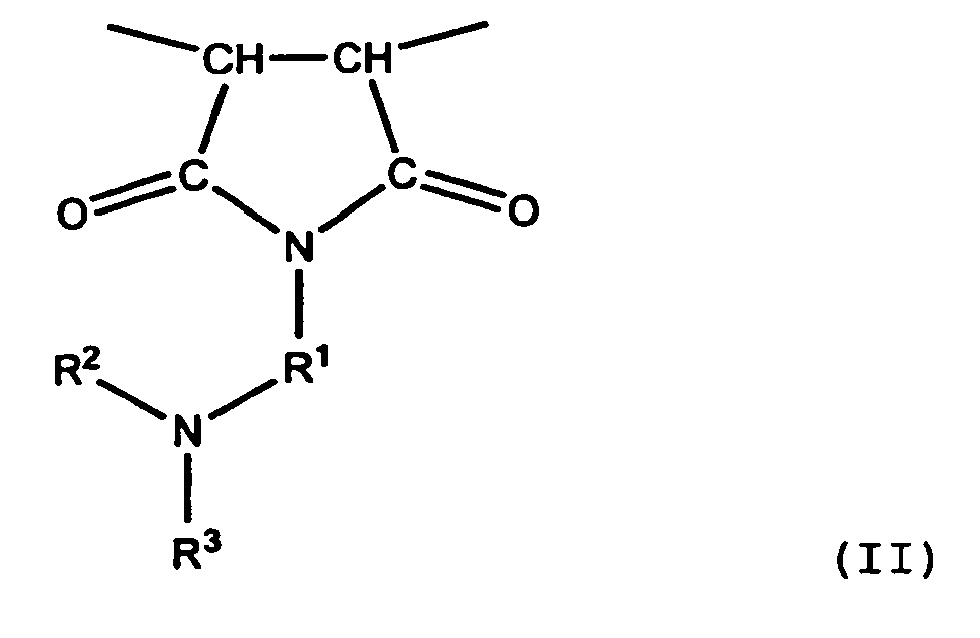
- Polymers with a maleimide structure to be used for the invention include polymers comprising an isobutylene unit represented by the following formula (I) and a maleimide unit represented by the following formula (II) (wherein R 1 represents a C 2-6 straight-chain or branched alkylene group, and R 2 and R 3 may be the same or different and each represents a C 1-6 straight-chain or branched alkyl group), and preferably it has the isobutylene unit and maleimide unit in alternating repetition.
- the polymer with a maleimide structure according to the invention may be easily obtained by dehydrating condensation reaction of a polymer comprising an isobutylene unit represented by the following formula (I) and a maleic anhydride unit represented by the following formula (III), with a diamine represented by the following formula (IV).
- Polymers comprising isobutylene and maleic anhydride can be produced with different monomer proportions by selecting the polymerization method and monomer ratio, but from the viewpoint of facilitating production and reducing cost, a polymer with a monomer ratio of 1 and alternatingly copolymerized is preferred, an example of which is ISOBAM 04 (product of Kuraray Co., Ltd.).
- the diamine used for formation of the maleimide may be any one such that the formed maleimide structure satisfies formula (II) above, and preferred examples thereof include 2-dimethylaminoethylamine, 2-diethylaminoethylamine, 2-di-n-propylaminoethylamine, 2-diisopropylaminoethylamine, 2-di-n-butylaminoethylamine, 2-diisobutylaminoethylamine, 2-di-tert-butylaminoethylamine, 2-di-n-pentylaminoethylamine, 2-din-hexylaminoethylamine, 3-dimethylaminopropylamine, 3-diethylaminopropylamine, 3-di-n-propylaminopropylamine, 3-diisopropylaminopropylamine, 3-di-n-butylaminopropylamine,
- the same phenomenon may be produced by some of the low-molecular-weight components or high-molecular-weight components.
- the molecular weight referred to here will be explained in more detail below, but it is the molecular weight in terms of PMMA and may be determined by GPC (gel permeation chromatography).
- the polymer with a maleimide structure according to the invention has a reactive amine content of no greater than 5.0 ⁇ 10 -2 millimole equivalents per gram of polymer. It is preferably no greater than 4.5 ⁇ 10 -2 millimole equivalents, more preferably no greater than 4.0 ⁇ 10 -2 millimole equivalents and most preferable no greater than preferably 3.0 ⁇ 10 -2 millimole equivalents. Including such a polymer can improve the fastness of the polyurethane elastic fibers dyed with acidic dyes, and especially the staining properties onto nylon white fabrics.
- the reactive amine is composed primarily of primary amines from the starting compound.
- the reactive amine content is the content of unreacted amine groups other than those of the polymer skeleton in the polymer with a maleimide structure, and it may be measured by an acid-base titration test, as explained hereunder.
- a reactive amine content per gram of polymer of 3.0 ⁇ 10 -2 millimole equivalents is the detection limit for experimental operation.
- a polymer having a maleimide structure and a reactive amine content of no greater than 5.0 ⁇ 10 -2 millimole equivalents per gram of polymer, according to the invention, can be suitably obtained by a method of reducing the mole equivalents of diamines in comparison with those of the polymer composed of isobutylene and maleic anhydride in the starting compounds, or by distilling off the residual volatile components by heating under reduced pressure upon completion of the reaction.
- the shear viscosity of the polymer with a maleimide structure in the polyurethane elastic fibers of the invention is preferably in the range of 6 to 30 Pa ⁇ s (60-300 poise), more preferably in the range of 8 to 30 Pa ⁇ s (80-300 poise), even more preferably in the range of 8 to 20 Pa ⁇ s (80-200 poise) and most preferably in the range of 9 to 20 Pa ⁇ s (90-200 poise) in a 50% dimethylacetamide solution, from the viewpoint of spinning stability.
- a shear viscosity in this range will avoid gelling.
- the shear viscosity is preferably 6 to 40 Pa ⁇ s (60-400 poise) when the polymer solution is allowed to stand at 55°C for 20 days.
- the polymer solution will have excellent stability.
- the shear viscosity referred to here will be described in detail hereunder, and it may be measured using a Brookfield viscometer.
- the polymer with a maleimide structure By adding the polymer with a maleimide structure to a polyurethane-based polymer in an amount of 0.2 wt%-10 wt%, it is possible to increase the dye affinity and fastness of the polyurethane elastic fibers.
- the content is more preferably 0.5 wt%-10 wt%. At less than 0.2 wt% the exhibited dyeing affinity will not be sufficient, and at greater than 10 wt% the excessive deep dyeing will result in grinning and poor fastness.
- the polyurethane elastic fibers of the invention have a deep dyeing property similar to polyamide fibers. Specifically, they are characterized by having a Blue L value of 20-50 after laundering according to JIS L0844 A2, when a bare single-loop tube-knit fabric of the polyurethane elastic fibers is dyed with a specific blue acidic dye. The value is more preferably 20-35.
- the Blue L value is the lightness of a blue-dyed tube-knit fabric, and it can be measured with a spectrophotometer. A larger L value indicates a lighter color while a smaller value indicates a darker color. In most cases, the Blue L value for polyamide fibers will be 28-32.
- a Blue L value of greater than 50 results in a lighter color of the polyurethane elastic fibers and thus tends to cause grinning in mixed knitted fabrics with polyamide fibers and the like. Conversely, a value of less than 20 results in excessively dark coloration, causing predominance of the color of the polyurethane elastic fibers at the fabric surface and disrupting the balance of color of the fabric as a whole.
- the polyurethane elastic fibers of the invention contain a polymer with a specific maleimide structure as mentioned above, sufficiently deep dye affinity is maintained even after laundering, while the washing fastness is excellent and the staining degree onto nylon white fabrics is grade 3.5 or greater based on washing fastness (JIS L0844 A2).
- a poor staining degree can lead to crocking and consequently staining of other fabrics.
- the staining degree is evaluated by observing the staining degree for acidic dyeable fibers.
- the polyurethane elastic fibers of the invention contain dyeing sites for acidic dyes.
- the number of dyeing sites is preferably at least 7.0 ⁇ 10 -3 millimole equivalents and no greater than 3.5 ⁇ 10 -1 millimole equivalents per gram of the polyurethane elastic fibers.
- a "dyeing site” means an amine site having basicity that is titratable with an acid such as hydrochloric acid.
- the polyurethane-based polymer used for the invention may be produced by a known technique involving, for example, reacting a polymer glycol having a number-average molecular weight of 600-5000 with an organic diisocyanate to synthesize a urethane intermediate polymer to form soft segments, and then polymerizing hard segments with a chain extender and sealing the ends with an end terminator.
- a chain extender Using a low molecular diol as the chain extender will yield a polyurethane polymer composed of urethane bonds as the hard segment, while using a bifunctional amine will yield a polyurethane-urea polymer composed of urea bonds as the hard segment.
- polymer glycols there may be mentioned homopolyether diols such as polyoxyethylene glycol, polyoxypropylene glycol, polyoxytetramethylene glycol and polyoxypentamethylene glycol, copolymer polyether diols composed of oxyalkylenes with 2-6 carbon atoms, polyester diols obtained from one or more dibasic acids such as adipic acid, sebacic acid, maleic acid, itaconic acid, azelaic acid and malonic acid and one or more glycols such as ethylene glycol, 1,2-propylene glycol, 1,3-propylene glycol, 2,2-dimethyl-1,3-propanediol, 1,4-butanediol, 1,3-butanediol, hexamethylene glycol, diethylene glycol, 1,10-decanediol, 1,3-dimethylolcyclohexane and 1,4-dimethylolcyclohexane, polyesteramide di
- organic diisocyanates there may be mentioned methylene-bis(4-phenyl isocyanate), methylene-bis(3-methyl-4-phenyl isocyanate), 2,4-tolylene diisocyanate, 2,6-tolylene diisocyanate, m- and p-xylylene diisocyanate, ⁇ , ⁇ , ⁇ ', ⁇ '-tetramethyl-xylylene diisocyanate, m- and p-phenylene diisocyanate, 4,4'-dimethyl-1,3-xylylene diisocyanate, 1-alkylphenylene-2,4 and 2,6-diisocyanate, 3-( ⁇ -isocyanatoethyl)phenyl isocyanate, 2,6-diethylphenylene-1,4-diisocyanate, diphenyl-dimethylmethane-4,4-diisocyanate, diphenyl ether-4,4'-diisocyanate
- chain extenders with polyfunctional active hydrogens there may be used hydrazine, polyhydrazine, C 2-10 straight-chain or branched aliphatic, alicyclic or aromatic compounds containing amino groups with active hydrogens, such as ethylenediamine and 1,2-propylenediamine, the diamines with urea groups mentioned in Japanese Unexamined Patent Publication No.
- hydroxylamine, water, and low-molecular-weight glycols such as ethylene glycol, 1,2-propylene glycol, 1,3-propylene glycol, 2,2-dimethyl-1,3-propanediol, 1,4-butanediol, 1,3-butanediol, hexamethylene glycol, diethylene glycol, 1,10-decanediol, 1,3-dimethylolcyclohexane and 1,4-dimethylolcyclohexane.
- Ethylenediamine and 1,2-propylenediamine are preferred.
- end terminators with monofunctional active hydrogens there may be used dialkylamines such as diethylamine and alkyl alcohols such as ethanol. These chain extenders and end terminators may be used alone or in combinations of two or more.
- the polyurethane-based polymer may also contain other added compounds ordinarily used in polyurethane elastic fibers, such as ultraviolet absorbers, antioxidants, light stabilizers, anti-chlorine agents, gasproof stabilizers, coloring agents, delustering agents and fillers.
- the polyurethane-based polymer obtained in the manner described above can be shaped into fibers by publicly known dry spinning, wet spinning or melt spinning processes to produce polyurethane elastic fibers.
- the obtained polyurethane elastic fibers may also be used with oils including polydimethylsiloxanes, polyester-modified silicon, polyether-modified silicon, amino-modified silicon, mineral oils, mineral-based fine particles such as silica, colloidal alumina or talc, higher fatty acid metal salt powders such as magnesium stearate or calcium stearate, higher aliphatic carboxylic acids, higher aliphatic alcohols, and solid waxes at ordinary temperature such as paraffins and polyethylene, either alone or in any desired combinations as necessary.
- oils including polydimethylsiloxanes, polyester-modified silicon, polyether-modified silicon, amino-modified silicon, mineral oils, mineral-based fine particles such as silica, colloidal alumina or talc, higher fatty acid metal salt powders such as magnesium stearate or calcium stearate, higher aliphatic carboxylic acids, higher aliphatic alcohols, and solid waxes at ordinary temperature such as paraffins and polyethylene, either alone or in
- the polyurethane elastic fibers of the invention has satisfactory colorability and washing fastness, and minimal areas of grinning, when dyed with acidic dyes in mixed fabrics with acidic dyeable fibers.
- acidic dyeable fibers there may be mentioned publicly known polyamide fibers, including notably nylon 6 fibers and nylon 66 fibers.
- the polyurethane elastic fibers of the invention even in mixed fabrics with non-acidic dyeable fibers, have the same coloring properties as non-acidic dyeable fibers in methods wherein, for example, non-acidic dyeable fibers are first dyed with a disperse dye or the like and then the polyurethane elastic fibers are dyed with an acidic dye, and they therefore exhibit minimal areas of grinning and satisfactory fastness so that superior mixed fabrics are obtained.
- Known polyester fibers may be mentioned as non-acidic dyeable fibers. They may also be used in admixture with other materials depending on the purpose of use, and the types, forms and finenesses of the other materials may be appropriately selected without any particular restrictions. As examples there may be mentioned natural fibers such as cotton, silk, wool and hemp, cupra rayon, viscose rayon, acetate rayon and the like.
- a single-loop circular knitting machine (Model CR-C by Koike Kikai Seisakujo, 8.89cm (3.5-inch), 380 strands) was used to produce a bare knitted fabric from test fibers. The bare knitted fabric of the test fibers was weighed out to 1.2 g.
- a polyamide fiber knitted fabric was prepared using four MIRACOSMO (nylon 6) (56 dT/17 filament) filaments by Toray Co., Ltd. paralleled and knitted into a bare knitted fabric with a single-loop circular knitting machine (Model TN-7 by Koike Kikai Seisakujo, 8.89cm (3.5 inch), 200 strands), and was then weighed out to 4.8 g.
- test fiber knitted fabric and the polyamide fiber knitted fabric were scoured at 80°C ⁇ 20 minutes and then subjected to dyeing treatment for 60 minutes at 90°C in the same bath under conditions with 1% owf of an acidic half-milling dye (Telon BLUE A2R, product of DyStar), 0.6% owf of a level dyeing agent (SeraGal N-FS, product of DyStar), 4.0% owf of ammonium sulfate, and a liquor to goods ratio of 1:50.
- an acidic half-milling dye Telon BLUE A2R, product of DyStar
- level dyeing agent SeraGal N-FS, product of DyStar
- ammonium sulfate sodium bicarbonate
- the dyed test fiber bare knitted fabric was laundered according to JIS L0844 A2.
- Nylon conforming to JIS L0803 was used as an added white fabric.
- the Blue L value of an air-dried sample, as a tube-knit fabric, was measured using a spectral color-difference meter (SQ-2000, product of Nippon Denshoku Industries Co., Ltd.). A lower L value is preferred, indicating a state of deeper dyeing.
- the polymer with a maleimide structure was adjusted to 1.0 mg/mL, and the solution was used as a reagent for GPC measurement.
- An eluent comprising LiBr dissolved in dimethylacetamide to 10 mmol/L was used.
- a tensile tester (Model UTM-III 100, trade name of Orientech Co., Ltd.) was used to measure the tensile breaking strength and elongation of a 5 cm sample length of the test filament at a speed of 50 cm/min, under conditions of 20°C, 65% humidity.
- An Okuma single circular knitting machine (76.2cm (30 inch), 24 gauge) was used for paralleling of two test filaments through a single aperture at a draft of 1.7, and three nylon 6 (MIRACOSMO, product of Toray Co., Ltd.) 56 dT/17 filaments were used with one aperture per filament, for paralleling with a total of four apertures to prepare a mixed knitted fabric. After scouring for 20 minutes at 80°C, the fabric was dyed.
- the dyeing was carried out after weighing 6 g of the mixed fabric.
- the dyeing treatment was carried out for 60 minutes at 90°C under conditions with 1% owf of an acidic half-milling dye (Telon BLUE A2R, product of DyStar), 0.6% owf of a level dyeing agent (SeraGalN-FS, product of DyStar), 4.0% owf of ammonium sulfate, and a liquor to goods ratio of 1:50.
- the mixed dyed product (fabric) was stretched and visually examined for grinning, which was judged on a scale of level 1 to 4.
- Level 4 was assigned for absolutely no apparent difference in dyeing concentration between the polyurethane elastic fibers and polyamide fibers
- level 3 was assigned for sufficient dyeing of the polyurethane elastic fibers but with a slight difference in dyeing concentration compared to the polyamide fibers
- level 2 was assigned for satisfactory dyeing of the polyurethane elastic fibers but with a significant difference in dyeing concentration compared to the polyamide fibers, clearly distinguishing the polyurethane elastic fibers
- level 1 was assigned for grinning that clearly distinguished the polyurethane elastic fibers, which were essentially undyed.
- Dry spinning was performed with a single end spinning machine at a spinning speed of 800 m/min and a hot air temperature of 325°C, to produce 44 dT/4 filament fibers. Spinning was continued for 1 hour, and evaluation was performed according to the following criteria
- the obtained polymer had a weight-average molecular weight Mw of 1.0 ⁇ 10 5 , a molecular weight distribution Mw/Mn of 2.7, an amine value of 3.64 mmol/g and a reactive amine content of no greater than 3.0 ⁇ 10 -2 millimole equivalents.
- the shear viscosity of the 50% dimethylacetamide solution was 10.2 Pa ⁇ s (102 poise). After allowing the solution to stand at 55°C for 20 days, the shear viscosity was measured to be 145 poise and virtually no coloration was observed.
- a mixture of 1500 g of polytetramethylene ether glycol with an average molecular weight of 1800 and 312 g of 4,4'-diphenylmethane diisocyanate was stirred under a nitrogen gas stream at 60°C for a period of 90 minutes for reaction to obtain a polyurethane prepolymer having isocyanate groups at both ends.
- the prepolymer was then cooled to room temperature and 2700 g of dimethylacetamide was added to dissolution to prepare a polyurethane prepolymer solution.
- a bare knitted fabric of the obtained polyurethane elastic fibers was dyed blue, and the Blue L value and staining degree after laundering were evaluated. The results are shown in Table 1.
- a mixed knitting fabric comprising the polyurethane elastic fibers and nylon 6 fibers was also prepared and dyed, and the degree of grinning was evaluated. The evaluation results are shown in Table 1.
- Example 2 Spinning was performed under the same conditions as Example 1, except that no polymer with a maleimide structure was added.
- the tensile breaking strength, the Blue L value and staining degree after laundering and the degree of grinning were evaluated in the same manner as Example 1. The evaluation results are shown in Table 1.
- the polymer was used for spinning under the same conditions as Example 1, and the Blue L value and staining degree after laundering and the degree of grinning were evaluated. The evaluation results are shown in Table 1. When the solution was allowed to stand at 55°C for 20 days, the shear viscosity was 55 Pa ⁇ s (550 poise) and coloration and gelling were observed.
- the polyurethane elastic fibers of the invention have excellent spinning stability, sufficient dyeability with acidic dyes and superior fastness, and therefore clothing articles without grinning and with excellent visual quality can be obtained from mixed fabrics containing the polyurethane elastic fibers, and the fibers can be supplied in a stable manner.
Landscapes
- Chemical & Material Sciences (AREA)
- Chemical Kinetics & Catalysis (AREA)
- General Chemical & Material Sciences (AREA)
- Engineering & Computer Science (AREA)
- Textile Engineering (AREA)
- Organic Chemistry (AREA)
- Medicinal Chemistry (AREA)
- Polymers & Plastics (AREA)
- Health & Medical Sciences (AREA)
- Artificial Filaments (AREA)
- Knitting Of Fabric (AREA)
- Woven Fabrics (AREA)
- Coloring (AREA)
- Yarns And Mechanical Finishing Of Yarns Or Ropes (AREA)
- Compositions Of Macromolecular Compounds (AREA)
- Polyurethanes Or Polyureas (AREA)
- Laminated Bodies (AREA)
Abstract
Description
- The present invention relates to polyurethane elastic fibers, and more specifically it relates to polyurethane elastic fibers with uniform dyeability that have a low degree of color unevenness and grinning during dyeing with acidic dyes, as well as high fastness, and which have deep dyeing properties equivalent to polyamide fibers and the like which are used as conventional acidic dyeable fibers.
- Elastic fibers composed of polymers comprising polyurethane or polyurethane-urea as the major structural unit (hereinafter referred to as "polyurethane elastic fibers") exhibit excellent performance including elastic properties and chemical resistance, and are therefore woven and knitted in mixture mainly with polyamide fibers or polyester fibers and widely used as expanding materials for numerous types of clothing, including foundations, socks, panty stockings and sportswear. In recent years, it has been a goal to increase the polyurethane elastic fiber contents of fabrics in order to further improve their stretch function as clothing.
- However, since polyurethane elastic fibers do not have effective dyeing sites for acidic dyes in the molecules of the polyurethane polymers or polyurethane-urea polymers (hereinafter referred to as "polyurethane-based polymers") composing them, when fabrics thereof knitted or woven in mixture with polyamide fibers are dyed with acidic dyes, the polyurethane elastic fibers have poor dyeability compared to the polyamide fibers that have numerous dyeing sites, resulting in a condition in which the fibers simply retain the dye, or in other words are merely "stained" with the dye. As a result, it is not only impossible to ensure a deep dyeing property equivalent to that of polyamide fibers, but crocking tends to occur during laundering, and this causes "grinning" and "glare" which significantly lower the visual quality of the final product. This tendency is particularly notable with deep colored products, causing reduced visual quality due to a lack of clarity of deep color, i.e. depth of the fabric color in the case of clothing, and depending on the purpose of use this may place restrictions on the mixing ratio of the polyurethane elastic fibers. Other kinds of fabric staining due to crocking can also pose a significant problem and can place restrictions on the use of polyurethane elastic fibers.
- Methods of adding tertiary nitrogen atoms to the molecular chains of polyurethane polymers are known as means of solving these problems (see Patent documents 1-4 and Non-patent document 1), but when such methods are employed it is not only difficult to achieve the same level of deep dyeing properties as polyamide fibers, but in some cases the physical properties of the polyurethane elastic fibers are impaired.
- There have also been proposed methods of mixing polyurethane polymers with dye affinity improvers that bind acidic dyes (see Patent documents 5-7), but such methods have not been capable of producing deep dyeing properties and high washing fastness with knitted fabrics.
In addition, "mass-colored filaments" wherein the polyurethane fiber itself is colored, have also been proposed (see Patent document 8), but they are not suitable for different types of color tones and the uses thereof have therefore been limited. - There has also been developed a method for improving the deep dyeing property by adding a polymer with a maleimide structure containing a tertiary nitrogen as a dyeing improver (see Patent document 9), but since some reactive amines, such as the unreacted portions of the diamines as one of the starting materials, are present in known polymers comprising maleimide structures containing tertiary nitrogens, the dye in polyurethane elastic fibers containing such a polymer tends to migrate onto nylon white fabrics during laundering together with nylon white fabrics after dyeing. Also, it has been found that the dyeing improvers used in such polymers can cause coloring and gelling with day-to-day changes. Such coloring and gelling affect the hue or spinning stability of the fibers.
-
- [Patent document 1] Japanese Examined Patent Publication No.
39-23097 - [Patent document 2] Japanese Examined Patent Publication No.
47-51645 - [Patent document 3] Japanese Examined Patent Publication No.
59-12789 - [Patent document 4] Japanese Examined Patent Publication No.
61-7212 - [Patent document 5] Japanese Unexamined Patent Publication No.
64-52889 - [Patent document 6] Japanese Unexamined Patent Publication No.
2000-313802 - [Patent document 7] Japanese Unexamined Patent Publication No.
2001-40587 - [Patent document 8] Japanese Unexamined Patent Publication No.
2004-60062 - [Patent document 9] Japanese Examined Patent Publication No.
3-6177 - [Non-patent document 1] Journal of the Society of Rheology, Japan, 2001, Vol. 29, P191
- In light of the aforementioned problems of the prior art, it is an object of the present invention to provide polyurethane elastic fibers that, when dyed with acidic dyes, exhibit a deep dyeing property and high fastness equivalent to those of polyamide fibers used as a companion material in mixed knitted and woven fabrics, while also exhibiting excellent spinning stability.
- The present inventors have found that polyurethane elastic fibers comprising a polymer with a specific maleimide structure have a deep dyeing property equivalent to those of polyamide fibers and high fastness while also allowing stable spinning, and on this basis we have completed this invention.
- The present invention is as follows:
- 1. Polyurethane elastic fibers comprising 0.2 wt%-10 wt% of a polymer with a maleimide structure comprising an isobutylene unit represented by the following formula (I) and a maleimide unit represented by the following formula (II) (wherein R1 represents a C2-6 straight-chain or branched alkylene group, and R2 and R3 may be the same or different and each represents a C1-6 straight-chain or branched alkyl group), having a Blue L value of 20-50 after laundering according to JIS L0844 A2 for dyeing of a single-loop tube-knit fabric with a specific blue acidic dye, and having a staining degree of grade 3.5 or greater on nylon fabrics, wherein the maleimide structure-containing polymer has a reactive amine content of no greater than 5.0 x 10⁻² millimole equivalents per gram of polymer

- 2. Polyurethane elastic fibers according to item 1,
wherein the density of dyeing sites for the acidic dye are at least 7.0 × 10⁻³ millimole equivalent and no greater than 3.5 × 10⁻¹ millimole equivalent per gram of fibers. - 3. Polyurethane elastic fibers according to item 1 or 2, wherein the weight-average molecular weight Mw of the maleimide structure-containing polymer is 80,000-150,000, and Mw/Mn (Mn = number-average molecular weight) is no greater than 3.5.
- 4. A mixed fabric comprising polyurethane elastic fibers according to any one of items 1 to 3 and another acidic dyeable fiber.
- 5. A mixed fabric according to item 4, wherein the other acidic dyeable fiber is a polyamide fiber.
- 6. A mixed fabric comprising polyurethane elastic fibers according to any one of items 1 to 3 and another non-acidic dyeable fiber.
- 7. A mixed fabric according to item 6, wherein the other non-acidic dyeable fiber is a polyester fiber.
- According to the invention, it is possible to achieve high fastness without bleeding on fiber surfaces since the dyeing component in the acidic dye is a high-molecular-weight polymer. Moreover, because of the high dyeing affinity, the dyed quality can be improved and the fibers can be suitably used in various mixed knitted and woven fabrics with polyamide fibers and polyester fibers, including foundations, socks, panty stockings and sportswear. In addition, since the dyeing component is resistant to gelling, the polyurethane elastic fibers of the invention can be supplied in a stable manner.
- The invention will now be explained in detail.
The polyurethane elastic fibers of the invention are characterized by comprising a polymer containing a maleimide structure.
Polymers with a maleimide structure to be used for the invention include polymers comprising an isobutylene unit represented by the following formula (I) and a maleimide unit represented by the following formula (II) (wherein R1 represents a C2-6 straight-chain or branched alkylene group, and R2 and R3 may be the same or different and each represents a C1-6 straight-chain or branched alkyl group), and preferably it has the isobutylene unit and maleimide unit in alternating repetition.

- The polymer with a maleimide structure according to the invention may be easily obtained by dehydrating condensation reaction of a polymer comprising an isobutylene unit represented by the following formula (I) and a maleic anhydride unit represented by the following formula (III), with a diamine represented by the following formula (IV). Polymers comprising isobutylene and maleic anhydride can be produced with different monomer proportions by selecting the polymerization method and monomer ratio, but from the viewpoint of facilitating production and reducing cost, a polymer with a monomer ratio of 1 and alternatingly copolymerized is preferred, an example of which is ISOBAM 04 (product of Kuraray Co., Ltd.).


- The diamine used for formation of the maleimide may be any one such that the formed maleimide structure satisfies formula (II) above, and preferred examples thereof include 2-dimethylaminoethylamine, 2-diethylaminoethylamine, 2-di-n-propylaminoethylamine, 2-diisopropylaminoethylamine, 2-di-n-butylaminoethylamine, 2-diisobutylaminoethylamine, 2-di-tert-butylaminoethylamine, 2-di-n-pentylaminoethylamine, 2-din-hexylaminoethylamine, 3-dimethylaminopropylamine, 3-diethylaminopropylamine, 3-di-n-propylaminopropylamine, 3-diisopropylaminopropylamine, 3-di-n-butylaminopropylamine, 3-diisobutylaminopropylamine, 3-di-tert-butylaminopropylamine, 3-di-n-pentylaminopropylamine, 3-di-n-hexylaminopropylamine, 4-dimethylaminobutylamine, 4-diethylaminobutylamine, 4-din-propylaminobutylamine, 4-diisopropylaminobutylamine, 4-di-n-butylaminobutylamine, 4-diisobutylaminobutylamine, 4-di-tert-butylaminobutylamine, 4-di-n-pentylaminobutylamine, 4-di-n-hexylaminobutylamine, 2-dimethylamino-2-methylpropylamine, 2-diethylamino-2-methylpropylamine, 2-di-n-propylamino-2-methylpropylamine, 2-diisopropylamino-2-methylpropylamine, 2-di-n-butylamino-2-methylpropylamine, 2-diisobutylamino-2-methylpropylamine, 2-di-tert-butylamino-2-methylpropylamine, 2-di-n-pentylamino-2-methylpropylamine, 2-di-n-hexylamino-2-methylpropylamine, 2-dimethylamino-1,1-dimethylethylamine, 2-diethylamino-1,1-dimethylethylamine, 2-di-n-propylamino-1,1-dimethylethylamine, 2-diisopropylamino-1,1-dimethylethylamine, 2-di-n-butylamino-1,1-dimethylethylamine, 2-diisobutylamino-1,1-dimethylethylamine, 2-di-tert-butylamino-1,1-dimethylethylamine, 2-di-n-pentylamino-1,1-dimethylethylamine, 2-di-n-hexylamino-1,1-dimethylethylamine, 5-dimethylaminopentylamine, 5-diethylaminopentylamine, 5-di-n-propylaminopentylamine, 5-diisopropylaminopentylamine, 5-di-n-butylaminopentylamine, 5-diisobutylaminopentylamine, 5-di-tert-butylaminopentylamine, 5-di-n-pentylaminopentylamine, 5-di-n-hexylaminopentylamine, 3-dimethylamino-2,2-dimethylpropylamine, 3-diethylamino-2,2-dimethylpropylamine, 3-di-n-propylamino-2,2-dimethylpropylamine, 3-diisopropylamino-2,2-dimethylpropylamine, 3-di-n-butylamino-2,2-dimethylpropylamine, 3-diisobutylamino-2,2-dimethylpropylamine, 3-di-tert-butylamino-2,2-dimethylpropylamine, 3-di-n-pentylamino-2,2-dimethylpropylamine, 3-di-n-hexylamino-2,2-dimethylpropylamine, 6-dimethylaminohexylamine, 6-diethylaminohexylamine, 6-di-n-propylaminohexylamine, 6-diisopropylaminohexylamine, 6-di-n-butylaminohexylamine, 6-diisobutylaminohexylamine, 6-di-tert-butylaminohexylamine, 6-di-n-pentylaminohexylamine, 6-din-hexylaminohexylamine, and mixtures of the foregoing, with 2-diethylaminoethylamine, 3-dibutylaminopropylamine and 3-diethylaminopropylamine being especially preferred.
- The weight-average molecular weight Mw of the polymer with a maleimide structure in the polyurethane elastic fibers of the invention is preferably 80,000-150,000, and Mw/Mn (Mn = number-average molecular weight) is preferably no greater than 3.5. More preferably, Mw is 90,000-120,000 and Mw/Mn is no greater than 3.0. If the molecular weight is too low, bleed out of the polymer at the surface will tend to cause the polymer drop outs, while if the molecular weight is too high the polymer will not easily disperse in an even manner in the spinning stock solution. If the molecular weight distribution is too large, also, the same phenomenon may be produced by some of the low-molecular-weight components or high-molecular-weight components. The molecular weight referred to here will be explained in more detail below, but it is the molecular weight in terms of PMMA and may be determined by GPC (gel permeation chromatography).
- The polymer with a maleimide structure according to the invention has a reactive amine content of no greater than 5.0 × 10⁻² millimole equivalents per gram of polymer. It is preferably no greater than 4.5 × 10⁻² millimole equivalents, more preferably no greater than 4.0 × 10⁻² millimole equivalents and most preferable no greater than preferably 3.0 × 10⁻² millimole equivalents. Including such a polymer can improve the fastness of the polyurethane elastic fibers dyed with acidic dyes, and especially the staining properties onto nylon white fabrics.
- The reactive amine is composed primarily of primary amines from the starting compound. The reactive amine content is the content of unreacted amine groups other than those of the polymer skeleton in the polymer with a maleimide structure, and it may be measured by an acid-base titration test, as explained hereunder. A reactive amine content per gram of polymer of 3.0 × 10⁻² millimole equivalents is the detection limit for experimental operation.
- A polymer having a maleimide structure and a reactive amine content of no greater than 5.0 × 10⁻² millimole equivalents per gram of polymer, according to the invention, can be suitably obtained by a method of reducing the mole equivalents of diamines in comparison with those of the polymer composed of isobutylene and maleic anhydride in the starting compounds, or by distilling off the residual volatile components by heating under reduced pressure upon completion of the reaction.
- The shear viscosity of the polymer with a maleimide structure in the polyurethane elastic fibers of the invention is preferably in the range of 6 to 30 Pa·s (60-300 poise), more preferably in the range of 8 to 30 Pa·s (80-300 poise), even more preferably in the range of 8 to 20 Pa·s (80-200 poise) and most preferably in the range of 9 to 20 Pa·s (90-200 poise) in a 50% dimethylacetamide solution, from the viewpoint of spinning stability. A shear viscosity in this range will avoid gelling. Also, the shear viscosity is preferably 6 to 40 Pa·s (60-400 poise) when the polymer solution is allowed to stand at 55°C for 20 days. If the polymer has a reactive amine content of no greater than 5.0 × 10⁻² millimole equivalents, the polymer solution will have excellent stability. The shear viscosity referred to here will be described in detail hereunder, and it may be measured using a Brookfield viscometer.
- By adding the polymer with a maleimide structure to a polyurethane-based polymer in an amount of 0.2 wt%-10 wt%, it is possible to increase the dye affinity and fastness of the polyurethane elastic fibers. The content is more preferably 0.5 wt%-10 wt%. At less than 0.2 wt% the exhibited dyeing affinity will not be sufficient, and at greater than 10 wt% the excessive deep dyeing will result in grinning and poor fastness.
- The polyurethane elastic fibers of the invention have a deep dyeing property similar to polyamide fibers. Specifically, they are characterized by having a Blue L value of 20-50 after laundering according to JIS L0844 A2, when a bare single-loop tube-knit fabric of the polyurethane elastic fibers is dyed with a specific blue acidic dye. The value is more preferably 20-35. As will be explained in more detail below, the Blue L value is the lightness of a blue-dyed tube-knit fabric, and it can be measured with a spectrophotometer. A larger L value indicates a lighter color while a smaller value indicates a darker color. In most cases, the Blue L value for polyamide fibers will be 28-32. A Blue L value of greater than 50 results in a lighter color of the polyurethane elastic fibers and thus tends to cause grinning in mixed knitted fabrics with polyamide fibers and the like. Conversely, a value of less than 20 results in excessively dark coloration, causing predominance of the color of the polyurethane elastic fibers at the fabric surface and disrupting the balance of color of the fabric as a whole.
- Since the polyurethane elastic fibers of the invention contain a polymer with a specific maleimide structure as mentioned above, sufficiently deep dye affinity is maintained even after laundering, while the washing fastness is excellent and the staining degree onto nylon white fabrics is grade 3.5 or greater based on washing fastness (JIS L0844 A2). A poor staining degree can lead to crocking and consequently staining of other fabrics. As will be explained hereunder, the staining degree is evaluated by observing the staining degree for acidic dyeable fibers.
- By addition of the polymer with a maleimide structure, the polyurethane elastic fibers of the invention contain dyeing sites for acidic dyes. The number of dyeing sites is preferably at least 7.0 × 10⁻³ millimole equivalents and no greater than 3.5 × 10⁻¹ millimole equivalents per gram of the polyurethane elastic fibers. A "dyeing site" means an amine site having basicity that is titratable with an acid such as hydrochloric acid.
- The polyurethane-based polymer used for the invention may be produced by a known technique involving, for example, reacting a polymer glycol having a number-average molecular weight of 600-5000 with an organic diisocyanate to synthesize a urethane intermediate polymer to form soft segments, and then polymerizing hard segments with a chain extender and sealing the ends with an end terminator. Using a low molecular diol as the chain extender will yield a polyurethane polymer composed of urethane bonds as the hard segment, while using a bifunctional amine will yield a polyurethane-urea polymer composed of urea bonds as the hard segment. As examples of polymer glycols there may be mentioned homopolyether diols such as polyoxyethylene glycol, polyoxypropylene glycol, polyoxytetramethylene glycol and polyoxypentamethylene glycol, copolymer polyether diols composed of oxyalkylenes with 2-6 carbon atoms, polyester diols obtained from one or more dibasic acids such as adipic acid, sebacic acid, maleic acid, itaconic acid, azelaic acid and malonic acid and one or more glycols such as ethylene glycol, 1,2-propylene glycol, 1,3-propylene glycol, 2,2-dimethyl-1,3-propanediol, 1,4-butanediol, 1,3-butanediol, hexamethylene glycol, diethylene glycol, 1,10-decanediol, 1,3-dimethylolcyclohexane and 1,4-dimethylolcyclohexane, polyesteramide diols, polyesterether diols, polylactone diols such as poly-ε-caprolactone diol and polyvalerolactone diol, polycarbonate diol, polyacryl diol, polythioether diol, and polythioester diol, or copolymers or mixtures of these diols.
- As examples of organic diisocyanates there may be mentioned methylene-bis(4-phenyl isocyanate), methylene-bis(3-methyl-4-phenyl isocyanate), 2,4-tolylene diisocyanate, 2,6-tolylene diisocyanate, m- and p-xylylene diisocyanate, α,α,α',α'-tetramethyl-xylylene diisocyanate, m- and p-phenylene diisocyanate, 4,4'-dimethyl-1,3-xylylene diisocyanate, 1-alkylphenylene-2,4 and 2,6-diisocyanate, 3-(α-isocyanatoethyl)phenyl isocyanate, 2,6-diethylphenylene-1,4-diisocyanate, diphenyl-dimethylmethane-4,4-diisocyanate, diphenyl ether-4,4'-diisocyanate, naphthylene-1,5-diisocyanate, 1,6-hexamethylene diisocyanate, methylene-bis(4-cyclohexyl isocyanate), 1,3- and 1,4-cyclohexylene diisocyanate, trimethylene diisocyanate, tetramethylene diisocyanate, pentamethylene diisocyanate, hexamethylene diisocyanate, isophorone diisocyanate, and mixtures of the foregoing.
- As examples of chain extenders with polyfunctional active hydrogens there may be used hydrazine, polyhydrazine, C2-10 straight-chain or branched aliphatic, alicyclic or aromatic compounds containing amino groups with active hydrogens, such as ethylenediamine and 1,2-propylenediamine, the diamines with urea groups mentioned in Japanese Unexamined Patent Publication No.
5-155841 - As examples of end terminators with monofunctional active hydrogens there may be used dialkylamines such as diethylamine and alkyl alcohols such as ethanol. These chain extenders and end terminators may be used alone or in combinations of two or more.
- In addition to the polymer with a maleimide structure according to the invention, the polyurethane-based polymer may also contain other added compounds ordinarily used in polyurethane elastic fibers, such as ultraviolet absorbers, antioxidants, light stabilizers, anti-chlorine agents, gasproof stabilizers, coloring agents, delustering agents and fillers.
The polyurethane-based polymer obtained in the manner described above can be shaped into fibers by publicly known dry spinning, wet spinning or melt spinning processes to produce polyurethane elastic fibers. - The obtained polyurethane elastic fibers may also be used with oils including polydimethylsiloxanes, polyester-modified silicon, polyether-modified silicon, amino-modified silicon, mineral oils, mineral-based fine particles such as silica, colloidal alumina or talc, higher fatty acid metal salt powders such as magnesium stearate or calcium stearate, higher aliphatic carboxylic acids, higher aliphatic alcohols, and solid waxes at ordinary temperature such as paraffins and polyethylene, either alone or in any desired combinations as necessary.
- The polyurethane elastic fibers of the invention has satisfactory colorability and washing fastness, and minimal areas of grinning, when dyed with acidic dyes in mixed fabrics with acidic dyeable fibers. As acidic dyeable fibers there may be mentioned publicly known polyamide fibers, including notably nylon 6 fibers and nylon 66 fibers.
- The polyurethane elastic fibers of the invention, even in mixed fabrics with non-acidic dyeable fibers, have the same coloring properties as non-acidic dyeable fibers in methods wherein, for example, non-acidic dyeable fibers are first dyed with a disperse dye or the like and then the polyurethane elastic fibers are dyed with an acidic dye, and they therefore exhibit minimal areas of grinning and satisfactory fastness so that superior mixed fabrics are obtained. Known polyester fibers may be mentioned as non-acidic dyeable fibers. They may also be used in admixture with other materials depending on the purpose of use, and the types, forms and finenesses of the other materials may be appropriately selected without any particular restrictions. As examples there may be mentioned natural fibers such as cotton, silk, wool and hemp, cupra rayon, viscose rayon, acetate rayon and the like.
- The present invention will now be explained in further detail through the following examples, with the understanding that these examples are in no way limitative on the invention. The measured values in the examples were determined by the following measuring methods.
- A single-loop circular knitting machine (Model CR-C by Koike Kikai Seisakujo, 8.89cm (3.5-inch), 380 strands) was used to produce a bare knitted fabric from test fibers. The bare knitted fabric of the test fibers was weighed out to 1.2 g. A polyamide fiber knitted fabric was prepared using four MIRACOSMO (nylon 6) (56 dT/17 filament) filaments by Toray Co., Ltd. paralleled and knitted into a bare knitted fabric with a single-loop circular knitting machine (Model TN-7 by Koike Kikai Seisakujo, 8.89cm (3.5 inch), 200 strands), and was then weighed out to 4.8 g. The test fiber knitted fabric and the polyamide fiber knitted fabric were scoured at 80°C × 20 minutes and then subjected to dyeing treatment for 60 minutes at 90°C in the same bath under conditions with 1% owf of an acidic half-milling dye (Telon BLUE A2R, product of DyStar), 0.6% owf of a level dyeing agent (SeraGal N-FS, product of DyStar), 4.0% owf of ammonium sulfate, and a liquor to goods ratio of 1:50.
- The dyed test fiber bare knitted fabric was laundered according to JIS L0844 A2. Nylon conforming to JIS L0803 was used as an added white fabric. The Blue L value of an air-dried sample, as a tube-knit fabric, was measured using a spectral color-difference meter (SQ-2000, product of Nippon Denshoku Industries Co., Ltd.). A lower L value is preferred, indicating a state of deeper dyeing. Staining of the added white fabric was evaluated according to JIS L0805, using a 5-level scale for the staining degree, from 5 = light staining to 1 = dark staining. A higher level is preferred since it indicates less color staining.
- After precisely weighing out approximately 400 mg of a 50% dimethylacetamide solution of the polymer with a maleimide structure, it was dissolved in 10 mL of dimethylacetamide, and bromphenol blue was used as an indicator for neutralization titration with a hydrochloric acid-methanol solution (0.16 mol/L), for measurement of the amine value per gram of polymer. The number of dyeing sites per gram of polyurethane elastic fiber was calculated from the amount of polymer with a maleimide structure added to the spinning polymer, and the amine value.
- The polymer with a maleimide structure was adjusted to 1.0 mg/mL, and the solution was used as a reagent for GPC measurement. An eluent comprising LiBr dissolved in dimethylacetamide to 10 mmol/L was used.
-
- Data processing: GPC-8020 by Tosoh Corp.
- Columns: Two TSKgel α-M (7.8 mm × 30 cm) columns
- Oven temperature: 60°C
- Eluent: 1.0 mL/min of dimethylacetamide (10 mmol/L LiBr)
- Reagent amount: 200 µL
- Detector: RI
- Calibration curve: PMMA
- After precisely weighing out approximately 400 mg of a 50% dimethylacetamide solution of the polymer with a maleimide structure, it was dissolved in 10 mL of dimethylacetamide, and 100 µL of phenyl isocyanate was added prior to stirring at room temperature for 10 minutes. Next, 1 mL of methanol was added and stirring was continued at room temperature for 10 minutes. The solution was subjected to neutralization titration with a hydrochloride-methanol solution (0.16 mol/L) using bromphenol blue as the indicator, for measurement of the amine value per gram of polymer without the reactive amines. Since the amine value measured in (2) is the total of the amine value for the reactive amines and nonreactive amines, the reactive amine content per gram of polymer can be calculated as the difference between that and the value measured here.
- This was measured using a Brookfield viscometer (RE105U by Toki Sangyo Co., Ltd.).
-
- Temperature: 30°C
- Sample volume: 0.5 mL
- Rotor: 3° × R14
- Rotation speed: 10 rpm
- A tensile tester (Model UTM-III 100, trade name of Orientech Co., Ltd.) was used to measure the tensile breaking strength and elongation of a 5 cm sample length of the test filament at a speed of 50 cm/min, under conditions of 20°C, 65% humidity.
- An Okuma single circular knitting machine (76.2cm (30 inch), 24 gauge) was used for paralleling of two test filaments through a single aperture at a draft of 1.7, and three nylon 6 (MIRACOSMO, product of Toray Co., Ltd.) 56 dT/17 filaments were used with one aperture per filament, for paralleling with a total of four apertures to prepare a mixed knitted fabric. After scouring for 20 minutes at 80°C, the fabric was dyed.
- The dyeing was carried out after weighing 6 g of the mixed fabric. The dyeing treatment was carried out for 60 minutes at 90°C under conditions with 1% owf of an acidic half-milling dye (Telon BLUE A2R, product of DyStar), 0.6% owf of a level dyeing agent (SeraGalN-FS, product of DyStar), 4.0% owf of ammonium sulfate, and a liquor to goods ratio of 1:50.
- The mixed dyed product (fabric) was stretched and visually examined for grinning, which was judged on a scale of level 1 to 4. Level 4 was assigned for absolutely no apparent difference in dyeing concentration between the polyurethane elastic fibers and polyamide fibers, level 3 was assigned for sufficient dyeing of the polyurethane elastic fibers but with a slight difference in dyeing concentration compared to the polyamide fibers, level 2 was assigned for satisfactory dyeing of the polyurethane elastic fibers but with a significant difference in dyeing concentration compared to the polyamide fibers, clearly distinguishing the polyurethane elastic fibers, and level 1 was assigned for grinning that clearly distinguished the polyurethane elastic fibers, which were essentially undyed.
- Dry spinning was performed with a single end spinning machine at a spinning speed of 800 m/min and a hot air temperature of 325°C, to produce 44 dT/4 filament fibers. Spinning was continued for 1 hour, and evaluation was performed according to the following criteria
-
- A: No yarn breakage
- B: 1-2 yarn breaks
- C: 3-5 yarn breaks
- D: 6 or more yarn breaks (non-spinnable)
- After combining 40 g of an isobutylene-maleic anhydride alternating copolymer with an average molecular weight of about 60,000 (ISOBAM 04 by Kuraray Co., Ltd.), 32.1 g of diethylaminopropylamine and 160 g of dimethylacetamide, the mixture was stirred at 50°C for 1 hour and at 100°C for 1 hour under a nitrogen atmosphere and then heated for 4 hours with reflux at 180°C while distilling off the generated water. The residual volatile components were distilled off under reduced pressure, and the obtained polymer was dissolved in dimethylacetamide to a 50% solution. The obtained polymer had a weight-average molecular weight Mw of 1.0 × 10⁵, a molecular weight distribution Mw/Mn of 2.7, an amine value of 3.64 mmol/g and a reactive amine content of no greater than 3.0 × 10⁻² millimole equivalents. The shear viscosity of the 50% dimethylacetamide solution was 10.2 Pa·s (102 poise). After allowing the solution to stand at 55°C for 20 days, the shear viscosity was measured to be 145 poise and virtually no coloration was observed.
- A mixture of 1500 g of polytetramethylene ether glycol with an average molecular weight of 1800 and 312 g of 4,4'-diphenylmethane diisocyanate was stirred under a nitrogen gas stream at 60°C for a period of 90 minutes for reaction to obtain a polyurethane prepolymer having isocyanate groups at both ends. The prepolymer was then cooled to room temperature and 2700 g of dimethylacetamide was added to dissolution to prepare a polyurethane prepolymer solution.
- After then dissolving 23.4 g of ethylenediamine and 3.7 g of diethylamine in 1570 g of dried dimethylacetamide, the solution was added to the aforementioned prepolymer solution at room temperature to obtain a polyurethane-urea polymer solution with a viscosity of 220 Pa·s (2200 poise) (30°C).
- With the polyurethane-urea polymer solution there were mixed 1.0 wt% of an isobutylene addition product as a polyaddition product of p-cresol and dicyclopentadiene, 0.4 wt% of Sumilizer GA-80 (product of Sumitomo Chemical Co., Ltd.), 0.2 wt% of 2-(2H-benzotriazol-2-yl)-4,6-bis(2-phenylpropan-2-yl)phenol, 5.0 wt% of hydrotalcite and 1.0 wt% of the previously produced polymer with a maleimide structure (shear viscosity: 104 poise), with respect to the polyurethane solid content, as a spinning stock solution.
- Dry spinning was performed with this spinning stock solution at a spinning speed of 800 m/min and a hot air temperature of 325°C, to produce 44 dT/4 filament fibers. No yarn breakage occurred, and the spinning stability was satisfactory. The tensile breaking strength of the fibers is shown in Table 1. A breaking strength of at least 40 cN for 44dT elastic fibers is satisfactory for practical use.
- A bare knitted fabric of the obtained polyurethane elastic fibers was dyed blue, and the Blue L value and staining degree after laundering were evaluated. The results are shown in Table 1. A mixed knitting fabric comprising the polyurethane elastic fibers and nylon 6 fibers was also prepared and dyed, and the degree of grinning was evaluated. The evaluation results are shown in Table 1.
- Spinning was performed under the same conditions using the same spinning stock solution as in Example 1, except that the amount of addition of the polymer with a maleimide structure was 2.0 wt%. The spinning stability was satisfactory. The tensile breaking strength, the Blue L value and staining degree after laundering and the degree of grinning were evaluated in the same manner as Example 1. The evaluation results are shown in Table 1.
- Spinning was performed under the same conditions using the same spinning stock solution as in Example 1, except that the amount of addition of the polymer with a maleimide structure was 4.0 wt%. The spinning stability was satisfactory. The tensile breaking strength, the Blue L value and staining degree after laundering and the degree of grinning were evaluated in the same manner as Example 1. The evaluation results are shown in Table 1.
- Spinning was performed under the same conditions as Example 1, except that no polymer with a maleimide structure was added. The tensile breaking strength, the Blue L value and staining degree after laundering and the degree of grinning were evaluated in the same manner as Example 1. The evaluation results are shown in Table 1.
- Spinning was performed under the same conditions using the same spinning stock solution as in Example 1, except that the amount of addition of the polymer with a maleimide structure was 15 wt%. Some yarn breakage occurred, and the spinning was slightly unstable. The Blue L value and staining degree after laundering and the degree of grinning were evaluated in the same manner as Example 1. The evaluation results are shown in Table 1.
- Following the method described in Patent document 9, 40 g of the ISOBAM 04, 33.8 g of diethylaminopropylamine and 160 g of dimethylacetamide, which were used in Example 1, were combined, the mixture was stirred at 50°C for 1 hour and at 100°C for 1 hour under a nitrogen atmosphere and then heated for 4 hours with reflux at 180°C while distilling off the generated water, and then a 50% dimethylacetamide solution of a polymer with a maleimide structure was prepared without distilling off the residual volatile components. The reactive amine content of the polymer was 5.5 × 10⁻² millimole equivalents, and the shear viscosity was 14 Pa·s (140 poise). The polymer was used for spinning under the same conditions as Example 1, and the Blue L value and staining degree after laundering and the degree of grinning were evaluated. The evaluation results are shown in Table 1. When the solution was allowed to stand at 55°C for 20 days, the shear viscosity was 55 Pa·s (550 poise) and coloration and gelling were observed.
- [Table 1]
Table 1 Example 1 Example 2 Example 3 Comp. Ex. 1 Comp. Ex. 2 Comp. Ex. 3 Spinning stability A A A A C A Number of dyeing sites (mmol/g) 3.3 × 10⁻² 6.6 × 10⁻² 1.3 × 10⁻¹ 0 4.9 × 10⁻¹ 3.4 × 10⁻² Breaking strength (cN) 54.8 53.9 52.5 52.4 47.4 54.1 Breaking elongation (%) 624 616 614 623 572 626 Post-laundering Blue L value 35 28 25 73 18 36 Staining degree (level) 4.5 4.5 4.0 5.0 2.0 3.0 Grinning (level) 3.5 4.0 3.5 1.0 2.0 3.5 - The results of Table 1 show that the polyurethane elastic fibers obtained according to the invention exhibited satisfactory dye affinity and fastness, without grinning, and therefore have high commercial value.
- The polyurethane elastic fibers of the invention have excellent spinning stability, sufficient dyeability with acidic dyes and superior fastness, and therefore clothing articles without grinning and with excellent visual quality can be obtained from mixed fabrics containing the polyurethane elastic fibers, and the fibers can be supplied in a stable manner.
Claims (7)
- Polyurethane elastic fibers comprising 0.2 wt%-10 wt% of a polymer with a maleimide structure comprising an isobutylene unit represented by the following formula (I) and a maleimide unit represented by the following formula (II) (wherein R1 represents a C2-6 straight-chain or branched alkylene group, and R2 and R3 may be the same or different and each represents a C1-6 straight-chain or branched alkyl group), having a Blue L value of 20-50 after laundering according to JIS L0844 A2 for dyeing of a single-loop tube-knit fabric with a specific blue acidic dye, and having a staining degree of grade 3.5 or greater on nylon fabrics wherein the maleimide structure-containing polymer has a reactive amine content of no greater than 5.0 x 10⁻² millimole equivalents per gram of polymer


- Polyurethane elastic fibers according to claim 1,
wherein the density of dyeing sites for the acidic dye are at least 7.0 × 10⁻³ millimole equivalent and no greater than 3.5 × 10⁻¹ millimole equivalent per gram of fibers. - Polyurethane elastic fibers according to claim 1 or 2, wherein the weight-average molecular weight Mw of the maleimide structure-containing polymer is 80,000-150,000, and Mw/Mn (Mn = number-average molecular weight) is no greater than 3.5.
- A mixed fabric comprising polyurethane elastic fibers according to any one of claims 1 to 3 and another acidic dyeable fiber.
- A mixed fabric according to claim 4, wherein the other acidic dyeable fiber is a polyamide fiber.
- A mixed fabric comprising polyurethane elastic fibers according to any one of claims 1 to 3 and another non-acidic dyeable fiber.
- A mixed fabric according to claim 6, wherein the other non-acidic dyeable fiber is a polyester fiber.
Applications Claiming Priority (2)
| Application Number | Priority Date | Filing Date | Title |
|---|---|---|---|
| JP2007155236 | 2007-06-12 | ||
| PCT/JP2008/060709 WO2008153080A1 (en) | 2007-06-12 | 2008-06-11 | Polyurethane elastic fiber |
Publications (3)
| Publication Number | Publication Date |
|---|---|
| EP2157215A1 EP2157215A1 (en) | 2010-02-24 |
| EP2157215A4 EP2157215A4 (en) | 2010-09-22 |
| EP2157215B1 true EP2157215B1 (en) | 2011-12-28 |
Family
ID=40129685
Family Applications (1)
| Application Number | Title | Priority Date | Filing Date |
|---|---|---|---|
| EP20080777147 Not-in-force EP2157215B1 (en) | 2007-06-12 | 2008-06-11 | Polyurethane elastic fiber |
Country Status (11)
| Country | Link |
|---|---|
| US (1) | US20100184347A1 (en) |
| EP (1) | EP2157215B1 (en) |
| JP (1) | JP5307711B2 (en) |
| KR (1) | KR101162417B1 (en) |
| CN (1) | CN101680127B (en) |
| AT (1) | ATE539185T1 (en) |
| BR (1) | BRPI0812272B8 (en) |
| ES (1) | ES2376698T3 (en) |
| MX (1) | MX2009012884A (en) |
| TW (1) | TWI357940B (en) |
| WO (1) | WO2008153080A1 (en) |
Families Citing this family (7)
| Publication number | Priority date | Publication date | Assignee | Title |
|---|---|---|---|---|
| JP6031331B2 (en) * | 2012-11-06 | 2016-11-24 | 旭化成株式会社 | Polyurethane elastic fiber and method for producing the same |
| DE112017008368B4 (en) * | 2016-10-05 | 2024-03-28 | Sanko Co., Ltd. | Process for producing elastic polyurethane fiber |
| KR101959146B1 (en) | 2017-12-27 | 2019-03-15 | 효성티앤씨 주식회사 | Elastic fiber having improved dying property, and method of manufacturing the same |
| WO2020102044A1 (en) | 2018-11-12 | 2020-05-22 | The Lycra Company Llc | Spandex fiber with reduced visibility |
| EP4212654A4 (en) * | 2020-09-11 | 2024-04-10 | Asahi Kasei Kabushiki Kaisha | ELASTIC POLYURETHANE FIBER, COLLECTING ELEMENT THEREOF AND SANITARY MATERIAL |
| CN113897703B (en) * | 2021-10-25 | 2024-01-23 | 华峰化学股份有限公司 | Polyurethane elastic fiber with ultrasonic bonding performance and preparation method thereof |
| CN115627554B (en) * | 2022-09-28 | 2024-04-05 | 清华大学 | Method for preparing imide copolymer fiber and fiber prepared by same |
Family Cites Families (12)
| Publication number | Priority date | Publication date | Assignee | Title |
|---|---|---|---|---|
| US3535415A (en) * | 1968-06-27 | 1970-10-20 | Du Pont | Production of cross-linked elastomeric yarns by dry spinning |
| JPS5912789B2 (en) | 1975-01-10 | 1984-03-26 | 株式会社クラレ | Method for producing leather-like sheet material with good dyeability |
| JPS5845221A (en) | 1981-09-10 | 1983-03-16 | Toyobo Co Ltd | Urethane polymer |
| GB2105734B (en) * | 1981-08-05 | 1984-12-12 | Toyo Boseki | Urethane polymers containing a tertiary nitrogen atom and their production |
| JPS6245650A (en) | 1985-08-23 | 1987-02-27 | Asahi Chem Ind Co Ltd | Polyurethane composition |
| JPS6452889A (en) | 1987-08-18 | 1989-02-28 | Kanebo Ltd | Production of porous sheet like article improved in dyeability |
| JP3352105B2 (en) | 1991-04-12 | 2002-12-03 | 旭化成株式会社 | Diaminourea compound, its production method and highly heat-resistant polyurethaneurea and its production method |
| JP3006177B2 (en) | 1991-07-12 | 2000-02-07 | セイコーエプソン株式会社 | Work cleaning device |
| JP4264912B2 (en) | 1999-04-28 | 2009-05-20 | オペロンテックス株式会社 | Polyurethane urea composition and polyurethane elastic fiber |
| JP3574762B2 (en) | 1999-07-22 | 2004-10-06 | 明成化学工業株式会社 | Polyurethane dyeability improver and method for improving polyurethane dyeability using the same |
| JP4002440B2 (en) | 2002-01-04 | 2007-10-31 | 旭化成せんい株式会社 | Mixed dyed product of disperse dyeable fiber and polyurethane fiber |
| JP2004060062A (en) | 2002-07-25 | 2004-02-26 | Du Pont Toray Co Ltd | Polyurethane yarn and method for producing the same |
-
2008
- 2008-06-11 JP JP2009519291A patent/JP5307711B2/en not_active Expired - Fee Related
- 2008-06-11 EP EP20080777147 patent/EP2157215B1/en not_active Not-in-force
- 2008-06-11 WO PCT/JP2008/060709 patent/WO2008153080A1/en not_active Ceased
- 2008-06-11 US US12/664,313 patent/US20100184347A1/en not_active Abandoned
- 2008-06-11 BR BRPI0812272A patent/BRPI0812272B8/en not_active IP Right Cessation
- 2008-06-11 MX MX2009012884A patent/MX2009012884A/en active IP Right Grant
- 2008-06-11 ES ES08777147T patent/ES2376698T3/en active Active
- 2008-06-11 KR KR1020097020784A patent/KR101162417B1/en not_active Expired - Fee Related
- 2008-06-11 CN CN2008800159006A patent/CN101680127B/en not_active Expired - Fee Related
- 2008-06-11 AT AT08777147T patent/ATE539185T1/en active
- 2008-06-12 TW TW97121952A patent/TWI357940B/en not_active IP Right Cessation
Also Published As
| Publication number | Publication date |
|---|---|
| US20100184347A1 (en) | 2010-07-22 |
| ATE539185T1 (en) | 2012-01-15 |
| HK1141843A1 (en) | 2010-11-19 |
| BRPI0812272B1 (en) | 2018-06-12 |
| WO2008153080A1 (en) | 2008-12-18 |
| TWI357940B (en) | 2012-02-11 |
| EP2157215A1 (en) | 2010-02-24 |
| ES2376698T3 (en) | 2012-03-16 |
| CN101680127B (en) | 2012-09-19 |
| BRPI0812272A2 (en) | 2014-11-18 |
| CN101680127A (en) | 2010-03-24 |
| KR20090118997A (en) | 2009-11-18 |
| KR101162417B1 (en) | 2012-07-03 |
| JP5307711B2 (en) | 2013-10-02 |
| JPWO2008153080A1 (en) | 2010-08-26 |
| EP2157215A4 (en) | 2010-09-22 |
| BRPI0812272B8 (en) | 2019-09-03 |
| MX2009012884A (en) | 2009-12-10 |
| TW200909625A (en) | 2009-03-01 |
Similar Documents
| Publication | Publication Date | Title |
|---|---|---|
| US4973647A (en) | Fiber from polyether-based spandex | |
| US20100184347A1 (en) | Polyurethane elastic fibers | |
| US6468652B1 (en) | Elastic polyurethane-urea fiber and method for producing the same | |
| US3555115A (en) | Low molecular weight polyurethanes containing n-t-butyl groups | |
| US8597787B2 (en) | Cationic dyeable polyurethane elastic yarn and method of production | |
| CN101432326A (en) | Segmented polyurethane elastomers with high elongation at tear | |
| CN101313002B (en) | Spandex from poly(tetramethylene-co-ethyleneether)glycols blended with polymeric glycols | |
| CN104387545A (en) | Spandex from high molecular weight poly (tetramethylene-co-ethyleneether) glycols | |
| JP2009074185A (en) | Woven fabric | |
| KR20230093318A (en) | Dyeable fabric comprising melt-spun thermoplastic polyurethane fibers | |
| JP2008540765A (en) | Spandex from poly (tetramethylene-co-ethyleneether) glycol with high ethylene ether content | |
| JP2014091891A (en) | Polyurethane elastic fiber and method of producing the same | |
| JP3836241B2 (en) | Polyurethane elastic fiber and elastic fabric using the same | |
| JP2009084728A (en) | Stocking | |
| JP2001098446A (en) | Knitted fabric containing polyurethane polyurea | |
| KR20100074587A (en) | Easily dyeable polyurethaneurea spandex yarn and preparation method thereof | |
| HK1141843B (en) | Polyurethane elastic fiber | |
| KR20230093319A (en) | Melt-spun thermoplastic polyurethane fibers | |
| JP2802792B2 (en) | Method for producing copolycarbonate urethane elastic fiber | |
| JP3108530B2 (en) | Method for producing dyed polyurethane fibers or textile products | |
| JP2009084729A (en) | Knitted lace | |
| KR101010151B1 (en) | Elastic yarn with improved viscosity stability and color fastness and manufacturing method | |
| CN101171276A (en) | Spandex formed from poly(tetramethylene-co-ethylene ether) glycol with high ethylene ether content | |
| JP3637503B2 (en) | Polyurethane fiber, clothing and clothing secondary materials | |
| JP2009084765A (en) | Tape |
Legal Events
| Date | Code | Title | Description |
|---|---|---|---|
| PUAI | Public reference made under article 153(3) epc to a published international application that has entered the european phase |
Free format text: ORIGINAL CODE: 0009012 |
|
| 17P | Request for examination filed |
Effective date: 20091125 |
|
| AK | Designated contracting states |
Kind code of ref document: A1 Designated state(s): AT BE BG CH CY CZ DE DK EE ES FI FR GB GR HR HU IE IS IT LI LT LU LV MC MT NL NO PL PT RO SE SI SK TR |
|
| AX | Request for extension of the european patent |
Extension state: AL BA MK RS |
|
| DAX | Request for extension of the european patent (deleted) | ||
| A4 | Supplementary search report drawn up and despatched |
Effective date: 20100823 |
|
| 17Q | First examination report despatched |
Effective date: 20100914 |
|
| GRAP | Despatch of communication of intention to grant a patent |
Free format text: ORIGINAL CODE: EPIDOSNIGR1 |
|
| RIC1 | Information provided on ipc code assigned before grant |
Ipc: D03D 15/08 20060101ALI20110725BHEP Ipc: D03D 15/00 20060101ALI20110725BHEP Ipc: D01F 6/94 20060101AFI20110725BHEP Ipc: C08F 8/32 20060101ALI20110725BHEP |
|
| GRAS | Grant fee paid |
Free format text: ORIGINAL CODE: EPIDOSNIGR3 |
|
| GRAA | (expected) grant |
Free format text: ORIGINAL CODE: 0009210 |
|
| AK | Designated contracting states |
Kind code of ref document: B1 Designated state(s): AT BE BG CH CY CZ DE DK EE ES FI FR GB GR HR HU IE IS IT LI LT LU LV MC MT NL NO PL PT RO SE SI SK TR |
|
| REG | Reference to a national code |
Ref country code: GB Ref legal event code: FG4D |
|
| REG | Reference to a national code |
Ref country code: CH Ref legal event code: EP |
|
| REG | Reference to a national code |
Ref country code: AT Ref legal event code: REF Ref document number: 539185 Country of ref document: AT Kind code of ref document: T Effective date: 20120115 |
|
| REG | Reference to a national code |
Ref country code: IE Ref legal event code: FG4D |
|
| REG | Reference to a national code |
Ref country code: ES Ref legal event code: FG2A Ref document number: 2376698 Country of ref document: ES Kind code of ref document: T3 Effective date: 20120316 |
|
| REG | Reference to a national code |
Ref country code: DE Ref legal event code: R096 Ref document number: 602008012369 Country of ref document: DE Effective date: 20120322 |
|
| REG | Reference to a national code |
Ref country code: NL Ref legal event code: VDEP Effective date: 20111228 |
|
| PG25 | Lapsed in a contracting state [announced via postgrant information from national office to epo] |
Ref country code: NO Free format text: LAPSE BECAUSE OF FAILURE TO SUBMIT A TRANSLATION OF THE DESCRIPTION OR TO PAY THE FEE WITHIN THE PRESCRIBED TIME-LIMIT Effective date: 20120328 Ref country code: LT Free format text: LAPSE BECAUSE OF FAILURE TO SUBMIT A TRANSLATION OF THE DESCRIPTION OR TO PAY THE FEE WITHIN THE PRESCRIBED TIME-LIMIT Effective date: 20111228 |
|
| LTIE | Lt: invalidation of european patent or patent extension |
Effective date: 20111228 |
|
| PG25 | Lapsed in a contracting state [announced via postgrant information from national office to epo] |
Ref country code: HR Free format text: LAPSE BECAUSE OF FAILURE TO SUBMIT A TRANSLATION OF THE DESCRIPTION OR TO PAY THE FEE WITHIN THE PRESCRIBED TIME-LIMIT Effective date: 20111228 Ref country code: GR Free format text: LAPSE BECAUSE OF FAILURE TO SUBMIT A TRANSLATION OF THE DESCRIPTION OR TO PAY THE FEE WITHIN THE PRESCRIBED TIME-LIMIT Effective date: 20120329 Ref country code: LV Free format text: LAPSE BECAUSE OF FAILURE TO SUBMIT A TRANSLATION OF THE DESCRIPTION OR TO PAY THE FEE WITHIN THE PRESCRIBED TIME-LIMIT Effective date: 20111228 Ref country code: SI Free format text: LAPSE BECAUSE OF FAILURE TO SUBMIT A TRANSLATION OF THE DESCRIPTION OR TO PAY THE FEE WITHIN THE PRESCRIBED TIME-LIMIT Effective date: 20111228 Ref country code: SE Free format text: LAPSE BECAUSE OF FAILURE TO SUBMIT A TRANSLATION OF THE DESCRIPTION OR TO PAY THE FEE WITHIN THE PRESCRIBED TIME-LIMIT Effective date: 20111228 |
|
| PG25 | Lapsed in a contracting state [announced via postgrant information from national office to epo] |
Ref country code: BE Free format text: LAPSE BECAUSE OF FAILURE TO SUBMIT A TRANSLATION OF THE DESCRIPTION OR TO PAY THE FEE WITHIN THE PRESCRIBED TIME-LIMIT Effective date: 20111228 Ref country code: CY Free format text: LAPSE BECAUSE OF FAILURE TO SUBMIT A TRANSLATION OF THE DESCRIPTION OR TO PAY THE FEE WITHIN THE PRESCRIBED TIME-LIMIT Effective date: 20111228 |
|
| PG25 | Lapsed in a contracting state [announced via postgrant information from national office to epo] |
Ref country code: EE Free format text: LAPSE BECAUSE OF FAILURE TO SUBMIT A TRANSLATION OF THE DESCRIPTION OR TO PAY THE FEE WITHIN THE PRESCRIBED TIME-LIMIT Effective date: 20111228 Ref country code: SK Free format text: LAPSE BECAUSE OF FAILURE TO SUBMIT A TRANSLATION OF THE DESCRIPTION OR TO PAY THE FEE WITHIN THE PRESCRIBED TIME-LIMIT Effective date: 20111228 Ref country code: NL Free format text: LAPSE BECAUSE OF FAILURE TO SUBMIT A TRANSLATION OF THE DESCRIPTION OR TO PAY THE FEE WITHIN THE PRESCRIBED TIME-LIMIT Effective date: 20111228 Ref country code: CZ Free format text: LAPSE BECAUSE OF FAILURE TO SUBMIT A TRANSLATION OF THE DESCRIPTION OR TO PAY THE FEE WITHIN THE PRESCRIBED TIME-LIMIT Effective date: 20111228 Ref country code: BG Free format text: LAPSE BECAUSE OF FAILURE TO SUBMIT A TRANSLATION OF THE DESCRIPTION OR TO PAY THE FEE WITHIN THE PRESCRIBED TIME-LIMIT Effective date: 20120328 Ref country code: IS Free format text: LAPSE BECAUSE OF FAILURE TO SUBMIT A TRANSLATION OF THE DESCRIPTION OR TO PAY THE FEE WITHIN THE PRESCRIBED TIME-LIMIT Effective date: 20120428 |
|
| PG25 | Lapsed in a contracting state [announced via postgrant information from national office to epo] |
Ref country code: RO Free format text: LAPSE BECAUSE OF FAILURE TO SUBMIT A TRANSLATION OF THE DESCRIPTION OR TO PAY THE FEE WITHIN THE PRESCRIBED TIME-LIMIT Effective date: 20111228 Ref country code: PT Free format text: LAPSE BECAUSE OF FAILURE TO SUBMIT A TRANSLATION OF THE DESCRIPTION OR TO PAY THE FEE WITHIN THE PRESCRIBED TIME-LIMIT Effective date: 20120430 Ref country code: PL Free format text: LAPSE BECAUSE OF FAILURE TO SUBMIT A TRANSLATION OF THE DESCRIPTION OR TO PAY THE FEE WITHIN THE PRESCRIBED TIME-LIMIT Effective date: 20111228 |
|
| REG | Reference to a national code |
Ref country code: AT Ref legal event code: MK05 Ref document number: 539185 Country of ref document: AT Kind code of ref document: T Effective date: 20111228 |
|
| PG25 | Lapsed in a contracting state [announced via postgrant information from national office to epo] |
Ref country code: DK Free format text: LAPSE BECAUSE OF FAILURE TO SUBMIT A TRANSLATION OF THE DESCRIPTION OR TO PAY THE FEE WITHIN THE PRESCRIBED TIME-LIMIT Effective date: 20111228 |
|
| PLBE | No opposition filed within time limit |
Free format text: ORIGINAL CODE: 0009261 |
|
| STAA | Information on the status of an ep patent application or granted ep patent |
Free format text: STATUS: NO OPPOSITION FILED WITHIN TIME LIMIT |
|
| 26N | No opposition filed |
Effective date: 20121001 |
|
| REG | Reference to a national code |
Ref country code: DE Ref legal event code: R097 Ref document number: 602008012369 Country of ref document: DE Effective date: 20121001 |
|
| PG25 | Lapsed in a contracting state [announced via postgrant information from national office to epo] |
Ref country code: MC Free format text: LAPSE BECAUSE OF NON-PAYMENT OF DUE FEES Effective date: 20120630 Ref country code: AT Free format text: LAPSE BECAUSE OF FAILURE TO SUBMIT A TRANSLATION OF THE DESCRIPTION OR TO PAY THE FEE WITHIN THE PRESCRIBED TIME-LIMIT Effective date: 20111228 |
|
| REG | Reference to a national code |
Ref country code: CH Ref legal event code: PL |
|
| REG | Reference to a national code |
Ref country code: CH Ref legal event code: PL |
|
| REG | Reference to a national code |
Ref country code: IE Ref legal event code: MM4A |
|
| PG25 | Lapsed in a contracting state [announced via postgrant information from national office to epo] |
Ref country code: IE Free format text: LAPSE BECAUSE OF NON-PAYMENT OF DUE FEES Effective date: 20120611 Ref country code: LI Free format text: LAPSE BECAUSE OF NON-PAYMENT OF DUE FEES Effective date: 20120630 Ref country code: CH Free format text: LAPSE BECAUSE OF NON-PAYMENT OF DUE FEES Effective date: 20120630 |
|
| PG25 | Lapsed in a contracting state [announced via postgrant information from national office to epo] |
Ref country code: FI Free format text: LAPSE BECAUSE OF FAILURE TO SUBMIT A TRANSLATION OF THE DESCRIPTION OR TO PAY THE FEE WITHIN THE PRESCRIBED TIME-LIMIT Effective date: 20111228 |
|
| PG25 | Lapsed in a contracting state [announced via postgrant information from national office to epo] |
Ref country code: MT Free format text: LAPSE BECAUSE OF FAILURE TO SUBMIT A TRANSLATION OF THE DESCRIPTION OR TO PAY THE FEE WITHIN THE PRESCRIBED TIME-LIMIT Effective date: 20111228 |
|
| PG25 | Lapsed in a contracting state [announced via postgrant information from national office to epo] |
Ref country code: LU Free format text: LAPSE BECAUSE OF NON-PAYMENT OF DUE FEES Effective date: 20120611 |
|
| PG25 | Lapsed in a contracting state [announced via postgrant information from national office to epo] |
Ref country code: HU Free format text: LAPSE BECAUSE OF FAILURE TO SUBMIT A TRANSLATION OF THE DESCRIPTION OR TO PAY THE FEE WITHIN THE PRESCRIBED TIME-LIMIT Effective date: 20080611 |
|
| REG | Reference to a national code |
Ref country code: FR Ref legal event code: PLFP Year of fee payment: 9 |
|
| REG | Reference to a national code |
Ref country code: FR Ref legal event code: PLFP Year of fee payment: 10 |
|
| REG | Reference to a national code |
Ref country code: FR Ref legal event code: PLFP Year of fee payment: 11 |
|
| PGFP | Annual fee paid to national office [announced via postgrant information from national office to epo] |
Ref country code: IT Payment date: 20190620 Year of fee payment: 12 Ref country code: DE Payment date: 20190528 Year of fee payment: 12 |
|
| PGFP | Annual fee paid to national office [announced via postgrant information from national office to epo] |
Ref country code: TR Payment date: 20190531 Year of fee payment: 12 Ref country code: FR Payment date: 20190510 Year of fee payment: 12 |
|
| PGFP | Annual fee paid to national office [announced via postgrant information from national office to epo] |
Ref country code: ES Payment date: 20190702 Year of fee payment: 12 Ref country code: GB Payment date: 20190605 Year of fee payment: 12 |
|
| REG | Reference to a national code |
Ref country code: DE Ref legal event code: R119 Ref document number: 602008012369 Country of ref document: DE |
|
| GBPC | Gb: european patent ceased through non-payment of renewal fee |
Effective date: 20200611 |
|
| PG25 | Lapsed in a contracting state [announced via postgrant information from national office to epo] |
Ref country code: GB Free format text: LAPSE BECAUSE OF NON-PAYMENT OF DUE FEES Effective date: 20200611 Ref country code: FR Free format text: LAPSE BECAUSE OF NON-PAYMENT OF DUE FEES Effective date: 20200630 |
|
| PG25 | Lapsed in a contracting state [announced via postgrant information from national office to epo] |
Ref country code: DE Free format text: LAPSE BECAUSE OF NON-PAYMENT OF DUE FEES Effective date: 20210101 |
|
| PG25 | Lapsed in a contracting state [announced via postgrant information from national office to epo] |
Ref country code: IT Free format text: LAPSE BECAUSE OF NON-PAYMENT OF DUE FEES Effective date: 20200611 |
|
| PG25 | Lapsed in a contracting state [announced via postgrant information from national office to epo] |
Ref country code: ES Free format text: LAPSE BECAUSE OF NON-PAYMENT OF DUE FEES Effective date: 20200612 |
|
| PG25 | Lapsed in a contracting state [announced via postgrant information from national office to epo] |
Ref country code: TR Free format text: LAPSE BECAUSE OF NON-PAYMENT OF DUE FEES Effective date: 20200611 |