EP2151489A2 - Reinigungsmittel mit Terpolymer - Google Patents
Reinigungsmittel mit Terpolymer Download PDFInfo
- Publication number
- EP2151489A2 EP2151489A2 EP09166219A EP09166219A EP2151489A2 EP 2151489 A2 EP2151489 A2 EP 2151489A2 EP 09166219 A EP09166219 A EP 09166219A EP 09166219 A EP09166219 A EP 09166219A EP 2151489 A2 EP2151489 A2 EP 2151489A2
- Authority
- EP
- European Patent Office
- Prior art keywords
- und
- acid
- bis
- hair
- alkyl
- Prior art date
- Legal status (The legal status is an assumption and is not a legal conclusion. Google has not performed a legal analysis and makes no representation as to the accuracy of the status listed.)
- Withdrawn
Links
- 229920001897 terpolymer Polymers 0.000 title claims abstract description 21
- 238000004140 cleaning Methods 0.000 title claims abstract description 12
- 239000000203 mixture Substances 0.000 claims abstract description 68
- 239000002537 cosmetic Substances 0.000 claims abstract description 35
- 210000004209 hair Anatomy 0.000 claims abstract description 31
- 239000012459 cleaning agent Substances 0.000 claims abstract description 20
- 125000002091 cationic group Chemical group 0.000 claims abstract description 17
- 239000004094 surface-active agent Substances 0.000 claims abstract description 13
- 239000004753 textile Substances 0.000 claims abstract description 9
- 230000001953 sensory effect Effects 0.000 claims abstract description 5
- 230000006641 stabilisation Effects 0.000 claims abstract description 4
- 238000011105 stabilization Methods 0.000 claims abstract description 4
- 239000003795 chemical substances by application Substances 0.000 claims description 42
- 229920001296 polysiloxane Polymers 0.000 claims description 41
- 229920000435 poly(dimethylsiloxane) Polymers 0.000 claims description 39
- 239000000178 monomer Substances 0.000 claims description 18
- 239000003945 anionic surfactant Substances 0.000 claims description 16
- 239000003531 protein hydrolysate Substances 0.000 claims description 15
- 239000002888 zwitterionic surfactant Substances 0.000 claims description 13
- 108010009736 Protein Hydrolysates Proteins 0.000 claims description 12
- 238000000034 method Methods 0.000 claims description 12
- 229940088594 vitamin Drugs 0.000 claims description 12
- 229930003231 vitamin Natural products 0.000 claims description 12
- 235000013343 vitamin Nutrition 0.000 claims description 12
- 239000011782 vitamin Substances 0.000 claims description 12
- 239000004904 UV filter Substances 0.000 claims description 11
- 239000003599 detergent Substances 0.000 claims description 11
- 239000002736 nonionic surfactant Substances 0.000 claims description 11
- 229920006317 cationic polymer Polymers 0.000 claims description 9
- 239000007788 liquid Substances 0.000 claims description 9
- 239000004480 active ingredient Substances 0.000 claims description 8
- 150000001413 amino acids Chemical class 0.000 claims description 8
- 239000003093 cationic surfactant Substances 0.000 claims description 8
- 239000000419 plant extract Substances 0.000 claims description 8
- SNPLKNRPJHDVJA-ZETCQYMHSA-N D-panthenol Chemical compound OCC(C)(C)[C@@H](O)C(=O)NCCCO SNPLKNRPJHDVJA-ZETCQYMHSA-N 0.000 claims description 5
- WHNWPMSKXPGLAX-UHFFFAOYSA-N N-Vinyl-2-pyrrolidone Chemical compound C=CN1CCCC1=O WHNWPMSKXPGLAX-UHFFFAOYSA-N 0.000 claims description 5
- 230000003750 conditioning effect Effects 0.000 claims description 3
- 229940101267 panthenol Drugs 0.000 claims description 3
- 235000020957 pantothenol Nutrition 0.000 claims description 3
- 239000011619 pantothenol Substances 0.000 claims description 3
- OSSNTDFYBPYIEC-UHFFFAOYSA-N 1-ethenylimidazole Chemical compound C=CN1C=CN=C1 OSSNTDFYBPYIEC-UHFFFAOYSA-N 0.000 claims description 2
- GQOKIYDTHHZSCJ-UHFFFAOYSA-M dimethyl-bis(prop-2-enyl)azanium;chloride Chemical compound [Cl-].C=CC[N+](C)(C)CC=C GQOKIYDTHHZSCJ-UHFFFAOYSA-M 0.000 claims description 2
- 238000004851 dishwashing Methods 0.000 claims description 2
- -1 Ethyl- Chemical group 0.000 description 136
- 125000004432 carbon atom Chemical group C* 0.000 description 54
- 239000000194 fatty acid Substances 0.000 description 37
- 235000014113 dietary fatty acids Nutrition 0.000 description 36
- 229930195729 fatty acid Natural products 0.000 description 36
- 239000000047 product Substances 0.000 description 35
- 125000000217 alkyl group Chemical group 0.000 description 33
- 235000013870 dimethyl polysiloxane Nutrition 0.000 description 31
- BARWIPMJPCRCTP-CLFAGFIQSA-N oleyl oleate Chemical compound CCCCCCCC\C=C/CCCCCCCCOC(=O)CCCCCCC\C=C/CCCCCCCC BARWIPMJPCRCTP-CLFAGFIQSA-N 0.000 description 28
- 150000004665 fatty acids Chemical class 0.000 description 27
- IAYPIBMASNFSPL-UHFFFAOYSA-N Ethylene oxide Chemical compound C1CO1 IAYPIBMASNFSPL-UHFFFAOYSA-N 0.000 description 25
- PEDCQBHIVMGVHV-UHFFFAOYSA-N Glycerine Chemical compound OCC(O)CO PEDCQBHIVMGVHV-UHFFFAOYSA-N 0.000 description 23
- 239000000839 emulsion Substances 0.000 description 22
- 125000002496 methyl group Chemical group [H]C([H])([H])* 0.000 description 21
- 150000002148 esters Chemical class 0.000 description 20
- 229920000642 polymer Polymers 0.000 description 19
- 150000003254 radicals Chemical class 0.000 description 19
- OSCJHTSDLYVCQC-UHFFFAOYSA-N 2-ethylhexyl 4-[[4-[4-(tert-butylcarbamoyl)anilino]-6-[4-(2-ethylhexoxycarbonyl)anilino]-1,3,5-triazin-2-yl]amino]benzoate Chemical compound C1=CC(C(=O)OCC(CC)CCCC)=CC=C1NC1=NC(NC=2C=CC(=CC=2)C(=O)NC(C)(C)C)=NC(NC=2C=CC(=CC=2)C(=O)OCC(CC)CCCC)=N1 OSCJHTSDLYVCQC-UHFFFAOYSA-N 0.000 description 18
- CXQXSVUQTKDNFP-UHFFFAOYSA-N octamethyltrisiloxane Chemical class C[Si](C)(C)O[Si](C)(C)O[Si](C)(C)C CXQXSVUQTKDNFP-UHFFFAOYSA-N 0.000 description 18
- 229920001577 copolymer Polymers 0.000 description 16
- 239000003921 oil Substances 0.000 description 16
- 235000019198 oils Nutrition 0.000 description 16
- LFQSCWFLJHTTHZ-UHFFFAOYSA-N Ethanol Chemical compound CCO LFQSCWFLJHTTHZ-UHFFFAOYSA-N 0.000 description 15
- 150000002191 fatty alcohols Chemical class 0.000 description 14
- 238000002360 preparation method Methods 0.000 description 14
- 239000000126 substance Substances 0.000 description 14
- KFZMGEQAYNKOFK-UHFFFAOYSA-N Isopropanol Chemical compound CC(C)O KFZMGEQAYNKOFK-UHFFFAOYSA-N 0.000 description 13
- 239000004205 dimethyl polysiloxane Substances 0.000 description 13
- 229910052739 hydrogen Inorganic materials 0.000 description 13
- LYCAIKOWRPUZTN-UHFFFAOYSA-N Ethylene glycol Chemical compound OCCO LYCAIKOWRPUZTN-UHFFFAOYSA-N 0.000 description 12
- KRKNYBCHXYNGOX-UHFFFAOYSA-N citric acid Chemical compound OC(=O)CC(O)(C(O)=O)CC(O)=O KRKNYBCHXYNGOX-UHFFFAOYSA-N 0.000 description 12
- 150000001875 compounds Chemical class 0.000 description 12
- 235000000346 sugar Nutrition 0.000 description 12
- 239000002253 acid Substances 0.000 description 11
- FPIPGXGPPPQFEQ-OVSJKPMPSA-N all-trans-retinol Chemical compound OC\C=C(/C)\C=C\C=C(/C)\C=C\C1=C(C)CCCC1(C)C FPIPGXGPPPQFEQ-OVSJKPMPSA-N 0.000 description 11
- 229940008099 dimethicone Drugs 0.000 description 11
- DNIAPMSPPWPWGF-UHFFFAOYSA-N Propylene glycol Chemical compound CC(O)CO DNIAPMSPPWPWGF-UHFFFAOYSA-N 0.000 description 10
- GOOHAUXETOMSMM-UHFFFAOYSA-N Propylene oxide Chemical compound CC1CO1 GOOHAUXETOMSMM-UHFFFAOYSA-N 0.000 description 10
- 239000012530 fluid Substances 0.000 description 10
- 239000001257 hydrogen Substances 0.000 description 10
- 239000000284 extract Substances 0.000 description 9
- 235000011187 glycerol Nutrition 0.000 description 9
- XLYOFNOQVPJJNP-UHFFFAOYSA-N water Substances O XLYOFNOQVPJJNP-UHFFFAOYSA-N 0.000 description 9
- WQZGKKKJIJFFOK-GASJEMHNSA-N Glucose Natural products OC[C@H]1OC(O)[C@H](O)[C@@H](O)[C@@H]1O WQZGKKKJIJFFOK-GASJEMHNSA-N 0.000 description 8
- UFHFLCQGNIYNRP-UHFFFAOYSA-N Hydrogen Chemical compound [H][H] UFHFLCQGNIYNRP-UHFFFAOYSA-N 0.000 description 8
- LQZZUXJYWNFBMV-UHFFFAOYSA-N dodecan-1-ol Chemical compound CCCCCCCCCCCCO LQZZUXJYWNFBMV-UHFFFAOYSA-N 0.000 description 8
- 239000008103 glucose Substances 0.000 description 8
- 125000001449 isopropyl group Chemical group [H]C([H])([H])C([H])(*)C([H])([H])[H] 0.000 description 8
- DFPAKSUCGFBDDF-UHFFFAOYSA-N nicotinic acid amide Natural products NC(=O)C1=CC=CN=C1 DFPAKSUCGFBDDF-UHFFFAOYSA-N 0.000 description 8
- 229920006395 saturated elastomer Polymers 0.000 description 8
- 239000001993 wax Substances 0.000 description 8
- FPIPGXGPPPQFEQ-UHFFFAOYSA-N 13-cis retinol Natural products OCC=C(C)C=CC=C(C)C=CC1=C(C)CCCC1(C)C FPIPGXGPPPQFEQ-UHFFFAOYSA-N 0.000 description 7
- RTZKZFJDLAIYFH-UHFFFAOYSA-N Diethyl ether Chemical compound CCOCC RTZKZFJDLAIYFH-UHFFFAOYSA-N 0.000 description 7
- 150000007513 acids Chemical class 0.000 description 7
- 150000001298 alcohols Chemical class 0.000 description 7
- 229940024606 amino acid Drugs 0.000 description 7
- 235000001014 amino acid Nutrition 0.000 description 7
- WQZGKKKJIJFFOK-VFUOTHLCSA-N beta-D-glucose Chemical compound OC[C@H]1O[C@@H](O)[C@H](O)[C@@H](O)[C@@H]1O WQZGKKKJIJFFOK-VFUOTHLCSA-N 0.000 description 7
- 230000000694 effects Effects 0.000 description 7
- 125000001495 ethyl group Chemical group [H]C([H])([H])C([H])([H])* 0.000 description 7
- 125000001972 isopentyl group Chemical group [H]C([H])([H])C([H])(C([H])([H])[H])C([H])([H])C([H])([H])* 0.000 description 7
- GLDOVTGHNKAZLK-UHFFFAOYSA-N octadecan-1-ol Chemical compound CCCCCCCCCCCCCCCCCCO GLDOVTGHNKAZLK-UHFFFAOYSA-N 0.000 description 7
- YBJHBAHKTGYVGT-ZKWXMUAHSA-N (+)-Biotin Chemical compound N1C(=O)N[C@@H]2[C@H](CCCCC(=O)O)SC[C@@H]21 YBJHBAHKTGYVGT-ZKWXMUAHSA-N 0.000 description 6
- 229930091371 Fructose Natural products 0.000 description 6
- 229910019142 PO4 Inorganic materials 0.000 description 6
- 229920000289 Polyquaternium Polymers 0.000 description 6
- PPBRXRYQALVLMV-UHFFFAOYSA-N Styrene Chemical compound C=CC1=CC=CC=C1 PPBRXRYQALVLMV-UHFFFAOYSA-N 0.000 description 6
- HVYWMOMLDIMFJA-DPAQBDIFSA-N cholesterol Chemical compound C1C=C2C[C@@H](O)CC[C@]2(C)[C@@H]2[C@@H]1[C@@H]1CC[C@H]([C@H](C)CCCC(C)C)[C@@]1(C)CC2 HVYWMOMLDIMFJA-DPAQBDIFSA-N 0.000 description 6
- MTHSVFCYNBDYFN-UHFFFAOYSA-N diethylene glycol Chemical group OCCOCCO MTHSVFCYNBDYFN-UHFFFAOYSA-N 0.000 description 6
- 239000003995 emulsifying agent Substances 0.000 description 6
- 239000002245 particle Substances 0.000 description 6
- 235000021317 phosphate Nutrition 0.000 description 6
- 229920005862 polyol Polymers 0.000 description 6
- 125000001436 propyl group Chemical group [H]C([*])([H])C([H])([H])C([H])([H])[H] 0.000 description 6
- RPACBEVZENYWOL-XFULWGLBSA-M sodium;(2r)-2-[6-(4-chlorophenoxy)hexyl]oxirane-2-carboxylate Chemical compound [Na+].C=1C=C(Cl)C=CC=1OCCCCCC[C@]1(C(=O)[O-])CO1 RPACBEVZENYWOL-XFULWGLBSA-M 0.000 description 6
- 150000003722 vitamin derivatives Chemical class 0.000 description 6
- WNWHHMBRJJOGFJ-UHFFFAOYSA-N 16-methylheptadecan-1-ol Chemical compound CC(C)CCCCCCCCCCCCCCCO WNWHHMBRJJOGFJ-UHFFFAOYSA-N 0.000 description 5
- 239000005715 Fructose Substances 0.000 description 5
- RFSUNEUAIZKAJO-ARQDHWQXSA-N Fructose Chemical compound OC[C@H]1O[C@](O)(CO)[C@@H](O)[C@@H]1O RFSUNEUAIZKAJO-ARQDHWQXSA-N 0.000 description 5
- NINIDFKCEFEMDL-UHFFFAOYSA-N Sulfur Chemical compound [S] NINIDFKCEFEMDL-UHFFFAOYSA-N 0.000 description 5
- 150000001412 amines Chemical class 0.000 description 5
- 125000000129 anionic group Chemical group 0.000 description 5
- 239000002585 base Substances 0.000 description 5
- 239000013065 commercial product Substances 0.000 description 5
- 125000004122 cyclic group Chemical group 0.000 description 5
- NOPFSRXAKWQILS-UHFFFAOYSA-N docosan-1-ol Chemical compound CCCCCCCCCCCCCCCCCCCCCCO NOPFSRXAKWQILS-UHFFFAOYSA-N 0.000 description 5
- 239000000499 gel Substances 0.000 description 5
- BXWNKGSJHAJOGX-UHFFFAOYSA-N hexadecan-1-ol Chemical compound CCCCCCCCCCCCCCCCO BXWNKGSJHAJOGX-UHFFFAOYSA-N 0.000 description 5
- 229930195733 hydrocarbon Natural products 0.000 description 5
- 150000002431 hydrogen Chemical class 0.000 description 5
- 235000005152 nicotinamide Nutrition 0.000 description 5
- 239000011570 nicotinamide Substances 0.000 description 5
- 125000001453 quaternary ammonium group Chemical group 0.000 description 5
- 150000003839 salts Chemical class 0.000 description 5
- 239000002453 shampoo Substances 0.000 description 5
- 229910052717 sulfur Inorganic materials 0.000 description 5
- 239000011593 sulfur Substances 0.000 description 5
- KBPLFHHGFOOTCA-UHFFFAOYSA-N 1-Octanol Chemical compound CCCCCCCCO KBPLFHHGFOOTCA-UHFFFAOYSA-N 0.000 description 4
- NIXOWILDQLNWCW-UHFFFAOYSA-N 2-Propenoic acid Natural products OC(=O)C=C NIXOWILDQLNWCW-UHFFFAOYSA-N 0.000 description 4
- 125000003903 2-propenyl group Chemical group [H]C([*])([H])C([H])=C([H])[H] 0.000 description 4
- QGZKDVFQNNGYKY-UHFFFAOYSA-O Ammonium Chemical compound [NH4+] QGZKDVFQNNGYKY-UHFFFAOYSA-O 0.000 description 4
- OKTJSMMVPCPJKN-UHFFFAOYSA-N Carbon Chemical compound [C] OKTJSMMVPCPJKN-UHFFFAOYSA-N 0.000 description 4
- 239000004215 Carbon black (E152) Substances 0.000 description 4
- VEXZGXHMUGYJMC-UHFFFAOYSA-M Chloride anion Chemical compound [Cl-] VEXZGXHMUGYJMC-UHFFFAOYSA-M 0.000 description 4
- XTJFFFGAUHQWII-UHFFFAOYSA-N Dibutyl adipate Chemical compound CCCCOC(=O)CCCCC(=O)OCCCC XTJFFFGAUHQWII-UHFFFAOYSA-N 0.000 description 4
- LCGLNKUTAGEVQW-UHFFFAOYSA-N Dimethyl ether Chemical compound COC LCGLNKUTAGEVQW-UHFFFAOYSA-N 0.000 description 4
- 241000196324 Embryophyta Species 0.000 description 4
- DHMQDGOQFOQNFH-UHFFFAOYSA-N Glycine Chemical compound NCC(O)=O DHMQDGOQFOQNFH-UHFFFAOYSA-N 0.000 description 4
- 239000004698 Polyethylene Substances 0.000 description 4
- FAPWRFPIFSIZLT-UHFFFAOYSA-M Sodium chloride Chemical compound [Na+].[Cl-] FAPWRFPIFSIZLT-UHFFFAOYSA-M 0.000 description 4
- 241000209140 Triticum Species 0.000 description 4
- 235000021307 Triticum Nutrition 0.000 description 4
- FPIPGXGPPPQFEQ-BOOMUCAASA-N Vitamin A Natural products OC/C=C(/C)\C=C\C=C(\C)/C=C/C1=C(C)CCCC1(C)C FPIPGXGPPPQFEQ-BOOMUCAASA-N 0.000 description 4
- 125000002252 acyl group Chemical group 0.000 description 4
- 229910052784 alkaline earth metal Inorganic materials 0.000 description 4
- POJWUDADGALRAB-UHFFFAOYSA-N allantoin Chemical compound NC(=O)NC1NC(=O)NC1=O POJWUDADGALRAB-UHFFFAOYSA-N 0.000 description 4
- WQZGKKKJIJFFOK-PHYPRBDBSA-N alpha-D-galactose Chemical compound OC[C@H]1O[C@H](O)[C@H](O)[C@@H](O)[C@H]1O WQZGKKKJIJFFOK-PHYPRBDBSA-N 0.000 description 4
- 125000003277 amino group Chemical group 0.000 description 4
- 125000004799 bromophenyl group Chemical group 0.000 description 4
- 125000000484 butyl group Chemical group [H]C([*])([H])C([H])([H])C([H])([H])C([H])([H])[H] 0.000 description 4
- 239000004359 castor oil Substances 0.000 description 4
- 235000019438 castor oil Nutrition 0.000 description 4
- 239000001913 cellulose Substances 0.000 description 4
- 229920002678 cellulose Polymers 0.000 description 4
- 125000000068 chlorophenyl group Chemical group 0.000 description 4
- 125000001995 cyclobutyl group Chemical group [H]C1([H])C([H])([H])C([H])(*)C1([H])[H] 0.000 description 4
- 125000000113 cyclohexyl group Chemical group [H]C1([H])C([H])([H])C([H])([H])C([H])(*)C([H])([H])C1([H])[H] 0.000 description 4
- 125000001511 cyclopentyl group Chemical group [H]C1([H])C([H])([H])C([H])([H])C([H])(*)C1([H])[H] 0.000 description 4
- MWKFXSUHUHTGQN-UHFFFAOYSA-N decan-1-ol Chemical compound CCCCCCCCCCO MWKFXSUHUHTGQN-UHFFFAOYSA-N 0.000 description 4
- 229930182830 galactose Natural products 0.000 description 4
- ZEMPKEQAKRGZGQ-XOQCFJPHSA-N glycerol triricinoleate Natural products CCCCCC[C@@H](O)CC=CCCCCCCCC(=O)OC[C@@H](COC(=O)CCCCCCCC=CC[C@@H](O)CCCCCC)OC(=O)CCCCCCCC=CC[C@H](O)CCCCCC ZEMPKEQAKRGZGQ-XOQCFJPHSA-N 0.000 description 4
- 125000004051 hexyl group Chemical group [H]C([H])([H])C([H])([H])C([H])([H])C([H])([H])C([H])([H])C([H])([H])* 0.000 description 4
- 229920001519 homopolymer Polymers 0.000 description 4
- 150000002430 hydrocarbons Chemical class 0.000 description 4
- 125000000959 isobutyl group Chemical group [H]C([H])([H])C([H])(C([H])([H])[H])C([H])([H])* 0.000 description 4
- 125000004491 isohexyl group Chemical group C(CCC(C)C)* 0.000 description 4
- 239000002480 mineral oil Substances 0.000 description 4
- IPCSVZSSVZVIGE-UHFFFAOYSA-N n-hexadecanoic acid Natural products CCCCCCCCCCCCCCCC(O)=O IPCSVZSSVZVIGE-UHFFFAOYSA-N 0.000 description 4
- 125000000740 n-pentyl group Chemical group [H]C([H])([H])C([H])([H])C([H])([H])C([H])([H])C([H])([H])* 0.000 description 4
- 125000004957 naphthylene group Chemical group 0.000 description 4
- 229910052757 nitrogen Inorganic materials 0.000 description 4
- WWZKQHOCKIZLMA-UHFFFAOYSA-N octanoic acid Chemical compound CCCCCCCC(O)=O WWZKQHOCKIZLMA-UHFFFAOYSA-N 0.000 description 4
- 229920001542 oligosaccharide Polymers 0.000 description 4
- 150000002482 oligosaccharides Chemical class 0.000 description 4
- 239000002304 perfume Substances 0.000 description 4
- 125000001997 phenyl group Chemical group [H]C1=C([H])C([H])=C(*)C([H])=C1[H] 0.000 description 4
- 125000000843 phenylene group Chemical group C1(=C(C=CC=C1)*)* 0.000 description 4
- 229920000223 polyglycerol Polymers 0.000 description 4
- 239000010695 polyglycol Substances 0.000 description 4
- 229920000151 polyglycol Polymers 0.000 description 4
- 150000003077 polyols Chemical group 0.000 description 4
- 229920002451 polyvinyl alcohol Polymers 0.000 description 4
- 239000002243 precursor Substances 0.000 description 4
- 235000013772 propylene glycol Nutrition 0.000 description 4
- 235000018102 proteins Nutrition 0.000 description 4
- 102000004169 proteins and genes Human genes 0.000 description 4
- 108090000623 proteins and genes Proteins 0.000 description 4
- YGSDEFSMJLZEOE-UHFFFAOYSA-N salicylic acid Chemical compound OC(=O)C1=CC=CC=C1O YGSDEFSMJLZEOE-UHFFFAOYSA-N 0.000 description 4
- 125000002914 sec-butyl group Chemical group [H]C([H])([H])C([H])([H])C([H])(*)C([H])([H])[H] 0.000 description 4
- HLZKNKRTKFSKGZ-UHFFFAOYSA-N tetradecan-1-ol Chemical compound CCCCCCCCCCCCCCO HLZKNKRTKFSKGZ-UHFFFAOYSA-N 0.000 description 4
- 125000000391 vinyl group Chemical group [H]C([*])=C([H])[H] 0.000 description 4
- 229920002554 vinyl polymer Polymers 0.000 description 4
- 235000019155 vitamin A Nutrition 0.000 description 4
- 239000011719 vitamin A Substances 0.000 description 4
- 235000019156 vitamin B Nutrition 0.000 description 4
- 239000011720 vitamin B Substances 0.000 description 4
- 229940045997 vitamin a Drugs 0.000 description 4
- ALSTYHKOOCGGFT-KTKRTIGZSA-N (9Z)-octadecen-1-ol Chemical compound CCCCCCCC\C=C/CCCCCCCCO ALSTYHKOOCGGFT-KTKRTIGZSA-N 0.000 description 3
- GHOKWGTUZJEAQD-ZETCQYMHSA-N (D)-(+)-Pantothenic acid Chemical compound OCC(C)(C)[C@@H](O)C(=O)NCCC(O)=O GHOKWGTUZJEAQD-ZETCQYMHSA-N 0.000 description 3
- GVJHHUAWPYXKBD-UHFFFAOYSA-N (±)-α-Tocopherol Chemical compound OC1=C(C)C(C)=C2OC(CCCC(C)CCCC(C)CCCC(C)C)(C)CCC2=C1C GVJHHUAWPYXKBD-UHFFFAOYSA-N 0.000 description 3
- QLAJNZSPVITUCQ-UHFFFAOYSA-N 1,3,2-dioxathietane 2,2-dioxide Chemical compound O=S1(=O)OCO1 QLAJNZSPVITUCQ-UHFFFAOYSA-N 0.000 description 3
- OBETXYAYXDNJHR-UHFFFAOYSA-N 2-Ethylhexanoic acid Chemical compound CCCCC(CC)C(O)=O OBETXYAYXDNJHR-UHFFFAOYSA-N 0.000 description 3
- QTBSBXVTEAMEQO-UHFFFAOYSA-M Acetate Chemical compound CC([O-])=O QTBSBXVTEAMEQO-UHFFFAOYSA-M 0.000 description 3
- CIWBSHSKHKDKBQ-JLAZNSOCSA-N Ascorbic acid Chemical compound OC[C@H](O)[C@H]1OC(=O)C(O)=C1O CIWBSHSKHKDKBQ-JLAZNSOCSA-N 0.000 description 3
- WSFSSNUMVMOOMR-UHFFFAOYSA-N Formaldehyde Chemical compound O=C WSFSSNUMVMOOMR-UHFFFAOYSA-N 0.000 description 3
- CERQOIWHTDAKMF-UHFFFAOYSA-N Methacrylic acid Chemical compound CC(=C)C(O)=O CERQOIWHTDAKMF-UHFFFAOYSA-N 0.000 description 3
- ISRUGXGCCGIOQO-UHFFFAOYSA-N Rhoden Chemical compound CNC(=O)OC1=CC=CC=C1OC(C)C ISRUGXGCCGIOQO-UHFFFAOYSA-N 0.000 description 3
- AUNGANRZJHBGPY-SCRDCRAPSA-N Riboflavin Chemical compound OC[C@@H](O)[C@@H](O)[C@@H](O)CN1C=2C=C(C)C(C)=CC=2N=C2C1=NC(=O)NC2=O AUNGANRZJHBGPY-SCRDCRAPSA-N 0.000 description 3
- 229930182558 Sterol Natural products 0.000 description 3
- ULUAUXLGCMPNKK-UHFFFAOYSA-N Sulfobutanedioic acid Chemical compound OC(=O)CC(C(O)=O)S(O)(=O)=O ULUAUXLGCMPNKK-UHFFFAOYSA-N 0.000 description 3
- 229930003270 Vitamin B Natural products 0.000 description 3
- CIUQDSCDWFSTQR-UHFFFAOYSA-N [C]1=CC=CC=C1 Chemical compound [C]1=CC=CC=C1 CIUQDSCDWFSTQR-UHFFFAOYSA-N 0.000 description 3
- 238000010521 absorption reaction Methods 0.000 description 3
- 150000001342 alkaline earth metals Chemical class 0.000 description 3
- 150000008051 alkyl sulfates Chemical class 0.000 description 3
- RWZYAGGXGHYGMB-UHFFFAOYSA-N anthranilic acid Chemical compound NC1=CC=CC=C1C(O)=O RWZYAGGXGHYGMB-UHFFFAOYSA-N 0.000 description 3
- PYMYPHUHKUWMLA-UHFFFAOYSA-N arabinose Natural products OCC(O)C(O)C(O)C=O PYMYPHUHKUWMLA-UHFFFAOYSA-N 0.000 description 3
- 238000000149 argon plasma sintering Methods 0.000 description 3
- 150000005840 aryl radicals Chemical class 0.000 description 3
- WPYMKLBDIGXBTP-UHFFFAOYSA-N benzoic acid Chemical compound OC(=O)C1=CC=CC=C1 WPYMKLBDIGXBTP-UHFFFAOYSA-N 0.000 description 3
- SRBFZHDQGSBBOR-UHFFFAOYSA-N beta-D-Pyranose-Lyxose Natural products OC1COC(O)C(O)C1O SRBFZHDQGSBBOR-UHFFFAOYSA-N 0.000 description 3
- NJKOMDUNNDKEAI-UHFFFAOYSA-N beta-sitosterol Natural products CCC(CCC(C)C1CCC2(C)C3CC=C4CC(O)CCC4C3CCC12C)C(C)C NJKOMDUNNDKEAI-UHFFFAOYSA-N 0.000 description 3
- 229910052799 carbon Inorganic materials 0.000 description 3
- 150000001805 chlorine compounds Chemical class 0.000 description 3
- 230000003766 combability Effects 0.000 description 3
- 150000005690 diesters Chemical class 0.000 description 3
- KPUWHANPEXNPJT-UHFFFAOYSA-N disiloxane Chemical class [SiH3]O[SiH3] KPUWHANPEXNPJT-UHFFFAOYSA-N 0.000 description 3
- 125000003438 dodecyl group Chemical group [H]C([H])([H])C([H])([H])C([H])([H])C([H])([H])C([H])([H])C([H])([H])C([H])([H])C([H])([H])C([H])([H])C([H])([H])C([H])([H])C([H])([H])* 0.000 description 3
- 238000004945 emulsification Methods 0.000 description 3
- 238000007720 emulsion polymerization reaction Methods 0.000 description 3
- 238000000605 extraction Methods 0.000 description 3
- 239000003925 fat Substances 0.000 description 3
- 235000019197 fats Nutrition 0.000 description 3
- ZZUFCTLCJUWOSV-UHFFFAOYSA-N furosemide Chemical compound C1=C(Cl)C(S(=O)(=O)N)=CC(C(O)=O)=C1NCC1=CC=CO1 ZZUFCTLCJUWOSV-UHFFFAOYSA-N 0.000 description 3
- 239000011521 glass Substances 0.000 description 3
- 125000002887 hydroxy group Chemical group [H]O* 0.000 description 3
- BTFJIXJJCSYFAL-UHFFFAOYSA-N icosan-1-ol Chemical compound CCCCCCCCCCCCCCCCCCCCO BTFJIXJJCSYFAL-UHFFFAOYSA-N 0.000 description 3
- SIOLDWZBFABPJU-UHFFFAOYSA-N isotridecanoic acid Chemical compound CC(C)CCCCCCCCCC(O)=O SIOLDWZBFABPJU-UHFFFAOYSA-N 0.000 description 3
- WCYWZMWISLQXQU-UHFFFAOYSA-N methyl Chemical compound [CH3] WCYWZMWISLQXQU-UHFFFAOYSA-N 0.000 description 3
- 125000001971 neopentyl group Chemical group [H]C([*])([H])C(C([H])([H])[H])(C([H])([H])[H])C([H])([H])[H] 0.000 description 3
- 229960003966 nicotinamide Drugs 0.000 description 3
- 125000004433 nitrogen atom Chemical group N* 0.000 description 3
- SERHXTVXHNVDKA-UHFFFAOYSA-N pantolactone Chemical compound CC1(C)COC(=O)C1O SERHXTVXHNVDKA-UHFFFAOYSA-N 0.000 description 3
- 229940115458 pantolactone Drugs 0.000 description 3
- SIEVQTNTRMBCHO-UHFFFAOYSA-N pantolactone Natural products CC1(C)OC(=O)CC1O SIEVQTNTRMBCHO-UHFFFAOYSA-N 0.000 description 3
- 125000001147 pentyl group Chemical group C(CCCC)* 0.000 description 3
- NBIIXXVUZAFLBC-UHFFFAOYSA-K phosphate Chemical compound [O-]P([O-])([O-])=O NBIIXXVUZAFLBC-UHFFFAOYSA-K 0.000 description 3
- 239000010452 phosphate Substances 0.000 description 3
- 229930195734 saturated hydrocarbon Natural products 0.000 description 3
- 239000011734 sodium Substances 0.000 description 3
- 125000004079 stearyl group Chemical group [H]C([*])([H])C([H])([H])C([H])([H])C([H])([H])C([H])([H])C([H])([H])C([H])([H])C([H])([H])C([H])([H])C([H])([H])C([H])([H])C([H])([H])C([H])([H])C([H])([H])C([H])([H])C([H])([H])C([H])([H])C([H])([H])[H] 0.000 description 3
- 150000003432 sterols Chemical class 0.000 description 3
- 235000003702 sterols Nutrition 0.000 description 3
- 150000008163 sugars Chemical class 0.000 description 3
- 238000010998 test method Methods 0.000 description 3
- JZRWCGZRTZMZEH-UHFFFAOYSA-N thiamine Chemical compound CC1=C(CCO)SC=[N+]1CC1=CN=C(C)N=C1N JZRWCGZRTZMZEH-UHFFFAOYSA-N 0.000 description 3
- 229930003799 tocopherol Natural products 0.000 description 3
- 239000011732 tocopherol Substances 0.000 description 3
- 150000003626 triacylglycerols Chemical class 0.000 description 3
- 229930195735 unsaturated hydrocarbon Natural products 0.000 description 3
- 235000013311 vegetables Nutrition 0.000 description 3
- GVJHHUAWPYXKBD-IEOSBIPESA-N α-tocopherol Chemical compound OC1=C(C)C(C)=C2O[C@@](CCC[C@H](C)CCC[C@H](C)CCCC(C)C)(C)CCC2=C1C GVJHHUAWPYXKBD-IEOSBIPESA-N 0.000 description 3
- WTVHAMTYZJGJLJ-UHFFFAOYSA-N (+)-(4S,8R)-8-epi-beta-bisabolol Natural products CC(C)=CCCC(C)C1(O)CCC(C)=CC1 WTVHAMTYZJGJLJ-UHFFFAOYSA-N 0.000 description 2
- RGZSQWQPBWRIAQ-CABCVRRESA-N (-)-alpha-Bisabolol Chemical compound CC(C)=CCC[C@](C)(O)[C@H]1CCC(C)=CC1 RGZSQWQPBWRIAQ-CABCVRRESA-N 0.000 description 2
- AEPMMTRERWOSHG-HULFFUFUSA-N (1E,3E)-dodeca-1,3-dien-1-ol Chemical compound CCCCCCCC\C=C\C=C\O AEPMMTRERWOSHG-HULFFUFUSA-N 0.000 description 2
- LPGUXCZWQAHKLZ-XBLVEGMJSA-N (1e,3e)-deca-1,3-dien-1-ol Chemical compound CCCCCC\C=C\C=C\O LPGUXCZWQAHKLZ-XBLVEGMJSA-N 0.000 description 2
- OILXMJHPFNGGTO-UHFFFAOYSA-N (22E)-(24xi)-24-methylcholesta-5,22-dien-3beta-ol Natural products C1C=C2CC(O)CCC2(C)C2C1C1CCC(C(C)C=CC(C)C(C)C)C1(C)CC2 OILXMJHPFNGGTO-UHFFFAOYSA-N 0.000 description 2
- OYHQOLUKZRVURQ-NTGFUMLPSA-N (9Z,12Z)-9,10,12,13-tetratritiooctadeca-9,12-dienoic acid Chemical compound C(CCCCCCC\C(=C(/C\C(=C(/CCCCC)\[3H])\[3H])\[3H])\[3H])(=O)O OYHQOLUKZRVURQ-NTGFUMLPSA-N 0.000 description 2
- IKYKEVDKGZYRMQ-PDBXOOCHSA-N (9Z,12Z,15Z)-octadecatrien-1-ol Chemical compound CC\C=C/C\C=C/C\C=C/CCCCCCCCO IKYKEVDKGZYRMQ-PDBXOOCHSA-N 0.000 description 2
- NKJOXAZJBOMXID-UHFFFAOYSA-N 1,1'-Oxybisoctane Chemical compound CCCCCCCCOCCCCCCCC NKJOXAZJBOMXID-UHFFFAOYSA-N 0.000 description 2
- OWEGWHBOCFMBLP-UHFFFAOYSA-N 1-(4-chlorophenoxy)-1-(1H-imidazol-1-yl)-3,3-dimethylbutan-2-one Chemical compound C1=CN=CN1C(C(=O)C(C)(C)C)OC1=CC=C(Cl)C=C1 OWEGWHBOCFMBLP-UHFFFAOYSA-N 0.000 description 2
- XUJLWPFSUCHPQL-UHFFFAOYSA-N 11-methyldodecan-1-ol Chemical compound CC(C)CCCCCCCCCCO XUJLWPFSUCHPQL-UHFFFAOYSA-N 0.000 description 2
- CFOQKXQWGLAKSK-UHFFFAOYSA-N 13-docosen-1-ol Natural products CCCCCCCCC=CCCCCCCCCCCCCO CFOQKXQWGLAKSK-UHFFFAOYSA-N 0.000 description 2
- XDOFQFKRPWOURC-UHFFFAOYSA-N 16-methylheptadecanoic acid Chemical compound CC(C)CCCCCCCCCCCCCCC(O)=O XDOFQFKRPWOURC-UHFFFAOYSA-N 0.000 description 2
- SMZOUWXMTYCWNB-UHFFFAOYSA-N 2-(2-methoxy-5-methylphenyl)ethanamine Chemical compound COC1=CC=C(C)C=C1CCN SMZOUWXMTYCWNB-UHFFFAOYSA-N 0.000 description 2
- YIWUKEYIRIRTPP-UHFFFAOYSA-N 2-ethylhexan-1-ol Chemical compound CCCCC(CC)CO YIWUKEYIRIRTPP-UHFFFAOYSA-N 0.000 description 2
- SFAAOBGYWOUHLU-UHFFFAOYSA-N 2-ethylhexyl hexadecanoate Chemical compound CCCCCCCCCCCCCCCC(=O)OCC(CC)CCCC SFAAOBGYWOUHLU-UHFFFAOYSA-N 0.000 description 2
- LQJBNNIYVWPHFW-UHFFFAOYSA-N 20:1omega9c fatty acid Natural products CCCCCCCCCCC=CCCCCCCCC(O)=O LQJBNNIYVWPHFW-UHFFFAOYSA-N 0.000 description 2
- OQMZNAMGEHIHNN-UHFFFAOYSA-N 7-Dehydrostigmasterol Natural products C1C(O)CCC2(C)C(CCC3(C(C(C)C=CC(CC)C(C)C)CCC33)C)C3=CC=C21 OQMZNAMGEHIHNN-UHFFFAOYSA-N 0.000 description 2
- HRPVXLWXLXDGHG-UHFFFAOYSA-N Acrylamide Chemical compound NC(=O)C=C HRPVXLWXLXDGHG-UHFFFAOYSA-N 0.000 description 2
- 229920001817 Agar Polymers 0.000 description 2
- POJWUDADGALRAB-PVQJCKRUSA-N Allantoin Natural products NC(=O)N[C@@H]1NC(=O)NC1=O POJWUDADGALRAB-PVQJCKRUSA-N 0.000 description 2
- GUBGYTABKSRVRQ-XLOQQCSPSA-N Alpha-Lactose Chemical compound O[C@@H]1[C@@H](O)[C@@H](O)[C@@H](CO)O[C@H]1O[C@@H]1[C@@H](CO)O[C@H](O)[C@H](O)[C@H]1O GUBGYTABKSRVRQ-XLOQQCSPSA-N 0.000 description 2
- 244000144725 Amygdalus communis Species 0.000 description 2
- 235000011437 Amygdalus communis Nutrition 0.000 description 2
- 229920000856 Amylose Polymers 0.000 description 2
- 240000005528 Arctium lappa Species 0.000 description 2
- 235000003130 Arctium lappa Nutrition 0.000 description 2
- 235000008078 Arctium minus Nutrition 0.000 description 2
- 235000018185 Betula X alpestris Nutrition 0.000 description 2
- 235000018212 Betula X uliginosa Nutrition 0.000 description 2
- CPELXLSAUQHCOX-UHFFFAOYSA-M Bromide Chemical compound [Br-] CPELXLSAUQHCOX-UHFFFAOYSA-M 0.000 description 2
- 235000004936 Bromus mango Nutrition 0.000 description 2
- 229920002134 Carboxymethyl cellulose Polymers 0.000 description 2
- 241001440269 Cutina Species 0.000 description 2
- 244000303965 Cyamopsis psoralioides Species 0.000 description 2
- 244000007835 Cyamopsis tetragonoloba Species 0.000 description 2
- 229920000858 Cyclodextrin Polymers 0.000 description 2
- 235000004866 D-panthenol Nutrition 0.000 description 2
- 239000011703 D-panthenol Substances 0.000 description 2
- SRBFZHDQGSBBOR-IOVATXLUSA-N D-xylopyranose Chemical compound O[C@@H]1COC(O)[C@H](O)[C@H]1O SRBFZHDQGSBBOR-IOVATXLUSA-N 0.000 description 2
- 229920001353 Dextrin Polymers 0.000 description 2
- FEWJPZIEWOKRBE-JCYAYHJZSA-N Dextrotartaric acid Chemical compound OC(=O)[C@H](O)[C@@H](O)C(O)=O FEWJPZIEWOKRBE-JCYAYHJZSA-N 0.000 description 2
- KCXVZYZYPLLWCC-UHFFFAOYSA-N EDTA Chemical compound OC(=O)CN(CC(O)=O)CCN(CC(O)=O)CC(O)=O KCXVZYZYPLLWCC-UHFFFAOYSA-N 0.000 description 2
- DNVPQKQSNYMLRS-NXVQYWJNSA-N Ergosterol Natural products CC(C)[C@@H](C)C=C[C@H](C)[C@H]1CC[C@H]2C3=CC=C4C[C@@H](O)CC[C@]4(C)[C@@H]3CC[C@]12C DNVPQKQSNYMLRS-NXVQYWJNSA-N 0.000 description 2
- 241000206672 Gelidium Species 0.000 description 2
- GLZPCOQZEFWAFX-UHFFFAOYSA-N Geraniol Chemical compound CC(C)=CCCC(C)=CCO GLZPCOQZEFWAFX-UHFFFAOYSA-N 0.000 description 2
- 239000004471 Glycine Substances 0.000 description 2
- 235000010469 Glycine max Nutrition 0.000 description 2
- 244000068988 Glycine max Species 0.000 description 2
- 229920002907 Guar gum Polymers 0.000 description 2
- 229920000084 Gum arabic Polymers 0.000 description 2
- GUBGYTABKSRVRQ-QKKXKWKRSA-N Lactose Natural products OC[C@H]1O[C@@H](O[C@H]2[C@H](O)[C@@H](O)C(O)O[C@@H]2CO)[C@H](O)[C@@H](O)[C@H]1O GUBGYTABKSRVRQ-QKKXKWKRSA-N 0.000 description 2
- 240000000982 Malva neglecta Species 0.000 description 2
- 235000000060 Malva neglecta Nutrition 0.000 description 2
- 235000014826 Mangifera indica Nutrition 0.000 description 2
- 240000007228 Mangifera indica Species 0.000 description 2
- 241001465754 Metazoa Species 0.000 description 2
- QIAFMBKCNZACKA-UHFFFAOYSA-N N-benzoylglycine Chemical compound OC(=O)CNC(=O)C1=CC=CC=C1 QIAFMBKCNZACKA-UHFFFAOYSA-N 0.000 description 2
- QUBHKIHVNBLQBS-UHFFFAOYSA-N N-benzyl-N',N'-dimethyl-N-(3-methylphenyl)-1-phenylethane-1,2-diamine 2,3-dihydroxybutanedioic acid Chemical compound OC(=O)C(O)C(O)C(O)=O.C=1C=CC=CC=1C(CN(C)C)N(C=1C=C(C)C=CC=1)CC1=CC=CC=C1 QUBHKIHVNBLQBS-UHFFFAOYSA-N 0.000 description 2
- CAHGCLMLTWQZNJ-UHFFFAOYSA-N Nerifoliol Natural products CC12CCC(O)C(C)(C)C1CCC1=C2CCC2(C)C(C(CCC=C(C)C)C)CCC21C CAHGCLMLTWQZNJ-UHFFFAOYSA-N 0.000 description 2
- PVNIIMVLHYAWGP-UHFFFAOYSA-N Niacin Chemical compound OC(=O)C1=CC=CN=C1 PVNIIMVLHYAWGP-UHFFFAOYSA-N 0.000 description 2
- ZQPPMHVWECSIRJ-UHFFFAOYSA-N Oleic acid Natural products CCCCCCCCC=CCCCCCCCC(O)=O ZQPPMHVWECSIRJ-UHFFFAOYSA-N 0.000 description 2
- 235000021314 Palmitic acid Nutrition 0.000 description 2
- 241000282372 Panthera onca Species 0.000 description 2
- 229920000691 Poly[bis(2-chloroethyl) ether-alt-1,3-bis[3-(dimethylamino)propyl]urea] Polymers 0.000 description 2
- 239000004372 Polyvinyl alcohol Substances 0.000 description 2
- RADKZDMFGJYCBB-UHFFFAOYSA-N Pyridoxal Chemical compound CC1=NC=C(CO)C(C=O)=C1O RADKZDMFGJYCBB-UHFFFAOYSA-N 0.000 description 2
- 235000009184 Spondias indica Nutrition 0.000 description 2
- CZMRCDWAGMRECN-UGDNZRGBSA-N Sucrose Chemical compound O[C@H]1[C@H](O)[C@@H](CO)O[C@@]1(CO)O[C@@H]1[C@H](O)[C@@H](O)[C@H](O)[C@@H](CO)O1 CZMRCDWAGMRECN-UGDNZRGBSA-N 0.000 description 2
- 229930006000 Sucrose Natural products 0.000 description 2
- QAOWNCQODCNURD-UHFFFAOYSA-L Sulfate Chemical compound [O-]S([O-])(=O)=O QAOWNCQODCNURD-UHFFFAOYSA-L 0.000 description 2
- QAOWNCQODCNURD-UHFFFAOYSA-N Sulfuric acid Chemical compound OS(O)(=O)=O QAOWNCQODCNURD-UHFFFAOYSA-N 0.000 description 2
- 240000007313 Tilia cordata Species 0.000 description 2
- 206010044625 Trichorrhexis Diseases 0.000 description 2
- 235000009108 Urtica dioica Nutrition 0.000 description 2
- XWCYDHJOKKGVHC-UHFFFAOYSA-N Vitamin A2 Chemical compound OCC=C(C)C=CC=C(C)C=CC1=C(C)C=CCC1(C)C XWCYDHJOKKGVHC-UHFFFAOYSA-N 0.000 description 2
- 229930003756 Vitamin B7 Natural products 0.000 description 2
- 229920004482 WACKER® Polymers 0.000 description 2
- 239000013543 active substance Substances 0.000 description 2
- 235000010419 agar Nutrition 0.000 description 2
- 229920000615 alginic acid Polymers 0.000 description 2
- 235000010443 alginic acid Nutrition 0.000 description 2
- 239000003513 alkali Substances 0.000 description 2
- 229910052783 alkali metal Inorganic materials 0.000 description 2
- 150000001340 alkali metals Chemical class 0.000 description 2
- 229960000458 allantoin Drugs 0.000 description 2
- 235000020224 almond Nutrition 0.000 description 2
- RGZSQWQPBWRIAQ-LSDHHAIUSA-N alpha-Bisabolol Natural products CC(C)=CCC[C@@](C)(O)[C@@H]1CCC(C)=CC1 RGZSQWQPBWRIAQ-LSDHHAIUSA-N 0.000 description 2
- 235000020661 alpha-linolenic acid Nutrition 0.000 description 2
- DTOSIQBPPRVQHS-PDBXOOCHSA-N alpha-linolenic acid Chemical compound CC\C=C/C\C=C/C\C=C/CCCCCCCC(O)=O DTOSIQBPPRVQHS-PDBXOOCHSA-N 0.000 description 2
- 150000003863 ammonium salts Chemical class 0.000 description 2
- 150000001450 anions Chemical class 0.000 description 2
- PYMYPHUHKUWMLA-WDCZJNDASA-N arabinose Chemical compound OC[C@@H](O)[C@@H](O)[C@H](O)C=O PYMYPHUHKUWMLA-WDCZJNDASA-N 0.000 description 2
- YZXBAPSDXZZRGB-DOFZRALJSA-N arachidonic acid Chemical compound CCCCC\C=C/C\C=C/C\C=C/C\C=C/CCCC(O)=O YZXBAPSDXZZRGB-DOFZRALJSA-N 0.000 description 2
- 235000013871 bee wax Nutrition 0.000 description 2
- 239000012166 beeswax Substances 0.000 description 2
- LGJMUZUPVCAVPU-UHFFFAOYSA-N beta-Sitostanol Natural products C1CC2CC(O)CCC2(C)C2C1C1CCC(C(C)CCC(CC)C(C)C)C1(C)CC2 LGJMUZUPVCAVPU-UHFFFAOYSA-N 0.000 description 2
- UCMIRNVEIXFBKS-UHFFFAOYSA-N beta-alanine Chemical compound NCCC(O)=O UCMIRNVEIXFBKS-UHFFFAOYSA-N 0.000 description 2
- 229960002685 biotin Drugs 0.000 description 2
- 235000020958 biotin Nutrition 0.000 description 2
- 239000011616 biotin Substances 0.000 description 2
- SAOKZLXYCUGLFA-UHFFFAOYSA-N bis(2-ethylhexyl) adipate Chemical compound CCCCC(CC)COC(=O)CCCCC(=O)OCC(CC)CCCC SAOKZLXYCUGLFA-UHFFFAOYSA-N 0.000 description 2
- WMNULTDOANGXRT-UHFFFAOYSA-N bis(2-ethylhexyl) butanedioate Chemical compound CCCCC(CC)COC(=O)CCC(=O)OCC(CC)CCCC WMNULTDOANGXRT-UHFFFAOYSA-N 0.000 description 2
- 229940036350 bisabolol Drugs 0.000 description 2
- HHGZABIIYIWLGA-UHFFFAOYSA-N bisabolol Natural products CC1CCC(C(C)(O)CCC=C(C)C)CC1 HHGZABIIYIWLGA-UHFFFAOYSA-N 0.000 description 2
- ULBTUVJTXULMLP-UHFFFAOYSA-N butyl octadecanoate Chemical compound CCCCCCCCCCCCCCCCCC(=O)OCCCC ULBTUVJTXULMLP-UHFFFAOYSA-N 0.000 description 2
- 125000003178 carboxy group Chemical group [H]OC(*)=O 0.000 description 2
- 239000001768 carboxy methyl cellulose Substances 0.000 description 2
- 235000010948 carboxy methyl cellulose Nutrition 0.000 description 2
- 239000008112 carboxymethyl-cellulose Substances 0.000 description 2
- 229960000541 cetyl alcohol Drugs 0.000 description 2
- 235000012000 cholesterol Nutrition 0.000 description 2
- 229940107161 cholesterol Drugs 0.000 description 2
- MRUAUOIMASANKQ-UHFFFAOYSA-N cocamidopropyl betaine Chemical compound CCCCCCCCCCCC(=O)NCCC[N+](C)(C)CC([O-])=O MRUAUOIMASANKQ-UHFFFAOYSA-N 0.000 description 2
- 229940073507 cocamidopropyl betaine Drugs 0.000 description 2
- 229940080421 coco glucoside Drugs 0.000 description 2
- 239000006071 cream Substances 0.000 description 2
- GHVNFZFCNZKVNT-UHFFFAOYSA-N decanoic acid Chemical compound CCCCCCCCCC(O)=O GHVNFZFCNZKVNT-UHFFFAOYSA-N 0.000 description 2
- 229960003949 dexpanthenol Drugs 0.000 description 2
- 150000001983 dialkylethers Chemical class 0.000 description 2
- DENRZWYUOJLTMF-UHFFFAOYSA-N diethyl sulfate Chemical compound CCOS(=O)(=O)OCC DENRZWYUOJLTMF-UHFFFAOYSA-N 0.000 description 2
- XBDQKXXYIPTUBI-UHFFFAOYSA-N dimethylselenoniopropionate Natural products CCC(O)=O XBDQKXXYIPTUBI-UHFFFAOYSA-N 0.000 description 2
- PKPOVTYZGGYDIJ-UHFFFAOYSA-N dioctyl carbonate Chemical compound CCCCCCCCOC(=O)OCCCCCCCC PKPOVTYZGGYDIJ-UHFFFAOYSA-N 0.000 description 2
- 239000006185 dispersion Substances 0.000 description 2
- UKMSUNONTOPOIO-UHFFFAOYSA-N docosanoic acid Chemical compound CCCCCCCCCCCCCCCCCCCCCC(O)=O UKMSUNONTOPOIO-UHFFFAOYSA-N 0.000 description 2
- 229960000735 docosanol Drugs 0.000 description 2
- POULHZVOKOAJMA-UHFFFAOYSA-N dodecanoic acid Chemical compound CCCCCCCCCCCC(O)=O POULHZVOKOAJMA-UHFFFAOYSA-N 0.000 description 2
- 239000000975 dye Substances 0.000 description 2
- ZQPPMHVWECSIRJ-MDZDMXLPSA-N elaidic acid Chemical compound CCCCCCCC\C=C\CCCCCCCC(O)=O ZQPPMHVWECSIRJ-MDZDMXLPSA-N 0.000 description 2
- DNVPQKQSNYMLRS-APGDWVJJSA-N ergosterol Chemical compound C1[C@@H](O)CC[C@]2(C)[C@@H](CC[C@@]3([C@@H]([C@H](C)/C=C/[C@H](C)C(C)C)CC[C@H]33)C)C3=CC=C21 DNVPQKQSNYMLRS-APGDWVJJSA-N 0.000 description 2
- 239000010696 ester oil Substances 0.000 description 2
- 125000001033 ether group Chemical group 0.000 description 2
- RRAFCDWBNXTKKO-UHFFFAOYSA-N eugenol Chemical compound COC1=CC(CC=C)=CC=C1O RRAFCDWBNXTKKO-UHFFFAOYSA-N 0.000 description 2
- 239000002979 fabric softener Substances 0.000 description 2
- 239000006260 foam Substances 0.000 description 2
- 238000009472 formulation Methods 0.000 description 2
- 229930182478 glucoside Natural products 0.000 description 2
- 150000008131 glucosides Chemical class 0.000 description 2
- 235000010417 guar gum Nutrition 0.000 description 2
- 239000000665 guar gum Substances 0.000 description 2
- 229960002154 guar gum Drugs 0.000 description 2
- PMMXXYHTOMKOAZ-UHFFFAOYSA-N hexadecyl 7-methyloctanoate Chemical compound CCCCCCCCCCCCCCCCOC(=O)CCCCCC(C)C PMMXXYHTOMKOAZ-UHFFFAOYSA-N 0.000 description 2
- JYTMDBGMUIAIQH-UHFFFAOYSA-N hexadecyl oleate Natural products CCCCCCCCCCCCCCCCOC(=O)CCCCCCCC=CCCCCCCCC JYTMDBGMUIAIQH-UHFFFAOYSA-N 0.000 description 2
- FUZZWVXGSFPDMH-UHFFFAOYSA-N hexanoic acid Chemical compound CCCCCC(O)=O FUZZWVXGSFPDMH-UHFFFAOYSA-N 0.000 description 2
- 229920013821 hydroxy alkyl cellulose Polymers 0.000 description 2
- WGCNASOHLSPBMP-UHFFFAOYSA-N hydroxyacetaldehyde Natural products OCC=O WGCNASOHLSPBMP-UHFFFAOYSA-N 0.000 description 2
- VKOBVWXKNCXXDE-UHFFFAOYSA-N icosanoic acid Chemical compound CCCCCCCCCCCCCCCCCCCC(O)=O VKOBVWXKNCXXDE-UHFFFAOYSA-N 0.000 description 2
- 239000012535 impurity Substances 0.000 description 2
- 239000002563 ionic surfactant Substances 0.000 description 2
- QXJSBBXBKPUZAA-UHFFFAOYSA-N isooleic acid Natural products CCCCCCCC=CCCCCCCCCC(O)=O QXJSBBXBKPUZAA-UHFFFAOYSA-N 0.000 description 2
- XUGNVMKQXJXZCD-UHFFFAOYSA-N isopropyl palmitate Chemical compound CCCCCCCCCCCCCCCC(=O)OC(C)C XUGNVMKQXJXZCD-UHFFFAOYSA-N 0.000 description 2
- 239000008101 lactose Substances 0.000 description 2
- CAHGCLMLTWQZNJ-BQNIITSRSA-N lanosterol Chemical compound C([C@@]12C)C[C@H](O)C(C)(C)[C@@H]1CCC1=C2CC[C@]2(C)[C@@H]([C@@H](CCC=C(C)C)C)CC[C@]21C CAHGCLMLTWQZNJ-BQNIITSRSA-N 0.000 description 2
- 239000004816 latex Substances 0.000 description 2
- 229920000126 latex Polymers 0.000 description 2
- XMGQYMWWDOXHJM-UHFFFAOYSA-N limonene Chemical compound CC(=C)C1CCC(C)=CC1 XMGQYMWWDOXHJM-UHFFFAOYSA-N 0.000 description 2
- 229960004488 linolenic acid Drugs 0.000 description 2
- KQQKGWQCNNTQJW-UHFFFAOYSA-N linolenic acid Natural products CC=CCCC=CCC=CCCCCCCCC(O)=O KQQKGWQCNNTQJW-UHFFFAOYSA-N 0.000 description 2
- 229920000609 methyl cellulose Polymers 0.000 description 2
- 239000001923 methylcellulose Substances 0.000 description 2
- 238000002156 mixing Methods 0.000 description 2
- 229940043348 myristyl alcohol Drugs 0.000 description 2
- WQEPLUUGTLDZJY-UHFFFAOYSA-N n-Pentadecanoic acid Natural products CCCCCCCCCCCCCCC(O)=O WQEPLUUGTLDZJY-UHFFFAOYSA-N 0.000 description 2
- GOQYKNQRPGWPLP-UHFFFAOYSA-N n-heptadecyl alcohol Natural products CCCCCCCCCCCCCCCCCO GOQYKNQRPGWPLP-UHFFFAOYSA-N 0.000 description 2
- 125000004123 n-propyl group Chemical group [H]C([H])([H])C([H])([H])C([H])([H])* 0.000 description 2
- QIQXTHQIDYTFRH-UHFFFAOYSA-N octadecanoic acid Chemical compound CCCCCCCCCCCCCCCCCC(O)=O QIQXTHQIDYTFRH-UHFFFAOYSA-N 0.000 description 2
- BARWIPMJPCRCTP-UHFFFAOYSA-N oleic acid oleyl ester Natural products CCCCCCCCC=CCCCCCCCCOC(=O)CCCCCCCC=CCCCCCCCC BARWIPMJPCRCTP-UHFFFAOYSA-N 0.000 description 2
- 229940055577 oleyl alcohol Drugs 0.000 description 2
- XMLQWXUVTXCDDL-UHFFFAOYSA-N oleyl alcohol Natural products CCCCCCC=CCCCCCCCCCCO XMLQWXUVTXCDDL-UHFFFAOYSA-N 0.000 description 2
- SECPZKHBENQXJG-FPLPWBNLSA-N palmitoleic acid Chemical compound CCCCCC\C=C/CCCCCCCC(O)=O SECPZKHBENQXJG-FPLPWBNLSA-N 0.000 description 2
- FJKROLUGYXJWQN-UHFFFAOYSA-N papa-hydroxy-benzoic acid Natural products OC(=O)C1=CC=C(O)C=C1 FJKROLUGYXJWQN-UHFFFAOYSA-N 0.000 description 2
- CNVZJPUDSLNTQU-SEYXRHQNSA-N petroselinic acid Chemical compound CCCCCCCCCCC\C=C/CCCCC(O)=O CNVZJPUDSLNTQU-SEYXRHQNSA-N 0.000 description 2
- 150000003013 phosphoric acid derivatives Chemical class 0.000 description 2
- 229940068065 phytosterols Drugs 0.000 description 2
- 239000008389 polyethoxylated castor oil Substances 0.000 description 2
- 229940051841 polyoxyethylene ether Drugs 0.000 description 2
- 229920000056 polyoxyethylene ether Polymers 0.000 description 2
- 229920000136 polysorbate Polymers 0.000 description 2
- 229910052700 potassium Inorganic materials 0.000 description 2
- 229940115476 ppg-1 trideceth-6 Drugs 0.000 description 2
- 239000003755 preservative agent Substances 0.000 description 2
- 230000002335 preservative effect Effects 0.000 description 2
- NHZMQXZHNVQTQA-UHFFFAOYSA-N pyridoxamine Chemical compound CC1=NC=C(CO)C(CN)=C1O NHZMQXZHNVQTQA-UHFFFAOYSA-N 0.000 description 2
- LXNHXLLTXMVWPM-UHFFFAOYSA-N pyridoxine Chemical compound CC1=NC=C(CO)C(CO)=C1O LXNHXLLTXMVWPM-UHFFFAOYSA-N 0.000 description 2
- 150000003856 quaternary ammonium compounds Chemical class 0.000 description 2
- 229960003471 retinol Drugs 0.000 description 2
- 235000020944 retinol Nutrition 0.000 description 2
- 239000011607 retinol Substances 0.000 description 2
- 229960004889 salicylic acid Drugs 0.000 description 2
- 235000003441 saturated fatty acids Nutrition 0.000 description 2
- 150000004671 saturated fatty acids Chemical class 0.000 description 2
- KZJWDPNRJALLNS-VJSFXXLFSA-N sitosterol Chemical compound C1C=C2C[C@@H](O)CC[C@]2(C)[C@@H]2[C@@H]1[C@@H]1CC[C@H]([C@H](C)CC[C@@H](CC)C(C)C)[C@@]1(C)CC2 KZJWDPNRJALLNS-VJSFXXLFSA-N 0.000 description 2
- NLQLSVXGSXCXFE-UHFFFAOYSA-N sitosterol Natural products CC=C(/CCC(C)C1CC2C3=CCC4C(C)C(O)CCC4(C)C3CCC2(C)C1)C(C)C NLQLSVXGSXCXFE-UHFFFAOYSA-N 0.000 description 2
- 239000000344 soap Substances 0.000 description 2
- 229910052708 sodium Inorganic materials 0.000 description 2
- 239000011780 sodium chloride Substances 0.000 description 2
- 239000007787 solid Substances 0.000 description 2
- 239000000243 solution Substances 0.000 description 2
- 239000002904 solvent Substances 0.000 description 2
- 239000012177 spermaceti Substances 0.000 description 2
- 229940084106 spermaceti Drugs 0.000 description 2
- 239000007858 starting material Substances 0.000 description 2
- 150000003431 steroids Chemical class 0.000 description 2
- HCXVJBMSMIARIN-PHZDYDNGSA-N stigmasterol Chemical compound C1C=C2C[C@@H](O)CC[C@]2(C)[C@@H]2[C@@H]1[C@@H]1CC[C@H]([C@H](C)/C=C/[C@@H](CC)C(C)C)[C@@]1(C)CC2 HCXVJBMSMIARIN-PHZDYDNGSA-N 0.000 description 2
- BFDNMXAIBMJLBB-UHFFFAOYSA-N stigmasterol Natural products CCC(C=CC(C)C1CCCC2C3CC=C4CC(O)CCC4(C)C3CCC12C)C(C)C BFDNMXAIBMJLBB-UHFFFAOYSA-N 0.000 description 2
- 239000005720 sucrose Substances 0.000 description 2
- 150000005846 sugar alcohols Polymers 0.000 description 2
- BDHFUVZGWQCTTF-UHFFFAOYSA-M sulfonate Chemical compound [O-]S(=O)=O BDHFUVZGWQCTTF-UHFFFAOYSA-M 0.000 description 2
- 150000003871 sulfonates Chemical class 0.000 description 2
- XOAAWQZATWQOTB-UHFFFAOYSA-N taurine Chemical compound NCCS(O)(=O)=O XOAAWQZATWQOTB-UHFFFAOYSA-N 0.000 description 2
- 239000010677 tea tree oil Substances 0.000 description 2
- 229940111630 tea tree oil Drugs 0.000 description 2
- 125000000999 tert-butyl group Chemical group [H]C([H])([H])C(*)(C([H])([H])[H])C([H])([H])[H] 0.000 description 2
- DZKXJUASMGQEMA-UHFFFAOYSA-N tetradecyl tetradecanoate Chemical compound CCCCCCCCCCCCCCOC(=O)CCCCCCCCCCCCC DZKXJUASMGQEMA-UHFFFAOYSA-N 0.000 description 2
- 239000002562 thickening agent Substances 0.000 description 2
- MGSRCZKZVOBKFT-UHFFFAOYSA-N thymol Chemical compound CC(C)C1=CC=C(C)C=C1O MGSRCZKZVOBKFT-UHFFFAOYSA-N 0.000 description 2
- 235000019149 tocopherols Nutrition 0.000 description 2
- 238000011282 treatment Methods 0.000 description 2
- JREYOWJEWZVAOR-UHFFFAOYSA-N triazanium;[3-methylbut-3-enoxy(oxido)phosphoryl] phosphate Chemical compound [NH4+].[NH4+].[NH4+].CC(=C)CCOP([O-])(=O)OP([O-])([O-])=O JREYOWJEWZVAOR-UHFFFAOYSA-N 0.000 description 2
- 235000021122 unsaturated fatty acids Nutrition 0.000 description 2
- 150000004670 unsaturated fatty acids Chemical class 0.000 description 2
- 235000015112 vegetable and seed oil Nutrition 0.000 description 2
- 235000011912 vitamin B7 Nutrition 0.000 description 2
- 239000011735 vitamin B7 Substances 0.000 description 2
- 229920001285 xanthan gum Polymers 0.000 description 2
- 235000010493 xanthan gum Nutrition 0.000 description 2
- 239000000230 xanthan gum Substances 0.000 description 2
- 229940082509 xanthan gum Drugs 0.000 description 2
- QUEDXNHFTDJVIY-UHFFFAOYSA-N γ-tocopherol Chemical class OC1=C(C)C(C)=C2OC(CCCC(C)CCCC(C)CCCC(C)C)(C)CCC2=C1 QUEDXNHFTDJVIY-UHFFFAOYSA-N 0.000 description 2
- NOOLISFMXDJSKH-UTLUCORTSA-N (+)-Neomenthol Chemical compound CC(C)[C@@H]1CC[C@@H](C)C[C@@H]1O NOOLISFMXDJSKH-UTLUCORTSA-N 0.000 description 1
- KZJWDPNRJALLNS-VPUBHVLGSA-N (-)-beta-Sitosterol Natural products O[C@@H]1CC=2[C@@](C)([C@@H]3[C@H]([C@H]4[C@@](C)([C@H]([C@H](CC[C@@H](C(C)C)CC)C)CC4)CC3)CC=2)CC1 KZJWDPNRJALLNS-VPUBHVLGSA-N 0.000 description 1
- BQPPJGMMIYJVBR-UHFFFAOYSA-N (10S)-3c-Acetoxy-4.4.10r.13c.14t-pentamethyl-17c-((R)-1.5-dimethyl-hexen-(4)-yl)-(5tH)-Delta8-tetradecahydro-1H-cyclopenta[a]phenanthren Natural products CC12CCC(OC(C)=O)C(C)(C)C1CCC1=C2CCC2(C)C(C(CCC=C(C)C)C)CCC21C BQPPJGMMIYJVBR-UHFFFAOYSA-N 0.000 description 1
- CFOQKXQWGLAKSK-KTKRTIGZSA-N (13Z)-docosen-1-ol Chemical compound CCCCCCCC\C=C/CCCCCCCCCCCCO CFOQKXQWGLAKSK-KTKRTIGZSA-N 0.000 description 1
- WFXHUBZUIFLWCV-UHFFFAOYSA-N (2,2-dimethyl-3-octanoyloxypropyl) octanoate Chemical compound CCCCCCCC(=O)OCC(C)(C)COC(=O)CCCCCCC WFXHUBZUIFLWCV-UHFFFAOYSA-N 0.000 description 1
- CSVWWLUMXNHWSU-UHFFFAOYSA-N (22E)-(24xi)-24-ethyl-5alpha-cholest-22-en-3beta-ol Natural products C1CC2CC(O)CCC2(C)C2C1C1CCC(C(C)C=CC(CC)C(C)C)C1(C)CC2 CSVWWLUMXNHWSU-UHFFFAOYSA-N 0.000 description 1
- RQOCXCFLRBRBCS-UHFFFAOYSA-N (22E)-cholesta-5,7,22-trien-3beta-ol Natural products C1C(O)CCC2(C)C(CCC3(C(C(C)C=CCC(C)C)CCC33)C)C3=CC=C21 RQOCXCFLRBRBCS-UHFFFAOYSA-N 0.000 description 1
- XMAYWYJOQHXEEK-OZXSUGGESA-N (2R,4S)-ketoconazole Chemical compound C1CN(C(=O)C)CCN1C(C=C1)=CC=C1OC[C@@H]1O[C@@](CN2C=NC=C2)(C=2C(=CC(Cl)=CC=2)Cl)OC1 XMAYWYJOQHXEEK-OZXSUGGESA-N 0.000 description 1
- MTCFGRXMJLQNBG-REOHCLBHSA-N (2S)-2-Amino-3-hydroxypropansäure Chemical compound OC[C@H](N)C(O)=O MTCFGRXMJLQNBG-REOHCLBHSA-N 0.000 description 1
- OBETXYAYXDNJHR-SSDOTTSWSA-M (2r)-2-ethylhexanoate Chemical compound CCCC[C@@H](CC)C([O-])=O OBETXYAYXDNJHR-SSDOTTSWSA-M 0.000 description 1
- DSEKYWAQQVUQTP-XEWMWGOFSA-N (2r,4r,4as,6as,6as,6br,8ar,12ar,14as,14bs)-2-hydroxy-4,4a,6a,6b,8a,11,11,14a-octamethyl-2,4,5,6,6a,7,8,9,10,12,12a,13,14,14b-tetradecahydro-1h-picen-3-one Chemical compound C([C@H]1[C@]2(C)CC[C@@]34C)C(C)(C)CC[C@]1(C)CC[C@]2(C)[C@H]4CC[C@@]1(C)[C@H]3C[C@@H](O)C(=O)[C@@H]1C DSEKYWAQQVUQTP-XEWMWGOFSA-N 0.000 description 1
- CHGIKSSZNBCNDW-UHFFFAOYSA-N (3beta,5alpha)-4,4-Dimethylcholesta-8,24-dien-3-ol Natural products CC12CCC(O)C(C)(C)C1CCC1=C2CCC2(C)C(C(CCC=C(C)C)C)CCC21 CHGIKSSZNBCNDW-UHFFFAOYSA-N 0.000 description 1
- MEJYDZQQVZJMPP-ULAWRXDQSA-N (3s,3ar,6r,6ar)-3,6-dimethoxy-2,3,3a,5,6,6a-hexahydrofuro[3,2-b]furan Chemical compound CO[C@H]1CO[C@@H]2[C@H](OC)CO[C@@H]21 MEJYDZQQVZJMPP-ULAWRXDQSA-N 0.000 description 1
- RBCOYOYDYNXAFA-UHFFFAOYSA-L (5-hydroxy-4,6-dimethylpyridin-3-yl)methyl phosphate Chemical compound CC1=NC=C(COP([O-])([O-])=O)C(C)=C1O RBCOYOYDYNXAFA-UHFFFAOYSA-L 0.000 description 1
- CUXYLFPMQMFGPL-WPOADVJFSA-N (9Z,11E,13E)-octadeca-9,11,13-trienoic acid Chemical compound CCCC\C=C\C=C\C=C/CCCCCCCC(O)=O CUXYLFPMQMFGPL-WPOADVJFSA-N 0.000 description 1
- JXNPEDYJTDQORS-HZJYTTRNSA-N (9Z,12Z)-octadecadien-1-ol Chemical compound CCCCC\C=C/C\C=C/CCCCCCCCO JXNPEDYJTDQORS-HZJYTTRNSA-N 0.000 description 1
- 125000003837 (C1-C20) alkyl group Chemical group 0.000 description 1
- 125000004178 (C1-C4) alkyl group Chemical group 0.000 description 1
- WRIDQFICGBMAFQ-UHFFFAOYSA-N (E)-8-Octadecenoic acid Natural products CCCCCCCCCC=CCCCCCCC(O)=O WRIDQFICGBMAFQ-UHFFFAOYSA-N 0.000 description 1
- DNIAPMSPPWPWGF-GSVOUGTGSA-N (R)-(-)-Propylene glycol Chemical compound C[C@@H](O)CO DNIAPMSPPWPWGF-GSVOUGTGSA-N 0.000 description 1
- BIDDLDNGQCUOJQ-KAMYIIQDSA-N (z)-2,3-diphenylprop-2-enoic acid Chemical class C=1C=CC=CC=1/C(C(=O)O)=C/C1=CC=CC=C1 BIDDLDNGQCUOJQ-KAMYIIQDSA-N 0.000 description 1
- DJYWKXYRGAMLRE-QXMHVHEDSA-N (z)-icos-9-en-1-ol Chemical compound CCCCCCCCCC\C=C/CCCCCCCCO DJYWKXYRGAMLRE-QXMHVHEDSA-N 0.000 description 1
- TVPWKOCQOFBNML-SEYXRHQNSA-N (z)-octadec-6-en-1-ol Chemical compound CCCCCCCCCCC\C=C/CCCCCO TVPWKOCQOFBNML-SEYXRHQNSA-N 0.000 description 1
- DFIIJEHQGUKXKU-UHFFFAOYSA-N 1,3-bis(2-ethylhexyl)cyclohexane Chemical compound CCCCC(CC)CC1CCCC(CC(CC)CCCC)C1 DFIIJEHQGUKXKU-UHFFFAOYSA-N 0.000 description 1
- UKIARGZKGOGJNE-UHFFFAOYSA-N 1-(16-methylheptadecanoyloxy)butyl 16-methylheptadecanoate Chemical compound CC(C)CCCCCCCCCCCCCCC(=O)OC(CCC)OC(=O)CCCCCCCCCCCCCCC(C)C UKIARGZKGOGJNE-UHFFFAOYSA-N 0.000 description 1
- WUKUJHQGDDICTM-UHFFFAOYSA-N 1-(2-methylpentoxy)octane Chemical compound CCCCCCCCOCC(C)CCC WUKUJHQGDDICTM-UHFFFAOYSA-N 0.000 description 1
- CDXJLTUAWFHXNY-UHFFFAOYSA-N 1-(3-methylbutoxy)octane Chemical compound CCCCCCCCOCCC(C)C CDXJLTUAWFHXNY-UHFFFAOYSA-N 0.000 description 1
- DXJWXUJMLBHMHP-UHFFFAOYSA-N 1-[(2-methylpropan-2-yl)oxy]octane Chemical compound CCCCCCCCOC(C)(C)C DXJWXUJMLBHMHP-UHFFFAOYSA-N 0.000 description 1
- LTSWUFKUZPPYEG-UHFFFAOYSA-N 1-decoxydecane Chemical compound CCCCCCCCCCOCCCCCCCCCC LTSWUFKUZPPYEG-UHFFFAOYSA-N 0.000 description 1
- CDVLDJICOUBXTI-UHFFFAOYSA-N 1-decoxyundecane Chemical class CCCCCCCCCCCOCCCCCCCCCC CDVLDJICOUBXTI-UHFFFAOYSA-N 0.000 description 1
- CMCBDXRRFKYBDG-UHFFFAOYSA-N 1-dodecoxydodecane Chemical class CCCCCCCCCCCCOCCCCCCCCCCCC CMCBDXRRFKYBDG-UHFFFAOYSA-N 0.000 description 1
- FKKAGFLIPSSCHT-UHFFFAOYSA-N 1-dodecoxydodecane;sulfuric acid Chemical class OS(O)(=O)=O.CCCCCCCCCCCCOCCCCCCCCCCCC FKKAGFLIPSSCHT-UHFFFAOYSA-N 0.000 description 1
- KUTWKGLRMXBROO-UHFFFAOYSA-N 1-hexoxyoctane Chemical class CCCCCCCCOCCCCCC KUTWKGLRMXBROO-UHFFFAOYSA-N 0.000 description 1
- XFALGLQQBRKCCV-UHFFFAOYSA-N 1-hexoxyundecane Chemical class CCCCCCCCCCCOCCCCCC XFALGLQQBRKCCV-UHFFFAOYSA-N 0.000 description 1
- DKZRLCHWDNEKRH-UHFFFAOYSA-N 1-nonoxynonane Chemical compound CCCCCCCCCOCCCCCCCCC DKZRLCHWDNEKRH-UHFFFAOYSA-N 0.000 description 1
- OVYMWJFNQQOJBU-UHFFFAOYSA-N 1-octanoyloxypropan-2-yl octanoate Chemical class CCCCCCCC(=O)OCC(C)OC(=O)CCCCCCC OVYMWJFNQQOJBU-UHFFFAOYSA-N 0.000 description 1
- BTWPHTDACLVGMG-UHFFFAOYSA-N 1-octoxydecane Chemical class CCCCCCCCCCOCCCCCCCC BTWPHTDACLVGMG-UHFFFAOYSA-N 0.000 description 1
- RZRNAYUHWVFMIP-KTKRTIGZSA-N 1-oleoylglycerol Chemical compound CCCCCCCC\C=C/CCCCCCCC(=O)OCC(O)CO RZRNAYUHWVFMIP-KTKRTIGZSA-N 0.000 description 1
- BGWLKTKHQMBLFA-UHFFFAOYSA-N 1-undecoxydodecane Chemical class CCCCCCCCCCCCOCCCCCCCCCCC BGWLKTKHQMBLFA-UHFFFAOYSA-N 0.000 description 1
- TXYKVMGAIGVXFY-UHFFFAOYSA-N 1-undecoxyundecane Chemical class CCCCCCCCCCCOCCCCCCCCCCC TXYKVMGAIGVXFY-UHFFFAOYSA-N 0.000 description 1
- ULQISTXYYBZJSJ-UHFFFAOYSA-M 12-hydroxyoctadecanoate Chemical compound CCCCCCC(O)CCCCCCCCCCC([O-])=O ULQISTXYYBZJSJ-UHFFFAOYSA-M 0.000 description 1
- 229940114069 12-hydroxystearate Drugs 0.000 description 1
- OXEDXHIBHVMDST-UHFFFAOYSA-N 12Z-octadecenoic acid Natural products CCCCCC=CCCCCCCCCCCC(O)=O OXEDXHIBHVMDST-UHFFFAOYSA-N 0.000 description 1
- XYTLYKGXLMKYMV-UHFFFAOYSA-N 14alpha-methylzymosterol Natural products CC12CCC(O)CC1CCC1=C2CCC2(C)C(C(CCC=C(C)C)C)CCC21C XYTLYKGXLMKYMV-UHFFFAOYSA-N 0.000 description 1
- DHGISFWHDBPFBJ-UHFFFAOYSA-N 2-(11-methyldodecanoyloxy)ethyl 11-methyldodecanoate Chemical compound CC(C)CCCCCCCCCC(=O)OCCOC(=O)CCCCCCCCCC(C)C DHGISFWHDBPFBJ-UHFFFAOYSA-N 0.000 description 1
- OATHWIHWTWDNLJ-UHFFFAOYSA-N 2-(16-methylheptadecanoyloxy)propyl 16-methylheptadecanoate Chemical compound CC(C)CCCCCCCCCCCCCCC(=O)OCC(C)OC(=O)CCCCCCCCCCCCCCC(C)C OATHWIHWTWDNLJ-UHFFFAOYSA-N 0.000 description 1
- AZLWQVJVINEILY-UHFFFAOYSA-N 2-(2-dodecoxyethoxy)ethanol Chemical compound CCCCCCCCCCCCOCCOCCO AZLWQVJVINEILY-UHFFFAOYSA-N 0.000 description 1
- RYKSMKFLIHUEBL-UHFFFAOYSA-N 2-(2-ethylhexanoyloxy)propyl 2-ethylhexanoate Chemical compound CCCCC(CC)C(=O)OCC(C)OC(=O)C(CC)CCCC RYKSMKFLIHUEBL-UHFFFAOYSA-N 0.000 description 1
- YBRJTUFWBLSLHY-UHFFFAOYSA-N 2-[2-(2-octadecanoyloxyethoxy)ethoxy]ethyl octadecanoate Chemical compound CCCCCCCCCCCCCCCCCC(=O)OCCOCCOCCOC(=O)CCCCCCCCCCCCCCCCC YBRJTUFWBLSLHY-UHFFFAOYSA-N 0.000 description 1
- PUAQLLVFLMYYJJ-UHFFFAOYSA-N 2-aminopropiophenone Chemical compound CC(N)C(=O)C1=CC=CC=C1 PUAQLLVFLMYYJJ-UHFFFAOYSA-N 0.000 description 1
- OPJWPPVYCOPDCM-UHFFFAOYSA-N 2-ethylhexyl octadecanoate Chemical compound CCCCCCCCCCCCCCCCCC(=O)OCC(CC)CCCC OPJWPPVYCOPDCM-UHFFFAOYSA-N 0.000 description 1
- 239000004808 2-ethylhexylester Substances 0.000 description 1
- 125000000954 2-hydroxyethyl group Chemical group [H]C([*])([H])C([H])([H])O[H] 0.000 description 1
- SGRCVQDBWHCTIS-UHFFFAOYSA-N 2-nonanoyloxypropyl nonanoate Chemical compound CCCCCCCCC(=O)OCC(C)OC(=O)CCCCCCCC SGRCVQDBWHCTIS-UHFFFAOYSA-N 0.000 description 1
- CZMRCDWAGMRECN-UHFFFAOYSA-N 2-{[3,4-dihydroxy-2,5-bis(hydroxymethyl)oxolan-2-yl]oxy}-6-(hydroxymethyl)oxane-3,4,5-triol Chemical compound OCC1OC(CO)(OC2OC(CO)C(O)C(O)C2O)C(O)C1O CZMRCDWAGMRECN-UHFFFAOYSA-N 0.000 description 1
- KLEXDBGYSOIREE-UHFFFAOYSA-N 24xi-n-propylcholesterol Natural products C1C=C2CC(O)CCC2(C)C2C1C1CCC(C(C)CCC(CCC)C(C)C)C1(C)CC2 KLEXDBGYSOIREE-UHFFFAOYSA-N 0.000 description 1
- UWRBFYBQPCJRRL-UHFFFAOYSA-N 3-[bis(carboxymethyl)amino]propanoic acid Chemical compound OC(=O)CCN(CC(O)=O)CC(O)=O UWRBFYBQPCJRRL-UHFFFAOYSA-N 0.000 description 1
- HVYWMOMLDIMFJA-UHFFFAOYSA-N 3-cholesterol Natural products C1C=C2CC(O)CCC2(C)C2C1C1CCC(C(C)CCCC(C)C)C1(C)CC2 HVYWMOMLDIMFJA-UHFFFAOYSA-N 0.000 description 1
- YMTZCQOAGFRQHV-UHFFFAOYSA-N 3-methyl-4,5-dihydro-1,2-thiazole Chemical class CC1=NSCC1 YMTZCQOAGFRQHV-UHFFFAOYSA-N 0.000 description 1
- FPTJELQXIUUCEY-UHFFFAOYSA-N 3beta-Hydroxy-lanostan Natural products C1CC2C(C)(C)C(O)CCC2(C)C2C1C1(C)CCC(C(C)CCCC(C)C)C1(C)CC2 FPTJELQXIUUCEY-UHFFFAOYSA-N 0.000 description 1
- JFMGYULNQJPJCY-UHFFFAOYSA-N 4-(hydroxymethyl)-1,3-dioxolan-2-one Chemical compound OCC1COC(=O)O1 JFMGYULNQJPJCY-UHFFFAOYSA-N 0.000 description 1
- ALYNCZNDIQEVRV-UHFFFAOYSA-N 4-aminobenzoic acid Chemical class NC1=CC=C(C(O)=O)C=C1 ALYNCZNDIQEVRV-UHFFFAOYSA-N 0.000 description 1
- HIQIXEFWDLTDED-UHFFFAOYSA-N 4-hydroxy-1-piperidin-4-ylpyrrolidin-2-one Chemical compound O=C1CC(O)CN1C1CCNCC1 HIQIXEFWDLTDED-UHFFFAOYSA-N 0.000 description 1
- AARXMLGCTGYZTD-UHFFFAOYSA-N 5-(1h-imidazol-5-yl)pentanoic acid Chemical compound OC(=O)CCCCC1=CN=CN1 AARXMLGCTGYZTD-UHFFFAOYSA-N 0.000 description 1
- FHVDTGUDJYJELY-UHFFFAOYSA-N 6-{[2-carboxy-4,5-dihydroxy-6-(phosphanyloxy)oxan-3-yl]oxy}-4,5-dihydroxy-3-phosphanyloxane-2-carboxylic acid Chemical compound O1C(C(O)=O)C(P)C(O)C(O)C1OC1C(C(O)=O)OC(OP)C(O)C1O FHVDTGUDJYJELY-UHFFFAOYSA-N 0.000 description 1
- XZOYHFBNQHPJRQ-UHFFFAOYSA-N 7-methyloctanoic acid Chemical compound CC(C)CCCCCC(O)=O XZOYHFBNQHPJRQ-UHFFFAOYSA-N 0.000 description 1
- QSBYPNXLFMSGKH-UHFFFAOYSA-N 9-Heptadecensaeure Natural products CCCCCCCC=CCCCCCCCC(O)=O QSBYPNXLFMSGKH-UHFFFAOYSA-N 0.000 description 1
- 244000215068 Acacia senegal Species 0.000 description 1
- 235000007754 Achillea millefolium Nutrition 0.000 description 1
- 240000000073 Achillea millefolium Species 0.000 description 1
- 235000009434 Actinidia chinensis Nutrition 0.000 description 1
- 244000298697 Actinidia deliciosa Species 0.000 description 1
- 235000009436 Actinidia deliciosa Nutrition 0.000 description 1
- 241000157282 Aesculus Species 0.000 description 1
- 235000001674 Agaricus brunnescens Nutrition 0.000 description 1
- WPWUFUBLGADILS-WDSKDSINSA-N Ala-Pro Chemical compound C[C@H](N)C(=O)N1CCC[C@H]1C(O)=O WPWUFUBLGADILS-WDSKDSINSA-N 0.000 description 1
- 235000019489 Almond oil Nutrition 0.000 description 1
- 235000002961 Aloe barbadensis Nutrition 0.000 description 1
- 244000144927 Aloe barbadensis Species 0.000 description 1
- 244000208874 Althaea officinalis Species 0.000 description 1
- 235000006576 Althaea officinalis Nutrition 0.000 description 1
- 235000009328 Amaranthus caudatus Nutrition 0.000 description 1
- 240000001592 Amaranthus caudatus Species 0.000 description 1
- QGZKDVFQNNGYKY-UHFFFAOYSA-N Ammonia Chemical compound N QGZKDVFQNNGYKY-UHFFFAOYSA-N 0.000 description 1
- 244000144730 Amygdalus persica Species 0.000 description 1
- 239000004382 Amylase Substances 0.000 description 1
- 102000013142 Amylases Human genes 0.000 description 1
- 108010065511 Amylases Proteins 0.000 description 1
- 229920000945 Amylopectin Polymers 0.000 description 1
- 239000004475 Arginine Substances 0.000 description 1
- 241000086254 Arnica montana Species 0.000 description 1
- 235000021357 Behenic acid Nutrition 0.000 description 1
- 239000005711 Benzoic acid Substances 0.000 description 1
- DPUOLQHDNGRHBS-UHFFFAOYSA-N Brassidinsaeure Natural products CCCCCCCCC=CCCCCCCCCCCCC(O)=O DPUOLQHDNGRHBS-UHFFFAOYSA-N 0.000 description 1
- 241000195940 Bryophyta Species 0.000 description 1
- 239000005632 Capric acid (CAS 334-48-5) Substances 0.000 description 1
- 239000005635 Caprylic acid (CAS 124-07-2) Substances 0.000 description 1
- CURLTUGMZLYLDI-UHFFFAOYSA-N Carbon dioxide Chemical compound O=C=O CURLTUGMZLYLDI-UHFFFAOYSA-N 0.000 description 1
- 108010059892 Cellulase Proteins 0.000 description 1
- 240000003538 Chamaemelum nobile Species 0.000 description 1
- 235000007866 Chamaemelum nobile Nutrition 0.000 description 1
- NPBVQXIMTZKSBA-UHFFFAOYSA-N Chavibetol Natural products COC1=CC=C(CC=C)C=C1O NPBVQXIMTZKSBA-UHFFFAOYSA-N 0.000 description 1
- GHOKWGTUZJEAQD-UHFFFAOYSA-N Chick antidermatitis factor Natural products OCC(C)(C)C(O)C(=O)NCCC(O)=O GHOKWGTUZJEAQD-UHFFFAOYSA-N 0.000 description 1
- KRKNYBCHXYNGOX-UHFFFAOYSA-K Citrate Chemical compound [O-]C(=O)CC(O)(CC([O-])=O)C([O-])=O KRKNYBCHXYNGOX-UHFFFAOYSA-K 0.000 description 1
- LPZCCMIISIBREI-MTFRKTCUSA-N Citrostadienol Natural products CC=C(CC[C@@H](C)[C@H]1CC[C@H]2C3=CC[C@H]4[C@H](C)[C@@H](O)CC[C@]4(C)[C@H]3CC[C@]12C)C(C)C LPZCCMIISIBREI-MTFRKTCUSA-N 0.000 description 1
- 241000207199 Citrus Species 0.000 description 1
- 235000008733 Citrus aurantifolia Nutrition 0.000 description 1
- 240000000560 Citrus x paradisi Species 0.000 description 1
- 235000013162 Cocos nucifera Nutrition 0.000 description 1
- 244000060011 Cocos nucifera Species 0.000 description 1
- 102000008186 Collagen Human genes 0.000 description 1
- 108010035532 Collagen Proteins 0.000 description 1
- 235000009917 Crataegus X brevipes Nutrition 0.000 description 1
- 235000013204 Crataegus X haemacarpa Nutrition 0.000 description 1
- 235000009685 Crataegus X maligna Nutrition 0.000 description 1
- 235000009444 Crataegus X rubrocarnea Nutrition 0.000 description 1
- 235000009486 Crataegus bullatus Nutrition 0.000 description 1
- 235000017181 Crataegus chrysocarpa Nutrition 0.000 description 1
- 235000009682 Crataegus limnophila Nutrition 0.000 description 1
- 240000000171 Crataegus monogyna Species 0.000 description 1
- 235000004423 Crataegus monogyna Nutrition 0.000 description 1
- 235000002313 Crataegus paludosa Nutrition 0.000 description 1
- 235000009840 Crataegus x incaedua Nutrition 0.000 description 1
- 244000241257 Cucumis melo Species 0.000 description 1
- 235000015510 Cucumis melo subsp melo Nutrition 0.000 description 1
- FBPFZTCFMRRESA-FSIIMWSLSA-N D-Glucitol Natural products OC[C@H](O)[C@H](O)[C@@H](O)[C@H](O)CO FBPFZTCFMRRESA-FSIIMWSLSA-N 0.000 description 1
- WQZGKKKJIJFFOK-CBPJZXOFSA-N D-Gulose Chemical compound OC[C@H]1OC(O)[C@H](O)[C@H](O)[C@H]1O WQZGKKKJIJFFOK-CBPJZXOFSA-N 0.000 description 1
- AUNGANRZJHBGPY-UHFFFAOYSA-N D-Lyxoflavin Natural products OCC(O)C(O)C(O)CN1C=2C=C(C)C(C)=CC=2N=C2C1=NC(=O)NC2=O AUNGANRZJHBGPY-UHFFFAOYSA-N 0.000 description 1
- WQZGKKKJIJFFOK-WHZQZERISA-N D-aldose Chemical compound OC[C@H]1OC(O)[C@@H](O)[C@@H](O)[C@H]1O WQZGKKKJIJFFOK-WHZQZERISA-N 0.000 description 1
- WQZGKKKJIJFFOK-IVMDWMLBSA-N D-allopyranose Chemical compound OC[C@H]1OC(O)[C@H](O)[C@H](O)[C@@H]1O WQZGKKKJIJFFOK-IVMDWMLBSA-N 0.000 description 1
- ZZZCUOFIHGPKAK-UHFFFAOYSA-N D-erythro-ascorbic acid Natural products OCC1OC(=O)C(O)=C1O ZZZCUOFIHGPKAK-UHFFFAOYSA-N 0.000 description 1
- WQZGKKKJIJFFOK-QTVWNMPRSA-N D-mannopyranose Chemical compound OC[C@H]1OC(O)[C@@H](O)[C@@H](O)[C@@H]1O WQZGKKKJIJFFOK-QTVWNMPRSA-N 0.000 description 1
- HMFHBZSHGGEWLO-SOOFDHNKSA-N D-ribofuranose Chemical compound OC[C@H]1OC(O)[C@H](O)[C@@H]1O HMFHBZSHGGEWLO-SOOFDHNKSA-N 0.000 description 1
- NOOLISFMXDJSKH-UHFFFAOYSA-N DL-menthol Natural products CC(C)C1CCC(C)CC1O NOOLISFMXDJSKH-UHFFFAOYSA-N 0.000 description 1
- XMSXQFUHVRWGNA-UHFFFAOYSA-N Decamethylcyclopentasiloxane Chemical compound C[Si]1(C)O[Si](C)(C)O[Si](C)(C)O[Si](C)(C)O[Si](C)(C)O1 XMSXQFUHVRWGNA-UHFFFAOYSA-N 0.000 description 1
- ARVGMISWLZPBCH-UHFFFAOYSA-N Dehydro-beta-sitosterol Natural products C1C(O)CCC2(C)C(CCC3(C(C(C)CCC(CC)C(C)C)CCC33)C)C3=CC=C21 ARVGMISWLZPBCH-UHFFFAOYSA-N 0.000 description 1
- 229920002307 Dextran Polymers 0.000 description 1
- 239000004375 Dextrin Substances 0.000 description 1
- AQZGPSLYZOOYQP-UHFFFAOYSA-N Diisoamyl ether Chemical compound CC(C)CCOCCC(C)C AQZGPSLYZOOYQP-UHFFFAOYSA-N 0.000 description 1
- 102000016942 Elastin Human genes 0.000 description 1
- 108010014258 Elastin Proteins 0.000 description 1
- 241000195955 Equisetum hyemale Species 0.000 description 1
- QSVJYFLQYMVBDR-UHFFFAOYSA-N Ergosterin Natural products C1C(O)CCC2(C)C3=CCC4(C)C(C(C)C=CC(C)C(C)C)CCC4C3=CC=C21 QSVJYFLQYMVBDR-UHFFFAOYSA-N 0.000 description 1
- 235000013830 Eruca Nutrition 0.000 description 1
- 241000801434 Eruca Species 0.000 description 1
- URXZXNYJPAJJOQ-UHFFFAOYSA-N Erucic acid Natural products CCCCCCC=CCCCCCCCCCCCC(O)=O URXZXNYJPAJJOQ-UHFFFAOYSA-N 0.000 description 1
- FMRHJJZUHUTGKE-UHFFFAOYSA-N Ethylhexyl salicylate Chemical compound CCCCC(CC)COC(=O)C1=CC=CC=C1O FMRHJJZUHUTGKE-UHFFFAOYSA-N 0.000 description 1
- WEEGYLXZBRQIMU-UHFFFAOYSA-N Eucalyptol Chemical compound C1CC2CCC1(C)OC2(C)C WEEGYLXZBRQIMU-UHFFFAOYSA-N 0.000 description 1
- 239000005770 Eugenol Substances 0.000 description 1
- 239000005792 Geraniol Substances 0.000 description 1
- GLZPCOQZEFWAFX-YFHOEESVSA-N Geraniol Natural products CC(C)=CCC\C(C)=C/CO GLZPCOQZEFWAFX-YFHOEESVSA-N 0.000 description 1
- BKLIAINBCQPSOV-UHFFFAOYSA-N Gluanol Natural products CC(C)CC=CC(C)C1CCC2(C)C3=C(CCC12C)C4(C)CCC(O)C(C)(C)C4CC3 BKLIAINBCQPSOV-UHFFFAOYSA-N 0.000 description 1
- WHUUTDBJXJRKMK-UHFFFAOYSA-N Glutamic acid Natural products OC(=O)C(N)CCC(O)=O WHUUTDBJXJRKMK-UHFFFAOYSA-N 0.000 description 1
- PNMUAGGSDZXTHX-BYPYZUCNSA-N Gly-Gln Chemical compound NCC(=O)N[C@H](C(O)=O)CCC(N)=O PNMUAGGSDZXTHX-BYPYZUCNSA-N 0.000 description 1
- 229920000569 Gum karaya Polymers 0.000 description 1
- 241000208680 Hamamelis mollis Species 0.000 description 1
- 235000019487 Hazelnut oil Nutrition 0.000 description 1
- 244000020551 Helianthus annuus Species 0.000 description 1
- 235000003222 Helianthus annuus Nutrition 0.000 description 1
- 241001456088 Hesperocnide Species 0.000 description 1
- CMBYOWLFQAFZCP-UHFFFAOYSA-N Hexyl dodecanoate Chemical compound CCCCCCCCCCCC(=O)OCCCCCC CMBYOWLFQAFZCP-UHFFFAOYSA-N 0.000 description 1
- 235000008694 Humulus lupulus Nutrition 0.000 description 1
- 244000025221 Humulus lupulus Species 0.000 description 1
- AVXURJPOCDRRFD-UHFFFAOYSA-N Hydroxylamine Chemical compound ON AVXURJPOCDRRFD-UHFFFAOYSA-N 0.000 description 1
- DGAQECJNVWCQMB-PUAWFVPOSA-M Ilexoside XXIX Chemical compound C[C@@H]1CC[C@@]2(CC[C@@]3(C(=CC[C@H]4[C@]3(CC[C@@H]5[C@@]4(CC[C@@H](C5(C)C)OS(=O)(=O)[O-])C)C)[C@@H]2[C@]1(C)O)C)C(=O)O[C@H]6[C@@H]([C@H]([C@@H]([C@H](O6)CO)O)O)O.[Na+] DGAQECJNVWCQMB-PUAWFVPOSA-M 0.000 description 1
- AXISYYRBXTVTFY-UHFFFAOYSA-N Isopropyl tetradecanoate Chemical compound CCCCCCCCCCCCCC(=O)OC(C)C AXISYYRBXTVTFY-UHFFFAOYSA-N 0.000 description 1
- 240000007049 Juglans regia Species 0.000 description 1
- 235000009496 Juglans regia Nutrition 0.000 description 1
- 241000721662 Juniperus Species 0.000 description 1
- 102000011782 Keratins Human genes 0.000 description 1
- 108010076876 Keratins Proteins 0.000 description 1
- XUJNEKJLAYXESH-REOHCLBHSA-N L-Cysteine Chemical compound SC[C@H](N)C(O)=O XUJNEKJLAYXESH-REOHCLBHSA-N 0.000 description 1
- ONIBWKKTOPOVIA-BYPYZUCNSA-N L-Proline Chemical compound OC(=O)[C@@H]1CCCN1 ONIBWKKTOPOVIA-BYPYZUCNSA-N 0.000 description 1
- QNAYBMKLOCPYGJ-REOHCLBHSA-N L-alanine Chemical compound C[C@H](N)C(O)=O QNAYBMKLOCPYGJ-REOHCLBHSA-N 0.000 description 1
- WQZGKKKJIJFFOK-VSOAQEOCSA-N L-altropyranose Chemical compound OC[C@@H]1OC(O)[C@H](O)[C@@H](O)[C@H]1O WQZGKKKJIJFFOK-VSOAQEOCSA-N 0.000 description 1
- ODKSFYDXXFIFQN-BYPYZUCNSA-P L-argininium(2+) Chemical compound NC(=[NH2+])NCCC[C@H]([NH3+])C(O)=O ODKSFYDXXFIFQN-BYPYZUCNSA-P 0.000 description 1
- LEVWYRKDKASIDU-IMJSIDKUSA-N L-cystine Chemical compound [O-]C(=O)[C@@H]([NH3+])CSSC[C@H]([NH3+])C([O-])=O LEVWYRKDKASIDU-IMJSIDKUSA-N 0.000 description 1
- WHUUTDBJXJRKMK-VKHMYHEASA-N L-glutamic acid Chemical compound OC(=O)[C@@H](N)CCC(O)=O WHUUTDBJXJRKMK-VKHMYHEASA-N 0.000 description 1
- AGPKZVBTJJNPAG-WHFBIAKZSA-N L-isoleucine Chemical compound CC[C@H](C)[C@H](N)C(O)=O AGPKZVBTJJNPAG-WHFBIAKZSA-N 0.000 description 1
- KDXKERNSBIXSRK-YFKPBYRVSA-N L-lysine Chemical compound NCCCC[C@H](N)C(O)=O KDXKERNSBIXSRK-YFKPBYRVSA-N 0.000 description 1
- AYFVYJQAPQTCCC-GBXIJSLDSA-N L-threonine Chemical compound C[C@@H](O)[C@H](N)C(O)=O AYFVYJQAPQTCCC-GBXIJSLDSA-N 0.000 description 1
- QIVBCDIJIAJPQS-VIFPVBQESA-N L-tryptophane Chemical compound C1=CC=C2C(C[C@H](N)C(O)=O)=CNC2=C1 QIVBCDIJIAJPQS-VIFPVBQESA-N 0.000 description 1
- OUYCCCASQSFEME-QMMMGPOBSA-N L-tyrosine Chemical compound OC(=O)[C@@H](N)CC1=CC=C(O)C=C1 OUYCCCASQSFEME-QMMMGPOBSA-N 0.000 description 1
- KZSNJWFQEVHDMF-BYPYZUCNSA-N L-valine Chemical compound CC(C)[C@H](N)C(O)=O KZSNJWFQEVHDMF-BYPYZUCNSA-N 0.000 description 1
- JVTAAEKCZFNVCJ-UHFFFAOYSA-M Lactate Chemical compound CC(O)C([O-])=O JVTAAEKCZFNVCJ-UHFFFAOYSA-M 0.000 description 1
- 239000004166 Lanolin Substances 0.000 description 1
- LOPKHWOTGJIQLC-UHFFFAOYSA-N Lanosterol Natural products CC(CCC=C(C)C)C1CCC2(C)C3=C(CCC12C)C4(C)CCC(C)(O)C(C)(C)C4CC3 LOPKHWOTGJIQLC-UHFFFAOYSA-N 0.000 description 1
- 239000005639 Lauric acid Substances 0.000 description 1
- 244000208060 Lawsonia inermis Species 0.000 description 1
- 241001072282 Limnanthes Species 0.000 description 1
- 235000004431 Linum usitatissimum Nutrition 0.000 description 1
- 240000006240 Linum usitatissimum Species 0.000 description 1
- 229920000161 Locust bean gum Polymers 0.000 description 1
- 241000219745 Lupinus Species 0.000 description 1
- 239000004472 Lysine Substances 0.000 description 1
- KDXKERNSBIXSRK-UHFFFAOYSA-N Lysine Natural products NCCCCC(N)C(O)=O KDXKERNSBIXSRK-UHFFFAOYSA-N 0.000 description 1
- 235000018330 Macadamia integrifolia Nutrition 0.000 description 1
- 240000000912 Macadamia tetraphylla Species 0.000 description 1
- 235000003800 Macadamia tetraphylla Nutrition 0.000 description 1
- 235000007232 Matricaria chamomilla Nutrition 0.000 description 1
- 235000010654 Melissa officinalis Nutrition 0.000 description 1
- 244000062730 Melissa officinalis Species 0.000 description 1
- CERQOIWHTDAKMF-UHFFFAOYSA-M Methacrylate Chemical compound CC(=C)C([O-])=O CERQOIWHTDAKMF-UHFFFAOYSA-M 0.000 description 1
- 239000004165 Methyl ester of fatty acids Substances 0.000 description 1
- MYGVPKMVGSXPCQ-JEDNCBNOSA-N Methylmethionine sulfonium salt Chemical compound [Cl-].C[S+](C)CC[C@H](N)C(O)=O MYGVPKMVGSXPCQ-JEDNCBNOSA-N 0.000 description 1
- 102000014171 Milk Proteins Human genes 0.000 description 1
- 108010011756 Milk Proteins Proteins 0.000 description 1
- GQPLMRYTRLFLPF-UHFFFAOYSA-N Nitrous Oxide Chemical compound [O-][N+]#N GQPLMRYTRLFLPF-UHFFFAOYSA-N 0.000 description 1
- 229910004727 OSO3H Inorganic materials 0.000 description 1
- 239000005642 Oleic acid Substances 0.000 description 1
- 235000021319 Palmitoleic acid Nutrition 0.000 description 1
- 240000004371 Panax ginseng Species 0.000 description 1
- 235000005035 Panax pseudoginseng ssp. pseudoginseng Nutrition 0.000 description 1
- 235000003140 Panax quinquefolius Nutrition 0.000 description 1
- 229930040373 Paraformaldehyde Natural products 0.000 description 1
- 241000237509 Patinopecten sp. Species 0.000 description 1
- 108091005804 Peptidases Proteins 0.000 description 1
- CNVZJPUDSLNTQU-UHFFFAOYSA-N Petroselaidic acid Natural products CCCCCCCCCCCC=CCCCCC(O)=O CNVZJPUDSLNTQU-UHFFFAOYSA-N 0.000 description 1
- NBIIXXVUZAFLBC-UHFFFAOYSA-N Phosphoric acid Chemical compound OP(O)(O)=O NBIIXXVUZAFLBC-UHFFFAOYSA-N 0.000 description 1
- ABLZXFCXXLZCGV-UHFFFAOYSA-N Phosphorous acid Chemical compound OP(O)=O ABLZXFCXXLZCGV-UHFFFAOYSA-N 0.000 description 1
- 241000218657 Picea Species 0.000 description 1
- 240000004713 Pisum sativum Species 0.000 description 1
- 235000010582 Pisum sativum Nutrition 0.000 description 1
- NKSOSPOXQKNIKJ-CLFAGFIQSA-N Polyoxyethylene dioleate Chemical compound CCCCCCCC\C=C/CCCCCCCC(=O)OCCOC(=O)CCCCCCC\C=C/CCCCCCCC NKSOSPOXQKNIKJ-CLFAGFIQSA-N 0.000 description 1
- 241000219000 Populus Species 0.000 description 1
- ZLMJMSJWJFRBEC-UHFFFAOYSA-N Potassium Chemical compound [K] ZLMJMSJWJFRBEC-UHFFFAOYSA-N 0.000 description 1
- ONIBWKKTOPOVIA-UHFFFAOYSA-N Proline Natural products OC(=O)C1CCCN1 ONIBWKKTOPOVIA-UHFFFAOYSA-N 0.000 description 1
- 239000004365 Protease Substances 0.000 description 1
- 235000009827 Prunus armeniaca Nutrition 0.000 description 1
- 244000018633 Prunus armeniaca Species 0.000 description 1
- 235000006040 Prunus persica var persica Nutrition 0.000 description 1
- UVMRYBDEERADNV-UHFFFAOYSA-N Pseudoeugenol Natural products COC1=CC(C(C)=C)=CC=C1O UVMRYBDEERADNV-UHFFFAOYSA-N 0.000 description 1
- 244000294611 Punica granatum Species 0.000 description 1
- 235000014360 Punica granatum Nutrition 0.000 description 1
- 244000305267 Quercus macrolepis Species 0.000 description 1
- NCYCYZXNIZJOKI-OVSJKPMPSA-N Retinaldehyde Chemical compound O=C\C=C(/C)\C=C\C=C(/C)\C=C\C1=C(C)CCCC1(C)C NCYCYZXNIZJOKI-OVSJKPMPSA-N 0.000 description 1
- 102100037486 Reverse transcriptase/ribonuclease H Human genes 0.000 description 1
- PYMYPHUHKUWMLA-LMVFSUKVSA-N Ribose Natural products OC[C@@H](O)[C@@H](O)[C@@H](O)C=O PYMYPHUHKUWMLA-LMVFSUKVSA-N 0.000 description 1
- 235000019774 Rice Bran oil Nutrition 0.000 description 1
- 235000004443 Ricinus communis Nutrition 0.000 description 1
- 244000178231 Rosmarinus officinalis Species 0.000 description 1
- 240000004808 Saccharomyces cerevisiae Species 0.000 description 1
- 235000019485 Safflower oil Nutrition 0.000 description 1
- 241000124033 Salix Species 0.000 description 1
- 240000000513 Santalum album Species 0.000 description 1
- 235000008632 Santalum album Nutrition 0.000 description 1
- MTCFGRXMJLQNBG-UHFFFAOYSA-N Serine Natural products OCC(N)C(O)=O MTCFGRXMJLQNBG-UHFFFAOYSA-N 0.000 description 1
- 244000000231 Sesamum indicum Species 0.000 description 1
- 235000003434 Sesamum indicum Nutrition 0.000 description 1
- 235000002595 Solanum tuberosum Nutrition 0.000 description 1
- 244000061456 Solanum tuberosum Species 0.000 description 1
- 229920002472 Starch Polymers 0.000 description 1
- 235000021355 Stearic acid Nutrition 0.000 description 1
- VBIIFPGSPJYLRR-UHFFFAOYSA-M Stearyltrimethylammonium chloride Chemical compound [Cl-].CCCCCCCCCCCCCCCCCC[N+](C)(C)C VBIIFPGSPJYLRR-UHFFFAOYSA-M 0.000 description 1
- 241000934878 Sterculia Species 0.000 description 1
- NLDBCFRIELDMRO-UHFFFAOYSA-N Stigmasterin Natural products CCCC(CC)C=CC(C)C1CCC2C3CC=C4CC(O)CCC4(C)C3CCC12C NLDBCFRIELDMRO-UHFFFAOYSA-N 0.000 description 1
- 235000019486 Sunflower oil Nutrition 0.000 description 1
- FEWJPZIEWOKRBE-UHFFFAOYSA-N Tartaric acid Natural products [H+].[H+].[O-]C(=O)C(O)C(O)C([O-])=O FEWJPZIEWOKRBE-UHFFFAOYSA-N 0.000 description 1
- 244000269722 Thea sinensis Species 0.000 description 1
- AYFVYJQAPQTCCC-UHFFFAOYSA-N Threonine Natural products CC(O)C(N)C(O)=O AYFVYJQAPQTCCC-UHFFFAOYSA-N 0.000 description 1
- 239000004473 Threonine Substances 0.000 description 1
- 239000005844 Thymol Substances 0.000 description 1
- 235000007303 Thymus vulgaris Nutrition 0.000 description 1
- 240000002657 Thymus vulgaris Species 0.000 description 1
- 235000011941 Tilia x europaea Nutrition 0.000 description 1
- GSEJCLTVZPLZKY-UHFFFAOYSA-N Triethanolamine Chemical compound OCCN(CCO)CCO GSEJCLTVZPLZKY-UHFFFAOYSA-N 0.000 description 1
- PHYFQTYBJUILEZ-UHFFFAOYSA-N Trioleoylglycerol Natural products CCCCCCCCC=CCCCCCCCC(=O)OCC(OC(=O)CCCCCCCC=CCCCCCCCC)COC(=O)CCCCCCCC=CCCCCCCCC PHYFQTYBJUILEZ-UHFFFAOYSA-N 0.000 description 1
- YZCKVEUIGOORGS-NJFSPNSNSA-N Tritium Chemical compound [3H] YZCKVEUIGOORGS-NJFSPNSNSA-N 0.000 description 1
- QIVBCDIJIAJPQS-UHFFFAOYSA-N Tryptophan Natural products C1=CC=C2C(CC(N)C(O)=O)=CNC2=C1 QIVBCDIJIAJPQS-UHFFFAOYSA-N 0.000 description 1
- 240000000377 Tussilago farfara Species 0.000 description 1
- 235000004869 Tussilago farfara Nutrition 0.000 description 1
- HZYXFRGVBOPPNZ-UHFFFAOYSA-N UNPD88870 Natural products C1C=C2CC(O)CCC2(C)C2C1C1CCC(C(C)=CCC(CC)C(C)C)C1(C)CC2 HZYXFRGVBOPPNZ-UHFFFAOYSA-N 0.000 description 1
- 244000274883 Urtica dioica Species 0.000 description 1
- KZSNJWFQEVHDMF-UHFFFAOYSA-N Valine Natural products CC(C)C(N)C(O)=O KZSNJWFQEVHDMF-UHFFFAOYSA-N 0.000 description 1
- 235000009499 Vanilla fragrans Nutrition 0.000 description 1
- 244000263375 Vanilla tahitensis Species 0.000 description 1
- 235000012036 Vanilla tahitensis Nutrition 0.000 description 1
- 229930003268 Vitamin C Natural products 0.000 description 1
- 229930003427 Vitamin E Natural products 0.000 description 1
- 235000018936 Vitellaria paradoxa Nutrition 0.000 description 1
- 241001135917 Vitellaria paradoxa Species 0.000 description 1
- 235000019498 Walnut oil Nutrition 0.000 description 1
- SZAMSYKZCSDVBH-CLFAGFIQSA-N [(z)-octadec-9-enyl] (z)-docos-13-enoate Chemical compound CCCCCCCC\C=C/CCCCCCCCCCCC(=O)OCCCCCCCC\C=C/CCCCCCCC SZAMSYKZCSDVBH-CLFAGFIQSA-N 0.000 description 1
- FJJCIZWZNKZHII-UHFFFAOYSA-N [4,6-bis(cyanoamino)-1,3,5-triazin-2-yl]cyanamide Chemical compound N#CNC1=NC(NC#N)=NC(NC#N)=N1 FJJCIZWZNKZHII-UHFFFAOYSA-N 0.000 description 1
- 235000010489 acacia gum Nutrition 0.000 description 1
- 239000000205 acacia gum Substances 0.000 description 1
- 229920006322 acrylamide copolymer Polymers 0.000 description 1
- 239000008186 active pharmaceutical agent Substances 0.000 description 1
- 239000000654 additive Substances 0.000 description 1
- 235000004279 alanine Nutrition 0.000 description 1
- 108010087924 alanylproline Proteins 0.000 description 1
- 229940072056 alginate Drugs 0.000 description 1
- 125000001931 aliphatic group Chemical group 0.000 description 1
- 125000003342 alkenyl group Chemical group 0.000 description 1
- 125000002877 alkyl aryl group Chemical group 0.000 description 1
- 125000005907 alkyl ester group Chemical group 0.000 description 1
- OENHQHLEOONYIE-UKMVMLAPSA-N all-trans beta-carotene Natural products CC=1CCCC(C)(C)C=1/C=C/C(/C)=C/C=C/C(/C)=C/C=C/C=C(C)C=CC=C(C)C=CC1=C(C)CCCC1(C)C OENHQHLEOONYIE-UKMVMLAPSA-N 0.000 description 1
- SHGAZHPCJJPHSC-YCNIQYBTSA-N all-trans-retinoic acid Chemical compound OC(=O)\C=C(/C)\C=C\C=C(/C)\C=C\C1=C(C)CCCC1(C)C SHGAZHPCJJPHSC-YCNIQYBTSA-N 0.000 description 1
- 235000019169 all-trans-retinol Nutrition 0.000 description 1
- 239000011717 all-trans-retinol Substances 0.000 description 1
- 239000008168 almond oil Substances 0.000 description 1
- 235000011399 aloe vera Nutrition 0.000 description 1
- 229940087168 alpha tocopherol Drugs 0.000 description 1
- HMFHBZSHGGEWLO-UHFFFAOYSA-N alpha-D-Furanose-Ribose Natural products OCC1OC(O)C(O)C1O HMFHBZSHGGEWLO-UHFFFAOYSA-N 0.000 description 1
- SRBFZHDQGSBBOR-STGXQOJASA-N alpha-D-lyxopyranose Chemical compound O[C@@H]1CO[C@H](O)[C@@H](O)[C@H]1O SRBFZHDQGSBBOR-STGXQOJASA-N 0.000 description 1
- 239000004178 amaranth Substances 0.000 description 1
- 235000012735 amaranth Nutrition 0.000 description 1
- 230000009435 amidation Effects 0.000 description 1
- 238000007112 amidation reaction Methods 0.000 description 1
- 125000003368 amide group Chemical group 0.000 description 1
- 150000001408 amides Chemical class 0.000 description 1
- 150000003862 amino acid derivatives Chemical class 0.000 description 1
- 239000002280 amphoteric surfactant Substances 0.000 description 1
- 235000019418 amylase Nutrition 0.000 description 1
- 235000021120 animal protein Nutrition 0.000 description 1
- 150000001449 anionic compounds Chemical class 0.000 description 1
- 239000002518 antifoaming agent Substances 0.000 description 1
- 239000003963 antioxidant agent Substances 0.000 description 1
- 235000006708 antioxidants Nutrition 0.000 description 1
- 239000007864 aqueous solution Substances 0.000 description 1
- 235000021342 arachidonic acid Nutrition 0.000 description 1
- 229940114079 arachidonic acid Drugs 0.000 description 1
- 239000010478 argan oil Substances 0.000 description 1
- ODKSFYDXXFIFQN-UHFFFAOYSA-N arginine Natural products OC(=O)C(N)CCCNC(N)=N ODKSFYDXXFIFQN-UHFFFAOYSA-N 0.000 description 1
- 239000008163 avocado oil Substances 0.000 description 1
- 235000021302 avocado oil Nutrition 0.000 description 1
- 229940116226 behenic acid Drugs 0.000 description 1
- 239000000440 bentonite Substances 0.000 description 1
- 229910000278 bentonite Inorganic materials 0.000 description 1
- SVPXDRXYRYOSEX-UHFFFAOYSA-N bentoquatam Chemical compound O.O=[Si]=O.O=[Al]O[Al]=O SVPXDRXYRYOSEX-UHFFFAOYSA-N 0.000 description 1
- 150000001556 benzimidazoles Chemical class 0.000 description 1
- JBIROUFYLSSYDX-UHFFFAOYSA-M benzododecinium chloride Chemical compound [Cl-].CCCCCCCCCCCC[N+](C)(C)CC1=CC=CC=C1 JBIROUFYLSSYDX-UHFFFAOYSA-M 0.000 description 1
- 235000010233 benzoic acid Nutrition 0.000 description 1
- 239000012965 benzophenone Substances 0.000 description 1
- 150000008366 benzophenones Chemical class 0.000 description 1
- MJVXAPPOFPTTCA-UHFFFAOYSA-N beta-Sistosterol Natural products CCC(CCC(C)C1CCC2C3CC=C4C(C)C(O)CCC4(C)C3CCC12C)C(C)C MJVXAPPOFPTTCA-UHFFFAOYSA-N 0.000 description 1
- 229940000635 beta-alanine Drugs 0.000 description 1
- 150000001576 beta-amino acids Chemical class 0.000 description 1
- 235000013734 beta-carotene Nutrition 0.000 description 1
- 239000011648 beta-carotene Substances 0.000 description 1
- TUPZEYHYWIEDIH-WAIFQNFQSA-N beta-carotene Natural products CC(=C/C=C/C=C(C)/C=C/C=C(C)/C=C/C1=C(C)CCCC1(C)C)C=CC=C(/C)C=CC2=CCCCC2(C)C TUPZEYHYWIEDIH-WAIFQNFQSA-N 0.000 description 1
- 229960002747 betacarotene Drugs 0.000 description 1
- 230000008033 biological extinction Effects 0.000 description 1
- VHIZYFAEPDWBFM-UHFFFAOYSA-M bis(2-hexadecanoyloxyethyl)-dimethylazanium;chloride Chemical compound [Cl-].CCCCCCCCCCCCCCCC(=O)OCC[N+](C)(C)CCOC(=O)CCCCCCCCCCCCCCC VHIZYFAEPDWBFM-UHFFFAOYSA-M 0.000 description 1
- KGBXLFKZBHKPEV-UHFFFAOYSA-N boric acid Chemical compound OB(O)O KGBXLFKZBHKPEV-UHFFFAOYSA-N 0.000 description 1
- 239000004327 boric acid Substances 0.000 description 1
- 150000001649 bromium compounds Chemical class 0.000 description 1
- HOWJQLVNDUGZBI-UHFFFAOYSA-N butane;propane Chemical compound CCC.CCCC HOWJQLVNDUGZBI-UHFFFAOYSA-N 0.000 description 1
- 229910052791 calcium Inorganic materials 0.000 description 1
- 239000004221 calcium diglutamate Substances 0.000 description 1
- 239000004204 candelilla wax Substances 0.000 description 1
- 235000013868 candelilla wax Nutrition 0.000 description 1
- 239000000828 canola oil Substances 0.000 description 1
- 235000019519 canola oil Nutrition 0.000 description 1
- BVKZGUZCCUSVTD-UHFFFAOYSA-N carbonic acid Chemical compound OC(O)=O BVKZGUZCCUSVTD-UHFFFAOYSA-N 0.000 description 1
- 150000007942 carboxylates Chemical class 0.000 description 1
- 239000004203 carnauba wax Substances 0.000 description 1
- 235000013869 carnauba wax Nutrition 0.000 description 1
- 230000015556 catabolic process Effects 0.000 description 1
- 150000001768 cations Chemical class 0.000 description 1
- 229940106157 cellulase Drugs 0.000 description 1
- WOWHHFRSBJGXCM-UHFFFAOYSA-M cetyltrimethylammonium chloride Chemical compound [Cl-].CCCCCCCCCCCCCCCC[N+](C)(C)C WOWHHFRSBJGXCM-UHFFFAOYSA-M 0.000 description 1
- 229960005233 cineole Drugs 0.000 description 1
- RFFOTVCVTJUTAD-UHFFFAOYSA-N cineole Natural products C1CC2(C)CCC1(C(C)C)O2 RFFOTVCVTJUTAD-UHFFFAOYSA-N 0.000 description 1
- 150000001851 cinnamic acid derivatives Chemical class 0.000 description 1
- SECPZKHBENQXJG-UHFFFAOYSA-N cis-palmitoleic acid Natural products CCCCCCC=CCCCCCCCC(O)=O SECPZKHBENQXJG-UHFFFAOYSA-N 0.000 description 1
- 235000020971 citrus fruits Nutrition 0.000 description 1
- 229960003344 climbazole Drugs 0.000 description 1
- 239000003240 coconut oil Substances 0.000 description 1
- 235000019864 coconut oil Nutrition 0.000 description 1
- 229920001436 collagen Polymers 0.000 description 1
- 239000008139 complexing agent Substances 0.000 description 1
- 239000012141 concentrate Substances 0.000 description 1
- 235000009508 confectionery Nutrition 0.000 description 1
- 238000011109 contamination Methods 0.000 description 1
- 239000008406 cosmetic ingredient Substances 0.000 description 1
- 229940097362 cyclodextrins Drugs 0.000 description 1
- 229940086555 cyclomethicone Drugs 0.000 description 1
- 235000018417 cysteine Nutrition 0.000 description 1
- XUJNEKJLAYXESH-UHFFFAOYSA-N cysteine Natural products SCC(N)C(O)=O XUJNEKJLAYXESH-UHFFFAOYSA-N 0.000 description 1
- 229960003067 cystine Drugs 0.000 description 1
- SASYSVUEVMOWPL-NXVVXOECSA-N decyl oleate Chemical compound CCCCCCCCCCOC(=O)CCCCCCC\C=C/CCCCCCCC SASYSVUEVMOWPL-NXVVXOECSA-N 0.000 description 1
- 238000006731 degradation reaction Methods 0.000 description 1
- 239000002781 deodorant agent Substances 0.000 description 1
- FYGDTMLNYKFZSV-MRCIVHHJSA-N dextrin Chemical compound O[C@@H]1[C@@H](O)[C@H](O)[C@@H](CO)OC1O[C@@H]1[C@@H](CO)OC(O[C@@H]2[C@H](O[C@H](O)[C@H](O)[C@H]2O)CO)[C@H](O)[C@H]1O FYGDTMLNYKFZSV-MRCIVHHJSA-N 0.000 description 1
- 235000019425 dextrin Nutrition 0.000 description 1
- AQEFLFZSWDEAIP-UHFFFAOYSA-N di-tert-butyl ether Chemical compound CC(C)(C)OC(C)(C)C AQEFLFZSWDEAIP-UHFFFAOYSA-N 0.000 description 1
- 150000004985 diamines Chemical class 0.000 description 1
- 150000001990 dicarboxylic acid derivatives Chemical class 0.000 description 1
- 229940008406 diethyl sulfate Drugs 0.000 description 1
- QBSJHOGDIUQWTH-UHFFFAOYSA-N dihydrolanosterol Natural products CC(C)CCCC(C)C1CCC2(C)C3=C(CCC12C)C4(C)CCC(C)(O)C(C)(C)C4CC3 QBSJHOGDIUQWTH-UHFFFAOYSA-N 0.000 description 1
- YIOJGTBNHQAVBO-UHFFFAOYSA-N dimethyl-bis(prop-2-enyl)azanium Chemical class C=CC[N+](C)(C)CC=C YIOJGTBNHQAVBO-UHFFFAOYSA-N 0.000 description 1
- REZZEXDLIUJMMS-UHFFFAOYSA-M dimethyldioctadecylammonium chloride Chemical compound [Cl-].CCCCCCCCCCCCCCCCCC[N+](C)(C)CCCCCCCCCCCCCCCCCC REZZEXDLIUJMMS-UHFFFAOYSA-M 0.000 description 1
- 229940047642 disodium cocoamphodiacetate Drugs 0.000 description 1
- SMVRDGHCVNAOIN-UHFFFAOYSA-L disodium;1-dodecoxydodecane;sulfate Chemical compound [Na+].[Na+].[O-]S([O-])(=O)=O.CCCCCCCCCCCCOCCCCCCCCCCCC SMVRDGHCVNAOIN-UHFFFAOYSA-L 0.000 description 1
- 239000004815 dispersion polymer Substances 0.000 description 1
- 239000004664 distearyldimethylammonium chloride (DHTDMAC) Substances 0.000 description 1
- QHKNLARMWXIVSM-UHFFFAOYSA-N dodecyl 4-methylbenzenesulfonate Chemical compound CCCCCCCCCCCCOS(=O)(=O)C1=CC=C(C)C=C1 QHKNLARMWXIVSM-UHFFFAOYSA-N 0.000 description 1
- GVGUFUZHNYFZLC-UHFFFAOYSA-N dodecyl benzenesulfonate;sodium Chemical compound [Na].CCCCCCCCCCCCOS(=O)(=O)C1=CC=CC=C1 GVGUFUZHNYFZLC-UHFFFAOYSA-N 0.000 description 1
- PGQAXGHQYGXVDC-UHFFFAOYSA-N dodecyl(dimethyl)azanium;chloride Chemical compound Cl.CCCCCCCCCCCCN(C)C PGQAXGHQYGXVDC-UHFFFAOYSA-N 0.000 description 1
- 235000013399 edible fruits Nutrition 0.000 description 1
- 235000013345 egg yolk Nutrition 0.000 description 1
- 210000002969 egg yolk Anatomy 0.000 description 1
- 229920002549 elastin Polymers 0.000 description 1
- DPUOLQHDNGRHBS-KTKRTIGZSA-N erucic acid Chemical compound CCCCCCCC\C=C/CCCCCCCCCCCC(O)=O DPUOLQHDNGRHBS-KTKRTIGZSA-N 0.000 description 1
- 235000004626 essential fatty acids Nutrition 0.000 description 1
- BEFDCLMNVWHSGT-UHFFFAOYSA-N ethenylcyclopentane Chemical compound C=CC1CCCC1 BEFDCLMNVWHSGT-UHFFFAOYSA-N 0.000 description 1
- 238000007046 ethoxylation reaction Methods 0.000 description 1
- 229960002217 eugenol Drugs 0.000 description 1
- 235000008524 evening primrose extract Nutrition 0.000 description 1
- 239000010475 evening primrose oil Substances 0.000 description 1
- 229940089020 evening primrose oil Drugs 0.000 description 1
- 239000004744 fabric Substances 0.000 description 1
- 235000019387 fatty acid methyl ester Nutrition 0.000 description 1
- 235000004426 flaxseed Nutrition 0.000 description 1
- LQJBNNIYVWPHFW-QXMHVHEDSA-N gadoleic acid Chemical compound CCCCCCCCCC\C=C/CCCCCCCC(O)=O LQJBNNIYVWPHFW-QXMHVHEDSA-N 0.000 description 1
- WIGCFUFOHFEKBI-UHFFFAOYSA-N gamma-tocopherol Natural products CC(C)CCCC(C)CCCC(C)CCCC1CCC2C(C)C(O)C(C)C(C)C2O1 WIGCFUFOHFEKBI-UHFFFAOYSA-N 0.000 description 1
- 229940113087 geraniol Drugs 0.000 description 1
- 229940102465 ginger root Drugs 0.000 description 1
- 235000008434 ginseng Nutrition 0.000 description 1
- 229940107131 ginseng root Drugs 0.000 description 1
- 235000013922 glutamic acid Nutrition 0.000 description 1
- 239000004220 glutamic acid Substances 0.000 description 1
- 229930182470 glycoside Natural products 0.000 description 1
- 108010010147 glycylglutamine Proteins 0.000 description 1
- 239000008169 grapeseed oil Substances 0.000 description 1
- 235000009569 green tea Nutrition 0.000 description 1
- 230000003700 hair damage Effects 0.000 description 1
- 150000004820 halides Chemical class 0.000 description 1
- 239000010468 hazelnut oil Substances 0.000 description 1
- IPCSVZSSVZVIGE-UHFFFAOYSA-M hexadecanoate Chemical compound CCCCCCCCCCCCCCCC([O-])=O IPCSVZSSVZVIGE-UHFFFAOYSA-M 0.000 description 1
- ZSIAUFGUXNUGDI-UHFFFAOYSA-N hexan-1-ol Chemical compound CCCCCCO ZSIAUFGUXNUGDI-UHFFFAOYSA-N 0.000 description 1
- 229940100463 hexyl laurate Drugs 0.000 description 1
- 235000012907 honey Nutrition 0.000 description 1
- 235000010181 horse chestnut Nutrition 0.000 description 1
- 239000000416 hydrocolloid Substances 0.000 description 1
- 125000004435 hydrogen atom Chemical group [H]* 0.000 description 1
- XMBWDFGMSWQBCA-UHFFFAOYSA-N hydrogen iodide Chemical compound I XMBWDFGMSWQBCA-UHFFFAOYSA-N 0.000 description 1
- 125000002768 hydroxyalkyl group Chemical group 0.000 description 1
- 125000002951 idosyl group Chemical class C1([C@@H](O)[C@H](O)[C@@H](O)[C@H](O1)CO)* 0.000 description 1
- 150000004693 imidazolium salts Chemical class 0.000 description 1
- 238000010348 incorporation Methods 0.000 description 1
- 229910001412 inorganic anion Inorganic materials 0.000 description 1
- 229910052500 inorganic mineral Inorganic materials 0.000 description 1
- 230000003993 interaction Effects 0.000 description 1
- 150000002500 ions Chemical class 0.000 description 1
- 230000000622 irritating effect Effects 0.000 description 1
- 229960000310 isoleucine Drugs 0.000 description 1
- AGPKZVBTJJNPAG-UHFFFAOYSA-N isoleucine Natural products CCC(C)C(N)C(O)=O AGPKZVBTJJNPAG-UHFFFAOYSA-N 0.000 description 1
- 229940119170 jojoba wax Drugs 0.000 description 1
- 235000010494 karaya gum Nutrition 0.000 description 1
- 239000000231 karaya gum Substances 0.000 description 1
- 229940039371 karaya gum Drugs 0.000 description 1
- 229960004125 ketoconazole Drugs 0.000 description 1
- JVTAAEKCZFNVCJ-UHFFFAOYSA-N lactic acid Chemical compound CC(O)C(O)=O JVTAAEKCZFNVCJ-UHFFFAOYSA-N 0.000 description 1
- 229940058690 lanosterol Drugs 0.000 description 1
- 229940100491 laureth-2 Drugs 0.000 description 1
- 239000000787 lecithin Substances 0.000 description 1
- 235000010445 lecithin Nutrition 0.000 description 1
- 239000004571 lime Substances 0.000 description 1
- 229940087305 limonene Drugs 0.000 description 1
- 235000001510 limonene Nutrition 0.000 description 1
- JXNPEDYJTDQORS-UHFFFAOYSA-N linoleyl alcohol Natural products CCCCCC=CCC=CCCCCCCCCO JXNPEDYJTDQORS-UHFFFAOYSA-N 0.000 description 1
- 235000010420 locust bean gum Nutrition 0.000 description 1
- 239000000711 locust bean gum Substances 0.000 description 1
- 239000006210 lotion Substances 0.000 description 1
- 229910052749 magnesium Inorganic materials 0.000 description 1
- 238000004519 manufacturing process Methods 0.000 description 1
- 235000001035 marshmallow Nutrition 0.000 description 1
- 239000010487 meadowfoam seed oil Substances 0.000 description 1
- 229940041616 menthol Drugs 0.000 description 1
- FQPSGWSUVKBHSU-UHFFFAOYSA-N methacrylamide Chemical compound CC(=C)C(N)=O FQPSGWSUVKBHSU-UHFFFAOYSA-N 0.000 description 1
- 125000005395 methacrylic acid group Chemical group 0.000 description 1
- HOVAGTYPODGVJG-UHFFFAOYSA-N methyl beta-galactoside Natural products COC1OC(CO)C(O)C(O)C1O HOVAGTYPODGVJG-UHFFFAOYSA-N 0.000 description 1
- 235000021239 milk protein Nutrition 0.000 description 1
- 239000011707 mineral Substances 0.000 description 1
- 235000010446 mineral oil Nutrition 0.000 description 1
- 150000002772 monosaccharides Chemical class 0.000 description 1
- 239000012170 montan wax Substances 0.000 description 1
- 235000011929 mousse Nutrition 0.000 description 1
- 229940078812 myristyl myristate Drugs 0.000 description 1
- 229940049292 n-(3-(dimethylamino)propyl)octadecanamide Drugs 0.000 description 1
- WWVIUVHFPSALDO-UHFFFAOYSA-N n-[3-(dimethylamino)propyl]octadecanamide Chemical compound CCCCCCCCCCCCCCCCCC(=O)NCCCN(C)C WWVIUVHFPSALDO-UHFFFAOYSA-N 0.000 description 1
- 235000001968 nicotinic acid Nutrition 0.000 description 1
- 229960003512 nicotinic acid Drugs 0.000 description 1
- 239000011664 nicotinic acid Substances 0.000 description 1
- 239000010466 nut oil Substances 0.000 description 1
- OQCDKBAXFALNLD-UHFFFAOYSA-N octadecanoic acid Natural products CCCCCCCC(C)CCCCCCCCC(O)=O OQCDKBAXFALNLD-UHFFFAOYSA-N 0.000 description 1
- WWZKQHOCKIZLMA-UHFFFAOYSA-M octanoate Chemical compound CCCCCCCC([O-])=O WWZKQHOCKIZLMA-UHFFFAOYSA-M 0.000 description 1
- 229960002446 octanoic acid Drugs 0.000 description 1
- JPMIIZHYYWMHDT-UHFFFAOYSA-N octhilinone Chemical compound CCCCCCCCN1SC=CC1=O JPMIIZHYYWMHDT-UHFFFAOYSA-N 0.000 description 1
- 229940060184 oil ingredients Drugs 0.000 description 1
- ZQPPMHVWECSIRJ-KTKRTIGZSA-N oleic acid group Chemical group C(CCCCCCC\C=C/CCCCCCCC)(=O)O ZQPPMHVWECSIRJ-KTKRTIGZSA-N 0.000 description 1
- ALSTYHKOOCGGFT-MDZDMXLPSA-N oleyl alcohol Chemical compound CCCCCCCC\C=C\CCCCCCCCO ALSTYHKOOCGGFT-MDZDMXLPSA-N 0.000 description 1
- 229940120511 oleyl erucate Drugs 0.000 description 1
- 238000006384 oligomerization reaction Methods 0.000 description 1
- 239000004006 olive oil Substances 0.000 description 1
- 235000008390 olive oil Nutrition 0.000 description 1
- 239000003605 opacifier Substances 0.000 description 1
- 230000003287 optical effect Effects 0.000 description 1
- 150000002891 organic anions Chemical class 0.000 description 1
- 150000003961 organosilicon compounds Chemical class 0.000 description 1
- 125000004430 oxygen atom Chemical group O* 0.000 description 1
- 239000003346 palm kernel oil Substances 0.000 description 1
- 235000019865 palm kernel oil Nutrition 0.000 description 1
- JYTMDBGMUIAIQH-ZPHPHTNESA-N palmityl oleate Chemical compound CCCCCCCCCCCCCCCCOC(=O)CCCCCCC\C=C/CCCCCCCC JYTMDBGMUIAIQH-ZPHPHTNESA-N 0.000 description 1
- 229940055726 pantothenic acid Drugs 0.000 description 1
- 235000019161 pantothenic acid Nutrition 0.000 description 1
- 239000011713 pantothenic acid Substances 0.000 description 1
- 239000012188 paraffin wax Substances 0.000 description 1
- 229920002866 paraformaldehyde Polymers 0.000 description 1
- 230000035515 penetration Effects 0.000 description 1
- 230000008447 perception Effects 0.000 description 1
- WVDDGKGOMKODPV-ZQBYOMGUSA-N phenyl(114C)methanol Chemical compound O[14CH2]C1=CC=CC=C1 WVDDGKGOMKODPV-ZQBYOMGUSA-N 0.000 description 1
- 125000002467 phosphate group Chemical group [H]OP(=O)(O[H])O[*] 0.000 description 1
- WTJKGGKOPKCXLL-RRHRGVEJSA-N phosphatidylcholine Chemical compound CCCCCCCCCCCCCCCC(=O)OC[C@H](COP([O-])(=O)OCC[N+](C)(C)C)OC(=O)CCCCCCCC=CCCCCCCCC WTJKGGKOPKCXLL-RRHRGVEJSA-N 0.000 description 1
- 150000008105 phosphatidylcholines Chemical class 0.000 description 1
- 150000003904 phospholipids Chemical class 0.000 description 1
- 150000003009 phosphonic acids Chemical class 0.000 description 1
- 230000000704 physical effect Effects 0.000 description 1
- 239000000049 pigment Substances 0.000 description 1
- 125000004193 piperazinyl group Chemical group 0.000 description 1
- BTSZTGGZJQFALU-UHFFFAOYSA-N piroctone olamine Chemical compound NCCO.CC(C)(C)CC(C)CC1=CC(C)=CC(=O)N1O BTSZTGGZJQFALU-UHFFFAOYSA-N 0.000 description 1
- 229940081510 piroctone olamine Drugs 0.000 description 1
- 229920002553 poly(2-methacrylolyloxyethyltrimethylammonium chloride) polymer Polymers 0.000 description 1
- 229920000058 polyacrylate Polymers 0.000 description 1
- 108010054442 polyalanine Proteins 0.000 description 1
- 229920001521 polyalkylene glycol ether Polymers 0.000 description 1
- 108010052780 polyasparagine Proteins 0.000 description 1
- 229920006294 polydialkylsiloxane Polymers 0.000 description 1
- 108010094020 polyglycine Proteins 0.000 description 1
- 229920000232 polyglycine polymer Polymers 0.000 description 1
- 229920001451 polypropylene glycol Polymers 0.000 description 1
- 108010000222 polyserine Proteins 0.000 description 1
- 229950008882 polysorbate Drugs 0.000 description 1
- 229940068965 polysorbates Drugs 0.000 description 1
- 239000011591 potassium Substances 0.000 description 1
- 229960002429 proline Drugs 0.000 description 1
- 239000003380 propellant Substances 0.000 description 1
- 235000019260 propionic acid Nutrition 0.000 description 1
- 239000001944 prunus armeniaca kernel oil Substances 0.000 description 1
- 239000008171 pumpkin seed oil Substances 0.000 description 1
- 229960003581 pyridoxal Drugs 0.000 description 1
- 235000008164 pyridoxal Nutrition 0.000 description 1
- 239000011674 pyridoxal Substances 0.000 description 1
- 235000008151 pyridoxamine Nutrition 0.000 description 1
- 239000011699 pyridoxamine Substances 0.000 description 1
- 235000008160 pyridoxine Nutrition 0.000 description 1
- 239000011677 pyridoxine Substances 0.000 description 1
- 229940079053 quaternium-27 Drugs 0.000 description 1
- IUVKMZGDUIUOCP-BTNSXGMBSA-N quinbolone Chemical compound O([C@H]1CC[C@H]2[C@H]3[C@@H]([C@]4(C=CC(=O)C=C4CC3)C)CC[C@@]21C)C1=CCCC1 IUVKMZGDUIUOCP-BTNSXGMBSA-N 0.000 description 1
- ARIWANIATODDMH-UHFFFAOYSA-N rac-1-monolauroylglycerol Chemical compound CCCCCCCCCCCC(=O)OCC(O)CO ARIWANIATODDMH-UHFFFAOYSA-N 0.000 description 1
- 235000020945 retinal Nutrition 0.000 description 1
- 239000011604 retinal Substances 0.000 description 1
- 229930002330 retinoic acid Natural products 0.000 description 1
- 235000019192 riboflavin Nutrition 0.000 description 1
- 229960002477 riboflavin Drugs 0.000 description 1
- 239000002151 riboflavin Substances 0.000 description 1
- 239000008165 rice bran oil Substances 0.000 description 1
- 235000020748 rosemary extract Nutrition 0.000 description 1
- 235000005713 safflower oil Nutrition 0.000 description 1
- 239000003813 safflower oil Substances 0.000 description 1
- 235000002020 sage Nutrition 0.000 description 1
- 150000003902 salicylic acid esters Chemical class 0.000 description 1
- 235000020637 scallop Nutrition 0.000 description 1
- HFHDHCJBZVLPGP-UHFFFAOYSA-N schardinger α-dextrin Chemical compound O1C(C(C2O)O)C(CO)OC2OC(C(C2O)O)C(CO)OC2OC(C(C2O)O)C(CO)OC2OC(C(O)C2O)C(CO)OC2OC(C(C2O)O)C(CO)OC2OC2C(O)C(O)C1OC2CO HFHDHCJBZVLPGP-UHFFFAOYSA-N 0.000 description 1
- VIDTVPHHDGRGAF-UHFFFAOYSA-N selenium sulfide Chemical class [Se]=S VIDTVPHHDGRGAF-UHFFFAOYSA-N 0.000 description 1
- 230000035807 sensation Effects 0.000 description 1
- 239000008159 sesame oil Substances 0.000 description 1
- 235000011803 sesame oil Nutrition 0.000 description 1
- 229940057910 shea butter Drugs 0.000 description 1
- 239000010703 silicon Substances 0.000 description 1
- 229910052710 silicon Inorganic materials 0.000 description 1
- 229920002379 silicone rubber Polymers 0.000 description 1
- 229950005143 sitosterol Drugs 0.000 description 1
- 235000015500 sitosterol Nutrition 0.000 description 1
- 229940080264 sodium dodecylbenzenesulfonate Drugs 0.000 description 1
- 229940057950 sodium laureth sulfate Drugs 0.000 description 1
- MDSQKJDNWUMBQQ-UHFFFAOYSA-M sodium myreth sulfate Chemical compound [Na+].CCCCCCCCCCCCCCOCCOCCOCCOS([O-])(=O)=O MDSQKJDNWUMBQQ-UHFFFAOYSA-M 0.000 description 1
- SXHLENDCVBIJFO-UHFFFAOYSA-M sodium;2-[2-(2-dodecoxyethoxy)ethoxy]ethyl sulfate Chemical compound [Na+].CCCCCCCCCCCCOCCOCCOCCOS([O-])(=O)=O SXHLENDCVBIJFO-UHFFFAOYSA-M 0.000 description 1
- 235000010199 sorbic acid Nutrition 0.000 description 1
- 239000004334 sorbic acid Substances 0.000 description 1
- 229940075582 sorbic acid Drugs 0.000 description 1
- 239000000600 sorbitol Substances 0.000 description 1
- 239000003549 soybean oil Substances 0.000 description 1
- 235000012424 soybean oil Nutrition 0.000 description 1
- 230000000087 stabilizing effect Effects 0.000 description 1
- 238000010186 staining Methods 0.000 description 1
- 239000008107 starch Substances 0.000 description 1
- 235000019698 starch Nutrition 0.000 description 1
- 230000003068 static effect Effects 0.000 description 1
- 239000008117 stearic acid Substances 0.000 description 1
- 229940032091 stigmasterol Drugs 0.000 description 1
- 235000016831 stigmasterol Nutrition 0.000 description 1
- 125000001424 substituent group Chemical group 0.000 description 1
- KDYFGRWQOYBRFD-UHFFFAOYSA-L succinate(2-) Chemical compound [O-]C(=O)CCC([O-])=O KDYFGRWQOYBRFD-UHFFFAOYSA-L 0.000 description 1
- 229960005349 sulfur Drugs 0.000 description 1
- 239000002600 sunflower oil Substances 0.000 description 1
- 230000008961 swelling Effects 0.000 description 1
- 239000011975 tartaric acid Substances 0.000 description 1
- 235000002906 tartaric acid Nutrition 0.000 description 1
- 229940095064 tartrate Drugs 0.000 description 1
- 229960003080 taurine Drugs 0.000 description 1
- TUNFSRHWOTWDNC-HKGQFRNVSA-N tetradecanoic acid Chemical compound CCCCCCCCCCCCC[14C](O)=O TUNFSRHWOTWDNC-HKGQFRNVSA-N 0.000 description 1
- 235000019157 thiamine Nutrition 0.000 description 1
- 229960003495 thiamine Drugs 0.000 description 1
- 239000011721 thiamine Substances 0.000 description 1
- 239000010496 thistle oil Substances 0.000 description 1
- 229960000790 thymol Drugs 0.000 description 1
- 239000001585 thymus vulgaris Substances 0.000 description 1
- 238000004448 titration Methods 0.000 description 1
- 229960000984 tocofersolan Drugs 0.000 description 1
- 229960001295 tocopherol Drugs 0.000 description 1
- 235000010384 tocopherol Nutrition 0.000 description 1
- AQWHMKSIVLSRNY-UHFFFAOYSA-N trans-Octadec-5-ensaeure Natural products CCCCCCCCCCCCC=CCCCC(O)=O AQWHMKSIVLSRNY-UHFFFAOYSA-N 0.000 description 1
- 125000002889 tridecyl group Chemical group [H]C([*])([H])C([H])([H])C([H])([H])C([H])([H])C([H])([H])C([H])([H])C([H])([H])C([H])([H])C([H])([H])C([H])([H])C([H])([H])C([H])([H])C([H])([H])[H] 0.000 description 1
- UFTFJSFQGQCHQW-UHFFFAOYSA-N triformin Chemical compound O=COCC(OC=O)COC=O UFTFJSFQGQCHQW-UHFFFAOYSA-N 0.000 description 1
- FAGMGMRSURYROS-UHFFFAOYSA-M trihexadecyl(methyl)azanium;chloride Chemical compound [Cl-].CCCCCCCCCCCCCCCC[N+](C)(CCCCCCCCCCCCCCCC)CCCCCCCCCCCCCCCC FAGMGMRSURYROS-UHFFFAOYSA-M 0.000 description 1
- RRHXZLALVWBDKH-UHFFFAOYSA-M trimethyl-[2-(2-methylprop-2-enoyloxy)ethyl]azanium;chloride Chemical compound [Cl-].CC(=C)C(=O)OCC[N+](C)(C)C RRHXZLALVWBDKH-UHFFFAOYSA-M 0.000 description 1
- VLPFTAMPNXLGLX-UHFFFAOYSA-N trioctanoin Chemical compound CCCCCCCC(=O)OCC(OC(=O)CCCCCCC)COC(=O)CCCCCCC VLPFTAMPNXLGLX-UHFFFAOYSA-N 0.000 description 1
- 229910052722 tritium Inorganic materials 0.000 description 1
- OUYCCCASQSFEME-UHFFFAOYSA-N tyrosine Natural products OC(=O)C(N)CC1=CC=C(O)C=C1 OUYCCCASQSFEME-UHFFFAOYSA-N 0.000 description 1
- 239000004474 valine Substances 0.000 description 1
- 235000019871 vegetable fat Nutrition 0.000 description 1
- NCYCYZXNIZJOKI-UHFFFAOYSA-N vitamin A aldehyde Natural products O=CC=C(C)C=CC=C(C)C=CC1=C(C)CCCC1(C)C NCYCYZXNIZJOKI-UHFFFAOYSA-N 0.000 description 1
- 235000019154 vitamin C Nutrition 0.000 description 1
- 239000011718 vitamin C Substances 0.000 description 1
- 235000019165 vitamin E Nutrition 0.000 description 1
- 239000011709 vitamin E Substances 0.000 description 1
- 229940046009 vitamin E Drugs 0.000 description 1
- 229940046001 vitamin b complex Drugs 0.000 description 1
- 229940011671 vitamin b6 Drugs 0.000 description 1
- 239000000341 volatile oil Substances 0.000 description 1
- 235000020234 walnut Nutrition 0.000 description 1
- 239000008170 walnut oil Substances 0.000 description 1
- 238000005406 washing Methods 0.000 description 1
- 239000003643 water by type Substances 0.000 description 1
- 239000010497 wheat germ oil Substances 0.000 description 1
- 229940118846 witch hazel Drugs 0.000 description 1
- 239000011701 zinc Chemical class 0.000 description 1
- 229910052725 zinc Chemical class 0.000 description 1
- 229940043810 zinc pyrithione Drugs 0.000 description 1
- PICXIOQBANWBIZ-UHFFFAOYSA-N zinc;1-oxidopyridine-2-thione Chemical compound [Zn+2].[O-]N1C=CC=CC1=S.[O-]N1C=CC=CC1=S PICXIOQBANWBIZ-UHFFFAOYSA-N 0.000 description 1
- 239000001841 zingiber officinale Substances 0.000 description 1
- 239000004711 α-olefin Substances 0.000 description 1
- 235000004835 α-tocopherol Nutrition 0.000 description 1
- 239000002076 α-tocopherol Substances 0.000 description 1
- OENHQHLEOONYIE-JLTXGRSLSA-N β-Carotene Chemical compound CC=1CCCC(C)(C)C=1\C=C\C(\C)=C\C=C\C(\C)=C\C=C\C=C(/C)\C=C\C=C(/C)\C=C\C1=C(C)CCCC1(C)C OENHQHLEOONYIE-JLTXGRSLSA-N 0.000 description 1
Classifications
-
- C—CHEMISTRY; METALLURGY
- C11—ANIMAL OR VEGETABLE OILS, FATS, FATTY SUBSTANCES OR WAXES; FATTY ACIDS THEREFROM; DETERGENTS; CANDLES
- C11D—DETERGENT COMPOSITIONS; USE OF SINGLE SUBSTANCES AS DETERGENTS; SOAP OR SOAP-MAKING; RESIN SOAPS; RECOVERY OF GLYCEROL
- C11D3/00—Other compounding ingredients of detergent compositions covered in group C11D1/00
- C11D3/16—Organic compounds
- C11D3/37—Polymers
- C11D3/3746—Macromolecular compounds obtained by reactions only involving carbon-to-carbon unsaturated bonds
- C11D3/3769—(Co)polymerised monomers containing nitrogen, e.g. carbonamides, nitriles or amines
- C11D3/3776—Heterocyclic compounds, e.g. lactam
-
- A—HUMAN NECESSITIES
- A61—MEDICAL OR VETERINARY SCIENCE; HYGIENE
- A61K—PREPARATIONS FOR MEDICAL, DENTAL OR TOILETRY PURPOSES
- A61K8/00—Cosmetics or similar toiletry preparations
- A61K8/18—Cosmetics or similar toiletry preparations characterised by the composition
- A61K8/72—Cosmetics or similar toiletry preparations characterised by the composition containing organic macromolecular compounds
- A61K8/81—Cosmetics or similar toiletry preparations characterised by the composition containing organic macromolecular compounds obtained by reactions involving only carbon-to-carbon unsaturated bonds
- A61K8/817—Compositions of homopolymers or copolymers of compounds having one or more unsaturated aliphatic radicals, each having only one carbon-to-carbon double bond, and at least one being terminated by a single or double bond to nitrogen or by a heterocyclic ring containing nitrogen; Compositions or derivatives of such polymers, e.g. vinylimidazol, vinylcaprolactame, allylamines (Polyquaternium 6)
- A61K8/8182—Copolymers of vinyl-pyrrolidones. Compositions of derivatives of such polymers
-
- A—HUMAN NECESSITIES
- A61—MEDICAL OR VETERINARY SCIENCE; HYGIENE
- A61Q—SPECIFIC USE OF COSMETICS OR SIMILAR TOILETRY PREPARATIONS
- A61Q5/00—Preparations for care of the hair
- A61Q5/02—Preparations for cleaning the hair
-
- A—HUMAN NECESSITIES
- A61—MEDICAL OR VETERINARY SCIENCE; HYGIENE
- A61Q—SPECIFIC USE OF COSMETICS OR SIMILAR TOILETRY PREPARATIONS
- A61Q5/00—Preparations for care of the hair
- A61Q5/12—Preparations containing hair conditioners
-
- C—CHEMISTRY; METALLURGY
- C11—ANIMAL OR VEGETABLE OILS, FATS, FATTY SUBSTANCES OR WAXES; FATTY ACIDS THEREFROM; DETERGENTS; CANDLES
- C11D—DETERGENT COMPOSITIONS; USE OF SINGLE SUBSTANCES AS DETERGENTS; SOAP OR SOAP-MAKING; RESIN SOAPS; RECOVERY OF GLYCEROL
- C11D1/00—Detergent compositions based essentially on surface-active compounds; Use of these compounds as a detergent
- C11D1/66—Non-ionic compounds
- C11D1/83—Mixtures of non-ionic with anionic compounds
-
- C—CHEMISTRY; METALLURGY
- C11—ANIMAL OR VEGETABLE OILS, FATS, FATTY SUBSTANCES OR WAXES; FATTY ACIDS THEREFROM; DETERGENTS; CANDLES
- C11D—DETERGENT COMPOSITIONS; USE OF SINGLE SUBSTANCES AS DETERGENTS; SOAP OR SOAP-MAKING; RESIN SOAPS; RECOVERY OF GLYCEROL
- C11D1/00—Detergent compositions based essentially on surface-active compounds; Use of these compounds as a detergent
- C11D1/88—Ampholytes; Electroneutral compounds
- C11D1/94—Mixtures with anionic, cationic or non-ionic compounds
-
- C—CHEMISTRY; METALLURGY
- C11—ANIMAL OR VEGETABLE OILS, FATS, FATTY SUBSTANCES OR WAXES; FATTY ACIDS THEREFROM; DETERGENTS; CANDLES
- C11D—DETERGENT COMPOSITIONS; USE OF SINGLE SUBSTANCES AS DETERGENTS; SOAP OR SOAP-MAKING; RESIN SOAPS; RECOVERY OF GLYCEROL
- C11D3/00—Other compounding ingredients of detergent compositions covered in group C11D1/00
- C11D3/0005—Other compounding ingredients characterised by their effect
- C11D3/001—Softening compositions
- C11D3/0015—Softening compositions liquid
-
- A—HUMAN NECESSITIES
- A61—MEDICAL OR VETERINARY SCIENCE; HYGIENE
- A61Q—SPECIFIC USE OF COSMETICS OR SIMILAR TOILETRY PREPARATIONS
- A61Q17/00—Barrier preparations; Preparations brought into direct contact with the skin for affording protection against external influences, e.g. sunlight, X-rays or other harmful rays, corrosive materials, bacteria or insect stings
- A61Q17/04—Topical preparations for affording protection against sunlight or other radiation; Topical sun tanning preparations
-
- A—HUMAN NECESSITIES
- A61—MEDICAL OR VETERINARY SCIENCE; HYGIENE
- A61Q—SPECIFIC USE OF COSMETICS OR SIMILAR TOILETRY PREPARATIONS
- A61Q19/00—Preparations for care of the skin
- A61Q19/10—Washing or bathing preparations
Definitions
- the invention relates to surfactant-based cleaning agents based on a cationic terpolymers, which-depending on the application form-have a specific pH range, the use of the cosmetic agent for improving the sensory properties of the hair and for intra-structural stabilization of the hair and a method of hair treatment using of the cosmetic product.
- detergents in particular cosmetic cleansers for the skin and hair, such as those commercially available as liquid soaps, shampoos, shower baths, bubble baths, shower gels and washing gels, must not only have good cleansing properties nowadays, but should continue to be well tolerated and even with frequent use do not lead to excessive defatting or dryness of the skin or hair.
- Conventional (cosmetic) cleaning products contain surfactants in amounts of about 10 to 15 wt .-% in order to achieve a satisfactory cleaning performance.
- the consumer after the application of such a cleansing product, the consumer often finds his skin condition not ideal, mainly due to the slightly irritating effect of most surfactants.
- the skin condition after application is perceived as dry, tense and sometimes rough, which is why the subsequent application of creams or lotions is required.
- This has the disadvantage of a higher expenditure of time on the one hand and on the other hand the disadvantage of a higher cost expenditure, since at least two products are needed.
- the aim of the present invention was therefore to provide machine and manual cleaners for hard surfaces, textiles and cosmetic purposes, in particular a skin and hair cleanser, which have noticeable care properties on the respective surface in each phase of the application.
- the foam quality of the agents and their stability - in particular the stability of the viscosity - to be improved.
- the cosmetic cleanser to improve the sensory properties of the hair such as grip and softness.
- a split reduction and an improved wet and dry combability of the hair should be achieved.
- the surface should be thoroughly cleaned of stains, dirt and debris without leaving any unwanted residue, water stains or streaks.
- the textiles should also be cleansed and soft to the touch after cleaning, and the skin should feel less rough and dried after using the manual cleanser.
- the terpolymers give the compositions according to the invention an improved foam quality and have a viscosity-stabilizing effect. This effect is especially noticeable at higher temperatures.
- agents according to the invention which were formulated as cosmetic agents, could increase the combability and gloss of the hair treated therewith and also reduce the static charge of the hair when combing, and alleviate hair damage such as hair breakage and split ends.
- Preferred agents according to the invention comprise terpolymers having a cationic charge density of 2.5 to 5 meq / g, preferably 3 to 4.5 meq / g and in particular 3.5 to 4 meq / g (at pH 7).
- the molecular weight of the terpolymers in the detergents according to the invention is from 50,000 to 500,000, preferably from 75,000 to 300,000 and in particular from 100,000 to 200,000.
- the terpolymer is added in an amount of 0.005 to 5% by weight, preferably in an amount of 0.01 to 4% by weight, and more preferably in an amount of 0.05 to 3% by weight, based on the total weight of the cleaning agent used.
- the terpolymer according to the invention may be incorporated as an aqueous solution into the cleaning agents according to the invention.
- a terpolymer which is particularly preferred according to the invention is the terpolymer known under the INCI name "Polyquaternium-87", for example marketed by BASF under the trade name “Luviquat Sensation”. This is present as a 26% solution in water.
- All cleaning agents according to the invention contain, in order to achieve a cleaning performance, surfactants which may usually be selected from anionic, amphoteric / zwitterionic, nonionic and / or cationic surfactants.
- the inventive detergents contain at least one anionic surfactant and further at least an amphoteric / zwitterionic and / or nonionic surfactant.
- the total surfactant content in the cleaning compositions is 3 to 50% by weight, preferably 5 to 40% by weight and in particular 7 to 25% by weight, based on the total weight of the cleaning agent.
- Preferred anionic surfactants for all cleaning agents according to the invention are alkyl sulfates, alkyl polyglycol ether sulfates with linear or branched C chains and ether carboxylic acid salts with 10 to 18 C atoms in the alkyl group and up to 12 glycol ether groups in the molecule, sulfosuccinic acid mono- and dialkyl esters having 8 to 18 C atoms in the alkyl group, sulfosuccinic monoalkylpolyoxyethylester having 8 to 18 C atoms in the alkyl group and 1 to 6 oxyethyl groups and the alkali metal and / or ammonium salts of Tridecethsulfats.
- Particularly preferred anionic surfactants are the alkali metal or ammonium salts of lauryl ether sulfate having a degree of ethoxylation of 2 to 4 EO.
- Zwitterionic surfactants are those surface-active compounds which carry in the molecule at least one quaternary ammonium group and at least one -COO (-) or -SO 3 (-) group.
- Particularly suitable zwitterionic surfactants are the so-called betaines such as the N-alkyl-N, N-dimethylammoniumglycinate, for example Kokosalkyldimethylammoniumglycinat, N-acyl-aminopropyl-N, N-dimethylammoniumglycinate, for example cocoacylaminopropyl-dimethylammoniumglycinat, and 2-alkyl-3-carboxymethyl 3-hydroxyethylimidazolines each having 8 to 18 carbon atoms in the alkyl or acyl group and cocoacylaminoethylhydroxyethylcarboxymethylglycinate.
- a preferred zwitterionic surfactant is the fatty acid amide derivative known by the INCI name Cocamidopropyl Betaine.
- Amphoteric surfactants are to be understood as meaning those surface-active compounds which, apart from a C 8 -C 24 -alkyl or -acyl group in the molecule, contain at least one free amino group and at least one -COOH or -SO 3 H group and are capable of forming internal salts .
- suitable ampholytic surfactants are N-alkylglycines, N-alkylpropionic acids, N-alkylaminobutyric acids, N-alkyliminodipropionic acids, N-hydroxyethyl-N-alkylamidopropylglycines, N-alkyltaurines, N-alkylsarcosines, 2-alkylaminopropionic acids and alkylaminoacetic acids each having about 8 to 24 C Atoms in the alkyl group.
- ampholytic surfactants are N-cocoalkylaminopropionate, cocoacylaminoethylaminopropionate and C 12 -C 18 acylsarcosine.
- R consists essentially of C 8 and C 10 -alkyl groups, essentially of C 12 and C 14 -alkyl groups, essentially of C 8 - to C 16 -alkyl groups, essentially of C 12 - to C 16 alkyl groups or consisting essentially of C 16 to C 18 alkyl groups.
- sugar building block Z it is possible to use any desired mono- or oligosaccharides.
- sugars with 5 or 6 carbon atoms and the corresponding oligosaccharides are used.
- Such sugars are, for example, glucose, fructose, galactose, arabinose, ribose, xylose, lyxose, allose, altrose, mannose, gulose, idose, talose and sucrose.
- Preferred sugar building blocks are glucose, fructose, galactose, arabinose and sucrose; Glucose is particularly preferred.
- alkyl polyglycosides which can be used according to the invention contain on average from 1.1 to 5 sugar units. Alkyl polyglycosides having x values of 1.1 to 2.0 are preferred. Very particular preference is given to alkyl glycosides in which x is 1.1 to 1.8.
- alkoxylated homologs of said alkyl polyglycosides can also be used according to the invention. These homologs may contain on average up to 10 ethylene oxide and / or propylene oxide units per alkyl glycoside unit.
- Preferred quaternary ammonium compounds are ammonium halides, especially chlorides and bromides, such as alkyltrimethylammonium chlorides, dialkyldimethylammonium chlorides and trialkylmethylammonium chlorides, e.g. Cetyltrimethylammonium chloride, stearyltrimethylammonium chloride, distearyldimethylammonium chloride, lauryldimethylammonium chloride, Lauryldimethylbenzylammoniumchlorid and tricetylmethylammonium chloride, as well as under the INCI names Quaternium-27 and Quaternium-83 known imidazolium compounds.
- alkyltrimethylammonium chlorides dialkyldimethylammonium chlorides and trialkylmethylammonium chlorides
- alkyltrimethylammonium chlorides e.g. Cetyltrimethylammonium chloride, stearyltrimethylammonium chloride, distearyldimethylammoni
- esterquats are known substances which contain both at least one ester function and at least one quaternary ammonium group as a structural element.
- Preferred ester quats are quaternized ester salts of fatty acids with triethanolamine, quaternized ester salts of fatty acids with diethanolalkylamines and quaternized ester salts of fatty acids with 1,2-dihydroxypropyldialkylamines.
- Such products are marketed under the trade names Stepantex® ®, ® and Dehyquart® Armocare® ®.
- the products Armocare ® VGH-70, a N, N-bis (2-palmitoyloxyethyl) dimethylammonium chloride, as well as Dehyquart ® F-75, Dehyquart ® C-4046, Dehyquart ® L80 and Dehyquart ® AU-35 are examples of such esterquats.
- the alkylamidoamines are usually prepared by amidation of natural or synthetic fatty acids and fatty acid cuts with dialkylaminoamines.
- An inventively particularly suitable compound from this group of substances under the name Tegoamid ® S 18 commercial stearamidopropyl dimethylamine is.
- the cationic surfactants are contained in the agents according to the invention preferably in amounts of 0.05 to 10 wt .-%, based on the total agent. Amounts of 0.1 to 5 wt .-% are particularly preferred.
- the cleaning agent according to the invention is formulated as a cosmetic cleaning agent.
- it further contains panthenol and at least one further hair care active ingredient which is selected from the group of vitamins and / or provitamins, the protein hydrolysates, the natural or synthetic oil components and / or the plant extracts.
- vitamins, provitamins and vitamin precursors and derivatives thereof are those representatives which are usually assigned to the groups A, B, C, E, F and H.
- vitamin A includes retinol (vitamin A 1 ) and 3,4-didehydroretinol (vitamin A 2 ).
- the ⁇ -carotene is the provitamin of retinol.
- vitamin A component according to the invention for example, vitamin A acid and its esters, vitamin A aldehyde and vitamin A alcohol and its esters such as the palmitate and the acetate into consideration.
- the agents according to the invention preferably contain the vitamin A component in amounts of 0.01-1% by weight, based on the total preparation.
- the vitamin B group or the vitamin B complex include u. a.
- Vitamin B 1 (thiamine)
- Vitamin B 2 (riboflavin)
- Vitamin B 3 the compounds nicotinic acid and nicotinamide (niacinamide) are often performed.
- Preferred according to the invention is the nicotinic acid amide, which is preferably present in the agents according to the invention in amounts of from 0.05 to 1% by weight, based on the total agent.
- Vitamin B 5 pantothenic acid, panthenol and pantolactone. Pantolactone is preferably used in this group.
- Vitamin B 6 pyridoxine and pyridoxamine and pyridoxal.
- the said compounds of the vitamin B group are preferably contained in the agents according to the invention in amounts of 0.01-2% by weight, based on the total agent. Amounts of 0.03 - 1 wt .-% are particularly preferred.
- Vitamin C (ascorbic acid). Vitamin C is used in the inventive compositions preferably in amounts of 0.01 to 3 wt .-%, based on the total agent. Use in the form of palmitic acid ester, glucosides or phosphates may be preferred. The use in combination with tocopherols may also be preferred.
- Vitamin E tocopherols, especially ⁇ -tocopherol.
- Tocopherol and its derivatives which include in particular the esters such as the acetate, the nicotinate, the phosphate and the succinate, are preferably present in the agents according to the invention in amounts of 0.01-1% by weight, based on the total agent.
- Vitamin F is usually understood as meaning essential fatty acids, in particular linoleic acid, linolenic acid and arachidonic acid.
- Vitamin H is the compound (3a S , 4 S , 6a R ) -2-oxohexahydrothienol [3,4- d ] imidazole-4-valeric acid, for which, however, the trivial name biotin has meanwhile prevailed.
- Biotin is preferably present in the compositions according to the invention in amounts of from 0.0001 to 1.0% by weight, in particular in amounts of from 0.001 to 0.01% by weight.
- the preparations according to the invention preferably contain vitamins, provitamins and vitamin precursors from groups A, E, F and H. Of course, several vitamins and vitamin precursors may also be present at the same time.
- the total amount used of the vitamins, provitamins, vitamin precursors and derivatives thereof in the compositions according to the invention is 0.01 to 5% by weight, preferably 0.02 to 4% by weight, and in particular 0, based on the total weight of the composition. From 05 to 3% by weight.
- Protein hydrolyzates in the context of the invention are understood as meaning protein hydrolysates and / or amino acids and their derivatives (H). Protein hydrolysates are product mixtures obtained by acid, alkaline or enzymatically catalyzed degradation of proteins (proteins). According to the invention, the term protein hydrolyzates also means total hydrolyzates as well as individual amino acids and their derivatives as well as mixtures of different amino acids. Furthermore, according to the invention, polymers made up of amino acids and amino acid derivatives are understood by the term protein hydrolyzates. The latter include, for example, polyalanine, polyasparagine, polyserine, etc.
- L-alanyl-L-proline polyglycine, glycyl-L-glutamine or D / L-methionine-S-methylsulfonium chloride.
- ⁇ -amino acids and their derivatives such as ⁇ -alanine, anthranilic acid or hippuric acid can also be used according to the invention.
- the molecular weight of the protein hydrolysates which can be used according to the invention is between 75, the molecular weight for glycine, and 200,000, preferably the molecular weight is 75 to 50,000 and very particularly preferably 75 to 20,000 daltons.
- protein hydrolysates of both vegetable and animal or marine or synthetic origin can be used.
- Animal protein hydrolysates are, for example, elastin, collagen, keratin, silk and milk protein protein hydrolysates, which may also be present in the form of salts.
- Such products are, for example, under the trademarks Dehylan ® (Cognis), Promois® ® (Interorgana) Collapuron ® (Cognis), Nutrilan® ® (Cognis), Gelita-Sol ® (German Gelatinefabriken Stoess & Co), Lexein ® (Inolex) and kerasol tm ® (Croda) sold.
- Preferred according to the invention is the use of protein hydrolysates of plant origin, eg. Soybean, almond, pea, potato and wheat protein hydrolysates.
- Such products are, for example, under the trademarks Gluadin ® (Cognis), diamine ® (Diamalt) ® (Inolex), Hydrosoy ® (Croda), hydro Lupine ® (Croda), hydro Sesame ® (Croda), Hydro tritium ® (Croda) and Crotein ® (Croda) available.
- amino acid mixtures otherwise obtained may be used in their place, if appropriate.
- the protein hydrolysates or their derivatives are preferably present in the preparations according to the invention in amounts of from 0.1 to 10% by weight, based on the total agent. Amounts of 0.1 to 5 wt .-% are particularly preferred.
- Suitable water-insoluble oil components according to the invention are vegetable, mineral or synthetic oils, as well as mixtures of these components.
- natural (vegetable) oils usually triglycerides and mixtures of triglycerides are used.
- Preferred natural oils according to the invention are coconut oil, (sweet) almond oil, walnut oil, peach kernel oil, apricot kernel oil, avocado oil, tea tree oil, soybean oil, sesame oil, sunflower oil, tsubaki oil, evening primrose oil, rice bran oil, palm kernel oil, mango seed oil, meadowfoam seed oil, thistle oil, Macadamia nut oil, grapeseed oil, amaranth seed oil, argan oil, babushu oil, olive oil, wheat germ oil, pumpkin seed oil, mallow oil, hazelnut oil, safflower oil, canola oil, sasanqua oil, jojoba oil and shea butter.
- mineral oils are used in particular mineral oils, paraffin and Isoparaffinöle and synthetic hydrocarbons.
- An inventively employable hydrocarbon is for example that available as a commercial product 1,3-di- (2-ethylhexyl) -cyclohexane (Cetiol ® S).
- Suitable synthetic oils are silicone compounds, in particular dialkyl and alkylaryl silicones, such as, for example, dimethylpolysiloxane and methylphenylpolysiloxane, and also their hydroxy-terminated, alkoxylated and quaternized analogs.
- silicones are those sold by Dow Corning under the names DC 190, DC 200, DC 344 and DC 345 (cyclomethicone).
- oil component may further serve a dialkyl ether.
- Dialkyl ethers which can be used according to the invention are, in particular, di-n-alkyl ethers having a total of from 12 to 36 carbon atoms, in particular 12 to 24 carbon atoms, such as, for example, di-n-octyl ether, di-n-decyl ether, di-n-nonyl ether, di-n-alkyl ether.
- n-undecyl ethers di-n-dodecyl ethers, n-hexyl n-octyl ethers, n-octyl n-decyl ethers, n-decyl n-undecyl ethers, n-undecyl n-dodecyl ethers and n-hexyl n-undecyl ethers, and di- tert-butyl ether, di-iso-pentyl ether, di-3-ethyldecyl ether, tert-butyl n-octyl ether, iso-pentyl n-octyl ether and 2-methylpentyl-n-octyl ether.
- di-n-octyl ether which is commercially available under the name Cetiol ® OE.
- the agents according to the invention preferably contain the water-insoluble oil component in an amount range from 0.1 to 5% by weight, in particular from 0.5 to 3% by weight, based on the total weight of the composition.
- the effect of the active compound combination according to the invention can be further optimized by further fatty substances.
- Other fatty substances are to be understood fatty acids, fatty alcohols and natural and synthetic waxes, which may be present both in solid form and liquid in aqueous dispersion.
- the fatty acids used can be linear and / or branched, saturated and / or unsaturated fatty acids having 6 to 30 carbon atoms. Preference is given to fatty acids having 10 to 22 carbon atoms. Among these could be mentioned, for example, isostearic as the commercial products Emersol ® 871 and Emersol ® 875, and isopalmitic acids such as the commercial product Edenor ® IP 95, and all other products sold under the trade names Edenor ® (Cognis) fatty acids.
- fatty acids are caproic, caprylic, 2-ethylhexanoic, capric, lauric, isotridecanoic, myristic, palmitic, palmitoleic, stearic, isostearic, oleic, elaidic, petroselic, linoleic, linolenic as well as their technical mixtures.
- the amount used is 0.1 - 15 wt.%, Based on the total mean. In a preferred embodiment, the amount is 0.5-10% by weight, very particularly preferably amounts of 1-5% by weight.
- fatty alcohols it is possible to use saturated, mono- or polyunsaturated, branched or unbranched fatty alcohols with C 6 -C 30 -, preferably C 10 -C 22 - and very particularly preferably C 12 -C 22 -carbon atoms.
- Decanols, octanols, dodecadienol, decadienol, oleyl alcohol, eruca alcohol, ricinoleic alcohol, stearyl alcohol, isostearyl alcohol, cetyl alcohol, lauryl alcohol, myristyl alcohol, arachidyl alcohol, caprylic alcohol, capric alcohol, linoleyl alcohol, linolenyl alcohol and behenyl alcohol are, for example, decanol, octanolol, dodecadienol, decadienol , as well as their Guerbet alcohols, this list should have exemplary and non-limiting character.
- the substances are, for example, under the names Stenol ® such as Stenol ® 1618 or Lanette ® such as Lanette ® O or Lorol ®, for example, Lorol ® C8, Lorol ® C14, Lorol ® C18, Lorol ® C8-18 , HD-Ocenol ®, Crodacol ® such as Crodacol ® CS, Novol ®, Eutanol ® G, Guerbitol ® 16, Guerbitol ® 18, Guerbitol ® 20, Isofol ® 12, Isofol ® 16, Isofol ® 24, Isofol ® 36, Isocarb ® 12, Isocarb ® 16 or Isocarb ® 24 are commercially available.
- wool wax alcohols such as the commercial products Corona ® , White Swan ® , Coronet ® or Fluilan ® , can be used
- the fatty alcohols are used in amounts of from 0.1 to 20% by weight, based on the total preparation, preferably in amounts of from 0.1 to 10% by weight.
- the natural or synthetic waxes used according to the invention are solid paraffins or isoparaffins, carnauba waxes, beeswaxes, candelilla waxes, ozokerites, ceresin, spermaceti, sunflower wax, fruit waxes such as apple wax or citrus wax, microwaxes of PE or PP.
- Such waxes are available, for example, from Kahl & Co., Trittau.
- the amount of other fatty substances used is 0.1 to 20% by weight, based on the total agent. Preference is given to 0.1-10% by weight and more preferably 0.1-5% by weight, based on the total agent.
- the total amount of oil and fat components in the compositions according to the invention is usually from 0.01 to 15% by weight, based on the total agent. Amounts of 0.05-5 wt .-% are inventively preferred.
- surfactant-containing cleaning agents are the plant extracts of green tea, oak bark, stinging nettle, witch hazel, hops, henna, chamomile, burdock, horsetail, hawthorn, linden, almond, aloe vera, spruce needle, horse chestnut, sandalwood, juniper, coconut, pomegranate, mango , Apricot, lime, wheat, kiwi, melon, orange, grapefruit, sage, rosemary, birch, mallow, meadowfoam, quenelle, yarrow, thyme, lemon balm, scallop, coltsfoot, vanilla, marshmallow, meristem, ginseng and ginger root included.
- extracts are produced by extraction of the whole plant. However, in individual cases it may also be preferred to prepare the extracts exclusively from flowers and / or leaves of the plant.
- alcohols and mixtures thereof can be used as extraction agent for the preparation of said plant extracts water.
- the alcohols are lower alcohols such as ethanol and isopropanol, but especially polyhydric alcohols such as ethylene glycol and propylene glycol, both as sole extractant and in admixture with water, are preferred.
- Plant extracts based on water / propylene glycol in a ratio of 1:10 to 10: 1 have proven to be particularly suitable.
- the plant extracts can be used according to the invention both in pure and in diluted form. If they are used in diluted form, they usually contain about 2 to 80 wt .-% of active substance and as a solvent used in their extraction agent or extractant mixture.
- the plant extracts are used in the inventive compositions - based on their weight - in an amount of 0.01 to 5 wt .-%, preferably 0.02 to 4 wt .-% and in particular 0.05 to 3 wt .-%.
- compositions according to the invention contain at least one further preservative selected from the group consisting of benzoic acid, propionic acid, salicylic acid and / or sorbic acid, as well as from the cosmetically acceptable salts and esters of these acids, formaldehyde and / or paraformaldehyde, from benzyl alcohol, Germall, Dowicil, Kathon, Baypival, methylisothiazolines, quaternary ammonium compounds, alcohols and / or from essential oils such as tea tree oil, cineole, eugenol, geraniol, limonene, menthol and / or thymol.
- this at least one antidandruff agent in an amount of 0.05 to 5 wt .-%, preferably from 0.1 to 3.0 wt. % and in particular from 0.3 to 2.0% by weight (based on the total agent).
- the agent according to the invention further contains at least one member of the group of cationic surfactants and / or Polymers, UV filters, amino acids, water-insoluble silicones, water-soluble silicones and / or amodimethicones.
- a suitable homopolymer is the, if desired cross-linked, poly (methacryloyloxyethyltrimethylammonium chloride) with the INCI name Polyquaternium-37.
- the homopolymer is preferably used in the form of a nonaqueous polymer dispersion which should not have a polymer content of less than 30% by weight.
- a nonaqueous polymer dispersion which should not have a polymer content of less than 30% by weight.
- Such polymer dispersions are available under the names Salcare ® SC 95 (INCI name: Mineral Oil) and Tridecylpolyoxypropylen polyoxyethylene ether (INCI name: PPG-1 trideceth-6)) and Salcare ® SC 96 (INCI name: Propylene Glycol Dicaprylates / dicaprate) and tridecyl polyoxypropylene polyoxyethylene ether (INCI name: PPG-1-trideceth-6)) are commercially available.
- Copolymers having monomer units of the formula (VI) contain as nonionic monomer units preferably acrylamide, methacrylamide, acrylic acid-C 1-4 -alkyl esters and methacrylic acid-C 1-4 -alkyl esters.
- nonionic monomers preferably acrylamide, methacrylamide, acrylic acid-C 1-4 -alkyl esters and methacrylic acid-C 1-4 -alkyl esters.
- the acrylamide is particularly preferred.
- These copolymers can also be used as in the case of the homopolymers above described, be networked.
- An inventively preferred copolymer is the crosslinked acrylamide-methacryloyloxyethyltrimethylammonium chloride copolymer, such as are sold under the name Salcare ® SC 92nd
- Can be used as cationic polymers are sold under the names Polyquaternium-24 (commercial product z. B. Quatrisoft ® LM 200), known polymers.
- Gaffix ® VC 713 manufactured by ISP:
- the copolymers of vinylpyrrolidone such as the commercial products Copolymer 845 (ISP manufacturer) are Gafquat ® ASCP 1011, Gafquat ® HS 110, Luviquat ® 8155 and Luviquat ® MS 370 available are.
- a cationic polymer at least one polymer selected from the group of cationic guar derivatives and / or Polyquaternium-7 (Merquat 550), Polyquaternium-6, Polyquaternium-10 and / or Polyquaternium-67 (SOFTCAT ® - Polymers) in the detergents.
- the cationic polymer (s) is (are) in the inventive compositions - based on the total agent - in amounts of 0.01 to 5 wt .-%. Amounts of 0.05 to 3, in particular from 0.1 to 2 wt .-%, are particularly preferred.
- the effect of the preparations can be increased by UV filters.
- the UV filters to be used according to the invention are not subject to any general restrictions with regard to their structure and their physical properties. On the contrary, all UV filters which can be used in the cosmetics sector and whose absorption maximum lies in the UVA (315-400 nm), in the UVB (280-315 nm) or in the UVC ( ⁇ 280 nm) range are suitable. UV filters with an absorption maximum in the UVB range, in particular in the range from about 280 to about 300 nm, are particularly preferred.
- the UV filters used according to the invention can be selected, for example, from substituted benzophenones, p-aminobenzoic acid esters, diphenylacrylic acid esters, cinnamic acid esters, salicylic acid esters, benzimidazoles and o-aminobenzoic acid esters. Preference is given to those UV filters whose molar extinction coefficient at the absorption maximum is above 15,000, in particular above 20,000.
- UV filters which have a cationic group, in particular a quaternary ammonium group.
- Two preferred UV filter with cationic groups are the commercially available compounds cinnamic acid trimethyl ammonium chloride (Incroquat ® UV-283) and dodecyl tosylate (Escalol ® HP 610).
- the UV filters (I) are contained in the compositions according to the invention usually in amounts of 0.1-5 wt .-%, based on the total agent. Levels of 0.4-2.5 wt .-% are preferred.
- Amino acids which are suitable according to the invention are lysine, isoleucine, tyrosine, cysteine, cystine, alanine, serine, tryptophan, glutamic acid, threonine, valine, glycine, proline, arginine and / or taurine. They are in the hair cleansing and conditioning according to the invention in a concentration of 0.01 to 5 wt .-%, in particular in a concentration of 0.05 to 3 wt .-%, used.
- compositions also contain at least one volatile or non-volatile, water-insoluble silicone, water-soluble and / or amino-functionalized silicone.
- suitable silicones cause a variety of effects. For example, at the same time they influence the dry and wet combability, the grip of dry and wet hair and the shine.
- silicones the skilled person understands several structures of organosilicon compounds.
- Dimethiconols (S1) form the first group of silicones which are particularly preferred according to the invention.
- the dimethiconols according to the invention can be both linear and branched as well as cyclic or cyclic and branched.
- Linear dimethiconols can be represented by the following structural formula (S1-I): (SiOHR 1 z ) - O - (SiR 2 2 - O -) x - (SiOHR 1 2 ) (S1 - I)
- Branched dimethiconols can be represented by the structural formula (S1-II):
- the radicals R 1 and R 2 are each independently hydrogen, a methyl radical, a C 2 to C 30 linear, saturated or unsaturated hydrocarbon radical, a phenyl radical and / or an aryl radical.
- the groups represented by R 1 and R 2 include alkyl groups such as methyl, ethyl, propyl, isopropyl, butyl, isobutyl, pentyl, isopentyl, neopentyl, amyl, isoamyl, hexyl, isohexyl and the like; Alkenyl radicals such as vinyl, halovinyl, alkylvinyl, allyl, haloallyl, alkylallyl; Cycloalkyl radicals such as cyclobutyl, cyclopentyl, cyclohexyl and the like; Phenyl radicals, benzyl radicals, halohydrocarbon radicals such as 3-chloropropyl, 4-
- R 1 examples include methylene, ethylene, propylene, hexamethylene, decamethylene, -CH 2 CH (CH 3 ) CH 2 -, phenylene, naphthylene, -CH 2 CH 2 SCH 2 CH 2 -, -CH 2 CH 2 OCH 2 - , -OCH 2 CH 2 -, -OCH 2 CH 2 CH 2 -, -CH 2 CH (CH 3 ) C (O) OCH 2 -, - (CH 2 ) 3 CC (O) OCH 2 CH 2 -, C 6 H 4 C 6 H 4 -, -C 6 H 4 CH 2 C 6 H 4 -; and - (CH 2 ) 3 C (O) SCH 2 CH 2 -.
- R 1 and R 2 are methyl, phenyl and C 2 to C 22 alkyl radicals. Of the C2 to C22 alkyl radicals, lauryl, stearyl and behenyl radicals are particularly preferred.
- the numbers x, y and z are integers and each run independently from 0 to 50,000.
- the molecular weights of the dimethicones are between 1000 D and 10,000,000 D.
- the viscosities are between 100 and 10,000,000 cPs measured at 25 ° C. with the aid of a glass capillary viscometer according to the Dow Corning Corporate Test Method CTM 0004 of 20 July 1970.
- Preferred viscosities are between 1,000 and 5,000,000 cps, particularly preferred viscosities are between 10,000 and 3,000,000 cps. The most preferred range is between 50,000 and 2,000,000 cps.
- the teaching of the invention also includes that the dimethiconols may already be present as an emulsion.
- the corresponding emulsion of the dimethiconols can be prepared both after the preparation of the corresponding dimethiconols from these and the usual methods of emulsification known to the person skilled in the art.
- both cationic, anionic, nonionic or zwitterionic surfactants and emulsifiers can be used as auxiliaries for the preparation of the corresponding emulsions.
- the emulsions of the dimethiconols can also be prepared directly by an emulsion polymerization process.
- the droplet size of the emulsified particles according to the invention is 0.01 ⁇ m to 10,000 ⁇ m, preferably 0.01 to 100 ⁇ m, very particularly preferably 0.01 to 20 ⁇ m and most preferably 0.01 to 10 ⁇ m ,
- the particle size is determined by the method of light scattering.
- branched dimethiconols are used, it is to be understood that the branching is greater than a random branching caused by contamination of the respective Monomers happen to be created.
- branched dimethiconols are therefore to be understood as meaning that the degree of branching is greater than 0.01%.
- a degree of branching is greater than 0.1%, and most preferably greater than 0.5%.
- the degree of branching is determined from the ratio of unbranched monomers, that is, the amount of monofunctional siloxane, to the branching monomers, that is, the amount of tri- and tetrafunctional siloxanes. According to the invention, both low-branched and highly branched dimethiconols can be very particularly preferred.
- Examples of such products include the following commercial products: Botanisil NU-150M (Botanigenics), Dow Coming 1-1254 Fluid, Dow Corning 2-9023 Fluid, Dow Corning 2-9026 Fluid, Ultrapure Dimethiconol (Ultra Chemical), Unisil SF- R (Universal Preserve), X-21-5619 (Shin-Etsu Chemical Co.), Abil OSW 5 (Degussa Care Specialties), ACC DL-9430 Emulsion (Taylor Chemical Company), AEC Dimethiconol & Sodium Dodecylbenzenesulfonate (A & E Connock (Perfumery & Cosmetics) Ltd.), BC Dimethiconol Emulsion 95 (Basildon Chemical Company, Ltd.), Cosmetic Fluid 1401, Cosmetic Fluid 1403, Cosmetic Fluid 1501, Cosmetic Fluid 1401 DC (all aforementioned Chemsil Silicones, Inc.), Dow Corning 1401 Fluid, Dow Corning 1403 Fluid, Dow Corning 1501 Fluid, Dow Corning 1784 HVF
- these compositions contain from 0.01 to 10% by weight, preferably 0.1 to 8% by weight, more preferably 0.25 to 7.5% by weight and especially 0 , 5 to 5 wt.% Dimethiconol based on the composition.
- dimethicones S2
- S2 dimethicones
- S2 Linear dimethicones
- S2-I structural formula (S2-I): (SiR 1 3 ) - O - (SiR 2 2 - O -) x - (SiR 1 3 ) (S2 - I)
- Branched dimethicones can be represented by the structural formula (S2 - II):
- the radicals R 1 and R 2 are each independently hydrogen, a methyl radical, a C 2 to C 30 linear, saturated or unsaturated hydrocarbon radical, a phenyl radical and / or an aryl radical.
- the groups represented by R 1 and R 2 include alkyl groups such as methyl, ethyl, propyl, isopropyl, butyl, isobutyl, pentyl, isopentyl, neopentyl, amyl, isoamyl, hexyl, isohexyl and the like; Alkenyl radicals such as vinyl, halovinyl, alkylvinyl, allyl, haloallyl, alkylallyl; Cycloalkyl radicals such as cyclobutyl, cyclopentyl, cyclohexyl and the like; Phenyl radicals, benzyl radicals, halohydrocarbon radicals such as 3-chloropropyl, 4-
- R 1 examples include methylene, ethylene, propylene, hexamethylene, decamethylene, -CH 2 CH (CH 3 ) CH 2 -, phenylene, naphthylene, -CH 2 CH 2 SCH 2 CH 2 -, -CH 2 CH 2 OCH 2 - , -OCH 2 CH 2 -, -OCH 2 CH 2 CH 2 -, -CH 2 CH (CH 3 ) C (O) OCH 2 -, - (CH 2 ) 3 CC (O) OCH 2 CH 2 -, C 6 H 4 C 6 H 4 -, -C 6 H 4 CH 2 C 6 H 4 -; and - (CH 2 ) 3 C (O) SCH 2 CH 2 -.
- R 1 and R 2 are methyl, phenyl and C 2 to C 22 alkyl radicals. Of the C2 to C22 alkyl radicals, lauryl, stearyl and behenyl radicals are particularly preferred.
- the numbers x, y and z are integers and each run independently from 0 to 50,000.
- linear polydialkylsiloxanes particularly preference is given in accordance with the invention to the linear polydialkylsiloxanes, the polyalkylaryl siloxanes, the polydiarylsiloxanes and / or the dihydroxypolydimethylsiloxanes.
- the molecular weights of the dimethicones suitable according to the invention are between 1000 D and 10,000,000 D.
- suitable dimethicones are usually between 0.01 and 10,000,000 cPs measured at 25 ° C using a glass capillary viscometer according to the Dow Corning Corporate Test Method CTM 0004 of 20 July 1970.
- Preferred viscosities are between 0.1 and 5000000 cPs, completely particularly preferred viscosities are between 0.1 and 3,000,000 cps.
- the most preferred viscosity range of dimethicones is between 0.6 and 600,000 cps.
- the teaching of the invention also includes that the dimethicones may already be present as an emulsion.
- the corresponding emulsion of the dimethicones can be prepared both after the preparation of the corresponding dimethicones from these and the usual methods of emulsification known to the person skilled in the art.
- both cationic, anionic, nonionic or zwitterionic surfactants and emulsifiers can be used as auxiliaries for the preparation of the corresponding emulsions.
- the emulsions of dimethicones can also be prepared directly by an emulsion polymerization process.
- the droplet size of the emulsified particles according to the invention is 0.01 ⁇ m to 10,000 ⁇ m, preferably 0.01 to 100 ⁇ m, very particularly preferably 0.01 to 20 ⁇ m and most preferably 0.01 to 10 ⁇ m ,
- the particle size is determined by the method of light scattering.
- branched dimethicones are used, it is to be understood that the branching is greater than a random branching, which occurs by impurities of the respective monomers randomly.
- branched dimethicones are therefore to be understood as meaning that the degree of branching is greater than 0.01%.
- a degree of branching is greater than 0.1%, and most preferably greater than 0.5%.
- the degree of branching is determined from the ratio of unbranched monomers, that is, the amount of monofunctional siloxane, to the branching monomers, that is, the amount of tri- and tetrafunctional siloxanes. According to the invention, both low-branched and highly branched dimethicones can be very particularly preferred.
- these compositions contain from 0.01 to 10% by weight, preferably 0.1 to 8% by weight, more preferably 0.25 to 7.5% by weight and especially 0 , 5 to 5% by weight of dimethicone, based on the composition.
- Dimethicone copolyols form another group of preferred silicones. Dimethiconols can be represented by the following structural formulas: (SiR 1 3) - O - (SiR 2 2 - O -) x - (Sirpe - O -) y - (SiR 1 3) (S3 - I) or by the following structural formula: PE - (SiR 1 2 ) - O - (SiR 2 2 - O -) x - (SiR 1 2 ) - PE (S3 - II)
- Branched dimethicone copolyols can be represented by the structural formula (S3-III): or by the structural formula (S3 - IV):
- the radicals R 1 and R 2 are each independently hydrogen, a methyl radical, a C 2 to C 30 linear, saturated or unsaturated hydrocarbon radical, a phenyl radical and / or an aryl radical.
- the groups represented by R 1 and R 2 include alkyl groups such as methyl, ethyl, propyl, isopropyl, butyl, isobutyl, pentyl, isopentyl, neopentyl, amyl, isoamyl, hexyl, isohexyl and the like; Alkenyl radicals such as vinyl, halovinyl, alkylvinyl, allyl, haloallyl, alkylallyl; Cycloalkyl radicals such as cyclobutyl, cyclopentyl, cyclohexyl and the like; Phenyl radicals, benzyl radicals, halohydrocarbon radicals such as 3-chloropropyl, 4-
- R 1 examples include methylene, ethylene, propylene, hexamethylene, decamethylene, -CH 2 CH (CH 3 ) CH 2 -, phenylene, naphthylene, -CH 2 CH 2 SCH 2 CH 2 -, -CH 2 CH 2 OCH 2 - , -OCH 2 CH 2 -, -OCH 2 CH 2 CH 2 -, -CH 2 CH (CH 3 ) C (O) OCH 2 -, - (CH 2 ) 3 CC (O) OCH 2 CH 2 -, C 6 H 4 C 6 H 4 -, -C 6 H 4 CH 2 C 6 H 4 -; and - (CH 2 ) 3 C (O) SCH 2 CH 2 -.
- R 1 and R 2 are methyl, phenyl and C 2 to C 22 alkyl radicals. Of the C2 to C22 alkyl radicals, lauryl, stearyl and behenyl radicals are particularly preferred.
- PE stands for a polyoxyalkylene radical. Preferred polyoxyalkylene radicals are derived from ethylene oxide, propylene oxide and glycerol. The numbers x, y and z are integers and each run independently from 0 to 50,000. The molecular weights of the dimethicones are between 1000 D and 10,000,000 D. The viscosities are between 100 and 10,000,000 cPs measured at 25 ° C.
- Preferred viscosities are between 1,000 and 5,000,000 cps, particularly preferred viscosities are between 10,000 and 3,000,000 cps. The most preferred range is between 50,000 and 2,000,000 cps.
- the teaching of the invention also includes that the Dimethiconcopolymere can already be present as an emulsion.
- the corresponding emulsion of the dimethicone copolyols can be prepared both after the preparation of the corresponding dimethicone copolyols from these and the usual methods of emulsification known to the person skilled in the art.
- both cationic, anionic, nonionic or zwitterionic surfactants and emulsifiers can be used as auxiliaries for the preparation of the corresponding emulsions.
- the emulsions of dimethicone copolyols can also be prepared directly by an emulsion polymerization process.
- the droplet size of the emulsified particles according to the invention is 0.01 ⁇ m to 10,000 ⁇ m, preferably 0.01 to 100 ⁇ m, very particularly preferably 0.01 to 20 ⁇ m and most preferably 0.01 to 10 ⁇ m ,
- the particle size is determined by the method of light scattering. If branched dimethicone copolyols are used, it is to be understood that the branching is greater than a random branching, which occurs by impurities of the respective monomers randomly. For the purposes of the present invention, branched dimethicone copolyols are therefore to be understood as meaning that the degree of branching is greater than 0.01%.
- a degree of branching is greater than 0.1%, and most preferably greater than 0.5%.
- the degree of branching is determined from the ratio of unbranched monomers, that is, the amount of monofunctional siloxane, to the branching monomers, that is, the amount of tri- and tetrafunctional siloxanes.
- both low-branched and highly branched dimethicone copolyols can be very particularly preferred.
- these compositions contain from 0.01 to 10% by weight, preferably 0.1 to 8% by weight, more preferably 0.25 to 7.5% by weight and especially 0 , 5 to 5 wt.% Dimethiconecopolyol based on the composition.
- Aminofunctional silicones or also called amodimethicones (S4), are silicones which have at least one (optionally substituted) amino group.
- Such silicones may be represented, for example, by the formula (S4-I) M (R a Q b SiO (4-ab) / 2) x (P c SiO (4-c) / 2) y M (S4-I)
- R is a hydrocarbon or a hydrocarbon radical having from 1 to about 6 carbon atoms
- Q is a polar radical of the general formula -R 1 HZ, wherein R 1 is a divalent connecting group attached to hydrogen and the Z is an organic, amino-functional radical containing at least one amino-functional group, carbon and hydrogen atoms, carbon, hydrogen and oxygen atoms or carbon, hydrogen and nitrogen atoms;
- "a” assumes values in the range of about 0 to about 2
- "b” assumes values in the range of about 1 to about 3
- "a” + “b” is less than or equal to 3
- "c” is a number in the range from about 1 to about 3
- x is a number ranging from 1 to about 2,000, preferably from about 3 to about 50, and most preferably from about 3 to about 25
- y is a number ranging from about 20 to about 10,000 , preferably from about 125 to about 10,000, and most preferably from about 150 to about 1,000
- M is a suitable silicone end
- Non-limiting examples of the groups represented by R include alkyl groups such as methyl, ethyl, propyl, isopropyl, isopropyl, butyl, isobutyl, amyl, isoamyl, hexyl, isohexyl and the like; Alkenyl radicals such as vinyl, halovinyl, alkylvinyl, allyl, haloallyl, alkylallyl; Cycloalkyl radicals such as cyclobutyl, cyclopentyl, cyclohexyl and the like; Phenyl radicals, benzyl radicals, halohydrocarbon radicals such as 3-chloropropyl, 4-bromobutyl, 3,3,3-trifluoropropyl, chlorocyclohexyl, bromophenyl, chlorophenyl and the like, and sulfur containing radicals such as mercaptoethyl, mercaptopropyl,
- R 1 examples include methylene, ethylene, propylene, hexamethylene, decamethylene, -CH 2 CH (CH 3 ) CH 2 -, phenylene, naphthylene, -CH 2 CH 2 SCH 2 CH 2 -, - CH 2 CH 2 OCH 2 - , -OCH 2 CH 2 -, -OCH 2 CH 2 CH 2 -, -CH 2 CH (CH 3 ) C (O) OCH 2 -, - (CH 2 ) 3 CC (O) OCH 2 CH 2 -, C 6 H 4 C 6 H 4 -, -C 6 H 4 CH 2 C 6 H 4 -; and - (CH 2 ) 3 C (O) SCH 2 CH 2 -.
- Z is an organic, amino-functional radical containing at least one functional amino group.
- a possible formula for Z is NH (CH 2 ) 2 NH 2 , wherein z is 1 or more.
- Another possible formula for Z is -NH (CH 2 ) z (CH 2 ) zz NH, wherein both z and zz are independently 1 or more, which structure includes diamino ring structures, such as piperazinyl.
- Z is most preferably a -NHCH 2 CH 2 NH 2 radical.
- Z is - N (CH 2 ) z (CH 2 ) zz NX 2 or -NX 2 , wherein each X of X 2 is independently selected from the group consisting of hydrogen and alkyl groups of 1 to 12 carbon atoms, and z is 0.
- Q is most preferably a polar, amine functional group of the formula - CH 2 CH 2 CH 2 NH 2 CH 2 CH 2 NH 2 .
- "a” assumes values in the range of about 0 to about 2
- "b” assumes values in the range of about 2 to about 3
- "a" + “b” is less than or equal to 3
- the molar ratio of the R a Q b SiO (4-ab) / 2 units to the R c SiO (4-c) / 2 units is in the range of about From 1: 2 to 1:65, preferably from about 1: 5 to about 1:65, and most preferably from about 1:15 to about 1:20 or more silicones of the above formula, then the various variable substituents in the above formula may be different for the various silicone components present in the silicone blend.
- silicones are referred to as amodimethicones according to the INCI declaration.
- agents according to the invention are preferred in which the amino-functional silicone has an amine number above 0.25 meq / g, preferably above 0.3 meq / g and in particular above 0.4 meq / g ,
- the amine number stands for the milliequivalents of amine per gram of amino-functional silicone. It can be determined by titration and also expressed in mg KOH / g.
- these compositions contain 0.01 to 10% by weight, preferably 0.1 to 8% by weight, more preferably 0.25 to 7.5% by weight, and especially 0 , 5 to 5 wt.% Amodimethicone based on the composition.
- the mixing ratio is largely variable.
- all silicones used for mixing are used in a ratio of 5: 1 to 1: 5 in the case of a binary mixture.
- a ratio of 3: 1 to 1: 3 is particularly preferred.
- Very particularly preferred mixtures contain all the silicones contained in the mixture largely in a ratio of about 1: 1, in each case based on the amounts used in wt.%.
- these compositions contain 0.01 to 10% by weight, preferably 0.1 to 8% by weight, more preferably 0.25 to 7.5% by weight, and especially 0.5 to 5% by weight of silicone mixture based on the composition.
- the agents according to the invention preferably contain the emulsifiers in amounts of 0.1-25% by weight, in particular 0.5-15% by weight, based on the total agent.
- the cosmetic cleansing compositions according to the invention are not subject to any restrictions with regard to their formulation form and can be formulated as emulsion, cream, solution, gel or mousse.
- Preferred embodiments of the cosmetic cleaning agent according to the invention are shampoos, shower baths, shower gels, hair rinses, hair treatments, shaving waters and / or deodorants.
- the cleaning agent is formulated as a liquid textile cleaning agent and / or as a liquid detergent having a pH in the range from 4 to 10, in particular from 5.5 to 8.5.
- the cleaning agent is formulated as a fabric softener having a pH in the range from 1 to 6, in particular from 1.5 to 3.5.
- the cleaning agent according to the invention is formulated as a liquid cleaning agent for hard surfaces.
- agents according to the invention which are present as bath and / or toilet cleaners and have a pH in the range from 1 to 6, in particular from 1.5 to 3.5, all-purpose cleaners having a pH from 4 to 11, in particular from 6 to 10 and hand dishwashing detergents having a pH in the range of 4 to 8, in particular from 5 to 7.
- a second object of the invention is the use of a cosmetic agent according to the invention for improving the sensory properties of the hair.
- a third object of the invention is the use of a cosmetic agent according to the invention for the intra-structural stabilization of the hair.
- a fourth subject of the invention is a process for the cleansing and conditioning of the skin and / or hair, in which a cosmetic composition according to the invention is applied to the skin or the hair, and rinsed off after an exposure time of 30 seconds to several hours, depending on the application form ,
Landscapes
- Life Sciences & Earth Sciences (AREA)
- Chemical & Material Sciences (AREA)
- Health & Medical Sciences (AREA)
- Engineering & Computer Science (AREA)
- Chemical Kinetics & Catalysis (AREA)
- Oil, Petroleum & Natural Gas (AREA)
- Wood Science & Technology (AREA)
- Organic Chemistry (AREA)
- Animal Behavior & Ethology (AREA)
- General Health & Medical Sciences (AREA)
- Public Health (AREA)
- Veterinary Medicine (AREA)
- Dermatology (AREA)
- Birds (AREA)
- Epidemiology (AREA)
- Detergent Compositions (AREA)
- Cosmetics (AREA)
Abstract
Description
- Die Erfindung betrifft tensidhaltige Reinigungsmittel auf der Basis eines kationischen Terpolymeren, die -je nach Anwendungsform - einen bestimmten pH-Bereich aufweisen, die Verwendung des kosmetischen Mittels zur Verbesserung der sensorischen Eigenschaften der Haare und zur innerstrukturellen Stabilisierung der Haare sowie ein Verfahren zur Haarbehandlung unter Verwendung des kosmetischen Mittels.
- Bedingt durch das stetig steigende Hygiene-Empfinden der Menschen und die damit immer größer und breiter werdenden Anforderungen an Reinigungsmittel, insbesondere an kosmetische Produkte, ergeben sich fortwährend neue Problemstellungen und Schwierigkeiten bei deren Herstellung. Um den Bedürfnissen der Verbraucher gerecht zu werden, müssen Reinigungsmittel, insbesondere kosmetische Reinigungsmittel für Haut und Haare, wie sie beispielsweise als flüssige Seifen, Shampoos, Duschbäder, Schaumbäder, Dusch- und Waschgele im Handel erhältlich sind, heutzutage nicht nur ein gutes Reinigungsvermögen aufweisen, sondern sollen weiterhin gut verträglich sein und auch bei häufiger Anwendung nicht zu starker Entfettung oder Trockenheit der Haut oder der Haare führen.
- Diesen Ansprüchen kann durch die gezielte Wahl geeigneter Wirkstoffe entsprochen werden, doch gerade die Kombination einer Vielzahl unterschiedlicher Wirkstoffe kann unerwünschte Wechselwirkungen unter der Wirkstoffen hervorrufen, oder es kann eine unerwünschte pH-Wert-Verschiebung stattfinden, wodurch die Wirksamkeit einiger Komponenten nachlässt oder gar verloren geht.
- Übliche (kosmetische) Reinigungsprodukte enthalten Tenside in Mengen von etwa 10 bis 15 Gew.-%, um eine zufriedenstellende Reinigungsleistung zu erzielen. Nach der Anwendung eines solchen Reinigungsprodukts empfindet der Verbraucher seinen Hautzustand jedoch oftmals als nicht ideal, was vorwiegend auf die leicht irritierende Wirkung der meisten Tenside zurückzuführen ist. Der Hautzustand nach der Anwendung wird als trocken, gespannt und mitunter als rau empfunden, weshalb die nachträgliche Applikation von Cremes oder Lotionen erforderlich wird. Dies hat zum einen den Nachteil eines höheren Zeitaufwands und zum anderen den Nachteil eines höheren Kostenaufwands, da mindestens zwei Produkte benötigt werden.
- In der letzten Zeit hat es daher nicht an Versuchen gefehlt Mittel zur Verfügung zu stellen, die nicht nur eine zufriedenstellende Reinigung von harten Oberflächen, Textilien, Haut und/oder Haaren, sondern auch spürbare Pflegeeigenschaften auf Textilien, der Haut oder der Haare aufweisen. So wurden diverse Fettstoffe, Silikone und/oder kationische Polymere, kationische Tenside, spezielle Pflanzenextrakte etc. eingesetzt, um die gewünschte Wirkung zu erzielen.
- Ziel der vorliegenden Erfindung war es daher maschinelle und manuelle Reinigungsmittel für harte Oberflächen, Textilien und kosmetische Zwecke, insbesondere ein Haut- und Haarreinigungsmittel zur Verfügung zu stellen, die in jeder Phase der Anwendung spürbare Pflegeeigenschaften auf der jeweiligen Oberfläche aufweisen. Daneben soll die Schaumqualität der Mittel und deren Stabilität - insbesondere die Stabilität der Viskosität - verbessert werden. Insbesondere sollen die kosmetischen Reinigungsmittel die sensorischen Eigenschaften der Haare wie Griff und Weichheit verbessern. Daneben soll aber auch eine Splissreduktion sowie eine verbesserte Naß- und Trockenkämmbarkeit der Haare erreicht werden.
- Schließlich ist es auch Ziel der Erfindung nicht nur die äußere Struktur der Haare zu verbessern, sondern auch eine innerstrukturelle, stabilisierende Wirkung auf den Haaren zu erreichen.
- Bei nicht-kosmetischen Reinigungsmitteln soll die Oberfläche gründlich von Flecken, Schmutz und Ablagerungen gereinigt werden, ohne dass unerwünschte Rückstände, Wasserflecken oder Streifen zurückbleiben. Die Textilien sollen sich zudem nach der Reinigung gepflegt und weich anfühlen und die Haut soll sich nach der Anwendung der manuellen Reinigungsmittel weniger rau und ausgetrocknet anfühlen.
- Vollkommen überraschend wurde nun gefunden, dass die Inkorporation eines speziellen Terpolymers in maschinelle, manuelle und kosmetische Reinigungsmittel die oben genannten Anforderungen in hohem Maße erfüllen.
- Die Verwendung der Terpolymere in kosmetischen Haarreinigungsmitteln ist bekannt, doch betreffen diese Reinigungsmittel ausschließlich Produkte mit einem pH-Wert von >6,2.
- Für die kosmetischen Mittel der vorliegenden Erfindung werden zur Erfüllung der o.g. Anforderungen aber niedrigere pH-Werte bis zu einem maximalen pH-Wert von 5,5 angestrebt. Die Verwendung der Terpolymere in Reinigungsmitteln für harte Oberflächen und/oder Textilien ist hingegen nicht bekannt.
- Gegenstand der vorliegenden Erfindung sind damit tensidhaltige Reinigungsmittel enthaltend - bezogen auf ihr Gesamtgewicht - 0,001 bis 10 Gew.-% mindestens eines kationischen Terpolymers, das zusammengesetzt ist aus
- a) mindestens einem Vinylimidazol-Monomeren,
- b) mindestens einem Vinyl-Pyrrolidon-Monomeren und
- c) Poly(dimethyldiallylammoniumchlorid),
- Es wurde gefunden, dass die Terpolymere den erfindungsgemäßen Mitteln eine verbesserte Schaumqualität verleihen und viskositätsstabilisierend wirken. Dieser Effekt macht sich vor allen Dingen bei höheren Temperaturen bemerkbar.
- Weiterhin konnten erfindungsgemäße Mittel, die als kosmetische Mittel konfektioniert wurden, die Kämmbarkeit und den Glanz der damit behandelten Haar erhöhen sowie die statische Aufladung der Haare beim Kämmen verringern, und Haarschädigungen wie Haarbruch und Spliss lindern. Bevorzugte erfindungsgemäße Mittel enthalten Terpolymere mit einer kationischen Ladungsdichte von 2,5 bis 5 meq/g, bevorzugt 3 bis 4,5 meq/g und insbesondere 3,5 bis 4 meq/g (bei pH 7). Das Molekulargewicht der Terpolymere in den erfindungsgemäßen Reinigungsmitteln beträgt 50,000 bis 500,000, bevorzugt 75,000 bis 300,000 und insbesondere 100,000 bis 200,000.
- Das Terpolymer wird in einer Menge von 0,005 bis 5 Gew.-%, bevorzugt in einer Menge von 0,01 bis 4 Gew.-% und insbesondere bevorzugt in einer Menge von 0,05 bis 3 Gew.-% - bezogen auf das Gesamtgewicht des Reinigungsmittels, eingesetzt.
- Aus formulierungstechnischen Gründen kann es bevorzugt sein, dass das erfindungsgemäße Terpolymer als wässrige Lösung in die erfindungsgemäßen Reinigungsmittel eingearbeitet wird. Ein erfindungsgemäß besonders bevorzugtes Terpolymer ist das unter der INCI-Bezeichnung "Polyquaternium-87" bekannte, beispielsweise von der Firma BASF unter dem Handelsnamen "Luviquat Sensation" vertriebene Terpolymer. Dieses liegt als 26%ige Lösung in Wasser vor.
- Alle erfindungsgemäßen Reinigungsmittel enthalten zur Erzielung einer Reinigungsleistung Tenside, die üblichweise ausgewählt sein können aus anionischen, amphoteren/zwitterionischen, nichtionischen und/oder kationischen Tensiden.
- Da anionische Tenside sich erfindungsgemäß als unbedingt erforderlich erwiesen haben, damit eine zufriedenstellende Reinigungsleistung erzielt wird, da aber gleichzeitig eine gewisse Milde der Tenside gewährleistet werden soll, hat es sich als erfindungsgemäß bevorzugt herausgestellt, wenn die erfindungsgemäßen Reinigungsmittel mindestens ein anionisches Tensid enthalten und weiterhin mindestens ein amphoteres/zwitterionisches und/oder nichtionisches Tensid.
- Bei den erfindungsgemäßen kosmetischen Mitteln hat es sich zudem als besonders vorteilhaft erwiesen, wenn als Reinigungstensid ein Gemisch aus anionischen Tensiden mit amphoteren/zwitterionischen und/oder nichtionischen Tensiden eingesetzt wird, bei denen das Gewichtsverhältnis des anionischen Tensids zu den amphoteren/zwitterionischen und nichtionischen Tensiden (1-2) : (0,5-1) : (0,5-1) beträgt.
- Der Gesamttensidgehalt in den Reinigungsmitteln beträgt 3 bis 50 Gew.-%, bevorzugt 5 bis 40 Gew.-% und insbesondere 7 bis 25 Gew.-% - bezogen auf das Gesamtgewicht des Reinigungsmittels.
- Als anionische Tenside eignen sich in erfindungsgemäßen Zubereitungen alle anionischen Tenside; für die Verwendung am menschlichen Körper eignen sich insbesondere für die kosmetische Verwendung geeignete anionische oberflächenaktive Stoffe. Diese sind gekennzeichnet durch eine wasserlöslich machende, anionische Gruppe wie z. B. eine Carboxylat-, Sulfat-, Sulfonat- oder Phosphat-Gruppe und eine lipophile Alkylgruppe mit etwa 8 bis 30 C-Atomen. Zusätzlich können im Molekül Glykol- oder Polyglykolether-Gruppen, Ester-, Ether- und Amidgruppen sowie Hydroxylgruppen enthalten sein. Beispiele für geeignete anionische Tenside sind, jeweils in Form der Natrium-, Kalium- und Ammonium- sowie der Mono-, Di- und Trialkanolammoniumsalze mit 2 bis 4 C-Atomen in der Alkanolgruppe,
- lineare und verzweigte Fettsäuren mit 8 bis 30 C-Atomen (Seifen),
- Ethercarbonsäuren der Formel R-O-(CH2-CH2O)X-CH2-COOH, in der R eine lineare Alkylgruppe mit 8 bis 30 C-Atomen und x = 0 oder 1 bis 16 ist,
- Acylsarcoside mit 8 bis 24 C-Atomen in der Acylgruppe,
- Acyltauride mit 8 bis 24 C-Atomen in der Acylgruppe,
- Acylisethionate mit 8 bis 24 C-Atomen in der Acylgruppe,
- Sulfobernsteinsäuremono- und -dialkylester mit 8 bis 24 C-Atomen in der Alkylgruppe und Sulfobernsteinsäuremono-alkylpolyoxyethylester mit 8 bis 24 C-Atomen in der Alkylgruppe und 1 bis 6 Oxyethylgruppen,
- lineare Alkansulfonate mit 8 bis 24 C-Atomen,
- lineare Alpha-Olefinsulfonate mit 8 bis 24 C-Atomen,
- Alpha-Sulfofettsäuremethylester von Fettsäuren mit 8 bis 30 C-Atomen,
- Alkylsulfate und Alkylpolyglykolethersulfate der Formel R-O(CH2-CH2O)xOSO3H, in der R eine bevorzugt lineare Alkylgruppe mit 8 bis 30 C-Atomen und x = 0 oder 1 bis 12 ist,
- Gemische oberflächenaktiver Hydroxysulfonate,
- sulfatierte Hydroxyalkylpolyethylen- und/oder Hydroxyalkylenpropylenglykolether,
- Sulfonate ungesättigter Fettsäuren mit 8 bis 24 C-Atomen und 1 bis 6 Doppelbindungen,
- Ester der Weinsäure und Zitronensäure mit Alkoholen, die Anlagerungsprodukte von etwa 2-15 Molekülen Ethylenoxid und/oder Propylenoxid an Fettalkohole mit 8 bis 22 C-Atomen darstellen,
- Alkyl- und/oder Alkenyletherphosphate der Formel (II),
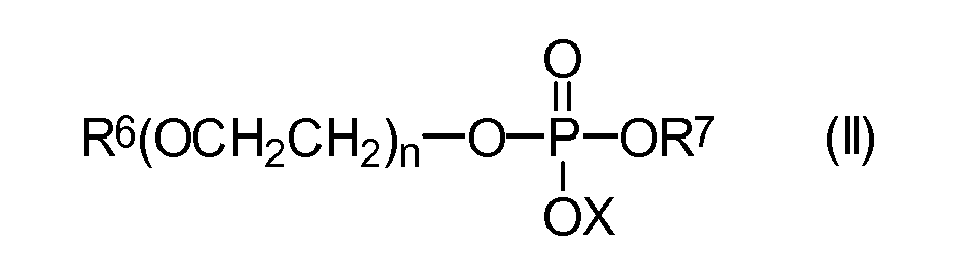
- sulfatierte Fettsäurealkylenglykolester der Formel (III),
R12CO(AlkO)nSO3M (III)
in der R12CO- für einen linearen oder verzweigten, aliphatischen, gesättigten und/oder ungesättigten Acylrest mit 6 bis 22 C-Atomen, Alk für Ethyl-, Propyl und/oder Isopropyl-, n für Zahlen von 0,5 bis 5 und M für ein Kation steht, Monoglyceridsulfate und Monoglyceridethersulfate der Formel (IV),
- Bevorzugte anionische Tenside für alle erfindungsgemäßen Reinigungsmittel sind Alkylsulfate, Alkylpolyglykolethersulfate mit linearen oder verzweigten C-Ketten und Ethercarbonsäuresalze mit 10 bis 18 C-Atomen in der Alkylgruppe und bis zu 12 Glykolethergruppen im Molekül, Sulfobernsteinsäuremono- und -dialkylester mit 8 bis 18 C-Atomen in der Alkylgruppe, Sulfobernsteinsäuremono-alkylpolyoxyethylester mit 8 bis 18 C-Atomen in der Alkylgruppe und 1 bis 6 Oxyethylgruppen sowie die Alkali- und/oder Ammoniumsalze des Tridecethsulfats.
- Besonders bevorzugte anionische Tenside sind die Alkali- oder Ammoniumsalze des Laurylethersulfates mit einem Ethoxylierungsgrad von 2 bis 4 EO.
- Als zwitterionische Tenside werden solche oberflächenaktiven Verbindungen bezeichnet, die im Molekül mindestens eine quartäre Ammoniumgruppe und mindestens eine -COO(-) - oder -SO3 (-) -Gruppe tragen. Besonders geeignete zwitterionische Tenside sind die sogenannten Betaine wie die N-Alkyl-N,N-dimethylammoniumglycinate, beispielsweise das Kokosalkyldimethylammoniumglycinat, N-Acyl-aminopropyl-N,N-dimethylammoniumglycinate, beispielsweise das Kokosacylaminopropyl-dimethylammoniumglycinat, und 2-Alkyl-3-carboxymethyl-3-hydroxyethylimidazoline mit jeweils 8 bis 18 C-Atomen in der Alkyl- oder Acylgruppe sowie das Kokosacylaminoethylhydroxyethylcarboxymethylglycinat.
- Ein bevorzugtes zwitterionisches Tensid ist das unter der INCI-Bezeichnung Cocamidopropyl Betaine bekannte Fettsäureamid-Derivat.
- Unter amphoteren Tensiden werden solche oberflächenaktiven Verbindungen verstanden, die außer einer C8 - C24 - Alkyl- oder -Acylgruppe im Molekül mindestens eine freie Aminogruppe und mindestens eine -COOH- oder -SO3H-Gruppe enthalten und zur Ausbildung innerer Salze befähigt sind. Beispiele für geeignete ampholytische Tenside sind N-Alkylglycine, N-Alkylpropionsäuren, N-Alkylaminobuttersäuren, N-Alkyliminodipropionsäuren, N-Hydroxyethyl-N-alkylamidopropylglycine, N-Alkyltaurine, N-Alkylsarcosine, 2-Alkylaminopropionsäuren und Alkylaminoessigsäuren mit jeweils etwa 8 bis 24 C-Atomen in der Alkylgruppe.
- Besonders bevorzugte ampholytische Tenside sind das N-Kokosalkylaminopropionat, das Kokosacylaminoethylaminopropionat und das C12 - C18 - Acylsarcosin.
- Nichtionische Tenside enthalten als hydrophile Gruppe z. B. eine Polyolgruppe, eine Polyalkylenglykolethergruppe oder eine Kombination aus Polyol- und Polyglykolethergruppe. Solche Verbindungen sind beispielsweise
- Anlagerungsprodukte von 2 bis 50 Mol Ethylenoxid und/oder 0 bis 5 Mol Propylenoxid an lineare und verzweigte Fettalkohole mit 8 bis 30 C-Atomen, an Fettsäuren mit 8 bis 30 C-Atomen und an Alkylphenole mit 8 bis 15 C-Atomen in der Alkylgruppe,
- mit einem Methyl- oder C2-C6- Alkylrest endgruppenverschlossene Anlagerungsprodukte von 2 bis 50 Mol Ethylenoxid und/oder 0 bis 5 Mol Propylenoxid an lineare und verzweigte Fettalkohole mit 8 bis 30 C-Atomen, an Fettsäuren mit 8 bis 30 C-Atomen und an Alkylphenole mit 8 bis 15 C-Atomen in der Alkylgruppe, wie beispielsweise die unter den Verkaufsbezeichnungen Dehydol® LS, Dehydol® LT (Cognis) erhältlichen Typen,
- C12-C30-Fettsäuremono- und -diester von Anlagerungsprodukten von 1 bis 30 Mol Ethylenoxid an Glycerin,
- Anlagerungsprodukte von 5 bis 60 Mol Ethylenoxid an Rizinusöl und gehärtetes Rizinusöl, beispielsweise Rizinusöl-hydriert+40 EO, wie es beispielsweise unter dem Handelsnamen Cremophor CO 455 von der Firma SHC im Handel erhältlich ist,
- Polyolfettsäureester, wie beispielsweise Hydagen® HSP (Cognis) oder Sovermol (Cognis),
- alkoxilierte Triglyceride,
- alkoxilierte Fettsäurealkylester der Formel (V)
R14CO-(OCH2CHR15)wOR16 (V)
in der R14CO für einen linearen oder verzweigten, gesättigten und/oder ungesättigten Acylrest mit 6 bis 22 Kohlenstoffatomen, R15 für Wasserstoff oder Methyl, R16 für lineare oder verzweigte Alkylreste mit 1 bis 4 Kohlenstoffatomen und w für Zahlen von 1 bis 20 steht, - Aminoxide,
- Hydroxymischether,
- Sorbitanfettsäureester und Anlagerungeprodukte von Ethylenoxid an Sorbitanfettsäureester wie beispielsweise die Polysorbate,
- Zuckerfettsäureester und Anlagerungsprodukte von Ethylenoxid an Zuckerfettsäureester,
- Anlagerungsprodukte von Ethylenoxid an Fettsäurealkanolamide und Fettamine,
- Fettsäure-N-alkylglucamide,
- Alkylpolygykoside entsprechend der allgemeinen Formel RO-(Z)x wobei R für Alkyl, Z für Zucker sowie x für die Anzahl der Zuckereinheiten steht. Die erfindungsgemäß verwendbaren Alkylpolyglykoside können lediglich einen bestimmten Alkylrest R enthalten. Üblicherweise werden diese Verbindungen aber ausgehend von natürlichen Fetten und Ölen oder Mineralölen hergestellt. In diesem Fall liegen als R Mischungen entsprechend den Ausgangsverbindungen vor.
- Besonders bevorzugt sind solche Alkylpolyglykoside, bei denen R im wesentlichen aus C8 und C10-Alkylgruppen, im wesentlichen aus C12- und C14-Alkylgruppen, im wesentlichen aus C8- bis C16-Alkylgruppen, im wesentlichen aus C12- bis C16-Alkylgruppen oder im wesentlichen aus C16 bis C18-Alkylgruppen besteht.
- Als Zuckerbaustein Z können beliebige Mono- oder Oligosaccharide eingesetzt werden. Üblicherweise werden Zucker mit 5 bzw. 6 Kohlenstoffatomen sowie die entsprechenden Oligosaccharide eingesetzt. Solche Zucker sind beispielsweise Glucose, Fructose, Galactose, Arabinose, Ribose, Xylose, Lyxose, Allose, Altrose, Mannose, Gulose, Idose, Talose und Sucrose. Bevorzugte Zuckerbausteine sind Glucose, Fructose, Galactose, Arabinose und Sucrose; Glucose ist besonders bevorzugt.
- Die erfindungsgemäß verwendbaren Alkylpolyglykoside enthalten im Schnitt 1,1 bis 5 Zuckereinheiten. Alkylpolyglykoside mit x-Werten von 1,1 bis 2,0 sind bevorzugt. Ganz besonders bevorzugt sind Alkylglykoside, bei denen x 1,1 bis 1,8 beträgt.
- Auch die alkoxylierten Homologen der genannten Alkylpolyglykoside können erfindungsgemäß eingesetzt werden. Diese Homologen können durchschnittlich bis zu 10 Ethylenoxid- und/oder Propylenoxideinheiten pro Alkylglykosideinheit enthalten.
- Bevorzugte quaternäre Ammoniumverbindungen sind Ammoniumhalogenide, insbesondere Chloride und Bromide, wie Alkyltrimethylammoniumchloride, Dialkyldimethylammoniumchloride und Trialkylmethylammoniumchloride, z. B. Cetyltrimethylammoniumchlorid, Stearyltrimethylammoniumchlorid, Distearyldimethylammoniumchlorid, Lauryldimethylammoniumchlorid, Lauryldimethylbenzylammoniumchlorid und Tricetylmethylammoniumchlorid, sowie die unter den INCI-Bezeichnungen Quaternium-27 und Quaternium-83 bekannten Imidazolium-Verbindungen. Die langen Alkylketten der oben genannten Tenside weisen bevorzugt 10 bis 18 C-atome auf. Bei Esterquats handelt es sich um bekannte Stoffe, die sowohl mindestens eine Esterfunktion als auch mindestens eine quartäre Ammoniumgruppe als Strukturelement enthalten. Bevorzugte Esterquats sind quaternierte Estersalze von Fettsäuren mit Triethanolamin, quaternierte Estersalze von Fettsäuren mit Diethanolalkylaminen und quaternierten Estersalzen von Fettsäuren mit 1,2-Dihydroxypropyldialkylaminen. Solche Produkte werden beispielsweise unter den Warenzeichen Stepantex®, Dehyquart® und Armocare® vertrieben. Die Produkte Armocare® VGH-70, ein N,N-Bis(2-Palmitoyloxyethyl)dimethylammoniumchlorid, sowie Dehyquart® F-75, Dehyquart® C-4046, Dehyquart® L80 und Dehyquart® AU-35 sind Beispiele für solche Esterquats. Die Alkylamidoamine werden üblicherweise durch Amidierung natürlicher oder synthetischer Fettsäuren und Fettsäureschnitte mit Dialkylaminoaminen hergestellt. Eine erfindungsgemäß besonders geeignete Verbindung aus dieser Substanzgruppe stellt das unter der Bezeichnung Tegoamid® S 18 im Handel erhältliche Stearamidopropyl-dimethylamin dar.
- Die kationischen Tenside sind in den erfindungsgemäßen Mitteln bevorzugt in Mengen von 0,05 bis 10 Gew.-%, bezogen auf das gesamte Mittel, enthalten. Mengen von 0,1 bis 5 Gew.-% sind besonders bevorzugt.
- In einer besonders bevorzugten Ausführungsform der Erfindung wird das erfindungsgemäße Reinigungsmittel als kosmetisches Reinigungsmittel konfektioniert. In diesem Fall enthält es weiterhin Panthenol sowie mindestens einen weiteren Haarpflegewirkstoff, der ausgewählt ist aus der Gruppe der Vitamine und/oder Provitamine, der Proteinhydrolysate, der natürlichen oder synthetischen Ölkomponenten und/oder der Pflanzenextrakte.
- Unter erfindungsgemäß bevorzugten Vitaminen, Provitaminen und Vitaminvorstufen sowie deren Derivaten sind solche Vertreter zu verstehen, die üblicherweise den Gruppen A, B, C, E, F und H zugeordnet werden.
- Zur Gruppe der als Vitamin A bezeichneten Substanzen gehören das Retinol (Vitamin A1) sowie das 3,4-Didehydroretinol (Vitamin A2). Das β-Carotin ist das Provitamin des Retinols. Als Vitamin A-Komponente kommen erfindungsgemäß beispielsweise Vitamin A-Säure und deren Ester, Vitamin A-Aldehyd und Vitamin A-Alkohol sowie dessen Ester wie das Palmitat und das Acetat in Betracht. Die erfindungsgemäßen Mittel enthalten die Vitamin A-Komponente bevorzugt in Mengen von 0,01-1 Gew.-%, bezogen auf die gesamte Zubereitung.
- Zur Vitamin B-Gruppe oder zu dem Vitamin B-Komplex gehören u. a.
- Vitamin B1 (Thiamin)
- Vitamin B2 (Riboflavin)
- Vitamin B3. Unter dieser Bezeichnung werden häufig die Verbindungen Nicotinsäure und Nicotinsäureamid (Niacinamid) geführt. Erfindungsgemäß bevorzugt ist das Nicotinsäureamid, das in den erfindungsgemäßen Mitteln bevorzugt in Mengen von 0,05 bis 1 Gew.-%, bezogen auf das gesamte Mittel, enthalten ist.
- Vitamin B5 (Pantothensäure, Panthenol und Pantolacton). Im Rahmen dieser Gruppe wird bevorzugt Pantolacton eingesetzt.
- Vitamin B6 (Pyridoxin sowie Pyridoxamin und Pyridoxal).
- Die genannten Verbindungen der Vitamin B-Gruppe sind in den erfindungsgemäßen Mitteln bevorzugt in Mengen von 0,01 - 2 Gew.-%, bezogen auf das gesamte Mittel, enthalten. Mengen von 0,03 - 1 Gew.-% sind besonders bevorzugt.
- Vitamin C (Ascorbinsäure). Vitamin C wird in den erfindungsgemäßen Mitteln bevorzugt in Mengen von 0,01 bis 3 Gew.-%, bezogen auf das gesamte Mittel eingesetzt. Die Verwendung in Form des Palmitinsäureesters, der Glucoside oder Phosphate kann bevorzugt sein. Die Verwendung in Kombination mit Tocopherolen kann ebenfalls bevorzugt sein.
- Vitamin E (Tocopherole, insbesondere α-Tocopherol). Tocopherol und seine Derivate, worunter insbesondere die Ester wie das Acetat, das Nicotinat, das Phosphat und das Succinat fallen, sind in den erfindungsgemäßen Mitteln bevorzugt in Mengen von 0,01-1 Gew.-%, bezogen auf das gesamte Mittel, enthalten.
- Vitamin F. Unter dem Begriff "Vitamin F" werden üblicherweise essentielle Fettsäuren, insbesondere Linolsäure, Linolensäure und Arachidonsäure, verstanden.
- Vitamin H. Als Vitamin H wird die Verbindung (3aS,4S,6aR)-2-Oxohexahydrothienol[3,4-d]-imidazol-4-valeriansäure bezeichnet, für die sich aber inzwischen der Trivialname Biotin durchgesetzt hat. Biotin ist in den erfindungsgemäßen Mitteln bevorzugt in Mengen von 0,0001 bis 1,0 Gew.-%, insbesondere in Mengen von 0,001 bis 0,01 Gew.-% enthalten.
- Bevorzugt enthalten die erfindungsgemäßen Zubereitungen Vitamine, Provitamine und Vitaminvorstufen aus den Gruppen A, E, F und H. Selbstverständlich können auch mehrere Vitamine und Vitaminvorstufen gleichzeitig enthalten sein.
- Die Gesamt-Einsatzmenge der Vitamine, Provitamine, Vitaminvorstufen sowie deren Derivate in den erfindungsgemäßen Mitteln beträgt - bezogen auf das Gesamtgewicht des Mittels - 0,01 bis 5 Gew.-%, vorzugsweise 0,02 bis 4 Gew.-% und insbesondere 0,05 bis 3 Gew.-%.
- Als Proteinhydrolysate im Sinne der Erfindung werden Proteinhydrolysate und/oder Aminosäuren und deren Derivate (H) verstanden. Proteinhydrolysate sind Produktgemische, die durch sauer, basisch oder enzymatisch katalysierten Abbau von Proteinen (Eiweißen) erhalten werden. Unter dem Begriff Proteinhydrolysate werden erfindungsgemäß auch Totalhydrolysate sowie einzelne Aminosäuren und deren Derivate sowie Gemische aus verschiedenen Aminosäuren verstanden. Weiterhin werden erfindungsgemäß aus Aminosäuren und Aminosäurederivaten aufgebaute Polymere unter dem Begriff Proteinhydrolysate verstanden. Zu letzteren sind beispielsweise Polyalanin, Polyasparagin, Polyserin etc. zu zählen. Weitere Beispiele für erfindungsgemäß einsetzbare Verbindungen sind L-Alanyl-L-prolin, Polyglycin, Glycyl-L-glutamin oder D/L-Methionin-S-Methylsulfoniumchlorid. Selbstverständlich können erfindungsgemäß auch β-Aminosäuren und deren Derivate wie β-Alanin, Anthranilsäure oder Hippursäure eingesetzt werden. Das Molgeweicht der erfindungsgemäß einsetzbaren Proteinhydrolysate liegt zwischen 75, dem Molgewicht für Glycin, und 200000, bevorzugt beträgt das Molgewicht 75 bis 50000 und ganz besonders bevorzugt 75 bis 20000 Dalton.
- Erfindungsgemäß können Proteinhydrolysate sowohl pflanzlichen als auch tierischen oder marinen oder synthetischen Ursprungs eingesetzt werden.
- Tierische Proteinhydrolysate sind beispielsweise Elastin-, Kollagen-, Keratin-, Seiden- und Milcheiweiß-Proteinhydrolysate, die auch in Form von Salzen vorliegen können. Solche Produkte werden beispielsweise unter den Warenzeichen Dehylan® (Cognis), Promois® (Interorgana), Collapuron® (Cognis), Nutrilan® (Cognis), Gelita-Sol® (Deutsche Gelatine Fabriken Stoess & Co), Lexein® (Inolex) und Kerasol® (Croda) vertrieben.
- Erfindungsgemäß bevorzugt ist die Verwendung von Proteinhydrolysaten pflanzlichen Ursprungs, z. B. Soja-, Mandel-, Erbsen-, Kartoffel- und Weizenproteinhydrolysate. Solche Produkte sind beispielsweise unter den Warenzeichen Gluadin® (Cognis), DiaMin® (Diamalt), Lexein® (Inolex), Hydrosoy® (Croda), Hydrolupin® (Croda), Hydrosesame® (Croda), Hydrotritium® (Croda) und Crotein® (Croda) erhältlich.
- Wenngleich der Einsatz der Proteinhydrolysate als solche bevorzugt ist, können an deren Stelle gegebenenfalls auch anderweitig erhaltene Aminosäuregemische eingesetzt werden.
- Die Proteinhydrolysate oder deren Derivate sind in den erfindungsgemäßen Zubereitungen bevorzugt in Mengen von 0,1 bis 10 Gew.-%, bezogen auf das gesamte Mittel, enthalten. Mengen von 0,1 bis 5 Gew.-% sind besonders bevorzugt.
- Als wasserunlösliche Ölkomponenten eignen sich erfindungsgemäß pflanzliche, mineralische oder synthetische Öle, sowie Gemische dieser Komponenten.
- Als natürliche (pflanzliche) Öle werden üblicherweise Triglyceride und Mischungen von Triglyceriden eingesetzt. Bevorzugte natürliche Öle im Sinne der Erfindung sind Kokosnussöl, (süßes) Mandelöl, Walnussöl, Pfirsichkernöl, Aprikosenkernöl, Avocadoöl, Teebaumöl (Tea Tree Oil), Sojaöl, Sesamöl, Sonnenblumenöl, Tsubakiöl, Nachtkerzenöl, Reiskleieöl, Palmkernöl, Mangokernöl, Wiesenschaumkrautöl, Distelöl, Macadamianussöl, Traubenkernöl, Amaranthsamenöl, Arganöl, Babssuöl, Olivenöl, Weizenkeimöl, Kürbiskernöl, Malvenöl, Haselnussöl, Safloröl, Canolaöl, Sasanquaöl, Jojobaöl und Shea-Butter.
- Als mineralische Öle kommen insbesondere Mineralöle, Paraffin- und Isoparaffinöle sowie synthetische Kohlenwasserstoffe zum Einsatz. Ein erfindungsgemäß einsetzbarer Kohlenwasserstoff ist beispielsweise das als Handelsprodukt erhältliche 1,3-Di-(2-ethylhexyl)-cyclohexan (Cetiol® S).
- Als synthetische Öle kommen Silikonverbindungen, insbesondere Dialkyl- und Alkylarylsilikone, wie beispielsweise Dimethylpolysiloxan und Methylphenylpolysiloxan, sowie deren hydroxyterminierte, alkoxylierte und quaternierte Analoga in Betracht. Beispiele für solche Silikone sind die von Dow Corning unter den Bezeichnungen DC 190, DC 200, DC 344 und DC 345 (Cyclomethicone) vertriebenen Produkte.
- Als Ölkomponente kann weiterhin ein Dialkylether dienen.
- Erfindungsgemäß einsetzbare Dialkylether sind insbesondere Di-n-alkylether mit insgesamt zwischen 12 bis 36 C-Atomen, insbesondere 12 bis 24 C-Atomen, wie beispielsweise Di-n-octylether, Di-n-decylether, Di-n-nonylether, Di-n-undecylether, Di-n-dodecylether, n-Hexyl-n-octylether, n-Octyl-n-decylether, n-Decyl-n-undecylether, n-Undecyl-n-dodecylether und n-Hexyln-undecylether sowie Di-tert.-butylether, Di-iso-pentylether, Di-3-ethyldecylether, tert.-Butyl-n-octylether, iso-Pentyl-n-octylether und 2-Methylpentyl-n-octylether.
- Erfindungsgemäß besonders bevorzugt ist der Di-n-octylether, der im Handel unter der Bezeichnung Cetiol® OE erhältlich ist.
- Die erfindungsgemäßen Mittel enthalten die wasserunlösliche Ölkomponente bevorzugt in einem Mengenbereich von 0,1 bis 5 Gew.-%, insbesondere von 0,5 bis 3 Gew.-%, bezogen auf das Gesamtgewicht des Mittels.
- In einer weiteren bevorzugten Ausführungsform der Erfindung kann die Wirkung der erfindungsgemäßen Wirkstoffkombination durch weitere Fettstoffe noch weiter optimiert werden. Unter weiteren Fettstoffen sind zu verstehen Fettsäuren, Fettalkohole sowie natürliche und synthetische Wachse, welche sowohl in fester Form als auch flüssig in wäßriger Dispersion vorliegen können.
- Als Fettsäuren können eingesetzt werden lineare und/oder verzweigte, gesättigte und/oder ungesättigte Fettsäuren mit 6 - 30 Kohlenstoffatomen. Bevorzugt sind Fettsäuren mit 10 - 22 Kohlenstoffatomen. Hierunter wären beispielsweise zu nennen die Isostearinsäuren, wie die Handelsprodukte Emersol® 871 und Emersol® 875, und Isopalmitinsäuren wie das Handelsprodukt Edenor® IP 95, sowie alle weiteren unter den Handelsbezeichnungen Edenor® (Cognis) vertriebenen Fettsäuren. Weitere typische Beispiele für solche Fettsäuren sind Capronsäure, Caprylsäure, 2-Ethylhexansäure, Caprinsäure, Laurinsäure, Isotridecansäure, Myristinsäure, Palmitinsäure, Palmitoleinsäure, Stearinsäure, Isostearinsäure, Ölsäure, Elaidinsäure, Petroselinsäure, Linolsäure, Linolensäure, Elaeostearinsäure, Arachinsäure, Gadoleinsäure, Behensäure und Erucasäure sowie deren technische Mischungen.
- Die Einsatzmenge beträgt dabei 0,1 - 15 Gew.%, bezogen auf das gesamte Mittel. In einer bevorzugten Ausführungsform beträgt die Menge 0,5 - 10 Gew.%, wobei ganz besonders vorteilhaft Mengen von 1 - 5 Gew.% sind.
- Als Fettalkohole können eingesetzt werden gesättigte, ein- oder mehrfach ungesättigte, verzweigte oder unverzweigte Fettalkohole mit C6 - C30-, bevorzugt C10 - C22- und ganz besonders bevorzugt C12 - C22- Kohlenstoffatomen. Einsetzbar im Sinne der Erfindung sind beispielsweise Decanol, Octanol, Octenol, Dodecenol, Decenol, Octadienol, Dodecadienol, Decadienol, Oleylalkohol, Erucaalkohol, Ricinolalkohol, Stearylalkohol, Isostearylalkohol, Cetylalkohol, Laurylalkohol, Myristylalkohol, Arachidylalkohol, Caprylalkohol, Caprinalkohol, Linoleylalkohol, Linolenylalkohol und Behenylalkohol, sowie deren Guerbetalkohole, wobei diese Aufzählung beispielhaften und nicht limitierenden Charakter haben soll. Weitere bevorzugte erfindungsgemäße Fettalkohole sind die Substanzen, die beispielsweise unter den Bezeichnungen Stenol®, z.B. Stenol® 1618 oder Lanette®, z.B. Lanette® O oder Lorol®, z.B. Lorol® C8, Lorol® C14, Lorol® C18, Lorol® C8-18, HD-Ocenol®, Crodacol®, z.B. Crodacol® CS, Novol®, Eutanol® G, Guerbitol® 16, Guerbitol® 18, Guerbitol® 20, Isofol® 12, Isofol® 16, Isofol® 24, Isofol® 36, Isocarb® 12, Isocarb® 16 oder Isocarb® 24 käuflich zu erwerben sind. Selbstverständlich können erfindungsgemäß auch Wollwachsalkohole, wie beispielsweise die Handelsprodukte Corona®, White Swan®, Coronet® oder Fluilan®, eingesetzt werden.
- Die Fettalkohole werden in Mengen von 0,1 - 20 Gew.-%, bezogen auf die gesamte Zubereitung, bevorzugt in Mengen von 0,1 - 10 Gew.-% eingesetzt.
- Als natürliche oder synthetische Wachse können erfindungsgemäß eingesetzt werden feste Paraffine oder Isoparaffine, Carnaubawachse, Bienenwachse, Candelillawachse, Ozokerite, Ceresin, Walrat, Sonnenblumenwachs, Fruchtwachse wie beispielsweise Apfelwachs oder Citruswachs, Microwachse aus PE- oder PP. Derartige Wachse sind beispielsweise erhältlich über die Fa. Kahl & Co., Trittau.
- Weitere Fettstoffe sind beispielsweise
- Esteröle. Unter Esterölen sind zu verstehen die Ester von C6 - C30 - Fettsäuren mit C2 - C30 - Fettalkoholen. Bevorzugt sind die Monoester der Fettsäuren mit Alkoholen mit 2 bis 24 C-Atomen. Beispiele für eingesetzte Fettsäurenanteile in den Estern sind Capronsäure, Caprylsäure, 2-Ethylhexansäure, Caprinsäure, Laurinsäure, Isotridecansäure, Myristinsäure, Palmitinsäure, Palmitoleinsäure, Stearinsäure, Isostearinsäure, Ölsäure, Elaidinsäure, Petroselinsäure, Linolsäure, Linolensäure, Elaeostearinsäure, Arachinsäure, Gadoleinsäure, Behensäure und Erucasäure sowie deren technische Mischungen. Beispiele für die Fettalkoholanteile in den Esterölen sind Isopropylalkohol, Capronalkohol, Caprylalkohol, 2-Ethylhexylalkohol, Caprinalkohol, Laurylalkohol, Isotridecylalkohol, My ristylalkohol, Cetylalkohol, Palmoleylalkohol, Stearylalkohol, Isostearylalkohol, Oleylalkohol, Elaidylalkohol, Petroselinylalkohol, Linolylalkohol, Linolenylalkohol, Elaeostearylalkohol, Arachylalkohol, Gadoleylalkohol, Behenylalkohol, Erucylalkohol und Brassidylalkohol sowie deren technische Mischungen. Erfindungsgemäß besonders bevorzugt sind Isopropylmyristat (Rilanit® IPM), Isononansäure-C16-18-alkylester (Cetiol® SN), 2-Ethylhexylpalmitat (Cegesoft® 24), Stearinsäure-2-ethylhexylester (Cetiol® 868), Cetyloleat, Glycerintricaprylat, Kokosfettalkohol- caprinat/-caprylat (Cetiol® LC), n-Butylstearat, Oleylerucat (Cetiol® J 600), Isopropylpalmitat Rilanit® IPP), Oleyl Oleate (Cetiol®), Laurinsäurehexylester (Cetiol® A), Di-n-butyladipat (Cetiol® B), Myristylmyristat (Cetiol® MM), Cetearyl Isononanoate (Cetiol® SN), Ölsäuredecylester (Cetiol® V).
- Dicarbonsäureester wie Di-n-butyladipat, Di-(2-ethylhexyl)-adipat, Di-(2-ethylhexyl)-succinat und Di-isotridecylacelaat sowie Diolester wie Ethylenglykol-dioleat, Ethylenglykol-diisotridecanoat, Propylenglykol-di(2-ethylhexanoat), Propylenglykol-di-isostearat, Propylenglykol-di-pelargonat, Butandiol-di-isostearat, Neopentylglykoldicaprylat,
- symmetrische, unsymmetrische oder cyclische Ester der Kohlensäure mit Fettalkoholen,
- Glycerincarbonat oder Dicaprylylcarbonat (Cetiol® CC),
- ethoxylierte oder nicht ethoxylierte Mono,- Di- und Trifettsäureester von gesättigten und/oder ungesättigten linearen und/oder verzweigten Fettsäuren mit Glycerin, wie beispielsweise Monomuls® 90-018, Monomuls® 90-L12, Cetiol® HE oder Cutina® MD.
- Die Einsatzmenge der weiteren Fettstoffe beträgt 0,1 -20 Gew. % bezogen auf das gesamte Mittel. Bevorzugt sind 0,1 - 10 Gew.% und besonders bevorzugt 0,1 - 5 Gew.%, bezogen auf das gesamte Mittel.
- Die Gesamtmenge an Öl- und Fettkomponenten in den erfindungsgemäßen Mitteln beträgt üblicherweise 0,01 - 15 Gew.-%, bezogen auf das gesamte Mittel. Mengen von 0,05- 5 Gew.-% sind erfindungsgemäß bevorzugt.
- Erfindungsgemäß bevorzugt sind tensidhaltige Reinigungsmittel, die Pflanzenextrakte aus grünem Tee, Eichenrinde, Brennessel, Hamamelis, Hopfen, Henna, Kamille, Klettenwurzel, Schachtelhalm, Weißdorn, Lindenblüten, Mandel, Aloe Vera, Fichtennadel, Roßkastanie, Sandelholz, Wacholder, Kokosnuß, Granatapfel, Mango, Aprikose, Limone, Weizen, Kiwi, Melone, Orange, Grapefruit, Salbei, Rosmarin, Birke, Malve, Wiesenschaumkraut, Quendel, Schafgarbe, Thymian, Melisse, Hauhechel, Huflattich, Vanille, Eibisch, Meristem, Ginseng und Ingwerwurzel enthalten.
- Üblicherweise werden diese Extrakte durch Extraktion der gesamten Pflanze hergestellt. Es kann aber in einzelnen Fällen auch bevorzugt sein, die Extrakte ausschließlich aus Blüten und/oder Blättern der Pflanze herzustellen.
- Als Extraktionsmittel zur Herstellung der genannten Pflanzenextrakte können Wasser, Alkohole sowie deren Mischungen verwendet werden. Unter den Alkoholen sind dabei niedere Alkohole wie Ethanol und Isopropanol, insbesondere aber mehrwertige Alkohole wie Ethylenglykol und Propylenglykol, sowohl als alleiniges Extraktionsmittel als auch in Mischung mit Wasser, bevorzugt. Pflanzenextrakte auf Basis von Wasser/Propylenglykol im Verhältnis 1:10 bis 10:1 haben sich als besonders geeignet erwiesen.
- Die Pflanzenextrakte können erfindungsgemäß sowohl in reiner als auch in verdünnter Form eingesetzt werden. Sofern sie in verdünnter Form eingesetzt werden, enthalten sie üblicherweise ca. 2 - 80 Gew.-% Aktivsubstanz und als Lösungsmittel das bei ihrer Gewinnung eingesetzte Extraktionsmittel oder Extraktionsmittelgemisch.
- Die Pflanzenextrakte werden in den erfindungsgemäßen Mitteln - bezogen auf deren Gewicht - in einer Menge von 0,01 bis 5 Gew.-%, vorzugsweise 0,02 bis 4 Gew.-% und insbesondere 0,05 bis 3 Gew.-% eingesetzt.
- In einer weiteren bevorzugten Ausführungsform der Erfindung enthalten die erfindungsgemäßen Mittel mindestens ein weiteres Konservierungsmittel, ausgewählt aus der Gruppe, die gebildet wird aus Benzoesäure, Propionsäure, Salicylsäure und/oder Sorbinsäure, sowie aus den kosmetisch verträglichen Salzen und Estern dieser Säuren, aus Formaldehyl und/oder Paraformaldehyd, aus Benzylalkohol, Germall, Dowicil, Kathon, Baypival, Methylisothiazoline, quaternären Ammoniumverbindungen, Alkoholen und/oder aus etherischen Ölen wie Teebaumöl, Cineol, Eugenol, Geraniol, Limonen, Menthol und/oder Thymol.
- Für den Fall, in dem das erfindungsgemäße kosmetische Mittel als Shampoo konfektioniert wird, kann es bevorzugt sein, dass dieses mindestens ein Antischuppenmittel in einer Menge von 0,05 bis 5 Gew.-%, bevorzugt von 0,1 bis 3,0 Gew.-% und insbesondere von 0,3 bis 2,0 Gew.-% enthält (bezogen auf das gesamte Mittel).
- Diese(s) ist (sind) beispielsweise ausgewählt aus Piroctone Olamine, Climbazol, Zink Pyrithion, Ketoconazole, Salicylsäure, Schwefel, Selensulfide, Teerpräparaten, Undecensäurederivaten, Klettenwurzelextrakten, Pappelextrakten, Brennesselextrakten, Walnussschalenextrakten, Birkenextrakten, Weidenrindenextrakten, Rosmarinextrakten und/oder Arnikaextrakten.
- In einer weiteren bevorzugten Ausführungsform der Erfindung enthält das erfindungsgemäße Mittel weiterhin mindestens einen Vertreter aus der Gruppe der kationischen Tenside und/oder Polymere, der UV-Filter, der Aminosäuren, der wasserunlöslichen Silikone, der wasserlöslichen Silikone und/oder der Amodimethicone.
- Unter erfindungsgemäß geeigneten kationischen Polymeren sind Polymere zu verstehen, welche in der Haupt- und/oder Seitenkette Gruppen aufweisen, welche "temporär" oder "permanent" kationisch sein kann. Als "permanent kationisch" werden erfindungsgemäß solche Polymere bezeichnet, die unabhängig vom pH-Wert des Mittels eine kationische Gruppe aufweisen. Dies sind in der Regel Polymere, die ein quartäres Stickstoffatom, beispielsweise in Form einer Ammoniumgruppe, enthalten. Bevorzugte kationische Gruppen sind quartäre Ammoniumgruppen. Insbesondere solche Polymere, bei denen die quartäre Ammoniumgruppe über eine C1-4-Kohlenwasserstoffgruppe an eine aus Acrylsäure, Methacrylsäure oder deren Derivaten aufgebaute Polymerhauptkette gebunden sind, haben sich als besonders geeignet erwiesen. Homopolymere der allgemeinen Formel (VI),

- R17 steht für eine Methylgruppe
- R18, R19 und R20 stehen für Methylgruppen
- m hat den Wert 2
- X- steht für Halogenid-, Sulfat-, Phosphat-, Methosulfat- sowie org. Ionen wie Lactat-, Citrat-, Tartrat- und Acetationen in Betracht. Bevorzugt sind Halogenidionen, insbesondere Chlorid.
- Ein geeignetes Homopolymer ist das, gewünschtenfalls vernetzte, Poly(methacryloyloxyethyltrimethylammoniumchlorid) mit der INCI-Bezeichnung Polyquaternium-37.
- Das Homopolymer wird bevorzugt in Form einer nichtwäßrigen Polymerdispersion, die einen Polymeranteil nicht unter 30 Gew.-% aufweisen sollte, eingesetzt. Solche Polymerdispersionen sind unter den Bezeichnungen Salcare® SC 95 (INCI-Bezeichnung: Mineral Oil) und Tridecylpolyoxypropylen-polyoxyethylen-ether (INCI-Bezeichnung: PPG-1-Trideceth-6)) und Salcare® SC 96 (INCI-Bezeichnung: Propylene Glycol Dicaprylate/Dicaprate) und Tridecyl-polyoxypropylenpolyoxyethylen-ether (INCI-Bezeichnung: PPG-1-Trideceth-6)) im Handel erhältlich.
- Copolymere mit Monomereinheiten gemäß Formel (VI) enthalten als nichtionogene Monomereinheiten bevorzugt Acrylamid, Methacrylamid, Acrylsäure-C1-4-alkylester und Methacrylsäure-C1-4-alkylester. Unter diesen nichtionogenen Monomeren ist das Acrylamid besonders bevorzugt. Auch diese Copolymere können, wie im Falle der Homopolymere oben beschrieben, vernetzt sein. Ein erfindungsgemäß bevorzugtes Copolymer ist das vernetzte Acrylamid-Methacryloyloxyethyltrimethylammoniumchlorid-Copolymer, wie sie unter der Bezeichnung Salcare® SC 92 erhältlich sind.
- Weitere bevorzugte kationische Polymere sind beispielsweise
- quaternisierte Cellulose-Derivate, wie sie unter den Bezeichnungen Celquat® und Polymer JR® im Handel erhältlich sind. Die Verbindungen Celquat® H 100, Celquat® L 200 und Polymer JR®400 sind bevorzugte quaternierte Cellulose-Derivate,
- hydrophob modifizierte Cellulosederivate, beispielsweise die unter dem Handelsnamen SoftCat® vertriebenen kationischen Polymere,
- kationische Alkylpolyglycoside,
- kationiserter Honig, beispielsweise das Handelsprodukt Honeyquat® 50,
- kationische Guar-Derivate, wie insbesondere die unter den Handelsnamen Cosmedia®Guar und Jaguar® vertriebenen Produkte,
- Polysiloxane mit quaternären Gruppen, wie beispielsweise die im Handel erhältlichen erhältlichen Produkte Q2-7224 (Hersteller: Dow Corning; ein stabilisiertes Trimethylsilylamodimethicon), Dow Corning® 929 Emulsion (enthaltend ein hydroxyl-aminomodifiziertes Silicon, das auch als Amodimethicone bezeichnet wird), SM-2059 (Hersteller: General Electric), SLM-55067 (Hersteller: Wacker) sowie Abil®-Quat 3270 und 3272 (Hersteller: Th. Goldschmidt; diquaternäre Polydimethylsiloxane, Quaternium-80),
- polymere Dimethyldiallylammoniumsalze und deren Copolymere mit Estern und Amiden von Acrylsäure und Methacrylsäure, wie beispielsweise die Handelsprodukte Merquat®100 und Merquat®550,
- Copolymere des Vinylpyrrolidons mit quaternierten Derivaten des Dialkylaminoalkylacrylats und -methacrylats, wie beispielsweise mit Diethylsulfat quaternierte Vinylpyrrolidon-Dimethylaminoethylmethacrylat-Copolymere, wie beispielsweise die Handelsprodukte Gafquat®734 und Gafquat®755,
- Vinylpyrrolidon-Vinylimidazoliummethochlorid-Copolymere, wie beispielsweise die Handelsprodukte Luviquat® FC 370, FC 550, FC 905 und HM 552,
- quaternierter Polyvinylalkohol, sowie die unter den Bezeichnungen Polyquaternium 2, Polyquaternium 17, Polyquaternium 18 und Polyquaternium 27 bekannten Polymeren mit quartären Stickstoffatomen in der Polymerhauptkette.
- Gleichfalls als kationische Polymere eingesetzt werden können die unter den Bezeichnungen Polyquaternium-24 (Handelsprodukt z. B. Quatrisoft® LM 200), bekannten Polymere. Ebenfalls erfindungsgemäß verwendbar sind die Copolymere des Vinylpyrrolidons, wie sie als Handelsprodukte Copolymer 845 (Hersteller: ISP), Gaffix® VC 713 (Hersteller: ISP), Gafquat®ASCP 1011, Gafquat®HS 110, Luviquat®8155 und Luviquat® MS 370 erhältlich sind.
- In einer besonders bevorzugten Ausführungsform der Erfindung ist als kationisches Polymer mindestens ein Polymer aus der Gruppe der kationischen Guar-Derivate und/oder Polyquaternium-7 (Merquat 550), Polyquaternium-6, Polyquaternium-10 und/oder Polyquaternium-67 (SoftCat®-Polymere) in den Reinigungsmitteln enthalten.
- Das oder die kationische(n) Polymer(e) ist (sind) in den erfindungsgemäßen Mitteln - bezogen auf das gesamte Mittel - in Mengen von 0,01 bis 5 Gew.-% enthalten. Mengen von 0,05 bis 3, insbesondere von 0,1 bis 2 Gew.-%, sind besonders bevorzugt.
- Weiterhin kann in einer bevorzugten Ausführungsform der Erfindung die Wirkung der Zubereitungen durch UV - Filter gesteigert werden. Die erfindungsgemäß zu verwendenden UV-Filter unterliegen hinsichtlich ihrer Struktur und ihrer physikalischen Eigenschaften keinen generellen Einschränkungen. Vielmehr eignen sich alle im Kosmetikbereich einsetzbaren UV-Filter, deren Absorptionsmaximum im UVA(315-400 nm)-, im UVB(280-315nm)- oder im UVC(<280 nm)-Bereich liegt. UV-Filter mit einem Absorptionsmaximum im UVB-Bereich, insbesondere im Bereich von etwa 280 bis etwa 300 nm, sind besonders bevorzugt.
- Die erfindungsgemäß verwendeten UV-Filter können beispielsweise ausgewählt werden aus substituierten Benzophenonen, p-Aminobenzoesäureestern, Diphenylacrylsäureestern, Zimtsäureestern, Salicylsäureestern, Benzimidazolen und o-Aminobenzoesäureestern. Bevorzugt sind solche UV-Filter, deren molarer Extinktionskoeffizient am Absorptionsmaximum oberhalb von 15 000, insbesondere oberhalb von 20000, liegt.
- Gemäß einer weiteren Ausführungsform der Erfindung sind solche UV-Filter bevorzugt, die eine kationische Gruppe, insbesondere eine quartäre Ammoniumgruppe, aufweisen.
- Zwei bevorzugte UV-Filter mit kationischen Gruppen sind die als Handelsprodukte erhältlichen Verbindungen Zimtsäureamidopropyl-trimethylammoniumchlorid (Incroquat®UV-283) und Dodecyl-dimethylaminobenzamidopropyl-dimethylammoniumtosylat (Escalol® HP 610).
- Die UV-Filter (I) sind in den erfindungsgemäß verwendeten Mitteln üblicherweise in Mengen 0,1-5 Gew.-%, bezogen auf das gesamte Mittel, enthalten. Mengen von 0,4-2,5 Gew.-% sind bevorzugt. Erfindungsgemäß geeignete Aminosäuren sind Lysin, Isoleucin, Tyrosin, Cystein, Cystin, Alanin, Serin, Tryptophan, Glutaminsäure, Threonin, Valin, Glycin, Prolin, Arginin und/oder Taurin. Sie werden in den erfindungsgemäßen Haarreinigungs- und -konditioniermitteln in einer Konzentration von 0,01 bis 5 Gew.-%, insbesondere in einer Konzentration von 0,05 bis 3 Gew.-%, eingesetzt.
- Gemäß einer weiteren bevorzugten Ausführungsform der Erfindung enthalten die Mittel außerdem mindestens ein flüchtiges oder nichtflüchtiges, wasserunlösliches Silikon, wasserlösliches und/oder aminofuktionalisiertes Silikon.
- Erfindungsgemäß geeignete Silikone bewirken die unterschiedlichsten Effekte. So beeinflussen sie beispielsweise gleichzeitig die Trocken- und Nasskämmbarkeiten, den Griff des trockenen und nassen Haares sowie den Glanz. Unter dem Begriff Silikone versteht der Fachmann mehrere Strukturen siliciumorganischer Verbindungen.
- Dimethiconole (S1) bilden die erste Gruppe der Silikone, welche erfindungsgemäß besonders bevorzugt sind. Die erfindungsgemäßen Dimethiconole können sowohl linear als auch verzweigt als auch cyclisch oder cyclisch und verzweigt sein. Lineare Dimethiconole können durch die folgende Strukturformel (S1 - I) dargestellt werden:
(SiOHR1 z) - O - (SiR2 2 - O - )x - (SiOHR1 2) (S1 - I)
- Verzweigte Dimethiconole können durch die Strukturformel (S1 - II) dargestellt werden:


- Die Reste R1 und R2 stehen unabhängig voneinander jeweils für Wasserstoff, einen Methylrest, einen C2 bis C30 linearen, gesättigten oder ungesättigten Kohlenwasserstoffrest, einen Phenylrest und/oder eine Arylrest. Nicht einschränkende Beispiele der durch R1 und R2 repräsentierten Reste schließen Alkylreste, wie Methyl, Ethyl, Propyl, Isopropyl, Butyl, Isobutyl, Pentyl, Isopentyl, Neopentyl, Amyl, Isoamyl, Hexyl, Isohexyl und ähnliche; Alkenylreste, wie Vinyl, Halogenvinyl, Alkylvinyl, Allyl, Halogenallyl, Alkylallyl; Cycloalkylreste, wie Cyclobutyl, Cyclopentyl, Cyclohexyl und ähnliche; Phenylreste, Benzylreste, Halogenkohlenwasserstoffreste, wie 3- Chlorpropyl, 4-Brombutyl, 3,3,3-Trifluorpropyl, Chlorcyclohexyl, Bromphenyl, Chlorphenyl und ähnliche sowie schwefelhaltige Reste, wie Mercaptoethyl, Mercaptopropyl, Mercaptohexyl, Mercaptophenyl und ähnliche ein; vorzugsweise ist R1 und R2 ein Alkylrest, der 1 bis etwa 6 Kohlenstoffatomen enthält, und am bevorzugtesten ist R1 und R2 Methyl. Beispiele von R1 schließen Methylen, Ethylen, Propylen, Hexamethylen, Decamethylen, -CH2CH(CH3)CH2-, Phenylen, Naphthylen, -CH2CH2SCH2CH2-, -CH2CH2OCH2-, -OCH2CH2-, -OCH2CH2CH2-, -CH2CH(CH3)C(O)OCH2-, -(CH2)3 CC(O)OCH2CH2-, -C6H4C6H4-, -C6H4CH2C6H4-; und -(CH 2)3C(O)SCH2CH2- ein. Bevorzugt als R1 und R2 sind Methyl, Phenyl und C2 bis C22 - Alkylreste. Bei den C2 bis C22 Alkylresten sind ganz besonders Lauryl-, Stearyl-, und Behenylreste bevorzugt. Die Zahlen x, y und z sind ganze Zahlen und laufen jeweils unabhängig voneinander von 0 bis 50.000. Die Molgewichte der Dimethicone liegen zwischen 1000 D und 10000000 D. Die Viskositäten liegen zwischen 100 und 10000000 cPs gemessen bei 25 °C mit Hilfe eines Glaskapillarviskosimeters nach der Dow Corning Corporate Testmethode CTM 0004 vom 20. Juli 1970. Bevorzugte Viskositäten liegen zwischen 1000 und 5000000 cPs, banz besonders bevorzugte Vsikositäten liegen zwischen 10000 und 3000000 cPs. Der bevorzugteste Bereich liegt zwischen 50000 und 2000000 cPs.
- Selbstverständlich umfasst die erfindungsgemäße Lehre auch, dass die Dimethiconole bereits als Emulsion vorliegen können. Dabei kann die entsprechende Emulsion der Dimethiconole sowohl nach der Herstellung der entsprechenden Dimethiconole aus diesen und den dem Fachmann bekannten üblichen Verfahren zur Emulgierung hergestellt werden. Hierzu können als Hilfsmittel zur Herstellung der entsprechenden Emulsionen sowohl kationische, anionische, nichtionische oder zwitterionische Tenside und Emulgatoren als Hilfsstoffe verwendet werden. Selbstverständlich können die Emulsionen der Dimethiconole auch direkt durch ein Emulsionspolymerisationsverfahren hergestellt werden.
- Wenn die erfindungsgemäßen Dimethiconole als Emulsion verwendet werden, dann beträgt die Tröpfchengröße der emulgierten Teilchen erfindungsgemäß 0,01µm bis 10000 µm, bevorzugt 0,01 bis 100 µm, ganz besonders bevorzugt 0,01 bis 20 µm und am bevorzugtesten 0,01 bis 10 µm. Die Teilchengröße wird dabei nach der Methode der Lichtstreuung bestimmt.
- Werden verzweigte Dimethiconole verwendet, so ist darunter zu verstehen, dass die Verzweigung größer ist, als eine zufällige Verzweigung, welche durch Verunreinigungen der jeweiligen Monomere zufällig entsteht. Im Sinne der vorliegenden Verbindung ist daher unter verzweigten Dimethiconolen zu verstehen, dass der Verzweigungsgrad größer als 0,01 % ist. Bevorzugt ist ein Verzweigungsgrad größer als 0,1 % und ganz besonders bevorzugt von größer als 0,5 %. Der Grad der Verzweigung wird dabei aus dem Verhältnis der unverzweigten Monomeren, das heißt der Menge des monofunktionalen Siloxanes, zu den verzweigenden Monomeren, das heißt der Menge an tri- und tetrafunktionalen Siloxanen, bestimmt. Erfindungsgemäß können sowohl niedrigverzweigte als auch hochverzweigte Dimethiconole ganz besonders bevorzugt sein.
- Als Beispiele für derartige Produkte werden die folgenden Handelsprodukte genannt: Botanisil NU-150M (Botanigenics), Dow Corning 1-1254 Fluid, Dow Corning 2-9023 Fluid, Dow Corning 2-9026 Fluid, Ultrapure Dimethiconol (Ultra Chemical), Unisil SF-R (Universal Preserve), X-21-5619 (Shin-Etsu Chemical Co.), Abil OSW 5 (Degussa Care Specialties), ACC DL-9430 Emulsion (Taylor Chemical Company), AEC Dimethiconol & Sodium Dodecylbenzenesulfonate (A & E Connock (Perfumery & Cosmetics) Ltd.), B C Dimethiconol Emulsion 95 (Basildon Chemical Company, Ltd.), Cosmetic Fluid 1401, Cosmetic Fluid 1403, Cosmetic Fluid 1501, Cosmetic Fluid 1401 DC (alle zuvor genannten Chemsil Silicones, Inc.), Dow Corning 1401 Fluid, Dow Corning 1403 Fluid, Dow Corning 1501 Fluid, Dow Corning 1784 HVF Emulsion, Dow Corning 9546 Silicone Elastomer Blend (alle zuvor genannten Dow Corning Corporation), Dub Gel SI 1400 (Stearinerie Dubois Fils), HVM 4852 Emulsion (Crompton Corporation), Jeesilc 6056 (Jeen International Corporation), Lubrasil, Lubrasil DS ( beide Guardian Laboratories), Nonychosine E, Nonychosine V (beide Exsymol), SanSurf Petrolatum-25, Satin Finish ( beide Collaborative Laboratories, Inc.), Silatex-D30 (Cosmetic Ingredient Resources), Silsoft 148, Silsoft E-50, Silsoft E-623 (alle zuvor genannten Crompton Corporation), SM555, SM2725, SM2765, SM2785 (alle zuvor genannten GE Silicones), Taylor T-Sil CD-1, Taylor TME-4050E (alle Taylor Chemical Company), TH V 148 (Crompton Corporation), Tixogel CYD-1429 (Sud-Chemie Performance Additives), Wacker-Belsil CM 1000, Wacker-Belsil CM 3092, Wacker-Belsil CM 5040, Wacker-Belsil DM 3096, Wacker-Belsil DM 3112 VP, Wacker-Belsil DM 8005 VP, Wacker-Belsil DM 60081 VP (alle zuvor genannten Wacker-Chemie GmbH).
- Wenn die Dimethiconole (S1) in der Basiszusammensetzung enthalten sind, so enthalten diese Zusammensetzungen 0,01 bis 10 Gew.%, vorzugsweise 0,1 bis 8 Gew.%, besonders bevorzugt 0,25 bis 7,5 Gew.% und insbesondere 0,5 bis 5 Gew.% an Dimethiconol bezogen auf die Zusammensetzung.
- Erfindungsgemäß besonders geeignet sind auch die sogenannten Dimethicone (S2). Diese können sowohl linear als auch verzweigt als auch cyclisch oder cyclisch und verzweigt sein. Lineare Dimethicone können durch die folgende Strukturformel (S2 - I) dargestellt werden:
(SiR1 3) - O - (SiR2 2 - O - )x - (SiR1 3) (S2 - I)
- Verzweigte Dimethicone können durch die Strukturformel (S2 - II) dargestellt werden:

- Die Reste R1 und R2 stehen unabhängig voneinander jeweils für Wasserstoff, einen Methylrest, einen C2 bis C30 linearen, gesättigten oder ungesättigten Kohlenwasserstoffrest, einen Phenylrest und/oder eine Arylrest. Nicht einschränkende Beispiele der durch R1 und R2 repräsentierten Reste schließen Alkylreste, wie Methyl, Ethyl, Propyl, Isopropyl, Butyl, Isobutyl, Pentyl, Isopentyl, Neopentyl, Amyl, Isoamyl, Hexyl, Isohexyl und ähnliche; Alkenylreste, wie Vinyl, Halogenvinyl, Alkylvinyl, Allyl, Halogenallyl, Alkylallyl; Cycloalkylreste, wie Cyclobutyl, Cyclopentyl, Cyclohexyl und ähnliche; Phenylreste, Benzylreste, Halogenkohlenwasserstoffreste, wie 3- Chlorpropyl, 4-Brombutyl, 3,3,3-Trifluorpropyl, Chlorcyclohexyl, Bromphenyl, Chlorphenyl und ähnliche sowie schwefelhaltige Reste, wie Mercaptoethyl, Mercaptopropyl, Mercaptohexyl, Mercaptophenyl und ähnliche ein; vorzugsweise ist R1 und R2 ein Alkylrest, der 1 bis etwa 6 Kohlenstoffatomen enthält, und am bevorzugtesten ist R1 und R2 Methyl. Beispiele von R1 schließen Methylen, Ethylen, Propylen, Hexamethylen, Decamethylen, -CH2CH(CH3)CH2-, Phenylen, Naphthylen, -CH2CH2SCH2CH2-, -CH2CH2OCH2-, -OCH2CH2-, -OCH2CH2CH2-, -CH2CH(CH3)C(O)OCH2-, -(CH2)3CC(O)OCH2CH2-, -C6H4C6H4-, -C6H4CH2C6H4-; und -(CH 2)3C(O)SCH2CH2- ein. Bevorzugt als R1 und R2 sind Methyl, Phenyl und C2 bis C22 - Alkylreste. Bei den C2 bis C22 Alkylresten sind ganz besonders Lauryl-, Stearyl-, und Behenylreste bevorzugt. Die Zahlen x, y und z sind ganze Zahlen und laufen jeweils unabhängig voneinander von 0 bis 50.000.
- Insbesondere bevorzugt sind erfindungsgemäß die linearen Polydialkylsiloxane, die Polyalkylarylsiloxane, die Polydiarylsiloxane und/oder die Dihydroxypolydimethylsiloxane.
- Die Molgewichte der erfindungsgemäß geeigneten Dimethicone liegen zwischen 1000 D und 10000000 D.
- Die Viskositäten der erfindungsgemäß geeigneten Dimethicone liegen üblicherweise zwischen 0,01 und 10000000 cPs gemessen bei 25 °C mit Hilfe eines Glaskapillarviskosimeters nach der Dow Corning Corporate Testmethode CTM 0004 vom 20. Juli 1970. Bevorzugte Viskositäten liegen zwischen 0,1 und 5000000 cPs, ganz besonders bevorzugte Vsikositäten liegen zwischen 0,1 und 3000000 cPs. Der am meisten bevorzugte Viskositätsbereich der Dimethicone liegt zwischen 0,6 und 600000 cPs.
- Selbstverständlich umfasst die erfindungsgemäße Lehre auch, dass die Dimethicone bereits als Emulsion vorliegen können. Dabei kann die entsprechende Emulsion der Dimethicone sowohl nach der Herstellung der entsprechenden Dimethicone aus diesen und den dem Fachmann bekannten üblichen Verfahren zur Emulgierung hergestellt werden. Hierzu können als Hilfsmittel zur Herstellung der entsprechenden Emulsionen sowohl kationische, anionische, nichtionische oder zwitterionische Tenside und Emulgatoren als Hilfsstoffe verwendet werden. Selbstverständlich können die Emulsionen der Dimethicone auch direkt durch ein Emulsionspolymerisationsverfahren hergestellt werden.
- Wenn die erfindungsgemäßen Dimethicone als Emulsion verwendet werden, dann beträgt die Tröpfchengröße der emulgierten Teilchen erfindungsgemäß 0,01µm bis 10000 µm, bevorzugt 0,01 bis 100 µm, ganz besonders bevorzugt 0,01 bis 20 µm und am bevorzugtesten 0,01 bis 10 µm. Die Teilchengröße wird dabei nach der Methode der Lichtstreuung bestimmt.
- Werden verzweigte Dimethicone verwendet, so ist darunter zu verstehen, dass die Verzweigung größer ist, als eine zufällige Verzweigung, welche durch Verunreinigungen der jeweiligen Monomere zufällig entsteht. Im Sinne der vorliegenden Verbindung ist daher unter verzweigten Dimethiconen zu verstehen, dass der Verzweigungsgrad größer als 0,01 % ist. Bevorzugt ist ein Verzweigungsgrad größer als 0,1 % und ganz besonders bevorzugt von größer als 0,5 %. Der Grad der Verzweigung wird dabei aus dem Verhältnis der unverzweigten Monomeren, das heißt der Menge des monofunktionalen Siloxanes, zu den verzweigenden Monomeren, das heißt der Menge an tri- und tetrafunktionalen Siloxanen, bestimmt. Erfindungsgemäß können sowohl niedrigverzweigte als auch hochverzweigte Dimethicone ganz besonders bevorzugt sein. Wenn die Dimethicone (S2) in der Basiszusammensetzung enthalten sind, so enthalten diese Zusammensetzungen 0,01 bis 10 Gew.%, vorzugsweise 0,1 bis 8 Gew.%, besonders bevorzugt 0,25 bis 7,5 Gew.% und insbesondere 0,5 bis 5 Gew.% an Dimethicon, bezogen auf die Zusammensetzung.
- Dimethiconcopolyole (S3) bilden eine weitere Gruppe bevorzugter Silikone. Dimethiconole können durch die folgende Strukturformeln dargestellt werden:
(SiR1 3) - O - (SiR2 2 - O - )x - (SiRPE - O - )y - (SiR1 3) (S3 - I)
oder durch die nachfolgende Strukturformel:
PE - (SiR1 2) - O - (SiR2 2 - O - )x -(SiR1 2) - PE (S3 - II)
- Verzweigte Dimethiconcopolyole können durch die Strukturformel (S3 - III) dargestellt werden:


- Die Reste R1 und R2 stehen unabhängig voneinander jeweils für Wasserstoff, einen Methylrest, einen C2 bis C30 linearen, gesättigten oder ungesättigten Kohlenwasserstoffrest, einen Phenylrest und/oder eine Arylrest. Nicht einschränkende Beispiele der durch R1 und R2 repräsentierten Reste schließen Alkylreste, wie Methyl, Ethyl, Propyl, Isopropyl, Butyl, Isobutyl, Pentyl, Isopentyl, Neopentyl, Amyl, Isoamyl, Hexyl, Isohexyl und ähnliche; Alkenylreste, wie Vinyl, Halogenvinyl, Alkylvinyl, Allyl, Halogenallyl, Alkylallyl; Cycloalkylreste, wie Cyclobutyl, Cyclopentyl, Cyclohexyl und ähnliche; Phenylreste, Benzylreste, Halogenkohlenwasserstoffreste, wie 3- Chlorpropyl, 4-Brombutyl, 3,3,3-Trifluorpropyl, Chlorcyclohexyl, Bromphenyl, Chlorphenyl und ähnliche sowie schwefelhaltige Reste, wie Mercaptoethyl, Mercaptopropyl, Mercaptohexyl, Mercaptophenyl und ähnliche ein; vorzugsweise ist R1 und R2 ein Alkylrest, der 1 bis etwa 6 Kohlenstoffatomen enthält, und am bevorzugtesten ist R1 und R2 Methyl. Beispiele von R1 schließen Methylen, Ethylen, Propylen, Hexamethylen, Decamethylen, -CH2CH(CH3)CH2-, Phenylen, Naphthylen, -CH2CH2SCH2CH2-, -CH2CH2OCH2-, -OCH2CH2-, -OCH2CH2CH2-, -CH2CH(CH3)C(O)OCH2-, -(CH2)3CC(O)OCH2CH2-, -C6H4C6H4-, -C6H4CH2C6H4-; und -(CH 2)3C(O)SCH2CH2- ein. Bevorzugt als R1 und R2 sind Methyl, Phenyl und C2 bis C22 - Alkylreste. Bei den C2 bis C22 Alkylresten sind ganz besonders Lauryl-, Stearyl-, und Behenylreste bevorzugt. PE steht für einen Polyoxyalkylenrest. Bevorzugte Polyoxyalkylenreste leiten sich ab von Ethylenoxid, Propylenoxid und Glycerin. Die Zahlen x, y und z sind ganze Zahlen und laufen jeweils unabhängig voneinander von 0 bis 50.000. Die Molgewichte der Dimethicone liegen zwischen 1000 D und 10000000 D. Die Viskositäten liegen zwischen 100 und 10000000 cPs gemessen bei 25 °C mit Hilfe eines Glaskapillarviskosimeters nach der Dow Corning Corporate Testmethode CTM 0004 vom 20. Juli 1970. Bevorzugte Viskositäten liegen zwischen 1000 und 5000000 cPs, banz besonders bevorzugte Vsikositäten liegen zwischen 10000 und 3000000 cPs. Der bevorzugteste Bereich liegt zwischen 50000 und 2000000 cPs.
- Selbstverständlich umfasst die erfindungsgemäße Lehre auch, dass die Dimethiconcopolymere bereits als Emulsion vorliegen können. Dabei kann die entsprechende Emulsion der Dimethiconcopolyole sowohl nach der Herstellung der entsprechenden Dimethiconcopolyole aus diesen und den dem Fachmann bekannten üblichen Verfahren zur Emulgierung hergestellt werden. Hierzu können als Hilfsmittel zur Herstellung der entsprechenden Emulsionen sowohl kationische, anionische, nichtionische oder zwitterionische Tenside und Emulgatoren als Hilfsstoffe verwendet werden. Selbstverständlich können die Emulsionen der Dimethiconcopolyole auch direkt durch ein Emulsionspolymerisationsverfahren hergestellt werden.
- Wenn die erfindungsgemäßen Dimethiconcopolyole als Emulsion verwendet werden, dann beträgt die Tröpfchengröße der emulgierten Teilchen erfindungsgemäß 0,01µm bis 10000 µm, bevorzugt 0,01 bis 100 µm, ganz besonders bevorzugt 0,01 bis 20 µm und am bevorzugtesten 0,01 bis 10 µm. Die Teilchengröße wird dabei nach der Methode der Lichtstreuung bestimmt. Werden verzweigte Dimethiconcopolyole verwendet, so ist darunter zu verstehen, dass die Verzweigung größer ist, als eine zufällige Verzweigung, welche durch Verunreinigungen der jeweiligen Monomere zufällig entsteht. Im Sinne der vorliegenden Verbindung ist daher unter verzweigten Dimethiconcopolyolen zu verstehen, dass der Verzweigungsgrad größer als 0,01 % ist. Bevorzugt ist ein Verzweigungsgrad größer als 0,1 % und ganz besonders bevorzugt von größer als 0,5 %. Der Grad der Verzweigung wird dabei aus dem Verhältnis der unverzweigten Monomeren, das heißt der Menge des monofunktionalen Siloxanes, zu den verzweigenden Monomeren, das heißt der Menge an tri- und tetrafunktionalen Siloxanen, bestimmt. Erfindungsgemäß können sowohl niedrigverzweigte als auch hochverzweigte Dimethiconcopolyole ganz besonders bevorzugt sein.
- Wenn die Dimethiconcopolyole (S3) in der Basiszusammensetzung enthalten sind, so enthalten diese Zusammensetzungen 0,01 bis 10 Gew.%, vorzugsweise 0,1 bis 8 Gew.%, besonders bevorzugt 0,25 bis 7,5 Gew.% und insbesondere 0,5 bis 5 Gew.% an Dimethiconcopolyol bezogen auf die Zusammensetzung.
- Aminofunktionelle Silikone oder auch Amodimethicone (S4) genannt, sind Silicone, welche mindestens eine (gegebenenfalls substituierte) Aminogruppe aufweisen.
Solche Silicone können z.B. durch die Formel (S4 - I)
M(RaQbSiO(4-a-b)/2)x(PcSiO(4-c)/2)yM (S4 - I)
- Beschreiben werden, wobei in der obigen Formel R ein Kohlenwasserstoff oder ein Kohlenwasserstoffrest mit 1 bis etwa 6 Kohlenstoffatomen ist, Q ein polarer Rest der allgemeinen Formel -R1HZ ist, worin R1 eine zweiwertige, verbindende Gruppe ist, die an Wasserstoff und den Rest Z gebunden ist, zusammengesetzt aus Kohlenstoff- und Wasserstoffatomen, Kohlenstoff-, Wasserstoff- und Sauerstoffatomen oder Kohlenstoff-, Wasserstoff- und Stickstoffatomen, und Z ein organischer, aminofunktioneller Rest ist, der mindestens eine aminofunktionelle Gruppe enthält; "a" Werte im Bereich von etwa 0 bis etwa 2 annimmt, "b" Werte im Bereich von etwa 1 bis etwa 3 annimmt, "a" + "b" kleiner als oder gleich 3 ist, und "c" eine Zahl im Bereich von etwa 1 bis etwa 3 ist, und x eine Zahl im Bereich von 1 bis etwa 2.000, vorzugsweise von etwa 3 bis etwa 50 und am bevorzugtesten von etwa 3 bis etwa 25 ist, und y eine Zahl im Bereich von etwa 20 bis etwa 10.000, vorzugsweise von etwa 125 bis etwa 10.000 und am bevorzugtesten von etwa 150 bis etwa 1.000 ist, und M eine geeignete Silicon-Endgruppe ist, wie sie im Stande der Technik bekannt ist, vorzugsweise Trimethylsiloxy. Nicht einschränkende Beispiele der durch R repräsentierten Reste schließen Alkylreste, wie Methyl, Ethyl, Propyl, Isopropyl, Isopropyl, Butyl, Isobutyl, Amyl, Isoamyl, Hexyl, Isohexyl und ähnliche; Alkenylreste, wie Vinyl, Halogenvinyl, Alkylvinyl, Allyl, Halogenallyl, Alkylallyl; Cycloalkylreste, wie Cyclobutyl, Cyclopentyl, Cyclohexyl und ähnliche; Phenylreste, Benzylreste, Halogenkohlenwasserstoffreste, wie 3- Chlorpropyl, 4-Brombutyl, 3,3,3-Trifluorpropyl, Chlorcyclohexyl, Bromphenyl, Chlorphenyl und ähnliche sowie schwefelhaltige Reste, wie Mercaptoethyl, Mercaptopropyl, Mercaptohexyl, Mercaptophenyl und ähnliche ein; vorzugsweise ist R ein Alkylrest, der 1 bis etwa 6 Kohlenstoffatomen enthält, und am bevorzugtesten ist R Methyl. Beispiele von R1 schließen Methylen, Ethylen, Propylen, Hexamethylen, Decamethylen, -CH2CH(CH3)CH2-, Phenylen, Naphthylen, -CH2CH2SCH2CH2-, - CH2CH2OCH2-, -OCH2CH2-, -OCH2CH2CH2-, -CH2CH(CH3)C(O)OCH2-, -(CH2)3CC(O)OCH2CH2-, -C6H4C6H4-, -C6H4CH2C6H4-; und -(CH2)3C(O)SCH2CH2- ein.
- Z ist ein organischer, aminofunktioneller Rest, enthaltend mindestens eine funktionelle Aminogruppe. Eine mögliche Formel für Z ist NH(CH2)2NH2, worin z 1 oder mehr ist. Eine andere mögliche Formel für Z ist -NH(CH2)z(CH2)zzNH, worin sowohl z als auch zz unabhängig 1 oder mehr sind, wobei diese Struktur Diamino-Ringstrukturen umfaßt, wie Piperazinyl. Z ist am bevorzugtesten ein -NHCH2CH2NH2-Rest. Eine andere mögliche Formel für Z ist - N(CH2)z(CH2)zzNX2 oder -NX2, worin jedes X von X2 unabhängig ausgewählt ist aus der Gruppe bestehend aus Wasserstoff und Alkylgruppen mit 1 bis 12 Kohlenstoffatomen, und z 0 ist.
- Q ist am bevorzugtesten ein polarer, aminfunktioneller Rest der Formel - CH2CH2CH2NHCH2CH2NH2. In den Formeln nimmt "a" Werte im Bereich von etwa 0 bis etwa 2 an, "b" nimmt Werte im Bereich von etwa 2 bis etwa 3 an, "a" + "b" ist kleiner als oder gleich 3, und "c" ist eine Zahl im Bereich von etwa 1 bis etwa 3. Das molare Verhältnis der RaQb SiO(4-a-b)/2-Einheiten zu den RcSiO(4-c)/2-Einheiten liegt im Bereich von etwa 1 : 2 bis 1 : 65, vorzugsweise von etwa 1 : 5 bis etwa 1 : 65 und am bevorzugtesten von etwa 1 : 15 bis etwa 1 : 20. Werden ein oder mehrere Silicone der obigen Formel eingesetzt, dann können die verschiedenen variablen Substituenten in der obigen Formel bei den verschiedenen Siliconkomponenten, die in der Siliconmischung vorhanden sind, verschieden sein.
- Bevorzugte erfindungsgemäße Mittel sind dadurch gekennzeichnet, daß sie ein aminofunktionelles Silikon der Formel (S4 - II)
R'aG3-a-Si(OSiG2)n-(OSiGbR'2-b)m-O-SiG3-a-R'a (S4 - II),
enthalten, worin bedeutet: - G ist-H, eine Phenylgruppe, -OH, -O-CH3, -CH3, -CH2CH3, -CH2CH2CH3, -CH(CH3)2, - CH2CH2CH2H3, -CH2CH(CH3)2, -CH(CH3)CH2CH3, -C(CH3)3;
- a steht für eine Zahl zwischen 0 und 3, insbesondere 0;
- b steht für eine Zahl zwischen 0 und 1, insbesondere 1,
- m und n sind Zahlen, deren Summe (m + n) zwischen 1 und 2000, vorzugsweise zwischen 50 und 150 beträgt, wobei n vorzugsweise Werte von 0 bis 1999 und insbesondere von 49 bis 149 und m vorzugsweise Werte von 1 bis 2000, insbesondere von 1 bis 10 annimmt,
- R' ist ein monovalenter Rest ausgewählt aus
- o -N(R")-CH2-CH2- N(R")2
- o -N(R")2
- o -N+(R")3A-
- o -N+H(R")2A-
- o -N+H2(R")A-
- o -N(R")-CH2-CH2-N+R"H2A-,
wobei jedes R" für gleiche oder verschiedene Reste aus der Gruppe -H, -Phenyl, - Benzyl, der C1-20-Alkyl, vorzugsweise -CH3, -CH2CH3, -CH2CH2CH3, -CH(CH3)2, - CH2CH2CH2H3, -CH2CH(CH3)2, -CH(CH3)CH2CH3, -C(CH3)3, steht, und A ein Anion ist,
das vorzugsweise ausgewählt ist aus Chlorid, Bromid, lodid oder Methosulfat. Besonders bevorzugte erfindungsgemäße Mittel sind dadurch gekennzeichnet, daß sie ein aminofunktionelles Silikon der Formel (S4 - III)
- Diese Silicone werden nach der INCI-Deklaration als Amodimethicone bezeichnet.
- Unabhängig davon, welche aminofunktionellen Silicone eingesetzt werden, sind erfindungsgemäße Mittel bevorzugt, bei denen das aminofunktionelle Silikon eine Aminzahl oberhalb von 0,25 meq/g, vorzugsweise oberhalb von 0,3 meq/g und insbesondere oberhalb von 0,4 meq/g aufweist. Die Aminzahl steht dabei für die Milli-Äquivalente Amin pro Gramm des aminofunktioinelen Silicons. Sie kann durch Titration ermittelt und auch in der Einheit mg KOH/g angegeben werden.
- Wenn die Amodimethicone (S4) in der Basiszusammensetzung enthalten sind, so enthalten diese Zusammensetzungen 0,01 bis 10 Gew.%, vorzugsweise 0,1 bis 8 Gew.%, besonders bevorzugt 0,25 bis 7,5 Gew.% und insbesondere 0,5 bis 5 Gew.% an Amodimethicon bezogen auf die Zusammensetzung.
- Werden unterschiedliche Silikone als Mischung verwendet, so ist das Mischungsverhältnis weitgehend variabel. Bevorzugt werden jedoch alle zur Mischung verwendeten Silikone in einem Verhältnis von 5 : 1 bis 1 : 5 im Falle einer binären Mischung verwendet. Ein Verhältnis von 3 : 1 bis 1 : 3 ist besonders bevorzugt. Ganz besonders bevorzugte Mischungen enthalten alle in der Mischung enthaltenen Silikone weitestgehend in einem Verhältnis von etwa 1 : 1, jeweils bezogen auf die eingesetzten Mengen in Gew.%.
- Wenn die Silikonmischung in der Basiszusammensetzung enthalten sind, so enthalten diese Zusammensetzungen 0,01 bis 10 Gew.%, vorzugsweise 0,1 bis 8 Gew.%, besonders bevorzugt 0,25 bis 7,5 Gew.% und insbesondere 0,5 bis 5 Gew.% an Silikonmischung bezogen auf die Zusammensetzung.
- In einer weiteren bevorzugten Ausführungsform kann die Wirkung der erfindungsgemäßen Wirkstoffkombination durch Emulgatoren gesteigert werden. Solche Emulgatoren sind beispielsweise
- Anlagerungsprodukte von 4 bis 30 Mol Ethylenoxid und/oder 0 bis 5 Mol Propylenoxid an lineare Fettalkohole mit 8 bis 22 C-Atomen, an Fettsäuren mit 12 bis 22 C-Atomen und an Alkylphenole mit 8 bis 15 C-Atomen in der Alkylgruppe,
- C12-C22-Fettsäuremono- und diester von Anlagerungsprodukten von 1 bis 30 Mol Ethylenoxid an Polyole mit 3 bis 6 Kohlenstoffatomen, insbesondere an Glycerin,
- Ethylenoxid- und Polyglycerin-Anlagerungsprodukte an Methylglucosid-Fettsäureester, Fettsäurealkanolamide und Fettsäureglucamide,
- C8-C22-Alkylmono- und oligoglycoside und deren ethoxylierte Analoga, wobei Oligomerisierungsgrade von 1,1 bis 5, insbesondere 1,2 bis 2,0, und Glucose als Zuckerkomponente bevorzugt sind,
- Gemische aus Alkyl-(oligo)-glucosiden und Fettalkoholen zu Beispiel das im Handel erhältliche Produkt Montanov®68,
- Anlagerungsprodukte von 5 bis 60 Mol Ethylenoxid an Rizinusöl und gehärtetes Rizinusöl,
- Partialester von Polyolen mit 3 bis 6 Kohlenstoffatomen mit gesättigten Fettsäuren mit 8 bis 22 C-Atomen,
- Sterine. Als Sterine wird eine Gruppe von Steroiden verstanden, die am C-Atom 3 des Steroid-Gerüsts eine Hydroxylgruppe tragen und sowohl aus tierischem Gewebe (Zoosterine) wie auch aus pflanzlichen Fetten (Phytosterine) isoliert werden. Beispiele für Zoosterine sind das Cholersterin und das Lanosterin. Beispiele geeigneter Phytosterine sind Ergosterin, Stigmasterin und Sitosterin. Auch aus Pilzen und Hefen werden Sterine, die sogenannten Mykosterine, isoliert.
- Phospholipide. Hierunter werden vor allem die Glucose-Phospholipide, die z.B. als Lecithine bzw. Phosphatidylcholine aus z.B. Eidotter oder Pflanzensamen (z.B. Sojabohnen) gewonnen werden, verstanden.
- Fettsäureestervon Zuckern und Zuckeralkoholen, wie Sorbit,
- Polyglycerine und Polyglycerinderivate wie beispielsweise Polyglycerinpoly-12-hydroxystearat (Handelsprodukt Dehymuls®PGPH),
- Lineare und verzweigte Fettsäuren mit 8 bis 30 C-Atomen und deren Na-, K-, Ammonium-, Ca-, Mg- und Zn-Salze.
- Die erfindungsgemäßen Mittel enthalten die Emulgatoren bevorzugt in Mengen von 0,1 - 25 Gew.-%, insbesondere 0,5 - 15 Gew.-%, bezogen auf das gesamte Mittel.
- Weitere Wirk-, Hilfs- und Zusatzstoffe sind beispielsweise
- Verdickungsmittel wie Agar-Agar, Guar-Gum, Alginate, Xanthan-Gum, Gummi arabicum, Karaya-Gummi, Johannisbrotkernmehl, Leinsamengummen, Dextrane, Cellulose-Derivate, z. B. Methylcellulose, Hydroxyalkylcellulose und Carboxymethylcellulose, Stärke-Fraktionen und Derivate wie Amylose, Amylopektin und Dextrine, Tone wie z. B. Bentonit oder vollsynthetische Hydrokolloide wie z. B. Polyvinylalkohol,
- Parfümöle, Dimethylisosorbid und Cyclodextrine,
- Lösungsmittel und -vermittler wie Ethanol, Isopropanol, Ethylenglykol, Propylenglykol, Glycerin und Diethylenglykol,
- faserstrukturverbessernde Wirkstoffe, insbesondere Mono-, Di- und Oligosaccharide, wie beispielsweise Glucose, Galactose, Fructose, Fruchtzucker und Lactose,
- Farbstoffe zum Anfärben des Mittels,
- Wirkstoffe wie Allantoin und Bisabolol, Cholesterin,
- Konsistenzgeber wie Zuckerester, Polyolester oder Polyolalkylether,
- Fette und Wachse wie Walrat, Bienenwachs, Montanwachs und Paraffine,
- Fettsäurealkanolamide,
- Komplexbildner wie EDTA, NTA, β-Alanindiessigsäure und Phosphonsäuren,
- Quell- und Penetrationsstoffe wie primäre, sekundäre und tertiäre Phosphate,
- Trübungsmittel wie Latex, Styrol/PVP- und Styrol/Acrylamid-Copolymere,
- Perlglanzmittel wie Ethylenglykolmono- und -distearat sowie PEG-3-distearat,
- Pigmente,
- Treibmittel wie Propan-Butan-Gemische, N2O, Dimethylether, CO2 und Luft,
- Antioxidantien.
- Die erfindungsgemäßen kosmetischen Reinigungsmittel unterliegen hinsichtlich ihrer Konfektionierungsform keinerlei Beschränkungen und können als Emulsion, Creme, Lösung, Gel oder Mousse formuliert werden.
- Bevorzugte Ausführungsformen des erfindungsgemäßen kosmetischen Reinigungsmittels sind Shampoos, Duschbäder, Duschgele, Haarspülungen, Haarkuren, Rasierwässer und/oder Deodorantien.
- Gemäß einer weiteren, besonders bevorzugten Ausführungsform der Erfindung wird das Reinigungsmittel als flüssiges Textilreinigungsmittel und/oder als flüssiges Waschmittel mit einen pH-Wert im Bereich von 4 bis 10, insbesondere von 5,5 bis 8,5 konfektioniert.
- Es kann aber auch erfindungsgemäß bevorzugt sein, dass das Reinigungsmittel als Weichspüler mit einem pH-Wert im Bereich von 1 bis 6, insbesondere von 1,5 bis 3,5, formuliert wird.
- In einer weiteren, besonders bevorzugten Ausführungsform der Erfindung wird das erfindungsgemäße Reinigungsmittel als flüssiges Reinigungsmittel für harte Oberflächen konfektioniert. Insbesondere bevorzugt innerhalb dieser Ausführungsform sind erfindungsgemäße Mittel, die als Bad- und/oder WC-Reiniger vorliegen und einen pH-Wert im Bereich von 1 bis 6, insbesondere von 1,5 bis 3,5 aufweisen, Allzweckreinigungsmittel, die einen pH-Wert von 4 bis 11, insbesondere von 6 bis 10 aufweisen sowie Handgeschirrspülmittel, die einen pH-Wert im Bereich von 4 bis 8, insbesondere von 5 bis 7 aufweisen.
- Ein zweiter Gegenstand der Erfindung die Verwendung eines erfindungsgemäßen kosmetischen Mittels zur Verbesserung der sensorischen Eigenschaften der Haare.
- Ein dritter Gegenstand der Erfindung ist die Verwendung eines erfindungsgemäßen kosmetischen Mittels zur innerstrukturellen Stabilisierung der Haare.
- Ein vierter Gegenstand der Erfindung ist ein Verfahren zur Reinigung und Konditionierung von Haut und/oder Haaren, bei dem ein erfindungsgemäßes kosmetisches Mittel auf die Haut oder die Haare aufgetragen, und je nach Applikationsform nach einer Einwirkungszeit von 30 Sekunden bis zu mehreren Stunden wieder ausgespült wird.
- Die folgenden Beispiele sollen die Erfindung näher erläutern, ohne sie darauf zu beschränken. Die aufgeführten Mengenangaben in den Beispielen beziehen sich, sofern nicht anders angegeben, auf Gew.-%.
-
Texapon®1K 14 S 50 Dehyton®2K 10 Plantacare®3 818 UP 4 D-Panthenol 0,5 Nicotinsäureamid 0,3 Terpolymer gem. Erfindung 0,3 Zitronensäure 0,5 Arlypon®4F 1,2 NaCl 1,3 Konservierungsmittel q.s. Wasser ad 100 pH-Wert 5 -
Texapon®5NSO 40 Dehyton®6G 6 Terpolymer gem. Erfindung 1,0 Lamesoft®7 PO 65 4 Gluadin®8WQT 2,5 Gluadin®9W 20 0,5 D-Panthenol 0,3 Pantolacton 1,0 Zitronensäure 0,5 Na-benzoat 0,5 Parfüm 0,4 NaCl 1,3 Polyquaternium-10 0,2 Wasser ad 100 pH-Wert 5 -
1 2 Esterquat* 15 5 2-Propanol 1,7 0,55 MgCl2 0,1 -- Terpolymer gem. Erfindung 0,8 1,2 Farbstoff + + Parfüm + + Wasser Ad 100 Ad 100 * N-Methyl-N-(2-hydroxyethyl)-N,N-(ditalgacyloxyethyl)ammonium-methosulfat -
Gew.-% C12-18-Fettsäure, Na-Salz 7 Polyacrylat-Verdicker 1,5 C12-18-Fettalkohol mit 7 EO 12 Natriumlaurylethersulfat mit 2 EO, Na-Salz 5 Lineare C10-C13-Alkylbenzolsulfonsäure, Na-Salz 10 Citronensäure, Na-Salz 2,5 Phosphonsäure, Na-Salz 1 Borsäure, Na-Salz 1 Optischer Aufheller 0,08 1,2-Propandiol 5 Silikon-Entschäumer 0,15 Cellulase 0,08 Protease 1,2 Amylase 0,5 Parfüm 1,5 Terpolymer gem. Erfindung 1,0 Wasser Ad 100 -
- 1
- INCI-Bezeichnung: Sodium Myreth Sulfate; AS: etwa 27%; Cognis
- 2
- INCI-Bezeichnung: Cocamidopropylbetaine; AS: etwa 30%; Cognis
- 3
- INCI-Bezeichnung: Coco Glucoside; AS: etwa 51-53%; Cognis
- 4
- INCI-Bezeichnung: Laureth-2; Cognis
- 5
- INCI-Bezeichnung: Sodium Laureth Sulfate; AS: etwa 28%; Cognis
- 6
- INCI-Bezeichnung: Disodium Cocoamphodiacetate; AS: etwa 30%; Cognis
- 7
- INCI-Bezeichnung: Coco Glucoside, Glyceryl Oleate; AS: etwa 65%; Cognis
- 8
- Weizenproteinhydrolysat; Cognis
- 9
- INCI-Bezeichnung: Hydrolized Wheat Protein; Cognis

wobei die Summe (n1 + n2) vorzugsweise Werte von 0 bis 1999 und insbesondere von 49 bis 149 und m vorzugsweise Werte von 1 bis 2000, insbesondere von 1 bis 10 annimmt.
Claims (12)
- Tensidhaltiges Reinigungsmittel, enthaltend - bezogen auf sein Gesamtgewicht - 0,001 bis 10 Gew.-% mindestens eines kationischen Terpolymers, das zusammengesetzt ist ausa) mindestens einem Vinylimidazol-Monomeren,b) mindestens einem Vinyl-Pyrrolidon-Monomeren undc) Poly(dimethyldiallylammoniumchlorid),dadurch gekennzeichnet, dass das Mittel einen pH-Wert im Bereich von 2 bis 5,5 aufweist, wenn es als kosmetisches Reinigungsmittel dient, und einen pH-Wert im Bereich von 2 bis 11, wenn es als Reinigungsmittel für harte Oberflächen und/oder Textilien formuliert wird.
- Mittel nach Anspruch 1, dadurch gekennzeichnet, dass die kationische Ladungsdichte des Terpolymers 2,5 bis 5 meq/g, bevorzugt 3 bis 4,5 meq/g und insbesondere 3,5 bis 4 meq/g (bei pH 7), und das Molekulargewicht 50,000 bis 500,000, bevorzugt 75,000 bis 300,000 und insbesondere 100,000 bis 200,000 beträgt.
- Mittel nach einem der Ansprüche 1 oder 2, dadurch gekennzeichnet, dass es mindestens ein anionisches Tensid sowie mindestens ein weiteres Tensid, ausgewählt aus der Gruppe der amphoteren/zwitterionischen und der nichtionischen Tenside enthält.
- Kosmetisches Mittel nach einem der Ansprüche 1 bis 3, dadurch gekennzeichnet, dass es ein Gemisch aus anionischen Tensiden mit amphoteren/zwitterionischen und/oder nichtionischen Tensiden enthält, wobei das Gewichtsverhältnis des anionischen Tensids zu den amphoteren/zwitterionischen und nichtionischen Tensiden (1-2) : (0,5-1) : (0,5-1) beträgt.
- Kosmetisches Mittel nach einem der Ansprüche 1 bis 4, dadurch gekennzeichnet, dass es weiterhin Panthenol enthält sowie mindestens einen weiteren Haarpflegewirkstoff, der ausgewählt ist aus der Gruppe der Vitamine und/oder Provitamine, der Proteinhydrolysate, der natürlichen oder synthetischen Ölkomponenten und/oder der Pflanzenextrakte.
- Kosmetisches Mittel nach einem der Ansprüche 1 bis 5, dadurch gekennzeichnet, dass es mindestens einen Antischuppenwirkstoff enthält.
- Kosmetisches Mittel nach einem der Ansprüche 1 bis 6, dadurch gekennzeichnet, dass es weiterhin mindestens einen Vertreter aus der Gruppe der kationischen Tenside, der kationischen Polymere, die sich von dem Terpolymer unterscheiden, der UV-Filter, der Aminosäuren der wasserunlöslichen Silikone, der wasserlöslichen Silikone und/oder der Amodimethicone
enthält. - Mittel nach einem der Ansprüche 1 bis 3, dadurch gekennzeichnet, dass es als flüssiges Textilreinigungsmittel vorliegt und im Falle eines flüssigen Waschmittels einen pH-Wert im Bereich von 4 bis 10, insbesondere von 5,5 bis 8,5 sowie im Falle eines Weichspülers einen pH-Wert im Bereich von 1 bis 6, insbesondere von 1,5 bis 3,5, aufweist.
- Mittel nach einem der Ansprüche 1 bis 3, dadurch gekennzeichnet, dass es als flüssiges Reinigungsmittel für harte Oberflächen vorliegt und im Falle eines Bad- und/oder WC-Reinigers einen einen pH-Wert im Bereich von 1 bis 6, insbesondere von 1,5 bis 3,5, im Falle eines Allzweckreinigungsmittels einen pH-Wert von 4 bis 11, insbesondere von 6 bis 10 sowie im Falle eines eines Handgeschirrspülmittels einen pH-Wert im Bereich von 4 bis 8, insbesondere von 5 bis 7 aufweist.
- Verwendung eines Mittels nach einem der Ansprüche 1 bis 7 zur Verbesserung der sensorischen Eigenschaften der Haare.
- Verwendung eines Mittels nach einem der Ansprüche 1 bis 7 zur innerstrukturellen Stabilisierung der Haare.
- Verfahren zur Reinigung und Konditionierung von Haut und/oder Haaren, dadurch gekennzeichnet, dass ein Mittel nach einem der vorhergehenden Ansprüche auf die Haut oder die Haare aufgetragen, und je nach Applikationsform nach einer Einwirkungszeit von 30 Sekunden bis zu mehreren Stunden wieder ausgespült wird.
Applications Claiming Priority (1)
| Application Number | Priority Date | Filing Date | Title |
|---|---|---|---|
| DE102008036073A DE102008036073A1 (de) | 2008-08-04 | 2008-08-04 | Reinigungsmittel mit Terpolymer |
Publications (2)
| Publication Number | Publication Date |
|---|---|
| EP2151489A2 true EP2151489A2 (de) | 2010-02-10 |
| EP2151489A3 EP2151489A3 (de) | 2012-09-19 |
Family
ID=41264073
Family Applications (1)
| Application Number | Title | Priority Date | Filing Date |
|---|---|---|---|
| EP09166219A Withdrawn EP2151489A3 (de) | 2008-08-04 | 2009-07-23 | Reinigungsmittel mit Terpolymer |
Country Status (2)
| Country | Link |
|---|---|
| EP (1) | EP2151489A3 (de) |
| DE (1) | DE102008036073A1 (de) |
Cited By (4)
| Publication number | Priority date | Publication date | Assignee | Title |
|---|---|---|---|---|
| WO2011113501A1 (de) * | 2010-03-15 | 2011-09-22 | Henkel Ag & Co. Kgaa | Haarbehandlungsmittel mit mindestens vier ausgewählten ölen |
| DE102010061710A1 (de) * | 2010-11-22 | 2012-05-24 | Beiersdorf Ag | Shampoo mit hydrophilem kationischem Polymer und hydrophilem Aminosilikon |
| WO2015139239A1 (en) * | 2014-03-19 | 2015-09-24 | The Procter & Gamble Company | Liquid detergent composition |
| CN105714585A (zh) * | 2016-04-12 | 2016-06-29 | 张家港市德宝化工有限公司 | 一种用于合成纤维的还原清洗剂、其制备方法及应用 |
Families Citing this family (2)
| Publication number | Priority date | Publication date | Assignee | Title |
|---|---|---|---|---|
| DE102019219905A1 (de) * | 2019-12-17 | 2021-06-17 | Henkel Ag & Co. Kgaa | Textilbehandlungsmittel |
| DE102020202017A1 (de) | 2020-02-18 | 2021-08-19 | Henkel Ag & Co. Kgaa | Textilbehandlungsmittel |
Family Cites Families (15)
| Publication number | Priority date | Publication date | Assignee | Title |
|---|---|---|---|---|
| US4237253A (en) | 1977-04-21 | 1980-12-02 | L'oreal | Copolymers, their process of preparation, and cosmetic compounds containing them |
| EP0047714B1 (de) | 1980-09-05 | 1985-10-30 | Ciba-Geigy Ag | Gemische aus quaternären, polymeren, hochmolekularen Ammoniumsalzen auf Acrylbasis und Tensiden, deren Herstellung und Verwendung in kosmetischen Mitteln |
| JPS5813700A (ja) | 1981-07-17 | 1983-01-26 | 花王株式会社 | 食器用洗浄剤組成物 |
| EP0217274A3 (de) | 1985-09-30 | 1988-06-29 | Kao Corporation | Haarkosmetikum |
| DE3708451A1 (de) | 1987-03-16 | 1988-10-06 | Henkel Kgaa | Zwitterionische polymere und deren verwendung in haarbehandlungsmitteln |
| DE3723354A1 (de) | 1987-07-15 | 1989-01-26 | Henkel Kgaa | Sulfatierte hydroxy-mischether, verfahren zu ihrer herstellung und ihre verwendung |
| DE3926344A1 (de) | 1989-08-09 | 1991-02-28 | Henkel Kgaa | Verfahren zur herstellung von hellfarbigen oelsaeuresulfonaten |
| DE3929973A1 (de) | 1989-09-08 | 1991-03-14 | Henkel Kgaa | Haarpflegemittel |
| ZA936928B (en) * | 1992-09-22 | 1995-03-20 | Colgate Palmolive Co | Hair conditioning shampoo containing high charge density polymers |
| DE4306041A1 (de) | 1993-02-26 | 1994-09-01 | Wacker Chemie Gmbh | Glycosidreste aufweisende Organosiliciumverbindungen und Verfahren zu deren Herstellung |
| DE4440625A1 (de) | 1994-11-14 | 1996-05-15 | Henkel Kgaa | Verfahren zur Herstellung hellfarbiger Chitosane |
| DE19503465A1 (de) | 1995-02-03 | 1996-08-08 | Henkel Kgaa | Verfahren zur Herstellung von niedrigviskosen kationischen Biopolymeren |
| DE19736906A1 (de) | 1997-08-25 | 1999-03-04 | Henkel Kgaa | Verfahren zur Herstellung von sulfatierten Fettsäurealkylenglykolestern |
| DE19756454C1 (de) | 1997-12-18 | 1999-06-17 | Henkel Kgaa | Verwendung von Glycerincarbonat |
| WO2008092933A1 (de) * | 2007-01-31 | 2008-08-07 | Basf Se | Kationische konditionierungsmittel |
-
2008
- 2008-08-04 DE DE102008036073A patent/DE102008036073A1/de not_active Withdrawn
-
2009
- 2009-07-23 EP EP09166219A patent/EP2151489A3/de not_active Withdrawn
Cited By (4)
| Publication number | Priority date | Publication date | Assignee | Title |
|---|---|---|---|---|
| WO2011113501A1 (de) * | 2010-03-15 | 2011-09-22 | Henkel Ag & Co. Kgaa | Haarbehandlungsmittel mit mindestens vier ausgewählten ölen |
| DE102010061710A1 (de) * | 2010-11-22 | 2012-05-24 | Beiersdorf Ag | Shampoo mit hydrophilem kationischem Polymer und hydrophilem Aminosilikon |
| WO2015139239A1 (en) * | 2014-03-19 | 2015-09-24 | The Procter & Gamble Company | Liquid detergent composition |
| CN105714585A (zh) * | 2016-04-12 | 2016-06-29 | 张家港市德宝化工有限公司 | 一种用于合成纤维的还原清洗剂、其制备方法及应用 |
Also Published As
| Publication number | Publication date |
|---|---|
| EP2151489A3 (de) | 2012-09-19 |
| DE102008036073A1 (de) | 2010-02-11 |
Similar Documents
| Publication | Publication Date | Title |
|---|---|---|
| EP2037877B1 (de) | Anti schuppen-shampoo | |
| EP2049073A1 (de) | Mittel zur bekämpfung von kopfhautschuppen | |
| EP2328544B1 (de) | Tensidhaltige zusammensetzung mit spezieller emulgatormischung | |
| DE102005018668A1 (de) | Körperreinigungszusammensetzung mit vermindertem Wassergehalt | |
| EP2331211A2 (de) | Anti-schuppen- und anti-rückfall-shampoo | |
| DE102007013144A1 (de) | Haarbehandlungsmittel mit Antischuppenwirkung | |
| EP1932512B1 (de) | Moisturizing-Duschbad mit optimierten Schaumeigenschaften | |
| EP1977728A2 (de) | Stabilisierung tensidhaltiger Mittel | |
| EP2151489A2 (de) | Reinigungsmittel mit Terpolymer | |
| EP2459164B1 (de) | Kosmetisches reinigungsmittel | |
| EP3016632A1 (de) | Reinigungszusammensetzung mit hohem fettsäuregehalt | |
| EP2263645B1 (de) | Stylingmittel mit hohem Haltegrad bei Feuchtigkeit | |
| EP1752138B1 (de) | Amaranthsamenöl in Haarbehandlungsmitteln | |
| DE102009045856A1 (de) | Verwendung kationischer Polymere in Haut- und Haarreinigungsmitteln | |
| EP2440173A2 (de) | Kosmetisches reinigungsmittel mit deo-effekt | |
| EP1759686B1 (de) | Quarz in kosmetischen Mitteln | |
| DE102005049493A1 (de) | Stabilisierung von wasserunlöslichen Silikonen | |
| DE102005057917A1 (de) | Wasserbeständige Frisiermittel | |
| WO2006066641A1 (de) | Mittel zur behandlung von grün-stichigem blonden haar | |
| DE102004041569A1 (de) | Verfahren zur Pflege keratinischer Fasern | |
| WO2008028778A2 (de) | Verwendung von pantolacton zur aktivierung der keratinsynthese | |
| DE102012216671A1 (de) | Ressourcenschonendes Haut- und Haarreinigungsverfahren |
Legal Events
| Date | Code | Title | Description |
|---|---|---|---|
| PUAI | Public reference made under article 153(3) epc to a published international application that has entered the european phase |
Free format text: ORIGINAL CODE: 0009012 |
|
| 17P | Request for examination filed |
Effective date: 20090723 |
|
| AK | Designated contracting states |
Kind code of ref document: A2 Designated state(s): AT BE BG CH CY CZ DE DK EE ES FI FR GB GR HR HU IE IS IT LI LT LU LV MC MK MT NL NO PL PT RO SE SI SK SM TR |
|
| AX | Request for extension of the european patent |
Extension state: AL BA RS |
|
| RIC1 | Information provided on ipc code assigned before grant |
Ipc: C11D 3/00 20060101ALI20120403BHEP Ipc: A61Q 5/12 20060101ALI20120403BHEP Ipc: A61Q 5/02 20060101ALI20120403BHEP Ipc: A61Q 5/00 20060101ALI20120403BHEP Ipc: A61K 8/81 20060101ALI20120403BHEP Ipc: C11D 3/37 20060101ALI20120403BHEP Ipc: C11D 1/94 20060101ALI20120403BHEP Ipc: C11D 1/83 20060101AFI20120403BHEP |
|
| RIC1 | Information provided on ipc code assigned before grant |
Ipc: C11D 3/00 20060101ALI20120416BHEP Ipc: A61Q 5/12 20060101ALI20120416BHEP Ipc: A61Q 5/02 20060101ALI20120416BHEP Ipc: A61Q 5/00 20060101ALI20120416BHEP Ipc: A61K 8/81 20060101ALI20120416BHEP Ipc: C11D 3/37 20060101ALI20120416BHEP Ipc: C11D 1/94 20060101ALI20120416BHEP Ipc: C11D 1/83 20060101AFI20120416BHEP |
|
| PUAL | Search report despatched |
Free format text: ORIGINAL CODE: 0009013 |
|
| AK | Designated contracting states |
Kind code of ref document: A3 Designated state(s): AT BE BG CH CY CZ DE DK EE ES FI FR GB GR HR HU IE IS IT LI LT LU LV MC MK MT NL NO PL PT RO SE SI SK SM TR |
|
| AX | Request for extension of the european patent |
Extension state: AL BA RS |
|
| RIC1 | Information provided on ipc code assigned before grant |
Ipc: C11D 1/94 20060101ALI20120814BHEP Ipc: A61K 8/81 20060101ALI20120814BHEP Ipc: A61Q 5/12 20060101ALI20120814BHEP Ipc: C11D 3/37 20060101ALI20120814BHEP Ipc: A61Q 5/02 20060101ALI20120814BHEP Ipc: C11D 1/83 20060101AFI20120814BHEP Ipc: C11D 3/00 20060101ALI20120814BHEP Ipc: A61Q 5/00 20060101ALI20120814BHEP |
|
| 17Q | First examination report despatched |
Effective date: 20121005 |
|
| STAA | Information on the status of an ep patent application or granted ep patent |
Free format text: STATUS: THE APPLICATION IS DEEMED TO BE WITHDRAWN |
|
| 18D | Application deemed to be withdrawn |
Effective date: 20130216 |