EP2143764A1 - Antistatic flame retardant resin composition and methods for manufacture thereof - Google Patents
Antistatic flame retardant resin composition and methods for manufacture thereof Download PDFInfo
- Publication number
- EP2143764A1 EP2143764A1 EP09165330A EP09165330A EP2143764A1 EP 2143764 A1 EP2143764 A1 EP 2143764A1 EP 09165330 A EP09165330 A EP 09165330A EP 09165330 A EP09165330 A EP 09165330A EP 2143764 A1 EP2143764 A1 EP 2143764A1
- Authority
- EP
- European Patent Office
- Prior art keywords
- composition
- phosphate
- bis
- flame retardant
- antistatic
- Prior art date
- Legal status (The legal status is an assumption and is not a legal conclusion. Google has not performed a legal analysis and makes no representation as to the accuracy of the status listed.)
- Ceased
Links
Classifications
-
- C—CHEMISTRY; METALLURGY
- C08—ORGANIC MACROMOLECULAR COMPOUNDS; THEIR PREPARATION OR CHEMICAL WORKING-UP; COMPOSITIONS BASED THEREON
- C08K—Use of inorganic or non-macromolecular organic substances as compounding ingredients
- C08K5/00—Use of organic ingredients
- C08K5/49—Phosphorus-containing compounds
-
- C—CHEMISTRY; METALLURGY
- C08—ORGANIC MACROMOLECULAR COMPOUNDS; THEIR PREPARATION OR CHEMICAL WORKING-UP; COMPOSITIONS BASED THEREON
- C08K—Use of inorganic or non-macromolecular organic substances as compounding ingredients
- C08K5/00—Use of organic ingredients
- C08K5/49—Phosphorus-containing compounds
- C08K5/51—Phosphorus bound to oxygen
- C08K5/52—Phosphorus bound to oxygen only
- C08K5/521—Esters of phosphoric acids, e.g. of H3PO4
- C08K5/523—Esters of phosphoric acids, e.g. of H3PO4 with hydroxyaryl compounds
-
- C—CHEMISTRY; METALLURGY
- C08—ORGANIC MACROMOLECULAR COMPOUNDS; THEIR PREPARATION OR CHEMICAL WORKING-UP; COMPOSITIONS BASED THEREON
- C08K—Use of inorganic or non-macromolecular organic substances as compounding ingredients
- C08K5/00—Use of organic ingredients
- C08K5/49—Phosphorus-containing compounds
- C08K5/5399—Phosphorus bound to nitrogen
-
- C—CHEMISTRY; METALLURGY
- C08—ORGANIC MACROMOLECULAR COMPOUNDS; THEIR PREPARATION OR CHEMICAL WORKING-UP; COMPOSITIONS BASED THEREON
- C08L—COMPOSITIONS OF MACROMOLECULAR COMPOUNDS
- C08L69/00—Compositions of polycarbonates; Compositions of derivatives of polycarbonates
-
- C—CHEMISTRY; METALLURGY
- C08—ORGANIC MACROMOLECULAR COMPOUNDS; THEIR PREPARATION OR CHEMICAL WORKING-UP; COMPOSITIONS BASED THEREON
- C08G—MACROMOLECULAR COMPOUNDS OBTAINED OTHERWISE THAN BY REACTIONS ONLY INVOLVING UNSATURATED CARBON-TO-CARBON BONDS
- C08G64/00—Macromolecular compounds obtained by reactions forming a carbonic ester link in the main chain of the macromolecule
- C08G64/18—Block or graft polymers
- C08G64/186—Block or graft polymers containing polysiloxane sequences
-
- C—CHEMISTRY; METALLURGY
- C08—ORGANIC MACROMOLECULAR COMPOUNDS; THEIR PREPARATION OR CHEMICAL WORKING-UP; COMPOSITIONS BASED THEREON
- C08L—COMPOSITIONS OF MACROMOLECULAR COMPOUNDS
- C08L51/00—Compositions of graft polymers in which the grafted component is obtained by reactions only involving carbon-to-carbon unsaturated bonds; Compositions of derivatives of such polymers
- C08L51/08—Compositions of graft polymers in which the grafted component is obtained by reactions only involving carbon-to-carbon unsaturated bonds; Compositions of derivatives of such polymers grafted on to macromolecular compounds obtained otherwise than by reactions only involving unsaturated carbon-to-carbon bonds
- C08L51/085—Compositions of graft polymers in which the grafted component is obtained by reactions only involving carbon-to-carbon unsaturated bonds; Compositions of derivatives of such polymers grafted on to macromolecular compounds obtained otherwise than by reactions only involving unsaturated carbon-to-carbon bonds on to polysiloxanes
-
- C—CHEMISTRY; METALLURGY
- C08—ORGANIC MACROMOLECULAR COMPOUNDS; THEIR PREPARATION OR CHEMICAL WORKING-UP; COMPOSITIONS BASED THEREON
- C08L—COMPOSITIONS OF MACROMOLECULAR COMPOUNDS
- C08L67/00—Compositions of polyesters obtained by reactions forming a carboxylic ester link in the main chain; Compositions of derivatives of such polymers
- C08L67/02—Polyesters derived from dicarboxylic acids and dihydroxy compounds
- C08L67/025—Polyesters derived from dicarboxylic acids and dihydroxy compounds containing polyether sequences
-
- C—CHEMISTRY; METALLURGY
- C08—ORGANIC MACROMOLECULAR COMPOUNDS; THEIR PREPARATION OR CHEMICAL WORKING-UP; COMPOSITIONS BASED THEREON
- C08L—COMPOSITIONS OF MACROMOLECULAR COMPOUNDS
- C08L71/00—Compositions of polyethers obtained by reactions forming an ether link in the main chain; Compositions of derivatives of such polymers
-
- C—CHEMISTRY; METALLURGY
- C08—ORGANIC MACROMOLECULAR COMPOUNDS; THEIR PREPARATION OR CHEMICAL WORKING-UP; COMPOSITIONS BASED THEREON
- C08L—COMPOSITIONS OF MACROMOLECULAR COMPOUNDS
- C08L77/00—Compositions of polyamides obtained by reactions forming a carboxylic amide link in the main chain; Compositions of derivatives of such polymers
- C08L77/12—Polyester-amides
-
- C—CHEMISTRY; METALLURGY
- C08—ORGANIC MACROMOLECULAR COMPOUNDS; THEIR PREPARATION OR CHEMICAL WORKING-UP; COMPOSITIONS BASED THEREON
- C08L—COMPOSITIONS OF MACROMOLECULAR COMPOUNDS
- C08L83/00—Compositions of macromolecular compounds obtained by reactions forming in the main chain of the macromolecule a linkage containing silicon with or without sulfur, nitrogen, oxygen or carbon only; Compositions of derivatives of such polymers
- C08L83/04—Polysiloxanes
-
- C—CHEMISTRY; METALLURGY
- C08—ORGANIC MACROMOLECULAR COMPOUNDS; THEIR PREPARATION OR CHEMICAL WORKING-UP; COMPOSITIONS BASED THEREON
- C08L—COMPOSITIONS OF MACROMOLECULAR COMPOUNDS
- C08L83/00—Compositions of macromolecular compounds obtained by reactions forming in the main chain of the macromolecule a linkage containing silicon with or without sulfur, nitrogen, oxygen or carbon only; Compositions of derivatives of such polymers
- C08L83/10—Block- or graft-copolymers containing polysiloxane sequences
Definitions
- This disclosure relates generally to antistatic compositions, their use in flame retardant resin compositions, and a method of manufacture thereof.
- Polymeric resins are suitable for a large number of applications because of their high strength-to-weight ratio and ease of processing.
- the build up of electrostatic charges in the polymeric resin attracts dust and foreign particles, thereby spoiling the appearance of molded parts made therefrom.
- the build up of electrostatic charges renders the polymeric resin unusable in certain electrical and electronic applications. It is therefore desirable to have polymeric resins that possess antistatic properties (i.e., are electrostatically conductive) and that maintain these properties at the elevated temperatures used in processing these materials.
- Polymeric resins and articles having antistatic properties are typically obtained by directly blending antistatic agents with the polymeric resins during a compounding process.
- the antistatic agent often migrates to the surface layer of the article over time, lowering the antistatic properties due to frictional wear of the surface layer.
- An antistatic, impact resistant, flame retardant composition comprises a polycarbonate resin; an impact modifier comprising polysiloxane; an antistatic agent; and a flame retardant in an amount greater than or equal to about 9 wt%. Owing to its excellent antistatic, impact and flame retardant properties, the composition can be used in electrical and electronic equipment, and precision machinery where high fabrication temperatures and high usage temperatures are often encountered.
- Antistatic compositions comprising polymeric resins and antistatic agents are often flammable, which is undesirable especially in electronic applications.
- the addition of large amounts of a flame retardant to reduce the flammability of the material typically has the effect of reducing the impact properties of the material.
- BPADP bisphenol A bis(diphenyl phosphate)
- an antistatic composition comprising a polymeric resin, an impact modifier comprising polysiloxane, and an antistatic agent such as PELESTAT 6321, commercially available from Sanyo, or PEBAX MH1657, commercially available from Atofina
- PELESTAT 6321 commercially available from Sanyo
- PEBAX MH1657 commercially available from Atofina
- This combination of antistatic, impact resistance, and flame retardant properties is useful in electronic articles as well as for packaging flammables.
- These compositions can also be used as media optical shells for optical media and other similar data storage devices.
- polycarbonate resin comprises aromatic carbonate chain units and includes compositions having structural units of the formula (I): in which at least about 60 percent of the total number of R 1 groups are aromatic organic radicals and the balance thereof are aliphatic, alicyclic, or aromatic radicals.
- R 1 is an aromatic organic radical and, more preferably, a radical of the formula (II): -A 1 -Y 1 -A 2 - (II) wherein each of A 1 and A 2 is a monocyclic, divalent aryl radical and Y 1 is a bridging radical having one or two atoms which separate A 1 from A 2 . In an exemplary embodiment, one atom separates A 1 from A 2 .
- radicals of this type are -O-, -S-, -S(O)-, -S(O 2 )-, -C(O)-, methylene, cyclohexylmethylene, 2-[2.2.1]-bicycloheptylidene, ethylidene, isopropylidene, neopentylidene, cyclohexylidene, cyclopentadecylidene, cyclododecylidene, and adamantylidene.
- the bridging radical Y 1 can be a hydrocarbon group or a saturated hydrocarbon group such as methylene, cyclohexylidene or isopropylidene.
- Polycarbonate resins can be produced by the reaction of the carbonate precursor with dihydroxy compounds.
- an aqueous base such as (e.g., sodium hydroxide, potassium hydroxide, calcium hydroxide, and the like,) is mixed with an organic, water immiscible solvent such as benzene, toluene, carbon disulfide, or dichloromethane, which contains the dihydroxy compound.
- a phase transfer resin is generally used to facilitate the reaction.
- Molecular weight regulators may be added to the reactant mixture. These molecular weight regulators may be added singly or as a combination. Branching resins, described forthwith may also be added singly or in admixture.
- Another process for producing aromatic polycarbonate resins is the transesterification process, which involves the transesterification of an aromatic dihydroxy compound and a diester carbonate. This process is known as the melt polymerization process.
- the process of producing the aromatic polycarbonate resins is not critical.
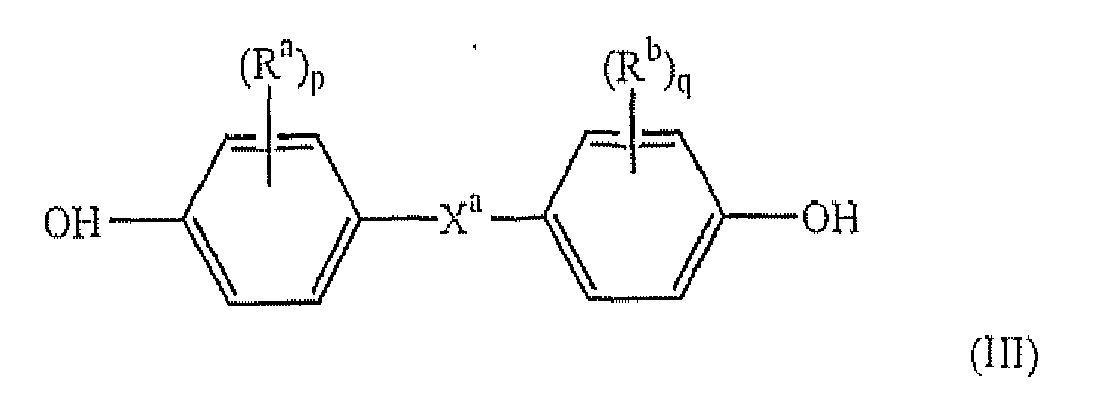
- dihydroxy compound includes, for example, bisphenol compounds having general formula (III) as follows: wherein R a and R b each represent a halogen atom, for example chlorine or bromine, or a monovalent hydrocarbon group, preferably having from 1 to 10 carbon atoms, and may be the same or different; p and q are each independently integers from 0 to 4;
- X a represents one of the groups of formula (IV): wherein R c and R d each independently represent a hydrogen atom or a monovalent linear or cyclic hydrocarbon group and R e is a divalent hydrocarbon group.
- dihydroxy compounds include the dihydroxy-substituted aromatic hydrocarbons disclosed by name or formula (generic or specific) in U.S. Patent 4,217,438 , which is incorporated herein by reference.
- a nonexclusive list of specific examples of the types of bisphenol compounds that may be represented by formula (III) includes 1,1-bis(4-hydroxyphenyl) methane; 1,1-bis(4-hydroxylphenyl) ethane; 2,2-bis(4-hydroxyphenyl) propane (hereinafter "bisphenol A” or "BPA”); 2,2-bis(4-hydroxyphenyl) butane; 2,2-bis(4-hydroxyphenyl) octane; 1,1-bis(4-hydroxnphenyl) propane; 1,1-bis(4-hydroxyphenyl) n-butane; bis(4-hydroxyphenyl) phenylmethane; 2,2-bis(4-hydroxy-1-metliylphonyl) propane; 1,1-bis(4-hydroxy-t-butylphenyl) propane; bis(hydroxyaryl) alkanes such as 2,2-bis(4-hydroxy-3-bromophenyl) propane; 1,1-bis(4-hydroxyphenyl)
- Typical carbonate precursors include the carbonyl halides, for example carbonyl chloride (phosgene), and carbonyl bromide; the bis-haloformates, for example the bis-haloformates of dihydric phenols such as bisphenol A, hydroquinone, and the like, and the bis-haloformates of glycols such as ethylene glycol and neopentyl glycol; and the diaryl carbonates, such as diphenyl carbonate, di(tolyl) carbonate, and di(naphthyl) carbonate.
- carbonyl halides for example carbonyl chloride (phosgene), and carbonyl bromide
- the bis-haloformates for example the bis-haloformates of dihydric phenols such as bisphenol A, hydroquinone, and the like, and the bis-haloformates of glycols such as ethylene glycol and neopentyl glycol
- the diaryl carbonates such as
- Typical branching resins such as ⁇ , ⁇ , ⁇ ', ⁇ '-tetrakis(3-methyl-4-hydroxyphenyl)-p-xylene, ⁇ , ⁇ , ⁇ ', ⁇ '-tetrkis(2-methyl-hydroxyphenyl)-p-xylene, ⁇ , ⁇ , ⁇ ', ⁇ '-tetrakis(2,5 dimethyl-4-hydroxyphenyl)-p-xylene, ⁇ , ⁇ , ⁇ ', ⁇ '-tetrakis(2,6 dimethyl-4-hydroxyphenyl)-p-xylene, ⁇ , ⁇ , ⁇ ', ⁇ '-tetrakis(4-hydroxyphenyl)-p-xylene, trimellitic acid, trimellitic anhydride, trimellitic trichloride, tris-p-hydroxy phenyl ethane, isatin-bis-phenol, tris-phenol TC (1,3,5-tris((p-hydroxyphenyl)isopropyl)benzene), tri
- phase transfer resins include, but are not limited to, tertiary amines such as triethylamine, quaternary ammonium compounds, and quaternary phosphonium compounds.
- Molecular weight regulators or chain stoppers are optional and are added to the mixture in order to arrest the progress of the polymerization.
- Typical molecular weight regulators such as phenol, chroman-1, p-t-butylphenol, p-bromophenol, paracumyl-phenol, and the like may be added either singly or in admixture and are typically added in an amount of about 1 to about 10 mol% excess with respect to the BPA.
- the molecular weight of the polycarbonate resin is generally greater than or equal to about 5000, preferably greater than or equal to about 10,000, more preferably greater than or equal to about 15,000 g/mole.
- polycarbonate resin less than or equal to about 100,000, preferably less than or equal to about 50,000, more preferably less than or equal to about 30,000 g/mole as calculated from the viscosity of a methylene chloride solution at 25°C.
- Polycarbonate resins are generally used in amounts greater than or equal to about 10 weight percent (wt%), preferably greater or equal to about 30 wt%, more preferably greater than or equal to about 40 wt% of the total composition.
- the polymeric resins are furthermore generally used in amounts less than or equal to about 99 weight percent wt%, preferably less than or equal to about 85 wt%, more preferably less than or equal to about 75 wt% of the total composition.
- antistatic agent refers to several materials that can be either melt-processed into polymeric resins or sprayed onto commercially available polymeric forms and shapes to improve conductive properties and overall physical performance.
- monomeric antistatic agents examples include glycerol monostearate, glycerol distearate, glycerol tristearate, ethoxylated gamines, primary, secondary and tertiary amines, ethoxylated alcohols, alkyl sulfates, alkylarylsulfates, alkylphosphates, alkylaminesulfates, quaternary ammonium a salts, quaternary ammonium resins, imidazoline derivatives, sorbitan esters, ethanolamides, betaines and mixtures of the forgoing.
- Non-limiting examples of commercial monomeric antistatic agents which may be used in polymeric resins are PATICNIC 1042 and PATIONIC AS10, available from Patco, or STATEXAN® K1, available from Bayer.
- polymeric antistatic agents examples include: copolyesteramides such as those disclosed in U.S. Pat. Nos. 4,115,475 to Foy et al. , U.S. Pat. Nos. 4,839,441 and 4,864,014 to Cuzin et al. ; polyether-polyamide (polyetheramide) block copolymers such as those disclosed in U.S. Pat. Nos. 5,840,807 to Frey et al. ; polyetheresteramide block copolymers such as those disclosed in U.S. Pat. Nos. 5,604,284 ; 5,652,326 ; and 5,886,098 to Ueda et al. , U.S. Pat. Nos.
- polyetheramides examples include block copolymers and graft copolymers both obtained by the reaction between a polyamide-forming compound and/or a polyester-forming compound, and a compound containing a polyalkylene oxide unit.
- Polyamide forming compounds include aminocarboxylic acids such as ⁇ - aminocaproic acid, ⁇ -aminoenanthic acid, ⁇ -aminocaprylic acid, ⁇ -aminopelargonic acid, ⁇ -aminocapric acid, 11-aminoundecanoic acid and 12-aminododecanoic acid; lactams such as ⁇ -caprolactam and enanthlactam; a salt of a diamine with a dicarboxylic acid, such as hexamethylene diamine adipate, hexamethylene diamine sebacate, and hexamethylene diamine isophthalate; and a mixture of these polyamide-forming compounds. It is preferred that the polyamide-forming compound is a caprolactam, 12-aminododecanoic acid, or a combination of hexamethylene diamine and adipate.
- Polyester forming compounds include a combination of a dicarboxylic acid (or a mixture of two or more dicarboxylic acids) with an aliphatic diol (or a mixture of two or more aliphatic diols).
- dicarboxylic acids include aromatic dicarboxylic acids, such as isophthalic acid, terephthalic acid, phthalic acid, naphthalene-2,6-dicarboxylic acid, naphthalene-2,7-dicarboxylic acid, diphenyl-4,4'-dicarboxylic acid, diphenoxyethanedicarboxylic acid and sodium 3-sulfoisophthalate; alicyclic dicarboxylic acids, such as 1,3-cyclopentanedicarboxylic acid, 1,4-cyclohexanedicarboxylic acid, 1,2-cyclohexanedicarboxylic acid and 1,3-dicarboxymethylcyclohexane; and aliphatic dicar
- dicarboxylic acids may be used individually or in combination.
- Non-limiting examples of aliphatic diols include methylene glycol, 1,2-propylene glycol, 1,3-propylene glycol, 1,2-butanediol, 1,3-butanediol, 2,3-butanediol, 1,4-butanediol, neopentyl glycol and hexanediol. These aliphatic diols may be used individually or in combination.
- Preferred dicarboxylic acids are terephthalic acid, isophthalic acid, 1,4-cyclohexanedicarboxylic acid, and sebacic acid and decanedicarboxylic acid.
- Preferred diols are ethylene glycol, 1,2-propylene glycol, 1,3-propylene glycol and 1,4-butanediol.
- Polyalkylene oxide units such as polyethylene glycol, polypropylene glycol, polytetramethylene glycol and a block or random copolymer of ethylene oxide and tetramethylene oxide; diamines obtained by replacing the terminal hydroxyl groups of these diols by amino groups; and dicarboxylic acids obtained by replacing the terminal hydroxyl groups of these diols by carboxylic acid groups can be used to form the polyetheramide, polyetherester and polyetheresteramide polymeric antistatic agents. These compounds containing a polyalkylene oxide unit can be used individually or in combination. Of these compounds, polyethylene glycol is preferred.
- a polyetheramide, a polyetherester or a polyetheresteramide there can be employed a method in which a polyamide-forming compound and/or a polyester-forming compound is reacted with a polyalkylene oxide unit-containing compound, wherein, depending on the type of the terminal groups of the polyalkylene oxide unit-containing compound, the reaction is an esterification reaction or an amidation reaction. Further, depending on the type of the reaction, a dicarboxylic acid or a diamine may also be used in the reaction.
- Polymeric antistatic agents such as PELESTAT 6321, available from Sanyo, or PEBAX MH1657, available from Atofina, are non-limiting examples of commercially available polymeric antistatic agents that may be added to polymeric resins to improve conductive properties.
- Other commercially available antistatic agents are IRGASTAT P18 and P22 from Ciba-Geigy.
- Other polymeric materials that may be used as antistatic agents are doped inherently conducing polymers such as polyaniline (commercially available as PANIPOL ® EB from Panipol), polypyrrole and polythiophene (commercially available from Bayer), which retain some of their intrinsic conductivity after melt processing at elevated temperatures.
- the antistatic agent is generally used in an amount greater than or equal to about 0.01, preferably greater or equal to about 0.1, and more preferably greater than or equal to about 1 wt% of the total composition.
- the antistatic agent is generally used in amount less than or equal to about 25 wt%, preferably less than or equal to about 15 wt%, and more preferably less than or equal to about 10 wt% of the total composition.
- Impact modifiers used in the antistatic compositions may be copolymers comprising a polysiloxane, such as, for example, A-B-A triblock copolymers and A-B diblock copolymers.
- the impact modifier may be a polycarbonate-polysiloxane copolymer comprising a polycarbonate block and a polysiloxane block, wherein the polysiloxane block portion comprises about 0.5 to about 10 wt% of the impact modifier.
- the impact modifiers include copolymers of one or more of an acrylic polymer or a methacrylic polymer mainly comprising an alkyl acrylate or an alkyl methacrylate, a silicone polymer mainly comprising a polysiloxane and an optional diene polymer mainly comprising a conjugated diene such as butadiene or isoprene.
- a preferred impact modifier of this type is polymethylmethacrylate-polyacryhc-polysiloxane copolymer, which is a core shell impact modifier wherein the shell comprises a polymethylmethacrylate graft polymer and the core is a rubbery phase comprised of a copolymer of silicone and acrylic polymers.
- a commercially available example of such core shell impact modifiers is METABLEN ® S-2001 from Mitsubishi Rayon.
- Impact modifiers may be used in amounts greater than or equal to about 1, and preferably greater than or equal to about 2 weight percent (wt%). Also preferred, the impact modifier is used in amounts less than or equal to about 20, preferably less than or equal to about 15, and more preferably less than or equal to about 12 wt% of the total composition.
- the antistatic composition may also comprise at least one flame retardant, generally a halogenated material, an organic phosphate, or a combination of the two.
- the organic phosphate classes of materials are generally preferred.
- the organic phosphate is preferably an aromatic phosphate compound of the formula (V): wherein each R is the same or different and is preferably an alkyl, a cycloalkyl, an aryl, an alkyl substituted aryl, a halogen substituted aryl, an aryl substituted alkyl, a halogen, or a combination of at least one of the foregoing phosphate compounds provided at least one R is aryl.
- Suitable phosphate compounds include phenol bis(dodecyl) phosphate, phenyl bis(neopentyl) phosphate, phenyl bis(3,5,5'-trimethylhexyl phosphate), ethyl diphenyl phosphate, 2-ethyylhexyl bis(p-tolyl) phosphate, bis(3-ethylhexyl) p-tolyl phosphate, tritolyl phosphate, bis(2-ethylhexyl) phenyl phosphate, tri(nonylphenyl) phosphate, bis(dodecyl) p-tolyl phosphate, tricresyl phosphate, triphenyl phosphate, dibutylphenyl phosphate, 2-chloroethyl diphenyl phosphate, p-tolyl bis(2,5,5'-trimethylhexyl) phosphate, 2-ethylhe
- the organic phosphate can be a di- or polyfunctional compound or polymer having the formula (VI), (VII), or (VIII) below: or or including mixtures thereof, in which R 1 , R 3 and R 5 are independently hydrocarbon; R 2 , R 4 , R 6 and R 7 are independently hydrocarbon or hydrocarbonoxy; X 1 , X 2 and X 3 are halogen; m and r are 0 or integers from I to 4, and n and p are integers from 1 to 30.
- di- and polyfunctional phosphate compounds include the bis(diphenyl phosphates) of resorcinol, hydroquinone and bisphenol-A, respectively, or their polymeric counterparts. Method for the preparation of the aforementioned di- and polyfunctional phosphates are described in British Patent No. 2,043,083 .
- Another group of useful flame-retardants include certain cyclic phosphates, for example, diphenyl pentaerythritol diphosphate, as a flame retardant resin for polyphenylene ether resins, as is described by Axelrod in U.S. Pat. No. 4,254,775 .
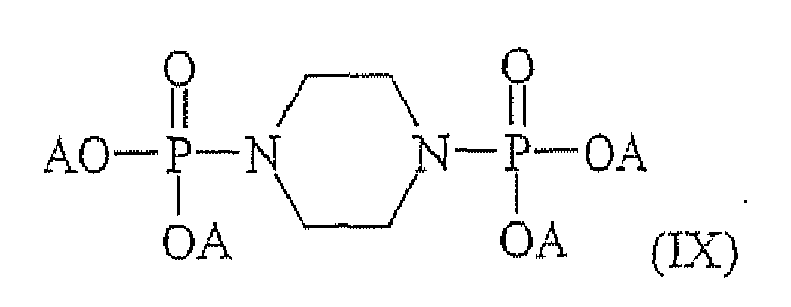
- flame-retardant additives are the phosphoramides of the formula (IX): wherein each A is a 2,6-dimethylphenyl moiety or a 2,4,6-trimethylphenyl moiety. These phosphoramides are piperazine-type phosphoramides. These additives have been described in Talley, J. Chem. Eng. Data, 33, 221-222 (1988 ).
- the flame retardant composition may contain a single phosphate compound or a mixture of two or more different types of phosphate compounds.
- Compositions containing essentially a single phosphate compound are preferred.
- Preferred phosphate flame-retardants include those based upon resorcinol such as, for example, resorcinol bis(diphenyl phosphate), as well as those based upon bisphenols such as, for example, bisphenol A bis(diphenyl phosphate). Also preferred are the aforementioned piperazine-type phosphoramides. Phosphates containing substituted phenyl groups are also preferred.
- the organophosphate is butylated triphenyl phosphate ester.
- the most preferred phosphate compounds are resorcinol bis(diphenyl phosphate) (hereinafter RDP), bisphenol A bis(diphenyl phosphate) (hereinafter BPADP) and N,N'-bis[di-(2,6-xylyl)phosphoryl]-piperazine (hereinafter XPP), and mixtures thereof, with BPADP most preferred.
- RDP resorcinol bis(diphenyl phosphate)
- BPADP bisphenol A bis(diphenyl phosphate)
- XPP N,N'-bis[di-(2,6-xylyl)phosphoryl]-piperazine
- Halogenated materials are also a useful class of flame-retardants. These materials are preferably aromatic halogen compounds and resins of the formula (X): wherein R is an alkylene, alkylidene or a cycloaliphatic linkage, e.g., methylene, methylene, propylene, isopropylene, isopropylidene, butylene, isobutylene, amylene, cyclohexylene, cyclopentylidene, and the like; a linkage selected from the group consisting of either oxygen ether; carbonyl; amine; a sulfur containing linkage, e.g., sulfide, sulfoxide, sulfone; a phosphorus containing linkage; R can also consist of two or more alkylene or alkylidene linkages connected by such groups as aromatic, ammo, ether, carbonyl, sulfide, sulfoxide, sulfone or a
- Ar and Ar' are mono- or polycarbocyclic aromatic groups such as phenylene, biphenylene, terphenylene, naphthylene, and the like. Ar and Ar 1 may be the same or different.
- Y is a substituent selected from the group consisting of organic, inorganic or organometallic radicals including but not limited to a halogen, ether groups of the general formula OE, wherein E is a monovalent hydrocarbon radical similar to X, monovalent hydrocarbon groups of the type represented by R or other substituents, e.g., nitro, cyano, and the like, substituents being essentially inert provided there be at least one and preferably two halogen atoms per aryl nucleus.
- X is a monovalent hydrocarbon group such as an alkyl, e.g., methyl, ethyl, propyl, isopropyl, butyl, decyl, and the like; an aryl group, e.g., phenyl, naphthyl, diphenyl, xylyl, tolyl, and the like; an aralkyl group e.g., benzyl, ethylphenyl, and the like, a cycloaliphatic groups, e.g., cyclopentyl, cyclohexyl, and the like, and a monovalent hydrocarbon groups containing inert substituents therein.
- alkyl e.g., methyl, ethyl, propyl, isopropyl, butyl, decyl, and the like
- an aryl group e.g., phenyl, naphthyl, diphenyl,
- the letter d represents a whole number ranging from 1 to a maximum equivalent to the number of replaceable hydrogens substituted on the aromatic rings comprising Ar or Ar 1 .
- the letter e represents a whole number ranging from 0 to a maximum controlled by the number of replaceable hydrogens on R.
- the letters a, b, and c represent whole numbers including 0. When b is not 0, neither a nor c may be 0. Otherwise either a or c, but not both, may be 0. Where b is 0, a direct carbon-carbon bond joins the aromatic groups.
- the hydroxyl and Y substituents on the aromatic groups, Ar and Ar' can be varied in the ortho, meta or para positions on the aromatic rings and the groups can be in a variety of possible geometric relationship with respect to one another.
- Suitable halogenated flame retardant materials include 2,2-bis-(3,5-dichlorophenyl)-propane, bis-(2-chlorophenyl)-methane, bis(2,6-dibromophenyl)-methane, 1,1-bis-(4-iodophenyl)-ethane, 1,2-bis-(2,6-dichlorophenyl)-ethane, 1,1-bis-(2-chloro-4-iodophenyl)ethane, 1,1-bis-(2-chloro-4-methylphenyl)-ethane, 1,1-bis-(3,5-dichlorophenyl)-ethane, 2,2-bis-(3-phenyl-bromophenyl)-ethane, 2,6-bis-(4,6-dichloronaphthyl)-propane, 2,2-bis-(2,6-dichloraphenyl)-pentane, 2,2-bis-(3,5
- halogenated flame-retardants may be by condensation of two moles of a phenol with a single mole of a ketone or aldehyde.
- divalent aliphatic group in the above examples may be substituted oxygen, sulfur, sulfoxy, and the like.
- Suitable halogenated flame-retardants include 1,3-dichlorobenzezxe, 1,4-dibrombenzene, 1,3-dichloro-4-hydroxybenzene and biphenyls such as 2,2'-dichlorobiphenyl, polybrominated 1,4-diphenoxybenzene, 2,4'-dibromobiphenyl, and 2,4'-dichlorobiphenyl as well as decabromo diphenyl oxide, and the like.
- oligomeric and polymeric halogenated aromatic compounds such as, for example, a copolycarbonate of bisphenol A and tetrabromobisphenol A and a carbonate precursor, e.g., phosgene.
- Metal synergists e.g., antimony oxide, may also be used with the flame retardant.
- the incorporation of flame-retardants also affords methods to increase the heat distortion temperature (HDT) of the flame retardant antistatic compositions so that the composition has a flame rating of at least V-2, preferably a flame rating of at least V-1, and more preferably a flame rating of V-0 as measured in accordance with a UL-94 protocol. While the particular amount of flame retardant used in the compositions will vary depending on the molecular weight of the organic phosphate, the amount of the flammable resin present in the composition is greater than or equal to about 9 wt% of the total composition. Also preferred, is to have the flame retardant present in an amount less than or equal to about 30, preferably less than or equal to about 25, and more preferably less than of equal to about 20 wt% of the total composition.
- HDT heat distortion temperature
- One method of preparing the composition includes such steps as dry blending followed by melt processing, the latter operation frequently being performed under continuous conditions such as extrusion.
- the components of the composition e.g., the polycarbonate resin, impact modifier, antistatic agent and flame retardant
- the various components of the composition are fed into the extruder sequentially.
- some of the components such as the antioxidant and the antistatic agent may be fed into the extruder in a masterbatch form.
- the strand emerging from the extruder is quenched in a water bath, pelletized and subjected into additional processing such as injection molding, blow molding, vacuum forming, and the like.
- the Table below shows antistatic flame retardant compositions comprising the antistatic agent PELESTAT NC6321 from Sanyo.
- BPADP obtained from Akzo-Nobel was used as the flame retardant.
- Lexan PC 145 obtained from GE Plastics was used as thermoplastic resin.
- Polycarbonate-polysiloxane (PC/PDMS) obtained from GE Plastics
- Metablen® S-2001 obtained from Mitsubishi Rayon are used as the impact modifiers.
- TSAN (a 1:1 blend of polytetrafluoroethylene and styrene acrylonitrile) was added as an anti-dip agent in an amount of about 0.6 wt%, while hindered phenol was added as the antioxidant in an amount of about 0.3 wt% in all compositions.
- the samples represented in the Table were first dry blended in the appropriate quantities in a Henschel high-speed mixer. The dry blends were then extruded in a 30 mm Werner and Pfleiderer Twin Screw extruder having six barrels. The barrel temperature was maintained at 230°C, 240°C, 260°C, 260°C, 260°C, and 260°C, respectively. The die temperature was set at 260°C and the extruder was run at 300 rpm at 50 lbs/hour. The strand of antistatic flame retardant resin emerging from the extruder was pelletized, dried at approximately 90°C for two to four hours and subjected to injection molding on an 85 ton Van Dorn molding machine to obtain the test samples.
- Samples 1, 2, and 3 shown in Table 1 were used as comparative examples, while samples 4, 5, 6, and 7 are representative of the antistatic, flame retardant compositions having high impact.
- composition 1 no impact modifier was used and therefore the impact properties as measured by notched Izod were low at 1.24 ft-lbs/inch while the use of BPADP as a flame retardant is effective as can be seen from the V-1 results at 2 mm of 1.0.
- the surface resistivity of 2.33 x 10 13 ohm/sq is attributable to the addition of 5 wt% antistatic agent.
- Composition 2 contains 5 wt% of the PC/PDMS impact modifier and hence shows a tremendous increase in impact strength from composition 1.
- the V-1 value however, drops to 0.61 showing reduced flame retardancy upon addition of the impact modifier, despite the use of the same amount of the flame retardant BPADP.
- Composition 3 contains a similar amount of impact modifier as composition 2, but contains less flame retardant and antistatic agent. This causes a poor V-1 value as well as an increase in surface resistivity.
- Composition 4 demonstrates that by increasing the antistatic agent and the flame retardant content, the sample has improved antistatic properties and better flame retardant properties than composition 2.
- Samples 4 and 5 have the same amount of antistatic agent as composition 1 but an increased amount of flame retardant, having 10 and 12 wt% respectively. This results in a combination of improved flame retardant as well as high impact properties.
- sample 6 has the same amount of antistatic agent and impact modifier as sample 2, an increased amount of the flame retardant renders this composition excellent in its flame retardant properties in addition to the impact and surface resistivity properties.
- the antistatic, impact resistant, flame retardant compositions can be advantageously used for a number of applications in the area of electronics, automobile components, packaging, and the like, where it is desirable to have notched Izod impact properties greater than or equal to about 1 ft-lb/inch, preferably greater than or equal to about 2 ft-lb/inch.
- the compositions will preferably have surface resistivities of less than or equal to about 10 14 ohm/square while having a flammability rating of greater than V-2.
Landscapes
- Chemical & Material Sciences (AREA)
- Health & Medical Sciences (AREA)
- Chemical Kinetics & Catalysis (AREA)
- Medicinal Chemistry (AREA)
- Polymers & Plastics (AREA)
- Organic Chemistry (AREA)
- Compositions Of Macromolecular Compounds (AREA)
Abstract
An antistatic flame retardant composition comprises a polycarbonate resin; an impact modifier comprising a polycarbonate-polysiloxane copolymer; and antistatic agent; and a flame retardant comprising phosphorous wherein the frame retardant is present in an amount greater than or equal to about 9 wt% of the total composition. Owing to its excellent antistatic, impact and flame retardant properties, the composition can be used in electrical and electronic equipment and precision machinery where high fabrication temperatures and high usage temperatures are often encountered.
Description
- This disclosure relates generally to antistatic compositions, their use in flame retardant resin compositions, and a method of manufacture thereof.
- Polymeric resins are suitable for a large number of applications because of their high strength-to-weight ratio and ease of processing. However, the build up of electrostatic charges in the polymeric resin attracts dust and foreign particles, thereby spoiling the appearance of molded parts made therefrom. Moreover, the build up of electrostatic charges renders the polymeric resin unusable in certain electrical and electronic applications. It is therefore desirable to have polymeric resins that possess antistatic properties (i.e., are electrostatically conductive) and that maintain these properties at the elevated temperatures used in processing these materials.
- Polymeric resins and articles having antistatic properties are typically obtained by directly blending antistatic agents with the polymeric resins during a compounding process. Unfortunately, the antistatic agent often migrates to the surface layer of the article over time, lowering the antistatic properties due to frictional wear of the surface layer. A need therefore remains for stable antistatic compositions wherein the antistatic agent remains well dispersed in the bulk of the polymeric resin during high temperature processing and subsequent use. In addition, it is desirable to have flame retardant antistatic compositions for end use applications such as electronic applications or packaging flammable materials.
- An antistatic, impact resistant, flame retardant composition comprises a polycarbonate resin; an impact modifier comprising polysiloxane; an antistatic agent; and a flame retardant in an amount greater than or equal to about 9 wt%. Owing to its excellent antistatic, impact and flame retardant properties, the composition can be used in electrical and electronic equipment, and precision machinery where high fabrication temperatures and high usage temperatures are often encountered.
- Antistatic compositions comprising polymeric resins and antistatic agents are often flammable, which is undesirable especially in electronic applications. The addition of large amounts of a flame retardant to reduce the flammability of the material typically has the effect of reducing the impact properties of the material. It has now been unexpectedly discovered that the addition of bisphenol A bis(diphenyl phosphate) (hereinafter BPADP) to an antistatic composition comprising a polymeric resin, an impact modifier comprising polysiloxane, and an antistatic agent such as PELESTAT 6321, commercially available from Sanyo, or PEBAX MH1657, commercially available from Atofina, can impart excellent flame retardant properties to the composition while maintaining impact properties. This combination of antistatic, impact resistance, and flame retardant properties is useful in electronic articles as well as for packaging flammables. These compositions can also be used as media optical shells for optical media and other similar data storage devices.
- The term polycarbonate resin, comprises aromatic carbonate chain units and includes compositions having structural units of the formula (I):

-A1-Y1-A2- (II)
wherein each of A1 and A2 is a monocyclic, divalent aryl radical and Y1 is a bridging radical having one or two atoms which separate A1 from A2. In an exemplary embodiment, one atom separates A1 from A2. Illustrative non-limiting examples of radicals of this type are -O-, -S-, -S(O)-, -S(O2)-, -C(O)-, methylene, cyclohexylmethylene, 2-[2.2.1]-bicycloheptylidene, ethylidene, isopropylidene, neopentylidene, cyclohexylidene, cyclopentadecylidene, cyclododecylidene, and adamantylidene. The bridging radical Y1 can be a hydrocarbon group or a saturated hydrocarbon group such as methylene, cyclohexylidene or isopropylidene. - Polycarbonate resins can be produced by the reaction of the carbonate precursor with dihydroxy compounds. Typically, an aqueous base such as (e.g., sodium hydroxide, potassium hydroxide, calcium hydroxide, and the like,) is mixed with an organic, water immiscible solvent such as benzene, toluene, carbon disulfide, or dichloromethane, which contains the dihydroxy compound. A phase transfer resin is generally used to facilitate the reaction. Molecular weight regulators may be added to the reactant mixture. These molecular weight regulators may be added singly or as a combination. Branching resins, described forthwith may also be added singly or in admixture. Another process for producing aromatic polycarbonate resins is the transesterification process, which involves the transesterification of an aromatic dihydroxy compound and a diester carbonate. This process is known as the melt polymerization process. The process of producing the aromatic polycarbonate resins is not critical.
- As used herein, the term "dihydroxy compound" includes, for example, bisphenol compounds having general formula (III) as follows:

- Some illustrative, non-limiting examples of suitable dihydroxy compounds include the dihydroxy-substituted aromatic hydrocarbons disclosed by name or formula (generic or specific) in
U.S. Patent 4,217,438 , which is incorporated herein by reference. A nonexclusive list of specific examples of the types of bisphenol compounds that may be represented by formula (III) includes 1,1-bis(4-hydroxyphenyl) methane; 1,1-bis(4-hydroxylphenyl) ethane; 2,2-bis(4-hydroxyphenyl) propane (hereinafter "bisphenol A" or "BPA"); 2,2-bis(4-hydroxyphenyl) butane; 2,2-bis(4-hydroxyphenyl) octane; 1,1-bis(4-hydroxnphenyl) propane; 1,1-bis(4-hydroxyphenyl) n-butane; bis(4-hydroxyphenyl) phenylmethane; 2,2-bis(4-hydroxy-1-metliylphonyl) propane; 1,1-bis(4-hydroxy-t-butylphenyl) propane; bis(hydroxyaryl) alkanes such as 2,2-bis(4-hydroxy-3-bromophenyl) propane; 1,1-bis(4-hydroxyphenyl) cyclopentane; and bis(hydroxyaryl) cycloalkanes such as 1,1-bis(4-hydroxyphenyl) cyclohexane. Two or more different dihydric phenols may also be used. - Typical carbonate precursors include the carbonyl halides, for example carbonyl chloride (phosgene), and carbonyl bromide; the bis-haloformates, for example the bis-haloformates of dihydric phenols such as bisphenol A, hydroquinone, and the like, and the bis-haloformates of glycols such as ethylene glycol and neopentyl glycol; and the diaryl carbonates, such as diphenyl carbonate, di(tolyl) carbonate, and di(naphthyl) carbonate.
- Typical branching resins such as α,α,α',α'-tetrakis(3-methyl-4-hydroxyphenyl)-p-xylene, α,α,α',α'-tetrkis(2-methyl-hydroxyphenyl)-p-xylene, α, α,α',α'-tetrakis(2,5 dimethyl-4-hydroxyphenyl)-p-xylene, α,α,α',α'-tetrakis(2,6 dimethyl-4-hydroxyphenyl)-p-xylene, α,α,α',α'-tetrakis(4-hydroxyphenyl)-p-xylene, trimellitic acid, trimellitic anhydride, trimellitic trichloride, tris-p-hydroxy phenyl ethane, isatin-bis-phenol, tris-phenol TC (1,3,5-tris((p-hydroxyphenyl)isopropyl)benzene), tris-phenol PA (4-(4-(1,1-bis(p-hydroxyhenyl)-ethyl)alpha,alphadimethylbenzyl)phenol), 4-chloroformyl phthalic anhydride, trimesic acid, benzophenone tetracarboxylic acid and the like, can also be added to the reaction mixture. Blends of linear polycarbonate and branched polycarbonate resins can be utilized herein. The branching agent may be added at a level of about 0.05 to about 2.0 weight percent (wt%).
- Some illustrative, non-limiting examples of suitable phase transfer resins include, but are not limited to, tertiary amines such as triethylamine, quaternary ammonium compounds, and quaternary phosphonium compounds.
- Molecular weight regulators or chain stoppers are optional and are added to the mixture in order to arrest the progress of the polymerization. Typical molecular weight regulators such as phenol, chroman-1, p-t-butylphenol, p-bromophenol, paracumyl-phenol, and the like may be added either singly or in admixture and are typically added in an amount of about 1 to about 10 mol% excess with respect to the BPA. The molecular weight of the polycarbonate resin is generally greater than or equal to about 5000, preferably greater than or equal to about 10,000, more preferably greater than or equal to about 15,000 g/mole. In general it is desirable to have the polycarbonate resin less than or equal to about 100,000, preferably less than or equal to about 50,000, more preferably less than or equal to about 30,000 g/mole as calculated from the viscosity of a methylene chloride solution at 25°C.
- Polycarbonate resins are generally used in amounts greater than or equal to about 10 weight percent (wt%), preferably greater or equal to about 30 wt%, more preferably greater than or equal to about 40 wt% of the total composition. The polymeric resins are furthermore generally used in amounts less than or equal to about 99 weight percent wt%, preferably less than or equal to about 85 wt%, more preferably less than or equal to about 75 wt% of the total composition.
- The term "antistatic agent" refers to several materials that can be either melt-processed into polymeric resins or sprayed onto commercially available polymeric forms and shapes to improve conductive properties and overall physical performance.
- Examples of monomeric antistatic agents that may be used are glycerol monostearate, glycerol distearate, glycerol tristearate, ethoxylated gamines, primary, secondary and tertiary amines, ethoxylated alcohols, alkyl sulfates, alkylarylsulfates, alkylphosphates, alkylaminesulfates, quaternary ammonium a salts, quaternary ammonium resins, imidazoline derivatives, sorbitan esters, ethanolamides, betaines and mixtures of the forgoing. Non-limiting examples of commercial monomeric antistatic agents which may be used in polymeric resins are PATICNIC 1042 and PATIONIC AS10, available from Patco, or STATEXAN® K1, available from Bayer.
- Examples of polymeric antistatic agents include: copolyesteramides such as those disclosed in
U.S. Pat. Nos. 4,115,475 to Foy et al. ,U.S. Pat. Nos. 4,839,441 and4,864,014 to Cuzin et al. ; polyether-polyamide (polyetheramide) block copolymers such as those disclosed inU.S. Pat. Nos. 5,840,807 to Frey et al. ; polyetheresteramide block copolymers such as those disclosed inU.S. Pat. Nos. 5,604,284 ;5,652,326 ; and5,886,098 to Ueda et al. ,U.S. Pat. Nos. 4,331,786 ;4,230,838 ;4,332,920 to Foy et al. , andU.S. Pat. Nos. 4,195,015 to Deleens et al. ; polyurethanes containing a polyalkylene glycol moiety such as those disclosed inU.S. Pat. Nos. 5,159,053 to Kolycheck et al. , andU.S. Pat. Nos. 5,863,466 to Mor et al. ; polyetheresters such as those disclosed inU.S. Pat. No. 5,112, 940 ,U.S. Pat. No 4,537,596 to Muller et al. , andU. S. Pat. No. 4,038,258 to Singh et al , all of which are incorporated herein by reference. Polymeric antistatic agents have been shown to be fairly thermally stable and processable in the melt state in their neat form or in blends with other polymeric resins. Examples of polyetheramides, polyetheresters and polyetheresteramides include block copolymers and graft copolymers both obtained by the reaction between a polyamide-forming compound and/or a polyester-forming compound, and a compound containing a polyalkylene oxide unit. Polyamide forming compounds include aminocarboxylic acids such as ω- aminocaproic acid, ω-aminoenanthic acid, ω-aminocaprylic acid, ω-aminopelargonic acid, ω-aminocapric acid, 11-aminoundecanoic acid and 12-aminododecanoic acid; lactams such as ε-caprolactam and enanthlactam; a salt of a diamine with a dicarboxylic acid, such as hexamethylene diamine adipate, hexamethylene diamine sebacate, and hexamethylene diamine isophthalate; and a mixture of these polyamide-forming compounds. It is preferred that the polyamide-forming compound is a caprolactam, 12-aminododecanoic acid, or a combination of hexamethylene diamine and adipate. - Polyester forming compounds include a combination of a dicarboxylic acid (or a mixture of two or more dicarboxylic acids) with an aliphatic diol (or a mixture of two or more aliphatic diols). Non-limiting examples of dicarboxylic acids include aromatic dicarboxylic acids, such as isophthalic acid, terephthalic acid, phthalic acid, naphthalene-2,6-dicarboxylic acid, naphthalene-2,7-dicarboxylic acid, diphenyl-4,4'-dicarboxylic acid, diphenoxyethanedicarboxylic acid and sodium 3-sulfoisophthalate; alicyclic dicarboxylic acids, such as 1,3-cyclopentanedicarboxylic acid, 1,4-cyclohexanedicarboxylic acid, 1,2-cyclohexanedicarboxylic acid and 1,3-dicarboxymethylcyclohexane; and aliphatic dicarboxylic acids, such as succinic acid, oxalic acid, adipic acid, sebacic acid and decanedicarboxylic acid. These dicarboxylic acids may be used individually or in combination. Non-limiting examples of aliphatic diols include methylene glycol, 1,2-propylene glycol, 1,3-propylene glycol, 1,2-butanediol, 1,3-butanediol, 2,3-butanediol, 1,4-butanediol, neopentyl glycol and hexanediol. These aliphatic diols may be used individually or in combination. Preferred dicarboxylic acids are terephthalic acid, isophthalic acid, 1,4-cyclohexanedicarboxylic acid, and sebacic acid and decanedicarboxylic acid. Preferred diols are ethylene glycol, 1,2-propylene glycol, 1,3-propylene glycol and 1,4-butanediol.
- Compounds containing polyalkylene oxide units such as polyethylene glycol, polypropylene glycol, polytetramethylene glycol and a block or random copolymer of ethylene oxide and tetramethylene oxide; diamines obtained by replacing the terminal hydroxyl groups of these diols by amino groups; and dicarboxylic acids obtained by replacing the terminal hydroxyl groups of these diols by carboxylic acid groups can be used to form the polyetheramide, polyetherester and polyetheresteramide polymeric antistatic agents. These compounds containing a polyalkylene oxide unit can be used individually or in combination. Of these compounds, polyethylene glycol is preferred.
- For synthesizing a polyetheramide, a polyetherester or a polyetheresteramide, there can be employed a method in which a polyamide-forming compound and/or a polyester-forming compound is reacted with a polyalkylene oxide unit-containing compound, wherein, depending on the type of the terminal groups of the polyalkylene oxide unit-containing compound, the reaction is an esterification reaction or an amidation reaction. Further, depending on the type of the reaction, a dicarboxylic acid or a diamine may also be used in the reaction.
- Polymeric antistatic agents such as PELESTAT 6321, available from Sanyo, or PEBAX MH1657, available from Atofina, are non-limiting examples of commercially available polymeric antistatic agents that may be added to polymeric resins to improve conductive properties. Other commercially available antistatic agents are IRGASTAT P18 and P22 from Ciba-Geigy. Other polymeric materials that may be used as antistatic agents are doped inherently conducing polymers such as polyaniline (commercially available as PANIPOL®EB from Panipol), polypyrrole and polythiophene (commercially available from Bayer), which retain some of their intrinsic conductivity after melt processing at elevated temperatures.
- In one embodiment, the antistatic agent is generally used in an amount greater than or equal to about 0.01, preferably greater or equal to about 0.1, and more preferably greater than or equal to about 1 wt% of the total composition. The antistatic agent is generally used in amount less than or equal to about 25 wt%, preferably less than or equal to about 15 wt%, and more preferably less than or equal to about 10 wt% of the total composition.
- Impact modifiers used in the antistatic compositions may be copolymers comprising a polysiloxane, such as, for example, A-B-A triblock copolymers and A-B diblock copolymers. In one embodiment the impact modifier may be a polycarbonate-polysiloxane copolymer comprising a polycarbonate block and a polysiloxane block, wherein the polysiloxane block portion comprises about 0.5 to about 10 wt% of the impact modifier. In another embodiment, the impact modifiers include copolymers of one or more of an acrylic polymer or a methacrylic polymer mainly comprising an alkyl acrylate or an alkyl methacrylate, a silicone polymer mainly comprising a polysiloxane and an optional diene polymer mainly comprising a conjugated diene such as butadiene or isoprene. A preferred impact modifier of this type is polymethylmethacrylate-polyacryhc-polysiloxane copolymer, which is a core shell impact modifier wherein the shell comprises a polymethylmethacrylate graft polymer and the core is a rubbery phase comprised of a copolymer of silicone and acrylic polymers. A commercially available example of such core shell impact modifiers is METABLEN® S-2001 from Mitsubishi Rayon.
- Impact modifiers may be used in amounts greater than or equal to about 1, and preferably greater than or equal to about 2 weight percent (wt%). Also preferred, the impact modifier is used in amounts less than or equal to about 20, preferably less than or equal to about 15, and more preferably less than or equal to about 12 wt% of the total composition.
- The antistatic composition may also comprise at least one flame retardant, generally a halogenated material, an organic phosphate, or a combination of the two. For antistatic compositions containing polyphenylene ether or a polycarbonate resin, the organic phosphate classes of materials are generally preferred. The organic phosphate is preferably an aromatic phosphate compound of the formula (V):

- Examples of suitable phosphate compounds include phenol bis(dodecyl) phosphate, phenyl bis(neopentyl) phosphate, phenyl bis(3,5,5'-trimethylhexyl phosphate), ethyl diphenyl phosphate, 2-ethyylhexyl bis(p-tolyl) phosphate, bis(3-ethylhexyl) p-tolyl phosphate, tritolyl phosphate, bis(2-ethylhexyl) phenyl phosphate, tri(nonylphenyl) phosphate, bis(dodecyl) p-tolyl phosphate, tricresyl phosphate, triphenyl phosphate, dibutylphenyl phosphate, 2-chloroethyl diphenyl phosphate, p-tolyl bis(2,5,5'-trimethylhexyl) phosphate, 2-ethylhexyl diphenyl phosphate, and the like. The preferred phosphates are those in which each R is aryl. A preferred phosphate compound is triphenyl phosphate, which may be unsubstituted or substituted, for example, isopropylated triphenyl phosphate.
- Alternatively, the organic phosphate can be a di- or polyfunctional compound or polymer having the formula (VI), (VII), or (VIII) below:


- Examples of di- and polyfunctional phosphate compounds include the bis(diphenyl phosphates) of resorcinol, hydroquinone and bisphenol-A, respectively, or their polymeric counterparts. Method for the preparation of the aforementioned di- and polyfunctional phosphates are described in British Patent No.
2,043,083 Axelrod in U.S. Pat. No. 4,254,775 . - Also suitable as flame-retardant additives are the phosphoramides of the formula (IX):

- The flame retardant composition may contain a single phosphate compound or a mixture of two or more different types of phosphate compounds. Compositions containing essentially a single phosphate compound are preferred. Preferred phosphate flame-retardants include those based upon resorcinol such as, for example, resorcinol bis(diphenyl phosphate), as well as those based upon bisphenols such as, for example, bisphenol A bis(diphenyl phosphate). Also preferred are the aforementioned piperazine-type phosphoramides. Phosphates containing substituted phenyl groups are also preferred. In an exemplary embodiment, the organophosphate is butylated triphenyl phosphate ester. The most preferred phosphate compounds are resorcinol bis(diphenyl phosphate) (hereinafter RDP), bisphenol A bis(diphenyl phosphate) (hereinafter BPADP) and N,N'-bis[di-(2,6-xylyl)phosphoryl]-piperazine (hereinafter XPP), and mixtures thereof, with BPADP most preferred.
- Halogenated materials are also a useful class of flame-retardants. These materials are preferably aromatic halogen compounds and resins of the formula (X):

- Suitable halogenated flame retardant materials include 2,2-bis-(3,5-dichlorophenyl)-propane, bis-(2-chlorophenyl)-methane, bis(2,6-dibromophenyl)-methane, 1,1-bis-(4-iodophenyl)-ethane, 1,2-bis-(2,6-dichlorophenyl)-ethane, 1,1-bis-(2-chloro-4-iodophenyl)ethane, 1,1-bis-(2-chloro-4-methylphenyl)-ethane, 1,1-bis-(3,5-dichlorophenyl)-ethane, 2,2-bis-(3-phenyl-bromophenyl)-ethane, 2,6-bis-(4,6-dichloronaphthyl)-propane, 2,2-bis-(2,6-dichloraphenyl)-pentane, 2,2-bis-(3,5-dichromophenyl)-hexane, bis-(4-chlorophenyl)-phenyl-methan, bis-(3,5-dichlorophenyl)-cyclohexylmethane, bis-(3-nitro-4-bromophenyl)-methane, bis-(4-hydroxy-2,6-dichloro-3-methoxyphenyl)-methane, 2,2-bis-(3,5-dichloro-4-hydroxylphenyl)-propane and 2,2 bis-(3-bromo-4-hydroxyphenyl)-propane. The preparation of these halogenated flame-retardants may be by condensation of two moles of a phenol with a single mole of a ketone or aldehyde. In place of the divalent aliphatic group in the above examples may be substituted oxygen, sulfur, sulfoxy, and the like.
- Other suitable halogenated flame-retardants include 1,3-dichlorobenzezxe, 1,4-dibrombenzene, 1,3-dichloro-4-hydroxybenzene and biphenyls such as 2,2'-dichlorobiphenyl, polybrominated 1,4-diphenoxybenzene, 2,4'-dibromobiphenyl, and 2,4'-dichlorobiphenyl as well as decabromo diphenyl oxide, and the like. Also useful are oligomeric and polymeric halogenated aromatic compounds, such as, for example, a copolycarbonate of bisphenol A and tetrabromobisphenol A and a carbonate precursor, e.g., phosgene. Metal synergists, e.g., antimony oxide, may also be used with the flame retardant.
- The incorporation of flame-retardants also affords methods to increase the heat distortion temperature (HDT) of the flame retardant antistatic compositions so that the composition has a flame rating of at least V-2, preferably a flame rating of at least V-1, and more preferably a flame rating of V-0 as measured in accordance with a UL-94 protocol. While the particular amount of flame retardant used in the compositions will vary depending on the molecular weight of the organic phosphate, the amount of the flammable resin present in the composition is greater than or equal to about 9 wt% of the total composition. Also preferred, is to have the flame retardant present in an amount less than or equal to about 30, preferably less than or equal to about 25, and more preferably less than of equal to about 20 wt% of the total composition.
- One method of preparing the composition includes such steps as dry blending followed by melt processing, the latter operation frequently being performed under continuous conditions such as extrusion. In another exemplary method, the components of the composition, e.g., the polycarbonate resin, impact modifier, antistatic agent and flame retardant, are fed directly into the throat of a twin screw extruder and extruded at a temperature greater than the melting point of the polycarbonate resin. It is also possible for the various components of the composition to be fed into the extruder sequentially. Additionally, some of the components such as the antioxidant and the antistatic agent may be fed into the extruder in a masterbatch form. The strand emerging from the extruder is quenched in a water bath, pelletized and subjected into additional processing such as injection molding, blow molding, vacuum forming, and the like.
- Preferred embodiments of the invention comprise:
- A. An antistatic composition comprising:
- a polycarbonate resin;
- an impact modifier comprising a polysiloxane;
- an antistatic agent; and
- a flame retardant in an amount greater than or equal to about 9 wt% of the total composition.
- B. The composition of embodiment A, wherein the polycarbonate resin comprises about 10 to about 90 wt% of the total composition.
- C. The composition of embodiment A, wherein the antistatic agent comprises a polyetheresteramide, a polyetherester, a polyetheramide, or a combination comprising at least one of the foregoing antistatic agents.
- D. The composition of embodiment A, wherein the antistatic agent comprises about 0.01 to about 25 wt% of the total composition.
- E. The composition of embodiment A, wherein the impact modifier comprises about 1 to about 20 wt% of the total composition, and wherein the impact modifier is a polycarbonate-polysiloxane, a polymethylmethacrylate-polyacrylic-polysiloxane copolymer, or a combination comprising at least one of the foregoing impact modifiers.
- F. The composition of embodiment A, wherein the impact modifier comprises about 2 to about 12 wt% of the total composition.
- G. The composition of embodiment A, wherein the flame retardant is an aromatic phosphate compound of the formula (V):

- H. The composition of embodiment A, wherein the flame retardant is an aromatic phosphate and phenyl bis(dodecyl) phosphate, phenyl bis(neopentyl) phosphate, phenyl bis(3,5,5-trimethylhexyl) phosphate, ethyl diphenyl phosphate, 2-ethylhexyl di(p-tolyl) phosphate, bis(2-ethylhexyl) p-tolyl phosphate, tritolyl phosphate, bis(2-ethylhexyl) phenyl phosphate, tri(nonylphenyl) phosphate, bis(dodecyl) p-tolyl phosphate, tricresyl phosphate, triphenyl phosphate, dibutyl phenyl phosphate, 2-chloroethyl diphenyl phosphate, p-tolyl bis(2,5,5'-trimethylhexyl) phosphate, 2-ethylhexyl diphenyl phosphate, or a combination comprising at least one of the foregoing aromatic phosphates.
- I. The composition of embodiment A, wherein the flame retardant is a di- or polyfunctional compound having the formula (VI), (VII), or (VIII):


- J. The composition of embodiment A, wherein the flame retardant is a phosphoramide of the formula (IX):
- K. The composition of embodiment A, wherein the flame retardant is selected from resorcinol bis(diphenyl phosphate), bisphenol A bis(diphenyl phosphate) N,N'-bis[di-(2,6-xylyl)phosphoryl]-piperazine, or a combination comprising at least one of the foregoing flame retardants.
- L. The composition of embodiment A, wherein the flame retardant is bisphenol A bis(diphenyl phosphate).
- M. The composition of embodiment A, wherein the flame retardant comprises about 10 to about 30 wt% of the total composition.
- N. The composition of embodiment A, wherein the composition has flammability rating of V-0 and a notched Izod greater than 2 ft-lbs/inch and a surface resistivity less than 1014 ohm/sq.
- O. The composition of embodiment A, wherein the composition has a flammability rating or V-1, a notched Izod greater than 2 ft-lbs/inch and a surface resistivity of less th an 1014 ohms/sq.
- P. The composition of embodiment A, wherein the composition has a flammability rating of V-2, a notched Izod greater than 2 ft-lbs/mch and a surface resistivity of less than 1014 ohms/sq.
- Q. An article comprising the composition of embodiment A.
- R. An antistatic flame retardant composition comprising, based on the total weight of the composition,:
- about 10 to about 90 wt% of a polycarbonate resin;
- about 1 to about 20 wt% of an impact modifier comprising a polysiloxane;
- about 0.01 to about 25 wt% of an antistatic agent; and
- greater than or equal to about 9 wt% of a flame retardant comprising bisphenol A bis(diphenyl phosphate).
- S. A method of manufacturing an antistatic composition, comprising:
- extruding a polycarbonate resin, an impact modifier comprising a polysiloxane, an antistatic agent, and a flame retardant in an amount greater than or equal to about 9 wt% of the total composition.
- This disclosure is further illustrated by the following non-limiting example.
- The Table below shows antistatic flame retardant compositions comprising the antistatic agent PELESTAT NC6321 from Sanyo. BPADP obtained from Akzo-Nobel was used as the flame retardant. Lexan PC 145 (obtained from GE Plastics) was used as thermoplastic resin. Polycarbonate-polysiloxane (PC/PDMS) (obtained from GE Plastics) and Metablen® S-2001 (obtained from Mitsubishi Rayon) are used as the impact modifiers.
- TSAN (a 1:1 blend of polytetrafluoroethylene and styrene acrylonitrile) was added as an anti-dip agent in an amount of about 0.6 wt%, while hindered phenol was added as the antioxidant in an amount of about 0.3 wt% in all compositions.
- The samples represented in the Table were first dry blended in the appropriate quantities in a Henschel high-speed mixer. The dry blends were then extruded in a 30 mm Werner and Pfleiderer Twin Screw extruder having six barrels. The barrel temperature was maintained at 230°C, 240°C, 260°C, 260°C, 260°C, and 260°C, respectively. The die temperature was set at 260°C and the extruder was run at 300 rpm at 50 lbs/hour. The strand of antistatic flame retardant resin emerging from the extruder was pelletized, dried at approximately 90°C for two to four hours and subjected to injection molding on an 85 ton Van Dorn molding machine to obtain the test samples.
- Samples were tested for flexural strength and flexural modulus as per ASTM D790, tensile strength and elongation as per ASTM D638, notched Izod as per ASTM D256. Flame retardancy tests were performed as per UL94 V-0-2 protocol. 2 mm or 3 mm x 0.5-inch x 5-inch bars were burned in the vertical position using a calibrated flame height from a Bunsen burner. The flame was applied for 10 seconds and then removed. The flame out time was recorded. The results were fed into a computer program, which predictively ascertains the probability that a particular composition will attain a V-1 or V-2 rating at a given distance from the flame. The method by which the probability is computed is described in
U. S. Patent No. 6,308,142 to Choate et al. the contents of which are incorporated by reference. A value close to 1 indicates that the composition will have a V-1 rating, while a value close to zero indicates that the composition will fail the flame retardancy test. The distance in these examples is chosen as 2 mm. Heat distortion temperature (HDT) was performed on 0.5" x 0.125" x 5" bars while being subjected to 264 pounds per square inch (psi) load at a rate of 248°F/hour starting at 86°F and finishing at 554°F as per ASTM D648. Surface resistivity was measured as per ASTM D257 by placing 4" diameter x 0.125" thick disks into a Keithley model 6517A electrometer equipped with a model 6524 high resistance measurement software.Table Components 1* 2* 3* 4 5 6 7 Pelestat NC 6321 5 7 6 9 5 5 7 BPADP 8 8 6 12 10 12 11 PC/PDMS 0 5 5 5 2.5 0 2.5 Metablen® S-2001 0 0 0 0 2.5 5 2.5 Polycarbonate 145 86.1 79.1 82.1 73.1 79.1 77.1 76.1 Properties Flexural Modulus (psi) 469700 379600 374700 384000 376200 449600 445900 Flexural Strength (psi) 17130 14620 14770 14340 14250 15500 15740 Tensile Strength (psi) 9652 9194 8622 9126 9103 8829 8891 Tensile Elongation (%) 139.97 60.77 130 64.31 143.92 168.36 117.81 N-Izod (ft-lb/inch) 1.24 13.1 14.37 6 14.4 15.2 14.4 p(FTP) V-1 @ 2mm 1.00 0.61 0.64 1.00 1.00 0.99 0.95 Heat Distortion Temperature (°F) 206.2 205.4 213.3 186.4 197.4 186 189.8 Surface Resistivity (ohm/sq) 2.33x10¹³ 7.7x10¹² 1 X 10¹³ 2.3x10¹² 3.6x10¹³ 3.7x10¹³ 6.5x10¹² * Comparative examples. - Samples 1, 2, and 3 shown in Table 1 were used as comparative examples, while samples 4, 5, 6, and 7 are representative of the antistatic, flame retardant compositions having high impact. In composition 1, no impact modifier was used and therefore the impact properties as measured by notched Izod were low at 1.24 ft-lbs/inch while the use of BPADP as a flame retardant is effective as can be seen from the V-1 results at 2 mm of 1.0. The surface resistivity of 2.33 x 10¹³ ohm/sq is attributable to the addition of 5 wt% antistatic agent.
- Composition 2 contains 5 wt% of the PC/PDMS impact modifier and hence shows a tremendous increase in impact strength from composition 1. The V-1 value however, drops to 0.61 showing reduced flame retardancy upon addition of the impact modifier, despite the use of the same amount of the flame retardant BPADP. Composition 3 contains a similar amount of impact modifier as composition 2, but contains less flame retardant and antistatic agent. This causes a poor V-1 value as well as an increase in surface resistivity.
- Composition 4 demonstrates that by increasing the antistatic agent and the flame retardant content, the sample has improved antistatic properties and better flame retardant properties than composition 2. Samples 4 and 5 have the same amount of antistatic agent as composition 1 but an increased amount of flame retardant, having 10 and 12 wt% respectively. This results in a combination of improved flame retardant as well as high impact properties. Similarly, while sample 6 has the same amount of antistatic agent and impact modifier as sample 2, an increased amount of the flame retardant renders this composition excellent in its flame retardant properties in addition to the impact and surface resistivity properties.
- The antistatic, impact resistant, flame retardant compositions can be advantageously used for a number of applications in the area of electronics, automobile components, packaging, and the like, where it is desirable to have notched Izod impact properties greater than or equal to about 1 ft-lb/inch, preferably greater than or equal to about 2 ft-lb/inch. The compositions will preferably have surface resistivities of less than or equal to about 1014 ohm/square while having a flammability rating of greater than V-2.
- While the invention has been described with reference to a preferred embodiment, it will be understood by those skilled in the art that various changes may be made and equivalents may be substituted for elements thereof without departing from the scope of the invention. In addition, many modifications may be made to adapt a particular situation or material to the teachings of the invention without departing from essential scope thereof. Therefore, it is intended that the invention not be limited to the particular embodiment disclosed as the best mode contemplated for carrying out this invention, but that the invention will include all embodiments falling within the scope of the appended claims.
Claims (14)
- An antistatic composition comprising:a polycarbonate resin;an impact modifier comprising a polycarbonate-polysiloxane copolymer;an antistatic agent; anda flame retardant comprising phosphorus, wherein the flame retardant is present in an amount greater than or equal to about 9 wt% of the total composition.
- The composition of Claim 1, wherein the polycarbonate resin comprises about 10 to about 90 wt% of the total composition.
- The composition of Claim 1, wherein the antistatic agent comprises a polyetheresteramide, a polyetherester, a polyetheramide, or a combination comprising at least one of the foregoing antistatic agents.
- The composition of Claim 1, wherein the antistatic agent comprises about 0.01 to about 25 wt% of the total composition.
- The composition of Claim 1,
wherein the antistatic agent comprises about 0.01 to about 25 wt% of the total composition;
wherein the impact modifier comprises about 1 to about 20 wt% of the total composition;
wherein the polycarbonate resin comprises about 10 to about 90 wt% of the total composition; and
wherein the flame retardant comprises bisphenol A bis(diphenyl phosphate). - The composition of Claim 1, wherein the impact modifier comprises about 2 to about 12 wt% of the total composition.
- The composition of Claim 1, wherein the flame retardant is an aromatic phosphate compound of the formula (V):

- The composition of Claim 1, wherein the flame retardant is phenyl bis(dodecyl) phosphate, phenyl bis(neopentyl) phosphate, phenyl bis(3,5,5-trimethylhexyl) phosphate, ethyl diphenyl phosphate, 2-ethylhexyl di(p-tolyl) phosphate, bis(2-ethylhexyl) p-tolyl phosphate, tritolyl phosphate, bis(2-ethylhexyl) phenyl phosphate, tri(nonylphenyl) phosphate, bis(dodecyl) p-tolyl phosphate, tricresyl phosphate, triphenyl phosphate, dibutyl phenyl phosphate, 2-chloroethyl diphenyl phosphate, p-tolyl bis(2,5,5'-trimethylhexyl) phosphate, 2-ethylhexyl diphenyl phosphate, or a combination comprising at least one of the foregoing aromatic phosphates.
- The composition of Claim 1, wherein the flame retardant is a di- or polyfunctional compound having the formula (VI), (VII), or (VIII):


- The composition of Claim 1, wherein the flame retardant is a phosphoramide of the formula (IX):

- The composition of Claim 1, wherein the flame retardant is selected from resorcinol bis(diphenyl phosphate), bisphenol A bis(diphenyl phosphate), N,N'-bis[di-(2,6-xylyl)phosphoryl]-piperazine, or a combination comprising at least one of the foregoing flame retardants.
- The composition of Claim 1, wherein the flame retardant is bisphenol A bis(diphenyl phosphate).
- The composition of Claim 1, wherein the flame retardant comprises about 10 to about 30 wt% of the total composition.
- A method of manufacturing an antistatic composition, comprising:extruding a polycarbonate resin, an impact modifier comprising a polycarbonate-polysiloxane copolymer, a polymeric antistatic agent, and a flame retardant comprising phosphorus, wherein the flame retardant is present in an amount greater than or equal to about 9 wt% of the total composition.
Applications Claiming Priority (2)
| Application Number | Priority Date | Filing Date | Title |
|---|---|---|---|
| US10/064,495 US7018567B2 (en) | 2002-07-22 | 2002-07-22 | Antistatic flame retardant resin composition and methods for manufacture thereof |
| EP03765443A EP1539884A1 (en) | 2002-07-22 | 2003-06-13 | Antistatic flame retardant resin composition and methods for manufacture thereof |
Related Parent Applications (1)
| Application Number | Title | Priority Date | Filing Date |
|---|---|---|---|
| EP03765443A Division EP1539884A1 (en) | 2002-07-22 | 2003-06-13 | Antistatic flame retardant resin composition and methods for manufacture thereof |
Publications (1)
| Publication Number | Publication Date |
|---|---|
| EP2143764A1 true EP2143764A1 (en) | 2010-01-13 |
Family
ID=30442209
Family Applications (2)
| Application Number | Title | Priority Date | Filing Date |
|---|---|---|---|
| EP09165330A Ceased EP2143764A1 (en) | 2002-07-22 | 2003-06-13 | Antistatic flame retardant resin composition and methods for manufacture thereof |
| EP03765443A Ceased EP1539884A1 (en) | 2002-07-22 | 2003-06-13 | Antistatic flame retardant resin composition and methods for manufacture thereof |
Family Applications After (1)
| Application Number | Title | Priority Date | Filing Date |
|---|---|---|---|
| EP03765443A Ceased EP1539884A1 (en) | 2002-07-22 | 2003-06-13 | Antistatic flame retardant resin composition and methods for manufacture thereof |
Country Status (7)
| Country | Link |
|---|---|
| US (1) | US7018567B2 (en) |
| EP (2) | EP2143764A1 (en) |
| JP (1) | JP4364797B2 (en) |
| KR (1) | KR100941555B1 (en) |
| CN (1) | CN100406519C (en) |
| AU (1) | AU2003253647A1 (en) |
| WO (1) | WO2004009703A1 (en) |
Families Citing this family (34)
| Publication number | Priority date | Publication date | Assignee | Title |
|---|---|---|---|---|
| US7799855B2 (en) * | 2001-11-12 | 2010-09-21 | Sabic Innovative Plastics Ip B.V. | Flame retardant thermoplastic polycarbonate compositions, use and method thereof |
| EP1600478A1 (en) * | 2004-05-28 | 2005-11-30 | Total Petrochemicals Research Feluy | Use of thermoplastic composition comprising thermoplastic polyurethanes as additive |
| US20060030647A1 (en) * | 2004-08-05 | 2006-02-09 | Thomas Ebeling | Flame retardant thermoplastic polycarbonate compositions, use, and method of manufacture thereof |
| US7365125B2 (en) * | 2004-08-16 | 2008-04-29 | General Electric Company | Polycarbonate compositions, articles, and method of manufacture |
| US20060142486A1 (en) * | 2004-12-23 | 2006-06-29 | Derudder James L | Thermoplastic polycarbonate compositions, articles made therefrom and method of manufacture |
| US7432327B2 (en) * | 2004-12-30 | 2008-10-07 | Sabic Innovative Plastics Ip B.V. | Transparent polymeric compositions comprising polysiloxane-polycarbonate copolymer, articles made therefrom and methods of making same |
| US7498401B2 (en) * | 2005-03-03 | 2009-03-03 | Sabic Innovative Plastics Ip B.V. | Thermoplastic polycarbonate compositions, articles made therefrom and method of manufacture |
| US20070060716A1 (en) * | 2005-09-13 | 2007-03-15 | Bala Ambravaneswaran | Fatigue resistant thermoplastic composition, method of making, and articles formed therefrom |
| US20070232739A1 (en) * | 2006-03-30 | 2007-10-04 | General Electric Company | Thermoplastic polycarbonate compositions with improved mechanical properties, articles made therefrom and method of manufacture |
| US7553895B2 (en) * | 2006-06-29 | 2009-06-30 | Sabic Innovative Plastics Ip B.V. | Polycarbonate compositions and articles formed therefrom |
| US20080015291A1 (en) * | 2006-07-12 | 2008-01-17 | General Electric Company | Flame retardant and scratch resistant thermoplastic polycarbonate compositions |
| US8674007B2 (en) * | 2006-07-12 | 2014-03-18 | Sabic Innovative Plastics Ip B.V. | Flame retardant and scratch resistant thermoplastic polycarbonate compositions |
| US20080015289A1 (en) * | 2006-07-12 | 2008-01-17 | General Electric Company | Flame retardant and chemical resistant thermoplastic polycarbonate compositions |
| KR100749676B1 (en) * | 2006-09-14 | 2007-08-17 | 스마트머티리얼스 테크널러지주식회사 | Manufacturing method of conductive flame retardant using potassium diphenyl sulfone sulfonate |
| WO2009153034A1 (en) * | 2008-06-19 | 2009-12-23 | Empa Eidgenössische Materialprüfungs- Und Forschungsanstalt | Phosphoramidate flame retardants |
| CN101402753B (en) * | 2008-10-31 | 2011-03-16 | 浙江七色鹿色母粒有限公司 | Begin-color flame-proof antistatic polyolefin master batch |
| CN101899204B (en) * | 2010-03-05 | 2013-08-28 | 上海锦湖日丽塑料有限公司 | Antistatic PC/ASA alloy material and preparation method thereof |
| CN101987897A (en) * | 2010-10-15 | 2011-03-23 | 金发科技股份有限公司 | Permanent antistatic molding composition and preparation method thereof |
| US8861167B2 (en) | 2011-05-12 | 2014-10-14 | Global Plasma Solutions, Llc | Bipolar ionization device |
| US8841404B2 (en) * | 2011-05-18 | 2014-09-23 | Sabic Global Technologies B.V. | Flame retardant bio-based polymer blends |
| US8933170B2 (en) | 2011-05-18 | 2015-01-13 | Sabic Global Technologies B.V. | Bio-sourced transparent and ductile polycarbonate blends |
| CN102321357A (en) * | 2011-07-25 | 2012-01-18 | 琨诘电子(昆山)有限公司 | Environment-friendly heat-resistant antistatic insulating material |
| CN102432987B (en) * | 2011-10-26 | 2013-06-05 | 贵州省复合改性聚合物材料工程技术研究中心 | Antistatic polycarbonate composite material, and preparation method thereof |
| KR101432613B1 (en) | 2011-12-29 | 2014-08-22 | 주식회사 삼양사 | Flame-retardant thermoplastic resin composition and molded article thereof |
| JP6200137B2 (en) | 2012-09-14 | 2017-09-20 | 出光興産株式会社 | Polycarbonate resin composition and molded product |
| US9260602B2 (en) * | 2012-10-11 | 2016-02-16 | Sabic Global Technologies B.V. | Antistatic flame retardant resin compositions and methods and uses thereof |
| US20140258851A1 (en) * | 2013-03-11 | 2014-09-11 | Microsoft Corporation | Table of Contents Detection in a Fixed Format Document |
| KR101951832B1 (en) | 2014-06-09 | 2019-02-25 | 사빅 글로벌 테크놀러지스 비.브이. | Thermal conductive compositions having good impact performance |
| CN105860474A (en) * | 2016-04-12 | 2016-08-17 | 东莞市奥能工程塑料有限公司 | Heat and solvent resisting lightweight alloy and preparation method thereof |
| CN107325324B (en) * | 2016-04-28 | 2019-08-20 | 中国石油化工股份有限公司 | Fire retardant, fire-resistant antistatic composition and fire-resistant antistatic polypropylene foaming beads |
| KR102501680B1 (en) * | 2016-10-20 | 2023-02-20 | 한국자동차연구원 | Polymer resin compounds and riding toy having the same |
| CN110483974B (en) * | 2019-09-04 | 2021-08-27 | 合肥科拜耳新材料有限公司 | Transparent scratch-resistant PC alloy material and preparation method thereof |
| JP7426247B2 (en) * | 2020-01-23 | 2024-02-01 | テクノUmg株式会社 | Polycarbonate resin compositions and molded products |
| CN115075008B (en) | 2022-07-01 | 2024-08-13 | 新乡市新科防护科技有限公司 | Efficient flame-retardant light, thin and soft multi-fiber blended fabric and preparation method thereof |
Citations (5)
| Publication number | Priority date | Publication date | Assignee | Title |
|---|---|---|---|---|
| US4925891A (en) * | 1986-08-26 | 1990-05-15 | Bayer Aktiengesellschaft | High impact strength flame-retardant polycarbonate moulding compositions |
| EP0376052A2 (en) * | 1988-12-26 | 1990-07-04 | Idemitsu Petrochemical Co., Ltd. | Polycarbonate-based resin composition |
| EP0692522A2 (en) * | 1994-07-15 | 1996-01-17 | Idemitsu Petrochemical Co., Ltd. | Polycarbonate resin composition |
| US6117969A (en) * | 1996-09-19 | 2000-09-12 | Asahi Kasei Kogyo Kabushiki Kaisha | Polycarbonate resin compositions |
| US6221939B1 (en) * | 1998-08-31 | 2001-04-24 | General Electric Company | Flame retardant resin compositions containing phosphoramides, and method for making |
Family Cites Families (30)
| Publication number | Priority date | Publication date | Assignee | Title |
|---|---|---|---|---|
| FR2273021B1 (en) | 1974-05-31 | 1977-03-11 | Ato Chimie | |
| FR2318185A1 (en) | 1975-07-17 | 1977-02-11 | Ato Chimie | PROCESS FOR PREPARING COPOLYESTERAMIDES AS MOLDING PRODUCTS |
| US4038258A (en) | 1975-09-17 | 1977-07-26 | E. I. Du Pont De Nemours And Company | Antistatic composition containing an aliphatic polyester or polyether ester and a phosphonium salt |
| US4195015A (en) | 1976-07-30 | 1980-03-25 | Ato Chimie | Heat and aging stable copolyetheresteramides and method of manufacturing same |
| US4217438A (en) | 1978-12-15 | 1980-08-12 | General Electric Company | Polycarbonate transesterification process |
| NL7901769A (en) | 1979-03-06 | 1980-09-09 | Gen Electric | FLAME RETARDANT, POLYPHENYLENE ETHER CONTAINING COMPOSITIONS. |
| US4254775A (en) | 1979-07-02 | 1981-03-10 | Mieczyslaw Mirowski | Implantable defibrillator and package therefor |
| FR2466478B2 (en) | 1979-10-02 | 1986-03-14 | Ato Chimie | PROCESS FOR THE PREPARATION OF ELASTOMERIC ALIPHATIC COPOLYETHERESTERAMIDES |
| DE3334798A1 (en) | 1983-09-26 | 1985-04-11 | Bayer Ag, 5090 Leverkusen | POLYETHERESTERS, THEIR PRODUCTION AND THEIR USE FOR TEXTILE TREATMENT |
| FR2611727B1 (en) | 1987-02-26 | 1989-06-16 | Atochem | POLYESTERAMIDES AND POLYETHERESTERAMIDES - THEIR MANUFACTURING PROCESS |
| FR2611726B1 (en) | 1987-02-26 | 1989-06-16 | Atochem | POLYESTERAMIDES AND POLYETHERTHIOETHER-ESTER-AMIDES - THEIR MANUFACTURING PROCESS |
| JPH01163252A (en) | 1987-09-14 | 1989-06-27 | Toray Ind Inc | Thermoplastic resin composition |
| US5159053A (en) | 1989-08-28 | 1992-10-27 | The B. F. Goodrich Company | Polyurethane for use in electrostatic dissipating applications |
| DE4119054A1 (en) | 1990-06-18 | 1991-12-19 | Sandoz Ag | POLYAETHERESTERS, THEIR PRODUCTION AND USE |
| US5652326A (en) | 1993-03-03 | 1997-07-29 | Sanyo Chemical Industries, Ltd. | Polyetheresteramide and antistatic resin composition |
| JP3135784B2 (en) | 1993-03-19 | 2001-02-19 | 三洋化成工業株式会社 | Resin composition |
| JP3202415B2 (en) | 1993-05-21 | 2001-08-27 | 三洋化成工業株式会社 | Antistatic agent and resin composition |
| US5360861A (en) * | 1993-05-28 | 1994-11-01 | General Electric Company | Polyester-carbonate resin compositions of improved impact-resistance |
| JP3162919B2 (en) | 1993-09-24 | 2001-05-08 | 三洋化成工業株式会社 | Polyetheresteramide and resin composition |
| JPH07330899A (en) | 1994-06-08 | 1995-12-19 | Sanyo Chem Ind Ltd | Polyetheresteramide and resin composition |
| US5658984A (en) | 1994-12-22 | 1997-08-19 | Mitsubishi Engineering-Plastics Corporation | Permanent anti-static polycarbonate resin composition |
| JP3946765B2 (en) * | 1995-03-07 | 2007-07-18 | 旭化成ケミカルズ株式会社 | Flame retardant resin composition |
| EP0737709B1 (en) | 1995-04-11 | 2004-02-04 | Atofina | Packaging from polymers containing polyamide and polyether blocks for keeping freshness of products |
| JPH09310000A (en) | 1996-05-23 | 1997-12-02 | Asahi Chem Ind Co Ltd | Antistatic resin composition excellent in heat stability and flame retardancy |
| US5863466A (en) | 1997-02-06 | 1999-01-26 | Mor; Ebrahim | Electrostatic dissipative composition |
| TWI234574B (en) * | 1997-05-06 | 2005-06-21 | Idemitsu Kosan Co | Battery pack obtained from a flame-retardant polycarbonate resin composition |
| JP3759303B2 (en) * | 1997-12-25 | 2006-03-22 | 出光興産株式会社 | Flame retardant polycarbonate resin composition and light reflector using the same |
| JP3888759B2 (en) | 1998-01-12 | 2007-03-07 | 帝人化成株式会社 | Antistatic resin composition having flame retardancy and molded article |
| JP3129699B2 (en) * | 1998-07-23 | 2001-01-31 | 日本電気株式会社 | Liquid crystal display |
| US6308142B1 (en) | 1999-02-12 | 2001-10-23 | General Electric Company | Method for determining flame retardance of polymer compositions |
-
2002
- 2002-07-22 US US10/064,495 patent/US7018567B2/en not_active Expired - Lifetime
-
2003
- 2003-06-13 EP EP09165330A patent/EP2143764A1/en not_active Ceased
- 2003-06-13 CN CNB038212196A patent/CN100406519C/en not_active Expired - Lifetime
- 2003-06-13 AU AU2003253647A patent/AU2003253647A1/en not_active Abandoned
- 2003-06-13 KR KR1020057001204A patent/KR100941555B1/en not_active Expired - Lifetime
- 2003-06-13 EP EP03765443A patent/EP1539884A1/en not_active Ceased
- 2003-06-13 WO PCT/US2003/018693 patent/WO2004009703A1/en not_active Ceased
- 2003-06-13 JP JP2004522994A patent/JP4364797B2/en not_active Expired - Fee Related
Patent Citations (5)
| Publication number | Priority date | Publication date | Assignee | Title |
|---|---|---|---|---|
| US4925891A (en) * | 1986-08-26 | 1990-05-15 | Bayer Aktiengesellschaft | High impact strength flame-retardant polycarbonate moulding compositions |
| EP0376052A2 (en) * | 1988-12-26 | 1990-07-04 | Idemitsu Petrochemical Co., Ltd. | Polycarbonate-based resin composition |
| EP0692522A2 (en) * | 1994-07-15 | 1996-01-17 | Idemitsu Petrochemical Co., Ltd. | Polycarbonate resin composition |
| US6117969A (en) * | 1996-09-19 | 2000-09-12 | Asahi Kasei Kogyo Kabushiki Kaisha | Polycarbonate resin compositions |
| US6221939B1 (en) * | 1998-08-31 | 2001-04-24 | General Electric Company | Flame retardant resin compositions containing phosphoramides, and method for making |
Also Published As
| Publication number | Publication date |
|---|---|
| EP1539884A1 (en) | 2005-06-15 |
| AU2003253647A1 (en) | 2004-02-09 |
| JP2005533890A (en) | 2005-11-10 |
| KR100941555B1 (en) | 2010-02-10 |
| JP4364797B2 (en) | 2009-11-18 |
| US20040011999A1 (en) | 2004-01-22 |
| CN1681885A (en) | 2005-10-12 |
| CN100406519C (en) | 2008-07-30 |
| US7018567B2 (en) | 2006-03-28 |
| KR20050021556A (en) | 2005-03-07 |
| WO2004009703A1 (en) | 2004-01-29 |
Similar Documents
| Publication | Publication Date | Title |
|---|---|---|
| US7018567B2 (en) | Antistatic flame retardant resin composition and methods for manufacture thereof | |
| EP1858980B1 (en) | Thermoplastic polycarbonate compositions, articles made therefrom and method of manufacture | |
| EP1940958B1 (en) | Flame retardant thermoplastic polycarbonate compositions, method of manufacture, and method of use thereof | |
| US20060135708A1 (en) | Static dissipating resin composition and methods for manufacture thereof | |
| KR101406365B1 (en) | Fatigue-resistant thermoplastic composition, process for its preparation and product formed therefrom | |
| US7649051B2 (en) | Flame retardant thermoplastic polycarbonate compositions | |
| CN1938383A (en) | Polycarbonate compositions with thin-wall flame retardance | |
| KR20080083278A (en) | Thermoplastic Polycarbonate Compositions, Methods of Preparation, and Methods of Using the Same | |
| CN101802095A (en) | Thermoplastic polyester composition and molded article thereof | |
| JPH0243255A (en) | Blend of silicone-polycarbonate block copolymer with alloy comprising mutual melt of polyphenylene ether resin and polyester resin | |
| CN104704052B (en) | Anti-static flame retardant resin composition and its method and purposes | |
| US6740696B1 (en) | Flame retardant polycarbonate/graft copolymer blends exhibiting heat aging stability | |
| US4804700A (en) | Resinous compositions | |
| US4506064A (en) | Amide and carbamate terminated copolyester-carbonates | |
| JP3899178B2 (en) | Flame retardant resin composition | |
| EP0533441B1 (en) | Polycarbonate resin compositions | |
| US5559172A (en) | Vinyl aromatic resin compositions containing condensation product of halogenated aromatic diol and an alkylene dihalide | |
| JP4536993B2 (en) | Flame retardant resin composition and molded product therefrom | |
| US20070049703A1 (en) | Static dissipating resin compositions, methods for manufacture and articles made therefrom | |
| JP3775952B2 (en) | Flame retardant polycarbonate resin composition | |
| JPH08269312A (en) | Permanent antistatic polycarbonate resin composition | |
| WO1980000027A1 (en) | Binary and ternary thermoplastic polycarbonate alloys | |
| KR20020027602A (en) | Flame-Resistant Polycarbonate ABS Moulding Materials | |
| CN1894337A (en) | Polyester molding composition |
Legal Events
| Date | Code | Title | Description |
|---|---|---|---|
| PUAI | Public reference made under article 153(3) epc to a published international application that has entered the european phase |
Free format text: ORIGINAL CODE: 0009012 |
|
| AC | Divisional application: reference to earlier application |
Ref document number: 1539884 Country of ref document: EP Kind code of ref document: P |
|
| AK | Designated contracting states |
Kind code of ref document: A1 Designated state(s): DE FR GB IT |
|
| 17P | Request for examination filed |
Effective date: 20100527 |
|
| 17Q | First examination report despatched |
Effective date: 20101217 |
|
| STAA | Information on the status of an ep patent application or granted ep patent |
Free format text: STATUS: THE APPLICATION HAS BEEN REFUSED |
|
| 18R | Application refused |
Effective date: 20120215 |