EP2139484B9 - Methods of treating cancer using pyridopyrimidinone inhibitors of pi3k alpha - Google Patents
Methods of treating cancer using pyridopyrimidinone inhibitors of pi3k alpha Download PDFInfo
- Publication number
- EP2139484B9 EP2139484B9 EP08742677.1A EP08742677A EP2139484B9 EP 2139484 B9 EP2139484 B9 EP 2139484B9 EP 08742677 A EP08742677 A EP 08742677A EP 2139484 B9 EP2139484 B9 EP 2139484B9
- Authority
- EP
- European Patent Office
- Prior art keywords
- pyrazolo
- piperazin
- methyl
- phenyl
- pyrimidin
- Prior art date
- Legal status (The legal status is an assumption and is not a legal conclusion. Google has not performed a legal analysis and makes no representation as to the accuracy of the status listed.)
- Active
Links
- 0 *C1CCCCC1 Chemical compound *C1CCCCC1 0.000 description 10
- OEIYXFCEHMXIQJ-UHFFFAOYSA-N CCNc1c(C(OCC)=O)c(C)nc(SC)n1 Chemical compound CCNc1c(C(OCC)=O)c(C)nc(SC)n1 OEIYXFCEHMXIQJ-UHFFFAOYSA-N 0.000 description 2
- DQIRWIFIZJQMAD-UHFFFAOYSA-N CCNc1nc(N(CCCO)C(C(Br)=C2)=O)c2c(C)n1 Chemical compound CCNc1nc(N(CCCO)C(C(Br)=C2)=O)c2c(C)n1 DQIRWIFIZJQMAD-UHFFFAOYSA-N 0.000 description 2
- CYYTVNOWOSIATK-UHFFFAOYSA-N Brc1c(Nc2cc(C3CC3)n[nH]2)nc(Nc(cccc2)c2N2CCOCC2)nc1 Chemical compound Brc1c(Nc2cc(C3CC3)n[nH]2)nc(Nc(cccc2)c2N2CCOCC2)nc1 CYYTVNOWOSIATK-UHFFFAOYSA-N 0.000 description 1
- XIXDCPLPNMFZSX-UHFFFAOYSA-N Brc1c(Nc2ccccc2)nc(Nc2ccccc2)nc1 Chemical compound Brc1c(Nc2ccccc2)nc(Nc2ccccc2)nc1 XIXDCPLPNMFZSX-UHFFFAOYSA-N 0.000 description 1
- OLNRWFFTVWSKMF-UHFFFAOYSA-N Brc1cnc(NC(c2ccccc2)c2ccccc2)nc1Nc1n[nH]c(C2CC2)c1 Chemical compound Brc1cnc(NC(c2ccccc2)c2ccccc2)nc1Nc1n[nH]c(C2CC2)c1 OLNRWFFTVWSKMF-UHFFFAOYSA-N 0.000 description 1
- NYKGPOBVQCGNKS-UHFFFAOYSA-N Brc1cnc(NC2CCNCC2)nc1Nc1n[nH]c(C2CC2)c1 Chemical compound Brc1cnc(NC2CCNCC2)nc1Nc1n[nH]c(C2CC2)c1 NYKGPOBVQCGNKS-UHFFFAOYSA-N 0.000 description 1
- MHNVINHXJBTSIW-UHFFFAOYSA-N Brc1cnc(Nc(cc2)ccc2-c2ccccc2)nc1Nc1n[nH]c(C2CC2)c1 Chemical compound Brc1cnc(Nc(cc2)ccc2-c2ccccc2)nc1Nc1n[nH]c(C2CC2)c1 MHNVINHXJBTSIW-UHFFFAOYSA-N 0.000 description 1
- NFCKJCHONLSDMK-UHFFFAOYSA-N Brc1cnc(Nc2cc(OCc3ccccc3)ccc2)nc1Nc1cc(C2CC2)n[nH]1 Chemical compound Brc1cnc(Nc2cc(OCc3ccccc3)ccc2)nc1Nc1cc(C2CC2)n[nH]1 NFCKJCHONLSDMK-UHFFFAOYSA-N 0.000 description 1
- FBZHGWHOICQUQG-YVMONPNESA-O C/C(/[OH2+])=C/C(Nc(nc(Nc(cc(cc1)NC(C)=O)c1Cl)nc1)c1Br)=N Chemical compound C/C(/[OH2+])=C/C(Nc(nc(Nc(cc(cc1)NC(C)=O)c1Cl)nc1)c1Br)=N FBZHGWHOICQUQG-YVMONPNESA-O 0.000 description 1
- VSVXOTIJTIOGSE-UHFFFAOYSA-N CC(C)(C)OC(N1CCC(CNc(nc2)nc(Nc3cc(C4CC4)n[nH]3)c2Br)CC1)=O Chemical compound CC(C)(C)OC(N1CCC(CNc(nc2)nc(Nc3cc(C4CC4)n[nH]3)c2Br)CC1)=O VSVXOTIJTIOGSE-UHFFFAOYSA-N 0.000 description 1
- HZRBHCGEYZORAK-UHFFFAOYSA-N CC(C)N(c1c(C=C2c3n[nH]cc3)c(C)nc(N)n1)C2=O Chemical compound CC(C)N(c1c(C=C2c3n[nH]cc3)c(C)nc(N)n1)C2=O HZRBHCGEYZORAK-UHFFFAOYSA-N 0.000 description 1
- JTXSGIUMCNUPGT-UHFFFAOYSA-O CC(C)NC(c(nc(Nc(cccc1)c1Cl)nc1NC([NH3+])=CC(C2CC2)=N)c1[NH+]([O-])[O-])=O Chemical compound CC(C)NC(c(nc(Nc(cccc1)c1Cl)nc1NC([NH3+])=CC(C2CC2)=N)c1[NH+]([O-])[O-])=O JTXSGIUMCNUPGT-UHFFFAOYSA-O 0.000 description 1
- LJFFBSLZCKOLKL-UHFFFAOYSA-N CC(C)c(cccc1)c1Nc(nc1Nc2n[nH]c(C3CC3)c2)ncc1Br Chemical compound CC(C)c(cccc1)c1Nc(nc1Nc2n[nH]c(C3CC3)c2)ncc1Br LJFFBSLZCKOLKL-UHFFFAOYSA-N 0.000 description 1
- AZSRXKUAHDYNRC-PBVYKCSPSA-N CC(C)c1cc(Nc2cc(N3C[C@H](C)NCC3)nc(NCC3=CC(c4ccccc4)NO3)n2)n[nH]1 Chemical compound CC(C)c1cc(Nc2cc(N3C[C@H](C)NCC3)nc(NCC3=CC(c4ccccc4)NO3)n2)n[nH]1 AZSRXKUAHDYNRC-PBVYKCSPSA-N 0.000 description 1
- CGVLQAQERXROHR-UHFFFAOYSA-N CC(C)c1n[nH]c(Nc2cc(N3CCOCC3)nc(NCc3cc(C(C=C4)=CCC4F)n[o]3)n2)c1 Chemical compound CC(C)c1n[nH]c(Nc2cc(N3CCOCC3)nc(NCc3cc(C(C=C4)=CCC4F)n[o]3)n2)c1 CGVLQAQERXROHR-UHFFFAOYSA-N 0.000 description 1
- PQLBBWIJFVLWQK-UHFFFAOYSA-N CC(C=[IH])c1cc(Nc2cc(OCCN3CCOCC3)nc(NCc3cc(-c4ccccc4)n[o]3)n2)n[nH]1 Chemical compound CC(C=[IH])c1cc(Nc2cc(OCCN3CCOCC3)nc(NCc3cc(-c4ccccc4)n[o]3)n2)n[nH]1 PQLBBWIJFVLWQK-UHFFFAOYSA-N 0.000 description 1
- PDCMNHNWGKOROY-AATRIKPKSA-N CC(N/C=C/C(C1)CC1[n]1c2ncnc(N)c2c(-c2cccc(O)c2)c1)=O Chemical compound CC(N/C=C/C(C1)CC1[n]1c2ncnc(N)c2c(-c2cccc(O)c2)c1)=O PDCMNHNWGKOROY-AATRIKPKSA-N 0.000 description 1
- PJOHPVVGMJWISA-UHFFFAOYSA-N CC(NCC#C[n]1c2ncnc(N)c2c(-c2cccc(OCc3ccccc3)c2)c1)=O Chemical compound CC(NCC#C[n]1c2ncnc(N)c2c(-c2cccc(OCc3ccccc3)c2)c1)=O PJOHPVVGMJWISA-UHFFFAOYSA-N 0.000 description 1
- BJCMWFJIFOYSBZ-UHFFFAOYSA-N CC1=CC(Nc2nc(Nc(cc3)ccc3N3CCOCC3)nc(C)c2)=N[U]1 Chemical compound CC1=CC(Nc2nc(Nc(cc3)ccc3N3CCOCC3)nc(C)c2)=N[U]1 BJCMWFJIFOYSBZ-UHFFFAOYSA-N 0.000 description 1
- ZZHAZDYPOVWNOY-UHFFFAOYSA-N CCCc1cc(Nc2cc(C)nc(NCc3cc(-c(cc4F)ccc4F)n[o]3)n2)n[nH]1 Chemical compound CCCc1cc(Nc2cc(C)nc(NCc3cc(-c(cc4F)ccc4F)n[o]3)n2)n[nH]1 ZZHAZDYPOVWNOY-UHFFFAOYSA-N 0.000 description 1
- GYIRYQBREBFQOD-UHFFFAOYSA-N CCN(C(C=C1)=O)c2c1c(C)nc(N)n2 Chemical compound CCN(C(C=C1)=O)c2c1c(C)nc(N)n2 GYIRYQBREBFQOD-UHFFFAOYSA-N 0.000 description 1
- YCJXECYRICTZPB-GFBLCVEISA-N CCN(CC)CCCNc(nc1Nc(cccc2)c2Cl)nc(N/C(/N)=C/C(C2CC2)=N)c1Cl Chemical compound CCN(CC)CCCNc(nc1Nc(cccc2)c2Cl)nc(N/C(/N)=C/C(C2CC2)=N)c1Cl YCJXECYRICTZPB-GFBLCVEISA-N 0.000 description 1
- DZKUBTPKXVNNDB-UHFFFAOYSA-N CCN(c1c(C=C2c3ccc[o]3)c(C)nc(N)n1)C2=O Chemical compound CCN(c1c(C=C2c3ccc[o]3)c(C)nc(N)n1)C2=O DZKUBTPKXVNNDB-UHFFFAOYSA-N 0.000 description 1
- LUUHJQUQJAPXSM-VOTSOKGWSA-N CCNc1c(/C=C/C(OCC)=O)c(C)nc(N)n1 Chemical compound CCNc1c(/C=C/C(OCC)=O)c(C)nc(N)n1 LUUHJQUQJAPXSM-VOTSOKGWSA-N 0.000 description 1
- VJEUHYDFQNWESU-UHFFFAOYSA-N CCNc1nc(N(CC)C(C(c2c[o]cc2)=C2)=O)c2c(C)n1 Chemical compound CCNc1nc(N(CC)C(C(c2c[o]cc2)=C2)=O)c2c(C)n1 VJEUHYDFQNWESU-UHFFFAOYSA-N 0.000 description 1
- XFVJUMGGCIFZBT-UHFFFAOYSA-N CCNc1nc(N(CC)C(C(c2c[s]cc2C)=C2)=O)c2c(C)n1 Chemical compound CCNc1nc(N(CC)C(C(c2c[s]cc2C)=C2)=O)c2c(C)n1 XFVJUMGGCIFZBT-UHFFFAOYSA-N 0.000 description 1
- NLRSTBWELKXVHN-UHFFFAOYSA-N CCNc1nc(N(CC)C(C(c2cc(C)c[s]2)=C2)=O)c2c(C)n1 Chemical compound CCNc1nc(N(CC)C(C(c2cc(C)c[s]2)=C2)=O)c2c(C)n1 NLRSTBWELKXVHN-UHFFFAOYSA-N 0.000 description 1
- LMLIISHGMOULFX-UHFFFAOYSA-N CCNc1nc(N(CCCOC(C)C)C(C(Br)=C2)=O)c2c(C)n1 Chemical compound CCNc1nc(N(CCCOC(C)C)C(C(Br)=C2)=O)c2c(C)n1 LMLIISHGMOULFX-UHFFFAOYSA-N 0.000 description 1
- JMNLUUPZYOLBHN-UHFFFAOYSA-N CCNc1nc(NC(C(c2n[nH]cc2)=C2)=O)c2c(C)n1 Chemical compound CCNc1nc(NC(C(c2n[nH]cc2)=C2)=O)c2c(C)n1 JMNLUUPZYOLBHN-UHFFFAOYSA-N 0.000 description 1
- ABUMVNULWBEYEI-MDZDMXLPSA-N CCOC(/C=C/c1c(NCc2ccccc2)nc(N)nc1C)=O Chemical compound CCOC(/C=C/c1c(NCc2ccccc2)nc(N)nc1C)=O ABUMVNULWBEYEI-MDZDMXLPSA-N 0.000 description 1
- IVZWCVGIENDCRO-UHFFFAOYSA-N CCOC(c(c(C)nc(SC)n1)c1Cl)=O Chemical compound CCOC(c(c(C)nc(SC)n1)c1Cl)=O IVZWCVGIENDCRO-UHFFFAOYSA-N 0.000 description 1
- HSGJOHABMBKSIE-BMXNGJOMSA-N CCc1nc(NC/C(/O)=C/C(c2ncccc2)=N)nc(Nc2n[nH]c(C3CC3)c2)c1 Chemical compound CCc1nc(NC/C(/O)=C/C(c2ncccc2)=N)nc(Nc2n[nH]c(C3CC3)c2)c1 HSGJOHABMBKSIE-BMXNGJOMSA-N 0.000 description 1
- YKFZUBDLAWAGOH-UHFFFAOYSA-N CN(CC1)CCN1c1nc(NCc2cc(-c3ncncc3)n[o]2)nc(Nc2n[nH]c(C3CC3)c2)c1 Chemical compound CN(CC1)CCN1c1nc(NCc2cc(-c3ncncc3)n[o]2)nc(Nc2n[nH]c(C3CC3)c2)c1 YKFZUBDLAWAGOH-UHFFFAOYSA-N 0.000 description 1
- MEGYKAHTFGNQQH-UHFFFAOYSA-O CNC(CCc(cc1)ccc1Nc1nc(NC([NH3+])=CC(C2CC2)=N)ccn1)=O Chemical compound CNC(CCc(cc1)ccc1Nc1nc(NC([NH3+])=CC(C2CC2)=N)ccn1)=O MEGYKAHTFGNQQH-UHFFFAOYSA-O 0.000 description 1
- LXLDNFGSIXTSAZ-UHFFFAOYSA-N C[O](C(C1)C1c1n[nH]c(Nc2n[nH]cc2Br)c1)c(cc1)cc(N)c1O Chemical compound C[O](C(C1)C1c1n[nH]c(Nc2n[nH]cc2Br)c1)c(cc1)cc(N)c1O LXLDNFGSIXTSAZ-UHFFFAOYSA-N 0.000 description 1
- WXWLZWXHKLWKIY-UHFFFAOYSA-O Cc1c(NC([NH3+])=CC(C2CC2)N)nc(NCC(O)=CC(c2ccccc2)=N)nc1 Chemical compound Cc1c(NC([NH3+])=CC(C2CC2)N)nc(NCC(O)=CC(c2ccccc2)=N)nc1 WXWLZWXHKLWKIY-UHFFFAOYSA-O 0.000 description 1
- MVPFOZRFUYWCDW-CAWMZFRYSA-N Cc1cc(Nc2cc(C(C3)[C@@]3(C3)[N]3(CC3)Cc4c3ccc(N3)c4)n[nH]2)nc3n1 Chemical compound Cc1cc(Nc2cc(C(C3)[C@@]3(C3)[N]3(CC3)Cc4c3ccc(N3)c4)n[nH]2)nc3n1 MVPFOZRFUYWCDW-CAWMZFRYSA-N 0.000 description 1
- FYOSGXZGXZLLAE-UHFFFAOYSA-N Cc1n[o]c(CNc2nc(OCCN3CCCC3)cc(Nc3n[nH]c(C4CC4)c3)n2)c1 Chemical compound Cc1n[o]c(CNc2nc(OCCN3CCCC3)cc(Nc3n[nH]c(C4CC4)c3)n2)c1 FYOSGXZGXZLLAE-UHFFFAOYSA-N 0.000 description 1
- INFDNHBQKWPEIV-UHFFFAOYSA-N Cc1nc(N)nc(N(C2CCCC2)C2O)c1C=C2C1=CN=[I]S1 Chemical compound Cc1nc(N)nc(N(C2CCCC2)C2O)c1C=C2C1=CN=[I]S1 INFDNHBQKWPEIV-UHFFFAOYSA-N 0.000 description 1
- XWDCKXIIYPRTEC-UHFFFAOYSA-N Cc1nc(N)nc(NCc2ccccc2)c1I Chemical compound Cc1nc(N)nc(NCc2ccccc2)c1I XWDCKXIIYPRTEC-UHFFFAOYSA-N 0.000 description 1
- VACLMZQVSKMNCV-UHFFFAOYSA-N Cc1nc(NCc2nc(-c3ccccc3)c[s]2)nc(Nc2n[nH]c(C3CC3)c2)c1 Chemical compound Cc1nc(NCc2nc(-c3ccccc3)c[s]2)nc(Nc2n[nH]c(C3CC3)c2)c1 VACLMZQVSKMNCV-UHFFFAOYSA-N 0.000 description 1
- SXPZUBHGKXHDNC-FNJYEUHFSA-N Cc1nc(Nc(cc2)ccc2N2CCOCC2)nc(N/C(/N)=C/C(C2CC2)=N)c1 Chemical compound Cc1nc(Nc(cc2)ccc2N2CCOCC2)nc(N/C(/N)=C/C(C2CC2)=N)c1 SXPZUBHGKXHDNC-FNJYEUHFSA-N 0.000 description 1
- WGYFAPWGCSEGDN-UHFFFAOYSA-N Clc(cccc1)c1Nc(nc(Nc1ccccc1Cl)nc1)c1Br Chemical compound Clc(cccc1)c1Nc(nc(Nc1ccccc1Cl)nc1)c1Br WGYFAPWGCSEGDN-UHFFFAOYSA-N 0.000 description 1
- DIGGAZXEEJOZLJ-UHFFFAOYSA-N Clc1ccccc1Nc1nc(Nc2cc(C3CC3)n[nH]2)c2nc[nH]c2n1 Chemical compound Clc1ccccc1Nc1nc(Nc2cc(C3CC3)n[nH]2)c2nc[nH]c2n1 DIGGAZXEEJOZLJ-UHFFFAOYSA-N 0.000 description 1
- SBHJKGCZZULRSN-UHFFFAOYSA-N ICC(COC12)C1OCC21OCCO1 Chemical compound ICC(COC12)C1OCC21OCCO1 SBHJKGCZZULRSN-UHFFFAOYSA-N 0.000 description 1
- OKQLEDANDWRJNO-CLTKARDFSA-N N/C(/C1CC1)=C\C(Nc(nc(N)nc1)c1Br)=N Chemical compound N/C(/C1CC1)=C\C(Nc(nc(N)nc1)c1Br)=N OKQLEDANDWRJNO-CLTKARDFSA-N 0.000 description 1
- LUTSGAVFLGCNPH-AANUIBRCSA-O N/C(/C1CC1)=C\C(Nc1nc(NC/C(/O)=C/C(c(cc2)ccc2Cl)=[NH2+])ncc1Br)=N Chemical compound N/C(/C1CC1)=C\C(Nc1nc(NC/C(/O)=C/C(c(cc2)ccc2Cl)=[NH2+])ncc1Br)=N LUTSGAVFLGCNPH-AANUIBRCSA-O 0.000 description 1
- MJMWXSJYBZUEFE-JLWNDFEASA-N N/C(/Nc1nc(NCc2ccccc2Cl)ncc1Br)=C\C(C1CC1)=N Chemical compound N/C(/Nc1nc(NCc2ccccc2Cl)ncc1Br)=C\C(C1CC1)=N MJMWXSJYBZUEFE-JLWNDFEASA-N 0.000 description 1
- LIOJTIVIRIIJEH-UHFFFAOYSA-N NC(c(cc1)ccc1Oc(nc1)nc(Nc2cc(C3CC3)n[nH]2)c1Br)=O Chemical compound NC(c(cc1)ccc1Oc(nc1)nc(Nc2cc(C3CC3)n[nH]2)c1Br)=O LIOJTIVIRIIJEH-UHFFFAOYSA-N 0.000 description 1
- PHHFTGDUVDUYOV-UHFFFAOYSA-N Nc(cc1)ccc1Nc(nc(Nc1cc(C2CC2)n[nH]1)nc1)c1Br Chemical compound Nc(cc1)ccc1Nc(nc(Nc1cc(C2CC2)n[nH]1)nc1)c1Br PHHFTGDUVDUYOV-UHFFFAOYSA-N 0.000 description 1
- CLVKQAUYXOAIRN-UHFFFAOYSA-N O=C(CCc(cc1)ccc1Nc1nc(Nc2cc(C3CC3)n[nH]2)ccn1)NCCCN1CCOCC1 Chemical compound O=C(CCc(cc1)ccc1Nc1nc(Nc2cc(C3CC3)n[nH]2)ccn1)NCCCN1CCOCC1 CLVKQAUYXOAIRN-UHFFFAOYSA-N 0.000 description 1
Images


Classifications
-
- A—HUMAN NECESSITIES
- A61—MEDICAL OR VETERINARY SCIENCE; HYGIENE
- A61K—PREPARATIONS FOR MEDICAL, DENTAL OR TOILETRY PURPOSES
- A61K31/00—Medicinal preparations containing organic active ingredients
- A61K31/33—Heterocyclic compounds
- A61K31/395—Heterocyclic compounds having nitrogen as a ring hetero atom, e.g. guanethidine or rifamycins
- A61K31/435—Heterocyclic compounds having nitrogen as a ring hetero atom, e.g. guanethidine or rifamycins having six-membered rings with one nitrogen as the only ring hetero atom
- A61K31/47—Quinolines; Isoquinolines
- A61K31/4738—Quinolines; Isoquinolines ortho- or peri-condensed with heterocyclic ring systems
- A61K31/4745—Quinolines; Isoquinolines ortho- or peri-condensed with heterocyclic ring systems condensed with ring systems having nitrogen as a ring hetero atom, e.g. phenantrolines
-
- A—HUMAN NECESSITIES
- A61—MEDICAL OR VETERINARY SCIENCE; HYGIENE
- A61K—PREPARATIONS FOR MEDICAL, DENTAL OR TOILETRY PURPOSES
- A61K31/00—Medicinal preparations containing organic active ingredients
- A61K31/28—Compounds containing heavy metals
- A61K31/282—Platinum compounds
-
- A—HUMAN NECESSITIES
- A61—MEDICAL OR VETERINARY SCIENCE; HYGIENE
- A61K—PREPARATIONS FOR MEDICAL, DENTAL OR TOILETRY PURPOSES
- A61K31/00—Medicinal preparations containing organic active ingredients
- A61K31/33—Heterocyclic compounds
- A61K31/335—Heterocyclic compounds having oxygen as the only ring hetero atom, e.g. fungichromin
- A61K31/337—Heterocyclic compounds having oxygen as the only ring hetero atom, e.g. fungichromin having four-membered rings, e.g. taxol
-
- A—HUMAN NECESSITIES
- A61—MEDICAL OR VETERINARY SCIENCE; HYGIENE
- A61K—PREPARATIONS FOR MEDICAL, DENTAL OR TOILETRY PURPOSES
- A61K31/00—Medicinal preparations containing organic active ingredients
- A61K31/33—Heterocyclic compounds
- A61K31/395—Heterocyclic compounds having nitrogen as a ring hetero atom, e.g. guanethidine or rifamycins
- A61K31/495—Heterocyclic compounds having nitrogen as a ring hetero atom, e.g. guanethidine or rifamycins having six-membered rings with two or more nitrogen atoms as the only ring heteroatoms, e.g. piperazine or tetrazines
- A61K31/505—Pyrimidines; Hydrogenated pyrimidines, e.g. trimethoprim
- A61K31/517—Pyrimidines; Hydrogenated pyrimidines, e.g. trimethoprim ortho- or peri-condensed with carbocyclic ring systems, e.g. quinazoline, perimidine
-
- A—HUMAN NECESSITIES
- A61—MEDICAL OR VETERINARY SCIENCE; HYGIENE
- A61K—PREPARATIONS FOR MEDICAL, DENTAL OR TOILETRY PURPOSES
- A61K31/00—Medicinal preparations containing organic active ingredients
- A61K31/33—Heterocyclic compounds
- A61K31/395—Heterocyclic compounds having nitrogen as a ring hetero atom, e.g. guanethidine or rifamycins
- A61K31/495—Heterocyclic compounds having nitrogen as a ring hetero atom, e.g. guanethidine or rifamycins having six-membered rings with two or more nitrogen atoms as the only ring heteroatoms, e.g. piperazine or tetrazines
- A61K31/505—Pyrimidines; Hydrogenated pyrimidines, e.g. trimethoprim
- A61K31/519—Pyrimidines; Hydrogenated pyrimidines, e.g. trimethoprim ortho- or peri-condensed with heterocyclic rings
-
- A—HUMAN NECESSITIES
- A61—MEDICAL OR VETERINARY SCIENCE; HYGIENE
- A61K—PREPARATIONS FOR MEDICAL, DENTAL OR TOILETRY PURPOSES
- A61K45/00—Medicinal preparations containing active ingredients not provided for in groups A61K31/00 - A61K41/00
- A61K45/06—Mixtures of active ingredients without chemical characterisation, e.g. antiphlogistics and cardiaca
-
- A—HUMAN NECESSITIES
- A61—MEDICAL OR VETERINARY SCIENCE; HYGIENE
- A61P—SPECIFIC THERAPEUTIC ACTIVITY OF CHEMICAL COMPOUNDS OR MEDICINAL PREPARATIONS
- A61P35/00—Antineoplastic agents
-
- A—HUMAN NECESSITIES
- A61—MEDICAL OR VETERINARY SCIENCE; HYGIENE
- A61P—SPECIFIC THERAPEUTIC ACTIVITY OF CHEMICAL COMPOUNDS OR MEDICINAL PREPARATIONS
- A61P35/00—Antineoplastic agents
- A61P35/02—Antineoplastic agents specific for leukemia
-
- A—HUMAN NECESSITIES
- A61—MEDICAL OR VETERINARY SCIENCE; HYGIENE
- A61P—SPECIFIC THERAPEUTIC ACTIVITY OF CHEMICAL COMPOUNDS OR MEDICINAL PREPARATIONS
- A61P35/00—Antineoplastic agents
- A61P35/04—Antineoplastic agents specific for metastasis
-
- A—HUMAN NECESSITIES
- A61—MEDICAL OR VETERINARY SCIENCE; HYGIENE
- A61P—SPECIFIC THERAPEUTIC ACTIVITY OF CHEMICAL COMPOUNDS OR MEDICINAL PREPARATIONS
- A61P43/00—Drugs for specific purposes, not provided for in groups A61P1/00-A61P41/00
Definitions
- This invention relates to methods of treating cancer with a compound that inhibits lipid kinase enzymatic activity and the resultant modulation of cellular activities (such as proliferation, differentiation, programmed cell death, migration, chemoinvasion and metabolism) in combination with anticancer agents.
- Phosphatidylinositol 3-kinase (PI3K or PIK3CA) is composed of an 85 kDa regulatory subunit and a 110 kDa catalytic subunit.
- the protein encoded by this gene represents the catalytic subunit, which uses ATP to phosphorylate PtdIns, PtdIns4P and PtdIns(4,5)P2.
- PTEN a tumor suppressor which inhibits cell growth through multiple mechanisms, can dephosphorylate PIP3, the major product of PIK3CA.
- PIP3 is required for translocation of protein kinase B (AKT1, PKB) to the cell membrane, where it is phosphorylated and activated by upstream kinases. The effect of PTEN on cell death is mediated through the PIK3CA/AKT1 pathway.
- PI3K ⁇ has been implicated in the control of cytoskeletal reorganization, apoptosis, vesicular trafficking, proliferation and differentiation processes.
- Increased copy number and expression of PIK3CA or activating mutations in the p1 10a catalytic subunit of PIK3CA are associated with a number of malignancies such as ovarian cancer ( Campbell et al., Cancer Res 2004, 64, 7678-7681 ; Levine et al., Clin Cancer Res 2005, 11, 2875-2878 ; Wang et al., Hum Mutat 2005, 25, 322 ; Lee et al., Gynecol Oncol 2005, 97, 26-34 ), cervical cancer, breast cancer ( Bachman, et al.
- inhibitors and/or modulators of this lipid kinase are desirable.
- combining treatments with different mechanisms of action often leads to enhanced anti-tumor activity as compared to single treatments administered alone. This is true for combinations of chemotherapies (e.g. Kyrgiou M. et. al. J Natl Cancer Inst 2006, 98, 1655 ) and combinations of antibodies and chemotherapy (e.g. Pasetto LM et. al. Anticancer Res 2006, 26, 3973 .
- activation of the PI3K pathway contributes to the resistance of human tumor cells to a wide variety of chemotherapeutic agents, including microtubule stabilizing agents such as taxol ( Brognard, J., et. al. Cancer Res 2001, 61, 3986-3997 ; Clark, A. S., et. al. Mol Cancer Ther 2002, 1, 707-717 ; Kraus, A. C., et. al. Oncogene 2002, 21, 8683-8695 ; Krystal, G. W., et. al. Mol Cancer Ther 2002, 1, 913-922 ; and Yuan, Z. Q., et. al. J Biol Chem 2003, 278, 23432-23440 ).
- taxol Brognard, J., et. al. Cancer Res 2001, 61, 3986-3997 ; Clark, A. S., et. al. Mol Cancer Ther 2002, 1, 707-717 ; Kraus, A. C.,
- Taxol is widely used to treat advanced cancers including prostate carcinomas, which frequently harbor deletions in the PTEN gene, resulting in elevated signaling downstream of PI3K.
- a number of preclinical studies suggest that inhibiting signaling downstream of PI3K restores or enhances the ability of chemotherapeutic agents such as taxol to kill tumor cells ( Brognard, J., et. al. Cancer Res 2001, 61, 3986-3997 ; Clark, A. S., et. al. Mol Cancer Ther 2002, 1, 707-717 ; Kraus, A. C., et. al. Oncogene 2002, 21, 8683-8695 ; Krystal, G. W., et. al. Mol Cancer Ther 2002, 1, 913-922 ; and Saga, Y., et. al. Clin Cancer Res 2002, 8, 1248-1252 ).
- Rapamycin another chemotherapeutic agent, is a potent inhibitor of the mTOR/Raptor complex. Inhibition of mTOR/Raptor prevents p70S6K and S6 phosphorylation, but also leads to relief of a negative feedback loop emanating from p70S6K that serves to downregulate PI3K ( Sarbassov, D. D., et. al. Science 2005, 307, 1098-1101 ). As a result, rapamycin treatment can lead to upregulation of PI3K and increased phosphorylation of AKT ( O'Donnell, A., et. al. paper presented at Proc Am Soc Clin Oncol. 2003 ; and O'Reilly, K. E., et. al.
- Activation of the PI3K pathway also contributes to the resistance of human tumor cells to DNA damaging agents, such as platins.
- DNA damaging agents such as platins.
- a number of preclinical studies suggest that inhibiting signaling downstream of PI3K restores or enhances the ability of chemotherapeutic agents such as platins to kill tumor cells ( Brognard, J., et. al. Cancer Res 2001, 61, 3986-3997 ; and Yuan, Z. Q., et. al. J Biol Chem 2003, 278, 23432-23440 ).
- Carboplatin is widely used to treat advanced cancers including non-small cell lung carcinomas (NSCLC), which frequently harbor activating mutations in the K-Ras gene, resulting in activation of PI3K ( Aviel-Ronen S., et. al. Clin Lung Cancer 2006, 8, 30-38 ).
- NSCLC patients with K-Ras mutations do not respond to EGFR inhibitors such as Tarceva, and thus represent a significant unmet medical need ( Janne PA, et. al. J Clin Oncology 2005, 23, 3227-3234 ).
- a DNA-damaging agent such as a platin in combination with an inhibitor of PI3K is desirable in light of the lack of efficacious treatments.
- Treatments that combine an inhibitor of PI3K- ⁇ with other anti-cancer agents are desirable and needed.
- compositions for use in the invention are used to treat diseases associated with abnormal and or unregulated cellular activities.
- Disease states which can be treated by the methods and compositions described herein include cancer. Described herein are methods of treating these diseases by administering a Compound of Formula I or II in combination with one or more treatments.
- chemotherapeutic agents selected from rapamycin, a rapamycin analogue selected from CCI-779, AP-23573, RAD-001, and TAFA-93, an alkylating agent, a taxane, a platin, an EGFR inhibitor, and an
- Also described is a method of treating cancer which method comprises administering to a patient a therapeutically effective amount of a Compound of Formula I: or a single isomer thereof where the compound is optionally as a pharmaceutically acceptable salt and additionally optionally as a hydrate and additionally optionally as a solvate thereof; or administering a pharmaceutical composition comprising a therapeutically effective amount of a compound of Formula I and a pharmaceutically acceptable carrier, excipient, or diluent in combination with one or more treatments independently selected from surgery, one or more chemotherapeutic agents, one or more hormone therapys, one or more antibodys, one or more immunotherapies, radioactive iodine therapy, and radiation, where the Compound of Formula I is that wherein:
- Also described is a method of treating cancer which method comprises administering to a patient a therapeutically effective amount of a Compound of Formula II: or a single isomer thereof where the compound is optionally as a pharmaceutically acceptable salt and additionally optionally as a hydrate and additionally optionally as a solvate thereof; or administering a pharmaceutical composition comprising a therapeutically effective amount of a compound of Formula II and a pharmaceutically acceptable carrier, excipient, or diluent in combination with one or more treatments independently selected from surgery, one or more chemotherapeutic agents, one or more hormone therapys, one or more antibodys, one or more immunotherapies, radioactive iodine therapy, and radiation, where the Compound of Formula II is that wherein:
- the "R” group may reside on either the 5-membered or the 6-membered ring of the fused ring system.
- the two "R's" may reside on any two atoms of the ring system, again assuming each replaces a depicted, implied, or expressly defined hydrogen on the ring.
- Acyl means a -C(O)R radical where R is optionally substituted alkyl, optionally substituted alkenyl, cycloalkyl, cycloalkylalkyl, aryl, aralkyl, heteroaryl, heteroaralkyl, heterocycloalkyl, or heterocycloalkylalkyl, as defined herein, e.g., acetyl, trifluoromethylcarbonyl, or 2-methoxyethylcarbonyl, and the like.
- Acylamino means a -NRR' radical where R is hydrogen, hydroxy, alkyl, or alkoxy and R' is acyl, as defined herein.
- Acyloxy means an -OR radical where R is acyl, as defined herein, e.g. cyanomethylcarbonyloxy, and the like.
- administering means introducing the compound or a prodrug of the compound into the system of the animal in need of treatment.
- a compound of the invention or prodrug thereof is provided in combination with one or more other active agents (e.g., surgery, radiation, and chemotherapy, etc.)
- administration and its variants are each understood to include concurrent and sequential introduction of the compound or prodrug thereof and other agents.
- Alkenyl means a means a linear monovalent hydrocarbon radical of one to six carbon atoms or a branched monovalent hydrocarbon radical of three to 6 carbon atoms which radical contains at least one double bond, e.g., ethenyl, propenyl, 1-but-3-enyl, and 1-pent-3-enyl, and the like.
- Alkoxy means an -OR group where R is alkyl group as defined herein. Examples include methoxy, ethoxy, propoxy, isopropoxy, and the like.
- Alkoxyalkyl means an alkyl group, as defined herein, substituted with at least one, preferably one, two, or three, alkoxy groups as defined herein. Representative examples include methoxymethyl and the like.
- Alkoxyalkylamino means an -NRR' group where R is hydrogen, alkyl, or alkoxyalkyl and R' is alkoxyalkyl, as defined herein.
- Alkoxyalkylaminoalkyl means an alkyl group substituted with at least one, specifcially one or two, alkoxyalkylamino groups, as defined herein.
- Alkoxycarbonyl means a -C(O)R group where R is alkoxy, as defined herein.
- Alkyl means a linear saturated monovalent hydrocarbon radical of one to six carbon atoms or a branched saturated monovalent hydrocarbon radical of three to 6 carbon atoms, e.g., methyl, ethyl, propyl, 2-propyl, butyl (including all isomeric forms), or pentyl (including all isomeric forms), and the like.
- Alkylamino means an -NHR group where R is alkyl, as defined herein.
- Alkylaminoalkyl means an alkyl group substituted with one or two alkylamino groups, as defined herein.
- Alkylaminoalkyloxy means an -OR group where R is alkylaminoalkyl, as defined herein.
- Alkylcarbonyl means a -C(O)R group where R is alkyl, as defined herein.
- Alkynyl means a linear monovalent hydrocarbon radical of one to six carbon atoms or a branched monovalent hydrocarbon radical of three to 6 carbon atoms which radical contains at least one triple bond, e.g., ethynyl, propynyl, butynyl, pentyN-2-yl and the like.
- Amino means -NH 2 .
- aminoalkyl means an alkyl group substiuted with at least one, for example one, two or three, amino groups.
- aminoalkyloxy means an -OR group where R is aminoalkyl, as defined herein.
- Aryl means a monovalent six- to fourtee N -membered, mono- or bi-carbocyclic ring, wherein the monocyclic ring is aromatic and at least one of the rings in the bicyclic ring is aromatic. Unless stated otherwise, the valency of the group may be located on any atom of any ring within the radical, valency rules permitting. Representative examples include phenyl, naphthyl, and indanyl, and the like.
- Arylalkyl means an alkyl radical, as defined herein, substituted with one or two aryl groups, as defined herein, e.g., benzyl and phenethyl, and the like.
- Aryloxy means an -OR gorup where R is aryl, as defined herein.
- Carboxyalkyl means an alkyl group, as defined herein, substituted with at least one, for example one or two, -C(O)OH groups.
- cycloalkyl includes, but is not limited to, cyclopropyl, cyclobutyl, cyclopentyl, cyclohexyl, cyclohexyl, or cyclohex-3-enyl, and the like.
- Cycloalkylalkyl means an alkyl group substituted with at least one, for example one or two, cycloalkyl groups as defined herein.
- Dialkylamino means a -NRR' radical where R and R' are alkyl as defined herein, or an N-oxide derivative, or a protected derivative thereof, e.g., dimethylamino, diethylamino, N , N- methylpropylamino or N , N -methylethylamino, and the like.
- Dialkylaminoalkyl means an alkyl group substituted with one or two dialkylamino groups, as defined herein.
- Dialkylaminoalkyloxy means an -OR group where R is dialkylaminoalkyl, as defined herein. Representative examples include 2-( N , N -diethylamino)-ethyloxy, and the like.
- fused-polycyclic or "fused ring system” means a polycyclic ring system that contains bridged or fused rings; that is, where two rings have more than one shared atom in their ring structures.
- fused-polycyclics and fused ring systems are not necessarily all aromatic ring systems.
- fused-polycyclics share a vicinal set of atoms, for example naphthalene or 1,2,3,4-tetrahydro-naphthalene.
- a spiro ring system is not a fused-polycyclic by this definition, but fused polycyclic ring systems of the invention may themselves have spiro rings attached thereto via a single ring atom of the fused-polycyclic.
- two adjacent groups on an aromatic system may be fused together to form a ring structure.
- the fused ring structure may contain heteroatoms and may be optionally substituted with one or more groups. It should additionally be noted that saturated carbons of such fused groups (i.e . saturated ring structures) can contain two substitution groups.
- Halogen or halo refers to fluorine, chlorine, bromine or iodine.
- Haloalkoxy means an -OR' group where R' is haloalkyl as defined herein, e.g., trifluoromethoxy or 2,2,2-trifluoroethoxy, and the like.
- Haloalkyl mean an alkyl group substituted with one or more halogens, for example one to five halo atoms, e.g., trifluoromethyl, 2-chloroethyl, and 2,2-difluoroethyl, and the like.
- Heteroaryl means a monocyclic, fused bicyclic, or fused tricyclic, monovalent radical of 5 to 14 ring atoms containing one or more, for example one, two, three, or four ring heteroatoms independently selected from -O-, -S(O) N - (n is 0, 1, or 2), - N -, -N(R x )-, and the remaining ring atoms being carbon, wherein the ring comprising a monocyclic radical is aromatic and wherein at least one of the fused rings comprising a bicyclic or tricyclic radical is aromatic.
- R x is hydrogen, alkyl, hydroxy, alkoxy, acyl, or alkylsulfonyl.
- Fused bicyclic radical includes bridged ring systems. Unless stated otherwise, the valency may be located on any atom of any ring of the heteroaryl group, valency rules permitting. When the point of valency is located on the nitrogen, R x is absent.
- heteroaryl includes, but is not limited to, 1,2,4-triazolyl, 1,3,5-triazolyl, phthalimidyl, pyridinyl, pyrrolyl, imidazolyl, thienyl, furanyl, indolyl, 2,3-dihydro-1 H -indolyl (including, for example, 2,3-dihydro-1 H- indol-2-yl or 2,3-dihydro-1 H -indol-5-yl, and the like), isoindolyl, indolinyl, isoindolinyl, benzimidazolyl, benzodioxol-4-yl, benzofuranyl, cinnolinyl, indolizinyl, naphthyridi N -3-yl, phthalazi N -3-yl, phthalazi N -4-yl, pteridinyl, purinyl, qui
- Heteroarylalkyl means an alkyl group, as defined herein, substituted with at least one, for example one or two heteroaryl groups, as defined herein.
- Heteroatom refers to O, S, N, or P.
- Heterocycloalkyl means a saturated or partially unsaturated (but not aromatic) monovalent monocyclic group of 3 to 8 ring atoms or a saturated or partially unsaturated (but not aromatic) monovalent fused bicyclic group of 5 to 12 ring atoms in which one or more, for example one, two, three, or four ring heteroatoms independently selected from O, S(O) n (n is 0, 1, or 2), N, N(R y ) (where R y is hydrogen, alkyl, hydroxy, alkoxy, acyl, or alkylsulfonyl), the remaining ring atoms being carbon.
- Fused bicyclic radical includes bridged ring systems. Unless otherwise stated, the valency of the group may be located on any atom of any ring within the radical, valency rules permitting. When the point of valency is located on a nitrogen atom, R y is absent.
- heterocycloalkyl includes, but is not limited to, azetidinyl, pyrrolidinyl, 2-oxopyrrolidinyl, 2,5-dihydro-1 H -pyrrolyl, piperidinyl, 4-piperidonyl, morpholinyl, piperazinyl, 2-oxopiperazinyl, tetrahydropyranyl, 2-oxopiperidinyl, thiomorpholinyl, thiamorpholinyl, perhydroazepinyl, pyrazolidinyl, imidazolinyl, imidazolidinyl, dihydropyridinyl, tetrahydropyridinyl, oxazolinyl, oxazolidinyl, isoxazolidinyl, thiazolinyl, thiazolidinyl, quinuclidinyl, isothiazolidinyl, octahydroi
- Heterocycloalkylalkyl means an alkyl radical, as defined herein, substituted with one or two heterocycloalkyl groups, as defined herein, e.g., morpholinylmethyl, N -pyrrolidinylethyl, and 3-( N -azetidinyl)propyl, and the like.
- Heterocycloalkylalkyloxy means an -OR group where R is heterocycloalkylalkyl, as defined herein.
- saturated bridged ring system refers to a bicyclic or polycyclic ring system that is not aromatic. Such a system may contain isolated or conjugated unsaturation, but not aromatic or heteroaromatic rings in its core structure (but may have aromatic substitution thereon). For example, hexahydro-furo[3,2-b]furan, 2,3,3a,4,7,7a-hexahydro-1 H -indene, 7-aza-bicyclo[2.2.1]heptane, and 1,2,3,4,4a,5,8,8a-octahydro-naphthalene are all included in the class "saturated bridged ring system.
- Spirocyclyl or “spirocyclic ring” refers to a ring originating from a particular annular carbon of another ring.
- a ring atom of a saturated bridged ring system (rings B and B'), but not a bridgehead atom, can be a shared atom between the saturated bridged ring system and a spirocyclyl (ring A) attached thereto.
- a spirocyclyl can be carbocyclic or heteroalicyclic.
- Optionally substituted alkoxy means an -OR group where R is optionally substituted alkyl, as defined herein.
- Optionally substituted alkyl means an alkyl radical, as defined herein, optionally substituted with one or more groups, for example one, two, three, four, or five groups, independently selected from alkylcarbonyl, alkenylcarbonyl, cycloalkylcarbonyl, alkylcarbonyloxy, alkenylcarbonyloxy, amino, alkylamino, dialkylamino, aminocarbonyl, alkylaminocarbonyl, dialkylaminocarbonyl, cyano, cyanoalkylaminocarbonyl, alkoxy, alkenyloxy, hydroxy, hydroxyalkoxy, halo, carboxy, alkylcarbonylamino, alkylcarbonyloxy, alkyl-S(O) 0-2 -, alkenyl-S(O) 0-2 -, aminosulfonyl, alkylaminosulfonyl, dialkylaminosulfonyl, alkylsulfonyl
- Optionally substituted alkenyl means an alkyl radical, as defined herein, optionally substituted with one or more groups, for example one, two, three, four, or five groups, independently selected from alkylcarbonyl, alkenylcarbonyl, cycloalkylcarbonyl, alkylcarbonyloxy, alkenylcarbonyloxy, amino, alkylamino, dialkylamino, aminocarbonyl, alkylaminocarbonyl, dialkylaminocarbonyl, cyano, cyanoalkylaminocarbonyl, alkoxy, alkenyloxy, hydroxy, hydroxyalkoxy, halo, carboxy, alkylcarbonylamino, alkylcarbonyloxy, alkyl-S(O) 0-2 -, alkenyl-S(O) 0-2 -, aminosulfonyl, alkylaminosulfonyl, dialkylaminosulfonyl, alkylsulfony
- Optionally substituted amino refers to the group -N(H)R or -N(R)R where each R is independently selected from the group: optionally substituted alkyl, optionally substituted alkoxy, optionally substituted aryl, optionally substituted heterocycloalkyl, optionally substituted heteroaryl, acyl, carboxy, alkoxycarbonyl, -S(O) 2 -(optionally substituted alkyl), -S(O) 2 -optionally substituted aryl), -S(O) 2 -(optionally substituted heterocycloalkyl), -S(O) 2 -(optionally substitutted heteroaryl), and -S(O) 2 -(optionally substituted heteroaryl).
- optionally substituted amino includes diethylamino, methylsulfonylamino, and furanyl-oxy-sulfonamino.
- Optionally substituted aminoalkyl means an alkyl group, as defined herein, substituted with at least one, for example one or two, optionally substituted amino groups, as defined herein.
- Optionally substituted aryl means an aryl group, as defined herein, optionally substituted with one, two, or three substituents independently selected from acyl, acylamino, acyloxy, optionally substituted alkyl, optionally substituted alkenyl, alkoxy, alkenyloxy, halo, hydroxy, alkoxycarbonyl, alkenyloxycarbonyl, amino, alkylamino, dialkylamino, nitro, aminocarbonyl, alkylaminocarbonyl, dialkylaminocarbonyl, carboxy, cyano, alkylthio, alkylsulfinyl, alkylsulfonyl, aminosulfonyl, alkylaminosulfonyl, dialkylaminosulfonyl, alkylsulfonylamino, aminoalkoxy, or aryl is pentafluorophenyl.
- alkyl and alkenyl are independently optionally substituted with one, two, three, four, or five halo.
- Optionally substituted arylalkyl means an alkyl group, as defined herein, substituted with optionally substituted aryl, as defined herein.
- Optionally substituted cycloalkyl means a cycloalkyl group, as defined herein, substituted with one, two, or three groups independently selected from acyl, acyloxy, acylamino, optionally substituted alkyl, optionally substituted alkenyl, alkoxy, alkenyloxy, alkoxycarbonyl, alkenyloxycarbonyl, alkylthio, alkylsulfinyl, alkylsulfonyl, aminosulfonyl, alkylaminosulfonyl, dialkylaminosulfonyl, alkylsulfonylamino, halo, hydroxy, amino, alkylamino, dialkylamino, aminocarbonyl, alkylaminocarbonyl, dialkylaminocarbonyl, nitro, alkoxyalkyloxy, aminoalkoxy, alkylaminoalkoxy, dialkylaminoalkoxy, carboxy, and cyano.
- alkyl and alkenyl are independently optionally substituted with one, two, three, four, or five halo, e.g. haloalkyl, haloalkoxy, haloalkenyloxy, or haloalkylsulfonyl.
- Optionally substituted cycloalkylalkyl means an alkyl group substituted with at least one, for example one or two, optionally substituted cycloalkyl groups, as defined herein.
- Optionally substituted heteroaryl means a heteroaryl group optionally substituted with one, two, or three substituents independently selected from acyl, acylamino, acyloxy, optionally substituted alkyl, optionally substituted alkenyl, alkoxy, alkenyloxy, halo, hydroxy, alkoxycarbonyl, alkenyloxycarbonyl, amino, alkylamino, dialkylamino, nitro, aminocarbonyl, alkylaminocarbonyl, dialkylaminocarbonyl, carboxy, cyano, alkylthio, alkylsulfinyl, alkylsulfonyl, aminosulfonyl, alkylaminosulfonyl, dialkylaminosulfonyl, alkylsulfonylamino, aminoalkoxy, alkylaminoalkoxy, and dialkylaminoalkoxy.
- alkyl and alkenyl are independently optionally substituted with one, two, three, four, or five halo.
- Optionally substituted heteroarylalkyl means an alkyl group, as defined herein, substituted with at least one, for example one or two, optionally substituted heteroaryl groups, as defined herein.
- Optionally substituted heterocycloalkyl means a heterocycloalkyl group, as defined herein, optionally substituted with one, two, or three substituents independently selected from acyl, acylamino, acyloxy, optionally substituted alkyl, optionally substituted alkenyl, alkoxy, alkenyloxy, halo, hydroxy, alkoxycarbonyl, alkenyloxycarbonyl, amino, alkylamino, dialkylamino, nitro, aminocarbonyl, alkylaminocarbonyl, dialkylaminocarbonyl, carboxy, cyano, alkylthio, alkylsulfinyl, alkylsulfonyl, aminosulfonyl, alkylaminosulfonyl, dialkylaminosulfonyl, alkylsulfonylamino, aminoalkoxy, or aryl is pentafluorophenyl.
- heterocycloalkyl the alkyl and alkenyl, either alone or as part of another group (including, for example, the alkyl in alkoxycarbonyl), are independently optionally substituted with one, two, three, four, or five halo.
- Optionally substituted heterocycloalkylalkyl means an alkyl group, as defined herein, substituted with at least one, for example one or two, optionally substituted heterocycloalkyl groups as defined herein.
- Yield for each of the reactions described herein is expressed as a percentage of the theoretical yield.
- AKT inhibitor includes, for example, LY294002, PKC 412, perifosine, compounds in Table 2a, compounds in Table 2b, and compounds described in WO 2006/071819 and WO05/117909 . These references also describe in vitro assays that can be used to determine the inhibitory activity of AKT.
- Alkylating agent includes, for example, one or more of the following: Chlorambucil, Chlormethine, Cyclophosphamide, Ifosfamide, Melphalan, Carmustine, Streptozocin, Fotemustine, Lomustine, Streptozocin, Carboplatin, Cisplatin, Oxaliplatin, BBR3464, Busulfan, dacarbazine, Mechlorethamine, Procarbazine, Temozolomide, ThioTEPA, and Uramustine.
- Antibody includes, for example, one or more of the following: an IGF1 R antibody (including, for example, ⁇ IGF-1R A 12 MoAb, 19D12, h7C 10 and CP-751871), an EGFR antibody (including, for example, Cetuximab (Erbitux®) and Panitumumab), an ErbB2 antibody (including, for example, Trastuzumab (Herceptin®)), a VEGF antibody (including, for example, Bevacizumab (Avastin®)), an IgG1 antibody (including, for example, lbritumomab (tiuxetan)), a CD20 antibody (including, for example, Rituximab and Tositumomab), a CD33 antibody (including, for example, Gemtuzumab and Gemtuzumab ozogamicin), and a CD52 antibody (including, for example, Alemtuzumab).
- an IGF1 R antibody including, for example
- Antimetabolite includes, for example, methotrexate, Pemetrexed, Raltitrexed, Cladribine, Clofarabine, Fludarabine, Mercaptopurine, Thioguanine, Capecitabine, Cytarabine, fluorouracil (administered with or without leucovorin or folinic acid), and Gemcitabine.
- Antimicrotubule agent includes, for example, Vincristine,Vinblastine, Vinorelbine, Vinflunine, and Vindesine.
- “Aromatase inhibitor” includes, for example, one or more of the following: Aminoglutethimide, Anastrozole (Arimidex®), Letrozole (Femara®), Exemestane (Aromasin®), and Formestane (Lentaron®).
- “Cancer” refers to cellular-proliferative disease states, including but not limited to: Cardiac : sarcoma (angiosarcoma, fibrosarcoma, rhabdomyosarcoma, liposarcoma), myxoma, rhabdomyoma, fibroma, lipoma and teratoma; Lung : bronchogenic carcinoma (squamous cell, undifferentiated small cell, undifferentiated large cell, adenocarcinoma), alveolar (bronchiolar) carcinoma, bronchial adenoma, sarcoma, lymphoma, chondromatous hanlartoma, inesothelioma; Gastrointestinal : esophagus (squamous cell carcinoma, adenocarcinoma, leiomyosarcoma, lymphoma), stomach (carcinoma, lymphoma, leiomyosarcoma), pancre
- “Chemotherapeutic agent” includes, but is not limited to, an AKT inhibitor, an alkylating agent, an antimetabolite, an antimicrotubule agent, an aromatase inhibitor, a c-KIT inhibitor, a cMET inhibitor, an EGFR inhibitor, an ErbB2 inhibitor, a Flt-3 inhibitor, an HSP90 inhibitor, an IGF1R inhibitor, a platin, a Raf inhibitor, rapamycin, a Rapamycin analogue, a Receptor Tyrosine Kinase inhibitor, a taxane, a topoisomerase inhibitor, a SRC and/or ABL kinase inhibitor, and a VEGFR inhibitor.
- a pharmaceutically acceptable salt, solvate, and/or hydrate of a chemotherapeutic agent can be prepared by one of ordinary skill in the art and such salt, solvate, and/or hydrates thereof can be used to practice the invention.
- c-KIT inhibitor includes, for example, imatinib, sunitinib, nilotinib, AMG 706, sorafenib, compounds in Table 3b, compounds in Table 3c, compounds in Table 8, compounds in Table 9, and compounds described in WO 2006/108059 , WO/2005/020921 , WO/2006/033943 , and WO 2005/030140 .
- cMET inhibitor includes, for example, compounds in Table 3a, compounds in Table 3b, compounds in Table 3c, compounds described in WO06/108059 , WO 2006/014325 , and WO 2005/030140 .
- EGFR inhibitor includes, for example, one or more of the following: pelitinib, lapatinib (Tykerb®), gefitinib (Iressa®), erlotinib (Tarceva®), Zactima (ZD6474, vandetinib), AEE788 and HKI-272, EKB-569, CI-1033, N -(3,4-dichloro-2-fluorophenyl)-7-( ⁇ [(3a R ,5r,6a S )-2-methyloctahydrocyctopenta[c]pyrrol-5-yl]methyl ⁇ oxy)-6-(methyloxy)quinazolin-4-amine N -(4-bromo-3-chloro-2-fluorophenyl)-7-( ⁇ [(3a R ,5r,6a S )-2-methyloctahydrocyclo-penta[c]pyrrol-5-yl]methyl ⁇ oxy)-6-(methyloxy)-6
- ErbB2 inhibitor includes, for example, lapatinib (GW572016), PKI-166, canertinib, CI-1033, HK1272, and EKB-569.
- Flt-3 inhibitor includes, for example, CEP-701, PKC 412, MLN 518, sunitinib, sorafenib, compounds in Table 3a, compounds in Table 3b, compounds in Table 3c, compounds in Table 9, and compounds described in WO 2006/108059 , WO/2006/033943 , WO 2006/014325 , and WO 2005/030140 .
- “Hormone therapy” and “hormonal therapy” include, for example, treatment with one or more of the following: steroids (e.g. dexamethasone), finasteride, tamoxifen, and an aromatase inhibitor.
- HSP90 inhibitor includes, for example, 17-AAG, 17-DMAG, Geldanamycin, 5-(2,4-dihydroxy-5-isopropylphenyl)- N -ethyl-4-(4-(morpholinomethyl)phenyl)isoxazole-3-carboxamide [NVP-AUY922 (VER 52296)], 6-chloro-9-((4-methoxy-3,5-dimethylpyridin-2-yl)methyl)-9 H -purin-2-amine (CNF2024, also named BIIB021), compounds disclosed in WO2004072051 (which is herein incorporated by reference), compounds disclosed in WO2005028434 (which is herein incorporated by reference), compounds disclosed in WO2007035620 (which is herein incorporated by reference) and compounds disclosed in WO2006091963 (which is herein incorporated by reference).
- IGF1R inhibitor includes, for example, Tyrphostin AG 1024, compounds in Table 5a, compounds in Table 5b, and compounds described in WO06/074057 .
- Kinase-dependent diseases or conditions refer to pathologic conditions that depend on the activity of one or more protein kinases. Kinases either directly or indirectly participate in the signal transduction pathways of a variety of cellular activities including proliferation, adhesion, migration, differentiation and invasion. Diseases associated with kinase activities include tumor growth, the pathologic neovascularization that supports solid tumor growth, and associated with other diseases where excessive local vascularization is involved such as ocular diseases (diabetic retinopathy, age-related macular degeneration, and the like) and inflammation (psoriasis, rheumatoid arthritis, and the like).
- ocular diseases diabetic retinopathy, age-related macular degeneration, and the like
- inflammation psoriasis, rheumatoid arthritis, and the like.
- phosphatases can also play a role in "kinase-dependent diseases or conditions" as cognates of kinases; that is, kinases phosphorylate and phosphatases dephosphorylate, for example protein substrates. Therefore compounds of the invention, while modulating kinase activity as described herein, may also modulate, either directly or indirectly, phosphatase activity. This additional modulation, if present, may be synergistic (or not) to activity of compounds of the invention toward a related or otherwise interdependent kinase or kinase family. In any case, as stated previously, the compounds of the invention are useful for treating diseases characterized in part by abnormal levels of cell proliferation (i.e . tumor growth), programmed cell death (apoptosis), cell migration and invasion and angiogenesis associated with tumor growth.
- abnormal levels of cell proliferation i.e . tumor growth
- apoptosis programmed cell death
- Methodabolite refers to the break-down or end product of a compound or its salt produced by metabolism or biotransformation in the animal or human body; for example, biotransformation to a more polar molecule such as by oxidation, reduction, or hydrolysis, or to a conjugate (see Goodman and Gilman, "The Pharmacological Basis of Therapeutics” 8.sup.th Ed., Pergamon Press, Gilman et al. (eds), 1990 for a discussion of biotransformation).
- the metabolite of a compound of the invention or its salt may be the biologically active form of the compound in the body.
- a prodrug may be used such that the biologically active form, a metabolite, is released in vivo.
- a biologically active metabolite is discovered serendipitously, that is, no prodrug design per se was undertaken.
- An assay for activity of a metabolite of a compound of the present invention is known to one of skill in the art in light of the present disclosure.
- Patient for the purposes of the present invention includes humans and other animals, particularly mammals, and other organisms. Thus the methods are applicable to both human therapy and veterinary applications. In a preferred embodiment the patient is a mammal, and in a most preferred embodiment the patient is human.
- a “pharmaceutically acceptable salt” of a compound means a salt that is pharmaceutically acceptable and that possesses the desired pharmacological activity of the parent compound. It is understood that the pharmaceutically acceptable salts are non-toxic. Additional information on suitable pharmaceutically acceptable salts can be found in Remington's Pharmaceutical Sciences, 17th ed., Mack Publishing Company, Easton, PA, 1985 , which is incorporated herein by reference or S. M. Berge, et al., "Pharmaceutical Salts," J. Pharm. Sci., 1977;66:1-19 both of which are incorporated herein by reference.
- Examples of pharmaceutically acceptable acid addition salts include those formed with inorganic acids such as hydrochloric acid, hydrobromic acid, sulfuric acid, nitric acid, phosphoric acid, and the like; as well as organic acids such as acetic acid, trifluoroacetic acid, propionic acid, hexanoic acid, cyclopentanepropionic acid, glycolic acid, pyruvic acid, lactic acid, oxalic acid, maleic acid, malonic acid, succinic acid, fumaric acid, tartaric acid, citric acid, benzoic acid, cinnamic acid, 3-(4-hydroxybenzoyl)benzoic acid, mandelic acid, methanesulfonic acid, ethanesulfonic acid, 1,2-ethanedisulfonic acid, 2-hydroxyethanesulfonic acid, benzenesulfonic acid, 4-chlorobenzenesulfonic acid, 2-naphthalenesulfonic acid, 4-tol
- Examples of a pharmaceutically acceptable base addition salts include those formed when an acidic proton present in the parent compound is replaced by a metal ion, such as sodium, potassium, lithium, ammonium, calcium, magnesium, iron, zinc, copper, manganese, aluminum salts and the like. Preferable salts are the ammonium, potassium, sodium, calcium, and magnesium salts. Salts derived from pharmaceutically acceptable organic non-toxic bases include, but are not limited to, salts of primary, secondary, and tert iary amines, substituted amines including naturally occurring substituted amines, cyclic amines and basic ion exchange resins.
- organic bases examples include isopropylamine, trimethylamine, diethylamine, triethylamine, tripropylamine, ethanolamine, 2-dimethylaminoethanol, 2-diethylaminoethanol, dicyclohexylamine, lysine, arginine, histidine, caffeine, procaine, hydrabamine, choline, betaine, ethylenediamine, glucosamine, methylglucamine, theobromine, purines, piperazine, piperidine, N -ethylpiperidine, tromethamine, N -methylglucamine, polyamine resins, and the like.
- Exemplary organic bases are isopropylamine, diethylamine, ethanolamine, trimethylamine, dicyclohexylamine, choline, and caffeine.
- Platinum and “platin-containing agent” include, for example, cisplatin, carboplatin, and oxaliplatin.
- Prodrug refers to compounds that are transformed (typically rapidly) in vivo to yield the parent compound of the above formulae, for example, by hydrolysis in blood.
- Common examples include, but are not limited to, ester and amide forms of a compound having an active form bearing a carboxylic acid moiety.
- Examples of pharmaceutically acceptable esters of the compounds of this invention include, but are not limited to, alkyl esters (for example with between about one and about six carbons) the alkyl group is a straight or branched chain. Acceptable esters also include cycloalkyl esters and arylalkyl esters such as, but not limited to benzyl.
- Examples of pharmaceutically acceptable amides of the compounds of this invention include, but are not limited to, primary amides, and secondary and tertiary alkyl amides (for example with between about one and about six carbons).
- Amides and esters of the compounds of the present invention may be prepared according to conventional methods. A thorough discussion of prodrugs is provided in T. Higuchi and V. Stella, "Pro-drugs as Novel Delivery Systems," Vol 14 of the A.C.S. Symposium Series , and in Bioreversible Carriers in Drug Design, ed. Edward B. Roche, American Pharmaceutical Association and Pergamon Press, 1987 , both of which are incorporated herein by reference for all purposes.
- Raf inhibitor includes, for example, sorafenib, RAF 265 (CHIR 265), compounds in Table 6, and compounds described in WO 2005/112932 . These references also describe in vitro assays that can be used to determine the inhibitory activity of RAF.
- Japanese analogue includes for example, CCI-779, AP 23573, RAD 001, TAFA 93, and compounds described in WO 2004/101583 and US 7,160,867 which are each incorporated herein by reference in their entireties.
- Receptor Tyrosine Kinase inhibitor includes, for example, inhibitors of AKT, EGFR, ErbB2, IGF1R, KIT, Met, Raf, and VEGFR2.
- Examples of receptor tyrosine kinase inhibitors can be found in WO 2006/108059 ( US Nat'l Stage Application Serial No. 11/910,720 ), WO 2006/074057 ( US Nat'l Stage Application Serial No. 11/722,719 ), WO 2006/071819 ( US Nat'l Stage Application Serial No. 11/722,291 ), WO 2006/014325 ( US Nat'l Stage Application Serial No. 11/571,140 ), WO 2005/117909 ( US Nat'l Stage Application Serial No.
- Troxane includes, for example, one or more of the following: Paclitaxel (Taxol ® ) and Docetaxel (Taxotere ® ).
- “Therapeutically effective amount” is an amount of a compound of the invention, that when administered to a patient, ameliorates a symptom of the disease.
- the amount of a compound of the invention which constitutes a “therapeutically effective amount” will vary depending on the compound, the disease state and its severity, the age of the patient to be treated, and the like.
- the therapeutically effective amount can be determined routinely by one of ordinary skill in the art having regard to their knowledge and to this disclosure.
- Topicisomerase inhibitor includes, for example, one or more of the following: amsacrine, camptothecin, etoposide, etoposide phosphate, exatecan, irinotecan, lurtotecan, and teniposide, and topotecan.
- Treating" or “treatment” of a disease, disorder, or syndrome includes (i) preventing the disease, disorder, or syndrome from occurring in a human, i.e. causing the clinical symptoms of the disease, disorder, or syndrome not to develop in an animal that may be exposed to or predisposed to the disease, disorder, or syndrome but does not yet experience or display symptoms of the disease, disorder, or syndrome; (ii) inhibiting the disease, disorder, or syndrome, i.e ., arresting its development; and (iii) relieving the disease, disorder, or syndrome, i.e ., causing regression of the disease, disorder, or syndrome.
- SRC and/or ABL kinase inhibitor includes, for example, dasatinib, imatinib (Gleevec®), and compounds described in WO 2006/074057 .
- VEGFR inhibitor includes, for example, one or more of the following: VEGF Trap, ZD6474 (vandetanib, Zactima), sorafenib, Angiozyme, AZD2171 (cediranib), pazopanib, sorafenib, axitinib, SU5416 (semaxanib), PTK787 (vatalanib), AEE778, RAF 265, sunitinib (Sutent), N -(3,4-dichloro-2-fluorophenyl)-7-( ⁇ [(3a R ,5r,6a S )-2-methyloctahydrocyclopenta[c]pyrrol-5-yl]methyl ⁇ oxy)-6-(methyloxy)quinazolin-4-amine, N -(4-bromo-3-chloro-2-fluorophenyl)-7-( ⁇ [(3a R ,5r,6a S )-2-methylocta
- the option includes both the recited compounds as well as individual isomers and mixtures of isomers.
- the option inludes the pharmaceutically acceptable salts, hydrates, and/or solvates of the recited compounds and any individual isomers or mixture of isomers thereof.
- Also described is a method of treating cancer which method comprises administering to a patient a therapeutically effective amount of a Compound of Formula I, as defined above, where growth and/or survival of tumor cells of the cancer is enhanced, at least in part, by the activity of PI3K; in combination with one or more treatments selected from surgery, one or more chemotherapeutic agents, one or more hormone therapies, one or more antibodies, one or more immunotherapies, radioactive iodine therapy, and radiation.
- a method of treating cancer which method comprises administering to a patient a therapeutically effective amount of a Compound of Formula I, as defined above, in combination with one or more treatments independently selected from surgery, one or more chemotherapeutic agents, one or more hormone therapies, one or more antibodies, one or more immunotherapies, radioactive iodine therapy, and radiation; where the cancer is selected from breast cancer, colon cancer, rectal cancer, endometrial cancer, gastric carcinoma (including gastrointestinal carcinoid tumors and gastrointestinal stromal tumors), glioblastoma, hepatocellular carcinoma, small cell lung cancer, non-small cell lung cancer (NSCLC), melanoma, ovarian cancer, cervical cancer, pancreatic cancer, prostate carcinoma, acute myelogenous leukemia (AML), chronic myelogenous leukemia (CML), non-Hodgkin's lymphoma, and thyroid carcinoma.
- AML acute myelogenous leukemia
- CML chronic myelogenous leukemia
- Also described is a method of treating cancer which method comprises administering to a patient a therapeutically effective amount of a Compound of Formula I, as defined above, in combination with one or more treatments independently selected from surgery, one or more chemotherapeutic agents, one or more hormone therapies, one or more antibodies, one or more immunotherapies, radioactive iodine therapy, and radiation; where the cancer is selected from prostate cancer, NSCLC, ovarian cancer, cervical cancer, breast cancer, colon cancer, rectal cancer, and glioblastoma.
- Also described is a method of treating cancer which method comprises administering to a patient a therapeutically effective amount of a Compound of Formula I, as defined above , in combination with one or more treatments independently selected from surgery, one or more chemotherapeutic agents, one or more hormone therapies, one or more antibodies, one or more immunotherapies, radioactive iodine therapy, and radiation; where the cancer is selected from NSCLC, breast cancer, prostate cancer, glioblastoma, and ovarian cancer.
- Also described is a method of treating cancer which method comprises administering to a patient a therapeutically effective amount of a Compound of Formula I, as defined above, in combination with a treatment where the treatment is one or more chemotherapeutic agents.
- a method of treating cancer which method comprises administering to a patient a therapeutically effective amount of a Compound of Formula I, as defined above, in combination with a treatment where the treatment is one or two chemotherapeutic agents independently selected from rapamycin, a rapamycin analogue, an alkylating agent, a taxane, a platin, an EGFR inhibitor, and an ErbB2 inhibitor.
- chemotherapeutic agents independently selected from rapamycin, a rapamycin analogue, an alkylating agent, a taxane, a platin, an EGFR inhibitor, and an ErbB2 inhibitor.
- a method of treating cancer which method comprises administering to a patient a therapeutically effective amount of a Compound of Formula I, as defined above , in combination with a treatment where the treatment is one or two chemotherapeutic agents independently selected from rapamycin, temozolomide, paclitaxel, docetaxel, carboplatin, cisplatin, oxaliplatin, gefitinib (Iressa®), erlotinib (Tarceva®), Zactima (ZD6474), HKI-272, pelitinib, carnertinib, a compound selected from Table 4, a compound in Table 7, and lapatinib.
- chemotherapeutic agents independently selected from rapamycin, temozolomide, paclitaxel, docetaxel, carboplatin, cisplatin, oxaliplatin, gefitinib (Iressa®), erlotinib (Tarceva®), Zactima (ZD6474), HKI
- a method of treating cancer which method comprises administering to a patient a therapeutically effective amount of a Compound of Formula I, as defined above , in combination with a treatment where the treatment is one or two chemotherapeutic agents independently selected from rapamycin, temozolomide, paclitaxel, docetaxel, carboplatin, trastuzumab, erlotinib, N -(3,4-dichloro-2-fluorophenyl)-7-( ⁇ [(3a R ,5r,6a S )-2-methyloctahydrocyclopenta[c]pyrrol-5-yl]methyl ⁇ oxy)-6-(methyloxy)quinazolin-4-amine, N -(4-bromo-3-chloro-2-fluorophenyl)-7-( ⁇ [(3a R ,5r,6a S )-2-methyloctahydrocyclo-penta[c]pyrrol-5-yl]methyl ⁇ oxy)-6-
- a method of treating cancer which method comprises administering to a patient a therapeutically effective amount of a Compound of Formula I, as defined above, in combination with a treatment where the treatment is one or two chemotherapeutic agents independently selected from rapamycin, paclitaxel, carboplatin, erlotinib, and N -(3,4-dichloro-2-fluorophenyl)-7-( ⁇ [(3a R ,5r,6a S )-2-methyloctahydrocyclopenta-[ c ]pyrrol-5-yl]methyl ⁇ oxy)-6-(methyloxy)quinazolin-4-amine.
- chemotherapeutic agents independently selected from rapamycin, paclitaxel, carboplatin, erlotinib, and N -(3,4-dichloro-2-fluorophenyl)-7-( ⁇ [(3a R ,5r,6a S )-2-methyloctahydrocyclopenta-[
- Also described is a method of treating cancer which method comprises administering to a patient a therapeutically effective amount of a Compound of Formula I, as defined above, in combination with a treatment where the treatment is one or two chemotherapeutic agents independently selected from a platin and a taxane. Also described is a method of treating cancer which method comprises administering to a patient a therapeutically effective amount of a Compound of Formula I, as defined above, in combination with a treatment where the treatment is one or two chemotherapeutic agents independently selected from carboplatin, cisplatin, oxaliplatin, and paclitaxel.
- Also described is a method of treating cancer which method comprises administering to a patient a therapeutically effective amount of a Compound of Formula I, as defined above, in combination with a treatment where the treatment is one or two chemotherapeutic agents where one of the chemotherapeutic agent is an AKT inhibitor. Also described is a method of treating cancer which method comprises administering to a patient a therapeutically effective amount of a Compound of Formula I, as defined above , in combination with a treatment where the treatment is one or two chemotherapeutic agents where one of the chemotherapeutic agents is an AKT inhibitor selected from perifosine, PKC 412, a compound in Table 2a, and a compound in Table 2b.
- Also described is a method of treating cancer which method comprises administering to a patient a therapeutically effective amount of a Compound of Formula I, as defined above, in combination with a treatment where the treatment is one or two chemotherapeutic agents where one of the chemotherapeutic agents is a cMET inhibitor. Also described is a method of treating cancer which method comprises administering to a patient a therapeutically effective amount of a Compound of Formula I, as defined above , in combination with a treatment where the treatment is one or two chemotherapeutic agents where one of the chemotherapeutic agents is a cMET inhibitor selected from a compound in Table 3a, a compound in Table 3b, and a compound in Table 3c.
- Also described is a method of treating cancer which method comprises administering to a patient a therapeutically effective amount of a Compound of Formula I, as defined above, in combination with a treatment where the treatment is one or two chemotherapeutic agents where one of the chemotherapeutic agents is an EGFR inhibitor.
- a method of treating cancer which method comprises administering to a patient a therapeutically effective amount of a Compound of Formula I, as defined above , in combination with a treatment where the treatment is one or two chemotherapeutic agents where one of the chemotherapeutic agents is an EGFR inhibitor selected from lapatinib (Tykerb®), gefitinib (Iressa®), erlotinib (Tarceva®), Zactima (ZD6474), AEE788, HKI-272, EKB-569, CI 1033, a compound selected from Table 4, and a compound in Table 7.
- a chemotherapeutic agents is an EGFR inhibitor selected from lapatinib (Tykerb®), gefitinib (Iressa®), erlotinib (Tarceva®), Zactima (ZD6474), AEE788, HKI-272, EKB-569, CI 1033, a compound selected from Table 4, and a compound in Table 7.
- a method of treating cancer which method comprises administering to a patient a therapeutically effective amount of a Compound of Formula I, as defined above , in combination with a treatment where the treatment is one or two chemotherapeutic agents where one of the chemotherapeutic agents is an EGFR inhibitor selected from lapatinib (Tykerb®), gefitinib (Iressa®), erlotinib (Tarceva®), Zactima (ZD6474), AEE788, HKI-272, EKB-569, CI 1033, N -(3,4-dichloro-2-fluorophenyl)-7-( ⁇ [(3a R ,5r,6a S )-2-methyloctahydrocyclopenta[c]pyrrol-5-yl]methyl ⁇ oxy)-6-(methyloxy)quinazolin-4-amine N -(4-bromo-3-chloro-2-fluorophenyl)-7-( ⁇ [(3a R ,5r
- Also described is a method of treating cancer which method comprises administering to a patient a therapeutically effective amount of a Compound of Formula I, as defined above, in combination with a treatment where the treatment is one or two chemotherapeutic agents where one of the chemotherapeutic agents is an ErbB2 inhibitor. Also described is a method of treating cancer which method comprises administering to a patient a therapeutically effective amount of a Compound of Formula I, as defined above , in combination with a treatment where the treatment is one or two chemotherapeutic agents where one of the chemotherapeutic agents is an ErbB2 inhibitor selected from lapatinib, EKB-569, HKI272, CI 1033, PKI-166, and a compound selected from Table 4.
- Also described is a method of treating cancer which method comprises administering to a patient a therapeutically effective amount of a Compound of Formula I, as defined above, in combination with a treatment where the treatment is one or two chemotherapeutic agents where one of the chemotherapeutic agents is an HSP90 inhibitor. Also described is a method of treating cancer which method comprises administering to a patient a therapeutically effective amount of a Compound of Formula I, as defined above , in combination with a treatment where the treatment is one or two chemotherapeutic agents where one of the chemotherapeutic agents is an HSP90 inhibitor selected from 17-AAG, 17-DMAG, Geldanamycin, and CNF2024.
- Also described is a method of treating cancer which method comprises administering to a patient a therapeutically effective amount of a Compound of Formula I, as defined above, in combination with a treatment where the treatment is one or two chemotherapeutic agents where one of the chemotherapeutic agents is an HSP90 inhibitor selected from 17-AAG, 17-DMAG, and Geldanamycin.
- Also described is a method of treating cancer which method comprises administering to a patient a therapeutically effective amount of a Compound of Formula I, as defined above, in combination with a treatment where the treatment is one or two chemotherapeutic agents where one of the chemotherapeutic agents is an IGFIR inhibitor. Also described is a method of treating cancer which method comprises administering to a patient a therapeutically effective amount of a Compound of Formula I, as defined above, in combination with a treatment where the treatment is one or two chemotherapeutic agents where one of the chemotherapeutic agents is an IGF1R inhibito selected from Table 5a and Table 5b.
- Also described is a method of treating cancer which method comprises administering to a patient a therapeutically effective amount of a Compound of Formula I, as defined above, in combination with a treatment where the treatment is one or two chemotherapeutic agents where one of the chemotherapeutic agents is a Raf inhibitor. Also described is a method of treating cancer which method comprises administering to a patient a therapeutically effective amount of a Compound of Formula I, as defined above , in combination with a treatment where the treatment is one or two chemotherapeutic agents where one of the chemotherapeutic agents is a Raf inhibitor selected from sorafenib, RAF 265 (CHIR-265), and a compound in Table 6.
- Also described is a method of treating cancer which method comprises administering to a patient a therapeutically effective amount of a Compound of Formula I, as defined above, in combination with a treatment where the treatment is one or two chemotherapeutic agents where one of the chemotherapeutic agents is a VEGFR inhibitor.
- a method of treating cancer which method comprises administering to a patient a therapeutically effective amount of a Compound of Formula I, as defined above , in combination with a treatment where the treatment is one or two chemotherapeutic agents where one of the chemotherapeutic agents is a VEGFR inhibitor selected from VEGF Trap, ZD6474 (Zactima), cediranib (AZ2171), pazopanib, sunitinib, sorafenib, axitinib, AEE788, RAF 265 (CHIR-265), a compound selected from Table 4, and a compound selected from Table 7.
- VEGFR inhibitor selected from VEGF Trap, ZD6474 (Zactima), cediranib (AZ2171), pazopanib, sunitinib, sorafenib, axitinib, AEE788, RAF 265 (CHIR-265), a compound selected from Table 4, and a compound selected from Table 7.
- Also described is a method of treating cancer which method comprises administering to a patient a therapeutically effective amount of a Compound of Formula I, as defined above, in combination with a treatment where the treatment is one or two chemotherapeutic agents where one of the chemotherapeutic agents is a cKIT inhibitor.
- a method of treating cancer which method comprises administering to a patient a therapeutically effective amount of a Compound of Formula I, as defined above , in combination with a treatment where the treatment is one or two chemotherapeutic agents where one of the chemotherapeutic agents is a cKIT inhibitor selected from imatinib, sunitinib, nilotinib, AMG 706, sorafenib, a compound in Table 3b, a compound in Table 3c, a compound in Table 8, and a compound in Table 9.
- the treatment is one or two chemotherapeutic agents where one of the chemotherapeutic agents is a cKIT inhibitor selected from imatinib, sunitinib, nilotinib, AMG 706, sorafenib, a compound in Table 3b, a compound in Table 3c, a compound in Table 8, and a compound in Table 9.
- Also described is a method of treating cancer which method comprises administering to a patient a therapeutically effective amount of a Compound of Formula I, as defined above, in combination with a treatment where the treatment is one or two chemotherapeutic agents where one of the chemotherapeutic agents is a FLT3 inhibitor.
- a method of treating cancer which method comprises administering to a patient a therapeutically effective amount of a Compound of Formula I, as defined above , in combination with a treatment where the treatment is one or two chemotherapeutic agents where one of the chemotherapeutic agents is a FLT3 inhibitor selected from CEP-701, PKC 412, sunitinib, MLN 518, sunitinib, sorafenib, a compound in Table 3a, a compound in Table 3b, a compound in Table 3c, and a compound in Table 9.
- the treatment is one or two chemotherapeutic agents where one of the chemotherapeutic agents is a FLT3 inhibitor selected from CEP-701, PKC 412, sunitinib, MLN 518, sunitinib, sorafenib, a compound in Table 3a, a compound in Table 3b, a compound in Table 3c, and a compound in Table 9.
- Also described is a method of treating cancer which method comprises administering to a patient a therapeutically effective amount of a Compound of Formula I, as defined above, in combination with a treatment where the treatment is one or two chemotherapeutic agents where one of the chemotherapeutic agents is selected from rapamycin, a rapamycin analogue, PI103, and SF 1126.
- a method of treating cancer which method comprises administering to a patient a therapeutically effective amount of a Compound of Formula I, as defined above, in combination with a treatment where the treatment is one or two chemotherapeutic agents where one of the chemotherapeutic agents is selected from rapamycin, CCI-779, AP 23573, RAD 001 , TAFA 93, PI103, and SF 1126. Also described is a method of treating cancer which method comprises administering to a patient a therapeutically effective amount of a Compound of Formula I, as defined above, in combination with a treatment where the treatment is one or two chemotherapeutic agents where one of the chemotherapeutic agents is rapamycin.
- a method of treating cancer which method comprises administering to a patient a therapeutically effective amount of a Compound of Formula I, as defined above, in combination with a treatment where the treatment is one or two chemotherapeutic agents where one of the chemotherapeutic agents is of formula 100 : where q is 1, 2, or 3; E is -NR 9 -, -O-, or absent and Y is -CH 2 CH 2 -, -CH 2 -, or absent provided that when E is -NR 9 - or -O-, then Y is -CH 2 CH 2 -; R 2 is selected from halogen, trihalomethyl, -CN, -NO 2 , -OR 3 , and lower alkyl; R 8 is selected from -H, lower alkyl, -C(O)OR 3 , -C(O)N(R 3 )R 4 , -SO 2 R 4 , and -C(O)R 3 ; R 9 is hydrogen or lower alkyl; R
- Aryl in formula 100 means an aromatic six- to fourteen-membered carbocyclic rings which include, for example, benzene, naphthalene, indane, tetralin, fluorene and the like.
- “Lower arylalkyl” in formula 100 means a residue in which an aryl moiety is attached to a parent structure via one of an alkylene, alkenylene, or alkynylene radical where the "alkyl” portion of the group has one to six carbons; examples include benzyl; phenethyl, phenylvinyl, phenylallyl and the like.
- heterocyclyl means a stable monocyclic, bicyclic or tricyclic three- to fifteen-membered ring radical (including fused or bridged ring systems) that consists of carbon atoms and from one to five heteroatoms selected from the group consisting of nitrogen, phosphorus, oxygen and sulfur where the nitrogen, phosphorus, carbon and sulfur atoms in the heterocyclyl radical may be optionally oxidized to various oxidation states and the nitrogen atom may be optionally quaternized; and the ring radical may be partially or fully saturated or aromatic.
- “Lower heterocyclylalkyl” means a residue in which a heterocyclyl is attached to a parent structure via one of an alkylene, alkenylene, and alkynylene radical having one to six carbons.
- Also described is a method of treating cancer which method comprises administering to a patient a therapeutically effective amount of a Compound of Formula I, as defined above, in combination with a treatment where the treatment is one or two chemotherapeutic agents where one of the chemotherapeutic agents is selected from a compound in Table 2a. Also described is a method of treating cancer which method comprises administering to a patient a therapeutically effective amount of a Compound of Formula I selected from Table 1 in combination with a treatment where the treatment is one or two chemotherapeutic agents where one of the chemotherapeutic agents is selected from Table 2a.
- Also described is a method of treating cancer which method comprises administering to a patient a therapeutically effective amount of a Compound of Formula I, as defined above, in combination with a treatment where the treatment is one or more chemotherapeutic agents where one of the chemotherapeutic agent is selected from a compound in Table 2b. Also described is a method of treating cancer which method comprises administering to a patient a therapeutically effective amount of a Compound of Formula I selected from Table 1 in combination with a treatment where the treatment is one or more chemotherapeutic agents where one of the chemotherapeutic agent is selected from Table 2b.
- Also described is a method of treating cancer which method comprises administering to a patient a therapeutically effective amount of a Compound of Formula I, as defined above, in combination with a treatment where the treatment is one or more chemotherapeutic agents where one of the chemotherapeutic agent is selected from a compound in Table 3a. Also described is a method of treating cancer which method comprises administering to a patient a therapeutically effective amount of a Compound of Formula I selected from Table 1 in combination with a treatment where the treatment is one or more chemotherapeutic agents where one of the chemotherapeutic agent is selected from Table 3a.
- Also described is a method of treating cancer which method comprises administering to a patient a therapeutically effective amount of a Compound of Formula I, as defined above, in combination with a treatment where the treatment is one or more chemotherapeutic agents where one of the chemotherapeutic agent is selected from a compound in Table 3b. Also described is a method of treating cancer which method comprises administering to a patient a therapeutically effective amount of a Compound of Formula I selected from Table 1 in combination with a treatment where the treatment is one or more chemotherapeutic agents where one of the chemotherapeutic agent is selected from Table 3b.
- Also described is a method of treating cancer which method comprises administering to a patient a therapeutically effective amount of a Compound of Formula I, as defined above, in combination with a treatment where the treatment is one or more chemotherapeutic agents where one of the chemotherapeutic agent is selected from a compound in Table 3c. Also described is a method of treating cancer which method comprises administering to a patient a therapeutically effective amount of a Compound of Formula I selected from Table 1 in combination with a treatment where the treatment is one or more chemotherapeutic agents where one of the chemotherapeutic agent is selected from Table 3c.
- Also described is a method of treating cancer which method comprises administering to a patient a therapeutically effective amount of a Compound of Formula I, as defined above, in combination with a treatment where the treatment is one or two chemotherapeutic agents where one of the chemotherapeutic agents is selected from a compound in Table 4. Also described is a method of treating cancer which method comprises administering to a patient a therapeutically effective amount of a Compound of Formula I selected from Table 1 in combination with a treatment where the treatment is one or two chemotherapeutic agents where one of the chemotherapeutic agents is selected from Table 4.
- a method of treating cancer which method comprises administering to a patient a therapeutically effective amount of a Compound of Formula I, as defined above, in combination with a treatment where the treatment is one or two chemotherapeutic agents where one of the chemotherapeutic agents is N -(3,4-dichloro-2-fluorophenyl)-7-( ⁇ [(3a R ,5r,6a S )-2-methyloctahydrocyclopenta[c]pyrrol-5-yl]methyl ⁇ oxy)-6-(methyloxy)quinazolin-4-amine, N -(4-bromo-3-chloro-2-fluorophenyl)-7-( ⁇ [(3a R ,5r,6a S )-2-methyloctahydrocyclopenta[c]pyrrol-5-yl]methyl ⁇ oxy)-6-(methyloxy)quinazolin-4-amine, N -(3,4-dichloro-2-fluorophenyl)-7-(
- a method of treating cancer which method comprises administering to a patient a therapeutically effective amount of a Compound of Formula I selected from Table 1 in combination with a treatment where the treatment is one or two chemotherapeutic agents where one of the chemotherapeutic agents is N -(3,4-dichloro-2-fluorophenyl)-7-( ⁇ [(3a R ,5r,6a S )-2-methyloctahydrocyclopenta[c]pyrrol-5-yl]methyl ⁇ oxy)-6-(methyloxy)quinazolin-4-amine, N -(4-bromo-3-chloro-2-fluorophenyl)-7-( ⁇ [(3a R ,5r,6a S )-2-methyloctahydrocyclo-penta[c]pyrro]-5-yl]methyl ⁇ oxy)-6-(methyloxy)quinazolin-4-amine, N -(3,4-dichloro-2-fluorophenyl)
- a method of treating cancer which method comprises administering to a patient a therapeutically effective amount of a Compound of Formula I, as defined above, in combination with a treatment where the treatment is one or two chemotherapeutic agents where one of the chemotherapeutic agents is N -(3,4-dichloro-2-fluorophenyl)-7-( ⁇ [(3a R ,5r,6a S )-2-methyloctahydrocyclopenta-[ c ]pyrrol-5-yl]methyl ⁇ oxy)-6-(methyloxy)quinazolin-4-amine optionally as a pharmaceutically acceptable salt and additionally optionally as a hydrate and additionally optionally as a solvate thereof.
- a method of treating cancer which method comprises administering to a patient a therapeutically effective amount of a Compound of Formula I selected from Table 1 in combination with a treatment where the treatment is one or two chemotherapeutic agents where one of the chemotherapeutic agents is N -(3,4-dichloro-2-fluorophenyl)-7-( ⁇ [(3a R ,5r,6a S )-2-methyloctahydrocyclopenta-[c]pyrrol-5-yl]methyl ⁇ oxy)-6-(methyloxy)quinazolin-4-amine optionally as a pharmacutically acceptable salt and additionally optionally as a hydrate and additionally optionally as a solvate thereof.
- Also described is a method of treating cancer which method comprises administering to a patient a therapeutically effective amount of a Compound of Formula I, as defined above, in combination with a treatment where the treatment is one or more chemotherapeutic agents where one of the chemotherapeutic agent is selected from a compound in Table 5a. Also described is a method of treating cancer which method comprises administering to a patient a therapeutically effective amount of a Compound of Formula I selected from Table 1 in combination with a treatment where the treatment is one or more chemotherapeutic agents where one of the chemotherapeutic agent is selected from Table 5a.
- Also described is a method of treating cancer which method comprises administering to a patient a therapeutically effective amount of a Compound of Formula I, as defined above, in combination with a treatment where the treatment is one or more chemotherapeutic agents where one of the chemotherapeutic agent is selected from a compound in Table 5b. Also described is a method of treating cancer which method comprises administering to a patient a therapeutically effective amount of a Compound of Formula I selected from Table 1 in combination with a treatment where the treatment is one or more chemotherapeutic agents where one of the chemotherapeutic agent is selected from Table 5b.
- Also described is a method of treating cancer which method comprises administering to a patient a therapeutically effective amount of a Compound of Formula I, as defined above, in combination with a treatment where the treatment is one or more chemotherapeutic agents where one of the chemotherapeutic agent is selected from a compound in Table 6. Also described is a method of treating cancer which method comprises administering to a patient a therapeutically effective amount of a Compound of Formula I selected from Table 1 in combination with a treatment where the treatment is one or more chemotherapeutic agent where one of the chemotherapeutic agent is selected from Table 6.
- Also described is a method of treating cancer which method comprises administering to a patient a therapeutically effective amount of a Compound of Formula I, as defined above, in combination with a treatment where the treatment is one or more chemotherapeutic agents where one of the chemotherapeutic agent is selected from a compound in Table 7. Also described is a method of treating cancer which method comprises administering to a patient a therapeutically effective amount of a Compound of Formula I selected from Table 1 in combination with a treatment where the treatment is one or more chemotherapeutic agents where one of the chemotherapeutic agent is selected from Table 7.
- Also described is a method of treating cancer which method comprises administering to a patient a therapeutically effective amount of a Compound of Formula I, as defined above, in combination with a treatment where the treatment is one or more chemotherapeutic agents where one of the chemotherapeutic agent is selected from a compound in Table 8. Also described is a method of treating cancer which method comprises administering to a patient a therapeutically effective amount of a Compound of Formula 1 selected from Table 1 in combination with a treatment where the treatment is one or more chemotherapeutic agents where one of the chemotherapeutic agent is selected from Table 8.
- Also described is a method of treating cancer which method comprises administering to a patient a therapeutically effective amount of a Compound of Formula I, as defined above, in combination with a treatment where the treatment is one or more chemotherapeutic agents where one of the chemotherapeutic agent is selected from a compound in Table 9. Also described is a method of treating cancer which method comprises administering to a patient a therapeutically effective amount of a Compound of Formula I selected from Table 1 in combination with a treatment where the treatment is one or more chemotherapeutic agents where one of the chemotherapeutic agent is selected from Table 9.
- Also described is a method of treating cancer which method comprises administering to a patient a therapeutically effective amount of a Compound of Formula I selected from Table 1 in combination with a treatment where the treatment is one or two chemotherapeutic agents where one of the chemotherapeutic agent is paclitaxel.
- Also described is a method of treating cancer which method comprises administering to a patient a therapeutically effective amount of a Compound of Formula I selected from Table 1 in combination with a treatment where the treatment is one or two chemotherapeutic agents where one of the chemotherapeutic agent is rapamycin.
- Also described is a method of treating cancer which method comprises administering to a patient a therapeutically effective amount of a Compound of Formula I selected from Table 1 in combination with a treatment where the treatment is one or two chemotherapeutic agents where one of the chemotherapeutic agent is carboplatin.
- Also described is a method of treating cancer which method comprises administering to a patient a therapeutically effective amount of a Compound of Formula I selected from Table 1 in combination with a treatment where the treatment is one or two chemotherapeutic agents where one of the chemotherapeutic agent is erlotinib.
- Also described is a method of treating cancer which method comprises administering to a patient a therapeutically effective amount of a Compound of Formula I selected from Table 1 in combination with a treatment where the treatment is one or two chemotherapeutic agents where one of the chemotherapeutic agent is lapatinib.
- Also described is a method of treating cancer which method comprises administering to a patient a therapeutically effective amount of a Compound of Formula I selected from Table 1 in combination with a treatment where the treatment is one or two antibodies where one of the antibodies is trastuzumab.
- Also described is a method of treating cancer which method comprises administering to a patient a therapeutically effective amount of a Compound of Formula I selected from Table 1 in combination with a treatment where the treatment is one or two antibodies where one of the antibodies is cetuximab.
- Also described is a method of treating cancer which method comprises administering to a patient a therapeutically effective amount of a Compound of Formula I selected from Table 1 in combination with a treatment where the treatment is or two antibodies where one of the antibodies is panitumumab.
- Also described is a method of treating cancer which method comprises administering to a patient a therapeutically effective amount of a Compound of Formula I selected from Table 1 in combination with a treatment where the treatment is one or two antibodies where one of the antibodies is bevacizumab.
- Also described is a method of treating cancer which method comprises administering to a patient a therapeutically effective amount of a Compound of formula I, as defined above, in combination with a treatment where the treatment is radiation. Also described is a method of treating cancer which method comprises administering to a patient a therapeutically effective amount of a Compound of Formula I selected from Table 1 in combination with a treatment where the treatment is radiation.
- a method of treating cancer which method comprises administering to a patient a therapeutically effective amount of a Compound of Formula I, as defined above, in combination with a treatment where the treatment is one or two antibodies. Also described is a method of treating cancer which method comprises administering to a patient a therapeutically effective amount of a Compound of Formula I, as defined above, in combination with a treatment where the treatment is one or two antibodies independently selected from an IGF1R antibody (including, for example, ⁇ IGF-1R A12 MoAb, ⁇ IGF-1R 19D12 MoAb, ⁇ IGF-1R h7C10 MoAb and ⁇ IGF-1R CP-751871 MoAb), Alemtuzumab, Bevacizumab (Avastin®), Gemtuzumab, Gemtuzumab ozogamicin, Ibritumomab tiuxetan, Panitumumab, Rituximab, Tositumomab, Omnitarg (pertuzi
- a method of treating cancer which method comprises administering to a patient a therapeutically effective amount of a Compound of Formula I selected from Table 1 in combination with a treatment where the treatment is one or two antibodies. Also described is a method of treating cancer which method comprises administering to a patient a therapeutically effective amount of a Compound of Formula I selected from Table 1 in combination with a treatment where the treatment is one or two antibodies independently selected from an IGF1R antibody (including, for example, ⁇ IGF-IR A12 MoAb, ⁇ IGF-1R 19D12 MoAb, ⁇ IGF-1R h7C10 MoAb and ⁇ IGF-1R CP-751871 MoAb), Alemtuzumab, Bevacizumab (Avastin®), Gemtuzumab, Gemtuzumab ozogamicin, Ibritumomab tiuxetan, Panitumumab, Rituximab, Tositumomab, Omnitarg (pertuzima
- Also described is a method of treating cancer which method comprises administering to a patient a therapeutically effective amount of a Compound of Formula I, as defined above, in combination with a treatment where the treatment is one or more chemotherapeutic agents where one of the chemotherapeutic agent is temozolomide. Also described is a method of treating cancer which method comprises administering to a patient a therapeutically effective amount of a Compound of Formula I selected from Table 1 in combination with a treatment where the treatment is one or more chemotherapeutic agents where one of the chemotherapeutic agent is temozolomide.
- Also described is a method of treating cancer which method comprises administering to a patient a therapeutically effective amount of a Compound of Formula I, as defined above, in combination with a treatment where the treatment is surgery. Also described is a method of treating cancer which method comprises administering to a patient a therapeutically effective amount of a Compound of Formula I selected from Table 1 in combination with a treatment where the treatment is surgery.
- Also described is a method of treating cancer which method comprises administering to a patient a therapeutically effective amount of a Compound of Formula I, as defined above, in combination with a treatment where the treatment is one or two hormone therapies. Also described is a method of treating cancer which method comprises administering to a patient a therapeutically effective amount of a Compound of Formula I, as defined above, in combination with a treatment where the treatment is one or two hormone therapies independently selected from tamoxifen, Toremifene (Fareston), Fulvestrant (Faslodex), Megestrol acetate (Megace), ovarian ablation, Raloxifene, a luteinizing hormone-releasing hormone (LHRH) analog (including goserelin and leuprolide), Megestrol acetate (Megace), and one or more aromatase inhibitor.
- hormone therapies independently selected from tamoxifen, Toremifene (Fareston), Fulvestrant (Faslodex), Megestro
- a method of treating cancer which method comprises administering to a patient a therapeutically effective amount of a Compound of Formula I, as defined above, in combination with a treatment where the treatment is one or two hormone therapies where one of the hormone therapies is an aromatase inhibitor selected from letrozole (Femara), anastrozole (Arimidex), and exemestane (Aromasin). Also described is a method of treating cancer which method comprises administering to a patient a therapeutically effective amount of a Compound of Formula I, as defined above, in combination with a treatment where the treatment is one or two hormone therapies independently selected from from tamoxifen and an aromatase inhibitor.
- Also described is a method of treating cancer which method comprises administering to a patient a therapeutically effective amount of a Compound of Formula I selected from Table 1 in combination with a treatment where the treatment is one or two hormone therapies. Also described is a method of treating cancer which method comprises administering to a patient a therapeutically effective amount of a Compound of Formula I selected from Table 1 in combination with a treatment where one of the treatments is one or two hormone therapies independently selected from tamoxifen, Toremifene (Fareston), Fulvestrant (Faslodex), Megestrol acetate (Megace), ovarian ablation, Raloxifene, a luteinizing hormone-releasing hormone (LHRH) analog (including goserelin and leuprolide), Megestrol acetate (Megace), and one or two aromatase inhibitor.
- hormone therapies independently selected from tamoxifen, Toremifene (Fareston), Fulvestrant (Faslodex), Megestro
- a method of treating cancer which method comprises administering to a patient a therapeutically effective amount of a Compound of Formula I selected from Table 1 in combination with a treatment where one of the treatments is one or two hormone therapies where one of the hormone therapies is an aromatase inhibitor selected from letrozole (Femara), anastrozole (Arimidex), and exemestane (Aromasin). Also described is a method of treating cancer which method comprises administering to a patient a therapeutically effective amount of a Compound of Formula I selected from Table 1 in combination with a treatment where one of the treatments is one or two hormone therapie independently selected from from tarnoxifen and an aromatase inhibitor.
- a method of treating cancer which method comprises administering to a patient a therapeutically effective amount of a Compound of Formula I, as defined above, in combination with a treatment where one of the treatments is one antibody selected from an EGFR antibody and an ErbB2 antibody, or the treatment is one or two chemotherapeutic agents independently selected from a rapamycin, a rapamycin analogue, an alkylating agent, a taxane, a platin, an EGFR inhibitor, and an ErbB2 inhibitor.
- a method of treating cancer which method comprises administering to a patient a therapeutically effective amount of a Compound of Formula I selected from Table 1 in combination with a treatment where one of the treatments is one antibody selected from an EGFR antibody and an ErbB2 antibody, or the treatment is one or two chemotherapeutic agents independently selected from a rapamycin, rapamycin analogue, an alkylating agent, a taxane a platin, EGFR inhibitor, and an ErbB2 inhibitor.
- AML acute myelogenous leukemia
- method of treating acute myelogenous leukemia comprises administering to a patient a therapeutically effective amount of a Compound of Formula I, as defined above, in combination with one or more treatments independently selected from bone marrow or peripheral blood stem cell transplantation, radiation, one or two antibodies, and one or two chemotherapeutic agents.
- AML acute myelogenous leukemia
- method of treating acute myelogenous leukemia comprises administering to a patient a therapeutically effective amount of a Compound of Formula I, as defined above, in combination with one or two treatments where one of the treatments is one antibody selected from Gemtuzumab ozogamicin (Mylotarg), ⁇ IGF-1R A12 MoAb, ⁇ IGF- 1R 19D12 MoAb, ⁇ IGF-1R h7C10 MoAb, ⁇ IGF-1R CP-751871 MoAb and trastuzumab.
- Mylotarg Gemtuzumab ozogamicin
- AML acute myelogenous leukemia
- AML acute myelogenous leukemia
- method comprises administering to a patient a therapeutically effective amount of a Compound of Formula I, as defined above, in combination with one or more treatments where one of the treatments is one or two chemotherapeutic agents selected from Imatinib (i.e. Gleevec®), PKC 412, CEP-701, daunorubicin, doxorubicin, cytarabine (ara-C), an anthracycline drug such as daunorubicin or idarubicin (Daunomycin, Idamycin), 6-thioguanine, and a granulocyte colony-stimulating factor (such as Neupogen or Leukine).
- Imatinib i.e. Gleevec®
- PKC 412 i.e. Gleevec®
- CEP-701 daunorubicin
- doxorubicin doxor
- CML chronic myelogenous leukemia
- method of treating chronic myelogenous leukemia comprises administering to a patient a therapeutically effective amount of a Compound of Formula I, as defined above, in combination with one or more treatments independently selected from bone marrow or peripheral blood stem cell transplantation, radiation, one or two chemotherapeutic agents, immunotherapy, and one or two antibodies.
- method of treating chronic myelogenous leukemia comprises administering to a patient a therapeutically effective amount of a Compound of Formula I, as defined above, in combination with one or more treatments where one of the treatments is one or two of the chemotherapeutic agents selected from Imatinib (i.e.
- the invention is directed to a method of treating chronic myelogenous leukemia (CML) which method comprises administering to a patient a therapeutically effective amount of a Compound of Formula I, as defined above, in combination with one or more treatments where one of the treatments is one or two chemotherapeutic agents selected from Imatinib (i.e. Gleevec®) and dasatinib.
- CML chronic myelogenous leukemia
- CML chronic myelogenous leukemia
- method of treating chronic myelogenous leukemia comprises administering to a patient a therapeutically effective amount of a Compound of Formula I, as defined above, in combination with one or more treatments where one of the treatments is immunotherapy and the immunotherapy is interferon therapy such as interferon- ⁇ .
- a method of treating prostate cancer which method comprises administering to a patient a therapeutically effective amount of a Compound of Formula I, as defined above, in combination with one or more treatments independently selected from surgery (including cryosurgery), radiation, one or two chemotherapeutic agents, one or two antibodies, and one or two hormone therapies.
- a method of treating prostate cancer which method comprises administering to a patient a therapeutically effective amount of a Compound of Formula I, as defined above, in combination with one or more treatments where one of the treatments is an antibody selected from ⁇ IGF-1R A12 MoAb, ⁇ IGF-1R 19D12 MoAb, ⁇ IGF-1R h7C10 MoAb, and ⁇ IGF-1R CP-751871 MoAb.
- a method of treating prostate cancer comprises administering to a patient a therapeutically effective amount of a Compound of Formula I, as defined above, in combination with one or more treatments where one of the treatments is one or two of the chemotherapeutic agents independently selected from rapamycin, mitoxantrone, prednisone, docetaxel (Taxotere), doxorubicin, etoposide, vinblastine, paclitaxel, and carboplatin.
- chemotherapeutic agents independently selected from rapamycin, mitoxantrone, prednisone, docetaxel (Taxotere), doxorubicin, etoposide, vinblastine, paclitaxel, and carboplatin.
- a method of treating prostate cancer which method comprises administering to patient a therapeutically effective amount of a Compound of Formula I, as defined above, in combination with one or more treatments where one of the treatments is one or two of the hormone therapy indepependly selected from androgen deprivation therapy and androgen suppression therapy. Also described is a method of treating prostate cancer which method comprises administering to a patient a therapeutically effective amount of a Compound of Formula I, as defined above, in combination with one or more treatments where one of the treatments is one or two chemotherapeutic agents where one of the chemotherapeutic agents is a taxane.
- Also described is a method of treating prostate cancer which method comprises administering to a patient a therapeutically effective amount of a Compound of Formula I, as define above, in combination with one or more treatments where one of the treatments is one or two chemotherapeutic agents where one of the chemotherapeutic agents is rapamycin.
- Also described is a method of treating melanoma which method comprises administering to a patient a therapeutically effective amount of a Compound of Formula I, as defined above, in combination with one or more treatments independently selected from surgery, radiation, one or two immunotherapies, one or two hormone therapies, and one or two chemotherapeutic agents. Also described is a method of treating melanoma which method comprises administering to a patient a therapeutically effective amount of a Compound of Formula I, as defined above, in combination with one or more treatments where one of the treatments is one or two chemotherapeutic agents independently selected from an alkylating agent, a taxane, a platin, and a Raf inhibitor.
- a method of treating melanoma which method comprises administering to a patient a therapeutically effective amount of a Compound of Formula I, as defined above, in combination with one or more treatments where one of the treatments is one or two chemotherapeutic agents independently selected from sorafenib, Paclitaxel (Taxol ® ), Docetaxel (Taxotere ® ), dacarbazine, rapamycin, imatinib mesylate (Gleevec®), sorafenib, cisplatin, carboplatin, dacarbazine (DTIC), carmustine (BCNU), vinblastine, temozolomide (Temodar), Melphalan, and imiquimod (Aldara).
- chemotherapeutic agents independently selected from sorafenib, Paclitaxel (Taxol ® ), Docetaxel (Taxotere ® ), dacarbazine, rapamycin,
- Also described is a method of treating melanoma which method comprises administering to a patient a therapeutically effective amount of a Compound of Formula I, as defined above, in combination with one or more treatments where one of the treatments is one or two immunotherapies independently selected from ipilimumab, interferon-alpha and interleukin-2. Also described is a method of treating melanoma which method comprises administering to a patient a therapeutically effective amount of a Compound of Formula I, as defined above, in combination with one or more treatments where one of the treatments is hormone therapy where the hormone therapy is tamoxifen.
- a method of treating colon or rectal cancer which method comprises administering to a patient a therapeutically effective amount of a Compound of Formula I, as defined above, in combination with one or more treatments independently selected from surgery, radiation, one or two antibodies, and one or two chemotherapeutic agents.
- a method of treating colon or rectal cancer which method comprises administering to a patient a therapeutically effective amount of a Compound of Formula I, as defined above, in combination with one or more treatments where one of the treatments is surgery selected from local excision, electrofulguration, segmental colon resection, polypectomy, local transanal resection, low anterior resection, abdominoperineal resection, and pelvic exenteration.
- a method of treating colon or rectal cancer comprises administering to a patient a therapeutically effective amount of a Compound of Formula I, as defined above, in combination with one or more treatments where one of the treatments is one or two chemotherapeutic agents independently selected from a platinum-containing compound (including cisplatin, oxaliplatin, and carboplatin), 5-fluorouracil (5-FU), leucovorin, capecitabine (Xeloda), irinotecan (Camptosar), FOLFOX (Folinic acid, 5-FU, Oxaliplatin), and leucovorin.
- a platinum-containing compound including cisplatin, oxaliplatin, and carboplatin
- 5-fluorouracil including cisplatin, oxaliplatin, and carboplatin
- 5-fluorouracil including cisplatin, oxaliplatin, and carboplatin
- 5-fluorouracil including cisplatin, oxalip
- Also described is a method of treating colon or rectal cancer which method comprises administering to a patient a therapeutically effective amount of a Compound of Formula I, as defined above, in combination with one or more treatments where one of the treatments is one or two antibodies independently selected from cetuximab (Erbitux) and bevacizumab (Avastin).
- pancreatic cancer also described is a method of treating pancreatic cancer which method comprises administering to a patient a therapeutically effective amount of a Compound of Formula I, as defined above, in combination with one or more treatments independently selected from surgery, radiation, one or two antibodies, and one or two chemotherapeutic agents.
- pancreatic cancer also described is a method of treating pancreatic cancer which method comprises administering to a patient a therapeutically effective amount of a Compound of Formula I, as defined above, in combination with one or more treatments where one of the treatments is selected from one or two chemotherapeutic agents independently selected from platinum-containing compound (including cisplatin, oxaliplatin, and carboplatin), 5-fluorouracil (5-FU), gemcitabine, a taxane (including paclitaxel and docetaxel), topotecan, irinotecan, capecitabine, streptozocin, erlotinib (Tarceva), , leucovorin, and capecitabine (Xeloda).
- platinum-containing compound including cisplatin, oxaliplatin, and carboplatin
- 5-fluorouracil (5-FU) 5-fluorouracil
- gemcitabine a taxane (including paclitaxel and docetaxel)
- pancreatic cancer also described is a method of treating pancreatic cancer which method comprises administering to a patient a therapeutically effective amount of a Compound of Formula I, as defined above, in combination with one or more treatments where one of the treatments is an antibody wehre the antibody is cetuximab.
- Also described is a method of treating breast cancer which method comprises administering to a patient a therapeutically effective amount of a Compound of Formula I, as defined above, in combination with one or more treatments independently selected from surgery, radiation, one or two chemotherapeutic agents, one or two hormone therapies, and one or two antibodies.
- a method of treating breast cancer comprises administering to a patient a therapeutically effective amount of a Compound of Formula I, as defined above, in combination with one or more treatments where one of the treatments is one or two of the chemotherapeutic agents independently selected from lapatinib (Tykerb ® ), Paclitaxel (Taxol ® ), docetaxel, capecitabine, Cyclophosphamide (Cytoxan), CMF (cyclophosphamide, fluoruracil, and methotrexate), methotrexate, fluorouracil, doxorubicin, epirubicin, gemcitabine, carboplatin (Paraplatin), cisplatin (Platinol), vinorelbine (Navelbine), capecitabine (Xeloda), pegylated liposomal doxorubicin (Doxil), albumin-bound paclitaxel (Abraxane), AC (adria)
- a method of treating breast cancer comprises administering to a patient a therapeutically effective amount of a Compound of Formula I, as defined above, in combination with one or more treatments where one of the treatments is one or two hormone therapies independently selected from tamoxifen, Toremifene (Fareston), Fulvestrant (Faslodex), Megestrol acetate (Megace), ovarian ablation, Raloxifene, a luteinizing hormone-releasing hormone (LHRH) analogs (including goserelin and leuprolide), Megestrol acetate (Megace), and one or more aromatase inhibitors.
- hormone therapies independently selected from tamoxifen, Toremifene (Fareston), Fulvestrant (Faslodex), Megestrol acetate (Megace), ovarian ablation, Raloxifene, a luteinizing hormone-releasing hormone (LHRH) analogs (including goserelin and leuprolide), Me
- a method of treating breast cancer comprises administering to patient a therapeutically effective amount of a Compound of Formula I, as defined above, in combination with one or more treatments where one of the treatments is one or two hormone therapies and one of the hormone therapies is an aromatase inhibitor selected from letrozole (Femara), anastrozole (Arimidex), and exemestane (Aromasin).
- Also described is a method of treating breast cancer which method comprises administering to a patient a therapeutically effective amount of a Compound of Formula I, as defined above, in combination with one or more treatments where one of the treatments is one or two antibodies independently selected from ⁇ IGF-1R A12 MoAb, ⁇ IGF-1R 19D12 MoAb, ⁇ IGF-1R h7C10 MoAb, ⁇ IGF-1R CP-751871 MoAb bevacizumab (Avastin), and trastuzumab.
- Also described is a method of treating breast cancer which method comprises administering to a patient a therapeutically effective amount of a Compound of Formula I, as defined above, in combination with one or more treatments where one of the treatments is one or two chemotherapeutic agents and one of the chemotherapeutic agents is erlotinib.
- a method of treating breast cancer which method comprises administering to a patient a therapeutically effective amount of a Compound of Formula I, as defined above, in combination with one or more treatments where one of the treatments is one or two of the chemotherapeutic agents and one or two of the chemotherapeutic agents are independently selected from rapamycin, lapatinib, erlotinib, N -(3,4-dichloro-2-fluorophenyl)-7-( ⁇ [(3a R ,5r,6a S )-2-methyloctahydrocyclopenta[c]pyrrol-5-yl]methyl ⁇ oxy)-6-(methyloxy)quinazolin-4-amine optionally as a pharmaceutically acceptable salt and additionally optionally as a hydrate and additionally optionally as a solvate thereof, N- (4-bromo-3-chloro-2-fluorophenyl)-7-( ⁇ [(3a R, 5r,6a S )-2-methyloctahydrocycl
- Also described is a method of treating breast cancer which method comprises administering to a patient a therapeutically effective amount of a Compound of Formula 1, as defined above, in combination with one or more treatments where one of the treatments is one or two of the antibodies. Also described is a method of treating breast cancer which method comprises administering to a patient a therapeutically effective amount of a Compound of Formula I, as defined above, in combination with one or more treatments where one of the treatments is one or two antibodies and one of the antibodies is trastuzumab.
- a method of treating breast cancer which method comprises administering to a patient a therapeutically effective amount of a Compound of Formula 1, as defined above, in combination with one or more treatments where one of the treatments is one or two of the chemotherapeutic agents and one of the chemotherapeutic agents is selected from N- (3,4-dichloro-2-fluorophenyl)-7-( ⁇ [(3a R, 5r,6a S )-2-methyloctahydrocyclopenta[c]pyrrol-5-yl]methyl ⁇ oxy)-6-(methyloxy)quinazolin-4-amine, N- (4-bromo-3-chloro-2-fluorophenyl)-7-( ⁇ [(3a R, 5r,6a S )-2-methyloctahydrocyclo-penta[c]pyrrol-5-yl]methyl ⁇ oxy)-6-(methyloxy)quinazolin-4-amine, N- (3,4-dichloro-2-fluorophenyl)
- a method of treating breast cancer which method comprises administering to a patient a therapeutically effective amount of a Compound of Formula I, as defined above, in combination with one or more treatments where one of the treatments is one or two of the chemotherapeutic agents and one of the chemotherapeutic agents is N- (3,4-dichloro-2-fluorophenyl)-7-( ⁇ [(3a R, 5r,6a,6a S )-2-methyloctahydrocyclopenta-[c]pyrrol-5-yl]methyl ⁇ oxy)-6-(methyloxy)quinazolin-4-amine optionally as a pharmaceutically acceptable salt and additionally optionally as a hydrate and additionally optionally as a solvate thereof.
- Also described is a method of treating non-small cell lung cancer which method comprises administering to a patient a therapeutically effective amount of a Compound of Formula I, as defined above, in combination with one or more treatments independently selected surgery, radiation, one or more antibodies, and one or more chemotherapeutic agents.
- a method of treating non-small cell lung cancer comprises administering to a patient a therapeutically effective amount of a Compound of Formula I, as defined above, in combination with one or more treatments where one of the treatments is one or two chemotherapeutic agents independently selected from cisplatin, oxaliplatin, carboplatin, Zactima (ZD6474), Paclitaxel, Docetaxel (Taxotere®), Gemcitabine (Gemzar®), Vinorelbine, Irinotecan, Etoposide, Vinblastine, Erlotinib (Tarceva®), gefitinib (Iressa), and Pemetrexed.
- chemotherapeutic agents independently selected from cisplatin, oxaliplatin, carboplatin, Zactima (ZD6474), Paclitaxel, Docetaxel (Taxotere®), Gemcitabine (Gemzar®), Vinorelbine, Irinotecan, Etoposide, Vinblastine
- a method of treating non-small cell lung cancer which method comprises administering to a patient a therapeutically effective amount of a Compound of Formula I, as defined above, in combination with one or more treatments where one of the treatments is an antibody and the antibody is Bevacizumab.
- a method of treating non-small cell lung cancer which method comprises administering to a patient a therapeutically effective amount of a Compound of Formula I, as defined above, in combination with one or more treatments where one of the treatments is one or two chemotherapeutic agents independently selected from cisplatin, oxaliplatin, carboplatin, Paclitaxel, Docetaxel (Taxotere®), and erlotinib (Tarceva®).
- Also described is a method of treating non-small cell lung cancer which method comprises administering to a patient a therapeutically effective amount of a Compound of Formula I, as defined above, in combination with one or more treatments where one of the treatments is one or two chemotherapeutic agents and one of the chemotherapeutic agents is carboplatin.
- a method of treating non-small cell lung cancer comprises administering to a patient a therapeutically effective amount of a Compound of Formula I, as defined above, in combination with one or more treatments where one of the treatments is one or two chemotherapeutic agents and one of the chemotherapeutic agents is selected from N -(3,4-dichloro-2-fluorophenyl)-7-( ⁇ [(3a R, 5r,6a S )-2-methyloctahydrocyclopenta[c]pyrrol-5-yl]methyl ⁇ oxy)-6-(methyloxy)quinazolin-4-amine, N- (4-bromo-3-chloro-2-fluorophenyl)-7-( ⁇ [(3a R, 5r,6a S )-2-methyloctahydrocyclo-penta[c]pyrrol-5-yl]methyl ⁇ oxy)-6-(methyloxy)quinazolin-4-amine, N- (3,4-dichloro-2-fluorophenyl)
- a method of treating non-small cell lung cancer comprises administering to a patient a therapeutically effective amount of a Compound of Formula I, as defined above, in combination with one or more treatments where one of the treatments is one or two chemotherapeutic agents and one of the chemotherapeutic agents is N- (3,4-dichloro-2-fluorophenyl)-7-( ⁇ [(3a R, 5r,6a S )-2-methyloctahydrocyclopenta-[c]pyrrol-5-yl]methyl ⁇ oxy)-6-(methyloxy)quinazolin-4-amine optionally as a pharmaceutically acceptable salt and additionally optionally as a hydrate and additionally optionally as a solvate thereof.
- Also described is a method of treating small cell lung cancer which method comprises administering to a patient a therapeutically effective amount of a Compound of Formula I, as defined above, in combination with one or more treatments independently selected from surgery, radiation, and one or two chemotherapeutic agents.
- a method of treating small cell lung cancer comprises administering to a patient a therapeutically effective amount of a Compound of Formula I, as defined above, in combination with one or more treatments where one of the treatments is one or two chemotherapy agents independently selected from a platin (such as cisplatin, oxaliplatin, and carboplatin), gefitinib, vinorelbine, docetaxel, paclitaxel, etoposide, fosfamide, ifosfamide, cyclophosphamide, cyclophosphamide/doxorubicin/vincristine (CAV), doxorubicin, vincristine, gemcitabine, paclitaxel, vinorelbine, topotecan, irinotecan, methotrexate and docetaxel.
- a platin such as cisplatin, oxaliplatin, and carboplatin
- doxorubicin doxorubicin/vincristine
- a method of treating papillary or anaplastic thyroid cancer which method comprises administering to a patient a therapeutically effective amount of a Compound of Formula I, as defined above, in combination with one or more treatments independently selected from surgery, radiation, radioactive iodine therapy, one or two hormone therapies, and one or two chemotherapeutic agent.
- a method of treating papillary or anaplastic thyroid cancer which method comprises administering to a patient a therapeutically effective amount of a Compound of Formula I, as defined above, in combination with one or more treatments where one of the treatments is one or two chemotherapeutic agents independently selected from thyroid hormone pills, Doxorubucin and a platin.
- Also described is a method of treating papillary or anaplastic thyroid cancer which method comprises administering to a patient a therapeutically effective amount of a Compound of Formula I, as defined above, in combination with one or more treatments where one of the treatments is hormone therapy and the hormone therapy is radioiodine ablation.
- Also described is a method of treating endometrial cancer which method comprises administering to a patient a therapeutically effective amount of a Compound of Formula I, as defined above, in combination with one or more treatments independently selected from surgery, radiation, one or two hormone therapies, and one or two chemotherapeutic agents. Also described is a method of treating endometrial cancer which method comprises administering to a patient a therapeutically effective amount of a Compound of Formula I, as defined above, in combination with one or more treatments where one of the treatments is one or two hormone therapies independently selected from megestrol acetate, Tamoxifen, and a progestin including medroxyprogesterone acetate (Provera) and megestrol acetate (Megace).
- a method of treating endometrial cancer comprises administering to a patient a therapeutically effective amount of a Compound of Formula 1, as defined above, in combination with one or more treatments where one of the treatments is one or two chemotherapeutic agents independently selected from a platinum-containing compound (including cisplatin, oxaliplatin, and carboplatin, more for example cisplatin), a taxane (including paclitaxel), doxorubicin (Adriamycin), cyclophosphamide, fluorouracil (5-FU), methotrexate, and vinblastine.
- a platinum-containing compound including cisplatin, oxaliplatin, and carboplatin, more for example cisplatin
- a taxane including paclitaxel
- doxorubicin Adriamycin
- cyclophosphamide fluorouracil (5-FU)
- methotrexate and vinblastine.
- Also described is a method of treating ovarian cancer which method comprises administering to a patient a therapeutically effective amount of a Compound of Formula I, as defined above, in combination with one or more treatments independently selected from surgery, radiation, one or two antibodies, and one or two chemotherapeutic agents. Also described is a method of treating ovarian cancer which method comprises administering to a patient a therapeutically effective amount of a Compound of Formula I, as defined above, in combination with one or more treatments where one of the treatments is an antibody and the antibody is bevacizumab.
- a method of treating ovarian cancer comprises administering to a patient a therapeutically effective amount of a Compound of Formula I, as defined above, in combination with one or more treatments where one of the treatments is one or two chemotherapeutic agents independently selected from a platinum-containing compound (including cisplatin, oxaliplatin and carboplatin), a taxane (including paclitaxel and docetaxel), topotecan, an anthracyclines (including doxorubicin and liposomal doxorubicin), gemcitabine, cyclophosphamide, vinorelbine (Navelbine), hexamethylmelamine, ifosfamide, etoposide, bleomycin, vinblastine, ifosfamide, vincristine, and cyclophosphamide.
- a platinum-containing compound including cisplatin, oxaliplatin and carboplatin
- a taxane including paclitaxel and docet
- Also described is a method of treating ovarian cancer which method comprises administering to a patient a therapeutically effective amount of a Compound of Formula I, as defined above, in combination with one or more treatments where one of the treatments one or two chemotherapeutic agents independently selected from a platin and a taxane. Also described is a method of treating ovarian cancer which method comprises administering to a patient a therapeutically effective amount of a Compound of Formula I, as defined above, in combination with one or more treatments where one of the treatments is one or two chemotherapeutic agents independently selected from cisplatin, oxaliplatin, carboplatin, paclitaxel, and docetaxel.
- Also described is a method of treating glioblastoma which method comprises administering to a patient a therapeutically effective amount of a Compound of Formula I, as defined above, in combination with one or more treatments independently selected from surgery, radiation, one or two chemotherapeutic agents, one or two anti-seizure agents, and one or two agents to reduce swelling. Also described is a method of treating glioblastoma (which method comprises administering to a patient a therapeutically effective amount of a Compound of Formula I, as defined above, in combination with one or more treatments where one of the treatments is radiation selected from external beam radiation, interstitial radiotherapy, and stereotactic radiosurgery.
- glioblastoma which method comprises administering to a patient a therapeutically effective amount of a Compound of Formula I, as defined above, in combination with one or more treatments where one of the treatments is one or two chemotherapeutic agents independently selected from carmustine (BCNU), Erlotinib (Tarceva), bevacizumab, gefitinib (Iressa), rapamycin, temozolomide, cisplatin, BCNU, lomustine, procarbazine, and vincristine.
- BCNU carmustine
- Tarceva Erlotinib
- bevacizumab gefitinib
- Iressa rapamycin
- temozolomide temozolomide
- cisplatin cisplatin
- BCNU lomustine
- procarbazine a method of treating glioblastoma
- a method of treating glioblastoma which method comprises administering to a patient a therapeutically effective amount of a Compound of Formula I, as defined above, in combination with one or more treatments where one of the treatments is an anti-seizure agent and the anti-seizure agent is diphenylhydantoin (Dilantin). Also described is a method of treating glioblastoma which method comprises administering to a patient a therapeutically effective amount of a Compound of Formula I, as defined above, in combination with one or more treatments where one of the treatments is an agents to reduce swelling and the agent is dexamethasone (Decadron).
- Also described is a method of treating glioblastoma which method comprises administering to a patient a therapeutically effective amount of a Compound of Formula I, as defined above, in combination with one or more treatments where one of the treatments is one or two chemotherapeutic agents. Also described is a method of treating glioblastoma which method comprises administering to a patient a therapeutically effective amount of a Compound of Formula I, as defined above, in combination with one or more treatments where one of the treatments is one or two chemotherapeutic agents independently selected from erlotinib and temozolomide.
- a method of treating cervical cancer which method comprises administering to a patient a therapeutically effective amount of a Compound of Formula I, as defined above, in combination with one or more treatments independently selected from surgery, radiation, and one or two chemotherapeutic agents. Also described is a method of treating cervical cancer which method comprises administering to a patient a therapeutically effective amount of a Compound of Formula I, as defined above, in combination with one or more treatments where one of the treatments is surgery selceted from cryosurgery, laser surgery, loop electrosurgical excision, conization, simple hysterectomy, and radical hysterectomy and pelvic lymph node dissection.
- a method of treating cervical cancer which method comprises administering to a patient a therapeutically effective amount of a Compound of Formula I, as defined above, in combination with one or more treatments where one of the treatments is radiation selected from called external beam radiation therapy and brachytherapy. Also described is a method of treating cervical cancer which method comprises administering to a patient a therapeutically effective amount of a Compound of Formula I, as defined above, in combination with one or more treatments where one of the treatments is one or two chemotherapeutic agents independently selected from a platinum compound (such as cisplatin, carboplatin, and oxaliplatin), paclitaxel, topotecan, ifosfamide, gemcitabine, vinorelbine, and fluorouracil.
- a platinum compound such as cisplatin, carboplatin, and oxaliplatin
- Also described is a method of treating a gastrointestinal carcinoid tumor which method comprises administering to a patient a therapeutically effective amount of a Compound of Formula I, as defined above, in combination with one or more treatments independently selected from surgery, radiation, immunotherapy, and one or two chemotherapeutic agents. Also described is a method of treating a gastrointestinal carcinoid tumor which method comprises administering to a patient a therapeutically effective amount of a Compound of Formula I, as defined above, in combination with one or more treatments where one of the treatments is surgery selected from excision and electrofulguration.
- a method of treating a gastrointestinal carcinoid tumor which method comprises administering to a patient a therapeutically effective amount of a Compound of Formula I, as defined above, in combination with one or more treatments where one of the treatments is one or two chemotherapeutic agents independently selected from cyproheptadine, SOM230, octreotide and lanreotide.
- a method of treating a gastrointestinal carcinoid tumor which method comprises administering to a patient a therapeutically effective amount of a Compound of Formula I, as defined above of the Invention, in combination with one or more treatments where one of the treatments is immunotherapy and the immunotherapy is an interferon.
- Also described is a method of treating a gastrointestinal stromal tumor which method comprises administering to a patient a therapeutically effective amount of a Compound of Formula I, as defined above, in combination with one or more treatments independently selected from surgery, radiation, and one or two chemotherapeutic agents. Also described is a method of treating a gastrointestinal stromal tumor which method comprises administering to a patient a therapeutically effective amount of a Compound of Formula I, as defined above, in combination with one or more treatments where one of the treatments is one or two chemotherapeutic agents independently selected from imatinib mesylate (Gleevec), sunitinib (Sutent), and nilotinib (AMN107).
- a method of treating hepatocellular carcinoma comprises administering to a patient a therapeutically effective amount of a Compound of Formula I, as defined above, in combination with one or more treatments independently selected from surgery, radiofrequency ablation, ethanol ablation, cryosurgery, hepatic artery embolization, chemoembolization, radiation, and one or two chemotherapeutic agents.
- a method of treating hepatocellular carcinoma which method comprises administering to a patient a therapeutically effective amount of a Compound of Formula I, as defined above, in combination with one or more treatments where one of the treatments is surgery selected from resection and transplantation.
- Also described is a method of treating hepatocellular carcinoma which method comprises administering to a patient a therapeutically effective amount of a Compound of Formula I, as defined above, in combination with one or more treatments where one of the treatments is one or two chemotherapeutic agents independently selected from sorafenib, 5-fluorouracil and cisplatin.
- Also described is a method of treating non-Hodgkin's lymphoma which method comprises administering to a patient a therapeutically effective amount of a Compound of Formula I, as defined above, in combination with one or more treatments independently selected from radiation, one or two chemotherapeutic agents, interferon therapy, one or two antibodies, and bone marrow or peripheral blood stem cell transplantation.
- non-Hodgkin's lymphoma which method comprises administering to a patient a therapeutically effective amount of a Compound of Formula I, as defined above, in combination with one or more treatments where one of the treatments is one or two chemotherapeutic agents selected from CHOP (cyclophosphamide, doxorubicin, vincristine and prednisone), chlorambucil, fludarabine, and etoposide.
- CHOP cyclophosphamide, doxorubicin, vincristine and prednisone
- chlorambucil chlorambucil
- fludarabine etoposide
- non-Hodgkin's lymphoma comprises administering to a patient a therapeutically effective amount of a Compound of Formula I, as defined above, in combination with one or more treatments where one of the treatments is an antibody selected from rituximab, ibritumomab tiuxetan, tositumomab, and alemtuzumab.
- a method of treating non-Hodgkin's lymphoma which method comprises administering to a patient a therapeutically effective amount of a Compound of Formula I, as defined above, in combination with one or more treatments where one of the treatments is an antibody and the anitbody is rituximab.
- Also described is a method of treating cancer which method comprises administering to a patient a therapeutically effective amount of a Compound of Formula I, as defined above, in combination with one or more treatments where one of the treatments is radiation and another treatment is surgery.
- Also described is a method of treating cancer which method comprises administering to a patient a therapeutically effective amount of a Compound of Formula I, as defined above, in combination with one or more treatments where one of the treatments is radiation and another treatment is one or two chemotherapeutic agents.
- Also described is a method of treating cancer which method comprises administering to a patient a therapeutically effective amount of a Compound of Formula I, as defined above, in combination with one or more treatments where one of the treatments is surgery and another treatment is one or two chemotherapeutic agents.
- the Compound of Formula I is selected from any of the following options, including from the Representative Compounds in Table 1.
- R 1 is hydrogen, optionally substituted alkyl, optionally substituted cycloalkyl, optionally substituted cycloalkylalkyl, optionally substituted aryl, optionally substituted arylalkyl, optionally substituted heterocycloalkyl, optionally substituted heterocycloalkylalkyl, optionally substituted heteroaryl or optionally substituted heteroarylalkyl.
- R 1 is hydrogen, optionally substituted alkyl, optionally substituted cycloalkyl, optionally substituted arylalkyl, or optionally substituted heterocycloalkylalkyl.
- R 1 is hydrogen, alkyl, alkyl substituted with one or two hydroxy, alkyl substituted with alkoxy, cycloalkyl, arylalkyl, or heterocycloalkylalkyl.
- R 1 is hydrogen, methyl, ethyl, propyl, isopropyl, 2-hydroxypropyl, 3-hydroxypropyl, 2-ethoxyethyl, 3-methoxypropyl, 3-ethoxypropyl, 3-isopropoxypropyl, cyclopropyl, cyclobutyl, cyclopentyl, cyclohexyl, benzyl, or 2-piperidin-1-ylethy.
- R 1 is ethyl, isopropyl, cyclopentyl, or cyclohexyl.
- R 1 is ethyl.
- R 2 is hydrogen or alkyl where the alkyl is optionally substituted with 1, 2, 3, 4, or 5 R 8 groups.
- R 2 is hydrogen or alkyl where the alkyl is optionally substituted with one, two, or three R 8 groups.
- R 2 is hydrogen or alkyl where the alkyl is optionally substitued with one, two, or three R 8 groups; and each R 8 , when present, is independently selected from amino, alkylamino, dialkylamino, and halo.
- R 2 is hydrogen, methyl, ethyl, propyl, isopropyl, tert -butyl, 3-aminopropyl, 3-( N- methylamino)-propyl, 3-( N , N- dimethylamino)-propyl, 2-fluoroethyl, or 2,2,2-trifluoroethyl.
- R 2 is hydrogen or ethyl. Yet even more preferably, R 2 is hydrogen.
- R 2 is hydrogen
- R 2 is alkyl optionally substituted with 1, 2, 3, 4, or 5, R 8 groups.
- R 2 is alkyl where the alkyl is optionally substitued with one, two, or three R 8 groups; and each R 8 , when present, is independently selected from amino, alkylamino, dialkylamino, and halo.
- R 2 is methyl, ethyl, propyl, isopropyl, tert -butyl, 3-aminopropyl, 3-( N- methylamino)-propyl, 3-( N,N- dimethylamino)-propyl, 2-fluoroethyl, or 2,2,2-trifluoroethyl.
- R 2 is ethyl.
- R 4 is optionally substituted alkyl.
- R 4 is methyl or ethyl.
- R 4 is methyl.
- R 6 is acyl.
- R 6 is alkylcarbonyl.
- R 6 is acetyl.
- R 6 is phenyl optionally substituted with 1, 2, 3, 4, or 5 R 9 groups.
- R 6 is phenyl optionally substituted with one or two R 9 groups; and each R 9 , when present, is independently selected from aryl, halo, alkoxy, aryloxy, and haloalkyl.
- R 6 is phenyl optionally substituted with one or two R 9 groups; and each R 9 , when present, is independently selected from phenyl, fluoro, chloro, methoxy, phenyloxy, and trifluoromethyl.
- R 6 is phenyl, phenyl substituted with phenyl, fluorophenyl, difluorophenyl, chlorophenyl, dichlorophenyl, phenyl substituted with chloro and fluoro, methoxyphenyl, dimethoxyphenyl, phenyloxyphenyl, or trifluoromethylphenyl.
- R 6 is phenyl, 2-phenyl-phenyl, 3-phenyl-phenyl, 4-phenyl-phenyl, 2-fluorophenyl, 3-fluorophenyl, 4-fluorophenyl, 2,3-difluorophenyl, 2,4-difluorophenyl, 2,5-difluorophenyl, 2,6-difluorophenyl, 3,4-difluorophenyl, 3,5-difluorophenyl, 2-chlorophenyl, 3-chlorophenyl, 4-chlorophenyl, 2,3-dichlorophenyl, 2,4-dichlorophenyl, 2,5-dichlorophenyl, 2,6-dichlorophenyl, 3,4-dichlorophenyl, 3,5-dichlorophenyl, 3-chloro-4-fluoro-phenyl, 2-methoxyphenyl, 3-methoxyphenyl, 4-me
- Another option (F) is directed to a Compound of Formula I where R 6 is phenyl substituted with 1, 2, 3, 4, or 5 R 9 groups.
- Another option (G) is directed to a Compound of Formula I where R 6 is heteroaryl optionally substituted with 1, 2, 3, 4, or 5 R 9 groups.
- option G1 of option G is a Compound of Formula I where R 6 is a 6-membered heteroaryl optionally substituted with one or two R 9 .
- R 6 is pyridinyl, pyrazinyl, pyrimidinyl, or pyridazinyl each of which is optionally substituted with one R 9 where R 9 , when present, is halo.
- R 6 is pyridi N -2-yl, pyridin-3-yl, pyridi N -4-yl, 3-fluoropyridi N -4-yl, pyrazin-2-yl, pyrazin-3-yl, pyrimidin-2-yl, pyrimidin-4-yl, pyrimidin-5-yl, pyridazin-3-yl, or pyridazin-4-yl, each of which is optionally substituted with one or two R 9 .
- option G is a Compound of Formula I where R 6 is pyrazinyl, pyrimidinyl, or pyridazinyl each of which is optionally substituted with one R 9 where R 9 , when present, is halo.
- R 6 is pyrazin-2-yl, pyrazin-3-yl, pyrimidin-2-yl, pyrimidin-4-yl, pyrimidin-5-yl, pyridazin-3-yl, or pyridazin-4-yl.
- option G is a Compound of Formula I where R 6 is 5-membered heteroaryl optionally substituted with one or two R 9 .
- R 6 is pyrazolyl, imidazolyl, thienyl, thiazolyl, oxazolyl, isoxazolyl, oxadiazolyl, furanyl, pyrrolyl, triazolyl, or tetrazolyl, each of which is optionally substituted with one R 9 where R 9 , when present, is alkyl, arylalkyl, cyano, aryl, alkoxycarbonyl, or halo.
- R 6 is pyrazol-1-yl, pyrazol-3-yl, pyrazol-4-yl, pyrazol-5-yl, imidazol-1-yl, imidazol-2-yl, imidazol-4-yl, imidazol-5-yl, thien-2-yl, thien-3-yl, thiazol-2-yl, thiazol-4-yl, thiazol-5-yl, oxazol-2-yl, oxazol-4-yl, oxazol-5-yl, isoxazol-3-yl, isoxazol-4-yl, isoxazol-5-yl, 1,2,3-oxadiazol-4-yl, 1,2,3-oxadiazol-5-yl, 1,3,4-oxadiazol-2-yl, 1,2,4-oxadiazol-3-yl, 1,2,4-oxadiazol-5-yl, furan-2-yl,
- R 6 is pyrazol-3-yl, pyrazol-4-yl, pyrazol-5-yl, imidazol-2-yl, imidazol-4-yl, imidazol-5-yl, thien-2-yl, thien-3-yl, thiazol-2-yl, thiazol-4-yl, thiazol-5-yl, oxazol-2-yl, oxazol-4-yl, oxazol-5-yl, isoxazol-3-yl, isoxazol-4-yl, isoxazol-5-yl, 1,2,3-oxadiazol-4-yl, 1,2,3-oxadiazol-5-yl, 1,3,4-oxadiazol-2-yl, 1,2,4-oxadiazol-3-yl, 1,2,4-oxadiazol-5-yl, furan-2-yl, furan-3-yl, pyrrol-2-yl, pyrrol-3-yl
- option G4 of option G is a Compound of Formula I where R 6 is thienyl, pyrrolyl, furanyl, pyrazolyl, thiazolyl, isoxazolyl, imidazolyl, triazolyl, or tetrazolyl, each of which is optionally substituted with one R 9 where R 9 , when present, is methyl, benzyl, cyano, phenyl, N - tert -butoxycarbonyl, or chloro.
- R 6 is thien-2-yl, thien-3-yl, pyrrol-2-yl, furan-2-yl, furan-3-yl, pyrazol-3-yl, pyrazol-4-yl, pyrazol-5-yl; thiazol-2-yl, thiazol-5-yl, isoxazol-4-yl, imidazol-5-yl, triazol-5-yl, tetrazol-5-yl, each of which is optionally substituted with one R 9 where R 9 , when present, is methyl, benzyl, cyano, phenyl, N - tert -butoxycarbonyl, or chloro.
- R 6 is thien-2-yl, thien-3-yl, 5-cyano-thien-2-yl, 4-methyl-thien-2-yl, 4-methyl-thien-3-yl, 5-chloro-thien-5-yl, 5-phenyl-thien-2-yl, pyrrol-2-yl, N - tert -butoxycarbonyl-pyrrol-2-yl, N -methyl-pyrrol-2-yl, furan-2-yl, furan-3-yl, pyrazol-3-yl, pyrazol-4-yl, N -benzyl-pyrazol-4-yl, pyrazol-5-yl, thiazol-2-yl, thiazol-5-yl, isoxazol-4-yl, imidazo-5-yl, triazol-5-yl, tetrazol-5-yl,
- option G5 is a Compound of Formula I where R 6 is thien-2-yl, thien-3-yl, pyrrol-2-yl, furan-2-yl, furan-3-yl, pyrazol-3-yl, pyrazol-4-yl, pyrazol-5-yl, thiazol-2-yl, thiazol-5-yl, isoxazol-4-yl, imidazol-5-yl, triazol-5-yl, or tetrazol-5-yl, each of which is optionally substituted with one R 9 where R 9 , when present, is methyl, benzyl, cyano, phenyl N - tert -butoxycarbonyl, or chloro.
- option G6 of option G is a Compound of Formula I where R 6 is indolyl, benzimidazolyl, benzofuranyl, benzoxazolyl, or benzoisoxazolyl each of which is optionally substituted with 1,2,3, 4, or 5 R 9 groups.
- R 6 is indol-2-yl, indol-3-yl, indol-4-yl, indol-5-yl, indol-6-yl, indol-7-yl, benzimidazol-2-yl, benzimidazol-4-yl, benzimidazol-5-yl, benzimidazol-6-yl, benzimidazol-7-yl, benzofuran-2-yl, benzofuran-3-yl, benzofuran-4-yl, benzofuran-5-yl, benzofuran-6-yl, benzofuran-7-yl, benzoxazol-2-yl, benzoxazol-4-yl, benzoxazol-5-yl, benzoxazol-6-yl, benzoxazol-7-yl, benzoisoxazol-3-yl, benzoisoxazol-4-yl, benzoisoxazol-5-yl
- R 1 is hydrogen, optionally substituted alkyl, optionally substituted cycloalkyl, optionally substituted heterocycloalkylalkyl, or optionally substituted arylalkyl
- X is -NH-
- R 2 is hydrogen or alkyl where the alkyl is optionally substituted with one or two R 8 groups
- R 4 is alkyl
- R 5 is hydrogen
- R 6 is phenyl or heteroaryl wherein the phenyl and heteroaryl are optionally substituted with one, two, or three R 9 groups
- each R 8 when present, is independently amino, alkylamino, dialkylamino, or halo
- each R 9 when present, is independently alkyl, arylalkyl, cyano, aryl, alkoxycarbonyl, or halo.
- R 6 is pyrazol-3-yl, pyrazol-4-yl, pyrazol-5-yl, imidazol-2-yl, imidazol-4-yl, imidazol-5-yl, thien-2-yl, thien-3-yl, thiazol-2-yl, thiazol-4-yl, thiazol-5-yl, oxazol-2-yl, oxazol-4-yl, oxazol-5-yl, isoxazol-3-yl, isoxazol-4-yl, isoxazol-5-yl, 1,2,3-oxadiazol-4-yl, 1,2,3-oxadiazol-5-yl, 1,3,4-oxadiazol-2-yl, 1,2,4-oxadiazol-3-yl, 1,2,4-oxadiazol-5-yl, furan-2-yl, furan-3-yl, pyr
- R 9 is a Compound of Formula I where R 1 is alkyl or cycloalkyl; R 4 is methyl; and R 6 is heteroaryl optionally substituted with one or two R 9 groups.
- each R 9 when present, is independently alkyl, arylalkyl, cyano, aryl, alkoxycarbonyl, or halo.
- R 6 is pyrazol-3-yl, pyrazol-4-yl, pyrazol-5-yl, imidazol-2-yl, imidazol-4-yl, imidazol-5-yl, thien-2-yl, thien-3-yl, thiazol-2-yl, thiazol-4-yl, thiazol-5-yl, oxazol-2-yl, oxazol-4-yl, oxazol-5-yl, isoxazol-3-yl, isoxazol-4-yl, isoxazol-5-yl, 1,2,3-oxadiazol-4-yl, 1,2,3-oxadiazol-5-yl, 1,3,4-oxadiazol-2-yl, 1,2,4-oxadiazol-3-yl, 1,2,4-oxadiazol-5-yl, furan-2-yl, furan-3-yl, pyrrol-2-yl, pyrrol-3-yl
- option K1 of option K is a Compound of Formula I where R 2 is hydrogen.
- option K2 of option K is a Compound of Formula I where R 2 is methyl or ethyl.
- R 1 is alkyl or cycloalkyl
- R 4 is methyl
- R 6 is phenyl optionally substituted with one or two R 9 groups.
- each R 9 when present, is independently halo, alkoxy, or haloalkyl.
- R 1 is alkyl or cycloalkyl
- R 4 is methyl
- R 2 is hydrogen
- N Another option (N) is a Compound of Formula I where R 1 is alkyl or cycloalkyl; R 4 is methyl; and R 2 is optionally substituted alkyl.
- the Compounds in Table 1 can be prepared as pharmaceutically acceptable salts, solvates, hydrates, and/or isomers thereof. Such salt, solvate, hydrate, and isomer combinations of the Compound of claim 1 can be used to practice the invention.
- the invention can be practiced with one or two pharmaceutically acceptable salts of a Compound of claim 1 which salt(s) are formed with one or two acids independently selected from hydrochloric acid, hydrobromic acid, sulfuric acid, nitric acid, phosphoric acid, acetic acid, trifluoroacetic acid, propionic acid, hexanoic acid, cyclopentanepropionic acid, glycolic acid, pyruvic acid, lactic acid, oxalic acid, maleic acid, malonic acid, succinic acid, fumaric acid, tartaric acid, citric acid, benzoic acid, cinnamic acid, 3-(4-hydroxybenzoyl)benzoic acid, mandelic acid, methanesulfonic
- Table 1 Example Structure Name 1 8-ethyl-2-(ethylamino)-4-methyl-6-phenylpyrido[2,3-d]pyrimidin-7(8 H )-one 2 6-bromo-8-ethyl-4-methyl-2-[(1-methylethyl)amino]pyrido[2,3-d]pyrimidin-7(8 H )-one 3 6-bromo-2-[(1,1-dimethylethyl)amino]-8-ethyl-4-methylpyrido[2,3-d]pyrimidin-7(8 H )-one 4 6-biphehyl-4-yl-8-ethyl-2-(ethylamino)-4-methylpyrido[2,3-d]pyrimidin-7(8 H )-one 5 6-(2,4-difluor
- the Compounds in Table 2a can be prepared as pharmaceutically acceptable salts, solvates, hydrates, and/or isomers thereof. All such salt, solvate, hydrate, and isomer combinations of the Compounds in Table 2a can be used.
- the Compounds in Table 2b can be prepared as pharmaceutically acceptable salts, solvates, hydrates, and/or isomers thereof. All such salt, solvate, hydrate, and isomer combinations of the Compounds in Table 2b can be used Table 2b Entry Name 1 [1-(3-bromo-1 H -pyrazolo[3,4-d]pyrimidin-4-yl)piperidin-4-yl](4-chlorophenyl)methanol 2 2- ⁇ [[1-(3-bromo-1 H -pyrazolo[3,4-d]pyrimidin-4-yl)piperidin-4-yl](4-chlorophenyl)methyl]oxy ⁇ - N , N -dimethylethanamine 3 3- ⁇ [[1-(3-bromo-1 H -pyrazolo[3,4-d]pyrimidin-4-yl)piperidin-4-yl](4-chlorophenyl)methyl]oxy ⁇ - N , N -d
- the Compounds in Table 3a can be prepared as pharmaceutically acceptable salts, solvates, hydrates, and/or isomers thereof. All such salt, solvate, hydrate, and isomer combinations of the Compounds in Table 3a can be used.
- the Compounds in Table 3b can be prepared as pharmaceutically acceptable salts, solvates, hydrates, and/or isomers thereof. All such salt, solvate, hydrate, and isomer combinations of the Compounds in Table 3b can be used.
- Table 3b Entry Name 1 N -[( ⁇ 3-fluoro-4-[(6-(methyloxy)-7- ⁇ [(3a R ,6a S )-octahydrocyclopenta[c]pyrrol-5-ylmethyl]oxy ⁇ quinazolin-4-yl)oxy]phenyl ⁇ amino)carbonothioyl]-2-phenylacetamide 2 N - ⁇ [(3-fluoro-4- ⁇ [7-( ⁇ [(3a R ,6a S )-2-methyloctahydrocyclopenta[c]pyrrol-5-yl]methyl ⁇ oxy)-6-(methyloxy)quinazolin-4-yl]oxy ⁇ phenyl)amino]carbonothio
- the Compounds in Table 3c can be prepared as pharmaceutically acceptable salts, solvates, hydrates, and/or isomers thereof. All such salt, solvate, hydrate, and isomer combinations of the Compounds in Table 3c can be used to practice the invention.
- the Compounds in Table 4 can be prepared as pharmaceutically acceptable salts, solvates, hydrates, and/or isomers thereof. All such salt, solvate, hydrate, and isomer combinations of the Compounds in Table 4 can be used.
- the invention can be practiced with one or two pharmaceutically acceptable salts of a Compound of Table 4 which salt(s) are formed with one or two acids independently selected from hydrochloric acid, hydrobromic acid, sulfuric acid, nitric acid, phosphoric acid, acetic acid, trifluoroacetic acid, propionic acid, hexanoic acid, cyclopentanepropionic acid, glycolic acid, pyruvic acid, lactic acid, oxalic acid, maleic acid, malonic acid, succinic acid, fumaric acid, tartaric acid, citric acid, benzoic acid, cinnamic acid, 3-(4-hydroxybenzoyl)benzoic acid, mandelic acid, methanesulfonic acid,
- the Compounds in Table 5a can be prepared as pharmaceutically acceptable salts, solvates, hydrates, and/or isomers thereof. All such salt, solvate, hydrate, and isomer combinations of the Compounds in Table 5a can be used.
- the Compounds in Table 5b can be prepared as pharmaceutically acceptable salts, solvates, hydrates, and/or isomers thereof. All such salt, solvate, hydrate, and isomer combinations of the Compounds in Table 5b can be used.
- the Compounds in Table 6 can be prepared as pharmaceutically acceptable salts, solvates, hydrates, and/or isomers thereof. All such salt, solvate, hydrate, and isomer combinations of the Compounds in Table 6 can be used.
- Table 6 Entry Name 1 6-(2-butyl-1-hydroxy-3-oxo-2,3-dihydro-1 H- isoindol-1-yl)-2 H- 1,4-benzoxazin-3(4 H )-one 2 6-[1-hydroxy-3-oxo-2-(2-phenylethyl)-2,3-dihydro-1 H- isoindol-1-yl]-2 H- 1,4-benzoxazin-3(4 H )-one 3 6-(1-hydroxy-2- ⁇ [4-(methyloxy)phenyl]methyl ⁇ -3-oxo-2,3-dihydro-1 H- isoindol-1-yl)-2 H- 1,4-benzoxazin-3(4 H )-one
- the Compounds in Table 7 can be prepared as pharmaceutically acceptable salts, solvates, hydrates, and/or isomers thereof. All such salt, solvate, hydrate, and isomer combinations of the Compounds in Table 7 can be used.
- Table 7 Entry Name 1 (3 Z )-3-[[5-(methyloxy)-1 H- benzimidazol-2-yl](phenyl)methylidene]-5- ⁇ [1-(phenylmethyl)pyrrolidin-3-yl]amino ⁇ -1,3-dihydro-2 H- indol-2-one 2 (3 Z )-5-[(1-ethylpiperidin-3-yl)amino]-3-[[5-(methyloxy)-1 H- benzimidazol-2-yl](phenyl)methylidene]-1,3-dihydro-2 H- indol-2-one 3 (3 Z )-5-[(1-ethylpiperidin-4-yl)amino
- the Compounds in Table 8 can be prepared as pharmaceutically acceptable salts, solvates, hydrates, and/or isomers thereof. All such salt, solvate, hydrate, and isomer combinations of the Compounds in Table 8 can be used.
- Table 8 Entry Name 1 N- [5-chloro-2-(methyloxy)phenyl]-2- ⁇ [3-(1 H- tetrazol-1-yl)phenyl]oxy ⁇ acetamide 2 N- phenyl-2- ⁇ [3-(1 H- tetrazol-1-yl)phenyl]oxy ⁇ acetamide 3 N- (2-methylphenyl)-2- ⁇ [3-(1 H- tetrazol-1-yl)phenyl]oxy ⁇ acetamide 4 N- (2-chlorophenyl)-2- ⁇ [3-(1 H- tetrazol-1-yl)phenyl]oxy ⁇ acetamide 5 N- [4-chloro-3-(trifluoromethyl)phenyl]-2
- the Compounds in Table 9 can be prepared as pharmaceutically acceptable salts, solvates, hydrates, and/or isomers thereof. All such salt, solvate, hydrate, and isomer combinations of the Compounds in Table 9 can be used.
- Table 9 Entry Name 1 4-(( E )-2- ⁇ 3-[6-(4-methylpiperazin-1-yl)-1 H -benzimidazol-2-yl]-1 H -pyrazol-5-yl ⁇ ethenyl)phenol 2 N -[4-chloro-3-(trifluoromethyl)phenyl]- N '-(4- ⁇ 3-[5-(4-ethylpiperazin-1-yl)-1 H- benzimidazol-2-yl]-1 H -pyrazol-5-yl ⁇ phenyl)urea 3 N -(3-ethylphenyl)- N '-(4- ⁇ 3-[5-(4-ethylpiperazin-1-yl
- compositions comprising an inhibitor of PI3K as described herein and a pharmaceutically acceptable carrier, excipient, or diluent.
- Administration may be by the oral route.
- Administration of the compounds for use the invention, or their pharmaceutically acceptable salts, in pure form or in an appropriate pharmaceutical composition, can be carried out via any of the accepted modes of administration or agents for serving similar utilities.
- administration can be, for example, orally, nasally, parenterally (intravenous, intramuscular, or subcutaneous), topically, transdermally, intravaginally, intravesically, intracistemally, or rectally, in the form of solid, semi-solid, lyophilized powder, or liquid dosage forms, such as for example, tablets, suppositories, pills, soft elastic and hard gelatin capsules, powders, solutions, suspensions, or aerosols, or the like, specifically in unit dosage forms suitable for simple administration of precise dosages.
- compositions will include a conventional pharmaceutical carrier or excipient and a compound for use in the invention as the/an active agent, and, in addition, may include carriers and adjuvants, etc.
- Adjuvants include preserving, wetting, suspending, sweetening, flavoring, perfuming, emulsifying, and dispensing agents. Prevention of the action of microorganisms can be ensured by various antibacterial and antifungal agents, for example, parabens, chlorobutanol, phenol, sorbic acid, and the like. It may also be desirable to include isotonic agents, for example sugars, sodium chloride, and the like. Prolonged absorption of the injectable pharmaceutical form can be brought about by the use of agents delaying absorption, for example, aluminum monostearate and gelatin.
- a pharmaceutical composition for use in the invention may also contain minor amounts of auxiliary substances such as wetting or emulsifying agents, pH buffering agents, antioxidants, and the like, such as, for example, citric acid, sorbitan monolaurate, triethanolamine oleate, butylalted hydroxytoluene, etc.
- auxiliary substances such as wetting or emulsifying agents, pH buffering agents, antioxidants, and the like, such as, for example, citric acid, sorbitan monolaurate, triethanolamine oleate, butylalted hydroxytoluene, etc.
- formulation depends on various factors such as the mode of drug administration (e.g., for oral administration, formulations in the form of tablets, pills or capsules) and the bioavailability of the drug substance.
- pharmaceutical formulations have been developed especially for drugs that show poor bioavailability based upon the principle that bioavailability can be increased by increasing the surface area i.e., decreasing particle size.
- U.S. Pat. No. 4,107,288 describes a pharmaceutical formulation having particles in the size range from 10 to 1,000 nm in which the active material is supported on a crosslinked matrix of macromolecules.
- 5,145,684 describes the production of a pharmaceutical formulation in which the drug substance is pulverized to nanoparticles (average particle size of 400 nm) in the presence of a surface modifier and then dispersed in a liquid medium to give a pharmaceutical formulation that exhibits remarkably high bioavailability.
- compositions suitable for parenteral injection may comprise physiologically acceptable sterile aqueous or nonaqueous solutions, dispersions, suspensions or emulsions, and sterile powders for reconstitution into sterile injectable solutions or dispersions.
- suitable aqueous and nonaqueous carriers, diluents, solvents or vehicles include water, ethanol, polyols (propyleneglycol, polyethyleneglycol, glycerol, and the like), suitable mixtures thereof, vegetable oils (such as olive oil) and injectable organic esters such as ethyl oleate.
- Proper fluidity can be maintained, for example, by the use of a coating such as lecithin, by the maintenance of the required particle size in the case of dispersions and by the use of surfactants.
- One specific route of administration is oral, using a convenient daily dosage regimen that can be adjusted according to the degree of severity of the disease-state to be treated.
- Solid dosage forms for oral administration include capsules, tablets, pills, powders, and granules.
- the active compound is admixed with at least one inert customary excipient (or carrier) such as sodium citrate or dicalcium phosphate or
- fillers or extenders as for example, starches, lactose, sucrose, glucose, mannitol, and silicic acid
- binders as for example, cellulose derivatives, starch, alignates, gelatin, polyvinylpyrrolidone, sucrose, and gum acacia
- humectants as for example, glycerol
- disintegrating agents as for example, agar-agar, calcium carbonate, potato or tapioca starch, alginic acid, croscarmellose sodium, complex silicates, and sodium carbonate
- solution retarders as for example paraffin
- absorption accelerators as for example, quaternary
- Solid dosage forms as described above can be prepared with coatings and shells, such as enteric coatings and others well known in the art. They may contain pacifying agents, and can also be of such composition that they release the active compound or compounds in a certain part of the intestinal tract in a delayed manner. Examples of embedded compositions that can be used are polymeric substances and waxes. The active compounds can also be in microencapsulated form, if appropriate, with one or more of the above-mentioned excipients.
- Liquid dosage forms for oral administration include pharmaceutically acceptable emulsions, solutions, suspensions, syrups, and elixirs. Such dosage forms are prepared, for example, by dissolving, dispersing, etc., a compound(s) of the invention, or a pharmaceutically acceptable salt thereof, and optional pharmaceutical adjuvants in a carrier, such as, for example, water, saline, aqueous dextrose, glycerol, ethanol and the like; solubilizing agents and emulsifiers, as for example, ethyl alcohol, isopropyl alcohol, ethyl carbonate, ethyl acetate, benzyl alcohol, benzyl benzoate, propyleneglycol, 1,3-butyleneglycol, dimethylformamide; oils, in particular, cottonseed oil, groundnut oil, corn germ oil, olive oil, castor oil and sesame oil, glycerol, tetrahydrofurfuryl alcohol, polyethylene
- Suspensions in addition to the active compounds, may contain suspending agents, as for example, ethoxylated isostearyl alcohols, polyoxyethylene sorbitol and sorbitan esters, microcrystalline cellulose, aluminum metahydroxide, bentonite, agar-agar and tragacanth, or mixtures of these substances, and the like.
- suspending agents as for example, ethoxylated isostearyl alcohols, polyoxyethylene sorbitol and sorbitan esters, microcrystalline cellulose, aluminum metahydroxide, bentonite, agar-agar and tragacanth, or mixtures of these substances, and the like.
- compositions for rectal administrations are, for example, suppositories that can be prepared by mixing the compounds of the present invention with for example suitable nonirritating excipients or carriers such as cocoa butter, polyethyleneglycol or a suppository wax, which are solid at ordinary temperatures but liquid at body temperature and therefore, melt while in a suitable body cavity and release the active component therein.
- suitable nonirritating excipients or carriers such as cocoa butter, polyethyleneglycol or a suppository wax, which are solid at ordinary temperatures but liquid at body temperature and therefore, melt while in a suitable body cavity and release the active component therein.
- Dosage forms for topical administration of a compound of this invention include ointments, powders, sprays, and inhalants.
- the active component is admixed under sterile conditions with a physiologically acceptable carrier and any preservatives, buffers, or propellants as may be required.
- Ophthalmic formulations, eye ointments, powders, and solutions are also contemplated as being within the scope of this invention.
- Compressed gases may be used to disperse a compound of this invention in aerosol form.
- Inert gases suitable for this purpose are nitrogen, carbon dioxide, etc.
- the pharmaceutically acceptable compositions will contain about 1% to about 99% by weight of a compound(s) of the invention, or a pharmaceutically acceptable salt thereof, and 99% to 1% by weight of a suitable pharmaceutical excipient.
- the composition will be between about 5% and about 75% by weight of a compound(s) for use in the invention, or a pharmaceutically acceptable salt thereof, with the rest being suitable pharmaceutical excipients.
- composition to be administered will, in any event, contain a therapeutically effective amount of a compound for use in the invention, or a pharmaceutically acceptable salt thereof, for treatment of a disease-state in accordance with the teachings of this invention.
- the compounds for use in the invention are administered in a therapeutically effective amount which will vary depending upon a variety of factors including the activity of the specific compound employed, the metabolic stability and length of action of the compound, the age, body weight, general health, sex, diet, mode and time of administration, rate of excretion, drug combination, the severity of the particular disease-states, and the host undergoing therapy.
- the compounds for use in the present invention can be administered to a patient at dosage levels in the range of about 0.1 to about 1,000 mg per day. For a normal human adult having a body weight of about 70 kilograms, a dosage in the range of about 0.01 to about 100 mg per kilogram of body weight per day is an example. The specific dosage used, however, can vary.
- the dosage can depend on a number of factors including the requirements of the patient, the severity of the condition being treated, and the pharmacological activity of the compound being used.
- the determination of optimum dosages for a particular patient is well known to one of ordinary skill in the art.
- Such combination products employ the compounds for use in this invention within the dosage range described above and the other pharmaceutically active agents within its approved dosage range.
- Compounds for use in the instant invention may alternatively be used sequentially with known pharmaceutical acceptable agents when a combination formulation is inappropriate.
- Certain compounds of Formula I have been tested using the assay described in Biological Example 1 and have been determined to be PI3K inhibitors. As such compounds of Formula I are useful for treating diseases, particularly cancer in which PI3Kactivity contributes to the pathology and/or symptomatology of the disease.
- cancer in which PI3K activity contributes to its pathology and/or symptomatology include breast cancer, colon cancer, rectal cancer, endometrial cancer, gastric carcinoma, glioblastoma, hepatocellular carcinoma, small cell lung cancer, non-small cell lung cancer, melanoma, ovarian cancer, pancreatic cancer, prostate carcinoma, acute myelogenous leukemia (AML), chronic myelogenous leukemia (CML), and thyroid carcinoma, and the like.
- AML acute myelogenous leukemia
- CML chronic myelogenous leukemia
- Suitable in vitro assays for measuring PI3K activity and the inhibition thereof by compounds are known. Typically, the assay will measure PI3K-induced ATP consumption.
- an in vitro assay for measuring PI3K activity see Biological Examples, Example 1 infra.
- Cellular activity can be determined using assays as described in Biological Examples 2, 3, and 4 infra.
- Suitable in viva models of cancer are known to those of ordinary skill in the art.
- Examples 5-10, infra Examples describing the administration of a Compound of Formula I in combination with anticancer agents are described in Biological Examples 11-14, infra. Following the examples disclosed herein, as well as that disclosed in the art, a person of ordinary skill in the art can determine what ombinations of a Compound of Formula I and anti-cancer agents would be effective for treating cancer.
- the reactions described herein take place at atmospheric pressure and over a temperature range from about -78 °C to about 150°C, in another embodiment from about 0 °C. to about 125 °C and in another embodiment at about room (or ambient) temperature, e.g., about 20 °C. Unless otherwise stated (as in the case of an hydrogenation), all reactions are performed under an atmosphere of nitrogen.
- Prodrugs can be prepared by techniques known to one skilled in the art. These techniques generally modify appropriate functional groups in a given compound. These modified functional groups regenerate ori ginal functional groups by routine manipulation or in vivo. Amides and esters of the compounds for use in the present invention may be prepared according to conventional methods. A thorough discussion of prodrugs is provided in T. Higuchi and V. Stella, "Pro-drugs as Novel Delivery Systems," Vol 14 of the A.C.S. Symposium Series , and in Bioreversible Carriers in Drug Design, ed. Edward B. Roche, American Pharmaceutical Association and Pergamon Press, 1987 .
- the compounds for use in the invention may have asymmetric carbon atoms or quatemized nitrogen atoms in their structure.
- Compounds of Formula 1 that may be prepared through the syntheses described herein may exist as single stereoisomers, racemates, and as mixtures of enantiomers and diastereomers.
- the compounds may also exist as geometric isomers. All such single stereoisomers, racemates and mixtures thereof, and geometric isomers are intended to be for use within the scope of this invention.
- Some of the compounds for use in the invention may exist as tautomers.
- the molecule may exist in the enol form; where an amide is present, the molecule may exist as the imidic acid; and where an enamine is present, the molecule may exist as an imine. All such tautomers are within the scope of the invention.
- imidazol-5-yl and pyrazol-5-yl each can also exist in their respective tautomeric forms imidazol-4-yl and pyrazol-3-yl. Regardless of which structure or which terminology is used, each tautomer is included for use within the scope of the Invention.
- N-oxide derivatives and protected derivatives of compounds of Formula I are also described herein.
- compounds of Formula I when compounds of Formula I contain an oxidizable nitrogen atom, the nitrogen atom can be converted to an N-oxide by methods well known in the art.
- compounds of Formula I When compounds of Formula I contain groups such as hydroxy, carboxy, thiol or any group containing a nitrogen atom(s), these groups can be protected with a suitable "protecting group” or "protective group”.
- a comprehensive list of suitable protective groups can be found in T.W. Greene, Protective Groups in Organic Synthesis, John Wiley & Sons, Inc. 1991 .
- the protected derivatives of compounds of Formula I can be prepared by methods well known in the art.
- optically active (R)- and (S)- isomers may be prepared using chiral synthons or chiral reagents, or resolved using conventional techniques.
- Enantiomers may be resolved by methods known to one of ordinary skill in the art, for example by: formation of diastereoisomeric salts or complexes which may be separated, for example, by crystallization; via formation of diastereoisomeric derivatives which may be separated, for example, by crystallization, selective reaction of one enantiomer with an enantiomer-specific reagent, for example enzymatic oxidation or reduction, followed by separation of the modified and unmodified enantiomers; or gas-liquid or liquid chromatography in a chiral environment, for example on a chiral support, such as silica with a bound chiral ligand or in the presence of a chiral solvent.
- enantiomer may be synthesized by asymmetric synthesis using optically active reagents, substrates, catalysts or solvents or by converting on enantiomer to the other by asymmetric transformation.
- enantiomer enriched in a particular enantiomer, the major component enantiomer may be further enriched (with concomitant loss in yield) by recrystallization.
- the compounds for use in the present invention can exist in unsolvated as well as solvated forms with pharmaceutically acceptable solvents such as water, ethanol, and the like.
- the solvated forms are considered equivalent to the unsolvated forms for the purposes of the present invention.
- R 1 is optionally substituted alkyl
- R 2 is hydrogen or optionally substituted alkyl
- R 4 is methyl or ethyl
- R 6 is phenyl or heteroaryl each of which is optionally substituted with 1, 2, 3, 4, or 5 R 9 groups (as defined in the Summary of the Invention)
- R 2 is hydrogen
- An intermediate of formula 2 is prepared by reacting an intermediate of formula 1 with a primary amine R 1 NH 2 in a solvent such as water and with heating. 2 is then treated with iodine monochloride in a solvent such as methanol at around 0°C and allowed to react for approximately overnight or less as needed for the reaction to go to completion to form 3 . After completion the residue is triturated with acetone. The intermediate 3 is then reacted in a solvent, such as DMA, with ethyl acrylate in the presence of a base, such as triethylamine, and in the presence of a catalyst, such as Pd(OAc) 2 , and (+)BINAP. The reaction is heated to approximately 100°C and allowed to react for approximately overnight or less as needed for the reaction to go to completion to form 4 . 4 is then optionally purified by column chromatography.
- a solvent such as water and with heating. 2 is then treated with iodine monochloride in a solvent such as methanol at
- 5 is prepared by treating 4 with DBU in the presence of a base such as DIPEA at room temperature. Then the reaction mixture is heated to reflux and reacted for approximately 15 h. After evaporation of solvent, the residue is triturated with acetone and collected by filtration to yield 5 .
- a base such as DIPEA
- a Suzuki coupling is then performed using 6 reacting with a boronic acid (or ester) of formula R 6 B(OH) 2 in a solvent such as a DME-H 2 O mixture, in the presence of a catalyst such as Pd(dpppf) and a base such as triethylamine at room temperature.
- a catalyst such as Pd(dpppf)
- a base such as triethylamine
- the reaction mixture is heated to reflux for approximately 4 h. After cooling to room temperature, the reaction mixture is partitioned with water and ethyl acetate. After separation, the organic layer is dried over a drying agent such as Na 2 SO 4 to yield 7.
- the methylthio group of 7 is then oxidized with m -CPBA in a solvent such as DCM at room temperature allowing to stir for approximately 4 h. After removal of the solvent under reduced pressure, the product is treated with with an amine of formula R 2 NH 2 in a solvent such as dioxane and stirred at room temperature for approximately overnight to yield a Compound of Formula I.
- R 1 is optionally substituted alkyl
- R 4 is methyl or ethyl
- R 6 is phenyl or heteroaryl each of which is optionally substituted with 1, 2, 3, 4, or 5 R 9 groups (as defined above)
- R 2 is hydrogen
- An intermediate of formula 9 is prepared by reacting an intermediate of formula 8 with neat POCl 3 and heating. 9 is then treated with a primary amine R 1 NH 2 in a solvent such as water or THF and triethylamine at 0 °C to form 10 . After removal of the solvent under reduced pressure, the intermediate 10 is then reacted with lithium aluminum hydride in a solvent such as THF at 0 °C. After quenching and aqueous workup, solvent removal provided crystalline 11 without further purification. Treatment of 11 with manganese (II) dioxide in a solvent such as methylene chloride or chloroform at room temperature provided aldehyde 12 upon filtration and solvent removal.
- a solvent such as water or THF and triethylamine
- a Wittig reaction with aldehyde 12 can be employed with (carbethoxymethylene)triphenylphosphorane in refluxing THF to provide the common intermediate 4 . 4 can then be used to prepare a Compounf of Formula I using the procedures described in Scheme 1.
- R 1 is optionally substituted alkyl
- R 4 is methyl or ethyl
- R 6 is phenyl or heteroaryl each of which is optionally substituted with 1, 2, 3, 4, or 5 R 9 groups (as defined in the Summary of the Invention)
- R 2 is hydrogen
- An intermediate of formula 14 is prepared by reacting an intermediate of formula 13 with a primary amine R 1 NH 2 in a solvent such as water and with heating. 14 is then treated with iodine monochloride in a solvent such as methanol at around 0 °C and allowed to react for approximately overnight or less as needed for the reaction to go to completion to form 15 . After completion the residue is triturated with acetone. The intermediate 15 is then reacted in a solvent, such as DMA, with ethyl acrylate in the presence of a base, such as triethylamine, and in the presence of a catalyst, such as Pd(OAc) 2 , and (+)BINAP.
- a solvent such as DMA
- ethyl acrylate in the presence of a base, such as triethylamine
- a catalyst such as Pd(OAc) 2 , and (+)BINAP.
- a Compound of Formula I can then be prepared from 16 by using the same reaction conditions as described in Scheme 1 (starting at the point of the preparation of 5 from 4 ).
- R 1 is optionally substituted alkyl
- R 4 is methyl or ethyl
- R 6 is phenyl or heteroaryl each of which is optionally substituted with 1, 2, 3, 4, or 5 R 9 groups (as defined in the Summary of the Invention)
- R 2 is hydrogen
- An intermediate of formula 20 is prepared by reacting an intermediate of formula 19 with neat POCl 3 and heating. 20 is then treated with a primary amine R 1 NH 2 in a solvent such as water or THF and triethylamine at 0 °C to form 21 . After removal of the solvent under reduced pressure, the intermediate 21 is then reacted with lithium aluminum hydride in a solvent such as THF at 0 °C. After quenching and aqueous workup, solvent removal provided crystalline 22 without further purification. Treatment of 22 with manganese (II) dioxide in a solvent such as methylene chloride or chloroform at room temperature provided aldehyde 23 upon filtration and solvent removal.
- a solvent such as water or THF and triethylamine
- a Knovenegal-type condensation with 23 and an arylacetonitrile in the presence of a base such as potassium carbonate or sodium hydroxide in a protic solvent provides the cyclized imine 24 .
- Acetylation of the imine with acetic anhydride is required prior to hydrolysis which takes place in the presence of aqueous acid and heating to afford 25 .
- 25 can be oxidized to the corresponding sulfone with m -CPBA at room temperature and displaced with ammonium to provide I .
- N -ethyl-6-methyl-2-(methylthio)pyrimidin-4-amine 20 g, 121.6 mmol
- iodine monochloride 26.58 g, 163.7 mmol
- the reaction mixture was stirred overnight. After evaporation of solvent, the residue was triturated with acetone.
- the product N -ethyl-5-iodo-6-methyl-2-(methylthio)pyrimin-4-amine (25.2 g, 75% yield) was collected by filtration.
- reaction mixture was heated to reflux and reacted for 4 h. After cooling down to room temperature, the reaction mixture was partitioned with water and ethyl acetate. After separation, the organic layer was dried with Na 2 SO 4 , and the product 8-ethyl-4-methyl-2-(methylthio)-6-(1 H -pyrazol-5-yl)pyrido[2,3-d]pyrimidin-7(8 H )-one (0.567 g, 77% yield) was obtained by silica gel column chromatography.
- N,N -Dimethyl acetamide dimethyl acetal (75 g, 0.56 mole) was added to a suspension of thiourea (33.0 g, 0.43 mole) in methylene chloride. The mixture was heated under reflux for 4 h. The solvent was removed and the residue was crystallized from 5% MeOH and diethyl ether affording (1E)- N '-(aminocarbonothioyl)- N,N -dimethylethanimidamide (47.8 g, 76% yield).
- N -isopropyl-6-methyl-2-(methylthio)pyrimidin-4-amine 44.6 g, 224 mmol
- ICI 40.0 g, 246 mmol
- the reaction mixture was then stirred at for 3 h monitoring by LC/MS. After evaporation of solvent by rotary evaporator, the residue was triturated with acetone to yield 5-iodo- N -isopropyl-6-methyl-2-(methylthio)pyrimidin-4-amine.
- reaction mixture including precipitate, was reduced to near dryness, filtered and washed with a minimal volume of cold THF, affording 2.88 g of 2-amino-8-isopropyl-4-methylpyrido[2,3-d]pyrimidin-7(8 H )-one.
- Pd(dppf) dichloromethane adduct (0.077 g, 0.095 mmol) was added to a suspension of 6-bromo-2-(ethylamino)-4-methyl-8-(1-methylethyl)pyrido[2,3- d ]pyrimidin-7(8 H )-one (0.154 g, 0.474 mmol), 2-thiophene boronic acid (0.079 g, 0.616 mmol), and triethylamine (165 ⁇ L, 1.19 mmol) in 10:1 DME: water (1.5 mL). The reaction was heated to 100°C.
- Triethylamine (3.4 mL, 24.6 mmol) was added to a suspension of 2-amino-4-chloro-6-methylpyrimidine (Aldrich, 1.77 g, 12.3 mmol) and benzylamine (1.98 g, 18.5 mmol) in anhydrous dioxane (20 mL). The reaction was heated to 80 °C and allowed to run for 12 h. Upon cooling to room temperature, a white precipitate formed which was collected by vacuum filtration. The solid was recrystallized from acetone: hexanes to afford N 4 -benzyl-6-methylpyrimidine-2,4 -d iamine (2.33 g, 89 % yield) as a white solid.
- Triethylamine (7.60 mL, 54.5 mmol) was added to a suspension of N 4 -benzyl-5-iodo-6-methylpyrimidine-2,4-diamine (3.14 g, 10.9 mmol), ethyl acrylate (3.55 mL, 32.7 mmol) and Pd(PPh 3 ) 4 (629 mg, 0.545 mmol) in anhydrous DMF (20 mL). The reaction was heated to 95 °C under nitrogen. After 24 h, the reaction was allowed to cool to room temperature and concentrated in vacuo. The residue was poured into a 10% solution of LiCl and washed with ethyl acetate (100 mL).
- aqueous ammonium hydroxide 400 ⁇ L was added to a solution of the sulfone in dioxane (10 mL) at 0 °C. The reaction flask sealed, and allowed to warm to room temperature upon standing overnight. The reaction was concentrated in vacuo and purified on reverse phase HPLC (acetonitrile: water 0.1 % TFA, 20-60% gradient). The fractions containing product were collected and concentrated to one half volume and poured into saturated NaHCO 3 (50 mL). The aqueous phase was washed trice with ethyl acetate (50 mL) and dried over Na 2 SO 4 , filtered, and concentrated in vacuo.
- Trimethylsilylethyne (1.44 mL, 10.2 mmol) was added to a pressure tube charged with 2-amino-6-bromo-8-ethyl-4-methylpyrido[2,3- d ]pyrimidin-7(8 H )-one (1.58 g, 5.59 mmol) from above, CuI (0.053 g, 0.279 mmol), and PdCl 2 (PPh 3 ) 2 (0.211 g, 0.279 mmol) in triethylamine (20 mL). The pressure tube was sealed under nitrogen and heated to 50 °C 96 h.
- Potassium carbonate (0.539 g, 3.90 mmol) was added to a suspension of 4-(ethylamino)-6-methyl-2-(methylthio)pyrimidine-5-carbaldehyde (0.413 g, 1.95 mmol) from above, and malononitrile (0.194 g, 2.93 mmol) in absolute ethanol (15.0 mL) and heated to 70 °C. After one h, the reaction was allowed to cool to room temperature and concentrated in vacuo. The residue was diluted with ethyl acetate (50 mL) and washed with saturated NaHCO 3 (50 mL), and brine. The organic phase was separated and concentrated in vacuo.
- Acetic anhydride (10.0 mL) was added to a flask charged with 8-ethyl-7-imino-4-methyl-2-(methylthio)-7,8-dihydropyrido[2,3- d ]pyrimidine-6-carbonitrile (0.506 g, 1.95 mmol) and heated to 100 °C. After one h, the reaction was allowed to cool to room temperature and concentrated in vacuo. The acetylated residue was then treated with 6 N HCl (40 mL) and heated to 95 °C for one hour then transferred to a large flask. A saturated solution of NaHCO 3 (500 mL) was added slowly at 0 °C until a ⁇ pH 8.0 was achieved.
- Ammonium hydroxide 500 ⁇ L was added to a solution of the above sulfone in dioxane (10 mL) at 0 °C. The reaction flask sealed, and allowed to warm to room temperature upon standing overnight. The reaction was concentrated in vacuo triturated with ethyl acetate to afford the product which was used in the subsequent step without further purification.
- Tributyltin azide (660 ⁇ L, 2.41 mmol) was added to a flask charged with 2-amino-8-ethyl-4-methyl-7-oxo-7,8-dihydropyrido[2,3- d ]pyrimidine-6-carbonitrile (0.184 g, 0.803 mmol) in anhydrous toluene (5.0 mL). The reaction was fitted with a reflux condenser and heated to 140 °C under a nitrogen atmosphere.
- the product was reacted with a solution of ethylamine (10 equiv.) in THE at 100 °C for 12 h.
- the crude 2-ethylamino-4-cyclohexylamino-6-methylpyrimidine was obtained from a standard workup and was used in the next step.
- PI3K ⁇ activity is measured as the percent of ATP consumed following the kinase reaction using luciferase-luciferi N -coupled chemiluminescence. Reactions were conducted in 384-well white, medium binding microtiter plates (Greiner). Kinase reactions were initiated by combining test compounds, ATP, substrate (PIP2), and kinase in a 20 ⁇ L volume in a buffer solution.
- the standard PI3Kalpha assay buffer is composed 50 mM Tris, pH 7.5, 1 mM EGTA, 10 mM MgCl 2 , 1 mM DTT and 0.03% CHAPS.
- the standard assay concentrations for enzyme, ATP, and substrate are 0.5-1.1 nM, 1 ⁇ M, and 7.5 ⁇ M, respectively.
- the reaction mixture was incubated at ambient temperature for approximately 2 h.
- a 10 ⁇ L aliquot of luciferase-luciferin mix (Promega Kinase-Glo) was added and the chemiluminescence signal measured using a Victor2 plate reader (Perkin Elmer).
- Total ATP consumption was limited to 40-60% and IC50 values of control compounds correlate well with literature references.
- the PI3K inhibitor is selected from the compounds in Table I having a PI3K-binding affinity of about 9 ⁇ M or less.
- the PI3K inhibitor is selected from the compounds in Table I having a PI3K-binding affinity of about 5 ⁇ M or less.
- the PI3K inhibitor is selected from the compounds in Table I having a PI3K-binding affinity of about 3 ⁇ M or less.
- the PI3K inhibitor is selected from the compounds in Table 1 having a PI3K-binding affinity of about 1.5 ⁇ M or less.
- the PI3K inhibitor is selected from the compounds in Table I having a PI3K-binding affinity of about I ⁇ M or less. In another embodiment, the PI3K inhibitor is selected from the compounds in Table 1 having a PI3K-binding affinity of about 0.6 ⁇ M or less. In another embodiment, the PI3K inhibitor is selected from the compounds in Table 1 having a PI3K-binding affinity of about 0.3 ⁇ M or less. In another embodiment, the PI3K inhibitor is selected from the compounds in Table I having a PI3K-binding affinity of about 0.2 ⁇ M or less.
- the PI3K inhibitor is selected from the compounds in Table I having a PI3K-binding affinity of about 0.1 ⁇ M or less. In another embodiment, the PI3K inhibitor is selected from the compounds in Table I having a PI3K-binding affinity of about 0.04 ⁇ M or less. In another embodiment, the PI3K inhibitor is selected from the compounds in Table 1 having a PI3K-binding affinity of about 0.020 ⁇ M or less.
- Phospho AKT assayPC-3 cells were seeded on 6-well plates at 150,000 cells/well. Cells were cultured for 3 days, then treated with compounds in serum-free medium for 3 hr. EGF (100 ng/mL) was added for the last 10 min. Cells were lysed in TENN buffer. Phospho T308 Akt and total Akt were quantified by ELISA performed according to the Biosource assay protocol. The readings of phospho Akt were normalized to total Akt readings.
- PC-3 cells were seeded on 96-well plates at 8,000 cells/well. For each experiment, cells were seeded and treated in duplicated plates: one plate for phospho S6 CellELISA, and one plate for total S6 CellELISA. Cells were cultured on the plates for 3 days, then treated with compounds in serum-free medium for 3 hr in triplicate. Cells were fixed with 4% formaldehyde, quenched with 0.6% H 2 O 2 , blocked with 5% BSA, incubated with either phospho S6 antibody or total S6 antibody overnight, incubated with goat-anti-rabbit-lgG-HRP for I hr, and developed in chemiluminescent substrate.
- MCF-7 cells grown in 10-cm dishes were starved for 3 hours in DMEM, and then treated with compounds for 20 minutes. In the last 2 minutes of the incubation with the compounds, EGF (100 ng/mL) was added to stimulate the production of PIP3. The medium was aspirated and the cells were scraped with 10% trichloroacetic acid. The lipids were extracted from the pellet after the cell lysates were centrifuged. PIP3 in the cellular lipid extraction was quantified with the AlphaScreen assay in which Grp1-PH is used as the PIP3 specific probe. The amount of cellular PIP3 was calculated from the standard curve of diC 8 PI (3,4,5) P3.
- Compound A is a Compound of Formula I.
- Compound B is N-(3,4-dichloro-2-fluorophenyl)-7-( ⁇ [(3a R ,5 r ,6a S )-2-methyloctahydrocyclopenta-[ c ]pyrrol-5-yl]methyl ⁇ oxy)-6-(methyloxy)quinazolin-4-amine.
- mice Female and male athymic nude mice (NCr) 5-8 weeks of age and weighing approximately 20-25 g were used in the following model. Prior to initiation of a study, the animals were allowed to acclimate for a minimum of 48 h. During these studies, animals were provided food and water ad libitum and housed in a room conditioned at 70-75°F and 60% relative humidity. A 12 h light and 12 h dark cycle was maintained with automatic timers. All animals were examined daily for compound-induced or tumor-related deaths.
- PC-3 human prostate adenocarcinoma cells were cultured in vitro in DMEM (Mediatech) supplemented with 20% Fetal Bovine Serum (Hyclone), Penicillin-Streptomycin and non-essential amino acids at 37°C in a humidified 5% CO 2 atmosphere. On day 0, cells were harvested by trypsinization and 3x10 6 cells (passage 13, 99% viability) in 0.1 mL of ice-cold Hank's balanced salt solution were implanted subcutaneously into the hindflank of 5-8 week old male nude mice. A transponder was implanted in each mouse for identification, and animals were monitored daily for clinical symptoms and survival. Body weights were recorded daily.
- A549 human lung carcinoma cells were cultured in vitro in DMEM (Mediatech) supplemented with 10% Fetal Bovine Serum (Hyclone), Penicilli N -Streptomycin and non-essential amino acids at 37°C in a humidified 5% CO 2 atmosphere. On day 0, cells were harvested by trypsinization and 10x10 6 cells (passage 12, 99% viability) in 0.1 mL of ice-cold Hank's balanced salt solution were implanted intradermally into the hindflank of 5-8 week old female nude mice. A transponder was implanted in each mouse for identification, and animals were monitored daily for clinical symptoms and survival. Body weights were recorded daily. Experiments were conducted with Compound A as a single agent as well as Compound A in combination with Compound B. This model can be used to assess the desirability of treating with Compound A in combination with other anti-cancer agents.
- MDA-MB-468 human breast adenocarcinoma cells passage number ⁇ 6, were maintained and propagated in log-phase growth in Dulbecco's Modification of Eagles's Medium (DMEM; Mediatech) containing L-Glutamine supplemented with 10% Fetal Bovine Serum (Hyclone), Penicillin-Streptomycin and non-essential amino acids at 37 °C in a humidified, 5% CO 2 atmosphere.
- DMEM Dulbecco's Modification of Eagles's Medium
- Hyclone Fetal Bovine Serum
- Penicillin-Streptomycin Penicillin-Streptomycin
- non-essential amino acids at 37 °C in a humidified, 5% CO 2 atmosphere.
- cells were harvested by trypsinization, and 10 x 10 6 cells (passage 10, 98% viability) in 50% cold Hanks balanced salt solution/50% Matrigel (100 ⁇ L total volume per mouse) were implanted subcutaneously into the mammary fat pads of female nu
- Calu-6 human lung anaplastic carcinoma cells were cultured in vitro in DMEM (Mediatech) supplemented with 10% Fetal Bovine Serum (Hyclone), Penicillin-Streptomycin and non-essential amino acids at 37 °C in a humidified, 5% CO 2 atmosphere. On day 0, cells were harvested by trypsinization, and 5x10 6 cells (passage #8, 96% viability) in 0.1 mL ice-cold Hank's balanced salt solution were implanted intradermally in the hind-flank of 5-8 week old female athymic nude mice. A transponder was implanted in each mouse for identification, and animals were monitored daily for clinical symptoms and survival. Body weights were recorded daily. Experiments were conducted with Compound A as a single agent as well as Compound A in combination with carboplatin. This model can be used to assess the desirability of treating with Compound A in combination with other anti-cancer agents.
- MCF7 human mammary adenocarcinoma cells were cultured in vitro in DMEM (Cellgro) supplemented with 10% Fetal Bovine Serum (Cellgro), Penicillin-Streptomycin and non-essential amino acids at 37 °C in a humidified 5% CO 2 atmosphere. On day 0, cells were harvested by trypsinization, and 5 x 10 6 cells (passage 10 and 95% viability for Study 1, passage 9 and 90% viability for Study 2) in 100 ⁇ L of a solution made of 50% cold Hanks balanced salt solution with 50% growth factor reduced matrigel (R&D Systems for Study 1 and Becton Dickinson for Study 2) implanted subcutaneously into the hindflank of female nude mice.
- DMEM Cellgro
- Fetal Bovine Serum Cellgro
- Penicillin-Streptomycin Penicillin-Streptomycin
- non-essential amino acids at 37 °C in a humidified 5% CO 2 atmosphere.
- cells were harvested by trypsinization, and
- a transponder was implanted into each mouse for identification and data tracking, and animals were monitored daily for clinical symptoms and survival. During the dosing period, the tumor weight of each animal was determined twice weekly and the body weight of each animal was measured daily. Experiments were conducted with Compound A as a single agent as well as Compound A in combination with Compound B. This model can be used to assess the desirability of treating with Compound A in combination with other anti-cancer agents.
- TGI Percent inhibition of tumor growth
- Compound A is a Compound of Formula I and is an inhibitor of class 1 PI3-kinases.
- Compound B is N -(3,4-dichloro-2-fluorophenyl)-7-( ⁇ [(3a R ,5 r ,6a S )-2-methyloctahydrocyclopenta-[ c ]pyrrol-5-yl]methyl ⁇ oxy)-6-(methyloxy)quinazolin-4-amine.
- PC-3 is a human prostate carcinoma cell line that harbors a homozygous deletion mutation in PTEN, which results in constitutive activation of the PI3K pathway.
- oral administration of Compound A resulted in a dose-dependent decrease in the phosphorylation of AKT, p70S6K, and S6 in PC-3 tumors grown ectopically in mice. Repeat-dose administration of Compound A also inhibited the growth of these tumors, but did not induce regressions.
- Compound A was tested alone and in combination with rapamycin in a prostate carcinoma tumor model (PC-3 cell line). Oral administration of Compound A at 100mg/kg q2d resulted in significant tumor growth inhibition. See Fig. 2 . Significant tumor growth inhibition was also observed with 5 mg/kg rapamycin administered i.p. daily. While tumor growth was inhibited substantially with Compound A alone, the combination of Compound A with rapamycin was transiently superior to either agent alone and induced regression of the tumors, although the final tumor weights were similar between rapamycin alone and the combination treatment. Body weight loss and dose skipping was minimal with each agent alone, but body weight loss was exacerbated in the combination group necessitating dose skipping. The fact that tumor regression was observed despite dose skipping suggests that using an intermittent dosing schedule would maintain efficacy and improve tolerability.
- tumors were resected and processed for histological analysis of markers of proliferation (Ki67) and apoptosis (TUNEL).
- Administration of Compound A as monotherapy (100mg/kg q2d) was associated with a significant 44% decrease in the fraction of proliferating cells.
- Administration of rapamycin as monotherapy was also associated with a decrease (77%) in the fraction of proliferating cells.
- Combined administration of Compound A and rapamycin resulted in a strong anti-proliferative effect (96% decrease) which was significantly enhanced over that seen with monotherapy ( Fig. 6 ).
- Calu-6 is a human NSCLC cell line that harbors a heterozygous activating mutation in K-Ras (Q61K).
- Compound A was tested both as a single agent and in combination with Compound B, an EGFR inhibitor, in a NSCLC tumor model.
- the A549 human non-small cell lung carcinoma cell line harbors a homozygous stop mutation in the gene encoding LKB1, and an activating G12S mutation in K-Ras, promoting activation of both PI3K and mTOR.
- A549 cells also express wild-type EGFR.
- Oral single-agent administration of Compound B at 30 mg/kg qd for 18 days caused a significant tumor growth inhibition of 80%. See Fig. 4a .
- Compound A administered qd as a single agent at 30 mg/kg caused a significant tumor growth inhibition of 80%.
- Oral administration of Compound B at 30 mg/kg qd followed by administration of Compound A at 30 mg/kg qd after about six hours led to a significant TGI of 93%, which trended towards an increased anti-tumor efficacy compared to the efficacy of the single treatments, although this did not reach statistical significance in these studies.
- One possible explanation for the modest effect of the combination is the short duration of the dosing period (14 days), which may be too short to observe the full benefit of the combination. Longer dosing regimes may produce more significant differences, as the anticipated effect of dual inhibition of PI3K/mTOR and EGFR on cell growth and survival becomes more apparent.
- Compound B dosed at 30 mg/kg qd was generally well tolerated, with a body weight loss of 1.5 to 7% with no dose omission.
- Compound A dosed at 30 mg/kg qd was also well tolerated with no dose skipping and non-significant body weight loss.
- Co-administration of Compound B at 30 mg/kg qd with Compound A at 30 mg/kg qd was associated with a body weight loss of 3 to 12%, which was necessitated minimal dose skipping (2 doses) with no dose skipping for the last 8 days.
- Compound A a PI3K inhibitor
- Compound B an EGFR inhibitor
- the MCF7 human mammary adenocarcinoma cell line harbors a heterozygous, activating mutation in PI3K (PI3KCA/E545K) and expresses wild-type EGFR.
- Compound B was administered orally once-daily (qd) at 30 mg/kg, and Compound A was orally administered once-daily at 30 mg/kg.
- Combination therapies consisted of adminstering Compound B at 30 mg/kg qd followed by administration of Compound A at 30 mg/kg qd within about 6-7 hours.
- Single agent administration of Compound B at 30 mg/kg qd for 14 days caused a tumor growth inhibition of 38 to 61%. See Figs. 4b-1 and 4b-2 . Tumor growth inhibition of 53-76% was observed with Compound A dosed at 30 mg/kg qd.
- tumors were resected and processed for analysis of proliferating cells (Ki67 staining), determination of microvessel density (MVD) following immunostaining for CD31, and for TUNEL (apoptotic cells) analysis (see Tables 8 and 9).
- Administration of Compound B dosed at 30 mg/kg qd caused a significant 14 to 19% decrease in the number of viable, Ki67-positive proliferating tumor cells when compared to the vehicle control-treated group.
- Compound A dosed at 30 mg/kg qd did cause a significant 13% decrease in Ki67-positive cells only in Study 2.
- Combination of Compound B with Compound A caused a significant 23 to 37% decrease in Ki67 positive tumor cells, which was significantly more efficacious in this model than the single agent treatments (however not better than Compound B single arm in Study 1).
- Treatment with Compound B dosed at 30 mg/kg qd did not result in a significant induction of TUNEL-positive (apoptotic) cells compared to the vehicle control-treated group.
- Administration of Compound A dosed at 30 mg/kg qd did not cause a significant induction of apoptotic tumor cells.
- Combining Compound B with Compound A did not result in a significant induction of apoptosis compared to vehicle control.
- MDA-MB-468 is a human breast carcinoma cell line that has an increase in the copy number of the EGFR gene and a homozygous deletion of PTEN.
- EGFR inhibitors such as erlotinib inhibits EGFR activity but fails to downregulate the PI3K pathway.
- Oral administration of erlotinib at 100 mg/kg qd to mice bearing MDA-MB-468 tumors resulted in significant but incomplete tumor growth inhibition. See Fig. 5 .
- Oral administration of Compound A at 100mg/kg q2d also resulted in tumor growth inhibition.
- the combination of the two agents was modestly superior to either agent alone. The relatively modest increase in efficacy in the combination group could improve with altering the dose and schedule for the administration of Compound A.
- mice administered Compound A at 100 mg/kg q2d exhibited a rate of body weight gain comparable to vehicle controls.
- Mice administered erlotinib exhibited an apparent decrease in their rate of body weight gain relative to vehicle controls.
- Coadministration with erlotinib resulted in a loss in body weight in mice treated with Compound A (10% body weight loss from start of dosing). Consistent with these data, only minimal dose-skipping was required when Compound A was administered as monotherapy (1-3 doses skipped), but substantial dose-skipping was required for Compound A when erlotinib was coadministered.
Landscapes
- Health & Medical Sciences (AREA)
- Animal Behavior & Ethology (AREA)
- Life Sciences & Earth Sciences (AREA)
- General Health & Medical Sciences (AREA)
- Public Health (AREA)
- Medicinal Chemistry (AREA)
- Chemical & Material Sciences (AREA)
- Veterinary Medicine (AREA)
- Pharmacology & Pharmacy (AREA)
- Epidemiology (AREA)
- Organic Chemistry (AREA)
- Nuclear Medicine, Radiotherapy & Molecular Imaging (AREA)
- General Chemical & Material Sciences (AREA)
- Chemical Kinetics & Catalysis (AREA)
- Oncology (AREA)
- Hematology (AREA)
- Bioinformatics & Cheminformatics (AREA)
- Engineering & Computer Science (AREA)
- Pharmaceuticals Containing Other Organic And Inorganic Compounds (AREA)
- Nitrogen Condensed Heterocyclic Rings (AREA)
- Acyclic And Carbocyclic Compounds In Medicinal Compositions (AREA)
- Medicines That Contain Protein Lipid Enzymes And Other Medicines (AREA)
- Plural Heterocyclic Compounds (AREA)
Description
- The Applicants claim priority under 35 U.S.C. 119(e) to copending Provisional Application No.
60/922,899 filed on April 10, 2007 - This invention relates to methods of treating cancer with a compound that inhibits lipid kinase enzymatic activity and the resultant modulation of cellular activities (such as proliferation, differentiation, programmed cell death, migration, chemoinvasion and metabolism) in combination with anticancer agents.
- Improvements in the specificity of agents used to treat various disease states such as cancer, metabolic, and inflammatory diseases is of considerable interest because of the therapeutic benefits which would be realized if the side effects associated with the administration of these agents could be reduced. Traditionally, dramatic improvements in the treatment of cancer are associated with identification of therapeutic agents acting through novel mechanisms.
- Phosphatidylinositol 3-kinase (PI3K or PIK3CA) is composed of an 85 kDa regulatory subunit and a 110 kDa catalytic subunit. The protein encoded by this gene represents the catalytic subunit, which uses ATP to phosphorylate PtdIns, PtdIns4P and PtdIns(4,5)P2. PTEN, a tumor suppressor which inhibits cell growth through multiple mechanisms, can dephosphorylate PIP3, the major product of PIK3CA. PIP3, in turn, is required for translocation of protein kinase B (AKT1, PKB) to the cell membrane, where it is phosphorylated and activated by upstream kinases. The effect of PTEN on cell death is mediated through the PIK3CA/AKT1 pathway.
- PI3Kα has been implicated in the control of cytoskeletal reorganization, apoptosis, vesicular trafficking, proliferation and differentiation processes. Increased copy number and expression of PIK3CA or activating mutations in the p1 10a catalytic subunit of PIK3CA are associated with a number of malignancies such as ovarian cancer (Campbell et al., Cancer Res 2004, 64, 7678-7681; Levine et al., Clin Cancer Res 2005, 11, 2875-2878; Wang et al., Hum Mutat 2005, 25, 322; Lee et al., Gynecol Oncol 2005, 97, 26-34), cervical cancer, breast cancer (Bachman, et al. Cancer Biol Ther 2004, 3, 772-775; Levine, et al., supra; Li et al., Breast Cancer Res Treat 2006, 96, 91-95; Saal et al., Cancer Res 2005, 65, 2554-2559; Samuels and Velculescu, Cell Cycle 2004, 3, 1221-1224), colorectal cancer (Samuels, et al. Science 2004, 304, 554; Velho et al. Eur J Cancer 2005, 41, 1649-1654), endometrial cancer (Oda et al. Cancer Res. 2005, 65, 10669-10673), gastric carcinomas (Byun et al., Int J Cancer 2003, 104, 318-327; Li et al., supra; Velho et al., supra; Lee et al., Oncogene 2005, 24, 1477-1480), hepatocellular carcinoma (Lee et al., id), small and non-small cell lung cancer (Tang et al., Lung Cancer 2006, 51, 181-191; Massion et al., Am J Respir Crit Care Med 2004, 170, 1088-1094), thyroid carcinoma (Wu et al., JClin Endocrinol Metab 2005, 90, 4688-4693), acute myelogenous leukemia (AML) (Sujobert et al., Blood 1997, 106, 1063-1066), chronic myelogenous leukemia (CML) (Hickey and Cotter J Biol Chem 2006, 281, 2441-2450), and glioblastomas (Hartmann et al. Acta Neuropathol (Berl), 2005, 109, 639-642; Samuels et al., supra).
- In view of the important role of PI3K-α in biological processes and disease states, inhibitors and/or modulators of this lipid kinase are desirable. In addition, it is well established that combining treatments with different mechanisms of action often leads to enhanced anti-tumor activity as compared to single treatments administered alone. This is true for combinations of chemotherapies (e.g. Kyrgiou M. et. al. J Natl Cancer Inst 2006, 98, 1655) and combinations of antibodies and chemotherapy (e.g. Pasetto LM et. al. Anticancer Res 2006, 26, 3973.
- For example, activation of the PI3K pathway contributes to the resistance of human tumor cells to a wide variety of chemotherapeutic agents, including microtubule stabilizing agents such as taxol (Brognard, J., et. al. Cancer Res 2001, 61, 3986-3997; Clark, A. S., et. al. Mol Cancer Ther 2002, 1, 707-717; Kraus, A. C., et. al. Oncogene 2002, 21, 8683-8695; Krystal, G. W., et. al. Mol Cancer Ther 2002, 1, 913-922; and Yuan, Z. Q., et. al. J Biol Chem 2003, 278, 23432-23440). Taxol is widely used to treat advanced cancers including prostate carcinomas, which frequently harbor deletions in the PTEN gene, resulting in elevated signaling downstream of PI3K. A number of preclinical studies suggest that inhibiting signaling downstream of PI3K restores or enhances the ability of chemotherapeutic agents such as taxol to kill tumor cells (Brognard, J., et. al. Cancer Res 2001, 61, 3986-3997; Clark, A. S., et. al. Mol Cancer Ther 2002, 1, 707-717; Kraus, A. C., et. al. Oncogene 2002, 21, 8683-8695; Krystal, G. W., et. al. Mol Cancer Ther 2002, 1, 913-922; and Saga, Y., et. al. Clin Cancer Res 2002, 8, 1248-1252).
- Rapamycin, another chemotherapeutic agent, is a potent inhibitor of the mTOR/Raptor complex. Inhibition of mTOR/Raptor prevents p70S6K and S6 phosphorylation, but also leads to relief of a negative feedback loop emanating from p70S6K that serves to downregulate PI3K (Sarbassov, D. D., et. al. Science 2005, 307, 1098-1101). As a result, rapamycin treatment can lead to upregulation of PI3K and increased phosphorylation of AKT (O'Donnell, A., et. al. paper presented at Proc Am Soc Clin Oncol. 2003; and O'Reilly, K. E., et. al. Cancer Res 2006, 66,1500-1508). Thus, combining rapamycin with inhibitors of PI3K can enhance the efficacy of rapamycin (Powis, G. et. al. Clinical Cancer Research 2006, 12, 2964-2966; Sun, S.-Y., et. al. Cancer Research 2005, 65, 7052-7058).
- A growing body of clinical and preclinical data indicates that activation of the PI3K pathway confers resistance to EGFR inhibitors such as erlotinib (Bianco, R., et. al. Oncogene 2003, 22, 2812-2822; Chakravarti, A., et. al. Cancer Res 2002, 62, 200-207; and Janmaat, M. L., et. al. Clin Cancer Res 2003, 9, 2316-2326). Both NSCLC patients with K-Ras mutations and glioblastoma patients with PTEN deletions fail to respond to erlotinib, potentially because of genetic activation of the PI3K pathway (Mellinghoff, I. K., et. al. N. Eng. J Med 2006, 353, 2012-2024). Preclinical studies have shown that downregulation of PI3K signaling in EGFR-expressing tumor cells confers increased sensitivity to EGFR inhibitors (Ihle, N. T., et. al. Mol Cancer Ther 2005, 4, 1349-1357). Thus, treating cancer with a PI3K inhibitor in combination with an EGFR inhibitor, such as erlotinib, is desirable.
- Activation of the PI3K pathway also contributes to the resistance of human tumor cells to DNA damaging agents, such as platins. A number of preclinical studies suggest that inhibiting signaling downstream of PI3K restores or enhances the ability of chemotherapeutic agents such as platins to kill tumor cells (Brognard, J., et. al. Cancer Res 2001, 61, 3986-3997; and Yuan, Z. Q., et. al. J Biol Chem 2003, 278, 23432-23440). Carboplatin is widely used to treat advanced cancers including non-small cell lung carcinomas (NSCLC), which frequently harbor activating mutations in the K-Ras gene, resulting in activation of PI3K (Aviel-Ronen S., et. al. Clin Lung Cancer 2006, 8, 30-38). NSCLC patients with K-Ras mutations do not respond to EGFR inhibitors such as Tarceva, and thus represent a significant unmet medical need (Janne PA, et. al. J Clin Oncology 2005, 23, 3227-3234). Thus, treating NSCLC with a DNA-damaging agent such as a platin in combination with an inhibitor of PI3K is desirable in light of the lack of efficacious treatments.
- Treatments that combine an inhibitor of PI3K-α with other anti-cancer agents are desirable and needed.
- The following only summarizes certain aspects of the invention and is not intended to be limiting in nature. These aspects and other aspects and embodiments are described more fully below. In the event of a discrepancy between the express disclosure of this specification and the references cited herein, the express disclosure of this specification shall control.
- The compositions for use in the invention are used to treat diseases associated with abnormal and or unregulated cellular activities. Disease states which can be treated by the methods and compositions described herein include cancer. Described herein are methods of treating these diseases by administering a Compound of Formula I or II in combination with one or more treatments.
According to the present invention, there is provided a therapeutically effective amount of: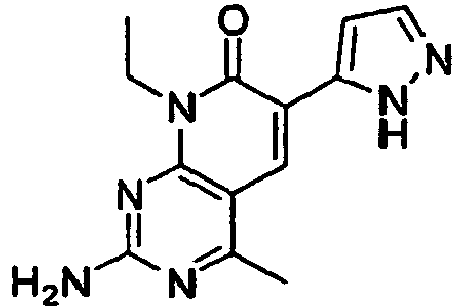
2-amino-8-ethyl-4-methyl-6-(1H-pyrazol-5-yl)pyrido[2,3-d]pyrimidin-7(8H)-one - Also described is a method of treating cancer which method comprises administering to a patient a therapeutically effective amount of a Compound of Formula I:
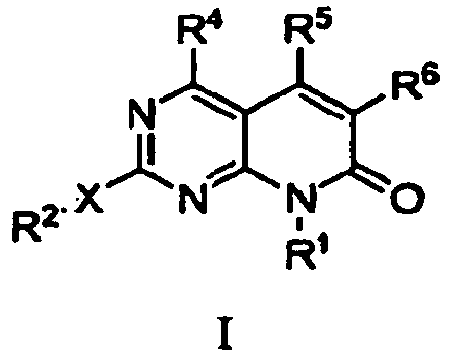
- R1 is hydrogen, optionally substituted alkyl, optionally substituted cycloalkyl, optionally substituted cycloalkylalkyl, optionally substituted aryl, optionally substituted arylalkyl, optionally substituted heterocycloalkyl, optionally substituted heterocycloalkylalkyl, optionally substituted heteroaryl or optionally substituted heteroarylalkyl;
- R2 is hydrogen or alkyl where the alkyl is optionally substituted with 1, 2, 3, 4, or 5 R8 groups;
- X is -NR3-;
- R3 hydrogen;
- R4 is optionally substituted alkyl;
- R5 is hydrogen; and
- R6 is phenyl, acyl, or heteroaryl wherein the phenyl and heteroaryl are optionally substituted with 1, 2, 3, 4, or 5 R9 groups;
- each R8, when present, is independently hydroxy, halo, alkoxy, haloalkoxy, amino, alkylamino, dialkylaminoalkyl, or alkoxyalkylamino; and
- each R9, when present, is independently halo, alkyl, haloalkyl, alkoxy, haloalkoxy, cyano, amino, alkylamino, dialkylamino, alkoxyalkyl, carboxyalkyl, alkoxycarbonyl, aminoalkyl, cycloalkyl, aryl, arylalkyl, aryloxy, heterocycloalkyl, or heteroaryl and where the cycloalkyl, aryl, heterocycloalkyl, and heteroaryl, each either alone or as part of another group within R9, are independently optionally substituted with 1,2,3, or 4 groups selected from halo, alkyl, haloalkyl, hydroxy, alkoxy, haloalkxy, amino, alkylamino, and dialkylamino.
- Also described is a method of treating cancer which method comprises administering to a patient a therapeutically effective amount of a Compound of Formula II:

- R1 is hydrogen, optionally substituted alkyl, optionally substituted C3-C7 cycloalkyl, optionally substituted aryl, optionally substituted arylalkyl, optionally substituted heterocycloalkyl, optionally substituted heterocycloalkylalkyl, optionally substituted heteroaryl or optionally substituted heteroarylalkyl;
- X is S, SO2, or -NR3-;
- R2 is hydrogen, haloalkyl, optionally substituted alkyl, optionally substituted C3-C7 cycloalkyl, optionally substituted aryl, optionally substituted arylalkyl, optionally substituted heterocycloalkyl, optionally substituted heterocycloalkylalkyl, optionally substituted heterocycloalkyl-aryl- or optionally substituted heteroaryl; R2 is optionally further substituted with one or more R8 groups;
- R3, R3a, and R3b are independently hydrogen, optionally substituted alkyl, optionally substituted C3-C7 cycloalkyl, optionally substituted aryl, optionally substituted heterocycloalkyl or optionally substituted heteroaryl;
- R4 is hydrogen, halo, haloalkyl, haloalkoxy, -NR3a-, optionally substituted alkyl, optionally substituted C1-C6 alkoxy, optionally substituted C1-C6 alkoxyalkyl, optionally substituted aminoalkyl, optionally substituted C3-C7 cycloalkyl, optionally substituted aryl, or optionally substituted heteroaryl;
- R5 is hydrogen, halo, haloalkyl, haloalkoxy, optionally substituted C1-C6 alkyl, optionally substituted C1-C6 alkoxy, optionally substituted C1-C6 alkoxyalkyl, optionally substituted aminoalkyl, optionally substituted C3-C7 cycloalkyl, optionally substituted aryl, optionally substituted aryl C1-C6 alkyl or optionally substituted heteroaryl; and
- R6 is hydrogen, halo, haloalkyl, haloalkoxy, -NR3b-, optionally substituted C1-C6 alkyl, optionally substituted C1-C6 alkoxy, optionally substituted C1-C6 alkoxyalkyl, optionally substituted acyl, optionally substituted aminoalkyl, optionally substituted C3-C7 cycloalkyl, optionally substituted aryl, optionally substituted arylalkyl, optionally substituted heterocycloalkyl, or optionally substituted heteroaryl; substitutable R6 groups are optionally further substituted with 1, 2, 3, 4, or 5 R9 groups;
- each R8, when present, is independently hydroxy, halo, haloalkyl, haloalkoxy, optionally substituted alkyl, optionally substituted C1-C6 alkoxy, optionally substituted C1-C6 alkoxyalkyl, optionally substituted C1-C6 alkoxyalkylaminoalkyl, C1-C6 alkylcarboxyheterocycloalkyl, oxy C1-C6alkylheterocycloalkyl, optionally substituted aminoalkyl, optionally substituted C3-C7 cycloalkyl, optionally substituted aryl, optionally substituted aryl C1-C6 alkyl, optionally substituted heterocycloalkyl, optionally substituted heterocycloalkylalkyl, optionally substituted heteroaryl or optionally substituted heteroarylalkyl;
- each R9, when present, is independently halo, haloalkyl, haloalkoxy, optionally substituted C1-C6 alkyl, optionally substituted C1-C6 alkoxy, optionally substituted C1-C6 alkoxyalkyl, optionally substituted C1-C6 carboxyalkyl, optionally substituted alkoxycarbonyl, optionally substituted aminoalkyl, optionally substituted C3-C7 cycloalkyl, optionally substituted aryl, optionally substituted aryl C1-C6 alkyl, optionally substituted aryloxy, optionally substituted heterocycloalkyl, or optionally substituted heteroaryl.
- The following abbreviations and terms have the indicated meanings throughout:
Abbreviation Meaning Ac acetyl br broad °C degrees Celsius c- cyclo CBZ CarboBenZoxy = benzyloxycarbonyl d doublet dd doublet of doublet dt doublet of triplet DCM dichloromethane DME 1,2-dimethoxyethane DMF N,N-dimethylformamide DMSO dimethyl sulfoxide dppf 1,1'-bis(diphenylphosphano)ferrocene EI Electron Impact ionization g gram(s) h or hr hour(s) HPLC high pressure liquid chromatography L liter(s) M molar or molarity m Multiplet mg milligram(s) MHz megahertz (frequency) Min minute(s) mL milliliter(s) µL microliter(s) µM Micromole(s) or micromolar mM Millimolar mmol millimole(s) mol mole(s) MS mass spectral analysis N normal or normality nM Nanomolar NMR nuclear magnetic resonance spectroscopy q Quartet RT Room temperature s Singlet t or tr Triplet TFA trifluoroacetic acid THF tetrahydrofuran TLC thin layer chromatography - The symbol "-" means a single bond, "=" means a double bond, "≡" means a triple bond, "" means a single or double bond. The symbol "
 " refers to a group on a double-bond as occupying either position on the terminus of a double bond to which the symbol is attached; that is, the geometry, E- or Z-, of the double bond is ambiguous. When a group is depicted removed from its parent formula, the "~" symbol will be used at the end of the bond which was theoretically cleaved in order to separated the group from its parent structural formula.
- When chemical structures are depicted or described, unless explicitly stated otherwise, all carbons are assumed to have hydrogen substitution to conform to a valence of four. For example, in the structure on the left-hand side of the schematic below there are nine hydrogens implied. The nine hydrogens are depicted in the right-hand structure. Sometimes a particular atom in a structure is described in textual formula as having a hydrogen or hydrogens as substitution (expressly defined hydrogen), for example, -CH2CH2-. It is understood by one of ordinary skill in the art that the aforementioned descriptive techniques are common in the chemical arts to provide brevity and simplicity to description of otherwise complex structures.

- If a group "R" is depicted as "floating" on a ring system, as for example in the formula:

- If a group "R" is depicted as floating on a fused ring system, as for example in the formulae:

- When a group "R" is depicted as existing on a ring system containing saturated carbons, as for example in the formula:

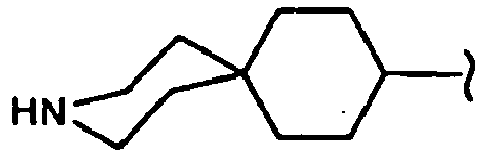
- "Acyl" means a -C(O)R radical where R is optionally substituted alkyl, optionally substituted alkenyl, cycloalkyl, cycloalkylalkyl, aryl, aralkyl, heteroaryl, heteroaralkyl, heterocycloalkyl, or heterocycloalkylalkyl, as defined herein, e.g., acetyl, trifluoromethylcarbonyl, or 2-methoxyethylcarbonyl, and the like.
- "Acylamino" means a -NRR' radical where R is hydrogen, hydroxy, alkyl, or alkoxy and R' is acyl, as defined herein.
- "Acyloxy" means an -OR radical where R is acyl, as defined herein, e.g. cyanomethylcarbonyloxy, and the like.
- "Administration" and variants thereof (e.g., "administering" a compound) in reference to a compound of the invention means introducing the compound or a prodrug of the compound into the system of the animal in need of treatment. When a compound of the invention or prodrug thereof is provided in combination with one or more other active agents (e.g., surgery, radiation, and chemotherapy, etc.), "administration" and its variants are each understood to include concurrent and sequential introduction of the compound or prodrug thereof and other agents.
- "Alkenyl" means a means a linear monovalent hydrocarbon radical of one to six carbon atoms or a branched monovalent hydrocarbon radical of three to 6 carbon atoms which radical contains at least one double bond, e.g., ethenyl, propenyl, 1-but-3-enyl, and 1-pent-3-enyl, and the like.
- "Alkoxy" means an -OR group where R is alkyl group as defined herein. Examples include methoxy, ethoxy, propoxy, isopropoxy, and the like.
- "Alkoxyalkyl" means an alkyl group, as defined herein, substituted with at least one, preferably one, two, or three, alkoxy groups as defined herein. Representative examples include methoxymethyl and the like.
- "Alkoxyalkylamino" means an -NRR' group where R is hydrogen, alkyl, or alkoxyalkyl and R' is alkoxyalkyl, as defined herein.
- "Alkoxyalkylaminoalkyl" means an alkyl group substituted with at least one, specifcially one or two, alkoxyalkylamino groups, as defined herein.
- "Alkoxycarbonyl" means a -C(O)R group where R is alkoxy, as defined herein.
- "Alkyl" means a linear saturated monovalent hydrocarbon radical of one to six carbon atoms or a branched saturated monovalent hydrocarbon radical of three to 6 carbon atoms, e.g., methyl, ethyl, propyl, 2-propyl, butyl (including all isomeric forms), or pentyl (including all isomeric forms), and the like.
- "Alkylamino" means an -NHR group where R is alkyl, as defined herein.
- "Alkylaminoalkyl" means an alkyl group substituted with one or two alkylamino groups, as defined herein.
- "Alkylaminoalkyloxy" means an -OR group where R is alkylaminoalkyl, as defined herein.
- "Alkylcarbonyl" means a -C(O)R group where R is alkyl, as defined herein.
- "Alkynyl" means a linear monovalent hydrocarbon radical of one to six carbon atoms or a branched monovalent hydrocarbon radical of three to 6 carbon atoms which radical contains at least one triple bond, e.g., ethynyl, propynyl, butynyl, pentyN-2-yl and the like.
- "Amino" means -NH2.
- "Aminoalkyl" means an alkyl group substiuted with at least one, for example one, two or three, amino groups.
- "Aminoalkyloxy" means an -OR group where R is aminoalkyl, as defined herein.
- "Aryl" means a monovalent six- to fourteeN-membered, mono- or bi-carbocyclic ring, wherein the monocyclic ring is aromatic and at least one of the rings in the bicyclic ring is aromatic. Unless stated otherwise, the valency of the group may be located on any atom of any ring within the radical, valency rules permitting. Representative examples include phenyl, naphthyl, and indanyl, and the like.
- "Arylalkyl" means an alkyl radical, as defined herein, substituted with one or two aryl groups, as defined herein, e.g., benzyl and phenethyl, and the like.
- "Aryloxy" means an -OR gorup where R is aryl, as defined herein.
- "Carboxyalkyl" means an alkyl group, as defined herein, substituted with at least one, for example one or two, -C(O)OH groups.
- "Cycloalkyl" means a monocyclic or fused bicyclic, saturated or partially unsaturated (but not aromatic), monovalent hydrocarbon radical of three to ten carbon ring atoms. Fused bicyclic hydrocarbon radical includes bridged ring systems. Unless stated otherwise, the valency of the group may be located on any atom of any ring within the radical, valency rules permitting. One or two ring carbon atoms may be. replaced by a -C(O)-, -C(S)-, or -C(=NH)- group. In another embodiment, the term cycloalkyl includes, but is not limited to, cyclopropyl, cyclobutyl, cyclopentyl, cyclohexyl, cyclohexyl, or cyclohex-3-enyl, and the like.
- "Cycloalkylalkyl" means an alkyl group substituted with at least one, for example one or two, cycloalkyl groups as defined herein.
- "Dialkylamino" means a -NRR' radical where R and R' are alkyl as defined herein, or an N-oxide derivative, or a protected derivative thereof, e.g., dimethylamino, diethylamino, N,N-methylpropylamino or N,N-methylethylamino, and the like.
- "Dialkylaminoalkyl" means an alkyl group substituted with one or two dialkylamino groups, as defined herein.
- "Dialkylaminoalkyloxy" means an -OR group where R is dialkylaminoalkyl, as defined herein. Representative examples include 2-(N,N-diethylamino)-ethyloxy, and the like.
- "Fused-polycyclic" or "fused ring system" means a polycyclic ring system that contains bridged or fused rings; that is, where two rings have more than one shared atom in their ring structures. In this application, fused-polycyclics and fused ring systems are not necessarily all aromatic ring systems. Typically, but not necessarily, fused-polycyclics share a vicinal set of atoms, for example naphthalene or 1,2,3,4-tetrahydro-naphthalene. A spiro ring system is not a fused-polycyclic by this definition, but fused polycyclic ring systems of the invention may themselves have spiro rings attached thereto via a single ring atom of the fused-polycyclic. In some examples, as appreciated by one of ordinary skill in the art, two adjacent groups on an aromatic system may be fused together to form a ring structure. The fused ring structure may contain heteroatoms and may be optionally substituted with one or more groups. It should additionally be noted that saturated carbons of such fused groups (i.e. saturated ring structures) can contain two substitution groups.
- "Halogen" or "halo" refers to fluorine, chlorine, bromine or iodine.
- "Haloalkoxy" means an -OR' group where R' is haloalkyl as defined herein, e.g., trifluoromethoxy or 2,2,2-trifluoroethoxy, and the like.
- "Haloalkyl" mean an alkyl group substituted with one or more halogens, for example one to five halo atoms, e.g., trifluoromethyl, 2-chloroethyl, and 2,2-difluoroethyl, and the like.
- "Heteroaryl" means a monocyclic, fused bicyclic, or fused tricyclic, monovalent radical of 5 to 14 ring atoms containing one or more, for example one, two, three, or four ring heteroatoms independently selected from -O-, -S(O) N- (n is 0, 1, or 2), -N-, -N(Rx)-, and the remaining ring atoms being carbon, wherein the ring comprising a monocyclic radical is aromatic and wherein at least one of the fused rings comprising a bicyclic or tricyclic radical is aromatic. One or two ring carbon atoms of any nonaromatic rings comprising a bicyclic or tricyclic radical may be replaced by a -C(O)-, -C(S)-, or -C(=NH)- group. Rx is hydrogen, alkyl, hydroxy, alkoxy, acyl, or alkylsulfonyl. Fused bicyclic radical includes bridged ring systems. Unless stated otherwise, the valency may be located on any atom of any ring of the heteroaryl group, valency rules permitting. When the point of valency is located on the nitrogen, Rx is absent. In another embodiment, the term heteroaryl includes, but is not limited to, 1,2,4-triazolyl, 1,3,5-triazolyl, phthalimidyl, pyridinyl, pyrrolyl, imidazolyl, thienyl, furanyl, indolyl, 2,3-dihydro-1H-indolyl (including, for example, 2,3-dihydro-1H-indol-2-yl or 2,3-dihydro-1H-indol-5-yl, and the like), isoindolyl, indolinyl, isoindolinyl, benzimidazolyl, benzodioxol-4-yl, benzofuranyl, cinnolinyl, indolizinyl, naphthyridiN-3-yl, phthalaziN-3-yl, phthalaziN-4-yl, pteridinyl, purinyl, quinazolinyl, quinoxalinyl, tetrazoyl, pyrazolyl, pyrazinyl, pyrimidinyl, pyridazinyl, oxazolyl, isooxazolyl, oxadiazolyl, benzoxazolyl, quinolinyl, isoquinolinyl, tetrahydroisoquinolinyl (including, for example, tetrahydroisoquinoliN-4-yl or tetrahydroisoquinoliN-6-yl, and the like), pyrrolo[3,2-c]pyridinyl (including, for example, pyrrolo[3,2-c]pyridiN-2-yl or pyrrolo[3,2-c]pyridiN-7-yl, and the like), benzopyranyl, thiazolyl, isothiazolyl, thiadiazolyl, benzothiazolyl, benzothienyl, and the derivatives thereof, or N-oxide or a protected derivative thereof.
- "Heteroarylalkyl" means an alkyl group, as defined herein, substituted with at least one, for example one or two heteroaryl groups, as defined herein.
- "Heteroatom" refers to O, S, N, or P.
- "Heterocycloalkyl" means a saturated or partially unsaturated (but not aromatic) monovalent monocyclic group of 3 to 8 ring atoms or a saturated or partially unsaturated (but not aromatic) monovalent fused bicyclic group of 5 to 12 ring atoms in which one or more, for example one, two, three, or four ring heteroatoms independently selected from O, S(O)n (n is 0, 1, or 2), N, N(Ry) (where Ry is hydrogen, alkyl, hydroxy, alkoxy, acyl, or alkylsulfonyl), the remaining ring atoms being carbon. One or two ring carbon atoms may be replaced by a -C(O)-, -C(S)-, or -C(=NH)- group. Fused bicyclic radical includes bridged ring systems. Unless otherwise stated, the valency of the group may be located on any atom of any ring within the radical, valency rules permitting. When the point of valency is located on a nitrogen atom, Ry is absent. In another embodiment the term heterocycloalkyl includes, but is not limited to, azetidinyl, pyrrolidinyl, 2-oxopyrrolidinyl, 2,5-dihydro-1H-pyrrolyl, piperidinyl, 4-piperidonyl, morpholinyl, piperazinyl, 2-oxopiperazinyl, tetrahydropyranyl, 2-oxopiperidinyl, thiomorpholinyl, thiamorpholinyl, perhydroazepinyl, pyrazolidinyl, imidazolinyl, imidazolidinyl, dihydropyridinyl, tetrahydropyridinyl, oxazolinyl, oxazolidinyl, isoxazolidinyl, thiazolinyl, thiazolidinyl, quinuclidinyl, isothiazolidinyl, octahydroihdolyl, octahydroisoindolyl, decahydroisoquinolyl, tetrahydrofuryl, and tetrahydropyranyl, and the derivatives thereof and N-oxide or a protected derivative thereof.
- "Heterocycloalkylalkyl" means an alkyl radical, as defined herein, substituted with one or two heterocycloalkyl groups, as defined herein, e.g., morpholinylmethyl, N-pyrrolidinylethyl, and 3-(N-azetidinyl)propyl, and the like.
- "Heterocycloalkylalkyloxy means an -OR group where R is heterocycloalkylalkyl, as defined herein.
- "saturated bridged ring system" refers to a bicyclic or polycyclic ring system that is not aromatic. Such a system may contain isolated or conjugated unsaturation, but not aromatic or heteroaromatic rings in its core structure (but may have aromatic substitution thereon). For example, hexahydro-furo[3,2-b]furan, 2,3,3a,4,7,7a-hexahydro-1H-indene, 7-aza-bicyclo[2.2.1]heptane, and 1,2,3,4,4a,5,8,8a-octahydro-naphthalene are all included in the class "saturated bridged ring system.
- "Spirocyclyl" or "spirocyclic ring" refers to a ring originating from a particular annular carbon of another ring. For example, as depicted below, a ring atom of a saturated bridged ring system (rings B and B'), but not a bridgehead atom, can be a shared atom between the saturated bridged ring system and a spirocyclyl (ring A) attached thereto. A spirocyclyl can be carbocyclic or heteroalicyclic.
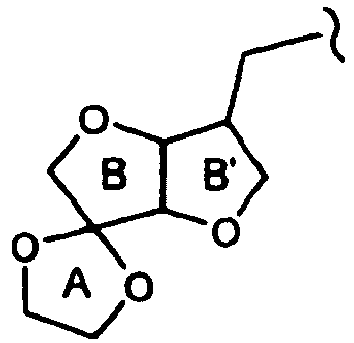
- "Optional" or "optionally" means that the subsequently described event or circumstance may or may not occur, and that the description includes instances where said event or circumstance occurs and instances in which it does not. One of ordinary skill in the art would understand that with respect to any molecule described as containing one or more optional substituents, only sterically practical and/or synthetically feasible compounds are meant to be included. "Optionally substituted" refers to all subsequent modifiers in a term. So, for example, in the term "optionally substituted arylC1-8 alkyl," optional substitution may occur on both the "C1-8 alkyl" portion and the "aryl" portion of the molecule may or may not be substituted. A list of exemplary optional substitutions is presented below in the definition of "substituted."
- "Optionally substituted alkoxy" means an -OR group where R is optionally substituted alkyl, as defined herein.
- "Optionally substituted alkyl" means an alkyl radical, as defined herein, optionally substituted with one or more groups, for example one, two, three, four, or five groups, independently selected from alkylcarbonyl, alkenylcarbonyl, cycloalkylcarbonyl, alkylcarbonyloxy, alkenylcarbonyloxy, amino, alkylamino, dialkylamino, aminocarbonyl, alkylaminocarbonyl, dialkylaminocarbonyl, cyano, cyanoalkylaminocarbonyl, alkoxy, alkenyloxy, hydroxy, hydroxyalkoxy, halo, carboxy, alkylcarbonylamino, alkylcarbonyloxy, alkyl-S(O)0-2-, alkenyl-S(O)0-2-, aminosulfonyl, alkylaminosulfonyl, dialkylaminosulfonyl, alkylsulfonyl-NRc- (where Rc is hydrogen, alkyl, optionally substituted alkenyl, hydroxy, alkoxy, alkenyloxy, or cyanoalkyl), alkylaminocarbonyloxy, dialkylaminocarbonyloxy, alkylaminoalkyloxy, dialkylaminoalkyloxy, alkoxycarbonyl, alkenyloxycarbonyl, alkoxycarbonylamino, alkylaminocarbonylamino, dialkylaminocarbonylamino, alkoxyalkyloxy, and -C(O)NRaRb (where Ra and Rb are independently hydrogen, alkyl, optionally substituted alkenyl, hydroxy, alkoxy, alkenyloxy, or cyanoalkyl).
- "Optionally substituted alkenyl" means an alkyl radical, as defined herein, optionally substituted with one or more groups, for example one, two, three, four, or five groups, independently selected from alkylcarbonyl, alkenylcarbonyl, cycloalkylcarbonyl, alkylcarbonyloxy, alkenylcarbonyloxy, amino, alkylamino, dialkylamino, aminocarbonyl, alkylaminocarbonyl, dialkylaminocarbonyl, cyano, cyanoalkylaminocarbonyl, alkoxy, alkenyloxy, hydroxy, hydroxyalkoxy, halo, carboxy, alkylcarbonylamino, alkylcarbonyloxy, alkyl-S(O)0-2-, alkenyl-S(O)0-2-, aminosulfonyl, alkylaminosulfonyl, dialkylaminosulfonyl, alkylsulfonyl-NRc- (where Rc is hydrogen, alkyl, optionally substituted alkenyl, hydroxy, alkoxy, alkenyloxy, or cyanoalkyl), alkylaminocarbonyloxy, dialkylaminocarbonyloxy, alkylaminoalkyloxy, dialkylaminoalkyloxy, alkoxycarbonyl, alkenyloxycarbonyl, alkoxycarbonylamino, alkylaminocarbonylamino, dialkylaminocarbonylamino, alkoxyalkyloxy, and -C(O)NRaRb (where Ra and Rb are independently hydrogen, alkyl, optionally substituted alkenyl, hydroxy, alkoxy, alkenyloxy, or cyanoalkyl).
- "Optionally substituted amino" refers to the group -N(H)R or -N(R)R where each R is independently selected from the group: optionally substituted alkyl, optionally substituted alkoxy, optionally substituted aryl, optionally substituted heterocycloalkyl, optionally substituted heteroaryl, acyl, carboxy, alkoxycarbonyl, -S(O)2-(optionally substituted alkyl), -S(O)2-optionally substituted aryl), -S(O)2-(optionally substituted heterocycloalkyl), -S(O)2-(optionally substitutted heteroaryl), and -S(O)2-(optionally substituted heteroaryl). For example, "optionally substituted amino" includes diethylamino, methylsulfonylamino, and furanyl-oxy-sulfonamino.
- "Optionally substituted aminoalkyl" means an alkyl group, as defined herein, substituted with at least one, for example one or two, optionally substituted amino groups, as defined herein.
- "Optionally substituted aryl" means an aryl group, as defined herein, optionally substituted with one, two, or three substituents independently selected from acyl, acylamino, acyloxy, optionally substituted alkyl, optionally substituted alkenyl, alkoxy, alkenyloxy, halo, hydroxy, alkoxycarbonyl, alkenyloxycarbonyl, amino, alkylamino, dialkylamino, nitro, aminocarbonyl, alkylaminocarbonyl, dialkylaminocarbonyl, carboxy, cyano, alkylthio, alkylsulfinyl, alkylsulfonyl, aminosulfonyl, alkylaminosulfonyl, dialkylaminosulfonyl, alkylsulfonylamino, aminoalkoxy, or aryl is pentafluorophenyl. Within the optional substituents on "aryl", the alkyl and alkenyl, either alone or as part of another group (including, for example, the alkyl in alkoxycarbonyl), are independently optionally substituted with one, two, three, four, or five halo.
- "Optionally substituted arylalkyl" means an alkyl group, as defined herein, substituted with optionally substituted aryl, as defined herein.
- "Optionally substituted cycloalkyl" means a cycloalkyl group, as defined herein, substituted with one, two, or three groups independently selected from acyl, acyloxy, acylamino, optionally substituted alkyl, optionally substituted alkenyl, alkoxy, alkenyloxy, alkoxycarbonyl, alkenyloxycarbonyl, alkylthio, alkylsulfinyl, alkylsulfonyl, aminosulfonyl, alkylaminosulfonyl, dialkylaminosulfonyl, alkylsulfonylamino, halo, hydroxy, amino, alkylamino, dialkylamino, aminocarbonyl, alkylaminocarbonyl, dialkylaminocarbonyl, nitro, alkoxyalkyloxy, aminoalkoxy, alkylaminoalkoxy, dialkylaminoalkoxy, carboxy, and cyano. Within the above optional substitutents on "cycloalkyl", the alkyl and alkenyl,, either alone or as part of another substituent on the cycloalkyl ring, are independently optionally substituted with one, two, three, four, or five halo, e.g. haloalkyl, haloalkoxy, haloalkenyloxy, or haloalkylsulfonyl.
- "Optionally substituted cycloalkylalkyl" means an alkyl group substituted with at least one, for example one or two, optionally substituted cycloalkyl groups, as defined herein.
- "Optionally substituted heteroaryl" means a heteroaryl group optionally substituted with one, two, or three substituents independently selected from acyl, acylamino, acyloxy, optionally substituted alkyl, optionally substituted alkenyl, alkoxy, alkenyloxy, halo, hydroxy, alkoxycarbonyl, alkenyloxycarbonyl, amino, alkylamino, dialkylamino, nitro, aminocarbonyl, alkylaminocarbonyl, dialkylaminocarbonyl, carboxy, cyano, alkylthio, alkylsulfinyl, alkylsulfonyl, aminosulfonyl, alkylaminosulfonyl, dialkylaminosulfonyl, alkylsulfonylamino, aminoalkoxy, alkylaminoalkoxy, and dialkylaminoalkoxy. Within the optional substituents on "heteroaryl", the alkyl and alkenyl, either alone or as part of another group (including, for example, the alkyl in alkoxycarbonyl), are independently optionally substituted with one, two, three, four, or five halo.
- "Optionally substituted heteroarylalkyl" means an alkyl group, as defined herein, substituted with at least one, for example one or two, optionally substituted heteroaryl groups, as defined herein.
- "Optionally substituted heterocycloalkyl" means a heterocycloalkyl group, as defined herein, optionally substituted with one, two, or three substituents independently selected from acyl, acylamino, acyloxy, optionally substituted alkyl, optionally substituted alkenyl, alkoxy, alkenyloxy, halo, hydroxy, alkoxycarbonyl, alkenyloxycarbonyl, amino, alkylamino, dialkylamino, nitro, aminocarbonyl, alkylaminocarbonyl, dialkylaminocarbonyl, carboxy, cyano, alkylthio, alkylsulfinyl, alkylsulfonyl, aminosulfonyl, alkylaminosulfonyl, dialkylaminosulfonyl, alkylsulfonylamino, aminoalkoxy, or aryl is pentafluorophenyl. Within the optional substituents on "heterocycloalkyl", the alkyl and alkenyl, either alone or as part of another group (including, for example, the alkyl in alkoxycarbonyl), are independently optionally substituted with one, two, three, four, or five halo.
- "Optionally substituted heterocycloalkylalkyl" means an alkyl group, as defined herein, substituted with at least one, for example one or two, optionally substituted heterocycloalkyl groups as defined herein.
- "Yield" for each of the reactions described herein is expressed as a percentage of the theoretical yield.
- The terms used to describe the scope of
formula 100 are defined inWO 2004/006846 (US Nat'l Stage Application Serial No. 10/522,004 ) which is herein incorporated by reference. For example "optionally substituted alkyl" forformula 100 has the meaning given inWO 2004/006846 (US Nat'l Stage Application Serial No. 10/522,004 ). Whenever a compound offormula 100 is described in this application, whether by structure or by use of the term "formula 100," the terms used to describe that compound are defined byWO 2004/006846 (US Nat'l Stage Application Serial No. 10/522,004 ). - "AKT inhibitor" includes, for example, LY294002, PKC 412, perifosine, compounds in Table 2a, compounds in Table 2b, and compounds described in
WO 2006/071819 andWO05/117909 - "Alkylating agent" includes, for example, one or more of the following: Chlorambucil, Chlormethine, Cyclophosphamide, Ifosfamide, Melphalan, Carmustine, Streptozocin, Fotemustine, Lomustine, Streptozocin, Carboplatin, Cisplatin, Oxaliplatin, BBR3464, Busulfan, Dacarbazine, Mechlorethamine, Procarbazine, Temozolomide, ThioTEPA, and Uramustine.
- "Antibody" includes, for example, one or more of the following: an IGF1 R antibody (including, for example, αIGF-1R A 12 MoAb, 19D12,
h7C 10 and CP-751871), an EGFR antibody (including, for example, Cetuximab (Erbitux®) and Panitumumab), an ErbB2 antibody (including, for example, Trastuzumab (Herceptin®)), a VEGF antibody (including, for example, Bevacizumab (Avastin®)), an IgG1 antibody (including, for example, lbritumomab (tiuxetan)), a CD20 antibody (including, for example, Rituximab and Tositumomab), a CD33 antibody (including, for example, Gemtuzumab and Gemtuzumab ozogamicin), and a CD52 antibody (including, for example, Alemtuzumab). - "Antimetabolite" includes, for example, methotrexate, Pemetrexed, Raltitrexed, Cladribine, Clofarabine, Fludarabine, Mercaptopurine, Thioguanine, Capecitabine, Cytarabine, fluorouracil (administered with or without leucovorin or folinic acid), and Gemcitabine.
- "Antimicrotubule agent" includes, for example, Vincristine,Vinblastine, Vinorelbine, Vinflunine, and Vindesine.
- "Aromatase inhibitor" includes, for example, one or more of the following: Aminoglutethimide, Anastrozole (Arimidex®), Letrozole (Femara®), Exemestane (Aromasin®), and Formestane (Lentaron®).
- "Cancer" refers to cellular-proliferative disease states, including but not limited to: Cardiac: sarcoma (angiosarcoma, fibrosarcoma, rhabdomyosarcoma, liposarcoma), myxoma, rhabdomyoma, fibroma, lipoma and teratoma; Lung: bronchogenic carcinoma (squamous cell, undifferentiated small cell, undifferentiated large cell, adenocarcinoma), alveolar (bronchiolar) carcinoma, bronchial adenoma, sarcoma, lymphoma, chondromatous hanlartoma, inesothelioma; Gastrointestinal: esophagus (squamous cell carcinoma, adenocarcinoma, leiomyosarcoma, lymphoma), stomach (carcinoma, lymphoma, leiomyosarcoma), pancreas (ductal adenocarcinoma, insulinoma, glucagonoma, gastrinoma, carcinoid tumors, vipoma), small bowel (adenocarcinoma, lymphoma, carcinoid tumors, Karposi's sarcoma, leiomyoma, hemangioma, lipoma, neurofibroma, fibroma), large bowel (adenocarcinoma, tubular adenoma, villous adenoma, hamartoma, leiomyoma); Genitourinary tract: kidney (adenocarcinoma, Wilm's tumor [nephroblastoma], lymphoma, leukemia), bladder and urethra (squamous cell carcinoma, transitional cell carcinoma, adenocarcinoma), prostate (adenocarcinoma, sarcoma), testis (seminoma, teratoma, embryonal carcinoma, teratocarcinoma, choriocarcinoma, sarcoma, interstitial cell carcinoma, fibroma, fibroadenoma, adenomatoid tumors, lipoma); Liver: hepatoma (hepatocellular carcinoma), cholangiocarcinoma, hepatoblastoma, angiosarcoma, hepatocellular adenoma, hemangioma; Bone: osteogenic sarcoma (osteosarcoma), fibrosarcoma, malignant fibrous histiocytoma, chondrosarcoma, Ewing's sarcoma, malignant lymphoma (reticulum cell sarcoma), multiple myeloma, malignant giant cell tumor chordoma, osteochronfroma (osteocartilaginous exostoses), benign chondroma, chondroblastoma, chondromyxofibroma, osteoid osteoma and giant cell tumors; Nervous system: skull (osteoma, hemangioma, granuloma, xanthoma, osteitis defomians), meninges (meningioma, meningiosarcoma, gliomatosis), brain (astrocytoma, medulloblastoma, glioma, ependymoma, germinoma [pinealoma], glioblastoma multiform, oligodendroglioma, schwannoma, retinoblastoma, congenital tumors), spinal cord neurofibroma, meningioma, glioma, sarcoma); Gynecological: uterus (endometrial carcinoma), cervix (cervical carcinoma, pre-tumor cervical dysplasia), ovaries (ovarian carcinoma [serous cystadenocarcinoma, mucinous cystadenocarcinoma, unclassified carcinoma], granulosa-thecal cell tumors, Sertoli-Leydig cell tumors, dysgerminoma, malignant teratoma), vulva (squamous cell carcinoma, intraepithelial carcinoma, adenocarcinoma, fibrosarcoma, melanoma), vagina (clear cell carcinoma, squamous cell carcinoma, botryoid sarcoma (embryonal rhabdomyosarcoma], fallopian tubes (carcinoma); Hematologic: blood (myeloid leukemia [acute and chronic], acute lymphoblastic leukemia, chronic lymphocytic leukemia, myeloproliferative diseases, multiple myeloma, myelodysplastic syndrome), Hodgkin's disease, non-Hodgkin's lymphoma [malignant lymphoma]; Skin: malignant melanoma, basal cell carcinoma, squamous cell carcinoma, Karposi's sarcoma, moles dysplastic nevi, lipoma, angioma, dermatofibroma, keloids, psoriasis; Adrenal Glands: neuroblastoma; and breast cancer. Thus, the term "cancerous cell" as provided herein, includes a cell afflicted by any one of the above-identified conditions.
- "Chemotherapeutic agent" includes, but is not limited to, an AKT inhibitor, an alkylating agent, an antimetabolite, an antimicrotubule agent, an aromatase inhibitor, a c-KIT inhibitor, a cMET inhibitor, an EGFR inhibitor, an ErbB2 inhibitor, a Flt-3 inhibitor, an HSP90 inhibitor, an IGF1R inhibitor, a platin, a Raf inhibitor, rapamycin, a Rapamycin analogue, a Receptor Tyrosine Kinase inhibitor, a taxane, a topoisomerase inhibitor, a SRC and/or ABL kinase inhibitor, and a VEGFR inhibitor. A pharmaceutically acceptable salt, solvate, and/or hydrate of a chemotherapeutic agent can be prepared by one of ordinary skill in the art and such salt, solvate, and/or hydrates thereof can be used to practice the invention.
- "c-KIT inhibitor" includes, for example, imatinib, sunitinib, nilotinib, AMG 706, sorafenib, compounds in Table 3b, compounds in Table 3c, compounds in Table 8, compounds in Table 9, and compounds described in
WO 2006/108059 ,WO/2005/020921 ,WO/2006/033943 , andWO 2005/030140 . - "cMET inhibitor" includes, for example, compounds in Table 3a, compounds in Table 3b, compounds in Table 3c, compounds described in
WO06/108059 WO 2006/014325 , andWO 2005/030140 . - "EGFR inhibitor"includes, for example, one or more of the following: pelitinib, lapatinib (Tykerb®), gefitinib (Iressa®), erlotinib (Tarceva®), Zactima (ZD6474, vandetinib), AEE788 and HKI-272, EKB-569, CI-1033, N-(3,4-dichloro-2-fluorophenyl)-7-({[(3aR,5r,6aS)-2-methyloctahydrocyctopenta[c]pyrrol-5-yl]methyl}oxy)-6-(methyloxy)quinazolin-4-amine N-(4-bromo-3-chloro-2-fluorophenyl)-7-({[(3aR,5r,6aS)-2-methyloctahydrocyclo-penta[c]pyrrol-5-yl]methyl}oxy)-6-(methyloxy)quinazolin-4-amine, N-(3,4-dichloro-2-fluorophenyl)-7-({[(3aR,5s,6aS)-2-methyloctahydrocyclopenta[c]pyrrol-5-yl]methyl}oxy)-6-(methyloxy)quinazolin-4-amine, N-(4-bromo-3-chloro-2-fluorophenyl)-7-({[(3aR,5s,6aS)-2-methyloctahydrocyclo-penta[c]pyrrol-5-yl]methyl}oxy)-6-(methyloxy)quinazolin-4-amine, compounds in Table 4, compounds in Table 7, and compounds described in
WO 2004/006846 andWO 2004/050681 . - "ErbB2 inhibitor" includes, for example, lapatinib (GW572016), PKI-166, canertinib, CI-1033, HK1272, and EKB-569.
- "Flt-3 inhibitor" includes, for example, CEP-701, PKC 412, MLN 518, sunitinib, sorafenib, compounds in Table 3a, compounds in Table 3b, compounds in Table 3c, compounds in Table 9, and compounds described in
WO 2006/108059 ,WO/2006/033943 ,WO 2006/014325 , andWO 2005/030140 . - "Hormone therapy" and "hormonal therapy" include, for example, treatment with one or more of the following: steroids (e.g. dexamethasone), finasteride, tamoxifen, and an aromatase inhibitor.
- "HSP90 inhibitor" includes, for example, 17-AAG, 17-DMAG, Geldanamycin, 5-(2,4-dihydroxy-5-isopropylphenyl)-N-ethyl-4-(4-(morpholinomethyl)phenyl)isoxazole-3-carboxamide [NVP-AUY922 (VER 52296)], 6-chloro-9-((4-methoxy-3,5-dimethylpyridin-2-yl)methyl)-9H-purin-2-amine (CNF2024, also named BIIB021), compounds disclosed in
WO2004072051 (which is herein incorporated by reference), compounds disclosed inWO2005028434 (which is herein incorporated by reference), compounds disclosed inWO2007035620 (which is herein incorporated by reference) and compounds disclosed inWO2006091963 (which is herein incorporated by reference). - "IGF1R inhibitor" includes, for example, Tyrphostin AG 1024, compounds in Table 5a, compounds in Table 5b, and compounds described in
WO06/074057 - "Kinase-dependent diseases or conditions" refer to pathologic conditions that depend on the activity of one or more protein kinases. Kinases either directly or indirectly participate in the signal transduction pathways of a variety of cellular activities including proliferation, adhesion, migration, differentiation and invasion. Diseases associated with kinase activities include tumor growth, the pathologic neovascularization that supports solid tumor growth, and associated with other diseases where excessive local vascularization is involved such as ocular diseases (diabetic retinopathy, age-related macular degeneration, and the like) and inflammation (psoriasis, rheumatoid arthritis, and the like).
- While not wishing to be bound to theory, phosphatases can also play a role in "kinase-dependent diseases or conditions" as cognates of kinases; that is, kinases phosphorylate and phosphatases dephosphorylate, for example protein substrates. Therefore compounds of the invention, while modulating kinase activity as described herein, may also modulate, either directly or indirectly, phosphatase activity. This additional modulation, if present, may be synergistic (or not) to activity of compounds of the invention toward a related or otherwise interdependent kinase or kinase family. In any case, as stated previously, the compounds of the invention are useful for treating diseases characterized in part by abnormal levels of cell proliferation (i.e. tumor growth), programmed cell death (apoptosis), cell migration and invasion and angiogenesis associated with tumor growth.
- "Metabolite" refers to the break-down or end product of a compound or its salt produced by metabolism or biotransformation in the animal or human body; for example, biotransformation to a more polar molecule such as by oxidation, reduction, or hydrolysis, or to a conjugate (see Goodman and Gilman, "The Pharmacological Basis of Therapeutics" 8.sup.th Ed., Pergamon Press, Gilman et al. (eds), 1990 for a discussion of biotransformation). As used herein, the metabolite of a compound of the invention or its salt may be the biologically active form of the compound in the body. In one example, a prodrug may be used such that the biologically active form, a metabolite, is released in vivo. In another example, a biologically active metabolite is discovered serendipitously, that is, no prodrug design per se was undertaken. An assay for activity of a metabolite of a compound of the present invention is known to one of skill in the art in light of the present disclosure.
- "Patient" for the purposes of the present invention includes humans and other animals, particularly mammals, and other organisms. Thus the methods are applicable to both human therapy and veterinary applications. In a preferred embodiment the patient is a mammal, and in a most preferred embodiment the patient is human.
- A "pharmaceutically acceptable salt" of a compound means a salt that is pharmaceutically acceptable and that possesses the desired pharmacological activity of the parent compound. It is understood that the pharmaceutically acceptable salts are non-toxic. Additional information on suitable pharmaceutically acceptable salts can be found in Remington's Pharmaceutical Sciences, 17th ed., Mack Publishing Company, Easton, PA, 1985, which is incorporated herein by reference or S. M. Berge, et al., "Pharmaceutical Salts," J. Pharm. Sci., 1977;66:1-19 both of which are incorporated herein by reference.
- Examples of pharmaceutically acceptable acid addition salts include those formed with inorganic acids such as hydrochloric acid, hydrobromic acid, sulfuric acid, nitric acid, phosphoric acid, and the like; as well as organic acids such as acetic acid, trifluoroacetic acid, propionic acid, hexanoic acid, cyclopentanepropionic acid, glycolic acid, pyruvic acid, lactic acid, oxalic acid, maleic acid, malonic acid, succinic acid, fumaric acid, tartaric acid, citric acid, benzoic acid, cinnamic acid, 3-(4-hydroxybenzoyl)benzoic acid, mandelic acid, methanesulfonic acid, ethanesulfonic acid, 1,2-ethanedisulfonic acid, 2-hydroxyethanesulfonic acid, benzenesulfonic acid, 4-chlorobenzenesulfonic acid, 2-naphthalenesulfonic acid, 4-toluenesulfonic acid, camphorsulfonic acid, glucoheptonic acid, 4,4'-methylenebis-(3-hydroxy-2-ene-1-carboxylic acid), 3-phenylpropionic acid, trimethylacetic acid, tertiary butylacetic acid, lauryl sulfuric acid, gluconic acid, glutamic acid, hydroxynaphthoic acid, salicylic acid, stearic acid, muconic acid, p-toluenesulfonic acid, and salicylic acid and the like.
- Examples of a pharmaceutically acceptable base addition salts include those formed when an acidic proton present in the parent compound is replaced by a metal ion, such as sodium, potassium, lithium, ammonium, calcium, magnesium, iron, zinc, copper, manganese, aluminum salts and the like. Preferable salts are the ammonium, potassium, sodium, calcium, and magnesium salts. Salts derived from pharmaceutically acceptable organic non-toxic bases include, but are not limited to, salts of primary, secondary, and tertiary amines, substituted amines including naturally occurring substituted amines, cyclic amines and basic ion exchange resins. Examples of organic bases include isopropylamine, trimethylamine, diethylamine, triethylamine, tripropylamine, ethanolamine, 2-dimethylaminoethanol, 2-diethylaminoethanol, dicyclohexylamine, lysine, arginine, histidine, caffeine, procaine, hydrabamine, choline, betaine, ethylenediamine, glucosamine, methylglucamine, theobromine, purines, piperazine, piperidine, N-ethylpiperidine, tromethamine, N-methylglucamine, polyamine resins, and the like. Exemplary organic bases are isopropylamine, diethylamine, ethanolamine, trimethylamine, dicyclohexylamine, choline, and caffeine.
- "Platin," and "platin-containing agent" include, for example, cisplatin, carboplatin, and oxaliplatin.
- "Prodrug" refers to compounds that are transformed (typically rapidly) in vivo to yield the parent compound of the above formulae, for example, by hydrolysis in blood. Common examples include, but are not limited to, ester and amide forms of a compound having an active form bearing a carboxylic acid moiety. Examples of pharmaceutically acceptable esters of the compounds of this invention include, but are not limited to, alkyl esters (for example with between about one and about six carbons) the alkyl group is a straight or branched chain. Acceptable esters also include cycloalkyl esters and arylalkyl esters such as, but not limited to benzyl. Examples of pharmaceutically acceptable amides of the compounds of this invention include, but are not limited to, primary amides, and secondary and tertiary alkyl amides (for example with between about one and about six carbons). Amides and esters of the compounds of the present invention may be prepared according to conventional methods. A thorough discussion of prodrugs is provided in T. Higuchi and V. Stella, "Pro-drugs as Novel Delivery Systems," , and in Bioreversible Carriers in Drug Design, ed. Edward B. Roche, American Pharmaceutical Association and Pergamon Press, 1987, both of which are incorporated herein by reference for all purposes.
- "Raf inhibitor" includes, for example, sorafenib, RAF 265 (CHIR 265), compounds in Table 6, and compounds described in
WO 2005/112932 . These references also describe in vitro assays that can be used to determine the inhibitory activity of RAF. - "Rapamycin analogue" includes for example, CCI-779, AP 23573, RAD 001, TAFA 93, and compounds described in
WO 2004/101583 andUS 7,160,867 which are each incorporated herein by reference in their entireties. - "Receptor Tyrosine Kinase inhibitor" includes, for example, inhibitors of AKT, EGFR, ErbB2, IGF1R, KIT, Met, Raf, and VEGFR2. Examples of receptor tyrosine kinase inhibitors can be found in
WO 2006/108059 (US Nat'l Stage Application Serial No. 11/910,720 ),WO 2006/074057 (US Nat'l Stage Application Serial No. 11/722,719 ),WO 2006/071819 (US Nat'l Stage Application Serial No. 11/722,291 ),WO 2006/014325 (US Nat'l Stage Application Serial No. 11/571,140 ),WO 2005/117909 (US Nat'l Stage Application Serial No. 11/568,173 ),WO 2005/030140 (US Nat'l Stage Application Serial No. 10/573,336 ),WO 2004/050681 US Nat'l Stage Application Serial No. 10/533,555 ),WO 2005/112932 (US Nat'l Stage Application Serial No. 11/568,789 ), andWO 2004/006846 (US Nat'l Stage Application Serial No. 10/522,004 ), each of which is incorporated herein by reference for all purposes. In particular, the applications cited in this paragraph are incorporated for the purpose of providing specific examples and generic embodiments (and the definitions associated with the terms used in the embodiments) of compounds that are useful in the practice of the invention. These references also describe in vitro assays useful in the practice of this invention. - "Taxane" includes, for example, one or more of the following: Paclitaxel (Taxol®) and Docetaxel (Taxotere®).
- "Therapeutically effective amount" is an amount of a compound of the invention, that when administered to a patient, ameliorates a symptom of the disease. The amount of a compound of the invention which constitutes a "therapeutically effective amount" will vary depending on the compound, the disease state and its severity, the age of the patient to be treated, and the like. The therapeutically effective amount can be determined routinely by one of ordinary skill in the art having regard to their knowledge and to this disclosure.
- "Topoisomerase inhibitor" includes, for example, one or more of the following: amsacrine, camptothecin, etoposide, etoposide phosphate, exatecan, irinotecan, lurtotecan, and teniposide, and topotecan.
- "Treating" or "treatment" of a disease, disorder, or syndrome, as used herein, includes (i) preventing the disease, disorder, or syndrome from occurring in a human, i.e. causing the clinical symptoms of the disease, disorder, or syndrome not to develop in an animal that may be exposed to or predisposed to the disease, disorder, or syndrome but does not yet experience or display symptoms of the disease, disorder, or syndrome; (ii) inhibiting the disease, disorder, or syndrome, i.e., arresting its development; and (iii) relieving the disease, disorder, or syndrome, i.e., causing regression of the disease, disorder, or syndrome. As is known in the art, adjustments for systemic versus localized delivery, age, body weight, general health, sex, diet, time of administration, drug interaction and the severity of the condition may be necessary, and will be ascertainable with routine experimentation by one of ordinary skill in the art.
- "SRC and/or ABL kinase inhibitor" includes, for example, dasatinib, imatinib (Gleevec®), and compounds described in
WO 2006/074057 . - "VEGFR inhibitor" includes, for example, one or more of the following: VEGF Trap, ZD6474 (vandetanib, Zactima), sorafenib, Angiozyme, AZD2171 (cediranib), pazopanib, sorafenib, axitinib, SU5416 (semaxanib), PTK787 (vatalanib), AEE778, RAF 265, sunitinib (Sutent), N-(3,4-dichloro-2-fluorophenyl)-7-({[(3aR,5r,6aS)-2-methyloctahydrocyclopenta[c]pyrrol-5-yl]methyl}oxy)-6-(methyloxy)quinazolin-4-amine, N-(4-bromo-3-chloro-2-fluorophenyl)-7-({[(3aR,5r,6aS)-2-methyloctahydrocyclopenta[c]pyrrol-5-yl]methyl}oxy)-6-(methyloxy)quinazolin-4-amine, N-(3,4-dichloro-2-fluorophenyl)-7-({[(3aR,5s,6aS)-2-methyloctahydrocyclopenta[c]pyrrol-5-yl]methyl}oxy)-6-(methyloxy)quinazolin-4-amine, N-(4-bromo-3-chloro-2-fluorophenyl)-7-({[(3aR,5s,6aS)-2-methyloctahydrocyclo-penta[c]pyrrol-5-yl]methyl}oxy)-6-(methyloxy)quinazolin-4-amine, compounds in Table 7, and compounds described in
WO 2004/050681 andWO 2004/006846 . - The following paragraphs present a number of options for compounds that are described herein. In each instance, the option includes both the recited compounds as well as individual isomers and mixtures of isomers. In addition, in each instance, the option inludes the pharmaceutically acceptable salts, hydrates, and/or solvates of the recited compounds and any individual isomers or mixture of isomers thereof.
- Also described is a method of treating cancer which method comprises administering to a patient a therapeutically effective amount of a Compound of Formula I, as defined above, where growth and/or survival of tumor cells of the cancer is enhanced, at least in part, by the activity of PI3K; in combination with one or more treatments selected from surgery, one or more chemotherapeutic agents, one or more hormone therapies, one or more antibodies, one or more immunotherapies, radioactive iodine therapy, and radiation.
- Also described is a method of treating cancer which method comprises administering to a patient a therapeutically effective amount of a Compound of Formula I, as defined above, in combination with one or more treatments independently selected from surgery, one or more chemotherapeutic agents, one or more hormone therapies, one or more antibodies, one or more immunotherapies, radioactive iodine therapy, and radiation; where the cancer is selected from breast cancer, colon cancer, rectal cancer, endometrial cancer, gastric carcinoma (including gastrointestinal carcinoid tumors and gastrointestinal stromal tumors), glioblastoma, hepatocellular carcinoma, small cell lung cancer, non-small cell lung cancer (NSCLC), melanoma, ovarian cancer, cervical cancer, pancreatic cancer, prostate carcinoma, acute myelogenous leukemia (AML), chronic myelogenous leukemia (CML), non-Hodgkin's lymphoma, and thyroid carcinoma. Also described is a method of treating cancer which method comprises administering to a patient a therapeutically effective amount of a Compound of Formula I, as defined above, in combination with one or more treatments independently selected from surgery, one or more chemotherapeutic agents, one or more hormone therapies, one or more antibodies, one or more immunotherapies, radioactive iodine therapy, and radiation; where the cancer is selected from prostate cancer, NSCLC, ovarian cancer, cervical cancer, breast cancer, colon cancer, rectal cancer, and glioblastoma. Also described is a method of treating cancer which method comprises administering to a patient a therapeutically effective amount of a Compound of Formula I, as defined above , in combination with one or more treatments independently selected from surgery, one or more chemotherapeutic agents, one or more hormone therapies, one or more antibodies, one or more immunotherapies, radioactive iodine therapy, and radiation; where the cancer is selected from NSCLC, breast cancer, prostate cancer, glioblastoma, and ovarian cancer.
- Also described is a method of treating cancer which method comprises administering to a patient a therapeutically effective amount of a Compound of Formula I, as defined above, in combination with a treatment where the treatment is one or more chemotherapeutic agents.
- Also described is a method of treating cancer which method comprises administering to a patient a therapeutically effective amount of a Compound of Formula I, as defined above, in combination with a treatment where the treatment is one or two chemotherapeutic agents independently selected from rapamycin, a rapamycin analogue, an alkylating agent, a taxane, a platin, an EGFR inhibitor, and an ErbB2 inhibitor. Also described is a method of treating cancer which method comprises administering to a patient a therapeutically effective amount of a Compound of Formula I, as defined above , in combination with a treatment where the treatment is one or two chemotherapeutic agents independently selected from rapamycin, temozolomide, paclitaxel, docetaxel, carboplatin, cisplatin, oxaliplatin, gefitinib (Iressa®), erlotinib (Tarceva®), Zactima (ZD6474), HKI-272, pelitinib, carnertinib, a compound selected from Table 4, a compound in Table 7, and lapatinib. Also described is a method of treating cancer which method comprises administering to a patient a therapeutically effective amount of a Compound of Formula I, as defined above , in combination with a treatment where the treatment is one or two chemotherapeutic agents independently selected from rapamycin, temozolomide, paclitaxel, docetaxel, carboplatin, trastuzumab, erlotinib, N-(3,4-dichloro-2-fluorophenyl)-7-({[(3aR,5r,6aS)-2-methyloctahydrocyclopenta[c]pyrrol-5-yl]methyl}oxy)-6-(methyloxy)quinazolin-4-amine, N-(4-bromo-3-chloro-2-fluorophenyl)-7-({[(3aR,5r,6aS)-2-methyloctahydrocyclo-penta[c]pyrrol-5-yl]methyl}oxy)-6-(methyloxy)quinazolin-4-amine, N-(3,4-dichloro-2-fluorophenyl)-7-({[(3aR,5s,6aS)-2-methyloctahydrocyclopenta[c]pyrrol-5-yl]methyl}oxy)-6-(methyloxy)quinazolin-4-amine, N-(4-bromo-3-chloro-2-fluorophenyl)-7-({[(3aR,5s,6aS)-2-methyloctahydrocyclo-penta[c]pyrrol-5-yl]methyl}oxy)-6-(methyloxy)quinazolin-4-amine, a compound in Table 7, and lapatinib. Also described is a method of treating cancer which method comprises administering to a patient a therapeutically effective amount of a Compound of Formula I, as defined above, in combination with a treatment where the treatment is one or two chemotherapeutic agents independently selected from rapamycin, paclitaxel, carboplatin, erlotinib, and N-(3,4-dichloro-2-fluorophenyl)-7-({[(3aR,5r,6aS)-2-methyloctahydrocyclopenta-[c]pyrrol-5-yl]methyl}oxy)-6-(methyloxy)quinazolin-4-amine.
- Also described is a method of treating cancer which method comprises administering to a patient a therapeutically effective amount of a Compound of Formula I, as defined above, in combination with a treatment where the treatment is one or two chemotherapeutic agents independently selected from a platin and a taxane. Also described is a method of treating cancer which method comprises administering to a patient a therapeutically effective amount of a Compound of Formula I, as defined above, in combination with a treatment where the treatment is one or two chemotherapeutic agents independently selected from carboplatin, cisplatin, oxaliplatin, and paclitaxel.
- Also described is a method of treating cancer which method comprises administering to a patient a therapeutically effective amount of a Compound of Formula I, as defined above, in combination with a treatment where the treatment is one or two chemotherapeutic agents where one of the chemotherapeutic agent is an AKT inhibitor. Also described is a method of treating cancer which method comprises administering to a patient a therapeutically effective amount of a Compound of Formula I, as defined above , in combination with a treatment where the treatment is one or two chemotherapeutic agents where one of the chemotherapeutic agents is an AKT inhibitor selected from perifosine, PKC 412, a compound in Table 2a, and a compound in Table 2b.
- Also described is a method of treating cancer which method comprises administering to a patient a therapeutically effective amount of a Compound of Formula I, as defined above, in combination with a treatment where the treatment is one or two chemotherapeutic agents where one of the chemotherapeutic agents is a cMET inhibitor. Also described is a method of treating cancer which method comprises administering to a patient a therapeutically effective amount of a Compound of Formula I, as defined above , in combination with a treatment where the treatment is one or two chemotherapeutic agents where one of the chemotherapeutic agents is a cMET inhibitor selected from a compound in Table 3a, a compound in Table 3b, and a compound in Table 3c.
- Also described is a method of treating cancer which method comprises administering to a patient a therapeutically effective amount of a Compound of Formula I, as defined above, in combination with a treatment where the treatment is one or two chemotherapeutic agents where one of the chemotherapeutic agents is an EGFR inhibitor. Also described is a method of treating cancer which method comprises administering to a patient a therapeutically effective amount of a Compound of Formula I, as defined above , in combination with a treatment where the treatment is one or two chemotherapeutic agents where one of the chemotherapeutic agents is an EGFR inhibitor selected from lapatinib (Tykerb®), gefitinib (Iressa®), erlotinib (Tarceva®), Zactima (ZD6474), AEE788, HKI-272, EKB-569, CI 1033, a compound selected from Table 4, and a compound in Table 7. Also described is a method of treating cancer which method comprises administering to a patient a therapeutically effective amount of a Compound of Formula I, as defined above , in combination with a treatment where the treatment is one or two chemotherapeutic agents where one of the chemotherapeutic agents is an EGFR inhibitor selected from lapatinib (Tykerb®), gefitinib (Iressa®), erlotinib (Tarceva®), Zactima (ZD6474), AEE788, HKI-272, EKB-569, CI 1033, N-(3,4-dichloro-2-fluorophenyl)-7-({[(3aR,5r,6aS)-2-methyloctahydrocyclopenta[c]pyrrol-5-yl]methyl}oxy)-6-(methyloxy)quinazolin-4-amine N-(4-bromo-3-chloro-2-fluorophenyl)-7-({[(3aR,5r,6aS)-2-methyloctahydrocyclo-penta[c]pyrrol-5-yl]methyl}oxy)-6-(methyloxy)quinazolin-4-amine, N-(3,4-dichloro-2-fluorophenyl)-7-({[(3aR,5s,6aS)-2-methyloctahydrocyclopenta[c]pyrrol-5-yl]methyl}oxy)-6-(methyloxy)quinazolin-4-amine, and N-(4-bromo-3-chloro-2-fluorophenyl)-7-({[(3aR,5s,6aS)-2-methyloctahydrocyclo-penta[c]pyrrol-5-yl]methyl}oxy)-6-(methyloxy)quinazolin-4-amine.
- Also described is a method of treating cancer which method comprises administering to a patient a therapeutically effective amount of a Compound of Formula I, as defined above, in combination with a treatment where the treatment is one or two chemotherapeutic agents where one of the chemotherapeutic agents is an ErbB2 inhibitor. Also described is a method of treating cancer which method comprises administering to a patient a therapeutically effective amount of a Compound of Formula I, as defined above , in combination with a treatment where the treatment is one or two chemotherapeutic agents where one of the chemotherapeutic agents is an ErbB2 inhibitor selected from lapatinib, EKB-569, HKI272, CI 1033, PKI-166, and a compound selected from Table 4.
- Also described is a method of treating cancer which method comprises administering to a patient a therapeutically effective amount of a Compound of Formula I, as defined above, in combination with a treatment where the treatment is one or two chemotherapeutic agents where one of the chemotherapeutic agents is an HSP90 inhibitor. Also described is a method of treating cancer which method comprises administering to a patient a therapeutically effective amount of a Compound of Formula I, as defined above , in combination with a treatment where the treatment is one or two chemotherapeutic agents where one of the chemotherapeutic agents is an HSP90 inhibitor selected from 17-AAG, 17-DMAG, Geldanamycin, and CNF2024. Also described is a method of treating cancer which method comprises administering to a patient a therapeutically effective amount of a Compound of Formula I, as defined above, in combination with a treatment where the treatment is one or two chemotherapeutic agents where one of the chemotherapeutic agents is an HSP90 inhibitor selected from 17-AAG, 17-DMAG, and Geldanamycin.
- Also described is a method of treating cancer which method comprises administering to a patient a therapeutically effective amount of a Compound of Formula I, as defined above, in combination with a treatment where the treatment is one or two chemotherapeutic agents where one of the chemotherapeutic agents is an IGFIR inhibitor. Also described is a method of treating cancer which method comprises administering to a patient a therapeutically effective amount of a Compound of Formula I, as defined above, in combination with a treatment where the treatment is one or two chemotherapeutic agents where one of the chemotherapeutic agents is an IGF1R inhibito selected from Table 5a and Table 5b.
- Also described is a method of treating cancer which method comprises administering to a patient a therapeutically effective amount of a Compound of Formula I, as defined above, in combination with a treatment where the treatment is one or two chemotherapeutic agents where one of the chemotherapeutic agents is a Raf inhibitor. Also described is a method of treating cancer which method comprises administering to a patient a therapeutically effective amount of a Compound of Formula I, as defined above , in combination with a treatment where the treatment is one or two chemotherapeutic agents where one of the chemotherapeutic agents is a Raf inhibitor selected from sorafenib, RAF 265 (CHIR-265), and a compound in Table 6.
- Also described is a method of treating cancer which method comprises administering to a patient a therapeutically effective amount of a Compound of Formula I, as defined above, in combination with a treatment where the treatment is one or two chemotherapeutic agents where one of the chemotherapeutic agents is a VEGFR inhibitor. Also described is a method of treating cancer which method comprises administering to a patient a therapeutically effective amount of a Compound of Formula I, as defined above , in combination with a treatment where the treatment is one or two chemotherapeutic agents where one of the chemotherapeutic agents is a VEGFR inhibitor selected from VEGF Trap, ZD6474 (Zactima), cediranib (AZ2171), pazopanib, sunitinib, sorafenib, axitinib, AEE788, RAF 265 (CHIR-265), a compound selected from Table 4, and a compound selected from Table 7.
- Also described is a method of treating cancer which method comprises administering to a patient a therapeutically effective amount of a Compound of Formula I, as defined above, in combination with a treatment where the treatment is one or two chemotherapeutic agents where one of the chemotherapeutic agents is a cKIT inhibitor. Also described is a method of treating cancer which method comprises administering to a patient a therapeutically effective amount of a Compound of Formula I, as defined above , in combination with a treatment where the treatment is one or two chemotherapeutic agents where one of the chemotherapeutic agents is a cKIT inhibitor selected from imatinib, sunitinib, nilotinib, AMG 706, sorafenib, a compound in Table 3b, a compound in Table 3c, a compound in Table 8, and a compound in Table 9.
- Also described is a method of treating cancer which method comprises administering to a patient a therapeutically effective amount of a Compound of Formula I, as defined above, in combination with a treatment where the treatment is one or two chemotherapeutic agents where one of the chemotherapeutic agents is a FLT3 inhibitor. Also described is a method of treating cancer which method comprises administering to a patient a therapeutically effective amount of a Compound of Formula I, as defined above , in combination with a treatment where the treatment is one or two chemotherapeutic agents where one of the chemotherapeutic agents is a FLT3 inhibitor selected from CEP-701, PKC 412, sunitinib, MLN 518, sunitinib, sorafenib, a compound in Table 3a, a compound in Table 3b, a compound in Table 3c, and a compound in Table 9.
- Also described is a method of treating cancer which method comprises administering to a patient a therapeutically effective amount of a Compound of Formula I, as defined above, in combination with a treatment where the treatment is one or two chemotherapeutic agents where one of the chemotherapeutic agents is selected from rapamycin, a rapamycin analogue, PI103, and SF 1126. Also described is a method of treating cancer which method comprises administering to a patient a therapeutically effective amount of a Compound of Formula I, as defined above, in combination with a treatment where the treatment is one or two chemotherapeutic agents where one of the chemotherapeutic agents is selected from rapamycin, CCI-779, AP 23573, RAD 001 , TAFA 93, PI103, and SF 1126. Also described is a method of treating cancer which method comprises administering to a patient a therapeutically effective amount of a Compound of Formula I, as defined above, in combination with a treatment where the treatment is one or two chemotherapeutic agents where one of the chemotherapeutic agents is rapamycin.
- Also described is a method of treating cancer which method comprises administering to a patient a therapeutically effective amount of a Compound of Formula I, as defined above, in combination with a treatment where the treatment is one or two chemotherapeutic agents where one of the chemotherapeutic agents is of formula 100:

formula 100 are defined inWO 2004/006846 (US Nat'l Stage Application Serial No. 10/522,004 ) which is herein incorporated by reference. Whenever a compound offormula 100 is described in this application, whether by structure or by use of the term "formula 100," the terms used to describe that compound are defined byWO 2004/006846 (US Nat'l Stage Application Serial No. 10/522,004 ). In particular, "alkyl" informula 100 is intended to include linear, branched, or cyclic hydrocarbon structures and combinations thereof, inclusively; "lower alkyl" means alkyl groups of from one to six carbon atoms. "Aryl" informula 100 means an aromatic six- to fourteen-membered carbocyclic rings which include, for example, benzene, naphthalene, indane, tetralin, fluorene and the like. "Lower arylalkyl" informula 100 means a residue in which an aryl moiety is attached to a parent structure via one of an alkylene, alkenylene, or alkynylene radical where the "alkyl" portion of the group has one to six carbons; examples include benzyl; phenethyl, phenylvinyl, phenylallyl and the like. Informula 100, "heterocyclyl" means a stable monocyclic, bicyclic or tricyclic three- to fifteen-membered ring radical (including fused or bridged ring systems) that consists of carbon atoms and from one to five heteroatoms selected from the group consisting of nitrogen, phosphorus, oxygen and sulfur where the nitrogen, phosphorus, carbon and sulfur atoms in the heterocyclyl radical may be optionally oxidized to various oxidation states and the nitrogen atom may be optionally quaternized; and the ring radical may be partially or fully saturated or aromatic. "Lower heterocyclylalkyl" means a residue in which a heterocyclyl is attached to a parent structure via one of an alkylene, alkenylene, and alkynylene radical having one to six carbons. - Also described is a method of treating cancer which method comprises administering to a patient a therapeutically effective amount of a Compound of Formula I, as defined above, in combination with a treatment where the treatment is one or two chemotherapeutic agents where one of the chemotherapeutic agents is selected from a compound in Table 2a. Also described is a method of treating cancer which method comprises administering to a patient a therapeutically effective amount of a Compound of Formula I selected from Table 1 in combination with a treatment where the treatment is one or two chemotherapeutic agents where one of the chemotherapeutic agents is selected from Table 2a.
- Also described is a method of treating cancer which method comprises administering to a patient a therapeutically effective amount of a Compound of Formula I, as defined above, in combination with a treatment where the treatment is one or more chemotherapeutic agents where one of the chemotherapeutic agent is selected from a compound in Table 2b. Also described is a method of treating cancer which method comprises administering to a patient a therapeutically effective amount of a Compound of Formula I selected from Table 1 in combination with a treatment where the treatment is one or more chemotherapeutic agents where one of the chemotherapeutic agent is selected from Table 2b.
- Also described is a method of treating cancer. which method comprises administering to a patient a therapeutically effective amount of a Compound of Formula I, as defined above, in combination with a treatment where the treatment is one or more chemotherapeutic agents where one of the chemotherapeutic agent is selected from a compound in Table 3a. Also described is a method of treating cancer which method comprises administering to a patient a therapeutically effective amount of a Compound of Formula I selected from Table 1 in combination with a treatment where the treatment is one or more chemotherapeutic agents where one of the chemotherapeutic agent is selected from Table 3a.
- Also described is a method of treating cancer which method comprises administering to a patient a therapeutically effective amount of a Compound of Formula I, as defined above, in combination with a treatment where the treatment is one or more chemotherapeutic agents where one of the chemotherapeutic agent is selected from a compound in Table 3b. Also described is a method of treating cancer which method comprises administering to a patient a therapeutically effective amount of a Compound of Formula I selected from Table 1 in combination with a treatment where the treatment is one or more chemotherapeutic agents where one of the chemotherapeutic agent is selected from Table 3b.
- Also described is a method of treating cancer which method comprises administering to a patient a therapeutically effective amount of a Compound of Formula I, as defined above, in combination with a treatment where the treatment is one or more chemotherapeutic agents where one of the chemotherapeutic agent is selected from a compound in Table 3c. Also described is a method of treating cancer which method comprises administering to a patient a therapeutically effective amount of a Compound of Formula I selected from Table 1 in combination with a treatment where the treatment is one or more chemotherapeutic agents where one of the chemotherapeutic agent is selected from Table 3c.
- Also described is a method of treating cancer which method comprises administering to a patient a therapeutically effective amount of a Compound of Formula I, as defined above, in combination with a treatment where the treatment is one or two chemotherapeutic agents where one of the chemotherapeutic agents is selected from a compound in Table 4. Also described is a method of treating cancer which method comprises administering to a patient a therapeutically effective amount of a Compound of Formula I selected from Table 1 in combination with a treatment where the treatment is one or two chemotherapeutic agents where one of the chemotherapeutic agents is selected from Table 4.
- Also described is a method of treating cancer which method comprises administering to a patient a therapeutically effective amount of a Compound of Formula I, as defined above, in combination with a treatment where the treatment is one or two chemotherapeutic agents where one of the chemotherapeutic agents is N-(3,4-dichloro-2-fluorophenyl)-7-({[(3aR,5r,6aS)-2-methyloctahydrocyclopenta[c]pyrrol-5-yl]methyl}oxy)-6-(methyloxy)quinazolin-4-amine, N-(4-bromo-3-chloro-2-fluorophenyl)-7-({[(3aR,5r,6aS)-2-methyloctahydrocyclopenta[c]pyrrol-5-yl]methyl}oxy)-6-(methyloxy)quinazolin-4-amine, N-(3,4-dichloro-2-fluorophenyl)-7-({[(3aR,5s,6aS)-2-methyloctahydrocyctopenta[c]pyrrol-5-yl]methyl}oxy)-6-(methyloxy)quinazolin-4-amine, or N-(4-bromo-3-chloro-2-fluorophenyl)-7-({[(3aR,5s,6aS)-2-methyloctahydrocyclo-penta[c]pyrrol-5-yl]methyl}oxy)-6-(methyloxy)quinazolin-4-amine, optionally as a pharmaceutically acceptable salt and additionally optionally as a hydrate and additionally optionally as a solvate thereof. Also described is a method of treating cancer which method comprises administering to a patient a therapeutically effective amount of a Compound of Formula I selected from Table 1 in combination with a treatment where the treatment is one or two chemotherapeutic agents where one of the chemotherapeutic agents is N-(3,4-dichloro-2-fluorophenyl)-7-({[(3aR,5r,6aS)-2-methyloctahydrocyclopenta[c]pyrrol-5-yl]methyl}oxy)-6-(methyloxy)quinazolin-4-amine, N-(4-bromo-3-chloro-2-fluorophenyl)-7-({[(3aR,5r,6aS)-2-methyloctahydrocyclo-penta[c]pyrro]-5-yl]methyl}oxy)-6-(methyloxy)quinazolin-4-amine, N-(3,4-dichloro-2-fluorophenyl)-7-({[(3aR,5s,6aS)-2-methyloctahydrocyclopenta[c]pyrrol-5-yl]methyl}oxy)-6-(methyloxy)quinazolin-4-amine, or N-(4-bromo-3-chloro-2-fluorophenyl)-7-({[(3aR,5s,6aS)-2-methyloctahydrocyclo-penta[c]pyrrol-5-yl]methyl}oxy)-6-(methyloxy)quinazolin-4-amine, optionally as a pharmaceutically acceptable salt and addiditionally optionally as a hydrate and additionally optionally as a solvate thereof.
- Also described is a method of treating cancer which method comprises administering to a patient a therapeutically effective amount of a Compound of Formula I, as defined above, in combination with a treatment where the treatment is one or two chemotherapeutic agents where one of the chemotherapeutic agents is N-(3,4-dichloro-2-fluorophenyl)-7-({[(3aR,5r,6aS)-2-methyloctahydrocyclopenta-[c]pyrrol-5-yl]methyl}oxy)-6-(methyloxy)quinazolin-4-amine optionally as a pharmaceutically acceptable salt and additionally optionally as a hydrate and additionally optionally as a solvate thereof. Also described is a method of treating cancer which method comprises administering to a patient a therapeutically effective amount of a Compound of Formula I selected from Table 1 in combination with a treatment where the treatment is one or two chemotherapeutic agents where one of the chemotherapeutic agents is N-(3,4-dichloro-2-fluorophenyl)-7-({[(3aR,5r,6aS)-2-methyloctahydrocyclopenta-[c]pyrrol-5-yl]methyl}oxy)-6-(methyloxy)quinazolin-4-amine optionally as a pharmacutically acceptable salt and additionally optionally as a hydrate and additionally optionally as a solvate thereof.
- Also described is a method of treating cancer which method comprises administering to a patient a therapeutically effective amount of a Compound of Formula I, as defined above, in combination with a treatment where the treatment is one or more chemotherapeutic agents where one of the chemotherapeutic agent is selected from a compound in Table 5a. Also described is a method of treating cancer which method comprises administering to a patient a therapeutically effective amount of a Compound of Formula I selected from Table 1 in combination with a treatment where the treatment is one or more chemotherapeutic agents where one of the chemotherapeutic agent is selected from Table 5a.
- Also described is a method of treating cancer which method comprises administering to a patient a therapeutically effective amount of a Compound of Formula I, as defined above, in combination with a treatment where the treatment is one or more chemotherapeutic agents where one of the chemotherapeutic agent is selected from a compound in Table 5b. Also described is a method of treating cancer which method comprises administering to a patient a therapeutically effective amount of a Compound of Formula I selected from Table 1 in combination with a treatment where the treatment is one or more chemotherapeutic agents where one of the chemotherapeutic agent is selected from Table 5b.
- Also described is a method of treating cancer which method comprises administering to a patient a therapeutically effective amount of a Compound of Formula I, as defined above, in combination with a treatment where the treatment is one or more chemotherapeutic agents where one of the chemotherapeutic agent is selected from a compound in Table 6. Also described is a method of treating cancer which method comprises administering to a patient a therapeutically effective amount of a Compound of Formula I selected from Table 1 in combination with a treatment where the treatment is one or more chemotherapeutic agent where one of the chemotherapeutic agent is selected from Table 6.
- Also described is a method of treating cancer which method comprises administering to a patient a therapeutically effective amount of a Compound of Formula I, as defined above, in combination with a treatment where the treatment is one or more chemotherapeutic agents where one of the chemotherapeutic agent is selected from a compound in Table 7. Also described is a method of treating cancer which method comprises administering to a patient a therapeutically effective amount of a Compound of Formula I selected from Table 1 in combination with a treatment where the treatment is one or more chemotherapeutic agents where one of the chemotherapeutic agent is selected from Table 7.
- Also described is a method of treating cancer which method comprises administering to a patient a therapeutically effective amount of a Compound of Formula I, as defined above, in combination with a treatment where the treatment is one or more chemotherapeutic agents where one of the chemotherapeutic agent is selected from a compound in Table 8. Also described is a method of treating cancer which method comprises administering to a patient a therapeutically effective amount of a Compound of
Formula 1 selected from Table 1 in combination with a treatment where the treatment is one or more chemotherapeutic agents where one of the chemotherapeutic agent is selected from Table 8. - Also described is a method of treating cancer which method comprises administering to a patient a therapeutically effective amount of a Compound of Formula I, as defined above, in combination with a treatment where the treatment is one or more chemotherapeutic agents where one of the chemotherapeutic agent is selected from a compound in Table 9. Also described is a method of treating cancer which method comprises administering to a patient a therapeutically effective amount of a Compound of Formula I selected from Table 1 in combination with a treatment where the treatment is one or more chemotherapeutic agents where one of the chemotherapeutic agent is selected from Table 9.
- Also described is a method of treating cancer which method comprises administering to a patient a therapeutically effective amount of a Compound of Formula I selected from Table 1 in combination with a treatment where the treatment is one or two chemotherapeutic agents where one of the chemotherapeutic agent is paclitaxel.
- Also described is a method of treating cancer which method comprises administering to a patient a therapeutically effective amount of a Compound of Formula I selected from Table 1 in combination with a treatment where the treatment is one or two chemotherapeutic agents where one of the chemotherapeutic agent is rapamycin.
- Also described is a method of treating cancer which method comprises administering to a patient a therapeutically effective amount of a Compound of Formula I selected from Table 1 in combination with a treatment where the treatment is one or two chemotherapeutic agents where one of the chemotherapeutic agent is carboplatin.
- Also described is a method of treating cancer which method comprises administering to a patient a therapeutically effective amount of a Compound of Formula I selected from Table 1 in combination with a treatment where the treatment is one or two chemotherapeutic agents where one of the chemotherapeutic agent is erlotinib.
- Also described is a method of treating cancer which method comprises administering to a patient a therapeutically effective amount of a Compound of Formula I selected from Table 1 in combination with a treatment where the treatment is one or two chemotherapeutic agents where one of the chemotherapeutic agent is lapatinib.
- Also described is a method of treating cancer which method comprises administering to a patient a therapeutically effective amount of a Compound of Formula I selected from Table 1 in combination with a treatment where the treatment is one or two antibodies where one of the antibodies is trastuzumab.
- Also described is a method of treating cancer which method comprises administering to a patient a therapeutically effective amount of a Compound of Formula I selected from Table 1 in combination with a treatment where the treatment is one or two antibodies where one of the antibodies is cetuximab.
- Also described is a method of treating cancer which method comprises administering to a patient a therapeutically effective amount of a Compound of Formula I selected from Table 1 in combination with a treatment where the treatment is or two antibodies where one of the antibodies is panitumumab.
- Also described is a method of treating cancer which method comprises administering to a patient a therapeutically effective amount of a Compound of Formula I selected from Table 1 in combination with a treatment where the treatment is one or two antibodies where one of the antibodies is bevacizumab.
- Also described is a method of treating cancer which method comprises administering to a patient a therapeutically effective amount of a Compound of formula I, as defined above, in combination with a treatment where the treatment is radiation. Also described is a method of treating cancer which method comprises administering to a patient a therapeutically effective amount of a Compound of Formula I selected from Table 1 in combination with a treatment where the treatment is radiation.
- Also described is a method of treating cancer which method comprises administering to a patient a therapeutically effective amount of a Compound of Formula I, as defined above, in combination with a treatment where the treatment is one or two antibodies. Also described is a method of treating cancer which method comprises administering to a patient a therapeutically effective amount of a Compound of Formula I, as defined above, in combination with a treatment where the treatment is one or two antibodies independently selected from an IGF1R antibody (including, for example, αIGF-1R A12 MoAb, αIGF-1R 19D12 MoAb, αIGF-1R h7C10 MoAb and αIGF-1R CP-751871 MoAb), Alemtuzumab, Bevacizumab (Avastin®), Gemtuzumab, Gemtuzumab ozogamicin, Ibritumomab tiuxetan, Panitumumab, Rituximab, Tositumomab, Omnitarg (pertuzimab), an anti-ErbB2 anibodies (including trastuzumab (Herceptin®)), and an anti-EGFR antibodies (including, for example, cetuximab (Erbitux), panitumumab, nimotuzumab, and EMD72000)),
- Also described is a method of treating cancer which method comprises administering to a patient a therapeutically effective amount of a Compound of Formula I selected from Table 1 in combination with a treatment where the treatment is one or two antibodies. Also described is a method of treating cancer which method comprises administering to a patient a therapeutically effective amount of a Compound of Formula I selected from Table 1 in combination with a treatment where the treatment is one or two antibodies independently selected from an IGF1R antibody (including, for example, αIGF-IR A12 MoAb, αIGF-1R 19D12 MoAb, αIGF-1R h7C10 MoAb and αIGF-1R CP-751871 MoAb), Alemtuzumab, Bevacizumab (Avastin®), Gemtuzumab, Gemtuzumab ozogamicin, Ibritumomab tiuxetan, Panitumumab, Rituximab, Tositumomab, Omnitarg (pertuzimab), an anti-ErbB2 anibodies (including trastuzumab (Herceptin®)), and an anti-EGFR antibodies (including, for example, cetuximab (Erbitux), panitumumab, nimotuzumab, and EMD72000)).
- Also described is a method of treating cancer which method comprises administering to a patient a therapeutically effective amount of a Compound of Formula I, as defined above, in combination with a treatment where the treatment is one or more chemotherapeutic agents where one of the chemotherapeutic agent is temozolomide. Also described is a method of treating cancer which method comprises administering to a patient a therapeutically effective amount of a Compound of Formula I selected from Table 1 in combination with a treatment where the treatment is one or more chemotherapeutic agents where one of the chemotherapeutic agent is temozolomide.
- Also described is a method of treating cancer which method comprises administering to a patient a therapeutically effective amount of a Compound of Formula I, as defined above, in combination with a treatment where the treatment is surgery. Also described is a method of treating cancer which method comprises administering to a patient a therapeutically effective amount of a Compound of Formula I selected from Table 1 in combination with a treatment where the treatment is surgery.
- Also described is a method of treating cancer which method comprises administering to a patient a therapeutically effective amount of a Compound of Formula I, as defined above, in combination with a treatment where the treatment is one or two hormone therapies. Also described is a method of treating cancer which method comprises administering to a patient a therapeutically effective amount of a Compound of Formula I, as defined above, in combination with a treatment where the treatment is one or two hormone therapies independently selected from tamoxifen, Toremifene (Fareston), Fulvestrant (Faslodex), Megestrol acetate (Megace), ovarian ablation, Raloxifene, a luteinizing hormone-releasing hormone (LHRH) analog (including goserelin and leuprolide), Megestrol acetate (Megace), and one or more aromatase inhibitor. Also described is a method of treating cancer which method comprises administering to a patient a therapeutically effective amount of a Compound of Formula I, as defined above, in combination with a treatment where the treatment is one or two hormone therapies where one of the hormone therapies is an aromatase inhibitor selected from letrozole (Femara), anastrozole (Arimidex), and exemestane (Aromasin). Also described is a method of treating cancer which method comprises administering to a patient a therapeutically effective amount of a Compound of Formula I, as defined above, in combination with a treatment where the treatment is one or two hormone therapies independently selected from from tamoxifen and an aromatase inhibitor.
- Also described is a method of treating cancer which method comprises administering to a patient a therapeutically effective amount of a Compound of Formula I selected from Table 1 in combination with a treatment where the treatment is one or two hormone therapies. Also described is a method of treating cancer which method comprises administering to a patient a therapeutically effective amount of a Compound of Formula I selected from Table 1 in combination with a treatment where one of the treatments is one or two hormone therapies independently selected from tamoxifen, Toremifene (Fareston), Fulvestrant (Faslodex), Megestrol acetate (Megace), ovarian ablation, Raloxifene, a luteinizing hormone-releasing hormone (LHRH) analog (including goserelin and leuprolide), Megestrol acetate (Megace), and one or two aromatase inhibitor. Also described is a method of treating cancer which method comprises administering to a patient a therapeutically effective amount of a Compound of Formula I selected from Table 1 in combination with a treatment where one of the treatments is one or two hormone therapies where one of the hormone therapies is an aromatase inhibitor selected from letrozole (Femara), anastrozole (Arimidex), and exemestane (Aromasin). Also described is a method of treating cancer which method comprises administering to a patient a therapeutically effective amount of a Compound of Formula I selected from Table 1 in combination with a treatment where one of the treatments is one or two hormone therapie independently selected from from tarnoxifen and an aromatase inhibitor.
- Also described is a method of treating cancer which method comprises administering to a patient a therapeutically effective amount of a Compound of Formula I, as defined above, in combination with a treatment where one of the treatments is one antibody selected from an EGFR antibody and an ErbB2 antibody, or the treatment is one or two chemotherapeutic agents independently selected from a rapamycin, a rapamycin analogue, an alkylating agent, a taxane, a platin, an EGFR inhibitor, and an ErbB2 inhibitor. Also described is a method of treating cancer which method comprises administering to a patient a therapeutically effective amount of a Compound of Formula I selected from Table 1 in combination with a treatment where one of the treatments is one antibody selected from an EGFR antibody and an ErbB2 antibody, or the treatment is one or two chemotherapeutic agents independently selected from a rapamycin, rapamycin analogue, an alkylating agent, a taxane a platin, EGFR inhibitor, and an ErbB2 inhibitor.
- Also described is a method of treating acute myelogenous leukemia (AML) which method comprises administering to a patient a therapeutically effective amount of a Compound of Formula I, as defined above, in combination with one or more treatments independently selected from bone marrow or peripheral blood stem cell transplantation, radiation, one or two antibodies, and one or two chemotherapeutic agents. Also described is a method of treating acute myelogenous leukemia (AML) which method comprises administering to a patient a therapeutically effective amount of a Compound of Formula I, as defined above, in combination with one or two treatments where one of the treatments is one antibody selected from Gemtuzumab ozogamicin (Mylotarg), αIGF-1R A12 MoAb, αIGF- 1R 19D12 MoAb, αIGF-1R h7C10 MoAb, αIGF-1R CP-751871 MoAb and trastuzumab. Also described is a method of treating acute myelogenous leukemia (AML) which method comprises administering to a patient a therapeutically effective amount of a Compound of Formula I, as defined above, in combination with one or more treatments where one of the treatments is one or two chemotherapeutic agents selected from Imatinib (i.e. Gleevec®), PKC 412, CEP-701, daunorubicin, doxorubicin, cytarabine (ara-C), an anthracycline drug such as daunorubicin or idarubicin (Daunomycin, Idamycin), 6-thioguanine, and a granulocyte colony-stimulating factor (such as Neupogen or Leukine).
- Also described is a method of treating chronic myelogenous leukemia (CML) which method comprises administering to a patient a therapeutically effective amount of a Compound of Formula I, as defined above, in combination with one or more treatments independently selected from bone marrow or peripheral blood stem cell transplantation, radiation, one or two chemotherapeutic agents, immunotherapy, and one or two antibodies. Also described is a method of treating chronic myelogenous leukemia (CML) which method comprises administering to a patient a therapeutically effective amount of a Compound of Formula I, as defined above, in combination with one or more treatments where one of the treatments is one or two of the chemotherapeutic agents selected from Imatinib (i.e. Gleevec®), PKC 412, hydroxyurea (Hydrea), cytosine, cytosine arabinoside, dasatinib, AMN107, VX680 (MK0457), and cytarabine (ara-C). In another embodiment, the invention is directed to a method of treating chronic myelogenous leukemia (CML) which method comprises administering to a patient a therapeutically effective amount of a Compound of Formula I, as defined above, in combination with one or more treatments where one of the treatments is one or two chemotherapeutic agents selected from Imatinib (i.e. Gleevec®) and dasatinib. Also described is a method of treating chronic myelogenous leukemia (CML) which method comprises administering to a patient a therapeutically effective amount of a Compound of Formula I, as defined above, in combination with one or more treatments where one of the treatments is immunotherapy and the immunotherapy is interferon therapy such as interferon-α.
- Also described is a method of treating prostate cancer which method comprises administering to a patient a therapeutically effective amount of a Compound of Formula I, as defined above, in combination with one or more treatments independently selected from surgery (including cryosurgery), radiation, one or two chemotherapeutic agents, one or two antibodies, and one or two hormone therapies. Also described is a method of treating prostate cancer which method comprises administering to a patient a therapeutically effective amount of a Compound of Formula I, as defined above, in combination with one or more treatments where one of the treatments is an antibody selected from αIGF-1R A12 MoAb, αIGF-1R 19D12 MoAb, αIGF-1R h7C10 MoAb, and αIGF-1R CP-751871 MoAb. Also described is a method of treating prostate cancer which method comprises administering to a patient a therapeutically effective amount of a Compound of Formula I, as defined above, in combination with one or more treatments where one of the treatments is one or two of the chemotherapeutic agents independently selected from rapamycin, mitoxantrone, prednisone, docetaxel (Taxotere), doxorubicin, etoposide, vinblastine, paclitaxel, and carboplatin. Also described is a method of treating prostate cancer which method comprises administering to patient a therapeutically effective amount of a Compound of Formula I, as defined above, in combination with one or more treatments where one of the treatments is one or two of the hormone therapy indepependly selected from androgen deprivation therapy and androgen suppression therapy. Also described is a method of treating prostate cancer which method comprises administering to a patient a therapeutically effective amount of a Compound of Formula I, as defined above, in combination with one or more treatments where one of the treatments is one or two chemotherapeutic agents where one of the chemotherapeutic agents is a taxane. Also described is a method of treating prostate cancer which method comprises administering to a patient a therapeutically effective amount of a Compound of Formula I, as define above, in combination with one or more treatments where one of the treatments is one or two chemotherapeutic agents where one of the chemotherapeutic agents is rapamycin.
- Also described is a method of treating melanoma which method comprises administering to a patient a therapeutically effective amount of a Compound of Formula I, as defined above, in combination with one or more treatments independently selected from surgery, radiation, one or two immunotherapies, one or two hormone therapies, and one or two chemotherapeutic agents. Also described is a method of treating melanoma which method comprises administering to a patient a therapeutically effective amount of a Compound of Formula I, as defined above, in combination with one or more treatments where one of the treatments is one or two chemotherapeutic agents independently selected from an alkylating agent, a taxane, a platin, and a Raf inhibitor. Also described is a method of treating melanoma which method comprises administering to a patient a therapeutically effective amount of a Compound of Formula I, as defined above, in combination with one or more treatments where one of the treatments is one or two chemotherapeutic agents independently selected from sorafenib, Paclitaxel (Taxol®), Docetaxel (Taxotere®), dacarbazine, rapamycin, imatinib mesylate (Gleevec®), sorafenib, cisplatin, carboplatin, dacarbazine (DTIC), carmustine (BCNU), vinblastine, temozolomide (Temodar), Melphalan, and imiquimod (Aldara). Also described is a method of treating melanoma which method comprises administering to a patient a therapeutically effective amount of a Compound of Formula I, as defined above, in combination with one or more treatments where one of the treatments is one or two immunotherapies independently selected from ipilimumab, interferon-alpha and interleukin-2. Also described is a method of treating melanoma which method comprises administering to a patient a therapeutically effective amount of a Compound of Formula I, as defined above, in combination with one or more treatments where one of the treatments is hormone therapy where the hormone therapy is tamoxifen.
- Also described is a method of treating colon or rectal cancer which method comprises administering to a patient a therapeutically effective amount of a Compound of Formula I, as defined above, in combination with one or more treatments independently selected from surgery, radiation, one or two antibodies, and one or two chemotherapeutic agents. Also described is a method of treating colon or rectal cancer which method comprises administering to a patient a therapeutically effective amount of a Compound of Formula I, as defined above, in combination with one or more treatments where one of the treatments is surgery selected from local excision, electrofulguration, segmental colon resection, polypectomy, local transanal resection, low anterior resection, abdominoperineal resection, and pelvic exenteration. Also described is a method of treating colon or rectal cancer which method comprises administering to a patient a therapeutically effective amount of a Compound of Formula I, as defined above, in combination with one or more treatments where one of the treatments is one or two chemotherapeutic agents independently selected from a platinum-containing compound (including cisplatin, oxaliplatin, and carboplatin), 5-fluorouracil (5-FU), leucovorin, capecitabine (Xeloda), irinotecan (Camptosar), FOLFOX (Folinic acid, 5-FU, Oxaliplatin), and leucovorin. Also described is a method of treating colon or rectal cancer which method comprises administering to a patient a therapeutically effective amount of a Compound of Formula I, as defined above, in combination with one or more treatments where one of the treatments is one or two antibodies independently selected from cetuximab (Erbitux) and bevacizumab (Avastin).
- Also described is a method of treating pancreatic cancer which method comprises administering to a patient a therapeutically effective amount of a Compound of Formula I, as defined above, in combination with one or more treatments independently selected from surgery, radiation, one or two antibodies, and one or two chemotherapeutic agents. Also described is a method of treating pancreatic cancer which method comprises administering to a patient a therapeutically effective amount of a Compound of Formula I, as defined above, in combination with one or more treatments where one of the treatments is selected from one or two chemotherapeutic agents independently selected from platinum-containing compound (including cisplatin, oxaliplatin, and carboplatin), 5-fluorouracil (5-FU), gemcitabine, a taxane (including paclitaxel and docetaxel), topotecan, irinotecan, capecitabine, streptozocin, erlotinib (Tarceva), , leucovorin, and capecitabine (Xeloda). Also described is a method of treating pancreatic cancer which method comprises administering to a patient a therapeutically effective amount of a Compound of Formula I, as defined above, in combination with one or more treatments where one of the treatments is an antibody wehre the antibody is cetuximab.
- Also described is a method of treating breast cancer which method comprises administering to a patient a therapeutically effective amount of a Compound of Formula I, as defined above, in combination with one or more treatments independently selected from surgery, radiation, one or two chemotherapeutic agents, one or two hormone therapies, and one or two antibodies. Also described is a method of treating breast cancer which method comprises administering to a patient a therapeutically effective amount of a Compound of Formula I, as defined above, in combination with one or more treatments where one of the treatments is one or two of the chemotherapeutic agents independently selected from lapatinib (Tykerb®), Paclitaxel (Taxol®), docetaxel, capecitabine, Cyclophosphamide (Cytoxan), CMF (cyclophosphamide, fluoruracil, and methotrexate), methotrexate, fluorouracil, doxorubicin, epirubicin, gemcitabine, carboplatin (Paraplatin), cisplatin (Platinol), vinorelbine (Navelbine), capecitabine (Xeloda), pegylated liposomal doxorubicin (Doxil), albumin-bound paclitaxel (Abraxane), AC (adriamycin and Cyclophosphamide), adriamyclin, and pamidronate or zoledronic acid (to treat bone weakness). Also described is a method of treating breast cancer which method comprises administering to a patient a therapeutically effective amount of a Compound of Formula I, as defined above, in combination with one or more treatments where one of the treatments is one or two hormone therapies independently selected from tamoxifen, Toremifene (Fareston), Fulvestrant (Faslodex), Megestrol acetate (Megace), ovarian ablation, Raloxifene, a luteinizing hormone-releasing hormone (LHRH) analogs (including goserelin and leuprolide), Megestrol acetate (Megace), and one or more aromatase inhibitors. Also described is a method of treating breast cancer which method comprises administering to patient a therapeutically effective amount of a Compound of Formula I, as defined above, in combination with one or more treatments where one of the treatments is one or two hormone therapies and one of the hormone therapies is an aromatase inhibitor selected from letrozole (Femara), anastrozole (Arimidex), and exemestane (Aromasin). Also described is a method of treating breast cancer which method comprises administering to a patient a therapeutically effective amount of a Compound of Formula I, as defined above, in combination with one or more treatments where one of the treatments is one or two antibodies independently selected fromα IGF-1R A12 MoAb, αIGF-1R 19D12 MoAb, αIGF-1R h7C10 MoAb, αIGF-1R CP-751871 MoAb bevacizumab (Avastin), and trastuzumab.
- Also described is a method of treating breast cancer which method comprises administering to a patient a therapeutically effective amount of a Compound of Formula I, as defined above, in combination with one or more treatments where one of the treatments is one or two chemotherapeutic agents and one of the chemotherapeutic agents is erlotinib.
- Also described is a method of treating breast cancer which method comprises administering to a patient a therapeutically effective amount of a Compound of Formula I, as defined above, in combination with one or more treatments where one of the treatments is one or two of the chemotherapeutic agents and one or two of the chemotherapeutic agents are independently selected from rapamycin, lapatinib, erlotinib, N-(3,4-dichloro-2-fluorophenyl)-7-({[(3aR,5r,6aS)-2-methyloctahydrocyclopenta[c]pyrrol-5-yl]methyl}oxy)-6-(methyloxy)quinazolin-4-amine optionally as a pharmaceutically acceptable salt and additionally optionally as a hydrate and additionally optionally as a solvate thereof, N-(4-bromo-3-chloro-2-fluorophenyl)-7-({[(3aR,5r,6aS)-2-methyloctahydrocyclo-penta[c]pyrrol-5-yl]methyl}oxy)-6-(methyloxy)quinazolin-4-amine optionally as a pharmaceutically acceptable salt and additionally optionally as a hydrate and additionally optionally as a solvate thereof, N-(3,4-dichloro-2-fluorophenyl)-7-({[(3aR,5s,6aS)-2-methyloctahydrocyclopenta[c]pyrrol-5-yl]methyl}oxy)-6-(methyloxy)quinazolin-4-amine optionally as a pharmaceutically acceptable salt and additionally optionally as a hydrate and additionally optionally as a solvate thereof, and N-(4-bromo-3-chloro-2-fluorophenyl)-7-({[(3aR,5s,6aS)-2-methyloctahydrocyclo-penta[c]pyrrol-5-yl]methyl}oxy)-6-(methyloxy)quinazolin-4-amine optionally as a pharmaceutically acceptable salt and additionally optionally as a hydrate and additionally optionally as a solvate thereof.
- Also described is a method of treating breast cancer which method comprises administering to a patient a therapeutically effective amount of a Compound of
Formula 1, as defined above, in combination with one or more treatments where one of the treatments is one or two of the antibodies. Also described is a method of treating breast cancer which method comprises administering to a patient a therapeutically effective amount of a Compound of Formula I, as defined above, in combination with one or more treatments where one of the treatments is one or two antibodies and one of the antibodies is trastuzumab. - Also described is a method of treating breast cancer which method comprises administering to a patient a therapeutically effective amount of a Compound of Formula 1, as defined above, in combination with one or more treatments where one of the treatments is one or two of the chemotherapeutic agents and one of the chemotherapeutic agents is selected from N-(3,4-dichloro-2-fluorophenyl)-7-({[(3aR,5r,6aS)-2-methyloctahydrocyclopenta[c]pyrrol-5-yl]methyl}oxy)-6-(methyloxy)quinazolin-4-amine, N-(4-bromo-3-chloro-2-fluorophenyl)-7-({[(3aR,5r,6aS)-2-methyloctahydrocyclo-penta[c]pyrrol-5-yl]methyl}oxy)-6-(methyloxy)quinazolin-4-amine, N-(3,4-dichloro-2-fluorophenyl)-7-({[(3aR,5s,6aS)-2-methyloctahydrocyclopenta[c]pyrrol-5-yl]methyl}oxy)-6-(methyloxy)quinazolin-4-amine, and N-(4-bromo-3-chloro-2-fluorophenyl)-7-({[(3aR,5s,6aS)-2-methyloctahydrocyclopenta[c]pyrrol-5-yl]methyl}oxy)-6-(methyloxy)quinazolin-4-amine; optionally as a pharmaceutically acceptable salt and additionally optionally as a hydrate and additionally optionally as a solvate thereof.
- Also described is a method of treating breast cancer which method comprises administering to a patient a therapeutically effective amount of a Compound of Formula I, as defined above, in combination with one or more treatments where one of the treatments is one or two of the chemotherapeutic agents and one of the chemotherapeutic agents is N-(3,4-dichloro-2-fluorophenyl)-7-({[(3aR,5r,6a,6aS)-2-methyloctahydrocyclopenta-[c]pyrrol-5-yl]methyl}oxy)-6-(methyloxy)quinazolin-4-amine optionally as a pharmaceutically acceptable salt and additionally optionally as a hydrate and additionally optionally as a solvate thereof.
- Also described is a method of treating non-small cell lung cancer which method comprises administering to a patient a therapeutically effective amount of a Compound of Formula I, as defined above, in combination with one or more treatments independently selected surgery, radiation, one or more antibodies, and one or more chemotherapeutic agents. Also described is a method of treating non-small cell lung cancer which method comprises administering to a patient a therapeutically effective amount of a Compound of Formula I, as defined above, in combination with one or more treatments where one of the treatments is one or two chemotherapeutic agents independently selected from cisplatin, oxaliplatin, carboplatin, Zactima (ZD6474), Paclitaxel, Docetaxel (Taxotere®), Gemcitabine (Gemzar®), Vinorelbine, Irinotecan, Etoposide, Vinblastine, Erlotinib (Tarceva®), gefitinib (Iressa), and Pemetrexed. Also described is a method of treating non-small cell lung cancer which method comprises administering to a patient a therapeutically effective amount of a Compound of Formula I, as defined above, in combination with one or more treatments where one of the treatments is an antibody and the antibody is Bevacizumab. Also described is a method of treating non-small cell lung cancer which method comprises administering to a patient a therapeutically effective amount of a Compound of Formula I, as defined above, in combination with one or more treatments where one of the treatments is one or two chemotherapeutic agents independently selected from cisplatin, oxaliplatin, carboplatin, Paclitaxel, Docetaxel (Taxotere®), and erlotinib (Tarceva®).
- Also described is a method of treating non-small cell lung cancer which method comprises administering to a patient a therapeutically effective amount of a Compound of Formula I, as defined above, in combination with one or more treatments where one of the treatments is one or two chemotherapeutic agents and one of the chemotherapeutic agents is carboplatin.
- Also described is a method of treating non-small cell lung cancer which method comprises administering to a patient a therapeutically effective amount of a Compound of Formula I, as defined above, in combination with one or more treatments where one of the treatments is one or two chemotherapeutic agents and one of the chemotherapeutic agents is selected from N-(3,4-dichloro-2-fluorophenyl)-7-({[(3aR,5r,6aS)-2-methyloctahydrocyclopenta[c]pyrrol-5-yl]methyl}oxy)-6-(methyloxy)quinazolin-4-amine, N-(4-bromo-3-chloro-2-fluorophenyl)-7-({[(3aR,5r,6aS)-2-methyloctahydrocyclo-penta[c]pyrrol-5-yl]methyl}oxy)-6-(methyloxy)quinazolin-4-amine, N-(3,4-dichloro-2-fluorophenyl)-7-({[(3aR,5s,6aS)-2-methyloctahydrocyclopenta[c]pyrrol-5-yl]methyl}oxy)-6-(methyloxy)quinazolin-4-amine, and N-(4-bromo-3-chloro-2-fluorophenyl)-7-({[(3aR,5s,6aS)-2-methyloctahydrocyclopenta[c]pyrrol-5-yl]methyl}oxy)-6-(methyloxy)quinazolin-4-amine; optionally as a pharmaceutically acceptable salt and additionally optionally as a hydrate and additionally optionally as a solvate thereof. Also described is a method of treating non-small cell lung cancer which method comprises administering to a patient a therapeutically effective amount of a Compound of Formula I, as defined above, in combination with one or more treatments where one of the treatments is one or two chemotherapeutic agents and one of the chemotherapeutic agents is N-(3,4-dichloro-2-fluorophenyl)-7-({[(3aR,5r,6aS)-2-methyloctahydrocyclopenta-[c]pyrrol-5-yl]methyl}oxy)-6-(methyloxy)quinazolin-4-amine optionally as a pharmaceutically acceptable salt and additionally optionally as a hydrate and additionally optionally as a solvate thereof.
- Also described is a method of treating small cell lung cancer which method comprises administering to a patient a therapeutically effective amount of a Compound of Formula I, as defined above, in combination with one or more treatments independently selected from surgery, radiation, and one or two chemotherapeutic agents. Also described is a method of treating small cell lung cancer which method comprises administering to a patient a therapeutically effective amount of a Compound of Formula I, as defined above, in combination with one or more treatments where one of the treatments is one or two chemotherapy agents independently selected from a platin (such as cisplatin, oxaliplatin, and carboplatin), gefitinib, vinorelbine, docetaxel, paclitaxel, etoposide, fosfamide, ifosfamide, cyclophosphamide, cyclophosphamide/doxorubicin/vincristine (CAV), doxorubicin, vincristine, gemcitabine, paclitaxel, vinorelbine, topotecan, irinotecan, methotrexate and docetaxel.
- Also described is a method of treating papillary or anaplastic thyroid cancer which method comprises administering to a patient a therapeutically effective amount of a Compound of Formula I, as defined above, in combination with one or more treatments independently selected from surgery, radiation, radioactive iodine therapy, one or two hormone therapies, and one or two chemotherapeutic agent. Also described is a method of treating papillary or anaplastic thyroid cancer which method comprises administering to a patient a therapeutically effective amount of a Compound of Formula I, as defined above, in combination with one or more treatments where one of the treatments is one or two chemotherapeutic agents independently selected from thyroid hormone pills, Doxorubucin and a platin. Also described is a method of treating papillary or anaplastic thyroid cancer which method comprises administering to a patient a therapeutically effective amount of a Compound of Formula I, as defined above, in combination with one or more treatments where one of the treatments is hormone therapy and the hormone therapy is radioiodine ablation.
- Also described is a method of treating endometrial cancer which method comprises administering to a patient a therapeutically effective amount of a Compound of Formula I, as defined above, in combination with one or more treatments independently selected from surgery, radiation, one or two hormone therapies, and one or two chemotherapeutic agents. Also described is a method of treating endometrial cancer which method comprises administering to a patient a therapeutically effective amount of a Compound of Formula I, as defined above, in combination with one or more treatments where one of the treatments is one or two hormone therapies independently selected from megestrol acetate, Tamoxifen, and a progestin including medroxyprogesterone acetate (Provera) and megestrol acetate (Megace). Also described is a method of treating endometrial cancer which method comprises administering to a patient a therapeutically effective amount of a Compound of
Formula 1, as defined above, in combination with one or more treatments where one of the treatments is one or two chemotherapeutic agents independently selected from a platinum-containing compound (including cisplatin, oxaliplatin, and carboplatin, more for example cisplatin), a taxane (including paclitaxel), doxorubicin (Adriamycin), cyclophosphamide, fluorouracil (5-FU), methotrexate, and vinblastine. - Also described is a method of treating ovarian cancer which method comprises administering to a patient a therapeutically effective amount of a Compound of Formula I, as defined above, in combination with one or more treatments independently selected from surgery, radiation, one or two antibodies, and one or two chemotherapeutic agents. Also described is a method of treating ovarian cancer which method comprises administering to a patient a therapeutically effective amount of a Compound of Formula I, as defined above, in combination with one or more treatments where one of the treatments is an antibody and the antibody is bevacizumab. Also described is a method of treating ovarian cancer which method comprises administering to a patient a therapeutically effective amount of a Compound of Formula I, as defined above, in combination with one or more treatments where one of the treatments is one or two chemotherapeutic agents independently selected from a platinum-containing compound (including cisplatin, oxaliplatin and carboplatin), a taxane (including paclitaxel and docetaxel), topotecan, an anthracyclines (including doxorubicin and liposomal doxorubicin), gemcitabine, cyclophosphamide, vinorelbine (Navelbine), hexamethylmelamine, ifosfamide, etoposide, bleomycin, vinblastine, ifosfamide, vincristine, and cyclophosphamide. Also described is a method of treating ovarian cancer which method comprises administering to a patient a therapeutically effective amount of a Compound of Formula I, as defined above, in combination with one or more treatments where one of the treatments one or two chemotherapeutic agents independently selected from a platin and a taxane. Also described is a method of treating ovarian cancer which method comprises administering to a patient a therapeutically effective amount of a Compound of Formula I, as defined above, in combination with one or more treatments where one of the treatments is one or two chemotherapeutic agents independently selected from cisplatin, oxaliplatin, carboplatin, paclitaxel, and docetaxel.
- Also described is a method of treating glioblastoma which method comprises administering to a patient a therapeutically effective amount of a Compound of Formula I, as defined above, in combination with one or more treatments independently selected from surgery, radiation, one or two chemotherapeutic agents, one or two anti-seizure agents, and one or two agents to reduce swelling. Also described is a method of treating glioblastoma (which method comprises administering to a patient a therapeutically effective amount of a Compound of Formula I, as defined above, in combination with one or more treatments where one of the treatments is radiation selected from external beam radiation, interstitial radiotherapy, and stereotactic radiosurgery. Also described is a method of treating glioblastoma which method comprises administering to a patient a therapeutically effective amount of a Compound of Formula I, as defined above, in combination with one or more treatments where one of the treatments is one or two chemotherapeutic agents independently selected from carmustine (BCNU), Erlotinib (Tarceva), bevacizumab, gefitinib (Iressa), rapamycin, temozolomide, cisplatin, BCNU, lomustine, procarbazine, and vincristine. Also described is a method of treating glioblastoma which method comprises administering to a patient a therapeutically effective amount of a Compound of Formula I, as defined above, in combination with one or more treatments where one of the treatments is an anti-seizure agent and the anti-seizure agent is diphenylhydantoin (Dilantin). Also described is a method of treating glioblastoma which method comprises administering to a patient a therapeutically effective amount of a Compound of Formula I, as defined above, in combination with one or more treatments where one of the treatments is an agents to reduce swelling and the agent is dexamethasone (Decadron). Also described is a method of treating glioblastoma which method comprises administering to a patient a therapeutically effective amount of a Compound of Formula I, as defined above, in combination with one or more treatments where one of the treatments is one or two chemotherapeutic agents. Also described is a method of treating glioblastoma which method comprises administering to a patient a therapeutically effective amount of a Compound of Formula I, as defined above, in combination with one or more treatments where one of the treatments is one or two chemotherapeutic agents independently selected from erlotinib and temozolomide.
- Also described is a method of treating cervical cancer which method comprises administering to a patient a therapeutically effective amount of a Compound of Formula I, as defined above, in combination with one or more treatments independently selected from surgery, radiation, and one or two chemotherapeutic agents. Also described is a method of treating cervical cancer which method comprises administering to a patient a therapeutically effective amount of a Compound of Formula I, as defined above, in combination with one or more treatments where one of the treatments is surgery selceted from cryosurgery, laser surgery, loop electrosurgical excision, conization, simple hysterectomy, and radical hysterectomy and pelvic lymph node dissection. Also described is a method of treating cervical cancer which method comprises administering to a patient a therapeutically effective amount of a Compound of Formula I, as defined above, in combination with one or more treatments where one of the treatments is radiation selected from called external beam radiation therapy and brachytherapy. Also described is a method of treating cervical cancer which method comprises administering to a patient a therapeutically effective amount of a Compound of Formula I, as defined above, in combination with one or more treatments where one of the treatments is one or two chemotherapeutic agents independently selected from a platinum compound (such as cisplatin, carboplatin, and oxaliplatin), paclitaxel, topotecan, ifosfamide, gemcitabine, vinorelbine, and fluorouracil.
- Also described is a method of treating a gastrointestinal carcinoid tumor which method comprises administering to a patient a therapeutically effective amount of a Compound of Formula I, as defined above, in combination with one or more treatments independently selected from surgery, radiation, immunotherapy, and one or two chemotherapeutic agents. Also described is a method of treating a gastrointestinal carcinoid tumor which method comprises administering to a patient a therapeutically effective amount of a Compound of Formula I, as defined above, in combination with one or more treatments where one of the treatments is surgery selected from excision and electrofulguration. Also described is a method of treating a gastrointestinal carcinoid tumor which method comprises administering to a patient a therapeutically effective amount of a Compound of Formula I, as defined above, in combination with one or more treatments where one of the treatments is one or two chemotherapeutic agents independently selected from cyproheptadine, SOM230, octreotide and lanreotide. Also described is a method of treating a gastrointestinal carcinoid tumor which method comprises administering to a patient a therapeutically effective amount of a Compound of Formula I, as defined above of the Invention, in combination with one or more treatments where one of the treatments is immunotherapy and the immunotherapy is an interferon.
- Also described is a method of treating a gastrointestinal stromal tumor which method comprises administering to a patient a therapeutically effective amount of a Compound of Formula I, as defined above, in combination with one or more treatments independently selected from surgery, radiation, and one or two chemotherapeutic agents. Also described is a method of treating a gastrointestinal stromal tumor which method comprises administering to a patient a therapeutically effective amount of a Compound of Formula I, as defined above, in combination with one or more treatments where one of the treatments is one or two chemotherapeutic agents independently selected from imatinib mesylate (Gleevec), sunitinib (Sutent), and nilotinib (AMN107).
- Also described is a method of treating hepatocellular carcinoma which method comprises administering to a patient a therapeutically effective amount of a Compound of Formula I, as defined above, in combination with one or more treatments independently selected from surgery, radiofrequency ablation, ethanol ablation, cryosurgery, hepatic artery embolization, chemoembolization, radiation, and one or two chemotherapeutic agents. Also described is a method of treating hepatocellular carcinoma which method comprises administering to a patient a therapeutically effective amount of a Compound of Formula I, as defined above, in combination with one or more treatments where one of the treatments is surgery selected from resection and transplantation. Also described is a method of treating hepatocellular carcinoma which method comprises administering to a patient a therapeutically effective amount of a Compound of Formula I, as defined above, in combination with one or more treatments where one of the treatments is one or two chemotherapeutic agents independently selected from sorafenib, 5-fluorouracil and cisplatin.
- Also described is a method of treating non-Hodgkin's lymphoma which method comprises administering to a patient a therapeutically effective amount of a Compound of Formula I, as defined above, in combination with one or more treatments independently selected from radiation, one or two chemotherapeutic agents, interferon therapy, one or two antibodies, and bone marrow or peripheral blood stem cell transplantation. Also described is to a method of treating non-Hodgkin's lymphoma which method comprises administering to a patient a therapeutically effective amount of a Compound of Formula I, as defined above, in combination with one or more treatments where one of the treatments is one or two chemotherapeutic agents selected from CHOP (cyclophosphamide, doxorubicin, vincristine and prednisone), chlorambucil, fludarabine, and etoposide. Also described is a method of treating non-Hodgkin's lymphoma which method comprises administering to a patient a therapeutically effective amount of a Compound of Formula I, as defined above, in combination with one or more treatments where one of the treatments is an antibody selected from rituximab, ibritumomab tiuxetan, tositumomab, and alemtuzumab. Also described is a method of treating non-Hodgkin's lymphoma which method comprises administering to a patient a therapeutically effective amount of a Compound of Formula I, as defined above, in combination with one or more treatments where one of the treatments is an antibody and the anitbody is rituximab.
- Also described is a method of treating cancer which method comprises administering to a patient a therapeutically effective amount of a Compound of Formula I, as defined above, in combination with one or more treatments where one of the treatments is radiation and another treatment is surgery.
- Also described is a method of treating cancer which method comprises administering to a patient a therapeutically effective amount of a Compound of Formula I, as defined above, in combination with one or more treatments where one of the treatments is radiation and another treatment is one or two chemotherapeutic agents.
- Also described is a method of treating cancer which method comprises administering to a patient a therapeutically effective amount of a Compound of Formula I, as defined above, in combination with one or more treatments where one of the treatments is surgery and another treatment is one or two chemotherapeutic agents.
- For each of the foregoing options, the Compound of Formula I is selected from any of the following options, including from the Representative Compounds in Table 1.
- One option (A) is directed to a Compound of Formula I where R1 is hydrogen, optionally substituted alkyl, optionally substituted cycloalkyl, optionally substituted cycloalkylalkyl, optionally substituted aryl, optionally substituted arylalkyl, optionally substituted heterocycloalkyl, optionally substituted heterocycloalkylalkyl, optionally substituted heteroaryl or optionally substituted heteroarylalkyl. In another option, R1 is hydrogen, optionally substituted alkyl, optionally substituted cycloalkyl, optionally substituted arylalkyl, or optionally substituted heterocycloalkylalkyl. In another option, R1 is hydrogen, alkyl, alkyl substituted with one or two hydroxy, alkyl substituted with alkoxy, cycloalkyl, arylalkyl, or heterocycloalkylalkyl. In another option, R1 is hydrogen, methyl, ethyl, propyl, isopropyl, 2-hydroxypropyl, 3-hydroxypropyl, 2-ethoxyethyl, 3-methoxypropyl, 3-ethoxypropyl, 3-isopropoxypropyl, cyclopropyl, cyclobutyl, cyclopentyl, cyclohexyl, benzyl, or 2-piperidin-1-ylethy. In another option, R1 is ethyl, isopropyl, cyclopentyl, or cyclohexyl. In another option, R1 is ethyl.
- Another option (B) is directed to a Compound of Formula I where R2 is hydrogen or alkyl where the alkyl is optionally substituted with 1, 2, 3, 4, or 5 R8 groups. In another option, R2 is hydrogen or alkyl where the alkyl is optionally substituted with one, two, or three R8 groups. In another option, R2 is hydrogen or alkyl where the alkyl is optionally substitued with one, two, or three R8 groups; and each R8, when present, is independently selected from amino, alkylamino, dialkylamino, and halo. In another option, R2 is hydrogen, methyl, ethyl, propyl, isopropyl, tert-butyl, 3-aminopropyl, 3-(N-methylamino)-propyl, 3-(N,N-dimethylamino)-propyl, 2-fluoroethyl, or 2,2,2-trifluoroethyl. In another embodiment, R2 is hydrogen or ethyl. Yet even more preferably, R2 is hydrogen.
- In another option, R2 is hydrogen.
- In another option, R2 is alkyl optionally substituted with 1, 2, 3, 4, or 5, R8 groups. In another option, R2 is alkyl where the alkyl is optionally substitued with one, two, or three R8 groups; and each R8, when present, is independently selected from amino, alkylamino, dialkylamino, and halo. In another option, R2 is methyl, ethyl, propyl, isopropyl, tert-butyl, 3-aminopropyl, 3-(N-methylamino)-propyl, 3-(N,N-dimethylamino)-propyl, 2-fluoroethyl, or 2,2,2-trifluoroethyl. In another option, R2 is ethyl.
- Another option (C) is directed to a Compound of Formula I where R4 is optionally substituted alkyl. In another option, R4 is methyl or ethyl. In another option, R4 is methyl.
- Another option (D) is directed to a Compound of Formula I where R6 is acyl. In another option, R6 is alkylcarbonyl. In another option, R6 is acetyl.
- Another option (E) is directed to a Compound of Formula I where R6 is phenyl optionally substituted with 1, 2, 3, 4, or 5 R9 groups. In another option , R6 is phenyl optionally substituted with one or two R9 groups; and each R9, when present, is independently selected from aryl, halo, alkoxy, aryloxy, and haloalkyl. In another option, R6 is phenyl optionally substituted with one or two R9 groups; and each R9, when present, is independently selected from phenyl, fluoro, chloro, methoxy, phenyloxy, and trifluoromethyl. In another option, R6 is phenyl, phenyl substituted with phenyl, fluorophenyl, difluorophenyl, chlorophenyl, dichlorophenyl, phenyl substituted with chloro and fluoro, methoxyphenyl, dimethoxyphenyl, phenyloxyphenyl, or trifluoromethylphenyl. In another embodiment, R6 is phenyl, 2-phenyl-phenyl, 3-phenyl-phenyl, 4-phenyl-phenyl, 2-fluorophenyl, 3-fluorophenyl, 4-fluorophenyl, 2,3-difluorophenyl, 2,4-difluorophenyl, 2,5-difluorophenyl, 2,6-difluorophenyl, 3,4-difluorophenyl, 3,5-difluorophenyl, 2-chlorophenyl, 3-chlorophenyl, 4-chlorophenyl, 2,3-dichlorophenyl, 2,4-dichlorophenyl, 2,5-dichlorophenyl, 2,6-dichlorophenyl, 3,4-dichlorophenyl, 3,5-dichlorophenyl, 3-chloro-4-fluoro-phenyl, 2-methoxyphenyl, 3-methoxyphenyl, 4-methoxyphenyl, 2,3-dimethoxyphenyl, 2,4-dimethoxyphenyl, 2,5-dimethoxyphenyl, 2,6-dimethoxyphenyl, 3,4-dimethoxyphenyl, 3,5-dimethoxyphenyl, 4-phenyloxyphenyl, 2-trifluoromethylphenyl, 3-trifluoromethylphenyl, or 4-trifluoromethylphenyl.
- Another option (F) is directed to a Compound of Formula I where R6 is phenyl substituted with 1, 2, 3, 4, or 5 R9 groups.
- Another option (G) is directed to a Compound of Formula I where R6 is heteroaryl optionally substituted with 1, 2, 3, 4, or 5 R9 groups.
- Another option (G1) of option G is a Compound of Formula I where R6 is a 6-membered heteroaryl optionally substituted with one or two R9. In another embodiment, R6 is pyridinyl, pyrazinyl, pyrimidinyl, or pyridazinyl each of which is optionally substituted with one R9 where R9, when present, is halo. In another option, R6 is pyridiN-2-yl, pyridin-3-yl, pyridiN-4-yl, 3-fluoropyridiN-4-yl, pyrazin-2-yl, pyrazin-3-yl, pyrimidin-2-yl, pyrimidin-4-yl, pyrimidin-5-yl, pyridazin-3-yl, or pyridazin-4-yl, each of which is optionally substituted with one or two R9.
- In another option (G2) of option G is a Compound of Formula I where R6 is pyrazinyl, pyrimidinyl, or pyridazinyl each of which is optionally substituted with one R9 where R9, when present, is halo. In another option, R6 is pyrazin-2-yl, pyrazin-3-yl, pyrimidin-2-yl, pyrimidin-4-yl, pyrimidin-5-yl, pyridazin-3-yl, or pyridazin-4-yl.
- Another option (G3) of option G is a Compound of Formula I where R6 is 5-membered heteroaryl optionally substituted with one or two R9. In another option R6 is pyrazolyl, imidazolyl, thienyl, thiazolyl, oxazolyl, isoxazolyl, oxadiazolyl, furanyl, pyrrolyl, triazolyl, or tetrazolyl, each of which is optionally substituted with one R9 where R9, when present, is alkyl, arylalkyl, cyano, aryl, alkoxycarbonyl, or halo. In another option , R6 is pyrazol-1-yl, pyrazol-3-yl, pyrazol-4-yl, pyrazol-5-yl, imidazol-1-yl, imidazol-2-yl, imidazol-4-yl, imidazol-5-yl, thien-2-yl, thien-3-yl, thiazol-2-yl, thiazol-4-yl, thiazol-5-yl, oxazol-2-yl, oxazol-4-yl, oxazol-5-yl, isoxazol-3-yl, isoxazol-4-yl, isoxazol-5-yl, 1,2,3-oxadiazol-4-yl, 1,2,3-oxadiazol-5-yl, 1,3,4-oxadiazol-2-yl, 1,2,4-oxadiazol-3-yl, 1,2,4-oxadiazol-5-yl, furan-2-yl, furan-3-yl, pyrrol-1-yl, pyrrol-2-yl, pyrrol-3-yl, triazol-1-yl, triazol-4-yl, triazol-5-yl, tetrazol-1-yl, or tetrazol-5-yl; each of which is optionally substituted with one R9 where R9, when present, is methyl, benzyl, cyano, phenyl, N-tert-butoxycarbonyl, or chloro. In another option, R6 is pyrazol-3-yl, pyrazol-4-yl, pyrazol-5-yl, imidazol-2-yl, imidazol-4-yl, imidazol-5-yl, thien-2-yl, thien-3-yl, thiazol-2-yl, thiazol-4-yl, thiazol-5-yl, oxazol-2-yl, oxazol-4-yl, oxazol-5-yl, isoxazol-3-yl, isoxazol-4-yl, isoxazol-5-yl, 1,2,3-oxadiazol-4-yl, 1,2,3-oxadiazol-5-yl, 1,3,4-oxadiazol-2-yl, 1,2,4-oxadiazol-3-yl, 1,2,4-oxadiazol-5-yl, furan-2-yl, furan-3-yl, pyrrol-2-yl, pyrrol-3-yl, triazol-4-yl, triazol-5-yl, or tebrazol-5-yl; each of which is optionally substituted with one R9 where R9, when present, is methyl, benzyl, cyano, phenyl N-tert-butoxycarbonyl, or chloro.
- Another option (G4) of option G is a Compound of Formula I where R6 is thienyl, pyrrolyl, furanyl, pyrazolyl, thiazolyl, isoxazolyl, imidazolyl, triazolyl, or tetrazolyl, each of which is optionally substituted with one R9 where R9, when present, is methyl, benzyl, cyano, phenyl, N-tert-butoxycarbonyl, or chloro. In another option, R6 is thien-2-yl, thien-3-yl, pyrrol-2-yl, furan-2-yl, furan-3-yl, pyrazol-3-yl, pyrazol-4-yl, pyrazol-5-yl; thiazol-2-yl, thiazol-5-yl, isoxazol-4-yl, imidazol-5-yl, triazol-5-yl, tetrazol-5-yl, each of which is optionally substituted with one R9 where R9, when present, is methyl, benzyl, cyano, phenyl, N-tert-butoxycarbonyl, or chloro. In another option, R6 is thien-2-yl, thien-3-yl, 5-cyano-thien-2-yl, 4-methyl-thien-2-yl, 4-methyl-thien-3-yl, 5-chloro-thien-5-yl, 5-phenyl-thien-2-yl, pyrrol-2-yl, N-tert-butoxycarbonyl-pyrrol-2-yl, N-methyl-pyrrol-2-yl, furan-2-yl, furan-3-yl, pyrazol-3-yl, pyrazol-4-yl, N-benzyl-pyrazol-4-yl, pyrazol-5-yl, thiazol-2-yl, thiazol-5-yl, isoxazol-4-yl, imidazo-5-yl, triazol-5-yl, tetrazol-5-yl,
- Another option (G5) of option G is a Compound of Formula I where R6 is thien-2-yl, thien-3-yl, pyrrol-2-yl, furan-2-yl, furan-3-yl, pyrazol-3-yl, pyrazol-4-yl, pyrazol-5-yl, thiazol-2-yl, thiazol-5-yl, isoxazol-4-yl, imidazol-5-yl, triazol-5-yl, or tetrazol-5-yl, each of which is optionally substituted with one R9 where R9, when present, is methyl, benzyl, cyano, phenyl N-tert-butoxycarbonyl, or chloro.
- Another option (G6) of option G is a Compound of Formula I where R6 is indolyl, benzimidazolyl, benzofuranyl, benzoxazolyl, or benzoisoxazolyl each of which is optionally substituted with 1,2,3, 4, or 5 R9 groups. In another option, R6 is indol-2-yl, indol-3-yl, indol-4-yl, indol-5-yl, indol-6-yl, indol-7-yl, benzimidazol-2-yl, benzimidazol-4-yl, benzimidazol-5-yl, benzimidazol-6-yl, benzimidazol-7-yl, benzofuran-2-yl, benzofuran-3-yl, benzofuran-4-yl, benzofuran-5-yl, benzofuran-6-yl, benzofuran-7-yl, benzoxazol-2-yl, benzoxazol-4-yl, benzoxazol-5-yl, benzoxazol-6-yl, benzoxazol-7-yl, benzoisoxazol-3-yl, benzoisoxazol-4-yl, benzoisoxazol-5-yl, benzoisoxazol-6-yl, or benzoisoxazol-7-yl; each of which is optionally substituted with 1, 2, 3, 4, or 5 R9 groups. In another embodiment, R6 is indol-6-yl.
- Another option (H) is a Compound of
Formula 1 where R1 is hydrogen, optionally substituted alkyl, optionally substituted cycloalkyl, optionally substituted heterocycloalkylalkyl, or optionally substituted arylalkyl; X is -NH-; R2 is hydrogen or alkyl where the alkyl is optionally substituted with one or two R8 groups; R4 is alkyl; R5 is hydrogen; R6 is phenyl or heteroaryl wherein the phenyl and heteroaryl are optionally substituted with one, two, or three R9 groups; each R8, when present, is independently amino, alkylamino, dialkylamino, or halo; and each R9, when present, is independently alkyl, arylalkyl, cyano, aryl, alkoxycarbonyl, or halo. - Another option (J) is a Compound of
Formula 1 where R6 is pyrazol-3-yl, pyrazol-4-yl, pyrazol-5-yl, imidazol-2-yl, imidazol-4-yl, imidazol-5-yl, thien-2-yl, thien-3-yl, thiazol-2-yl, thiazol-4-yl, thiazol-5-yl, oxazol-2-yl, oxazol-4-yl, oxazol-5-yl, isoxazol-3-yl, isoxazol-4-yl, isoxazol-5-yl, 1,2,3-oxadiazol-4-yl, 1,2,3-oxadiazol-5-yl, 1,3,4-oxadiazol-2-yl, 1,2,4-oxadiazol-3-yl, 1,2,4-oxadiazol-5-yl, furan-2-yl, furan-3-yl, pyrrol-2-yl, pyrrol-3-yl, triazol-4-yl, triazol-5-yl, or tetrazol-5-yl; each of which is optionally substituted with 1, 2, 3, 4, or 5 R9 groups. - Another option (K) is a Compound of Formula I where R1 is alkyl or cycloalkyl; R4 is methyl; and R6 is heteroaryl optionally substituted with one or two R9 groups. In another embodiment, each R9, when present, is independently alkyl, arylalkyl, cyano, aryl, alkoxycarbonyl, or halo. In another embodiment, R6 is pyrazol-3-yl, pyrazol-4-yl, pyrazol-5-yl, imidazol-2-yl, imidazol-4-yl, imidazol-5-yl, thien-2-yl, thien-3-yl, thiazol-2-yl, thiazol-4-yl, thiazol-5-yl, oxazol-2-yl, oxazol-4-yl, oxazol-5-yl, isoxazol-3-yl, isoxazol-4-yl, isoxazol-5-yl, 1,2,3-oxadiazol-4-yl, 1,2,3-oxadiazol-5-yl, 1,3,4-oxadiazol-2-yl, 1,2,4-oxadiazol-3-yl, 1,2,4-oxadiazol-5-yl, furan-2-yl, furan-3-yl, pyrrol-2-yl, pyrrol-3-yl, triazol-4-yl, triazol-5-yl, or tetrazol-5-yl; each of which is optionally substituted with one R9 where R9, when present, is methyl, benzyl, cyano, phenyl, or N-tert-butoxycarbonyl.
- Another option (K1) of option K is a Compound of Formula I where R2 is hydrogen.
- Another option (K2) of option K is a Compound of Formula I where R2 is methyl or ethyl.
- Another option (L) is a Compound of Formula I where R1 is alkyl or cycloalkyl; R4 is methyl; and R6 is phenyl optionally substituted with one or two R9 groups. In another embodiment each R9, when present, is independently halo, alkoxy, or haloalkyl.
- Another option (M) is a Compound of Formula I where R1 is alkyl or cycloalkyl; R4 is methyl; and R2 is hydrogen.
- Another option (N) is a Compound of Formula I where R1 is alkyl or cycloalkyl; R4 is methyl; and R2 is optionally substituted alkyl.
- Representative compounds of Formula I and/or II are depicted below. The examples are merely illustrative and do not limit the scope of the invention in any way. Compounds are named according to systematic application of the nomenclature rules agreed upon by the International Union of Pure and Applied Chemistry (IUPAC), International Union of Biochemistry and Molecular Biology (IUBMB), and the Chemical Abstracts Service (CAS). Names were generated using ACD/Labs naming software 8.00 release, product version 8.08.
- The Compounds in Table 1 can be prepared as pharmaceutically acceptable salts, solvates, hydrates, and/or isomers thereof. Such salt, solvate, hydrate, and isomer combinations of the Compound of
claim 1 can be used to practice the invention. In particular, the invention can be practiced with one or two pharmaceutically acceptable salts of a Compound ofclaim 1 which salt(s) are formed with one or two acids independently selected from hydrochloric acid, hydrobromic acid, sulfuric acid, nitric acid, phosphoric acid, acetic acid, trifluoroacetic acid, propionic acid, hexanoic acid, cyclopentanepropionic acid, glycolic acid, pyruvic acid, lactic acid, oxalic acid, maleic acid, malonic acid, succinic acid, fumaric acid, tartaric acid, citric acid, benzoic acid, cinnamic acid, 3-(4-hydroxybenzoyl)benzoic acid, mandelic acid, methanesulfonic acid, ethanesulfonic acid, 1,2-ethanedisulfonic acid, 2-hydroxyethanesulfonic acid, benzenesulfonic acid, 4-chlorobenzenesulfonic acid, 2-naphthalenesulfonic acid, 4-toluenesulfonic acid, camphorsulfonic acid, glucoheptonic acid, 4,4'-methylenebis-(3-hydroxy-2-ene-1-carboxylic acid), 3-phenylpropionic acid, trimethylacetic acid, tertiary butylacetic acid, lauryl sulfuric acid, gluconic acid, glutamic acid, hydroxynaphthoic acid, salicylic acid, stearic acid, muconic acid, p-toluenesulfonic acid, and salicylic acid. Any individual compound (and any optional salt, optional solvate, and optional hydrate thereof) in Table 1 can be used in combination with any of the above embodiments.Table 1 Example Structure Name 1 
8-ethyl-2-(ethylamino)-4-methyl-6-phenylpyrido[2,3-d]pyrimidin-7(8H)-one 2 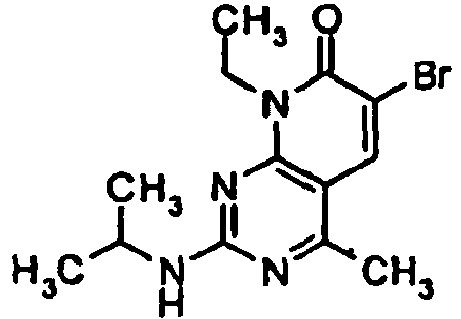
6-bromo-8-ethyl-4-methyl-2-[(1-methylethyl)amino]pyrido[2,3-d]pyrimidin-7(8H)-one 3 
6-bromo-2-[(1,1-dimethylethyl)amino]-8-ethyl-4-methylpyrido[2,3-d]pyrimidin-7(8H)-one 4 
6-biphehyl-4-yl-8-ethyl-2-(ethylamino)-4-methylpyrido[2,3-d]pyrimidin-7(8H)-one 5 
6-(2,4-difluorophenyl)-8-ethyl-2-(ethylamino)-4-methylpyrido[2,3-d]pyrimidin-7(8H)-one 6 
6-(3-chloro-4-fluorophenyl)-8-ethyl-2-(ethylamino)-4-methylpyrido[2,3-d]pyrimidin-7(8H)-one 7 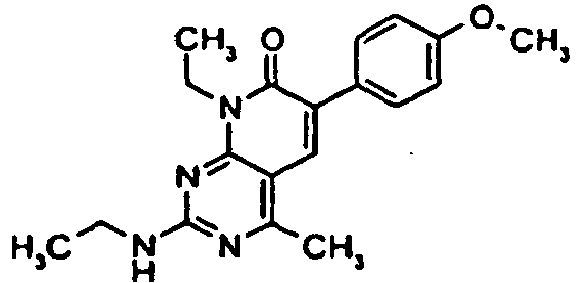
8-ethyl-2-(ethylamino)-4-methyl-6-[4-(methyloxy)phenyl]pyrido[2,3-d]pyrimidin-7(8H)-one 8 
6-(2,4-dichlorophenyl)-8-ethyl-2-(ethylamino)-4-methylpyrido[2,3-d]pyrimidin-7(8H)-one 9 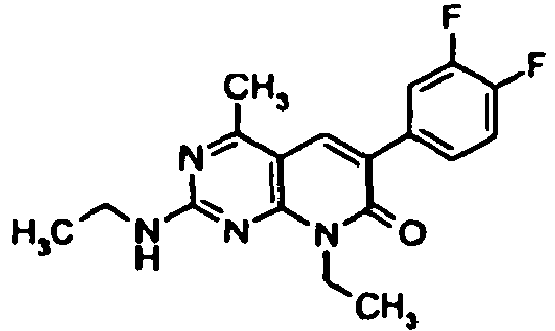
6-(3,4-difluorophenyl)-8-ethyl-2-(ethylamino)-4-methylpyrido[2,3-d]pyrimidin-7(8H)-one 10 
8-ethyl-2-(ethylamino)-4-methyl-6-[2-(methyloxy)phenyl]pyrido[2,3-d]pyrimidin-7(8H)-one 11 
6-bromo-2-{[3-(dimethylamino)propyl]amino}-8-ethyl-4-methylpyrido[2,3-d]pyrimidin-7(8H)-one 12 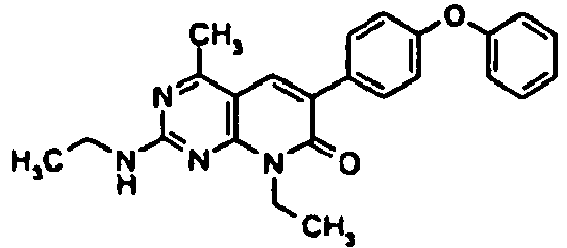
8-ethyl-2-(ethylamino)-4-methyl-6-[4-(phenyloxy)phenyl]pyrido[2,3-d]pyrimidin-7(8H)-one 13 
6-[2,4-bis(methyloxy)phenyl]-8-ethyl-2-(ethylamino)-4-methylpyrido[2,3-d]pyrimidin-7(8H)-one 14 
8-ethyl-2-(ethylamino)-6-(3-fluorophenyl)-4-methylpyrido[2,3-d]pyrimidin-7(8H)-one 15 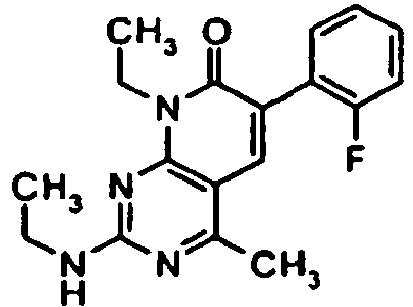
8-ethyl-2-(ethylamino)-6-(2-fluorophenyl)-4-methylpyrido[2,3-d]pyrimidin-7(8H)-one 16 
8-ethyl-2-(ethylamino)-4-methyl-6-[3-(trifluoromethyl)phenyl]pyrido[2,3-d]pyrimidin-7(8H)-one 17 
8-ethyl-2-(ethylamino)-6-(4-fluorophenyl)-4-methylpyrido[2,3-d]pyrimidin-7(8H)-one 18 
8-ethyl-2-(ethylamino)-4-methyl-6-(2-thienyl)pyrido[2,3-d]pyrimidin-7(8H)-one 19 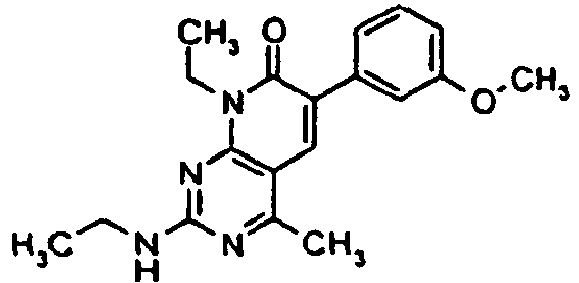
8-ethyl-2-(ethylamino)-4-methyl-6-[3-(methyloxy)phenyl]pyrido[2,3-d]pyrimidin-7(8H)-one 20 
6-(3-chlorophenyl)-8-ethyl-2-(ethylamino)-4-methylpyrido[2,3-d]pyrimidin-7(8H)-one 21 
6-(4-chlorophenyl)-8-ethyl-2-(ethylamino)-4-methylpyrido[2,3-d]pyrimidin-7(8H)-one 22 
8-ethyl-2-(ethylamino)-4-methyl-6-(3-thienyl)pyrido[2,3-d]pyrimidin-7(8H)-one 23 
8-ethyl-2-(ethylamino)-4-methyl-6-(4-methyl-2-thienyl)pyrido[2,3-d]pyrimidin-7(8H)-one 24 
8-ethyl-2-(ethylamino)-4-methyl-6-(4-methyl-3-thienyl)pyrido[2,3-d]pyrimidin-7(8H)-one 25 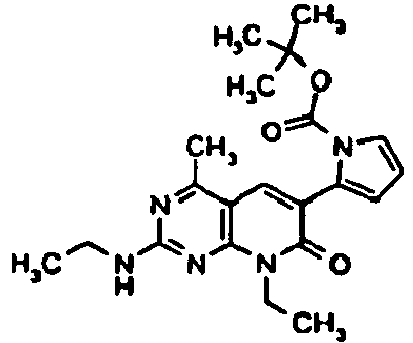
1,1-dimethylethyl 2-[8-ethyl-2-(ethylamino)-4-methyl-7-oxo-7,8-dihydropyrido[2,3-d]pyrimidin-6-yl]-1H-pyrrole-1-carboxylate 26 
8-ethyl-2-(ethylamino)-4-methyl-6-(1H-pyrrol-2-yl)pyrido[2,3-d]pyrimidin-7(8H)-one 27 
6-(5-chloro-2-thienyl)-8-ethyl-2-(ethylamino)-4-methylpyrido[2,3-d]pyrimidin-7(8H)-one 28 
8-ethyl-2-(ethylamino)-4-methyl-6-pyrimidin-5-ylpyrido[2,3-d]pyrimidin-7(8H)-one 29 
8-ethyl-2-(ethylamino)-6-(3-fluoropyridiN-4-yl)-4-methylpyrido[2,3-d]pyrimidin-7(8H)-one 30 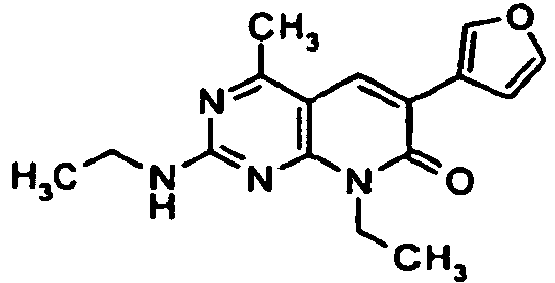
8-ethyl-2-(ethylamino)-6-furan-3-yl-4-methylpyrido[2,3-d]pyrimidin-7(8H)-one 31 
8-ethyl-2-(ethylamino)-4-methyl-6-[1-(phenylmethyl)-1H-pyrazol-4-yl]pyrido[2,3-d]pyrimidin-7(8H)-one 32 
6-bromo-2-(ethylamino)-4-methyl-8-(1-methylethyl)pyrido[2,3-d]pyrimidin-7(8H)-one 33 
2-(ethylamino)-4-methyl-8-(1-methylethyl)-6-(2-thienyl)pyrido[2,3-d]pyrimidin-7(8H)-one 34 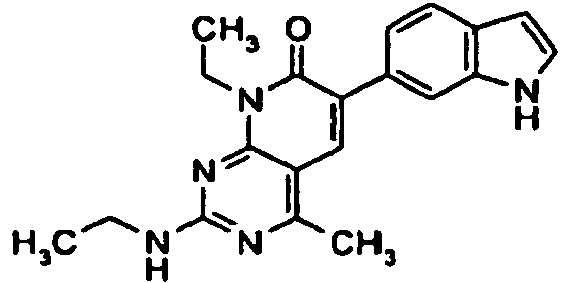
8-ethyl-2-(ethylamino)-6-(1H-indol-6-yl)-4-methylpyrido[2,3-d]pyrimidin-7(8H)-one 35 
8-ethyl-2-(ethylamino)-4-methyl-6-(5-phenyl-2-thienyl)pyrido[2,3-d]pyrimidin-7(8H)-one 36 
2-(ethylamino)-6-furan-3-yl-4-methyl-8-(1-methylethyl)pyrido[2,3-d]pyrimidin-7(8H)-one 37 
8-ethyl-2-(ethylamino)-4-methylpyrido[2,3-d]pyrimidin-7(8H)-one 38 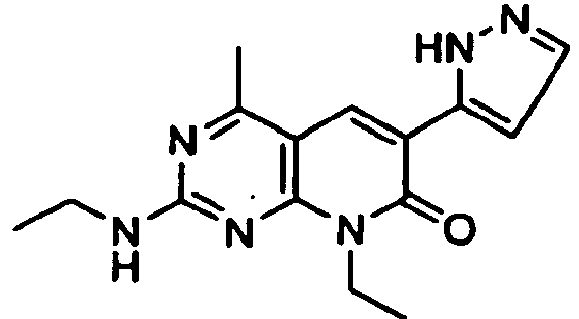
8-ethyl-2-(ethylamino)-4-methyl-6-(1H-pyrazol-5-yl)pyrido[2,3-d]pyrimidin-7(8H)-one 39 
8-cyclohexyl-2-(ethylamino)-4-methyl-6-(2-thienyl)pyrido[2,3-d]pyrimidin-7(8H)-one 40 
6-bromo-2-(ethylamino)-4-methyl-8-[3-(methyloxy)propyl]pyrido[2,3-d]pyrimidin-7(8H)-one 41 
6-bromo-2-(ethylamino)-8-[2-(ethyloxy)ethyl]-4-methylpyrido[2,3-d]pyrimidin-7(8H)-one 42 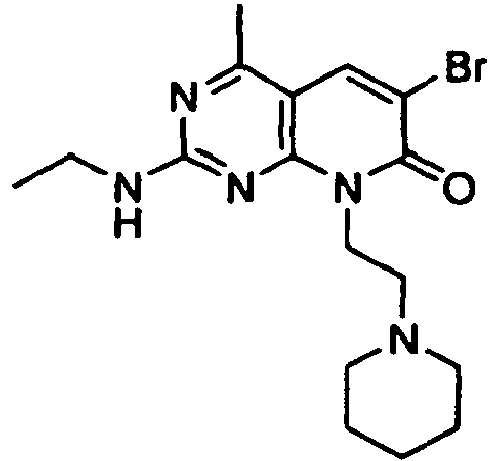
6-bromo-2-(ethylamino)-4-methyl-8-(2-piperidin-1-ylethyl)pyrido[2,3-d]pyrimidin-7(8H)-one 43 
6-bromo-2-(ethylamino)-8-[3-(ethyloxy)propyl]-4-methylpyrido[2,3-d]pyrimidin-7(8H)-one 44 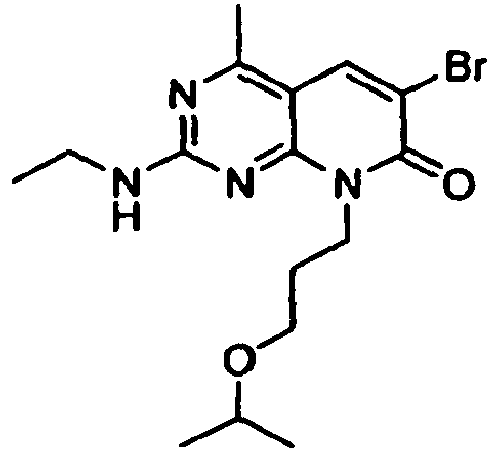
6-bromo-2-(ethylamino)-4-methyl-8-{3-[(1-methylethyl)oxy]propyl)pyrido[2,3-d]pyrimidin-7(8H)-one 45 
6-bromo-2-(ethylamino)-8-(3-hydroxypropyl)-4-methylpyrido[2,3-d]pyrimidin-7(8H)-one 46 
6-bromo-2-(ethylamino)-8-(2-hydroxyethyl)-4-methylpyrido[2,3-d]pyrimidin-7(8H)-one 47 
6-bromo-8-cyclopropyl-2-(ethylamino)-4-methylpyrido[2,3-d]pyrimidin-7(8H)-one 48 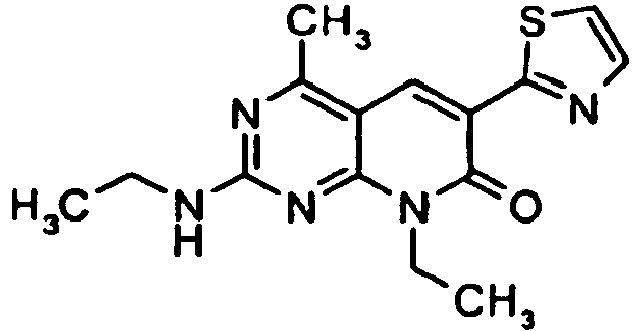
8-ethyl-2-(ethylamino)-4-methyl-6-(1,3-thiazol-2-yl)pyrido[2,3-d]pyrimidin-7(8H)-one 49 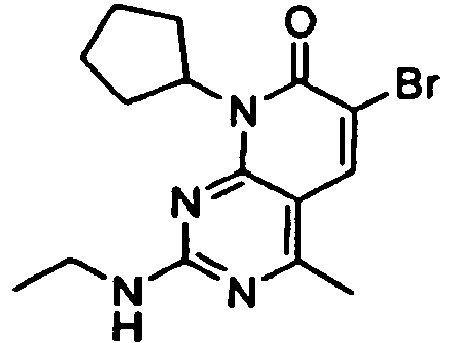
6-bromo-8-cyclopentyl-2-(ethylamino)-4-methylpyrido[2,3-d]pyrimidin-7(8H)-one 50 
8-cyclopentyl-2-(ethylamino)-4-methyl-6-(1H-pyrazol-3-yl)pyrido[2,3-d]pyrimidin-7(8H)-one 51 
2-(ethylamino)-4-methyl-8-(1-methylethyl)-6-(1H-pyrazol-5-yl)pyrido[2,3-d]pyrimidin-7(8H)-one 52 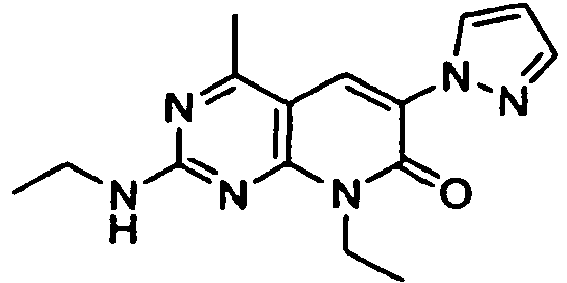
8-ethyl-2-(ethylamino)-4-methyl-6-(1H-pyrazol-1-yl)pyrido[2,3-d]pyrimidin-7(8H)-one 53 
2-(ethylamino)-4-methyl-8-(1-methylethyl)-6-(1H-pyrazol-1-yl)pyrido[2,3-d]pyrimidin-7(8H)-one 54 
8-cyclopentyl-2-(ethylamino)-4-methyl-6-(1H-pyrazol-1-yl)pyrido[2,3-d]pyrimidin-7(8H)-one 55 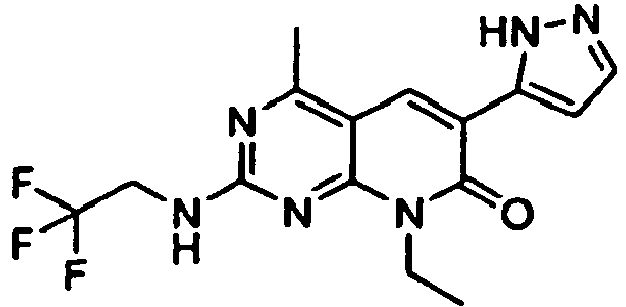
8-ethyl-4-methyl-6-(1H-pyrazol-5-yl)-2-[(2,2,2-trifluoroethyl)amino]pyrido[2,3-d]pyrimidin-7(8H)-one 56 
2-amino-8-ethyl-4-methyl-6-(1H-pyrazol-5-yl)pyrido[2,3-d]pyrimidin-7(8H)-one 57 
2-(ethylamino)-4-methyl-6-(1H-pyrazol-3-yl)pyrido[2,3-d]pyrimidin-7(8H)-one 58 
8-ethyl-4-methyl-2-(methylamino)-6-(1H-pyrazol-5-yl)pyrido[2,3-d]pyrimidin-7(8H)-one 59 
2-amino-8-cyclopentyl-4-methyl-6-(1H-pyrazol-3-yl)pyrido[2,3-d]pyrimidin-7(8H)-one 60 
8-ethyl-2-[(2-fluoroethyl)amino]-4-methyl-6-(1H-pyrazol-5-yl)pyrido[2,3-d]pyrimidin-7(8H)-one 61 
2-amino-4-methyl-8-(1-methylethyl)-6-(1H-pyrazol-3-yl)pyrido[2,3-d]pyrimidin-7(8H)-one 62 
2-amino-8-ethyl-4-methylpyrido[2,3-d]pyrimidin-7(8H)-one 63 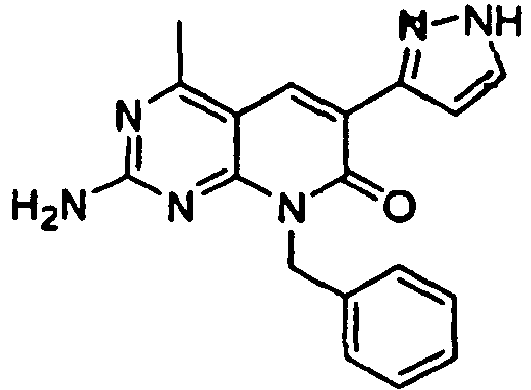
2-amino-4-methyl-8-(phenylmethyl)-6-(1H-pyrazol-3-yl)pyrido[2,3-d]pyrimidin-7(8H)-one 64 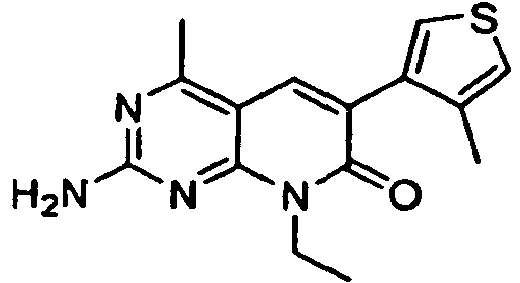
2-amino-8-ethyl-4-methyl-6-(4-methyl-3-thienyl)pyrido[2,3-d]pyrimidin-7(8H)-one 65 
2-amino-8-ethyl-4-methyl-6-(2-thienyl)pyrido[2,3-d]pyrimidin-7(8H)-one 66 
2-amino-8-ethyl-6-(4-fluorophenyl)-4-methylpyrido[2,3-d]pyrimidin-7(8H)-one 67 
2-amino-8-ethyl-6-(3-fluorophenyl)-4-methylpyrido[2,3-d]pyrimidin-7(8H)-one 68 
2-amino-8-ethyl-6-(2-fluorophenyl)-4-methylpyrido[2,3-d]pyrimidin-7(8H)-one 69 
2-amino-8-ethyl-4-methyl-6-(3-thienyl)pyrido[2,3-d]pyrimidin-7(8H)-one 70 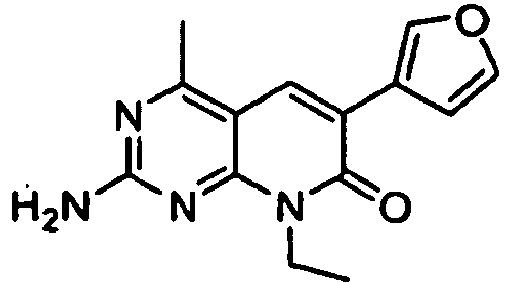
2-amino-8-ethyl-6-furan-3-yl-4-methylpyrido[2,3-d]pyrimidin-7(8H)-one 71 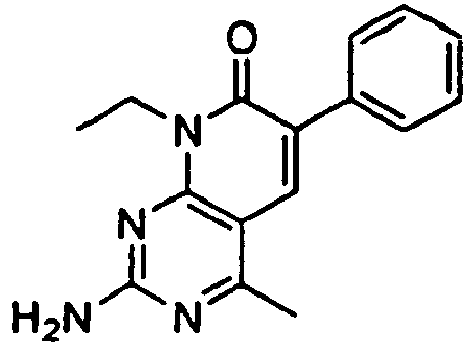
2-amino-8-ethyl-4-methyl-6-phenylpyrido[2,3-d]pyrimidin-7(8H)-one 72 
2-amino-8-ethyl-4-methyl-6-[4-(methyloxy)phenyl]pyrido[2,3-d]pyrimidin-7(8H)-one 73 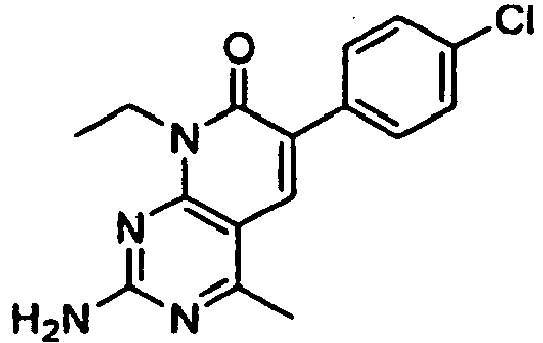
2-amino-6-(4-chlorophenyl)-8-ethyl-4-methylpyrido[2,3-d]pyrimidin-7(8H)-one 74 
2-amino-6-(3-chlorophenyl)-8-ethyl-4-methylpyrido[2,3-d]]pyrimidin-7(8H)-one 75 
2-amino-8-ethyl-6-isoxazol-4-yl-4-methylpyrido[2,3-d]pyrimidin-7(8H)-one 76 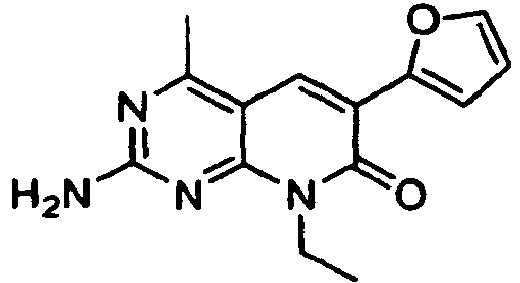
2-amino-8-ethyl-6-furan-2-yl-4-methylpyrido[2,3-d]pyrimidin-7(8H)-one 77 
2-amino-6-(2,4-dichlorophenyl)-8-ethyl-4-methylpyrido[2,3-d]pyrimidin-7(8H)-one 78 
5-(2-amino-8-ethyl-4-methyl-7-oxo-7,8-dihydropyrido[2,3-d]pyrimidin-6-yl)thiophene-2-carbonitrile 79 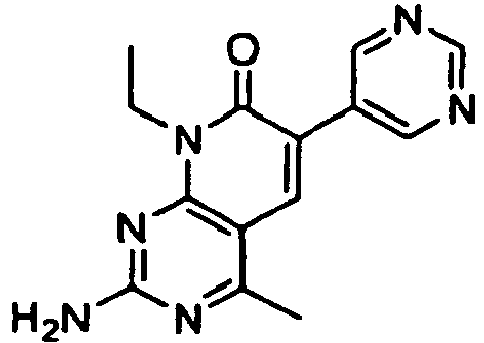
2-amino-8-ethyl-4-methyl-6-pyrimidin-5-ylpyrido[2,3-d]pyrimidin-7(8H)-one 80 
2-amino-8-ethyl-6-(1H-imidazol-5-yl)-4-methylpyrido[2,3-d]pyrimidin-7(8H)-one 81 
2-amino-8-ethyl-4-methyl-6-(1H-1,2,3-triazol-5-yl)pyrido[2,3-d]pyrimidin-7(8H)-one 82 
2-amino-8-ethyl-4-methyl-6-(1H-pyrazol-4-yl)pyrido[2,3-d]pyrimidin-7(8H)-one 83 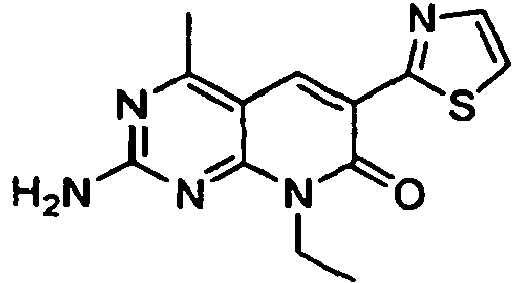
2-amino-8-ethyl-4-methyl-6-(1,3-thiazol-2-yl)pyrido[2,3-d]pyrimidin-7(8H)-one 84 
2-amino-8-ethyl-4-methyl-6-(1H-tetrazol-5-yl)pyrido[2,3-d]pyrimidin-7(8H)-one 85 
2-amino-8-ethyl-4-methyl-6-(1-methyl-1H-pyrrol-2-yl)pyrido[2,3-d]pyrimidin-7(8H)-one 86 
2-amino-6-bromo-8-cyclopentyl-4-methylpyrido[2,3-d]pyrimidin-7(8H)-one 87 
2-amino-4,8-diethyl-6-(1H-pyrazol-5-yl)pyrido[2,3-d]pyrimidin-7(8H)-one 88 
2-amino-8-cyclopentyl-4-methyl-6-(1,3-thiazol-5-yl)pyrido[2,3-d]pyrimidin-7(8H)-one - The Compounds in Table 2a can be prepared as pharmaceutically acceptable salts, solvates, hydrates, and/or isomers thereof. All such salt, solvate, hydrate, and isomer combinations of the Compounds in Table 2a can be used.
Table 2a Cmpd No. Name 1 3-(azetidin-3-ylidenemethyl)-4-(4-(5-chloro-2-methylphenyl)piperazin-1-yl]-1H-pyrazolo[3,4-d]pyrimidine 2 4-[4-(5-chloro-2-methylphenyl)piperazin-1-yl]-3-(3-fluoropyridin-4-yl)-1H-pyrazolo[3,4-d]pyrimidine 3 4-[4-(5-chloro-2-methylphenyl)piperazin-1-yl]-3-(3-chloropyridin-4-yl)-1H-pyrazolo[3,4-d]pyrimidine 4 2-({5-chloro-3-[4-(3-ethyl-1H-pyrazolo[3,4-d]pyrimidin-4-yl)piperazin-1-yl]-2-methylphenyl}oxy)-N,N-dimethylethanamine 5 2-({5-chloro-3-[4-(3-ethyl-1H-pyrazolo[3,4-d]pyrimidin-4-yl)piperazin-1-yl]-2-methylphenyl}oxy)-N,N-diethylethanamine 6 4-(4-{5-chloro-2-methyl-3-[(2-pyrrolidin-1-ylethyl)oxy]phenyl}piperazin-1-yl)-3-ethyl-1H-pyrazolo[3,4-d]pyrimidine 7 4-[4-(5-chloro-2-methylphenyl)piperazin-1-yl]-3-piperazin-1-yl-1H-pyrazolo[3,4-d]pyrimidine 8 N-(3-{4-[4-(5-chloro-2-methylphenyl)piperazin-1-yl]-1H-pyrazolo[3,4-d]pyrimidin-3-yl}prop-2-yn-1-yl)acetamide 9 N,N-diethyl-2-({3-[4-(3-ethyl-1H-pyrazolo[3,4-d]pyrimidin-4-yl)piperazin-1-yl]phenyl}oxy)ethanamine 10 3-{3-[4-(3-bromo-1H-pyrazolo[3,4-d]pyrimidin-4-yl)piperazin-1-yl]-5-chloro-2-methylphenyl}-N,N-diethylpropan-1-amine 11 3-bromo-4-{4-[5-chloro-2-methyl-3-(3-pyrrolidin-1-ylpropyl)phenyl]piperazin-1-yl}-1H-pyrazolo[3,4-d]pyrimidine 12 3-bromo-4-(4-{5-chloro-2-methyl-3-[(2-pyrrolidin-1-ylethyl)oxy]phenyl}piperazin-1-yl)-1H-pyrazolo[3,4-d]pyrimidine 13 2-({3-[4-(3-bromo-1H-pyrazolo[3,4-d]pyrimidin-4-yl)piperazin-1-yl]-5-chloro-2-methylphenyl}oxy)-N,N-diethylethanamine 14 4-[4-(5-chloro-2-methyl-3-{[2-(1-methylpiperidin-4-yl)ethyl]oxy}phenyl)piperazin-1-yl]-3-ethyl-1H-pyrazolo[3,4-d]pyrimidine 15 5-chloro-3-[4-(3-ethyl-1H-pyrazolo[3,4-d]pyrimidin-4-yl)piperazin-1-yl]-2-methyl-N-(2-pyrrolidin-1-ylethyl)aniline 16 4-(4-{5-chloro-2-methyl-3-[(2-morpholin-4-ylethyl)oxy]phenyl}piperazin-1-yl)-3-ethyl-1H-pyrazolo[3,4-d]pyrimidine 17 4-(4-{5-chloro-2-methyl-3-[(2-piperidin-1-ylethyl)oxy]phenyl}piperazin-1-yl)-3-ethyl-1H-pyrazolo[3,4-d]pyrimidine 18 3-bromo-4-{4-[5-chloro-2-methyl-3-(3-morpholin-4-ylpropyl)phenyl]piperazin-1-yl}-1H-pyrazolo[3,4-d]pyrimidine 19 3-bromo-4-(4-{5-chloro-2-methyl-3-[3-(4-methylpiperazin-1-yl)propyl]phenyl}piperazin-1-yl)-1H-pyrazolo[3,4-d]pyrimidine 20 3-bromo-4-(4-{5-chloro-2-methyl-3-[(2-piperidin-1-ylethyl)oxy]phenyl}piperazin-1-yl)-1H-pyrazolo[3,4-d]pyrimidine 21 3-bromo-4-(4-{5-chloro-2-methyl-3-[(2-morpholin-4-ylethyl)oxy]phenyl}piperazin-1-yl)-1H-pyrazolo[3,4-d]pyrimidine 22 4-{4-[5-chloro-2-methyl-3-(3-morpholin-4-ylpropyl)phenyl]piperazin-1-yl}-3-ethyl-1H-pyrazolo[3,4-d]pyrimidine 23 N'-{5-chloro-3-[4-(3-ethyl-1H-pyrazolo[3,4-d]pyrimidin-4-yl)piperazin-1-yl]-2-methylphenyl}-N,N-diethylethane-1,2-diamine 24 4-{4-(5-chloro-2-methyl-3-(3-piperidin-1-ylpropyl)phenyl]piperazin-1-yl}-3-ethyl-1H-pyrazolo[3,4-d]pyrimidine 25 4-[4-(5-chloro-3-{[2-(4-ethylpiperazin-1-yl)ethyl]oxy}-2-methylphenyl)piperazin-1-yl]-3-ethyl-1H-pyrazolo[3,4-d]pyrimidine 26 4-(4-{5-chloro-2-methyl-3-[(3-morpholin-4-ylpropyl)oxy]phenyl}piperazin-1-yl)-3-ethyl-1H-pyrazolo[3,4-d]pyrimidine 27 3-bromo-4-{4-[5-chloro-2-methyl-3-(3-piperidin-1-ylpropyl)phenyl]piperazin-1-yl}-1H-pyrazolo[3,4-d]pyrimidine 28 N'-{3-[4-(3-bromo-1H-pyrazolo[3,4-d]pyrimidin-4-yl)piperazin-1-yl]-5-chloro-2-methylphenyl}-N,N-diethylethane-1,2-diamine 29 3-[4-(3-bromo-1H-pyrazolo[3,4-d]pyrimidin-4-yl)piperazin-1-yl]-5-chloro-2-methyl-N-(2-pyrrolidin-1-ylethyl)aniline 30 4-[4-(5-chloro-2-methyl-3-{[2-(4-methylpiperazin-1-yl)ethyl]oxy}phenyl)piperazin-1-yl]-3-ethyl-1H-pyrazolo[3,4-d]pyrimidine 31 4-[4-(5-chloro-2-methyl-3-{[(1-methylpiperidin-4-yl)methyl]oxy}phenyl)piperazin-1-yl]-3-ethyl-1H-pyrazolo[3,4-d]pyrimidine 32 N,N-diethyl-2-({3-[4-(3-ethyl-1H-pyrazolo[3,4-d]pyrimidin-4-yl)piperazin-1-yl]-2-methylphenyl}oxy)ethanamine 33 2-[(5-chloro-3-{4-[1-(1,1-dimethylethyl)-3-(trifluoromethyl)-1H-pyrazolo[3,4-d]pyrimidin-4-yl]piperazin-1-yl}-2-methylphenyl)oxy]-N,N-diethylethanamine 34 2-[(5-chloro-2-methyl-3-{4-[3-(trifluoromethyl)-1H-pyrazolo[3,4-d]pyrimidin-4-yl]piperazin-1-yl}phenyl)oxy)-N,N-diethylethanamine 35 4-(4-{5-chloro-2-methyl-3-[(3-pyrrolidin-1-ylpropyl)oxy]phenyl}piperazin-1-yl)-3-ethyl-1H-pyrazolo[3,4-d]pyrimidine 36 4-[4-(5-chloro-2-methyl-3-{[3-(4-methylpiperazin-1-yl)propyl]oxy}phenyl)piperazin-1-yl]-3-ethyl-1H-pyrazolo[3,4-d]pyrimidine 37 3-bromo-4-(4-{5-chloro-2-methyl-3-[(3-piperidin-1-ylpropyl)oxy]phenyl}piperazin-1-yl)-1H-pyrazolo[3,4-d]pyrimidine 38 3-bromo-4-(4-{5-chloro-2-methyl-3-[(3-morpholin-4-ylpropyl)oxy]phenyl}piperazin-1-yl)-1H-pyrazolo[3,4-d]pyrimidine 39 4-(4-{5-chloro-2-methyl-3-[(2-pyrrolidin-1-ylethyl)oxy]phenyl}piperazin-1-yl)-3-(trifluoromethyl)-1H-pyrazolo[3,4-d]pyrimidine 40 4-(4-{5-chloro-2-methyl-3-[(3-morpholin-4-ylpropyl)oxy]phenyl}piperazin-1-yl)-3-(trifluoromethyl)-1H-pyrazolo[3,4-d]pyrimidine 41 4-(4-{5-chloro-2-methyl-3-[(2-morpholin-4-ylethyl)oxy]phenyl}piperazin-1-yl)-3-(trifluoromethyl)-1H-pyrazolo[3,4-d]pyrimidine 42 4-(4-{5-chloro-2-methyl-3-[(3-piperidin-1-ylpropyl)oxy]phenyl}piperazin-1-yl)-3-ethyl-1H-pyrazolo[3,4-d]pyrimidine 43 4-[4-(5-chloro-3-{[3-(4-ethylpiperazin-1-yl)propyl]oxy}-2-methylphenyl)piperazin-1-yl]-3-ethyl-1H-pyrazolo[3,4-d]pyrimidine 44 5-chloro-2-methyl-3-[4-(1H-pyrazolo[3,4-d]pyrimidin-4-yl)piperazin-1-yl]-N-(2-pyrrolidin-1-ylethyl)aniline 45 5-chloro-2-methyl-3-[4-(3-methyl-1H-pyrazolo[3,4-d]pyrimidin-4-yl)piperazin-1-yl]-N-(2-pyrrolidin-1-ylethyl)aniline 46 N'-(5-chloro-2-methyl-3-{4-[3-(trifluoromethyl)-1H-pyrazolo[3,4-d]pyrimidin-4-yl]piperazin-1-yl}phenyl)-N,N-dimethylethane-1,2-diamine 47 3-({5-chloro-3-[4-(3-ethyl-1H-pyrazolo[3,4-d]pyrimidin-4-yl)piperazin-1-yl]-2-methylphenyl}oxy)-N,N-diethylpropan-1-amine 48 N'-(5-chloro-2-methyl-3-{4-[3-(trifluoromethyl)-1H-pyrazolo[3,4-d]pyrimidin-4-yl]piperazin-1-yl}phenyl)-N,N-diethylethane-1,2-diamine 49 5-chloro-2-methyl-N-(2-pyrrolidin-1-ylethyl)-3-{4-[3-(trifluoromethyl)-1H-pyrazolo[3,4-d]pyrimidin-4-yl]piperazin-1-yl}aniline 50 3-bromo-4-(4-{4-methyl-3-[(2-pyrrolidin-1-ylethyl)oxy]phenyl}piperazin-1-yl)-1H-pyrazolo[3,4-d]pyrimidine 51 4-(4-{4-methyl-3-[(2-pyrrolidin-1-ylethyl)oxy]phenyl}piperazin-1-yl)-1H-pyrazolo[3,4-d]pyrimidine 52 3-methyl-4-(4-{4-methyl-3-[(2-pyrrolidin-1-ylethyl)oxy]phenyl}piperazin-1-yl)-1H-pyrazolo[3,4-d]pyrimidine 53 4-(4-{5-chloro-2-methyl-3-[(2-pyrrolidin-1-ylethyl)oxy]phenyl}piperazin-1-yl)-1H-pyrazolo[3,4-d]pyrimidine 54 4-(4-{5-chloro-2-methyl-3-[(2-pyrrolidin-1-ylethyl)oxy]phenyl}piperazin-1-yl)-3-methyl-1H-pyrazolo[3,4-d]pyrimidine 55 4-(4-{5-chloro-2-methyl-3-[(2-piperidin-1-ylethyl)oxy]phenyl}piperazin-1-yl)-3-(trifluoromethyl)-1H-pyrazolo[3,4-d]pyrimidine 56 3-[(5-chloro-2-methyl-3-{4-[3-(trifluoromethyl)-1H-pyrazolo[3,4-d]pyrimidin-4-yl]piperazin-1-yl}phenyl)oxy]-N,N-diethylpropan-1-amine 57 5-[4-(3-bromo-1H-pyrazolo[3,4-d]pyrimidin-4-yl)piperazin-1-yl]-2-methyl-N-(2-pyrrolidin-1-ylethyl)aniline 58 3-[4-(3-bromo-1H-pyrazolo[3,4-d]pyrimidin-4-yl)piperazin-1-yl]-5-fluoro-2-methyl-N-(2-pyrrolidin-1-ylethyl)aniline 59 4-{4-[5-chloro-2-methyl-3-(3-pyrrolidin-1-ylpropyl)phenyl]piperazin-1-yl}-1H-pyrazolo[3,4-d]pyrimidine 60 3-bromo-4-{4-[5-fluoro-2-methyl-3-(3-pyrrolidin-1-ylpropyl)phenyl]piperazin-1-yl}-1H-pyrazolo[3,4-d]pyrimidine 61 4-{4-[5-chloro-2-methyl-3-(3-pyrrolidin-1-ylpropyl)phenyl]piperazin-1-yl}-3-(trifluoromethyl)-1H-pyrazolo[3,4-d]pyrimidine 62 4-(4-{5-chloro-2-methyl-3-[3-(4-methylpiperazin-1-yl)propyl]phenyl}piperazin-1-yl)-3-ethyl-1H-pyrazolo[3,4-d]pyrimidine 63 3-bromo-4-(4-pyridin-2-ylpiperazin-1-yl-1H-pyrazolo[3,4-d]pyrimidine 64 3-bromo-4-[4-(2,4-dimethylphenyl)piperazin-1-yl]-1H-pyrazolo[3,4-d]pyrimidine 65 3-bromo-4-{4-[3-(methyloxy)phenyl]piperazin-1-yl}-1H-pyrazolo[3,4-d]pyrimidine 66 3-bromo-4-{4-[2-(methyloxy)phenyl]piperazin-1-yl}-1H-pyrazolo[3,4-d]pyrimidine 67 3-bromo-4-{4-[4-methyl-3-(3-pyrrolidin-1-ylpropyl)phenyl]piperazin-1-yl}-1H-pyrazolo[3,4-d]pyrimidine 68 4-(4-{5-chloro-2-methyl-3-[(3-pyrrolidin-1-ylpropyl)oxy]phenyl}piperazin-1-yl)-3-(trifluoromethyl)-1H-pyrazolo[3,4-d]pyrimidine 69 4-(4-{5-chloro-2-methyl-3-[(3-piperidin-1-ylpropyl)oxy]phenyl}piperazin-1-yl)-3-(trifluoromethyl)-1H-pyrazolo[3,4-d]pyrimidine 70 4-[4-(5-chloro-2-methyl-3-{[3-(4-methylpiperazin-1-yl)propyl]oxy}phenyl)piperazin-1-yl]-3-(trifluoromethyl)-1H-pyrazolo[3,4-d]pyrimidine 71 4-[4-(5-chloro-3-{[3-(4-ethylpiperazin-1-yl)propyl]oxy}-2-methylphenyl)piperazin-1-yl]-3-(trifluoromethyl)-1H-pyrazolo[3,4-d]pyrimidine 72 3-bromo-4-[4-(5-chloro-2-methyl-3-{[2-(4-methylpiperazin-1-yl)ethyl]oxy}phenyl)piperazin-1-yl]-1H-pyrazolo[3,4-d]pyrimidine 73 4-[4-(5-chloro-2-methyl-3-{[2-(4-methylpiperazin-1-yl)ethyl]oxy}phenyl)piperazin-1-yl]-3-(trifluoromethyl)-1H-pyrazolo[3,4-d]pyrimidine 74 3-bromo-4-[4-(5-chloro-3-{[2-(4-ethylpiperazin-1-yl)ethyl]oxy}-2-methylphenyl)piperazin-1-yl]-1H-pyrazolo[3,4-d]pyrimidine 75 3-bromo-4-[4-(3,4-dichlorophenyl)piperazin-1-yl]-1H-pyrazolo[3,4-d]pyrimidine 76 3-bromo-4-[4-(3,4-difluorophenyl)piperazin-1-yl]-1H-pyrazolo[3,4-d]pyrimidine 77 3-bromo-4-[4-(2,4-dichlorophenyl)piperazin-1-yl]-1H-pyrazolo[3,4-d]pyrimidine 78 3-[4-(3-ethyl-1H-pyrazolo[3,4-d]pyrimidin-4-yl)piperazin-1-yl]-5-fluoro-2-methyl-N-(2-pyrrolidin-1-ylethyl)aniline 79 5-fluoro-2-methyl-N-(2-pyrrolidin-1-ylethyl)-3-{4-[3-(trifluoromethyl)-1H-pyrazolo[3,4-d]pyrimidin-4-yl]piperazin-1-yl}aniline 80 4-{4-[3,5-bis(methyloxy)phenyl]piperazin-1-yl}-3-bromo-1H-pyrazolo[3,4-d]pyrimidine 81 4-[4-(5-chloro-3-{[2-(4-ethylpiperazin-1-yl)ethyl]oxy}-2-methylphenyl)piperazin-1-yl]-3-(trifluoromethyl)-1H-pyrazolo[3,4-d]pyrimidine 82 N-{5-chloro-3-[4-(3-ethyl-1H-pyrazolo[3,4-d]pyrimidin-4-yl)piperazin-1-yl]-2-methylphenyl}-N,N',N'-trimethylethane-1,2-diamine 83 3-({3-[4-(3-bromo-1H-pyrazolo[3,4-d]pyrimidin-4-yl)piperazin-1-yl]-5-chloro-2-methylphenyl}oxy)-N,N-diethylpropan-1-amine 84 3-bromo-4-(4-{5-chloro-2-methyl-3-[(3-pyrrolidin-1-ylpropyl)oxy]phenyl}piperazin-1-yl)-1H-pyrazolo[3,4-d]pyrimidine 85 3-bromo-4-[4-(5-chloro-2-methyl-3-{[3-(4-methylpiperazin-1-yl)propyl]oxy}phenyl)piperazin-1-yl]-1H-pyrazolo[3,4-d]pyrimidine 86 3-bromo-4-[4-(5-chloro-3-{[3-(4-ethylpiperazin-1-yl)propyl]oxy}-2-methylphenyl)piperazin-1-yl]-1H-pyrazolo[3,4-d]pyrimidine 87 3-(5-chloro-2-methyl-3-{4-[3-(trifluoromethyl)-1H-pyrazolo[3,4-d]pyrimidin-4-yl]piperazin-1-yl}phenyl)-N,N-diethylpropan-1-amine 88 3-bromo-4-[4-(5-chloro-2-methyl-3-{[(1-methylpiperidin-4-yl)methyl]oxy}phenyl)piperazin-1-yl]-1H-pyrazolo[3,4-d]pyrimidine 89 3-bromo-4-[4-(5-chloro-2-methyl-3-{[2-(1-methylpiperidin-4-yl)ethyl]oxy}phenyl)piperazin-1-yl]-1H-pyrazolo[3,4-d]pyrimidine 90 4-[4-(5-chloro-2-methyl-3-{[(1-methylpiperidin-4-yl)methyl]oxy}phenyl)piperazin-1-yl]-3-(trifluoromethyl)-1H-pyrazolo[3,4-d]pyrimidine 91 4-[4-(5-chloro-2-methyl-3-{[2-(1-methylpiperidin-4-yl)ethyl]oxy}phenyl)piperazin-1-yl]-3-(trifluoromethyl)-1H-pyrazolo[3,4-d]pyrimidine 92 4-(4-{5-chloro-2-methyl-3-[3-(4-methylpiperazin-1-yl)propyl]phenyl}piperazin-1-yl)-3-(trifluoromethyl)-1H-pyrazolo[3,4-d]pyrimidine 93 3-bromo-4-[4-(3-chloro-4-fluorophenyl)piperazin-1-yl]-1H-pyrazolo[3,4-d]pyrimidine 94 1-{4-[4-(3-bromo-1H-pyrazolo[3,4-d]pyrimidin-4-yl)piperazin-1-yl]phenyl}ethanone 95 3-bromo-4-[4-(2,5-dichlorophenyl)piperazin-1-yl]-1H-pyrazolo[3,4-d]pyrimidine 96 3-bromo-4-[4-(3,4-dimethylphenyl)piperazin-1-yl]-1H-pyrazolo[3,4-d]pyrimidine 97 3-bromo-4-[4-(4-nitrophenyl)piperazin-1-yl]-1H-pyrazolo[3,4-d]pyrimidine 98 3-ethyl-4-(4-phenylpiperazin-1-yl)-1H-pyrazolo[3,4-d]pyrimidine 99 3-ethyl-4-{4-[3-(methyloxy)phenyl]piperazin-1-yl}-1H-pyrazolo[3,4-d]pyrimidine 100 4-{4-[5-chloro-2-methyl-3-(3-piperidin-1-ylpropyl)phenyl]piperazin-1-yl}-3-(trifluoromethyl)-1H-pyrazolo[3,4-d]pyrimidine 101 4-[4-(3,6-dimethylpyrazin-2-yl)piperazin-1-yl]-3-ethyl-1H-pyrazolo[3,4-d]pyrimidine 102 1-[4-(3-ethyl-1H-pyrazolo[3,4-d]pyrimidin-4-yl)piperazin-1-yl]isoquinoline 103 3-bromo-4-[4-(2,6-dimethylphenyl)piperazin-1-yl]-1H-pyrazolo[3,4-d]pyrimidine 104 3-bromo-4-{4-[4-(ethyloxy)phenyl]piperazin-1-yl}-1H-pyrazolo[3,4-d]pyrimidine 105 3-bromo-4-[4-(2-ethylphenyl)piperazin-1-yl]-1H-pyrazolo[3,4-d]pyrimidine 106 4-{4-[2,4-bis(methyloxy)phenyl]piperazin-1-yl}-3-bromo-1H-pyrazolo[3,4-d]pyrimidine 107 3-bromo-4-(4-pyrazin-2-ylpiperazin-1-yl)-1H-pyrazolo[3,4-d]pyrimidine 108 3-bromo-4-(4-pyrimidin-2-ylpiperazin-1-yl)-1H-pyrazolo[3,4-d]pyrimidine 109 4-[4-(3-bromo-1H-pyrazolo[3,4-d]pyrimidin-4-yl)piperazin-1-yl]-2-(trifluoromethyl)quinoline 110 3-[4-(3-bromo-1H-pyrazolo[3,4-d]pyrimidin-4-yl)piperazin-1-yl]pyrazine-2-carbonitrile 111 4-[4-(4,6-dimethylpyrimidin-2-yl)piperazin-1-yl]-3-ethyl-1H-pyrazolo[3,4-d]pyrimidine 112 ethyl 4-[4-(3-ethyl-1H-pyrazolo[3,4-d]pyrimidin-4-yl)piperazin-1-yl]-2-(trifluoromethyl)pyrimidine-5-carboxylate 113 4-{4-[3-chloro-5-(methyloxy)phenyl]piperazin-1-yl}-3-ethyl-1H-pyrazolo[3,4-d]pyrimidine 114 4-[4-(3-bromo-2-chloro-5-fluorophenyl)piperazin-1-yl]-3-ethyl-1H-pyrazolo[3,4-d]pyrimidine 115 2-[4-(3-ethyl-1H-pyrazolo[3,4-d]pyrimidin-4-yl)piperazin-1-yl]pyridine-3-carboxamide 116 3-ethyl-4-{4-[4-(trifluoromethyl)pyridin-2-yl]piperazin-1-yl}-1H-pyrazolo[3,4-d]pyrimidine 117 3-bromo-4-{4-[4-(trifluoromethyl)pyridin-2-yl]piperazin-1-yl}-1H-pyrazolo[3,4-d]pyrimidine 118 3-bromo-4-{4-[4-(trifluoromethyl)pyrimidin-2-yl]piperazin-1-yl}-1H-pyrazolo[3,4-d]pyrimidine 119 2-({3-[4-(3-bromo-1H-pyrazolo[3,4-d]pyrimidin-4-yl)piperazin-1-yl]pyrazin-2-yl}oxy)-N,N-dimethylethanamine 120 4-[4-(3-bromo-1H-pyrazolo[3,4-d]pyrimidin-4-yl)piperazin-1-yl]-2-methylquinoline 121 3-bromo-4-[4-(2-nitrophenyl)piperazin-1-yl]-1H-pyrazolo[3,4-d]pyrimidine 122 2-[4-(3-bromo-1H-pyrazolo[3,4-d]pyrimidin-4-yl)piperazin-1-yl]benzonitrile 123 4-[4-(3-bromo-1H-pyrazolo[3,4-d]pyrimidin-4-yl)piperazin-1-yl]benzonitrile 124 3-bromo-4-{4-[4-(trifluoromethyl)phenyl]piperazin-1-yl}-1H-pyrazolo[3,4-d]pyrimidine 125 3-bromo-4-(4-{4-[(phenylmethyl)oxy]phenyl}piperazin-1-yl}-1H-pyrazolo[3,4-d]pyrimidine 126 4-{4-[5-chloro-2-methyl-3-(methyloxy)phenyl]piperazin-1-yl}-3-ethyl-1H-pyrazolo[3,4-d]pyrimidine 127 2-[4-(3-bromo-1H-pyrazolo[3,4-d]pyrimidin-4-yl)piperazin-1-yl]pyridine-3-carbonitrile 128 3-bromo-4-[4-(3,5-dichlorophenyl)piperazin-1-yl]-1H-pyrazolo[3,4-d]pyrimidine 129 3-[4-(3-bromo-1H-pyrazolo[3,4-d]pyrimidin-4-yl)piperazin-1-yl]-2-chloro-5-fluoro-N-(2-pyrrolidin-1-ylethyl)aniline 130 2-chloro-3-[4-(3-ethyl-1H-pyrazolo[3,4-d]pyrimidin-4-yl)piperazin-1-yl]-5-fluoro-N-(2-pyrrolidin-1-ylethyl)aniline 131 3-bromo-4-[4-(2,5-difluorophenyl)piperazin-1-yl]-1H-pyrazolo[3,4-d]pyrimidine 132 4-[4-(2,5-difluorophenyl)piperazin-1-yl]-3-ethyl-1H-pyrazolo[3,4-d]pyrimidine 133 3-bromo-4-{4-[3-(methyloxy)pyrazin-2-yl]piperazin-1-yl}-1H-pyrazolo[3,4-d]pyrimidine 134 3-bromo-4-[4-(3-chlorophenyl)piperazin-1-yl]-1H-pyrazolo[3,4-d]pyrimidine 135 3-bromo-4-{4-[3-(trifluoromethyl)pyridin-2-yl]piperazin-1-yl}-1H-pyrazolo[3,4-d]pyrimidine 136 3-bromo-4-{4-[3-chloro-5-(trifluoromethyl)pyridin-2-yl]piperazin-1-yl}-1H-pyrazolo[3,4-d]pyrimidine 137 4-(4-{5-chloro-2-methyl-3-[(2-pyrrolidin-1-ylethyl)oxy]phenyl}piperazin-1-yl)-3-(1-methylethyl)-1H-pyrazolo[3,4-d]pyrimidine 138 5-chloro-2-methyl-3-{4-[3-(1-methylethyl)-1H-pyrazolo[3,4-d]pyrimidin-4-yl]piperazin-1-yl}-N-(2-pyrrolidin-1-ylethyl)aniline 139 2-({3-[4-(3-bromo-1H-pyrazolo[3,4-d]pyrimidin-4-yl)piperazin-1-yl]phenyl}oxy)-N-ethylacetamide 140 2-[4-(3-bromo-1H-pyrazolo[3,4-d]pyrimidin-4-yl)piperazin-1-yl]-N,N-diethylpyrimidin-4-amine 141 3-bromo-4-[4-(3-{[(3-methylphenyl)methyl]oxy}phenyl)piperazin-1-yl]-1H-pyrazolo[3,4-d]pyrimidine 142 3-bromo-4-(4-{3-[(2-pipendin-1-ylethyl)oxy]phenyl}piperazin-1-yl)-1H-pyrazolo[3,4-d]pyrimidine 143 3-bromo-4-[4-(4-furan-2-ylpyrimidin-2-yl)piperazin-1-yl]-1H-pyrazolo[3,4-d]pyrimidine 144 6-{2-[4-(3-bromo-1H-pyrazolo[3,4-d]pyrimidin-4-yl)piperazin-1-yl]pyrimidin-4-yl}-2H-1,4-benzoxazin-3(4H)-one 145 3-ethyl-4-{4-[2-methyl-3-(methyloxy)phenyl]piperazin-1-yl}-1H-pyrazolo[3,4-d]pyrimidine 146 N'-{5-chloro-3-[4-(3-ethyl-1H-pyrazolo[3,4-d]pyrimidin-4-yl)piperazin-1-yl]-2-methylphenyl}-N-methyl-N-(1-methylethyl)ethane-1,2-diamine 147 N'-{5-chloro-3-[4-(3-ethyl-1H-pyrazolo[3,4-d]pyrimidin-4-yl)piperazin-1-yl]-2-methylphenyl}-N-ethyl-N-methylethane-1,2-diamine 148 N'-{3-[4-(3-bromo-1H-pyrazolo[3,4-d]pyrimidin-4-yl)piperazin-1-yl)-5-chloro-2-methylphenyl}-N,N-dimethylethane-1,2-diamine 149 3-({6-[4-(3-bromo-1H-pyrazolo[3,4-d]pyrimidin-4-yl)piperazin-1-yl]-2-chloro-5-methylpyrimidin-4-yl}oxy)-N,N-diethylpropan-1-amine 150 3-bromo-4-[4-(2,3-dichlorophenyl)piperazin-1-yl]-1H-pyrazolo[3,4-d]pyrimidine 151 3-bromo-4-{4-[2-(trifluoromethyl)phenyl]piperazin-1-yl}-1H-pyrazolo[3,4-d]pyrimidine 152 3-bromo-4-(4-phenylpiperazin-1-yl)-1H-pyrazolo[3,4-d]pyrimidine 153 3-bromo-4-[4-(4-fluorophenyl)piperazin-1-yl]-1H-pyrazolo[3,4-d]pyrimidine 154 3-bromo-4-[4-(4-chlorophenyl)piperazin-1-yl]-1H-pyrazolo[3,4-d]pyrimidine 155 3-bromo-4-{4-[3-(trifluoromethyl)phenyl]piperazin-1-yl}-1H-pyrazolo[3,4-d]pyrimidine 156 4-[4-(5-chloro-2-methylphenyl)piperazin-1-yl)-1H-pyrazolo[3,4-d]pyrimidin-6-amine 157 3-bromo-4-[4-(4-bromophenyl)piperazin-1-yl]-1H-pyrazolo[3,4-d]pyrimidine 158 3-bromo-4-[3-methyl-4-(3-methylphenyl)piperazin-1-yl]-1H-pyrazolo[3,4-d]pyrimidine 159 4-[4-(3-bromo-5-chloro-2-methylphenyl)piperazin-1-yl]-1H-pyrazolo[3,4-d]pyrimidin-6-amine 160 4-(4-{5-chloro-2-methyl-3-[(2-pyrrolidin-1-ylethyl)oxy]phenyl}piperazin-1-yl)-3-cyclopropyl-1H-pyrazolo[3,4-d]pyrimidine 161 5-chloro-3-[4-(3-cyclopropyl-1H-pyrazolo[3,4-d]pyrimidin-4-yl)piperazin-1-yl]-2-methyl-N-(2-pyrrolidin-1-ylethyl)aniline 162 5-chloro-2-methyl-3-{4-[3-(2-methylpropyl)-1H-pyrazolo[3,4-d]pyrimidin-4-yl]piperazin-1-yl}-N-(2-pyrrolidin-1-ylethyl)aniline 163 4-(4-{5-chloro-2-methyl-3-[(2-pyrrolidin-1-ylethyl)oxy]phenyl}piperazin-1-yl)-3-(2-methylpropyl)-1H-pyrazolo[3,4-d]pyrimidine 164 3-bromo-4-[(3S)-4-(5-chloro-2-methylphenyl)-3-methylpiperazin-1-yl]-1H-pyrazolo[3,4-d]pyrimidine 165 5-bromo-3-[4-(3-ethyl-1H-pyrazolo[3,4-d]pyrimidin-4-yl)piperazin-1-yl]-2-methylaniline 166 2-({3-[4-(3-bromo-1H-pyrazolo[3,4-d]pyrimidin-4-yl)piperazin-1-yl]phenyl}oxy)-N-cyclopropylacetamide 167 3-bromo-4-(4-{3-[(2-piperidin-1-ylethyl)oxy]pyrazin-2-yl}piperazin-1-yl)-1H-pyrazolo[3,4-d]pyrimidine 168 4-[4-(3-ethyl-1H-pyrazolo[3,4-d]pyrimidin-4-yl)piperazin-1-yl]-6,7-bis(methyloxy)quinazoline 169 2-({3-chloro-5-[4-(3-ethyl-1H-pyrazolo[3,4-d]pyrimidin-4-yl)piperazin-1-yl]phenyl}oxy)-N,N-diethylethanamine 170 4-{4-[2-chloro-5-(trifluoromethyl)phenyl]piperazin-1-yl}-3-ethyl-1H-pyrazolo[3,4-d]pyrimidine 171 3-[4-(3-ethyl-1H-pyrazolo[3,4-d]pyrimidin-4-yl)piperazin-1-yl]-2-methyl-5-[(2-methylpropyl)oxy]-N-(2-pyrrolidin-1-ylethyl)aniline 172 3-({4-[4-(3-bromo-1H-pyrazolo[3,4-d]pyrimidin-4-yl)piperazin-1-yl]-6-chloro-5-methylpyrimidin-2-yl}oxy)-N,N-diethylpropan-1-amine 173 3-[4-(3-ethyl-1H-pyrazolo[3,4-d]pyrimidin-4-yl)piperazin-1-yl]-2-methyl-5-[(phenylmethyl)oxy]-N-(2-pyrrolidin-1-ylethyl)aniline 174 3-bromo-4-[(3R)-4-(5-chloro-2-methylphenyl)-3-methylpiperazin-1-yl]-1H-pyrazolo[3,4-d]pyrimidine 175 3-[(2S)-4-(3-bromo-1H-pyrazolo[3,4-d]pyrimidin-4-yl)-2-methylpiperazin-1-yl]-4-methyl-N-phenylbenzamide 176 3-[(2S)-4-(3-bromo-1H-pyrazolo[3,4-d]pyrimidin-4-yl)-2-methylpiperazin-1-yl]-4-methyl-N-(phenylmethyl)benzamide 177 methyl 3-[4-(3-bromo-1H-pyrazolo[3,4-d]pyrimidin-4-yl)piperazin-1-yl]-4-methylbenzoate 178 3-[4-(3-bromo-1H-pyrazolo[3,4-d]pyrimidin-4-yl)piperazin-1-yl]-4-methylbenzoic acid 179 (2E)-3-(4-{4-[5-chloro-2-methyl-3-(3-pyrrolidin-1-ylpropyl)phenyl]piperazin-1-yl}-1H-pyrazolo[3,4-d]pyrimidin-3-yl)prop-2-enoic acid 180 3-(4-{4-[5-chloro-2-methyl-3-(3-pyrrolidin-1-ylpropyl)phenyl]piperazin-1-yl}-1H-pyrazolo[3,4-d]pyrimidin-3-yl)prop-2-yn-1-ol 181 4-(3-bromo-1H-pyrazolo[3,4-d]pyrimidin-4-yl)-1-(5-chloro-2-methylphenyl)piperazin-2-one 182 3-[4-(3-bromo-1H-pyrazolo[3,4-d]pyrimidin-4-yl)piperazin-1-yl]-2-methyl-5-[(2-methylpropyl)oxy]-N-(2-pyrrolidin-1-ylethyl)aniline 183 N'-{3-[4-(3-bromo-1H-pyrazolo[3,4-d]pyrimidin-4-yl)piperazin-1-yl]-2-methyl-5-[(2-methylpropyl)oxy]phenyl}-N,N-diethylethane-1,2-diamine 184 methyl 3-bromo-5-[4-(3-bromo-1H-pyrazolo[3,4-d]pyrimidin-4-yl)piperazin-1-yl]-4-methylbenzoate 185 3-[4-(3-bromo-1H-pyrazolo[3,4-d]pyrimidin-4-yl)piperazin-1-yl]-4-methyl-N-phenylbenzamide 186 3-[4-(3-bromo-1H-pyrazolo[3,4-d]pyrimidin-4-yl)piperazin-1-yl]-N,4-dimethylbenzamide 187 2-({3-[4-(3-bromo-1H-pyrazolo[3,4-d]pyrimidin-4-yl)piperazin-1-yl]phenyl}oxy)-N,N-diethylethanamine 188 methyl 3-[4-(3-bromo-1H-pyrazolo[3,4-d]pyrimidin-4-yl)piperazin-1-yl]-4-methyl-5-[(2-pyrrolidin-1-ylethyl)amino]benzoate 189 3-bromo-5-[4-(3-bromo-1H-pyrazolo[3,4-d]pyrimidin-4-yl)piperazin-1-yl)-4-methyl-N-phenylbenzamide 190 3-bromo-5-[4-(3-ethyl-1H-pyrazolo[3,4-d]pyrimidin-4-yl)piperazin-1-yl]-4-methyl-N-phenylbenzamide 191 N'-{3-[4-(3-bromo-1H-pyrazolo[3,4-d]pyrimidin-4-yl)piperazin-1-yl]-5-chloro-2-methylphenyl}-N-methyl-N-(1-methylethyl)ethane-1,2-diamine 192 3-[4-(3-bromo-1H-pyrazolo[3,4-d]pyrimidin-4-yl)piperazin-1-yl]-4-methyl-N-phenyl-5-[(2-pyrrolidin-1-ylethyl)amino]benzamide 193 N'-{3-[4-(3-bromo-1H-pyrazolo[3,4-d]pyrimidin-4-yl)piperazin-1-yl]-2-methyl-5-[(2-methylpropyl)oxy]phenyl}-N,N-dimethylethane-1,2-diamine 194 3-[4-(3-bromo-1H-pyrazolo[3,4-d]pyrimidin-4-yl)piperazin-1-yl)-N,N,4-trimethylbenzamide 195 3-[4-(3-chloro-1H-pyrazolo[3,4-d]pyrimidin-4-yl)piperazin-1-yl]-4-methyl-N-(2-methylpropyl)benzamide 196 3-[4-(3-bromo-1H-pyrazolo[3,4-d]pyrimidin-4-yl)piperazin-1-yl]-N,N,4-trimethyl-5-[(2-pyrrolidin-1-ylethyl)amino]benzamide 197 3-[4-(3-bromo-1H-pyrazolo[3,4-d]pyrimidin-4-yl)-2-oxopiperazin-1-yl]-4-methyl-N-phenylbenzamide 198 3-[(2R)-4-(3-bromo-1H-pyrazolo[3,4-d]pyrimidin-4-yl)-2-(hydroxymethyl)piperazin-1-yl]-4-methyl-N-phenylbenzamide 199 3-[4-(3-bromo-1H-pyrazolo[3,4-d]pyrimidin-4-yl)piperazin-1-yl]-2-methyl-5-(pyrrolidin-1-ylcarbonyl)-N-(2-pyrrolidin-1-ylethyl)aniline 200 3-[4-(3-bromo-1H-pyrazolo[3,4-d]pyrimidin-4-yl)piperazin-1-yl]-N,4-dimethyl-5-[(2-pyrrolidin-1-ylethyl)amino]benzamide 201 3-[4-(3-bromo-1H-pyrazolo[3,4-d]pyrimidin-4-yl)piperazin-1-yl]-N-(4-chlorophenyl)-4-methyl-5-[(2-pyrrolidin-1-ylethyl)amino]benzamide 202 3-[4-(3-bromo-1H-pyrazolo[3,4-d]pyrimidin-4-yl)piperazin-1-yl]-N-(2-chlorophenyl)-4-methyl-5-[(2-pyrrolidin-1-ylethyl)amino]benzamide 203 3-[4-(3-bromo-1H-pyrazolo[3,4-d]pyrimidin-4-yl)piperazin-1-yl]-5-[(cyclopropylmethyl)oxy]-2-methyl-N-(2-pyrrolidin-1-ylethyl)aniline 204 3-[4-(3-bromo-1H-pyrazolo[3,4-d]pyrimidin-4-yl)piperazin-1-yl]-2-methyl-5-[(3-methylbutyl)oxy]-N-(2-pyrrolidin-1-ylethyl)aniline 205 3-[4-(3-bromo-1H-pyrazolo[3,4-d]pyrimidin-4-yl)piperazin-1-yl]-5-[(2-ethylbutyl)oxy]-2-methyl-N-(2-pyrrolidin-1-ylethyl)aniline 206 3-[4-(3-bromo-1H-pyrazolo[3,4-d]pyrimidin-4-yl)piperazin-1-yl]-5-(butyloxy)-2-methyl-N-(2-pyrrolidin-1-ylethyl)aniline 207 3-[4-(3-bromo-1H-pyrazolo[3,4-d]pyrimidin-4-yl)piperazin-1-yl]-4-methyl-N-(1-methylethyl)-5-[(2-pyrrolidin-1-ylethyl)amino]benzamide 208 3-[4-(3-bromo-1H-pyrazolo[3,4-d]pyrimidin-4-yl)piperazin-1-yl]-N,4-dimethyl-N-(1-methylethyl)-5-[(2-pyrrolidin-1-ylethyl)amino]benzamide 209 3-[4-(3-bromo-1H-pyrazolo[3,4-d]pyrimidin-4-yl)piperazin-1-yl]-5-[(cyclobutylmethyl)oxy]-2-methyl-N-(2-pyrrolidin-1-ylethyl)aniline 210 3-[4-(3-bromo-1H-pyrazolo[3,4-d]pyrimidin-4-yl)piperazin-1-yl]-5-(ethyloxy)-2-methyl-N-(2-pyrrolidin-1-ylethyl)aniline 211 3-[4-(3-bromo-1H-pyrazolo[3,4-d]pyrimidin-4-yl)piperazin-1-yl]-N-[2-(dimethylamino)ethyl]-4-methylbenzamide 212 3-[4-(3-bromo-1H-pyrazolo[3,4-d]pyrimidin-4-yl)piperazin-1-yl]-N-(1,1-dimethylethyl)-4-methyl-5-[(2-pyrrolidin-1-ylethyl)amino]benzamide 213 3-[4-(3-bromo-1H-pyrazolo[3,4-d]pyrimidin-4-yl)piperazin-1-yl]-4-methyl-N-pyridin-3-yl-5-[(2-pyrrolidin-1-ylethyl)amino]benzamide 214 3-[4-(3-bromo-1H-pyrazolo[3,4-d]pyrimidin-4-yl)piperazin-1-yl]-5-[(2-fluoro-2-methylpropyl)oxy]-2-methyl-N-(2-pyrrolidin-1-ylethyl)aniline 215 3-[4-(3-bromo-1H-pyrazolo[3,4-d]pyrimidin-4-yl)piperazin-1-yl]-5-[(cyclohexylmethyl)oxy]-2-methyl-N-(2-pyrrolidin-1-ylethyl)aniline 216 3-[4-(3-bromo-1H-pyrazolo[3,4-d]pyrimidin-4-yl)piperazin-1-yl]-5-[(cyclopentylmethyl)oxy]-2-methyl-N-(2-pyrrolidin-1-ylethyl)aniline 217 3-[4-(3-bromo-1H-pyrazolo[3,4-d]pyrimidin-4-yl)piperazin-1-yl]-N-ethyl-4-methyl-5-[(2-pyrrolidin-1-ylethyl)amino]benzamide 218 3-[4-(3-bromo-1H-pyrazolo[3,4-d]pyrimidin-4-yl)piperazin-1-yl]-2-methyl-5-[(1-methylethyl)oxyl-N-(2-pyrrolidin-1-ylethyl)aniline 219 3-[4-(3-bromo-1H-pyrazolo[3,4-d]pyrimidin-4-yl)piperazin-1-yl]-5-[(2,2-dimethylpropyl)oxy]-2-methyl-N-(2-pyrrolidin-1-ylethyl)aniline 220 3-[4-(3-bromo-1H-pyrazolo[3,4-d]pyrimidin-4-yl)piperazin-1-yl]-2-methyl-N-(2-pyrrolidin-1-ylethyl)-5-[(tetrahydrofuran-2-ylmethyl)oxy]aniline 221 3-[4-(3-bromo-1H-pyrazolo[3,4-d]pyrimidin-4-yl)piperazin-1-yl]-2-methyl-5-{(2-(methyloxy)ethyl)oxy}-N-(2-pyrrolidin-1-ylethyl)aniline 222 3-[4-(3-bromo-1H-pyrazolo[3,4-d]pyrimidin-4-yl)piperazin-1-yl]-2-methyl-5-(propyloxy)-N-(2-pyrrolidin-1-ylethyl)aniline 223 3-[4-(3-bromo-1H-pyrazolo[3,4-d]pyrimidin-4-yl)piperazin-1-yl]-5-{[2-(dimethylamino)ethyl]amino}-4-methyl-N-phenylbenzamide 224 N'-{3-[4-(3-bromo-1H-pyrazolo[3,4-d]pyrimidin-4-yl)piperazin-1-yl]-5-[(2-fluoro-2-methylpropyl)oxy]-2-methylphenyl}-N,N-dimethylethane-1,2-diamine 225 3-[4-(3-bromo-1H-pyrazolo[3,4-d]pyrimidin-4-yl)piperazin-1-yl)-5-{[2-(dimethylamino)ethyl]amino}-4-methyl-N-(1-methylethyl)benzamide 226 1-{3-[4-(3-bromo-1H-pyrazolo[3,4-d]pyrimidin-4-yl)piperazin-1-yl]-4-methyl-5-[(2-pyrrolidin-1-ylethyl)amino]phenyl}pentan-1-one 227 N'-(3-[4-(3-bromo-1H-pyrazolo[3,4-d]pyrimidin-4-yl)piperazin-1-yl]-5-{[2,3-difluoro-2-(fluoromethyl)propyl]oxy}-2-methylphenyl)-N,N-dimethylethane-1,2-diamine 228 3-[4-(3-bromo-1H-pyrazolo[3,4-d]pyrimidin-4-yl)piperazin-1-yl]-5-{[2,3-difluoro-2-(fluoromethyl)propyl]oxy}-2-methyl-N-(2-pyrrolidin-1-ylethyl)aniline 229 5-[4-(3-bromo-1H-pyrazolo[3,4-d]pyrimidin-4-yl)piperazin-1-yl]-4-methyl-N-(2-pyrrolidin-1-ylethyl)biphenyl-3-amine 230 1-(3-{5-[4-(3-bromo-1H-pyrazolo[3,4-d]pyrimidin-4-yl)piperazin-1-yl]-4-methylbiphenyl-3-yl}propyl)pyridinium 231 3-[4-(3-bromo-1H-pyrazolo[3,4-d]pyrimidin-4-yl)piperazin-1-yl]-2-methyl-N-(2-pyrrolidin-1-ylethyl)-5-(1,3-thiazol-2-yl)aniline 232 3-[4-(3-bromo-1H-pyrazolo[3,4-d]pyrimidin-4-yl)piperazin-1-yl]-4-methyl-5-[(2-pyrrolidin-1-ylethyl)amino]benzoic acid 233 3-[4-(3-bromo-1H-pyrazolo[3,4-d]pyrimidin-4-yl)piperazin-1-yl]-2-methyl-5-(phenylethynyl)-N-(2-pyrrolidin-1-ylethyl)aniline 234 {3-[4-(3-bromo-1H-pyrazolo[3,4-d]pyrimidin-4-yl)piperazin-1-yl]-4-methyl-5-[(2-pyrrolidin-1-ylethyl)amino]phenyl}(phenyl)methanone 235 3-[4-(3-bromo-1H-pyrazolo[3,4-d]pyrimidin-4-yl)piperazin-1-yl]-5-ethynyl-2-methyl-N-(2-pyrrolidin-1-ylethyl)aniline 236 3-[4-(3-bromo-1H-pyrazolo[3,4-d]pyrimidin-4-yl)piperazin-1-yl]-5-(3,3-dimethylbut-1-yn-1-yl)-2-methyl-N-(2-pyrrolidin-1-ylethyl)aniline 237 3-bromo-4-{4-[5-{[2,3-difluoro-2-(fluoromethyl)propyl]oxy}-2-methyl-3-(3-pyrrolidin-1-ylpropyl)phenyl]piperazin-1-yl}-1H-pyrazolo[3,4-d]pyrimidine 238 3-bromo-4-{4-[2-methyl-5-[(2-methylpropyl)oxy]-3-(3-pyrrolidin-1-ylpropyl)phenyl]piperazin-1-yl}-1H-pyrazolo[3,4-d]pyrimidine 239 3-[4-(3-bromo-1H-pyrazolo[3,4-d]pyrimidin-4-yl)piperazin-1-yl]-2-methyl-5-(3-phenyl-1,2,4-oxadiazol-5-yl)-N-(2-pyrrolidin-1-ylethyl)aniline 240 3-[4-(3-bromo-1H-pyrazolo[3,4-d]pyrimidin-4-yl)piperazin-1-yl)-2-methyl-5-(3-methyl-1,2,4-oxadiazol-5-yl)-N-(2-pyrrolidin-1-ylethyl)aniline 241 1-{3-[4-(3-bromo-1H-pyrazolo[3,4-d]pyrimidin-4-yl)piperazin-1-yl]-4-methyl-5-[(2-pyrrolidin-1-ylethyl)amino]phenyl}propan-1-one 242 3-[4-(3-bromo-1H-pyrazolo[3,4-d]pyrimidin-4-yl)piperazin-1-yl]-5-(3,3-dimethylbutyl)-2-methyl-N-(2-pyrrolidin-1-ylethyl)aniline 243 3-[4-(3-bromo-1H-pyrazolo[3,4-d]pyrimidin-4-yl)piperazin-1-yl]-5-ethyl-2-methyl-N-(2-pyrrolidin-1-ylethyl)aniline 244 3-[4-(3-bromo-1H-pyrazolo[3,4-d]pyrimidin-4-yl)piperazin-1-yl]-2-methyl-N-(2-pyrrolidin-1-ylethyl)-5-[2-(trimethylsilyl)ethyl]aniline 245 3-[4-(3-bromo-1H-pyrazolo[3,4-d]pyrimidin-4-yl)piperazin-1-yl]-2-methyl-5-(2-phenylethyl)-N-(2-pyrrolidin-1-ylethyl)aniline 246 1-{3-[4-(3-bromo-1H-pyrazolo[3,4-d]pyrimidin-4-yl)piperazin-1-yl]-4-methyl-5-[(2-pyrrolidin-1-ylethyl)amino]phenyl}butan-1-one 247 3-[4-(3-bromo-1H-pyrazolo[3,4-d]pyrimidin-4-yl)piperazin-1-yl]-N,4-dimethyl-N-(methyloxy)-5-[(2-pyrrolidin-1-ylethyl)amino]benzamide 248 3-bromo-4-[4-(3-bromo-5-{[2,3-difluoro-2-(fluoromethyl)propyl]oxy}-2-methylphenyl)piperazin-1-yl]-1H-pyrazolo[3,4-d]pyrimidine 249 4-[4-(3-bromo-5-{[2,3-difluoro-2-(fluoromethyl)propyl]oxy}-2-methylphenyl)piperazin-1-yl]-3-ethyl-1H-pyrazolo[3,4-d]pyrimidine 250 1-{3-[4-(3-bromo-1H-pyrazolo[3,4-d]pyrimidin-4-yl)piperazin-1-yl]-4-methyl-5-[(2-pyrrolidin-1-ylethyl)amino]phenyl}ethanone 251 3-[4-(3-bromo-1H-pyrazolo[3,4-d]pyrimidin-4-yl)piperazin-1-yl]-5-[(difluoromethyl)oxy]-2-methyl-N-(2-pyrrolidin-1-ylethyl)aniline 252 3-[4-(3-bromo-1H-pyrazolo[3,4-d]pyrimidin-4-yl)piperazin-1-yl]-5-{[(difluoromethyl)oxy]methyl}-2-methyl-N-(2-pyrrolidin-1-ylethyl)aniline 253 3-[4-(3-bromo-1H-pyrazolo[3,4-d]pyrimidin-4-yl)piperazin-1-yl)-2-methyl-5-(methyloxy)-N-(2-pyrrolidin-1-ylethyl)aniline 254 5-{[2,3-difluoro-2-(fluoromethyl)propyl]oxy}-3-[4-(3-ethyl-1H-pyrazolo[3,4-d]pyrimidin-4-yl)piperazin-1-yl]-2-methyl-N-(2-pyrrolidin-1-ylethyl)aniline 255 2-[4-(3-bromo-1H-pyrazolo[3,4-d]pyrimidin-4-yl)piperazin-1-yl]-3,5,6-trifluoro-N-(3-methylbutyl)pyridin-4-amine 256 3-[4-(3-bromo-1H-pyrazolo[3,4-d]pyrimidin-4-yl)piperazin-1-yl]-N-[(cyclopropylmethyl)oxy]-4-methyl-5-[(2-pyrrolidin-1-ylethyl)amino]benzamide 257 3-[4-(3-bromo-1H-pyrazolo[3,4-d]pyrimidin-4-yl)piperazin-1-yl]-2-methyl-5-(5-methyl-1,2,4-oxadiazol-3-yl)-N-(2-pyrrolidin-1-ylethyl)aniline 258 3-[4-(3-bromo-1H-pyrazolo[3,4-d]pyrimidin-4-yl)piperazin-1-yl]-5-(ethylsulfonyl)-2-methyl-N-(2-pyrrolidin-1-ylethyl)aniline 259 3-[4-(3-bromo-1H-pyrazolo[3,4-d]pyrimidin-4-yl)piperazin-1-yl]-2-methyl-5-(methylsulfonyl)-N-(2-pyrrolidin-1-ylethyl)aniline 260 1-{3-[4-(3-ethyl-1H-pyrazolo[3,4-d]pyrimidin-4-yl)piperazin-1-yl]-4-methyl-5-[(2-pyrrolidin-1-ylethyl)amino]phenyl}pentan-1-one 261 3-bromo-4-(4-(5-{[2,3-difluoro-2-(fluoromethyl)propyl]oxy}-2-methylphenyl)piperazin-1-yl]-1H-pyrazolo[3,4-d]pyrimidine 262 6-[4(-3-bromo-1H-pyrazolo[3,4-d]pyrimidin-4-yl)piperazin-1-yl]-3,5-difluoro-N-4-(3-methylbutyl)-N∼2∼-(2-pyrrolidin-1-ylethyl)pyridine-2,4-diamine 263 3-bromo-5-[4-(3-bromo-1H-pyrazolo[3,4-d]pyrimidin-4-yl)piperazin-1-yl]-N-(2-pyrrolidin-1-ylethyl)aniline 264 3-bromo-4-[4-(3',4',6-trifluoro-4-methylbiphenyl-3-yl)piperazin-1-yl]-1H-pyrazolo[3,4-d]pyrimidine 265 3-[4-(3-bromo-1H-pyrazolo[3,4-d]pyrimidin-4-yl)piperazin-1-yl]-5-chloro-N-(2-pyrrolidin-1-ylethyl)aniline 266 {3-[4-(3-bromo-1H-pyrazolo[3,4-d]pyrimidin-4-yl)piperazin-1-yl]-4-methyl-5-[(2-pyrrolidin-1-ylethyl)amino]phenyl}methanol 267 3-bromo-4-(4-{4-methyl-2'-[(2-pyrrolidin-1-ylethyl)oxy]biphenyl-3-yl}piperazin-1-yl)-1H-pyrazolo[3,4-d]pyrimidine 268 3-[4-(3-bromo-1H-pyrazolo[3,4-d]pyrimidin-4-yl)piperazin-1-yl]-5-{[(2,2-difluorocyclopropyl)methyl]oxy}-2-methyl-N-(2-pyrrolidin-1-ylethyl)aniline 269 5-bromo-3-[4-(3-bromo-1H-pyrazolo[3,4-d]pyrimidin-4-yl)piperazin-1-yl]-2-methyl-N-(2-pyrrolidin-1-ylethyl)aniline 270 3-[4-(3-bromo-1H-pyrazolo[3,4-d]pyrimidin-4-yl)piperazin-1-yl]-5-[(ethyloxy)methyl]-2-methyl-N-{2-pyrrolidin-1-ylethyl)aniline 271 3-[4-[4-(3-bromo-1H-pyrazolo[3,4-d]pyrimidin-4-yl)piperazin-1-yl]-1-methyl-6-(trifluoromethyl)-1H-benzimidazol-2-yl]propan-1-ol 272 1-{3-[4-(3-bromo-1H-pyrazolo[3,4-d]pyrimidin-4-yl)piperazin-1-yl]-4-methyl-5-[(2-pyrrolidin-1-ylethyl)amino]phenyl}-4,4,4-trifluorobutan-1-one 273 {3-[4-(3-bromo-1H-pyrazolo[3,4-d]pyrimidin-4-yl)piperazin-1-yl]-4-methyl-5-[(2-pyrrolidin-1-ylethyl)amino]phenyl}(cyclopropyl)methanone 274 3-({3'-[4-(3-bromo-1H-pyrazolo[3,4-d]pyrimidin-4-yl)piperazin-1-yl]-4'-methylbiphenyl-2-yl}oxy)-N,N-dimethylpropan-1-amine 275 3-[4-(3-bromo-1H-pyrazolo[3,4-d]pyrimidin-4-yl)piperazin-1-yl]-5-(1,1-difluorobutyl)-2-methyl-N-(2-pyrrolidin-1-ylethyl)aniline 276 3-bromo-4-(4-{4-methyl-2'-[(3-morpholin-4-ylpropyl)oxy]biphenyl-3-yl}-piperazin-1-yl)-1H-pyrazolo[3,4-d]pyrimidine 277 3-bromo-4-(4-{4-methyl-2'-[(2-morpholin-4-ylethyl)oxy]biphenyl-3-yl}piperazin-1-yl)-1H-pyrazolo[3,4-d]pyrimidine 278 3-[4-(3-bromo-1H-pyrazolo[3,4-d]pyrimidin-4-yl)piperazin-1-yl]-2-methyl-N-(2-pyrrolidin-1-ylethyl)-5-{[(2,2,2-trifluoroethyl)oxy]methyl}aniline 279 1-[2-({3'-[4-(3-bromo-1H-pyrazolo[3,4-d]pyrimidin-4-yl)piperazin-1-yl]-4'-methylbiphenyl-2-yl}oxy)ethyl]pyrrolidine-2,5-dione 280 3-bromo-4-(4-{3'-fluoro-4-methyl-2'-[(2-pyrrolidin-1-ylethyl)oxy]biphenyl-3-yl}piperazin-1-yl)-1H-pyrazolo[3,4-d]pyrimidine 281 1-{3-[4-(3-bromo-1H-pyrazolo[3,4-d]pyrimidin-4-yl)piperazin-1-yl]-5-[(2-pyrrolidin-1-ylethyl)amino]phenyl}butan-1-one 282 3-[4-(3-bromo-1H-pyrazolo[3,4-d]pyrimidin-4-yl)piperazin-1-yl]-2-methyl-N-(2-pyrrolidin-1-ylethyl)-5-[(3,3,3-trifluoropropyl)oxy]aniline 283 3-[4-(3-bromo-1H-pyrazolo[3,4-d]pyrimidin-4-yl)piperazin-1-yl]-2-methyl-N-(2-pyrrolidin-1-ylethyl)-5-[(2,2,2-trifluoroethyl)oxy]aniline 284 1-{3-[4-(3-bromo-1H-pyrazolo[3,4-d]pyrimidin-4-yl)piperazin-1-yl]-4-methyl-5-[(2-pyrrolidin-1-ylethyl)amino]phenyl}butan-1-ol 285 3-bromo-4-(4-{4-chloro-2'-[(2-pyrrolidin-1-ylethyl)oxy]biphenyl-3-yl}piperazin-1-yl)-1H-pyrazolo[3,4-d]pyrimidine 286 3-[4-(4-{5-{[2,3-difluoro-2-(fluoromethyl)propyl]oxy}-2-methyl-3-[(2-pyrrolidin-1-ylethyl)amino]phenyl}piperazin-1-yl)-1H-pyrazolo[3,4-d]pyrimidin-3-yl]prop-2-yn-1-ol 287 3-bromo-4-(4-{4-chloro-4'-fluoro-2'-[(2-pyrrolidin-1-ylethyl)oxy]biphenyl-3-yl}piperazin-1-yl)-1H-pyrazolo[3,4-d]pyrimidine 288 3-bromo-4-(4-{4-methyl-3'-[(2-pyrrolidin-1-ylethyl)oxy]biphenyl-3-yl}piperazin-1-yl)-1H-pyrazolo[3,4-d]pyrimidine 289 (2E)-3-[4-(4-{5-{[2,3-difluoro-2-(fluoromethyl)propyl]oxy}-2-methyl-3-[(2-pyrrolidin-1-ylethyl)amino]phenyl}piperazin-1-yl)-1H-pyrazolo[3,4-d]pyrimidin-3-yl]prop-2-enoic acid 290 3-[4-(3-bromo-1H-pyrazolo[3,4-d]pyrimidin-4-yl)piperazin-1-yl]-2-methyl-N-(2-pyrrolidin-1-ylethyl)-5-[4,4,4-trifluoro-1,1-bis(methyloxy)butyl]aniline 291 6-(4-phenylpiperazin-1-yl)-9H-purine 292 6-[4-(3-chlorophenyl)piperazin-1-yl]-9H-purine 293 4-(4-phenylpiperazin-1-yl)-7H-pyrrolo[2,3-d]pyrimidine 294 4-[4-(3-chlorophenyl)piperazin-1-yl]-7H-pyrrolo[2,3-d]pyrimidine 295 4-(4-phenylpiperazin-1-yl)-1H-pyrazolo[3,4-d]pyrimidine 296 4-[4-(3-chlorophenyl)piperazin-1-yl]-1H-pyrazolo[3,4-d]pyrimidine 297 6-[4-(2-chlorophenyl)piperazin-1-yl]-9H-purine 298 6-[4-(2-fluorophenyl)piperazin-1-yl]-9H-purine 299 4-[4-(2-methylphenyl)piperazin-1-yl]-7H-pyrrolo[2,3-d]pyrimidine 300 4-{4-[2-(methyloxy)phenyl]piperazin-1-yl}-7H-pyrrolo[2,3-d]pyrimidine 301 4-{4-[3-(methyloxy)phenyl]piperazin-1-yl}-7H-pyrrolo[2,3-d]pyrimidine 302 4-{4-[4-(methyloxy)phenyl]piperazin-1-yl}-7H-pyrrolo[2,3-d]pyrimidine 303 4-{4-[3-(trifluoromethyl)phenyl]piperazin-1-yl}-7H-yrrolo[2,3-d]pyrimidine 304 6-{4-[4-(methyloxy)phenyl]piperazin-1-yl}-9H-purine 305 6-{4-[2-(methyloxy)phenyl]piperazin-1-yl}-9H-purine 306 6-[4-(4-chlorophenyl)piperazin-1-yl]-9H-purine 307 6-[4-(4-fluorophenyl)piperazin-1-yl]-9H-purine 308 4-[4-(4-chlorophenyl)piperazin-1-yl]-7H-pyrrolo[2,3-d]pyrimidine 309 4-[4-(2-chlorophenyl)piperazin-1-yl]-7H-pyrrolo[2,3-d]pyrimidine 310 4-[4-(4-fluorophenyl)piperazin-1-yl]-7H-pyrrolo[2,3-d]pyrimidine 311 4-[4-(2-fluorophenyl)piperazin-1-yl]-7H-pyrrolo[2,3-d]pyrimidine 312 6-{4-[3-(trifluoromethyl)phenyl]piperazin-1-yl}-9H-purine 313 6-[4-(2-methylphenyl)piperazin-1-yl]-9H-purine 314 4-{4-[3-(trifluoromethyl)phenyl]piperazin-1-yl}-1H-pyrazolo[3,4-d]pyrimidine 315 4-[4-(2-methylphenyl)piperazin-1-yl]-1H-pyrazolo[3,4-d]pyrimidine 316 4-[4-(3-chlorophenyl)piperazin-1-yl]-3-methyl-1H-pyrazolo[3,4-d]pyrimidine 317 3-methyl-4-[4-(2-methylphenyl)piperazin-1-yl]-1H-pyrazolo[3,4-d]pyrimidine 318 4-[4-(5-chloro-2-methylphenyl)piperazin-1-yl]-1H-pyrazolo[3,4-d]pyrimidine 319 4-[4-(5-chloro-2-methylphenyl)piperazin-1-yl]-3-methyl-1H-pyrazolo[3,4-d]pyrimidine 320 4-[4-(5-chloro-2-methylphenyl)piperazin-1-yl]-3-methyl-6-phenyl-1H-pyrazolo[3,4-d]pyrimidine 321 4-[4-(5-chloro-2-methylphenyl)piperazin-1-yl]-3-ethyl-1H-pyrazolo[3,4-d]pyrimidine 322 4-[4-(5-chloro-2-methylphenyl)piperazin-1-yl]-6-methyl-1H-pyrazolo[3,4-d]pyrimidine 323 4-[4-(5-chloro-2-methylphenyl)piperazin-1-yl]-6-ethyl-1H-pyrazolo[3,4-d]pyrimidine 324 4-[4-(5-chloro-2-methylphenyl)piperazin-1-yl]-6-(1-methylethyl)-1H-pyrazolo[3,4-d]pyrimidine 325 4-[4-(5-chloro-2-methylphenyl)piperazin-1-yl]-3-phenyl-1H-pyrazolo[3,4-d]pyrimidine 326 4-[4-(5-chloro-2-methylphenyl)piperazin-1-yl]-3-({[2-(methyloxy)ethyl]oxy}methyl)-1H-pyrazolo[3,4-d]pyrimidine 327 3-bromo-4-[4-(5-chloro-2-methylphenyl)piperazin-1-yl]-1H-pyrazolo[3,4-d]pyrimidine 328 4-[4-(5-chloro-2-methylphenyl)piperazin-1-yl]-3-propyl-1H-pyrazolo[3,4-d]pyrimidine 329 4-{4-[4-(5-chloro-2-methylphenyl)piperazin-1-yl]-1H-pyrazolo[3,4-d]pyrimidin-3-yl}phenol 330 4-[4-(5-chloro-2-methylphenyl)piperazin-1-yl]-N-phenyl-1H-pyrazolo[3,4-d]pyrimidin-3-amine 331 4-[4-(3-chlorophenyl)piperazin-1-yl]-3-ethyl-1H-pyrazolo[3,4-d]pyrimidine 332 4-{4-[5-chloro-2-(methyloxy)phenyl]piperazin-1-yl}-3-ethyl-1H-pyrazolo[3,4-d]pyrimidine 333 3-{4-[4-(5-chloro-2-methylphenyl)piperazin-1-yl]-1H-pyrazolo[3,4-d]pyrimidin-3-yl}phenol 334 4-[4-(5-chloro-2-methylphenyl)piperazin-1-yl]-3-{3-[(phenylmethyl)oxy]phenyl}-1H-pyrazolo[3,4-d]pyrimidine 335 3-(1,3-benzodioxol-5-yl)-4-[4-(5-chloro-2-methylphenyl)piperazin-1-yl]-1H-pyrazolo[3,4-d]pyrimidine 336 4-[4-(5-chloro-2-methylphenyl)piperazin-1-yl]-3-(2-thienyl)-1H-pyrazolo[3,4-d]pyrimidine 337 3-{4-[4-(5-chloro-2-methylphenyl)piperazin-1-yl]-1H-pyrazolo[3,4-d]pyrimidin-3-yl}aniline 338 3-{4-[4-(5-chloro-2-methylphenyl)piperazin-1-yl]-1H-pyrazolo[3,4-d]pyrimidin-3-yl}benzoic acid 339 4-[4-(5-chloro-2-methylphenyl)piperazin-1-yl]-3-(4-methylphenyl)-1H-pyrazolo[3,4-d]pyrimidine 340 N-(4-{4-[4-(5-chloro-2-methylphenyl)piperazin-1-yl]-1H-pyrazolo[3,4-d]pyrimidin-3-yl}phenyl)acetamide 341 4-[4-(3-chlorophenyl)-1,4-diazepan-1-yl]-3-ethyl-1H-pyrazolo[3,4-d]pyrimidine 342 4-[5-(3-chlorophenyl)-2,5-diazabicyclo[2.2.1]hept-2-yl]-3-ethyl-1H-pyrazolo[3,4-d]pyrimidine 343 4-(4-{3-chloro-4-[(2-morpholin-4-ylethyl)oxy]phenyl}piperazin-1-yl)-3-ethyl-1H-pyrazolo[3,4-d]pyrimidine 344 methyl 1-(3-chlorophenyl)-4-(3-ethyl-1H-pyrazolo[3,4-d]pyrimidin-4-yl)piperazine-2-carboxylate 345 4-[4-(5-chloro-2-methylphenyl)piperazin-1-yl]-3-(3-methylbut-2-en-1-yl)-1H-pyrazolo[3,4-d]pyrimidine 346 4-[4-(5-chloro-2-methylphenyl)piperazin-1-yl]-3-(trifluoromethyl)-1H-pyrazolo[3,4-d]pyrimidine 347 methyl 4-(3-chlorophenyl)-1-(3-ethyl-1H-pyrazolo[3,4-d]pyrimidin-4-yl)piperazine-2-carboxylate 348 4-(4-{3-chloro-4-[(2-piperidin-1-ylethyl)oxy]phenyl}piperazin-1-yl)-3-ethyl-1H-pyrazolo[3,4-d]pyrimidine 349 4-[4-(5-chloro-2-methylphenyl)piperazin-1-yl]-3-(1-methylethyl)-1H-pyrazolo[3,4-d]pyrimidine 350 1-{3-chlorophenyl)-4-(3-ethyl-1H-pyrazolo[3,4-d]pyrimidin-4-yl)piperazine-2-carboxylic acid 351 1-(3-chlorophenyl)-4-(3-ethyl-1H-pyrazolo[3,4-d]pyrimidin-4-yl)-N-methylpiperazine-2-carboxamide 352 4-[4-(5-chloro-2-methylphenyl)piperazin-1-yl]-3-(phenylmethyl)-1H-pyrazolo[3,4-d]pyrimidine 353 4-[4-(5-chloro-2-methylphenyl)piperazin-1-yl]-3-(2-methylpropyl)-1H-pyrazolo[3,4-d]pyrimidine 354 4-[4-(5-chloro-2-methylphenyl)piperazin-1-yl]-3-[4-(methyloxy)phenyl]-1H-pyrazolo[3,4-d]pyrimidine 355 4-[4-(5-chloro-2-methylphenyl)pipezazin-1-yl]-3-(4-fluorophenyl)-1H-pyrazolo[3,4-d]pyrimidine 356 4-[4-(5-chloro-2-methylphenyl)piperazin-1-yl]-3-[4-(phenyloxy)phenyl-1H-pyrazolo[3,4-d]pyrimidine 357 4-[4-(5-chloro-2-methylphenyl)piperazin-1-yl]-3-{4-[(piperidin-4-ylmethyl)oxy]phenyl}-1H-pyrazolo[3,4-d]pyrimidine 358 1-(3-chlorophenyl)-N-[2-(dimethylamino)ethyl]-4-(3-ethyl-1H-pyrazolo[3,4-d]pyrimidin-4-yl)piperazine-2-carboxamide 359 4-[4-(5-chloro-2-methyl-3-morpholin-4-ylphenyl)piperazin-1-yl)-3-ethyl-1H-pyrazolo[3,4-d]pyrimidine 360 4-(3-chlorophenyl)-(3-ethyl-1H-pyrazolo[3,4-d]pyrimidin-4-yl)-N-methylpiperazine-2-carboxamide 361 4-[4-(5-chloro-2-methylphenyl)piperazin-1-yl]-3-[2-(methyloxy)phenyl]-1H-pyrazolo[3,4-d]pyrimidine 362 4-[4-(5-chloro-2-methylphenyl)piperazin-1-yl]-3-pyridin-4-yl-1H-pyrazolo[3,4-d]pyrimidine 363 4-[4-(5-chloro-2-methylphenyl)piperazin-1-yl]-3-[3-(methyloxy)phenyl]-1H-pyrazolo[3,4-d]pyrimidine 364 4-{4-[4-(5-chloro-2-methylphenyl)piperazin-1-yl]-1H-pyrazolo[3,4-d]pyrimidin-3-yl}benzonitrile 365 [5-chloro-3-[4-(3-ethyl-1H-pyrazolo[3,4-d]pyrimidin-4-yl)piperazin-1-yl]-2-(methyloxy)phenyl]methanol 366 methyl 5-chloro-3-[4-(3-ethyl-1H-pyrazolo[3,4-d]pyrimidin-4-yl)piperazin-1-yl]-2-(methyloxy)benzoate 367 (2E)-3-{4-[4-(5-chloro-2-methylphenyl)piperazin-1-yl]-1H-pyrazolo[3,4-d]pyrimidin-3-yl}prop-2-enoic acid 368 3-{4-[4-(5-chloro-2-methylphenyl)piperazin-1-yl]-1H-pyrazolo[3,4-d]pyrimidin-3-yl}propanoic acid 369 3-{4-[4-(5-chloro-2-methylphenyl)piperazin-1-yl]-1H-pyrazolo[3,4-d]pyrimidin-3-yl}propan-1-ol 370 methyl (2E)-3-{4-[4-(5-chloro-2-methylphenyl)piperazin-1-yl]-1H-pyrazolo[3,4-d]pyrimidin-3-yl}prop-2-enoate 371 4-[4-(5-chloro-2-methylphenyl)piperazin-1-yl]-3-{4-[(2-morpholin-4-ylethyl)oxy]phenyl}-1H-pyrazolo[3,4-d]pyrimidine 372 5-chloro-N-[2-(dimethylamino)ethyl]-3-[4-(3-ethyl-1H-pyrazolo[3,4-d]pyrimidin-4-yl)piperazin-1-yl]-2-(methyloxy)benzamide 373 4-(4-{5-chloro-2-(methyloxy)-3-[(4-methylpiperazin-1-yl)carbonyl]phenyl}piperazin-1-yl)-3-ethyl-1H-pyrazolo[3,4-d]pyrimidine 374 2-(dimethylamino)ethyl 5-chloro-3-[4-(3-ethyl-1H-pyrazolo[3,4-d]pyrimidin-4-yl)piperazin-1-yl]-2-(methyloxy)benzoate 375 1-[5-chloro-3-[4-(3-ethyl-1H-pyrazolo[3,4-d]pyrimidin-4-yl)piperazin-1-yl]-2-(methyloxy)phenyl]-N,N-dimethylmethanamine 376 N'-{[5-chloro-3-[4-(3-ethyl-1H-pyrazolo[3,4-d]pyrimidin-4-yl)piperazin-1-yl]-2-(methyloxy)phenyl]methyl}-N,N-dimethylethane-1,2-diamine 377 [1-(3-chlorophenyl)-4-(3-ethyl-1H-pyrazolo[3,4-d]pyrimidin-4-yl)piperazin-2-yl]methanol 378 3-[(4-{4-[4-(5-chloro-2-methylphenyl)piperazin-1-yl]-1H-pyrazolo[3,4-d]pyrimidin-3-yl}phenyl)oxy]-N,N-dimethylpropan-1-amine 379 2-chloro-4-[4-(3-ethyl-1H-pyrazolo[3,4-d]pyrimidin-4-yl)piperazin-1-yl]-5-methylphenol 380 1-(3-chlorophenyl)-4-(3-ethyl-1H-pyrazolo[3,4-d]pyrimidin-4-yl)-N-(1-methylpiperidin-4-yl)piperazine-2-carboxamide 381 1-(3-chlorophenyl)-4-(3-ethyl-1H-pyrazolo[3,4-d]pyrimidin-4-yl)-N-(2-morpholin-4-ylethyl)piperazine-2-carboxamide 382 2-{[5-chloro-3-[4-(3-ethyl-1H-pyrazolo[3,4-d]pyrimidin-4-yl)piperazin-1-yl]-2-(methyloxy)phenyl]oxy}-N,N-dimethylethanamine 383 3-{5-chloro-3-[4-(3-ethyl-1H-pyrazolo[3,4-d]pyrimidin-4-yl)piperazin-1-yl]-2-methylphenyl}-N,N-dimethylprop-2-yn-1-amine 384 N'-{5-chloro-3-[4-(3-ethyl-1H-pyrazolo[3,4-d]pyrimidin-4-yl)piperazin-1-yl]-2-methylphenyl}-N,N-dimethylethane-1,2-diamine 385 1,1-dimethylethyl (2E)-3-{4-[4-(5-chloro-2-methylphenyl)piperazin-1-yl]-1H-pyrazolo[3,4-d]pyrimidin-3-yl}prop-2-enoate 386 3-({2-chloro-4-[4-(3-ethyl-1H-pyrazolo[3,4-d]pyrimidin-4-yl)piperazin-1-yl]-5-methylphenyl}oxy)-N,N-dimethylpropan-1-amine 387 2-({2-chloro-4-[4-(3-ethyl-1H-pyrazolo[3,4-d]pyrimidin-4-yl)piperazin-1-yl]-5-methylphenyl}oxy)-N,N-dimethylethanamine 388 4-{4-[5-chloro-2-methyl-4-(methyloxy)phenyl]piperazin-1-yl}-3-ethyl-1H-pyrazolo[3,4-d]pyrimidine 389 4-[4-(5-chloro-2-methylphenyl)piperazin-1-yl]-3-(4-methylpiperazin-1-yl)-1H-pyrazolo[3,4-d]pyrimidine 390 3-{4-[4-(5-chloro-2-methylphenyl)piperazin-1-yl]-1H-pyrazolo[3,4-d]pyrimidin-3-yl}-N,N-diethylprop-2-yn-1-amine 391 3-{4-[4-(5-chloro-2-methylphenyl)piperazin-1-yl]-1H-pyrazolo[3,4-d]pyrimidin-3-yl}prop-2-yn-1-ol 392 4-[4-(5-chloro-2-methylphenyl)piperazin-1-yl]-3-(piperidin-4-ylmethyl)-1H-pyrazolo[3,4-d]pyrimidine 393 phenylmethyl (3aR,6aS)-5-({4-[4-(5-chloro-2-methylphenyl)piperazin-1-yl]-1H-pyrazolo[3,4-d]pyrimidin-3-yl}methylidene)hexahydrocyclopenta[c]pyrrole-2(1H)-carboxylate 394 4-[4-(5-chloro-2-methylphenyl)piperazin-1-yl]-3-[(E)-3aR,6aS)-hexahydrocyclopenta[c]pyrrol-5(1H)-ylidenemethyl]-1H-pyrazolo[3,4-d]pyrimidine 395 4-[4-(5-chloro-2-methylphenyl)piperazin-1-yl]-3-(3-pyrrolidin-1-ylprop-1-yn-1-yl)-1H-pyrazolo[3,4-d]pyrimidine 396 4-[4-(5-chloro-2-methylphenyl)piperazin-1-yl]-3-[3-(4-methylpiperazin-1-yl)prop-1-yn-1-yl]-1H-pyrazolo[3,4-d]pyrimidine 397 3-{4-[4-(5-chloro-2-methylphenyl)piperazin-1-yl]-1H-pyrazolo[3,4-d]pyrimidin-3-yl}-N,N-diethylpropan-1-amine 398 4-[4-(5-chloro-2-methylphenyl)piperazin-1-yl]-3-(3-pyrrolidin-1-ylpropyl)-1H-pyrazolo[3,4-d]pyrimidine 399 4-[4-(5-chloro-2-methylphenyl)piperazin-1-yl]-3-(1,2,3,6-tetrahydropyridin-4-yl)-1H-pyrazolo[3,4-d]pyrimidine 400 3-{5-chloro-3-[4-(3-ethyl-1H-pyrazolo[3,4-d]pyrimidin-4-yl)piperazin-1-yl]-2-methylphenyl}-N,N-diethylpropan-1-amine 401 4-{4-[5-chloro-2-methyl-3-(3-pyrrolidin-1-ylpropyl)phenyl]piperazin-1-yl}-3-ethyl-1H-pyrazolo[3,4-d]pyrimidine - The Compounds in Table 2b can be prepared as pharmaceutically acceptable salts, solvates, hydrates, and/or isomers thereof. All such salt, solvate, hydrate, and isomer combinations of the Compounds in Table 2b can be used
Table 2b Entry Name 1 [1-(3-bromo-1H-pyrazolo[3,4-d]pyrimidin-4-yl)piperidin-4-yl](4-chlorophenyl)methanol 2 2-{[[1-(3-bromo-1H-pyrazolo[3,4-d]pyrimidin-4-yl)piperidin-4-yl](4-chlorophenyl)methyl]oxy}-N,N-dimethylethanamine 3 3-{[[1-(3-bromo-1H-pyrazolo[3,4-d]pyrimidin-4-yl)piperidin-4-yl](4-chlorophenyl)methyl]oxy}-N,N-dimethylpropan-1-amine 4 3-bromo-4-{4-[(4-bromophenyl)methyl]piperazin-1-yl}-1H-pyrazolo[3,4-d]pyrimidine 5 {4-(3-bromo-1H-pyrazolo[3,4-d]pyrimidin-4-yl)-1-[(4-chlorophenyl)methyl]piperazin-2-yl}methanol 6 N'-[[1-(3-bromo-1H-pyrazolo[3,4-d]pyrimidin-4-yl)piperidin-4-yl](4-chlorophenyl)methyl]-N,N-diethylethane-1,2-diamine 7 3-bromo-4-(4-{[4-(1,1-dimethylethyl)phenyl]methyl}piperazin-1-yl)-1H-pyrazolo[3,4-d]pyrimidine 8 4-(3-bromo-1H-pyrazolo[3,4-d]pyrimidin-4-yl)-1-[(4-chlorophenyl)methyl]piperazin-2-one 9 2-[4-(3-bromo-1H-pyrazolo[3,4-d]pyrimidin-4-yl)piperazin-1-yl]-2-(4-chlorophenyl)-N-[2-(dimethylamino)ethyl]acetamide 10 N-[1-(3-bromo-1H-pyrazolo[3,4-d]pyrimidin-4-yl)piperidin-4-yl)-N-(4-chlorophenyl)-N',N'-diethylpropane-1,3-diamine 11 3-bromo-4-(4-{[4-(trifluoromethyl)phenyl]methyl}piperazin-1-yl)-1H-pyrazolo[3,4-d]pyrimidine 12 N-[1-(3-bromo-1H-pyrazolo[3,4-d]pyrimidin-4-yl)piperidin-4-yl]-N-(4-chlorophenyl)-N'-(2-(dimethylamino)ethyl]urea 13 N-[[1-(3-bromo-1H-pyrazolo[3,4-d]pyrimidin-4-yl)piperidin-4-yl](4-chlorophenyl)methyl]-N'-[2-(dimethylamino)ethyl]urea 14 2-[4-(3-bromo-1H)-pyrazolo[3,4-d]pyrimidin-4-yl)-2-oxopiperazin-1-yl]-2-(4-chlorophenyl)-N-(2-(dimethylamino)ethyl]acetamide 15 2-(dimethylamino)ethyl [1-(3-bromo-1H-pyrrolo[3,4-d]pyrimidin-4-yl)piperidin-4-yl](4-chlorophenyl)carbamate 16 3-bromo-4-{4-[(4-chloro-3-fluorophenyl)methyl]piperazin-1-yl}-1H-pyrazolo[3,4-d]pyrimidine 17 3-bromo-4-{4-[(4-chloro-2-fluorophenyl)methyl]piperazin-1-yl)-1H-pyrazolo[3,4-d]pyrimidine 18 N-[1-(3-bromo-1H-pyrazolo[3,4-d]pyrimidin-4-yl)piperidin-4-yl]-N-(4-chlorophenyl)-N',N'-diethylethane-1,2-diamine 19 3-bromo-4-{4-[(4-chlorophenyl)methyl]piperazin-1-yl}-1H-pyrazolo[3,4-d]pyrimidine 20 [1-(3-bromo-1H-pyrazolo[3,4-d]pyrimidin-4-yl)piperidin-4-yl](4-fluorophenyl)methanone 21 N-[[1-(3-bromo-1H-pyrazolo[3,4-d]pyrimidin-4-yl)piperidin-4-yl](4-chlorophenyl)methyl]-N',N'-diethyl-N-methylethane-1,2-diamine 22 [1-(3-bromo-1H-pyrazolo[3,4-d]pyrimidin-4-yl)piperidin-4-yl](4-fluorophenyl)methanol 23 3-bromo-4-(4-{[2-fluoro-4-(trifluoromethyl)phenyl]methyl}piperazin-1-yl)-1H-pyrazolo[3,4-d]pyrimidine 24 N-[1-(3-bromo-1H-pyrazolo[3,4-d]pyrimidin-4-yl)piperidin-4-yl]-N-(4-chlorophenyl)-N∼3∼,N∼3∼-diethyl-beta-alaninamide 25 2-{[[1-(3-bromo-1H-pyrazolo[3,4-d]pyrimidin-4-yl)piperidin-4-yl](4-fluorophenyl)methyl]oxy}-N,N-dimethylethanamine 26 N-[[1-(3-bromo-1H-pyrazolo[3,4-d]pyrimidin-4-yl)piperidin-4-yl](4-chlorophenyl)methyl]-N∼3∼,N∼3∼-diethyl-beta-alaninamide 27 3-bromo-4-{4-[(3,4-dichlorophenyl)methyl]piperazin-1-yl}-1H-pyrazolo[3,4-d]pyrimidine 28 N-[1-(3-bromo-1H-pyrazolo[3,4-d]pyrimidin-4-yl)piperidin-4-yl]-N-(4-chlorophenyl)-N'-[2-(dimethylamino)ethyl]ethanediamide 29 N-[1-(3-bromo-1H-pyrazolo13,4-d]pirimidin-4-yl)piperidin-4-yl]-N-(4-chlorophenyl)-2-(diethylamino)ethanesulfonamide 30 4-[4-(biphenyl-4-ylmethyl)piperazin-1-yl]-3-bromo-1H-pyrazolo[3,4-d]pyrimidine 31 3-bromo-4-{(3S)-4-[(4-chlorophenyl)methyl]-3-methylpiperazin-1-yl}-1H-pyrazolo[3,4-d]pyrimidine 32 3-bromo-4-(4-{[4-(methyloxy)phenyl]methyl}piperazin-1-yl)-1H-pyrazolo[3,4-d]pyrimidine 33 4-(3-bromo-1H-pyrazolo[3,4-d]pyrimidin-4-yl)-N-[3-(trifluoromethyl)phenyl]piperazine-1-carboxamide 34 3-bromo-4-{4-[(4-fluorophenyl)methyl]piperazin-1-yl}-1H-pyrazolo[3,4-d]pyrimidine 35 N-[1-(3-bromo-1H-pyrazolo[3,4-d]pyrimidin-4-yl)piperidin-4-yl]-N-(4-chlorophenyl)pent-4-enamide 36 3-bromo-4-[4-(2,3-dihydro-1,4-benzodioxin-6-ylmethyl)piperazin-1-yl]-1H-pyrazolo[3,4-d]pyrimidine 37 4-[4-(1,3-benzodioxol-5-ylmethyl)piperazin-1-yl]-3-bromo-1H-pyrazolo[3,4-d]pyrimidine 38 [1-(3-bromo-1H-pyrazolo[3,4-d]pyrimidin-4-yl)piperidin-4-yl](4-chlorophenyl)methanone 39 3-bromo-4-(4-{[4-(phenyloxy)phenyl]methyl}piperazin-1-yl)-1H-pyrazolo[3,4-d]pyrimidine 40 3-bromo-4-{4-[(3,4-dichlorophenyl)methyl]piperidin-1-yl}-1H-pyrazolo[3,4-d]pyrimidine 41 4-{[4-(3-bromo-1H-pyrazolo[3,4-d]pyrimidin-4-yl)piperazin-1-yl]methyl}-N,N-dimethylaniline 42 methyl 4-{[4-(3-bromo-1H-pyrazolo[3,4-d]pyrimidin-4-yl)piperazin-1-yl]methyl}benzoate 43 3-bromo-4-{4-[(2E)-3-phenylprop-2-enoyl]piperazin-1-yl}-1H-pyrazolo[3,4-d]pyrimidine 44 1-(3-bromo-1H-pyrazolo[3,4-d]pyrimidin-4-yl)-4-[(4-chlorophenyl)methyl]-N-[3-(diethylamino)propyl]piperidine-4-carboxamide 45 3-bromo-4-{4-[(2-bromophenyl)methyl]piperazin-1-yl)-1H-pyrazolo[3,4-d]pyrimidine 46 3-bromo-4-{4-[(2-chlorophenyl)methyl]piperazin-1-yl]-1H-pyrazolo[3,4-d]pyrimidine 47 3-bromo-4-{4-[(2,4-dichlorophenyl)methyl]piperazin-1-yl}-1H-pyrazolo[3,4-d]pyrimidine 48 3-bromo-4-{4-[(2-chloro-4-fluorophenyl)methyl]piperazin-1-yl}-1H-pyrazolo[3,4-d]pyrimidine 49 1-(3-bromo-1H-pyrazolo[3,4-d]pyrimidin-4-yl)-4-(4-chlorophenyl)-N-[3-(diethylamino)propyl]piperidine-4-carboxamide 50 3-bromo-4-[4-(phenylmethyl)piperazin-1-yl]-1H-pyrazolo[3,4-d]pyrimidine 51 2-[4-(3-bromo-1H-pyrazolo[3,4-d]pyrimidin-4-yl)piperazin-1-yl]-N-pyridin-2-ylacetamide 52 3-bromo-4-[4-(1H-imidazol-2-ylmethyl)piperazin-1-yl]-1H-pyrazolo[3,4-d]pyrimidine 53 3-bromo-4-(4-{[3-(phenyloxy)phenyl]methyl}piperazin-1-yl)-1H-pyrazolo[3,4-d]pyrimidine 54 3-bromo-4-{4-[(3-methylphenyl)methyl]piperazin-1-yl}-1H-pyrazolo[3,4-d]pyrimidine 55 3-{[4-(3-bromo-1H-pyrazolo[3,4-d]pyrimidin-4-yl)piperazin-1-yl]methyl}benzonitrile 56 3-bromo-4-{4-[(2-chloro-6-fluorophenyl)methyl]piperazin-1-yl}-1H-pyrazolo[3,4-d]pyrimidine 57 3-bromo-4-[4-(1-phenylethyl)piperazin-1-yl]-1H-pyrazolo[3,4-d]pyrimidine 58 3-bromo-4-[4-(pyridin-4-ylmethyl)piperazin-1-yl]-1H-pyrazolo[3,4-d]pyrimidine 59 1-(3-bromo-1H-pyrazolo[3,4-d]pyrimidin-4-yl)-N-(4-chlorophenyl)piperidin-4-amine 60 3-bromo-4-[4-(pyridin-3-ylmethyl)piperazin-1-yl]-1H-pyrazolo[3,4-d]pyrimidine 61 3-bromo-4-(4-{[2,3,4-tris(methyloxy)phenyl]methyl}piperazin-1-yl)-1H-pyrazolo[3,4-d]pyrimidine 62 3-bromo-4-[4-({3-[(phenylmethyl)oxy]phenyl}methyl)piperazin-1-yl]-1H-pyrazolo[3,4-d]pyrimidine 63 3-bromo-4-[4-(naphthalen-1-ylmethyl)piperazin-1-yl]-1H-pyrazolo[3,4-d]pyrimidine 64 3-bromo-4-(4-{[5-(4-chlorophenyl)furan-2-yl]methyl}piperazin-1-yl)-1H-pyrazolo[3,4-d]pyrimidine 65 3-bromo-4-[4-({4-[(4-fluorophenyl)oxy]-3-nitrophenyl}methyl)piperazin-1-yl]-1H-pyrazolo[3,4-d]pyrimidine 66 3-bromo-4-[4-(furan-2-ylcarbonyl)piperazin-1-yl]-1H-pyrazolo[3,4-d]pyrimidine 67 3-bromo-4-[4-(1H-indol-6-ylcarbonyl)piperazin-1-yl]-1H-pyrazolo[3,4-d]pyrimidine 68 3-bromo-4-{4-[2-(2-thienyl)ethyl]piperazin-1-yl}-1H-pyrazolo[3,4-d]pyrimidine 69 3-bromo-4-[4-(3-pyrrolidin-1-ylpropyl)piperazin-1-yl]-1H-pyrazolo[3,4-d]pyrimidine 70 3-bromo-4-[4-(cyclohexylmethyl)piperazin-1-yl]-1H-pyrazolo[3,4-d]pyrimidine 71 3-bromo-4-{4-[(10-chloroanthracen-9-yl)methyl]piperazin-1-yl}-1H-pyrazolo[3,4-d]pyrimidine 72 3-bromo-4-[4-(1-methylpropyl)piperazin-1-yl]-1H-pyrazolo[3,4-d]pyrimidine 73 4-(4-{[4,6-bis(methyloxy)pyrimidin-2-yl]methyl}piperazin-1-yl)-3-bromo-1H-pyrazolo[3,4-d]pyrimidine 74 3-bromo-4-{4-[2-(methyloxy)ethyl]piperazin-1-yl}-1H-pyrazolo[3,4-d]pyrimidine 75 3-bromo-4-[4-(2-morpholin-4-yl-2-oxoethyl)piperazin-1-yl]-1H-pyrazolo[3,4-d]pyrimidine 76 3-bromo-4-{4-[3-(methyloxy)propyl]piperazin-1-yl}-1H-pyrazolo[3,4-d]pyrimidine 77 4-{4-[[4,6-bis(methyloxy)pyrimidin-2-yl](phenyl)methyl]piperazin-1-yl}-3-bromo-1H-pyrazolo[3,4-d]pyrimidine 78 3-bromo-4-[4-(6,7,8,9-tetrahydro-5H-benzocyclohepten-5-yl)piperazin-1-yl]-1H-pyrazolo[3,4-d]pyrimidine 79 3-bromo-4-[4-({4-[(phenylmethyl)oxy]phenyl}methyl)piperazin-1-yl]-1H-pyrazolo[3,4-d]pyrimidine 80 3-bromo-4-[4-({3-chloro-4-[(phenylmethyl)oxy]phenyl}methyl)piperazin-1-yl]-1H-pyrazolo[3,4-d]pyrimidine 81 4-{[4-(3-bromo-1H-pyrazolo[3,4-d]pyrimidin-4-yl)piperazin-1-yl]methyl}-N-(3-morpholin-4-ylpropyl)benzamide 82 4-{[4-{3-bromo-1H-pyrazolo[3,4-d]pyrimidin-4-yl)piperazin-1-yl]methyl}-N-[3-(methyloxy)propyl]benzamide 83 2-[({4-(3-bromo-1H-pyrazolo[3,4-d]pyrimidin-4-yl)-1-[(4-chlorophenyl)methyl]piperazin-2-yl}methyl)oxy]-N,N-dimethylethanamine 84 3-bromo-4-[4-({4-[(4-chlorophenyl)oxy]-3-nitrophenyl}methyl)piperazin-1-yl]-1H-pyrazolo[3,4-d]pyrimidine 85 2-[4-(3-bromo-1H-pyrazolo[3,4-d]pyrimidin-4-yl)piperazin-1-yl]-N,N-dimethylacetamide 86 2-{[(R)-[1-(3-bromo-1H-pyrazolo[3,4-d]pyrimidin-4-yl)piperidin-4-yl](4-chlorophenyl)methyl]oxy}-N,N-dimethylethanamine 87 N-(4-bromo-3-fluorophenyl)-N-[1-(3-bromo-1H-pyrazolo[3,4-d]pyrimidin-4-yl)piperidin-4-yl]-N'-[2-(dimethylamino)ethyl]urea 88 2-({(R)-(4-chlorophenyl)[1-(3-ethyl-1H-pyrazolo[3,4-d]pyrimidin-4-yl)piperidin-4-yl]methyl}oxy)-N,N-dimethylethanamine 89 2-{[(S)-[1-(3-bromo-1H-pyrazolo[3,4-d]pyrimidin-4-yl)piperidin-4-yl](4-chlorophenyl)methyl]oxy}-N,N-dimethylethanamine 90 3-bromo-4-(4-{(R)-(4-chlorophenyl)[(2-pyrrolidin-1-ylethyl)oxy]methyl}piperidin-1-yl)-1H-pyrazolo[3,4-d]pyrimidine 91 1-[1-(3-bromo-1H-pyrazolo[3,4-d]pyrimidin-4-yl)piperidin-4-yl]-1-(4-chlorophenyl)-4-(dimethylamino)butan-1-ol 92 2-{[(R)-[1-(3-bromo-1H-pyrazolo[3,4-d]pyrimidin-4-yl)piperidin-4-yl](4-chloro-3-fluorophenyl)methyl]oxy}-N,N-dimethylethamine 93 3-bromo-4-(4-{(R)-(4-chlorophenyl)[(2-piperidin-1-ylethyl)oxy]methyl}piperidin-1-yl)-1H-pyrazolo[3,4-d]pyrimidine 94 4-[1-(3-bromo-1H-pyrazolo[3,4-d]pyrimidin-4-yl)piperidin-4-yl]-4-(4-chlorophenyl)-N,N-dimethylbutan-1-amine 95 3-bromo-4-(4-{(R)-(4-chlorophenyl)[(2-morpholin-4-ylethyl)oxy]methyl}piperidin-1-yl)-1H-pyrazolo[3,4-d]pyrimidine 96 1-[1-(3-bromo-1H-pyrazolo[3,4-d]pyrimidin-4-yl)piperidin-4-yl]-1-(4-fluorophenyl)-N-(furan-2-ylmethyl)-N-methylmethanamine 97 1-[1-(3-bromo-1H-pyrazolo[3,4-d]pyrimidin-4-yl)piperidin-4-yl]-1-(4-fluoropheny)-N-methyl-N-(pyridin-2-ylmethyl)methanamine 98 4-{[{[1-(3-bromo-1H-pyrazolo[3,4-d]pyrimidin-4-yl)piperidin-4-yl](4-fluorophenyl)methyl}(methyl)amino]methyl}-N,N-dimethylaniline 99 [4-(3-bromo-1H-pyrazolo[3,4-d]pyrimidin-4-yl)piperazin-1-yl](1H-indol-6-yl)methanol 100 3-bromo-4-(4-{(R)-(4-chloro-3-fluorophenyl)[(2-pyrrolidin-1-ylethyl)oxy]methyl}piperidin-1-yl)-1H-pyrazolo[3,4-d]pyrimidine 101 3-bromo-4-{4-[(4-chlorophenyl)oxy]piperidin-1-yl}-1H-pyrazolo[3,4-d]pyrimidine 102 2-{[(R)-[1-(3-bromo-1H-pyrazolo[3,4-d]pyrimidin-4-yl)piperidin-4-yl](4-chlorophenyl)methyl]oxy}-N,N-diethylethanamine 103 2-{[1-(3-bromo-1H-pyrazolo[3,4-d]pyrimidin-4-yl)piperidin-4-yl]oxy}-5-chloro-N-(2-pyrrolidin-1-ylethyl)aniline - The Compounds in Table 3a can be prepared as pharmaceutically acceptable salts, solvates, hydrates, and/or isomers thereof. All such salt, solvate, hydrate, and isomer combinations of the Compounds in Table 3a can be used.
Table 3a Cmpd No. Name 1 N-(4-fluorophenyl)-N'-[3-fluoro-4-(7H-pyrrolo[2,3-d]pyrimidin-4-yloxy)phenyl]propanediamide 2 N-(4-fluorophenyl)-N'-[3-fluoro-4-(7H-pyrrolo[2,3-d]pyrimidin-4-yloxy)phenyl]cyclopropane-1,1-dicarboxamide 3 N-({[3-fluoro-4-(7H-pyrrolo[2,3-d]pyrimidin-4-yloxy)phenyl]amino}carbonothioyl)-2-phenylacetamide 4 N-(4-fluorophenyl)-N'-(4-{[1-(tetrahydro-2H-pyran-2-yl)-1H-pyrazolo[3,4-d]pyrimidin-4-yl]oxy}phenyl)cyclopropane-1,1-dicarboxamide 5 2-phenyl-N-{[(4-{[(1-(tetrahydin-2H-pyran-2-yl)-1H-pyrazolo[3,4-d]pyrimidin-4-yl]oxy}phenyl)amino]carbonothioyl}acetamide 6 N-(4-fluorophenyl)-N'-[4-(1H-pyrazolo[3,4-d]pyrimidin-4-yloxy)phenyl]cyclopropane-1,1-dicarboxamide 7 2-phenyl-N-({[4-(1H-pyrazolo[3,4-d]pyrimidin-4-yloxy)phenyl]amino}carbonothioyl)acetamide 8 N-(4-fluorophenyl)-N'-(4-{[9-tetrahydro-2H-pyran-2-yl)-9H-purin-6-yl]oxy}phenyl)cyclopropane-1,1-dicarboxamide 9 2-phenyl-N-{[(4-{[9-(tetrahydro-2H-pyran-2-yl)-9H-purin-6-yl]oxyl}phenyl)amino]carbonothioyl}acetamide 10 N-(4-fluorophenyl)-N'-[4-(9H-purin-6-yloxy)phenyl]cyclopropane-1,1-dicarboxamide 11 2-phenyl-N-({[4-(9H-purin-6-yloxy)phenyl]amino}carbonothioyl)acetamide 12 N-{3-fluoro-4-[(6-{[(2-morpholin-4-ylethyl)amino]carbonyl}-7H-pyrrolo[2,3-d]pyrimidin-4-yl)oxy]phenyl}-N'-(4-fluorophenyl)cyclopropane-1,1-dicarboxamide - The Compounds in Table 3b can be prepared as pharmaceutically acceptable salts, solvates, hydrates, and/or isomers thereof. All such salt, solvate, hydrate, and isomer combinations of the Compounds in Table 3b can be used.
Table 3b Entry Name 1 N-[({3-fluoro-4-[(6-(methyloxy)-7-{[(3aR,6aS)-octahydrocyclopenta[c]pyrrol-5-ylmethyl]oxy}quinazolin-4-yl)oxy]phenyl}amino)carbonothioyl]-2-phenylacetamide 2 N-{[(3-fluoro-4-{[7-({[(3aR,6aS)-2-methyloctahydrocyclopenta[c]pyrrol-5-yl]methyl}oxy)-6-(methyloxy)quinazolin-4-yl]oxy}phenyl)amino]carbonothioyl)-2-phenylacetamide 3 N-{[(4-{[6,7-bis(methyloxy)quinolin-4-yl]oxy}-3-fluorophenyl)(methyl)amino]carbonothioyl}-2-phenylacetamide 4 1-(4-{[6,7-bis(methyloxy)quinolin-4-yl]oxy}-3-fluorophenyl)imidazolidin-2-one 5 1-(4-{[6,7-bis(methyloxy)quinolin-4-yl]oxy}-3-fluorophenyl)-3-(phenylmethyl)imidazolidin-2-one 6 1-(4-{[6,7-bis(methyloxy)quinolin-4-yl]oxy}-3-fluorophenyl)-3-(phenylacetyl)imidazolidin-2-one 7 ethyl [(4-{[6,7-bis(methyloxy)quinolin-4-yl]oxy}-3-fluorophenyl)amino](oxo)acetate 8 N-{[(4-{[6,7-bis(methyloxy)quinazolin-4-yl]amino}-3-fluorophenyl)amino]carbonothioyl}-2-phenylacetamide 9 N'-(4-{[6,7-bis(methyloxy)quinolin-4-yl]oxy}-3-fluorophenyl-N-methyl-N-(2-phenylethyl)sulfamide 10 N-(4-{[6,7-bis(methyloxy)quinolin-4-yl]oxy}-3-fluorophenyl)-3-(phenylmethyl)-1,2,4-oxadiazol-5-amine 11 1-(4-{[6,7-bis(methyloxy)quinolin-4-yl]oxy}-3-fluorophenyl)piperidin-2-one 12 N-(4-{[6,7-bis(methyloxy)quinolin-4-yl]oxy}-3-fluorophenyl)-N'-(phenylmethyl)ethanediamide 13 N-(4-{[6,7-bis(methyloxy)quinolin-4-yl]oxy}-3-fluorophenyl)-4-phenyl-1,3-thiazol-2-amine 14 N-(4-{[6,7-bis(methyloxy)quinolin-4-yl]oxy}-3-fluorophenyl)-N'-(2-phenylethyl)ethanediamide 15 N-(4-{[6,7-bis(methyloxy)quinolin-4-yl]oxy}-3-fluorophenyl)-1-phenylmethanesulfonamide 16 N-(4-{[6,7-bis(methyloxy)quinolin-4-yl]oxy}-3-fluorophenyl)-2-phenylethanesulfonamide 17 4-{[6,7-bis(methyloxy)quinolin-4-yl]oxy}-3-fluoro-N-(phenylmethyl)benzenesulfonamide 18 4-{[6,7-bis(methyloxy)quinolin-4-yl]oxy}-3-fluoro-N-methyl-N-(phenylmethyl)benzenesulfonamide 19 4-{[6,7-bis(methyloxy)quinolin-4-yl]oxy}-3-fluoro-N-(2-phenylethyl)benzenesulfonamide 20 4-{[6,7-bis(methyloxy)quinolin-4-yl]oxy}-3-fluoro-N-methyl-N-(2-phenylethyl)benzenesulfonamide 21 4-{[6,7-bis(methyloxy)quinolin-4-yl]oxy}-3-fluoro-N-(3-phenylpropyl)benzenesulfonamide 22 1-(4-{[6,7-bis(methyloxy)quinolin-4-yl]oxy}-3-fluorophenyl)pyrrolidin-2-one 23 4-{[6,7-bis(methyloxy)quinolin-4-yl]oxy}phenyl (phenylmethyl)carbamate 24 4-{[6,7-bis(methyloxy)quinolin-4-yl]oxy}phenyl (2-phenylethyl)carbamate 25 4-{[6,7-bis(methyloxy)quinolin-4-yl]oxy}-3-fluoro-N-methyl-N-(3-phenylpropyl)benzenesulfonamide 26 N-(4-{[6,7-bis(methyloxy)quinolin-4-yl]oxy}-3-fluorophenyl)-N'-phenylethanediamide 27 N-{[(3-fluoro-4-{[7-{[(2-methyloctahydrocyclopenta[c]pyrrol-5-yl)methyl]oxy}-6-(methyloxy)quinolin-4-yl]oxy}phenyl)amino]carbonothioyl}-2-phenylacetamide 28 N-[(Z)-[(4-{[6,7-bis(methyloxy)quinolin-4-yl]oxy}-3-fluorophenyl)amino](imino)methyl]-2-phenylacetamide 29 4-{[6,7-bis(methyloxy)quinolin-4-yl]oxy}-3-fluoro-N-[2-(phenyloxy)ethyl]benzenesulfonamide 30 N,N-(4-{[6,7-bis(methyloxy)quinolin-4-yl]oxy}-3-fluorophenyl)-bis-(3-phenylpropane-1-sulfonamide) 31 N-(4-{[6,7-bis(methyloxy)quinolin-4-yl]oxy}-3-fluorophenyl)-3-phenylpropane-1-sulfonamide 32 N2-[(4-{[6,7-bis(methyloxy)quinolin-4-yl]oxy}-3-fluorophenyl)sulfonyl]-N1-phenylglycinamide 33 N-(6-{[6,7-bis(methyloxy)quinolin-4-yl]oxy}pyridin-3-yl)-2-phenylacetamide 34 N-{[(6-{[6,7-bis(methyloxy)quinolin-4-yl]oxy}pyridin-3-yl)amino]carbonothioyl}-2-phenylacetamide 35 6-{[6,7-bis(methyloxy)quinolin-4-yl]oxy}-1,3-benzothiazol-2-amine 36 6-{[6,7-bis(methyloxy)quinolin-4-yl]oxy}-5-fluoro-1,3-benzothiazol-2-amine 37 N-(6-{[6,7-bis(methyloxy)quinolin-4-yl]oxy}-5-fluoro-1,3-benzothiazol-2-yl)-2-phenylacetamide 38 N-(4-{[6,7-bis(methyloxy)quinolin-4-yl]oxy}-3-fluorophenyl)-N'-(2-morpholin-4-ylethyl)ethanediamide 39 benzyl-{[4-(6,7-dimethoxy-quinolin-4-yloxy)-3-fluoro-phenylcarbamoyl]-methyl}-carbamic acid tert-butyl ester 40 N1-(4-{[6,7-bis(methyloxy)quinolin-4-yl]oxy}-3-fluorophenyl)-N2-(phenylmethyl)glycinamide 41 N2-acetyl-N1-(4-{[6,7-bis(methyloxy)quinolin-4-yl]oxy}-3-fluorophenyl)-N2-(phenylmethyl)glycinamide 42 N-(6-{[6,7-bis(methyloxy)quinolin-4-yl]oxy}-1,3-benzothiazol-2-yl)-2-phenylacetamide 43 benzyl-{[6-(6,7-dimethoxy-quinolin-4-yloxy)-pyridin-3-ylcarbamoyl]-methyl}-carbamic acid tert-butyl ester 44 N1-(6-{(6,7-bis(methyloxy)quinolin-4-yl]oxy}pyridin-3-yl)-N2-(phenylmethyl)glycinamide 45 N2-acetyl-N1-(6-{[6,7-bis(methyloxy)quinolin-4-yl]oxy}pyridin-3-yl)-N2-(phenylmethyl)glycinamide 46 N-(6-{[6,7-bis(methyloxy)quinolin-4-yl]oxy}pyridin-3-yl)-3-phenylpropanamide 47 N-(6-{[6,7-bis(methyloxy)quinolin-4-yl]oxy}pyridin-3-yl)-4-phenylbutanamide 48 N1-(6-{[6,7-bis(methyloxy)quinolin-4-yl]oxy}pyridin-3-yl)-N2-methyl-N2-(phenylmethyl)glycinamide 49 N-(4-{[6,7-bis(methyloxy)quinolin-4-yl]oxy}-3-fluorophenyl)-N'-{2-[4-(methyloxy)phenyl]ethyl}ethanediamide 50 N1-(4-{[6,7-bis(methyloxy)quinolin-4-yl]oxy}-3-fluorophenyl)-N2-methyl-N2-(phenylmethyl)glycinamide 51 4-[(2-amino-1,3-benzothiazol-6-yl)oxy]-6,7-bis(methyloxy)-1-(2-oxo-2-phenylethyl)quinolinium 52 N-{[(4-{[6,7-bis(methyloxy)quinolin-4-yl]amino}phenyl)amino]carbonothioyl}-2-phenylacetamide 53 N-(6-{[6,7-bis(methyloxy)quinolin-4-yl]oxy}-5-fluoro-1,3-benzothiazol-2-yl)-3-phenylpropanamide 54 N-{[(6-{[6,7-bis(methyloxy)quinolin-4-yl]oxy}-5-chloropyridin-3-yl)amino]carbonothioyl}-2-phenylacetamide 55 N-(4-{[6,7-bis(methyloxy)quinolin-4-yl]oxy}-3-fluorophenyl)-N'-(2,3-dihydro-1H-inden-1-yl)ethanediamide 56 N-(4-{[6,7-bis(methyloxy)quinolin-4-yl]oxy}-3-fluorophenyl)-N'-(2,3-dihydro-1H-inden-2-yl)ethanediamide 57 N-(4-{[6,7-bis(methyloxy)quinolin-4-yl]oxy}-3-fluorophenyl)-N'-(1,2,3,4-tetrahydronaphthalen-1-yl)ethanediamide 58 N'-(4-{[6,7-bis(methyloxy)quinolin-4-yl]oxy}-3-fluorophenyl)-N-(2-phenylethyl)-N-(phenylmethyl)sulfamide 59 N1-(4-{[6,7-bis(methyloxy)quinolin-4-yl]oxy}-3-fluorophenyl)-N2-(trifluoroacetyl)glycinamide 60 N-{[4-(6,7-dimethoxy-quinolin-4-yloxy)-3-fluoro-phenylcarbamoyl]-methyl}-benzamide 61 N-(6-{[6,7-bis(methyloxy)quinolin-4-yl]oxy}pyridin-3-yl)-N'-(4-fluorophenyl)propanediamide 62 N-(4-{[6,7-bis(methyloxy)quinolin-4-yl]oxy}-3-fluorophenyl)-N'-[(2S)-1,2,3,4-tetrahydronaphthalen-2-yl]ethanediamide 63 N-(4-{[6,7-bis(methyloxy)quinolin-4-yl]oxy}-3-fluorophenyl)-N'-[2-(4-methylphenyl)ethyl]ethanediamide 64 N-(4-{[6,7-bis(methyloxy)quinolin-4-yl]oxy}-3-fluorophenyl)-N'-(2-phenylpropyl)ethanediamide 65 N-(4-{[6,7-bis(methyloxy)quinolin-4-yl]oxy}-3-fluorophenyl)-N'-[2-(4-chlorophenyl)ethyl]ethanediamide 66 N-(4-{[6,7-bis(methyloxy)quinolin-4-yl]oxy}-3-fluorophenyl)-N,N'-bis(phenylmethyl)sulfamide 67 N-(4-{[6,7-bis(methyloxy)quinolin-4-yl]oxy}-3-fluorophenyl)-N,N'-bis(2-phenylethyl)sulfamide 68 ethyl [(6-{[6,7-bis(methyloxy)quinolin-4-yl]oxy}-5-chloropyridin-3-yl)amino](oxo)acetate 69 N-(6-{[6,7-bis(methyloxy)quinolin-4-yl]oxy}-5-chloropyridin-3-yl)-N'-(2-phenylethyl)ethanediamide 70 N-(6-{[6,7-bis(methyloxy)quinolin-4-yl]oxy}-5-chloropyridin-3-yl)-N'-(4-fluorophenyl)propanediamide 71 N-(4-{[6,7-bis(methyloxy)quinolin-4-yl]oxy}-3-fluorophenyl)-N'-(1,2,3,4-tetrahydronaphthalen-2-yl)ethanediamide 72 N-(4-{[6,7-bis(methyloxy)quinolin-4-yl]oxy}-3-fluorophenyl)-N'-[2-(1-methylpyrrolidin-2-yl)ethyl]ethanediamide 73 N-(4-{[6,7-bis(methyloxy)quinolin-4-yl]oxy}-3-fluorophenyl)-N'-[2-(phenyloxy)ethyl]ethanediamide 74 N-(4-{[6,7-bis(methyloxy)quinolin-4-yl]oxy}-3-fluorophenyl)-N'-[2-hydroxy-1-(phenylmethyl)ethyl]urea 75 1-(4-{[6,7-bis(methyloxy)quinolin-4-yl]oxy}-3-fluorophenyl)-3-[(4-methylphenyl)sulfonyl]-4-(phenylmethyl)imidazolidin-2-one 76 N'-(4-{[6,7-bis(methyloxy)quinolin-4-yl]oxy}-3-fluorophenyl)-N-methyl-N-(2-phenylethyl)ethanediamide 77 N-(4-{[6,7-bis(methyloxy)quinolin-4-yl]oxy}-3-fluorophenyl)-N'-{[3-(trifluoromethyl)phenyl]methyl}ethanediamide 78 N-(4-{[6,7-bis(methyloxy)quinolin-4-yl]oxy}-3-fluorophenyl)-N'-{2-[3-(trifluoromethyl)phenyl]ethyl}ethanediamide 79 N-(6-{[6,7-bis(methyloxy)quinolin-4-yl]oxy}-5-chloropyridin-3-yl)-3-oxo-4-phenylbutanamide 80 N-(6-{[6,7-bis(methyloxy)quinolin-4-yl]oxy}-5-chloropyridin-3-yl)-2-[3-(trifluoromethyl)phenyl]acetamide 81 6-{[6,7-bis(methyloxy)quinolin-4-yl]oxy}-5-fluoro-N-[2-(phenyloxy)ethyl]-1,3-benzothiazol-2-amine 82 6-{[6,7-bis(methyloxy)quinolin-4-yl]oxy}-5-fluoro-N-(2-piperidin-1-ylethyl)-1,3-benzothiazol-2-amine 83 6-{[6,7-bis(methyloxy)quinolin-4-yl]oxy}-5-fluoro-N-methyl-N-(2-phenylethyl)-1,3-benzothiazol-2-amine 84 6-{[6,7-bis(methyloxy)quinolin-4-yl]oxy}-5-fluoro-N-(2-pyrrolidin-1-ylethyl)-1,3-benzothiazol-2-amine 85 6-{[6,7-bis(methyloxy)quinolin-4-yl]oxy}-5-fluoro-N-{[3-(trifluoromethyl)phenyl]methyl}-1,3-benzothiazol-2-amine 86 6-{[6,7-bis(methyloxy)quinolin-4-yl]oxy}-5-fluoro-N-{2-[3-(trifluoromethyl)phenyl]ethyl}-1,3-benzothiazol-2-amine 87 N-(6-{[6,7-bis(methyloxy)quinolin-4-yl]oxy}-5-chloropyridin-3-yl)-N'-[3-(trifluoromethyl)phenyl]propanediamide 88 N-(6-{[6,7-bis(methyloxy)quinolin-4-yl]oxy}-5-fluoro-1,3-benzothiazol-2-yl)-2-[3-(trifluoromethyl)phenyl]acetamide 89 N1-(4-{[6,7-bis(methyloxy)quinolin-4-yl]oxy}-3-fluorophenyl)-N2-{[3-(trifluoromethyl)phenyl]methyl}glycinamide 90 N1-(4-{[6,7-bis(methyloxy)quinolin-4-yl]oxy}-3-fluorophenyl)-N2-(2-phenylethyl)glycinamide 91 N1-(4-{[6,7-bis(methyloxy)quinolin-4-yl]oxy}-3-fluorophenyl)-N2-{2-[3-(trifluoromethyl)phenyl]ethyl}glycinamide 92 benzyl-{[5-chloro-6-(6,7-dimethoxy-quinolin-4-yloxy)-pyridin-3-ylcarbamoyl]-methyl}-carbamic acid tert-butyl ester 93 N1-(6-{[6,7-bis(methyloxy)quinolin-4-yl]oxy}-5-chloropyridin-3-yl)-N2-(phenylmethyl)glycinamide 94 N-(6-{[6,7-bis(methyloxy)quinolin-4-yl]oxy}-5-fluoro-1,3-benzothiazol-2-yl)-2-[3,5-bis(trifluoromethyl)phenyl]acetamide 95 N-(6-{[6,7-bis(methyloxy)quinolin-4-yl]oxy}-5-fluoro-1,3-benzothiazol-2-yl)-2-[2-chloro-5-(trifluoromethyl)phenyl]acetamide 96 N-{3-fluoro-4-[(6-(methyloxy)-7-{[(1-methylpiperidin-4-yl)methyl]oxy}quinolin-4-yl)oxy]phenyl}-N'-(2-phenylethyl)ethanediamide 97 N-(4-{[6,7-bis(methyloxy)quinolin-4-yl]oxy}-3-fluorophenyl)-N'-(1,2,3,4-tetrahydroisoquinolin-1-ylmethyl)ethanediamide 98 N-(4-{[6,7-bis(methyloxy)quinolin-4-yl]oxy}-3-fluorophenyl)-N'-[(2-methyl-1,2,3,4-tetrahydroisoquinolin-1-yl)methyl]ethanediamide 99 N1-(4-{[6,7-bis(methyloxy)quinolin-4-yl]oxy}-3-fluorophenyl)-N2-methyl-N2-{[3-(trifluoromethyl)phenyl]methyl}glycinamide 100 N1-(4-{[6,7-bis(methyloxy)quinolin-4-yl]oxy}-3-fluorophenyl)-N2-methyl-N2-{2-[3-(trifluoromethyl)phenyl]ethyl}glycinamide 101 N1-(4-{[6,7-bis(methyloxy)quinolin-4-yl]oxy}-3-fluorophenyl)-N2-methyl-N2-(2-phenylethyl)glycinamide 102 1-(4-{[6,7-bis(methyloxy)quinolin-4-yl]oxy}-3-fluorophenyl)-4-(phenylmethyl)imidazolidin-2-one 103 N-(6-{[6,7-bis(methyloxy)quinolin-4-yl]oxy}pyridazin-3-yl)-N'-(4-fluorophenyl)propanediamide 104 N-(6-{[6,7-bis(methyloxy)quinolin-4-yl]oxy}-5-chloropyridin-3-yl)-N'-(2-chlorophenyl)propanediamide 105 N-(6-{[6,7-bis(methyloxy)quinolin-4-yl]oxy}-5-chloropyridin-3-yl)-N'-(3-chlorophenyl)propanediamide 106 N1-(6-{[6,7-bis(methyloxy)quinolin-4-yl]oxy}-5-chloropyridin-3-yl)-N2-methyl-N2-(phenylmethyl)glycinamide 107 N-(6-{[6,7-bis(methyloxy)quinolin-4-yl]oxy}-5-chloropyridin-3-yl)-N'-(4-chlorophenyl)propanediamide 108 (2E)-N-(4-{[6,7-bis(methyloxy)quinolin-4-yl]oxy}phenyl)-2-[(methyloxy)imino]propanamide 109 (2E)-N-(4-{[6,7-bis(methyloxy)quinolin-4-yl]oxy}phenyl)-2-[(ethyloxy)imino]propanamide 110 (2E)-N-(4-{[6,7-bis(methyloxy)quinolin-4-yl]oxy}phenyl)-2-{[(phenylmethyl)oxy]imino}propanamide 111 N-(4-{[6,7-bis(methyloxy)quinolin-4-yl]oxy}phenyl)-1-(phenylmethyl)prolinamide 112 1-(4-{[6,7-bis(methyloxy)quinolin-4-yl]oxy}phenyl)-3-[(4-methylphenyl)sulfonyl]-4-(phenylmethyl)imidazolidin-2-one 113 1-(4-{[6,7-bis(methyloxy)quinolin-4-yl]oxy}phenyl)-4-(phenylmethyl)imidazolidin-2-one 114 N-(4-{[6,7-bis(methyloxy)quinolin-4-yl]oxy}phenyl)-4-(phenylmethyl)-4,5-dihydro-1,3-oxazol-2-amine 115 6,7-bis(methyloxy)-4-({4-[4-(phenylmethyl)piperazin-1-yl]phenyl}oxy)quinoline 116 1-(4-{[6,7-bis(methyloxy)quinolin-4-yl]oxy}phenyl)-4-(phenylmethyl)piperazin-2-one 117 N1-(4-{[6,7-bis(methyloxy)quinolin-4-yl]oxy}phenyl)-N2-(phenylmethyl)alaninamide 118 N1-(4-{[6,7-bis(methyloxy)quinolin-4-yl]oxy}phenyl)-N2-methyl-N2-(phenylmethyl)alaninamide 119 N1-(4-{[6,7-bis(methyloxy)quinolin-4-yl]oxy}phenyl)-N2-(phenylmethyl)leucinamide 120 N1-(4-{[6,7-bis(methyloxy)quinolin-4-yl]oxy}phenyl)-N2-methyl-N2-(phenylmethyl)leucinamide 121 N1-(4-{[6,7-bis(methyloxy)quinolin-4-yl]oxy}phenyl)-N2-(phenylmethyl)valinamide 122 4-(6,7-dimethoxy-quinolin-4-ylamino)-N-(3-phenyl-propyl)-benzamide 123 4-benzyl-1-[4-(6,7-dimethoxy-quinolin-4-yloxy)-phenyl]-tetrahydropyrimidin-2-one 124 N-{3-Fluoro-4-[6-methoxy-7-(piperidin-4-ylmethoxy)-quinolin-4-yloxy]-phenyl}-N'-phenethyl-oxalamide 125 2-(Benzyl-methyl-amino)-N-[4-(6,7-dimethoxy-quinolin-4-yloxy)-phenyl]-3-methyl-butyramide (note: Alphabetic order of prefixes ignored while selecting parent chain) 126 N-[4-(6,7-Dimethoxy-quinolin-4-yloxy)-phenyl]-2-phenoxyiminopropionamide 127 2-Benzyloxyimino-N-[4-(6,7-dimethoxy-quinolin-4-yloxy)-phenyl]-2-phenyl-acetamide 128 4-[4-(4-Benzyl-piperidin-1-yl)-phenoxy]-6,7-dimethoxy-quinoline 129 N-[4-(6,7-Dimethoxy-quinolin-4-yloxy)-3-fluoro-phenyl]-N'-(2-isopropyl-1,2,3,4-tetrahydro-isoquinolin-1-ylmethyl)-oxalamide 130 N-[4-(6,7-Dimethoxy-quinolin-4-yloxy)-3-fluoro-phenyl]-N'-(2-ethyl-1,2,3,4-tetrahydro-isoquinolin-1-ylmethyl)-oxalamide 131 4-(4-{3-Chloro-5-[2-(4-fluoro-phenylcarbamoyl)-acetylamino]-pyridin-2-yloxy}-6-methoxy-quinolin-7-yloxymethyl)-piperidine-1-carboxylic acid tert-butyl ester 132 N-{5-Chloro-6-[6-methoxy-7-(piperidin-4-ylmethoxy)-quinolin-4-yloxy]-pyridin-3-yl}-N'-(4-fluoro-phenyl)-malonamide 133 N-{5-Chloro-6-[6-methoxy-7-(1-methyl-piperidin-4-ylmethoxy)-quinolin-4-yloxy]-pyridin-3-yl}-N'-(4-fluoro-phenyl)-malonamide 134 N-{4-[7-(3-Diethylamino-propoxy)-6-methoxy-quinolin-4-yloxy]-3-fluorophenyl}-N'-phenethyl-oxalamide 135 N-{3-Fluoro-4-[6-methoxy-7-(3-morpholin-4-yl-propoxy)-quinolin-4-yloxy]-phenyl}-N'-phenethyl-oxalamide 136 N-{3-Fluoro-4-[6-methoxy-7-(3-piperidin-1-yl-propoxy)-quinolin-4-yloxy]-phenyl}-N'-phenethyl-oxalamide 137 N-{4-[7-(2-Diethylamino-ethoxy)-6-methoxy-quinolin-4-yloxy]-3-fluorophenyl}-N'-phenethyl-oxalamide 138 N-{3-Fluoro-4-[6-methoxy-7-(1-methyl-piperidin-4-ylmethoxy)-quinolin-4-yloxy]-phenyl}-N'-methyl-N'-phenethyl-oxalamide 139 N-{3-Fluoro-4-[6-methoxy-7-(2-methyl-octahydro-cyclopenta[c]pyrrol-5-ylmethoxy)-quinolin-4-yloxy]-phenyl}-N'-phenethyl-oxalamide 140 N-{3-Fluoro-4-[6-methoxy-7-(2-methyl-octahydro-cyclopenta[c]pyrrol-5-ylmethoxy)-quinazolin-4-yloxy]-phenyl}-N'-phenethyl-oxalamide 141 2-(3,4-Dihydro-1H-isoquinolin-2-yl)-N-{3-fluoro-4-[6-methoxy-7-(1-methyl-piperidin-4-ylmethoxy)-quinolin-4-yloxy]-phenyl}-2-oxo-acetamide 142 N-{3-Fluoro-4-[6-methoxy-7-(piperidin-4-ylmethoxy)-quinolin-4-yloxy]-phenyl}-2-oxo-2-(3-phenyl-pyrrolidin-1-yl)-acetamide 143 N-{3-Fluoro-4-[6-methoxy-7-(piperidin-4-ylmethoxy)-quinolin-4-yloxy]-phenyl}-2-oxo-2-(2-phenyl-morpholin-4-yl)-acetamide 144 N-(2-Dimethylamino-2-phenyl-ethyl)-N'-{3-fluoro-4-[6-methoxy-7-(piperidin-4-ylmethoxy)-quinolin-4-yloxy]-phenyl}-oxalamide 145 N-{3-Fluoro-4-[6-methoxy-7-(piperidin-4-ylmethoxy)-quinolin-4-yloxy]-phenyl}-N'-(2-oxo-2-phenyl-ethyl)-oxalamide 146 N-[5-Chloro-6-(6,7-dimethoxy-quinolin-4-yloxy)-pyridin-3-yl]-2,2-difluoro-N'-(4-fluoro-phenyl)-malonamide 147 N-Benzyl-N'-{3-fluoro-4-[6-methoxy-7-(1-methyl-piperidin-4-ylmethoxy)-quinolin-4-yloxy]-phenyl}-oxalamide 148 N-{3-Fluoro-4-[6-methoxy-7-(piperidin-4-ylmethoxy)-quinolin-4-yloxy]-phenyl}-N'-[2-(2-fluoro-phenyl)-ethyl]-oxalamide 149 N-[2-(3-Chloro-phenyl)-ethyl]-N'-{3-fluoro-4-[6-methoxy-7-(piperidin-4-ylmethoxy)-quinolin-4-yloxy]-phenyl}-oxalamide 150 N-{3-Fluoro-4-[6-methoxy-7-(piperidin-4-ylmethoxy)-quinolin-4-yloxy]-phenyl}-N'-[2-(2-methoxy-phenyl)-ethyl]-oxalamide 151 N-{3-Fluoro-4-[6-methoxy-7-(piperidin-4-ylmethoxy)-quinolin-4-yloxy]-phenyl}-N'-(2-pyridin-3-yl-ethyl)-oxalamide 152 N-Benzyl-N'-{3-fluoro-4-[6-methoxy-7-(piperidin-4-ylmethoxy)-quinolin-4-yloxy]-phenyl}-oxalamide 153 N-[2-(2,5-Dimethoxy-phenyl)-ethyl]-N'-{3-fluoro-4-[6-methoxy-7-(piperidin-4-ylmethoxy)-quinolin-4-yloxy]-phenyl}-oxalamide 154 N-{3-Fluoro-4-[6-methoxy-7-(piperidin-4-ylmethoxy)-quinolin-4-yloxy]-phenyl}-N'-[2-(2-trifluoromethyl-phenyl)-ethyl]-oxalamide 155 N-[2-(2-Ethoxy-phenyl)-ethyl]-N'-{3-fluoro-4-[6-methoxy-7-(piperidin-4-ylmethoxy)-quinolin-4-yloxy]-phenyl}-oxalamide 156 N-[2-(2,4-Dimethyl-phenyl)-ethyl]-N'-{3-fluoro-4-[6-methoxy-7-(piperidin-4-ylmethoxy)-quinolin-4-yloxy]-phenyl}-oxalamide 157 N-{3-Fluoro-4-[6-methoxy-7-(piperidin-4-ylmethoxy)-quinolin-4-yloxy]-phenyl}-N'-(1S-phenyl-2-p-tolyl-ethyl)-oxalamide 158 N-[2-(4-Chloro-phenyl)-ethyl]-N'-{3-fluoro-4-[6-methoxy-7-(piperidin-4-ylmethoxy)-quinolin-4-yloxy]-phenyl}-oxalamide 159 N-{3-Fluoro-4-[6-methoxy-7-(1-methyl-piperidin-4-ylmethoxy)-quinolin-4-yloxy]-phenyl}-oxalamic acid 160 N-{3-Fluoro-4-[6-methoxy-7-(piperidin-4-ylmethoxy)-quinolin-4-yloxy]-phenyl}-N'-[2-(3-fluoro-phenyl)-ethyl]-oxalamide 161 N-[2-(2-Chloro-phenyl)-ethyl]-N'-{3-fluoro-4-[6-methoxy-7-(piperidin-4-ylmethoxy)-quinolin-4-yloxy]-phenyl}-oxalamide 162 N-{3-Fluoro-4-[6-methoxy-7-(piperidin-4-ylmethoxy)-quinolin-4-yloxy]-phenyl}-N'-[2-(3-methoxy-phenyl)-ethyl]-oxalamide 163 N-(1,2-Diphenyl-ethyl)-N'-{3-fluoro-4-[6-methoxy-7-(piperidin-4-ylmethoxy)-quinolin-4-yloxy]-phenyl}-oxalamide 164 N-[2-(2,4-Dichloro-phenyl)-ethyl]-N'-{3-fluoro-4-[6-methoxy-7-(piperidin-4-ylmethoxy)-quinolin-4-yloxy]-phenyl}-oxalamide 165 N-[2-(3,4-Dimethoxy-phenyl)-ethyl]-N'-{3-fluoro-4-[6-methoxy-7-(piperidin-4-ylmethoxy)-quinolin-4-yloxy]-phenyl}-oxalamide 166 N-[2-(4-Ethyl-phenyl)-ethyl]-N'-{3-fluoro-4-[6-methoxy-7-(piperidin-4-ylmethoxy)-quinolin-4-yloxy]-phenyl}-oxalamide 167 N-[2-(4-Ethoxy-phenyl)-ethyl]-N'-{3-fluoro-4-[6-methoxy-7-(piperidin-4-ylmethoxy)-quinolin-4-yloxy]-phenyl}-oxalamide 168 N-[2-(4-Ethoxy-3-methoxy-phenyl)-ethyl]-N'-{3-fluoro-4-[6-methoxy-7-(piperidin-4-ylmethoxy)-quinolin-4-yloxy]-phenyl}-oxalamide 169 N-{3-Fluoro-4-[6-methoxy-7-(piperidin-4-ylmethoxy)-quinolin-4-yloxy]-phenyl}-N'-[2-(4-phenoxy-phenyl)-ethyl]-oxalamide 170 N-[2-(3-Ethoxy-4-methoxy-phenyl)-ethyl]-N'-{3-fluoro-4-[6-methoxy-7-(piperidin-4-ylmethoxy)-quinolin-4-yloxy]-phenyl}-oxalamide 171 N-{3-Fluoro-4-[6-methoxy-7-(piperidin-4-ylmethoxy)-quinolin-4-yloxy]-phenyl}-N'-(2-pyridin-2-yl-ethyl)-oxalamide 172 N-{3-Fluoro-4-[6-methoxy-7-(piperidin-4-ylmethoxy)-quinolin-4-yloxy]-phenyl}-N'-(2-pyridin-4-yl-ethyl)-oxalamide 173 N-{3-Fluoro-4-[6-methoxy-7-(piperidin-4-ylmethoxy)-quinolin-4-yloxy]-phenyl}-N'-[2-(4-fluoro-phenyl)-ethyl]-oxalamide 174 N-[2-(2-Bromo-phenyl)-ethyl]-N'-{3-fluoro-4-[6-methoxy-7-(piperidin-4-ylmethoxy)-quinolin-4-yloxy]-phenyl}-oxalamide 175 N-[2-(2-Chloro-6-fluoro-phenyl)-ethyl]-N'-{3-fluoro-4-[6-methoxy-7-(piperidin-4-ylmethoxy)-quinolin-4-yloxy]-phenyl}-oxalamide 176 N-{3-Fluoro-4-[6-methoxy-7-(piperidin-4-ylmethoxy)-quinolin-4-yloxy]-phenyl}-N'-(2R-phenyl-propyl)-oxalamide 177 N-{3-Fluoro-4-[6-methoxy-7-(piperidin-4-ylmethoxy)-quinolin-4-yloxy]-phenyl}-N'-indan-1-yl-oxalamide 178 N-{3-Fluoro-4-[6-methoxy-7-(1-methyl-piperidin-4-ylmethoxy)-quinolin-4-yloxy]-phenyl}-N'-isobutyl-oxalamide 179 N-{3-Fluoro-4-[6-methoxy-7-(1-methyl-piperidin-4-ylmethoxy)-quinolin-4-yloxy]-phenyl}-N'-(3-methyl-butyl)-oxalamide 180 N-{3-Fluoro-4-[6-methoxy-7-(1-methyl-piperidin-4-ylmethoxy)-quinolin-4-yloxy]-phenyl}-N'-(2R-phenyl-propyl)-oxalamide 181 N-{3-Fluoro-4-[6-methoxy-7-(1-methyl-piperidin-4-ylmethoxy)-quinolin-4-yloxy]-phenyl}-N'-(2-phenyl-propyl)-oxalamide 182 N-{3-Fluoro-4-[6-methoxy-7-(1-methyl-piperidin-4-ylmethoxy)-quinolin-4-yloxy]-phenyl}-N'-indan-2-yl-oxalamide 183 N-{3-Fluoro-4-[6-methoxy-7-(piperidin-4-ylmethoxy)-quinolin-4-yloxy]-phenyl}-N'-(1R-phenyl-ethyl)-oxalamide 184 N-{3-Fluoro-4-[6-methoxy-7-(piperidin-4-ylmethoxy)-quinolin-4-yloxy]-phenyl}-N'-(1S-phenyl-ethyl)-oxalamide 185 N-[2-(3-Bromo-phenyl)-ethyl]-N'-{3-fluoro-4-[6-methoxy-7-(piperidin-4-ylmethoxy)-quinolin-4-yloxy]-phenyl}-oxalamide 186 N-[2-(2,6-Dichloro-phenyl)-ethyl]-N'-{3-fluoro-4-[6-methoxy-7-(piperidin-4-ylmethoxy)-quinolin-4-yloxy]-phenyl}-oxalamide 187 N-[2-(2,4-Dichloro-phenyl)-ethyl]-N'-{3-fluoro-4-[6-methoxy-7-(piperidin-4-ylmethoxy)-quinolin-4-yloxy]-phenyl}-oxalamide 188 N-(2-Benzo[1,3]dioxol-5-yl-ethyl)-N'-{3-fluoro-4-[6-methoxy-7-(piperidin-4-ylmethoxy)-quinolin-4-yloxy]-phenyl}-oxalamide 189 N-[2-(3-Bromo-4-methoxy-phenyl)-ethyl]-N'-{3-fluoro-4-[6-methoxy-7-(piperidin-4-ylmethoxy)-quinolin-4-yloxy]-phenyl}-oxalamide 190 N-[2-(3,5-Dimethoxy-phenyl)-ethyl]-N'-{3-fluoro-4-[6-methoxy-7-(piperidin-4-ylmethoxy)-quinolin-4-yloxy]-phenyl}-oxalamide 191 N-{3-Fluoro-4-[6-methoxy-7-(piperidin-4-ylmethoxy)-quinolin-4-yloxy]-phenyl}-N'-(2-o-tolyl-ethyl)-oxalamide 192 N-{3-Fluoro-4-[6-methoxy-7-(piperidin-4-ylmethoxy)-quinolin-4-yloxy]-phenyl}-N'-(2-m-tolyl-ethyl)-oxalamide 193 N-[2-(3-Ethoxy-phenyl)-ethyl]-N'-{3-fluoro-4-[6-methoxy-7-(piperidin-4-ylmethoxy)-quinolin-4-yloxy]-phenyl}-oxalamide 194 N-[2-(3,4-Dimethyl-phenyl)-ethyl]-N'-{3-fluoro-4-[6-methoxy-7-(piperidin-4-ylmethoxy)-quinolin-4-yloxy]-phenyl}-oxalamide 195 N-[2-(2,5-Dimethyl-phenyl)-ethyl]-N'-{3-fluoro-4-[6-methoxy-7-(piperidin-4-ylmethoxy)-quinolin-4-yloxy]-phenyl}-oxalamide 196 N-[2-(3-Chloro-4-propoxy-phenyl)-ethyl]-N'-{3-fluoro-4-[6-methoxy-7-(piperidin-4-ylmethoxy)-quinolin-4-yloxy]-phenyl}-oxalamide 197 N-[2-(4-Butoxy-3-chloro-phenyl)-ethyl]-N'-{3-fluoro-4-[6-methoxy-7-(piperidin-4-ylmethoxy)-quinolin-4-yloxy]-phenyl}-oxalamide 198 N-[2-(4-tert-Butyl-phenyl)-ethyl]-N'-{3-fluoro-4-[6-methoxy-7-(piperidin-4-ylmethoxy)-quinolin-4-yloxy]-phenyl}-oxalamide 199 N-{3-Fluoro-4-[6-methoxy-7-(piperidin-4-ylmethoxy)-quinolin-4-yloxy]-phenyl}-N'-[2-(4-sulfamoyl-phenyl)-ethyl]-oxalamide 200 N-{3-Fluoro-4-[6-methoxy-7-(piperidin-4-ylmethoxy)-quinolin-4-yloxy]-phenyl}-N'-[2-(4-hydroxy-3-methoxy-phenyl)-ethyl]-oxalamide 201 N-{3-Fluoro-4-[6-methoxy-7-(piperidin-4-ylmethoxy)-quinolin-4-yloxy]-phenyl}-N'-[2-(3-hydroxy-4-methoxy-phenyl)-ethyl]-oxalamide 202 N-(2,4-Dichloro-benzyl)-N'-{3-fluoro-4-[6-methoxy-7-(piperidin-4-ylmethoxy)-quinolin-4-yloxy]-phenyl}-oxalamide 203 N-{3-Fluoro-4-[6-methoxy-7-(piperidin-4-ylmethoxy)-quinolin-4-yloxy]-phenyl}-N'-(4-fluoro-2-trifluoromethyl-benzyl)-oxalamide 204 N-{3-Fluoro-4-[6-methoxy-7-(piperidin-4-ylmethoxy)-quinolin-4-yloxy]-phenyl}-N'-(1-p-tolyl-ethyl)-oxalamide 205 N-{3-Fluoro-4-[6-methoxy-7-(piperidin-4-ylmethoxy)-quinolin-4-yloxy]-phenyl}-N'-(3-fluoro-4-trifluoromethyl-benzyl)-oxalamide 206 N-(3-Chloro-4-fluoro-benzyl)-N'-{3-fluoro-4-[6-methoxy-7-(piperidin-4-ylmethoxy)-quinolin-4-yloxy]-phenyl}-oxalamide 207 N-{3-Fluoro-4-[6-methoxy-7-(piperidin-4-ylmethoxy)-quinolin-4-yloxy]-phenyl}-N'-[1-(3-methoxy-phenyl)-ethyl]-oxalamide 208 N-{3-Fluoro-4-[6-methoxy-7-(piperidin-4-ylmethoxy)-quinolin-4-yloxy]-phenyl}-N'-(1-naphthalen-2-yl-ethyl)-oxalamide 209 N-(4-Chloro-3-trifluoromethyl-benzyl)-N'-{3-fluoro-4-[6-methoxy-7-(piperidin-4-ylmethoxy)-quinolin-4-yloxy]-phenyl}-oxalamide 210 N-{3-Fluoro-4-[6-methoxy-7-(piperidin-4-ylmethoxy)-quinolin-4-yloxy]-phenyl}-N'-(1-p-tolyl-ethyl)-oxalamide 211 N-{3-Fluoro-4-[6-methoxy-7-(piperidin-4-ylmethoxy)-quinolin-4-yloxy]-phenyl}-N'-(6-trifluoromethyl-pyridin-3-ylmethyl)-oxalamide 212 N-{3-Fluoro-4-[6-methoxy-7-(piperidin-4-ylmethoxy)-quinolin-4-yloxy]-phenyl}-N'-(2-methyl-benzyl)-oxalamide 213 N-{3-Fluoro-4-[6-methoxy-7-(piperidin-4-ylmethoxy)-quinolin-4-yloxy]-phenyl}-N'-(3-methyl-benzyl)-oxalamide 214 N-{3-Fluoro-4-[6-methoxy-7-(piperidin-4-ylmethoxy)-quinolin-4-yloxy]-phenyl}-N'-(4-fluoro-3-trifluoromethyl-benzyl)-oxalamide 215 N-(3,5-Dichloro-benzyl)-N'-{3-fluoro-4-[6-methoxy-7-(piperidin-4-ylmethoxy)-quinolin-4-yloxy]-phenyl}-oxalamide 216 N-{3-Fluoro-4-[6-methoxy-7-(piperidin-4-ylmethoxy)-quinolin-4-yloxy]-phenyl}-N'-(1R,2,3,4-tetrahydro-naphthalen-1-yl)-oxalamide 217 N-{3-Fluoro-4-[6-methoxy-7-(piperidin-4-ylmethoxy)-quinolin-4-yloxy]-phenyl}-N'-(1S,2,3,4-tetrahydro-naphthalen-1-yl)-oxalamide 218 N-Cyclopentyl-N'-{3-fluoro-4-[6-methoxy-7-(piperidin-4-ylmethoxy)-quinolin-4-yloxy]-phenyl}-oxalamide 219 N-[1-(4-Bromo-phenyl)-ethyl]-N'-{3-fluoro-4-[6-methoxy-7-(piperidin-4-ylmethoxy)-quinolin-4-yloxy]-phenyl}-oxalamide 220 N-(2-Fluoro-benzyl)-N'-{3-fluoro-4-[6-methoxy-7-(piperidin-4-ylmethoxy)-quinolin-4-yloxy]-phenyl}-oxalamide 221 N-[2-(3,4-Dichloro-phenyl)-ethyl]-N'-{3-fluoro-4-[6-methoxy-7-(piperidin-4-ylmethoxy)-quinolin-4-yloxy]-phenyl}-oxalamide 222 N-(4-Fluoro-benzyl)-N'-{3-fluoro-4-[6-methoxy-7-(piperidin-4-ylmethoxy)-quinolin-4-yloxy]-phenyl}-oxalamide 223 N-(2,3-Difluoro-benzyl)-N'-{3-fluoro-4-[6-methoxy-7-(piperidin-4-ylmethoxy)-quinolin-4-yloxy]-phenyl}-oxalamide 224 N-{3-Fluoro-4-[6-methoxy-7-(piperidin-4-ylmethoxy)-quinolin-4-yloxy]-phenyl}-N'-(2-phenoxy-ethyl)-oxalamide 225 N-(2,2-Diphenyl-ethyl)-N'-{3-fluoro-4-[6-methoxy-7-(piperidin-4-ylmethoxy)-quinolin-4-yloxy]-phenyl}-oxalamide 226 N-{3-Fluoro-4-[6-methoxy-7-(piperidin-4-ylmethoxy)-quinolin-4-yloxy]-phenyl}-N'-[2-(4-methoxy-phenyl)-ethyl]-oxalamide 227 N-{3-Fluoro-4-[6-methoxy-7-(piperidin-4-ylmethoxy)-quinolin-4-yloxy]-phenyl}-N'-(2-phenyl-propyl)-oxalamide 228 N-[2-(4-Bromo-phenyl)-ethyl]-N'-{3-fluoro-4-[6-methoxy-7-(piperidin-4-ylmethoxy)-quinolin-4-yloxy]-phenyl}-oxalamide 229 N-{4-[7-(1-Ethyl-piperidin-4-ylmethoxy)-6-methoxy-quinolin-4-yloxy]-3-fluoro-phenyl}-2-oxo-2-(2-phenyl-morpholin-4-yl)-acetamide 230 N-{3-Fluoro-4-[6-methoxy-7-(piperidin-4-ylmethoxy)-quinolin-4-yloxy]-phenyl}-N'-(3-fluoro-5-trifluoromethyl-benzyl)-oxalamide 231 N-(3,5-Difluoro-benzyl)-N'-{3-fluoro-4-[6-methoxy-7-(piperidin-4-ylmethoxy)-quinolin-4-yloxy]-phenyl}-oxalamide 232 N-(2-Chloro-5-trifluoromethyl-benzyl)-N'-{3-fluoro-4-[6-methoxy-7-(piperidin-4-ylmethoxy)-quinolin-4-yloxy]-phenyl}-oxalamide 233 N-[4-(6,7-Dimethoxy-quinolin-4-yloxy)-3-fluoro-phenyl]-N'-(2-dimethylamino-2-phenyl-ethyl)-oxalamide 234 N-{3-Fluoro-4-(6-methoxy-7-(piperidin-4-ylmethoxy)-quinolin-4-yloxy]-phenyl}-N'-(4-methoxy-benzyl)-oxalamide 235 N-{3-Fluoro-4-[6-methoxy-7-(piperidin-4-ylmethoxy)-quinolin-4-yloxy]-phenyl}-N'-(4-trifluoromethyl-benzyl)-oxalamide 236 N-{3-Fluoro-4-[6-methoxy-7-(piperidin-4-ylmethoxy)-quinolin-4-yloxy]-phenyl}-N'-(3-methoxy-benzyl)-oxalamide 237 N-{3-Fluoro-4-[6-methoxy-7-(piperidin-4-ylmethoxy)-quinolin-4-yloxy]-phenyl}-N'-(3-trifluoromethyl-benzyl)-oxalamide 238 N-{3-Fluoro-4-[6-methoxy-7-(piperidin-4-ylmethoxy)-quinolin-4-yloxy]-phenyl}-N'-(3-trifluoromethoxy-benzyl)-oxalamide 239 N-{3-Fluoro-4-[6-methoxy-7-(piperidin-4-ylmethoxy)-quinolin-4-yloxy]-phenyl}-N'-(2-methoxy-benzyl)-oxalamide 240 N-{3-Fluoro-4-[6-methoxy-7-(piperidin-4-ylmethoxy)-quinolin-4-yloxy]-phenyl}-N'-(2-trifluoromethyl-benzyl)-oxalamide 241 N-(3-Chloro-benzyl)-N'-{3-fluoro-4-[6-methoxy-7-(piperidin-4-ylmethoxy)-quinolin-4-yloxy]-phenyl}-oxalamide 242 N-{3-Fluoro-4-[6-methoxy-7-(piperidin-4-ylmethoxy)-quinolin-4-yloxy]-phenyl}-N'-(2-trifluoromethoxy-benzyl)-oxalamide 243 N-(2-Chloro-benzyl)-N'-{3-fluoro-4-[6-methoxy-7-(piperidin-4-ylmethoxy)-quinolin-4-yloxy]-phenyl}-oxalamide 244 N-{3-Fluoro-4-[6-methoxy-7-(piperidin-4-ylmethoxy)-quinolin-4-yloxy]-phenyl}-N'-(4-trifluoromethoxy-benzyl)-oxalamide 245 N-{3-Fluoro-4-[6-methoxy-7-(1-methyl-piperidin-4-ylmethoxy)-quinolin-4-yloxy]-phenyl}-N'-(4-methoxy-benzyl)-oxalamide 246 N-{3-Fluoro-4-[6-methoxy-7-(1-methyl-piperidin-4-ylmethoxy)-quinolin-4-yloxy]-phenyl}-N'-(4-trifluoromethyl-benzyl)-oxalamide 247 N-{4-[7-(Azetidin-3-ylmethoxy)-6-methoxy-quinolin-4-yloxy]-3-fluorophenyl}-N'-phenethyl-oxalamide 248 N-{3-Fluoro-4-[6-methoxy-7-(1-methyl-azetidin-3-ylmethoxy)-quinolin-4-yloxy]-phenyl}-N'-phenethyl-oxalamide 249 N-{3-Fluoro-4-[6-methoxy-7-(piperidin-4-ylmethoxy)-quinolin-4-yloxy]-phenyl}-N'-(2-hydroxy-2-phenyl-ethyl)-oxalamide 250 N-[5-Chloro-6-(6,7-dimethoxy-quinolin-4-yloxy)-pyridin-3-yl]-N'-(2,4-difluoro-phenyl)-malonamide 251 N-[5-Chloro-6-(6,7-dimethoxy-quinolin-4-yloxy)-pyridin-3-yl]-N'-(4-fluoro-phenyl)-N'-methyl-malonamide 252 N-{3-Fluoro-4-[6-methoxy-7-(piperidin-4-ylmethoxy)-quinolin-4-yloxy]-phenyl}-N'-(1R-phenyl-propyl)-oxalamide 253 N-{3-Fluoro-4-[6-methoxy-7-(piperidin-4-ylmethoxy)-quinolin-4-yloxy]-phenyl}-N'-(1R-phenyl-propyl)-oxalamide 254 N-(3,4-Difluoro-benzyl)-N'-{3-fluoro-4-[6-methoxy-7-(piperidin-4-ylmethoxy)-quinolin-4-yloxy]-phenyl}-oxalamide 255 N-(2,6-Difluoro-benzyl)-N'-{3-fluoro-4-[6-methoxy-7-(piperidin-4-ylmethoxy)-quinolin-4-yloxy]-phenyl}-oxalamide 256 N-{3-Fluoro-4-[6-methoxy-7-(1-methyl-piperidin-4-ylmethoxy)-quinolin-4-yloxy]-phenyl}-N'-[2-(4-fluoro-phenyl)-ethyl]-oxalamide 257 N-{3-Fluoro-4-[6-methoxy-7-(1-methyl-piperidin-4-ylmethoxy)-quinolin-4-yloxy]-phenyl}-N'-phenyl-oxalamide 258 N-{3-Fluoro-4-[6-methoxy-7-(piperidin-4-ylmethoxy)-quinolin-4-yloxy]-phenyl}-N'-(3-fluoro-phenyl)-oxalamide 259 N-(4-Chloro-3-fluoro-phenyl)-N'-{3-fluoro-4-[6-methoxy-7-(piperidin-4-ylmethoxy)-quinolin-4-yloxy]-phenyl}-oxalamide 260 N-(3,4-Dimethoxy-phenyl)-N'-{3-fluoro-4-[6-methoxy-7-(piperidin-4-ylmethoxy)-quinolin-4-yloxy]-phenyl}-oxalamide 261 N-{3-Fluoro-4-[6-methoxy-7-(piperidin-4-ylmethoxy)-quinolin-4-yloxy]-phenyl}-N'-(3-methyl-butyl)-oxalamide 262 N-(3,3-Dimethyl-butyl)-N'-{3-fluoro-4-[6-methoxy-7-(piperidin-4-ylmethoxy)-quinolin-4-yloxy]-phenyl}-oxalamide 263 N-{5-Chloro-6-[6-methoxy-7-(3-piperidin-1-yl-propoxy)-quinolin-4-yloxy]-pyridin-3-yl}-N'-(4-fluoro-phenyl)-malonamide 264 N-{5-Chloro-6-[6-methoxy-7-(3-morpholin-4-yl-propoxy)-quinolin-4-yloxy]-pyridin-3-yl}-N'-(4-fluoro-phenyl)-malonamide 265 N-{5-Chloro-6-[7-(3-diethylamino-propoxy)-6-methoxy-quinolin-4-yloxy]-pyridin-3-yl}-N'-(4-fluoro-phenyl)-malonamide 266 N-(4-Chloro-benzyl)-N'-{3-fluoro-4-[6-methoxy-7-(piperidin-4-ylmethoxy)-quinolin-4-yloxy]-phenyl}-oxalamide 267 N-(3,5-Dimethoxy-benzyl)-N'-{3-fluoro-4-[6-methoxy-7-(piperidin-4-ylmethox)-quinolin-4-yloxy]-phenyl}-oxalamide 268 N-(4-Butyl-benzyl)-N'-{3-fluoro-4-[6-methoxy-7-(piperidin-4-ylmethoxy)-quinolin-4-yloxy]-phenyl}-oxalamide 269 N-{3-Fluoro-4-[6-methoxy-7-(piperidin-4-ylmethoxy)-quinolin-4-yloxy]-phenyl}-N'-(2-p-tolyl-ethyl)-oxalamide 270 N-(3,5-Bis-trifluoromethyl-benzyl)-N'-{3-fluoro-4-[6-methoxy-7-(piperidin-4-ylmethoxy)-quinolin-4-yloxy]-phenyl}-oxalamide 271 N-{3-Fluoro-4-[6-methoxy-7-(piperidin-4-ylmethoxy)-quinolin-4-yloxy]-phenyl}-N'-pyrazin-2-ylmethyl-oxalamide 272 N-{3-Fluoro-4-[6-methoxy-7-(piperidin-4-ylmethoxy)-quinolin-4-yloxy]-phenyl}-N'-pyridin-2-ylmethyl-oxalamide 273 N-{3-Fluoro-4-[6-methoxy-7-(piperidin-4-ylmethoxy)-quinazolin-4-yloxy]-phenyl}-N'-phenethyl-oxalamide 274 N-{3-Fluoro-4-[6-methoxy-7-(1-methyl-piperidin-4-ylmethoxy)-quinazolin-4-yloxy]-phenyl}-N'-phenethyl-oxalamide 275 N-{3-Fluoro-4-[6-methoxy-7-(piperidin-4-ylmethoxy)-quinolin-4-yloxy]-phenyl}-N'-(2-fluoro-3-trifluoromethyl-benzyl)-oxalamide 276 N-[2-(2-Bromo-6-methoxy-phenyl)-ethyl]-N'-{3-fluoro-4-[6-methoxy-7-(piperidin-4-ylmethoxy)-quinolin-4-yloxy]-phenyl}-oxalamide 277 N-[2-(3,4-Dimethoxy-phenyl)-ethyl]-N'-{3-fluoro-4-[6-methoxy-7-(piperidin-4-ylmethoxy)-quinolin-4-yloxy]-phenyl}-N-methyl-oxalamide 278 N-[2-(5-Bromo-2-methoxy-phenyl)-ethyl]-N'-{3-fluoro-4-[6-methoxy-7-(piperidin-4-ylmethoxy)-quinolin-4-yloxy]-phenyl}-oxalamide 279 N-{3-Fluoro-4-[6-methoxy-7-(piperidin-4-ylmethoxy)-quinolin-4-yloxy]-phenyl}-N'-(2-fluoro-5-trifluoromethyl-benzyl)-oxalamide 280 N-{3-Fluoro-4-[6-methoxy-7-(piperidin-4-ylmethoxy)-quinolin-4-yloxy]-phenyl}-N'-[1-(4-fluoro-phenyl)-ethyl]-oxalamide 281 N-(1S-Benzyl-2-oxo-2-pyrrolidin-1-yl-ethyl)-N'-{3-fluoro-4-[6-methoxy-7-(piperidin-4-ylmethoxy)-quinolin-4-yloxy]-phenyl}-oxalamide 282 N-{3-Fluoro-4-[6-methoxy-7-(octahydro-cyclopenta[c]pyrrol-5-ylmethoxy)-quinazolin-4-yloxy]-phenyl}-N'-phenethyl-oxalamide 283 N-[2-(4-Amino-phenyl)-ethyl]-N'-{3-fluoro-4-[6-methoxy-7-(piperidin-4-ylmethoxy)-quinolin-4-yloxy]-phenyl}-oxalamide 284 2-(4-Benzyl-piperidin-1-yl)-N-{3-fluoro-4-[6-methoxy-7-(piperidin-4-ylmethoxy)-quinolin-4-yloxy]-phenyl}-2-oxo-acetamide 285 N-[4-(6,7-Dimethoxy-quinolin-4-yloxy)-phenyl]-N'-(4-fluoro-phenyl)-malonamide 286 N-[5-Chloro-6-(6,7-dimethoxy-quinolin-4-yloxy)-pyridin-3-yl]-N'-(3-fluoro-phenyl)-malonamide 287 N-[5-Chloro-6-(6,7-dimethoxy-quinolin-4-yloxy)-pyridin-3-yl]-N'-phenyl-malonamide 288 N-[5-Chloro-6-(6,7-dimethoxy-quinolin-4-yloxy)-pyridin-3-yl]-N'-(4-fluoro-phenyl)-2,2-dimethyl-malonamide 289 N-Ethyl-N'-{3-fluoro-4-[6-methoxy-7-(piperidin-4-ylmethoxy)-quinolin-4-yloxy]-phenyl}-oxalamide 290 N-{3-Fluoro-4-[6-methoxy-7-(piperidin-4-ylmethoxy)-quinolin-4-yloxy]-phenyl}-N'-isopropyl-oxalamide 291 N-Butyl-N'-{3-fluoro-4-[6-methoxy-7-(piperidin-4-ylmethoxy)-quinolin-4-yloxy]-phenyl}-oxalamide 292 N-{3-Fluoro-4-[6-methoxy-7-(piperidin-4-ylmethoxy)-quinolin-4-yloxy]-phenyl}-N'-(2-methoxy-ethyl)-oxalamide 293 N-Cyclopropylmethyl-N'-{3-fluoro-4-[6-methoxy-7-(piperidin-4-ylmethoxy)-quinolin-4-yloxy]-phenyl}-oxalamide 294 N-{3-Fluoro-4-[6-methoxy-7-(piperidin-4-ylmethoxy)-quinolin-4-yloxy]-phenyl}-N'-(2-morpholin-4-yl-ethyl)-oxalamide 295 N-{3-Fluoro-4-[6-methoxy-7-(piperidin-4-ylmethoxy)-quinolin-4-yloxy]-phenyl}-2-oxo-2-pyrrolidin-1-yl-acetamide 296 N-Ethyl-N'-{3-fluoro-4-[6-methoxy-7-(piperidin-4-ylmethoxy)-quinolin-4-yloxy]-phenyl}-N-methyl-oxalamide - The Compounds in Table 3c can be prepared as pharmaceutically acceptable salts, solvates, hydrates, and/or isomers thereof. All such salt, solvate, hydrate, and isomer combinations of the Compounds in Table 3c can be used to practice the invention.
Table 3c Entry Name 1 N-(6-{[6,7-bis(methyloxy)quinolin-4-yl]oxy}-5-chloropyridin-3-yl)-N'-(4-fluorophenyl)cyclopropane-1,1-dicarboxamide 2 N-(6-{[6,7-bis(methyloxy)quinolin-4-yl]oxy}-5-chloropyridin-3-yl)-N'-(4-fluorophenyl)cyclobutane-1,1-dicarboxamide 3 N-(6-{[6,7-bis(methyloxy)quinolin-4-yl]oxy}-5-chloropyridin-3-yl)-N'-(phenylmethyl)cyclopropane-1,1-dicarboxamide 4 N-(6-{[6,7-bis(methyloxy)quinolin-4-yl]oxy}-5-chloropyridin-3-yl)-N'-phenylcyclopropane-1,1-dicarboxamide 5 N-[3-fluoro-4-({6-(methyloxy)-7-[(3-morpholin-4-ylpropyl)oxy]quinolin-4-yl}oxy)phenyl]-N'-(4-fluorophenyl)cyclopropane-1,1-dicarboxamide 6 N-[3-fluoro-4-({6-(methyloxy)-7-[(3-piperidin-1-ylpropyl)oxy]quinolin-4-yl}oxy)phenyl]-N'-(4-fluorophenyl)cyclopropane-1,1-dicarboxamide 7 N-[3-fluoro-4-({6-(methyloxy)-7-[(3-piperidin-1-ylpropyl)oxy]quinolin-4-yl}oxy)phenyl]-N'-(4-fluorophenyl)cyclobutane-1,1-dicarboxamide 8 N-(6-{[6,7-bis(methyloxy)quinolin-4-yl]oxy}-5-chloropyridin-3-yl)-N'-(2-phenylethyl)cyclopropane-1,1-dicarboxamide 9 N-(6-{[6,7-bis(methyloxy)quinolin-4-yl]oxy}-2-methylpyridin-3-yl)-N'-(4-fluorophenyl)cyclopropane-1,1-dicarboxamide 10 N-{4-[(7-chloroquinolin-4-yl)oxy]-3-fluorophenyl}-N'-(4-fluorophenyl)cyclopropane-1,1-dicarboxamide 11 N-{4-[(7-chloroquinolin-4-yl)oxy]phenyl}-N'-(4-fluorophenyl)cyclopropane-1,1-dicarboxamide 12 N-(4-{[6,7-bis(methyloxy)quinolin-4-yl]oxy}phenyl)-N'-(4-fluorophenyl)cyclopropane-1,1-dicarboxamide 13 N-(4-{[6,7-bis(methyloxy)quinazolin-4-yl]oxy}phenyl)-N'-(4-fluorophenyl)cyclopropane-1,1-dicarboxamide 14 N-(4-{[6,7-bis(methyloxy)quinazolin-4-yl]oxy}-3-fluorophenyl)-N'-(4-fluorophenyl)cyclopropane-1,1-dicarboxamide 15 N-[3-fluoro-4-({6-(methyloxy)-7-[(3-morpholin-4-ylpropyl)oxy]quinazolin-4-yl}oxy)phenyl]-N'-(4-fluorophenyl)cyclopropane-1,1-dicarboxamide 16 N-{5-chloro-6-[(6-(methyloxy)-7-{[(1-methylpiperidin-4-yl)methyl]oxy}quinolin-4-yl)oxy]pyridin-3-yl}-N'-(4-fluorophenyl)cyclopropane-1,1-dicarboxamide 17 N-[5-chloro-6-({6-(methyloxy)-7-[(piperidin-4-ylmethyl)oxy]quinolin-4-yl}oxy)pyridin-3-yl]-N'-(4-fluorophenyl)cyclopropane-1,1-dicarboxamide 18 N-[5-chloro-6-({6-(methyloxy)-7-[(phenylmethyl)oxy]quinolin-4-yl}oxy)pyridin-3-yl]-N'-(4-fluorophenyl)cyclopropane-1,1-dicarboxamide 19 N-(4-{[7-{[2-(diethylamino)ethyl]oxy}-6-(methyloxy)quinolin-4-yl]oxy}-3-fluorophenyl)-N'-(4-fluorophenyl)cyclopropane-1,1-dicarboxamide 20 N-(4-{[7-{[2-(diethylamino)ethyl]oxy}-6-(methyloxy)quinolin-4-yl]oxy}-3-fluorophenyl)-N'-(4-fluorophenyl)cyclobutane-1,1-dicarboxamide 21 N-{3-fluoro-4-[(6-(methyloxy)-7-{[(1-methylpiperidin-4-yl)methyl]oxy}quinazolin-4-yl)oxy]phenyl}-N'-(4-fluorophenyl)cyclopropane-1,1-dicarboxamide 22 N-(4-{[6,7-bis(methyloxy)quinolin-4-yl]oxy}-2-methylphenyl)-N'-(4-fluorophenyl)cyclopropane-1,1-dicarboxamide 23 N-(4-fluorophenyl)-N'-[2-methyl-6-({6-(methyloxy)-7-[(3-morpholin-4-ylpropyl)oxy]quinolin-4-yl}oxy)pyridin-3-yl]cyclopropane-1,1-dicarboxamide 24 N-(4-{[6,7-bis(methyloxy)quinolin-4-yl]oxy}-3-fluorophenyl)-N'-(4-fluorophenyl)cyclopropane-1,1-dicarboxamide 25 N-(6-{[6,7-bis(methyloxy)quinolin-4-yl]oxy}-5-chloro-2-methylpyridin-3-yl)-N'-(4-fluorophenyl)cyclopropane-1,1-dicarboxamide 26 N-[3-fluoro-4-({7-(methyloxy)-6-[(3-morpholin-4-ylpropyl)oxy]quinazolin-4-yl}oxy)phenyl]-N'-(4-fluorophenyl)cyclopropane-1,1-dicarboxamide 27 N-(4-{[6,7-bis(methyloxy)quinolin-4-yl]oxy}-3,5-difluorophenyl)-N'-(4-fluorophenyl)cyclopropane-1,1-dicarboxamide 28 N-(4-{[6,7-bis(methyloxy)quinolin-4-yl]oxy}-2,5-difluorophenyl)-N'-(4-fluorophenyl)cyclopropane-1,1-dicarboxamide 29 N-[3-fluoro-4-({7-(methyloxy)-6-[(3-morpholin-4-ylpropyl)oxy]quinolin-4-yl}oxy)phenyl]-N'-(4-fluorophenyl)cyclopropane-1,1-dicarboxamide 30 N-{3-fluoro-4-[(6-(methyloxy)-7-(2-methyl octahydrocyclo-penta[c]pyrrol-5-ylmethoxy)quinazolin-4-yl)oxy]phenyl}-N'-(4-fluorophenyl)cyclopropane-1,1-dicarboxamide 31 N-{3-fluoro-4-[(7-(methyloxy)-6-{[(1-methylpiperidin-4-yl)methyl]oxy}quinazolin-4-yl)oxy]phenyl}-N'-(4-fluorophenyl)cyclopropane-1,1-dicarboxamide 32 N-[5-fluoro-2-methyl-4-({6-(methyloxy)-7-[(3-morpholin-4-ylpropyl)oxy]quinolin-4-yl}oxy)phenyl]-N'-(4-fluorophenyl)cyclopropane-1,1-dicarboxamide 33 N-(4-{[6,7-bis(methyloxy)quinolin-4-yl]oxy}-2,3,5-trifluorophenyl)-N'-(4-fluorophenyl)cyclopropane-1,1-dicarboxamide 34 N-(4-{[6,7-bis(methyloxy)quinolin-4-yl]oxy}-5-fluoro-2-methylphenyl)-N'-(4-fluorophenyl)cyclopropane-1,1-dicarboxamide 35 N-(4-{[6,7-bis(methyloxy)quinolin-4-yl]oxy}-2-chloro-5-methylphenyl)-N'-(4-fluorophenyl)cyclopropane-1,1-dicarboxamide 36 N-(3-fluoro-4-{[6-hydroxy-7-(methyloxy)quinolin-4-yl]oxy}phenyl)-N'-(4-fluorophenyl)cyclopropane-1,1-dicarboxamide 37 N-(4-fluorophenyl)-N'-[2-methyl-4-({6-(methyloxy)-7-[(3-morpholin-4-ylpropyl)oxy]quinolin-4-yl}oxy)phenyl]cyclopropane-1,1-dicarboxamide 38 N-[3-fluoro-4-({6-(methyloxy)-7-[(3-piperazin-1-ylpropyl)oxy]quinolin-4-yl}oxy)phenyl]-N'-(4-fluorophenyl)cyclopropane-1,1-dicarboxamide 39 N-{3-fluoro-4-[(6-(methyloxy)-7-{[3-(4-methylpiperazin-1-yl)propyl]oxy}quinolin-4-yl)oxy]phenyl}-N'-(4-fluorophenyl)cyclopropane-1,1-dicarboxamide 40 N-{3-fluoro-4-[(6-(methyloxy)-7-{[(1-methylpiperidin-4-yl)methyl]oxy}quinolin-4-yl)oxy]phenyl}-N'-(4-fluorophenyl)cyclopropane-1,1-dicarboxamide 41 N-(4-fluorophenyl)-N'-[4-({6-(methyloxy)-7-[(3-morpholin-4-ylpropyl)oxy]quinolin-4-yl}oxy)phenyl]cyclopropane-1,1-dicarboxamide 42 N-(4-{[7-{[3-(diethylamino)propyl]oxy}-6-(methyloxy)quinolin-4-yl]oxy}-3-fluorophenyl)-N'-(4-fluorophenyl)cyclopropane-1,1-dicarboxamide 43 N-(4-{[6,7-bis(methyloxy)quinolin-4-yl]oxy}-2-chloro-5-fluorophenyl)-N'-(4-fluorophenyl)cyclopropane-1,1-dicarboxamide 44 N-(4-{[6,7-bis(methyloxy)-2-(methylthio)quinolin-4-yl]oxy}-3-fluorophenyl)-N'-(4-fluorophenyl)cyclopropane-1,1-dicarboxamide 45 N-(4-fluorophenyl)-N'-(4-{[2-methyl-6,7-bis(methyloxy)quinazolin-4-yl]oxy}phenyl)cyclopropane-1,1-dicarboxamide 46 N-(4-{[2-amino-6,7-bis(methyloxy)quinolin-4-yl]oxy}-3-fluorophenyl)-N'-(4-fluorophenyl)cyclopropane-1,1-dicarboxamide 47 N-(3-fluoro-4-{[2-(methylamino)-6,7-bis(methyloxy)quinolin-4-yl]oxy}phenyl)-N'-(4-fluorophenyl)cyclopropane-1,1-dicarboxamide 48 (1S,2R)-N-[3-fluoro-4-({6-(methyloxy)-7-[(3-morpholin-4-ylpropyl)oxy]quinolin-4-yl}oxy)phenyl]-N'-(4-fluorophenyl)-2-methylcyclopropane-1,1-dicarboxamide 49 (1R,2R)-N-[3-fluoro-4-({6-(methyloxy)-7-[(3-morpholin-4-ylpropyl)oxy]quinolin-4-yl}oxy)phenyl]-N'-(4-fluorophenyl)-2-methylcyclopropane-1,1-dicarboxamide 50 N-(4-{[6-{[3-(diethylamino)propyl]oxy}-7-(methyloxy)quinolin-4-yl]oxy}-3-fluorophenyl)-N'-(4-fluorophenyl)cyclopropane-1,1-dicarboxamide 51 N-(4-{[6-{[2-(diethylamino)ethyl]oxy}-7-(methyloxy)quinolin-4-yl]oxy}-3-fluorophenyl)-N'-(4-fluorophenyl)cyclopropane-1,1-dicarboxamide 52 1,1-dimethylethyl 4-(3-{[4-[(2-fluoro-4-{[(1-{[(4-fluorophenyl)amino]carbonyl}cyclopropyl)carbonyl]amino}phenyl)oxy]-6-(methyloxy)quinolin-7-yl]oxy}propyl)piperazine-1-carboxylate 53 (1R,2R)-N-[3-fluoro-4-({6-(methyloxy)-7-[(3-morpholin-4-ylpropyl)oxy]quinazolin-4-yl}oxy)phenyl]-N'-(4-fluorophenyl)-2-methylcyclopropane-1,1-dicarboxamide 54 (1R,2R)-N-(4-{[7-{[2-(diethylamino)ethyl]oxy}-6-(methyloxy)quinazolin-4-yl]oxy}-3-fluorophenyl)-N'-(4-fluorophenyl)-2-methylcyclopropane-1,1-dicarboxamide 55 N-(4-{[7-{[3-(diethylamino)propyl]oxy}-6-(methyloxy)quinazolin-4-yl]oxy}-3-fluorophenyl)-N'-(4-fluorophenyl)cyclopropane-1,1-dicarboxamide 56 N-(4-{[7-{[3-(4-acetylpiperazin-1-yl)propyl]oxy}-6-(methyloxy)quinolin-4-yl]oxy}-3-fluorophenyl)-N'-(4-fluorophenyl)cyclopropane-1,1-dicarboxamide 57 1,1-dimethylethyl 4-(3-{[4-[(2-fluoro-4-{[((1R,2R)-1-{[(4-fluorophenyl)amino]carbonyl}-2-methylcyclopropyl)carbonyl]amino}phenyl)oxy]-6-(methyloxy)quinolin-7-yl]oxy}propyl)piperazine-1-carboxylate 58 N-(4-{[6,7-bis(methyloxy)quinolin-4-yl]oxy}phenyl)-N'-(4-fluorophenyl)-1-(phenylmethyl)azetidine-3,3-dicarboxamide 59 N-(4-{[6,7-bis(methyloxy)quinolin-4-yl]oxy]phenyl)-N'-(4-fluorophenyl)azetidine-3,3-dicarboxamide 60 (1R,2S)-N-{3-fluoro-4-[(6-(methyloxy)-7-{[3-(4-methylpiperazin-1-yl)propyl]oxy}quinolin-4-yl)oxy]phenyl}-N'-(4-fluorophenyl)-2-methylcyclopropane-1,1-dicarboxamide 61 (1R,2R)-N-{3-fluoro-4-[(6-(methyloxy)-7-{[3-(4-methylpiperazin-1-yl)propyl]oxy}quinolin-4-yl)oxy]phenyl}-N'-(4-fluorophenyl)-2-methylcyclopropane-1,1-dicarboxamide 62 (1R,2R)-N-[3-fluoro-4-({6-(methyloxy)-7-[(3-piperazin-1-ylpropyl)oxy]quinolin-4-yl}oxy)phenyl]-N'-(4-fluorophenyl)-2-methylcyclopropane-1,1-dicarboxamide 63 N-(3-fluoro-4-{[7-({3-[4-(1-methylethyl)piperazin-1-yl]propyl}oxy)-6-(methyloxy)quinolin-4-yl]oxy}phenyl)-N'-(4-fluorophenyl)cyclopropane-1,1-dicarboxamide 64 N-(4-{[7-{[3-(diethylamino)propyl]oxy}-6-(methyloxy)quinazolin-4-yl]oxy}-3-fluorophenyl)-N'-(4-fluorophenyl)cyclopropane-1,1-dicarboxamide 65 (1R,2R)-N-(4-{[7-{[3-(diethylamino)propyl]oxy}-6-(methyloxy)quinolin-4-yl]oxy}-3-fluorophenyl)-N'-(4-fluorophenyl)-2-methylcyclopropane-1,1-dicarboxamide 66 (1R,2R)-N-(4-{[7-{[2-(diethylamino)ethyl]oxy}-6-(methyloxy)quinolin-4-yl]oxy}-3-fluorophenyl)-N'-(4-fluorophenyl)-2-methylcyclopropane-1,1-dicarboxamide 67 (1R,2S)-N-(4-{[7-{[3-(diethylamino)propyl]oxy}-6-(methyloxy)quinolin-4-yl]oxy}-3-fluorophenyl)-N'-(4-fluorophenyl)-2-methylcyclopropane-1,1-dicarboxamide 68 (1R,2S)-N-(4-{[7-{[2-(diethylamino)ethyl]oxy}-6-(methyloxy)quinolin-4-yl]oxy}-3-fluorophenyl)-N'-(4-fluorophenyl)-2-methylcyclopropane-1,1-dicarboxamide 69 N-(4-{[7-{[2-(diethylamino)ethyl]oxy}-6-(methyloxy)quinazolin-4-yl]oxy}-3-fluorophenyl)-N'-(4-fluorophenyl)cyclobutane-1,1-dicarboxamide 70 (1R,2S)-N-[3-fluoro-4-({6-(methyloxy)-7-[(3-piperazin-1-ylpropyl)oxy]quinolin-4-yl}oxy)phenyl]-N'-(4-fluorophenyl)-2-methylcyclopropane-1,1-dicarboxamide 71 (1R,2R,3S)-N-[3-fluoro-4-({6-(methyloxy)-7-[(3-morpholin-4-ylpropyl)oxy]quinolin-4-yl}oxy)phenyl]-N'-(4-fluorophenyl)-2,3-dimethylcyclopropane-1,1-dicarboxamide 72 (1R,2R,3S)-N-{3-fluoro-4-[(6-(methyloxy)-7-{[3-(4-methylpiperazin-1-yl)propyl]oxy}quinolin-4-yl)oxy]phenyl}-N'-(4-fluorophenyl)-2,3-dimethylcyclopropane-1,1-dicarboxamide 73 (1R,2R,3S)-N-[3-fluoro-4-({6-(methyloxy)-7-[(3-morpholin-4-ylpropyl)oxy]quinazolin-4-yl}oxy)phenyl]-N'-(4-fluorophenyl)-2,3-dimethylcyclopropane-1,1-dicarboxamide 74 (1R,2R,3S)-N-{3-fluoro-4-[(6-(methyloxy)-7-{[3-(4-methylpiperazin-1-yl)propyl]oxy}quinazolin-4-yl)oxy]phenyl}-N'-(4-fluorophenyl)-2,3-dimethylcyclopropane-1,1-dicarboxamide 75 N-[3-fluoro-4-({6-(methyloxy)-7-[(3-morpholin-4-ylpropyl)oxy]quinazolin-4-yl}oxy)phenyl]-N'-(4-fluorophenyl)cyclobutane-1,1-dicarboxamide 76 (2R,3R)-N-[3-fluoro-4-({6-(methyloxy)-7-[(3-morpholin-4-ylpropyl)oxy]quinolin-4-yl}oxy)phenyl]-N'-(4-fluorophenyl)-2,3-dimethylcyclopropane-1,1-dicarboxamide 77 (2R,3R)-N-(4-{[7-{[3-(diethylamino)propyl]oxy}-6-(methyloxy)quinolin-4-yl]oxy}-3-fluorophenyl)-N'-(4-fluorophenyl)-2,3-dimethylcyclopropane-1,1-dicarboxamide 78 N-(4-{[7-{[3-(diethylamino)propyl]oxy}-6-(methyloxy)quinolin-4-yl]oxy}-3-fluorophenyl)-N'-(4-fluorophenyl)-2,2-dimethylcyclopropane-1,1-dicarboxamide 79 N-[3-fluoro-4-({6-(methyloxy)-7-[(3-morpholin-4-ylpropyl)oxy]quinazolin-4-yl}oxy)phenyl]-N'-(4-fluorophenyl)-2,2-dimethylcyclopropane-1,1-dicarboxamide 80 (1R,2R,3S)-N-(4-{[7-{[3-(diethylamino)propyl]oxy}-6-(methyloxy)quinolin-4-yl]oxy}-3-fluorophenyl)-N'-(4-fluorophenyl)-2,3-dimethylcyclopropane-1,1-dicarboxamide 81 N-(4-{[7-{[2-(diethylamino)ethyl]oxy}-6-(methyloxy)quinolin-4-yl]oxy}-3-fluorophenyl)-N'-(4-fluorophenyl)-2,2-dimethylcyclopropane-1,1-dicarboxamide 82 (1R,2R,3S)-N-(4-{(7-{[2-(diethylamino)ethyl]oxy}-6-(methyloxy)quinolin-4-yl]oxy}-3-fluorophenyl)-N'-(4-fluorophenyl)-2,3-dimethylcyclopropane-1,1-dicarboxamide 83 N-[3-fluoro-4-({6-(methyloxy)-7-[(3-morpholin-4-ylpropyl)oxy]quinolin-4-yl}oxy)phenyl]-N'-(4-fluorophenyl)-2,2-dimethylcyclopropane-1,1-dicarboxamide 84 N-(4-{[7-{[2-(diethylamino)ethyl]oxy}-6-(methyloxy)quinazolin-4-yl]oxy}-3-fluorophenyl)-N'-(4-fluorophenyl)-2,2-dimethylcyclopropane-1,1-dicarboxamide 85 N-(4-{[7-{[3-(diethylamino)propyl]oxy}-6-(methyloxy)quinazolin-4-yl]oxy}-3-fluorophenyl)-N'-(4-fluorophenyl)-2,2-dimethylcyclopropane-1,1-dicarboxamide 86 N-(4-{[7-{[3-(diethylamino)propyl]oxy}-6-(methyloxy)quinazolin-4-yl]oxy}-3-fluorophenyl)-N'-(4-fluorophenyl)cyclobutane-1,1-dicarboxamide 87 N-{3-fluoro-4-[(6-(methyloxy)-7-{[3-(4-methylpiperazin-1-yl)propyl]oxy}quinazolin-4-yl)oxy]phenyl}-N'-(4-fluorophenyl)cyclobutane-1,1-dicarboxamide 88 N-[3-fluoro-4-({6-(methyloxy)-7-[(3-piperazin-1-ylpropyl)oxy]quinazolin-4-yl}oxy)phenyl]-N'-(4-fluorophenyl)cyclobutane-1,1-dicarboxamide 89 (2R,3R)-N-[3-fluoro-4-({6-(methyloxy)-7-[(3-morpholin-4-ylpropyl)oxy]quinazolin-4-yl}oxy)phenyl]-N'-(4-fluorophenyl)-2,3-dimethylcyclopropane-1,1-dicarboxamide 90 N-(4-{[7-{[3-(diethylamino)propyl]oxy}-6-(methyloxy)quinolin-4-yl]oxy}-3-fluorophenyl)-N'-(4-fluorophenyl)cyclobutane-1,1-dicarboxamide 91 N-{3-fluoro-4-[(6-(methyloxy)-7-{[3-(4-methylpiperazin-1-yl)propyl]oxy}quinolin-4-yl)oxy]phenyl}-N'-(4-fluorophenyl)cyclobutane-1,1-dicarboxamide 92 (1R,2R)-N-(4-{[7-{[3-(diethylamino)propyl]oxy}-6-(methyloxy)quinazolin-4-yl]oxy}-3-fluorophenyl)-N'-(4-fluorophenyl)-2-methylcyclopropane-1,1-dicarboxamide 93 (1R,2R)-N-{3-fluoro-4-[(6-(methyloxy)-7-{[3-(4-methylpiperazin-1-yl)propyl]oxy}quinazolin-4-yl)oxy]phenyl}-N'-(4-fluorophenyl)-2-methylcyclopropane-1,1-dicarboxamide 94 (2R,3R)-N-(4-{(7-{[2-(diethylamino)ethyl]oxy}-6-(methyloxy)quinazolin-4-yl]oxy}-3-fluorophenyl-N'-(4-fluorophenyl)-2,3-dimethylcyclopropane-1,1-dicarboxamide 95 (2R,3R)-N-4-([7-([3-(diethylamino)propyl]oxy}-6-(methyloxy)quinazolin-4-yl]oxy}-3-fluorophenyl)-N'-(4-fluorophenyl)-2,3-dimethylcyclopropane-1,1-dicarboxamide 96 (1R,2R)-N-[3-fluoro-4-({6-(methyloxy)-7-[(3-piperazin-1-ylpropyl)oxy]quinazolin-4-yl}oxy)phenyl]-N'-(4-fluorophenyl)-2-methylcyclopropane-1,1-dicarboxamide 97 (2R,3R)-N-(4-{[7-{[2-(diethylamino)ethyl]oxy}-6-(methyloxy)quinolin-4-yl]oxy}-3-fluorophenyl)-N'-(4-fluorophenyl)-2,3-dimethylcyclopropane-1,1-dicarboxamide 98 N-(4-{[6,7-bis(methyloxy)quinolin-4-yl]oxy}phenyl)-N'-[(4-fluorophenyl)methyl]cyclopropane-1,1-dicarboxamide 99 N-(4-{[6,7-bis(methyloxy)quinolin-4-yl]oxy}phenyl)-N'-(2-morpholin-4-ylethyl)cyclopropane-1,1-dicarboxamide 100 N-(4-{[6,7-bis(methyloxy)quinolin-4-yl]oxy}phenyl)-N'-(2-(piperidin-1-ylmethyl)phenyl]cyclopropane-1,1-dicarboxamide 101 N-(4-{[6,7-bis(methyloxy)quinolin-4-yl]oxy}phenyl)-N'-[2-(pyrrolidin-1-ylmethyl)phenyl]cyclopropane-1,1-dicarboxamide 102 N-{4-{[6,7-bis(methyloxy)quinolin-4-yl]oxy}phenyl)-N'-[3-(morpholin-4-ylmethyl)phenyl]cyclopropane-1,1-dicarboxamide 103 N-(4-{[6,7-bis(methyloxy)quinolin-4-yl]oxy}phenyl)-N'-[2-(morpholin-4-ylmethyl)phenyl]cyclopropane-1,1-dicarboxamide 104 N-(4-{[6,7-bis(methyloxy)quinolin-4-yl]oxy}phenyl)-N'-phenylcyclopropane-1,1-dicarboxamide 105 N-[3-(aminomethyl)phenyl]-N'-(4-([6,7-bis(methyloxy)quinolin-4-yl]oxy}phenyl)cyclopropane-1,1-dicarboxamide 106 N-(4-{[6,7-bis(methyloxy)quinolin-4-yl]oxy}phenyl)-N'-[3-(piperidin-1-ylmethyl)phenyl]cyclopropane-1,1-dicarboxamide 107 N-(4-{[6,7-bis(methyloxy)quinolin-4-yl]oxy}phenyl)-N'-[3-(pyrrolidin-1-ylmethyl)phenyl]cyclopropane-1,1-dicarboxamide - The Compounds in Table 4 can be prepared as pharmaceutically acceptable salts, solvates, hydrates, and/or isomers thereof. All such salt, solvate, hydrate, and isomer combinations of the Compounds in Table 4 can be used. In particular, the invention can be practiced with one or two pharmaceutically acceptable salts of a Compound of Table 4 which salt(s) are formed with one or two acids independently selected from hydrochloric acid, hydrobromic acid, sulfuric acid, nitric acid, phosphoric acid, acetic acid, trifluoroacetic acid, propionic acid, hexanoic acid, cyclopentanepropionic acid, glycolic acid, pyruvic acid, lactic acid, oxalic acid, maleic acid, malonic acid, succinic acid, fumaric acid, tartaric acid, citric acid, benzoic acid, cinnamic acid, 3-(4-hydroxybenzoyl)benzoic acid, mandelic acid, methanesulfonic acid, ethanesulfonic acid, 1,2-ethanedisulfonic acid, 2-hydroxyethanesulfonic acid, benzenesulfonic acid, 4-chlorobenzenesulfonic acid, 2-naphthalenesulfonic acid, 4-toluenesulfonic acid, camphorsulfonic acid, glucoheptonic acid, 4,4'-methylenebis-(3-hydroxy-2-ene-1-carboxylic acid), 3-phenylpropionic acid, trimethylacetic acid, tertiary butylacetic acid, lauryl sulfuric acid, gluconic acid, glutamic acid, hydroxynaphthoic acid, salicylic acid, stearic acid, muconic acid, p-toluenesulfonic acid, and salicylic acid.
Table 4 Entry Name 1 N-(3,4-dichloro-2-fluorophenyl)-7-({[(3aR,5r,6aS)-2-(1-methylethyl)octahydrocyclopenta[c]pyrrol-5-yl]methyl}oxy)-6-(methyloxy)quinazolin-4-amine 2 N-(4-bromo-3-chloro-2-fluorophenyl)-7-({[(3aR,5r,6aS)-2-(1-methylethyl)octahydrocyclopenta[c]pyrrol-5-yl]methyl}oxy)-6-(methyloxy)quinazolin-4-amine 3 7-({[(3aR,5r,6aS)-2-acetyloctahydrocyclopenta[c]pyrrol-5-yl]methyl}oxy)-N-(4-bromo-3-chloro-2-fluorophenyl-6-(methyloxy)quinazolin-4-amine 4 N-(4-bromo-3-chloro-2-fluorophenyl)-6-(methyloxy)-7-{[(3aR,5r,6aS)-octahydrocyclopenta[c]pyrrol-5-ylmethyl]oxy}quinazolin-4-amine 5 ethyl (3aR,6aS)-5-({[4-[(4-bromo-3-chloro-2-fluorophenyl)amino]-6-(methyloxy)quinazolin-7-yl]oxy}methyl)hexahydrocyclopenta[c]pyrrole-2(1H)-carboxylate 6 N-(4-bromo-3-chloro-2-fluorophenyl)-6-(methyloxy)-7-({[(3aR,5r,6aS)-2-(methylsulfonyl)octahydrocyclopenta[c]pyrrol-5-yl]methyl)oxy)quinazolin-4-amine 7 N-(3,4-dichloro-2-fluorophenyl-7-({[(3aR,5r,6aS)-2-ethyloctahydrocyclopenta[c]pyrrol-5-yl]methyl}oxy)-6-(methyloxy)quinazolin-4-amine 8 N-(3,4-dichloro-2-fluorophenyl)-6-(methyloxy)-7-({[(3aR,5r,6aS)-2-(2-methylpropyl)octahydrocyclopenta[c]pyrrol-5-yl]methyl}oxy)quinazolin-4-amine 9 N-(3,4-dichloro-2-fluorophenyl)-7-({[(3aR,5s,6aS)-2-methyloctahydrocyclopenta[c]pyrrol-5-yl]methyl}oxy)-6-(methyloxy)quinazolin-4-amine 10 N-(4-bromo-3-chloro-2-fluorophenyl)-7-({[(3aR,5s,6aS)-2-methyloctahydrocyclopenta[c]pyrrol-5-yl]methyl}oxy)-6-(methyloxy)quinazolin-4-amine 11 N-(3-chloro-2,4-difluorophenyl)-7-({[(3aR,5s,6aS)-2-methyloctahydrocyclopenta[c]pyrrol-5-yl]methyl}oxy)-6-(methyloxy)quinazolin-4-amine 12 N-(4,5-dichloro-2-fluorophenyl)-7-({[(3aR,5s,6aS)-2-methyloctahydrocyclopenta[c]pyrrol-5-yl]methyl}oxy)-6-(methyloxy)quinazolin-4-amine 13 N-(4-bromo-5-chloro-2-fluorophenyl)-7-({[(3aR,5s,6aS)-2-methyloctahydrocyclopenta[c]pyrrol-5-yl]methyl}oxy)-6-(methyloxy)quinazolin-4-amine 14 N-(4-bromo-2,3-dichlorophenyl)-7-({[(3aR,5s,6aS)-2-methyloctahydrocyclopenta[c]pyrrol-5-yl]methyl}oxy)-6-(methyloxy)quinazolin-4-amine 15 N-(3,4-dichlorophenyl)-7-({[(3aR,5s,6aS)-2-methyloctahydrocyclopenta[c]pyrrol-5-yl]methyl}oxy)-6-(methyloxy)quinazolin-4-amine 16 N-(4-bromo-3-chloro-2-fluorophenyl)-7-{([(3aR,5r,6aS)-2-ethyloctahydrocyclopenta[c]pyrrol-5-yl]methyl}oxy)-6-(methyloxy)quinazolin-4-amine 17 N-(4-bromo-3-chloro-2-fluorophenyl)-6-(methyloxy)-7-({[(3aR,5r,6aS)-2-(2-methylpropyl)octahydrocyclopenta[c]pyrrol-5-yl]methyl}oxy)quinazolin-4-amine 18 N-(4-bromo-2,3-dichlorophenyl)-7-{[(3R,9aS)-hexahydro-1H-[1,4]oxazino[3,4-c][1,4]oxazin-3-ylmethyl]oxy} -6-(methyloxy)quinazolin-4-amine 19 N-(4,5-dichloro-2-fluorophenyl)-7-{[(3R,9aS)-hexahydro-1H-[1,4]oxazino[3,4-c][1,4]oxazin-3-ylmethyl]oxy}-6-(methyloxy)quinazolin-4-amine 20 N-(4-bromo-5-chloro-2-fluorophenyl)-7-{[(3R,9aS)-hexahydro-1H-[1,4]oxazino[3,4-c][1,4]oxazin-3-ylmethyl]oxy}-6-(methyloxy)quinazolin-4-amine 21 N-(3-chloro-2,4-difluorophenyl)-7-{[(3R,9aS)-hexahydro-1H-[1,4]oxazino[3,4-c][1,4]oxazin-3-ylmethyl]oxy}-6-(methyloxy)quinazolin-4-amine 22 N-(3,4-dichloro-2-fluorophenyl)-7-{[(3S,9aS)-hexahydro-1H-[1,4]oxazino[3,4-c][1,4]oxazin-3-ylmethyl]oxy}-6-(methyloxy)quinazolin-4-amine 23 N-(4-bromo-3-chloro-2-fluorophenyl)-7-{[(3S,9aS)-hexahydro-1H-[1,4]oxazino[3,4-c][1,4]oxazin-3-ylmethyl]oxy}-6-(methyloxy)quinazolin-4-amine 24 N-(3-chloro-2,4-difluorophenyl)-7-{[(3S,9aS)-hexahydro-1H-[1,4]oxazino[3,4-c][1,4]oxazin-3-ylmethyl]oxy}-6-(methyloxy)quinazolin-4-amine 25 N-(3,4-dichlorophenyl)-7-[(hexahydro-1H-[1,4]oxazino[3,4-c][1,4]oxazin-3-ylmethyl)oxy]-6-(methyloxy)quinazolin-4-amine 26 N-(4,5-dichloro-2-fluorophenyl)-7-{[(3S,9aS)-hexahydro-1H-[1,4]oxazino[3,4-c][1,4]oxazin-3-ylmethyl]oxy}-6-(methyloxy)quinazolin-4-amine 27 N-(4-bromo-2,3-dichlorophenyl)-7-{[(3S,9aS)-hexahydro-1H-[1,4]oxazino[3,4-c][1,4]oxazin-3-ylmethyl]oxy}-6-(methyloxy)quinazolin-4-amine 28 N-(4-bromo-5-chloro-2-fluorophenyl)-7-{[(3S,9aS)-hexahydro-1H-[1,4]oxazino[3,4-c][1,4]oxazin-3-ylmethyl]oxy}-6-(methyloxy)quinazolin-4-amine 29 N-(3,4-dichloro-2-fluorophenyl)-7-{[(3R,9aS)-hexahydro-1H-[1,4]oxazino[3,4-c][1,4]oxazin-3-ylmethyl]oxy}-6-(methyloxy)quinazolin-4-amine 30 N-(4-bromo-3-chloro-2-fluorophenyl)-7-{[(3R,9aS)-hexahydro-1H-[1,4]oxazino[3,4-c][1,4]oxazin-3-ylmethyl]oxy}-6-(methyloxy)quinazolin-4-amine 31 N-(3,4-dichlorophenyl)-7-{[(3R,8aR)-hexahydro-1H-pyrrolo[2,1-c][1,4]oxazin-3-ylmethyl]oxy}-6-(methyloxy)quinazolin-4-amine 32 N-(4-bromo-5-chloro-2-fluorophenyl)-7-{[(3S,8aS)-hexahydro-1H-pyrrolo[2,1-c][1,4]oxazin-3-ylmethyl]oxy}-6-(methyloxy)quinazolin-4-amine 33 N-(3,4-dichlorophenyl)-7-{[(3S,8aR)-hexahydro-1H-pyrrolo[2,1-c][1,4]oxazin-3-ylmethyl]oxy}-6-(methyloxy)quinazolin-4-amine 34 N-{3,4-dichlorophenyl)-7-{[(3S,8aS)-hexahydro-1H-pyrrolo[2,1-c][1,4]oxazin-3-ylmethyl]oxy}-6-(methyloxy)quinazolin-4-amine 35 N-(3,4-dichlorophenyl)-7-{[(3R,8aS)-hexahydro-1H-pyrrolo[2,1-c][1,4]oxazin-3-ylmethyl]oxy}-6-(methyloxy)quinazolin-4-amine 36 N-(3,4-dichloro-2-fluorophenyl)-7-{[(3S,8aS)-hexahydro-1H-pyrrolo[2,1-c][1,4]oxazin-3-ylmethyl]oxy}-6-(methyloxy)quinazolin-4-amine 37 N-(4-bromo-3-chloro-2-fluorophenyl)-7-{[(3S,8aS)-hexahydro-1H-pyrrolo[2,1-c][1,4]oxazin-3-ylmethyl]oxy}-6-(methyloxy)quinazolin-4-amine 38 N-(3-chloro-2,4-difluorophenyl)-7-{[(3S,8aS)-hexahydro-1H-pyrrolo[2,1-c] [1,4]oxazin-3-ylmethyl]oxy}-6-(methyloxy)quinazolin-4-amine 39 N-(4-bromo-2,3-dichlorophenyl)-7-{[(3S,8aS)-hexahydro-1H-pyrrolo[2,1-c][1,4]oxazin-3-ylmethyl]oxy}-6-(methyloxy)quinazolin-4-amine 40 N-(4,5-dichloro-2-fluorophenyl)-7-{[(3S,8aS)-hexahydro-1H-pyrrolo[2,1-c][1,4]oxazin-3-ylmethyl]oxy}-6-(methyloxy)quinazolin-4-amine 41 1,4:3,6-dianhydro-5-({[4-[(4-bromo-5-chloro-2-fluorophenyl)amino]-6-(methyloxy)quinazolin-7-yl]oxy} methyl)-5-deoxy-2-O-methyl-D-xylo-hexitol 42 1,4:3,6-dianhydro-5-deoxy-5-({[4-[(3,4-dichlorophenyl)amino]-6-(methyloxy)quinazolin-7-yl]oxy}methyl)-2-O-methyl-D-glucitol 43 1,4:3,6-dianhydro-5-deoxy-5-({[4-[(3,4-dichloro-2-fluorophenyl)amino]-6-(methyloxy)quinazolin-7-yl]oxy}methyl)-2-O-methyl-D-xylo-hexitol 44 1,4:3,6-dianhydro-5-({[4-[(4-bromo-3-chloro-2-fluorophenyl)amino]-6-(methyloxy)quinazolin-7-yl]oxy}methyl)-5-deoxy-2-O-methyl-D-xylo-hexitol 45 1,4:3,6-dianhydro-5-({[4-[(3-chloro-2,4-difluorophenyl)amino]-6-(methyloxy)quinazolin-7-yl]oxy}methyl)-5-deoxy-2-O-methyl-D-xylo-hexitol 46 1,4:3,6-dianhydro-5-({[4-[(4-bromo-2,3-dichlorophenyl)amino]-6-(methyloxy)quinazolin-7-yl]oxy}methyl)-5-deoxy-2-O-methyl-D-glucitol 47 1,4:3,6-dianhydro-2-deoxy-2-({[4-[(3,4-dichlorophenyl)amino]-6-(methyloxy)quinazolin-7-yl]oxy}methyl)-5-O-methyl-D-threo-hexitol 48 1,4:3,6-dianhydro-5-deoxy-5-({[4-[(4,5-dichloro-2-fluorophenyl)amino]-6-(methyloxy)quinazolin-7-yl]oxy}methyl)-2-O-methyl-D-glucitol 49 (3S,9aS)-3-({[4-[(3,4-dichloro-2-fluorophenyl)amino]-6-(methyloxy)quinazolin-7-yl]oxy}methyl)hexahydro-2H-pyrido[1,2-a]pyrazin-1(6H)-one 50 (3S,9aR)-3-({[4-[(3,4-dichloro-2-fluorophenyl)amino]-6-(methyloxy)quinazolin-7-yl]oxy}methyl)hexahydro-2H-pyrido[1,2-a]pyrazin-1(6H)-one 51 (3S,8aS)-3-({[4-[(3,4-dichloro-2-fluorophenyl)amino]-6-(methyloxy)quinazolin-7-yl]oxy}methyl)hexahydropyrrolo[1,2-a]pyrazin-1(2H)-one 52 (3S,8aR)-3-({[4-[(3,4-dichloro-2-fluorophenyl)amino]-6-(methyloxy)quinazolin-7-yl]oxy}methyl)hexahydropyrrolo[1,2-a]pyrazin-1(2H)-one 53 (3S,8aS)-3-({[4-[(4-bromo-3-chloro-2-fluorophenyl)amino]-6-(methyloxy)quinazolin-7-yl]oxy}methyl)hexahydropyrrolo[1,2-a]pyrazin-1(2H)-one 54 (3S,8aS)-3-({[4-[(3,4-dichloro-2-fluorophenyl)amino]-6-(methyloxy)quinazolin-7-yl]oxy}methyl)-2-methylhexahydropyrrolo[1,2-a]pyrazin-1(2H)-one 55 N-(3,4-dichlorophenyl)-7-({2-[(8-methyl-8-azabicyclo[3.2.1]oct-3-yl)amino]ethyl}oxy)-6-(methyloxy)quinazolin-4-amine 56 N-(3,4-dichlorophenyl)-6-(methyloxy)-7-{([(8aR)-tetrahydro-1H-[1,3]thiazolo[4,3-c][1,4]oxazin-6-ylmethyl]oxy}quinazolin-4-amine 57 N-(3,4-dichlorophenyl)-7-{[2-(8-methyl-8-azabicyclo[3.2.1]oct-3-yl)ethyl]oxy}-6-(methyloxy)quinazolin-4-amine 58 N-(3,4-dichlorophenyl)-7-{[(8-methyl-8-azabicyclo[3.2.1]oct-3-yl)methyl]oxy}-6-(methyloxy)quinazolin-4-amine 59 N-(3,4-dichlorophenyl)-7-{[(3aR,6aS)-2-methyloctahydrocyclopenta[c]pyrrol-5-yl]oxy}-6-(methyloxy)quinazolin-4-amine 60 N-(3,4-dichlorophenyl)-7-[(8-methyl-8-azabicyclo[3.2.1]oct-3-yl)oxy]-6-(methyloxy)quinazolin-4-amine 61 1,4:3,6-dianhydro-2-O-[4-[(4-bromo-5-chloro-2-fluorophenyl)amino]-6-(methyloxy)quinazolin-7-yl]-5-O-methyl-L-iditol 62 1,4:3,6-dianhydro-2-O-[4-[(3,4-dichloro-2-fluorophenyl)amino]-6-(methyloxy)quinazolin-7-yl]-5-O-methyl-L-iditol 63 1,4:3,6-dianhydro-2-O-[4-[(4-bromo-3-chloro-2-fluorophenyl)amino]-6-(methyloxy)quinazolin-7-yl]-5-O-methyl-L-iditol 64 1,4:3,6-dianhydro-2-O-methyl-5-O-{6-(methyloxy)-4-[(2,3,4-trichlorophenyl)amino]quinazolin-7-yl}-L-iditol 65 1,4:3,6-dianhydro-5-O-[4-[(3,4-dichlorophenyl)amino]-6-(methyloxy)quinazolin-7-yl]-2-O-methyl-D-xylo-hexitol 66 1,4:3,6-dianhydro-2-O-[4-[(4-bromo-2,3-dichlorophenyl)amino]-6-(methyloxy)quinazolin-7-yl]-5-O-methyl-L-iditol 67 1,4:3,6-dianhydro-5-O-[4-[(4-bromo-3-chlorophenyl)amino]-6-(methyloxy)quinazolin-7-yl]-L-sorbose ethylene glycol acetal 68 1,4:3,6-dianhydro-2-O-[4-[(3-chloro-2,4-difluorophenyl)amino]-6-(methyloxy)quinazolin-7-yl]-5-O-methyl-L-iditol 69 1,4:3,6-dianhydro-2-O-[4-[(4,5-dichloro-2-fluorophenyl)amino]-6-(methyloxy)quinazolin-7-yl]-5-O-methyl-L-iditol 70 1,4:3,6-dianhydro-2-O-[4-[(4-bromo-3-chlorophenyl)amino]-6-(methyloxy)quinazolin-7-yl]-5-O-(difluoromethyl)-L-iditol 71 1,4:3,6-dianhydro-2-O-[4-[(3-chloro-2-fluorophenyl)amino]-6-(methyloxy)quinazolin-7-yl]-5-O-methyl-L-iditol 72 1,4:3,6-dianhydro-2-O-[4-[(3,4-dichlorophenyl)amino]-6-(methyloxy)quinazolin-7-yl]-5-O-methyl-L-iditol 73 1,4:3,6-dianhydro-2-O-[4-[(4-bromo-3-chlorophenyl)amino]-6-(methyloxy)quinazolin-7-yl]-5-O-methyl-L-iditol 74 1,4:3,6-dianhydro-2-O-[4-[(4-bromo-3-chlorophenyl)amino]-6-(methyloxy)quinazolin-7-yl]-5-O-ethyl-L-iditol 75 1,4:3,6-dianhydro-2-O-[4-[(3-bromo-2-methylphenyl)amino]-6-(methyloxy)quinazolin-7-yl]-5-O-methyl-L-iditol 76 1,4:3,6-dianhydro-2-O-[4-[(3-chloro-2-methylphenyl)amino]-6-(methyloxy)quinazolin-7-yl]-5-O-methyl-L-iditol 77 1,4:3,6-dianhydro-2-O-[4-[(4-bromo-3-chlorophenyl)amino]-6-(methyloxy)quinazolin-7-yl]-5-deoxy-D-xylo-hexitol 78 1,4:3,6-dianhydro-2-O-[4-[(4-bromo-3-chlorophenyl)amino]-6-(methyloxy)quinazolin-7-yl]-5-Omethyl-D-glucitol 79 methyl 3,6-anhydro-5-O-[4-[(4-bromo-3-chlorophenyl)amino]-6-(methyloxy)quinazolin-7-yl]-2-O-methyl-alpha-L-idofuranoside 80 3,6-anhydro-5-O-[4-[(4-bromo-3-chlorophenyl)amino]-6-(methyloxy)quinazolin-7-yl]-1,2-O-(1-methylethylidene)-beta-L-xylo-hexofuranose 81 1,4:3,6-dianhydro-2-O-[4-[(4-bromo-3-chlorophenyl)amino]-6-(methyloxy)quinazolin-7-yl]-5-deoxy-5-methylidene-D-xylo-hexitol 82 methyl 3,6-anhydro-5-O-[4-[(4-bromo-3-chlorophenyl)amino]-6-(methyloxy)quinazolin-7-yl]-2-O-methyl-beta-L-idofuranoside 83 N-(3,4-dichloro-2-fluorophenyl)-6-(methyloxy)-7-[(octahydro-2H-quinolizin-3-ylmethyl)oxy]quinazolin-4-amine 84 1,4:3,6-dianhydro-2-deoxy-2-fluoro-5-O-{6-(methyloxy)-4-[(2,3,4-trifluorophenyl)amino]quinazolin-7-yl}-D-iditol 85 1,4:3,6-dianhydro-5-O-[4-[(2-chloro-4-fluorophenyl)amino]-6-(methyloxy)quinazolin-7-yl]-2-deoxy-2-fluoro-D-iditol 86 1,4:3,6-dianhydro-5-O-[4-[(2-bromo-4-fluorophenyl)amino]-6-(methyloxy)quinazolin-7-yl]-2-deoxy-2-fluoro-D-iditol 87 1,4:3,6-dianhydro-2-deoxy-5-O-[4-[(2,6-difluorophenyl)amino]-6-(methyloxy)quinazolin-7-yl]-2-fluoro-D-iditol 88 1,4:3,6-dianhydro-5-O-[4-[(3-chloro-2-fluorophenyl)amino]-6-(methyloxy)quinazolin-7-yl]-2-deoxy-2-fluoro-D-iditol 89 1,4:3,6-dianhydro-2-deoxy-2-fluoro-5-O-[4-{(4-fluoro-3-(trifluoromethyl)phenyl]amino}-6-(methyloxy)quinazolin-7-yl]-D-iditol 90 1,4:3,6-dianhydro-2-deoxy-5-O-[4-[(2,4-difluorophenyl)amino]-6-(methyloxy)quinazolin-7-yl]-2-fluoro-D-iditol 91 1,4:3,6-dianhydro-2-deoxy-5-O-[4-[(2,5-difluorophenyl)amino]-6-(methyloxy)quinazolin-7-yl]-2-fluoro-D-iditol 92 1,4:3,6-dianhydro-2-deoxy-5-O-[4-[(2,3-difluorophenyl)amino]-6-(methyloxy)quinazolin-7-yl]-2-fluoro-D-iditol 93 1,4:3,6-dianhydro-5-O-[4-[(5-chloro-2-fluorophenyl)amino]-6-(methyloxy)quinazolin-7-yl]-2-deoxy-2-fluoro-D-iditol 94 1,4:3,6-dianhydro-2-deoxy-5-O-[4-[(3,5-difluorophenyl)amino]-6-(methyloxy)quinazolin-7-yl]-2-fluoro-D-iditol 95 1,4:3,6-dianhydro-5-O-[4-[(3-chloro-4-fluorophenyl)amino]-6-(methyloxy)quinazolin-7-yl]-2-deoxy-2-fluoro-D-iditol 96 1,4:3,6-dianhydro-5-O-[4-[(4-bromo-2-chlorophenyl)amino]-6-(methyloxy)quinazolin-7-yl]-2-deoxy-2-fluoro-D-iditol 97 1,4:3,6-dianhydro-2-deoxy-5-O-[4-[(3,4-dichloro-2-fluorophenyl)amino]-6-(methyloxy)quinazolin-7-yl]-2-fluoro-D-iditol 98 1,4:3,6-dianhydro-5-O-[4-[(4-bromo-5-chloro-2-fluorophenyl)amino]-6-(methyloxy)quinazolin-7-yl]-2-deoxy-2-fluoro-D-iditol 99 1,4:3,6-dianhydro-2-deoxy-2-fluoro-5-O-{6-(methyloxy)-4-[(2,4,5-trifluorophenyl)amino]quinazolin-7-yl}-D-iditol 100 1,4:3,6-dianhydro-2-deoxy-2-fluoro-5-O-{6-(methyloxy)-4-[(2,4,6-trifluorophenyl)amino]quinazolin-7-yl}-D-iditol 101 1,4:3,6-dianhydro-5-O-[4-({4-[(4-chlorophenyl)oxy]-3,5-difluorophenyl}amino)-6-(methyloxy)quinazolin-7-yl]-2-deoxy-2-fluoro-D-iditol 102 1,4:3,6-dianhydro-5-O-[4-[(4-bromo-3-chloro-2-fluorophenyl)amino]-6-(methyloxy)quinazolin-7-yl]-2-deoxy-2-fluoro-D-iditol 103 1,4:3,6-dianhydro-5-O-[4-[(4-bromo-2,3-dichlorophenyl)amino]-6-(methyloxy)quinazolin-7-yl]-2-deoxy-2-fluoro-D-iditol 104 1,4:3,6-dianhydro-5-O-[4-[(4-bromo-3-chloro-5-fluorophenyl)amino]-6-(methyloxy)quinazolin-7-yl]-2-deoxy-2-fluoro-D-iditol 105 1,4:3,6-dianhydro-2-deoxy-5-O-[4-[(4,5-dichloro-2-fluorophenyl)amino]-6-(methyloxy)quinazolin-7-yl]-2-fluoro-D-iditol 106 1,4:3,6-dianhydro-2-deoxy-2-fluoro-5-O-{6-(methyloxy)-4-((2,3,4-trichlorophenyl)amino]quinazolin-7-yl}-D-iditol 107 1,4:3,6-dianhydro-2-deoxy-2-fluoro-5-O-{6-(methyloxy)-4-[(3,4,5-trichlorophenyl)amino]quinazolin-7-yl}-D-iditol 108 1,4:3,6-dianhydro-5-O-[4-[(4-bromo-2-fluorophenyl)amino]-6-(methyloxy)quinazolin-7-yl]-2-deoxy-2-fluoro-D-iditol 109 1,4:3,6-dianhydro-5-O-[4-[(4-chloro-2-fluorophenyl)amino]-6-(methyloxy)quinazolin-7-yl]-2-deoxy-2-fluoro-D-iditol 110 1,4:3,6-dianhydro-5-O-[4-[(3-chloro-2-methylphenyl)amino]-6-(methyloxy)quinazolin-7-yl]-2-deoxy-2-fluoro-D-iditol 111 1,4:3,6-dianhydro-2-deoxy-5-O-[4-[(3,4-difluorophenyl)amino]-6-(methyloxy)quinazolin-7-yl]-2-fluoro-D-iditol 112 1,4:3,6-dianhydro-5-O-[4-[(2-chlorophenyl)amino]-6-(methyloxy)quinazolin-7-yl]-2-deoxy-2-fluoro-D-iditol 113 1,4:3,6-dianhydro-2-deoxy-2-fluoro-5-O-[4-[(2-fluorophenyl)amino]-6-(methyloxy)quinazolin-7-yl]-D-iditol 114 1,4:3,6-dianhydro-5-O-[4-[(3-chlorophenyl)amino]-6-(methyloxy)quinazolin-7-yl]-2-deoxy-2-fluoro-D-iditol 115 1,4:3,6-dianhydro-2-deoxy-2-fluoro-5-O-[4-[(4-fluorophenyl)amino]-6-(methyloxy)quinazolin-7-yl]-D-iditol 116 1,4:3,6-dianhydro-5-O-[4-[(4-chlorophenyl)amino]-6-(methyloxy)quinazolin-7-yl]-2-deoxy-2-fluoro-D-iditol 117 1,4:3,6-dianhydro-2-deoxy-5-O-[4-[(2,4-dichlorophenyl)amino]-6-(methyloxy)quinazolin-7-yl]-2-fluoro-D-iditol 118 1,4:3,6-dianhydro-2-deoxy-5-O-[4-[(2,5-dichlorophenyl)amino]-6-(methyloxy)quinazolin-7-yl]-2-fluoro-D-iditol 119 1,4:3,6-dianhydro-2-deoxy-5-O-[4-[(3,4-dichlorophenyl)amino]-6-(methyloxy)quinazolin-7-yl]-2-fluoro-D-iditol 120 1,4:3,6-dianhydro-5-O-(4-[(2-bromo-4,6-difluorophenyl)amino]-6-(methyloxy)quinazolin-7-yl]-2-deoxy-2-fluoro-D-iditol 121 1,4:3,6-dianhydro-5-O-[4-{[4-chloro-3-(trifluoromethyl)phenyl]amino}-6-(methyloxy)quinazolin-7-yl]-2-deoxy-2-fluoro-D-iditol 122 1,4:3,6-dianhydro-5-O[4-{[2-chloro-5-(trifloromethyl)phenyl]amino}-6-(methyloxy)quinazolin-7-yl]-2-deoxy-2-fluoro-D-iditol 123 1,4:3,6-dianhydro-2-deoxy-2-fluoro-5-O-[4-{[2-fluoro-3-(trifluoromethyl)phenyl]amino}-6-(methyloxy)quinazolin-7-yl]-D-iditol 124 1,4:3,6-dianhydro-5-O-[4-{[2-bromo-5-(trifluoromethyl)phenyl]amino}-6-(methyloxy)quinazolin-7-yl]-2-deoxy-2-fluoro-D-iditol 125 1,4:3,6-dianhydro-5-O-[4-{[2-bromo-4-(trifluoromethyl)phenyl]amino}-6-(methyloxy)quinazolin-7-yl]-2-deoxy-2-fluoro-D-iditol 126 1,4:3,6-dianhydro-2-deoxy-2-fluoro-5-O-[4-{[4-fluoro-2-(trifluoromethyl)phenyl]amino}-6-(methyloxy)quinazolin-7-yl]-D-iditol 127 1,4:3,6-dianhydro-5-O-[4-{[3-bromo-5-(trifluoromethyl)phenyl]amino}-6-(methyloxy)quinazolin-7-yl]-2-deoxy-2-fluoro-D-iditol 128 1,4:3,6-dianhydro-5-O-[4-[(2-bromophenyl)amino]-6-(methyloxy)quinazolin-7-yl]-2-deoxy-2-fluoro-D-iditol 129 1,4:3,6-dianhydro-5-O-[4-[(3-bromophenyl)amino]-6-(methyloxy)quinazolin-7-yl]-2-deoxy-2-fluoro-D-iditol 130 1,4:3,6-dianhydro-5-O-[4-[(4-bromophenyl)amino]-6-(methyloxy)quinazolin-7-yl]-2-deoxy-2-fluoro-D-iditol 131 1,4:3,6-dianhydro-5-O-[4-[(3-bromo-4-methylphenyl)amino]-6-(methyloxy)quinazolin-7-yl]-2-deoxy-2-fluoro-D-iditol 132 1,4:3,6-dianhydro-5-O-[4-[(5-chloro-2-methylphenyl)amino]-6-(methyloxy)quinazolin-7-yl]-2-deoxy-2-fluoro-D-iditol 133 1,4:3,6-dianhydro-2-deoxy-5-O-[4-[(3,5-dimethylphenyl)amino]-6-(methyloxy)quinazolin-7-yl]-2-fluoro-D-iditol 134 1,4:3,6-dianhydro-5-O-[4-{[2,5-bis(methyloxy)phenyl]amino}-6-(methyloxy)quinazolin-7-yl]-2-deoxy-2-fluoro-D-iditol 135 1,4:3,6-dianhydro-5-O-[4-{[5-chloro-2,4-bis(methyloxy)phenyl]amino}-6-(methyloxy)quinazolin-7-yl]-2-deoxy-2-fluoro-D-iditol 136 1,4:3,6-dianhydro-5-O-[4-{[4-chloro-2,5-bis(methyloxy)phenyl]amino}-6-(methyloxy)quinazolin-7-yl]-2-deoxy-2-fluoro-D-iditol 137 1,4:3,6-dianhydro-5-O-[4-[(3-chloro-2,4-difluorophenyl)amino]-6-(methyloxy)quinazolin-7-yl]-2-deoxy-2-fluoro-D-iditol 138 N-(3,4-dichlorophenyl)-7-[({5-[(dimethylamino)methyl]-1,2,4-oxadiazol-3-yl}methyl)oxy]-6-(methyloxy)quinazolin-4-amine 139 N-3,4-dichlorophenyl)-7-[({3-[(dimethylamino)methyl]-1,2,4-oxadiazol-5-yl}methyl)oxy]-6-(methyloxy)quinazolin-4-amine 140 N-(3,4-dichlorophenyl)-6-(methyloxy)-7-[({3-[(4-methylpiperazin-1-yl)methyl]-1,2,4-oxadiazol-5-yl} methyl)oxy]quinazolin-4-amine 141 N-(3,4-dichlorophenyl)-6-(methyloxy)-7-{[(5-piperidin-4-yl-1,2,4-oxadiazol-3-yl)methyl]oxy}quinazolin-4-amine 142 N-(3,4-dichlorophenyl)-6-(methyloxy)-7-({[5-(1-methylpiperidin-4-yl)-1,2,4-oxadiazol-3-yl]methyl}oxy)quinazolin-4-amine 143 N-(3,4-dichlorophenyl)-6-(methyloxy)-7-({[3-(morpholin-4-ylmethyl)-1,2,4-oxadiazol-5-yl]methyl}oxy)quinazolin-4-amine 144 N-(3,4-dichlorophenyl)-6-(methyloxy)-7-[(morpholin-2-ylmethyl)oxy]quinazolin-4-amine 145 N-(3,4-dichlorophenyl)-6-(methyloxy)-7-{[(5-piperidin-2-yl-1,2,4-oxadiazol-3-yl)methyl]oxy}quinazolin-4-amine 146 N-3,4-dichlorophenyl)-7-[({2-[(dimethylamino)methyl]-1,3-thiazol-4-yl}methyl)oxy]-6-(methyloxy)quinazolin-4-amine 147 N-(3,4-dichlorophenyl)-6-(methyloxy)-7-({[4-(phenylmethyl)morpholin-2-yl]methyl}oxy)quinazolin-4-amine 148 1,1-dimethylethyl 2-({[4-[(3,4-dichlorophenyl)amino]-6-(methyloxy)quinazolin-7-yl]oxy}methyl)morpholine-4-carboxylate 149 N-(3,4-dichlorophenyl)-6-(methyloxy)-7-({[2-(morpholin-4-ylmethyl)-1,3-thiazol-4-yl]methyl}oxy)quinazolin-4-amine 150 N-{3,4-dichlorophenyl)-6-(methyloxy)-7-[({2-[(4-methylpiperazin-1-yl)methyl]-1,3-thiazol-4-yl}methyl)oxy]quinazolin-4-amine 151 N-(3,4-dichlorophenyl)-7-{[(4-methylmorpholin-2-yl)methyl]oxy -6-(methyloxy)quinazolin-4-amine 152 N-(3,4-dichlorophenyl)-6-(methyloxy)-7-[(1,4-oxazepan-2-ylmethyl)oxy]quinazolin-4-amine 153 N-(3,4-dichlorophenyl)-6-(methyloxy)-7-{[(5-piperidin-3-yl-1,2,4-oxadiazol-3-yl)methyl]oxy}quinazolin-4-amine 154 N-(3,4-dichlorophenyl)-6-(methyloxy)-7-({[5-(1-methylpiperidin-2-yl)-1,2,4-oxadiazol-3-yl]methyl}oxy)quinazolin-4-amine 155 N-(3,4-dichlorophenyl)-7-{[(4-methyl-1,4-oxazepan-2-yl)methyl]oxy}-6-(methyloxy)quinazolin-4-amine 156 N-(3,4-dichlorophenyl)-6-(methyloxy)-7-({[5-(1-methylpiperidin-3-yl)-1,2,4-oxadiazol-3-yl]methyl}oxy)quinazolin-4-amine 157 N-(3,4-dichlorophenyl)-7-({[5-(1,1-dimethylethyl)-1,2,4-oxadiazol-3-yl]methyl}oxy)-6-(methyloxy)quinazolin-4-amine 158 N-(3,4-dichlorophenyl)-6-(methyloxy)-7-{[(2-phenyl-1,3-thiazol-4-yl)methyl]oxy}quinazolin-4-amine 159 7-[(2,1,3-benzothiadiazol-4-ylmethyl)oxy]-N-(3,4-dichlorophenyl)-6-(methyloxy)quinazolin-4-amine 160 N-(3,4-dichlorophenyl)-7-{[(5-methylisoxazol-3-yl)methyl]oxy}-6-(methyloxy)quinazolin-4-amine 161 N-(3,4-dichlorophenyl)-6-(methyloxy)-7-{[(5-methyl-4-phenylisoxazol-3-yl)methyl]oxy}quinazolin-4-amine 162 7-[(1,3-benzothiazol-2-ylmethyl)oxy]-N-(3,4-dichlorophenyl)-6-(methyloxy)quinazolin-4-amine 163 7-[(2,1,3-benzoxadiazol-5-ylmethyl)oxy]-N-(3,4-dichlorophenyl)-6-(methyloxy)quinazolin-4-amine 164 N-(3,4-dichlorophenyl)-6-(methyloxy)-7-({[2-(2-thienyl)-1,3-thiazol-4-yl]methyl}oxy)quinazolin-4-amine 165 N-3,4-dichlorophenyl)-6-(methyloxy)-7-{[(1-phenyl-1H-pyrazol-4-yl)methyl]oxy}quinazolin-4-amine 166 N-3,4-dichlorophenyl)-6-(methyloxy)-7-[({5-[3-(trifluoromethyl)phenyl]-1,2,4-oxadiazol-3-yl}methyl)oxy]quinazolin-4-amine 167 N-3,4-dichlorophenyl)-6-(methyloxy)-7-[({5-[4-(trifluoromethyl)phenyl]-1,2,4-oxadiazol-3-yl}methyl)oxy]quinazolin-4-amine 168 7-({[3-(4-chlorophenyl)-1,2,4-oxadiazol-5-yl]methyl}oxy)-N-(3,4-dichlorophenyl)-6-(methyloxy)quinazolin-4-amine 169 7-({[6-bromo-2-(methyloxy)naphthalen-1-yl]methyl}oxy)-N-(3,4-dichlorophenyl)-6-(methyloxy)quinazolin-4-amine 170 N-(3,4-dichlorophenyl)-6-(methyloxy)-7-[(1,3-thiazol-4-ylmethyl)oxy]quinazolin-4-amine 171 7-{[(6-chloropyridin-3-yl)methyl]oxy}-N-(3,4-dichlorophenyl)-6-(methyloxy)quinazolin-4-amine 172 N-(3,4-dichlorophenyl)-6-(methyloxy)-7-[(pyridin-4-ylmethyl)oxy]quinazolin-4-amine 173 N-(3,4-dichlorophenyl)-6-(methyloxy)-7-{[(2-methyl-1,3-thiazol-4-yl)methyl)oxy}quinazolin-4-amine 174 7-{[(6-chloro-4H-1,3-benzodioxin-8-yl)methyl]oxy}-N-(3,4-dichlorophenyl)-6-(methyloxy)quinazolin-4-amine 175 7-{[(5-chloro-1-methyl-3-phenyl-1H-pyrazol-4-yl)methyl]oxy}-N-(3,4-dichlorophenyl)-6-(methyloxy)quinazolin-4-amine 176 N-(3,4-dichlorophenyl)-6-(methyloxy)-7-({[1-methyl-3-(trifluoromethyl)-1H-thieno[2,3-c]pyrazol-5-yl]methyl}loxy)quinazolin-4-amine 177 N-(3,4-dichlorophenyl)-6-(methyloxy)-7-{[(3-phenylisoxazol-5-yl)methyl]oxy}quinazolin-4-amine 178 N-(3,4-dichlorophenyl)-6-(methyloxy)-7-{[(2,4,6-trimethylphenyl)methyl]oxy}quinazolin-4-amine 179 N-(3,4-dichlorophenyl)-6-(methyloxy)-7-[(pyridin-3-ylmethyl)oxy]quinazolin-4-amine 180 N-(3,4-dichlorophenyl)-6-(methyloxy)-7-[({3-[4-(methyloxy)phenyl]isoxazol-5-yl}methyl)oxy]quinazolin-4-amine 181 N-(3,4-dichlorophenyl)-7-({[5-[(2,4-dichlorophenyl)oxy]-1-methyl-3-(trifluoromethyl)-1H-pyrazol-4-yl]methyl}oxy)-6-(methyloxy)quinazolin-4-amine 182 7-[(cyclopropylmethyl)oxy]-N-(3,4-dichlorophenyl)-6-(methyloxy)quinazolin-4-amine 183 N-(3,4-dichlorophenyl)-6-(methyloxy)-7-[(tetrahydrofuran-2-ylmethyl)oxy]quinazolin-4-amine 184 7-(cyclopentyloxy)-N-(3,4-dichlorophenyl)-6-(methyloxy)quinazolin-4-amine 185 7-[(2-cyclohexylethyl)oxy)-N-(3,4-dichlorophenyl)-6-(methyloxy)quinazolin-4-amine 186 7-[(cyclohexylmethyl)oxy]-N-(3,4-dichlorophenyl)-6-(methyloxy)quinazolin-4-amine 187 7-[(cyclobutylmethyl)oxy]-N-(3,4-dichlorophenyl)-6-(methyloxy)quinazolin-4-amine 188 N-(3,4-dichlorophenyl)-7-{[2-(1,3-dioxolan-2-yl)ethyl]oxy}-6-(methyloxy)quinazolin-4-amine 189 N-(3,4-dichlorophenyl)-7-{[2-(1,3-dioxan-2-yl)ethyl]oxy}-6-(methyloxy)quinazolin-4-amine 190 N-(3,4-dichlorophenyl)-6-(methyloxy)-7-[(2-morpholin-4-ylethyl)oxy]quinazolin-4-amine 191 N-(3,4-dichlorophenyl)-6-(methyloxy)-7-[(2-pyrrolidin-1-ylethyl)oxy]quinazolin-4-amine 192 N-(3,4-dichlorophenyl)-6-(methyloxy)-7-[(2-piperidin-1-ylethyl)oxy]quinazolin-4-amine 193 2-(2-{4-[(3,4-dichlorophenyl)amino]-6-(methyloxy)quinazolin-7-yl]oxy}ethyl)-1H-isoindole-1,3(2H)-dione 194 methyl 6-O-[4-[(3,4-dichlorophenyl)amino]-6-(methyloxy)quinazolin-7-yl]-alpha-D-glucopyranoside 195 N-(3,4-dichlorophenyl)-6-(methyloxy)-7-[(2-morpholin-4-yl-2-oxoethyl)oxy]quinazolin-4-amine 196 1,1-dimethylethyl 2-[3-({[4-[(3,4-dichlorophenyl)amino]-6-(methyloxy)quinazolin-7-yl]oxy}methyl)-1,2,4-oxadiazol-5-yl]piperidine-1-carboxylate 197 1,1-dimethylethyl 4-[3-({[4-[(3,4-dichlorophenyl)amino]-6-(methyloxy)quinazolin-7-yl]oxy}methyl)-1,2,4-oxadiazol-5-yl]piperidine-1-carboxylate 198 N-(3,4-dichlorophenyl)-6-(methyloxy)-7-({[4-(4-pyrrolidin-1-ylphenyl)-1,3-thiazol-2-yl]methyl}oxy)quinazolin-4-amine 199 N-(3,4-dichlorophenyl)-7-[({4-[4-(diethylamino)phenyl]-1,3-thiazol-2-yl} methyl)oxy]-6-(methyloxy)quinazolin-4-amine 200 5-[2-({[4-[(3,4-dichlorophenyl)amino]-6-(methyloxy)quinazolin-7-yl]oxy}methyl)-1,3-thiazol-4-yl]-2-hydroxybenzamide 201 N-(3,4-dichlorophenyl)-6-(methyloxy)-7-{[(4-pyridin-3-yl-1,3-thiazol-2-yl)methyl]oxy}quinazolin-4-amine 202 N-(3,4-dichlorophenyl)-6-(methyloxy)-7-{[(4-pyridin-2-yl-1,3-thiazol-2-yl)methyl]oxy}quinazolin-4-amine 203 N-(3,4-dichlorophenyl)-6-(methyloxy)-7-{[(4-pyridin-4-yl-1,3-thiazol-2-yl)methyl]oxy}quinazolin-4-amine 204 N-(3,4-dichlorophenyl)-6-(methyloxy)-7-{[(2-morpholin-4-yl-1,3-thiazol-4-yl)methyl]oxy}quinazolin-4-amine 205 N-(3,4-dichlorophenyl)-6-(methyloxy)-7-{[(3-morpholin-4-yl-1,2,4-oxadiazol-5-yl)methyl]oxy}quinazolin-4-amine 206 N-(3,4-dichlorophenyl)-7-({[3-(dimethylamino)-1,2,4-oxadiazol-5-yl]methyl}oxy)-6-(methyloxy)quinazolin-4-amine 207 N-(3,4-dichlorophenyl)-6-(methyloxy)-7-[({4-[(4-methylpiperazin-1-yl)methyl]-1,3-thiazol-2-yl}methyl)oxy]quinazolin-4-amine 208 N-(3,4-dichlorophenyl)-6-(methyloxy)-7-[(4,5,6,7-tetrahydro[1,3]thiazolo[5,4-c]pyridin-2-ylmethyl)oxy]quinazolin-4-amine 209 N-(3,4-dichlorophenyl)-6-(methyloxy)-7-({[4-(morpholin-4-ylmethyl)-1,3-thiazol-2-yl]methyl}oxy)quinazolin-4-amine 210 N-(3,4-dichlorophenyl)-7-[({4-[(4-methyl-1,4-diazepan-1-yl)methyl]-1,3-thiazol-2-yl}methyl)oxy]-6-(methyloxy)quinazolin-4-amine 211 N-(3,4-dichlorophenyl)-6-(methyloxy)-7-{[(5-{[(phenylmethyl)oxy]methyl}-1,2,4-oxadiazol-3-yl)methyl]oxy}quinazolin-4-amine 212 N-(3,4-dichlorophenyl)-7-{[(4-ethylmorpholin-2-yl)methyl]oxy}-6-(methyloxy)quinazolin-4-amine 213 N-(3,4-dichlorophenyl)-6-(methyloxy)-7-{[(2-piperidin-4-yl-1,3-thiazol-4-yl)methyl]oxy}quinazolin-4-amine 214 N-(3,4-dichlorophenyl)-6-(methyloxy)-7-({[2-(1-methylpiperidin-4-yl)-1,3-thiazol-4-yl]methyl}oxy)quinazolin-4-amine 215 1,1-dimethylethyl 4-[5-({[4-[(3,4-dichlorophenyl)amino]-6-(methyloxy)quinazolin-7-yl]oxy}methyl)-1,2,4-oxadiazol-3-yl]piperazine-1-carboxylate 217 N-(3,4-dichlorophenyl)-6-(methyloxy)-7-{[(3-piperazin-1-yl-1,2,4-oxadiazol-5-yl)methyl]oxy}quinazolin-4-amine 218 N-(3,4-dichlorophenyl)-6-(methyloxy)-7-({[3-(4-methylpiperazin-1-yl)-1,2,4-oxadiazol-5-yl]methyl}oxy)quinazolin-4-amine 219 N-(3,4-dichlorophenyl)-7-({[5-(1-ethylpiperidin-2-yl)-1,2,4-oxadiazol-3-yl]methyl}oxy)-6-(methyloxy)quinazolin-4-amine 220 N-(3,4-dichlorophenyl)-7-({[3-(4-ethylpiperazin-1-yl)-1,2,4-oxadiazol-5-yl]methyl}oxy)-6-(methyloxy)quinazolin-4-amine 221 N-(3,4-dichlorophenyl)-6-(methyloxy)-7-[({5-[4-(methyloxy)phenyl]-1,2,4-oxadiazol-3-yl}methyl)oxy]quinazolin-4-amine 222 N-(3,4-dichlorophenyl)-6-(methyloxy)-7-[({2-[4-(trifluoromethyl)phenyl]-1,3-thiazol-4-yl}methyl)oxy]quinazolin-4-amine 223 7-({[2-(4-chlorophenyl)-1,3-thiazol-4-yl]methyl}oxy)-N-(3,4-dichlorophenyl)-6-(methyloxy)quinazolin-4-amine 224 N-(3,4-dichlorophenyl)-7-({[5-(3,5-dimethylisoxazol-4-yl)-1,2,4-oxadiazol-3-yl]methyl}oxy)-6-(methyloxy)quinazolin-4-amine 225 7-{[(5-chloro-1-benzothien-3-yl)methyl]oxy}-N-(3,4-dichlorophenyl)-6-(methyloxy)quinazolin-4-amine 226 N-(3,4-dichlorophenyl)-7-[({3-[4-(1,1-dimethylethyl)phenyl]-1,2,4-oxadiazol-5-yl}methyl)oxy]-6-(methyloxy)quinazolin-4-amine 227 N-(3,4-dichlorophenyl)-6-(methyloxy)-7-[({5-[2-(methyloxy)phenyl]-1,2,4-oxadiazol-3-yl}methyl)oxy]quinazolin-4-amine 228 N-(3,4-dichlorophenyl)-6-(methyloxy)-7-({[5-(4-methylphenyl)-1,3,4-oxadiazol-2-yl]methyl}oxy)quinazolin-4-amine 229 N-(3,4-dichlorophenyl)-6-(methyloxy)-7-({[1-(phenylmethyl)-1H-imidazol-2-yl)methyl}oxy)quinazolin-4-amine 230 N-(3,4-dichlorophenyl)-7-({[3-(2,6-dichlorophenyl)-5-methylisoxazol-4-yl]methyl}oxy)-6-(methyloxy)quinazolin-4-amine 231 N-(3,4-dichlorophenyl)-7-{[(6-fluoro-4H-1,3-benzodioxin-8-yl)methyl]oxy}-6-(methyloxy)quinazolin-4-amine 232 7-{[(3,5-dibromophenyl)methyl]oxy}-N-(3,4-dichlorophenyl)-6-(methyloxy)quinazolin-4-amine 233 N-(3,4-dichlorophenyl)-7-{[(2,6-difluorophenyl)methyl]oxy}-6-(methyloxy)quinazolin-4-amine 234 N-(3,4-dichlorophenyl)-6-(methyloxy)-7-[({3-[(pyridin-2-ylsulfonyl)methyl]-1,2,4-oxadiazol-5-yl}methyl)oxy]quinazolin-4-amine 235 N-3,4-dichlorophenyl)-6-(methyloxy)-7-{[(5-phenyl-1,2,4-oxadiazol-3-yl)methyl]oxy}quinazolin-4-amine 236 7-({[4-chloro-2-(trifluoromethyl)quinolin-6-yl]methyl}oxy)-N-(3,4-dichlorophenyl)-6-(methyloxy)quinazolin-4-amine 237 N-(3,4-dichlorophenyl)-6-(methyloxy)-7-{[2-(1-methylpyrrolidin-2-yl)ethyl]oxy}quinazolin-4-amine 238 N-(3,4-dichlorophenyl)-7-({[5-(1-ethylpiperidin-4-yl)-1,2,4-oxadiazol-3-yl]methyl}oxy)-6-(methyloxy)quinazolin-4-amine 239 N-(3,4-dichlorophenyl)-7-({[5-(1-ethylpiperidin-3-yl)-1,2,4-oxadiazol-3-yl]methyl}oxy)-6-(methyloxy)quinazolin-4-amine 240 N-(3,4-dichlorophenyl)-7-({[2-(dimethylamino)-1,3-thiazol-4-yl]methyl}oxy)-6-(methyloxy)quinazolin-4-amine 241 N-(3,4-dichlorophenyl)-7-{[(4-ethyl-1,4-oxazepan-2-yl)methyl]oxy}-6-(methyloxy)quinazolin-4-amine 242 N-(3,4-dichlorophenyl)-7-({[2-(1-ethylpiperidin-4-yl)-1,3-thiazol-4-yl]methyl}oxy)-6-(methyloxy)quinazolin-4-amine 243 N-(3,4-dichlorophenyl)-6-(methyloxy)-7-[({3-[(2S)-pyrrolidin-2-yl]-1,2,4-oxadiazol-5-yl}methyl)oxy]quinazolin-4-amine 244 N-(3,4-dichlorophenyl)-6-(methyloxy)-7-[({2-[(2S)-pyrrolidin-2-yl]-1,3-thiazol-4-yl}methyl)oxy]quinazolin-4-amine 245 [4-({[4-[(3,4-dichlorophenyl)amino]-6-(methyloxy)quinazolin-7-yl]oxy}methyl)-1,3-thiazol-2-yl]methyl benzoate 246 [4-({[4-[(3,4-dichlorophenyl)amino]-6-(methyloxy)quinazolin-7-yl]oxy}methyl)-1,3-thiazol-2-yl]methanol 247 N-(3,4-dichlorophenyl)-6-(methyloxy)-7-{[(5-methyl-4,5,6,7-tetrahydro[1,3]thiazolo[5,4-c]pyridin-2-yl)methyl]oxy}quinazolin-4-amine 248 N-(3,4-dichlorophenyl)-6-(methyloxy)-7-[({2-[(4S)-1,3-thiazolidin-4-yl]-1,3-thiazol-4-yl}methyl)oxy}quinazolin-4-amine 249 N-(3,4-dichlorophenyl)-6-(methyloxy)-7-{[(2-piperidin-2-yl-1,3-thiazol-4-yl)methyl]oxy}quinazolin-4-amine 250 N-(3,4-dichlorophenyl)-6-(methyloxy)-7-({[2-(1-methylpiperidin-2-yl)-1,3-thiazol-4-yl]methyl}oxy)quinazolin-4-amine 251 N-(3,4-dichlorophenyl)-6-(methyloxy)-7-{[(2-piperidin-3-yl-1,3-thiazol-4-yl)methyl]oxy} quinazolin-4-amine 252 N-(3,4-dichlorophenyl)-6-(methyloxy)-7-({[2-(1-methylpiperidin-3-yl)-1,3-thiazol-4-yl]methyl}oxy)quinazolin-4-amine 253 N-(3,4-dichlorophenyl)-7-({[2-(1-ethylpiperidin-2-yl)-1,3-thiazol-4-yl]methyl}oxy)-6-(methyloxy)quinazolin-4-amine 254 N-(3,4-dichlorophenyl)-7-({[2-(1-ethylpiperidin-3-yl)-1,3-thiazol-4-yl]methyl}oxy)-6-(methyloxy)quinazolin-4-amine 255 N-(3,4-dichlorophenyl)-7-[({3-[(2S)-1-ethylpyrrolidin-2-yl]-1,2,4-oxadiazol-5-yl}methyl)oxy]-6-(methyloxy)quinazolin-4-amine 256 N-(3,4-dichlorophenyl)-7-[({2-[(2S)-1-ethylpyrrolidin-2-yl]-1,3-thiazol-4-yl}methyl)oxy]-6-(methyloxy)quinazolin-4-amine 257 N-(3,4-dichlorophenyl)-7-{[(5-ethyl-4,5,6,7-tetrahydro[1,3]thiazolo[5,4-c]pyridin-2-yl)methyl]oxy}-6-(methyloxy)quinazolin-4-amine 258 N-(3,4-dichlorophenyl)-6-(methyloxy)-7-{[(4-propyl-1,4-oxazepan-2-yl)methyl]oxy}quinazolin-4-amine 259 7-({[4-(cyclopropylmethyl)-1,4-oxazepan-2-yl]methyl}oxy)-N-(3,4-dichlorophenyl)-6-(methyloxy)quinazolin-4-amine 260 N-(3,4-dichlorophenyl)-6-(methyloxy)-7-[({4-[2-(methyloxy)ethyl]-1,4-oxazepan-2-yl}methyl)oxy]quinazolin-4-amine 261 N-(3,4-dichlorophenyl)-7-({[4-(1-methylethyl)-1,4-oxazepan-2-yl]methyl}oxy)-6-(methyloxy)quinazolin-4-amine 262 N-(3,4-dichlorophenyl)-6-(methyloxy)-7-([(2-piperazin-1-yl-1,3-thiazol-4-yl)methyl]oxy}quinazolin-4-amine 263 N-(3,4-dichlorophenyl)-6-(methyloxy)-7-{[(5-pyrrolidin-2-yl-1,2,4-oxadiazol-3-yl)methyl]oxy}quinazolin-4-amine 264 N-(3,4-dichlorophenyl)-7-({[5-(1-ethylpyrrolidin-2-yl)-1,2,4-oxadiazol-3-yl]methyl}oxy)-6-(methyloxy)quinazolin-4-amine 265 N-(3,4-dichlorophenyl)-6-(methyloxy)-7-[({3-[(2S)-1-methylpyrrolidin-2-yl]-1,2,4-oxadiazol-5-yl}methyl)oxy]quinazolin-4-amine 266 N-(3,4-dichlorophenyl)-6-(methyloxy)-7-[({2-[(2S)-1-methylpyrrolidin-2-yl]-1,3-thiazol-4-yl}methyl)oxyl]quinazolin-4-amine 267 N-(3,4-dichlorophenyl)-7-({[2-(4-ethylpiperazin-1-yl)-1,3-thiazol-4-yl]methyl}oxy)-6-(methyloxy)quinazolin-4-amine 268 N-(3,4-dichlorophenyl)-7-([(1,4-dimethylpiperazin-2-yl)methyl]oxy}-6-(methyloxy)quinazolin-4-amine 269 7-{[(4-cyclopentylmorpholin-2-yl)methyl]oxy}-N-(3,4-dichlorophenyl)-6-(methyloxy)quinazolin-4-amine 270 N-(3,4-dichlorophenyl)-7-({[4-(1-methylethyl)morpholin-2-yl]methyl}oxy)-6-(methyloxy)quinazolin-4-amine 271 N-(3,4-dichlorophenyl)-6-(methyloxy)-7-({[4-(3-phenylpropyl)morpholin-2-yl]methyl} oxy)quinazolin-4-amine 272 N-(3,4-dichlorophenyl)-6-(methyloxy)-7-[({4-[2-(methyloxy)ethyl]morpholin-2-yl}methyl)oxy]quinazolin-4-amine 273 ethyl 2-[2-({[4-[(3,4-dichlorophenyl)amino]-6-(methyloxy)quinazolin-7-yl]oxy}methyl)morpholin-4-yl]propanoate 274 N-(3,4-dichlorophenyl)-7-{[(4-hex-5-en-1-ylmorpholin-2-yl)methyl]oxy}-6-(methyloxy)quinazolin-4-amine 275 2-({2-[2-({[4-[(3,4-dichlorophenyl)amino]-6-(methyloxy)quinazolin-7-yl]oxy}methyl)morpholin-4-yl]ethyl}oxy)ethanol 276 methyl 3-[2-({[4-[(3,4-dichlorophenyl)amino]-6-(methyloxy)quinazolin-7-yl]oxy}methyl)morpholin-4-yl]propanoate 277 6-[2-({[4-[(3,4-dichlorophenyl)amino]-6-(methyloxy)quinazolin-7-yl]oxy}methyl)morpholin-4-yl]hexanenitrile 278 N-(3,4-dichlorophenyl)-6-(methyloxy)-7-({[4-(tetrahydro-2H-pyran-2-ylmethyl)morpholin-2-yl]methyl}oxy)quinazolin-4-amine 279 4-[2-({[4-[(3,4-dichlorophenyl)amino]-6-(methyloxy)quinazolin-7-yl]oxy}methyl)morpholin-4-yl]butanenitrile 280 N-(3,4-dichlorophenyl)-7-[({4-[(4-fluorophenyl)methyl]morpholin-2-yl}methyl)oxy]-6-(methyloxy)quinazolin-4-amine 281 methyl 5-[2-({[4-[(3,4-dichlorophenyl)amino)-6-(methyloxy)quinazolin-7-yl]oxy}methyl)morpholin-4-yl]pentanoate 282 N-(3,4-dichlorophenyl)-6-(methyloxy)-7-{[(4-oct-7-en-1-ylmorpholin-2-yl)methyl]oxy}quinazolin-4-amine 283 N-(3,4-dichlorophenyl)-6-(methyloxy)-7-{[(4-propylmorpholin-2-yl)methyl]oxy}quinazolin-4-amine 284 6-[2-({[4-[(3,4-dichlorophenyl)amino]-6-(methyloxy)quinazolin-7-yl]oxy}methyl)morpholin-4-yl]hexan-1-ol 285 7-{[(4-acetylmorpholin-2-yl)methyl]oxy}-N-(3,4-dichlorophenyl)-6-(methyloxy)quinazolin-4-amine 286 7-({[4-(cyclopropylmethyl)morpholin-2-yl]methyl}oxy)-N-(3,4-dichlorophenyl)-6-(methyloxy)quinazolin-4-amine 287 N-(3,4-dichlorophenyl)-6-(methyloxy)-7-{[(4-prop-2-yn-1-ylmorpholin-2-yl)methyl]oxy}quinazolin-4-amine 288 N-(3,4-dichlorophenyl)-6-(methyloxy)-7-{[(4-pyridin-4-ylmorpholin-2-yl)methyl]oxy}quinazolin-4-amine 289 N-(3,4-dichlorophenyl)-6-(methyloxy)-7-({[4-(pyridin-2-ylmethyl)morpholin-2-yl]methyl}oxy)quinazolin-4-amine 290 N-(3,4-dichlorophenyl)-6-methyloxy)-7-{[(4-pent-2-yn-1-ylmorpholin-2-yl)methyl]oxy}quinazolin-4-amine 291 N-(3,4-dichlorophenyl)-6-(methyloxy)-7-({[2-(4-methylpiperein-1-yl)-1,3-thiazol-4-yl]methyl}oxy)quinazolin-4-amine 292 N-(3,4-dichlorophenyl)-6-(methyloxy)-7-({[5-(1-methylpyrrolidin-2-yl)-1,2,4-oxadiazol-3-yl]methyl}oxy)quinazolin-4-amine 293 N-(3-chloro-4-fluorophenyl)-7-{[(4-methylmorpholin-2-yl)methyl]oxy}-6-(methyloxy)quinazolin-4-amine 294 7-{[(4-butyl-1,4-oxazepan-2-yl)methyl]oxy}-N-(3,4-dichlorophenyl)-6-(methyloxy) quinazolin-4-amine 295 (3,4-dichlorophenyl)[7-(methyloxy)-6-({[4-(2-methylpropyl)-1,4-oxazepan-2-yl]methyl}oxy) quinazolin-4-amine 296 7-{[(4-acetyl-1-ethylpiperazin-2-yl)methyl]oxy}-N-(3,4-dichlorophenyl)-6-(methyloxy)quinazolin-4-amine 297 (3,4-dichlorophenyl)(6-(methyloxy)-7-{[(4-pentyl-1,4-oxazepan-2-yl)methyl]oxy} quinazolin-4-amine 298 (3,4-dichlorophenyl)[6-(methyloxy)-7-({[4-(tetrahydro-2H-pyran-2-ylmethyl)-1,4-oxazepan-2-yl]methyl}oxy)quinazolin-4-amine 299 (3,4-dichlorophenyl)[6-(methyloxy)-7-({[4-(3-thienylmethyl)-1,4-oxazepan-2-yl]methyl}oxy) quinazolin-4-amine 300 N-[4-chloro-2,5-bis(methyloxy)phenyl]-7-{[(4-methylmorpholin-2-yl)methyl]oxy}-6-(methyloxy)quinazolin-4-amine 301 N-(3-bromo-2-methylphenyl)-7-{[(4-methylmorpholin-2-yl)methyl]oxy}-6-(methyloxy)quinazolin-4-amine 302 7-{[(4-methylmorpholin-2-yl)methyl]oxy}-6-(methyloxy)-N-(3,4,5-trichlorophenyl)quinazolin-4-amine 303 N-(3-chloro-2-methylphenyl)-7-{[(4-methylmorpholin-2-yl)methyl]oxy}-6-(methyloxy)quinazolin-4-amine 304 N-3,4-dichlorophenyl)-7-{[(4-ethanimidoyl-1,4-oxazepan-2-yl)methyl]oxy}-6-(methyloxy)quinazolin-4-amine 305 N-(4-bromo-2-fluorophenyl)-7-{[(4-methylmorpholin-2-yl)methyl]oxy}-6-(methyloxy)quinazolin-4-amine 306 N-(5-chloro-2-fluorophenyl)-7-{[(4-methylmorpholin-2-yl)methyl]oxy}-6-(methyloxy)quinazolin-4-amine 307 N-(4-chloro-2-fluorophenyl)-7-{[(4-methylmorpholin-2-yl)methyl]oxy}-6-(methyloxy)quinazolin-4-amine 308 N-(2,4-dichlorophenyl)-7-{[(4-methylmorpholin-2-yl)methyl]oxy}-6-(methyloxy)quinazolin-4-amine 309 N-(2,4-dibromophenyl)-7-{[(4-methylmorpholin-2-yl)methyl]oxy}-6-(methyloxy)quinazolin-4-amine 310 7-{[(4-methylmorpholin-2-yl)methyl]oxy}-6-(methyloxy)-N-(2,3,4-trichlorophenyl)quinazolin-4-amine 311 N-(3,4-dichlorophenyl)-7-{[(1-ethyl-4-methylpiperazin-2-yl)methyl]oxy}-6-(methyloxy)quinazolin-4-amine 312 N'-cyano-2-({[4-[(3,4-dichlorophenyl)amino]-6-(methyloxy)quinazolin-7-yl]oxy}methyl)morpholine-4-carboximidamide 313 N-(3,4-dichlorophenyl)-6-(methyloxy)-7-({[2-(pyrrolidin-1-ylmethyl)-1,3-thiazol-4-yl]methyl}oxy)quinazolin-4-amine 314 N-(3,4-dichlorophenyl)-6-(methyloxy)-7-({[4(tetrahydro-2H-pyran-4-yl)morpholin-2-yl]methyl}oxy)quinazolin-4-amine 315 N-(3,4-dichlorophenyl)-7-({[4-(2-ethylbutyl)morpholin-2-yl]methyl}oxy)-6-(methyloxy)quinazolin-4-amine 316 7-({[4-(cyclohexylmethyl)morpholin-2-yl]methyl}oxy)-N-(3,4-dichlorophenyl)-6-(methyloxy)quinazolin-4-amine 317 2-[2-({[4-[(3,4-dichlorophenyl)amino]-6-(methyloxy)quinazolin-7-yl]oxy}methyl)morpholin-4-yl]ethanol 318 7-{[(4-but-2-yn-1-ylmorpholin-2-yl)methyl]oxy}-N-(3,4-dichlorophenyl)-6-(methyloxy)quinazolin-4-amine 319 7-{[(4-cyclobutylmorpholin-2-yl)methyl]oxy}-N-(3,4-dichlorophenyl)-6-(methyloxy)quinazolin-4-amine 320 N-(3,4-dichlorophenyl)-7-[({4-[2-(1,3-dioxolan-2-yl)ethyl]morpholin-2-yl}methyl)oxy]-6-(methyloxy)quinazolin-4-amine 321 7-({[4-(2-cyclohexylethyl)morpholin-2-yl]methyl}oxy)-N-(3,4-dichlorophenyl)-6-(methyloxy)quinazolin-4-amine 322 N-(3,4-dichlorophenyl)-7-[({4-[2-(1,3-dioxan-2-yl)ethyl]morpholin-2-yl}methyl)oxy]-6-(methyloxy)quinazolin-4-amine 323 N-(3,4-dichlorophenyl)-6-(methyloxy)-7-{[(4-pent-4-en-1-ylmorpholin-2-yl)methyl]oxy}quinazolin-4-amine 324 N-(3,4-dichlorophenyl)-7-[({4-[(2R)-2-methylbutyl]morpholin-2-yl}methyl)oxy]-6-(methyloxy)quinazolin-4-amine 325 N-(3,4-dichlorophenyl)-7-({[4-(4-fluorobutyl)morpholin-2-yl]methyl}oxy)-6-(methyloxy)quinazolin-4-amine 326 3-[2-({[4-[(3,4-dichlorophenyl)amino]-6-(methyloxy)quinazolin-7-yl]oxy}methyl)morpholin-4-yl]butan-2-one 327 1-[2-({[4-[(3,4-dichlorophenyl)amino]-6-(methyloxy)quinazolin-7-yl]oxy}methyl)morpholin-4-yl]butan-2-one 328 N-(3,4-dichlorophenyl)-6-(methyloxy)-7-{[(4-pentylmorpholin-2-yl)methyl]oxy}quinazolin-4-amine 329 N-(3,4-dichlorophenyl)-7-{[(4-hexylmorpholin-2-yl)methyl]oxy}-6-(methyloxy)quinazolin-4-amine 330 N-(3,4-dichlorophenyl)-7-{[(4-heptylmorpholin-2-yl)methyl]oxy}-6-(methyloxy)quinazolin-4-amine 331 N-(3,4-dichlorophenyl)-6-(methyloxy)-7-{[(4-octylmorpholin-2-yl)methyl]oxy}quinazolin-4-amine 332 N-(3,4-dichlorophenyl)-6-(methyloxy)-7-({[4-(2-phenylethyl)morpholin-2-yl]methyl}oxy)quinazolin-4-amine 333 7-{[(4-butylmorpholin-2-yl)methyl]oxy}-N-(3,4-dichlorophenyl)-6-(methyloxy)quinazolin-4-amine 334 N-(3,4-dichlorophenyl)-6-(methyloxy)-7-{[(4-prop-2-en-1-ylmorpholin-2-yl)methyl]oxy}quinazolin-4-amine 335 2-[2-({[4-[(3,4-dichlorophenyl)amino]-6-(methyloxy)quinazolin-7-yl]oxy}methyl)morpholin-4-yl]-1-phenylethanone 336 N-(3,4-dichlorophenyl)-7-({[4-(2-fluoroethyl)morpholin-2-yl]methyl}oxy)-6-(methyloxy)quinazolin-4-amine 337 N-(3,4-dichlorophenyl)-7-({[4-(3-methylbut-2-en-1-yl)morpholin-2-yl]methyl}oxy)-6-(methyloxy)quinazolin-4-amine 338 7-[({4-[(2E)-3-bromoprop-2-en-1-yl]morpholin-2-yl}methyl)oxy]-N-(3,4-dichlorophenyl)-6-(methyloxy)quinazolin-4-amine 339 2-[2-({[4-[(3,4-dichlorophenyl)amino]-6-(methyloxy)quinazolin-7-yl]oxy}methyl)morpholin-4-yl]acetamide 340 N-(3,4-dichlorophenyl)-6-(methyloxy)-7-[({4-[3-(tetrahydro-2H-pyran-2-yloxy)propyl]-1,4-oxazepan-2-yl}methyl)oxy]quinazolin-4-amine 341 N-(3,4-dichlorophenyl)-7-({[4-(3-methylbutyl)-1,4-oxazepan-2-yl]methyl}oxy)-6-(methyloxy)quinazolin-4-amine 342 7-({[4-(cyclohexylmethyl)-1,4-oxazepan-2-yl]methyl}oxy)-4-[(3,4-dichlorophenyl)methyl]-6-(methyloxy)quinazoline 343 7-({(4-(2-cyclohexylethyl)-1,4-oxazepan-2-yl]methyl}oxy)-4-[(3,4-dichlorophenyl)methyl]-6-(methyloxy)quinazoline 345 N-(3,4-dichlorophenyl)-7-({[4-(2-ethylbutyl)-1,4-oxazepan-2-yl]methyl}oxy)-6-(methyloxy)quinazolin-4-amine 346 N-(3,4-dichlorophenyl)-6-(methyloxy)-7-({[4-(methylsulfonyl)-1,4-oxazepan-2-yl]methyl}oxy)quinazolin-4-amine 347 N-(3,4-dichlorophenyl)-6-(methyloxy)-7-({[4-(1-methylpiperidin-4-yl)morpholin-2-yl]methyl}oxy)quinazolin-4-amine 348 N-(3-chloro-2-fluorophenyl)-7-{[(4-methylmorpholin-2-yl)methyl]oxy}-6-(methyloxy)quinazolin-4-amine 349 N'-cyano-2-({[4-[(3,4-dichlorophenyl)amino]-6-(methyloxy)quinazolin-7-yl]oxy}methyl)-1,4-oxazepane-4-carboximidamide 350 N-(3-bromo-4-methylphenyl)-7-{[(4-methylmorpholin-2-yl)methyl]oxy}-6-(methyloxy)quinazolin-4-amine 351 N-(3,4-dichlorophenyl)-7-{[(1,4-diethylpiperazin-2-yl)methyl]oxy}-6-(methyloxy)quinazolin-4-amine 352 4-({[4-[(4-bromo-2-fluorophenyl)amino]-6-(methyloxy)quinazolin-7-yl]oxy}methyl)-N'-cyanopiperidine-1-carboximidamide 353 N-(3,4-dichlorophenyl)-6-(methyloxy)-7-({[4-(methylsulfonyl)morpholin-2-yl]methyl}oxy)quinazolin-4-amine 354 N-(3,4-dichlorophenyl)-6-(methyloxy)-7-[({4-[(phenylmethyl)sulfonyl]morpholin-2-yl}methyl)oxy]quinazolin-4-amine 355 N-(3,4-dichlorophenyl)-7-[({4-[(4-fluorophenyl)sulfonyl]morpholin-2-yl}methyl)oxy]-6-(methyloxy)quinazolin-4-amine 356 N-(3,4-dichlorophenyl)-7-({[4-(ethylsulfonyl)morpholin-2-yl]methyl}oxy)-6-(methyloxy)quinazolin-4-amine 357 N-(3,4-dichlorophenyl)-6-(methyloxy)-7-({[4-(phenylsulfonyl)morpholin-2-yl]methyl}oxy)quinazolin-4-amine 358 7-[({4-[(3-chloropropyl)sulfonyl]morpholin-2-yl}methyl)oxy]-N-(3,4-dichlorophenyl)-6-(methyloxy)quinazolin-4-amine 359 7-({[4-(butylsulfonyl)morpholin-2-yl]methyl}oxy)-N-(3,4-dichlorophenyl)-6-(methyloxy)quinazolin-4-amine 360 N-(3,4-dichlorophenyl)-6-(methyloxy)-7-[({4-[(4-methylphenyl)sulfonyl]morpholin-2-yl}methyl)oxy]quinazolin-4-amine 361 N-(3,4-dichlorophenyl)-7-[({4-[(3,5-dimethylisoxazol-4-yl)carbonyl]morpholin-2-yl}methyl)oxy]-6-methyloxy)quinazolin-4-amine 362 N-(3,4-dichlorophenyl)-6-(methyloxy)-7-{[(4-{[3-(methyloxy)phenyl]acetyl}morpholin-2-yl)methyl]oxy}quinazolin-4-amine 363 N-(3,4-dichlorophenyl)-6-(methyloxy)-7-({[4-(2-methylpentanoyl)morpholin-2-yl]methyl}oxy)quinazolin-4-amine 364 7-[({4-[(4-butylphenyl)carbonyl]morpholin-2-yl}methyl)oxy]-N-(3,4-dichlorophenyl)-6-(methyloxy)quinazolin-4-amine 365 7-[({4-[(4-chlorophenyl)acetyl]morpholin-2-yl}methyl)oxy]-N-3,4-dichlorophenyl)-6-(methyloxy)quinazolin-4-amine 366 N-(3,4-dichlorophenyl)-6-(methyloxy)-7-({[4-(2-propylpentanoyl)morpholin-2-yl]methyl}oxy)quinazolin-4-amine 367 N-(3,4-dichlorophenyl)-6-(methyloxy)-7-({[4-(4-methylpentanoyl)morpholin-2-yl]methyl}oxy)quinazolin-4-amine 368 N-(3,4-dichlorophenyl)-7-[({4-[(2,5-difluorophenyl)carbonyl]morpholin-2-yl)methyl)oxy]-6-(methyloxy)quinazolin-4-amine 369 7-({[4-(cyclopentylcarbonyl)morpholin-2-yl]methyl}oxy)-N-(3,4-dichlorophenyl)-6-(methyloxy)quinazolin-4-amine 370 N-(3,4-dichlorophenyl)-6-(methyloxy)-7-({[4-(2-phenylbutanoyl)morpholin-2-yl]methyl}oxy)quinazolin-4-amine 371 N-(3,4-dichlorophenyl)-6-(methyloxy)-7-[({4-[(2,3,6-trifluorophenyl)carbonyl]morpholin-2-yl}methyl)oxy]quinazolin-4-amine 372 N-(3,4-dichlorophenyl)-7-({[4-(furan-3-ylcarbonyl)morpholin-2-yl]methyl}oxy)-6-(methyloxy)quinazolin-4-amine 373 N-(3,4-dichlorophenyl)-6-(methyloxy)-7-{[(4-propanoylmorpholin-2-yl)methyl]oxy}quinazolin-4-amine 374 N-(3,4-dichlorophenyl)-7-{[(4-hexanoylmorpholin-2-yl)methyl]oxy}-6-(methyloxy)quinazolin-4-amine 375 N-(3,4-dichlorophenyl)-7-({[4-(2-ethylhexanoyl)morpholin-2-yl]methyl}oxy)-6-(methyloxy)quinazolin-4-amine 376 N-(3,4-dichlorophenyl)-6-(methyloxy)-7-({[4-(3-phenylpropanoyl)morpholin-2-yl]methyl}oxy)quinazolin-4-amine 377 N-(3,4-dichlorophenyl)-7-({[4-(2,2-dimethylpropanoyl)morpholin-2-yl]methyl}oxy)-6-(methyloxy)quinazolin-4-amine 378 N-(3,4-dichlorophenyl)-6-(methyloxy)-7-({[4-(naphthalen-1-ylcarbonyl)morpholin-2-yl]methyl}oxy)quinazolin-4-amine 379 7-[({4-[(2-chloropyridin-3-yl)carbonyl]morpholin-2-yl}methyl)oxy]-N-(3,4-dichlorophenyl)-6-(methyloxy)quinazolin-4-amine 380 7-[({4-[(6-chloropyridin-3-yl)carbonyl]morpholin-2-yl}methyl)oxy]-N-(3,4-dichlorophenyl)-6-(methyloxy)quinazolin-4-amine 381 7-({[4-(1,3-benzodioxol-5-ylcarbonyl)morpholin-2-yl]methyl}oxy)-N-(3,4-dichlorophenyl)-6-(methyloxy)quinazolin-4-amine 382 N-(3,4-dichlorophenyl)-6-[(1-methylethyl)oxy]-7-[(morpholin-2-ylmethyl)oxy]quinazolin-4-amine 383 N-(3,4-dichlorophenyl)-6-{[2-{methyloxy)ethyl]oxy}-7-[(morpholin-2-ylmethyl)oxy]quinazolin-4-amine 384 -N-(3,4-dichlorophenyl)-6-(ethyloxy)-7-[(morpholin-2-ylmethyl)oxy]quinazolin-4-amine 385 N-(3,4-dichlorophenyl)-6-(ethyloxy)-7-{[(4-methylmorpholin-2-yl)methyl]oxy}quinazolin-4-amine 386 N-(4-bromo-2-methylphenyl)-7-{[(4-methylmorpholin-2-yl)methyl]oxy}-6-(methyloxy)quinazolin-4-amine 387 N-(4-chloro-3-methylphenyl)-7-{[(4-methylmorpholin-2-yl)methyl]oxy}-6-(methyloxy)quinazolin-4-amine 388 N'-cyano-2-({[4-[(3,4-dichlorophenyl)amino]-6-(methyloxy)quinazolin-7-yl]oxy}methyl)-N-methylmorpholine-4-carboximidamide 389 N-(4-bromo-3-chlorophenyl)-7-{[(4-methylmorpholin-2-yl)methyl]oxy}-6-(methyloxy)quinazolin-4-amine 390 N-(3,4-dichlorophenyl)-6-[(1-methylethyl)oxy]-7-{[(4-methylmorpholin-2-yl)methyl]oxy}quinazolin-4-amine 391 N-(3,4-dichlorophenyl)-7-{[(4-methylmorpholin-2-yl)methyl]oxy}-6-{[2-(methyloxy)ethyl]oxy}quinazolin-4-amine 392 N-(4-bromo-2-chlorophenyl)-7-{[(4-methylmorpholin-2-yl)methyl]oxy}-6-(methyloxy)quinazolin-4-amine 393 7-{[(4-acetyl-1,4-oxazepan-2-yl)methyl]oxy}-N-(3,4-dichlorophenyl)-6-(methyloxy)quinazolin-4-amine 394 4-[(3,4-dichlorophenyl)amino]-7-{[(4-methylmorpholin-2-yl)methyl]oxy}quinazolin-6-ol 395 N-(3-bromo-4-chlorophenyl)-7-{[(4-methylmorpholin-2-yl)methyl]oxy}-6-(methyloxy)quinazolin-4-amine 396 3-[2-({[4-[(3,4-dichlorophenyl)amino]-6-(methyloxy)quinazolin-7-yl]oxy}methyl)morpholin-4-yl]-3-oxopropanoic acid 397 methyl 4-[2-({[4-[(3,4-dichlorophenyl)amino]-6-(methyloxy)quinazolin-7-yl]oxy}methyl)morpholin-4-yl]-4-oxobutanoate 398 N-(3,4-dichlorophenyl)-7-{[(4-methylmorpholin-3-yl)methyl]oxy}-6-(methyloxy)quinazolin-4-amine 399 N-(3-bromo-2-chlorophenyl)-7-{[(4-methylmorpholin-2-yl)methyl]oxy}-6-(methyloxy)quinazolin-4-amine 400 N'-cyano-2-({[4-[(3,4-dichlorophenyl)amino]-6-(methyloxy)quinazolin-7-yl]oxy}methyl)-N-[2-(methyloxy)ethyl]morpholine-4-carboximidamide 401 N'-cyano-2-({[4-[(3,4-dichlorophenyl)amino]-6-(methyloxy)quinazolin-7-yl]oxy}methyl)-N-ethylmorpholine-4-carboximidamide 402 [(1E)-[2-({[4-[(3,4-dichlorophenyl)amino]-6-(methyloxy)quinazolin-7-yl]oxy}methyl)morpholin-4-yl](piperidin-1-yl)methylidene]cyanamide 403 [(1E)-[2-({[4-[(3,4-dichlorophenyl)amino]-6-(methyloxy)quinazolin-7-yl]oxy}methyl)morpholin-4-yl](pyrrolidin-1-yl)methylidene]cyanamide 404 [(1E)-[2-({[4-[(3,4-dichlorophenyl)amino]-6-(methyloxy)quinazolin-7-yl]oxy}methyl)morpholin-4-yl](4-methylpiperazin-1-yl)methylidene]cyanamide 405 N-(3,4-dichlorophenyl)-7-{[(6-ethyl-4,6-dimethylmorpholin-2-yl)methyl]oxy}-6-(methyloxy)quinazolin-4-amine 406 N-(4-bromo-3-methylphenyl)-7-{[(4-methylmorpholin-2-yl)methyl]oxy}-6-(methyloxy)quinazolin-4-amine 407 N-(3,4-dichlorophenyl)-7-{[(6,6-dimethylmorpholin-2-yl)methyl]oxy}-6-(methyloxy)quinazolin-4-amine 408 N-(3,4-dichlorophenyl)-6-(methyloxy)-7-{[(4,6,6-trimethylmorpholin-2-yl)methyl]oxy}quinazolin-4-amine 409 N-(3,4-dichlorophenyl)-7-{[2-(5,5-dimethylmorpholin-2-yl)ethyl]oxy}-6-(methyloxy)quinazolin-4-amine 410 N-(3,4-dichlorophenyl)-6-(methyloxy)-7-{[2-(4,5,5-trimethylmorpholin-2-yl)ethyl]oxy}quinazolin-4-amine 411 1,1-dimethylethyl 2-(2-{[4-[(3,4-dichlorophenyl)amino]-6-(methyloxy)quinazolin-7-yl]oxy}ethyl)-5,5-dimethylmorpholine-4-carboxylate 412 N-(3,4-dichlorophenyl)-6-(methyloxy)-7-{[(4,5,5-trimethylmorpholin-2-yl)methyl]oxy}quinazolin-4-amine 413 N-(4-bromo-2,3-dichlorophenyl)-7-{[(4-methylmorpholin-2-yl)methyl]oxy}-6-(methyloxy)quinazolin-4-amine 414 N-(4,5-dichloro-2-fluorophenyl)-7-{[(4-methylmorpholin-2-yl)methyl]oxy}-6-(methyloxy)quinazolin-4-amine 415 N-(3,4-dichlorophenyl)-6-(methyloxy)-7-{[2-(4,6,6-trimethylmorpholin-2-yl)ethyl]oxy}quinazolin-4-amine 416 N-(4-bromo-2,3-difluorophenyl)-7-{[(4-methylmorpholin-2-yl)methyl]oxy}-6-(methyloxy)quinazolin-4-amine 417 N-(4-bromo-2,5-difluorophenyl)-7-{[(4-methylmorpholin-2-yl)methyl]oxy}-6-(methyloxy)quinazolin-4-amine 418 N-(4-bromo-3,5-difluorophenyl)-7-{[(4-methylmorpholin-2-yl)methyl]oxy}-6-(methyloxy)quinazolin-4-amine 419 N-(3,4-dichloro-2-methylphenyl)-7-{[(4-methylmorpholin-2-yl)methyl]oxy}-6-(methyloxy)quinazolin-4-amine 420 N-(3,4-dichlorophenyl)-7-({[(2R,5S,6S)-5,6-dimethylmorpholin-2-yl]methyl}oxy)-6-(methyloxy)quinazolin-4-amine 421 N-(3,4-dichlorophenyl)-6-(methyloxy)-7-({[(2R,5S,6S)-4,5,6-trimethylmorpholin-2-yl]methyl}oxy)quinazolin-4-amine 422 N-(3,4-dichlorophenyl)-6-(methyloxy)-7-({[(2S,5S,6S)-4,5,6-trimethylmorpholin-2-yl]methyl}oxy)quinazolin-4-amine 423 N-(4-bromo-3-chloro-2-methylphenyl)-7-{[(4-methylmorpholin-2-yl)methyl]oxy}-6-(methyloxy)quinazolin-4-amine 424 N-(4-bromo-5-chloro-2-fluorophenyl)-7-{[(4-methylmorpholin-2-yl)methyl]oxy}-6-(methyloxy)quinazolin-4-amine 425 N-(4-bromo-3-chloro-2-fluorophenyl)-7-{[(4-methylmorpholin-2-yl)methyl]oxy}-6-(methyloxy)quinazolin-4-amine 426 N-(3,4-dichloro-2-fluorophenyl)-7-{[(4-methylmorpholin-2-yl)methyl]oxy}-6-(methyloxy)quinazolin-4-amine 427 N-(3-chloro-2,4-difluorophenyl)-7-{[(4-methylmorpholin-2-yl)methyl]oxy}-6-(methyloxy)quinazolin-4-amine 428 N-(2,3-dichloro-4-methylphenyl)-7-{[(4-methylmorpholin-2-yl)methyl]oxy}-6-(methyloxy)quinazolin-4-amine 429 6-({[4-[(3,4-dichlorophenyl)amino]-6-(methyloxy)quinazolin-7-yl]oxy}methyl)-3,3,4-trimethylmorpholin-2-one 430 N-(4-bromo-2,3-dichlorophenyl)-6-(methyloxy)-7-{[(4,5,5-trimethylmorpholin-2-yl)methyl]oxy}quinazolin-4-amine 431 N-(4-bromo-5-chloro-2-fluorophenyl)-6-(methyloxy)-7-{[(4,5,5-trimethylmorpholin-2-yl)methyl]oxy}quinazolin-4-amine 432 N-(4,5-dichloro-2-fluorophenyl)-6-(methyloxy)-7-{[(4,5,5-trimethylmorpholin-2-yl)methyl]oxy}quinazolin-4-amine 433 N-(3,4-dichloro-2-fluorophenyl)-6-(methyloxy)-7-{[(4,5,5-trimethylmorpholin-2-yl)methyl]oxy}quinazolin-4-amine 434 N-(4-bromo-3-chloro-2-fluorophenyl)-6-(methyloxy)-7-{[(4,5,5-trimethylmorpholin-2-yl)methyl]oxy}quinazolin-4-amine 435 N-(3-chloro-2,4-difluorophenyl)-6-(methyloxy)-7-{[(4,5,5-trimethylmorpholin-2-yl)methyl]oxy}quinazolin-4-amine 436 (6S)-6-({[4-[(4-bromo-3-chloro-2-fluorophenyl)amino]-6-(methyloxy)quinazolin-7-yl]oxy}methyl)-4-methylpiperazin-2-one 437 (6S)-6-({[4-[(3,4-dichloro-2-fluorophenyl)amino]-6-(methyloxy)quinazolin-7-yl]oxy}methyl)-4-methylpiperazin-2-one 438 (6S)-6-({[4-[(4-bromo-3-chloro-2-fluorophenyl)amino]-6-(methyloxy)quinazolin-7-yl]oxy}methyl)-1,4-dimethylpiperazin-2-one 439 (6S)-6-({[4-[(3,4-dichloro-2-fluorophenyl)amino]-6-(methyloxy)quinazolin-7-yl]oxy}methyl)-1,4-dimethylpiperazin-2-one 440 N-(4-bromo-3-chlorophenyl)-7-{[(3a'S,4R,6'S,6a'R)-2,2-dimethyltetrahydrospiro[1,3-dioxolane-4,3'-furo[3,2-b]furan]-6'-yl]oxy}-6-(methyloxy)quinazolin-4-amine 441 1,4:3,6-dianhydro-2-O-[4-[(4-bromo-3-chlorophenyl)amino]-6-(methyloxy)quinazolin-7-yl]-5-O-methyl-5-C-[(methyloxy)methyl]-L-glucitol 442 1,4:3,6-dianhydro-2-O-[4-[(4-bromo-3-chlorophenyl)amino]-6-(methyloxy)quinazolin-7-yl]-5-O-(methylsulfonyl)-L-glucitol 443 1,4:3,6-dianhydro-2-O-[4-[(4-bromo-3-chlorophenyl)amino]-6-(methyloxy)quinazolin-7-yl]-L-glucitol 444 1,4:3,6-dianhydro-2-O-[4-[(4-bromo-3-chlorophenyl)amino]-6-(methyloxy)quinazolin-7-yl]-5-S-methyl-5-thio-D-iditol 445 1,4:3,6-dianhydro-5-O-[4-[(4-bromo-3-chlorophenyl)amino]-6-(methyloxy)quinazolin-7-yl]-2-deoxy-2-morpholin-4-yl-D-iditol 446 1,4:3,6-dianhydro-5-O-[4-[(4-bromo-3-chlorophenyl)amino]-6-(methyloxy)quinazolin-7-yl]-2-deoxy-2-(4-methylpiperazin-1-yl)-D-iditol 447 1,4:3,6-dianhydro-5-O-[4-[(4-bromo-3-chlorophenyl)amino]-6-(methyloxy)quinazolin-7-yl]-2-deoxy-2-pyrrolidin-1-yl-D-iditol 448 2-O-acetyl-1,4:3,6-dianhydro-5-O-[4-[(4-bromo-3-chlorophenyl)amino]-6-(methyloxy)quinazolin-7-yl]-D-iditol 449 1,4:3,6-dianhydro-2-O-[4-[(4-bromo-3-chlorophenyl)amino]-6-(methyloxy)quinazolin-7-yl]-D-iditol 450 1,4:3,6-dianhydro-5-O-[4-[(4-bromo-3-chlorophenyl)amino]-6-(methyloxy)quinazolin-7-yl]-2-deoxy-2-(methylsulfonyl)-D-iditol 451 2-amino-1,4:3,6-dianhydro-5-O-[4-[(4-bromo-3-chlorophenyl)amino]-6-(methyloxy)quinazolin-7-yl]-2-deoxy-D-iditol 452 1,4:3,6-dianhydro-5-O-[4-[(4-bromo-3-chlorophenyl)amino]-6-(methyloxy)quinazolin-7-yl]-2-deoxy-2-(dimethylamino)-D-iditol 453 1,4:3,6-dianhydro-5-O-[4-[(4-bromo-3-chlorophenyl)amino]-6-(methyloxy)quinazolin-7-yl]-2-deoxy-2-(diethylamino)-D-iditol 454 1,4:3,6-dianhydro-5-O-[4-[(4-bromo-3-chlorophenyl)amino]-6-(methyloxy)quinazolin-7-yl]-2-deoxy-2-piperidin-1-yl-D-iditol 455 2-(acetylamino)-1,4:3,6-dianhydro-5-O-[4-[(4-bromo-3-chlorophenyl)amino]-6-(methyloxy)quinazolin-7-yl]-2-deoxy-D-iditol 456 1,4:3,6-dianhydro-2-O-[4-[(4-bromo-3-chlorophenyl)amino]-6-(methyloxy)quinazolin-7-yl]-5-O-methyl-5-C-(trifluoromethyl)-L-glucitol 457 1,4:3,6-dianhydro-5-O-[4-[(4-bromo-3-chlorophenyl)amino]-6-(methyloxy)quinazolin-7-yl]-2-deoxy-2-[(methylsulfonyl)amino]-D-iditol 458 N-(4-bromo-3-chlorophenyl)-6-(methyloxy)-7-[(1-methylpyrrolidin-3-yl)oxy]quinazolin-4-amine 459 N-(4-bromo-3-chlorophenyl)-6-(methyloxy)-7-[(3R)-tetrahydrofuran-3-yloxy]quinazolin-4-amine 460 N-(4-bromo-3-chlorophenyl)-6-(methyloxy)-7-{[(3S,4R)-4-(methyloxy)tetrahydrofuran-3-yl]oxy}quinazolin-4-amine 461 1,4:3,6-dianhydro-2-deoxy-2-fluoro-5-O-(6-(methyloxy)-4-{[4-(4-methylpiperazin-1-yl)phenyl]amino}quinazolin-7-yl)-D-iditol 462 1,4:3,6-dianhydro-2-deoxy-2-fluoro-5-O-[4-{[3-fluoro-4-(4-methylpiperazin-1-yl)phenyl]amino}-6-(methyloxy)quinazolin-7-yl]-D-iditol 463 1,4:3,6-dianhydro-2-deoxy-5-O-[4-{[2,3-dichloro-4-(4-methylpiperazin-1-yl)phenyl]amino}-6-(methyloxy)quinazolin-7-yl]-2-fluoro-D-iditol 464 1,4:3,6-dianhydro-2-deoxy-5-O-[4-{[3,4-dichloro-2-(4-methylpiperazin-1-yl)phenyl]amino}-6-(methyloxy)quinazolin-7-yl]-2-fluoro-D-iditol 465 1,4:3,6-dianhydro-2-O-[4-[(4-bromo-3-chlorophenyl)amino]-6-(methyloxy)quinazolin-7-yl]-5-C-(trifluoromethyl)-D-glucitol 466 (3,4-dichlorophenyl)[6-(methyloxy)-7-({[4-(tetrahydrofuran-2-ylmethyl)-1,4-oxazepan-2-yl]methyl}oxy)quinazolin -4-amine 467 N-(3,4-dichloro-2-fluorophenyl)-7-({[(3aR,5r,6aS)-2-methyloctahydrocyclopenta-[c]pyrrol-5-yl]methyl}oxy)-6-(methyloxy)quinazolin-4-amine 468 N-(4-bromo-3-chloro-2-fluorophenyl)-7-({[(3aR,5r,6aS)-2-methyloctahydrocyclo-penta[c]pyrrol-5-yl]methyl}oxy)-6-(methyloxy)quinazolin-4-amine 469 N-(3-chloro-2,4-difluorophenyl)-7-({[(3aR,5r,6aS)-2-methyloctahydrocyclopenta-[c]pyrrol-5-yl]methyl}oxy)-6-(methyloxy)quinazolin-4-amine 470 N-(4,5-dichloro-2-fluorophenyl)-7-({[(3aR,5r,6aS)-2-methyloctahydrocyclo-penta[c]pyrrol-5-yl]methyl}oxy)-6-(methyloxy)quinazolin-4-amine 471 N-(4-bromo-5-chloro-2-fluorophenyl)-7-({[(3aR,5r,6aS)-2-methyloctahydrocyclo-penta[c]pyrrol-5-yl]methyl}oxy)-6-(methyloxy)quinazolin-4-amine 472 N-(4-bromo-2,3-dichlorophenyl)-7-({[(3aR,5r,6aS)-2-methyloctahydrocyclo-penta[c]pyrrol-5-yl]methyl}oxy)-6-(methyloxy)quinazolin-4-amine 473 N-(3,4-dichlorophenyl)-7-({[(3aR,5r,6aS)-2-methyloctahydrocyclopenta[c]pyrrol-5-yl]methyl}oxy)-6-(methyloxy)quinazolin-4-amine 474 N-(3,4-dichlorophenyl)-7-[(2-{[(3-endo)-8-methyl-8-azabicyclo[3.2.1]oct-3-yl]amino}ethyl)oxy]-6-(methyloxy)quinazolin-4-amine 475 N-(3,4-dichlorophenyl)-7-({2-[(3-endo)-8-methyl-8-azabicyclo[3.2.1]oct-3-yl]ethyl}oxy)-6-(methyloxy)quinazolin-4-amine 476 N-(3,4-dichlorophenyl)-7-({[(3-endo)-8-methyl-8-azabicyclo[3.2.1]oct-3-yl]methyl}oxy)-6-(methyloxy)quinazolin-4-amine 477 N-(3,4-dichlorophenyl)-7-{[(3-exo)-8-methyl-8-azabicyclo[3.2.1]oct-3-yl]oxy}-6-(methyloxy)quinazolin-4-amine 478 1,4:3,6-Dianhydro-5-O-[4-[(3,4-dichlorophenyl)amino]-6-(methyoxy)quinazolin-7-yl]-2-O-methyl-D-glucitol 479 1,4:3,6-dianhydro-5-O-{4-[(3-chloro-2-fluorophenyl)amino]-6-(methyloxy)quin-azolin-7-yl}-2-deoxy-2-fluoro-L-iditol 480 1,4:3,6-dianhydro-2-O-[4-[(4-bromo-3-chlorophenyl)amino]-6-(methyloxy)quinazolin-7-yl]-5-O-(methylsulfonyl)-D-glucitol 481 1,4:3,6-dianhydro-2-O-[4-[(4-bromo-3-chlorophenyl)amino]-6-(methyloxy)quinazolin-7-yl]-D-glucitol 482 1,4:3,6-dianhydro-2-O-[4-[(4-bromo-3-chlorophenyl)amino]-6-(methyloxy)quinazolin-7-yl]-5-S-methyl-5-thio-L-iditol 483 1,4:3,6-dianhydro-5-O-[4-[(4-bromo-3-chlorophenyl)amino]-6-(methyloxy)quinazolin-7-yl]-2-deoxy-2-morpholin-4-yl-L-iditol 484 1,4:3,6-dianhydro-5-O-[4-[(4-bromo-3-chlorophenyl)amino]-6-(methyloxy)quinazolin-7-yl]-2-deoxy-2-(4-methylpiperazin-1-yl)-L-iditol 485 1,4:3,6-dianhydro-5-O-[4-[(4-bromo-3-chlorophenyl)amino]-6-(methyloxy)quinazolin-7-yl]-2-deoxy-2-pyrrolidin-1-yl-L-iditol 486 2-O-acetyl-1,4:3,6-dianhydro-5-O-[4-[(4-bromo-3-chlorophenyl)amino]-6-(methyloxy)quinazolin-7-yl]-L-iditol 487 1,4:3,6-dianhydro-2-O-[4-[(4-bromo-3-chlorophenyl)amino]-6-(methyloxy)quinazolin-7-yl]-L-iditol 488 1,4:3,6-dianhydro-5-O-[4-[(4-bromo-3-chlorophenyl)amino]-6-(methyloxy)quinazolin-7-yl]-2-deoxy-2-(methylsulfonyl)-L-iditol 489 2-amino-1,4:3,6-dianhydro-5-O-[4-[(4-bromo-3-chlorophenyl)amino]-6-(methyloxy)quinazolin-7-yl]-2-deoxy-L-iditol 490 1,4:3,6-dianhydro-5-O-[4-[(4-bromo-3-chlorophenyl)amino]-6-(methyloxy)quinazolin-7-yl]-2-deoxy-2-(dimethylamino)-L-iditol 491 1,4:3,6-dianhydro-5-O-[4-[(4-bromo-3-chlorophenyl)amino]-6-(methyloxy)quinazolin-7-yl]-2-deoxy-2-(diethylamino)-L-iditol 492 1,4:3,6-dianhydro-5-O-[4-[(4-bromo-3-chlorophenyl)amino]-6-(methyloxy)quinazolin-7-yl]-2-deoxy-2-piperidin-1-yl-L-iditol 493 2-(acetylamino)-1,4:3,6-dianhydro-5-O-[4-[(4-bromo-3-chlorophenyl)amino]-6-(methyloxy)quinazolin-7-yl]-2-deoxy-L-iditol 494 1,4:3,6-dianhydro-2-O-[4-[(4-bromo-3-chlorophenyl)amino]-6-(methyloxy)quinazolin-7-yl]-5-O-methyl-5-C-(trifluoromethyl)-D-glucitol 495 1,4:3,6-dianhydro-5-O-[4-[(4-bromo-3-chlorophenyl)amino]-6-(methyloxy)quinazolin-7-yl]-2-deoxy-2-[(methylsulfonyl)amino]-L-iditol 496 1,4:3,6-dianhydro-2-deoxy-2-fluoro-5-O-(6-(methyloxy)-4-{[4-(4-methylpiperazin-1-yl)phenyl]amino}quinazolin-7-yl)-L-iditol 497 1,4:3,6-dianhydro-2-deoxy-2-fluoro-5-O-[4-{[3-fluoro-4-(4-methylpiperazin-1-yl)phenyl]amino}-6-(methyloxy)quinazolin-7-yl]-L-iditol 498 1,4:3,6-dianhydro-2-deoxy-5-O-[4-{[2,3-dichloro-4-(4-methylpiperazin-1-yl)phenyl]amino}-6-(methyloxy)quinazolin-7-yl]-2-fluoro-L-iditol 499 1,4:3,6-dianhydro-2-deoxy-5-O-[4-{[3,4-dichloro-2-(4-methylpiperazin-1-yl)phenyl]amino}-6-(methyloxy)quinazolin-7-yl]-2-fluoro-L- iditol 500 1,4:3,6-Dianhydro-5-O-[4-[(3,4-dichlorophenyl)amino]-6-(methyloxy)quinazolin-7-yl]-2-O-methyl-D-glucitol 501 1,4:3,6-Dianhydro-2-O-[4-[(4-bromo-3-chlorophenyl)amino]-6-(methyloxy)quinazolin-7-yl]-5-O-methyl-L-glucitol - The Compounds in Table 5a can be prepared as pharmaceutically acceptable salts, solvates, hydrates, and/or isomers thereof. All such salt, solvate, hydrate, and isomer combinations of the Compounds in Table 5a can be used.
Table 5a Entry Structure 1 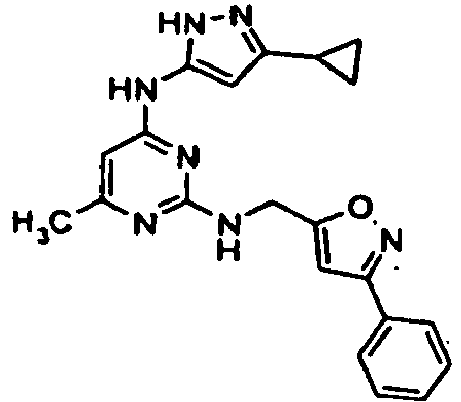
2 
3 
4 
5 
6 
7 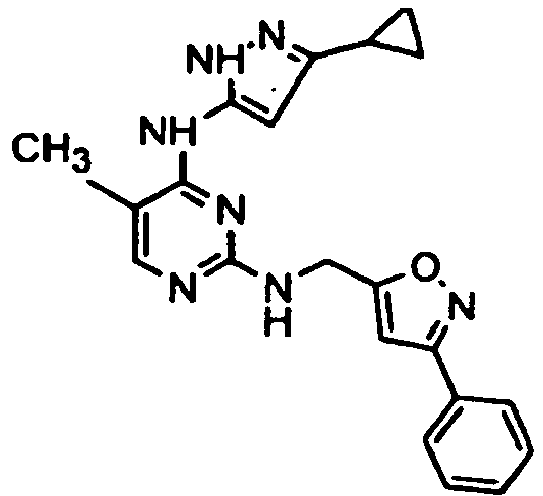
8 
9 
10 
11 
12 
13 
14 
15 
16 
17 
18 
19 
20 
21 
22 
23 
24 
25 
26 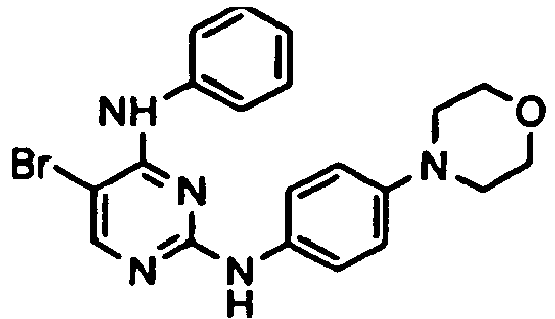
27 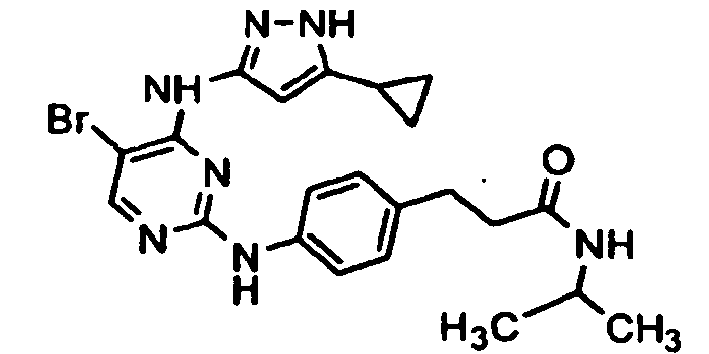
28 
29 
30 
31 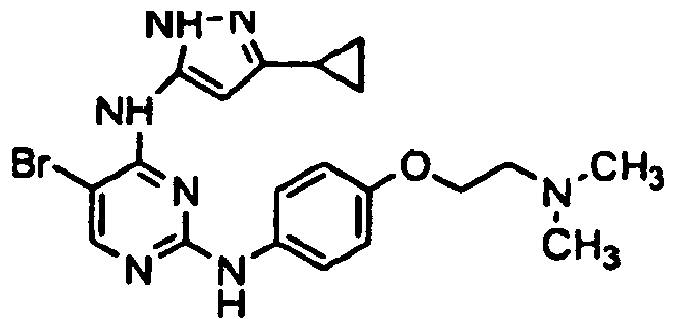
32 
33 
34 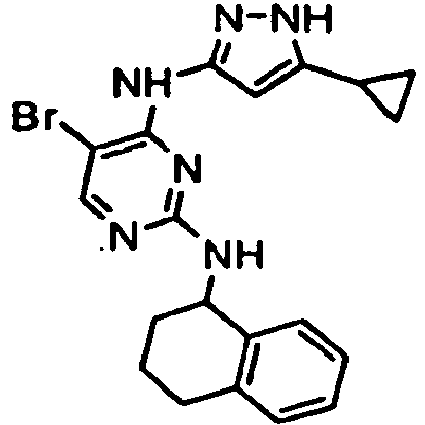
35 
36 
37 
38 
39 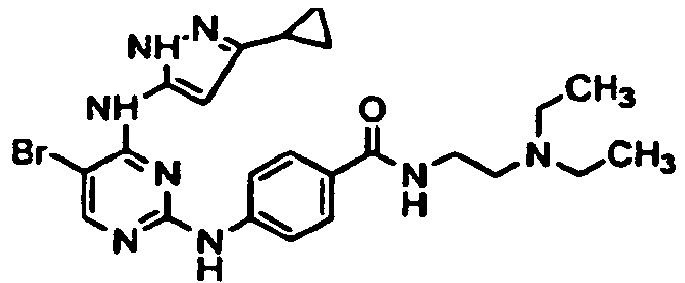
40 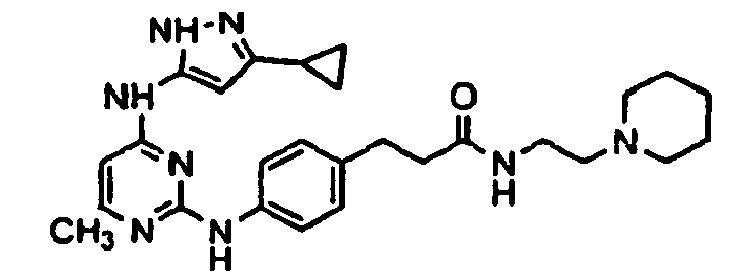
41 
42 
43 
44 
45 
46 
47 
48 
49 
50 
51 
52 
53 
54 
55 
56 
57 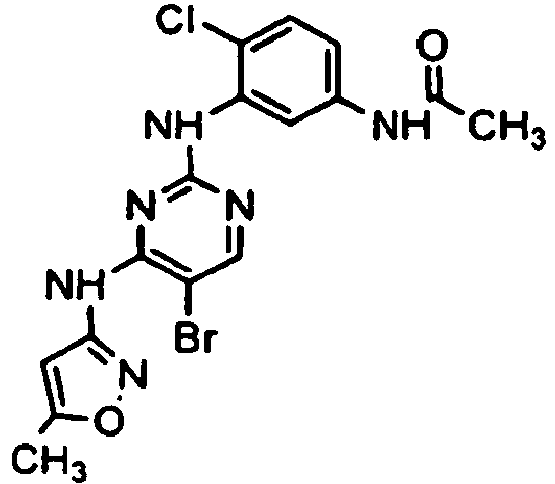
58 
59 
60 
61 
62 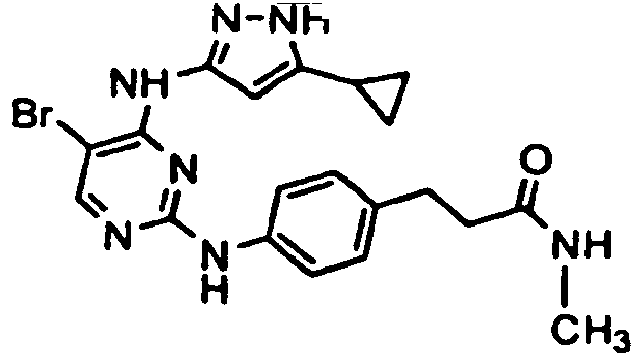
63 
64 
65 
66 
67 
68 
69 
70 
71 
72 
73 
74 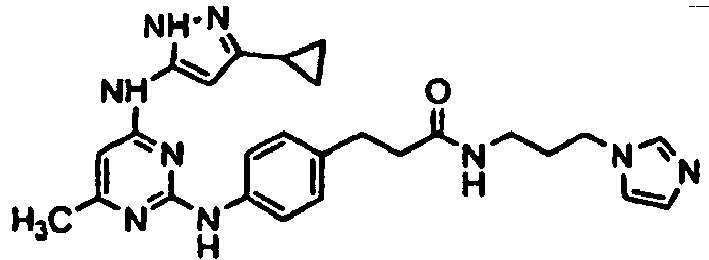
75 
76 
77 
78 
79 
80 
81 
82 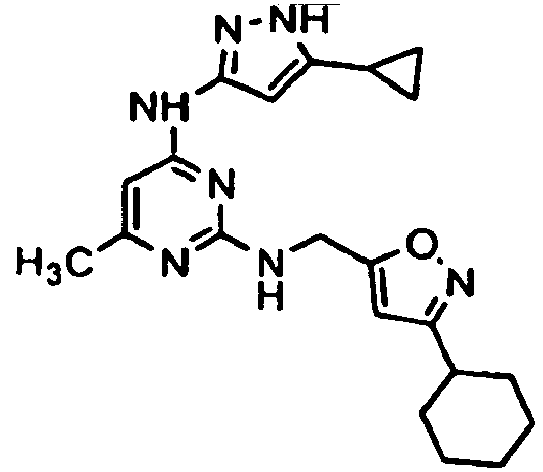
83 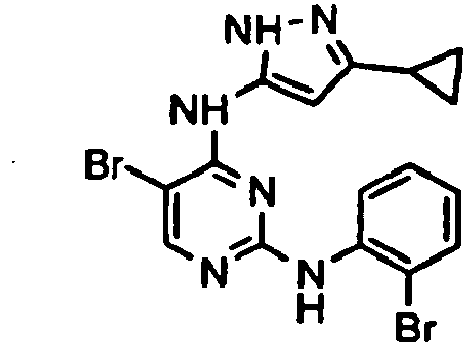
84 
85 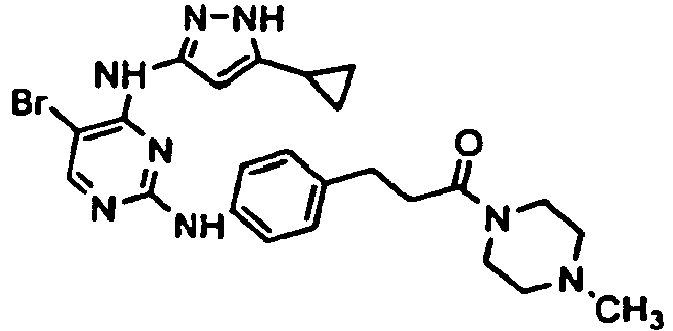
86 
87 
88 
89 
90 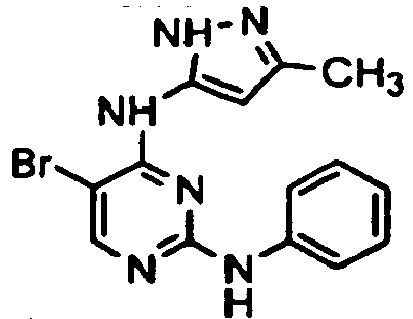
91 
92 
93 
94 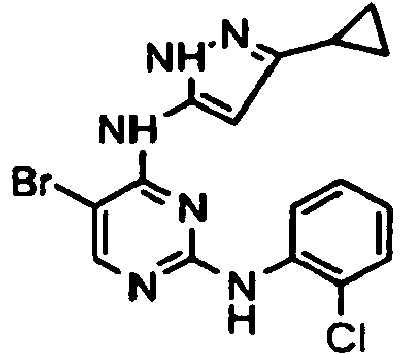
95 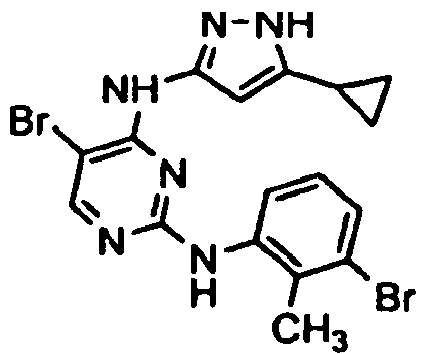
96 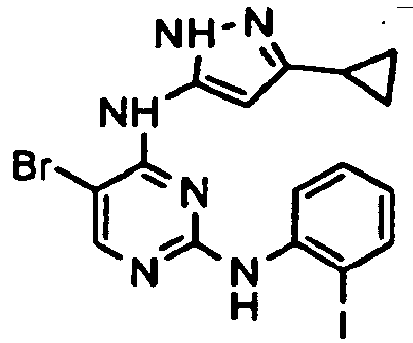
97 
98 
99 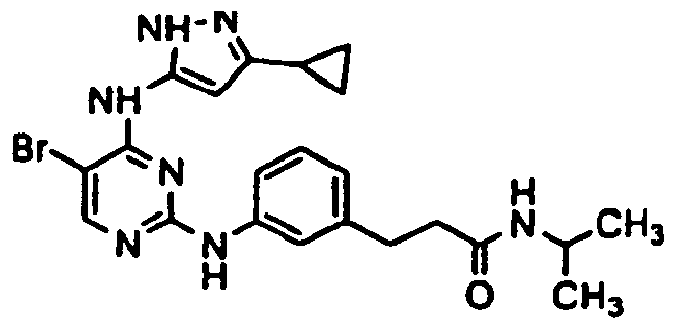
100 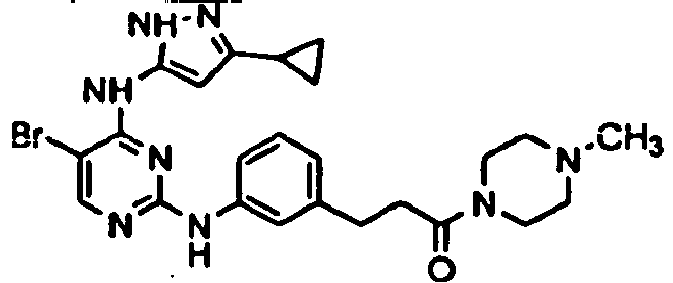
101 
102 
103 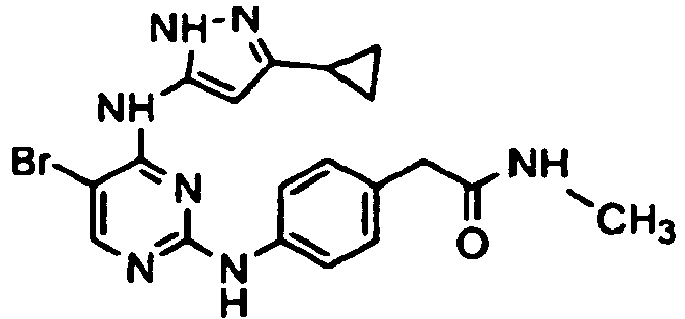
104 
105 
106 
107 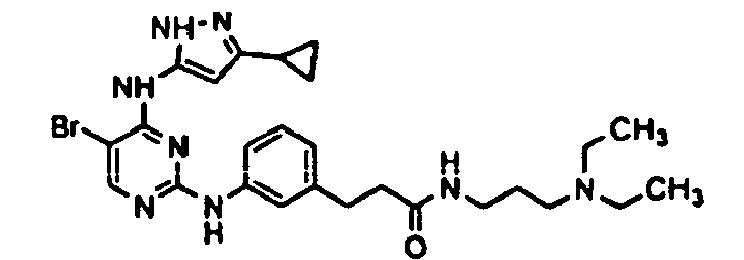
108 
109 
110 
111 
112 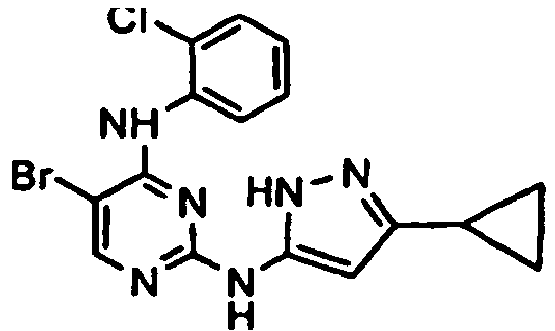
113 
114 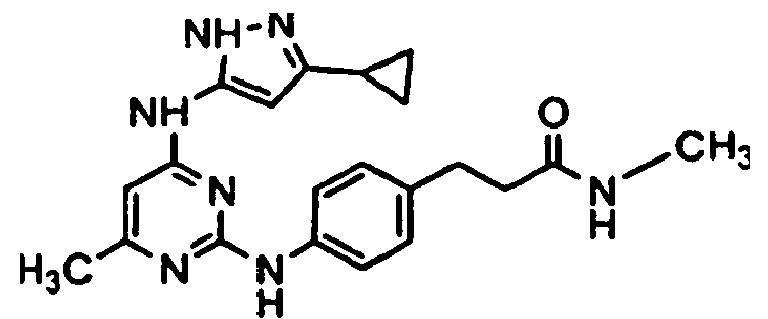
115 
116 
117 
118 
119 
120 
121 
122 
123 
124 
125 
126 
127 
128 
129 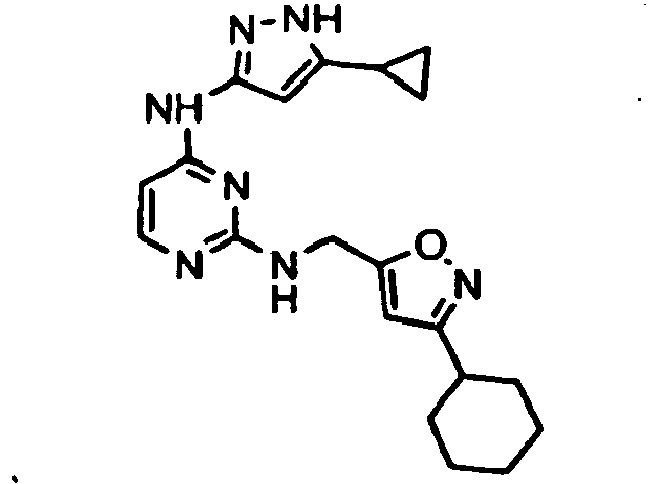
130 
131 
132 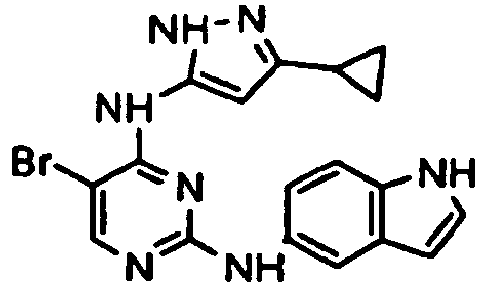
133 
134 
135 
136 
137 
138 
139 
140 
141 
142 
143 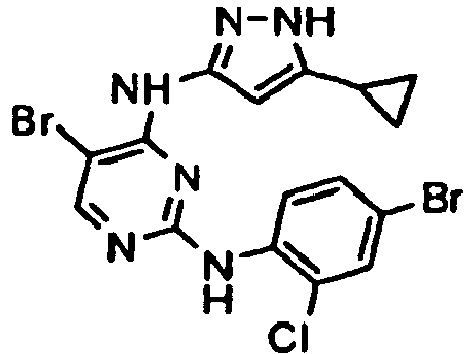
144 
145 
146 
147 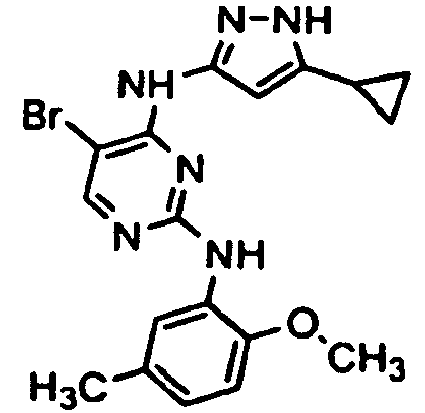
148 
149 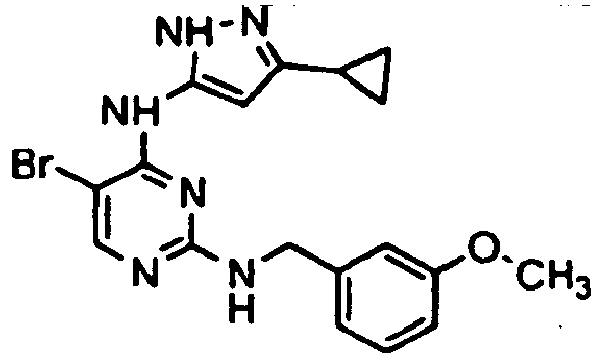
150 
151 
152 
153 
154 
155 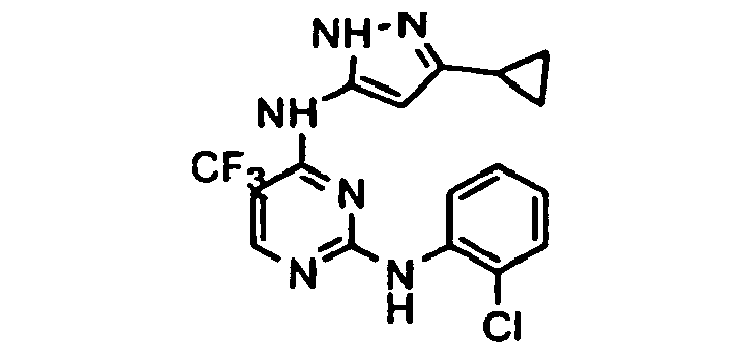
156 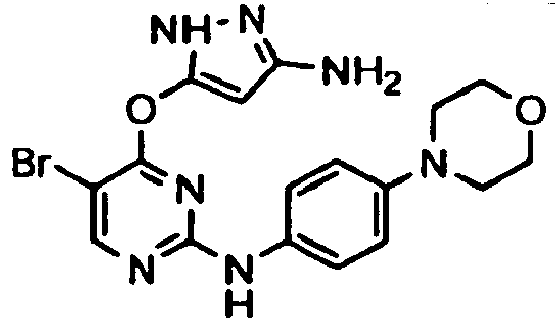
157 
158 
159 
160 
161 
162 
163 
164 
165 
166 
167 
168 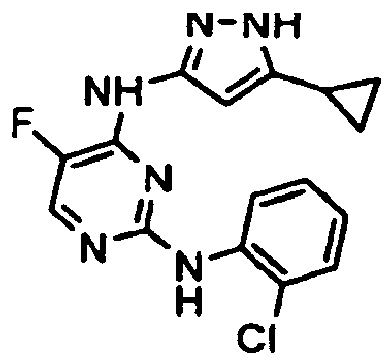
169 
170 
171 
172 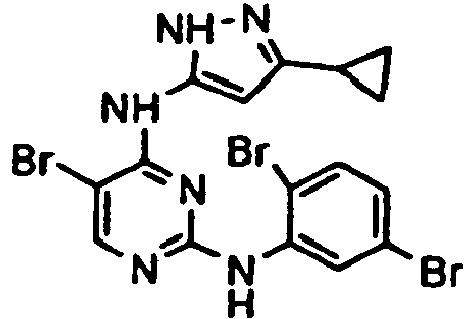
173 
174 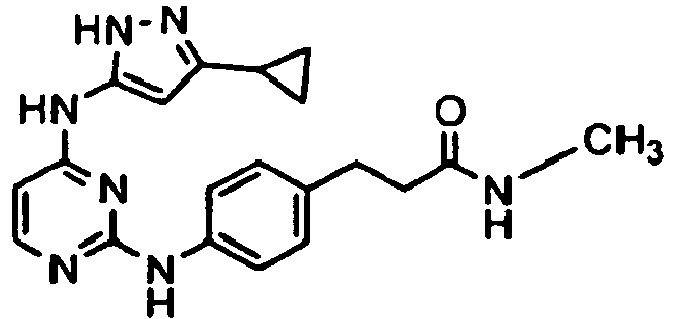
175 
176 
177 
178 
179 
180 
181 
182 183 
184 
185 
186 
187 
188 
189 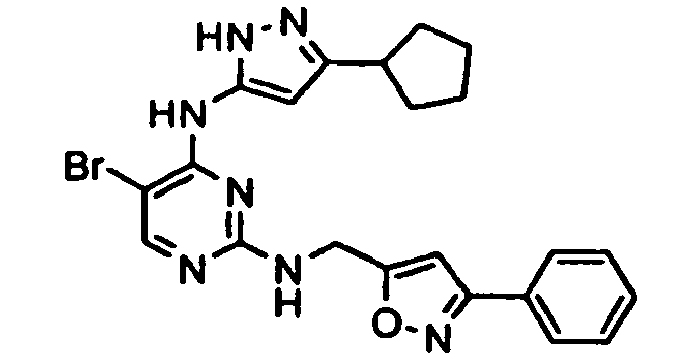
190 
191 
192 
193 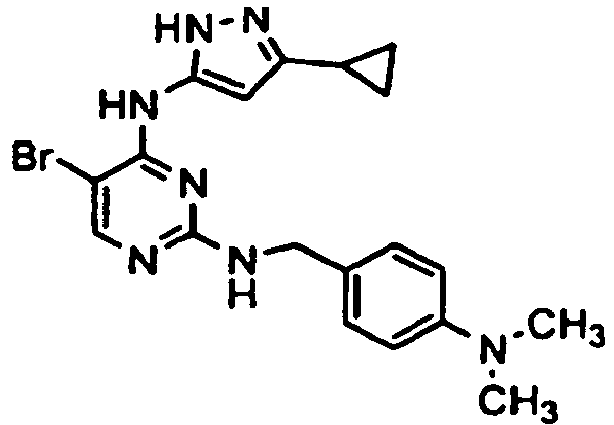
194 
195 
196 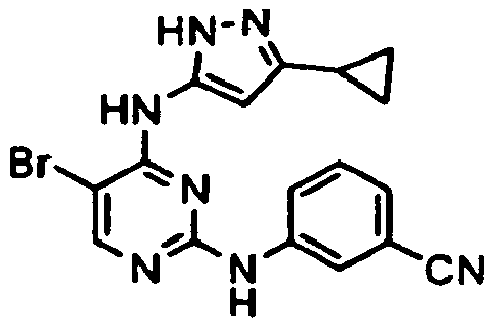
197 
198 
199 
200 
201 
202 
203 
204 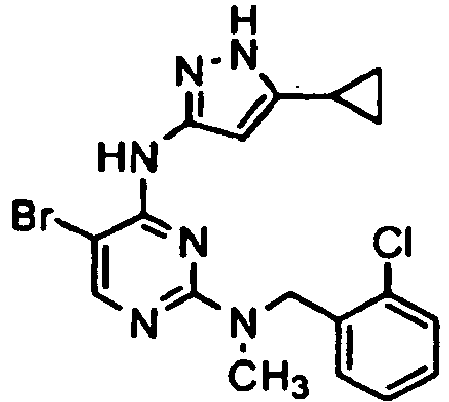
205 
206 
207 
208 
209 
210 
211 
212 
213 
214 
215 
216 
217 
218 
219 
220 
221 
222 
223 
224 
225 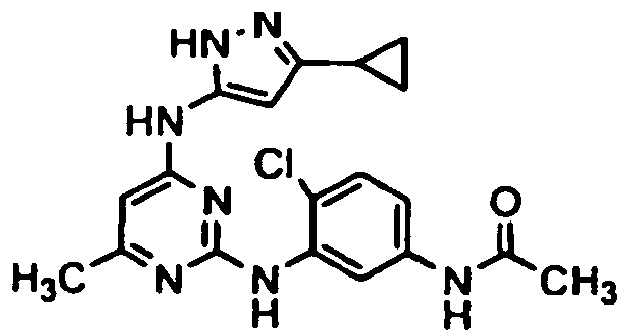
226 
227 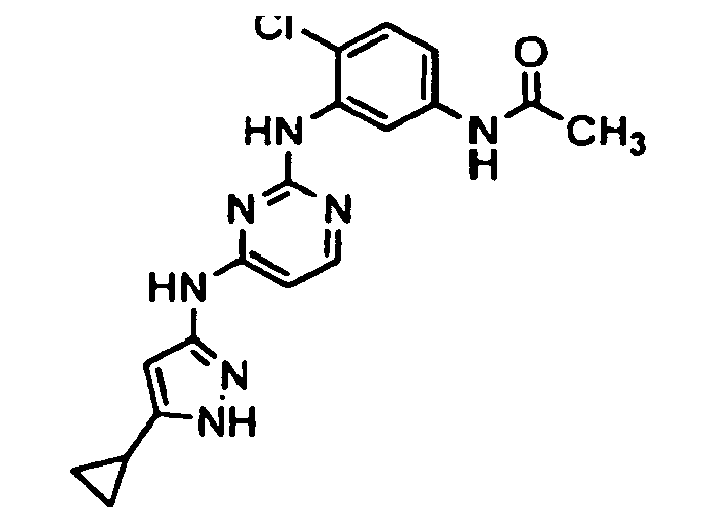
228 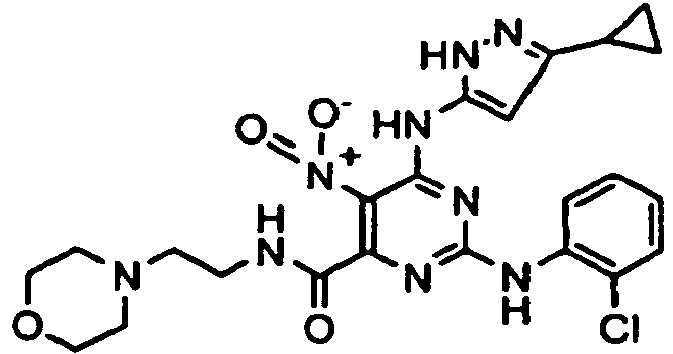
229 
230 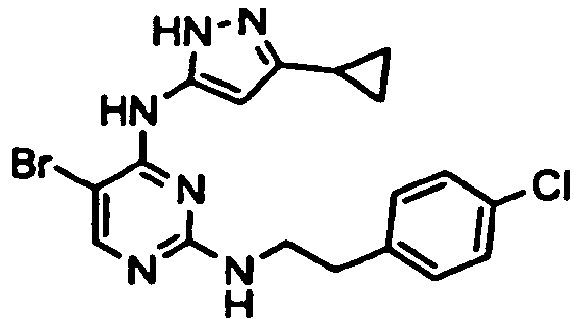
231 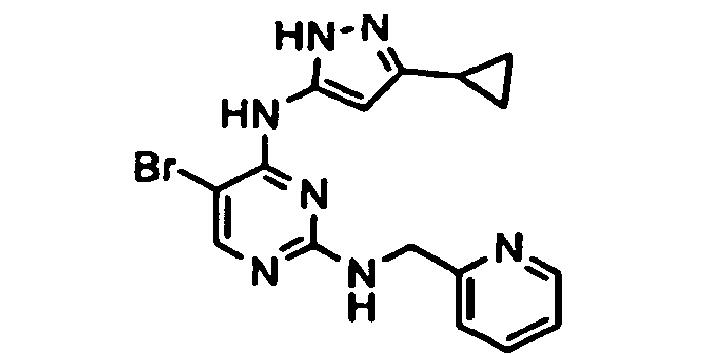
232 
233 
234 
235 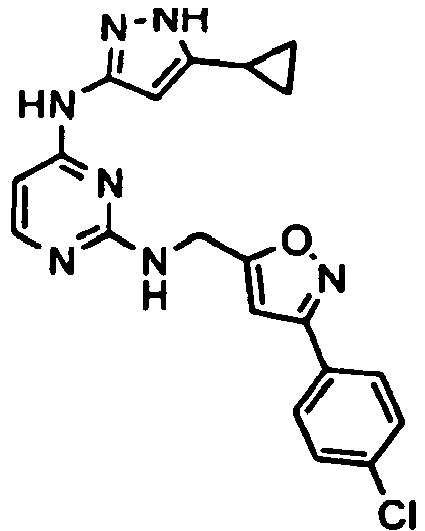
236 
237 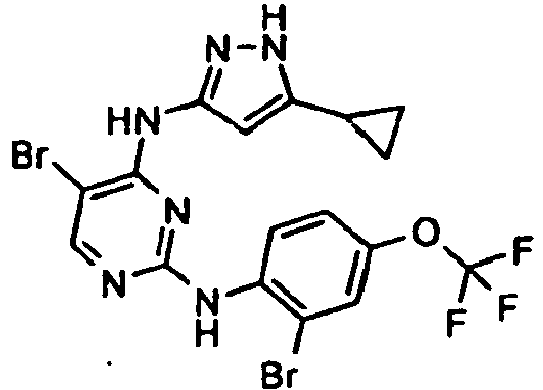
238 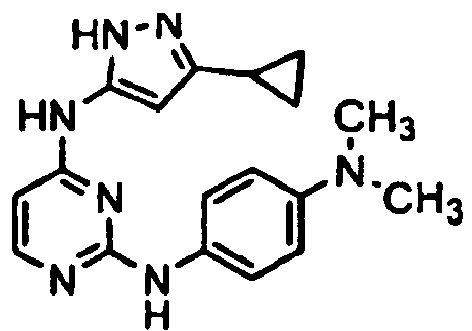
239 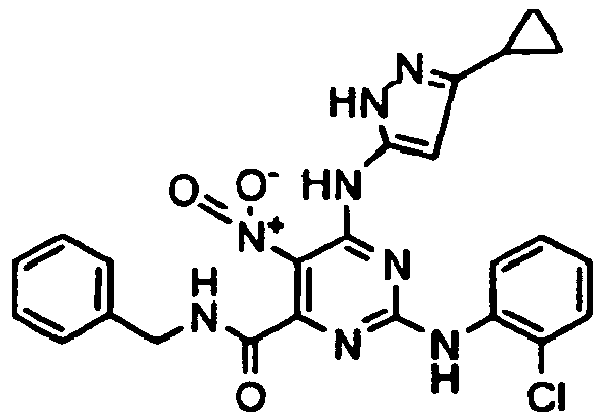
240 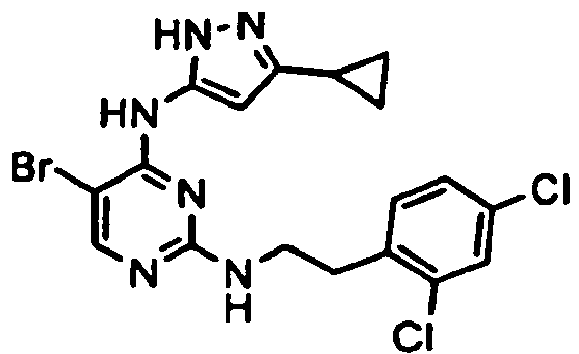
241 
242 
243 
244 
245 
246 
247 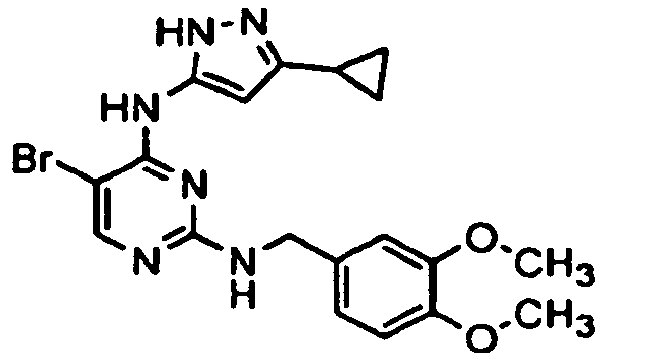
248 
249 
250 
251 
252 
253 
254 
255 
256 
257 
258 
259 
260 
261 
262 
263 
264 
265 
266 
267 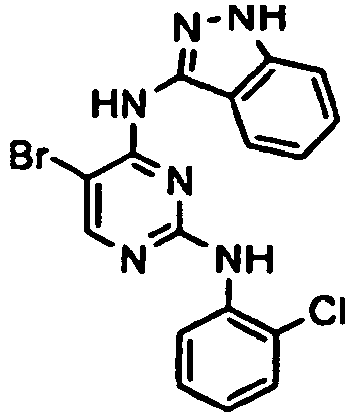
268 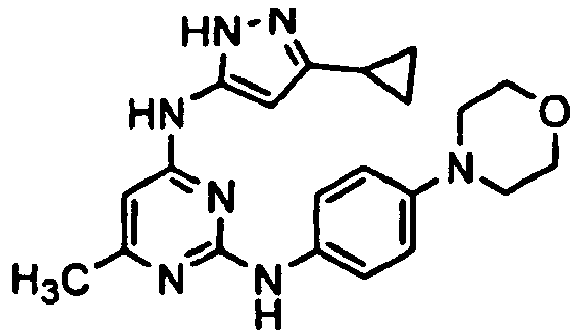
269 
270 
271 
272 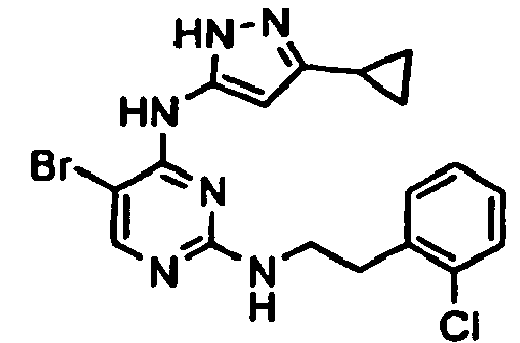
273 
274 
275 
276 
277 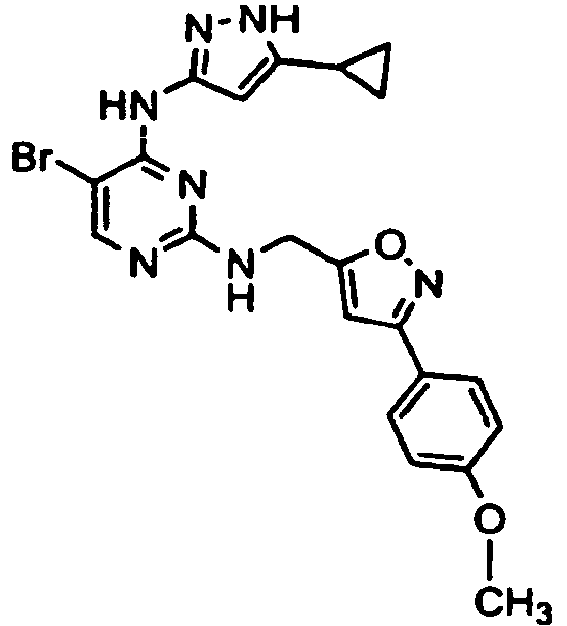
278 
279 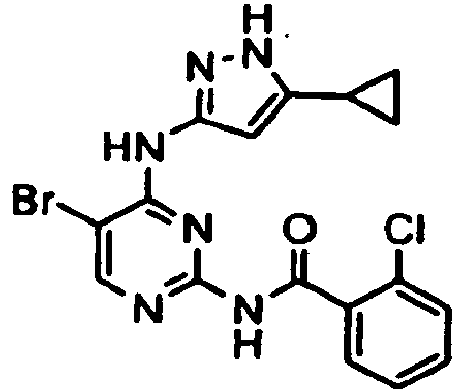
280 
281 
282 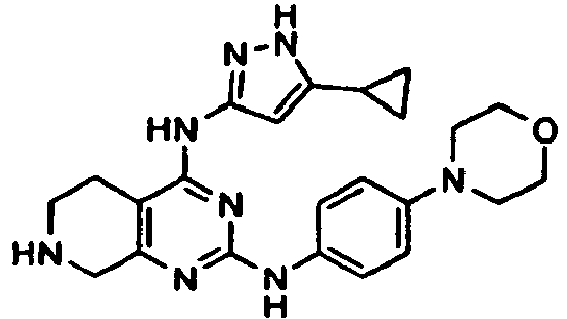
283 
284 
285 
286 
287 
288 
289 
290 
291 
292 
293 
294 
295 
296 
297 
298 
299 
300 
301 
302 
303 
304 
305 
306 
307 
308 
309 
310 
311 
312 
313 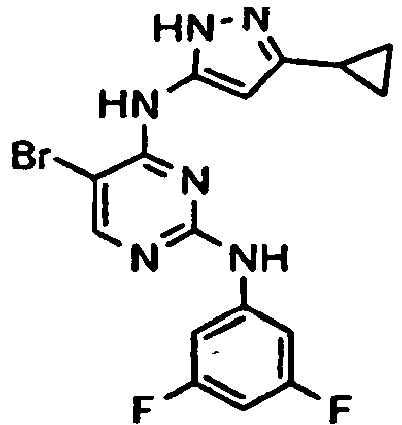
314 
315 
316 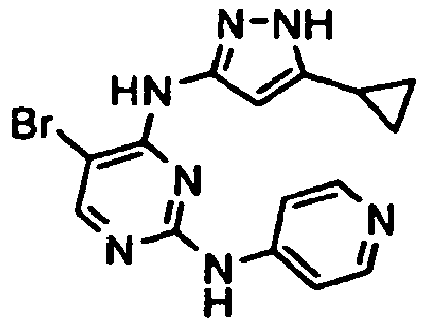
317 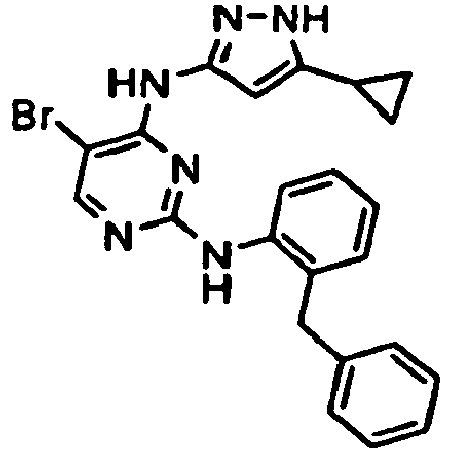
318 
319 
320 
321 
322 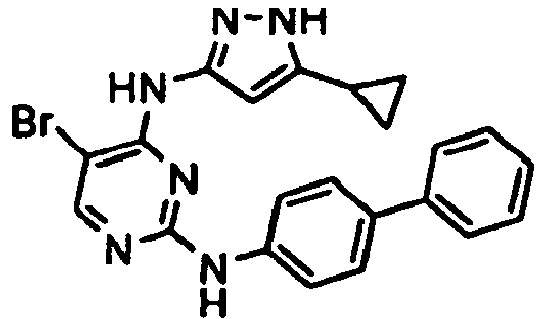
323 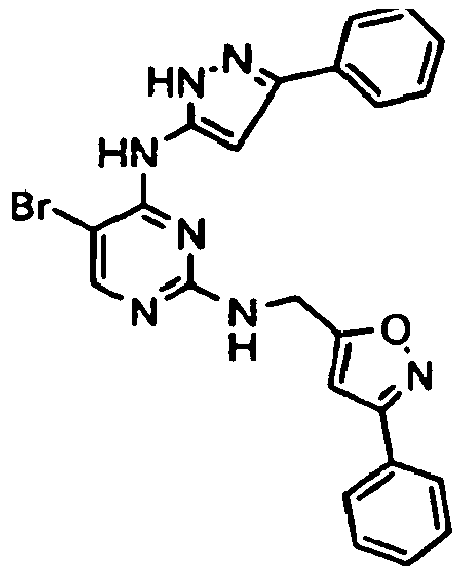
324 
325 
326 
327 
328 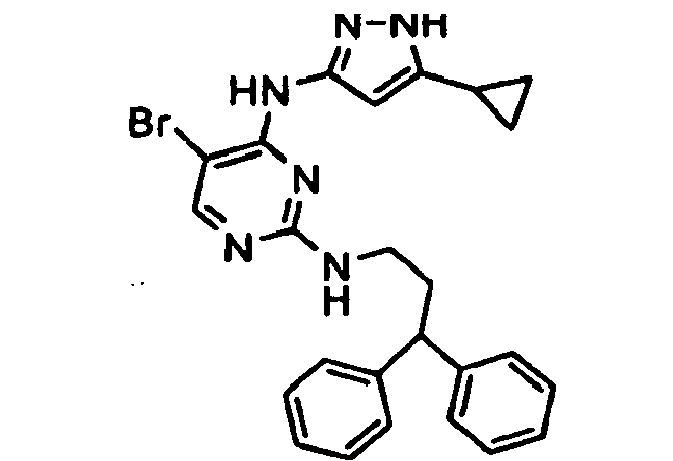
329 
330 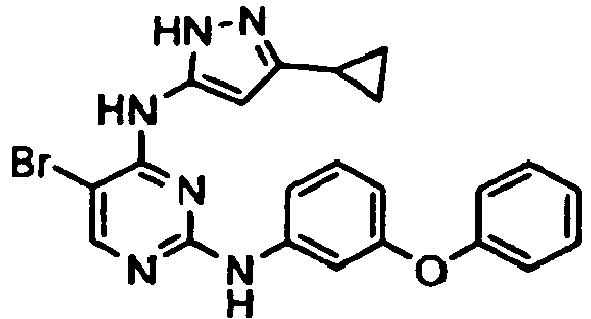
331 
332 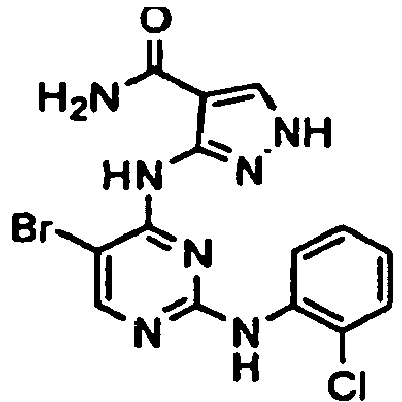
333 
334 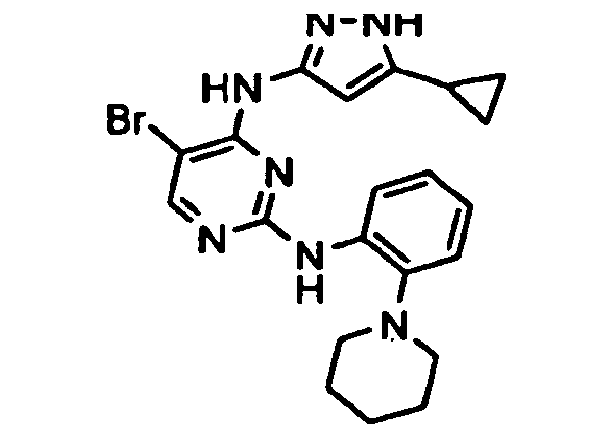
335 
336 
337 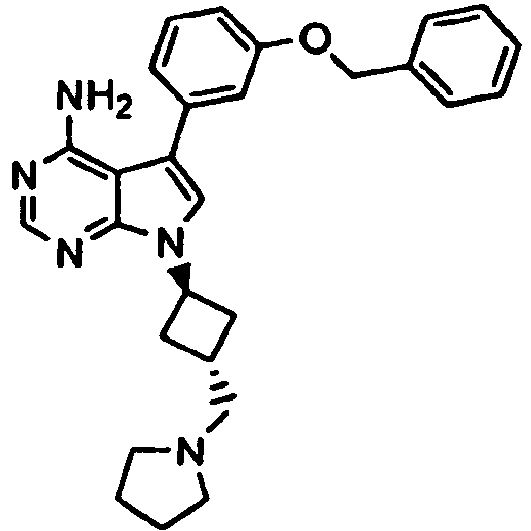
338 
339 
340 
341 
342 
343 
344 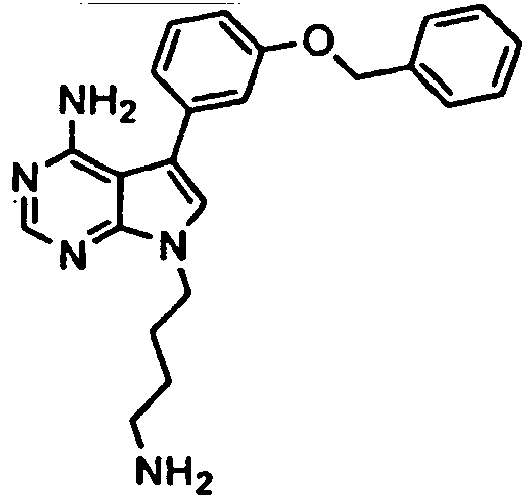
345 
346 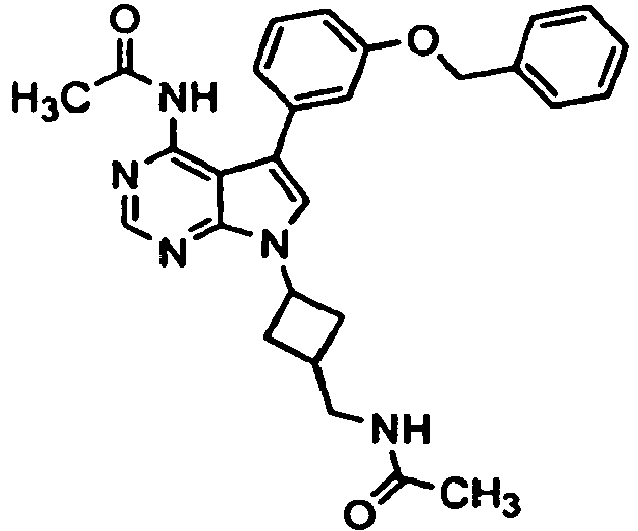
347 
348 
349 
350 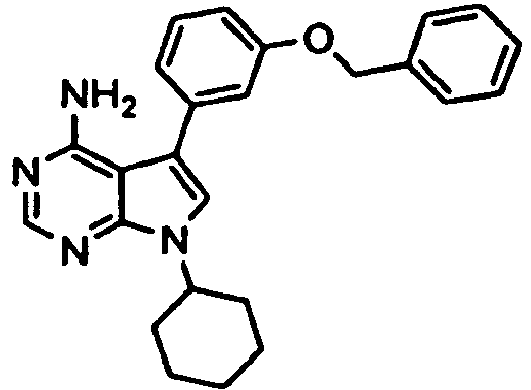
351 
352 
353 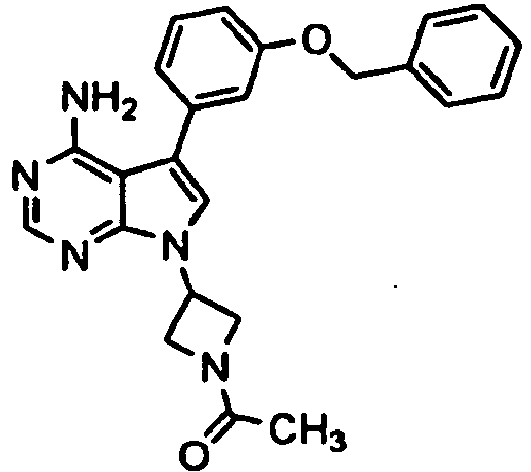
354 
355 
356 
357 
358 
495 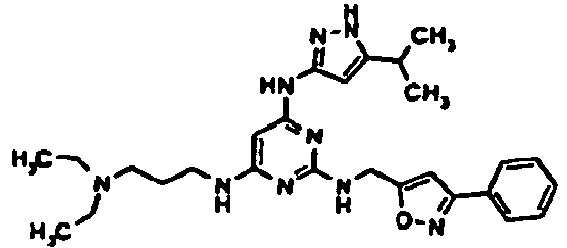
496 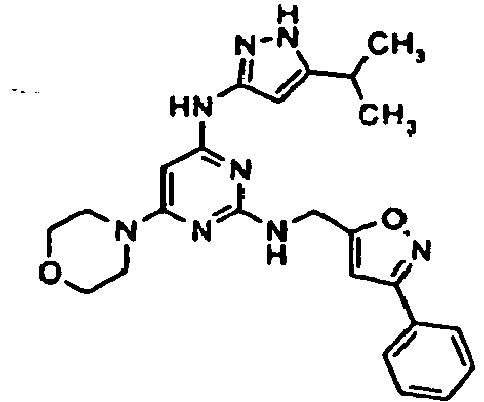
497 
498 
499 
500 
501 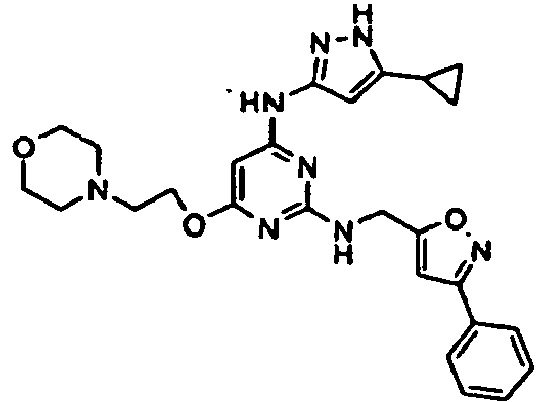
502 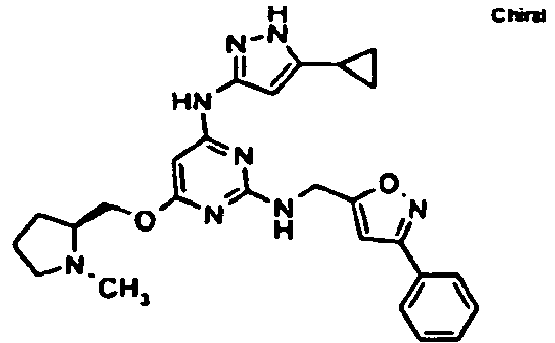
503 
504 
505 
506 
507 
508 
509 
510 
511 
512 
513 
514 
515 
516 
517 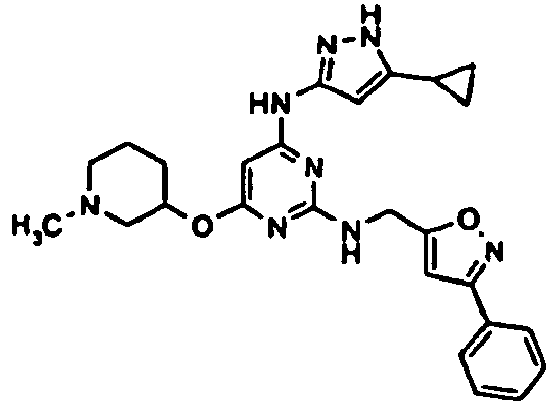
518 
519 
520 
521 
522 
523 
524 
525 
526 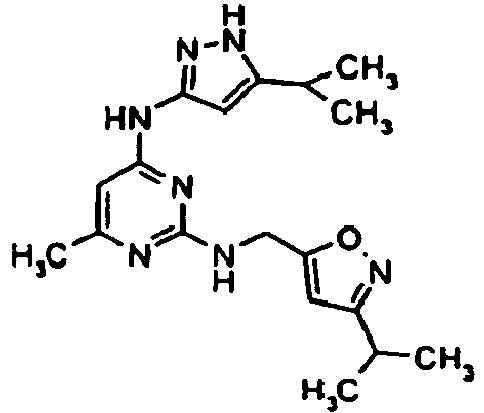
527 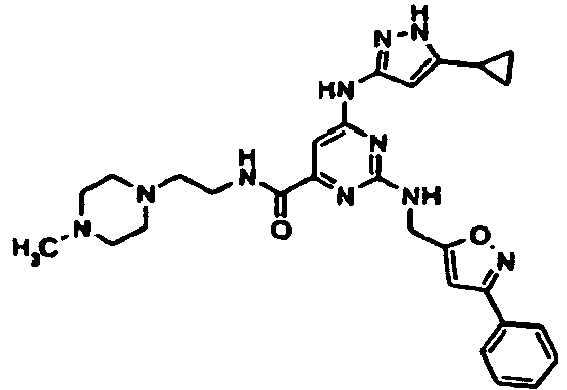
528 
529 
530 
531 
532 
533 
534 
535 
536 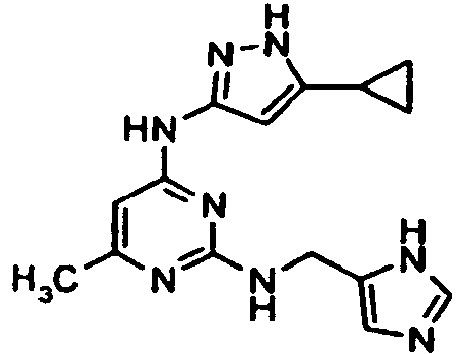
537 
538 
539 
540 
541 
542 
543 
544 
545 
546 
547 
548 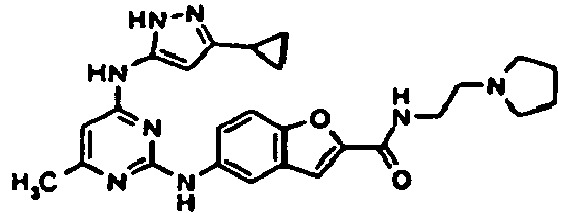
549 
550 
551 
552 
553 
554 
555 
556 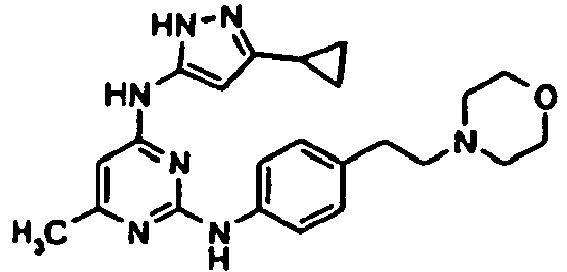
557 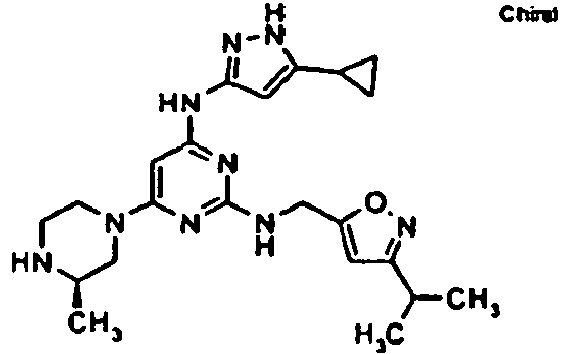
558 
559 
560 
561 
562 
563 
564 
565 
566 
567 
568 
569 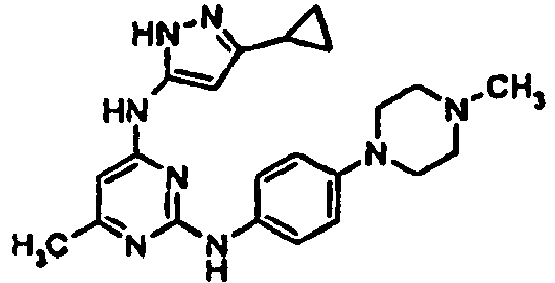
570 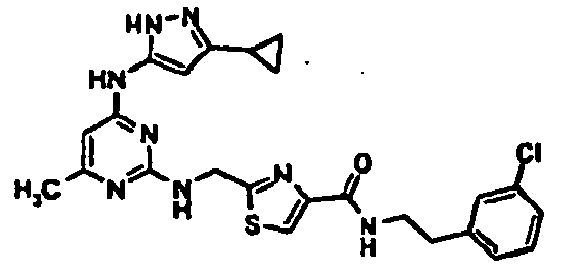
571 
572 
- The Compounds in Table 5b can be prepared as pharmaceutically acceptable salts, solvates, hydrates, and/or isomers thereof. All such salt, solvate, hydrate, and isomer combinations of the Compounds in Table 5b can be used.
Table 5b Entry Structure Name 573 
N 4-(5-cyclopropyl-1H-pyrazol-3-yl)-N 6-[3-(diethylamino)propyl]-N 2-{[3-(1-methylethyl)isoxazol-5-yl]methyl}pyrimidine-2,4,6-triamine 574 
N 4-(5-cyclopropyl-1H-pyrazol-3-yl)-N 6-[2-(diethylamino)ethyl]-N 2-{[3-(1-methylethyl)isoxazol-5-yl]methyl}pyrimidine-2,4,6-triamine 575 
N 2-{[3-(1-methylethyl)isoxazol-5-yl]methyl}-N 4-[5-(1-methylethyl)-1H-pyrazol-3-yl]-6-[(3S)-3-methylpiperazin-1-yl]pyrimidine-2,4-diamine 576 
N 4-(5-cyclopropyl-1H-pyrazol-3-yl)-6-{[2-(dimethylamino)ethyl]oxy}-N 2-{[3-(1-methylethyl)isoxazol-5-yl]methyl}pyrimidine-2,4-diamine 577 
N 4-[3-(1-methylethyl)-1H-pyrazol-5-yl]-6-[(1-methylpyrrolidin-3-yl)oxy]-N 2-[(3-phenylisoxazol-5-yl)methyl]pyrimidine-2,4-diamine 578 
N 4-(3-cyclopropyl-1H-pyrazol-5-yl)-N 2-{[3-(1-methylethyl)isoxazol-5-yl]methyl}-6-[(1-methylpyrrolidin-3-yl)oxy]pyrimidine-2,4-diamine 579 
N 2-{[3-(1-methylethyl)isoxazol-5-yl]methyl}-N 4-[3-(1-methylethyl)-1H-pyrazol-5-yl]-6-[(1-methylpyrrolidin-3-yl)oxy]pyrimidine-2,4-diamine 580 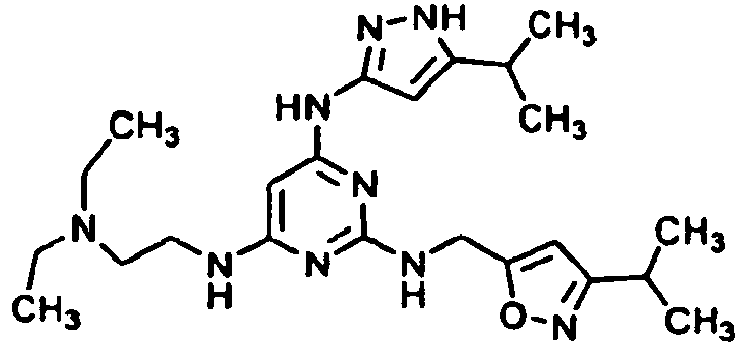
N 4-[2-(diethylamino)ethyl]-N 2-{[3-(1-methylethyl)isoxazol-5-yl]methyl}-N 6-[5-(1-methylethyl)-1H-pyrazol-3-yl]pyrimidine-2,4,6-triamine 581 
N 2-{[3-(1-methylethyl)isoxazol-5-yl]methyl}-N 4-[5-(1-methylethyl)-1H-pyrazol-3-yl]pyrimidine-2,4-diamine 582 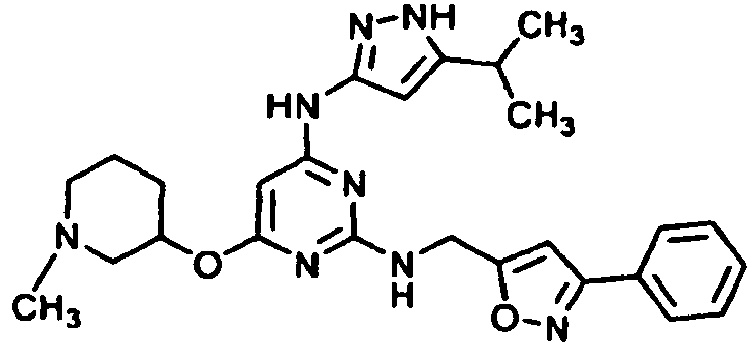
N 4-[5-(1-methylethyl)-1H-pyrazol-3-yl]-6-[(1-methylpiperidin-3-yl)oxy]-N 2-[(3-phenylisoxazol-5-yl)methyl]pyrimidine-2,4-diamine 583 
N 2-{[3-(1-methylethyl)isoxazol-5-yl]methyl}-N 4-[5-(1-methylethyl)-1H-pyrazol-3-yl]-6-[(1-methylpiperidin-3-yl)oxy]pyrimidine-2,4-diamine 584 
N-(5-cyclopropyl-1H-pyrazol-3-yl)-6-methyl-2-{[(3-phenylisoxazol-5-yl)methyl]oxy}pyrimidin-4-amine 585 
N 4-(5-cyclopropyl-1H-pyrazol-3-yl)-6-methyl-N 2-[(4-phenyl-1H-imidazol-2-yl)methyl]pyrimidine-2,4-diamine 586 
6-{[2-(dimethylamino)ethyl]oxy}-N 2-{[3-(1-methylethyl)isoxazol-5-yl]methyl}-N 4-[5-(1-methylethyl)-1H-pyrazol-3-yl]pyrimidine-2,4-diamine 587 
N 2-{[3-(1-methylethyl)isoxazol-5-yl]methyl}-N 4-[5-(1-methylethyl)-1H-pyrazol-3-yl]-6-[(2-morpholin-4-ylethyl)oxy]pyrimidine-2,4-diamine 588 
N 4-[5-(1-methylethyl)-1H-pyrazol-3-yl]-6-[(2-morpholin-4-ylethyl)oxy]-N 2-[(3-phenylisoxazol-5-yl)methyl]pyrimidine-2,4-diamine 589 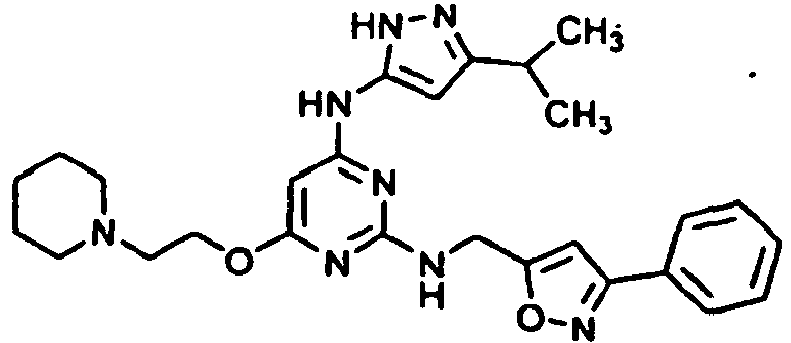
N 4-[3-(1-methylethyl)-1H-pyrazol-5-yl]-N 2-[(3-phenylisoxazol-5-yl)methyl]-6-[(2-piperidin-1-ylethyl)oxy]pyrimidine-2,4-diamine 590 
N 4-[3-(diethylamino)propyl]-N 2-{[3-(1-methylethyl)isoxazol-5-yl]methyl}-N 6-[5-(1-methylethyl)-1H-pyrazol-3-yl]pyrimidine-2,4,6-triamine 591 
N 4-[5-(1-methylethyl)-1H-pyrazol-3-yl]-6-[(3S)-3-methylpiperazin-1-yl]-N 2-[(3-phenylisoxazol-5-yl)methyl]pyrimidine-2,4-diamine 592 
N 4-[2-(diethylamino)ethyl]-N 6-[5-(1-methylethyl)-1H-pyrazol-3-yl]-N 2-[(3-phenylisoxazol-5-yl)methyl]pyrimidine-2,4,6-triamine 593 
N 4-[5-(1-methylethyl)-1H-pyrazol-3-yl]-6-[(1-methylpiperidin-4-yl)oxy]-N 2-[(3-phenylisoxazol-5-yl)methyl]pyrimidine-2,4-diamine 594 
N 4-(5-cyclopropyl-1H-pyrazol-3-yl)-N 2-{[3-(1-methylethyl)isoxazol-5-yl]methyl}-6-[(2-morpholin-4-ylethyl)oxy]pyrimidine-2,4-diamine 595 
N 2-{[3-(1-methylethyl)isoxazol-5-yl]methyl}-N 4-[3-(1-methylethyl)-1H pyrazol-5-yl]-6-[(2-piperidin-1-ylethyl)oxy]pyrimidine-2,4-diamine 596 
N 4-(3-cyclopropyl-1H-pyrazol-5-yl)-6-[3-(diethylamino)propyl]-N 2-[(3-phenylisoxazol-5-yl)methyl]pyrimidine-2,4-diamine 597 
N 4-(3-cyclopropyl-1H-pyrazol-5-yl)-N 2-{[3-(1-methylethyl)isoxazol-5-yl]methyl}-6-[(2-piperidin-1-ylethyl)oxy]pyrimidine-2,4-diamine 598 
N 4-(5-cyclopropyl-1H-pyrazol-3-yl)-N 2-{[3-(1-methylethyl)isoxazol-5-yl]methyl}-6-[(1-methylpiperidin-3-yl)oxy]pyrimidine-2,4-diamine 599 
N 2-{[3-(1-methylethyl)isoxazol-5-yl]methyl}-N 4-[3-(1-methylethyl)-1H-pyrazol-5-yl]-6-[(1-methylpiperidin-4-yl)oxy]pyrimidine-2,4-diamine 600 
N 4-(3-cycloprypl-1H-pyrazol-5-yl)-6-methyl-N 2-[(3-methylisoxazol-5-yl)methyl]pyrimidine-2,4-diamine 601 
N 4-(3-cyclopropyl-1H-pyrazol-5-yl)-N 2-[(3-methylisoxazol-5-yl)methyl]-6-morpholin-4-ylpyrimidine-2,4-diamine 602 
N 4-(3-cyclopropyl-1H-pyrazol-5-yl)-N 2-[(3-methylisoxazol-5-yl)methyl]-6-(4-methylpiperazin-1-yl)pyrimidine-2,4-diamine 603 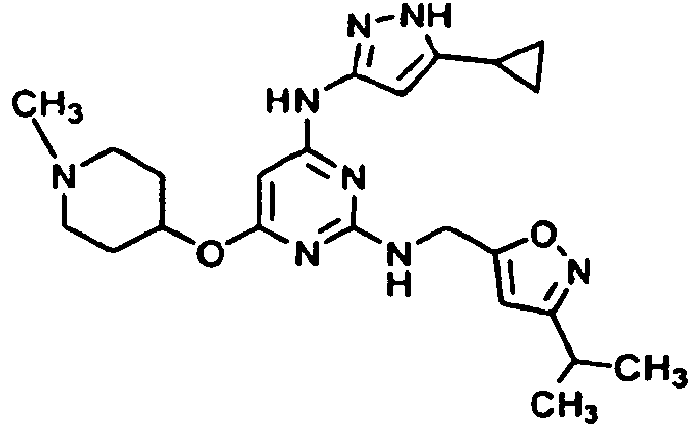
N 4-(5-cyclopropyl-1H-pyrazol-3-yl)-N 2-{[3-(1-methylethyl)isoxazol-5-yl]methyl}-6-[(1-methylpiperidin-4-yl)oxy]pyrimidine-2,4-diamine 604 
N 4-(3-cyclopropyl-1H-pyrazol-5-yl)-N 2-{[3-(4-fluorophenyl)isoxazol-5-yl]methyl}-6-morpholin-4-ylpyrimidine-2,4-diamine 605 
N 4-(3-cyclopropyl-1H-pyrazol-5-yl)-N 2-{[3-(4-fluorophenyl)isoxazol-5-yl]methyl}-6-(4-methylpiperazin-I-yl)pyrimidine-2,4-diamine 606 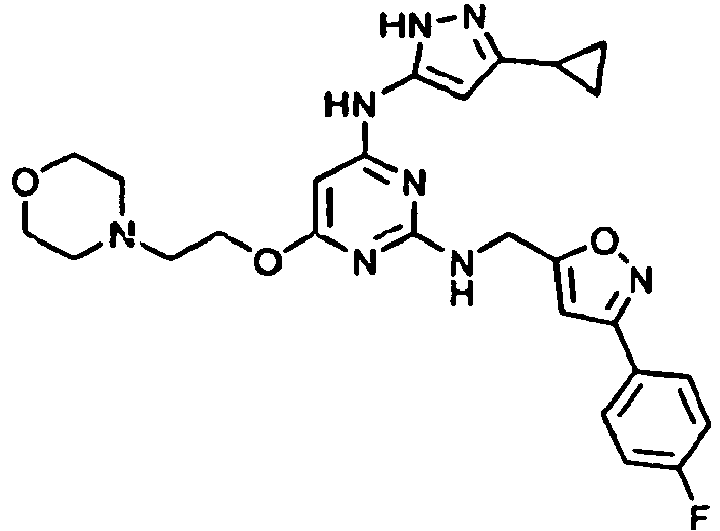
N 4-(3-cyclopropyl-1H-pyrazol-5-yl)-N 2-{[3-(4-fluorophenyl)isoxazol-5-yl]methyl}-6-[(2-morpholin-4-ylethyl)oxy]pyrimidine-2,4-diamine 607 
N 2-{[3-(4-fluorophenyl)isoxazol-5-yl]methyl}-N 4-[3-(1-methylethyl)-1H-pyrazol-5-yl]-6-morpholin-4-ylpyrimidine-2,4-diamine 608 
N 2-{[3-(4-fluorophenyl)isoxazol-5-yl]methyl}-N 4-[3-(1-methylethyl)-1H-pyrazol-5-yl]-6-(4-methylpiperazin-1-yl)pyrimidine-2,4-diamine 609 
N 2-{[3-(4-fluorophenyl)isoxazol-5-yl]methyl}-N 4-[3-(1-methylethyl)-1H-pyrazol-5-yl]-6-[(2-morpholin-4-ylethyl)oxy]pyrimidine-2,4-diamine 610 
N 4-(5-cyclopropyl-1H-pyrazol-3-yl)-6-methyl-N 2-[(3-pyridin-3-ylisoxazol-5-yl)methyl]pyrimidine-2,4-diamine 611 
N 4-(5-cyclopropyl-1H-pyrazol-3-yl)-6-(4-methylpiperazin-1-yl)-N 2-[(3-pyridin-2-ylisoxazol-5-yl)methyl]pyrimidine-2,4-diamine 612 
N 4-(5-cyclopropyl-1H-pyrazol-3-yl)-6-morpholin-4-yl-N 2-[(3-pyridin-2-ylisoxazol-5-yl)methyl]pyrimidine-2,4-diamine 613 
N 4-(5-cyclopropyl-1H-pyrazol-3-yl)-N 2-{[3-(1-methylethyl)isoxazol-5-yl]methyl}-6-piperazin-1-ylpyrimidine-2,4-diamine 614 
6-(4-acetylpiperazin-1-yl)-N 4-(5-cyclopropyl-1H-pyrazol-3-yl)-N 2-{[3-(1-methylethyl)isoxazol-5-yl]methyl}pyrimidine-2,4-diamine 615 
N 4-(5-cyclopropyl-1H-pyrazol-3-yl)-N 2-{[3-(1-methylethyl)isoxazol-5-yl]methyl}-6-[4-(methylsulfonyl)piperazin-1-yl]pyrimidine-2,4-diamine 616 
4-{6-[(5-cyclopropyl-1H- pyrazol-3-yl)amino]-2-({[3-(1-methylethyl)isoxazol-5-yl]methyl}amino)pyrimidin-4-yl}piperazine-1-carbaldehyde 617 
N 4-(3-methyl-1H-pyrazol-5-yl)-6-morpholin-4-yl-N 2-[(3-phenylisoxazol-5-yl)methyl]pyrimidine-2,4-diamine 618 
6-(4-methylpiperazin-1-yl)-N 4-(3-methyl-1H-pyrazol-5-yl)-N 2-[(3-phenylisoxazol-5-yl)methyl]pyrimidine-2,4-diamine 619 
N 4-(3-methyl-1H-pyrazol-5-yl)-6-[(2-morpholin-4-ylethyl)oxy]-N 2-[(3-phenylisoxazol-5-yl)methyl]pyrimidine-2,4-diamine 620 
N 4-(5-cyclopropyl-1H-pyrazol-3-yl)-6-methyl-N 2 -[(3-pyridin-4-ylisoxazol-5-yl)methyl]pyrimidine-2,4-diamine 621 
N 4-(5-cyclopropyl-1H-pyrazol-3-yl)-N 2-{[3-(3,4-difluorophenyl)isoxazol-5-yl]methyl}-6-methylpyrimidine-2,4-diamine 622 
N 4-(5-cyclopropyl-1H-pyrazol-3-yl)-N 2-{[3-(2,4-difluorophenyl)isoxazol-5-yl]methyl}-6-methylpyrimidine-2,4-diamine 623 
N 4-(5-cyclopropyl-1H-pyrazol-3-yl)-6-methyl-N 2 -[(3-pyrazin-2-ylisoxazol-5-yl)methyl]pyrimidine-2,4-diamine 624 
5-chloro-N 4-(3-cyclopropyl-1H-pyrazol-5-yl)-6-morpholin-4-yl-N 2-[(3-phenylisoxazol-5-yl)methyl]pyrimidine-2,4-diamine 625 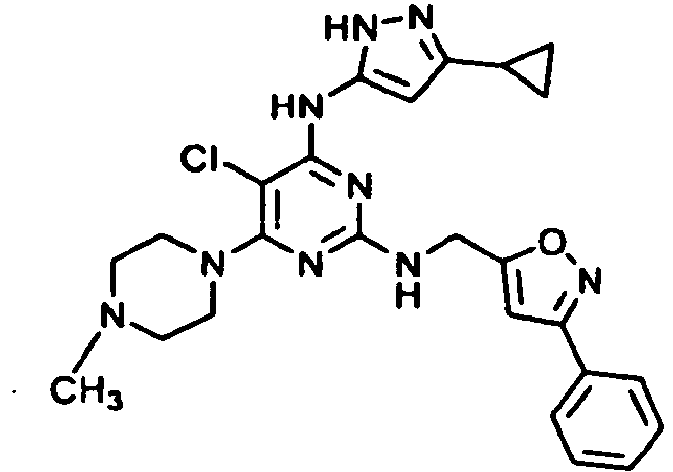
5-chloro-N4-(3-cyclopropyl-1H-pyrazol-5-yl)-6-(4-methylpiperazin-1-yl)-N 2-[(3-phenylisoxazol-5-yl)methyl]pyrimidine-2,4-diamine 626 
N 2-[(3-methylisoxazol-5-yl)methyl]-6-(4-methylpiperazin-1-yl)-N 4-(3-methyl-1H-pyrazol-5-yl)pyrimidine-2,4-diamine 627 
N 2-[(3-methylisoxazol-5-yl)methyl]-N 4-(3-methyl-1H-pyrazol-5-yl)-6-morpholin-4-ylpyrimidine-2,4-diamine 628 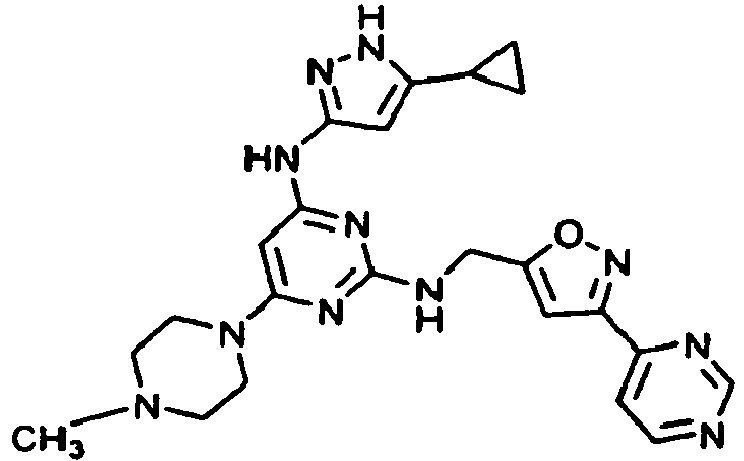
N 4-(5-cyclopropyl-1H-pyrazol-3-yl)-6-(4-methylpiperazin-1-yl)-N 2-[(3-pyrimidin-4-ylisoxazol-5-yl)methyl]pyrimidine-2,4-diamine 629 
N 4-(5-cyclopropyl-1H-pyrazol-3-yl)-N 2-[(3-furan-3-ylisoxazol-5-yl)methyl]-6-(4-methylpiperazin-1-yl)pyrimidine-2,4-diamine 630 
N 4-(5-cyclopropyl-1H-pyrazol-3-yl)-N 6-(8-methyl-8-azabicyclo[3.2.1]oct-3-yl)-N 2-[(3-methylisoxazol-5-yl)methyl]pyrimidine-2,4,6-triamine 631 
N 4-(5-cyclopropyl-1H-pyrazol-3-yl)-6-(5-methyl-2,5-diazabicyclo[2.2.1]hept-2-yl)-N 2-[(3-methylisoxazol-5-yl)methyl]pyrimidine-2,4-diamine 632 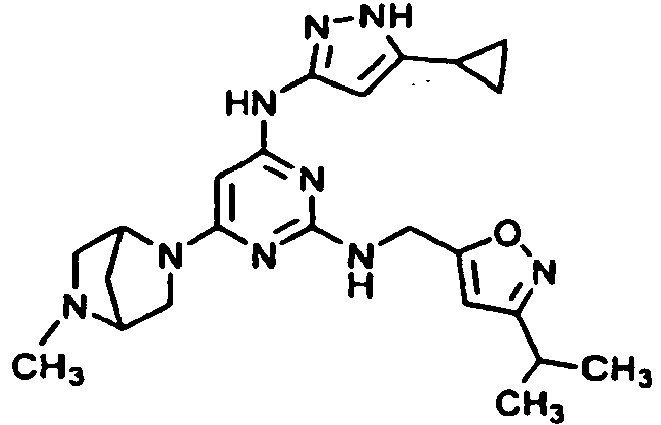
N 4-(5-cyclopropyl-1H-pyrazol-3-yl)-6-(5-methyl-2,5-diazabicyclo[2.2.1]hept-2-yl)-N 2-{[3-(1-methylethyl)isoxazol-5-yl]methyl}pyrimidine-2,4-diamine 633 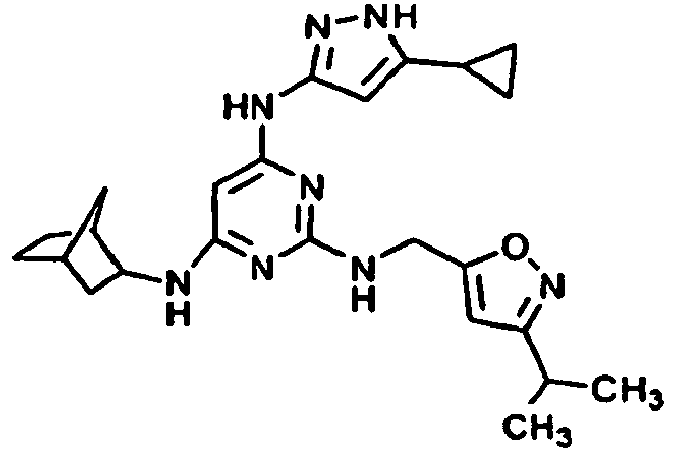
N 4-bicyclo[2.2.1]hept-2-yl-N 6-(5-cyclopropyl-1H-pyrazol-3-yl)-N 2-{[3-(1-methylethyl)isoxazol-5-yl]methyl}pyrimidine-2,4,6-triamine 634 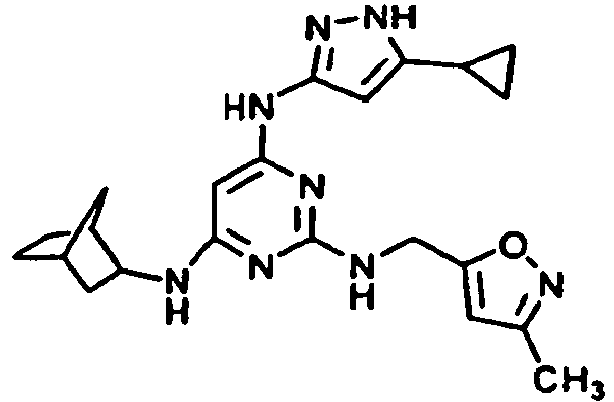
N 4-bicyclo[2.2.1]hept-2-yl-N 6-(5-cyclopropyl-1H-pyrazol-3-yl)-N 2-[(3-methylisoxazol-5-yl)methyl]pyrimidine-2,4,6-triamine 635 
N 4-(5-cyclopropyl-1H-pyrazol-3-yl)-N 2-[(3-methylisoxazol-5-yl)methyl]-6-[(1R,4R)-5-(phenylmethyl)-2,5-diazabicyclo[2.2.1]hept-2-yl]pyrimidine-2,4-diamine 636 
N 4-(5-cyclopropyl-1H-pyrazol-3-yl)-N 2-{[3-(1-methylethyl)isoxazol-5-yl]methyl}-6-[(1R,4R)-5-(phenylmethyl)-2,5-diazabicyclo[2.2.1]hept-2-yl]pyrimidine-2,4-diamine 637 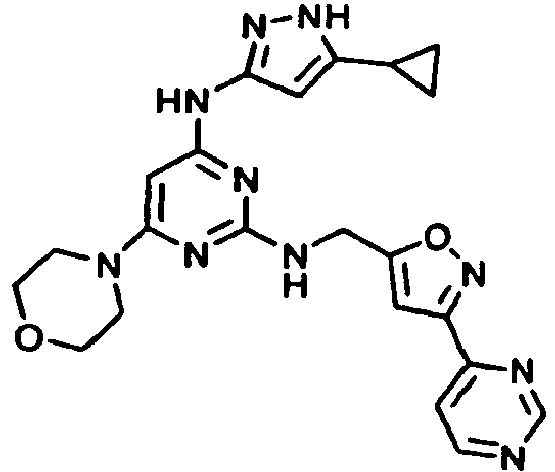
N 4-(5-cyclopropyl-1H-pyrazol-3-yl)-6-morpholin-4-yl-N 2-[(3-pyrimidin-4-ylisoxazol-5-yl)methyl]pyrimidine-2,4-diamine 638 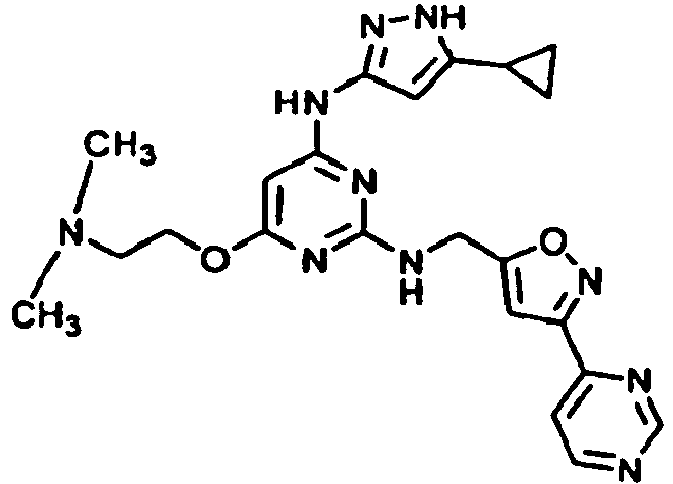
N 4-(5-cyclopropyl-1H-pyrazol-3-yl)-6-{[2-(dimethylamino)ethyl]oxy}-N 2-[(3-pyrimidin-4-ylisoxazol-5-yl)methyl]pyrimidine-2,4-diamine 639 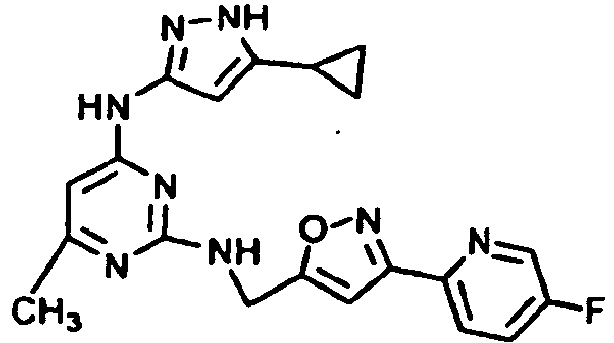
N 4-(5-cyclopropyl-1H-pyrazol-3-yl)-N 2-{[3-(5-fluoropyridin-2-yl)isoxazol-5-yl]methyl}-6-methylpyrimidine-2,4-diamine 640 
N 4-(5-cyclopropyl-1H-pyrazol-3-yl)-6-(4-methylpiperazin-1-yl)-N 2-{[3-(2-thienyl)isoxazol-5-yl]methyl}pyrimidine-2,4-diamine 641 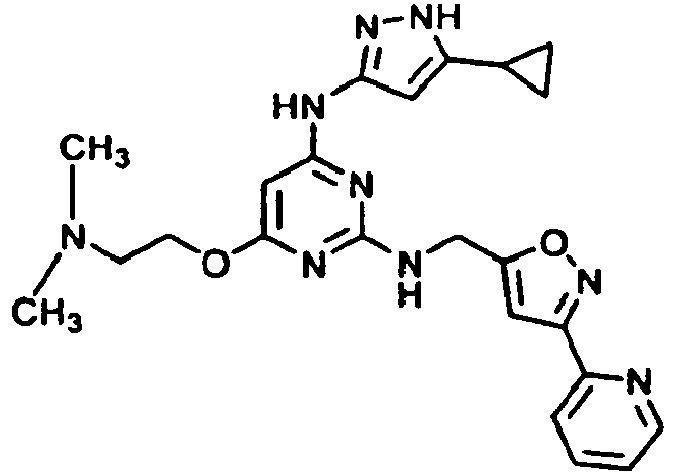
N 4-(5-cyclopropyl-1H-pyrazol-3-yl)-6-{[2-(dimethylamino)ethyl]oxy}-N 2-[(3-pyridin-2-ylisoxazol-5-yl)methyl]pyrimidine-2,4-diamine 642 
N 4-(3-cyclopropyl-1H-pyrazol-5-yl)-6-(4-methylpiperazin-1-yl)-N 2-[(3-pyrimidin-5-yilsoxazol-5-yl)methyl]pyrimidine-2,4-diamine 643 
N 4-(3-cyclopropyl-1H-pyrazol-5-yl)-6-morpholin-4-yl-N 2-[(3-pyrimidin-5-ylisoxazol-5-yl)methyl]pyrimidine-2,4-diamine 644 
N 4-(5-cyclopropyl-1H-pyrazol-3-yl)-6-{[2-(diethylamino)ethyl]oxy}-N 2-{[3-(1-methylethyl)isoxazol-5-yl]methyl}pyrimidine-2,4-diamine 645 
N 4-(5-cyclopropyl-1H-pyrazol-3-yl)-N 2-{[3-(1-methylethyl)isoxazol-5-yl]methyl}-6-[(2-pyrrolidin-1-ylethyl)oxy]pyrimidine-2,4-diamine 646 
N 4-(5-cyclopropyl-1H-pyrazol-3-yl)-6-{[2-(diethylamino)ethyl]oxy}-N 2-[(3-methylisoxazol-5-yl)methyl]pyrimidine-2,4-diamine 647 
N 4-(5-cyclopropyl-1H-pyrazol-3-yl)-N 2-[(3-methylisoxazol-5-yl)methyl]-6-[(2-pyrrolidin-1-ylethyl)oxy]pyrimidine-2,4-diamine 648 
N 4-(5-cyclopropyl-1H-pyrazol-3-yl)-6-(4-methylpiperazin-1-yl)-N 2-{[3-(1,3-thiazol-2-yl)isoxazol-5-yl]methyl}pyrimidine-2,4-diamine 649 
N 4-(3-cyclopropyl-1H-pyrazol-5-yl)-6-[2-(dimethylamino)ethoxy]-N 2-[(3-methylisoxazol-5-yl)methyl]pyrimidine-2,4-diamine 650 
6-{[2-(dimethylamino)ethyl]oxy}-N 2-[(3-methylisoxazol-5-yl)methyl]-N 4-(3-methyl-1H-pyrazol-5-yl)pyrimidine-2,4-diamine 651 
6-{[2-(diethylamino)ethyl]oxy}-N 2-[(3-methylisoxazol-5-yl)methyl]-N 4-(3-methyl-1H-pyrazol-5-yl)pyrimidine-2,4-diamine 652 
N 2-[(3-methylisoxazol-5-yl)methyl]-N 4-(3-methyl-1H-pyrazol-5-yl)-6-[(2-pyrrolidin-1-ylethyl)oxy]pyrimidine-2,4-diamine 653 
N 4-(3-cyclopropyl-1H-pyrazol-5-yl)-6-methyl-N 2-[2-(3-phenylisoxazol-5-yl)ethyl]pyrimidine-2,4-diamine 654 
N 4-(3-cyclopropyl-1H-pyrazol-5-yl)-6-methyl-N 2-[1-(3-phenylisoxazol-5-yl)ethyl]pyrimidine-2,4-diamine 655 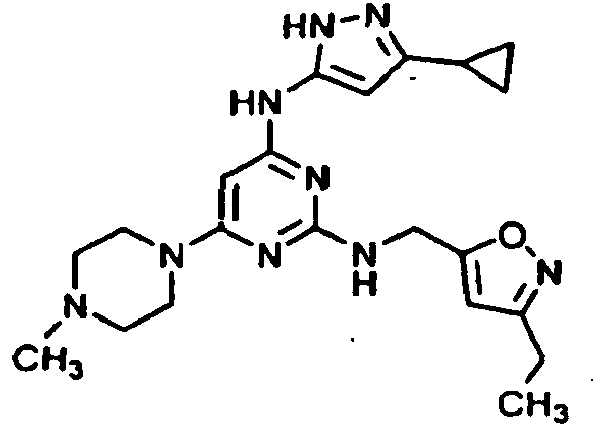
N 4-(3-cyclopropyl-1H-pyrazol-5-yl)-N 2-[(3-ethylisoxazol-5-yl)methyl]-6-(4-methylpiperazin-1-yl)pyrimidine-2,4-diamine 656 
N 4-(3-cyclopropyl-1H-pyrazol-5-yl)-N 2-[(3-ethylisoxazol-5-yl)methyl]-6-morpholin-4-ylpyrimidine-2,4-diamine 657 
N 4-(3-cyclopropyl-1H-pyrazol-5-yl)-6-{[2-(dimethylamino)ethyl]oxy}-N 2-[(3-ethylisoxazol-5-yl)methyl]pyrimidine-2,4-diamine 658 
N 4-(3-cyclopropyl-1H-pyrazol-5-yl)-6-{[2-(diethylamino)ethyl]oxy}-N 2-[(3-ethylisoxazol-5-yl)methyl]pyrimidine-2,4-diamine 659 
N 4-(3-cyclopropyl-1H-pyrazol-5-yl)-N 2-[(3-ethylisoxazol-5-yl)methyl]-6-[(2-pyrrolidin-1-ylethyl)oxy]pyrimidine-2,4-diamine 660 
N 2-{[3-(2-aminopyrimidin-4-yl)isoxazol-5-yl]methyl}-N 4-(3-cyclopropyl-1H-pyrazol-5-yl)-6-(4-methylpiperazin-1-yl)pyrimidine-2,4-diamine 661 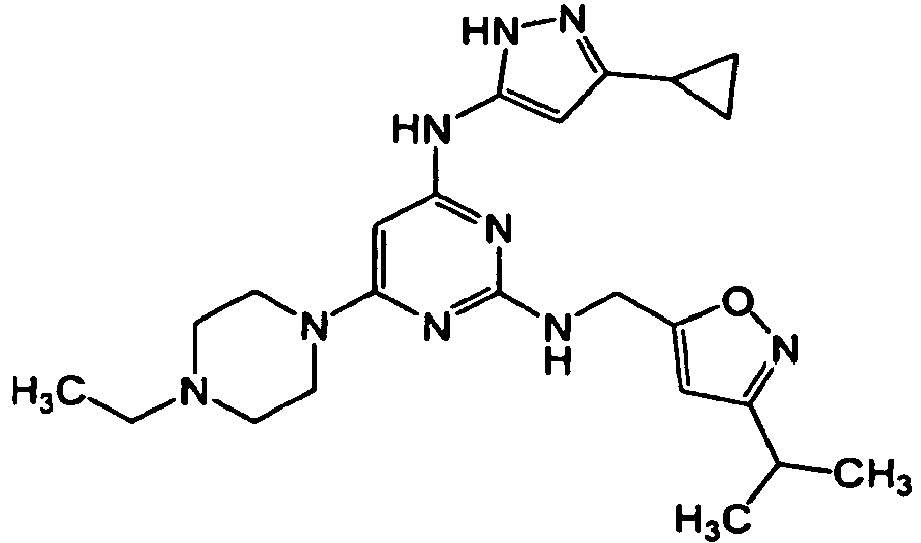
N 4-(3-cyclopropyl-1H-pyrazol-5-yl)-6-(4-ethylpiperazin-1-yl)-N 2-{[3-(1-methylethyl)isoxazol-5-yl]methyl}pyrimidine-2,4-diamine 662 
2-(1-{6-[(3-cyclopropyl-1H-pyrazol-5-yl)amino]-2-({[3-(1-methylethyl)isoxazol-5-yl]methyl}amino)pyrimidin-4-yl}piperidin-4-yl)ethanol 663 
2-(4-{6-[(3-cyclopropyl-1H-pyrazol-5-yl)amino]-2-({[3-(1-methylethyl)isoxazol-5-yl]methyl}amino)pyrimidin-4-yl}piperazin-1-yl)ethanol - The Compounds in Table 6 can be prepared as pharmaceutically acceptable salts, solvates, hydrates, and/or isomers thereof. All such salt, solvate, hydrate, and isomer combinations of the Compounds in Table 6 can be used.
Table 6 Entry Name 1 6-(2-butyl-1-hydroxy-3-oxo-2,3-dihydro-1H-isoindol-1-yl)-2H-1,4-benzoxazin-3(4H)-one 2 6-[1-hydroxy-3-oxo-2-(2-phenylethyl)-2,3-dihydro-1H-isoindol-1-yl]-2H-1,4-benzoxazin-3(4H)-one 3 6-(1-hydroxy-2-{[4-(methyloxy)phenyl]methyl}-3-oxo-2,3-dihydro-1H-isoindol-1-yl)-2H-1,4-benzoxazin-3(4H)-one 4 6-(1-hydroxy-2-{[3-(methyloxy)phenyl]methyl}-3-oxo-2,3-dihydro-1H-isoindol-1-yl)-2H-1,4-benzoxazin-3(4H)-one 5 6-{2-[(4-fluorophenyl)methyl]-1-hydroxy-3-oxo-2,3-dihydro-1H-isoindol-1-yl}-2H-1,4-benzoxazin-3(4H)-one 6 6-(1-hydroxy-3-oxo-2-phenyl-2,3-dihydro-1H-isoindol-1-yl)-2H-1,4-benzoxazin-3(4H)-one 7 6-{2-[(3-bromophenyl)methyl]-1-hydroxy-3-oxo-2,3-dihydro-1H-isoindol-1-yl}-2H-1,4-benzoxazin-3(4H)-one 8 6-{2-[(4-bromophenyl)methyl]-1-hydroxy-3-oxo-2,3-dihydro-1H-isoindol-1-yl}-2H-1,4-benzoxazin-3(4H)-one 9 6-[1-hydroxy-3-oxo-2-(3-phenylpropyl)-2,3-dihydro-1H-isoindol-1-yl]-2H-1,4-benzoxazin-3(4H)-one 10 6-{2-[(3,4-dichlorophenyl)methyl]-1-hydroxy-3-oxo-2,3-dihydro-1H-isoindol-1-yl}-2H-1,4-benzoxazin-3(4H)-one 11 6-{1-hydroxy-2-[(4-methylphenyl)methyl]-3-oxo-2,3-dihydro-1H-isoindol-1-yl}-2H-1,4-benzoxazin-3(4H)-one 12 6-{2-[(4-chlorophenyl)methyl]-1-hydroxy-3-oxo-2,3-dihydro-1H-isoindol-1-yl}-2H-1,4-benzoxazin-3(4H)-one 13 6-[1-hydroxy-2-(1-methylethyl)-3-oxo-2,3-dihydro-1H-isoindol-1-yl]-2H-1,4-benzoxazin-3(4H)-one 14 methyl {5-[1-hydroxy-3-oxo-2-(phenylmethyl)-2,3-dihydro-1H-isoindol-1-yl]-1H-benzimidazol-2-yl} carbamate 15 6-{2-[(3,4-dimethylphenyl)methyl]-1-hydroxy-3-oxo-2,3-dihydro-1H-isoindol-1-yl}-2H-1,4-benzoxazin-3(4H)-one 16 6-(2-{[4-chloro-3-(trifluoromethyl)phenyl]methyl}-1-hydroxy-3-oxo-2,3-dihydro-1H-isoindol-1-yl)-2H-1,4-benzoxazin-3(4H)-one 17 6-(2-{[4-(dimethylamino)phenyl]methyl}-1-hydroxy-3-oxo-2,3-dihydro-1H-isoindol-1-yl)-2H-1,4-benzoxazin-3(4H)-one 18 6-[2-(3-chlorophenyl)-1-hydroxy-3-oxo-2,3-dihydro-1H-isoindol-1-yl]-2H-1,4-benzoxazin-3(4H)-one 19 6-[2-(4-chlorophenyl)-1-hydroxy-3-oxo-2,3-dihydro-1H-isoindol-1-yl]-2H-1,4-benzoxazin-3(4H)-one 20 6-[2-(3,4-dichlorophenyl)-1-hydroxy-3-oxo-2,3-dihydro-1H-isoindol-1-yl]-2H-1,4-benzoxazin-3(4H)-one 21 6-[1-hydroxy-2-(4-methylphenyl)-3-oxo-2,3-dihydro-1H-isoindol-1-yl]-2H-1,4-benzoxazin-3(4H)-one 22 3-(2-{[3,5-bis(methyloxy)phenyl]amino}-1H-benzimidazol-5-yl)-3-(methyloxy)-2-(phenylmethyl)-2,3-dihydro-1H-isoindol-1-one 23 3-(2-{[3,5-bis(methyloxy)phenyl]amino}-1H-benzimidazol-5-yl)-2-(1-methylethyl)-3-(methyloxy)-2,3-dihydro-1H-isoindol-1-one 24 3-(2-{[3,5-bis(methyloxy)phenyl]amino}-1H-benzimidazol-5-yl)-3-hydroxy-2-phenyl-2,3-dihydro-1H-isoindol-1-one 25 3-(2-{[3,5-bis(methyloxy)phenyl]amino}-1H-benzimidazol-5-yl)-3-hydroxy-2-(phenylmethyl)-2,3-dihydro-1H-isoindol-1-one 26 methyl {5-[1-hydroxy-3-oxo-2-(phenylmethyl)-2,3-dihydro-1H-isoindol-1-yl]-1-methyl-1H-benzimidazol-2-yl}carbamate 27 3-(1H-benzimidazol-5-yl)-3-hydroxy-2-(phenylmethyl)-2,3-dihydro-1H-isoindol-1-one 28 5-[1-hydroxy-3-oxo-2-(phenylmethyl)-2,3-dihydro-1H-isoindol-1-yl]-N-methyl-1H-benzimidazole-2-carboxamide 29 3-hydroxy-3-(2-methyl-1H-benzimidazol-5-yl)-2-(phenylmethyl)-2,3-dihydro-1H-isoindol-1-one 30 7-[1-hydroxy-3-oxo-2-(phenylmethyl)-2,3-dihydro-1H-isoindol-1-yl]-3,4-dihydroquinoxalin-2(1H)-one 31 2-[2-(3-chlorophenyl)-1-hydroxy-3-oxo-2,3-dihydro-1H-isoindol-1-yl]-3,4-dihydroquinoxalin-2(1H)-one 32 1,1-dimethylethyl 4-{[1-hydroxy-3-oxo-1-(3-oxo-3,4-dihydro-2H-1,4-benzoxazin-6-yl)-1,3-dihydro-2H-isoindol-2-yl]methyl}piperidine-1-carboxylate 33 6-(1-hydroxy-2-{[2-(methyloxy)phenyl]methyl}-3-oxo-2,3-dihydro-1H-isoindol-1-yl)-2H-1,4-benzoxazin-3(4H)-one 34 6-{2-[(3-chlorophenyl)methyl]-1-hydroxy-3-oxo-2,3-dihydro-1H-isoindol-1-yl}-2H-1,4-benzoxazin-3(4H)-one 35 6-{2-[(2-chlorophenyl)methyl]-1-hydroxy-3-oxo-2,3-dihydro-1H-isoindot-1-yl}-2H-1,4-benzoxazin-3(4H)-one 36 6-{2-[(3-fluorophenyl)methyl]-1-hydroxy-3-oxo-2,3-dihydro-1H-isoindol-1-yl}-2H-1,4-benzoxazin-3(4H)-one 37 6-{2-[(2-bromophenyl)methyl]-1-hydroxy-3-oxo-2,3-dihydro-1H-isoindol-1-yl}-2H-1,4-benzoxazin-3(4H)-one 38 6-{2-[(2-fluorophenyl)methyl]-1-hydroxy-3-oxo-2,3-dihydro-1H-isoindol-1-yl}-2H-1,4-benzoxazin-3(4H)-one 39 6-[2-(3-fluorophenyl)-1-hydroxy-3-oxo-2,3-dihydro-1H-isoindol-1-yl]-2H-1,4-benzoxazin-3(4H)-one 40 6-[1-hydroxy-2-(3-iodophenyl)-3-oxo-2,3-dihydro-1H-isoindol-1-yl]-2H-1,4-benzoxazin-3(4H)-one 41 6-[2-(3-bromophenyl)-1-hydroxy-3-oxo-2,3-dihydro-1H-isoindol-1-yl]-2H-1,4-benzoxazin-3(4H)-one 42 6-[1-hydroxy-2-(3-nitrophenyl)-3-oxo-2,3-dihydro-1H-isoindol-1-yl]-2H-1,4-benzoxazin-3(4H)-one 43 6-{1-hydroxy-2-[3-(methyloxy)phenyl]-3-oxo-2,3-dihydro-1H-isoindol-1-yl}-2H-1,4-benzoxazin-3(4H)-one 44 6-[1-hydroxy-2-(3-methylphenyl)-3-oxo-2,3-dihydro-1H-isoindol-1-yl]-2H-1,4-benzoxazin-3(4H)-one 45 3-hydroxy-3-(1H-indol-5-yl)-2-(phenylmethyl)-2,3-dihydro-1H-isoindol-1-one 46 methyl [6-(1-hydroxy-3-oxo-2-phenyl-2,3-dihydro-1H-isoindol-1-yl)-1H-benzimidazol-2-yl]carbamate 47 6-[2-(2-aminophenyl)-1-hydroxy-3-oxo-2,3-dihydro-1H-isoindol-1-yl]-2H-1,4-benzoxazin-3(4H)-one 48 6-{[2-(3-phenyl-1,2,4-oxadiazol-5-yl)phenyl]carbonyl}-2H-1,4-benzoxazin-3(4H)-one 49 6-{[2-(1H-benzimidazol-2-yl)phenyl]carbonyl}-2H-1,4-benzoxazin-3(4H)-one 50 6-(1-hydroxy-3-oxo-2-{[2-(trifluoromethyl)phenyl]methyl}-2,3-dihydro-1H-isoindol-1-yl)-2H-1,4-benzoxazin-3(4H)-one 51 6-{2-[(5-bromo-2-fluorophenyl)methyl]-1-hydroxy-3-oxo-2,3-dihydro-1H-isoindol-1-yl}-2H-1,4-benzoxazin-3(4H)-one 52 6-{1-hydroxy-2-[(3-nitrophenyl)methyl]-3-oxo-2,3-dihydro-1H-isoindol-1-yl}-2H-1,4-benzoxazin-3(4H)-one 53 6-(1-hydroxy-3-oxo-2-{[3-(trifluoromethyl)phenyl]methyl}-2,3-dihydro-1H-isoindol-1-yl)-2H-1,4-benzoxazin-3(4H)-one 54 6-(2-{[2,3-bis(methyloxy)phenyl]methyl}-1-hydroxy-3-oxo-2,3-dihydro-1H-isoindol-1-yl)-2H-1,4-benzoxazin-3(4H)-one 55 6-{1-hydroxy-2-[(3-iodophenyl)methyl]-3-oxo-2,3-dihydro-1H-isoindol-1-yl}-2H-1,4-benzoxazin-3(4H)-one 56 6-[1-hydroxy-3-oxo-2-({3-[(trifluoromethyl)oxy]phenyl}methyl)-2,3-dihydro-1H-isoindol-1-yl]-2H-1,4-benzoxazin-3(4H)-one 57 6-(1-hydroxy-2-{[2-(methylthio)phenyl]methyl}-3-oxo-2,3-dihydro-1H-isoindol-1-yl)-2H-1,4-benzoxazin-3(4H)-one 58 6-[2-(3,4-difluorophenyl)-1-hydroxy-3-oxo-2,3-dihydro-1H-isoindol-1-yl]-2H-1,4-benzoxazin-3(4H)-one 59 6-{1-hydroxy-2-[3-(1-methylethyl)phenyl]-3-oxo-2,3-dihydro-1H-isoindol-1-yl}-2H-1,4-benzoxazin-3(4H)-one 60 6-(1-hydroxy-3-oxo-2-{3-[(trifluoromethyl)oxy]phenyl}-2,3-dihydro-1H-isoindol-1-yl)-2H-1,4-benzoxazin-3(4H)-one 61 6-{1-hydroxy-3-oxo-2-[3-(trifluoromethyl)phenyl]-2,3-dihydro-1H-isoindol-1-yl}-2H-1,4-benzoxazin-3(4H)-one 62 3-[1-hydroxy-3-oxo-1-(3-oxo-3,4-dihydro-2H-1,4-benzoxazin-6-yl)-1,3-dihydro-2H-isoindol-2-yl]benzenesulfonamide 63 6-{2-[5-chloro-2-(methyloxy)phenyl]-1-hydroxy-3-oxo-2,3-dihydro-1H-isoindol-1-yl}-2H-1,4-benzoxazin-3(4H)-one 64 6-{2-[4-fluoro-3-(trifluoromethyl)phenyl]-1-hydroxy-3-oxo-2,3-dihydro-1H-isoindol-1-yl}-2H-1,4-benzoxazin-3(4H)-one 65 3-hydroxy-3-(1H-indol-6-yl)-2-(phenylmethyl)-2,3-dihydro-1H-isoindol-1-one 66 6-[2-(3-fluoro-5-iodophenyl)-1-hydroxy-3-oxo-2,3-dihydro-1H-isoindol-1-yl]-2H-1,4-benzoxazin-3(4H)-one 67 6-[2-(3-aminophenyl)-1-hydroxy-3-oxo-2,3-dihydro-1H-isoindol-1-yl]-2H-1,4-benzoxazin-3(4H)-one 68 6-[2-(3,5-difluorophenyl)-1-hydroxy-3-oxo-2,3-dihydro-1H-isoindol-1-yl]- 2H 1,4-benzoxazin-3(4H)-one69 6-{1-hydroxy-2-[3-(methylsulfonyl)phenyl]-3-oxo-2,3-dihydro-1H-isoindol-1-yl}-2H-1,4-benzoxazin-3(4H)-one 70 ethyl 3-[1-hydroxy-3-oxo-1-(3-oxo-3,4-dihydro-2H-1,4-benzoxazin-6-yl)-1,3-dihydro-2H-isoindol-2-yl]benzoate 71 3-[1-hydroxy-3-oxo-1-(3-oxo-3,4-dihydro-2H-1,4-benzoxazin-6-yl)-1,3-dihydro-2H-isoindol-2-yl]benzonitrile 72 6-[2-(2-chlorophenyl)-1-hydroxy-3-oxo-2,3-dihydro-1H-isoindol-1-yl]-2H-1,4-benzoxazin-3(4H)-one 73 6-[2-(3-amino-5-chlorophenyl)-1-hydroxy-3-oxo-2,3-dihydro-1H-isoindol-1-yl]-2H-1,4-benzoxazin-3(4H)-one 74 6-[2-(5-chloro-2-methylphenyl)-1-hydroxy-3-oxo-2,3-dihydro-1H-isoindol-1-yl]-2H-1,4-benzoxazin-3(4H)-one 75 6-[2-(3-chloro-2-methylphenyl)-1-hydroxy-3-oxo-2,3-dihydro-1H-isoindol-1-yl]-2H-1,4-benzoxazin-3(4H)-one 76 6-[2-(3-ethylphenyl)-1-hydroxy-3-oxo-2,3-dihydro-1H-isoindol-1-yl]-2H-1,4-benzoxazin-3(4H)-one 77 6-[2-(3-ethynylphenyl)-1-hydroxy-3-oxo-2,3-dihydro-1H-isoindol-1-yl]-2H-1,4-benzoxazin-3(4H)-one 78 6-[1-hydroxy-2-(3-hydroxyphenyl)-3-oxo-2,3-dihydro-1H-isoindol-1-yl]-2H-1,4-benzoxazin-3(4H)-one 79 6-{1-hydroxy-3-oxo-2-[3-(phenyloxy)phenyl]-2,3-dihydro-1H-isoindol-1-yl}-2H-1,4-benzoxazin-3(4H)-one 80 6-(1-hydroxy-3-oxo-2-{3-[(phenylmethyl)oxy]phenyl}-2,3-dihydro-1H-isoindol-1-yl)-2H-1,4-benzoxazin-3(4H)-one 81 3-[1-hydroxy-3-oxo-1-(3-oxo-3,4-dihydro-2H-1,4-benzoxazin-6-yl)-1,3-dihydro-2H-isoindol-2-yl]benzamide 82 6-{1-hydroxy-2-[3-(hydroxymethyl)phenyl]-3-oxo-2,3-dihydro-1H-isoindol-1-yl}-2H-1,4-benzoxazin-3(4H)-one 83 6-[2-(2-fluorophenyl)-1-hydroxy-3-oxo-2,3-dihydro-1H-isoindol-1-yl]-2H-1,4-benzoxazin-3(4H)-one 84 3-hydroxy-3-[2-(methylamino)-1H-benzimidazol-5-yl]-2-(phenylmethyl)-2,3-dihydro-1H-isoindol-1-one 85 6-(2-biphenyl-3-yl-1-hydroxy-3-oxo-2,3-dihydro-1H-isoindol-1-yl)-2H-1,4-benzoxazin-3(4H)-one 86 6-(2-{3-[(dimethylamino)methyl]phenyl}-1-hydroxy-3-oxo-2,3-dihydro-1H-isoindol-1-yl)-2H-1,4-benzoxazin-3(4H)-one 87 6-[2-(3,5-dichlorophenyl)-1-hydroxy-3-oxo-2,3-dihydro-1H-isoindol-1-yl]- 2H 1,4-benzoxazin-3(4H)-one88 6-(1-hydroxy-3-oxo-2-piperidin-4-yl-2,3-dihydro-1H-isoindol-1-yl)-2H-1,4-benzoxazin-3(4H)-one 89 6-[2-(3-{[2-(dimethylamino)ethyl]oxy}phenyl)-1-hydroxy-3-oxo-2,3-dihydro-1H-isoindol-1-yl]-2H-1,4-benzoxazin-3(4H)-one 90 6-[1-hydroxy-2-(2-methylphenyl)-3-oxo-2,3-dihydro-1H-isoindol-1-yl]-2H-1,4-benzoxazin-3(4H)-one 91 N-methyl-2-[(3-oxo-3,4-dihydro-2H-1,4-benzoxazin-6-yl)carbonyl]-N-phenylbenzamide 92 methyl {5-[1-(ethyloxy)-3-oxo-2-(phenylmethyl)-2,3-dihydro-1H-isoindol-1-yl]-1H-benzimidazol-2-yl}carbamate 93 phenylmethyl 2-[(2-{[(methyloxy)carbonyl]amino}-1H-benzimidazol-5-yl)carbonyl]benzoate 94 3-hydroxy-3-(1H-indazol-5-yl)-2-(phenylmethyl)-2,3-dihydro-1H-isoindol-1-one 95 3-hydroxy-3-(1H-indazol-6-yl)-2-(phenylmethyl)-2,3-dihydro-1H-isoindol-1-one 96 ethyl {5-[1-hydroxy-3-oxo-2-(phenylmethyl)-2,3-dihydro-1H-isoindol-1-yl]-1H-benzimidazol-2-yl}carbamate 97 2-methylpropyl {5-[1-hydroxy-3-oxo-2-(phenylmethyl)-2,3-dihydro-1H-isoindol-1-yl]-1H-benzimidazol-2-yl}carbamate 98 methyl {5-[1-hydroxy-3-oxo-2-(2-thienylmethyl)-2,3-dihydro-1H-isoindol-1-yl]-1H-benzimidazol-2-yl}carbamate 99 methyl {5-[1-hydroxy-3-oxo-2-(2-phenylethyl)-2,3-dihydro-1H-isoindol-1-yl]-1H-benzimidazol-2-yl} carbamate 100 3-[2-amino-1-(1,1-dimethylethyl)-1H-benzimidazol-5-yl]-3-hydroxy-2-(phenylmethyl)-2,3-dihydro-1H-isoindol-1-one 101 3-(2-amino-1H-benzimidazol-5-yl)-3-hydroxy-2-(phenylmethyl)-2,3-dihydro-1H-isoindol-1-one 102 methyl [5-(1-hydroxy-3-oxo-2,3-dihydro-1H-isoindol-1-yl)-1H-benzimidazol-2-yl]carbamate 103 3-(methyloxy)butyl {5-[1-hydroxy-3-oxo-2-(phenylmethyl)-2,3-dihydro-1H-isoindol-1-yl]-1H-benzimidazol-2-yl}carbamate 104 methyl (5-{1-hydroxy-3-oxo-2-[(1R)-1-phenylethyl]-2,3-dihydro-1H-isoindol-1-yl}-1H-benzimidazol-2-yl)carbamate 105 methyl (5-{1-hydroxy-3-oxo-2-[(1S)-1-phenylethyl]-2,3-dihydro-1H-isoindol-1-yl}-1H-benzimidazol-2-yl)carbamate 106 2-(methyloxy)ethyl {5-[1-hydroxy-3-oxo-2-(phenylmethyl)-2,3-dihydro-1H-isoindol-1-yl]-1H-benzimidazol-2-yl}carbamate 107 methyl {6-[1-hydroxy-3-oxo-2-(phenylmethyl)-2,3-dihydro-1H-isoindol-1-yl]-1-methyl-1H-benzimidazol-2-yl}carbamate 108 prop-2-yn-1-yl {5-[1-hydroxy-3-oxo-2-(phenylmethyl)-2,3-dihydro-1H-isoindol-1-yl]-1H-benzimidazol-2-yl}carbamate 109 but-2-yn-1-yl {5-[1-hydroxy-3-oxo-2-(phenylmethyl)-2,3-dihydro-1H-isoindol-1-yl]-1H-benzimidazol-2-yl}carbamate 110 1-methylethyl {5-[1-hydroxy-3-oxo-2-(phenylmethyl)-2,3-dihydro-1H-isoindol-1-yl]-1H-benzimidazol-2-yl}carbamate 111 methyl {5-[2-(2,3-dihydro-1H-inden-2-yl)-1-hydroxy-3-oxo-2,3-dihydro-1H-isoindol-1-yl]-1H-benzimidazol-2-yl}carbamate 112 methyl {5-[1-hydroxy-3-oxo-2-(pyridin-4-ylmethyl)-2,3-dihydro-1H-isoindol-1-yl]-1H-benzimidazol-2-yl}carbamate 113 methyl {5-[1-hydroxy-3-oxo-2-(pyridin-3-ylmethyl)-2,3-dihydro-1H-isoindol-1-yl]-1H-benzimidazol-2-yl}carbamate 114 methyl (6-{2-[(3-fluorophenyl)methyl]-1-hydroxy-3-oxo-2,3-dihydro-1H-isoindol-1-yl}-1H-benzimidazol-2-yl)carbamate 115 methyl {5-[1-hydroxy-2-(3-methylphenyl)-3-oxo-2,3-dihydro-1H-isoindol-1-yl]-1H-benzimidazol-2-yl}carbamate 116 methyl [5-(1-hydroxy-2-{[2-(methyloxy)phenyl]methyl}-3-oxo-2,3-dihydro-1H-isoindol-1-yl)-1H-benzimidazol-2-yl]carbamate 117 methyl [5-(1-hydroxy-2-{[3-(methyloxy)phenyl]methyl}-3-oxo-2,3-dihydro-1H-isoindol-1-yl)-1H-benzimidazol-2-yl]carbamate 118 methyl [5-(1-hydroxy-2-{[4-(methyloxy)phenyl]methyl}-3-oxo-2,3-dihydro-1H-isoindol-1-yl)-1H-benzimidazol-2-yl]carbamate 119 methyl (6-{2-[(4-fluorophenyl)methyl]-1-hydroxy-3-oxo-2,3-dihydro-1H-isoindol-1-yl}-1H-benzimidazol-2-yl)carbamate 120 methyl (6-{2-[(3-bromophenyl)methyl]-1-hydroxy-3-oxo-2,3-dihydro-1H-isoindol-1-yl}-1H-benzimidazol-2-yl)carbamate 121 methyl (5-{1-hydroxy-2-[(3-iodophenyl)methyl]-3-oxo-2,3-dihydro-1H-isoindol-1-yl}-1H-benzimidazol-2-yl)carbamate 122 methyl (5-{2-[(3-chlorophenyl)methyl]-1-hydroxy-3-oxo-2,3-dihydro-1H-isoindol-1-yl}-1H-benzimidazol-2-yl)carbamate 123 methyl (5-{2-[(2-fluorophenyl)methyl]-1-hydroxy-3-oxo-2,3-dihydro-1H-isoindol-1-yl}-1H-benzimidazol-2-yl)carbamate 124 methyl {5-[1-hydroxy-3-oxo-2-(pyridin-2-ylmethyl)-2,3-dihydro-1H-isoindol-1-yl]-1H-benzimidazol-2-yl}carbamate 125 phenylmethyl {5-[1-hydroxy-3-oxo-2-(phenylmethyl)-2,3-dihydro-1H-isoindol-1-yl]-1H-benzimidazol-2-yl}carbamate 126 2-fluoroethyl {5-[1-hydroxy-3-oxo-2-(phenylmethyl)-2,3-dihydro-1H-isoindol-1-yl]-1H-benzimidazol-2-yl}carbamate 127 propyl {5-[1-hydroxy-3-oxo-2-(phenylmethyl)-2,3-dihydro-1H-isoindol-1-yl]-1H-benzimidazol-2-yl}carbamate 128 methyl (5-{1-hydroxy-2-[4-(methyloxy)phenyl]-3-oxo-2,3-dihydro-1H-isoindol-1-yl}-1H-benzimidazol-2-yl)carbamate 129 methyl (5-{2-[(2-chlorophenyl)methyl]-1-hydroxy-3-oxo-2,3-dihydro-1H-isoindol-1-yl}-1H-benzimidazol-2-yl)carbamate 130 methyl (5-{2-[(2-bromophenyl)methyl]-1-hydroxy-3-oxo-2,3-dihydro-1H-isoindol-1-yl}-1H-benzimidazol-2-yl)carbamate 131 methyl (5-{1-hydroxy-2-[(3-methylphenyl)methyl]-3-oxo-2,3-dihydro-1H-isoindol-1-yl}-1H-benzimidazol-2-yl)carbamate 132 methyl (5-{1-hydroxy-2-[(4-methylphenyl)methyl]-3-oxo-2,3-dihydro-1H-isoindol-1-yl}-1H-benzimidazol-2-yl)carbamate 133 methyl (5-{1-hydroxy-2-[(2-methylphenyl)methyl]-3-oxo-2,3-dihydro-1H-isoindol-1-yl}-1H-benzimidazol-2-yl)carbamate 134 methyl {5-[2-(3-bromophenyl)-1-hydroxy-3-oxo-2,3-dihydro-1H-isoindol-1-yl]-1H-benzimidazol-2-yl}carbamate 135 methyl {5-[2-(3-chlorophenyl)-1-hydroxy-3-oxo-2,3-dihydro-1H-isoindol-1-yl]-1H-benzimidazol-2-yl}carbamate 136 methyl {5-[2-(3-fluorophenyl)-1-hydroxy-3-oxo-2,3-dihydro-1H-isoindol-1-yl]-1H-benzimidazol-2-yl}carbamate 137 methyl (5-{1-hydroxy-2-[3-(methyloxy)phenyl]-3-oxo-2,3-dihydro-1H-isoindol-1-yl}-1H-benzimidazol-2-yl)carbamate 138 methyl {5-[2-(4-bromophenyl)-1-hydroxy-3-oxo-2,3-dihydro-1H-isoindol-1-yl]-1H-benzimidazol-2-yl}carbamate 139 methyl {5-[2-(4-chlorophenyl)-1-hydroxy-3-oxo-2,3-dihydro-1H-isoindol-1-yl]-1H-benzimidazol-2-yl}carbamate 140 methyl {5-[2-(4-fluorophenyl)-1-hydroxy-3-oxo-2,3-dihydro-1H-isoindol-1-yl]-1H-benzimidazol-2-yl}carbamate 141 methyl {5-[2-(3,5-dimethylphenyl)-1-hydroxy-3-oxo-2,3-dihydro-1H-isoindol-1-yl]-1H-benzimidazol-2-yl}carbamate 142 methyl {5-[2-(2-fluorophenyl)-1-hydroxy-3-oxo-2,3-dihydro-1H-isoindol-1-yl]-1H-benzimidazol-2-yl}carbamate 143 methyl {5-[2-(2-chlorophenyl)-1-hydroxy-3-oxo-2,3-dihydro-1H-isoindol-1-yl]-1H-benzimidazol-2-yl}carbamate 144 methyl {5-[1-hydroxy-2-(2-methylphenyl)-3-oxo-2,3-dihydro-1H-isoindol-1-yl]-1H-benzimidazol-2-yl}carbamate 145 methyl (5-{1-hydroxy-2-[2-(methyloxy)phenyl]-3-oxo-2,3-dihydro-1H-isoindol-1-yl}-1H-benzimidazol-2-yl)carbamate 146 methyl {5-[1-hydroxy-2-(4-methylphenyl)-3-oxo-2,3-dihydro-1H-isoindol-1-yl]-1H-benzimidazol-2-yl}carbamate 147 methyl (5-{1-hydroxy-3-oxo-2-[3-(trifluoromethyl)phenyl]-2,3-dihydro-1H-isoindol-1-yl}-1H-benzimidazol-2-yl)carbamate 148 but-2-yn-1-yl (5-{1-hydroxy-3-oxo-2-[(1R)-1-phenylethyl]-2,3-dihydro-1H-isoindol-1-yl}-1H-benzimidazol-2-yl)carbamate 149 N-ethyl-N'-{5-[1-hydroxy-3-oxo-2-(phenylmethyl)-2,3-dihydro-1H-isoindol-1-yl]-1H-benzimidazol-2-yl} urea 150 phenylmethyl (5-{1-hydroxy-3-oxo-2-[(1R)-1-phenylethyl]-2,3-dihydro-1H-isoindol-1-yl}-1H-benzimidazol-2-yl)carbamate 151 methyl {6-[2-(3-amino-5-chlorophenyl)-1-hydroxy-3-oxo-2,3-dihydro-1H-isoindol-1-yl]-1H-benzimidazol-2-yl}carbamate 152 piperidin-4-ylmethyl {5-[1-hydroxy-3-oxo-2-(phenylmethyl)-2,3-dihydro-1H-isoindol-1-yl]-1H-benzimidazol-2-yl}carbamate 153 methyl {5-[2-(cyclopropylmethyl)-1-hydroxy-3-oxo-2,3-dihydro-1H-isoindol-1-yl]-1H-benzimidazol-2-yl}carbamate 154 methyl {5-[2-(2,2-dimethylpropyl)-1-hydroxy-3-oxo-2,3-dihydro-1H-isoindol-1-yl]-1H-benzimidazol-2-yl}carbamate 155 methyl {5-[2-(3,5-dichlorophenyl)-1-hydroxy-3-oxo-2,3-dihydro-1H-isoindol-1-yl]-1H-benzimidazol-2-yl}carbamate 156 methyl {5-[2-(3,5-difluorophenyl)-1-hydroxy-3-oxo-2,3-dihydro-1H-isoindol-1-yl]-1H-benzimidazol-2-yl}carbamate 157 N-ethyl-N'-(5-{1-hydroxy-3-oxo-2-[(1R)-1-phenylethyl]-2,3-dihydro-1H-isoindol-1-yl}-1H-benzimidazol-2-yl)urea 158 N'-{5-[1-hydroxy-3-oxo-2-(phenylmethyl)-2,3-dihydro-1H-isoindol-1-yl]-1H-benzimidazol-2-yl}-N,N-dimethylurea 159 methyl {5-[2-(3-{[2-(dimethylamino)ethyl]oxy}phenyl)-1-hydroxy-3-oxo-2,3-dihydro-1H-isoindol-1-yl]-1H-benzimidazol-2-yl}carbamate 160 3-(4-methylpiperazin-1-yl)propyl {6-[1-hydroxy-3-oxo-2-(phenylmethyl)-2,3-dihydro-1H-isoindol-1-yl]-1H-benzimidazol-2-yl}carbamate 161 methyl {5-[2-(cyclohexylmethyl)-1-hydroxy-3-oxo-2,3-dihydro-1H-isoindol-1-yl]-1H-benzimidazol-2-yl}carbamate 162 methyl {5-[1-hydroxy-2-(2-methylpropyl)-3-oxo-2,3-dihydro-1H-isoindol-1-yl]-1H-benzimidazol-2-yl}carbamate 163 methyl {5-[1-hydroxy-3-oxo-2-(1,3-thiazol-2-ylmethyl)-2,3-dihydro-1H-isoindol-1-yl]-1H-benzimidazol-2-yl}carbamate 164 methyl {5-[2-(3,4-difluorophenyl)-1-hydroxy-3-oxo-2,3-dihydro-1H-isoindol-1-yl]-1H-benzimidazol-2-yl}carbamate 165 methyl (5-{2-[1-(3,5-difluorophenyl)ethyl]-1-hydroxy-3-oxo-2,3-dihydro-1H-isoindol-1-yl}-1H-benzimidazol-2-yl)carbamate 166 methyl (5-{2-[1-(3-fluorophenyl)ethyl]-1-hydroxy-3-oxo-2,3-dihydro-1H-isoindol-1-yl}-1H-benzimidazol-2-yl)carbamate 167 methyl [5-(2-cyclohexyl-1-hydroxy-3-oxo-2,3-dihydro-1H-isoindol-1-yl)-1H-benzimidazol-2-yl]carbamate 168 methyl {5-[2-(2,5-difluorophenyl)-1-hydroxy-3-oxo-2,3-dihydro-1H-isoindol-1-yl]-1H-benzimidazol-2-yl}carbamate 169 N-{5-[1-hydroxy-3-oxo-2-(phenylmethyl)-2,3-dihydro-1H-isoindol-1-yl]-1H-benzimidazol-2-yl}-N'-(phenylmethyl)urea 170 piperidin-4-yl {5-[1-hydroxy-3-oxo-2-(phenylmethyl)-2,3-dihydro-1H-isoindol-1-yl]-1H-benzimidazol-2-yl}carbamate 171 N-{5-[1-hydroxy-3-oxo-2-(phenylmethyl)-2,3-dihydro-1H-isoindol-1-yl]-1H-benzimidazol-2-yl}-N'-methylurea 172 methyl (5-{2-[1-(2-fluorophenyl)ethyl]-1-hydroxy-3-oxo-2,3-dihydro-1H-isoindol-1-yl}-1H-benzimidazol-2-yl)carbamate 173 methyl (5-{1-hydroxy-3-oxo-2-[1-(2-thienyl)ethyl]-2,3-dihydro-1H-isoindol-1-yl}-1H-benzimidazol-2-yl)carbamate 174 methyl (5-{2-[1-(3-chlorophenyl)ethyl]-1-hydroxy-3-oxo-2,3-dihydro-1H-isoindol-1-yl}-1H-benzimidazol-2-yl)carbamate 175 methyl (5-{1-hydroxy-2-[3-methyl-5-(trifluoromethyl)phenyl]-3-oxo-2,3-dihydro-1H-isoindol-1-yl}-1H-benzimidazol-2-yl)carbamate 176 N-{5-[1-hydroxy-3-oxo-2-(phenylmethyl)-2,3-dihydro-1H-isoindol-1-yl]-1H-benzimidazol-2-yl}propanamide 177 methyl {5-[2-(3,4-dichlorophenyl)-1-hydroxy-3-oxo-2,3-dihydro-1H-isoindol-1-yl]-1H-benzimidazol-2-yl}carbamate 178 methyl {5-[2-(3-ethylphenyl)-1-hydroxy-3-oxo-2,3-dihydro-1H-isoindol-1-yl]-1H-benzimidazol-2-yl}carbamate 179 methyl {5-[2-(3-ethynylphenyl)-1-hydroxy-3-oxo-2,3-dihydro-1H-isoindol-1-yl]-1H-benzimidazol-2-yl}carbamate 180 methyl {5-[2-(4-chloro-3-methylphenyl)-1-hydroxy-3-oxo-2,3-dihydro-1H-isoindol-1-yl]-1H-benzimidazol-2-yl}carbamate 181 methyl [5-(1-hydroxy-3-oxo-2-{1-[3-(trifluoromethyl)phenyl]ethyl}-2,3-dihydro-1H-isoindol-1-yl)-1H-benzimidazol-2-yl]carbamate 182 methyl (5-{1-hydroxy-3-oxo-2-[(1R)-1-phenylpropyl]-2,3-dihydro-1H-isoindol-1-yl}-1H-benzimidazol-2-yl)carbamate 183 methyl [5-(1-hydroxy-3-oxo-2-{2-[(trifluoromethyl)oxy]phenyl}-2,3-dihydro-1H-isoindol-1-yl)-1H-benzimidazol-2-yl]carbamate 184 methyl {5-[2-(2,3-difluorophenyl)-1-hydroxy-3-oxo-2,3-dihydro-1H-isoindol-1-yl]-1H-benzimidazol-2-yl}carbamate 185 cyclohexyl {5-[1-hydroxy-3-oxo-2-(phenylmethyl)-2,3-dihydro-1H-isoindol-1-yl]-1H-benzimidazol-2-yl}carbamate 186 tetrahydrofuran-2-ylmethyl {5-[1-hydroxy-3-oxo-2-(phenylmethyl)-2,3-dihydro-1H-isoindol-1-yl]-1H-benzimidazol-2-yl}carbamate 187 cyclopropylmethyl {5-[1-hydroxy-3-oxo-2-(phenylmethyl)-2,3-dihydro-1H-isoindol-1-yl]-1H-benzimidazol-2-yl}carbamate 188 N-{5-[1-hydroxy-3-oxo-2-(phenylmethyl)-2,3-dihydro-1H-isoindol-1-yl]-1H-benzimidazol-2-yl}morpholine-4-carboxamide 189 methyl {5-[2-(cyclopentylmethyl)-1-hydroxy-3-oxo-2,3-dihydro-1H-isoindol-1-yl]-1H-benzimidazol-2-yl}carbamate 190 methyl {5-[2-(2,3-dimethylphenyl)-1-hydroxy-3-oxo-2,3-dihydro-1H-isoindol-1-yl]-1H-benzimidazol-2-yl}carbamate 191 methyl {5-[2-(2,3-dihydro-1H-inden-1-yl)-1-hydroxy-3-oxo-2,3-dihydro-1H-isoindol-1-yl]-1H-benzimidazol-2-yl}carbamate 192 methyl (2S)-cyclohexyl[1-hydroxy-1-(2-{[(methyloxy)carbonyl]amino}-1H-benzimidazol-5-yl)-3-oxo-1,3-dihydro-2H-isoindol-2-yl]ethanoate 193 methyl {5-[2-(2,6-difluorophenyl)-1-hydroxy-3-oxo-2,3-dihydro-1H-isoindol-1-yl]-1H-benzimidazol-2-yl}carbamate 194 methyl {5-[2-(3-chloro-4-fluorophenyl)-1-hydroxy-3-oxo-2,3-dihydro-1H-isoindol-1-yl]-1H-benzimidazol-2-yl}carbamate 195 but-3-en-1-yl {5-[1-hydroxy-3-oxo-2-(phenylmethyl)-2,3-dihydro-1H-isoindol-1-yl]-1H-benzimidazol-2-yl}carbamate 196 2,2,2-trifluoroethyl {5-[1-hydroxy-3-oxo-2-(phenylmethyl)-2,3-dihydro-1H-isoindol-1-yl]-1H-benzimidazol-2-yl}carbamate 197 methyl {5-[2-(5-chloro-2-fluorophenyl)-1-hydroxy-3-oxo-2,3-dihydro-1H-isoindol-1-yl]-1H-benzimidazol-2-yl}carbamate 198 methyl (5-{2-[1-(5-chloro-2-methylphenyl)ethyl]-1-hydroxy-3-oxo-2,3-dihydro-1H-isoindol-1-yl}-1H-benzimidazol-2-yl)carbamate 199 methyl (5-{1-hydroxy-3-oxo-2-[(1S)-1-phenylpropyl]-2,3-dihydro-1H-isoindol-1-yl}-1H-benzimidazol-2-yl) carbamate 200 methyl (5-{2-[1-(3-chloro-2-methylphenyl)ethyl]-1-hydroxy-3-oxo-2,3-dihydro-1H-isoindol-1-yl}-1H-benzimidazol-2-yl)carbamate 201 methyl (5-{1-hydroxy-2-[1-(5-methyl-2-thienyl)ethyl]-3-oxo-2,3-dihydro-1H-isoindol-1-yl}-1H-benzimidazol-2-yl)carbamate 202 methyl (5-{2-[1-(5-chloro-2-thienyl)ethyl]-1-hydroxy-3-oxo-2,3-dihydro-1H-isoindol-1-yl}-1H-benzimidazol-2-yl)carbamate 203 methyl {5-[1-hydroxy-2-(3-iodophenyl)-3-oxo-2,3-dihydro-1H-isoindol-1-yl]-1H-benzimidazol-2-yl}carbamate 204 methyl (5-{1-hydroxy-2-[3-(1-methylethyl)phenyl]-3-oxo-2,3-dihydro-1H-isoindol-1-yl}-1H-benzimidazol-2-yl)carbamate 205 methyl {5-[2-(furan-2-ylmethyl)-1-hydroxy-3-oxo-2,3-dihydro-1H-isoindol-1-yl]-1H-benzimidazol-2-yl}carbamate 206 methyl {5-[1-hydroxy-3-oxo-2-(3-thienylmethyl)-2,3-dihydro-1H-isoindol-1-yl]-1H-benzimidazol-2-yl}carbamate 207 methyl {5-[2-(cyclobutylmethyl)-1-hydroxy-3-oxo-2,3-dihydro-1H-isoindol-1-yl]-1H-benzimidazol-2-yl}carbamate 208 3,3,3-trifluoro-2-hydroxy-N-{5-[1-hydroxy-3-oxo-2-(phenylmethyl)-2,3-dihydro-1H-isoindol-1-yl]-1H-benzimidazol-2-yl}-2-(trifluoromethyl)propanamide 209 methyl (5-{1-hydroxy-2-[1-(4-methyl-2-thienyl)ethyl]-3-oxo-2,3-dihydro-1H-isoindol-1-yl}-1H-benzimidazol-2-yl)carbamate 210 methyl (5-{2-[1-(4-bromo-2-thienyl)ethyl]-1-hydroxy-3-oxo-2,3-dihydro-1H-isoindol-1-yl}-1H-benzimidazol-2-yl)carbamate 211 methyl {5-[1-hydroxy-2-(3-{[2-(methyloxy)ethyl]oxy}phenyl)-3-oxo-2,3-dihydro-1H-isoindol-1-yl]-1H-benzimidazol-2-yl}carbamate 212 tetrahydrofuran-3-ylmethyl {5-[1-hydroxy-3-oxo-2-(phenylmethyl)-2,3-dihydro-1H-isoindol-1-yl]-1H-benzimidazol-2-yl}carbamate 213 N-{5-[1-hydroxy-3-oxo-2-(phenylmethyl)-2,3-dihydro-1H-isoindol-1-yl]-1H-benzimidazol-2-yl}piperidine-1-carboxamide 214 methyl {5-[2-(3-bromo-4-fluorophenyl)-1-hydroxy-3-oxo-2,3-dihydro-1H-isoindol-1-yl]-1H-benzimidazol-2-yl}carbamate 215 2,3-dihydroxypropyl {5-[1-hydroxy-3-oxo-2-(phenylmethyl)-2,3-dihydro-1H-isoindol-1-yl]-1H-benzimidazol-2-yl}carbamate 216 methyl {5-[1-hydroxy-3-oxo-2-(tetrahydrofuran-2-ylmethyl)-2,3-dihydro-1H-isoindol-1-yl]-1H-benzimidazol-2-yl}carbamate 217 methyl (5-{2-[3-(aminocarbonyl)phenyl]-1-hydroxy-3-oxo-2,3-dihydro-1H-isoindol-1-yl}-1H-benzimidazol-2-yl)carbamate 218 4,4,4-trifluoro-3-hydroxy-N-{5-[1-hydroxy-3-oxo-2-(phenylmethyl)-2,3-dihydro-1H-isoindol-1-yl]-1H-benzimidazol-2-yl}-3-(trifluoromethyl)butanamide 219 methyl (5-{1-hydroxy-2-[3-(methylsulfonyl)phenyl]-3-oxo-2,3-dihydro-1H-isoindol-1-yl}-1H-benzimidazol-2-yl)carbamate 220 methyl (5-{1-hydroxy-3-oxo-2-[3-(phenyloxy)phenyl]-2,3-dihydro-1H-isoindol-1-yl}-1H-benzimidazol-2-yl)carbamate 221 methyl [5-(1-hydroxy-3-oxo-2-{3-[(phenylmethyl)oxy]phenyl}-2,3-dihydro-1H-isoindol-1-yl)-1H-benzimidazol-2-yl] carbamate 222 methyl [5-(2-biphenyl-3-yl-1-hydroxy-3-oxo-2,3-dihydro-1H-isoindol-1-yl)-1H-benzimidazol-2-yl]carbamate 223 2,2-dimethyl-3-[(phenylmethyl)oxy]propyl {5-[1-hydroxy-3-oxo-2-(phenylmethyl)-2,3-dihydro-1H-isoindol-1-yl]-1H-benzimidazol-2-yl}carbamate 224 methyl {5-[2-(3-chloro-2-fluorophenyl)-1-hydroxy-3-oxo-2,3-dihydro-1H-isoindol-1-yl]-1H-benzimidazol-2-yl}carbamate 225 methyl {5-[2-(3-cyanophenyl)-1-hydroxy-3-oxo-2,3-dihydro-1H-isoindol-1-yl]-1H-benzimidazol-2-yl}carbamate 226 methyl {5-[2-(3-ethynyl-4-fluorophenyl)-1-hydroxy-3-oxo-2,3-dihydro-1H-isoindol-1-yl]-1H-benzimidazol-2-yl}carbamate 227 methyl {5-[2-(4-fluoro-3-methylphenyl)-1-hydroxy-3-oxo-2,3-dihydro-1H-isoindol-1-yl]-1H-benzimidazol-2-yl}carbamate 228 methyl {6-[2-(3,4-dichloro-2-fluorophenyl)-1-hydroxy-3-oxo-2,3-dihydro-1H-isoindol-1-yl]-1H-benzimidazol-2-yl}carbamate 229 [(4S)-2,2-dimethyl-1,3-dioxolan-4-yl]methyl {5-[1-hydroxy-3-oxo-2-(phenylmethyl)-2,3-dihydro-1H-isoindol-1-yl]-1H-benzimidazol-2-yl}carbamate 230 methyl {5-[2-(5-bromo-2-fluorophenyl)-1-hydroxy-3-oxo-2,3-dihydro-1H-isoindol-1-yl]-1H-benzimidazol-2-yl}carbamate 231 methyl (5-{2-[3-(acetylamino)phenyl]-1-hydroxy-3-oxo-2,3-dihydro-1H-isoindol-1-yl}-1H-benzimidazol-2-yl)carbamate 232 methyl (5-{1-hydroxy-3-oxo-2-[3-(phenylmethyl)phenyl]-2,3-dihydro-1H-isoindol-1-yl}-1H-benzimidazol-2-yl)carbamate 233 methyl (5-{2-[1-(4-chloro-2-thienyl)ethyl]-1-hydroxy-3-oxo-2,3-dihydro-1H-isoindol-1-yl}-1H-benzimidazol-2-yl)carbamate 234 methyl (5-{1-hydroxy-3-oxo-2-[3-(phenylcarbonyl)phenyl]-2,3-dihydro-1H-isoindol-1-yl}-1H-benzimidazol-2-yl)carbamate 235 methyl [5-(2-{3-[(dimethylamino)methyl]phenyl}-1-hydroxy-3-oxo-2,3-dihydro-1H-isoindol-1-yl)-1H-benzimidazol-2-yl]carbamate 236 methyl (5-{2-[3-(aminosulfonyl)phenyl]-1-hydroxy-3-oxo-2,3-dihydro-1H-isoindol-1-yl}-1H-benzimidazol-2-yl)carbamate 237 methyl {5-[2-(3-acetylphenyl)-1-hydroxy-3-oxo-2,3-dihydro-1H-isoindol-1-yl]-1H-benzimidazol-2-yl}carbamate 238 methyl {5-[2-(3-ethyl-4-fluorophenyl)-1-hydroxy-3-oxo-2,3-dihydro-1H-isoindol-1-yl]-1H-benzimidazol-2-yl}carbamate 239 methyl {5-[2-(3-chloro-5-fluorophenyl)-1-hydroxy-3-oxo-2,3-dihydro-1H-isoindol-1-yl]-1H-benzimidazol-2-yl}carbamate 240 N-{6-[1-hydroxy-3-oxo-2-(phenylmethyl)-2,3-dihydro-1H-isoindol-1-yl]-1H-benzimidazol-2-yl}-2-methylpropanamide 241 methyl (5-{2-[1-(3-chloro-2-thienyl)ethyl]-1-hydroxy-3-oxo-2,3-dihydro-1H-isoindol-1-yl}-1H-benzimidazol-2-yl)carbamate 242 methyl [5-(1-hydroxy-3-oxo-2-pyridin-3-yl-2,3-dihydro-1H-isoindol-1-yl)-1H-benzimidazol-2-yl]carbamate 243 methyl (5-{1-hydroxy-3-oxo-2-[3-(phenylamino)phenyl]-2,3-dihydro-1H-isoindol-1-yl}-1H-benzimidazol-2-yl)carbamate 244 methyl {5-[2-(5-bromo-2,4-difluorophenyl)-1-hydroxy-3-oxo-2,3-dihydro-1H-isoindol-1-yl]-1H-benzimidazol-2-yl}carbamate 245 methyl {5-[2-(5-chloro-2,4-difluorophenyl)-1-hydroxy-3-oxo-2,3-dihydro-1H-isoindol-1-yl]-1H-benzimidazol-2-yl}carbamate 246 methyl {5-[2-(3,5-dichloro-4-fluorophenyl)-1-hydroxy-3-oxo-2,3-dihydro-1H-isoindol-1-yl]-1H-benzimidazol-2-yl}carbamate 247 2,2-dimethyl-3-(methyloxy)propyl{5-[1-hydroxy-3-oxo-2-(phenylmethyl)-2,3-dihydro-1H-isoindol-1-yl]-1H-benzimidazol-2-yl}carbamate 248 3-hydroxy-2,2-dimethylpropyl{5-[1-hydroxy-3-oxo-2-(phenylmethyl)-2,3-dihydro-1H-isoindol-1-yl]-1H-benzimidazol-2-yl}carbamate 249 methyl (5-{2-[1-(5-bromo-2-thienyl)ethyl]-1-hydroxy-3-oxo-2,3-dihydro-1H-isoindol-1-yl}-1H-benzimidazol-2-yl) carbamate 250 methyl {5-[2-(4,5-dichloro-2-fluorophenyl)-1-hydroxy-3-oxo-2,3-dihydro-1H-isoindol-1-yl]-1H-benzimidazol-2-yl}carbamate 251 methyl {5-[2-(3-bromo-2-fluorophenyl)-1-hydroxy-3-oxo-2,3-dihydro-1H-isoindol-1-yl]-1H-benzimidazol-2-yl}carbamate 252 methyl {5-[2-(3-chloro-2,4-difluorophenyl)-1-hydroxy-3-oxo-2,3-dihydro-1H-isoindol-1-yl]-1H-benzimidazol-2-yl}carbamate 253 N-{6-[1-hydroxy-3-oxo-2-(phenylmethyl)-2,3-dihydro-1H-isoindol-1-yl]-1H-benzimidazol-2-yl}pent-4-ynamide 254 methyl (6-{1-methyl-3-oxo-2-[3-(trifluoromethyl)phenyl]-2,3-dihydro-1H-isoindol-1-yl}-1H-benzimidazol-2-yl)carbamate 255 methyl [5-(1-hydroxy-3-oxo-2-{3-[(1,1,2,2-tetrafluoroethyl)oxy]phenyl}-2,3-dihydro-1H-isoindol-1-yl)-1H-benzimidazol-2-yl]carbamate 256 methyl {5-[1-hydroxy-3-oxo-2-(3-piperidin-4-ylphenyl)-2,3-dihydro-1H-isoindol-1-yl]-1H-benzimidazol-2-yl}carbamate 257 methyl {5-[2-(3-ethenylphenyl)-1-hydroxy-3-oxo-2,3-dihydro-1H-isoindol-1-yl]-1H-benzimidazol-2-yl}carbamate 258 methyl (5-{2-[3-(dimethylamino)phenyl]-1-hydroxy-3-oxo-2,3-dihydro-1H-isoindol-1-yl}-1H-benzimidazol-2-yl)carbamate 259 2,2-difluoro-N-{6-[1-hydroxy-3-oxo-2-(phenylmethyl)-2,3-dihydro-1H-isoindol-1-yl]-1H-benzimidazol-2-yl}cyclopropanecarboxamide 260 N-ethyl-N'-{6-[2-(4-fluorophenyl)-1-hydroxy-3-oxo-2,3-dihydro-1H-isoindol-1-yl]-1H-benzimidazol-2-yl}urea 261 methyl {5-[2-(3-aminophenyl)-l-hydroxy-3-oxo-2,3-dihydro-1H-isoindol-1-yl]-1H-benzimidazol-2-yl}carbamate 262 N-{5-[1-hydroxy-3-oxo-2-(phenylmethyl)-2,3-dihydro-1H-isoindol-1-yl]-1H-benzimidazol-2-yl}-4-[(phenylmethyl)oxy]butanamide 263 N-{5-[1-hydroxy-3-oxo-2-(phenylmethyl)-2,3-dihydro-1H-isoindol-1-yl]-1H-benzimidazol-2-yl}-4-piperidin-1-ylbutanamide 264 N-{5-[1-hydroxy-3-oxo-2-(phenylmethyl)-2,3-dihydro-1H-isoindol-1-yl]-1H-benzimidazol-2-yl}-4-(4-methylpiperazin-1-yl)butanamide 265 N-{6-[2-(4-fluorophenyl)-1-hydroxy-3-oxo-2,3-dihydro-1H-isoindol-1-yl]-1H-benzimidazol-2-yl}butanamide 266 methyl {6-[2-(3-bromophenyl)-5,6-dichloro-1-hydroxy-3-oxo-2,3-dihydro-1H-isoindol-1-yl]-1H-benzimidazol-2-yl}carbamate 267 methyl [5-(1-hydroxy-2-{3-[methyl(phenyl)amino]phenyl}-3-oxo-2,3-dihydro-1H-isoindol-1-yl)-1H-benzimidazol-2-yl]carbamate 268 methyl {5-[1-hydroxy-3-oxo-2-(phenylsulfonyl)-2,3-dihydro-1H-isoindol-1-yl]-1H-benzimidazol-2-yl}carbamate 269 methyl {5-[(2-{[(phenylamino)carbonyl]amino}phenyl)carbonyl]-1H-benzimidazol-2-yl}carbamate 270 methyl (5-{[2-({[(phenylmethyl)oxy]carbonyl}amino)phenyl]carbonyl}-1H-benzimidazol-2-yl)carbamate 271 methyl [5-({2-[(2-phenylhydrazino)carbonyl]phenyl}carbonyl)-1H-benzimidazol-2-yl]carbamate 272 methyl {5-[(2-{[(phenyloxy)amino]carbonyl}phenyl)carbonyl]-1H-benzimidazol-2-yl}-carbamate 273 but-2-yn-1-yl {5-[2-(4-fluorophenyl)-1-hydroxy-3-oxo-2,3-dihydro-1H-isoindol-1-yl]-1H-benzimidazol-2-yl}carbamate 274 N-{5-[1-hydroxy-3-oxo-2-(phenylmethyl)-2,3-dihydro-1H-isoindol-1-yl]-1H-benzimidazol-2-yl}-3-piperidin-1-ylpropanamide 275 N-{6-[2-(4-fluorophenyl)-1-hydroxy-3-oxo-2,3-dihydro-1H-isoindol-1-yl]-1H-benzimidazol-2-yl}propanamide 276 N-(4-fluorophenyl)-2-{[2-(pent-4-ynoylamino)-1H-benzimidazol-6-yl]carbonyl} benzamide 277 4-(diethylamino)-N-{5-[1-hydroxy-3-oxo-2-(phenylmethyl)-2,3-dihydro-1H-isoindol-1-yl]-1H-benzimidazol-2-yl}butanamide 278 N-{5-[1-hydroxy-3-oxo-2-(phenylmethyl)-2,3-dihydro-1H-isoindol-1-yl]-1H-benzimidazol-2-yl}-4-pyrrolidin-1-ylbutanamide 279 3-piperidin-1-ylpropyl {6-[2-(4-fluorophenyl)-1-hydroxy-3-oxo-2,3-dihydro-1H-isoindol-1-yl]-1H-benzimidazol-2-yl}carbamate 280 3-(4-methylpiperazin-1-yl)propyl {6-[2-(4-fluorophenyl)-1-hydroxy-3-oxo-2,3-dihydro-1H-isoindol-1-yl]-1H-benzimidazol-2-yl}carbamate 281 methyl {5-[2-(3-bromophenyl)-3-oxo-2,3-dihydro-1H-isoindol-1-yl]-1H-benzimidazol-2-yl}carbamate 282 methyl {5-[2-(3-ethynyl-2-fluorophenyl)-1-hydroxy-3-oxo-2,3-dihydro-1H-isoindol-1-yl]-1H-benzimidazol-2-yl}carbamate 283 2-piperidin-1-ylethyl {5-[2-(4-fluorophenyl)-1-hydroxy-3-oxo-2,3-dihydro-1H isoindol-1-yl]-1H-benzimidazol-2-yl}carbamate 284 methyl {5-[2-(3-chloro-2-methylphenyl)-1-hydroxy-3-oxo-2,3-dihydro-1H-isoindol-1-yl]-1H-benzimidazol-2-yl}carbamate 285 methyl {5-[2-(5-chloro-2-methylphenyl)-1-hydroxy-3-oxo-2,3-dihydro-1H-isoindol-1-yl]-1H-benzimidazol-2-yl}carbamate 286 N-{6-[1-hydroxy-3-oxo-2-(phenylmethyl)-2,3-dihydro-1H-isoindol-1-yl]-1H-benzimidazol-2-yl}-2,2-dimethyl-3-piperidin-1-ylpropanamide 287 N-{5-[2-(4-fluorophenyl)-1-hydroxy-3-oxo-2,3-dihydro-1H-isoindol-1-yl]-1H-benzimidazol-2-yl}-4-piperidin-1-ylbutanamide 288 N-{5-[2-(3-chloro-2-fluorophenyl)-1-hydroxy-3-oxo-2,3-dihydro-1H-isoindol-1-yl]-1H-benzimidazol-2-yl}-4-piperidin-1-ylbutanamide 289 methyl [6-({2-[(phenylcarbonyl)amino]phenyl}carbonyl)-1H-benzimidazol-2-yl]carbamate 290 methyl {5-[1-hydroxy-2-(3-morpholin-4-ylphenyl)-3-oxo-2,3-dihydro-1H-isoindol-1-yl]-1H-benzimidazol-2-yl}arbamate 291 2-(dimethylamino)ethyl {6-[2-(3-chloro-2-fluorophenyl)-1-hydroxy-3-oxo-2,3-dihydro-1H-isoindol-1-yl]-1H-benzimidazol-2-yl}carbamate 292 2-(diethylamino)ethyl {5-[2-(3-chloro-2-fluorophenyl)-1-hydroxy-3-oxo-2,3-dihydro-1H-isoindol-1-yl]-1H-benzimidazol-2-yl}carbamate 293 2-piperidin-1-ylethyl {5-[2-(3-chloro-2-fluorophenyl)-1-hydroxy-3-oxo-2,3-dihydro-1H-isoindol-1-yl]-1H-benzimidazol-2-yl}carbamate 294 3-piperidin-1-ylpropyl {6-[2-(3-chloro-2-fluorophenyl)-1-hydroxy-3-oxo-2,3-dihydro-1H-isoindol-1-yl]-1H-benzimidazol-2-yl}carbamate 295 2-piperidin-1-ylethyl {6-[2-(3-bromophenyl)-3-oxo-2,3-dihydro-1H-isoindol-1-yl]-1H-benzimidazol-2-yl}carbamate 296 methyl {6-[2-(3-bromophenyl)-4,7-difluoro-1-hydroxy-3-oxo-2,3-dihydro-1H-isoindol-1-yl]-1H-benzimidazol-2-yl}carbamate 297 2-[methyl(phenylmethyl)amino]ethyl {5-[2-(3-chloro-2-fluorophenyl)-1-hydroxy-3-oxo-2,3-dihydro-1H-isoindol-1-yl]-1H-benzimidazol-2-yl}carbamate 298 methyl {5-[1-hydroxy-3-oxo-2-(3-pyrrolidin-1-ylphenyl)-2,3-dihydro-1H-isoindol-1-yl]-1H-benzimidazol-2-yl}carbamate 299 methyl {5-[2-(5-chloro-2,3-difluorophenyl)-1-hydroxy-3-oxo-2,3-dihydro-1H-isoindol-1-yl]-1H-benzimidazol-2-yl} carbamate 300 methyl {5-[1-hydroxy-3-oxo-2-(pyrrolidin-2-ylmethyl)-2,3-dihydro-1H-isoindol-1-yl]-1H-benzimidazol-2-yl}carbamate 301 methyl {5-[1-hydroxy-3-oxo-2-(pyrrolidin-3-ylmethyl)-2,3-dihydro-1H-isoindol-1-yl]-1H-benzimidazol-2-yl}carbamate 302 (1-methylpiperidin-2-yl)methyl{6-[2-(3-chloro-2-fluorophenyl)-1-hydroxy-3-oxo-2,3-dihydro-1H-isoindol-1-yl]-1H-benzimidazol-2-yl}carbamate 303 [(2S)-1-methylpyrrolidin-2-yl]methyl {6-[2-(3-chloro-2-fluorophenyl)-1-hydroxy-3-oxo-2,3-dihydro-1H-isoindol-1-yl]-1H-benzimidazol-2-yl}carbamate 304 octahydro-2H-quinolizin-1-ylmethyl{6-[2-(3-chloro-2-fluorophenyl)-1-hydroxy-3-oxo-2,3-dihydro-1H-isoindol-1-yl]-1H-benzimidazol-2-yl}carbamate 305 methyl {5-[2-(5-bromo-2-methylphenyl)-1-hydroxy-3-oxo-2,3-dihydro-1H-isoindol-1-yl]-1H-benzimidazol-2-yl}carbamate 306 5-[2-(3-chloro-2-fluorophenyl)-1-hydroxy-3-oxo-2,3-dihydro-1H-isoindol-1-yl]-1,3-dihydro-2H-benzimidazol-2-one 307 methyl {5-[2-(3-bromo-2,5-difluorophenyl)-1-hydroxy-3-oxo-2,3-dihydro-1H-isoindol-1-yl]-1H-benzimidazol-2-yl}carbamate 308 2-morpholin-4-ylethyl{6-[2-(3-chloro-2-fluorophenyl)-1-hydroxy-3-oxo-2,3-dihydro-1H-isoindol-1-yl]-1H-benzimidazol-2-yl}carbamate 309 (1-methylpiperidin-3-yl)methyl {6-[2-(3-chloro-2-fluorophenyl)-1-hydroxy-3-oxo-2,3-dihydro-1H-isoindol-1-yl]-1H-benzimidazol-2-yl}carbamate 310 methyl (5-{2-[5-chloro-2-(methyloxy)phenyl]-1-hydroxy-3-oxo-2,3-dihydro-1H-isoindol-1-yl}-1H-benzimidazol-2-yl)carbamate 311 methyl [5-(2-{3-[cyclohexyl(methyl)amino]phenyl}-1-hydroxy-3-oxo-2,3-dihydro-1H-isoindol-1-yl)-1H-benzimidazol-2-yl]carbamate 312 8-azabicyclo[3.2.1]oct-3-ylmethyl {6-[2-(3-chloro-2-fluorophenyl)-1-hydroxy-3-oxo-2,3-dihydro-1H-isoindol-1-yl]-1H-benzimidazol-2-yl}carbamate 313 methyl {6-[1-(3-bromophenyl)-5-oxopyrrolidin-2-yl]-1H-benzimidazol-2-yl}carbamate 314 (1-methylpiperidin-4-yl)methyl {5-[1-hydroxy-3-oxo-2-(phenylmethyl)-2,3-dihydro-1H-isoindol-1-yl]-1H-benzimidazol-2-yl}carbamate 315 1,1-dimethylethyl 4-({[({5-[1-hydroxy-3-oxo-2-(phenylmethyl)-2,3-dihydro-1H-isoindol-1-yl]-1H-benzimidazol-2-yl}amino)carbonyl]oxy}methyl)piperidine-1-carboxylate 316 (1-methylpiperidin-4-yl)methyl {5-[2-(3-chloro-2-fluorophenyl)-1-hydroxy-3-oxo-2,3-dihydro-1H-isoindol-1-yl]-1H-benzimidazol-2-yl}carbamate 317 2-(1-methylpiperidin-4-yl)ethyl {5-[2-(3-chloro-2-fluorophenyl)-1-hydroxy-3-oxo-2,3-dihydro-1H-isoindol-1-yl]-1H-benzimidazol-2-yl}carbamate 318 methyl ({6-[2-(3-chloro-2-fluorophenyl)-1-hydroxy-3-oxo-2,3-dihydro-1H-isoindol-1-yl]-1H-benzimidazol-2-yl}amino)(oxo)acetate 319 N-(5-{1-hydroxy-3-oxo-2-[3-(phenyloxy)phenyl]-2,3-dihydro-1H-isoindol-1-yl}-1H-benzimidazol-2-yl)-4-piperidin-1-ylbutanamide 320 methyl {6-[2-(3-bromophenyl)-1-methyl-3-oxo-2,3-dihydro-1H-isoindol-1-yl]-1H-benzimidazol-2-yl}carbamate 321 4-(diethylamino)but-2-yn-1-yl{6-[2-(3-chloro-2-fluorophenyl)-1-hydroxy-3-oxo-2,3-dihydro-1H-isoindol-1-yl]-1H-benzimidazol-2-yl}carbamate 322 methyl {5-[2-(3-chloro-2,6-difluorophenyl)-1-hydroxy-3-oxo-2,3-dihydro-1H-isoindol-1-yl]-1H-benzimidazol-2-yl}carbamate 323 2-(2-oxopyrrolidin-1-yl)ethyl {6-[2-(3-chloro-2-fluorophenyl)-1-hydroxy-3-oxo-2,3-dihydro-1H-isoindol-1-yl]-1H-benzimidazol-2-yl}carbamate 324 2-(2,5-dioxopyrrolidin-1-yl)ethyl {6-[2-(3-chloro-2-fluorophenyl)-1-hydroxy-3-oxo-2,3-dihydro-1H-isoindol-1-yl]-1H-benzimidazol-2-yl}carbamate 325 2,2,3,3-tetrafluorocyclobutyl {5-[2-(3-chloro-2-fluorophenyl)-1-hydroxy-3-oxo-2,3-dihydro-1H-isoindol-1-yl]-1H-benzimidazol-2-yl}carbamate 326 1-acetyl-N-{5-[2-(3-chloro-2-fluorophenyl)-1-hydroxy-3-oxo-2,3-dihydro-1H-isoindol-1-yl]-1H-benzimidazol-2-yl}piperidine-4-carboxamide 327 N-{5-[2-(3-chloro-2-fluorophenyl)-1-hydroxy-3-oxo-2,3-dihydro-1H-isoindol-1-yl]-1H-benzimidazol-2-yl}cyclobutanecarboxamide 328 methyl[5-(2-{3-[ethyl(phenyl)amino]phenyl}-1-hydroxy-3-oxo-2,3-dihydro-1H-isoindol-1-yl)-1H-benzimidazol-2-yl]carbamate 329 N-{6-[2-(3-chloro-2-fluorophenyl)-1-hydroxy-3-oxo-2,3-dihydro-1H-isoindol-1-yl]-1H-benzimidazol-2-yl}-2,2-difluorocyclopropanecarboxamide 330 cyclobutyl{6-[2-(3-chloro-2-fluorophenyl)-1-hydroxy-3-oxo-2,3-dihydro-1H-isoindol-1-yl]-1H-benzimidazol-2-yl}carbamate 331 2,2-difluoroethyl {6-[2-(3-chloro-2-fluorophenyl)-1-hydroxy-3-oxo-2,3-dihydro-1H-isoindol-1-yl]-1H-benzimidazol-2-yl}carbamate 332 2-(3-chloro-2-fluorophenyl)-3-hydroxy-3-[2-(pyridin-2-ylamino)-1H-benzimidazol-5-yl]-2,3-dihydro-1H-isoindol-1-one 333 1-methylethyl{6-[2-(3-chioro-2-fluorophenyl)-1-hydroxy-3-oxo-2,3-dihydro-1H-isoindol-1-yl]-1H-benzimidazol-2-yl}carbamate 334 cyclopropylmethyl {6-[2-(3-chloro-2-fluorophenyl)-1-hydroxy-3-oxo-2,3-dihydro-1H-isoindol-1-yl]-1H-benzimidazol-2-yl}carbamate 335 N-{5-[2-(3-chloro-2-fluorophenyl)-1-hydroxy-3-oxo-2,3-dihydro-1H-isoindol-1-yl]-1H-benzimidazol-2-yl}cyclopropanecarboxamide 336 2-(methyloxy)ethyl{5-[2-(3-chloro-2-fluorophenyl)-1-hydroxy-3-oxo-2,3-dihydro-1H-isoindol-1-yl]-1H-benzimidazol-2-yl}carbamate 337 tetrahydrofuran-2-ylmethyl{6-[2-(3-chloro-2-fluorophenyl)-1-hydroxy-3-oxo-2,3-dihydro-1H-isoindol-1-yl]-1H-benzimidazol-2-yl}carbamate 338 N-{5-[2-(3-chloro-2-fluorophenyl)-1-hydroxy-3-oxo-2,3-dihydro-1H-isoindol-1-yl]-1H-benzimidazol-2-yl}-2-(2-thienyl)acetamide 339 methyl {6-[2-(3-chloro-2-fluorophenyl)-4,7-difluoro-1-hydroxy-3-oxo-2,3-dihydro-1H-isoindol-1-yl]-1H-benzimidazol-2-yl}carbamate 340 ethyl{6-[2-(3-chloro-2-fluorophenyl)-1-hydroxy-3-oxo-2,3-dihydro-1H-isoindol-1-yl]-1H-benzimidazol-2-yl}carbamaie 341 2-fluoroethyl{6-[2-(3-chloro-2-fluorophenyl)-1-hydroxy-3-oxo-2,3-dihydro-1H-isoindol-1-yl]-1H-benzimidazol-2-yl}carbamate 342 methyl(5-{1-hydroxy-3-oxo-2-[2-(phenyloxy)phenyl]-2,3-dihydro-1H-isoindol-1-yl}-1H-benzimidazol-2-yl)carbamate 343 N'-{5-[2-(3-chloro-2-fluorophenyl)-1-hydroxy-3-oxo-2,3-dihydro-1H-isoindol-1-yl]-1H-benzimidazol-2-yl}-N,N-diethylpentanediamide 344 cyclobutylmethyl {6-[2-(3-chloro-2-fluorophenyl)-1-hydroxy-3-oxo-2,3-dihydro-1H-isoindol-1-yl]-1H-benzimidazol-2-yl}carbamate 345 2,2,2-trifluoroethyl{6-[2-(3-chloro-2-fluorophenyl)-1-hydroxy-3-oxo-2,3-dihydro-1H-isoindol-1-yl]-1H-benzimidazol-2-yl}carbamate 346 methyl (5-{2-[3-(1,1-dimethylethyl)phenyl]-1-hydroxy-3-oxo-2,3-dihydro-1H-isoindol-1-yl}-1H-benzimidazol-2-yl)carbamate 347 methyl {6-[2-(3-chloro-2-fluorophenyl)-7-fluoro-1-hydroxy-3-oxo-2,3-dihydro-1H-isoindol-1-yl]-1H-benzimidazol-2-yl}carbamate 348 2-(3-chloro-2-fluorophenyl)-3-hydroxy-3-[2-(phenylamino)-1H-benzimidazol-5-yl]-2,3-dihydro-1H-isoindol-1-one 349 methyl{6-[4,7-dichloro-2-(3-chloro-2-fluorophenyl)-1-hydroxy-3-oxo-2,3-dihydro-1H-isoindol-1-yl]-1H-benzimidazol-2-yl} carbamate 350 phenylmethyl 2-[(2-{[(ethyloxy)carbonyl]amino}-1,3-benzoxazol-5-yl)carbonyl]benzoate 351 methyl{5-[2-(5-chloro-3-ethynyl-2-methylphenyl)-1-hydroxy-3-oxo-2,3-dihydro-1H-isoindol-1-yl]-1H-benzimidazol-2-yl}carbamate 352 methyl{5-[2-(5-ethynyl-2,4-difluorophenyl)-1-hydroxy-3-oxo-2,3-dihydro-1H-isoindol-1-yl]-1H-benzimidazol-2-yl}carbamate 353 methyl{5-[2-(3-ethynyl-2,4-difluorophenyl)-1-hydroxy-3-oxo-2,3-dihydro-1H-isoindol-1-yl]-1H-benzimidazol-2-yl}carbamate 354 2-(3-chloro-2-fluorophenyl)-3-hydroxy-3-[2-(pyrimidin-2-ylamino)-1H-benzimidazol-5-yl]-2,3-dihydro-1H-isoindol-1-one 355 methyl {5-[2-(3-ethynyl-2-fluorophenyl)-4,7-difluoro-1-hydroxy-3-oxo-2,3-dihydro-1H-isoindol-1-yl]-1H-benzimidazol-2-yl}carbamate 356 2-(3-chloro-2-fluorophenyl)-3-hydroxy-3-[2-(1,3-thiazol-2-ylamino)-1H-benzimidazol-5-yl]-2,3-dihydro-1H-isoindol-1-one 357 ethyl {5-[2-(3-chloro-2-fluorophenyl)-1-hydroxy-3-oxo-2,3-dihydro-1H-isoindol-1-yl]-1,3-benzoxazol-2-yl}carbamate 358 methyl {5-[2-(5-chloro-3-iodo-2-methylphenyl)-1-hydroxy-3-oxo-2,3-dihydro-1H-isoindol-1-yl]-1H-benzimidazol-2-yl}carbamate 359 methyl{5-[2-(3-ethyl-2-fluorophenyl)-1-hydroxy-3-oxo-2,3-dihydro-1H-isoindol-1-yl]-1H-benzimidazol-2-yl}carbamate 360 methyl{5-[2-(5-ethynyl-2-methylphenyl)-1-hydroxy-3-oxo-2,3-dihydro-1H-isoindol-1-yl]-1H-benzimidazol-2-yl}carbamate 361 2-(3-chloro-2-fluorophenyl)-3-hydroxy-3-[2-(pyrazin-2-ylamino)-1H-benzimidazol-5-yl]-2,3-dihydro-1H-isoindol-1-one 362 methyl{5-[2-(2-fluoro-3-iodophenyl)-1-hydroxy-3-oxo-2,3-dihydro-1H-isoindol-1-yl]-1H-benzimidazol-2-yl}carbamate 363 methyl{6-[2-(5-ethynyl-2-fluorophenyl)-1-hydroxy-3-oxo-2,3-dihydro-1H-isoindol-1-yl]-1H-benzimidazol-2-yl}carbamate 364 2-(3-ethynyl-2-fluorophenyl)-3-hydroxy-3-[2-(pyrimidin-2-ylamino)-1H-benzimidazol-5-yl]-2,3-dihydro-1H-isoindol-1-one 365 methyl{5-[2-(2,5-dimethylphenyl)-1-hydroxy-3-oxo-2,3-dihydro-1H-isoindol-1-yl]-1H-benzimidazol-2-yl}carbamate 366 methyl{5-[2-(3-ethenyl-2-fluorophenyl)-1-hydroxy-3-oxo-2,3-dihydro-1H-isoindol-1-yl]-1H-benzimidazol-2-yl}carbamate 367 methyl(6-{2-[2-fluoro-3-(methyloxy)phenyl]-1-hydroxy-3-oxo-2,3-dihydro-1H-isoindol-1-yl}-1H-benzimidazol-2-yl)carbamate 368 methyl(5-{1-hydroxy-2-[2-methyl-5-(methyloxy)phenyl]-3-oxo-2,3-dihydro-1H-isoindol-1-yl}-1H-benzimidazol-2-yl)carbamate 369 methyl{5-[2-(3-ethynyl-2-fluorophenyl)-7-fluoro-1-hydroxy-3-oxo-2,3-dihydro-1H-isoindol-1-yl]-1H-benzimidazol-2-yl}carbamate 370 methyl{5-[2-(2-fluoro-3-prop-1-yn-1-ylphenyl)-1-hydroxy-3-oxo-2,3-dihydro-1H-isoindol-1-yl]-1H-benzimidazol-2-yl}carbamate 371 methyl{5-[2-(5-chloro-2-methylphenyl)-7-fluoro-1-hydroxy-3-oxo-2,3-dihydro-1H-isoindol-1-yl]-1H-benzimidazol-2-yl}carbamate 372 methyl{5-[2-(3-ethynyl-2-methylphenyl)-1-hydroxy-3-oxo-2,3-dihydro-1H-isoindol-1-yl]-1H-benzimidazol-2-yl}carbamate 373 3-hydroxy-2-[3-(methyloxy)phenyl]-3-[2-(pyrimidin-2-ylamino)-1H-benzimidazol-6-yl]-2,3-dihydro-1H-isoindol-1-one 374 3-hydroxy-2-(3-methylphelyl)-3-[2-(pyrimidin-2-ylamino)-1H-benzimidazol-6-yl]-2,3-dihydro-1H-isoindol-1-one 375 2-(5-chloro-2-methylphenyl)-3-hydroxy-3-[2-(pyrimidin-2-ylamino)-1H-benzimidazol-6-yl]-2,3-dihydro-1H-isoindol-1-one 376 methyl{6-[2-(5-chloro-2-methylphenyl)-4,7-difluoro-1-hydroxy-3-oxo-2,3-dihydro-1H-isoindol-1-yl]-1H-benzimidazol-2-yl}carbamate 377 methyl{5-[2-(3-ethynyl-2-fluorophenyl)-3-oxo-2,3-dihydro-1H-isoindol-1-yl]-1H-benzimidazol-2-yl}carbamate 378 2-(3-chloro-2-fluorophenyl)-3-{2-[(6-chloropyridazin-3-yl)amino]-1H-benzimidazol-5-yl}-3-hydroxy-2,3-dihydro-1H-isoindol-1-one 379 2-(3-chloro-2-fluorophenyl)-4,7-difluoro-3-hydroxy-3-[2-(pyrimidin-2-ylamino)-1H-benzimidazol-5-yl]-2,3-dihydro-1H-isoindol-1-one 380 methyl{5-[2-(2-fluoro-5-methylphenyl)-1-hydroxy-3-oxo-2,3-dihydro-1H-isoindol-1-yl]-1H-benzimidazol-2-yl}carbamate 381 methyl(5-{2-[2-fluoro-5-(methyloxy)phenyl]-1-hydroxy-3-oxo-2,3-dihydro-1H-isoindol-1-yl}-1H-benzimidazol-2-yl)carbamate 382 methyl(5-{1-hydroxy-2-[5-methyl-2-(methyloxy)phenyl]-3-oxo-2,3-dihydro-1H-isoindol-1-yl}-1H-benzimidazol-2-yl)carbamate 383 methyl{5-[2-(3-ethynyl-5-methylphenyl)-1-hydroxy-3-oxo-2,3-dihydro-1H-isoindol-1-yl]-1H-benzimidazol-2-yl}carbamate 384 2-(3-chloro-2-fluorophenyl)-3-{2-[(5-chloropyrimidin-2-yl)amino]-1H-benzimidazol-5-yl}-3-hydroxy-2,3-dihydro-1H-isoindol-1-one 385 2-(3-chloro-2-fluorophenyl)-3-hydroxy-3-{2-[(4-methylpyrimidin-2-yl)amino]-1H-benzimidazol-5-yl}-2,3-dihydro-1H-isoindol-1-one 386 3-(2-{[4,6-bis(methyloxy)pyrimidin-2-yl]amino}-1H-benzimidazol-5-yl)-2-(3-chloro-2-fluorophenyl)-3-hydroxy-2,3-dihydro-1H-isoindol-1-one 387 2-(3-chloro-2-fluorophenyl)-3-hydroxy-3-(2-{[4-methyl-6-(methyloxy)pyrimidin-2-yl]amino}-1H-benzimidazol-5-yl)-2,3-dihydro-1H-isoindol-1-one 388 3-hydroxy-2-(3-methylphenyl)-3-[2-(pyrazin-2-ylamino)-1H-benzimidazol-6-yl]-2,3-dihydro-1H-isoindol-1-one 389 2-(5-chloro-2-methylphenyl)-3-hydroxy-3-[2-(pyrazin-2-ylamino)-1H-benzimidazol-6-yl]-2,3-dihydro-1H-isoindol-1-one 390 methyl{6-[2-(2-fluoro-3-methylphenyl)-1-hydroxy-3-oxo-2,3-dihydro-1H-isoindol-1-yl]-1H-benzimidazol-2-yl}carbamate 391 3-hydroxy-2-[3-(methyloxy)phenyl]-3-[2-(pyrazin-2-ylamino)-1H-benzimidazol-5-yl]-2,3-dihydro-1H-isoindol-1-one 392 methyl{6-[(2-{[(2-thienylmethyl)amino]carbonyl}phenyl)carbonyl]-1H-benzimidazol-2-yl}carbamate 393 methyl{6-[(2-{[(3-methylphenyl)amino]carbonyl}phenyl)carbonyl]-1H-benzimidazol-2-yl}carbamate 394 methyl{6-[(2-{[(3-bromophenyl)amino]carbonyl}phenyl)carbonyl]-1H-benzimidazol-2-yl}carbamate 395 methyl{6-[(2-{[(3-chlorophenyl)amino]carbonyl}phenyl)carbonyl]-1H-benzimidazol-2-yl}carbamate 396 methyl{6-[(2-{[(3-fluorophenyl)amino]carbonyl}phenyl)carbonyl]-1H-benzimidazol-2-yl}carbamate 397 methyl(6-{[2-({[3-(methyoxy)phenyl]amino}calrbonyl)phenyl]carbonyl}-1H-benzimidazol-2-yl)carbamate 398 methyl(6-{[2-({[3-(trifluoromethyl)phenyl]amino}carbonyl)phenyl]carbonyl}-1H-benzimidazol-2-yl)carbamate 399 methyl{6-[(2-{[(3-ethylphenyl)amino]carbonyl}phenyl)carbonyl]-1H-benzimidazol-2-yl} carbamate 400 methyl{6-[(2-{[(3-ethynylphenyl)amino]carbonyl}phenyl)carbonyl]-1H-benzimidazol-2-yl}carbamate 401 methyl{6-[(2-{[(3-chloro-4-fluorophenyl)amino]carbonyl}phenyl)carbonyl]-1H-benzimidazol-2-yl}carbamate 402 methyl{6-[(2-{[(5-chloro-2-fluorophenyl)amino]carbonyl}phenyl)carbonyl]-1H-benzimidazol-2-yl}carbamate 403 methyl{6-[(2-{[(3-iodophenyl)amino]carbonyl}phenyl)carbonyl]-1H-benzimidazol-2-yl}carbamate 404 methyl(6-{[2-({[3-(1-methylethyl)phenyl]amino}carbonyl)phenyl]carbonyl}-1H-benzimidazol-2-yl)carbamate 405 methyl{6-[(2-{[(3-thienylmethyl)amino]carbonyl}phenyl)carbonyl]-1H-benzimidazol-2-yl}carbamate 406 methyl{6-[(2-{[(3-bromo-4-fluorophenyl)amino]carbonyl}phenyl)carbonyl]-1H-benzimidazol-2-yl}carbamate 407 methyl{6-[(2-{[(3-chloro-2-fluorophenyl)amino]carbonyl}phenyl)carbonyl]-1H-benzimidazol-2-yl}carbamate 408 methyl {6-[(2-{[(4-fluoro-3-methylphenyl)amino]carbonyl}phenyl)carbonyl]-1H-benzimidazol-2-yl}carbamate 409 methyl{6-[(2-{[(5-bromo-2-fluorophenyl)amino]carbonyl}phenyl)carbonyl]-1H-benzimidazol-2-yl}carbamate 410 methyl{6-[(2-{[(5-bromo-2,4-difluorophenyl)amino]carbonyl}phenyl)carbonyl]-1H-benzimidazol-2-yl}carbamate 411 methyl{6-[(2-{[(5-chloro-2,4-difluorophenyl)amino]carbonyl}phenyl)carbonyl]-1H-benzimidazol-2-yl}carbamate 412 methyl{6-[(2-{[(3-bromo-2-fluorophenyl)amino]carbonyl}phenyl)carbonyl]-1H-benzimidazol-2-yl}carbamate 413 methyl{6-[(2-{[(3-ethenylphenyl)amino]carbonyl}phenyl)carbonyl]-1H-benzimidazol-2-yl}carbamate 414 methyl{6-[(2-{[(3-ethynyl-2-fluorophenyl)amino]carbonyl}phenyl)carbonyl]-1H-benzimidazol-2-yl}carbamate 415 methyl{6-[(2-{[(5-chloro-2-methylphenyl)amino]carbonyl}phenyl)carbonyl]-1H-benzimidazol-2-yl}carbamate 416 methyl {6-[(2-{[(5-bromo-2-methylphenyl)amino]carbonyl}phenyl)carbonyl]-1H-benzimidazol-2-yl}carbamate 417 methyl{6-[(2-{[(2-fluoro-3-iodophenyl)amino]carbonyl}phenyl)carbonyl]-1H-benzimidazol-2-yl}carbamate 418 methyl{6-[(2-{[(3-ethenyl-2-fluorophenyl)amino]carbonyl}phenyl)carbonyl]-1H-benzimidazol-2-yl}carbamate 419 methyl{6-[(2-{[(2-fluoro-5-methylphenyl)amino]carbonyl}phenyl)carbonyl]-1H-benzimidazol-2-yl}carbamate - The Compounds in Table 7 can be prepared as pharmaceutically acceptable salts, solvates, hydrates, and/or isomers thereof. All such salt, solvate, hydrate, and isomer combinations of the Compounds in Table 7 can be used.
Table 7 Entry Name 1 (3Z)-3-[[5-(methyloxy)-1H-benzimidazol-2-yl](phenyl)methylidene]-5-{[1-(phenylmethyl)pyrrolidin-3-yl]amino}-1,3-dihydro-2H-indol-2-one 2 (3Z)-5-[(1-ethylpiperidin-3-yl)amino]-3-[[5-(methyloxy)-1H-benzimidazol-2-yl](phenyl)methylidene]-1,3-dihydro-2H-indol-2-one 3 (3Z)-5-[(1-ethylpiperidin-4-yl)amino]-3-[[5-(methyloxy)-1H-benzimidazol-2-yl](phenyl)methylidene]-1,3-dihydro-2H-indol-2-one 4 (3Z)-5-[(1-ethylpiperidin-4-yl)amino]-3-[1H-imidazol-2-yl(phenyl)methylidene]-1,3-dihydro-2H-indol-2-one 5 (3Z)-5-[(1-ethylpiperidin-4-yl)amino]-3-{[5-(methyloxy)-1H-benzimidazol-2-yl][4-(methyloxy)phenyl]methylidene}-1,3-dihydro-2H-indol-2-one 6 (3Z)-5-[(1-ethylpiperidin-4-yl)amino]-3-[[5-(methyloxy)-1H-benzimidazol-2-yl](4-methylphenyl)methylidene]-1,3-dihydro-2H-indol-2-one 7 (3Z)-3-[1H-benzimidazol-2-yl(4-nitrophenyl)methylidene]-5-[(1-ethylpiperidin-4-yl)amino]-1,3-dihydro-2H-indol-2-one 8 (3Z)-3-{1H-benzimidazol-2-yl[4-(methyloxy)phenyl]methylidene}-5-[(1-ethylpiperidin-4-yl)amino]-1,3-dihydro-2H-indol-2-one 9 (3Z)-3-[1H-benzimidazol-2-yl(phenyl)methylidene]-5-[(1-ethylpiperidin-4-yl)amino]-1,3-dihydro-2H-indol-2-one 10 (3Z)-3-[[5-(methyloxy)-1H-benzimidazol-2-yl](phenyl)methylidene]-5-[(2,2,6,6-tetramethylpiperidin-4-yl)amino]-1,3-dihydro-2H-indol-2-one 11 (3Z)-3-[(4-aminophenyl)(1H-benzimidazol-2-yl)methylidene]-5-[(1-ethylpiperidin-4-yl)amino]-1,3-dihydro-2H-indol-2-one 12 (3Z)-3-[1H-benzimidazol-2-yl(4-methylphenyl)methylidene]-5-[(1-ethylpiperidin-4-yl)amino]-1,3-dihydro-2H-indol-2-one 13 (3Z)-5-[(1-ethylpiperidin-4-yl)amino]-3-[1H-imidazol-2-yl(4-methylphenyl)methylidene]-1,3-dihydro-2H-indol-2-one 14 (3Z)-5-[(1-ethylpiperidin-4-yl)oxy]-3-[[5-(methyloxy)-1H-benzimidazol-2-yl](phenyl)methylidene]-1,3-dihydro-2H-indol-2-one 15 (3Z)-5-[(1-ethylpiperidin-4-yl)amino]-3-{1H-imidazol-2-yl[4-(methyloxy)phenyl]methylidene}-1,3-dihydro-2H-indol-2-one 16 (3Z)-3-[1H-benzimidazol-2-yl(4-fluorophenyl)methylidene]-5-[(1-ethylpiperidin-4-yl)amino]-1,3-dihydro-2H-indol-2-one 17 (3Z)-3-[1H-benzimidazol-2-yl(3,5-difluorophenyl)methylidene]-5-[(1-ethylpiperidin-4-yl)amino]-1,3-dihydro-2H-indol-2-one 18 (3Z)-3-[1H-benzimidazol-2-yl(3-fluorophenyl)methylidene]-5-[(1-ethylpiperidin-4-yl)amino]-1,3-dihydro-2H-indol-2-one 19 (3Z)-3-[1H-benzimidazol-2-yl(3-nitrophenyl)methylidene]-5-[(1-ethylpiperidin-4-yl)amino]-1,3-dihydro-2H-indol-2-one 20 3-((Z)-1H-benzimidazol-2-yl{5-[(1-ethylpiperidin-4-yl)amino]-2-oxo-1,2-dihydro-3H-indol-3-ylidene}methyl)benzonitrile 21 (3Z)-3-[(3-aminophenyl)(1H-benzimidazol-2-yl)methylidene]-5-[(1-ethylpiperidin-4-yl)amino]-1,3-dihydro-2H-indol-2-one 22 (3Z)-3-[1H-benzimidazol-2-yl(phenyl)methylidene]-5-(piperidin-4-ylamino)-1,3-dihydro-2H-indol-2-one 23 3-((Z)-1H-benzimidazol-2-yl{5-[(1-ethylpiperidin-4-yl)amino]-2-oxo-1,2-dihydro-3H-indol-3-ylidene}methyl)benzenecarboximidamide 24 (3Z)-3-[1H-benzimidazol-2-yl(phenyl)methylidene]-5-({1-[2-(methyloxy)ethyl]piperidin-4-yl}amino)-1,3-dihydro-2H-indol-2-one 25 (3Z)-3-[1H-benzimidazol-2-yl(phenyl)methylidene]-5-[(2,2,6,6-tetramethylpiperidin-4-yl)amino]-1,3-dihydro-2H-indol-2-one 26 (3Z)-3-{1H-benzimidazol-2-yl[3-(methyloxy)phenyl]methylidene}-5-[(1-ethylpiperidin-4-yl)amino]-1,3-dihydro-2H-indol-2-one 27 (3Z)-3-[1H-benzimidazol-2-yl(3-chlorophenyl)methylidene]-5-[(1-ethylpiperidin-4-yl)amino]-1,3-dihydro-2H-indol-2-one 28 2-(2-{2-[(Z)-{5-[(1-ethylpiperidin-4-yl)amino]-2-oxo-1,2-dihydro-3H-indol-3-ylidene}(phenyl)methyl]-1H-imidazol-4-yl}ethyl)-1H-isoindole-1,3(2H)-dione 29 (3Z)-3-[1H-benzimidazol-2-yl(phenyl)methylidene]-5-({1-[2-(dimethylamino)ethyl]piperidin-4-yl}amino)-1,3-dihydro-2H-indol-2-one 30 (3Z)-3-[1H-benzimidazol-2-yl(phenyl)methylidene]-5-{[1-(methylsulfonyl)piperidin-4-yl]amino}-1,3-dihydro-2H-indol-2-one 31 (3Z)-5-(8-azabicyclo[3.2.1]oct-3-ylamino)-3-[1H-benzimidazol-2-yl(phenyl)methylidene]-1,3-dihydro-2H-indol-2-one 32 (3Z)-3-{1H-benzimidazol-2-yl[3-(methyloxy)phenyl]methylidene}-5-[(1-ethylpiperidin-4-yl)oxy]-1,3-dihydro-2H-indol-2-one 33 (3Z)-3-[1H-benzimidazol-2-yl(3,5-difluorophenyl)methylidene]-5-[(1-ethylpiperidin-4-yl)oxy]-1,3-dihydro-2H-indol-2-one 34 (3Z)-3-[1H-benzimidazol-2-yl(phenyl)methylidene]-5-{[1-(phenylmethyl)piperidin-4-yl]oxy}-1,3-dihydro-2H-indol-2-one 35 (3Z)-3-[1H-benzimidazol-2-yl(3-chlorophenyl)methylidene]-5-[(1-ethylpiperidin-4-yl)oxy]-1,3-dihydro-2H-indol-2-one 36 (3Z)-3-[1H-benzimidazol-2-yl(3,5-difluorophenyl)methylidene]-5-({1-[2-(methyloxy)ethyl]piperidin-4-yl}oxy)-1,3-dihydro-2H-indol-2-one 37 (3Z)-3-[1H-benzimidazol-2-yl(3-chlorophenyl)methylidene]-5-({1-[2-(methyloxy)ethyl]piperidin-4-yl}oxy)-1,3-dihydro-2H-indol-2-one 38 (3Z)-3-[1H-benzimidazol-2-yl(3-chlorophenyl)methylidene]-5-({1-[2-(methyloxy)ethyl]piperidin-4-yl}amino)-1,3-dihydro-2H-indol-2-one 39 (3Z)-3-{1H-benzimidazol-2-yl[3-(methyloxy)phenyl]methylidene}-5-({1-[2-(methyloxy)ethyl]piperidin-4-yl}amino)-1,3-dihydro-2H-indol-2-one 40 (3Z)-3-[(3-chlorophenyl)(1H-imidazol-2-yl)methylidene]-5-({1-[2-(methyloxy)ethyl]piperidin-4-yl}amino)-1,3-dihydro-2H-indol-2-one 41 (3Z)-3-[(3-fluorophenyl)(1H-imidazol-2-yl)methylidene]-5-({1-[2-(methyloxy)ethyl]piperidin-4-yl}amino)-1,3-dihydro-2H-indol-2-one 42 (3Z)-3-[1H-benzimidazol-2-yl(3,5-difluorophenyl)methylidene]-5-({1-[2-(methyloxy)ethyl]piperidin-4-yl}amino)-1,3-dihydro-2H-indol-2-one 43 (3Z)-3-[1H-benzimidazol-2-yl(3-chlorophenyl)methylidene]-5-[(1-ethylpiperidin-4-yl)(methyl)amino]-1,3-dihydro-2H-indol-2-one 44 (3Z)-3-[(3-chlorophenyl)(1H-imidazol-2-yl)methylidene]-5-[(1-ethylpiperidin-4-yl)oxy]-1,3-dihydro-2H-indol-2-one 45 (3Z)-3-[1H-benzimidazol-2-yl(4-chlorophenyl)methylidene]-5-[(1-ethylpiperidin-4-yl)amino]-1,3-dihydro-2H-indol-2-one 46 (3Z)-3-[1H-benzimidazol-2-yl(3-fluorophenyl)methylidene]-5-({1-[2-(methyloxy)ethyl]piperidin-4-yl}amino)-1,3-dihydro-2H-indol-2-one 47 (3Z)-3-[1H-benzimidazol-2-yl(4-fluorophenyl)methylidene]-5-({1-[2-(methyloxy)ethyl]piperidin-4-yl}amino)-1,3-dihydro-2H-indol-2-one 48 (3Z)-3-[(3-chlorophenyl)(1H-imidazol-2-yl)methylidene]-5-[(1-ethylpiperidin-4-yl)amino]-1,3-dihydro-2H-indol-2-one 49 (3Z)-5-[(1-ethylpiperidin-4-yl)aminol]-3-[(3-fluorophenyl)(1H-imidazol-2-yl)methylidene]-1,3-dihydro-2H-indol-2-one 50 (3Z)-3-[1H-benzimidazol-2-yl(3-fluoro-4-methylphenyl)methylidene]-5-[(1-ethylpiperidin-4-yl)amino]-1,3-dihydro-2H-indol-2-one 51 (3Z)-5-[(1-ethylpiperidin-4-yl)amino]-3-[(3-fluorophenyl)(4-methyl-1H-imidazol-2-yl)methylidene]-1,3-dihydro-2H-indol-2-one 52 (3Z)-3-[1H-benzimidazol-2-yl(4-fluoro-3-methylphenyl)methylidene]-5-[(1-ethylpiperidin-4-yl)amino]-1,3-dihydro-2H-indol-2-one 53 (3Z)-3-[(3-chloro-4-fluorophenyl)(1H-imidazol-2-yl)methylidene]-5-[(1-ethylpiperidin-4-yl)amino]-1,3-dihydro-2H-indol-2-one 54 (3Z)-3-[(3,4-difluorophenyl)(1H-imidazol-2-yl)methylidene]-5-[(1-ethylpiperidin-4-yl)amino]-1,3-dihydro-2H-indol-2-one 55 (3Z)-3-[(5-chloro-1H-benzimidazol-2-yl)(phenyl)methylidene]-5-[(1-ethylpiperidin-4-yl)amino]-1,3-dihydro-2H-indol-2-one 56 (3Z)-3-[(5-chloro-1H-benzimidazol-2-yl)(3,5-difluorophenyl)methylidene]-5-[(1-ethylpiperidin-4-yl)amino]-1,3-dihydro-2H-indol-2-one 57 (3Z)-5-[(1-ethylpiperidin-4-yl)amino]-3-[(3-fluoro-4-methylphenyl)(1H-imidazol-2-yl)methylidene]-1,3-dihydro-2H-indol-2-one 58 (3Z)-5-[(1-ethylpiperidin-4-yl)amino]-3-[(4-fluorophenyl)(1H-imidazol-2-yl)methylidene]-1,3-dihydro-2H-indol-2-one 59 (3Z)-5-[(1-ethylpiperidin-4-yl)amino]-3-[1H-imidazol-2-yl(4-propylphenyl)methylidene]-1,3-dihydro-2H-indol-2-one 60 (3Z)-5-[(1-ethylpiperidin-4-yl)amino]-3-{1H-imidazol-2-yl[4-(trifluoromethyl)phenyl]methylidene}-1,3-dihydro-2H-indol-2-one 61 (3E)-3-[(3,5-difluorophenyl)(5-fluoro-1H-benzimidazol-2-yl)methylidene]-5-[(1-ethylpiperidin-4-yl)amino]-1,3-dihydro-2H-indol-2-one 62 (3Z)-3-[(3,5-difluorophenyl)(5-fluoro-1H-benzimidazol-2-yl)methylidene]-5-[(1-ethylpiperidin-4-yl)amino]-1,3-dihydro-2H-indol-2-one 63 (3Z)-3-[(3-fluoro-4-methylphenyl)(1H-imidazol-2-yl)methylidene]-5-({1-[2-(methyloxy)ethyl]piperidin-4-yl}amino)-1,3-dihydro-2H-indol-2-one 64 (3Z)-5-[(1-ethylpiperidin-4-yl)amino]-3-[(4-methyl-1H-imidazol-2-yl)(4-methylphenyl)methylidene]-1,3-dihydro-2H-indol-2-one 65 (3Z)-5-[(1-ethylpiperidin-4-yl)amino]-3-[[3-fluoro-4-(trifluoromethyl)phenyl](1H-imidazol-2-yl)methylidene]-1,3-dihydro-2H-indol-2-one 66 (3Z)-3-[(4-chlorophenyl)(1H-imidazol-2-yl)methylidene]-5-[(1-ethylpiperidin-4-yl)amino]-1,3-dihydro-2H-indol-2-one 67 (3Z)-5-[(1-ethylpiperidin-4-yl)amino]-3-[(3-fluoro-4-methylphenyl)(4-methyl-1H-imidazol-2-yl)methylidene]-1,3-dihydro-2H-indol-2-one 68 (3Z)-5-[(1-ethylpiperidin-4-yl)amino]-3-{1H-imidazol-2-yl[6-(trifluoromethyl)pyridin-3-yl]methylidene}-1,3-dihydro-2H-indol-2-one 69 (3Z)-3-[1H-imidazol-2-yl(4-methylphenyl)methylidene]-5-({1-[2-(methyloxy)ethyl]piperidin-4-yl}amino)-1,3-dihydro-2H-indol-2-one 70 (3Z)-3-[(3-fluorophenyl)(4-methyl-1H-imidazol-2-yl)methylidene]-5-({1-[2-(methyloxy)ethyl]piperidin-4-yl}amino)-1,3-dihydro-2H-indol-2-one 71 (3Z)-3-{1H-imidazol-2-yl[4-(trifluoromethyl)phenyl]methylidene}-5-({1-[2-(methyloxy)ethyl]piperidin-4-yl}amino)-1,3-dihydro-2H-indol-2-one 72 (3Z)-3-[(5-chloro-1H-benzimidazol-2-yl)(phenyl)methylidene]-5-({1-[2-(methyloxy)ethyl]piperidin-4-yl}amino)-1,3-dihydro-2H-indol-2-one 73 (3Z)-3-[(3,5-difluorophenyl)(1H-imidazol-2-yl)methylidene]-5-[(1-ethylpiperidin-4-yl)amino]-1,3-dihydro-2H-indol-2-one 74 (3Z)-3-[(3,5-difluorophenyl)(4-methyl-1H-imidazol-2-yl)methylidene]-5-[(1-ethylpiperidin-4-yl)amino]-1,3-dihydro-2H-indol-2-one 75 (3Z)-3-[(3,5-difluorophenyl)(1H-imidazol-2-yl)methylidene]-5-({1-[2-(methyloxy)ethyl]piperidin-4-yl}amino)1,3-dihydro-2H-indol-2-one 76 (3Z)-3-[(3,5-difluorophenyl)(4-methyl-1H-imidazol-2-yl)methylidene]-5-({1-[2-(methyloxy)ethyl]piperidin-4-yl}amino)-1,3-dihydro-2H-indol-2-one 77 (3Z)-3-[(4-methyl-1H-imidazol-2-yl)(4-methylphenyl)methylidene]-5-({1-[2-(methyloxy)ethyl]piperidin-4-yl}amino)-1,3-dihydro-2H-indol-2-one 78 (3Z)-3-[(4-fluorophenyl)(1H-imidazol-2-yl)methylidene]-5-({1-[2-(methyloxy)ethyl]piperidin-4-yl}amino)-1,3-dihydro-2H-indol-2-one 79 (3Z)-3-[(3,4-difluorophenyl)(1H-imidazol-2-yl)methylidene]-5-({1-[2-(methyloxy)ethyl]piperidin-4-yl}amino)-1,3-dihydro-2H-indol-2-one 80 (3Z)-3-[(3-chloro-4-fluorophenyl)(1H-imidazol-2-yl)methylidene]-5-({1-[2-(methyloxy)ethyl]piperidin-4-yl}amino)-1,3-dihydro-2H-indol-2-one 81 (3Z)-3-[(3-fluorophenyl)(1H-imidazol-2-yl)methylidene]-5-(piperidin-4-ylamino)-1,3-dihydro-2H-indol-2-one 82 (3Z)-3-[(3-fluorophenyl)(1H-imidazol-2-yl)methylidene]-5-{[1-(2-piperidin-1-ylethyl)piperidin-4-yl]amino}-1,3-dihydro-2H-indol-2-one 83 (3Z)-3-[(3-fluorophenyl)(1H-imidazol-2-yl)methylidene]-5-{[1-(2-morpholin-4-ylethyl)piperidin-4-yl]amino}-1,3-dihydro-2H-indol-2-one 84 (3Z)-5-({1-[2-(diethylamino)ethyl]piperidin-4-yl}amino)-3-[(3-fluorophenyl)(1H-imidazol-2-yl)methylidene]-1,3-dihydro-2H-indol-2-one 85 (3Z)-3-[(3-fluorophenyl)(1H-imidazol-2-yl)methylidene]-5-{[1-(2-pyrrolidin-1-ylethyl)piperidin-4-yl]amino}-1,3-dihydro-2H-indol-2-one 86 (3Z)-3-[1H-imidazol-2-yl(4-methylphenyl)methylidene]-5-[(1-methylpiperidin-4-yl)amino]-1,3-dihydro-2H-indol-2-one 87 (3Z)-3-[(3-fluorophenyl)(1H-1,2,4-triazol-5-yl)methylidene]-5-({1-[2-(methyloxy)ethyl]piperidin-4-yl}amino)-1,3-dihydro-2H-indol-2-one 88 ethyl 2-{(Z)-(3-fluorophenyl)[5-({1-[2-(methyloxy)ethyl]piperidin-4-yl}amino)-2-oxo-1,2-dihydro-3H-indol-3-ylidene]methyl}-4-methyl-1H-imidazole-5-carboxylate 89 (3Z)-3-[1H-imidazol-2-yl(phenyl)methylidene]-5-({1-[2-(methyloxy)ethyl]piperidin-4-yl}amino)-1,3-dihydro-2H-indol-2-one 90 (3Z)-3-{1H-imidazol-2-yl[4-(methyloxy)phenyl]methylidene}-5-({1-[2-(methyloxy)ethyl]piperidin-4-yl}amino)-1,3-dihydro-2H-indol-2-one 91 (3Z)-3-[(4-chlorophenyl)(1H-imidazol-2-yl)methylidene]-5-({1-[2-(methyloxy)ethyl]piperidin-4-yl}amino)-1,3-dihydro-2H-indol-2-one 92 (3Z)-3-[[3-fluoro-4-(trifluoromethyl)phenyl](1H-imidazol-2-yl)methylidene]-5-({1-[2-(methyloxy)ethyl]piperidin-4-yl}amino)-1,3-dihydro-2H-indol-2-one 93 (3Z)-3-[(3-fluorophenyl)(1H-imidazol-2-yl)methylidene]-5-{[1-(methylsulfonyl)piperidin-4-yl]amino}-1,3-dihydro-2H-indol-2-one 94 (3Z)-3-[1H-imidazol-2-yl(4-propylphenyl)methylidene]-5-({1-[2-(methyloxy)ethyl]piperidin-4-yl}amino)-1,3-dihydro-2H-indol-2-one 95 (3Z)-5-[(1-ethylpiperidin-4-yl)amino]-3-[(3-fluorophenyl)(4-phenyl-1H-imidazol-2-yl)methylidene]-1,3-dihydro-2H-indol-2-one 96 (3Z)-3-[(3-fluorophenyl)(4-phenyl-1H-imidazol-2-yl)methylidenel-5-({1-[2-(methyloxy)ethyl]piperidin-4-yl}amino)-1,3-dihydro-2H-indol-2-one 97 (3Z)-3-[(3-fluoro-4-methylphenyl)(4-methyl-1H-imidazol-2-yl)methylidene]-5-({1-[2-(methyloxy)ethyl]piperidin-4-yl}amino)-1,3-dihydro-2H-indol-2-one 98 (3Z)-3-{1H-imidazol-2-yl[6-(trifluoromethyl)pyridin-3-yl]methylidene}-5-({1-[2-(methyloxy)ethyl]piperidin-4-yl}amino)-1,3-dihydro-2H-indol-2-one 99 (3Z)-5-[(1-ethylpiperidin-4-yl)amino]-3-[(3-fluorophenyl)(1H-1,2,4-triazol-5-yl)methylidene]-1,3-dihydro-2H-indol-2-one 100 (3Z)-5-[(1-ethylpiperidin-4-yl)amino]-3-[[2-fluoro-4-(trifluoromethyl)phenyl](1H-imidazol-2-yl)methylidene]-1,3-dihydro-2H-indol-2-one 101 (3Z)-5-[(1-ethylpiperidin-4-yl)amino]-3-{(4-methyl-1H-imidazol-2-yl)[4-(trifluoromethyl)phenyl]methylidene}-1,3-dihydro-2H-indol-2-one 102 (3Z)-3-[(4-chlorophenyl)(4-methyl-1H-imidazol-2-yl)methylidene]-5-[(1-ethylpiperidin-4-yl)amino]-1,3-dihydro-2H-indol-2-one 103 (3Z)-5-[(1-ethylpiperidin-4-yl)amino]-3-[[3-fluoro-4-(trifluoromethyl)phenyl](4-methyl-1H-imidazol-2-yl)methylidene]-1,3-dihydro-2H-indol-2-one 104 (3Z)-3-[(3,4-difluorophenyl)(4-methyl-1H-imidazol-2-yl)methylidene]-5-[(1-ethylpiperidin-4-yl)amino]-1,3-dihydro-2H-indol-2-one 105 (3Z)-3-[(3-chloro-4-fluorophenyl)(4-methyl-1H-imidazol-2-yl)methylidene]-5-[(1-ethylpiperidin-4-yl)amino-1,3-dihydro-2H-indol-2-one 106 (3Z)-5-[(1-ethylpiperidin-4-yl)amino]-3-[(4-fluorophenyl)(4-methyl-1H-imidazol-2-yl)methylidene]-1,3-dihydro-2H-indol-2-one 107 (3Z)-5-[(1-ethylpiperidin-4-yl)amino]-3-[(2-fluorophenyl)(1H-imidazol-2-yl)methylidene]-1,3-dihydro-2H-indol-2-one 108 (3Z)-5-[(1-ethylpiperidin-4-yl)amino]-3-[[2-fluoro-4-(trifluoromethyl)phenyl](4-methyl-1H-imidazol-2-yl)methylidene]-1,3-dihydro-2H-indol-2-one 109 (3Z)-3-[(2,3-difluorophenyl)(1H-imidazol-2-yl)methylidene]-5-[(1-ethylpiperidin-4-yl)amino]-1,3-dihydro-2H-indol-2-one 110 (3Z)-3-[(2,3-difluorophenyl)(4-methyl-1H-imidazol-2-yl)methylidene]-5-[(1-ethylpiperidin-4-yl)amino]-1,3-dihydro-2H-indol-2-one 111 (3Z)-3-[(2,4-difluorophenyl)(4-methyl-1H-imidazol-2-yl)methylidene]-5-[(1-ethylpiperidin4-yl)amino]-1,3-dihydro-2H-indol-2-one 112 (3Z)-3-[(2,4-difluorophenyl)(1H-imidazol-2-yl)methylidene]-5-[(1-ethylpiperidin-4-yl)amino]-1,3-dihydro-2H-indol-2-one 113 (3Z)-3-[(2-fluorophenyl)(4-methyl-1H-imidazol-2-yl)methylidene]-5-[(1-ethylpiperidin-4-yl)amino]-1,3-dihydro-2H-indol-2-one 114 (3Z)-3-[(3-trifluoromethylphenyl)(1H-imidazol-2-yl)methylidene]-5-[(1-ethylpiperidin-4-yl)amino]-1,3-dihydro-2H-indol-2-one 115 (3Z)-3-[(3-trifluoromethylphenyl)(4-methyl-1H-imidazol-2-yl)methylidene]-5-[(1-ethylpiperidin-4-yl)amino]-1,3-dihydro-2H-indol-2-one 116 (3Z)-3-[(2,4-dichloro-5-fluorophenyl)(1H-imidazol-2-yl)methylidene]-5-[(1-ethylpiperidin-4-yl)amino]-1,3-dihydro-2H-indol-2-one 117 (3Z)-3-[(2,4-dichloro-5-fluorophenyl)(4-methyl-1H-imidazol-2-yl)methylidene]-5-[(1-ethylpiperidin-4-yl)amino]-1,3-dihydro-2H-indol-2-one 118 (3Z)-3-[(4-chloro-2-fluorophenyl)(4-methyl-1H-imidazol-2-yl)methylidene]-5-[(1-ethylpiperidin-4-yl)amino]-1,3-dihydro-2H-indol-2-one - The Compounds in Table 8 can be prepared as pharmaceutically acceptable salts, solvates, hydrates, and/or isomers thereof. All such salt, solvate, hydrate, and isomer combinations of the Compounds in Table 8 can be used.
Table 8 Entry Name 1 N-[5-chloro-2-(methyloxy)phenyl]-2-{[3-(1H-tetrazol-1-yl)phenyl]oxy}acetamide 2 N-phenyl-2-{[3-(1H-tetrazol-1-yl)phenyl]oxy}acetamide 3 N-(2-methylphenyl)-2-{[3-(1H-tetrazol-1-yl)phenyl]oxy}acetamide 4 N-(2-chlorophenyl)-2-{[3-(1H-tetrazol-1-yl)phenyl]oxy}acetamide 5 N-[4-chloro-3-(trifluoromethyl)phenyl]-2-{[3-(1H-tetrazol-1-yl)phenyl]oxy} acetamide 6 ethyl 2-[({[3-(1H-tetrazol-1-yl)phenyl]oxy}acetyl)amino]-4,5,6,7-tetrahydro-1-benzothiophene-3-carboxylate 7 N-(3-chloro-2-methylphenyl)-2-{[3-(1H-tetrazol-1-yl)phenyl]oxy}acetamide 8 N-(3-fluorophenyl)-2-{[3-(1H-tetrazol-1-yl)phenyl]oxy}acetamide 9 N-[4-chloro-3-(trifluoromethyl)phenyl]-2-{[3-(2H-tetrazol-5-yl)phenyl]oxy}acetamide 10 N-(4-chloro-2-fluorophenyl)-2-{[3-(1H-tetrazol-1-yl)phenyl]oxy}acetamide 11 N-(4-bromo-3-methylphenyl)-2-{[3-(1H-tetrazol-1-yl)phenyl]oxy}acetamide 12 N-(4-morpholin-4-ylphenyl)-2-{[3-(1H-tetrazol-1-yl)phenyl]oxy}acetamide 13 N-[4-fluoro-3-(trifluoromethyl)phenyl]-2-{[3-(1H-tetrazol-1-yl)phenyl]oxy}acetamide 14 N-[4-bromo-3-(trifluoromethyl)phenyl]-2-{[3-(1H-tetrazol-1-yl)phenyl]oxy}acetamide 15 N-[4-chloro-3-(trifluoromethyl)phenyl]-2-{[4-(1H-tetrazol-1-yl)phenyl]oxy}acetamide 16 N-[4-chloro-3-(trifluoromethyl)phenyl]-2-{[3-(1H-tetrazol-1-yl)phenyl]oxy}propanamide 17 N-[4-chloro-3-(trifluoromethyl)phenyl]-2-{[3-(5-methyl-1H-tetrazol-1-yl)phenyl]oxy}acetamide 18 N-[4-chloro-3-(trifluoromethyl)phenyl]-2-{[2-methyl-5-(1H-tetrazol-1-yl)phenyl]oxy}acetamide 19 N-(4-chlorophenyl)-N-methyl-2-{[3-(1H-tetrazol-1-yl)phenyl]oxy}acetamide 20 N-[4-chloro-2-(trifluoromethyl)phenyl]-2-{[3-(1H-tetrazol-1-yl)phenyl]oxy}acetamide 21 N-[4-chloro-3-(trifluoromethyl)phenyl]-2-{[3-(2,5-dioxopyrrolidin-1-yl)phenyl]oxy}acetamide 22 (2E)-N-[4-chloro-3-(trifluoromethyl)phenyl]-3-[3-(1H-tetrazol-1-yl)phenyl]prop-2-enamide 23 N-[4-fluoro-3-(trifluoromethyl)phenyl]-2-{[4-(1H-tetrazol-1-yl)phenyl]oxy}acetamide 24 N-[4-chloro-3-(trifluoromethyl)phenyl]-2-{[3-(2-methyl-2H-tetrazol-5-yl)phenyl]oxy}acetamide 25 N-[4-chloro-3-(trifluoromethyl)phenyl]-2-{[2,4-dichloro-5-(1H-tetrazol-1-yl)phenyl]oxy}acetamide 26 N-[4-chloro-3-(trifluoromethyl)phenyl]-2-{[3-(1H-tetrazol-1-yl)phenyl]thio}acetamide 27 N-[4-chloro-3-(trifluoromethyl)phenyl]-N~2~-[3-(1H-tetrazol-1-yl)phenyl]glycinamide 28 N-[4-chloro-3-(trifluoromethyl)phenyl]-2-{[2-(1H-tetrazol-1-yl)phenyl]oxy}acetamide 29 methyl 1-{3-[(2-{[4-chloro-3-(trifluoromethyl)phenyl]amino}-2-oxoethyl)oxy]phenyl}-1H-1,2,3-triazole-4- carboxylate 30 1,1-dimethylethyl{4-[({[3-(1H-tetrazol-1-yl)phenyl]oxy}acetyl)amino]phenyl} carbamate 31 1,1-dimethylethyl{4-[({[4-(1H-tetrazol-1-yl)phenyl]oxy}acetyl)amino]phenyl}carbamate 32 N-{4-[(1-ethylpiperidin-4-yl)amino]phenyl}-2-{[3-(1H-tetrazol-1-yl)phenyl]oxy}acetamide 33 N-{4-[(1-ethylpiperidin-3-yl)amino]phenyl}-2-{[3-(1H-tetrazol-1-yl)phenyl]oxy}acetamide 34 N-(4-aminophenyl)-2-{[4-(1H-tetrazol-1-yl)phenyl]oxy}acetamide 35 N-{4-[(1-ethylpiperidin-4-yl)amino]phenyl}-2-{[4-(1H-tetrazol-1-yl)phenyl]oxy}acetamide 36 N-{4-[(1-ethylpiperidin-3-yl)amino]phenyl}-2-{[4-(1H-tetrazol-1-yl)phenyl]oxy}acetamide 37 N-[4-chloro-3-(trifluoromethyl)phenyl]-2-[(3-pyridin-4-ylphenyl)oxy]acetamide 38 N-[4-chloro-3-(trifluoromethyl)phenyl]-N~2~-methyl-N~2~-[3-(1H-tetrazol-1-yl)phenyl]glycinamide 39 N-1,3-benzothiazol-2-yl-2-{[3-(1H-tetrazol-1-yl)phenyl]oxy}acetamide 40 N-quinolin-8-yl-2-{[3-(1H-tetrazol-1-yl)phenyl]oxy}acetamide 41 N-(2,3-dihydro-1,4-benzodioxin-6-yl)-2-{[3-(1H-tetrazol-1-yl)phenyl]oxy}acetamide 42 N-isoquinolin-5-yl-2-{[3-(1H-tetrazol-1-yl)phenyl]oxy}acetamide 43 N-{3-[(phenylmethyl)oxy]phenyl}-2-{[3-(1H-tetrazol-1-yl)phenyl]oxy}acetamide 44 N-[5-methyl-2-(methyloxy)phenyl]-2-{[3-(1H-tetrazol-1-yl)phenyl]oxy}acetamide 45 N-[2,5-bis(methyloxy)phenyl]-2-{(3-(1H-tetrazol-1-yl)phenyl]oxy}acetamide 46 N-(6-fluoro-1,3-benzothiazol-2-yl)-2-{[3-(1H-tetrazol-1-yl)phenyl]oxy}acetamide 47 methyl 3-[({[3-(1H-tetrazol-1-yl)phenyl]oxy}acetyl)amino]benzoate 48 5-chloro-2-[({[3-(1H-tetrazol-1-yl)phenyl]oxy}acetyl)amino]benzamide 49 N-[5-chloro-2,4-bis(methyloxy)phenyl]-2-{[3-(1H-tetrazol-1-yl)phenyl]oxy}acetamide 50 N-[2-(phenyloxy)phenyl]-2-{[3-(1H-tetrazol-1-yl)phenyl]oxy}acetamide 51 N-[3-(aminosulfonyl)phenyl]-2-([3-(1H-tetrazol-1 - yl)phenyl]oxy}acetamide 52 N-[2-(methyloxy)-5-(trifluoromethyl)phenyl]-2-{[3-(1H-tetrazol-1-yl)phenyl]oxy}acetamide 53 N-(4-{[(4-methylphenyl)sulfonyl]amino)phenyl)-2-([3-(1H-tetrazol-1-yl)phenyl]oxy}acetamide 54 N-(5-phenyl-1H-pyrazol-3-yl)-2-{[3-(1H-tetrazol-1-yl)phenyl]oxy}acetamide 55 N-1,3-benzothiazol-2-yl-2-{[4-(1H-tetrazol-1-yl)phenyl]oxy}acetamide 56 N-quinolin-8-yl-2-([4-(1H-tetrazol-1-yl)phenyl]oxy}acetamide 57 1,1-dimethylethyl 2-{3-[(2-{[4-chloro-3-(trifluoromethyl)phenyl]amino}-2-oxoethyl)oxy]phenyl}-1H-pyrrole-1-carboxylate 58 N-[4-chloro-3-(trifluoromethyl)phenyl]-2-{[3-(1H-pyrrol-2-yl)phenyl]oxy}acetamide 59 N-[4-chloro-3-(trifluoromethyl)phenyl]-2-[(3-pyrimidin-5-ylphenyl)oxy]acetamide 60 N-[4-chloro-3-{trifluoromethyl)phenyl]-2-{[3-(1H-1,2,3-triazol-1-yl)phenyl)oxy}acetamide 61 4-chloro-N-(2-{(3-(1H-tetrazol-1-yl)phenyl]oxy}ethyl)-3-(trifluoromethyl)aniline 62 N-[4-chloro-3-(trifluoromethyl)phenyl]-N-(2-{[3-(1H-tetrazol-1-yl)pheny]oxy}ethyl)formamide 63 N-(4-chloro-3-(trifluoromethyl)phenyl]-2-[(3-pyridin-3-ylphenyl)oxy]acetamide 64 N-[4-chloro-3-(trifluoromethyl)phenyl)-2-[(3-furan-3-ylphenyl)oxy]acetamide 65 (2E)-N-[4-fluoro-3-(trifluoromethyl)phenyl]-3-[3-(1H-tetrazol-1-yl)phenyl]prop-2-enamide 66 N-[4-fluoro-3-(trifluoromethyl)phenyl]-3-[3-(1H-tetrazol-1-yl)phenyl]propanamide 67 N-[4-chloro-3-(trifluoromethyl)phenyl]-2-{[6-(1H-tetrazol-1-yl)pyrimidin-4-yl]oxy}acetamide 68 N-[4-chloro-3-(trifluoromethyl)phenyl]-2-{[3-(3,5-dimethylisoxazol-4-yl)phenyl]oxy}acetamide 69 N-[4-chloro-3-(trifluoromethyl)phenyl]-2-[(3-quinolin-7-ylphenyl)oxy]acetamide 70 N-[4-chloro-3-(trifluoromethyl)phenyl]-2-[(3-furan-2-ylphenyl)oxy]acetamide 71 N-[4-chloro-3-(trifluoromethyl)phenyl]-2-[3-(1H-tetrazol-1-yl)phenyl]hydrazinecarboxamide 72 N-[4-chloro-3-(trifluoromethyl)phenyl]-2-[(3-dibenzo[b,d]furan-4-ylphenyl)oxy]acetamide 73 N-[4-chloro-3-(trifluoromethyl)phenyl]-2-[(4-pyrimidin-5-ylphenyl)oxy]acetamide 74 N-methyl-N-[4-(methyloxy)phenyl]-2-{[3-(1H-tetrazol-1-yl)phenyl]oxy}acetamide 75 N-[4-chloro-3-(trifluoromethyl)phenyl]-N'-{[3-(1H-tetrazol-1-yl)phenyl]methyl}urea 76 N-[4-chloro-3-(trifluoromethyl)phenyl]-N-methyl-2-{[3-(1H-tetrazol-1-yl)phenyl]oxy}acetamide 77 N-[4-fluoro-3-(trifluoromethyl)phenyl]-N~2~-[3-(1H-tetrazol-1-yl)phenyl]glycinamide 78 N-[4-fluoro-3-(trifluoromethyl)phenyl]-2-{[3-(pyridin-2-ylamino)phenyl]oxy}acetamide 79 N-(2-fluoro-5-(trifluoromethyl)phenyl]-2-[3-(1H-tetrazol-1-yl)phenyl]hydrazinecarboxamide 80 N-(4-chloro-3-(trifluoromethyl)phenyl]-2-[(4-pyridin-3-ylphenyl)oxy]acetamide 81 N-[4-chloro-3-(trifluoromethyl)phenyl]-N'-[(3-pyrimidin-5-ylphenyl)methyl]urea 82 N-[4-chloro-3-(trifluoromethyl)phenyl]-N'-[(4-pyrimidin-5-ylphenyl)methyl]urea 83 N-[4-chloro-3-(trifluoromethyl)phenyl]-N'-[(4-pyridin-3-ylphenyl)methyl]urea 84 [3-(1H-tetrazol-1-yl)phenyl]methyl [4-chloro-3-(trifluoromethyl)phenyl]carbamate 85 N-[4-fluoro-3-(trifluoromethyl)phenyl]-2-[(4-pyrimidin-5-ylphenyl)oxy]acetamide 86 N~2~-[4-chloro-3-(trifluoromethyl)phenyl]-N-[3-(1H-tetrazol-1-yl)phenyil]glycinamide 87 2-{[4-chloro-3-(trifluoromethyl)phenyl]oxy}-N-[3-(1H-tetrazol-1-yl)phenyl]acetamide 88 N-[4-chloro-3-(trifluoromethyl)phenyl]-2-{[3-methyl-4-(1H-tetrazol-1-yl)phenyl]oxy}acetamide 89 N-[4-chloro-3-(trifluoromethyl)phenyl]-2-{[4-(1H-1,2,3-triazol-1-yl)phenyl]oxy}acetamide 90 N-[4-chloro-3-(trifluoromethyl)phenyl]-2-{[3-fluoro-4-(1H-tetreol-1-yl)phenyl]oxy}acetamide 91 N-[4-chloro-3-(trifluoromethyl)phenyl]-2-{[2-fluoro-4-(1H-tetrazol-1-yl)phenyl]oxy}acetamide 92 N-({[4-chloro-3-(trifluoromethyl)phenyl]amino}carbonyl)-3-(1H-tetrazol-1-yl)benzenesulfonamide 93 N-({[4-chloro-3-(trifluoromethyl)phenyl]amino}carbonyl)-N-methyl-3-(1H-tetrazol-1-yl)benzenesulfonamide 94 N-[4-fluoro-3-(trifluoromethyl)phenyl]-2-[(4-pyridin-3-ylphenyl)oxy]acetamide 95 2-({4-[2,4-bis(methyloxy)pyrimidin-5-yl]phenyl}oxy)-N-[4-fluoro-3-(trifluoromethyl)phenyl]acetamide 96 2-({4-[2,4-bis(methyloxy)pyrimidin-5-yl]phenyl}oxy)-N-[4-chloro-3-(trifluoromethyl)phenyl]acetamide 97 N-[4-chloro-3-(trifluoromethyl)phenyl]-2-[(4-pyridin-4-ylphenyl)oxy]acetamide 98 N-[4-chloro-3-(trifluoromethyl)phenyl]-N~2~-[3-(methyloxy)-4-(1H-tetrazol-1-yl)phenyl]glycinamide 99 N-[4-chloro-3-(trifluoromethyl)phenyl]-N~2~-[4-(methyloxy)-3-(1H-tetrazol-1-yl)phenyl]gycinamide 100 N-[4-chloro-3-(trifluoromethyl)phenyl]-N~2~-[4-(1H-tetrazol-1-yl)phenyl]glycinamide 101 N-[4-chloro-3-(trifluoromethyl)phenyl]-2-(2,3,5,6-tetrafluoro-4-pyrimidin-5-ylphenyl)hydrazinecarboxamide 102 N-[4-chloro-3-(trifluoromethyl)phenyl]-N'-{[4-(1H-tetrazol-1-yl)phenyl]methy}) urea 103 N-[4-chloro-3-(trifluoromethyl)phenyl]-2-(4-pyrimidin-5-ylphenyl)hydrazinecarboxamide 104 N-(4-chloro-3-(trifluoromethyl)phenyl]-N'-[(3-pyridin-3-ylphenyl)methyl]urea 105 N-[4-chloro-3-(trifluoromethyl)phenyl]-2-methyl-2-{[3-(1H-tetrazol-1-yl)phenyl]oxyl}propanamide 106 N-[4-chloro-3-(trifluoromethyl)phenyl]-2-{[4-(1H-tetrazol-1-yl)phenyl)oxy}propanamide 107 N-({4-[2,4-bis(methyloxy)pyrimidin-5-yl]phenyl}methyl)-N'-[4-chloro-3-(trifluoromethyl)phenyl]urea 108 N-[4-chloro-3-(trifluoromethyl)phenyl)-N'-({3-(2-(methyloxy)pyrimidin-5-yl]phenyl}methyl)urea 109 N-[4-chloro-3-(trifluoromethyl)phenyl]-N'-({3-[6-(methyloxy)pyridin-3-yl]phenyl}methyl)urea 110 N-[4-chloro-3-(trifluoromethyl)phenyl]-N'-({4-[2-(methyloxy)pyrimidin-5-yl]phenyl}methyl)urea 111 N-[4-chloro-3-(trifluoromethyl)phenyl]-N'-({4-[6-(methyloxy)pyridin-3-yl]phenyl}methyl)urea 112 1,1-dimethylethyl 2-{4-[(2-{[4-chloro-3-(trifluoromethyl)phenyl]amino}-2-oxoethyl)oxy]phenyl}-1H-indole-1-carboxylate 113 N-({[4-chloro-3-(trifluoromethyl)phenyl]amino}carbonyl)-4-(1H-tetrazol-1-yl)benzenesulfonamide 114 N-[4-chloro-3-(trifluoromethyl)phenyl]-N~2~-[3-(2H-tetrazol-5-yl)phenyl]glycinamide 115 N-[4-chloro-3-(trifluoromethyl)phenyl]-2-{[2,6-difluoro-4-(1H-tetrazol-1-yl)phenyl]oxy}acetamide 116 (3-pyridin-3-ylphenyl)methyl [4-chloro-3-(trifluoromethyl)phenyl]carbamate 117 (3-pyrimidin-5-ylphenyl)methyl [4-chloro-3-(trifluoromethyl)phenyl]carbamate 118 (3-pyridin-4-ylphenyl)methyl [4-chloro-3-(trifluoromethyl)phenyl]carbamate 119 N-[4-chloro-3-(trifluoromethyl)phenyl]-2-[4-(1H-tetrazol-1-yl)phenyl]hydrazinecarboxamide 120 N-[4-chloro-3-(trifluoromethyl)phenyl]-2-(4-pyridin-3-ylphenyl)hydrazinecarboxamide 121 (4-pyridin-3-ylphenyl)methyl [4-chloro-3-(trifluoromethyl)phenyl]carbamate 122 (4-pyridin-4-ylphenyl)methyl) [4-chloro-3-(trifluommethyl)phenyl]carbamate 123 (4-pyrimidin-5-ylphenyl)methyl [4-chloro-3-(trifluoromethyl)phenyl]carbamate 124 N-[4-chloro-3-(trifluoromethyl)phenyl]-N'-[(4-pyridin-4-ylphenyl)methyl]urea 125 N-[4-chloro-3-(trifluoromethyl)phenyl]-2-(3-pyridin-3-ylpheny)hydrazinecarboxamide 126 N-[4-chloro-3-(trifluoromethyl)phenyl]-2-(3-pyrimidin-5-ylphenyl)hydrazinecarboxamide 127 N-[5-chloro-2,4-bis(methyloxy)phenyl]-N'-[(4-pyrimidin-5-ylphenyl)methyl]urea 128 N-[5-chloro-2,4-bis(methyloxy)phenyl]-N'-[(4-pyridin-3-ylphenyl)methyl]urea 129 (4-pyrimidin-5-ylphenyl)methyl [5-chloro-2,4-bis(methyloxy)phenyl]carbamate 130 (4-pyridin-3-ylphenyl)methyl (5-chloro-2,4-bis(methyloxy)phenyl]carbamate 131 1-(4-pyridin-3-ylphenyl)ethyl [4-chloro-3-(trifluoromethyl)phenyl]carbamate 132 1-(4-pyrimidin-5-ylphenyl)ethyl [4-chloro-3-(trifluoromethyl)phenyl]carbamate 133 N-[5-chloro-2,4-bis(methyloxy)phenyl]-N'-[(3-pyridin-3-ylphenyl)methyl]urea 134 N-[5-chloro-2,4-bis(methyloxy)phenyl]-N'-[(3-pyrimidin-5-ylphenyl)methyl]urea 135 (3-pyridin-3-ylphenyl)methyl [5-chloro-2,4-bis(methyloxy)phenyl]carbamate 136 (3-pyrimidin-5-ylphenyl)methyl [5-chloro-2,4-bis(methyloxy)phenyl]carbamate 137 N-[4-chloro-3-(trifluoromethyl)phenyl]-2-methyl-2-(3-pyrimidin-5-ylphenyl)hydrazinecarboxamide 138 N-[4-fluoro-3-(trifluoromethyl)phenyl]-N'-[(4-pyridin-3-ylphenyl)methyl]urea 139 N-{[3-(6-aminopyridin-3-yl)phenyl]methyl}-N'-[4-chloro-3-(trifluoromethyl)phenyl]urea 140 N-{[4-(6-aminopyridin-3-yl)phenyl]methyl)-N'-[4-chloro-3-(trifluromethyl)phenyl urea 141 N-{[3-(2-aminopyrimidin-5-yl)phenyl]methyl}-N'-[4-chloro-3-(trifluoromethyl)phenyl]urea 142 N-{[4-(2-aminopyrimidin-5-yl)phenyl]methyl}-N'-[4-chloro-3-(trifluoromethyl)phenyl]urea 143 N-[4-chloro-3-(trifluoromethyl)phenyl]-N'-[1-(4-pyridin-3-ylphenyl)ethyl]urea 144 N-[4-chloro-3-(trifluoromethyl)phenyl]-N'-[1-(4-pyrimidin-5-ylphenyl)ethyl]urea 145 N-[4-chloro-3-(trifluoromethyl)phenyl]-2-{[4-(1H-indol-2-yl)phenyl]oxy}acetamide 146 N-[4-chloro-3-(trifluoromethyl)phenyl]-2-(isoquinolin-7-yloxy)acetamide 147 N-(4-chloro-3-(trifluoromethyl)phenyl]-2-(4-pyridin-4-ylphenyl)hydrazinecarboxamide 148 N-[4-chloro-3-(trifluoromethyl)phenyl]-2-(3-pyridin-4-ylphenyl)hydrazinecarboxamide 149 N-[4-chloro-3-(trifluoromethyl)phenyl]-N'-[(3-pyridin-4-ylphenyl)methyl]urea 150 N-[4-chloro-3-{trifluoromethyl)phenyl]-N'-[(3-quinoxalin-6-ylphenyl)methyl]urea 151 methyl 3-amino-6-(3-{[({[4-chloro-3-(trifluoromethyl)phenyl]amino}carbonyl)amino]methyl}phenyl)pyrazi ne-2-carboxylate 152 N-[4-chloro-3-(trifluoromethy)pheny]-N'-[(4-quinoxalin-6-ylpheny)methyl]urea 153 N-{[3-(2-amino-5-methylpyridin-3-yl)phenyl]methyl}-N'-[4-chloro-3-(trifluoromethyl)phenyl]urea 154 methyl 3-amino-6-(4-{[({[4-chloro-3-(trifluoromethyl)phenyl]amino}carbonyl)amino]methyl}phenyl)pyrazi ne-2-carboxylate 155 [3-(1H-tetrazol-1-yl)phenyl]methyl [3-chloro-4-(methyloxy)phenyl]carbamate 156 N-[3-chloro-4-(methyloxy)phenyl]-N'-{[3-(1H-tetrazol-1-yl)phenyl]methyl}urea 157 N-[4-chloro-3-(trifluoromethyl)phenyl]-2-{[4-(5-hydroxy-1H-tetrazol-1-yl)phenyl]oxy}acetamide 158 N-{[3-(2-amino-5-chloropyridin-3-yl)phenyl]methyl}-N'-[4-chloro-3-(trifluoromethyl)phenyl]urea 159 N-{[4-(2-amino-5-chloropyridin-3-yl)phenyl]methyl}-N'-[4-chloro-3-(trifluoromethyl)phenyl]urea 160 N-([3-(6-chlolopyridin-3-yl)phenyl]methyl}-N'-[4-chloro-3-(trifluoromethyl)phenyl]urea 161 N-{[4-(6-chloropyridin-3-yl)phenyl]methyl}-N'-[4-chloro-3-(trifluoromethyl)phenyl]urea 162 N-[4-chloro-3-(trifluoromethyl)phenyl]-N'-{[4-(pyrimidin-2-yloxy)phenyl]methyl} urea 163 N-({[4-chloro-3-(trifluoromethyl)phenyl]amino}carbonyl)-3-(1H-tetrazol-1-yl)benzamide 164 3-amino-6-(3-{[({[4-chloro-3-(trifluoromethyl)phenyl]amino}carbonyl)amino]methyl}phenyl)-N-[2-(dimethylamino)ethyl]pyrazine-2-carboxamide 165 N-[4-chloro-3-(trifluoromethyl)phenyl]-N'-{[3-(6-fluoropyridin-3-yl)phenyl]methyl}urea 166 N-[4-chloro-3-(trifluoromethyl)phenyl]-N'-({3-[2-(methyloxy)pyridin-3-yl]phenyl}methyl)urea 167 N-[4-chloro-3-(trifluoromethyl)phenyl]-N'-([4-(6-fluropyridin-3-yl)phenyl]methyl}urea 168 N-[4-chloro-3-(trifluoromethyl)phenyl]-N'-({4-[2-(methyloxy)pyridin-3-yl]phenyl}methyl)urea 169 N-[4-chloro-3-(trifluoromethyl)phenyl]-N'-{[4-(6-methylpyridin-3-yl)Phenyl]methyl}urea 170 N-{[4-(2-amino-5-fluoropyridin-3-yl)phenyl]methyl}-N'-[4-chloro-3-(trifluoromethyl)phenyl]urea 171 N-[4-chloro-3-(trifluoromethyl)phenyl]-N'-{[3-(6-methylpyridin-3-yl)phenyl]methyl}urea 172 N-{[4-(2-aminopyridin-3-yl)phenyl]methyl}-N'-[4-chloro-3-(trifluoromethyl)phenyl]urea 173 N-{(3-(2-aminopyridin-3-yl)phenyl]methyl}-N'-[4-chloro-3-(trifluoromethyl)phenyl]urea 174 [3-(6-methylpyridin-3-yl)phenyl]methyl [4-chloro-3-(trifluoromethyl)phenyl]carbamate 175 [3-(2-amino-5-fluoropyridin-3-yl)phenyl]methyl [4-chloro-3-(trifluoromethyl)phenyl]carbamate 176 [3-(2-aminopyridin-3-yl)phenyl]methyl [4-chloro-3-(trifluoromethyl)phenyl]carbamate l77 (3-pyrazin-2-ylphenyl)methyl [4-chloro-3-(trifluoromethyl)phenyl]carbamate 178 N-[4-chloro-3-(trifluoromethyl)phenyl)-N'-({3-[6-(hydroxymethyl)pyridin-3-yl]phenyl}methyl)urea 179 N-{[3-(6-acetylpyridin-3-yl)phenyl]methyl}-N'-[4-chloro-3-(trifluoromethyl)phenyl]urea 180 N-[4-chloro-3-(trifluoromethyl)phenyl]-N'-{(3-(6-cyanopyridin-3-yl)phenyl]methyl}urea 181 1,1-dimethylethyl (3S)-3-({[3-amino-6-(3-{[({[4-chloro-3-(trifluoromethyl)phenyl]amino}carbonyl)amino]methyl}phenyl)pyrazi n-2-yl]carbonyl}amino)piperidine-1-carboxylate 182 3-amino-6-(3-{[({[4-chloro-3-(trifluoromethyl)phenyl]amino}carbonyl)amino]methyl}phenyl)-N-[(3S-piperidin-3-yl]pyrazine-2-carboxamide 183 1,1-dimethylethyl (3S)-3-({[3-amino-6-{4-{[({[4-chloro-3-(trifluoromethyl)phenyl]amino}carbonyl)amino]methyl}phenyl)pyrazi n-2-yl]carbonyl}amino)piperidine-1-carboxylate 184 3-amino-6-(4-{[({[4-chloro-3-(trifluoromethyl)phenyl]amino}carbonyl)amino]methyl}phenyl)-N-[(3S)-piperidin-3-yl]pyrazine-2-carboxamide 185 [3-(7H-pyrrolo[2,3-d]pyrimidin-4-yl)phenyl]methyl [4-chloro-3-(trifluoromethyl)phenyl]carbamate 186 N-{[3-(2-amino-5-fluoropyridin-3-yl)phenyl]methyl}-N'-[4-chloro-3-(trifluoromethyl)phenyl]urea 187 [6-(1H-tetrazol-1-yl)pyridin-2-yl]methyl [4-chloro-3-(trifluoromethyl)phenyl]carbamate 188 [3-(1H-benzimidazol-2-yl)phenyl]methyl [4-chloro-3-(trifluoromethyl)phenyl]carbamate 189 [3-(6-amino-2-methylpyridin-3-yl)phenyl]methyl [4-chloro-3-(trifluoromethyl)phenyl]carbamate 190 N-[4-chloro-3-(trifluoromethyl)phenyl]-N'-({3-[5-(methylthio)pyridin-3-yl]phenyl)methyl)urea 191 [4-(6-methylpyridin-3-yl)phenyl]methyl [4-chloro-3-(trifluoromethyl)phenyl]carbamate 192 [4-(2-amino-5-fluoropyridin-3-yl)phenyl]methyl [4-chloro-3-(trifluoromethyl)phenyl]carbamate 193 (4-(2-aminopyridin-3-yl)phenyl]methyl [4-chloro-3-(trifluoromethyl)phenyl]carbamate 194 (4-pyrazin-2-ylphenyl)methyl [4-chloro-3-(trifluoromethyl)phenyl]carbamate 195 [4-(7H-pyrrolo[2,3-d]pyrimidin-4-yl)phenyl]methyl [4-chloro-3-(trifluoromethyl)phenyl]carbamate 196 [4-(6-amino-2-methylpyridin-3-yl)phenyl]methyl [4-chloro-3-(trifluoromethyl)phenyl]carbamate 197 [3-(1H-tetrazol-1-yl)phenyl] methyl 1,3-benzothiazol-2-ylcarbamate198 (3-(1H-tetrazol-1-yl)phenyl]methyl (5-bromopyridin-2-yl)carbamate 199 (3-pyridin-3-ylphenyl)methyl (3,5-dimethylphenyl)carbamate 200 (3-pyridin-3-ylphenyl)methyl [5-chloro-2-(methyloxy)phenyl]carbamate 201 [4-(1H-tetrazol-1-yl)phenyl]methyl [4-chloro-3-(trifluoromethyl)phenyl]carbamate 202 (3-pyrimidin-5-ylphenyl)methyl (5-chloro-2-(methyloxy)phenyl]carbamate 203 (4-pyrimidin-5-ylphenyl)methyl (3,4-dimethylphenyl)carbamate 204 (3-pyridin-3-ylphenyl)methyl (3,4-dimethylphenyl)carbamate 205 1,1-dimethylethyl 3-({[3-amino-6-(3-{[({[4-chloro-3-(trifluoromethyl)phenyl)amino}carbonyl)amino]methyl}phenyl)pyrazi n-2-yl)carbonyl}amino)piperidine-1-carboxylate 206 1,1-dimethylethyl 3-({[3-amino-6-(4-{[({[4-chloro-3-(trifluoromethyl)phenyl]amino}carbonyl)amino]methyl}phenyl)pyrazi n-2-yl]carbonyl}amino)piperidine-1-carboxylate 207 3-amino-6-(3-{[({[4-chloro-3-(trifluoromethyl)phenyl]amino}carbonyl)amino]methyl}phenyl)-N-piperidin-3-ylpyrazine-2-carboxamide 208 3-amino-6-(4-{[( {[4-chloro-3-(trifluoromethyl)phenyl]amino}carbonyl)amino]methyl}phenyt)-N-piperidin-3-ylpyrazine-2-carboxamide 209 1,1-dimethylethyl 4-{[3-amino-6-(3-{[({[4-chloro-3-(trifluoromethyl)phenyl]amino}carbonyl)amino]methyl }phenyl)pyrazi n-2-yl]carbonyl}piperazine-1-carboxylate 210 1,1-dimethylethyl 4-{[3-amino-6-(4-{[({[4-chloro-3-(trifluoromethyl)phenyl]amino}carbonyl)amino]methyl}phenyl)pyrazi n-2-yl]carbonyl}piperazine-1-carboxylate 211 N-({3-[5-amino-6-(piperazin-1-ylcarbonyl)pyrazin-2-yl]phenyl}methyl)-N'-[4-chloro-3-(trifluoromethyl)phenyl]urea 212 N-({4-[5-amino-6-(piperazin-1-ylcarbonyl)pyrazin-2-yl]phenyl}methyl)-N'-[4-chloro-3-(trifluoromethyl)phenyl]urea 213 N-[4-chloro-3-(trifluoromethyl)phenyl]-N'-{[3-(1H-pyrazol-4-yl)phenyl]methyl}urea 214 N-[4-chloro-3-(trifluoromethyl)phenyl]-N'-{[4-1H-pyrazol-4-yl)phenyl]methyl}urea 215 [3-(2-piperazin-1-ylpyrimidin-5-yl)phenyl]methyl [4-chloro-3-(trifluoromethyl)phenyl]carbamate 216 [4-(2-piperazin-1-ylpyrimidin-5-yl)phenyl]methyl [4-chloro-3-(trifluoromethyl)phenyl]carbamate 217 N-{[3-(2-chloropyridin-3-yl)phenyl]methyl)-N'-[4-chloro-3-(trifluoromethyl)phenyl]urea 218 N-{[4-(2-chlolopyridin-3-yl)phenyl]methyl}-N'-[4-chloro-3-(trifluoromethyl)phenyl]urea 219 N-[4-chloro-3-(trifluoromethyl)phenyl]-N'-{[3-(2-fluoropyridin-3-yl)phenyl]methyl}urea 220 N-[4-chloro-3-(trifluoromethyl)phenyl]-N'-{[4-(2-fluoropyridin-3-yl)phenyl]methyl}urea 221 [3-(1H-tetrazol-1-yl)phenyl]methyl [3-(trifluomethyl)phenyl]carbamate 222 [3-(1H-tetrazol-1-yl)phenyl]methyl [6-(trifluoromethyl)pyridin-2-yl]carbamate 223 [3-(1H-tetrezol-1-yl)phenyl]methyl [4-(trifluoromethyl)pyridin-2-yl]carbamate 224 N-[4-chloro-3-(trifluoromethyl)phenyl]-N'-({3-[5-(methylthio)pyridin-2-yl]phenyl)methyl)urea 225 [3-(2,6-dimethylpyridin-3-yl)phenyl]methyl [4-chloro-3-(trifluoromethyl)phenyl]carbamate 226 {3-[5-(methyloxy)pyridin-3-yl]phenyl}methyl [4-chloro-3-(trifluoromethyl)phenyl]carbamate 227 2,3'-bipyridin-6-ylmethyl [4-chloro-3-(trifluoromethyl)phenyl]carbamate 228 (6-pyrimidin-5-ylpyridin-2-yl)methyl [4-chloro-3-(trifluoromethyl)phenyl]carbamate 229 N-[4-chloro-3-(trifluoromethyl)pheny]-N'-[(3-isoquinolin-4-ylphenyl)methyl]urea 230 N-[4-chloro-3-(trifluoromethyl)phenyl]-N'-[(4-isoquinolin-4-ylphenyl)methyl]urea 231 [6-(1H-tetrazol-1-yl)pyridin-2-yl]methyl [4-(trifluoromethyl)pyridin-2-yl]carbamate 232 [3-(1H-pyrazol-4-yl)phenyl]methyl (4-chloro-3-(trifluoromethyl)phenyl]carbamate 233 [4-(1H-pyrazol-4-yl)phenyl]methyl [4-chloro-3-(trifluoromethyl)phenyl]carbamate - The Compounds in Table 9 can be prepared as pharmaceutically acceptable salts, solvates, hydrates, and/or isomers thereof. All such salt, solvate, hydrate, and isomer combinations of the Compounds in Table 9 can be used.
Table 9 Entry Name 1 4-((E)-2-{3-[6-(4-methylpiperazin-1-yl)-1H-benzimidazol-2-yl]-1H-pyrazol-5-yl}ethenyl)phenol 2 N-[4-chloro-3-(trifluoromethyl)phenyl]-N'-(4-{3-[5-(4-ethylpiperazin-1-yl)-1H-benzimidazol-2-yl]-1H-pyrazol-5-yl}phenyl)urea 3 N-(3-ethylphenyl)-N'-(4-{3-[5-(4-ethylpiperazin-1-yl)-1H-benzimidazol-2-yl]-1H-pyrazol-5-yl}phenyl)urea 4 N-(4-{3-[5-(4-ethylpiperazin-1-yl)-1H-benzimidazol-2-yl]-1H-pyrazol-5-yl}phenyl)-N'-(3-(trifluoromethyl)phenyl]urea 5 N-(3-acetylphenyl)-N'-(4-{3-[5-(4-methylpiperazin-1-yl)-1H-benzimidazol-2-yl]-1H-pyrazol-5-yl}phenyl)urea 6 N-(3,4-dichlorophenyl)-N'-(4-{3-[5-(4-methylpiperazin-1-yl)-1H-benzimidazol-2-yl]-1H-pyrazol-5-yl)phenyl)urea 7 N-3-bromophenyl)-N'-4-{3-[6-(4-methylpiperazin-1-yl)-1H-benzimidazol-2-yl]-1H-pyrazol-5-yl}phenyl)urea 8 N-[4-fluoro-3-(trifluoromethyl)phenyl]-N'-(4-{3-[5-(4-methylpiperazin-1-yl)-1H-benzimidazol-2-yl]-1H-pyrazol-5-yl}phenyl)urea 9 N-(4-{3-[5-(4-methylpiperazin-1-yl)-1H-benzimidazol-2-yl]-1H-pyrazol-5-yl}phenyl)-N'-[4-phenyloxy)phenyl]urea 10 N-(3-chlorophenyl)-N'-(4-{3-[5-(4-methylpiperazin-1-yl)-1H-benzirnidazol-2-yl]-1H-pyrazol-5-yl}phenyl)urea 11 N-[3,5-bis(methyloxy)phenyl]-N'-(4-{3-[6-(4-methylpiperazin-1-yl)-1H-benzimidazol-2-yl]-1H-pyrazol-5-yl)phenyl)urea 12 N-(4-{3-[5-(4-methylpiperazin-1-yl)-1H-benzimidazol-2-yl]-1H-pyrazol-5-yl}phenyl)-N'-{4-[(trifluoromethy)oxy]phenyl}urea 13 N-(4-{3-[6-(4-methylpiperazin-1-yl)-1H-benzimidazol-2-yl]-1H-pyrazol-5-yl}phenyl)-N'-[4-(trifluoromethyl)phenyl]urea 14 N-[4-chloro-3-(trifluoromethyl)phenyl]-N'-(4-{3-[5-(4-methylpiperazin-1-yl)-1H-benzimidazol-2-yl]-1H-Pyrazol-5-yl}phenyl)urea 15 N-(4-{3-[5-(4-methylpiperazin-1-yl)-1H-benzimidazol-2-yl]-1H-pyrazol-5-yl}phenyl)-N'-[3-(trifluoromethyl)phenyl]urea 16 N-[4-chloro-3-(trifluoromethyl)phenyl]-N'-(4-{3-[4-(4-methylpiperazin-1-yl)phenyl]-1H-pyrazol-5-yl}phenyl)urea 17 N-(3,4-dimethylphenyl)-N'-(4-(5-[4-(4-methylpiperazin-1-yl)phenyl]-1H-pyrazol-3-yl}phenyl)urea 18 N-(4-chlorophenyl)-N'-(4-{3-[5-(4-methylpiperazin-1-yl)-1H-benzimidazol-2-yl]-1H-pyrazol-5-yl}phenyl)urea 19 N-(3,5-difluorophenyl)-N'-(4-{3-[5-(4-methylpiperazin-1-yl)-1H-benzimidazol-2-yl]-1H-pyrazol-5-yl}phenyl)urea 20 N-[3-(methyloxy)phenyl]-N'-(4-{3-[5-(4-methylpiperazin-1-yl)-1H-benzimidazol-2-yl]-1H-pyrazol-5-y}phenyl)urea 21 N-[4-chloro-3-(trifluoromethyl)phenyl]-N'-(4-{3-[4-{4-ethylpiperazin-1-yl)phenyl]-1H-pyrazol-5-yl)phenyl)urea 22 N-(3-fluorophenyl)-N'-(4-{3-[5-(4-methylpiperazin-1-yl)-1H-benzimidazol-2-yl]-1H-pyrazol-5-yl}phenyl)urea 23 N-(4-fluorophenyl)-N'-(4-{ 3-[5-(4-methylpiperazin-1-yl)-1H-benzimidazol-2-yl]-1H-pyrazol-5-yl} Phenyl)urea 24 N-(3-cyanophenyl)-N'-(4-{3-[6-(4-methylpiperazin-1-yl)-1H-benzimidazol-2-yl]-1H-pyrazol-5-yl}phenyl)urea 25 N-(3,4-difluorophenyl)-N'-(4-{3-[5-(4-methylpiperazin-1-yl)-1H-benzimidazol-2-yl]-1H-pyrazol-5-yl}phenyl)urea 26 N-[3,4-bis(methyloxy)phenyl]-N'-(4-{3-[5-(4-methylpiperazin-1-yl)-1H-benzimidazol-2-yl]-1H-pyrazol-5-yl}phenyl)urea 27 N-[5-chloro-2-(methyloxy)phenyl]-N'-(4-{5-[4-(4-methylpiperazin-1-yl)phenyl]-1H-pyrazol-3-yl}phenyl)urea 28 N-(4-{5-[4-(4-methylpiperazin-1-yl)phenyl]-1H-pyrazol-3-yl}phenyl-N'-[4-(phenyloxy)phenyl]urea 29 N-(2,4-difluorophenyl)-N'-(4-{3-[6-(4-ethylpiperazin-1-yl)-1H-benzimidazol-2-yl]-1H-pyrazol-5-yl}phenyl)urea 30 N-{4-[3-(1H-benzimidazol-2-yl)-1H-pyrazol-5-yl]phenyl}-N'-[4-chloro-3-(trifluoromethyl)phenyl]urea 31 N-{4-[3-(1H-benzimidazol-2-yl)-1H-pyrazol-5-yl]phenyl}-N'-[2-fluoro-5-(trifluoromethyl)phenyl]urea 32 N-(2,4-difluorophenyl)-N'-(4-{3-[5-(4-methylpiperazin-1-yl)-1H-benzimidazol-2-yl]-1H-pyrazol-5-yl}phenyl)urea 33 N-{4-(3-(1H-benzimidazol-2-yl)-1H-pyrazol-5-yl]phenyl}-N'-phenylurea 34 N-[3,5-bis(trifluoromethyl)phenyl]-N'-(4-{3-[5-(4-methylpiperein-1-yl)-1H-benzimidazol-2-yl]-1H-pyrazol-5-yl}phenyl)urea 35 N-(2-fluorophenyl)-N'-(4-{3-[5-(4-methylpiperazin-1-yl)-1H-benzimidazol-2-yl]-1H-pyrazol-5-yl}phenyl)urea 36 4-((E)-2-{5-[(E)-2-phenylethenyl]-1H-pyrazol-3-yl}ethenyl) phenol 37 2-(methyloxy)-4-((E)-2-{5-[(E)-2-phenylethenyl)-1H-pyrazol-3-yl}ethenyl)phenol 38 N-(5-fluoro-2-methylphenyl)-N'-(4-{3-[6-(4-methylpiperazin-1-yl)-1H-benzimidazol-2-yl]-1H-pyrazol-5-yl}phenyl)urea 39 N-(4-{3-[5-(4-methylpiperazin-1-yl)-1H-benzimidazol-2-yl]-1H-pyrazol-5-yl}phenyl)-N'-phenylurea 40 N-[4-chloro-3-(trifluoromethyl)phenyl]-N'-(4-{3-[3-(4-methylpiperazin-1-yl)phenyl]-1H-pyrazol-5-yl}phenyl)urea 41 N-(2,4-difluorophenyl)-N'-(4-{3-[4-(4-methylpiperazin-1-yl)phenyl]-1H-pyrazol-5-yl}phenyl)urea 42 N-(2,3-dihydro-1,4-benzodioxin-6-yl)-N'-(4-{5-[4-(4-methylpiperazin-1-yl)phenyl]-1H-pyrazol-3-yl}phenyl)urea 43 N-[2,4-bis(methyloxy)phenyl]-N'-(4-{5-[4-(4-methytpiperazin-1-yl)phenyl]-1H-pyrazol-3-yl)phenyl)urea 44 4-((E)-2-{3-[(E)-2-(4-fluorophenyl)ethenyl]-1H-pyrazol-5-yl}ethenyl)-2-(methyloxy) phenol 45 4-{(E)-2-[3-(1-benzofuran-2-yl)-1H-pyrazol-5-yl]ethenyl}phenol 46 N-(4-{3-[4-(4-methylpiperazin-1-yl)phenyl)-1H-pyrazol-5-yl}phenyl)-N'-(2-phenylethyl)ethanediamide 47 4-{(E)-2-[3-(1H-benzimidazol-2-yl)-1H-pyrazol-5-yl]ethenyl}phenol 48 4-((E)-2-{3-[(E)-2-(4-chlorophenyl)ethenyl]-1H-pyrazol-5-yl}ethenyl)-2-(methyloxy)phenol 49 4-{(E)-2-[3-(1-benzothien-2-yl)-1H-pyrazol-5-yl]ethenyl}phenol 50 N-[4-chloro-3-(trifluoromethyl)phenyl]-N'-[4-(3-phenyl-1H-pyrazol-5-yl)phenyl]urea 51 4-((E)-2-{3-[4-(4-methylpiperazin-1-yl)phenyl]-1H-pyrazol-5-yl}ethenyl)phenol 52 1,1-dimethylethyl {4-[3-(1H-benzimidazol-2-yl)-1H-pyrazol-5-yl]phenyl}carbamate 53 N-(5-fluoro-2-methylphenyl)-N'-(4-{5-[4-(4-methylpiperazin-1-yl)phenyl]-1H-pyrazol-3-yl} phenyl)urea 54 4-[(E)-2-(3-phenyl-1H-pyrazol-5-yl)ethenyl] phenol 55 2-(methyloxy)-4-[(E)-2-(5-phenyl-1H-pyrazol-3-yl)ethenyl]phenol 56 4-[(E)-2-(5-naphthalen-2-yl-1H-pyrazol-3-yl)ethenyl]phenol 57 4-{(E)-2-[5-(2-fluorophenyl)-1H-pyrazol-3-yl]ethenyl}phenol 58 4-((E)-2-{3-[3-(4-methylpiperazin-1-yl)phenyl]-1H-pyrazol-5-yl}ethenyl)phenol 59 4-((E)-2-{3-[(E)-2-(2,4-difluorophenyl)ethenyl]-1H-pyrazol-5-yl}ethenyl)-2-(methyloxy)phenol 60 4-{(E)-2-[5-{4-fluorophenyl)-1H-pyrazol-3-yl]ethenyl}phenol 61 4-{(E)-2-[3-(4-chlorophenyl)-1H-pyrazol-5-yl)ethenyl}phenol 62 4-[(E)-2-(5-pyridin-2-yl-1H-pyrazol-3-yl)ethenyl]phenol 63 4-{(E)-2-[3-{5-chloro-1-benzofuran-2-yl)-1H-pyrazol-5-yl]ethenyl}phenol 64 N-(1,1-dimethylethyl)-N'-(4-{3-[5-(4-ethylpiperazin-1-yl)-1H-benzimidazol-2-yl]-1H-pyrazol-5-yl}phenyl)urea 65 4-[(E)-2-(3-pyridin-4-yl-1H-pyrazol-5-yl)ethenyl)phenol 66 4-{(E)-2-[3-(3-chlorophenyl)-1H-pyrazol-5-yl]ethenyl}phenol 67 4-((E)-2-{5-[2-(methyloxy)phenyl]-1H-pyrazol-3-yl}ethenyl)phenol 68 4-{(E)-2-[3-(2-chlorophenyl)-1H-pyrazol-5-yl]ethenyl}phenol 69 4-[(E)-2-(3-pyridin-3-yl-1H-pyrazol-5-yl)ethenyl]phenof 70 4-((E)-2-{5-[3-(methyloxy)phenyl]-1H-pyrazol-3-yl}ethenyl)phenol 71 1,1-dimethylethyl (4-{3-[(E)-2-phenylethenyl]-1H-pyrazol-5-yl}phenyl)carbamate 72 4-{(E)-2-[3-(3,4-dichlorophenyl)-1H-pyrazol-5-yl]ethenyl}phenol 73 2-{5-[(E)-2-phenylethenyl]-1H-pyrazol-3-yl}-1-benzofuran-6-ol 74 4-{(E)-2-[5-(3-fluorophenyl)-1H-pyrazol-3-yl]ethenyl}phenol 75 2-(5-phenyl-1H-pyrazol-3-yl)-1H-benzimidazole 76 N-phenyl-N'-[4-(3-phenyl-1H-pyrazol-5-yl)phenyl]urea 77 4-[3-(1H-benzimidazol-2-yl)-1H-pyrazol-5-yl]aniline 78 4-[(E)-2-(5-biphenyl-3-yl-1H-pyrazol-3-yl)ethenyl]phenol 79 4-((E)-2-{5-[5-(4-methylpiperazin-1-yl)-1H-benzimidazol-2-yl]-1H-pyrazol-3-yl}ethenyl)phenol - Also described are pharmaceutical compositions comprising an inhibitor of PI3K as described herein and a pharmaceutically acceptable carrier, excipient, or diluent. Administration may be by the oral route. Administration of the compounds for use the invention, or their pharmaceutically acceptable salts, in pure form or in an appropriate pharmaceutical composition, can be carried out via any of the accepted modes of administration or agents for serving similar utilities. Thus, administration can be, for example, orally, nasally, parenterally (intravenous, intramuscular, or subcutaneous), topically, transdermally, intravaginally, intravesically, intracistemally, or rectally, in the form of solid, semi-solid, lyophilized powder, or liquid dosage forms, such as for example, tablets, suppositories, pills, soft elastic and hard gelatin capsules, powders, solutions, suspensions, or aerosols, or the like, specifically in unit dosage forms suitable for simple administration of precise dosages.
- The compositions will include a conventional pharmaceutical carrier or excipient and a compound for use in the invention as the/an active agent, and, in addition, may include carriers and adjuvants, etc.
- Adjuvants include preserving, wetting, suspending, sweetening, flavoring, perfuming, emulsifying, and dispensing agents. Prevention of the action of microorganisms can be ensured by various antibacterial and antifungal agents, for example, parabens, chlorobutanol, phenol, sorbic acid, and the like. It may also be desirable to include isotonic agents, for example sugars, sodium chloride, and the like. Prolonged absorption of the injectable pharmaceutical form can be brought about by the use of agents delaying absorption, for example, aluminum monostearate and gelatin.
- If desired, a pharmaceutical composition for use in the invention may also contain minor amounts of auxiliary substances such as wetting or emulsifying agents, pH buffering agents, antioxidants, and the like, such as, for example, citric acid, sorbitan monolaurate, triethanolamine oleate, butylalted hydroxytoluene, etc.
- The choice of formulation depends on various factors such as the mode of drug administration (e.g., for oral administration, formulations in the form of tablets, pills or capsules) and the bioavailability of the drug substance. Recently, pharmaceutical formulations have been developed especially for drugs that show poor bioavailability based upon the principle that bioavailability can be increased by increasing the surface area i.e., decreasing particle size. For example,
U.S. Pat. No. 4,107,288 describes a pharmaceutical formulation having particles in the size range from 10 to 1,000 nm in which the active material is supported on a crosslinked matrix of macromolecules.U.S. Pat. No. 5,145,684 describes the production of a pharmaceutical formulation in which the drug substance is pulverized to nanoparticles (average particle size of 400 nm) in the presence of a surface modifier and then dispersed in a liquid medium to give a pharmaceutical formulation that exhibits remarkably high bioavailability. - Compositions suitable for parenteral injection may comprise physiologically acceptable sterile aqueous or nonaqueous solutions, dispersions, suspensions or emulsions, and sterile powders for reconstitution into sterile injectable solutions or dispersions. Examples of suitable aqueous and nonaqueous carriers, diluents, solvents or vehicles include water, ethanol, polyols (propyleneglycol, polyethyleneglycol, glycerol, and the like), suitable mixtures thereof, vegetable oils (such as olive oil) and injectable organic esters such as ethyl oleate. Proper fluidity can be maintained, for example, by the use of a coating such as lecithin, by the maintenance of the required particle size in the case of dispersions and by the use of surfactants.
- One specific route of administration is oral, using a convenient daily dosage regimen that can be adjusted according to the degree of severity of the disease-state to be treated.
- Solid dosage forms for oral administration include capsules, tablets, pills, powders, and granules. In such solid dosage forms, the active compound is admixed with at least one inert customary excipient (or carrier) such as sodium citrate or dicalcium phosphate or (a) fillers or extenders, as for example, starches, lactose, sucrose, glucose, mannitol, and silicic acid, (b) binders, as for example, cellulose derivatives, starch, alignates, gelatin, polyvinylpyrrolidone, sucrose, and gum acacia, (c) humectants, as for example, glycerol, (d) disintegrating agents, as for example, agar-agar, calcium carbonate, potato or tapioca starch, alginic acid, croscarmellose sodium, complex silicates, and sodium carbonate, (e) solution retarders, as for example paraffin, (f) absorption accelerators, as for example, quaternary ammonium compounds, (g) wetting agents, as for example, cetyl alcohol, and glycerol monostearate, magnesium stearate and the like (h) adsorbents, as for example, kaolin and bentonite, and (i) lubricants, as for example, talc, calcium stearate, magnesium stearate, solid polyethylene glycols, sodium lauryl sulfate, or mixtures thereof. In the case of capsules, tablets, and pills, the dosage forms may also comprise buffering agents.
- Solid dosage forms as described above can be prepared with coatings and shells, such as enteric coatings and others well known in the art. They may contain pacifying agents, and can also be of such composition that they release the active compound or compounds in a certain part of the intestinal tract in a delayed manner. Examples of embedded compositions that can be used are polymeric substances and waxes. The active compounds can also be in microencapsulated form, if appropriate, with one or more of the above-mentioned excipients.
- Liquid dosage forms for oral administration include pharmaceutically acceptable emulsions, solutions, suspensions, syrups, and elixirs. Such dosage forms are prepared, for example, by dissolving, dispersing, etc., a compound(s) of the invention, or a pharmaceutically acceptable salt thereof, and optional pharmaceutical adjuvants in a carrier, such as, for example, water, saline, aqueous dextrose, glycerol, ethanol and the like; solubilizing agents and emulsifiers, as for example, ethyl alcohol, isopropyl alcohol, ethyl carbonate, ethyl acetate, benzyl alcohol, benzyl benzoate, propyleneglycol, 1,3-butyleneglycol, dimethylformamide; oils, in particular, cottonseed oil, groundnut oil, corn germ oil, olive oil, castor oil and sesame oil, glycerol, tetrahydrofurfuryl alcohol, polyethyleneglycols and fatty acid esters of sorbitan; or mixtures of these substances, and the like, to thereby form a solution or suspension.
- Suspensions, in addition to the active compounds, may contain suspending agents, as for example, ethoxylated isostearyl alcohols, polyoxyethylene sorbitol and sorbitan esters, microcrystalline cellulose, aluminum metahydroxide, bentonite, agar-agar and tragacanth, or mixtures of these substances, and the like.
- Compositions for rectal administrations are, for example, suppositories that can be prepared by mixing the compounds of the present invention with for example suitable nonirritating excipients or carriers such as cocoa butter, polyethyleneglycol or a suppository wax, which are solid at ordinary temperatures but liquid at body temperature and therefore, melt while in a suitable body cavity and release the active component therein.
- Dosage forms for topical administration of a compound of this invention include ointments, powders, sprays, and inhalants. The active component is admixed under sterile conditions with a physiologically acceptable carrier and any preservatives, buffers, or propellants as may be required. Ophthalmic formulations, eye ointments, powders, and solutions are also contemplated as being within the scope of this invention.
- Compressed gases may be used to disperse a compound of this invention in aerosol form. Inert gases suitable for this purpose are nitrogen, carbon dioxide, etc.
- Generally, depending on the intended mode of administration, the pharmaceutically acceptable compositions will contain about 1% to about 99% by weight of a compound(s) of the invention, or a pharmaceutically acceptable salt thereof, and 99% to 1% by weight of a suitable pharmaceutical excipient. In one example, the composition will be between about 5% and about 75% by weight of a compound(s) for use in the invention, or a pharmaceutically acceptable salt thereof, with the rest being suitable pharmaceutical excipients.
- Actual methods of preparing such dosage forms are known, or will be apparent, to those skilled in this art; for example, see RemingtoN's Pharmaceutical Sciences, 18th Ed., (Mack Publishing Company, Easton, Pa., 1990). The composition to be administered will, in any event, contain a therapeutically effective amount of a compound for use in the invention, or a pharmaceutically acceptable salt thereof, for treatment of a disease-state in accordance with the teachings of this invention.
- The compounds for use in the invention, or their pharmaceutically acceptable salts or solvates, are administered in a therapeutically effective amount which will vary depending upon a variety of factors including the activity of the specific compound employed, the metabolic stability and length of action of the compound, the age, body weight, general health, sex, diet, mode and time of administration, rate of excretion, drug combination, the severity of the particular disease-states, and the host undergoing therapy. The compounds for use in the present invention can be administered to a patient at dosage levels in the range of about 0.1 to about 1,000 mg per day. For a normal human adult having a body weight of about 70 kilograms, a dosage in the range of about 0.01 to about 100 mg per kilogram of body weight per day is an example. The specific dosage used, however, can vary. For example, the dosage can depend on a number of factors including the requirements of the patient, the severity of the condition being treated, and the pharmacological activity of the compound being used. The determination of optimum dosages for a particular patient is well known to one of ordinary skill in the art.
- If formulated as a fixed dose, such combination products employ the compounds for use in this invention within the dosage range described above and the other pharmaceutically active agents within its approved dosage range. Compounds for use in the instant invention may alternatively be used sequentially with known pharmaceutical acceptable agents when a combination formulation is inappropriate.
- Representative pharmaceutical formulations containing a compound of Formula I are described below in the Pharmaceutical Composition Examples.
- Certain compounds of Formula I have been tested using the assay described in Biological Example 1 and have been determined to be PI3K inhibitors. As such compounds of Formula I are useful for treating diseases, particularly cancer in which PI3Kactivity contributes to the pathology and/or symptomatology of the disease. For example, cancer in which PI3K activity contributes to its pathology and/or symptomatology include breast cancer, colon cancer, rectal cancer, endometrial cancer, gastric carcinoma, glioblastoma, hepatocellular carcinoma, small cell lung cancer, non-small cell lung cancer, melanoma, ovarian cancer, pancreatic cancer, prostate carcinoma, acute myelogenous leukemia (AML), chronic myelogenous leukemia (CML), and thyroid carcinoma, and the like.
- Suitable in vitro assays for measuring PI3K activity and the inhibition thereof by compounds are known. Typically, the assay will measure PI3K-induced ATP consumption. For further details of an in vitro assay for measuring PI3K activity see Biological Examples, Example 1 infra. Cellular activity can be determined using assays as described in Biological Examples 2, 3, and 4 infra. Suitable in viva models of cancer are known to those of ordinary skill in the art. For further details of in vivo assays see Biological Examples 5-10, infra. Examples describing the administration of a Compound of Formula I in combination with anticancer agents are described in Biological Examples 11-14, infra. Following the examples disclosed herein, as well as that disclosed in the art, a person of ordinary skill in the art can determine what ombinations of a Compound of Formula I and anti-cancer agents would be effective for treating cancer.
- Compounds for use in this invention can be made by the synthetic procedures described below. The starting materials and reagents used in preparing these compounds are either available from commercial suppliers such as Aldrich Chemical Co. (Milwaukee, Wis.), or Bachem (Torrance, Calif.), or are prepared by methods known to those skilled in the art following procedures set forth in references such as Fieser and Fieser's Reagents for Organic Synthesis, Volumes 1-17 (John Wiley and Sons, 1991); Rodd's Chemistry of Carbon Compounds, Volumes 1-5 and Supplementals (Elsevier Science Publishers, 1989); Organic Reactions, Volumes 1-40 (John Wiley and Sons, 1991), March's Advanced Organic Chemistry, (John Wiley and Sons, 4th Edition) and Larock's Comprehensive Organic Transformations (VCH Publishers Inc. 1989). These schemes are merely illustrative of some methods by which the compounds for use in this invention can be synthesized, and various modifications to these schemes can be made and will be suggested to one skilled in the art having referred to this disclosure. The starting materials and the intermediates of the reaction may be isolated and purified if desired using conventional techniques, including but not limited to filtration, distillation, crystallization, chromatography and the like. Such materials may be characterized using conventional means, including physical constants and spectral data.
- Unless specified to the contrary, the reactions described herein take place at atmospheric pressure and over a temperature range from about -78 °C to about 150°C, in another embodiment from about 0 °C. to about 125 °C and in another embodiment at about room (or ambient) temperature, e.g., about 20 °C. Unless otherwise stated (as in the case of an hydrogenation), all reactions are performed under an atmosphere of nitrogen.
- Prodrugs can be prepared by techniques known to one skilled in the art. These techniques generally modify appropriate functional groups in a given compound. These modified functional groups regenerate ori ginal functional groups by routine manipulation or in vivo. Amides and esters of the compounds for use in the present invention may be prepared according to conventional methods. A thorough discussion of prodrugs is provided in T. Higuchi and V. Stella, "Pro-drugs as Novel Delivery Systems," , and in Bioreversible Carriers in Drug Design, ed. Edward B. Roche, American Pharmaceutical Association and Pergamon Press, 1987.
- The compounds for use in the invention, or their pharmaceutically acceptable salts, may have asymmetric carbon atoms or quatemized nitrogen atoms in their structure. Compounds of
Formula 1 that may be prepared through the syntheses described herein may exist as single stereoisomers, racemates, and as mixtures of enantiomers and diastereomers. The compounds may also exist as geometric isomers. All such single stereoisomers, racemates and mixtures thereof, and geometric isomers are intended to be for use within the scope of this invention. Some of the compounds for use in the invention may exist as tautomers. For example, where a ketone or aldehyde is present, the molecule may exist in the enol form; where an amide is present, the molecule may exist as the imidic acid; and where an enamine is present, the molecule may exist as an imine. All such tautomers are within the scope of the invention. In particular, imidazol-5-yl and pyrazol-5-yl each can also exist in their respective tautomeric forms imidazol-4-yl and pyrazol-3-yl. Regardless of which structure or which terminology is used, each tautomer is included for use within the scope of the Invention. - Also described herein are N-oxide derivatives and protected derivatives of compounds of Formula I. For example, when compounds of Formula I contain an oxidizable nitrogen atom, the nitrogen atom can be converted to an N-oxide by methods well known in the art. When compounds of Formula I contain groups such as hydroxy, carboxy, thiol or any group containing a nitrogen atom(s), these groups can be protected with a suitable "protecting group" or "protective group". A comprehensive list of suitable protective groups can be found in T.W. Greene, Protective Groups in Organic Synthesis, John Wiley & Sons, Inc. 1991. The protected derivatives of compounds of Formula I can be prepared by methods well known in the art.
- Methods for the preparation and/or separation and isolation of single stereoisomers from racemic mixtures or non-racemic mixtures of stereoisomers are well known in the art. For example, optically active (R)- and (S)- isomers may be prepared using chiral synthons or chiral reagents, or resolved using conventional techniques. Enantiomers (R- and S-isomers) may be resolved by methods known to one of ordinary skill in the art, for example by: formation of diastereoisomeric salts or complexes which may be separated, for example, by crystallization; via formation of diastereoisomeric derivatives which may be separated, for example, by crystallization, selective reaction of one enantiomer with an enantiomer-specific reagent, for example enzymatic oxidation or reduction, followed by separation of the modified and unmodified enantiomers; or gas-liquid or liquid chromatography in a chiral environment, for example on a chiral support, such as silica with a bound chiral ligand or in the presence of a chiral solvent. It will be appreciated that where a desired enantiomer is converted into another chemical entity by one of the separation procedures described above, a further step may be required to liberate the desired enantiomeric form. Alternatively, specific enantiomer may be synthesized by asymmetric synthesis using optically active reagents, substrates, catalysts or solvents or by converting on enantiomer to the other by asymmetric transformation. For a mixture of enantiomers, enriched in a particular enantiomer, the major component enantiomer may be further enriched (with concomitant loss in yield) by recrystallization.
- In addition, the compounds for use in the present invention can exist in unsolvated as well as solvated forms with pharmaceutically acceptable solvents such as water, ethanol, and the like. In general, the solvated forms are considered equivalent to the unsolvated forms for the purposes of the present invention.
- The chemistry for the preparation of the compounds for use in this invention is known to those skilled in the art. In fact, there may be more than one process to prepare the compounds of the invention. For specific examples, see M. Barvian et al. J. Med. Chem. 2000, 43, 4606-4616; S. N. VanderWei et al. J. Med. Chem. 2005, 48, 2371-2387; P. L. Toogood et al. J. Med. Chem. 2005, 48, 2388-2406; J. Kasparec et al. Tetrahedron Letters 2003, 44, 4567-4570; and references cited therein. See also U.S. Pre-grant publication
US2004/0009993 A1 (M. Angiolini et al. ), and references cited therein. The following examples illustrate but do not limit the invention. - A compound where R1 is optionally substituted alkyl, R2 is hydrogen or optionally substituted alkyl, R4 is methyl or ethyl, R6 is phenyl or heteroaryl each of which is optionally substituted with 1, 2, 3, 4, or 5 R9 groups (as defined in the Summary of the Invention), and R2 is hydrogen can be prepared according to
Scheme 1.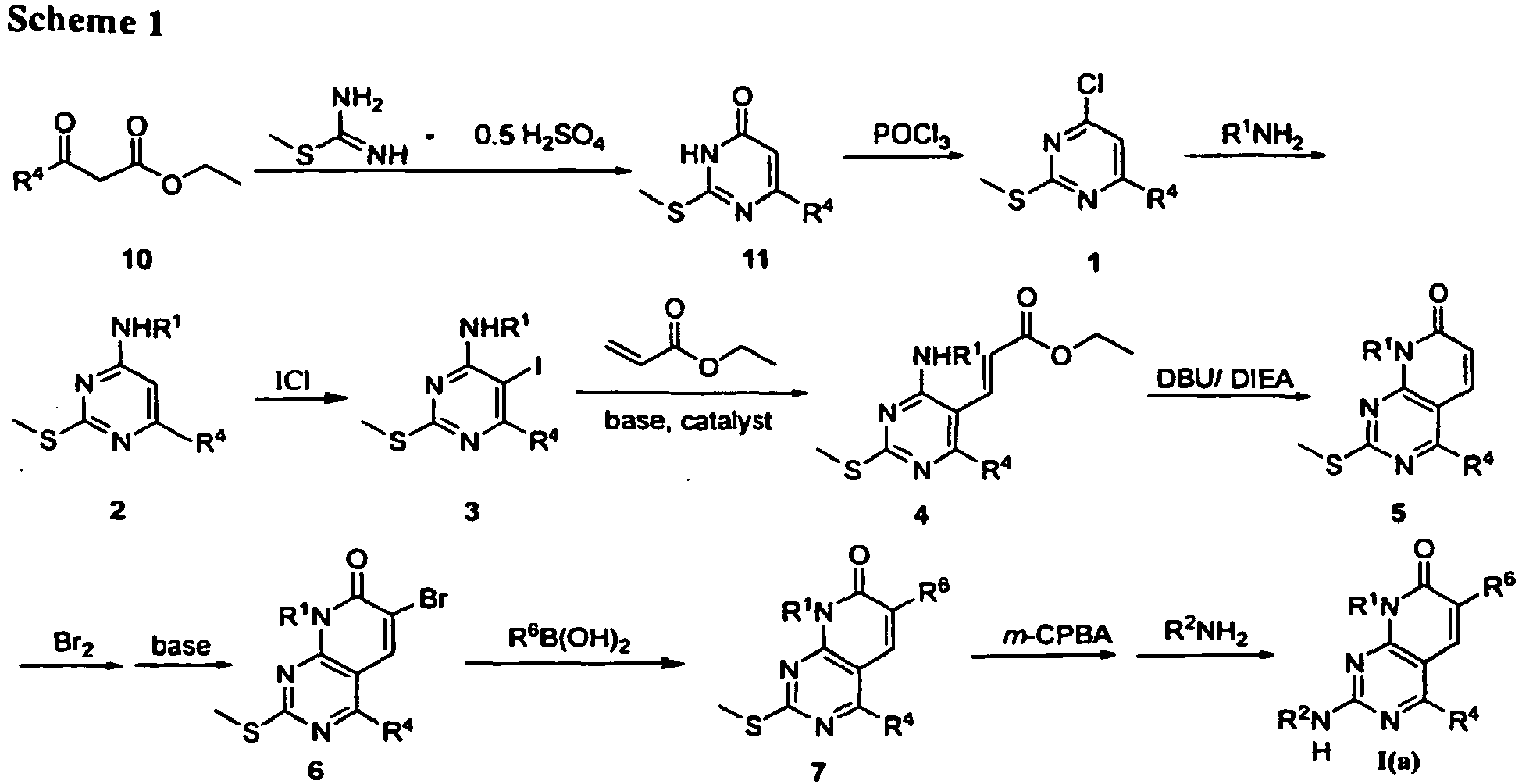
- To a solution of commercially available 2-methyl-2-thiopseudourea sulfate in a solvent such as water is added a base such as sodium carbonate and an intermediate of
formula 10 at room temperature. The reaction mixture is stirred for overnight or less. After neutralizing, 11 is collected through filtration and followed by drying under vacuum. 11 is then treated with POCl3 and the reaction is heated to reflux for approximately 2 h and then concentrated under vacuum to dryness. 1 can be used directly in the next reaction without further purification. - An intermediate of
formula 2 is prepared by reacting an intermediate offormula 1 with a primary amine R1NH2 in a solvent such as water and with heating. 2 is then treated with iodine monochloride in a solvent such as methanol at around 0°C and allowed to react for approximately overnight or less as needed for the reaction to go to completion to form 3. After completion the residue is triturated with acetone. The intermediate 3 is then reacted in a solvent, such as DMA, with ethyl acrylate in the presence of a base, such as triethylamine, and in the presence of a catalyst, such as Pd(OAc)2, and (+)BINAP. The reaction is heated to approximately 100°C and allowed to react for approximately overnight or less as needed for the reaction to go to completion to form 4. 4 is then optionally purified by column chromatography. - 5 is prepared by treating 4 with DBU in the presence of a base such as DIPEA at room temperature. Then the reaction mixture is heated to reflux and reacted for approximately 15 h. After evaporation of solvent, the residue is triturated with acetone and collected by filtration to yield 5.
- 6 is prepared by reacting 5 with a brominating agent such as Br2 in a solvent such as DCM at room temperature. Then the reaction mixture is stirred for approximately overnight. The resulting product is filtered and then suspended in a solvent such as DCM and treated with a base such as triethylamine. The mixture is then washed with water and dried over a drying agent such as Na2SO4 to yield 6.
- A Suzuki coupling is then performed using 6 reacting with a boronic acid (or ester) of formula R6B(OH)2 in a solvent such as a DME-H2O mixture, in the presence of a catalyst such as Pd(dpppf) and a base such as triethylamine at room temperature. The reaction mixture is heated to reflux for approximately 4 h. After cooling to room temperature, the reaction mixture is partitioned with water and ethyl acetate. After separation, the organic layer is dried over a drying agent such as Na2SO4 to yield 7.
- The methylthio group of 7 is then oxidized with m-CPBA in a solvent such as DCM at room temperature allowing to stir for approximately 4 h. After removal of the solvent under reduced pressure, the product is treated with with an amine of formula R2NH2 in a solvent such as dioxane and stirred at room temperature for approximately overnight to yield a Compound of Formula I.
- Alternatively, a compound where R1 is optionally substituted alkyl, R4 is methyl or ethyl, R6 is phenyl or heteroaryl each of which is optionally substituted with 1, 2, 3, 4, or 5 R9 groups (as defined above), and R2 is hydrogen can be prepared according to
Scheme 2.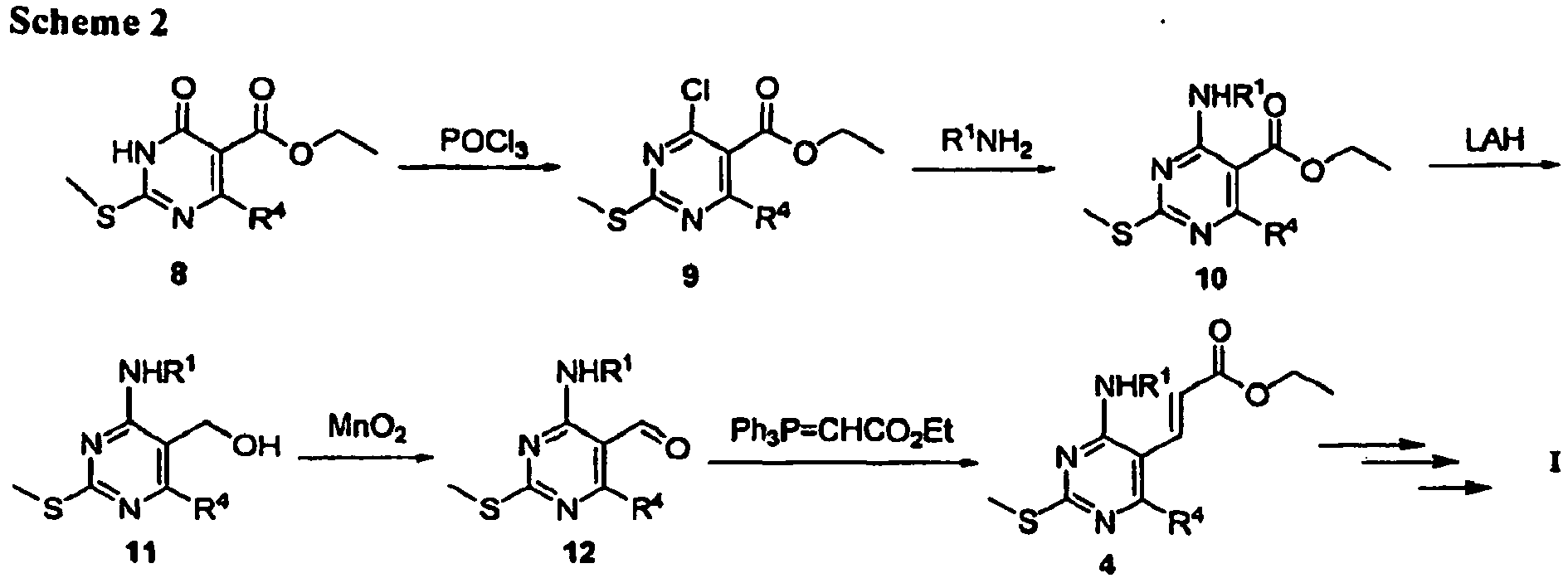
- An intermediate of
formula 9 is prepared by reacting an intermediate offormula 8 with neat POCl3 and heating. 9 is then treated with a primary amine R1NH2 in a solvent such as water or THF and triethylamine at 0 °C to form 10. After removal of the solvent under reduced pressure, the intermediate 10 is then reacted with lithium aluminum hydride in a solvent such as THF at 0 °C. After quenching and aqueous workup, solvent removal provided crystalline 11 without further purification. Treatment of 11 with manganese (II) dioxide in a solvent such as methylene chloride or chloroform at room temperature provided aldehyde 12 upon filtration and solvent removal. A Wittig reaction with aldehyde 12 can be employed with (carbethoxymethylene)triphenylphosphorane in refluxing THF to provide thecommon intermediate 4. 4 can then be used to prepare a Compounf of Formula I using the procedures described inScheme 1. - A compound where R1 is optionally substituted alkyl, R4 is methyl or ethyl, R6 is phenyl or heteroaryl each of which is optionally substituted with 1, 2, 3, 4, or 5 R9 groups (as defined in the Summary of the Invention), and R2 is hydrogen can be prepared according to
Scheme 3.
- An intermediate of
formula 14 is prepared by reacting an intermediate offormula 13 with a primary amine R1NH2 in a solvent such as water and with heating. 14 is then treated with iodine monochloride in a solvent such as methanol at around 0 °C and allowed to react for approximately overnight or less as needed for the reaction to go to completion to form 15. After completion the residue is triturated with acetone. The intermediate 15 is then reacted in a solvent, such as DMA, with ethyl acrylate in the presence of a base, such as triethylamine, and in the presence of a catalyst, such as Pd(OAc)2, and (+)BINAP. The reaction is heated to approximately 100°C and allowed to react for approximately overnight or less as needed for the reaction to go to completion to form 16. 16 is then optionally purified by column chromatography. A Compound of Formula I can then be prepared from 16 by using the same reaction conditions as described in Scheme 1 (starting at the point of the preparation of 5 from 4). - A compound where R1 is optionally substituted alkyl, R4 is methyl or ethyl, R6 is phenyl or heteroaryl each of which is optionally substituted with 1, 2, 3, 4, or 5 R9 groups (as defined in the Summary of the Invention), and R2 is hydrogen can alternatively be prepared according to
Scheme 4.
- An intermediate of
formula 20 is prepared by reacting an intermediate offormula 19 with neat POCl3 and heating. 20 is then treated with a primary amine R1NH2 in a solvent such as water or THF and triethylamine at 0 °C to form 21. After removal of the solvent under reduced pressure, the intermediate 21 is then reacted with lithium aluminum hydride in a solvent such as THF at 0 °C. After quenching and aqueous workup, solvent removal providedcrystalline 22 without further purification. Treatment of 22 with manganese (II) dioxide in a solvent such as methylene chloride or chloroform at room temperature providedaldehyde 23 upon filtration and solvent removal. A Knovenegal-type condensation with 23 and an arylacetonitrile in the presence of a base such as potassium carbonate or sodium hydroxide in a protic solvent provides the cyclized imine 24. Acetylation of the imine with acetic anhydride is required prior to hydrolysis which takes place in the presence of aqueous acid and heating to afford 25. Subsequently, 25 can be oxidized to the corresponding sulfone with m-CPBA at room temperature and displaced with ammonium to provide I. -

- To a solution of 2-methyl-2-thiopseudourea sulfate (Aldrich, 58.74 g, 0.422 mol) in water (1000 mL) were added sodium carbonate (81.44 g, 0.768 mol) and ethyl acetoacetate (50 g, 0.384 mol) at room temperature. The reaction mixture was stirred overnight. After neutralizing to pH = 8, the solid was collected through filtration followed by drying under vacuum overnight to afford 6-methyl-2-(methylthio)pyrimidin-4(3H)-one (57.2 g, 95% yield) of product. 1H NMR (400 MHz, DMSO-d6): δ 12.47 (bs, 1H), 5.96 (bs, 1H), 2.47(s, 3H), 2.17 (s, 3H).

- To the round bottom flask containing 6-methyl-2-(methylthio)pyrimidin-4(3H)-one (19 g, 121.6 mmol) was added POCl3 (30 mL). The reaction mixture was heated to reflux for 2 h and then concentrated on a rotary evaporator to dryness. The crude 4-chloro-6-methyl-2-(methylthio)pyrimidine was used directly in the next reaction without further purification.

- To the 4-chloro-6-methyl-2-(methylthio)pyrimidine from above was added 30 mL of a solution of 70% ethylamine in water. The reaction mixture was heated to 50 °C for 3 h. After completion, excess ethylamine was evaporated on rotary evaporator under vacuum. The solid was filtered and dried under vacuum to afford N-ethyl-6-methyl-2-(methylthio)pyrimidin-4-amine (20 g, 90% yield).

- To the solution of N-ethyl-6-methyl-2-(methylthio)pyrimidin-4-amine (20 g, 121.6 mmol) in methanol was added iodine monochloride (26.58 g, 163.7 mmol) in small portions at 0 °C. Then the reaction mixture was stirred overnight. After evaporation of solvent, the residue was triturated with acetone. The product N-ethyl-5-iodo-6-methyl-2-(methylthio)pyrimin-4-amine (25.2 g, 75% yield) was collected by filtration. 1H NMR (400 MHz, CDCl3): δ 5.37 (bs, 1H), 3.52 (q, J = 7.2 Hz, 1H), 2.50 (s, 3H), 1.26 (t, J = 7.2 Hz, 3H).

- To the solution of N-ethyl-5-iodo-6-methyl-2-(methylthio)pyrimin-4-amine (25.2 g, 81.48 mmol) in DMA (260 mL) were added ethyl acrylate (12.23 g, 122.2 mmol), Pd(OAc)2 (3.65 g, 16.25 mmol), (+)BINAP and triethyl amine (24.68 g, 244.4 mmol). Then the reaction mixture was heated to 100°C and reacted overnight. After evaporation of solvent, the residue was diluted with water and the aqueous layer was extracted with ethyl acetate. The product (E)-ethyl-3-(4-(ethylamino)-6-methyl-2-(methylthio)pyrimidin-5-yl)acrylate (16.8 g, 73% yield) was isolated by silica gel column chromatography with 6-8% ethyl acetate in hexane as eluent. 1H NMR (400 MHz, CDCl3): δ 7.65 (d, J = 16.4Hz, 1H), 6.20 (d, J = 16.4Hz, 1H), 5.15 (bs, 1H), 4.28(q, J = 7.2 Hz, 2H), 3.54 (q, J = 7.2 Hz, 2H), 2.53 (s, 3H), 2.37 (s, 3H), 1.35 (t, J = 7.2 Hz, 3H), 1.24 (t, J = 7.2 Hz, 3H).

- To a solution of (E)-ethyl-3-(4-(ethylamino)-6-methyl-2-(methylthio)pyrimidin-5-yl)acrylate (16.8 g, 59.8 mmol) in DIPEA was added 1,8-diazabicyclo[5.4.0]undec-7-ene (DBU, 18.21 g, 119.6 mmol) at room temperature. Then the reaction mixture was heated to reflux and reacted for 15 h. After evaporation of solvent, the residue was triturated with acetone. The product 8-ethyl-4-methyl-2-(methylthio)pyrido[2,3-d]pyrimidin-7(8H)-one (10.77 g, 77% yield) was collected by filtration. 1H NMR (400 MHz, CDCl3): δ 7.78 (d, J = 9.6 Hz, I H), 6.63 (d, J = 9.6 Hz, 1H), 4.5(q, J = 7.2 Hz, 2H), 2.67 (s, 3H), 2.62 (s, 3H), 1.33 (t, J = 7.2 Hz, 3H).
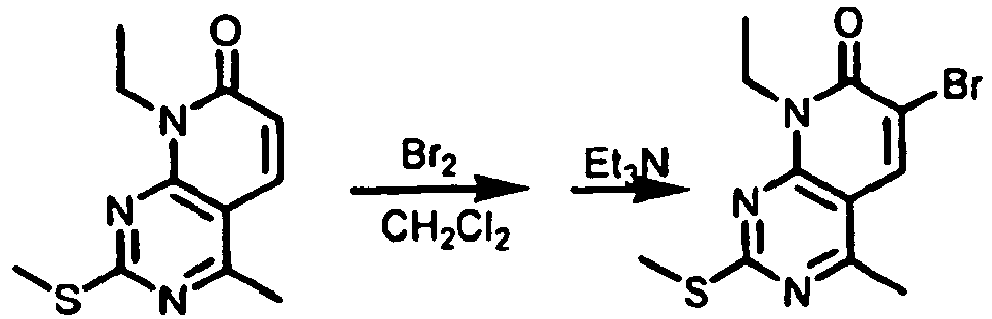
- To a solution of 8-ethyl-4-methyl-2-(methylthio)pyrido[2,3-d]pyrimidin-7(8H)-one (6.31 g, 26.84 mmol) in DCM was added Br2 (4.79 g, 29.52 mmol) dropwise at room temperature. Then the reaction mixture was stirred at room temperature overnight. After filtration the solid was suspended in DCM (100 mL), and triethylamine (20 mL) was added. The mixture was washed with water and dried with Na2SO4, and the product 6-bromo-8-ethyl-4-methyl-2-(methylthio)pyrido[2,3-d]pyrimidin-7(8H)-one (6.96 g, 83 % yield) was obtained after evaporation of DCM. 1H NMR (400 MHz, CDCl3): δ 8.22 (s, 1H), 4.56 (q, J = 7.2 Hz, 2H), 2.68 (s, 3H), 2.62 (s, 3H), 1.34 (t, J = 7.2Hz, 3H).

- To a solution of 6-bromo-8-ethyl-4-methyl-2-(methylthio)pyrido[2,3-d]pyrimidin-7(8H)-one (0.765 g, 2.43 mmol) in DME-H2O (10:1 11 mL) was added I H-pyrazol-5-ylboronic acid (Frontier, 0.408 g, 3.65 mmol), [1,1'-bis(diphenylphosphino)ferrocene]dichloropalladium(II) complex with CH2Cl2 (Pd(dpppf),0.198 g, 0.243 mmol) and triethylamine (0.736 g, 7.29 mmol) at room temperature. Then the reaction mixture was heated to reflux and reacted for 4 h. After cooling down to room temperature, the reaction mixture was partitioned with water and ethyl acetate. After separation, the organic layer was dried with Na2SO4, and the product 8-ethyl-4-methyl-2-(methylthio)-6-(1H-pyrazol-5-yl)pyrido[2,3-d]pyrimidin-7(8H)-one (0.567 g, 77% yield) was obtained by silica gel column chromatography. 1H NMR (400 MHz, CDCl3): δ 13.3 (bs, 1H), 8.54 (s, 1H), 7.82-7.07 (m, 2H), 4.45 (q, J = 7.2 Hz, 2H), 2.71 (s, 3H), 2.60 (s, 3H), 1.26 (t, J = 7.2Hz, 3H).

- To the solution of 8-ethyl-4-methyl-2-(methylthio)-6-(1H-pyrazol-5-yl)pyrido[2,3-d]pyrimidin-7(8H)-one (0.123 g, 0.41 mmol) in DCM (2 mL) was added MCPBA (0.176 g, 77%, 0.785 mmol) in a small portion at room temperature. Then the reaction mixture was stirred for 4 h. After evaporation of DCM, dioxane (1 mL) and liquid ammonia (1 mL) were introduced. The reaction was stirred at room temperature overnight. The product 2-amino-8-ethyl-4-methyl-6-(1H-pyrazol-5-yl)pyrido[2,3-d]pyrimidin-7(8H)-one (50.4 mg) was obtained by silica gel column chromatography. 1H NMR (400 MHz, CD3OD): δ 8.41 (s, 1H), 7.62 (d, J = 2.0 Hz, 1H), 6.96 (d, J = 2.0Hz, 1H), 4.51 (q, J = 7.2Hz, 2H), 2.64 (s, 3H), 1.29 (t, J = 7.2Hz, 3H); MS (EI) for C13H14N6O: 271.3 (MH+).
- Using the same or analogous synthetic techniques and substituting with appropriate reagents, the following compounds were prepared:
- Example 1a. 2-(amino)-8-ethyl-4-ethyl-6-(1H-pyrazol-5-yl)pyrido[2,3-d]pyrimidin-7(8H)-one: 1H NMR (400 MHz, DMSO-D6): δ 8.40 (s, 1H), 7.27 (bs, 1H), 7.00 (s, 1H), 4.40 (q, J = 7.2 Hz, 2H), 2.95 (d, J = 7.20 Hz, 2H), 1.14 (t, J = 7.2 Hz, 3H), 1.08 (t, J = 7.2Hz, 3H), 0.89 (m, 1H), 0.24 (m, 2H), 0.01 (m, 2H); MS (EI) for C14H16N6O: 285.2 (MH+).
- Example 1b. 8-ethyl-4-methyl-2-(methylamino)-6-(1H-pyrazol-5-yl)pyrido[2,3-d]pyrimidin-7(8H)-one: 1H NMR (400 MHz, CH3OH-d4 ): δ 8.39 (s, 1H), 7.60 (bs, 1H), 6.93 (bs, 1H), 4.53 (bs, 2H), 3.02 (s, 3H), 2.84 (bs, 3H), 1.33 (bs, 3H); MS (EI) for C14H16N6O: 285.3 (MH+).
- Example 1c. 8-Ethyl-2-[(2-fluoroethyl)amino]4-methyl-6-(1H-pyrazol-5-yl)pyrido[2,3-d]pyrimidin-7(8H)-one: 1H NMR (400 MHz, CH3OH-d4 ): δ 8.34 (bs, 1H), 7.25 (bs, 1H), 6.90 (bs, 1H), 4.60 (dt, J = 5.2, 2.2 Hz, 2H), 4.49 (q, J = 7.20 Hz, 2H), 3.78 (dt, J= 5.2, 2.2 Hz, 2H), 2.64 (s, 3H), 1.30 (t, J = 7.2 Hz, 3H); MS (EI) for C15H17FN6O: 317.3 (MH+).
- Example 1d. 2-Amino-8-cyclopentyl-4-methyl-6-(1H-pyrazol-3-yl)pyrido[2,3-d]pyrimidin-7(8H)-one: 1H NMR (400 MHz, DMSO-d6 ): δ 13.10 (s, 1H), 8.42 (d, 1H), 7.70 (s, 1H), 7.20 (bs, 2H), 6.01 (m, 1H), 2.61 (s, 3H), 2.30 (m, 2H), 2.10 (m, 2H), 1.80 (m, 2H), 1.60 (m, 2H); MS (EI) for C16H18N6O: 311.8 (M+H).
-

- N,N-Dimethyl acetamide dimethyl acetal (75 g, 0.56 mole) was added to a suspension of thiourea (33.0 g, 0.43 mole) in methylene chloride. The mixture was heated under reflux for 4 h. The solvent was removed and the residue was crystallized from 5% MeOH and diethyl ether affording (1E)-N'-(aminocarbonothioyl)-N,N-dimethylethanimidamide (47.8 g, 76% yield).

- A suspension of (1E)-N'-(aminocarbonothioyl)-N,N-dimethylethanimidamide (47.8 g, 0.33 mole) in methyl iodide (150 mL) and THF (350 mL) was stirred for 18 h at room temperature. The mixture was evaporated under reduced pressure. After addition of 5% MeOH and diethyl ether, the compound precipitated and was collected by filtration affording (1E)-N'-[amino(methylthio)methyl]-N,N-dimethylethanimidamide hydrogen iodide salt (91.0 g, 96% yield).

- To a solution of (1E)-N'-[amino(methylthio)methyl]-N,N-dimethylethanimidamide hydrogen iodide salt (73.0 g, 0.26 mole) in dry dichloromethane (900 mL), was added ethyl 3-chloro-3-oxopropanoate (44 mL, 95% Lancaster, 0.34 mole) was added under a nitrogen atmosphere. The mixture was stirred for 4 h at room temperature, cooled to 0 °C then triethylamine (107 mL, 0.78 mole) was added. The reaction mixture was stirred overnight. The solvent was removed and H2O was added. The pH was adjusted to pH = 5.0 with acetic acid and extracted with ethylacetate then evaporated and crystallized from the appropriate solvent (Ethylacetate-Hexanes mixture solvent, approximately 20% ethylacetate-Hexanes). This afforded ethyl 4-methyl-2-(methylthio)-6-oxo-1,6-dihydropyrimidine-5-carboxylate (36.5 g, 62% yield) after drying under vacuum.

- A solution of ethyl 4-methyl-2-(methylthio)-6-oxo-1,6-dihydropyrimidine-5-carboxylate (60 g, 0.26 mole) and phosphorous oxychloride (POCl3, 320 mL) was heated under reflux for 4 to 5 h (monitor reaction by TLC using 30% ethylacetate and hexanes). After completion of reaction, phosphorous oxychloride was removed on a rotary evaporator. The residue was poured on to ice water and extracted with ethylacetate several times. The combined organic layers were evaporated, on a rotary evaporator, to give crude ethyl 4-chloro-6-methyl-2-(methylthio)pyrimidine-5-carboxylate (65 g). This compound was used without purification.

- To a solution of ethyl 4-chloro-6-methyl-2-(methylthio)pyrimidine-5-carboxylate (65 g) in THF (1000 mL) and triethylamine (110 mL, 0.81 mole) was added ethylamine (2.0 M in THF, 0.81 mole) at 0 °C. This reaction mixture was stirred at room temperature overnight and then solvents were removed on a rotary evaporator. H2O was added and the mixture extracted with ethyl acetate several times. Solvents from the combined organic layers were removed on a rotary evaporator affording 58 g (86% yield) of ethyl 4-(ethylamino)-6-methyl-2-(methylthio)pyrimidine-5-carboxylate. This material was used as such without further purification.

- To a lithium aluminum hydride solution (LAH, 1.0 M solution in THF, Aldrich, 450 mL) was added a solution of ethyl 4-(ethylamino)-6-methyl-2-(methylthio)pyrimidine-5-carboxylate (57 g) in THF (1000 mL). The reaction mixture was stirred overnight. After cooling to 0°C, the reaction mixture was cautiously quenched with a 1:9 mixture of H2O/THF until gas evolution has ceased, then diluted with H2O (500 mL) and stirred well for 2 h. The resulting slurry was extracted with ethylacetate several times. The aqueous layer was then filtered through Celite and washed with ethylacetate again. The combined organic layers were washed with brine, dried and concentrated under reduced pressure to give 41.0 g (85% yield) of [4-(ethylamino)-6-methyl-2-(methylthio)pyrimidin-5-yl]methanol as a light yellow crystal, which was used without purification in the next step.

- To a solution of [4-(ethylamino)-6-methyl-2-(methylthio)pyrimidin-5-yl]methanol (41.0 g) in chloroform (4000 mL) was added manganese oxide (125 g, 1.4 mole) and stirred for 4 h at room temperature. More manganese oxide was added until the disappearance of alcohol compound was observed. The reaction mixture was filtered through Celite and washed with some chloroform and evaporated all organic solvents to give 38 g (92 % yield) of 4-(ethylamino)-6-methyl-2-(methylthio)pyrimidine-5-carbaldehyde as a colorless solid, which was used without purification in the next step.

- To a solution of 4-(ethylamino)-6-methyl-2-(methylthio)pyrimidine-5-carbaldehyde (38 g, 180 mmol) in THF (500 mL) was added (Carbethoxymethylene) triphenylphosphorane (95%, Aldrich, 85.18 g, 244 mmol). The reaction mixture was heated to reflux for 1.5 h and was monitered by TLC (4:1 hexanes/ethylacetate). The reaction was cooled to room temperature and was concentrated on a rotary evaporator. It was directly subjected to column chromatography (4:1 hexanes/ethylacetate) to give (E)-ethyl-3-(4-(ethylamino)-6-methyl-2-(methylthio)pyrimidin-5-yl)acrylate as a white crystal, 46.14 g (91% yield).
-

- To a 3-necked 3-L flask, that was equipped with an overhead stirrer, was added in order 2-amino-4-chloro-6-methylpyrimidine (Aldrich, 100 g, 0.696 mol, 1 equiv.), ethylamine (70% ethylamine in water, Lancaster, 625 mL), 625 mL H2O, and 125 mL TEA (0.889 mol, 1.28 equiv.). The mixture was stirred and heated at reflux for 20 h, during which time the reaction turned homogeneous. The reaction was allowed to cool to room temperature. The volatile ethylamine was removed on a rotary evaporator. A precipitate formed. The aqueous mixture containing the precipitate was allowed to stand at room temperature for 2 h and then filtered. After drying under vacuum, 106 g (100% yield) of 2-amino-6-ethylaminopyrimidine was obtained as a colorless solid. This material was used as such in the following reaction.

- To a solution of 2-amino-6-ethylaminopyrimidine (98 g, 0.64 mol) in methanol (1.6 L) was added ICI (115.0 g, 0.71 mol) in a small portion at 15 °C. Then the reaction mixture was stirred at room temperature for 3 h (monitored by LC/MS). After evaporation of solvent by rotary evaporator, the residue was triturated with acetone. 2-amino-6-ethylamino-4-iodopyrimidine hydrochloride (188.5 g, 93% isolated yield) was obtained by vacuum filtration and drying. 1H NMR (400 MHz, CD3OD) δ 3.58 (q, 2H), 2.14 (s, 3H), 1.11 (t, 3H); MS (EI) for C7H11N4CII: 279.1 (MH+).

- To a three-neck round bottom flask equipped with over-head mechanic stirrer were added 2-amino-6-ethylamino-4-iodopyrimidine hydrochloride (188.5 g, 0.60 mol), ethyl acrylate (221 mL, 2.0 mol), triethylamine (285 mL, 2.0 mol), DMF (1.3 L), and tetrakis(triphenylphosphine)palladium(0) (Pd(PPh3)4, 31.3 g, 0.027 mol). The reaction mixture was heated to 95°C and stirred for 3 h (monitored by LC/MC). After reaction completion, the reaction mixture was evaporated about to 1/10 of original volume and partitioned with 500 mL of ethyl acetate and 1000 mL of water. The aqueous layer was extracted with
ethyl acetate 5 times. (E)-Ethyl 3-(2-amino-4-(ethylamino)-6-methylpyrimidin-5-yl)acrylate (100 g, 67% yield) was obtained by recrystalization from acetone after evaporation of ethyl acetate. 1H NMR (400 MHz, CD3OD) δ 7.48 (dd, J1 = 16.0 Hz, J2 = 4.0 Hz, 1H), 6.20 (dd, J1 = 16 Hz, J2 = 4 Hz, I H), 4.25 (q, J = 7.2 Hz, 2H), 3.51 (q, J = 7.6 Hz, 2H), 2.39 (s, 3H), 1.3 (t, J = 7.2 Hz, 3H), 1.2 (t, J = 7.6 Hz, 3H). MS (EI) for C12H18N4O2: 251.3 (MH+).
- (E)-Ethyl 3-(2-amino-4-(ethylamino)-6-methylpyrimidin-5-yl)acrylate (4.50 g, 18.0 mmol) was added to DBU (10.95 g, 4.0 equiv.) and the mixture was heated to 165°C and stirred for 24 h. After that, the mixture was cooled to 70°C followed by the addition of H2O (20 mL) to precipitate crystal and stirred for 1 h at room temperature. The crystal was collected and washed with H2O and acetone and dried under vacuum to afford 2.70 g (73.5% yield of 2-amino-8-ethyl-4-methylpyrido[2,3-d]pyrimidin-7(8H)-one as a light yellowish brown solid. LC/MS: Calculated for C10H12N4O (204.2). Found: 205.31 (M+1); HPLC analytical purity: 98.5%. 1H NMR (400 MHz, DMSO-d6 ): δ 7.9 (d, 1H), 7.20 (bs, 2H), 6.20 (m, 1H), 4.20 (q, 2H), 2.50 (s, 3H), 1.20 (t, 3H); MS (EI) for C10H12N4O: 205.11 (MH+).
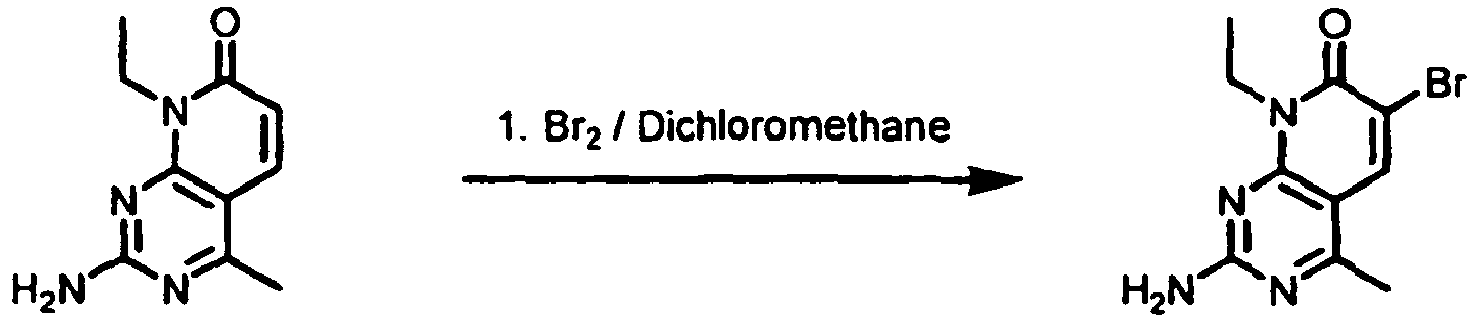
- 2-Amino-8-ethyl-4-methylpyrido[2,3-d]pyrimidin-7(8H)-one (2.70 g, 13.2 mmol) was added to dichloromethane (100 mL), and then bromine (0.75 mL, 1.10 equiv.) was added slowly. This reaction mixture was stirred for 3 h at room temperature. After that, the solvent was evaporated nearly 80% volume of reaction mixture under vacuum, and then acetone was added to give 3.54 g 2-Amino-6-bromo-8-ethyl-4-methylpyrido[2,3-d]pyrimidin-7(8H)-one as a tan solid. LC/MS: Calculated for C10H11BrN4O (283.12). Found: 285.15 (M+2). HPLC analytical purity: 97.7%.
-

- To a crude solution of N-isopropyl-6-methyl-2-(methylthio)pyrimidin-4-amine (44.6 g, 224 mmol), prepared using analogous procedures as described in Example 1, in 400 mL of methanol was added ICI (40.0 g, 246 mmol) in small portions at room temperature. The reaction mixture was then stirred at for 3 h monitoring by LC/MS. After evaporation of solvent by rotary evaporator, the residue was triturated with acetone to yield 5-iodo-N-isopropyl-6-methyl-2-(methylthio)pyrimidin-4-amine. 1H NMR (400 MHz, CDCl3) δ 6.37 (br m, 1H), 4.47 (m, 1H), 2.78 (s, 3H), 2.67 (s, 3H), 1.41 (d, J = 6.4, 6H).

- 5-Iodo-N-isopropyl-6-methyl-2-(methylthio)pyrimidin-4-amine (8.1 g, 26.2 mmol), ethyl acrylate (5.24 g, 52.4 mmol), triethylamine (10.6 g, 105 mmol), palladium (II) acetate (1.17 g, 5.23 mmol), and tri-o-tolyl phosphine (1.59 g, 5.23 mmol) were added in that order to 10.8 mL of DMA in a pressure tube and sealed. The reaction mixture was heated to 100°C and allowed to stir overnight. The reaction was quenched by filtration through a short silica plug washing with ACN. The solvent was evaporated and diluted with ethyl acetate then extracted with 10 % aqueous LiCl, followed by water and brine. NOTE: Extraction is necessary to remove all DMA giving resolution in chromatography. The sample was purified by silica gel column chromatography using 20 % ethyl acetate/hexane as eluent. Desired fractions were combined and reduced to afford 2.5 g (34 % yield) of ethyl (2E)-3-[4-(isopropylamino)-6-methyl-2-(methylthio)pyrimidin-5-yl]acrylate as a yellow/orange oil.

- (E)-Ethyl 3-(4-(isopropylamino)-6-methyl-2-(methylthio)pyrimidin-5-yl)acrylate (2.5 g, 8.46 mmol) was dissolved in acetic acid by gentle warming. Sample was placed in microwave reactor for 6 h at 180°C, 300 W, and 200 PSI. The product was purified by silica gel column chromatography eluting with 20 % ethyl acetate/hexane. Desired fractions were combined and reduced into 8-isopropyl-4-methyl-2-(methylthio)pyrido[2,3-d]pyrimidin-7(8H)-one as a yellow powder (1.20 g, 57 % yield) which was then dried under heavy vacuum overnight. 1H NMR (400MHz, CDCl3) δ 7.74 (d, J = 9.6, 1H), 6.58 (d, J = 9.6, 1H), 5.84 (br s, 1H), 2.65 (s, 3H), 2.63 (s, 3H), 1.63 (d, J = 6.8, 6H).
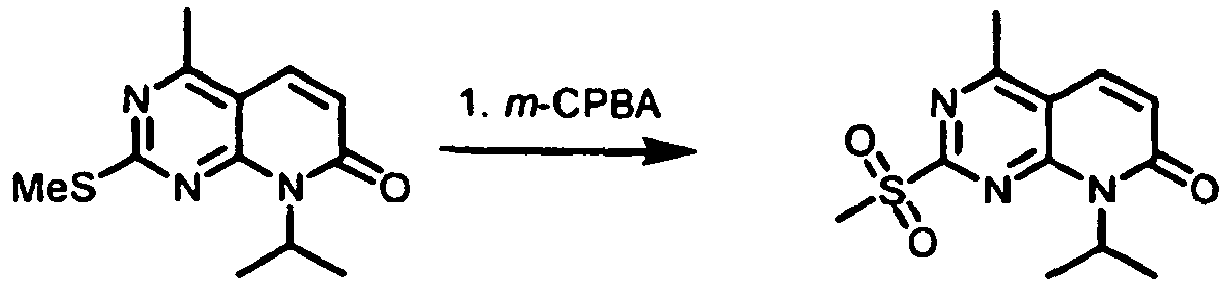
- 8-Isopropyl-4-methyl-2-(methylthio)pyrido[2,3-d]pyrimidin-7(8H)-one (5.38 g, 21.59 mmol) was dissolved in 100 mL DCM. To the stirring solution, m-CPBA (13.97 g, 64.78 mmol) was added. The reaction was allowed to stir for 2.5 h at room temperature. LCMS indicated reaction had gone to completion. Sample was diluted with 300 mL of DCM and 300 mL K2CO3, upon addition of base a white precipitate formed that dissolved in excess H2O. Organic layer was extracted further with H2O and brine, and then dried over Na2CO3. The solvent was evaporated to afford the product8-isopropyl-4-methyl-2-(methylsulfonyl)pyrido[2,3-d]pyrimidin-7(8H)-one (6.0 g, 99 % yield) as a light yellow oil that was used immediately in the next reaction.

- 8-isopropyl-4-methyl-2-(methylsulfonyl)pyrido[2,3-d]pyrimidin-7(8H)-one (approximately 3.0 g) was dissolved in 50 mL THF, in a 350 mL pressure tube. While stirring, NH3 (g) was bubbled in through solution for 1.5 minutes. A color change was observed form light yellow to olive green in about 120 seconds. The tube was sealed and stirred at room temperature overnight. A precipitate had formed. The reaction mixture, including precipitate, was reduced to near dryness, filtered and washed with a minimal volume of cold THF, affording 2.88 g of 2-amino-8-isopropyl-4-methylpyrido[2,3-d]pyrimidin-7(8H)-one.

- To a solution of 2-amino-8-isopropyl-4-methylpyrido[2,3-d]pyrimidin-7(8H)-one (2.88 g, 13.19 mmol) dissolved in 80 mL of DCM at 0 °C, (4.21 g, 26.39 mmol) bromine was added. Reaction vessel was removed from ice bath and allowed to react at room temperature over night. LCMS indicated complete conversion of starting material to product. Sample was evaporated to remove DCM and excess bromine. Orange solid was diluted in ethyl acetate and extracted with 10 % NaHSO3, H2O, and brine. Organic layer was dried over Na2SO4, filtered, and reduced to dryness yielding 2-amino-6-bromo-8-isopropyl-4-methylpyrido[2,3-d]pyrimidin-7(8H)-one as a light yellow powder (2.2 g, 56% yield). 1H NMR (400MHz, CDCl3) δ 8.08 (s, 1 H), 5.83 (m, I H), 5.69 (br s, 2H), 2.60 (s, 3H), 1.58 (d, J = 6.8, 6H).
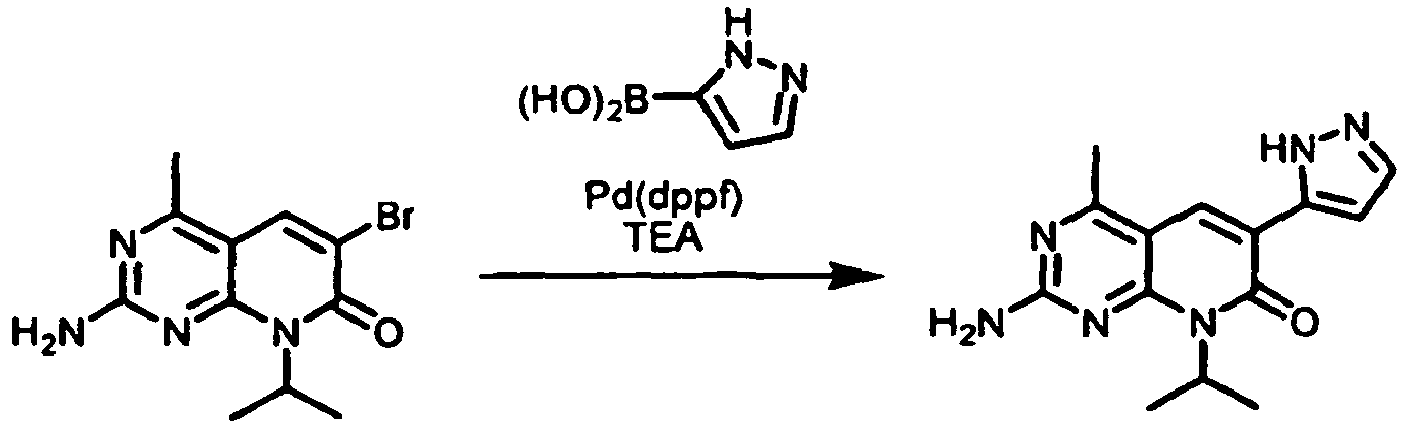
- In a 350 mL pressure tube 2-amino-6-bromo-8-isopropyl-4-methylpyrido[2,3-d]pyrimidin-7(8H)-one (1.50 g, 5.05 mmol), 1H-pyrazol-3-yl boronic acid (1.12 g, 10.09 mmol), K2CO3 (336 mg, 15.1 mmol), and tetrakis(triphenylphosphine) palladium (0) (583 mg, 0.0504 mmol) were dissolved in 50 mL dioxane and 5 mL H2O. The tube was sealed, heated to 100°C and allowed to react overnight. A color change was observed. LCMS indicated no presence of starting material. Sample was filtered through a syringe filter and evaporated to dryness. Compound was dissolved in ethyl acetate and triturated in hexane. Light yellow powder of 2-amino-8-isopropyl-4-methyl-6-(1H-pyrazol-5-yl)pyrido[2,3-d]pyrimidin-7(8H)-one (195 mg, 13.7% yield) was found to be 98% pure by HPLC. 1H NMR (400MHz, CDCl3) δ 12.97 (br s, I H), 8.35 (s, I H), 7.60 (br s, 1H), 7.21 (s, 2H), 6.94 (s, I H), 5.86 (br s, 1H), 2.50 (m, 6H), 1.54 (s, 3H), MS (EI) for C14H16N6O: 285.0 (MH+).
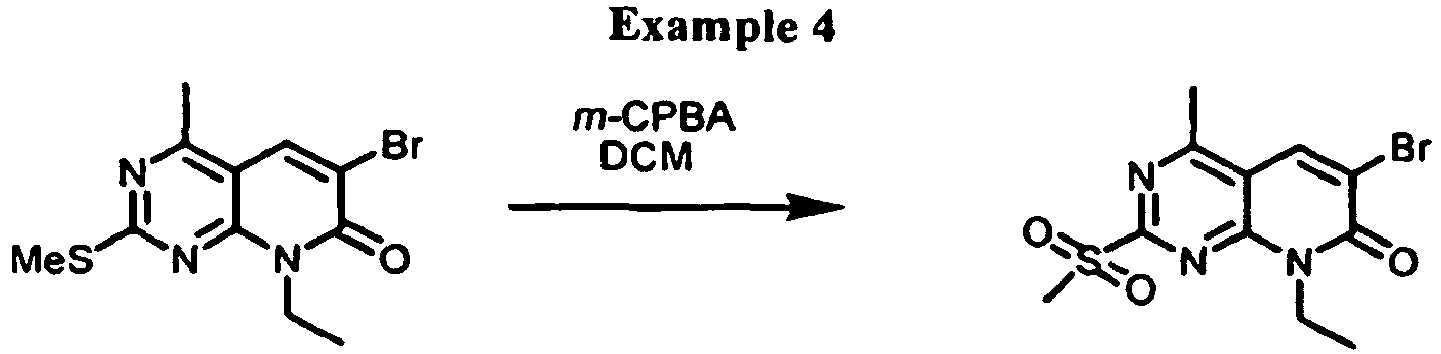
- 3-Chloroperbenzoic acid (0.565 g, 3.27 mmol) was added to a solution of 6-bromo-8-ethyl-4-methyl-2-(methylthio)pyrido[2,3-d]pyrimidin-7(8H)-one (0.308 g, 0.980 mmol) in dichloromethane (5.0 mL) at room temperature. After 30 minutes, the reaction was diluted with dichloromethane (50 mL) and washed twice with saturated NaHCO3, followed by brine. The organic phase was separated and dried over Na2SO4, filtered, and concentrated in vacuo. The residue was precipitated with ethyl acetate to provide 8-ethyl-4-methyl-2-(methylsulfonyl)pyrido[2,3-d]pyrimidin-7(8H)-one (302 mg, 89 % yield) as a yellow solid.

- To a stirred solution of (76.5 mg, 0.221 mmol) in 1.5 mL of CH2Cl2 was added isopropyl amine (709.9 mg, 12.0 mmol, 54 eq.) The reaction was stirred for 15 h at room temperature. The reaction was diluted with CH2Cl2 and extracted with 2N NaOH, H2O, and brine. The organic layer was dried over Na2SO4, filtered and concentrated. The crude material was purified using preparative HPLC. Lyophillization of the product containing fractions affored 19.9 mg (27.6 %yield) of 6-bromo-8-ethyl-2-(isopropylamino)-4-methylpyrido[2,3-d]pyrimidin-7(8H)-one: 1H NMR (400 MHz, CDCl3): δ 8.08 (s, 1H), 5.30 (bs, 1H), 4.48 (bd, 2H), 4.18 (bs, 1H), 2.52 (s, 3H), 1.62 (bs, 3H), 1.29 (m, 9H), MS (EI) for C13H17BrN4O: 325.2 (MH+).
- Using the same or analogous synthetic techniques and substituting with appropriate reagents, the following compounds were prepared:
- Example 4b. 6-bromo-2-(tert-butylamino)-8-ethyl-4-methylpyrido[2,3-d]pyrimidin-7(8H)-one: 1H NMR (400 MHz, CDCl3): δ 8.08 (s, 1H), 5.47 (bs, 1H), 4.48 (m, 2H), 2.50 (s, 3H), 1.58 (bs, 3H), 1.49 (s, 9H), MS (EI) for C14H19BrN4O: 339.2 (MH+)
- Example 4c. 6-Bromo-2-(cyclopentylamino)-8-ethyl-4-methylpyrido[2,3-d]pyrimidin-7(8H)-one: 1H NMR (400 MHz, CDCl3): δ 8.07 (s, 1H), 5.89 (bs, 1H), 4.49 (bd, 2H), 2.51 (s, 3H), 2.07 (m, 2H), 1.71 (m, 2H), 1.58 (m, 2H), 1.31 (t, 3H), MS (EI) for C15H19BrN4O:351.2 (MH+) Example 4d. 6-Bromo-2-(cyclohexylamino)-8-ethyl-4-methylpyrido[2,3-d]pyrimidin-7(8H)-one: 1H NMR (400 MHz, CDCl3): δ 8.07 (s, 1H), 5.41 (bs, 1H), 4.47 (bd, 2H), 3.84 (bs, 1H), 2.51 (s, 3H), 2.05 (d, J = 12.4 Hz, 2H), 1.77 (m, 2H), 1.64 (br m, 4H), 1.39 (m, 2H), 1.30 (m, 3H), MS (EI) for C16H21BrN4O: 365.2 (MH+)
- Example 4e. 6-Bromo-8-ethyl-4-methyl-2-(2-morpholinoethylamino)pyrido[2,3-d]pyrimidin-7(8H)-one: 1H NMR (400 MHz, CDCl3): δ 8.08 (s, 1H), 6.22 (bs, 1H), 4.48 (q, J = 6.4 Hz, 2H), 3.74 (t, J = 4.4 Hz, 1H), 3.57 (q, J = 4.8 Hz, 3H), 2.98 (bs, 2H), 2.63 (t, J = 6.0 Hz, 2H), 2.53 (s, 3H), 1.30 (t, J = 6.8 Hz, 2H), MS (EI) for C16H22BrN5O: 396.2 (MH+)
- Example 4f. 6-Bromo-8-ethyl-4-methyl-2-[(3-morpholino-4-ylpropyl)amino]pyrido[2,3-d]pyrimidin-7(8H)-one: 1H NMR (400 MHz, CDCl3): δ 8.07 (s, 1H), 6.23 (bs, 1H), 4.47 (bs, 1H), 3.75 (m, 4H), 3.57 (m, 2H), 2.52 (m, 4H), 2.48 (m, 2H), 1.82 (m, 2H), 1.28 (s, 3H), MS (EI) for C17H24BrN5O: 410.2 (MH+)
- Example 4g. 6-Bromo-2-{[3-(dimethylamino)propyl]amino}-8-ethyl-4-methylpyrido[2,3-d]pyrimidin-7(8H)-one: 1H NMR (400 MHz, CDCl3): δ 8.08 (s, 1H), 7.26 (bs, 1H), 4.47 (m, 2H), 3.54 (m, 2H), 2.78 (t, J = 7.6 Hz, 2H), 2.52 (s, 3H), 2.50 (s, 3H), 2.04 (s, 3H), 2.00 (m, 2H), 1.29 (t, J = 7.2 Hz, 3H), MS (EI) for C15H22BrN5O: 369.2 (MH+)
- Example 4h. 8-Ethyl-2-(ethylamino)-4-methylpyrido[2,3-d]pyrimidin-7(8H)-one: 1H NMR (400 MHz, CDCl3): δ 7.67 (d, J = 9.2 Hz, 1H), 6.39 (d, J = 9.2 Hz, 1H), 5.31 (bs, 1H), 2.54 (s, 3H), 4.32 (q, J = 6.8 Hz, 2H), 3.52 (q, J = 6.8 Hz, 2H), 2.53 (s, 3H), 1.15 (m, 6H); MS (EI) for C12H16N4O: 233.2 (MH+).
- Example 4j. 6-Bromo-2-{[2-(dimethylamino)ethyl]amino}-8-ethyl-4-methylpyrido[2,3-d]pyrimidin-7(8H)-one: 1H NMR (400 MHz, DMSO-d6 ): δ 8.37 (s, 1H), 7.83 (bt, J = 8.0 Hz, 1H), 4.34 (q, J = 8.0 Hz, 2H), 3.42 (q, J = 4.0 Hz, 2H), 2.51 (s, 3H), 2.45 (t, J = 4.0 Hz, 2H), 1.83 (s, 6H), 1.20 (t, J = 8.0 Hz, 3H); MS (EI) for C14H20BrN5O: 354.3 (M+).
- Example 4k. 6-bromo-2-(ethylamino)-4-methyl-8-(1-methylethyl)pyrido[2,3-d]pyrimidin-7(8H)-one: 1H NMR (400 MHz, CDCl3): δ 8.04 (s, 1H), 6.66 (bs, 1H), 5.83 (sept, J = 6.8 Hz, 1H), 3.54 (dq, J = 12.8, 7.6 Hz, 2H), 2.62 (s, 3H), 1.60 (d, J = 6.8 Hz, 6H), 1.34 (t, J = 7.2 Hz, 3H); MS (EI) for C13H17BrN4O: 324.9 (M+).
- Example 4m. 6-Bromo-8-ethyl-4-methyl-2-morpholiN-4-ylpyrido[2,3-d]pyrimidin-7(8H)-one: 1H NMR (400 MHz, CDCl3): δ 8.09 (s, 1H), 4.45 (q, J = 6.8 Hz, 2H), 3.92 (s, 3H), 3.79 (s, 3H), 2.55 (s, 3H), 1.30 (t, J = 6.8 Hz, 3H); MS (EI) for C14H17Br N4O2: 355.1 (M2H+).
- Example 4n. 6-Bromo-8-ethyl-4-methyl-2-[(phenylmethyl)amino]pyrido[2,3-d]pyrimidin-7(8H)-one: 1H NMR (400 MHz, CDCl3): δ 8.09 (s, 1H), 7.32 (m, 5H), 5.86 (bs, 1H), 4.68 (s, 2H), 4.43 (q, J = 7.2 Hz, 2H), 2.54 (s, 3H), 1.13 (t, J = 7.2 Hz, 3H); MS (EI) for C17H17BrN4O: 375.1 (M2H+). Example 4p. 6-Bromo-8-ethyl-2-(ethylamino)-4-methylpyrido[2,3-d]pyrimidin-7(8H)-one: 1H NMR (400 MHz, CDCl3): δ 8.09 (s, 1H), 5.71 (bs, 1H), 4.48 (bs, 2H), 3.54 (q, J = 6.8 Hz, 2H), 2.53 (s, 3H), 1.16 (m, 6H); MS (EI) for C12H15BrN4O: 311.9 (MH+).
-

- Pd(dppf) dichloromethane adduct (0.077 g, 0.095 mmol) was added to a suspension of 6-bromo-2-(ethylamino)-4-methyl-8-(1-methylethyl)pyrido[2,3-d]pyrimidin-7(8H)-one (0.154 g, 0.474 mmol), 2-thiophene boronic acid (0.079 g, 0.616 mmol), and triethylamine (165 µL, 1.19 mmol) in 10:1 DME: water (1.5 mL). The reaction was heated to 100°C. After 5 h, the reaction was cooled to room temperature, filtered though a Celite plug and concentrated in vacuo. The residue was purified on SiO2 (3:2 hexanes: ethyl acetate) to give 2-(ethylamino)-4-methyl-8-(1-methylethyl)-6-(2-thienyl)pyrido[2,3-d]pyrimidin-7(8H)-one (28 mg, 18 % yield) as a light yellow solid: 1H NMR (400 MHz, CDCl3): δ 8.06 (s, 1H), 7.60 (dd, J = 4.0, 1.2 Hz, 1H), 7.38 (dd, J = 5.2 , 0.8 Hz, 1H), 7.10 (dd, J = 4.8, 3.2 Hz, 1H), 5.93 (bsept, 1H), 5.13 (bs, 1H), 3.54 (pent, J = 7.2 Hz, 2H), 2.61 (s, 3H), 1.66 (d, J = 6.8 Hz, 6H), 1.28 (t, J = 7.6 Hz, 3H); MS (EI) for C17H20N4OS: 329.0 (MH+).
- Using the same or analogous synthetic techniques and substituting with appropriate reagents, the following compounds were prepared:
- Example 5a. 2-(Ethylamino)-6-furan-2-yl-4-methyl-8-(1-methylethyl)pyrido[2,3-d]pyrimidin-7(8H)-one: 1H NMR (400 MHZ, CDCL3): δ 8.43 (S, 1H), 7.81 (S, 1H), 7.47 (T, J = 2 HZ, 1H), 6.75 (DD, J = 2.0 , 0.8 HZ, 1H), 5.92 (BSEPT, 1H), 5.25 (BS, 1H), 3.53 (DQ, J = 12.5, 7.6 HZ, 2H), 2.60 (S, 3H), 1.65 (D, J = 6.8 HZ, 6H), 1.29 (T, J = 7.2 HZ, 3H); MS (EI) FOR C17H20N4O2: 313.1 (MH+).
- Example 5b. 2-(Ethylamino)-4-methyl-8-(1-methylethyl)-6-(1H-pyrazol-3-yl)pyrido[2,3-d]pyrimidin-7(8H)-one: 1H NMR (400 MHz, CDCl3): δ 8.08 (s, 1H), 7.61 (d, J = 2.0 Hz, 1H), 6.65 (bs, 1H), 5.93 (bs, 1H), 5.44 (bs, 1H), 3.55 (dq, J = 12.8, 6.4 Hz, 2H), 2.62 (s, 3H), 1.66 (d, J = 6.4 Hz, 6H), 1.30 (t, J = 7.6 Hz, 3H); MS (EI) for C16H20N6O: 313.3 (MH+).
- Example 5c. 2-(Ethylamino)-4-methyl-6-(1H-pyrazol-3-yl)pyrido[2,3-d]pyrimidin-7(8H)-one: 1H NMR (400 MHz, MeOH-d4 :TFA-d, 10:1): δ 8.59 (s, 1H), 8.07 (s, 1H), 7.30 (s, 1H), 3.59 (q, J = 8.0 Hz, 2H), 2.88 (s, 3H), 1.28 (t, J = 8.0 Hz, 3H); MS (EI) for C13H14N6O: 271.0 (MH+).
- Example 5e. 8-Cyclopentyl-2-(ethylamino)-4-methyl-6-(1H-pyrazol-3-yl)pyrido[2,3-d]pyrimidin-7(8H)-one: 1H NMR (400MHz, DMSO-d6 ): δ 8.32 (s, 1H), 7.80 (s, 1H), 7.59 (s, 1H), 6.916 (s, 1H), 5.95 (m, 1H), 2.35 (bs, 2H), 1.95 (bs, 2H), 1.73 (bs, 2H), 1.61 (bs, 2H), 1.12 (t, J = 6.8 Hz, 3H), MS (EI) for C18H22N6O: 339.1 (MH+)
- Example 5f. 6-(2,4-Difluorophenyl)-8-ethyl-2-(ethylamino)-4-methylpyrido[2,3-d]pyrimidin-7(8H)-one: 1H NMR (400 MHz, CDCl3): δ 7.78 (d, 2H), 7.52 (m, 1H), 6.85 (m, 2H), 5.38 (bs, 1H), 4.48 (m, 2H), 3.56 (m, 2H), 2.57 (s, 3H), 1.39 (m, 6H); MS (EI) for C18H18F2N4O: 345.1 (MH+).
- Example 5g. 6-(3-Chloro-4-fluorophenyl)-8-ethyl-2-(ethylamino)-4-methylpyrido[2,3-d]pyrimidin-7(8H)-one: 1H NMR (400 MHz, CDCl3): δ 7.79 (s, 2H), 7.57 (m, 1H), 7.19 (m, 1H), 5.41 (bs, 1H), 4.45 (bs, 2H), 3.58 (m, 2H), 2.59 (m, 3H), 1.36 (m, 6H); MS (EI) for C18H18ClFN4O: 361.0 (MH+).
- Example 5h. 6-(2,4-Dichlorophenyl)-8-ethyl-2-(ethylamino)-4-methylpyrido[2,3-d]pyrimidin-7(8H)-one: 1H NMR (400 MHz, CDCl3): δ 7.75 (s, 1H), 7.42 (d, 1H), 7.38 (m, 2H), 5.38 (bs, 1H), 4.42 (m, 2H), 3.59 (m, 2H), 2.56 (s, 3H), 1.24 (m, 6H); MS (EI) for C18H18Cl2N4O: 377.0 (M+), 379.0 (M+2)
- Example 5i. 6-(3,4-Difluorophenyl)-8-ethyl-2-(ethylamino)-4-methylpyrido[2,3-d]pyrimidin-7(8H)-one: 1H NMR (400 MHz, CDCl3): δ 7.79 (s, 1H), 7.59 (m, 1H), 7.39 (m, I H), 7.18 (m, 1H), 5.39 (bs, 1H), 4.46 (m, 2H), 3.58 (m, 2H), 2.59 (s, 3H), 1.27 (m, 6H); MS (EI) for C18H18F2N4O: 345.1 (MH+).
- Example 5j. 8-Ethyl-2-(ethylamino)-4-methyl-6-[4-(phenyloxy)phenyl]pyrido[2,3-d]pyrimidin-7(8H)-one: 1H NMR (400 MHz, CDCl3): δ 7.78 (s. 1H), 7.63 (d, 2H), 7.39 (t, 2H), 7.16 (t, 1H), 7.04 (d, 4H), 5.38 (bs, 1H), 4.47 (m, 2H), 3.57 (m, 2H), 2.59 (s, 3H), 1.26 (m, 6H); MS (EI) for C24H24N4O2: 401.1 (MH+).
- Example 5k. 8-Ethyl-2-(ethylamino)-4-methyl-6-naphthaleN-1-ylpyrido[2,3-d]pyrimidin-7(8H)-one: 1H NMR (400 MHz, CDCl3): δ 7.84 (d, 2H), 7.80 (s, 1H), 7.73 (d, 1H), 7.48 (m, 4H), 539 (bs, 1H), 4.55 (bs, 2H), 3.59 (m, 2H), 2.54 (s, 3H), 1.37 (m, 6H); MS (EI) for C22H22N4O:359.1 (MH+).
- Example 5m. 8-Ethyl-2-(ethylamino)-4-methyl-6-[3-(trifluoromethyl)phenyl]pyrido[2,3-d]pyrimidin-7(8H)-one: 1H NMR (400 MHz, CDCl3): δ 7.82 (m, 3H), 7.56 (m, 2H), 5.59 (bs, 1H), 4.47 (d, 2H), 3.51 (m, 2H), 2.58 (s, 3H), 1.30 (m, 6H); MS (E1) for C19H19F3N4O: 377.1 (MH+).
- Example 5n. 8-Ethyl-2-(ethylamino)-4-methyl-6-(2-thienyl)pyrido[2,3-d]pyrimidin-7(8H)-one: 1H NMR (400 MHz, CDCl3): δ 8.09 (s, 1H), 7.64 (dd, J= 3.60, 1.20 Hz, 1H), 7.38 (dd, J= 5.20, 1.20 Hz, 1H), 7.10 (dd, J = 4.78, 3.60 Hz, 2H), 3.54 (qn, 2H), 2.62 (s, 3H), 1.30 (m, 6H); MS (EI) for C16H18N4OS: 315.0 (MH+).
- Example 5p. 6-(3-Chlorophenyl)-8-ethyl-2-(ethylamino)-4-methylpyrido[2,3-d]pyrimidin-7(8H)-one: 1H NMR (400 MHz, CDCl3): δ 7.78 (s, 1H), 7.65 (s, 1H), 7.56 (dd, 1H), 7.34 (m, 2H), 5.39 (bs, 1H), 4.43 (m, 2H0, 3.57 (m, 2H), 2.59 (s, 3H), 1.32 (m, 6H); MS (EI) for C18H19ClN4O: 343.0 (MH+).
- Example 5q. 6-(4-Chlorophenyl)-8-ethyl-2-(ethylamino)-4-methylpyrido[2,3-d]pyrimidin-7(8H)-one: 1H NMR (400 MHz, CDCl3): δ 7.77 (s, 1H), 7.62 (dd, 2H0, 7.40 (dd, 2H), 5.38 (bs, 1H), 4.47 (m, 2H), 3.58 (m, 2H), 2.59 (s, 3H), 1.39 (m, 6H); MS (EI) for C18H19CIN4O: 343.0 (MH+).
- Example 5r. 8-Ethyl-2-(ethylamino)-4-methyl-6-[4-(trifluoromethyl)phenyl]pyrido[2,3-d]pyrimidin-7(8H)-one: 1H NMR (400 MHz, CDCl3): δ 7.80 (m, 3H), 7.63 (dd, 2H), 5.39 (bs, 1H), 4.51 (m, 2H), 3.58 (m, 2H), 2.58 (s, 3H), 1.33 (m, 6H); MS (EI) for C19H19F3N4O: 343.0 (MH+).
- Example 5s. 8-Ethyl-2-(ethylamino)-4-methyl-6-(3-thienyl)pyrido[2,3-d]pyrimidin-7(8H)-one: 1H NMR (400 MHz, CDCl3): δ 8.11 (dd, J= 2.10, 0.90 Hz, 1H), 7.94 (s, 1H), 7.52 (dd, J= 3.90, 1.20 Hz, 1H), 7.35 (qr, 1H), 5.33 (bs, 1H), 4.52 (qr, 2H), 3.54 (m, 2H), 2.58 (s, 3H), 1.28 (m, 6H); MS (EI) for C16H18N4OS: 315.0 (MH+).
- Example 5t. 8-Ethyl-2-(ethylamino)-4-methyl-6-(4-methyl-2-thienyl)pyrido[2,3-d]pyrimidin-7(8H)-one: 1H NMR (400 MHz, CDCl3): δ 8.01 (s, 1H), 7.52 (s, 1H), 6.93 (s, 1H), 5.38 (bs, 1H), 4.58 (qr, 2H), 3.57 (m, 2H), 2.61 (s, 1H), 2.33 (s, 1H), 1.60 (s, 3H); MS (EI) for C17H20N4OS: 329.0 (MH+).
- Example 5u. 8-Ethyl-2-(ethylamino)-4-methyl-6-(4-methyl-3-thienyl)pyrido[2,3-d]pyrimidin-7(8H)-one: 1H NMR (400 MHz, CDCl3): δ 7.69 (s, 1H), 7.38 (d, 1H), 6.99 (m, 1H), 5.35 (bs, 1H), 4.51 (qr, 2H), 3.57 (m, 2H), 2.58 (s, 3H), 2.22 (s, 3H), 1.32 (m, 6H); MS (EI) for C17H20N4OS: 329.0 (MH+).
- Example 5v. 1, 1-Dimethylethyl 2-[8-ethyl-2-(ethylamino)-4-methyl-7-oxo-7,8-dihydropyrido[2,3-d]pyrimidin-6-yl]-1H-pyrrole-1-carboxylate: 1H NMR (400 MHz, CDCl3): δ 7.65 (s, 1H), 7.38 (d, 1H), 6.22 (m, 2H), 5.29 (bs, 1H), 4.41 (m, 2H), 3.57 (m, 2H), 2.56 (s, 3H), 1.41 (s, 9H), 1.22 (m, 6H); MS (EI) for C21H27N5O3: 398.0 (MH+).
- Example 5w. 8-Ethyl-2-(ethylamino)-4-methyl-6-(1H-pyrrol-2-yl)pyrido[2,3-d]pyrimidin-7(8H)-one: 1H NMR (400 MHz, CDCl3): δ 11.1 (bs, 1H), 7.99 (s, 1H), 6.85 (d, 1H), 6.62 (d, 1H), 6.29 (d, 1H), 5.28 (bs, 1H), 4.57 (m, 2H), 3.56 (m, 2H), 2.61 (s, 3H), 1.35 (m, 6H); MS (EI) for C16H19N5O: 298.1 (MH+).
- Example 5x. 8-Ethyl-2-(ethylamino)-6-furan-3-yl-4-methylpyrido[2,3-d]pyrimidin-7(8H)-one: 1H NMR (400 MHz, CDCl3): δ 8.42 (s, 1H), 7.83 (s, 1H), 7.43 (s, 1H),6.76 (s, 1 H), 5.37 (bs, 1H), 4.52 (m, 2H), 3.58 (m, 2H), 2.61 (s, 3H), 1.30 (m, 6H); MS (EI) for C16H18N4O2: 299.1 (MH+).
- Example 5y. 8-Ethyl-2-(ethylamino)-4-methyl-6-[1-(phenylmethyl)-1H-pyrazol-4-yl]pyrido[2,3-d]pyrimidin-7(8H)-one: 1H NMR (400 MHz, CDCl3): δ 8.39 (s, 1H), 7.98 (d, 1H), 7.96 (d, 1H), 7.35 (m, 5H), 5.39 (s, 2H), 5.35 (bs, 1H), 4.52 (m, 2H), 3.58 (m, 2H), 2.62 (s, 3H), 1.35 (m, 6H) ; MS (EI) for C22H24N6O: 389.3 (MH+).
- Example 5z. 6-(3,5-Dimethylisoxazol-4-yl)-8-ethyl-2-(ethylamino)-4-methylpyrido[2,3-d]pyrimidin-7(8H)-one: 1H NMR (400 MHz, CDCl3): δ 7.59 (s, 1H), 7.24 (s, 1H), 5.43 (bs, 1H), 4.47 (bs, 2H), 3.56 (m, 2H), 2.58 (s, 3H), 2.39 (s, 3H), 2.25 (s, 3H), 1.29 (m, 6H) ; MS (EI) for C17H21N5O2: 328.1 (MH+).
- Example 5aa. 8-Ethyl-2-(ethylamino)-4-methyl-6-(1H)-pyrazol-5-yl)pyrido[2,3-d]pyrimidin-7(8H)-one: 1H NMR (400 MHz, CDCl3): δ 8.11 (s, 1H), 7.62 (s, 1H), 6.65 (d, 1H), 5.43 (bs, 1H), 4.58 (m, 2H), 3.59 (m, 2H), 2.62 (s, 3H), 1.38 (m, 6H); MS (EI) for C15H18N6O: 299.1 (MH+).
- Example 5bb. 8-Ethyl-4-methyl-6-(1H-pyrazol-5-yl)-2-[(2,2,2-trifluoroethyl)amino]pyrido[2,3-d]pyrimidin-7(8H)-one: 1H NMR (400 MHz, CDCl3): δ 8.18 (s, 1H), 7.63 (d, 1H), 6.73 (d, 1H), 5.62 (bs, 1H), 4.58 (m, 2H), 4.30 (m, 2H), 2.74 (s, 3H), 1.35 (t, 3H); MS (EI) for C15H15F3N6O: 353.0 (MH+).
- Example 5cc. 8-Ethyl-2-(ethylamino)-4-methyl-6-(1,3-thiazol-2-yl)pyrido[2,3-d]pyrimidin-7(8H)-one: 1H NMR (400 MHz, CDCl3): δ 8.87 (s, 1H), 7.98 (s, 1H), 7.43 (s, 1H), 7.22 (s, 1H), 5.56 (bs, 1H), 4.58 (bs, 2H), 2.72 (s, 3H0, 1.36 (m, 6H); MS (EI) for C15H17N5OS: 316.0 (MH+).
-

- 2-Ethylamino-6-bromo-8-ethyl-4-methylpyrido[2,3-d]pyrimidin-7(8H)-one (60 mg, 0.194 mmol), K2CO3 (81.0 mg, 3.0 equiv.), biphenyl boronic acid (17.8 mg, 1.5 equiv.) and Pd(PPh3)4 (10 mol %, 225 mg) were added to dioxane / H2O (10 mL / 3 mL). The reaction was heated to 95 °C and stirred for 2 h. The reaction mixture was partitioned between organic and aqueous layers with ethyl acetate (20 mL) and H2O (10 mL) and saturated aqueous NaCl (5 mL). The organic layer was dried over anhydrous magnesium sulfate, filtered and evaporated to give 6-Biphenyl-4-yl-8-ethyl-2-(ethylamino)-4-methylpyrido[2,3-d]pyridimidiN-7(8H)-one (48.42 mg, 65 % yield): 1H NMR (400 MHz, CDCl3): δ 7.81 (s, 1H), 7.74 (m, 2H), 7.60 (m, 4H), 7.42 (m, 2H), 7.38 (m, 1H), 4.50 (q, 2H), 3.60 (q, 2H), 2.60 (s, 3H), 1.30 (m, 6H); MS (EI) for C24H24N4O: 385.1 (MH+).
- Using the same or analogous synthetic techniques and substituting with appropriate reagents, the following compounds were prepared:
- Example 6a. 8-Ethy 1-2-(ethylamino)-4-methyl-6-[4-(methyloxy)phenyl]pyrido[2,3-d]pyridimidiN-7(8H)-one: 1H NMR (400 MHz, CDCl3): δ 7.81 (s, 1H), 7.60 (d, 2H), 6.96 (d, 2H), 4.50 (q, 2H), 3.82 (s, 3H), 3.58 (q, 2H), 2.58 (s, 3H), 1.30 (m, 6H); MS (EI) for C19H22N4O2: 339.1 (MH+).
- Example 6b. 8-Ethyl-2-(ethylamino)-4-methyl-6-[2-(methyloxy)phenyl]pyrido[2,3-d]pyridimidiN-7(8H)-one: 1H NMR (400 MHz, CDCl3): δ 7.81 (s, 1H), 7.60 (d, 2H), 6.96 (d, 2H), 4.50 (q, 2H), 3.80 (s, 3H), 3.58 (q, 2H), 2.50 (s, 3H), 1.30 (m, 6H); MS (EI) for C19H22N4O2: 339.1 (MH+).
- Example 6c. 6-[2,4-Bis(methyloxy)phenyl]-8-ethyl-2-(ethylamino)-4-methylpyrido[2,3-d]pyrimidin-7(8H)-one: 1H NMR (400 MHz, CDCl3): δ 7.70 (s, 1H), 7.30 (s, 1H), 6.60 (m, 2H), 4.50 (q, 2H), 3.82 (s, 3H), 3.80 (s, 3H), 3.45 (q, 2H), 2.50 (s, 3H), 1.30 (m, 6H); MS (EI) for C20H24N4O3: 369.1 (MH+).
- Example 6d. 8-Ethy 1-2-(ethylamino)-4-methyl-6-[3-(methyloxy)phenyl]pyrido[2,3-d]pyridimidiN-7(8H)-one: 1H NMR (400 MHz, CDCl3): δ 7.81 (s, 1H), 7.60 (d, 2H), 6.96 (d, 2H), 4.50 (q, 2H), 3.80 (s, 3H), 3.58 (q, 2H), 2.50 (s, 3H), 1.30 (m, 6H); MS (EI) for C19H22N4O2: 339.1 (MH+):
- Example 6e. 8-(5-Chloro-2-thienyl)-8-ethyl-2-(ethylamino)-4-methylpyrido[2,3-d]pyrimidin-7(8H)-one: 1H NMR (400 MHz, CDCl3): δ 8.00 (s, 1H), 7.38 (d, 2H), 6.96 (d, 2H), 4.50 (q, 2H), 3.58 (q, 2H), 2.60 (s, 3H), 1.30 (m, 6H); MS (EI) for C16H17ClN4OS: 349.2 (MH+).
- Example 6f. 8-Ethyl-2-(ethylamino)-4-methyl-6-pyrimidin-5-ylpyrido[2,3-d]pyridimidN-7(8H)-one: 1H NMR (400 MHz, DMSO-d 6): δ 9.19 (s, 1H), 9.16 (s, 1H), 8.23 (s, 1H), 8.00 (m, 1H), 4.38 (q, 2H), 3.40 (q, 2H), 2.50 (s, 3H), 1.30 (m, 6H); MS (EI) for C16H18N6O: 311.3 (MH+).
- Example 6g. 8-Ethyl-2-(ethylamino)-6-(3-fluoropyridiN-4-yl)-4-methylpyrido[2,3-d]pyrimidin-7(8H)-one: 1H NMR (400 MHz, CDCl3): δ 8.58 (s, 1H), 8.42 (d, 1H), 7.98 (s, 1H), 7.60 (t, 1H), 4.50 (q, 2H), 3.58 (q, 2H), 2.60 (s, 3H), 1.30 (m, 6H); MS (EI) for C17H18FN5O:328.3 (MH+).
- Example 6h. 8-Ethyl-2-(ethylamino)-6-(1H indole-6-yl)-4-methylpyrido[2,3-d]pyrimidin-7(8H)-one: 1H NMR (400 MHz, DMSO-d 6): δ 11.2 (s, 1H), 7.90 (s, 1H), 7.88 (s, 1H), 7.42 (s, 2H), 7.38 (s, I H), 6.50 (s, 1H), 4.40 (q, 2H), 3.40 (q, 2H), 2.42 (s, 3H), 1.30 (m, 6H); MS (EI) for C20H21N5O: 348.3 (MH+).
- Example 6i. 8-Ethyl-2-(ethylamino)-4-methyl-6-(5-phenyl-2-thienyl)pyrido[2,3-d]pyrimidin-7(8H)-one: 1H NMR (400 MHz, DMSO-d 6): δ 8.40 (s, 1H), 7.81 (d, 1H), 7.70 (d, 2H), 7.50 (d, 1H), 7.42 (m, 2H), 7.30 (m, 1H), 4.40 (q, 2H), 3.40 (q, 2H), 2.42 (s, 3H), 1.30 (m, 6H); MS (EI) for C22H22N4OS: 391.3 (MH+).
- Example 6j. 8-Ethyl-2-(ethylarnino)-4-methyl-6-phenylpyrido[2,3-d]pyrimidin-7(8H)-one: 1H NMR (400 MHz, CDCl3): δ 7.78 (s, 1H), 7.46 (m, 5H), 5.41 (bs, 1H), 4.50 (q, J= 6.8 Hz, 2H), 3.60 (m, 2H), 2.57 (s, 3H), 1.30 (m, 6H); MS (EI) for C18H20 N4O: 309.2 (MH+).
- Example 6k. 8-Ethyl-2-(ethylamino)-6-(3-fluorophenyl)-4-methylpyrido[2,3-d]pyrimidin-7(8H)-one: 1H NMR (400 MHz, CDCl3): δ 7.79 (s, 1H), 7.46-7.02 (m, 4H), 5.41 (bs, 1H), 4.51 (q, J = 6.4 Hz, 2H), 3.55 (q, J = 6.8 Hz, 2H), 2.58 (s, 3H), 1.34 (t, J = 6.80 Hz, 3H), 1.29 (t, J= 6.40 Hz, 3H); MS (EI) for C18H19FN4O: 327.3 (MH+).
- Example 6m. 8-ethyl-2-(ethylamino)-6-(2-fluorophenyl)-4-methylpyrido[2,3-d]pyrimidin-7(8H)-one: 1H NMR (400 MHz, CDCl3): δ 7.80 (s, 1H), 7.52-7.12 (m, 4H), 5.33 (bs, 1H), 4.49 (q, J= 6.8 Hz, 2H), 3.53 (q, J= 7.2 Hz, 2H), 2.55 (s, 3H), 1.34 (t, J = 7.20 Hz, 3H), 1.28 (t, J = 6.80 Hz, 3H); MS (EI) for C18H19FN4O: 327.3 (MH+).
- Example 6n. 8-ethyl-2-(ethylamino)-6-(4-fluorophenyl)-4-methylpyrido[2,3-d]pyrimidin-7(8H)-one: 1H NMR (400 MHz, CDCl3): δ 7.75 (s, 1H), 7.66-7.08 (m, 4H), 5.30 (bs, 1H), 4.52 (q, J = 6.4 Hz, 2H), 3.54 (q, J = 6.8 Hz, 2H), 2.58 (s, 3H), 1.34 (t, J= 6.80 Hz, 3H), 1.29 (t, J= 6.40 Hz, 3H); MS (EI) for C18H19FN4O: 327.3 (MH+).
-

- 3-Chloroperbenzoic acid (1.78 g, 10.4 mmol) was added to a solution of 6-bromo-4-methyl-8-(1-methylethyl)-2-(methylthio)pyrido[2,3-d]pyrimidin-7(8H)-one (1.33 g, 4.14 mmol), prepared using procedures similar to those described in Example 1, in dichloromethane (30.0 mL) at room temperature. After 1, the reaction was diluted with dichloromethane (50 mL) and washed twice with saturated NaHCO3, followed by brine. The organic phase was separated and dried over Na2SO4, filtered, and concentrated in vacuo. The residue was precipitated with ethyl acetate/hexanes to provide the corresponding sulfone (1.31 g, 93 % yield) as an off-white solid.
-

- Triethylamine (3.4 mL, 24.6 mmol) was added to a suspension of 2-amino-4-chloro-6-methylpyrimidine (Aldrich, 1.77 g, 12.3 mmol) and benzylamine (1.98 g, 18.5 mmol) in anhydrous dioxane (20 mL). The reaction was heated to 80 °C and allowed to run for 12 h. Upon cooling to room temperature, a white precipitate formed which was collected by vacuum filtration. The solid was recrystallized from acetone: hexanes to afford N 4-benzyl-6-methylpyrimidine-2,4-diamine (2.33 g, 89 % yield) as a white solid.

- Iodine (3.04 g, 12.0 mmol) was added to a solution of N4 -benzyl-6-methylpyrimidine-2,4-diamine (2.33 g, 10.9 mmol) in anhydrous MeOH (50 mL) at 0 °C. The reaction was allowed to warm to room temperature overnight. After 12 hours, an additional 0.5 equiv of iodine was added, and the reaction warmed to 50 °C. After four hours, the reaction was cooled to room temperature and concentrated in vacuo. The residue was diluted with ethyl acetate (200 mL) and washed with 10% NaHSO3 (200 mL). The aqueous phase was separated and washed once more with ethyl acetate (200 mL). The organic phases were combined, washed with brine, separated and dried over Na2SO4, The filtrate was concentrated in vacuo to afford the product N4 -benzyl-5-iodo-6-methylpyrimidine-2,4-diamine (3.14 g, 85 % yield).

- Triethylamine (7.60 mL, 54.5 mmol) was added to a suspension of N4 -benzyl-5-iodo-6-methylpyrimidine-2,4-diamine (3.14 g, 10.9 mmol), ethyl acrylate (3.55 mL, 32.7 mmol) and Pd(PPh3)4 (629 mg, 0.545 mmol) in anhydrous DMF (20 mL). The reaction was heated to 95 °C under nitrogen. After 24 h, the reaction was allowed to cool to room temperature and concentrated in vacuo. The residue was poured into a 10% solution of LiCl and washed with ethyl acetate (100 mL). The organic phase was separated and washed with brine, separated and dried over Na2SO4. The filtrate was concentrated in vacuo and purified on SiO2 (3:2 methylene chloride: ethyl acetate) to afford (E)-ethyl-3-(2-amino-4-(benzylamino)-6-methylpyrimidin-5-yl)acrylate (0.954 g, 28 % yield) as a light yellow solid.
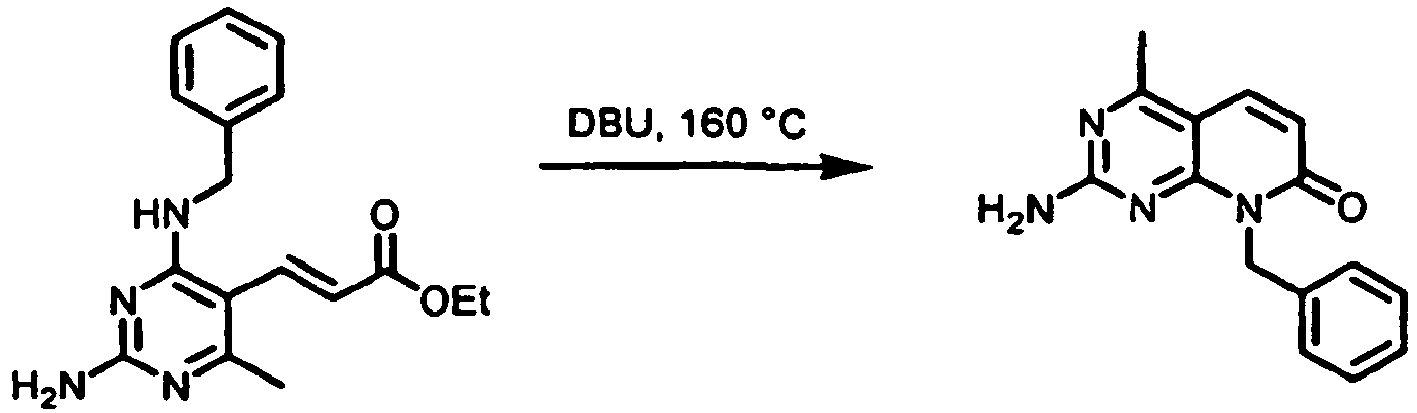
- 2-amino-4-methyl-8-(phenylmethyl)pyrido[2,3-d]pyrimidin-7(8H)-one Diazabicyclo[5.4.0]undec-7-ene (DBU) (1.83 mL, 12.2 mmol) was added to a flask charged with (E)-ethyl-3-(2-amino-4-(benzylamino)-6-methylpyrimidin-5-yl)acrylate (0.954 g, 3.05 mmol) and the reaction refluxed at 160 °C under a nitrogen atmosphere. After 20 hours, the reaction was cooled to room temperature and concentrated in vacuo. Purification on SiO2 (1:1 methylene chloride: ethyl acetate) afforded the product (0.508 g, 62 % yield) as an off-white solid.
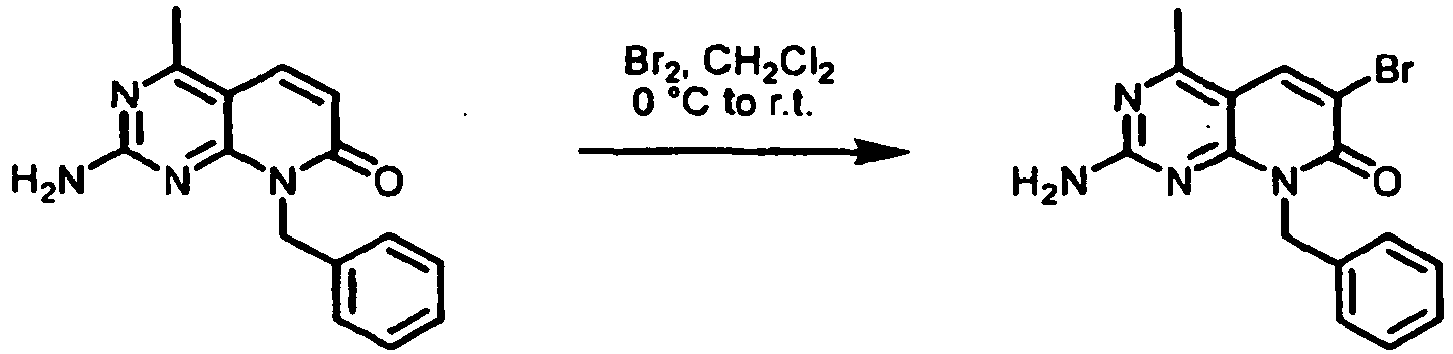
- Bromine (72 µL, 1.40 mmol) was added to a suspension of 2-amino-4-methyl-8-(phenylmethyl)pyrido[2,3-d]pyrimidin-7(8H)-one (0.340 g, 1.27 mmol) in methylene chloride (20 mL) at 0 °C. The reaction was allowed to warm to room temperature over one hour and the resulting precipitate collected by vacuum filtration to afford 2-amino-6-bromo-4-methyl-(8-phenylmethyl)pyrido[2,3-d]pyrimidin-7(8H)-one (0.435 g, 99 % yield) after drying. The yellow solid was used in the next step without further purification.

- A 10:1 solution of dioxane and water (11 mL) was added to a flask charged with 2-amino-6-bromo-4-methyl-(8-phenylmethyl)pyrido[2,3-d]pyrimidin-7(8H)-one (0.435 g, 1.27 mmol), 1H-pyrazole-5-boronic acid (0.284 g, 2.54 mmol), Pd(PPh3)4 (0.073 mg, 0.063 mmol), and K2CO3 (0.527 g, 3.81 mmol). The flask was flushed with nitrogen and fitted with a reflux condenser and heated to 110 °C. After 12 h the reaction was cooled to room temperature and diluted with ethyl acetate (100 mL) and washed with water. The aqueous phase was acidified to pH 1.0 and washed with ethyl acetate (100 mL). The organic phases were combined and washed with brine, separated and dried over Na2SO4, filtered and concentrated in vacuo. The residue was precipitated with ethyl acetate to give 2-Amino-4-methyl-8-(phenylmethyl)-6-(1H-pyrazol-3-yl)pyrido[2,3-d]pyrimidin-7(8H)-one (0.062 g, 15 % yield) as a yellow solid: 1H NMR (400 MHz, DMSO-d 6): δ 13.10 (bs, 1H), 12.93 (bs, 1H), 8.47 (s, 1H), 7.76 (bs, 1H), 7.51 (bs, 1H), 7.28 (m, 5H), 6.97 (s, 1H), 5.55 (s, 2H), 2.55 (bs, 3H); MS (EI) for C18H16N6O: 333.1 (MH+).
-

- A 3:1 solution of dioxane and water (4 mL) was added to a flask charged with 2-amino-6-bromo-8-ethyl-4-methylpyrido[2,3-d]pyrimidin-7(8H)-one (0.140 g, 0.495 mmol) from above, 4-methylthiophene-3-boronic acid (0.140 g, 0.989 mmol), Pd(PPh3)4 (0.057 mg, 0.050 mmol), and K2CO3 (0.205 g, 1.48 mmol). The flask was flushed with nitrogen and fitted with a reflux condenser and heated to 100 °C. After 12 hours the reaction was cooled to room temperature and diluted with ethyl acetate (70 mL) and washed with water. The aqueous phase was separated and washed with an additional amount of ethyl acetate (70 mL). The organic phases were combined and washed with brine, separated and dried over Na2SO4, filtered and concentrated in vacuo. The residue was purified on SiO2 (1:1 methylene chloride: ethyl acetate) to give 2-Amino-8-ethyl-4-methyl-6-(4-methyl-3-thienyl)pyrido[2,3-d]pyrimidin-7(8H)-one (0.081 g, 55 % yield) as an off-white solid: 1H NMR (400 MHz, DMSO-d 6): δ 7.84 (s, 1H), 7.46 (d, J= 4.0 Hz, 1H), 7.19 (m, 3H), 4.32 (q, J= 8.0 Hz, 2H), 2.52 (s, 3H), 2.11 (bs, 3H), 1.19 (t, J= 8.0 Hz, 3H); MS (EI) for C15H16N4OS: 301.1 (MH+).
- Using the same or analogous synthetic techniques and substituting with appropriate reagents, the following compounds were prepared:
- Example 9a. 2-Amino-8-ethyl-4-methyl-6-(3-thienyl)pyrido[2,3-d]pyrimidin-7(8H)-one: 1H NMR (400 MHz, CDCl3): δ 8.11 (dd, J= 2.8, 1.2 Hz, 1H), 7.95 (s, 1H), 7.51 (dd, J= 5.2, 1.2 Hz, 1H), 7.37 (dd, J = 4.8, 3.2 Hz, 1H), 5.21, (bs, 2H), 4.48 (q, J = 6.8 Hz, 2H), 2.63 (s, 3H), 1.32 (t, J = 7.2 Hz, 3H); MS (EI) for C14H14N4OS: 287.0 (MH+).
- Example 9b. 2-Amino-8-ethyl-6-furan-3-yl-4-methylpyrido[2,3-d]pyrimidin-7(8H)-one: 1H NMR (400 MHz, CDCl3): δ 8.47 (bs, 1H), 7.85 (s, 1H), 7.49 (t,J= 1.6 Hz, 1H), 6.77 (dd, J=. 2.0, 0.8 Hz, 1H), 5.19, (bs, 2H), 4.48 (q, J = 6.8 Hz, 2H), 2.64 (s, 3H), 1.31 (t, J = 7.2 Hz, 3H); MS (EI) for C14H14N4O2: 271.1 (MH+).
- Example 9c. 2-Amino-6-(3,5-dimethylisoxazol-4-yl)-8-ethyl-4-methylpyrido[2,3-d]pyrimidin-7(8H)-one: 1H NMR (400 MHz, CDCl3): δ 7.62 (s, 1H), 5.27, (bs, 2H), 4.44 (q, J= 7.2 Hz, 2H), 2.59 (s, 3H), 2.38 (s, 3H), 2.25 (s, 3H), 1.31 (t, J= 6.8 Hz, 3H); MS (EI) for C15H17N5O2: 300.1 (MH+).
- Example 9d. 2-Amino-8-ethyl-6-isoxazol-4-yl-4-methylpyrido[2,3-d]pyrimidin-7(8H)-one: 1H NMR (400 MHz, CDCl3): δ 9.36 (s, 1H), 8.71 (s, 1H), 7.91 (s, 1H), 5.30, (bs, 2H), 4.48 (q, J= 7.2 Hz, 2H), 2.67 (s, 3H), 1.32 (t, J = 6.8 Hz, 3H); MS (EI) for C13H13N5O2: 272.0 (MH+).
- Example 9e. 2-Amino-8-ethyl-6-furan-2-yl-4-methylpyrido[2,3-d]pyrimidin-7(8H)-one: 1H NMR (400 MHz, CDCl3): δ 8.19(s, 1H), 7.48 (d, J= 0.8 Hz, 1H), 7.37 (d, J= 3.6 Hz, 1H), 6.53 (dd, J = 3.6, 2.0 Hz 1H), 5.21, (bs, 2H), 4.48 (q, J= 7.2 Hz, 2H), 2.66 (s, 3H), 1.32 (t, J = 6.8 Hz, 3H); MS (EI) for C14H14N4O2: 271.0 (MH+).
- Example 9f. 5-(2-Amino-8-ethyl-4-methyl-7-oxo-7,8-dihydropyrido[2,3-d]pyrimidin-6-yl)thiophene-2-carbonitrile: 1H NMR (400 MHz, CDCl3): δ 8.24 (s, 1H), 7.61 (d, J= 4.4 Hz, 1H), 7.55 (d, J= 4.4 Hz, 1H), 5.33, (bs, 2H), 4.48 (q, J= 7.2 Hz, 2H), 2.68 (s, 3H), 1.33 (t, J = 6.8 Hz, 3H); MS (EI) for C15H13N5OS: 312.0 (MH+).
- Example 9g. 2-Amino-8-ethyl-4-methyl-6-(1H-pyrazol-4-yl)pyrido[2,3-d]pyrimidin-7(8H)-one: 1H NMR (400 MHz, DMSO-d 6): δ 12.88 (s, 1H), 8.38 (s, 1H), 8.17 (s, 2H), 7.10 (bs, 2H), 4.35 (q, J= 7.2 Hz, 2H), 2.59 (s, 3H), 1.20 (t, J= 7.2 Hz, 3H); MS (EI) for C13H14N6O: 271.0 (MH+).
- Example 9h. 2-Amino-8-ethyl-4-methyl-6-(1,3-thiazol-2-yl)pyrido[2,3-d]pyrimidin-7(8H)-one: 1H NMR (400 MHz, CDCl3): δ 8.94 (s, 1H), 7.94 (d, J = 3.2 Hz, 1H), 7.46 (d, J= 3.2 Hz, 1H), 5.34 (bs, 2H), 4.54 (q, J= 7.2 Hz, 2H), 2.73 (s, 3H), 1.35 (t, J= 7.2 Hz, 3H); MS (EI) for C13H13N5OS: 288.0 (MH+).
- Example 9i. 2-Amino-8-ethyl-4-methyl-6-(1-methyl-1H-pyrrol-2-yl)pyrido[2,3-d]pyrimidin-7(8H)-one: 1H NMR (400 MHz, DMSO-d 6): δ 7.81 (s, 1H), 7.20 (bs, 2H), 6.81 6.11 (dd, J= 3.6, 2 .0Hz, 1H), 6.02 (t, J = 3.2 Hz, 1H), 4.32 (q, J = 7.2 Hz, 2H), 3.49 (s, 3H), 2.52 (s, 3H), 1.19 (t, J = 7.2 Hz, 3H); MS (EI) for C15H17N5O: 284.1 (MH+).
- Example 9j. 2-Amino-8-ethyl-4-methyl-6-phenylpyrido[2,3-d]pyrimidin-7(8H)-one: 1H NMR (400MHz, CDCl3): δ 7.79 (s, 1H), 7.65 (d, J= 6.8 Hz, 2H), 7.43 (d, J= 7.2 Hz, 2H), 7.36 (d, J = 7.2 Hz, 1H), 5.24 (bs, 2H), 4.47 (q, J= 7.2 Hz, 2H), 2.60 (s, 3H), 1.31 (d, J= 7.2 Hz, 3H), MS (EI) for C16H16N4O: 281.2 (MH+)
- Example 9k 2-Amino-8-ethyl-6-(4-methoxyphenyl)-4-methylpyrido[2,3-d]pyrimidin-7(8H)-one: 1H NMR (400MHz, CDCl3): δ 7.75 (s, 1H), 7.62 (d, J = 8.8 Hz, 2H), 6.96 (d, J = 8.8 Hz, 2H), 5.17 (bs, 2H), 4.47 (q, J = 6.8 Hz, 2H), 3.85 (s, 3H), 2.60 (s, 3H), 1.31 (d, J = 7.2 Hz, 3H), MS (EI) for C17H18N4O2: 31 1.2 (MH+)
- Example 9m 2-Amino-8-ethyl-6-(2-methoxyphenyl)-4-methylpyrido[2,3-d]pyrimidin-7(8H)-one: 1H NMR (400MHz, CDCl3): δ 7.75 (m, 1H), 7.36 (m, 2H), 7.01 (m, 2H), 5.20 (bs, 2H), 4.45 (m, 2H), 3.82 (s, 3H), 2.56 (s, 3H), 1.31 (m, 3H), MS (EI) for C17H18N4O2: 311.2 (MH+)
- Example 9n 2-Amino-6-(4-chlorophenyl)-8-ethyl-4-methylpyrido[2,3-d]pyrimidin-7(8H)-one: 1H NMR (400MHz, CDCl3): δ 7.78 (s, 1H), 7.61 (d, J= 8.8 Hz, 2H), 7.39 (d, J= 8.8 Hz, 2H), 5.23 (bs, 2H), 4.46 (q, J = 7.2 Hz, 2H), 2.61 (s, 3H), 1.31 (d, J = 6.8 Hz, 3H), MS (EI) for C16H15ClN4O: 315.1 (MH+)
- Example 9p 2-Amino-6-(3-chlorophenyl)-8-ethyl-4-methylpyrido[2,3-d]pyrimidin-7(8H)-one: 1H NMR (400MHz, CDCl3): δ 7.79 (s, 1H), 7.66 (m, 1H), 7.56 (m, 1H), 7.35 (m, 2H), 5.25 (bs, 2H), 4.46 (q, J= 5.6 Hz, 2H), 2.61 (s, 3H), 1.31 (d, J= 7.2 Hz, 3H), MS (EI) for C16H15ClN4O: 315.1 (MH+)
- Example 9q 2-Amino-6-(2-chlorophenyl)-8-ethyl-4-methylpyrido[2,3-d]pyrimidin-7(8H)-one: 1H NMR (400MHz, CDCl3): δ 7.75 (s, 1H), 7.67 (m, 1H), 7.54 (m, 2H), 7.38 (m, 1H), 7.333 (m, 1H), 5.22 (bs, 2H), 4.46 (q, J= 6.8 Hz, 2H), 2.57 (s, 3H), 1.31 (d, J= 6.8 Hz, 3H), MS (EI) for C16H15ClN4O: 315.1 (MH+)
- Example 9r 2-Amino-6-(2,4-dichlorophenyl)-8-ethyl-4-methylpyrido[2,3-d]pyrimidin-7(8H)-one: 1H NMR (400MHz, CDCl3): δ 7.77 (s, 1H), 7.67 (m, 1H), 7.49 (m, 1H), 7.32 (m, 1H), 5.24 (bs, 2H), 4.45 (q, J= 6.8 Hz, 2H), 2.58 (s, 3H), 1.30 (d, J= 7.2 Hz, 3H), MS (EI) for C16H14Cl2N4O: 349.1 (MH+)
- Example 9t 2-Amino-8-ethyl-4-methyl-6-(2-thienyl)pyrido[2,3-d]pyrimidin-7(8H)-one: 1H NMR (400 MHz, DMSO-d 6): δ 8.39 (s, 1H), 7.85-7.13 (m, 5H), 4.37 (q,J= 7.2 Hz, 2H), 2.62 (s, 3H), 1.18 (t, J= 7.2 Hz, 3H); MS (EI) for C14H14N4OS: 287.1 (MH+).
- Example 9u 2-Amino-8-ethyl-6-(4-fluorophenyl)-4-methylpyrido[2,3-d]pyrimidin-7(8H)-one: 1H NMR (400 MHz, DMSO-d 6): δ 7.99 (s, 1H), 7.76-7.22 (m, 6H), 4.34 (q, J= 7.2Hz, 2H), 2.56 (s, 3H), 1.20 (t, J= 7.2 Hz, 3H); MS (EI) for C16H15FN4O: 299.2 (MH+).
- Example 9v 2-Amino-8-ethyl-6-(3-fluorophenyl)-4-methylpyrido[2,3-d]pyrimidin-7(8H)-one: 1H NMR (400 MHz, DMSO-d 6): δ 8.06 (s, 1H), 7.61-7.44 (m, 3H), 7.29 (bs, 2H), 7.20-7.15 (m, 1H), 4.34 (q, J= 7.2Hz, 2H), 2.58 (s, 3H), 1.20 (t, J= 7.2 Hz, 3H); MS (EI) for C16H15FN4O: 299.2 (MH+).
- Example 9w 2-Amino-8-ethyl-6-(2-fluorophenyl)-4-methylpyrido[2,3-d]pyrimidin-7(8H)-one: 1H NMR (400 MHz, DMSO-d 6): δ 7.96 (s, 1H), 7.50-7.23 (m, 6H), 4.32 (q, J= 6.8 Hz, 2H), 2.52 (s, 3H), 1.19 (t, J= 6.8 Hz, 3H); MS (EI) for C16H15FN4O: 299.2 (MH+).
- Example 9x Methyl 3-(2-amino-8-ethyl-4-methyl-7-oxo-7,8-dihydropyrido[2,3-d]pyrimidin-6-yl)benzoate: 1H NMR (400 MHz, DMSO-d 6): δ 8.34 (s, 1H), 8.06 (s, 1H), 7.95-7.55 (m, 3H), 7.28 (bs, 1H), 4.35 (q, J = 6.8 Hz, 2H), 3.89 (s, 3H), 2.58 (s, 3H), 1.21 (t, J = 6.8 Hz, 3H); MS (EI) for C18H18N4O3: 339.2 (MH+).
- Example 9y 2-Amino-8-ethyl-4-methyl-6-pyrimidin-5-ylpyrido[2,3-d]pyrimidin-7(8H)-one: 1H NMR (400 MHz, DMSO-d 6): δ 8.39 (s, 1H), 7.65-7.30 (m, 5H), 4.31 (q, J = 7.2 Hz, 2H), 2.50 (s, 3H), 1.17 (t, J= 7.2 Hz, 3H); MS (EI) for C14H14N6O: 283.2 (MH+).
-

- A solution of potassium hydroxide (0.139 g, 2.48 mmol) in absolute ethanol (3.0 mL) was added to a pressure tube charged with 4-(ethylamino)-6-methyl-2-(methylthio)pyrimidine-5-carbaldehyde (0.229 g, 1.08 mmol), prepared using procedures ismilar to those described for
Intermediate 1, and 2-(1H-imidazol-5-yl)acetonitrile (0.174 g, 162 mmol) and heated to 70 °C. After 12 h, the reaction was allowed to cool to room temperature and concentrated in vacuo affording 8-ethyl-6-(1H-imidazol-5-yl)-4-methyl-2-(methylthio)pyrido[2,3-d]pyrimidin-7(8H)-imine as a solid. The product was used in the subsequent step without further purification.
- Acetic anhydride (15.0 mL) was added to a flask charged with crude 8-ethyl-6-(1H-imidazol-5-yl)-4-methyl-2-(methylthio)pyrido[2,3-d]pyrimidin-7(8H)-imine and heated to 100 °C. After 30 minutes, the reaction was allowed to cool to room temperature and concentrated in vacuo. The acetylated residue was then treated with 6 N HCl (16 mL) and heated to 95 °C for 30 minutes then transferred to a large flask. A saturated solution of NaHCO3 (150 mL) was added at 0 °C to about pH = 8.0. The aqueous phase was washed thrice with ethyl acetate (100 mL) and the organic layers combined, then washed with brine and dried over Na2SO4. The drying agent was filtered off and the organic layers were concentrated in vacuo to afford crude 8-ethyl-6-(1H-imidazol-5-yl)-4-methyl-2-(methylthio)pyrido[2,3-d]pyrimidin-7(8H)-one which was used in the subsequent step without further purification.

- 3-Chloroperbenzoic acid (0.299 g, 1.73 mmol) was added to a solution of crude 8-ethyl-6-(1H-imidazol-5-yl)-4-methyl-2-(methylthio)pyrido[2,3-d]pyrimidin-7(8H)-one (0.260g, 0.866 mmol) in dichloromethane (10.0 mL) at room temperature. After 1.5 h, the reaction was diluted with dichloromethane (50 mL) and washed twice with saturated NaHCO3, followed by brine. The organic phase was separated and dried over Na2SO4, filtered, and concentrated in vacuo. The corresponding sulfone was used in the subsequent step without further purification.

- Concentrated aqueous ammonium hydroxide (400 µL) was added to a solution of the sulfone in dioxane (10 mL) at 0 °C. The reaction flask sealed, and allowed to warm to room temperature upon standing overnight. The reaction was concentrated in vacuo and purified on reverse phase HPLC (acetonitrile: water 0.1 % TFA, 20-60% gradient). The fractions containing product were collected and concentrated to one half volume and poured into saturated NaHCO3 (50 mL). The aqueous phase was washed trice with ethyl acetate (50 mL) and dried over Na2SO4, filtered, and concentrated in vacuo. The residue was triturated with methylene chloride and ethyl acetate to afford 2-amino-8-ethyl-6-(1H-imidazol-5-yl)-4-methylpyrido[2,3-d]pyrimidin-7(8H)-one (29 mg, 12 % yield) as a light yellow solid: 1H NMR (400 MHz, CH3OH-d 4): δ 8.52 (bs, 1H), 7.88 (bs, 1H), 7.76 (s, 1H), 4.30 (q, J= 6.8 Hz, 2H), 2.65 (s, 3H), 1.29 (t, J= 6.8 Hz, 3H); MS (EI) for C13H14N6O: 271.0 (MH+).
-

- Trimethylsilylethyne (1.44 mL, 10.2 mmol) was added to a pressure tube charged with 2-amino-6-bromo-8-ethyl-4-methylpyrido[2,3-d]pyrimidin-7(8H)-one (1.58 g, 5.59 mmol) from above, CuI (0.053 g, 0.279 mmol), and PdCl2(PPh3)2 (0.211 g, 0.279 mmol) in triethylamine (20 mL). The pressure tube was sealed under nitrogen and heated to 50 °C 96 h. The reaction was cooled to room temperature and poured into a saturated solution of NaHCO3 (150 mL), then washed four times with ethyl acetate (50 mL). The organic layers were pooled and dried over Na2SO4, filtered and concentrated in vacuo. The residue was purified on SiO2 (2:1, methylene chloride: ethyl acetate) to afford 2-amino-8-ethyl-4-methyl-6-((trimethylsilyl)ethynyl)pyrido[2,3-d]pyrimidin-7(8H)-one (1.09 g, 65 % yield) as an offwhite solid.

- Potassium carbonate (1.00 g, 7.28 mmol) was added to a flask charged with 2-amino-8-ethyl-4-methyl-6-((trimethylsilyl)ethynyl)pyrido[2,3-d]pyrimidin-7(8H)-one (1.09 g, 3.64 mmol) in anhydrous methanol (15 mL). The reaction was stirred at room temperature under nitrogen for 16 h. The reaction was concentrated to one half volume and the yellow precipitate collected by vacuum filtration to afford 2-amino-8-ethyl -6-ethynyl-4-methylpyrido[2,3-d]pyrimidin-7(8H)-one.

- Anhydrous DMF (5.0 mL) was added to a flask charged with 2-amino-8-ethyl - 6-ethynyl-4-methylpyrido[2,3-d]pyrimidin-7(8H)-one (0.204 g, 0.894 mmol), sodium azide (0.070 g, 1.07 mmol), and ammonium chloride (0.057 g, 1.07 mmol). The reaction was capped under nitrogen and heated to 120 °C. After 48 h, the reaction was cooled to room temperature and concentrated in vacuo. The residue was purified on reverse phase HPLC (acetonitrile: water 0.1 % TFA, 20-60% gradient). The fractions containing product were collected and concentrated to one half volume and poured into saturated NaHCO3 (50 mL). The aqueous phase was washed trice with ethyl acetate (50 mL) and dried over Na2SO4, filtered, and concentrated in vacuo. The residue was triturated with methylene chloride and ethyl acetate to afford 2-amino-8-ethyl-4-methyl-6-(1H-1,2,3-triazol-5-yl)pyrido[2,3-d]pyrimidin-7(8H)-one (14 mg, 6 % yield) as a light yellow solid: 1H NMR (400 MHz, DMSO-d6 ): δ 8.55 (bs, 1H), 8.41 (bs, 1H), 7.32 (bs, 2H), 4.37 (q, J = 7.2 Hz, 2H), 2.60 (s, 3H), 1.21 (t, J= 7.2 Hz, 3H); MS (EI) for C12H13N7O: 272.0 (MH+).
-
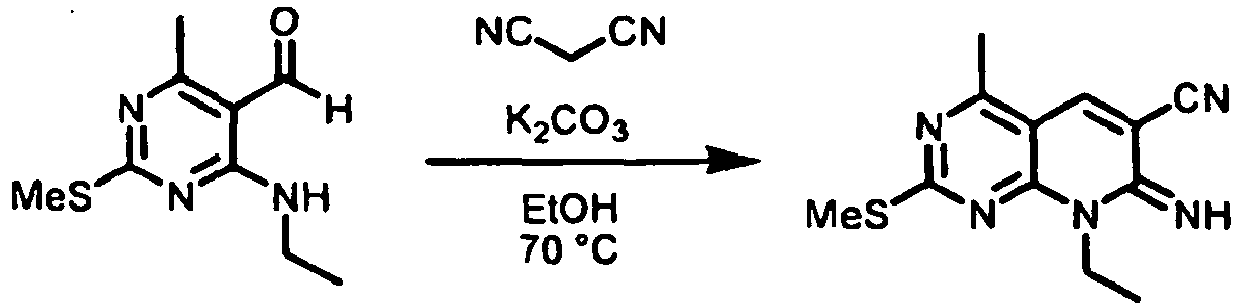
- Potassium carbonate (0.539 g, 3.90 mmol) was added to a suspension of 4-(ethylamino)-6-methyl-2-(methylthio)pyrimidine-5-carbaldehyde (0.413 g, 1.95 mmol) from above, and malononitrile (0.194 g, 2.93 mmol) in absolute ethanol (15.0 mL) and heated to 70 °C. After one h, the reaction was allowed to cool to room temperature and concentrated in vacuo. The residue was diluted with ethyl acetate (50 mL) and washed with saturated NaHCO3 (50 mL), and brine. The organic phase was separated and concentrated in vacuo. The residue was precipitated with ethyl acetate and hexanes to give 8-ethyl-7-imino-4-methyl-2-(methylthio)-7,8-dihydropyrido[2,3-d]pyrimidine-6-carbonitrile as a brown solid that was used in the subsequent step without further purification.

- Acetic anhydride (10.0 mL) was added to a flask charged with 8-ethyl-7-imino-4-methyl-2-(methylthio)-7,8-dihydropyrido[2,3-d]pyrimidine-6-carbonitrile (0.506 g, 1.95 mmol) and heated to 100 °C. After one h, the reaction was allowed to cool to room temperature and concentrated in vacuo. The acetylated residue was then treated with 6 N HCl (40 mL) and heated to 95 °C for one hour then transferred to a large flask. A saturated solution of NaHCO3 (500 mL) was added slowly at 0 °C until a ∼pH 8.0 was achieved. The aqueous phase was washed thrice with ethyl acetate (100 mL) and the organic layers combined, then washed with brine and dried over Na2SO4. The drying agent was filtered and concentrated in vacuo to afford crude 8-ethyl-4-methyl-2-(methylthio)-7-oxo-7,8-dihydropyrido[2,3-d]pyrimidine-6-carbonitrile which was used in the subsequent step without further purification.

- 3-Chloroperbenzoic acid (1.00 g, 5.85 mmol) was added to a solution of crude 8-ethyl-4-methyl-2-(methylthio)-7-oxo-7,8-dihydropyrido[2,3-d]pyrimidine-6-carbonitrile (0.507 g, 1.95 mmol) in dichloromethane (30.0 mL) at room temperature. After 2.5 hours, the reaction was diluted with dichloromethane (50 mL) and washed twice with saturated NaHCO3, followed by brine. The organic phase was separated and dried over Na2SO4, filtered, and concentrated in vacuo. 2-Amino-8-ethyl-4-methyl-7-oxo-7,8-dihydropyrido[2,3-d]pyrimidine-6-carbonitrile was used in the subsequent step without further purification.
- Ammonium hydroxide (500 µL) was added to a solution of the above sulfone in dioxane (10 mL) at 0 °C. The reaction flask sealed, and allowed to warm to room temperature upon standing overnight. The reaction was concentrated in vacuo triturated with ethyl acetate to afford the product which was used in the subsequent step without further purification.

- Tributyltin azide (660 µL, 2.41 mmol) was added to a flask charged with 2-amino-8-ethyl-4-methyl-7-oxo-7,8-dihydropyrido[2,3-d]pyrimidine-6-carbonitrile (0.184 g, 0.803 mmol) in anhydrous toluene (5.0 mL). The reaction was fitted with a reflux condenser and heated to 140 °C under a nitrogen atmosphere. After 20 h, the reaction was cooled to room temperature and the precipitate collected by vacuum filtration and washed with absolute ethanol to give 2-amino-8-ethyl-4-methyl-6-(1H-tetrazol-5-yl)pyrido[2,3-d]pyrimidin-7(8H)-one (98 mg, 45 % yield) as a light brown solid: 1H NMR (400 MHz, 20 % DCI in D2O): δ 6.97 (s, 1H), 2.42 (q, J = 7.2 Hz, 2H), 0.953 (s, 3H), -0.73 (t, J = 7.2 Hz, 3H); MS (EI) for C11H11N8O: 271.0 (MH+).
-

- A mixture of 8-(3-methoxypropyl)-4-methyl-2-(methylthio)pyrido[2,3-d]pyrimidin-7(8H)-one (0.36 g, 1.29 mmol), prepared using procedures similar to those described in Example 1, dichloromethane (10 mL), and 77 % 3-chloroperbenzoic acid with water (0.723 g, 3.23 mmol) was stirred for 1 h. The mixture was diluted with dichloromethane, washed with sat. sodium bicarbonate (3 times), brine, dried over sodium sulfate, and DCM was removed under reduced pressure. The crude 8-(3-methoxypropyl)-4-methyl-2-(methylsulfonyl)pyrido[2,3-d]pyrimidin-7(8H)-one was used without further purification for subsequent step.

- 8-(3-methoxypropyl)-4-methyl-2-(methylsulfonyl)pyrido[2,3-d]pyrimidin-7(8H)-one, and a solution of 2M ethylamine in THF (20 mL) was stirred for 2 h. THF was removed under reduced pressure and the crude product was purified by flash column chromatography to give 2-(ethylamino)-8-(3-methoxypropyl)-4-methylpyrido[2,3-d]pyrimidin-7(8H)-one (0.18 g, 50 % yield over 2 steps).

- To a solution of 2-(ethylamino)-8-(3-methoxypropyl)-4-methylpyrido[2,3-d]pyrimidin-7(8H)-one (0.18 g, 0.65 mmol), acetic acid (5 mL) and dichloromethane (3 mL) was added bromine (36 ul, 0.7 mmol). The mixture was stirred for 5 minutes, and then diluted with DCM and water. The organic layer was washed with sat. sodium bicarbonate (3 times), brine, dried over sodium sulfate, filtered and concentrated under reduced pressure. The crude product was purified by flash column chromatography to gave 0.13 g (56 % yield) of 6-bromo-2-(ethylamino)-8-(3-methoxypropyl)-4-methylpyrido[2,3-d]pyrimidin-7(8H)-one. 1H NMR (400MHz, CDCl3) δ 8.09 (s, 1H), 5.44 (Br. s, 1H), 4.55 (m, 2H), 3.54-3.47 (m, 4H), 3.33 (s, 3H), 2.53 (s, 3H), 2.05-2.00 (m, 2H), 1.30- 1.23 (m, 3H); MS (EI) for C14H19BrN4O2: 355 (MH+).
- Using the same or analogous synthetic techniques and substituting with appropriate reagents, the following compounds were prepared:
- Example 13a. 6-bromo-8-(2-ethoxyethyl)-2-(ethylamino)-4-methylpyrido[2,3-d]pyrimidin-7(8H)-one: 1H NMR (400MHz, CDCl3) δ 8.09 (s, 1H), 5.37 (Br. s, 1H), 4.67 (m, 2H), 3.74 (m, 2H), 3.61-3.56 (t, 2H), 3.51 (m, 2H), 2.53 (s, 3H), 1.29-1.25 (t, 3H), 1.19-1.15 (t, 3H); MS (EI) for C14H19BrN4O2: 355 (MH+).
- Example 13b. 6-bromo-8-(3-ethoxypropyl)-2-(ethylamino)-4-methylpyrido[2,3-d]pyrimidin-7(8H)-one: 1H NMR (400MHz, CDCl3) δ 8.09 (s, 1H), 5.37 (Br. s, 1H), 4.53 (m, 2H), 3.52 (m, 4H), 3.48-3.43 (m, 2H), 2.53 (s, 3H), 2.04-2.00 (m, 2H), 1.29-1.25 (t, 3H), 1.19-1.15 (t, 3H); MS (EI) for C15H21BrN4O2: 369 (MH+).
- Example 13c. 6-bromo-2-(ethylamino)-8-(3-isopropoxypropyl)-4-methylpyrido[2,3-d]pyrimidin-7(8H)-one: 1H NMR (400MHz, CDCl3) δ 8.09 (s, 1H), 5.37 (Br. s, 1H), 4.53 (m, 2H), 3.59-3.49 (m, 5H), 2.52 (s, 3H), 2.01-1.98 (m, 2H), 1.28-1.25 (t, 3H), 1.13-1.11 (t, 6H); MS (EI) for C16H23BrN4O2: 383 (MH+).
-

- A mixture of 2,4-dichloro-6-methylpyrimidine (Aldrich, 5 g, 30 mmol), cyclohexylamine (3 g, 30 mmol) and DIEA (10 mL) was stirred at 80 °C for 12 h. The volatile material was removed under reduced pressure. The residue was loaded on a silica gel column, and was eluted with hexanes/ethyl acetate (3:1). 8-cyclohexyl-2-(ethylamino)-4-methyl-6-(thiopheN-2-yl)pyrido[2,3-d]pyrimidin-7(8H)-one was obtained as colorless oil (2.8 g, 41% yield).

- The product was reacted with a solution of ethylamine (10 equiv.) in THE at 100 °C for 12 h. The crude 2-ethylamino-4-cyclohexylamino-6-methylpyrimidine was obtained from a standard workup and was used in the next step.

- To a solution of 2-ethylamino-4-cyclohexylamino-6-methylpyrimidine (600 mg, 2.56 mmol) in CH3CN (10 mL) was added N-iodosuccinimide (NIS, 658 mg, 2.92 mmol). The reaction was stirred for 2 h at room temperature. After removal of the solvent, the residue was dissolved in EtOAc. The organic phase was then washed with sodium bisulfite, brine, and dried over Na2SO4. Purification by flash column chromatography gave 660 mg (73% yield) of 2-ethylamino-4-cyclohexylamino-5-iodo-6-methylpyrimidine.

- To a solution of 2-ethylamino-4-cyclohexylamino-5-iodo-6-methylpyrimidine (660 mg, 1.83 mmol) in DMA (7 mL) was added ethyl acrylate (458 mg, 4.58 mmol), Pd(OAc)2 (121 mg, 0.18 mmol), (o-Tol)3P (110 mg, 0.37 mmol), and Et3N (740 mg, 7.32 mmol). The mixture was then stirred at 100 °C for 12 h under N2. Standard workup and purification by column chromatography gave 411 mg (67% yield) of (E)-ethyl 3-(4-(cyclohexylamino)-2-(ethylamino)-6-methylpyrimidin-5-yl)acrylate

- (E)-ethyl 3-(4-(cyclohexylamino)-2-(ethylamino)-6-methylpyrimidin-5-yl)acrylate (200 mg, 0.6 mmol) was dissolved in AcOH (2 mL). This solution was heated in a sealed tube at 186 °C for 17 h. Standard workup and purification by column chromatography gave 65 mg (38 % yield) of 8-cyclohexyl-2-(ethylamino)-4-methylpyrido[2,3-d]pyrimidin-7(8H)-one.

- To 8-cyclohexyl-2-(ethylamino)-4-methylpyrido[2,3-d]pyrimidin-7(8H)-one in AcOH and CH2Cl2 was added Br2 (22 uL, 0.42 mmol) at 80 °C. Standard workup and purification by column chromatography gave 65 mg (0.17 mmol, 80 % yield) of 6-bromo-8-cyclohexyl-2-(ethylamino)-4-methylpyrido[2,3-d]pyrimidin-7(8H)-one.
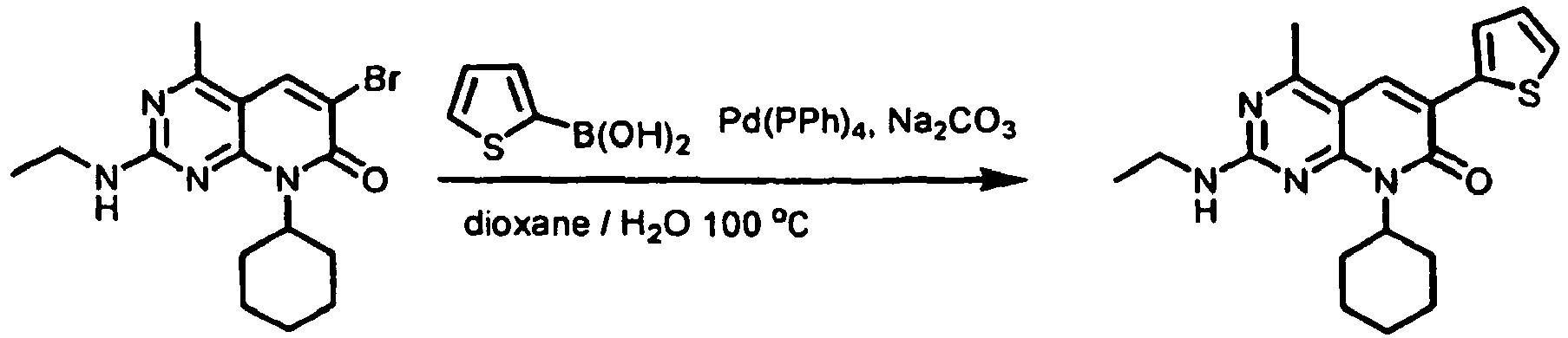
- The bromide (65 mg, 0.17 mmol) obtained above was reacted with 2-thiopheneboronic acid (45 mg, 0.36 mmol) in the presence of Pd(PPh3)4 (20 mg, 0.018 mmol) and Na2CO3 (38 mg, 0.36 mmol) in 1,4-dioxane/H2O (1:1) at 100 °C for 2 h. Removal of solvents and purification by column chromatography gave 33 mg (50% yield) of 8-cyclohexyl-2-(ethylamino)-4-methyl-6-(thiopheN-2-yl)pyrido[2,3-d]pyrimidin-7(8H)-one. 1H NMR (400 MHz, DMSO-d6) δ 8.01 (br s, 1 H), 7.60 (m, I H), 7.37 (m, 1 H), 7.10 (m, 1H), 5.60-5.40 (m, 1 H), 3.55 (m, 2 H), 2.85 (m, 1 H), 2.61 (s, 3 H), 1.90 (m, 2 H), 1.71 (m, 4 H), 1.43 (m, 2 H), 1.30-1.2 (m, 2 H),1.30 (t, 3 H); MS (EI) for C20H24N4OS: 369 (MH+).
- Using the same or analogous synthetic techniques and substituting with appropriate reagents, the following compound was prepared:
- Example 14a. 6-bromo-8-cyclopropyl-2-(ethylamino)-4-methylpyrido[2,3-d]pyrimidin-7(8H)-one: 1H NMR (400 MHz, CDCl3) δ 8.06. (s, 1 H), 5.37 (br s, 1 H), 3.54 (m, 2 H), 2.94 (br s, 1 H), 2.51 (s, 3 H), 1.31-1.25 (m, 5 H), 0.91 (br s, 2 H); MS (EI) for C13H15BrN4O: 323 (MH+).
-

- To a solution of 6-bromo-2-(ethylamino)-4-methylpyrido[2,3-d]pyrimidin-7(8H)-one (100 mg, 0.35 mmol) in DMF (2 mL), prepared using porocedures analogous to those described in Example 14, was added NaH (30 mg, 60%, 0.7 mmol). The mixture was stirred for 30 min at room temperature and was warmed to 70 °C. 3-Bromopropanol (48 mg, 0.35 mmol) was then added. The stirring was continued for 12 h. Standard workup and purification by column chromatography gave 33 mg (27% yield) of 6-bromo-2-(ethylamino)-8-(3-hydroxypropyl)-4-methylpyrido[2,3-d]pyrimidin-7(8H)-one. 1H NMR (400 MHz, CDCl3) δ 8.13 (s, I H), 5.42 (br s, 1 H), 4.59 (br s, 2 H), 3.50-3.47 (m, 5 H), 2.55 (s, 3 H), 2.02 (br s, 2 H), 1.28 (t, 3 H); MS (EI) for C13H17BrN4O2: 341 (MH+).
- Using the same or analogous synthetic techniques and substituting with appropriate reagents, the following compounds were prepared:
- Example 15a. 6-bromo-2-(ethylamino)-8-(2-hydroxyethyl)-4-methylpyrido[2,3-d]pyrimidin-7(8H)-one: 1H NMR (400 MHz, DMSO-d6) δ 8.38 (s, I H), 4.82 (br s, 1 H), 4.40 (br s, 2 H), 3.62-3.55 (m, 2 H), 3.40-3.20 (m, 3 H), 2.55 (s, 3 H), 1.15 (t, 3 H); MS (EI) for C12H15BrN4O2: 327 (MH+).
- Example 15b. 6-bromo-2-(ethylamino)-4-methyl-8-(2-(piperidin-1-yl)ethyl)pyrido[2,3-d]pyrimidin-7(8H)-one: 1H NMR (400 MHz, CDCl3) δ 8.08 (s, 1 H), 5.39 (br s, 1 H), 4.59 (br s, 2 H), 3.55-3.40 (m, 2 H), 2.70-2.50 (m, 6 H), 2.52 (s, 3 H), 1.62-1.58 (m, 4 H), 1.46-1.40 (m, 2 H), 1.27 (t, 3 H); MS (EI) for C17H24BrN5O: 394 (MH+).
- PI3Kα activity is measured as the percent of ATP consumed following the kinase reaction using luciferase-luciferiN-coupled chemiluminescence. Reactions were conducted in 384-well white, medium binding microtiter plates (Greiner). Kinase reactions were initiated by combining test compounds, ATP, substrate (PIP2), and kinase in a 20 µL volume in a buffer solution. The standard PI3Kalpha assay buffer is composed 50 mM Tris, pH 7.5, 1 mM EGTA, 10 mM MgCl2, 1 mM DTT and 0.03% CHAPS. The standard assay concentrations for enzyme, ATP, and substrate are 0.5-1.1 nM, 1µM, and 7.5 µM, respectively. The reaction mixture was incubated at ambient temperature for approximately 2 h. Following the kinase reaction, a 10 µL aliquot of luciferase-luciferin mix (Promega Kinase-Glo) was added and the chemiluminescence signal measured using a Victor2 plate reader (Perkin Elmer). Total ATP consumption was limited to 40-60% and IC50 values of control compounds correlate well with literature references.
- Certain compounds of the invention were tested in this assay and demonstrated the ability to bind to PI3K. For example, in one embodiment of the invention, the PI3K inhibitor is selected from the compounds in Table I having a PI3K-binding affinity of about 9 µM or less. In another embodiment, the PI3K inhibitor is selected from the compounds in Table I having a PI3K-binding affinity of about 5 µM or less. In another embodiment, the PI3K inhibitor is selected from the compounds in Table I having a PI3K-binding affinity of about 3 µM or less. In another embodiment, the PI3K inhibitor is selected from the compounds in Table 1 having a PI3K-binding affinity of about 1.5 µM or less. In another embodiment, the PI3K inhibitor is selected from the compounds in Table I having a PI3K-binding affinity of about I µM or less. In another embodiment, the PI3K inhibitor is selected from the compounds in Table 1 having a PI3K-binding affinity of about 0.6 µM or less. In another embodiment, the PI3K inhibitor is selected from the compounds in Table 1 having a PI3K-binding affinity of about 0.3 µM or less. In another embodiment, the PI3K inhibitor is selected from the compounds in Table I having a PI3K-binding affinity of about 0.2 µM or less. In another embodiment, the PI3K inhibitor is selected from the compounds in Table I having a PI3K-binding affinity of about 0.1 µM or less. In another embodiment, the PI3K inhibitor is selected from the compounds in Table I having a PI3K-binding affinity of about 0.04 µM or less. In another embodiment, the PI3K inhibitor is selected from the compounds in Table 1 having a PI3K-binding affinity of about 0.020 µM or less.
- Phospho AKT assayPC-3 cells were seeded on 6-well plates at 150,000 cells/well. Cells were cultured for 3 days, then treated with compounds in serum-free medium for 3 hr. EGF (100 ng/mL) was added for the last 10 min. Cells were lysed in TENN buffer. Phospho T308 Akt and total Akt were quantified by ELISA performed according to the Biosource assay protocol. The readings of phospho Akt were normalized to total Akt readings.
- PC-3 cells were seeded on 96-well plates at 8,000 cells/well. For each experiment, cells were seeded and treated in duplicated plates: one plate for phospho S6 CellELISA, and one plate for total S6 CellELISA. Cells were cultured on the plates for 3 days, then treated with compounds in serum-free medium for 3 hr in triplicate. Cells were fixed with 4% formaldehyde, quenched with 0.6% H2O2, blocked with 5% BSA, incubated with either phospho S6 antibody or total S6 antibody overnight, incubated with goat-anti-rabbit-lgG-HRP for I hr, and developed in chemiluminescent substrate.
- MCF-7 cells grown in 10-cm dishes were starved for 3 hours in DMEM, and then treated with compounds for 20 minutes. In the last 2 minutes of the incubation with the compounds, EGF (100 ng/mL) was added to stimulate the production of PIP3. The medium was aspirated and the cells were scraped with 10% trichloroacetic acid. The lipids were extracted from the pellet after the cell lysates were centrifuged. PIP3 in the cellular lipid extraction was quantified with the AlphaScreen assay in which Grp1-PH is used as the PIP3 specific probe. The amount of cellular PIP3 was calculated from the standard curve of diC8 PI (3,4,5) P3.
- Compound A is a Compound of Formula I. Compound B is N-(3,4-dichloro-2-fluorophenyl)-7-({[(3aR,5r,6aS)-2-methyloctahydrocyclopenta-[c]pyrrol-5-yl]methyl}oxy)-6-(methyloxy)quinazolin-4-amine.
- Female and male athymic nude mice (NCr) 5-8 weeks of age and weighing approximately 20-25 g were used in the following model. Prior to initiation of a study, the animals were allowed to acclimate for a minimum of 48 h. During these studies, animals were provided food and water ad libitum and housed in a room conditioned at 70-75°F and 60% relative humidity. A 12 h light and 12 h dark cycle was maintained with automatic timers. All animals were examined daily for compound-induced or tumor-related deaths.
- PC-3 human prostate adenocarcinoma cells were cultured in vitro in DMEM (Mediatech) supplemented with 20% Fetal Bovine Serum (Hyclone), Penicillin-Streptomycin and non-essential amino acids at 37°C in a humidified 5% CO2 atmosphere. On
day 0, cells were harvested by trypsinization and 3x10⁶ cells (passage 13, 99% viability) in 0.1 mL of ice-cold Hank's balanced salt solution were implanted subcutaneously into the hindflank of 5-8 week old male nude mice. A transponder was implanted in each mouse for identification, and animals were monitored daily for clinical symptoms and survival. Body weights were recorded daily. Experiments were conducted with Compound A as a single agent as well as Compound A in combination with Taxol and Compound A in combination with Rapamycin. This model can be used to assess the desirability of treating with Compound A in combination with other anti-cancer agents. - U-87 MG human glioblastoma cells were cultured in vitro in DMEM (Mediatech) supplemented with 10% Fetal Bovine Serum (Hyclone), PenicilliN-Streptomycin and non-essential amino acids at 37°C in a humidified 5% CO2 atmosphere. On
day 0, cells were harvested by trypsinization and 2x10⁶ cells (passage 5, 96% viability) in 0.1 mL of ice-cold Hank's balanced salt solution were implanted intradermally into the hindflank of 5-8 week old female nude mice. A transponder was implanted in each mouse for identification, and animals were monitored daily for clinical symptoms and survival. Body weights were recorded daily. Experiments were conducted with Compound A as a single agent and the results are not included. This model can be used to assess the desirability of treating with Compound A in combination with other anti-cancer agents. - A549 human lung carcinoma cells were cultured in vitro in DMEM (Mediatech) supplemented with 10% Fetal Bovine Serum (Hyclone), PenicilliN-Streptomycin and non-essential amino acids at 37°C in a humidified 5% CO2 atmosphere. On
day 0, cells were harvested by trypsinization and 10x106 cells (passage 12, 99% viability) in 0.1 mL of ice-cold Hank's balanced salt solution were implanted intradermally into the hindflank of 5-8 week old female nude mice. A transponder was implanted in each mouse for identification, and animals were monitored daily for clinical symptoms and survival. Body weights were recorded daily. Experiments were conducted with Compound A as a single agent as well as Compound A in combination with Compound B. This model can be used to assess the desirability of treating with Compound A in combination with other anti-cancer agents. - MDA-MB-468 human breast adenocarcinoma cells, passage number <6, were maintained and propagated in log-phase growth in Dulbecco's Modification of Eagles's Medium (DMEM; Mediatech) containing L-Glutamine supplemented with 10% Fetal Bovine Serum (Hyclone), Penicillin-Streptomycin and non-essential amino acids at 37 °C in a humidified, 5% CO2 atmosphere. On
day 0, cells were harvested by trypsinization, and 10 x 106 cells (passage 10, 98% viability) in 50% cold Hanks balanced salt solution/50% Matrigel (100 µL total volume per mouse) were implanted subcutaneously into the mammary fat pads of female nude mice. Experiments were conducted with Compound A as a single agent as well as Compound A in combination with erlotinib. This model can be used to assess the desirability of treating with Compound A in combination with other anti-cancer agents. - Calu-6 human lung anaplastic carcinoma cells were cultured in vitro in DMEM (Mediatech) supplemented with 10% Fetal Bovine Serum (Hyclone), Penicillin-Streptomycin and non-essential amino acids at 37 °C in a humidified, 5% CO2 atmosphere. On
day 0, cells were harvested by trypsinization, and 5x10⁶ cells (passage # 8, 96% viability) in 0.1 mL ice-cold Hank's balanced salt solution were implanted intradermally in the hind-flank of 5-8 week old female athymic nude mice. A transponder was implanted in each mouse for identification, and animals were monitored daily for clinical symptoms and survival. Body weights were recorded daily. Experiments were conducted with Compound A as a single agent as well as Compound A in combination with carboplatin. This model can be used to assess the desirability of treating with Compound A in combination with other anti-cancer agents. - MCF7 human mammary adenocarcinoma cells were cultured in vitro in DMEM (Cellgro) supplemented with 10% Fetal Bovine Serum (Cellgro), Penicillin-Streptomycin and non-essential amino acids at 37 °C in a humidified 5% CO2 atmosphere. On
day 0, cells were harvested by trypsinization, and 5 x 10⁶ cells (passage 10 and 95% viability forStudy 1,passage 9 and 90% viability for Study 2) in 100 µL of a solution made of 50% cold Hanks balanced salt solution with 50% growth factor reduced matrigel (R&D Systems forStudy 1 and Becton Dickinson for Study 2) implanted subcutaneously into the hindflank of female nude mice. A transponder was implanted into each mouse for identification and data tracking, and animals were monitored daily for clinical symptoms and survival. During the dosing period, the tumor weight of each animal was determined twice weekly and the body weight of each animal was measured daily. Experiments were conducted with Compound A as a single agent as well as Compound A in combination with Compound B. This model can be used to assess the desirability of treating with Compound A in combination with other anti-cancer agents. - For subcutaneous or intradermal tumors, the mean tumor weight of each animal in the respective control and treatment groups was determined twice weekly during the study. Tumor weight (TW) was determined by measuring perpendicular diameters with a caliper, using the following formula:

- These data were recorded and plotted on a tumor weight vs. days post-implantation line graph and presented graphically as an indication of tumor growth rates. Percent inhibition of tumor growth (TGI) is determined with the following formula:

- where X0 = average TW of all tumors on group day
- Xf = TW of treated group on Day f
- Yf = TW of vehicle control group on Day f
- Compound A is a Compound of Formula I and is an inhibitor of
class 1 PI3-kinases. Compound B is N-(3,4-dichloro-2-fluorophenyl)-7-({[(3aR,5r,6aS)-2-methyloctahydrocyclopenta-[c]pyrrol-5-yl]methyl}oxy)-6-(methyloxy)quinazolin-4-amine. - Compound A was tested alone and in combination with taxol in a prostate carcinoma tumor model. PC-3 is a human prostate carcinoma cell line that harbors a homozygous deletion mutation in PTEN, which results in constitutive activation of the PI3K pathway. In single-dose pharmacodynamic experiments, oral administration of Compound A resulted in a dose-dependent decrease in the phosphorylation of AKT, p70S6K, and S6 in PC-3 tumors grown ectopically in mice. Repeat-dose administration of Compound A also inhibited the growth of these tumors, but did not induce regressions.
- Oral administration of Compound A at 100mg/kg q2d or 30 mg/kg bid resulted in substantial tumor growth inhibition. See
Fig. 1 . Comparable tumor growth inhibition was achieved with 7.5 mg/kg taxol administered i.v. twice weekly. While tumor growth was inhibited substantially with Compound A alone, the combination of either dose of Compound A with taxol was superior to either agent alone and induced significant regression of the tumors. Body weight loss and dose skipping was minimal in all groups, and was not exacerbated in the combination group indicating that the combination was well tolerated. These results support the use of a Compound of Formula I in combination with taxol in tumors with constitutively activated PI3K signaling. - Compound A was tested alone and in combination with rapamycin in a prostate carcinoma tumor model (PC-3 cell line). Oral administration of Compound A at 100mg/kg q2d resulted in significant tumor growth inhibition. See
Fig. 2 . Significant tumor growth inhibition was also observed with 5 mg/kg rapamycin administered i.p. daily. While tumor growth was inhibited substantially with Compound A alone, the combination of Compound A with rapamycin was transiently superior to either agent alone and induced regression of the tumors, although the final tumor weights were similar between rapamycin alone and the combination treatment. Body weight loss and dose skipping was minimal with each agent alone, but body weight loss was exacerbated in the combination group necessitating dose skipping. The fact that tumor regression was observed despite dose skipping suggests that using an intermittent dosing schedule would maintain efficacy and improve tolerability. - At the end of the efficacy study, tumors were resected and processed for histological analysis of markers of proliferation (Ki67) and apoptosis (TUNEL). Administration of Compound A as monotherapy (100mg/kg q2d) was associated with a significant 44% decrease in the fraction of proliferating cells. Administration of rapamycin as monotherapy was also associated with a decrease (77%) in the fraction of proliferating cells. Combined administration of Compound A and rapamycin resulted in a strong anti-proliferative effect (96% decrease) which was significantly enhanced over that seen with monotherapy (
Fig. 6 ). Administration of Compound A as monotherapy was associated with a significant 3.6-fold induction in the fraction of apoptotic cells, whereas rapamycin administered as monotherapy did not exert significant pro-apoptotic effects. Combined administration of Compound A and rapamycin resulted in a 7-fold induction in the fraction of apoptotic cells, which was significantly enhanced over that seen with monotherapy (Fig. 7 ). Together, these data indicate that coadministration of Compound A and rapamycin leads to a significant decrease in tumor cell proliferation and a significant increase in tumor cell apoptosis compared to either agent administered as monotherapy. These results support the use of a Compound of Formula I in combination with rapamycin in tumors with constitutively activated PI3K signaling. - Compound A was tested both as a single agent and in combination with carboplatin in a NSCLC tumor model. Calu-6 is a human NSCLC cell line that harbors a heterozygous activating mutation in K-Ras (Q61K).
- Oral administration of Compound A at 100mg/kg q2d or 30 mg/kg bid to mice bearing Calu-6 tumors resulted in substantial tumor growth inhibition. See
Fig. 3 . Both dose schedules resulted in similar inhibition of tumor growth. Significant tumor growth inhibition was also observed with 50 mg/kg carboplatin administered i.v. q4d, but was not as pronounced as with Compound A. The combination ofCompound A 100 mg/kg q2d and carboplatin was superior to either agent alone, however, the combination ofCompound A 30 mg/kg bid with carboplatin was not significantly different fromCompound A 30 mg/kg bid alone. Body weight loss and dose skipping was minimal in all groups, and was not exacerbated in the combination group indicating that the combination was well tolerated. These results support the use of a Compound of Formula I in combination with platins in tumors with activating mutations in K-Ras. - Compound A was tested both as a single agent and in combination with Compound B, an EGFR inhibitor, in a NSCLC tumor model. The A549 human non-small cell lung carcinoma cell line harbors a homozygous stop mutation in the gene encoding LKB1, and an activating G12S mutation in K-Ras, promoting activation of both PI3K and mTOR. A549 cells also express wild-type EGFR.
- Oral single-agent administration of Compound B at 30 mg/kg qd for 18 days caused a significant tumor growth inhibition of 80%. See
Fig. 4a . Compound A administered qd as a single agent at 30 mg/kg caused a significant tumor growth inhibition of 80%. Oral administration of Compound B at 30 mg/kg qd followed by administration of Compound A at 30 mg/kg qd after about six hours led to a significant TGI of 93%, which trended towards an increased anti-tumor efficacy compared to the efficacy of the single treatments, although this did not reach statistical significance in these studies. One possible explanation for the modest effect of the combination is the short duration of the dosing period (14 days), which may be too short to observe the full benefit of the combination. Longer dosing regimes may produce more significant differences, as the anticipated effect of dual inhibition of PI3K/mTOR and EGFR on cell growth and survival becomes more apparent. - As a single agent Compound B dosed at 30 mg/kg qd was generally well tolerated, with a body weight loss of 1.5 to 7% with no dose omission. Compound A dosed at 30 mg/kg qd was also well tolerated with no dose skipping and non-significant body weight loss. Co-administration of Compound B at 30 mg/kg qd with Compound A at 30 mg/kg qd was associated with a body weight loss of 3 to 12%, which was necessitated minimal dose skipping (2 doses) with no dose skipping for the last 8 days.
- Compound A, a PI3K inhibitor, was tested both as a single agent and in combination with Compound B, an EGFR inhibitor, in a breast cancer tumor model. The MCF7 human mammary adenocarcinoma cell line harbors a heterozygous, activating mutation in PI3K (PI3KCA/E545K) and expresses wild-type EGFR.
- Compound B was administered orally once-daily (qd) at 30 mg/kg, and Compound A was orally administered once-daily at 30 mg/kg. Combination therapies consisted of adminstering Compound B at 30 mg/kg qd followed by administration of Compound A at 30 mg/kg qd within about 6-7 hours. Single agent administration of Compound B at 30 mg/kg qd for 14 days caused a tumor growth inhibition of 38 to 61%. See
Figs. 4b-1 and 4b-2 . Tumor growth inhibition of 53-76% was observed with Compound A dosed at 30 mg/kg qd. The combination of Compound B dosed at 30 mg/kg qd with Compound A dosed at 30 mg/kg qd resulted in significant tumor growth inhibition of 83-87%, which trended towards an increased anti-tumor efficacy compared to the efficacy of the single treatments, although this did not reach statistical significance in these studies. One possible explanation for the modest effect of the combination is the short duration of the dosing period (14 days), which may be too short to observe the full benefit of the combination. Longer dosing regimes may produce more significant differences, as the anticipated effect of dual inhibition of PI3K and EGFR on cell growth and survival becomes more apparent. In both studies (Figs. 4b-1 and 4b-2 ) the average tumor size in the combination groups is still decreasing at the last measurement point. - At the end of the study, tumors were resected and processed for analysis of proliferating cells (Ki67 staining), determination of microvessel density (MVD) following immunostaining for CD31, and for TUNEL (apoptotic cells) analysis (see Tables 8 and 9). Administration of Compound B dosed at 30 mg/kg qd caused a significant 14 to 19% decrease in the number of viable, Ki67-positive proliferating tumor cells when compared to the vehicle control-treated group. Compound A dosed at 30 mg/kg qd did cause a significant 13% decrease in Ki67-positive cells only in
Study 2. Combination of Compound B with Compound A caused a significant 23 to 37% decrease in Ki67 positive tumor cells, which was significantly more efficacious in this model than the single agent treatments (however not better than Compound B single arm in Study 1). Treatment with Compound B dosed at 30 mg/kg qd did not result in a significant induction of TUNEL-positive (apoptotic) cells compared to the vehicle control-treated group. Administration of Compound A dosed at 30 mg/kg qd did not cause a significant induction of apoptotic tumor cells. Combining Compound B with Compound A did not result in a significant induction of apoptosis compared to vehicle control. Administration of Compound B dosed at 30 mg/kg qd and Compound A dosed at 30 mg/kg qd caused a significant 31% and 32% decrease, respectively, in CD31-positive tumor vessels. The combination of Compound B with Compound A caused a 22% decrease in MVD, which was not significantly different from Compound B or Compound A single agent treatment. End-of-study immunohistochemical analyses suggest that co-administration of Compound B and Compound A may provide an additional benefit on the anti proliferative, but not the anti-angiogenic effect of the single agents in MCF-7 tumors. - As a single agent Compound B dosed at 30 mg/kg qd was generally well tolerated, with a final body weight loss of 4.5 to 6.1% (not significantly different from the vehicle-treated control group) and 7 to 13 dose omissions. The majority of the skipped doses (11 out of 13) in
Study 1 came from one mouse maintaining a low body weight throughout the study fromdose day 3. Administration of Compound A dosed at 30 mg/kg qd was also well tolerated with 3 to 9 doses skipped and non-significant body weight loss or gain. Co-administration of Compound B at 30 mg/kg qd with Compound A at 30 mg/kg qd was associated with a body weight loss of 0.3 to 10% throughout the study and minimal dose skipping (6 to 11 doses). By the end of the dosing period there was a non-significant loss of 0.3 to 6.2% in body weight. - Compound A was tested both as a single agent and in combination with erlotinib, in an erolitinib-resistant tumor model with elevated PI3K signaling. MDA-MB-468 is a human breast carcinoma cell line that has an increase in the copy number of the EGFR gene and a homozygous deletion of PTEN. In vitro treatment of these cells with EGFR inhibitors such as erlotinib inhibits EGFR activity but fails to downregulate the PI3K pathway.
- Oral administration of erlotinib at 100 mg/kg qd to mice bearing MDA-MB-468 tumors resulted in significant but incomplete tumor growth inhibition. See
Fig. 5 . Oral administration of Compound A at 100mg/kg q2d also resulted in tumor growth inhibition. The combination of the two agents was modestly superior to either agent alone. The relatively modest increase in efficacy in the combination group could improve with altering the dose and schedule for the administration of Compound A. - Mice administered Compound A at 100 mg/kg q2d exhibited a rate of body weight gain comparable to vehicle controls. Mice administered erlotinib exhibited an apparent decrease in their rate of body weight gain relative to vehicle controls. Coadministration with erlotinib resulted in a loss in body weight in mice treated with Compound A (10% body weight loss from start of dosing). Consistent with these data, only minimal dose-skipping was required when Compound A was administered as monotherapy (1-3 doses skipped), but substantial dose-skipping was required for Compound A when erlotinib was coadministered. These results support the use of a Compound of Formula I in combination with erlotinib in tumors expressing EGF receptors and harboring PTEN deletions.
- The foregoing invention has been described in some detail by way of illustration and example, for purposes of clarity and understanding. The invention has been described with reference to various specific embodiments and techniques. However, it should be understood that many variations and modifications may be made while remaining within the scope of the invention. It will be obvious to one of skill in the art that changes and modifications may be practiced within the scope of the appended claims. Therefore, it is to be understood that the above description is intended to be illustrative and not restrictive. The scope of the invention should, therefore, be determined not with reference to the above description, but should instead be determined with reference to the following appended claims, along with the full scope of equivalents to which such claims are entitled.

Claims (11)
- A therapeutically effective amount of:
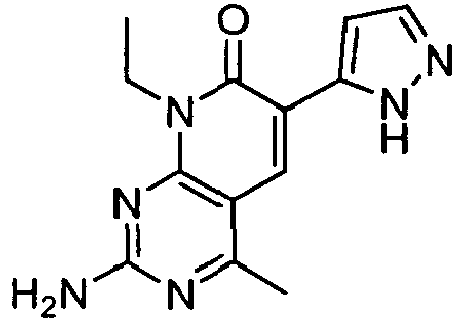
2-amino-8-ethyl-4-methyl-6-(1H-pyrazol-5-yl)pyrido[2,3-d]pyrimidin-7(8H)-one - The Compound, single isomer thereof, pharmaceutically acceptable salt, hydrate, or solvate thereof of Claim 1 where the cancer is selected from breast cancer, colon cancer, rectal cancer, endometrial cancer, gastrointestinal carcinoid tumors, gastrointestinal stromal tumors, glioblastoma, hepatocellular carcinoma, small cell lung cancer, non-small cell lung cancer, melanoma, ovarian cancer, cervical cancer, pancreatic cancer, prostate carcinoma, acute myelogenous leukemia, chronic myelogenous leukemia, non-Hodgkin's lymphoma, or thyroid carcinoma.
- The Compound, single isomer thereof, pharmaceutically acceptable salt, hydrate, or solvate thereof of Claim 1 or Claim 2, where the treatment is one chemotherapeutic agent and the chemotherapeutic agent is erlotinib.
- The Compound, single isomer thereof, pharmaceutically acceptable salt, hydrate, or solvate thereof of Claim 1 or Claim 2, where the treatment is one chemotherapeutic agent and the chemotherapeutic agent is carboplatin.
- The Compound, single isomer thereof, pharmaceutically acceptable salt, hydrate, or solvate thereof of Claim 1 or Claim 2, where the treatment is one chemotherapeutic agent and the chemotherapeutic agent is taxol.
- The Compound, single isomer thereof, pharmaceutically acceptable salt, hydrate, or solvate thereof of Claim 1 or Claim 2, where the treatment is one chemotherapeutic agent and the chemotherapeutic agent is rapamycin.
- The use of claim 1, where the cancer is selected from prostate cancer, non-small cell lung cancer, and breast cancer.
- The use of claim 1, where the chemotherapeutic agent is taxol and the cancer is prostate cancer.
- The use of claim 1, where the chemotherapeutic agent is rapamycin and the cancer is prostate cancer.
- The use of claim 1, where the chemotherapeutic agent is carboplatin and the cancer is non-small cell lung cancer.
- The use of claim 1, where the chemotherapeutic agent is erlotinib and the cancer is breast cancer.
Priority Applications (3)
| Application Number | Priority Date | Filing Date | Title |
|---|---|---|---|
| PL08742677T PL2139484T3 (en) | 2007-04-10 | 2008-04-09 | Methods of treating cancer using pyridopyrimidinone inhibitors of pi3k alpha |
| SI200831004T SI2139484T1 (en) | 2007-04-10 | 2008-04-09 | Methods of treating cancer using pyridopyrimidinone inhibitors of pi3k alpha |
| CY20131100805T CY1114609T1 (en) | 2007-04-10 | 2013-09-18 | METHODS OF CANCER TREATMENT USING P13K ALPHA PYRIDOPYRIMIDINONIS |
Applications Claiming Priority (2)
| Application Number | Priority Date | Filing Date | Title |
|---|---|---|---|
| US92289907P | 2007-04-10 | 2007-04-10 | |
| PCT/US2008/004573 WO2008124161A1 (en) | 2007-04-10 | 2008-04-09 | Methods of treating cancer using pyridopyrimidinone inhibitors of pi3k alpha |
Related Child Applications (2)
| Application Number | Title | Priority Date | Filing Date |
|---|---|---|---|
| EP12172484 Division-Into | 2012-06-18 | ||
| EP12172484.3 Division-Into | 2012-06-18 |
Publications (4)
| Publication Number | Publication Date |
|---|---|
| EP2139484A1 EP2139484A1 (en) | 2010-01-06 |
| EP2139484B1 EP2139484B1 (en) | 2013-07-17 |
| EP2139484B8 EP2139484B8 (en) | 2013-08-21 |
| EP2139484B9 true EP2139484B9 (en) | 2014-06-11 |
Family
ID=39627802
Family Applications (1)
| Application Number | Title | Priority Date | Filing Date |
|---|---|---|---|
| EP08742677.1A Active EP2139484B9 (en) | 2007-04-10 | 2008-04-09 | Methods of treating cancer using pyridopyrimidinone inhibitors of pi3k alpha |
Country Status (31)
| Country | Link |
|---|---|
| US (1) | US8513266B2 (en) |
| EP (1) | EP2139484B9 (en) |
| JP (3) | JP2010523670A (en) |
| KR (1) | KR101626435B1 (en) |
| CN (2) | CN101715345A (en) |
| AU (1) | AU2008236562B2 (en) |
| BR (1) | BRPI0810206A2 (en) |
| CA (1) | CA2683641C (en) |
| CO (1) | CO6251254A2 (en) |
| CR (1) | CR11100A (en) |
| DK (1) | DK2139484T3 (en) |
| DO (1) | DOP2009000243A (en) |
| EA (1) | EA020022B1 (en) |
| EC (1) | ECSP099724A (en) |
| ES (1) | ES2430614T3 (en) |
| HN (1) | HN2009003002A (en) |
| HR (1) | HRP20130688T1 (en) |
| IL (1) | IL201284A (en) |
| MA (1) | MA31358B1 (en) |
| ME (1) | ME00936B (en) |
| MX (1) | MX2009010930A (en) |
| MY (1) | MY150697A (en) |
| NZ (1) | NZ580110A (en) |
| PL (1) | PL2139484T3 (en) |
| PT (1) | PT2139484E (en) |
| RS (1) | RS52939B (en) |
| SI (1) | SI2139484T1 (en) |
| TN (1) | TN2009000400A1 (en) |
| UA (1) | UA100979C2 (en) |
| WO (1) | WO2008124161A1 (en) |
| ZA (1) | ZA200906764B (en) |
Families Citing this family (45)
| Publication number | Priority date | Publication date | Assignee | Title |
|---|---|---|---|---|
| TW200726767A (en) * | 2005-07-04 | 2007-07-16 | Astrazeneca Ab | Chemical compounds 2 |
| HRP20140975T1 (en) * | 2005-10-07 | 2014-11-21 | Exelixis, Inc. | N- (3-amino-quinoxalin-2-yl) -sulfonamide derivatives and their use as phosphatidylinositol 3-kinase inhibitors |
| HRP20130902T1 (en) * | 2005-10-07 | 2013-11-08 | Exelixis Inc. | PYRIDOPYRIMIDINONE INHIBITORS OF PI3Kalpha |
| CA2658725A1 (en) | 2006-08-16 | 2008-02-21 | Exelixis, Inc. | Using pi3k and mek modulators in treatments of cancer |
| US8188113B2 (en) * | 2006-09-14 | 2012-05-29 | Deciphera Pharmaceuticals, Inc. | Dihydropyridopyrimidinyl, dihydronaphthyidinyl and related compounds useful as kinase inhibitors for the treatment of proliferative diseases |
| SA08280783B1 (en) * | 2007-01-11 | 2011-04-24 | استرازينيكا ايه بي | Pyridopyrimidine Derivatives as PDE4 Inhibitors |
| PT2139484E (en) | 2007-04-10 | 2013-10-31 | Exelixis Inc | Methods of treating cancer using pyridopyrimidinone inhibitors of pi3k alpha |
| UA98141C2 (en) * | 2007-04-11 | 2012-04-25 | Экселиксис, Инк. | Methods of treating with quinaxoline inhibitors of pi3k-alpha |
| WO2010022128A1 (en) * | 2008-08-20 | 2010-02-25 | Schering Corporation | Ethenyl-substituted pyridine and pyrimidine derivatives and their use in treating viral infections |
| US8470834B2 (en) | 2008-08-20 | 2013-06-25 | Merck Sharp & Dohme Corp. | AZO-substituted pyridine and pyrimidine derivatives and their use in treating viral infections |
| CA2734487A1 (en) | 2008-08-20 | 2010-02-25 | Southern Research Institute | Ethynyl-substituted pyridine and pyrimidine derivatives and their use in treating viral infections |
| WO2010022121A1 (en) | 2008-08-20 | 2010-02-25 | Schering Corporation | Substituted pyridine and pyrimidine derivatives and their use in treating viral infections |
| UY33221A (en) | 2010-02-09 | 2011-09-30 | Univ California | METHODS TO TREAT CANCER USING PI3K AND mTOR INHIBITORS IN COMBINATION WITH AUTOPHAGIA INHIBITORS |
| US20130156768A1 (en) * | 2010-08-26 | 2013-06-20 | Bristol-Myers Squibb Company | Combination of anti-ctla4 antibody with braf inhibitors for the synergistic treatment of proliferative diseases |
| TWI642670B (en) | 2010-09-14 | 2018-12-01 | 伊塞利克斯公司 | PI3K-delta inhibitor and its application and production method |
| WO2012065019A2 (en) | 2010-11-12 | 2012-05-18 | Exelixis, Inc. | Pyridopyrimidinone inhibitors of p13k alpha |
| US9441013B2 (en) | 2011-05-17 | 2016-09-13 | H. Lee Moffitt Cancer Center And Research Institute, Inc. | Melanocortin 1 receptor ligands and methods of use |
| TW201306842A (en) * | 2011-06-15 | 2013-02-16 | Exelixis Inc | Combination therapies for treating hematologic malignancies using pyridopyrimidinone inhibitors of PI3K/MTOR with bendamustine and/or rituximab |
| CN104010494B (en) * | 2011-07-28 | 2017-07-04 | 霍夫曼-拉罗奇有限公司 | PIK3CA H1047R knock in non-human animal's breast cancer model |
| WO2013056067A1 (en) * | 2011-10-13 | 2013-04-18 | Exelixis, Inc. | Compounds for use in the treatment of basal cell carcinoma |
| SG11201401961UA (en) | 2011-11-01 | 2014-05-29 | Exelixis Inc | N- (3- { [ (3- { [2-chloro-5- (methoxy) phenyl] amino} quinoxalin- 2 -yl) amino] sulfonyl} phe nyl) - 2 -methylalaninamide as phosphatidylinositol 3 - kinase inhibitor for the treatment of lymphoproliferative malignancies |
| WO2013071264A1 (en) * | 2011-11-11 | 2013-05-16 | Intellikine, Llc | Combination of kinase inhibitors and uses thereof |
| CA2860051A1 (en) | 2011-12-27 | 2013-07-04 | Kadmon Corporation, Llc | Methods for treatment of breast cancer nonresponsive to trastuzumab |
| US8461179B1 (en) | 2012-06-07 | 2013-06-11 | Deciphera Pharmaceuticals, Llc | Dihydronaphthyridines and related compounds useful as kinase inhibitors for the treatment of proliferative diseases |
| US20150182490A1 (en) | 2012-06-26 | 2015-07-02 | Del Mar Pharmaceuticals | Methods for treating tyrosine-kinase-inhibitor-resistant malignancies in patients with genetic polymorphisms or ahi1 dysregulations or mutations employing dianhydrogalactitol, diacetyldianhydrogalactitol, dibromodulcitol, or analogs or derivatives thereof |
| US8980259B2 (en) * | 2012-07-20 | 2015-03-17 | Novartis Ag | Combination therapy |
| IN2015DN00450A (en) | 2012-08-07 | 2015-06-26 | Novartis Ag | |
| CN105492011A (en) | 2013-04-08 | 2016-04-13 | 丹尼斯·M·布朗 | Therapeutic potentiation of suboptimally administered chemical compounds |
| US9950194B2 (en) | 2014-09-09 | 2018-04-24 | Mevion Medical Systems, Inc. | Patient positioning system |
| KR20250007056A (en) | 2016-03-04 | 2025-01-13 | 다이호야쿠힌고교 가부시키가이샤 | Preparation and composition for treatment of malignant tumors |
| US11883404B2 (en) | 2016-03-04 | 2024-01-30 | Taiho Pharmaceuticals Co., Ltd. | Preparation and composition for treatment of malignant tumors |
| WO2017205503A1 (en) | 2016-05-24 | 2017-11-30 | Indiana University Research And Technology Corporation | Ku inhibitors and their use |
| CN109803968A (en) * | 2016-08-15 | 2019-05-24 | 辉瑞公司 | Pyridopyrimidinone CDK2/4/6 inhibitor |
| JP7027699B2 (en) * | 2017-05-09 | 2022-03-02 | 住友ゴム工業株式会社 | Tire tread and tires |
| CN118903436A (en) | 2018-01-31 | 2024-11-08 | 德西费拉制药有限责任公司 | Combination therapy for the treatment of mastocytosis |
| KR102708177B1 (en) | 2018-01-31 | 2024-09-23 | 데시페라 파마슈티칼스, 엘엘씨. | Combination therapy for the treatment of gastrointestinal stromal tumors |
| US11833151B2 (en) | 2018-03-19 | 2023-12-05 | Taiho Pharmaceutical Co., Ltd. | Pharmaceutical composition including sodium alkyl sulfate |
| IL330104A (en) | 2019-03-11 | 2026-08-01 | Deciphera Pharmaceuticals Llc | Solid state forms of ripretinib |
| HRP20260411T1 (en) | 2019-08-12 | 2026-05-08 | Deciphera Pharmaceuticals, Llc | Ripretinib for treating gastrointestinal stromal tumors |
| WO2021119242A1 (en) * | 2019-12-10 | 2021-06-17 | The Trustees Of Indiana University | Replication protein a (rpa)-dna interaction inhibitors |
| FI4084779T3 (en) | 2019-12-30 | 2024-12-16 | Deciphera Pharmaceuticals Llc | Compositions of 1-(4-bromo-5-(1-ethyl-7-(methylamino)-2-oxo-1,2-dihydro-1,6-naphthyridin-3-yl)-2-fluorophenyl)-3-phenylurea |
| KR102195221B1 (en) | 2019-12-31 | 2020-12-24 | 서울대학교산학협력단 | Pharmaceutical composition for combination of radiotherapy for treating triple negative breast cancer comprising phosphatidylinositol 3-kinase inhibitor and programmed cell death protein 1 inhibitor |
| CN111358952B (en) * | 2020-04-15 | 2022-03-15 | 中山大学肿瘤防治中心(中山大学附属肿瘤医院、中山大学肿瘤研究所) | A kind of antitumor drug composition and its preparation and application |
| IL312844A (en) * | 2021-11-18 | 2024-07-01 | Onconova Therapeutics Inc | Methods and preparations for the treatment of cancer |
| US11779572B1 (en) | 2022-09-02 | 2023-10-10 | Deciphera Pharmaceuticals, Llc | Methods of treating gastrointestinal stromal tumors |
Family Cites Families (15)
| Publication number | Priority date | Publication date | Assignee | Title |
|---|---|---|---|---|
| US7019002B2 (en) * | 2001-12-11 | 2006-03-28 | Pharmacia & Upjohn, S.P.A. | Pyridopyrimidinones derivatives as telomerase inhibitors |
| EP1521747B1 (en) * | 2002-07-15 | 2018-09-05 | Symphony Evolution, Inc. | Receptor-type kinase modulators and methods of use |
| CA2555724A1 (en) | 2004-02-18 | 2005-09-09 | Warner-Lambert Company Llc | 2-(pyridin-3-ylamino)-pyrido[2,3-d]pyrimidin-7-ones |
| WO2005105801A1 (en) * | 2004-05-04 | 2005-11-10 | Warner-Lambert Company Llc | Pyrrolyl substituted pyrido[2,3-d]pyrimidin-7-ones and derivatives thereof as therapeutic agents |
| TW200710406A (en) * | 2005-07-06 | 2007-03-16 | Sbc Corp | Leakage current detection apparatus and leakage current detection method |
| HRP20130902T1 (en) | 2005-10-07 | 2013-11-08 | Exelixis Inc. | PYRIDOPYRIMIDINONE INHIBITORS OF PI3Kalpha |
| PT1940839E (en) | 2005-10-07 | 2013-10-10 | Exelixis Inc | Pyridopyrimidinone inhibitors of pi3kalpha |
| HRP20140975T1 (en) | 2005-10-07 | 2014-11-21 | Exelixis, Inc. | N- (3-amino-quinoxalin-2-yl) -sulfonamide derivatives and their use as phosphatidylinositol 3-kinase inhibitors |
| CA2658725A1 (en) | 2006-08-16 | 2008-02-21 | Exelixis, Inc. | Using pi3k and mek modulators in treatments of cancer |
| CA2663401C (en) * | 2006-09-15 | 2011-07-12 | Pfizer Products Inc. | Pyrido (2, 3-d) pyrimidinone compounds and their use as pi3 inhibitors |
| PT2139484E (en) | 2007-04-10 | 2013-10-31 | Exelixis Inc | Methods of treating cancer using pyridopyrimidinone inhibitors of pi3k alpha |
| CA2683820A1 (en) | 2007-04-11 | 2008-10-23 | Exelixis, Inc. | Pyrido [2, 3-d] pyrimidin-7-one compounds as inhibitors of p13k-alpha for the treatment of cancer |
| AU2008239655B2 (en) | 2007-04-11 | 2013-06-20 | Exelixis, Inc. | Pyrido (2, 3-d) pyrimidin-7-one compounds as inhibitors of PI3k-alpha for the treatment of cancer |
| UA98141C2 (en) | 2007-04-11 | 2012-04-25 | Экселиксис, Инк. | Methods of treating with quinaxoline inhibitors of pi3k-alpha |
| TW201018685A (en) | 2008-09-30 | 2010-05-16 | Exelixis Inc | Pyridopyrimidinone inhibitors of PI3Kα and mTOR |
-
2008
- 2008-04-09 PT PT87426771T patent/PT2139484E/en unknown
- 2008-04-09 EA EA200970932A patent/EA020022B1/en not_active IP Right Cessation
- 2008-04-09 NZ NZ580110A patent/NZ580110A/en not_active IP Right Cessation
- 2008-04-09 UA UAA200911419A patent/UA100979C2/en unknown
- 2008-04-09 JP JP2010503045A patent/JP2010523670A/en active Pending
- 2008-04-09 PL PL08742677T patent/PL2139484T3/en unknown
- 2008-04-09 WO PCT/US2008/004573 patent/WO2008124161A1/en not_active Ceased
- 2008-04-09 BR BRPI0810206-6A2A patent/BRPI0810206A2/en not_active IP Right Cessation
- 2008-04-09 HR HRP20130688AT patent/HRP20130688T1/en unknown
- 2008-04-09 ES ES08742677T patent/ES2430614T3/en active Active
- 2008-04-09 AU AU2008236562A patent/AU2008236562B2/en not_active Ceased
- 2008-04-09 RS RS20130384A patent/RS52939B/en unknown
- 2008-04-09 ME MEP-2009-303A patent/ME00936B/en unknown
- 2008-04-09 CA CA2683641A patent/CA2683641C/en not_active Expired - Fee Related
- 2008-04-09 EP EP08742677.1A patent/EP2139484B9/en active Active
- 2008-04-09 CN CN200880018725A patent/CN101715345A/en active Pending
- 2008-04-09 SI SI200831004T patent/SI2139484T1/en unknown
- 2008-04-09 US US12/595,219 patent/US8513266B2/en not_active Expired - Fee Related
- 2008-04-09 CN CN201210032620.4A patent/CN102727498B/en not_active Expired - Fee Related
- 2008-04-09 KR KR1020097023351A patent/KR101626435B1/en not_active Expired - Fee Related
- 2008-04-09 MX MX2009010930A patent/MX2009010930A/en active IP Right Grant
- 2008-04-09 DK DK08742677.1T patent/DK2139484T3/en active
- 2008-04-09 MY MYPI20094214 patent/MY150697A/en unknown
-
2009
- 2009-09-29 ZA ZA200906764A patent/ZA200906764B/en unknown
- 2009-09-30 TN TNP2009000400A patent/TN2009000400A1/en unknown
- 2009-10-01 IL IL201284A patent/IL201284A/en active IP Right Grant
- 2009-10-09 HN HN2009003002A patent/HN2009003002A/en unknown
- 2009-10-09 DO DO2009000243A patent/DOP2009000243A/en unknown
- 2009-11-02 MA MA32318A patent/MA31358B1/en unknown
- 2009-11-09 CR CR11100A patent/CR11100A/en unknown
- 2009-11-09 EC EC2009009724A patent/ECSP099724A/en unknown
- 2009-11-09 CO CO09126924A patent/CO6251254A2/en not_active Application Discontinuation
-
2013
- 2013-09-19 JP JP2013194611A patent/JP2014034576A/en active Pending
-
2014
- 2014-03-24 JP JP2014059561A patent/JP2014139217A/en active Pending
Also Published As
Similar Documents
| Publication | Publication Date | Title |
|---|---|---|
| EP2139484B1 (en) | Methods of treating cancer using pyridopyrimidinone inhibitors of pi3k alpha | |
| EP2139483B9 (en) | Combination therapies comprising a quinoxaline inhibitor of pi3k-alpha for use in the treatment of cancer | |
| EP2142544B1 (en) | Pyrido [2, 3-d]pyrimidin-7-one compounds as inhibitors of pi3k-alpha for the treatment of cancer | |
| EP2142543B1 (en) | Pyrido [2, 3-d]pyrimidin-7-one compounds as inhibitors of pi3k-alpha for the treatment of cancer | |
| WO2014177915A1 (en) | Cancer combination therapy using imidazo[4,5-c]quinoline derivatives | |
| HK1139863B (en) | Methods of treating cancer using pyridopyrimidinone inhibitors of pi3k alpha | |
| HK1139941B (en) | Pyrido [2, 3-d]pyrimidin-7-one compounds as inhibitors of pi3k-alpha for the treatment of cancer | |
| HK1140141B (en) | Combination therapies comprising a quinoxaline inhibitors of pi3k-alpha for use in the treatment of cancer | |
| HK1139948B (en) | Pyrido [2, 3-d]pyrimidin-7-one compounds as inhibitors of pi3k-alpha for the treatment of cancer |
Legal Events
| Date | Code | Title | Description |
|---|---|---|---|
| PUAI | Public reference made under article 153(3) epc to a published international application that has entered the european phase |
Free format text: ORIGINAL CODE: 0009012 |
|
| 17P | Request for examination filed |
Effective date: 20091028 |
|
| AK | Designated contracting states |
Kind code of ref document: A1 Designated state(s): AT BE BG CH CY CZ DE DK EE ES FI FR GB GR HR HU IE IS IT LI LT LU LV MC MT NL NO PL PT RO SE SI SK TR |
|
| AX | Request for extension of the european patent |
Extension state: AL BA MK RS |
|
| 17Q | First examination report despatched |
Effective date: 20100607 |
|
| REG | Reference to a national code |
Ref country code: HK Ref legal event code: DE Ref document number: 1139863 Country of ref document: HK |
|
| GRAP | Despatch of communication of intention to grant a patent |
Free format text: ORIGINAL CODE: EPIDOSNIGR1 |
|
| GRAP | Despatch of communication of intention to grant a patent |
Free format text: ORIGINAL CODE: EPIDOSNIGR1 |
|
| GRAS | Grant fee paid |
Free format text: ORIGINAL CODE: EPIDOSNIGR3 |
|
| GRAA | (expected) grant |
Free format text: ORIGINAL CODE: 0009210 |
|
| AK | Designated contracting states |
Kind code of ref document: B1 Designated state(s): AT BE BG CH CY CZ DE DK EE ES FI FR GB GR HR HU IE IS IT LI LT LU LV MC MT NL NO PL PT RO SE SI SK TR |
|
| AX | Request for extension of the european patent |
Extension state: AL BA MK RS |
|
| REG | Reference to a national code |
Ref country code: GB Ref legal event code: FG4D |
|
| REG | Reference to a national code |
Ref country code: HR Ref legal event code: TUEP Ref document number: P20130688 Country of ref document: HR |
|
| REG | Reference to a national code |
Ref country code: CH Ref legal event code: EP |
|
| RAP2 | Party data changed (patent owner data changed or rights of a patent transferred) |
Owner name: EXELIXIS, INC. |
|
| REG | Reference to a national code |
Ref country code: IE Ref legal event code: FG4D |
|
| REG | Reference to a national code |
Ref country code: AT Ref legal event code: REF Ref document number: 621744 Country of ref document: AT Kind code of ref document: T Effective date: 20130815 |
|
| REG | Reference to a national code |
Ref country code: DE Ref legal event code: R096 Ref document number: 602008026072 Country of ref document: DE Effective date: 20130912 |
|
| REG | Reference to a national code |
Ref country code: CH Ref legal event code: NV Representative=s name: MURGITROYD AND COMPANY, CH |
|
| REG | Reference to a national code |
Ref country code: HR Ref legal event code: T1PR Ref document number: P20130688 Country of ref document: HR |
|
| REG | Reference to a national code |
Ref country code: RO Ref legal event code: EPE |
|
| REG | Reference to a national code |
Ref country code: SE Ref legal event code: TRGR |
|
| REG | Reference to a national code |
Ref country code: DK Ref legal event code: T3 |
|
| REG | Reference to a national code |
Ref country code: PT Ref legal event code: SC4A Free format text: AVAILABILITY OF NATIONAL TRANSLATION Effective date: 20131017 |
|
| REG | Reference to a national code |
Ref country code: NL Ref legal event code: T3 |
|
| REG | Reference to a national code |
Ref country code: HK Ref legal event code: GR Ref document number: 1139863 Country of ref document: HK |
|
| REG | Reference to a national code |
Ref country code: ES Ref legal event code: FG2A Ref document number: 2430614 Country of ref document: ES Kind code of ref document: T3 Effective date: 20131121 |
|
| REG | Reference to a national code |
Ref country code: NO Ref legal event code: T2 Effective date: 20130717 |
|
| REG | Reference to a national code |
Ref country code: PL Ref legal event code: T3 |
|
| REG | Reference to a national code |
Ref country code: SK Ref legal event code: T3 Ref document number: E 15097 Country of ref document: SK |
|
| REG | Reference to a national code |
Ref country code: GR Ref legal event code: EP Ref document number: 20130402133 Country of ref document: GR Effective date: 20131118 |
|
| REG | Reference to a national code |
Ref country code: EE Ref legal event code: FG4A Ref document number: E008651 Country of ref document: EE Effective date: 20131202 |
|
| PLBE | No opposition filed within time limit |
Free format text: ORIGINAL CODE: 0009261 |
|
| STAA | Information on the status of an ep patent application or granted ep patent |
Free format text: STATUS: NO OPPOSITION FILED WITHIN TIME LIMIT |
|
| 26N | No opposition filed |
Effective date: 20140422 |
|
| REG | Reference to a national code |
Ref country code: HU Ref legal event code: AG4A Ref document number: E019329 Country of ref document: HU |
|
| REG | Reference to a national code |
Ref country code: DE Ref legal event code: R097 Ref document number: 602008026072 Country of ref document: DE Effective date: 20140422 |
|
| REG | Reference to a national code |
Ref country code: FR Ref legal event code: PLFP Year of fee payment: 9 |
|
| REG | Reference to a national code |
Ref country code: FR Ref legal event code: PLFP Year of fee payment: 10 |
|
| REG | Reference to a national code |
Ref country code: FR Ref legal event code: PLFP Year of fee payment: 11 |
|
| REG | Reference to a national code |
Ref country code: HR Ref legal event code: ODRP Ref document number: P20130688 Country of ref document: HR Payment date: 20190402 Year of fee payment: 12 |
|
| REG | Reference to a national code |
Ref country code: HR Ref legal event code: ODRP Ref document number: P20130688 Country of ref document: HR Payment date: 20200330 Year of fee payment: 13 |
|
| PGFP | Annual fee paid to national office [announced via postgrant information from national office to epo] |
Ref country code: PL Payment date: 20200326 Year of fee payment: 13 Ref country code: BG Payment date: 20200327 Year of fee payment: 13 Ref country code: MC Payment date: 20200326 Year of fee payment: 13 Ref country code: PT Payment date: 20200320 Year of fee payment: 13 Ref country code: GR Payment date: 20200327 Year of fee payment: 13 Ref country code: LV Payment date: 20200330 Year of fee payment: 13 Ref country code: EE Payment date: 20200330 Year of fee payment: 13 |
|
| PGFP | Annual fee paid to national office [announced via postgrant information from national office to epo] |
Ref country code: CZ Payment date: 20200330 Year of fee payment: 13 Ref country code: LU Payment date: 20200324 Year of fee payment: 13 Ref country code: BE Payment date: 20200316 Year of fee payment: 13 Ref country code: IS Payment date: 20200326 Year of fee payment: 13 Ref country code: SK Payment date: 20200326 Year of fee payment: 13 |
|
| PGFP | Annual fee paid to national office [announced via postgrant information from national office to epo] |
Ref country code: FR Payment date: 20200326 Year of fee payment: 13 |
|
| PGFP | Annual fee paid to national office [announced via postgrant information from national office to epo] |
Ref country code: DE Payment date: 20200325 Year of fee payment: 13 Ref country code: FI Payment date: 20200409 Year of fee payment: 13 Ref country code: IE Payment date: 20200409 Year of fee payment: 13 Ref country code: CH Payment date: 20200420 Year of fee payment: 13 Ref country code: TR Payment date: 20200409 Year of fee payment: 13 Ref country code: CY Payment date: 20200320 Year of fee payment: 13 Ref country code: LT Payment date: 20200403 Year of fee payment: 13 Ref country code: NO Payment date: 20200414 Year of fee payment: 13 Ref country code: NL Payment date: 20200417 Year of fee payment: 13 Ref country code: ES Payment date: 20200504 Year of fee payment: 13 Ref country code: RO Payment date: 20200403 Year of fee payment: 13 Ref country code: DK Payment date: 20200414 Year of fee payment: 13 |
|
| PGFP | Annual fee paid to national office [announced via postgrant information from national office to epo] |
Ref country code: SE Payment date: 20200415 Year of fee payment: 13 Ref country code: IT Payment date: 20200326 Year of fee payment: 13 Ref country code: SI Payment date: 20200331 Year of fee payment: 13 Ref country code: HU Payment date: 20200405 Year of fee payment: 13 Ref country code: HR Payment date: 20200409 Year of fee payment: 13 Ref country code: GB Payment date: 20200401 Year of fee payment: 13 |
|
| PGFP | Annual fee paid to national office [announced via postgrant information from national office to epo] |
Ref country code: AT Payment date: 20200325 Year of fee payment: 13 Ref country code: MT Payment date: 20200416 Year of fee payment: 13 |
|
| REG | Reference to a national code |
Ref country code: HR Ref legal event code: PBON Ref document number: P20130688 Country of ref document: HR Effective date: 20210409 |
|
| REG | Reference to a national code |
Ref country code: DE Ref legal event code: R119 Ref document number: 602008026072 Country of ref document: DE |
|
| REG | Reference to a national code |
Ref country code: FI Ref legal event code: MAE Ref country code: LT Ref legal event code: MM4D Effective date: 20210409 |
|
| REG | Reference to a national code |
Ref country code: EE Ref legal event code: MM4A Ref document number: E008651 Country of ref document: EE Effective date: 20210430 |
|
| REG | Reference to a national code |
Ref country code: DK Ref legal event code: EBP Effective date: 20210430 |
|
| REG | Reference to a national code |
Ref country code: NO Ref legal event code: MMEP |
|
| PG25 | Lapsed in a contracting state [announced via postgrant information from national office to epo] |
Ref country code: MC Free format text: LAPSE BECAUSE OF NON-PAYMENT OF DUE FEES Effective date: 20210430 |
|
| REG | Reference to a national code |
Ref country code: SE Ref legal event code: EUG |
|
| REG | Reference to a national code |
Ref country code: NL Ref legal event code: MM Effective date: 20210501 |
|
| REG | Reference to a national code |
Ref country code: AT Ref legal event code: MM01 Ref document number: 621744 Country of ref document: AT Kind code of ref document: T Effective date: 20210409 |
|
| REG | Reference to a national code |
Ref country code: SK Ref legal event code: MM4A Ref document number: E 15097 Country of ref document: SK Effective date: 20210409 |
|
| GBPC | Gb: european patent ceased through non-payment of renewal fee |
Effective date: 20210409 |
|
| PG25 | Lapsed in a contracting state [announced via postgrant information from national office to epo] |
Ref country code: LU Free format text: LAPSE BECAUSE OF NON-PAYMENT OF DUE FEES Effective date: 20210409 |
|
| REG | Reference to a national code |
Ref country code: BE Ref legal event code: MM Effective date: 20210430 |
|
| PG25 | Lapsed in a contracting state [announced via postgrant information from national office to epo] |
Ref country code: FR Free format text: LAPSE BECAUSE OF NON-PAYMENT OF DUE FEES Effective date: 20210430 Ref country code: HU Free format text: LAPSE BECAUSE OF NON-PAYMENT OF DUE FEES Effective date: 20210410 Ref country code: HR Free format text: LAPSE BECAUSE OF NON-PAYMENT OF DUE FEES Effective date: 20210409 Ref country code: GB Free format text: LAPSE BECAUSE OF NON-PAYMENT OF DUE FEES Effective date: 20210409 Ref country code: CY Free format text: LAPSE BECAUSE OF NON-PAYMENT OF DUE FEES Effective date: 20210409 Ref country code: CZ Free format text: LAPSE BECAUSE OF NON-PAYMENT OF DUE FEES Effective date: 20210409 Ref country code: DE Free format text: LAPSE BECAUSE OF NON-PAYMENT OF DUE FEES Effective date: 20211103 Ref country code: EE Free format text: LAPSE BECAUSE OF NON-PAYMENT OF DUE FEES Effective date: 20210430 Ref country code: SK Free format text: LAPSE BECAUSE OF NON-PAYMENT OF DUE FEES Effective date: 20210409 Ref country code: SE Free format text: LAPSE BECAUSE OF NON-PAYMENT OF DUE FEES Effective date: 20210410 Ref country code: BG Free format text: LAPSE BECAUSE OF NON-PAYMENT OF DUE FEES Effective date: 20211031 Ref country code: AT Free format text: LAPSE BECAUSE OF NON-PAYMENT OF DUE FEES Effective date: 20210409 Ref country code: CH Free format text: LAPSE BECAUSE OF NON-PAYMENT OF DUE FEES Effective date: 20210430 Ref country code: LI Free format text: LAPSE BECAUSE OF NON-PAYMENT OF DUE FEES Effective date: 20210430 Ref country code: LT Free format text: LAPSE BECAUSE OF NON-PAYMENT OF DUE FEES Effective date: 20210409 Ref country code: PT Free format text: LAPSE BECAUSE OF NON-PAYMENT OF DUE FEES Effective date: 20211011 Ref country code: RO Free format text: LAPSE BECAUSE OF NON-PAYMENT OF DUE FEES Effective date: 20210409 Ref country code: NO Free format text: LAPSE BECAUSE OF NON-PAYMENT OF DUE FEES Effective date: 20210430 Ref country code: FI Free format text: LAPSE BECAUSE OF NON-PAYMENT OF DUE FEES Effective date: 20210409 |
|
| PG25 | Lapsed in a contracting state [announced via postgrant information from national office to epo] |
Ref country code: SI Free format text: LAPSE BECAUSE OF NON-PAYMENT OF DUE FEES Effective date: 20210410 Ref country code: LV Free format text: LAPSE BECAUSE OF NON-PAYMENT OF DUE FEES Effective date: 20210409 Ref country code: GR Free format text: LAPSE BECAUSE OF NON-PAYMENT OF DUE FEES Effective date: 20211108 |
|
| REG | Reference to a national code |
Ref country code: SI Ref legal event code: KO00 Effective date: 20220126 |
|
| PG25 | Lapsed in a contracting state [announced via postgrant information from national office to epo] |
Ref country code: NL Free format text: LAPSE BECAUSE OF NON-PAYMENT OF DUE FEES Effective date: 20210501 |
|
| PG25 | Lapsed in a contracting state [announced via postgrant information from national office to epo] |
Ref country code: IE Free format text: LAPSE BECAUSE OF NON-PAYMENT OF DUE FEES Effective date: 20210409 Ref country code: DK Free format text: LAPSE BECAUSE OF NON-PAYMENT OF DUE FEES Effective date: 20210430 |
|
| PG25 | Lapsed in a contracting state [announced via postgrant information from national office to epo] |
Ref country code: MT Free format text: LAPSE BECAUSE OF NON-PAYMENT OF DUE FEES Effective date: 20210409 |
|
| REG | Reference to a national code |
Ref country code: ES Ref legal event code: FD2A Effective date: 20220701 |
|
| PG25 | Lapsed in a contracting state [announced via postgrant information from national office to epo] |
Ref country code: ES Free format text: LAPSE BECAUSE OF NON-PAYMENT OF DUE FEES Effective date: 20210410 Ref country code: BE Free format text: LAPSE BECAUSE OF NON-PAYMENT OF DUE FEES Effective date: 20210430 |
|
| PG25 | Lapsed in a contracting state [announced via postgrant information from national office to epo] |
Ref country code: PL Free format text: LAPSE BECAUSE OF NON-PAYMENT OF DUE FEES Effective date: 20210409 |
|
| PG25 | Lapsed in a contracting state [announced via postgrant information from national office to epo] |
Ref country code: IT Free format text: LAPSE BECAUSE OF NON-PAYMENT OF DUE FEES Effective date: 20200409 |
|
| PG25 | Lapsed in a contracting state [announced via postgrant information from national office to epo] |
Ref country code: TR Free format text: LAPSE BECAUSE OF NON-PAYMENT OF DUE FEES Effective date: 20210409 |
|
| PG25 | Lapsed in a contracting state [announced via postgrant information from national office to epo] |
Ref country code: IT Free format text: LAPSE BECAUSE OF NON-PAYMENT OF DUE FEES Effective date: 20210409 |
|
| PG25 | Lapsed in a contracting state [announced via postgrant information from national office to epo] |
Ref country code: IS Free format text: LAPSE BECAUSE OF NON-PAYMENT OF DUE FEES Effective date: 20211103 |