EP2139003A2 - Aufzeichnungsvorrichtung, Wiedergabevorrichtung und Aufzeichnungsmedium zur Zuweisung derselben CCI an eine Gruppe von Paketen in einem Transportstrom - Google Patents
Aufzeichnungsvorrichtung, Wiedergabevorrichtung und Aufzeichnungsmedium zur Zuweisung derselben CCI an eine Gruppe von Paketen in einem Transportstrom Download PDFInfo
- Publication number
- EP2139003A2 EP2139003A2 EP09003611A EP09003611A EP2139003A2 EP 2139003 A2 EP2139003 A2 EP 2139003A2 EP 09003611 A EP09003611 A EP 09003611A EP 09003611 A EP09003611 A EP 09003611A EP 2139003 A2 EP2139003 A2 EP 2139003A2
- Authority
- EP
- European Patent Office
- Prior art keywords
- packets
- chain
- packet
- module configured
- encrypted
- Prior art date
- Legal status (The legal status is an assumption and is not a legal conclusion. Google has not performed a legal analysis and makes no representation as to the accuracy of the status listed.)
- Withdrawn
Links
Images




Classifications
-
- G—PHYSICS
- G11—INFORMATION STORAGE
- G11B—INFORMATION STORAGE BASED ON RELATIVE MOVEMENT BETWEEN RECORD CARRIER AND TRANSDUCER
- G11B20/00—Signal processing not specific to the method of recording or reproducing; Circuits therefor
- G11B20/00086—Circuits for prevention of unauthorised reproduction or copying, e.g. piracy
-
- G—PHYSICS
- G11—INFORMATION STORAGE
- G11B—INFORMATION STORAGE BASED ON RELATIVE MOVEMENT BETWEEN RECORD CARRIER AND TRANSDUCER
- G11B20/00—Signal processing not specific to the method of recording or reproducing; Circuits therefor
- G11B20/00086—Circuits for prevention of unauthorised reproduction or copying, e.g. piracy
- G11B20/0021—Circuits for prevention of unauthorised reproduction or copying, e.g. piracy involving encryption or decryption of contents recorded on or reproduced from a record carrier
-
- G—PHYSICS
- G11—INFORMATION STORAGE
- G11B—INFORMATION STORAGE BASED ON RELATIVE MOVEMENT BETWEEN RECORD CARRIER AND TRANSDUCER
- G11B20/00—Signal processing not specific to the method of recording or reproducing; Circuits therefor
- G11B20/00086—Circuits for prevention of unauthorised reproduction or copying, e.g. piracy
- G11B20/0021—Circuits for prevention of unauthorised reproduction or copying, e.g. piracy involving encryption or decryption of contents recorded on or reproduced from a record carrier
- G11B20/00485—Circuits for prevention of unauthorised reproduction or copying, e.g. piracy involving encryption or decryption of contents recorded on or reproduced from a record carrier characterised by a specific kind of data which is encrypted and recorded on and/or reproduced from the record carrier
- G11B20/00492—Circuits for prevention of unauthorised reproduction or copying, e.g. piracy involving encryption or decryption of contents recorded on or reproduced from a record carrier characterised by a specific kind of data which is encrypted and recorded on and/or reproduced from the record carrier wherein content or user data is encrypted
- G11B20/00507—Circuits for prevention of unauthorised reproduction or copying, e.g. piracy involving encryption or decryption of contents recorded on or reproduced from a record carrier characterised by a specific kind of data which is encrypted and recorded on and/or reproduced from the record carrier wherein content or user data is encrypted wherein consecutive physical data units of the record carrier are encrypted with separate encryption keys, e.g. the key changes on a cluster or sector basis
-
- G—PHYSICS
- G11—INFORMATION STORAGE
- G11B—INFORMATION STORAGE BASED ON RELATIVE MOVEMENT BETWEEN RECORD CARRIER AND TRANSDUCER
- G11B20/00—Signal processing not specific to the method of recording or reproducing; Circuits therefor
- G11B20/00086—Circuits for prevention of unauthorised reproduction or copying, e.g. piracy
- G11B20/00731—Circuits for prevention of unauthorised reproduction or copying, e.g. piracy involving a digital rights management system for enforcing a usage restriction
- G11B20/00746—Circuits for prevention of unauthorised reproduction or copying, e.g. piracy involving a digital rights management system for enforcing a usage restriction wherein the usage restriction can be expressed as a specific number
- G11B20/00753—Circuits for prevention of unauthorised reproduction or copying, e.g. piracy involving a digital rights management system for enforcing a usage restriction wherein the usage restriction can be expressed as a specific number wherein the usage restriction limits the number of copies that can be made, e.g. CGMS, SCMS, or CCI flags
- G11B20/00768—Circuits for prevention of unauthorised reproduction or copying, e.g. piracy involving a digital rights management system for enforcing a usage restriction wherein the usage restriction can be expressed as a specific number wherein the usage restriction limits the number of copies that can be made, e.g. CGMS, SCMS, or CCI flags wherein copy control information is used, e.g. for indicating whether a content may be copied freely, no more, once, or never, by setting CGMS, SCMS, or CCI flags
-
- H—ELECTRICITY
- H04—ELECTRIC COMMUNICATION TECHNIQUE
- H04L—TRANSMISSION OF DIGITAL INFORMATION, e.g. TELEGRAPHIC COMMUNICATION
- H04L9/00—Cryptographic mechanisms or cryptographic arrangements for secret or secure communications; Network security protocols
- H04L9/12—Transmitting and receiving encryption devices synchronised or initially set up in a particular manner
-
- H—ELECTRICITY
- H04—ELECTRIC COMMUNICATION TECHNIQUE
- H04N—PICTORIAL COMMUNICATION, e.g. TELEVISION
- H04N21/00—Selective content distribution, e.g. interactive television or video on demand [VOD]
- H04N21/20—Servers specifically adapted for the distribution of content, e.g. VOD servers; Operations thereof
- H04N21/25—Management operations performed by the server for facilitating the content distribution or administrating data related to end-users or client devices, e.g. end-user or client device authentication, learning user preferences for recommending movies
- H04N21/254—Management at additional data server, e.g. shopping server, rights management server
- H04N21/2541—Rights Management
-
- H—ELECTRICITY
- H04—ELECTRIC COMMUNICATION TECHNIQUE
- H04N—PICTORIAL COMMUNICATION, e.g. TELEVISION
- H04N21/00—Selective content distribution, e.g. interactive television or video on demand [VOD]
- H04N21/40—Client devices specifically adapted for the reception of or interaction with content, e.g. set-top-box [STB]; Operations thereof
- H04N21/43—Processing of content or additional data, e.g. demultiplexing additional data from a digital video stream; Elementary client operations, e.g. monitoring of home network or synchronising decoder's clock; Client middleware
- H04N21/433—Content storage operation, e.g. storage operation in response to a pause request, caching operations
- H04N21/4334—Recording operations
-
- H—ELECTRICITY
- H04—ELECTRIC COMMUNICATION TECHNIQUE
- H04N—PICTORIAL COMMUNICATION, e.g. TELEVISION
- H04N21/00—Selective content distribution, e.g. interactive television or video on demand [VOD]
- H04N21/80—Generation or processing of content or additional data by content creator independently of the distribution process; Content per se
- H04N21/83—Generation or processing of protective or descriptive data associated with content; Content structuring
- H04N21/835—Generation of protective data, e.g. certificates
-
- H—ELECTRICITY
- H04—ELECTRIC COMMUNICATION TECHNIQUE
- H04N—PICTORIAL COMMUNICATION, e.g. TELEVISION
- H04N21/00—Selective content distribution, e.g. interactive television or video on demand [VOD]
- H04N21/80—Generation or processing of content or additional data by content creator independently of the distribution process; Content per se
- H04N21/83—Generation or processing of protective or descriptive data associated with content; Content structuring
- H04N21/835—Generation of protective data, e.g. certificates
- H04N21/8355—Generation of protective data, e.g. certificates involving usage data, e.g. number of copies or viewings allowed
-
- H—ELECTRICITY
- H04—ELECTRIC COMMUNICATION TECHNIQUE
- H04N—PICTORIAL COMMUNICATION, e.g. TELEVISION
- H04N5/00—Details of television systems
- H04N5/76—Television signal recording
- H04N5/91—Television signal processing therefor
- H04N5/913—Television signal processing therefor for scrambling ; for copy protection
-
- H—ELECTRICITY
- H04—ELECTRIC COMMUNICATION TECHNIQUE
- H04N—PICTORIAL COMMUNICATION, e.g. TELEVISION
- H04N5/00—Details of television systems
- H04N5/76—Television signal recording
- H04N5/91—Television signal processing therefor
- H04N5/913—Television signal processing therefor for scrambling ; for copy protection
- H04N2005/91307—Television signal processing therefor for scrambling ; for copy protection by adding a copy protection signal to the video signal
- H04N2005/91328—Television signal processing therefor for scrambling ; for copy protection by adding a copy protection signal to the video signal the copy protection signal being a copy management signal, e.g. a copy generation management signal [CGMS]
-
- H—ELECTRICITY
- H04—ELECTRIC COMMUNICATION TECHNIQUE
- H04N—PICTORIAL COMMUNICATION, e.g. TELEVISION
- H04N5/00—Details of television systems
- H04N5/76—Television signal recording
- H04N5/91—Television signal processing therefor
- H04N5/913—Television signal processing therefor for scrambling ; for copy protection
- H04N2005/91357—Television signal processing therefor for scrambling ; for copy protection by modifying the video signal
- H04N2005/91364—Television signal processing therefor for scrambling ; for copy protection by modifying the video signal the video signal being scrambled
Definitions
- the present invention relates to a recording apparatus, a reproducing apparatus and a recording medium for recording or reproducing data.
- a recording/reproducing apparatus is used for recording/reproducing content data as a subject of copyright protection on/from a recording medium such as a memory card.
- a recording medium such as a memory card.
- SD-Video standard and an SDSD-Video standard as recording formats for recording MPEG2-TS format digital contents on a recording medium.
- CPRM Content Protection for Recordable Media
- Copy control information hereinafter referred to as CCI
- CCI Copy control information
- Content data may be divided into chained packets (a chain of packets) so that each packet can be processed (encrypted or decrypted).
- the range of the chain has a fixed length.
- a copyright protection control packet in which CCI information is written is added periodically (at intervals of 31 packets).
- 31 packets following the control packet are encrypted when copyright protection is required, but 31 packets following the control packet are recorded without encryption when copyright protection is not required (copy free).
- the range of the chain for encryption has a fixed length. It is impossible to change the range of the chain in the middle of content in accordance with a bit rate or CCI.
- broadcast methods such as one-segment, HD (high definition) and SD (Standard Definition) widely different in bit rate are mixed.
- the bit rate (about 18 Mbps) in the HD broadcast is not lower than 30 times as high as the bit rate (about 500 Kbps) in the one-segment broadcast.
- the time required for transmitting the same number of packets in the HD broadcast is not longer than about 1/30 as long as the time required in the one-segment broadcast.
- To insert a control packet with CCI written therein at intervals of 31 packets in the same manner as in the one-segment broadcast is not effective to the HD broadcast.
- one of objects of the invention is to provide a recording apparatus, a reproducing apparatus and a recording medium in which the number of chained packets can be changed appropriately.
- a recording apparatus including: a packet generating module configured to generate a control packet and a chain of packets based on content data, the control packet having copy control information and chained packet number information, the chain of packets corresponding to the chained packet number information; and a writing module configured to write the control packet and the chain of packets into a recording medium.
- a reproducing apparatus including: a reading module configured to read a control packet and a chain of packets from a recording medium, the control packet having copy control information and chained packet number information, the chain of packets corresponding to the chained packet number information; and a content data generating module configured to generate content data from the control packet and the chain of packets.
- a recording medium including: at least one file containing a control packet and a chain of packets, the control packet having copy control information and chained packet number information, the chain of packets corresponding to the chained packet number information; and a management file configured to be used for managing the file.
- Fig. 1 is a block diagram showing a recording/reproducing apparatus 100 according to an embodiment.
- the recording/reproducing apparatus 100 includes an input module 101, a demodulator 102, a demultiplexer (DEMUX) 103, a video/audio decoder 104, an OSD (On Screen Display) module 105, a DA converter 106, a monitor 107, a speaker 108, a user interface (I/F) 111, a CPU (Central Processing Unit) 112, a memory 113, an HDD (Hard Disk Drive) interface 114, an HDD 115, and an external media processing module 116.
- I/F user interface
- CPU Central Processing Unit
- HDD Hard Disk Drive
- the input module 101 inputs a content signal.
- the content signal is a broadcast signal distributed from a broadcast station.
- the demodulator 102 generates a transport stream (hereinafter referred to as "TS") by demodulating the content signal.
- TS is a multiplexed signal containing an MPEG-2 signal and a management signal.
- the DUMUX 103 demultiplexes the TS input from the demodulator 102 into an MPEG-2 video/audio signal, a management signal, etc. and outputs these signals to the video/audio decoder 104.
- the video/audio decoder 104 generates a video signal and an audio signal by decoding the video/audio signal input from the DEMUX 103 and outputs these signals to the OSD module 105 and the DA converter 106 respectively.
- the OSD module 105 superimposes a menu signal on the video signal.
- the DA converter 106 converts the digital audio signal into an analog audio signal.
- the monitor 107 is a display device such as a CRT or a liquid crystal display device.
- the speaker 108 is an audio output device.
- the user I/F 111 is connected to a radio receiving portion and a key input module which are not shown, and receives control information.
- the radio receiving portion receives the control information which is transmitted from a remote controller by radio (e.g. infrared radiation).
- the key input module can input various kinds of control information in the same manner as the remote controller.
- the CPU 112 controls other components provided in the recording/reproducing apparatus 100 and serves as the following modules (1) and (2).
- the memory 113 has an ROM (Read Only Memory), an RAM (Random Access Memory), and an NVRAM (Non Volatile RAM). Programs, etc. necessary for operation of the CPU 112 are stored in the ROM. Programs, data, etc. used at the time of operation of the CPU 112 are written in the RAM.
- ROM Read Only Memory
- RAM Random Access Memory
- NVRAM Non Volatile RAM
- the HDD interface 114 controls writing/reading of data in/from the HDD 115. Encrypted contents are recorded on the HDD 115. Incidentally, a storage area in the HDD 115 will be described later in detail.
- the external media processing module 116 is a processing device such as a card I/F which writes encrypted contents in external recording media such as a memory card (SD memory) and an optical disc.
- a processing device such as a card I/F which writes encrypted contents in external recording media such as a memory card (SD memory) and an optical disc.
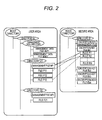
- FIG. 2 is a schematic view showing a storage area of an SD memory card where contents are recorded.
- the SD memory card is a memory card conformable to CPRM (Content Protection for Recordable Media) technology which is one of copyright protection functions.
- the SD memory card has an SD input/output portion (SD I/O), a memory controller, and a flash memory.
- SD I/O is an interface with the external media processing module 116.
- the storage area (flash memory) of the SD memory card is partitioned into a secure area and a user area.
- the secure area is a storage area restricted in access from the recording/reproducing apparatus 100.
- the recording/reproducing apparatus 100 is licensed for the CPRM technology (i.e. when the recording/reproducing apparatus 100 conforms to the copyright protection technology)
- the recording/reproducing apparatus 100 is permitted to access the secure area.
- the recording/reproducing apparatus 100 does not conform to the copyright protection technology, the recording/reproducing apparatus 100 is forbidden to access the secure area.
- An encryption key management file, encryption key files Ek1 to Ek4, etc. are stored in a directory such as directory B in Fig. 2 under a root directory in the secure area.
- the encryption key management file is a file for managing the encryption key files.
- Rules such as rule R1, rule R2, ..., and rule RN are stored in each of the encryption key files Ek1 to Ek4.
- the rules R1 to RN are encryption keys for encrypting files obtained by dividing a content file, respectively.
- the user area is an area permitted (not restricted) to be accessed from the recording/reproducing apparatus 100 regardless of the copyright protection technology.
- Directories D1, D2, etc. and a management data directory are provided in a directory such as directory A in Fig. 2 under the root directory in the user area.
- the directories D1, D2, etc. are directories in which content files are stored.
- Files F11, F12, F13, etc. and a management file MF1 are stored in the directory D1.
- These files F11, F12, F13, etc. are encrypted files which are obtained in such a manner that a content file is divided into files by a predetermined storage unit and the files are encrypted.
- the management file MF1 is a file of data management information for managing reading of the files F11, F12, F13, etc. Destinations to be referred to for reading data are designated by the management file MF1. For example, the rules R1 and R2 of the encryption key file Ek1 in the secure area are designated as the destinations to be referred to. Accordingly, the respective files F11, F12, F13, etc. are decoded according to the designated rules. For example, the file F11 is decoded according to the rule R1 and the file F13 is decoded according to the rule R2.
- a management file MF2 and files F21, etc. are stored in the directory D2.
- the files F21, etc. are encrypted files.
- the management file MF2 is a file for managing the files F21, etc.
- Management data files MDF1 and MDF2 are stored in the management data directory.
- the management data files MDF1 and MDF2 are files for storing general information (e.g. total recording time) of contents recorded on directories under the directory A.
- Fig. 3 is a view showing an example of the data structure of contents recorded on an SD memory card.
- contents Encrypted contents
- contents are separated into files F1, F2, F3, etc. by a storage unit so that the files F1, F2, F3, etc. are stored in a user area of the SD memory card.
- the inside of the file F1 or the like is encrypted in a chaining mode. The chaining mode will be described later.
- One file has a control packet, and at least one time-stamped transport stream packet (hereinafter referred to as TTS packet).
- the first file F1 has a control packet, and TTS packets #1 to #N.
- the next file F2 has a control packet, and TTS packets #(N+1) to #2N.
- the control packet at the head of the file F1 has no preceding packets to be used for the encryption, and therefore, the file F1 is being encrypted from an intermediate block that is positioned after the control packet.
- the control packet has a TS portion of first 4 bytes, and a body portion of 188 bytes following the TS portion.
- the TS portion indicates a timestamp (relative time in contents).
- the body portion is classified into a non-encrypted portion and a encrypted portion.
- the non-encrypted portion contains a sync byte (47h) indicating the top of the transport stream, and copy control information (hereinafter referred to as CCI) and chained packet number N which are written in predetermined positions from the top, respectively.
- the chained packet number N indicates the number of TTS packets (chained packets).
- the CCI will be described later.
- the CCI is inserted in a top position of the encrypted portion.
- the CCI exhibits the same information as the CCI of the non-encrypted portion.
- the encrypted portion of the control packet and the TTS packets #1 to #N form one encrypted portion (extended encrypted portion).
- the extended encrypted portion can be obtained in such a manner that data as a subject of encryption is divided into blocks each having a predetermined length by a predetermined encryption algorithm and each block is encrypted in a chaining mode as a predetermined encryption mode.
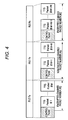
- Fig. 4 is a schematic view showing continuous files Fa to Fc of encrypted contents.
- the presence/absence of encryption and the number of chained packets in the extended encrypted portion vary according to CCI and chained packet number N in the control packet.
- the extended encrypted portions of the files Fa to Fc are encrypted, non-encrypted and encrypted, respectively.
- the respective numbers of chained packets in the files Fa to Fc are M, N and N which are different. In this manner, the presence/absence of encryption and the number of chained packets can be changed appropriately in accordance with each of the continuous files.
- a digital copy control descriptor and a content availability descriptor are set in the CCI.
- the CCI is described with a data length of not larger than 8 bits as the sum of the digital copy control descriptor and the content availability descriptor.
- the descriptors can be used in combination so that permission/forbiddance of digital recording and contents of copy control can be designated.
- a copy control type and digital recording encryption mode control data are set in the digital copy control descriptor.
- the type of the encryption mode is set in the content availability descriptor. For example, the state of the copy control type of "01" or "11” indicates that copying is disabled. The state of the copy control type of "10", the digital recording encryption mode control data of "00" and the content availability descriptor of "0" indicates that copying is enabled without restriction (without encryption).
- the state of the copy control type of "10" and the digital recording encryption mode control data of "10" indicates that only first copy generation is enabled.
- only first copy generation is enabled means that copying is performed while a bit flag is changed to a copy-disabled state at the time of recording of first data generation.
- the CCI is information for defining data reading conditions such as "copy free”, “copy once (copy 10)", “copy never”, etc. at the time of data reading.
- Fig. 5 is a schematic view showing a storage area of the HDD 115 on which contents are recorded.
- Directories A and B are disposed in the storage area of the HDD 115 like the SD memory card.
- the HDD 115 there is no distinction between a user area and a secure area, so that permission/forbiddance of access due to the presence/absence of CPRM technology license does not occur.
- the directory B is encrypted, access to the directory B can be substantially restricted.
- the storage contents of the HDD 155 are substantially the same as those of the SD memory card in other respects and detailed description thereof will be omitted.
- Fig. 6 is a flowchart showing an example of a recording procedure in the recording/reproducing apparatus 100.
- Content data is input to the input module 101.
- the selected program is input through the input module 101.
- the selected program can be viewed and listened to through the monitor 107 and the speaker 108.
- the CPU 112 When the CPU 112 is instructed through the user I/F 111 to record the content data, the CPU 112 performs a process in which an encryption key for encrypting a recording content is stored in the secure area of the SD memory card by two-way authentication. That is, the CPU 112 generates an encryption key according to a predetermined rule and stores the encryption key in the secure area of the SD memory card.
- the CPU 112 further generates a new recording directory in the user area.
- the CPU 112 divides MPEG2-TTS format content data into chains.
- One chain means an amount of data corresponding to a set of a number of packets corresponding to the number of chained packets.
- a chain of content data after division is referred to as "chain unit data".
- Control packets are generated. That is, CCI contained in each chain unit data is acquired and written in each control packet.
- FIG. 7 is a diagram showing the contents of an arithmetic operation at the time of encrypting each chain unit data.
- a CBC (Cipher Book Chaining) mode is used as a chaining mode which is one of block encryption methods.
- Each chain unit data is divided into data corresponding to a chain of packets and further divided into plain data PD0 to PDn by a block length (e.g. of 128 bits). That is, one chain of packets corresponds to the plurality of plain data PD0 to PDn.
- the first plain data PD0 is XORed with a encryption initial value (IV) and then encrypted with an encryption key K, so that coded data (encrypted block data) CDO is output.
- Each of the plain data PD1 to PDn after the first plain data PD0 is XORed with the previous encrypted data (corresponding one of CDO to CDn-1) and then encrypted with the encryption key K. Then, each encrypted packet is generated from such a plurality of encrypted block data.
- the encrypted packets (a control packet and a chain of packets) are combined to generate an encrypted file. Encrypted files generated in this manner are written in the user area.
- the CPU 112 stores files (e.g. a management data file MDF1, a management file MF1, etc.) for managing the content files in corresponding directories of the user area.
- files e.g. a management data file MDF1, a management file MF1, etc.
- the content is written in the SD memory card.
- the content can be written in the HDD 115 almost in the same manner. This is because the data structure of the HDD 115 can be formed to be substantially the same as that of the SD memory card except the presence/absence of partition into the user area and the secure area.
- Fig. 8 is a flowchart showing an example of a reproducing procedure in the recording/reproducing apparatus 100. Reproduction of recoded data stored in the SD memory card will be described here.
- a desired content is selected from the SD memory card. For example, in the condition that directories of the SD memory card are displayed on the monitor 107, the user selects a desired content from the directories. As a result, files for managing content files as a subject of copying, for example, a management file MF1, etc. are read from the user area of the SD memory card.
- the CPU 112 reads an encryption key file designated by data of the read management file MF1, from the secure area (S22) . On this occasion, the CPU 112 performs two-way authentication with a memory controller of the SD memory card. Encryption technology using parameters which are set in the receiver side memory 3 and the secure area in advance is used in the two-way authentication.
- the CPU 112 reads content files (encrypted content files), as a subject of copying, stored in the user area of the SD memory card.
- FIG. 9 is a diagram showing the contents of an arithmetic operation for decrypting a content file from each encrypted content file.
- a CBC (Cipher Book Chaining) mode is used as a chaining mode which is one of block cipher methods.
- Packets (a control packet and a chain of packets) constituting one encrypted content file are divided into coded data (encrypted block data) CDO to CDn by a block length (of 128 bits).
- the coded data CD0 to CDn are decrypted with a key (K) to generate decrypted block data.
- each decrypted block data is subjected to an arithmetic operation, the decrypted block data are combined to generate a content file.
- the decrypted coded data CDO is XORed with an encryption initial value (IV), so that a first coded data CDO is output.
- Each of the coded data CD1 to CDn following the coded data CD0 is XORed with the previous encrypted data (corresponding one of CDO to CDn-1) instead of IV, so that respective coded data CDO to CDn are output.
- the output coded data CDO to CDn are combined to generate a content file.
- Content files generated in this manner can be used for reproducing the content so that the user can view or listen to the content.
- the recording/reproducing apparatus 100 can record and reproduce various content data other than the broadcast signal.
- the recording/reproducing apparatus 100 can be applied to a broadcast via a communication network (so-called IP broadcast) other than the television broadcast using electric waves.
- IP broadcast a communication network
- the aforementioned CBC mode as a chaining mode is only an example.
- various chaining modes other than the CBC mode For example, a CFB (Cipher Feedback) mode, an OFB (Output Feedback) mode, etc. as other chaining modes may be applied to the present invention.
- CFB Cirpher Feedback
- OFB Output Feedback
- C-CBC mode there are a C-CBC mode, an FCBC mode, an XCBC mode, etc. as CBC mode-based chaining modes. These modes may be applied to the present invention.
- the C-CBC mode has C2 algorithm defined by CPRM.
- a recording apparatus As described above with reference to the embodiment, there is provided a recording apparatus, a reproducing apparatus and a recording medium in which the number of chained packets can be changed appropriately.
Landscapes
- Engineering & Computer Science (AREA)
- Signal Processing (AREA)
- Computer Security & Cryptography (AREA)
- Multimedia (AREA)
- Computer Networks & Wireless Communication (AREA)
- Databases & Information Systems (AREA)
- Signal Processing For Digital Recording And Reproducing (AREA)
- Management Or Editing Of Information On Record Carriers (AREA)
- Television Signal Processing For Recording (AREA)
Applications Claiming Priority (1)
| Application Number | Priority Date | Filing Date | Title |
|---|---|---|---|
| JP2008169606A JP2010009705A (ja) | 2008-06-27 | 2008-06-27 | 記録装置および再生装置 |
Publications (2)
| Publication Number | Publication Date |
|---|---|
| EP2139003A2 true EP2139003A2 (de) | 2009-12-30 |
| EP2139003A3 EP2139003A3 (de) | 2011-03-16 |
Family
ID=40863744
Family Applications (1)
| Application Number | Title | Priority Date | Filing Date |
|---|---|---|---|
| EP09003611A Withdrawn EP2139003A3 (de) | 2008-06-27 | 2009-03-12 | Aufzeichnungsvorrichtung, Wiedergabevorrichtung und Aufzeichnungsmedium zur Zuweisung derselben CCI an eine Gruppe von Paketen in einem Transportstrom |
Country Status (2)
| Country | Link |
|---|---|
| EP (1) | EP2139003A3 (de) |
| JP (1) | JP2010009705A (de) |
Families Citing this family (1)
| Publication number | Priority date | Publication date | Assignee | Title |
|---|---|---|---|---|
| KR20190131025A (ko) * | 2017-03-24 | 2019-11-25 | 소니 주식회사 | 정보 처리 장치, 정보 기록 매체 및 정보 처리 방법, 그리고 프로그램 |
Citations (1)
| Publication number | Priority date | Publication date | Assignee | Title |
|---|---|---|---|---|
| US20070198858A1 (en) | 2006-02-15 | 2007-08-23 | Samsung Electronics Co., Ltd. | Method and apparatus for importing a transport stream |
Family Cites Families (6)
| Publication number | Priority date | Publication date | Assignee | Title |
|---|---|---|---|---|
| US7668436B2 (en) * | 2001-07-13 | 2010-02-23 | Sony Corporation | Video information recording device and reproducing device |
| JP3663626B2 (ja) * | 2001-09-18 | 2005-06-22 | ソニー株式会社 | ビデオ信号処理装置および方法、プログラム、情報記録媒体、並びにデータ構造 |
| TWI244645B (en) * | 2002-01-28 | 2005-12-01 | Sony Corp | Information recording apparatus and method, information reproduction apparatus and method, information recording medium, program storage medium |
| JP2003228921A (ja) * | 2002-01-31 | 2003-08-15 | Toshiba Corp | 情報記録媒体、情報記録装置及び情報再生装置 |
| US20040047424A1 (en) * | 2002-10-15 | 2004-03-11 | Kumar Ramaswamy | System and method for transmitting digital video files with error recovery |
| JP2007164377A (ja) * | 2005-12-12 | 2007-06-28 | Toshiba Corp | データ処理装置およびデータ処理方法 |
-
2008
- 2008-06-27 JP JP2008169606A patent/JP2010009705A/ja active Pending
-
2009
- 2009-03-12 EP EP09003611A patent/EP2139003A3/de not_active Withdrawn
Patent Citations (2)
| Publication number | Priority date | Publication date | Assignee | Title |
|---|---|---|---|---|
| US20070198858A1 (en) | 2006-02-15 | 2007-08-23 | Samsung Electronics Co., Ltd. | Method and apparatus for importing a transport stream |
| JP2007274715A (ja) | 2006-02-15 | 2007-10-18 | Samsung Electronics Co Ltd | コンテンツの使用方法及び使用装置 |
Also Published As
| Publication number | Publication date |
|---|---|
| JP2010009705A (ja) | 2010-01-14 |
| EP2139003A3 (de) | 2011-03-16 |
Similar Documents
| Publication | Publication Date | Title |
|---|---|---|
| JP5046341B2 (ja) | ディジタル・ビデオ・データを処理する方法 | |
| JP5002371B2 (ja) | デジタルコンテンツ受信装置、デジタルコンテンツ受信方法、および、デジタルコンテンツ送受信方法 | |
| US20060230322A1 (en) | Content processing device | |
| JP4876082B2 (ja) | 記録装置及び記録方法 | |
| JP4629791B2 (ja) | デジタルコンテンツ受信装置、デジタルコンテンツ受信方法、およびデジタルコンテンツ送受信方法 | |
| JP4431599B2 (ja) | デジタルコンテンツの受信装置、受信方法、及び送受信方法 | |
| US8918909B2 (en) | Output control method | |
| CN101320582A (zh) | 控制方法、记录装置、记录再现装置 | |
| JP4431598B2 (ja) | デジタルコンテンツの受信装置、受信方法、及び送受信方法 | |
| JP5530628B2 (ja) | 出力装置、及び、出力制御方法 | |
| JP5522644B2 (ja) | デジタルコンテンツ送受信システム、および、デジタルコンテンツ送受信方法 | |
| JP2006203671A (ja) | コンテンツ暗号化装置、その方法及びそのプログラム、並びに、コンテンツ復号装置、その方法及びそのプログラム | |
| JP4629789B2 (ja) | デジタルコンテンツ受信装置、デジタルコンテンツ受信方法、およびデジタルコンテンツ送受信方法 | |
| JP5325489B2 (ja) | デジタルコンテンツ受信装置、および、デジタルコンテンツ受信方法 | |
| JP2007164377A5 (de) | ||
| JP2010009705A (ja) | 記録装置および再生装置 | |
| JP5081512B2 (ja) | デジタルコンテンツ受信装置及びデジタルコンテンツ受信方法 | |
| JP4629790B2 (ja) | デジタルコンテンツ受信装置、デジタルコンテンツ受信方法、およびデジタルコンテンツ送受信方法 | |
| JP4565049B2 (ja) | デジタルコンテンツ受信装置、デジタルコンテンツ受信方法、およびデジタルコンテンツ送受信方法 | |
| KR100435918B1 (ko) | 디지털 방송 프로그램에서의 데이터 암호화 기록 방법 | |
| JP5236112B2 (ja) | デジタルコンテンツ送受信システム、および、デジタルコンテンツ送受信方法 | |
| JP5241946B2 (ja) | デジタルコンテンツ送受信システム、および、デジタルコンテンツ送受信方法 | |
| JP5236113B2 (ja) | デジタルコンテンツ送受信システム、および、デジタルコンテンツ送受信方法 | |
| JP5241945B2 (ja) | デジタルコンテンツ受信装置、および、デジタルコンテンツ受信方法 | |
| JP5114600B2 (ja) | デジタルコンテンツ受信装置、および、デジタルコンテンツ受信方法 |
Legal Events
| Date | Code | Title | Description |
|---|---|---|---|
| PUAI | Public reference made under article 153(3) epc to a published international application that has entered the european phase |
Free format text: ORIGINAL CODE: 0009012 |
|
| 17P | Request for examination filed |
Effective date: 20090312 |
|
| AK | Designated contracting states |
Kind code of ref document: A2 Designated state(s): AT BE BG CH CY CZ DE DK EE ES FI FR GB GR HR HU IE IS IT LI LT LU LV MC MK MT NL NO PL PT RO SE SI SK TR |
|
| AX | Request for extension of the european patent |
Extension state: AL BA RS |
|
| PUAL | Search report despatched |
Free format text: ORIGINAL CODE: 0009013 |
|
| AK | Designated contracting states |
Kind code of ref document: A3 Designated state(s): AT BE BG CH CY CZ DE DK EE ES FI FR GB GR HR HU IE IS IT LI LT LU LV MC MK MT NL NO PL PT RO SE SI SK TR |
|
| AX | Request for extension of the european patent |
Extension state: AL BA RS |
|
| STAA | Information on the status of an ep patent application or granted ep patent |
Free format text: STATUS: THE APPLICATION HAS BEEN WITHDRAWN |
|
| 18W | Application withdrawn |
Effective date: 20110413 |