EP2138810B2 - Ladenwaage - Google Patents
Ladenwaage Download PDFInfo
- Publication number
- EP2138810B2 EP2138810B2 EP09008054.0A EP09008054A EP2138810B2 EP 2138810 B2 EP2138810 B2 EP 2138810B2 EP 09008054 A EP09008054 A EP 09008054A EP 2138810 B2 EP2138810 B2 EP 2138810B2
- Authority
- EP
- European Patent Office
- Prior art keywords
- control device
- scale
- data
- scales
- memory
- Prior art date
- Legal status (The legal status is an assumption and is not a legal conclusion. Google has not performed a legal analysis and makes no representation as to the accuracy of the status listed.)
- Active
Links
Images
Classifications
-
- G—PHYSICS
- G07—CHECKING-DEVICES
- G07G—REGISTERING THE RECEIPT OF CASH, VALUABLES, OR TOKENS
- G07G1/00—Cash registers
- G07G1/0036—Checkout procedures
- G07G1/0045—Checkout procedures with a code reader for reading of an identifying code of the article to be registered, e.g. barcode reader or radio-frequency identity [RFID] reader
- G07G1/0054—Checkout procedures with a code reader for reading of an identifying code of the article to be registered, e.g. barcode reader or radio-frequency identity [RFID] reader with control of supplementary check-parameters, e.g. weight or number of articles
-
- G—PHYSICS
- G01—MEASURING; TESTING
- G01G—WEIGHING
- G01G19/00—Weighing apparatus or methods adapted for special purposes not provided for in the preceding groups
- G01G19/40—Weighing apparatus or methods adapted for special purposes not provided for in the preceding groups with provisions for indicating, recording, or computing price or other quantities dependent on the weight
- G01G19/413—Weighing apparatus or methods adapted for special purposes not provided for in the preceding groups with provisions for indicating, recording, or computing price or other quantities dependent on the weight using electromechanical or electronic computing means
- G01G19/414—Weighing apparatus or methods adapted for special purposes not provided for in the preceding groups with provisions for indicating, recording, or computing price or other quantities dependent on the weight using electromechanical or electronic computing means using electronic computing means only
- G01G19/4144—Weighing apparatus or methods adapted for special purposes not provided for in the preceding groups with provisions for indicating, recording, or computing price or other quantities dependent on the weight using electromechanical or electronic computing means using electronic computing means only for controlling weight of goods in commercial establishments, e.g. supermarket, P.O.S. systems
-
- G—PHYSICS
- G01—MEASURING; TESTING
- G01G—WEIGHING
- G01G23/00—Auxiliary devices for weighing apparatus
- G01G23/18—Indicating devices, e.g. for remote indication; Recording devices; Scales, e.g. graduated
- G01G23/36—Indicating the weight by electrical means, e.g. using photoelectric cells
- G01G23/37—Indicating the weight by electrical means, e.g. using photoelectric cells involving digital counting
- G01G23/3728—Indicating the weight by electrical means, e.g. using photoelectric cells involving digital counting with wireless means
- G01G23/3735—Indicating the weight by electrical means, e.g. using photoelectric cells involving digital counting with wireless means using a digital network
-
- G—PHYSICS
- G01—MEASURING; TESTING
- G01G—WEIGHING
- G01G23/00—Auxiliary devices for weighing apparatus
- G01G23/18—Indicating devices, e.g. for remote indication; Recording devices; Scales, e.g. graduated
- G01G23/38—Recording and/or coding devices specially adapted for weighing apparatus
- G01G23/42—Recording and/or coding devices specially adapted for weighing apparatus electrically operated
-
- G—PHYSICS
- G06—COMPUTING OR CALCULATING; COUNTING
- G06Q—INFORMATION AND COMMUNICATION TECHNOLOGY [ICT] SPECIALLY ADAPTED FOR ADMINISTRATIVE, COMMERCIAL, FINANCIAL, MANAGERIAL OR SUPERVISORY PURPOSES; SYSTEMS OR METHODS SPECIALLY ADAPTED FOR ADMINISTRATIVE, COMMERCIAL, FINANCIAL, MANAGERIAL OR SUPERVISORY PURPOSES, NOT OTHERWISE PROVIDED FOR
- G06Q20/00—Payment architectures, schemes or protocols
- G06Q20/08—Payment architectures
- G06Q20/20—Point-of-sale [POS] network systems
- G06Q20/206—Point-of-sale [POS] network systems comprising security or operator identification provisions, e.g. password entry
-
- G—PHYSICS
- G06—COMPUTING OR CALCULATING; COUNTING
- G06Q—INFORMATION AND COMMUNICATION TECHNOLOGY [ICT] SPECIALLY ADAPTED FOR ADMINISTRATIVE, COMMERCIAL, FINANCIAL, MANAGERIAL OR SUPERVISORY PURPOSES; SYSTEMS OR METHODS SPECIALLY ADAPTED FOR ADMINISTRATIVE, COMMERCIAL, FINANCIAL, MANAGERIAL OR SUPERVISORY PURPOSES, NOT OTHERWISE PROVIDED FOR
- G06Q20/00—Payment architectures, schemes or protocols
- G06Q20/38—Payment protocols; Details thereof
- G06Q20/40—Authorisation, e.g. identification of payer or payee, verification of customer or shop credentials; Review and approval of payers, e.g. check credit lines or negative lists
- G06Q20/401—Transaction verification
- G06Q20/4014—Identity check for transactions
- G06Q20/40145—Biometric identity checks
-
- G—PHYSICS
- G07—CHECKING-DEVICES
- G07F—COIN-FREED OR LIKE APPARATUS
- G07F7/00—Mechanisms actuated by objects other than coins to free or to actuate vending, hiring, coin or paper currency dispensing or refunding apparatus
- G07F7/02—Mechanisms actuated by objects other than coins to free or to actuate vending, hiring, coin or paper currency dispensing or refunding apparatus by keys or other credit registering devices
-
- G—PHYSICS
- G07—CHECKING-DEVICES
- G07G—REGISTERING THE RECEIPT OF CASH, VALUABLES, OR TOKENS
- G07G1/00—Cash registers
- G07G1/0036—Checkout procedures
- G07G1/0045—Checkout procedures with a code reader for reading of an identifying code of the article to be registered, e.g. barcode reader or radio-frequency identity [RFID] reader
- G07G1/0054—Checkout procedures with a code reader for reading of an identifying code of the article to be registered, e.g. barcode reader or radio-frequency identity [RFID] reader with control of supplementary check-parameters, e.g. weight or number of articles
- G07G1/0072—Checkout procedures with a code reader for reading of an identifying code of the article to be registered, e.g. barcode reader or radio-frequency identity [RFID] reader with control of supplementary check-parameters, e.g. weight or number of articles with means for detecting the weight of the article of which the code is read, for the verification of the registration
-
- G—PHYSICS
- G07—CHECKING-DEVICES
- G07C—TIME OR ATTENDANCE REGISTERS; REGISTERING OR INDICATING THE WORKING OF MACHINES; GENERATING RANDOM NUMBERS; VOTING OR LOTTERY APPARATUS; ARRANGEMENTS, SYSTEMS OR APPARATUS FOR CHECKING NOT PROVIDED FOR ELSEWHERE
- G07C9/00—Individual registration on entry or exit
- G07C9/30—Individual registration on entry or exit not involving the use of a pass
- G07C9/32—Individual registration on entry or exit not involving the use of a pass in combination with an identity check
- G07C9/37—Individual registration on entry or exit not involving the use of a pass in combination with an identity check using biometric data, e.g. fingerprints, iris scans or voice recognition
Definitions
- the invention relates to scales, in particular shop scales for weighing items to be weighed, according to the features of the preamble of claim 1.
- Scales are known from practice which carry out a biometric identification of the user. This is how it shows WO 2005/076813 A2 a publicly accessible bathroom scale for fitness studios that uses biometric identification to protect personal data such as body weight or body mass index from unauthorized access.
- WO 2005/076813 A2 a publicly accessible bathroom scale for fitness studios that uses biometric identification to protect personal data such as body weight or body mass index from unauthorized access.
- a laboratory balance is known in which different parameters of the laboratory balance can be stored in different user profiles in order to improve the weighing results. Different people are recognized by a recognition device and a previously stored set of parameters is called up.
- a self-checkout is known, with a biometric sensor for verifying the identity of the user.
- scales are used to weigh groceries such as B. meat or sausage products or cheese according to customer requirements.
- the operators of the scales identify themselves by entering a code or a unique key.
- the scale has a control device that automatically determines an operator identity and automatically connects the user identity to the weight value of the goods to be weighed.
- the linked data from the weight value and the user identity is then stored in a sales memory.
- the associated data can consist of a common data set, or the weight value can be stored in a table or in a matrix, with the table or matrix having a structure that enables unambiguous assignment to the user identity.
- the sales memory is an electronically readable and writable memory or memory area, preferably a RAM or flash memory, which is used for temporary storage of weighing processes.
- the intermediately stored weighing data is retrieved at the end of a sales process for the purpose of creating an invoice, with the affiliation of the data to an operator or a sales process being selected on the basis of the operator identity.
- This enables a sales process to be largely automated.
- An operator of the scales only has to make very few manual entries. The operator is preferably recognized automatically when approaching the scale. Manual entry of the operator identity is therefore no longer necessary.
- the weighing data is also automatically recorded and saved. This reduces the necessary entries on the scales or the handling to operate them as much as possible.
- the control device determines the user's identity using biometric data.
- Biometric data is such data that z. B. based on image recognition via a camera, or a fingerprint sensor or voice recognition.
- Biometric data for each operator is stored in a personal data memory.
- the biometric data of a user are measured via a biometric sensor before or during a weighing process and compared by the control device with the data stored in the personal data memory.
- a user identity is automatically determined by the control device from the comparison of the data.
- Operator or user in this context means a user of the scales who serves a customer in a shop, e.g. B. to weigh and pack fresh food such as meat, sausage or cheese.
- all operators or users are a group of individuals with a defined number whose biometric data are stored in the personal memory.
- a customer acts as an operator or user of a scale, in particular a self-service scale or self-service scale, by the customer z. B. registers as a regular customer and thereby stores his biometric data in the personal memory.
- Registration or storage of the biometric data takes place by creating a user profile and capturing the associated biometric data via a biometric sensor.
- the user recognition is initiated by the control device, so that the user is already identified at the time of weighing.
- the housing has an input device in the form of a keyboard or a touch-sensitive screen, preferably a touchscreen, which is connected to the control device.
- the control device can start a user identification as soon as it recognizes an input on the input device.
- the control device can be designed as a separate module that is arranged outside of the scale and is connected to the scale. Alternatively, the control device can also be arranged within a scale.
- the module of the control device can be designed as a hardware module with its own microprocessor and memory and a communication interface. Alternatively, the module can also be designed as a software module and based on an already existing hardware architecture, e.g. B. a server to be implemented.
- a scale within a network of scales with a plurality of connected scales has a control device which, as a central control device, controls further scales that are connected to the network of scales.
- control device is connected to personal scales. This is as z. B. plate, which is arranged in the floor in front of the scale executed.
- the control device can start a user identification as soon as it detects stepping onto the bathroom scale. It is advantageous if the weight determined using the bathroom scales also serves as an additional biometric data record for recognizing a user. In this way, the accuracy of the automatic user identification can be increased or the required computing capacity can be reduced.
- a fingerprint sensor for recognizing a fingerprint can be used as a biometric sensor.
- a microphone can also be used to recognize a user's voice or speech profile.
- An advantageous embodiment provides that a camera is used as a biometric sensor and the user is identified via image recognition. This solution enables non-contact recognition of the user without requiring the user to take any additional action, such as e.g. B. a password or key entry, must perform to identify themselves.
- control device is connected to an inventory memory in which additional product and/or price information is stored.
- control device can automatically connect the weighing data with price information and store it in the sales memory.
- the control device can also provide additional information such as e.g. B. retrieve and display an advertising message or a time-limited action from the stock memory or store it together with the weighing data in the sales memory.
- the weighing data can be assigned to such goods and/or price information via user input on an input device.
- the control device can be connected to digital image processing, which has a camera directed at the load plate.
- the digital image processing performs an evaluation of the camera image to recognize the goods to be weighed and transmits this information to the control device. This then automatically connects the measured weight value with product information and/or price information based on the evaluation.
- the scales and/or the control device have an interface.
- This interface can be used for communication with the personal data memory and/or the sales memory and/or the inventory memory.
- the interface can be designed as a USB interface, or as a LAN interface, or as a WLAN interface or as an Ethernet interface.
- a cash register system or a label printer can also be connected to the scale via this interface.
- scales can also be connected or communicate with one another via this interface. It is thus possible to set up a scale network consisting of at least two scales and preferably other devices such as cash register systems or label printers in a simple manner. Such a combination of scales can, in particular, make it possible for a customer to be served conveniently. All scales in the network access a central sales memory in which all sales processes are continuously linked and automatically stored by the control device with the operator identity.
- the weighing data can be continuously stored in a central sales memory without the need for entries such as a password or key for identification for each weighing process.
- all weighing data belonging to a user identity and/or to a sales process can then be retrieved from any connected device for billing purposes.
- the control device adapts the data stored in the personal data memory to the currently measured data. This ensures that the data stored in the personal data memory is automatically updated and is up-to-date.
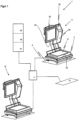
- a scale system 1 with two individual retail scales 11, 12 is shown schematically.
- the shop scales 11 and 12 are constructed identically, so that only one of the scales is described here as an example.
- the shop scale 11 has a housing 2 with a load or weighing plate 21 .
- the housing 2 is on its underside with feet on a flat surface 3, z. B. a sales counter, parked.
- the feet can be adjusted in height to ensure that the scale 11 is always exactly horizontal, even on uneven ground.
- a weight sensor (not shown) for detecting the weight of an object placed on the load plate 21, ie the item to be weighed, is arranged in the housing 2.
- the housing 2 also has a printer 26 for printing labels and a display 22 .
- the display 22 is designed as a touch screen and is used both for displaying and for entering data.
- a control device 4 is connected to the scales 11, 12 and the personal data memory 41, the sales memory 42 and the stock memory 43.
- the control device 4 and the memory, personal data memory 41, sales memory 42 and inventory memory 43 are shown schematically in the figure. You can be integrated within a scale, or separately z. B. be installed in a spatially remote from the scales arranged server.
- the memories 41, 42, 43 can each be in the form of physically separate readable and writable memories. However, they can also be implemented as different memory areas on a physical memory.
- the connection of the control device 4 with the memory 41, 42, 43 and the scales 11, 12 is realized via digital communication interfaces in the figure 1 are sketched as lines.
- Personal scales 31 are arranged on the floor in front of the scales 11 , which have a separate weight sensor and are connected to the control device 4 . Personal scales 31 record the weight of a user of scales 11 and report this to control device 4.
- a proximity sensor 25 is attached to the front of the housing 2 and detects a user approaching the scales 11 .
- the proximity sensor is designed as a passive infrared sensor and detects a movement in the close range in front of the scale 11.
- a camera 23 is arranged in the upper area of the housing 2 next to the display 22 as a biometric sensor, which is used to record the biometric data of a user or operator of the scale 11 .
- the field of view of the camera 23 is directed towards a user.
- the camera 23 captures an image, which is digitized and subjected to geometric pattern recognition to perform facial recognition of a user. In the case of pattern recognition, recognition features are extracted from the image and are compared with the data stored in the personal data memory 41 . A user is identified based on the data with the closest match.
- a further camera 24 is arranged on the underside of the display 22 , the field of view of which is directed onto the load plate 21 .
- This camera 24 uses pattern recognition to automatically recognize the goods to be weighed, so that the necessary inputs for operating the scales 11, 12 can be omitted as far as possible.
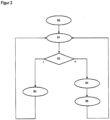
- FIG 2 an operating procedure for the scales 11 or 12 is shown.
- a first step 60 the users of the scales are created and their biometric data are recorded in the personal data memory 41 .
- one or more measurements are carried out via the biometric sensor, ie the camera 23, ie images are recorded, the results of which are stored in the personal data memory 41 under the respective user identity.
- the biometric sensor ie the camera 23
- ie images are recorded, the results of which are stored in the personal data memory 41 under the respective user identity.
- step 61 the goods to be weighed are weighed and the user is identified.
- the control device 4 initiates a user recognition, ie a picture of a user is recorded via the camera 23 . This image is processed digitally and compared with the data stored in the personal data memory 41 . If the comparison is definitely possible, ie if it is above a tolerance threshold, the user is automatically identified via the control device 4 .
- step 63 the weighing takes place and the weighing result is automatically linked to the user identification. The linked weighing date is then stored in the sales memory 42 . The weighing process is thus ended. The operation of the scale can now continue with step 61 and a new weighing process.
- step 64 the control device 4 displays a selection of the best hits on the display 22 . It is intended that the three most likely users will be displayed. The display can be done by displaying a passport photo or the name in plain text. The user can then B. identify yourself by tapping the right selection, and thus choose the right user.
- the tolerance threshold is adjustable. So e.g., a tolerance can be adjusted to a specific environment in order to set a customer-specific detection rate.
- the tolerance threshold can be set more generously for a group of users that is limited to a few people than for a large number of users. With a small number of users, good results can be achieved even with a relatively low recognition rate. With a large number of users, there are statistically more similarities between the users, so that reliable recognition, i.e. with low tolerance, is important.
- step 65 the data stored in the personal data store are maintained. This means that if the stored data was not sufficient to identify a user, it will be adjusted to the new data measured by the biometric sensor. The new measured data is provided with a percentage factor and thus weighted. These are then offset against the original data and thus adjusted.
- the scales can easily react to a change in the biometric data, e.g. B. can be based on face recognition on a change in the face or a changed lighting situation, react.
- the scale is thus designed to be self-learning and adapts to new data in a simple manner.
- step 65 after the identification of the user, the weighing and the automatic linking of the weighing result with the user identification also takes place.
- the linked weighing date is then stored in the sales memory 42 .
- the weighing process is thus ended.
- the operation of the scale can now continue with step 61 and a new weighing process.
Landscapes
- Physics & Mathematics (AREA)
- Engineering & Computer Science (AREA)
- General Physics & Mathematics (AREA)
- Business, Economics & Management (AREA)
- Theoretical Computer Science (AREA)
- Accounting & Taxation (AREA)
- General Business, Economics & Management (AREA)
- Strategic Management (AREA)
- Finance (AREA)
- Computer Security & Cryptography (AREA)
- Mathematical Physics (AREA)
- Computer Networks & Wireless Communication (AREA)
- Cash Registers Or Receiving Machines (AREA)
- Measurement Of The Respiration, Hearing Ability, Form, And Blood Characteristics Of Living Organisms (AREA)
- Measurement And Recording Of Electrical Phenomena And Electrical Characteristics Of The Living Body (AREA)
- Fats And Perfumes (AREA)
- Liquid Crystal Substances (AREA)
Description
- Die Erfindung betrifft eine Waage, insbesondere eine Ladenwaage zum Wiegen von Wiegegut nach den Merkmalen des Oberbegriffs des Anspruchs 1. Aus der Praxis sind Waagen bekann, die eine biometrische Identifikation der Benutzer vornehmen.
So zeigt dieWO 2005/076813 A2 eine öffentlich zugängliche Personenwaage für Fitness-Studios, die mittels einer biometrischen Identifikation persönliche Daten wie Körpergewicht oder Body-Maß Index vor unberechtigtem Zugriff schützt.
Aus derEP 1 320 730 B1 ist eine Laborwaage bekannt, bei der zur Verbesserung der Wiegeergebnisse unterschiedliche Parameter der Laborwaage in unterschiedlichen Benutzerprofilen speicherbar sind. Über eine Erkennungsvorrichtung werden unterschiedliche Personen erkannt und damit ein vorab gespeicherter Parametersatz aufgerufen. Aus derEP0991027 ist eine Selbstbedienungskasse bekannt, mit einem biometrischen Sensor für die Überprüfung der Identität des Benutzers. - Im Einzelhandel werden Waagen verwendet, um Lebensmittel wie z. B. Fleisch- oder Wurstwaren oder Käse entsprechend den Kundenwünschen abzupacken. Dabei identifizieren sich die Bediener der Waagen durch Eingabe eines Codes oder durch einen eindeutigen Schlüssel.
- In der Praxis des Einzelhandels ist es wichtig, einen Bedienvorgang möglichst einfach zu gestalten und dabei mögliche Fehlbedienungen zu verhindern. Dies ermöglicht eine rasche und Zufriedenstellende Bedienung eines Kunden, insbesondere, wenn der Andrang zu sogenannten Stoßzeiten sehr groß ist.
- Es ist Aufgabe der vorliegenden Erfindung eine Waage zu schaffen, die einfach bedienbar ist, eine hohe Fehlbediensicherheit aufweist und dabei insbesondere ein flexibles und schnelles Bedienen der Kunden ermöglicht.
- Die Aufgabe wird erfindungsgemäß durch eine Waage gemäß den Merkmalen des Anspruchs 1 gelöst.
- Die Waage weist eine Steuerungsvorrichtung auf, die eine Bedieneridentität automatisch ermittelt und die Benutzeridentität automatisch mit dem Gewichtswert des Wägeguts verbindet. Das verbundene Datum aus dem Gewichtswert und der Benutzeridentität wird dann in einem Verkaufsspeicher abgelegt. Dabei kann das verbundene Datum aus einem gemeinsamen Datensatz bestehen, oder es kann der Gewichtswert in einer Tabelle oder in einer Matrix abgespeichert werden, wobei die Tabelle oder die Matrix eine Struktur aufweist, die eine eindeutige Zuordnung zu der Benutzeridentität ermöglicht. Der Verkaufsspeicher ist ein elektronisch les- und beschreibbarer Speicher oder Speicherbereich, vorzugsweise ein RAM oder Flash-Speicher, der zur Zwischenspeicherung von Wiegevorgängen dient. Die Zwischengespeicherten Wiegedaten werden am Ende eines Verkaufsvorganges zum Zweck der Rechnungserstellung abgerufen, wobei anhand der Bedieneridentität die Zugehörigkeit der Daten zu einem Bediener oder einem Verkaufsvorgang selektiert wird. So wird ermöglicht, dass ein Verkaufsvorgang weitgehend automatisiert abläuft. Ein Bediener der Waage muss nur noch sehr wenige manuelle Eingaben vornehmen. Der Bediener wird vorzugsweise beim Herantreten an die Waage automatisch erkannt. Eine manuelle Eingabe der Bedieneridentität ist somit nicht mehr notwendig. Auch die Wiegedaten werden automatisch erfasst und gespeichert. Somit reduzieren sich die notwendigen Eingaben an der Waage, oder die Handgriffe zu deren Bedienung weitestgehend.
- Die Steuerungsvorrichtung ermittelt die Benutzeridentität anhand biometrischer Daten. Biometrische Daten sind solche Daten, die z. B. auf Basis einer Bilderkennung über eine Kamera, oder einen Fingerabdrucksensor oder über Stimmerkennung gewonnen werden. Es sind in einem Personendatenspeicher zu jedem Bediener biometrische Daten hinterlegt. Über einen biometrischen Sensor werden zudem vor oder während eines Wiegevorgangs die biometrischen Daten eines Benutzers gemessen und von der Steuervorrichtung mit den in dem Personendatenspeicher hinterlegten Daten verglichen. Aus dem Vergleich der Daten wird von der Steuerungsvorrichtung automatisch eine Benutzeridentität bestimmt.
- Bediener oder Benutzer bedeutet in diesem Kontext einen Benutzer der Waage, der in einem Laden einen Kunden bedient, um z. B. frische Lebensmittel wie Fleisch, Wurst oder Käse abzuwiegen und zu verpacken. Alle Bediener oder Benutzer sind jedenfalls eine Gruppe Individuen von definierter Zahl, deren biometrische Daten in dem Personenspeicher hinterlegt sind. Es ist jedoch auch denkbar, dass ein Kunde als Bediener oder Benutzer einer Waage, insbesondere einer SB bzw. Selbstbedienungswaage tätig wird, indem der Kunde sich z. B. als Stammkunde registrieren lässt und dabei seine biometrischen Daten in dem Personenspeicher hinterlegt.
- Eine Registrierung bzw. Hinterlegung der biometrischen Daten geschieht durch Anlegen eines Benutzerprofils und Erfassen der zugehörigen biometrischen Daten über einen biometrischen Sensor.
- Eine solche automatische Benutzererkennung ist relativ rechenintensiv und belastet die Rechenkapazität der Steuerungsvorrichtung. Deshalb kann die Benutzererkennung nicht ständig aktiv sein, sondern es kommt darauf an, den richtigen Zeitpunkt zum Erkennen des Benutzers zu bestimmen.
- Es hat sich gezeigt, dass es von Vorteil ist, den Benutzer in dem Moment des Herantretens an die Waage zu identifizieren. eines Benutzers wird von der Steuerungsvorrichtung die Benutzererkennung initiiert, so dass zum Zeitpunkt des Wiegens bereits der Benutzer identifiziert ist. Es ist vorgesehen, dass die Waage ein Gehäuse mit einem Näherungssensor aufweist, der als Infrarotsensor oder als Ultraschallsensor ausgebildet sein kann. Dieser Näherungssensor detektiert ein Herantreten des Benutzers an die Waage und meldet dies an die Steuerungsvorrichtung, die daraufhin eine Benutzererkennung initiiert.
- In einer Ausführung ist vorgesehen, dass das Gehäuse eine Eingabevorrichtung in Form einer Tastatur oder eines berührungsempfindlichen Bildschirms, vorzugsweise einen Touchscreen aufweist, die mit der Steuerungsvorrichtung verbunden ist. Die Steuerungsvorrichtung kann eine Benutzeridentifikation starten, sobald sie eine Eingabe an der Eingabevorrichtung erkennt.
- Die Steuerungsvorrichtung kann dabei als separates Modul ausgebildet sein, das außerhalb der Waage angeordnet ist und mit der Waage verbunden wird. Die Steuerungsvorrichtung kann alternativ auch innerhalb einer Waage angeordnet sein. Das Modul der Steuerungsvorrichtung kann als Hardwaremodul mit einem eigenen Mikroprozessor und eigenem Speicher und einer Kommunikationsschnittstelle ausgebildet sein. Das Modul kann alternativ auch als Softwaremodul ausgebildet sein und auf einer bereits vorhandenen Hardwarearchitektur, z. B. einem Server, implementiert sein.
- Insbesondere kann vorgesehen sein, dass eine Waage innerhalb eines Waagenverbundes mit mehreren verbundenen Waagen eine Steuerungsvorrichtung aufweisen, die als zentrale Steuerungsvorrichtung weitere Waagen steuert, die an den Waagenverbund angeschlossen sind.
- In einer Ausführung kann vorgesehen sein, dass die Steuerungsvorrichtung mit einer Personenwaage verbunden ist. Diese ist als z. B. Platte, die im Boden vor der Waage angeordnet ist, ausgeführt. Die Steuerungsvorrichtung kann eine Benutzeridentifikation starten, sobald sie ein Betreten der Personenwaage erkennt. Von Vorteil ist, wenn das über die Personenwaage ermittelte Gewicht zudem als zusätzlicher biometrischer Datensatz zum Erkennen eines Benutzers dient. So kann die Treffsicherheit der automatischen Benutzererkennung erhöht oder die benötigte Rechenkapazität verringert werden.
- Als biometrischer Sensor kann ein Fingerprintsensor zum Erkennen eines Fingerabdrucks verwendet werden. Es kann auch ein Mikrofon zum Erkennen der Stimme bzw. des Sprachprofils eines Benutzers verwendet werden.
- Eine vorteilhafte Ausgestaltung sieht vor, dass eine Kamera als biometrischer Sensor verwendet wird, und der Benutzer über eine Bilderkennung identifiziert wird. Diese Lösung ermöglicht eine berührungsfreie Erkennung des Benutzers, ohne dass der Benutzer eine zusätzliche Aktion, wie z. B. eine Passwort- oder Schlüsseleingabe, ausführen muss, um sich zu identifizieren.
- Von Vorteil ist, wenn die Steuerungsvorrichtung mit einem Bestandsspeicher verbunden ist, in dem zusätzliche Waren- und oder Preisinformationen abgespeichert sind. So kann die Steuerungsvorrichtung die Wiegedaten gleich mit einer Preisinformation automatisch verbinden und in dem Verkaufsspeicher ablegen. Die Steuerungsvorrichtung kann auch eine zusätzliche Information wie z. B. eine Werbebotschaft oder eine zeitlich befristete Aktion aus dem Bestandspeicher abrufen und anzeigen oder zusammen mit den Wiegedaten in dem Verkaufsspeicher ablegen.
- Eine Zuordnung der Wiegedaten zu einer solchen Waren- und oder Preisinformationen kann über eine Benutzereingabe an einer Eingabevorrichtung erfolgen. Von Vorteil ist jedoch, wenn die Waage die Ware selbsttätig erkennt. Hierfür kann die Steuerungsvorrichtung mit einer digitalen Bildverarbeitung verbunden sein, die eine auf die Lastplatte gerichtete Kamera aufweist. Die digitale Bildverarbeitung nimmt eine Auswertung des Kamerabildes zum Erkennen des aufgelegten Wägeguts vor und übermittelt diese Information an die Steuerungsvorrichtung. Diese nimmt dann die Verbindung von gemessenem Gewichtswert mit einer Wareninformation und/oder Preisinformation anhand der Auswertung automatisch vor.
- In einer Ausführung kann vorgesehen sein, dass die Waage und/oder die Steuerungsvorrichtung eine Schnittstelle aufweist. Diese Schnittstelle kann zur Kommunikation mit dem Personendatenspeicher und/oder dem Verkaufsspeicher und/oder dem Bestandsspeicher dienen. Die Schnittstelle kann als USB-Schnittstelle, oder als LAN-Schnittstelle, oder als WLAN-Schnittstelle oder als Ethernetschnittstelle ausgebildet sein. Über diese Schnittstelle kann zudem ein Kassensystem oder ein Etikettendrucker an die Waage angeschlossen sein.
- Auch können mehrere Waagen untereinander über diese Schnittstelle verbunden sein bzw. kommunizieren. So ist es möglich, auf einfache Art und Weise einen Waagenverbund, bestehend aus mindestens zwei Waagen und vorzugsweise weiteren Geräten wie Kassensysteme oder Etikettendrucker, aufzubauen. Über einen solchen Waagenverbund kann insbesondere ein komfortables sogenanntes Durchbedienen eines Kunden ermöglicht werden. Dabei greifen alle Waagen in dem Verbund auf einen zentralen Verkaufsspeicher zu, in dem von der Steuerungsvorrichtung jeweils alle Verkaufsvorgänge fortlaufend und mit der Bedieneridentität verknüpft und automatisch abgelegt werden.
- Es können an einer Waage nacheinander mehrere Kunden und/oder Bediener tätig sein oder ein Kunde und/oder Bediener nutzt nacheinander mehrere Waagen. Über die Bedieneridentifikation anhand der biometrischen Daten und der automatischen Verknüpfung der Wiegedaten mit der Bedieneridentität, können die Wiegedaten in einem zentralen Verkaufsspeicher insbesondere fortlaufend abgelegt werden, ohne dass zu jedem Wiegevorgang Eingaben wie Passwort oder Schlüssel zur Identifikation notwendig werden. Am Ende eines Verkaufsvorganges können dann von irgendeinem beliebigen angeschlossenen Gerät, alle zu einer Benutzeridentität gehörenden und/oder zu einem Verkaufsvorgang gehörenden Wiegedaten zur Rechnungserstellung abgerufen werden.
- Um eine hohe Erkennungsrate sicherzustellen kann vorgesehen sein, dass die Waage selbstlernend ausgebildet ist. Insbesondere wenn der automatische Vergleich der gemessenen mit den gespeicherten biometrischen Daten keine hinreichend genaue Selektion erlaubt, ist vorgesehen, dass die Steuerungsvorrichtung die in dem Personendatenspeicher hinterlegten Daten an die aktuellen gemessenen Daten anpasst. Somit wird gewährleistet, dass die in dem Personendatenspeicher hinterlegten Daten automatisch aktualisiert werden und aktuell sind.
- Weitere Ausführungsbeispiele der Erfindung sind in den Figuren dargestellt und der dazugehörenden Beschreibung beschrieben.
- Es zeigen,
- Figur 1:
- Eine schematische Darstellung eines Waagenverbundes aus zwei Ladenwaagen.
- Figur 2:
- Ein Verfahren zum Betreiben der Waagen.
- In der
Figur 1 ist schematisch ein Waagenverbund 1 mit zwei einzelnen Ladenwaagen 11, 12 dargestellt. Die Ladenwaagen 11 und 12 sind identisch aufgebaut, so dass hier nur eine der Waagen exemplarisch beschrieben wird. Die Ladenwaage 11 weist ein Gehäuse 2 mit einer Last- bzw. Wiegeplatte 21 auf. Das Gehäuse 2 ist an seiner Unterseite über Füße auf einer ebenen Fläche 3, z. B. einer Verkaufstheke, abstellbar. Die Füße sind in der Höhe verstellbar, um zu gewährleisten, dass die Waage 11 auch bei unebenem Untergrund immer genau horizontal ausgerichtet ist. In dem Gehäuse 2 ist ein nicht dargestellter Gewichtsensor zum Erfassen des Gewichts eines auf die Lastplatte 21 aufgelegten Gegenstandes, also des Wiegeguts, angeordnet. - Das Gehäuse 2 weist zudem einen Drucker 26 zum Drucken von Etiketten und ein Display 22 auf. Das Display 22 ist als Touch-Screen ausgebildet und dient sowohl zur Anzeige als auch zur Eingabe von Daten. Eine Steuerungsvorrichtung 4 ist mit den Waagen 11, 12 und dem Personendatenspeicher 41, dem Verkaufsspeicher 42 und dem Bestandspeicher 43 verbunden.
- Die Steuerungsvorrichtung 4 und die Speicher, Personendatenspeicher 41, Verkaufsspeicher 42 und Bestandspeicher 43 sind in der Figur schematisch dargestellt. Sie können innerhalb einer Waage integriert angeordnet sein, oder aber separat z. B. in einem räumlich entfernt von den Waagen angeordneten Server installiert sein. Die Speicher 41, 42, 43 können jeweils als physikalisch getrennte lesbare und beschreibbare Speicher ausgebildet sein. Sie können jedoch auch auf einem physikalischen Speicher als unterschiedliche Speicherbereiche realisiert werden. Die Verbindung der Steuervorrichtung 4 mit den Speichern 41, 42, 43 und den Waagen 11, 12 ist über digitale Kommunikationsschnittstellen realisiert, die in der
Figur 1 als Leitungen skizziert sind. - An Boden vor der Waage 11 ist eine Personenwaage 31 angeordnet, die einen separaten Gewichtssensor aufweist und mit der Steuervorrichtung 4 verbunden ist. Die Personenwaage 31 erfasst das Gewicht eines Benutzers der Waage 11 und meldet dieses an die Steuervorrichtung 4.
- An der Vorderseite des Gehäuses 2 ist ein Näherungssensor 25 angebracht, der eine Annäherung eines Benutzers an die Waage 11 detektiert. Der Näherungssensor ist als passiver Infrarotsensor ausgebildet und erfasst eine Bewegung im Nahbereich vor der Waage 11.
- Im oberen Bereich des Gehäuses 2 ist neben dem Display 22 als biometrischer Sensor eine Kamera 23 angeordnet, die zur Erfassung der biometrischen Daten eines Benutzers oder Bedieners der Waage 11 dient. Das Gesichtsfeld der Kamera 23 ist auf einen Benutzer hin gerichtet. Die Kamera 23 nimmt ein Bild auf, welches digitalisiert und einer geometrischen Mustererkennung unterzogen wird, um eine Gesichtserkennung eines Benutzers durchzuführen. Bei der Mustererkennung werden aus dem Bild Erkennungsmerkmale extrahiert, die mit den in dem Personendatenspeicher 41 gespeicherten Daten verglichen werden. Anhand der Daten mit der größten Übereinstimmung wird ein Benutzer identifiziert.
- An der Unterseite des Displays 22 ist eine weitere Kamera 24 angeordnet, deren Gesichtsfeld auf die Lastplatte 21 gerichtet ist. Über diese Kamera 24 erfolgt über eine Mustererkennung eine automatische Erkennung der zu wiegenden Waren, so dass notwendige Eingaben zum Bedienen der Waage 11, 12 weitest möglich entfallen können.
- Bei einem Wiegevorgang tritt ein Benutzer an die Waage 11 heran. Über den Näherungssensor 25 wird sein Herannahen detektiert und an die Steuerungsvorrichtung 4 gemeldet. Diese initiiert über die Kamera 23 und über die Personenwaage 31 eine Benutzererkennung. Der Benutzer legt Wägegut auf die Lastplatte 21 auf, welches über die Kamera 24 automatisch erkannt wird. Die Steuerungsvorrichtung ruft dann aus dem Bestandspeicher 43 Preisinformationen ab, verknüpft diese automatisch mit den Wiegedaten und der Benutzeridentität und legt bei einer Bestätigung des Wiegevorganges die verbundenen Daten automatisch in dem Verkaufsspeicher 42 ab. Danach können weitere Benutzer die Waage bedienen oder weitere Wiegevorgänge des gleichen Benutzers folgen. Am Ende eines Verkaufsvorganges wird dieser über eine Eingabe des Benutzers abgeschlossen. Die Steuerungsvorrichtung 4 liest alle zu dem Benutzer gehörenden Daten aus dem Verkaufsspeicher und druckt über den Drucker 26 eine Rechnung aus. Die Verkaufsdaten werden dabei aus dem Verkaufsspeicher 42 gelöscht.
- In
Figur 2 ist ein Betriebsverfahren für die Waage 11 bzw. 12 dargestellt. In einem ersten Schritt 60 werden die Benutzer der Waage angelegt und deren biometrische Daten in dem Personendatenspeicher 41 erfasst. Dabei werden über den biometrischen Sensor, also der Kamera 23 eine oder mehrere Messungen durchgeführt, also Bilder aufgenommen, deren Ergebnisse in dem Personendatenspeicher 41 unter der jeweiligen Benutzeridentität abgelegt werden. Als Ergebnis werden hier charakteristische Merkmale verstanden, die eine Benutzeridentifikation ermöglichen. Ein Abspeichern kompletter Bilder ist nicht notwendig. - In dem Schritt 61 erfolgt das Wiegen des Wiegeguts und die Identifizierung des Benutzers. Dazu wird von der Steuerungsvorrichtung 4 eine Benutzererkennung initiiert, also über die Kamera 23 ein Bild eines Benutzers aufgenommen. Dieses Bild wird digital verarbeitet und mit den in dem Personendatenspeicher 41 hinterlegten Daten verglichen. Sofern der Vergleich sicher möglich ist, das heißt oberhalb einer Toleranzschwelle liegt, erfolgt die Identifikation des Benutzers über die Steuervorrichtung 4 automatisch. In Schritt 63 erfolgt das Wiegen und die automatische Verknüpfung des Wiegeergebnisses mit der Benutzeridentifikation. Anschließend wird das verknüpfte Wiegedatum in dem Verkaufsspeicher 42 abgespeichert. Der Wiegevorgang ist somit beendet. Die Bedienung der Waage kann nun mit Schritt 61 und einem neuen Wiegevorgang weitergehen.
- Sofern der Vergleich kein eindeutiges Ergebnis liefert, d. h. unterhalb der Toleranzschwelle liegt, geht das Verfahren mit Schritt 64 weiter. Bei Schritt 64 zeigt die Steuervorrichtung 4 eine Auswahl der besten Treffer auf dem Display 22 an. Es ist vorgesehen, dass die drei wahrscheinlichsten Benutzer angezeigt werden. Die Anzeige kann durch Anzeige als Passbild oder der Namen in Klartext erfolgen. Daraufhin kann der Benutzer z. B. durch Antippen der richtigen Auswahl sich identifizieren, und damit den richtigen Benutzers wählen.
- Es ist vorgesehen, dass die Toleranzschwelle einstellbar ist. So kann z. B. eine Toleranz an eine spezielle Umgebung angepasst werden um eine kundenspezifische Erkennrate einzustellen. So kann z.B. bei einem auf wenige Personen begrenzten Kreis an Benutzern die Toleranzschwelle großzügiger eingestellt werden, als bei einer großen Menge an Benutzern. Bei einer geringen Anzahl von Benutzern können auch mit relativ geringer Erkennrate gute Ergebnisse erzielt werden. Bei einer großen Anzahl von Benutzern ergeben sich statistisch gesehen mehr Ähnlichkeiten zwischen den Benutzern, so dass eine sichere Erkennung, also mit geringer Toleranz wichtig ist.
- In Schritt 65 werden die in dem Personendatenspeicher hinterlegten Daten gepflegt. Das bedeutet, dass wenn die hinterlegten Daten nicht hinreichend waren, um einen Benutzer zu identifizieren, werden diese an die neuen, über den biometrischen Sensor gemessenen Daten angepasst. Dabei werden die neuen gemessenen Daten mit einem prozentualen Faktor versehen und somit gewichtet. Diese werden dann mit den ursprünglichen Daten verrechnet und diese somit angepasst. Durch die Anpassung der Daten kann die Waage auf einfache Weise auf eine Veränderung der biometrischen Daten, die z. B. bei einer Gesichtserkennung auf einer Veränderung des Gesichts oder einer geänderten Beleuchtungssituation basieren können, reagieren. Die Waage ist dadurch selbstlernend ausgebildet und passt sich an neue Daten auf einfache Art und Weise an.
- In Schritt 65 erfolgt nach der Identifizierung des Benutzers noch das Wiegen und die automatische Verknüpfung des Wiegeergebnisses mit der Benutzeridentifikation. Anschließend wird das verknüpfte Wiegedatum in dem Verkaufsspeicher 42 abgespeichert. Der Wiegevorgang ist somit beendet. Die Bedienung der Waage kann nun mit Schritt 61 und einem neuen Wiegevorgang weitergehen.
Claims (14)
- Waage, nämlich Ladenwaage (11, 12), mit einem eine Lastplatte (21) tragenden Gehäuse (2) und einem Display (22) zur Anzeige eines Gewichtswertes von auf der Lastplatte (21) befindlichem Wägegut, wobei ein mit der Lastplatte (21) verbundener Gewichtssensor den Gewichtswert ermittelt, undmit einer Steuerungsvorrichtung (4), die mit einem Personendatenspeicher (41) und einem biometrischen Sensor (23) zur Messung von Bedienerdaten verbunden ist und durch Vergleich der gemessenen Bedienerdaten mit den gespeicherten Bedienerdaten eine Bedieneridentität ermittelt,dadurch gekennzeichnet,dass die Steuerungsvorrichtung (4) automatisch den Gewichtswert des Wägeguts mit der ermittelten Bedieneridentität verbindet und die verbundenen Daten in einem Verkaufsspeicher (42) fortlaufend ablegt,wobei die Steuerungsvorrichtung (4) mit einem Bestandsspeicher (43) mit Waren und/oder Preisinformationen verbunden ist, und den gemessenen Gewichtswert des Wiegeguts automatisch mit einer aus dem Bestandsspeicher ausgelesenen Wareninformation und/oder Preisinformation verbindet.
- Waage nach Anspruch 1,
dadurch gekennzeichnet,
dass das Gehäuse (2) einen Näherungssensor (25), vorzugsweise einen Infrarot oder einen Ultraschallsensor, aufweist, der mit der Steuerungsvorrichtung (4) verbunden ist und diese eine Messung der Benutzerdaten initiiert, wenn der Näherungssensor (25) eine Person detektiert. - Waage nach Anspruch 1 oder 2,
dadurch gekennzeichnet,
dass die Steuerungsvorrichtung (4) mit dem Gewichtssensor verbunden ist, und eine Messung der biometrischen Benutzerdaten initiiert, wenn der Gewichtssensor ein Auflegen von Wägegut auf die Lastplatte (21) detektiert. - Waage nach einem der Ansprüche 1 bis 3,
dadurch gekennzeichnet,
dass die Steuerungsvorrichtung (4) mit einer Eingabevorrichtung, vorzugsweise einer Tastatur oder einem Touchscreen (22) verbunden ist, und eine Messung der Benutzerdaten initiiert, wenn über die Eingabevorrichtung (22) eine Eingabe erfolgt. - Waage nach einem der Ansprüche 1 bis 4,
dadurch gekennzeichnet,
dass die Steuerungsvorrichtung (4) mit einer Personenwaage (31) zum Erfassen des Gewichts eines Bedieners verbunden ist, und die Steuerungsvorrichtung (4) eine Messung der Benutzerdaten initiiert, wenn über die Personenwaage (31) ein Benutzer detektiert wird. - Waage nach Anspruch 5,
dadurch gekennzeichnet,
dass die Steuerungsvorrichtung (4) das über die Personenwaage (31) gemessene Gewicht eines Bedieners als ein biometrisches Identifikationsmerkmal zum Ermitteln der Bedieneridentität verwendet. - Waage nach einem der Ansprüche 1 bis 6,
dadurch gekennzeichnet,
dass der biometrische Sensor (23) als Fingerprintsensor zum Erkennen eines Fingerabrucks oder dass der biometrische Sensor (23) als Spracherkennungssensor mit einem Mikrofon zum Erkennen eines Sprachprofils ausgebildet ist. - Waage nach einem der Ansprüche 1 bis 6,
dadurch gekennzeichnet,
dass der biometrische Sensor (23) als optischer Sensor mit einer Kamera zur Gesichtserkennung ausgebildet ist. - Waage nach einem der vorhergehenden Ansprüche,
dadurch gekennzeichnet,
dass die Steuerungsvorrichtung (4) die Verbindung von gemessenem Gewichtswert mit einer Wareninformation und/oder Preisinformation anhand einer Bedienereingabe über Tastatur oder Touchscreen (22) vornimmt. - Waage nach einem der vorhergehenden Ansprüche,
dadurch gekennzeichnet,
dass die Steuerungsvorrichtung (4) mit einer digitalen Bildverarbeitung verbunden ist, die eine auf die Lastplatte gerichteten Kamera (24) aufweist und eine Auswertung des Kamerabildes zum Erkennen des aufgelegten Wägeguts an die Steuerungsvorrichtung (4) übermittelt, so dass diese die Verbindung von gemessenem Gewichtswert mit einer Wareninformation und/oder Preisinformation anhand der Auswertung automatisch vornimmt. - Waage nach einem der vorhergehenden Ansprüche,
dadurch gekennzeichnet,
dass die Steuerungsvorrichtung (4) über eine Schnittstelle, vorzugsweise eine USB Schnittstelle, oder eine LAN Schnittstelle mit dem Personendatenspeicher (41) und/oder dem Verkaufsspeicher (42) und/oder dem Bestandsspeicher (43) verbunden ist. - Waagenverbund mit wenigstens zwei Waagen nach einem der vorhergehenden Ansprüche,
dadurch gekennzeichnet,
dass die Waagen (11, 12) über eine Kommunikationsschnittstelle, vorzugsweise LAN-, Ethernet-, W-LAN-, Intranet- oder Internet- Schnittstelle, untereinander und mit dem Verkaufsspeicher (42) verbunden sind. - Waagenverbund nach Anspruch 12,
dadurch gekennzeichnet,
dass die Waagen (11, 12) über eine Kommunikationsschnittstelle, vorzugsweise LAN-, Ethernet-, W-LAN-, Intranet- oder Internet- Schnittstelle, mit der Steuerungsvorrichtung (4) verbunden sind. - Waagenverbund nach einem der Ansprüche 12 oder 13,
dadurch gekennzeichnet,
dass der Verkaufsspeicher (42) über eine Schnittstelle auslesbar ist, wobei eine Waage (11, 12) oder ein Kassensystem oder ein Etikettendrucker am Ende eines Verkaufsvorgangs über ein Pullsignal alle zu einer Bedieneridentität gehörenden Warendaten bzw. Gewichtswerte über die Schnittstelle zum Erstellen einer Rechnung abruft.
Applications Claiming Priority (1)
| Application Number | Priority Date | Filing Date | Title |
|---|---|---|---|
| DE102008029419A DE102008029419A1 (de) | 2008-06-23 | 2008-06-23 | Ladenwaage |
Publications (4)
| Publication Number | Publication Date |
|---|---|
| EP2138810A2 EP2138810A2 (de) | 2009-12-30 |
| EP2138810A3 EP2138810A3 (de) | 2011-09-28 |
| EP2138810B1 EP2138810B1 (de) | 2017-08-23 |
| EP2138810B2 true EP2138810B2 (de) | 2023-04-19 |
Family
ID=41161343
Family Applications (1)
| Application Number | Title | Priority Date | Filing Date |
|---|---|---|---|
| EP09008054.0A Active EP2138810B2 (de) | 2008-06-23 | 2009-06-19 | Ladenwaage |
Country Status (3)
| Country | Link |
|---|---|
| EP (1) | EP2138810B2 (de) |
| DE (1) | DE102008029419A1 (de) |
| ES (1) | ES2643667T5 (de) |
Families Citing this family (6)
| Publication number | Priority date | Publication date | Assignee | Title |
|---|---|---|---|---|
| DE102009009933A1 (de) * | 2009-02-20 | 2010-08-26 | Mettler-Toledo Garvens Gmbh | Waage, insbesondere Kontrollwaage und Verfahren zum Betreiben derselben |
| DE102010055418A1 (de) | 2010-12-21 | 2012-06-21 | Bizerba Gmbh & Co. Kg | Verfahren zum Betrieb einer Ladenwaage |
| DE102018104302A1 (de) * | 2018-02-26 | 2019-08-29 | Anker Kassensysteme Gmbh | Kassensystem, Verfahren zur Authentifizierung an einem Kassensystem, Computerprogramm sowie computerlesbares Medium |
| DE102018104300A1 (de) * | 2018-02-26 | 2019-08-29 | Anker Kassensysteme Gmbh | Geldbehälter, Geldaufbewahrungsvorrichtung, Kassensystem sowie Verfahren zur Freigabe eines Kassensystems |
| CN109935022A (zh) * | 2019-04-02 | 2019-06-25 | 大连华信数据技术有限公司 | 集自动识别、移动支付为一体的智能称重系统 |
| GB2625110A (en) * | 2022-12-07 | 2024-06-12 | Illinois Tool Works | Weighing system and method for refillable containers |
Citations (3)
| Publication number | Priority date | Publication date | Assignee | Title |
|---|---|---|---|---|
| DE10039668A1 (de) † | 2000-08-14 | 2002-02-28 | Mettler Toledo Gmbh | Messapparatur mit Benutzerprofil |
| US20040131997A1 (en) † | 2002-12-19 | 2004-07-08 | Mcguire Todd J. | System and method for measuring and distributing monetary incentives for weight loss |
| EP1310140B1 (de) † | 2000-08-14 | 2006-06-14 | Mettler-Toledo (Albstadt) GmbH | Ladenwaage zum abwickeln einzelner vorgänge |
Family Cites Families (10)
| Publication number | Priority date | Publication date | Assignee | Title |
|---|---|---|---|---|
| CH667921A5 (de) * | 1985-09-18 | 1988-11-15 | Mettler Instrumente Ag | Analysenwaage. |
| US6363366B1 (en) | 1998-08-31 | 2002-03-26 | David L. Henty | Produce identification and pricing system for checkouts |
| US6522772B1 (en) | 1998-09-30 | 2003-02-18 | Ncr Corporation | Self-service checkout terminal having a biometric sensing device for verifying identity of a user and associated method |
| DE20122342U1 (de) * | 2000-08-14 | 2005-03-17 | Mettler Toledo Albstadt Gmbh | Gerät zum Abwickeln einzelner Vorgänge |
| US6779722B1 (en) * | 2002-06-28 | 2004-08-24 | Ncr Corporation | System and method for updating a database of weights at a self-checkout terminal |
| DE10304589A1 (de) | 2003-02-04 | 2004-08-12 | BALTUS, René | Indirekt-dynamisch wirkende, biometrische Erfassungs-und Erkennungsvorrichtung |
| US7041915B2 (en) * | 2003-05-16 | 2006-05-09 | Premark Feg L.L.C. | Random weight food product pricing scale with automated login capability |
| US20070167286A1 (en) | 2004-02-09 | 2007-07-19 | Icline Technology, Inc. | Digital weight apparatus having a biometrics based security feature |
| DE102005014626B4 (de) * | 2005-03-23 | 2018-06-21 | Bizerba SE & Co. KG | Waage |
| US7769207B2 (en) | 2005-04-01 | 2010-08-03 | Olivo Jr John W | System and method for collection, storage, and analysis of biometric data |
-
2008
- 2008-06-23 DE DE102008029419A patent/DE102008029419A1/de not_active Withdrawn
-
2009
- 2009-06-19 EP EP09008054.0A patent/EP2138810B2/de active Active
- 2009-06-19 ES ES09008054T patent/ES2643667T5/es active Active
Patent Citations (3)
| Publication number | Priority date | Publication date | Assignee | Title |
|---|---|---|---|---|
| DE10039668A1 (de) † | 2000-08-14 | 2002-02-28 | Mettler Toledo Gmbh | Messapparatur mit Benutzerprofil |
| EP1310140B1 (de) † | 2000-08-14 | 2006-06-14 | Mettler-Toledo (Albstadt) GmbH | Ladenwaage zum abwickeln einzelner vorgänge |
| US20040131997A1 (en) † | 2002-12-19 | 2004-07-08 | Mcguire Todd J. | System and method for measuring and distributing monetary incentives for weight loss |
Also Published As
| Publication number | Publication date |
|---|---|
| ES2643667T5 (es) | 2023-08-25 |
| EP2138810A2 (de) | 2009-12-30 |
| ES2643667T3 (es) | 2017-11-23 |
| DE102008029419A1 (de) | 2009-12-24 |
| EP2138810A3 (de) | 2011-09-28 |
| EP2138810B1 (de) | 2017-08-23 |
Similar Documents
| Publication | Publication Date | Title |
|---|---|---|
| DE69829443T2 (de) | Verfahren und Einrichtung zum Tarieren einer Artikelwaage für Abrechnungsterminal im Einzelhandel | |
| EP2138810B1 (de) | Ladenwaage | |
| EP3654305B1 (de) | Verkaufsvorrichtung zum selbst-checkout | |
| DE102005014626B4 (de) | Waage | |
| DE202016009151U1 (de) | System zur Identifizierung von Produkten in einem Einkaufswagen | |
| DE102008023620A1 (de) | Funktionseinheit mit einer aufrufbaren Funktion und Verfahren zu deren Aufruf | |
| DE212017000037U1 (de) | Selbstbedienungskassensystem | |
| EP4020415A1 (de) | Self-checkout store | |
| EP2138811B1 (de) | Verfahren zum Betrieb einer Ladenwaage | |
| EP4010883A1 (de) | Vorrichtung zur automatisierten rückgabe einer ware und verfahren zum betreiben der vorrichtung | |
| EP2267419B1 (de) | Waage | |
| WO2011057695A1 (de) | System für eine mobile warenerfassung und verfahren hierzu | |
| EP4020417A1 (de) | Self-checkout store | |
| EP2656026B1 (de) | Verfahren zum betrieb einer ladenwaage | |
| EP2463631A1 (de) | Ladenwaage | |
| EP2153184B1 (de) | Wägevorrichtung und verfahren zum betreiben derselben | |
| DE102009044156A1 (de) | System für einen selbstbedienten Warenerfassungsplatz und Verfahren hierzu | |
| DE102017001832B4 (de) | Verkaufseinrichtung | |
| DE102016014420B3 (de) | Ladenlokal mit Einrichtungen zur Verhütung von Rückgabebetrug sowie Verfahren zur Verhütung von Rückgabebetrug in Ladenlokalen | |
| EP4020418B1 (de) | Self-checkout store | |
| EP1813172B1 (de) | Selbstbedienungs-Warenerfassungsplatz | |
| DE102019106057A1 (de) | Verfahren, Vorrichtung zur Datenverarbeitung und Haltevorrichtung zur Klassierung von Lebensmitteln | |
| EP3531087B1 (de) | Waagen-verbund | |
| DE102008034719B4 (de) | Bezahlautomat | |
| DE19614985C2 (de) | Verfahren und Vorrichtung zum Kassieren in Selbstbedienungsgeschäften |
Legal Events
| Date | Code | Title | Description |
|---|---|---|---|
| PUAI | Public reference made under article 153(3) epc to a published international application that has entered the european phase |
Free format text: ORIGINAL CODE: 0009012 |
|
| AK | Designated contracting states |
Kind code of ref document: A2 Designated state(s): AT BE BG CH CY CZ DE DK EE ES FI FR GB GR HR HU IE IS IT LI LT LU LV MC MK MT NL NO PL PT RO SE SI SK TR |
|
| PUAL | Search report despatched |
Free format text: ORIGINAL CODE: 0009013 |
|
| AK | Designated contracting states |
Kind code of ref document: A3 Designated state(s): AT BE BG CH CY CZ DE DK EE ES FI FR GB GR HR HU IE IS IT LI LT LU LV MC MK MT NL NO PL PT RO SE SI SK TR |
|
| AX | Request for extension of the european patent |
Extension state: AL BA RS |
|
| RIC1 | Information provided on ipc code assigned before grant |
Ipc: G01G 23/42 20060101ALI20110824BHEP Ipc: G01G 19/414 20060101AFI20110824BHEP Ipc: G07G 1/00 20060101ALI20110824BHEP Ipc: G07F 7/02 20060101ALI20110824BHEP |
|
| 17P | Request for examination filed |
Effective date: 20120327 |
|
| GRAP | Despatch of communication of intention to grant a patent |
Free format text: ORIGINAL CODE: EPIDOSNIGR1 |
|
| STAA | Information on the status of an ep patent application or granted ep patent |
Free format text: STATUS: GRANT OF PATENT IS INTENDED |
|
| RAP1 | Party data changed (applicant data changed or rights of an application transferred) |
Owner name: BIZERBA SE & CO. KG |
|
| INTG | Intention to grant announced |
Effective date: 20161220 |
|
| GRAS | Grant fee paid |
Free format text: ORIGINAL CODE: EPIDOSNIGR3 |
|
| GRAA | (expected) grant |
Free format text: ORIGINAL CODE: 0009210 |
|
| STAA | Information on the status of an ep patent application or granted ep patent |
Free format text: STATUS: THE PATENT HAS BEEN GRANTED |
|
| AK | Designated contracting states |
Kind code of ref document: B1 Designated state(s): AT BE BG CH CY CZ DE DK EE ES FI FR GB GR HR HU IE IS IT LI LT LU LV MC MK MT NL NO PL PT RO SE SI SK TR |
|
| REG | Reference to a national code |
Ref country code: GB Ref legal event code: FG4D Free format text: NOT ENGLISH |
|
| REG | Reference to a national code |
Ref country code: CH Ref legal event code: EP |
|
| REG | Reference to a national code |
Ref country code: AT Ref legal event code: REF Ref document number: 921844 Country of ref document: AT Kind code of ref document: T Effective date: 20170915 |
|
| REG | Reference to a national code |
Ref country code: IE Ref legal event code: FG4D Free format text: LANGUAGE OF EP DOCUMENT: GERMAN |
|
| REG | Reference to a national code |
Ref country code: DE Ref legal event code: R096 Ref document number: 502009014289 Country of ref document: DE |
|
| REG | Reference to a national code |
Ref country code: ES Ref legal event code: FG2A Ref document number: 2643667 Country of ref document: ES Kind code of ref document: T3 Effective date: 20171123 |
|
| REG | Reference to a national code |
Ref country code: NL Ref legal event code: MP Effective date: 20170823 |
|
| REG | Reference to a national code |
Ref country code: LT Ref legal event code: MG4D |
|
| PG25 | Lapsed in a contracting state [announced via postgrant information from national office to epo] |
Ref country code: SE Free format text: LAPSE BECAUSE OF FAILURE TO SUBMIT A TRANSLATION OF THE DESCRIPTION OR TO PAY THE FEE WITHIN THE PRESCRIBED TIME-LIMIT Effective date: 20170823 Ref country code: FI Free format text: LAPSE BECAUSE OF FAILURE TO SUBMIT A TRANSLATION OF THE DESCRIPTION OR TO PAY THE FEE WITHIN THE PRESCRIBED TIME-LIMIT Effective date: 20170823 Ref country code: NO Free format text: LAPSE BECAUSE OF FAILURE TO SUBMIT A TRANSLATION OF THE DESCRIPTION OR TO PAY THE FEE WITHIN THE PRESCRIBED TIME-LIMIT Effective date: 20171123 Ref country code: HR Free format text: LAPSE BECAUSE OF FAILURE TO SUBMIT A TRANSLATION OF THE DESCRIPTION OR TO PAY THE FEE WITHIN THE PRESCRIBED TIME-LIMIT Effective date: 20170823 Ref country code: LT Free format text: LAPSE BECAUSE OF FAILURE TO SUBMIT A TRANSLATION OF THE DESCRIPTION OR TO PAY THE FEE WITHIN THE PRESCRIBED TIME-LIMIT Effective date: 20170823 Ref country code: NL Free format text: LAPSE BECAUSE OF FAILURE TO SUBMIT A TRANSLATION OF THE DESCRIPTION OR TO PAY THE FEE WITHIN THE PRESCRIBED TIME-LIMIT Effective date: 20170823 |
|
| PG25 | Lapsed in a contracting state [announced via postgrant information from national office to epo] |
Ref country code: IS Free format text: LAPSE BECAUSE OF FAILURE TO SUBMIT A TRANSLATION OF THE DESCRIPTION OR TO PAY THE FEE WITHIN THE PRESCRIBED TIME-LIMIT Effective date: 20171223 Ref country code: LV Free format text: LAPSE BECAUSE OF FAILURE TO SUBMIT A TRANSLATION OF THE DESCRIPTION OR TO PAY THE FEE WITHIN THE PRESCRIBED TIME-LIMIT Effective date: 20170823 Ref country code: GR Free format text: LAPSE BECAUSE OF FAILURE TO SUBMIT A TRANSLATION OF THE DESCRIPTION OR TO PAY THE FEE WITHIN THE PRESCRIBED TIME-LIMIT Effective date: 20171124 Ref country code: BG Free format text: LAPSE BECAUSE OF FAILURE TO SUBMIT A TRANSLATION OF THE DESCRIPTION OR TO PAY THE FEE WITHIN THE PRESCRIBED TIME-LIMIT Effective date: 20171123 Ref country code: PL Free format text: LAPSE BECAUSE OF FAILURE TO SUBMIT A TRANSLATION OF THE DESCRIPTION OR TO PAY THE FEE WITHIN THE PRESCRIBED TIME-LIMIT Effective date: 20170823 |
|
| PG25 | Lapsed in a contracting state [announced via postgrant information from national office to epo] |
Ref country code: CZ Free format text: LAPSE BECAUSE OF FAILURE TO SUBMIT A TRANSLATION OF THE DESCRIPTION OR TO PAY THE FEE WITHIN THE PRESCRIBED TIME-LIMIT Effective date: 20170823 Ref country code: DK Free format text: LAPSE BECAUSE OF FAILURE TO SUBMIT A TRANSLATION OF THE DESCRIPTION OR TO PAY THE FEE WITHIN THE PRESCRIBED TIME-LIMIT Effective date: 20170823 Ref country code: RO Free format text: LAPSE BECAUSE OF FAILURE TO SUBMIT A TRANSLATION OF THE DESCRIPTION OR TO PAY THE FEE WITHIN THE PRESCRIBED TIME-LIMIT Effective date: 20170823 |
|
| REG | Reference to a national code |
Ref country code: DE Ref legal event code: R026 Ref document number: 502009014289 Country of ref document: DE |
|
| PLBI | Opposition filed |
Free format text: ORIGINAL CODE: 0009260 |
|
| PG25 | Lapsed in a contracting state [announced via postgrant information from national office to epo] |
Ref country code: EE Free format text: LAPSE BECAUSE OF FAILURE TO SUBMIT A TRANSLATION OF THE DESCRIPTION OR TO PAY THE FEE WITHIN THE PRESCRIBED TIME-LIMIT Effective date: 20170823 Ref country code: SK Free format text: LAPSE BECAUSE OF FAILURE TO SUBMIT A TRANSLATION OF THE DESCRIPTION OR TO PAY THE FEE WITHIN THE PRESCRIBED TIME-LIMIT Effective date: 20170823 |
|
| PLAX | Notice of opposition and request to file observation + time limit sent |
Free format text: ORIGINAL CODE: EPIDOSNOBS2 |
|
| REG | Reference to a national code |
Ref country code: FR Ref legal event code: PLFP Year of fee payment: 10 |
|
| 26 | Opposition filed |
Opponent name: METTLER-TOLEDO GMBH Effective date: 20180518 |
|
| PG25 | Lapsed in a contracting state [announced via postgrant information from national office to epo] |
Ref country code: SI Free format text: LAPSE BECAUSE OF FAILURE TO SUBMIT A TRANSLATION OF THE DESCRIPTION OR TO PAY THE FEE WITHIN THE PRESCRIBED TIME-LIMIT Effective date: 20170823 |
|
| PG25 | Lapsed in a contracting state [announced via postgrant information from national office to epo] |
Ref country code: MT Free format text: LAPSE BECAUSE OF FAILURE TO SUBMIT A TRANSLATION OF THE DESCRIPTION OR TO PAY THE FEE WITHIN THE PRESCRIBED TIME-LIMIT Effective date: 20170823 |
|
| PLBB | Reply of patent proprietor to notice(s) of opposition received |
Free format text: ORIGINAL CODE: EPIDOSNOBS3 |
|
| REG | Reference to a national code |
Ref country code: BE Ref legal event code: MM Effective date: 20180630 |
|
| REG | Reference to a national code |
Ref country code: IE Ref legal event code: MM4A |
|
| PG25 | Lapsed in a contracting state [announced via postgrant information from national office to epo] |
Ref country code: MC Free format text: LAPSE BECAUSE OF FAILURE TO SUBMIT A TRANSLATION OF THE DESCRIPTION OR TO PAY THE FEE WITHIN THE PRESCRIBED TIME-LIMIT Effective date: 20170823 Ref country code: LU Free format text: LAPSE BECAUSE OF NON-PAYMENT OF DUE FEES Effective date: 20180619 |
|
| PG25 | Lapsed in a contracting state [announced via postgrant information from national office to epo] |
Ref country code: IE Free format text: LAPSE BECAUSE OF NON-PAYMENT OF DUE FEES Effective date: 20180619 |
|
| PG25 | Lapsed in a contracting state [announced via postgrant information from national office to epo] |
Ref country code: BE Free format text: LAPSE BECAUSE OF NON-PAYMENT OF DUE FEES Effective date: 20180630 |
|
| REG | Reference to a national code |
Ref country code: AT Ref legal event code: MM01 Ref document number: 921844 Country of ref document: AT Kind code of ref document: T Effective date: 20180619 |
|
| PG25 | Lapsed in a contracting state [announced via postgrant information from national office to epo] |
Ref country code: AT Free format text: LAPSE BECAUSE OF NON-PAYMENT OF DUE FEES Effective date: 20180619 |
|
| PG25 | Lapsed in a contracting state [announced via postgrant information from national office to epo] |
Ref country code: TR Free format text: LAPSE BECAUSE OF FAILURE TO SUBMIT A TRANSLATION OF THE DESCRIPTION OR TO PAY THE FEE WITHIN THE PRESCRIBED TIME-LIMIT Effective date: 20170823 |
|
| PG25 | Lapsed in a contracting state [announced via postgrant information from national office to epo] |
Ref country code: PT Free format text: LAPSE BECAUSE OF FAILURE TO SUBMIT A TRANSLATION OF THE DESCRIPTION OR TO PAY THE FEE WITHIN THE PRESCRIBED TIME-LIMIT Effective date: 20170823 Ref country code: HU Free format text: LAPSE BECAUSE OF FAILURE TO SUBMIT A TRANSLATION OF THE DESCRIPTION OR TO PAY THE FEE WITHIN THE PRESCRIBED TIME-LIMIT; INVALID AB INITIO Effective date: 20090619 |
|
| PG25 | Lapsed in a contracting state [announced via postgrant information from national office to epo] |
Ref country code: MK Free format text: LAPSE BECAUSE OF NON-PAYMENT OF DUE FEES Effective date: 20170823 Ref country code: CY Free format text: LAPSE BECAUSE OF FAILURE TO SUBMIT A TRANSLATION OF THE DESCRIPTION OR TO PAY THE FEE WITHIN THE PRESCRIBED TIME-LIMIT Effective date: 20170823 |
|
| REG | Reference to a national code |
Ref country code: FR Ref legal event code: PLFP Year of fee payment: 14 |
|
| PUAH | Patent maintained in amended form |
Free format text: ORIGINAL CODE: 0009272 |
|
| STAA | Information on the status of an ep patent application or granted ep patent |
Free format text: STATUS: PATENT MAINTAINED AS AMENDED |
|
| 27A | Patent maintained in amended form |
Effective date: 20230419 |
|
| AK | Designated contracting states |
Kind code of ref document: B2 Designated state(s): AT BE BG CH CY CZ DE DK EE ES FI FR GB GR HR HU IE IS IT LI LT LU LV MC MK MT NL NO PL PT RO SE SI SK TR |
|
| REG | Reference to a national code |
Ref country code: DE Ref legal event code: R102 Ref document number: 502009014289 Country of ref document: DE |
|
| REG | Reference to a national code |
Ref country code: ES Ref legal event code: DC2A Ref document number: 2643667 Country of ref document: ES Kind code of ref document: T5 Effective date: 20230825 |
|
| PGFP | Annual fee paid to national office [announced via postgrant information from national office to epo] |
Ref country code: DE Payment date: 20250618 Year of fee payment: 17 |
|
| PGFP | Annual fee paid to national office [announced via postgrant information from national office to epo] |
Ref country code: GB Payment date: 20250620 Year of fee payment: 17 |
|
| PGFP | Annual fee paid to national office [announced via postgrant information from national office to epo] |
Ref country code: FR Payment date: 20250618 Year of fee payment: 17 |
|
| PGFP | Annual fee paid to national office [announced via postgrant information from national office to epo] |
Ref country code: ES Payment date: 20250718 Year of fee payment: 17 |
|
| PGFP | Annual fee paid to national office [announced via postgrant information from national office to epo] |
Ref country code: IT Payment date: 20250630 Year of fee payment: 17 |
|
| PGFP | Annual fee paid to national office [announced via postgrant information from national office to epo] |
Ref country code: CH Payment date: 20250701 Year of fee payment: 17 |