EP2128101A1 - Boroalumino silicate glasses - Google Patents
Boroalumino silicate glasses Download PDFInfo
- Publication number
- EP2128101A1 EP2128101A1 EP09161441A EP09161441A EP2128101A1 EP 2128101 A1 EP2128101 A1 EP 2128101A1 EP 09161441 A EP09161441 A EP 09161441A EP 09161441 A EP09161441 A EP 09161441A EP 2128101 A1 EP2128101 A1 EP 2128101A1
- Authority
- EP
- European Patent Office
- Prior art keywords
- cao
- mgo
- sro
- glass
- equal
- Prior art date
- Legal status (The legal status is an assumption and is not a legal conclusion. Google has not performed a legal analysis and makes no representation as to the accuracy of the status listed.)
- Granted
Links
Images


Classifications
-
- C—CHEMISTRY; METALLURGY
- C03—GLASS; MINERAL OR SLAG WOOL
- C03C—CHEMICAL COMPOSITION OF GLASSES, GLAZES OR VITREOUS ENAMELS; SURFACE TREATMENT OF GLASS; SURFACE TREATMENT OF FIBRES OR FILAMENTS MADE FROM GLASS, MINERALS OR SLAGS; JOINING GLASS TO GLASS OR OTHER MATERIALS
- C03C3/00—Glass compositions
- C03C3/04—Glass compositions containing silica
- C03C3/076—Glass compositions containing silica with 40% to 90% silica, by weight
- C03C3/083—Glass compositions containing silica with 40% to 90% silica, by weight containing aluminium oxide or an iron compound
- C03C3/085—Glass compositions containing silica with 40% to 90% silica, by weight containing aluminium oxide or an iron compound containing an oxide of a divalent metal
- C03C3/087—Glass compositions containing silica with 40% to 90% silica, by weight containing aluminium oxide or an iron compound containing an oxide of a divalent metal containing calcium oxide, e.g. common sheet or container glass
-
- C—CHEMISTRY; METALLURGY
- C03—GLASS; MINERAL OR SLAG WOOL
- C03C—CHEMICAL COMPOSITION OF GLASSES, GLAZES OR VITREOUS ENAMELS; SURFACE TREATMENT OF GLASS; SURFACE TREATMENT OF FIBRES OR FILAMENTS MADE FROM GLASS, MINERALS OR SLAGS; JOINING GLASS TO GLASS OR OTHER MATERIALS
- C03C3/00—Glass compositions
- C03C3/04—Glass compositions containing silica
- C03C3/076—Glass compositions containing silica with 40% to 90% silica, by weight
- C03C3/089—Glass compositions containing silica with 40% to 90% silica, by weight containing boron
- C03C3/091—Glass compositions containing silica with 40% to 90% silica, by weight containing boron containing aluminium
-
- Y—GENERAL TAGGING OF NEW TECHNOLOGICAL DEVELOPMENTS; GENERAL TAGGING OF CROSS-SECTIONAL TECHNOLOGIES SPANNING OVER SEVERAL SECTIONS OF THE IPC; TECHNICAL SUBJECTS COVERED BY FORMER USPC CROSS-REFERENCE ART COLLECTIONS [XRACs] AND DIGESTS
- Y02—TECHNOLOGIES OR APPLICATIONS FOR MITIGATION OR ADAPTATION AGAINST CLIMATE CHANGE
- Y02E—REDUCTION OF GREENHOUSE GAS [GHG] EMISSIONS, RELATED TO ENERGY GENERATION, TRANSMISSION OR DISTRIBUTION
- Y02E20/00—Combustion technologies with mitigation potential
- Y02E20/34—Indirect CO2mitigation, i.e. by acting on non CO2directly related matters of the process, e.g. pre-heating or heat recovery
Definitions
- the present invention relates, generally, to glasses and, more particularly, to boroalumino silicate glasses and to methods for making and using same.
- Displays may be broadly classified into one of two types: emissive (e.g., CRTs and plasma display panels (PDPs)) or non-emissive.
- emissive e.g., CRTs and plasma display panels (PDPs)
- non-emissive e.g., CRTs and plasma display panels (PDPs)
- This latter family to which liquid crystal displays (LCDs) belong, relies upon an external light source, with the display only serving as a light modulator.
- this external light source may be either ambient light (used in reflective displays) or a dedicated light source (such as found in direct view displays).
- Liquid crystal displays rely upon three inherent features of liquid crystal (LC) materials to modulate light.
- the first is the ability of LC materials to cause optical rotation of polarized light.
- Second is the dependence of such rotation on the mechanical orientation of the liquid crystal.
- Third is the ability of the liquid crystal to undergo mechanical orientation by the application of an external electric field.
- TN liquid crystal display In the construction of a simple, twisted nematic (TN) liquid crystal display, two substrates surround a layer of liquid crystal material. In a display type known as Normally White, the application of alignment layers on the inner surfaces of the substrates creates a 90° spiral of the liquid crystal director. This means that the polarization of linearly polarized light entering one face of the liquid crystal cell will be rotated 90° by the liquid crystal material. Polarization films, oriented 90° to each other, are placed on the outer surfaces of the substrates.
- the liquid crystal material becomes a light valve, whose ability to allow or block light transmission is controlled by the application of an electric field.
- AMLCDs active matrix liquid crystal display devices
- the present invention addresses the various technical issues discussed supra .
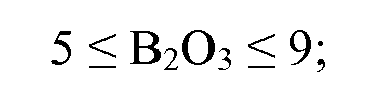
- the present invention relates to an alkali-free glass having a liquidus viscosity of greater than or equal to about 90,000 poises, said glass comprising SiO 2 , Al 2 O 3 , B 2 O 3 , MgO, CaO, and SrO such that, in mole percent on an oxide basis: 64 ⁇ S ⁇ i ⁇ O 2 ⁇ 68.2 ; 11 ⁇ A ⁇ l 2 ⁇ O 3 ⁇ 13.5 ; 5 ⁇ B 2 ⁇ O 3 ⁇ 9 ; 2 ⁇ MgO ⁇ 9 ; 3 ⁇ CaO ⁇ 9 ; and 1 ⁇ SrO ⁇ 5.
- Figure 1 is a graph showing compaction after one hour at 450 °C for glasses with a range of anneal points.
- Figure 2 is a graph of predicted SiO 2 content vs. measured SiO 2 content for a variety of glasses in accordance with the present invention.
- Figure 3 is a graph of predicted MgO content vs. measured MgO content for a variety of glasses in accordance with the present invention.
- Figure 4 is a graph of melting temperature of various glasses of the present invention as a function of SiO 2 content.
- a weight percent of a component is based on the total weight of the formulation or composition in which the component is included.
- a mole percent of a component unless specifically stated to the contrary, is based on the total number of moles of all components in the formulation or composition in which the component is included.
- the present invention relates to an alkali-free glass that includes SiO 2 , Al 2 O 3 , B 2 O 3 , MgO, CaO, and SrO, and the glass can further include a variety of other components.
- the SiO 2 , Al 2 O 3 , B 2 O 3 , MgO, CaO, SrO, and other components (if any) are chosen such that the glass includes, as calculated in mole percent on an oxide basis: 64-68.2 SiO 2 , 11-13.5 Al 2 O 3 , 5-9 B 2 O 3 , 2-9, MgO, 3-9 CaO, and 1-5 SrO.
- alkali-free means that the glass (i) is essentially free of intentionally added alkali metal oxide, for example, to avoid the possibility of having a negative impact on thin film transistor (TFT) performance through diffusion of alkali ions from the glass into the silicon of the TFT; (ii) contains a total of less than about 0.1 mol % of alkali metal oxides; or (iii) both.
- the glass includes, as calculated in mole percent on an oxide basis, 64-68 SiO 2 . In certain embodiments, the glass includes, as calculated in mole percent on an oxide basis, 11.3-13.5 Al 2 O 3 .
- the glass satisfies one or more of the following expressions: 1.05 ⁇ MgO + CaO + SrO / Al 2 ⁇ O 3 ⁇ 1.45 ; 0.67 ⁇ SrO + CaO / Al 2 ⁇ O 3 ⁇ 0.92 ; and 0.45 ⁇ CaO / CaO + SrO ⁇ 0.95.
- the glass satisfying the above immediate requirements further has a liquidus temperature of lower than or equal to about 1200°C, and a melting temperature of lower than or equal to about 1620°C.
- the glass satisfies the first of the aforementioned expressions (1.05 ⁇ (MgO+CaO+SrO)/Al 2 O 3 ⁇ 1.45). In certain embodiments, the glass satisfies the second of the aforementioned expressions (0.67 ⁇ (SrO+CaO)/Al 2 O 3 ⁇ 0.92). In certain embodiments, the glass satisfies the third of the aforementioned expressions (0.45 ⁇ CaO/(CaO+SrO) ⁇ 0.95). In certain embodiments, two or more of the aforementioned expressions are satisfied. In certain embodiments, all three of the aforementioned expressions are satisfied.
- the glass satisfies all three of the following expressions: 1.05 ⁇ MgO + CaO + SrO / Al 2 ⁇ O 3 ⁇ 1.3 ; 0.72 ⁇ SrO + CaO / Al 2 ⁇ O 3 ⁇ 0.9 ; and 0.55 ⁇ CaO / CaO + SrO ⁇ 0.95 , such as in the case where the glass satisfies all three of the following expressions: 1.05 ⁇ MgO + CaO + SrO / Al 2 ⁇ O 3 ⁇ 1.3 ; 0.72 ⁇ SrO + CaO / Al 2 ⁇ O 3 ⁇ 0.9 ; and 0.8 ⁇ CaO / CaO + SrO ⁇ 0.95.
- the glasses of the present invention can further include a variety of other components.
- the glasses of the present invention can further include SnO 2 , Fe 2 O 3 , CeO 2 , As 2 O 3 , Sb 2 O 3 , Cl, Br, or combinations thereof. These materials can be added as fining agents (e.g., to facilitate removal of gaseous inclusions from melted batch materials used to produce the glass) and/or for other purposes.
- the glasses of the present invention further include SnO 2 (e.g., as calculated in mole percent on an oxide basis, 0.02-0.3 SnO 2 , etc.) and Fe 2 O 3 (e.g., as calculated in mole percent on an oxide basis, 0.005-0.08 Fe 2 O 3 , 0.01-0.08 Fe 2 O 3 , etc.).
- the alkali-free glass of the present invention further includes SnO 2 and Fe 2 O 3 , wherein, in mole percent on an oxide basis: 0.02 ⁇ S ⁇ n ⁇ O 2 ⁇ 0.3 ; and 0.005 ⁇ F ⁇ e 2 ⁇ O 3 ⁇ 0.08.
- the glasses of the present invention include less than 0.05% (e.g., less than 0.04%, less than 0.03%, less than 0.02%, less than 0.01%, etc.) by weight of Sb 2 O 3 , As 2 O 3 , or combinations thereof.
- the glasses of the present invention further include SnO 2 , Fe 2 O 3 , CeO 2 , Cl, Br, or combinations thereof and include less than 0.05% (e.g., less than 0.04%, less than 0.03%, less than 0.02%, less than 0.01 %, etc.) by weight of Sb 2 O 3 , As 2 O 3 , or combinations thereof.
- the glasses of the present invention further include SnO 2 and Fe 2 O 3 and include less than 0.05% (e.g., less than 0.04%, less than 0.03%, less than 0.02%, less than 0.01 %, etc.) by weight of Sb 2 O 3 , As 2 O 3 , or combinations thereof.
- the alkali-free glasses of the present invention further include SnO 2 and Fe 2 O 3 , wherein, in mole percent on an oxide basis: 0.02 ⁇ S ⁇ n ⁇ O 2 ⁇ 0.3 ; and 0.005 ⁇ F ⁇ e 2 ⁇ O 3 ⁇ 0.08 , and include less than 0.05% (e.g., less than 0.04%, less than 0.03%, less than 0.02%, less than 0.01 %, etc.) by weight of Sb 2 O 3 , As 2 O 3 , or combinations thereof.
- SnO 2 and Fe 2 O 3 wherein, in mole percent on an oxide basis: 0.02 ⁇ S ⁇ n ⁇ O 2 ⁇ 0.3 ; and 0.005 ⁇ F ⁇ e 2 ⁇ O 3 ⁇ 0.08 , and include less than 0.05% (e.g., less than 0.04%, less than 0.03%, less than 0.02%, less than 0.01 %, etc.) by weight of Sb 2 O 3 , As
- the glasses of the present invention can include F, Cl, or Br, for example, as in the case where the glasses further include Cl and/or Br as fining agents.
- the glass can include fluorine, chlorine, and/or bromine, wherein, as calculated in mole percent: F+Cl+Br ⁇ 0.4, such as where F+Cl+Br ⁇ 0.3, F+Cl+Br ⁇ 0.2, F+Cl+Br ⁇ 0.1, 0.001 ⁇ F+Cl+Br ⁇ 0.4, and/or 0.005 ⁇ F+Cl+Br ⁇ 0.4.
- the glass further includes SnO 2 and Fe 2 O 3 and, optionally, fluorine, chlorine, and/or bromine, such that, as calculated in mole percent on an oxide basis: 0.02 ⁇ SnO 2 ⁇ 0.3, 0.005 ⁇ Fe 2 O 3 ⁇ 0.08, and F+Cl+Br ⁇ 0.4; and, in certain embodiments, the glass further includes SnO 2 and Fe 2 O 3 and, optionally, Sb 2 O 3 , As 2 O 3 , fluorine, chlorine, and/or bromine, such that, as calculated in mole percent on an oxide basis, 0.02 ⁇ SnO 2 ⁇ 0.3, 0.005 ⁇ Fe 2 O 3 ⁇ 0.08, and F+Cl+Br ⁇ 0.4, and such that the glass includes less than 0.05% (e.g., less than 0.04%, less than 0.03%, less than 0.02%, less than 0.01 %, etc.) by weight of Sb 2 O 3 , As 2
- fining agents can be added, for example, to produce glasses that are substantially defect-free by facilitating removal of gaseous inclusions from melted batch materials used to produce the glass.
- iron/tin fining can be used alone or in combination with other fining techniques if desired.
- iron/tin fining can be combined with halide fining, e.g., bromine fining.
- halide fining presents challenges from a pollution abatement point of view, and halides can complex with iron to produce glass with non-optimal transmission characteristics.
- Other possible combinations include, but are not limited to, iron/tin fining plus sulfate, sulfide, cerium oxide, mechanical bubbling, and/or vacuum fining.
- optimization may require that the sulfur content of the glass be controlled to avoid the production of gaseous defects containing SO 2 or SO 3 ; and the use of excessive amounts of iron or other transition metal fining agents may impart undesirable coloration to the glass.
- the glasses of the present invention can further include BaO.
- the glasses of the present invention include less than 1000 ppm by weight of BaO.
- the glasses of the present invention are "alkali-free".
- the alkali-free glasses of the present invention can include alkali oxides (e.g., Li 2 O, Na 2 O, K 2 O, etc), provided that the glass (i) is essentially free of intentionally added alkali metal oxide; (ii) contains a total of less than about 0.1 mol % of alkali metal oxides; or (iii) both.
- alkali oxides e.g., Li 2 O, Na 2 O, K 2 O, etc
- the intentional inclusion of alkali oxides is generally viewed as being undesirable owing to their negative impact on TFT performance.
- the alkali-free glass of the present invention includes intentionally added alkali oxides, but in amounts such that the alkali-free glass contains less than 1000 ppm (e.g., less than 700 ppm, less than 500 ppm, less than 200 ppm, less than 100 ppm, less than 50 ppm, etc.) by weight of alkali oxides (e.g., in amounts such that the sum of Li 2 O, Na 2 O, and K 2 O is less than 1000 ppm by weight).
- the alkali-free glass of the present invention includes no intentionally added alkali oxides, and the alkali-free glass contains a total of less than about 0.1 mol % of alkali metal oxides.
- the glasses of the present invention can further include contaminants as typically found in commercially prepared glass.
- a variety of other oxides e.g., TiO 2 , MnO, ZnO, Nb 2 O 5 , MoO 3 , Ta 2 O 5 , WO 3 , ZrO 2 , Y 2 O 3 , La 2 O 3 , and the like
- each of such other oxides are typically present in an amount not exceeding 1 mole percent, and their total combined concentration is typically less than or equal to 5 mole percent, although higher amounts can be used so long as the amounts used do not place the composition outside of the ranges described above.
- the glasses of the invention can also include various contaminants associated with batch materials and/or introduced into the glass by the melting, fining, and/or forming equipment used to produce the glass (e.g., ZrO 2 ).
- the glass satisfies one or more of the following expressions: 1.05 ⁇ MgO + CaO + SrO / Al 2 ⁇ O 3 ⁇ 1.45 ; 1.05 ⁇ MgO + CaO + SrO / Al 2 ⁇ O 3 ⁇ 1.3 ; 0.67 ⁇ SrO + CaO / Al 2 ⁇ O 3 ⁇ 0.92 ; 0.72 ⁇ SrO + CaO / Al 2 ⁇ O 3 ⁇ 0.9 ; 0.45 ⁇ CaO / CaO + SrO ⁇ 0.95 ; 0.55 ⁇ CaO / CaO + SrO ⁇ 0.95 ; and 0.8 ⁇ CaO / CaO + SrO ⁇ 0.95.
- the SiO 2 , Al 2 O 3 , B 2 O 3 , MgO, CaO, SrO, and other components can be chosen such that: 0.45 ⁇ CaO/(CaO+SrO) ⁇ 0.8; such that 64 ⁇ SiO 2 ⁇ 68; such that 11.3 ⁇ Al 2 O 3 ⁇ 113.5; such that 0.02 ⁇ SnO 2 ⁇ 0.3; such that 0.005 ⁇ Fe 2 O 3 ⁇ 0.08; such that F+Cl+Br ⁇ 0.4; and/or such the glass includes less than 0.05% (e.g., less than 0.04%, less than 0.03%, less than 0.02%, less than 0.01%, etc.) by weight of Sb 2 O 3 , As 2 O 3 , or combinations thereof.
- 0.05% e.g., less than 0.04%, less than 0.03%, less than 0.02%, less than 0.01%, etc.
- the glasses of the present invention include 5-9 B 2 O 3 .
- examples of such glasses include those in which contain, as calculated in mole percent on an oxide basis: 5-8.8 B 2 O 3 , 5-8.5 B 2 O 3 , 5-8.2 B 2 O 3 , and/or 5-8 B 2 O 3 .
- the glasses of the present invention include 2-9 MgO.
- examples of such glasses include those which contain, as calculated in mole percent on an oxide basis: 2-8 MgO, 2-7 MgO, 2-6 MgO, 2.5-9 MgO, 2.5-8 MgO, 2.5-7 MgO, and/or 2.5-6 MgO.
- the glasses of the present invention include 1-5 SrO.
- examples of such glasses include those which contain, as calculated in mole percent on an oxide basis: 1-4.5 SrO, 1-4 SrO, 1-3.5 SrO, 1.5-5 SrO, 1.5-4.5 SrO, 1.5-4 SrO, 1.5-3.5 SrO, 2.5-3.5 SrO, and/or 2.5-5 SrO.
- the SiO 2 , Al 2 O 3 , B 2 O 3 , MgO, CaO, SrO, and other components are chosen such that the glass includes, as calculated in mole percent on an oxide basis: 64-68.2 SiO 2 , 11-13.5 Al 2 O 3 , 5-9 B 2 O 3 , 2-9, MgO, 3-9 CaO, and 1-3.5 SrO.
- the SiO 2 , Al 2 O 3 , B 2 O 3 , MgO, CaO, SrO, and other components are chosen such that the glass includes, as calculated in mole percent on an oxide basis: 64-68.2 SiO 2 , 11-13.5 Al 2 O 3 , 5-9 B 2 O 3 , 2.5-6, MgO, 3-9 CaO, and 1-5 SrO.
- the SiO 2 , Al 2 O 3 , B 2 O 3 , MgO, CaO, SrO, and other components are chosen such that the glass includes, as calculated in mole percent on an oxide basis: 64-68.2 SiO 2 , 11-13.5 Al 2 O 3 , 5-8 B 2 O 3 , 2-9, MgO, 3-9 CaO, and 1-5 SrO.
- the SiO 2 , Al 2 O 3 , B 2 O 3 , MgO, CaO, SrO, and other components are chosen such that the glass includes, as calculated in mole percent on an oxide basis: 64-68.2 SiO 2 , 11-13.5 Al 2 O 3 , 5-8 B 2 O 3 , 2.5-6, MgO, 3-9 CaO, and 1-3.5 SrO.
- the glasses of the present invention have densities of less than about 2.6 g/cm 3 , such as densities of less than 2.6 g/cm 3 , densities of less than about 2.56 g/cm 3 , densities of less than 2.56 g/cm 3 , densities of from about 2.4 g/cm 3 to about 2.6 g/cm 3 , densities of from 2.4 g/cm 3 to 2.6 g/cm 3 , densities of from about 2.45 g/cm 3 to about 2.6 g/cm 3 , densities of from 2.45 g/cm 3 to 2.6 g/cm 3 , etc.
- the glasses of the present invention have liquidus temperatures of lower than or equal to about 1200°C, such as liquidus temperatures lower than or equal to about 1190°C, liquidus temperatures lower than or equal to about 1180°C, liquidus temperatures lower than or equal to about 1170°C, liquidus temperatures lower than or equal to about 1160°C, liquidus temperatures lower than or equal to about 1150°C, liquidus temperatures lower than or equal to about 1140°C, liquidus temperatures lower than or equal to about 1130°C, liquidus temperatures lower than or equal to about 1120°C, liquidus temperatures lower than or equal to about 1110°C, and liquidus temperatures lower than or equal to about 1100°C.
- liquidus temperatures lower than or equal to about 1200°C such as liquidus temperatures lower than or equal to about 1190°C, liquidus temperatures lower than or equal to about 1180°C, liquidus temperatures lower than or equal to about 1170°C, liquidus temperatures lower than or equal to about 1160°C, liquidus temperatures lower than or equal to about 1150°C, liquidus
- the glasses of the present invention have liquidus viscosities of greater than or equal to about 90,000.
- the glasses of the present invention have liquidus viscosities of greater than or equal to 90,000 poises, such as greater than or equal to about 100,000 poises, greater than or equal to 100,000 poises, greater than or equal to about 110,000 poises, greater than or equal to 110,000 poises, greater than or equal to about 120,000 poises, greater than or equal to 120,000 poises, greater than or equal to about 130,000 poises, greater than or equal to 130,000 poises, greater than or equal to about 140,000 poises, greater than or equal to 140,000 poises, greater than or equal to about 150,000 poises, greater than or equal to 150,000 poises, greater than or equal to about 160,000 poises, greater than or equal to 160,000 poises, greater than or equal to about 170,000 poises, greater than or equal to 170,000 poises, greater than or equal to about 180,000 poises, greater than or equal to 180,000 poises, etc.
- the glasses of the present invention have linear coefficients of thermal expansion over the temperature range of 0 °C to 300 °C of less than or equal to about 40 ⁇ 10 -7 /°C, such as less than or equal to 40 ⁇ 10 -7 /°C; less than or equal to about 39 ⁇ 10 -7 /°C; less than or equal to 39 ⁇ 10 -7 /°C; less than or equal to about 38 ⁇ 10 -7 /°C; less than or equal to 38 ⁇ 10 -7 /°C; less than or equal to 38 ⁇ 10 -7 /°C; less than or equal to 38 ⁇ 10 -7 /°C; less than or equal to about 37 ⁇ 10 -7 /°C; less than or equal to 37 ⁇ 10 -7 /°C; less than or equal to about 36 ⁇ 10 -7 /°C; less than or equal to 36 ⁇ 10 -7 /°C; from about 33 ⁇ 10 -7 /°C to about 40 ⁇ 10 -7 /°C; from 33 ⁇ 10 -7 /°C to 40 ⁇ 10
- the glasses of the present invention have strain points of greater than or equal to about 680 °C, such as greater than or equal to 680 °C, greater than or equal to about 685 °C, greater than or equal to 685 °C, greater than or equal to about 690 °C, greater than or equal to 690 °C, etc.
- the glasses of the present invention have anneal points of greater than or equal to about 725°C, such as greater than or equal to 725 °C, greater than or equal to about 730 °C, greater than or equal to 730 °C, greater than or equal to about 735 °C, greater than or equal to 735 °C, greater than or equal to about 745 °C, greater than or equal to 745 °C, from about 725 °C to about 760 °C, from 725 °C to 760 °C, from about 735 °C to about 760 °C, from 735 °C to 760 °C, etc.
- the glasses of the present invention have melting temperatures of less than or equal to about 1620 °C, such as less than or equal to 1620 °C, less than or equal to about 1615 °C, less than or equal to 1615 °C, less than or equal to about 1610 °C, less than or equal to 1610 °C, etc.
- the glasses of the present invention have specific moduli of greater than or equal to about 30.5 GPa ⁇ cc/g, such as greater than or equal to 30.5 GPa ⁇ cc/g, greater than or equal to about 31.5 GPa ⁇ cc/g, greater than or equal to 31.5 GPa ⁇ cc/g, etc.
- the glasses can be produced in a variety of glass shapes, for example, glass plates (e.g., glass plates having a thickness of from about 30 ⁇ m to about 2 mm, such as from 30 ⁇ m to 2 mm, from about 100 ⁇ m to about 1 mm, from 10 ⁇ m to 1 mm, etc.).
- glass plates e.g., glass plates having a thickness of from about 30 ⁇ m to about 2 mm, such as from 30 ⁇ m to 2 mm, from about 100 ⁇ m to about 1 mm, from 10 ⁇ m to 1 mm, etc.
- Batch ingredients can include fine sand, alumina, boric acid, magnesium oxide, limestone strontium carbonate, strontium nitrate, tin oxide, etc.
- SiO 2 is typically added as a crushed sand made of alpha quartz, either from loose sand deposits or mined from sandstone or quartzite. While these are commercially available at low cost, other crystalline or amorphous forms of SiO 2 can be substituted in part or in whole with little impact on melting behavior. Because molten SiO 2 is very viscous and dissolves slowly into alkali-free glass, it is generally advantageous that the sand be crushed so that at least 85% of it passes through a U.S. mesh size of 100, corresponding to mesh opening sizes of about 150 microns. In production, fines may be lofted by batch transfer processes or by air-handling equipment, and, to avoid the health hazards this presents, it may be desirable to remove the smallest fraction of crushed sand as well.
- Alumina is typically used as the source of Al 2 O 3 .
- Boric acid is typically used as the source of B 2 O 3 .
- the glasses of the invention also include MgO, CaO, and SrO.
- the alkaline earths are typically added as oxides (especially MgO), carbonates (CaO and SrO), nitrates (CaO and SrO), and/or hydroxides (MgO, CaO, and SrO).
- naturally-occurring minerals that can serve as sources include dolomite (Ca x ,Mg 1-x )CO 3 ), magnesite (MgCO 3 ), brucite (Mg(OH) 2 ), talc (Mg 3 Si 4 O 10 (OH) 2 ), olivine (Mg 2 SiO 4 ), and limestone (CaCO 3 ).
- These natural sources include iron and so can be used as a way of adding this component in those cases where iron oxide is to be present in the glass.
- the glasses of the invention can be manufactured using various techniques known in the art.
- glass plates can be made using a downdraw process, such as by a fusion downdraw process.
- the fusion process may be preferred in certain circumstances for several reasons.
- glass substrates made from the fusion process require less polishing or do not require polishing, depending, of course, on the desired surface roughness of the final product.
- glass substrates made from the fusion process can have reduced average internal stress, relative to glasses made using other processes.
- the glasses of the present invention can be used in a variety of applications.
- the glasses of the present invention can be used as a substrate for a silicon semiconductor.
- the glasses of the present invention can be used to make display glass substrates, such as display glass substrates having thicknesses of from about 30 ⁇ m to about 2 mm (e.g., from 30 ⁇ m to 2 mm, from about 100 ⁇ m to about 1 mm, from 10 ⁇ m to 1 mm, etc.).
- display glass substrates include TFT display glass substrates, such as a TFT display glass substrates for flat panel display devices.
- the present invention also relates to a semiconductor assembly that includes a semiconductor disposed on a glass substrate, wherein said glass substrate comprises an alkali-free glass of the present invention.
- semiconductors that can be used in the aforementioned semiconductor assemblies include transistors, diodes, silicon transistors, silicon diodes, and other silicon semiconductors; field effect transistors (FETs), thin-film transistors (TFTs), organic light-emitting diodes (OLEDs) and other light-emitting diodes; as well as semiconductors that are useful in electro-optic (EO) applications, in two photon mixing applications, in non-linear optical (NLO) applications, in electroluminescent applications, and in photovoltaic and sensor applications.
- EO electro-optic
- the present invention also relates to a flat panel display device that includes a flat, transparent glass substrate carrying polycrystalline silicon thin film transistors, wherein said glass substrate comprises an alkali-free glass of the present invention.
- the alkali-free glass includes SiO 2 , Al 2 O 3 , B 2 O 3 , MgO, CaO, and SrO such that, in mole percent on an oxide basis: 64 ⁇ S ⁇ i ⁇ O 2 ⁇ 68.2 ; 11 ⁇ A ⁇ l 2 ⁇ O 3 ⁇ 13.5 ; 5 ⁇ B 2 ⁇ O 3 ⁇ 9 ; 2 ⁇ MgO ⁇ 9 ; 3 ⁇ CaO ⁇ 9 ; and 1 ⁇ SrO ⁇ 5.
- suitable glasses from which the glass substrates can be made include those discussed above, for example, glasses which satisfy the following expressions: 1.05 ⁇ (MgO+CaO+SrO)/Al 2 O 3 ⁇ 1.45; 0.67 ⁇ (SrO+CaO)/Al 2 O 3 ⁇ 0.92; and 0.45 ⁇ CaO/(CaO+SrO) ⁇ 0.95.
- the device includes two plates (substrate assemblies) that are manufactured separately.
- the color filter plate has a series of red, blue, green, and black organic dyes deposited on it. Each of these primary colors corresponds precisely with a sub pixel of the companion active plate.
- the active plate so called because it contains the active, thin film transistors (TFTs), is manufactured using typical semiconductor type processes. These include sputtering, CVD, photolithography, and etching.
- the alkali-free glass used in the aforementioned substrates can be substantially defect-free.
- alkali-free glasses of the present invention that are substantially defect-free can be produced, for example, by using one or more fining agents, such as SnO 2 , Fe 2 O 3 , CeO 2 , As 2 O 3 , Sb 2 O 3 , Cl, Br, or combinations thereof. Examples of suitable combinations are set forth above.
- the glass can include, as fining agents, SnO 2 and Fe 2 O 3 ; 0.02-0.3 SnO 2 and 0.005-0.08 Fe 2 O 3 ; less than 0.05% by weight of Sb 2 O 3 and/or As 2 O 3 ; SnO 2 , Fe 2 O 3 , CeO 2 , Cl, Br, or combinations thereof but less than 0.05% by weight of Sb 2 O 3 and/or As 2 O 3 ; SnO 2 and Fe 2 O 3 but less than 0.05% by weight of Sb 2 O 3 and/or As 2 O 3 ; and/or 0.02-0.3 SnO 2 and 0.005-0.08 Fe 2 O 3 but less than 0.05% by weight of Sb 2 O 3 and/or As 2 O 3 .
- the glasses of the present invention are particularly advantageous in the manufacture of certain substrates for active matrix liquid crystal display devices (AMLCDs).
- AMLCD substrates optimally meet a variety of customer requirements, several of which are strongly dependent on the fusion process itself.
- a pristine surface is believed to be an attribute of fusion, and partially explains why customers are drawn to substrates made by the fusion process.
- Another customer requirement is geometric stability under thermal cycling, and in this matter the fusion process sometimes comes up short.
- the glass temperature decreases rather quickly from the forming temperatures (e.g., in excess of 1100 °C) to well below the glass transition temperature (e.g., about 720 °C for certain products), the glass has a slightly expanded volume relative to its fully relaxed state, or the state that would be obtained if the glass were held near T g for a considerable length of time.
- the glass is reheated, it naturally relaxes towards its equilibrium volume, and this three-dimensional contraction or relaxation as sometimes referred to as "compaction".
- the rate of cooling can be determined almost entirely by the rate (in inches per minute) at which the sheet comes off the draw. This rate is sometimes referred to as the "pulling roll speed". From draw to draw, it has been found that increasing the pulling roll speed can increase compaction.
- Figure 1 shows compaction after one hour at 450 °C for glasses with a range of anneal points. Prior to the 450 °C heat treatment, the glasses were subjected to a thermal cycle intended to be similar to the cooling profile of a glass coming off of a fusion draw (e.g., prolonged exposure to high temperature, then rapid cooling at a rate similar to that used in a fusion draw). As can be seen from Figure 1 , as anneal point increases, compaction decreases; however, above an anneal point of about 760 °C, the additional gain in compaction performance for a given increase in anneal point diminishes rapidly. The glasses with the highest anneal point in Figure 1 are intended for low-temperature polysilicon ("pSi") applications.
- pSi low-temperature polysilicon
- compositions of the present invention can be optimized so as to have liquidus viscosities of 90 kpoise or greater, melting temperatures of 1620 °C or less, anneal points of 725 °C or greater, and/or specific moduli of 30.5 GPa ⁇ cc/g or greater. It is believed that compositions of the present invention having a combination of high modulus and anneal point can especially desirable for use in certain fusion draw processes, such as for fusion draw processes at high cooling rates.
- elevated anneal points may provide enhanced geometric stability during amorphous silicon (“aSi") processing and may permit higher draw speeds without recourse to annealing or expensive equipment redesign. It is also believed (again, without intending to be limited by any theory by which certain glasses of the present invention may operate) that high level of fluxes and comparatively low melting temperatures can accelerate melting and, consequently, may allow for higher melting rates without a corresponding increase in defects.
- aSi amorphous silicon
- compositions of the glasses of the invention can b ee determined using quantitative analysis techniques well known in the art. Suitable techniques are X-ray fluorescence spectrometry (XRF) for elements with an atomic number higher than 8, inductively coupled plasma optical emission spectrometry (ICP-OES), inductively coupled plasma mass spectrometry (ICP-MS), and electron microprobe analysis.
- XRF X-ray fluorescence spectrometry
- ICP-OES inductively coupled plasma optical emission spectrometry
- ICP-MS inductively coupled plasma mass spectrometry
- electron microprobe analysis See, for example, J. Nolte, ICP Emission Spectrometry: A Practical Guide, Wiley-VCH (2003 ); H.E. Taylor, Inductively Coupled Plasma Mass Spectroscopy: Practices and Techniques, Academic Press (2000 ); and S.J.B.
- Example 1 and the following Examples 2 and 3 are meant to describe how the present invention was made. These Examples are not meant to, in any way, be limiting; instead, they are provided so that one skilled in the art might have access to applicant's thought process and may use this thought process, if appropriate, to further develop that which is described here to optimize the glasses of the present invention for use in particular applications.
- the glasses with the best combination of liquidus viscosity, melting temperature, and anneal point tended to have similar proportions of SiO 2 , Al 2 O 3 , MgO, CaO, and SrO when projected to B 2 O 3 -free compositions.
- SiO 2 , Al 2 O 3 , MgO, CaO, and SrO when projected to B 2 O 3 -free compositions.
- the liquidus temperature will decrease sharply, whereas viscosity will decrease more gradually. It is estimated that, at about 5 mol% B 2 O 3 , the viscosity of the glass at the highest temperature at which crystals form (the liquidus viscosity) will be > 85 kpoise, and the glass will be compatible with fusion, perhaps not exactly as generally practiced today, but well within reach of existing or planned adaptations to the process.
- the B 2 O 3 -free analogs of glasses within the ranges of the glasses of the present invention tend to be very similar to one another, and nearly always represent advantageous combinations of high liquidus viscosity, low melting temperature, and high anneal point relative to glasses outside of these ranges.
- a B 2 O 3 glass containing no SrO at all would tend to have an unacceptably high liquidus temperature.
- B 2 O 3 could be added and eventually a high liquidus viscosity might be obtained, but it would generally have too low an anneal point to facilitate high pull rates.
- the SiO 2 concentration of such a glass could be manipulated so as to increase the liquidus viscosity, perhaps to a very high value, but the melting temperature would be far higher than that of a glass in which 0.67 ⁇ S o ⁇ 0.92.
- other attributes such as, CTE, density, and/or modulus (which may be of secondary importance, depending on the process by which the glass is to be formed and the use to which the glass is to be put) may also suffer relative to an analogous glass in which 0.67 ⁇ S o ⁇ 0.92 and 1.05 ⁇ R o ⁇ 1.45.
- B 2 O 3 -free compositions having S o and/or R o outside of, but close to, the 0.67 ⁇ S o ⁇ 0.92 and 1.05 ⁇ R o ⁇ 1.45 ranges can be made compatible with fusion, but at a cost of anneal points that are perhaps too low and/or melt temperatures that are perhaps too high.
- the second surprising insight is that, as R o increases, the glass with the best combination of liquidus viscosity, melt temperature, and anneal point tends to have a higher MgO content than a glass with the same B 2 O 3 content but lower R o . Indeed, it is believed that there is a preferred MgO content determined by R o and S o . This preferred MgO content is referred to as "[MgO] pred ".
- the third surprising insight is that glasses with the best combinations of liquidus viscosity, melting temperature, and anneal point and 5 ⁇ B 2 O 3 ⁇ 9 tend to have SiO 2 contents that are determined largely by the MgO content, R o value, and S o value of the glass.
- MgO it is believed that there is a preferred SiO 2 content determined by MgO, R o , and S o (this preferred SiO 2 content being referred to as "[SiO 2 ] pred "), but, for fixed R o and S o , MgO will be determined in part by the level of B 2 O 3 in the glass.
- SiO 2 MgO / 1 - B 2 ⁇ O 3 / 100 .
- the glass when the difference between SiO 2 and [SiO 2 ] pred is small, the glass will have at least two of the following: an advantageous liquidus viscosity, an advantageous melting temperature, an advantageous anneal point. It is further believed that glasses having all three advantageous properties (i.e., an advantageous liquidus viscosity, an advantageous melting temperature, and an advantageous anneal point) can be obtained when - 0.3 ⁇ SiO 2 - SiO 2 pred ⁇ 0.3.
- This Example 2 illustrates a procedure for testing a glass composition to determine whether it is particularly well suited for use in fusion processes. the use of [MgO] pred and [SiO 2 ] pred to optimize the glasses of the present invention for use in fusion processes.
- Example 2 The process described above in this Example 2 can be repeated for a variety of candidate glass compositions to determine the glass compositions' [MgO] prea and [SiO 2 ] prea values. It is believed that, by comparing the [MgO] pred and [SiO 2 ] pred values with the MgO and SiO 2 concentrations in the candidate glasses, one can obtain glasses that may have particularly desirable combinations of liquidus viscosity, melting temperature, and anneal point for use in certain processes , such as in fusion processes.
- Example 3 illustrates a procedure for generating a glass composition using the relationships described in Example 1.
- the procedure involves the following steps:
- the first step is to select an anneal point target.
- Anneal points of 740°C or more afford a substantial increase in pull rate, but anneal points above 760°C may offer little improvement with regard to aSi applications. If the glass were intended for a larger size sheet, however, it is possible that a lower anneal point might suffice, as melting rate might be the limiting factor. In this example, an intermediate target value of 748°C was selected.
- the next step is to select starting values for R o , S o and C o .
- the relationship between these variables and the properties of the final glass are complex, as one may be adjusted against the other to obtain a range of properties.
- step (6) can be performed.
- the anneal point algorithm presented above is used to determine how much B 2 O 3 must be added to produce the desired anneal point.
- the calculated value for B 2 O 3 can now be used to renormalize the concentrations of the other oxides.
- Step (7) values for CTE and density are calculated to confirm that they are appropriate for the application in mind:
- having a higher SiO 2 content may adversely affect the melting point; having a higher B 2 O 3 content may adversely affect anneal point; having a lower B 2 O 3 content and/or a lower SiO 2 content may adversely affect liquidus viscosity; etc.
- the glass components are selected such that the expression 1.05 ⁇ (MgO+CaO+SrO)/Al 2 O 3 ⁇ 1.45 is satisfied.
- These glasses are believed to possess particularly good anneal points and liquidus viscosities, compared to anneal points when (MgO+CaO+SrO)/Al 2 O 3 > 1.45 and liquidus viscosities when (MgO+CaO+SrO)/Al 2 O 3 ⁇ 1.05.
- Table 1 lists examples of glasses of the present invention in terms of mole percents which are either calculated on an oxide basis from the glass batches. Table 1 also lists various physical properties for these glasses, the units for these properties being as follows: Strain Point °C Anneal Point °C Softening Point °C CTE x 10 -7 /°C (0-300°C) Density grams/centimeter 3 Melting Temp. °C Liquidus Temp. °C Liquidus Viscosity kilopoise
- the actual batch ingredients may comprise any materials, either oxides, or other compounds, which, when melted together with the other batch components, will be converted into the desired oxide in the proper proportions.
- SrCO 3 and CaCO 3 can provide the source of SrO and CaO, respectively.
- the specific batch ingredients used to prepare the glasses of Table 1 were fine sand, alumina, boric acid, magnesium oxide, limestone, and strontium carbonate or strontium nitrate.
- the glasses set forth in Table 1 were prepared by melting 3,000 or 19,000 gram batches of each glass composition at a temperature and time to result in a relatively homogeneous glass composition, e.g., at a temperature of about 1600°C for a period of about 16 hours in platinum crucibles.
- the batch materials were ball-milled for one hour using ceramic media in a ceramic mill.
- the batch was transferred to an 1800 cc platinum crucible and loaded into a furnace at 1600°C. After 16 hours, the crucible was removed from the furnace and the glass was poured onto a cold steel plate. When viscous enough to handle, the glass was transferred to an annealing oven at 725°C, held for one hour at this temperature, then cooled at 0.5°C/minute to room temperature.
- the glass properties set forth in Table 1 were determined in accordance with techniques conventional in the glass art. For example, the linear coefficient of thermal expansion (CTE) over the temperature range 0-300°C is expressed in terms of x 10 -7 /°C and the strain point is expressed in terms of °C. These were determined from fiber elongation techniques (ASTM references E228-85 and C336, respectively). The density in terms of grams/cm 3 was measured via the Archimedes method (ASTM C693). The melting temperature in terms of °C (defined as the temperature at which the glass melt demonstrates a viscosity of 200 poises (“T @ 200p”)) was calculated employing a Fulcher equation fit to high temperature viscosity data measured via rotating cylinders viscometry (ASTM C965-81).
- the liquidus temperature of the glass in terms of °C was measured using the standard gradient boat liquidus method of ASTM C829-81. This involves placing crushed glass particles in a platinum boat, placing the boat in a furnace having a region of gradient temperatures, heating the boat in an appropriate temperature region for 24 hours, and determining by means of microscopic examination the highest temperature at which crystals appear in the interior of the glass.
- the liquidus viscosity in kilopoises was determined from the liquidus temperature and the coefficients of the Fulcher equation.
- compositions that satisfy the expressions: - 0.3 ⁇ MgO - MgO pred ⁇ 0.3 - 0.3 ⁇ SiO 2 - SiO 2 pred ⁇ 0.3 have liquidus viscosities of at least 90 kpoise, and are therefore are compatible with fusion as practiced today, or can be made compatible with fusion with minimal adjustment to current processes.
- the nominal liquidus viscosity of Corning's Eagle XG is 130 kpoise, and devitrification within the quality area has never been seen for this glass in production. This is because of its comparatively steep viscosity curve, which permits a smaller ⁇ T across the isopipe.
- Figure 2 is a plot of SiO 2 concentration for various glasses of the present invention vs. [87.46 - 5.85 ⁇ MgO ⁇ (1-B 2 O 3 /100) + 63.67 ⁇ M a - 13.85 ⁇ S o ] ⁇ [1-B 2 O 3 /100], the predictive measure for SiO 2 .
- Figure 3 is a plot of MgO for various glasses of the present invention vs. [1.01 + 12.77 ⁇ R o - 13.79 ⁇ S o ] ⁇ [1-B 2 O 3 /100], the predictive measure for MgO. As Figures 2 and 3 show, the actual concentrations of MgO and SiO 2 lie very close to the predicted values for all compositions.
- Figure 4 is a graph of melting temperature of various glasses of the present invention as a function of SiO 2 content.
- the melting temperature increases as a relatively steep function of SiO 2 content for glasses that otherwise satisfy the expressions: 11 ⁇ Al 2 O 3 ⁇ 13.5; 5 ⁇ B 2 O 3 ⁇ 9; 2 ⁇ MgO ⁇ 9; 3 ⁇ CaO ⁇ 9; and 1 ⁇ SrO ⁇ 5. Accordingly, it is believed that, when SiO 2 content is above 68.2 mol%, melting temperatures higher than 1620°C may result, particularly in compositions that do not contain arsenic.
Landscapes
- Chemical & Material Sciences (AREA)
- Life Sciences & Earth Sciences (AREA)
- Engineering & Computer Science (AREA)
- Chemical Kinetics & Catalysis (AREA)
- General Chemical & Material Sciences (AREA)
- Geochemistry & Mineralogy (AREA)
- Materials Engineering (AREA)
- Organic Chemistry (AREA)
- Glass Compositions (AREA)
- Liquid Crystal (AREA)
- Air Supply (AREA)
Abstract
Description
- This application claims the benefit of priority to
U.S. provisional application no 61/130474 - The present invention relates, generally, to glasses and, more particularly, to boroalumino silicate glasses and to methods for making and using same.
- Displays may be broadly classified into one of two types: emissive (e.g., CRTs and plasma display panels (PDPs)) or non-emissive. This latter family, to which liquid crystal displays (LCDs) belong, relies upon an external light source, with the display only serving as a light modulator. In the case of liquid crystal displays, this external light source may be either ambient light (used in reflective displays) or a dedicated light source (such as found in direct view displays).
- Liquid crystal displays rely upon three inherent features of liquid crystal (LC) materials to modulate light. The first is the ability of LC materials to cause optical rotation of polarized light. Second is the dependence of such rotation on the mechanical orientation of the liquid crystal. Third is the ability of the liquid crystal to undergo mechanical orientation by the application of an external electric field.
- In the construction of a simple, twisted nematic (TN) liquid crystal display, two substrates surround a layer of liquid crystal material. In a display type known as Normally White, the application of alignment layers on the inner surfaces of the substrates creates a 90° spiral of the liquid crystal director. This means that the polarization of linearly polarized light entering one face of the liquid crystal cell will be rotated 90° by the liquid crystal material. Polarization films, oriented 90° to each other, are placed on the outer surfaces of the substrates.
- Light, upon entering the first polarization film becomes linearly polarized. Traversing the liquid crystal cell, the polarization of this light is rotated 90° and is allowed to exit through the second polarization film. Application of an electric field across the liquid crystal layer aligns the liquid crystal directors with the field, interrupting its ability to rotate light. Linearly polarized light passing through this cell does not have its polarization rotated and hence is blocked by the second polarization film. Thus, in the simplest sense, the liquid crystal material becomes a light valve, whose ability to allow or block light transmission is controlled by the application of an electric field.
- The above description pertains to the operation of a single pixel in a liquid crystal display. High information type displays require the assembly of several million of these pixels, which are referred to in the art as sub pixels, into a matrix format. Addressing all of these sub pixels, i.e., applying an electric field to all of these sub pixels, while maximizing addressing speed and minimizing cross-talk presents several challenges. One of the preferred ways to address sub pixels is by controlling the electric field with a thin film transistor located at each sub pixel, which forms the basis of active matrix liquid crystal display devices (AMLCDs).
- The manufacturing of these displays is extremely complex, and the properties of the substrate glass can be extremely important when producing displays having optimal performance. We have described some suitable substrate glasses in
U.S. Patent No. 6,060,168 to Kohli ,U.S. Patent No. 6,319,867 to Chacon et al. ,U.S. Patent No. 6,831,029 to Chacon et al. , andU.S. Patent No. RE38,959 to Kohli . However, a need for glasses that can be used as substrates in the manufacture of active matrix liquid crystal display devices (AMLCDs) and other flat panel displays continues to exist, and the present invention is directed, in part, to addressing this need. - One technical issue facing the glass substrates for LCD displays, especially those displays made by high-temperature processes such as polysilicon technology, is the density change (compaction, or thermal stability) of the glass sheets after they are subjected to high-temperature treatment steps. The compaction of the glass sheets can lead to lack of registration of the semiconductor features created on the surface of the substrates, hence lower-quality or defective displays. Thermal stability of the glass sheet is dependent on the glass composition and thermal history thereof. Whereas a rigorously annealed glass sheet would have less compaction in down-stream processing, obtaining such thermodynamically stable glass sheet is difficult and could incur prohibitive costs to the manufacture process by requiring either a secondary heat treatment and/or a low production rate. It has been found that anneal point of the glass material correlates with the thermal stability of a glass sheet. For glass sheets produced by a given thermal process, the higher the anneal point of the glass material, the less the compaction of the glass sheets made therefrom.
- The present invention addresses the various technical issues discussed supra.
- The present invention relates to an alkali-free glass having a liquidus viscosity of greater than or equal to about 90,000 poises, said glass comprising SiO2, Al2O3, B2O3, MgO, CaO, and SrO such that, in mole percent on an oxide basis:




- These and additional features and embodiments of the present invention will be more fully illustrated and discussed in the following drawings and detailed description.
-
Figure 1 is a graph showing compaction after one hour at 450 °C for glasses with a range of anneal points. -
Figure 2 is a graph of predicted SiO2 content vs. measured SiO2 content for a variety of glasses in accordance with the present invention. -
Figure 3 is a graph of predicted MgO content vs. measured MgO content for a variety of glasses in accordance with the present invention. -
Figure 4 is a graph of melting temperature of various glasses of the present invention as a function of SiO2 content. - Before the present materials, articles, and/or methods are disclosed and described, it is to be understood that the aspects described below are not limited to specific materials, preparative methods, or uses, but is to be understood to be illustrative of the invention. It is also to be understood that the terminology used herein is for the purpose of describing particular aspects only and is not intended to be limiting.
- Throughout this specification and claims, unless the context requires otherwise, the word "comprise" or variations, such as "comprises" or "comprising", will be understood to imply the inclusion of a stated element but not the exclusion of any other element or group of elements.
- It must be noted that, as used in the specification and the appended claims, the singular forms "a", "an", and "the" include plural referents unless the context clearly dictates otherwise. Thus, for example, reference to "a fining agent" is meant to include mixtures of two or more such fining agents; reference to "the glass former" is meant to include mixtures of two or more such glass formers; and the like.
- "Optional" or "optionally" means that the subsequently described event or circumstance can or cannot occur, and that the description includes instances where the event or circumstance occurs and instances where it does not.
- When values are expressed as approximations, e.g., by use of the antecedent "about" as in "'about' a particular value", it will be understood that the particular value forms another aspect of the invention. Ranges may be expressed herein as "from'about' one particular value to 'about' another particular value", as "less than 'about' a particular value", as "'about' a particular value or greater", etc. When such ranges are expressed, another aspect of the invention includes "from the one particular value to the other particular value", "less than the particular value", and "the particular value or greater", respectively. It will be further understood that the endpoints of each of the ranges are significant both in relation to the other endpoint, and independently of the other endpoint; and, in cases where no lower endpoint is stated in a range, the lower endpoint is meant to be and include zero.
- A weight percent of a component, unless specifically stated to the contrary, is based on the total weight of the formulation or composition in which the component is included. Similarly, a mole percent of a component, unless specifically stated to the contrary, is based on the total number of moles of all components in the formulation or composition in which the component is included.
- As discussed above, the present invention relates to an alkali-free glass that includes SiO2, Al2O3, B2O3, MgO, CaO, and SrO, and the glass can further include a variety of other components. The SiO2, Al2O3, B2O3, MgO, CaO, SrO, and other components (if any) are chosen such that the glass includes, as calculated in mole percent on an oxide basis: 64-68.2 SiO2, 11-13.5 Al2O3, 5-9 B2O3, 2-9, MgO, 3-9 CaO, and 1-5 SrO.
- As used herein, "alkali-free" means that the glass (i) is essentially free of intentionally added alkali metal oxide, for example, to avoid the possibility of having a negative impact on thin film transistor (TFT) performance through diffusion of alkali ions from the glass into the silicon of the TFT; (ii) contains a total of less than about 0.1 mol % of alkali metal oxides; or (iii) both.
- In certain embodiments, the glass includes, as calculated in mole percent on an oxide basis, 64-68 SiO2. In certain embodiments, the glass includes, as calculated in mole percent on an oxide basis, 11.3-13.5 Al2O3.
- In certain embodiments, the glass satisfies one or more of the following expressions:


- For example, in certain embodiments, the glass satisfying the above immediate requirements further has a liquidus temperature of lower than or equal to about 1200°C, and a melting temperature of lower than or equal to about 1620°C.
- For example, in certain embodiments, the glass satisfies the first of the aforementioned expressions (1.05 ≤ (MgO+CaO+SrO)/Al2O3 ≤ 1.45). In certain embodiments, the glass satisfies the second of the aforementioned expressions (0.67 ≤ (SrO+CaO)/Al2O3 ≤ 0.92). In certain embodiments, the glass satisfies the third of the aforementioned expressions (0.45 ≤ CaO/(CaO+SrO) ≤ 0.95). In certain embodiments, two or more of the aforementioned expressions are satisfied. In certain embodiments, all three of the aforementioned expressions are satisfied. By way of further illustration, in certain embodiments, the glass satisfies all three of the following expressions:



such as in the case where the glass satisfies all three of the following expressions:


- The glasses of the present invention (e.g., any of the glasses discussed above) can further include a variety of other components.
- For example, the glasses of the present invention can further include SnO2, Fe2O3, CeO2, As2O3, Sb2O3, Cl, Br, or combinations thereof. These materials can be added as fining agents (e.g., to facilitate removal of gaseous inclusions from melted batch materials used to produce the glass) and/or for other purposes. In certain embodiments, the glasses of the present invention (e.g., any of the glasses discussed above) further include SnO2 (e.g., as calculated in mole percent on an oxide basis, 0.02-0.3 SnO2, etc.) and Fe2O3 (e.g., as calculated in mole percent on an oxide basis, 0.005-0.08 Fe2O3, 0.01-0.08 Fe2O3, etc.). By way of illustration, in certain embodiments, the alkali-free glass of the present invention further includes SnO2 and Fe2O3, wherein, in mole percent on an oxide basis:


- In certain embodiments, the glasses of the present invention include less than 0.05% (e.g., less than 0.04%, less than 0.03%, less than 0.02%, less than 0.01%, etc.) by weight of Sb2O3, As2O3, or combinations thereof. In certain embodiments, the glasses of the present invention further include SnO2, Fe2O3, CeO2, Cl, Br, or combinations thereof and include less than 0.05% (e.g., less than 0.04%, less than 0.03%, less than 0.02%, less than 0.01 %, etc.) by weight of Sb2O3, As2O3, or combinations thereof. In certain embodiments, the glasses of the present invention further include SnO2 and Fe2O3 and include less than 0.05% (e.g., less than 0.04%, less than 0.03%, less than 0.02%, less than 0.01 %, etc.) by weight of Sb2O3, As2O3, or combinations thereof. In certain embodiments, the alkali-free glasses of the present invention further include SnO2 and Fe2O3, wherein, in mole percent on an oxide basis:


and include less than 0.05% (e.g., less than 0.04%, less than 0.03%, less than 0.02%, less than 0.01 %, etc.) by weight of Sb2O3, As2O3, or combinations thereof. - The glasses of the present invention (e.g., any of the glasses discussed above) can include F, Cl, or Br, for example, as in the case where the glasses further include Cl and/or Br as fining agents. For example, the glass can include fluorine, chlorine, and/or bromine, wherein, as calculated in mole percent: F+Cl+Br ≤ 0.4, such as where F+Cl+Br ≤ 0.3, F+Cl+Br ≤ 0.2, F+Cl+Br ≤ 0.1, 0.001 ≤ F+Cl+Br ≤ 0.4, and/or 0.005 ≤ F+Cl+Br ≤ 0.4. By way of illustration, in certain embodiments, the glass further includes SnO2 and Fe2O3 and, optionally, fluorine, chlorine, and/or bromine, such that, as calculated in mole percent on an oxide basis: 0.02 ≤ SnO2 ≤ 0.3, 0.005 ≤ Fe2O3 ≤ 0.08, and F+Cl+Br ≤ 0.4; and, in certain embodiments, the glass further includes SnO2 and Fe2O3 and, optionally, Sb2O3, As2O3, fluorine, chlorine, and/or bromine, such that, as calculated in mole percent on an oxide basis, 0.02 ≤ SnO2 ≤ 0.3, 0.005 ≤ Fe2O3 ≤ 0.08, and F+Cl+Br ≤ 0.4, and such that the glass includes less than 0.05% (e.g., less than 0.04%, less than 0.03%, less than 0.02%, less than 0.01 %, etc.) by weight of Sb2O3, As2O3, or combinations thereof.
- The use of SnO2, Fe2O3, CeO2, As2O3, Sb2O3, Cl, Br, or combinations thereof as fining can be especially useful in the manufacture of glasses for certain applications, such as substrates for flat panel displays. As mentioned above, fining agents can be added, for example, to produce glasses that are substantially defect-free by facilitating removal of gaseous inclusions from melted batch materials used to produce the glass. Illustratively, iron/tin fining can be used alone or in combination with other fining techniques if desired. For example, iron/tin fining can be combined with halide fining, e.g., bromine fining. However, halide fining presents challenges from a pollution abatement point of view, and halides can complex with iron to produce glass with non-optimal transmission characteristics. Other possible combinations include, but are not limited to, iron/tin fining plus sulfate, sulfide, cerium oxide, mechanical bubbling, and/or vacuum fining. However, optimization may require that the sulfur content of the glass be controlled to avoid the production of gaseous defects containing SO2 or SO3; and the use of excessive amounts of iron or other transition metal fining agents may impart undesirable coloration to the glass.
- The glasses of the present invention can further include BaO. In certain embodiments, the glasses of the present invention include less than 1000 ppm by weight of BaO.
- As noted above, the glasses of the present invention are "alkali-free". As also noted above, the alkali-free glasses of the present invention can include alkali oxides (e.g., Li2O, Na2O, K2O, etc), provided that the glass (i) is essentially free of intentionally added alkali metal oxide; (ii) contains a total of less than about 0.1 mol % of alkali metal oxides; or (iii) both. For example, in those cases where the glass is to be used as a thin film transistor (TFT) substrate, the intentional inclusion of alkali oxides is generally viewed as being undesirable owing to their negative impact on TFT performance. In certain embodiments, the alkali-free glass of the present invention includes intentionally added alkali oxides, but in amounts such that the alkali-free glass contains less than 1000 ppm (e.g., less than 700 ppm, less than 500 ppm, less than 200 ppm, less than 100 ppm, less than 50 ppm, etc.) by weight of alkali oxides (e.g., in amounts such that the sum of Li2O, Na2O, and K2O is less than 1000 ppm by weight). In certain embodiments, the alkali-free glass of the present invention includes no intentionally added alkali oxides, and the alkali-free glass contains a total of less than about 0.1 mol % of alkali metal oxides.
- The glasses of the present invention can further include contaminants as typically found in commercially prepared glass. In addition or alternatively, a variety of other oxides (e.g., TiO2, MnO, ZnO, Nb2O5, MoO3, Ta2O5, WO3, ZrO2, Y2O3, La2O3, and the like) can be added so long as their addition does not push the composition outside of the ranges described above. In those cases where the glasses of the present invention further include such other oxide(s), each of such other oxides are typically present in an amount not exceeding 1 mole percent, and their total combined concentration is typically less than or equal to 5 mole percent, although higher amounts can be used so long as the amounts used do not place the composition outside of the ranges described above. The glasses of the invention can also include various contaminants associated with batch materials and/or introduced into the glass by the melting, fining, and/or forming equipment used to produce the glass (e.g., ZrO2).
- As mentioned above, in certain embodiments, the glass satisfies one or more of the following expressions:


- Irrespective of whether the glass satisfies none, one, two, or three, or more of the aforementioned expressions and irrespective of whether the glass contains none, one, or more of additional components (e.g., those discussed above), the SiO2, Al2O3, B2O3, MgO, CaO, SrO, and other components (if any) can be chosen such that, in mole percent on an oxide basis:


in which

and in which


- Additionally or alternatively, the SiO2, Al2O3, B2O3, MgO, CaO, SrO, and other components (if any) can be chosen such that: 0.45 ≤ CaO/(CaO+SrO) ≤ 0.8; such that 64 ≤ SiO2 ≤ 68; such that 11.3 ≤ Al2O3 ≤ 113.5; such that 0.02 ≤ SnO2 ≤ 0.3; such that 0.005 ≤ Fe2O3 ≤ 0.08; such that F+Cl+Br ≤ 0.4; and/or such the glass includes less than 0.05% (e.g., less than 0.04%, less than 0.03%, less than 0.02%, less than 0.01%, etc.) by weight of Sb2O3, As2O3, or combinations thereof.
- As mentioned above, the glasses of the present invention include 5-9 B2O3. Examples of such glasses include those in which contain, as calculated in mole percent on an oxide basis: 5-8.8 B2O3, 5-8.5 B2O3, 5-8.2 B2O3, and/or 5-8 B2O3.
- Also as mentioned above, the glasses of the present invention include 2-9 MgO. Examples of such glasses include those which contain, as calculated in mole percent on an oxide basis: 2-8 MgO, 2-7 MgO, 2-6 MgO, 2.5-9 MgO, 2.5-8 MgO, 2.5-7 MgO, and/or 2.5-6 MgO.
- Also as mentioned above, the glasses of the present invention include 1-5 SrO. Examples of such glasses include those which contain, as calculated in mole percent on an oxide basis: 1-4.5 SrO, 1-4 SrO, 1-3.5 SrO, 1.5-5 SrO, 1.5-4.5 SrO, 1.5-4 SrO, 1.5-3.5 SrO, 2.5-3.5 SrO, and/or 2.5-5 SrO.
- In certain embodiments, the SiO2, Al2O3, B2O3, MgO, CaO, SrO, and other components (if any) are chosen such that the glass includes, as calculated in mole percent on an oxide basis: 64-68.2 SiO2, 11-13.5 Al2O3, 5-9 B2O3, 2-9, MgO, 3-9 CaO, and 1-3.5 SrO.
- In certain embodiments, the SiO2, Al2O3, B2O3, MgO, CaO, SrO, and other components (if any) are chosen such that the glass includes, as calculated in mole percent on an oxide basis: 64-68.2 SiO2, 11-13.5 Al2O3, 5-9 B2O3, 2.5-6, MgO, 3-9 CaO, and 1-5 SrO.
- In certain embodiments, the SiO2, Al2O3, B2O3, MgO, CaO, SrO, and other components (if any) are chosen such that the glass includes, as calculated in mole percent on an oxide basis: 64-68.2 SiO2, 11-13.5 Al2O3, 5-8 B2O3, 2-9, MgO, 3-9 CaO, and 1-5 SrO.
- In certain embodiments, the SiO2, Al2O3, B2O3, MgO, CaO, SrO, and other components (if any) are chosen such that the glass includes, as calculated in mole percent on an oxide basis: 64-68.2 SiO2, 11-13.5 Al2O3, 5-8 B2O3, 2.5-6, MgO, 3-9 CaO, and 1-3.5 SrO.
- In certain embodiments, the glasses of the present invention have densities of less than about 2.6 g/cm3, such as densities of less than 2.6 g/cm3, densities of less than about 2.56 g/cm3, densities of less than 2.56 g/cm3, densities of from about 2.4 g/cm3 to about 2.6 g/cm3, densities of from 2.4 g/cm3 to 2.6 g/cm3, densities of from about 2.45 g/cm3 to about 2.6 g/cm3, densities of from 2.45 g/cm3 to 2.6 g/cm3, etc.
- In certain embodiments, the glasses of the present invention have liquidus temperatures of lower than or equal to about 1200°C, such as liquidus temperatures lower than or equal to about 1190°C, liquidus temperatures lower than or equal to about 1180°C, liquidus temperatures lower than or equal to about 1170°C, liquidus temperatures lower than or equal to about 1160°C, liquidus temperatures lower than or equal to about 1150°C, liquidus temperatures lower than or equal to about 1140°C, liquidus temperatures lower than or equal to about 1130°C, liquidus temperatures lower than or equal to about 1120°C, liquidus temperatures lower than or equal to about 1110°C, and liquidus temperatures lower than or equal to about 1100°C.
- As mentioned above, the glasses of the present invention have liquidus viscosities of greater than or equal to about 90,000. Illustratively, in certain embodiments, the glasses of the present invention have liquidus viscosities of greater than or equal to 90,000 poises, such as greater than or equal to about 100,000 poises, greater than or equal to 100,000 poises, greater than or equal to about 110,000 poises, greater than or equal to 110,000 poises, greater than or equal to about 120,000 poises, greater than or equal to 120,000 poises, greater than or equal to about 130,000 poises, greater than or equal to 130,000 poises, greater than or equal to about 140,000 poises, greater than or equal to 140,000 poises, greater than or equal to about 150,000 poises, greater than or equal to 150,000 poises, greater than or equal to about 160,000 poises, greater than or equal to 160,000 poises, greater than or equal to about 170,000 poises, greater than or equal to 170,000 poises, greater than or equal to about 180,000 poises, greater than or equal to 180,000 poises, etc.
- In certain embodiments, the glasses of the present invention have linear coefficients of thermal expansion over the temperature range of 0 °C to 300 °C of less than or equal to about 40×10-7 /°C, such as less than or equal to 40×10-7 /°C; less than or equal to about 39×10-7 /°C; less than or equal to 39×10-7 /°C; less than or equal to about 38×10-7 /°C; less than or equal to 38×10-7 /°C; less than or equal to about 37×10-7 /°C; less than or equal to 37× 10-7 /°C; less than or equal to about 36× 10-7 /°C; less than or equal to 36× 10-7 /°C; from about 33×10-7 /°C to about 40×10-7 /°C; from 33×10-7 /°C to 40×10-7 /°C; from about 33×10-7 /°C to about 36×10-7 /°C; from 33×10-7 /°C to 36×10-7 /°C; etc.
- In certain embodiments, the glasses of the present invention have strain points of greater than or equal to about 680 °C, such as greater than or equal to 680 °C, greater than or equal to about 685 °C, greater than or equal to 685 °C, greater than or equal to about 690 °C, greater than or equal to 690 °C, etc.
- In certain embodiments, the glasses of the present invention have anneal points of greater than or equal to about 725°C, such as greater than or equal to 725 °C, greater than or equal to about 730 °C, greater than or equal to 730 °C, greater than or equal to about 735 °C, greater than or equal to 735 °C, greater than or equal to about 745 °C, greater than or equal to 745 °C, from about 725 °C to about 760 °C, from 725 °C to 760 °C, from about 735 °C to about 760 °C, from 735 °C to 760 °C, etc.
- In certain embodiments, the glasses of the present invention have melting temperatures of less than or equal to about 1620 °C, such as less than or equal to 1620 °C, less than or equal to about 1615 °C, less than or equal to 1615 °C, less than or equal to about 1610 °C, less than or equal to 1610 °C, etc.
- In certain embodiments, the glasses of the present invention have specific moduli of greater than or equal to about 30.5 GPa·cc/g, such as greater than or equal to 30.5 GPa·cc/g, greater than or equal to about 31.5 GPa·cc/g, greater than or equal to 31.5 GPa·cc/g, etc.
- The glasses can be produced in a variety of glass shapes, for example, glass plates (e.g., glass plates having a thickness of from about 30 µm to about 2 mm, such as from 30 µm to 2 mm, from about 100 µm to about 1 mm, from 10 µm to 1 mm, etc.).
- The sources of the various oxides contained in glasses of the present invention are not particularly critical. Batch ingredients can include fine sand, alumina, boric acid, magnesium oxide, limestone strontium carbonate, strontium nitrate, tin oxide, etc.
- For example, SiO2 is typically added as a crushed sand made of alpha quartz, either from loose sand deposits or mined from sandstone or quartzite. While these are commercially available at low cost, other crystalline or amorphous forms of SiO2 can be substituted in part or in whole with little impact on melting behavior. Because molten SiO2 is very viscous and dissolves slowly into alkali-free glass, it is generally advantageous that the sand be crushed so that at least 85% of it passes through a U.S. mesh size of 100, corresponding to mesh opening sizes of about 150 microns. In production, fines may be lofted by batch transfer processes or by air-handling equipment, and, to avoid the health hazards this presents, it may be desirable to remove the smallest fraction of crushed sand as well.
- Alumina is typically used as the source of Al2O3.
- Boric acid is typically used as the source of B2O3.
- In addition to the glass formers (SiO2, Al2O3, and B2O3), the glasses of the invention also include MgO, CaO, and SrO. As known in the art, the alkaline earths are typically added as oxides (especially MgO), carbonates (CaO and SrO), nitrates (CaO and SrO), and/or hydroxides (MgO, CaO, and SrO). In the case of MgO and CaO, naturally-occurring minerals that can serve as sources include dolomite (Cax,Mg1-x)CO3), magnesite (MgCO3), brucite (Mg(OH)2), talc (Mg3Si4O10(OH)2), olivine (Mg2SiO4), and limestone (CaCO3). These natural sources include iron and so can be used as a way of adding this component in those cases where iron oxide is to be present in the glass.
- The glasses of the invention can be manufactured using various techniques known in the art. For example, glass plates can be made using a downdraw process, such as by a fusion downdraw process. Compared to other forming processes, such as the float process, the fusion process may be preferred in certain circumstances for several reasons. For example, glass substrates made from the fusion process require less polishing or do not require polishing, depending, of course, on the desired surface roughness of the final product. By way of further illustration, glass substrates made from the fusion process can have reduced average internal stress, relative to glasses made using other processes.
- The glasses of the present invention can be used in a variety of applications.
- Illustratively, they can be used as a substrate for a silicon semiconductor. For example, the glasses of the present invention can be used to make display glass substrates, such as display glass substrates having thicknesses of from about 30 µm to about 2 mm (e.g., from 30 µm to 2 mm, from about 100 µm to about 1 mm, from 10 µm to 1 mm, etc.). Examples of display glass substrates include TFT display glass substrates, such as a TFT display glass substrates for flat panel display devices.
- The present invention also relates to a semiconductor assembly that includes a semiconductor disposed on a glass substrate, wherein said glass substrate comprises an alkali-free glass of the present invention. Examples of semiconductors that can be used in the aforementioned semiconductor assemblies include transistors, diodes, silicon transistors, silicon diodes, and other silicon semiconductors; field effect transistors (FETs), thin-film transistors (TFTs), organic light-emitting diodes (OLEDs) and other light-emitting diodes; as well as semiconductors that are useful in electro-optic (EO) applications, in two photon mixing applications, in non-linear optical (NLO) applications, in electroluminescent applications, and in photovoltaic and sensor applications.
- The present invention also relates to a flat panel display device that includes a flat, transparent glass substrate carrying polycrystalline silicon thin film transistors, wherein said glass substrate comprises an alkali-free glass of the present invention. The alkali-free glass includes SiO2, Al2O3, B2O3, MgO, CaO, and SrO such that, in mole percent on an oxide basis:


Examples of suitable glasses from which the glass substrates can be made include those discussed above, for example, glasses which satisfy the following expressions: 1.05 ≤ (MgO+CaO+SrO)/Al2O3 ≤ 1.45; 0.67 ≤ (SrO+CaO)/Al2O3 ≤ 0.92; and 0.45 ≤ CaO/(CaO+SrO) ≤ 0.95. Typically, in the case of a flat panel display device, the device includes two plates (substrate assemblies) that are manufactured separately. One, the color filter plate, has a series of red, blue, green, and black organic dyes deposited on it. Each of these primary colors corresponds precisely with a sub pixel of the companion active plate. The active plate, so called because it contains the active, thin film transistors (TFTs), is manufactured using typical semiconductor type processes. These include sputtering, CVD, photolithography, and etching. - In certain embodiments, the alkali-free glass used in the aforementioned substrates (e.g., display glass substrates) can be substantially defect-free. As discussed above, alkali-free glasses of the present invention that are substantially defect-free can be produced, for example, by using one or more fining agents, such as SnO2, Fe2O3, CeO2, As2O3, Sb2O3, Cl, Br, or combinations thereof. Examples of suitable combinations are set forth above. Illustratively, the glass can include, as fining agents, SnO2 and Fe2O3; 0.02-0.3 SnO2 and 0.005-0.08 Fe2O3; less than 0.05% by weight of Sb2O3 and/or As2O3; SnO2, Fe2O3, CeO2, Cl, Br, or combinations thereof but less than 0.05% by weight of Sb2O3 and/or As2O3; SnO2 and Fe2O3 but less than 0.05% by weight of Sb2O3 and/or As2O3; and/or 0.02-0.3 SnO2 and 0.005-0.08 Fe2O3 but less than 0.05% by weight of Sb2O3 and/or As2O3.
- It is believed that the glasses of the present invention are particularly advantageous in the manufacture of certain substrates for active matrix liquid crystal display devices (AMLCDs). For example, AMLCD substrates optimally meet a variety of customer requirements, several of which are strongly dependent on the fusion process itself. One of these, a pristine surface, is believed to be an attribute of fusion, and partially explains why customers are drawn to substrates made by the fusion process. Another customer requirement is geometric stability under thermal cycling, and in this matter the fusion process sometimes comes up short. Because, in the fusion process, the glass temperature decreases rather quickly from the forming temperatures (e.g., in excess of 1100 °C) to well below the glass transition temperature (e.g., about 720 °C for certain products), the glass has a slightly expanded volume relative to its fully relaxed state, or the state that would be obtained if the glass were held near Tg for a considerable length of time. When the glass is reheated, it naturally relaxes towards its equilibrium volume, and this three-dimensional contraction or relaxation as sometimes referred to as "compaction".
- Illustratively, for a given draw (and its own specific cooling profile), and for a particular glass being made into a particular product (e.g., thickness, area, etc.), the rate of cooling can be determined almost entirely by the rate (in inches per minute) at which the sheet comes off the draw. This rate is sometimes referred to as the "pulling roll speed". From draw to draw, it has been found that increasing the pulling roll speed can increase compaction.
- If melting takes place at a constant rate (e.g., 900 lbs per hour), then delivering glass onto a longer isopipe slows down the rate at which glass is removed, and hence lowers compaction. Thus, as larger sizes of glass panel substrates are made on a particular tank, a reprieve (of sorts) is obtained for the compaction problem. However, to improve efficiency, it is often desirable to make as many square feet of glass from a given draw as possible. One way to do this is to increase the melt rate, but this can push the system toward the compaction limit. This can be especially true of tanks with smaller isopipes, where high pulling roll rates can result in glasses close to acceptable limits of compaction (e.g., close to the compaction resulting from a 450 °C isothermal hold for one hour).
- To pull more glass off of existing assets (i.e., without increasing the size of tanks and isopipes), pulling roll rates can be increased, but this may result in glasses having too high compaction. While it may be possible to revamp the thermal profile of a draw so as to slow the rate of cooling through the critical viscosity region, thus reducing compaction, there are practical limits to how far this can be taken. For example, at some point, the draw must become higher to allow for slower cooling at a high pulling roll speed, and this reinvigorates the problem of getting more glass out of an existing (as opposed to completely redesigned and rebuilt) asset.
- Research shows that isothermal holds of glasses produce less compaction as the strain or anneal point of a glass increases.
Figure 1 shows compaction after one hour at 450 °C for glasses with a range of anneal points. Prior to the 450 °C heat treatment, the glasses were subjected to a thermal cycle intended to be similar to the cooling profile of a glass coming off of a fusion draw (e.g., prolonged exposure to high temperature, then rapid cooling at a rate similar to that used in a fusion draw). As can be seen fromFigure 1 , as anneal point increases, compaction decreases; however, above an anneal point of about 760 °C, the additional gain in compaction performance for a given increase in anneal point diminishes rapidly. The glasses with the highest anneal point inFigure 1 are intended for low-temperature polysilicon ("pSi") applications. - By way of further illustration, the compositions of the present invention can be optimized so as to have liquidus viscosities of 90 kpoise or greater, melting temperatures of 1620 °C or less, anneal points of 725 °C or greater, and/or specific moduli of 30.5 GPa·cc/g or greater. It is believed that compositions of the present invention having a combination of high modulus and anneal point can especially desirable for use in certain fusion draw processes, such as for fusion draw processes at high cooling rates.
- While not intending to be bound or otherwise limited by any theory by which certain glasses of the present invention may operate, it is believed that elevated anneal points may provide enhanced geometric stability during amorphous silicon ("aSi") processing and may permit higher draw speeds without recourse to annealing or expensive equipment redesign. It is also believed (again, without intending to be limited by any theory by which certain glasses of the present invention may operate) that high level of fluxes and comparatively low melting temperatures can accelerate melting and, consequently, may allow for higher melting rates without a corresponding increase in defects.
- Compositions of the glasses of the invention can b ee determined using quantitative analysis techniques well known in the art. Suitable techniques are X-ray fluorescence spectrometry (XRF) for elements with an atomic number higher than 8, inductively coupled plasma optical emission spectrometry (ICP-OES), inductively coupled plasma mass spectrometry (ICP-MS), and electron microprobe analysis. See, for example, J. Nolte, ICP Emission Spectrometry: A Practical Guide, Wiley-VCH (2003); H.E. Taylor, Inductively Coupled Plasma Mass Spectroscopy: Practices and Techniques, Academic Press (2000); and S.J.B. Reed, Electron Microprobe Analysts, Cambridge University Press; 2nd edition (1997), which are hereby incorporated by reference. For an analysis time of about 10 minutes for each element, detection limits of approximately 200 ppm for F and approximately 20 ppm for Cl, Br, Fe, and Sn can be readily achieved using electron microprobe analysis. For trace elements, ICP-MS can be used.
- The present invention is further illustrated by the following non-limiting examples.
- This Example 1 and the following Examples 2 and 3 are meant to describe how the present invention was made. These Examples are not meant to, in any way, be limiting; instead, they are provided so that one skilled in the art might have access to applicant's thought process and may use this thought process, if appropriate, to further develop that which is described here to optimize the glasses of the present invention for use in particular applications.
- Several surprising insights led to this invention.
- First was that the glasses with the best combination of liquidus viscosity, melting temperature, and anneal point tended to have similar proportions of SiO2, Al2O3, MgO, CaO, and SrO when projected to B2O3-free compositions. To understand this, it is easiest to consider the example of a single glass, which will also serve to introduce variables required for further discussion, the
glass 67 SiO2 - 9 B2O3 - 11Al2O3 - 3MgO - 7CaO - 3SrO. This can be expressed as a B2O3-free glass as follows:




The liquidus temperature of this glass is believed to be considerably higher than that of the glass that contains B2O3 because B2O3 dilutes the concentrations of the other oxides and thus lowers their chemical potentials in the glass. It is further believed that, as B2O3 is added to this composition, the liquidus temperature will decrease sharply, whereas viscosity will decrease more gradually. It is estimated that, at about 5 mol% B2O3, the viscosity of the glass at the highest temperature at which crystals form (the liquidus viscosity) will be > 85 kpoise, and the glass will be compatible with fusion, perhaps not exactly as generally practiced today, but well within reach of existing or planned adaptations to the process. - What may be most unexpected is that the B2O3-free analogs of glasses within the ranges of the glasses of the present invention tend to be very similar to one another, and nearly always represent advantageous combinations of high liquidus viscosity, low melting temperature, and high anneal point relative to glasses outside of these ranges. For example, a B2O3 glass containing no SrO at all would tend to have an unacceptably high liquidus temperature. B2O3 could be added and eventually a high liquidus viscosity might be obtained, but it would generally have too low an anneal point to facilitate high pull rates. This may be because CaO and MgO (particularly MgO ) have unfavorable interactions with SiO2 and stabilize cristobalite (or anorthite) relative to a glass containing SrO in the range 2.5 ≤ SrO ≤ 5.. To extend this, consider a glass with no MgO but in which 1.05 ≤ Ro ≤ 1.45 (i.e., 1.05 ≤ (MgO+CaO+SrO)/Al2O3 ≤ 1.45). In such a glass, So (i.e., (SrO+CaO)/Al2O3) would be too high (i.e., outside of the range in which 0.67 ≤ So ≤ 0.92. At fixed B2O3 concentration, the SiO2 concentration of such a glass could be manipulated so as to increase the liquidus viscosity, perhaps to a very high value, but the melting temperature would be far higher than that of a glass in which 0.67 ≤ So ≤ 0.92. Moreover, other attributes such as, CTE, density, and/or modulus (which may be of secondary importance, depending on the process by which the glass is to be formed and the use to which the glass is to be put) may also suffer relative to an analogous glass in which 0.67 ≤ So ≤ 0.92 and 1.05 ≤ Ro ≤ 1.45. In other words, it is believed that many B2O3-free compositions having So and/or Ro outside of, but close to, the 0.67 ≤ So ≤ 0.92 and 1.05 ≤ Ro ≤ 1.45 ranges can be made compatible with fusion, but at a cost of anneal points that are perhaps too low and/or melt temperatures that are perhaps too high.
- The second surprising insight is that, as Ro increases, the glass with the best combination of liquidus viscosity, melt temperature, and anneal point tends to have a higher MgO content than a glass with the same B2O3 content but lower Ro. Indeed, it is believed that there is a preferred MgO content determined by Ro and So. This preferred MgO content is referred to as "[MgO]pred". Applicant has determined [MgO]pred empirically to be approximated by:

For a given Ro and So, it is believed that, when the difference between MgO and [MgO]pred is small, the glass will have at least two of the following: an advantageous liquidus viscosity, an advantageous melting temperature, an advantageous anneal point. It is further believed that glasses having all three advantageous properties (i.e., an advantageous liquidus viscosity, an advantageous melting temperature, and an advantageous anneal point) can be obtained when
- The third surprising insight is that glasses with the best combinations of liquidus viscosity, melting temperature, and anneal point and 5 ≤ B2O3 ≤ 9 tend to have SiO2 contents that are determined largely by the MgO content, Ro value, and So value of the glass. As is the case with MgO, it is believed that there is a preferred SiO2 content determined by MgO, Ro, and So (this preferred SiO2 content being referred to as "[SiO2]pred"), but, for fixed Ro and So, MgO will be determined in part by the level of B2O3 in the glass. Therefore, it is believed that the preferred value of SiO2 must be calculated using the MgO concentration of the B2O3-free analog of the composition in question, e.g., from above,

With this, applicant has determined [SiO2]pred to be approximated by:
in which Bo = 1-B2O3/100. It is believed that, when the difference between SiO2 and [SiO2]pred is small, the glass will have at least two of the following: an advantageous liquidus viscosity, an advantageous melting temperature, an advantageous anneal point. It is further believed that glasses having all three advantageous properties (i.e., an advantageous liquidus viscosity, an advantageous melting temperature, and an advantageous anneal point) can be obtained when
- To see the interplay between these variables, and to see how to use the relationships set forth in this Example 1 to optimize the glasses of the present invention for particular applications, Examples 2 and 3 are provided below.
- This Example 2 illustrates a procedure for testing a glass composition to determine whether it is particularly well suited for use in fusion processes. the use of [MgO]pred and [SiO2]pred to optimize the glasses of the present invention for use in fusion processes.
- Consider the glass discussed in Example 1, 67 SiO2 - 9 B2O3 - 11Al2O3 - 3MgO - 7CaO - 3SrO. As a preliminary matter, simple inspection reveals that the glass's oxide components lie within the following ranges:


Moreover, a simple calculation shows that the expressions (MgO+CaO+SrO)/Al2O3 = (3+7+3)/11 = 1.18; (SrO+CaO)/Al2O3 = (3+7)/11 = 0.91; and CaO/(CaO+SrO) = 7/(7+3) = 0.7 lie within the following ranges:


- Using the expressions given above, Ro, So, Co, and [MgO]o can be calculated as follows:


The values for Ro, So, Co, and [MgO]o can then be used to calculate the values of [MgO]pred and [SiO2]pred, as follows:

Using these [MgO]pred and [SiO2]pred values, the expressions MgO-[MgO]pred and for SiO2-[SiO2]pred can be determined as follows:

Thus, the glass composition used in this example (i.e., SiO2 - 9B2O3 - 11Al2O3 - 3MgO - 7CaO - 3SrO) satisfies the expressions:

It is believed that, for example, relative to glasses with the same Ro and So values but with MgO or SiO2 concentrations outside of the preferred ranges (i.e., those concentrations of MgO which differ from [MgO]prea by more than 0.3 and those concentrations of SiO2 which differ from [SiO2]pred by more than 0.3 and, especially, relative to glasses with MgO or SiO2 concentrations that lie outside of theranges 64 ≤ SiO2 ≤ 68.2 and 2 ≤ MgO ≤ 9, the glass in the example (67 SiO2 - 9 B2O3 - 11Al2O3 - 3MgO - 7CaO - 3SrO) will tend to have a better combination of liquidus viscosity, melting temperature, and anneal point for use in certain processes (such as in fusion processes). - The process described above in this Example 2 can be repeated for a variety of candidate glass compositions to determine the glass compositions' [MgO]prea and [SiO2]prea values. It is believed that, by comparing the [MgO]pred and [SiO2]pred values with the MgO and SiO2 concentrations in the candidate glasses, one can obtain glasses that may have particularly desirable combinations of liquidus viscosity, melting temperature, and anneal point for use in certain processes , such as in fusion processes.
- This Example 3 illustrates a procedure for generating a glass composition using the relationships described in Example 1.
- The procedure involves the following steps:
- (1) selecting an anneal point target;
- (2) selecting trial values for Ro and So;
- (3) calculating [MgO]o using Ro and So;
- (4) calculating [SiO2]o using [MgO]o as the target value for MgO;
- (5) calculating [Al2O3]o, [CaO]o, and [SrO]o using Ro, So, [MgO]o and [SiO2]o;
- (6) calculating B2O3 and using it to calculate the renormalized concentrations of SiO2, B2O3, Al2O3, MgO and CaO; and
- (7) comparing the result with desired density and CTE targets, and if necessary perform steps 1-6 again with new input parameters.
- To perform these steps, we take advantage of three empirical relationships describing the composition dependence of anneal point, coefficient of thermal expansion, and density, viz.:


- The first step is to select an anneal point target. Anneal points of 740°C or more afford a substantial increase in pull rate, but anneal points above 760°C may offer little improvement with regard to aSi applications. If the glass were intended for a larger size sheet, however, it is possible that a lower anneal point might suffice, as melting rate might be the limiting factor. In this example, an intermediate target value of 748°C was selected.
- The next step is to select starting values for Ro, So and Co. The relationship between these variables and the properties of the final glass are complex, as one may be adjusted against the other to obtain a range of properties. With this in mind, and putting aside for the present the question of liquidus viscosity (and hence compatibility with fusion), it is believed that, generally:
- high values of Ro result in low melting temperatures, low anneal points, high CTEs and high densities relative to lower Ro values;
- high values of So result in high melting temperatures, high CTEs, relatively low anneal points, and high densities relative to lower So values;
- High values of Co result in lower melting temperatures, higher CTEs, high anneal points, and high densities.
Given the trends for Co, it might seem attractive to make it as high as possible (1.0), but in fact this tends to drive up liquidus temperatures, and thus diminish liquidus viscosities. - Since the CTEs and densities of glasses of the present invention are almost invariably well-suited for AMLCD applications, it is more usually the case to try to obtain some balance between the competing attributes of liquidus viscosity, melting temperature, and anneal point, then adjust a reference composition so as to improve density or CTE. For this example, the following Ro, So, and Co values are selected so as to be close to the mid-points of their respective ranges: Ro = 1.23, So = 0.82, and Co 0.65.
- With these Ro, So, and Co values in hand, steps (3) and (4) are performed. More particularly, a target MgO content for a reference B2O3-free glass is calculated as follows:

Using [MgO]o as input, the idealized SiO2 content of the reference B2O3-free glass is calculated as follows:
- With these values, step (5) can be performed to determine Al2O3, CaO, and SrO contents for the reference B2O3-free glass:

Since
combining the previous two expressions yields:
and, solving for [Al2O3]o, one obtains
The combined concentration of CaO and SrO are determined by difference:
Since by assumption [CaO]o/ [CaO + SrO]o = 0.65,
the values of [CaO]o and [SrO]o are obtained as follows:

- Using these oxide concentrations (which are pertinent to a B2O3-free glass), step (6) can be performed. In step (6), the anneal point algorithm presented above is used to determine how much B2O3 must be added to produce the desired anneal point. Substituting the expressions of the form [MxOy]o = MxOy×(1-B2O3/100) into the anneal point expression, where MxOy represents Al2O3, MgO, CaO, and SrO, the following expression is obtained:

Defining
the following expression is obtained:
With further rearrangement, this expression yields
For the composition under consideration,
Substituting this and the target anneal point of 748°C into the expression for B2O3, the value for B2O3 is calculated:
The calculated value for B2O3 can now be used to renormalize the concentrations of the other oxides. For example,
The final composition is


- Finally, in Step (7), values for CTE and density are calculated to confirm that they are appropriate for the application in mind:


and

- Both values fall well within the ranges of commercially-available LCD compositions. If lower CTE or density is required, then lower values for Ro and/or a higher So may drive the properties in the correct sense, albeit perhaps at the expense of other attributes, such as melting temperature or liquidus viscosity. The best balance depends upon the processes envisioned for manufacturing the glass and limitations on attributes dictated by customer requirements.
- It is believed that glasses in which the SiO2, Al2O3, B2O3, MgO, CaO, SrO, and other components (if any) are chosen such that the glass includes, as calculated in mole percent on an oxide basis: 64-68.2 SiO2, 11-13.5 Al2O3, 5-9 B2O3, 2-9, MgO, 3-9 CaO, and 1-5 SrO have one or more (e.g., two or more, three or more, etc.) of the following advantageous properties: melting temperature less than or equal to 1620°C (e.g., less than or equal to 1615°C, less than or equal to 1610°C, etc.); anneal point greater than or equal to 725°C (e.g., greater than or equal to 730°C, greater than or equal to 735°C, greater than or equal to 740°C, greater than or equal to 745°C, etc.); liquidus viscosities of greater than or equal to 90 kilopoises (e.g., greater than or equal to 100 kilopoises, greater than or equal to 110 kilopoises, greater than or equal to 130 kilopoises, etc.). The data presented in Table 1 below confirm this.
- When one migrates outside of the aforementioned ranges (i.e., outside of 64-68.2 SiO2, 11-13.5 Al2O3, 5-9 B2O3, 2-9, MgO, 3-9 CaO, and 1-5 SrO), one might be able to find glasses having one or more of the above-cited advantageous properties, but, in view of the analysis presented in this Example 3, operating outside these ranges will likely impact one or more of the above-cited properties in a particularly unfavorable way. For example, it is believed that having a higher SiO2 content may adversely affect the melting point; having a higher B2O3 content may adversely affect anneal point; having a lower B2O3 content and/or a lower SiO2 content may adversely affect liquidus viscosity; etc.
- Moreover, as noted above, in certain embodiments, the glass components are selected such that the expression 1.05 ≤ (MgO+CaO+SrO)/Al2O3 ≤ 1.45 is satisfied. These glasses are believed to possess particularly good anneal points and liquidus viscosities, compared to anneal points when (MgO+CaO+SrO)/Al2O3 > 1.45 and liquidus viscosities when (MgO+CaO+SrO)/Al2O3 < 1.05.
- Table 1 lists examples of glasses of the present invention in terms of mole percents which are either calculated on an oxide basis from the glass batches. Table 1 also lists various physical properties for these glasses, the units for these properties being as follows:
Strain Point °CAnneal Point °C Softening Point °C CTE x 10-7/°C (0-300°C) Density grams/centimeter3 Melting Temp. °C Liquidus Temp. °C Liquidus Viscosity kilopoise - Inasmuch as the sum of the individual constituents totals or very closely approximates 100, for all practical purposes, the reported values may be deemed to represent mole percent. The actual batch ingredients may comprise any materials, either oxides, or other compounds, which, when melted together with the other batch components, will be converted into the desired oxide in the proper proportions. For example, SrCO3 and CaCO3 can provide the source of SrO and CaO, respectively.
- The specific batch ingredients used to prepare the glasses of Table 1 were fine sand, alumina, boric acid, magnesium oxide, limestone, and strontium carbonate or strontium nitrate.
- The glasses set forth in Table 1 were prepared by melting 3,000 or 19,000 gram batches of each glass composition at a temperature and time to result in a relatively homogeneous glass composition, e.g., at a temperature of about 1600°C for a period of about 16 hours in platinum crucibles. In particular, the batch materials were ball-milled for one hour using ceramic media in a ceramic mill. The batch was transferred to an 1800 cc platinum crucible and loaded into a furnace at 1600°C. After 16 hours, the crucible was removed from the furnace and the glass was poured onto a cold steel plate. When viscous enough to handle, the glass was transferred to an annealing oven at 725°C, held for one hour at this temperature, then cooled at 0.5°C/minute to room temperature.
- The glass properties set forth in Table 1 were determined in accordance with techniques conventional in the glass art. For example, the linear coefficient of thermal expansion (CTE) over the temperature range 0-300°C is expressed in terms of
x 10-7/°C and the strain point is expressed in terms of °C. These were determined from fiber elongation techniques (ASTM references E228-85 and C336, respectively). The density in terms of grams/cm3 was measured via the Archimedes method (ASTM C693). The melting temperature in terms of °C (defined as the temperature at which the glass melt demonstrates a viscosity of 200 poises ("T @ 200p")) was calculated employing a Fulcher equation fit to high temperature viscosity data measured via rotating cylinders viscometry (ASTM C965-81). The liquidus temperature of the glass in terms of °C was measured using the standard gradient boat liquidus method of ASTM C829-81. This involves placing crushed glass particles in a platinum boat, placing the boat in a furnace having a region of gradient temperatures, heating the boat in an appropriate temperature region for 24 hours, and determining by means of microscopic examination the highest temperature at which crystals appear in the interior of the glass. The liquidus viscosity in kilopoises was determined from the liquidus temperature and the coefficients of the Fulcher equation.


- From Table 1, it can be seen that the compositions that satisfy the expressions:


have liquidus viscosities of at least 90 kpoise, and are therefore are compatible with fusion as practiced today, or can be made compatible with fusion with minimal adjustment to current processes. For comparison, the nominal liquidus viscosity of Corning's Eagle XG is 130 kpoise, and devitrification within the quality area has never been seen for this glass in production. This is because of its comparatively steep viscosity curve, which permits a smaller ΔT across the isopipe. Since some glasses set forth in Table 1 have melting temperatures comparable to or lower than Eagle XG and anneal points higher than Eagle XG, they have still steeper viscosity curves, and so a slightly lower liquidus viscosity is believed to be acceptable. Of course, many of the glasses have liquidus viscosities comparable to or greater than Eagle XG, and, for these, the risk is much smaller. -
Figure 2 is a plot of SiO2 concentration for various glasses of the present invention vs. [87.46 - 5.85×MgO×(1-B2O3/100) + 63.67×Ma - 13.85×So] × [1-B2O3/100], the predictive measure for SiO2.Figure 3 is a plot of MgO for various glasses of the present invention vs. [1.01 + 12.77×Ro - 13.79×So] × [1-B2O3/100], the predictive measure for MgO. AsFigures 2 and3 show, the actual concentrations of MgO and SiO2 lie very close to the predicted values for all compositions. -
Figure 4 is a graph of melting temperature of various glasses of the present invention as a function of SiO2 content. AsFigure 4 shows, the melting temperature increases as a relatively steep function of SiO2 content for glasses that otherwise satisfy the expressions: 11 ≤ Al2O3 ≤ 13.5; 5 ≤ B2O3 ≤ 9; 2 ≤ MgO ≤ 9; 3 ≤ CaO ≤ 9; and 1 ≤ SrO ≤ 5. Accordingly, it is believed that, when SiO2 content is above 68.2 mol%, melting temperatures higher than 1620°C may result, particularly in compositions that do not contain arsenic. - Although preferred embodiments have been depicted and described in detail herein, it will be apparent to those skilled in the relevant art that various modifications, additions, substitutions and the like can be made without departing from the spirit of the invention and these are therefore considered to be within the scope of the invention, as defined in the claims which follow.
Claims (15)
- An alkali-free glass having a liquidus viscosity of greater than or equal to about 90,000 poises, said glass comprising SiO2, Al2O3, B2O3, MgO, CaO, and SrO such that, in mole percent on an oxide basis: 64 ≤ SiO2 ≤ 68.2; 11 ≤ Al2O3 ≤ 13.5; 5 ≤ B2O3 ≤ 9; 2 ≤ MgO ≤ 9; 3 ≤ CaO ≤ 9; and 1 ≤ SrO ≤ 5.
- An alkali-free glass according to claim 1 wherein said glass has a liquidus viscosity of greater than or equal to about 100,000 poises and a liquidus temperature of lower than or equal to about 1200°C.
- An alkali-free glass according to claim 1 or claim 2 wherein said glass has linear coefficient of thermal expansion over the temperature range of 0 °C to 300 °C of less than or equal to about 40×10-7 /°C.
- An alkali-free glass according to any one the preceding claims wherein said glass has a anneal point of greater than or equal to about 725 °C.
- An alkali-free glass according to any one of the preceding claims, wherein, in mole percent on an oxide basis:

- An alkali-free glass according to any one of the preceding claims, wherein, in mole percent on an oxide basis:


and the glass has a liquidus temperature of lower than or equal to about 1200°C and a melting temperature of lower than or equal to about 1620°C. - An alkali-free glass according to any one of the preceding claims, wherein, in mole percent on an oxide basis:


- An alkali-free glass according to any one of the preceding claims, wherein, in mole percent on an oxide basis:


- An alkali-free glass according to any one of the preceding claims further comprising SnO2 and Fe2O3 in mole percent on an oxide basis:


- An alkali-free glass according to any one of the preceding claims, wherein said glass comprises less than 0.05% by weight of Sb2O3, As2O3, or combinations thereof.
- An alkali-free glass according to any one of the preceding claims, wherein:

- An alkali-free glass according to any one of the preceding claims, wherein,


in which

and in which


- An alkali-free glass according to any one of the preceding claims in the form of a plate produced by a fusion draw process.
- A glass substrate comprising an alkali-free glass according to any one of the preceding claims.
- A flat panel display device comprising a flat, transparent glass substrate carrying polycrystalline silicon thin film transistors, wherein said glass substrate comprises an alkali-free glass according to any one of claims 1-14.
Applications Claiming Priority (1)
| Application Number | Priority Date | Filing Date | Title |
|---|---|---|---|
| US13047408P | 2008-05-30 | 2008-05-30 |
Publications (2)
| Publication Number | Publication Date |
|---|---|
| EP2128101A1 true EP2128101A1 (en) | 2009-12-02 |
| EP2128101B1 EP2128101B1 (en) | 2018-12-19 |
Family
ID=41058649
Family Applications (1)
| Application Number | Title | Priority Date | Filing Date |
|---|---|---|---|
| EP09161441.2A Active EP2128101B1 (en) | 2008-05-30 | 2009-05-28 | Boroalumino silicate glasses |
Country Status (7)
| Country | Link |
|---|---|
| US (2) | US8598055B2 (en) |
| EP (1) | EP2128101B1 (en) |
| JP (2) | JP5684463B2 (en) |
| KR (1) | KR101431846B1 (en) |
| CN (1) | CN101591141B (en) |
| RU (1) | RU2010154445A (en) |
| TW (1) | TWI452025B (en) |
Cited By (3)
| Publication number | Priority date | Publication date | Assignee | Title |
|---|---|---|---|---|
| WO2015175581A1 (en) * | 2014-05-15 | 2015-11-19 | Corning Incorporated | Aluminosilicate glasses |
| EP3444229A1 (en) * | 2012-12-21 | 2019-02-20 | Corning Incorporated | Glass with improved total pitch stability |
| CN111732336A (en) * | 2019-10-14 | 2020-10-02 | 东旭集团有限公司 | Composition for glass, aluminosilicate glass and preparation method and application thereof |
Families Citing this family (50)
| Publication number | Priority date | Publication date | Assignee | Title |
|---|---|---|---|---|
| CN102603184B (en) * | 2005-06-28 | 2015-04-15 | 康宁股份有限公司 | Down-drawing method for manufacturing alkali-free glass board |
| US8975199B2 (en) | 2011-08-12 | 2015-03-10 | Corsam Technologies Llc | Fusion formable alkali-free intermediate thermal expansion coefficient glass |
| JP5537144B2 (en) | 2009-12-16 | 2014-07-02 | AvanStrate株式会社 | Glass composition and glass substrate for flat panel display using the same |
| JP5644129B2 (en) * | 2010-02-12 | 2014-12-24 | 日本電気硝子株式会社 | Tempered plate glass and manufacturing method thereof |
| WO2011136027A1 (en) * | 2010-04-27 | 2011-11-03 | 旭硝子株式会社 | Method for producing magnetic disk and method for producing glass substrate for information recording medium |
| US8778820B2 (en) * | 2010-05-27 | 2014-07-15 | Corning Incorporated | Glasses having low softening temperatures and high toughness |
| JP6149284B2 (en) * | 2010-10-06 | 2017-06-21 | コーニング インコーポレイテッド | Alkali-free glass composition having high heat and chemical stability |
| CN103228589A (en) * | 2010-10-18 | 2013-07-31 | Ocv智识资本有限责任公司 | Glass composition for producing high strength and high modulus fibers |
| US8993465B2 (en) * | 2011-01-25 | 2015-03-31 | Corning Incorporated | Glass composition having high thermal and chemical stability |
| JP5696543B2 (en) * | 2011-03-17 | 2015-04-08 | セイコーエプソン株式会社 | Manufacturing method of semiconductor substrate |
| US20120280368A1 (en) * | 2011-05-06 | 2012-11-08 | Sean Matthew Garner | Laminated structure for semiconductor devices |
| KR101409534B1 (en) * | 2011-07-01 | 2014-06-19 | 아반스트레이트 가부시키가이샤 | Glass substrate for flat panel display and manufacturing method thereof |
| JPWO2013005402A1 (en) * | 2011-07-01 | 2015-02-23 | AvanStrate株式会社 | Glass substrate for flat panel display and manufacturing method thereof |
| US8932969B2 (en) * | 2011-07-01 | 2015-01-13 | Avanstrate Inc. | Glass substrate for flat panel display and method for manufacturing same |
| US20130114219A1 (en) * | 2011-11-08 | 2013-05-09 | Sean Matthew Garner | Opto-electronic frontplane substrate |
| JP6202297B2 (en) | 2011-12-29 | 2017-09-27 | 日本電気硝子株式会社 | Alkali-free glass |
| US9162919B2 (en) * | 2012-02-28 | 2015-10-20 | Corning Incorporated | High strain point aluminosilicate glasses |
| JP6107823B2 (en) * | 2012-06-05 | 2017-04-05 | 旭硝子株式会社 | Alkali-free glass and method for producing the same |
| JP5882840B2 (en) * | 2012-06-18 | 2016-03-09 | AvanStrate株式会社 | Glass composition and glass substrate for display using the same |
| CN103508667B (en) * | 2012-06-26 | 2016-01-06 | 广东华兴玻璃股份有限公司 | A kind of glass and preparation method thereof |
| JP6037117B2 (en) * | 2012-12-14 | 2016-11-30 | 日本電気硝子株式会社 | Glass and glass substrate |
| CN102976587A (en) * | 2012-12-22 | 2013-03-20 | 蚌埠玻璃工业设计研究院 | Clarification method of alumina silicate glass melts |
| US9150448B2 (en) * | 2013-03-14 | 2015-10-06 | Corning Incorporated | Dimensionally-stable, damage-resistant, glass sheets |
| JP6365826B2 (en) * | 2013-07-11 | 2018-08-01 | 日本電気硝子株式会社 | Glass |
| FR3008695B1 (en) | 2013-07-16 | 2021-01-29 | Corning Inc | ALUMINOSILICATE GLASS THE COMPOSITION OF WHICH IS FREE OF ALKALINE METALS, SUITABLE AS A SUBSTRATE FOR BAKING PLATES FOR INDUCTION HEATING |
| CN106966586B (en) * | 2013-12-13 | 2020-12-01 | Agc株式会社 | Glass for chemical strengthening, chemically strengthened glass, and method for producing chemically strengthened glass |
| JP6742593B2 (en) * | 2015-01-05 | 2020-08-19 | 日本電気硝子株式会社 | Method for manufacturing supporting glass substrate and method for manufacturing laminated body |
| JPWO2016125792A1 (en) * | 2015-02-06 | 2017-12-14 | 旭硝子株式会社 | Light selective transmission glass and laminated substrate |
| WO2017091981A1 (en) * | 2015-12-01 | 2017-06-08 | Kornerstone Materials Technology Company, Ltd. | Low-boron, barium-free, alkaline earth aluminosilicate glass and its applications |
| JP6172481B2 (en) * | 2015-12-25 | 2017-08-02 | 日本電気硝子株式会社 | Glass substrate and manufacturing method thereof |
| TWI774655B (en) * | 2016-02-22 | 2022-08-21 | 美商康寧公司 | Alkali-free boroalumino silicate glasses |
| JP7047757B2 (en) * | 2016-05-25 | 2022-04-05 | Agc株式会社 | Alkaline-free glass substrate, laminated substrate, and manufacturing method of glass substrate |
| JP6880528B2 (en) * | 2016-06-27 | 2021-06-02 | 日本電気硝子株式会社 | Wavelength conversion member and light emitting device using it |
| JP7044064B2 (en) * | 2016-08-05 | 2022-03-30 | Agc株式会社 | Alkaline-free glass substrate, laminated substrate, and manufacturing method of glass substrate |
| WO2019045099A1 (en) * | 2017-09-04 | 2019-03-07 | 日本電気硝子株式会社 | Method and device for manufacturing glass article |
| CN109809687A (en) * | 2017-11-21 | 2019-05-28 | 彩虹显示器件股份有限公司 | A kind of base plate glass for high resolution display |
| US11674030B2 (en) | 2017-11-29 | 2023-06-13 | Corning Incorporated | Highly loaded inorganic filled aqueous resin systems |
| CN111971336A (en) | 2018-03-29 | 2020-11-20 | 康宁股份有限公司 | Highly loaded inorganic filled organic resin systems |
| CN112351959B (en) | 2018-06-18 | 2023-09-15 | 康宁股份有限公司 | Additive manufacturing methods for glass structures |
| CN108623150A (en) * | 2018-07-17 | 2018-10-09 | 武汉理工大学 | A kind of highly-acidproof Aluminiu, boron silicate glass without alkali and the preparation method and application thereof suitable for floating process |
| CN108911501A (en) * | 2018-07-17 | 2018-11-30 | 武汉理工大学 | A kind of high rigidity Aluminiu, boron silicate glass without alkali and the preparation method and application thereof suitable for floating process production |
| CN117228951A (en) * | 2018-09-25 | 2023-12-15 | 康宁公司 | dimensionally stable glass |
| CN109485254A (en) * | 2018-11-15 | 2019-03-19 | 东旭科技集团有限公司 | Alkali-free alumina silicate glass composition, alkali-free alumina silicate glass and its preparation method and application |
| CN109678343B (en) * | 2019-03-08 | 2022-06-28 | 淄博宝晶新材料股份有限公司 | Environment-friendly solar glass powder |
| CN110255894A (en) * | 2019-04-26 | 2019-09-20 | 武汉理工大学 | Alkali-free aluminoborosilicate glass with high elastic modulus suitable for float process production and preparation method thereof |
| CN110981190B (en) * | 2019-12-11 | 2021-11-19 | 福耀玻璃工业集团股份有限公司 | Colored thin glass and laminated glass |
| US12515982B2 (en) * | 2021-03-19 | 2026-01-06 | Corning Incorporated | High-index borate glasses |
| CN114685043A (en) * | 2022-03-30 | 2022-07-01 | 彩虹显示器件股份有限公司 | Electronic glass with high liquidus viscosity and preparation method thereof |
| US11773006B1 (en) * | 2022-11-10 | 2023-10-03 | Corning Incorporated | Glasses for high performance displays |
| US12630462B2 (en) | 2022-11-10 | 2026-05-19 | Corning Incorporated | Glasses for high performance displays |
Citations (13)
| Publication number | Priority date | Publication date | Assignee | Title |
|---|---|---|---|---|
| JPH1072237A (en) * | 1996-06-03 | 1998-03-17 | Asahi Glass Co Ltd | Alkali-free glass and liquid crystal display panel |
| US5801109A (en) * | 1994-11-30 | 1998-09-01 | Asahi Glass Company Ltd. | Alkali-free glass and flat panel display |
| US6060168A (en) | 1996-12-17 | 2000-05-09 | Corning Incorporated | Glasses for display panels and photovoltaic devices |
| US6169047B1 (en) * | 1994-11-30 | 2001-01-02 | Asahi Glass Company Ltd. | Alkali-free glass and flat panel display |
| DE19939789A1 (en) * | 1999-08-21 | 2001-02-22 | Schott Glas | Alkali-free aluminoborosilicate glasses and their uses |
| DE10000839C1 (en) * | 2000-01-12 | 2001-05-10 | Schott Glas | Alkali-free aluminoborosilicate glass and its uses |
| US6319867B1 (en) | 1998-11-30 | 2001-11-20 | Corning Incorporated | Glasses for flat panel displays |
| CN1648087A (en) * | 2005-02-06 | 2005-08-03 | 河南安彩高科股份有限公司 | Alkali-free glass compositions with high specific modulus values and applications thereof |
| JP2005330176A (en) * | 2003-12-26 | 2005-12-02 | Asahi Glass Co Ltd | Alkali-free glass and liquid crystal display panel |
| KR20060090175A (en) * | 2005-02-06 | 2006-08-10 | 허난 안카이 하이-테크 컴퍼니 리미티드 | Alkali-metal-free glass compositions, methods of making and uses thereof |
| EP1705160A1 (en) * | 2003-12-26 | 2006-09-27 | Asahi Glass Company, Limited | No alkali glass, method for production thereof and liquid crystalline display panel |
| EP1911725A1 (en) * | 2005-07-06 | 2008-04-16 | Asahi Glass Co., Ltd. | Process for production of non-alkaline glass and non-alkaline glass |
| US20080110208A1 (en) * | 2006-11-13 | 2008-05-15 | Adam James Gillmar Ellison | Alkali-free glasses containing iron and tin as fining agents |
Family Cites Families (22)
| Publication number | Priority date | Publication date | Assignee | Title |
|---|---|---|---|---|
| JP3083586B2 (en) * | 1991-04-26 | 2000-09-04 | 旭硝子株式会社 | Alkali-free glass |
| US5116788A (en) * | 1991-08-12 | 1992-05-26 | Corning Incorporated | Alkaline earth aluminoborosilicate glasses for flat panel displays |
| FR2692883B1 (en) | 1992-06-25 | 1994-12-02 | Saint Gobain Vitrage Int | Thermally stable and chemically resistant glasses. |
| US5508237A (en) * | 1994-03-14 | 1996-04-16 | Corning Incorporated | Flat panel display |
| JP3901757B2 (en) | 1994-11-30 | 2007-04-04 | 旭硝子株式会社 | Alkali-free glass, liquid crystal display panel and glass plate |
| US5885914A (en) * | 1995-07-28 | 1999-03-23 | Asahi Glass Company Ltd. | Alkali-free glass and display substrate |
| DE19655399B3 (en) * | 1995-09-28 | 2014-04-03 | Nippon Electric Glass Co., Ltd. | Alkali-free glass substrate |
| JP3800657B2 (en) | 1996-03-28 | 2006-07-26 | 旭硝子株式会社 | Alkali-free glass and flat display panel |
| JP3804112B2 (en) | 1996-07-29 | 2006-08-02 | 旭硝子株式会社 | Alkali-free glass, alkali-free glass manufacturing method and flat display panel |
| JPH10139467A (en) | 1996-11-12 | 1998-05-26 | Asahi Glass Co Ltd | Alkali-free glass and flat display panel |
| JP4739468B2 (en) | 1997-05-20 | 2011-08-03 | 旭硝子株式会社 | Alkali-free glass and its clarification method |
| US6537937B1 (en) * | 1999-08-03 | 2003-03-25 | Asahi Glass Company, Limited | Alkali-free glass |
| DE10000837C1 (en) * | 2000-01-12 | 2001-05-31 | Schott Glas | Alkali-free alumino-borosilicate glass used as substrate glass in thin film transistor displays and thin layer solar cells contains oxides of silicon, boron, aluminum, magnesium, strontium, and barium |
| JP4815688B2 (en) * | 2000-10-31 | 2011-11-16 | 旭硝子株式会社 | Aluminoborosilicate glass for LCD |
| JP2004168597A (en) | 2002-11-20 | 2004-06-17 | Asahi Glass Co Ltd | Lead-free glass and electronic circuit board composition |
| JP2005053712A (en) * | 2003-08-04 | 2005-03-03 | Nippon Electric Glass Co Ltd | Alkali-free glass |
| JP4977965B2 (en) * | 2005-05-02 | 2012-07-18 | 旭硝子株式会社 | Alkali-free glass and method for producing the same |
| CN102603184B (en) * | 2005-06-28 | 2015-04-15 | 康宁股份有限公司 | Down-drawing method for manufacturing alkali-free glass board |
| JP4946216B2 (en) * | 2005-07-06 | 2012-06-06 | 旭硝子株式会社 | Method for producing alkali-free glass |
| US8007913B2 (en) * | 2006-02-10 | 2011-08-30 | Corning Incorporated | Laminated glass articles and methods of making thereof |
| CN103121796B (en) * | 2006-02-10 | 2017-03-29 | 康宁股份有限公司 | Glass composition with high heat stability and chemical stability and preparation method thereof |
| US7709406B2 (en) * | 2007-07-31 | 2010-05-04 | Corning Incorporation | Glass compositions compatible with downdraw processing and methods of making and using thereof |
-
2009
- 2009-05-15 RU RU2010154445/06A patent/RU2010154445A/en not_active Application Discontinuation
- 2009-05-22 US US12/470,968 patent/US8598055B2/en not_active Ceased
- 2009-05-27 TW TW098117921A patent/TWI452025B/en active
- 2009-05-27 CN CN2009101595460A patent/CN101591141B/en active Active
- 2009-05-28 EP EP09161441.2A patent/EP2128101B1/en active Active
- 2009-05-29 KR KR1020090047590A patent/KR101431846B1/en active Active
- 2009-05-29 JP JP2009130082A patent/JP5684463B2/en active Active
-
2015
- 2015-01-15 JP JP2015005648A patent/JP5883166B2/en active Active
- 2015-12-01 US US14/955,372 patent/USRE46337E1/en active Active
Patent Citations (15)
| Publication number | Priority date | Publication date | Assignee | Title |
|---|---|---|---|---|
| US5801109A (en) * | 1994-11-30 | 1998-09-01 | Asahi Glass Company Ltd. | Alkali-free glass and flat panel display |
| US6169047B1 (en) * | 1994-11-30 | 2001-01-02 | Asahi Glass Company Ltd. | Alkali-free glass and flat panel display |
| JPH1072237A (en) * | 1996-06-03 | 1998-03-17 | Asahi Glass Co Ltd | Alkali-free glass and liquid crystal display panel |
| US6060168A (en) | 1996-12-17 | 2000-05-09 | Corning Incorporated | Glasses for display panels and photovoltaic devices |
| USRE38959E1 (en) | 1996-12-17 | 2006-01-31 | Corning Incorporated | Glasses for display panels and photovoltaic devices |
| US6319867B1 (en) | 1998-11-30 | 2001-11-20 | Corning Incorporated | Glasses for flat panel displays |
| US6831029B2 (en) | 1998-11-30 | 2004-12-14 | Corning Incorporated | Glasses for flat panel displays |
| DE19939789A1 (en) * | 1999-08-21 | 2001-02-22 | Schott Glas | Alkali-free aluminoborosilicate glasses and their uses |
| DE10000839C1 (en) * | 2000-01-12 | 2001-05-10 | Schott Glas | Alkali-free aluminoborosilicate glass and its uses |
| JP2005330176A (en) * | 2003-12-26 | 2005-12-02 | Asahi Glass Co Ltd | Alkali-free glass and liquid crystal display panel |
| EP1705160A1 (en) * | 2003-12-26 | 2006-09-27 | Asahi Glass Company, Limited | No alkali glass, method for production thereof and liquid crystalline display panel |
| CN1648087A (en) * | 2005-02-06 | 2005-08-03 | 河南安彩高科股份有限公司 | Alkali-free glass compositions with high specific modulus values and applications thereof |
| KR20060090175A (en) * | 2005-02-06 | 2006-08-10 | 허난 안카이 하이-테크 컴퍼니 리미티드 | Alkali-metal-free glass compositions, methods of making and uses thereof |
| EP1911725A1 (en) * | 2005-07-06 | 2008-04-16 | Asahi Glass Co., Ltd. | Process for production of non-alkaline glass and non-alkaline glass |
| US20080110208A1 (en) * | 2006-11-13 | 2008-05-15 | Adam James Gillmar Ellison | Alkali-free glasses containing iron and tin as fining agents |
Non-Patent Citations (3)
| Title |
|---|
| H.E. TAYLOR: "Inductively Coupled Plasma Mass Spectroscopy: Practices and Techniques", 2000, ACADEMIC PRESS |
| J. NOLTE: "ICP Emission Spectrometry: A Practical Guide", 2003, WILEY-VCH |
| S.J.B. REED: "Electron Microprobe Analysis", 1997, CAMBRIDGE UNIVERSITY PRESS |
Cited By (5)
| Publication number | Priority date | Publication date | Assignee | Title |
|---|---|---|---|---|
| EP3444229A1 (en) * | 2012-12-21 | 2019-02-20 | Corning Incorporated | Glass with improved total pitch stability |
| EP3447034A3 (en) * | 2012-12-21 | 2019-06-26 | Corning Incorporated | Glass with improved total pitch stability |
| WO2015175581A1 (en) * | 2014-05-15 | 2015-11-19 | Corning Incorporated | Aluminosilicate glasses |
| CN111732336A (en) * | 2019-10-14 | 2020-10-02 | 东旭集团有限公司 | Composition for glass, aluminosilicate glass and preparation method and application thereof |
| CN111732336B (en) * | 2019-10-14 | 2022-08-02 | 东旭光电科技股份有限公司 | Composition for glass, aluminosilicate glass, and preparation method and application thereof |
Also Published As
| Publication number | Publication date |
|---|---|
| TW201004887A (en) | 2010-02-01 |
| EP2128101B1 (en) | 2018-12-19 |
| USRE46337E1 (en) | 2017-03-14 |
| JP5883166B2 (en) | 2016-03-09 |
| TWI452025B (en) | 2014-09-11 |
| KR20090125003A (en) | 2009-12-03 |
| JP5684463B2 (en) | 2015-03-11 |
| KR101431846B1 (en) | 2014-08-25 |
| CN101591141B (en) | 2012-10-24 |
| CN101591141A (en) | 2009-12-02 |
| JP2009286689A (en) | 2009-12-10 |
| US8598055B2 (en) | 2013-12-03 |
| JP2015120637A (en) | 2015-07-02 |
| RU2010154445A (en) | 2012-07-10 |
| US20090294773A1 (en) | 2009-12-03 |
Similar Documents
| Publication | Publication Date | Title |
|---|---|---|
| EP2128101B1 (en) | Boroalumino silicate glasses | |
| EP3296274B1 (en) | Fining of boroalumino silicate glasses | |
| US7935649B2 (en) | Alkali-free glasses containing iron and tin as fining agents | |
| US9604870B2 (en) | High strain point aluminosilicate glasses | |
| US8431503B2 (en) | Alkali-free glass and method for producing same | |
| EP1534641B1 (en) | Low-density glass for flat panel display substrates | |
| US9540273B2 (en) | Non-alkali glass and method for producing same | |
| US20200339468A1 (en) | Alkali-free boroalumino silicate glasses | |
| EP3142977B1 (en) | Aluminosilicate glasses | |
| US20250026678A1 (en) | Aluminosilicate or aluminoborosilicate glass composition and products comprising the same | |
| US20250304487A1 (en) | Alkali metal containing glasses with low alumina content |
Legal Events
| Date | Code | Title | Description |
|---|---|---|---|
| PUAI | Public reference made under article 153(3) epc to a published international application that has entered the european phase |
Free format text: ORIGINAL CODE: 0009012 |
|
| AK | Designated contracting states |
Kind code of ref document: A1 Designated state(s): AT BE BG CH CY CZ DE DK EE ES FI FR GB GR HR HU IE IS IT LI LT LU LV MC MK MT NL NO PL PT RO SE SI SK TR |
|
| 17P | Request for examination filed |
Effective date: 20100519 |
|
| 17Q | First examination report despatched |
Effective date: 20100720 |
|
| STAA | Information on the status of an ep patent application or granted ep patent |
Free format text: STATUS: EXAMINATION IS IN PROGRESS |
|
| GRAP | Despatch of communication of intention to grant a patent |
Free format text: ORIGINAL CODE: EPIDOSNIGR1 |
|
| STAA | Information on the status of an ep patent application or granted ep patent |
Free format text: STATUS: GRANT OF PATENT IS INTENDED |
|
| INTG | Intention to grant announced |
Effective date: 20181012 |
|
| GRAS | Grant fee paid |
Free format text: ORIGINAL CODE: EPIDOSNIGR3 |
|
| GRAA | (expected) grant |
Free format text: ORIGINAL CODE: 0009210 |
|
| STAA | Information on the status of an ep patent application or granted ep patent |
Free format text: STATUS: THE PATENT HAS BEEN GRANTED |
|
| AK | Designated contracting states |
Kind code of ref document: B1 Designated state(s): AT BE BG CH CY CZ DE DK EE ES FI FR GB GR HR HU IE IS IT LI LT LU LV MC MK MT NL NO PL PT RO SE SI SK TR |
|
| REG | Reference to a national code |
Ref country code: GB Ref legal event code: FG4D |
|
| REG | Reference to a national code |
Ref country code: CH Ref legal event code: EP |
|
| REG | Reference to a national code |
Ref country code: IE Ref legal event code: FG4D |
|
| REG | Reference to a national code |
Ref country code: DE Ref legal event code: R096 Ref document number: 602009056245 Country of ref document: DE |
|
| REG | Reference to a national code |
Ref country code: AT Ref legal event code: REF Ref document number: 1078508 Country of ref document: AT Kind code of ref document: T Effective date: 20190115 |
|
| REG | Reference to a national code |
Ref country code: NL Ref legal event code: MP Effective date: 20181219 |
|
| PG25 | Lapsed in a contracting state [announced via postgrant information from national office to epo] |
Ref country code: FI Free format text: LAPSE BECAUSE OF FAILURE TO SUBMIT A TRANSLATION OF THE DESCRIPTION OR TO PAY THE FEE WITHIN THE PRESCRIBED TIME-LIMIT Effective date: 20181219 Ref country code: BG Free format text: LAPSE BECAUSE OF FAILURE TO SUBMIT A TRANSLATION OF THE DESCRIPTION OR TO PAY THE FEE WITHIN THE PRESCRIBED TIME-LIMIT Effective date: 20190319 Ref country code: LT Free format text: LAPSE BECAUSE OF FAILURE TO SUBMIT A TRANSLATION OF THE DESCRIPTION OR TO PAY THE FEE WITHIN THE PRESCRIBED TIME-LIMIT Effective date: 20181219 Ref country code: NO Free format text: LAPSE BECAUSE OF FAILURE TO SUBMIT A TRANSLATION OF THE DESCRIPTION OR TO PAY THE FEE WITHIN THE PRESCRIBED TIME-LIMIT Effective date: 20190319 Ref country code: HR Free format text: LAPSE BECAUSE OF FAILURE TO SUBMIT A TRANSLATION OF THE DESCRIPTION OR TO PAY THE FEE WITHIN THE PRESCRIBED TIME-LIMIT Effective date: 20181219 Ref country code: LV Free format text: LAPSE BECAUSE OF FAILURE TO SUBMIT A TRANSLATION OF THE DESCRIPTION OR TO PAY THE FEE WITHIN THE PRESCRIBED TIME-LIMIT Effective date: 20181219 |
|
| REG | Reference to a national code |
Ref country code: LT Ref legal event code: MG4D |
|
| REG | Reference to a national code |
Ref country code: AT Ref legal event code: MK05 Ref document number: 1078508 Country of ref document: AT Kind code of ref document: T Effective date: 20181219 |
|
| PG25 | Lapsed in a contracting state [announced via postgrant information from national office to epo] |
Ref country code: GR Free format text: LAPSE BECAUSE OF FAILURE TO SUBMIT A TRANSLATION OF THE DESCRIPTION OR TO PAY THE FEE WITHIN THE PRESCRIBED TIME-LIMIT Effective date: 20190320 Ref country code: SE Free format text: LAPSE BECAUSE OF FAILURE TO SUBMIT A TRANSLATION OF THE DESCRIPTION OR TO PAY THE FEE WITHIN THE PRESCRIBED TIME-LIMIT Effective date: 20181219 |
|
| PG25 | Lapsed in a contracting state [announced via postgrant information from national office to epo] |
Ref country code: NL Free format text: LAPSE BECAUSE OF FAILURE TO SUBMIT A TRANSLATION OF THE DESCRIPTION OR TO PAY THE FEE WITHIN THE PRESCRIBED TIME-LIMIT Effective date: 20181219 |
|
| PG25 | Lapsed in a contracting state [announced via postgrant information from national office to epo] |
Ref country code: IT Free format text: LAPSE BECAUSE OF FAILURE TO SUBMIT A TRANSLATION OF THE DESCRIPTION OR TO PAY THE FEE WITHIN THE PRESCRIBED TIME-LIMIT Effective date: 20181219 Ref country code: CZ Free format text: LAPSE BECAUSE OF FAILURE TO SUBMIT A TRANSLATION OF THE DESCRIPTION OR TO PAY THE FEE WITHIN THE PRESCRIBED TIME-LIMIT Effective date: 20181219 Ref country code: PL Free format text: LAPSE BECAUSE OF FAILURE TO SUBMIT A TRANSLATION OF THE DESCRIPTION OR TO PAY THE FEE WITHIN THE PRESCRIBED TIME-LIMIT Effective date: 20181219 Ref country code: ES Free format text: LAPSE BECAUSE OF FAILURE TO SUBMIT A TRANSLATION OF THE DESCRIPTION OR TO PAY THE FEE WITHIN THE PRESCRIBED TIME-LIMIT Effective date: 20181219 Ref country code: PT Free format text: LAPSE BECAUSE OF FAILURE TO SUBMIT A TRANSLATION OF THE DESCRIPTION OR TO PAY THE FEE WITHIN THE PRESCRIBED TIME-LIMIT Effective date: 20190419 |
|
| PG25 | Lapsed in a contracting state [announced via postgrant information from national office to epo] |
Ref country code: EE Free format text: LAPSE BECAUSE OF FAILURE TO SUBMIT A TRANSLATION OF THE DESCRIPTION OR TO PAY THE FEE WITHIN THE PRESCRIBED TIME-LIMIT Effective date: 20181219 Ref country code: IS Free format text: LAPSE BECAUSE OF FAILURE TO SUBMIT A TRANSLATION OF THE DESCRIPTION OR TO PAY THE FEE WITHIN THE PRESCRIBED TIME-LIMIT Effective date: 20190419 Ref country code: RO Free format text: LAPSE BECAUSE OF FAILURE TO SUBMIT A TRANSLATION OF THE DESCRIPTION OR TO PAY THE FEE WITHIN THE PRESCRIBED TIME-LIMIT Effective date: 20181219 Ref country code: SK Free format text: LAPSE BECAUSE OF FAILURE TO SUBMIT A TRANSLATION OF THE DESCRIPTION OR TO PAY THE FEE WITHIN THE PRESCRIBED TIME-LIMIT Effective date: 20181219 |
|
| REG | Reference to a national code |
Ref country code: DE Ref legal event code: R097 Ref document number: 602009056245 Country of ref document: DE |
|
| PLBE | No opposition filed within time limit |
Free format text: ORIGINAL CODE: 0009261 |
|
| STAA | Information on the status of an ep patent application or granted ep patent |
Free format text: STATUS: NO OPPOSITION FILED WITHIN TIME LIMIT |
|
| PG25 | Lapsed in a contracting state [announced via postgrant information from national office to epo] |
Ref country code: AT Free format text: LAPSE BECAUSE OF FAILURE TO SUBMIT A TRANSLATION OF THE DESCRIPTION OR TO PAY THE FEE WITHIN THE PRESCRIBED TIME-LIMIT Effective date: 20181219 Ref country code: DK Free format text: LAPSE BECAUSE OF FAILURE TO SUBMIT A TRANSLATION OF THE DESCRIPTION OR TO PAY THE FEE WITHIN THE PRESCRIBED TIME-LIMIT Effective date: 20181219 |
|
| 26N | No opposition filed |
Effective date: 20190920 |
|
| REG | Reference to a national code |
Ref country code: CH Ref legal event code: PL |
|
| GBPC | Gb: european patent ceased through non-payment of renewal fee |
Effective date: 20190528 |
|
| PG25 | Lapsed in a contracting state [announced via postgrant information from national office to epo] |
Ref country code: LI Free format text: LAPSE BECAUSE OF NON-PAYMENT OF DUE FEES Effective date: 20190531 Ref country code: MC Free format text: LAPSE BECAUSE OF FAILURE TO SUBMIT A TRANSLATION OF THE DESCRIPTION OR TO PAY THE FEE WITHIN THE PRESCRIBED TIME-LIMIT Effective date: 20181219 Ref country code: CH Free format text: LAPSE BECAUSE OF NON-PAYMENT OF DUE FEES Effective date: 20190531 |
|
| REG | Reference to a national code |
Ref country code: BE Ref legal event code: MM Effective date: 20190531 |
|
| PG25 | Lapsed in a contracting state [announced via postgrant information from national office to epo] |
Ref country code: LU Free format text: LAPSE BECAUSE OF NON-PAYMENT OF DUE FEES Effective date: 20190528 Ref country code: SI Free format text: LAPSE BECAUSE OF FAILURE TO SUBMIT A TRANSLATION OF THE DESCRIPTION OR TO PAY THE FEE WITHIN THE PRESCRIBED TIME-LIMIT Effective date: 20181219 |
|
| PG25 | Lapsed in a contracting state [announced via postgrant information from national office to epo] |
Ref country code: TR Free format text: LAPSE BECAUSE OF FAILURE TO SUBMIT A TRANSLATION OF THE DESCRIPTION OR TO PAY THE FEE WITHIN THE PRESCRIBED TIME-LIMIT Effective date: 20181219 |
|
| PG25 | Lapsed in a contracting state [announced via postgrant information from national office to epo] |
Ref country code: IE Free format text: LAPSE BECAUSE OF NON-PAYMENT OF DUE FEES Effective date: 20190528 Ref country code: GB Free format text: LAPSE BECAUSE OF NON-PAYMENT OF DUE FEES Effective date: 20190528 |
|
| PG25 | Lapsed in a contracting state [announced via postgrant information from national office to epo] |
Ref country code: BE Free format text: LAPSE BECAUSE OF NON-PAYMENT OF DUE FEES Effective date: 20190531 |
|
| PG25 | Lapsed in a contracting state [announced via postgrant information from national office to epo] |
Ref country code: CY Free format text: LAPSE BECAUSE OF FAILURE TO SUBMIT A TRANSLATION OF THE DESCRIPTION OR TO PAY THE FEE WITHIN THE PRESCRIBED TIME-LIMIT Effective date: 20181219 |
|
| PG25 | Lapsed in a contracting state [announced via postgrant information from national office to epo] |
Ref country code: MT Free format text: LAPSE BECAUSE OF FAILURE TO SUBMIT A TRANSLATION OF THE DESCRIPTION OR TO PAY THE FEE WITHIN THE PRESCRIBED TIME-LIMIT Effective date: 20181219 Ref country code: HU Free format text: LAPSE BECAUSE OF FAILURE TO SUBMIT A TRANSLATION OF THE DESCRIPTION OR TO PAY THE FEE WITHIN THE PRESCRIBED TIME-LIMIT; INVALID AB INITIO Effective date: 20090528 |
|
| PG25 | Lapsed in a contracting state [announced via postgrant information from national office to epo] |
Ref country code: MK Free format text: LAPSE BECAUSE OF FAILURE TO SUBMIT A TRANSLATION OF THE DESCRIPTION OR TO PAY THE FEE WITHIN THE PRESCRIBED TIME-LIMIT Effective date: 20181219 |
|
| REG | Reference to a national code |
Ref country code: FR Ref legal event code: PLFP Year of fee payment: 15 |
|
| PGFP | Annual fee paid to national office [announced via postgrant information from national office to epo] |
Ref country code: DE Payment date: 20260414 Year of fee payment: 18 |
|
| PGFP | Annual fee paid to national office [announced via postgrant information from national office to epo] |
Ref country code: FR Payment date: 20260409 Year of fee payment: 18 |