EP2127458B1 - Verfahren und vorrichtung zur verwaltung der zuweisung von funkbetriebsmitteln eines funkkommunikationsnetzes - Google Patents
Verfahren und vorrichtung zur verwaltung der zuweisung von funkbetriebsmitteln eines funkkommunikationsnetzes Download PDFInfo
- Publication number
- EP2127458B1 EP2127458B1 EP06829890A EP06829890A EP2127458B1 EP 2127458 B1 EP2127458 B1 EP 2127458B1 EP 06829890 A EP06829890 A EP 06829890A EP 06829890 A EP06829890 A EP 06829890A EP 2127458 B1 EP2127458 B1 EP 2127458B1
- Authority
- EP
- European Patent Office
- Prior art keywords
- radio resources
- service request
- served
- network
- available
- Prior art date
- Legal status (The legal status is an assumption and is not a legal conclusion. Google has not performed a legal analysis and makes no representation as to the accuracy of the status listed.)
- Active
Links
Images






Classifications
-
- H—ELECTRICITY
- H04—ELECTRIC COMMUNICATION TECHNIQUE
- H04W—WIRELESS COMMUNICATION NETWORKS
- H04W28/00—Network traffic management; Network resource management
- H04W28/16—Central resource management; Negotiation of resources or communication parameters, e.g. negotiating bandwidth or QoS [Quality of Service]
-
- H—ELECTRICITY
- H04—ELECTRIC COMMUNICATION TECHNIQUE
- H04W—WIRELESS COMMUNICATION NETWORKS
- H04W36/00—Hand-off or reselection arrangements
- H04W36/14—Reselecting a network or an air interface
- H04W36/144—Reselecting a network or an air interface over a different radio air interface technology
- H04W36/1446—Reselecting a network or an air interface over a different radio air interface technology wherein at least one of the networks is unlicensed
Definitions
- the present invention generally relates to the management of the assignment of resources, particularly radio resources of mobile communications networks, like mobile telephony networks and wireless data networks, to entities requesting services from the network.
- radio communications networks of the second generation like those complying with the GSM - Global System for Mobile communications
- 3G third-generation
- fourth-generation networks still in the course of being standardized
- WLAN technologies can also be integrated within a mobile telephony network, particularly in the access network segment. For this reason, interoperation mechanisms are also being defined that enable WLAN technologies (e.g ., complying with the IEEE 802.11 family of standards, or with the ETSI standard known as HIPERLAN2) to interoperate with 3G mobile telephony networks so as to enable access to the transport network thereof.
- IEEE 802.11 family of standards or with the ETSI standard known as HIPERLAN2
- the 3GPP TR 23.934 titled “3GPP system to Wireless Local Area Network (WLAN) interworking functional and architectural definition, Release 6” specifies the functional requirements to be satisfied by those network architectures that include IEEE 802.11 WLAN accesses in the UMTS network.
- the ETSI TR 101.957 titled “Broadband Radio Access Networks (BRAN): HIPERLAN Type 2; Requirements and architectures for interworking between HIPERLAN/2 and 3 rd generation cellular systems", specifies the interoperation mechanisms of HIPERLAN2 WLANs with the UMTS network.
- BRAN Broadband Radio Access Networks
- Radio communications systems integrating two or more Radio Access Technologies are referred to as "multi-RAT" systems.
- Multi-mode mobile telecommunications terminals are already available on the market (like cellular phones, palmtops, Personal Digital Assistants - PDAs -, peripheral cards for Personal Computers - PCs, etc.) which can connect to networks complying with different standards, like the GSM, the UMTS, IEEE 802.11 b/g/a WLAN.
- GSM Global System for Mobile Communications
- UMTS Universal Mobile Broadband
- IEEE 802.11 b/g/a WLAN IEEE 802.11 b/g/a WLAN.
- dual-mode mobile phones can work both in GSM and in UMTS systems.
- CRRM policies are implemented by means of CRRM algorithms that run on specific network equipment, like for example the Radio Network Controllers (RNCs) of a UMTS network, or the Base Station Controllers (BSCs) of a GSM network, and that, upon receiving service requests from users, allocate them on the better pool of radio communications resources, depending on a number of factors like the nature of the requested service, the load status of the network at the time the service request is received, the overall radio resources available.
- RNCs Radio Network Controllers
- BSCs Base Station Controllers
- an adaptive placement technique may rearrange sessions between RANs (Radio Access Networks) in order to serve hard-to-place sessions.
- the rearranging of sessions can be implemented using a substitution technique whereby flexible mobile terminals overflow to free capacity for arriving inflexible sessions, which cannot be carried by alternative RANs.
- WO 94/05130 discloses a method to dynamically set up calls and/or change the channel allocation of multi- mode cellular mobile stations in a mobile cellular radio system using handoff to balance the Grade of Service (G.O.S.) which is also called the blocking rate experienced by the different mobile stations.
- G.O.S. Grade of Service
- the system allocates the new call to the type of channel in lesser demand if the new call is for a multi-mode mobile, or it hands off multi-mode mobile stations from a first group of channels to a second group of channels or viceversa to create free channels for calls from single mode mobiles of the type for which there is a shortage of channels.
- the Applicant believes that it may indeed be useful, for the operator of a heterogeneous network like a multi-RAT network, e.g . a network including GSM cells, UMTS cells and WLAN hot-spots, to be capable of exploiting, in a coordinated and synergic way, the different radio access technologies, in order to improve the overall efficiency and the exploitation of the communications network as a whole.
- a heterogeneous network like a multi-RAT network, e.g . a network including GSM cells, UMTS cells and WLAN hot-spots
- CRRM policies and related implementing algorithms, that, whenever a service is requested, are able to find, among the different access technologies supported by the network, the one that is more suitable to support the requested service, and thus to assign the service request to that access technology, as well as to subsequently move, re-assign the service, while it is being provided, to another access technology, in the aim of maximizing the system performance and optimizing the costs for re-assigning the resources.
- the access technology to be used for providing the service is chosen taking into account the possibility of changing the access technology currently exploited for managing one or more other services which are already in progress, exploiting Vertical HandOver (VHO) mechanisms.
- VHO Vertical HandOver
- VHO mechanisms allow modifying the (radio) access technology initially selected for providing a certain service, causing the re-assignment of one or more services, already being provided, from a (radio) access technology to another.
- VHO mechanisms are normally relied upon when the radio signal quality perceived by a user worsen too much, and thus a change in radio access technology is attempted to avoid interruption of the service being provided (in particular, VHO mechanisms between the GSM and the UMTS are set forth in the 3GPP TS 25.331 and 04.18).
- VHO is used as a synonym of "intersystem handover” and "inter-RAT handover”.
- a policy that allocates new service requests to the one of the available access technologies that is prima facie more suitable may be not sufficient to ensure the efficient exploitation of the network resources. Indeed, dynamic phenomena that may take place during the provision of a service may for example cause saturation of the resources in case of high traffic, and even if some network resources are freed, the new service requests may not be of a nature suitable to be provided by the network resources which became free. On the contrary, moving some of the services already being provided to the freed network resources may allow to set free further resources, which might be suitable to serve the new service requests.
- the Applicant has found that in order to exploit VHO mechanisms for dynamically re-allocating already allocated radio resources of the different RATs of an heterogeneous network, so as to accept new service requests, it is necessary to have an estimation of the capacity of the different RATs; based on said capacity estimation, the amount of radio resources to be re-allocated can be quantified, and the VHO mechanisms invoked for selectively moving on-going sessions from one RAT to another.
- a method is provided of managing radio resources of a heterogeneous network, as claimed in claim 1.
- an apparatus for managing radio resources of a heterogeneous network is provided, as claimed in claim 4.
- radio communications networks namely the GSM, the GPRS (General Packet Radio Service), the EDGE (Enhanced Data rate for GSM Evolution), the UMTS (Universal Mobile Telecommunications System), the WLAN, and to CRRM algorithms that are used for the interworking and the cooperation of such networks.
- GSM Global System for Mobile Communications
- GPRS General Packet Radio Service
- EDGE Enhanced Data rate for GSM Evolution
- UMTS Universal Mobile Telecommunications System
- WLAN Universal Mobile Telecommunications System
- CRRM Universal Mobile Telecommunications System
- FIG. 1 depicts a possible scenario wherein the present invention can be applied.
- a geographic area of interest denoted as 105
- a portion 110 of the area 105 is assumed to be also served by a UMTS network (thus, the area 110 is served by both the GSM network and the UMTS network); in a portion 115 of the area 110 , coverage by a WLAN network is also assumed to exist (thus, the area 115 is jointly served by the GSM network, the UMTS network and the WLAN hot-spot).
- WLAN hot-spots are present that enable a broadband connection to, e.g ., the Internet (the fact that, in the considered scenario, the hot-spots 115 are contained within the area 110 covered by the UMTS is not to be considered limitative, but it is nonetheless a reasonable assumption, because WLAN hot-spots are usually placed in areas characterized by a high concentration of users with low mobility requiring broadband data communications services).
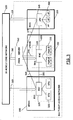
- FIG 2 schematically shows, in terms of functional blocks, the structure of an illustrative, multi-RAT communications network reflecting the scenario of Figure 1 .
- the multi-RAT network comprises in particular a GERAN (GPRS-EDGE RAN) 205 , used by GSM/GPRS/EDGE terminals for accessing the network, a UTRAN (UMTS RAN) 210 , used by UMTS (or GSM-UMTS dual-mode) terminals for accessing the network, and a BRAN (Broadband RAN) 215 used by WLAN (or GSM-UMTS-WLAN multi-mode) terminals for accessing the network.
- a 3G core network 220 forms the transport segment of the multi-RAT network.
- the network architecture in Figure 2 is shown in greater detail in Figure 3 ; the core network 220 is connected: to the GERAN 205 through an interface 305 , for example the interface called " A " interface or " Gb " interface, depending on the core network domain; to the UTRAN 210 through an interface 310 , for example corresponding to the " lu " interface; and to the BRAN 215 through an interface 315 (for example, the interface sometimes referred to as the " lu -like" interface).
- the GERAN 205 comprises, in a way per-se known in the art, Base Station Subsystems (BSS), including Base Transceiver Stations (BTSs) 320 and Base Station Controllers (BSCs) 325 .
- BSS Base Station Subsystems
- BSCs Base Station Controllers
- the UTRAN comprises, also in a way per-se known in the art, Radio Network Subsystems (RNS), including Node-Bs 330 and Radio Network Controllers (RNCs) 335 .
- RNS Radio Network Subsystems
- the BRAN 215 comprises, still in a way per - se known in the art, Access Points (APs) 340 and Access Points Controllers (APCs) 345 .
- APs Access Points
- APIs Access Points Controllers
- the BSCs 325 , the RNCs 335 and the APCs 345 may exchange information through the core network 220 , or, when suitable interfaces 350 (corresponding to the "lur- g" interface) and 355 (also referred to as the "/ ur -like" interface) are provided, they can communicate directly with each other.
- CRRM algorithms can for example reside and be executed by the BSCs 325 , the RNCs 335 and the APCs 345 .
- a network entity denoted 360 in the drawing and hereinafter referred to as "CRRM server” may be optionally provided, dedicated to the common, integrated management of the resources of the multi-RAT network.
- the CRRM server 360 may be connected to the BSCs 325 through an interface 365 , to the RNCs 335 through an interface 370 , and to the APCs through an interface 375 .
- the CRRM server 360 may request to the BSCs 325 information about the state of the GSM network cells, as well as it may request to the RNCs 335 information about the state of the UMTS network cells; similarly, the CRRM server may request to the APCs 345 information about the state of the WLAN hot-spots.
- any service supported by the multi-RAT network may be allocated to only one or, on the contrary, to two or even more different radio access networks; for example, a voice communication service (voice call) may be offered through either the GSM or the UMTS network, whereas a specific data exchange service (e . g . a videocall) can only be provided through the UMTS network or the WLAN, not through the GSM.
- a voice communication service voice call
- a specific data exchange service e . g . a videocall
- different types of services may be envisaged.
- the network shall guarantee a pre-defined quality profile, which essentially cannot vary in time, and hence, if the network, when a real-time service is requested, does not have sufficient resources for providing the requested service with the appropriate level of quality, the new service request is preferably blocked and refused.
- real-time services in the considered scenario are, in addition to voice calls, videocalls (a data exchange service belonging to the " CONVERSATIONAL " class) and multimedia content delivery by a content provider (server) (a service belonging to the " STREAMING " class).
- the CRRM algorithm when service requests are received by the network subscribers, determines whether the service request is to be refused or accepted, and, in case it is accepted, which radio access technology, i.e. , which radio access network among the three available RANs, to use for providing the service. Additionally, the CRRM algorithm is capable of determining whether, in order to accept the new service request, or to improve the performance, one or more services already being provided exploiting a previously selected one of the three available radio access technologies can be moved, re-assigned to a different radio access technology, for example exploiting VHO mechanisms.
- Each RAN is assumed to have a maximum limit of services that can be provisioned simultaneously.
- the maximum number of voice calls that can be supported is given by the maximum number of circuit-switched connections that the cell can handle.
- the WLAN radio access system is no longer capable of ensuring the Quality of Service (QoS) profile requested for the service.
- QoS Quality of Service
- Such maximum number of users can be determined based on the specific WLAN technology (for example, IEEE 802.11 b) and the throughput requested by the considered data exchange service, setting for example a minimum limit for the transfer speed of the data that it is intended to offer to each user, or alternatively a limit to the maximum tolerable transfer delay.
- the different possible combinations of maximum number of users requesting to set up voice calls and data exchange sessions i.e ., the so-called "service mix" that the cell can handle, with the available radio resources, should be considered.
- Such combinations determine a cell's "capacity region".
- the cell's capacity region can be uniquely defined by means of a function Cd(n v ) , expressing the maximum number of users requesting data exchange services that the system can accept, in presence of n v already ongoing voice calls.
- the function Cd() that expresses the capacity region of a specific UMTS cell can be determined considering the QoS profile of the considered services.
- FIG. 4 An example of capacity region for a UMTS cell that is assumed to have to support voice calls and a data exchange service belonging to the "STREAMING" class at 16 kbits/s in uplink and 128 kbit/s in downlink is depicted in Figure 4 , where on the abscissa the number n v of users requesting voice calls is indicated, whereas in ordinate there is indicated the number n d of users requesting the data exchange service.
- the capacity region for the considered UMTS cell is the region 405 delimited by the (positive) ordinate and abscissa (semi-)axes and a capacity region boundary 410 ;
- the capacity region boundary 410 is the limit above which the UMTS cell is no longer capable of accepting further service requests; each point of such boundary 410 represents an optimum mix of traffic for which the UMTS cell is fully exploiting its resources.
- the capacity region boundary 410 below the capacity region boundary 410 , the cell's resources are under-exploited, therefore other service requests can be allocated, based on the free radio resources available.
- the joint capacity region is adapted to provide a description of the total traffic that the multi-RAT network can handle, depending on the specific mix of services being requested, and the greater or lesser capacity of the individual RANs to simultaneously support a certain number of users of each type.
- the joint capacity region will be a region of a multi-dimensional space, the number of dimensions of the space corresponding to the number of different services that the multi-RAT network can provide; the capacity region boundary will be a surface, in the multi-dimensional space.
- the network may undertake several actions, which may affect the QoS perceived by the users.
- actions that can be undertaken, and which affect the perceived QoS there are the refusal of a new call (a call not originating from a handover from another cell), and the termination of a call originating from a handover from another cell.
- actions that can be undertaken, and that do not affect the perceived QoS, but only the network signaling there are the change of the access technology used for managing a service which is already being served, and the change of access technology for a call originating from a handover from another cell.
- the network equipment(s) (the BSCs, the RNCs, the APCs, or the CRRM server) where the CRRM method is implemented takes decisions only when one of the following events, related to a single call, occur: incoming new call, or incoming call originating from a HO from another cell.
- the CRRM functionality implemented in the network may decide:
- the method according to an embodiment of the present invention provides for the following actions:
- the re-assignment (exploiting VHO mechanisms) of ongoing calls to different radio access system is attempted in the following four situations (the underlying assumption is that it is not possible to directly assign the radio resources necessary for managing a service request, because on the contrary it would not be necessary to rely on the VHO).
- the network attempts to free the GSM radio resources necessary for accepting the voice call by performing a VHO in respect of a voice call already going on in the GSM, but that can be indifferently served by both the GSM and the UMTS, moving the selected ongoing voice call from the GSM to the UMTS (this action is hereinafter denoted "action A1" ).
- the network attempts to perform a number N of VHOs in respect of data exchange calls currently being served by the UMTS, but that can indifferently be served by both the UMTS and the WLAN, moving the selected N data exchange calls from the UMTS to the WLAN; the number N is calculated, based on the capacity region of the UMTS cell, in such a way that the UMTS resources that, as a consequence of the VHOs, would be set free are sufficient to serve a voice call on the UMTS. Then, a VHO is performed in respect of an ongoing voice call that is currently served by the GSM, moving it to the UMTS (this set of actions is hereinafter referred to as " action A2 ").
- the network attempts to free UMTS radio resources necessary for the voice call by performing a number M of VHOs involving ongoing data exchange calls currently served by the UMTS, but that can be indifferently served by both the UMTS and the WLAN, moving them from the UMTS to the WLAN; the number M is calculated based on the capacity region of the UMTS cell, in such a way that the UMTS resources that, as a consequence of the VHOs, would be set free are sufficient to serve a voice call on the UMTS (this set of actions is hereinafter referred to as " action B2 ").
- the network performs a number Q of VHOs involving ongoing voice calls, served by the UMTS, but that can be served by both the GSM and the UMTS, moving them from the UMTS to the GSM; the number Q is calculated based on the capacity region of the UMTS cell, in such a way that the resources that, as a consequence of the VHOs, would be set free are sufficient for managing the data call request on the UMTS (this set of actions is hereinafter referred to as " action B1" ).
- the network tries to free the resources necessary for the data call request on the UMTS by means of the action B1 ; if this is not possible, then the call request is refused.
- the network before actually performing any of the actions A1 , A2 , B1 or B2 , preliminary assesses the possibility of actually performing said action, by calculating the amount of resources that should be set free, based on the capacity region and checking the availability of the needed resources; in case it appears that the action cannot be fully accomplished, the action is not undertaken, and the status quo is maintained.
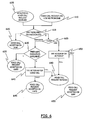
- the flowchart of Figure 6 relates to the case in which the network, particularly a GSM cell thereof, receives a new service request from a user that wishes to set up a new ("fresh") voice call (case 1, box 605 ), or the case in which, for radio coverage problems, the network receives a HO request for a voice call coming from a different GSM cell (case 2, box 610 ).
- the network assesses whether the considered GSM cell still has available resources to devote to serving the incoming call (decision box 615 ). In the affirmative case (exit branch Y of decision box 615 ), the voice call is assigned to the GSM (box 620 ).
- an attempt to free UMTS resources is made (box 640 ), trying to perform the action 82 discussed above for a voice call. If the attempt fails (exit FAIL of box 640 ), the voice call request is refused (box 690 ); if the attempt succeeds (exit SUCC of box 640 ), the voice call request is accepted and assigned to the UMTS (box 645 ). If the incoming voice call request can only be served by the GSM (exit branch GSM of decision box 625 ), an attempt is made to free GSM resources (box 650 ), performing the action A1 or the action A2 discussed in the foregoing. If the attempt fails (exit FAIL of box 650 ), the voice call request is refused; if the attempt succeeds (exit SUCC of box 650 ), the voice call request is accepted and assigned to the GSM (box 655 ).
- the flowchart of Figure 7 relates to the case in which the network, particularly a generic UMTS cell thereof, receives a HO request in respect of a voice call coming from a different UMTS cell (case 3, box 705 ).
- the network receives a HO request in respect of a voice call coming from a different UMTS cell (case 3, box 705 ).
- it is necessary to assess whether the considered UMTS cell still has available radio resources sufficient for serving the request (decision box 710 ).
- the voice call request is accepted and assigned to the UMTS (box 715 ); in the negative case (exit branch N of decision block 710 ), the network assesses whether there are still available GSM resources sufficient for serving the voice call request (decision box 720 ).
- the voice call request is accepted and assigned to the GSM (box 725 ).
- the network attempts to free UMTS resources (box 730 ), undertaking the action B2 discussed in the foregoing for a voice call. If the attempt fails (exit branch FAIL of box 730 ), the voice call request is refused (box 790 ), otherwise (exit branch SUCC of box 730 ), the voice call request is accepted and assigned to the UMTS.
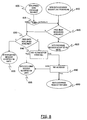
- the flowchart of Figure 8 relates to the case in which the network receives a service request from a user wishing to set up a new data exchange call (case 4, box 805 ), or the case in which, due to bad radio quality issues, the network receives a request of HO for a data exchange call from a different WLAN cell (case 5, box 810 ).
- the network assesses whether the received data exchange call request can be indifferently served by the UMTS or the WLAN (decision box 815 ).
- the affirmative case (exit branch UMTS/WLAN of decision box 815 ) it is ascertained whether the WLAN still has available radio resources to be assigned to the service request (decision box 820 ); in the affirmative case (exit branch Y of decision box 820 ), the service request is accepted and it assigned to the WLAN (box 825 ); in the negative case (exit branch N of decision block 820 ), as well as in the case the service request can only be served by the UMTS (exit branch UMTS of decision box 815 ) the network assesses whether the UMTS still has sufficient radio resources available for serving the request (decision box 830 ).
- the service request is accepted and assigned to the UMTS (box 835); in the negative case (exit branch N of decision box 830 ), the network performs an attempt to free UMTS resources (box 840 ), undertaking the above discussed action B2 for a voice call. If the attempt succeeds (exit branch SUCC of box 840 ), the service request is accepted and assigned to the UMTS (box 845 ); if the attempt fails (exit branch FAIL of box 840 ), the network performs an attempt to free UMTS radio resources (box 850) by undertaking the above discussed action B1 . If the attempt succeeds (exit branch SUCC of box 850 ), the service request is accepted and assigned to the UMTS, otherwise (exit branch FAIL of box 850 ) the service request is refused (890) .
- the flowchart of Figure 9 relates to the case in which the network receives a HO request for a data exchange call from a different UMTS cell (case 6, box 905 ). Firstly, it is assessed whether the considered UMTS cell still has sufficient radio resources available for accepting the service request (decision box 910 ). In the affirmative case (exit branch Y of decision box 910 ), the service request is accepted and assigned to the UMTS (box 915 ). In the negative case, the network evaluates whether the service request can be indifferently served by the UMTS or the WLAN, or by the UMTS only (decision box 920 ).
- the service request can be served by the UMTS or the WLAN (exit branch UMTS/WLAN of decision box 920 ), it is assessed whether the WLAN has sufficient resources available for accepting the service request (decision box 925 ). In the affirmative case, the service request is accepted, and it is assigned to the WLAN (box 930 ). In the negative case (exit branch N of decision box 925 ), or in the case the service request can only be served by the UMTS (exit branch UMTS of decision box 920 ), the network attempts to free UMTS radio resources (box 935 ), undertaking the action B2 for a data exchange call discussed above.
- the minimum number M of data exchange connections that should be moved from the UMTS to the WLAN for enabling the latter to accept a new voice call request is calculated (box 1030 ), based on the UMTS cell capacity region. Then, it is ascertained whether the WLAN is capable of accepting a number of new data exchange connections equal to the calculated number M (decision box 1035 ), based on a WLAN cell capacity region or on the network joint capacity region.
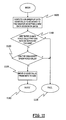
- FIG. 11 schematically shows in greater detail how the " action B1 " can be carried out.
- a number Q of voice calls that should be removed from the UMTS for enabling the UMTS accepting a new data exchange connection is calculated (box 1105 ), based on the UMTS cell capacity region or on the network joint capacity region.
- decision box 1110 In the negative case (exit branch N of decision box 1110 ), no action is undertaken, and the attempt fails (box 1115 ).
- the method according to the present invention ensures a low probability that new calls are refused, a low probability that an ongoing call is terminated, even during a handover, a low frequency of VHOs for ongoing calls, and a low probability of change of the access system for calls originating from handovers from other cells.
- the method according to the present invention has been described making reference to an exemplary scenario, which is not to be considered limitative.
- the assumption has been made that a single cell for each of the available access systems is considered; this is a reasonable assumption, because CRRM algorithms normally manage the radio resources at the level of the individual cells of the different access systems. Nevertheless, nothing prevents from applying the method of the invention in a more general context.
- a CRRM algorithm might be defined for a whole network portion, covering a certain geographic area: it is sufficient to consider all the different cells, analyzing the relationship between the cells of different access systems that cover a common area.
- the method according to the present invention has been described considering as available access systems the GSM, the UMTS and the WLAN. However, this is not to be construed as a limitation of the present invention, which is instead applicable in general, irrespective of the number and specific type of different access systems available. It is thus sufficient that the different access systems have a (direct or indirect) maximum limit to the number of users for a given service which can be managed with the available radio resources. This occurs in all the practical cases, where, in general, the different access systems can exploit a limited number of resources. Depending on the considered specific standard, the maximum limit is determined by the specific transmission techniques adopted and by related practical issues.
- each cell of the GSM system has a maximum number of voice circuits, determined during the system planning, whereas in the UMTS the limit may be due to the maximum interference that the system can sustain with the available power, or the number of codes that can be used to identify each user.
- the maximum number of users for a given service that a hot-spot can manage may be determined based on the minimum level of service quality which is intended to be offered to the users (setting for example a minimum limit to the data transfer speed that is intended to be guarantee for each of the users, or a limit to the tolerable transmission delays).
- Another possible application of the method of the present invention is within a single access system, where however there are two or more cell layers belonging to different "radio modes". For example, this is the case of different hierarchical layers in a cellular network having a hierarchic cell structure, or in the case of layers making use of different frequencies.
- moving a service which is already being provided may exploit the "intra-system handover" procedure (which involves the passage from a UTRAN cell to another UTRAN cell on the same carrier frequency, as prescribed in the 3GPP TS 25.331), whereas in the second case the "inter-frequency handover" procedure may be exploited (which involves the passage from a UTRAN cell to another UTRAN cell over a different carrier frequency).
- a system that exploits a same radio technology in at least two different layers differing in the hierarchic level (like in the MACRO and MICRO cell) or in the frequency may be regarded as a heterogeneous system, in terms of coverage, since there is the problem of jointly managing the radio resources of the cells belonging to the different layers.
- the method of the invention can be exploited to determine which layer is more suitable for offering a requested service; in other words, the method of the present invention is applicable in general to any heterogeneous network, irrespective of where the heterogeneity resides (in the radio access technology, in the number of layers, etc.).
- the method can be applied in software, hardware, or as a mix of software and hardware.
- it may be implemented by means of a firmware, executed by microprocessors/microcontrollers of the network apparatuses like the RNCs, the BSCs, the APCs, and/or the CRRM server.
Landscapes
- Engineering & Computer Science (AREA)
- Quality & Reliability (AREA)
- Computer Networks & Wireless Communication (AREA)
- Signal Processing (AREA)
- Mobile Radio Communication Systems (AREA)
Claims (6)
- Verfahren zum Verwalten von Funkbetriebsmitteln eines heterogenen Netzes (220, 205, 210, 215), wobei das Netz in der Lage ist, verschiedene Funkzugangstechnologien zu nutzen, und wobei das Verfahren Folgendes umfasst:- beim Empfang (605, 610, 705, 805, 810, 905) einer neuen Dienstanforderung für einen bereitzustellenden Dienst Bewerten (615, 710, 820, 910), ob Funkbetriebsmittel einer ersten Menge vorhanden sind, die zum Befriedigen der Anforderung geeignet und verfügbar sind, undwobei das Verfahren dadurch gekennzeichnet ist, dass es ferner Folgendes umfasst:- wenn dies der Fall ist (Y), Nutzen (620, 715, 825, 910) der verfügbaren Funkbetriebsmittel zum Befriedigen der neuen Dienstanforderung;- wenn dies nicht der Fall ist (N):- Berechnen (1105, 1205) eines Betrags der geeigneten Funkbetriebsmittel, die zum Befriedigen der Dienstanforderung freizumachen sind;- Bewerten (1110, 1210), ob mindestens eine erste, bereits bediente Dienstanforderung vorhanden ist, die zum Zeitpunkt des Empfangs der neuen Dienstanforderung unter Verwendung des berechneten Betrags an Funkbetriebsmitteln der ersten Menge bedient wird und deren Bedienung fortgesetzt werden kann, indem ihr Funkbetriebsmittel einer zweiten Menge zugewiesen werden, die sich von der ersten Menge unterscheiden, die nicht zum Bedienen der neuen Dienstanforderung geeignet sind;- wenn dies der Fall ist (Y):- Berechnen (1120, 1220) eines Betrags der Funkbetriebsmittel der zweiten Menge, der zum Bedienen der mindestens einen bereits bedienten Dienstanforderung erforderlich ist;- Bewerten (1120, 1220), ob der berechnete Betrag an Funkbetriebsmitteln der zweiten Menge verfügbar ist;- wenn der berechnete Betrag an Funkbetriebsmitteln der zweiten Menge verfügbar ist, Neuzuweisen (1125, 1225) der Funkbetriebsmittel der zweiten Menge zu der mindestens einen ersten, bereits bedienten Dienstanforderung und Zuweisen (645, 735, 835, 930) der Funkbetriebsmittel der ersten, vorher der bereits bedienten Dienstanforderung zugewiesenen Menge zu der neuen Dienstanforderung;- wenn dies nicht der Fall ist, Zurückweisen (690, 790, 890, 990) der neuen Dienstanforderung,- Bestimmen (1105, 1205) einer Dienstkapazität des heterogenen Netzes, wobei die Dienstkapazität für eine gemeinsame Dienstkapazität charakteristisch ist, die mit der ersten und zweiten Menge von Betriebsmitteln des heterogenen Netzes verbunden ist, wobei die gemeinsame Dienstkapazität von der spezifischen Mischung von Diensten, die angefordert werden, und von der Kapazität des heterogenen Netzes zum gleichzeitigen Unterstützen von Benutzern unterschiedlicher Typen abhängig ist; und- Nutzen (1105, 1205) der bestimmten Dienstkapazität beim Berechnen des Betrags der Funkbetriebsmittel.
- Verfahren nach Anspruch 1, wobei die Funkbetriebsmittel des heterogenen Netzes ferner eine dritte Menge von Funkbetriebsmitteln umfassen, die sich von der ersten und der zweiten Menge unterscheiden, wobei das Verfahren ferner Folgendes umfasst:- wenn die berechnete Menge von Funkbetriebsmitteln der zweiten Menge nicht verfügbar ist:- Bewerten (1040), ob mindestens eine zweite, bereits bediente Dienstanforderung vorhanden ist, die zum Zeitpunkt des Empfangs der neuen Dienstanforderung unter Verwendung des berechneten Betrags der Funkbetriebsmittel der zweiten Menge bedient wird und deren Bedienung fortgesetzt werden kann, indem ihr Funkbetriebsmittel der dritten Menge zugewiesen werden;- wenn dies der Fall ist (Y):- Berechnen (1030) eines Betrags der Funkbetriebsmittel der dritten Menge, der zum Bedienen der mindestens einen zweiten, bereits bedienten Dienstanforderung erforderlich ist;- Bewerten (1035), ob der berechnete Betrag an Funkbetriebsmitteln der dritten Menge verfügbar ist;- wenn der berechnete Betrag an Funkbetriebsmitteln der dritten Menge verfügbar ist, Neuzuweisen (1045) der Funkbetriebsmittel der dritten Menge zu der mindestens einen zweiten, bereits bedienten Dienstanforderung, Neuzuweisen (1020) der Funkbetriebsmittel der zweiten, vorher der mindestens einen zweiten, bereits bedienten Dienstanforderung zugewiesenen Funkbetriebsmittel zu der mindestens einen ersten, bereits bedienten Dienstanforderung und Zuweisen (655) der Funkbetriebsmittel der ersten, vorher der bereits bedienten Dienstanforderung zugewiesenen Menge zu der neuen Dienstanforderung;- wenn dies nicht der Fall ist, Zurückweisen (690) der neuen Dienstanforderung.
- Verfahren nach einem der vorhergehenden Ansprüche, wobei das heterogene Netz (220, 205, 210, 215) ein Mobiltefonnetz (205) der zweiten Generation, ein Mobiltelefonnetz (210) der dritten Generation und ein drahtloses Breitband-Datennetz (215) umfasst.
- Vorrichtung zum Verwalten von Funkbetriebsmitteln eines heterogenen Netzes (220, 205, 210, 215), das in der Lage ist, verschiedene Funkzugangstechnologien (RAT) zu nutzen, wobei die Vorrichtung Mittel umfasst, die für Folgendes geeignet sind:- beim Empfangen (605, 610, 705, 805, 810, 905) einer neuen Dienstanforderung für einen bereitzustellenden Dienst Bewerten (615, 710, 820, 910), ob Funkbetriebsmittel einer ersten Menge vorhanden sind, die zum Befriedigen der Anforderung geeignet und verfügbar sind, und:- wenn dies der Fall ist (Y), Nutzen (620, 715, 825, 910) der verfügbaren Funkbetriebsmittel zum Befriedigen der neuen Dienstanforderung;- wenn dies nicht der Fall ist (N):- Berechnen (1105, 1205) eines Betrags der geeigneten Funkbetriebsmittel, die zum Erfüllen der Dienstanforderung freizumachen sind;- Bewerten (1110, 1210), ob mindestens eine erste, bereits bediente Dienstanforderung vorhanden ist, die zum Zeitpunkt des Empfangs der neuen Dienstanforderung unter Verwendung des berechneten Betrags an Funkbetriebsmitteln der ersten Menge bedient wird und deren Bedienung fortgesetzt werden kann, indem ihr Funkbetriebsmittel einer zweiten Menge zugewiesen werden, die sich von der ersten Menge unterscheiden, die nicht zum Bedienen der neuen Dienstanforderung geeignet sind;- wenn dies der Fall ist (Y):- Berechnen (1120, 1220) eines Betrags der Funkbetriebsmittel der zweiten Menge, der zum Bedienen der mindestens einen, bereits bedienten Dienstanforderung erforderlich ist;- Bewerten (1120, 1220), ob der berechnete Betrag an Funkbetriebsmitteln der zweiten Menge verfügbar ist;- wenn der berechnete Betrag an Funkbetriebsmitteln der zweiten Menge verfügbar ist, Neuzuweisen (1125, 1225) der Funkbetriebsmittel der zweiten Menge zu der mindestens einen ersten, bereits bedienten Dienstanforderung und Zuweisen (645, 735, 835, 930) der Funkbetriebsmittel der ersten, vorher der bereits bedienten Dienstanforderung zugewiesenen Menge zu der neuen Dienstanforderung;- wenn dies nicht der Fall ist, Zurückweisen (690, 790, 890, 990) der neuen Dienstanforderung,
und wobei die Vorrichtung dadurch gekennzeichnet ist, dass sie ferner Mittel umfasst, die für Folgendes geeignet sind:- Bestimmen (1105, 1205) einer Dienstkapazität des heterogenen Netzes, wobei die Dienstkapazität für eine gemeinsame Dienstkapazität charakteristisch ist, die mit der ersten und zweiten Menge von Betriebsmitteln des heterogenen Netzes verbunden ist, wobei die gemeinsame Dienstkapazität von der spezifischen Mischung von Diensten, die angefordert werden, und von der Kapazität des heterogenen Netzes zum gleichzeitigen Unterstützen von Benutzern unterschiedlicher Typen abhängig ist; und- Nutzen (1105, 1205) der bestimmten Dienstkapazität beim Berechnen des Betrags der Funkbetriebsmittel. - Vorrichtung nach Anspruch 4, wobei die Funkbetriebsmittel des heterogenen Netzes ferner eine dritte Menge von Funkbetriebsmitteln umfassen, die sich von der ersten und der zweiten Menge unterscheiden, wobei die Vorrichtung ferner Mittel umfasst, die für Folgendes geeignet sind:- wenn die berechnete Menge an Funkbetriebsmitteln der zweiten Menge nicht verfügbar ist:- Bewerten (1040), ob mindestens eine zweite bereits bediente Dienstanforderung vorhanden ist, die zum Zeitpunkt des Empfangs der neuen Dienstanforderung unter Verwendung der berechneten Menge der Funkbetriebsmittel der zweiten Menge bedient wird und deren Bedienung fortgesetzt werden kann, indem ihr Funkbetriebsmittel der dritten Menge zugewiesen werden;- wenn dies der Fall ist (Y):- Berechnen (1030) eines Betrags der Funkbetriebsmittel der dritten Menge, die zum Bedienen der mindestens einen zweiten, bereits bedienten Dienstanforderung erforderlich sind;- Bewerten (1035), ob der berechnete Betrag an Funkbetriebsmitteln der dritten Menge verfügbar ist;- wenn der berechnete Betrag an Funkbetriebsmitteln der dritten Menge verfügbar ist, Neuzuweisen (1045) der Funkbetriebsmittel der dritten Menge zu der mindestens einen zweiten, bereits bedienten Dienstanforderung, Neuzuweisen (1020) der Funkbetriebsmittel der zweiten, vorher der mindestens einen zweiten, bereits bedienten Dienstanforderung zugewiesenen Menge zu der mindestens einen ersten, bereits bedienten Dienstanforderung, und Zuweisen (655) der Funkbetriebsmittel der ersten, vorher der bereits bedienten Dienstanforderung zugewiesenen Menge zu der neuen Dienstanforderung;- wenn dies nicht der Fall ist, Zurückweisen (690) der neuen Dienstanforderung.
- Vorrichtung nach einem der Ansprüche 4 bis 5, wobei das heterogene Netz (220, 205, 210, 215) ein Mobiltefonnetz (205) der zweiten Generation, ein Mobiltelefonnetz (210) der dritten Generation und ein drahtloses Breitband-Datennetz (215) umfasst.
Applications Claiming Priority (1)
| Application Number | Priority Date | Filing Date | Title |
|---|---|---|---|
| PCT/EP2006/012579 WO2008080422A1 (en) | 2006-12-28 | 2006-12-28 | A method and apparatus for managing the assignment of radio resources of a radio communications network |
Publications (2)
| Publication Number | Publication Date |
|---|---|
| EP2127458A1 EP2127458A1 (de) | 2009-12-02 |
| EP2127458B1 true EP2127458B1 (de) | 2011-09-21 |
Family
ID=38362812
Family Applications (1)
| Application Number | Title | Priority Date | Filing Date |
|---|---|---|---|
| EP06829890A Active EP2127458B1 (de) | 2006-12-28 | 2006-12-28 | Verfahren und vorrichtung zur verwaltung der zuweisung von funkbetriebsmitteln eines funkkommunikationsnetzes |
Country Status (5)
| Country | Link |
|---|---|
| US (1) | US8189523B2 (de) |
| EP (1) | EP2127458B1 (de) |
| AT (1) | ATE525870T1 (de) |
| ES (1) | ES2373569T3 (de) |
| WO (1) | WO2008080422A1 (de) |
Families Citing this family (10)
| Publication number | Priority date | Publication date | Assignee | Title |
|---|---|---|---|---|
| US20100178919A1 (en) * | 2009-01-15 | 2010-07-15 | Qualcomm Incorporated | Optimum technology selection |
| CN101841888B (zh) * | 2009-03-16 | 2012-06-27 | 华为技术有限公司 | 资源控制方法、相关设备及系统 |
| US8837427B2 (en) | 2009-08-14 | 2014-09-16 | Qualcomm Incorporated | Resource selection for dual radio terminals |
| EP2517498B1 (de) | 2009-12-24 | 2017-03-22 | Nokia Technologies Oy | Verfahren und zugehörige vorrichtung zur koordination der ausführung von intrafunkübergabe |
| EP2564610A4 (de) * | 2010-04-26 | 2015-07-01 | Nokia Solutions & Networks Oy | Dynamische frequenzwiederverwendung |
| US8830935B2 (en) * | 2011-01-25 | 2014-09-09 | Qualcomm Incorporated | Facilitating user equipment feedback to manage rate loop at a base station |
| KR101343633B1 (ko) * | 2011-02-14 | 2013-12-19 | 주식회사 케이티 | 단말의 트래픽 패턴에 기반한 무선 자원 관리 방법 및 장치 |
| CN103718639A (zh) * | 2011-04-01 | 2014-04-09 | 英特尔公司 | 使用短程扩展载波的机会性载波聚合 |
| CN102821424B (zh) * | 2011-06-09 | 2015-02-18 | 中磊电子股份有限公司 | 辅助移动数据分流的方法及通信装置以及移动装置 |
| US11496959B2 (en) * | 2019-01-31 | 2022-11-08 | Hewlett Packard Enterprise Development Lp | Establishing and controlling connection of user equipment to a heterogeneous network |
Family Cites Families (6)
| Publication number | Priority date | Publication date | Assignee | Title |
|---|---|---|---|---|
| WO1994005130A1 (en) | 1992-08-11 | 1994-03-03 | Telefonaktiebolaget Lm Ericsson | Rearranging channels |
| ES2288516T3 (es) * | 2001-04-26 | 2008-01-16 | Nokia Corporation | Metodo y elemento de red para controlar traspasos. |
| ES2290695T3 (es) | 2004-04-19 | 2008-02-16 | Telecom Italia S.P.A. | Procedimiento y sistema para la asignacion de servicios en redes de comunicacion, red y programa para computadora relacionadas con los mismos. |
| CN100593350C (zh) | 2004-04-19 | 2010-03-03 | 意大利电信股份公司 | 用于通信网络中的资源管理的方法和系统、其相关网络及计算机程序产品 |
| WO2005120109A1 (en) * | 2004-06-04 | 2005-12-15 | Nortel Networks Limited | Method and system for soft handoff in mobile broadband systems |
| JP4543842B2 (ja) * | 2004-09-09 | 2010-09-15 | 日本電気株式会社 | 無線基地局装置およびリソース管理方法 |
-
2006
- 2006-12-28 EP EP06829890A patent/EP2127458B1/de active Active
- 2006-12-28 ES ES06829890T patent/ES2373569T3/es active Active
- 2006-12-28 WO PCT/EP2006/012579 patent/WO2008080422A1/en not_active Ceased
- 2006-12-28 AT AT06829890T patent/ATE525870T1/de not_active IP Right Cessation
- 2006-12-28 US US12/448,610 patent/US8189523B2/en active Active
Also Published As
| Publication number | Publication date |
|---|---|
| WO2008080422A1 (en) | 2008-07-10 |
| ES2373569T3 (es) | 2012-02-06 |
| EP2127458A1 (de) | 2009-12-02 |
| US20100039999A1 (en) | 2010-02-18 |
| ATE525870T1 (de) | 2011-10-15 |
| US8189523B2 (en) | 2012-05-29 |
Similar Documents
| Publication | Publication Date | Title |
|---|---|---|
| CN1270578C (zh) | 在分层小区结构中利用载干比来提供多播业务的方法 | |
| CN1188010C (zh) | 移动通信 | |
| US6212389B1 (en) | Methods and apparatus for controlling allocation of traffic channels in macrocell/microcell telecommunications networks | |
| US8031652B2 (en) | Load balancing for an air interface protocol architecture with a plurality of heterogenous physical layer modes | |
| CA2282313C (en) | Methods and apparatus for controlling allocation of traffic channels in macrocell/microcell telecommunications networks | |
| CN1714589A (zh) | 多小区网络中的服务优先权 | |
| EP2014114B1 (de) | Weiterleitung zwischen funknetzwerken | |
| US8189523B2 (en) | Method and apparatus for managing the assignment of radio resources of a radio communications network | |
| JP2001339770A (ja) | 無線通信システム及びそれに用いる通信端末装置 | |
| Gonzalez et al. | Radio access considerations for data offloading with multipath TCP in cellular/WiFi networks | |
| CN100466802C (zh) | Wcdma与td-scdma混合网络业务承载分配方法 | |
| Bauer et al. | Classification of handover schemes within a cellular environment | |
| CN102612010B (zh) | 一种多连接业务控制系统及多连接业务流量分配方法 | |
| CN100428846C (zh) | 使用数据卡业务的用户终端的接入方法 | |
| US12426041B2 (en) | System and method for SDAP / QoS based proactive scheduling for UL transmission | |
| Piao et al. | MXRRM for WIMAX integrated to GSM and UMTS heterogeneous networks | |
| Lincke-Salecker et al. | A supernet: engineering traffic across network boundaries | |
| Roberto et al. | Organizing reserve channels for superior admission control performance | |
| CHAN | Interworking vs. standardization of wireless networks | |
| Wu | Supporting Quality of Service (QoS) in overlaid wireless networks | |
| HK1095467A (en) | Method and system for integrating resource allocation between time division duplex and frequency division duplex in wireless communication systems | |
| HK1182268B (en) | Context transfer in heterogeneous handover |
Legal Events
| Date | Code | Title | Description |
|---|---|---|---|
| PUAI | Public reference made under article 153(3) epc to a published international application that has entered the european phase |
Free format text: ORIGINAL CODE: 0009012 |
|
| 17P | Request for examination filed |
Effective date: 20090707 |
|
| AK | Designated contracting states |
Kind code of ref document: A1 Designated state(s): AT BE BG CH CY CZ DE DK EE ES FI FR GB GR HU IE IS IT LI LT LU LV MC NL PL PT RO SE SI SK TR |
|
| RIC1 | Information provided on ipc code assigned before grant |
Ipc: H04W 4/00 20090101AFI20091030BHEP |
|
| DAX | Request for extension of the european patent (deleted) | ||
| 17Q | First examination report despatched |
Effective date: 20100709 |
|
| GRAP | Despatch of communication of intention to grant a patent |
Free format text: ORIGINAL CODE: EPIDOSNIGR1 |
|
| GRAS | Grant fee paid |
Free format text: ORIGINAL CODE: EPIDOSNIGR3 |
|
| GRAA | (expected) grant |
Free format text: ORIGINAL CODE: 0009210 |
|
| AK | Designated contracting states |
Kind code of ref document: B1 Designated state(s): AT BE BG CH CY CZ DE DK EE ES FI FR GB GR HU IE IS IT LI LT LU LV MC NL PL PT RO SE SI SK TR |
|
| REG | Reference to a national code |
Ref country code: GB Ref legal event code: FG4D |
|
| REG | Reference to a national code |
Ref country code: CH Ref legal event code: EP |
|
| REG | Reference to a national code |
Ref country code: IE Ref legal event code: FG4D |
|
| REG | Reference to a national code |
Ref country code: DE Ref legal event code: R096 Ref document number: 602006024618 Country of ref document: DE Effective date: 20111201 |
|
| REG | Reference to a national code |
Ref country code: SE Ref legal event code: TRGR |
|
| REG | Reference to a national code |
Ref country code: NL Ref legal event code: VDEP Effective date: 20110921 |
|
| PG25 | Lapsed in a contracting state [announced via postgrant information from national office to epo] |
Ref country code: LT Free format text: LAPSE BECAUSE OF FAILURE TO SUBMIT A TRANSLATION OF THE DESCRIPTION OR TO PAY THE FEE WITHIN THE PRESCRIBED TIME-LIMIT Effective date: 20110921 |
|
| REG | Reference to a national code |
Ref country code: ES Ref legal event code: FG2A Ref document number: 2373569 Country of ref document: ES Kind code of ref document: T3 Effective date: 20120206 |
|
| LTIE | Lt: invalidation of european patent or patent extension |
Effective date: 20110921 |
|
| PG25 | Lapsed in a contracting state [announced via postgrant information from national office to epo] |
Ref country code: AT Free format text: LAPSE BECAUSE OF FAILURE TO SUBMIT A TRANSLATION OF THE DESCRIPTION OR TO PAY THE FEE WITHIN THE PRESCRIBED TIME-LIMIT Effective date: 20110921 Ref country code: CY Free format text: LAPSE BECAUSE OF FAILURE TO SUBMIT A TRANSLATION OF THE DESCRIPTION OR TO PAY THE FEE WITHIN THE PRESCRIBED TIME-LIMIT Effective date: 20110921 Ref country code: LV Free format text: LAPSE BECAUSE OF FAILURE TO SUBMIT A TRANSLATION OF THE DESCRIPTION OR TO PAY THE FEE WITHIN THE PRESCRIBED TIME-LIMIT Effective date: 20110921 Ref country code: GR Free format text: LAPSE BECAUSE OF FAILURE TO SUBMIT A TRANSLATION OF THE DESCRIPTION OR TO PAY THE FEE WITHIN THE PRESCRIBED TIME-LIMIT Effective date: 20111222 Ref country code: SI Free format text: LAPSE BECAUSE OF FAILURE TO SUBMIT A TRANSLATION OF THE DESCRIPTION OR TO PAY THE FEE WITHIN THE PRESCRIBED TIME-LIMIT Effective date: 20110921 |
|
| REG | Reference to a national code |
Ref country code: AT Ref legal event code: MK05 Ref document number: 525870 Country of ref document: AT Kind code of ref document: T Effective date: 20110921 |
|
| PG25 | Lapsed in a contracting state [announced via postgrant information from national office to epo] |
Ref country code: BE Free format text: LAPSE BECAUSE OF FAILURE TO SUBMIT A TRANSLATION OF THE DESCRIPTION OR TO PAY THE FEE WITHIN THE PRESCRIBED TIME-LIMIT Effective date: 20110921 |
|
| PG25 | Lapsed in a contracting state [announced via postgrant information from national office to epo] |
Ref country code: IS Free format text: LAPSE BECAUSE OF FAILURE TO SUBMIT A TRANSLATION OF THE DESCRIPTION OR TO PAY THE FEE WITHIN THE PRESCRIBED TIME-LIMIT Effective date: 20120121 Ref country code: SK Free format text: LAPSE BECAUSE OF FAILURE TO SUBMIT A TRANSLATION OF THE DESCRIPTION OR TO PAY THE FEE WITHIN THE PRESCRIBED TIME-LIMIT Effective date: 20110921 Ref country code: CZ Free format text: LAPSE BECAUSE OF FAILURE TO SUBMIT A TRANSLATION OF THE DESCRIPTION OR TO PAY THE FEE WITHIN THE PRESCRIBED TIME-LIMIT Effective date: 20110921 |
|
| PG25 | Lapsed in a contracting state [announced via postgrant information from national office to epo] |
Ref country code: PT Free format text: LAPSE BECAUSE OF FAILURE TO SUBMIT A TRANSLATION OF THE DESCRIPTION OR TO PAY THE FEE WITHIN THE PRESCRIBED TIME-LIMIT Effective date: 20120123 Ref country code: RO Free format text: LAPSE BECAUSE OF FAILURE TO SUBMIT A TRANSLATION OF THE DESCRIPTION OR TO PAY THE FEE WITHIN THE PRESCRIBED TIME-LIMIT Effective date: 20110921 Ref country code: NL Free format text: LAPSE BECAUSE OF FAILURE TO SUBMIT A TRANSLATION OF THE DESCRIPTION OR TO PAY THE FEE WITHIN THE PRESCRIBED TIME-LIMIT Effective date: 20110921 Ref country code: EE Free format text: LAPSE BECAUSE OF FAILURE TO SUBMIT A TRANSLATION OF THE DESCRIPTION OR TO PAY THE FEE WITHIN THE PRESCRIBED TIME-LIMIT Effective date: 20110921 Ref country code: PL Free format text: LAPSE BECAUSE OF FAILURE TO SUBMIT A TRANSLATION OF THE DESCRIPTION OR TO PAY THE FEE WITHIN THE PRESCRIBED TIME-LIMIT Effective date: 20110921 |
|
| PLBE | No opposition filed within time limit |
Free format text: ORIGINAL CODE: 0009261 |
|
| STAA | Information on the status of an ep patent application or granted ep patent |
Free format text: STATUS: NO OPPOSITION FILED WITHIN TIME LIMIT |
|
| PG25 | Lapsed in a contracting state [announced via postgrant information from national office to epo] |
Ref country code: MC Free format text: LAPSE BECAUSE OF NON-PAYMENT OF DUE FEES Effective date: 20111231 Ref country code: DK Free format text: LAPSE BECAUSE OF FAILURE TO SUBMIT A TRANSLATION OF THE DESCRIPTION OR TO PAY THE FEE WITHIN THE PRESCRIBED TIME-LIMIT Effective date: 20110921 |
|
| REG | Reference to a national code |
Ref country code: CH Ref legal event code: PL |
|
| 26N | No opposition filed |
Effective date: 20120622 |
|
| REG | Reference to a national code |
Ref country code: IE Ref legal event code: MM4A |
|
| REG | Reference to a national code |
Ref country code: DE Ref legal event code: R097 Ref document number: 602006024618 Country of ref document: DE Effective date: 20120622 |
|
| PG25 | Lapsed in a contracting state [announced via postgrant information from national office to epo] |
Ref country code: CH Free format text: LAPSE BECAUSE OF NON-PAYMENT OF DUE FEES Effective date: 20111231 Ref country code: IE Free format text: LAPSE BECAUSE OF NON-PAYMENT OF DUE FEES Effective date: 20111228 Ref country code: LI Free format text: LAPSE BECAUSE OF NON-PAYMENT OF DUE FEES Effective date: 20111231 |
|
| PG25 | Lapsed in a contracting state [announced via postgrant information from national office to epo] |
Ref country code: LU Free format text: LAPSE BECAUSE OF NON-PAYMENT OF DUE FEES Effective date: 20111228 |
|
| PG25 | Lapsed in a contracting state [announced via postgrant information from national office to epo] |
Ref country code: BG Free format text: LAPSE BECAUSE OF FAILURE TO SUBMIT A TRANSLATION OF THE DESCRIPTION OR TO PAY THE FEE WITHIN THE PRESCRIBED TIME-LIMIT Effective date: 20111221 |
|
| PG25 | Lapsed in a contracting state [announced via postgrant information from national office to epo] |
Ref country code: TR Free format text: LAPSE BECAUSE OF FAILURE TO SUBMIT A TRANSLATION OF THE DESCRIPTION OR TO PAY THE FEE WITHIN THE PRESCRIBED TIME-LIMIT Effective date: 20110921 |
|
| PG25 | Lapsed in a contracting state [announced via postgrant information from national office to epo] |
Ref country code: HU Free format text: LAPSE BECAUSE OF FAILURE TO SUBMIT A TRANSLATION OF THE DESCRIPTION OR TO PAY THE FEE WITHIN THE PRESCRIBED TIME-LIMIT Effective date: 20110921 |
|
| REG | Reference to a national code |
Ref country code: FR Ref legal event code: PLFP Year of fee payment: 10 |
|
| REG | Reference to a national code |
Ref country code: FR Ref legal event code: PLFP Year of fee payment: 11 |
|
| PG25 | Lapsed in a contracting state [announced via postgrant information from national office to epo] |
Ref country code: IT Free format text: LAPSE BECAUSE OF NON-PAYMENT OF DUE FEES Effective date: 20151228 |
|
| PG25 | Lapsed in a contracting state [announced via postgrant information from national office to epo] |
Ref country code: IT Free format text: LAPSE BECAUSE OF NON-PAYMENT OF DUE FEES Effective date: 20151228 |
|
| PGRI | Patent reinstated in contracting state [announced from national office to epo] |
Ref country code: IT Effective date: 20170710 |
|
| REG | Reference to a national code |
Ref country code: FR Ref legal event code: PLFP Year of fee payment: 12 |
|
| P01 | Opt-out of the competence of the unified patent court (upc) registered |
Effective date: 20230529 |
|
| P02 | Opt-out of the competence of the unified patent court (upc) changed |
Effective date: 20230604 |
|
| PGFP | Annual fee paid to national office [announced via postgrant information from national office to epo] |
Ref country code: GB Payment date: 20251229 Year of fee payment: 20 |
|
| PGFP | Annual fee paid to national office [announced via postgrant information from national office to epo] |
Ref country code: FI Payment date: 20251216 Year of fee payment: 20 |
|
| PGFP | Annual fee paid to national office [announced via postgrant information from national office to epo] |
Ref country code: FR Payment date: 20251222 Year of fee payment: 20 |
|
| PGFP | Annual fee paid to national office [announced via postgrant information from national office to epo] |
Ref country code: SE Payment date: 20251217 Year of fee payment: 20 |
|
| PGFP | Annual fee paid to national office [announced via postgrant information from national office to epo] |
Ref country code: ES Payment date: 20260119 Year of fee payment: 20 |
|
| PGFP | Annual fee paid to national office [announced via postgrant information from national office to epo] |
Ref country code: DE Payment date: 20251222 Year of fee payment: 20 |
|
| PGFP | Annual fee paid to national office [announced via postgrant information from national office to epo] |
Ref country code: IT Payment date: 20251231 Year of fee payment: 20 |