EP2125309B1 - Verfahren und vorrichtung zum konservieren von holz und holzprodukt - Google Patents
Verfahren und vorrichtung zum konservieren von holz und holzprodukt Download PDFInfo
- Publication number
- EP2125309B1 EP2125309B1 EP07851938.6A EP07851938A EP2125309B1 EP 2125309 B1 EP2125309 B1 EP 2125309B1 EP 07851938 A EP07851938 A EP 07851938A EP 2125309 B1 EP2125309 B1 EP 2125309B1
- Authority
- EP
- European Patent Office
- Prior art keywords
- wood
- temperature
- treatment space
- steam
- degrees celsius
- Prior art date
- Legal status (The legal status is an assumption and is not a legal conclusion. Google has not performed a legal analysis and makes no representation as to the accuracy of the status listed.)
- Active
Links
Images

Classifications
-
- B—PERFORMING OPERATIONS; TRANSPORTING
- B27—WORKING OR PRESERVING WOOD OR SIMILAR MATERIAL; NAILING OR STAPLING MACHINES IN GENERAL
- B27K—PROCESSES, APPARATUS OR SELECTION OF SUBSTANCES FOR IMPREGNATING, STAINING, DYEING, BLEACHING OF WOOD OR SIMILAR MATERIALS, OR TREATING OF WOOD OR SIMILAR MATERIALS WITH PERMEANT LIQUIDS, NOT OTHERWISE PROVIDED FOR; CHEMICAL OR PHYSICAL TREATMENT OF CORK, CANE, REED, STRAW OR SIMILAR MATERIALS
- B27K1/00—Damping wood
-
- B—PERFORMING OPERATIONS; TRANSPORTING
- B27—WORKING OR PRESERVING WOOD OR SIMILAR MATERIAL; NAILING OR STAPLING MACHINES IN GENERAL
- B27K—PROCESSES, APPARATUS OR SELECTION OF SUBSTANCES FOR IMPREGNATING, STAINING, DYEING, BLEACHING OF WOOD OR SIMILAR MATERIALS, OR TREATING OF WOOD OR SIMILAR MATERIALS WITH PERMEANT LIQUIDS, NOT OTHERWISE PROVIDED FOR; CHEMICAL OR PHYSICAL TREATMENT OF CORK, CANE, REED, STRAW OR SIMILAR MATERIALS
- B27K5/00—Treating of wood not provided for in groups B27K1/00, B27K3/00
- B27K5/0085—Thermal treatments, i.e. involving chemical modification of wood at temperatures well over 100°C
- B27K5/009—Thermal treatments, i.e. involving chemical modification of wood at temperatures well over 100°C using a well-defined temperature schedule
-
- B—PERFORMING OPERATIONS; TRANSPORTING
- B27—WORKING OR PRESERVING WOOD OR SIMILAR MATERIAL; NAILING OR STAPLING MACHINES IN GENERAL
- B27K—PROCESSES, APPARATUS OR SELECTION OF SUBSTANCES FOR IMPREGNATING, STAINING, DYEING, BLEACHING OF WOOD OR SIMILAR MATERIALS, OR TREATING OF WOOD OR SIMILAR MATERIALS WITH PERMEANT LIQUIDS, NOT OTHERWISE PROVIDED FOR; CHEMICAL OR PHYSICAL TREATMENT OF CORK, CANE, REED, STRAW OR SIMILAR MATERIALS
- B27K5/00—Treating of wood not provided for in groups B27K1/00, B27K3/00
- B27K5/04—Combined bleaching or impregnating and drying of wood
-
- C—CHEMISTRY; METALLURGY
- C08—ORGANIC MACROMOLECULAR COMPOUNDS; THEIR PREPARATION OR CHEMICAL WORKING-UP; COMPOSITIONS BASED THEREON
- C08L—COMPOSITIONS OF MACROMOLECULAR COMPOUNDS
- C08L97/00—Compositions of lignin-containing materials
- C08L97/02—Lignocellulosic material, e.g. wood, straw or bagasse
-
- B—PERFORMING OPERATIONS; TRANSPORTING
- B27—WORKING OR PRESERVING WOOD OR SIMILAR MATERIAL; NAILING OR STAPLING MACHINES IN GENERAL
- B27K—PROCESSES, APPARATUS OR SELECTION OF SUBSTANCES FOR IMPREGNATING, STAINING, DYEING, BLEACHING OF WOOD OR SIMILAR MATERIALS, OR TREATING OF WOOD OR SIMILAR MATERIALS WITH PERMEANT LIQUIDS, NOT OTHERWISE PROVIDED FOR; CHEMICAL OR PHYSICAL TREATMENT OF CORK, CANE, REED, STRAW OR SIMILAR MATERIALS
- B27K3/00—Impregnating wood, e.g. impregnation pretreatment, for example puncturing; Wood impregnation aids not directly involved in the impregnation process
- B27K3/02—Processes; Apparatus
- B27K3/025—Controlling the process
-
- Y—GENERAL TAGGING OF NEW TECHNOLOGICAL DEVELOPMENTS; GENERAL TAGGING OF CROSS-SECTIONAL TECHNOLOGIES SPANNING OVER SEVERAL SECTIONS OF THE IPC; TECHNICAL SUBJECTS COVERED BY FORMER USPC CROSS-REFERENCE ART COLLECTIONS [XRACs] AND DIGESTS
- Y10—TECHNICAL SUBJECTS COVERED BY FORMER USPC
- Y10T—TECHNICAL SUBJECTS COVERED BY FORMER US CLASSIFICATION
- Y10T428/00—Stock material or miscellaneous articles
- Y10T428/31504—Composite [nonstructural laminate]
- Y10T428/31971—Of carbohydrate
- Y10T428/31975—Of cellulosic next to another carbohydrate
- Y10T428/31978—Cellulosic next to another cellulosic
- Y10T428/31986—Regenerated or modified
-
- Y—GENERAL TAGGING OF NEW TECHNOLOGICAL DEVELOPMENTS; GENERAL TAGGING OF CROSS-SECTIONAL TECHNOLOGIES SPANNING OVER SEVERAL SECTIONS OF THE IPC; TECHNICAL SUBJECTS COVERED BY FORMER USPC CROSS-REFERENCE ART COLLECTIONS [XRACs] AND DIGESTS
- Y10—TECHNICAL SUBJECTS COVERED BY FORMER USPC
- Y10T—TECHNICAL SUBJECTS COVERED BY FORMER US CLASSIFICATION
- Y10T428/00—Stock material or miscellaneous articles
- Y10T428/31504—Composite [nonstructural laminate]
- Y10T428/31971—Of carbohydrate
- Y10T428/31989—Of wood
-
- Y—GENERAL TAGGING OF NEW TECHNOLOGICAL DEVELOPMENTS; GENERAL TAGGING OF CROSS-SECTIONAL TECHNOLOGIES SPANNING OVER SEVERAL SECTIONS OF THE IPC; TECHNICAL SUBJECTS COVERED BY FORMER USPC CROSS-REFERENCE ART COLLECTIONS [XRACs] AND DIGESTS
- Y10—TECHNICAL SUBJECTS COVERED BY FORMER USPC
- Y10T—TECHNICAL SUBJECTS COVERED BY FORMER US CLASSIFICATION
- Y10T428/00—Stock material or miscellaneous articles
- Y10T428/4935—Impregnated naturally solid product [e.g., leather, stone, etc.]
- Y10T428/662—Wood timber product [e.g., piling, post, veneer, etc.]
Definitions
- the invention relates to a method for preserving wood.
- the invention also relates to a wood product.
- the invention further relates to an apparatus for performing the method according to the invention.
- Upgrading of wood by hydrothermolysis is known.
- a hydrothermolysis wood is treated with saturated steam at a temperature between 130-220°C, wherein a hemicellulose and lignin become reactive.
- the wood is cooled and cured by drying, wherein the reactive hemicellulose and lignin form cross-links.
- the final product is wood which has acquired a greater durability and fungal resistance than the untreated wood. Since all that is required for the reaction is water in the form of steam, hydrothermolysis is particularly advantageous compared to preserving methods in which the wood is upgraded with impregnating agents usually having an environmental impact.
- EP-A1-0623433 discloses a process for upgrading low-quality wood to high-quality wood, comprising:
- the softening is conducted at a temperature in the range of from 170 to 220 DEG C, and the curing is conducted at a temperature in the range of from 140 to 200 DEG C.
- the wood is soaked (wetted) wood and is heated in the presence of saturated steam.
- the invention provides for this purpose a method for preserving wood, comprising the processing steps of: A) placing wood for treating in a treatment space, B) removing air, in particular oxygen, from the treatment space, C) feeding steam to the treatment space, wherein the temperature of the wood is simultaneously increased, wherein from a temperature of 70 degrees Celsius the temperature is raised with a temperature gradient of a maximum of 60 degrees, preferably between 30-50 degrees Celsius per hour, to a temperature of at least 150 degrees Celsius; wherein the wood is heated at a temperature above 150 degrees Celsius during a reaction time of at least 10 minutes; and D) polymerizing wood constituents thermally activated in step C) by removing moisture from the wood up to a moisture content of between 3 and 5% at a temperature of at least 130 degrees Celsius, and E) cooling the wood, wherein the moisture content of the wood is simultaneously increased to at least 7% by weight, preferably between 7-8%, in the temperature path below 140 degrees.
- the starting temperature of the wood in step A is normally the ambient temperature, usually between 15 and 25 degrees Celsius. In the starting situation the wood generally has a moisture content of between 10-18% by weight.
- the removal of air, in particular oxygen, from the treatment space in step B can for instance take place by displacement of air by an inert gas such as nitrogen or argon, or by steam. If air is not removed, oxygen from the air can produce unwanted reactions during the preservation process. The best results are achieved if the oxygen is removed by creating a vacuum in the treatment space.
- an inert gas such as nitrogen or argon
- step C steam is fed to the treatment space. If a vacuum has been created in the treatment space in step B, the steam can be used to supplement the vacuum.
- the temperature of the wood is simultaneously increased, at a rate of between 20-60 degrees Celsius per hour, preferably approximately 40 degrees Celsius per hour, to a temperature of at least 150 degrees Celsius. Deformations and damage to the wood are prevented by raising the temperature gradually. Up to a temperature of 70 degrees Celsius the rate of heating can be higher than 40 degrees Celsius per hour. Above 70 degrees however, heating rates higher than 40 degrees per hour can be detrimental to the wood. Above 150 degrees activation reactions of wood constituents take place in the wood at a sufficiently high speed, wherein a reaction time of at least 10 minutes is required in order to eventually achieve a good preservation of the wood.
- the reaction time is preferably at least 30 minutes. Unwanted reactions can take place in the wood at temperatures above 220 degrees Celsius: the temperature is preferably held between 150-220 degrees Celsius during the reaction time. At higher temperatures reactions generally proceed more rapidly so that the reaction time can be shortened: a minimum reaction time of 10 minutes does however ensure a good result.
- the wood activated by the heating with steam in step C) is then polymerized in step D) by removing moisture from the wood up to a moisture content lower than 5% by weight, preferably between 3 and 5% by weight, at a temperature of at least 130 degrees Celsius. This is possible for instance by gradually decreasing the vapour pressure and/or increasing the wall temperature of the treatment space in order to achieve a combination of vapour pressure and temperature whereby wood with a moisture content of 3 to 5% by weight is in hygroscopic equilibrium.
- step E) the polymerization reaction of step D) is stopped by reducing the temperature to below 140 degrees Celsius, preferably to below 100 degrees Celsius, and then further to room temperature.
- the moisture content of the wood is simultaneously increased to at least 7% by weight, preferably 7 to 8% by weight. Deformations during the continuous cooling are hereby prevented.
- the vapour pressure of water in the treatment space is adjusted to the value at which wood with a moisture content of 7% to 8% is in hygroscopic equilibrium. The wood is then conditioned for final processing and further manufacturing of wooden products.
- a step F is performed between steps C and D of: compressing the heated wood. Compression results in a wood product with a greater density.
- the steam has a maximum degree of saturation of 95% during step C).
- the degree of saturation is the percentage relative to 100% saturated steam at the same pressure and temperature. This produces a better wood product, and in particular less splitting, than a comparable process in which saturated steam is used. A significant factor here is probably that condensation of water is largely prevented.
- At least a part of the oxygen is preferably removed in step B) by placing the treatment space under reduced pressure.
- Placing the treatment space under reduced pressure (creating a vacuum) is found to be a more rapid and effective method of removing oxygen than other methods, such as displacing air by means of nitrogen or steam.
- Creating a vacuum moreover simplifies control of the process: the degree of pressure decrease can be determined using a simple pressure gauge and is a reliable measure of the quantity of air, and thereby oxygen, removed.
- the reduced pressure is lower than 13 kPa. This results in a proper removal of oxygen from the treatment space.
- the wall temperature of the treatment space can optionally be increased to 50-70 degrees Celsius for an even better removal of oxygen. The time required for the process is moreover shortened since a start is already made with pre-heating for the subsequent processing step C).
- the pH of the steam is preferably adjusted to a value between 3.0 and 6.0 by adding a base and/or an acid. Acids which result during heating with steam (in particular acetic acid) are neutralized by adding a base, and this is found to provide an improved product, wherein corrosion of metal components of the apparatus used is also less than at a pH below 3.0. Excess of added base can be balanced by adding an acid. Furthermore, at a pH below 3.0 the reactions are accelerated such that they are difficult to keep under control. At a pH higher than 6.0 the desired acid hydrolysis reaction proceeds too slowly. At a basic pH (higher than 7.0) acid hydrolysis does not occur while basic hydrolysis does, which results in undesirable products.
- the base is not used to actually treat the actual wood, but only to neutralize the volatile acids resulting from the heat treatment of the wood.
- the amounts of base needed are therefore much smaller than by base treatment of woods, and also the products obtained are significantly different.
- the pH of the steam is determined by collecting and measuring a condensate of the steam using a pH-meter: such devices are commercially available.
- a dosed quantity of base can be supplied subject to the measured value.
- a volatile base and a volatile acid are used, as volatile bases and acids readily spread in the treatment space and react rapidly, leading quickly to the predetermined pH of steam in the treatment space.
- Non-volatile basic or acidic compounds such as sodium hydroxide leave a solid residue on the wood.
- volatile bases are ammonia (NH 3 ), and volatile lower alkyl amines having from 1-6 carbon atoms, in particular methylamine, ethylamine, n-propylamine, i-propylamine, diethylamine, triethylamine and diisopropylamine.
- volatile acids include carbon dioxide, hydrochloric acid, or lower alkyl acids having 1-3 carbon atoms, including formic acid, acetic acid and propanoic acid.
- Volatile bases or acids that already are gaseous may be dispensed from a pressurized container by a simple automated valve. Volatile bases and acids with a higher boiling temperature may be introduced using an inert carrier gas such as nitrogen or argon. The best balance between reaction rate and controllability is obtained if the pH is held between 4.2 and 4.7 during the reaction time.
- the added base comprises ammonia.
- Ammonia (NH 3 ) is a volatile base which can be easily removed again as gas without leaving residue on the wood. It can be easily dispensed from a pressurized container.
- the added acid is carbon dioxide.
- Carbon dioxide can be added from a pressurized container and does not leave a residue on the wood. Moreover, corrosion problems associated with acids are virtually non-existent when carbon dioxide is used.
- step C the pH is monitored and maintained a value between 3.0 and 6.0, preferably between 4.2 and 4.7, by adding a base and/or an acid.
- the process and the quality of the resulting product are optimised.
- step C the reaction temperature is preferably held between 160 and 190 degrees Celsius. At this temperature a good preservation is realized in combination with a minimal loss of mechanical strength.
- the wood has a temperature higher than 150 degrees Celsius for between 10 and 60 minutes during step C. At the reaction temperature above 150 degrees Celsius a thermal activation of the wood constituents lignin and hemicellulose occurs for such a time, while excessive depolymerization of wood constituents is avoided by limiting the reaction time. Wood temperature can be monitored by inserting a thermometer between the wood parts in the treatment space.
- step C the steam preferably has a pressure of at least 4 bar. Heat and water are transferred rapidly to the wood at such a pressure. Step C is preferably performed at a steam pressure between 4 and 12 bar.
- the invention also provides a wood product which obtainable in accordance with the method according to any of the foregoing claims.
- a wood product has a good durability combined with a mechanical strength which is a maximum of only 10-15% lower than the wood before the treatment.
- the invention further provides an apparatus suitable for performing the method according to any of the foregoing claims, comprising a treatment space sealable in medium-tight manner, a vacuum pump connected to the treatment space, a steam source connected to the treatment space, a heating device which is in thermal contact with the treatment space, dispensing means for adding predetermined amounts of a base and/or an acid to the treatment space, pH measuring means for determining the pH value of steam in the treatment space, and measuring and control equipment adapted to monitor at least the pH temperature and pressure inside the treatment space and to control the vacuum pump, the steam source and the heat source, and the pH by dispensing a base and/or an acid.
- the method according to the invention can be performed in simple manner using such an apparatus.
- the apparatus can herein be programmed optimally for the treatment of determined types of wood. It is advantageous if the apparatus also comprises a device for adding a base and/or an acid, wherein the measuring and control equipment is also adapted to measure the pH of a condensate in the treatment space.
- the measuring and control equipment is programmed to maintain the pH in the treatment space at a predetermined value by adding base or acid by activating the dispensing means.
- the pH can hereby be readily monitored and, in the case of acidification, easily increased by adding base. Excess base can be balanced by adding an acid. Hence it it relatively easy to maintain a predetermined pH value within the treatment space.
- the base is for instance ammonia
- the acid for instance carbon dioxide, which can be added as an aqueous solution or as a gas, dispensed by means of a dispensing device such as an automated valve.
- the apparatus also comprises homogenizing means for spreading the steam homogeneously over the treatment space.
- homogenizing means improve homogenous treatment of the wood.
- monitoring of temperature and pH are more accurate. For instance adding a predetermined amount of base or acid more rapidly results in a homogenously adjusted pH in the treatment space when homogenizing means are used.
- at least part of the homogenizing means are located adjacent to the dispensing means.
- the homogenizing means may for instance be a mechanical ventilator.
- the steam source includes a container for water comprising heating means.
- heating means allow for an easy way of generating steam.
- the temperature within the container for water is monitored, in order to precisely control water evaporation.
- the treatment space is bounded by a double wall provided with thermally conducting oil.
- the temperature inside the treatment space can hereby be readily controlled and kept homogeneous.
- the thermal oil is situated between the two walls of the double wall.
- the apparatus according to the invention is preferably programmed for performing a method according to the invention.
- the apparatus can be provided for this purpose with a computer with which the measuring and control equipment is read and the vacuum pump, the steam source and the heat source and possible other components are controlled.
- FIG. 1 shows a treatment space (1) filled with wood parts (4).
- Treatment space (1) is provided with a double wall (1) in which thermally conducting oil (2) is arranged.
- a vacuum pump (5) Connected to the treatment space is a vacuum pump (5) with which the air pressure in the sealed treatment space can be reduced to 10 kPa (abs) in order to remove air from space (1), and thereby reduce undesirable chemical reactions of oxygen with wood components which can result in permanent loss of mechanical strength of wood (4).
- Steam from a steam generator (8) can then be fed to vacuumized treatment space (1) via a control valve (7), wherein the temperature and pressure in treatment space (1) is adjusted such that it is unsaturated, with a degree of saturation of a maximum of 95%.
- Both the wall temperature and the wood temperature remain at least several degrees Celsius higher than the vapour dew point temperature at all times by a thermostat and heating device in order to avoid condensation anywhere in the treatment space.
- the rise in temperature is limited to 20 to 60 degrees Celsius per hour in order to achieve the required uniformity of temperature over the whole volume, most preferably approximately 30-50 degrees Celsius per hour. Lower temperature increase rates are easier to control, whereas a higher increase rate shortens the procedure time.
- the measuring and control equipment (6) comprises thermometers for vapour temperature and wall temperature, a pressure gauge and a pH meter. Condensation of water from the steam can result in unwanted variation in water contents in treatment space (1): in order to prevent this the wall temperature is held above the temperature of steam inside boiler (1).
- the process conditions are optimized for each type of wood and depend partly on each other.
- the pH can be regulated by adding a base for the purpose of neutralizing released organic acids.
- the base is ammonia, which is fed as a gas from a pressure cylinder (8), wherein the pH is measured in a pH meter (6) which measures the pH of a condensate of the steam.
- the wood is then in a soft state, at or above the glass temperature.
- the wood can optionally be compressed in this phase for the purpose of compaction thereof by means of pressure means which are not shown here.
- the reaction products are linked together again under dry conditions.
- the wall temperature is here maintained or increases slightly, while the relative humidity decreases gradually by discharging gas from the boiler.
- the equilibrium moisture content decreases in controlled manner such that the wood dries gradually and uniformly to a moisture content of 3 to 5%.
- the polymerization of the degradation products comes about as this drying progresses, wherein the material strength is restored.
- the wood must be cooled in controlled manner, wherein the equilibrium moisture content is raised again to 7 - 8% by weight from 100 degrees Celsius (or another temperature, well below 140 degrees Celsius) in order to condition the wood for subsequent final processing.
- Figure 2 shows a schematic example of the progression of various reaction parameters during the preservation of wood according to the invention.
- the shown reaction is optimized for spruce wood (Picea Abies) but can be adapted for use with other types of wood, such as pinewood (Pinus Sylvestris).
- the wood is placed in a treatment space in wood parts (planks) with a thickness of about 25 mm, as shown in fig. 1 .
- planks wood parts
- the temperature and vapour pressure of steam are regulated by a programmed control unit and adjusted if necessary on the basis of the measured values.
- the parameters are plotted against the time in hours.
- the saturation pressure of steam is also indicated at the temperature, wherein the graph shows that the vapour pressure of the steam in the treatment space is held below 100% saturation during the treatment. Condensation of water in the treatment space is hereby prevented.
- step A) the wood for treating is placed in the treatment space and vacuum is then created in step B).
- the boiler can already be pre-heated to 70 degrees Celsius for an additional time-saving.
- step C) steam is subsequently supplied and the temperature is simultaneously increased from 20 to 180 degrees in a period of 4 hours (40 degrees per hour), wherein the wood is at a temperature higher than 150 degrees for a reaction time of about 15 minutes.
- the pressure herein rises to about 9 bar, wherein the steam is held at all times below the saturation pressure.
- the high steam pressure serves to accelerate the hydrolysis reaction, as well as stabilizing the moisture content of the treated wood.
- step D) The pressure is then reduced in step D) and steam is thus discharged by discharging steam at 180 degrees, whereby water is discharged and the wood constituents activated in step C) are polymerized, wherein cross-links occur between for instance lignin and hemicellulose.
- step E) the polymerization is then stopped by cooling and steam is supplied again, wherein the hygroscopic equilibrium is such that the moisture content of the wood is between 7 and 8% by weight.
- the wood is hereby conditioned for further treatment.
- the produced wood is particularly durable and fungal-resistant, and also has a mechanical strength which is no more than 10-15% lower than the starting material.
- the whole process is completed within 10 hours.
- the known slow processes for preservation take at least a day and are comparable in respect of durability, but display more damage such as splitting, whereby the mechanical strength can decrease to less than 80%.
- the known rapid preservation processes with temperatures of 240 degrees Celsius, likewise produce an inferior product due to brittleness and a greatly reduced mechanical strength.
- the wood treated according to the invention also shows a darkening in colour appearance.
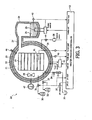
- FIG. 3 describes another apparatus 20 according to the invention.
- the treatment space 21 is confined by a thermally isolated outer reactor wall 22, and a thermally conducting inner reactor wall 23 which is filled with a thermally conductive oil.
- the treatment space 21 connects to a water container 24 containing water 25 that is heated by heating means 26 in order to generate steam, which is led to the treatment chamber 21 through a steam channel 27.
- the amount of water should be sufficient for achieving the desired steam pressure in the reactor chamber 21, taking into account the additional water consumed by hydrolysis reactions and the amount of water adsorbed by the wood..
- the container is sufficiently large to store the initial amount of water plus the amount released by condensation reactions, dehydration reactions and drying.
- the reactor chamber 21 is provided with a mechanical stirrer 28 used to homogenize the generated steam and volatile reaction products, leading to a homogenous exposure of the treated wood parts 29.
- the wood parts 29 are preferably spaced apart, preferably having mutual distances of 8-15 mm, allowing for an even more homogenous treatment. If wood parts 29 are packed closely together, inner parts in a pile of wood parts 29 are less exposed than outer parts, leading to different treatment of the parts.
- the reactor space 21 and the water container 24 form a closed system, in order to optimise the use of water.
- the system is provided with a safety pressure valve.
- the water container can be used as a cold spot, wherein the water container 24 has a temperature lower than the reactor space 21, in order to ensure that water condenses in the water container and not in the reactor space 21 where it could possibly condense on the wood 29.
- the reactor space 21 is provided with at least one standard safety pressure release valve, set at a pressure below the maximum pressure the reactor walls 22,23 can withstand. Under operating conditions according to the invention, the pressure typically ranges from vacuum to a maximum of approximately 12 bar, hence the safety pressure release valve could for instance be set at 14 bar.
- the pressure inside the reactor space 21 can be monitored by a standard pressure meter 47 covering the operating range.
- the reactor space 21 also connects to a first pressurized cylinder 30 comprising carbon dioxide (CO 2 ), which is connected through an first automated dispensing valve 31. Carbon dioxide may be used to lower the pH in the reactor as carbon dioxide acidifies steam.
- the apparatus 20 also comprises a second pressurized cylinder 32 of ammonia (NH 3 ) also connected to a second automated dispensing valve 33. Having the possibility to add predetermined amounts of acid or base may be used to maintain the pH at a predetermined value during the treatment according to the invention.
- the pH is monitored by taking samples of the steam in the reactor space 21 by temporarily opening a sample valve 34, condensing the sampled steam in a condensator 35, and collecting the condensed steam 36 for pH measurement using regular electrochemical pH measurement equipment 37.
- the reactor chamber is also provided with a vacuum pump system 38 for evacuating the reactor chamber, in particular for removing oxygen gas.
- the vacuum system 38 optionally includes a pressure meter for monitoring pressure within the chamber. Instead of the optional pressure meter, it is also possible to rely on temperature and pH measurements only.
- the apparatus 20 is provided with heating means 45 for heating the reactor chamber 21, and a temperature measurement units (40, 41, 42) for the inner reactor wall 23 (unit 40), the wood 29 (unit 41) and the water 25 of the steam generator 24 (unit 42).
- a central control unit 43 monitors the temperature of the wood 41, the temperature of the inner reactor wall 23, the temperature of the steam water 25, the pressure within the reactor space 21, and the pH within the reactor space. The control unit 43 will then, following the preset program or manual control, adjust these parameters. For instance, pressure can be increased by turning up the heater 26 of the steam generator, leading to increased steam evaporation, or lowered by lowering the temperature, water evaporation and/or opening the vacuum valve 44 of the vacuum system 38.
- the vacuum valve 44 is a three-way valve, that can also be used to depressurise the reaction vessel 21, or to let air or an inert gas such as nitrogen into the reactor space 21 in order to remove vacuum.
- the temperature in the chamber 21 can be adjusted by the wall heater unit 45. pH can be lowered by adding carbon dioxide 30, or increased by adding ammonia 32.
Landscapes
- Life Sciences & Earth Sciences (AREA)
- Engineering & Computer Science (AREA)
- Wood Science & Technology (AREA)
- Chemical & Material Sciences (AREA)
- Forests & Forestry (AREA)
- Thermal Sciences (AREA)
- Physics & Mathematics (AREA)
- Materials Engineering (AREA)
- Health & Medical Sciences (AREA)
- Chemical Kinetics & Catalysis (AREA)
- Medicinal Chemistry (AREA)
- Polymers & Plastics (AREA)
- Organic Chemistry (AREA)
- Chemical And Physical Treatments For Wood And The Like (AREA)
Claims (15)
- Verfahren zum Konservieren von Holz, umfassend die Verarbeitungsschritte:A) Anordnen von Holz zum Behandeln in einem Behandlungsraum;B) Entfernen von Luft, insbesondere Sauerstoff, aus dem Behandlungsraum;C) Zuführen von Dampf in den Behandlungsraum, wobei gleichzeitig die Temperatur des Holzes erhöht wird, wobei die Temperatur von einer Temperatur von 70 Grad Celsius mit einem Temperaturgradienten von höchstens 60 Grad Celsius pro Stunde, höchst bevorzugt zwischen 30 und 50 Grad Celsius pro Stunde, auf eine Temperatur von wenigstens 150 Grad Celsius erhöht wird; wobei das Holz während einer Reaktionszeit von wenigstens 10 Minuten bei einer Temperatur von über 150 Grad Celsius gewärmt wird;D) Polymerisieren von bei Schritt C) thermisch aktivierten Holzbestandteilen durch Entfernen von Feuchte aus dem Holz bis zu einem Feuchtegehalt von weniger als 5 % bei einer Temperatur von wenigstens 130 Grad Celsius undE) Abkühlen des Holzes, wobei der Feuchtegehalt des Holzes in dem Temperaturverlauf unter 140 Grad gleichzeitig auf wenigstens 7 Gew.-% erhöht wird, vorzugsweise zwischen 7 und 8 Gew.-%.
- Verfahren gemäß Anspruch 1, dadurch gekennzeichnet, dass zwischen den Schritten C und D ein Schritt F durchgeführt wird: Komprimieren des erhitzten Holzes.
- Verfahren gemäß einem der vorstehenden Ansprüche, dadurch gekennzeichnet, dass der Dampf während Schritt C) einen maximalen Sättigungsgrad von 95 % aufweist.
- Verfahren gemäß einem der vorstehenden Ansprüche, dadurch gekennzeichnet, dass bei Schritt B) wenigstens ein Teil des Sauerstoffs entfernt wird, indem der Behandlungsraum unter verringerten Druck gesetzt wird.
- Verfahren gemäß Anspruch 4, dadurch gekennzeichnet, dass der verringerte Druck niedriger als 13 kPa ist.
- Verfahren gemäß einem der vorstehenden Ansprüche, dadurch gekennzeichnet, dass der pH-Wert des Dampfs wenigstens während Schritt C durch Zugeben einer Base und/oder einer Säure auf einen Wert zwischen 3,0 und 6,0 eingestellt wird.
- Verfahren gemäß Anspruch 6, dadurch gekennzeichnet, dass der pH-Wert auf einen pH-Wert zwischen 4,2 und 4,7 erhöht wird.
- Verfahren gemäß Anspruch 6 oder 7, dadurch gekennzeichnet, dass die zugegebene Base Ammoniak umfasst.
- Verfahren gemäß Anspruch 6, 7 oder 8, dadurch gekennzeichnet, dass die zugegebene Säure Kohlendioxid ist.
- Verfahren gemäß einem der Ansprüche 6-9, dadurch gekennzeichnet, dass während Schritt C der pH-Wert überwacht und durch Zugeben einer Base und/oder einer Säure bei einem Wert zwischen 3,0 und 6,0, vorzugsweise zwischen 4,2 und 4,7, gehalten wird.
- Verfahren gemäß einem der vorstehenden Ansprüche, dadurch gekennzeichnet, dass die Reaktionstemperatur bei Schritt C zwischen 160 und 190 Grad Celsius beträgt.
- Verfahren gemäß einem der vorstehenden Ansprüche, dadurch gekennzeichnet, dass das Holz während Schritt C für zwischen 10 und 60 Minuten eine Temperatur von höher als 150 Grad Celsius aufweist.
- Verfahren gemäß einem der vorstehenden Ansprüche, dadurch gekennzeichnet, dass während Schritt C der Dampf einen Druck von wenigstens 4 bar aufweist.
- Konserviertes Holz, erhältlich gemäß der Verfahren gemäß einem der vorstehenden Ansprüche.
- Vorrichtung, programmiert zum Durchführen des Verfahrens gemäß einem der vorstehenden Ansprüche, umfassend- einen Behandlungsraum, der auf Medium-dichte Weise abdichtbar ist,- eine mit dem Behandlungsraum verbundene Unterdruckpumpe,- eine mit dem Behandlungsraum verbundene Dampfquelle,- eine Heizvorrichtung, die in thermischem Kontakt mit dem Behandlungsraum steht,- Ausgabemittel zum Zugeben vorbestimmter Mengen einer Base und/oder einer Säure zu dem Behandlungsraum,- pH-Messmittel zum Bestimmen des pH-Werts des Dampfs in dem Behandlungsraum und- Mess- und Steuerungsvorrichtungen, ausgelegt zum Überwachen von wenigstens pH-Wert, Temperatur und Druck im Inneren des Behandlungsraums und zum Steuern der Unterdruckpumpe, der Dampfquelle und der Wärmequelle, und des pH-Werts durch Ausgeben einer Base und/oder einer Säure.
Applications Claiming Priority (2)
| Application Number | Priority Date | Filing Date | Title |
|---|---|---|---|
| NL2000405A NL2000405C2 (nl) | 2006-12-22 | 2006-12-22 | Werkwijze voor het verduurzamen van hout, houtproduct en inrichting daarvoor. |
| PCT/NL2007/050678 WO2008079000A1 (en) | 2006-12-22 | 2007-12-20 | Method and apparatus for preserving wood, and wood product |
Publications (2)
| Publication Number | Publication Date |
|---|---|
| EP2125309A1 EP2125309A1 (de) | 2009-12-02 |
| EP2125309B1 true EP2125309B1 (de) | 2015-11-18 |
Family
ID=38229973
Family Applications (1)
| Application Number | Title | Priority Date | Filing Date |
|---|---|---|---|
| EP07851938.6A Active EP2125309B1 (de) | 2006-12-22 | 2007-12-20 | Verfahren und vorrichtung zum konservieren von holz und holzprodukt |
Country Status (7)
| Country | Link |
|---|---|
| US (1) | US8465845B2 (de) |
| EP (1) | EP2125309B1 (de) |
| JP (1) | JP2010513085A (de) |
| CA (1) | CA2672599C (de) |
| DK (1) | DK2125309T3 (de) |
| NL (1) | NL2000405C2 (de) |
| WO (1) | WO2008079000A1 (de) |
Families Citing this family (11)
| Publication number | Priority date | Publication date | Assignee | Title |
|---|---|---|---|---|
| US20080256823A1 (en) * | 2004-09-27 | 2008-10-23 | Andrew Karl Knorr | Timber Processing |
| WO2008118036A1 (en) * | 2007-03-28 | 2008-10-02 | Igor Aleksandrovich Danchenko | Method for wood heat treatment and a device for carrying out said method |
| JP4626713B2 (ja) * | 2008-10-20 | 2011-02-09 | 株式会社高瀬文夫商店 | 木製食品容器の脱臭・脱色の処理方法 |
| US20110259761A1 (en) * | 2010-04-23 | 2011-10-27 | Mcguire Dennis | Precipitation of hardness salt in flow back and produced water |
| ITRM20110314A1 (it) * | 2011-06-16 | 2012-12-17 | Dott Ing Ernesto Pagnozzi | Procedimento per la modificazione termica di legname ad alta temperatura all interno di un autoclave a vuoto d ora in avanti per brevita denominato termovuoto |
| US20130233340A1 (en) * | 2012-03-07 | 2013-09-12 | Paul Sapan | Flavored Function Specific Toothpicks |
| CN105583925B (zh) * | 2014-10-22 | 2017-10-27 | 贾超 | 双层罐体木材改性装置 |
| DK179238B1 (en) * | 2016-07-15 | 2018-02-26 | Wtt Holding Aps | A thermo treatment process for wood |
| CN108098956B (zh) * | 2017-12-18 | 2021-01-05 | 北川羌族自治县和谐旅游开发有限公司 | 一种棕榈叶的处理方法 |
| CN113843869A (zh) * | 2021-10-21 | 2021-12-28 | 西南林业大学 | 一种导电木材气凝胶制备方法及其应用 |
| WO2024002448A1 (en) * | 2022-06-29 | 2024-01-04 | Alpha Holding Brande Aps | Elevated pressure hybrid wood modification |
Family Cites Families (11)
| Publication number | Priority date | Publication date | Assignee | Title |
|---|---|---|---|---|
| BE795890Q (fr) * | 1969-05-12 | 1973-06-18 | Inst Khim | Procédé de compactage et de séchage du bois entier et dispositif pour la mise en oeuvre dudit procédé. |
| JPS5818205B2 (ja) * | 1980-03-26 | 1983-04-12 | 宮城県 | 木材を埋木状に加工する方法 |
| DE69400417T2 (de) * | 1993-04-29 | 1997-02-13 | Shell Int Research | Verfahren zur Verbesserung von Holz niedriger Qualität |
| ES2154676T3 (es) * | 1993-05-12 | 2001-04-16 | Valtion Teknillinen | Procedimiento para el aumento de la resistencia de productos celulosicos contra hongos y putrefaccion. |
| JP3892531B2 (ja) * | 1997-06-19 | 2007-03-14 | 永大産業株式会社 | 木質材の寸法安定化方法 |
| FR2770441B1 (fr) * | 1997-10-30 | 2000-02-11 | Bernard Dedieu | Procede de sechage des bois de sciage et dispositif permettant la mise en oeuvre du procede |
| EP0936038A2 (de) * | 1998-02-10 | 1999-08-18 | Nisshinbo Industries, Inc. | Verfahren zur Herstellung von Holzformkörpern |
| JP3992441B2 (ja) * | 2001-02-02 | 2007-10-17 | 独立行政法人科学技術振興機構 | 圧縮木材の製造方法 |
| US20020178608A1 (en) * | 2001-05-04 | 2002-12-05 | Aleksandrs Leonovs | Method and apparatus for the production of lumber identical to natural Bog oak |
| JP3656963B2 (ja) * | 2003-01-17 | 2005-06-08 | 三重県 | 木質解繊物およびその製造方法、ならびに微生物資材 |
| US7404422B2 (en) * | 2003-02-05 | 2008-07-29 | Eagle Analytical Company, Inc. | Viscoelastic thermal compression of wood |
-
2006
- 2006-12-22 NL NL2000405A patent/NL2000405C2/nl not_active IP Right Cessation
-
2007
- 2007-12-20 US US12/520,770 patent/US8465845B2/en active Active
- 2007-12-20 DK DK07851938.6T patent/DK2125309T3/en active
- 2007-12-20 WO PCT/NL2007/050678 patent/WO2008079000A1/en not_active Ceased
- 2007-12-20 EP EP07851938.6A patent/EP2125309B1/de active Active
- 2007-12-20 CA CA2672599A patent/CA2672599C/en active Active
- 2007-12-20 JP JP2009542677A patent/JP2010513085A/ja active Pending
Also Published As
| Publication number | Publication date |
|---|---|
| EP2125309A1 (de) | 2009-12-02 |
| WO2008079000A1 (en) | 2008-07-03 |
| NL2000405C2 (nl) | 2008-06-24 |
| CA2672599C (en) | 2016-10-04 |
| US20100143739A1 (en) | 2010-06-10 |
| US8465845B2 (en) | 2013-06-18 |
| DK2125309T3 (en) | 2016-02-22 |
| JP2010513085A (ja) | 2010-04-30 |
| CA2672599A1 (en) | 2008-07-03 |
Similar Documents
| Publication | Publication Date | Title |
|---|---|---|
| EP2125309B1 (de) | Verfahren und vorrichtung zum konservieren von holz und holzprodukt | |
| US9156185B2 (en) | Apparatus and operating systems for manufacturing impregnated wood | |
| Altgen et al. | Wood degradation affected by process conditions during thermal modification of European beech in a high-pressure reactor system | |
| EP0695408B1 (de) | Verfahren zur verbesserung des widerstandes von zellulosehaltigen produkten gegen schimmel und fäulnis | |
| Ferrari et al. | Thermo-vacuum Modification of some European Softwood and Hardwood Species Treated at Different Conditions. | |
| JP5060791B2 (ja) | 木材の乾燥方法、木材への薬剤浸透方法及び乾燥装置 | |
| RU2360791C2 (ru) | Способ импрегнирования древесины или материала на древесной основе | |
| US6217939B1 (en) | Wood treatment process | |
| BR112017000829B1 (pt) | Processo para a acetilação de madeira | |
| JP5965670B2 (ja) | 熱処理木材の製造方法 | |
| RU2425305C1 (ru) | Способ сушки и термической обработки древесины | |
| US12220836B2 (en) | Modified wood product and a process for producing said product | |
| KR102322516B1 (ko) | 고강도 목재 제조를 위한 목재 건조 및 고열처리 방법 | |
| KR20110012754A (ko) | 탄화 및 수지경화 목재 제조방법 | |
| JP2008106959A (ja) | 木材乾燥装置及び木材乾燥方法 | |
| US20180111286A1 (en) | Process of Improving the Dimensional Stability of Wood and Dimensional Stabile Wood Thereof | |
| FI118139B (fi) | Menetelmä massiivipuuta käsittävän puukappaleen käsittelemiseksi | |
| GB2178149A (en) | Method and apparatus for drying timber | |
| JP2022500280A (ja) | 改質木製品 | |
| WO2021025562A1 (en) | Method for modifying wood and products thereof | |
| WO2021025563A1 (en) | Method for modifying wood and products thereof | |
| Sanya et al. | A new method for drying waterlogged wooden artefacts: Comparison of cyclical pressure drops with conventional methods | |
| Zlateski et al. | COMPARATIVE INVESTIGATION OF CONVECTIVE AND VACUUM DRYING OF BEECH WOOD | |
| RU2520272C1 (ru) | Способ сушки и термовлажностной обработки крупномерной древесины | |
| RU2637288C1 (ru) | Способ импульсной сушки |
Legal Events
| Date | Code | Title | Description |
|---|---|---|---|
| PUAI | Public reference made under article 153(3) epc to a published international application that has entered the european phase |
Free format text: ORIGINAL CODE: 0009012 |
|
| 17P | Request for examination filed |
Effective date: 20090722 |
|
| AK | Designated contracting states |
Kind code of ref document: A1 Designated state(s): AT BE BG CH CY CZ DE DK EE ES FI FR GB GR HU IE IS IT LI LT LU LV MC MT NL PL PT RO SE SI SK TR |
|
| DAX | Request for extension of the european patent (deleted) | ||
| 17Q | First examination report despatched |
Effective date: 20100713 |
|
| GRAP | Despatch of communication of intention to grant a patent |
Free format text: ORIGINAL CODE: EPIDOSNIGR1 |
|
| INTG | Intention to grant announced |
Effective date: 20150612 |
|
| GRAS | Grant fee paid |
Free format text: ORIGINAL CODE: EPIDOSNIGR3 |
|
| GRAA | (expected) grant |
Free format text: ORIGINAL CODE: 0009210 |
|
| AK | Designated contracting states |
Kind code of ref document: B1 Designated state(s): AT BE BG CH CY CZ DE DK EE ES FI FR GB GR HU IE IS IT LI LT LU LV MC MT NL PL PT RO SE SI SK TR |
|
| REG | Reference to a national code |
Ref country code: GB Ref legal event code: FG4D |
|
| REG | Reference to a national code |
Ref country code: CH Ref legal event code: EP |
|
| REG | Reference to a national code |
Ref country code: AT Ref legal event code: REF Ref document number: 761295 Country of ref document: AT Kind code of ref document: T Effective date: 20151215 |
|
| REG | Reference to a national code |
Ref country code: IE Ref legal event code: FG4D |
|
| REG | Reference to a national code |
Ref country code: DE Ref legal event code: R096 Ref document number: 602007044023 Country of ref document: DE |
|
| REG | Reference to a national code |
Ref country code: FR Ref legal event code: PLFP Year of fee payment: 9 |
|
| REG | Reference to a national code |
Ref country code: DK Ref legal event code: T3 Effective date: 20160216 |
|
| REG | Reference to a national code |
Ref country code: SE Ref legal event code: TRGR |
|
| REG | Reference to a national code |
Ref country code: LT Ref legal event code: MG4D |
|
| REG | Reference to a national code |
Ref country code: NL Ref legal event code: FP |
|
| PG25 | Lapsed in a contracting state [announced via postgrant information from national office to epo] |
Ref country code: IS Free format text: LAPSE BECAUSE OF FAILURE TO SUBMIT A TRANSLATION OF THE DESCRIPTION OR TO PAY THE FEE WITHIN THE PRESCRIBED TIME-LIMIT Effective date: 20160318 Ref country code: LT Free format text: LAPSE BECAUSE OF FAILURE TO SUBMIT A TRANSLATION OF THE DESCRIPTION OR TO PAY THE FEE WITHIN THE PRESCRIBED TIME-LIMIT Effective date: 20151118 Ref country code: ES Free format text: LAPSE BECAUSE OF FAILURE TO SUBMIT A TRANSLATION OF THE DESCRIPTION OR TO PAY THE FEE WITHIN THE PRESCRIBED TIME-LIMIT Effective date: 20151118 Ref country code: IT Free format text: LAPSE BECAUSE OF FAILURE TO SUBMIT A TRANSLATION OF THE DESCRIPTION OR TO PAY THE FEE WITHIN THE PRESCRIBED TIME-LIMIT Effective date: 20151118 |
|
| PG25 | Lapsed in a contracting state [announced via postgrant information from national office to epo] |
Ref country code: GR Free format text: LAPSE BECAUSE OF FAILURE TO SUBMIT A TRANSLATION OF THE DESCRIPTION OR TO PAY THE FEE WITHIN THE PRESCRIBED TIME-LIMIT Effective date: 20160219 Ref country code: PL Free format text: LAPSE BECAUSE OF FAILURE TO SUBMIT A TRANSLATION OF THE DESCRIPTION OR TO PAY THE FEE WITHIN THE PRESCRIBED TIME-LIMIT Effective date: 20151118 Ref country code: LV Free format text: LAPSE BECAUSE OF FAILURE TO SUBMIT A TRANSLATION OF THE DESCRIPTION OR TO PAY THE FEE WITHIN THE PRESCRIBED TIME-LIMIT Effective date: 20151118 Ref country code: PT Free format text: LAPSE BECAUSE OF FAILURE TO SUBMIT A TRANSLATION OF THE DESCRIPTION OR TO PAY THE FEE WITHIN THE PRESCRIBED TIME-LIMIT Effective date: 20160318 |
|
| PG25 | Lapsed in a contracting state [announced via postgrant information from national office to epo] |
Ref country code: CZ Free format text: LAPSE BECAUSE OF FAILURE TO SUBMIT A TRANSLATION OF THE DESCRIPTION OR TO PAY THE FEE WITHIN THE PRESCRIBED TIME-LIMIT Effective date: 20151118 |
|
| REG | Reference to a national code |
Ref country code: CH Ref legal event code: PL |
|
| REG | Reference to a national code |
Ref country code: DE Ref legal event code: R097 Ref document number: 602007044023 Country of ref document: DE |
|
| PG25 | Lapsed in a contracting state [announced via postgrant information from national office to epo] |
Ref country code: SK Free format text: LAPSE BECAUSE OF FAILURE TO SUBMIT A TRANSLATION OF THE DESCRIPTION OR TO PAY THE FEE WITHIN THE PRESCRIBED TIME-LIMIT Effective date: 20151118 Ref country code: EE Free format text: LAPSE BECAUSE OF FAILURE TO SUBMIT A TRANSLATION OF THE DESCRIPTION OR TO PAY THE FEE WITHIN THE PRESCRIBED TIME-LIMIT Effective date: 20151118 Ref country code: RO Free format text: LAPSE BECAUSE OF FAILURE TO SUBMIT A TRANSLATION OF THE DESCRIPTION OR TO PAY THE FEE WITHIN THE PRESCRIBED TIME-LIMIT Effective date: 20151118 |
|
| REG | Reference to a national code |
Ref country code: IE Ref legal event code: MM4A |
|
| PLBE | No opposition filed within time limit |
Free format text: ORIGINAL CODE: 0009261 |
|
| STAA | Information on the status of an ep patent application or granted ep patent |
Free format text: STATUS: NO OPPOSITION FILED WITHIN TIME LIMIT |
|
| PG25 | Lapsed in a contracting state [announced via postgrant information from national office to epo] |
Ref country code: MC Free format text: LAPSE BECAUSE OF FAILURE TO SUBMIT A TRANSLATION OF THE DESCRIPTION OR TO PAY THE FEE WITHIN THE PRESCRIBED TIME-LIMIT Effective date: 20151118 |
|
| 26N | No opposition filed |
Effective date: 20160819 |
|
| PG25 | Lapsed in a contracting state [announced via postgrant information from national office to epo] |
Ref country code: LI Free format text: LAPSE BECAUSE OF NON-PAYMENT OF DUE FEES Effective date: 20151231 Ref country code: CH Free format text: LAPSE BECAUSE OF NON-PAYMENT OF DUE FEES Effective date: 20151231 Ref country code: IE Free format text: LAPSE BECAUSE OF NON-PAYMENT OF DUE FEES Effective date: 20151220 |
|
| PG25 | Lapsed in a contracting state [announced via postgrant information from national office to epo] |
Ref country code: SI Free format text: LAPSE BECAUSE OF FAILURE TO SUBMIT A TRANSLATION OF THE DESCRIPTION OR TO PAY THE FEE WITHIN THE PRESCRIBED TIME-LIMIT Effective date: 20151118 |
|
| REG | Reference to a national code |
Ref country code: FR Ref legal event code: PLFP Year of fee payment: 10 |
|
| PG25 | Lapsed in a contracting state [announced via postgrant information from national office to epo] |
Ref country code: BG Free format text: LAPSE BECAUSE OF FAILURE TO SUBMIT A TRANSLATION OF THE DESCRIPTION OR TO PAY THE FEE WITHIN THE PRESCRIBED TIME-LIMIT Effective date: 20151118 Ref country code: HU Free format text: LAPSE BECAUSE OF FAILURE TO SUBMIT A TRANSLATION OF THE DESCRIPTION OR TO PAY THE FEE WITHIN THE PRESCRIBED TIME-LIMIT; INVALID AB INITIO Effective date: 20071220 |
|
| PG25 | Lapsed in a contracting state [announced via postgrant information from national office to epo] |
Ref country code: CY Free format text: LAPSE BECAUSE OF FAILURE TO SUBMIT A TRANSLATION OF THE DESCRIPTION OR TO PAY THE FEE WITHIN THE PRESCRIBED TIME-LIMIT Effective date: 20151118 |
|
| PG25 | Lapsed in a contracting state [announced via postgrant information from national office to epo] |
Ref country code: MT Free format text: LAPSE BECAUSE OF FAILURE TO SUBMIT A TRANSLATION OF THE DESCRIPTION OR TO PAY THE FEE WITHIN THE PRESCRIBED TIME-LIMIT Effective date: 20151118 Ref country code: TR Free format text: LAPSE BECAUSE OF FAILURE TO SUBMIT A TRANSLATION OF THE DESCRIPTION OR TO PAY THE FEE WITHIN THE PRESCRIBED TIME-LIMIT Effective date: 20151118 |
|
| PG25 | Lapsed in a contracting state [announced via postgrant information from national office to epo] |
Ref country code: LU Free format text: LAPSE BECAUSE OF NON-PAYMENT OF DUE FEES Effective date: 20151220 |
|
| REG | Reference to a national code |
Ref country code: FR Ref legal event code: PLFP Year of fee payment: 11 |
|
| REG | Reference to a national code |
Ref country code: DE Ref legal event code: R082 Ref document number: 602007044023 Country of ref document: DE Representative=s name: LAUB, ALEXANDER, DIPL.-PHYS. DR.RER.NAT., DE |
|
| REG | Reference to a national code |
Ref country code: AT Ref legal event code: UEP Ref document number: 761295 Country of ref document: AT Kind code of ref document: T Effective date: 20151118 |
|
| REG | Reference to a national code |
Ref country code: DE Ref legal event code: R082 Ref document number: 602007044023 Country of ref document: DE Representative=s name: LAUB, ALEXANDER, DIPL.-PHYS. DR.RER.NAT., DE |
|
| PGFP | Annual fee paid to national office [announced via postgrant information from national office to epo] |
Ref country code: GB Payment date: 20251229 Year of fee payment: 19 |
|
| PGFP | Annual fee paid to national office [announced via postgrant information from national office to epo] |
Ref country code: AT Payment date: 20251230 Year of fee payment: 19 |
|
| PGFP | Annual fee paid to national office [announced via postgrant information from national office to epo] |
Ref country code: FI Payment date: 20251226 Year of fee payment: 19 Ref country code: DK Payment date: 20251226 Year of fee payment: 19 |
|
| PGFP | Annual fee paid to national office [announced via postgrant information from national office to epo] |
Ref country code: NL Payment date: 20251226 Year of fee payment: 19 Ref country code: FR Payment date: 20251226 Year of fee payment: 19 |
|
| PGFP | Annual fee paid to national office [announced via postgrant information from national office to epo] |
Ref country code: BE Payment date: 20251229 Year of fee payment: 19 |
|
| PGFP | Annual fee paid to national office [announced via postgrant information from national office to epo] |
Ref country code: SE Payment date: 20251227 Year of fee payment: 19 |
|
| PGFP | Annual fee paid to national office [announced via postgrant information from national office to epo] |
Ref country code: DE Payment date: 20251229 Year of fee payment: 19 |